US10121973B2 - Compound for organic optoelectronic device, organic light-emitting diode including same, and display device including organic light-emitting diode - Google Patents
Compound for organic optoelectronic device, organic light-emitting diode including same, and display device including organic light-emitting diode Download PDFInfo
- Publication number
- US10121973B2 US10121973B2 US15/704,102 US201715704102A US10121973B2 US 10121973 B2 US10121973 B2 US 10121973B2 US 201715704102 A US201715704102 A US 201715704102A US 10121973 B2 US10121973 B2 US 10121973B2
- Authority
- US
- United States
- Prior art keywords
- substituted
- unsubstituted
- group
- compound
- organic
- Prior art date
- Legal status (The legal status is an assumption and is not a legal conclusion. Google has not performed a legal analysis and makes no representation as to the accuracy of the status listed.)
- Active
Links
- 0 *1=*C2=C(*=*1)C1(C3=C2C=CC=C3)C2=C(C=CC=C2)C2=C1/C=C\C=C/2.CCC1=C(C)C=CC=C1.CCN(C)C.CCN(C)C.[1*]C.[2*]C.[3*]C.[4*]C.[5*]C.[6*]C.[7*]C Chemical compound *1=*C2=C(*=*1)C1(C3=C2C=CC=C3)C2=C(C=CC=C2)C2=C1/C=C\C=C/2.CCC1=C(C)C=CC=C1.CCN(C)C.CCN(C)C.[1*]C.[2*]C.[3*]C.[4*]C.[5*]C.[6*]C.[7*]C 0.000 description 14
- ZSTFXTDADPPPES-UHFFFAOYSA-N C1=CSC(N(C2=CC3=C(C=C2)C2=C(C=C(N(C4=CC=CS4)C4=C5C=CC=CC5=CC=C4)C=C2)C32C3=C(C=CC=C3)C3=C2C=CC2=C3SC3=C2C=CC=C3)C2=CC=CC3=C2C=CC=C3)=C1 Chemical compound C1=CSC(N(C2=CC3=C(C=C2)C2=C(C=C(N(C4=CC=CS4)C4=C5C=CC=CC5=CC=C4)C=C2)C32C3=C(C=CC=C3)C3=C2C=CC2=C3SC3=C2C=CC=C3)C2=CC=CC3=C2C=CC=C3)=C1 ZSTFXTDADPPPES-UHFFFAOYSA-N 0.000 description 5
- KVCREJNIGKKHQI-UHFFFAOYSA-N C1=CC2=C(C=C1)C(N(C1=CC3=C(C=C1)C1=C(C=CC=C1)C31C3=C(C=CC=C3)C3=C1/C=C\C1=C\3OC3=C1C=CC=C3)C1=CC=CC3=C1C=CC=C3)=CC=C2.C1=CC2=CC=C(N(C3=CC4=C(C=C3)C3=C(C=CC=C3)C43C4=C(C=CC=C4)C4=C3/C=C\C3=C\4OC4=C3C=CC=C4)C3=C4C=CC=CC4=CC=C3)C=C2C=C1.C1=CC2=CC=C(N(C3=CC=C4C=CC=CC4=C3)C3=CC4=C(C=C3)C3=C(C=CC=C3)C43C4=C(C=CC=C4)C4=C3/C=C\C3=C\4OC4=C3C=CC=C4)C=C2C=C1.C1=CC=C(N(C2=CC3=C(C=C2)C2=C(C=CC=C2)C32C3=C(C=CC=C3)C3=C2/C=C\C2=C\3OC3=C2C=CC=C3)C2=CC=CC3=C2C=CC=C3)C=C1 Chemical compound C1=CC2=C(C=C1)C(N(C1=CC3=C(C=C1)C1=C(C=CC=C1)C31C3=C(C=CC=C3)C3=C1/C=C\C1=C\3OC3=C1C=CC=C3)C1=CC=CC3=C1C=CC=C3)=CC=C2.C1=CC2=CC=C(N(C3=CC4=C(C=C3)C3=C(C=CC=C3)C43C4=C(C=CC=C4)C4=C3/C=C\C3=C\4OC4=C3C=CC=C4)C3=C4C=CC=CC4=CC=C3)C=C2C=C1.C1=CC2=CC=C(N(C3=CC=C4C=CC=CC4=C3)C3=CC4=C(C=C3)C3=C(C=CC=C3)C43C4=C(C=CC=C4)C4=C3/C=C\C3=C\4OC4=C3C=CC=C4)C=C2C=C1.C1=CC=C(N(C2=CC3=C(C=C2)C2=C(C=CC=C2)C32C3=C(C=CC=C3)C3=C2/C=C\C2=C\3OC3=C2C=CC=C3)C2=CC=CC3=C2C=CC=C3)C=C1 KVCREJNIGKKHQI-UHFFFAOYSA-N 0.000 description 3
- RFHXCBFNOVZNJD-UHFFFAOYSA-N C1=CC2=C(C=C1)C(N(C1=CC3=C(C=C1)C1=C(C=CC=C1)C31C3=C(C=CC=C3)C3=C1/C=C\C1=C\3SC3=C1C=CC=C3)C1=CC=CC3=C1C=CC=C3)=CC=C2.C1=CC2=CC=C(N(C3=CC4=C(C=C3)C3=C(C=CC=C3)C43C4=C(C=CC=C4)C4=C3/C=C\C3=C\4SC4=C3C=CC=C4)C3=C4C=CC=CC4=CC=C3)C=C2C=C1.C1=CC2=CC=C(N(C3=CC=C4C=CC=CC4=C3)C3=CC4=C(C=C3)C3=C(C=CC=C3)C43C4=C(C=CC=C4)C4=C3/C=C\C3=C\4SC4=C3C=CC=C4)C=C2C=C1.C1=CC=C(N(C2=CC3=C(C=C2)C2=C(C=CC=C2)C32C3=C(C=CC=C3)C3=C2/C=C\C2=C\3SC3=C2C=CC=C3)C2=CC=CC3=C2C=CC=C3)C=C1 Chemical compound C1=CC2=C(C=C1)C(N(C1=CC3=C(C=C1)C1=C(C=CC=C1)C31C3=C(C=CC=C3)C3=C1/C=C\C1=C\3SC3=C1C=CC=C3)C1=CC=CC3=C1C=CC=C3)=CC=C2.C1=CC2=CC=C(N(C3=CC4=C(C=C3)C3=C(C=CC=C3)C43C4=C(C=CC=C4)C4=C3/C=C\C3=C\4SC4=C3C=CC=C4)C3=C4C=CC=CC4=CC=C3)C=C2C=C1.C1=CC2=CC=C(N(C3=CC=C4C=CC=CC4=C3)C3=CC4=C(C=C3)C3=C(C=CC=C3)C43C4=C(C=CC=C4)C4=C3/C=C\C3=C\4SC4=C3C=CC=C4)C=C2C=C1.C1=CC=C(N(C2=CC3=C(C=C2)C2=C(C=CC=C2)C32C3=C(C=CC=C3)C3=C2/C=C\C2=C\3SC3=C2C=CC=C3)C2=CC=CC3=C2C=CC=C3)C=C1 RFHXCBFNOVZNJD-UHFFFAOYSA-N 0.000 description 3
- GOAIRNWKFTYFKE-UHFFFAOYSA-N C1=CC2=CC=C(N(C3=CC4=C(C=C3)C3=C(C=C(N(C5=CC=C6C=CC=CC6=C5)C5=C6C=CC=CC6=CC=C5)C=C3)C43C4=C(C=CC=C4)C4=C3C=CC3=C4OC4=C3C=CC=C4)C3=C4C=CC=CC4=CC=C3)C=C2C=C1.C1=CC=C(C2=CC(N(C3=CC=CC=C3)C3=CC4=C(C=C3)C3=C(C=C(N(C5=CC=CC=C5)C5=CC=CC(C6=CC=CC=C6)=C5)C=C3)C43C4=C(C=CC=C4)C4=C3C=CC3=C4OC4=C3C=CC=C4)=CC=C2)C=C1.C1=CC=C(C2=CC=C(N(C3=CC=CC(C4=CC=CC=C4)=C3)C3=CC4=C(C=C3)C3=C(C=C(N(C5=CC=C(C6=CC=CC=C6)C=C5)C5=CC(C6=CC=CC=C6)=CC=C5)C=C3)C43C4=C(C=CC=C4)C4=C3C=CC3=C4OC4=C3C=CC=C4)C=C2)C=C1 Chemical compound C1=CC2=CC=C(N(C3=CC4=C(C=C3)C3=C(C=C(N(C5=CC=C6C=CC=CC6=C5)C5=C6C=CC=CC6=CC=C5)C=C3)C43C4=C(C=CC=C4)C4=C3C=CC3=C4OC4=C3C=CC=C4)C3=C4C=CC=CC4=CC=C3)C=C2C=C1.C1=CC=C(C2=CC(N(C3=CC=CC=C3)C3=CC4=C(C=C3)C3=C(C=C(N(C5=CC=CC=C5)C5=CC=CC(C6=CC=CC=C6)=C5)C=C3)C43C4=C(C=CC=C4)C4=C3C=CC3=C4OC4=C3C=CC=C4)=CC=C2)C=C1.C1=CC=C(C2=CC=C(N(C3=CC=CC(C4=CC=CC=C4)=C3)C3=CC4=C(C=C3)C3=C(C=C(N(C5=CC=C(C6=CC=CC=C6)C=C5)C5=CC(C6=CC=CC=C6)=CC=C5)C=C3)C43C4=C(C=CC=C4)C4=C3C=CC3=C4OC4=C3C=CC=C4)C=C2)C=C1 GOAIRNWKFTYFKE-UHFFFAOYSA-N 0.000 description 3
- IYGCHILUPKOVFQ-UHFFFAOYSA-N C1=CC2=CC=C(N(C3=CC4=C(C=C3)C3=C(C=C(N(C5=CC=C6C=CC=CC6=C5)C5=C6C=CC=CC6=CC=C5)C=C3)C43C4=C(C=CC=C4)C4=C3C=CC3=C4SC4=C3C=CC=C4)C3=C4C=CC=CC4=CC=C3)C=C2C=C1.C1=CC2=CC=C(N(C3=CC=C4C=CC=CC4=C3)C3=CC4=C(C=C3)C3=C(C=C(N(C5=CC=C6C=CC=CC6=C5)C5=CC6=C(C=CC=C6)C=C5)C=C3)C43C4=C(C=CC=C4)C4=C3C=CC3=C4SC4=C3C=CC=C4)C=C2C=C1.C1=CC2=CC=CC(N(C3=CC4=C(C=C3)C3=C(C=C(N(C5=CC=CC6=C5C=CC=C6)C5=CC=CC6=C5C=CC=C6)C=C3)C43C4=C(C=CC=C4)C4=C3C=CC3=C4SC4=C3C=CC=C4)C3=C4C=CC=CC4=CC=C3)=C2C=C1 Chemical compound C1=CC2=CC=C(N(C3=CC4=C(C=C3)C3=C(C=C(N(C5=CC=C6C=CC=CC6=C5)C5=C6C=CC=CC6=CC=C5)C=C3)C43C4=C(C=CC=C4)C4=C3C=CC3=C4SC4=C3C=CC=C4)C3=C4C=CC=CC4=CC=C3)C=C2C=C1.C1=CC2=CC=C(N(C3=CC=C4C=CC=CC4=C3)C3=CC4=C(C=C3)C3=C(C=C(N(C5=CC=C6C=CC=CC6=C5)C5=CC6=C(C=CC=C6)C=C5)C=C3)C43C4=C(C=CC=C4)C4=C3C=CC3=C4SC4=C3C=CC=C4)C=C2C=C1.C1=CC2=CC=CC(N(C3=CC4=C(C=C3)C3=C(C=C(N(C5=CC=CC6=C5C=CC=C6)C5=CC=CC6=C5C=CC=C6)C=C3)C43C4=C(C=CC=C4)C4=C3C=CC3=C4SC4=C3C=CC=C4)C3=C4C=CC=CC4=CC=C3)=C2C=C1 IYGCHILUPKOVFQ-UHFFFAOYSA-N 0.000 description 3
- QRXAWYZRRQITCD-UHFFFAOYSA-N C1=CC2=CC=C(N(C3=CC=C4C=CC=CC4=C3)C3=CC4=C(C=C3)C3=C(C=C(N(C5=CC=C6C=CC=CC6=C5)C5=CC6=C(C=CC=C6)C=C5)C=C3)C43C4=C(C=CC=C4)C4=C3C=CC3=C4OC4=C3C=CC=C4)C=C2C=C1.C1=CC2=CC=CC(N(C3=CC4=C(C=C3)C3=C(C=C(N(C5=CC=CC6=C5C=CC=C6)C5=CC=CC6=C5C=CC=C6)C=C3)C43C4=C(C=CC=C4)C4=C3C=CC3=C4OC4=C3C=CC=C4)C3=C4C=CC=CC4=CC=C3)=C2C=C1.C1=CC=C(N(C2=CC3=C(C=C2)C2=C(C=C(N(C4=CC=CC=C4)C4=C5C=CC=CC5=CC=C4)C=C2)C32C3=C(C=CC=C3)C3=C2C=CC2=C3OC3=C2C=CC=C3)C2=CC=CC3=C2C=CC=C3)C=C1 Chemical compound C1=CC2=CC=C(N(C3=CC=C4C=CC=CC4=C3)C3=CC4=C(C=C3)C3=C(C=C(N(C5=CC=C6C=CC=CC6=C5)C5=CC6=C(C=CC=C6)C=C5)C=C3)C43C4=C(C=CC=C4)C4=C3C=CC3=C4OC4=C3C=CC=C4)C=C2C=C1.C1=CC2=CC=CC(N(C3=CC4=C(C=C3)C3=C(C=C(N(C5=CC=CC6=C5C=CC=C6)C5=CC=CC6=C5C=CC=C6)C=C3)C43C4=C(C=CC=C4)C4=C3C=CC3=C4OC4=C3C=CC=C4)C3=C4C=CC=CC4=CC=C3)=C2C=C1.C1=CC=C(N(C2=CC3=C(C=C2)C2=C(C=C(N(C4=CC=CC=C4)C4=C5C=CC=CC5=CC=C4)C=C2)C32C3=C(C=CC=C3)C3=C2C=CC2=C3OC3=C2C=CC=C3)C2=CC=CC3=C2C=CC=C3)C=C1 QRXAWYZRRQITCD-UHFFFAOYSA-N 0.000 description 3
- BUBKVYGIFMZBGM-UHFFFAOYSA-N C1=CC=C(C2=CC(N(C3=CC=CC=C3)C3=CC4=C(C=C3)C3=C(C=C(C5=CC=CC=C5)C=C3)C43C4=C(C=CC=C4)C4=C3/C=C\C3=C\4OC4=C3C=CC=C4)=CC=C2)C=C1.C1=CC=C(C2=CC3=C(C=C2)C2=C(C=C(N(C4=CC=CC=C4)C4=CC=CC=C4C4=CC=CC=C4)C=C2)C32C3=C(C=CC=C3)C3=C2/C=C\C2=C\3OC3=C2C=CC=C3)C=C1.C1=CC=C(C2=CC=C(N(C3=CC(C4=CC=CC=C4)=CC=C3)C3=CC4=C(C=C3)C3=C(C=C(C5=CC=CC=C5)C=C3)C43C4=C(C=CC=C4)C4=C3/C=C\C3=C\4OC4=C3C=CC=C4)C=C2)C=C1.C1=CC=C(C2=CC=CC(N(C3=CC=CC(C4=CC=CC=C4)=C3)C3=CC4=C(C=C3)C3=C(C=C(C5=CC=CC=C5)C=C3)C43C4=C(C=CC=C4)C4=C3/C=C\C3=C\4OC4=C3C=CC=C4)=C2)C=C1 Chemical compound C1=CC=C(C2=CC(N(C3=CC=CC=C3)C3=CC4=C(C=C3)C3=C(C=C(C5=CC=CC=C5)C=C3)C43C4=C(C=CC=C4)C4=C3/C=C\C3=C\4OC4=C3C=CC=C4)=CC=C2)C=C1.C1=CC=C(C2=CC3=C(C=C2)C2=C(C=C(N(C4=CC=CC=C4)C4=CC=CC=C4C4=CC=CC=C4)C=C2)C32C3=C(C=CC=C3)C3=C2/C=C\C2=C\3OC3=C2C=CC=C3)C=C1.C1=CC=C(C2=CC=C(N(C3=CC(C4=CC=CC=C4)=CC=C3)C3=CC4=C(C=C3)C3=C(C=C(C5=CC=CC=C5)C=C3)C43C4=C(C=CC=C4)C4=C3/C=C\C3=C\4OC4=C3C=CC=C4)C=C2)C=C1.C1=CC=C(C2=CC=CC(N(C3=CC=CC(C4=CC=CC=C4)=C3)C3=CC4=C(C=C3)C3=C(C=C(C5=CC=CC=C5)C=C3)C43C4=C(C=CC=C4)C4=C3/C=C\C3=C\4OC4=C3C=CC=C4)=C2)C=C1 BUBKVYGIFMZBGM-UHFFFAOYSA-N 0.000 description 3
- VNRIJKPJUPUDIP-UHFFFAOYSA-N C1=CC=C(C2=CC(N(C3=CC=CC=C3)C3=CC4=C(C=C3)C3=C(C=C(C5=CC=CC=C5)C=C3)C43C4=C(C=CC=C4)C4=C3/C=C\C3=C\4SC4=C3C=CC=C4)=CC=C2)C=C1.C1=CC=C(C2=CC3=C(C=C2)C2=C(C=C(N(C4=CC=CC=C4)C4=CC=CC=C4C4=CC=CC=C4)C=C2)C32C3=C(C=CC=C3)C3=C2/C=C\C2=C\3SC3=C2C=CC=C3)C=C1.C1=CC=C(C2=CC=C(N(C3=CC(C4=CC=CC=C4)=CC=C3)C3=CC4=C(C=C3)C3=C(C=C(C5=CC=CC=C5)C=C3)C43C4=C(C=CC=C4)C4=C3/C=C\C3=C\4SC4=C3C=CC=C4)C=C2)C=C1.C1=CC=C(C2=CC=CC(N(C3=CC=CC(C4=CC=CC=C4)=C3)C3=CC4=C(C=C3)C3=C(C=C(C5=CC=CC=C5)C=C3)C43C4=C(C=CC=C4)C4=C3/C=C\C3=C\4SC4=C3C=CC=C4)=C2)C=C1 Chemical compound C1=CC=C(C2=CC(N(C3=CC=CC=C3)C3=CC4=C(C=C3)C3=C(C=C(C5=CC=CC=C5)C=C3)C43C4=C(C=CC=C4)C4=C3/C=C\C3=C\4SC4=C3C=CC=C4)=CC=C2)C=C1.C1=CC=C(C2=CC3=C(C=C2)C2=C(C=C(N(C4=CC=CC=C4)C4=CC=CC=C4C4=CC=CC=C4)C=C2)C32C3=C(C=CC=C3)C3=C2/C=C\C2=C\3SC3=C2C=CC=C3)C=C1.C1=CC=C(C2=CC=C(N(C3=CC(C4=CC=CC=C4)=CC=C3)C3=CC4=C(C=C3)C3=C(C=C(C5=CC=CC=C5)C=C3)C43C4=C(C=CC=C4)C4=C3/C=C\C3=C\4SC4=C3C=CC=C4)C=C2)C=C1.C1=CC=C(C2=CC=CC(N(C3=CC=CC(C4=CC=CC=C4)=C3)C3=CC4=C(C=C3)C3=C(C=C(C5=CC=CC=C5)C=C3)C43C4=C(C=CC=C4)C4=C3/C=C\C3=C\4SC4=C3C=CC=C4)=C2)C=C1 VNRIJKPJUPUDIP-UHFFFAOYSA-N 0.000 description 3
- SYWVXARZXZWQNP-UHFFFAOYSA-N C1=CC=C(C2=CC(N(C3=CC=CC=C3)C3=CC4=C(C=C3)C3=C(C=C(N(C5=CC=CC=C5)C5=CC=CC(C6=CC=CC=C6)=C5)C=C3)C43C4=C(C=CC=C4)C4=C3C=CC3=C4SC4=C3C=CC=C4)=CC=C2)C=C1.C1=CC=C(C2=CC=C(N(C3=CC=CC(C4=CC=CC=C4)=C3)C3=CC4=C(C=C3)C3=C(C=C(N(C5=CC=C(C6=CC=CC=C6)C=C5)C5=CC(C6=CC=CC=C6)=CC=C5)C=C3)C43C4=C(C=CC=C4)C4=C3C=CC3=C4SC4=C3C=CC=C4)C=C2)C=C1.C1=CC=C(C2=CC=CC(N(C3=CC=CC(C4=CC=CC=C4)=C3)C3=CC4=C(C=C3)C3=C(C=C(N(C5=CC=CC(C6=CC=CC=C6)=C5)C5=CC=CC(C6=CC=CC=C6)=C5)C=C3)C43C4=C(C=CC=C4)C4=C3C=CC3=C4SC4=C3C=CC=C4)=C2)C=C1 Chemical compound C1=CC=C(C2=CC(N(C3=CC=CC=C3)C3=CC4=C(C=C3)C3=C(C=C(N(C5=CC=CC=C5)C5=CC=CC(C6=CC=CC=C6)=C5)C=C3)C43C4=C(C=CC=C4)C4=C3C=CC3=C4SC4=C3C=CC=C4)=CC=C2)C=C1.C1=CC=C(C2=CC=C(N(C3=CC=CC(C4=CC=CC=C4)=C3)C3=CC4=C(C=C3)C3=C(C=C(N(C5=CC=C(C6=CC=CC=C6)C=C5)C5=CC(C6=CC=CC=C6)=CC=C5)C=C3)C43C4=C(C=CC=C4)C4=C3C=CC3=C4SC4=C3C=CC=C4)C=C2)C=C1.C1=CC=C(C2=CC=CC(N(C3=CC=CC(C4=CC=CC=C4)=C3)C3=CC4=C(C=C3)C3=C(C=C(N(C5=CC=CC(C6=CC=CC=C6)=C5)C5=CC=CC(C6=CC=CC=C6)=C5)C=C3)C43C4=C(C=CC=C4)C4=C3C=CC3=C4SC4=C3C=CC=C4)=C2)C=C1 SYWVXARZXZWQNP-UHFFFAOYSA-N 0.000 description 3
- UKSVOGQCEJWVST-UHFFFAOYSA-N C1=CC=C(C2=CC(N(C3=CC=CC=C3)C3=CC4=C(C=C3)C3=C(C=CC=C3)C43C4=C(C=CC=C4)C4=C3/C=C\C3=C\4OC4=C3C=CC=C4)=CC=C2)C=C1.C1=CC=C(C2=CC=C(N(C3=CC(C4=CC=CC=C4)=CC=C3)C3=CC4=C(C=C3)C3=C(C=CC=C3)C43C4=C(C=CC=C4)C4=C3/C=C\C3=C\4OC4=C3C=CC=C4)C=C2)C=C1.C1=CC=C(C2=CC=CC(N(C3=CC=CC(C4=CC=CC=C4)=C3)C3=CC4=C(C=C3)C3=C(C=CC=C3)C43C4=C(C=CC=C4)C4=C3/C=C\C3=C\4OC4=C3C=CC=C4)=C2)C=C1.C1=CC=C(C2=CC=CC=C2N(C2=CC=CC=C2)C2=CC3=C(C=C2)C2=C(C=CC=C2)C32C3=C(C=CC=C3)C3=C2/C=C\C2=C\3OC3=C2C=CC=C3)C=C1 Chemical compound C1=CC=C(C2=CC(N(C3=CC=CC=C3)C3=CC4=C(C=C3)C3=C(C=CC=C3)C43C4=C(C=CC=C4)C4=C3/C=C\C3=C\4OC4=C3C=CC=C4)=CC=C2)C=C1.C1=CC=C(C2=CC=C(N(C3=CC(C4=CC=CC=C4)=CC=C3)C3=CC4=C(C=C3)C3=C(C=CC=C3)C43C4=C(C=CC=C4)C4=C3/C=C\C3=C\4OC4=C3C=CC=C4)C=C2)C=C1.C1=CC=C(C2=CC=CC(N(C3=CC=CC(C4=CC=CC=C4)=C3)C3=CC4=C(C=C3)C3=C(C=CC=C3)C43C4=C(C=CC=C4)C4=C3/C=C\C3=C\4OC4=C3C=CC=C4)=C2)C=C1.C1=CC=C(C2=CC=CC=C2N(C2=CC=CC=C2)C2=CC3=C(C=C2)C2=C(C=CC=C2)C32C3=C(C=CC=C3)C3=C2/C=C\C2=C\3OC3=C2C=CC=C3)C=C1 UKSVOGQCEJWVST-UHFFFAOYSA-N 0.000 description 3
- FVEQNIFXONLULD-UHFFFAOYSA-N C1=CC=C(C2=CC(N(C3=CC=CC=C3)C3=CC4=C(C=C3)C3=C(C=CC=C3)C43C4=C(C=CC=C4)C4=C3/C=C\C3=C\4SC4=C3C=CC=C4)=CC=C2)C=C1.C1=CC=C(C2=CC=C(N(C3=CC(C4=CC=CC=C4)=CC=C3)C3=CC4=C(C=C3)C3=C(C=CC=C3)C43C4=C(C=CC=C4)C4=C3/C=C\C3=C\4SC4=C3C=CC=C4)C=C2)C=C1.C1=CC=C(C2=CC=CC(N(C3=CC=CC(C4=CC=CC=C4)=C3)C3=CC4=C(C=C3)C3=C(C=CC=C3)C43C4=C(C=CC=C4)C4=C3/C=C\C3=C\4SC4=C3C=CC=C4)=C2)C=C1.C1=CC=C(C2=CC=CC=C2N(C2=CC=CC=C2)C2=CC3=C(C=C2)C2=C(C=CC=C2)C32C3=C(C=CC=C3)C3=C2/C=C\C2=C\3SC3=C2C=CC=C3)C=C1 Chemical compound C1=CC=C(C2=CC(N(C3=CC=CC=C3)C3=CC4=C(C=C3)C3=C(C=CC=C3)C43C4=C(C=CC=C4)C4=C3/C=C\C3=C\4SC4=C3C=CC=C4)=CC=C2)C=C1.C1=CC=C(C2=CC=C(N(C3=CC(C4=CC=CC=C4)=CC=C3)C3=CC4=C(C=C3)C3=C(C=CC=C3)C43C4=C(C=CC=C4)C4=C3/C=C\C3=C\4SC4=C3C=CC=C4)C=C2)C=C1.C1=CC=C(C2=CC=CC(N(C3=CC=CC(C4=CC=CC=C4)=C3)C3=CC4=C(C=C3)C3=C(C=CC=C3)C43C4=C(C=CC=C4)C4=C3/C=C\C3=C\4SC4=C3C=CC=C4)=C2)C=C1.C1=CC=C(C2=CC=CC=C2N(C2=CC=CC=C2)C2=CC3=C(C=C2)C2=C(C=CC=C2)C32C3=C(C=CC=C3)C3=C2/C=C\C2=C\3SC3=C2C=CC=C3)C=C1 FVEQNIFXONLULD-UHFFFAOYSA-N 0.000 description 3
- IVANDHUEAJRHIT-UHFFFAOYSA-N C1=CC=C(C2=CC3=C(C=C2)C2=C(C=C(N(C4=CC=C5C=CC=CC5=C4)C4=C5C=CC=CC5=CC=C4)C=C2)C32C3=C(C=CC=C3)C3=C2/C=C\C2=C\3OC3=C2C=CC=C3)C=C1.C1=CC=C(C2=CC3=C(C=C2)C2=C(C=C(N(C4=CC=C5C=CC=CC5=C4)C4=CC=C5C=CC=CC5=C4)C=C2)C32C3=C(C=CC=C3)C3=C2/C=C\C2=C\3OC3=C2C=CC=C3)C=C1.C1=CC=C(C2=CC3=C(C=C2)C2=C(C=C(N(C4=CC=CC5=C4C=CC=C5)C4=CC=CC5=C4C=CC=C5)C=C2)C32C3=C(C=CC=C3)C3=C2/C=C\C2=C\3OC3=C2C=CC=C3)C=C1.C1=CC=C(C2=CC3=C(C=C2)C2=C(C=C(N(C4=CC=CC=C4)C4=CC=CC5=C4C=CC=C5)C=C2)C32C3=C(C=CC=C3)C3=C2/C=C\C2=C\3OC3=C2C=CC=C3)C=C1 Chemical compound C1=CC=C(C2=CC3=C(C=C2)C2=C(C=C(N(C4=CC=C5C=CC=CC5=C4)C4=C5C=CC=CC5=CC=C4)C=C2)C32C3=C(C=CC=C3)C3=C2/C=C\C2=C\3OC3=C2C=CC=C3)C=C1.C1=CC=C(C2=CC3=C(C=C2)C2=C(C=C(N(C4=CC=C5C=CC=CC5=C4)C4=CC=C5C=CC=CC5=C4)C=C2)C32C3=C(C=CC=C3)C3=C2/C=C\C2=C\3OC3=C2C=CC=C3)C=C1.C1=CC=C(C2=CC3=C(C=C2)C2=C(C=C(N(C4=CC=CC5=C4C=CC=C5)C4=CC=CC5=C4C=CC=C5)C=C2)C32C3=C(C=CC=C3)C3=C2/C=C\C2=C\3OC3=C2C=CC=C3)C=C1.C1=CC=C(C2=CC3=C(C=C2)C2=C(C=C(N(C4=CC=CC=C4)C4=CC=CC5=C4C=CC=C5)C=C2)C32C3=C(C=CC=C3)C3=C2/C=C\C2=C\3OC3=C2C=CC=C3)C=C1 IVANDHUEAJRHIT-UHFFFAOYSA-N 0.000 description 3
- HJWBNGLUAJUYHA-UHFFFAOYSA-N C1=CC=C(C2=CC3=C(C=C2)C2=C(C=C(N(C4=CC=CC=C4)C4=CC=C5C=CC=CC5=C4)C=C2)C32C3=C(C=CC=C3)C3=C2/C=C\C2=C\3SC3=C2C=CC=C3)C=C1.C1=CC=C(C2=CC3=C(C=C2)C2=C(C=C(N(C4=CC=CC=C4)C4=CC=CC=C4)C=C2)C32C3=C(C=CC=C3)C3=C2/C=C\C2=C\3SC3=C2C=CC=C3)C=C1.C1=CC=C(C2=CC=C(N(C3=CC=C(C4=CC=CC=C4)C=C3)C3=CC4=C(C=C3)C3=C(C=C(C5=CC=CC=C5)C=C3)C43C4=C(C=CC=C4)C4=C3/C=C\C3=C\4SC4=C3C=CC=C4)C=C2)C=C1.C1=CC=C(C2=CC=C(N(C3=CC=CC=C3)C3=CC4=C(C=C3)C3=C(C=C(C5=CC=CC=C5)C=C3)C43C4=C(C=CC=C4)C4=C3/C=C\C3=C\4SC4=C3C=CC=C4)C=C2)C=C1 Chemical compound C1=CC=C(C2=CC3=C(C=C2)C2=C(C=C(N(C4=CC=CC=C4)C4=CC=C5C=CC=CC5=C4)C=C2)C32C3=C(C=CC=C3)C3=C2/C=C\C2=C\3SC3=C2C=CC=C3)C=C1.C1=CC=C(C2=CC3=C(C=C2)C2=C(C=C(N(C4=CC=CC=C4)C4=CC=CC=C4)C=C2)C32C3=C(C=CC=C3)C3=C2/C=C\C2=C\3SC3=C2C=CC=C3)C=C1.C1=CC=C(C2=CC=C(N(C3=CC=C(C4=CC=CC=C4)C=C3)C3=CC4=C(C=C3)C3=C(C=C(C5=CC=CC=C5)C=C3)C43C4=C(C=CC=C4)C4=C3/C=C\C3=C\4SC4=C3C=CC=C4)C=C2)C=C1.C1=CC=C(C2=CC=C(N(C3=CC=CC=C3)C3=CC4=C(C=C3)C3=C(C=C(C5=CC=CC=C5)C=C3)C43C4=C(C=CC=C4)C4=C3/C=C\C3=C\4SC4=C3C=CC=C4)C=C2)C=C1 HJWBNGLUAJUYHA-UHFFFAOYSA-N 0.000 description 3
- QPECFWKTGLANFY-UHFFFAOYSA-N C1=CC=C(C2=CC=C(N(C3=CC4=C(C=C3)C3=C(C=C(N(C5=CC=C(C6=CC=CC=C6)C=C5)C5=CC=CS5)C=C3)C43C4=C(C=CC=C4)C4=C3C=CC3=C4OC4=C3C=CC=C4)C3=CC=CS3)C=C2)C=C1.C1=CC=C(C2=CC=C(N(C3=CC=C(C4=CC=CC=C4)C=C3)C3=CC4=C(C=C3)C3=C(C=C(N(C5=CC=C(C6=CC=CC=C6)C=C5)C5=CC=C(C6=CC=CC=C6)C=C5)C=C3)C43C4=C(C=CC=C4)C4=C3C=CC3=C4OC4=C3C=CC=C4)C=C2)C=C1.C1=CC=C(N(C2=CC3=C(C=C2)C2=C(C=C(N(C4=CC=CC=C4)C4=CC=CS4)C=C2)C32C3=C(C=CC=C3)C3=C2C=CC2=C3OC3=C2C=CC=C3)C2=CC=CS2)C=C1 Chemical compound C1=CC=C(C2=CC=C(N(C3=CC4=C(C=C3)C3=C(C=C(N(C5=CC=C(C6=CC=CC=C6)C=C5)C5=CC=CS5)C=C3)C43C4=C(C=CC=C4)C4=C3C=CC3=C4OC4=C3C=CC=C4)C3=CC=CS3)C=C2)C=C1.C1=CC=C(C2=CC=C(N(C3=CC=C(C4=CC=CC=C4)C=C3)C3=CC4=C(C=C3)C3=C(C=C(N(C5=CC=C(C6=CC=CC=C6)C=C5)C5=CC=C(C6=CC=CC=C6)C=C5)C=C3)C43C4=C(C=CC=C4)C4=C3C=CC3=C4OC4=C3C=CC=C4)C=C2)C=C1.C1=CC=C(N(C2=CC3=C(C=C2)C2=C(C=C(N(C4=CC=CC=C4)C4=CC=CS4)C=C2)C32C3=C(C=CC=C3)C3=C2C=CC2=C3OC3=C2C=CC=C3)C2=CC=CS2)C=C1 QPECFWKTGLANFY-UHFFFAOYSA-N 0.000 description 3
- HEOBNTVCEZLTPY-UHFFFAOYSA-N C1=CC=C(C2=CC=C(N(C3=CC4=C(C=C3)C3=C(C=C(N(C5=CC=C(C6=CC=CC=C6)C=C5)C5=CC=CS5)C=C3)C43C4=C(C=CC=C4)C4=C3C=CC3=C4SC4=C3C=CC=C4)C3=CC=CS3)C=C2)C=C1.C1=CC=C(N(C2=CC3=C(C=C2)C2=C(C=C(N(C4=CC=CC=C4)C4=CC=CS4)C=C2)C32C3=C(C=CC=C3)C3=C2C=CC2=C3SC3=C2C=CC=C3)C2=CC=CS2)C=C1.C1=CSC(N(C2=CC=C3C=CC=CC3=C2)C2=CC3=C(C=C2)C2=C(C=C(N(C4=CC=C5C=CC=CC5=C4)C4=CC=CS4)C=C2)C32C3=C(C=CC=C3)C3=C2C=CC2=C3SC3=C2C=CC=C3)=C1 Chemical compound C1=CC=C(C2=CC=C(N(C3=CC4=C(C=C3)C3=C(C=C(N(C5=CC=C(C6=CC=CC=C6)C=C5)C5=CC=CS5)C=C3)C43C4=C(C=CC=C4)C4=C3C=CC3=C4SC4=C3C=CC=C4)C3=CC=CS3)C=C2)C=C1.C1=CC=C(N(C2=CC3=C(C=C2)C2=C(C=C(N(C4=CC=CC=C4)C4=CC=CS4)C=C2)C32C3=C(C=CC=C3)C3=C2C=CC2=C3SC3=C2C=CC=C3)C2=CC=CS2)C=C1.C1=CSC(N(C2=CC=C3C=CC=CC3=C2)C2=CC3=C(C=C2)C2=C(C=C(N(C4=CC=C5C=CC=CC5=C4)C4=CC=CS4)C=C2)C32C3=C(C=CC=C3)C3=C2C=CC2=C3SC3=C2C=CC=C3)=C1 HEOBNTVCEZLTPY-UHFFFAOYSA-N 0.000 description 3
- MKXJLEAUBQEDDC-UHFFFAOYSA-N C1=CC=C(C2=CC=C(N(C3=CC4=C(C=C3)C3=C(C=CC=C3)C43C4=C(C=CC=C4)C4=C3/C=C\C3=C\4OC4=C3C=CC=C4)C3=CC=CS3)C=C2)C=C1.C1=CC=C(N(C2=CC3=C(C=C2)C2=C(C=CC=C2)C32C3=C(C=CC=C3)C3=C2/C=C\C2=C\3OC3=C2C=CC=C3)C2=CC=CS2)C=C1.C1=CSC(N(C2=CC3=C(C=C2)C2=C(C=CC=C2)C32C3=C(C=CC=C3)C3=C2/C=C\C2=C\3OC3=C2C=CC=C3)C2=CC=CC3=C2C=CC=C3)=C1.C1=CSC(N(C2=CC=C3C=CC=CC3=C2)C2=CC3=C(C=C2)C2=C(C=CC=C2)C32C3=C(C=CC=C3)C3=C2/C=C\C2=C\3OC3=C2C=CC=C3)=C1 Chemical compound C1=CC=C(C2=CC=C(N(C3=CC4=C(C=C3)C3=C(C=CC=C3)C43C4=C(C=CC=C4)C4=C3/C=C\C3=C\4OC4=C3C=CC=C4)C3=CC=CS3)C=C2)C=C1.C1=CC=C(N(C2=CC3=C(C=C2)C2=C(C=CC=C2)C32C3=C(C=CC=C3)C3=C2/C=C\C2=C\3OC3=C2C=CC=C3)C2=CC=CS2)C=C1.C1=CSC(N(C2=CC3=C(C=C2)C2=C(C=CC=C2)C32C3=C(C=CC=C3)C3=C2/C=C\C2=C\3OC3=C2C=CC=C3)C2=CC=CC3=C2C=CC=C3)=C1.C1=CSC(N(C2=CC=C3C=CC=CC3=C2)C2=CC3=C(C=C2)C2=C(C=CC=C2)C32C3=C(C=CC=C3)C3=C2/C=C\C2=C\3OC3=C2C=CC=C3)=C1 MKXJLEAUBQEDDC-UHFFFAOYSA-N 0.000 description 3
- NQHYEMWYEJWQQX-UHFFFAOYSA-N C1=CC=C(C2=CC=C(N(C3=CC4=C(C=C3)C3=C(C=CC=C3)C43C4=C(C=CC=C4)C4=C3/C=C\C3=C\4SC4=C3C=CC=C4)C3=CC=CS3)C=C2)C=C1.C1=CC=C(N(C2=CC3=C(C=C2)C2=C(C=CC=C2)C32C3=C(C=CC=C3)C3=C2/C=C\C2=C\3SC3=C2C=CC=C3)C2=CC=CS2)C=C1.C1=CSC(N(C2=CC3=C(C=C2)C2=C(C=CC=C2)C32C3=C(C=CC=C3)C3=C2/C=C\C2=C\3SC3=C2C=CC=C3)C2=CC=CC3=C2C=CC=C3)=C1.C1=CSC(N(C2=CC=C3C=CC=CC3=C2)C2=CC3=C(C=C2)C2=C(C=CC=C2)C32C3=C(C=CC=C3)C3=C2/C=C\C2=C\3SC3=C2C=CC=C3)=C1 Chemical compound C1=CC=C(C2=CC=C(N(C3=CC4=C(C=C3)C3=C(C=CC=C3)C43C4=C(C=CC=C4)C4=C3/C=C\C3=C\4SC4=C3C=CC=C4)C3=CC=CS3)C=C2)C=C1.C1=CC=C(N(C2=CC3=C(C=C2)C2=C(C=CC=C2)C32C3=C(C=CC=C3)C3=C2/C=C\C2=C\3SC3=C2C=CC=C3)C2=CC=CS2)C=C1.C1=CSC(N(C2=CC3=C(C=C2)C2=C(C=CC=C2)C32C3=C(C=CC=C3)C3=C2/C=C\C2=C\3SC3=C2C=CC=C3)C2=CC=CC3=C2C=CC=C3)=C1.C1=CSC(N(C2=CC=C3C=CC=CC3=C2)C2=CC3=C(C=C2)C2=C(C=CC=C2)C32C3=C(C=CC=C3)C3=C2/C=C\C2=C\3SC3=C2C=CC=C3)=C1 NQHYEMWYEJWQQX-UHFFFAOYSA-N 0.000 description 3
- PABMYSBSZUPQIP-UHFFFAOYSA-N C1=CC=C(C2=CC=C(N(C3=CC=C(C4=CC=CC=C4)C=C3)C3=CC4=C(C=C3)C3=C(C=C(N(C5=CC=C(C6=CC=CC=C6)C=C5)C5=CC=C(C6=CC=CC=C6)C=C5)C=C3)C43C4=C(C=CC=C4)C4=C3C=CC3=C4SC4=C3C=CC=C4)C=C2)C=C1.C1=CC=C(C2=CC=C(N(C3=CC=CC=C3)C3=CC4=C(C=C3)C3=C(C=C(N(C5=CC=CC=C5)C5=CC=C(C6=CC=CC=C6)C=C5)C=C3)C43C4=C(C=CC=C4)C4=C3C=CC3=C4SC4=C3C=CC=C4)C=C2)C=C1.C1=CC=C(N(C2=CC=CC=C2)C2=CC3=C(C=C2)C2=C(C=C(N(C4=CC=CC=C4)C4=CC=CC=C4)C=C2)C32C3=C(C=CC=C3)C3=C2C=CC2=C3SC3=C2C=CC=C3)C=C1 Chemical compound C1=CC=C(C2=CC=C(N(C3=CC=C(C4=CC=CC=C4)C=C3)C3=CC4=C(C=C3)C3=C(C=C(N(C5=CC=C(C6=CC=CC=C6)C=C5)C5=CC=C(C6=CC=CC=C6)C=C5)C=C3)C43C4=C(C=CC=C4)C4=C3C=CC3=C4SC4=C3C=CC=C4)C=C2)C=C1.C1=CC=C(C2=CC=C(N(C3=CC=CC=C3)C3=CC4=C(C=C3)C3=C(C=C(N(C5=CC=CC=C5)C5=CC=C(C6=CC=CC=C6)C=C5)C=C3)C43C4=C(C=CC=C4)C4=C3C=CC3=C4SC4=C3C=CC=C4)C=C2)C=C1.C1=CC=C(N(C2=CC=CC=C2)C2=CC3=C(C=C2)C2=C(C=C(N(C4=CC=CC=C4)C4=CC=CC=C4)C=C2)C32C3=C(C=CC=C3)C3=C2C=CC2=C3SC3=C2C=CC=C3)C=C1 PABMYSBSZUPQIP-UHFFFAOYSA-N 0.000 description 3
- JMRGWYLBLHJHNJ-UHFFFAOYSA-N C1=CC=C(C2=CC=C(N(C3=CC=C(C4=CC=CC=C4)C=C3)C3=CC4=C(C=C3)C3=C(C=CC=C3)C43C4=C(C=CC=C4)C4=C3/C=C\C3=C\4OC4=C3C=CC=C4)C=C2)C=C1.C1=CC=C(C2=CC=C(N(C3=CC=CC=C3)C3=CC4=C(C=C3)C3=C(C=CC=C3)C43C4=C(C=CC=C4)C4=C3/C=C\C3=C\4OC4=C3C=CC=C4)C=C2)C=C1.C1=CC=C(N(C2=CC=C3C=CC=CC3=C2)C2=CC3=C(C=C2)C2=C(C=CC=C2)C32C3=C(C=CC=C3)C3=C2/C=C\C2=C\3OC3=C2C=CC=C3)C=C1.C1=CC=C(N(C2=CC=CC=C2)C2=CC3=C(C=C2)C2=C(C=CC=C2)C32C3=C(C=CC=C3)C3=C2/C=C\C2=C\3OC3=C2C=CC=C3)C=C1 Chemical compound C1=CC=C(C2=CC=C(N(C3=CC=C(C4=CC=CC=C4)C=C3)C3=CC4=C(C=C3)C3=C(C=CC=C3)C43C4=C(C=CC=C4)C4=C3/C=C\C3=C\4OC4=C3C=CC=C4)C=C2)C=C1.C1=CC=C(C2=CC=C(N(C3=CC=CC=C3)C3=CC4=C(C=C3)C3=C(C=CC=C3)C43C4=C(C=CC=C4)C4=C3/C=C\C3=C\4OC4=C3C=CC=C4)C=C2)C=C1.C1=CC=C(N(C2=CC=C3C=CC=CC3=C2)C2=CC3=C(C=C2)C2=C(C=CC=C2)C32C3=C(C=CC=C3)C3=C2/C=C\C2=C\3OC3=C2C=CC=C3)C=C1.C1=CC=C(N(C2=CC=CC=C2)C2=CC3=C(C=C2)C2=C(C=CC=C2)C32C3=C(C=CC=C3)C3=C2/C=C\C2=C\3OC3=C2C=CC=C3)C=C1 JMRGWYLBLHJHNJ-UHFFFAOYSA-N 0.000 description 3
- CMKYVTCBQYSLIQ-UHFFFAOYSA-N C1=CC=C(C2=CC=C(N(C3=CC=C(C4=CC=CC=C4)C=C3)C3=CC4=C(C=C3)C3=C(C=CC=C3)C43C4=C(C=CC=C4)C4=C3/C=C\C3=C\4SC4=C3C=CC=C4)C=C2)C=C1.C1=CC=C(C2=CC=C(N(C3=CC=CC=C3)C3=CC4=C(C=C3)C3=C(C=CC=C3)C43C4=C(C=CC=C4)C4=C3/C=C\C3=C\4SC4=C3C=CC=C4)C=C2)C=C1.C1=CC=C(N(C2=CC=C3C=CC=CC3=C2)C2=CC3=C(C=C2)C2=C(C=CC=C2)C32C3=C(C=CC=C3)C3=C2/C=C\C2=C\3SC3=C2C=CC=C3)C=C1.C1=CC=C(N(C2=CC=CC=C2)C2=CC3=C(C=C2)C2=C(C=CC=C2)C32C3=C(C=CC=C3)C3=C2/C=C\C2=C\3SC3=C2C=CC=C3)C=C1 Chemical compound C1=CC=C(C2=CC=C(N(C3=CC=C(C4=CC=CC=C4)C=C3)C3=CC4=C(C=C3)C3=C(C=CC=C3)C43C4=C(C=CC=C4)C4=C3/C=C\C3=C\4SC4=C3C=CC=C4)C=C2)C=C1.C1=CC=C(C2=CC=C(N(C3=CC=CC=C3)C3=CC4=C(C=C3)C3=C(C=CC=C3)C43C4=C(C=CC=C4)C4=C3/C=C\C3=C\4SC4=C3C=CC=C4)C=C2)C=C1.C1=CC=C(N(C2=CC=C3C=CC=CC3=C2)C2=CC3=C(C=C2)C2=C(C=CC=C2)C32C3=C(C=CC=C3)C3=C2/C=C\C2=C\3SC3=C2C=CC=C3)C=C1.C1=CC=C(N(C2=CC=CC=C2)C2=CC3=C(C=C2)C2=C(C=CC=C2)C32C3=C(C=CC=C3)C3=C2/C=C\C2=C\3SC3=C2C=CC=C3)C=C1 CMKYVTCBQYSLIQ-UHFFFAOYSA-N 0.000 description 3
- RLYUDNMXGXKYNC-UHFFFAOYSA-N C1=CC=C(C2=CC=C(N(C3=CC=CC=C3)C3=CC4=C(C=C3)C3=C(C=C(N(C5=CC=CC=C5)C5=CC=C(C6=CC=CC=C6)C=C5)C=C3)C43C4=C(C=CC=C4)C4=C3C=CC3=C4OC4=C3C=CC=C4)C=C2)C=C1.C1=CC=C(N(C2=CC=C3C=CC=CC3=C2)C2=CC3=C(C=C2)C2=C(C=C(N(C4=CC=CC=C4)C4=CC=C5C=CC=CC5=C4)C=C2)C32C3=C(C=CC=C3)C3=C2C=CC2=C3OC3=C2C=CC=C3)C=C1.C1=CC=C(N(C2=CC=CC=C2)C2=CC3=C(C=C2)C2=C(C=C(N(C4=CC=CC=C4)C4=CC=CC=C4)C=C2)C32C3=C(C=CC=C3)C3=C2C=CC2=C3OC3=C2C=CC=C3)C=C1 Chemical compound C1=CC=C(C2=CC=C(N(C3=CC=CC=C3)C3=CC4=C(C=C3)C3=C(C=C(N(C5=CC=CC=C5)C5=CC=C(C6=CC=CC=C6)C=C5)C=C3)C43C4=C(C=CC=C4)C4=C3C=CC3=C4OC4=C3C=CC=C4)C=C2)C=C1.C1=CC=C(N(C2=CC=C3C=CC=CC3=C2)C2=CC3=C(C=C2)C2=C(C=C(N(C4=CC=CC=C4)C4=CC=C5C=CC=CC5=C4)C=C2)C32C3=C(C=CC=C3)C3=C2C=CC2=C3OC3=C2C=CC=C3)C=C1.C1=CC=C(N(C2=CC=CC=C2)C2=CC3=C(C=C2)C2=C(C=C(N(C4=CC=CC=C4)C4=CC=CC=C4)C=C2)C32C3=C(C=CC=C3)C3=C2C=CC2=C3OC3=C2C=CC=C3)C=C1 RLYUDNMXGXKYNC-UHFFFAOYSA-N 0.000 description 3
- VUPUWCDLAUSPTI-UHFFFAOYSA-N C1=CC=C(C2=CC=CC(N(C3=CC=CC(C4=CC=CC=C4)=C3)C3=CC4=C(C=C3)C3=C(C=C(N(C5=CC=CC(C6=CC=CC=C6)=C5)C5=CC=CC(C6=CC=CC=C6)=C5)C=C3)C43C4=C(C=CC=C4)C4=C3C=CC3=C4OC4=C3C=CC=C4)=C2)C=C1.C1=CC=C(C2=CC=CC=C2N(C2=CC=CC=C2)C2=CC3=C(C=C2)C2=C(C=C(N(C4=CC=CC=C4)C4=C(C5=CC=CC=C5)C=CC=C4)C=C2)C32C3=C(C=CC=C3)C3=C2C=CC2=C3OC3=C2C=CC=C3)C=C1.CC1=CC=C(C2=CC=C(N(C3=CC=CC=C3)C3=CC4=C(C=C3)C3=C(C=C(N(C5=CC=CC=C5)C5=CC=C(C6=CC=C(C)C=C6)C=C5)C=C3)C43C4=C(C=CC=C4)C4=C3C=CC3=C4OC4=C3C=CC=C4)C=C2)C=C1 Chemical compound C1=CC=C(C2=CC=CC(N(C3=CC=CC(C4=CC=CC=C4)=C3)C3=CC4=C(C=C3)C3=C(C=C(N(C5=CC=CC(C6=CC=CC=C6)=C5)C5=CC=CC(C6=CC=CC=C6)=C5)C=C3)C43C4=C(C=CC=C4)C4=C3C=CC3=C4OC4=C3C=CC=C4)=C2)C=C1.C1=CC=C(C2=CC=CC=C2N(C2=CC=CC=C2)C2=CC3=C(C=C2)C2=C(C=C(N(C4=CC=CC=C4)C4=C(C5=CC=CC=C5)C=CC=C4)C=C2)C32C3=C(C=CC=C3)C3=C2C=CC2=C3OC3=C2C=CC=C3)C=C1.CC1=CC=C(C2=CC=C(N(C3=CC=CC=C3)C3=CC4=C(C=C3)C3=C(C=C(N(C5=CC=CC=C5)C5=CC=C(C6=CC=C(C)C=C6)C=C5)C=C3)C43C4=C(C=CC=C4)C4=C3C=CC3=C4OC4=C3C=CC=C4)C=C2)C=C1 VUPUWCDLAUSPTI-UHFFFAOYSA-N 0.000 description 3
- KPBLTMJNFBEGCW-UHFFFAOYSA-N C1=CC=C(C2=CC=CC=C2N(C2=CC=CC=C2)C2=CC3=C(C=C2)C2=C(C=C(N(C4=CC=CC=C4)C4=C(C5=CC=CC=C5)C=CC=C4)C=C2)C32C3=C(C=CC=C3)C3=C2C=CC2=C3SC3=C2C=CC=C3)C=C1.CC1=CC=C(C2=CC=C(N(C3=CC=CC=C3)C3=CC4=C(C=C3)C3=C(C=C(N(C5=CC=CC=C5)C5=CC=C(C6=CC=C(C)C=C6)C=C5)C=C3)C43C4=C(C=CC=C4)C4=C3C=CC3=C4SC4=C3C=CC=C4)C=C2)C=C1.CC1=CC=CC=C1N(C1=CC=CC=C1)C1=CC2=C(C=C1)C1=C(C=C(N(C3=CC=CC=C3)C3=C(C)C=CC=C3)C=C1)C21C2=C(C=CC=C2)C2=C1C=CC1=C2SC2=C1C=CC=C2 Chemical compound C1=CC=C(C2=CC=CC=C2N(C2=CC=CC=C2)C2=CC3=C(C=C2)C2=C(C=C(N(C4=CC=CC=C4)C4=C(C5=CC=CC=C5)C=CC=C4)C=C2)C32C3=C(C=CC=C3)C3=C2C=CC2=C3SC3=C2C=CC=C3)C=C1.CC1=CC=C(C2=CC=C(N(C3=CC=CC=C3)C3=CC4=C(C=C3)C3=C(C=C(N(C5=CC=CC=C5)C5=CC=C(C6=CC=C(C)C=C6)C=C5)C=C3)C43C4=C(C=CC=C4)C4=C3C=CC3=C4SC4=C3C=CC=C4)C=C2)C=C1.CC1=CC=CC=C1N(C1=CC=CC=C1)C1=CC2=C(C=C1)C1=C(C=C(N(C3=CC=CC=C3)C3=C(C)C=CC=C3)C=C1)C21C2=C(C=CC=C2)C2=C1C=CC1=C2SC2=C1C=CC=C2 KPBLTMJNFBEGCW-UHFFFAOYSA-N 0.000 description 3
- QRXNHAFKRNRSNE-UHFFFAOYSA-N C1=CC=C(N(C2=CC3=C(C=C2)C2=C(C=C(N(C4=CC=CC=C4)C4=C5C=CC=CC5=CC=C4)C=C2)C32C3=C(C=CC=C3)C3=C2C=CC2=C3SC3=C2C=CC=C3)C2=CC=CC3=C2C=CC=C3)C=C1.C1=CSC(N(C2=CC3=C(C=C2)C2=C(C=C(N(C4=CC=CS4)C4=C5C=CC=CC5=CC=C4)C=C2)C32C3=C(C=CC=C3)C3=C2C=CC2=C3OC3=C2C=CC=C3)C2=CC=CC3=C2C=CC=C3)=C1.C1=CSC(N(C2=CC=C3C=CC=CC3=C2)C2=CC3=C(C=C2)C2=C(C=C(N(C4=CC=C5C=CC=CC5=C4)C4=CC=CS4)C=C2)C32C3=C(C=CC=C3)C3=C2C=CC2=C3OC3=C2C=CC=C3)=C1 Chemical compound C1=CC=C(N(C2=CC3=C(C=C2)C2=C(C=C(N(C4=CC=CC=C4)C4=C5C=CC=CC5=CC=C4)C=C2)C32C3=C(C=CC=C3)C3=C2C=CC2=C3SC3=C2C=CC=C3)C2=CC=CC3=C2C=CC=C3)C=C1.C1=CSC(N(C2=CC3=C(C=C2)C2=C(C=C(N(C4=CC=CS4)C4=C5C=CC=CC5=CC=C4)C=C2)C32C3=C(C=CC=C3)C3=C2C=CC2=C3OC3=C2C=CC=C3)C2=CC=CC3=C2C=CC=C3)=C1.C1=CSC(N(C2=CC=C3C=CC=CC3=C2)C2=CC3=C(C=C2)C2=C(C=C(N(C4=CC=C5C=CC=CC5=C4)C4=CC=CS4)C=C2)C32C3=C(C=CC=C3)C3=C2C=CC2=C3OC3=C2C=CC=C3)=C1 QRXNHAFKRNRSNE-UHFFFAOYSA-N 0.000 description 3
- ZIQAWMVIFZWOSN-UHFFFAOYSA-N C1=CC=C(N(C2=CC=C3C=CC=CC3=C2)C2=CC3=C(C=C2)C2=C(C=C(N(C4=CC=CC=C4)C4=CC=C5C=CC=CC5=C4)C=C2)C32C3=C(C=CC=C3)C3=C2C=CC2=C3SC3=C2C=CC=C3)C=C1.CC1=CC(N(C2=CC=CC=C2)C2=CC3=C(C=C2)C2=C(C=C(N(C4=CC=CC=C4)C4=CC=CC(C)=C4)C=C2)C32C3=C(C=CC=C3)C3=C2C=CC2=C3SC3=C2C=CC=C3)=CC=C1.CC1=CC=C(N(C2=CC=CC=C2)C2=CC3=C(C=C2)C2=C(C=C(N(C4=CC=CC=C4)C4=CC=C(C)C=C4)C=C2)C32C3=C(C=CC=C3)C3=C2C=CC2=C3SC3=C2C=CC=C3)C=C1 Chemical compound C1=CC=C(N(C2=CC=C3C=CC=CC3=C2)C2=CC3=C(C=C2)C2=C(C=C(N(C4=CC=CC=C4)C4=CC=C5C=CC=CC5=C4)C=C2)C32C3=C(C=CC=C3)C3=C2C=CC2=C3SC3=C2C=CC=C3)C=C1.CC1=CC(N(C2=CC=CC=C2)C2=CC3=C(C=C2)C2=C(C=C(N(C4=CC=CC=C4)C4=CC=CC(C)=C4)C=C2)C32C3=C(C=CC=C3)C3=C2C=CC2=C3SC3=C2C=CC=C3)=CC=C1.CC1=CC=C(N(C2=CC=CC=C2)C2=CC3=C(C=C2)C2=C(C=C(N(C4=CC=CC=C4)C4=CC=C(C)C=C4)C=C2)C32C3=C(C=CC=C3)C3=C2C=CC2=C3SC3=C2C=CC=C3)C=C1 ZIQAWMVIFZWOSN-UHFFFAOYSA-N 0.000 description 3
- MPROUQXUQSCDTR-UHFFFAOYSA-N CC1=CC(N(C2=CC=CC=C2)C2=CC3=C(C=C2)C2=C(C=C(C4=CC=CC=C4)C=C2)C32C3=C(C=CC=C3)C3=C2/C=C\C2=C\3OC3=C2C=CC=C3)=CC=C1.CC1=CC=C(C2=CC=C(N(C3=CC=CC=C3)C3=CC4=C(C=C3)C3=C(C=C(C5=CC=CC=C5)C=C3)C43C4=C(C=CC=C4)C4=C3/C=C\C3=C\4OC4=C3C=CC=C4)C=C2)C=C1.CC1=CC=C(N(C2=CC=CC=C2)C2=CC3=C(C=C2)C2=C(C=C(C4=CC=CC=C4)C=C2)C32C3=C(C=CC=C3)C3=C2/C=C\C2=C\3OC3=C2C=CC=C3)C=C1.CC1=CC=CC=C1N(C1=CC=CC=C1)C1=CC2=C(C=C1)C1=C(C=C(C3=CC=CC=C3)C=C1)C21C2=C(C=CC=C2)C2=C1/C=C\C1=C\2OC2=C1C=CC=C2 Chemical compound CC1=CC(N(C2=CC=CC=C2)C2=CC3=C(C=C2)C2=C(C=C(C4=CC=CC=C4)C=C2)C32C3=C(C=CC=C3)C3=C2/C=C\C2=C\3OC3=C2C=CC=C3)=CC=C1.CC1=CC=C(C2=CC=C(N(C3=CC=CC=C3)C3=CC4=C(C=C3)C3=C(C=C(C5=CC=CC=C5)C=C3)C43C4=C(C=CC=C4)C4=C3/C=C\C3=C\4OC4=C3C=CC=C4)C=C2)C=C1.CC1=CC=C(N(C2=CC=CC=C2)C2=CC3=C(C=C2)C2=C(C=C(C4=CC=CC=C4)C=C2)C32C3=C(C=CC=C3)C3=C2/C=C\C2=C\3OC3=C2C=CC=C3)C=C1.CC1=CC=CC=C1N(C1=CC=CC=C1)C1=CC2=C(C=C1)C1=C(C=C(C3=CC=CC=C3)C=C1)C21C2=C(C=CC=C2)C2=C1/C=C\C1=C\2OC2=C1C=CC=C2 MPROUQXUQSCDTR-UHFFFAOYSA-N 0.000 description 3
- UKCLUIANQZDRAE-UHFFFAOYSA-N CC1=CC(N(C2=CC=CC=C2)C2=CC3=C(C=C2)C2=C(C=C(C4=CC=CC=C4)C=C2)C32C3=C(C=CC=C3)C3=C2/C=C\C2=C\3SC3=C2C=CC=C3)=CC=C1.CC1=CC=C(C2=CC=C(N(C3=CC=CC=C3)C3=CC4=C(C=C3)C3=C(C=C(C5=CC=CC=C5)C=C3)C43C4=C(C=CC=C4)C4=C3/C=C\C3=C\4SC4=C3C=CC=C4)C=C2)C=C1.CC1=CC=C(N(C2=CC=CC=C2)C2=CC3=C(C=C2)C2=C(C=C(C4=CC=CC=C4)C=C2)C32C3=C(C=CC=C3)C3=C2/C=C\C2=C\3SC3=C2C=CC=C3)C=C1.CC1=CC=CC=C1N(C1=CC=CC=C1)C1=CC2=C(C=C1)C1=C(C=C(C3=CC=CC=C3)C=C1)C21C2=C(C=CC=C2)C2=C1/C=C\C1=C\2SC2=C1C=CC=C2 Chemical compound CC1=CC(N(C2=CC=CC=C2)C2=CC3=C(C=C2)C2=C(C=C(C4=CC=CC=C4)C=C2)C32C3=C(C=CC=C3)C3=C2/C=C\C2=C\3SC3=C2C=CC=C3)=CC=C1.CC1=CC=C(C2=CC=C(N(C3=CC=CC=C3)C3=CC4=C(C=C3)C3=C(C=C(C5=CC=CC=C5)C=C3)C43C4=C(C=CC=C4)C4=C3/C=C\C3=C\4SC4=C3C=CC=C4)C=C2)C=C1.CC1=CC=C(N(C2=CC=CC=C2)C2=CC3=C(C=C2)C2=C(C=C(C4=CC=CC=C4)C=C2)C32C3=C(C=CC=C3)C3=C2/C=C\C2=C\3SC3=C2C=CC=C3)C=C1.CC1=CC=CC=C1N(C1=CC=CC=C1)C1=CC2=C(C=C1)C1=C(C=C(C3=CC=CC=C3)C=C1)C21C2=C(C=CC=C2)C2=C1/C=C\C1=C\2SC2=C1C=CC=C2 UKCLUIANQZDRAE-UHFFFAOYSA-N 0.000 description 3
- REUOHGLDOUKBFD-UHFFFAOYSA-N CC1=CC(N(C2=CC=CC=C2)C2=CC3=C(C=C2)C2=C(C=C(N(C4=CC=CC=C4)C4=CC=CC(C)=C4)C=C2)C32C3=C(C=CC=C3)C3=C2C=CC2=C3OC3=C2C=CC=C3)=CC=C1.CC1=CC=C(N(C2=CC=CC=C2)C2=CC3=C(C=C2)C2=C(C=C(N(C4=CC=CC=C4)C4=CC=C(C)C=C4)C=C2)C32C3=C(C=CC=C3)C3=C2C=CC2=C3OC3=C2C=CC=C3)C=C1.CC1=CC=CC=C1N(C1=CC=CC=C1)C1=CC2=C(C=C1)C1=C(C=C(N(C3=CC=CC=C3)C3=C(C)C=CC=C3)C=C1)C21C2=C(C=CC=C2)C2=C1C=CC1=C2OC2=C1C=CC=C2 Chemical compound CC1=CC(N(C2=CC=CC=C2)C2=CC3=C(C=C2)C2=C(C=C(N(C4=CC=CC=C4)C4=CC=CC(C)=C4)C=C2)C32C3=C(C=CC=C3)C3=C2C=CC2=C3OC3=C2C=CC=C3)=CC=C1.CC1=CC=C(N(C2=CC=CC=C2)C2=CC3=C(C=C2)C2=C(C=C(N(C4=CC=CC=C4)C4=CC=C(C)C=C4)C=C2)C32C3=C(C=CC=C3)C3=C2C=CC2=C3OC3=C2C=CC=C3)C=C1.CC1=CC=CC=C1N(C1=CC=CC=C1)C1=CC2=C(C=C1)C1=C(C=C(N(C3=CC=CC=C3)C3=C(C)C=CC=C3)C=C1)C21C2=C(C=CC=C2)C2=C1C=CC1=C2OC2=C1C=CC=C2 REUOHGLDOUKBFD-UHFFFAOYSA-N 0.000 description 3
- DRGUBGPKCSURHI-UHFFFAOYSA-N CC1=CC(N(C2=CC=CC=C2)C2=CC3=C(C=C2)C2=C(C=CC=C2)C32C3=C(C=CC=C3)C3=C2/C=C\C2=C\3OC3=C2C=CC=C3)=CC=C1.CC1=CC=C(C2=CC=C(N(C3=CC=CC=C3)C3=CC4=C(C=C3)C3=C(C=CC=C3)C43C4=C(C=CC=C4)C4=C3/C=C\C3=C\4OC4=C3C=CC=C4)C=C2)C=C1.CC1=CC=C(N(C2=CC=CC=C2)C2=CC3=C(C=C2)C2=C(C=CC=C2)C32C3=C(C=CC=C3)C3=C2/C=C\C2=C\3OC3=C2C=CC=C3)C=C1.CC1=CC=CC=C1N(C1=CC=CC=C1)C1=CC2=C(C=C1)C1=C(C=CC=C1)C21C2=C(C=CC=C2)C2=C1/C=C\C1=C\2OC2=C1C=CC=C2 Chemical compound CC1=CC(N(C2=CC=CC=C2)C2=CC3=C(C=C2)C2=C(C=CC=C2)C32C3=C(C=CC=C3)C3=C2/C=C\C2=C\3OC3=C2C=CC=C3)=CC=C1.CC1=CC=C(C2=CC=C(N(C3=CC=CC=C3)C3=CC4=C(C=C3)C3=C(C=CC=C3)C43C4=C(C=CC=C4)C4=C3/C=C\C3=C\4OC4=C3C=CC=C4)C=C2)C=C1.CC1=CC=C(N(C2=CC=CC=C2)C2=CC3=C(C=C2)C2=C(C=CC=C2)C32C3=C(C=CC=C3)C3=C2/C=C\C2=C\3OC3=C2C=CC=C3)C=C1.CC1=CC=CC=C1N(C1=CC=CC=C1)C1=CC2=C(C=C1)C1=C(C=CC=C1)C21C2=C(C=CC=C2)C2=C1/C=C\C1=C\2OC2=C1C=CC=C2 DRGUBGPKCSURHI-UHFFFAOYSA-N 0.000 description 3
- KMRGCSOXSYCZDL-UHFFFAOYSA-N CC1=CC(N(C2=CC=CC=C2)C2=CC3=C(C=C2)C2=C(C=CC=C2)C32C3=C(C=CC=C3)C3=C2/C=C\C2=C\3SC3=C2C=CC=C3)=CC=C1.CC1=CC=C(C2=CC=C(N(C3=CC=CC=C3)C3=CC4=C(C=C3)C3=C(C=CC=C3)C43C4=C(C=CC=C4)C4=C3/C=C\C3=C\4SC4=C3C=CC=C4)C=C2)C=C1.CC1=CC=C(N(C2=CC=CC=C2)C2=CC3=C(C=C2)C2=C(C=CC=C2)C32C3=C(C=CC=C3)C3=C2/C=C\C2=C\3SC3=C2C=CC=C3)C=C1.CC1=CC=CC=C1N(C1=CC=CC=C1)C1=CC2=C(C=C1)C1=C(C=CC=C1)C21C2=C(C=CC=C2)C2=C1/C=C\C1=C\2SC2=C1C=CC=C2 Chemical compound CC1=CC(N(C2=CC=CC=C2)C2=CC3=C(C=C2)C2=C(C=CC=C2)C32C3=C(C=CC=C3)C3=C2/C=C\C2=C\3SC3=C2C=CC=C3)=CC=C1.CC1=CC=C(C2=CC=C(N(C3=CC=CC=C3)C3=CC4=C(C=C3)C3=C(C=CC=C3)C43C4=C(C=CC=C4)C4=C3/C=C\C3=C\4SC4=C3C=CC=C4)C=C2)C=C1.CC1=CC=C(N(C2=CC=CC=C2)C2=CC3=C(C=C2)C2=C(C=CC=C2)C32C3=C(C=CC=C3)C3=C2/C=C\C2=C\3SC3=C2C=CC=C3)C=C1.CC1=CC=CC=C1N(C1=CC=CC=C1)C1=CC2=C(C=C1)C1=C(C=CC=C1)C21C2=C(C=CC=C2)C2=C1/C=C\C1=C\2SC2=C1C=CC=C2 KMRGCSOXSYCZDL-UHFFFAOYSA-N 0.000 description 3
- VLDVHDUFECESOR-UHFFFAOYSA-N C1=CC=C(C2=CC3=C(C=C2)C2=C(C=C(N(C4=CC=C5C=CC=CC5=C4)C4=C5C=CC=CC5=CC=C4)C=C2)C32C3=C(C=CC=C3)C3=C2C=CC2=C3SC3=C2C=CC=C3)C=C1.C1=CC=C(C2=CC3=C(C=C2)C2=C(C=C(N(C4=CC=C5C=CC=CC5=C4)C4=CC=CC5=C4C=CC=C5)C=C2)C32C3=C(C=CC=C3)C3=C2C=CC2=C3SC3=C2C=CC=C3)C=C1.C1=CC=C(C2=CC3=C(C=C2)C2=C(C=C(N(C4=CC=CC5=C4C=CC=C5)C4=CC=CC5=C4C=CC=C5)C=C2)C32C3=C(C=CC=C3)C3=C2C=CC2=C3SC3=C2C=CC=C3)C=C1.C1=CC=C(C2=CC3=C(C=C2)C2=C(C=C(N(C4=CC=CC=C4)C4=CC=CC5=C4C=CC=C5)C=C2)C32C3=C(C=CC=C3)C3=C2C=CC2=C3SC3=C2C=CC=C3)C=C1 Chemical compound C1=CC=C(C2=CC3=C(C=C2)C2=C(C=C(N(C4=CC=C5C=CC=CC5=C4)C4=C5C=CC=CC5=CC=C4)C=C2)C32C3=C(C=CC=C3)C3=C2C=CC2=C3SC3=C2C=CC=C3)C=C1.C1=CC=C(C2=CC3=C(C=C2)C2=C(C=C(N(C4=CC=C5C=CC=CC5=C4)C4=CC=CC5=C4C=CC=C5)C=C2)C32C3=C(C=CC=C3)C3=C2C=CC2=C3SC3=C2C=CC=C3)C=C1.C1=CC=C(C2=CC3=C(C=C2)C2=C(C=C(N(C4=CC=CC5=C4C=CC=C5)C4=CC=CC5=C4C=CC=C5)C=C2)C32C3=C(C=CC=C3)C3=C2C=CC2=C3SC3=C2C=CC=C3)C=C1.C1=CC=C(C2=CC3=C(C=C2)C2=C(C=C(N(C4=CC=CC=C4)C4=CC=CC5=C4C=CC=C5)C=C2)C32C3=C(C=CC=C3)C3=C2C=CC2=C3SC3=C2C=CC=C3)C=C1 VLDVHDUFECESOR-UHFFFAOYSA-N 0.000 description 2
- HEFSQUBTANZUON-UHFFFAOYSA-N C1=CC=C(C2=CC3=C(C=C2)C2=C(C=C(N(C4=CC=CC=C4)C4=CC=C5C=CC=CC5=C4)C=C2)C32C3=C(C=CC=C3)C3=C2C=CC2=C3OC3=C2C=CC=C3)C=C1.C1=CC=C(C2=CC3=C(C=C2)C2=C(C=C(N(C4=CC=CC=C4)C4=CC=CC=C4)C=C2)C32C3=C(C=CC=C3)C3=C2C=CC2=C3OC3=C2C=CC=C3)C=C1.C1=CC=C(C2=CC=C(N(C3=CC=C(C4=CCCC=C4)C=C3)C3=CC4=C(C=C3)C3=C(C=C(C5=CC=CC=C5)C=C3)C43C4=C(C=CC=C4)C4=C3C=CC3=C4OC4=C3C=CC=C4)C=C2)C=C1.C1=CC=C(C2=CC=C(N(C3=CC=CC=C3)C3=CC4=C(C=C3)C3=C(C=C(C5=CC=CC=C5)C=C3)C43C4=C(C=CC=C4)C4=C3C=CC3=C4OC4=C3C=CC=C4)C=C2)C=C1 Chemical compound C1=CC=C(C2=CC3=C(C=C2)C2=C(C=C(N(C4=CC=CC=C4)C4=CC=C5C=CC=CC5=C4)C=C2)C32C3=C(C=CC=C3)C3=C2C=CC2=C3OC3=C2C=CC=C3)C=C1.C1=CC=C(C2=CC3=C(C=C2)C2=C(C=C(N(C4=CC=CC=C4)C4=CC=CC=C4)C=C2)C32C3=C(C=CC=C3)C3=C2C=CC2=C3OC3=C2C=CC=C3)C=C1.C1=CC=C(C2=CC=C(N(C3=CC=C(C4=CCCC=C4)C=C3)C3=CC4=C(C=C3)C3=C(C=C(C5=CC=CC=C5)C=C3)C43C4=C(C=CC=C4)C4=C3C=CC3=C4OC4=C3C=CC=C4)C=C2)C=C1.C1=CC=C(C2=CC=C(N(C3=CC=CC=C3)C3=CC4=C(C=C3)C3=C(C=C(C5=CC=CC=C5)C=C3)C43C4=C(C=CC=C4)C4=C3C=CC3=C4OC4=C3C=CC=C4)C=C2)C=C1 HEFSQUBTANZUON-UHFFFAOYSA-N 0.000 description 2
- KCRRWUVQCGICSU-UHFFFAOYSA-N *.B.BrC1=C(I)C=CC=C1.BrC1=CC2=C(C=C1)C1=C(C=CC=C1)C21C2=C(C=CC=C2)C2=C3\OC4=C(C=CC=C4)\C3=C/C=C\21.BrC1=CC=CC=C1C1=C2\OC3=C(C=CC=C3)\C2=C\C=C\1.BrC1=CC=CC=C1C1=C2\OC3=C(C=CC=C3)\C2=C\C=C\1.C.CS(=O)(=O)O.O=C1C2=C(C=CC=C2)/C2=C\C=C(Br)/C=C\12.OBOC1=C2\OC3=C(C=CC=C3)\C2=C\C=C\1.OC1(C2=CC=CC=C2C2=C3\OC4=C(C=CC=C4)\C3=C\C=C\2)C2=C(C=CC=C2)C2=C1C=C(Br)C=C2 Chemical compound *.B.BrC1=C(I)C=CC=C1.BrC1=CC2=C(C=C1)C1=C(C=CC=C1)C21C2=C(C=CC=C2)C2=C3\OC4=C(C=CC=C4)\C3=C/C=C\21.BrC1=CC=CC=C1C1=C2\OC3=C(C=CC=C3)\C2=C\C=C\1.BrC1=CC=CC=C1C1=C2\OC3=C(C=CC=C3)\C2=C\C=C\1.C.CS(=O)(=O)O.O=C1C2=C(C=CC=C2)/C2=C\C=C(Br)/C=C\12.OBOC1=C2\OC3=C(C=CC=C3)\C2=C\C=C\1.OC1(C2=CC=CC=C2C2=C3\OC4=C(C=CC=C4)\C3=C\C=C\2)C2=C(C=CC=C2)C2=C1C=C(Br)C=C2 KCRRWUVQCGICSU-UHFFFAOYSA-N 0.000 description 1
- GKVFAXHPWBVYDY-PSZXADNCSA-N BrC1=C(I)C=CC=C1.BrC1=CC2=C(C=C1)C1=C(C=C(Br)C=C1)C21C2=C(C=CC=C2)C2=C3\OC4=C(C=CC=C4)\C3=C/C=C\21.BrC1=CC=CC=C1C1=C2\OC3=C(C=CC=C3)\C2=C\C=C\1.BrC1=CC=CC=C1C1=C2\OC3=C(C=CC=C3)\C2=C\C=C\1.C.C.CS(=O)(=O)O.F.O=C1C2=C(C=CC(Br)=C2)/C2=C\C=C(Br)/C=C\12.OBOC1=C2\OC3=C(C=CC=C3)\C2=C\C=C\1.OC1(C2=CC=CC=C2C2=C3\OC4=C(C=CC=C4)\C3=C\C=C\2)C2=C(C=CC(Br)=C2)C2=C1C=C(Br)C=C2.[2HH] Chemical compound BrC1=C(I)C=CC=C1.BrC1=CC2=C(C=C1)C1=C(C=C(Br)C=C1)C21C2=C(C=CC=C2)C2=C3\OC4=C(C=CC=C4)\C3=C/C=C\21.BrC1=CC=CC=C1C1=C2\OC3=C(C=CC=C3)\C2=C\C=C\1.BrC1=CC=CC=C1C1=C2\OC3=C(C=CC=C3)\C2=C\C=C\1.C.C.CS(=O)(=O)O.F.O=C1C2=C(C=CC(Br)=C2)/C2=C\C=C(Br)/C=C\12.OBOC1=C2\OC3=C(C=CC=C3)\C2=C\C=C\1.OC1(C2=CC=CC=C2C2=C3\OC4=C(C=CC=C4)\C3=C\C=C\2)C2=C(C=CC(Br)=C2)C2=C1C=C(Br)C=C2.[2HH] GKVFAXHPWBVYDY-PSZXADNCSA-N 0.000 description 1
- AAJZVTGKXPICTA-UHFFFAOYSA-N BrC1=CC2=C(C=C1)C1=C(C=C(Br)C=C1)C21C2=C(C=CC=C2)C2=C3\OC4=C(C=CC=C4)\C3=C\C=C\21.C1=CC=C(N(C2=CC=CC=C2)C2=CC3=C(C=C2)C2=C(/C=C(N(C4=CC=CC=C4)C4=CC=CC=C4)\C=C/2)C32C3=CC=C4C5=C(C=CC=C5)OC4=C3C3=C2C=CC=C3)C=C1.C1=CC=C(NC2=CC=CC=C2)C=C1 Chemical compound BrC1=CC2=C(C=C1)C1=C(C=C(Br)C=C1)C21C2=C(C=CC=C2)C2=C3\OC4=C(C=CC=C4)\C3=C\C=C\21.C1=CC=C(N(C2=CC=CC=C2)C2=CC3=C(C=C2)C2=C(/C=C(N(C4=CC=CC=C4)C4=CC=CC=C4)\C=C/2)C32C3=CC=C4C5=C(C=CC=C5)OC4=C3C3=C2C=CC=C3)C=C1.C1=CC=C(NC2=CC=CC=C2)C=C1 AAJZVTGKXPICTA-UHFFFAOYSA-N 0.000 description 1
- MPLBPIVTUSOYTC-UHFFFAOYSA-N BrC1=CC2=C(C=C1)C1=C(C=CC=C1)C21C2=C(C=CC=C2)C2=C3\OC4=C(C=CC=C4)\C3=C\C=C\21.C1=CC=C(C2=CC=C(N(C3=CC=CC=C3)C3=C/C4=C(\C=C/3)C3=C(C=CC=C3)C43C4=CC=C5C6=C(C=CC=C6)OC5=C4C4=C3C=CC=C4)C=C2)C=C1.C1=CC=C(NC2=CC=C(C3=CC=CC=C3)C=C2)C=C1 Chemical compound BrC1=CC2=C(C=C1)C1=C(C=CC=C1)C21C2=C(C=CC=C2)C2=C3\OC4=C(C=CC=C4)\C3=C\C=C\21.C1=CC=C(C2=CC=C(N(C3=CC=CC=C3)C3=C/C4=C(\C=C/3)C3=C(C=CC=C3)C43C4=CC=C5C6=C(C=CC=C6)OC5=C4C4=C3C=CC=C4)C=C2)C=C1.C1=CC=C(NC2=CC=C(C3=CC=CC=C3)C=C2)C=C1 MPLBPIVTUSOYTC-UHFFFAOYSA-N 0.000 description 1
- BCTUFDLXVSFBPB-UHFFFAOYSA-N C1=CC=C(C2=CC3=C(C=C2)C2=C(C=C(N(C4=CC=C5C=CC=CC5=C4)C4=C5C=CC=CC5=CC=C4)C=C2)C32C3=C(C=CC=C3)C3=C2/C=C\C2=C\3SC3=C2C=CC=C3)C=C1.C1=CC=C(C2=CC3=C(C=C2)C2=C(C=C(N(C4=CC=C5C=CC=CC5=C4)C4=CC=C5C=CC=CC5=C4)C=C2)C32C3=C(C=CC=C3)C3=C2/C=C\C2=C\3SC3=C2C=CC=C3)C=C1.C1=CC=C(C2=CC3=C(C=C2)C2=C(C=C(N(C4=CC=CC5=C4C=CC=C5)C4=CC=CC5=C4C=CC=C5)C=C2)C32C3=C(C=CC=C3)C3=C2/C=C\C2=C\3SC3=C2C=CC=C3)C=C1.C1=CC=C(C2=CC3=C(C=C2)C2=C(C=C(N(C4=CC=CC=C4)C4=CC=CC5=C4C=CC=C5)C=C2)C32C3=C(C=CC=C3)C3=C2/C=C\C2=C\3SC3=C2C=CC=C3)C=C1 Chemical compound C1=CC=C(C2=CC3=C(C=C2)C2=C(C=C(N(C4=CC=C5C=CC=CC5=C4)C4=C5C=CC=CC5=CC=C4)C=C2)C32C3=C(C=CC=C3)C3=C2/C=C\C2=C\3SC3=C2C=CC=C3)C=C1.C1=CC=C(C2=CC3=C(C=C2)C2=C(C=C(N(C4=CC=C5C=CC=CC5=C4)C4=CC=C5C=CC=CC5=C4)C=C2)C32C3=C(C=CC=C3)C3=C2/C=C\C2=C\3SC3=C2C=CC=C3)C=C1.C1=CC=C(C2=CC3=C(C=C2)C2=C(C=C(N(C4=CC=CC5=C4C=CC=C5)C4=CC=CC5=C4C=CC=C5)C=C2)C32C3=C(C=CC=C3)C3=C2/C=C\C2=C\3SC3=C2C=CC=C3)C=C1.C1=CC=C(C2=CC3=C(C=C2)C2=C(C=C(N(C4=CC=CC=C4)C4=CC=CC5=C4C=CC=C5)C=C2)C32C3=C(C=CC=C3)C3=C2/C=C\C2=C\3SC3=C2C=CC=C3)C=C1 BCTUFDLXVSFBPB-UHFFFAOYSA-N 0.000 description 1
- FRHJUTIODQVXQD-UHFFFAOYSA-N C1=CC=C(C2=CC3=C(C=C2)C2=C(C=C(N(C4=CC=CC=C4)C4=CC=C5C=CC=CC5=C4)C=C2)C32C3=C(C=CC=C3)C3=C2/C=C\C2=C\3OC3=C2C=CC=C3)C=C1.C1=CC=C(C2=CC3=C(C=C2)C2=C(C=C(N(C4=CC=CC=C4)C4=CC=CC=C4)C=C2)C32C3=C(C=CC=C3)C3=C2/C=C\C2=C\3OC3=C2C=CC=C3)C=C1.C1=CC=C(C2=CC=C(N(C3=CC=C(C4=CC=CC=C4)C=C3)C3=CC4=C(C=C3)C3=C(C=C(C5=CC=CC=C5)C=C3)C43C4=C(C=CC=C4)C4=C3/C=C\C3=C\4OC4=C3C=CC=C4)C=C2)C=C1.C1=CC=C(C2=CC=C(N(C3=CC=CC=C3)C3=CC4=C(C=C3)C3=C(C=C(C5=CC=CC=C5)C=C3)C43C4=C(C=CC=C4)C4=C3/C=C\C3=C\4OC4=C3C=CC=C4)C=C2)C=C1 Chemical compound C1=CC=C(C2=CC3=C(C=C2)C2=C(C=C(N(C4=CC=CC=C4)C4=CC=C5C=CC=CC5=C4)C=C2)C32C3=C(C=CC=C3)C3=C2/C=C\C2=C\3OC3=C2C=CC=C3)C=C1.C1=CC=C(C2=CC3=C(C=C2)C2=C(C=C(N(C4=CC=CC=C4)C4=CC=CC=C4)C=C2)C32C3=C(C=CC=C3)C3=C2/C=C\C2=C\3OC3=C2C=CC=C3)C=C1.C1=CC=C(C2=CC=C(N(C3=CC=C(C4=CC=CC=C4)C=C3)C3=CC4=C(C=C3)C3=C(C=C(C5=CC=CC=C5)C=C3)C43C4=C(C=CC=C4)C4=C3/C=C\C3=C\4OC4=C3C=CC=C4)C=C2)C=C1.C1=CC=C(C2=CC=C(N(C3=CC=CC=C3)C3=CC4=C(C=C3)C3=C(C=C(C5=CC=CC=C5)C=C3)C43C4=C(C=CC=C4)C4=C3/C=C\C3=C\4OC4=C3C=CC=C4)C=C2)C=C1 FRHJUTIODQVXQD-UHFFFAOYSA-N 0.000 description 1
- BSVGYXOLXAUYOK-UHFFFAOYSA-N Cc(cc1)ccc1N(c1ccccc1)c(cc1C2(c3ccc(c4ccccc4[s]4)c4c3-c3ccccc23)c2c3)ccc1-c2ccc3N(c1ccccc1)c1ccc(C)cc1 Chemical compound Cc(cc1)ccc1N(c1ccccc1)c(cc1C2(c3ccc(c4ccccc4[s]4)c4c3-c3ccccc23)c2c3)ccc1-c2ccc3N(c1ccccc1)c1ccc(C)cc1 BSVGYXOLXAUYOK-UHFFFAOYSA-N 0.000 description 1
- KPHCRJWHFIPMDQ-UHFFFAOYSA-N Cc1cccc(N(c2ccccc2)c(cc2)cc(C(c3ccccc3-3)(c(cc4)c-3c3c4c4ccccc4[s]3)c3c4)c2-c3ccc4N(c2ccccc2)c2cccc(C)c2)c1 Chemical compound Cc1cccc(N(c2ccccc2)c(cc2)cc(C(c3ccccc3-3)(c(cc4)c-3c3c4c4ccccc4[s]3)c3c4)c2-c3ccc4N(c2ccccc2)c2cccc(C)c2)c1 KPHCRJWHFIPMDQ-UHFFFAOYSA-N 0.000 description 1
- VPYCSUIBFKLWAU-UHFFFAOYSA-N Cc1ccccc1N(c1ccccc1)c(cc1C(c2ccccc2-2)(c(cc3)c-2c2c3c(cccc3)c3[s]2)c2c3)ccc1-c2ccc3N(c1ccccc1)c1c(C)cccc1 Chemical compound Cc1ccccc1N(c1ccccc1)c(cc1C(c2ccccc2-2)(c(cc3)c-2c2c3c(cccc3)c3[s]2)c2c3)ccc1-c2ccc3N(c1ccccc1)c1c(C)cccc1 VPYCSUIBFKLWAU-UHFFFAOYSA-N 0.000 description 1
- SDYZBUIFJYKZOQ-UHFFFAOYSA-N c(cc1)ccc1-c(cc1)ccc1N(c1ccccc1)c(cc1C23c4ccc(c(cccc5)c5[s]5)c5c4-c4c2cccc4)ccc1-c(cc1)c3cc1N(c1ccccc1)c(cc1)ccc1-c1ccccc1 Chemical compound c(cc1)ccc1-c(cc1)ccc1N(c1ccccc1)c(cc1C23c4ccc(c(cccc5)c5[s]5)c5c4-c4c2cccc4)ccc1-c(cc1)c3cc1N(c1ccccc1)c(cc1)ccc1-c1ccccc1 SDYZBUIFJYKZOQ-UHFFFAOYSA-N 0.000 description 1
- RWLKRYQMNVMNJL-UHFFFAOYSA-N c(cc1)ccc1N(c(cc1)cc(C(c2ccccc2-2)(c(cc3)c-2c2c3c3ccccc3[s]2)c2c3)c1-c2ccc3N(c1ccccc1)c1cc2ccccc2cc1)c1cc2ccccc2cc1 Chemical compound c(cc1)ccc1N(c(cc1)cc(C(c2ccccc2-2)(c(cc3)c-2c2c3c3ccccc3[s]2)c2c3)c1-c2ccc3N(c1ccccc1)c1cc2ccccc2cc1)c1cc2ccccc2cc1 RWLKRYQMNVMNJL-UHFFFAOYSA-N 0.000 description 1
- PTSZJABLPKVCER-UHFFFAOYSA-N c(cc1)ccc1N(c1ccccc1)c(cc1C(c2ccccc2-2)(c(cc3)c-2c2c3c(cccc3)c3[s]2)c2c3)ccc1-c2ccc3N(c1ccccc1)c1ccccc1 Chemical compound c(cc1)ccc1N(c1ccccc1)c(cc1C(c2ccccc2-2)(c(cc3)c-2c2c3c(cccc3)c3[s]2)c2c3)ccc1-c2ccc3N(c1ccccc1)c1ccccc1 PTSZJABLPKVCER-UHFFFAOYSA-N 0.000 description 1
Images


Classifications
-
- H01L51/0058—
-
- H—ELECTRICITY
- H10—SEMICONDUCTOR DEVICES; ELECTRIC SOLID-STATE DEVICES NOT OTHERWISE PROVIDED FOR
- H10K—ORGANIC ELECTRIC SOLID-STATE DEVICES
- H10K85/00—Organic materials used in the body or electrodes of devices covered by this subclass
- H10K85/60—Organic compounds having low molecular weight
- H10K85/649—Aromatic compounds comprising a hetero atom
- H10K85/657—Polycyclic condensed heteroaromatic hydrocarbons
- H10K85/6574—Polycyclic condensed heteroaromatic hydrocarbons comprising only oxygen in the heteroaromatic polycondensed ring system, e.g. cumarine dyes
-
- C—CHEMISTRY; METALLURGY
- C07—ORGANIC CHEMISTRY
- C07D—HETEROCYCLIC COMPOUNDS
- C07D307/00—Heterocyclic compounds containing five-membered rings having one oxygen atom as the only ring hetero atom
- C07D307/77—Heterocyclic compounds containing five-membered rings having one oxygen atom as the only ring hetero atom ortho- or peri-condensed with carbocyclic rings or ring systems
- C07D307/91—Dibenzofurans; Hydrogenated dibenzofurans
-
- C—CHEMISTRY; METALLURGY
- C09—DYES; PAINTS; POLISHES; NATURAL RESINS; ADHESIVES; COMPOSITIONS NOT OTHERWISE PROVIDED FOR; APPLICATIONS OF MATERIALS NOT OTHERWISE PROVIDED FOR
- C09K—MATERIALS FOR MISCELLANEOUS APPLICATIONS, NOT PROVIDED FOR ELSEWHERE
- C09K11/00—Luminescent materials, e.g. electroluminescent or chemiluminescent
- C09K11/06—Luminescent materials, e.g. electroluminescent or chemiluminescent containing organic luminescent materials
-
- H01L51/0059—
-
- H01L51/006—
-
- H01L51/0061—
-
- H01L51/0073—
-
- H01L51/0074—
-
- H—ELECTRICITY
- H05—ELECTRIC TECHNIQUES NOT OTHERWISE PROVIDED FOR
- H05B—ELECTRIC HEATING; ELECTRIC LIGHT SOURCES NOT OTHERWISE PROVIDED FOR; CIRCUIT ARRANGEMENTS FOR ELECTRIC LIGHT SOURCES, IN GENERAL
- H05B33/00—Electroluminescent light sources
- H05B33/12—Light sources with substantially two-dimensional [2D] radiating surfaces
- H05B33/14—Light sources with substantially two-dimensional [2D] radiating surfaces characterised by the chemical or physical composition or the arrangement of the electroluminescent material, or by the simultaneous addition of the electroluminescent material in or onto the light source
-
- H—ELECTRICITY
- H10—SEMICONDUCTOR DEVICES; ELECTRIC SOLID-STATE DEVICES NOT OTHERWISE PROVIDED FOR
- H10K—ORGANIC ELECTRIC SOLID-STATE DEVICES
- H10K50/00—Organic light-emitting devices
- H10K50/10—OLEDs or polymer light-emitting diodes [PLED]
- H10K50/11—OLEDs or polymer light-emitting diodes [PLED] characterised by the electroluminescent [EL] layers
-
- H—ELECTRICITY
- H10—SEMICONDUCTOR DEVICES; ELECTRIC SOLID-STATE DEVICES NOT OTHERWISE PROVIDED FOR
- H10K—ORGANIC ELECTRIC SOLID-STATE DEVICES
- H10K50/00—Organic light-emitting devices
- H10K50/10—OLEDs or polymer light-emitting diodes [PLED]
- H10K50/14—Carrier transporting layers
-
- H—ELECTRICITY
- H10—SEMICONDUCTOR DEVICES; ELECTRIC SOLID-STATE DEVICES NOT OTHERWISE PROVIDED FOR
- H10K—ORGANIC ELECTRIC SOLID-STATE DEVICES
- H10K50/00—Organic light-emitting devices
- H10K50/10—OLEDs or polymer light-emitting diodes [PLED]
- H10K50/14—Carrier transporting layers
- H10K50/15—Hole transporting layers
-
- H—ELECTRICITY
- H10—SEMICONDUCTOR DEVICES; ELECTRIC SOLID-STATE DEVICES NOT OTHERWISE PROVIDED FOR
- H10K—ORGANIC ELECTRIC SOLID-STATE DEVICES
- H10K50/00—Organic light-emitting devices
- H10K50/10—OLEDs or polymer light-emitting diodes [PLED]
- H10K50/17—Carrier injection layers
-
- H—ELECTRICITY
- H10—SEMICONDUCTOR DEVICES; ELECTRIC SOLID-STATE DEVICES NOT OTHERWISE PROVIDED FOR
- H10K—ORGANIC ELECTRIC SOLID-STATE DEVICES
- H10K85/00—Organic materials used in the body or electrodes of devices covered by this subclass
- H10K85/60—Organic compounds having low molecular weight
- H10K85/615—Polycyclic condensed aromatic hydrocarbons, e.g. anthracene
- H10K85/626—Polycyclic condensed aromatic hydrocarbons, e.g. anthracene containing more than one polycyclic condensed aromatic rings, e.g. bis-anthracene
-
- H—ELECTRICITY
- H10—SEMICONDUCTOR DEVICES; ELECTRIC SOLID-STATE DEVICES NOT OTHERWISE PROVIDED FOR
- H10K—ORGANIC ELECTRIC SOLID-STATE DEVICES
- H10K85/00—Organic materials used in the body or electrodes of devices covered by this subclass
- H10K85/60—Organic compounds having low molecular weight
- H10K85/631—Amine compounds having at least two aryl rest on at least one amine-nitrogen atom, e.g. triphenylamine
-
- H—ELECTRICITY
- H10—SEMICONDUCTOR DEVICES; ELECTRIC SOLID-STATE DEVICES NOT OTHERWISE PROVIDED FOR
- H10K—ORGANIC ELECTRIC SOLID-STATE DEVICES
- H10K85/00—Organic materials used in the body or electrodes of devices covered by this subclass
- H10K85/60—Organic compounds having low molecular weight
- H10K85/631—Amine compounds having at least two aryl rest on at least one amine-nitrogen atom, e.g. triphenylamine
- H10K85/633—Amine compounds having at least two aryl rest on at least one amine-nitrogen atom, e.g. triphenylamine comprising polycyclic condensed aromatic hydrocarbons as substituents on the nitrogen atom
-
- H—ELECTRICITY
- H10—SEMICONDUCTOR DEVICES; ELECTRIC SOLID-STATE DEVICES NOT OTHERWISE PROVIDED FOR
- H10K—ORGANIC ELECTRIC SOLID-STATE DEVICES
- H10K85/00—Organic materials used in the body or electrodes of devices covered by this subclass
- H10K85/60—Organic compounds having low molecular weight
- H10K85/631—Amine compounds having at least two aryl rest on at least one amine-nitrogen atom, e.g. triphenylamine
- H10K85/636—Amine compounds having at least two aryl rest on at least one amine-nitrogen atom, e.g. triphenylamine comprising heteroaromatic hydrocarbons as substituents on the nitrogen atom
-
- H—ELECTRICITY
- H10—SEMICONDUCTOR DEVICES; ELECTRIC SOLID-STATE DEVICES NOT OTHERWISE PROVIDED FOR
- H10K—ORGANIC ELECTRIC SOLID-STATE DEVICES
- H10K85/00—Organic materials used in the body or electrodes of devices covered by this subclass
- H10K85/60—Organic compounds having low molecular weight
- H10K85/649—Aromatic compounds comprising a hetero atom
- H10K85/655—Aromatic compounds comprising a hetero atom comprising only sulfur as heteroatom
-
- H—ELECTRICITY
- H10—SEMICONDUCTOR DEVICES; ELECTRIC SOLID-STATE DEVICES NOT OTHERWISE PROVIDED FOR
- H10K—ORGANIC ELECTRIC SOLID-STATE DEVICES
- H10K85/00—Organic materials used in the body or electrodes of devices covered by this subclass
- H10K85/60—Organic compounds having low molecular weight
- H10K85/649—Aromatic compounds comprising a hetero atom
- H10K85/657—Polycyclic condensed heteroaromatic hydrocarbons
- H10K85/6576—Polycyclic condensed heteroaromatic hydrocarbons comprising only sulfur in the heteroaromatic polycondensed ring system, e.g. benzothiophene
-
- C—CHEMISTRY; METALLURGY
- C09—DYES; PAINTS; POLISHES; NATURAL RESINS; ADHESIVES; COMPOSITIONS NOT OTHERWISE PROVIDED FOR; APPLICATIONS OF MATERIALS NOT OTHERWISE PROVIDED FOR
- C09K—MATERIALS FOR MISCELLANEOUS APPLICATIONS, NOT PROVIDED FOR ELSEWHERE
- C09K2211/00—Chemical nature of organic luminescent or tenebrescent compounds
- C09K2211/10—Non-macromolecular compounds
- C09K2211/1003—Carbocyclic compounds
- C09K2211/1011—Condensed systems
-
- C—CHEMISTRY; METALLURGY
- C09—DYES; PAINTS; POLISHES; NATURAL RESINS; ADHESIVES; COMPOSITIONS NOT OTHERWISE PROVIDED FOR; APPLICATIONS OF MATERIALS NOT OTHERWISE PROVIDED FOR
- C09K—MATERIALS FOR MISCELLANEOUS APPLICATIONS, NOT PROVIDED FOR ELSEWHERE
- C09K2211/00—Chemical nature of organic luminescent or tenebrescent compounds
- C09K2211/10—Non-macromolecular compounds
- C09K2211/1003—Carbocyclic compounds
- C09K2211/1014—Carbocyclic compounds bridged by heteroatoms, e.g. N, P, Si or B
-
- C—CHEMISTRY; METALLURGY
- C09—DYES; PAINTS; POLISHES; NATURAL RESINS; ADHESIVES; COMPOSITIONS NOT OTHERWISE PROVIDED FOR; APPLICATIONS OF MATERIALS NOT OTHERWISE PROVIDED FOR
- C09K—MATERIALS FOR MISCELLANEOUS APPLICATIONS, NOT PROVIDED FOR ELSEWHERE
- C09K2211/00—Chemical nature of organic luminescent or tenebrescent compounds
- C09K2211/10—Non-macromolecular compounds
- C09K2211/1018—Heterocyclic compounds
- C09K2211/1022—Heterocyclic compounds bridged by heteroatoms, e.g. N, P, Si or B
-
- C—CHEMISTRY; METALLURGY
- C09—DYES; PAINTS; POLISHES; NATURAL RESINS; ADHESIVES; COMPOSITIONS NOT OTHERWISE PROVIDED FOR; APPLICATIONS OF MATERIALS NOT OTHERWISE PROVIDED FOR
- C09K—MATERIALS FOR MISCELLANEOUS APPLICATIONS, NOT PROVIDED FOR ELSEWHERE
- C09K2211/00—Chemical nature of organic luminescent or tenebrescent compounds
- C09K2211/10—Non-macromolecular compounds
- C09K2211/1018—Heterocyclic compounds
- C09K2211/1025—Heterocyclic compounds characterised by ligands
- C09K2211/1088—Heterocyclic compounds characterised by ligands containing oxygen as the only heteroatom
-
- C—CHEMISTRY; METALLURGY
- C09—DYES; PAINTS; POLISHES; NATURAL RESINS; ADHESIVES; COMPOSITIONS NOT OTHERWISE PROVIDED FOR; APPLICATIONS OF MATERIALS NOT OTHERWISE PROVIDED FOR
- C09K—MATERIALS FOR MISCELLANEOUS APPLICATIONS, NOT PROVIDED FOR ELSEWHERE
- C09K2211/00—Chemical nature of organic luminescent or tenebrescent compounds
- C09K2211/10—Non-macromolecular compounds
- C09K2211/1018—Heterocyclic compounds
- C09K2211/1025—Heterocyclic compounds characterised by ligands
- C09K2211/1092—Heterocyclic compounds characterised by ligands containing sulfur as the only heteroatom
-
- H01L51/0055—
-
- H01L51/5012—
-
- H01L51/5048—
-
- H01L51/5056—
-
- H01L51/5072—
-
- H01L51/5088—
-
- H01L51/5092—
-
- H01L51/5096—
-
- H—ELECTRICITY
- H10—SEMICONDUCTOR DEVICES; ELECTRIC SOLID-STATE DEVICES NOT OTHERWISE PROVIDED FOR
- H10K—ORGANIC ELECTRIC SOLID-STATE DEVICES
- H10K50/00—Organic light-emitting devices
- H10K50/10—OLEDs or polymer light-emitting diodes [PLED]
- H10K50/14—Carrier transporting layers
- H10K50/16—Electron transporting layers
-
- H—ELECTRICITY
- H10—SEMICONDUCTOR DEVICES; ELECTRIC SOLID-STATE DEVICES NOT OTHERWISE PROVIDED FOR
- H10K—ORGANIC ELECTRIC SOLID-STATE DEVICES
- H10K50/00—Organic light-emitting devices
- H10K50/10—OLEDs or polymer light-emitting diodes [PLED]
- H10K50/17—Carrier injection layers
- H10K50/171—Electron injection layers
-
- H—ELECTRICITY
- H10—SEMICONDUCTOR DEVICES; ELECTRIC SOLID-STATE DEVICES NOT OTHERWISE PROVIDED FOR
- H10K—ORGANIC ELECTRIC SOLID-STATE DEVICES
- H10K50/00—Organic light-emitting devices
- H10K50/10—OLEDs or polymer light-emitting diodes [PLED]
- H10K50/18—Carrier blocking layers
-
- H—ELECTRICITY
- H10—SEMICONDUCTOR DEVICES; ELECTRIC SOLID-STATE DEVICES NOT OTHERWISE PROVIDED FOR
- H10K—ORGANIC ELECTRIC SOLID-STATE DEVICES
- H10K85/00—Organic materials used in the body or electrodes of devices covered by this subclass
- H10K85/60—Organic compounds having low molecular weight
- H10K85/615—Polycyclic condensed aromatic hydrocarbons, e.g. anthracene
- H10K85/623—Polycyclic condensed aromatic hydrocarbons, e.g. anthracene containing five rings, e.g. pentacene
-
- Y—GENERAL TAGGING OF NEW TECHNOLOGICAL DEVELOPMENTS; GENERAL TAGGING OF CROSS-SECTIONAL TECHNOLOGIES SPANNING OVER SEVERAL SECTIONS OF THE IPC; TECHNICAL SUBJECTS COVERED BY FORMER USPC CROSS-REFERENCE ART COLLECTIONS [XRACs] AND DIGESTS
- Y02—TECHNOLOGIES OR APPLICATIONS FOR MITIGATION OR ADAPTATION AGAINST CLIMATE CHANGE
- Y02E—REDUCTION OF GREENHOUSE GAS [GHG] EMISSIONS, RELATED TO ENERGY GENERATION, TRANSMISSION OR DISTRIBUTION
- Y02E10/00—Energy generation through renewable energy sources
- Y02E10/50—Photovoltaic [PV] energy
- Y02E10/549—Organic PV cells
-
- Y—GENERAL TAGGING OF NEW TECHNOLOGICAL DEVELOPMENTS; GENERAL TAGGING OF CROSS-SECTIONAL TECHNOLOGIES SPANNING OVER SEVERAL SECTIONS OF THE IPC; TECHNICAL SUBJECTS COVERED BY FORMER USPC CROSS-REFERENCE ART COLLECTIONS [XRACs] AND DIGESTS
- Y02—TECHNOLOGIES OR APPLICATIONS FOR MITIGATION OR ADAPTATION AGAINST CLIMATE CHANGE
- Y02P—CLIMATE CHANGE MITIGATION TECHNOLOGIES IN THE PRODUCTION OR PROCESSING OF GOODS
- Y02P70/00—Climate change mitigation technologies in the production process for final industrial or consumer products
- Y02P70/50—Manufacturing or production processes characterised by the final manufactured product
-
- Y02P70/521—
Definitions
- a compound for an organic optoelectronic device being capable of providing an organic optoelectronic device having excellent life-span, efficiency, electrochemical stability, and thermal stability, an organic light emitting diode including the compound, and a display device including the organic light emitting diode are disclosed.
- An organic optoelectronic device is a device requiring a charge exchange between an electrode and an organic material by using holes or electrons.
- An organic optoelectronic device may be classified as follows in accordance with its driving principles.
- a first organic optoelectronic device is an electronic device driven as follows: excitons are generated in an organic material layer by photons from an external light source; the excitons are separated into electrons and holes; and the electrons and holes are transferred to different electrodes as a current source (voltage source).
- a second organic optoelectronic device is an electronic device driven as follows: a voltage or a current is applied to at least two electrodes to inject holes and/or electrons into an organic material semiconductor positioned at an interface of the electrodes, and the device is driven by the injected electrons and holes.
- Examples of an organic optoelectronic device include an organic photoelectric device, an organic light emitting diode, an organic solar cell, an organic photo conductor drum, an organic transistor, and the like, which require a hole injecting or transport material, an electron injecting or transport material, or a light emitting material.
- organic light emitting diode has recently drawn attention due to an increase in demand for flat panel displays.
- organic light emission refers to conversion of electrical energy into photo-energy.
- Such an organic light emitting diode converts electrical energy into light by applying current to an organic light emitting material. It has a structure in which a functional organic material layer is interposed between an anode and a cathode.
- the organic material layer includes a multi-layer including different materials, for example a hole injection layer, a hole transport layer, an emission layer, an electron transport layer, and an electron injection layer, in order to improve efficiency and stability of an organic light emitting diode.
- an organic light emitting diode when a voltage is applied between an anode and a cathode, holes from the anode and electrons from the cathode are injected to an organic material layer and recombined to generate excitons having high energy.
- the generated excitons generate light having certain wavelengths while shifting to a ground state.
- a phosphorescent light emitting material may be used for a light emitting material of an organic light emitting diode in addition to the fluorescent light emitting material.
- a phosphorescent material emits lights by transporting the electrons from a ground state to an exited state, non-radiance transiting of a singlet exciton to a triplet exciton through intersystem crossing, and transiting a triplet exciton to a ground state to emit light.
- an organic material layer includes a light emitting material and a charge transport material, for example a hole injection material, a hole transport material, an electron transport material, an electron injection material, and the like.
- the light emitting material is classified as blue, green, and red light emitting materials according to emitted colors, and yellow and orange light emitting materials to emit colors approaching natural colors.
- a maximum light emitting wavelength is shifted to a long wavelength or color purity decreases because of interactions between molecules, or device efficiency decreases because of a light emitting quenching effect. Therefore, a host/dopant system is included as a light emitting material in order to improve color purity and increase luminous efficiency and stability through energy transfer.
- a material constituting an organic material layer for example a hole injection material, a hole transport material, a light emitting material, an electron transport material, an electron injection material, and a light emitting material such as a host and/or a dopant, should be stable and have good efficiency.
- a hole injection material, a hole transport material, a light emitting material, an electron transport material, an electron injection material, and a light emitting material such as a host and/or a dopant
- the low molecular organic light emitting diode is manufactured as a thin film in a vacuum deposition method and can have good efficiency and life-span performance.
- a polymer organic light emitting diode is manufactured in an inkjet or spin coating method has an advantage of low initial cost and being large-sized.
- Both low molecular organic light emitting and polymer organic light emitting diodes have an advantage of self-light emitting, high speed response, wide viewing angle, ultra-thin, high image quality, durability, large driving temperature range, and the like. In particular, they have good visibility due to self-light emitting characteristics compared with a conventional LCD (liquid crystal display) and have an advantage of decreasing thickness and weight of LCD up to a third, because they do not need a backlight.
- a compound for an organic optoelectronic device that may act as a hole injection and transport material or an electron injection and transport material, and also act as a light emitting host along with an appropriate dopant is provided.
- An organic light emitting diode having excellent life-span, efficiency, driving voltage, electrochemical stability, and thermal stability and a display device including the same are provided.
- a compound for an organic optoelectronic device represented by a combination of the following Chemical Formula 1 and Chemical Formula 2 is provided.
- X is —O—, —S—, —S(O)— or —S(O) 2 —
- Ar 1 to Ar4 are independently a substituted or unsubstituted C6 to C30 aryl group, or a substituted or unsubstituted C2 to C30 heteroaryl group
- L1 and L2 are independently a single bond, a substituted or unsubstituted C2 to C10 alkenylene group, a substituted or unsubstituted C2 to C10 alkynylene group, a substituted or unsubstituted C6 to C30 arylene group, or a substituted or unsubstituted C2 to C30 heteroarylene group
- m1 and m2 are independently integers of 0 or 1
- one of m1 and m2 is 1
- n1 and n2 are independently integers ranging from 0 to 3
- R1 to R7 are independently hydrogen, deuterium, a substituted or un
- the above Chemical Formula 1 may be represented by the following Chemical Formula 3.
- Ar 3 and Ar4 are independently a substituted or unsubstituted C6 to C30 aryl group, or a substituted or unsubstituted C2 to C30 heteroaryl group
- L2 is a single bond, a substituted or unsubstituted C2 to C10 alkenylene group, a substituted or unsubstituted C2 to C10 alkynylene group, a substituted or unsubstituted C6 to C30 arylene group, or a substituted or unsubstituted C2 to C30 heteroarylene group
- m2 is 1, n2 is an integer ranging from 0 to 3
- R1 to R3, R6 or R7 are independently hydrogen, deuterium, a substituted or unsubstituted C1 to C10 alkyl group, a substituted or unsubstituted C6 to C30 aryl group, or a substituted or unsubstituted C2 to C30 heteroaryl group, and two *
- the compound for an organic optoelectronic device may be represented by the following Chemical Formula 4.
- X is —O—, —S—, —S(O)— or —S(O) 2 —
- Ar 1 to Ar4 are independently a substituted or unsubstituted C6 to C30 aryl group, or a substituted or unsubstituted C2 to C30 heteroaryl group
- L1 and L2 are independently a single bond, a substituted or unsubstituted C2 to C10 alkenylene group, a substituted or unsubstituted C2 to C10 alkynylene group, a substituted or unsubstituted C6 to C30 arylene group, or a substituted or unsubstituted C2 to C30 heteroarylene group
- m1 and m2 are independently integers of 0 or 1
- one of m1 and m2 is 1
- n1 and n2 are independently integers ranging from 0 to 3
- R1 to R7 are independently hydrogen, deuterium, a substituted or un
- the compound for an organic optoelectronic device may be represented by the following Chemical Formula 5.
- Ar 3 and Ar4 are independently a substituted or unsubstituted C6 to C30 aryl group, or a substituted or unsubstituted C2 to C30 heteroaryl group
- L2 is a single bond, a substituted or unsubstituted C2 to C10 alkenylene group, a substituted or unsubstituted C2 to C10 alkynylene group, a substituted or unsubstituted C6 to C30 arylene group, or a substituted or unsubstituted C2 to C30 heteroarylene group
- m2 is 1, n2 is an integer ranging from 0 to 3
- R1 to R7 are independently hydrogen, deuterium, a substituted or unsubstituted C1 to C10 alkyl group, a substituted or unsubstituted C6 to C30 aryl group, or a substituted or unsubstituted C2 to C30 heteroaryl group.
- the Ar 1 to Ar4 may be independently a substituted or unsubstituted phenyl group, a substituted or unsubstituted naphthyl group, a substituted or unsubstituted anthracenyl group, a substituted or unsubstituted phenanthryl group, a substituted or unsubstituted naphthacenyl group, a substituted or unsubstituted pyrenyl group, a substituted or unsubstituted biphenylyl group, a substituted or unsubstituted p-terphenyl group, a substituted or unsubstituted m-terphenyl group, a substituted or unsubstituted chrysenyl group, a substituted or unsubstituted triphenylenyl group, a substituted or unsubstituted perylenyl group, a substituted or unsubstituted indenyl group, a
- the compound for an organic optoelectronic device may be represented by one of the following Chemical Formulae A-1 to A-72.
- the compound for an organic optoelectronic device may be represented by one of the following Chemical Formulae B-1 to B-40.
- the compound for an organic optoelectronic device may have triplet exciton energy (T1) of greater than or equal to about 2.0 eV.
- the organic optoelectronic device may be selected from an organic photoelectric device, an organic light emitting diode, an organic solar cell, an organic transistor, an organic photo-conductor drum, and an organic memory device.
- an organic light emitting diode including an anode, a cathode, and at least one organic thin layer interposed between the anode and cathode, wherein at least one of the organic thin layers includes the above compound for an organic optoelectronic device.
- the organic thin layer may be selected from an emission layer, a hole transport layer, a hole injection layer, an electron transport layer, an electron injection layer, a hole blocking layer, and a combination thereof.
- the compound for an organic optoelectronic device may be included in a hole transport layer (HTL) or a hole injection layer (HIL).
- HTL hole transport layer
- HIL hole injection layer
- the compound for an organic optoelectronic device may be included in an emission layer.
- the compound for an organic optoelectronic device may be used as a phosphorescent or fluorescent host material in an emission layer.
- a display device including the above organic light emitting diode is provided.
- a compound having high hole or electron transport properties, film stability, thermal stability, and high triplet exciton energy may be provided.
- Such a compound may be used as a hole injection/transport material, host material, or electron injection/transport material of an emission layer.
- An organic optoelectronic device using the same has improved life-span characteristic high luminous efficiency at a low driving voltage due to excellent electrochemical and thermal stability.
- FIGS. 1 to 5 are cross-sectional views showing organic light emitting diodes according to various embodiments of the present invention including the compound for an organic optoelectronic device according to one embodiment of the present invention.
- organic light emitting diode 110 cathode 120: anode 105: organic thin film 130: emission layer 140: hole transport layer (HTL) 150: electron transport layer 160: electron injection layer (ETL) (EIL) 170: hole injection layer (HIL) 230: emission layer + electron transport layer (ETL)
- substituted refers to one substituted with a substituent selected from deuterium, a halogen, a hydroxy group, an amino group, a substituted or unsubstituted C1 to C30 amine group, a nitro group, a substituted or unsubstituted C3 to C40 silyl group, a C1 to C30 alkyl group, a C1 to C10 alkylsilyl group, a C3 to C30 cycloalkyl group, a C6 to C30 aryl group, a C1 to C20 alkoxy group, a fluoro group, a C1 to C10 trifluoroalkyl group such as a trifluoromethyl group and the like, or a cyano group, instead of at least one hydrogen of a substituent or a compound.
- a substituent selected from deuterium, a halogen, a hydroxy group, an amino group, a substituted or unsubstituted C1 to C30 amine
- the two adjacent substituent selected from the substituted a halogen, hydroxy group, amino group, substituted or unsubstituted C1 to C20 amine group, nitro group, substituted or unsubstituted C3 to C40 silyl group, C1 to C30 alkyl group, C1 to C10 alkylsilyl group, C3 to C30 cycloalkyl group, C6 to C30 aryl group, C1 to C20 alkoxy group, fluoro group, C1 to C10 trifluoroalkyl group such as trifluoromethyl group and the like, or cyano group may be fused to form a ring.
- hetero refers to one including 1 to 3 hetero atoms selected from N, O, S, and P, and remaining carbons in one compound or substituent.
- the term “combination thereof” refers to at least two substituents bound to each other by a linker, or at least two substituents condensed to each other.
- alkyl group refers to an aliphatic hydrocarbon group.
- the alkyl group may be “a saturated alkyl group” without any double bond or triple bond.
- the alkyl group may be branched, linear or cyclic.
- alkenylene group refers to a functional group of at least one carbon-carbon double bond of at least two carbons
- alkynylene group refers to a functional group of at least one carbon-carbon triple bond of at least two carbons.
- the alkyl group may be a C1 to C20 alkyl group. More specifically, the alkyl group may be a C1 to C10 alkyl group or a C1 to C6 alkyl group.
- a C1 to C4 alkyl group may have 1 to 4 carbon atoms in an alkyl chain which may be selected from methyl, ethyl, propyl, iso-propyl, n-butyl, iso-butyl, sec-butyl, and t-butyl.
- alkyl group may be a methyl group, an ethyl group, a propyl group, an isopropyl group, a butyl group, an isobutyl group, a t-butyl group, a pentyl group, a hexyl group, a cyclopropyl group, a cyclobutyl group, a cyclopentyl group, a cyclohexyl group, and the like.
- “Aromatic group” refers to a cyclic functional group where all elements have p-orbitals, and these p-orbitals forms conjugation. Specific examples are aryl group and a heteroaryl group.
- Aryl group includes monocyclic or fused ring polycyclic (i.e., rings sharing adjacent pairs of carbon atoms) groups.
- Heteroaryl group refers to aryl group including 1 to 3 hetero atoms selected from N, O, S, and P, and remaining carbons. When the heteroaryl group is a fused ring, each ring may include 1 to 3 hetero atoms.
- the carbazole-based derivative may refer to a substituted structure where a nitrogen atom of a substituted or unsubstituted carbazolyl group is substituted with a hetero atom except nitrogen, or carbon.
- Specific examples may be dibenzofuran (dibenzofuranyl group), dibenzothiophene (dibenzothiopheneyl group), fluorene(fluorenyl group), and the like.
- hole characteristics refer to characteristics that holes formed in the anode is easily injected into the emission layer and transported in the emission layer due to conductive characteristics according to HOMO level.
- Electron characteristics refer to characteristics that electron formed in the cathode is easily injected into the emission layer and transported in the emission layer due to conductive characteristics according to LUMO level.
- a compound for an organic optoelectronic device may have a structure that at least one amine group is combined with a bifluorene core having a spiro structure.
- a part of the core having a spiro structure may be a fused ring.
- the core structure may be used as a light emitting material, a hole injection material, or a hole transport material for an organic optoelectronic device. Particularly, the core structure may be more appropriate for a hole injection material or a hole transport material.
- the compound for an organic optoelectronic device includes a core part and various substituents for a substituent for substituting the core part and thus may have various energy bandgaps.
- the compound having an appropriate energy level depending on a substituent When the compound having an appropriate energy level depending on a substituent is used to manufacture an organic optoelectronic device, the compound reinforces hole transport capability or electron transport capability and thus, brings about excellent effects in terms of efficiency and a driving voltage, and also, has excellent electrochemical and thermal stability and thus, may improve life-span characteristics of the organic optoelectronic device.
- a compound for an organic optoelectronic device represented by a combination of the following Chemical Formula 1 and Chemical Formula 2 is provided.
- X is —O—, —S—, —S(O)— or —S(O) 2 —
- Ar 1 to Ar4 are independently a substituted or unsubstituted C6 to C30 aryl group, or a substituted or unsubstituted C2 to C30 heteroaryl group
- L1 and L2 are independently a single bond, a substituted or unsubstituted C2 to C10 alkenylene group, a substituted or unsubstituted C2 to C10 alkynylene group, a substituted or unsubstituted C6 to C30 arylene group, or a substituted or unsubstituted C2 to C30 heteroarylene group
- m1 and m2 are independently integers of 0 or 1
- one of m1 and m2 is 1
- n1 and n2 are independently integers ranging from 0 to 3
- R1 to R7 are independently hydrogen, deuterium, a substituted or un
- the X may be —O—, —S—, —S(O)— or —S(O) 2 —. Since the —O—, —S—, —S(O)— or —S(O) 2 — has a polar group and thus, is able to interact with an electrode, charges may be easily injected.
- arylamine group (or a heteroarylamine group) is combined with a bifluorene group of the core having a Spiro structure, charge mobility may be increased, and thus, a driving voltage of a device may be deteriorated.
- the compound has steric hindrance and thus, may be suppressed from crystallization due to low interaction among molecules. Accordingly, a yield of manufacturing a device may be improved. In addition, life-span characteristics of the device may be improved.
- the compound has a relatively large molecular weight and thus, may be suppressed from decomposition during the deposition.
- Chemical Formula 1 may be represented by the following Chemical Formula 3.
- Ar 3 and Ar4 are independently a substituted or unsubstituted C6 to C30 aryl group, or a substituted or unsubstituted C2 to C30 heteroaryl group
- L2 is a single bond, a substituted or unsubstituted C2 to C10 alkenylene group, a substituted or unsubstituted C2 to C10 alkynylene group, a substituted or unsubstituted C6 to C30 arylene group, or a substituted or unsubstituted C2 to C30 heteroarylene group
- m2 is 1, n2 is an integer ranging from 0 to 3
- R1 to R3, R6 or R7 are independently hydrogen, deuterium, a substituted or unsubstituted C1 to C10 alkyl group, a substituted or unsubstituted C6 to C30 aryl group, or a substituted or unsubstituted C2 to C30 heteroaryl group, and two *
- the compound for an organic optoelectronic device may be represented by the following Chemical Formula 4.
- Chemical Formula 4 When a fused ring is positioned as shown in the following Chemical Formula 4, high Tg may be obtained like spiro fluorene, and introduction of a dibenzofuran group may increase mobility of the compound and hole mobility.
- X is —O—, —S—, —S(O)— or —S(O) 2 —
- Ar 1 to Ar4 are independently a substituted or unsubstituted C6 to C30 aryl group, or a substituted or unsubstituted C2 to C30 heteroaryl group
- L1 and L2 are independently a single bond, a substituted or unsubstituted C2 to C10 alkenylene group, a substituted or unsubstituted C2 to C10 alkynylene group, a substituted or unsubstituted C6 to C30 arylene group, or a substituted or unsubstituted C2 to C30 heteroarylene group
- m1 and m2 are independently integers of 0 or 1
- one of m1 and m2 is 1
- n1 and n2 are independently integers ranging from 0 to 3
- R1 to R7 are independently hydrogen, deuterium, a substituted or un
- the compound for an organic optoelectronic device may be represented by the following Chemical Formula 5.
- Ar 3 and Ar4 are independently a substituted or unsubstituted C6 to C30 aryl group, or a substituted or unsubstituted C2 to C30 heteroaryl group
- L2 is a single bond, a substituted or unsubstituted C2 to C10 alkenylene group, a substituted or unsubstituted C2 to C10 alkynylene group, a substituted or unsubstituted C6 to C30 arylene group, or a substituted or unsubstituted C2 to C30 heteroarylene group
- m2 is 1, n2 is an integer ranging from 0 to 3
- R1 to R7 are independently hydrogen, deuterium, a substituted or unsubstituted C1 to C10 alkyl group, a substituted or unsubstituted C6 to C30 aryl group, or a substituted or unsubstituted C2 to C30 heteroaryl group.
- the L 1 and L2 may be selectively adjusted to determine the entire conjugation length of the compound, and thereby energy level may be adjusted and Tg may be increased.
- L 1 and L2 may be a substituted or unsubstituted phenylene group, a substituted or unsubstituted biphenylene group, a substituted or unsubstituted terphenylene group, a substituted or unsubstituted naphthylene group, a substituted or unsubstituted anthracenylene group, a substituted or unsubstituted phenanthrylene group, a substituted or unsubstituted pyrenylene group, a substituted or unsubstituted fluorenylene group, a thiopheneylene group, a furan group, a vinyl group, and the like.
- the Ar 1 to Ar4 may be independently a substituted or unsubstituted phenyl group, a substituted or unsubstituted naphthyl group, a substituted or unsubstituted anthracenyl group, a substituted or unsubstituted phenanthryl group, a substituted or unsubstituted naphthacenyl group, a substituted or unsubstituted pyrenyl group, a substituted or unsubstituted biphenylyl group, a substituted or unsubstituted p-terphenyl group, a substituted or unsubstituted m-terphenyl group, a substituted or unsubstituted chrysenyl group, a substituted or unsubstituted triphenylenyl group, a substituted or unsubstituted perylenyl group, a substituted or unsubstituted indenyl group, a
- the compound for an organic optoelectronic device may have light emission, hole or electron characteristics; film stability; thermal stability, and high triplet exciton energy (T1) due to the substituent.
- the compound for an organic optoelectronic device may be represented by one of the following Chemical Formulae A-1 to A-72, but is not limited thereto.
- the compound for an organic optoelectronic device may be represented by one of the following Chemical Formulae B-1 to B-40, but is not limited thereto.
- the functional group having electron characteristics may be introduced to effectively improve life-span of an organic light emitting diode and decreasing its driving voltage.
- the above compound for an organic optoelectronic device shows a maximum light emitting wavelength in a range of about 320 to about 500 nm, high triplet exciton energy (T1) of greater than equal to about 2.0 eV and specifically, about 2.0 to about 4.0 eV and thus, has an advantage of increasing luminous efficiency of a dopant by well transporting charges of a host having high triplet exciton energy to the dopant and decreasing a driving voltage by freely adjusting HOMO and LUMO energy levels and accordingly, may be used as a host material or a charge transport material.
- T1 high triplet exciton energy
- the compound for an organic optoelectronic device has optical and electrical activity and thus, may be used as a non-linear optical material, an electrode material, an electrochromic material, an optical switch, a sensor, a module, a wave guide, an organic transistor, a laser, an optical absorbing material, a dielectric material, and a material for a separation membrane and the like.
- the compound for an organic optoelectronic device including the above compounds has a glass transition temperature of greater than or equal to about 90° C. and a thermal decomposition temperature of greater than or equal to about 400° C., indicating improved thermal stability. Thereby, it is possible to produce an organic optoelectronic device having a high efficiency.
- the compound for an organic optoelectronic device including the above compounds may play a role for emitting light or injecting and/or transporting electrons, and also act as a light emitting host with an appropriate dopant.
- the compound for an organic optoelectronic device may be used as a phosphorescent or fluorescent host material, a blue light emitting dopant material, or an electron transport material.
- the compound for an organic optoelectronic device according to one embodiment of the present invention is used for an organic thin layer, and it may improve the life-span characteristics, efficiency characteristics, electrochemical stability, and thermal stability of an organic optoelectronic device and decrease the driving voltage.
- an organic optoelectronic device that includes the compound for an organic optoelectronic device.
- the organic optoelectronic device may include an organic photoelectric device, an organic light emitting diode, an organic solar cell, an organic transistor, an organic photo-conductor drum, an organic memory device, and the like.
- the compound for an organic optoelectronic device according to one embodiment may be included in an electrode or an electrode buffer layer in the organic solar cell to improve the quantum efficiency, and it may be used as an electrode material for a gate, a source-drain electrode, or the like in the organic transistor.
- An organic light emitting diode includes an anode, a cathode, and at least one or more organic thin layer between the anode and the cathode, and at least one of the organic thin layers may include the compound for an organic optoelectronic device according to one embodiment of the present invention.
- the organic thin layer including the compound for an organic optoelectronic device may include a layer selected from an emission layer, a hole transport layer, a hole injection layer, an electron transport layer, an electron injection layer, a hole blocking layer, and a combination thereof.
- the at least one layer includes the compound for an organic optoelectronic device according to one embodiment.
- the compound for an organic optoelectronic device according to one embodiment may be included in an electron transport layer or electron injection layer.
- the compound for an organic optoelectronic device when the compound for an organic optoelectronic device is included in the emission layer, the compound for an organic optoelectronic device may be included as a phosphorescent or fluorescent host, and particularly, as a fluorescent blue dopant material.
- FIGS. 1 to 5 are cross-sectional views showing organic light emitting diodes including the compound for an organic optoelectronic device according to one embodiment of the present invention.
- organic light emitting diodes 100 , 200 , 300 , 400 , and 500 include at least one organic thin layer 105 interposed between an anode 120 and a cathode 110 .
- the anode 120 includes an anode material having a large work function to help hole injection into an organic thin layer.
- the anode material include: a metal such as nickel, platinum, vanadium, chromium, copper, zinc, and gold, or alloys thereof; a metal oxide such as zinc oxide, indium oxide, indium tin oxide (ITO), and indium zinc oxide (IZO); a combined metal and oxide such as ZnO:Al or SnO 2 :Sb; or a conductive polymer such as poly(3-methylthiophene), poly[3,4-(ethylene-1,2-dioxy)thiophene] (PEDT), polypyrrole, and polyaniline, but is not limited thereto. It is preferable to include a transparent electrode including indium tin oxide (ITO) as an anode.
- ITO indium tin oxide
- the cathode 110 includes a cathode material having a small work function to help electron injection into an organic thin layer.
- the cathode material include: a metal such as magnesium, calcium, sodium, potassium, titanium, indium, yttrium, lithium, gadolinium, aluminum, silver, tin, and lead, or alloys thereof; or a multi-layered material such as LiF/Al, Liq/Al, LiO 2 /Al, LiF/Ca, LiF/Al, and BaF 2 /Ca, but is not limited thereto. It is preferable to include a metal electrode including aluminum as a cathode.
- the organic light emitting diode 100 includes an organic thin layer 105 including only an emission layer 130 .
- a double-layered organic light emitting diode 200 includes an organic thin layer 105 including an emission layer 230 including an electron transport layer (ETL), and a hole transport layer (HTL) 140 .
- the organic thin layer 105 includes a double layer of the emission layer 230 and hole transport layer (HTL) 140 .
- the emission layer 130 also functions as an electron transport layer (ETL), and the hole transport layer (HTL) 140 layer has an excellent binding property with a transparent electrode such as ITO or an excellent hole transport capability.
- a three-layered organic light emitting diode 300 includes an organic thin layer 105 including an electron transport layer (ETL) 150 , an emission layer 130 , and a hole transport layer (HTL) 140 .
- the emission layer 130 is independently installed, and layers having an excellent electron transport capability or an excellent hole transport capability are separately stacked.
- a four-layered organic light emitting diode 400 includes an organic thin layer 105 including an electron injection layer (EIL) 160 , an emission layer 130 , a hole transport layer (HTL) 140 , and a hole injection layer (HIL) 170 for adherence with the cathode of ITO.
- EIL electron injection layer
- HTL hole transport layer
- HIL hole injection layer
- a five-layered organic light emitting diode 500 includes an organic thin layer 105 including an electron transport layer (ETL) 150 , an emission layer 130 , a hole transport layer (HTL) 140 , and a hole injection layer (HIL) 170 , and further includes an electron injection layer (EIL) 160 to achieve a low voltage.
- ETL electron transport layer
- HTL hole transport layer
- HIL hole injection layer
- EIL electron injection layer
- the organic thin layer 105 including at least one selected from the group consisting of an electron transport layer (ETL) 150 , an electron injection layer (EIL) 160 , emission layers 130 and 230 , a hole transport layer (HTL) 140 , a hole injection layer (HIL) 170 , and combinations thereof includes the compound for an organic optoelectronic device.
- the compound for an organic optoelectronic device may be used for an electron transport layer (ETL) 150 including the electron transport layer (ETL) 150 or electron injection layer (EIL) 160 .
- ETL electron transport layer
- the compound for an organic optoelectronic device when included in the emission layers 130 and 230 , the compound for an organic optoelectronic device may be included as a phosphorescent or fluorescent host or a fluorescent blue dopant.
- the organic light emitting diode may be manufactured by: forming an anode on a substrate; forming an organic thin layer in accordance with a dry coating method such as evaporation, sputtering, plasma plating, and ion plating or a wet coating method such as spin coating, dipping, and flow coating; and providing a cathode thereon.
- a dry coating method such as evaporation, sputtering, plasma plating, and ion plating
- a wet coating method such as spin coating, dipping, and flow coating
- Another embodiment of the present invention provides a display device including the light emitting diode according to the above embodiment.
- a compound represented by the above Chemical Formula A-14 as specific examples of a compound for an organic optoelectronic device according to one embodiment of the present invention was synthesized through the following Reaction Scheme 1.
- reaction solution was extracted with dichloromethane and filtered with extract silica gel and then, distillated under a reduced pressure distillation and silica-columned, obtaining 18.6 g of an intermediate product A (a yield: 65%).
- a compound represented by the above Chemical Formula B-14 as specific examples of a compound for an organic optoelectronic device according to one embodiment of the present invention was synthesized through three steps in the following Reaction Scheme 2.
- ITO indium tin oxide
- a solvent such as isopropyl alcohol, acetone, methanol, and the like and dried, then, moved to a plasma cleaner, cleaned by using oxygen plasma for 5 minute, and moved to a vacuum depositor.
- This ITO transparent electrode was used as an anode, and a 600 ⁇ -thick hole injection layer (HIL) was formed thereon by vacuum-depositing 4,4′-bis[N-[4- ⁇ N,N-bis(3-methylphenyl)amino ⁇ -phenyl]-N-phenylamino]biphenyl (DNTPD). Subsequently, the compound according to Example 1 was vacuum-deposited thereon to form a 300 ⁇ -thick hole transport layer (HTL).
- HIL 600 ⁇ -thick hole injection layer
- HTL hole transport layer
- ADN 9,10-di-(2-naphthyl)anthracene
- TBPe 2,5,8,11-tetra(tert-butyl)perylene
- ETL electron transport layer
- a cathode was formed by sequentially vacuum-depositing LiF to be 10 ⁇ thick and Al to be 1000 ⁇ thick, manufacturing an organic light emitting diode.
- An organic light emitting diode was manufactured according to the same method as Example 7 except for using the compound according to Example 2 instead of the compound according to Example 1 to form the hole transport layer (HTL).
- HTL hole transport layer
- An organic light emitting diode was manufactured according to the same method as Example 7 except for using the compound according to Example 3 instead of the compound according to Example 1 to form the hole transport layer (HTL).
- HTL hole transport layer
- An organic light emitting diode was manufactured according to the same method as Example 7 except for using the compound according to Example 4 instead of the compound according to Example 2 to form the hole transport layer (HTL).
- HTL hole transport layer
- An organic light emitting diode was manufactured according to the same method as Example 7 except for using the compound according to Example 5 instead of the compound according to Example 2 to form the hole transport layer (HTL).
- HTL hole transport layer
- An organic light emitting diode was manufactured according to the same method as Example 7 except for using the compound according to Example 6 instead of the compound according to Example 2 to form the hole transport layer (HTL).
- HTL hole transport layer
- An organic light emitting diode was manufactured according to the same method as Example 7 except for using NPB instead of the compound according to Example 2 to form the hole transport layer (HTL).
- NPB hole transport layer
- the obtained organic light emitting diodes were measured for current value flowing in the unit device while increasing the voltage from 0 V to 10 V using a current-voltage meter (Keithley 2400), and the measured current value was divided by area to provide the result.
- Luminance was measured by using a luminance meter (Minolta Cs-1000A), while the voltage of the organic light emitting diodes was increased from 0 V to 10 V.
- the luminance, current density, and voltage obtained from the (1) and (2) were used to calculate current efficiency (cd/A) and power efficiency (lm/W) at the same luminance (1,000 cd/m 2 ).
- an organic light emitting diode having a low voltage, high efficiency, high luminance, and long life-span as well as excellent electron injection and transportation capability may be manufactured.
Landscapes
- Chemical & Material Sciences (AREA)
- Physics & Mathematics (AREA)
- Engineering & Computer Science (AREA)
- Materials Engineering (AREA)
- Spectroscopy & Molecular Physics (AREA)
- Organic Chemistry (AREA)
- Optics & Photonics (AREA)
- Electroluminescent Light Sources (AREA)
Abstract
Disclosed are a compound for an organic optoelectronic device, an organic light emitting diode including the same, and a display device including the organic light emitting diode. The compound for an organic optoelectronic device represented by a combination of the following Chemical Formula 1 and Chemical Formula 2 provides an organic light emitting diode having life-span characteristics due to excellent electrochemical and thermal stability, and high luminous efficiency at a low driving voltage.
Description
This is a continuation application based on pending application Ser. No. 14/360,697, filed May 27, 2014, the entire contents of which is hereby incorporated by reference.
Parent Ser. No. 14/360,697 is the U.S. national phase application based on PCT Application No. PCT/KR2012/011040, filed Dec. 18, 2012, which is based on Korean Patent Application No. 10-2011-0147392, filed Dec. 30, 2011, the entire contents of all of which are hereby incorporated by reference.
A compound for an organic optoelectronic device being capable of providing an organic optoelectronic device having excellent life-span, efficiency, electrochemical stability, and thermal stability, an organic light emitting diode including the compound, and a display device including the organic light emitting diode are disclosed.
An organic optoelectronic device is a device requiring a charge exchange between an electrode and an organic material by using holes or electrons.
An organic optoelectronic device may be classified as follows in accordance with its driving principles. A first organic optoelectronic device is an electronic device driven as follows: excitons are generated in an organic material layer by photons from an external light source; the excitons are separated into electrons and holes; and the electrons and holes are transferred to different electrodes as a current source (voltage source).
A second organic optoelectronic device is an electronic device driven as follows: a voltage or a current is applied to at least two electrodes to inject holes and/or electrons into an organic material semiconductor positioned at an interface of the electrodes, and the device is driven by the injected electrons and holes.
Examples of an organic optoelectronic device include an organic photoelectric device, an organic light emitting diode, an organic solar cell, an organic photo conductor drum, an organic transistor, and the like, which require a hole injecting or transport material, an electron injecting or transport material, or a light emitting material.
Particularly, an organic light emitting diode (OLED) has recently drawn attention due to an increase in demand for flat panel displays. In general, organic light emission refers to conversion of electrical energy into photo-energy.
Such an organic light emitting diode converts electrical energy into light by applying current to an organic light emitting material. It has a structure in which a functional organic material layer is interposed between an anode and a cathode. The organic material layer includes a multi-layer including different materials, for example a hole injection layer, a hole transport layer, an emission layer, an electron transport layer, and an electron injection layer, in order to improve efficiency and stability of an organic light emitting diode.
In such an organic light emitting diode, when a voltage is applied between an anode and a cathode, holes from the anode and electrons from the cathode are injected to an organic material layer and recombined to generate excitons having high energy. The generated excitons generate light having certain wavelengths while shifting to a ground state.
Recently, it has become known that a phosphorescent light emitting material may be used for a light emitting material of an organic light emitting diode in addition to the fluorescent light emitting material. Such a phosphorescent material emits lights by transporting the electrons from a ground state to an exited state, non-radiance transiting of a singlet exciton to a triplet exciton through intersystem crossing, and transiting a triplet exciton to a ground state to emit light.
As described above, in an organic light emitting diode, an organic material layer includes a light emitting material and a charge transport material, for example a hole injection material, a hole transport material, an electron transport material, an electron injection material, and the like.
The light emitting material is classified as blue, green, and red light emitting materials according to emitted colors, and yellow and orange light emitting materials to emit colors approaching natural colors.
When one material is used as a light emitting material, a maximum light emitting wavelength is shifted to a long wavelength or color purity decreases because of interactions between molecules, or device efficiency decreases because of a light emitting quenching effect. Therefore, a host/dopant system is included as a light emitting material in order to improve color purity and increase luminous efficiency and stability through energy transfer.
In order to implement excellent performance of an organic light emitting diode, a material constituting an organic material layer, for example a hole injection material, a hole transport material, a light emitting material, an electron transport material, an electron injection material, and a light emitting material such as a host and/or a dopant, should be stable and have good efficiency. However, development of an organic material layer forming material for an organic light emitting diode has thus far not been satisfactory and thus there is a need for a novel material. This material development is also required for other organic optoelectronic devices.
The low molecular organic light emitting diode is manufactured as a thin film in a vacuum deposition method and can have good efficiency and life-span performance. A polymer organic light emitting diode is manufactured in an inkjet or spin coating method has an advantage of low initial cost and being large-sized.
Both low molecular organic light emitting and polymer organic light emitting diodes have an advantage of self-light emitting, high speed response, wide viewing angle, ultra-thin, high image quality, durability, large driving temperature range, and the like. In particular, they have good visibility due to self-light emitting characteristics compared with a conventional LCD (liquid crystal display) and have an advantage of decreasing thickness and weight of LCD up to a third, because they do not need a backlight.
In addition, since they have a response speed 1000 time faster microsecond unit than LCD, they can realize a perfect motion picture without after-image. Based on these advantages, they have been remarkably developed to have 80 times efficiency and more than 100 times life-span since they come out for the first time in the late 1980s. Recently, they keep being rapidly larger such as a 40-inch organic light emitting diode panel.
They are simultaneously required to have improved luminous efficiency and life-span in order to be larger. Herein, their luminous efficiency need smooth combination between holes and electrons in an emission layer. However, since an organic material in general has slower electron mobility than hole mobility, it has a drawback of inefficient combination between holes and electrons. Accordingly, while increasing electron injection and mobility from a cathode and simultaneously preventing movement of holes is required.
In order to improve life-span, a material crystallization caused by Joule heats generated during device operating is required to be prevented. Accordingly, there has been a strong need for an organic compound having excellent electron injection and mobility, and high electrochemical stability.
A compound for an organic optoelectronic device that may act as a hole injection and transport material or an electron injection and transport material, and also act as a light emitting host along with an appropriate dopant is provided.
An organic light emitting diode having excellent life-span, efficiency, driving voltage, electrochemical stability, and thermal stability and a display device including the same are provided.
In one embodiment of the present invention, a compound for an organic optoelectronic device represented by a combination of the following Chemical Formula 1 and Chemical Formula 2 is provided.

In the above Chemical Formulae 1 and 2, X is —O—, —S—, —S(O)— or —S(O)2—, Ar1 to Ar4 are independently a substituted or unsubstituted C6 to C30 aryl group, or a substituted or unsubstituted C2 to C30 heteroaryl group, L1 and L2 are independently a single bond, a substituted or unsubstituted C2 to C10 alkenylene group, a substituted or unsubstituted C2 to C10 alkynylene group, a substituted or unsubstituted C6 to C30 arylene group, or a substituted or unsubstituted C2 to C30 heteroarylene group, m1 and m2 are independently integers of 0 or 1, one of m1 and m2 is 1, n1 and n2 are independently integers ranging from 0 to 3, R1 to R7 are independently hydrogen, deuterium, a substituted or unsubstituted C1 to C10 alkyl group, a substituted or unsubstituted C6 to C30 aryl group, or a substituted or unsubstituted C2 to C30 heteroaryl group, and two *s of the above Chemical Formula 2 are bonded with the adjacent two *s of the above Chemical Formula 1 to form a fused ring.
The above Chemical Formula 1 may be represented by the following Chemical Formula 3.

In the above Chemical Formula 3, Ar3 and Ar4 are independently a substituted or unsubstituted C6 to C30 aryl group, or a substituted or unsubstituted C2 to C30 heteroaryl group, L2 is a single bond, a substituted or unsubstituted C2 to C10 alkenylene group, a substituted or unsubstituted C2 to C10 alkynylene group, a substituted or unsubstituted C6 to C30 arylene group, or a substituted or unsubstituted C2 to C30 heteroarylene group, m2 is 1, n2 is an integer ranging from 0 to 3, R1 to R3, R6 or R7 are independently hydrogen, deuterium, a substituted or unsubstituted C1 to C10 alkyl group, a substituted or unsubstituted C6 to C30 aryl group, or a substituted or unsubstituted C2 to C30 heteroaryl group, and two *s of the above Chemical Formula 2 are bonded with the adjacent two *s of the above Chemical Formula 3 to form a fused ring.
The compound for an organic optoelectronic device may be represented by the following Chemical Formula 4.

In the above Chemical Formula 4, X is —O—, —S—, —S(O)— or —S(O)2—, Ar1 to Ar4 are independently a substituted or unsubstituted C6 to C30 aryl group, or a substituted or unsubstituted C2 to C30 heteroaryl group, L1 and L2 are independently a single bond, a substituted or unsubstituted C2 to C10 alkenylene group, a substituted or unsubstituted C2 to C10 alkynylene group, a substituted or unsubstituted C6 to C30 arylene group, or a substituted or unsubstituted C2 to C30 heteroarylene group, m1 and m2 are independently integers of 0 or 1, one of m1 and m2 is 1, n1 and n2 are independently integers ranging from 0 to 3, and R1 to R7 are independently hydrogen, deuterium, a substituted or unsubstituted C1 to C10 alkyl group, a substituted or unsubstituted C6 to C30 aryl group, or a substituted or unsubstituted C2 to C30 heteroaryl group.
The compound for an organic optoelectronic device may be represented by the following Chemical Formula 5.

In the above Chemical Formula 5, Ar3 and Ar4 are independently a substituted or unsubstituted C6 to C30 aryl group, or a substituted or unsubstituted C2 to C30 heteroaryl group, L2 is a single bond, a substituted or unsubstituted C2 to C10 alkenylene group, a substituted or unsubstituted C2 to C10 alkynylene group, a substituted or unsubstituted C6 to C30 arylene group, or a substituted or unsubstituted C2 to C30 heteroarylene group, m2 is 1, n2 is an integer ranging from 0 to 3, and R1 to R7 are independently hydrogen, deuterium, a substituted or unsubstituted C1 to C10 alkyl group, a substituted or unsubstituted C6 to C30 aryl group, or a substituted or unsubstituted C2 to C30 heteroaryl group.
The Ar1 to Ar4 may be independently a substituted or unsubstituted phenyl group, a substituted or unsubstituted naphthyl group, a substituted or unsubstituted anthracenyl group, a substituted or unsubstituted phenanthryl group, a substituted or unsubstituted naphthacenyl group, a substituted or unsubstituted pyrenyl group, a substituted or unsubstituted biphenylyl group, a substituted or unsubstituted p-terphenyl group, a substituted or unsubstituted m-terphenyl group, a substituted or unsubstituted chrysenyl group, a substituted or unsubstituted triphenylenyl group, a substituted or unsubstituted perylenyl group, a substituted or unsubstituted indenyl group, a substituted or unsubstituted furanyl group, a substituted or unsubstituted thiopheneyl group, a substituted or unsubstituted pyrrolyl group, a substituted or unsubstituted pyrazolyl group, a substituted or unsubstituted imidazolyl group, a substituted or unsubstituted triazolyl group, a substituted or unsubstituted oxazolyl group, a substituted or unsubstituted thiazolyl group, a substituted or unsubstituted oxadiazolyl group, a substituted or unsubstituted thiadiazolyl group, a substituted or unsubstituted pyridyl group, a substituted or unsubstituted pyrimidinyl group, a substituted or unsubstituted pyrazinyl group, a substituted or unsubstituted triazinyl group, a substituted or unsubstituted benzofuranyl group, a substituted or unsubstituted benzothiopheneyl group, a substituted or unsubstituted benzimidazolyl group, a substituted or unsubstituted indolyl group, a substituted or unsubstituted quinolinyl group, a substituted or unsubstituted isoquinolinyl group, a substituted or unsubstituted quinazolinyl group, a substituted or unsubstituted quinoxalinyl group, a substituted or unsubstituted naphthyridinyl group, a substituted or unsubstituted benzoxazinyl group, a substituted or unsubstituted benzthiazinyl group, a substituted or unsubstituted acridinyl group, a substituted or unsubstituted phenazinyl group, a substituted or unsubstituted phenothiazinyl group, a substituted or unsubstituted phenoxazinyl group, or a combination thereof.
The compound for an organic optoelectronic device may be represented by one of the following Chemical Formulae A-1 to A-72.


The compound for an organic optoelectronic device may be represented by one of the following Chemical Formulae B-1 to B-40.


The compound for an organic optoelectronic device may have triplet exciton energy (T1) of greater than or equal to about 2.0 eV.
The organic optoelectronic device may be selected from an organic photoelectric device, an organic light emitting diode, an organic solar cell, an organic transistor, an organic photo-conductor drum, and an organic memory device.
In another embodiment of the present invention, provided is an organic light emitting diode including an anode, a cathode, and at least one organic thin layer interposed between the anode and cathode, wherein at least one of the organic thin layers includes the above compound for an organic optoelectronic device.
The organic thin layer may be selected from an emission layer, a hole transport layer, a hole injection layer, an electron transport layer, an electron injection layer, a hole blocking layer, and a combination thereof.
The compound for an organic optoelectronic device may be included in a hole transport layer (HTL) or a hole injection layer (HIL).
The compound for an organic optoelectronic device may be included in an emission layer.
The compound for an organic optoelectronic device may be used as a phosphorescent or fluorescent host material in an emission layer.
In yet another embodiment of the present invention, a display device including the above organic light emitting diode is provided.
A compound having high hole or electron transport properties, film stability, thermal stability, and high triplet exciton energy may be provided.
Such a compound may be used as a hole injection/transport material, host material, or electron injection/transport material of an emission layer. An organic optoelectronic device using the same has improved life-span characteristic high luminous efficiency at a low driving voltage due to excellent electrochemical and thermal stability.
| 100: | organic light emitting diode | 110: | cathode |
| 120: | anode | 105: | organic thin film |
| 130: | emission layer | 140: | hole transport layer (HTL) |
| 150: | electron transport layer | 160: | electron injection layer |
| (ETL) | (EIL) | ||
| 170: | hole injection layer (HIL) | 230: | emission layer + electron |
| transport layer (ETL) | |||
Hereinafter, embodiments of the present invention are described in detail. However, these embodiments are exemplary, and this disclosure is not limited thereto.
As used herein, when a definition is not otherwise provided, the term “substituted” refers to one substituted with a substituent selected from deuterium, a halogen, a hydroxy group, an amino group, a substituted or unsubstituted C1 to C30 amine group, a nitro group, a substituted or unsubstituted C3 to C40 silyl group, a C1 to C30 alkyl group, a C1 to C10 alkylsilyl group, a C3 to C30 cycloalkyl group, a C6 to C30 aryl group, a C1 to C20 alkoxy group, a fluoro group, a C1 to C10 trifluoroalkyl group such as a trifluoromethyl group and the like, or a cyano group, instead of at least one hydrogen of a substituent or a compound.
The two adjacent substituent selected from the substituted a halogen, hydroxy group, amino group, substituted or unsubstituted C1 to C20 amine group, nitro group, substituted or unsubstituted C3 to C40 silyl group, C1 to C30 alkyl group, C1 to C10 alkylsilyl group, C3 to C30 cycloalkyl group, C6 to C30 aryl group, C1 to C20 alkoxy group, fluoro group, C1 to C10 trifluoroalkyl group such as trifluoromethyl group and the like, or cyano group may be fused to form a ring.
In the present specification, when specific definition is not otherwise provided, “hetero” refers to one including 1 to 3 hetero atoms selected from N, O, S, and P, and remaining carbons in one compound or substituent.
In the present specification, when a definition is not otherwise provided, the term “combination thereof” refers to at least two substituents bound to each other by a linker, or at least two substituents condensed to each other.
In the present specification, when a definition is not otherwise provided, “alkyl group” refers to an aliphatic hydrocarbon group. The alkyl group may be “a saturated alkyl group” without any double bond or triple bond. The alkyl group may be branched, linear or cyclic.
The “alkenylene group” refers to a functional group of at least one carbon-carbon double bond of at least two carbons, and the “alkynylene group” refers to a functional group of at least one carbon-carbon triple bond of at least two carbons.
The alkyl group may be a C1 to C20 alkyl group. More specifically, the alkyl group may be a C1 to C10 alkyl group or a C1 to C6 alkyl group.
For example, a C1 to C4 alkyl group may have 1 to 4 carbon atoms in an alkyl chain which may be selected from methyl, ethyl, propyl, iso-propyl, n-butyl, iso-butyl, sec-butyl, and t-butyl.
Specific examples of the alkyl group may be a methyl group, an ethyl group, a propyl group, an isopropyl group, a butyl group, an isobutyl group, a t-butyl group, a pentyl group, a hexyl group, a cyclopropyl group, a cyclobutyl group, a cyclopentyl group, a cyclohexyl group, and the like.
“Aromatic group” refers to a cyclic functional group where all elements have p-orbitals, and these p-orbitals forms conjugation. Specific examples are aryl group and a heteroaryl group.
“Aryl group” includes monocyclic or fused ring polycyclic (i.e., rings sharing adjacent pairs of carbon atoms) groups.
“Heteroaryl group” refers to aryl group including 1 to 3 hetero atoms selected from N, O, S, and P, and remaining carbons. When the heteroaryl group is a fused ring, each ring may include 1 to 3 hetero atoms.
As used herein, the carbazole-based derivative may refer to a substituted structure where a nitrogen atom of a substituted or unsubstituted carbazolyl group is substituted with a hetero atom except nitrogen, or carbon. Specific examples may be dibenzofuran (dibenzofuranyl group), dibenzothiophene (dibenzothiopheneyl group), fluorene(fluorenyl group), and the like.
In the present specification, hole characteristics refer to characteristics that holes formed in the anode is easily injected into the emission layer and transported in the emission layer due to conductive characteristics according to HOMO level.
Electron characteristics refer to characteristics that electron formed in the cathode is easily injected into the emission layer and transported in the emission layer due to conductive characteristics according to LUMO level.
A compound for an organic optoelectronic device according to one embodiment of the present invention may have a structure that at least one amine group is combined with a bifluorene core having a spiro structure.
In addition, a part of the core having a spiro structure may be a fused ring.
The core structure may be used as a light emitting material, a hole injection material, or a hole transport material for an organic optoelectronic device. Particularly, the core structure may be more appropriate for a hole injection material or a hole transport material.
The compound for an organic optoelectronic device includes a core part and various substituents for a substituent for substituting the core part and thus may have various energy bandgaps.
When the compound having an appropriate energy level depending on a substituent is used to manufacture an organic optoelectronic device, the compound reinforces hole transport capability or electron transport capability and thus, brings about excellent effects in terms of efficiency and a driving voltage, and also, has excellent electrochemical and thermal stability and thus, may improve life-span characteristics of the organic optoelectronic device.
In one embodiment of the present invention, a compound for an organic optoelectronic device represented by a combination of the following Chemical Formula 1 and Chemical Formula 2 is provided.

In the above Chemical Formulae 1 and 2, X is —O—, —S—, —S(O)— or —S(O)2—, Ar1 to Ar4 are independently a substituted or unsubstituted C6 to C30 aryl group, or a substituted or unsubstituted C2 to C30 heteroaryl group, L1 and L2 are independently a single bond, a substituted or unsubstituted C2 to C10 alkenylene group, a substituted or unsubstituted C2 to C10 alkynylene group, a substituted or unsubstituted C6 to C30 arylene group, or a substituted or unsubstituted C2 to C30 heteroarylene group, m1 and m2 are independently integers of 0 or 1, one of m1 and m2 is 1, n1 and n2 are independently integers ranging from 0 to 3, R1 to R7 are independently hydrogen, deuterium, a substituted or unsubstituted C1 to C10 alkyl group, a substituted or unsubstituted C6 to C30 aryl group, or a substituted or unsubstituted C2 to C30 heteroaryl group, and two *s of the above Chemical Formula 2 are bonded with the adjacent two *s of the above Chemical Formula 1 to form a fused ring.
The X may be —O—, —S—, —S(O)— or —S(O)2—. Since the —O—, —S—, —S(O)— or —S(O)2— has a polar group and thus, is able to interact with an electrode, charges may be easily injected.
When the arylamine group (or a heteroarylamine group) is combined with a bifluorene group of the core having a Spiro structure, charge mobility may be increased, and thus, a driving voltage of a device may be deteriorated.
In addition, the compound has steric hindrance and thus, may be suppressed from crystallization due to low interaction among molecules. Accordingly, a yield of manufacturing a device may be improved. In addition, life-span characteristics of the device may be improved.
Furthermore, the compound has a relatively large molecular weight and thus, may be suppressed from decomposition during the deposition.
More specifically, the above Chemical Formula 1 may be represented by the following Chemical Formula 3.

In the above Chemical Formula 3, Ar3 and Ar4 are independently a substituted or unsubstituted C6 to C30 aryl group, or a substituted or unsubstituted C2 to C30 heteroaryl group, L2 is a single bond, a substituted or unsubstituted C2 to C10 alkenylene group, a substituted or unsubstituted C2 to C10 alkynylene group, a substituted or unsubstituted C6 to C30 arylene group, or a substituted or unsubstituted C2 to C30 heteroarylene group, m2 is 1, n2 is an integer ranging from 0 to 3, R1 to R3, R6 or R7 are independently hydrogen, deuterium, a substituted or unsubstituted C1 to C10 alkyl group, a substituted or unsubstituted C6 to C30 aryl group, or a substituted or unsubstituted C2 to C30 heteroaryl group, and two *s of the above Chemical Formula 2 are bonded with the adjacent two *s of the above Chemical Formula 3 to form a fused ring.
More specifically, the compound for an organic optoelectronic device may be represented by the following Chemical Formula 4. When a fused ring is positioned as shown in the following Chemical Formula 4, high Tg may be obtained like spiro fluorene, and introduction of a dibenzofuran group may increase mobility of the compound and hole mobility.

In the above Chemical Formula 4, X is —O—, —S—, —S(O)— or —S(O)2—, Ar1 to Ar4 are independently a substituted or unsubstituted C6 to C30 aryl group, or a substituted or unsubstituted C2 to C30 heteroaryl group, L1 and L2 are independently a single bond, a substituted or unsubstituted C2 to C10 alkenylene group, a substituted or unsubstituted C2 to C10 alkynylene group, a substituted or unsubstituted C6 to C30 arylene group, or a substituted or unsubstituted C2 to C30 heteroarylene group, m1 and m2 are independently integers of 0 or 1, one of m1 and m2 is 1, n1 and n2 are independently integers ranging from 0 to 3, and R1 to R7 are independently hydrogen, deuterium, a substituted or unsubstituted C1 to C10 alkyl group, a substituted or unsubstituted C6 to C30 aryl group, or a substituted or unsubstituted C2 to C30 heteroaryl group.
More specifically, the compound for an organic optoelectronic device may be represented by the following Chemical Formula 5.

In the above Chemical Formula 5, Ar3 and Ar4 are independently a substituted or unsubstituted C6 to C30 aryl group, or a substituted or unsubstituted C2 to C30 heteroaryl group, L2 is a single bond, a substituted or unsubstituted C2 to C10 alkenylene group, a substituted or unsubstituted C2 to C10 alkynylene group, a substituted or unsubstituted C6 to C30 arylene group, or a substituted or unsubstituted C2 to C30 heteroarylene group, m2 is 1, n2 is an integer ranging from 0 to 3, and R1 to R7 are independently hydrogen, deuterium, a substituted or unsubstituted C1 to C10 alkyl group, a substituted or unsubstituted C6 to C30 aryl group, or a substituted or unsubstituted C2 to C30 heteroaryl group.
The L1 and L2 may be selectively adjusted to determine the entire conjugation length of the compound, and thereby energy level may be adjusted and Tg may be increased.
Specific examples of the L1 and L2 may be a substituted or unsubstituted phenylene group, a substituted or unsubstituted biphenylene group, a substituted or unsubstituted terphenylene group, a substituted or unsubstituted naphthylene group, a substituted or unsubstituted anthracenylene group, a substituted or unsubstituted phenanthrylene group, a substituted or unsubstituted pyrenylene group, a substituted or unsubstituted fluorenylene group, a thiopheneylene group, a furan group, a vinyl group, and the like.
The Ar1 to Ar4 may be independently a substituted or unsubstituted phenyl group, a substituted or unsubstituted naphthyl group, a substituted or unsubstituted anthracenyl group, a substituted or unsubstituted phenanthryl group, a substituted or unsubstituted naphthacenyl group, a substituted or unsubstituted pyrenyl group, a substituted or unsubstituted biphenylyl group, a substituted or unsubstituted p-terphenyl group, a substituted or unsubstituted m-terphenyl group, a substituted or unsubstituted chrysenyl group, a substituted or unsubstituted triphenylenyl group, a substituted or unsubstituted perylenyl group, a substituted or unsubstituted indenyl group, a substituted or unsubstituted furanyl group, a substituted or unsubstituted thiopheneyl group, a substituted or unsubstituted pyrrolyl group, a substituted or unsubstituted pyrazolyl group, a substituted or unsubstituted imidazolyl group, a substituted or unsubstituted triazolyl group, a substituted or unsubstituted oxazolyl group, a substituted or unsubstituted thiazolyl group, a substituted or unsubstituted oxadiazolyl group, a substituted or unsubstituted thiadiazolyl group, a substituted or unsubstituted pyridyl group, a substituted or unsubstituted pyrimidinyl group, a substituted or unsubstituted pyrazinyl group, a substituted or unsubstituted triazinyl group, a substituted or unsubstituted benzofuranyl group, a substituted or unsubstituted benzothiopheneyl group, a substituted or unsubstituted benzimidazolyl group, a substituted or unsubstituted indolyl group, a substituted or unsubstituted quinolinyl group, a substituted or unsubstituted isoquinolinyl group, a substituted or unsubstituted quinazolinyl group, a substituted or unsubstituted quinoxalinyl group, a substituted or unsubstituted naphthyridinyl group, a substituted or unsubstituted benzoxazinyl group, a substituted or unsubstituted benzthiazinyl group, a substituted or unsubstituted acridinyl group, a substituted or unsubstituted phenazinyl group, a substituted or unsubstituted phenothiazinyl group, a substituted or unsubstituted phenoxazinyl group, or a combination thereof, but is not limited thereto.
The compound for an organic optoelectronic device may have light emission, hole or electron characteristics; film stability; thermal stability, and high triplet exciton energy (T1) due to the substituent.
More specifically, the compound for an organic optoelectronic device may be represented by one of the following Chemical Formulae A-1 to A-72, but is not limited thereto.


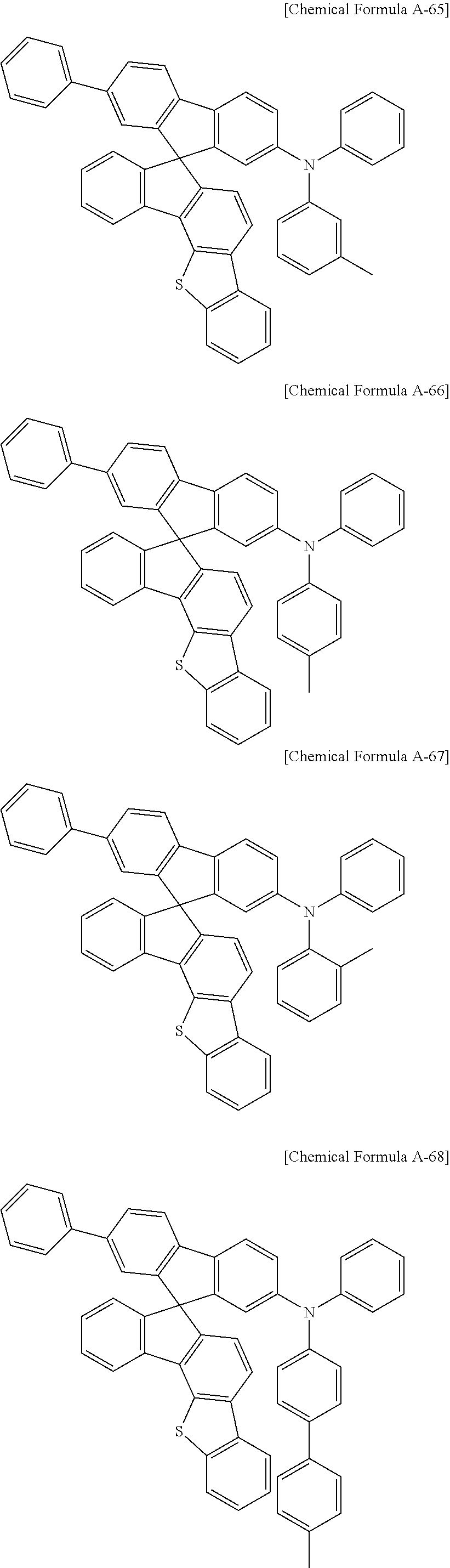

More specifically, the compound for an organic optoelectronic device may be represented by one of the following Chemical Formulae B-1 to B-40, but is not limited thereto.


When the above compound according to one embodiment of the present invention requires both electron and hole characteristics, the functional group having electron characteristics may be introduced to effectively improve life-span of an organic light emitting diode and decreasing its driving voltage.
The above compound for an organic optoelectronic device according to one embodiment of the present invention shows a maximum light emitting wavelength in a range of about 320 to about 500 nm, high triplet exciton energy (T1) of greater than equal to about 2.0 eV and specifically, about 2.0 to about 4.0 eV and thus, has an advantage of increasing luminous efficiency of a dopant by well transporting charges of a host having high triplet exciton energy to the dopant and decreasing a driving voltage by freely adjusting HOMO and LUMO energy levels and accordingly, may be used as a host material or a charge transport material.
In addition, the compound for an organic optoelectronic device has optical and electrical activity and thus, may be used as a non-linear optical material, an electrode material, an electrochromic material, an optical switch, a sensor, a module, a wave guide, an organic transistor, a laser, an optical absorbing material, a dielectric material, and a material for a separation membrane and the like.
The compound for an organic optoelectronic device including the above compounds has a glass transition temperature of greater than or equal to about 90° C. and a thermal decomposition temperature of greater than or equal to about 400° C., indicating improved thermal stability. Thereby, it is possible to produce an organic optoelectronic device having a high efficiency.
The compound for an organic optoelectronic device including the above compounds may play a role for emitting light or injecting and/or transporting electrons, and also act as a light emitting host with an appropriate dopant. In other words, the compound for an organic optoelectronic device may be used as a phosphorescent or fluorescent host material, a blue light emitting dopant material, or an electron transport material.
The compound for an organic optoelectronic device according to one embodiment of the present invention is used for an organic thin layer, and it may improve the life-span characteristics, efficiency characteristics, electrochemical stability, and thermal stability of an organic optoelectronic device and decrease the driving voltage.
Therefore, according to another embodiment, an organic optoelectronic device that includes the compound for an organic optoelectronic device is provided. The organic optoelectronic device may include an organic photoelectric device, an organic light emitting diode, an organic solar cell, an organic transistor, an organic photo-conductor drum, an organic memory device, and the like. For example, the compound for an organic optoelectronic device according to one embodiment may be included in an electrode or an electrode buffer layer in the organic solar cell to improve the quantum efficiency, and it may be used as an electrode material for a gate, a source-drain electrode, or the like in the organic transistor.
Hereinafter, an organic light emitting diode is specifically described.
An organic light emitting diode according to another embodiment of the present invention includes an anode, a cathode, and at least one or more organic thin layer between the anode and the cathode, and at least one of the organic thin layers may include the compound for an organic optoelectronic device according to one embodiment of the present invention.
The organic thin layer including the compound for an organic optoelectronic device may include a layer selected from an emission layer, a hole transport layer, a hole injection layer, an electron transport layer, an electron injection layer, a hole blocking layer, and a combination thereof. The at least one layer includes the compound for an organic optoelectronic device according to one embodiment. Particularly, the compound for an organic optoelectronic device according to one embodiment may be included in an electron transport layer or electron injection layer. In addition, when the compound for an organic optoelectronic device is included in the emission layer, the compound for an organic optoelectronic device may be included as a phosphorescent or fluorescent host, and particularly, as a fluorescent blue dopant material.
Referring to FIGS. 1 to 5 , organic light emitting diodes 100, 200, 300, 400, and 500 according to one embodiment include at least one organic thin layer 105 interposed between an anode 120 and a cathode 110.
The anode 120 includes an anode material having a large work function to help hole injection into an organic thin layer. Specific examples of the anode material include: a metal such as nickel, platinum, vanadium, chromium, copper, zinc, and gold, or alloys thereof; a metal oxide such as zinc oxide, indium oxide, indium tin oxide (ITO), and indium zinc oxide (IZO); a combined metal and oxide such as ZnO:Al or SnO2:Sb; or a conductive polymer such as poly(3-methylthiophene), poly[3,4-(ethylene-1,2-dioxy)thiophene] (PEDT), polypyrrole, and polyaniline, but is not limited thereto. It is preferable to include a transparent electrode including indium tin oxide (ITO) as an anode.
The cathode 110 includes a cathode material having a small work function to help electron injection into an organic thin layer. Specific examples of the cathode material include: a metal such as magnesium, calcium, sodium, potassium, titanium, indium, yttrium, lithium, gadolinium, aluminum, silver, tin, and lead, or alloys thereof; or a multi-layered material such as LiF/Al, Liq/Al, LiO2/Al, LiF/Ca, LiF/Al, and BaF2/Ca, but is not limited thereto. It is preferable to include a metal electrode including aluminum as a cathode.
First, referring to FIG. 1 , the organic light emitting diode 100 includes an organic thin layer 105 including only an emission layer 130.
Referring to FIG. 2 , a double-layered organic light emitting diode 200 includes an organic thin layer 105 including an emission layer 230 including an electron transport layer (ETL), and a hole transport layer (HTL) 140. As shown in FIG. 2 , the organic thin layer 105 includes a double layer of the emission layer 230 and hole transport layer (HTL) 140. The emission layer 130 also functions as an electron transport layer (ETL), and the hole transport layer (HTL) 140 layer has an excellent binding property with a transparent electrode such as ITO or an excellent hole transport capability.
Referring to FIG. 3 , a three-layered organic light emitting diode 300 includes an organic thin layer 105 including an electron transport layer (ETL) 150, an emission layer 130, and a hole transport layer (HTL) 140. The emission layer 130 is independently installed, and layers having an excellent electron transport capability or an excellent hole transport capability are separately stacked.
As shown in FIG. 4 , a four-layered organic light emitting diode 400 includes an organic thin layer 105 including an electron injection layer (EIL) 160, an emission layer 130, a hole transport layer (HTL) 140, and a hole injection layer (HIL) 170 for adherence with the cathode of ITO.
As shown in FIG. 5 , a five-layered organic light emitting diode 500 includes an organic thin layer 105 including an electron transport layer (ETL) 150, an emission layer 130, a hole transport layer (HTL) 140, and a hole injection layer (HIL) 170, and further includes an electron injection layer (EIL) 160 to achieve a low voltage.
In FIGS. 1 to 5 , the organic thin layer 105 including at least one selected from the group consisting of an electron transport layer (ETL) 150, an electron injection layer (EIL) 160, emission layers 130 and 230, a hole transport layer (HTL) 140, a hole injection layer (HIL) 170, and combinations thereof includes the compound for an organic optoelectronic device. The compound for an organic optoelectronic device may be used for an electron transport layer (ETL) 150 including the electron transport layer (ETL) 150 or electron injection layer (EIL) 160. When it is used for the electron transport layer (ETL), it is possible to provide an organic light emitting diode having a more simple structure because it does not require an additional hole blocking layer (not shown).
Furthermore, when the compound for an organic optoelectronic device is included in the emission layers 130 and 230, the compound for an organic optoelectronic device may be included as a phosphorescent or fluorescent host or a fluorescent blue dopant.
The organic light emitting diode may be manufactured by: forming an anode on a substrate; forming an organic thin layer in accordance with a dry coating method such as evaporation, sputtering, plasma plating, and ion plating or a wet coating method such as spin coating, dipping, and flow coating; and providing a cathode thereon.
Another embodiment of the present invention provides a display device including the light emitting diode according to the above embodiment.
Hereinafter, the embodiments are illustrated in more detail with reference to examples. These examples, however, should not in any sense be interpreted as limiting the scope of the present invention.
A compound represented by the above Chemical Formula A-14 as specific examples of a compound for an organic optoelectronic device according to one embodiment of the present invention was synthesized through the following Reaction Scheme 1.


First Step: Synthesis of Intermediate Product (A)
17.04 g (80.34 mmol) of 4-dibenzofuran boronic acid, 25.0 g (88.37 mmol) of 2-bromoiodobenzene, 22.21 g (160.67 mmol) of potassium carbonate, and 0.93 g (0.80 mmmol) of tetrakis-(triphenylphosphine)palladium (0) were suspended in 250 ml of toluene and 200 ml of distilled water, and the suspended solution was refluxed and agitated for 12 hours. When the reaction was complete, the reaction solution was extracted with dichloromethane and filtered with extract silica gel and then, distillated under a reduced pressure distillation and silica-columned, obtaining 18.6 g of an intermediate product A (a yield: 65%).
Second Step: Synthesis of Intermediate Product (B)
27.3 g (84.47 mmol) of the intermediate product (A) synthesized according to Example 1 and 150 mL of tetrahydrofuran were suspended, and 63.35 mL (101.37 mmol) of n-BuLi was slowly added thereto at −78° C. The mixture was agitated at −78° C. for 2 hours, 24.08 g (92.92 mol) of 2-bromofluorenone was slowly added thereto, and the mixture was agitated for 24 hours. When the reaction was complete, the resultant was quenched with an ammonium chloride aqueous solution and extracted with dichloromethane, and an organic layer obtained therefrom was filtered with silica gel. After removing an organic solution therefrom, silica gel column was performed with hexane:ethylacetate=7:3 (v/v), obtaining 33.0 g of an intermediate product (B) (a yield: 79%).
Third Step: Synthesis of Intermediate Product (C)
33.0 g (65.6 mmol) of the intermediate product (B) was suspended in 350 mL of acetic acid, and 12.8 mL (196.8 mmol) of CH3SO3H was slowly added thereto at room temperature. The mixture was agitated for 24 hours. When the reaction was complete, the resultant was quenched with 200 mL of a sodium bicarbonate aqueous solution, a solid produced therein was filtered, extraction was performed with dichloromethane and distilled water, and an organic layer was filtered with silica gel. After removing an organic solution therefrom, silica gel column was performed with hexane:dichloromethane=6:4 (v/v), obtaining 29.3 g of an intermediate product (D) (a yield: 92%).
Fourth Step: Synthesis of Compound A-14
15.0 g (30.9 mmol) of the intermediate compound (C), 8.34 g (34.0 mmol) of biphenylphenylamine, 4.45 g (46.36 mmol) of NaO(t-Bu), and 0.28 g (0.31 mmmol) of Pd2(dba)3 were suspended in 300 ml of toluene, 0.45 mL (1.85 mmol) of P(t-Bu)3 was added thereto, and the mixture was refluxed and agitated for 12 hours. The agitated mixture was extracted with dichloromethane and distilled water, and an organic layer obtained therefrom was filtered with silica gel. After removing an organic solution therefrom, silica gel column was performed with hexane:dichloromethane=7:3 (v/v) to obtain a solid product, the solid product was recrystallized with dichloromethane and n-hexane, obtaining 17.4 g of a compound represented by Chemical Formula 1 (a yield: 87%).
15.0 g (30.9 mmol) of the intermediate compound (C), 10.93 g (34.0 mmol) of bisbiphenylamine, 4.45 g (46.36 mmol) of NaO(t-Bu), and 0.28 g (0.31 mmmol) of Pd2(dba)3 were suspended in 300 ml of toluene, 0.45 mL (1.85 mmol) of P(t-Bu)3 was added thereto, and the mixture was refluxed and agitated for 12 hours. Dichloromethane and distilled water were used to perform extraction, and an organic layer obtained therefrom was filtered with silica gel. After removing an organic solution therefrom, silica gel column was performed by using hexane:dichloromethane=7:3 (v/v), and a solid product was recrystallized with dichloromethane and acetone, obtaining 18.1 g of a compound represented by Chemical Formula 1 (a yield: 81%).
15.0 g (30.9 mmol) of the intermediate compound (C), 7.45 g (34.0 mmol) of naphthylphenylamine, 4.45 g (46.36 mmol) of NaO(t-Bu), and 0.28 g (0.31 mmmol) of Pd2(dba)3 were suspended in 300 ml of toluene, 0.45 mL (1.85 mmol) of P(t-Bu)3 was added thereto, and the mixture was refluxed and agitated for 12 hours. Dichloromethane and distilled water was used to perform extraction, and an organic layer obtained therefrom was filtered with silica gel. After removing an organic solution therefrom, silica gel column was performed with hexane:dichloromethane=7:3 (v/v), a solid product was recrystallized with dichloromethane and n-hexane, obtaining 15.2 g of a compound represented by Chemical Formula 1 (a yield: 79%).
A compound represented by the above Chemical Formula B-14 as specific examples of a compound for an organic optoelectronic device according to one embodiment of the present invention was synthesized through three steps in the following Reaction Scheme 2.


First Step: Synthesis of Intermediate Product (E)
8.2 g (25.37 mmol) of the intermediate product (A) synthesized in Example 1 was suspended in 150 mL of tetrahydrofuran, and 19.04 mL (30.45 mmol) of n-BuLi was slowly added thereto at −78° C. The mixture was agitated at −78° C. for 2 hours, 9.43 g (27.91 mol) of 2,7-dibromofluorenone was slowly added thereto, and the mixture was agitated for 24 hours. When the reaction was complete, the resultant was quenched with an ammonium chloride aqueous solution and extracted with dichloromethane, and an organic layer obtained therefrom was filtered with silica gel. After removing an organic solution therefrom, silica gel column was performed with hexane:ethylacetate=7:3 (v/v), obtaining 11.8 g of an intermediate product (E) (a yield: 80%).
Second Step: Synthesis of Intermediate Product (F)
11.8 g (20.27 mmol) of the intermediate product (E) was suspended in 200 mL of acetic acid, and 27 mL of CH3SO3H was slowly added thereto at room temperature. The mixture was agitated for 24 hours. When the reaction was complete, the resultant was quenched with 200 mL of a sodium bicarbonate aqueous solution, a solid product was filtered and extracted with dichloromethane and distilled water, and then, an organic layer obtained therefrom was filtered with silica gel. After removing an organic solution therefrom, silica gel column was performed with hexane:dichloromethane=6:4 (v/v), obtaining 9.5 g of an intermediate product (F) (a yield: 83%).
Third Step: Synthesis of Chemical Formula 2 Compound
9.43 g (16.71 mmol) of the intermediate compound (F), 6.22 g (36.77 mmol) of diphenylamine, 4.82 g (50.14 mmol) of NaO(t-Bu), and 0.31 g (0.33 mmmol) of Pd2(dba)3 were suspended in 100 ml of toluene, 0.80 mL (3.34 mmol) of P(t-Bu)3 was added thereto, and the mixture was refluxed and agitated for 12 hours. Dichloromethane and distilled water were used to perform extraction, and an organic layer obtained therefrom was filtered with silica gel. After removing an organic solution, silica gel column was performed by using hexane:dichloromethane=7:3 (v/v), and a solid product obtained therefrom was recrystallized with dichloromethane and ethylacetate, obtaining 10.33 g of a compound represented by Chemical Formula 2 (a yield: 83%).
10.0 g (17.72 mmol) of the intermediate compound (F), 12.53 g (38.99 mmol) of biphenylphenylamine, 5.11 g (53.16 mmol) of NaO(t-Bu), and 0.32 g (0.35 mmmol) of Pd2(dba)3 were suspended in 100 ml of toluene, 0.86 mL (3.54 mmol) of P(t-Bu)3 was added thereto, and the mixture was refluxed and agitated for 12 hours. Dichloromethane and distilled water were used to perform extraction, and an organic layer obtained therefrom was filtered with silica gel. After removing an organic solution therefrom, the resultant was silica gel columned with hexane:dichloromethane=7:3 (v/v), and a solid product was recrystallized with dichloromethane and ethylacetate, obtaining 10.96 g of a compound represented by Chemical Formula 2 (a yield: 83%).
10.0 g (17.72 mmol) of the intermediate compound (F), 8.55 g (38.99 mmol) of naphthylphenylamine, 5.11 g (53.16 mmol) of NaO(t-Bu), and 0.32 g (0.35 mmmol) of Pd2(dba)3 were suspended in 100 ml of toluene, 0.86 mL (3.54 mmol) of P(t-Bu)3 was added thereto, and the mixture was refluxed and agitated for 12 hours. Dichloromethane and distilled water were used to perform extraction, and an organic layer obtained therefrom was filtered with silica gel. After removing an organic solution therefrom, silica gel column was performed by using hexane:dichloromethane=7:3 (v/v), and a solid product was recrystallized with dichloromethane and ethylacetate, obtaining 9.95 g of a compound represented by Chemical Formula 2 (a yield: 67%).
ITO (indium tin oxide) was coated to be 1500 Å thick on a glass substrate, and the coated glass substrate was washed with distilled water and an ultrasonic wave. When the washing with distilled water was complete, the substrate was washed with an ultrasonic wave by using a solvent such as isopropyl alcohol, acetone, methanol, and the like and dried, then, moved to a plasma cleaner, cleaned by using oxygen plasma for 5 minute, and moved to a vacuum depositor. This ITO transparent electrode was used as an anode, and a 600 Å-thick hole injection layer (HIL) was formed thereon by vacuum-depositing 4,4′-bis[N-[4-{N,N-bis(3-methylphenyl)amino}-phenyl]-N-phenylamino]biphenyl (DNTPD). Subsequently, the compound according to Example 1 was vacuum-deposited thereon to form a 300 Å-thick hole transport layer (HTL). On the hole transport layer (HTL), a 250 Å-thick emission layer was formed by using 9,10-di-(2-naphthyl)anthracene (ADN) as a host and doping it with 3 wt % of 2,5,8,11-tetra(tert-butyl)perylene (TBPe) as a dopant.
Subsequently, on the emission layer, Alq3 was vacuum-deposited to form a 250 Å-thick electron transport layer (ETL). On the electron transport layer (ETL), a cathode was formed by sequentially vacuum-depositing LiF to be 10 Å thick and Al to be 1000 Å thick, manufacturing an organic light emitting diode.
An organic light emitting diode was manufactured according to the same method as Example 7 except for using the compound according to Example 2 instead of the compound according to Example 1 to form the hole transport layer (HTL).
An organic light emitting diode was manufactured according to the same method as Example 7 except for using the compound according to Example 3 instead of the compound according to Example 1 to form the hole transport layer (HTL).
An organic light emitting diode was manufactured according to the same method as Example 7 except for using the compound according to Example 4 instead of the compound according to Example 2 to form the hole transport layer (HTL).
An organic light emitting diode was manufactured according to the same method as Example 7 except for using the compound according to Example 5 instead of the compound according to Example 2 to form the hole transport layer (HTL).
An organic light emitting diode was manufactured according to the same method as Example 7 except for using the compound according to Example 6 instead of the compound according to Example 2 to form the hole transport layer (HTL).
An organic light emitting diode was manufactured according to the same method as Example 7 except for using NPB instead of the compound according to Example 2 to form the hole transport layer (HTL).
Performance Measurement of Organic Light Emitting Diode
Current density change, luminance change, and luminous efficiency of each organic light emitting diode according to Examples 7 to 12 and Comparative Example 1 depending on a voltage were measured. Specific measurement methods are as follows, and the results are shown in the following Table 1.
(1) Measurement of Current Density Change Depending on Voltage Change
The obtained organic light emitting diodes were measured for current value flowing in the unit device while increasing the voltage from 0 V to 10 V using a current-voltage meter (Keithley 2400), and the measured current value was divided by area to provide the result.
(2) Measurement of Luminance Change Depending on Voltage Change
Luminance was measured by using a luminance meter (Minolta Cs-1000A), while the voltage of the organic light emitting diodes was increased from 0 V to 10 V.
(3) Measurement of Luminous Efficiency
The luminance, current density, and voltage obtained from the (1) and (2) were used to calculate current efficiency (cd/A) and power efficiency (lm/W) at the same luminance (1,000 cd/m2).
| TABLE 1 | |||||
| Compound | |||||
| used in hole | |||||
| transport | Voltage | Color | Efficiency | Efficiency | |
| Device | layer (HTL) | (V) | (EL color) | (cd/A) | (lm/W) |
| Example 7 | A-14 | 5.8 | Blue | 6.2 | 3.4 |
| Example 8 | A-15 | 5.6 | Blue | 6.4 | 3.6 |
| Example 9 | A-16 | 5.5 | Blue | 6.1 | 3.5 |
| Example 10 | B-14 | 5.2 | Blue | 6.5 | 3.9 |
| Example 11 | B-15 | 5.0 | Blue | 6.0 | 3.8 |
| Example 12 | B-21 | 5.1 | Blue | 6.1 | 3.8 |
| Comparative | NPB | 7.1 | Blue | 4.9 | 2.2 |
| Example 1 | |||||
Current Density: 10 mA/Cm2
All the organic light emitting diodes according to Examples 7 to 12 decreased a driving voltage and improved luminance and efficiency compared with the organic light emitting diode according to Comparative Example 1.
Accordingly, an organic light emitting diode having a low voltage, high efficiency, high luminance, and long life-span as well as excellent electron injection and transportation capability may be manufactured.
While this invention has been described in connection with what is presently considered to be practical exemplary embodiments, it is to be understood that the invention is not limited to the disclosed embodiments, but, on the contrary, is intended to cover various modifications and equivalent arrangements included within the spirit and scope of the appended claims. Therefore, the aforementioned embodiments should be understood to be exemplary but not limiting the present invention in any way.
Claims (15)
1. A compound for an organic optoelectronic device represented by a combination of the following Chemical Formula 1 and Chemical Formula 2:

wherein, in the above Chemical Formulae 1 and 2,
X is —O—, —S—,
Ar1 to Ar4 are independently a substituted or unsubstituted C6 to C30 aryl group, or a substituted or unsubstituted C2 to C30 heteroaryl group,
L1 and L2 are independently a single bond, a substituted or unsubstituted C6 to C30 arylene group, or a substituted or unsubstituted C2 to C30 heteroarylene group,
m1 and m2 are independently integers of 0 or 1, one of m1 and m2 is 1,
n1 and n2 are independently integers ranging from 0 to 1,
R1 to R7 are independently hydrogen, deuterium, a substituted or unsubstituted C1 to C10 alkyl group, a substituted or unsubstituted C6 to C30 aryl group, or a substituted or unsubstituted C2 to C30 heteroaryl group, and
two *s of the above Chemical Formula 2 are bonded with the adjacent two *s of the above Chemical Formula 1 to form a fused ring.
2. The compound for an organic optoelectronic device of claim 1 , wherein the above Chemical Formula 1 is represented by the following Chemical Formula 3:

wherein, in the above Chemical Formula 3,
Ar3 and Ar4 are independently a substituted or unsubstituted C6 to C30 aryl group, or a substituted or unsubstituted C2 to C30 heteroaryl group,
L2 is a single bond, a substituted or unsubstituted C6 to C30 arylene group, or a substituted or unsubstituted C2 to C30 heteroarylene group,
m2 is 1,
n2 is an integer ranging from 0 to 1,
R1 to R3, R6 or R7 are independently hydrogen, deuterium, a substituted or unsubstituted C1 to C10 alkyl group, a substituted or unsubstituted C6 to C30 aryl group, or a substituted or unsubstituted C2 to C30 heteroaryl group, and
two *s of the above Chemical Formula 2 are bonded with the adjacent two *s of the above Chemical Formula 3 to form a fused ring.
3. The compound for an organic optoelectronic device of claim 1 , wherein the compound for an organic optoelectronic device is represented by the following Chemical Formula 4:

wherein, in the above Chemical Formula 4,
X is —O—, —S—, —S(O)—, or —S(O)2—,
Ar1 to Ar4 are independently a substituted or unsubstituted C6 to C30 aryl group, or a substituted or unsubstituted C2 to C30 heteroaryl group,
L1 and L2 are independently a single bond, a substituted or unsubstituted C6 to C30 arylene group, or a substituted or unsubstituted C2 to C30 heteroarylene group,
m1 and m2 are independently integers of 0 or 1, one of m1 and m2 is 1,
n1 and n2 are independently integers ranging from 0 to 1, and
R1 to R7 are independently hydrogen, deuterium, a substituted or unsubstituted C1 to C10 alkyl group, a substituted or unsubstituted C6 to C30 aryl group, or a substituted or unsubstituted C2 to C30 heteroaryl group.
4. The compound for an organic optoelectronic device of claim 1 , wherein the compound for an organic optoelectronic device is represented by the following Chemical Formula 5:

wherein, in the above Chemical Formula 5,
Ar3 and Ar4 are independently a substituted or unsubstituted C6 to C30 aryl group, or a substituted or unsubstituted C2 to C30 heteroaryl group,
L2 is a single bond, a substituted or unsubstituted C6 to C30 arylene group, or a substituted or unsubstituted C2 to C30 heteroarylene group,
m2 is 1,
n2 is an integer ranging from 0 to 1, and
R1 to R7 are independently hydrogen, deuterium, a substituted or unsubstituted C1 to C10 alkyl group, a substituted or unsubstituted C6 to C30 aryl group, or a substituted or unsubstituted C2 to C30 heteroaryl group.
5. The compound for an organic optoelectronic device of claim 1 , wherein the Ar1 to Ar4 are independently substituted or unsubstituted phenyl group, a substituted or unsubstituted naphthyl group, a substituted or unsubstituted anthracenyl group, a substituted or unsubstituted phenanthryl group, a substituted or unsubstituted naphthacenyl group, a substituted or unsubstituted pyrenyl group, a substituted or unsubstituted biphenylyl group, a substituted or unsubstituted p-terphenyl group, a substituted or unsubstituted m-terphenyl group, a substituted or unsubstituted chrysenyl group, a substituted or unsubstituted triphenylenyl group, a substituted or unsubstituted perylenyl group, a substituted or unsubstituted indenyl group, a substituted or unsubstituted furanyl group, a substituted or unsubstituted thiopheneyl group, a substituted or unsubstituted pyrrolyl group, a substituted or unsubstituted pyrazolyl group, a substituted or unsubstituted imidazolyl group, a substituted or unsubstituted triazolyl group, a substituted or unsubstituted oxazolyl group, a substituted or unsubstituted thiazolyl group, a substituted or unsubstituted oxadiazolyl group, a substituted or unsubstituted thiadiazolyl group, a substituted or unsubstituted pyridyl group, a substituted or unsubstituted pyrimidinyl group, a substituted or unsubstituted pyrazinyl group, a substituted or unsubstituted triazinyl group, a substituted or unsubstituted benzofuranyl group, a substituted or unsubstituted benzothiopheneyl group, a substituted or unsubstituted benzimidazolyl group, a substituted or unsubstituted indolyl group, a substituted or unsubstituted quinolinyl group, a substituted or unsubstituted isoquinolinyl group, a substituted or unsubstituted quinazolinyl group, a substituted or unsubstituted quinoxalinyl group, a substituted or unsubstituted naphthyridinyl group, a substituted or unsubstituted benzoxazinyl group, a substituted or unsubstituted benzthiazinyl group, a substituted or unsubstituted acridinyl group, a substituted or unsubstituted phenazinyl group, a substituted or unsubstituted phenothiazinyl group, a substituted or unsubstituted phenoxazinyl group, or a combination thereof.
6. The compound for an organic optoelectronic device of claim 1 , wherein the compound for an organic optoelectronic device has triplet exciton energy (T1) of greater than or equal to about 2.0 eV.
7. The compound for an organic optoelectronic device of claim 1 , wherein the organic optoelectronic device is organic optoelectronic device is selected from an organic photoelectric device, an organic light emitting diode.
8. An organic light emitting diode, comprising
an anode, a cathode, and at least one organic thin layer interposed between the anode and cathode,
wherein at least one of the organic thin layers comprises the above compound for an organic optoelectronic device of claim 1 .
9. The organic light emitting diode of claim 8 , wherein the organic thin layer is selected from an emission layer, a hole transport layer, a hole injection layer, an electron transport layer, an electron injection layer, a hole blocking layer, and a combination thereof.
10. The organic light emitting diode of claim 9 , wherein the compound for an organic optoelectronic device is included in a hole transport layer (HTL) or a hole injection layer (HIL).
11. The organic light emitting diode of claim 9 , wherein the compound for an organic optoelectronic device is included in an emission layer.
12. The organic light emitting diode of claim 11 , wherein the compound for an organic optoelectronic device is used as a phosphorescent or fluorescent host material in an emission layer.
13. The organic light emitting diode as claimed in claim 8 , wherein the compound for an organic optoelectronic device is represented by one of the following Chemical Formulae A-1 to A-72:


14. The organic light emitting diode as claimed in claim 8 , wherein the compound for an organic optoelectronic device is represented by one of the following Chemical Formulae B-1 to B-40:


15. A display device comprising the above organic light emitting diode of claim 8 .
Priority Applications (1)
| Application Number | Priority Date | Filing Date | Title |
|---|---|---|---|
| US15/704,102 US10121973B2 (en) | 2011-12-30 | 2017-09-14 | Compound for organic optoelectronic device, organic light-emitting diode including same, and display device including organic light-emitting diode |
Applications Claiming Priority (5)
| Application Number | Priority Date | Filing Date | Title |
|---|---|---|---|
| KR1020110147392A KR101507001B1 (en) | 2011-12-30 | 2011-12-30 | Compound for organic optoelectronic device, organic light emitting diode including the same and display including the organic light emitting diode |
| KR10-2011-0147392 | 2011-12-30 | ||
| PCT/KR2012/011040 WO2013100467A1 (en) | 2011-12-30 | 2012-12-18 | Compound for organic optoelectric device, organic light-emitting diode including same, and display device including organic light-emitting diode |
| US201414360697A | 2014-05-27 | 2014-05-27 | |
| US15/704,102 US10121973B2 (en) | 2011-12-30 | 2017-09-14 | Compound for organic optoelectronic device, organic light-emitting diode including same, and display device including organic light-emitting diode |
Related Parent Applications (2)
| Application Number | Title | Priority Date | Filing Date |
|---|---|---|---|
| US14/360,697 Continuation US9768389B2 (en) | 2011-12-30 | 2012-12-18 | Compound for optoelectronic device, organic light-emitting diode including same, and display device including organic light-emitting diode |
| PCT/KR2012/011040 Continuation WO2013100467A1 (en) | 2011-12-30 | 2012-12-18 | Compound for organic optoelectric device, organic light-emitting diode including same, and display device including organic light-emitting diode |
Publications (2)
| Publication Number | Publication Date |
|---|---|
| US20180006234A1 US20180006234A1 (en) | 2018-01-04 |
| US10121973B2 true US10121973B2 (en) | 2018-11-06 |
Family
ID=48697848
Family Applications (2)
| Application Number | Title | Priority Date | Filing Date |
|---|---|---|---|
| US14/360,697 Active 2034-11-04 US9768389B2 (en) | 2011-12-30 | 2012-12-18 | Compound for optoelectronic device, organic light-emitting diode including same, and display device including organic light-emitting diode |
| US15/704,102 Active US10121973B2 (en) | 2011-12-30 | 2017-09-14 | Compound for organic optoelectronic device, organic light-emitting diode including same, and display device including organic light-emitting diode |
Family Applications Before (1)
| Application Number | Title | Priority Date | Filing Date |
|---|---|---|---|
| US14/360,697 Active 2034-11-04 US9768389B2 (en) | 2011-12-30 | 2012-12-18 | Compound for optoelectronic device, organic light-emitting diode including same, and display device including organic light-emitting diode |
Country Status (5)
| Country | Link |
|---|---|
| US (2) | US9768389B2 (en) |
| EP (1) | EP2799515B1 (en) |
| KR (1) | KR101507001B1 (en) |
| CN (1) | CN104024373B (en) |
| WO (1) | WO2013100467A1 (en) |
Cited By (1)
| Publication number | Priority date | Publication date | Assignee | Title |
|---|---|---|---|---|
| US11107994B2 (en) | 2014-06-18 | 2021-08-31 | Merck Patent Gmbh | Materials for organic electroluminescent devices |
Families Citing this family (30)
| Publication number | Priority date | Publication date | Assignee | Title |
|---|---|---|---|---|
| KR101507001B1 (en) * | 2011-12-30 | 2015-03-31 | 제일모직 주식회사 | Compound for organic optoelectronic device, organic light emitting diode including the same and display including the organic light emitting diode |
| WO2014129846A1 (en) * | 2013-02-21 | 2014-08-28 | Rohm And Haas Electronic Materials Korea Ltd. | Organic electroluminescent compounds and an organic electroluminescent device comprising the same |
| KR102182270B1 (en) * | 2013-02-21 | 2020-11-24 | 롬엔드하스전자재료코리아유한회사 | Organic Electroluminescent Compounds and Organic Electroluminescent Device Comprising the Same |
| KR101429035B1 (en) * | 2013-05-16 | 2014-08-12 | 롬엔드하스전자재료코리아유한회사 | Organic Electroluminescent Compounds and Organic Electroluminescent Device Comprising the Same |
| CN110003155B (en) * | 2013-08-15 | 2023-11-24 | 默克专利有限公司 | Material for electronic devices |
| KR102148643B1 (en) * | 2013-09-26 | 2020-08-28 | 롬엔드하스전자재료코리아유한회사 | Novel organic electroluminescent compounds and organic electroluminescent device comprising the same |
| EP4345089A3 (en) * | 2013-10-11 | 2024-06-26 | Idemitsu Kosan Co.,Ltd. | Aromatic amine compound, organic electroluminescent element and electronic device |
| KR20250006321A (en) | 2013-12-19 | 2025-01-10 | 메르크 파텐트 게엠베하 | Heterocyclic spiro compounds |
| KR102030354B1 (en) * | 2014-05-13 | 2019-10-10 | 에스에프씨주식회사 | Heterocyclic compound comprising aromatic amine group and organic light-emitting diode including the same |
| JP6398322B2 (en) * | 2014-05-23 | 2018-10-03 | 東ソー株式会社 | Benzothienofluorene compounds and uses thereof |
| KR102357467B1 (en) * | 2014-07-22 | 2022-02-04 | 롬엔드하스전자재료코리아유한회사 | Organic Electroluminescence Device |
| KR102030377B1 (en) * | 2014-07-28 | 2019-10-10 | 에스에프씨주식회사 | Condensed fluorene derivative comprising heterocyclic ring |
| KR102293894B1 (en) * | 2014-07-28 | 2021-08-27 | 에스에프씨주식회사 | Condensed fluorene derivative comprising heterocyclic ring |
| US10334685B2 (en) * | 2014-11-14 | 2019-06-25 | Board Of Supervisors Of Louisiana State University And Agricultural And Mechanical College | Carbon dot light emitting diodes |
| EP3238286B1 (en) * | 2014-12-22 | 2024-01-17 | Merck Patent GmbH | Materials for electronic devices |
| JP6925982B2 (en) * | 2015-02-16 | 2021-08-25 | メルク パテント ゲーエムベーハー | Materials for electronic devices |
| KR102002031B1 (en) * | 2015-06-12 | 2019-07-23 | 에스에프씨주식회사 | organic light-emitting diode with High efficiency |
| KR101991049B1 (en) | 2015-10-06 | 2019-06-20 | 주식회사 엘지화학 | Spiro structure compound and organic light emitting device comprising the same |
| KR101991050B1 (en) | 2015-10-06 | 2019-06-20 | 주식회사 엘지화학 | Spiro structure compound and organic light emitting device comprising the same |
| EP3345982B1 (en) * | 2015-10-07 | 2020-03-18 | LG Chem, Ltd. | Double spiro-type compound and organic light emitting diode comprising same |
| KR102656066B1 (en) * | 2015-11-13 | 2024-04-09 | 에스에프씨 주식회사 | Novel amine compounds for organic light-emitting diode and organic light-emitting diode including the same |
| CN105481811B (en) * | 2015-12-18 | 2018-01-16 | 上海道亦化工科技有限公司 | A kind of compound and its organic electroluminescence device with spiro structure |
| KR101829108B1 (en) * | 2015-12-24 | 2018-02-13 | 주식회사 두산 | Organic compounds and organic electro luminescence device comprising the same |
| CN105503801B (en) * | 2015-12-29 | 2018-12-18 | 上海道亦化工科技有限公司 | A kind of aromatic amine luminophor and its organic electroluminescence device |
| KR101872961B1 (en) * | 2016-05-27 | 2018-06-29 | 엘지디스플레이 주식회사 | Organic compounds and light emitting diode and organic light emitting diode display device using the compounds |
| CN107868067B (en) * | 2016-09-28 | 2021-06-15 | 株式会社Lg化学 | Heterocyclic compound and organic light-emitting element including the same |
| KR102668890B1 (en) * | 2017-04-03 | 2024-05-27 | 듀폰스페셜티머터리얼스코리아 유한회사 | Organic electroluminescent device |
| CN109232277B (en) * | 2018-09-17 | 2020-06-05 | 北京鼎材科技有限公司 | Organic compounds and organic electroluminescent devices |
| US11844275B2 (en) * | 2019-10-18 | 2023-12-12 | Lg Display Co., Ltd. | Organic compound, organic light emitting diode and organic light emitting deice including the organic compound |
| CN114426492B (en) * | 2020-10-29 | 2024-04-26 | 广州华睿光电材料有限公司 | Aromatic amine organic compound, mixture, composition and organic electronic device |
Citations (18)
| Publication number | Priority date | Publication date | Assignee | Title |
|---|---|---|---|---|
| KR20060080726A (en) | 2005-01-06 | 2006-07-11 | 삼성에스디아이 주식회사 | Blue light emitting polymer and organic electroluminescent device employing the same |
| WO2006108497A1 (en) | 2005-04-14 | 2006-10-19 | Merck Patent Gmbh | Compounds for organic electronic devices |
| WO2006122630A1 (en) | 2005-05-20 | 2006-11-23 | Merck Patent Gmbh | Compounds for organic electronic devices |
| US20070160870A1 (en) | 2005-11-10 | 2007-07-12 | Au Optronics Corp. | Phosphorescent organic light-emitting diodes |
| US20070222376A1 (en) | 2006-03-21 | 2007-09-27 | Semiconductor Energy Laboratory Co., Ltd. | Light-emitting element, light-emitting device, and electronic device |
| US20080102312A1 (en) | 2004-04-26 | 2008-05-01 | Merck Patent Gmbh | Electroluminescent Polymers Containing Planar Arylamine Units, the Preparation and Use Thereof |
| WO2009057978A2 (en) | 2007-11-01 | 2009-05-07 | Cheil Industries Inc. | Material for organic photoelectric device, and organic photoelectric device thereby |
| US20090159874A1 (en) | 2004-06-26 | 2009-06-25 | Horst Vestweber | Organic electroluminescent devices |
| WO2009124627A1 (en) | 2008-04-07 | 2009-10-15 | Merck Patent Gmbh | Fluorine derivatives for organic electroluminescence devices |
| KR20100028471A (en) | 2008-09-04 | 2010-03-12 | 제일모직주식회사 | Compounds for organic photoelectric device and organic photoelectric device containing the same |
| CN101679855A (en) | 2007-05-29 | 2010-03-24 | 默克专利有限公司 | New Materials for Organic Electroluminescent Devices |
| DE102009031021A1 (en) | 2009-06-30 | 2011-01-05 | Merck Patent Gmbh | Materials for organic electroluminescent devices |
| WO2011006574A1 (en) | 2009-07-14 | 2011-01-20 | Merck Patent Gmbh | Materials for organic electroluminescent devices |
| US20110121274A1 (en) | 2008-08-08 | 2011-05-26 | Merck Patent Gmbh | Organic electroluminescence device |
| WO2011116869A1 (en) | 2010-03-26 | 2011-09-29 | Merck Patent Gmbh | Compounds for electronic devices |
| KR20120060611A (en) | 2010-12-02 | 2012-06-12 | 제일모직주식회사 | Compound for organic photoelectric device and organic photoelectric device including the same |
| WO2013017189A1 (en) | 2011-07-29 | 2013-02-07 | Merck Patent Gmbh | Compounds for electronic devices |
| US9768389B2 (en) * | 2011-12-30 | 2017-09-19 | Cheil Industries, Inc. | Compound for optoelectronic device, organic light-emitting diode including same, and display device including organic light-emitting diode |
Family Cites Families (1)
| Publication number | Priority date | Publication date | Assignee | Title |
|---|---|---|---|---|
| US8974613B2 (en) | 2007-09-28 | 2015-03-10 | Ntn Corporation | Method of quenching a ring-shaped article and apparatus therefor |
-
2011
- 2011-12-30 KR KR1020110147392A patent/KR101507001B1/en active Active
-
2012
- 2012-12-18 WO PCT/KR2012/011040 patent/WO2013100467A1/en not_active Ceased
- 2012-12-18 EP EP12863091.0A patent/EP2799515B1/en active Active
- 2012-12-18 CN CN201280065000.9A patent/CN104024373B/en active Active
- 2012-12-18 US US14/360,697 patent/US9768389B2/en active Active
-
2017
- 2017-09-14 US US15/704,102 patent/US10121973B2/en active Active
Patent Citations (21)
| Publication number | Priority date | Publication date | Assignee | Title |
|---|---|---|---|---|
| US20080102312A1 (en) | 2004-04-26 | 2008-05-01 | Merck Patent Gmbh | Electroluminescent Polymers Containing Planar Arylamine Units, the Preparation and Use Thereof |
| US20090159874A1 (en) | 2004-06-26 | 2009-06-25 | Horst Vestweber | Organic electroluminescent devices |
| KR20060080726A (en) | 2005-01-06 | 2006-07-11 | 삼성에스디아이 주식회사 | Blue light emitting polymer and organic electroluminescent device employing the same |
| WO2006108497A1 (en) | 2005-04-14 | 2006-10-19 | Merck Patent Gmbh | Compounds for organic electronic devices |
| WO2006122630A1 (en) | 2005-05-20 | 2006-11-23 | Merck Patent Gmbh | Compounds for organic electronic devices |
| KR20080015865A (en) | 2005-05-20 | 2008-02-20 | 메르크 파텐트 게엠베하 | Compound for Organic Electronic Devices |
| US20070160870A1 (en) | 2005-11-10 | 2007-07-12 | Au Optronics Corp. | Phosphorescent organic light-emitting diodes |
| US20070222376A1 (en) | 2006-03-21 | 2007-09-27 | Semiconductor Energy Laboratory Co., Ltd. | Light-emitting element, light-emitting device, and electronic device |
| CN101679855A (en) | 2007-05-29 | 2010-03-24 | 默克专利有限公司 | New Materials for Organic Electroluminescent Devices |
| WO2009057978A2 (en) | 2007-11-01 | 2009-05-07 | Cheil Industries Inc. | Material for organic photoelectric device, and organic photoelectric device thereby |
| CN101809117A (en) | 2007-11-01 | 2010-08-18 | 第一毛织株式会社 | Material for organic photoelectric device, and organic photoelectric device thereby |
| WO2009124627A1 (en) | 2008-04-07 | 2009-10-15 | Merck Patent Gmbh | Fluorine derivatives for organic electroluminescence devices |
| US20110121274A1 (en) | 2008-08-08 | 2011-05-26 | Merck Patent Gmbh | Organic electroluminescence device |
| KR20100028471A (en) | 2008-09-04 | 2010-03-12 | 제일모직주식회사 | Compounds for organic photoelectric device and organic photoelectric device containing the same |
| WO2011000455A1 (en) | 2009-06-30 | 2011-01-06 | Merck Patent Gmbh | Materials for organic electroluminescence devices |
| DE102009031021A1 (en) | 2009-06-30 | 2011-01-05 | Merck Patent Gmbh | Materials for organic electroluminescent devices |
| WO2011006574A1 (en) | 2009-07-14 | 2011-01-20 | Merck Patent Gmbh | Materials for organic electroluminescent devices |
| WO2011116869A1 (en) | 2010-03-26 | 2011-09-29 | Merck Patent Gmbh | Compounds for electronic devices |
| KR20120060611A (en) | 2010-12-02 | 2012-06-12 | 제일모직주식회사 | Compound for organic photoelectric device and organic photoelectric device including the same |
| WO2013017189A1 (en) | 2011-07-29 | 2013-02-07 | Merck Patent Gmbh | Compounds for electronic devices |
| US9768389B2 (en) * | 2011-12-30 | 2017-09-19 | Cheil Industries, Inc. | Compound for optoelectronic device, organic light-emitting diode including same, and display device including organic light-emitting diode |
Non-Patent Citations (5)
| Title |
|---|
| Jang, Sang Eok, et al., "Stable efficiency roll-off in red phosphorescent organic light-emitting diodes using a spirofluorene-benzofluorene based carbazole type host material", Journal of Luminescence 130 (2010) 2184-2187. |
| Jeon, et al., "Fluorenobenzofuran as the Core Structure of High Triplet Energy Host Materials for Green Phosphorescent Organic Light-Emitting Diodes", Journal of Materials Chemistry, vol. 22, Mo. 21, (2012), pp. 10537-10541. |
| Li, Zhigang, et al., "Hole Transport Materials", Organic Light-Emitting Materials and Devices, CRC Press (2007) Abschnitt 3.4, pp. 312-321. |
| Notice of Opposition dated Jul. 24, 2017 in corresponding EP Application 12863091.0. |
| Search Report dated Feb. 9, 2015 in corresponding Chinese Patent Application No. 2012800650009. |
Cited By (1)
| Publication number | Priority date | Publication date | Assignee | Title |
|---|---|---|---|---|
| US11107994B2 (en) | 2014-06-18 | 2021-08-31 | Merck Patent Gmbh | Materials for organic electroluminescent devices |
Also Published As
| Publication number | Publication date |
|---|---|
| EP2799515B1 (en) | 2016-10-12 |
| EP2799515A1 (en) | 2014-11-05 |
| US20180006234A1 (en) | 2018-01-04 |
| EP2799515A4 (en) | 2015-08-12 |
| CN104024373B (en) | 2016-02-03 |
| US9768389B2 (en) | 2017-09-19 |
| US20140332787A1 (en) | 2014-11-13 |
| KR20130078439A (en) | 2013-07-10 |
| WO2013100467A1 (en) | 2013-07-04 |
| KR101507001B1 (en) | 2015-03-31 |
| CN104024373A (en) | 2014-09-03 |
Similar Documents
| Publication | Publication Date | Title |
|---|---|---|
| US9768389B2 (en) | Compound for optoelectronic device, organic light-emitting diode including same, and display device including organic light-emitting diode | |
| US9559309B2 (en) | Compound for organic optoelectronic device, organic light emitting diode including the same, and display device including the organic light emitting diode | |
| US10153436B2 (en) | Compound for an organic optoelectronic element, organic light-emitting element comprising same, and display device comprising the organic light-emitting element | |
| US8993783B2 (en) | Compound for organic photoelectric device and organic photoelectric device including the same | |
| US9543530B2 (en) | Compound for organic optoelectronic device, organic light emitting diode including the same and display including the organic light emitting diode | |
| US9502662B2 (en) | Compound for an organic optoelectronic device, organic light-emitting element comprising same, and display device comprising the organic light-emitting element | |
| US9478753B2 (en) | Compound for organic optoelectronic device, organic light emitting diode including the same, and display device including the light emitting diode | |
| US20150263294A1 (en) | Compound for organic optoelectronic device, organic light-emitting device including same, and display device including the organic light- emitting diode | |
| US9136481B2 (en) | Compound for an organic photoelectric device, organic photoelectric device including the same, and display device including the organic photoelectric device | |
| US9722186B2 (en) | Compound for organic optoelectronic device, organic light emitting diode comprising same, and display comprising organic light emitting diode | |
| US9203033B2 (en) | Nitrogen-containing heterocyclic compounds and organic electronic device comprising the same | |
| US10333081B2 (en) | Compound for organic optoelectronic device, organic light emitting diode including the same and display including the organic light emitting diode | |
| US9793488B2 (en) | Compound for organic optoelectronic element, organic light-emitting element comprising same, and display device comprising the organic light-emitting element | |
| US20160163995A1 (en) | Organic optoelectric device and display device | |
| US20150144937A1 (en) | Compound for organic optoelectronic device, organic light emitting diode comprising same, and display device comprising organic light emitting diode | |
| US20150236273A1 (en) | Fluoranthene compound, and organic electronic device comprising same | |
| US20140042412A1 (en) | Compound for organic optoelectronic device, organic light-emitting diode including the same and display device including the organic light-emitting diode | |
| US10381571B2 (en) | Compound, organic light emitting element comprising same, and display device comprising organic light emitting element | |
| US9444054B2 (en) | Compound for organic optoelectronic device and organic light emitting diode including the same | |
| US9419229B2 (en) | Compound, organic optoelectric device including the same and display device including the optoelectric device | |
| KR101497137B1 (en) | Compound for organic optoelectronic device, organic light emitting diode including the same and display including the organic light emitting diode | |
| US20150021563A1 (en) | Compound for organic optoelectronic device, organic light emitting diode including the same and display including the organic light emitting diode | |
| KR20130078746A (en) | Compound for organic optoelectronic device, organic light emitting diode including the same and display including the organic light emitting diode | |
| US11690288B2 (en) | Composition for organic optoelectronic diode, organic optoelectronic diode, and display device | |
| KR20140045154A (en) | Compound for organic optoelectronic device, organic light emitting diode including the same and display including the organic light emitting diode |
Legal Events
| Date | Code | Title | Description |
|---|---|---|---|
| FEPP | Fee payment procedure |
Free format text: ENTITY STATUS SET TO UNDISCOUNTED (ORIGINAL EVENT CODE: BIG.); ENTITY STATUS OF PATENT OWNER: LARGE ENTITY |
|
| STCF | Information on status: patent grant |
Free format text: PATENTED CASE |
|
| MAFP | Maintenance fee payment |
Free format text: PAYMENT OF MAINTENANCE FEE, 4TH YEAR, LARGE ENTITY (ORIGINAL EVENT CODE: M1551); ENTITY STATUS OF PATENT OWNER: LARGE ENTITY Year of fee payment: 4 |
|
| MAFP | Maintenance fee payment |
Free format text: PAYMENT OF MAINTENANCE FEE, 8TH YEAR, LARGE ENTITY (ORIGINAL EVENT CODE: M1552); ENTITY STATUS OF PATENT OWNER: LARGE ENTITY Year of fee payment: 8 |