US10070704B2 - Loop-forming closure element for hook-and-loop fasteners and method for the production of a closure element - Google Patents
Loop-forming closure element for hook-and-loop fasteners and method for the production of a closure element Download PDFInfo
- Publication number
- US10070704B2 US10070704B2 US14/506,797 US201414506797A US10070704B2 US 10070704 B2 US10070704 B2 US 10070704B2 US 201414506797 A US201414506797 A US 201414506797A US 10070704 B2 US10070704 B2 US 10070704B2
- Authority
- US
- United States
- Prior art keywords
- nonwoven material
- closure element
- staple fibers
- fibers
- material layer
- Prior art date
- Legal status (The legal status is an assumption and is not a legal conclusion. Google has not performed a legal analysis and makes no representation as to the accuracy of the status listed.)
- Active
Links
Images




Classifications
-
- A—HUMAN NECESSITIES
- A44—HABERDASHERY; JEWELLERY
- A44B—BUTTONS, PINS, BUCKLES, SLIDE FASTENERS, OR THE LIKE
- A44B18/00—Fasteners of the touch-and-close type; Making such fasteners
- A44B18/0069—Details
- A44B18/008—Hooks or loops provided with means to reinforce the attachment, e.g. by adhesive means
-
- B—PERFORMING OPERATIONS; TRANSPORTING
- B32—LAYERED PRODUCTS
- B32B—LAYERED PRODUCTS, i.e. PRODUCTS BUILT-UP OF STRATA OF FLAT OR NON-FLAT, e.g. CELLULAR OR HONEYCOMB, FORM
- B32B3/00—Layered products comprising a layer with external or internal discontinuities or unevennesses, or a layer of non-planar shape; Layered products comprising a layer having particular features of form
- B32B3/26—Layered products comprising a layer with external or internal discontinuities or unevennesses, or a layer of non-planar shape; Layered products comprising a layer having particular features of form characterised by a particular shape of the outline of the cross-section of a continuous layer; characterised by a layer with cavities or internal voids ; characterised by an apertured layer
- B32B3/266—Layered products comprising a layer with external or internal discontinuities or unevennesses, or a layer of non-planar shape; Layered products comprising a layer having particular features of form characterised by a particular shape of the outline of the cross-section of a continuous layer; characterised by a layer with cavities or internal voids ; characterised by an apertured layer characterised by an apertured layer, the apertures going through the whole thickness of the layer, e.g. expanded metal, perforated layer, slit layer regular cells B32B3/12
-
- B—PERFORMING OPERATIONS; TRANSPORTING
- B32—LAYERED PRODUCTS
- B32B—LAYERED PRODUCTS, i.e. PRODUCTS BUILT-UP OF STRATA OF FLAT OR NON-FLAT, e.g. CELLULAR OR HONEYCOMB, FORM
- B32B3/00—Layered products comprising a layer with external or internal discontinuities or unevennesses, or a layer of non-planar shape; Layered products comprising a layer having particular features of form
- B32B3/26—Layered products comprising a layer with external or internal discontinuities or unevennesses, or a layer of non-planar shape; Layered products comprising a layer having particular features of form characterised by a particular shape of the outline of the cross-section of a continuous layer; characterised by a layer with cavities or internal voids ; characterised by an apertured layer
- B32B3/30—Layered products comprising a layer with external or internal discontinuities or unevennesses, or a layer of non-planar shape; Layered products comprising a layer having particular features of form characterised by a particular shape of the outline of the cross-section of a continuous layer; characterised by a layer with cavities or internal voids ; characterised by an apertured layer characterised by a layer formed with recesses or projections, e.g. hollows, grooves, protuberances, ribs
-
- B—PERFORMING OPERATIONS; TRANSPORTING
- B32—LAYERED PRODUCTS
- B32B—LAYERED PRODUCTS, i.e. PRODUCTS BUILT-UP OF STRATA OF FLAT OR NON-FLAT, e.g. CELLULAR OR HONEYCOMB, FORM
- B32B5/00—Layered products characterised by the non- homogeneity or physical structure, i.e. comprising a fibrous, filamentary, particulate or foam layer; Layered products characterised by having a layer differing constitutionally or physically in different parts
- B32B5/02—Layered products characterised by the non- homogeneity or physical structure, i.e. comprising a fibrous, filamentary, particulate or foam layer; Layered products characterised by having a layer differing constitutionally or physically in different parts characterised by structural features of a fibrous or filamentary layer
- B32B5/022—Non-woven fabric
-
- B—PERFORMING OPERATIONS; TRANSPORTING
- B32—LAYERED PRODUCTS
- B32B—LAYERED PRODUCTS, i.e. PRODUCTS BUILT-UP OF STRATA OF FLAT OR NON-FLAT, e.g. CELLULAR OR HONEYCOMB, FORM
- B32B5/00—Layered products characterised by the non- homogeneity or physical structure, i.e. comprising a fibrous, filamentary, particulate or foam layer; Layered products characterised by having a layer differing constitutionally or physically in different parts
- B32B5/02—Layered products characterised by the non- homogeneity or physical structure, i.e. comprising a fibrous, filamentary, particulate or foam layer; Layered products characterised by having a layer differing constitutionally or physically in different parts characterised by structural features of a fibrous or filamentary layer
- B32B5/06—Layered products characterised by the non- homogeneity or physical structure, i.e. comprising a fibrous, filamentary, particulate or foam layer; Layered products characterised by having a layer differing constitutionally or physically in different parts characterised by structural features of a fibrous or filamentary layer characterised by a fibrous or filamentary layer mechanically connected, e.g. by needling to another layer, e.g. of fibres, of paper
-
- B—PERFORMING OPERATIONS; TRANSPORTING
- B32—LAYERED PRODUCTS
- B32B—LAYERED PRODUCTS, i.e. PRODUCTS BUILT-UP OF STRATA OF FLAT OR NON-FLAT, e.g. CELLULAR OR HONEYCOMB, FORM
- B32B5/00—Layered products characterised by the non- homogeneity or physical structure, i.e. comprising a fibrous, filamentary, particulate or foam layer; Layered products characterised by having a layer differing constitutionally or physically in different parts
- B32B5/22—Layered products characterised by the non- homogeneity or physical structure, i.e. comprising a fibrous, filamentary, particulate or foam layer; Layered products characterised by having a layer differing constitutionally or physically in different parts characterised by the presence of two or more layers which are next to each other and are fibrous, filamentary, formed of particles or foamed
- B32B5/24—Layered products characterised by the non- homogeneity or physical structure, i.e. comprising a fibrous, filamentary, particulate or foam layer; Layered products characterised by having a layer differing constitutionally or physically in different parts characterised by the presence of two or more layers which are next to each other and are fibrous, filamentary, formed of particles or foamed one layer being a fibrous or filamentary layer
- B32B5/26—Layered products characterised by the non- homogeneity or physical structure, i.e. comprising a fibrous, filamentary, particulate or foam layer; Layered products characterised by having a layer differing constitutionally or physically in different parts characterised by the presence of two or more layers which are next to each other and are fibrous, filamentary, formed of particles or foamed one layer being a fibrous or filamentary layer another layer next to it also being fibrous or filamentary
-
- B—PERFORMING OPERATIONS; TRANSPORTING
- B32—LAYERED PRODUCTS
- B32B—LAYERED PRODUCTS, i.e. PRODUCTS BUILT-UP OF STRATA OF FLAT OR NON-FLAT, e.g. CELLULAR OR HONEYCOMB, FORM
- B32B7/00—Layered products characterised by the relation between layers; Layered products characterised by the relative orientation of features between layers, or by the relative values of a measurable parameter between layers, i.e. products comprising layers having different physical, chemical or physicochemical properties; Layered products characterised by the interconnection of layers
- B32B7/04—Interconnection of layers
- B32B7/12—Interconnection of layers using interposed adhesives or interposed materials with bonding properties
-
- D—TEXTILES; PAPER
- D04—BRAIDING; LACE-MAKING; KNITTING; TRIMMINGS; NON-WOVEN FABRICS
- D04H—MAKING TEXTILE FABRICS, e.g. FROM FIBRES OR FILAMENTARY MATERIAL; FABRICS MADE BY SUCH PROCESSES OR APPARATUS, e.g. FELTS, NON-WOVEN FABRICS; COTTON-WOOL; WADDING ; NON-WOVEN FABRICS FROM STAPLE FIBRES, FILAMENTS OR YARNS, BONDED WITH AT LEAST ONE WEB-LIKE MATERIAL DURING THEIR CONSOLIDATION
- D04H1/00—Non-woven fabrics formed wholly or mainly of staple fibres or like relatively short fibres
- D04H1/40—Non-woven fabrics formed wholly or mainly of staple fibres or like relatively short fibres from fleeces or layers composed of fibres without existing or potential cohesive properties
- D04H1/44—Non-woven fabrics formed wholly or mainly of staple fibres or like relatively short fibres from fleeces or layers composed of fibres without existing or potential cohesive properties the fleeces or layers being consolidated by mechanical means, e.g. by rolling
- D04H1/46—Non-woven fabrics formed wholly or mainly of staple fibres or like relatively short fibres from fleeces or layers composed of fibres without existing or potential cohesive properties the fleeces or layers being consolidated by mechanical means, e.g. by rolling by needling or like operations to cause entanglement of fibres
- D04H1/492—Non-woven fabrics formed wholly or mainly of staple fibres or like relatively short fibres from fleeces or layers composed of fibres without existing or potential cohesive properties the fleeces or layers being consolidated by mechanical means, e.g. by rolling by needling or like operations to cause entanglement of fibres by fluid jet
- D04H1/495—Non-woven fabrics formed wholly or mainly of staple fibres or like relatively short fibres from fleeces or layers composed of fibres without existing or potential cohesive properties the fleeces or layers being consolidated by mechanical means, e.g. by rolling by needling or like operations to cause entanglement of fibres by fluid jet for formation of patterns, e.g. drilling or rearrangement
-
- D—TEXTILES; PAPER
- D04—BRAIDING; LACE-MAKING; KNITTING; TRIMMINGS; NON-WOVEN FABRICS
- D04H—MAKING TEXTILE FABRICS, e.g. FROM FIBRES OR FILAMENTARY MATERIAL; FABRICS MADE BY SUCH PROCESSES OR APPARATUS, e.g. FELTS, NON-WOVEN FABRICS; COTTON-WOOL; WADDING ; NON-WOVEN FABRICS FROM STAPLE FIBRES, FILAMENTS OR YARNS, BONDED WITH AT LEAST ONE WEB-LIKE MATERIAL DURING THEIR CONSOLIDATION
- D04H5/00—Non woven fabrics formed of mixtures of relatively short fibres and yarns or like filamentary material of substantial length
- D04H5/02—Non woven fabrics formed of mixtures of relatively short fibres and yarns or like filamentary material of substantial length strengthened or consolidated by mechanical methods, e.g. needling
- D04H5/03—Non woven fabrics formed of mixtures of relatively short fibres and yarns or like filamentary material of substantial length strengthened or consolidated by mechanical methods, e.g. needling by fluid jet
-
- A—HUMAN NECESSITIES
- A41—WEARING APPAREL
- A41B—SHIRTS; UNDERWEAR; BABY LINEN; HANDKERCHIEFS
- A41B2400/00—Functions or special features of shirts, underwear, baby linen or handkerchiefs not provided for in other groups of this subclass
- A41B2400/52—Functions or special features of shirts, underwear, baby linen or handkerchiefs not provided for in other groups of this subclass disposable
-
- A—HUMAN NECESSITIES
- A44—HABERDASHERY; JEWELLERY
- A44B—BUTTONS, PINS, BUCKLES, SLIDE FASTENERS, OR THE LIKE
- A44B18/00—Fasteners of the touch-and-close type; Making such fasteners
- A44B18/0003—Fastener constructions
- A44B18/0011—Female or loop elements
-
- B—PERFORMING OPERATIONS; TRANSPORTING
- B32—LAYERED PRODUCTS
- B32B—LAYERED PRODUCTS, i.e. PRODUCTS BUILT-UP OF STRATA OF FLAT OR NON-FLAT, e.g. CELLULAR OR HONEYCOMB, FORM
- B32B2262/00—Composition or structural features of fibres which form a fibrous or filamentary layer or are present as additives
- B32B2262/02—Synthetic macromolecular fibres
- B32B2262/0253—Polyolefin fibres
-
- B—PERFORMING OPERATIONS; TRANSPORTING
- B32—LAYERED PRODUCTS
- B32B—LAYERED PRODUCTS, i.e. PRODUCTS BUILT-UP OF STRATA OF FLAT OR NON-FLAT, e.g. CELLULAR OR HONEYCOMB, FORM
- B32B2262/00—Composition or structural features of fibres which form a fibrous or filamentary layer or are present as additives
- B32B2262/02—Synthetic macromolecular fibres
- B32B2262/0276—Polyester fibres
-
- B—PERFORMING OPERATIONS; TRANSPORTING
- B32—LAYERED PRODUCTS
- B32B—LAYERED PRODUCTS, i.e. PRODUCTS BUILT-UP OF STRATA OF FLAT OR NON-FLAT, e.g. CELLULAR OR HONEYCOMB, FORM
- B32B2307/00—Properties of the layers or laminate
- B32B2307/50—Properties of the layers or laminate having particular mechanical properties
- B32B2307/542—Shear strength
-
- B—PERFORMING OPERATIONS; TRANSPORTING
- B32—LAYERED PRODUCTS
- B32B—LAYERED PRODUCTS, i.e. PRODUCTS BUILT-UP OF STRATA OF FLAT OR NON-FLAT, e.g. CELLULAR OR HONEYCOMB, FORM
- B32B2555/00—Personal care
- B32B2555/02—Diapers or napkins
-
- Y—GENERAL TAGGING OF NEW TECHNOLOGICAL DEVELOPMENTS; GENERAL TAGGING OF CROSS-SECTIONAL TECHNOLOGIES SPANNING OVER SEVERAL SECTIONS OF THE IPC; TECHNICAL SUBJECTS COVERED BY FORMER USPC CROSS-REFERENCE ART COLLECTIONS [XRACs] AND DIGESTS
- Y10—TECHNICAL SUBJECTS COVERED BY FORMER USPC
- Y10T—TECHNICAL SUBJECTS COVERED BY FORMER US CLASSIFICATION
- Y10T24/00—Buckles, buttons, clasps, etc.
- Y10T24/27—Buckles, buttons, clasps, etc. including readily dissociable fastener having numerous, protruding, unitary filaments randomly interlocking with, and simultaneously moving towards, mating structure [e.g., hook-loop type fastener]
- Y10T24/2767—Buckles, buttons, clasps, etc. including readily dissociable fastener having numerous, protruding, unitary filaments randomly interlocking with, and simultaneously moving towards, mating structure [e.g., hook-loop type fastener] having several, repeating, interlocking formations along length of filaments
Definitions
- the invention relates to a loop-forming closure element for hook-and-loop fasteners, comprising an embossed nonwoven material having continuous fibers of a spun bonded fabric and carded staple fibers.
- loop-forming closure elements are attached on the front waist region of the diapers in the form of strips.
- the hook-and-loop fastener is completed by closure strips, which are fastened on the sides of the diapers and have gripping hooks on the free ends thereof. Since the gripping hooks come to lie on the loop-forming closure element during use and bring about an interlocking connection there, the loop-forming closure element is also referred to as a “landing zone”.
- Hook-and-loop fasteners are repeatedly opened and closed without this impairing the functionality of the closure. In contrast to adhesive closures, hook-and-loop fasteners are insensitive to contact with skin creams or powder.
- a plurality of requirements are placed on hook-and-loop fasteners on disposable products.
- the loop-forming closure element must ensure an adequate interconnection with gripping hooks of the associated closure strip.
- the closure element should also allow an attractive design to be obtained and should have a pleasant feel.
- a loop-forming closure element which has a knitted fabric on a carrier film, wherein the knitted fabric and the carrier film are interconnected by an adhesive pattern.
- the knitted fabric can have a mass per unit area of 18 g/m 2 , for example, which results in a lightweight, open structure overall, while a decorative impression on the carrier film remains visible through the knitted fabric.
- Loop-forming closure elements with incorporated loops have proven effective in practical applications, but the feel thereof is perceived as somewhat unpleasant. Even if the loop-forming closure element comes into direct contact with a user only in exceptional cases, the “skin friendliness” of the material still needs improvement for some applications.
- nonwoven materials In addition to closure elements having incorporated loops, nonwoven materials also are known, which form loops that are suitable for connection with gripping hooks.
- Document EP 0 963 472 B1 makes known a loop-forming nonwoven material for hook-and-loop fasteners, wherein bicomponent fibers are used to produce a sufficiently solid structure. In order to obtain a plurality of bonds between fibers, a polymer component is fused onto the bicomponent fibers in the presence of hot air. The manufacturing process is complex overall.
- a loop-forming closure element also is known from DE 10 2004 053 469 A1, wherein a card web, i.e., a layer of carded staple fibers, is disposed on a spun bonded fabric and the thusly formed nonwoven material is embossed.
- the card web and the spun bonded fabric are provided for different purposes. While the carded staple fibers are provided for connection with gripping hooks, the continuous fibers of the spun bonded fabric provide high stability and attachment on a carrier layer.
- Document EP 0 937 420 A2 makes known a loop-forming closure element for hook-and-loop fasteners, which can contain a nonwoven material having continuous fibers of a spun bonded fabric and carded staple fibers. A mechanical needle punching for forming loops is described.
- the present invention overcomes the shortcomings of known arts, such as those mentioned above.
- the present invention provides a loop-forming closure element for hook-and-loop fasteners comprising an embossed nonwoven material to realize good gripping effect, and a particularly soft surface.
- the invention also provides a method for the production of such a closure element.
- the invention provides for intertwining the continuous fibers and the staple fibers and jointly forming a layer of nonwoven material comprising a fiber blend.
- the properties of the continuous fibers and of the staple fibers are therefore combined with one another in a particularly advantageous manner.
- the continuous fibers form a continuous, stabilizing structure, which enables tensile forces to be transferred within the material.
- the staple fibers which are also referred to as short-staple fibers, produce a particularly soft and fleeced structure, wherein at least a few staple fibers protrude on both sides of the nonwoven material layer.
- the intertwining and blending of the continuous fibers and the staple fibers initially effectively anchor the staple fibers in the nonwoven material.
- the continuous fibers simultaneously form a basic structure into which the staple fibers are incorporated.
- the staple fibers as well as the continuous fibers can form loops on a surface of the nonwoven material, which are suitable for receiving gripping hooks.
- the entire nonwoven material is embossed.
- the embossing initially increases the stability and strength of the nonwoven material.
- the staple fibers and the continuous fibers are bulked particularly intensively by water jets in the space between the embossed regions, thereby improving the gripping effect.
- the embossing also enlarges the surface area of the nonwoven material, wherein gripping hooks can engage deeply into the nonwoven material specifically on the edge of the embossing.
- the embossed nonwoven material is formed entirely of the continuous fibers and the staple fibers, and therefore the nonwoven material then comprises only one nonwoven material layer made of a fiber blend.
- the spun bonded fabric and the carded staple fibers are usually supplied as separate layers and are then intertwined and blended with one another, by water jets, for example.
- the proportion of continuous fibers to the proportion of staple fibers changes across the thickness of the nonwoven material layer. Accordingly, the intertwining and blending at least take place such that at least a few of the short staple fibers protrude from both sides of the nonwoven material layer.
- the proportion of staple fibers will usually be greater on the side of the nonwoven material on which the staple fibers would have been originally supplied. After the blending and intertwining by water jets, this side is then also softer and is preferably provided as the exposed side of the closure element for the connection with gripping hooks.
- the nonwoven material layer is configured such that the nonwoven material layer has sufficient tensile strength and a sufficient number of free loops when used with typical gripping hooks.
- the invention is manufactured in a way that realizes the lowest possible mass per unit area, wherein a decorative impression also is provided underneath the nonwoven material, which is intended to be visible through the nonwoven material layer. Proceeding therefrom, the mass per unit area of the nonwoven material layer is preferably between 20 g/m 2 and 50 g/m 2 (grams per square meter). Nonwoven materials having the mass per unit area indicated are also referred to as lofty nonwoven fabrics.
- the nonwoven material is laminated with a carrier film so that the closure element is easily attached on a hygienic product such as a diaper or the like and is provided with a decorative covering.
- the lamination can take the form of an adhesive pattern having bonded sections and adhesive-free areas. Suitable adhesive patterns are known from DE 20 2004 021 382 U1.
- a simple film made of polyolefin, in particular, is provided as the carrier film.
- the carrier film preferably has a thickness between 10 and 40 ⁇ m, wherein, for example, a monofilm made of polyethylene is used, which is provided with the nonwoven material with an impression before lamination is implemented.
- a single-component PUR laminating adhesive also is provided as the adhesive.
- the impressions can make a contribution to improved strength and an improved gripping effect. It must be taken into account, however, that the embossed regions are not available or are available only to a limited extent for the connection with gripping hooks. Proceeding therefrom, the surface portion of the impressions is preferably between 5% and 20%.
- the density of the nonwoven material is, for example, between 0.04 and 0.1 g/cm 3 .
- the continuous fibers are usually deposited randomly and can have a fineness of 0.8 to 1.8 dtex, preferably of 1.0 to 1.2 dtex.
- the staple fibers are curled and can have a fineness, for example, of 2.2 to 15 dtex, preferably of 4 to 10 dtex.
- a second type is provided, which has a lesser fineness of 1.2 to 2.1 dtex, for example.
- the ratio of the first type to the second type is preferably greater than 1:4.
- the nonwoven material In addition to punctiform and latticed impressions, the nonwoven material also is provided with linear or wavy impressions in particular. In the case of an interrupted wave shape, a visually pleasing appearance also results, which also is matched to an impression located thereunder.
- the continuous fibers are preferably formed of polyolefin, wherein polypropylene, in particular, is suitable for use as the material for the continuous fibers.
- the staple fibers also are formed of polyolefin, in particular, polypropylene (PP). This makes it possible to provide a homogeneous nonwoven material.
- PP polypropylene
- PET polyester, in particular, polyethylene terephthalate (PET), also is suitable for use as the polymer material for the staple fibers.
- the impressions are preferably formed on the side on which the staple fibers are initially placed during production and which is preferably also provided for the connection with the gripping hooks.
- the invention also provides a method for the production of the above-described closure element.
- a spun bonded fabric is formed by extruding and depositing continuous fibers, wherein a layer of carded staple fibers is subsequently placed onto the spun bonded fabric such that the staple fibers are located on a first side of the thusly formed nonwoven material.
- the continuous fibers and staple fibers of the nonwoven material are subsequently acted upon with water jets and are thereby blended with one another and intertwined and whereby the nonwoven material is cold embossed.
- the embossing and the acting upon with water jets are preferably combined with one another.
- the spun bonded fabric and the layer of carded staple fibers are fed to a roller gap between two rollers for embossing and to be acted upon by water jets.
- At least one of the rollers has an embossing structure and a perforation having a plurality of openings for producing water jets. While the nonwoven material is retained and fixed in position in the roller gap on raised areas of the embossing structure, the remaining areas are free, thereby allowing the fibers to intimately blend with one another and bulk up there.
- the roller comprises a perforation having a plurality of openings for producing the water jets.
- the openings of the perforation are disposed between the raised areas of the embossing structure.
- a plurality of roller pairs preferably are disposed one behind the other in order to obtain a good intertwining of the fibers.
- the nonwoven material is laminated by adhesive onto a carrier film, on which a decoration was previously printed.
- the lamination with the film preferably takes place on a second side of the nonwoven material, i.e., opposite the first side, on which the layer of staple fibers was previously placed onto the spun bonded fabric.
- FIG. 1A shows a loop-forming closure element for hook-and-loop fasteners
- FIG. 1B shows staple fibers protruding from both sides of the nonwoven materials layer of the loop-forming closure element of FIG. 1 .
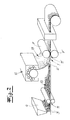
- FIG. 2 shows method steps for producing the loop-forming closure element depicted in FIGS. 1A and 1B ;
- FIG. 3 shows method steps for producing the loop-forming closure element depicted in FIGS. 1A and 1B .
- FIG. 4 shows an embossing structure on the surface of a roller used in the method according to FIG. 2 ;
- FIG. 5 shows an adhesive pattern for laminating a nonwoven material with a carrier film.
- FIG. 1B shows a loop-forming closure element, which forms the female part of a hook-and-loop fastener, wherein loops for connection with gripping hooks of a nonwoven material 1 are formed.
- the nonwoven material 1 has impressions 2 on a first side and, on one side, is formed of continuous fibers 3 of a spun bonded fabric and carded short-staple fibers in the form of staple fibers 4 .
- the continuous fibers 3 and the staple fibers 4 are intertwined and form a common nonwoven material layer comprising a fiber blend. While the continuous fibers 3 ensure good stability and strength of the nonwoven material 1 , the staple fibers 4 provide a particularly soft surface.
- the staple fibers 4 extend across the entire thickness of the nonwoven material 1 , although as shown in FIGS. 1A and 1B , the proportion of staple fibers on the first side of the nonwoven material 1 provided with impressions 2 is somewhat higher, for production-related reasons.
- the nonwoven material 1 is laminated with a single-layer carrier film 6 by means of adhesive 5 .
- the continuous fibers 3 and the staple fibers 4 protrude from the first side of the nonwoven materials 1 , partially forming loops, and can therefore be used for a connection with gripping hooks.
- FIG. 1B at least a few staple fibers protrude from the other or second side of the nonwoven materials forming nonwoven materials layer 1 .
- An interconnection at the continuous fibers 3 as well as at the staple fibers 4 is possible. Gripping hooks can engage deeply into the nonwoven material 1 specifically at the edges of the impressions 2 .
- the impressions 2 bring about a stabilization of the nonwoven material 1 .
- the mass per unit area of the nonwoven material 1 is preferably between 20 g/m 2 and 50 g/m 2 .
- the impressions 2 are produced using a roller 7 ( FIG. 2 ).
- the surface structure of the roller 7 provided for the embossing is depicted in FIG. 4 .
- the structure that is shown therefore also corresponds to the embossing structure of the nonwoven material 1 in the top view. It is evident that, in the top view, the impressions 2 are shaped in the form of wavy sections corresponding to the raised areas 8 of the roller.
- the surface portion of the impressions is typically between 5% and 20%.
- the continuous fibers 3 as well as the staple fibers 4 are formed of polyolefin, in particular polypropylene (PP).
- PP polypropylene
- FIG. 2 shows the steps for producing the nonwoven material 1 .
- continuous fibers 3 are first extruded from an extruder 9 and are deposited in order to produce a spun bonded fabric 10 .
- the deposited continuous fibers 3 are guided through a roller gap 11 in an incompletely hardened state and are thereby interconnected to a slight extent.
- a carding device 12 produces a layer 13 of carded staple fibers 4 and places the layer onto the spun bonded fabric 10 such that the staple fibers 4 are located on a first side of the thusly formed nonwoven material 1 .
- the nonwoven material 1 which still has two layers at this point, is fed to a roller gap 11 between two rollers 7 , 7 ′, wherein one of the rollers 7 has the embossing structure (according to FIG. 4 ) and a perforation having a plurality of openings 14 between the raised areas 8 of the embossing structure.
- a pressurized liquid is fed to the roller 7 provided with the raised areas 8 in order to produce liquid jets at the openings 14 , wherein said liquid jets are referred to as water jets within the scope of the invention, even if water is not fed, but rather an aqueous liquid or another liquid.
- the nonwoven material 1 is embossed in the roller gap 11 ′ between the rollers 7 , 7 ′, the continuous fibers 3 are blended and intertwined with the staple fibers 4 by the action of water jets.
- a nonwoven material layer forms out of the fiber blend, which contains staple fibers 4 and continuous fibers 3 across the thickness thereof.
- a somewhat greater concentration of the staple fibers 4 is generally expected on the first side of the nonwoven material 1 , because the staple fibers were originally placed there.
- FIG. 2 also shows that the nonwoven material 1 is dried and then rolled up.
- FIG. 3 shows the further processing, wherein a carrier film 15 is supplied and is provided with a decorative impression in a printing unit 16 . Subsequently, the adhesive 5 is applied onto the carrier film 15 in a pattern via a roller arrangement 17 before the carrier film 15 , comprising the adhesive 5 disposed thereon in a pattern, is laminated with the nonwoven material 1 , thereby ultimately resulting in the material depicted in FIG. 1 .
- FIG. 5 shows, as an example, a suitable adhesive pattern for connecting the nonwoven material 1 with the carrier film 15 .
- the surface portion of adhesive 5 and, therefore, also the portion of the bonded regions is preferably between 10 and 30%.
- the amount of adhesive 5 present, on average, over the entire surface is preferably between 1.5 g/m 2 and 5 g/m 2 .
- the width of the individual webs provided with adhesive are in the range of 1 to 1.5 mm, for example.
- the PE monofilm formed of a mixture of PE-LLD and PE-HD was then provided with a single-component PUR adhesive having the adhesive pattern according to FIG. 5 and was provided with a nonwoven material 1 having a mass per unit area of 35 g/m 2 .
- the nonwoven material 1 is formed of continuous fibers 3 and staple fibers 4 , each of which comprise polypropylene.
- the mass per unit area of the adhesive applied for the lamination is 3.0 g/m 2 .
- the mass per unit area of the nonwoven material was increased from 35 g/m 2 to 40 g/m 2 .
- the carrier film 15 having the above-described configuration was imprinted and then provided with the single-component PUR adhesive having a mass per unit area of 1.8 g/m 2 having the pattern depicted in FIG. 5 .
- a known knitted fabric made of polyamide having a mass per unit area of 18 g/m 2 was laminated instead of the nonwoven material 1 .
- Tables 1 and 2 show the results of a peel measurement and a shear measurement of the examples.
- a strip of the nonwoven material is cropped in a transverse direction relative to the production process depicted in FIGS. 2 and 3 with a width of one inch (24.4 mm).
- the sample is then hung in a hanging device.
- a hook strip having a mass of 500 g is pressed by hand against the nonwoven material for a duration of 3 seconds and then hangs on the nonwoven material 1 under a weight load for 5 seconds before the weight is removed.
- the further testing is then carried out with the standard settings of a Zwick device.
- the nonwoven material 1 is inserted into the lower clamping jaw and the hook strip is inserted into the upper clamping jaw.
- the hook strip and the nonwoven material 1 are disposed flat in a plane.
- the nonwoven material 1 is clamped such that, proceeding from the hook strip, the material is folded onto itself by 180°.
- a peel-off by 180° is simulated.
- the measurements show that the peel and shear values of a known texturized polyamide knitted fabric are met or even exceeded with various masses per unit area of the nonwoven material 1 according to the invention.
- the closure element according to the invention is characterized by a very soft, uniform and visually appealing surface.
Landscapes
- Engineering & Computer Science (AREA)
- Textile Engineering (AREA)
- Mechanical Engineering (AREA)
- Slide Fasteners, Snap Fasteners, And Hook Fasteners (AREA)
- Nonwoven Fabrics (AREA)
- Laminated Bodies (AREA)
Applications Claiming Priority (3)
| Application Number | Priority Date | Filing Date | Title |
|---|---|---|---|
| DE13189354.7 | 2013-10-18 | ||
| EP13189354.7A EP2862708B1 (de) | 2013-10-18 | 2013-10-18 | Schlaufenbildendes Verschlusselement für Klettverschlüsse sowie Verfahren zur Herstellung eines Verschlusselementes |
| EP13189354 | 2013-10-18 |
Publications (2)
| Publication Number | Publication Date |
|---|---|
| US20150107063A1 US20150107063A1 (en) | 2015-04-23 |
| US10070704B2 true US10070704B2 (en) | 2018-09-11 |
Family
ID=49447985
Family Applications (1)
| Application Number | Title | Priority Date | Filing Date |
|---|---|---|---|
| US14/506,797 Active US10070704B2 (en) | 2013-10-18 | 2014-10-06 | Loop-forming closure element for hook-and-loop fasteners and method for the production of a closure element |
Country Status (8)
| Country | Link |
|---|---|
| US (1) | US10070704B2 (pl) |
| EP (1) | EP2862708B1 (pl) |
| JP (1) | JP5955363B2 (pl) |
| CN (1) | CN104544779B (pl) |
| DK (1) | DK2862708T3 (pl) |
| ES (1) | ES2581519T3 (pl) |
| HU (1) | HUE029741T2 (pl) |
| PL (1) | PL2862708T3 (pl) |
Families Citing this family (8)
| Publication number | Priority date | Publication date | Assignee | Title |
|---|---|---|---|---|
| US20160270488A1 (en) * | 2015-03-19 | 2016-09-22 | MONDI Gronau GmbH | Laminate for a hook-and-loop-fastener, and method of making a laminate for a hook-and-loop fastener |
| WO2017125862A1 (en) * | 2016-01-18 | 2017-07-27 | Fintex & Partners Italia S.P.A. | Mechanical reversible tear-off closing device of the male-female type, multi-layer female material to be used in a mechanical reversible tear-off closing device and method to produce said multi-layer female material |
| JP7004494B2 (ja) * | 2016-09-29 | 2022-01-21 | スリーエム イノベイティブ プロパティズ カンパニー | ループ部材、及びおむつ |
| CN112912046B (zh) * | 2018-09-27 | 2023-01-31 | 宝洁公司 | 具有视觉可辨别的图案的非织造纤维网 |
| US11999150B2 (en) * | 2019-05-03 | 2024-06-04 | The Procter & Gamble Company | Nonwoven webs with one or more repeat units |
| DE102020114549A1 (de) * | 2020-05-29 | 2021-12-02 | Mondi Ag | Vliesstoffelement und Herstellungsverfahren |
| TR202019976A2 (tr) | 2020-12-08 | 2021-02-22 | Telasis Tekstil Ueruenleri San Tic A S | Yeni̇ bi̇r çok katmanli tela ve bunun üreti̇m prosesi̇ |
| CN112726029B (zh) * | 2020-12-22 | 2022-09-30 | 杭州诺邦无纺股份有限公司 | 一种长丝无纺复合材料及其制备方法 |
Citations (22)
| Publication number | Priority date | Publication date | Assignee | Title |
|---|---|---|---|---|
| US3271216A (en) * | 1963-01-22 | 1966-09-06 | Du Pont | Production of loop pile textiles |
| US5614281A (en) * | 1995-11-29 | 1997-03-25 | Kimberly-Clark Corporation | Creped nonwoven laminate loop fastening material for mechanical fastening systems |
| US5669900A (en) * | 1993-11-03 | 1997-09-23 | Kimberly-Clark Worldwide, Inc. | Spunbond loop material for hook and loop fastening systems |
| US5773120A (en) | 1997-02-28 | 1998-06-30 | Kimberly-Clark Worldwide, Inc. | Loop material for hook-and-loop fastening system |
| US5888607A (en) * | 1997-07-03 | 1999-03-30 | Minnesota Mining And Manufacturing Co. | Soft loop laminate and method of making |
| EP0937420A2 (en) | 1998-02-23 | 1999-08-25 | Japan Vilene Company, Ltd. | Female component for touch and close fastener and method of manufacturing the same |
| US6162522A (en) * | 1998-06-19 | 2000-12-19 | Kimberly-Clark Worldwide, Inc. | Loop substrate for releasably attachable abrasive sheet material |
| US20020019206A1 (en) * | 2000-05-12 | 2002-02-14 | Deka Ganesh Chandra | Colored loop substrate for releasably attachable abrasive sheet material |
| US6489004B1 (en) * | 2000-11-03 | 2002-12-03 | Kimberly-Clark Worldwide, Inc. | Hook and loop fastener having an increased coefficient of friction |
| US6642429B1 (en) * | 1999-06-30 | 2003-11-04 | Kimberly-Clark Worldwide, Inc. | Personal care articles with reduced polymer fibers |
| US20030232170A1 (en) | 2002-06-12 | 2003-12-18 | Gillette Samuel Mark | Spunlaced loop material for a refastenable fastening device and methods of making same |
| US6740385B2 (en) * | 2001-03-28 | 2004-05-25 | Bp Corporation North America Inc. | Tuftable and tufted fabrics |
| US20040163221A1 (en) * | 2001-06-12 | 2004-08-26 | Shepard William H. | Loop materials for touch fastening |
| DE102004053469A1 (de) | 2004-11-03 | 2006-05-04 | Paul Hartmann Ag | Schlaufenbildendes Vliesstoffmaterial für ein mechanisches Verschlussmittel |
| US20060148359A1 (en) * | 2004-12-30 | 2006-07-06 | Kimberly-Clark Worldwide, Inc. | Nonwoven loop material |
| US20070178273A1 (en) * | 2006-02-01 | 2007-08-02 | Provost George A | Embossing loop materials |
| DE202004021382U1 (de) | 2004-03-22 | 2007-12-13 | Nordenia Deutschland Gronau Gmbh | Verbundstoff für Klettverschlüsse, insbesondere Windelverschlüsse |
| US20080260989A1 (en) * | 2007-04-17 | 2008-10-23 | Aplix, Inc. | Loop material for loop and hook type fastener used in a disposable article or garment |
| US20080305704A1 (en) * | 2002-12-03 | 2008-12-11 | Velcro Industries B.V. | Needling loops into carrier sheets |
| US7465366B2 (en) * | 2002-12-03 | 2008-12-16 | Velero Industries B.V. | Needling loops into carrier sheets |
| US7547469B2 (en) * | 2002-12-03 | 2009-06-16 | Velcro Industries B.V. | Forming loop materials |
| US20130052403A1 (en) * | 2011-08-25 | 2013-02-28 | Velcro Industries B.V. | Loop-Engageable Fasteners and Related Systems and Methods |
Family Cites Families (3)
| Publication number | Priority date | Publication date | Assignee | Title |
|---|---|---|---|---|
| JP4320078B2 (ja) * | 1999-02-15 | 2009-08-26 | 大和紡績株式会社 | 嵩高性不織布、その製造方法およびこれを用いた清拭材 |
| SE0302874D0 (sv) * | 2003-10-31 | 2003-10-31 | Sca Hygiene Prod Ab | A hydroentangled nonwoven material |
| JP5043293B2 (ja) * | 2004-09-16 | 2012-10-10 | スリーエム イノベイティブ プロパティズ カンパニー | メカニカルファスナー用雌材及び使い捨て紙おむつ |
-
2013
- 2013-10-18 HU HUE13189354A patent/HUE029741T2/en unknown
- 2013-10-18 DK DK13189354.7T patent/DK2862708T3/en active
- 2013-10-18 EP EP13189354.7A patent/EP2862708B1/de active Active
- 2013-10-18 ES ES13189354.7T patent/ES2581519T3/es active Active
- 2013-10-18 PL PL13189354.7T patent/PL2862708T3/pl unknown
-
2014
- 2014-09-25 JP JP2014194585A patent/JP5955363B2/ja active Active
- 2014-10-06 US US14/506,797 patent/US10070704B2/en active Active
- 2014-10-13 CN CN201410536168.4A patent/CN104544779B/zh not_active Expired - Fee Related
Patent Citations (28)
| Publication number | Priority date | Publication date | Assignee | Title |
|---|---|---|---|---|
| US3271216A (en) * | 1963-01-22 | 1966-09-06 | Du Pont | Production of loop pile textiles |
| US5669900A (en) * | 1993-11-03 | 1997-09-23 | Kimberly-Clark Worldwide, Inc. | Spunbond loop material for hook and loop fastening systems |
| US5614281A (en) * | 1995-11-29 | 1997-03-25 | Kimberly-Clark Corporation | Creped nonwoven laminate loop fastening material for mechanical fastening systems |
| EP0963472A1 (en) | 1997-02-28 | 1999-12-15 | Kimberly-Clark Worldwide, Inc. | Loop material for hook-and-loop fastening system |
| US5773120A (en) | 1997-02-28 | 1998-06-30 | Kimberly-Clark Worldwide, Inc. | Loop material for hook-and-loop fastening system |
| US5888607A (en) * | 1997-07-03 | 1999-03-30 | Minnesota Mining And Manufacturing Co. | Soft loop laminate and method of making |
| EP0937420A2 (en) | 1998-02-23 | 1999-08-25 | Japan Vilene Company, Ltd. | Female component for touch and close fastener and method of manufacturing the same |
| US6192556B1 (en) | 1998-02-23 | 2001-02-27 | Japan Vilene Company, Ltd. | Female component for touch and close fastener and method of manufacturing the same |
| US6162522A (en) * | 1998-06-19 | 2000-12-19 | Kimberly-Clark Worldwide, Inc. | Loop substrate for releasably attachable abrasive sheet material |
| US6642429B1 (en) * | 1999-06-30 | 2003-11-04 | Kimberly-Clark Worldwide, Inc. | Personal care articles with reduced polymer fibers |
| US20020019206A1 (en) * | 2000-05-12 | 2002-02-14 | Deka Ganesh Chandra | Colored loop substrate for releasably attachable abrasive sheet material |
| US6489004B1 (en) * | 2000-11-03 | 2002-12-03 | Kimberly-Clark Worldwide, Inc. | Hook and loop fastener having an increased coefficient of friction |
| US6740385B2 (en) * | 2001-03-28 | 2004-05-25 | Bp Corporation North America Inc. | Tuftable and tufted fabrics |
| US20040163221A1 (en) * | 2001-06-12 | 2004-08-26 | Shepard William H. | Loop materials for touch fastening |
| WO2003105621A1 (en) | 2002-06-01 | 2003-12-24 | Precision Fabrics Group, Inc. | Spunlaced loop material for a refastenable fastening device and methods of making same |
| US20040072491A1 (en) | 2002-06-12 | 2004-04-15 | Gillette Samuel Mark | Spunlaced loop material for a refastenable fastening device and methods of making same |
| US20030232170A1 (en) | 2002-06-12 | 2003-12-18 | Gillette Samuel Mark | Spunlaced loop material for a refastenable fastening device and methods of making same |
| US20060217022A1 (en) | 2002-06-12 | 2006-09-28 | Precision Fabrics Group | Spunlaced loop material for a refastenable fastening device and methods of making same |
| US20080305704A1 (en) * | 2002-12-03 | 2008-12-11 | Velcro Industries B.V. | Needling loops into carrier sheets |
| US7465366B2 (en) * | 2002-12-03 | 2008-12-16 | Velero Industries B.V. | Needling loops into carrier sheets |
| US7547469B2 (en) * | 2002-12-03 | 2009-06-16 | Velcro Industries B.V. | Forming loop materials |
| DE202004021382U1 (de) | 2004-03-22 | 2007-12-13 | Nordenia Deutschland Gronau Gmbh | Verbundstoff für Klettverschlüsse, insbesondere Windelverschlüsse |
| DE102004053469A1 (de) | 2004-11-03 | 2006-05-04 | Paul Hartmann Ag | Schlaufenbildendes Vliesstoffmaterial für ein mechanisches Verschlussmittel |
| US7544628B2 (en) | 2004-11-03 | 2009-06-09 | Paul Hartmann Ag | Loop-forming nonwoven material for a mechanical closure element |
| US20060148359A1 (en) * | 2004-12-30 | 2006-07-06 | Kimberly-Clark Worldwide, Inc. | Nonwoven loop material |
| US20070178273A1 (en) * | 2006-02-01 | 2007-08-02 | Provost George A | Embossing loop materials |
| US20080260989A1 (en) * | 2007-04-17 | 2008-10-23 | Aplix, Inc. | Loop material for loop and hook type fastener used in a disposable article or garment |
| US20130052403A1 (en) * | 2011-08-25 | 2013-02-28 | Velcro Industries B.V. | Loop-Engageable Fasteners and Related Systems and Methods |
Also Published As
| Publication number | Publication date |
|---|---|
| ES2581519T3 (es) | 2016-09-06 |
| JP5955363B2 (ja) | 2016-07-20 |
| PL2862708T3 (pl) | 2016-11-30 |
| CN104544779A (zh) | 2015-04-29 |
| JP2015077403A (ja) | 2015-04-23 |
| CN104544779B (zh) | 2018-12-04 |
| DK2862708T3 (en) | 2016-08-15 |
| EP2862708A1 (de) | 2015-04-22 |
| HUE029741T2 (en) | 2017-04-28 |
| US20150107063A1 (en) | 2015-04-23 |
| EP2862708B1 (de) | 2016-04-27 |
Similar Documents
| Publication | Publication Date | Title |
|---|---|---|
| US10070704B2 (en) | Loop-forming closure element for hook-and-loop fasteners and method for the production of a closure element | |
| US7547469B2 (en) | Forming loop materials | |
| EP1871939B1 (en) | Needling loops into carrier sheets | |
| US7682686B2 (en) | Tufted fibrous web | |
| EP1902168B1 (en) | Tufted fibrous web | |
| DE69626410T3 (de) | Muster-ungebundene Vliesbahn und Verfahren zu deren Herstellung | |
| EP2152948B1 (en) | Anchoring loops of fibers needled into a carrier sheet | |
| US20050196583A1 (en) | Embossing loop materials | |
| US20120330266A1 (en) | Reticulated mechanical fastening patch and method of making the same | |
| US20050196580A1 (en) | Loop materials | |
| US20050217092A1 (en) | Anchoring loops of fibers needled into a carrier sheet | |
| US7465366B2 (en) | Needling loops into carrier sheets | |
| CZ249493A3 (en) | Multilayer internal component for detachable connecting means and process for producing thereof | |
| WO2008154303A1 (en) | Needling loops into carrier sheets | |
| JP2010022832A (ja) | 面ファスナ用の複合材要素 | |
| US20070178273A1 (en) | Embossing loop materials | |
| JP5940193B1 (ja) | 面ファスナーと繊維製品 | |
| DE10352958B4 (de) | Verwendung eines hochreißfesten Verbundstoffes als Verhakungsteil eines mechanischen Verschlusssystems | |
| DK2883472T3 (en) | Composite material element for Velcro closures and method for forming a composite material element of Velcro closures | |
| JP2017099825A (ja) | 雄型面ファスナー機能性資材と製造方法 |
Legal Events
| Date | Code | Title | Description |
|---|---|---|---|
| AS | Assignment |
Owner name: MONDI GRONAU GMBH, GERMANY Free format text: ASSIGNMENT OF ASSIGNORS INTEREST;ASSIGNORS:BALDAUF, GEORG;HOMOELLE, DIETER;REEL/FRAME:033897/0409 Effective date: 20140916 |
|
| STCF | Information on status: patent grant |
Free format text: PATENTED CASE |
|
| MAFP | Maintenance fee payment |
Free format text: PAYMENT OF MAINTENANCE FEE, 4TH YEAR, LARGE ENTITY (ORIGINAL EVENT CODE: M1551); ENTITY STATUS OF PATENT OWNER: LARGE ENTITY Year of fee payment: 4 |
|
| MAFP | Maintenance fee payment |
Free format text: PAYMENT OF MAINTENANCE FEE, 8TH YEAR, LARGE ENTITY (ORIGINAL EVENT CODE: M1552); ENTITY STATUS OF PATENT OWNER: LARGE ENTITY Year of fee payment: 8 |