US10066109B2 - Articles including nanosilica-based primers for polymer coatings and methods - Google Patents
Articles including nanosilica-based primers for polymer coatings and methods Download PDFInfo
- Publication number
- US10066109B2 US10066109B2 US13/642,341 US201113642341A US10066109B2 US 10066109 B2 US10066109 B2 US 10066109B2 US 201113642341 A US201113642341 A US 201113642341A US 10066109 B2 US10066109 B2 US 10066109B2
- Authority
- US
- United States
- Prior art keywords
- silicone
- primer
- silica
- based material
- nanoparticle
- Prior art date
- Legal status (The legal status is an assumption and is not a legal conclusion. Google has not performed a legal analysis and makes no representation as to the accuracy of the status listed.)
- Expired - Fee Related, expires
Links
- 229920000642 polymer Polymers 0.000 title abstract description 56
- 238000000034 method Methods 0.000 title abstract description 52
- 238000000576 coating method Methods 0.000 title abstract description 50
- VYPSYNLAJGMNEJ-UHFFFAOYSA-N Silicium dioxide Chemical compound O=[Si]=O VYPSYNLAJGMNEJ-UHFFFAOYSA-N 0.000 claims abstract description 272
- 229920001296 polysiloxane Polymers 0.000 claims abstract description 171
- 239000002105 nanoparticle Substances 0.000 claims abstract description 138
- 239000000377 silicon dioxide Substances 0.000 claims abstract description 127
- 239000000758 substrate Substances 0.000 claims abstract description 110
- 239000002210 silicon-based material Substances 0.000 claims description 91
- 239000011521 glass Substances 0.000 claims description 65
- 239000002253 acid Substances 0.000 claims description 19
- 239000003054 catalyst Substances 0.000 claims description 18
- 239000003999 initiator Substances 0.000 claims description 12
- 239000011164 primary particle Substances 0.000 claims description 5
- 239000002987 primer (paints) Substances 0.000 abstract description 116
- 239000000463 material Substances 0.000 abstract description 58
- 239000011248 coating agent Substances 0.000 abstract description 39
- 239000000203 mixture Substances 0.000 description 90
- -1 siloxane backbone Chemical group 0.000 description 67
- 239000010408 film Substances 0.000 description 63
- 239000002245 particle Substances 0.000 description 44
- 229920000139 polyethylene terephthalate Polymers 0.000 description 37
- 239000005020 polyethylene terephthalate Substances 0.000 description 37
- 239000011347 resin Substances 0.000 description 30
- 229920005989 resin Polymers 0.000 description 30
- 239000008119 colloidal silica Substances 0.000 description 27
- 239000004926 polymethyl methacrylate Substances 0.000 description 26
- 239000008199 coating composition Substances 0.000 description 25
- 229920003229 poly(methyl methacrylate) Polymers 0.000 description 25
- 239000002033 PVDF binder Substances 0.000 description 20
- 229920002981 polyvinylidene fluoride Polymers 0.000 description 20
- 239000000243 solution Substances 0.000 description 19
- 230000008569 process Effects 0.000 description 18
- 229910052751 metal Inorganic materials 0.000 description 17
- 239000002184 metal Substances 0.000 description 17
- 239000000126 substance Substances 0.000 description 17
- 239000012530 fluid Substances 0.000 description 16
- BPQQTUXANYXVAA-UHFFFAOYSA-N Orthosilicate Chemical compound [O-][Si]([O-])([O-])[O-] BPQQTUXANYXVAA-UHFFFAOYSA-N 0.000 description 15
- 238000010894 electron beam technology Methods 0.000 description 15
- 125000000217 alkyl group Chemical group 0.000 description 14
- 229920002313 fluoropolymer Polymers 0.000 description 14
- 239000004811 fluoropolymer Substances 0.000 description 14
- 239000004094 surface-active agent Substances 0.000 description 14
- XLYOFNOQVPJJNP-UHFFFAOYSA-N water Substances O XLYOFNOQVPJJNP-UHFFFAOYSA-N 0.000 description 14
- 229910001868 water Inorganic materials 0.000 description 13
- 229920002799 BoPET Polymers 0.000 description 12
- 125000000391 vinyl group Chemical group [H]C([*])=C([H])[H] 0.000 description 12
- 229920002554 vinyl polymer Polymers 0.000 description 12
- 238000010276 construction Methods 0.000 description 11
- 229920000435 poly(dimethylsiloxane) Polymers 0.000 description 11
- 239000004743 Polypropylene Substances 0.000 description 10
- 125000003118 aryl group Chemical group 0.000 description 10
- GRYLNZFGIOXLOG-UHFFFAOYSA-N Nitric acid Chemical compound O[N+]([O-])=O GRYLNZFGIOXLOG-UHFFFAOYSA-N 0.000 description 9
- 239000004820 Pressure-sensitive adhesive Substances 0.000 description 9
- 229910017604 nitric acid Inorganic materials 0.000 description 9
- 229920001155 polypropylene Polymers 0.000 description 9
- 230000005855 radiation Effects 0.000 description 9
- 238000012360 testing method Methods 0.000 description 9
- 150000007513 acids Chemical class 0.000 description 8
- 238000001723 curing Methods 0.000 description 8
- 239000006185 dispersion Substances 0.000 description 8
- 238000001125 extrusion Methods 0.000 description 8
- 239000000853 adhesive Substances 0.000 description 7
- 230000001070 adhesive effect Effects 0.000 description 7
- 238000003475 lamination Methods 0.000 description 7
- BASFCYQUMIYNBI-UHFFFAOYSA-N platinum Chemical compound [Pt] BASFCYQUMIYNBI-UHFFFAOYSA-N 0.000 description 7
- 229920002379 silicone rubber Polymers 0.000 description 7
- QTBSBXVTEAMEQO-UHFFFAOYSA-N Acetic acid Chemical compound CC(O)=O QTBSBXVTEAMEQO-UHFFFAOYSA-N 0.000 description 6
- MUBZPKHOEPUJKR-UHFFFAOYSA-N Oxalic acid Chemical compound OC(=O)C(O)=O MUBZPKHOEPUJKR-UHFFFAOYSA-N 0.000 description 6
- 239000004698 Polyethylene Substances 0.000 description 6
- 230000001133 acceleration Effects 0.000 description 6
- KRKNYBCHXYNGOX-UHFFFAOYSA-N citric acid Chemical compound OC(=O)CC(O)(C(O)=O)CC(O)=O KRKNYBCHXYNGOX-UHFFFAOYSA-N 0.000 description 6
- 229920001971 elastomer Polymers 0.000 description 6
- 239000012943 hotmelt Substances 0.000 description 6
- 125000002496 methyl group Chemical group [H]C([H])([H])* 0.000 description 6
- 239000004005 microsphere Substances 0.000 description 6
- 239000003960 organic solvent Substances 0.000 description 6
- 239000000080 wetting agent Substances 0.000 description 6
- 239000004971 Cross linker Substances 0.000 description 5
- 229920002323 Silicone foam Polymers 0.000 description 5
- DTQVDTLACAAQTR-UHFFFAOYSA-N Trifluoroacetic acid Chemical compound OC(=O)C(F)(F)F DTQVDTLACAAQTR-UHFFFAOYSA-N 0.000 description 5
- 229920001577 copolymer Polymers 0.000 description 5
- 239000007822 coupling agent Substances 0.000 description 5
- 238000004132 cross linking Methods 0.000 description 5
- 125000000524 functional group Chemical group 0.000 description 5
- 230000002209 hydrophobic effect Effects 0.000 description 5
- 125000002887 hydroxy group Chemical group [H]O* 0.000 description 5
- 239000012788 optical film Substances 0.000 description 5
- 239000000123 paper Substances 0.000 description 5
- 229920000573 polyethylene Polymers 0.000 description 5
- 230000003068 static effect Effects 0.000 description 5
- 229920000089 Cyclic olefin copolymer Polymers 0.000 description 4
- VEXZGXHMUGYJMC-UHFFFAOYSA-N Hydrochloric acid Chemical compound Cl VEXZGXHMUGYJMC-UHFFFAOYSA-N 0.000 description 4
- 239000000654 additive Substances 0.000 description 4
- 238000007754 air knife coating Methods 0.000 description 4
- 229920001400 block copolymer Polymers 0.000 description 4
- 210000004027 cell Anatomy 0.000 description 4
- 230000010261 cell growth Effects 0.000 description 4
- 239000000919 ceramic Substances 0.000 description 4
- KPUWHANPEXNPJT-UHFFFAOYSA-N disiloxane Chemical class [SiH3]O[SiH3] KPUWHANPEXNPJT-UHFFFAOYSA-N 0.000 description 4
- 238000001035 drying Methods 0.000 description 4
- 239000004744 fabric Substances 0.000 description 4
- 239000006260 foam Substances 0.000 description 4
- 239000003365 glass fiber Substances 0.000 description 4
- 229920000515 polycarbonate Polymers 0.000 description 4
- 239000004417 polycarbonate Substances 0.000 description 4
- 229920000728 polyester Polymers 0.000 description 4
- 230000010076 replication Effects 0.000 description 4
- 239000005060 rubber Substances 0.000 description 4
- RMAQACBXLXPBSY-UHFFFAOYSA-N silicic acid Chemical compound O[Si](O)(O)O RMAQACBXLXPBSY-UHFFFAOYSA-N 0.000 description 4
- OKTJSMMVPCPJKN-UHFFFAOYSA-N Carbon Chemical compound [C] OKTJSMMVPCPJKN-UHFFFAOYSA-N 0.000 description 3
- JIGUQPWFLRLWPJ-UHFFFAOYSA-N Ethyl acrylate Chemical compound CCOC(=O)C=C JIGUQPWFLRLWPJ-UHFFFAOYSA-N 0.000 description 3
- VVQNEPGJFQJSBK-UHFFFAOYSA-N Methyl methacrylate Chemical compound COC(=O)C(C)=C VVQNEPGJFQJSBK-UHFFFAOYSA-N 0.000 description 3
- NBIIXXVUZAFLBC-UHFFFAOYSA-N Phosphoric acid Chemical compound OP(O)(O)=O NBIIXXVUZAFLBC-UHFFFAOYSA-N 0.000 description 3
- QAOWNCQODCNURD-UHFFFAOYSA-N Sulfuric acid Chemical compound OS(O)(=O)=O QAOWNCQODCNURD-UHFFFAOYSA-N 0.000 description 3
- GWEVSGVZZGPLCZ-UHFFFAOYSA-N Titan oxide Chemical compound O=[Ti]=O GWEVSGVZZGPLCZ-UHFFFAOYSA-N 0.000 description 3
- 229920004482 WACKER® Polymers 0.000 description 3
- 239000006096 absorbing agent Substances 0.000 description 3
- 239000003945 anionic surfactant Substances 0.000 description 3
- 238000006243 chemical reaction Methods 0.000 description 3
- 230000000052 comparative effect Effects 0.000 description 3
- 238000009826 distribution Methods 0.000 description 3
- 230000005611 electricity Effects 0.000 description 3
- 239000000945 filler Substances 0.000 description 3
- 238000009472 formulation Methods 0.000 description 3
- 238000010438 heat treatment Methods 0.000 description 3
- 238000007757 hot melt coating Methods 0.000 description 3
- 238000006459 hydrosilylation reaction Methods 0.000 description 3
- XEEYBQQBJWHFJM-UHFFFAOYSA-N iron Substances [Fe] XEEYBQQBJWHFJM-UHFFFAOYSA-N 0.000 description 3
- 125000005647 linker group Chemical group 0.000 description 3
- 238000002156 mixing Methods 0.000 description 3
- 239000003921 oil Substances 0.000 description 3
- PNJWIWWMYCMZRO-UHFFFAOYSA-N pent‐4‐en‐2‐one Natural products CC(=O)CC=C PNJWIWWMYCMZRO-UHFFFAOYSA-N 0.000 description 3
- 239000013500 performance material Substances 0.000 description 3
- 150000002978 peroxides Chemical class 0.000 description 3
- 229910052697 platinum Inorganic materials 0.000 description 3
- 229920002959 polymer blend Polymers 0.000 description 3
- 229920002635 polyurethane Polymers 0.000 description 3
- 239000004814 polyurethane Substances 0.000 description 3
- 230000003014 reinforcing effect Effects 0.000 description 3
- 150000003839 salts Chemical class 0.000 description 3
- 239000000565 sealant Substances 0.000 description 3
- SCPYDCQAZCOKTP-UHFFFAOYSA-N silanol Chemical compound [SiH3]O SCPYDCQAZCOKTP-UHFFFAOYSA-N 0.000 description 3
- 229920001897 terpolymer Polymers 0.000 description 3
- 238000009736 wetting Methods 0.000 description 3
- BQCIDUSAKPWEOX-UHFFFAOYSA-N 1,1-Difluoroethene Chemical compound FC(F)=C BQCIDUSAKPWEOX-UHFFFAOYSA-N 0.000 description 2
- NIXOWILDQLNWCW-UHFFFAOYSA-M Acrylate Chemical compound [O-]C(=O)C=C NIXOWILDQLNWCW-UHFFFAOYSA-M 0.000 description 2
- 0 C.C.C.C.[1*][Si]([2*])(O[Si]([5*])([5*])[5*])O[Si]([3*])([4*])O[Si]([5*])([5*])[5*] Chemical compound C.C.C.C.[1*][Si]([2*])(O[Si]([5*])([5*])[5*])O[Si]([3*])([4*])O[Si]([5*])([5*])[5*] 0.000 description 2
- VTYYLEPIZMXCLO-UHFFFAOYSA-L Calcium carbonate Chemical compound [Ca+2].[O-]C([O-])=O VTYYLEPIZMXCLO-UHFFFAOYSA-L 0.000 description 2
- 239000004593 Epoxy Substances 0.000 description 2
- LFQSCWFLJHTTHZ-UHFFFAOYSA-N Ethanol Chemical compound CCO LFQSCWFLJHTTHZ-UHFFFAOYSA-N 0.000 description 2
- VGGSQFUCUMXWEO-UHFFFAOYSA-N Ethene Chemical compound C=C VGGSQFUCUMXWEO-UHFFFAOYSA-N 0.000 description 2
- 239000005977 Ethylene Substances 0.000 description 2
- LYCAIKOWRPUZTN-UHFFFAOYSA-N Ethylene glycol Chemical compound OCCO LYCAIKOWRPUZTN-UHFFFAOYSA-N 0.000 description 2
- CPELXLSAUQHCOX-UHFFFAOYSA-N Hydrogen bromide Chemical compound Br CPELXLSAUQHCOX-UHFFFAOYSA-N 0.000 description 2
- UQSXHKLRYXJYBZ-UHFFFAOYSA-N Iron oxide Chemical compound [Fe]=O UQSXHKLRYXJYBZ-UHFFFAOYSA-N 0.000 description 2
- AFVFQIVMOAPDHO-UHFFFAOYSA-N Methanesulfonic acid Chemical compound CS(O)(=O)=O AFVFQIVMOAPDHO-UHFFFAOYSA-N 0.000 description 2
- IMNFDUFMRHMDMM-UHFFFAOYSA-N N-Heptane Chemical compound CCCCCCC IMNFDUFMRHMDMM-UHFFFAOYSA-N 0.000 description 2
- KKCBUQHMOMHUOY-UHFFFAOYSA-N Na2O Inorganic materials [O-2].[Na+].[Na+] KKCBUQHMOMHUOY-UHFFFAOYSA-N 0.000 description 2
- 239000004793 Polystyrene Substances 0.000 description 2
- BOTDANWDWHJENH-UHFFFAOYSA-N Tetraethyl orthosilicate Chemical compound CCO[Si](OCC)(OCC)OCC BOTDANWDWHJENH-UHFFFAOYSA-N 0.000 description 2
- 229920002359 Tetronic® Polymers 0.000 description 2
- MCMNRKCIXSYSNV-UHFFFAOYSA-N Zirconium dioxide Chemical compound O=[Zr]=O MCMNRKCIXSYSNV-UHFFFAOYSA-N 0.000 description 2
- 150000001252 acrylic acid derivatives Chemical class 0.000 description 2
- 239000002390 adhesive tape Substances 0.000 description 2
- 230000002776 aggregation Effects 0.000 description 2
- 125000002947 alkylene group Chemical group 0.000 description 2
- 125000000129 anionic group Chemical group 0.000 description 2
- 239000003963 antioxidant agent Substances 0.000 description 2
- 235000006708 antioxidants Nutrition 0.000 description 2
- 239000007900 aqueous suspension Substances 0.000 description 2
- 239000011324 bead Substances 0.000 description 2
- 230000009286 beneficial effect Effects 0.000 description 2
- 230000008901 benefit Effects 0.000 description 2
- 230000015572 biosynthetic process Effects 0.000 description 2
- SXDBWCPKPHAZSM-UHFFFAOYSA-N bromic acid Chemical compound OBr(=O)=O SXDBWCPKPHAZSM-UHFFFAOYSA-N 0.000 description 2
- 229910052799 carbon Inorganic materials 0.000 description 2
- 238000005266 casting Methods 0.000 description 2
- 239000003795 chemical substances by application Substances 0.000 description 2
- IJOOHPMOJXWVHK-UHFFFAOYSA-N chlorotrimethylsilane Chemical compound C[Si](C)(C)Cl IJOOHPMOJXWVHK-UHFFFAOYSA-N 0.000 description 2
- 150000001875 compounds Chemical class 0.000 description 2
- 230000003247 decreasing effect Effects 0.000 description 2
- 230000001419 dependent effect Effects 0.000 description 2
- 238000010790 dilution Methods 0.000 description 2
- 239000012895 dilution Substances 0.000 description 2
- 239000000975 dye Substances 0.000 description 2
- 238000002296 dynamic light scattering Methods 0.000 description 2
- 239000000806 elastomer Substances 0.000 description 2
- QHSJIZLJUFMIFP-UHFFFAOYSA-N ethene;1,1,2,2-tetrafluoroethene Chemical group C=C.FC(F)=C(F)F QHSJIZLJUFMIFP-UHFFFAOYSA-N 0.000 description 2
- ZYMKZMDQUPCXRP-UHFFFAOYSA-N fluoro prop-2-enoate Chemical group FOC(=O)C=C ZYMKZMDQUPCXRP-UHFFFAOYSA-N 0.000 description 2
- 238000005187 foaming Methods 0.000 description 2
- 239000005350 fused silica glass Substances 0.000 description 2
- 230000005484 gravity Effects 0.000 description 2
- 150000002367 halogens Chemical group 0.000 description 2
- HCDGVLDPFQMKDK-UHFFFAOYSA-N hexafluoropropylene Chemical group FC(F)=C(F)C(F)(F)F HCDGVLDPFQMKDK-UHFFFAOYSA-N 0.000 description 2
- FFUAGWLWBBFQJT-UHFFFAOYSA-N hexamethyldisilazane Chemical compound C[Si](C)(C)N[Si](C)(C)C FFUAGWLWBBFQJT-UHFFFAOYSA-N 0.000 description 2
- 229910052739 hydrogen Inorganic materials 0.000 description 2
- 239000001257 hydrogen Substances 0.000 description 2
- 125000004435 hydrogen atom Chemical class [H]* 0.000 description 2
- 230000005661 hydrophobic surface Effects 0.000 description 2
- 239000010954 inorganic particle Substances 0.000 description 2
- 229910052742 iron Inorganic materials 0.000 description 2
- 238000010030 laminating Methods 0.000 description 2
- 239000007791 liquid phase Substances 0.000 description 2
- 230000007774 longterm Effects 0.000 description 2
- 230000000873 masking effect Effects 0.000 description 2
- 150000007522 mineralic acids Chemical class 0.000 description 2
- 239000000178 monomer Substances 0.000 description 2
- 150000007524 organic acids Chemical class 0.000 description 2
- 125000000962 organic group Chemical group 0.000 description 2
- 229920006136 organohydrogenpolysiloxane Polymers 0.000 description 2
- 235000006408 oxalic acid Nutrition 0.000 description 2
- 150000002924 oxiranes Chemical class 0.000 description 2
- VLTRZXGMWDSKGL-UHFFFAOYSA-N perchloric acid Chemical compound OCl(=O)(=O)=O VLTRZXGMWDSKGL-UHFFFAOYSA-N 0.000 description 2
- 125000001997 phenyl group Chemical group [H]C1=C([H])C([H])=C(*)C([H])=C1[H] 0.000 description 2
- 239000000049 pigment Substances 0.000 description 2
- 229920003023 plastic Polymers 0.000 description 2
- 229920003216 poly(methylphenylsiloxane) Polymers 0.000 description 2
- 229920002223 polystyrene Polymers 0.000 description 2
- 239000004800 polyvinyl chloride Substances 0.000 description 2
- 229920000915 polyvinyl chloride Polymers 0.000 description 2
- 239000005033 polyvinylidene chloride Substances 0.000 description 2
- 239000000843 powder Substances 0.000 description 2
- QQONPFPTGQHPMA-UHFFFAOYSA-N propylene Natural products CC=C QQONPFPTGQHPMA-UHFFFAOYSA-N 0.000 description 2
- 239000010453 quartz Substances 0.000 description 2
- 150000003254 radicals Chemical class 0.000 description 2
- 239000013464 silicone adhesive Substances 0.000 description 2
- 229920006268 silicone film Polymers 0.000 description 2
- 239000012798 spherical particle Substances 0.000 description 2
- 230000006641 stabilisation Effects 0.000 description 2
- 238000011105 stabilization Methods 0.000 description 2
- 239000007858 starting material Substances 0.000 description 2
- 125000001424 substituent group Chemical group 0.000 description 2
- BDHFUVZGWQCTTF-UHFFFAOYSA-M sulfonate Chemical compound [O-]S(=O)=O BDHFUVZGWQCTTF-UHFFFAOYSA-M 0.000 description 2
- 239000000725 suspension Substances 0.000 description 2
- BFKJFAAPBSQJPD-UHFFFAOYSA-N tetrafluoroethene Chemical group FC(F)=C(F)F BFKJFAAPBSQJPD-UHFFFAOYSA-N 0.000 description 2
- 239000004753 textile Substances 0.000 description 2
- 238000004627 transmission electron microscopy Methods 0.000 description 2
- ITMCEJHCFYSIIV-UHFFFAOYSA-N triflic acid Chemical compound OS(=O)(=O)C(F)(F)F ITMCEJHCFYSIIV-UHFFFAOYSA-N 0.000 description 2
- 125000006663 (C1-C6) perfluoroalkyl group Chemical group 0.000 description 1
- LIKMAJRDDDTEIG-UHFFFAOYSA-N 1-hexene Chemical compound CCCCC=C LIKMAJRDDDTEIG-UHFFFAOYSA-N 0.000 description 1
- PLFJWWUZKJKIPZ-UHFFFAOYSA-N 2-[2-[2-(2,6,8-trimethylnonan-4-yloxy)ethoxy]ethoxy]ethanol Chemical compound CC(C)CC(C)CC(CC(C)C)OCCOCCOCCO PLFJWWUZKJKIPZ-UHFFFAOYSA-N 0.000 description 1
- IEQAICDLOKRSRL-UHFFFAOYSA-N 2-[2-[2-[2-[2-[2-[2-[2-[2-[2-[2-[2-[2-[2-[2-[2-[2-[2-[2-[2-[2-[2-(2-dodecoxyethoxy)ethoxy]ethoxy]ethoxy]ethoxy]ethoxy]ethoxy]ethoxy]ethoxy]ethoxy]ethoxy]ethoxy]ethoxy]ethoxy]ethoxy]ethoxy]ethoxy]ethoxy]ethoxy]ethoxy]ethoxy]ethoxy]ethanol Chemical compound CCCCCCCCCCCCOCCOCCOCCOCCOCCOCCOCCOCCOCCOCCOCCOCCOCCOCCOCCOCCOCCOCCOCCOCCOCCOCCOCCO IEQAICDLOKRSRL-UHFFFAOYSA-N 0.000 description 1
- 125000003903 2-propenyl group Chemical group [H]C([*])([H])C([H])=C([H])[H] 0.000 description 1
- NNWNNQTUZYVQRK-UHFFFAOYSA-N 5-bromo-1h-pyrrolo[2,3-c]pyridine-2-carboxylic acid Chemical compound BrC1=NC=C2NC(C(=O)O)=CC2=C1 NNWNNQTUZYVQRK-UHFFFAOYSA-N 0.000 description 1
- QTBSBXVTEAMEQO-UHFFFAOYSA-M Acetate Chemical compound CC([O-])=O QTBSBXVTEAMEQO-UHFFFAOYSA-M 0.000 description 1
- QGZKDVFQNNGYKY-UHFFFAOYSA-O Ammonium Chemical compound [NH4+] QGZKDVFQNNGYKY-UHFFFAOYSA-O 0.000 description 1
- 238000012935 Averaging Methods 0.000 description 1
- 229910001369 Brass Inorganic materials 0.000 description 1
- FERIUCNNQQJTOY-UHFFFAOYSA-M Butyrate Chemical compound CCCC([O-])=O FERIUCNNQQJTOY-UHFFFAOYSA-M 0.000 description 1
- FERIUCNNQQJTOY-UHFFFAOYSA-N Butyric acid Natural products CCCC(O)=O FERIUCNNQQJTOY-UHFFFAOYSA-N 0.000 description 1
- 229920002574 CR-39 Polymers 0.000 description 1
- DODHYCGLWKOXCD-UHFFFAOYSA-N C[Pt](C1(C=CC=C1)C)(C)C Chemical compound C[Pt](C1(C=CC=C1)C)(C)C DODHYCGLWKOXCD-UHFFFAOYSA-N 0.000 description 1
- 229920000103 Expandable microsphere Polymers 0.000 description 1
- PXGOKWXKJXAPGV-UHFFFAOYSA-N Fluorine Chemical compound FF PXGOKWXKJXAPGV-UHFFFAOYSA-N 0.000 description 1
- DGAQECJNVWCQMB-PUAWFVPOSA-M Ilexoside XXIX Chemical compound C[C@@H]1CC[C@@]2(CC[C@@]3(C(=CC[C@H]4[C@]3(CC[C@@H]5[C@@]4(CC[C@@H](C5(C)C)OS(=O)(=O)[O-])C)C)[C@@H]2[C@]1(C)O)C)C(=O)O[C@H]6[C@@H]([C@H]([C@@H]([C@H](O6)CO)O)O)O.[Na+] DGAQECJNVWCQMB-PUAWFVPOSA-M 0.000 description 1
- 239000005909 Kieselgur Substances 0.000 description 1
- 229920005479 Lucite® Polymers 0.000 description 1
- 239000004594 Masterbatch (MB) Substances 0.000 description 1
- 229910019142 PO4 Inorganic materials 0.000 description 1
- 229920002012 Pluronic® F 38 Polymers 0.000 description 1
- RVGRUAULSDPKGF-UHFFFAOYSA-N Poloxamer Chemical compound C1CO1.CC1CO1 RVGRUAULSDPKGF-UHFFFAOYSA-N 0.000 description 1
- 229920003171 Poly (ethylene oxide) Polymers 0.000 description 1
- 239000004695 Polyether sulfone Substances 0.000 description 1
- 239000002202 Polyethylene glycol Substances 0.000 description 1
- 229910008051 Si-OH Inorganic materials 0.000 description 1
- 229910020388 SiO1/2 Inorganic materials 0.000 description 1
- 229910020447 SiO2/2 Inorganic materials 0.000 description 1
- 229910020487 SiO3/2 Inorganic materials 0.000 description 1
- 229910020485 SiO4/2 Inorganic materials 0.000 description 1
- BLRPTPMANUNPDV-UHFFFAOYSA-N Silane Chemical compound [SiH4] BLRPTPMANUNPDV-UHFFFAOYSA-N 0.000 description 1
- XUIMIQQOPSSXEZ-UHFFFAOYSA-N Silicon Chemical group [Si] XUIMIQQOPSSXEZ-UHFFFAOYSA-N 0.000 description 1
- 229910006358 Si—OH Inorganic materials 0.000 description 1
- DBMJMQXJHONAFJ-UHFFFAOYSA-M Sodium laurylsulphate Chemical compound [Na+].CCCCCCCCCCCCOS([O-])(=O)=O DBMJMQXJHONAFJ-UHFFFAOYSA-M 0.000 description 1
- QAOWNCQODCNURD-UHFFFAOYSA-L Sulfate Chemical compound [O-]S([O-])(=O)=O QAOWNCQODCNURD-UHFFFAOYSA-L 0.000 description 1
- LSNNMFCWUKXFEE-UHFFFAOYSA-N Sulfurous acid Chemical compound OS(O)=O LSNNMFCWUKXFEE-UHFFFAOYSA-N 0.000 description 1
- WPMWEFXCIYCJSA-UHFFFAOYSA-N Tetraethylene glycol monododecyl ether Chemical compound CCCCCCCCCCCCOCCOCCOCCOCCO WPMWEFXCIYCJSA-UHFFFAOYSA-N 0.000 description 1
- 238000003848 UV Light-Curing Methods 0.000 description 1
- 235000012545 Vaccinium macrocarpon Nutrition 0.000 description 1
- 235000002118 Vaccinium oxycoccus Nutrition 0.000 description 1
- 244000291414 Vaccinium oxycoccus Species 0.000 description 1
- 238000005299 abrasion Methods 0.000 description 1
- NIXOWILDQLNWCW-UHFFFAOYSA-N acrylic acid group Chemical group C(C=C)(=O)O NIXOWILDQLNWCW-UHFFFAOYSA-N 0.000 description 1
- 238000013006 addition curing Methods 0.000 description 1
- 238000007259 addition reaction Methods 0.000 description 1
- 238000005054 agglomeration Methods 0.000 description 1
- 238000004220 aggregation Methods 0.000 description 1
- 150000001298 alcohols Chemical class 0.000 description 1
- 125000001931 aliphatic group Chemical group 0.000 description 1
- 229910052783 alkali metal Inorganic materials 0.000 description 1
- 125000003342 alkenyl group Chemical group 0.000 description 1
- 125000002877 alkyl aryl group Chemical group 0.000 description 1
- 125000005233 alkylalcohol group Polymers 0.000 description 1
- 230000004075 alteration Effects 0.000 description 1
- 229910052782 aluminium Inorganic materials 0.000 description 1
- XAGFODPZIPBFFR-UHFFFAOYSA-N aluminium Chemical compound [Al] XAGFODPZIPBFFR-UHFFFAOYSA-N 0.000 description 1
- 150000001412 amines Chemical class 0.000 description 1
- BTBJBAZGXNKLQC-UHFFFAOYSA-N ammonium lauryl sulfate Chemical compound [NH4+].CCCCCCCCCCCCOS([O-])(=O)=O BTBJBAZGXNKLQC-UHFFFAOYSA-N 0.000 description 1
- 229940063953 ammonium lauryl sulfate Drugs 0.000 description 1
- 150000003863 ammonium salts Chemical class 0.000 description 1
- 230000003373 anti-fouling effect Effects 0.000 description 1
- 239000012736 aqueous medium Substances 0.000 description 1
- 230000002902 bimodal effect Effects 0.000 description 1
- 230000005540 biological transmission Effects 0.000 description 1
- 239000005388 borosilicate glass Substances 0.000 description 1
- 239000010951 brass Substances 0.000 description 1
- 210000000481 breast Anatomy 0.000 description 1
- 239000011449 brick Substances 0.000 description 1
- 239000006227 byproduct Substances 0.000 description 1
- 229910000019 calcium carbonate Inorganic materials 0.000 description 1
- 125000004432 carbon atom Chemical group C* 0.000 description 1
- 239000006229 carbon black Substances 0.000 description 1
- 229910021393 carbon nanotube Inorganic materials 0.000 description 1
- 239000002041 carbon nanotube Substances 0.000 description 1
- 150000004649 carbonic acid derivatives Chemical class 0.000 description 1
- 229920002678 cellulose Polymers 0.000 description 1
- 229910010293 ceramic material Inorganic materials 0.000 description 1
- 229910000420 cerium oxide Inorganic materials 0.000 description 1
- 239000002666 chemical blowing agent Substances 0.000 description 1
- 239000007795 chemical reaction product Substances 0.000 description 1
- 239000003153 chemical reaction reagent Substances 0.000 description 1
- 238000006757 chemical reactions by type Methods 0.000 description 1
- 239000004927 clay Substances 0.000 description 1
- 229910052570 clay Inorganic materials 0.000 description 1
- 239000002131 composite material Substances 0.000 description 1
- 239000004567 concrete Substances 0.000 description 1
- 238000006482 condensation reaction Methods 0.000 description 1
- 238000007796 conventional method Methods 0.000 description 1
- 238000001816 cooling Methods 0.000 description 1
- 235000004634 cranberry Nutrition 0.000 description 1
- 239000011243 crosslinked material Substances 0.000 description 1
- 229910021419 crystalline silicon Inorganic materials 0.000 description 1
- 239000008367 deionised water Substances 0.000 description 1
- 229910021641 deionized water Inorganic materials 0.000 description 1
- 239000007933 dermal patch Substances 0.000 description 1
- 239000010432 diamond Substances 0.000 description 1
- 229910003460 diamond Inorganic materials 0.000 description 1
- 238000009792 diffusion process Methods 0.000 description 1
- 238000003618 dip coating Methods 0.000 description 1
- SMVRDGHCVNAOIN-UHFFFAOYSA-L disodium;1-dodecoxydodecane;sulfate Chemical compound [Na+].[Na+].[O-]S([O-])(=O)=O.CCCCCCCCCCCCOCCCCCCCCCCCC SMVRDGHCVNAOIN-UHFFFAOYSA-L 0.000 description 1
- GVGUFUZHNYFZLC-UHFFFAOYSA-N dodecyl benzenesulfonate;sodium Chemical compound [Na].CCCCCCCCCCCCOS(=O)(=O)C1=CC=CC=C1 GVGUFUZHNYFZLC-UHFFFAOYSA-N 0.000 description 1
- 230000009977 dual effect Effects 0.000 description 1
- 230000000694 effects Effects 0.000 description 1
- 239000013536 elastomeric material Substances 0.000 description 1
- 238000005516 engineering process Methods 0.000 description 1
- HEAMQYHBJQWOSS-UHFFFAOYSA-N ethene;oct-1-ene Chemical compound C=C.CCCCCCC=C HEAMQYHBJQWOSS-UHFFFAOYSA-N 0.000 description 1
- 229920001038 ethylene copolymer Polymers 0.000 description 1
- 229920000840 ethylene tetrafluoroethylene copolymer Polymers 0.000 description 1
- 230000001747 exhibiting effect Effects 0.000 description 1
- 239000003063 flame retardant Substances 0.000 description 1
- 230000009969 flowable effect Effects 0.000 description 1
- 229910052731 fluorine Inorganic materials 0.000 description 1
- 239000011737 fluorine Substances 0.000 description 1
- 125000001153 fluoro group Chemical group F* 0.000 description 1
- XUCNUKMRBVNAPB-UHFFFAOYSA-N fluoroethene Chemical compound FC=C XUCNUKMRBVNAPB-UHFFFAOYSA-N 0.000 description 1
- 210000000497 foam cell Anatomy 0.000 description 1
- 229910021485 fumed silica Inorganic materials 0.000 description 1
- 239000007789 gas Substances 0.000 description 1
- 229910052736 halogen Inorganic materials 0.000 description 1
- 230000005660 hydrophilic surface Effects 0.000 description 1
- WGCNASOHLSPBMP-UHFFFAOYSA-N hydroxyacetaldehyde Natural products OCC=O WGCNASOHLSPBMP-UHFFFAOYSA-N 0.000 description 1
- 239000007943 implant Substances 0.000 description 1
- 239000011261 inert gas Substances 0.000 description 1
- 239000003112 inhibitor Substances 0.000 description 1
- 229910010272 inorganic material Inorganic materials 0.000 description 1
- 239000011147 inorganic material Substances 0.000 description 1
- 238000009413 insulation Methods 0.000 description 1
- 230000001788 irregular Effects 0.000 description 1
- NLYAJNPCOHFWQQ-UHFFFAOYSA-N kaolin Chemical compound O.O.O=[Al]O[Si](=O)O[Si](=O)O[Al]=O NLYAJNPCOHFWQQ-UHFFFAOYSA-N 0.000 description 1
- 239000004611 light stabiliser Substances 0.000 description 1
- 230000000670 limiting effect Effects 0.000 description 1
- 239000000314 lubricant Substances 0.000 description 1
- ZLNQQNXFFQJAID-UHFFFAOYSA-L magnesium carbonate Chemical compound [Mg+2].[O-]C([O-])=O ZLNQQNXFFQJAID-UHFFFAOYSA-L 0.000 description 1
- 239000001095 magnesium carbonate Substances 0.000 description 1
- 229910000021 magnesium carbonate Inorganic materials 0.000 description 1
- 239000013521 mastic Substances 0.000 description 1
- 238000005259 measurement Methods 0.000 description 1
- 229910044991 metal oxide Inorganic materials 0.000 description 1
- 150000004706 metal oxides Chemical class 0.000 description 1
- 150000002739 metals Chemical class 0.000 description 1
- 238000012986 modification Methods 0.000 description 1
- 230000004048 modification Effects 0.000 description 1
- LWFWUJCJKPUZLV-UHFFFAOYSA-N n-trimethylsilylacetamide Chemical compound CC(=O)N[Si](C)(C)C LWFWUJCJKPUZLV-UHFFFAOYSA-N 0.000 description 1
- 230000007935 neutral effect Effects 0.000 description 1
- 239000004745 nonwoven fabric Substances 0.000 description 1
- 230000003287 optical effect Effects 0.000 description 1
- 239000003791 organic solvent mixture Substances 0.000 description 1
- 230000001590 oxidative effect Effects 0.000 description 1
- BMMGVYCKOGBVEV-UHFFFAOYSA-N oxo(oxoceriooxy)cerium Chemical compound [Ce]=O.O=[Ce]=O BMMGVYCKOGBVEV-UHFFFAOYSA-N 0.000 description 1
- 230000020477 pH reduction Effects 0.000 description 1
- 239000011049 pearl Substances 0.000 description 1
- 125000005010 perfluoroalkyl group Chemical group 0.000 description 1
- 239000003348 petrochemical agent Substances 0.000 description 1
- NBIIXXVUZAFLBC-UHFFFAOYSA-K phosphate Chemical compound [O-]P([O-])([O-])=O NBIIXXVUZAFLBC-UHFFFAOYSA-K 0.000 description 1
- 239000010452 phosphate Substances 0.000 description 1
- 229920002492 poly(sulfone) Polymers 0.000 description 1
- 229920000058 polyacrylate Polymers 0.000 description 1
- 229920001707 polybutylene terephthalate Polymers 0.000 description 1
- 229920006393 polyether sulfone Polymers 0.000 description 1
- 229920001223 polyethylene glycol Polymers 0.000 description 1
- 229920006254 polymer film Polymers 0.000 description 1
- 229920000098 polyolefin Polymers 0.000 description 1
- 229920001451 polypropylene glycol Polymers 0.000 description 1
- 238000003825 pressing Methods 0.000 description 1
- 239000000047 product Substances 0.000 description 1
- 230000001737 promoting effect Effects 0.000 description 1
- 125000004805 propylene group Chemical group [H]C([H])([H])C([H])([*:1])C([H])([H])[*:2] 0.000 description 1
- 230000001681 protective effect Effects 0.000 description 1
- 230000003134 recirculating effect Effects 0.000 description 1
- 230000009467 reduction Effects 0.000 description 1
- 230000002829 reductive effect Effects 0.000 description 1
- 230000002441 reversible effect Effects 0.000 description 1
- 239000006254 rheological additive Substances 0.000 description 1
- 238000005096 rolling process Methods 0.000 description 1
- 238000007650 screen-printing Methods 0.000 description 1
- 229910052710 silicon Inorganic materials 0.000 description 1
- 239000010703 silicon Substances 0.000 description 1
- 229910052990 silicon hydride Inorganic materials 0.000 description 1
- 239000013514 silicone foam Substances 0.000 description 1
- 239000004945 silicone rubber Substances 0.000 description 1
- 238000005245 sintering Methods 0.000 description 1
- 239000005361 soda-lime glass Substances 0.000 description 1
- 239000011734 sodium Substances 0.000 description 1
- 229910052708 sodium Inorganic materials 0.000 description 1
- 229940080264 sodium dodecylbenzenesulfonate Drugs 0.000 description 1
- 235000019333 sodium laurylsulphate Nutrition 0.000 description 1
- DBMJMQXJHONAFJ-UHFFFAOYSA-N sodium;dodecyl sulfate;hydron Chemical compound [H+].[Na+].CCCCCCCCCCCCOS([O-])(=O)=O DBMJMQXJHONAFJ-UHFFFAOYSA-N 0.000 description 1
- 239000007787 solid Substances 0.000 description 1
- 239000007921 spray Substances 0.000 description 1
- 238000005507 spraying Methods 0.000 description 1
- 229910001220 stainless steel Inorganic materials 0.000 description 1
- 239000010935 stainless steel Substances 0.000 description 1
- 239000004575 stone Substances 0.000 description 1
- 229920002994 synthetic fiber Polymers 0.000 description 1
- 125000001302 tertiary amino group Chemical group 0.000 description 1
- 238000005382 thermal cycling Methods 0.000 description 1
- 229920001169 thermoplastic Polymers 0.000 description 1
- 229920005992 thermoplastic resin Polymers 0.000 description 1
- 239000004416 thermosoftening plastic Substances 0.000 description 1
- 239000010409 thin film Substances 0.000 description 1
- OGIDPMRJRNCKJF-UHFFFAOYSA-N titanium oxide Inorganic materials [Ti]=O OGIDPMRJRNCKJF-UHFFFAOYSA-N 0.000 description 1
- 238000000411 transmission spectrum Methods 0.000 description 1
- 239000005051 trimethylchlorosilane Substances 0.000 description 1
- GPRLSGONYQIRFK-MNYXATJNSA-N triton Chemical compound [3H+] GPRLSGONYQIRFK-MNYXATJNSA-N 0.000 description 1
- 238000009281 ultraviolet germicidal irradiation Methods 0.000 description 1
- 238000009827 uniform distribution Methods 0.000 description 1
- 238000001429 visible spectrum Methods 0.000 description 1
- 239000002759 woven fabric Substances 0.000 description 1
Images

Classifications
-
- C—CHEMISTRY; METALLURGY
- C09—DYES; PAINTS; POLISHES; NATURAL RESINS; ADHESIVES; COMPOSITIONS NOT OTHERWISE PROVIDED FOR; APPLICATIONS OF MATERIALS NOT OTHERWISE PROVIDED FOR
- C09D—COATING COMPOSITIONS, e.g. PAINTS, VARNISHES OR LACQUERS; FILLING PASTES; CHEMICAL PAINT OR INK REMOVERS; INKS; CORRECTING FLUIDS; WOODSTAINS; PASTES OR SOLIDS FOR COLOURING OR PRINTING; USE OF MATERIALS THEREFOR
- C09D5/00—Coating compositions, e.g. paints, varnishes or lacquers, characterised by their physical nature or the effects produced; Filling pastes
- C09D5/002—Priming paints
-
- B—PERFORMING OPERATIONS; TRANSPORTING
- B05—SPRAYING OR ATOMISING IN GENERAL; APPLYING FLUENT MATERIALS TO SURFACES, IN GENERAL
- B05D—PROCESSES FOR APPLYING FLUENT MATERIALS TO SURFACES, IN GENERAL
- B05D1/00—Processes for applying liquids or other fluent materials
- B05D1/36—Successively applying liquids or other fluent materials, e.g. without intermediate treatment
-
- C—CHEMISTRY; METALLURGY
- C09—DYES; PAINTS; POLISHES; NATURAL RESINS; ADHESIVES; COMPOSITIONS NOT OTHERWISE PROVIDED FOR; APPLICATIONS OF MATERIALS NOT OTHERWISE PROVIDED FOR
- C09D—COATING COMPOSITIONS, e.g. PAINTS, VARNISHES OR LACQUERS; FILLING PASTES; CHEMICAL PAINT OR INK REMOVERS; INKS; CORRECTING FLUIDS; WOODSTAINS; PASTES OR SOLIDS FOR COLOURING OR PRINTING; USE OF MATERIALS THEREFOR
- C09D1/00—Coating compositions, e.g. paints, varnishes or lacquers, based on inorganic substances
-
- C—CHEMISTRY; METALLURGY
- C09—DYES; PAINTS; POLISHES; NATURAL RESINS; ADHESIVES; COMPOSITIONS NOT OTHERWISE PROVIDED FOR; APPLICATIONS OF MATERIALS NOT OTHERWISE PROVIDED FOR
- C09J—ADHESIVES; NON-MECHANICAL ASPECTS OF ADHESIVE PROCESSES IN GENERAL; ADHESIVE PROCESSES NOT PROVIDED FOR ELSEWHERE; USE OF MATERIALS AS ADHESIVES
- C09J183/00—Adhesives based on macromolecular compounds obtained by reactions forming in the main chain of the macromolecule a linkage containing silicon, with or without sulfur, nitrogen, oxygen, or carbon only; Adhesives based on derivatives of such polymers
- C09J183/04—Polysiloxanes
-
- G—PHYSICS
- G02—OPTICS
- G02B—OPTICAL ELEMENTS, SYSTEMS OR APPARATUS
- G02B3/00—Simple or compound lenses
- G02B3/02—Simple or compound lenses with non-spherical faces
- G02B3/08—Simple or compound lenses with non-spherical faces with discontinuous faces, e.g. Fresnel lens
-
- C—CHEMISTRY; METALLURGY
- C08—ORGANIC MACROMOLECULAR COMPOUNDS; THEIR PREPARATION OR CHEMICAL WORKING-UP; COMPOSITIONS BASED THEREON
- C08L—COMPOSITIONS OF MACROMOLECULAR COMPOUNDS
- C08L83/00—Compositions of macromolecular compounds obtained by reactions forming in the main chain of the macromolecule a linkage containing silicon with or without sulfur, nitrogen, oxygen or carbon only; Compositions of derivatives of such polymers
- C08L83/04—Polysiloxanes
-
- C—CHEMISTRY; METALLURGY
- C08—ORGANIC MACROMOLECULAR COMPOUNDS; THEIR PREPARATION OR CHEMICAL WORKING-UP; COMPOSITIONS BASED THEREON
- C08L—COMPOSITIONS OF MACROMOLECULAR COMPOUNDS
- C08L83/00—Compositions of macromolecular compounds obtained by reactions forming in the main chain of the macromolecule a linkage containing silicon with or without sulfur, nitrogen, oxygen or carbon only; Compositions of derivatives of such polymers
- C08L83/04—Polysiloxanes
- C08L83/06—Polysiloxanes containing silicon bound to oxygen-containing groups
-
- C—CHEMISTRY; METALLURGY
- C08—ORGANIC MACROMOLECULAR COMPOUNDS; THEIR PREPARATION OR CHEMICAL WORKING-UP; COMPOSITIONS BASED THEREON
- C08L—COMPOSITIONS OF MACROMOLECULAR COMPOUNDS
- C08L83/00—Compositions of macromolecular compounds obtained by reactions forming in the main chain of the macromolecule a linkage containing silicon with or without sulfur, nitrogen, oxygen or carbon only; Compositions of derivatives of such polymers
- C08L83/04—Polysiloxanes
- C08L83/08—Polysiloxanes containing silicon bound to organic groups containing atoms other than carbon, hydrogen and oxygen
-
- C—CHEMISTRY; METALLURGY
- C09—DYES; PAINTS; POLISHES; NATURAL RESINS; ADHESIVES; COMPOSITIONS NOT OTHERWISE PROVIDED FOR; APPLICATIONS OF MATERIALS NOT OTHERWISE PROVIDED FOR
- C09D—COATING COMPOSITIONS, e.g. PAINTS, VARNISHES OR LACQUERS; FILLING PASTES; CHEMICAL PAINT OR INK REMOVERS; INKS; CORRECTING FLUIDS; WOODSTAINS; PASTES OR SOLIDS FOR COLOURING OR PRINTING; USE OF MATERIALS THEREFOR
- C09D183/00—Coating compositions based on macromolecular compounds obtained by reactions forming in the main chain of the macromolecule a linkage containing silicon, with or without sulfur, nitrogen, oxygen, or carbon only; Coating compositions based on derivatives of such polymers
- C09D183/04—Polysiloxanes
-
- Y—GENERAL TAGGING OF NEW TECHNOLOGICAL DEVELOPMENTS; GENERAL TAGGING OF CROSS-SECTIONAL TECHNOLOGIES SPANNING OVER SEVERAL SECTIONS OF THE IPC; TECHNICAL SUBJECTS COVERED BY FORMER USPC CROSS-REFERENCE ART COLLECTIONS [XRACs] AND DIGESTS
- Y10—TECHNICAL SUBJECTS COVERED BY FORMER USPC
- Y10T—TECHNICAL SUBJECTS COVERED BY FORMER US CLASSIFICATION
- Y10T428/00—Stock material or miscellaneous articles
- Y10T428/249921—Web or sheet containing structurally defined element or component
- Y10T428/249953—Composite having voids in a component [e.g., porous, cellular, etc.]
- Y10T428/249967—Inorganic matrix in void-containing component
- Y10T428/249969—Of silicon-containing material [e.g., glass, etc.]
Definitions
- Silicone-based materials are often used in our daily life.
- silicone elastomers are known for their stability under long-term ultra-violet light exposure. They can be optically clear and tough, which makes them well suited for outdoor use.
- a common problem with this type of material is adhesion to a substrate surface. Therefore, a need exists for primers that are effective for silicone-based materials on a wide variety of substrates.
- the present disclosure provides articles that include polymer coatings on substrates primed with a primer coating containing silica nanoparticles, and methods of coating.
- the polymer coating is preferably a silicone-based polymeric material.
- a coated article comprising a substrate surface, a nanoparticle-containing primer disposed on the substrate surface, and a silicone-based material bonded to the nanoparticle-containing primer, wherein the nanoparticle-containing primer comprises agglomerates of silica nanoparticles, said agglomerates comprising a three-dimensional porous network of silica nanoparticles, and the silica nanoparticles being bonded to adjacent silica nanoparticles.
- coated article comprising a substrate surface, a nanoparticle-containing primer disposed on the substrate surface, a silicone tie layer disposed on the nanoparticle-containing primer, and a silicone-based material bonded to the silicone tie layer, wherein the tie layer is at least one of UV or thermally cured, and wherein the nanoparticle-containing primer comprises agglomerates of silica nanoparticles, said agglomerates comprising a three-dimensional porous network of silica nanoparticles, and the silica nanoparticles being bonded to adjacent silica nanoparticles.
- the silica nanoparticles are spherical and have a have an average particle diameter of less than 40 nanometers (preferably, less than 20 nanometers, more preferably, less than 10 nanometers, and even more preferably, less than 5 nanometers).
- the substrate surface of the coated article includes a metal surface, a glass surface, a ceramic surface, an organic polymeric surface, a UV stable polymer surface, a UV stable polymeric mirror film surface, a fluoropolymer film surface, a PVDF/PMMA polymer blend film surface, a paper surface, a fabric surface, or a combination thereof.
- the silicone-based material is a surface-structured silicone-based material.
- the surface structures comprise micro-sized structures, nano-sized structures, or both.
- the silicone-based material has a smooth surface.
- the silicone-based material is substantially free of catalysts and initiators.
- a composition is “substantially free of catalysts and initiators” if the composition does not include any catalyst and initiator or does not include an “effective amount” of a catalyst and/or initiator.
- a particular catalyst or initiator is present at an “effective amount” if the amount of catalyst or initiator reduces the cure time of the composition by at least 10% relative to the cure time for the same composition at the same curing conditions, absent that catalyst or initiator.
- the silicone-based material is a nonfunctionalized silicone-based material.
- the silicone-based material comprises a siloxane backbone and at least one functional group. In some embodiments, all functional groups are hydroxy groups.
- the crosslinked silicone-based material is a silicone pressure sensitive adhesive.
- the crosslinked silicone-based material is a foam (e.g., a silicone foam).
- the crosslinked silicone-based material is a non-tacky foam.
- the silicone-based material is a polysiloxane (e.g., a poly(dialkyl siloxane) or a poly(dimethylsiloxane)).
- the polysiloxane bears aromatic groups.
- the silicone-based material further comprises a tackifier (e.g., an MQ resin tackifier). In some embodiments, the silicone-based material is a non-tacky film.
- the silicone-based material is a blend. In some embodiments, the silicone-based material is a blend of fluorosilicone and a nonfluorinated silicone. In some embodiments, the silicone-based material is a release material. In some embodiments, the silicone-based material is a pressure sensitive adhesive.
- the present disclosure also provides a laminated article comprising two substrates, a nanoparticle-containing primer layer disposed on one surface of each of the two substrates, and a silicone-based material bonded between the nanoparticle-containing primer layers, thereby forming a laminate.
- Embodiments of silicone-based materials described herein are useful, for example, in applications of light capture, anti-reflection, light redirection, light diffusion, hydrophobic surfaces, hydrophilic surfaces, light guiding, light collimation, light concentration, Fresnel lens, retro-reflection, drag reduction, air bleed adhesives, release liner, abrasion resistance, and anti-fouling.
- the present disclosure also provides methods of coating.
- a method of coating a substrate surface comprising: applying a primer coating composition to the substrate surface to form a primed surface; wherein applying a primer coating composition to the substrate surface comprises: contacting the substrate surface with a nanoparticle-containing coating composition, wherein the nanoparticle-containing coating composition comprises: an aqueous dispersion having a pH of less than 5 comprising silica nanoparticles (preferably, spherical particles having average particle diameters of less than 40 nanometers), and an acid having a pK a of ⁇ 3.5; and drying the nanoparticle-containing coating composition to provide a silica nanoparticle primer coating on the substrate surface.
- the method further includes contacting the primed surface (preferably having Si—OH groups thereon) with a silicone-containing coating composition; and curing the silicone-containing coating composition to form a crosslinked silicone-containing coating.
- the nanoparticle-containing primer coating composition includes an aqueous dispersion having a pH of less than 5 comprising spherical silica nanoparticles having average particle diameters of less than 20 nanometers (more preferably less than 10 nanometers, and even more preferably less than 5 nanometers), and an acid having a pK a of ⁇ 3.5 (preferably ⁇ 2.5, more preferably less than 1, and even more preferably less than 0).
- a preferred nanoparticle-containing primer comprises agglomerates of silica nanoparticles comprising a three-dimensional porous network of silica nanoparticles, and the silica nanoparticles being bonded to adjacent silica nanoparticles.
- a primer composition that comprises “an” acid can be interpreted to mean that the primer composition includes “one or more” acids.
- the term “or” is generally employed in its sense including “and/or” unless the content clearly dictates otherwise.
- the term “and/or” means one or all of the listed elements or a combination of any two or more of the listed elements.
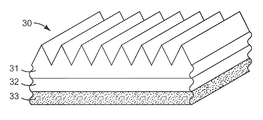
- FIG. 1 is a perspective view of an exemplary surface-structured crosslinked silicone described herein attached to a substrate with a primer layer.
- the present disclosure provides articles that include polymer coatings on substrates primed with a primer coating containing silica nanoparticles, and methods of coating.
- the present disclosure also provides an article comprising a substrate having a first major surface with a silicone-based material described herein on at least a portion of the first major surface.
- FIG. 1 illustrates a perspective view of an exemplary film 30 having a surface-structured, crosslinked silicone-based material 31 disposed on a substrate 33 with a primer coating 32 of the present invention between the crosslinked silicone-based material and the substrate surface.
- the substrate has a second major surface generally opposed the first major surface and the silicone-based material described herein on at least a portion of the second major surface.
- the surface of the silicone-based material may be smooth or structured.
- the article is an adhesive, wherein the silicone-based material described herein is a pressure sensitive adhesive adhered to at least a portion of the primed first major surface of the substrate.
- the article is a release liner, wherein the silicone-based material described herein is a release material adhered to at least a portion of the primed first major surface of the substrate.
- the polymer coatings of the present invention preferably include a silicone-based material.
- Silicones are largely-inert, synthetic compounds with a wide variety of forms and uses. Typically, heat-resistant, nonstick, and rubber-like, they are commonly used in cookware, medical applications, sealants, adhesives, lubricants, insulation, and breast implants. Some common forms of silicone include oils, fluids, gums greases, elastomers (e.g., silicone rubber), and resins. Silicone elastomers are known for their stability under long-term ultra-violet light exposure, and they can be optically clear and tough, which makes them well suited for outdoor use.
- PDMS poly(dimethylsiloxanes)
- reaction types are generally employed for the formation of silicone three-dimensional networks (i.e., crosslinked silicones): peroxide-induced free-radical processes (which typically also require thermal cycling), hydrosilylation addition reactions (which typically require a catalyst and thermal cycle), and condensation reactions (typically requiring a catalyst and moisture). Silicones have also been crosslinked using radiation (e.g., e-beam, gamma, UV) to produce free radicals or to induce photoinitiated reactions.
- radiation e.g., e-beam, gamma, UV
- the crosslinked siloxane networks of the silicone-based materials can be formed from either functional or non-functional silicone materials.
- useful silicone materials include the general silicone materials listed in the previous paragraph as well as others, for example, UV-cured silicones as disclosed in U.S. Pat. Nos. 6,376,569, 6,046,250 5,145,886, and 4,916,169; thermal-cured silicones disclosed in U.S. Pat. No. 6,573,328 (as well as the silicone materials described in the background of this patent); low-surface-energy silicone-based protective materials as disclosed in U.S. Pat. No.
- silicone-based materials such as “SYLGARD 184” from Dow Corning Corporation, Midland, Mich., “SYLGARD 182” from Dow Corning, “RTV615” from Momentive Performance Materials, Inc, Watertown, N.Y., a UV dual cure silicone adhesive sealant “SS-5088” from Silicone Solutions, Inc. Twinsburg, Ohio, “3112 RTV RUBBER” from Dow Corning Corporation, “734 FLOWABLE SEALANT” from Dow Corning Corporation.
- the silicone-based material can be nonfunctionalized and can be crosslinked by use of peroxide initiators or high energy radiation (e.g., electron beam irradiation) which is described below.
- the nonfunctionalized silicone-based materials can be a linear material described by the following formula illustrating a siloxane backbone with aliphatic and/or aromatic substituents:
- R1, R2, R3, and R4 are independently selected from the group consisting of an alkyl group and an aryl group, each R5 is an alkyl group and n and m are integers, and at least one of m or n is not zero.
- at least one of the alkyl or aryl groups may contain a halogen substituent (e.g., fluorine).
- at least one of the alkyl groups may be —CH 2 CH 2 C 4 F 9 .
- R5 is a methyl group (i.e., the nonfunctionalized silicone material is terminated by trimethylsiloxy groups).
- R1 and R2 are alkyl groups and n is zero (i.e., the material is a poly(dialkylsiloxane)).
- the alkyl group is a methyl group (i.e., poly(dimethylsiloxane) (“PDMS”)).
- PDMS poly(dimethylsiloxane)
- R1 is an alkyl group
- R2 is an aryl group
- n is zero (i.e., the material is a poly(alkylarylsiloxane)).
- R1 is methyl group and R2 is a phenyl group (i.e., the material is poly(methylphenylsiloxane)).
- R1 and R2 are alkyl groups and R3 and R4 are aryl groups (i.e., the material is a poly(dialkyldiarylsiloxane)).
- R1 and R2 are methyl groups, and R3 and R4 are phenyl groups (i.e., the material is poly(dimethyldiphenylsiloxane) or poly(methylphenylsiloxane)).
- the nonfunctionalized silicone materials may be branched.
- at least one of the R1, R2, R3, and/or R4 groups may be a linear or branched siloxane with alkyl or aryl (including halogenated alkyl or aryl) substituents and terminal R5 groups.
- nonfunctional groups are either alkyl or aryl groups consisting of carbon, hydrogen, and in some embodiments, halogen (e.g., fluorine) atoms.
- a “nonfunctionalized silicone material” is one in which the R1, R2, R3, R4, and R5 groups are nonfunctional groups.
- functional silicone systems include specific reactive groups attached to the siloxane backbone of the starting material (e.g., hydrogen, hydroxyl, vinyl, allyl, or acrylic groups).
- a “functionalized silicone material” is one in which at least one of the R-groups of Formula 2 is a functional group.
- a functional silicone material is one is which at least 2 of the R-groups are functional groups.
- the R-groups of Formula 2 may be independently selected.
- the only functional groups present are hydroxyl groups (e.g., silanol terminated polysiloxanes (e.g., silanol terminated poly dimethyl siloxane)).
- the R-groups may be nonfunctional groups (e.g., alkyl or aryl groups, including halogenated (e.g., fluorinated) alky and aryl groups).
- the functionalized silicone materials may be branched.
- at least one of the R groups may be a linear or branched siloxane with functional and/or non-functional substituents.
- fluids or oils lower molecular weight, lower viscosity materials are referred to as fluids or oils, while higher molecular weight, higher viscosity materials are referred to as gums; however, there is no sharp distinction between these terms.
- fluid and oil refer to materials having a dynamic viscosity at 25° C. of no greater than 1,000,000 mPa ⁇ sec (e.g., less than 600,000 mPa ⁇ sec), while materials having a dynamic viscosity at 25° C. of greater than 1,000,000 mPa ⁇ sec (e.g., at least 10,000,000 mPa ⁇ sec) are referred to as “gums.”
- Crosslinked silicone-based material described herein may also comprise inorganic particles (including nanoparticles) therein.
- suitable inorganic materials include silica, zirconia, titania, and combination thereof.
- Silica particles are preferably not greater than 1 micrometer although larger sizes may also be useful.
- particles made of other materials are in the nanometer size range, e.g., are in the range of from about 5 nm up to about 50 nm). Silica particles in the nanometer size range may also be useful.
- Such particles, especially nanoparticles may also be loaded into the silicone elastomeric material in the range of from 0 wt. % to about 60 wt. %.
- the silicone based materials are blends (e.g., blends of fluorinated silicones and nonfluorinated silicones).
- a curable composition can include an ethylenically unsaturated fluoroorganopolysiloxane polymer; a non-fluorinated organopolysiloxane polymer comprising an average of at least two ethylenically unsaturated organic groups; a hydrosilation catalyst; and at least one crosslinker.
- the crosslinker can be selected from the group consisting of a fluoroorganohydrogenpolysiloxane and an organohydrogenpolysiloxane.
- the composition comprises both the fluoroorganohydrogenpolysiloxane and the organohydrogenpolysiloxane crosslinkers.
- the non-fluorinated organopolysiloxane polymer has a vinyl equivalent weight of no greater than 60,000 grams per equivalent. In some embodiments, the non-fluorinated organopolysiloxane polymer has a vinyl equivalent weight of 2000 to 5000 grams per equivalent.
- the ethylenically unsaturated fluoroorganopolysiloxane polymer comprises an average of at least two ethylenically unsaturated organic groups.
- fluoroorganopolysiloxane polymer comprises a siloxane backbone and pendant C1 to C6 perfluoroalkyl groups bonded to backbone with a linking group.
- the linking group is an alkylene group comprising at least two carbon atoms.
- the alkylene linking group is —C 2 H 4 —.
- the pendant perfluoroalkyl group is —C 4 F 9 .
- the hydrosilation catalyst comprises platinum.
- the curable release composition further comprises a cure inhibitor.
- silicone material comprises a blend of a fluoro-functional silicone release polymer and a second fluoropolymer.
- the second fluoropolymer is a linear fluoropolymer.
- the weight ratio of the fluoro-functional silicone release polymer to the linear fluoropolymer is no greater than 10:1.
- the weight ratio of the fluoro-functional silicone release polymer to the linear fluoropolymer is no greater than no greater than 1:10.
- the linear fluoropolymer is a non-silicone, linear fluoropolymer.
- the linear fluoropolymer is a fluoroacrylate polymer.
- the fluoroacrylate polymer is derived from at least one C4MH monomer.
- the linear fluoropolymer is a fluoroolefin-based polymer.
- the present disclosure provides a release material comprising a blend of a fluoro-functional silicone release polymer and a fluoroolefin-based polymer.
- the fluoroolefin-based polymer comprises the reaction product of at least one monomer selected from the group consisting of tetrafluoroethylene, hexafluoropropylene, vinyl fluoride, and vinylidene fluoride.
- the fluoroolefin-based polymer is a terpolymer of tetrafluoroethylene, hexafluoropropylene, and vinylidene fluoride.
- the fluoroolefin-based polymer is an elastomeric fluoroolefin-based polymer. In some embodiments, the fluoroolefin-based polymer is a thermoplastic fluoroolefin-based polymer.
- the silicone-based material includes fillers.
- fillers include: fumed silica, fused silica powder, quartz powder, glass bubbles, milled glass fibers, carbon, diatomaceous earth, clay, carbon nano-tubes, carbon black, metal oxides (e.g., iron oxide, titanium oxide, and cerium oxide) and metal carbonates (e.g., calcium carbonate and magnesium carbonate).
- metal oxides e.g., iron oxide, titanium oxide, and cerium oxide
- metal carbonates e.g., calcium carbonate and magnesium carbonate.
- the silicone-based material described herein is a pressure sensitive adhesive. In some embodiments, the crosslinked material is non-tacky.
- the pressure sensitive adhesives may be prepared by combining silicone materials (e.g., silicone gums or elastomers) with an appropriate tackifying resin, hot melt coating the resulting combination, and curing using electron beam (e-beam) irradiation.
- silicone materials e.g., silicone gums or elastomers
- tackifying resin e.g., silicone gums or elastomers
- Other silicone pressure sensitive adhesive formulations utilizing other curing methods e.g., peroxide, free radical, or platinum-catalyzed silicone addition
- any known additives useful in the formulation of pressure sensitive adhesives e.g., dyes, pigments, fillers, flame retardants, rheology modifiers, flow agents, surfactants, chopped glass fibers, and microspheres (e.g., expandable microspheres) may be also be included).
- any known tackifying resin may be used (e.g., in some embodiments, silicate tackifying resins may be used).
- silicate tackifying resins may be used in some exemplary adhesive compositions.
- a plurality of silicate tackifying resins can be used to achieve desired performance.
- Suitable silicate tackifying resins include those resins composed of the following structural units M (i.e., monovalent R′ 3 SiO 1/2 units), D (i.e., divalent R′ 2 SiO 2/2 units), T (i.e., trivalent R′SiO 3/2 units), and Q (i.e., quaternary SiO 4/2 units), and combinations thereof.
- Typical exemplary silicate resins include MQ silicate tackifying resins, MQD silicate tackifying resins, and MQT silicate tackifying resins.
- silicate tackifying resins usually have a number average molecular weight in the range of 100 g/mole to 50,000 g/mole (e.g., 500 g/mole to 15,000 g/mole) and generally R′ groups are methyl groups.
- MQ silicate tackifying resins are copolymeric resins where each M unit is bonded to a Q unit, and each Q unit is bonded to at least one other Q unit. Some of the Q units are bonded to only other Q units. However, some Q units are bonded to hydroxyl radicals resulting in HOSiO 3/2 units (i.e., “T OH ” units), thereby accounting for some silicon-bonded hydroxyl content of the silicate tackifying resin.
- the level of silicon bonded hydroxyl groups (i.e., silanol) on the MQ resin may be reduced to no greater than 1.5 weight percent (in some embodiments, no greater than 1.2 weight percent, no greater than 1 weight percent, or even no greater than 0.8 weight percent), based on the weight of the silicate tackifying resin.
- This may be accomplished, for example, by reacting hexamethyldisilazane with the silicate tackifying resin. Such a reaction may be catalyzed, for example, with trifluoroacetic acid.
- trimethylsilating reagents such as trimethylchlorosilane or trimethylsilylacetamide may be reacted with the silicate tackifying resin, a catalyst not being necessary in the latter case.
- MQD silicone tackifying resins are terpolymers having M, Q and D units.
- MQT silicate tackifying resins are terpolymers having M, Q and T units.
- Suitable silicate tackifying resins are available, for example, under the trade designations “DC2-7066” from Dow Corning Corporation; and “SR545” and “SR1000” from Momentive Performance Materials, Inc.
- the silicone material, the tackifying resin, and any optional additives may be combined by any of a wide variety of known means prior to being hot melt coated and cured.
- the various components may be pre-blended using common equipment (e.g., mixers, blenders, mills, and extruders).
- the hot melt coating process is extrusion.
- the various components may be added together, in various combinations or individually, through one or more separate ports of an extruder, blended (e.g., melt mixed) within the extruder, and extruded to form the hot melt coated composition. Regardless of how it is formed, the hot melt coated composition may be cured through exposure to electron beam irradiation.
- the methods and materials of the present disclosure may be used to foam silicone.
- Silicone foams provide unique properties, including: resilience, wide service temperature stability (e.g., about 50° C. to about 200° C.), inertness, and inherent flame retardancy.
- silicone foams have been made in processes where cell growth or expansion (i.e., the foaming process) and cell stabilization (i.e., the crosslinking process) happen simultaneously.
- cell growth or expansion i.e., the foaming process
- cell stabilization i.e., the crosslinking process
- Most common cell expansion chemistries for silicone foams rely on chemical blowing agents (e.g., azo containing compounds or condensed gas by-product from crosslinking reactions).
- the cell expansion or foaming process and cell stabilization or crosslinking process can be independently optimized. In some embodiments, this can lead to improved control over cell structures with uniform distribution of foam cell sizes.
- the E-beam cured silicone foams can be made with microspheres, including both rigid non-polymeric hollow microspheres (e.g., glass bubbles), polymeric microspheres, including thermally expandable polymeric microspheres), and include chopped glass fibers, and/or nanoparticles.
- the silicone material, the microsphere, and any optional additives may be combined by any of a wide variety of known means prior to being hot melt coated and cured.
- the various components may be pre-blended using common equipment (e.g., mixers, blenders, mills, and extruders).
- the hot melt coating process is extrusion.
- the various components may be added together, in various combinations or individually, through one or more separate ports of an extruder, blended (e.g., melt mixed) within the extruder, and extruded to form the hot melt coated composition. Regardless of how it is formed, the hot melt coated composition may be cured through exposure to e-beam irradiation.
- the procedures for making a structured silicone utilize a tool that will impart the negative structure in the silicone surface before the silicone is crosslinked (for example, using electron beam radiation).
- the tooling can be of a variety of forms and materials. Commonly the form of the tooling will either be a sheet, roll, belt or roll of film. Tooling is generally constructed of material that fall either into the category of metal or polymer but could potentially include ceramic or other suitable material.
- the metal is generally diamond-machined, embossed, knurled, sandblasted, etc., to form the surface structure.
- the structured polymer surface is generally formed by extrusion replication where a thermoplastic resin such as polypropylene is extruded using standard extrusion equipment and fed through a die and into a nip with a machined metal tool roll and a rubber roll. The molten polymer is quenched while in contact with a tool surface which then releases from the tool roll and is wound on a roll. Additional polymer tooling can be made by UV-curing acrylate functional resins against a tool followed by removal of the crosslinked structured film from the tool.
- a thermoplastic resin such as polypropylene
- polymers are potential options for polymer tools: polypropylene, polyethylene, polyethylene terephthalate, ethylene/octene, ethylene/hexene, other ethylene copolymers, propylene/ethylene, propylene copolymers of lower modulus, UV-curable acrylates, poly(methyl methacrylate), polycarbonate, polystyrene, styrene-co-acrylonitrile, polyurethane or other suitable materials.
- the non-crosslinked silicone material is brought into intimate contact with the tooling surface by way of pressing the silicone material between the tooling and a substrate using nip rolls or a platen press.
- the silicone must be crosslinked while in contact with the tool. Therefore the silicone passes through an electron beam unit while still in contact with the tool and the primed substrate.
- the electron beam radiation may pass through the tooling side or the substrate side depending on the thickness and density of the tooling and the substrate. Generally it is unfavorable to irradiate through thick or very dense materials because such materials absorb the electrons before they can reach and crosslink the silicone.
- the tool When the tool is metal it is best to irradiate the construction through the silicone or substrate side since metal is usually too dense to allow the radiation through unless it is very thin.
- One skilled in the art will be able to select the proper electron beam acceleration voltage to account for the thickness of the tooling, silicone and substrate layers and also will be able to select the proper dose to properly crosslink the silicone material.
- the permanently structured silicone may be removed from the tooling.
- the silicone will release from the tool and stay attached to the substrate as long as there is adhesion between the silicone and the substrate, which may be enhanced using a suitable primer (discussed herein).
- the primer coating is formed from a nanoparticle-containing coating composition that is coated and dried on a substrate surface.
- the silica nanoparticles are preferably not surface modified.
- the silica particles used in the primer coating composition can be of a wide variety of shapes, including spherical or nonspherical (e.g., needle-like, rod-like, string-like, bead-chain-like, nanofilaments, elongated particles).
- the nonspherical or irregular shaped nanoparticles may result in the formation of voids in the coatings differently from that of spherical or regular shaped nanoparticles. Combinations of spherical and nonspherical silica nanoparticles can be used if desired.
- the silica nanoparticles used in this primer composition are dispersions of submicron size silica nanoparticles in an aqueous or in a water/organic solvent mixture.
- the average particle size i.e., the longest dimension of a particle, which is a diameter of a spherical particle
- spherical silica nanoparticles have an average primary particle diameter of less than 40 nanometers (nm), preferably less than 20 nm, more preferably less than 10 nm, and even more preferably less than 5 nm. Although larger nanoparticles can be used if desired (e.g., those having a diameter of 50 nm or greater).
- nonspherical (i.e., acicular) colloidal silica particles may have a uniform thickness of at least 2 nm (in certain embodiments at least 5 nm) and typically up to 25 nm. They may have a length, D 1 of at least 40 nm and typically, a length up to 500 nm (as measured by dynamic light-scattering method).
- the smaller nanoparticles (i.e., those less than 20 nanometers), generally provide better primer coatings, when acidified, without the need for additives (e.g., tetraalkoxysilanes, surfactants, and organic solvents).
- the nanoparticles generally have a surface area greater than 150 m 2 /g (in some embodiments, greater than 200, 300, or even greater than 400 m 2 /g).
- the particles preferably have narrow particle size distributions, that is, a polydispersity (i.e., particle size distribution) up to 2, preferably up to 1.5.
- a polydispersity i.e., particle size distribution
- larger silica particles may be added, in limited amounts that do not deleteriously decrease the coatability of the composition on a selected substrate, and do not reduce the transmissivity and/or the hydrophilicity.
- various sizes of particles may be used in combination.
- bimodal distributions of particle sizes may be used. For example, particles having an average particle size of at least 50 nm (preferably 50 to 100 nm) may be used in ratios of 0.2:99.8 to 99.8:0.2 relative to the weight of the silica nanoparticles of 40 nm or less.
- the larger particles are preferably used in ratios of 1:9 to 9:1 relative to the smaller particles.
- particles may be used that have an average particle size of 40 nm or less (preferably 0.1 to 20 wt-%) plus particles having an average particle size of 50 nm or greater (preferably 0 to 20 wt-%), wherein the sum of the two different particle sizes is 0.1 to 20 wt-%.
- the total weight of silica particles (regardless of size) in a primer composition of the present invention is at least 0.1 wt-%, preferably at least 1 wt-%, and more preferably at least 2 wt-%.
- the total weight of silica particles (regardless of size) in a primer composition of the present invention is no greater than 40 wt-%, preferably no greater than 20 wt-%, even more preferably no greater than 10 wt-%, and even more preferably no greater than 7 wt-%.
- the primer compositions of the present invention are acidified. These acidified aqueous silica nanoparticle primer coating compositions, can be coated directly onto hydrophobic organic and inorganic substrates without either organic solvents or surfactants.
- the wetting property of these inorganic nanoparticle aqueous dispersions on hydrophobic surfaces e.g., polyethylene terephthalate (PET) or polycarbonate (PC)
- PET polyethylene terephthalate
- PC polycarbonate
- silica sols in aqueous media are well known in the art and available commercially.
- Silica sols in water or water-alcohol solutions are available, for example, under the trade designations “LUDOX” from E.I. duPont de Nemours and Co., Inc., Wilmington, Del.; “NYACOL” from Nyacol Co., Ashland, Mass.; and “NALCO” from Ondea Nalco Chemical Co., Oak Brook, Ill.
- One useful silica sol is NALCO 2326 available as a silica sol with mean particle size of 5 nanometers, pH 10.5, and solid content 15% by weight.
- silica nanoparticles include “NALCO 1115” and “NALCO 1130,” commercially available from NALCO Chemical Co., “REMASOL SP30,” commercially available from Remet Corp., Utica, N.Y., and “LUDOX SM,” commercially available from E.I. Du Pont de Nemours Co., Inc.
- Useful nonspherical (i.e., acicular) silica particles may be obtained as an aqueous suspension under the trade name SNOWTEX-UP from Nissan Chemical Industries (Tokyo, Japan).
- the mixture consists of 20-21% (w/w) of nonspherical silica, less than 0.35% (w/w) of Na 2 O, and water.
- the particles are about 9 to 15 nanometers i n diameter and have lengths of 40 to 300 nanometers.
- the suspension has a viscosity of ⁇ 100 mPas at 25° C., a pH of about 9 to 10.5, and a specific gravity of about 1.13 at 20° C.
- acicular silica particles may be obtained as an aqueous suspension under the trade name SNOWTEX-PS-S and SNOWTEX-PS-M by Nissan Chemical Industries, having a morphology of a string of pearls.
- the mixture consists of 20-21% (w/w) of silica, less than 0.2% (w/w) of Na 2 O, and water.
- the SNOWTEX-PS-M particles are about 18 to 25 nanometers in diameter and have lengths of 80 to 150 nanometers.
- the particle size is 80 to 150 by dynamic light scattering methods.
- the suspension has a viscosity of ⁇ 100 mPas at 25° C., a pH of about 9 to 10.5, and a specific gravity of about 1.13 at 20° C.
- the SNOWTEX-PS-S has a particle diameter of 10-15 nm and a length of 80-120 nm.
- Non-aqueous silica sols may also be used and are silica sol dispersions wherein the liquid phase is an organic solvent, or an aqueous organic solvent.
- the silica sol is chosen so that its liquid phase is typically aqueous (or less preferably) an aqueous organic solvent. It has been observed that sodium stabilized silica nanoparticles should first be acidified prior to dilution with an organic solvent (e.g., ethanol). Dilution prior to acidification may yield poor or non-uniform coatings. Ammonium stabilized silica nanoparticles may generally be diluted and acidified in any order.
- the primer coating composition contains an acid or combination of acids, each having a pK a (H 2 O) of ⁇ 3.5, preferably ⁇ 2.5, more preferably less than 1, and even more preferably less than 0.
- Useful acids include both organic and inorganic acids and may be exemplified by oxalic acid, citric acid, H 2 SO 3 , H 3 PO 4 , CF 3 CO 2 H, HCl, HBr, HI, HBrO 3 , HNO 3 , HClO 4 , H 2 SO 4 , CH 3 SO 3 H, CF 3 SO 3 H, and CF 3 CO 2 H.
- Most preferred acids include HCl, HNO 3 , H 2 SO 4 , and H 3 PO 4 .
- a mixture of acids comprising those having a pK a ⁇ 3.5 (preferably ⁇ 2.5, more preferably less than 1, and even more preferably less than 0), optionally with minor amounts of other acids having pK a 's>0.
- weaker acids having a pK a of >4 e.g., acetic acid
- primer coating compositions with weaker acids typically bead up on the surface of a substrate.
- the primer coating composition generally contains sufficient acid to provide a pH of less than 5, preferably less than 4, most preferably less than 3. In some embodiments, it has been found that the pH of the coating composition can be adjusted to pH 5-6 after first reducing the pH to substantially less than 5. This allows one to coat pH-sensitive substrates.
- Tetraalkoxy coupling agents particularly tetraalkoxysilanes (e.g., tetraethylorthosilicate (TEOS)), and oligomeric forms of tetraalkoxysilane (e.g., alkyl polysilicates (e.g., poly(diethoxysiloxane))), may also be useful to improve binding between silica nanoparticles.
- TEOS tetraethylorthosilicate
- alkyl polysilicates e.g., poly(diethoxysiloxane)
- the optimal amount of coupling agent is determined experimentally and is dependent on the coupling agent's identity, molecular weight and refractive index.
- the coupling agent(s), when present, are typically added to the composition at levels of up to 50 percent by weight (wt-%), often up to 20 wt-%, and in some embodiments up to 15 wt-%, relative to the amount of the silica nanoparticle concentration. In some embodiments, the coupling agent(s) are present in an amount of 0.1 wt-% to 50 wt-%, and more preferably 1 wt-% to 15 wt-% of the silica nanoparticles.
- the primer typically provides the surface coated thereon with a continuous network of acid-sintered silica nanoparticles agglomerates.
- the particles preferably have an average primary particle size of below 40 nanometers (preferably below 20 nanometers).
- the average particle size may be determined using transmission electron microscopy.
- continuous refers to covering the surface of the substrate with virtually no discontinuities or gaps in the areas where the gelled network is applied.
- network refers to an aggregation or agglomeration of nanoparticles linked together to form a porous three-dimensional network.
- primary particle size refers to the average size of unagglomerated single particles of silica.
- porous refers to the presence of voids between the silica nanoparticles created when the nanoparticles form a continuous coating.
- the network has a porosity of 25 to 45 volume percent, more preferably 30 to 40 volume percent, when dried. In some embodiments the porosity may be higher. Porosity may be calculated from the refractive index of the coating according to published procedures such as in W. L. Bragg, A. B. Pippard, Acta Crystallographica, volume 6, page 865 (1953).
- a primer composition onto a hydrophobic substrate from an aqueous system it may be optionally desirable to increase the surface energy of the substrate and/or reduce the surface tension of the coating composition.
- the surface energy may be increased by oxidizing the substrate surface prior to coating using corona discharge or flame treatment methods. These methods may also improve adhesion of the coating to the substrate.
- Other methods capable of increasing the surface energy of the article include the use of primers such as thin coatings of polyvinylidene chloride (PVDC).
- PVDC polyvinylidene chloride
- the surface tension of the coating composition may be decreased by addition of lower alcohols (C 1 to C 8 ).
- a wetting agent which is typically a surfactant
- surfactant as used herein describes molecules comprising hydrophilic (polar) and hydrophobic (non-polar) regions on the same molecule which are capable of reducing the surface tension of the coating solution.
- Useful surfactants may include those disclosed in U.S. Pat. No. 6,040,053 (Scholz et al.).
- most surfactants comprise less than 0.1 percent by weight of the coating composition, preferably 0.003 to 0.05 percent by weight.
- Anionic surfactants in the primer coating composition are preferred when added to improve the uniformity of the resulting coatings.
- Useful anionic surfactants include those with molecular structures comprising (1) at least one hydrophobic moiety, such as C 6 -C 20 alkyl, alkylaryl, and/or alkenyl groups, (2) at least one anionic group, such as sulfate, sulfonate, phosphate, polyoxyethylene sulfate, polyoxyethylene sulfonate, polyoxyethylene phosphate, and the like, and/or (3) the salts of such anionic groups, wherein said salts include alkali metal salts, ammonium salts, tertiary amino salts, and the like.
- useful anionic surfactants include sodium lauryl sulfate (available, for example, under the trade designations “TEXAPON L-100” from Henkel Inc., Wilmington, Del.; and “POLYSTEP B-3” from Stepan Chemical Co, Northfield, Ill.); sodium lauryl ether sulfate (available, for example, under the trade designation “POLYSTEP B-12” from Stepan Chemical Co., Northfield, Ill.); ammonium lauryl sulfate (available, for example, under the trade designation “STANDAPOL A” from Henkel Inc., Wilmington, Del.); and sodium dodecyl benzene sulfonate (available, for example, under the trade designation “SIPONATE DS-10” from Rhone-Poulenc, Inc., Cranberry, N.J.).
- a primer does not include a surfactant or when improved coating uniformity is desirable, it may be beneficial to add another wetting agent in order to ensure uniform coating of a surface from an aqueous or hydroalcoholic solution.
- useful wetting agents include polyethoxylated alkyl alcohols (available, for example, under the trade designations “BRIJ 30” and “BRIJ 35 from ICI Americas, Inc.; and “TERGITOL TMN-6” SPECIALTY SURFACTANT” from Union Carbide Chemical and Plastics Co.), polyethoxylated alkylphenols (available, for example, under the trade designations, “TRITON X-100” from Union Carbide Chemical and Plastics Co., “ICONOL NP-70” from BASF Corp., Florham Park, N.J.); and polyethylene glycol/polypropylene glycol block copolymer (available, for example, under the trade designations “TETRONIC 1502 BLOCK COPOLYMER SURFACTANT”, “TETRONIC 90
- the wetting agent is used in amounts of less than 0.1 percent by weight of the coating composition, preferably 0.003 to 0.05 percent by weight of the coating composition depending on the amount of silica nanoparticles. Rinsing or steeping the coated article in water may be desirable to remove excess surfactant or wetting agent.
- Primers are preferably coated on a surface using conventional techniques, such as bar, roll, curtain, rotogravure, spray, or dip coating techniques.
- the preferred methods include bar and roll coating, or air knife coating to adjust thickness.
- Other methods capable of increasing the surface energy of the article include the use of primers such as polyvinylidene chloride (PVDC).
- the primer is preferably applied in uniform average thicknesses varying by less than 200 angstroms ( ⁇ ), and more preferably by less than 100 ⁇ , in order to avoid visible interference color variations in the coating.
- the optimal average dry coating thickness is dependent upon the particular primer coating composition, but in general the average thickness of the coating is 100 ⁇ to 10,000 ⁇ , preferably 500 to 2500 ⁇ , more preferably 750 to 2000 ⁇ , and even more preferably 1000 to 1500 ⁇ , as measured using an ellipsometer such as a Gaertner Scientific Corp. Model No. L115C. It should be noted, however, that while the average coating thickness is preferably uniform, the actual coating thickness can vary considerably from one particular point on the coating to another.
- Primers can be coated on both sides of a substrate if desired. Alternatively, the primers may be coated on one side of the substrate.
- the primed article is typically dried at temperatures in a range from 20° C. to 150° C. in a recirculating oven.
- An inert gas may be circulated.
- the temperature may be increased further to speed the drying process, but care should be exercised to avoid damage to the substrate.
- the cure temperature can be above 200° C.
- the coating comprises preferably from 60 to 95 percent by weight (more preferably from 70 to 92 percent by weight) of silica nanoparticles (typically agglomerated), from 0.1 to 20 percent by weight (more preferably from 10 to 25 percent by weight) tetraalkoxysilanes and optionally 0 to 5 percent by weight (more preferably from 0.5 to 2 percent by weight) surfactant, and optionally up to 5 percent by weight (preferably 0.1 to 2 percent by weight) wetting agent.
- silica nanoparticles typically agglomerated
- 0.1 to 20 percent by weight more preferably from 10 to 25 percent by weight
- tetraalkoxysilanes optionally 0 to 5 percent by weight (more preferably from 0.5 to 2 percent by weight) surfactant, and optionally up to 5 percent by weight (preferably 0.1 to 2 percent by weight) wetting agent.
- Support backings or substrates, on which the silicone-based material is disposed can comprise a polymeric material, metal, paper, glass, or other transparent ceramic material.
- substrates include at least one of a polymeric film, a polymeric sheet, a molded polymeric part, a metal (including a metal surface) (e.g., vapor deposited metals)) such as aluminum or stainless steel, paper, an ultraviolet (UV) mirror, infrared (IR) mirror, a UV stable substrate, a glass (e.g., soda-lime glass, low-iron glass, borosilicate glass, or quartz (fused silica)) substrate, masonry (e.g., brick, stone, concrete, etc.), a portion (e.g., hood, door, roof, side panel, trunk, or bumper) of a car, a portion (e.g., wing or fuselage) of a plane, a portion (e.g., roof or side) of a train, a wind turbine blade (e.g.
- the substrate may be flat, curved or shaped.
- the substrates are transparent (i.e., transmit at least 85% of incident light in at least a portion of the visible spectrum (400-700 nm wavelength).
- Transparent substrates may be colored or colorless.
- polymeric substrates examples include polyester (e.g., polyethylene terephthalate (PET), polybutyleneterephthalate), cyclic olefin co-polymer (COC), fluoropolymers (e.g., ethylene tetrafluorethylene, polyvinylidene fluoride (PVDF), THV), polycarbonate, allyldiglycolcarbonate, polyacrylates, such as polymethyl methacrylate (PMMA), polystyrene, polysulfone, polyethersulfone, homo-epoxy polymers, epoxy addition polymers with polydiamines, polydithiols, polyethylene copolymers, fluorinated surfaces, cellulose esters (e.g., acetate and butyrate), crosslinked polyurethane, and acrylates.
- polyester e.g., polyethylene terephthalate (PET), polybutyleneterephthalate
- COC cyclic olefin co-polymer
- the substrate is flexible and made from polyesters (e.g. polyethylene terephthalate (PET)), cyclic olefin co-polymer (COC), polyolefins (e.g., PP (polypropylene), PE (polyethylene) and PVC (polyvinyl chloride) are particularly preferred.
- PET polyethylene terephthalate
- COC cyclic olefin co-polymer
- polyolefins e.g., PP (polypropylene), PE (polyethylene) and PVC (polyvinyl chloride) are particularly preferred.
- the substrate can be formed into a film using conventional filmmaking techniques such as extrusion of the substrate resin into a film and optional uniaxial or biaxial orientation of the extruded film.
- the substrate can be in the form of a foam.
- the support backing can also be chosen so as to dissipate static electricity.
- the support backing can comprise one or more polymeric materials that enable support backing to dissipate static electricity.
- transparent support backing may also comprise an inherently static dissipative polymer (available, for example, under the trade designations “STATRITE X5091 POLYURETHANE” or “STATRITE M809 POLYMETHYL METHACRYLATE” from Lubrizol Corp., Wickliffe, Ohio).
- static dissipative salts available, for example, under the trade designation “FC4400” from 3M Company, St. Paul, Minn.
- FC4400 can be blended into the polymer used to make the transparent support backing 65 (e.g., PVDF).
- Support backing can also be comprised of multiple layers.
- UV mirrors are known in the art and include a multilayer optical film constructed of alternating layers of a UV stabilized polyethylene terephthalate (PET) and a copolymer of methylmethacrylate and ethyl acrylate (co-PMMA) at thicknesses one quarter of the wavelength of the light they will reflect.
- PET polyethylene terephthalate
- co-PMMA copolymer of methylmethacrylate and ethyl acrylate
- This UV mirror has alternating polymer layers in the range of thicknesses that reflect UV light while passing visible light.
- UV mirrors can be made as described in U.S. Patent Application Publication Nos. 2009/0283133 and 2009/0283144.
- Polymeric visible mirrors can be used as the substrate.
- Visible mirror are known in the art and include a biaxial oriented multilayer optical film constructed of alternating layers of a UV stabilized polyethylene terephthalate (PET) and a copolymer of methylmethacrylate and ethyl acrylate (co-PMMA) at thicknesses one quarter of the wavelength of the light they will reflect.
- PET polyethylene terephthalate
- co-PMMA copolymer of methylmethacrylate and ethyl acrylate
- the Visible mirror has alternating polymer layers in the range of thicknesses that reflect Visible light while passing IR light.
- Polymeric visible light mirrors can be made as described in U.S. Patent Application Publication Nos. 2009/0283133 and 2009/0283144.
- Fresnel lens Glass as part of a “silicone on glass” Fresnel lens can be used as a substrate herein.
- Fresnel lenses are lenses of large aperture and short focal length without the weight and volume of conventional lenses produced by breaking the lens into a set of concentric annular sections known as “Fresnel zones”.
- Fresnel lenses are commonly used for concentrating sunlight onto solar photovoltaic or solar thermal modules although they have been and are used for many other applications. Fresnel lenses are often made out of polymethyl methacrylate (PMMA) and polycarbonate.
- PMMA polymethyl methacrylate
- “Silicone on glass” Fresnel lenses are more recent and comprise a structured silicone on glass. These Fresnel lenses offer the potential for increased durability and weatherability.
- the “silicone on glass” Fresnel lens may be improved, for example by the following process.
- the glass may be primed on one side using the nano-silica solution described herein and optionally coated on the opposite sun side of the glass with nano-silica solution described herein to reduce reflection and improve light capture.
- the primer may be baked to improve adhesion.
- a blend of non-functional poly(dimethylsiloxane) (PDMS) fluid and vinyl-functional PDMS fluid can be coated onto a Fresnel tooling surface so that the features are fully filled and a smooth PDMS blend surface results.
- the filled tooling can then be passed through an e-beam process which cross-links the PDMS fluid blend.
- a UV initiated, Pt catalyzed, addition cure silicone fluid tie layer such as described, for example, in Example 10, can optionally be applied in a very thin layer, to minimize cost, to the primed glass surface.
- This solution may be applied onto the glass with various techniques, such as roll coating, notch-bar coating, and screen-printing.
- the thickness of this layer can vary, although the cure dynamics are to be taken into account so that it does not cure prior to lamination but still cures quickly after lamination and UV exposure.
- the silicone filled tooling film Prior to curing of the silicone tie-layer, is laminated to the primed glass. This lamination step may involve a rolling bank of silicone to form at the lamination site. Registration of the tooling film pattern to the glass edges may need to be tightly controlled.
- the construction can then be irradiated with UV radiation from a standard H bulb or black light to initiate the silicone tie-layer cross-linking.
- UV radiation from a standard H bulb or black light
- the Fresnel tooling can be removed leaving the e-beam cross-linked silicone Fresnel adhered to the glass sheet.
- an e-beam cross-linked silicone Fresnel lens can be made directly onto a primed film without the use of a separate silicone tie-layer.
- a PDMS gum may be pressed between a polymethylmethacrylate (PMMA) Fresnel tool and sheet of polyethylene terephthalate (PET) primed with the nano-silica solution described herein.
- PMMA polymethylmethacrylate
- PET polyethylene terephthalate
- This construction may be passed through an e-beam process so that the radiation passes first through the PET surface.
- the PMMA tool may be removed leaving the e-beam cross-linked silicone Fresnel lens attached to the primed PET surface.
- IR mirrors can be used as the substrate.
- IR mirrors are known in the art and include a biaxial oriented multilayer optical film constructed of alternating layers of a UV stabilized polyethylene terephthalate (PET) and a copolymer of methylmethacrylate and ethyl acrylate (co-PMMA) at thicknesses one quarter of the wavelength of the light they will reflect.
- PET polyethylene terephthalate
- co-PMMA copolymer of methylmethacrylate and ethyl acrylate
- This IR mirror has alternating polymer layers in the range of thicknesses that reflect IR light while passing visible light.
- Polymeric IR mirrors can be made as described in U.S. Patent Application Publication Nos. 2009/0283133 and 2009/0283144.
- Broadband polymeric mirrors can be made by laminating visible polymeric mirrors to IR polymeric mirrors with silicone adhesive after each mirror has been coated with acidified nano-silica primer.
- UV stable substrates known in the art can be used as the substrate.
- examples include a film or part made from a polymer that generally maintains it's optical and mechanical properties during outdoor exposure to sunlight and the elements for a period of at least 10 years either through the addition of UV absorbers, anti-oxidants and hindered amine light stabilizers and/or through the polymer's intrinsic weatherability (e.g., fluoropolymers).
- Solar photovoltaic modules known in the art can be used as the substrate. These can include a glass front surface of a module for rigid photovoltaic modules (e.g., crystalline silicon modules).
- the front surface substrate is generally a UV stable polymer film (e.g., ethylene tetrafluoroethylene).
- Solar thermal modules known in the art can be used as the substrate. These capture thermal energy by collecting the suns energy and heating a fluid. Solar thermal modules are similar to photovoltaic modules in that they are generally rigid and have a glass front surface.
- Reinforcing scrims known in the art can be used as the substrate. These include woven or non-woven fabric, that when impregnated with a resin and cured, provide improved dimensional stability and tensile properties by decreasing elongation and increasing strength of the resulting composite.
- Textiles known in the art can be used as the substrate. These include directionally flexible materials made of a network of natural or artificial fibers which are often used to make clothes, bags, furniture, tents, umbrellas, etc.
- the articles of the present invention can also be release liners, which provide a release effect against any type of a sticky material (e.g., an adhesive or a mastic).
- the silicone-containing material can be an ultraviolet radiation curable controllable release composition as described in U.S. Pat. No. 5,217,805.
- This composition comprises polyepoxypolysiloxane, silicone-free polyfunctional epoxide normally incompatible with the epoxypolysiloxane, and compatibilizing monofunctional epoxide.
- a polysiloxane release material consists essentially of one or more polysiloxane fluids having a kinematic viscosity at 25° C.
- the polysiloxane material comprises a poly(dimethylsiloxane).
- all polysiloxane materials in the composition are nonfunctional polysiloxanes.
- each nonfunctional polysiloxane is a polysiloxane fluid having a kinematic viscosity at 25° C. of no greater than 50,000 centistokes (e.g., between 5,000 and 50,000 centistokes).
- a nano-silica primer was prepared consisting of a 5% by weight blend of a 70:30 weight ratio of a first colloidal silica (obtained under the trade designation “NALCO 1115 COLLOIDAL SILICA” from Nalco Chemical Company, Naperville, Ill.) and a second colloidal silica (obtained under the trade designation “NALCO 1050 COLLOIDAL SILICA” from Nalco Chemical Company) in H 2 O, brought to a pH of 2.5-2.0 with HNO 3 .
- the nano-silica primer was applied by wiping the surface of the glass with a small wipe (obtained under the trade designation “KIMTECH” from Kimberly-Clark, Roswell, Ga.) dampened with the nano-silica primer solution.
- the primer was allowed to dry at room temperature. The primer thickness was approximately 100 nm.
- the masking tape was removed leaving an un-primed section on the surface of the glass.
- a metal template 6.4 cm (2.5 inch) wide, 19.1 cm (7.5 inch) long and 0.16 cm (0.063 in) deep was placed over the glass plate so that 2.5 cm (1 inch) of the template was located over the unprimed portion of the glass.
- 10 grams of a thermal cure silicone obtained under the trade name “SYLGARD 184” from Dow-Corning Corporation, Midland, Mich.
- a second plate of glass coated with primer and silicone was prepared in the same manner above except that the glass was primed with an organic solvent-borne silicone primer (obtained under the trade designation “SS4120” from Momentive Performance Materials, Inc., Waterford, N.Y.) instead of the nano-silica primer.
- an organic solvent-borne silicone primer obtained under the trade designation “SS4120” from Momentive Performance Materials, Inc., Waterford, N.Y.
- a third plate of glass was prepared in the same manner above except that the glass was not primed before applying the silicone.
- the template was removed resulting in a rectangle of silicone coated on top of the glass. 2.5 cm wide strips were cut along the length of the coated silicone. The section of the silicone coated over the un-primed area allows for an area to grip and peel the silicone strips.
- the glass plates were loaded onto a slip/peel tester (obtained under the trade designation “SP2000” from IMASS, Inc., Accord, Mass.) setup for 180° peel test. The samples were tested with a peel rate of 30.5 cm/min(12 in/min) and a 20 second peel time with a 4 second delay before averaging peel force.
- the silicone on the glass plates with the SS4120 primer and without primer was able to be peel tested since the silicone peeled from the surface of the glass.
- the glass plate primed with the nano-silica primer of this invention was not able to peel test since the primer caused adhesion so strong that the silicone would not peel from the primed glass.
- a nano-silica primer was prepared consisting of a 5% by weight blend of a 70:30 weight ratio of a first colloidal silica (“NALCO 1115 COLLOIDAL SILICA”) and a second colloidal silica (“NALCO 1050 COLLOIDAL SILICA”) in H 2 O, brought to a pH of 2.5-2.0 with HNO 3 .
- the nano-silica primer was applied by wiping the surface with a small wipe (“KIMTECH”) dampened with the nano-silica primer solution.
- the primer was allowed to dry at room temperature.
- the dry primer layer was approximately 100 nm thick.
- the masking tape was removed leaving an un-primed section on the surface of the PET.
- a metal template with the dimensions of 5.1 cm (2 inch) by 10.2 cm (4 inch) was placed over the PET sheet so that 2.5 cm (1 inch) of the template is located over the unprimed portion of the PET.
- 10 grams of a thermal cure silicone (“SYLGARD 184”) was mixed and poured into the template.
- a 5.1 cm (2 inch) by 10.2 cm (4 inch) piece of glass fiber fabric was placed on top of and allowed to settle into the wet silicone.
- the PET and silicone construction was placed into a 100° C. oven for 1 hour to cure.
- the template was removed resulting in a rectangle of reinforced silicone coated on top of the PET. 2.5 cm wide strips were cut along the length of the coated silicone. The section of the silicone coated over the un-primed area allows for an area to grip and peel the silicone strips.
- the PET film primed with the nano-silica primer of this invention was not able to peel test since the primer caused adhesion so strong that the silicone would not peel from the nano-silica primed PET and the reinforcing scrim was ripped from the silicone.
- PETg polyethylene terephthalate glycol co-polyester
- UVA UV absorber masterbatch
- the PETg/UVA surface of the film was primed with a nano-silica primer consisting of a 5% by weight blend of a 70:30 weight ratio of a first colloidal silica (“NALCO 1115 COLLOIDAL SILICA”) and a second colloidal silica (“NALCO 1050 COLLOIDAL SILICA”) in H2O, brought to a pH of 2.5-2.0 with HNO 3 .
- a nano-silica primer consisting of a 5% by weight blend of a 70:30 weight ratio of a first colloidal silica (“NALCO 1115 COLLOIDAL SILICA”) and a second colloidal silica (“NALCO 1050 COLLOIDAL SILICA”) in H2O, brought to a pH of 2.5-2.0 with HNO 3 .
- the nano-silica primer was applied using an air knife coating process to coat an approximately 100 nm layer of nano-silica to one PETg surface that was corona treated at a setting of 1.5 kW, the primer was then dried in an oven at temperatures from 21° C. (70° F.) to 107° C. (225° F.).
- PVDF Polyvinylidene Fluoride
- PMMA Polymethylmethacrylate
- the nano-silica primer was applied using an air knife coating process to coat an approximately 100 nm layer of nano-silica to one PVDF/PMMA blend skin layer surface that was corona treated at a setting of 1.5 kW, the primer was then dried in an oven at temperatures from 21° C. (70° F.) to 107° C. (225° F.).
- a PET film (available from 3M Co.) was coated with the nano-silica primer using an air knife coating process to coat an approximately 100 nm layer of nano-silica to one surface of the PET that was corona treated at a setting of 1.5 kW, the primer was then dried in an oven at temperatures from 21° C. (70° F.) to 107° C. (225° F.).
- a 1 gram portion of a non-functional silicone gum (obtained under the trade name “EL POLYMER NA” from Wacker Chemical Corp, Adrian, Mich.) was weighed and formed into a round ball.
- the ball of silicone gum was placed between the primed surfaces of two PETg/UVA skin layer films cut to the dimensions of 10.2 cm by 10.2 cm.
- the silicone gum was pressed to a thickness of 125 micrometer between the films using an unheated platen press using a pressure of 48.3 MPa (7000 psi).
- the above was repeated for the PVDF/PMMA blend skin films and the PET film.
- the above was also repeated for non-primed versions of the PETg/UVA skin film, PVDF/PMMA blend skin film and PET film.
- the film and silicone construction were taped to a carrier web and passed through an electron beam at an acceleration voltage of 300 keV and a dose of 2 MRads to crosslink the silicone gum.
- the E-beam unit was a broadband curtain type electron beam processor (obtained from PCT Engineered Systems, LLC).
- the laminate samples were cut into 2.54 cm wide strips and tested using a tensile tester, (model number “1122” from Instron, Norwood, Mass.) setup for T-peel testing using a 90.7 kg (200 lb) load cell, peel rate of 15 cm/min and peel length of 4.4 cm.
- Nano-silica primed and non-primed PVDF/PMMA blend skin film and PET film laminates were made according to Example 3 except a fluorosilicone gum, (obtained under the trade name “FSE2080” from General Electric Company, Waterford, N.Y.) was used instead EL Polymer NA silicone gum as the crosslinked lamination adhesive. The samples were tested in the same method according to Example 3.
- a fluorosilicone gum obtained under the trade name “FSE2080” from General Electric Company, Waterford, N.Y.
- a 10% by weight fluorosilicone gum (“FSE2080”) and 90% by weight silicone gum (“EL POLYMER NA”) blend was made by heating the two gum components to 250° C. and mixing them using a wooden rod. This heating, mixing cycle was repeated three times to ensure full mixing.
- Nano-silica primed and non-primed PVDF/PMMA skin film and PET film laminates were made according to Example 3 substituting the fluorosilicone/silicone gum blend for the pure EL Polymer NA silicone gum as the crosslinked lamination adhesive. The samples were tested in the same method according to Example 3.
- a sample suitable for use as a release liner could be made with improved adhesion to a polyester substrate and exhibiting improved wetting of the silicone release material.
- a polyethylene terephthalate (PET) film obtained under the trade designation “Scotchpar” from 3M Company, St. Paul, Minn. was coated with a primer consisting of a 5% by weight blend of a 70:30 weight ratio of a first colloidal silica (“NALCO 1115 COLLOIDAL SILICA”) and a second colloidal silica (obtained “NALCO 1050 COLLOIDAL SILICA”) in H 2 O, brought to a pH of 2.5-2.0 with HNO 3 .
- NALCO 1115 COLLOIDAL SILICA a first colloidal silica
- NALCO 1050 COLLOIDAL SILICA obtained “NALCO 1050 COLLOIDAL SILICA”
- the nano-silica primer was applied by wiping the surface with a small wipe (“KIMTECH”) dampened with the nano-silica primer solution.
- the primer was applied at a dry thickness of approximately 100 nanometers.
- the primer was allowed to dry at room temperature.
- a silanol-terminated silicone fluid obtained under the trade designation “DMS-S31” from Gelest, Inc, Morrisville, Pa.
- DMS-S31 silanol-terminated silicone fluid
- a non-primed PET was also coated with the silanol-terminated silicone fluid (“DMS-S31”) using a notch bar coater with a gap set to 75 micrometers (0.003 inch).
- the nano-silica primed PET had better coating quality, which was characterized by a smoother surface of the silicone and fewer de-wet areas.
- the silicone coated samples could be crosslinked using electron-beam irradiation at an acceleration voltage of 300 keV and a dose of 36 MRad.
- a microstructured polypropylene film was made using an extrusion replication process.
- Polypropylene obtained under the trade designation “FINA 7825” from Total Petrochemicals USA, Inc. Houston, Tex.
- the polypropylene extrudate film quenches while against the machined roll forming a liner prism surfaced film, which was then wound into a roll.
- a roll of 30.5 cm (12 inch) wide PET film was primed with an adhesion promoting nano-silica primer.
- the nano-silica primer consists of a 5% by weight blend of a 70:30 weight ratio of a first colloidal silica (obtained under the trade designation “NALCO 1115 COLLOIDAL SILICA” from Nalco Chemical Company, Naperville, Ill.) and a second colloidal silica (obtained under the trade designation “NALCO 1050 COLLOIDAL SILICA” from Nalco Chemical Company) in H 2 O, brought to a pH of 2.5-2.0 with HNO 3 .
- the primer was coated onto the PET film at a thickness of about 100 nanometers, and run through an oven at 21° C. (70° F.)-107° C. (225° F.) and then wound on a roll.
- a non-functional silicone gum (obtained under the trade designation “EL POLYMER NA” available from Wacker Chemical Corp, Adrian, Mich.) was extruded from a 15.2 cm (6 inch) wide film extrusion die at 191° C. (375° F.) using a 5.1 cm (2 inch) diameter extruder (obtained under the trade designation “BONNOT EXTRUDER” from The Bonnot Company, Uniontown, Ohio). The gum was extruded directly into a nip roll casting station consisting of a metal chill roll and a rubber roll.
- Both the polypropylene tooling film and the nano-silica primed PET film were introduced into the nip while the silicone gum was extruded between them so that the polypropylene tooling film structures made intimate contact with the top surface of the extruded silicone gum and the nano-silica primed surface of the PET film was in intimate contact with the bottom surface of the extruded silicone gum.
- This film construction was then wound in to a roll. Sections of the film constructions 0.9 meter (3 feet) long were unwound and taped onto a carrier web that passed through an electron beam at an acceleration voltage of 300 keV and a dose of 3 MRads.
- the electron beam unit was a broadband curtain type electron beam processor (obtained from PCT Engineered Systems, LLC, Davenport, Iowa). After irradiation, the polypropylene tooling film was removed leaving the reverse image in the surface of the crosslinked silicone film attached to the nano-silica primed PET film.
- the silicone and tooling films were analyzed using a digital microscope which showed excellent replication of the tooling film surface in the crosslinked silicone gum film.
- a “silicone on glass” Fresnel lens was made that included silica nano-particles on two generally opposed major surfaces of the glass.
- Low iron glass panels were cleaned with cleaner (obtained under the trade designation “ALCONOX” from Alconox, White Plains, N.Y.) and stored in deionized water.
- the cleaned glass was removed from the water bath and dried with a stream of compressed air.
- the dried glass was immersed and removed from a coating solution at a rate of 38 mm/min.
- the coating solution was an acidified (pH 2) aqueous nanosilica solution made up of a 1:1 blend of a first 3.0 wt % aqueous nanosilica solution obtained under the trade designation “SNOWTEX ST-OUP” from Nissan Chemical, Houston, Tex. and a second 3.0 wt.
- % aqueous nanosilica solution obtained under the trade designation “NALCO 1050 COLLOIDAL SILICA” from Nalco Chemical, Naperville, Ill.).
- the coated glass was air dried for 5-10 minutes.
- the dried, coated glass was heated at 120° C. for 10 minutes, followed by a cooling period of 15 minutes before sintering at 550° C. for 5 minutes.
- Uncured silicone obtained under the trade designation “ELASTOSIL601” from Wacker Chemie AG, Kunststoff, Germany
- ELASTOSIL601 Uncured silicone
- the microreplicated tooling film was fabricated using a diamond to cut a brass blank with a Fresnel lens pattern.
- a conventional UV-curable acrylate was coated onto the Fresnel lens pattern and then cured with a UV lamp to provide the microreplicated tooling film.
- the coating used the minimal amount to fill the tooling film while not allowing silicone on the tooling film land areas.
- This tooling with the uncured silicone was then laminated with a silicone roller onto the top surface of the coated glass. The construction was then allowed to cure by standing at 20° C. for 20 hours.
- the average light transmission spectrum of the resulting article from 400 nm to 800 nm using spectrometer a (obtained under the trade designation “LAMDA 900” from Perkin Elmer, Waltham, Mass.).
- the resulting article had a 1.5%-2% increased light transmission over the Fresnel lens without the nanoparticle coating.
- Fresnel lens was made comprising an e-beam cured silicone.
- the aqueous nano-silica primer contained a 5% by weight blend in water of a 70:30 weight ratio of a first colloidal silica (obtained under the trade designation “NALCO 1115 COLLOIDAL SILICA” from Nalco Chemical Company, Naperville, Ill.) and a second colloidal silica (obtained under the trade designation “NALCO 1050 COLLOIDAL SILICA” from Nalco Chemical Company), brought to a pH of 2.0 with HNO 3 .
- a first colloidal silica obtained under the trade designation “NALCO 1115 COLLOIDAL SILICA” from Nalco Chemical Company, Naperville, Ill.
- NALCO 1050 COLLOIDAL SILICA obtained under the trade designation “NALCO 1050 COLLOIDAL SILICA” from Nalco Chemical Company
- the nano-silica primer was applied to a major surface of the glass panel by wiping the surface with a small wipe (obtained under the trade designation “KIMTECH” from Kimberley Clark, Irving, Tex.) dampened with the nano-silica primer solution.
- the primer was applied at a dry thickness of about 100 nanometers. The primer was allowed to dry at room temperature.
- a silicone blend was made containing 50 wt. % non-functional poly(dimethylsiloxane) (PDMS) fluid (obtained under the trade designation “DMS-T43” from Gelest, Morrisville, Pa.) and 50 weight % of vinyl terminated silicone fluid (obtained under the trade designation “DMS-V42” from Gelest).
- the silicone blend was then coated into a microreplicated daylighting film (obtained under the trade designation “DLRP0022” from 3M Company, St. Paul, Minn.) using a notch bar coater set with a gap so that the tooling features were filled and a planar top surface resulted.
- the coated tooling film was passed open face through an e-beam process where it received a dose of 16 MRad through two passes at 8 MRad/pass at an acceleration voltage of 300 keV which fully cross-linked the silicone.
- the resulting construction was laminated to the primed glass using a thin layer of a clear thermal-cure silicone elastomer (obtained under the trade designation “SYLGARD 184” from Dow Corning Corporation, Midland, Mich.).
- the thermal-cure silicone elastomer (“SYLGARD 184”) was cured at 100° C. for one hour.
- the tooling film was removed leaving the e-beam cured Fresnel structured silicone attached to the glass with the silicone elastomer (“SYLGARD 184”) tie-layer.
- a silicone blend was made containing 95 wt. % non-functional poly(dimethylsiloxane) fluid (obtained under the trade designation “DMS-T41.2” from Gelest) and 5 weight % of vinyl terminated silicone fluid (obtained under the trade designation “DMS-V41” from Gelest).
- the silicone blend was then coated into a microreplicated daylighting film (“DLRP0022”).
- the coated tooling film was passed open face through an e-beam process where it received a dose of 20 MRad through two passes at 10 MRad/pass at an acceleration voltage of 300 keV which fully cross-linked the silicone.
- a two-part photocurable silicone was prepared as follows.
- the two-part mixture was formulated to be mixed in a 1:1 ratio of Part A to Part B to make the photocurable silicone.
- Part A was prepared as follows. To a 22.7 liter (5 gallon) polyethylene pail (obtained from Consolidated Container Co. Ltd., Minneapolis, Minn.) was added 9.7 kg of a mixture of about 25% by weight vinyl MQ resin in a vinyl terminated poly(dimethylsiloxane) polymer (obtained under the trade designation “VQM-135” from Gelest, Inc.), 5.23 kg of a vinyl terminated poly(dimethylsiloxane) polymer (obtained under the trade designation “DMS-V22” from Gelest, Inc., Morrisville, Pa.), and 0.98 gram of trimethyl(methylcyclopentadienyl)platinum IV dissolved in 2 mL heptane (catalyst obtained from Strem Chemical Inc, Newburyport, Mass.). The resulting mixture was stirred using an overhead stirrer for 30 minutes until the mixture was homogeneous. The platinum catalyst concentration was designed to be 20 ppm platinum for the 2-part mixed formulation.
- Part B was prepared as follows. To a 22.7 liter (5 gallon) polyethylene pail was added 9.7 kg of a mixture of about 25% by weight vinyl MQ resin in a vinyl terminated poly(dimethylsiloxane) polymer (“VQM-135”), 6.4 kg of a vinyl terminated poly(dimethylsiloxane) polymer (“DMS-V22”), and 1.39 kg of a silicon hydride containing crosslinker (obtained under the trade designation “DOW CORNING SYL-OFF 7678 Crosslinker” (Lot#0002623315 from Dow Corning Corporation). The resulting mixture was stirred using an overhead stirrer for 30 minutes until the mixture was homogeneous.
- VQM-135 vinyl terminated poly(dimethylsiloxane) polymer
- DMS-V22 vinyl terminated poly(dimethylsiloxane) polymer
- silicon hydride containing crosslinker obtained under the trade designation “DOW CORNING SYL-OFF 76
- the “photocurable silicone tie layer” was coated onto a major surface of the glass prepared with the silica nanoparticle coating as described in Example 8.
- the filled tooling film was then laminated to the primed glass and partially cured via exposure to 350 nm UV lamps for 3 minutes through the glass side of the construction.
- the sample was then fully cured in an oven at 80° C. for 10 minutes. After the thermal cure step the tooling film was removed leaving the e-beam cured Fresnel structured silicone attached to the glass with the photocurable silicone tie-layer.
Landscapes
- Chemical & Material Sciences (AREA)
- Organic Chemistry (AREA)
- Wood Science & Technology (AREA)
- Life Sciences & Earth Sciences (AREA)
- Engineering & Computer Science (AREA)
- Materials Engineering (AREA)
- Inorganic Chemistry (AREA)
- Physics & Mathematics (AREA)
- Chemical Kinetics & Catalysis (AREA)
- General Physics & Mathematics (AREA)
- Optics & Photonics (AREA)
- Laminated Bodies (AREA)
- Paints Or Removers (AREA)
- Application Of Or Painting With Fluid Materials (AREA)
- Coating Of Shaped Articles Made Of Macromolecular Substances (AREA)
- Silicon Compounds (AREA)
Priority Applications (1)
| Application Number | Priority Date | Filing Date | Title |
|---|---|---|---|
| US13/642,341 US10066109B2 (en) | 2010-04-28 | 2011-04-20 | Articles including nanosilica-based primers for polymer coatings and methods |
Applications Claiming Priority (5)
| Application Number | Priority Date | Filing Date | Title |
|---|---|---|---|
| US32893910P | 2010-04-28 | 2010-04-28 | |
| US36014510P | 2010-06-30 | 2010-06-30 | |
| US39049110P | 2010-10-06 | 2010-10-06 | |
| US13/642,341 US10066109B2 (en) | 2010-04-28 | 2011-04-20 | Articles including nanosilica-based primers for polymer coatings and methods |
| PCT/US2011/033262 WO2011137005A1 (en) | 2010-04-28 | 2011-04-20 | Articles including nanosilica-based primers for polymer coatings and methods |
Related Parent Applications (1)
| Application Number | Title | Priority Date | Filing Date |
|---|---|---|---|
| PCT/US2011/033262 A-371-Of-International WO2011137005A1 (en) | 2010-04-28 | 2011-04-20 | Articles including nanosilica-based primers for polymer coatings and methods |
Related Child Applications (1)
| Application Number | Title | Priority Date | Filing Date |
|---|---|---|---|
| US16/048,731 Continuation US20180334572A1 (en) | 2010-04-28 | 2018-07-30 | Articles including nanosilica-based primers for polymer coatings and methods |
Publications (2)
| Publication Number | Publication Date |
|---|---|
| US20130040126A1 US20130040126A1 (en) | 2013-02-14 |
| US10066109B2 true US10066109B2 (en) | 2018-09-04 |
Family
ID=44059078
Family Applications (2)
| Application Number | Title | Priority Date | Filing Date |
|---|---|---|---|
| US13/642,341 Expired - Fee Related US10066109B2 (en) | 2010-04-28 | 2011-04-20 | Articles including nanosilica-based primers for polymer coatings and methods |
| US16/048,731 Abandoned US20180334572A1 (en) | 2010-04-28 | 2018-07-30 | Articles including nanosilica-based primers for polymer coatings and methods |
Family Applications After (1)
| Application Number | Title | Priority Date | Filing Date |
|---|---|---|---|
| US16/048,731 Abandoned US20180334572A1 (en) | 2010-04-28 | 2018-07-30 | Articles including nanosilica-based primers for polymer coatings and methods |
Country Status (7)
| Country | Link |
|---|---|
| US (2) | US10066109B2 (enExample) |
| EP (1) | EP2563865B1 (enExample) |
| JP (1) | JP5844798B2 (enExample) |
| KR (1) | KR20130096161A (enExample) |
| CN (1) | CN102858887B (enExample) |
| SG (1) | SG185084A1 (enExample) |
| WO (1) | WO2011137005A1 (enExample) |
Cited By (1)
| Publication number | Priority date | Publication date | Assignee | Title |
|---|---|---|---|---|
| US20180370678A1 (en) * | 2015-06-18 | 2018-12-27 | Stora Enso Oyj | Container with oleophilic/oleophobic pattern on a sealing surface |
Families Citing this family (28)
| Publication number | Priority date | Publication date | Assignee | Title |
|---|---|---|---|---|
| BR112012027060A2 (pt) | 2010-04-28 | 2016-07-19 | 3M Innovative Properties Co | material à base de silicone |
| JP6247533B2 (ja) | 2010-10-06 | 2017-12-13 | スリーエム イノベイティブ プロパティズ カンパニー | ナノシリカ系コーティング及びバリア層を有する反射防止物品 |
| CN103154152B (zh) | 2010-10-06 | 2018-04-13 | 3M创新有限公司 | 涂料组合物及其制备和使用方法 |
| EP2625719A2 (en) * | 2010-10-06 | 2013-08-14 | 3M Innovative Properties Company | Coatings for optical components of solar energy systems |
| WO2013025955A1 (en) * | 2011-08-17 | 2013-02-21 | 3M Innovative Properties Company | A hydrophobic adhesive with absorbent fibers |
| KR102038341B1 (ko) * | 2011-12-29 | 2019-10-30 | 쓰리엠 이노베이티브 프로퍼티즈 컴파니 | 클리닝가능한 물품, 이의 제조 방법 및 사용 방법 |
| WO2013173588A1 (en) * | 2012-05-18 | 2013-11-21 | 3M Innovative Properties Company | Adhesive articles for medical applications |
| FR3002485B1 (fr) * | 2013-02-28 | 2015-03-20 | Urgo Lab | Article comprenant un substrat polymerique et une couche de polymere de silicone |
| JP2016529085A (ja) | 2013-05-30 | 2016-09-23 | スリーエム イノベイティブ プロパティズ カンパニー | ポリ(ビニルアルコール)及びシリカナノ粒子多層コーティング及び方法 |
| WO2014193571A1 (en) * | 2013-05-30 | 2014-12-04 | 3M Innovative Properties Company | Poly(vinyl alcohol)-containing and silica nanoparticle multilayer coatings and methods |
| CN105246985B (zh) * | 2013-05-30 | 2017-11-03 | 3M创新有限公司 | 交联聚(乙烯醇)和二氧化硅纳米颗粒多层涂层以及方法 |
| CN103832028A (zh) * | 2014-02-18 | 2014-06-04 | 温州泰升表面处理科技有限公司 | 一种新型的多涂实色涂料组合层 |
| US10737467B2 (en) * | 2014-08-25 | 2020-08-11 | Dell Products L.P. | Multilayer glass composite display cover |
| ES2836101T3 (es) * | 2014-11-28 | 2021-06-24 | Nippon Sheet Glass Co Ltd | Placa de vidrio con revestimiento de baja reflexión |
| TWI546559B (zh) * | 2015-05-19 | 2016-08-21 | 長興材料工業股份有限公司 | 增光穿透塗料組合物及由其所形成之塗層 |
| WO2018118916A1 (en) | 2016-12-22 | 2018-06-28 | 3M Innovative Properties Company | Surface structured articles and methods of making the same |
| JP2020519496A (ja) | 2017-05-10 | 2020-07-02 | スリーエム イノベイティブ プロパティズ カンパニー | フルオロポリマー物品及び関連する方法 |
| WO2018211440A1 (en) * | 2017-05-19 | 2018-11-22 | New Zealand Forest Research Institute Limited | Moisture barrier compositions |
| EP3732733A1 (en) * | 2017-12-29 | 2020-11-04 | 3M Innovative Properties Company | Anti-reflective surface structures |
| KR101952074B1 (ko) * | 2018-07-18 | 2019-02-25 | 주식회사 디와이케미칼 | 도로 변 콘크리트 구조물의 염해 방지, 반사성능 및 시인성 강화 도장용 도료 조성물 및 시공방법 |
| CN110908234B (zh) * | 2018-08-28 | 2022-08-02 | 深圳光峰科技股份有限公司 | 固化胶及其投影屏幕 |
| CN111073505A (zh) * | 2019-12-30 | 2020-04-28 | 昆山裕凌导热科技有限公司 | 一种纳米防结冻涂覆料及其制备方法 |
| CN111847464B (zh) * | 2020-07-27 | 2023-07-21 | 湖北科技学院 | 一种纳米二氧化硅的辐射制备方法 |
| MX2023012663A (es) * | 2021-04-30 | 2024-02-02 | Univ Cornell | Recubrimientos hidrofobicos y oleofobicos, metodos de elaboracion y usos de los mismos. |
| WO2022269437A1 (en) * | 2021-06-23 | 2022-12-29 | 3M Innovative Properties Company | Optical film, backlight, and display |
| KR102601093B1 (ko) * | 2021-08-09 | 2023-11-20 | 주식회사 고그린라이프 | 수유용 젖꼭지 |
| KR102459988B1 (ko) * | 2021-11-30 | 2022-10-31 | 주식회사 퀸비스토어 | 항균성이 향상된 위생용 제품 및 이의 제조방법 |
| KR102803188B1 (ko) * | 2023-07-28 | 2025-04-30 | 국립부경대학교 산학협력단 | 다공성 비납계 x선 차폐재 및 이의 제조 방법 |
Citations (114)
| Publication number | Priority date | Publication date | Assignee | Title |
|---|---|---|---|---|
| US3301741A (en) | 1963-09-11 | 1967-01-31 | Minnesota Mining & Mfg | Adhesive sheet and method of making |
| US3354022A (en) | 1964-03-31 | 1967-11-21 | Du Pont | Water-repellant surface |
| US3931428A (en) | 1974-01-04 | 1976-01-06 | Michael Ebert | Substrate coated with super-hydrophobic layers |
| GB1454960A (en) | 1974-06-25 | 1976-11-10 | Dow Corning | Pigment-free coating compositions |
| GB2041956A (en) | 1979-01-15 | 1980-09-17 | Dow Corning | Protective coating compositions cured coatings and articles coated therewith |
| GB2066565A (en) | 1979-12-28 | 1981-07-08 | Solarex Corp | Structured solar cell and method of making same |
| GB2137648A (en) | 1980-01-10 | 1984-10-10 | Nippon Sheet Glass Co Ltd | Coating compositions |
| EP0145308A2 (en) | 1983-11-21 | 1985-06-19 | Dow Corning Corporation | Phenolic resin-containing aqueous compositions |
| US4590117A (en) | 1983-03-10 | 1986-05-20 | Toray Industries, Inc. | Transparent material having antireflective coating |
| US4683160A (en) | 1985-05-09 | 1987-07-28 | Exxon Research And Engineering Company | Solar cells with correlated roughness substrate |
| EP0263428A2 (en) | 1986-10-03 | 1988-04-13 | Ppg Industries, Inc. | Organosiloxane/metal oxide coatings |
| US4816333A (en) * | 1985-01-25 | 1989-03-28 | Minnesota Mining And Manufacturing Company | Silica coating |
| US4916169A (en) | 1988-09-09 | 1990-04-10 | Minnesota Mining And Manufacturing Company | Visible radiation activated hydrosilation reaction |
| US4944514A (en) | 1986-06-06 | 1990-07-31 | Suitco Surface, Inc. | Floor finishing material and method |
| WO1990015673A1 (en) | 1989-06-12 | 1990-12-27 | General Electric Company | A laminar impressor for coating flat substrates |
| US4986496A (en) | 1985-05-31 | 1991-01-22 | Minnesota Mining And Manufacturing | Drag reduction article |
| EP0424006A2 (en) | 1989-10-18 | 1991-04-24 | Dow Corning Corporation | Silane free radiation curable abrasion resistant coatings |
| US5073404A (en) | 1987-03-09 | 1991-12-17 | Minnesota Mining And Manufacturing Company | Silica coating composition for reflective sheeting |
| US5091483A (en) * | 1989-09-22 | 1992-02-25 | Minnesota Mining And Manufacturing Company | Radiation-curable silicone elastomers and pressure sensitive adhesives |
| US5120693A (en) * | 1991-03-25 | 1992-06-09 | Uop | Bonded adsorbent agglomerates |
| US5133516A (en) | 1985-05-31 | 1992-07-28 | Minnesota Mining And Manufacturing Co. | Drag reduction article |
| US5145886A (en) | 1988-05-19 | 1992-09-08 | Minnesota Mining And Manufacturing Company | Radiation activated hydrosilation reaction |
| US5175030A (en) | 1989-02-10 | 1992-12-29 | Minnesota Mining And Manufacturing Company | Microstructure-bearing composite plastic articles and method of making |
| US5217805A (en) | 1991-10-15 | 1993-06-08 | Minnesota Mining And Manufacturing Company | Uv-curable silicon release compositions |
| US5221497A (en) | 1988-03-16 | 1993-06-22 | Nissan Chemical Industries, Ltd. | Elongated-shaped silica sol and method for preparing the same |
| JPH05163463A (ja) | 1991-12-12 | 1993-06-29 | Japan Synthetic Rubber Co Ltd | コーティング用組成物の製造方法 |
| EP0570165A2 (en) | 1992-05-11 | 1993-11-18 | General Electric Company | Heat curable primerless silicone hardcoat compositions, and thermoplastic composites |
| US5378535A (en) | 1992-07-29 | 1995-01-03 | Pilkington Aerospace, Inc. | Primer system for silicone elastomers |
| US5435816A (en) | 1993-01-14 | 1995-07-25 | Minnesota Mining And Manufacturing Company | Method of making an abrasive article |
| US5480596A (en) | 1989-07-12 | 1996-01-02 | Canon Kabushiki Kaisha | Optical recording medium substrate sheet producing apparatus having roll stamper with elastomer layer of predetermined hardness |
| US5505789A (en) * | 1993-04-19 | 1996-04-09 | Entech, Inc. | Line-focus photovoltaic module using solid optical secondaries for improved radiation resistance |
| US5644014A (en) * | 1991-06-03 | 1997-07-01 | Institut Fur Neue Materialien Gemeinnutzige Gmbh | Coating compositions based on fluorine-containing inorganic polycondensates, their production and their use |
| WO1997031357A1 (en) | 1996-02-20 | 1997-08-28 | Minnesota Mining And Manufacturing Company | Dew-resistant retroreflective traffic sign having a textured glass surface |
| US5667595A (en) | 1995-04-22 | 1997-09-16 | Saint-Gobain Vitrage | Process for manufacturing a solar module and the solar module prepared thereby |
| EP0834468A1 (en) | 1996-10-03 | 1998-04-08 | Dow Corning Corporation | Encapsulated silica nanoparticles |
| US5858468A (en) | 1990-10-29 | 1999-01-12 | Mcdonnell Douglas Corporation | Chemical resistant coatings |
| US5972809A (en) | 1996-02-20 | 1999-10-26 | Ppg Industries Ohio, Inc. | Waterborne coating compositions |
| US6040053A (en) | 1996-07-19 | 2000-03-21 | Minnesota Mining And Manufacturing Company | Coating composition having anti-reflective and anti-fogging properties |
| US6046250A (en) | 1990-12-13 | 2000-04-04 | 3M Innovative Properties Company | Hydrosilation reaction utilizing a free radical photoinitiator |
| US6117555A (en) | 1996-04-17 | 2000-09-12 | Nippon Telegraph And Telephone Corporation | Water repellent coating composition, and coated films and coated articles using the same |
| US6132861A (en) | 1998-05-04 | 2000-10-17 | 3M Innovatives Properties Company | Retroreflective articles including a cured ceramer composite coating having a combination of excellent abrasion, dew and stain resistant characteristics |
| US6180181B1 (en) | 1998-12-14 | 2001-01-30 | Ppg Industries Ohio, Inc. | Methods for forming composite coatings on substrates |
| US6244740B1 (en) | 1998-10-16 | 2001-06-12 | Espe Dental Ag | Mixer for multi-component pastes, incorporating a delay chamber |
| US6251523B1 (en) | 1997-12-09 | 2001-06-26 | Nippon Sheet Glass Co, Ltd. | Reflection preventing glass plate and production method thereof and coating composition for reflection preventing |
| EP1132448A2 (en) | 2000-03-09 | 2001-09-12 | Central Glass Company, Limited | Article with antifogging film and process for producing same |
| WO2001068940A1 (en) | 2000-03-10 | 2001-09-20 | 3M Innovative Properties Company | Methods for replication, replicated articles, and replication tools |
| US20010051213A1 (en) | 1997-08-16 | 2001-12-13 | Jochen Schulz | Process for depositing optical layers |
| US20020045045A1 (en) | 2000-10-13 | 2002-04-18 | Adams Edward William | Surface-modified semiconductive and metallic nanoparticles having enhanced dispersibility in aqueous media |
| US6376569B1 (en) | 1990-12-13 | 2002-04-23 | 3M Innovative Properties Company | Hydrosilation reaction utilizing a (cyclopentadiene)(sigma-aliphatic) platinum complex and a free radical photoinitiator |
| US6391141B2 (en) | 1998-07-06 | 2002-05-21 | Visteon Global Technologies, Inc. | Process of adhering organic paint on glass to match automotive body color |
| US20020099161A1 (en) * | 2001-01-23 | 2002-07-25 | Michael Mager | Process for producing sol-gel condensates based on polyfunctional organosilanes |
| US20020129850A1 (en) | 1999-05-31 | 2002-09-19 | Kaneka Corporation | Solar battery module |
| US6480596B1 (en) | 1993-05-07 | 2002-11-12 | Samsung Electronics Co., Ltd. | Direct inward-outward dialing trunk circuit |
| US6495624B1 (en) | 1997-02-03 | 2002-12-17 | Cytonix Corporation | Hydrophobic coating compositions, articles coated with said compositions, and processes for manufacturing same |
| US20030013795A1 (en) | 2001-07-16 | 2003-01-16 | Creavis Gesellschaft F. Techn. U. Innovation Mbh | Surfaces rendered self-cleaning by hydrophobic structures and a process for their production |
| US6511701B1 (en) | 2000-05-09 | 2003-01-28 | 3M Innovative Properties Company | Coatings and methods |
| WO2003033423A1 (en) | 2001-10-18 | 2003-04-24 | Council Of Scientific And Industrial Research | A process of making rare earth doped optical fibre |
| US6573328B2 (en) | 2001-01-03 | 2003-06-03 | Loctite Corporation | Low temperature, fast curing silicone compositions |
| EP1362682A1 (en) | 2002-05-13 | 2003-11-19 | ZBD Displays Ltd, | Method and apparatus for liquid crystal alignment |
| US20040068035A1 (en) | 2002-10-08 | 2004-04-08 | 3M Innovative Properties Company | Floor finish composition |
| US6730397B2 (en) | 2001-12-18 | 2004-05-04 | 3M Innovative Properties Company | Silicone pressure sensitive adhesives, articles and methods |
| US6783349B2 (en) | 1998-01-13 | 2004-08-31 | 3M Innovative Properties Company | Apparatus for making multilayer optical films |
| US6800354B2 (en) | 2000-12-21 | 2004-10-05 | Ferro Gmbh | Substrates with a self-cleaning surface, a process for their production and their use |
| CN1539888A (zh) | 2003-08-25 | 2004-10-27 | 胡立江 | 一种有机-无机杂化纳米防腐保护膜 |
| EP1486802A1 (en) | 2003-06-09 | 2004-12-15 | Kabushiki Kaisha Toyota Jidoshokki | Textured optical path converting element and display backlight incorporating same |
| CN1564742A (zh) | 2002-06-21 | 2005-01-12 | 帝人化成株式会社 | 丙烯酸树脂组合物、有机硅氧烷树脂组合物及其形成的层合体 |
| US20050064183A1 (en) * | 2003-09-23 | 2005-03-24 | 3M Innovative Properties Company | Adhesive articles including a nanoparticle primer and methods for preparing same |
| US6926952B1 (en) | 1998-01-13 | 2005-08-09 | 3M Innovative Properties Company | Anti-reflective polymer constructions and method for producing same |
| US6929849B2 (en) | 2001-08-28 | 2005-08-16 | 3M Innovative Properties Company | Embedded electrical traces |
| US20050178428A1 (en) | 2004-02-17 | 2005-08-18 | Solar Roofing Systems Inc. | Photovoltaic system and method of making same |
| US20050223945A1 (en) | 2002-07-31 | 2005-10-13 | Basf Coatings Aktiengesellschaft | Coating material, related production method and use |
| US20060062937A1 (en) | 2003-04-02 | 2006-03-23 | 3M Innovative Properties Company | Flexible high-temperature ultrabarrier |
| US7070850B2 (en) | 2002-12-31 | 2006-07-04 | 3M Innovative Properties Company | Drag reduction article and method of use |
| US7074463B2 (en) | 2003-09-12 | 2006-07-11 | 3M Innovative Properties Company | Durable optical element |
| EP1690602A1 (de) | 2005-02-09 | 2006-08-16 | Fritz Egger GmbH & Co. | Verfahren und Vorrichtung zum Erzeugen einer strukturierten Lackoberfläche sowie Werkstück mit einer strukturierten Lackoberfläche |
| US20060204655A1 (en) | 2003-02-06 | 2006-09-14 | Koji Takahashi | Method for producing article having been subjected to low reflection treatment, solution for forming low reflection layer and article having been subjected to low reflection treatment |
| US20060225776A1 (en) | 2005-04-08 | 2006-10-12 | Portable Pipe Hangers, Inc. | Skylight solar panel assembly |
| US20060234605A1 (en) | 2002-09-10 | 2006-10-19 | 3M Innovative Properties Company | Multi-diamond cutting tool assembly for creating microreplication tools |
| US20060246297A1 (en) * | 2005-04-27 | 2006-11-02 | Ferro Corporation | Process for structuring self-cleaning glass surfaces |
| WO2007014230A1 (en) | 2005-07-26 | 2007-02-01 | Mitsubishi Polyester Film, Inc. | Coating composition for adhering metallized layers to polymeric films |
| WO2007015273A1 (en) | 2005-08-04 | 2007-02-08 | Resal S.R.L. | Process and composition for the preparation of transparent polyurethanes and polyurethanes obtained therefrom |
| US7215473B2 (en) | 2002-08-17 | 2007-05-08 | 3M Innovative Properties Company | Enhanced heat mirror films |
| US20070257400A1 (en) | 2003-10-01 | 2007-11-08 | Volkmar Stenzel | Tool for the Production of a Microstructured Surface |
| US20070292623A1 (en) | 2006-06-14 | 2007-12-20 | Jun Lin | Clear coating compositions comprising dispersed silica nono-particles and processes for using |
| WO2008022027A2 (en) | 2006-08-10 | 2008-02-21 | 3M Innovative Properties Company | Window sash paint replacement tape application tool and method |
| US7368655B2 (en) | 2001-11-28 | 2008-05-06 | Saint-Gobain Glass France | Textured transparent plate with high light transmission |
| US20080135091A1 (en) | 2006-12-08 | 2008-06-12 | Lap Kin Cheng | Process and device to produce a solar panel with enhanced light capture |
| WO2009029435A1 (en) | 2007-08-27 | 2009-03-05 | 3M Innovative Properties Company | Silicone mold and use thereof |
| WO2009046725A1 (en) | 2007-10-12 | 2009-04-16 | Nanon A/S | A method of producing an item and an overmolded item |
| US7575655B2 (en) | 2005-03-18 | 2009-08-18 | Wacker Chemie Ag | Primer for heat-curable silicone elastomers |
| WO2009111190A1 (en) | 2008-03-04 | 2009-09-11 | Dow Corning Corporation | Silicone composition, silicone adhesive, coated and laminated substrates |
| JP2009220581A (ja) | 2007-07-11 | 2009-10-01 | Seiko Epson Corp | 接合体および接合方法 |
| JP2009248546A (ja) | 2008-04-11 | 2009-10-29 | Seiko Epson Corp | 接合体 |
| WO2009140482A1 (en) | 2008-05-16 | 2009-11-19 | 3M Innovative Properties Company | Silica coating for enhanced hydrophilicity/transmittivity |
| US20090283144A1 (en) | 2008-05-14 | 2009-11-19 | 3M Innovative Properties Company | Solar concentrating mirror |
| US20090283133A1 (en) | 2008-05-14 | 2009-11-19 | 3M Innovative Properties Company | Solar concentrating mirror |
| WO2009141830A1 (en) | 2008-05-23 | 2009-11-26 | Tata Steel Limited | Anti-corrosive hybrid sol-gel film on metallic substrates and method of producing the same |
| WO2010017069A1 (en) | 2008-08-07 | 2010-02-11 | 3M Innovative Properties Company | Acicular silica coating for enhanced hydrophilicity/transmittivity |
| US20100051093A1 (en) | 2005-06-16 | 2010-03-04 | Saint-Gobain Glass France | Glass pane with light-capturing surface structure |
| WO2010056543A1 (en) | 2008-10-29 | 2010-05-20 | 3M Innovative Properties Company | Electron beam cured, nonfunctionalized silicone pressure sensitive adhesives |
| WO2010056541A1 (en) | 2008-10-29 | 2010-05-20 | 3M Innovative Properties Company | Electron beam cured silicone materials |
| WO2010056546A1 (en) | 2008-10-29 | 2010-05-20 | 3M Innovative Properties Company | Electron beam cured silicone release materials |
| US20100173167A1 (en) | 2007-04-30 | 2010-07-08 | Fraunhofer-Gesellschaft zur Förderung der angewandten Forschung e.V. | Method for producing thin layers and corresponding layer |
| US20100180928A1 (en) | 2009-01-16 | 2010-07-22 | Genie Lens Technologies, Llc | Solar arrays and other photovoltaic (pv) devices using pv enhancement films for trapping light |
| US20100266836A1 (en) | 2006-10-02 | 2010-10-21 | Euro. Aeronautic Defence And Space Co. Eads France | Mesostructured skins for application in the aeronautics and aerospace industries |
| WO2011056496A2 (en) | 2009-10-26 | 2011-05-12 | 3M Innovative Properties Company | Apparatus and method for providing a structured surface on a substrate |
| WO2011081974A2 (en) | 2009-12-31 | 2011-07-07 | 3M Innovative Properties Company | Anti-reflective films with cross-linked silicone surfaces, methods of making and light absorbing devices using same |
| US20110223434A1 (en) | 2008-11-17 | 2011-09-15 | Roehrig Mark A | Gradient composition barrier |
| US20120018482A1 (en) | 2009-04-17 | 2012-01-26 | Pepin Ronald P | Bladeless optical fiber cleaver |
| WO2012047749A1 (en) | 2010-10-06 | 2012-04-12 | 3M Innovative Properties Company | Anti-reflective articles with nanosilica-based coatings and barrier layer |
| WO2012047422A1 (en) | 2010-10-06 | 2012-04-12 | 3M Innovative Properties Company | Anti-reflective articles with nanosilica-based coatings |
| US20120199198A1 (en) | 2009-10-26 | 2012-08-09 | Hebrink Timothy J | Structured film and articles made therefrom |
| US20120276369A1 (en) | 2009-11-18 | 2012-11-01 | 3M Innovative Properties Company | Protective coatings and methods of making and using the same |
| US20130040073A1 (en) | 2010-04-28 | 2013-02-14 | 3M Innovative Properties Company | Silicone-based material |
Family Cites Families (1)
| Publication number | Priority date | Publication date | Assignee | Title |
|---|---|---|---|---|
| JP5296351B2 (ja) | 2007-08-28 | 2013-09-25 | オリンパスメディカルシステムズ株式会社 | 内視鏡挿入装置 |
-
2011
- 2011-04-20 JP JP2013508043A patent/JP5844798B2/ja not_active Expired - Fee Related
- 2011-04-20 CN CN201180021506.5A patent/CN102858887B/zh not_active Expired - Fee Related
- 2011-04-20 KR KR20127030547A patent/KR20130096161A/ko not_active Withdrawn
- 2011-04-20 US US13/642,341 patent/US10066109B2/en not_active Expired - Fee Related
- 2011-04-20 EP EP11717144.7A patent/EP2563865B1/en not_active Not-in-force
- 2011-04-20 SG SG2012079935A patent/SG185084A1/en unknown
- 2011-04-20 WO PCT/US2011/033262 patent/WO2011137005A1/en not_active Ceased
-
2018
- 2018-07-30 US US16/048,731 patent/US20180334572A1/en not_active Abandoned
Patent Citations (125)
| Publication number | Priority date | Publication date | Assignee | Title |
|---|---|---|---|---|
| US3301741A (en) | 1963-09-11 | 1967-01-31 | Minnesota Mining & Mfg | Adhesive sheet and method of making |
| US3354022A (en) | 1964-03-31 | 1967-11-21 | Du Pont | Water-repellant surface |
| US3931428A (en) | 1974-01-04 | 1976-01-06 | Michael Ebert | Substrate coated with super-hydrophobic layers |
| GB1454960A (en) | 1974-06-25 | 1976-11-10 | Dow Corning | Pigment-free coating compositions |
| GB2041956A (en) | 1979-01-15 | 1980-09-17 | Dow Corning | Protective coating compositions cured coatings and articles coated therewith |
| GB2066565A (en) | 1979-12-28 | 1981-07-08 | Solarex Corp | Structured solar cell and method of making same |
| GB2137648A (en) | 1980-01-10 | 1984-10-10 | Nippon Sheet Glass Co Ltd | Coating compositions |
| US4590117A (en) | 1983-03-10 | 1986-05-20 | Toray Industries, Inc. | Transparent material having antireflective coating |
| EP0145308A2 (en) | 1983-11-21 | 1985-06-19 | Dow Corning Corporation | Phenolic resin-containing aqueous compositions |
| US4816333A (en) * | 1985-01-25 | 1989-03-28 | Minnesota Mining And Manufacturing Company | Silica coating |
| US4816333B1 (en) * | 1985-01-25 | 1999-11-02 | Minnesota Mining & Mfg | Silica coating |
| US4683160A (en) | 1985-05-09 | 1987-07-28 | Exxon Research And Engineering Company | Solar cells with correlated roughness substrate |
| US5069403A (en) | 1985-05-31 | 1991-12-03 | Minnesota Mining And Manufacturing Company | Drag reduction article |
| US4986496A (en) | 1985-05-31 | 1991-01-22 | Minnesota Mining And Manufacturing | Drag reduction article |
| US5133516A (en) | 1985-05-31 | 1992-07-28 | Minnesota Mining And Manufacturing Co. | Drag reduction article |
| US4944514A (en) | 1986-06-06 | 1990-07-31 | Suitco Surface, Inc. | Floor finishing material and method |
| EP0263428A2 (en) | 1986-10-03 | 1988-04-13 | Ppg Industries, Inc. | Organosiloxane/metal oxide coatings |
| US5073404A (en) | 1987-03-09 | 1991-12-17 | Minnesota Mining And Manufacturing Company | Silica coating composition for reflective sheeting |
| US5221497A (en) | 1988-03-16 | 1993-06-22 | Nissan Chemical Industries, Ltd. | Elongated-shaped silica sol and method for preparing the same |
| US5145886A (en) | 1988-05-19 | 1992-09-08 | Minnesota Mining And Manufacturing Company | Radiation activated hydrosilation reaction |
| US4916169A (en) | 1988-09-09 | 1990-04-10 | Minnesota Mining And Manufacturing Company | Visible radiation activated hydrosilation reaction |
| US5175030A (en) | 1989-02-10 | 1992-12-29 | Minnesota Mining And Manufacturing Company | Microstructure-bearing composite plastic articles and method of making |
| WO1990015673A1 (en) | 1989-06-12 | 1990-12-27 | General Electric Company | A laminar impressor for coating flat substrates |
| US5480596A (en) | 1989-07-12 | 1996-01-02 | Canon Kabushiki Kaisha | Optical recording medium substrate sheet producing apparatus having roll stamper with elastomer layer of predetermined hardness |
| US5091483A (en) * | 1989-09-22 | 1992-02-25 | Minnesota Mining And Manufacturing Company | Radiation-curable silicone elastomers and pressure sensitive adhesives |
| EP0424006A2 (en) | 1989-10-18 | 1991-04-24 | Dow Corning Corporation | Silane free radiation curable abrasion resistant coatings |
| US5858468A (en) | 1990-10-29 | 1999-01-12 | Mcdonnell Douglas Corporation | Chemical resistant coatings |
| US6376569B1 (en) | 1990-12-13 | 2002-04-23 | 3M Innovative Properties Company | Hydrosilation reaction utilizing a (cyclopentadiene)(sigma-aliphatic) platinum complex and a free radical photoinitiator |
| US6046250A (en) | 1990-12-13 | 2000-04-04 | 3M Innovative Properties Company | Hydrosilation reaction utilizing a free radical photoinitiator |
| US5120693A (en) * | 1991-03-25 | 1992-06-09 | Uop | Bonded adsorbent agglomerates |
| US5644014A (en) * | 1991-06-03 | 1997-07-01 | Institut Fur Neue Materialien Gemeinnutzige Gmbh | Coating compositions based on fluorine-containing inorganic polycondensates, their production and their use |
| US5217805A (en) | 1991-10-15 | 1993-06-08 | Minnesota Mining And Manufacturing Company | Uv-curable silicon release compositions |
| JPH05163463A (ja) | 1991-12-12 | 1993-06-29 | Japan Synthetic Rubber Co Ltd | コーティング用組成物の製造方法 |
| EP0570165A2 (en) | 1992-05-11 | 1993-11-18 | General Electric Company | Heat curable primerless silicone hardcoat compositions, and thermoplastic composites |
| US5378535A (en) | 1992-07-29 | 1995-01-03 | Pilkington Aerospace, Inc. | Primer system for silicone elastomers |
| US5435816A (en) | 1993-01-14 | 1995-07-25 | Minnesota Mining And Manufacturing Company | Method of making an abrasive article |
| US5505789A (en) * | 1993-04-19 | 1996-04-09 | Entech, Inc. | Line-focus photovoltaic module using solid optical secondaries for improved radiation resistance |
| US6480596B1 (en) | 1993-05-07 | 2002-11-12 | Samsung Electronics Co., Ltd. | Direct inward-outward dialing trunk circuit |
| US5667595A (en) | 1995-04-22 | 1997-09-16 | Saint-Gobain Vitrage | Process for manufacturing a solar module and the solar module prepared thereby |
| WO1997031357A1 (en) | 1996-02-20 | 1997-08-28 | Minnesota Mining And Manufacturing Company | Dew-resistant retroreflective traffic sign having a textured glass surface |
| US5972809A (en) | 1996-02-20 | 1999-10-26 | Ppg Industries Ohio, Inc. | Waterborne coating compositions |
| US6117555A (en) | 1996-04-17 | 2000-09-12 | Nippon Telegraph And Telephone Corporation | Water repellent coating composition, and coated films and coated articles using the same |
| US6040053A (en) | 1996-07-19 | 2000-03-21 | Minnesota Mining And Manufacturing Company | Coating composition having anti-reflective and anti-fogging properties |
| EP0834468A1 (en) | 1996-10-03 | 1998-04-08 | Dow Corning Corporation | Encapsulated silica nanoparticles |
| US6495624B1 (en) | 1997-02-03 | 2002-12-17 | Cytonix Corporation | Hydrophobic coating compositions, articles coated with said compositions, and processes for manufacturing same |
| US20010051213A1 (en) | 1997-08-16 | 2001-12-13 | Jochen Schulz | Process for depositing optical layers |
| US6251523B1 (en) | 1997-12-09 | 2001-06-26 | Nippon Sheet Glass Co, Ltd. | Reflection preventing glass plate and production method thereof and coating composition for reflection preventing |
| US6783349B2 (en) | 1998-01-13 | 2004-08-31 | 3M Innovative Properties Company | Apparatus for making multilayer optical films |
| US6926952B1 (en) | 1998-01-13 | 2005-08-09 | 3M Innovative Properties Company | Anti-reflective polymer constructions and method for producing same |
| US6132861A (en) | 1998-05-04 | 2000-10-17 | 3M Innovatives Properties Company | Retroreflective articles including a cured ceramer composite coating having a combination of excellent abrasion, dew and stain resistant characteristics |
| US6391141B2 (en) | 1998-07-06 | 2002-05-21 | Visteon Global Technologies, Inc. | Process of adhering organic paint on glass to match automotive body color |
| US6244740B1 (en) | 1998-10-16 | 2001-06-12 | Espe Dental Ag | Mixer for multi-component pastes, incorporating a delay chamber |
| US6180181B1 (en) | 1998-12-14 | 2001-01-30 | Ppg Industries Ohio, Inc. | Methods for forming composite coatings on substrates |
| US20020129850A1 (en) | 1999-05-31 | 2002-09-19 | Kaneka Corporation | Solar battery module |
| EP1132448A2 (en) | 2000-03-09 | 2001-09-12 | Central Glass Company, Limited | Article with antifogging film and process for producing same |
| WO2001068940A1 (en) | 2000-03-10 | 2001-09-20 | 3M Innovative Properties Company | Methods for replication, replicated articles, and replication tools |
| US6511701B1 (en) | 2000-05-09 | 2003-01-28 | 3M Innovative Properties Company | Coatings and methods |
| US20020045045A1 (en) | 2000-10-13 | 2002-04-18 | Adams Edward William | Surface-modified semiconductive and metallic nanoparticles having enhanced dispersibility in aqueous media |
| US6800354B2 (en) | 2000-12-21 | 2004-10-05 | Ferro Gmbh | Substrates with a self-cleaning surface, a process for their production and their use |
| US6573328B2 (en) | 2001-01-03 | 2003-06-03 | Loctite Corporation | Low temperature, fast curing silicone compositions |
| US20020099161A1 (en) * | 2001-01-23 | 2002-07-25 | Michael Mager | Process for producing sol-gel condensates based on polyfunctional organosilanes |
| US20030013795A1 (en) | 2001-07-16 | 2003-01-16 | Creavis Gesellschaft F. Techn. U. Innovation Mbh | Surfaces rendered self-cleaning by hydrophobic structures and a process for their production |
| US6929849B2 (en) | 2001-08-28 | 2005-08-16 | 3M Innovative Properties Company | Embedded electrical traces |
| WO2003033423A1 (en) | 2001-10-18 | 2003-04-24 | Council Of Scientific And Industrial Research | A process of making rare earth doped optical fibre |
| US7368655B2 (en) | 2001-11-28 | 2008-05-06 | Saint-Gobain Glass France | Textured transparent plate with high light transmission |
| US6730397B2 (en) | 2001-12-18 | 2004-05-04 | 3M Innovative Properties Company | Silicone pressure sensitive adhesives, articles and methods |
| EP1362682A1 (en) | 2002-05-13 | 2003-11-19 | ZBD Displays Ltd, | Method and apparatus for liquid crystal alignment |
| CN1564742A (zh) | 2002-06-21 | 2005-01-12 | 帝人化成株式会社 | 丙烯酸树脂组合物、有机硅氧烷树脂组合物及其形成的层合体 |
| US7070859B2 (en) | 2002-06-21 | 2006-07-04 | Teijin Chemicals, Ltd. | Acrylic resin composition organosiloxane resin composition and laminate comprising the same |
| US20050223945A1 (en) | 2002-07-31 | 2005-10-13 | Basf Coatings Aktiengesellschaft | Coating material, related production method and use |
| US7215473B2 (en) | 2002-08-17 | 2007-05-08 | 3M Innovative Properties Company | Enhanced heat mirror films |
| US20060234605A1 (en) | 2002-09-10 | 2006-10-19 | 3M Innovative Properties Company | Multi-diamond cutting tool assembly for creating microreplication tools |
| US20040068035A1 (en) | 2002-10-08 | 2004-04-08 | 3M Innovative Properties Company | Floor finish composition |
| US7070850B2 (en) | 2002-12-31 | 2006-07-04 | 3M Innovative Properties Company | Drag reduction article and method of use |
| US20060204655A1 (en) | 2003-02-06 | 2006-09-14 | Koji Takahashi | Method for producing article having been subjected to low reflection treatment, solution for forming low reflection layer and article having been subjected to low reflection treatment |
| US7486019B2 (en) | 2003-04-02 | 2009-02-03 | 3M Innovative Properties Company | Flexible high-temperature ultrabarrier |
| US20060062937A1 (en) | 2003-04-02 | 2006-03-23 | 3M Innovative Properties Company | Flexible high-temperature ultrabarrier |
| EP1486802A1 (en) | 2003-06-09 | 2004-12-15 | Kabushiki Kaisha Toyota Jidoshokki | Textured optical path converting element and display backlight incorporating same |
| CN1539888A (zh) | 2003-08-25 | 2004-10-27 | 胡立江 | 一种有机-无机杂化纳米防腐保护膜 |
| US7074463B2 (en) | 2003-09-12 | 2006-07-11 | 3M Innovative Properties Company | Durable optical element |
| JP2007505773A (ja) | 2003-09-23 | 2007-03-15 | スリーエム イノベイティブ プロパティズ カンパニー | ナノ粒子プライマーを含む接着物品およびその製造方法 |
| WO2005035680A2 (en) | 2003-09-23 | 2005-04-21 | 3M Innovative Properties Company | Adhesive articles comprising a nanoparticle primer and methods for preparing same |
| US20050064183A1 (en) * | 2003-09-23 | 2005-03-24 | 3M Innovative Properties Company | Adhesive articles including a nanoparticle primer and methods for preparing same |
| US20070257400A1 (en) | 2003-10-01 | 2007-11-08 | Volkmar Stenzel | Tool for the Production of a Microstructured Surface |
| US20050178428A1 (en) | 2004-02-17 | 2005-08-18 | Solar Roofing Systems Inc. | Photovoltaic system and method of making same |
| EP1690602A1 (de) | 2005-02-09 | 2006-08-16 | Fritz Egger GmbH & Co. | Verfahren und Vorrichtung zum Erzeugen einer strukturierten Lackoberfläche sowie Werkstück mit einer strukturierten Lackoberfläche |
| US7575655B2 (en) | 2005-03-18 | 2009-08-18 | Wacker Chemie Ag | Primer for heat-curable silicone elastomers |
| US20060225776A1 (en) | 2005-04-08 | 2006-10-12 | Portable Pipe Hangers, Inc. | Skylight solar panel assembly |
| US20060246297A1 (en) * | 2005-04-27 | 2006-11-02 | Ferro Corporation | Process for structuring self-cleaning glass surfaces |
| US20100051093A1 (en) | 2005-06-16 | 2010-03-04 | Saint-Gobain Glass France | Glass pane with light-capturing surface structure |
| WO2007014230A1 (en) | 2005-07-26 | 2007-02-01 | Mitsubishi Polyester Film, Inc. | Coating composition for adhering metallized layers to polymeric films |
| WO2007015273A1 (en) | 2005-08-04 | 2007-02-08 | Resal S.R.L. | Process and composition for the preparation of transparent polyurethanes and polyurethanes obtained therefrom |
| US20070292623A1 (en) | 2006-06-14 | 2007-12-20 | Jun Lin | Clear coating compositions comprising dispersed silica nono-particles and processes for using |
| WO2008022027A2 (en) | 2006-08-10 | 2008-02-21 | 3M Innovative Properties Company | Window sash paint replacement tape application tool and method |
| US20100266836A1 (en) | 2006-10-02 | 2010-10-21 | Euro. Aeronautic Defence And Space Co. Eads France | Mesostructured skins for application in the aeronautics and aerospace industries |
| US20080135091A1 (en) | 2006-12-08 | 2008-06-12 | Lap Kin Cheng | Process and device to produce a solar panel with enhanced light capture |
| US20100173167A1 (en) | 2007-04-30 | 2010-07-08 | Fraunhofer-Gesellschaft zur Förderung der angewandten Forschung e.V. | Method for producing thin layers and corresponding layer |
| US20100151231A1 (en) | 2007-07-11 | 2010-06-17 | Seiko Epson Corporation | Bonded body and bonding method |
| JP2009220581A (ja) | 2007-07-11 | 2009-10-01 | Seiko Epson Corp | 接合体および接合方法 |
| WO2009029435A1 (en) | 2007-08-27 | 2009-03-05 | 3M Innovative Properties Company | Silicone mold and use thereof |
| WO2009046725A1 (en) | 2007-10-12 | 2009-04-16 | Nanon A/S | A method of producing an item and an overmolded item |
| WO2009111190A1 (en) | 2008-03-04 | 2009-09-11 | Dow Corning Corporation | Silicone composition, silicone adhesive, coated and laminated substrates |
| JP2009248546A (ja) | 2008-04-11 | 2009-10-29 | Seiko Epson Corp | 接合体 |
| US20090283144A1 (en) | 2008-05-14 | 2009-11-19 | 3M Innovative Properties Company | Solar concentrating mirror |
| US20090283133A1 (en) | 2008-05-14 | 2009-11-19 | 3M Innovative Properties Company | Solar concentrating mirror |
| WO2009140482A1 (en) | 2008-05-16 | 2009-11-19 | 3M Innovative Properties Company | Silica coating for enhanced hydrophilicity/transmittivity |
| US20110033694A1 (en) | 2008-05-16 | 2011-02-10 | Naiyong Jing | Silica Coating For Enhanced Hydrophilicity/Transmittivity |
| WO2009141830A1 (en) | 2008-05-23 | 2009-11-26 | Tata Steel Limited | Anti-corrosive hybrid sol-gel film on metallic substrates and method of producing the same |
| WO2010017069A1 (en) | 2008-08-07 | 2010-02-11 | 3M Innovative Properties Company | Acicular silica coating for enhanced hydrophilicity/transmittivity |
| US20110206924A1 (en) | 2008-10-29 | 2011-08-25 | Liu Junkang J | Electron beam cured, nonfunctionalized silicone pressure sensitive adhesives |
| WO2010056546A1 (en) | 2008-10-29 | 2010-05-20 | 3M Innovative Properties Company | Electron beam cured silicone release materials |
| WO2010056541A1 (en) | 2008-10-29 | 2010-05-20 | 3M Innovative Properties Company | Electron beam cured silicone materials |
| US20110206923A1 (en) | 2008-10-29 | 2011-08-25 | Liu Junkang J | Electron beam cured silicone materials |
| WO2010056543A1 (en) | 2008-10-29 | 2010-05-20 | 3M Innovative Properties Company | Electron beam cured, nonfunctionalized silicone pressure sensitive adhesives |
| US20110223434A1 (en) | 2008-11-17 | 2011-09-15 | Roehrig Mark A | Gradient composition barrier |
| US20100180928A1 (en) | 2009-01-16 | 2010-07-22 | Genie Lens Technologies, Llc | Solar arrays and other photovoltaic (pv) devices using pv enhancement films for trapping light |
| US20120018482A1 (en) | 2009-04-17 | 2012-01-26 | Pepin Ronald P | Bladeless optical fiber cleaver |
| WO2011056496A2 (en) | 2009-10-26 | 2011-05-12 | 3M Innovative Properties Company | Apparatus and method for providing a structured surface on a substrate |
| US20120199198A1 (en) | 2009-10-26 | 2012-08-09 | Hebrink Timothy J | Structured film and articles made therefrom |
| US20120276369A1 (en) | 2009-11-18 | 2012-11-01 | 3M Innovative Properties Company | Protective coatings and methods of making and using the same |
| WO2011081974A2 (en) | 2009-12-31 | 2011-07-07 | 3M Innovative Properties Company | Anti-reflective films with cross-linked silicone surfaces, methods of making and light absorbing devices using same |
| US20130010364A1 (en) | 2009-12-31 | 2013-01-10 | Hebrink Timothy J | Anti-reflective films with cross-linked silicone surfaces, methods of making and light absorbing devices using same |
| US20130040073A1 (en) | 2010-04-28 | 2013-02-14 | 3M Innovative Properties Company | Silicone-based material |
| WO2012047749A1 (en) | 2010-10-06 | 2012-04-12 | 3M Innovative Properties Company | Anti-reflective articles with nanosilica-based coatings and barrier layer |
| WO2012047422A1 (en) | 2010-10-06 | 2012-04-12 | 3M Innovative Properties Company | Anti-reflective articles with nanosilica-based coatings |
Non-Patent Citations (13)
| Title |
|---|
| AEROSIL® fumed silica and SIPERNAT® in sealants Technical Bulletin, Jul. 1, 2015 downloaded on Sep. 29, 2017 from https://www.aerosil.com/sites/lists/RE/DocumentsSI/TB-63-AEROSIL-Fumed-Silica-and-SIPERNAT-in-Sealants-EN.pdf. * |
| Bragg, "The Form Birefringence of Macromolecules", Acta. Cryst., 1953, vol. 6, pp. 865-867. |
| Brook, Silicon in Organic, Organometallic, and Polymer Chemistry, Chapter 9.6.3: Oxidative Degradation, 2nd paragraph, John Wiley & Sons, Inc., p. 297, (2000). |
| Dolle, "Gradual Photochemical-Induced Conversion of Liquid Polydimethylsiloxane Layers to Carbon Containing Silica Coatings by VUV Irradiation at 172 nm", Langmuir, 2009, vol. 25, No. 12, pp. 7129-7134. |
| Frounchi, "Comparison Between Electron-Beam and Chemical Crosslinking of Silicone Rubber", Nuclear Instruments and Methods in Physics Research B, Feb. 2006, vol. 243, No. 2, pp. 354-358. |
| Gelest Silane Coupling Agents product literature, 2006, Gelest Inc., pp. 1-56. * |
| International Search Report for PCT/US2011/033262, 4 pages. |
| Mark, Physical Properties of Polymers Handbook, Second Edition, (2007), Springer Science + Business Media, LLC, p. 882. |
| Oxford English Dictionary-sinter definition, 1989, Oxford University Press, second edition. * |
| Oxford English Dictionary—sinter definition, 1989, Oxford University Press, second edition. * |
| Pope, E.J.A., et al., "SOL-GEL Processing of Silica, II. The role of the catalyst," Journal of Non-Crystalline Solids, vol. 87, (1986), pp. 185-198. |
| Scheydecker, "Reduction of Reflection Losses of PV-Modules by Structured Surfaces", Solar Energy, Aug. 1994, vol. 53, No. 2, pp. 171-176. |
| Winter, "Design of Dies for the Extrusion of Sheets and Annular Parisons: The Distribution Problem", Polymer Engineering & Science, Apr. 1986, vol. 26, No. 8, pp. 543-553. |
Cited By (2)
| Publication number | Priority date | Publication date | Assignee | Title |
|---|---|---|---|---|
| US20180370678A1 (en) * | 2015-06-18 | 2018-12-27 | Stora Enso Oyj | Container with oleophilic/oleophobic pattern on a sealing surface |
| US11072458B2 (en) * | 2015-06-18 | 2021-07-27 | Stora Enso Oyj | Container with oleophilic/oleophobic pattern on a sealing surface |
Also Published As
| Publication number | Publication date |
|---|---|
| SG185084A1 (en) | 2012-12-28 |
| US20130040126A1 (en) | 2013-02-14 |
| JP2013530064A (ja) | 2013-07-25 |
| CN102858887A (zh) | 2013-01-02 |
| JP5844798B2 (ja) | 2016-01-20 |
| CN102858887B (zh) | 2018-02-13 |
| KR20130096161A (ko) | 2013-08-29 |
| US20180334572A1 (en) | 2018-11-22 |
| EP2563865B1 (en) | 2016-06-01 |
| WO2011137005A1 (en) | 2011-11-03 |
| EP2563865A1 (en) | 2013-03-06 |
Similar Documents
| Publication | Publication Date | Title |
|---|---|---|
| US20180334572A1 (en) | Articles including nanosilica-based primers for polymer coatings and methods | |
| US9896557B2 (en) | Silicone-based material | |
| CN104540905B (zh) | 基于聚甲基丙烯酸甲酯的硬质涂膜组合物和涂覆制品 | |
| CN107075304A (zh) | 高增益耐久性抗反射涂层 | |
| WO2010137721A1 (ja) | オルガノシロキサン樹脂組成物およびその積層体 | |
| US9725561B2 (en) | Curable polymers comprising silsesquioxane polymer core and silsesquioxane polymer outer layer and methods | |
| WO2016011071A2 (en) | High gain durable anti-reflective coating | |
| CN101400736B (zh) | 防污加聚聚硅氧烷油漆及其用于支撑物的用途以及此法处理过的支撑物 | |
| US10723894B2 (en) | Tie layers prepared from particle-containing waterborne suspensions | |
| CN117157192A (zh) | 脱模薄膜和薄膜层叠体 | |
| JP5823949B2 (ja) | 光触媒塗装体 | |
| JP2009067049A (ja) | 透明樹脂積層体とその製造方法 | |
| JP5707389B2 (ja) | 光触媒塗装体 | |
| WO2024219397A1 (ja) | 接着フィルム及び接着フィルムを備える物品 |
Legal Events
| Date | Code | Title | Description |
|---|---|---|---|
| AS | Assignment |
Owner name: 3M INNOVATIVE PROPERTIES COMPANY, MINNESOTA Free format text: ASSIGNMENT OF ASSIGNORS INTEREST;ASSIGNORS:PETT, TODD G.;HEBRINK, TIMOTHY J.;JING, NAIYONG;AND OTHERS;SIGNING DATES FROM 20120612 TO 20120913;REEL/FRAME:029160/0312 |
|
| STCF | Information on status: patent grant |
Free format text: PATENTED CASE |
|
| CC | Certificate of correction | ||
| FEPP | Fee payment procedure |
Free format text: MAINTENANCE FEE REMINDER MAILED (ORIGINAL EVENT CODE: REM.); ENTITY STATUS OF PATENT OWNER: LARGE ENTITY |
|
| LAPS | Lapse for failure to pay maintenance fees |
Free format text: PATENT EXPIRED FOR FAILURE TO PAY MAINTENANCE FEES (ORIGINAL EVENT CODE: EXP.); ENTITY STATUS OF PATENT OWNER: LARGE ENTITY |
|
| STCH | Information on status: patent discontinuation |
Free format text: PATENT EXPIRED DUE TO NONPAYMENT OF MAINTENANCE FEES UNDER 37 CFR 1.362 |
|
| FP | Lapsed due to failure to pay maintenance fee |
Effective date: 20220904 |