RU99123784A - METHOD FOR REPAIR OF PARTS WITH OPEN SURFACE DEFECTS - Google Patents
METHOD FOR REPAIR OF PARTS WITH OPEN SURFACE DEFECTSInfo
- Publication number
- RU99123784A RU99123784A RU99123784/02A RU99123784A RU99123784A RU 99123784 A RU99123784 A RU 99123784A RU 99123784/02 A RU99123784/02 A RU 99123784/02A RU 99123784 A RU99123784 A RU 99123784A RU 99123784 A RU99123784 A RU 99123784A
- Authority
- RU
- Russia
- Prior art keywords
- fence
- defect
- exothermic mixture
- enclosure
- metal
- Prior art date
Links
- 238000000034 method Methods 0.000 title claims 4
- 230000007547 defect Effects 0.000 claims 9
- 239000000203 mixture Substances 0.000 claims 7
- 239000002184 metal Substances 0.000 claims 4
- 239000011230 binding agent Substances 0.000 claims 3
- 238000002485 combustion reaction Methods 0.000 claims 2
- 230000001476 alcoholic effect Effects 0.000 claims 1
- 238000009434 installation Methods 0.000 claims 1
- 235000019353 potassium silicate Nutrition 0.000 claims 1
- 239000002893 slag Substances 0.000 claims 1
- 239000000758 substrate Substances 0.000 claims 1
Claims (3)
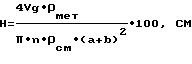
где Vg - объем полости дефекта, см3;
Ρсм; Ρмет- соответственно плотность экзотермической смеси и плотность образующегося при ее горении металла, г/см3;
а; b - соответственно большая и малая полуоси эллипса, описанного вокруг дефекта, см;
n - количество металла, выделяющего при сгорании данной экзотермической смеси, %.2. The method according to claim 1, characterized in that a fence is used that has a cross-section in the form of an ellipse, the half-axes of which are equal to the half-axes of the ellipse described around the defect, and the height of the fence is determined by the formula:
where V g is the volume of the cavity of the defect, cm 3 ;
Ρ cm ; Ρ met - respectively, the density of the exothermic mixture and the density of the metal formed during its combustion, g / cm 3 ;
a; b - respectively, the major and minor axes of the ellipse described around the defect, cm;
n is the amount of metal released during the combustion of this exothermic mixture,%.
Priority Applications (1)
| Application Number | Priority Date | Filing Date | Title |
|---|---|---|---|
| RU99123784/02A RU2182063C2 (en) | 1999-11-11 | 1999-11-11 | Process for repairing parts with open surface flaws |
Applications Claiming Priority (1)
| Application Number | Priority Date | Filing Date | Title |
|---|---|---|---|
| RU99123784/02A RU2182063C2 (en) | 1999-11-11 | 1999-11-11 | Process for repairing parts with open surface flaws |
Publications (2)
| Publication Number | Publication Date |
|---|---|
| RU99123784A true RU99123784A (en) | 2001-09-20 |
| RU2182063C2 RU2182063C2 (en) | 2002-05-10 |
Family
ID=20226864
Family Applications (1)
| Application Number | Title | Priority Date | Filing Date |
|---|---|---|---|
| RU99123784/02A RU2182063C2 (en) | 1999-11-11 | 1999-11-11 | Process for repairing parts with open surface flaws |
Country Status (1)
| Country | Link |
|---|---|
| RU (1) | RU2182063C2 (en) |
Families Citing this family (4)
| Publication number | Priority date | Publication date | Assignee | Title |
|---|---|---|---|---|
| RU2244614C1 (en) * | 2003-08-07 | 2005-01-20 | Тольяттинский государственный университет | Charge for thermit surfacing |
| RU2446932C2 (en) * | 2010-02-18 | 2012-04-10 | Федеральное государственное бюджетное образовательное учреждение высшего профессионального образования "Уральский государственный университет путей сообщения" (УрГУПС) | Method of repairing metal structures with surface cracks and device to this end |
| RU2477208C2 (en) * | 2011-04-07 | 2013-03-10 | Государственное образовательное учреждение высшего профессионального образования "Тольяттинский государственный университет" | Device for repairing parts with exposed surface defects |
| RU2693252C1 (en) * | 2018-05-28 | 2019-07-01 | Общество с ограниченной ответственностью "ЮниТранс" | Repair method of operational damages of railroad head rolling surface |
Family Cites Families (3)
| Publication number | Priority date | Publication date | Assignee | Title |
|---|---|---|---|---|
| SU115804A1 (en) * | 1957-11-11 | 1957-11-30 | Б.Ф. Браун | The method of thermite metal welding |
| FR2151524A5 (en) * | 1971-09-01 | 1973-04-20 | Ruggieri Ets | |
| SU1727969A1 (en) * | 1989-12-06 | 1992-04-23 | Научно-производственное объединение по механизации, роботизации труда и совершенствованию ремонтного обеспечения на предприятиях черной металлургии "Черметмеханизация" | Method of repair of articles with external defects of surface |
-
1999
- 1999-11-11 RU RU99123784/02A patent/RU2182063C2/en not_active IP Right Cessation
Similar Documents
| Publication | Publication Date | Title |
|---|---|---|
| ATE434163T1 (en) | METHOD FOR MELTING METALS | |
| BE865230A (en) | PROCESS FOR THE PREPARATION OF A CERAMIC PLUTONIUM-URANIUM NUCLEAR FUEL IN THE FORM OF FRIED PELLETS | |
| DE60003358D1 (en) | Phase change material with inhibitor and method for its production | |
| FR2412605B1 (en) | PROCESS FOR THERMAL CRACKING OF RESIDUAL HYDROCARBON WITH CALORIFIC POWER | |
| GB2164886A (en) | Welding preheating insert for heavy wall pipe | |
| DE60010196D1 (en) | Hot dipping device | |
| ATE14850T1 (en) | PROCESS FOR MAKING A POURING TUBE. | |
| RU2182063C2 (en) | Process for repairing parts with open surface flaws | |
| SU1611551A1 (en) | Method of producing moulds by investment pattern | |
| RU96122657A (en) | METHOD OF ALUMOTHERMAL WELDING OF RAILS | |
| SU591433A1 (en) | Method of roasting articles | |
| SU515568A1 (en) | Foundry two-layer form | |
| SU1476287A1 (en) | Arrangement for producing packed crucibles for iduction melting furnaces | |
| BR7804416A (en) | PROCESS FOR AUTOMATIC LEAKAGE OF CAST METAL FROM A SHELL IN A FUNNEL THROUGH THE USE OF A ROTATING NOZZLE SET IN CONTINUOUS METAL CASTING | |
| JPS6436752A (en) | Thermal spraying treatment for metal | |
| JPS5330983A (en) | Treating method for solid waste by electric melting | |
| SU501835A1 (en) | A METHOD FOR REMOVING A MODEL COMPOSITION OF A CERAMIC SHAPED FORM IN THE MANUFACTURE OF CASTING ON A MOLDED MODELS1 improving the quality of ceramic shells and sanitary-hygienic working conditions. There is a well-known method of melting a model composition from ceramic shells in liquid Yu media, according to which Which medium for melting, which is simultaneously a heat carrier, is known a composition for removing model material 1 [from ceramic forms, including a mixture of glycols and 15 carbitol. A well-known method is that models are made of a low-melting model material (for example, composition P-3) and collect them in blocks. On the assembled model blocks, apply the required number of layers of a refractory coating based on a binder hydrolyzed solution of ethyl silicate and with them in an exothermic ammonia atmosphere. After the act !! All the layers of the block — o are transported by the condom to the bath for the smelting of models. when heated to a temperature above the melt of the moling composition with a liquid, for example, a mixture of glycols and carbitol, the blocks in this mixture are kept for the time necessary for the complete removal of the models from the cavity, and then the forms are transported to the next operation. The disadvantage of this method is the following: —When using shell forms of glass glass or a hydrolyzed solution of ethyl silicate as a binder, around the shell form, immersed in a model bath, forms with an area with high pH (pH). If the models are melted in high-boiling organic liquids, such as mixtures of glycols and carb'Itol, then at high pH the medium will produce slow-burning tar-like products, which accumulate the oxidation products of the bath material, as well as sand particles, etc. Getting into the internal cavity of the mold, these products cause incomplete burning of combustible during annealing, resulting in the rejection of castings due to insufficient heat, gas shells and clogs. At the time of removing the ceramic shells from the installation, they have a high temperature y (about SO' ^ C) and reduced proch- | |
| SU562378A2 (en) | Method of lining centrifugal form | |
| RU2161545C2 (en) | Method of manufacturing full form from photopolymerizing materials | |
| SU12006A1 (en) | Fitting to an upward-expanding mold for dense ingots | |
| SU630027A1 (en) | Ingot mould insert | |
| SU778905A1 (en) | Shell mould calcination method | |
| JPS5639157A (en) | Continuous casting method | |
| JPH01284456A (en) | Method of carburizing steel product | |
| JPS5390193A (en) | Desulfuration method of blast furnace slag |