RU2361663C1 - Catalyst for recombination of hydrogen and oxygen and method of making said catalyst - Google Patents
Catalyst for recombination of hydrogen and oxygen and method of making said catalyst Download PDFInfo
- Publication number
- RU2361663C1 RU2361663C1 RU2008101609/04A RU2008101609A RU2361663C1 RU 2361663 C1 RU2361663 C1 RU 2361663C1 RU 2008101609/04 A RU2008101609/04 A RU 2008101609/04A RU 2008101609 A RU2008101609 A RU 2008101609A RU 2361663 C1 RU2361663 C1 RU 2361663C1
- Authority
- RU
- Russia
- Prior art keywords
- carrier
- catalyst
- hydrogen
- recombination
- metal
- Prior art date
Links
- 239000003054 catalyst Substances 0.000 title claims abstract description 46
- UFHFLCQGNIYNRP-UHFFFAOYSA-N Hydrogen Chemical compound [H][H] UFHFLCQGNIYNRP-UHFFFAOYSA-N 0.000 title claims abstract description 20
- 239000001257 hydrogen Substances 0.000 title claims abstract description 20
- 229910052739 hydrogen Inorganic materials 0.000 title claims abstract description 20
- 238000005215 recombination Methods 0.000 title claims abstract description 12
- 230000006798 recombination Effects 0.000 title claims abstract description 12
- QVGXLLKOCUKJST-UHFFFAOYSA-N atomic oxygen Chemical compound [O] QVGXLLKOCUKJST-UHFFFAOYSA-N 0.000 title claims abstract description 8
- 238000004519 manufacturing process Methods 0.000 title claims abstract description 8
- 239000001301 oxygen Substances 0.000 title claims abstract description 8
- 229910052760 oxygen Inorganic materials 0.000 title claims abstract description 8
- 229910052751 metal Inorganic materials 0.000 claims abstract description 19
- 239000002184 metal Substances 0.000 claims abstract description 19
- 230000003197 catalytic effect Effects 0.000 claims abstract description 17
- 239000011248 coating agent Substances 0.000 claims abstract description 17
- 238000000576 coating method Methods 0.000 claims abstract description 17
- RTAQQCXQSZGOHL-UHFFFAOYSA-N Titanium Chemical compound [Ti] RTAQQCXQSZGOHL-UHFFFAOYSA-N 0.000 claims abstract description 14
- 239000010936 titanium Substances 0.000 claims abstract description 14
- 229910052719 titanium Inorganic materials 0.000 claims abstract description 14
- 239000000725 suspension Substances 0.000 claims abstract description 9
- 238000001354 calcination Methods 0.000 claims abstract description 8
- 238000002360 preparation method Methods 0.000 claims abstract description 8
- 150000001875 compounds Chemical class 0.000 claims abstract description 7
- 239000007787 solid Substances 0.000 claims abstract description 7
- 229920000642 polymer Polymers 0.000 claims abstract description 6
- 239000003381 stabilizer Substances 0.000 claims abstract description 6
- YCKRFDGAMUMZLT-UHFFFAOYSA-N Fluorine atom Chemical compound [F] YCKRFDGAMUMZLT-UHFFFAOYSA-N 0.000 claims abstract description 5
- 229910052731 fluorine Inorganic materials 0.000 claims abstract description 5
- 239000011737 fluorine Substances 0.000 claims abstract description 5
- 230000010355 oscillation Effects 0.000 claims abstract description 4
- QCWXUUIWCKQGHC-UHFFFAOYSA-N Zirconium Chemical compound [Zr] QCWXUUIWCKQGHC-UHFFFAOYSA-N 0.000 claims abstract description 3
- 229910052758 niobium Inorganic materials 0.000 claims abstract description 3
- 239000010955 niobium Substances 0.000 claims abstract description 3
- GUCVJGMIXFAOAE-UHFFFAOYSA-N niobium atom Chemical compound [Nb] GUCVJGMIXFAOAE-UHFFFAOYSA-N 0.000 claims abstract description 3
- 229910052715 tantalum Inorganic materials 0.000 claims abstract description 3
- GUVRBAGPIYLISA-UHFFFAOYSA-N tantalum atom Chemical compound [Ta] GUVRBAGPIYLISA-UHFFFAOYSA-N 0.000 claims abstract description 3
- 229910052726 zirconium Inorganic materials 0.000 claims abstract description 3
- BASFCYQUMIYNBI-UHFFFAOYSA-N platinum Chemical group [Pt] BASFCYQUMIYNBI-UHFFFAOYSA-N 0.000 claims description 18
- 230000001603 reducing effect Effects 0.000 claims description 5
- 238000005470 impregnation Methods 0.000 claims description 3
- 150000003058 platinum compounds Chemical class 0.000 claims description 3
- 238000004663 powder metallurgy Methods 0.000 claims description 3
- 238000009736 wetting Methods 0.000 claims description 3
- 238000000034 method Methods 0.000 abstract description 6
- 230000000694 effects Effects 0.000 abstract description 2
- 239000000843 powder Substances 0.000 abstract description 2
- 230000002035 prolonged effect Effects 0.000 abstract description 2
- 230000009467 reduction Effects 0.000 abstract description 2
- 238000005520 cutting process Methods 0.000 abstract 1
- 238000009738 saturating Methods 0.000 abstract 1
- 239000000126 substance Substances 0.000 abstract 1
- XLYOFNOQVPJJNP-UHFFFAOYSA-N water Substances O XLYOFNOQVPJJNP-UHFFFAOYSA-N 0.000 description 10
- 229910052697 platinum Inorganic materials 0.000 description 6
- 238000012360 testing method Methods 0.000 description 6
- 230000008569 process Effects 0.000 description 4
- 238000001179 sorption measurement Methods 0.000 description 4
- 239000000758 substrate Substances 0.000 description 4
- 238000006243 chemical reaction Methods 0.000 description 3
- 239000007789 gas Substances 0.000 description 3
- 238000010438 heat treatment Methods 0.000 description 3
- 238000009434 installation Methods 0.000 description 3
- 230000007420 reactivation Effects 0.000 description 3
- 239000005871 repellent Substances 0.000 description 3
- 229910018072 Al 2 O 3 Inorganic materials 0.000 description 2
- KDLHZDBZIXYQEI-UHFFFAOYSA-N Palladium Chemical compound [Pd] KDLHZDBZIXYQEI-UHFFFAOYSA-N 0.000 description 2
- 230000004913 activation Effects 0.000 description 2
- 238000005516 engineering process Methods 0.000 description 2
- 230000000737 periodic effect Effects 0.000 description 2
- 238000006722 reduction reaction Methods 0.000 description 2
- 230000002940 repellent Effects 0.000 description 2
- 229910001220 stainless steel Inorganic materials 0.000 description 2
- 239000010935 stainless steel Substances 0.000 description 2
- 238000012546 transfer Methods 0.000 description 2
- 229910000809 Alumel Inorganic materials 0.000 description 1
- 229910000831 Steel Inorganic materials 0.000 description 1
- 238000009825 accumulation Methods 0.000 description 1
- 230000032683 aging Effects 0.000 description 1
- 238000013459 approach Methods 0.000 description 1
- 239000007900 aqueous suspension Substances 0.000 description 1
- 150000001768 cations Chemical class 0.000 description 1
- 239000003638 chemical reducing agent Substances 0.000 description 1
- 239000003795 chemical substances by application Substances 0.000 description 1
- 239000003251 chemically resistant material Substances 0.000 description 1
- 238000009833 condensation Methods 0.000 description 1
- 230000005494 condensation Effects 0.000 description 1
- 238000001035 drying Methods 0.000 description 1
- 239000002360 explosive Substances 0.000 description 1
- 229920002313 fluoropolymer Polymers 0.000 description 1
- 230000002209 hydrophobic effect Effects 0.000 description 1
- 238000007654 immersion Methods 0.000 description 1
- 238000012986 modification Methods 0.000 description 1
- 230000004048 modification Effects 0.000 description 1
- 239000000178 monomer Substances 0.000 description 1
- TWNQGVIAIRXVLR-UHFFFAOYSA-N oxo(oxoalumanyloxy)alumane Chemical compound O=[Al]O[Al]=O TWNQGVIAIRXVLR-UHFFFAOYSA-N 0.000 description 1
- 229910052763 palladium Inorganic materials 0.000 description 1
- 238000002161 passivation Methods 0.000 description 1
- UGPIIBDOUTZDQE-UHFFFAOYSA-L platinum(2+) dichloride hydrochloride Chemical compound Cl.[Pt+2].[Cl-].[Cl-] UGPIIBDOUTZDQE-UHFFFAOYSA-L 0.000 description 1
- 239000011148 porous material Substances 0.000 description 1
- 238000012545 processing Methods 0.000 description 1
- 230000001681 protective effect Effects 0.000 description 1
- 238000003908 quality control method Methods 0.000 description 1
- 150000003839 salts Chemical class 0.000 description 1
- 239000002002 slurry Substances 0.000 description 1
- 239000002594 sorbent Substances 0.000 description 1
- 238000005507 spraying Methods 0.000 description 1
- 239000010959 steel Substances 0.000 description 1
- BFKJFAAPBSQJPD-UHFFFAOYSA-N tetrafluoroethene Chemical compound FC(F)=C(F)F BFKJFAAPBSQJPD-UHFFFAOYSA-N 0.000 description 1
- 238000005979 thermal decomposition reaction Methods 0.000 description 1
Images
Classifications
-
- Y—GENERAL TAGGING OF NEW TECHNOLOGICAL DEVELOPMENTS; GENERAL TAGGING OF CROSS-SECTIONAL TECHNOLOGIES SPANNING OVER SEVERAL SECTIONS OF THE IPC; TECHNICAL SUBJECTS COVERED BY FORMER USPC CROSS-REFERENCE ART COLLECTIONS [XRACs] AND DIGESTS
- Y02—TECHNOLOGIES OR APPLICATIONS FOR MITIGATION OR ADAPTATION AGAINST CLIMATE CHANGE
- Y02E—REDUCTION OF GREENHOUSE GAS [GHG] EMISSIONS, RELATED TO ENERGY GENERATION, TRANSMISSION OR DISTRIBUTION
- Y02E30/00—Energy generation of nuclear origin
- Y02E30/30—Nuclear fission reactors
Landscapes
- Catalysts (AREA)
Abstract
Description
Изобретение относится к изготовлению катализаторов и может быть использовано для рекомбинации водорода в реакторных цехах атомных электростанций (АЭС) и на других предприятиях, где из-за утечек или в результате аварии возможно взрывоопасное скопление водорода в закрытых помещениях. Рабочей (собственно каталитической) составляющей таких катализаторов служит обычно металл из группы платиноидов, чаще дисперсные платина или палладий, которые наносят на носитель (основу катализатора) различной формы, выполняемый из нержавеющая стали, высокопористых инертных окислов и других термически и химически стойких материалов. Такие катализаторы могут работать в пассивном режиме, т.е. без дополнительного подогрева, связывая водород по реакцииThe invention relates to the manufacture of catalysts and can be used for recombination of hydrogen in the reactor shops of nuclear power plants (NPPs) and in other enterprises where explosive accumulation of hydrogen in closed rooms is possible due to leaks or as a result of an accident. The working (actually catalytic) component of such catalysts is usually a metal from the group of platinoids, most often dispersed platinum or palladium, which are deposited on a support (catalyst base) of various shapes made of stainless steel, highly porous inert oxides and other thermally and chemically resistant materials. Such catalysts can operate in a passive mode, i.e. without additional heating, binding hydrogen by reaction

Тепло реакции (1) приводит к разогреву катализатора, так что образующаяся вода испаряется с поверхности, забирая часть тепла:The heat of reaction (1) leads to heating of the catalyst, so that the resulting water evaporates from the surface, taking part of the heat:

Платинирование носителя осуществляют путем напыления металла-катализатора или нанесения на него растворов соединений платиноидов, чаще раствора платинохлористоводородной кислоты (ПХВК), с последующим химическим восстановлением (чаще - водородом) катиона до металлической формы, а также термическим разложением ПХВК и других солей платиноидов.Platinization of the support is carried out by spraying a metal catalyst or applying solutions of platinoid compounds, usually a solution of platinum chloride hydrochloric acid (PCVC), followed by chemical reduction (usually hydrogen) of the cation to a metal form, as well as thermal decomposition of PCVC and other salts of platinoids.
Образующаяся по реакции (1) и (2) вода, а также влага окружающего газового пространства могут блокировать поверхность катализатора. В режиме аварии на АЭС не исключено и периодическое затопление катализатора. Конденсат на поверхности катализатора замедляет газомассобмен и может привести к полной пассивации процесса рекомбинации. Для предотвращения «намокания» катализатора его подвергают гидрофобизации, в результате чего его поверхность приобретает водоотталкивающие свойства. В качестве гидрофобизаторов обычно используют некоторые неполярные химические соединения и полимеры, в частности порошкообразный фторопласт-4.The water formed by reaction (1) and (2), as well as moisture in the surrounding gas space, can block the surface of the catalyst. In the accident mode at nuclear power plants, periodic flooding of the catalyst is not excluded. Condensation on the surface of the catalyst slows the gas exchange and can lead to complete passivation of the recombination process. To prevent the catalyst from getting wet, it is subjected to hydrophobization, as a result of which its surface acquires water-repellent properties. As non-polarizing agents, some non-polar chemical compounds and polymers are usually used, in particular powdered fluoroplast-4.
Известен катализатор для рекомбинации водорода и кислорода, содержащий твердый пористый носитель с гидрофобизированным каталитическим покрытием из металла группы платиноидов [1] - аналог. В этом катализаторе носитель изготовлен в виде системы цилиндрических стержней из кристаллической модификации γ-Аl2О3 с удельной поверхностью порядка 100 м2/г. Катализатор может работать в условиях периодического контакта с водой, но вследствие высокой пористости лишь кратковременного (не более 1 минуты). Обладая гидрофильными свойствами, γ-Аl2О3 сорбирует до 30 вес.% воды, что значительно замедляет саморазогрев катализатора и ухудшает его пусковые характеристики, особенно при температурах, близких к комнатным.A known catalyst for the recombination of hydrogen and oxygen, containing a solid porous carrier with a hydrophobized catalytic coating of a metal of the platinum group [1] is an analogue. In this catalyst, the support is made in the form of a system of cylindrical rods from a crystalline modification of γ-Al 2 O 3 with a specific surface of the order of 100 m 2 / g. The catalyst can operate under conditions of periodic contact with water, but due to the high porosity of only short-term (no more than 1 minute). Possessing hydrophilic properties, γ-Al 2 O 3 sorb up to 30 wt.% Water, which significantly slows down the self-heating of the catalyst and worsens its starting characteristics, especially at temperatures close to room temperature.
Известен катализатор для рекомбинации водорода и кислорода, содержащий твердый пористый носитель с гидрофобизированным каталитическим покрытием из металла группы платиноидов [2] - прототип. В этом катализаторе носитель изготовлен в виде системы пластин из нержавеющей стали с субстратным покрытием из высокопористого окисла алюминия и (или) других химически и термически стойких окислов. Однако представятся весьма сложным добиться прочной адгезии субстрата на стали и предотвратить его отслоение (осыпание) в штатных условиях эксплуатации. Дело в том, что катализатор должен работать в широком интервале температур от комнатной до примерно 600°С, а обе контактирующие фазы имеют коэффициенты термического расширения, различающиеся во много раз. Кроме того, изготовление такого катализатора требует довольно сложной многостадийной технологии с применением дорогостоящего оборудования.A known catalyst for the recombination of hydrogen and oxygen, containing a solid porous carrier with a hydrophobized catalytic coating of a metal of the platinum group [2] is a prototype. In this catalyst, the support is made in the form of a system of stainless steel plates with a substrate coating of highly porous aluminum oxide and (or) other chemically and thermally stable oxides. However, it will be very difficult to achieve strong adhesion of the substrate to steel and prevent its peeling (shedding) under normal operating conditions. The fact is that the catalyst must operate in a wide temperature range from room temperature to about 600 ° C, and both contacting phases have thermal expansion coefficients that differ many times. In addition, the manufacture of such a catalyst requires a rather complex multi-stage technology using expensive equipment.
Одним из ожидаемых результатов изобретения является обеспечение надежного функционирования катализатора для рекомбинации водорода и кислорода в условиях длительного контакта с влажной средой.One of the expected results of the invention is to ensure reliable operation of the catalyst for the recombination of hydrogen and oxygen under conditions of prolonged contact with a humid environment.
Указанный результат достигается тем, что в катализаторе для рекомбинации водорода и кислорода, содержащем твердый пористый носитель с гидрофобизированным каталитическим покрытием из металла группы платиноидов, согласно изобретению носитель изготовлен из полученного методом порошковой металлургии вентильного металла с удельной поверхностью 0,05-1,50 м2/г. При этом носитель может быть изготовлен из пористых пластин титана, или тантала, или ниобия, или циркония толщиной 0,3-2,0 мм.This result is achieved by the fact that in the catalyst for the recombination of hydrogen and oxygen containing a solid porous support with a hydrophobized catalytic coating of a metal of the platinum group, according to the invention, the support is made of a valve metal obtained by powder metallurgy with a specific surface area of 0.05-1.50 m 2 / g In this case, the carrier can be made of porous plates of titanium, or tantalum, or niobium, or zirconium with a thickness of 0.3-2.0 mm.
Известен способ изготовления катализатора, содержащего твердый пористый носитель с гидрофобизированным каталитическим покрытием из металла группы платиноидов, включающий пропитку носителя раствором соединения платиноида, восстановление указанного соединения до металла, а также гидрофобизацию каталитического покрытия путем смачивания его суспензией фторсодержащего полимера с органическим стабилизатором и последующего прокаливания [1] - прототип.A known method of manufacturing a catalyst containing a solid porous carrier with a hydrophobized catalytic coating from a metal of the platinoid group, comprising impregnating the carrier with a solution of a platinum compound, reducing the specified compound to metal, and also hydrophobizing the catalytic coating by wetting it with a suspension of a fluorine-containing polymer with an organic stabilizer and subsequent calcining [1 ] is the prototype.
Другим ожидаемым результатом изобретения является сокращение времени приготовления и удешевление катализатора за счет уменьшения числа стадий технологического процесса при сохранении гидрофобных свойств каталитического покрытия.Another expected result of the invention is to reduce the preparation time and the cost of the catalyst by reducing the number of stages of the process while maintaining the hydrophobic properties of the catalytic coating.
Это обеспечивается тем, что при осуществлении способа изготовления катализатора, содержащего твердый пористый носитель с гидрофобизированным каталитическим покрытием из металла группы платиноидов, включающего пропитку носителя раствором соединения платиноида, восстановление указанного соединения до металла, а также гидрофобизацию каталитического покрытия путем смачивания его суспензией фторсодержащего полимера с органическим стабилизатором и последующего прокаливания, согласно изобретению время выдерживания носителя в суспензии составляет 5-30 с, носитель фиксируют в одном положении, и в этом положении осуществляют все стадии приготовления гидрофобизированного каталитического покрытия, во время пропитывания носителю сообщают поступательные колебания с частотой 1-2 Гц.This is ensured by the fact that, when implementing a method of manufacturing a catalyst containing a solid porous support with a hydrophobized catalytic coating from a metal of the platinum group, comprising impregnating the support with a solution of a platinum compound, reducing said compound to metal, and also hydrophobizing the catalyst coating by wetting it with a suspension of a fluorine-containing polymer with an organic stabilizer and subsequent calcination, according to the invention, the aging time of the carrier in suspension uu is from 5-30, the carrier is fixed in one position, and in this position is carried out all the steps of preparing hydrophobized catalytic coating, the carrier during impregnation reported translational oscillations with a frequency of 1-2 Hz.
Пористый металл, получаемый методом порошковой металлургии, предпочтительно титан, не требует дополнительного нанесения высокопористого субстрата и обладает относительно низкой удельной поверхностью. При этом число стадий приготовления нового катализатора ограничено стадией пропитки пористого титана в растворе ПХВК (не более 1 часа), кратковременным погружением в суспензию гидрофобизатора (не более 20 секунд) и прокаливанием в печи менее 1 часа. Общий технологический цикл приготовления нового катализатора требует не более двух часов.The porous metal obtained by powder metallurgy, preferably titanium, does not require additional application of a highly porous substrate and has a relatively low specific surface area. The number of stages of preparation of a new catalyst is limited by the stage of impregnation of porous titanium in a solution of PCVC (no more than 1 hour), short-term immersion in a slurry of water repellent (not more than 20 seconds) and calcination in an oven for less than 1 hour. The general technological cycle for the preparation of a new catalyst requires no more than two hours.
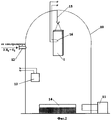
На фиг.1 схематически изображена последовательность изготовления катализатора согласно изобретению; на фиг.2 - установка для испытания катализатора рассматриваемого типа.Figure 1 schematically shows the sequence of manufacture of the catalyst according to the invention; figure 2 - installation for testing a catalyst of the type in question.
Для упрощения технологии и сокращения потерь ПХВК исходный носитель - пластины 1 из пористого титана закрепляют (фиг.1) в подвесном положении с помощью титановых проволок 2 штатива 3. В этом фиксированном положении пластины проходят все три стадии (А, В, С) приготовления катализатора. Штатив 3 с пластинами 1 лишь переносится из одних условий технологического цикла в другие, причем погружению подвергаются только обрабатываемые пластины 1.To simplify the technology and reduce PCVC losses, the initial carrier - porous titanium plates 1 is fixed (Fig. 1) in a suspended position using titanium wires 2 of a tripod 3. In this fixed position of the plate, all three stages (A, B, C) of the catalyst preparation go through . A tripod 3 with plates 1 is only transferred from some conditions of the technological cycle to others, and only the processed plates 1 are immersed.
На первой стадии А пластины 1 из пористого титана пропитывают раствором ПХВК в ванне 4, сообщенной линиями 5, 6 с не показанным на чертеже термостатом. Для интенсификации массообмена в растворе штативу 3 с помощью вибратора (шейкера) 7 сообщают горизонтальные поступательные колебания с частотой 1-2 Гц. На второй стадии В пластины 1 на 5-30 секунд помещают в ванну 8, наполненную суспензией фторсодержащего полимера с органическим стабилизатором. И, наконец, на стадии С пластины 1 прокаливают в печи 9, где одновременно протекают два основных процесса: платинирование носителя и формирование защитной пленки из пористого гидрофобизатора. При прокаливании происходит разложение стабилизатора суспензии до простейших мономеров. Эти продукты, обладая ярко выраженными восстановительными свойствами, восстанавливают ПХВК до металлической платины. В результате в порах носителя (пористого титана) образуется каталитически активный слой дисперсной платины, перемешанный с дисперсной фазой гидрофобизированного покрытия. Для приготовления каталитических пластин общей площадью 90 дм2 на данной установке требуется не более двух часов.In the first stage A, the plates 1 of porous titanium are impregnated with a solution of PCVC in bath 4, connected by lines 5, 6 with a thermostat not shown in the drawing. To intensify mass transfer in the solution, the tripod 3 using a vibrator (shaker) 7 report horizontal translational vibrations with a frequency of 1-2 Hz. In the second stage B, the plates 1 are placed for 5-30 seconds in a bath 8 filled with a suspension of a fluorine-containing polymer with an organic stabilizer. And finally, at stage C, the plates 1 are calcined in the furnace 9, where two main processes simultaneously occur: platinizing the carrier and forming a protective film from the porous water repellent. During calcination, the suspension stabilizer decomposes to the simplest monomers. These products, with pronounced reducing properties, restore PCVC to metallic platinum. As a result, a catalytically active layer of dispersed platinum is formed in the pores of the support (porous titanium), mixed with the dispersed phase of the hydrophobized coating. For the preparation of catalytic plates with a total area of 90 dm 2 in this installation, no more than two hours are required.
Каталитическая фаза дисперсной платины прочно сорбируется в поверхностном пористом слое носителя - пористого титана, не требуя нанесения специального субстрата-сорбента. Низкая удельная поверхность пористого титана (0,05-1,50 м2/г) достаточна для сорбции дисперсной платины, с одной стороны, и практически не создает условий для сорбции больших количеств воды: максимальная сорбция воды в пористом титане составляет менее 0,3% вес. Тем что металл-катализатор (платина) сорбируется непосредственно в носитель, достигается хорошая адгезия платины.The catalytic phase of dispersed platinum is firmly sorbed in the surface porous support layer - porous titanium, without requiring the application of a special sorbent substrate. The low specific surface area of porous titanium (0.05-1.50 m 2 / g) is sufficient for sorption of dispersed platinum, on the one hand, and practically does not create conditions for sorption of large quantities of water: the maximum sorption of water in porous titanium is less than 0.3 % the weight. By the fact that the metal catalyst (platinum) is adsorbed directly into the support, good adhesion of platinum is achieved.
Проверку качества приготовляемого катализатора проводят на испытательной установке (фиг.2) в специальной камере 10. Камера снабжена термостатом 11, патрубком 12 для дозированного ввода водорода от электролизера (на чертеже не показан), анализатором 13 концентрации водорода, устройством 14 для осушения или увлажнения газового пространства, устройством 15 крепления испытуемого образца (пластины 1 площадью до 200 см2) катализатора, системой измерения температуры в камере и самих образцов (на чертеже не показана) с помощью термопар 16, а также компьютерной системой обработки кинетических и температурных данных (на чертеже не показана).The quality control of the prepared catalyst is carried out on a test installation (Fig. 2) in a
Качество катализатора оценивают по трем параметрам: времени активации (τакт) в минутах, удельной скорости рекомбинации водорода (i) в миллилитрах окисляемого водорода за 1 минуту, отнесенных к единице ширины нижней части образца (мл/мин см), и времени реактивации (времени возвращения в активное состояние) образца в минутах после 10-30 минутного нахождения в воде (τреакт). Для этого испытуемые образцы (пластины 1) катализатора поочередно помещают в камеру 10 (подвешивают под крышкой), заполненную воздухом с содержанием водорода около 2% об. при 25°С. Температуру образца контролируют с помощью хромель-алюмелевой термопары 16.The quality of the catalyst is evaluated by three parameters: the activation time (τ act ) in minutes, the specific hydrogen recombination rate (i) in milliliters of oxidized hydrogen per 1 minute, referred to the unit width of the lower part of the sample (ml / min cm), and the reactivation time (time return to the active state) of the sample in minutes after 10-30 minutes in water (τ react ). To do this, the test samples (plates 1) of the catalyst are alternately placed in the chamber 10 (suspended under the lid), filled with air with a hydrogen content of about 2% vol. at 25 ° C. The temperature of the sample is controlled using a chromel-
Пример. Пластины 1 из пористого титана с удельной поверхностью от 0,05 до 1,50 м2/г разной площади толщиной 0,9 мм, подвесив на титановых проволоках 2 к штативу 3 (фиг.1), погружали в раствор с ПХВК при температуре 75°С. Для интенсификации массообмена штативу 3 с помощью шейкера 7 сообщали поступательные горизонтальные колебания с частотой от 1 до 2 Гц. Через 10 минут после окончания процесса сорбции ПХВК пластины извлекали из ванны и для разных образцов на 5-30 секунд погружали в ванну 8 с водной суспензией порошка фторопласта марки Ф-4Д и затем на 30 минут помещали для прокаливания в печь 9 при температуре 310°С. Охлажденные после прокаливания образцы катализатора испытывали в камере 10 (фиг.2). Время контакта образца с водой в процессе испытаний составляло 13 минут. Результаты испытаний образцов различной формы и площади приведены ниже в таблице.Example. Plates 1 of porous titanium with a specific surface area of 0.05 to 1.50 m 2 / g of different area 0.9 mm thick, suspended on titanium wires 2 to a tripod 3 (Fig. 1), were immersed in a solution with PCVC at a temperature of 75 ° C. To intensify mass transfer to the tripod 3 using a shaker 7, translational horizontal oscillations were reported with a frequency of 1 to 2 Hz. 10 minutes after the end of the PCVC sorption process, the plates were removed from the bath and for different samples for 5-30 seconds they were immersed in bath 8 with an aqueous suspension of F-4D fluoroplastic powder and then placed for 30 minutes in the furnace 9 for calcination at 310 ° С . The catalyst samples cooled after calcination were tested in chamber 10 (FIG. 2). The contact time of the sample with water during the test was 13 minutes. The test results of samples of various shapes and sizes are shown in the table below.
Как видно из таблицы, оба параметра: τакт и τреакт не превышают 1 минуты, что существенно меньше, чем время реактивации для образцов катализатора согласно [1, 2].As can be seen from the table, both parameters: τ act and τ react do not exceed 1 minute, which is significantly less than the reactivation time for catalyst samples according to [1, 2].
Источники информацииInformation sources
1. SU №1747146, 5 В01J 37/02, 1990.1. SU No. 1747146, 5 B01J 37/02, 1990.
2. A two-pronged approach to hydrogen reduction. / Reinhard Heck and Axel Hill // Nuclear Engineering International. July 1992, p.21-28.2. A two-pronged approach to hydrogen reduction. / Reinhard Heck and Axel Hill // Nuclear Engineering International. July 1992, p.21-28.
Claims (3)
Priority Applications (1)
| Application Number | Priority Date | Filing Date | Title |
|---|---|---|---|
| RU2008101609/04A RU2361663C1 (en) | 2008-01-23 | 2008-01-23 | Catalyst for recombination of hydrogen and oxygen and method of making said catalyst |
Applications Claiming Priority (1)
| Application Number | Priority Date | Filing Date | Title |
|---|---|---|---|
| RU2008101609/04A RU2361663C1 (en) | 2008-01-23 | 2008-01-23 | Catalyst for recombination of hydrogen and oxygen and method of making said catalyst |
Publications (1)
| Publication Number | Publication Date |
|---|---|
| RU2361663C1 true RU2361663C1 (en) | 2009-07-20 |
Family
ID=41047030
Family Applications (1)
| Application Number | Title | Priority Date | Filing Date |
|---|---|---|---|
| RU2008101609/04A RU2361663C1 (en) | 2008-01-23 | 2008-01-23 | Catalyst for recombination of hydrogen and oxygen and method of making said catalyst |
Country Status (1)
| Country | Link |
|---|---|
| RU (1) | RU2361663C1 (en) |
Cited By (3)
| Publication number | Priority date | Publication date | Assignee | Title |
|---|---|---|---|---|
| EP2489430A1 (en) | 2011-02-17 | 2012-08-22 | Vladimir Shepelin | Method with an accelerated procedure for preparing a catalyst for a recombination of hydrogen and oxygen in enclosed areas |
| RU2468866C1 (en) * | 2011-09-15 | 2012-12-10 | Владимир Андреевич Шепелин | Method of manufacturing catalyst and impregnated porous catalyst carrier for hydrogen and oxygen recombination |
| RU2471555C1 (en) * | 2011-11-24 | 2013-01-10 | Владимир Андреевич Шепелин | Method of accelerated production of catalyst for hydrogen and oxygen passive recombiner |
Citations (4)
| Publication number | Priority date | Publication date | Assignee | Title |
|---|---|---|---|---|
| CA2082627A1 (en) * | 1990-05-11 | 1991-11-12 | Reinhard Heck | Device for the recombination of hydrogen and oxygen and the use of said device |
| SU1747146A1 (en) * | 1990-05-22 | 1992-07-15 | Научно-исследовательский физико-химический институт им.Л.Я.Карпова | Method of producing hydrophobic platinum catalyst for hydrogen combustion |
| RU2232635C2 (en) * | 1999-03-31 | 2004-07-20 | Фраматом Анп Гмбх | Catalytic element (versions) |
| RU2241541C1 (en) * | 2003-07-30 | 2004-12-10 | Институт химии Дальневосточного отделения РАН (статус государственного учреждения) | Method of preparing oxide catalysts |
-
2008
- 2008-01-23 RU RU2008101609/04A patent/RU2361663C1/en active
Patent Citations (4)
| Publication number | Priority date | Publication date | Assignee | Title |
|---|---|---|---|---|
| CA2082627A1 (en) * | 1990-05-11 | 1991-11-12 | Reinhard Heck | Device for the recombination of hydrogen and oxygen and the use of said device |
| SU1747146A1 (en) * | 1990-05-22 | 1992-07-15 | Научно-исследовательский физико-химический институт им.Л.Я.Карпова | Method of producing hydrophobic platinum catalyst for hydrogen combustion |
| RU2232635C2 (en) * | 1999-03-31 | 2004-07-20 | Фраматом Анп Гмбх | Catalytic element (versions) |
| RU2241541C1 (en) * | 2003-07-30 | 2004-12-10 | Институт химии Дальневосточного отделения РАН (статус государственного учреждения) | Method of preparing oxide catalysts |
Cited By (3)
| Publication number | Priority date | Publication date | Assignee | Title |
|---|---|---|---|---|
| EP2489430A1 (en) | 2011-02-17 | 2012-08-22 | Vladimir Shepelin | Method with an accelerated procedure for preparing a catalyst for a recombination of hydrogen and oxygen in enclosed areas |
| RU2468866C1 (en) * | 2011-09-15 | 2012-12-10 | Владимир Андреевич Шепелин | Method of manufacturing catalyst and impregnated porous catalyst carrier for hydrogen and oxygen recombination |
| RU2471555C1 (en) * | 2011-11-24 | 2013-01-10 | Владимир Андреевич Шепелин | Method of accelerated production of catalyst for hydrogen and oxygen passive recombiner |
Similar Documents
| Publication | Publication Date | Title |
|---|---|---|
| CN102133537B (en) | Honeycomb-ceramic-type monolithic catalyst, and preparation method and application thereof | |
| Valentini et al. | The deposition of γ-Al2O3 layers on ceramic and metallic supports for the preparation of structured catalysts | |
| RU2146171C1 (en) | Catalytic system for catalytic hydrodesulfurization hydrodehydrogenation, reforming, hydrogenation - dehydrogenation and isomerization of hydrocarbon raw material; method of production, activation, regeneration and use | |
| RU2702988C2 (en) | Scr catalysts with improved low-temperature efficiency and methods of their creation and use | |
| KR20220069941A (en) | Metal foam element containing cobalt and method for manufacturing same | |
| JP2014510620A (en) | Metal structure catalyst and method for producing the same | |
| US5314853A (en) | High temperature sorbents for oxygen | |
| KR101182755B1 (en) | Catalyst composit for vocs oxidation and preparation process thereof | |
| Zamaro et al. | The effect of different slurry compositions and solvents upon the properties of ZSM5-washcoated cordierite honeycombs for the SCR of NOx with methane | |
| CN114920258B (en) | A method for synthesizing molecular sieve monolithic material by pre-adsorption-drying-in-situ crystallization method | |
| Wu et al. | Mechanical stability of ZSM-5 zeolite washcoated cordierite monoliths | |
| CN114177919A (en) | Method for preparing monolithic metal-based environmental catalyst by metal replacement method | |
| Wu et al. | Preparation and catalytic properties of honeycomb catalyst for hydrogen isotope oxidation | |
| RU2546120C1 (en) | Method of catalyst preparing for hydrogen oxidation | |
| JP7337542B2 (en) | hydrogen combustion catalyst | |
| CN114308070B (en) | Self-contained metal core-shell structure catalyst and coupling agent auxiliary preparation method and application thereof | |
| CN109513452A (en) | Membrane catalyst, precursor and carrier thereof, and preparation method thereof | |
| US10259710B2 (en) | Process for spontaneous catalytic decomposition of hydrogen peroxide | |
| US3896048A (en) | Catalyst composition | |
| JPS581628B2 (en) | Ammonia oxidative decomposition catalyst and its manufacturing method | |
| RU2468866C1 (en) | Method of manufacturing catalyst and impregnated porous catalyst carrier for hydrogen and oxygen recombination | |
| RU2136366C1 (en) | Method of preparing fischer-tropsch catalyst | |
| CN119524866A (en) | A method and device for preparing a honeycomb CO oxidation catalyst with a simplified process | |
| RU52341U1 (en) | PLANT FOR PRODUCING A CATALYST FOR RECOMBINING HYDROGEN AND OXYGEN | |
| US20150209746A1 (en) | Catalysts systems |