RU2334373C1 - Method of getting heating element - Google Patents
Method of getting heating element Download PDFInfo
- Publication number
- RU2334373C1 RU2334373C1 RU2007109561/09A RU2007109561A RU2334373C1 RU 2334373 C1 RU2334373 C1 RU 2334373C1 RU 2007109561/09 A RU2007109561/09 A RU 2007109561/09A RU 2007109561 A RU2007109561 A RU 2007109561A RU 2334373 C1 RU2334373 C1 RU 2334373C1
- Authority
- RU
- Russia
- Prior art keywords
- electrically conductive
- pressure
- catalyst
- current
- temperature
- Prior art date
Links
- 238000000034 method Methods 0.000 title claims abstract description 24
- 238000010438 heat treatment Methods 0.000 title claims abstract description 17
- 239000004020 conductor Substances 0.000 claims abstract description 24
- 239000003054 catalyst Substances 0.000 claims abstract description 17
- 239000007864 aqueous solution Substances 0.000 claims abstract description 10
- 239000011810 insulating material Substances 0.000 claims abstract description 10
- 229920002379 silicone rubber Polymers 0.000 claims abstract description 9
- 239000004945 silicone rubber Substances 0.000 claims abstract description 9
- 238000003763 carbonization Methods 0.000 claims abstract description 7
- 238000001035 drying Methods 0.000 claims abstract description 7
- 230000003647 oxidation Effects 0.000 claims abstract description 7
- 238000007254 oxidation reaction Methods 0.000 claims abstract description 7
- 238000005087 graphitization Methods 0.000 claims abstract description 6
- 238000012545 processing Methods 0.000 claims abstract description 6
- 238000001125 extrusion Methods 0.000 claims abstract description 5
- 239000000243 solution Substances 0.000 claims description 9
- 230000015572 biosynthetic process Effects 0.000 claims description 8
- 229920005594 polymer fiber Polymers 0.000 claims 1
- 239000000835 fiber Substances 0.000 abstract description 5
- 239000000126 substance Substances 0.000 abstract description 5
- 229920001059 synthetic polymer Polymers 0.000 abstract description 5
- 230000015556 catabolic process Effects 0.000 abstract description 3
- OKTJSMMVPCPJKN-UHFFFAOYSA-N Carbon Chemical compound [C] OKTJSMMVPCPJKN-UHFFFAOYSA-N 0.000 abstract description 2
- 229910052799 carbon Inorganic materials 0.000 abstract description 2
- 238000004870 electrical engineering Methods 0.000 abstract description 2
- 230000005611 electricity Effects 0.000 abstract 1
- 238000007493 shaping process Methods 0.000 abstract 1
- 229920000049 Carbon (fiber) Polymers 0.000 description 18
- 239000004917 carbon fiber Substances 0.000 description 18
- VNWKTOKETHGBQD-UHFFFAOYSA-N methane Chemical compound C VNWKTOKETHGBQD-UHFFFAOYSA-N 0.000 description 16
- NLXLAEXVIDQMFP-UHFFFAOYSA-N Ammonia chloride Chemical compound [NH4+].[Cl-] NLXLAEXVIDQMFP-UHFFFAOYSA-N 0.000 description 10
- 238000005470 impregnation Methods 0.000 description 9
- 239000011152 fibreglass Substances 0.000 description 8
- 238000004519 manufacturing process Methods 0.000 description 6
- 229920000297 Rayon Polymers 0.000 description 5
- 235000019270 ammonium chloride Nutrition 0.000 description 5
- 244000309464 bull Species 0.000 description 4
- 229920002239 polyacrylonitrile Polymers 0.000 description 4
- 229920000642 polymer Polymers 0.000 description 4
- 229920006395 saturated elastomer Polymers 0.000 description 3
- 238000009826 distribution Methods 0.000 description 2
- 238000012423 maintenance Methods 0.000 description 2
- 229920005596 polymer binder Polymers 0.000 description 2
- 239000002491 polymer binding agent Substances 0.000 description 2
- 239000011148 porous material Substances 0.000 description 2
- KXGFMDJXCMQABM-UHFFFAOYSA-N 2-methoxy-6-methylphenol Chemical compound [CH]OC1=CC=CC([CH])=C1O KXGFMDJXCMQABM-UHFFFAOYSA-N 0.000 description 1
- 239000003463 adsorbent Substances 0.000 description 1
- 239000000443 aerosol Substances 0.000 description 1
- 238000013461 design Methods 0.000 description 1
- 238000011161 development Methods 0.000 description 1
- 230000018109 developmental process Effects 0.000 description 1
- 239000000428 dust Substances 0.000 description 1
- 238000005516 engineering process Methods 0.000 description 1
- 239000011521 glass Substances 0.000 description 1
- 231100000086 high toxicity Toxicity 0.000 description 1
- 238000009413 insulation Methods 0.000 description 1
- 239000012774 insulation material Substances 0.000 description 1
- 238000004811 liquid chromatography Methods 0.000 description 1
- 239000000463 material Substances 0.000 description 1
- 238000005259 measurement Methods 0.000 description 1
- 239000000203 mixture Substances 0.000 description 1
- 238000007353 oxidative pyrolysis Methods 0.000 description 1
- 230000035515 penetration Effects 0.000 description 1
- 229920001568 phenolic resin Polymers 0.000 description 1
- 239000012779 reinforcing material Substances 0.000 description 1
- 239000012047 saturated solution Substances 0.000 description 1
- 208000017520 skin disease Diseases 0.000 description 1
- 238000009864 tensile test Methods 0.000 description 1
- 231100000419 toxicity Toxicity 0.000 description 1
- 230000001988 toxicity Effects 0.000 description 1
- 238000009827 uniform distribution Methods 0.000 description 1
- 238000004804 winding Methods 0.000 description 1
Landscapes
- Inorganic Fibers (AREA)
Abstract
Description
Изобретение относится к области электротехники, а именно к способам получения нагревательных элементов, имеющих в качестве электропроводящего материала углеродное волокно, а в качестве изоляционного материала - синтетический полимер.The invention relates to the field of electrical engineering, and in particular to methods for producing heating elements having carbon fiber as an electrically conductive material, and a synthetic polymer as an insulating material.
Наиболее близким к заявляемому является способ получения нагревательного элемента (RU патент №2041507, кл. Н01В 1/04, В32В 7/02, Бюл. №22, 1995, прототип), содержащий:Closest to the claimed is a method for producing a heating element (RU patent No. 2041507, CL HB 1/04, BB 7/02, Bull. No. 22, 1995, prototype), containing:
- формирование заготовки для получения электропроводящего материала из нитей вискозы или полиакрилонитрила;- the formation of the workpiece to obtain an electrically conductive material from yarn of viscose or polyacrylonitrile;
- обработку заготовки водным раствором катализатора;- processing the workpiece with an aqueous catalyst solution;
- сушку заготовки;- drying the workpiece;
- термоокисление заготовки при температуре 200÷300°С;- thermal oxidation of the workpiece at a temperature of 200 ÷ 300 ° C;
- карбонизацию заготовки при температуре 1500÷2000°С;- carbonization of the workpiece at a temperature of 1500 ÷ 2000 ° C;
- изготовление изоляционных слоев из стеклоткани;- manufacture of insulating layers of fiberglass;
- пропитку стеклоткани полимерным связующим;- impregnation of fiberglass with a polymer binder;
- сушку пропитанной стеклоткани;- drying impregnated fiberglass;
- формирование электропроводящих слоев намоткой или синусоидальной укладкой электропроводящего материала на средний изоляционный слой;- the formation of electrically conductive layers by winding or sinusoidally laying electrically conductive material on the middle insulating layer;
- формирование внешних изоляционных слоев;- the formation of external insulating layers;
- термообработку сформированного нагревательного элемента.- heat treatment of the formed heating element.
Недостатки известного способа:The disadvantages of this method:
- многостадийность и токсичность производства;- multistage and toxicity of production;
- использование стеклоткани в качестве армирующего материала: операция изготовления изоляционных слоев приводит к образованию устойчивого аэрозоля из стеклопыли, а контакт обслуживающего персонала с стеклотканью вызывает кожные заболевания;- the use of fiberglass as a reinforcing material: the operation of the manufacture of insulating layers leads to the formation of a stable aerosol from glass dust, and the contact of maintenance personnel with fiberglass causes skin diseases;
- следствием пропитки стеклоткани полимерным связующим и последующей сушки может быть создание опасных для организма человека концентраций вредных веществ в воздухе рабочей зоны;- the consequence of the impregnation of fiberglass with a polymer binder and subsequent drying can be the creation of concentrations of harmful substances dangerous to the human body in the air of the working area;
- трудоемкость операции формирования изоляционного слоя.- the complexity of the operation of forming an insulating layer.
Технический результат настоящего изобретения заключается в том, что способ получения нагревательного элемента, имеющего в качестве электропроводящего материала углеродное волокно, а в качестве изоляционного материала - синтетический полимер, характеризуется удовлетворительной экологией, значительным сокращением числа операций, получением электропроводящего материала однородного состава и, как следствие, имеющего высокие физико-механические показатели, созданием изоляционного слоя, устойчивого как к электрическому пробою, так и механическим нагрузкам.The technical result of the present invention lies in the fact that the method of producing a heating element having carbon fiber as an electrically conductive material, and a synthetic polymer as an insulating material, is characterized by a satisfactory environment, a significant reduction in the number of operations, obtaining a conductive material of a homogeneous composition and, as a result, having high physical and mechanical properties, the creation of an insulating layer resistant to both electrical breakdown and m mechanically load.
Технический результат достигается тем, что формирование изоляционного слоя осуществляется экструзией силиконового каучука на электропроводящий материал - углеродное волокно - при температуре 150÷200°С и давлении (2÷3)·107 Па, а обработка заготовки для получения электропроводящего материала водным раствором катализатора производится при давлении (2÷5)·105 Па и температуре 20÷50°С.The technical result is achieved by the fact that the formation of the insulating layer is carried out by extrusion of silicone rubber on an electrically conductive material - carbon fiber - at a temperature of 150 ÷ 200 ° C and a pressure of (2 ÷ 3) · 10 7 Pa, and processing the workpiece to obtain an electrically conductive material with an aqueous catalyst solution is performed at a pressure of (2 ÷ 5) · 10 5 Pa and a temperature of 20 ÷ 50 ° C.
Исследованием уровня техники установлено, что способов получения нагревательных элементов, имеющих в качестве электропроводящего материала углеродное волокно, а в качестве изоляционного материала синтетический полимер, содержащих формирование изоляционного слоя экструзией силиконового каучука на электропроводящий материал и обработку заготовки для получения электропроводящего материала водным раствором катализатора при давлении (2÷5)·105 Па и температуре 20÷50°С, не обнаруживается.A study of the prior art found that methods for producing heating elements having a carbon fiber as an electrically conductive material, and a synthetic polymer as an insulating material, comprising forming an insulating layer by extruding silicone rubber onto an electrically conductive material and processing a workpiece to obtain an electrically conductive material with an aqueous catalyst solution at a pressure ( 2 ÷ 5) · 10 5 Pa and a temperature of 20 ÷ 50 ° C, is not detected.
Известен способ получения нагревательного элемента (RU патент №2041507, кл. Н01В 1/04, В32В 7/02, Бюл. №22, 1995, прототип), имеющего в качестве электропроводящего материала углеродное волокно, а в качестве изоляционного материала фенолформальдегидную смолу, армированную стеклотканью.A known method of producing a heating element (RU patent No. 2041507, class Н01В 1/04, В32В 7/02, Bull. No. 22, 1995, prototype) having carbon fiber as an electrically conductive material, and reinforced phenol-formaldehyde resin, reinforced fiberglass.
Однако сравнение свойств совокупности признаков известного способа и заявляемого показывает, чтоHowever, a comparison of the properties of the totality of the features of the known method and the claimed shows that
- известный способ включает стандартную технологию получения электропроводящего материала (углеродного волокна), а в заявляемом способе обработка заготовки для получения электропроводящего материала водным раствором катализатора осуществляется при давлении (2÷5)·105 Па и температуре 20÷50°С;- the known method includes a standard technology for producing an electrically conductive material (carbon fiber), and in the claimed method, the processing of a workpiece to obtain an electrically conductive material with an aqueous solution of the catalyst is carried out at a pressure of (2 ÷ 5) · 10 5 Pa and a temperature of 20 ÷ 50 ° C;
- в известном способе в качестве изоляционного материала используется синтетический полимер, армированный стеклотканью, а в заявляемом - силиконовый каучук;- in the known method as an insulating material uses a synthetic polymer reinforced with fiberglass, and in the claimed silicone rubber;
- известный способ характеризуется высокой токсичностью, заявляемый способ практически свободен от выбросов вредных веществ в окружающую среду;- the known method is characterized by high toxicity, the claimed method is practically free from emissions of harmful substances into the environment;
- в соответствии с заявляемым способом электропроводящий материал (углеродное волокно) боле однороден благодаря проведению пропитки заготовки водным раствором катализатора при повышенном давлении;- in accordance with the claimed method, the electrically conductive material (carbon fiber) is more uniform due to the impregnation of the workpiece with an aqueous solution of the catalyst at elevated pressure;
- физико-механические характеристики изоляционного слоя улучшены по сравнению с прототипом, так как изоляционный слой формируется на однородной поверхности углеродного волокна с близкими размерами пор, а в качестве полимерного изоляционного материала используется силиконовый каучук, обладающий высокой эластичностью и имеющий верхний температурный предел эксплуатации более 300°С.- the physico-mechanical characteristics of the insulating layer are improved compared to the prototype, since the insulating layer is formed on a uniform surface of carbon fiber with close pore sizes, and silicone rubber is used as a polymer insulating material, which has high elasticity and has an upper temperature limit of operation of more than 300 ° FROM.
Следовательно, заявляемый способ соответствует критерию "существенные отличия".Therefore, the claimed method meets the criterion of "significant differences".
Сущность изобретения заключается в следующем.The invention consists in the following.
Получение нагревательных элементов на основе углеродного волокна известно более 30 лет (Свойства конструкционных материалов на основе углерода. Под ред. Соседова В.П., 1975).Obtaining carbon fiber-based heating elements has been known for over 30 years (Properties of carbon-based structural materials. Edited by V.P. Sosedov, 1975).
Однако практически во всех разработках решается одна и та же проблема: получение нагревательного элемента, содержащего электропроводящее углеродное волокно одного и того же сечения по всей длине жгута, однородное по его физико-механическим характеристикам: электрическому сопротивлению, плотности, пористости, усадке, механической прочности. При неоднородности свойств углеродного волокна эксплуатационные характеристики нагревательного элемента невысоки.However, in almost all developments, the same problem is solved: obtaining a heating element containing an electrically conductive carbon fiber of the same cross section along the entire length of the bundle, uniform in its physicomechanical characteristics: electrical resistance, density, porosity, shrinkage, mechanical strength. With the heterogeneous properties of the carbon fiber, the operational characteristics of the heating element are low.
С другой стороны, затрудняется формирование устойчивого к пробою и механически прочного изоляционного слоя. Если жгут из углеродного волокна имеет не одинаковое по форме и площади сечение, существенную разницу в объеме пор, толщина слоя полимерной изоляции, формируемой из расплава полимера, будет различной в различных участках поверхности.On the other hand, it is difficult to form a breakdown resistant and mechanically strong insulating layer. If the carbon fiber bundle has a cross section not identical in shape and area, a significant difference in pore volume, the thickness of the polymer insulation layer formed from the polymer melt will be different in different parts of the surface.
Основная причина неоднородности электропроводящего материала из углеродного волокна - неравномерное распределение катализатора в объеме исходного волокна вискозного или полиакрилонитрильного.The main reason for the heterogeneity of the electrically conductive material from carbon fiber is the uneven distribution of the catalyst in the volume of the initial fiber viscose or polyacrylonitrile.
В качестве катализатора чаще всего используется водный раствор хлористого аммония - от 10-процентного до насыщенного.The most commonly used catalyst is an aqueous solution of ammonium chloride - from 10 percent to saturated.
Заготовки вискозного или полиакрилонитрильного волокна в виде скрученных в жгуты нитей пропитываются водным раствором катализатора при повышенной температуре (около 40°С). Катализатор диффундирует в объем заготовки и его распределение соответствует значительному градиенту концентраций от поверхности жгута к его центру. Это приводит к последующему неравномерному термоокислению волокна, его карбонизации и графитации.Blanks of viscose or polyacrylonitrile fiber in the form of strands twisted into bundles are impregnated with an aqueous solution of the catalyst at an elevated temperature (about 40 ° C). The catalyst diffuses into the bulk of the preform and its distribution corresponds to a significant concentration gradient from the surface of the tow to its center. This leads to subsequent uneven thermal oxidation of the fiber, its carbonization and graphitization.
Более равномерное распределение катализатора в объеме заготовки достигается увеличением количества циклов пропитки - сушки или пропиткой заготовки из параллельных нитей с последующим формированием жгута после термоокисления, но и в этом случае предусмотрено повторение цикла пропитка - сушка (Авт. вид. СССР №807389, кл. Н01В 1/04, Бюл. №7, 1981). Это существенно усложняет аппаратурное оформление способа, увеличивает его длительность.A more uniform distribution of the catalyst in the volume of the workpiece is achieved by increasing the number of impregnation - drying or impregnation cycles of the workpiece from parallel threads with the subsequent formation of a bundle after thermal oxidation, but in this case, a repetition of the impregnation - drying cycle is also provided (Aut. View. USSR No. 807389, class H01B 1/04, Bull. No. 7, 1981). This significantly complicates the hardware design of the method, increases its duration.
Как это широко известно из теории и практики получения химически чистых веществ, количество растворенного вещества, поглощенного адсорбентом из раствора, возрастает при увеличении давления. На этом явлении основана жидкостная хроматография.As is widely known from the theory and practice of producing chemically pure substances, the amount of dissolved substance absorbed by the adsorbent from the solution increases with increasing pressure. Liquid chromatography is based on this phenomenon.
Аналогично протекает процесс закрепления катализатора в волокнах исходной заготовки при ее пропитке водным раствором хлористого аммония. Поэтому для большей свободы проникновения катализатора и снижения градиента концентраций от поверхности заготовки к ее центру в заявляемом способе пропитка проводится при повышенной температуре и повышенном давлении: 20÷50°С и (2÷5)·105 Па.The process of fixing the catalyst in the fibers of the initial billet proceeds similarly when it is impregnated with an aqueous solution of ammonium chloride. Therefore, for greater freedom of penetration of the catalyst and to reduce the concentration gradient from the surface of the workpiece to its center in the present method, the impregnation is carried out at elevated temperature and elevated pressure: 20 ÷ 50 ° C and (2 ÷ 5) · 10 5 Pa.
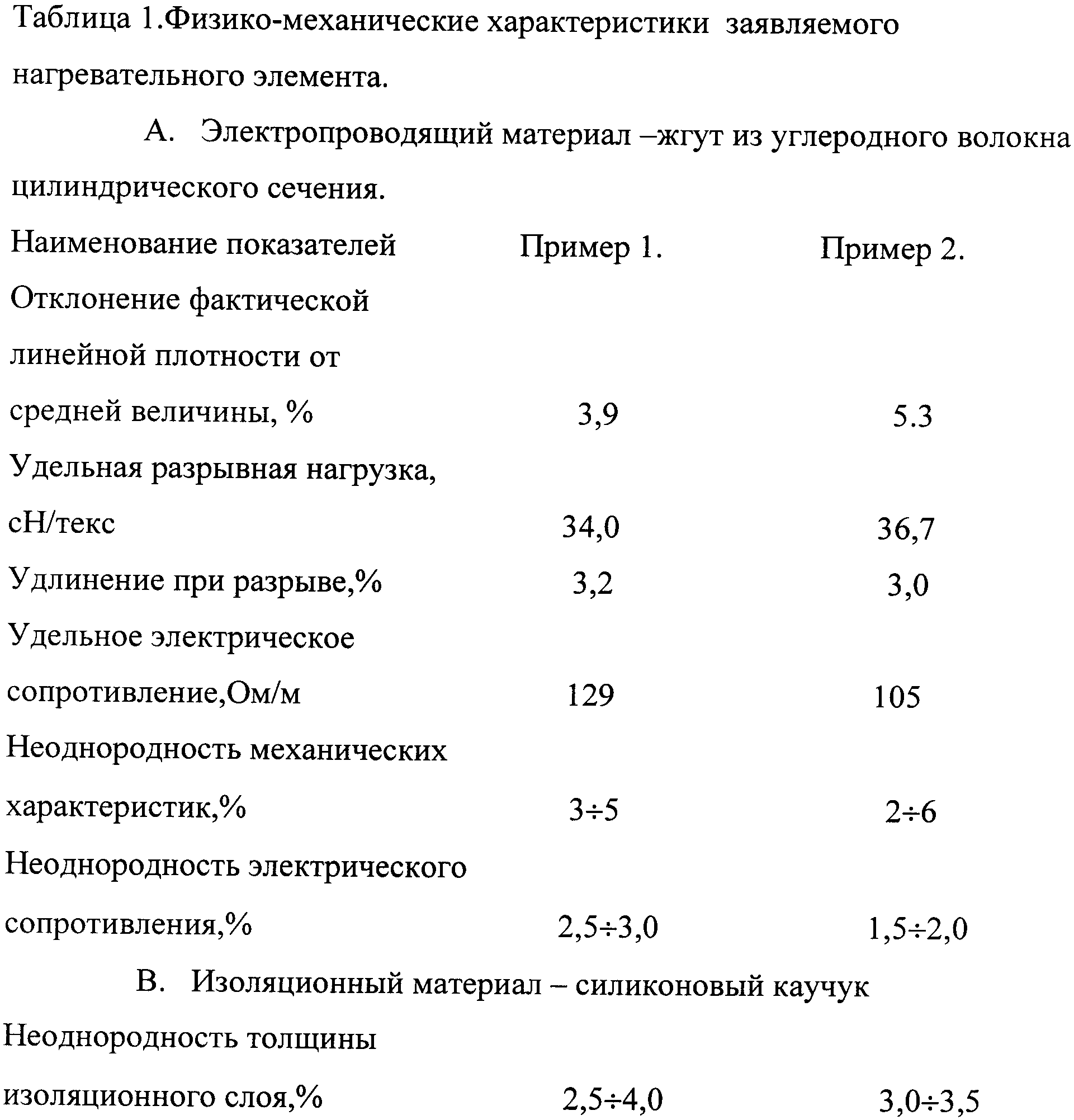
Полученный после термоокисления, карбонизации и графитации электропроводящий жгут испытывался на механическую прочность на разрывных машинах с фиксацией удлинения при разрыве. Относительное отклонение удельной разрывной нагрузки и удлинения при разрыве от их средних величин указывает на неоднородность механических характеристик по сечению жгута. Относительное отклонение удельного электрического сопротивления от его среднего значения указывает на неоднородность электрического сопротивления по сечению жгута (таблица 1).The electrically conductive tow obtained after thermal oxidation, carbonization, and graphitization was tested for mechanical strength on tensile testing machines with fixation of elongation at break. The relative deviation of the specific breaking load and elongation at break from their average values indicates the heterogeneity of the mechanical characteristics over the cross section of the bundle. The relative deviation of the electrical resistivity from its average value indicates the heterogeneity of the electrical resistance over the cross section of the bundle (table 1).
На полученный электропроводящий материал - углеродное волокно - экструзией при температуре 150÷200°С и давлении (2÷3)·107 Па наносится изоляционный слой из силиконового каучука.An insulating layer of silicone rubber is applied to the obtained electrically conductive material - carbon fiber - by extrusion at a temperature of 150 ÷ 200 ° C and a pressure of (2 ÷ 3) · 10 7 Pa.
Относительное отклонение толщины изоляционного слоя от ее среднего значения в пределах участка нагревательного элемента с одним и тем же сечением указывает на неоднородность изоляционного слоя (измерения проводились электромагнитным толщиномером). Данные представлены в таблице 1.The relative deviation of the thickness of the insulating layer from its average value within the area of the heating element with the same cross section indicates the heterogeneity of the insulating layer (measurements were carried out by an electromagnetic thickness gauge). The data are presented in table 1.
Для электропроводящих материалов из углеродного волокна показатели неоднородности физико-механических характеристик колеблются от 1,5 до 50% (Авт. свид. СССР №807389, кл. Н01В 1/04, Бюл. №7, 1981). Показатели неоднородности как электропроводящего, так и изоляционного материала нагревательного элемента, изготовленного заявляемым способом, не превышают 5%.For electrically conductive materials made of carbon fiber, the indices of heterogeneity of physical and mechanical characteristics range from 1.5 to 50% (Auth. Certificate. USSR No. 807389, class N01B 1/04, Bull. No. 7, 1981). The heterogeneity of both the electrically conductive and the insulating material of the heating element made by the claimed method does not exceed 5%.
Способ осуществляется следующим образом.The method is as follows.
Из полимерных нитей (вискоза, полиакрилонитрил) формируют жгуты цилиндрического сечения. Полученные жгуты помещают в герметичную ванну для пропитки насыщенным водным раствором хлористого аммония при постоянной циркуляции раствора. Температура: 20÷50°С, давление: (2÷5)·105 Па. Пропитанную заготовку сушат при температуре 120÷150°С и подвергают термоокислительному пиролизу при 200÷300°С, карбонизации - при 1500÷200°С и графитации - при 2000÷3000°С.Of the polymer threads (viscose, polyacrylonitrile), bundles of cylindrical section are formed. The resulting tows are placed in a sealed bath for impregnation with a saturated aqueous solution of ammonium chloride with constant circulation of the solution. Temperature: 20 ÷ 50 ° С, pressure: (2 ÷ 5) · 10 5 Pa. The impregnated preform is dried at a temperature of 120 ÷ 150 ° C and subjected to thermo-oxidative pyrolysis at 200 ÷ 300 ° C, carbonization at 1500 ÷ 200 ° C and graphitization at 2000 ÷ 3000 ° C.
Полученное углеродное волокно синусоидально укладывают на платформу перед экструдером и при температуре 150÷200°С и давлении (2÷3)·107 Па выдавливанием наносят изоляционный материал - силиконовый каучук.The obtained carbon fiber is sinusoidally laid on the platform in front of the extruder and at an temperature of 150 ÷ 200 ° C and a pressure of (2 ÷ 3) · 10 7 Pa extrusion is applied insulation material - silicone rubber.
Примеры выполнения способаExamples of the method
Пример 1Example 1
Из вискозных нитей формируют жгуты цилиндрического сечения до получения 50 круток на 1 м длины заготовки. Полученные заготовки помещают в герметичную ванну для пропитки насыщенным водным раствором хлористого аммония при температуре 20°С и давлении 4·105 Па. Поддержание давления и циркуляция пропиточного раствора осуществляются центробежным насосом, имеющим байпас для регулирования расхода пропиточного раствора. Заготовки в ванне укрепляются с небольшим растяжением вдоль их длины. Пропитанную заготовку сушат при температуре 140°С. В трубчатой печи с тремя зонами нагрева заготовку, высушенную до остаточной влажности не более 10% (по массе), последовательно подвергают термоокислению при 250°С, карбонизации при 2000°С и графитированию при 2500°С. Полученное углеродное волокно синусоидально укладывают на платформу перед экструдером и при температуре 200°С и давлении 2·107 Па формируют слой изоляционного материала - силиконового каучука.From viscose yarns form bundles of cylindrical section to obtain 50 twists per 1 m of the length of the workpiece. The resulting blanks are placed in a sealed bath for impregnation with a saturated aqueous solution of ammonium chloride at a temperature of 20 ° C and a pressure of 4 · 10 5 PA. Pressure maintenance and circulation of the impregnating solution are carried out by a centrifugal pump having a bypass to control the flow rate of the impregnating solution. Billets in the bath are strengthened with a slight extension along their length. The impregnated preform is dried at a temperature of 140 ° C. In a tube furnace with three heating zones, the billet, dried to a residual moisture content of not more than 10% (by mass), is subsequently subjected to thermal oxidation at 250 ° C, carbonization at 2000 ° C and graphitization at 2500 ° C. The obtained carbon fiber is sinusoidally laid on the platform in front of the extruder and at a temperature of 200 ° C and a pressure of 2 · 10 7 Pa form a layer of insulating material - silicone rubber.
Пример 2Example 2
Операции выполняются так же, как в примере 1, но пропитка заготовки насыщенным раствором хлористого аммония приводится при температуре 50°С и давлении 2,4·105 Па.The operations are performed in the same manner as in example 1, but the preform is impregnated with a saturated solution of ammonium chloride at a temperature of 50 ° C and a pressure of 2.4 · 10 5 Pa.
Способ может быть воспроизведен на предприятии, имеющем в своем распоряжении стандартное оборудование для производства углеродного волокна, при включении в технологическую линию нового контура пропитки заготовок раствором катализатора и отделения формирования изоляционного слоя, оснащенного экструдерами с нестандартными насадкамиThe method can be reproduced at an enterprise that has at its disposal standard equipment for the production of carbon fiber, when a new contour of impregnating the workpieces with a catalyst solution is included in the production line and separating the formation of an insulating layer equipped with extruders with non-standard nozzles
Claims (1)
Priority Applications (1)
| Application Number | Priority Date | Filing Date | Title |
|---|---|---|---|
| RU2007109561/09A RU2334373C1 (en) | 2007-03-16 | 2007-03-16 | Method of getting heating element |
Applications Claiming Priority (1)
| Application Number | Priority Date | Filing Date | Title |
|---|---|---|---|
| RU2007109561/09A RU2334373C1 (en) | 2007-03-16 | 2007-03-16 | Method of getting heating element |
Publications (1)
| Publication Number | Publication Date |
|---|---|
| RU2334373C1 true RU2334373C1 (en) | 2008-09-20 |
Family
ID=39868172
Family Applications (1)
| Application Number | Title | Priority Date | Filing Date |
|---|---|---|---|
| RU2007109561/09A RU2334373C1 (en) | 2007-03-16 | 2007-03-16 | Method of getting heating element |
Country Status (1)
| Country | Link |
|---|---|
| RU (1) | RU2334373C1 (en) |
Citations (4)
| Publication number | Priority date | Publication date | Assignee | Title |
|---|---|---|---|---|
| FR2373206B1 (en) * | 1976-12-02 | 1979-08-17 | Anvar | |
| EP0271278A2 (en) * | 1986-12-10 | 1988-06-15 | Lantor (Uk) Limited | Improvements in or relating to composite material |
| FR2617430B3 (en) * | 1987-07-01 | 1989-06-16 | Vaw Ver Aluminium Werke Ag | COMPOSITE MATERIAL FORMED FROM ALUMINUM AND A FIBERGLASS MATERIAL AND MANUFACTURING METHOD THEREOF |
| RU2041507C1 (en) * | 1992-06-30 | 1995-08-09 | Щербаков Владимир Иванович | Process of manufacture of multilayer composite conductive material |
-
2007
- 2007-03-16 RU RU2007109561/09A patent/RU2334373C1/en not_active IP Right Cessation
Patent Citations (4)
| Publication number | Priority date | Publication date | Assignee | Title |
|---|---|---|---|---|
| FR2373206B1 (en) * | 1976-12-02 | 1979-08-17 | Anvar | |
| EP0271278A2 (en) * | 1986-12-10 | 1988-06-15 | Lantor (Uk) Limited | Improvements in or relating to composite material |
| FR2617430B3 (en) * | 1987-07-01 | 1989-06-16 | Vaw Ver Aluminium Werke Ag | COMPOSITE MATERIAL FORMED FROM ALUMINUM AND A FIBERGLASS MATERIAL AND MANUFACTURING METHOD THEREOF |
| RU2041507C1 (en) * | 1992-06-30 | 1995-08-09 | Щербаков Владимир Иванович | Process of manufacture of multilayer composite conductive material |
Similar Documents
| Publication | Publication Date | Title |
|---|---|---|
| KR102068052B1 (en) | Porous carbon material, composite material reinforced with carbon material, porous carbon material precursor, porous carbon material precursor production method, and porous carbon material production method | |
| KR101656976B1 (en) | Carbon fiber bundle and method of producing carbon fiber bundle | |
| EP2554725B1 (en) | Method for preparing carbon fiber and precursor fiber for carbon fiber | |
| CN109423703B (en) | Modification of continuous carbon fibers during precursor formation of composite materials with enhanced moldability | |
| KR20150037794A (en) | High Density carbon Nano-fiber Felt with Unidirectional Orientation and Application to Supercapacitor Electrode | |
| JP6819701B2 (en) | Carbon fiber precursor Acrylic fiber, carbon fiber and their manufacturing method | |
| RU2429316C1 (en) | Procedure for continuous production of hydrated cellulose of carbon fibre in form of unidirectional braid | |
| CN101583747A (en) | Method for production of carbonized cloth, and carbonized cloth produced by the method | |
| US20160060793A1 (en) | Carbon fiber bundle and method for producing same | |
| KR20190001045A (en) | Method of manufacturing carbon paper using cabon nano tube containing polyacrylonitrile short fiber | |
| RU2386603C2 (en) | Heat-protective erosion resistant carbon-carbon composite material and method of producing said material | |
| JP5964638B2 (en) | Carbon fiber chopped strand and method for producing the same | |
| JP2017137614A (en) | Carbon fiber bundle and method for producing the same | |
| CN113597484B (en) | Carbon fiber bundle and method for producing same | |
| CN114457469B (en) | Preparation method of polyacrylonitrile pre-oxidized fiber, pre-oxidized fiber and application of pre-oxidized fiber | |
| KR101957061B1 (en) | Process for preparing carbon fiber having high strength | |
| JP4138361B2 (en) | Carbon fiber strand and method for producing the same | |
| JP5226238B2 (en) | Carbon fiber and composite material using the same | |
| JP3971632B2 (en) | Carbon fiber reinforced resin sheet and manufacturing method thereof | |
| JP2013202803A (en) | Carbon fiber reinforced composite material | |
| DE102016105059B4 (en) | High conductivity carbon fiber, manufacturing method, and uses therefor | |
| Bermudez | Anomalous Effect of Spinning Conditions on the Mechanical and Transport Properties of Mesophase Pitch-Based Carbon Fibers | |
| JP7798147B2 (en) | Carbon fiber bundle manufacturing method and SMC manufacturing method | |
| WO2013060792A1 (en) | Carbon fibres, carbon fibre precursors and production thereof | |
| RU2451037C2 (en) | Method of preparing composition for saturating carbon fibre |
Legal Events
| Date | Code | Title | Description |
|---|---|---|---|
| MM4A | The patent is invalid due to non-payment of fees |
Effective date: 20090317 |