RU2184792C2 - Steel - Google Patents
Steel Download PDFInfo
- Publication number
- RU2184792C2 RU2184792C2 RU2000117173A RU2000117173A RU2184792C2 RU 2184792 C2 RU2184792 C2 RU 2184792C2 RU 2000117173 A RU2000117173 A RU 2000117173A RU 2000117173 A RU2000117173 A RU 2000117173A RU 2184792 C2 RU2184792 C2 RU 2184792C2
- Authority
- RU
- Russia
- Prior art keywords
- steel
- titanium
- vanadium
- molybdenum
- nitrogen
- Prior art date
Links
- 229910000831 Steel Inorganic materials 0.000 title claims abstract description 84
- 239000010959 steel Substances 0.000 title claims abstract description 84
- IJGRMHOSHXDMSA-UHFFFAOYSA-N Atomic nitrogen Chemical compound N#N IJGRMHOSHXDMSA-UHFFFAOYSA-N 0.000 claims abstract description 42
- 239000010936 titanium Substances 0.000 claims abstract description 33
- 229910052719 titanium Inorganic materials 0.000 claims abstract description 31
- RTAQQCXQSZGOHL-UHFFFAOYSA-N Titanium Chemical compound [Ti] RTAQQCXQSZGOHL-UHFFFAOYSA-N 0.000 claims abstract description 27
- 229910052720 vanadium Inorganic materials 0.000 claims abstract description 24
- XEEYBQQBJWHFJM-UHFFFAOYSA-N Iron Chemical compound [Fe] XEEYBQQBJWHFJM-UHFFFAOYSA-N 0.000 claims abstract description 23
- 229910052757 nitrogen Inorganic materials 0.000 claims abstract description 23
- 229910052799 carbon Inorganic materials 0.000 claims abstract description 22
- LEONUFNNVUYDNQ-UHFFFAOYSA-N vanadium atom Chemical compound [V] LEONUFNNVUYDNQ-UHFFFAOYSA-N 0.000 claims abstract description 22
- OKTJSMMVPCPJKN-UHFFFAOYSA-N Carbon Chemical compound [C] OKTJSMMVPCPJKN-UHFFFAOYSA-N 0.000 claims abstract description 20
- ZOKXTWBITQBERF-UHFFFAOYSA-N Molybdenum Chemical compound [Mo] ZOKXTWBITQBERF-UHFFFAOYSA-N 0.000 claims abstract description 20
- 229910052750 molybdenum Inorganic materials 0.000 claims abstract description 20
- 239000011733 molybdenum Substances 0.000 claims abstract description 20
- 239000011575 calcium Substances 0.000 claims abstract description 19
- OYPRJOBELJOOCE-UHFFFAOYSA-N Calcium Chemical compound [Ca] OYPRJOBELJOOCE-UHFFFAOYSA-N 0.000 claims abstract description 17
- 229910052791 calcium Inorganic materials 0.000 claims abstract description 17
- ZOXJGFHDIHLPTG-UHFFFAOYSA-N Boron Chemical compound [B] ZOXJGFHDIHLPTG-UHFFFAOYSA-N 0.000 claims abstract description 16
- 229910052796 boron Inorganic materials 0.000 claims abstract description 16
- 229910052710 silicon Inorganic materials 0.000 claims abstract description 16
- 239000010703 silicon Substances 0.000 claims abstract description 16
- VYZAMTAEIAYCRO-UHFFFAOYSA-N Chromium Chemical compound [Cr] VYZAMTAEIAYCRO-UHFFFAOYSA-N 0.000 claims abstract description 15
- 229910052742 iron Inorganic materials 0.000 claims abstract description 12
- 239000011651 chromium Substances 0.000 claims abstract description 11
- 229910052804 chromium Inorganic materials 0.000 claims abstract description 10
- WPBNNNQJVZRUHP-UHFFFAOYSA-L manganese(2+);methyl n-[[2-(methoxycarbonylcarbamothioylamino)phenyl]carbamothioyl]carbamate;n-[2-(sulfidocarbothioylamino)ethyl]carbamodithioate Chemical compound [Mn+2].[S-]C(=S)NCCNC([S-])=S.COC(=O)NC(=S)NC1=CC=CC=C1NC(=S)NC(=O)OC WPBNNNQJVZRUHP-UHFFFAOYSA-L 0.000 claims abstract description 6
- XUIMIQQOPSSXEZ-UHFFFAOYSA-N Silicon Chemical compound [Si] XUIMIQQOPSSXEZ-UHFFFAOYSA-N 0.000 claims description 15
- 239000011572 manganese Substances 0.000 claims description 7
- PWHULOQIROXLJO-UHFFFAOYSA-N Manganese Chemical compound [Mn] PWHULOQIROXLJO-UHFFFAOYSA-N 0.000 claims description 6
- 229910052748 manganese Inorganic materials 0.000 claims description 6
- 239000000203 mixture Substances 0.000 abstract description 11
- 230000000694 effects Effects 0.000 abstract description 4
- 238000005272 metallurgy Methods 0.000 abstract description 4
- 239000000126 substance Substances 0.000 abstract 1
- 150000004767 nitrides Chemical class 0.000 description 12
- PXHVJJICTQNCMI-UHFFFAOYSA-N Nickel Chemical compound [Ni] PXHVJJICTQNCMI-UHFFFAOYSA-N 0.000 description 10
- 230000007423 decrease Effects 0.000 description 10
- 230000015572 biosynthetic process Effects 0.000 description 9
- 230000001965 increasing effect Effects 0.000 description 8
- 229910052761 rare earth metal Inorganic materials 0.000 description 8
- 150000001247 metal acetylides Chemical class 0.000 description 7
- 229910052782 aluminium Inorganic materials 0.000 description 6
- XAGFODPZIPBFFR-UHFFFAOYSA-N aluminium Chemical compound [Al] XAGFODPZIPBFFR-UHFFFAOYSA-N 0.000 description 6
- 238000005266 casting Methods 0.000 description 6
- 150000002910 rare earth metals Chemical class 0.000 description 6
- 238000010438 heat treatment Methods 0.000 description 5
- 238000000034 method Methods 0.000 description 5
- 229910052759 nickel Inorganic materials 0.000 description 5
- 230000008569 process Effects 0.000 description 5
- 239000006104 solid solution Substances 0.000 description 5
- 238000005275 alloying Methods 0.000 description 4
- 238000004519 manufacturing process Methods 0.000 description 4
- 229910052751 metal Inorganic materials 0.000 description 4
- 239000002184 metal Substances 0.000 description 4
- 230000004913 activation Effects 0.000 description 3
- 239000000654 additive Substances 0.000 description 3
- 230000015271 coagulation Effects 0.000 description 3
- 238000005345 coagulation Methods 0.000 description 3
- 238000011109 contamination Methods 0.000 description 3
- 239000000155 melt Substances 0.000 description 3
- 239000002245 particle Substances 0.000 description 3
- 238000009827 uniform distribution Methods 0.000 description 3
- RYGMFSIKBFXOCR-UHFFFAOYSA-N Copper Chemical compound [Cu] RYGMFSIKBFXOCR-UHFFFAOYSA-N 0.000 description 2
- 229910001208 Crucible steel Inorganic materials 0.000 description 2
- -1 Titanium nitrides Chemical class 0.000 description 2
- 230000000996 additive effect Effects 0.000 description 2
- 229910001566 austenite Inorganic materials 0.000 description 2
- 238000009749 continuous casting Methods 0.000 description 2
- 229910052802 copper Inorganic materials 0.000 description 2
- 239000010949 copper Substances 0.000 description 2
- 238000002425 crystallisation Methods 0.000 description 2
- 230000008025 crystallization Effects 0.000 description 2
- 239000006185 dispersion Substances 0.000 description 2
- 239000007788 liquid Substances 0.000 description 2
- 239000011159 matrix material Substances 0.000 description 2
- 230000004048 modification Effects 0.000 description 2
- 238000012986 modification Methods 0.000 description 2
- 239000003607 modifier Substances 0.000 description 2
- 230000003647 oxidation Effects 0.000 description 2
- 238000007254 oxidation reaction Methods 0.000 description 2
- 230000008092 positive effect Effects 0.000 description 2
- 229910001200 Ferrotitanium Inorganic materials 0.000 description 1
- 229910000628 Ferrovanadium Inorganic materials 0.000 description 1
- 230000035508 accumulation Effects 0.000 description 1
- 238000009825 accumulation Methods 0.000 description 1
- 229910045601 alloy Inorganic materials 0.000 description 1
- 239000000956 alloy Substances 0.000 description 1
- 238000000137 annealing Methods 0.000 description 1
- 238000004140 cleaning Methods 0.000 description 1
- 238000001816 cooling Methods 0.000 description 1
- 229910052593 corundum Inorganic materials 0.000 description 1
- 239000010431 corundum Substances 0.000 description 1
- 230000006866 deterioration Effects 0.000 description 1
- 238000009792 diffusion process Methods 0.000 description 1
- 238000004090 dissolution Methods 0.000 description 1
- 238000009826 distribution Methods 0.000 description 1
- 238000005516 engineering process Methods 0.000 description 1
- 230000002708 enhancing effect Effects 0.000 description 1
- 230000006698 induction Effects 0.000 description 1
- 230000005764 inhibitory process Effects 0.000 description 1
- 230000003993 interaction Effects 0.000 description 1
- PNXOJQQRXBVKEX-UHFFFAOYSA-N iron vanadium Chemical compound [V].[Fe] PNXOJQQRXBVKEX-UHFFFAOYSA-N 0.000 description 1
- 150000002739 metals Chemical class 0.000 description 1
- 239000003921 oil Substances 0.000 description 1
- 229910001562 pearlite Inorganic materials 0.000 description 1
- 239000004033 plastic Substances 0.000 description 1
- 239000004848 polyfunctional curative Substances 0.000 description 1
- 238000010791 quenching Methods 0.000 description 1
- 230000000171 quenching effect Effects 0.000 description 1
- 238000001953 recrystallisation Methods 0.000 description 1
- 239000013074 reference sample Substances 0.000 description 1
- 230000000717 retained effect Effects 0.000 description 1
- 150000003839 salts Chemical class 0.000 description 1
- 239000007787 solid Substances 0.000 description 1
- 239000000243 solution Substances 0.000 description 1
- 229910052596 spinel Inorganic materials 0.000 description 1
- 239000011029 spinel Substances 0.000 description 1
- 238000009628 steelmaking Methods 0.000 description 1
- 238000005496 tempering Methods 0.000 description 1
Images
Landscapes
- Solid-Phase Diffusion Into Metallic Material Surfaces (AREA)
Abstract
Description
Изобретение относится к металлургии, а именно к литейным теплоустойчивым сталям, используемым для изготовления отливок, работающих в условиях высоких температур и абразивного изнашивания, например для получения роликов машин непрерывного литья заготовок (МНЛЗ). The invention relates to metallurgy, and in particular to heat-resistant foundry steels used for the manufacture of castings operating at high temperatures and abrasive wear, for example, to produce casters of continuous casting machines (CCM).
Известна сталь, содержащая углерод, кремний, марганец, хром, никель, молибден, ванадий, алюминий, титан, бор, кальций, РЗМ и железо при следующем соотношении компонентов, мас.%:
Углерод - 0,26-0,34
Кремний - 0,15-0,35
Марганец - 0,30-0,60
Хром - 2,00-2,50
Никель - 1,20-1,50
Молибден - 0,40-0,60
Ванадий - 0,25-0,40
Алюминий - 0,01-0,05
Титан - 0,01-0,10
Бор - 0,0001-0,002
Кальций - 0,005-0,050
РЗМ - 0,005-0,080
Железо - Остальное
(См. авт. св. СССР 821527, С 22 С 38/51).Known steel containing carbon, silicon, manganese, chromium, nickel, molybdenum, vanadium, aluminum, titanium, boron, calcium, rare-earth metals and iron in the following ratio, wt.%:
Carbon - 0.26-0.34
Silicon - 0.15-0.35
Manganese - 0.30-0.60
Chrome - 2.00-2.50
Nickel - 1.20-1.50
Molybdenum - 0.40-0.60
Vanadium - 0.25-0.40
Aluminum - 0.01-0.05
Titanium - 0.01-0.10
Boron - 0.0001-0.002
Calcium - 0.005-0.050
REM - 0.005-0.080
Iron - Else
(See ed. St. USSR 821527, C 22 C 38/51).
Недостатком известной стали является низкая теплостойкость и износостойкость из-за присутствия алюминия и редкоземельных металлов. Редкоземельные металлы загрязняют сталь неметаллическими включениями с высокой плотностью, которые почти не удаляются из расплава и снижают указанные свойства стали. Кроме того, сталь содержит дорогой и дефицитный металл никель и дорогостоящие лигатуры с редкоземельными металлами. A disadvantage of the known steel is low heat resistance and wear resistance due to the presence of aluminum and rare earth metals. Rare-earth metals pollute steel with non-metallic inclusions with a high density, which are almost not removed from the melt and reduce these properties of steel. In addition, steel contains expensive and scarce metal nickel and expensive rare earth alloys.
Известна также сталь, содержащая углерод, кремний, марганец, хром, молибден, ванадий, никель, титан, медь, алюминий, кальций, бор, РЗМ и железо при следующем соотношении компонентов, мас.%:
Углерод - 0,35-0,45
Кремний - 0,30-0,40
Марганец - 0,40-0,70
Хром - 1,00-1,80
Ванадий - 0,50-1,20
Молибден - 1,25-1,50
Никель - 0,50-1,00
Титан - 0,05-0,15
Медь - 0,50-0,90
Алюминий - 0,50-0,90
Кальций - 0,01-0,12
Бор - 0,003-0,005
РЗМ - 0,05-0,10
Железо - Остальное.Steel is also known containing carbon, silicon, manganese, chromium, molybdenum, vanadium, nickel, titanium, copper, aluminum, calcium, boron, rare-earth metals and iron in the following ratio, wt.%:
Carbon - 0.35-0.45
Silicon - 0.30-0.40
Manganese - 0.40-0.70
Chrome - 1.00-1.80
Vanadium - 0.50-1.20
Molybdenum - 1.25-1.50
Nickel - 0.50-1.00
Titanium - 0.05-0.15
Copper - 0.50-0.90
Aluminum - 0.50-0.90
Calcium - 0.01-0.12
Boron - 0.003-0.005
REM - 0.05-0.10
Iron - The rest.
Кроме того, должны соблюдаться следующие соотношения:

2) разница вышеуказанных сумм=15-32;
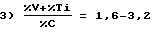
2) the difference of the above amounts = 15-32;
(См. а.с. СССР 1622418, С 22 С 38/54). (See A.S. USSR 1622418, C 22 C 38/54).
Недостатком известной стали является низкая износостойкость и теплостойкость за счет высокого содержания в ней алюминия 0,5-0,9%, что приводит к загрязнению стали неметаллическими включениями корунда и шпинели неблагоприятной формы, а также к дополнительному загрязнению стали включениями в результате вторичного окисления. Кроме того, наличие в составе стали других высокоактивных элементов кальция и РЗМ также увеличивает загрязненность стали продуктами их взаимодействия в жидком расплаве и снижает вышеуказанные свойства. A disadvantage of the known steel is low wear resistance and heat resistance due to the high aluminum content of 0.5-0.9% in it, which leads to contamination of the steel with non-metallic inclusions of corundum and spinel of an unfavorable shape, as well as to additional pollution of the steel with inclusions as a result of secondary oxidation. In addition, the presence in the steel of other highly active elements of calcium and rare-earth metals also increases the pollution of steel by the products of their interaction in a liquid melt and reduces the above properties.
Наиболее близким аналогом к заявляемому объекту является износостойкая сталь, содержащая углерод, кремний, марганец, хром, молибден, ванадий, титан, бор, кальций, железо при следующем соотношении компонентов, мас.%:
Углерод - 0,20-0,30
Кремний - 0,17-0,37
Марганец - 0,25-0,60
Хром - 1,40-1,80
Молибден - 0,25-0,40
Ванадий - 0,40-1,10
Титан - 0,06-0,12
Бор - 0,003-0,005
Кальций - 0,005-0,01
Железо - Остальное,
при этом должно соблюдаться соотношение 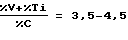
Carbon - 0.20-0.30
Silicon - 0.17-0.37
Manganese - 0.25-0.60
Chrome - 1.40-1.80
Molybdenum - 0.25-0.40
Vanadium - 0.40-1.10
Titanium - 0.06-0.12
Boron - 0.003-0.005
Calcium - 0.005-0.01
Iron - The rest,
in this case, the ratio
(См. патент РФ 2137859, С 22 С 38/32). (See RF patent 2137859, C 22
Недостатком данной стали также является низкая твердость и износостойкость при удовлетворительной теплостойкости. Это связано с тем, что в стали образуется недостаточное количество упрочняющей фазы с высокой твердостью, в частности карбидов и карбонитридов ванадия и титана из-за низкого их содержания. Кроме того, низкое содержание указанных элементов приводит к тому, что большая часть хрома и молибдена расходуется на образование карбидов, что обедняет твердый раствор и не позволяет получать у стали высокую теплостойкость. The disadvantage of this steel is also low hardness and wear resistance with satisfactory heat resistance. This is due to the fact that in the steel an insufficient amount of the hardening phase is formed with high hardness, in particular carbides and carbonitrides of vanadium and titanium due to their low content. In addition, the low content of these elements leads to the fact that most of the chromium and molybdenum is spent on the formation of carbides, which depletes the solid solution and does not allow to obtain high heat resistance from steel.
В основу изобретения поставлена задача разработать состав стали, обладающей одновременно комплексом высоких технических свойств: теплостойкостью и износостойкостью, позволяющих использовать ее для изготовления роликов МНЛЗ. The basis of the invention is the task of developing a composition of steel having both a combination of high technical properties: heat resistance and wear resistance, allowing it to be used for the manufacture of CCM rollers.
Поставленная задача решается тем, что известная сталь, содержащая углерод, кремний, марганец, хром, молибден, ванадий, титан, бор, кальций и железо, согласно изобретению дополнительно содержит азот при следующем соотношении компонентов, мас.%:
Углерод - 0,15-0,35
Кремний - 0,17-0,40
Марганец - 0,25-0,60
Хром - 1,20-2,00
Молибден - 0,25-0,45
Ванадий - 0,90-1,40
Титан - 0,09-0,18
Бор - 0,002-0,008
Кальций - 0,006-0,012
Азот - 0,01-0,04
Железо - Остальное,
при этом должны соблюдаться следующие соотношения:
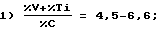
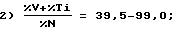
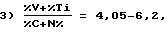
Известно применение азота в сталях в качестве микролегирующего элемента для улучшения их свойств (см. Азот в металлах/В.В. Аверин, А.В. Ревякин, В. И. Федорченко и др. - М. : Металлургия, 1976. - 224 с.; Бабаскин Ю.З. Структура и свойства литой стали. - Киев: Наукова думка, 1980. - 240 с.; Научные и технологические основы микролегирования стали /В.Л. Пилюшенко, В.А. Вихлевщук, М.А. Поживанов и др. - М.: Металлургия, 1994. - 384 с.).The problem is solved in that the known steel containing carbon, silicon, manganese, chromium, molybdenum, vanadium, titanium, boron, calcium and iron, according to the invention additionally contains nitrogen in the following ratio, wt.%:
Carbon - 0.15-0.35
Silicon - 0.17-0.40
Manganese - 0.25-0.60
Chrome - 1.20-2.00
Molybdenum - 0.25-0.45
Vanadium - 0.90-1.40
Titanium - 0.09-0.18
Boron - 0.002-0.008
Calcium - 0.006-0.012
Nitrogen - 0.01-0.04
Iron - The rest,
the following ratios must be observed:
It is known the use of nitrogen in steels as a microalloying element to improve their properties (see Nitrogen in metals / V.V. Averin, A.V. Revyakin, V.I. Fedorchenko, etc. - M.: Metallurgy, 1976. - 224 pp.; Babaskin Yu.Z. Structure and properties of cast steel. - Kiev: Naukova Dumka, 1980. - 240 p .; Scientific and technological foundations of microalloying steel / V.L. Pilyushenko, V.A. Vikhlevshchuk, M.A. Pozhivanov et al. - M.: Metallurgy, 1994 .-- 384 p.).
В заявляемой стали азот также предназначен для микролегирования ее. Однако наравне с этим азот при совместном взаимодействии с ванадием и титаном в заявляемой стали проявляет новое техническое свойство, заключающееся в создании эффекта модифицирования стали при одновременном усилении эффекта микролегирования. In the inventive steel, nitrogen is also intended for microalloying it. However, along with this, nitrogen, when combined with vanadium and titanium in the inventive steel, exhibits a new technical property, which consists in creating the effect of steel modification while enhancing the microalloying effect.
Это происходит следующим образом. Микролегирование и модифицирование стали азотом совместно с ванадием и титаном, при соблюдении заявляемых соотношений и условий, обеспечивает достижение исключительной мелкодисперсности первичной литой структуры путем создания дисперсности и равномерности выделения упрочняющих фаз и повышения их стойкости к коагуляции. Такая мелкозернистость сохраняется и при последующих нагревах стали в рабочих условиях за счет обеспечения торможения роста зерна дисперсными частицами образованных нитридных и карбонитридных фаз. Таким образом, достигаемое при микролегировании и модифицировании азотом, титаном и ванадием диспергирование структуры перлитной стали, непосредственное упрочнение ее нитридной и карбонитридной фазами приводит к повышению износостойкости и теплостойкости стали при высоких температурах, что позволяет использовать ее для изготовления роликов МНЛЗ, работающих в условиях высоких температур и абразивного изнашивания. При этом достигается сочетание повышения прочности с повышением устойчивости упрочняющих фаз к коагуляции. В основе этого явления лежит снижение диффузионной подвижности углерода вследствие присутствия в растворе ванадия и титана, уменьшения равновесной растворимости углерода и повышения азотом энергии активации коагуляции карбидной фазы. This happens as follows. Microalloying and modifying steel with nitrogen, together with vanadium and titanium, subject to the claimed ratios and conditions, ensures the achievement of exceptional fineness of the primary cast structure by creating dispersion and uniformity of the allocation of hardening phases and increasing their resistance to coagulation. Such fine-grained grains are retained upon subsequent heating of steel under operating conditions due to the inhibition of grain growth by dispersed particles of the formed nitride and carbonitride phases. Thus, the dispersion of the structure of pearlite steel achieved by microalloying and modification with nitrogen, titanium, and vanadium, its direct hardening with nitride and carbonitride phases leads to an increase in the wear and heat resistance of steel at high temperatures, which makes it possible to use it for the manufacture of CCM rollers operating at high temperatures and abrasive wear. This achieves a combination of increased strength with increased resistance of the hardening phases to coagulation. This phenomenon is based on a decrease in the diffusion mobility of carbon due to the presence of vanadium and titanium in the solution, a decrease in the equilibrium solubility of carbon, and an increase in the activation energy of coagulation of the carbide phase with nitrogen.
Помимо заявляемых соотношений компонентов, указанные в формуле изобретения соотношения суммы концентраций ванадия и титана к концентрациям углерода и азота (условие 1 и 2), а также к сумме концентраций углерода и азота (условие 3) способствуют активизации протекания выше описанных процессов. При этом весь молибден сохраняется в твердом растворе без участия в процессах карбидообразования, способствуя тем самым значительному повышению теплостойкости стали. In addition to the claimed component ratios, the ratios of the sum of the concentrations of vanadium and titanium to the concentrations of carbon and nitrogen (
На основании вышеизложенного можно сделать вывод, что состав заявляемой стали не следует явным образом из известного уровня техники, а следовательно, соответствует условию патентоспособности "Изобретательский уровень". Based on the foregoing, we can conclude that the composition of the inventive steel does not follow explicitly from the prior art, and therefore meets the patentability condition "Inventive step".
Углерод (С), взятый в заявляемом количестве, является одним из главных упрочнителей стали, резко повышающим твердость и износостойкость стали за счет образования карбидов, нитридов и карбонитридов легирующих элементов и легирования твердого раствора. Carbon (C), taken in the claimed amount, is one of the main steel hardeners, sharply increasing the hardness and wear resistance of steel due to the formation of carbides, nitrides and carbonitrides of alloying elements and alloying of a solid solution.
При содержании углерода менее 0,15 мас.% уменьшается износостойкость стали из-за снижения в ней упрочняющей фазы. При содержании углерода более 0,35 мас. %, происходит охрупчивание структуры - снижается пластичность, падает сопротивление износу. When the carbon content is less than 0.15 wt.%, The wear resistance of the steel is reduced due to a decrease in the hardening phase in it. When the carbon content is more than 0.35 wt. %, embrittlement of the structure occurs - ductility decreases, wear resistance decreases.
Кремний (Si) - является технологической добавкой обеспечивающей при выплавке стали необходимые пластические свойства металла. Кремний является раскислителем, и взятый в заявляемом количестве, способствует более полному усвоению хрома, ванадия и титана, увеличивает прокаливаемостъ и способствует смягчению матрицы. Silicon (Si) - is a technological additive providing the necessary plastic properties of the metal during steelmaking. Silicon is a deoxidizer, and taken in the claimed amount, contributes to a more complete assimilation of chromium, vanadium and titanium, increases hardenability and helps soften the matrix.
Содержание кремния более 0,40 мас.% нецелесообразно, так как это приводит к снижению прокаливаемости и износостойкости, вследствие специфического воздействия кремния на другие компоненты стали. Содержание кремния в стали меньше 0,17 мас.% не обеспечит предварительное раскисление стали. A silicon content of more than 0.40 wt.% Is impractical, since this leads to a decrease in hardenability and wear resistance, due to the specific effect of silicon on other steel components. The silicon content of the steel is less than 0.17 wt.% Will not provide preliminary deoxidation of the steel.
Марганец (Мn) также является технологической добавкой, позволяющей получить структуру необходимой стабильности, раскисляет сталь. Manganese (Mn) is also a technological additive that allows you to get the structure of the necessary stability, deoxidizes steel.
Для заявляемой стали, содержание хрома (Сr) находится в пределах 1,2-2,0 мас. %. Это обеспечивает получение необходимой теплостойкости, образование в стали карбидов дополнительно увеличивает износостойкость и твердость. For the inventive steel, the chromium content (Cr) is in the range of 1.2-2.0 wt. % This provides the necessary heat resistance, the formation of carbides in steel additionally increases the wear resistance and hardness.
В присутствии молибдена (Мо) в заявляемом количестве (0,25-0,45%) улучшается протекание процессов нитридообразования при фазовой перекристаллизации стали, происходит более равномерное распределение нитридных, карбидных и карбонитридных частиц по объему литой стали, устраняются их скопления. Молибден, гомогенизируя структуру стали, способствует при изготовлении роликов МНЛЗ достижению большей однородности свойств по сечению отливки при высоких температурах, когда в отливке возможно образование горячих трещин. Это улучшает теплостойкость, износостойкость и трещиноустойчивость стали. In the presence of molybdenum (Mo) in the claimed amount (0.25-0.45%), the course of nitride formation during phase recrystallization of steel improves, a more uniform distribution of nitride, carbide and carbonitride particles in the volume of cast steel occurs, their accumulations are eliminated. Molybdenum, by homogenizing the steel structure, contributes to the achievement of greater uniformity in the properties of the casting cross section at high temperatures when casting rollers of a continuous casting machine, when hot cracks are possible in the casting. This improves the heat resistance, wear resistance and crack resistance of steel.
При содержании молибдена менее 0,25 мас.% и более 0,45 мас.% положительное влияние его на свойства стали значительно снижается. When the molybdenum content is less than 0.25 wt.% And more than 0.45 wt.%, Its positive effect on the properties of steel is significantly reduced.
Совместное присутствие титана (Ti), бора (В) и кальция (Са) позволяет в процессе отливки роликов из заявляемой стали эффективно управлять процессами первичной и вторичной кристаллизации. Титан, взятый в заявляемом количестве, микролегирует и модифицирует сталь. Нитриды титана, образующиеся в жидкой стали, являются дополнительными центрами кристаллизации. Совместное присутствие титана и бора ведет к равномерному распределению карбидов. Кроме того, титан является рафинизатором стали, очищая расплав от неметаллических включений. The combined presence of titanium (Ti), boron (B) and calcium (Ca) allows the process of primary and secondary crystallization to be effectively controlled during casting of rollers from the inventive steel. Titanium, taken in the claimed amount, microalloys and modifies steel. Titanium nitrides formed in liquid steel are additional crystallization centers. The combined presence of titanium and boron leads to a uniform distribution of carbides. In addition, titanium is a refiner of steel, cleaning the melt from non-metallic inclusions.
Бор (В) - сильный карбюризатор и модификатор, способствует измельчению структуры. Присутствие бора в количестве (0,002-0,008 мас.%) устраняет появление карбидной сетки по границам зерен, что улучшает теплостойкие и износостойкие свойства стали. Boron (B) - a powerful carburizer and modifier, contributes to the refinement of the structure. The presence of boron in an amount (0.002-0.008 wt.%) Eliminates the appearance of a carbide network along the grain boundaries, which improves the heat-resistant and wear-resistant properties of steel.
Кальций (Са) (0,006-0,012 мас.%), является активным раскислителем, модификатором и глобуляризатором включений и способствует равномерному их распределению по объему отливок и получению однородной структуры. Calcium (Ca) (0.006-0.012 wt.%), Is an active deoxidizer, modifier and globularizer of inclusions and contributes to their uniform distribution over the volume of castings and to obtain a homogeneous structure.
При введении в состав стали кальция в количестве менее 0,006 мас.% его положительное влияние на структуру стали незначительно, а содержание кальция более 0,012 мас.% приводит к вторичному окислению и загрязнению расплава неметаллическими включениями, что снижает свойства стали. When calcium is introduced into the composition of the steel in an amount of less than 0.006 wt.%, Its positive effect on the steel structure is negligible, and a calcium content of more than 0.012 wt.% Leads to secondary oxidation and contamination of the melt with non-metallic inclusions, which reduces the properties of steel.
Азот (N), введенный в сталь в заявляемом количестве (0,01-0,04 мас.%), взаимодействуя с легирующими элементами, титаном и ванадием, образует нитриды и карбонитриды, которые, являясь упрочняющей фазой, значительно усиливают свойства стали, такие как твердость, теплостойкость и износостойкость. Это происходит за счет того, что указанные частицы являются фазовыми составляющими стали, взаимодействующими с твердым раствором (α- и γ- железа) при термической обработке. Присутствие в стали нитридов и карбонитридов, при переходе через критическую точку Ас3, приводит к образованию более мелкого зерна аустенита. Также нитриды и карбонитриды тормозят рост зерна аустенита при дальнейшем его нагреве, вплоть до растворения этих фаз. Кроме того, азот, увеличивает прокаливаемость стали. Все это приводит к повышению теплостойкости и износостойкости стали.Nitrogen (N) introduced into steel in the claimed amount (0.01-0.04 wt.%), Interacting with alloying elements, titanium and vanadium, forms nitrides and carbonitrides, which, being a hardening phase, significantly enhance the properties of steel, such like hardness, heat resistance and wear resistance. This is due to the fact that these particles are phase components of steel interacting with a solid solution (α- and γ-iron) during heat treatment. The presence of nitrides and carbonitrides in steel, when passing through the critical point Ac 3 , leads to the formation of a finer austenite grain. Also, nitrides and carbonitrides inhibit the growth of austenite grain upon its further heating, up to the dissolution of these phases. In addition, nitrogen increases the hardenability of steel. All this leads to increased heat resistance and wear resistance of steel.
Введение в заявляемую сталь азота в количестве менее 0,01 мас.% и более 0,02 мас. % нецелесообразно, так как в первом случае азота недостаточно для образования нужного количества упрочняющей фазы, а во втором - получается переизбыток нитридов и карбонитридов и загрязнение границ зерен, что приводит к значительному ухудшению теплостойких и износостойких свойств стали. Introduction to the inventive steel nitrogen in an amount of less than 0.01 wt.% And more than 0.02 wt. % is impractical, since in the first case there is not enough nitrogen to form the required amount of the hardening phase, and in the second, an excess of nitrides and carbonitrides and grain boundary contamination are obtained, which leads to a significant deterioration in the heat-resistant and wear-resistant properties of steel.
Присутствие в заявляемой стали повышенных добавок ванадия (V) и титана (Ti) позволяет в большей степени сохранить в твердом растворе хром и молибден, что улучшает теплостойкость стали, а образование высокотвердых нитридов, карбидов и карбонитридов ванадия и титана с микротвердостью Н50>30000МПа обеспечивает высокие значения твердости и износостойкости.The presence of increased additives of vanadium (V) and titanium (Ti) in the inventive steel makes it possible to preserve chromium and molybdenum in a solid solution to a greater extent, which improves the heat resistance of steel, and the formation of high hardness nitrides, carbides and carbonitrides of vanadium and titanium with a microhardness of H 50 > 30000MPa provides high hardness and wear resistance.
Отношения суммы ванадия и титана к углероду, азоту (условия 1 и 2), а также к сумме углерода и азота (условие 3) в заявляемых соотношениях способствуют активизации протекания процессов карбонитридообразования в стали, а также одновременно препятствует участию молибдена в указанных процессах. Это приводит к повышению теплостойкости, твердости и износостойкости стали. The ratios of the sum of vanadium and titanium to carbon, nitrogen (
Использование соотношений компонентов при условиях 1-3 в пределах, превышающих заявляемые значения, нецелесообразно, так как это приводит к резкому увеличению количества карбидов, нитридов и карбонитридов. При этом увеличиваются их размеры и неоднородность распределения в металлической матрице, создается перенапряжение последней, в результате чего, происходит снижение износостойких и теплостойких свойств стали. The use of component ratios under conditions 1-3 in the range exceeding the declared values is impractical, since this leads to a sharp increase in the number of carbides, nitrides and carbonitrides. At the same time, their size and distribution heterogeneity in the metal matrix are increased, the latter is overstressed, resulting in a decrease in the wear-resistant and heat-resistant properties of steel.
Использование соотношений компонентов при условиях 1-3 ниже заявляемых значений также нецелесообразно, так как при этом в стали образуется недостаточное количество карбидных, нитридных и карбонитридных фаз, что не обеспечивает требуемых свойств заявляемой стали. Кроме того, в процессах карбонитридообразования начинает участвовать молибден, в результате чего, происходит снижение легированности твердого расплава молибденом и снижение теплостойкости стали. The use of component ratios under conditions 1-3 below the declared values is also impractical, since in this case an insufficient amount of carbide, nitride and carbonitride phases is formed in the steel, which does not provide the required properties of the claimed steel. In addition, molybdenum begins to participate in the processes of carbonitride formation, resulting in a decrease in the alloying of the solid melt with molybdenum and a decrease in the heat resistance of steel.
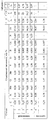
Пример. В индукционной тигельной печи емкостью 60 кг с основной футеровкой выплавляли опытные составы заявляемой стали (составы 1-5, табл.1) и стали, взятой за прототип (составы 6, 7, табл. 1), по общепринятой технологии. Титан, бор, кальций и азот вводили в сталь в виде ферротитана ФТи 35, ферробора ФБи 20, силикокальция СК 45 и феррованадия азотированного ФВнА 47. Из опытных составов отливали трефовидные пробы согласно ГОСТ 977-88, которые подвергали термической обработке по режиму: отжиг при 950oС, закалка от 1000oС в масло, отпуск при 650oС, охлаждение на воздухе.Example. In an induction crucible furnace with a capacity of 60 kg with the main lining, experimental compositions of the inventive steel (compositions 1-5, table 1) and steel taken as a prototype (
Для определения теплостойкости стали, проводили четырехчасовой нагрев образцов после вышеуказанного режима термической обработки при температурах 650, 680, 710oС в соляной ванне, после чего производили замер твердости.To determine the heat resistance of steel, the samples were heated for four hours after the above heat treatment at 650, 680, 710 o C in a salt bath, after which hardness was measured.
Износостойкость определяли согласно ГОСТ 23.208-79. Износостойкость исследуемых образцов оценивали путем сравнения их износа с износом эталонного образца. В качестве эталона использовалась сталь 45. Wear resistance was determined according to GOST 23.208-79. The wear resistance of the test samples was evaluated by comparing their wear with the wear of the reference sample.
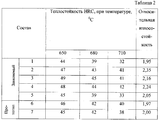
В табл. 2 приведены результаты образцов, изготовленных из заявляемой стали и стали - прототипа. In the table. 2 shows the results of samples made from the inventive steel and steel prototype.
Полученные результаты, позволяют сделать вывод, что заявляемая сталь по сравнению с прототипом имеет более высокую износостойкость (на 8-17%) и более высокую теплостойкость (на 2,5-6,5%) при высоких температурах, что позволяет использовать заявляемую сталь для изготовления роликов МНЛЗ. The results obtained allow us to conclude that the inventive steel in comparison with the prototype has higher wear resistance (8-17%) and higher heat resistance (2.5-6.5%) at high temperatures, which allows the use of the inventive steel for manufacturing rollers CCM.
Использовать составы стали с содержанием компонентов, выходящих за заявляемые минимальные (состав 1) и максимальные (состав 5) значения, нецелесообразно, так как в этих случаях у сталей наблюдается уменьшение износостойкости и теплостойкости. It is impractical to use steel compositions with a content of components that go beyond the declared minimum (composition 1) and maximum (composition 5) values, since in these cases a decrease in wear resistance and heat resistance is observed in steels.
Claims (1)
Углерод - 0,15-0,35
Кремний - 0,17-0,40
Марганец - 0,25-0,60
Хром - 1,20-2,00
Молибден - 0,25-0,45
Ванадий - 0,90-1,40
Титан - 0,09-0,18
Бор - 0,002-0,008
Кальций - 0,006-0,012
Азот - 0,01-0,04
Железо - Остальное
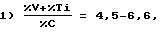
при этом должны соблюдаться следующие соотношения:


Carbon - 0.15-0.35
Silicon - 0.17-0.40
Manganese - 0.25-0.60
Chrome - 1.20-2.00
Molybdenum - 0.25-0.45
Vanadium - 0.90-1.40
Titanium - 0.09-0.18
Boron - 0.002-0.008
Calcium - 0.006-0.012
Nitrogen - 0.01-0.04
Iron - Else
the following ratios must be observed:
Priority Applications (1)
| Application Number | Priority Date | Filing Date | Title |
|---|---|---|---|
| RU2000117173A RU2184792C2 (en) | 2000-06-27 | 2000-06-27 | Steel |
Applications Claiming Priority (1)
| Application Number | Priority Date | Filing Date | Title |
|---|---|---|---|
| RU2000117173A RU2184792C2 (en) | 2000-06-27 | 2000-06-27 | Steel |
Publications (2)
| Publication Number | Publication Date |
|---|---|
| RU2000117173A RU2000117173A (en) | 2002-05-20 |
| RU2184792C2 true RU2184792C2 (en) | 2002-07-10 |
Family
ID=20237080
Family Applications (1)
| Application Number | Title | Priority Date | Filing Date |
|---|---|---|---|
| RU2000117173A RU2184792C2 (en) | 2000-06-27 | 2000-06-27 | Steel |
Country Status (1)
| Country | Link |
|---|---|
| RU (1) | RU2184792C2 (en) |
Citations (8)
| Publication number | Priority date | Publication date | Assignee | Title |
|---|---|---|---|---|
| SU106372A1 (en) * | 1956-12-06 | 1957-11-30 | И.Е. Тутов | Heat resistant steel |
| US4537644A (en) * | 1981-09-28 | 1985-08-27 | Nippon Steel Corporation | High-tension high-toughness steel having excellent resistance to delayed fracture and method for producing the same |
| GB2187202A (en) * | 1986-02-25 | 1987-09-03 | Nippon Steel Corp | Method of directly softening rolled machine structural steels |
| SU1592383A1 (en) * | 1988-08-01 | 1990-09-15 | Tsnii Chernoj Metallurg | Steel |
| SU1622418A1 (en) * | 1989-01-10 | 1991-01-23 | Специальное Конструкторско-Технологическое Бюро Металловедения С Опытным Заводом "Кристалл" Ан Азсср | Die steel |
| SU1680796A1 (en) * | 1989-09-25 | 1991-09-30 | Центральный научно-исследовательский институт черной металлургии им.И.П.Бардина | Heat-resistance steel |
| US5284529A (en) * | 1990-06-06 | 1994-02-08 | Nkk Corporation | Abrasion-resistant steel |
| RU2137859C1 (en) * | 1998-09-30 | 1999-09-20 | Колокольцев Валерий Михайлович | Wear-resistant steel |
-
2000
- 2000-06-27 RU RU2000117173A patent/RU2184792C2/en active
Patent Citations (8)
| Publication number | Priority date | Publication date | Assignee | Title |
|---|---|---|---|---|
| SU106372A1 (en) * | 1956-12-06 | 1957-11-30 | И.Е. Тутов | Heat resistant steel |
| US4537644A (en) * | 1981-09-28 | 1985-08-27 | Nippon Steel Corporation | High-tension high-toughness steel having excellent resistance to delayed fracture and method for producing the same |
| GB2187202A (en) * | 1986-02-25 | 1987-09-03 | Nippon Steel Corp | Method of directly softening rolled machine structural steels |
| SU1592383A1 (en) * | 1988-08-01 | 1990-09-15 | Tsnii Chernoj Metallurg | Steel |
| SU1622418A1 (en) * | 1989-01-10 | 1991-01-23 | Специальное Конструкторско-Технологическое Бюро Металловедения С Опытным Заводом "Кристалл" Ан Азсср | Die steel |
| SU1680796A1 (en) * | 1989-09-25 | 1991-09-30 | Центральный научно-исследовательский институт черной металлургии им.И.П.Бардина | Heat-resistance steel |
| US5284529A (en) * | 1990-06-06 | 1994-02-08 | Nkk Corporation | Abrasion-resistant steel |
| RU2137859C1 (en) * | 1998-09-30 | 1999-09-20 | Колокольцев Валерий Михайлович | Wear-resistant steel |
Similar Documents
| Publication | Publication Date | Title |
|---|---|---|
| JP6143355B2 (en) | Hot-rolled steel sheet with excellent drawability and surface hardness after carburizing heat treatment | |
| CN103510007B (en) | Steel for high-frequency quenching and high-frequency quenching steel part and their manufacture method | |
| WO2013058131A1 (en) | Bearing steel and method for producing same | |
| JP2015081366A (en) | Hot rolled steel sheet excellent in cold workability and surface hardness after carburization heat treatment | |
| JP2016169433A (en) | Carburizing steel plate with excellent cold workability and toughness after carburizing heat treatment | |
| JP2015193867A (en) | high toughness hot work tool steel | |
| JP6510714B1 (en) | Duplex stainless steel with excellent low temperature toughness | |
| JP2001279383A (en) | High temperature carburizing steel and hot forging for high temperature carburizing | |
| JP2019011510A (en) | Carburizing steel plate with excellent cold workability and toughness after carburizing heat treatment | |
| JP2009191322A (en) | Case-hardened steel with excellent coarsening resistance for carburized parts | |
| CN116806276A (en) | Wire rod and graphite steel for graphitization heat treatment | |
| RU2272086C1 (en) | Cast iron | |
| JP7653277B2 (en) | Steel for machine construction with excellent grain size characteristics | |
| RU2241779C1 (en) | Rail steel | |
| JP3546284B2 (en) | Method for producing steel for nitriding and mechanical structural parts | |
| RU2137859C1 (en) | Wear-resistant steel | |
| RU2095460C1 (en) | Cast pressed steel | |
| JPH10152760A (en) | Martensitic stainless steel for disc brakes | |
| JP6635100B2 (en) | Case hardened steel | |
| SU1199820A1 (en) | Cast iron | |
| CN119177396B (en) | A high-strength, high-toughness, high-temperature carburized gear shaft steel and its manufacturing method | |
| RU2484173C1 (en) | Automatic plumbous steel | |
| RU2432412C2 (en) | Iron and procedure for its production | |
| SU1733497A1 (en) | Tool steel | |
| SU1341234A1 (en) | Wear-resistant cast iron |
Legal Events
| Date | Code | Title | Description |
|---|---|---|---|
| QB4A | Licence on use of patent |
Free format text: LICENCE Effective date: 20130129 |
|
| QA4A | Patent open for licensing |
Effective date: 20171204 |