RU2156458C1 - Method of assessing nitrogen in biological samples - Google Patents
Method of assessing nitrogen in biological samples Download PDFInfo
- Publication number
- RU2156458C1 RU2156458C1 RU99111126A RU99111126A RU2156458C1 RU 2156458 C1 RU2156458 C1 RU 2156458C1 RU 99111126 A RU99111126 A RU 99111126A RU 99111126 A RU99111126 A RU 99111126A RU 2156458 C1 RU2156458 C1 RU 2156458C1
- Authority
- RU
- Russia
- Prior art keywords
- nitrogen
- sample
- solution
- volume
- mixture
- Prior art date
Links
- IJGRMHOSHXDMSA-UHFFFAOYSA-N Atomic nitrogen Chemical compound N#N IJGRMHOSHXDMSA-UHFFFAOYSA-N 0.000 title claims abstract description 64
- 229910052757 nitrogen Inorganic materials 0.000 title claims abstract description 31
- 238000000034 method Methods 0.000 title claims abstract description 24
- 239000012472 biological sample Substances 0.000 title claims abstract description 12
- HEMHJVSKTPXQMS-UHFFFAOYSA-M Sodium hydroxide Chemical compound [OH-].[Na+] HEMHJVSKTPXQMS-UHFFFAOYSA-M 0.000 claims abstract description 24
- 239000000523 sample Substances 0.000 claims abstract description 22
- XLYOFNOQVPJJNP-UHFFFAOYSA-N water Chemical compound O XLYOFNOQVPJJNP-UHFFFAOYSA-N 0.000 claims abstract description 20
- 239000012153 distilled water Substances 0.000 claims abstract description 18
- 238000004458 analytical method Methods 0.000 claims abstract description 13
- MHAJPDPJQMAIIY-UHFFFAOYSA-N Hydrogen peroxide Chemical compound OO MHAJPDPJQMAIIY-UHFFFAOYSA-N 0.000 claims abstract description 12
- QAOWNCQODCNURD-UHFFFAOYSA-N Sulfuric acid Chemical compound OS(O)(=O)=O QAOWNCQODCNURD-UHFFFAOYSA-N 0.000 claims abstract description 12
- 238000004448 titration Methods 0.000 claims abstract description 10
- BTBUEUYNUDRHOZ-UHFFFAOYSA-N Borate Chemical compound [O-]B([O-])[O-] BTBUEUYNUDRHOZ-UHFFFAOYSA-N 0.000 claims abstract description 8
- 239000000779 smoke Substances 0.000 claims abstract description 8
- 229920002472 Starch Polymers 0.000 claims abstract description 7
- 235000019698 starch Nutrition 0.000 claims abstract description 7
- 239000008107 starch Substances 0.000 claims abstract description 7
- 239000005708 Sodium hypochlorite Substances 0.000 claims abstract description 5
- SUKJFIGYRHOWBL-UHFFFAOYSA-N sodium hypochlorite Chemical compound [Na+].Cl[O-] SUKJFIGYRHOWBL-UHFFFAOYSA-N 0.000 claims abstract description 5
- 239000011734 sodium Substances 0.000 claims description 13
- 239000011572 manganese Substances 0.000 claims description 6
- 239000013068 control sample Substances 0.000 claims description 5
- 238000001816 cooling Methods 0.000 claims description 5
- 238000002845 discoloration Methods 0.000 claims description 4
- 238000010438 heat treatment Methods 0.000 claims description 3
- PWHULOQIROXLJO-UHFFFAOYSA-N Manganese Chemical compound [Mn] PWHULOQIROXLJO-UHFFFAOYSA-N 0.000 claims description 2
- 229910052748 manganese Inorganic materials 0.000 claims description 2
- 238000005070 sampling Methods 0.000 claims description 2
- 239000000203 mixture Substances 0.000 abstract description 12
- NLKNQRATVPKPDG-UHFFFAOYSA-M potassium iodide Chemical compound [K+].[I-] NLKNQRATVPKPDG-UHFFFAOYSA-M 0.000 abstract description 6
- AKHNMLFCWUSKQB-UHFFFAOYSA-L sodium thiosulfate Chemical compound [Na+].[Na+].[O-]S([O-])(=O)=S AKHNMLFCWUSKQB-UHFFFAOYSA-L 0.000 abstract description 4
- 235000019345 sodium thiosulphate Nutrition 0.000 abstract description 4
- 239000000126 substance Substances 0.000 abstract description 4
- WPBNNNQJVZRUHP-UHFFFAOYSA-L manganese(2+);methyl n-[[2-(methoxycarbonylcarbamothioylamino)phenyl]carbamothioyl]carbamate;n-[2-(sulfidocarbothioylamino)ethyl]carbamodithioate Chemical compound [Mn+2].[S-]C(=S)NCCNC([S-])=S.COC(=O)NC(=S)NC1=CC=CC=C1NC(=S)NC(=O)OC WPBNNNQJVZRUHP-UHFFFAOYSA-L 0.000 abstract description 3
- 235000013305 food Nutrition 0.000 abstract description 2
- 230000001863 plant nutrition Effects 0.000 abstract description 2
- 239000013074 reference sample Substances 0.000 abstract 2
- 230000000694 effects Effects 0.000 abstract 1
- 239000000243 solution Substances 0.000 description 41
- 239000000460 chlorine Substances 0.000 description 39
- WQYVRQLZKVEZGA-UHFFFAOYSA-N hypochlorite Chemical compound Cl[O-] WQYVRQLZKVEZGA-UHFFFAOYSA-N 0.000 description 31
- 238000006243 chemical reaction Methods 0.000 description 27
- ZAMOUSCENKQFHK-UHFFFAOYSA-N Chlorine atom Chemical compound [Cl] ZAMOUSCENKQFHK-UHFFFAOYSA-N 0.000 description 12
- 229910052801 chlorine Inorganic materials 0.000 description 12
- JGJLWPGRMCADHB-UHFFFAOYSA-N hypobromite Chemical compound Br[O-] JGJLWPGRMCADHB-UHFFFAOYSA-N 0.000 description 10
- QGZKDVFQNNGYKY-UHFFFAOYSA-O Ammonium Chemical compound [NH4+] QGZKDVFQNNGYKY-UHFFFAOYSA-O 0.000 description 9
- QDHHCQZDFGDHMP-UHFFFAOYSA-N Chloramine Chemical class ClN QDHHCQZDFGDHMP-UHFFFAOYSA-N 0.000 description 7
- QGZKDVFQNNGYKY-UHFFFAOYSA-N Ammonia Chemical compound N QGZKDVFQNNGYKY-UHFFFAOYSA-N 0.000 description 6
- JSYGRUBHOCKMGQ-UHFFFAOYSA-N dichloramine Chemical compound ClNCl JSYGRUBHOCKMGQ-UHFFFAOYSA-N 0.000 description 6
- 239000000047 product Substances 0.000 description 6
- 238000010521 absorption reaction Methods 0.000 description 4
- 230000015572 biosynthetic process Effects 0.000 description 4
- NUJOXMJBOLGQSY-UHFFFAOYSA-N manganese dioxide Chemical compound O=[Mn]=O NUJOXMJBOLGQSY-UHFFFAOYSA-N 0.000 description 4
- KJFMBFZCATUALV-UHFFFAOYSA-N phenolphthalein Chemical compound C1=CC(O)=CC=C1C1(C=2C=CC(O)=CC=2)C2=CC=CC=C2C(=O)O1 KJFMBFZCATUALV-UHFFFAOYSA-N 0.000 description 4
- 238000002360 preparation method Methods 0.000 description 4
- 238000001228 spectrum Methods 0.000 description 4
- 238000007696 Kjeldahl method Methods 0.000 description 3
- 229910021529 ammonia Inorganic materials 0.000 description 3
- XKMRRTOUMJRJIA-UHFFFAOYSA-N ammonia nh3 Chemical compound N.N XKMRRTOUMJRJIA-UHFFFAOYSA-N 0.000 description 3
- 239000010425 asbestos Substances 0.000 description 3
- 239000003054 catalyst Substances 0.000 description 3
- 230000007423 decrease Effects 0.000 description 3
- QWPPOHNGKGFGJK-UHFFFAOYSA-N hypochlorous acid Chemical compound ClO QWPPOHNGKGFGJK-UHFFFAOYSA-N 0.000 description 3
- 102000004169 proteins and genes Human genes 0.000 description 3
- 108090000623 proteins and genes Proteins 0.000 description 3
- 239000011541 reaction mixture Substances 0.000 description 3
- 229910052895 riebeckite Inorganic materials 0.000 description 3
- DHCDFWKWKRSZHF-UHFFFAOYSA-L thiosulfate(2-) Chemical compound [O-]S([S-])(=O)=O DHCDFWKWKRSZHF-UHFFFAOYSA-L 0.000 description 3
- ZCYVEMRRCGMTRW-UHFFFAOYSA-N 7553-56-2 Chemical compound [I] ZCYVEMRRCGMTRW-UHFFFAOYSA-N 0.000 description 2
- NLXLAEXVIDQMFP-UHFFFAOYSA-N Ammonia chloride Chemical compound [NH4+].[Cl-] NLXLAEXVIDQMFP-UHFFFAOYSA-N 0.000 description 2
- VEXZGXHMUGYJMC-UHFFFAOYSA-M Chloride anion Chemical compound [Cl-] VEXZGXHMUGYJMC-UHFFFAOYSA-M 0.000 description 2
- WAEMQWOKJMHJLA-UHFFFAOYSA-N Manganese(2+) Chemical compound [Mn+2] WAEMQWOKJMHJLA-UHFFFAOYSA-N 0.000 description 2
- 238000009835 boiling Methods 0.000 description 2
- 229910021538 borax Inorganic materials 0.000 description 2
- 238000000354 decomposition reaction Methods 0.000 description 2
- 238000004821 distillation Methods 0.000 description 2
- 239000004744 fabric Substances 0.000 description 2
- 229910052740 iodine Inorganic materials 0.000 description 2
- 239000011630 iodine Substances 0.000 description 2
- 229910001437 manganese ion Inorganic materials 0.000 description 2
- 239000007800 oxidant agent Substances 0.000 description 2
- 230000003647 oxidation Effects 0.000 description 2
- 238000007254 oxidation reaction Methods 0.000 description 2
- 150000002978 peroxides Chemical class 0.000 description 2
- 235000010339 sodium tetraborate Nutrition 0.000 description 2
- 239000004328 sodium tetraborate Substances 0.000 description 2
- 239000012224 working solution Substances 0.000 description 2
- VEXZGXHMUGYJMC-UHFFFAOYSA-N Hydrochloric acid Chemical compound Cl VEXZGXHMUGYJMC-UHFFFAOYSA-N 0.000 description 1
- 239000002253 acid Substances 0.000 description 1
- 230000002378 acidificating effect Effects 0.000 description 1
- 239000003513 alkali Substances 0.000 description 1
- 235000019270 ammonium chloride Nutrition 0.000 description 1
- 239000007864 aqueous solution Substances 0.000 description 1
- 230000008033 biological extinction Effects 0.000 description 1
- 239000003153 chemical reaction reagent Substances 0.000 description 1
- 150000001875 compounds Chemical class 0.000 description 1
- 230000021615 conjugation Effects 0.000 description 1
- 238000003745 diagnosis Methods 0.000 description 1
- 229910001873 dinitrogen Inorganic materials 0.000 description 1
- UQGFMSUEHSUPRD-UHFFFAOYSA-N disodium;3,7-dioxido-2,4,6,8,9-pentaoxa-1,3,5,7-tetraborabicyclo[3.3.1]nonane Chemical compound [Na+].[Na+].O1B([O-])OB2OB([O-])OB1O2 UQGFMSUEHSUPRD-UHFFFAOYSA-N 0.000 description 1
- 238000010494 dissociation reaction Methods 0.000 description 1
- 230000005593 dissociations Effects 0.000 description 1
- 238000009826 distribution Methods 0.000 description 1
- 239000003814 drug Substances 0.000 description 1
- 229940079593 drug Drugs 0.000 description 1
- 238000005516 engineering process Methods 0.000 description 1
- 238000001704 evaporation Methods 0.000 description 1
- 230000008020 evaporation Effects 0.000 description 1
- 238000002474 experimental method Methods 0.000 description 1
- 235000021384 green leafy vegetables Nutrition 0.000 description 1
- 229910052739 hydrogen Inorganic materials 0.000 description 1
- 230000002209 hydrophobic effect Effects 0.000 description 1
- RSAZYXZUJROYKR-UHFFFAOYSA-N indophenol Chemical compound C1=CC(O)=CC=C1N=C1C=CC(=O)C=C1 RSAZYXZUJROYKR-UHFFFAOYSA-N 0.000 description 1
- 239000013067 intermediate product Substances 0.000 description 1
- 229940099596 manganese sulfate Drugs 0.000 description 1
- 239000011702 manganese sulphate Substances 0.000 description 1
- 235000007079 manganese sulphate Nutrition 0.000 description 1
- SQQMAOCOWKFBNP-UHFFFAOYSA-L manganese(II) sulfate Chemical compound [Mn+2].[O-]S([O-])(=O)=O SQQMAOCOWKFBNP-UHFFFAOYSA-L 0.000 description 1
- 238000004519 manufacturing process Methods 0.000 description 1
- 229910000474 mercury oxide Inorganic materials 0.000 description 1
- UKWHYYKOEPRTIC-UHFFFAOYSA-N mercury(ii) oxide Chemical compound [Hg]=O UKWHYYKOEPRTIC-UHFFFAOYSA-N 0.000 description 1
- QEHKBHWEUPXBCW-UHFFFAOYSA-N nitrogen trichloride Chemical compound ClN(Cl)Cl QEHKBHWEUPXBCW-UHFFFAOYSA-N 0.000 description 1
- 235000016709 nutrition Nutrition 0.000 description 1
- 244000144977 poultry Species 0.000 description 1
- 238000004451 qualitative analysis Methods 0.000 description 1
- 238000003908 quality control method Methods 0.000 description 1
- 239000012429 reaction media Substances 0.000 description 1
- 230000000717 retained effect Effects 0.000 description 1
- 238000007086 side reaction Methods 0.000 description 1
Landscapes
- Investigating Or Analyzing Non-Biological Materials By The Use Of Chemical Means (AREA)
Abstract
Description
Изобретение относится к пищевой промышленности, сельскому хозяйству, агрохимии и может быть использовано при диагностике питания растений в процессе выращивания, а также при контроле качества сельскохозяйственной продукции, то есть для количественного определения азота в природных и промышленных продуктах. The invention relates to food industry, agriculture, agricultural chemistry and can be used in the diagnosis of plant nutrition during the cultivation process, as well as in the quality control of agricultural products, that is, for the quantitative determination of nitrogen in natural and industrial products.
Известен способ определения азота в органических веществах - метод Кьельдаля, включающий отбор пробы, внесение перекиси водорода и серной кислоты, нагрев до выделения белого дыма и полного обесцвечивания, охлаждение, добавление дистиллированной воды (Г.Т.Кларк "Руководство по качественному и количественному органическому анализу". ОНТИ НКТП Государственное научно-техническое издательство Украины, 1934, с. 314-316). A known method for the determination of nitrogen in organic substances is the Kjeldahl method, including sampling, adding hydrogen peroxide and sulfuric acid, heating to produce white smoke and completely discoloring, cooling, adding distilled water (G.T. Clark "Guide to qualitative and quantitative organic analysis ". ONTI NKTP State Scientific and Technical Publishing House of Ukraine, 1934, p. 314-316).
После того, как Кьельдаль предложил метод определения азота в органических веществах, начались поиски способа исключения громоздкой и трудоемкой процедуры отгонки аммиака. К этому времени Гофманом была уже открыта реакция между аммиаком и хлором, в результате которой образуется элементарный азот, составляющий 3 часть объема хлора (1). Позже она была проведена в водном растворе с гипохлоритом вместо хлора (2). After Kjeldahl proposed a method for the determination of nitrogen in organic substances, the search began for a way to eliminate the cumbersome and laborious procedure for the distillation of ammonia. By this time, Hoffmann had already discovered the reaction between ammonia and chlorine, as a result of which elemental nitrogen was formed, which constituted 3 part of the volume of chlorine (1). Later it was carried out in an aqueous solution with hypochlorite instead of chlorine (2).
2NH4 + + 3OCl- = N2 + 2H+ + 3Cl- + 3H2 (1)
Однако попытки применить ее для определения аммонийного азота оказались безуспешными, поскольку не удавалось добиться необходимой точности. Когда гипохлорит был заменен на гипобромит (3), благодаря чему получались вполне удовлетворительные результаты, интерес к ней был окончательно потерян. Высказывалось предположение, что в этой реакции параллельно основной протекает какая-то побочная (4).2NH 4 + + 3OCl - = N 2 + 2H + + 3Cl - + 3H 2 (1)
However, attempts to apply it to determine ammonium nitrogen were unsuccessful, because it was not possible to achieve the necessary accuracy. When hypochlorite was replaced by hypobromite (3), due to which quite satisfactory results were obtained, interest in it was finally lost. It has been suggested that in this reaction, parallel to the main one, some kind of side reaction occurs (4).
Таким образом, недостатком известного способа является невозможность определения аммонийного азота в органических веществах и большая продолжительность анализа. Thus, the disadvantage of this method is the inability to determine ammonia nitrogen in organic substances and the long analysis.
Существующий в настоящее время метод определения протеина (белка) в кормах не позволяет своевременно выполнить анализ, и данные по питательности кормов, например, лаборатория птицефабрики получает после того, как корма скормлены. Практическая ценность такого анализа практически равна 0. Предлагаемый способ определения белка дает возможность получить данные в течение 1 часа и, в случае необходимости, своевременно доработать до нужных показателей. Это позволяет избежать срывов в технологии производства и экономических потерь. The current method for determining the protein (protein) in feed does not allow timely analysis, and data on the nutritional value of the feed, for example, the poultry laboratory receives after the feed is fed. The practical value of such an analysis is practically equal to 0. The proposed method for determining the protein makes it possible to obtain data within 1 hour and, if necessary, to finalize in time to the desired indicators. This avoids disruptions in production technology and economic losses.
Цель изобретения - сокращение времени проведения анализа, улучшение воспроизводимости результатов, точность определения аммонийного азота. The purpose of the invention is to reduce the analysis time, improve the reproducibility of the results, the accuracy of determination of ammonium nitrogen.
Поставленная цель достигается тем, что в предлагаемом способе определения азота в биологических образцах, включающем подготовку образца, внесение перекиси водорода, серной кислоты, нагрев до появления белого дыма и полного обесцвечивания, охлаждение, добавление дистиллированной воды, в смесь дополнительно вносят боратный буфер, нейтрализуют раствором NaOH, затем вносят растворы марганца, гипохлорита натрия, KJ, H2SO4, добавляют крахмал и титруют до обесцвечивания, далее аналогичную процедуру выполняют и для контрольной пробы, после чего определяют содержание азота по формуле:
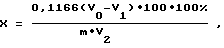
где V0 - объем Na2S2O3, пошедший на титрование контрольной пробы, мл;
V1 - объем Na2S2O3, пошедший на титрование пробы, мл;
V2 - объем зольного раствора пробы, взятой на анализ, мл;
m - масса навески, мг;
0,1166 - количество мг азота, эквивалентное 1 мл 0,025 н. раствору Na2S2O3;
100 - исходный объем зольного раствора пробы, мл.This goal is achieved by the fact that in the proposed method for the determination of nitrogen in biological samples, including sample preparation, adding hydrogen peroxide, sulfuric acid, heating until white smoke and complete discoloration, cooling, adding distilled water, a borate buffer is added to the mixture, neutralized with a solution NaOH, then making manganese solutions of sodium hypochlorite, KJ, H 2 SO 4, added starch and titrated until colorless, then a similar procedure is performed for the control sample, then a redelyayut nitrogen content according to the formula:
where V 0 is the volume of Na 2 S 2 O 3 used for titration of the control sample, ml;
V 1 - the volume of Na 2 S 2 O 3 , went to the titration of the sample, ml;
V 2 - the volume of the ash solution of the sample taken for analysis, ml;
m is the mass of the sample, mg;
0.1166 - the amount of mg of nitrogen, equivalent to 1 ml of 0.025 N. a solution of Na 2 S 2 O 3 ;
100 - the initial volume of the ash solution of the sample, ml.
Способ осуществляется следующим образом. The method is as follows.
Раствор гипохлорита готовят из коммерческого препарата "Белизна" в боратном буфере в концентрации 0,075 н. Нужный pH доводился растворами NaOH или H2SO4. Стандартный раствор аммония готовился из фиксанала хлористого аммония (0,1 г-экв). Активный хлор определяется методом йодометрии. Йод оттитровывался 0,025 н. раствором тиосульфата натрия, приготовленного из фиксанала (0,1 г-экв).A solution of hypochlorite is prepared from the commercial drug "White" in borate buffer at a concentration of 0.075 N. The desired pH was adjusted with NaOH or H 2 SO 4 solutions. A standard ammonium solution was prepared from fixanal of ammonium chloride (0.1 g-equiv). Active chlorine is determined by iodometry. Iodine was titrated 0.025 n. a solution of sodium thiosulfate prepared from fixanal (0.1 g-equiv).
Абсолютные спектры реакционной смеси регистрировались на дифференциальном спектрофотометре SPECORD (ФРГ), pH определялось на ORION RESEARCH (США), азот измерялся на автоанализаторе CONTIFO (Венгрия) (реакция индофенольной зелени) после определения Cl+. Окислительно-восстановительный потенциал измерялся на pH 340.Absolute spectra of the reaction mixture were recorded on a SPECORD differential spectrophotometer (Germany), pH was determined on an ORION RESEARCH (USA), nitrogen was measured on a CONTIFO autoanalyzer (Hungary) (indophenol greens reaction) after determination of Cl + . The redox potential was measured at pH 340.
Определение азота в биологических образцах по методу Кьельдаля проводилось следующим образом. В колбу бралась навеска около 500 мг, затем в нее вносили 5 мл 30% H2O2 и 10 мл концентрированной H2SO4. После бурного кипения колба нагревалась на электроплитке в течение 10-15 минут, затем ставилась на асбестовую ткань для охлаждения. После повторного внесения 5 мл перекиси водорода колба вновь нагревалась до выделения белого дыма и полного обесцвечивания содержимого. При необходимости эта процедура повторялась вновь.The determination of nitrogen in biological samples by the Kjeldahl method was carried out as follows. A sample of about 500 mg was taken into a flask, then 5 ml of 30% H 2 O 2 and 10 ml of concentrated H 2 SO 4 were added to it. After rapid boiling, the flask was heated on an electric stove for 10-15 minutes, then placed on an asbestos cloth for cooling. After repeated addition of 5 ml of hydrogen peroxide, the flask was again heated until white smoke was formed and the contents were completely discolored. If necessary, this procedure was repeated again.
Объем охлажденной пробы доводят до 100 мл дистиллированной водой. The volume of the chilled sample is adjusted to 100 ml with distilled water.
50 мл зольного раствора брались для отгонки аммиака в 0,05 н. раствор H2SO4, приготовленный из фиксанала (0,1 г-экв). Титр раствора щелочи уточнялся 0,05 н. раствором H2SO4. Оставшийся зольный раствор доводился водой до 100 мл и использовался в предлагаемом методе.50 ml of ash solution was taken for distillation of ammonia in 0.05 N. H 2 SO 4 solution prepared from fixanal (0.1 g-equiv). The titer of the alkali solution was clarified 0.05 N. a solution of H 2 SO 4 . The remaining ash solution was brought with water to 100 ml and was used in the proposed method.
Многими авторами было показано, что промежуточными продуктами реакции (1) являются хлорамины, причем какой преимущественно хлорамин образуется зависит от pH смеси. При pH более 7 преобладает NH2Cl, а в пределах от 5 до 4 NHCl2, и менее 2-NCl3 (5, 6). Каждый из них находился в равновесии со своим соседом, и при любом данном pH в системе не может существовать более двух хлораминов (7). В этой работе реакция исследуется только в слабощелочной среде.Many authors have shown that the intermediate products of reaction (1) are chloramines, and which predominantly chloramine is formed depends on the pH of the mixture. At pH greater than 7, NH 2 Cl prevails, and in the range from 5 to 4 NHCl 2 and less than 2-NCl 3 (5, 6). Each of them was in equilibrium with its neighbor, and at any given pH no more than two chloramines can exist in the system (7). In this work, the reaction is studied only in a slightly alkaline environment.
Посмотрим, что происходит по мере прибавления гипохлорита к раствору аммония. Для удобства изложения обозначим хлор с валентностью +1, так называемый "активный хлор" через Cl+, мольное отношение исходного Cl+ к исходному аммонию -R и мольное отношение израсходованного в реакции Cl+ к исходному аммонию -r.Let's see what happens as hypochlorite is added to the ammonium solution. For convenience of presentation, we denote chlorine with a valency of +1, the so-called “active chlorine” through Cl + , the molar ratio of the initial Cl + to the initial ammonium -R and the molar ratio of the spent Cl + to the initial ammonium -r.
Следовательно, идет известная реакция:
NH4 + + OCl- = NH2Cl + H2O. (2)
Дальнейшее увеличение соотношения хлора к азоту до R = 1 вызывает смещение равновесия реакций (2) вправо, о чем свидетельствует повышение максимума поглощения. При эквимолярном соотношении структура спектра резко меняется. Во-первых, снижается содержание NH2Cl в системе и появляются еще два максимума поглощения при 206 нм и 292 нм. Последний соответствует иону гипохлорита (8), а другой обусловлен присутствием дихлорамина. Дело в том, что спектр дихлорамина имеет два максимума поглощения: при 206 нм и 295 нм (9), но поскольку гипохлорит поглощает при 292 нм, их полосы накладываются. В смеси эти соединения можно дифференцировать по более выраженной полосе поглощения дихлорамина (206 нм), так как его коэффициент молярной экстинции при этой длине волны в 7 раз превосходит коэффициент при 295 нм (9). Таким образом, по мере увеличения R до значения, равного 1.5, протекает следующая реакция:
NH2Cl + OCl- = NHCl2 + OH-. (3)
При R = 2 в смеси содержится незначительное количество хлораминов в равновесии с гипохлоритом. Спектр при более высоком значении R (3.0) демонстрирует полное отсутствие хлораминов и преобладание в системе гипохлорита.Therefore, there is a known reaction:
NH 4 + + OCl - = NH 2 Cl + H 2 O. (2)
A further increase in the ratio of chlorine to nitrogen to R = 1 causes a shift in the equilibrium of reactions (2) to the right, as evidenced by an increase in the absorption maximum. With an equimolar ratio, the structure of the spectrum changes dramatically. First, the NH 2 Cl content in the system decreases and two more absorption maxima appear at 206 nm and 292 nm. The latter corresponds to the hypochlorite ion (8), and the other is due to the presence of dichloramine. The fact is that the dichloramine spectrum has two absorption maxima: at 206 nm and 295 nm (9), but since hypochlorite absorbs at 292 nm, their bands overlap. In a mixture, these compounds can be differentiated by a more pronounced absorption band of dichloramine (206 nm), since its molar extinction coefficient at this wavelength is 7 times greater than the coefficient at 295 nm (9). Thus, as R increases to a value of 1.5, the following reaction proceeds:
NH 2 Cl + OCl - = NHCl 2 + OH - . (3)
At R = 2, the mixture contains a small amount of chloramines in equilibrium with hypochlorite. The spectrum at a higher value of R (3.0) shows the complete absence of chloramines and the predominance of hypochlorite in the system.
Были исследованы результаты количественного контроля за содержанием азота и Cl+, проведенного параллельно качественному анализу. Потеря как азота, так и Cl+, хотя и незначительная, происходит даже тогда, когда в системе преобладает монохлорамин, но наиболее резкая наблюдается при R>1.0. При эквимолярном соотношении реакция (1) прореагировала приблизительно на 80%. Полное завершение ее достигается при исходном мольном соотношении хлора к азоту, равном 2.25.The results of a quantitative control of the nitrogen and Cl + contents, which were carried out in parallel with a qualitative analysis, were investigated. The loss of both nitrogen and Cl + , although insignificant, occurs even when monochloramine predominates in the system, but the sharpest one is observed at R> 1.0. At an equimolar ratio, reaction (1) reacted approximately 80%. Its full completion is achieved with the initial molar ratio of chlorine to nitrogen equal to 2.25.
Фактическое потребление Cl+ на окисление аммония до молекулярного азота на 10% выше теоретически рассчитанного по реакции (1). Причина потери хлора, возможно кроется в механизме последующих реакций дихлорамина. Было показано (10), что стабильность его сохраняется только до тех пор, пока в системе присутствует ион аммония. При исчерпании NH4 +, вызванного избытком гипохлорита идут следующие сопряжения реакции:
NHCl2 + OCl- = NCl3 + OH-, (4)
NHCl2 + NCl3 + 3OH- = N2 + 2HOCl- + 3Cl- + H2O, (5)
HOCl = OCl- + H+. (6)
Образование хлорноватистой кислоты можно наблюдать визуально по желтовато-зеленоватой окраске смеси в период наиболее бурного протекания реакции (1<R<1,5). Обесцвечивание обусловлено диссоциацией HОCl на ионы H+ и OCl-. Гипохлорит включается в реакцию (4), ускоряя ее, поэтому распад дихлорамина является аутокаталитическим процессом.The actual consumption of Cl + for the oxidation of ammonium to molecular nitrogen is 10% higher than theoretically calculated by reaction (1). The reason for the loss of chlorine, possibly lies in the mechanism of subsequent reactions of dichloramine. It was shown (10) that its stability is retained only until an ammonium ion is present in the system. With the exhaustion of NH 4 + caused by an excess of hypochlorite, the following conjugation reactions occur:
NHCl 2 + OCl - = NCl 3 + OH - , (4)
NHCl 2 + NCl 3 + 3OH - = N 2 + 2HOCl - + 3Cl - + H 2 O, (5)
HOCl = OCl - + H + . (6)
The formation of hypochlorous acid can be observed visually by the yellowish-green color of the mixture during the period of the most rapid reaction (1 <R <1.5). Discoloration is due to the dissociation of HCl into H + and OCl - ions. Hypochlorite is included in reaction (4), accelerating it; therefore, the decomposition of dichloramine is an autocatalytic process.
Как показали дальнейшие опыты, потеря хлора предотвращается присутствием в реагирующей смеси иона марганца в боратном буфере при pH 8,5 гипохлорит не окисляет Mn++, но внесение в эту смесь NH4 + вызывает помутнение раствора, обусловленное образованием двуокиси марганца, точнее ее гидрата MnO(OH)2. Такое же помутнение происходит при пропускании через смесь боратного буфера с Mn++ (pH 8,5) как Cl2, так и NCl3. Вероятно реакция (5) протекает через стадию образования Cl2.As further experiments showed, the loss of chlorine is prevented by the presence of manganese ion in the borate buffer at pH 8.5, hypochlorite does not oxidize Mn ++ , but the addition of NH 4 + to this mixture causes a cloudy solution due to the formation of manganese dioxide, more precisely its hydrate MnO (OH) 2 . The same turbidity occurs when passing through a mixture of borate buffer with Mn ++ (pH 8.5) as Cl 2 and NCl 3 . Probably reaction (5) proceeds through the stage of formation of Cl 2 .
NHCl2 + NCl3 + OH- = N2 + 2Cl2 + Cl- + H2O, (7)
Cl2 + OH- = HOCl + Cl-. (8)
Если уравнение реакции (8) умножить на 2 и почленно сложить с уравнением (7), то получиться уравнение (5), выделившаяся двуокись марганца определяется методом йодометрии аналогично определению Cl+.NHCl 2 + NCl 3 + OH - = N 2 + 2Cl 2 + Cl - + H 2 O, (7)
Cl 2 + OH - = HOCl + Cl - . (eight)
If reaction equation (8) is multiplied by 2 and termwise added to equation (7), then we get equation (5), the released manganese dioxide is determined by the iodometry method similarly to the definition of Cl + .
Мольное отношение израсходованного хлора к исходному аммонию (r) в этом случае получается равным 1.5, что соответствует отношению стехиометрических коэффициентов в уравнении (1). The molar ratio of the consumed chlorine to the starting ammonium (r) in this case is 1.5, which corresponds to the ratio of stoichiometric coefficients in equation (1).
С увеличением pH в системе преобладает NH2Cl, а с уменьшением NHCl2, то максимум скорости реакции, вероятно, достигается при оптимальном соотношении монохлорамина и дихлорамина. В присутствии Mn++ r, принимает значение, равное теоретическому в интервале 7,5-9,5. Резкое снижение r за пределами этого интервала вызвано тем, что реакция не идет до конца, и оставшиеся часть азота содержится в форме NHCl2 в более кислой среде и NH2Cl- в более щелочной.With an increase in pH, NH 2 Cl prevails in the system, and with a decrease in NHCl 2 , the maximum reaction rate is likely to be achieved with the optimal ratio of monochloramine and dichloramine. In the presence of Mn ++ r, takes a value equal to the theoretical in the range of 7.5-9.5. R sharp decrease outside of this range due to the fact that the reaction does not go to the end, and the remaining portion of the nitrogen contained in the form NHCl 2 in acidic medium and more NH 2 Cl - in the more alkaline.
Полученные данные позволили подобрать оптимальные условия для протекания реакции (1) и позволили применить ее для определения азота в биологических образцах, подвергнутых кислотному разложению по Кьельдалю. The data obtained made it possible to select the optimal conditions for the reaction (1) and allowed to use it to determine nitrogen in biological samples subjected to acid decomposition according to Kjeldahl.
А. Приготовление зольного раствора пробы. A. Preparation of the ash solution of the sample.
В мерную на 100 мл колбу берут 100-200 мг (в зависимости от содержания азота) тщательно измельченного и перемешанного образца, вносят 5 мл 30% перекиси водорода, 4 мл концентрированной H2SO4. Колбу ставят на электроплитку и нагревают до появления белого дыма (15 минут), а затем снимают и ставят на асбестовую ткань для охлаждения (10 мин). В остывшую колбу вновь вносят 5 мл перекиси и ставят на электроплитку для дальнейшего сжигания до появления белого дыма и обесцвечивания содержимого (25 минут). Объем колбы, остывшей на асбесте, доводят дистиллированной водой до метки и тщательно перемешивают.In a 100 ml volumetric flask, 100-200 mg (depending on the nitrogen content) of a thoroughly ground and mixed sample is taken, 5 ml of 30% hydrogen peroxide, 4 ml of concentrated H 2 SO 4 are added. The flask was placed on a hot plate and heated until white smoke appeared (15 minutes), and then removed and placed on an asbestos cloth for cooling (10 minutes). 5 ml of peroxide are again added to the cooled flask and put on a hot plate for further burning until white smoke and discoloration of the contents (25 minutes). The volume of the flask cooled on asbestos was adjusted to the mark with distilled water and mixed thoroughly.
Все перечисленные операции параллельно выполняют и для слепой (контрольной) пробы, содержащей только 4 мл концентрированной H2SO4.All these operations are simultaneously performed for a blind (control) sample containing only 4 ml of concentrated H 2 SO 4 .
Б. Приготовление реактивов. B. Preparation of reagents.
1. Раствор йодистого калия. Растворяют 50 г KJ в 1 л дистиллированной воды. Раствор хранят в темной посуде. 1. A solution of potassium iodide. Dissolve 50 g of KJ in 1 liter of distilled water. The solution is stored in a dark bowl.
2. Раствор серной кислоты (2 н.). В мерную колбу на 1 л берут 53,6 мл концентрированной H2SO4, доводят до метки дистиллированной водой.2. A solution of sulfuric acid (2 N.). 53.6 ml of concentrated H 2 SO 4 are taken into a 1 L volumetric flask, adjusted to the mark with distilled water.
3. Раствор гипосульфита натрия (0,025 н.). Растворяют фиксанал, содержащий 0,1 г-экв Na2S2O3 в 4 литрах дистиллированной воды.3. A solution of sodium hyposulfite (0,025 N.). The fixanal containing 0.1 g-equiv of Na 2 S 2 O 3 is dissolved in 4 liters of distilled water.
4. В полученный раствор вносят 400 мг Na2CO3 или 1 г Na2CO3•10H2O.4. 400 mg of Na 2 CO 3 or 1 g of Na 2 CO 3 • 10H 2 O are added to the resulting solution.
5. Раствор крахмала. Отвешивают 0,5 г "растворимого крахмала" и тщательно растирают его с несколькими миллилитрами холодной дистиллированной воды. Полученную пасту вливают в 100 мл кипящей дистиллированной воды, кипятят 2 минуты и горячим фильтруют. Хранят в холодильнике. 5. A solution of starch. 0.5 g of “soluble starch” is weighed out and triturated with several milliliters of cold distilled water. The resulting paste is poured into 100 ml of boiling distilled water, boiled for 2 minutes and filtered hot. Store in the refrigerator.
6. Раствор гидроокиси натрия. Растворяют 100 г NaOH в 1 л дистиллированной воды. 6. A solution of sodium hydroxide. Dissolve 100 g of NaOH in 1 liter of distilled water.
7. Приготовление рабочего раствора гипохлорита. Растворяют в мерной колбе на 1 л 30 г буры в 800 - 900 мл теплой дистиллированной воды и вносят 50 мл 2 н. H2SO4. Затем определяют объем исходного раствора гипохлорита (бытовой препарат "Белизна") для получения 0,075 н. рабочего раствора. Для этого вносят в колбу на 250 мл с магнитной мешалкой 1 мл "Белизны", 50 мл дистиллированной воды, 10 мл раствора KJ и 10 мл 2 н. H2SO4. Выделившийся йод титруют 0,025 н. раствором Na2S2O3 до соломенно-желтой окраски, после чего прибавляют около 0.5 мл раствора крахмала и титруют до обесцвечивания синей окраски от одной капли. Объем (V) определяют по формуле

где a - объем 0,025 н. раствора гипосульфита, пошедший на титрование.7. Preparation of a working solution of hypochlorite. Dissolve in a 1 L volumetric flask 30 g of borax in 800 - 900 ml of warm distilled water and add 50 ml of 2 N H 2 SO 4 . Then determine the volume of the initial solution of hypochlorite (household product "White") to obtain 0,075 N. working solution. To do this, add 1 ml of "White", 50 ml of distilled water, 10 ml of KJ solution and 10 ml of 2 N into a 250 ml flask with a magnetic stirrer. H 2 SO 4 . The released iodine is titrated with 0.025 n. Na 2 S 2 O 3 solution until a straw-yellow color, after which about 0.5 ml of starch solution is added and titrated until one drop of blue color becomes discolored. Volume (V) is determined by the formula
where a is the volume of 0.025 N. a solution of hyposulfite, which went to the titration.
После внесения найденного объема "Белизны" колбу доводят до метки дистиллированной водой и тщательно перемешивают, pH полученного раствора должен быть в пределах 8.5. After making the found volume of "Whiteness", the flask is brought to the mark with distilled water and thoroughly mixed, the pH of the resulting solution should be within 8.5.
8. Раствор сернокислого марганца. Растворяют 2.5 г MnSO4•5H2O в 100 мл дистиллированной воды.8. A solution of manganese sulfate. Dissolve 2.5 g of MnSO 4 • 5H 2 O in 100 ml of distilled water.
9. Боратный буфер. В мерную колбу на 1 литр берут навеску фенолфталеина, равную 15 мг, вносят некоторое количество дистиллированной воды и 1 мл раствора NaOH (N 5), перемешивают и растворяют 30 г тетрабората натрия теплой дистиллированной водой. 9. Borate buffer. In a 1 liter volumetric flask, a weighed portion of phenolphthalein equal to 15 mg is taken, a certain amount of distilled water and 1 ml of NaOH solution (N 5) are added, 30 g of sodium tetraborate are mixed and dissolved in warm distilled water.
10. Объем доводят до метки. 10. The volume is adjusted to the mark.
В коническую колбу на 250 мл вносят 10-20 мл зольного раствора пробы, 10 мл боратного буфера. Смесь нейтрализуют на магнитной мешалке раствором NaOH до слабо-розовой окраски. Затем последовательно вносят 2 мл раствора марганца, 20 мл гипохлорита натрия, 10 мл KJ и 10 мл 2 н. H2SO4, после чего добавляют около 0,5 мл крахмала и титруют до обесцвечивания синей окраски от одной капли. Аналогичную процедуру выполняют и для слепой (контрольной) пробы. Процентное содержание азота в пробе (X) определяют по формуле:
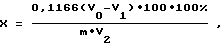
где V0 - объем Na2S2O3, пошедший на титрование контрольной пробы, мл;
V1 - объем Na2S2O3, пошедший на титрование пробы, мл;
V2 - объем зольного раствора пробы, взятой на анализ, мл;
m - масса навески, мг;
0,1166 - количество мг азота, эквивалентное 1 мл 0,025 н. раствору Na2S2O3;
100 - исходный объем зольного раствора пробы, мл.In a conical flask of 250 ml add 10-20 ml of ash solution of the sample, 10 ml of borate buffer. The mixture is neutralized on a magnetic stirrer with a NaOH solution until a faint pink color. Then, 2 ml of a solution of manganese, 20 ml of sodium hypochlorite, 10 ml of KJ and 10 ml of 2 N are successively added. H 2 SO 4 , after which about 0.5 ml of starch is added and titrated to one drop with a blue color. A similar procedure is performed for a blind (control) sample. The percentage of nitrogen in the sample (X) is determined by the formula:
where V 0 is the volume of Na 2 S 2 O 3 used for titration of the control sample, ml;
V 1 - the volume of Na 2 S 2 O 3 , went to the titration of the sample, ml;
V 2 - the volume of the ash solution of the sample taken for analysis, ml;
m is the mass of the sample, mg;
0.1166 - the amount of mg of nitrogen, equivalent to 1 ml of 0.025 N. a solution of Na 2 S 2 O 3 ;
100 - the initial volume of the ash solution of the sample, ml.
Если почленно сложить уравнение (2)-(6), умножив (2), (3), (6) на 2, то получится уравнение (1). Таким образом, конечные продукты этой реакции являются результатом сложной цепи последовательных превращений исходных продуктов. При этом Cl+ с валентностью +1, превращаясь в хлорид с валентностью -1, проходит стадию с нулевой валентностью, и в этом состоянии возможна его потеря.If we add equation (2) - (6) term by term, multiplying (2), (3), (6) by 2, we get equation (1). Thus, the final products of this reaction are the result of a complex chain of successive conversions of the starting products. In this case, Cl + with a valency of +1, turning into chloride with a valency of -1, goes through a stage with zero valency, and in this state its loss is possible.
Определенный вклад в эту потерю может вносить и треххлористый азот потому, что он обладает более выраженным по сравнению с NH2Cl и NHCl2 гидрофобными свойствами. В двухфазной системе, по имеющимся данным (7), отношения распределения между Cl4C и водой равно 0,058, 0,88 и 32,0 соответственно для NH2Cl и NHCl2 и NCl3. Поэтому некоторая часть NCl3 вместе с Cl2, вероятно, увлекается бурно выделяющимся газообразным азотом, приводя к потери "активного хлора". Марганец, очевидно, вызывает резкое смещение реакции (7) вправо, поскольку Cl2 расходуется на образование двуокиси.Nitrogen trichloride can also make a certain contribution to this loss because it has more pronounced hydrophobic properties compared to NH 2 Cl and NHCl 2 . In a two-phase system, according to available data (7), the distribution ratios between Cl 4 C and water are 0.058, 0.88, and 32.0 for NH 2 Cl and NHCl 2 and NCl 3, respectively. Therefore, a certain part of NCl 3 together with Cl 2 is probably carried away by rapidly emitting nitrogen gas, leading to the loss of “active chlorine”. Manganese, obviously, causes a sharp shift of reaction (7) to the right, since Cl 2 is spent on the formation of dioxide.
Равенство r отношения стехиометрических коэффициентов исходных продуктов реакции (1) в присутствии Mn++ дает возможность рассчитать титр раствора гипосульфита по азоту. Между тем в некоторых предлагаемых гипобромитных методах определения азота это далеко не всегда возможно, и тогда титр гипосульфита уточняется по стандартному раствору аммония (11).The equality r of the ratio of stoichiometric coefficients of the starting products of reaction (1) in the presence of Mn ++ makes it possible to calculate the titer of a hyposulfite solution from nitrogen. Meanwhile, in some proposed hypobromite methods for the determination of nitrogen, this is far from always possible, and then the hyposulfite titer is specified using a standard ammonium solution (11).
Чаще всего в качестве индикатора при доведении pH до нужного значения в предлагаемых методах с гипобромитом используют окись ртути, так как органические индикаторы окисляются гипогалогенами, искажая результаты анализа. В данном случае для доведения pH реакционной смеси до 8,5 применен фенолфталеин таким образом, что количество его одинаково как в слепой (контрольной), так и в исследуемых пробах ошибка, связанная с расходованием Cl+ на окисление индикатора, уничтожается в формуле (2). Поскольку предел pH, в которых значение r равно 1.5, сравнительно широкий, требования к точности доведения реакционной среды - невысокие.Most often, mercury oxide is used as an indicator in adjusting the pH to the desired value in the proposed methods with hypobromite, since organic indicators are oxidized by hypohalogens, distorting the analysis results. In this case, to bring the pH of the reaction mixture to 8.5, phenolphthalein was used in such a way that its amount is the same both in the blind (control) and in the studied samples, the error associated with the consumption of Cl + for oxidation of the indicator is eliminated in formula (2) . Since the pH limit, in which the value of r is 1.5, is relatively wide, the requirements for the accuracy of adjusting the reaction medium are low.
Нормальность 0,075 рабочего раствора гипохлорита рассчитана на определение азота в пределах от 0 до 3 мг в реакционной смеси, но этот интервал можно расширить, повысив концентрацию Cl+.The normality of 0.075 working hypochlorite solution is designed to determine nitrogen in the range from 0 to 3 mg in the reaction mixture, but this range can be extended by increasing the concentration of Cl + .
Сжигание биологических образцов проводится в концентрированной H2SO4 с окислителем (H2O2) без добавления каких-либо катализаторов, так как они мешают определению азота. Рекомендуемые некоторыми авторами способы удаления катализаторов из минерализата (12) сложны и неоправданно увеличивают время анализа. Перекись значительно эффективнее катализаторов, но и она тоже может вносить помеху в случае неполного испарения, завышая результаты анализа. Однако, как показали исследования, H2O2 в нем отсутствует, если сжигаемая смесь кипит с выделением белого дыма (330oC).The burning of biological samples is carried out in concentrated H 2 SO 4 with an oxidizing agent (H 2 O 2 ) without the addition of any catalysts, since they interfere with the determination of nitrogen. Recommended by some authors, methods of removing catalysts from mineralizate (12) are complex and unreasonably increase the analysis time. Peroxide is much more effective than catalysts, but it can also interfere with incomplete evaporation, overstating the results of the analysis. However, studies have shown that H 2 O 2 is absent in it if the combustible mixture boils with the release of white smoke (330 o C).
Гипохлорит натрия является более доступным окислителем, чем гипобромид, поэтому иногда в предлагаемых гипобромидных методах применяется KBr, окисляющийся гипохлоритом до гипобромита. Sodium hypochlorite is a more affordable oxidizing agent than hypobromide, therefore, KBr, which is oxidized by hypochlorite to hypobromite, is sometimes used in the proposed hypobromide methods.
Однако реакция (1), в отличие от гипобромитной, применима только для метода обратного титрования, так как она идет до конца только при значительном избытке гипохлорита. However, reaction (1), in contrast to hypobromite, is applicable only for the back titration method, since it goes to the end only with a significant excess of hypochlorite.
Выводы
1. Точность предлагаемого метода определения азота в биологических образцах близка к точности метода Кьельдаля.conclusions
1. The accuracy of the proposed method for determining nitrogen in biological samples is close to the accuracy of the Kjeldahl method.
2. Участие иона марганца в данной реакции является важным условием достижения этой точности. 2. The participation of the manganese ion in this reaction is an important condition for achieving this accuracy.
3. Для полного завершения реакции исходное мольное отношение хлора к аммонию должно быть не менее 2.25. 3. To complete the reaction, the initial molar ratio of chlorine to ammonium should be at least 2.25.
4. Оптимальная для протекания реакция pH в пределах 7,5-9.0. 4. The optimum reaction for the pH is in the range of 7.5-9.0.
Источники информации
1. Hofmann A. Ber. 1882 15. 2664.Sources of information
1. Hofmann A. Ber. 1882.15.2664.
2. Hentschell W. Ber. 1897. 30. 1434. 2. Hentschell W. Ber. 1897.30.3034.
3. Rapp E., Rossler E. Arch. Farm. 1905. 243. 104. 3. Rapp E., Rossler E. Arch. Farm. 1905.2433.
4. Dowell С. Bray W. Am. Chem. Soc. 1917. 39. 896. 4. Dowell C. Bray W. Am. Chem. Soc. 1917.39 896.
5. Chapin R. J. Am. Chem. Soc. 1931. 53. 912. 5. Chapin R. J. Am. Chem. Soc. 1931.53.912.
6. Metcalf W. J. Chem. Soc. 1932. 148. 6. Metcalf W. J. Chem. Soc. 1932.148.
7. Czech F., Fuches R., Antezak H. Anatyt. Chem. 1961. 33. 705. 7. Czech F., Fuches R., Antezak H. Anatyt. Chem. 1961.33705.
8. Anber M. J. Chem. Soc. 1954. 1105. 8. Anber M. J. Chem. Soc. 1954.1105.
9. Soulard M. Bloc F., Hatterer A. J. Chem. Soc. 1981. 2300. 9. Soulard M. Bloc F., Hatterer A. J. Chem. Soc. 1981. 2300.
10. Sisler H. Jnorg Chem. 1983, 22. 1449. 10. Sisler H. Jnorg Chem. 1983, 22.449.
11. Belcher R., West Т., Williams M. J. Chem. Soc. 1957. 4323. 11. Belcher R., West T., Williams M. J. Chem. Soc. 1957.4323.
12. Hashmi M., Ali E., Umar M. Analyt. Chem. 1962. 34. 988-991. 12. Hashmi M., Ali E., Umar M. Analyt. Chem. 1962.34. 988-991.
Claims (1)
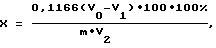
где V0 - объем Na2S2O3, пошедший на титрование контрольной пробы, мл;
V1 - объем Na2S2O3, пошедший на титрование пробы, мл;
V2 - объем зольного раствора пробы, взятой на анализ, мл;
m - масса навески, мг;
0,1166 - количество мг азота, эквивалентное 1 мл 0,025 н раствора Na2S2O3; 100 - исходный объем зольного раствора пробы, мл.A method for determining nitrogen in biological samples, including sampling, introducing hydrogen peroxide and sulfuric acid, heating to produce white smoke and completely discoloring, cooling, adding distilled water, characterized in that they additionally add borate buffer, neutralize with NaOH solution, then add manganese solutions , sodium hypochlorite, KJ, H 2 SO 4 , add starch and titrate until discoloration, then a similar procedure is performed for the control sample, after which the nitrogen content is determined by the formula
where V 0 is the volume of Na 2 S 2 O 3 used for titration of the control sample, ml;
V 1 - the volume of Na 2 S 2 O 3 , went to the titration of the sample, ml;
V 2 - the volume of the ash solution of the sample taken for analysis, ml;
m is the mass of the sample, mg;
0.1166 - the amount of mg of nitrogen, equivalent to 1 ml of 0.025 n solution of Na 2 S 2 O 3 ; 100 - the initial volume of the ash solution of the sample, ml.
Priority Applications (1)
| Application Number | Priority Date | Filing Date | Title |
|---|---|---|---|
| RU99111126A RU2156458C1 (en) | 1999-05-28 | 1999-05-28 | Method of assessing nitrogen in biological samples |
Applications Claiming Priority (1)
| Application Number | Priority Date | Filing Date | Title |
|---|---|---|---|
| RU99111126A RU2156458C1 (en) | 1999-05-28 | 1999-05-28 | Method of assessing nitrogen in biological samples |
Publications (1)
| Publication Number | Publication Date |
|---|---|
| RU2156458C1 true RU2156458C1 (en) | 2000-09-20 |
Family
ID=20220413
Family Applications (1)
| Application Number | Title | Priority Date | Filing Date |
|---|---|---|---|
| RU99111126A RU2156458C1 (en) | 1999-05-28 | 1999-05-28 | Method of assessing nitrogen in biological samples |
Country Status (1)
| Country | Link |
|---|---|
| RU (1) | RU2156458C1 (en) |
Cited By (5)
| Publication number | Priority date | Publication date | Assignee | Title |
|---|---|---|---|---|
| RU2216992C2 (en) * | 2001-07-04 | 2003-11-27 | Всероссийский научно-исследовательский институт мясного скотоводства | Method for detecting quality of protein fodders |
| RU2407003C1 (en) * | 2009-07-20 | 2010-12-20 | Государственное образовательное учреждение высшего профессионального образования "Алтайский государственный университет" | Method of determining content of nitrogen in cellulose nitrate |
| CN104391076A (en) * | 2014-11-03 | 2015-03-04 | 乌鲁木齐市华泰隆化学助剂有限公司 | Detection method of content of bis (3,5,5-trimethyl hexanoyl) peroxide in initiator Tx-36 |
| RU2554799C2 (en) * | 2013-11-06 | 2015-06-27 | Федеральное государственное бюджетное научное учреждение "Северо-Кавказский зональный научно-исследовательский институт садоводства и виноградарства" | Method of determining total nitrogen by capillary electrophoresis |
| CN111693474A (en) * | 2020-06-29 | 2020-09-22 | 中国第一重型机械股份公司 | Novel detection method of amino nitrogen/crude protein |
-
1999
- 1999-05-28 RU RU99111126A patent/RU2156458C1/en active
Non-Patent Citations (1)
| Title |
|---|
| Кларк Г.Т. Руководство по качественному и количественному органическому анализу. ОНТИ НКТП Государственное научно-техническое издательство Украины, 1934, с.314-316. Колосов С.Г. и др. Физико-химические методы контроля ингредиентов, питательных сред и биопрепаратов./ Методическое пособие для биофабрик и ветеринарных лабораторий. М., 1970, с.4-11. * |
Cited By (5)
| Publication number | Priority date | Publication date | Assignee | Title |
|---|---|---|---|---|
| RU2216992C2 (en) * | 2001-07-04 | 2003-11-27 | Всероссийский научно-исследовательский институт мясного скотоводства | Method for detecting quality of protein fodders |
| RU2407003C1 (en) * | 2009-07-20 | 2010-12-20 | Государственное образовательное учреждение высшего профессионального образования "Алтайский государственный университет" | Method of determining content of nitrogen in cellulose nitrate |
| RU2554799C2 (en) * | 2013-11-06 | 2015-06-27 | Федеральное государственное бюджетное научное учреждение "Северо-Кавказский зональный научно-исследовательский институт садоводства и виноградарства" | Method of determining total nitrogen by capillary electrophoresis |
| CN104391076A (en) * | 2014-11-03 | 2015-03-04 | 乌鲁木齐市华泰隆化学助剂有限公司 | Detection method of content of bis (3,5,5-trimethyl hexanoyl) peroxide in initiator Tx-36 |
| CN111693474A (en) * | 2020-06-29 | 2020-09-22 | 中国第一重型机械股份公司 | Novel detection method of amino nitrogen/crude protein |
Similar Documents
| Publication | Publication Date | Title |
|---|---|---|
| US8065906B2 (en) | Detection of free chlorine in water | |
| US3082146A (en) | Process for the treatment of water | |
| JPH069202A (en) | Preparation of chlorine dioxide in non-aqueous medium | |
| RU2156458C1 (en) | Method of assessing nitrogen in biological samples | |
| Holzbecher et al. | The fluorimetric determination of mercury | |
| Busch et al. | Bleaches and sterilants | |
| Johannesson | The determination of monobromamine and monochloramine in water | |
| EP0985929B1 (en) | Aqueous solution with azo-dye, its manufacturing method and utilization | |
| Hosseini et al. | Spectrophotometric determination of chlorate ions in drinking water | |
| Ayres et al. | Catalytic Decomposition of Hypochlorite Solution by Iridium Compounds. I. The pH-Time Relationship1, 2 | |
| JP2006170897A (en) | Chemical oxygen demand measuring method and measuring apparatus | |
| Mary et al. | Spectrophotometric determination of iodine species in table salt and pharmaceutical preparations | |
| CN108351337B (en) | Storage stable standards for aqueous chlorine analysis | |
| JPH11116205A (en) | Selecting method of raw material solution supply quantity in aqueous chlorine dioxide production and production of aqueous chlorine dioxide using the same | |
| Szabó et al. | On the iodometric determination of the bromide ion | |
| Jackson et al. | Sodium Chlorite as a Volumetric Oxidizing Agent | |
| Ibragim et al. | Investigating the processes and rate of iodide ion and compound oxidation in subterranean hydrothermal waters | |
| CN115979978A (en) | A method for measuring ammonia nitrogen content in seawater aquaculture water | |
| Grampp et al. | Kinetics of the formation of the blue complex CrO (O2) 2 formed by dichromate and H2O2 in acid solutions. A stopped-flow investigation using rapid-scan UV-VIS detection | |
| CN115791766B (en) | A highly selective and ultrasensitive quantitative detection method for iodide ions | |
| Llmoni et al. | Determination of oxidants formed upon the disinfection of drinking water with chlorine dioxide | |
| SU1508146A1 (en) | Method of determining protein in bread goods | |
| Tan et al. | A spectrofluorimetric method for the determination of small amounts of sulphate ion | |
| KR970000300B1 (en) | Process for the preparation of stabilized chlorine dioxide | |
| Preising et al. | Analytical Reactions Involving Ignition with Manganous Nitrate |