KR20180098317A - Single-fiber non-woven fabric, loop member for surface fastener, and sanitary article - Google Patents
Single-fiber non-woven fabric, loop member for surface fastener, and sanitary article Download PDFInfo
- Publication number
- KR20180098317A KR20180098317A KR1020187020943A KR20187020943A KR20180098317A KR 20180098317 A KR20180098317 A KR 20180098317A KR 1020187020943 A KR1020187020943 A KR 1020187020943A KR 20187020943 A KR20187020943 A KR 20187020943A KR 20180098317 A KR20180098317 A KR 20180098317A
- Authority
- KR
- South Korea
- Prior art keywords
- layer
- loop
- nonwoven fabric
- less
- backing layer
- Prior art date
- Legal status (The legal status is an assumption and is not a legal conclusion. Google has not performed a legal analysis and makes no representation as to the accuracy of the status listed.)
- Withdrawn
Links
Images


Classifications
-
- A—HUMAN NECESSITIES
- A61—MEDICAL OR VETERINARY SCIENCE; HYGIENE
- A61F—FILTERS IMPLANTABLE INTO BLOOD VESSELS; PROSTHESES; DEVICES PROVIDING PATENCY TO, OR PREVENTING COLLAPSING OF, TUBULAR STRUCTURES OF THE BODY, e.g. STENTS; ORTHOPAEDIC, NURSING OR CONTRACEPTIVE DEVICES; FOMENTATION; TREATMENT OR PROTECTION OF EYES OR EARS; BANDAGES, DRESSINGS OR ABSORBENT PADS; FIRST-AID KITS
- A61F13/00—Bandages or dressings; Absorbent pads
- A61F13/15—Absorbent pads, e.g. sanitary towels, swabs or tampons for external or internal application to the body; Supporting or fastening means therefor; Tampon applicators
- A61F13/56—Supporting or fastening means
- A61F13/5622—Supporting or fastening means specially adapted for diapers or the like
-
- A—HUMAN NECESSITIES
- A61—MEDICAL OR VETERINARY SCIENCE; HYGIENE
- A61F—FILTERS IMPLANTABLE INTO BLOOD VESSELS; PROSTHESES; DEVICES PROVIDING PATENCY TO, OR PREVENTING COLLAPSING OF, TUBULAR STRUCTURES OF THE BODY, e.g. STENTS; ORTHOPAEDIC, NURSING OR CONTRACEPTIVE DEVICES; FOMENTATION; TREATMENT OR PROTECTION OF EYES OR EARS; BANDAGES, DRESSINGS OR ABSORBENT PADS; FIRST-AID KITS
- A61F13/00—Bandages or dressings; Absorbent pads
- A61F13/15—Absorbent pads, e.g. sanitary towels, swabs or tampons for external or internal application to the body; Supporting or fastening means therefor; Tampon applicators
- A61F13/56—Supporting or fastening means
- A61F13/5622—Supporting or fastening means specially adapted for diapers or the like
- A61F13/5633—Supporting or fastening means specially adapted for diapers or the like open type diaper
-
- A—HUMAN NECESSITIES
- A61—MEDICAL OR VETERINARY SCIENCE; HYGIENE
- A61F—FILTERS IMPLANTABLE INTO BLOOD VESSELS; PROSTHESES; DEVICES PROVIDING PATENCY TO, OR PREVENTING COLLAPSING OF, TUBULAR STRUCTURES OF THE BODY, e.g. STENTS; ORTHOPAEDIC, NURSING OR CONTRACEPTIVE DEVICES; FOMENTATION; TREATMENT OR PROTECTION OF EYES OR EARS; BANDAGES, DRESSINGS OR ABSORBENT PADS; FIRST-AID KITS
- A61F13/00—Bandages or dressings; Absorbent pads
- A61F13/15—Absorbent pads, e.g. sanitary towels, swabs or tampons for external or internal application to the body; Supporting or fastening means therefor; Tampon applicators
- A61F13/56—Supporting or fastening means
- A61F13/62—Mechanical fastening means ; Fabric strip fastener elements, e.g. hook and loop
- A61F13/622—Fabric strip fastener elements, e.g. hook and loop
- A61F13/627—Fabric strip fastener elements, e.g. hook and loop characterised by the loop
-
- B—PERFORMING OPERATIONS; TRANSPORTING
- B32—LAYERED PRODUCTS
- B32B—LAYERED PRODUCTS, i.e. PRODUCTS BUILT-UP OF STRATA OF FLAT OR NON-FLAT, e.g. CELLULAR OR HONEYCOMB, FORM
- B32B5/00—Layered products characterised by the non- homogeneity or physical structure, i.e. comprising a fibrous, filamentary, particulate or foam layer; Layered products characterised by having a layer differing constitutionally or physically in different parts
- B32B5/02—Layered products characterised by the non- homogeneity or physical structure, i.e. comprising a fibrous, filamentary, particulate or foam layer; Layered products characterised by having a layer differing constitutionally or physically in different parts characterised by structural features of a fibrous or filamentary layer
- B32B5/022—Non-woven fabric
-
- B—PERFORMING OPERATIONS; TRANSPORTING
- B32—LAYERED PRODUCTS
- B32B—LAYERED PRODUCTS, i.e. PRODUCTS BUILT-UP OF STRATA OF FLAT OR NON-FLAT, e.g. CELLULAR OR HONEYCOMB, FORM
- B32B5/00—Layered products characterised by the non- homogeneity or physical structure, i.e. comprising a fibrous, filamentary, particulate or foam layer; Layered products characterised by having a layer differing constitutionally or physically in different parts
- B32B5/22—Layered products characterised by the non- homogeneity or physical structure, i.e. comprising a fibrous, filamentary, particulate or foam layer; Layered products characterised by having a layer differing constitutionally or physically in different parts characterised by the presence of two or more layers which are next to each other and are fibrous, filamentary, formed of particles or foamed
- B32B5/24—Layered products characterised by the non- homogeneity or physical structure, i.e. comprising a fibrous, filamentary, particulate or foam layer; Layered products characterised by having a layer differing constitutionally or physically in different parts characterised by the presence of two or more layers which are next to each other and are fibrous, filamentary, formed of particles or foamed one layer being a fibrous or filamentary layer
- B32B5/26—Layered products characterised by the non- homogeneity or physical structure, i.e. comprising a fibrous, filamentary, particulate or foam layer; Layered products characterised by having a layer differing constitutionally or physically in different parts characterised by the presence of two or more layers which are next to each other and are fibrous, filamentary, formed of particles or foamed one layer being a fibrous or filamentary layer another layer next to it also being fibrous or filamentary
-
- D—TEXTILES; PAPER
- D04—BRAIDING; LACE-MAKING; KNITTING; TRIMMINGS; NON-WOVEN FABRICS
- D04H—MAKING TEXTILE FABRICS, e.g. FROM FIBRES OR FILAMENTARY MATERIAL; FABRICS MADE BY SUCH PROCESSES OR APPARATUS, e.g. FELTS, NON-WOVEN FABRICS; COTTON-WOOL; WADDING ; NON-WOVEN FABRICS FROM STAPLE FIBRES, FILAMENTS OR YARNS, BONDED WITH AT LEAST ONE WEB-LIKE MATERIAL DURING THEIR CONSOLIDATION
- D04H1/00—Non-woven fabrics formed wholly or mainly of staple fibres or like relatively short fibres
- D04H1/40—Non-woven fabrics formed wholly or mainly of staple fibres or like relatively short fibres from fleeces or layers composed of fibres without existing or potential cohesive properties
- D04H1/54—Non-woven fabrics formed wholly or mainly of staple fibres or like relatively short fibres from fleeces or layers composed of fibres without existing or potential cohesive properties by welding together the fibres, e.g. by partially melting or dissolving
- D04H1/541—Composite fibres, e.g. sheath-core, sea-island or side-by-side; Mixed fibres
-
- D—TEXTILES; PAPER
- D04—BRAIDING; LACE-MAKING; KNITTING; TRIMMINGS; NON-WOVEN FABRICS
- D04H—MAKING TEXTILE FABRICS, e.g. FROM FIBRES OR FILAMENTARY MATERIAL; FABRICS MADE BY SUCH PROCESSES OR APPARATUS, e.g. FELTS, NON-WOVEN FABRICS; COTTON-WOOL; WADDING ; NON-WOVEN FABRICS FROM STAPLE FIBRES, FILAMENTS OR YARNS, BONDED WITH AT LEAST ONE WEB-LIKE MATERIAL DURING THEIR CONSOLIDATION
- D04H1/00—Non-woven fabrics formed wholly or mainly of staple fibres or like relatively short fibres
- D04H1/40—Non-woven fabrics formed wholly or mainly of staple fibres or like relatively short fibres from fleeces or layers composed of fibres without existing or potential cohesive properties
- D04H1/54—Non-woven fabrics formed wholly or mainly of staple fibres or like relatively short fibres from fleeces or layers composed of fibres without existing or potential cohesive properties by welding together the fibres, e.g. by partially melting or dissolving
- D04H1/541—Composite fibres, e.g. sheath-core, sea-island or side-by-side; Mixed fibres
- D04H1/5412—Composite fibres, e.g. sheath-core, sea-island or side-by-side; Mixed fibres sheath-core
-
- D—TEXTILES; PAPER
- D04—BRAIDING; LACE-MAKING; KNITTING; TRIMMINGS; NON-WOVEN FABRICS
- D04H—MAKING TEXTILE FABRICS, e.g. FROM FIBRES OR FILAMENTARY MATERIAL; FABRICS MADE BY SUCH PROCESSES OR APPARATUS, e.g. FELTS, NON-WOVEN FABRICS; COTTON-WOOL; WADDING ; NON-WOVEN FABRICS FROM STAPLE FIBRES, FILAMENTS OR YARNS, BONDED WITH AT LEAST ONE WEB-LIKE MATERIAL DURING THEIR CONSOLIDATION
- D04H1/00—Non-woven fabrics formed wholly or mainly of staple fibres or like relatively short fibres
- D04H1/40—Non-woven fabrics formed wholly or mainly of staple fibres or like relatively short fibres from fleeces or layers composed of fibres without existing or potential cohesive properties
- D04H1/54—Non-woven fabrics formed wholly or mainly of staple fibres or like relatively short fibres from fleeces or layers composed of fibres without existing or potential cohesive properties by welding together the fibres, e.g. by partially melting or dissolving
- D04H1/559—Non-woven fabrics formed wholly or mainly of staple fibres or like relatively short fibres from fleeces or layers composed of fibres without existing or potential cohesive properties by welding together the fibres, e.g. by partially melting or dissolving the fibres being within layered webs
-
- D—TEXTILES; PAPER
- D04—BRAIDING; LACE-MAKING; KNITTING; TRIMMINGS; NON-WOVEN FABRICS
- D04H—MAKING TEXTILE FABRICS, e.g. FROM FIBRES OR FILAMENTARY MATERIAL; FABRICS MADE BY SUCH PROCESSES OR APPARATUS, e.g. FELTS, NON-WOVEN FABRICS; COTTON-WOOL; WADDING ; NON-WOVEN FABRICS FROM STAPLE FIBRES, FILAMENTS OR YARNS, BONDED WITH AT LEAST ONE WEB-LIKE MATERIAL DURING THEIR CONSOLIDATION
- D04H11/00—Non-woven pile fabrics
- D04H11/08—Non-woven pile fabrics formed by creation of a pile on at least one surface of a non-woven fabric without addition of pile-forming material, e.g. by needling, by differential shrinking
-
- B—PERFORMING OPERATIONS; TRANSPORTING
- B32—LAYERED PRODUCTS
- B32B—LAYERED PRODUCTS, i.e. PRODUCTS BUILT-UP OF STRATA OF FLAT OR NON-FLAT, e.g. CELLULAR OR HONEYCOMB, FORM
- B32B2250/00—Layers arrangement
- B32B2250/20—All layers being fibrous or filamentary
-
- B—PERFORMING OPERATIONS; TRANSPORTING
- B32—LAYERED PRODUCTS
- B32B—LAYERED PRODUCTS, i.e. PRODUCTS BUILT-UP OF STRATA OF FLAT OR NON-FLAT, e.g. CELLULAR OR HONEYCOMB, FORM
- B32B2255/00—Coating on the layer surface
- B32B2255/02—Coating on the layer surface on fibrous or filamentary layer
-
- B—PERFORMING OPERATIONS; TRANSPORTING
- B32—LAYERED PRODUCTS
- B32B—LAYERED PRODUCTS, i.e. PRODUCTS BUILT-UP OF STRATA OF FLAT OR NON-FLAT, e.g. CELLULAR OR HONEYCOMB, FORM
- B32B2262/00—Composition or structural features of fibres which form a fibrous or filamentary layer or are present as additives
- B32B2262/02—Synthetic macromolecular fibres
- B32B2262/0253—Polyolefin fibres
-
- B—PERFORMING OPERATIONS; TRANSPORTING
- B32—LAYERED PRODUCTS
- B32B—LAYERED PRODUCTS, i.e. PRODUCTS BUILT-UP OF STRATA OF FLAT OR NON-FLAT, e.g. CELLULAR OR HONEYCOMB, FORM
- B32B2262/00—Composition or structural features of fibres which form a fibrous or filamentary layer or are present as additives
- B32B2262/02—Synthetic macromolecular fibres
- B32B2262/0276—Polyester fibres
- B32B2262/0284—Polyethylene terephthalate [PET] or polybutylene terephthalate [PBT]
-
- B—PERFORMING OPERATIONS; TRANSPORTING
- B32—LAYERED PRODUCTS
- B32B—LAYERED PRODUCTS, i.e. PRODUCTS BUILT-UP OF STRATA OF FLAT OR NON-FLAT, e.g. CELLULAR OR HONEYCOMB, FORM
- B32B2262/00—Composition or structural features of fibres which form a fibrous or filamentary layer or are present as additives
- B32B2262/12—Conjugate fibres, e.g. core/sheath or side-by-side
-
- B—PERFORMING OPERATIONS; TRANSPORTING
- B32—LAYERED PRODUCTS
- B32B—LAYERED PRODUCTS, i.e. PRODUCTS BUILT-UP OF STRATA OF FLAT OR NON-FLAT, e.g. CELLULAR OR HONEYCOMB, FORM
- B32B2307/00—Properties of the layers or laminate
- B32B2307/70—Other properties
- B32B2307/724—Permeability to gases, adsorption
-
- B—PERFORMING OPERATIONS; TRANSPORTING
- B32—LAYERED PRODUCTS
- B32B—LAYERED PRODUCTS, i.e. PRODUCTS BUILT-UP OF STRATA OF FLAT OR NON-FLAT, e.g. CELLULAR OR HONEYCOMB, FORM
- B32B2555/00—Personal care
- B32B2555/02—Diapers or napkins
-
- D—TEXTILES; PAPER
- D10—INDEXING SCHEME ASSOCIATED WITH SUBLASSES OF SECTION D, RELATING TO TEXTILES
- D10B—INDEXING SCHEME ASSOCIATED WITH SUBLASSES OF SECTION D, RELATING TO TEXTILES
- D10B2321/00—Fibres made from polymers obtained by reactions only involving carbon-to-carbon unsaturated bonds
- D10B2321/02—Fibres made from polymers obtained by reactions only involving carbon-to-carbon unsaturated bonds polyolefins
- D10B2321/021—Fibres made from polymers obtained by reactions only involving carbon-to-carbon unsaturated bonds polyolefins polyethylene
-
- D—TEXTILES; PAPER
- D10—INDEXING SCHEME ASSOCIATED WITH SUBLASSES OF SECTION D, RELATING TO TEXTILES
- D10B—INDEXING SCHEME ASSOCIATED WITH SUBLASSES OF SECTION D, RELATING TO TEXTILES
- D10B2321/00—Fibres made from polymers obtained by reactions only involving carbon-to-carbon unsaturated bonds
- D10B2321/02—Fibres made from polymers obtained by reactions only involving carbon-to-carbon unsaturated bonds polyolefins
- D10B2321/022—Fibres made from polymers obtained by reactions only involving carbon-to-carbon unsaturated bonds polyolefins polypropylene
-
- D—TEXTILES; PAPER
- D10—INDEXING SCHEME ASSOCIATED WITH SUBLASSES OF SECTION D, RELATING TO TEXTILES
- D10B—INDEXING SCHEME ASSOCIATED WITH SUBLASSES OF SECTION D, RELATING TO TEXTILES
- D10B2331/00—Fibres made from polymers obtained otherwise than by reactions only involving carbon-to-carbon unsaturated bonds, e.g. polycondensation products
- D10B2331/04—Fibres made from polymers obtained otherwise than by reactions only involving carbon-to-carbon unsaturated bonds, e.g. polycondensation products polyesters, e.g. polyethylene terephthalate [PET]
-
- D—TEXTILES; PAPER
- D10—INDEXING SCHEME ASSOCIATED WITH SUBLASSES OF SECTION D, RELATING TO TEXTILES
- D10B—INDEXING SCHEME ASSOCIATED WITH SUBLASSES OF SECTION D, RELATING TO TEXTILES
- D10B2509/00—Medical; Hygiene
- D10B2509/02—Bandages, dressings or absorbent pads
- D10B2509/026—Absorbent pads; Tampons; Laundry; Towels
Landscapes
- Engineering & Computer Science (AREA)
- Health & Medical Sciences (AREA)
- Textile Engineering (AREA)
- Animal Behavior & Ethology (AREA)
- Biomedical Technology (AREA)
- Heart & Thoracic Surgery (AREA)
- Vascular Medicine (AREA)
- Life Sciences & Earth Sciences (AREA)
- Epidemiology (AREA)
- General Health & Medical Sciences (AREA)
- Public Health (AREA)
- Veterinary Medicine (AREA)
- Mechanical Engineering (AREA)
- Nonwoven Fabrics (AREA)
- Slide Fasteners, Snap Fasteners, And Hook Fasteners (AREA)
- Absorbent Articles And Supports Therefor (AREA)
Abstract
극복해야 할 한 가지 과제는 공기 투과도와 유연도의 적절한 균형을 갖는 단섬유 부직포 및 루프 구성요소를 제공하는 것이다. 해결책 중 하나는, 단섬유 부직포를 포함하는 상부 층 및 단섬유 부직포를 포함하는 기재 층을 포함하는, 기계적 체결구용 루프 구성요소로서, [기재 층의 평균 섬도 (데니어)]에 대한 [상부 층의 평균 섬도 (데니어)]의 비는 1.5 내지 30이고, 기재의 유연도는 45도 캔틸레버 방법에 의해 MD 방향에서 60 mm 미만이고 CD 방향에서 50 mm 미만이며, 기재의 공기 투과도는 프라지어 유형 방법에 의해 10 내지 100 ㎤/sec*㎠인, 루프 구성요소이다.One challenge to overcome is to provide a monofilament nonwoven fabric and loop components with an adequate balance of air permeability and flexibility. One solution is to provide a loop component for a mechanical fastener comprising an upper layer comprising a short fiber nonwoven and a substrate layer comprising a short fiber nonwoven, wherein [the average fineness (denier) of the base layer The average degree of fineness (denier)] is 1.5 to 30, the degree of flexibility of the substrate is less than 60 mm in the MD direction and less than 50 mm in the CD direction by the 45 degree cantilever method, Cm < 2 > / sec * cm < 2 >
Description
본 발명은 단섬유 부직포(short fiber nonwoven fabric), 표면 체결구(surface fastener)용 루프 부재(loop member), 및 위생 용품에 관한 것이다.The present invention relates to short fiber nonwoven fabrics, loop members for surface fasteners, and sanitary articles.
통상적으로, 표면 체결구는 섬유 제품, 플라스틱 제품, 종이 제품, 산업용 물품, 전자 구성요소, 건축 재료 등을 포함하는 다양한 물품을 고정하거나 결속하기 위해 널리 사용되어 왔다. 예를 들어, 체결 부재로서 표면 체결구가 부착된 위생 용품 (예컨대, 종이 기저귀 등)이 알려져 있다. 예를 들어, 후크(hook)-유사 결합 요소를 갖는 수형 부재(male member) 및 이 결합 요소에 결합 가능한 암형 부재(female member)로 구성되는, 쌍을 이루는 체결구와 같이, 다양한 결합 방법을 이용하는 표면 체결구가 알려져 있다. 이들 중에서, 부직포를 사용하는 표면 체결구용 체결 부재가 유연성(pliability) 및 공기 투과성을 갖는다는 점에서 유리하며, 따라서 통상적으로, 많은 유형이 제안되어 왔다.BACKGROUND OF THE INVENTION [0002] Surface fasteners have been widely used to fix or bind various articles including textile products, plastic products, paper products, industrial products, electronic components, building materials and the like. For example, sanitary articles (e.g., paper diapers, etc.) with surface fasteners as fastening members are known. For example, a surface using a variety of bonding methods, such as a pair of fasteners, consisting of a male member having a hook-like pliable coupling element and a female member capable of engaging the coupling element, Fasteners are known. Among these, a fastening member for a surface fastener using a nonwoven fabric is advantageous in that it has pliability and air permeability, and therefore, many types have been conventionally proposed.
예를 들어, 특허 문헌 1은 복합 부직포로 구성된 후크 및 루프 유형 체결구용 루프 부재를 기술한다. 복합 부직포는 열가소성 권축 스테이플 섬유(thermoplastic crimped staple fiber)의 카디드(carded) 부직포의 루프 층 - 스테이플 섬유는 1.5 내지 6.0 dTEX이고, 상기 카디드 부직포는 10 내지 35 g/m2의 평량을 가짐 -; 5 내지 30 g/m2의 평량을 갖는 스펀본드(spunbond) 또는 스펀멜트(spunmelt) 부직포의 배킹 층(backing layer) - 루프 층은 배킹 층과 대면하여 중첩됨 -; 및 루프 층을 배킹 층에 연결하는 복수의 접합 영역 - 접합 영역은 실질적으로 공기 불투과성으로 되고, 접합 영역은 루프 재료의 표면적의 35 내지 55%를 포함함 - 으로 이루어진다.For example, Patent Document 1 describes a loop member for a hook and loop type fastener composed of a composite nonwoven fabric. Composite non-woven fabric is a carded (carded) a loop layer of a nonwoven fabric of thermoplastic crimped staple fibers (thermoplastic crimped staple fiber) - staple fibers 1.5 to 6.0 dTEX, and the carded non-woven fabric having a basis weight of 10 to 35 g / m 2 - ; A backing layer of a spunbond or spunmelt nonwoven having a basis weight of 5 to 30 g / m 2, the loop layer being overlaid facing the backing layer; And the plurality of bonded area-bonded areas connecting the roof layer to the backing layer are substantially air impermeable, and the bonded area comprises 35 to 55% of the surface area of the loop material.
특허 문헌 2는 열 융착 복합 섬유체를 포함하는 웨브; 웨브의 제1 표면에 형성된 복수의 얽힌(entangled) 루프; 및 웨브의 제2 표면에 형성된 치밀화된 열 융착 층을 포함하는, 면 체결구용 암형 부재를 기술한다. 웨브는 약 0.5 내지 10 데니어의 섬도(fineness) 및 약 2 g/데니어 초과의 인장 강도를 갖는 섬유를 포함하고, 제2 표면은 제1 표면보다 더 치밀하여 제1 표면에 형성된 복수의 얽힌 루프가 수형 부재의 표면 상에 형성된 요소와 강제적으로 결합될 수 있고, 복수의 얽힌 루프를 수형 부재의 표면 상에 형성된 요소로부터 분리하는 데 필요한 박리 강도는 20 gf/cm 이상이다.Patent Document 2 discloses a web comprising a thermally fusible composite fiber body; A plurality of entangled loops formed on a first surface of the web; And a densified heat-sealable layer formed on the second surface of the web. The web comprises fibers having a fineness of about 0.5 to 10 denier and a tensile strength of greater than about 2 g / denier, the second surface being more dense than the first surface to form a plurality of tangled loops The peel strength required for separating the plurality of entangled loops from the element formed on the surface of the male member is 20 gf / cm or more, which can be forcibly joined with the element formed on the surface of the male member.
특허 문헌 3은 섬유질 표면을 갖는 액체-불투과성의 통기성 시트(sheet)를 형성하는 방법을 기술한다. 이 방법은 제1 섬유질 표면 및 제2 섬유질 표면을 갖는 시트를 형성하는 단계; 제2 표면의 섬유를 크게 변화시키지 않으면서 제1 표면의 섬유를 용융시키고, 용융물을 액체 불투과성 비통기성 스킨(skin)으로 형성하기에 충분한 압력 및 z-구배 온도 차동(z-gradient temperature differential)을 시트에 가하는 단계; 스킨이 적어도 반-용융되어 있는 동안에 스킨 상에 섬유를 침착하여 섬유질/스킨/섬유질 재료를 형성하는 단계; 및 액체 불투과성 비통기성 스킨을 천공하여 스킨을 액체 불투과성으로 유지하면서 통기성으로 만드는 단계를 포함한다.Patent Document 3 describes a method of forming a liquid-impermeable breathable sheet having a fibrous surface. The method includes forming a sheet having a first fibrous surface and a second fibrous surface; A pressure and z-gradient temperature differential sufficient to melt the fibers of the first surface and to form the melt into a liquid impermeable non-breathable skin without significantly changing the fibers of the second surface, To the sheet; Depositing fibers on the skin while the skins are at least half-molten to form a fibrous / skin / fibrous material; And puncturing the liquid impervious non-breathable skin to make the skin breathable while keeping the skin liquid impermeable.
그러나, 예를 들어, 성인용 기저귀에 대해, 일부 경우에, 기저귀 내부에 배치된 패드와 조합하여 기저귀가 사용되는 사용 방식이 채택되며, 내부 패드가 빈번하게 교환되는 동안, 외부 기저귀는 단지 3일 정도마다 1회 (또는 패드를 20회 정도 교체할 때마다 1회) 교환된다. 따라서, 기저귀는 비교적 긴 연속 기간 동안 사용된다. 이 경우에, 기저귀의 표면 체결구는 쌍을 이루는 체결 부재들 사이에서 심지어 다수회 (예컨대 약 20회) 반복된 분리 및 부착을 거친 후에도 체결 부재들 사이의 우수한 결합 강도(engagement strength) (특히 박리 강도 및 전단 강도)를 유지할 필요가 있다 (즉, 반복된 분리 및 부착을 거칠 때의 결합 강도 지속성). 그러나, 결합 요소가 부직포 (및 특히 단섬유 부직포)인 루프 부재에 대해, 부직포를 구성하는 섬유는 반복된 분리 및 부착으로 인해 탈락(shedding)되거나 파손되기 쉬우며, 그 결과로, 반복된 분리 및 부착의 경우에 결합 강도 지속성을 달성하기 어렵다. 한편, 편물(knit) 루프는 반복된 분리 및 부착을 거칠 때 일반적으로 우수한 결합 강도 지속성을 갖지만, 공기 투과성 및 유연성이 낮다. 따라서, 부직포가 사용되어 우수한 공기 투과성 및 유연성을 보장하는 동시에, 또한 반복된 분리 및 부착을 거칠 때 우수한 결합 강도 지속성을 갖는 체결 부재가 필요하다.However, for adult diapers, for example, in some cases, the manner in which the diaper is used in combination with the pads disposed within the diaper is employed, while the inner pads are frequently exchanged, Once (or once every time the pad is replaced about 20 times). Thus, the diaper is used for a relatively long continuous period. In this case, the surface fasteners of the diaper have excellent bonding strength between the fastening members even after repeated separation and attachment between the pair of fastening members even a plurality of times (for example, about 20 times) And shear strength) (i. E., Bond strength persistence during repeated separation and attachment). However, for a loop member in which the coupling element is a nonwoven (and in particular a short-woven nonwoven), the fibers constituting the nonwoven are susceptible to shedding or breakage due to repeated separation and attachment, It is difficult to achieve bond strength persistence in the case of adhesion. On the other hand, knit loops generally have good bond strength persistence when subjected to repeated separation and attachment, but have poor air permeability and flexibility. Thus, there is a need for a fastening member having a good bond strength continuity when nonwovens are used to ensure good air permeability and flexibility, as well as undergoing repeated separation and attachment.
추가로, 표면 체결구를 포함하는 물품 (예컨대, 기저귀 등과 같은 위생 용품)에서, 인쇄 층을 갖는 표면 체결구용 체결 부재가 때때로 사용된다. 그러한 표면 체결구용 체결 부재의 예에는 부직포의 하나의 주 표면 상에 인쇄 층이 형성되고 부직포의 다른 주 표면이 다른 표면 체결구용 체결 부재와 결합하기 위한 결합 표면으로서 구성되는 것들이 포함된다. 그러한 구성에서, 인쇄 층 상에 제공되는 디자인은 부직포를 통해 보일 수 있다. 표면 체결구용 체결 부재의 인쇄 층 측의 주 표면을 물품의 본체 부분에 고정함으로써, 디자인을 갖는 표면 체결구를 포함하는 물품이 형성될 수 있다. 그러나, 통상적으로, 부직포 상에 제공되는 인쇄 층은 반드시 충분한 선명성(sharpness)을 갖지는 않는다. 추가로, 체결 부재의 비용의 추가 감소가 요구된다.Further, in an article (for example, a sanitary article such as a diaper or the like) including a surface fastener, a fastening member for a surface fastener having a print layer is sometimes used. Examples of such coupling members for surface fasteners include those in which a printing layer is formed on one main surface of a nonwoven fabric and another main surface of the nonwoven fabric is configured as a coupling surface for engaging with another coupling member for a surface fastener. In such an arrangement, the design provided on the print layer may be visible through the nonwoven fabric. An article including a surface fastener having a design can be formed by fixing the main surface on the print layer side of the fastening member for the surface fastener to the body portion of the article. However, typically, the printing layer provided on the nonwoven fabric does not necessarily have sufficient sharpness. In addition, further reduction of the cost of the fastening member is required.
더욱이, 전술된 바와 같이, 부직포는 편물 루프보다 더 높은 공기 투과성 및 유연성을 갖기 때문에, 공기 투과성이 과도하게 높으면, 제조 시 취급성이 저하되고, 공기 투과성이 낮아지면, 유연성이 또한 저하된다는 문제가 있다.Furthermore, as described above, since the nonwoven fabric has higher air permeability and flexibility than the knitted loop, if the air permeability is excessively high, the handling property at the time of manufacture is lowered, and when the air permeability is lowered, have.
본 발명의 목적은 전술된 문제들을 해결하여, 공기 투과성 및 유연성의 적절한 균형을 갖는 부직포 및 루프 부재를 제공하는 것이다. 이러한 목적은 성인용 및 소아용 둘 모두에 대해 공유되지만, 유연성의 관점에서, 해결 방법에 대한 요구는 특히 소아용에 대해 더 높다. 이러한 균형에 더하여, 본 발명의 목적은 쌍을 이루는 체결 부재들 사이의 우수한 결합 강도, 반복된 분리 및 부착을 거칠 때의 우수한 지속성, 및 우수한 인쇄 특성 (인쇄 층의 선명성)을 가지며 저비용으로 제조가능한 루프 부재를 제공하는 것이다. 이러한 목적으로, 내구성의 관점에서, 해결 방법에 대한 요구는 특히 성인용에 대해 크다.It is an object of the present invention to solve the above-mentioned problems and to provide a nonwoven fabric and a loop member having an appropriate balance of air permeability and flexibility. While this goal is shared for both adult and pediatric use, in terms of flexibility, the need for resolution is higher, especially for pediatric use. In addition to this balance, it is an object of the present invention to provide an image forming apparatus which has excellent bond strength between paired fastening members, good continuity when subjected to repeated separation and adhesion, and excellent printability (print layer clarity) Thereby providing a loop member. For this purpose, in terms of durability, the demand for a solution is particularly large for adult use.
문제의 해결 방법How to fix the problem
본 발명의 일 태양은 단섬유 부직포의 루프 층 및 단섬유 부직포의 배킹 층을 포함하는 표면 체결구용 루프 부재로서, 배킹 층 내의 섬유의 평균 섬도에 대한 루프 층 내의 섬유의 평균 섬도의 비 (루프 층 내의 섬유의 평균 섬도/배킹 층 내의 섬유의 평균 섬도)는 1.5 내지 30이고, 캔틸레버(cantilever) 방법에 의해 측정할 때 루프 부재의 유연도는 기계 방향(machine direction)에서 60 mm 이하이고 폭 방향(cross direction)에서 50 mm 이하이며, 프라지어(Frazier) 방법에 의해 측정할 때 루프 부재의 공기 투과도는 10 내지 100 ㎤/s×㎠인, 표면 체결구용 루프 부재를 제공한다.One aspect of the present invention is a loop member for a surface fastener comprising a loop layer of a short fiber nonwoven fabric and a backing layer of a short fiber nonwoven fabric, wherein the ratio of the average fineness of the fibers in the loop layer to the average fineness of the fibers in the backing layer The average fineness of the fibers in the backing layer / the average fineness of the fibers in the backing layer) is from 1.5 to 30, and the flexibility of the loop member when measured by the cantilever method is 60 mm or less in the machine direction, wherein the loop member has an air permeability of 10 to 100 cm3 / s 占 ㎠ 2 when measured by a Frazier method and a loop member for a surface fastener.
본 발명의 다른 태양은 단섬유 부직포로서, 캔틸레버 방법에 의해 측정되는 유연도는 기계 방향에서 40 mm 이하이고 폭 방향에서 30 mm 이하이며, 프라지어 방법에 의해 측정되는 공기 투과도는 150 ㎤/s×㎠ 이하인, 단섬유 부직포를 제공한다.Another aspect of the present invention is a monofilament nonwoven fabric wherein the flexibility measured by the cantilever method is 40 mm or less in the machine direction and 30 mm or less in the width direction and the air permeability measured by the Prazier method is 150 cm3 / Cm 2 or less.
발명의 유리한 효과Advantageous Effects of the Invention
본 발명에 따르면, 공기 투과성 및 유연성의 적절한 균형을 갖는 부직포, 표면 체결구용 루프 부재, 및 위생 용품이 제공될 수 있다.According to the present invention, it is possible to provide a nonwoven fabric, a loop member for a surface fastener, and a sanitary article having an appropriate balance of air permeability and flexibility.
도 1은 본 발명의 일 태양에 따른 루프 부재 의 예를 예시하는 도면.
도 2는 본 발명의 일 태양에 따른 루프 부재의 예를 예시하는 도면이고, 루프 층 및 배킹 층이 엠보싱에 의해 고정된 상태를 도시하는 도면.
도 3은 실시예 1의 루프 층의 표면 상태 이미지를 나타내는 도면.
도 4는 비교예 1의 루프 층의 표면 상태 이미지를 나타내는 도면.BRIEF DESCRIPTION OF THE DRAWINGS Fig. 1 is a view illustrating an example of a loop member according to one aspect of the present invention. Fig.
2 is a view illustrating an example of a loop member according to an aspect of the present invention, and shows a state in which a loop layer and a backing layer are fixed by embossing.
3 is a view showing a surface state image of a loop layer of Example 1. Fig.
4 is a view showing a surface state image of a loop layer of Comparative Example 1. Fig.
본 발명의 예시적인 태양을 이하에서 설명할 것이지만, 본 발명은 하기의 태양으로 제한되지 않으며, 청구범위의 사상 및 범주 내의 다양한 변경이 본 발명에 포함된다. 달리 언급되지 않으면, 본 개시 내용에서 각각의 특성 값은 본 개시 내용의 실시예 부분에 기재된 방법 또는 그와 동등한 것으로 당업자에 의해 이해되는 방법으로 측정된 값으로 의도된다.Although the exemplary aspects of the present invention will be described below, the present invention is not limited to the following aspects, and various changes within the spirit and scope of the claims are included in the present invention. Unless otherwise stated, each characteristic value in this disclosure is intended to be a value as measured in a manner that is understood by those of skill in the art to be the same as, or equivalent to, those set forth in the Examples section of this disclosure.
본 발명의 루프 부재는 다양한 통상적으로 알려진 체결 수단으로 표면 체결구를 형성하는 루프 부재로서 사용될 수 있다. 일 태양에서, 본 발명의 루프 부재는 암형 부재로서 사용될 수 있으며, 수형 부재와 조합되어 표면 체결구를 구성할 수 있다. 다른 태양에서, 표면 체결구는, 예를 들어, 수형 부재 및 본 발명의 루프 부재, 즉 암형 부재의 구조 둘 모두가 동일 표면 상에 존재하는 부재들의 쌍일 수 있다. 본 발명의 루프 부재는, 예를 들어, 벽, 천(fabric) 등과 직접 결합할 수 있다.The loop member of the present invention can be used as a loop member to form surface fasteners with various commonly known fastening means. In one aspect, the loop member of the present invention can be used as a female member, and can be combined with a male member to form a surface fastener. In another aspect, the surface fastener can be a pair of members, for example, a male member and a loop member of the present invention, i.e., a structure of a female member, both present on the same surface. The loop member of the present invention can be directly coupled to, for example, a wall, fabric, or the like.
더욱 구체적으로, 본 발명의 루프 부재에 대해, 루프 층에 포함된 단섬유 부직포는 결합 요소로서 기능하고, 배킹 층에 포함된 단섬유 부직포는 인쇄 표면을 구성하도록 의도된다. 후크가 바람직한 수형 부재의 예인데, 부직포 결합 요소와 강하게 결합할 수 있기 때문이다. 후크는 표면 체결구의 두께 방향으로 돌출하는 돌출부로 구성된다. 충분한 결합력이 얻어질 수 있기만 하다면 돌출부는 임의의 유형의 것일 수 있지만, 예를 들어, 버섯형, 닻형, 또는 J자형이 바람직하다. 핀 밀도(pin density)는 일반적으로 1 제곱인치당 약 500 내지 5,000개의 핀이다. 재료는 폴리프로필렌, 폴리에스테르, 폴리에틸렌, 폴리아미드, 및 이들의 공중합체 또는 혼합물로부터 선택될 수 있다. 본 발명의 루프 부재는, 후크 및 후크가 함께 결합가능한 결합 요소로서의 단섬유 부직포를 포함하는 루프 부재 둘 모두가 동일 표면 상에 존재하도록 구성된 체결 부재의 일부분일 수 있다.More specifically, for the loop member of the present invention, the single-fiber nonwoven fabric included in the loop layer functions as a coupling element, and the single-fiber nonwoven fabric included in the backing layer is intended to constitute the printing surface. The hook is an example of a preferred male member, because it is able to bind strongly to the nonwoven binding element. The hook is constituted by a protrusion protruding in the thickness direction of the surface fastener. The protrusion may be of any type as long as sufficient bonding force can be obtained, but for example, mushroom-shaped, anchor-shaped, or J-shaped is preferable. The pin density is generally about 500 to 5,000 pins per square inch. The material may be selected from polypropylene, polyester, polyethylene, polyamide, and copolymers or mixtures thereof. The loop member of the present invention may be a part of a fastening member configured such that both of the loop members comprising a single-fiber nonwoven as a coupling element with which the hook and the hook are coupled together are present on the same surface.
도 1은 본 발명의 일 태양에 따른 루프 부재의 예를 예시하는 도면이다. 도 1에 예시된 바와 같이, 루프 부재(1)는 배킹 층(11) 및 루프 층(12)을 포함한다. 전형적인 태양에서, 루프 부재(1)는 인쇄 층(13)을 추가로 포함할 수 있다.1 is a view illustrating an example of a loop member according to an aspect of the present invention. As illustrated in Figure 1, the loop member 1 comprises a
루프 층 및 배킹 층은 단섬유 부직포를 포함한다. 전형적인 태양에서, 루프 부재는 부직포로 본질적으로 구성될 수 있고, 더욱 전형적으로 단섬유 부직포로 본질적으로 구성될 수 있다. 부직포로 본질적으로 구성된 루프 부재는 위생 용품으로서 사용하기에 적합한 정도의 유연성 및 공기 투과성을 가질 수 있다. 단섬유 부직포는 이로부터 얇고 유연한 층이 형성될 수 있기 때문에 유리하다. 본 발명에서, 용어 "단섬유 부직포"는, 적어도 주요 부분 (구성 섬유의 50 질량% 초과)이 스테이플 (즉, 단섬유)로 구성된 부직포를 지칭하며, 필라멘트 (즉, 장섬유)로 구성된 부직포와는 구별됨에 유의한다. 단섬유 부직포는 카디드 부직포, 에어-레이드(air-laid) 부직포, 에어-레이드 부직포 등을 포함한다. 한편, 장섬유 부직포는 일반적으로 스펀본드 부직포 등을 포함한다. 이에 한정되지는 않지만, 스테이플은 일반적으로 수백 밀리미터 이하의 섬유 길이를 가질 수 있다.The loop layer and the backing layer comprise a single-fiber nonwoven fabric. In a typical embodiment, the loop member may be constructed essentially of a nonwoven fabric, and more typically may consist essentially of a single-fiber nonwoven fabric. The loop member consisting essentially of a nonwoven may have a degree of flexibility and air permeability suitable for use as a sanitary article. Single-fiber nonwoven fabrics are advantageous because a thin and flexible layer can be formed therefrom. In the present invention, the term "monofilament nonwoven fabric" refers to a nonwoven fabric composed of at least a main portion (more than 50% by mass of the constituent fibers) of staple (that is, staple fibers) and is made of a nonwoven fabric composed of filaments Are distinguished. The short-fiber nonwoven fabric includes carded nonwoven fabric, air-laid nonwoven fabric, air-laid nonwoven fabric, and the like. On the other hand, the long-fiber nonwoven fabric generally includes a spunbond nonwoven fabric or the like. Staples may, but are not limited to, generally have a fiber length of several hundreds of millimeters or less.
루프 층은 융착된 단섬유 부직포를 포함한다. 본 발명에서, 용어 "융착된 단섬유 부직포"는 단섬유 부직포를 구성하는 섬유들이 그러한 섬유들의 용융 결과로서 함께 고착되는 형태를 갖는 단섬유 부직포를 지칭한다. 상태 관찰 (예컨대, 광학 현미경을 사용한 상태 관찰)을 수행함에 있어서, 단섬유 부직포의 섬유 표면 상에서 섬유 재료의 용융흔(melting mark)이 나타나고 용융흔의 부위에서 섬유들이 함께 접합된 경우, 단섬유 부직포가 융착된 것으로 확인될 수 있다. 여기서, 용어 "용융흔"은, 오직 루프 층만 용융시키는 것을 목적으로 하는 처리를 수행함으로써 남겨지는 흔적 (따라서, 흔적은 오직 루프 층에만 나타남)을 지칭하며, 예를 들어, 루프 층을 배킹 층에 접합하는 것 등과 같은 다른 목적을 위한 처리의 결과로서 형성되는 용융흔 (그러한 용융흔은 루프 층 및 배킹 층 둘 모두에 걸쳐 나타남)과는 구별된다. 추가로, 융착은, 손으로 접촉했을 때 다소 강성(rigid) 표면을 갖는 단섬유 부직포에 의해 확인될 수 있다. 본 발명에서, 융착된 단섬유 부직포를 형성하는 융착은 고온 에어-스루(high temperature air-through) 가공을 통해 달성될 수 있다. 본 발명에서, 단섬유 부직포의 용어 "고온 에어-스루 가공"은 고온 (적어도 단섬유 부직포의 섬유의 외측 상의 재료의 융점 이상)의 공기를 두께 방향으로 단섬유 부직포에 통과시키는 가공을 지칭한다. 융착을 위한 다른 방법으로서, 고온의 공기를 통과시키지 않고 대신에 가열 수단에 의해 또는 화학적으로 섬유의 외측을 용융시켜 섬유들을 함께 고착하는 기술이 고려될 수 있다. 그러나, 단섬유 부직포의 표면뿐만 아니라, 내부측(의 섬유의 외측)의 융착의 관점에서, 고온 에어-스루 가공이 바람직하다. 추가로, 기저귀 및 유사한 위생 용품 응용에서, 섬유를 용융시키기 위한 화학 물질 등의 사용은 자주 회피되며, 따라서 고온 에어-스루 가공이 바람직하다. 따라서, 섬유는 롤링 등과 같이 단섬유 부직포에 직접 대량의 압력을 가하는 것을 포함하는 방법 이외의 방법을 통해 융착된다. 결과로서, 루프 부재의 결합력을 유지하면서 내구성을 개선할 수 있다.The loop layer comprises a fused single-fiber nonwoven fabric. In the present invention, the term "fused single-fiber nonwoven fabric" refers to a single-fiber nonwoven fabric in which the fibers constituting the single-spun nonwoven fabric are fixed together as a result of melting of such fibers. In the case of observing the state (for example, observing using an optical microscope), when a melting mark of the fiber material appears on the surface of the fiber of the single-fiber nonwoven fabric and the fibers are bonded together at the site of the melting trace, Can be confirmed to be welded. Here, the term "melting trace " refers to the trace (and thus the trace only appears only in the loop layer) that is left by performing processing aimed at melting only the loop layer, for example, (Such molten shafts appear across both the roof layer and the backing layer) that are formed as a result of processing for other purposes such as joining, joining, and the like. In addition, fusing can be confirmed by a short-fiber nonwoven fabric having a rather rigid surface upon hand contact. In the present invention, fusion bonding to form a fused single-fiber nonwoven fabric can be achieved through high temperature air-through processing. In the present invention, the term " hot air-through processing "of short-fiber nonwoven fabric refers to the processing of passing air at a high temperature (at least above the melting point of the material on the outer side of the fibers of the short-fiber nonwoven fabric) in the thickness direction. As another method for fusing, it is possible to consider a technique in which hot air is not passed but fusing the fibers together by heating means or by chemically melting the outside of the fibers together. However, from the viewpoint of fusion of not only the surface of the short-fiber non-woven fabric but also the inner side (outer side of the fibers), high-temperature air-through processing is preferable. In addition, in diapers and similar sanitary appliances applications, the use of chemicals and the like to melt fibers is often avoided, and therefore hot air-through processing is preferred. Thus, the fibers are fused via a method other than a method involving applying a large amount of direct pressure directly to the short-fiber nonwoven, such as rolling. As a result, durability can be improved while maintaining the bonding force of the loop member.
배킹 층은 캘린더링된(calendered) 단섬유 부직포를 포함한다. 본 발명에서, 용어 "캘린더링된 단섬유 부직포"는 압력의 인가에 의해 평활화된 표면 형태를 갖는 단섬유 부직포를 지칭한다. 따라서, 본 발명에서, 캘린더링된 단섬유 부직포를 형성하기 위한 캘린더링은, 가공될 층을 한 쌍의 평활 롤들 사이에 통과시키는 가공 및 또한, 예를 들어, 가공될 층을 평활 롤과 요철 롤 (예컨대, 열 접합 롤) 사이에 통과시켜 평활화하는 가공 등을 포함할 수 있다. 요철 롤을 사용하는 경우에, 예를 들어, 당업자는 원하는 평활화 결과를 얻기 위해 공정의 적절한 조정 (예컨대, 가공될 층을 롤들 사이에 다수회 통과시키는 작업을 다수회 수행하고 점-접합(point-bonding) (후술됨)에서의 가공 면적이 비교적 더 크도록 점-접합 조건을 조정하는 등)을 수행하는 것이 의도됨에 유의한다. "고온 에어-스루 가공" 및 "캘린더링"이, 후자가 평활화를 목적으로 단섬유 부직포 방향을 롤 등과 접촉시키는 것을 포함하지만, 전자는 그렇지 않다는 점에서 상이함에 유의한다.The backing layer comprises a calendered monofilament nonwoven fabric. In the present invention, the term "calendered monofilament nonwoven fabric" refers to a monofilament nonwoven fabric having a surface morphology smoothed by the application of pressure. Therefore, in the present invention, the calendering for forming the calendered single-fiber nonwoven fabric is carried out by a process of passing the layer to be processed between a pair of smoothing rolls, and also by, for example, (For example, a heat-bonding roll) to smooth the sheet. In the case of using a concave-convex roll, for example, one skilled in the art will be able to make appropriate adjustments of the process to obtain the desired smoothing result (e.g., performing multiple passes of the layer to be machined multiple times between rolls, bonding conditions are adjusted so that the machining area in the bonding (to be described later) is relatively larger). It should be noted that the terms "hot air-through" and "calendering " include contacting the short fiber nonwoven direction with a roll or the like for the purpose of smoothing the latter,
본 발명의 루프 부재에 대해, 배킹 층 및 루프 부재는 별개의 층이며, 따라서, 각각의 층의 특성은 그의 목적에 따라 독립적으로 제어될 수 있다. 본 발명자는 우수한 인쇄 특성 (구체적으로, 선명하게 인쇄된 디자인의 실현)을 실현하기 위해서는 평활성이 높은 인쇄 표면을 제공할 필요가 있음에 초점을 맞추었다. 본 발명자는, 한 쌍의 체결 부재들 (예컨대, 본 발명의 루프 부재를 암형 부재로서 사용하는 경우에 수형 부재; "후크"로서 또한 지칭됨) 사이의 결합 강도 (특히, 박리 강도 및 전단 강도)를 보장할 필요가 있고, 반복된 분리 및 부착을 거칠 때 결합 강도의 지속성을 보장할 필요가 있음에 또한 초점을 맞추었다. 추가로, 통상적으로, 부직포는 점-접합되며, 이와 같이 본 발명자는 인쇄 표면이 평활한 것에 초점을 맞추지 않았고, 보이는 인쇄된 이미지가 흐릿한 것의 주된 이유로서, 잉크 방울이 인쇄 표면 상에 불안정하게 존재하고, 루프 부재가 두껍고, 루프 부재를 통해 인쇄 층이 보일 때, 인쇄된 이미지가 불선명하게 보인다는 사실에 오히려 초점을 맞추었다. 본 발명자는 부직포가 사용되는 통상적인 루프 부재가 반복된 분리 및 부착을 견딜 수 있는 결합 강도 지속성을 갖지 않는다는 사실에 또한 초점을 맞추었다.For the loop member of the present invention, the backing layer and the loop member are separate layers, and therefore the properties of each layer can be independently controlled according to its purpose. The present inventors have focused on the need to provide a printing surface with high smoothness in order to realize excellent printing characteristics (specifically, realization of a clearly printed design). The present inventors have found that the bonding strength (in particular, peel strength and shear strength) between a pair of fastening members (for example, male members when the loop member of the present invention is used as a female member; And it is also necessary to ensure the continuity of bond strength when subjected to repeated segregation and attachment. In addition, typically, the nonwoven is point-bonded and thus the inventor has not focused on the smooth surface of the print, and the main reason for the printed image being blurred is that the ink drop is unstable on the print surface , Rather than focusing on the fact that the printed image appears blurred when the loop member is thick and the printed layer is visible through the loop member. The inventors have also focused on the fact that conventional loop members in which the nonwoven fabric is used have no bond strength persistence that can withstand repeated separation and attachment.
더욱이, 본 발명자는, 배킹 층에 사용되는 부직포와 비교하여 더 큰 섬도를 가지며 융착된 부직포를 포함하는 루프 층, 및 캘린더링에 의해 얇게 평활화된 배킹 층을 라미네이팅하는 것을 연구하였고, 따라서, 체결 부재들 사이의 결합 강도 및 반복된 분리 및 부착 시 결합 강도 지속성과, 인쇄 특성 및 부재로서의 형상 지속성이 둘 모두 높은 수준으로 달성될 수 있음을 알아내었다. 추가로, 얇은 루프 부재 (즉, 루프 부재와 배킹 층을 라미네이팅하여 얻어지는 생성물)는 저비용이며 우수한 유연성을 갖는다는 점에서 유리하다.Furthermore, the present inventor has studied to laminate a loop layer having a larger fineness and a welded nonwoven fabric as compared with a nonwoven fabric used for a backing layer, and a backing layer thinly smoothed by calendering, The bond strength between the bond and bond, the bond strength between the bond and bond, the bond strength between the bond and bond, the repeatability of bond strength between bond and bond, and the consistency of printability and shape continuity as members. In addition, a thin loop member (i.e., a product obtained by laminating the loop member and the backing layer) is advantageous in that it is low cost and has excellent flexibility.
루프 층은 결합 요소로서 기능할 수 있다. 일 태양에서, 루프 층에 포함된 단섬유 부직포는 후크와 결합 가능하다. 다양한 유형의 열가소성 수지가 후크의 재료로서 사용될 수 있으며, 그의 예에는 폴리에틸렌 (예컨대, 고밀도 폴리에틸렌), 폴리프로필렌, 폴리스티렌, 폴리비닐 클로라이드, 폴리에틸렌 테레프탈레이트, 폴리부틸렌 테레프탈레이트, 나일론, 폴리카르보네이트, 폴리메틸 메타크릴레이트, 폴리아세탈, 폴리메틸펜텐, 아크릴로니트릴-스티렌-부타다이엔, 폴리페닐렌 에테르, 폴리페닐렌 설파이드뿐만 아니라, 스티렌-부타다이엔-스티렌, 스티렌-아이소프렌-스티렌, 및 유사한 스티렌계 탄성중합체, 에틸렌-α-올레핀 공중합체 및 유사한 올레핀계 탄성중합체, 에스테르계 탄성중합체, 아미드계 탄성중합체, 우레탄계 탄성중합체, 비닐 클로라이드계 탄성중합체, 실리콘계 탄성중합체, 불소계 탄성중합체, 이들의 합금 등이 포함된다.The loop layer may function as a coupling element. In one aspect, the short fiber nonwoven fabric included in the loop layer is engageable with the hook. Various types of thermoplastic resins may be used as the material of the hook, examples of which include polyethylene (e.g., high density polyethylene), polypropylene, polystyrene, polyvinyl chloride, polyethylene terephthalate, polybutylene terephthalate, nylon, polycarbonate Styrene-butadiene-styrene, styrene-isoprene-styrene, styrene-butadiene-styrene, styrene-butadiene-styrene, styrene-butadiene-styrene , And similar styrene elastomers, ethylene-? -Olefin copolymers and similar olefin elastomers, ester elastomers, amide elastomers, urethane elastomers, vinyl chloride elastomers, silicone elastomers, fluoroelastomers, Alloys thereof, and the like.
루프 층 및 배킹 층의 각각에 포함되는 단섬유 부직포를 구성하는 섬유의 예에는 폴리올레핀 (예컨대, 폴리에틸렌, 폴리프로필렌 등), 폴리에스테르 (예컨대, PET, PBT 등), 폴리아미드, 폴리우레탄, EVA (에틸렌-비닐 아세테이트), 폴리락트산, 레이온, 이들의 공중합체 및 혼합물의 섬유, 천연 섬유 등이 포함된다.Examples of the fibers constituting the monofilament nonwoven fabric included in each of the loop layer and the backing layer include polyolefin (e.g., polyethylene, polypropylene, etc.), polyester (e.g., PET, PBT and the like), polyamide, polyurethane, EVA Ethylene-vinyl acetate), polylactic acid, rayon, fibers of copolymers and blends thereof, natural fibers and the like.
일 태양에서, 다른 체결 부재와의 결합으로 인한 루프 층에 대한 손상 (섬유가 빠지는 것 등)을 방지하는 관점에서, 고강도 폴리아미드가 루프 층을 위해 사용될 수 있다. 한편, 재료 비용 및 환경 안전성을 고려하여, 폴리에틸렌, 폴리프로필렌, 폴리에스테르 등이 바람직하게는 루프 층 및/또는 배킹 층에 사용된다.In one aspect, high strength polyamides may be used for the loop layer, in view of preventing damage to the loop layer due to engagement with other fastening members (such as fiber escape). On the other hand, in consideration of material cost and environmental safety, polyethylene, polypropylene, polyester, etc. are preferably used for the loop layer and / or the backing layer.
단섬유 부직포를 구성하는 섬유는 친수성 또는 소수성일 수 있다. 섬유는 또한 복합 섬유일 수 있다. 복합 섬유의 바람직한 섬유 형태의 예에는 시스(sheath) 및 코어(core) 형 (동심형 및 편심형), 병렬형 (사이드 바이 사이드(side-by-side) 형), 분할형 (예컨대, 단면이 원호 형태로 분할됨) 등이 포함된다. 추가로, 섬유는 변형-단면(modified cross-section) 섬유, 권축 섬유, 열수축성 섬유 등일 수 있다. 이들 섬유는 단독으로 또는 둘 이상의 종류의 조합으로 사용될 수 있다.The fibers constituting the single-fiber nonwoven fabric may be hydrophilic or hydrophobic. The fibers can also be composite fibers. Examples of preferred fiber forms of the conjugate fiber include sheath and core (concentric and eccentric), parallel (side-by-side), splittable (e.g., And divided into arc shapes). In addition, the fibers may be modified cross-section fibers, crimped fibers, heat shrinkable fibers, and the like. These fibers can be used singly or in combination of two or more kinds.
추가적인 예에는 결정질 폴리프로필렌을 포함하는 경질 탄성 성분을 제1 성분으로서 갖고 열가소성 탄성중합체를 제2 성분으로서 갖는 2성분형 탄성 복합 섬유, 및 2성분형 탄성 복합 섬유와 다른 섬유를 포함하는 혼방 섬유가 포함된다.As a further example, a two-component type elastic conjugated fiber having a hard elastic component containing crystalline polypropylene as a first component and a thermoplastic elastomer as a second component, and a bicomponent fiber comprising a bicomponent elastic conjugate fiber and another fiber .
바람직한 태양에서, 루프 층에 포함된 단섬유 부직포를 구성하는 섬유는 코어-인-시스(core-in-sheath) 구조를 갖는다. 추가로 바람직한 태양에서, 루프 층 및 배킹 층의 각각에 포함된 단섬유 부직포를 구성하는 섬유는 코어-인-시스 구조를 갖는다. 코어-인-시스 구조를 갖는 섬유로서는 제1 융점을 갖는 코어 (예컨대, 폴리아미드) 및 제1 융점보다 낮은 제2 융점을 갖는 시스 (예컨대, 폴리에틸렌)를 갖는 코어-인-시스 섬유가 유리한데, 그 이유는 그의 열 융착성이 우수하기 때문이다. 재료 비용 및 환경 안전성을 고려하여, 그리고 폴리에틸렌, 폴리프로필렌, 폴리에스테르 등이 루프 층 및/또는 배킹 층에 바람직하게 사용된다는 관점에서, 제1 융점을 갖는 코어 및 제1 융점보다 낮은 제2 융점을 갖는 시스를 갖는 코어-인-시스 섬유의 예에는 폴리프로필렌 코어 및 폴리에틸렌 시스를 갖는 코어-인-시스 섬유, 폴리프로필렌 코어 및 개질 폴리에틸렌 시스를 갖는 코어-인-시스 섬유, 및 폴리프로필렌 코어 및 개질 폴리프로필렌 시스를 갖는 코어-인-시스 섬유 등이 포함된다. 일 태양에서, 경량일 것, 높은 강도를 가질 것, 높은 유연성을 가질 것 등의 관점에서, 폴리프로필렌 코어 및 폴리에틸렌 시스를 갖는 코어-인-시스 섬유가 선택될 수 있다. 특히, 융착 부위의 우수한 형성을 달성하는 관점에서, 루프 층은 전술된 코어-인-시스 구조를 갖는 섬유로 구성된 단섬유 부직포를 갖는 것이 유리하다.In a preferred embodiment, the fibers constituting the monofilament nonwoven fabric included in the loop layer have a core-in-sheath structure. In a further preferred embodiment, the fibers constituting the single-fiber nonwoven fabric contained in each of the loop layer and the backing layer have a core-in-cis structure. As the fiber having the core-in-cis structure, a core-in-cis fiber having a core having a first melting point (e.g., polyamide) and a sheath having a second melting point lower than the first melting point , Because of its excellent heat-sealability. In consideration of material cost and environmental safety, and in view of the fact that polyethylene, polypropylene, polyester or the like is preferably used for the loop layer and / or the backing layer, the core having the first melting point and the second melting point lower than the first melting point Examples of core-in-cis fibers having a sheath having core-in-cis fiber having a polypropylene core and a polyethylene sheath, core-in-cis fiber having a polypropylene core and a modified polyethylene sheath, Core-in-cis fiber having a polypropylene sheath and the like. In one aspect, a core-in-cis fiber having a polypropylene core and a polyethylene sheath may be selected from the viewpoints of being lightweight, having high strength, having high flexibility, and the like. In particular, from the viewpoint of achieving excellent formation of the fusion-bonded portion, it is advantageous that the loop layer has a single-fiber nonwoven fabric composed of the fibers having the core-in-cis structure described above.
예를 들어, 루프 층에 포함된 단섬유 부직포를 구성하는 섬유가 제1 융점을 갖는 코어 및 제1 융점보다 낮은 제2 융점을 갖는 시스를 갖는 코어-인-시스 섬유인 경우의 바람직한 태양에서, 루프 층의 우수한 기계적 강도를 얻는 관점에서, 제1 융점은 약 150℃ 이상, 약 160℃ 이상, 또는 약 170℃ 이상이고, 폴리에틸렌 또는 폴리프로필렌이 사용되는 경우에, 재료의 특성을 고려하여, 약 200℃ 이하이고, 폴리에스테르가 사용되는 경우, 재료의 특성을 고려하여, 약 300℃ 이하이다. 추가로, 바람직한 태양에서, 루프 층의 우수한 기계적 강도를 얻는 관점에서, 루프 층에 대한 융착에 의한 고착 부위의 우수한 형성을 달성하는 관점에서, 그리고 루프 층의 우수한 유연성을 얻는 관점에서, 제2 융점은 약 130℃ 이하, 약 120℃ 이하, 또는 약 110℃ 이하이고, 중합체 재료가 사용된다는 관점에서, 약 80℃ 이상 또는 약 100℃ 이상이다. 전술된 범위의 제1 융점과 전술된 범위의 제2 융점의 조합이 특히 바람직하다. 우수한 공기 투과성 및 평활성을 갖는 단섬유 부직포를 형성하는 관점에서, 전술된 범위의 제1 융점 및 제2 융점, 그리고 이들의 조합이 배킹 층을 위해 또한 유리함에 유의한다. 추가로, 코어가 복수의 융점을 갖는 경우 및 시스가 복수의 융점을 갖는 경우 둘 모두가 가능하다. 이들 경우에, 코어의 복수의 융점 모두가 제1 융점이고 시스의 복수의 융점 모두가 제2 융점이지만, 각각의 최저 융점이 특히 융착 및 형상 지속성에 기여한다. 일 태양에서, 본 발명에서 코어의 제1 융점 및 시스의 제2 융점의 예는 코어의 제1 융점 중 최저 융점 및 시스의 제2 융점 중 최저 융점에 관련될 수 있다. 융점은 DSC 등에 의해 측정된 값임에 유의한다.For example, in a preferred embodiment in which the fibers constituting the monofilament nonwoven fabric included in the loop layer are core-in-cis fibers having a core having a first melting point and a sheath having a second melting point lower than the first melting point, From the viewpoint of obtaining excellent mechanical strength of the loop layer, the first melting point is at least about 150 DEG C, at least about 160 DEG C, or at least about 170 DEG C, and when polyethylene or polypropylene is used, 200 deg. C or less, and when polyester is used, it is about 300 deg. C or less in consideration of the characteristics of the material. In addition, in a preferred aspect, from the viewpoint of obtaining an excellent mechanical strength of the loop layer, from the viewpoint of achieving an excellent formation of the fixing site by fusion to the loop layer and from the viewpoint of obtaining excellent flexibility of the loop layer, Is about 80 캜 or higher, or about 100 캜 or higher, from the standpoint that a polymer material is used, and is about 130 캜 or lower, about 120 캜 or lower, or about 110 캜 or lower. A combination of the first melting point of the above-mentioned range and the second melting point of the aforementioned range is particularly preferred. It is noted that from the viewpoint of forming a single-fiber nonwoven fabric having excellent air permeability and smoothness, the first melting point and the second melting point of the above-mentioned range, and combinations thereof, are also advantageous for the backing layer. In addition, both are possible when the core has a plurality of melting points and when the sheath has a plurality of melting points. In these cases, both of the plurality of melting points of the core are the first melting point and all of the plurality of melting points of the sheath are the second melting point, but each lowest melting point particularly contributes to fusion and shape persistence. In one embodiment, examples of the first melting point of the core and the second melting point of the sheath in the present invention may relate to the lowest melting point among the first melting point of the core and the second melting point of the sheath. Note that the melting point is a value measured by DSC or the like.
다른 바람직한 태양에서, 루프 층에 포함된 단섬유 부직포를 구성하는 섬유는, 예를 들어, 제1 융점으로서 전술된 범위 내의 융점을 갖는 단일 재료의 섬유일 수 있다.In another preferred embodiment, the fibers constituting the monofilament nonwoven fabric included in the loop layer may be, for example, a single material fiber having a melting point within the above-mentioned range as the first melting point.
바람직한 태양에서, 루프 층의 평균 섬도는 약 2.0 데니어 이상 약 15.0 데니어 이하이다. 우수한 결합 강도를 얻는 관점에서, 평균 섬도는 바람직하게는 약 2.0 데니어 이상 또는 약 4.0 데니어 이상이고, 루프 부재의 우수한 유연성을 유지하는 관점에서, 바람직하게는 약 15.0 데니어 이하, 약 12.0 데니어 이하, 약 10.0 데니어 이하, 약 8.0 데니어 이하, 또는 약 6.0 데니어 이하이다.In a preferred embodiment, the average fineness of the loop layer is no less than about 2.0 denier and no more than about 15.0 denier. From the viewpoint of obtaining excellent bonding strength, the average fineness is preferably not less than about 2.0 denier or not less than 4.0 denier, and preferably not more than about 15.0 denier, not more than about 12.0 denier, 10.0 denier or less, about 8.0 denier or less, or about 6.0 denier or less.
바람직한 태양에서, 배킹 층의 평균 섬도는 약 0.5 데니어 이상 약 3.0 데니어 이하이다. 배킹 층의 기계적 강도 유지 및 제조 용이성의 관점에서, 평균 섬도는 바람직하게는 약 0.5 데니어 이상, 약 0.7 데니어 이상, 약 0.9 데니어 이상, 또는 약 1.0 데니어 이상이고, 평활한 인쇄 표면을 제공하고 우수한 인쇄 특성을 유지하는 관점에서, 바람직하게는 약 3.0 데니어 이하, 약 2.5 데니어 이하, 약 2.0 데니어 이하, 또는 약 1.5 데니어 이하이다.In a preferred embodiment, the average fineness of the backing layer is from about 0.5 denier to about 3.0 denier. The average fineness is preferably at least about 0.5 denier, at least about 0.7 denier, at least about 0.9 denier, or at least about 1.0 denier in view of maintaining the mechanical strength of the backing layer and ease of manufacture, Preferably about 3.0 denier or less, about 2.5 denier or less, about 2.0 denier or less, or about 1.5 denier or less from the viewpoint of maintaining the characteristics.
배킹 층 내의 섬유의 평균 섬도에 대한 루프 층 내의 섬유의 평균 섬도의 비 (루프 층 내의 섬유의 평균 섬도/배킹 층 내의 섬유의 평균 섬도)는 약 1.5 이상 약 30 이하이다. 루프 층의 결합 강도 및 배킹 층의 인쇄 특성 둘 모두를 얻는 관점에서, 비는 약 1.5 이상이고, 바람직하게는 약 1.7 이상 또는 약 2 이상이다. 추가로, 루프 부재의 유연성을 유지하고, 배킹 층의 기계적 강도를 유지하고, 제조용이성을 보장하는 관점에서, 비는 약 30 이하이고, 바람직하게는 약 18 이하 또는 약 6 이하이다.The ratio of the average fineness of the fibers in the loop layer to the average fineness of the fibers in the backing layer (the average fineness of the fibers in the loop layer / the average fineness of the fibers in the backing layer) is about 1.5 to about 30. In view of obtaining both the bonding strength of the loop layer and the printing properties of the backing layer, the ratio is at least about 1.5, preferably at least about 1.7 or at least about 2. In addition, the ratio is about 30 or less, preferably about 18 or less, or about 6 or less, from the standpoints of maintaining the flexibility of the loop member, maintaining the mechanical strength of the backing layer, and ensuring ease of manufacture.
비는 섬도 측정 장치, 즉 바이브로매트(Vibromat) ME (텍스테크노(Textechno)에 의해 제조됨) 또는 동등한 측정 장치를 사용하여 루프 층 및 배킹 층의 각각의 평균 섬도를 측정하여 얻어지는 값으로부터 계산된다. 구체적으로, 먼저, 약 10 가닥의 섬유를 가능한 한 랜덤 방식으로 수집한다. 수집 시에, 파단된 섬유 및 달리 손상된 섬유는 측정에 사용할 수 없으며, 따라서 그러한 섬유는 수집하지 않는다. 수집된 섬유들로부터, 핀셋을 사용하여 하나의 섬유의 단부를 잡고, 섬유를 비틀거나 늘이지 않고서, 섬유의 양측 단부를 측정 기구의 클램프에 고정시킨다. 이때, 실(thread)은 수직이 되도록 배치된다. 설정된 섬유 길이 및 장력에서, 클램프에 고정된 섬유의 고정 진동률을 그의 진동으로부터 측정하고 섬도로 변환한다. 이러한 작업을 5회 반복하고, 5가닥의 섬유의 섬도 평균값을 평균 섬도로 정의한다. 측정 환경은 21℃±1℃의 온도 및 65%±2%의 습도로 설정한다. 전술된 비 (루프 층 내의 섬유의 평균 섬도/배킹 층 내의 섬유의 평균 섬도)는 루프 층 및 배킹 층의 각각의 계산된 평균 섬도로부터 계산된다.The ratio is calculated from the value obtained by measuring the average fineness of each of the loop layer and the backing layer using a fineness measuring device, that is, Vibromat ME (manufactured by Textechno) or an equivalent measuring device . Specifically, first, about ten strands of the fibers are collected as random as possible. At the time of collection, broken fibers and otherwise damaged fibers can not be used for measurement, and therefore such fibers are not collected. From the collected fibers, tweezers are used to hold the ends of one fiber and the ends of the fibers are fixed to the clamp of the measuring instrument without twisting or stretching the fibers. At this time, the threads are arranged to be vertical. At the set fiber length and tensile force, the fixed vibration rate of the fiber fixed to the clamp is measured from its vibration and converted into fineness. This operation is repeated five times, and the average value of the fineness of five fibers is defined as the average fineness. The measurement environment is set at a temperature of 21 ° C ± 1 ° C and a humidity of 65% ± 2%. The above-described ratio (average fineness of fibers in the loop layer / average fineness of fibers in the backing layer) is calculated from each calculated average fineness of the loop layer and the backing layer.
루프 층 또는 배킹 층이라는 층에 복수의 유형의 섬유가 사용되는 경우에, 이러한 층의 평균 섬도는 복수의 유형의 섬유의 중량비 가중 평균 섬도임에 유의한다. 예를 들어, 루프 층에 섬유 A 및 섬유 B가 미리 결정된 중량비로 사용되는 경우, 이러한 루프 층의 평균 섬도는 다음과 같이 계산된다: 섬유 A에 대해 구한 평균 섬도 × 섬유 A의 중량비 + 섬유 B에 대해 구한 평균 섬도 × 섬유 B의 중량비.Note that when multiple types of fibers are used in a layer, such as a loop layer or a backing layer, the average fineness of such layers is a weighted average weighted fineness of a plurality of types of fibers. For example, when fibers A and B are used in a predetermined weight ratio in the loop layer, the average fineness of such a loop layer is calculated as follows: average fineness determined for fiber A x weight ratio of fiber A + Average fiber size x fiber B weight ratio.
루프 층 및 배킹 층의 각각에 포함된 단섬유 부직포는 단섬유 부직포의 일반적인 제조 방법을 사용하여 제조된 단섬유 부직포일 수 있으며, 이의 예에는 카디드 부직포, 에어-레이드 부직포 등이 포함된다. 여기서, 스펀본드 방법 또는 멜트블로운(meltblown) 방법에 의해 제조된 장섬유 부직포가 배킹 층으로서 사용되는 경우에는, 생성되는 배킹 층의 공기 투과성을 감소시키기 위해 고밀도 부직포를 사용할 필요가 있다. 추가로, 이러한 장섬유 부직포로 구성된 배킹 층이 캘린더링을 통해 더 얇아지는 경우, 감소된 두께는 생성되는 배킹 층이 강성으로 되는 경향이 더 커지게 할 것이다. 한편, 단섬유 부직포를 포함하는 배킹 층이 캘린더링을 통해 더 얇아지는 경우, 유연성 및 적절한 정도의 공기 투과성을 부여하기가 더 용이하다. 단섬유 부직포의 섬유를 접합하는 방법은 열 접합, 화학 접합, 하이드로인탱글링(hydroentangling), 니들 펀칭(needle punching), 스티치 접합(stitch bonding), 스팀 제팅(steam jetting) 등일 수 있다. 바람직한 태양에서, 우수한 유연성을 갖는 얇은 층을 얻는 관점에서, 배킹 층에 포함된 단섬유 부직포는 열 접합된 부직포이다. 바람직한 태양에서, 루프 층에 포함된 단섬유 부직포는 바람직하게는 고온 에어-스루 가공을 통해 단섬유 부직포를 융착하여 얻어진다.The monofilament nonwoven fabric included in each of the loop layer and the backing layer may be a monofilament nonwoven fabric produced using a general manufacturing method of monofilament nonwoven fabric, examples of which include carded nonwoven fabric, air-laid nonwoven fabric and the like. Here, when a long-fiber nonwoven fabric produced by a spunbond method or a meltblown method is used as a backing layer, it is necessary to use a high-density nonwoven fabric to reduce the air permeability of the resulting backing layer. In addition, if the backing layer comprised of such a long fibrous nonwoven fabric becomes thinner through calendering, the reduced thickness will tend to make the resulting backing layer more prone to stiffness. On the other hand, when the backing layer including the single-fiber nonwoven fabric becomes thinner through the calendering, it is easier to impart flexibility and an appropriate degree of air permeability. The method of bonding the fibers of the short-fiber nonwoven fabric may be thermal bonding, chemical bonding, hydroentangling, needle punching, stitch bonding, steam jetting, and the like. In a preferred embodiment, from the viewpoint of obtaining a thin layer having excellent flexibility, the single-fiber nonwoven fabric included in the backing layer is a thermally bonded nonwoven fabric. In a preferred embodiment, the monofilament nonwoven fabric included in the loop layer is obtained by fusing the monofilament nonwoven fabric preferably through hot air-through processing.
루프 층에 포함되어진 융착된 단섬유 부직포에서, 단섬유 부직포를 구성하는 섬유는 섬유의 용융 (전형적으로 섬유의 표면의 용융)으로 인해 고착 부위에서 함께 접합된다. 결과로서, 루프 층의 단섬유 부직포는 우수한 기계적 강도를 가지며, 따라서, 반복된 분리 및 부착을 거칠 때 우수한 결합 강도 지속성을 나타낼 수 있다.In the fused single-fiber nonwoven fabric included in the loop layer, the fibers constituting the single-spun nonwoven fabric are joined together at the fixing site due to melting of the fibers (typically melting of the surface of the fibers). As a result, the short-fiber nonwoven fabric of the loop layer has excellent mechanical strength and, therefore, can exhibit excellent bond strength persistence under repeated separation and adhesion.
융착은 고온 에어-스루 가공이 가능한 임의의 장치를 사용하여 수행될 수 있다. 예를 들어, 부직포의 제조에 사용되는 오븐이 이러한 장치로서 사용될 수 있다. 그러나, 본 발명의 전형적인 태양에서, 융착은 부직포의 생성 시에 각각의 부직포 재료에 대해 설정된 보통의 온도 조건보다 높은 온도에서 수행된다. 따라서, 본 발명의 전형적인 태양에서, 후술되는 것과 같은 온도에서 에어-스루 가공이 가능한 장치가 사용된다.Fusing may be performed using any apparatus capable of high temperature air-through processing. For example, an oven used in the manufacture of nonwoven fabrics can be used as such a device. However, in a typical embodiment of the present invention, fusing is performed at a temperature higher than the normal temperature conditions set for each nonwoven material at the time of production of the nonwoven. Thus, in an exemplary aspect of the present invention, an apparatus capable of air-through processing at the temperature as described below is used.
전술한 재료의 단섬유 부직포를 융착할 때, 용융 온도를 고온으로 설정하는 등에 의해 야기되는, 섬유의 더 높은 정도의 용융은, 섬유 표면의 용융에 의해 형성되는, 섬유들 사이의 고착 부위의 증가에 기여한다. 섬유들 사이에 다수의 고착 부위가 존재하는 경우, 단섬유 부직포 내의 섬유들 사이의 간극이 감소할 것이고, 단섬유 부직포의 부피가 감소할 것이다. 전형적인 태양에서, 고온 에어-스루 가공에 의해 융착이 수행되는 경우에, 융착 온도 (구체적으로, 공기 온도) 및 공기 송풍량은 목적에 따른 고착 부위의 원하는 형성 정도에 따라 설정될 수 있다. 이하에서, 온도 및 공기 송풍량의 예의 태양이 기재되지만, 본 발명은 이에 한정되지 않는다.The higher degree of melting of the fibers, caused by, for example, fusing short-fiber nonwovens of the above-mentioned materials, setting the melting temperature at a high temperature, etc., is accompanied by an increase in the area of adhesion between the fibers . If there are a plurality of adhesion sites between the fibers, the gap between the fibers in the monofilament nonwoven will decrease and the volume of the monofilament nonwoven will decrease. In a typical embodiment, when fusion is performed by hot air-through processing, the fusing temperature (specifically, the air temperature) and the air blowing amount can be set according to the desired degree of formation of the fixing portion according to the purpose. In the following, exemplary embodiments of temperature and air blowing amount are described, but the present invention is not limited thereto.
시스가 폴리에틸렌인 바람직한 태양에서, 루프 층의 단섬유 부직포는 약 135℃ 내지 약 160℃의 융착 온도 (예컨대, 고온 에어-스루 가공에서의 공기 온도)에서 융착된다. 고착 부위의 우수한 형성을 보장하고 이로써 루프 층의 단섬유 부직포의 섬유 탈락을 방지하고, 우수한 기계적 강도를 얻고, 결합 강도의 우수한 지속성을 얻는 관점에서, 융착 온도는 약 135℃ 이상 또는 약 140℃ 이상으로 설정되고, 루프 층의 우수한 유연성 및 공기 투과성을 유지하는 관점에서, 약 160℃ 이하, 약 150℃ 이하, 또는 약 145℃ 이하로 설정된다.In a preferred embodiment wherein the sheath is polyethylene, the short fiber nonwoven fabric of the loop layer is fused at a fusing temperature of from about 135 占 폚 to about 160 占 폚 (e.g., air temperature in a hot air-through process). From the viewpoint of ensuring an excellent formation of the fixing region and thereby preventing the fibers from falling off from the single-fiber nonwoven fabric of the loop layer, obtaining excellent mechanical strength, and achieving excellent persistence of bonding strength, And is set to about 160 占 폚 or lower, about 150 占 폚 or lower, or about 145 占 폚 or lower from the viewpoint of maintaining excellent flexibility and air permeability of the loop layer.
바람직한 태양에서, 고착 부위의 우수한 형성을 얻는 관점에서, 융착 온도 (T1)와 권축될 섬유의 표면을 구성하는 재료의 융점 (T2) 사이의 차이 (T1-T2)는 약 5℃ 이상, 약 10℃ 이상, 또는 약 30℃ 이상이다.In a preferred aspect, the difference (T1-T2) between the fusion temperature (T1) and the melting point (T2) of the material constituting the surface of the fiber to be crimped is about 5 ° C or higher, about 10 Or more, or about 30 < 0 > C or more.
바람직한 태양에서, 고착 부위의 우수한 형성을 보장하고, 이로써 루프 층의 단섬유 부직포의 섬유 탈락을 방지하고, 우수한 기계적 강도를 얻고, 결합 강도의 우수한 지속성을 얻는 관점에서, 고온 에어-스루 가공에서의 공기 송풍량은 약 1% 이상, 약 10% 이상, 약 20% 이상, 또는 약 30% 이상이고, 고착 부위가 과도하게 많아지는 것을 방지하고 우수한 유연성 및 공기 투과성을 유지하는 관점에서, 약 100% 이하 또는 약 50% 이하이다. 공기 송풍량이 온도와 균형을 이루도록 선택됨에 유의한다.In a preferred embodiment, from the viewpoints of ensuring excellent formation of the fixing region, thereby preventing fiber dropout of the short-fiber nonwoven fabric of the loop layer, obtaining excellent mechanical strength, and obtaining excellent persistence of bonding strength, The air blowing amount is preferably not less than about 1%, not less than about 10%, not less than about 20%, or not less than about 30%, and more preferably not more than about 100% from the viewpoint of preventing an excessive increase in the fixing region and maintaining excellent flexibility and air permeability Or about 50% or less. Note that the amount of air blowing is selected to balance temperature.
바람직한 태양에서, 루프 층의 파단 인장 강도는 약 20 N/50 mm 이상 약 200 N/50 mm 이하이다. 바람직한 태양에서, 루프 부재의 우수한 결합 강도를 얻는 관점에서, 인장 강도는 약 20 N/50 mm 이상, 약 25 N/50 mm 이상, 또는 약 30 N/50 mm 이상이고, 루프 부재의 우수한 유연성 및 공기 투과성을 얻는 관점에서, 약 200 N/50 mm 이하 또는 약 100 N/50 mm 이하이다.In a preferred embodiment, the breaking tensile strength of the loop layer is from about 20 N / 50 mm to about 200 N / 50 mm. In a preferred aspect, the tensile strength is about 20 N / 50 mm or more, about 25 N / 50 mm or more, or about 30 N / 50 mm or more from the viewpoint of obtaining excellent bonding strength of the loop member, From the viewpoint of obtaining air permeability, about 200 N / 50 mm or less or about 100 N / 50 mm or less.
전형적인 태양에서, 루프 층은 표면 평활화를 목적으로 하는 캘린더링을 실질적으로 거치지 않는다. 결과로서, 루프 층에 포함된 단섬유 부직포를 결합 요소로서 우수하게 기능하게 하는 것이 가능하다. 루프 층에 가해지는 압축, 예를 들어 루프 층 및 배킹 층을 접합/고착시킬 때 롤 등으로부터의 압축이 제거되지 않음에 유의한다. 예를 들어, 단섬유 부직포 층의 오직 하나의 표면만 표면 평활화되는 경우에, 때때로 단섬유 부직포 층의 다른 표면의 일부분이 동시에 표면 평활화된다. 이 경우에, 다른 표면 상에 존재하는 단섬유 부직포의 결합 강도 (예컨대 박리 강도 및 전단 강도)가 감소할 가능성이 있다. 대조적으로, 본 발명의 루프 부재에 대해서는, 루프 층이 예비-캘린더링된 배킹 층과 조합되고, 따라서, 루프 층은 배킹 층의 캘린더링에 의해 영향을 받지 않는다. 그러므로, 원하는 결합 강도를 해치지 않으면서 루프 층이 형성될 수 있다.In a typical embodiment, the loop layer does not substantially undergo calendering for surface smoothing purposes. As a result, it is possible to make the single-fiber nonwoven fabric included in the loop layer function excellently as a coupling element. Note that the compression applied to the loop layer, for example, the compression from the roll or the like when joining / fixing the loop layer and the backing layer is not removed. For example, when only one surface of a single-fiber nonwoven layer is surface smoothed, sometimes a portion of the other surface of the single-fiber nonwoven layer is simultaneously surface smoothed. In this case, there is a possibility that the bonding strength (for example, peel strength and shear strength) of the single-fiber nonwoven fabric present on the other surface is reduced. In contrast, for the loop member of the present invention, the loop layer is combined with the pre-calendered backing layer, so that the loop layer is not affected by calendering of the backing layer. Therefore, the loop layer can be formed without harming the desired bonding strength.
배킹 층에 포함된 캘린더링된 단섬유 부직포를 얻기 위한 캘린더링 방법 및 조건은 이의 목적에 따라 설정될 수 있다. 캘린더링으로 인해 배킹 층의 밀도가 증가한 경우, 배킹 층은 평활한 표면을 가질 수 있다.The calendering method and conditions for obtaining the calendered monofilament nonwoven fabric included in the backing layer may be set according to the purpose thereof. When the density of the backing layer is increased due to calendering, the backing layer may have a smooth surface.
예를 들어, 캘린더링은 배킹 층에 사용하기 위한 단섬유 부직포가 원하는 두께로 압축되도록 설정된 조건 하에서 수행된다. 예시된 태양에서, 배킹 층이 폴리프로필렌/폴리에틸렌 코어-인-시스 섬유로 구성되는 경우, 캘린더링은, 예를 들어, 약 120℃ 내지 약 180℃의 롤 온도의 조건 하에 수행될 수 있다.For example, calendering is performed under conditions set so that a short-fiber nonwoven fabric for use in a backing layer is compressed to a desired thickness. In the illustrated embodiment, where the backing layer is comprised of polypropylene / polyethylene core-in-cis fibers, calendering may be performed under conditions of, for example, a roll temperature of from about 120 캜 to about 180 캜.
캘린더링된 배킹 층의 단섬유 부직포는, 배킹 층과 루프 층의 안정한 접합, 즉 배킹 층에 의한 루프 층의 안정한 지속에 기여하고 루프 부재의 결합 강도를 증가시킨다는 점에서 유리하다. 추가로, 캘린더링된 배킹 층은 캘린더링되지 않은 부직포와 비교하여 더 낮은 공기 투과성을 가질 수 있다. 결과로서, 부직포를 사용하여 얻어지는 기여의 결과인 원하는 공기 투과성을 유지하면서 제조 공정에 불리한 과도하게 높은 공기 투과성은 회피될 수 있다.The monofilament nonwoven fabric of the calendered backing layer is advantageous in that it contributes to the stable bonding of the backing layer and the loop layer, that is, the stable continuation of the loop layer by the backing layer and increases the bonding strength of the loop member. Additionally, the calendered backing layer may have lower air permeability compared to non-calendered nonwoven. As a result, excessively high air permeability, which is disadvantageous to the manufacturing process, can be avoided while maintaining the desired air permeability, which is the result of the contribution obtained using the nonwoven fabric.
전형적인 태양에서, 배킹 층은 배킹 층이 필름-유사하게 되는 정도 (즉, 부직포 표면의 평활성이 높고 부직포 표면 상의 미세 인쇄가 가능한 상태)로 캘린더링될 수 있다. 캘린더링된 필름-유사 배킹 층은 캘린더링 이전의 배킹 층과 비교하여 더 낮은 공기 투과성을 갖는다.In a typical embodiment, the backing layer can be calendered to such an extent that the backing layer becomes film-like (i.e., a high smoothness of the nonwoven surface and a microprintable state on the nonwoven surface). The calendered film-like backing layer has lower air permeability compared to the backing layer prior to calendering.
그러나, 본 발명자는 더 낮은 롤 온도에서 캘린더링을 수행함으로써 유연성이 추가로 개선될 수 있음을 알아내었다. 롤 온도가 120℃ 이하인 조건에서 캘린더링을 수행함으로써, 원하는 공기 투과성을 유지하면서 제조 공정에 불리한 과도하게 높은 공기 투과성이 회피될 수 있고, 약 120℃ 내지 약 180℃의 조건 하에 캘린더링을 거친 배킹 층과 비교하여 유연성이 또한 개선될 수 있다. 비교적 저온에서의 이러한 캘린더링은 "저온 캘린더링"으로 불린다.However, the present inventors have found that flexibility can be further improved by performing calendering at lower roll temperatures. By performing the calendering under the condition that the roll temperature is 120 DEG C or lower, excessively high air permeability unfavorable to the manufacturing process can be avoided while maintaining the desired air permeability, and the calendered backing The flexibility can also be improved compared to the layer. Such calendering at relatively low temperatures is referred to as "low temperature calendering. &Quot;
따라서, 공기 투과성과 유연성의 적절한 균형을 부여하기 위하여, 유연성의 관점에서, 바람직한 태양에서, 롤 온도는 120℃ 이하, 110℃ 이하, 또는 100℃ 이하이고, 공기 투과성의 관점에서, 바람직한 태양에서, 롤 온도는 30℃ 이상, 50℃ 이상, 65℃ 이상, 또는 80℃ 이상이다.Therefore, from the viewpoint of flexibility, in a preferred embodiment, the roll temperature is 120 deg. C or lower, 110 deg. C or 100 deg. C or lower, and in view of air permeability, The roll temperature is at least 30 캜, at least 50 캜, at least 65 캜, or at least 80 캜.
추가로, 공기 투과성의 관점에서, 캘린더링의 압력은 7 MPa 이상 또는 8 MPa 이상이고, 유연성의 관점에서, 15 MPa 이하, 13 MPa 이하, 또는 11 MPa 이하이다.Further, from the viewpoint of air permeability, the calendering pressure is 7 MPa or more or 8 MPa or more, and from the viewpoint of flexibility, 15 MPa or less, 13 MPa or less, or 11 MPa or less.
배킹 층의 유연성은 바람직한 태양에서 JIS L1096에 규정된 캔틸레버 방법에 의해 측정되는 유연도이며, 기계 방향 (MD)에서의 유연도는 60 mm 이하, 50 mm 이하, 또는 40 mm 이하이다. 폭 방향 (CD)에서의 유연도는 50 mm 이하, 40 mm 이하, 또는 30 mm 이하이다. KES (카와바타 평가 시스템(Kawabata's Evaluation System)) 값으로 측정되는 유연도는 기계 방향과 폭 방향의 평균값이며 0.00008(8×10⁻⁵) N×㎠/cm 이하 또는 0.00006(6×10⁻⁵) N×㎠/cm 이하이다.The flexibility of the backing layer is a degree of flexibility measured by the cantilever method specified in JIS L1096 in the preferred embodiment and a degree of flexibility in the machine direction (MD) is not more than 60 mm, not more than 50 mm, or not more than 40 mm. The flexibility in the width direction (CD) is not more than 50 mm, not more than 40 mm, or not more than 30 mm. The flexibility measured by KES (Kawabata's Evaluation System) is an average value in the machine direction and the width direction and is 0.00008 (8 × 10 -5 ) N × ㎠ / cm or 0.00006 (6 × 10 -5 ) N Cm2 / cm or less.
배킹 층의 공기 투과성은 바람직한 태양에서 JIS L1096에 규정된 프라지어 방법에 의해 측정되는 공기 투과도이며, 제조 공정에 불리한 과도하게 높은 공기 투과성을 회피하는 관점에서, 공기 투과도는 200 ㎤/s×㎠ 이하, 170 ㎤/s×㎠ 이하, 150 ㎤/s×㎠ 이하, 130 ㎤/s×㎠ 이하, 또는 110 ㎤/s×㎠ 이하이고, 예를 들어, 위생 용품으로서 사용되는 경우에, 위생 용품의 내부까지 또는 착용자의 피부까지 공기 투과성을 갖는 관점에서, 10 ㎤/s×㎠ 이상, 20 ㎤/s×㎠ 이상, 또는 30 ㎤/s×㎠ 이상이다.The air permeability of the backing layer is the air permeability measured by the Prajjire method specified in JIS L1096 in the preferred embodiment and the air permeability is preferably not more than 200 cm3 / s 占 ㎠ m2 from the viewpoint of avoiding excessively high air permeability, , 170 cm3 / s 占 ㎠ or less, 150 cm3 / s 占 ㎠ or less, 130 cm3 / s 占 ㎠ or less, or 110 cm3 / s 占 ㎠ or less and, for example, when used as a sanitary article, 10 cm3 / s 占 ㎠ 2 or more, 20 cm3 / s 占 ㎠ 2 or more, or 30 cm3 / s 占 ㎠ 2 or more from the viewpoint of air permeability to the inside of the wearer's skin or to the skin of the wearer.
비교적 저온 (예컨대, 120℃ 이하)에서 캘린더링 (저온 캘린더링)을 거친 배킹 층과 조합된 루프 층에 대해, 성인용으로 의도된 경우, 전술된 고온 에어-스루 가공에 의해 융착된 단섬유 부직포가 바람직한데, 그 이유는 반복된 분리 및 부착을 거칠 때 결합 강도의 우수한 지속성이 얻어질 것이기 때문이다. 한편, 소아용으로 의도된 경우, 유연성, 피부 감촉 등의 관점에서, 특히 고온 에어-스루 가공을 거치지 않은 단섬유 부직포를 루프 층으로서 조합하는 것이 바람직하다. 고온 에어-스루 가공에 의해 융착되는 경우 (섬유 표면이 용융되고 섬유들 사이의 고착 부위가 증가되는 경우), 강성이 증가할 것이고 피부 감촉이 뻣뻣한 느낌을 가질 것이다. 그러나, 소아용 제품에 대해, 일회용 적용이 일반적이며 반복된 분리 및 부착에 대한 필요성이 그다지 크지 않다. 그러므로, 성인보다 더 연하고 더 민감한 피부를 갖는 소아의 경우, 특히 고온 에어-스루 가공을 거치지 않은 단섬유 부직포 (오히려, 가공 정도가 감소된, 즉, 가공 온도가 가능한 한 많이 감소되고 부드러운 느낌이 유지되는 부직포)가 루프 층에 사용되는 것이 바람직하다.For a loop layer combined with a backing layer that has undergone calendaring (low temperature calendering) at a relatively low temperature (e.g., 120 占 폚 or less), a staple nonwoven fabric fused by the hot air- , Because good continuity of bond strength will be obtained when subjected to repeated separation and attachment. On the other hand, in the case of intended for children, it is preferable to combine, as a loop layer, a single-fiber nonwoven fabric not subjected to high-temperature air-through processing, from the viewpoints of flexibility and skin feel. When fused by high temperature air-through processing (when the fiber surface melts and the area of adhesion between the fibers increases), the stiffness will increase and the skin feel will have a stiff feel. However, for pediatric products, disposable applications are common and the need for repeated separation and attachment is not so great. Therefore, in the case of pediatric skin that is smoother and more sensitive than adults, especially short-fiber nonwoven fabrics that are not subjected to high temperature air-through processing (rather, the degree of processing is reduced, i.e., the processing temperature is reduced as much as possible, A nonwoven fabric to be held) is preferably used for the loop layer.
따라서, 높은 유연성을 갖는 배킹 층은 소아용 기저귀에 적합하며, 예를 들어, 융착된 루프 층과 조합함으로써, 성인용 기저귀에 또한 적합하다. 배킹 층은 기저귀에 한정되지 않으며 위생 용품에 전반적으로 적합하다. 게다가, 공기 투과성과 유연성의 적절한 균형을 갖는 배킹 층은 또한 필터 제품, 폴리싱 제품 등에서 단섬유 부직포로서 사용될 수 있다. 예를 들어, 배킹 층을 필터 제품으로서 사용함으로써, 적합한 양의 기류의 차폐로 인해 이물질의 여과/흡수에 도움이 되고 높은 유연성으로 인해 필터 카트리지에 대한 밀착성이 개선되는 효과가 예상될 수 있다. 이러한 필터 제품을 마스크 응용에 적용함으로써, 높은 미세입자 포획 효율 및 안면에 대한 가요성 적합성과 같은 효과가 예상될 수 있다.Thus, the backing layer with high flexibility is suitable for a diaper for children, and is also suitable for adult diapers, for example, by combining with a fused loop layer. The backing layer is not limited to diapers and is generally suitable for sanitary articles. In addition, a backing layer having an appropriate balance of air permeability and flexibility can also be used as a short fiber nonwoven fabric in filter articles, polishing products, and the like. For example, by using the backing layer as a filter product, an effect of improving the adhesion to the filter cartridge due to the high flexibility that helps filter / absorb foreign matter due to the shielding of an appropriate amount of airflow can be expected. By applying such a filter product to a mask application, effects such as high fine particle trapping efficiency and flexibility to face can be expected.
바람직한 태양에서, 루프 층의 두께는 약 0.5 mm 이상 약 20 mm 이하이다. 우수한 기계적 강도를 유지하고 우수한 결합 강도 및 반복된 분리 및 부착을 거칠 때의 결합 강도의 우수한 지속성을 얻는 관점에서, 루프 층의 두께는 바람직하게는 약 0.5 mm 이상, 약 1.0 mm 이상, 또는 약 1.5 mm 이상이고, 비용을 감소시키고 우수한 유연성을 얻는 관점에서, 바람직하게는 약 20 mm 이하, 약 10 mm 이하, 또는 약 2.0 mm 이하이다.In a preferred embodiment, the thickness of the loop layer is from about 0.5 mm to about 20 mm. The thickness of the loop layer is preferably at least about 0.5 mm, at least about 1.0 mm, at least about 1.5 mm, or at least about 1.5 mm, in order to maintain good mechanical strength and to obtain good bond strength and good persistence of bond strength upon repeated separation and adhesion. mm or more, preferably about 20 mm or less, about 10 mm or less, or about 2.0 mm or less from the viewpoint of cost reduction and excellent flexibility.
본 발명의 일 태양에서, 배킹 층의 두께는 약 15 μm 이상 약 100 μm 이하이다. 우수한 기계적 강도를 유지하고 우수한 결합 강도를 얻는 관점에서, 배킹 층의 두께는 약 15 μm 이상, 바람직하게는 약 20 μm 이상, 약 25 μm 이상, 또는 약 35 μm 이상이다. 비용을 감소시키고 우수한 유연성을 얻는 관점에서, 두께는 약 100 μm 이하, 바람직하게는 약 85 μm 이하, 약 70 μm 이하, 또는 약 55 μm 이하이다. 단섬유 부직포로 구성된 배킹 층 (예컨대, 열 접합된 부직포)에 대해, 캘린더링에 의해 미리 결정된 두께가 얻어지는 경우에, 배킹 층의 공기 투과성을 원하는 수준으로 감소시키고 유연성을 유지하는 둘 모두가 달성될 수 있다.In one aspect of the invention, the thickness of the backing layer is at least about 15 [mu] m and no more than about 100 [mu] m. The thickness of the backing layer is at least about 15 占 퐉, preferably at least about 20 占 퐉, at least about 25 占 퐉, or at least about 35 占 퐉 in view of maintaining excellent mechanical strength and obtaining excellent bonding strength. In view of reducing cost and obtaining excellent flexibility, the thickness is less than about 100 占 퐉, preferably less than about 85 占 퐉, less than about 70 占 퐉, or less than about 55 占 퐉. For a backing layer comprised of a single-fiber nonwoven fabric (e.g., a thermally bonded nonwoven), both a reduction in air permeability of the backing layer to a desired level and flexibility are achieved when a predetermined thickness is obtained by calendering .
본 발명에서, 루프 층 및 배킹 층의 두께는 다음과 같이 측정된다. 먼저, 10 × 10 mm의 면적을 갖는 두께 측정 샘플을 루프 부재로부터 수집한다. 다음으로, 루프 층을 측정하는 경우, 측정 샘플로부터 배킹 층을 제거하고, 배킹 층에 접합되거나 고착되지 않은 상태로 루프 층의 두께를 측정한다. 배킹 층을 측정하는 경우, 측정 샘플로부터 루프 층을 제거하고, 루프 층에 접합되거나 고착되지 않은 상태로 배킹 층의 두께를 측정한다. 이러한 두께 측정을 샘플의 상이한 위치에서 5회 반복하고, 5회 측정으로부터 얻어지는 두께의 평균값을 루프 층 또는 배킹 층의 두께로서 간주한다. 두께 측정 기구 (미츠토요(Mitsutoyo)에 의해 제조된 앱솔루트(ABSOLUTE) KK-547-055, 또는 동등한 측정 기구)가 두께를 측정하는 데 사용된다. 측정 기구의 원통 단부면과 기반(base) 사이에 샘플을 개재하고, 2초 후에 디지털 표시된 두께를 읽어서 루프 층 또는 배킹 층의 두께를 측정한다.In the present invention, the thicknesses of the loop layer and the backing layer are measured as follows. First, a thickness measurement sample having an area of 10 x 10 mm is collected from the loop member. Next, when measuring the loop layer, the backing layer is removed from the measurement sample, and the thickness of the loop layer is measured without being bonded or fixed to the backing layer. In the case of measuring the backing layer, the loop layer is removed from the measurement sample, and the thickness of the backing layer is measured without being bonded or fixed to the loop layer. This thickness measurement is repeated five times at different positions of the sample, and the average value of the thickness obtained from the five measurements is regarded as the thickness of the loop layer or the backing layer. A thickness measuring instrument (ABSOLUTE KK-547-055, manufactured by Mitsutoyo, or equivalent measuring instrument) is used to measure the thickness. A sample is interposed between the cylindrical end face of the measuring instrument and the base, and the thickness of the loop layer or the backing layer is measured by reading the digital displayed thickness after 2 seconds.
바람직한 태양에서, 루프 층의 평량은 약 12 gsm 이상 약 50 gsm 이하이다. 루프 층의 기계적 강도를 유지하고 우수한 결합 강도 및 반복된 분리 및 부착을 거칠 때의 결합 강도의 우수한 지속성을 얻는 관점에서, 루프 층의 평량은 바람직하게는 약 12 gsm 이상, 약 15 gsm 이상, 약 20 gsm 이상, 또는 약 25 gsm 이상이며, 얇게 하고 비용을 감소시키며 유연한 루프 부재를 얻는 관점에서, 바람직하게는 약 50 gsm 이하, 약 45 gsm 이하, 또는 약 35 gsm 이하이다.In a preferred embodiment, the basis weight of the loop layer is from about 12 gsm to about 50 gsm. From the standpoint of maintaining the mechanical strength of the loop layer and obtaining excellent bond strength and good continuity of bonding strength when subjected to repeated separation and adhesion, the basis weight of the loop layer is preferably at least about 12 gsm, at least about 15 gsm, Preferably not more than about 50 gsm, not more than about 45 gsm, or not more than about 35 gsm, from the viewpoint of obtaining a flexible loop member by thinning, reducing the cost, and not less than 20 gsm, or not less than about 25 gsm.
바람직한 태양에서, 배킹 층의 평량은 약 8 gsm 이상 약 30 gsm 이하이다. 배킹 층의 기계적 강도를 유지하는 관점에서, 평량은 바람직하게는 약 8 gsm 이상, 약 10 gsm 이상, 또는 약 12 gsm 이상이며, 얇게 하고 비용을 감소시키며 유연한 루프 부재를 얻는 관점에서, 바람직하게는 약 30 gsm 이하, 약 25 gsm 이하, 약 21 gsm 이하, 또는 약 18 gsm 이하이다.In a preferred embodiment, the basis weight of the backing layer is from about 8 gsm to about 30 gsm. From the standpoint of maintaining the mechanical strength of the backing layer, the basis weight is preferably at least about 8 gsm, at least about 10 gsm, or at least about 12 gsm, and from the viewpoint of obtaining a thin and cost- About 30 gsm or less, about 25 gsm or less, about 21 gsm or less, or about 18 gsm or less.
배킹 층의 인쇄 층 형성 표면의 표면은 표면 처리 (예컨대 코로나 방전 처리, E-빔 처리)를 거칠 수 있다. 추가로, 루프 층 및/또는 배킹 층은 착색 또는 다른 처리를 거칠 수 있다.The surface of the printing layer forming surface of the backing layer may be subjected to surface treatment (e.g., corona discharge treatment, E-beam treatment). Additionally, the loop layer and / or the backing layer may undergo coloring or other processing.
본 발명의 루프 부재의 이점을 우수하게 얻는 관점에서, 루프 층 및/또는 배킹 층은 전형적으로 단섬유 부직포로부터 구성된다. 단섬유 부직포 이외의 추가 층이 또한 포함될 수 있다. 루프 층 및 배킹 층, 및 루프 층 및 배킹 층에 포함된 단섬유 부직포는 각각 단일 층으로 이루어질 수 있거나, 복수의 층으로 이루어질 수 있다. 추가 층의 예에는 접착 층, 수지 필름, 편포(knitted fabric), 직포(woven fabric), 종이, 이들의 라미네이트 등이 포함된다. 추가 층을 형성하는 방법은 특별히 한정되지 않으며, 임의의 통상적으로 알려진 방법, 예를 들어 코팅, 건식 라미네이션, 압출 라미네이션, 습식 라미네이션, 열 라미네이션, 초음파 방법이 사용될 수 있다.From the standpoint of obtaining the advantages of the loop member of the present invention excellently, the loop layer and / or the backing layer are typically constructed from single-fiber nonwoven fabrics. Additional layers other than short fiber nonwovens may also be included. The loop layer and the backing layer, and the short fiber nonwoven fabric included in the loop layer and the backing layer may each be composed of a single layer or a plurality of layers. Examples of additional layers include adhesive layers, resin films, knitted fabrics, woven fabrics, paper, laminates thereof, and the like. The method of forming the additional layer is not particularly limited, and any conventionally known method such as coating, dry lamination, extrusion lamination, wet lamination, thermal lamination, ultrasonic method can be used.
전형적인 태양에서, 루프 부재는 인쇄 층을 추가로 포함한다. 인쇄 층은 배킹 층 상에 직접 고착될 수 있다. 본 발명에서, 인쇄 층이 배킹 층 상에 직접 고착된다는 것은, 인쇄 층이 배킹 층 상에, 임의의 다른 부재 또는 층이 그들 사이에 배치됨이 없이, 배치되고 (즉, 배킹 층과 접촉되고), 인쇄 층의 형태를 유지하면서 인쇄 층을 배킹 층으로부터 실질적으로 박리할 수 없음을 의미한다. 그러한 인쇄 층은 얇은 루프 부재가 샘플 공정을 통해 얻어질 수 있기 때문에 유리하다.In a typical aspect, the loop member further comprises a printed layer. The print layer can be directly bonded onto the backing layer. In the present invention, the fact that the printing layer is directly fixed on the backing layer means that the printing layer is disposed (i.e., in contact with the backing layer) on the backing layer, without any other member or layer disposed between them, Means that the print layer can not be substantially peeled from the backing layer while maintaining the form of the print layer. Such a print layer is advantageous because a thin loop member can be obtained through the sample process.
인쇄 층은 적어도 잉크 층을 포함하며, 단일 층이거나 복수의 층이다. 인쇄 층은 오직 잉크 층으로만 구성될 수 있거나, 잉크 층에 더하여, 베이스 코트(base coat) 및/또는 탑 코트(top coat)를 포함할 수 있다. 베이스 코트 및 탑 코트 각각은 배킹 층 상에서의 잉크 층의 고착성의 개선에 기여한다.The printing layer includes at least an ink layer, and may be a single layer or a plurality of layers. The printing layer may consist solely of an ink layer, or it may comprise a base coat and / or a top coat in addition to the ink layer. Each of the base coat and the top coat contributes to improvement in fixability of the ink layer on the backing layer.
잉크 층 및 선택적인 베이스 코트 및 탑 코트 각각은 배킹 층 상에 연속 층으로서 존재할 수 있거나 불연속적으로 배치될 수 있고, 예를 들어, 잉크 층의 의도된 디자인과 같은 원하는 목적에 따라 적절히 디자인될 수 있다. 문자, 도면, 패턴 등을 포함하는 임의의 디자인이 선택될 수 있다.The ink layer and the optional basecoat and topcoat may each be present as a continuous layer on the backing layer or may be disposed discretely and may be suitably designed for a desired purpose, such as, for example, the intended design of the ink layer have. Any design including letters, drawings, patterns, etc. may be selected.
잉크 층의 재료의 예에는 다양한 유형의 통상적으로 알려진 잉크가 포함되며, 수용성 잉크 및 용매계 잉크가 사용될 수 있다. 본 기술 분야에 보통 사용되는 수지가 잉크에 포함되는 잉크로서 사용될 수 있다. 그러한 수지의 예에는 아크릴 수지, 폴리우레탄 수지, 폴리아미드 수지, 우레아 수지, 폴리에스테르 수지, 비닐 클로라이드 수지, 비닐리덴 클로라이드 수지, 비닐 클로라이드-비닐 아세테이트 공중합체 수지, 에틸렌-비닐 아세테이트 공중합체 수지, 올레핀 수지, 염소화 올레핀 수지, 에폭시 수지, 석유계 수지, 셀룰로오스 유도체 수지 등이 포함된다. 잉크 층이 우수한 강인성(toughness)을 갖는 경우, 본 발명의 루프 부재가 제공된 물품을 사용할 때 잉크 층이 노출되는 경우와 같은 경우에도 잉크 층에 결함이 생기기 쉽지 않을 것이다. 이러한 관점에서, 예를 들어, 아크릴계 잉크, 우레탄계 잉크 등이 바람직하다.Examples of materials for the ink layer include various types of commonly known inks, and water-soluble inks and solvent-based inks can be used. A resin usually used in this technical field can be used as the ink contained in the ink. Examples of such resins include acrylic resin, polyurethane resin, polyamide resin, urea resin, polyester resin, vinyl chloride resin, vinylidene chloride resin, vinyl chloride-vinyl acetate copolymer resin, ethylene-vinyl acetate copolymer resin, olefin Resins, chlorinated olefin resins, epoxy resins, petroleum resins, cellulose derivative resins and the like. In the case where the ink layer has excellent toughness, even when the ink layer is exposed when using the article provided with the loop member of the present invention, the ink layer will not easily be defective. From this point of view, for example, an acrylic ink, a urethane ink and the like are preferable.
배킹 층 상에서의 인쇄 층의 고착성의 관점에서, 잉크 층 자체가 접착성인 것이 바람직하다. 접착성 잉크 층을 형성하기 위한 재료의 예에는 전술된 접착 층에 대해 사용되는 재료와 잉크를 혼합하여 얻어지는 재료가 포함된다.From the standpoint of fixation of the print layer on the backing layer, it is preferable that the ink layer itself is adhesive. Examples of the material for forming the adhesive ink layer include a material obtained by mixing the ink and the material used for the above-mentioned adhesive layer.
인쇄 층을 형성하는 잉크 층, 및 선택적으로 베이스 코트 및 탑 코트의 각각의 두께는 한정되지 않으나, 인쇄 층의 강인성 및 위생 용품에 사용되는 경우의 착용감 (유연성, 공기 투과성 등)의 관점에서, 예를 들어, 약 0.5 μm 이상 약 20 μm 이하, 약 1 μm 이상 약 15 μm 이하, 또는 약 2 μm 이상 약 10 μm 이하이다.The thickness of the ink layer forming the print layer and optionally the thicknesses of the base coat and the top coat are not limited, but from the viewpoint of the toughness of the print layer and the feeling of wearing (flexibility, air permeability, etc.) About 0.5 μm or more to about 20 μm or less, about 1 μm or more to about 15 μm or less, or about 2 μm or more to about 10 μm or less.
일 태양에서, 인쇄 층은 접착제에 의해 배킹 층에 접착될 수 있다. 이 경우에, 인쇄 층의 고착성이 우수하다. 접착제의 재료의 예에는 아크릴 중합체 (예컨대 SK 다인(dyne) (소켄 케미칼 앤드 엔지니어링 컴퍼니, 리미티드(Soken Chemical & Engineering Co., Ltd.)로부터 구매가능한 아크릴 접착제), 실리콘계 중합체, 고무계 중합체 등과 같은 접착성 중합체, 및 예를 들어, 제트-멜트(Jet-melt)™ EC-3748 (쓰리엠(3M)으로부터 구매가능함) 등과 같은 핫멜트-유형 접착제가 포함된다. 게다가, 선택적으로, 점착부여 수지, 가교결합제, 또는 다른 첨가제가 전술된 접착성 중합체와 조합될 수 있다.In one aspect, the print layer can be adhered to the backing layer by an adhesive. In this case, the fixing property of the printing layer is excellent. Examples of materials for the adhesive include adhesives such as acrylic polymers (e.g., SK dynes (acrylic adhesives available from Soken Chemical & Engineering Co., Ltd.), silicone polymers, rubber polymers, Type adhesive, such as, for example, a polymer, and a hot melt-type adhesive such as, for example, Jet-melt 占 EC-3748 (available from 3M) Or other additives may be combined with the above-described adhesive polymers.
접착제의 두께는 전형적으로 약 5 μm 내지 약 200 μm이다. 접착제는, 예를 들어, 전술된 접착제의 재료를 배킹 층의 표면 상에 코팅한 후에, 건조시킴으로써 형성된다.The thickness of the adhesive is typically from about 5 [mu] m to about 200 [mu] m. The adhesive is formed, for example, by coating the surface of the backing layer with the above-mentioned material of the adhesive, followed by drying.
본 발명의 루프 부재를 위한 다양한 제조 방법이 가능하다. 예시된 태양에서, 루프 부재는, 루프 층을 위한 단섬유 부직포 및 배킹 층을 위한 단섬유 부직포를 제조하는 단계; 배킹 층의 단섬유 부직포를 캘린더링하는 단계; 루프 층의 단섬유 부직포를 융착하는 단계; 캘린더링된 단섬유 부직포 및 루프 층을 위한 융착된 단섬유 부직포를 라미네이팅하는 단계; 이들 두 층을 함께 접합하여 배킹 층 및 루프 층을 갖는 라미네이팅된 웨브를 얻는 단계; 및 선택적으로 라미네이팅된 웨브의 배킹 층 면 상에 인쇄 층을 형성하는 단계를 포함하는 방법에 의해 제조될 수 있다.Various manufacturing methods for the loop member of the present invention are possible. In the illustrated embodiment, the loop member comprises: fabricating a single-fiber nonwoven fabric for the loop layer and a single-fiber nonwoven fabric for the backing layer; Calendering the single-fiber nonwoven fabric of the backing layer; Fusing a short-fiber nonwoven fabric of the loop layer; Laminating the calendered monofilament nonwoven fabric and the fused monofilament nonwoven fabric for the loop layer; Joining the two layers together to obtain a laminated web having a backing layer and a loop layer; And optionally forming a printing layer on the backing layer side of the laminated web.
단섬유 부직포의 제작, 배킹 층의 캘린더링, 및 루프 층의 융착은, 예를 들어, 전술된 방법 및 조건을 통해 수행될 수 있다. 다음으로, 캘린더링된 단섬유 부직포 및 루프 층을 위한 융착된 단섬유 부직포가 라미네이팅된다.Fabrication of single-fiber nonwoven fabrics, calendering of backing layers, and fusion of loop layers can be performed, for example, through the methods and conditions described above. Next, the calendered monofilament nonwoven fabric and the fused monofilament nonwoven fabric for the loop layer are laminated.
전형적인 태양에서, 루프 층 및 배킹 층은 엠보싱, 화학 접합, 워터 제트(water jet), 에어-스루 (고온 에어-스루 포함), 또는 유사한 가공에 의해 서로 접합된다. 도 2는 본 발명의 일 태양에 따른 루프 부재의 예를 예시하는 도면이며, 루프 층 및 배킹 층이 엠보싱에 의해 고정된 상태를 도시한다. 도 2에 예시된 바와 같이, 루프 부재(1)에 대해서, 배킹 층(11) 및 루프 층(12)은 엠보스 패턴(A)에 의해 서로 접합될 수 있다. 엠보싱을 통해 형성되는 엠보스 패턴의 형상은 특별히 한정되지 않으며, 직사각형, 물결형 등일 수 있다. 예를 들어, 루프 층과 배킹 층이 접합된 접합 영역의 예시된 태양에서, 루프 층 및/또는 배킹 층이 카디드 부직포를 포함하는 경우에, 카디드 부직포의 섬유 방향으로의 접합 영역들의 피치(pitch)가 바람직하게는 섬유 방향에 실질적으로 직교하는 방향으로의 접합 영역들의 피치보다 짧도록 배치된다. 그러한 접합 영역들은 카디드 부직포의 플러핑(fluffing)이 회피될 수 있기 때문에 유리하다. 캘린더링된 배킹 층에 루프 층이 접합된 구조가 얻어지며, 따라서, 루프 층을 배킹 층에 고정되게 그리고 강하게 고착시킬 수 있다. 따라서, 수형 부재 등으로부터 루프 부재를 박리할 때, 배킹 층으로부터의 루프 층의 박리, 루프 층의 인열 및 파괴 등과 같은 문제가 쉽게 일어나지 않을 것이다. 엠보싱 조건은, 예를 들어, 약 110℃ 내지 약 180℃의 온도 및 0 N/m2 내지 약 1000 N/m2의 범위의 압력으로 설정될 수 있다.In a typical embodiment, the roof layer and backing layer are bonded together by embossing, chemical bonding, water jet, air-through (including hot air-through), or similar processing. 2 is a view illustrating an example of a loop member according to an aspect of the present invention, and shows a state in which a loop layer and a backing layer are fixed by embossing. 2, the
저온 캘린더링을 거친 배킹 층이 융착되지 않은 (고온 에어-스루 가공을 거치지 않은) 루프 층과 조합된 루프 부재의 경우에 (예컨대, 소아용 위생 용품이 예상됨), 바람직한 태양에서의 유연성은 JIS L1096에 규정된 캔틸레버 방법에 의해 측정되는 유연도이며, 기계 방향 (MD)에서 유연도는 60 mm 이하, 55 mm 이하, 또는 50 mm 이하이다. 폭 방향 (CD)에서의 유연도는 50 mm 이하, 또는 45 mm 이하이다.In the case of a loop member combined with a roof layer (not subjected to hot air-through processing) where the backing layer is subjected to low-temperature calendering (for example, a pediatric hygiene article is expected), the flexibility in the preferred embodiment is in accordance with JIS L1096 , And the degree of flexibility in the machine direction (MD) is 60 mm or less, 55 mm or less, or 50 mm or less. The flexibility in the width direction (CD) is 50 mm or less, or 45 mm or less.
저온 캘린더링을 거친 배킹 층이 융착되지 않은 (고온 에어-스루 가공을 거치지 않은) 루프 층과 조합된 루프 부재의 경우에 (예컨대, 소아용 위생 용품이 예상됨), 제조 공정에 불리한 과도하게 높은 공기 투과성을 회피하는 관점에서, JIS L1096에 규정된 프라지어 방법에 의해 측정되는 공기 투과도는 100 ㎤/s×㎠ 이하, 95 ㎤/s×㎠ 이하, 90 ㎤/s×㎠ 이하, 또는 85 ㎤/s×㎠ 이하이고, 예를 들어, 위생 용품으로서 사용되는 경우, 위생 용품의 내부까지 또는 착용자의 피부까지 공기 투과성을 갖는 관점에서, 10 ㎤/s×㎠ 이상, 20 ㎤/s×㎠ 이상, 또는 30 ㎤/s×㎠ 이상이다.In the case of a loop member combined with a loop layer (not subjected to high temperature air-through processing) in which the backing layer with low temperature calendering is not fused (for example, a pediatric hygiene article is expected), excessively high air The air permeability measured by the Przier method defined in JIS L1096 is preferably not more than 100 cm3 / s 占 ㎠, not more than 95 cm3 / s 占 ㎠, not more than 90 cm3 / s 占 ㎠, or 85 cm3 / cm 2 or more and 20 cm 3 / s 占 ㎠ 2 or more, for example, from the viewpoint of air permeability to the inside of the sanitary article or the skin of the wearer when used as a sanitary article, Or 30 cm < 3 > / s * cm < 2 >
배킹 층 상에 인쇄 층을 형성하는 방법의 예에는, 인쇄 층을 형성하는 재료 (본 발명에서 "인쇄 재료"로도 지칭됨)를 배킹 층 상에 직접 코팅하는 방법이 포함된다. 추가로, 라이너 상에 예비-형성된 인쇄 층을 배킹 층으로 전사하고, 이어서 라이너를 제거하는 방법이 사용될 수 있다. 전사 방법은, 인쇄 층의 잉크가 배킹 층 및 루프 층에 쉽게 침투하지 않을 것이기 때문에 바람직하다.An example of a method of forming a printing layer on a backing layer includes a method of directly coating a material (also referred to as "printing material" in the present invention) forming the printing layer on the backing layer. In addition, a method may be used in which the print layer pre-formed on the liner is transferred to the backing layer, and then the liner is removed. The transfer method is preferable because the ink of the printing layer will not easily penetrate the backing layer and the loop layer.
구체적으로, 전사 방법에서는, 먼저, 라이너 상에 인쇄 층을 형성한다. 라이너의 표면은 바람직하게는 배킹 층으로의 인쇄 층의 전사를 가능하게 하기에 충분한 이형 특성을 갖는다. 전사 라이너로서 통상적으로 알려진 다양한 유형의 시트가 라이너로서 사용될 수 있으며, 이의 예에는 실리콘 코팅된 크라프트지, 실리콘 코팅된 폴리에틸렌 코팅지, 실리콘 코팅되거나 코팅되지 않은 중합체 재료 (예컨대, 폴리에틸렌, 폴리프로필렌 등)뿐만 아니라, 실리콘 우레아, 우레탄, 장쇄 알킬 아크릴레이트 등과 같은 중합체 이형제로 코팅된 기자재(base material)가 포함된다. 적합한 구매가능한 이형 라이너의 예에는 폴리실크(POLYSLIK) (미국 일리노이주 오크브룩 소재의 렉삼 릴리스(Rexam Release)에 의해 제조됨)로 알려진 제품, 엑스히어(EXHERE) (미국 펜실베이니아주 스프링 그로브 소재의 피.에이치. 글래트펠터 컴퍼니(P.H. Glatfelter Company)에 의해 제조됨)로 알려진 제품 등이 포함된다. 라이너의 인쇄 층 형성 표면은, 예를 들어, 엠보싱 등을 거칠 수 있다.Specifically, in the transfer method, first, a print layer is formed on the liner. The surface of the liner preferably has sufficient release properties to enable transfer of the print layer to the backing layer. Various types of sheets commonly known as transfer liners can be used as liners, examples of which include silicone coated kraft paper, silicone coated polyethylene coated paper, silicone coated or uncoated polymeric materials (e.g., polyethylene, polypropylene, etc.) But includes a base material coated with a polymeric release agent such as silicone urea, urethane, long chain alkyl acrylate, and the like. Examples of suitable removable release liners include those known as POLYSLIK (manufactured by Rexam Release, Oak Brook, Illinois, USA), EXHERE (available from Springbrook, Pennsylvania, USA) (Manufactured by P. H. Glatfelter Company), and the like. The print layer forming surface of the liner may be subjected to, for example, embossing or the like.
인쇄 재료는 전술된 라이너 상에 적용된다. 전형적인 태양에서, 잉크는, 예를 들어, 롤 코팅, 그라비어 코팅, 커튼 코팅, 분무 코팅, 스크린 인쇄 등과 같은 원하는 인쇄 방법을 통해 라이너 상에 적용된다. 대안적으로, 탑 코트, 잉크, 및 베이스 코트가, 이러한 순서로, 라이너 상에 적용될 수 있다. 전술된 절차에 따라, 인쇄 층이 라이너 상에 형성된 전사 시트가 얻어진다.The printing material is applied on the liner described above. In a typical embodiment, the ink is applied on the liner via a desired printing process such as, for example, roll coating, gravure coating, curtain coating, spray coating, screen printing, Alternatively, a topcoat, an ink, and a base coat may be applied on the liner in this order. According to the above-described procedure, a transfer sheet having a print layer formed on the liner is obtained.
다음으로, 전사 시트의 인쇄 층 측 및 라미네이팅된 웨브의 배킹 층 측이 서로 대면하도록 한 쌍의 롤러를 통해 전사 시트 및 라미네이팅된 웨브를 통과시켜, 인쇄 층을 라이너로부터 배킹 층으로 전사한다. 이로써, 배킹 층 상에 인쇄 층이 형성된 루프 부재가 얻어질 수 있다.Next, the transfer sheet and the laminated web are passed through a pair of rollers so that the print layer side of the transfer sheet and the backing layer side of the laminated web face each other, and the print layer is transferred from the liner to the backing layer. Thereby, a loop member having a print layer formed on the backing layer can be obtained.
인쇄 층이 잉크 층, 및 베이스 코트 및/또는 탑 코트를 포함하는 경우에, 인쇄 층은 복수의 단계를 통해 순차적으로 형성될 수 있음에 유의한다. 예를 들어, 베이스 코트, 잉크 층, 및 탑 코트를 포함하는 인쇄 층의 경우에, 배킹 층 상에 베이스 코트가 미리 형성되고, 이어서 잉크 층이 전사될 수 있고, 이어서 탑 코트가 형성될 수 있다. 인쇄 층은 이러한 방법을 통해 배킹 층에 직접 고착될 수 있다.Note that in the case where the print layer includes an ink layer, and a base coat and / or a top coat, the print layer may be formed sequentially through a plurality of steps. For example, in the case of a printing layer comprising a base coat, an ink layer, and a top coat, a base coat may be preformed on the backing layer, then the ink layer may be transferred, and then a top coat may be formed . The printing layer can be directly bonded to the backing layer through this method.
바람직한 태양에서, 루프 부재의 평량은 약 10 gsm 이상 약 60 gsm 이하이다. 루프 부재의 기계적 강도를 유지하고 우수한 결합 강도를 얻는 관점에서, 평량은 바람직하게는 약 10 gsm 이상, 약 13 gsm 이상, 약 16 gsm 이상, 약 20 gsm 이상, 약 25 gsm 이상, 약 28 gsm 이상, 또는 약 33 gsm 이상이며, 얇게 하고 비용을 감소시키며 유연한 루프 부재를 얻는 관점에서, 바람직하게는 약 60 gsm 이하, 약 50 gsm 이하, 약 43 gsm 이하, 또는 약 37 gsm 이하이다.In a preferred embodiment, the basis weight of the loop member is from about 10 gsm to about 60 gsm. From the standpoint of maintaining the mechanical strength of the loop member and obtaining excellent bonding strength, the basis weight is preferably at least about 10 gsm, at least about 13 gsm, at least about 16 gsm, at least about 20 gsm, at least about 25 gsm, at least about 28 gsm , Or about 33 gsm or more, and is preferably about 60 gsm or less, about 50 gsm or less, about 43 gsm or less, or about 37 gsm or less, from the viewpoint of thinning, reducing cost, and obtaining a flexible loop member.
바람직한 태양에서, 루프 부재와 루프 부재가 함께 결합된 다른 체결 부재 (구체적으로, 표면 체결구를 위한 후크) 사이의 90도 박리 강도는 약 0.2 N/25.4 mm 이상 약 10 N/25.4 mm 이하이다. 90도 박리 강도는, 1600 핀/in2을 갖는 후크 부재 (1600DH, 쓰리엠 컴퍼니에 의해 제조됨)를 수형 부재로서 사용하여, JTM-1221에 따라 측정된다. 우수한 결합 강도를 얻는 관점에서, 90도 박리 강도는 바람직하게는 약 0.2 N/25.4 mm 이상, 약 0.3 N/25.4 mm 이상, 약 0.4 N/25.4 mm 이상, 또는 약 0.45 N/25.4 mm 이상이고, 우수한 사용감을 얻는 관점에서, 바람직하게는 약 10 N/25.4 mm 이하, 약 8 N/25.4 mm 이하, 약 7 N/25.4 mm 이하, 또는 약 6 N/25.4 mm 이하이다.In a preferred aspect, the 90 degree peel strength between the loop member and the other fastening member (specifically, the hook for the surface fastener) to which the loop member is joined together is about 0.2 N / 25.4 mm or more and about 10 N / 25.4 mm or less. The 90 degree peel strength was measured according to JTM-1221 using a hook member (1600DH, manufactured by 3M Company) having 1600 pins / in 2 as the male member. The 90 degree peel strength is preferably at least about 0.2 N / 25.4 mm, at least about 0.3 N / 25.4 mm, at least about 0.4 N / 25.4 mm, or at least about 0.45 N / 25.4 mm, Preferably about 10 N / 25.4 mm or less, about 8 N / 25.4 mm or less, about 7 N / 25.4 mm or less, or about 6 N / 25.4 mm or less, from the viewpoint of obtaining excellent feeling.
바람직한 태양에서, 루프 부재와 루프 부재가 함께 결합된 다른 체결 부재 (구체적으로, 표면 체결구를 위한 후크) 사이의 90도 박리 강도는, 90도 박리의 20회 반복의 20회째 반복에, 약 0.1 N/25.4 mm 이상 약 5.0 N/25.4 mm 이하이다. 90도 박리 강도는, 1600 핀/in2을 갖는 후크 부재 (1600DH, 쓰리엠 컴퍼니에 의해 제조됨)를 수형 부재로서 사용하여, JTM-1221에 따라 측정된다. 우수한 결합 강도를 얻는 관점에서, 90도 박리 강도는 바람직하게는 약 0.1 N/25.4 mm 이상, 약 0.2 N/25.4 mm 이상, 약 0.3 N/25.4 mm 이상, 또는 약 0.4 N/25.4 mm 이상이고, 우수한 사용감을 얻는 관점에서, 바람직하게는 약 5.0 N/25.4 mm 이하, 약 3.0 N/25.4 mm 이하, 또는 약 1.0 N/25.4 mm 이하이다.In a preferred aspect, the 90 degree peel strength between the loop member and the other fastening member (specifically, the hook for the surface fastener) to which the loop member is joined together is about 0.1 N / 25.4 mm or more and about 5.0 N / 25.4 mm or less. The 90 degree peel strength was measured according to JTM-1221 using a hook member (1600DH, manufactured by 3M Company) having 1600 pins / in 2 as the male member. The 90 degree peel strength is preferably at least about 0.1 N / 25.4 mm, at least about 0.2 N / 25.4 mm, at least about 0.3 N / 25.4 mm, or at least about 0.4 N / 25.4 mm, Preferably about 5.0 N / 25.4 mm or less, about 3.0 N / 25.4 mm or less, or about 1.0 N / 25.4 mm or less from the viewpoint of obtaining excellent feeling of use.
바람직한 태양에서, 루프 부재와 루프 부재가 함께 결합된 다른 체결 부재 (구체적으로, 표면 체결구를 위한 후크) 사이의 전단 강도는 약 25 N/20 mm × 25.4 mm 이상이다. 전단 강도는, 1600 핀/in2을 갖는 후크 부재 (1600DH, 쓰리엠 컴퍼니에 의해 제조됨)를 수형 부재로서 사용하여, JTM-1235에 따라 측정된 값이다. 우수한 결합 강도를 얻는 관점에서, 전단 강도는 바람직하게는 약 25 N/20 mm × 25.4 mm 이상 또는 약 30 N/20 mm × 25.4 mm 이상이다. 전단 강도의 상한은 특별히 한정되지 않지만, 제조 용이성 및 체결 부재의 강도의 관점에서, 예를 들어, 약 100 N/20 mm × 25.4 mm 이하일 수 있다.In a preferred aspect, the shear strength between the loop member and the other fastening member (specifically, the hook for the surface fastener) joined together with the loop member is at least about 25 N / 20 mm x 25.4 mm. Shear strength is a value measured according to JTM-1235 using a hook member (1600DH, manufactured by 3M Company) having 1600 pins / in 2 as a male member. From the viewpoint of obtaining excellent bond strength, the shear strength is preferably at least about 25 N / 20 mm x 25.4 mm or at least about 30 N / 20 mm x 25.4 mm. The upper limit of the shear strength is not particularly limited, but may be, for example, about 100 N / 20 mm x 25.4 mm or less from the viewpoints of ease of manufacture and strength of the fastening member.
바람직한 태양에서, JTM-1221에 따른 루프 부재와 루프 부재가 함께 결합된 다른 체결 부재 (구체적으로, 표면 체결구를 위한 후크) 사이의 결합 및 90도 박리의 20회 반복 후에, 전단 강도는 약 5 N/20 mm × 25.4 mm 이상 약 100 N/20 mm × 25.4 mm 이하이다. 전단 강도는, 1600 핀/in2을 갖는 후크 부재 (1600DH, 쓰리엠 컴퍼니에 의해 제조됨)를 수형 부재로서 사용하여, JTM-1235에 따라 측정된 값이다. 우수한 결합 강도를 얻는 관점에서, 전단 강도는 바람직하게는 약 5 N/20 mm × 25.4 mm 이상, 약 9 N/20 mm × 25.4 mm 이상 또는 약 14 N/20 mm × 25.4 mm 이상이다. 전단 강도의 상한은 특별히 한정되지 않지만, 제조 용이성 및 체결 부재의 강도의 관점에서, 예를 들어, 약 100 N/20 mm × 25.4 mm 이하일 수 있다.In a preferred aspect, after 20 cycles of joining between the loop member according to JTM-1221 and another fastening member (specifically, hook for surface fastener) joined together with the loop member and 90 degree peel, the shear strength is about 5 N / 20 mm x 25.4 mm or more and about 100 N / 20 mm x 25.4 mm or less. Shear strength is a value measured according to JTM-1235 using a hook member (1600DH, manufactured by 3M Company) having 1600 pins / in 2 as a male member. From the viewpoint of obtaining excellent bond strength, the shear strength is preferably at least about 5 N / 20 mm x 25.4 mm, at least about 9 N / 20 mm x 25.4 mm, or at least about 14 N / 20 mm x 25.4 mm. The upper limit of the shear strength is not particularly limited, but may be, for example, about 100 N / 20 mm x 25.4 mm or less from the viewpoints of ease of manufacture and strength of the fastening member.
바람직한 태양에서, 5% 연신율에서의 루프 부재의 인장 강도는 목적에 따라 미리 결정된 범위로 제어된다. 루프 부재의 인장 강도가 과도하게 높은 경우에, 루프 부재가 강성인 경향이 있을 것이다. 한편, 루프 부재의 인장 강도가 과도하게 낮은 경우, 위생 용품 (기저귀 등)을 제조할 때 루프 부재가 기계 방향으로 길어지는 단점 (기계 방향에서의 인장 강도가 과도하게 낮은 경우), 또는 루프 부재가 제공된 위생 용품 (기저귀 등)의 사용 시에 루프 부재가 조합된 후크와의 전단으로 인해 루프 층이 길어지는 단점 (폭 방향에서의 인장 강도가 과도하게 낮은 경우)이 발생할 수 있다. 본 발명에서, 루프 부재의 기계 방향은 제조 시의 루프 부재의 기계 방향을 지칭함에 유의한다. 제조 시의 루프 부재의 기계 방향은 제조 시의 루프 층 및 배킹 층의 기계 방향과 보통 일치한다. 추가로, 폭 방향은 기계 방향에 직교하는 (즉, 기계 방향과 90도 각도를 형성하는) 방향을 지칭한다. 전술된 관점에서, 기계 방향에서의 인장 강도는 바람직하게는 약 7 N/25.4 mm 이상, 약 10 N/25.4 mm 이상, 또는 약 12 N/25.4 mm 이상일 수 있고, 바람직하게는 약 200 N/25.4 mm 이하, 약 100 N/25.4 mm 이하, 또는 약 50 N/25.4 mm 이하일 수 있다. 추가로, 폭 방향에서의 인장 강도는 바람직하게는 약 2.5 N/25.4 mm 이상, 약 3 N/25.4 mm 이상, 또는 약 3.5 N/25.4 mm 이상일 수 있고, 바람직하게는 약 50 N/25.4 mm 이하, 약 30 N/25.4 mm 이하, 또는 약 20 N/25.4 mm 이하일 수 있다.In a preferred embodiment, the tensile strength of the loop member at 5% elongation is controlled to a predetermined range depending on the purpose. If the tensile strength of the loop member is excessively high, the loop member will tend to be stiff. On the other hand, when the tensile strength of the loop member is excessively low, there is a disadvantage that the loop member is elongated in the machine direction (excessively low tensile strength in the machine direction) when the sanitary article (diaper etc.) A drawback (in the case where the tensile strength in the width direction is excessively low) that the loop layer becomes long due to the shearing with the hook combined with the loop member when using the provided sanitary article (such as diaper) may occur. Note that, in the present invention, the machine direction of the loop member refers to the machine direction of the loop member at the time of manufacture. The machine direction of the loop member at the time of manufacture generally coincides with the machine direction of the loop layer and the backing layer at the time of manufacture. In addition, the width direction refers to a direction orthogonal to the machine direction (i.e., forming a 90 degree angle with the machine direction). In view of the foregoing, the tensile strength in the machine direction may preferably be at least about 7 N / 25.4 mm, at least about 10 N / 25.4 mm, or at least about 12 N / 25.4 mm, mm or less, about 100 N / 25.4 mm or less, or about 50 N / 25.4 mm or less. In addition, the tensile strength in the transverse direction may preferably be at least about 2.5 N / 25.4 mm, at least about 3 N / 25.4 mm, or at least about 3.5 N / 25.4 mm, and preferably at least about 50 N / , About 30 N / 25.4 mm or less, or about 20 N / 25.4 mm or less.
본 발명의 루프 부재는, 예를 들어, 바닥, 벽, 의류, 세정 부재, 자동차 내장 재료 등에 적용 가능한 다양한 유형의 대상의 고착을 위해서와 같이 다양한 물품을 위해 사용될 수 있다. 본 발명의 루프 부재는, 그의 구성으로 인해, 우수한 유연성 및 공기 투과성, 우수한 결합 강도, 및 반복된 분리 및 부착을 거친 후 결합 강도의 우수한 지속성을 가질 수 있다. 따라서, 본 발명의 루프 부재는 특히 성인용 기저귀에 부착될 표면 체결구용 루프 부재로서 특히 적합하다.The loop members of the present invention can be used for a variety of articles, such as for fixation of various types of objects applicable, for example, to floors, walls, garments, cleaning members, automotive interior materials and the like. The loop member of the present invention, due to its construction, can have excellent flexibility and air permeability, good bond strength, and good continuity of bond strength after repeated segregation and attachment. Therefore, the loop member of the present invention is particularly suitable as a loop member for a surface fastener to be attached to an adult diaper.
본 발명의 다른 태양에서, 전술된 본 발명의 태양에 따른 루프 부재를 포함하는 표면 체결구를 포함하는 성인용 기저귀가 제공된다.In another aspect of the present invention, there is provided an adult diaper comprising a surface fastener comprising a loop member according to the above-described aspects of the present invention.
위생 용품의 예에는 소아용 및 성인용 기저귀, 생리대 및 다른 용도의 냅킨 등이 포함되지만, 본 발명의 루프 부재는 반복된 분리 및 부착을 거칠 때 결합 강도의 우수한 지속성을 가지며, 따라서 특히 빈번하게 부착 및 분리되는 성인용 기저귀에 적합하다. 전형적인 태양에서, 본 발명의 루프 부재는 본 발명의 루프 부재 또는 다른 원하는 체결 부재와 각각 조합될 수 있고, 위생 용품, 바람직하게는 성인용 기저귀의 표면 체결구로서 사용될 수 있다.Examples of sanitary articles include pediatric and adult diapers, sanitary napkins and other types of napkins and the like, but the loop members of the present invention have a good persistence of bond strength when subjected to repeated detachment and attachment, Is suitable for adult diapers. In a typical aspect, the loop members of the present invention can each be combined with the loop members or other desired fastening members of the present invention, respectively, and can be used as surface fasteners for sanitary articles, preferably adult diapers.
바람직한 태양에서, 위생 용품은 우수한 공기 투과성을 갖는다. 더욱 구체적으로, 위생 용품에 우수한 착용감을 부여하는 관점에서, 걸리(Gurley) 방법에 의해 측정되는 위생 용품의 공기 투과도는 바람직하게는 약 5초 이하이다. 공기 투과도는 더욱 바람직하게는 약 3초 이하, 심지어 더욱 바람직하게는 약 1초 이하이다. 하한은 특별히 한정되지 않지만, 일 태양에서, 약 0.1초 이상이다.In a preferred embodiment, the sanitary article has excellent air permeability. More specifically, the air permeability of the sanitary article measured by the Gurley method is preferably not more than about 5 seconds, from the viewpoint of imparting a good fit to the sanitary article. The air permeability is more preferably about 3 seconds or less, and even more preferably about 1 second or less. The lower limit is not particularly limited, but in one embodiment, it is about 0.1 second or more.
위생 용품의 제조 방법은 특별히 한정되지 않으며, 방법의 예가 후술된다. 위생 용품에서 루프 부재 이외에 임의의 통상적으로 알려진 구성요소가 사용될 수 있고, 이의 구체적인 설명은 본 명세서에서 생략된다. 위생 용품에서, 루프 부재를 적용 부분에 부착하는 방법은 임의의 통상적으로 알려진 방법일 수 있다. 루프 부재의 인쇄 층 형성 표면은 통상적으로 알려진 접합 방법 (글루잉(gluing), 열 융착, 초음파 기계 가공 등에 의한 접합, 재봉(sewing), 스테이플링에 의한 기계적 고착 등)에 의해 적용 부분에 접합된다. 글루잉에 의한 체결을 위해, SIS 및 SBS와 같은 고무계 접착제, 아크릴계 접착제, 실리콘계 접착제, EVA계 접착제 등과 같은 공지의 접착제가 필요한 대로 적합하게 선택될 수 있지만, 접착제는 이들 수지에 한정되지 않는다.The manufacturing method of the sanitary article is not particularly limited, and an example of the method will be described later. Any conventionally known components other than the loop member in the sanitary article may be used, and a specific description thereof is omitted herein. In sanitary articles, the method of attaching the loop member to the application portion can be any conventionally known method. The printing layer forming surface of the loop member is bonded to the application portion by a conventionally known bonding method (gluing, heat sealing, joining by ultrasonic machining, sewing, mechanical fixing by stapling, etc.) . For adhesion by gluing, known adhesives such as rubber-based adhesives such as SIS and SBS, acrylic adhesives, silicone adhesives, EVA adhesives, and the like can be suitably selected as needed, but the adhesive is not limited to these resins.
본 발명의 태양은 루프 부재를 제공하며, 루프 층 및 배킹 층을 포함하는 표면 체결구용 루프 부재로서, 루프 층은 융착된 단섬유 부직포를 포함하고, 배킹 층은 캘린더링된 단섬유 부직포를 포함하고, 배킹 층 내의 섬유의 평균 섬도에 대한 루프 층 내의 섬유의 평균 섬도의 비 (루프 층 내의 섬유의 평균 섬도/배킹 층 내의 섬유의 평균 섬도)는 1.5 내지 30이고, 배킹 층의 두께는 15 μm 내지 100 μm인, 표면 체결구용 루프 부재를 포함한다.An aspect of the present invention provides a loop member for a surface fastener comprising a loop layer and a backing layer, wherein the loop layer comprises a fused single-fiber nonwoven, the backing layer comprises a calendered monofilament nonwoven The ratio of the average fineness of the fibers in the loop layer to the average fineness of the fibers in the backing layer (the average fineness of the fibers in the loop layer / the average fineness of the fibers in the backing layer) is from 1.5 to 30, 100 mu m for the surface fastener.
추가로, 다른 태양은 이러한 루프 부재를 포함하는 성인용 기저귀를 제공한다.Additionally, another aspect provides an adult diaper comprising such a loop member.
이들 태양에 따르면, 우수한 공기 투과성, 유연성, 결합 강도, 반복된 분리 및 부착을 거친 때의 결합 강도 지속성, 및 인쇄 특성을 갖고 저비용으로 제조될 수 있는, 표면 체결구용 루프 부재 및 성인용 기저귀가 제공될 수 있다.According to these aspects, there is provided a loop member for a surface fastener and an adult diaper, which can be manufactured at low cost with excellent air permeability, flexibility, bond strength, bond strength persistence under repeated separation and adhesion, and printing property .
실시예Example
이제 실시예를 사용하여 본 발명을 추가로 상세하게 기재하지만, 본 발명은 이들 실시예에 한정되지 않는다. 실시예 1 내지 실시예 7은 고온 에어-스루 가공을 거친 루프 층이 제공된 루프 부재의 예의 설명이다. 예를 들어, 성인용 기저귀의 루프 부재에 적합하다. 한편, 실시예 B1 내지 실시예 B6은 저온 캘린더링을 거친 배킹 층 및 고온 에어-스루 가공을 거치지 않은 루프 층이 제공된 루프 부재의 예의 설명이다 (실시예 A1 내지 실시예 A5는 오직 배킹 층이 저온 캘린더링을 거친 예의 설명이다). 예를 들어, 소아용 기저귀의 루프 부재에 적합하다.The present invention will now be described in further detail using examples, but the invention is not limited to these examples. Examples 1 to 7 are explanatory views of examples of a loop member provided with a loop layer subjected to a high-temperature air-through process. For example, it is suitable for a loop member of an adult diaper. Examples B1 to B6 illustrate examples of a loop member provided with a backing layer subjected to low-temperature calendering and a loop layer not subjected to high-temperature air-through processing (Examples A1 to A5 show that only the backing layer has a low temperature Described in Calendering example). For example, it is suitable for a loop member of a diaper for a child.
융착된 루프 층을 포함하는 루프 부재의 제조Fabrication of Loop Member Including Fused Loop Layer
실시예 1 내지 실시예 7 및 비교예 1Examples 1 to 7 and Comparative Example 1
루프 층을 위한 단섬유 부직포Single-fiber nonwoven for loop layer
하기의 카디드 부직포를 사용하였다. 시스의 융점은 약 115℃이었고 코어의 융점은 약 163℃이었다.The following carded nonwoven fabric was used. The melting point of the sheath was about 115 캜 and the melting point of the core was about 163 캜.
제품: 6.6 ESC 큐어 리피트(cure repeat) PE 1185, 폴리에틸렌 (시스) / 폴리프로필렌 (코어) 2성분 섬유,Products: 6.6 ESC cure repeat PE 1185, polyethylene (cis) / polypropylene (core) bicomponent fiber,
평균 섬도: 6 데니어, 섬유 길이: 40 mm, 파이버비전스(Fibervisions)에 의해 제조됨.Average fineness: 6 denier, fiber length: 40 mm, manufactured by Fibervisions.
제품: SESC4013, 폴리에틸렌 (시스) / 폴리프로필렌 (코어) 2성분 섬유, 평균 섬도: 4 데니어, 섬유 길이: 40 mm, 파이버비전스에 의해 제조됨.Product: SESC4013, polyethylene (sheath) / polypropylene (core) bicomponent fiber, average fineness: 4 denier, fiber length: 40 mm, manufactured by Fibervision.
제품: ESC225SDGK, 평균 섬도: 2 데니어, 폴리에틸렌 (시스) / 폴리프로필렌 (코어) 2성분 섬유, 섬유 길이: 40 mm, 파이버비전스로부터 구매가능함.Product: ESC225SDGK, average fineness: 2 denier, polyethylene (sheath) / polypropylene (core) bicomponent fiber, fiber length: 40 mm, available from Fiber Vision.
제품: ETC212C, 평균 섬도: 12 데니어, 폴리에틸렌 (시스) / 폴리에틸렌 테레프탈레이트 (코어) 2성분 섬유, 섬유 길이: 40 mm, 파이버비전스로부터 구매가능함.Product: ETC212C, average fineness: 12 denier, polyethylene (sheath) / polyethylene terephthalate (core) bicomponent fiber, fiber length: 40 mm, available from Fiber Vision.
루프 층의 융착Fusion of loop layer
후술되는 오븐 내에서 그리고 하기의 조건 하에서, 단섬유 부직포를 고온 에어-스루 가공하였다. 따라서, 루프 층을 위한 단섬유 부직포를 얻었다.In the oven described below and under the following conditions, the short fiber nonwoven fabric was hot air-through processed. Thus, a monofilament nonwoven fabric for the loop layer was obtained.
오븐: 스트람 하이퍼(STRAHM HiPer)™ 썸 시스템(Therm System) (스트람 텍스타일 시스템즈 아게(Strahm Textile Systems AG)에 의해 제조됨)Oven: STRAHM HiPer ™ Therm System (manufactured by Strahm Textile Systems AG)
선속도: 표 1 및 표 2에 나타난 바와 같음Line speed: as shown in Table 1 and Table 2
에어-스루 온도: 표 1 및 표 2에 나타난 바와 같음Air-through temperature: as shown in Table 1 and Table 2
공기 송풍량*: 표 1 및 표 2에 나타난 바와 같음Air volume *: As shown in Table 1 and Table 2
* 오븐의 최대 송풍량 100%에 대한 비율* Percentage of oven's maximum ventilation rate to 100%
추가로, 폴리에틸렌 (시스) / 폴리프로필렌 (코어) 2성분 섬유로 구성된 카디드 부직포 (제품: 1.7 ESC 큐어 리피트 PE 1185 또는 SESC4014, 평균 섬도: 1.5 데니어, 섬유 길이: 40 mm, 파이버비전스로부터 구매가능함)를 150℃ 열 점 접합 롤러(thermal point bonding roller)에 통과시킨 후에, 100% 캘린더링하였다. 따라서, 배킹 층을 위한 단섬유 부직포 (평량: 15 gsm, 섬도: 1.5 데니어)를 얻었다.Further, a carded nonwoven fabric made of polyethylene (cis) / polypropylene (core) bicomponent fiber (product: 1.7 ESC Curepipe PE 1185 or SESC4014, average fineness: 1.5 denier, fiber length: 40 mm, purchased from Fiber Vision) ) Was passed through a 150 [deg.] C thermal point bonding roller and then 100% calendared. Thus, a short-fiber nonwoven fabric (basis weight: 15 gsm, fineness: 1.5 denier) for the backing layer was obtained.
전술된 바와 같이 얻어진, 루프 층을 위한 단섬유 부직포 및 배킹 층을 위한 단섬유 부직포를 적층하고 135℃의 온도 및 80 ㎏ (8 MPa)의 닙(nip) 압력으로 패턴 엠보싱하여 라미네이팅하였다. 따라서, 루프 부재를 얻었다.The single fiber nonwoven fabric for the loop layer and the single fiber nonwoven fabric for the backing layer obtained as described above were laminated and laminated by pattern embossing at a temperature of 135 DEG C and a nip pressure of 80 kg (8 MPa). Thus, a loop member was obtained.
비교예 2Comparative Example 2
KLL GKLL: 제품: CLP-06603, 쓰리엠 컴퍼니로부터 구매가능함.KLL GKLL: Product: CLP-06603, available from 3M Company.
융착된 루프 층을 포함하는 루프 부재의 특성 평가Evaluation of characteristics of loop member including fused loop layer
1. 90도 박리 강도1. 90 degree peel strength
1600 핀/in2을 갖는 후크 부재 (1600DH, 쓰리엠 컴퍼니에 의해 제조됨)를 수형 부재로서 사용하여, JTM-1221에 따라 90도 박리 강도를 측정하였다. 루프 부재 및 수형 부재의 결합 및 90도 박리를 20회 반복하였고 1회째 반복 및 20회째 반복에서의 박리 강도를 기록하였다.A 90 degree peel strength was measured according to JTM-1221 using a hook member (1600DH, manufactured by 3M Company) having 1600 pins / in 2 as a male member. The bonding of the loop member and the male member and the 90 degree peeling were repeated 20 times and the peeling strength in the first and the 20th iteration was recorded.
2. 전단 강도2. Shear Strength
1600 핀/in2을 갖는 후크 부재 (1600DH, 쓰리엠 컴퍼니에 의해 제조됨)를 수형 부재로서 사용하여, JTM-1235에 따라 전단 강도를 측정하였다. 루프 부재와 수형 부재를 결합한 후에 측정한 전단 강도를 1회째 전단 강도로 설정하였고, JTM-1221에 따라 그리고 1.에서 전술된 방법에 의해, 루프 부재와 수형 부재의 결합 및 90도 박리를 20회 반복하였다. 이어서, 루프 부재와 수형 부재를 결합한 후에 측정한 전단 강도를 20회째 반복 시의 전단 강도로 설정하였다.The shear strength was measured according to JTM-1235 using a hook member (1600DH, manufactured by 3M Company) having 1600 pins / in 2 as the male member. The shear strength measured after joining the loop member and the male member was set to the first shear strength, and the joining of the loop member and the male member and the 90 degree exfoliation was performed 20 times in accordance with JTM-1221 and by the method described above in 1. And repeated. Next, the shear strength measured after joining the loop member and the male member was set to the shear strength at the 20th iteration.
3. 인장 강도3. Tensile strength
텐실론(Tensilon) 범용 시험기 (RTG-1225, 에이 앤드 디 컴퍼니 리미티드(A&D Company, Ltd.)에 의해 제조됨)를 사용하여, 후술되는 방법을 통해 루프 층의 인장 강도를 측정하였다.Using a Tensilon general purpose tester (RTG-1225, manufactured by A & D Company, Ltd.), the tensile strength of the loop layer was measured by the method described below.
레이저 절단기를 사용하여 루프 층으로부터 100 mm 이상의 길이 및 50 mm의 폭으로 절단하여 샘플을 제작하였다.The sample was cut using a laser cutter at a length of 100 mm or more and a width of 50 mm from the loop layer.
텐실론 설정은 다음과 같았다:The Tensilon setup was as follows:
척(Chuck) 간격: 100 mmChuck spacing: 100 mm
인장 속도: 300 mm/minTensile speed: 300 mm / min
샘플을 척에 부착하고 파단 인장 강도를 측정하였다.The sample was attached to the chuck and the tensile strength at break was measured.
4. 루프 층 표면 조건4. Loop layer surface conditions
실시예 1 및 비교예 1에서 제작된 루프 부재의 루프 층의 표면 상태를, 광학 현미경을 사용하여 관찰하였다. 도 3은 실시예 1의 루프 층의 표면 상태 이미지를 나타내는 도면이다. 도 4는 비교예 1의 루프 층의 표면 상태 이미지를 나타내는 도면이다. 도 3 및 도 4는 각각 175배 확대율로 이미지화된 도면이다.The surface states of the loop layers of the loop members fabricated in Example 1 and Comparative Example 1 were observed using an optical microscope. 3 is a view showing a surface state image of the loop layer of Example 1. Fig. 4 is a view showing a surface state image of the loop layer of Comparative Example 1. Fig. Figs. 3 and 4 are views obtained by imaging at a magnification of 175 times, respectively.
[표 1][Table 1]
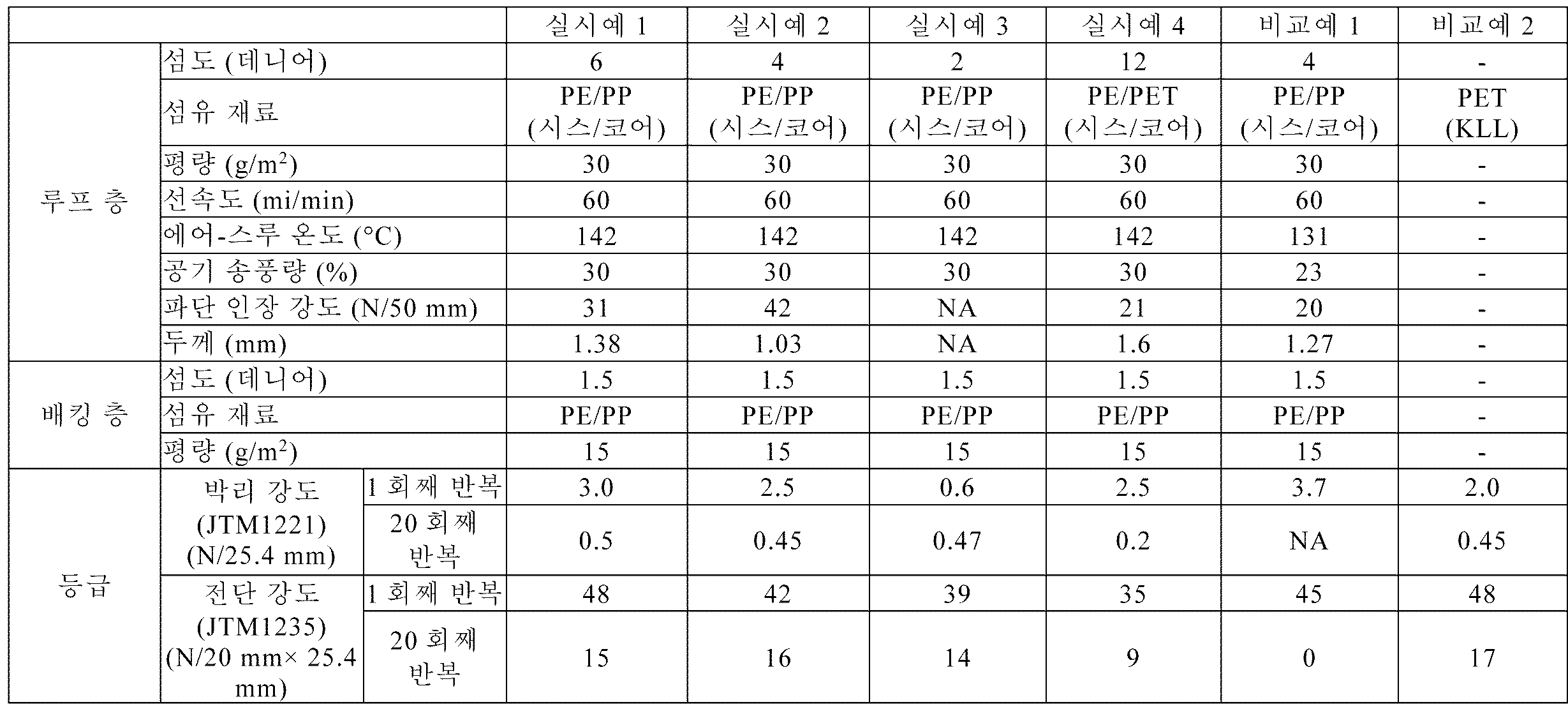
[표 2][Table 2]
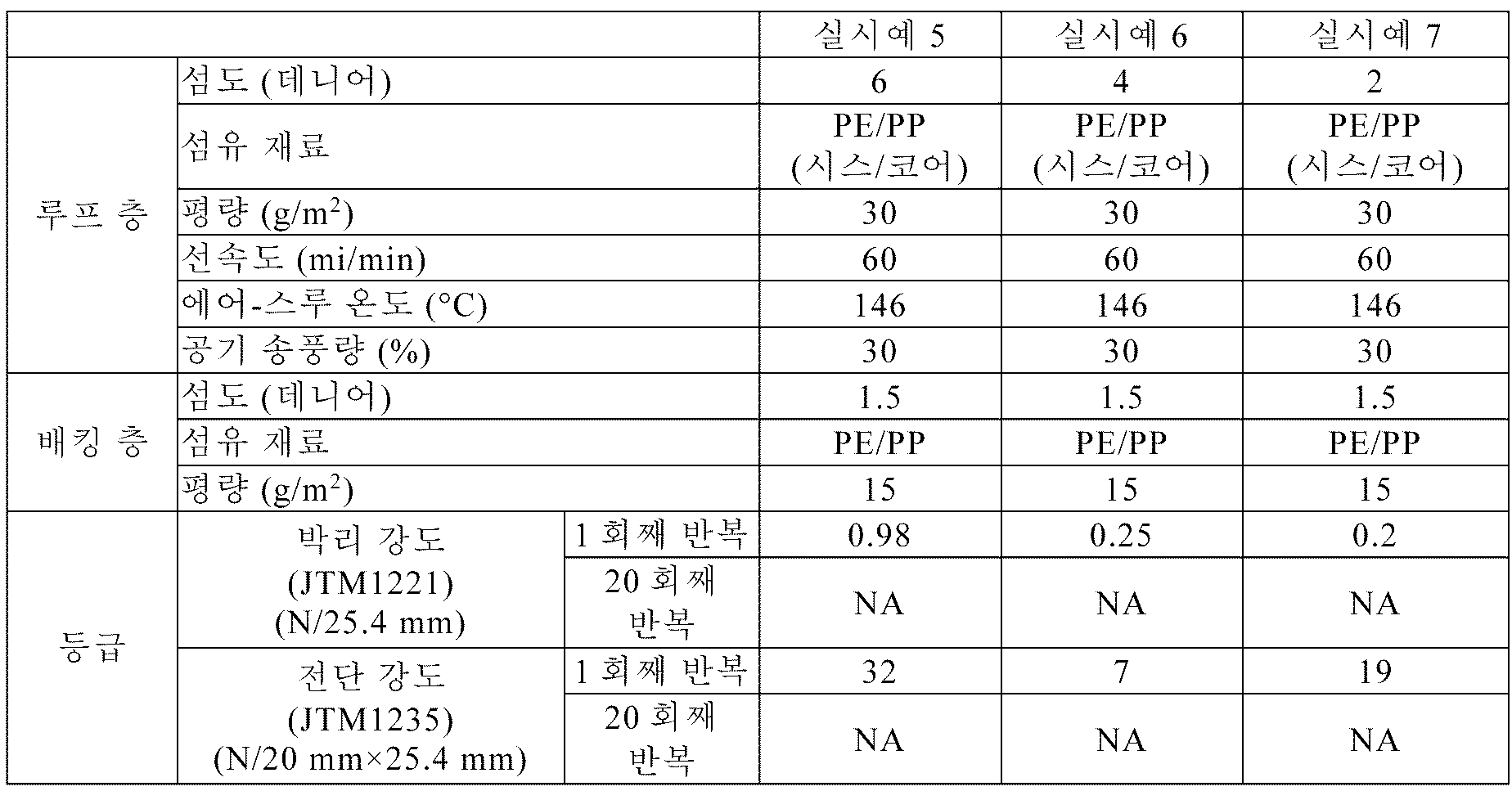
각각의 실시예에 따른 루프 부재에 의해 우수한 박리 강도 및 전단 강도가 나타났다. 실시예 1 내지 실시예 4에 대해, 심지어 분리 및 부착의 20회 반복 후에 우수한 박리 강도 및 전단 강도 (즉, 박리 강도 및 전단 강도의 우수한 지속성)가 나타났다. 각각의 실시예에 대한 박리 강도 및 전단 강도의 지속성은 비교예 2의 편물 루프보다 열등하지 않았다. 한편, 부직포 루프 부재가 사용된 비교예 1에 대해, 박리 시험에서, 루프 층의 라미네이션의 지속성은 10회째 내지 15회째 반복 시에 파괴되거나, 전단 강도는 반복된 분리 및 부착으로 인해 극적으로 감소하였다. 비교예 1에서는, 저온 에어-스루 조건 하에서 루프 층을 형성하였고, 따라서, 루프 층은 실질적으로 융착되지 않았다.Excellent peel strength and shear strength were exhibited by the loop members according to the respective embodiments. For Examples 1 to 4, good peel strength and shear strength (i.e. good persistence of peel strength and shear strength) appeared even after 20 iterations of separation and attachment. The peel strength and continuity of the shear strength for each example were not inferior to those of the knitted loop of Comparative Example 2. [ On the other hand, in Comparative Example 1 in which a nonwoven loop member was used, in the peeling test, the persistence of the lamination of the loop layer was destroyed at the 10th to 15th repetition, or the shear strength was dramatically reduced due to repeated separation and adhesion . In Comparative Example 1, the loop layer was formed under the low-temperature air-through condition, and therefore, the loop layer was not substantially fused.
저온 캘린더링을 거친 배킹 층의 제조Fabrication of backing layer through low temperature calendering
실시예 A1 내지 실시예 A5 및 비교예 A1 내지 비교예 A5Examples A1 to A5 and Comparative Examples A1 to A5
배킹 층을 위한 단섬유 부직포Single-fiber nonwoven for backing layer
하기의 카디드 부직포를 배킹 층에 사용하였다. 시스의 융점은 약 115℃이었고 코어의 융점은 약 163℃이었다.The following carded nonwoven fabric was used for the backing layer. The melting point of the sheath was about 115 캜 and the melting point of the core was about 163 캜.
평균 섬도: 1.5 데니어, 폴리에틸렌 (시스) / 폴리프로필렌 (코어) 2성분 섬유, 섬유 길이: 40 mm, 평량: 15 gsm, 파이버비전스로부터 제조됨.Average fiber size: 1.5 denier, polyethylene (sheath) / polypropylene (core) bicomponent fiber, fiber length: 40 mm, basis weight: 15 gsm, manufactured by Fiber Vision.
평균 섬도: 1.2 데니어, 폴리에틸렌 (시스) / 폴리프로필렌 (코어) 2성분 섬유, 섬유 길이: 40 mm, 평량: 15 gsm, 파이버비전스로부터 구매가능함 (제품: ESC112)Average fiber size: 1.2 denier, polyethylene (sheath) / polypropylene (core) bicomponent fiber, fiber length: 40 mm, basis weight: 15 gsm, available from Fiber Vision (product: ESC112)
배킹 층의 캘린더링Calendering of backing layer
단섬유 부직포를 열 점 접합 롤러에 통과시키고 임시로 고착시킨 후에, 100% 캘린더링 (캘린더 가공)하였다. 따라서, 배킹 층을 위한 단섬유 부직포를 얻었다. 이러한 단섬유 부직포의 섬도 및 캘린더링의 조건이 표 3에 나타난 바와 같다. 실시예 A1 내지 실시예 A5에서와 같이 비교적 저온에서 수행되는 캘린더링을 "저온 캘린더링"으로 지칭한다.The monofilament nonwoven fabric was passed through a hot spot bonding roller and temporarily fixed, followed by 100% calendering (calendaring). Thus, a short-fiber nonwoven fabric for the backing layer was obtained. The fineness and calendering conditions of such a monofilament nonwoven fabric are shown in Table 3. Calendering performed at relatively low temperatures as in Examples A1 through A5 is referred to as "low temperature calendering. &Quot;
저온 캘린더링을 거친 배킹 층을 포함하는 루프 부재의 제조Fabrication of a loop member comprising a backing layer with low temperature calendering
실시예 B1 내지 실시예 B6 및 비교예 B1 및 비교예 B2Examples B1 to B6 and Comparative Examples B1 and B2
루프 층을 위한 단섬유 부직포Single-fiber nonwoven for loop layer
폴리에틸렌 (시스) / 폴리프로필렌 (코어) 2성분 섬유, 평균 섬도: 4 데니어, 섬유 길이: 40 mm, 파이버비전스로부터 제조됨.Polyethylene (cis) / polypropylene (core) bicomponent fiber, average fineness: 4 denier, fiber length: 40 mm, manufactured by Fibervision.
루프 부재의 생성Creation of loop member
전술된 루프 층을 위한 단섬유 부직포 및 저온 캘린더링을 거친 배킹 층을 위한 단섬유 부직포를 적층하고 135℃의 온도 및 5 MPa의 닙 압력에서 패턴 엠보싱하여 라미네이팅하였다. 따라서, 루프 부재를 얻었다.A single-fiber nonwoven fabric for the above-described loop layer and a single-fiber nonwoven fabric for a backing layer having a low temperature calendering were laminated and laminated by pattern embossing at a temperature of 135 캜 and a nip pressure of 5 MPa. Thus, a loop member was obtained.
저온 캘린더링을 거친 배킹 층 및 이를 포함하는 루프 부재의 특성 평가Evaluation of characteristics of backing layer subjected to low-temperature calendering and loop member including the backing layer
1. 전단 강도 및 인장 강도1. Shear Strength and Tensile Strength
"융착된 루프 층을 포함하는 루프 부재의 특성 평가"에서 전술된 것과 동일한 방식으로 전단 강도 및 인장 강도를 평가하였다.Shear strength and tensile strength were evaluated in the same manner as described above in "Evaluation of properties of loop member including fused loop layer ".
2. JIS L1096의 캔틸레버 방법에 따른 유연도2. Flexibility according to the cantilever method of JIS L1096
25 mm × 250 mm의 시험편을 샘플로부터 수집하였다. 시험편의 제1 에지를 캔틸레버-유형 시험 기기의 플랫폼의 전방 단부와 정렬하여 그 상에 배치하였다. 마크 D에 대해 강철 자(steel ruler)의 0점을 조정하고, 이 상태로, 강철 자를 시험 편 상에 배치하였다. 강철 자 및 시험편을 경사면 방향으로 일정 속도로 함께 완만하게 가압하였다. 강철 자를 이동시키고 시험편을 8초간 방치하고, 이어서, 시험편의 돌출 길이를 강철 자에서 판독하였다.A test specimen of 25 mm x 250 mm was collected from the sample. The first edge of the test piece was aligned with and aligned with the front end of the platform of the cantilever-type test instrument. For the mark D, the zero point of the steel ruler was adjusted, and in this state, the steel strip was placed on the test piece. The steel and the test piece were gently pressed together at a constant speed in the direction of the slope. The steel strip was moved and the test piece was left for 8 seconds, and then the protruding length of the test piece was read in the steel strip.
3. KES에 따른 유연도3. Flexibility according to KES
카토 테크(Kato Tech)에 의해 제조된 KESFB2-S를 시험 기기로서 사용하였다. 샘플로부터 시험편을 수집하고 시험 기기에 배치하였다. 따라서, 휨 강성(flexural rigidity) (gf×㎠/cm)을 얻었다. 1 gf×㎠/cm는 0.0098 N×㎠/cm와 동일함에 유의하며, 둘 모두의 값이 표 3에 기록되어 있다. 또한, 표 3에서, "5.4E-05"는, 예를 들어 "5.4×10⁻⁵"를 의미한다.KESFB2-S manufactured by Kato Tech was used as a test instrument. Specimens were collected from the sample and placed in the test instrument. Therefore, the flexural rigidity (gf × ㎠ / cm) was obtained. Note that 1 gf × ㎠ / cm is equal to 0.0098 N × cm 2 / cm, both of which are recorded in Table 3. In Table 3, "5.4E-05" means, for example, "5.4 × 10 -5 ".
4. JIS L1096의 프라지어 방법에 따른 공기 투과성4. Air permeability according to Przier method of JIS L1096
토요 세이키 세이사쿠-쇼 리미티드 (Toyo Seiki Seisaku-Sho. Ltd.)에 의해 제조된 기기를 프라지어-유형 시험 기기로서 사용하였다. 샘플로부터 150 mm×150 mm 시험편을 수집하고, 시험편을 시험 기기의 실린더의 제1 단부에 부착하였다. 이어서, 경사진 기압계가 125 Pa를 나타내도록 가변 저항기를 사용하여 흡입 팬 및 공기 포트를 조정하고, 그 시점에 수직 기압계에 나타난 압력을 측정하였다. 시험 기기에 제공된 변환표를 사용하여, 측정된 압력 및 공기 포트의 유형으로부터 시험편을 통과하는 기류 (㎤/sec×㎠)를 계산하였다.A device manufactured by Toyo Seiki Seisaku-Sho. Ltd. was used as a przier-type test instrument. A 150 mm x 150 mm test specimen was collected from the sample and the specimen was attached to the first end of the cylinder of the test instrument. Subsequently, the intake fan and the air port were adjusted using a variable resistor so that the inclined barometer indicated 125 Pa, and the pressure shown on the vertical barometer was measured at that time. Using the conversion table provided in the test instrument, the air flow through the specimen (cm3 / sec × cm2) was calculated from the measured pressure and type of air port.
[표 3][Table 3]
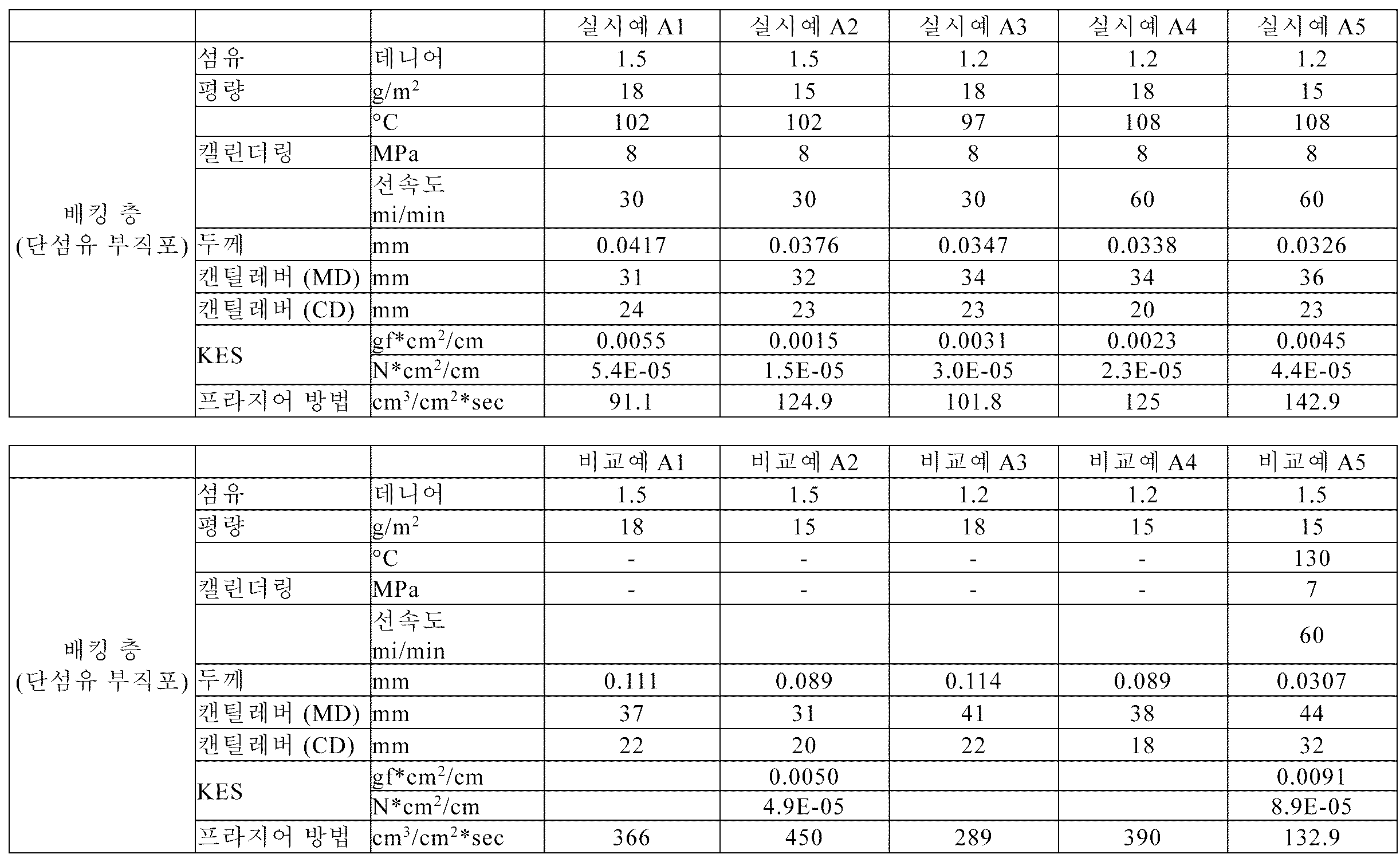
표 3에 나타난 바와 같이, 실시예 A1 내지 실시예 A5에 대해, 캘린더링을 수행하지 않은 비교예 A1 내지 비교예 A5와 비교하여 프라지어 방법의 수치가 낮았다. 즉, 실시예 A1 내지 실시예 A5에 대해, 공기 투과성이 적절히 감소된다. 한편, 130℃에서 캘린더링을 수행한 비교예 A5와 비교하여, 캔틸레버 값 및 KES 값 둘 모두가 낮았으며, 이는 유연도가 증가하였음 (부직포가 부드러워졌음)을 의미한다.As shown in Table 3, with respect to Examples A1 to A5, the values of the Prasij method were lower than those of Comparative Examples A1 to A5 in which calendering was not performed. That is, for Examples A1 to A5, the air permeability is appropriately reduced. On the other hand, both the cantilever value and the KES value were lower than in Comparative Example A5 in which calendering was performed at 130 캜, which means that the flexibility was increased (the nonwoven fabric was softened).
[표 4][Table 4]
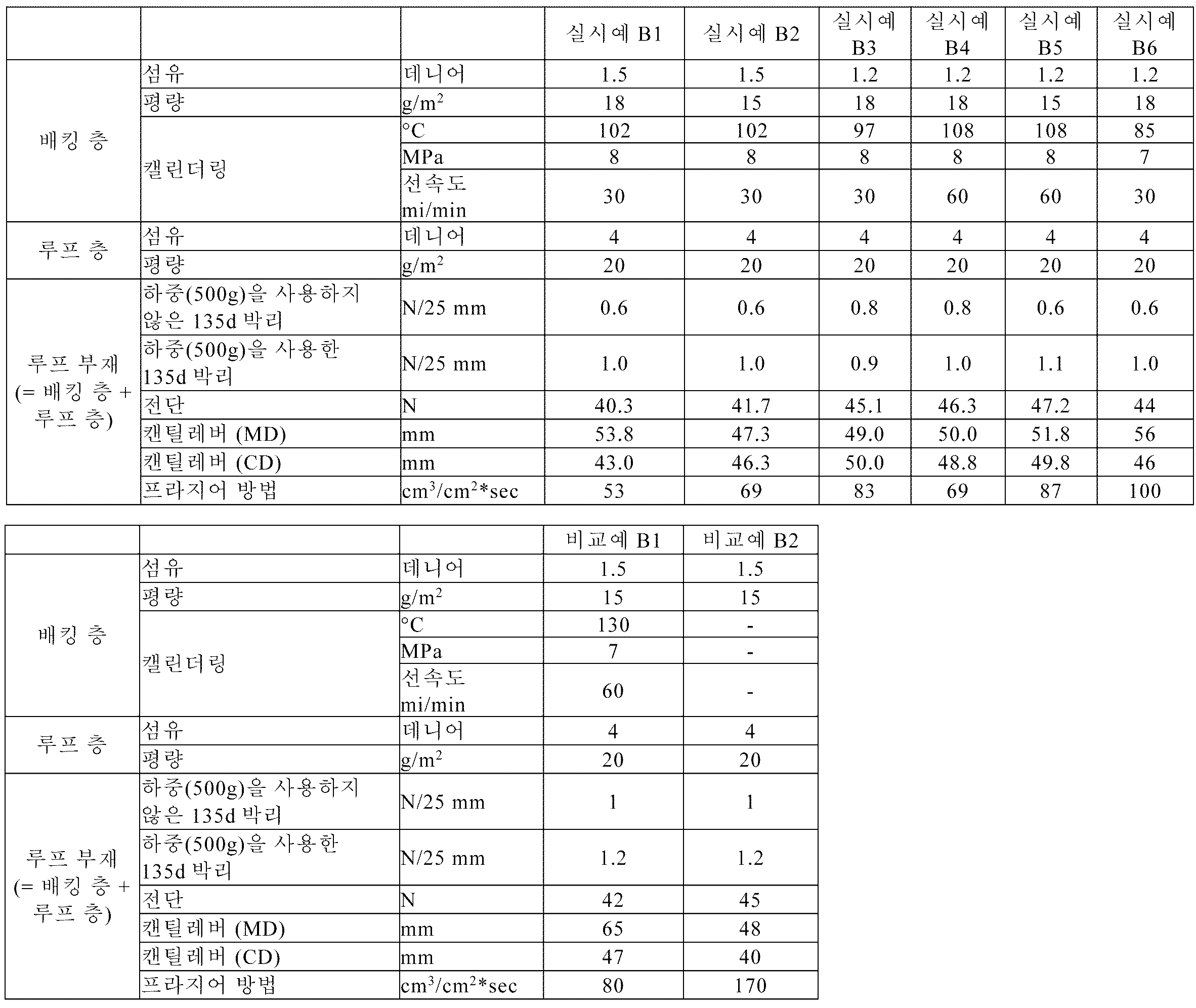
표 4에 나타난 바와 같이, 실시예 B1 내지 실시예 B6에 대해, 프라지어 방법의 수치는 캘린더링을 거치지 않은 배킹 층을 포함하는 비교예 B2와 비교하여 낮았다. 즉, 실시예 B1 내지 실시예 B6에 대해, 공기 투과성이 적절히 감소된다. 한편, 130℃에서 캘린더링된 기자재 층을 포함하는 비교예 B1과 비교하여, 캔틸레버 값은 (특히, 기계 방향에서) 낮았으며, 이는 유연도가 증가하였음 (부직포가 부드러워졌음)을 의미한다.As shown in Table 4, for Examples B1 to B6, the values of the Prazier process were lower compared to Comparative Example B2 which included a backing layer not subjected to calendering. That is, for Examples B1 to B6, the air permeability is appropriately reduced. On the other hand, the cantilever value was lower (in particular in the machine direction), as compared to Comparative Example B1 comprising the material layer calendered at 130 캜, which means that the flexibility was increased (the nonwoven fabric was softened).
고온 에어-스루 가공을 거친 루프 층을, 캘린더링을 거친 배킹 층과 조합한 예 (예를 들어, 성인용 기저귀의 루프 부재로 적합한, 실시예 1 내지 실시예 7); 및 고온 에어-스루 가공을 거치지 않은 루프 층을, 저온 캘린더링을 거친 배킹 층과 조합한 예 (예를 들어, 소아용 기저귀의 루프 부재로 적합한, 실시예 B1 내지 실시예 B6)의 설명을 제공하였다. 이들 이외에, 고온 에어-스루 가공을 거친 루프 층을, 저온 캘린더링을 거친 배킹 층과 조합한 예가 가능하다. 이러한 고온 에어-스루 가공된 루프 층 + 저온 캘린더링된 배킹 층 조합에 따르면, 높은 내구성을 갖는 루프 층을 포함하며 공기 투과성 및 유연성이 적절히 균형을 이루는 루프 부재가 제공된다.(For example, Examples 1 to 7, which are suitable as a loop member of an adult diaper) in which a loop layer subjected to high-temperature air-through processing is combined with a calendered backing layer; And examples in which a loop layer not subjected to hot air-through processing is combined with a backing layer subjected to low-temperature calendering (for example, Examples B1 to B6, which are suitable as loop members of a diaper for children) . In addition to these, examples in which a loop layer subjected to high-temperature air-through processing is combined with a backing layer subjected to low-temperature calendering is possible. This combination of a high temperature air-through looped layer and a low temperature calendered backing layer provides a loop member comprising a loop layer with high durability and with an adequate balance of air permeability and flexibility.
추가로, 고온 에어-스루 가공을 거치지 않은 루프 층과 저온 캘린더링된 배킹 층을 조합한 후에 루프 층 측을 고온 에어-스루 가공하는 것이 또한 가능하다. 그러나, 이 경우에, 고온 에어-스루가 배킹 층을 통과하고 이와 접촉하는 것으로 인해, 저온 캘린더링으로부터 얻어지는 특성이 쉽게 나타날 수 있다. 따라서, 각각의 층의 특성의 차이를 사용하는 관점에서, 전술한 구성이 바람직하다.In addition, it is also possible to hot air-through the loop layer side after combining the low-temperature calendered backing layer with the loop layer not subjected to the high-temperature air-through processing. However, in this case, due to the hot air-through passing through and contacting the backing layer, the properties obtained from the low temperature calendering can easily appear. Therefore, from the viewpoint of using the difference in characteristics of the respective layers, the above-described structure is preferable.
추가로, 재료, 온도, 압력 등은 본 발명의 사상 및 범주 내에서 변화될 수 있다.In addition, materials, temperatures, pressures, etc. may be varied within the spirit and scope of the present invention.
본 발명의 루프 부재는, 예를 들어, 위생 용품 및 특히 성인용 및 소아용 기저귀에 유리하게 사용될 수 있다.The loop member of the present invention can be advantageously used, for example, in sanitary articles and in particular diapers for adults and infants.
Claims (12)
[기재 층의 평균 섬도(fineness) (데니어)]에 대한 [상부 층의 평균 섬도 (데니어)]의 비는 1.5 내지 30이고,
기재의 유연도(softness)는 45도 캔틸레버(cantilever) 방법에 의해 MD 방향에서 60 mm 미만이고 CD 방향에서 50 mm 미만이며,
기재의 공기 투과도는 프라지어(Frajour) 유형 방법에 의해 10 내지 100 ㎤/sec*㎠인, 루프 구성요소.1. A loop component for a mechanical fastener comprising a substrate layer comprising an upper layer comprising a short-fiber nonwoven and a short-fiber nonwoven,
The ratio of the average fineness (denier) of the upper layer to the average fineness (denier) of the base layer is from 1.5 to 30,
The softness of the substrate is less than 60 mm in the MD direction and less than 50 mm in the CD direction by a 45 degree cantilever method,
Wherein air permeability of the substrate is 10 to 100 cm3 / sec * cm < 2 > by the Frajour type method.
루프 층은 제1 융점과 제2 융점 사이의 온도로 융착되는, 루프 구성요소.7. The nonwoven fabric according to claim 6, wherein the short fiber nonwoven fabric in the loop layer comprises a core having a first melting point and a sheath having a second melting point lower than the first melting point,
And the loop layer is fused to a temperature between the first melting point and the second melting point.
Applications Claiming Priority (3)
| Application Number | Priority Date | Filing Date | Title |
|---|---|---|---|
| JPJP-P-2015-253849 | 2015-12-25 | ||
| JP2015253849A JP6838802B2 (en) | 2015-12-25 | 2015-12-25 | Short fiber non-woven fabric, loop member for hook-and-loop fastener and hygiene products |
| PCT/US2016/066809 WO2017112509A1 (en) | 2015-12-25 | 2016-12-15 | Short fiber nonwoven fabric, loop member for surface fastener, and sanitary article |
Publications (1)
| Publication Number | Publication Date |
|---|---|
| KR20180098317A true KR20180098317A (en) | 2018-09-03 |
Family
ID=57796982
Family Applications (1)
| Application Number | Title | Priority Date | Filing Date |
|---|---|---|---|
| KR1020187020943A Withdrawn KR20180098317A (en) | 2015-12-25 | 2016-12-15 | Single-fiber non-woven fabric, loop member for surface fastener, and sanitary article |
Country Status (8)
| Country | Link |
|---|---|
| US (1) | US20190000696A1 (en) |
| EP (1) | EP3393417A1 (en) |
| JP (1) | JP6838802B2 (en) |
| KR (1) | KR20180098317A (en) |
| CN (1) | CN108697566B (en) |
| BR (1) | BR112018013046A2 (en) |
| TW (1) | TWI757262B (en) |
| WO (1) | WO2017112509A1 (en) |
Families Citing this family (6)
| Publication number | Priority date | Publication date | Assignee | Title |
|---|---|---|---|---|
| CN106436025B (en) * | 2016-07-15 | 2019-03-15 | 厦门和洁无纺布制品有限公司 | A kind of non-woven fabric coiled material with printed patterns |
| JP7202772B2 (en) * | 2017-09-22 | 2023-01-12 | 大王製紙株式会社 | Tape type disposable diaper |
| WO2021153642A1 (en) * | 2020-01-29 | 2021-08-05 | クラレファスニング株式会社 | Front-and-back engagement type hook-and-loop fastener with excellent biodegradability |
| DE102020114549A1 (en) * | 2020-05-29 | 2021-12-02 | Mondi Ag | Nonwoven element and manufacturing process |
| WO2022088058A1 (en) * | 2020-10-30 | 2022-05-05 | The Procter & Gamble Company | Absorbent article with hybrid nonwoven web |
| CN116899005B (en) * | 2023-06-27 | 2026-06-19 | 江苏百优达生命科技股份有限公司 | Medical gasket with fiber not easy to fall off and preparation method thereof |
Citations (3)
| Publication number | Priority date | Publication date | Assignee | Title |
|---|---|---|---|---|
| US5470424A (en) | 1993-11-30 | 1995-11-28 | Kimberly-Clark Corporation | Process for forming liquid impermeable sheet material having a fibrous surface and products formed thereby |
| US5786060A (en) | 1995-09-28 | 1998-07-28 | Japan Vilene Company, Ltd. | Female member for face fastener and method of producing the same |
| WO2008130807A1 (en) | 2007-04-17 | 2008-10-30 | Aplix, Inc. | Loop material for loop and hook type fastener used in a disposable article or garment |
Family Cites Families (18)
| Publication number | Priority date | Publication date | Assignee | Title |
|---|---|---|---|---|
| JP3277046B2 (en) * | 1993-10-06 | 2002-04-22 | 三菱製紙株式会社 | Hydro-entangled non-woven fabric and method for producing the same |
| JP3181195B2 (en) * | 1995-06-22 | 2001-07-03 | 大和紡績株式会社 | Nonwoven fabric and surface fastener female material having irregularities on the surface and method for producing the same |
| JP3222833B2 (en) * | 1998-05-26 | 2001-10-29 | 花王株式会社 | Nonwoven fabric and absorbent article using the same |
| WO1999060881A1 (en) * | 1998-05-26 | 1999-12-02 | Kao Corporation | Fastener and absorbing article using it |
| ES2291509T3 (en) * | 2001-06-12 | 2008-03-01 | Velcro Industries B.V. | LOOP MATERIALS FOR CLOSURE BY CONTACT. |
| JP2004261332A (en) * | 2003-02-28 | 2004-09-24 | Daio Paper Corp | Absorptive article and absorbing pad holder |
| JP2004267257A (en) * | 2003-03-05 | 2004-09-30 | Daio Paper Corp | Disposable paper diaper |
| US7981822B2 (en) * | 2004-07-21 | 2011-07-19 | Aplix S.A. | Hook and loop fastener device |
| DE102004053469A1 (en) * | 2004-11-03 | 2006-05-04 | Paul Hartmann Ag | Loop forming nonwoven material for a mechanical closure |
| JP4620604B2 (en) * | 2006-02-20 | 2011-01-26 | 日本バイリーン株式会社 | Substrate for printing |
| JP2007284838A (en) * | 2006-04-19 | 2007-11-01 | Daiwabo Co Ltd | Hydroentangled nonwoven fabric and wiping cloth |
| JP2009209496A (en) * | 2008-03-06 | 2009-09-17 | Toray Ind Inc | Needle punched nonwoven fabric |
| JP5605148B2 (en) * | 2010-10-12 | 2014-10-15 | 東洋紡株式会社 | Non-woven fabric for foam molded article reinforcement and method for producing the same |
| DK2505707T3 (en) * | 2011-04-01 | 2013-10-21 | Rkw Se | Use of spun lacquered nonwoven material as a cage closure component |
| JP5796336B2 (en) * | 2011-04-28 | 2015-10-21 | Jnc株式会社 | Uneven stretch nonwoven fabric |
| WO2015073374A1 (en) * | 2013-11-12 | 2015-05-21 | 3M Innovative Properties Company | Loop components for hook-and-loop fasteners and methods of making the same |
| JP6509506B2 (en) * | 2014-07-09 | 2019-05-08 | スリーエム イノベイティブ プロパティズ カンパニー | Loop members for surface fasteners and sanitary products |
| JP6714982B2 (en) * | 2014-08-15 | 2020-07-01 | 旭化成株式会社 | Bulky composite long fiber non-woven fabric |
-
2015
- 2015-12-25 JP JP2015253849A patent/JP6838802B2/en active Active
-
2016
- 2016-12-15 WO PCT/US2016/066809 patent/WO2017112509A1/en not_active Ceased
- 2016-12-15 US US16/064,469 patent/US20190000696A1/en not_active Abandoned
- 2016-12-15 CN CN201680075634.0A patent/CN108697566B/en active Active
- 2016-12-15 KR KR1020187020943A patent/KR20180098317A/en not_active Withdrawn
- 2016-12-15 BR BR112018013046A patent/BR112018013046A2/en not_active Application Discontinuation
- 2016-12-15 EP EP16826230.1A patent/EP3393417A1/en not_active Withdrawn
- 2016-12-23 TW TW105142893A patent/TWI757262B/en not_active IP Right Cessation
Patent Citations (3)
| Publication number | Priority date | Publication date | Assignee | Title |
|---|---|---|---|---|
| US5470424A (en) | 1993-11-30 | 1995-11-28 | Kimberly-Clark Corporation | Process for forming liquid impermeable sheet material having a fibrous surface and products formed thereby |
| US5786060A (en) | 1995-09-28 | 1998-07-28 | Japan Vilene Company, Ltd. | Female member for face fastener and method of producing the same |
| WO2008130807A1 (en) | 2007-04-17 | 2008-10-30 | Aplix, Inc. | Loop material for loop and hook type fastener used in a disposable article or garment |
Also Published As
| Publication number | Publication date |
|---|---|
| WO2017112509A1 (en) | 2017-06-29 |
| JP2017113391A (en) | 2017-06-29 |
| CN108697566B (en) | 2022-05-10 |
| TWI757262B (en) | 2022-03-11 |
| EP3393417A1 (en) | 2018-10-31 |
| BR112018013046A2 (en) | 2018-12-04 |
| JP6838802B2 (en) | 2021-03-03 |
| US20190000696A1 (en) | 2019-01-03 |
| CN108697566A (en) | 2018-10-23 |
| TW201736658A (en) | 2017-10-16 |
Similar Documents
| Publication | Publication Date | Title |
|---|---|---|
| JP6509506B2 (en) | Loop members for surface fasteners and sanitary products | |
| TWI280869B (en) | Foam-based fasteners | |
| TWI757262B (en) | Short fiber nonwoven fabric, loop member for surface fastener, and sanitary article | |
| RU2724844C1 (en) | Absorbent product | |
| KR101455440B1 (en) | Female member for hook-and-loop fastener, hook-and-loop fastener employing the female member, and absorbent article employing the hook-and-loop fastener | |
| RU2713963C1 (en) | Multilayer nonwoven material, method for its production, absorbent article and sweat absorbing sheet | |
| JP5884733B2 (en) | Laminated nonwoven fabric and its products | |
| CN109906068B (en) | Ring members and diapers | |
| JP2015119782A (en) | Fixing member for hook-and-loop fastener, manufacturing method thereof, and sanitary article | |
| CN107923093B (en) | Ring members for surface fasteners and adult diapers | |
| JP5514536B2 (en) | Disposable diapers | |
| CN107708469A (en) | The female component of face touch fasteners | |
| CN107708470A (en) | The female component of face touch fasteners | |
| KR20090060688A (en) | Joining loop nonwoven fabric and manufacturing method thereof | |
| JP2002159532A (en) | Absorbent articles |
Legal Events
| Date | Code | Title | Description |
|---|---|---|---|
| PA0105 | International application |
Patent event date: 20180720 Patent event code: PA01051R01D Comment text: International Patent Application |
|
| PG1501 | Laying open of application | ||
| PC1203 | Withdrawal of no request for examination | ||
| WITN | Application deemed withdrawn, e.g. because no request for examination was filed or no examination fee was paid |