KR20180098232A - Laminate and optical article using the laminate - Google Patents
Laminate and optical article using the laminate Download PDFInfo
- Publication number
- KR20180098232A KR20180098232A KR1020187014517A KR20187014517A KR20180098232A KR 20180098232 A KR20180098232 A KR 20180098232A KR 1020187014517 A KR1020187014517 A KR 1020187014517A KR 20187014517 A KR20187014517 A KR 20187014517A KR 20180098232 A KR20180098232 A KR 20180098232A
- Authority
- KR
- South Korea
- Prior art keywords
- compound
- adhesive layer
- photochromic
- laminate
- film
- Prior art date
- Legal status (The legal status is an assumption and is not a legal conclusion. Google has not performed a legal analysis and makes no representation as to the accuracy of the status listed.)
- Ceased
Links
- 230000003287 optical effect Effects 0.000 title claims abstract description 136
- 239000012790 adhesive layer Substances 0.000 claims abstract description 251
- 239000000203 mixture Substances 0.000 claims abstract description 228
- 150000001875 compounds Chemical class 0.000 claims abstract description 199
- 229920005989 resin Polymers 0.000 claims abstract description 135
- 239000011347 resin Substances 0.000 claims abstract description 135
- 229920003226 polyurethane urea Polymers 0.000 claims abstract description 134
- 239000010410 layer Substances 0.000 claims abstract description 82
- 229920000515 polycarbonate Polymers 0.000 claims description 105
- 239000004417 polycarbonate Substances 0.000 claims description 105
- IQPQWNKOIGAROB-UHFFFAOYSA-N isocyanate group Chemical group [N-]=C=O IQPQWNKOIGAROB-UHFFFAOYSA-N 0.000 claims description 84
- -1 isocyanurate compound Chemical class 0.000 claims description 81
- 238000000034 method Methods 0.000 claims description 48
- RRAMGCGOFNQTLD-UHFFFAOYSA-N hexamethylene diisocyanate Chemical group O=C=NCCCCCCN=C=O RRAMGCGOFNQTLD-UHFFFAOYSA-N 0.000 claims description 39
- 239000005057 Hexamethylene diisocyanate Chemical group 0.000 claims description 37
- JOYRKODLDBILNP-UHFFFAOYSA-N Ethyl urethane Chemical compound CCOC(N)=O JOYRKODLDBILNP-UHFFFAOYSA-N 0.000 claims description 25
- 239000005056 polyisocyanate Substances 0.000 claims description 25
- 229920001228 polyisocyanate Polymers 0.000 claims description 25
- 229920000768 polyamine Polymers 0.000 claims description 20
- 229920005749 polyurethane resin Polymers 0.000 claims description 20
- 229920002284 Cellulose triacetate Polymers 0.000 claims description 18
- NNLVGZFZQQXQNW-ADJNRHBOSA-N [(2r,3r,4s,5r,6s)-4,5-diacetyloxy-3-[(2s,3r,4s,5r,6r)-3,4,5-triacetyloxy-6-(acetyloxymethyl)oxan-2-yl]oxy-6-[(2r,3r,4s,5r,6s)-4,5,6-triacetyloxy-2-(acetyloxymethyl)oxan-3-yl]oxyoxan-2-yl]methyl acetate Chemical compound O([C@@H]1O[C@@H]([C@H]([C@H](OC(C)=O)[C@H]1OC(C)=O)O[C@H]1[C@@H]([C@@H](OC(C)=O)[C@H](OC(C)=O)[C@@H](COC(C)=O)O1)OC(C)=O)COC(=O)C)[C@@H]1[C@@H](COC(C)=O)O[C@@H](OC(C)=O)[C@H](OC(C)=O)[C@H]1OC(C)=O NNLVGZFZQQXQNW-ADJNRHBOSA-N 0.000 claims description 18
- 125000003277 amino group Chemical group 0.000 claims description 15
- 229910052799 carbon Inorganic materials 0.000 claims description 10
- OKTJSMMVPCPJKN-UHFFFAOYSA-N Carbon Chemical group [C] OKTJSMMVPCPJKN-UHFFFAOYSA-N 0.000 claims description 9
- 239000011342 resin composition Substances 0.000 claims 1
- 229920006289 polycarbonate film Polymers 0.000 abstract description 11
- 239000000758 substrate Substances 0.000 abstract description 9
- 239000010408 film Substances 0.000 description 206
- 238000006243 chemical reaction Methods 0.000 description 74
- 238000002834 transmittance Methods 0.000 description 65
- 230000001070 adhesive effect Effects 0.000 description 50
- 239000000853 adhesive Substances 0.000 description 49
- 238000012360 testing method Methods 0.000 description 48
- 229920005862 polyol Polymers 0.000 description 47
- 238000005452 bending Methods 0.000 description 44
- 230000010287 polarization Effects 0.000 description 43
- 229920003023 plastic Polymers 0.000 description 42
- 239000004033 plastic Substances 0.000 description 42
- 150000003077 polyols Chemical class 0.000 description 40
- 238000011161 development Methods 0.000 description 36
- ZMXDDKWLCZADIW-UHFFFAOYSA-N N,N-Dimethylformamide Chemical compound CN(C)C=O ZMXDDKWLCZADIW-UHFFFAOYSA-N 0.000 description 33
- 239000012298 atmosphere Substances 0.000 description 33
- 239000003960 organic solvent Substances 0.000 description 30
- 125000004432 carbon atom Chemical group C* 0.000 description 25
- 238000001746 injection moulding Methods 0.000 description 25
- 238000002156 mixing Methods 0.000 description 25
- 239000000243 solution Substances 0.000 description 25
- 125000000217 alkyl group Chemical group 0.000 description 22
- 238000004519 manufacturing process Methods 0.000 description 22
- YXFVVABEGXRONW-UHFFFAOYSA-N Toluene Chemical compound CC1=CC=CC=C1 YXFVVABEGXRONW-UHFFFAOYSA-N 0.000 description 21
- 238000011156 evaluation Methods 0.000 description 21
- 239000002253 acid Substances 0.000 description 19
- KORSJDCBLAPZEQ-UHFFFAOYSA-N dicyclohexylmethane-4,4'-diisocyanate Chemical compound C1CC(N=C=O)CCC1CC1CCC(N=C=O)CC1 KORSJDCBLAPZEQ-UHFFFAOYSA-N 0.000 description 18
- 238000005562 fading Methods 0.000 description 18
- 239000007767 bonding agent Substances 0.000 description 17
- 125000002887 hydroxy group Chemical group [H]O* 0.000 description 17
- 229920005668 polycarbonate resin Polymers 0.000 description 15
- 239000004431 polycarbonate resin Substances 0.000 description 15
- WYURNTSHIVDZCO-UHFFFAOYSA-N Tetrahydrofuran Chemical compound C1CCOC1 WYURNTSHIVDZCO-UHFFFAOYSA-N 0.000 description 14
- MTHSVFCYNBDYFN-UHFFFAOYSA-N diethylene glycol Chemical compound OCCOCCO MTHSVFCYNBDYFN-UHFFFAOYSA-N 0.000 description 14
- 229920003171 Poly (ethylene oxide) Polymers 0.000 description 13
- 230000000694 effects Effects 0.000 description 13
- LYCAIKOWRPUZTN-UHFFFAOYSA-N Ethylene glycol Chemical compound OCCO LYCAIKOWRPUZTN-UHFFFAOYSA-N 0.000 description 12
- 125000003118 aryl group Chemical group 0.000 description 12
- FDPIMTJIUBPUKL-UHFFFAOYSA-N pentan-3-one Chemical compound CCC(=O)CC FDPIMTJIUBPUKL-UHFFFAOYSA-N 0.000 description 12
- IJGRMHOSHXDMSA-UHFFFAOYSA-N Atomic nitrogen Chemical compound N#N IJGRMHOSHXDMSA-UHFFFAOYSA-N 0.000 description 11
- LFQSCWFLJHTTHZ-UHFFFAOYSA-N Ethanol Chemical compound CCO LFQSCWFLJHTTHZ-UHFFFAOYSA-N 0.000 description 11
- 239000004721 Polyphenylene oxide Substances 0.000 description 11
- 125000003710 aryl alkyl group Chemical group 0.000 description 11
- 125000003386 piperidinyl group Chemical group 0.000 description 11
- 229920000570 polyether Polymers 0.000 description 11
- 239000004094 surface-active agent Substances 0.000 description 11
- IAZDPXIOMUYVGZ-UHFFFAOYSA-N Dimethylsulphoxide Chemical compound CS(C)=O IAZDPXIOMUYVGZ-UHFFFAOYSA-N 0.000 description 10
- 229920001610 polycaprolactone Polymers 0.000 description 10
- 239000004632 polycaprolactone Substances 0.000 description 10
- 238000002360 preparation method Methods 0.000 description 10
- ZWEHNKRNPOVVGH-UHFFFAOYSA-N 2-Butanone Chemical compound CCC(C)=O ZWEHNKRNPOVVGH-UHFFFAOYSA-N 0.000 description 9
- XEKOWRVHYACXOJ-UHFFFAOYSA-N Ethyl acetate Chemical compound CCOC(C)=O XEKOWRVHYACXOJ-UHFFFAOYSA-N 0.000 description 9
- PEDCQBHIVMGVHV-UHFFFAOYSA-N Glycerine Chemical compound OCC(O)CO PEDCQBHIVMGVHV-UHFFFAOYSA-N 0.000 description 9
- KFZMGEQAYNKOFK-UHFFFAOYSA-N Isopropanol Chemical compound CC(C)O KFZMGEQAYNKOFK-UHFFFAOYSA-N 0.000 description 9
- OKKJLVBELUTLKV-UHFFFAOYSA-N Methanol Chemical compound OC OKKJLVBELUTLKV-UHFFFAOYSA-N 0.000 description 9
- 239000004372 Polyvinyl alcohol Substances 0.000 description 9
- BTANRVKWQNVYAZ-UHFFFAOYSA-N butan-2-ol Chemical compound CCC(C)O BTANRVKWQNVYAZ-UHFFFAOYSA-N 0.000 description 9
- 238000001035 drying Methods 0.000 description 9
- 239000000194 fatty acid Substances 0.000 description 9
- 125000004435 hydrogen atom Chemical group [H]* 0.000 description 9
- VLKZOEOYAKHREP-UHFFFAOYSA-N n-Hexane Chemical compound CCCCCC VLKZOEOYAKHREP-UHFFFAOYSA-N 0.000 description 9
- 229910052757 nitrogen Inorganic materials 0.000 description 9
- 229920002451 polyvinyl alcohol Polymers 0.000 description 9
- 239000000047 product Substances 0.000 description 9
- IMNIMPAHZVJRPE-UHFFFAOYSA-N triethylenediamine Chemical compound C1CN2CCN1CC2 IMNIMPAHZVJRPE-UHFFFAOYSA-N 0.000 description 9
- XKRFYHLGVUSROY-UHFFFAOYSA-N Argon Chemical compound [Ar] XKRFYHLGVUSROY-UHFFFAOYSA-N 0.000 description 8
- 125000004453 alkoxycarbonyl group Chemical group 0.000 description 8
- 239000003963 antioxidant agent Substances 0.000 description 8
- 239000004202 carbamide Substances 0.000 description 8
- 238000004040 coloring Methods 0.000 description 8
- 235000014113 dietary fatty acids Nutrition 0.000 description 8
- 229930195729 fatty acid Natural products 0.000 description 8
- 239000007788 liquid Substances 0.000 description 8
- DNIAPMSPPWPWGF-UHFFFAOYSA-N monopropylene glycol Natural products CC(O)CO DNIAPMSPPWPWGF-UHFFFAOYSA-N 0.000 description 8
- 229920005906 polyester polyol Polymers 0.000 description 8
- 229920005992 thermoplastic resin Polymers 0.000 description 8
- DKGAVHZHDRPRBM-UHFFFAOYSA-N Tert-Butanol Chemical compound CC(C)(C)O DKGAVHZHDRPRBM-UHFFFAOYSA-N 0.000 description 7
- 229920001807 Urea-formaldehyde Polymers 0.000 description 7
- 125000002947 alkylene group Chemical group 0.000 description 7
- 239000003153 chemical reaction reagent Substances 0.000 description 7
- 239000000975 dye Substances 0.000 description 7
- 238000010438 heat treatment Methods 0.000 description 7
- 239000002985 plastic film Substances 0.000 description 7
- 230000006641 stabilisation Effects 0.000 description 7
- 238000011105 stabilization Methods 0.000 description 7
- YLQBMQCUIZJEEH-UHFFFAOYSA-N tetrahydrofuran Natural products C=1C=COC=1 YLQBMQCUIZJEEH-UHFFFAOYSA-N 0.000 description 7
- ZCYVEMRRCGMTRW-UHFFFAOYSA-N 7553-56-2 Chemical compound [I] ZCYVEMRRCGMTRW-UHFFFAOYSA-N 0.000 description 6
- CSCPPACGZOOCGX-UHFFFAOYSA-N Acetone Chemical compound CC(C)=O CSCPPACGZOOCGX-UHFFFAOYSA-N 0.000 description 6
- IMNFDUFMRHMDMM-UHFFFAOYSA-N N-Heptane Chemical compound CCCCCCC IMNFDUFMRHMDMM-UHFFFAOYSA-N 0.000 description 6
- 150000001412 amines Chemical class 0.000 description 6
- WERYXYBDKMZEQL-UHFFFAOYSA-N butane-1,4-diol Chemical compound OCCCCO WERYXYBDKMZEQL-UHFFFAOYSA-N 0.000 description 6
- 239000011248 coating agent Substances 0.000 description 6
- 238000000576 coating method Methods 0.000 description 6
- JHIVVAPYMSGYDF-UHFFFAOYSA-N cyclohexanone Chemical compound O=C1CCCCC1 JHIVVAPYMSGYDF-UHFFFAOYSA-N 0.000 description 6
- 229910052740 iodine Inorganic materials 0.000 description 6
- 239000011630 iodine Substances 0.000 description 6
- 238000010030 laminating Methods 0.000 description 6
- VNWKTOKETHGBQD-UHFFFAOYSA-N methane Chemical compound C VNWKTOKETHGBQD-UHFFFAOYSA-N 0.000 description 6
- 125000002496 methyl group Chemical group [H]C([H])([H])* 0.000 description 6
- WSTNFGAKGUERTC-UHFFFAOYSA-N n-ethylhexan-1-amine Chemical compound CCCCCCNCC WSTNFGAKGUERTC-UHFFFAOYSA-N 0.000 description 6
- 125000001997 phenyl group Chemical group [H]C1=C([H])C([H])=C(*)C([H])=C1[H] 0.000 description 6
- 229920002635 polyurethane Polymers 0.000 description 6
- 239000004814 polyurethane Substances 0.000 description 6
- 230000008569 process Effects 0.000 description 6
- 238000012545 processing Methods 0.000 description 6
- 239000000523 sample Substances 0.000 description 6
- 238000003756 stirring Methods 0.000 description 6
- 239000013589 supplement Substances 0.000 description 6
- 125000003396 thiol group Chemical group [H]S* 0.000 description 6
- XLYOFNOQVPJJNP-UHFFFAOYSA-N water Substances O XLYOFNOQVPJJNP-UHFFFAOYSA-N 0.000 description 6
- 239000005058 Isophorone diisocyanate Substances 0.000 description 5
- 239000002585 base Substances 0.000 description 5
- 230000000052 comparative effect Effects 0.000 description 5
- 238000013329 compounding Methods 0.000 description 5
- 230000006870 function Effects 0.000 description 5
- 235000011187 glycerol Nutrition 0.000 description 5
- 239000001257 hydrogen Substances 0.000 description 5
- 229910052739 hydrogen Inorganic materials 0.000 description 5
- NIMLQBUJDJZYEJ-UHFFFAOYSA-N isophorone diisocyanate Chemical compound CC1(C)CC(N=C=O)CC(C)(CN=C=O)C1 NIMLQBUJDJZYEJ-UHFFFAOYSA-N 0.000 description 5
- 239000012299 nitrogen atmosphere Substances 0.000 description 5
- 150000003254 radicals Chemical class 0.000 description 5
- 239000002904 solvent Substances 0.000 description 5
- ARXJGSRGQADJSQ-UHFFFAOYSA-N 1-methoxypropan-2-ol Chemical compound COCC(C)O ARXJGSRGQADJSQ-UHFFFAOYSA-N 0.000 description 4
- RNLHGQLZWXBQNY-UHFFFAOYSA-N 3-(aminomethyl)-3,5,5-trimethylcyclohexan-1-amine Chemical compound CC1(C)CC(N)CC(C)(CN)C1 RNLHGQLZWXBQNY-UHFFFAOYSA-N 0.000 description 4
- DZIHTWJGPDVSGE-UHFFFAOYSA-N 4-[(4-aminocyclohexyl)methyl]cyclohexan-1-amine Chemical compound C1CC(N)CCC1CC1CCC(N)CC1 DZIHTWJGPDVSGE-UHFFFAOYSA-N 0.000 description 4
- 239000004970 Chain extender Substances 0.000 description 4
- LRHPLDYGYMQRHN-UHFFFAOYSA-N N-Butanol Chemical compound CCCCO LRHPLDYGYMQRHN-UHFFFAOYSA-N 0.000 description 4
- 239000000654 additive Substances 0.000 description 4
- 150000001298 alcohols Chemical class 0.000 description 4
- 229910052786 argon Inorganic materials 0.000 description 4
- 239000003054 catalyst Substances 0.000 description 4
- 238000001816 cooling Methods 0.000 description 4
- 238000001723 curing Methods 0.000 description 4
- 230000006866 deterioration Effects 0.000 description 4
- 238000010586 diagram Methods 0.000 description 4
- 125000005843 halogen group Chemical group 0.000 description 4
- 239000011261 inert gas Substances 0.000 description 4
- 230000000977 initiatory effect Effects 0.000 description 4
- 230000004899 motility Effects 0.000 description 4
- 239000012788 optical film Substances 0.000 description 4
- 229920000139 polyethylene terephthalate Polymers 0.000 description 4
- 239000005020 polyethylene terephthalate Substances 0.000 description 4
- 229920000642 polymer Polymers 0.000 description 4
- 235000013772 propylene glycol Nutrition 0.000 description 4
- 230000035484 reaction time Effects 0.000 description 4
- 239000000126 substance Substances 0.000 description 4
- RTTZISZSHSCFRH-UHFFFAOYSA-N 1,3-bis(isocyanatomethyl)benzene Chemical compound O=C=NCC1=CC=CC(CN=C=O)=C1 RTTZISZSHSCFRH-UHFFFAOYSA-N 0.000 description 3
- CDMDQYCEEKCBGR-UHFFFAOYSA-N 1,4-diisocyanatocyclohexane Chemical compound O=C=NC1CCC(N=C=O)CC1 CDMDQYCEEKCBGR-UHFFFAOYSA-N 0.000 description 3
- CGCVLTOGUMLHNP-UHFFFAOYSA-N 2,3-dimethylbutane-2,3-diamine Chemical compound CC(C)(N)C(C)(C)N CGCVLTOGUMLHNP-UHFFFAOYSA-N 0.000 description 3
- YSWBFLWKAIRHEI-UHFFFAOYSA-N 4,5-dimethyl-1h-imidazole Chemical compound CC=1N=CNC=1C YSWBFLWKAIRHEI-UHFFFAOYSA-N 0.000 description 3
- OMAUSUKGZFZKBA-UHFFFAOYSA-N 5,5,6-trimethylheptane-1,6-diamine Chemical compound CC(C)(N)C(C)(C)CCCCN OMAUSUKGZFZKBA-UHFFFAOYSA-N 0.000 description 3
- QTBSBXVTEAMEQO-UHFFFAOYSA-N Acetic acid Chemical compound CC(O)=O QTBSBXVTEAMEQO-UHFFFAOYSA-N 0.000 description 3
- UHOVQNZJYSORNB-UHFFFAOYSA-N Benzene Chemical compound C1=CC=CC=C1 UHOVQNZJYSORNB-UHFFFAOYSA-N 0.000 description 3
- WWZKQHOCKIZLMA-UHFFFAOYSA-N Caprylic acid Natural products CCCCCCCC(O)=O WWZKQHOCKIZLMA-UHFFFAOYSA-N 0.000 description 3
- RTZKZFJDLAIYFH-UHFFFAOYSA-N Diethyl ether Chemical compound CCOCC RTZKZFJDLAIYFH-UHFFFAOYSA-N 0.000 description 3
- NTIZESTWPVYFNL-UHFFFAOYSA-N Methyl isobutyl ketone Chemical compound CC(C)CC(C)=O NTIZESTWPVYFNL-UHFFFAOYSA-N 0.000 description 3
- UIHCLUNTQKBZGK-UHFFFAOYSA-N Methyl isobutyl ketone Natural products CCC(C)C(C)=O UIHCLUNTQKBZGK-UHFFFAOYSA-N 0.000 description 3
- ZJCCRDAZUWHFQH-UHFFFAOYSA-N Trimethylolpropane Chemical compound CCC(CO)(CO)CO ZJCCRDAZUWHFQH-UHFFFAOYSA-N 0.000 description 3
- 238000002835 absorbance Methods 0.000 description 3
- 239000006096 absorbing agent Substances 0.000 description 3
- 150000005215 alkyl ethers Chemical class 0.000 description 3
- 125000001797 benzyl group Chemical group [H]C1=C([H])C([H])=C(C([H])=C1[H])C([H])([H])* 0.000 description 3
- HQABUPZFAYXKJW-UHFFFAOYSA-N butan-1-amine Chemical compound CCCCN HQABUPZFAYXKJW-UHFFFAOYSA-N 0.000 description 3
- 125000003178 carboxy group Chemical group [H]OC(*)=O 0.000 description 3
- 125000002057 carboxymethyl group Chemical group [H]OC(=O)C([H])([H])[*] 0.000 description 3
- 239000007795 chemical reaction product Substances 0.000 description 3
- 239000003795 chemical substances by application Substances 0.000 description 3
- 239000000470 constituent Substances 0.000 description 3
- 150000004985 diamines Chemical class 0.000 description 3
- UAOMVDZJSHZZME-UHFFFAOYSA-N diisopropylamine Chemical compound CC(C)NC(C)C UAOMVDZJSHZZME-UHFFFAOYSA-N 0.000 description 3
- 229910001873 dinitrogen Inorganic materials 0.000 description 3
- 150000002009 diols Chemical class 0.000 description 3
- WOZUGDXHVLSOHV-UHFFFAOYSA-L dodecanoate tin(4+) Chemical compound [Sn+4].C(CCCCCCCCCCC)(=O)[O-].C(CCCCCCCCCCC)(=O)[O-].[Sn+4] WOZUGDXHVLSOHV-UHFFFAOYSA-L 0.000 description 3
- 125000001495 ethyl group Chemical group [H]C([H])([H])C([H])([H])* 0.000 description 3
- 239000004744 fabric Substances 0.000 description 3
- 125000004051 hexyl group Chemical group [H]C([H])([H])C([H])([H])C([H])([H])C([H])([H])C([H])([H])C([H])([H])* 0.000 description 3
- 239000012535 impurity Substances 0.000 description 3
- PNDPGZBMCMUPRI-UHFFFAOYSA-N iodine Chemical compound II PNDPGZBMCMUPRI-UHFFFAOYSA-N 0.000 description 3
- 239000012948 isocyanate Substances 0.000 description 3
- 125000001449 isopropyl group Chemical group [H]C([H])([H])C([H])(*)C([H])([H])[H] 0.000 description 3
- 239000000463 material Substances 0.000 description 3
- FUZZWVXGSFPDMH-UHFFFAOYSA-N n-hexanoic acid Natural products CCCCCC(O)=O FUZZWVXGSFPDMH-UHFFFAOYSA-N 0.000 description 3
- 239000002736 nonionic surfactant Substances 0.000 description 3
- 125000001147 pentyl group Chemical group C(CCCC)* 0.000 description 3
- ISWSIDIOOBJBQZ-UHFFFAOYSA-N phenol group Chemical group C1(=CC=CC=C1)O ISWSIDIOOBJBQZ-UHFFFAOYSA-N 0.000 description 3
- 239000004014 plasticizer Substances 0.000 description 3
- NLKNQRATVPKPDG-UHFFFAOYSA-M potassium iodide Chemical compound [K+].[I-] NLKNQRATVPKPDG-UHFFFAOYSA-M 0.000 description 3
- BDERNNFJNOPAEC-UHFFFAOYSA-N propan-1-ol Chemical compound CCCO BDERNNFJNOPAEC-UHFFFAOYSA-N 0.000 description 3
- 125000001424 substituent group Chemical group 0.000 description 3
- 150000005846 sugar alcohols Polymers 0.000 description 3
- 230000002194 synthesizing effect Effects 0.000 description 3
- 238000011191 terminal modification Methods 0.000 description 3
- 125000000999 tert-butyl group Chemical group [H]C([H])([H])C(*)(C([H])([H])[H])C([H])([H])[H] 0.000 description 3
- RMVRSNDYEFQCLF-UHFFFAOYSA-N thiophenol Chemical compound SC1=CC=CC=C1 RMVRSNDYEFQCLF-UHFFFAOYSA-N 0.000 description 3
- 239000000326 ultraviolet stabilizing agent Substances 0.000 description 3
- PUPZLCDOIYMWBV-UHFFFAOYSA-N (+/-)-1,3-Butanediol Chemical compound CC(O)CCO PUPZLCDOIYMWBV-UHFFFAOYSA-N 0.000 description 2
- DNIAPMSPPWPWGF-GSVOUGTGSA-N (R)-(-)-Propylene glycol Chemical compound C[C@@H](O)CO DNIAPMSPPWPWGF-GSVOUGTGSA-N 0.000 description 2
- CGXOAAMIQPDTPE-UHFFFAOYSA-N 1,2,2,6,6-pentamethylpiperidin-4-amine Chemical compound CN1C(C)(C)CC(N)CC1(C)C CGXOAAMIQPDTPE-UHFFFAOYSA-N 0.000 description 2
- JYEUMXHLPRZUAT-UHFFFAOYSA-N 1,2,3-triazine Chemical group C1=CN=NN=C1 JYEUMXHLPRZUAT-UHFFFAOYSA-N 0.000 description 2
- RYHBNJHYFVUHQT-UHFFFAOYSA-N 1,4-Dioxane Chemical compound C1COCCO1 RYHBNJHYFVUHQT-UHFFFAOYSA-N 0.000 description 2
- PMBXCGGQNSVESQ-UHFFFAOYSA-N 1-Hexanethiol Chemical compound CCCCCCS PMBXCGGQNSVESQ-UHFFFAOYSA-N 0.000 description 2
- KBPLFHHGFOOTCA-UHFFFAOYSA-N 1-Octanol Chemical compound CCCCCCCCO KBPLFHHGFOOTCA-UHFFFAOYSA-N 0.000 description 2
- JOLQKTGDSGKSKJ-UHFFFAOYSA-N 1-ethoxypropan-2-ol Chemical compound CCOCC(C)O JOLQKTGDSGKSKJ-UHFFFAOYSA-N 0.000 description 2
- BBMCTIGTTCKYKF-UHFFFAOYSA-N 1-heptanol Chemical compound CCCCCCCO BBMCTIGTTCKYKF-UHFFFAOYSA-N 0.000 description 2
- BMVXCPBXGZKUPN-UHFFFAOYSA-N 1-hexanamine Chemical compound CCCCCCN BMVXCPBXGZKUPN-UHFFFAOYSA-N 0.000 description 2
- HXVNBWAKAOHACI-UHFFFAOYSA-N 2,4-dimethyl-3-pentanone Chemical compound CC(C)C(=O)C(C)C HXVNBWAKAOHACI-UHFFFAOYSA-N 0.000 description 2
- XNWFRZJHXBZDAG-UHFFFAOYSA-N 2-METHOXYETHANOL Chemical compound COCCO XNWFRZJHXBZDAG-UHFFFAOYSA-N 0.000 description 2
- QQZOPKMRPOGIEB-UHFFFAOYSA-N 2-Oxohexane Chemical compound CCCCC(C)=O QQZOPKMRPOGIEB-UHFFFAOYSA-N 0.000 description 2
- POAOYUHQDCAZBD-UHFFFAOYSA-N 2-butoxyethanol Chemical compound CCCCOCCO POAOYUHQDCAZBD-UHFFFAOYSA-N 0.000 description 2
- ZNQVEEAIQZEUHB-UHFFFAOYSA-N 2-ethoxyethanol Chemical compound CCOCCO ZNQVEEAIQZEUHB-UHFFFAOYSA-N 0.000 description 2
- XLLIQLLCWZCATF-UHFFFAOYSA-N 2-methoxyethyl acetate Chemical compound COCCOC(C)=O XLLIQLLCWZCATF-UHFFFAOYSA-N 0.000 description 2
- BDFAOUQQXJIZDG-UHFFFAOYSA-N 2-methylpropane-1-thiol Chemical compound CC(C)CS BDFAOUQQXJIZDG-UHFFFAOYSA-N 0.000 description 2
- HCGFUIQPSOCUHI-UHFFFAOYSA-N 2-propan-2-yloxyethanol Chemical compound CC(C)OCCO HCGFUIQPSOCUHI-UHFFFAOYSA-N 0.000 description 2
- YEYKMVJDLWJFOA-UHFFFAOYSA-N 2-propoxyethanol Chemical compound CCCOCCO YEYKMVJDLWJFOA-UHFFFAOYSA-N 0.000 description 2
- UPMLOUAZCHDJJD-UHFFFAOYSA-N 4,4'-Diphenylmethane Diisocyanate Chemical compound C1=CC(N=C=O)=CC=C1CC1=CC=C(N=C=O)C=C1 UPMLOUAZCHDJJD-UHFFFAOYSA-N 0.000 description 2
- DKPFZGUDAPQIHT-UHFFFAOYSA-N Butyl acetate Natural products CCCCOC(C)=O DKPFZGUDAPQIHT-UHFFFAOYSA-N 0.000 description 2
- FERIUCNNQQJTOY-UHFFFAOYSA-N Butyric acid Chemical compound CCCC(O)=O FERIUCNNQQJTOY-UHFFFAOYSA-N 0.000 description 2
- BVKZGUZCCUSVTD-UHFFFAOYSA-L Carbonate Chemical compound [O-]C([O-])=O BVKZGUZCCUSVTD-UHFFFAOYSA-L 0.000 description 2
- XTHFKEDIFFGKHM-UHFFFAOYSA-N Dimethoxyethane Chemical compound COCCOC XTHFKEDIFFGKHM-UHFFFAOYSA-N 0.000 description 2
- ROSDSFDQCJNGOL-UHFFFAOYSA-N Dimethylamine Chemical compound CNC ROSDSFDQCJNGOL-UHFFFAOYSA-N 0.000 description 2
- QUSNBJAOOMFDIB-UHFFFAOYSA-N Ethylamine Chemical compound CCN QUSNBJAOOMFDIB-UHFFFAOYSA-N 0.000 description 2
- IAYPIBMASNFSPL-UHFFFAOYSA-N Ethylene oxide Chemical compound C1CO1 IAYPIBMASNFSPL-UHFFFAOYSA-N 0.000 description 2
- OAKJQQAXSVQMHS-UHFFFAOYSA-N Hydrazine Chemical compound NN OAKJQQAXSVQMHS-UHFFFAOYSA-N 0.000 description 2
- UFHFLCQGNIYNRP-UHFFFAOYSA-N Hydrogen Chemical compound [H][H] UFHFLCQGNIYNRP-UHFFFAOYSA-N 0.000 description 2
- 239000004166 Lanolin Substances 0.000 description 2
- BAVYZALUXZFZLV-UHFFFAOYSA-N Methylamine Chemical compound NC BAVYZALUXZFZLV-UHFFFAOYSA-N 0.000 description 2
- QCOGKXLOEWLIDC-UHFFFAOYSA-N N-methylbutylamine Chemical compound CCCCNC QCOGKXLOEWLIDC-UHFFFAOYSA-N 0.000 description 2
- GLUUGHFHXGJENI-UHFFFAOYSA-N Piperazine Chemical compound C1CNCCN1 GLUUGHFHXGJENI-UHFFFAOYSA-N 0.000 description 2
- NQRYJNQNLNOLGT-UHFFFAOYSA-N Piperidine Chemical group C1CCNCC1 NQRYJNQNLNOLGT-UHFFFAOYSA-N 0.000 description 2
- XBDQKXXYIPTUBI-UHFFFAOYSA-M Propionate Chemical compound CCC([O-])=O XBDQKXXYIPTUBI-UHFFFAOYSA-M 0.000 description 2
- GOOHAUXETOMSMM-UHFFFAOYSA-N Propylene oxide Chemical compound CC1CO1 GOOHAUXETOMSMM-UHFFFAOYSA-N 0.000 description 2
- FAPWRFPIFSIZLT-UHFFFAOYSA-M Sodium chloride Chemical compound [Na+].[Cl-] FAPWRFPIFSIZLT-UHFFFAOYSA-M 0.000 description 2
- KKEYFWRCBNTPAC-UHFFFAOYSA-N Terephthalic acid Chemical compound OC(=O)C1=CC=C(C(O)=O)C=C1 KKEYFWRCBNTPAC-UHFFFAOYSA-N 0.000 description 2
- 239000012963 UV stabilizer Substances 0.000 description 2
- 238000010521 absorption reaction Methods 0.000 description 2
- 239000003522 acrylic cement Substances 0.000 description 2
- WNLRTRBMVRJNCN-UHFFFAOYSA-N adipic acid Chemical compound OC(=O)CCCCC(O)=O WNLRTRBMVRJNCN-UHFFFAOYSA-N 0.000 description 2
- 150000001336 alkenes Chemical class 0.000 description 2
- 230000003078 antioxidant effect Effects 0.000 description 2
- UENWRTRMUIOCKN-UHFFFAOYSA-N benzyl thiol Chemical compound SCC1=CC=CC=C1 UENWRTRMUIOCKN-UHFFFAOYSA-N 0.000 description 2
- WGQKYBSKWIADBV-UHFFFAOYSA-N benzylamine Chemical compound NCC1=CC=CC=C1 WGQKYBSKWIADBV-UHFFFAOYSA-N 0.000 description 2
- XMSVKICKONKVNM-UHFFFAOYSA-N bicyclo[2.2.1]heptane-3,4-diamine Chemical compound C1CC2(N)C(N)CC1C2 XMSVKICKONKVNM-UHFFFAOYSA-N 0.000 description 2
- 230000015572 biosynthetic process Effects 0.000 description 2
- IISBACLAFKSPIT-UHFFFAOYSA-N bisphenol A Chemical compound C=1C=C(O)C=CC=1C(C)(C)C1=CC=C(O)C=C1 IISBACLAFKSPIT-UHFFFAOYSA-N 0.000 description 2
- CDQSJQSWAWPGKG-UHFFFAOYSA-N butane-1,1-diol Chemical compound CCCC(O)O CDQSJQSWAWPGKG-UHFFFAOYSA-N 0.000 description 2
- WQAQPCDUOCURKW-UHFFFAOYSA-N butanethiol Chemical compound CCCCS WQAQPCDUOCURKW-UHFFFAOYSA-N 0.000 description 2
- VHRGRCVQAFMJIZ-UHFFFAOYSA-N cadaverine Chemical compound NCCCCCN VHRGRCVQAFMJIZ-UHFFFAOYSA-N 0.000 description 2
- 150000001735 carboxylic acids Chemical class 0.000 description 2
- 238000012937 correction Methods 0.000 description 2
- 238000004132 cross linking Methods 0.000 description 2
- MWKFXSUHUHTGQN-UHFFFAOYSA-N decan-1-ol Chemical compound CCCCCCCCCCO MWKFXSUHUHTGQN-UHFFFAOYSA-N 0.000 description 2
- SWXVUIWOUIDPGS-UHFFFAOYSA-N diacetone alcohol Chemical compound CC(=O)CC(C)(C)O SWXVUIWOUIDPGS-UHFFFAOYSA-N 0.000 description 2
- JQVDAXLFBXTEQA-UHFFFAOYSA-N dibutylamine Chemical compound CCCCNCCCC JQVDAXLFBXTEQA-UHFFFAOYSA-N 0.000 description 2
- XBDQKXXYIPTUBI-UHFFFAOYSA-N dimethylselenoniopropionate Natural products CCC(O)=O XBDQKXXYIPTUBI-UHFFFAOYSA-N 0.000 description 2
- SZXQTJUDPRGNJN-UHFFFAOYSA-N dipropylene glycol Chemical compound OCCCOCCCO SZXQTJUDPRGNJN-UHFFFAOYSA-N 0.000 description 2
- POULHZVOKOAJMA-UHFFFAOYSA-N dodecanoic acid Chemical compound CCCCCCCCCCCC(O)=O POULHZVOKOAJMA-UHFFFAOYSA-N 0.000 description 2
- LIWAQLJGPBVORC-UHFFFAOYSA-N ethylmethylamine Chemical compound CCNC LIWAQLJGPBVORC-UHFFFAOYSA-N 0.000 description 2
- WSFSSNUMVMOOMR-UHFFFAOYSA-N formaldehyde Natural products O=C WSFSSNUMVMOOMR-UHFFFAOYSA-N 0.000 description 2
- ZSIAUFGUXNUGDI-UHFFFAOYSA-N hexan-1-ol Chemical compound CCCCCCO ZSIAUFGUXNUGDI-UHFFFAOYSA-N 0.000 description 2
- TZMQHOJDDMFGQX-UHFFFAOYSA-N hexane-1,1,1-triol Chemical compound CCCCCC(O)(O)O TZMQHOJDDMFGQX-UHFFFAOYSA-N 0.000 description 2
- 238000009776 industrial production Methods 0.000 description 2
- 239000003112 inhibitor Substances 0.000 description 2
- 238000003780 insertion Methods 0.000 description 2
- 230000037431 insertion Effects 0.000 description 2
- 230000010354 integration Effects 0.000 description 2
- QQVIHTHCMHWDBS-UHFFFAOYSA-N isophthalic acid Chemical compound OC(=O)C1=CC=CC(C(O)=O)=C1 QQVIHTHCMHWDBS-UHFFFAOYSA-N 0.000 description 2
- JVTAAEKCZFNVCJ-UHFFFAOYSA-N lactic acid Chemical compound CC(O)C(O)=O JVTAAEKCZFNVCJ-UHFFFAOYSA-N 0.000 description 2
- 235000019388 lanolin Nutrition 0.000 description 2
- 229940039717 lanolin Drugs 0.000 description 2
- AMXOYNBUYSYVKV-UHFFFAOYSA-M lithium bromide Chemical compound [Li+].[Br-] AMXOYNBUYSYVKV-UHFFFAOYSA-M 0.000 description 2
- 239000011259 mixed solution Substances 0.000 description 2
- 238000013008 moisture curing Methods 0.000 description 2
- 125000004108 n-butyl group Chemical group [H]C([H])([H])C([H])([H])C([H])([H])C([H])([H])* 0.000 description 2
- PXSXRABJBXYMFT-UHFFFAOYSA-N n-hexylhexan-1-amine Chemical compound CCCCCCNCCCCCC PXSXRABJBXYMFT-UHFFFAOYSA-N 0.000 description 2
- UOIWOHLIGKIYFE-UHFFFAOYSA-N n-methylpentan-1-amine Chemical compound CCCCCNC UOIWOHLIGKIYFE-UHFFFAOYSA-N 0.000 description 2
- 125000004123 n-propyl group Chemical group [H]C([H])([H])C([H])([H])C([H])([H])* 0.000 description 2
- 125000004433 nitrogen atom Chemical group N* 0.000 description 2
- ZWRUINPWMLAQRD-UHFFFAOYSA-N nonan-1-ol Chemical compound CCCCCCCCCO ZWRUINPWMLAQRD-UHFFFAOYSA-N 0.000 description 2
- BDJRBEYXGGNYIS-UHFFFAOYSA-N nonanedioic acid Chemical compound OC(=O)CCCCCCCC(O)=O BDJRBEYXGGNYIS-UHFFFAOYSA-N 0.000 description 2
- FBUKVWPVBMHYJY-UHFFFAOYSA-N nonanoic acid Chemical compound CCCCCCCCC(O)=O FBUKVWPVBMHYJY-UHFFFAOYSA-N 0.000 description 2
- JRZJOMJEPLMPRA-UHFFFAOYSA-N olefin Natural products CCCCCCCC=C JRZJOMJEPLMPRA-UHFFFAOYSA-N 0.000 description 2
- WXZMFSXDPGVJKK-UHFFFAOYSA-N pentaerythritol Chemical compound OCC(CO)(CO)CO WXZMFSXDPGVJKK-UHFFFAOYSA-N 0.000 description 2
- DPBLXKKOBLCELK-UHFFFAOYSA-N pentan-1-amine Chemical compound CCCCCN DPBLXKKOBLCELK-UHFFFAOYSA-N 0.000 description 2
- JYVLIDXNZAXMDK-UHFFFAOYSA-N pentan-2-ol Chemical compound CCCC(C)O JYVLIDXNZAXMDK-UHFFFAOYSA-N 0.000 description 2
- XNLICIUVMPYHGG-UHFFFAOYSA-N pentan-2-one Chemical compound CCCC(C)=O XNLICIUVMPYHGG-UHFFFAOYSA-N 0.000 description 2
- AQIXEPGDORPWBJ-UHFFFAOYSA-N pentan-3-ol Chemical compound CCC(O)CC AQIXEPGDORPWBJ-UHFFFAOYSA-N 0.000 description 2
- 229920000728 polyester Polymers 0.000 description 2
- 150000007519 polyprotic acids Polymers 0.000 description 2
- SUVIGLJNEAMWEG-UHFFFAOYSA-N propane-1-thiol Chemical compound CCCS SUVIGLJNEAMWEG-UHFFFAOYSA-N 0.000 description 2
- WGYKZJWCGVVSQN-UHFFFAOYSA-N propylamine Chemical compound CCCN WGYKZJWCGVVSQN-UHFFFAOYSA-N 0.000 description 2
- KIDHWZJUCRJVML-UHFFFAOYSA-N putrescine Chemical compound NCCCCN KIDHWZJUCRJVML-UHFFFAOYSA-N 0.000 description 2
- 239000012488 sample solution Substances 0.000 description 2
- CXMXRPHRNRROMY-UHFFFAOYSA-N sebacic acid Chemical compound OC(=O)CCCCCCCCC(O)=O CXMXRPHRNRROMY-UHFFFAOYSA-N 0.000 description 2
- 239000004447 silicone coating Substances 0.000 description 2
- 229910001220 stainless steel Inorganic materials 0.000 description 2
- 239000010935 stainless steel Substances 0.000 description 2
- 210000004243 sweat Anatomy 0.000 description 2
- 238000003786 synthesis reaction Methods 0.000 description 2
- 230000000930 thermomechanical effect Effects 0.000 description 2
- 229920002803 thermoplastic polyurethane Polymers 0.000 description 2
- 238000004448 titration Methods 0.000 description 2
- XFNJVJPLKCPIBV-UHFFFAOYSA-N trimethylenediamine Chemical compound NCCCN XFNJVJPLKCPIBV-UHFFFAOYSA-N 0.000 description 2
- 239000006097 ultraviolet radiation absorber Substances 0.000 description 2
- 238000000870 ultraviolet spectroscopy Methods 0.000 description 2
- NQPDZGIKBAWPEJ-UHFFFAOYSA-N valeric acid Chemical compound CCCCC(O)=O NQPDZGIKBAWPEJ-UHFFFAOYSA-N 0.000 description 2
- 229910052724 xenon Inorganic materials 0.000 description 2
- FHNFHKCVQCLJFQ-UHFFFAOYSA-N xenon atom Chemical compound [Xe] FHNFHKCVQCLJFQ-UHFFFAOYSA-N 0.000 description 2
- DNIAPMSPPWPWGF-VKHMYHEASA-N (+)-propylene glycol Chemical compound C[C@H](O)CO DNIAPMSPPWPWGF-VKHMYHEASA-N 0.000 description 1
- LHOVWNIWUIWYIP-UHFFFAOYSA-N (1,2,2,6,6-pentamethylpiperidin-4-yl)methanamine Chemical compound CN1C(C)(C)CC(CN)CC1(C)C LHOVWNIWUIWYIP-UHFFFAOYSA-N 0.000 description 1
- 239000001858 (2R)-2-methylbutane-1-thiol Substances 0.000 description 1
- 125000000008 (C1-C10) alkyl group Chemical group 0.000 description 1
- QXRRAZIZHCWBQY-UHFFFAOYSA-N 1,1-bis(isocyanatomethyl)cyclohexane Chemical compound O=C=NCC1(CN=C=O)CCCCC1 QXRRAZIZHCWBQY-UHFFFAOYSA-N 0.000 description 1
- TYXYPYXZOFXWKB-UHFFFAOYSA-N 1,1-diisocyanato-5-methylnonane Chemical compound CCCCC(C)CCCC(N=C=O)N=C=O TYXYPYXZOFXWKB-UHFFFAOYSA-N 0.000 description 1
- NWHNXXMYEICZAT-UHFFFAOYSA-N 1,2,2,6,6-pentamethylpiperidin-4-ol Chemical compound CN1C(C)(C)CC(O)CC1(C)C NWHNXXMYEICZAT-UHFFFAOYSA-N 0.000 description 1
- UXIKMAOGSBQRNJ-UHFFFAOYSA-N 1,2,4,5-tetrachloro-3,6-bis(isocyanatomethyl)benzene Chemical compound ClC1=C(Cl)C(CN=C=O)=C(Cl)C(Cl)=C1CN=C=O UXIKMAOGSBQRNJ-UHFFFAOYSA-N 0.000 description 1
- NNOZGCICXAYKLW-UHFFFAOYSA-N 1,2-bis(2-isocyanatopropan-2-yl)benzene Chemical compound O=C=NC(C)(C)C1=CC=CC=C1C(C)(C)N=C=O NNOZGCICXAYKLW-UHFFFAOYSA-N 0.000 description 1
- FKTHNVSLHLHISI-UHFFFAOYSA-N 1,2-bis(isocyanatomethyl)benzene Chemical compound O=C=NCC1=CC=CC=C1CN=C=O FKTHNVSLHLHISI-UHFFFAOYSA-N 0.000 description 1
- MTZUIIAIAKMWLI-UHFFFAOYSA-N 1,2-diisocyanatobenzene Chemical compound O=C=NC1=CC=CC=C1N=C=O MTZUIIAIAKMWLI-UHFFFAOYSA-N 0.000 description 1
- ZXHZWRZAWJVPIC-UHFFFAOYSA-N 1,2-diisocyanatonaphthalene Chemical compound C1=CC=CC2=C(N=C=O)C(N=C=O)=CC=C21 ZXHZWRZAWJVPIC-UHFFFAOYSA-N 0.000 description 1
- YPFDHNVEDLHUCE-UHFFFAOYSA-N 1,3-propanediol Substances OCCCO YPFDHNVEDLHUCE-UHFFFAOYSA-N 0.000 description 1
- ALVZNPYWJMLXKV-UHFFFAOYSA-N 1,9-Nonanediol Chemical compound OCCCCCCCCCO ALVZNPYWJMLXKV-UHFFFAOYSA-N 0.000 description 1
- GYSCBCSGKXNZRH-UHFFFAOYSA-N 1-benzothiophene-2-carboxamide Chemical compound C1=CC=C2SC(C(=O)N)=CC2=C1 GYSCBCSGKXNZRH-UHFFFAOYSA-N 0.000 description 1
- RWNUSVWFHDHRCJ-UHFFFAOYSA-N 1-butoxypropan-2-ol Chemical compound CCCCOCC(C)O RWNUSVWFHDHRCJ-UHFFFAOYSA-N 0.000 description 1
- KYZJYDSSXRSBDB-UHFFFAOYSA-N 1-isocyanato-2-(2-isocyanatophenoxy)benzene Chemical compound O=C=NC1=CC=CC=C1OC1=CC=CC=C1N=C=O KYZJYDSSXRSBDB-UHFFFAOYSA-N 0.000 description 1
- KANVKUMQZXAJGG-UHFFFAOYSA-N 1-isocyanato-2-(3-isocyanatopropyl)cyclohexane Chemical compound O=C=NCCCC1CCCCC1N=C=O KANVKUMQZXAJGG-UHFFFAOYSA-N 0.000 description 1
- ICLCCFKUSALICQ-UHFFFAOYSA-N 1-isocyanato-4-(4-isocyanato-3-methylphenyl)-2-methylbenzene Chemical group C1=C(N=C=O)C(C)=CC(C=2C=C(C)C(N=C=O)=CC=2)=C1 ICLCCFKUSALICQ-UHFFFAOYSA-N 0.000 description 1
- YNCUDPSSZHALIE-UHFFFAOYSA-N 1-isocyanato-4-[(4-isocyanatocyclohexyl)methyl]-1-methylcyclohexane Chemical compound N(=C=O)C1(CCC(CC1)CC1CCC(CC1)N=C=O)C YNCUDPSSZHALIE-UHFFFAOYSA-N 0.000 description 1
- GQCZPFJGIXHZMB-UHFFFAOYSA-N 1-tert-Butoxy-2-propanol Chemical compound CC(O)COC(C)(C)C GQCZPFJGIXHZMB-UHFFFAOYSA-N 0.000 description 1
- FTVFPPFZRRKJIH-UHFFFAOYSA-N 2,2,6,6-tetramethylpiperidin-4-amine Chemical compound CC1(C)CC(N)CC(C)(C)N1 FTVFPPFZRRKJIH-UHFFFAOYSA-N 0.000 description 1
- VDVUCLWJZJHFAV-UHFFFAOYSA-N 2,2,6,6-tetramethylpiperidin-4-ol Chemical compound CC1(C)CC(O)CC(C)(C)N1 VDVUCLWJZJHFAV-UHFFFAOYSA-N 0.000 description 1
- BXGYYDRIMBPOMN-UHFFFAOYSA-N 2-(hydroxymethoxy)ethoxymethanol Chemical compound OCOCCOCO BXGYYDRIMBPOMN-UHFFFAOYSA-N 0.000 description 1
- ACUZDYFTRHEKOS-SNVBAGLBSA-N 2-Decanol Natural products CCCCCCCC[C@@H](C)O ACUZDYFTRHEKOS-SNVBAGLBSA-N 0.000 description 1
- WGQKBCSACFQGQY-UHFFFAOYSA-N 2-Methyl-1-butanethiol Chemical compound CCC(C)CS WGQKBCSACFQGQY-UHFFFAOYSA-N 0.000 description 1
- BDLXTDLGTWNUFM-UHFFFAOYSA-N 2-[(2-methylpropan-2-yl)oxy]ethanol Chemical compound CC(C)(C)OCCO BDLXTDLGTWNUFM-UHFFFAOYSA-N 0.000 description 1
- NGNBDVOYPDDBFK-UHFFFAOYSA-N 2-[2,4-di(pentan-2-yl)phenoxy]acetyl chloride Chemical group CCCC(C)C1=CC=C(OCC(Cl)=O)C(C(C)CCC)=C1 NGNBDVOYPDDBFK-UHFFFAOYSA-N 0.000 description 1
- IHAYMIVQKCTBBS-UHFFFAOYSA-N 2-[2-(2-hydroxyethyl)phenyl]ethanol Chemical compound OCCC1=CC=CC=C1CCO IHAYMIVQKCTBBS-UHFFFAOYSA-N 0.000 description 1
- QSRJVOOOWGXUDY-UHFFFAOYSA-N 2-[2-[2-[3-(3-tert-butyl-4-hydroxy-5-methylphenyl)propanoyloxy]ethoxy]ethoxy]ethyl 3-(3-tert-butyl-4-hydroxy-5-methylphenyl)propanoate Chemical compound CC(C)(C)C1=C(O)C(C)=CC(CCC(=O)OCCOCCOCCOC(=O)CCC=2C=C(C(O)=C(C)C=2)C(C)(C)C)=C1 QSRJVOOOWGXUDY-UHFFFAOYSA-N 0.000 description 1
- SVONRAPFKPVNKG-UHFFFAOYSA-N 2-ethoxyethyl acetate Chemical compound CCOCCOC(C)=O SVONRAPFKPVNKG-UHFFFAOYSA-N 0.000 description 1
- MSXVEPNJUHWQHW-UHFFFAOYSA-N 2-methylbutan-2-ol Chemical compound CCC(C)(C)O MSXVEPNJUHWQHW-UHFFFAOYSA-N 0.000 description 1
- MPBLPZLNKKGCGP-UHFFFAOYSA-N 2-methyloctane-2-thiol Chemical compound CCCCCCC(C)(C)S MPBLPZLNKKGCGP-UHFFFAOYSA-N 0.000 description 1
- QWGRWMMWNDWRQN-UHFFFAOYSA-N 2-methylpropane-1,3-diol Chemical compound OCC(C)CO QWGRWMMWNDWRQN-UHFFFAOYSA-N 0.000 description 1
- WMRCTEPOPAZMMN-UHFFFAOYSA-N 2-undecylpropanedioic acid Chemical compound CCCCCCCCCCCC(C(O)=O)C(O)=O WMRCTEPOPAZMMN-UHFFFAOYSA-N 0.000 description 1
- QZWKEPYTBWZJJA-UHFFFAOYSA-N 3,3'-Dimethoxybenzidine-4,4'-diisocyanate Chemical group C1=C(N=C=O)C(OC)=CC(C=2C=C(OC)C(N=C=O)=CC=2)=C1 QZWKEPYTBWZJJA-UHFFFAOYSA-N 0.000 description 1
- BYPFICORERPGJY-UHFFFAOYSA-N 3,4-diisocyanatobicyclo[2.2.1]hept-2-ene Chemical compound C1CC2(N=C=O)C(N=C=O)=CC1C2 BYPFICORERPGJY-UHFFFAOYSA-N 0.000 description 1
- NTKBNCABAMQDIG-UHFFFAOYSA-N 3-butoxypropan-1-ol Chemical compound CCCCOCCCO NTKBNCABAMQDIG-UHFFFAOYSA-N 0.000 description 1
- SXFJDZNJHVPHPH-UHFFFAOYSA-N 3-methylpentane-1,5-diol Chemical compound OCCC(C)CCO SXFJDZNJHVPHPH-UHFFFAOYSA-N 0.000 description 1
- IRFVKZIREJLBCY-UHFFFAOYSA-N 4-(2,2-dimethylpiperidin-1-yl)-3,3-dimethylpentan-1-amine Chemical compound CC(C(CCN)(C)C)N1CCCCC1(C)C IRFVKZIREJLBCY-UHFFFAOYSA-N 0.000 description 1
- XOHXEVLVCPBVAW-UHFFFAOYSA-N 4-[(4-amino-3-butylcyclohexyl)methyl]-2-butylcyclohexan-1-amine Chemical compound C1CC(N)C(CCCC)CC1CC1CC(CCCC)C(N)CC1 XOHXEVLVCPBVAW-UHFFFAOYSA-N 0.000 description 1
- VQIAWQKBOAUGHE-UHFFFAOYSA-N 4-propylheptan-4-amine Chemical compound CCCC(N)(CCC)CCC VQIAWQKBOAUGHE-UHFFFAOYSA-N 0.000 description 1
- AWQSAIIDOMEEOD-UHFFFAOYSA-N 5,5-Dimethyl-4-(3-oxobutyl)dihydro-2(3H)-furanone Chemical compound CC(=O)CCC1CC(=O)OC1(C)C AWQSAIIDOMEEOD-UHFFFAOYSA-N 0.000 description 1
- QTBSBXVTEAMEQO-UHFFFAOYSA-M Acetate Chemical compound CC([O-])=O QTBSBXVTEAMEQO-UHFFFAOYSA-M 0.000 description 1
- NIXOWILDQLNWCW-UHFFFAOYSA-M Acrylate Chemical compound [O-]C(=O)C=C NIXOWILDQLNWCW-UHFFFAOYSA-M 0.000 description 1
- PAYRUJLWNCNPSJ-UHFFFAOYSA-N Aniline Chemical compound NC1=CC=CC=C1 PAYRUJLWNCNPSJ-UHFFFAOYSA-N 0.000 description 1
- 229920002799 BoPET Polymers 0.000 description 1
- DOISJENRXUCISU-UHFFFAOYSA-N C1=CC=C(C=C1)C2=C(C(=CC=C2)C(N=C=O)N=C=O)C3=CC=CC=C3 Chemical compound C1=CC=C(C=C1)C2=C(C(=CC=C2)C(N=C=O)N=C=O)C3=CC=CC=C3 DOISJENRXUCISU-UHFFFAOYSA-N 0.000 description 1
- WVDYBOADDMMFIY-UHFFFAOYSA-N Cyclopentanethiol Chemical compound SC1CCCC1 WVDYBOADDMMFIY-UHFFFAOYSA-N 0.000 description 1
- GHVNFZFCNZKVNT-UHFFFAOYSA-N Decanoic acid Natural products CCCCCCCCCC(O)=O GHVNFZFCNZKVNT-UHFFFAOYSA-N 0.000 description 1
- OIFBSDVPJOWBCH-UHFFFAOYSA-N Diethyl carbonate Chemical compound CCOC(=O)OCC OIFBSDVPJOWBCH-UHFFFAOYSA-N 0.000 description 1
- 239000004593 Epoxy Substances 0.000 description 1
- KMTRUDSVKNLOMY-UHFFFAOYSA-N Ethylene carbonate Chemical compound O=C1OCCO1 KMTRUDSVKNLOMY-UHFFFAOYSA-N 0.000 description 1
- PIICEJLVQHRZGT-UHFFFAOYSA-N Ethylenediamine Chemical compound NCCN PIICEJLVQHRZGT-UHFFFAOYSA-N 0.000 description 1
- YCKRFDGAMUMZLT-UHFFFAOYSA-N Fluorine atom Chemical compound [F] YCKRFDGAMUMZLT-UHFFFAOYSA-N 0.000 description 1
- VPIAKHNXCOTPAY-UHFFFAOYSA-N Heptane-1-thiol Chemical compound CCCCCCCS VPIAKHNXCOTPAY-UHFFFAOYSA-N 0.000 description 1
- 241000451147 Lacon Species 0.000 description 1
- AMQJEAYHLZJPGS-UHFFFAOYSA-N N-Pentanol Chemical compound CCCCCO AMQJEAYHLZJPGS-UHFFFAOYSA-N 0.000 description 1
- FDZWELNHSHIIGQ-UHFFFAOYSA-N N=C=O.CCC(C)CC(C)(C)C Chemical compound N=C=O.CCC(C)CC(C)(C)C FDZWELNHSHIIGQ-UHFFFAOYSA-N 0.000 description 1
- OTNZTUMXZJDUOD-UHFFFAOYSA-N N=C=O.N=C=O.C=1C=CC=CC=1CC1CCCCC1 Chemical compound N=C=O.N=C=O.C=1C=CC=CC=1CC1CCCCC1 OTNZTUMXZJDUOD-UHFFFAOYSA-N 0.000 description 1
- CTQNGGLPUBDAKN-UHFFFAOYSA-N O-Xylene Chemical compound CC1=CC=CC=C1C CTQNGGLPUBDAKN-UHFFFAOYSA-N 0.000 description 1
- 229920004552 POLYLITE® Polymers 0.000 description 1
- ALQSHHUCVQOPAS-UHFFFAOYSA-N Pentane-1,5-diol Chemical compound OCCCCCO ALQSHHUCVQOPAS-UHFFFAOYSA-N 0.000 description 1
- OAICVXFJPJFONN-UHFFFAOYSA-N Phosphorus Chemical compound [P] OAICVXFJPJFONN-UHFFFAOYSA-N 0.000 description 1
- 239000002202 Polyethylene glycol Substances 0.000 description 1
- 239000004642 Polyimide Substances 0.000 description 1
- 229920001214 Polysorbate 60 Polymers 0.000 description 1
- 239000005700 Putrescine Substances 0.000 description 1
- JUJWROOIHBZHMG-UHFFFAOYSA-N Pyridine Chemical group C1=CC=NC=C1 JUJWROOIHBZHMG-UHFFFAOYSA-N 0.000 description 1
- KDYFGRWQOYBRFD-UHFFFAOYSA-N Succinic acid Natural products OC(=O)CCC(O)=O KDYFGRWQOYBRFD-UHFFFAOYSA-N 0.000 description 1
- NINIDFKCEFEMDL-UHFFFAOYSA-N Sulfur Chemical compound [S] NINIDFKCEFEMDL-UHFFFAOYSA-N 0.000 description 1
- GSEJCLTVZPLZKY-UHFFFAOYSA-N Triethanolamine Chemical compound OCCN(CCO)CCO GSEJCLTVZPLZKY-UHFFFAOYSA-N 0.000 description 1
- RHQDFWAXVIIEBN-UHFFFAOYSA-N Trifluoroethanol Chemical compound OCC(F)(F)F RHQDFWAXVIIEBN-UHFFFAOYSA-N 0.000 description 1
- XTXRWKRVRITETP-UHFFFAOYSA-N Vinyl acetate Chemical compound CC(=O)OC=C XTXRWKRVRITETP-UHFFFAOYSA-N 0.000 description 1
- XMUZQOKACOLCSS-UHFFFAOYSA-N [2-(hydroxymethyl)phenyl]methanol Chemical compound OCC1=CC=CC=C1CO XMUZQOKACOLCSS-UHFFFAOYSA-N 0.000 description 1
- 230000001133 acceleration Effects 0.000 description 1
- NIXOWILDQLNWCW-UHFFFAOYSA-N acrylic acid group Chemical group C(C=C)(=O)O NIXOWILDQLNWCW-UHFFFAOYSA-N 0.000 description 1
- 239000001361 adipic acid Substances 0.000 description 1
- 235000011037 adipic acid Nutrition 0.000 description 1
- OBETXYAYXDNJHR-UHFFFAOYSA-N alpha-ethylcaproic acid Natural products CCCCC(CC)C(O)=O OBETXYAYXDNJHR-UHFFFAOYSA-N 0.000 description 1
- 125000000129 anionic group Chemical group 0.000 description 1
- 239000003945 anionic surfactant Substances 0.000 description 1
- 230000003064 anti-oxidating effect Effects 0.000 description 1
- 239000002216 antistatic agent Substances 0.000 description 1
- 239000007864 aqueous solution Substances 0.000 description 1
- QVGXLLKOCUKJST-UHFFFAOYSA-N atomic oxygen Chemical compound [O] QVGXLLKOCUKJST-UHFFFAOYSA-N 0.000 description 1
- 235000013871 bee wax Nutrition 0.000 description 1
- 239000012166 beeswax Substances 0.000 description 1
- 230000008901 benefit Effects 0.000 description 1
- QRUDEWIWKLJBPS-UHFFFAOYSA-N benzotriazole Chemical compound C1=CC=C2N[N][N]C2=C1 QRUDEWIWKLJBPS-UHFFFAOYSA-N 0.000 description 1
- 239000012964 benzotriazole Substances 0.000 description 1
- 125000003354 benzotriazolyl group Chemical group N1N=NC2=C1C=CC=C2* 0.000 description 1
- GONOPSZTUGRENK-UHFFFAOYSA-N benzyl(trichloro)silane Chemical compound Cl[Si](Cl)(Cl)CC1=CC=CC=C1 GONOPSZTUGRENK-UHFFFAOYSA-N 0.000 description 1
- HIFVAOIJYDXIJG-UHFFFAOYSA-N benzylbenzene;isocyanic acid Chemical class N=C=O.N=C=O.C=1C=CC=CC=1CC1=CC=CC=C1 HIFVAOIJYDXIJG-UHFFFAOYSA-N 0.000 description 1
- MRNZSTMRDWRNNR-UHFFFAOYSA-N bis(hexamethylene)triamine Chemical compound NCCCCCCNCCCCCCN MRNZSTMRDWRNNR-UHFFFAOYSA-N 0.000 description 1
- 238000006664 bond formation reaction Methods 0.000 description 1
- KGBXLFKZBHKPEV-UHFFFAOYSA-N boric acid Chemical compound OB(O)O KGBXLFKZBHKPEV-UHFFFAOYSA-N 0.000 description 1
- 239000004327 boric acid Substances 0.000 description 1
- ULEAQRIQMIQDPJ-UHFFFAOYSA-N butane-1,2-diamine Chemical compound CCC(N)CN ULEAQRIQMIQDPJ-UHFFFAOYSA-N 0.000 description 1
- RGTXVXDNHPWPHH-UHFFFAOYSA-N butane-1,3-diamine Chemical compound CC(N)CCN RGTXVXDNHPWPHH-UHFFFAOYSA-N 0.000 description 1
- LOCHFZBWPCLPAN-UHFFFAOYSA-N butane-2-thiol Chemical compound CCC(C)S LOCHFZBWPCLPAN-UHFFFAOYSA-N 0.000 description 1
- KDYFGRWQOYBRFD-NUQCWPJISA-N butanedioic acid Chemical compound O[14C](=O)CC[14C](O)=O KDYFGRWQOYBRFD-NUQCWPJISA-N 0.000 description 1
- 125000000484 butyl group Chemical group [H]C([*])([H])C([H])([H])C([H])([H])C([H])([H])[H] 0.000 description 1
- 150000001721 carbon Chemical group 0.000 description 1
- 239000004359 castor oil Substances 0.000 description 1
- 235000019438 castor oil Nutrition 0.000 description 1
- 239000003093 cationic surfactant Substances 0.000 description 1
- 230000008859 change Effects 0.000 description 1
- RCTFHBWTYQOVGJ-UHFFFAOYSA-N chloroform;dichloromethane Chemical compound ClCCl.ClC(Cl)Cl RCTFHBWTYQOVGJ-UHFFFAOYSA-N 0.000 description 1
- VZWXIQHBIQLMPN-UHFFFAOYSA-N chromane Chemical class C1=CC=C2CCCOC2=C1 VZWXIQHBIQLMPN-UHFFFAOYSA-N 0.000 description 1
- 150000001845 chromium compounds Chemical class 0.000 description 1
- 239000011247 coating layer Substances 0.000 description 1
- 238000006482 condensation reaction Methods 0.000 description 1
- 229920001577 copolymer Polymers 0.000 description 1
- QYQADNCHXSEGJT-UHFFFAOYSA-N cyclohexane-1,1-dicarboxylate;hydron Chemical compound OC(=O)C1(C(O)=O)CCCCC1 QYQADNCHXSEGJT-UHFFFAOYSA-N 0.000 description 1
- VKIRRGRTJUUZHS-UHFFFAOYSA-N cyclohexane-1,4-diamine Chemical compound NC1CCC(N)CC1 VKIRRGRTJUUZHS-UHFFFAOYSA-N 0.000 description 1
- VKONPUDBRVKQLM-UHFFFAOYSA-N cyclohexane-1,4-diol Chemical compound OC1CCC(O)CC1 VKONPUDBRVKQLM-UHFFFAOYSA-N 0.000 description 1
- CMKBCTPCXZNQKX-UHFFFAOYSA-N cyclohexanethiol Chemical compound SC1CCCCC1 CMKBCTPCXZNQKX-UHFFFAOYSA-N 0.000 description 1
- KQWGXHWJMSMDJJ-UHFFFAOYSA-N cyclohexyl isocyanate Chemical compound O=C=NC1CCCCC1 KQWGXHWJMSMDJJ-UHFFFAOYSA-N 0.000 description 1
- YZFOGXKZTWZVFN-UHFFFAOYSA-N cyclopentane-1,1-dicarboxylic acid Chemical compound OC(=O)C1(C(O)=O)CCCC1 YZFOGXKZTWZVFN-UHFFFAOYSA-N 0.000 description 1
- ACUZDYFTRHEKOS-UHFFFAOYSA-N decan-2-ol Chemical compound CCCCCCCCC(C)O ACUZDYFTRHEKOS-UHFFFAOYSA-N 0.000 description 1
- 230000003247 decreasing effect Effects 0.000 description 1
- 230000002542 deteriorative effect Effects 0.000 description 1
- HPNMFZURTQLUMO-UHFFFAOYSA-N diethylamine Chemical compound CCNCC HPNMFZURTQLUMO-UHFFFAOYSA-N 0.000 description 1
- 238000009792 diffusion process Methods 0.000 description 1
- 229940105990 diglycerin Drugs 0.000 description 1
- GPLRAVKSCUXZTP-UHFFFAOYSA-N diglycerol Chemical compound OCC(O)COCC(O)CO GPLRAVKSCUXZTP-UHFFFAOYSA-N 0.000 description 1
- 229940043279 diisopropylamine Drugs 0.000 description 1
- 239000000539 dimer Substances 0.000 description 1
- LAWOZCWGWDVVSG-UHFFFAOYSA-N dioctylamine Chemical compound CCCCCCCCNCCCCCCCC LAWOZCWGWDVVSG-UHFFFAOYSA-N 0.000 description 1
- ROORDVPLFPIABK-UHFFFAOYSA-N diphenyl carbonate Chemical compound C=1C=CC=CC=1OC(=O)OC1=CC=CC=C1 ROORDVPLFPIABK-UHFFFAOYSA-N 0.000 description 1
- WEHWNAOGRSTTBQ-UHFFFAOYSA-N dipropylamine Chemical compound CCCNCCC WEHWNAOGRSTTBQ-UHFFFAOYSA-N 0.000 description 1
- 239000012153 distilled water Substances 0.000 description 1
- WNAHIZMDSQCWRP-UHFFFAOYSA-N dodecane-1-thiol Chemical compound CCCCCCCCCCCCS WNAHIZMDSQCWRP-UHFFFAOYSA-N 0.000 description 1
- 238000004043 dyeing Methods 0.000 description 1
- 239000003480 eluent Substances 0.000 description 1
- 230000002708 enhancing effect Effects 0.000 description 1
- 125000004185 ester group Chemical group 0.000 description 1
- 230000001747 exhibiting effect Effects 0.000 description 1
- 239000007850 fluorescent dye Substances 0.000 description 1
- 229910052731 fluorine Inorganic materials 0.000 description 1
- 239000011737 fluorine Substances 0.000 description 1
- 230000004313 glare Effects 0.000 description 1
- 239000011521 glass Substances 0.000 description 1
- 230000009477 glass transition Effects 0.000 description 1
- ZEMPKEQAKRGZGQ-XOQCFJPHSA-N glycerol triricinoleate Natural products CCCCCC[C@@H](O)CC=CCCCCCCCC(=O)OC[C@@H](COC(=O)CCCCCCCC=CC[C@@H](O)CCCCCC)OC(=O)CCCCCCCC=CC[C@H](O)CCCCCC ZEMPKEQAKRGZGQ-XOQCFJPHSA-N 0.000 description 1
- 150000002334 glycols Chemical class 0.000 description 1
- HTXVEEVTGGCUNC-UHFFFAOYSA-N heptane-1,3-diol Chemical compound CCCCC(O)CCO HTXVEEVTGGCUNC-UHFFFAOYSA-N 0.000 description 1
- 125000003187 heptyl group Chemical group [H]C([*])([H])C([H])([H])C([H])([H])C([H])([H])C([H])([H])C([H])([H])C([H])([H])[H] 0.000 description 1
- NAQMVNRVTILPCV-UHFFFAOYSA-N hexane-1,6-diamine Chemical compound NCCCCCCN NAQMVNRVTILPCV-UHFFFAOYSA-N 0.000 description 1
- XXMIOPMDWAUFGU-UHFFFAOYSA-N hexane-1,6-diol Chemical compound OCCCCCCO XXMIOPMDWAUFGU-UHFFFAOYSA-N 0.000 description 1
- 230000007062 hydrolysis Effects 0.000 description 1
- 238000006460 hydrolysis reaction Methods 0.000 description 1
- 238000007654 immersion Methods 0.000 description 1
- 230000006872 improvement Effects 0.000 description 1
- 238000002347 injection Methods 0.000 description 1
- 239000007924 injection Substances 0.000 description 1
- 230000009878 intermolecular interaction Effects 0.000 description 1
- 150000002513 isocyanates Chemical class 0.000 description 1
- DUDXQIXWPJMPRQ-UHFFFAOYSA-N isocyanatomethylcyclohexane Chemical compound O=C=NCC1CCCCC1 DUDXQIXWPJMPRQ-UHFFFAOYSA-N 0.000 description 1
- ZFSLODLOARCGLH-UHFFFAOYSA-N isocyanuric acid Chemical compound OC1=NC(O)=NC(O)=N1 ZFSLODLOARCGLH-UHFFFAOYSA-N 0.000 description 1
- JJWLVOIRVHMVIS-UHFFFAOYSA-N isopropylamine Chemical compound CC(C)N JJWLVOIRVHMVIS-UHFFFAOYSA-N 0.000 description 1
- 150000002576 ketones Chemical class 0.000 description 1
- 239000004310 lactic acid Substances 0.000 description 1
- 235000014655 lactic acid Nutrition 0.000 description 1
- 239000002648 laminated material Substances 0.000 description 1
- 238000003475 lamination Methods 0.000 description 1
- 239000002346 layers by function Substances 0.000 description 1
- 239000004611 light stabiliser Substances 0.000 description 1
- 229930187760 maximol Natural products 0.000 description 1
- 238000005259 measurement Methods 0.000 description 1
- 230000007246 mechanism Effects 0.000 description 1
- 229910052751 metal Inorganic materials 0.000 description 1
- 239000002184 metal Substances 0.000 description 1
- 230000004048 modification Effects 0.000 description 1
- 238000012986 modification Methods 0.000 description 1
- SCZVXVGZMZRGRU-UHFFFAOYSA-N n'-ethylethane-1,2-diamine Chemical compound CCNCCN SCZVXVGZMZRGRU-UHFFFAOYSA-N 0.000 description 1
- KFIGICHILYTCJF-UHFFFAOYSA-N n'-methylethane-1,2-diamine Chemical compound CNCCN KFIGICHILYTCJF-UHFFFAOYSA-N 0.000 description 1
- KVKFRMCSXWQSNT-UHFFFAOYSA-N n,n'-dimethylethane-1,2-diamine Chemical compound CNCCNC KVKFRMCSXWQSNT-UHFFFAOYSA-N 0.000 description 1
- VATUKUMHBXZSCD-UHFFFAOYSA-N n,n'-dipropylethane-1,2-diamine Chemical compound CCCNCCNCCC VATUKUMHBXZSCD-UHFFFAOYSA-N 0.000 description 1
- XHDKYWMKOLURNK-UHFFFAOYSA-N n,n-diethylhexan-1-amine Chemical compound CCCCCCN(CC)CC XHDKYWMKOLURNK-UHFFFAOYSA-N 0.000 description 1
- SYSQUGFVNFXIIT-UHFFFAOYSA-N n-[4-(1,3-benzoxazol-2-yl)phenyl]-4-nitrobenzenesulfonamide Chemical class C1=CC([N+](=O)[O-])=CC=C1S(=O)(=O)NC1=CC=C(C=2OC3=CC=CC=C3N=2)C=C1 SYSQUGFVNFXIIT-UHFFFAOYSA-N 0.000 description 1
- IUZZLNVABCISOI-UHFFFAOYSA-N n-ethylheptan-1-amine Chemical compound CCCCCCCNCC IUZZLNVABCISOI-UHFFFAOYSA-N 0.000 description 1
- SDQCOADWEMMSGK-UHFFFAOYSA-N n-ethyloctan-1-amine Chemical compound CCCCCCCCNCC SDQCOADWEMMSGK-UHFFFAOYSA-N 0.000 description 1
- LTGYRKOQQQWWAF-UHFFFAOYSA-N n-methylheptan-1-amine Chemical compound CCCCCCCNC LTGYRKOQQQWWAF-UHFFFAOYSA-N 0.000 description 1
- XJINZNWPEQMMBV-UHFFFAOYSA-N n-methylhexan-1-amine Chemical compound CCCCCCNC XJINZNWPEQMMBV-UHFFFAOYSA-N 0.000 description 1
- OKRJGUKZYSEUOY-UHFFFAOYSA-N n-propan-2-ylbutan-1-amine Chemical compound CCCCNC(C)C OKRJGUKZYSEUOY-UHFFFAOYSA-N 0.000 description 1
- CWYZDPHNAGSFQB-UHFFFAOYSA-N n-propylbutan-1-amine Chemical compound CCCCNCCC CWYZDPHNAGSFQB-UHFFFAOYSA-N 0.000 description 1
- SENZORBCFNGGDX-UHFFFAOYSA-N n-propylheptan-1-amine Chemical compound CCCCCCCNCCC SENZORBCFNGGDX-UHFFFAOYSA-N 0.000 description 1
- WBLXZSQLBOFHAB-UHFFFAOYSA-N n-propylhexan-1-amine Chemical compound CCCCCCNCCC WBLXZSQLBOFHAB-UHFFFAOYSA-N 0.000 description 1
- BBFLXVFMAOURDU-UHFFFAOYSA-N n-propyloctan-1-amine Chemical compound CCCCCCCCNCCC BBFLXVFMAOURDU-UHFFFAOYSA-N 0.000 description 1
- GFAQQAUTKWCQHA-UHFFFAOYSA-N n-propylpentan-1-amine Chemical compound CCCCCNCCC GFAQQAUTKWCQHA-UHFFFAOYSA-N 0.000 description 1
- KYTZHLUVELPASH-UHFFFAOYSA-N naphthalene-1,2-dicarboxylic acid Chemical compound C1=CC=CC2=C(C(O)=O)C(C(=O)O)=CC=C21 KYTZHLUVELPASH-UHFFFAOYSA-N 0.000 description 1
- SLCVBVWXLSEKPL-UHFFFAOYSA-N neopentyl glycol Chemical compound OCC(C)(C)CO SLCVBVWXLSEKPL-UHFFFAOYSA-N 0.000 description 1
- IOQPZZOEVPZRBK-UHFFFAOYSA-N octan-1-amine Chemical compound CCCCCCCCN IOQPZZOEVPZRBK-UHFFFAOYSA-N 0.000 description 1
- OEIJHBUUFURJLI-UHFFFAOYSA-N octane-1,8-diol Chemical compound OCCCCCCCCO OEIJHBUUFURJLI-UHFFFAOYSA-N 0.000 description 1
- KZCOBXFFBQJQHH-UHFFFAOYSA-N octane-1-thiol Chemical compound CCCCCCCCS KZCOBXFFBQJQHH-UHFFFAOYSA-N 0.000 description 1
- 125000002347 octyl group Chemical group [H]C([*])([H])C([H])([H])C([H])([H])C([H])([H])C([H])([H])C([H])([H])C([H])([H])C([H])([H])[H] 0.000 description 1
- 239000007800 oxidant agent Substances 0.000 description 1
- 239000001301 oxygen Substances 0.000 description 1
- 229910052760 oxygen Inorganic materials 0.000 description 1
- 239000008188 pellet Substances 0.000 description 1
- 230000035515 penetration Effects 0.000 description 1
- LWHMWTVYYKNHQA-UHFFFAOYSA-N pentane-1,2,5-triamine Chemical compound NCCCC(N)CN LWHMWTVYYKNHQA-UHFFFAOYSA-N 0.000 description 1
- 229940100684 pentylamine Drugs 0.000 description 1
- 239000002304 perfume Substances 0.000 description 1
- KHUXNRRPPZOJPT-UHFFFAOYSA-N phenoxy radical Chemical compound O=C1C=C[CH]C=C1 KHUXNRRPPZOJPT-UHFFFAOYSA-N 0.000 description 1
- 229910052698 phosphorus Inorganic materials 0.000 description 1
- 239000011574 phosphorus Substances 0.000 description 1
- 238000007539 photo-oxidation reaction Methods 0.000 description 1
- XNGIFLGASWRNHJ-UHFFFAOYSA-N phthalic acid Chemical compound OC(=O)C1=CC=CC=C1C(O)=O XNGIFLGASWRNHJ-UHFFFAOYSA-N 0.000 description 1
- 230000000704 physical effect Effects 0.000 description 1
- 239000000049 pigment Substances 0.000 description 1
- 229920006255 plastic film Polymers 0.000 description 1
- 229920001223 polyethylene glycol Polymers 0.000 description 1
- 229920001721 polyimide Polymers 0.000 description 1
- 229920002503 polyoxyethylene-polyoxypropylene Polymers 0.000 description 1
- 229920001296 polysiloxane Polymers 0.000 description 1
- 229920000166 polytrimethylene carbonate Polymers 0.000 description 1
- 229920003009 polyurethane dispersion Polymers 0.000 description 1
- 229920003225 polyurethane elastomer Polymers 0.000 description 1
- 235000019260 propionic acid Nutrition 0.000 description 1
- 125000001436 propyl group Chemical group [H]C([*])([H])C([H])([H])C([H])([H])[H] 0.000 description 1
- AOHJOMMDDJHIJH-UHFFFAOYSA-N propylenediamine Chemical compound CC(N)CN AOHJOMMDDJHIJH-UHFFFAOYSA-N 0.000 description 1
- IUVKMZGDUIUOCP-BTNSXGMBSA-N quinbolone Chemical compound O([C@H]1CC[C@H]2[C@H]3[C@@H]([C@]4(C=CC(=O)C=C4CC3)C)CC[C@@]21C)C1=CCCC1 IUVKMZGDUIUOCP-BTNSXGMBSA-N 0.000 description 1
- 239000002994 raw material Substances 0.000 description 1
- 230000009257 reactivity Effects 0.000 description 1
- 238000001226 reprecipitation Methods 0.000 description 1
- 238000007151 ring opening polymerisation reaction Methods 0.000 description 1
- 230000000630 rising effect Effects 0.000 description 1
- 150000003839 salts Chemical class 0.000 description 1
- 241000894007 species Species 0.000 description 1
- 238000003860 storage Methods 0.000 description 1
- 238000000859 sublimation Methods 0.000 description 1
- 230000008022 sublimation Effects 0.000 description 1
- 229910052717 sulfur Inorganic materials 0.000 description 1
- 239000011593 sulfur Substances 0.000 description 1
- YBRBMKDOPFTVDT-UHFFFAOYSA-N tert-butylamine Chemical compound CC(C)(C)N YBRBMKDOPFTVDT-UHFFFAOYSA-N 0.000 description 1
- 150000003573 thiols Chemical class 0.000 description 1
- DVKJHBMWWAPEIU-UHFFFAOYSA-N toluene 2,4-diisocyanate Chemical compound CC1=CC=C(N=C=O)C=C1N=C=O DVKJHBMWWAPEIU-UHFFFAOYSA-N 0.000 description 1
- RUELTTOHQODFPA-UHFFFAOYSA-N toluene 2,6-diisocyanate Chemical compound CC1=C(N=C=O)C=CC=C1N=C=O RUELTTOHQODFPA-UHFFFAOYSA-N 0.000 description 1
- 238000005809 transesterification reaction Methods 0.000 description 1
- 239000013638 trimer Substances 0.000 description 1
- 239000003643 water by type Substances 0.000 description 1
- 239000008096 xylene Substances 0.000 description 1
Images



Classifications
-
- G—PHYSICS
- G02—OPTICS
- G02C—SPECTACLES; SUNGLASSES OR GOGGLES INSOFAR AS THEY HAVE THE SAME FEATURES AS SPECTACLES; CONTACT LENSES
- G02C7/00—Optical parts
- G02C7/10—Filters, e.g. for facilitating adaptation of the eyes to the dark; Sunglasses
- G02C7/102—Photochromic filters
-
- B—PERFORMING OPERATIONS; TRANSPORTING
- B29—WORKING OF PLASTICS; WORKING OF SUBSTANCES IN A PLASTIC STATE IN GENERAL
- B29D—PRODUCING PARTICULAR ARTICLES FROM PLASTICS OR FROM SUBSTANCES IN A PLASTIC STATE
- B29D11/00—Producing optical elements, e.g. lenses or prisms
- B29D11/0073—Optical laminates
-
- B—PERFORMING OPERATIONS; TRANSPORTING
- B32—LAYERED PRODUCTS
- B32B—LAYERED PRODUCTS, i.e. PRODUCTS BUILT-UP OF STRATA OF FLAT OR NON-FLAT, e.g. CELLULAR OR HONEYCOMB, FORM
- B32B23/00—Layered products comprising a layer of cellulosic plastic substances, i.e. substances obtained by chemical modification of cellulose, e.g. cellulose ethers, cellulose esters, viscose
- B32B23/04—Layered products comprising a layer of cellulosic plastic substances, i.e. substances obtained by chemical modification of cellulose, e.g. cellulose ethers, cellulose esters, viscose comprising such cellulosic plastic substance as the main or only constituent of a layer, which is next to another layer of the same or of a different material
- B32B23/08—Layered products comprising a layer of cellulosic plastic substances, i.e. substances obtained by chemical modification of cellulose, e.g. cellulose ethers, cellulose esters, viscose comprising such cellulosic plastic substance as the main or only constituent of a layer, which is next to another layer of the same or of a different material of synthetic resin
-
- B—PERFORMING OPERATIONS; TRANSPORTING
- B32—LAYERED PRODUCTS
- B32B—LAYERED PRODUCTS, i.e. PRODUCTS BUILT-UP OF STRATA OF FLAT OR NON-FLAT, e.g. CELLULAR OR HONEYCOMB, FORM
- B32B23/00—Layered products comprising a layer of cellulosic plastic substances, i.e. substances obtained by chemical modification of cellulose, e.g. cellulose ethers, cellulose esters, viscose
- B32B23/20—Layered products comprising a layer of cellulosic plastic substances, i.e. substances obtained by chemical modification of cellulose, e.g. cellulose ethers, cellulose esters, viscose comprising esters
-
- B—PERFORMING OPERATIONS; TRANSPORTING
- B32—LAYERED PRODUCTS
- B32B—LAYERED PRODUCTS, i.e. PRODUCTS BUILT-UP OF STRATA OF FLAT OR NON-FLAT, e.g. CELLULAR OR HONEYCOMB, FORM
- B32B27/00—Layered products comprising a layer of synthetic resin
-
- B—PERFORMING OPERATIONS; TRANSPORTING
- B32—LAYERED PRODUCTS
- B32B—LAYERED PRODUCTS, i.e. PRODUCTS BUILT-UP OF STRATA OF FLAT OR NON-FLAT, e.g. CELLULAR OR HONEYCOMB, FORM
- B32B27/00—Layered products comprising a layer of synthetic resin
- B32B27/06—Layered products comprising a layer of synthetic resin as the main or only constituent of a layer, which is next to another layer of the same or of a different material
- B32B27/08—Layered products comprising a layer of synthetic resin as the main or only constituent of a layer, which is next to another layer of the same or of a different material of synthetic resin
-
- B—PERFORMING OPERATIONS; TRANSPORTING
- B32—LAYERED PRODUCTS
- B32B—LAYERED PRODUCTS, i.e. PRODUCTS BUILT-UP OF STRATA OF FLAT OR NON-FLAT, e.g. CELLULAR OR HONEYCOMB, FORM
- B32B27/00—Layered products comprising a layer of synthetic resin
- B32B27/18—Layered products comprising a layer of synthetic resin characterised by the use of special additives
- B32B27/20—Layered products comprising a layer of synthetic resin characterised by the use of special additives using fillers, pigments, thixotroping agents
-
- B—PERFORMING OPERATIONS; TRANSPORTING
- B32—LAYERED PRODUCTS
- B32B—LAYERED PRODUCTS, i.e. PRODUCTS BUILT-UP OF STRATA OF FLAT OR NON-FLAT, e.g. CELLULAR OR HONEYCOMB, FORM
- B32B27/00—Layered products comprising a layer of synthetic resin
- B32B27/30—Layered products comprising a layer of synthetic resin comprising vinyl (co)polymers; comprising acrylic (co)polymers
- B32B27/306—Layered products comprising a layer of synthetic resin comprising vinyl (co)polymers; comprising acrylic (co)polymers comprising vinyl acetate or vinyl alcohol (co)polymers
-
- B—PERFORMING OPERATIONS; TRANSPORTING
- B32—LAYERED PRODUCTS
- B32B—LAYERED PRODUCTS, i.e. PRODUCTS BUILT-UP OF STRATA OF FLAT OR NON-FLAT, e.g. CELLULAR OR HONEYCOMB, FORM
- B32B27/00—Layered products comprising a layer of synthetic resin
- B32B27/36—Layered products comprising a layer of synthetic resin comprising polyesters
-
- B—PERFORMING OPERATIONS; TRANSPORTING
- B32—LAYERED PRODUCTS
- B32B—LAYERED PRODUCTS, i.e. PRODUCTS BUILT-UP OF STRATA OF FLAT OR NON-FLAT, e.g. CELLULAR OR HONEYCOMB, FORM
- B32B27/00—Layered products comprising a layer of synthetic resin
- B32B27/36—Layered products comprising a layer of synthetic resin comprising polyesters
- B32B27/365—Layered products comprising a layer of synthetic resin comprising polyesters comprising polycarbonates
-
- B—PERFORMING OPERATIONS; TRANSPORTING
- B32—LAYERED PRODUCTS
- B32B—LAYERED PRODUCTS, i.e. PRODUCTS BUILT-UP OF STRATA OF FLAT OR NON-FLAT, e.g. CELLULAR OR HONEYCOMB, FORM
- B32B27/00—Layered products comprising a layer of synthetic resin
- B32B27/42—Layered products comprising a layer of synthetic resin comprising condensation resins of aldehydes, e.g. with phenols, ureas or melamines
-
- B—PERFORMING OPERATIONS; TRANSPORTING
- B32—LAYERED PRODUCTS
- B32B—LAYERED PRODUCTS, i.e. PRODUCTS BUILT-UP OF STRATA OF FLAT OR NON-FLAT, e.g. CELLULAR OR HONEYCOMB, FORM
- B32B7/00—Layered products characterised by the relation between layers; Layered products characterised by the relative orientation of features between layers, or by the relative values of a measurable parameter between layers, i.e. products comprising layers having different physical, chemical or physicochemical properties; Layered products characterised by the interconnection of layers
- B32B7/04—Interconnection of layers
- B32B7/12—Interconnection of layers using interposed adhesives or interposed materials with bonding properties
-
- C—CHEMISTRY; METALLURGY
- C08—ORGANIC MACROMOLECULAR COMPOUNDS; THEIR PREPARATION OR CHEMICAL WORKING-UP; COMPOSITIONS BASED THEREON
- C08G—MACROMOLECULAR COMPOUNDS OBTAINED OTHERWISE THAN BY REACTIONS ONLY INVOLVING UNSATURATED CARBON-TO-CARBON BONDS
- C08G18/00—Polymeric products of isocyanates or isothiocyanates
- C08G18/06—Polymeric products of isocyanates or isothiocyanates with compounds having active hydrogen
- C08G18/08—Processes
- C08G18/10—Prepolymer processes involving reaction of isocyanates or isothiocyanates with compounds having active hydrogen in a first reaction step
-
- C—CHEMISTRY; METALLURGY
- C08—ORGANIC MACROMOLECULAR COMPOUNDS; THEIR PREPARATION OR CHEMICAL WORKING-UP; COMPOSITIONS BASED THEREON
- C08G—MACROMOLECULAR COMPOUNDS OBTAINED OTHERWISE THAN BY REACTIONS ONLY INVOLVING UNSATURATED CARBON-TO-CARBON BONDS
- C08G18/00—Polymeric products of isocyanates or isothiocyanates
- C08G18/06—Polymeric products of isocyanates or isothiocyanates with compounds having active hydrogen
- C08G18/28—Polymeric products of isocyanates or isothiocyanates with compounds having active hydrogen characterised by the compounds used containing active hydrogen
- C08G18/30—Low-molecular-weight compounds
- C08G18/32—Polyhydroxy compounds; Polyamines; Hydroxyamines
- C08G18/3203—Polyhydroxy compounds
- C08G18/3215—Polyhydroxy compounds containing aromatic groups or benzoquinone groups
-
- C—CHEMISTRY; METALLURGY
- C08—ORGANIC MACROMOLECULAR COMPOUNDS; THEIR PREPARATION OR CHEMICAL WORKING-UP; COMPOSITIONS BASED THEREON
- C08G—MACROMOLECULAR COMPOUNDS OBTAINED OTHERWISE THAN BY REACTIONS ONLY INVOLVING UNSATURATED CARBON-TO-CARBON BONDS
- C08G18/00—Polymeric products of isocyanates or isothiocyanates
- C08G18/06—Polymeric products of isocyanates or isothiocyanates with compounds having active hydrogen
- C08G18/28—Polymeric products of isocyanates or isothiocyanates with compounds having active hydrogen characterised by the compounds used containing active hydrogen
- C08G18/40—High-molecular-weight compounds
- C08G18/42—Polycondensates having carboxylic or carbonic ester groups in the main chain
-
- C—CHEMISTRY; METALLURGY
- C08—ORGANIC MACROMOLECULAR COMPOUNDS; THEIR PREPARATION OR CHEMICAL WORKING-UP; COMPOSITIONS BASED THEREON
- C08G—MACROMOLECULAR COMPOUNDS OBTAINED OTHERWISE THAN BY REACTIONS ONLY INVOLVING UNSATURATED CARBON-TO-CARBON BONDS
- C08G18/00—Polymeric products of isocyanates or isothiocyanates
- C08G18/06—Polymeric products of isocyanates or isothiocyanates with compounds having active hydrogen
- C08G18/28—Polymeric products of isocyanates or isothiocyanates with compounds having active hydrogen characterised by the compounds used containing active hydrogen
- C08G18/40—High-molecular-weight compounds
- C08G18/42—Polycondensates having carboxylic or carbonic ester groups in the main chain
- C08G18/4266—Polycondensates having carboxylic or carbonic ester groups in the main chain prepared from hydroxycarboxylic acids and/or lactones
- C08G18/4269—Lactones
- C08G18/4277—Caprolactone and/or substituted caprolactone
-
- C—CHEMISTRY; METALLURGY
- C08—ORGANIC MACROMOLECULAR COMPOUNDS; THEIR PREPARATION OR CHEMICAL WORKING-UP; COMPOSITIONS BASED THEREON
- C08G—MACROMOLECULAR COMPOUNDS OBTAINED OTHERWISE THAN BY REACTIONS ONLY INVOLVING UNSATURATED CARBON-TO-CARBON BONDS
- C08G18/00—Polymeric products of isocyanates or isothiocyanates
- C08G18/06—Polymeric products of isocyanates or isothiocyanates with compounds having active hydrogen
- C08G18/28—Polymeric products of isocyanates or isothiocyanates with compounds having active hydrogen characterised by the compounds used containing active hydrogen
- C08G18/40—High-molecular-weight compounds
- C08G18/42—Polycondensates having carboxylic or carbonic ester groups in the main chain
- C08G18/44—Polycarbonates
-
- C—CHEMISTRY; METALLURGY
- C08—ORGANIC MACROMOLECULAR COMPOUNDS; THEIR PREPARATION OR CHEMICAL WORKING-UP; COMPOSITIONS BASED THEREON
- C08G—MACROMOLECULAR COMPOUNDS OBTAINED OTHERWISE THAN BY REACTIONS ONLY INVOLVING UNSATURATED CARBON-TO-CARBON BONDS
- C08G18/00—Polymeric products of isocyanates or isothiocyanates
- C08G18/06—Polymeric products of isocyanates or isothiocyanates with compounds having active hydrogen
- C08G18/28—Polymeric products of isocyanates or isothiocyanates with compounds having active hydrogen characterised by the compounds used containing active hydrogen
- C08G18/40—High-molecular-weight compounds
- C08G18/48—Polyethers
-
- C—CHEMISTRY; METALLURGY
- C08—ORGANIC MACROMOLECULAR COMPOUNDS; THEIR PREPARATION OR CHEMICAL WORKING-UP; COMPOSITIONS BASED THEREON
- C08G—MACROMOLECULAR COMPOUNDS OBTAINED OTHERWISE THAN BY REACTIONS ONLY INVOLVING UNSATURATED CARBON-TO-CARBON BONDS
- C08G18/00—Polymeric products of isocyanates or isothiocyanates
- C08G18/06—Polymeric products of isocyanates or isothiocyanates with compounds having active hydrogen
- C08G18/28—Polymeric products of isocyanates or isothiocyanates with compounds having active hydrogen characterised by the compounds used containing active hydrogen
- C08G18/40—High-molecular-weight compounds
- C08G18/48—Polyethers
- C08G18/4825—Polyethers containing two hydroxy groups
-
- C—CHEMISTRY; METALLURGY
- C08—ORGANIC MACROMOLECULAR COMPOUNDS; THEIR PREPARATION OR CHEMICAL WORKING-UP; COMPOSITIONS BASED THEREON
- C08G—MACROMOLECULAR COMPOUNDS OBTAINED OTHERWISE THAN BY REACTIONS ONLY INVOLVING UNSATURATED CARBON-TO-CARBON BONDS
- C08G18/00—Polymeric products of isocyanates or isothiocyanates
- C08G18/06—Polymeric products of isocyanates or isothiocyanates with compounds having active hydrogen
- C08G18/70—Polymeric products of isocyanates or isothiocyanates with compounds having active hydrogen characterised by the isocyanates or isothiocyanates used
- C08G18/72—Polyisocyanates or polyisothiocyanates
- C08G18/721—Two or more polyisocyanates not provided for in one single group C08G18/73 - C08G18/80
- C08G18/725—Combination of polyisocyanates of C08G18/78 with other polyisocyanates
-
- C—CHEMISTRY; METALLURGY
- C08—ORGANIC MACROMOLECULAR COMPOUNDS; THEIR PREPARATION OR CHEMICAL WORKING-UP; COMPOSITIONS BASED THEREON
- C08G—MACROMOLECULAR COMPOUNDS OBTAINED OTHERWISE THAN BY REACTIONS ONLY INVOLVING UNSATURATED CARBON-TO-CARBON BONDS
- C08G18/00—Polymeric products of isocyanates or isothiocyanates
- C08G18/06—Polymeric products of isocyanates or isothiocyanates with compounds having active hydrogen
- C08G18/70—Polymeric products of isocyanates or isothiocyanates with compounds having active hydrogen characterised by the isocyanates or isothiocyanates used
- C08G18/72—Polyisocyanates or polyisothiocyanates
- C08G18/73—Polyisocyanates or polyisothiocyanates acyclic
-
- C—CHEMISTRY; METALLURGY
- C08—ORGANIC MACROMOLECULAR COMPOUNDS; THEIR PREPARATION OR CHEMICAL WORKING-UP; COMPOSITIONS BASED THEREON
- C08G—MACROMOLECULAR COMPOUNDS OBTAINED OTHERWISE THAN BY REACTIONS ONLY INVOLVING UNSATURATED CARBON-TO-CARBON BONDS
- C08G18/00—Polymeric products of isocyanates or isothiocyanates
- C08G18/06—Polymeric products of isocyanates or isothiocyanates with compounds having active hydrogen
- C08G18/70—Polymeric products of isocyanates or isothiocyanates with compounds having active hydrogen characterised by the isocyanates or isothiocyanates used
- C08G18/72—Polyisocyanates or polyisothiocyanates
- C08G18/74—Polyisocyanates or polyisothiocyanates cyclic
- C08G18/75—Polyisocyanates or polyisothiocyanates cyclic cycloaliphatic
- C08G18/751—Polyisocyanates or polyisothiocyanates cyclic cycloaliphatic containing only one cycloaliphatic ring
-
- C—CHEMISTRY; METALLURGY
- C08—ORGANIC MACROMOLECULAR COMPOUNDS; THEIR PREPARATION OR CHEMICAL WORKING-UP; COMPOSITIONS BASED THEREON
- C08G—MACROMOLECULAR COMPOUNDS OBTAINED OTHERWISE THAN BY REACTIONS ONLY INVOLVING UNSATURATED CARBON-TO-CARBON BONDS
- C08G18/00—Polymeric products of isocyanates or isothiocyanates
- C08G18/06—Polymeric products of isocyanates or isothiocyanates with compounds having active hydrogen
- C08G18/70—Polymeric products of isocyanates or isothiocyanates with compounds having active hydrogen characterised by the isocyanates or isothiocyanates used
- C08G18/72—Polyisocyanates or polyisothiocyanates
- C08G18/74—Polyisocyanates or polyisothiocyanates cyclic
- C08G18/75—Polyisocyanates or polyisothiocyanates cyclic cycloaliphatic
- C08G18/751—Polyisocyanates or polyisothiocyanates cyclic cycloaliphatic containing only one cycloaliphatic ring
- C08G18/752—Polyisocyanates or polyisothiocyanates cyclic cycloaliphatic containing only one cycloaliphatic ring containing at least one isocyanate or isothiocyanate group linked to the cycloaliphatic ring by means of an aliphatic group
- C08G18/753—Polyisocyanates or polyisothiocyanates cyclic cycloaliphatic containing only one cycloaliphatic ring containing at least one isocyanate or isothiocyanate group linked to the cycloaliphatic ring by means of an aliphatic group containing one isocyanate or isothiocyanate group linked to the cycloaliphatic ring by means of an aliphatic group having a primary carbon atom next to the isocyanate or isothiocyanate group
- C08G18/755—Polyisocyanates or polyisothiocyanates cyclic cycloaliphatic containing only one cycloaliphatic ring containing at least one isocyanate or isothiocyanate group linked to the cycloaliphatic ring by means of an aliphatic group containing one isocyanate or isothiocyanate group linked to the cycloaliphatic ring by means of an aliphatic group having a primary carbon atom next to the isocyanate or isothiocyanate group and at least one isocyanate or isothiocyanate group linked to a secondary carbon atom of the cycloaliphatic ring, e.g. isophorone diisocyanate
-
- C—CHEMISTRY; METALLURGY
- C08—ORGANIC MACROMOLECULAR COMPOUNDS; THEIR PREPARATION OR CHEMICAL WORKING-UP; COMPOSITIONS BASED THEREON
- C08G—MACROMOLECULAR COMPOUNDS OBTAINED OTHERWISE THAN BY REACTIONS ONLY INVOLVING UNSATURATED CARBON-TO-CARBON BONDS
- C08G18/00—Polymeric products of isocyanates or isothiocyanates
- C08G18/06—Polymeric products of isocyanates or isothiocyanates with compounds having active hydrogen
- C08G18/70—Polymeric products of isocyanates or isothiocyanates with compounds having active hydrogen characterised by the isocyanates or isothiocyanates used
- C08G18/72—Polyisocyanates or polyisothiocyanates
- C08G18/74—Polyisocyanates or polyisothiocyanates cyclic
- C08G18/75—Polyisocyanates or polyisothiocyanates cyclic cycloaliphatic
- C08G18/758—Polyisocyanates or polyisothiocyanates cyclic cycloaliphatic containing two or more cycloaliphatic rings
-
- C—CHEMISTRY; METALLURGY
- C08—ORGANIC MACROMOLECULAR COMPOUNDS; THEIR PREPARATION OR CHEMICAL WORKING-UP; COMPOSITIONS BASED THEREON
- C08G—MACROMOLECULAR COMPOUNDS OBTAINED OTHERWISE THAN BY REACTIONS ONLY INVOLVING UNSATURATED CARBON-TO-CARBON BONDS
- C08G18/00—Polymeric products of isocyanates or isothiocyanates
- C08G18/06—Polymeric products of isocyanates or isothiocyanates with compounds having active hydrogen
- C08G18/70—Polymeric products of isocyanates or isothiocyanates with compounds having active hydrogen characterised by the isocyanates or isothiocyanates used
- C08G18/72—Polyisocyanates or polyisothiocyanates
- C08G18/74—Polyisocyanates or polyisothiocyanates cyclic
- C08G18/76—Polyisocyanates or polyisothiocyanates cyclic aromatic
- C08G18/7657—Polyisocyanates or polyisothiocyanates cyclic aromatic containing two or more aromatic rings
- C08G18/7678—Polyisocyanates or polyisothiocyanates cyclic aromatic containing two or more aromatic rings containing condensed aromatic rings
-
- C—CHEMISTRY; METALLURGY
- C08—ORGANIC MACROMOLECULAR COMPOUNDS; THEIR PREPARATION OR CHEMICAL WORKING-UP; COMPOSITIONS BASED THEREON
- C08G—MACROMOLECULAR COMPOUNDS OBTAINED OTHERWISE THAN BY REACTIONS ONLY INVOLVING UNSATURATED CARBON-TO-CARBON BONDS
- C08G18/00—Polymeric products of isocyanates or isothiocyanates
- C08G18/06—Polymeric products of isocyanates or isothiocyanates with compounds having active hydrogen
- C08G18/70—Polymeric products of isocyanates or isothiocyanates with compounds having active hydrogen characterised by the isocyanates or isothiocyanates used
- C08G18/72—Polyisocyanates or polyisothiocyanates
- C08G18/74—Polyisocyanates or polyisothiocyanates cyclic
- C08G18/76—Polyisocyanates or polyisothiocyanates cyclic aromatic
- C08G18/7657—Polyisocyanates or polyisothiocyanates cyclic aromatic containing two or more aromatic rings
- C08G18/7685—Polyisocyanates or polyisothiocyanates cyclic aromatic containing two or more aromatic rings containing two or more non-condensed aromatic rings directly linked to each other
-
- C—CHEMISTRY; METALLURGY
- C08—ORGANIC MACROMOLECULAR COMPOUNDS; THEIR PREPARATION OR CHEMICAL WORKING-UP; COMPOSITIONS BASED THEREON
- C08G—MACROMOLECULAR COMPOUNDS OBTAINED OTHERWISE THAN BY REACTIONS ONLY INVOLVING UNSATURATED CARBON-TO-CARBON BONDS
- C08G18/00—Polymeric products of isocyanates or isothiocyanates
- C08G18/06—Polymeric products of isocyanates or isothiocyanates with compounds having active hydrogen
- C08G18/70—Polymeric products of isocyanates or isothiocyanates with compounds having active hydrogen characterised by the isocyanates or isothiocyanates used
- C08G18/72—Polyisocyanates or polyisothiocyanates
- C08G18/77—Polyisocyanates or polyisothiocyanates having heteroatoms in addition to the isocyanate or isothiocyanate nitrogen and oxygen or sulfur
- C08G18/78—Nitrogen
- C08G18/7806—Nitrogen containing -N-C=0 groups
- C08G18/7818—Nitrogen containing -N-C=0 groups containing ureum or ureum derivative groups
- C08G18/7831—Nitrogen containing -N-C=0 groups containing ureum or ureum derivative groups containing biuret groups
-
- C—CHEMISTRY; METALLURGY
- C08—ORGANIC MACROMOLECULAR COMPOUNDS; THEIR PREPARATION OR CHEMICAL WORKING-UP; COMPOSITIONS BASED THEREON
- C08G—MACROMOLECULAR COMPOUNDS OBTAINED OTHERWISE THAN BY REACTIONS ONLY INVOLVING UNSATURATED CARBON-TO-CARBON BONDS
- C08G18/00—Polymeric products of isocyanates or isothiocyanates
- C08G18/06—Polymeric products of isocyanates or isothiocyanates with compounds having active hydrogen
- C08G18/70—Polymeric products of isocyanates or isothiocyanates with compounds having active hydrogen characterised by the isocyanates or isothiocyanates used
- C08G18/72—Polyisocyanates or polyisothiocyanates
- C08G18/77—Polyisocyanates or polyisothiocyanates having heteroatoms in addition to the isocyanate or isothiocyanate nitrogen and oxygen or sulfur
- C08G18/78—Nitrogen
- C08G18/79—Nitrogen characterised by the polyisocyanates used, these having groups formed by oligomerisation of isocyanates or isothiocyanates
- C08G18/791—Nitrogen characterised by the polyisocyanates used, these having groups formed by oligomerisation of isocyanates or isothiocyanates containing isocyanurate groups
- C08G18/792—Nitrogen characterised by the polyisocyanates used, these having groups formed by oligomerisation of isocyanates or isothiocyanates containing isocyanurate groups formed by oligomerisation of aliphatic and/or cycloaliphatic isocyanates or isothiocyanates
-
- G—PHYSICS
- G02—OPTICS
- G02B—OPTICAL ELEMENTS, SYSTEMS OR APPARATUS
- G02B5/00—Optical elements other than lenses
- G02B5/20—Filters
- G02B5/22—Absorbing filters
- G02B5/23—Photochromic filters
-
- G—PHYSICS
- G02—OPTICS
- G02B—OPTICAL ELEMENTS, SYSTEMS OR APPARATUS
- G02B5/00—Optical elements other than lenses
- G02B5/30—Polarising elements
-
- G—PHYSICS
- G02—OPTICS
- G02B—OPTICAL ELEMENTS, SYSTEMS OR APPARATUS
- G02B5/00—Optical elements other than lenses
- G02B5/30—Polarising elements
- G02B5/3025—Polarisers, i.e. arrangements capable of producing a definite output polarisation state from an unpolarised input state
-
- G—PHYSICS
- G02—OPTICS
- G02C—SPECTACLES; SUNGLASSES OR GOGGLES INSOFAR AS THEY HAVE THE SAME FEATURES AS SPECTACLES; CONTACT LENSES
- G02C7/00—Optical parts
- G02C7/10—Filters, e.g. for facilitating adaptation of the eyes to the dark; Sunglasses
-
- G—PHYSICS
- G02—OPTICS
- G02C—SPECTACLES; SUNGLASSES OR GOGGLES INSOFAR AS THEY HAVE THE SAME FEATURES AS SPECTACLES; CONTACT LENSES
- G02C7/00—Optical parts
- G02C7/12—Polarisers
-
- B—PERFORMING OPERATIONS; TRANSPORTING
- B32—LAYERED PRODUCTS
- B32B—LAYERED PRODUCTS, i.e. PRODUCTS BUILT-UP OF STRATA OF FLAT OR NON-FLAT, e.g. CELLULAR OR HONEYCOMB, FORM
- B32B2250/00—Layers arrangement
- B32B2250/03—3 layers
-
- B—PERFORMING OPERATIONS; TRANSPORTING
- B32—LAYERED PRODUCTS
- B32B—LAYERED PRODUCTS, i.e. PRODUCTS BUILT-UP OF STRATA OF FLAT OR NON-FLAT, e.g. CELLULAR OR HONEYCOMB, FORM
- B32B2250/00—Layers arrangement
- B32B2250/04—4 layers
-
- B—PERFORMING OPERATIONS; TRANSPORTING
- B32—LAYERED PRODUCTS
- B32B—LAYERED PRODUCTS, i.e. PRODUCTS BUILT-UP OF STRATA OF FLAT OR NON-FLAT, e.g. CELLULAR OR HONEYCOMB, FORM
- B32B2250/00—Layers arrangement
- B32B2250/05—5 or more layers
-
- B—PERFORMING OPERATIONS; TRANSPORTING
- B32—LAYERED PRODUCTS
- B32B—LAYERED PRODUCTS, i.e. PRODUCTS BUILT-UP OF STRATA OF FLAT OR NON-FLAT, e.g. CELLULAR OR HONEYCOMB, FORM
- B32B2255/00—Coating on the layer surface
- B32B2255/10—Coating on the layer surface on synthetic resin layer or on natural or synthetic rubber layer
-
- B—PERFORMING OPERATIONS; TRANSPORTING
- B32—LAYERED PRODUCTS
- B32B—LAYERED PRODUCTS, i.e. PRODUCTS BUILT-UP OF STRATA OF FLAT OR NON-FLAT, e.g. CELLULAR OR HONEYCOMB, FORM
- B32B2255/00—Coating on the layer surface
- B32B2255/26—Polymeric coating
-
- B—PERFORMING OPERATIONS; TRANSPORTING
- B32—LAYERED PRODUCTS
- B32B—LAYERED PRODUCTS, i.e. PRODUCTS BUILT-UP OF STRATA OF FLAT OR NON-FLAT, e.g. CELLULAR OR HONEYCOMB, FORM
- B32B2307/00—Properties of the layers or laminate
- B32B2307/30—Properties of the layers or laminate having particular thermal properties
- B32B2307/306—Resistant to heat
-
- B—PERFORMING OPERATIONS; TRANSPORTING
- B32—LAYERED PRODUCTS
- B32B—LAYERED PRODUCTS, i.e. PRODUCTS BUILT-UP OF STRATA OF FLAT OR NON-FLAT, e.g. CELLULAR OR HONEYCOMB, FORM
- B32B2307/00—Properties of the layers or laminate
- B32B2307/40—Properties of the layers or laminate having particular optical properties
- B32B2307/402—Coloured
- B32B2307/4026—Coloured within the layer by addition of a colorant, e.g. pigments, dyes
-
- B—PERFORMING OPERATIONS; TRANSPORTING
- B32—LAYERED PRODUCTS
- B32B—LAYERED PRODUCTS, i.e. PRODUCTS BUILT-UP OF STRATA OF FLAT OR NON-FLAT, e.g. CELLULAR OR HONEYCOMB, FORM
- B32B2307/00—Properties of the layers or laminate
- B32B2307/40—Properties of the layers or laminate having particular optical properties
- B32B2307/412—Transparent
-
- B—PERFORMING OPERATIONS; TRANSPORTING
- B32—LAYERED PRODUCTS
- B32B—LAYERED PRODUCTS, i.e. PRODUCTS BUILT-UP OF STRATA OF FLAT OR NON-FLAT, e.g. CELLULAR OR HONEYCOMB, FORM
- B32B2307/00—Properties of the layers or laminate
- B32B2307/40—Properties of the layers or laminate having particular optical properties
- B32B2307/42—Polarizing, birefringent, filtering
-
- B—PERFORMING OPERATIONS; TRANSPORTING
- B32—LAYERED PRODUCTS
- B32B—LAYERED PRODUCTS, i.e. PRODUCTS BUILT-UP OF STRATA OF FLAT OR NON-FLAT, e.g. CELLULAR OR HONEYCOMB, FORM
- B32B2307/00—Properties of the layers or laminate
- B32B2307/50—Properties of the layers or laminate having particular mechanical properties
- B32B2307/558—Impact strength, toughness
-
- B—PERFORMING OPERATIONS; TRANSPORTING
- B32—LAYERED PRODUCTS
- B32B—LAYERED PRODUCTS, i.e. PRODUCTS BUILT-UP OF STRATA OF FLAT OR NON-FLAT, e.g. CELLULAR OR HONEYCOMB, FORM
- B32B2551/00—Optical elements
Landscapes
- Chemical & Material Sciences (AREA)
- Health & Medical Sciences (AREA)
- Organic Chemistry (AREA)
- Chemical Kinetics & Catalysis (AREA)
- Medicinal Chemistry (AREA)
- Polymers & Plastics (AREA)
- Physics & Mathematics (AREA)
- Ophthalmology & Optometry (AREA)
- General Physics & Mathematics (AREA)
- Optics & Photonics (AREA)
- General Health & Medical Sciences (AREA)
- Engineering & Computer Science (AREA)
- Manufacturing & Machinery (AREA)
- Mechanical Engineering (AREA)
- Laminated Bodies (AREA)
- Polarising Elements (AREA)
- Optical Filters (AREA)
- Adhesives Or Adhesive Processes (AREA)
- Eyeglasses (AREA)
Abstract
한 쌍의 폴리카르보네이트로 이루어지는 광학 시트 또는 필름이 편광 필름층, 및 (I) 폴리우레탄우레아 수지 및 (II) 포토크로믹 화합물을 포함하여 이루어지는 포토크로믹 조성물로 이루어지는 접착층을 통해 적층된, 우수한 포토크로믹 특성, 접착성, 내열성 및 내한성을 갖고, 렌즈 기재와의 밀착성이 우수한 적층체를 제공한다.An optical sheet or film comprising a pair of polycarbonate films laminated through a polarizing film layer and an adhesive layer comprising a photochromic composition comprising (I) a polyurethaneurea resin and (II) a photochromic compound, Provided is a laminate having excellent photochromic characteristics, adhesiveness, heat resistance and cold resistance, and having excellent adhesion to a lens substrate.
Description
본 발명은, 편광성 및 포토크로믹성을 나타내는 편광 렌즈나 선글라스 렌즈 등의 렌즈를 제조할 때에 사용되는 적층체 및 해당 적층체를 사용한 광학 물품에 관한 것이다.The present invention relates to a laminate used for producing a lens such as a polarizing lens or a sunglass lens exhibiting a polarizing property and a photochromic property, and an optical article using the laminate.
근년 미국을 중심으로 하여, 방현성을 갖는 선글라스 등에, 투명하며 우수한 내충격성을 갖는 폴리카르보네이트를 사용한 플라스틱 기재의 수요가 급속하게 높아지고 있다. 그리고, 이러한 플라스틱제 선글라스에 있어서는, 포토크로믹 특성을 조합함으로써, 주위의 밝기나 자외선량에 따라 투과율이 변화됨으로써 방현성을 조절할 수 있는 플라스틱제 포토크로믹 선글라스가 급속하게 인기를 얻고 있다. 이러한 선글라스는, 현재 이하의 방법에 의해 제조되고 있다.2. Description of the Related Art In recent years, demand for plastic substrates using polycarbonate which is transparent and has excellent impact resistance has been rapidly increasing, for example, in sunglasses having flicker resistance in the United States. In such plastic sunglasses, plastic photochromic sunglasses, which can control the flashing property by changing the transmittance according to the ambient brightness and the amount of ultraviolet rays, have rapidly gained popularity by combining photochromic characteristics. Such sunglasses are currently manufactured by the following methods.
예를 들어, 2매의 플라스틱 시트 또는 필름 사이에 방현성을 갖는 기능층을 적층하는 방법으로서, 2매의 폴리카르보네이트 시트 사이에 포토크로믹층을 적층하는 방법이 알려져 있다(일본 특허 제4661017호 참조). 구체적으로는, 용매를 포함하는 포토크로믹 도공액을 한쪽의 플라스틱 시트에 도포하고, 그것을 특정 온도의 건조기에 특정 속도로 통과시킴으로써 건조시킨 후, 다른 쪽의 플라스틱 시트를 접합시켜 적층체를 제조하는 방법이다. 이 방법에 의하면, 연속해서 평활성이 우수한 접착층을 갖는 적층체를 제조할 수 있다.For example, as a method of laminating a functional layer having antifogging property between two sheets of plastic sheets or films, a method of laminating a photochromic layer between two sheets of polycarbonate sheets is known (Japanese Patent No. 4661017 See also Specifically, a photochromic coating liquid containing a solvent is applied to one plastic sheet, and the plastic sheet is dried by passing it through a dryer at a specific temperature at a specific speed, and then the other plastic sheet is bonded to produce a laminate Method. According to this method, a laminate having an adhesive layer continuously excellent in smoothness can be produced.
또한, 상기 포토크로믹층을 갖는 적층체는, 미리 원하는 형상으로 음각 가공이 실시된 금형 등을 사용하여, 가열 환경 하 예를 들어 적층체의 유리 전이 온도 부근의 가열 온도 하에서, 가압 또는 감압(진공) 하에서 부형하거나, 열 굽힘 가공을 행함으로써 원하는 형상으로 가공하는 것이 가능하다. 또한, 해당 적층체는 통상 전술한 열 굽힘 가공 전 또는 후에 원하는 형상으로 모양을 뽑아낼 수 있다.The laminate having the photochromic layer can be formed by using a metal mold or the like subjected to intaglio processing in a desired shape in advance under a heating environment, for example, at a heating temperature in the vicinity of the glass transition temperature of the laminate, ), Or it can be processed into a desired shape by performing thermal bending. In addition, the laminate can usually be drawn out to a desired shape before or after the heat bending process described above.
또한 열 굽힘 가공된 적층체는 사출 성형기의 금형 내에 설치되고, 굽힘 가공된 적층체의 오목면측에 열가소성 수지를 사출 성형함으로써, 열가소성 수지로 이루어지는 광학 기재와 해당 적층체를 일체화하여, 선글라스가 제조된다.Further, the heat-bend laminate is placed in a mold of an injection molding machine, and a thermoplastic resin is injected and molded on the concave side of the bend-processed laminate to integrate the optical substrate made of a thermoplastic resin and the laminate to produce sunglasses .
또한, 반사광의 번쩍임을 억제하면서, 또한 주위의 밝기나 자외선량에 따라서 투과율을 조정하는 것을 목적으로 하여, 편광성과 포토크로믹성의 2가지 성능을 부여한 선글라스도 개발되고 있다.In addition, for the purpose of adjusting the transmittance according to the brightness of the surroundings and the amount of ultraviolet rays while suppressing the glare of the reflected light, sunglasses having two properties of polarization and photochromic properties have been developed.
상기 편광성과 포토크로믹성의 2가지 성능을 부여한 선글라스의 제조 방법으로서, 예를 들어 2매의 폴리카르보네이트 필름 사이에 포토크로믹층과 편광층의 2층을 적층하는 방법(일본 특허 제4586953호 참조)이 알려져 있다. 구체적으로는, 용매를 포함하는 포토크로믹 도공액을 편광 필름에 도포ㆍ건조 후에 폴리카르보네이트 필름을 접합시키고, 또 다른 한쪽의 편광 필름면에 우레탄계 접착제를 도포ㆍ건조 후에 폴리카르보네이트 시트를 접합시켜 적층체를 제조하는 방법이다. 이 방법에 의하면, 연속해서 평활성이 우수한 접착층을 갖는 적층체를 제조할 수 있다.As a method of producing sunglasses having the above two properties of polarization and photochromic properties, for example, a method of laminating two layers of a photochromic layer and a polarizing layer between two polycarbonate films (Japanese Patent No. 4586953 ) Is known. Specifically, a photochromic coating solution containing a solvent is applied to a polarizing film, and after drying, a polycarbonate film is bonded, a urethane adhesive is applied to the other polarizing film surface, To form a laminate. According to this method, a laminate having an adhesive layer continuously excellent in smoothness can be produced.
또한, 셀룰로오스트리아세테이트 필름과 폴리카르보네이트 필름 사이에 포토크로믹층과 편광층의 2층을 적층하는 방법(일본 특허 제5037614호 참조)도 알려져 있다. 구체적으로는, 일본 특허 제5037614호에는 이하의 방법이 기재되어 있다. 우선, 2매의 셀룰로오스트리아세테이트 필름 사이에 편광층을 갖는 편광 시트를 준비하고, 그의 한쪽 표면에 2액 수지를 접착제로서 도포하여 폴리카르보네이트 필름을 부착시킨다. 그리고, 편광 시트의 다른 한쪽의 표면에 포토크로믹 화합물을 포함하는 2액 경화형 우레탄 수지를 접착제로서 도포하여 셀룰로오스트리아세테이트 필름을 적층하여 적층체를 제조하는 방법이다. 이 방법에 의하면, 연속해서 평활성, 포토크로믹 특성이 우수한 접착층을 갖는 적층체를 제조할 수 있다.Further, a method of laminating two layers of a photochromic layer and a polarizing layer between a cellulose triacetate film and a polycarbonate film (see Japanese Patent No. 5037614) is also known. Specifically, the following method is described in Japanese Patent No. 5037614. [ First, a polarizing sheet having a polarizing layer between two cellulose triacetate films is prepared, and a two-liquid resin is applied to one surface thereof as an adhesive to attach a polycarbonate film. Then, a two-liquid curing type urethane resin containing a photochromic compound is applied to the other surface of the polarizing sheet as an adhesive to laminate a cellulose triacetate film to produce a laminate. According to this method, a laminate having an adhesive layer continuously excellent in smoothness and photochromic properties can be produced.
그러나, 본 발명자들의 검토에 의하면, 상기 3건의 일본 특허 제4661017호, 일본 특허 제4586953호 및 일본 특허 제5037614호에 기재된 방법에 의해 제조되는 적층체의 접착성(플라스틱 시트끼리의 접착성)은, 모두 선글라스에 요구되는 "내한성(耐汗性)" 즉 인간의 땀이 접촉되어도 변화가 없는 상태가 열악한 경우가 있음이 판명되었다. 즉, 종래의 적층체를 사용한 선글라스에서는, 접착층과 폴리카르보네이트 시트 사이, 또는 접착층과 셀룰로오스트리아세테이트 필름 사이 등의 계면이 박리되는 경우가 있음이 판명되었다.However, according to the examination by the inventors of the present invention, the adhesiveness (adhesiveness between the plastic sheets) of the laminate produced by the methods described in the above three Japanese Patent No. 4661017, Japanese Patent No. 4586953 and Japanese Patent No. 5037614 , It has been found that there is a case in which both of the "cold resistance" required for sunglasses, that is, the state in which human sweat is in contact, does not change. That is, in the conventional sunglasses using the laminate, it has been found that the interface between the adhesive layer and the polycarbonate sheet, or between the adhesive layer and the cellulose triacetate film may peel off.
또한, 상기 포토크로믹층과 광학 시트 또는 광학 필름과의 접착성을 향상시키는 방법으로서, 포토크로믹 화합물과 폴리우레탄우레아 수지를 사용하여 형성한 포토크로믹성 폴리우레탄우레아 수지층 및 광학 시트 또는 광학 필름을, 접착층을 통해 적층시키는 방법이 제안되어 있다(일본 특허 공개 제2013-33131호 공보 참조).As a method for improving the adhesion between the photochromic layer and the optical sheet or the optical film, a photochromic polyurethane-urea resin layer formed using a photochromic compound and a polyurethane-urea resin, and an optical sheet or optical film (See Japanese Patent Application Laid-Open No. 2013-33131).
상기 일본 특허 공개 제2013-33131호 공보에 기재된 방법에 의해, 우수한 밀착성을 갖는 포토크로믹층과 편광층을 갖는 적층체가 얻어진다.According to the method described in JP-A-2013-33131, a laminate having a photochromic layer and a polarizing layer having excellent adhesion can be obtained.
그러나, 이 방법으로 얻어지는 적층체는, 해당 적층체의 표면과 이면은 상이한 2개의 재질로 이루어지는 시트, 즉 셀룰로오스트리아세테이트 필름과 폴리카르보네이트 시트로 이루어져 있다. 선글라스로서 포토크로믹 특성을 충분히 발휘시키기 위해서는, 포토크로믹층이 편광 시트에 대하여 태양광의 조사면측에 위치될 필요가 있다. 그 때문에, 태양광의 조사면 표면으로부터의 적층 형태는, 폴리카르보네이트 시트, 포토크로믹층, 셀룰로오스트리아세테이트 필름, 편광층, 셀룰로오스트리아세테이트 필름의 순서로 하는 것이 최적이다.However, the laminate obtained by this method is composed of two sheets of different materials, that is, a cellulose triacetate film and a polycarbonate sheet, on the front and back surfaces of the laminate. In order to sufficiently exhibit the photochromic property as sunglasses, the photochromic layer needs to be positioned on the irradiation side of the sunlight with respect to the polarizing sheet. Therefore, the lamination from the surface of the irradiated surface of sunlight is preferably in the order of a polycarbonate sheet, a photochromic layer, a cellulose triacetate film, a polarizing layer, and a cellulose triacetate film.
그러나, 이상과 같은 적층순으로 한 적층체에 있어서, 본 발명자들의 검토에 의하면, 태양광의 조사면의 이면층, 즉 셀룰로오스트리아세테이트 필름층에 폴리카르보네이트 수지 등의 열가소성 수지를 사출 성형하여, 상기 적층체와 일체형의 렌즈를 제작했을 때, 셀룰로오스트리아세테이트 필름과 열가소성 수지의 밀착성이 불충분해지는 것이 판명되었다.However, according to the examination by the present inventors of a laminate in the above laminated order, the thermoplastic resin such as polycarbonate resin is injection-molded on the back layer of the sunlight-irradiated surface, that is, the cellulose triacetate film layer, It has been found that adhesion between the cellulose triacetate film and the thermoplastic resin becomes insufficient when a lens integrated with the laminate is produced.
따라서, 본 발명의 목적은, 우수한 포토크로믹 특성, 접착성, 내열성 및 내한성을 갖는 적층체이며, 또한 해당 적층체와 렌즈 기재의 밀착성이 우수한 적층체를 제공하는 것이다.Therefore, an object of the present invention is to provide a laminate having excellent photochromic properties, adhesiveness, heat resistance and cold resistance, and also having excellent adhesion between the laminate and the lens substrate.
본 발명자들은 상기 과제를 해결하기 위해 예의 검토를 행한 결과, 적층체의 이면에 열가소성 수지로서 폴리카르보네이트로 이루어지는 층을 사출 성형하여, 적층체와 일체형의 렌즈를 제작하는 경우에는, 이하의 조건이 필요하다는 것을 발견하였다. 즉, 사출하는 폴리카르보네이트층과 동일한 열가소성 수지인 폴리카르보네이트로 이루어지는 광학 시트 또는 필름을 적층체의 이면에 사용하는 것, 및 포토크로믹층에 특정한 수지를 사용하는 것에 의해, 적층체와 렌즈 기재의 밀착성을 향상시킬 수 있다는 지견을 얻어, 본 발명을 완성시키기에 이르렀다.As a result of intensive studies to solve the above problems, the present inventors have found that when a lens made of a polycarbonate as a thermoplastic resin is injection-molded on the back surface of a laminate to manufacture a lens integrated with the laminate, . ≪ / RTI > That is, by using an optical sheet or film comprising polycarbonate, which is the same thermoplastic resin as the polycarbonate layer to be injected, on the back surface of the laminate, and by using a specific resin for the photochromic layer, And that the adhesion of the lens base material can be improved, thereby completing the present invention.
즉, 본 발명은That is,
(1) 한 쌍의 폴리카르보네이트로 이루어지는 광학 시트 또는 필름이, 편광 필름층, 및 (I) 폴리우레탄우레아 수지 및 (II) 포토크로믹 화합물을 포함하는 포토크로믹 조성물로 이루어지는 접착층을 통해 일체로 적층되어 이루어지는 적층체이다.(1) An optical sheet or film made of a pair of polycarbonate is laminated on a polarizing film layer and an adhesive layer made of a photochromic composition comprising (I) a polyurethane-urea resin and (II) a photochromic compound And are integrally laminated.
상기 본 발명의 적층체는 다음 형태를 적합하게 채용할 수 있다.The laminate of the present invention can suitably adopt the following form.
(2) 상기 (I) 폴리우레탄우레아 수지의 다분산도, 즉 중량 평균 분자량/수 평균 분자량의 비가 1.6 내지 2.4의 범위인 것.(2) The polydispersity of the polyurethane-urea resin (I), that is, the ratio of the weight average molecular weight / number average molecular weight is in the range of 1.6 to 2.4.
(3) 상기 포토크로믹 조성물이, 추가로 (III) 분자 내에 적어도 2개의 이소시아네이트기를 갖는 폴리이소시아네이트 화합물을 포함하고 있는 것.(3) the photochromic composition further comprises (III) a polyisocyanate compound having at least two isocyanate groups in the molecule.
(4) 상기 (III) 분자 내에 적어도 2개의 이소시아네이트기를 갖는 폴리이소시아네이트 화합물이,(4) The polyisocyanate compound having at least two isocyanate groups in the molecule (III)
2급 탄소에 결합한 이소시아네이트기를 갖는 화합물, 헥사메틸렌디이소시아네이트, 헥사메틸렌디이소시아네이트의 뷰렛 화합물, 헥사메틸렌디이소시아네이트의 이소시아누레이트 화합물 및 헥사메틸렌디이소시아네이트의 어덕트 화합물로 이루어지는 군에서 선택되는 적어도 1종의 폴리이소시아네이트 화합물인 것.At least one member selected from the group consisting of a compound having an isocyanate group bonded to a secondary carbon, hexamethylene diisocyanate, a burette compound of hexamethylene diisocyanate, an isocyanurate compound of hexamethylene diisocyanate, and an adduct compound of hexamethylene diisocyanate A polyisocyanate compound of the species.
(5) 상기 (III) 분자 내에 적어도 2개의 이소시아네이트기를 갖는 폴리이소시아네이트 화합물이,(5) The polyisocyanate compound having at least two isocyanate groups in the molecule (III)
(IIIA) 2급 탄소에 결합한 이소시아네이트기를 갖는 화합물과,A compound having an isocyanate group bonded to the (IIIA) secondary carbon,
(IIIB) 헥사메틸렌디이소시아네이트, 헥사메틸렌디이소시아네이트의 뷰렛 화합물, 헥사메틸렌디이소시아네이트의 이소시아누레이트 화합물 및 헥사메틸렌디이소시아네이트의 어덕트 화합물로 이루어지는 군에서 선택되는 적어도 1종의 화합물을 포함하는 것인 것.(IIIB) at least one compound selected from the group consisting of hexamethylene diisocyanate, a burette compound of hexamethylene diisocyanate, an isocyanurate compound of hexamethylene diisocyanate, and an adduct compound of hexamethylene diisocyanate .
(6) 상기 (III) 분자 내에 적어도 2개의 이소시아네이트기를 갖는 폴리이소시아네이트 화합물이,(6) The polyisocyanate compound having at least two isocyanate groups in the molecule (III)
(IIIA) 2급 탄소에 결합한 이소시아네이트기를 갖는 화합물을 100질량부로 했을 때,(IIIA) < / RTI > secondary carbon is 100 parts by mass,
(IIIB) 헥사메틸렌디이소시아네이트, 헥사메틸렌디이소시아네이트의 뷰렛 화합물, 헥사메틸렌디이소시아네이트의 이소시아누레이트 화합물 및 헥사메틸렌디이소시아네이트의 어덕트 화합물로 이루어지는 군에서 선택되는 적어도 1종의 화합물의 배합 비율이 20 내지 150질량부로 되는 것.(IIIB) a compounding ratio of at least one compound selected from the group consisting of hexamethylene diisocyanate, a burette compound of hexamethylene diisocyanate, an isocyanurate compound of hexamethylene diisocyanate, and an adduct compound of hexamethylene diisocyanate, 20 to 150 parts by mass.
(7) 상기 (I) 폴리우레탄우레아 수지가, (A) 분자 말단에 이소시아네이트기를 갖는 우레탄 예비 중합체와, (B) 분자 내에 2개 이상의 아미노기를 갖는 폴리아민 화합물과, (C) 분자 내에 이소시아네이트기와 반응할 수 있는 기를 1개 갖는 화합물의 반응 생성물인 것.(7) The polyurethane-urea resin according to the above (1), wherein the polyurethane-urea resin (A) is a urethane prepolymer having an isocyanate group at the molecular terminal, (B) a polyamine compound having two or more amino groups in the molecule, (C) Which is a reaction product of a compound having one group capable of reacting with an acid.
(8) 상기 폴리카르보네이트로 이루어지는 광학 시트 또는 필름과 상기 편광 필름층, 및/또는 상기 편광 필름층과 상기 포토크로믹 조성물로 이루어지는 접착층이, 포토크로믹 화합물을 포함하지 않는 접착층을 통해 적층되어 있는 것.(8) An optical sheet or film comprising the polycarbonate and an adhesive layer comprising the polarizing film layer and / or the polarizing film layer and the photochromic composition are laminated through an adhesive layer not containing a photochromic compound, Being.
(9) 상기 편광 필름층과 상기 포토크로믹 조성물로 이루어지는 접착층 사이에 적어도 1매의 광학 시트 또는 필름을 포함하여 이루어지는 것.(9) An optical element comprising at least one optical sheet or film between the polarizing film layer and the adhesive layer comprising the photochromic composition.
(10) 상기 편광 필름층의 양면에 셀룰로오스트리아세테이트 필름이 적층되어 있는 것.(10) The cellulose triacetate film is laminated on both sides of the polarizing film layer.
(11) 상기 포토크로믹 조성물로 이루어지는 접착층의 연화점이 100℃ 이상인 것.(11) The adhesive layer comprising the photochromic composition has a softening point of 100 캜 or higher.
(12) 상기 포토크로믹 조성물로 이루어지는 접착층 및 상기 포토크로믹 화합물을 포함하지 않는 접착층의 연화점이 모두 100℃ 이상인 것.(12) The adhesive layer comprising the photochromic composition and the adhesive layer containing no photochromic compound both have a softening point of 100 ° C or higher.
(13) 폴리카르보네이트로 이루어지는 광학 시트 또는 필름, 상기 포토크로믹 화합물을 포함하지 않는 접착층, 상기 포토크로믹 조성물로 이루어지는 접착층, 편광 필름층, 상기 포토크로믹 화합물을 포함하지 않는 접착층, 및 폴리카르보네이트로 이루어지는 광학 시트 또는 필름이 이 순서로 적층되어 있는 것.(13) An optical sheet or film comprising polycarbonate, an adhesive layer not containing the photochromic compound, an adhesive layer comprising the photochromic composition, a polarizing film layer, an adhesive layer not containing the photochromic compound, An optical sheet or film made of polycarbonate laminated in this order.
(14) 편광 필름층 전에 기재된 포토크로믹 조성물로 이루어지는 접착층은, 편광 필름층 후에 기재된 포토크로믹 화합물을 포함하지 않는 접착층과, 포토크로믹 화합물을 포함하는 것만이 상이한 것.(14) Polarizing Film Layer The adhesive layer made of the photochromic composition described before is different only in that the adhesive layer not containing the photochromic compound described after the polarizing film layer contains a photochromic compound.
(15) 편광 필름층 후에 기재된 포토크로믹 화합물을 포함하지 않는 접착층과 폴리카르보네이트로 이루어지는 광학 시트 또는 필름 사이에, 추가로 해당 포토크로믹 화합물을 포함하지 않는 접착층과는 상이한 접착층이 개재되어 있는 것.(15) An adhesive layer different from the adhesive layer not containing the photochromic compound is interposed between the adhesive layer containing no photochromic compound described later after the polarizing film layer and the optical sheet or film made of polycarbonate There is.
(16) 추가로, 본 발명의 다른 발명은, 상기 적층체의 편광 필름층측의 폴리카르보네이트로 이루어지는 광학 시트 또는 필름의 표면 상에 폴리카르보네이트층이 적층되어 이루어지는 광학 물품이다.(16) Further, another invention of the present invention is an optical article comprising a polycarbonate laminated on the surface of an optical sheet or film made of polycarbonate on the polarizing film side of the laminate.
도 1은, 본 발명의 적층체의 구성을 나타내는 제1예의 설명도이다.
도 2는, 본 발명의 적층체를 사용하여 형성되는 광학 물품의 구성을 나타내는 설명도이다.
도 3은, 본 발명의 적층체의 구성을 나타내는 제2예의 설명도이다.
도 4는, 본 발명의 적층체의 구성을 나타내는 제3예의 설명도이다.
도 5는, 본 발명의 적층체의 구성을 나타내는 제4예의 설명도이다.Fig. 1 is an explanatory diagram of a first example showing the structure of the laminate of the present invention.
Fig. 2 is an explanatory view showing a configuration of an optical article formed using the laminate of the present invention. Fig.
3 is an explanatory diagram of a second example showing the structure of the laminate of the present invention.
4 is an explanatory diagram of a third example showing the structure of the laminate of the present invention.
5 is an explanatory diagram of a fourth example showing the structure of the laminate of the present invention.
본 발명의 적층체는, 한 쌍의 폴리카르보네이트로 이루어지는 광학 시트 또는 필름이, 편광 필름층, 및 (I) 폴리우레탄우레아 수지 및 (II) 포토크로믹 화합물을 포함하는 포토크로믹 조성물로 이루어지는 접착층을 통해 적층된 적층체이다. 우선 도 1을 참조로, 본 발명의 적층체를 구체예로 하여, 본 발명을 설명한다.The laminate of the present invention is characterized in that the optical sheet or film comprising a pair of polycarbonate is a photochromic composition comprising a polarizing film layer and (I) a polyurethaneurea resin and (II) a photochromic compound The adhesive layer being laminated. First, with reference to FIG. 1, the present invention will be described by taking the laminate of the present invention as a specific example.
도 1을 참조하면, 본 발명의 적층체(4)는, 서로 대향하는 한 쌍의 폴리카르보네이트로 이루어지는 광학 시트 또는 필름(1 및 1')이, 편광 필름층(3) 및 포토크로믹 조성물로 이루어지는 접착층(2)을 포함하여 이루어지는 구성체이다. 이하의 설명에서, 적층체의 포토크로믹 조성물로 이루어지는 접착층측의 광학 시트 또는 필름의 노출면을 적층체의 「표면」, 편광 필름측의 광학 시트 또는 필름의 노출면을 적층체의 「이면」이라 하기로 한다. 또한, 하기에도 상세하게 설명하지만, 도 1 내지 도 5에 있어서의, 적층체의 표면측에 존재하는 폴리카르보네이트로 이루어지는 광학 시트 또는 필름(1)은, 후술하는 편광 필름과 동축 방향으로 1축 연신된 것이면 바람직하다.1, the
또한, 도 2는, 본 발명의 적층체를 사용하여 형성되는 광학 물품의 구체예를 나타내고 있다. 즉, 본 발명의 적층체(4)의 이면에 사용되고 있는 폴리카르보네이트 광학 시트 또는 필름(1')과, 열가소성 수지인 폴리카르보네이트를 그 위에 사출 성형하여 얻은 렌즈 기재(5)로 이루어지는, 이면에 폴리카르보네이트층이 적층된 광학 물품(6)이다.Fig. 2 shows a specific example of the optical article formed using the laminate of the present invention. That is, a
도 3은, 본 발명의 적층체의 구성을 나타내는 다른 제2예를 나타내고 있다. 서로 대향하는 한 쌍의 폴리카르보네이트로 이루어지는 광학 시트 또는 필름(1 및 1')이, 편광 필름층(3) 및 포토크로믹 조성물로 이루어지는 접착층(2)을 포함하여 이루어지는 구성체이다. 해당 편광 필름층(3)의 양면측에 접착층(8)을 통해, 각각 제3 광학 시트 또는 필름(7), 또는 폴리카르보네이트로 이루어지는 광학 시트 또는 필름(1')이 부착되어 있는 적층체이다.Fig. 3 shows another second example showing the structure of the laminate of the present invention. An optical sheet or
도 4는, 본 발명의 적층체의 구성을 나타내는 또 다른 제3예이다. 서로 대향하는 한 쌍의 폴리카르보네이트로 이루어지는 광학 시트 또는 필름(1 및 1')이, 편광 필름층(3) 및 포토크로믹 조성물로 이루어지는 접착층(2)을 포함하여 이루어지는 구성체이다. 해당 편광 필름층(3)의 양면측에 제3 광학 시트 또는 필름(7)이 부착되고, 한쪽의 제3 광학 시트 또는 필름(7)이 포토크로믹 조성물로 이루어지는 접착층(2)측에 설치되고, 다른 한쪽의 제3 광학 시트 또는 필름(7)이 접착층(8)을 통해 폴리카르보네이트로 이루어지는 광학 시트 또는 필름(1')에 부착되어 있는 적층체이다.Fig. 4 shows another third example of the structure of the laminate of the present invention. An optical sheet or
도 5는, 본 발명의 적층체의 구성을 나타내는 또 다른 제4예이다. 서로 대향하는 한 쌍의 폴리카르보네이트로 이루어지는 광학 시트 또는 필름(1 및 1')이, 편광 필름층(3) 및 포토크로믹 조성물로 이루어지는 접착층(2)을 포함하여 이루어지는 구성체이다. 폴리카르보네이트로 이루어지는 광학 시트 또는 필름(1)으로부터 하방으로 차례로, 접착층(8), 포토크로믹 조성물로 이루어지는 접착층(2), 편광 필름층(3), 접착층(9), 접착층(8) 및 폴리카르보네이트로 이루어지는 광학 시트 또는 필름(1')으로 이루어지는 적층체이다. 단, 접착층(9)은 필수이지는 않지만, 접착층(9)이 존재함으로써 밀착성이 보다 향상되고, 특히 폴리카르보네이트 광학 시트 또는 필름(1')의 표면 상에 사출 성형에 의해 폴리카르보네이트의 렌즈 기재(5)를 적층하여 광학 물품(6)으로 한 경우에, 밀착성의 효과가 현저하게 발휘된다.Fig. 5 shows still another fourth example showing the structure of the laminate of the present invention. An optical sheet or
또한, 상기 적층체의 예시에 있어서, 접착층(8) 및 접착층(9)은 어느 것도 포토크로믹 화합물을 포함하지 않지만, 접착제를 상이하게 한 접착층이다.In the example of the laminate, the
이하, 본 발명의 적층체의 구성 성분에 대해서 상세하게 설명한다. 우선은, 본 발명의 서로 대향하는 한 쌍의 폴리카르보네이트로 이루어지는 광학 시트 또는 필름에 대하여 설명한다.Hereinafter, the constituent components of the laminate of the present invention will be described in detail. First, an optical sheet or film made of a pair of polycarbonate films facing each other according to the present invention will be described.
<폴리카르보네이트로 이루어지는 광학 시트 또는 필름>≪ Optical sheet or film made of polycarbonate >
본 발명에 있어서, 폴리카르보네이트로 이루어지는 광학 시트 또는 필름으로서는, 염색된 필름, 염색된 시트도 사용하는 것이 가능하다. 당연하지만, 염색되지 않은 필름 또는 시트도 사용할 수 있다. 또한, 염색한 폴리카르보네이트 시트 또는 필름을 사용하는 경우에는, 원래 염색된 것을 사용할 수도 있고, 본 발명의 적층체를 제작한 후, 표면의 폴리카르보네이트 시트 또는 필름을 염색해도 된다.In the present invention, as the optical sheet or film made of polycarbonate, a dyed film or a dyed sheet can be used. Naturally, an unstained film or sheet can also be used. Further, in the case of using a dyed polycarbonate sheet or film, the dyed polycarbonate sheet or film may be dyed originally, or the polycarbonate sheet or film on the surface may be dyed after the laminate of the present invention is produced.
상기 염색 필름 또는 염색 시트를 사용한 적층체에서는, 포토크로믹 조성물로 이루어지는 접착층이 해당 염색 필름 등보다도 먼저 태양광이나 자외선에 의해 조사되도록 적층되는 것이 바람직하다.In the laminate using the above-mentioned dye film or dye sheet, it is preferable that the adhesive layer made of the photochromic composition is laminated so as to be irradiated with sunlight or ultraviolet rays before the dye film or the like.
본 발명에서 사용하는 폴리카르보네이트로 이루어지는 광학 시트 또는 필름의 적합한 두께로서는, 30 내지 1000㎛가 바람직하고, 50 내지 400㎛가 보다 바람직하다. 또한, 이들 폴리카르보네이트로 이루어지는 광학 시트 또는 필름은, 상이한 두께를 조합하여 사용하는 것도 가능하다.A suitable thickness of the optical sheet or film made of the polycarbonate used in the present invention is preferably 30 to 1000 占 퐉, more preferably 50 to 400 占 퐉. In addition, the optical sheets or films made of these polycarbonates can be used in combination of different thicknesses.
본 발명에서 사용하는 폴리카르보네이트로 이루어지는 광학 시트 또는 필름으로서는, 광학 변형의 관점에서, 후술하는 편광 필름과 동축 방향으로 1축 연신된 광학 시트 또는 필름을 사용하는 것이 바람직하다. 나아가, 이 1축 연신된 광학 필름 또는 시트는, 위상차가 3000nm 이상인 것이 바람직하다.As the optical sheet or film comprising the polycarbonate used in the present invention, from the viewpoint of optical deformation, it is preferable to use an optical sheet or film uniaxially stretched in the coaxial direction with the polarizing film described later. Further, the uniaxially stretched optical film or sheet preferably has a retardation of 3000 nm or more.
또한, 상기 1축 연신된 폴리카르보네이트로 이루어지는 광학 시트 또는 필름을 사용하는 경우에는, 상기 한 쌍의 폴리카르보네이트로 이루어지는 광학 시트 또는 필름 중, 적어도 적층체의 표면측에 존재하는 광학 시트 또는 필름에 사용되면 된다. 또한, 다른 폴리카르보네이트로 이루어지는 광학 시트 또는 필름(적층체의 이면측에 존재하는 폴리카르보네이트로 이루어지는 광학 시트 또는 필름을 포함함)은, 상기 1축 연신된 것이어도 되고, 비연신의 것이어도 된다.In the case of using an optical sheet or film made of the uniaxially stretched polycarbonate, it is preferable that an optical sheet or film of the pair of polycarbonate, Or film. Further, the optical sheet or film made of another polycarbonate (including an optical sheet or film made of polycarbonate present on the back surface side of the laminate) may be uniaxially stretched as described above, It is acceptable.
이어서, 본 발명에서 사용되는 편광 필름층에 대하여 설명한다.Next, the polarizing film layer used in the present invention will be described.
<편광 필름층><Polarizing Film Layer>
본 발명에 있어서 편광 필름층은, 공지된 편광 필름을 특별히 제한없이 사용할 수 있다. 그 중에서도, 해당 편광 필름은 두께가 10 내지 200㎛, 전체 광선 투과율이 30% 이상, 그리고 편광도가 95.0% 이상인 것이 바람직하다. 보다 바람직하게는, 각각 두께는 10 내지 100㎛, 전체 광선 투과율은 40% 이상, 편광도는 99.0% 이상이다. 편광 필름 자체의 공업적인 생산을 고려하면, 전체 광선 투과율의 상한은 50%이며, 편광도의 상한은 100%이다.As the polarizing film layer in the present invention, a known polarizing film can be used without particular limitation. In particular, the polarizing film preferably has a thickness of 10 to 200 μm, a total light transmittance of 30% or more, and a polarization degree of 95.0% or more. More preferably, the thickness is 10 to 100 mu m, the total light transmittance is 40% or more, and the degree of polarization is 99.0% or more. Considering the industrial production of the polarizing film itself, the upper limit of the total light transmittance is 50% and the upper limit of the polarization degree is 100%.
본 발명에 있어서, 상기 편광 필름층은 베이스 필름으로서 일반적으로 사용되고 있는 폴리비닐알코올계 필름을, 2색성 물질의 요오드나 2색성 염료를 사용하여 염색하고, 염색한 폴리비닐알코올계 필름을 1축 연신함으로써 형성된다.In the present invention, the polarizing film layer may be formed by dying a polyvinyl alcohol film generally used as a base film with iodine of a dichromatic substance or a dichromatic dye, and then dying the polyvinyl alcohol film as a monoaxial stretching .
이어서, 본 발명에서 사용되는 포토크로믹 조성물로 이루어지는 접착층에 대하여 설명한다. 본 발명에 있어서, 포토크로믹 조성물로 이루어지는 접착층은, (I) 폴리우레탄우레아 수지 및 (II) 포토크로믹 화합물을 포함하는 것을 특징으로 한다. 우선, 포토크로믹 조성물에 포함되는 (I) 폴리우레탄우레아 수지에 대하여 설명한다.Next, the adhesive layer comprising the photochromic composition used in the present invention will be described. In the present invention, the adhesive layer comprising a photochromic composition is characterized by comprising (I) a polyurethaneurea resin and (II) a photochromic compound. First, the polyurethane-urea resin (I) contained in the photochromic composition will be described.
<포토크로믹 조성물>≪ Photochromic composition >
<(I) 폴리우레탄우레아 수지>≪ (I) Polyurethaneurea resin >
본 발명에 있어서, (I) 폴리우레탄우레아 수지는 분자쇄 중에 우레아 결합(-R-NH-CO-NH-)을 갖는다. 공지된 폴리우레탄우레아 수지를 특별히 제한없이 사용할 수 있다. 그 중에서도 접착성, 내열성 및 내한성의 관점에서, In the present invention, (I) the polyurethane-urea resin has a urea bond (-R-NH-CO-NH-) in the molecular chain. A known polyurethane-urea resin can be used without particular limitation. Among them, in view of adhesiveness, heat resistance and cold resistance,
(A) 분자 말단에 이소시아네이트기를 갖는 우레탄 예비 중합체와,(A) a urethane prepolymer having an isocyanate group at the molecular end, and
(B) 분자 내에 2개 이상의 아미노기를 갖는 폴리아민 화합물과,(B) a polyamine compound having two or more amino groups in the molecule,
(C) 분자 내에 이소시아네이트기와 반응할 수 있는 기를 1개 갖는 화합물(C) a compound having one group capable of reacting with an isocyanate group in the molecule
의 반응 생성물인 것이 바람직하다. 이러한 폴리우레탄우레아 수지에 있어서는, 원료인 (B) 성분으로서 폴리아민 화합물을 사용하는 것에 기인하여 분자 내에 우레아 결합이 도입된다. 이하, 이들 성분에 대하여 설명한다. 이하, (I) 폴리우레탄우레아 수지를 간단히 (I) 성분이라 하는 경우도 있다.Of the reaction product. In such a polyurethane-urea resin, a urea bond is introduced into the molecule due to the use of a polyamine compound as the raw material (B). Hereinafter, these components will be described. Hereinafter, the polyurethane-urea resin (I) may be simply referred to as component (I).
<A 성분: 분자 말단에 이소시아네이트기를 갖는 우레탄 예비 중합체><Component A: urethane prepolymer having isocyanate group at the molecular end>
상기 폴리우레탄우레아 수지의 구성 성분인 분자 말단에 이소시아네이트기를 갖는 우레탄 예비 중합체(A 성분)로서는, 공지된 우레탄 예비 중합체를 사용하는 것이 가능하다. 그 중에서도,As the urethane prepolymer (component A) having an isocyanate group at the molecular end, which is a component of the polyurethane-urea resin, it is possible to use a known urethane prepolymer. inter alia,
(A1) 폴리에테르폴리올, 폴리에스테르폴리올, 폴리카르보네이트폴리올 및 폴리카프로락톤폴리올 등의 적어도 2개 이상의 수산기를 갖는 폴리올로 이루어지는 군에서 선택되는 적어도 1종의 폴리올 화합물과,(A1) at least one polyol compound selected from the group consisting of a polyether polyol, a polyester polyol, a polycarbonate polyol and a polycaprolactone polyol, or a polyol having at least two hydroxyl groups,
(A2) 분자 내에 2개의 이소시아네이트기를 갖는 디이소시아네이트 화합물과의 반응 생성물인 것이 바람직하다.And a diisocyanate compound having two isocyanate groups in the molecule (A2).
<A1 성분: 폴리에테르폴리올, 폴리에스테르폴리올, 폴리카르보네이트폴리올 및 폴리카프로락톤폴리올 등의 적어도 2개 이상의 수산기를 갖는 폴리올로 이루어지는 군에서 선택되는 적어도 1종의 폴리올 화합물><Component (A1): at least one polyol compound selected from the group consisting of a polyether polyol, a polyester polyol, a polycarbonate polyol and a polycaprolactone polyol, and a polyol having at least two hydroxyl groups>
상기 폴리올 화합물(A1 성분)은, 생성되는 폴리우레탄우레아 수지(I 성분)가 고가교체로 될 뿐이다는 이유에서, 1 분자 중에 포함되는 수산기수가 2 내지 6개인 것이 바람직하고, 또한 유기 용제에 대한 용해성을 가미하여 고려하면, 분자 중에 포함되는 수산기수가 2 내지 3개인 것이 보다 바람직하다. 또한, 전술한 폴리에테르폴리올, 폴리에스테르폴리올, 폴리카르보네이트폴리올 및 폴리카프로락톤폴리올 등의 폴리올 화합물은 단독으로 사용해도 되고, 2종류 이상을 병용할 수도 있다. 그 중에서도 내열성, 접착성, 내후성, 내가수분해성 등의 관점에서, 특히 폴리카르보네이트폴리올 및 폴리카프로락톤폴리올을 사용하는 것이 바람직하다. 이하, A1 성분으로서 사용되는 각종 화합물에 대하여 상세하게 설명한다.The number of hydroxyl groups contained in one molecule is preferably 2 to 6, and the solubility in an organic solvent (component (A1)) is preferably 2 to 6, since the resulting polyurethaneurea resin (component I) It is more preferable that the number of hydroxyl groups contained in the molecule is 2 to 3. The polyol compounds such as the polyether polyol, polyester polyol, polycarbonate polyol and polycaprolactone polyol described above may be used alone or in combination of two or more. Among them, polycarbonate polyol and polycaprolactone polyol are preferably used from the viewpoints of heat resistance, adhesiveness, weather resistance, hydrolysis resistance and the like. Hereinafter, various compounds used as the component A1 will be described in detail.
<폴리카르보네이트폴리올><Polycarbonate Polyol>
A1 성분으로서 사용되는 폴리카르보네이트폴리올로서는, 예를 들어 에틸렌글리콜, 1,2-프로판디올, 1,3-프로판디올, 2-메틸-1,3-프로판디올, 1,2-부탄디올, 1,3-부탄디올, 1,4-부탄디올, 1,5-펜탄디올, 1,6-헥산디올, 1,8-옥탄디올, 1,9-노난디올, 1,10-데칸디올, 3-메틸-1,5-펜탄디올, 2-에틸-4-부틸-1,3-프로판디올, 디에틸렌글리콜, 디프로필렌글리콜, 네오펜틸글리콜, 시클로헥산-1,4-디올, 시클로헥산-1,4-디메탄올, 다이머산디올, 비스페놀 A의 에틸렌옥시드나 프로필렌옥시드 부가물, 비스(β-히드록시에틸)벤젠, 크실릴렌글리콜, 글리세린, 트리메틸올프로판, 펜타에리트리톨과 같은 저분자 폴리올의 1종 이상을 포스겐화하거나 또는 에틸렌카르보네이트, 디에틸카르보네이트 및 디페닐카르보네이트의 저분자 카르보네이트와 에스테르 교환시켜 얻어지는 폴리카르보네이트폴리올을 들 수 있다. 상기 저분자 폴리올 중에서도, 최종적으로 얻어지는 폴리우레탄우레아 수지(I 성분)의 접착성 및 내열성의 관점에서, 직쇄의 알킬렌쇄를 갖는 저분자 폴리올이 보다 바람직하다. 측쇄에 알킬기를 갖는 저분자 폴리올로 합성된 폴리카르보네이트폴리올은, 직쇄의 알킬렌쇄를 갖는 저분자 폴리올류와 비교하여, 접착성이 저하되는 경향이 보인다.Examples of the polycarbonate polyol to be used as the A1 component include ethylene glycol, 1,2-propanediol, 1,3-propanediol, 2-methyl-1,3-propanediol, Butanediol, 1,4-butanediol, 1,5-pentanediol, 1,6-hexanediol, 1,8-octanediol, 1,9-nonanediol, Butyl-1,3-propanediol, diethylene glycol, dipropylene glycol, neopentyl glycol, cyclohexane-1,4-diol, cyclohexane- Dimeric polyols such as dimethanol, dimer acid diol, ethylene oxide or propylene oxide adduct of bisphenol A, bis (beta -hydroxyethyl) benzene, xylylene glycol, glycerin, trimethylol propane, pentaerythritol Or a polycarbonate obtained by transesterification with a low molecular weight carbonate of ethylene carbonate, diethyl carbonate and diphenyl carbonate, Lt; / RTI > polyol. Of the above-mentioned low-molecular polyols, low-molecular polyols having a straight-chain alkylene chain are more preferable from the viewpoint of adhesiveness and heat resistance of the polyurethane-urea resin finally obtained (component I). The polycarbonate polyol synthesized with a low-molecular polyol having an alkyl group in the side chain tends to have decreased adhesiveness as compared with a low-molecular polyol having a linear alkylene chain.
A1 성분으로서의 폴리카르보네이트폴리올의 수 평균 분자량은, 최종적으로 얻어지는 폴리우레탄우레아 수지(I 성분)의 내열성의 관점에서, 바람직하게는 400 내지 2000, 보다 바람직하게는 500 내지 1500, 가장 바람직하게는 600 내지 1200이다.The number average molecular weight of the polycarbonate polyol as the A1 component is preferably from 400 to 2000, more preferably from 500 to 1500, and most preferably from 500 to 5,000, from the viewpoint of the heat resistance of the finally obtained polyurethaneurea resin (component I) 600 to 1200.
이들 폴리카르보네이트폴리올은 시약으로서 또는 공업적으로 입수 가능하다. 시판되고 있는 것을 예시하면, 아사히 가세이 케미컬즈 가부시키가이샤제 「듈라놀(등록 상표)」 시리즈, 가부시키가이샤 쿠라레제 「쿠라레 폴리올(등록 상표)」 시리즈, 다이셀 가가쿠 고교 가부시키가이샤제 「플락셀(등록 상표)」 시리즈, 닛본 폴리우레탄 고교 가부시키가이샤제 「닛포란(등록 상표)」 시리즈, 우베 고산 가부시키가이샤제 「ETERNACOLL(등록 상표)」 시리즈 등을 들 수 있다.These polycarbonate polyols are available as reagents or commercially available. Examples of commercially available products include "Dulanol (registered trademark) series" available from Asahi Kasei Chemicals Corporation, "Kurare Polyol (registered trademark)" series available from Kabushiki Kaisha Kureha Co., (Registered trademark) series manufactured by Nippon Polyurethane Industry Co., Ltd., Nissan (registered trademark) series manufactured by Nippon Polyurethane Industry Co., Ltd., and ETERNACOLL (registered trademark) series manufactured by Ube Kosan Co., Ltd., and the like.
<폴리카프로락톤폴리올><Polycaprolactone polyol>
A1 성분으로서 사용되는 폴리카프로락톤폴리올로서는, 예를 들어 ε-카프로락톤의 개환 중합에 의해 얻어지는 화합물이 바람직하다. A1 성분으로서의 폴리카프로락톤폴리올의 수 평균 분자량은, 폴리카르보네이트폴리올에서의 경우와 동일한 이유로부터, 바람직하게는 400 내지 2000, 보다 바람직하게는 500 내지 1500, 가장 바람직하게는 600 내지 1200이다.As the polycaprolactone polyol to be used as the component A1, for example, a compound obtained by ring-opening polymerization of? -Caprolactone is preferable. The number average molecular weight of the polycaprolactone polyol as the A1 component is preferably from 400 to 2000, more preferably from 500 to 1500, and most preferably from 600 to 1200, for the same reason as in the polycarbonate polyol.
이러한 폴리카프로락톤폴리올은 시약으로서 또는 공업적으로 입수 가능하다. 시판되고 있는 것을 예시하면, 다이셀 가가쿠 고교 가부시키가이샤제 「플락셀(등록 상표)」 시리즈 등을 들 수 있다.Such polycaprolactone polyols are available as reagents or commercially available. Examples of commercially available products include "Flaxel (registered trademark)" series manufactured by Daicel Chemical Industries, Ltd., and the like.
<폴리에테르폴리올><Polyether Polyol>
폴리에테르폴리올로서는, 예를 들어 분자 중에 활성 수소 함유기를 2개 이상 갖는 화합물과 알킬렌옥시드의 반응에 의해 얻어지는 폴리에테르폴리올 화합물 및 해당 폴리에테르폴리올 화합물의 변성체인, 중합체 폴리올, 우레탄 변성 폴리에테르폴리올, 폴리에테르에스테르코폴리머폴리올 등을 들 수 있다.The polyether polyol includes, for example, a polyether polyol compound obtained by the reaction of a compound having two or more active hydrogen-containing groups in the molecule with an alkylene oxide, and a modification chain of the polyether polyol compound, a polymer polyol, a urethane- , Polyetherester copolymer polyol, and the like.
상기 분자 중에 활성 수소 함유기를 2개 이상 갖는 화합물로서는, 예를 들어 물, 에틸렌글리콜, 프로필렌글리콜, 부탄디올, 글리세린, 트리메틸올프로판, 헥산트리올, 트리에탄올아민, 디글리세린, 펜타에리트리톨, 트리메틸올프로판, 헥산트리올 등의 분자 중에 수산기를 1개 이상 갖는 글리콜, 글리세린 등의 폴리올 화합물을 들 수 있다. 이들은 단독으로 사용해도, 2종류 이상을 혼합하여 사용해도 상관없다.Examples of the compound having two or more active hydrogen-containing groups in the molecule include water, ethylene glycol, propylene glycol, butanediol, glycerin, trimethylolpropane, hexanetriol, triethanolamine, diglycerin, pentaerythritol, , Hexanetriol and the like, glycols having at least one hydroxyl group in the molecule, and polyol compounds such as glycerin. These may be used alone or in combination of two or more.
또한, 상기 알킬렌옥시드로서는, 예를 들어 에틸렌옥시드, 프로필렌옥시드, 테트라히드로푸란 등의 환상 에테르 화합물을 들 수 있다. 이들은 단독으로 사용해도 2종류 이상을 혼합하여 사용해도 상관없다.Examples of the alkylene oxide include cyclic ether compounds such as ethylene oxide, propylene oxide and tetrahydrofuran. These may be used singly or in combination of two or more.
폴리에테르폴리올의 수 평균 분자량은, 폴리카르보네이트폴리올에서의 경우와 동일한 이유로부터, 바람직하게는 400 내지 2000, 보다 바람직하게는 500 내지 1500, 가장 바람직하게는 600 내지 1200이다.The number average molecular weight of the polyether polyol is preferably from 400 to 2000, more preferably from 500 to 1500, and most preferably from 600 to 1200, from the same reason as in the polycarbonate polyol.
이러한 폴리에테르폴리올은 시약으로서 또는 공업적으로 입수 가능하다. 시판되고 있는 것을 예시하면, 아사히 가라스 가부시키가이샤제 「엑세놀(등록 상표)」 시리즈, 「에말스터(등록 상표)」, 가부시키가이샤 ADEKA제 「아데카 폴리에테르」 시리즈 등을 들 수 있다.Such polyether polyols are available as reagents or commercially available. Examples of commercially available products include "Exenol (registered trademark) series", "Emalster (registered trademark)" manufactured by Asahi Glass Co., Ltd., "Adeka polyether" series manufactured by ADEKA .
<폴리에스테르폴리올><Polyester Polyol>
폴리에스테르폴리올로서는, 예를 들어 다가 알코올과 다염기산의 축합 반응에 의해 얻어지는 폴리에스테르폴리올 등을 들 수 있다. 여기서, 상기 다가 알코올로서는, 예를 들어 에틸렌글리콜, 1,2-프로판디올, 1,3-부탄디올, 1,4-부탄디올, 3-메틸-1,5-펜탄디올, 1,6-헥산디올, 3,3'-디메틸올헵탄, 1,4-시클로헥산디메탄올, 네오펜틸글리콜, 3,3-비스(히드록시메틸)헵탄, 디에틸렌글리콜, 디프로필렌글리콜, 글리세린, 트리메틸올프로판 등을 들 수 있다. 이들은 단독으로 사용해도, 2종류 이상을 혼합하여 사용해도 상관없다. 또한, 상기 다염기산으로서는, 숙신산, 아디프산, 아젤라산, 세바스산, 도데칸디카르복실산, 시클로펜탄디카르복실산, 시클로헥산디카르복실산, 오르토프탈산, 이소프탈산, 테레프탈산, 나프탈렌디카르복실산 등을 들 수 있다. 이들은 단독으로 사용해도, 2종류 이상을 혼합하여 사용해도 상관없다.Examples of the polyester polyol include a polyester polyol obtained by a condensation reaction between a polyhydric alcohol and a polybasic acid. Examples of the polyhydric alcohol include ethylene glycol, 1,2-propanediol, 1,3-butanediol, 1,4-butanediol, 3-methyl-1,5-pentanediol, (Hydroxymethyl) heptane, diethylene glycol, dipropylene glycol, glycerin, trimethylolpropane, and the like can be used in combination with other solvents such as benzene, toluene, xylene, . These may be used alone or in combination of two or more. Examples of the polybasic acid include succinic acid, adipic acid, azelaic acid, sebacic acid, dodecanedicarboxylic acid, cyclopentanedicarboxylic acid, cyclohexanedicarboxylic acid, orthophthalic acid, isophthalic acid, terephthalic acid, naphthalenedicarboxylic acid And the like. These may be used alone or in combination of two or more.
폴리에스테르폴리올의 수 평균 분자량은, 폴리카르보네이트폴리올에서의 경우와 동일한 이유로부터, 바람직하게는 400 내지 2000, 보다 바람직하게는 500 내지 1500, 가장 바람직하게는 600 내지 1200이다.The number average molecular weight of the polyester polyol is preferably from 400 to 2000, more preferably from 500 to 1500, and most preferably from 600 to 1200, for the same reason as in the polycarbonate polyol.
이들 폴리에스테르폴리올은 시약으로서 또는 공업적으로 입수 가능하다. 시판되고 있는 것을 예시하면, DIC 가부시키가이샤제 「폴리라이트(등록 상표)」 시리즈, 닛본 폴리우레탄 고교 가부시키가이샤제 「닛포란(등록 상표)」 시리즈, 가와사키 가세이 고교 가부시키가이샤제 「맥시몰(등록 상표)」 시리즈 등을 들 수 있다.These polyester polyols are available as reagents or commercially available. Examples of commercially available products include "POLYLITE (registered trademark) series" manufactured by DIC Corporation, "Nitolan (registered trademark)" series manufactured by NIPPON POLYURETHANE INDUSTRIAL CO., LTD., "MAXIMOL (registered trademark)" manufactured by Kawasaki Kasei Kogyo Co., (Registered trademark) " series.
<A2 성분: 분자 내에 2개의 이소시아네이트기를 갖는 디이소시아네이트 화합물>≪ Component A2: diisocyanate compound having two isocyanate groups in the molecule >
상기 디이소시아네이트 화합물(A2 성분)로서는, 예를 들어 지방족 디이소시아네이트 화합물, 지환식 디이소시아네이트 화합물, 방향족 디이소시아네이트 화합물 및 이들의 혼합물이 사용된다. 이들 중에서도, 내후성의 관점에서 지방족 디이소시아네이트 화합물 및/또는 지환식 디이소시아네이트 화합물을 사용하는 것이 바람직하다. 또한, 동일한 이유로부터 A2 성분의 30 내지 100질량%, 특히 50 내지 100 질량%가 지방족 디이소시아네이트 화합물인 것이 바람직하다.As the diisocyanate compound (component A2), for example, aliphatic diisocyanate compounds, alicyclic diisocyanate compounds, aromatic diisocyanate compounds, and mixtures thereof are used. Among them, it is preferable to use an aliphatic diisocyanate compound and / or an alicyclic diisocyanate compound from the viewpoint of weatherability. For the same reason, it is preferable that 30 to 100 mass%, particularly 50 to 100 mass%, of the A2 component is an aliphatic diisocyanate compound.
A2 성분으로서 적합하게 사용할 수 있는 디이소시아네이트 화합물을 예시하면, 테트라메틸렌-1,4-디이소시아네이트, 헥사메틸렌-1,6-디이소시아네이트, 옥타메틸렌-1,8-디이소시아네이트, 2,2,4-트리메틸헥산-1,6-디이소시아네이트 등의 지방족 디이소시아네이트 화합물; 시클로부탄-1,3-디이소시아네이트, 시클로헥산-1,3-디이소시아네이트, 시클로헥산-1,4-디이소시아네이트, 2,4-메틸시클로헥실디이소시아네이트, 2,6-메틸시클로헥실디이소시아네이트, 이소포론디이소시아네이트, 노르보르넨디이소시아네이트, 4,4'-메틸렌비스(시클로헥실이소시아네이트)의 이성체 혼합물, 헥사히드로톨루엔-2,4-디이소시아네이트, 헥사히드로톨루엔-2,6-디이소시아네이트, 헥사히드로페닐렌-1,3-디이소시아네이트, 헥사히드로페닐렌-1,4-디이소시아네이트, 1,9-디이소시아나토-5-메틸노난, 1,1-비스(이소시아나토메틸)시클로헥산, 2-이소시아나토-4-[(4-이소시아나토시클로헥실)메틸]-1-메틸시클로헥산, 2-(3-이소시아나토프로필)시클로헥실이소시아네이트, 노르보르난디이소시아네이트 등의 지환식 디이소시아네이트 화합물; 페닐시클로헥실메탄디이소시아네이트, 4,4'-메틸렌비스(페닐이소시아네이트)의 이성체 혼합물, 톨루엔-2,3-디이소시아네이트, 톨루엔-2,4-디이소시아네이트, 톨루엔-2,6-디이소시아네이트, 페닐렌-1,3-디이소시아네이트, 페닐렌-1,4-디이소시아네이트, 1,3-비스(이소시아나토메틸)벤젠, 크실릴렌디이소시아네이트, 테트라메틸크실릴렌디이소시아네이트, 나프탈렌디이소시아네이트, 디페닐에테르디이소시아네이트, 1,3-디이소시아나토메틸벤젠, 4,4'-디이소시아나토-3,3'-디메톡시(1,1'-비페닐), 4,4'-디이소시아나토-3,3'-디메틸비페닐, 1,2-디이소시아나토벤젠, 1,4-비스(이소시아나토메틸)-2,3,5,6-테트라클로로벤젠, 2-도데실-1,3-디이소시아나토벤젠, 1-이소시아나토-4-[(2-이소시아나토시클로헥실)메틸]2-메틸벤젠, 1-이소시아나토-3-[(4-이소시아나토페닐)메틸]-2-메틸벤젠, 4-[(2-이소시아나토페닐)옥시]페닐이소시아네이트, 디페닐메탄디이소시아네이트 등의 방향족 디이소시아네이트 화합물 등을 들 수 있다.Examples of the diisocyanate compound that can be suitably used as the component A2 include tetramethylene-1,4-diisocyanate, hexamethylene-1,6-diisocyanate, octamethylene-1,8-diisocyanate, 2,2,4 - aliphatic diisocyanate compounds such as trimethylhexane-1,6-diisocyanate; Cyclohexane-1,3-diisocyanate, cyclohexane-1,4-diisocyanate, 2,4-methylcyclohexyldiisocyanate, 2,6-methylcyclohexyldiisocyanate, Isophorone diisocyanate, norbornene diisocyanate, an isomer mixture of 4,4'-methylenebis (cyclohexyl isocyanate), hexahydrotoluene-2,4-diisocyanate, hexahydrotoluene-2,6-diisocyanate, hexahydro Diisocyanato-5-methylnonane, 1,1-bis (isocyanatomethyl) cyclohexane, 2-isocyanatomethylcyclohexane, Alicyclic diisocyanates such as isocyanato-4 - [(4-isocyanatocyclohexyl) methyl] -1-methylcyclohexane, 2- (3-isocyanatopropyl) cyclohexyl isocyanate and norbornadiisocyanate compound; Phenyl cyclohexylmethane diisocyanate, isomer mixtures of 4,4'-methylene bis (phenyl isocyanate), toluene-2,3-diisocyanate, toluene-2,4-diisocyanate, toluene-2,6-diisocyanate, phenyl 1,4-diisocyanate, 1,3-bis (isocyanatomethyl) benzene, xylylene diisocyanate, tetramethylxylylene diisocyanate, naphthalene diisocyanate, diphenyl Diisocyanatomethylbenzene, 4,4'-diisocyanato-3,3'-dimethoxy (1,1'-biphenyl), 4,4'-diisocyanato-3 , 3'-dimethylbiphenyl, 1,2-diisocyanatobenzene, 1,4-bis (isocyanatomethyl) -2,3,5,6-tetrachlorobenzene, Diisocyanatobenzene, 1-isocyanato-4 - [(2-isocyanatocyclohexyl) methyl] 2-methyl Can be cited aromatic diisocyanate compounds such as [(2-isocyanato-phenyl) oxy] phenyl isocyanate, diphenylmethane diisocyanate, etc. - Zen, 4.
이들 중에서도, 얻어지는 폴리우레탄우레아 수지((I) 성분)의 내후성의 관점에서, 상기와 같이, A2 성분의 디이소시아네이트 화합물의 바람직하게는 30 내지 100질량%, 보다 바람직하게는 50 내지 100 질량%가, 지방족 디이소시아네이트 화합물 및 지환식 디이소시아네이트 화합물로 이루어지는 군에서 선택되는 적어도 1종의 디이소시아네이트 화합물인 것이 적합하다. 적합한 화합물의 구체예로서는, 테트라메틸렌-1,4-디이소시아네이트, 헥사메틸렌-1,6-디이소시아네이트, 옥타메틸렌-1,8-디이소시아네이트, 2,2,4-트리메틸헥산-1,6-디이소시아네이트, 시클로부탄-1,3-디이소시아네이트, 시클로헥산-1,3-디이소시아네이트, 시클로헥산-1,4-디이소시아네이트, 2,4-메틸시클로헥실디이소시아네이트, 2,6-메틸시클로헥실디이소시아네이트, 이소포론디이소시아네이트, 노르보르난디이소시아네이트, 4,4'-메틸렌비스(시클로헥실이소시아네이트)의 이성체 혼합물, 헥사히드로톨루엔-2,4-디이소시아네이트, 헥사히드로톨루엔-2,6-디이소시아네이트, 헥사히드로페닐렌-1,3-디이소시아네이트, 헥사히드로페닐렌-1,4-디이소시아네이트를 들 수 있다. 이들 이소시아네이트 화합물은 단독으로 사용해도 되고, 2종류 이상을 병용해도 상관없다.Among them, preferably 30 to 100% by mass, more preferably 50 to 100% by mass, of the diisocyanate compound of the component A2 is contained in the polyisocyanate compound (A), as described above, from the viewpoint of the weatherability of the obtained polyurethaneurea resin , An aliphatic diisocyanate compound, and an alicyclic diisocyanate compound. Specific examples of suitable compounds include tetramethylene-1,4-diisocyanate, hexamethylene-1,6-diisocyanate, octamethylene-1,8-diisocyanate, 2,2,4-trimethylhexane- Isocyanate, cyclobutane-1,3-diisocyanate, cyclohexane-1,3-diisocyanate, cyclohexane-1,4-diisocyanate, 2,4-methylcyclohexyldiisocyanate, 2,6- Diisocyanate, isophorone diisocyanate, norbornadiisocyanate, isomer mixture of 4,4'-methylenebis (cyclohexylisocyanate), hexahydrotoluene-2,4-diisocyanate, hexahydrotoluene-2,6-diisocyanate, 1,3-diisocyanate, hexahydrophenylene-1,3-diisocyanate, and hexahydrophenylene-1,4-diisocyanate. These isocyanate compounds may be used alone or in combination of two or more.
<(B) 분자 내에 2개 이상의 아미노기를 갖는 폴리아민 화합물>≪ (B) Polyamine compound having two or more amino groups in the molecule >
상기 분자 내에 2개 이상의 아미노기를 갖는 폴리아민 화합물(B 성분)은, 분자 내에 2개 이상의 아미노기(-NH2 또는 -NH(R). 단, R은 알킬기, 바람직하게는 탄소수 1 내지 5의 알킬기를 의미함)를 갖는 폴리아민 화합물이다.The polyamine compound (component B) having two or more amino groups in the molecule is preferably a compound having two or more amino groups (-NH 2 or -NH (R), where R is an alkyl group, preferably an alkyl group having 1 to 5 carbon atoms Quot;). ≪ / RTI >
해당 B 성분은, 폴리우레탄우레아 수지((I) 성분)를 합성할 때의 쇄연장제로서 기능하는 것이며, 쇄연장제로서, B 성분을 사용함으로써 폴리우레탄 수지 중에 우레아 결합이 도입되어, 폴리우레탄우레아 수지가 된다.The component B functions as a chain extender at the time of synthesizing a polyurethaneurea resin (component (I)), and when a component B is used as a chain extender, a urea bond is introduced into the polyurethane resin, Urea resin.
얻어지는 폴리우레탄우레아 수지((I) 성분)를 적당한 경도로 하고, 또한 접착성 및 내열성을 양호하게 유지하기 위해서는, 폴리아민 화합물의 분자량은 50 내지 300인 것이 바람직하고, 50 내지 250인 것이 보다 바람직하고, 100 내지 220인 것이 가장 바람직하다.In order to obtain a polyurethane-urea resin (component (I)) to be obtained at an appropriate hardness and to maintain good adhesiveness and heat resistance, the molecular weight of the polyamine compound is preferably 50 to 300, more preferably 50 to 250 , Most preferably from 100 to 220.
B 성분의 폴리아민 화합물로서는, 디아민 및 트리아민으로 이루어지는 군에서 선택되는 적어도 1종의 화합물을 적합하게 사용할 수 있다. 본 발명에 있어서 폴리아민 화합물로서 적합하게 사용되는 화합물의 구체예로서는, 이소포론디아민, 에틸렌디아민, 1,2-디아미노프로판, 1,3-디아미노프로판, 1,2-디아미노부탄, 1,3-디아미노부탄, 1,4-디아미노부탄, 1,5-디아미노펜탄, 1,6-디아미노헥산, 피페라진, N,N-비스-(2-아미노에틸)피페라진, 비스-(4-아미노시클로헥실)메탄, 비스-(4-아미노-3-부틸시클로헥실)메탄, 1,2-, 1,3- 및 1,4-디아미노시클로헥산, 노르보르난디아민, 히드라진, 아디프산디히드라진, 페닐렌디아민, 4,4'-디페닐메탄디아민, N,N'-디에틸에틸렌디아민, N,N'-디메틸에틸렌디아민, N,N'-디프로필에틸렌디아민, N,N'-디부틸에틸렌디아민, N-메틸에틸렌디아민, N-에틸에틸렌디아민, 비스(헥사메틸렌)트리아민, 1,2,5-펜탄트리아민 등을 들 수 있다.As the polyamine compound of component B, at least one compound selected from the group consisting of diamine and triamine can be suitably used. Specific examples of the compound suitably used as the polyamine compound in the present invention include isophoronediamine, ethylenediamine, 1,2-diaminopropane, 1,3-diaminopropane, 1,2-diaminobutane, 1,3 - diaminobutane, 1,4-diaminobutane, 1,5-diaminopentane, 1,6-diaminohexane, piperazine, N, N-bis- Aminocyclohexyl) methane, bis- (4-amino-3-butylcyclohexyl) methane, 1,2-, 1,3- and 1,4-diaminocyclohexane, norbornanediamine, hydrazine, N, N'-dimethylethylenediamine, N, N'-dipropylethylenediamine, N, N'-dimethyldiethylenediamine, N, '-Dibutylethylenediamine, N-methylethylenediamine, N-ethylethylenediamine, bis (hexamethylene) triamine, 1,2,5-pentanetriamine and the like.
폴리아민 화합물에 있어서는, 접착성 및 내열성 등의 관점에서, 특히 디아민 화합물을 사용하는 것이 바람직하다. 이 이유는, 폴리우레탄우레아 수지((I) 성분)를 합성할 때, 폴리아민 화합물을 사용함으로써, 우레아 결합을 갖게 되어, 분자의 강직성이 높아짐과 함께, 분자쇄간의 수소 결합이 보다 견고해지기 때문에, 내열성이 향상될 것으로 추정된다. 또한, 우레아 결합의 존재에 의해 분자쇄간의 수소 결합이 보다 견고해짐으로써, 공기 중의 산소가 해당 폴리우레탄우레아 수지((I) 성분) 중에 확산되기 어려워져, 해당 폴리우레탄우레아 수지의 광산화 열화가 억제되었기 때문이라고 추정된다. 또한, 접착력이 향상되는 것에 대해서는, 우레아 결합의 존재에 의해 분자쇄간의 수소 결합이 견고해져 수지의 응집 파괴가 일어나기 어려워졌기 때문이라고 추정된다.In the polyamine compound, a diamine compound is particularly preferably used from the viewpoints of adhesiveness and heat resistance. This is because, when a polyurethane urea resin (component (I)) is synthesized, the use of a polyamine compound leads to a urea bond, which increases the rigidity of the molecule and makes the hydrogen bonds between the molecular chains more rigid , And heat resistance is expected to improve. Further, since the hydrogen bonding between the molecular chains becomes more rigid by the presence of the urea bond, the oxygen in the air becomes difficult to diffuse into the polyurethane-urea resin (component (I)) and the deterioration of the photo-oxidation of the polyurethane- . Further, it is presumed that the hydrogen bonding between the molecular chains becomes strong due to the presence of the urea bond, and the cohesive failure of the resin hardly occurs.
또한, 상기 폴리아민 화합물 중에서, 내수성 및 내한 시험에 대한 안정성의 관점으로부터, 이소포론디아민, 비스-(4-아미노시클로헥실)메탄, 노르보르난디아민을 사용하는 것이 보다 바람직하고, 그 중에서도 비스-(4-아미노시클로헥실)메탄을 사용하는 것이 가장 바람직하다.Among these polyamine compounds, isophorone diamine, bis- (4-aminocyclohexyl) methane and norbornanediamine are more preferably used from the viewpoints of water resistance and stability against cold test, and among them, bis 4-aminocyclohexyl) methane is most preferably used.
<(C) 분자 내에 이소시아네이트기와 반응할 수 있는 기를 1개 갖는 화합물>≪ (C) Compound having one group capable of reacting with isocyanate group in the molecule >
상기 폴리우레탄우레아 수지를 합성할 때, 분자 내에 이소시아네이트기와 반응할 수 있는 기를 1개 갖는 화합물(C 성분)을 병용한다. 이 C 성분을 사용함으로써, 분자쇄의 말단이 캐핑된 폴리우레탄우레아 수지가 된다. 전술한 이소시아네이트기와 반응할 수 있는 기로서는, 예를 들어 아미노기(-NH2기 및 -NH(R)기), 수산기(-OH기), 머캅토기(-SH기: 티올기), 카르복실기[-C(=O)OH기] 또는 산클로라이드기[-C(=O)OCl기]를 들 수 있다. 상기 C 성분 중에서도, 분자 내에 적어도 하나의 피페리딘 구조를 갖는 기능성 부여 화합물인 것이 바람직하다. 기능성 부여 화합물로서는, 그 밖에도 피페리딘 구조 대신에 힌더드 페놀 구조, 트리아진 구조 또는 벤조트리아졸 구조를 갖는 것이어도 되지만, 가장 우수한 효과를 발휘하는 것은, 피페리딘 구조를 갖는 기능성 부여 화합물이다.In synthesizing the polyurethane-urea resin, a compound (component C) having one group capable of reacting with an isocyanate group in the molecule is used in combination. By using this C component, a polyurethane-urea resin in which the terminal of the molecular chain is capped is obtained. Examples of the group capable of reacting with the above isocyanate group include an amino group (-NH 2 group and -NH (R) group), a hydroxyl group (-OH group), a mercapto group (-SH group: thiol group) C (= O) OH group] or an acid chloride group [-C (= O) OCl group]. Among the above-mentioned C components, a functional imparting compound having at least one piperidine structure in the molecule is preferable. As the function-imparting compound, other than the piperidine structure, a hindered phenol structure, a triazine structure, or a benzotriazole structure may be used, but the most excellent effect is a function imparting compound having a piperidine structure .
이러한 기능성 부여 화합물을 사용함으로써, 폴리우레탄우레아 수지((I) 성분)에 피페리딘 구조를 도입할 수 있고, 그 결과, 광안정 성능, 산화 방지 성능 및 자외선 흡수 성능 등의 기능성이 우수한 폴리우레탄우레아 수지((I) 성분)를 얻을 수 있다.By using such a function-imparting compound, it is possible to introduce a piperidine structure into a polyurethaneurea resin (component (I)), and as a result, a polyurethane resin having excellent functions such as light stability performance, antioxidation performance, Urea resin (component (I)) can be obtained.
이하, C 성분으로서 사용되는 각종 화합물에 대해서, 대표예로서 피페리딘 구조를 갖는 화합물 등을 상세하게 설명한다.Hereinafter, with respect to various compounds used as the component C, a compound having a piperidine structure and the like will be described in detail.
<피페리딘 구조를 갖는 화합물><Compounds Having Piperidine Structure>
폴리우레탄우레아 수지에 있어서의 C 성분으로서 사용되는 피페리딘 구조를 갖는 화합물로서는, 하기 식 (i)로 표시되는 구조를 분자 내에 갖는 화합물을 적합하게 사용할 수 있다.As the compound having a piperidine structure used as the component C in the polyurethane-urea resin, a compound having a structure represented by the following formula (i) in the molecule can be suitably used.

여기서, R1, R2, R3 및 R4는 각각 독립적으로 탄소수 1 내지 4의 알킬기이며, 특히 메틸기인 것이 바람직하다. 상기 피페리딘환의 질소 원자 또는 4위치의 탄소 원자에 이소시아네이트기와 반응할 수 있는 기를 갖는 화합물, 즉 상기 식 중의 2개의 결합손 중 어느 한쪽에 결합되어 있는 기가 이소시아네이트기와 반응할 수 있는 기인 화합물이 피페리딘 구조를 갖는 화합물이다.Here, each of R 1 , R 2 , R 3 and R 4 is independently an alkyl group having 1 to 4 carbon atoms, and is preferably a methyl group. A compound having a group capable of reacting with an isocyanate group at the nitrogen atom or the carbon atom at the 4-position of the piperidine ring, that is, a compound in which a group bonded to either of two bonding hands in the above formula is a group capable of reacting with an isocyanate group, Pyridine structure.
이하, 보다 구체적인 화합물에 대하여 설명한다.Hereinafter, more specific compounds will be described.
본 발명에서 C 성분으로서 사용되는 화합물 중에서, 본 발명의 I 성분인 폴리우레탄우레아 수지의 말단에 피페리딘 구조를 도입할 수 있는 화합물로서는, 하기 식 (1)로 표시되는 화합물을 적합하게 들 수 있다.Among the compounds used as the component C in the present invention, the compound capable of introducing the piperidine structure into the terminal of the polyurethane-urea resin which is the component I of the present invention is preferably a compound represented by the following formula (1) have.
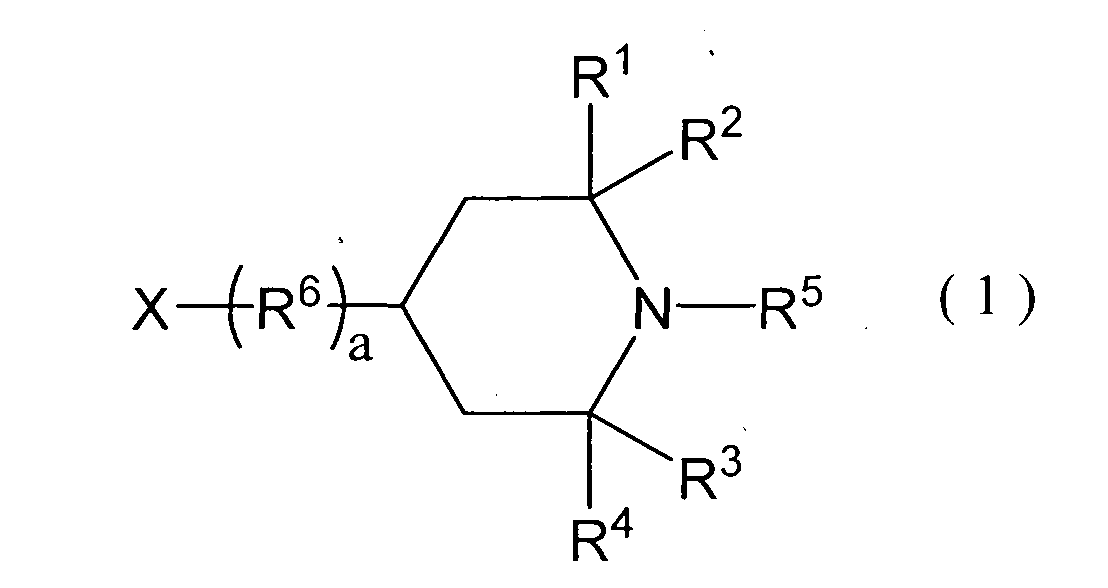
여기서,here,
R1, R2, R3 및 R4는 상기 식 (i)에서의 것과 동일한 의미이며,R 1 , R 2 , R 3 and R 4 have the same meanings as in the formula (i)
R5는 탄소수 1 내지 10 알킬기 또는 수소 원자이며,R < 5 > is a C1-10 alkyl group or a hydrogen atom,
R6은 탄소수 1 내지 20의 알킬렌기 또는 탄소수 3 내지 20의 폴리메틸렌기이며, a는 0 또는 1이며,R 6 is an alkylene group having 1 to 20 carbon atoms or a polymethylene group having 3 to 20 carbon atoms, a is 0 or 1,
X는 이소시아네이트기와 반응할 수 있는 기이다.X is a group capable of reacting with an isocyanate group.
상기 식 (1)에 있어서, R1, R2, R3 및 R4는 각각 독립적으로 탄소수 1 내지 4의 알킬기이다. 4개의 알킬기가 모두 메틸기인 것이 바람직하다.In the formula (1), R 1 , R 2 , R 3 and R 4 are each independently an alkyl group having 1 to 4 carbon atoms. It is preferable that all of the four alkyl groups are methyl groups.
R5는 탄소수 1 내지 10의 알킬기 또는 수소 원자이다. 그 중에서도, 입수의 용이함의 관점에서, 탄소수 1 내지 4의 알킬기 또는 수소 원자인 것이 바람직하다. 또한, R1 내지 R4가 탄소수 1 내지 4의 알킬기이기 때문에, R5가 수소 원자여도, 입체 장애의 영향으로 R5가 결합하고 있는 질소 원자와 이소시아네이트기가 반응하는 일은 없다.R 5 is an alkyl group having 1 to 10 carbon atoms or a hydrogen atom. Among them, an alkyl group having 1 to 4 carbon atoms or a hydrogen atom is preferable from the viewpoint of availability. Also, since R 1 to R 4 are alkyl groups having 1 to 4 carbon atoms, even when R 5 is a hydrogen atom, the isocyanate group and the nitrogen atom bonded to R 5 do not react due to the steric hindrance.
R6은 탄소수 1 내지 20의 알킬렌기 또는 탄소수 3 내지 20의 폴리메틸렌기이며, 바람직하게는 탄소수 1 내지 10의 알킬렌기 또는 탄소수 3 내지 10의 폴리메틸렌기이다. 또한, a는 R6의 수를 나타내지만, a가 0인 경우에는, X가 직접 피페리딘환에 결합하고 있다고 이해되어야 한다.R 6 is an alkylene group having 1 to 20 carbon atoms or a polymethylene group having 3 to 20 carbon atoms, preferably an alkylene group having 1 to 10 carbon atoms or a polymethylene group having 3 to 10 carbon atoms. Also, a represents the number of R 6 , but when a is 0, it is to be understood that X directly bonds to the piperidine ring.
X는 이소시아네이트기와 반응할 수 있는 기이며, 바람직하게는 아미노기, 수산기, 카르복실기 또는 티올기이다. 그 중에서도, 이소시아네이트기와의 반응성, 입수의 용이함 등의 관점에서 아미노기 및 수산기가 적합하다.X is a group capable of reacting with an isocyanate group, and is preferably an amino group, a hydroxyl group, a carboxyl group or a thiol group. Among them, an amino group and a hydroxyl group are suitable from the viewpoints of reactivity with an isocyanate group, ease of availability, and the like.
상기 식 (1)로 표시되는 화합물의 구체예로서는, 1,2,2,6,6-펜타메틸-4-히드록시피페리딘, 1,2,2,6,6-펜타메틸-4-아미노피페리딘, 2,2,6,6-테트라메틸-4-히드록시피페리딘, 2,2,6,6-테트라메틸-4-아미노피페리딘, 1,2,2,6,6-펜타메틸-4-아미노메틸피페리딘, 1,2,2,6,6-펜타메틸-4-아미노부틸피페리딘 등을 들 수 있다.Specific examples of the compound represented by the formula (1) include 1,2,2,6,6-pentamethyl-4-hydroxypiperidine, 1,2,2,6,6-pentamethyl-4-amino Piperidine, 2,2,6,6-tetramethyl-4-hydroxypiperidine, 2,2,6,6-tetramethyl-4-aminopiperidine, 1,2,2,6,6 - pentamethyl-4-aminomethylpiperidine, 1,2,2,6,6-pentamethyl-4-aminobutylpiperidine, and the like.
<그 밖의 C 성분>≪ Other C components >
상기 C 성분으로서는, 전술한 피페리딘 구조를 갖는 내후성의 향상을 목적으로 한 화합물 이외에도, 일반적인 아민, 알코올, 티올 및 카르복실산을 사용할 수 있다. 이들 화합물은, 분자 내에 이소시아네이트기와 반응할 수 있는 기를 1개 가짐으로써, I 성분인 폴리우레탄우레아 수지의 말단을 불활성화할 수 있다.As the component C, ordinary amines, alcohols, thiols and carboxylic acids may be used in addition to the compounds having the above-mentioned piperidine structure for the purpose of improving the weather resistance. These compounds have one group capable of reacting with an isocyanate group in the molecule, so that the terminal of the polyurethane-urea resin as the I component can be inactivated.
본 발명에서 사용되는 그 밖의 C 성분 중에서도, 바람직한 화합물로서는, 하기 식 (2) 및 (3)으로 표시되는 화합물을 들 수 있다.Among the other C components used in the present invention, preferred compounds include compounds represented by the following formulas (2) and (3).

여기서,here,
R7은 탄소수 1 내지 20의 알킬기, 아릴기, 아르알킬기, 알킬옥시카르보닐기 또는 수소 원자이며,R 7 is an alkyl group having 1 to 20 carbon atoms, an aryl group, an aralkyl group, an alkyloxycarbonyl group or a hydrogen atom,
R8은 탄소수 1 내지 20의 알킬기, 아릴기, 아르알킬기 또는 에스테르기이다.R 8 is an alkyl group having 1 to 20 carbon atoms, an aryl group, an aralkyl group or an ester group.
R7이 수소 원자인 화합물을 C 성분으로서 사용한 경우에는, (I) 성분인 폴리우레탄우레아 수지의 말단은 -NH(R8)기로 되지만, 이 -NH(R8)기는 다른 중합체 및 이소시아네이트 화합물과는 실질적으로 반응하지 않는다. 그 때문에, -NH(R8)기는 이소시아네이트기와 반응할 수 있는 기에는 해당하지 않는다.When a compound in which R 7 is a hydrogen atom is used as the component C, the terminal of the polyurethaneurea resin as the component (I) is an -NH (R 8 ) group, but the -NH (R 8 ) group is different from other polymer and isocyanate compound Does not substantially react. Therefore, the -NH (R 8 ) group does not correspond to a group capable of reacting with an isocyanate group.
상기 식 (2)에서, R7은 탄소수 1 내지 20의 알킬기, 아릴기, 아르알킬기, 알킬옥시카르보닐기 또는 수소 원자이다. 그 중에서도, R7은 탄소수 1 내지 10의 알킬기, 아릴기, 아르알킬기, 알킬옥시카르보닐기 또는 수소 원자인 것이 바람직하다. 상기 아릴기 및 아르알킬기는 탄소수 1 내지 5의 알킬기, 할로겐 원자를 치환기로서 가져도 된다.In the above formula (2), R 7 is an alkyl group having 1 to 20 carbon atoms, an aryl group, an aralkyl group, an alkyloxycarbonyl group or a hydrogen atom. Among them, R 7 is preferably an alkyl group having 1 to 10 carbon atoms, an aryl group, an aralkyl group, an alkyloxycarbonyl group or a hydrogen atom. The aryl group and the aralkyl group may have an alkyl group having 1 to 5 carbon atoms or a halogen atom as a substituent.
적합한 R7의 예로서는, 메틸기, 에틸기, 노르말프로필기, 이소프로필기, 노르말부틸기, tert-부틸기, 펜틸기, 헥실기, 헵틸기, 옥틸기, 1,1,3,3-테트라메틸부틸기, 페닐기, 벤질기, 1,1-디메틸벤질기, 카르복시메틸기, 카르복시에틸기, 카르복시프로필기 또는 수소 원자를 들 수 있다.Examples of suitable R 7 include methyl, ethyl, n-propyl, isopropyl, n-butyl, tert-butyl, pentyl, hexyl, Group, a phenyl group, a benzyl group, a 1,1-dimethylbenzyl group, a carboxymethyl group, a carboxyethyl group, a carboxypropyl group or a hydrogen atom.
또한, R8은 탄소수 1 내지 20의 알킬기, 아릴기, 아르알킬기 또는 알킬옥시카르보닐기이다. 그 중에서도, R8은 탄소수 1 내지 10의 알킬기, 아릴기, 아르알킬기 또는 알킬옥시카르보닐기인 것이 바람직하다. 상기 아릴기는 탄소수 1 내지 5의 알킬기, 할로겐 원자를 치환기로서 가져도 된다.R 8 is an alkyl group, an aryl group, an aralkyl group or an alkyloxycarbonyl group having 1 to 20 carbon atoms. Among them, R 8 is preferably an alkyl group having 1 to 10 carbon atoms, an aryl group, an aralkyl group or an alkyloxycarbonyl group. The aryl group may have an alkyl group having 1 to 5 carbon atoms or a halogen atom as a substituent.
적합한 R8의 예로서는, 메틸기, 에틸기, 노르말프로필기, 이소프로필기, 노르말부틸기, tert-부틸기, 펜틸기, 헥실기, 헵틸기, 옥틸기, 1,1,3,3-테트라메틸부틸기, 페닐기, 벤질기, 1,1-디메틸벤질기, 카르복시메틸기, 카르복시에틸기 또는 카르복시프로필기를 들 수 있다.Examples of suitable R 8 include methyl, ethyl, n-propyl, isopropyl, n-butyl, tert-butyl, pentyl, hexyl, Group, a phenyl group, a benzyl group, a 1,1-dimethylbenzyl group, a carboxymethyl group, a carboxyethyl group or a carboxypropyl group.
하기 식 (3)(3)
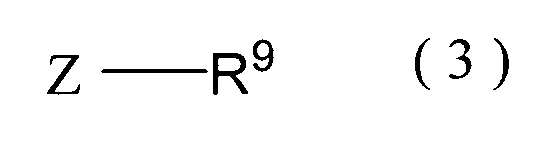
(여기서,(here,
R9는 탄소수 1 내지 20의 알킬기, 아릴기, 아르알킬기 또는 알킬옥시카르보닐기이며,R 9 is an alkyl group having 1 to 20 carbon atoms, an aryl group, an aralkyl group or an alkyloxycarbonyl group,
Z는 수산기, 카르복실기 또는 티올기이다.)Z is a hydroxyl group, a carboxyl group or a thiol group.
으로 표시되는 화합물도 적합하게 사용할 수 있다.May also be suitably used.
상기 식 (3)에 있어서, R9는 탄소수 1 내지 20의 알킬기, 아릴기, 아르알킬기 또는 알킬옥시카르보닐기이며, 탄소수 1 내지 10의 알킬기, 아릴기, 아르알킬기 또는 알킬옥시카르보닐기인 것이 바람직하다. 이 아릴기 및 아르알킬기는 탄소수 1 내지 5의 알킬기, 할로겐 원자를 치환기로서 가져도 된다. 바람직한 기로서는, 탄소수 1 내지 5의 알킬기, 페닐기, 할로겐 원자를 갖는 페닐기를 들 수 있다. 적합한 R9의 예로서는, 메틸기, 에틸기, 노르말프로필기, 이소프로필기, 노르말부틸기, tert-부틸기, 펜틸기, 헥실기, 헵틸기, 옥틸기, 1,1,3,3-테트라메틸부틸기, 페닐기, 벤질기, 1,1-디메틸벤질기, 카르복시메틸기, 카르복시에틸기 및 카르복시프로필기를 들 수 있다.In the formula (3), R 9 is preferably an alkyl group, an aryl group, an aralkyl group or an alkyloxycarbonyl group having 1 to 20 carbon atoms, and is an alkyl group, an aryl group, an aralkyl group or an alkyloxycarbonyl group having 1 to 10 carbon atoms. The aryl group and the aralkyl group may have an alkyl group having 1 to 5 carbon atoms or a halogen atom as a substituent. Preferable examples thereof include an alkyl group having 1 to 5 carbon atoms, a phenyl group, and a phenyl group having a halogen atom. Examples of suitable R 9 include a methyl group, an ethyl group, a normal propyl group, an isopropyl group, a normal butyl group, a tert-butyl group, a pentyl group, a hexyl group, a heptyl group, an octyl group, a 1,1,3,3-tetramethylbutyl Group, a phenyl group, a benzyl group, a 1,1-dimethylbenzyl group, a carboxymethyl group, a carboxyethyl group and a carboxypropyl group.
상기 식 (3)에 있어서의 Z는 이소시아네이트기와 반응할 수 있는 기이며, 구체적으로는 수산기, 카르복실기 또는 티올기이며, 바람직하게는 수산기이다.Z in the formula (3) is a group capable of reacting with an isocyanate group, specifically, a hydroxyl group, a carboxyl group or a thiol group, preferably a hydroxyl group.
상기 식 (2) 및 (3)으로 표시되는 화합물의 구체예로서는, 메틸아민, 에틸아민, 프로필아민, 이소프로필아민, 부틸아민, tert-부틸아민, 펜틸아민, 헥실아민, 헵틸아민, 4-헵틸아민, 옥틸아민, 1,1-디프로필부틸아민, 페닐아민, 벤질아민, 디메틸아민, 디에틸아민, 디프로필아민, 디이소프로필아민, 디부틸아민, 디-tert-부틸아민, 디펜틸아민, 디헥실아민, 디헵틸아민, 디옥틸아민, 메틸에틸아민, 메틸부틸아민, 메틸펜틸아민, 메틸헥실아민, 메틸헵틸아민, 메틸옥틸아민, 에틸프로필아민, 에틸부틸아민, 에틸펜틸아민, 에틸헥실아민, 에틸헵틸아민, 에틸옥틸아민, 프로필부틸아민, 이소프로필부틸아민, 프로필펜틸아민, 프로필헥실아민, 프로필헵틸아민, 프로필옥틸아민 등의 아민; 메탄올, 에탄올, 프로판올, 이소프로판올, 부탄올, 2-부탄올, tert-부틸알코올, 펜틸알코올, 헥실알코올, 헵틸알코올, 옥틸알코올, 노닐알코올, 데칸올, 2-데칸올 등의 알코올; 메탄티올, 에탄티올, 1-프로판티올, 2-프로판티올, 1-부탄티올, 2-부탄티올, 프로판티올, 헥산티올, 헵탄티올, 옥탄티올, 도데칸티올, 2-메틸-1-부탄티올, 2-메틸프로판티올, 3-메틸-2-부텐티올, 1,1-디메틸헵탄티올, 시클로헥산티올, 시클로펜탄티올, 벤젠티올, 벤젠메탄티올, 2,6-디메틸벤젠티올 등의 티올; 아세트산, 프로피온산, 부티르산, 펜탄산, 헥산산, 헵탄산, 옥탄산, 노난산, 데칸산, 도데칸산 등의 카르복실산 등을 들 수 있다.Specific examples of the compounds represented by the above formulas (2) and (3) include methylamine, ethylamine, propylamine, isopropylamine, butylamine, tert- butylamine, pentylamine, hexylamine, There may be mentioned amine compounds such as amine, octylamine, 1,1-dipropylbutylamine, phenylamine, benzylamine, dimethylamine, diethylamine, dipropylamine, diisopropylamine, dibutylamine, di- Ethylhexylamine, ethylhexylamine, ethylhexylamine, ethylhexylamine, ethylhexylamine, ethylhexylamine, ethylhexylamine, dihexylamine, dihexylamine, dioctylamine, methylethylamine, methylbutylamine, methylpentylamine, methylhexylamine, methylheptylamine, Amines such as hexylamine, ethylheptylamine, ethyloctylamine, propylbutylamine, isopropylbutylamine, propylpentylamine, propylhexylamine, propylheptylamine and propyloctylamine; Alcohols such as methanol, ethanol, propanol, isopropanol, butanol, 2-butanol, tert-butyl alcohol, pentyl alcohol, hexyl alcohol, heptyl alcohol, octyl alcohol, nonyl alcohol, decanol and 2-decanol; Butanethiol, 1-butanethiol, 2-butanethiol, propanethiol, hexanethiol, heptanethiol, octanethiol, dodecanethiol, 2-methyl-1-butanethiol Such as 2-methylpropanethiol, 3-methyl-2-butenetiol, 1,1-dimethylheptanethiol, cyclohexanethiol, cyclopentanethiol, benzenethiol, benzenemethanethiol, 2,6- ; And carboxylic acids such as acetic acid, propionic acid, butyric acid, pentanoic acid, hexanoic acid, heptanoic acid, octanoic acid, nonanoic acid, decanoic acid and dodecanoic acid.
이상의 C 성분은 단독으로 사용해도, 2종류 이상을 혼합하여 사용해도 상관없다. 그 중에서도, 폴리우레탄우레아 수지의 내구성을 향상시킨다는 관점에서, 피페리딘 구조를 갖는 화합물을 사용하는 것이 적합하다.These C components may be used alone or in combination of two or more. Among them, from the viewpoint of improving the durability of the polyurethane-urea resin, it is preferable to use a compound having a piperidine structure.
<폴리우레탄우레아 수지에 있어서의 A1, A2, B 및 C 성분의 사용량><Amount of Al, A2, B and C Components Used in Polyurethane Urea Resin>
상기 본 발명에 있어서, 접착층의 포토크로믹 조성물에서의 폴리우레탄우레아 수지(I 성분)를 구성하는 상기 각 성분, 즉 A1 성분, A2 성분, B 성분 및 C 성분의 양비는, 폴리우레탄우레아 수지를 사용하는 용도 등을 감안하여 적절히 결정된다. 그 중에서도, 얻어지는 폴리우레탄우레아 수지의 내열성, 접착력 등의 밸런스의 관점에서, 다음과 같은 양비로 하는 것이 바람직하다. 즉, A1 성분에 포함되는 수산기의 총 몰수를 n1이라 하고, A2 성분에 포함되는 이소시아네이트기의 총 몰수를 n2라 하고, B 성분에 포함되는 아미노기의 총 몰수를 n3이라 하고, C 성분에 포함되는 이소시아네이트기와 반응할 수 있는 기(구체적으로는 아미노기, 수산기, 머캅토기 및/또는 카르복실기 등)의 총 몰수를 n4라 했을 때, n1:n2:n3:n4=0.4 내지 0.8/1.0/0.19 내지 0.59/0.01 내지 0.2가 되는 양비, 특히 n1:n2:n3:n4=0.45 내지 0.75/1.0/0.23 내지 0.53/0.02 내지 0.15가 되는 양비로 하는 것이 바람직하고, n1:n2:n3:n4=0.65 내지 0.75/1.0/0.23 내지 0.33/0.02 내지 0.1이 되는 양비로 하는 것이 가장 바람직하다. 여기서, 상기 n1 내지 n4는 각 성분으로서 사용하는 화합물의 사용 몰수와 해당 화합물 1 분자 중에 존재하는 각 기의 수의 곱으로서 구할 수 있다.In the present invention, the ratio of the respective components constituting the polyurethane-urea resin (I component) in the photochromic composition of the adhesive layer, that is, the proportion of the A1 component, the A2 component, the B component and the C component, And the purpose of use. Among them, from the viewpoint of the balance of the heat resistance and the adhesive force of the resulting polyurethane-urea resin, it is preferable to make the following ratio. Namely, the total number of moles of hydroxyl groups contained in component A1 is n1, the total number of moles of isocyanate groups contained in component A2 is n2, the total number of moles of amino groups contained in component B is n3, N1: n2: n3: n4 = 0.4 to 0.8 / 1.0 / 0.19 to 0.59 / n4 when the total number of moles of the group capable of reacting with the isocyanate group (specifically, amino group, hydroxyl group, mercapto group and / N1: n2: n3: n4 = 0.65 to 0.75 / 1.0 / 0.23 to 0.53 / 0.02 to 0.15, And most preferably in a ratio of 1.0 / 0.23 to 0.33 / 0.02 to 0.1. Herein, n1 to n4 can be obtained as the product of the number of moles of the compound used as each component and the number of each group present in one molecule of the compound.
상기 폴리우레탄우레아 수지((I) 성분)에 있어서는, 말단에는 반응성의 기를 갖지 않는 것이 바람직하다. 특히, 말단에 이소시아네이트기가 잔존하지 않도록 불활성화시키는 것이 바람직하다. 그 때문에, 제조 시에는, n2=n1+n3+n4가 되는 배합 비율로 제조하는 것이 바람직하다. n2보다도 n1, n3 및 n4의 합계 몰수(n1+n3+n4)가 큰 경우에는, 재침전 등에 의해 미반응된 A1, B, C 성분을 제거할 수 있다.In the polyurethane-urea resin (component (I)), it is preferable that the polyurethane-urea resin has no terminal reactive group. Particularly, it is preferable to inactivate the isocyanate group so that no isocyanate group remains at the terminal. Therefore, at the time of production, it is preferable that the compounding ratio is n2 = n1 + n3 + n4. When the total molar number (n1 + n3 + n4) of n1, n3 and n4 is larger than n2, unreacted Al, B and C components can be removed by reprecipitation or the like.
<다분산도(중량 평균 분자량/수 평균 분자량의 비)가 1.6 내지 2.4의 범위인 폴리우레탄우레아 수지>≪ Polyurethaneurea resin having a polydispersity (weight-average molecular weight / number-average molecular weight ratio) of 1.6 to 2.4>
본 발명에 있어서, 포토크로믹 조성물에 사용하는 폴리우레탄우레아 수지로서는, 다분산도(중량 평균 분자량/수 평균 분자량의 비)가 1.6 내지 2.4의 범위인 폴리우레탄우레아 수지를 사용하는 것이 적합하다. 이렇게 좁은 범위의 다분산도를 갖는 폴리우레탄우레아 수지를 포함하는 포토크로믹 조성물로 이루어지는 접착층에 의해 폴리카르보네이트로 이루어지는 광학 시트 또는 필름을 접합시켜 적층체를 제조한 경우, 얻어진 적층체는 우수한 접착성, 특히 고온에서의 우수한 접착성을 나타내고, 우수한 포토크로믹 특성을 발휘한다. 또한, 얻어진 적층체는 내한성도 높다. 즉, 인공땀과 접촉시킨 후에도, 우수한 접착성을 나타낸다. 이러한 효과가 얻어진 이유로서 상세한 것은 불분명하지만, 본 발명자들은 이하와 같이 추측하고 있다. 즉, 다분산도(중량 평균 분자량/수 평균 분자량)가 1.6 내지 2.4의 범위인 것에서, 저분자량의 폴리우레탄우레아 함유량을 저감시킬 수 있어, 내열성이 안정된 점을 들 수 있다. 또한, 저분자량 폴리우레탄우레아의 영향에 의한 물리적인 분자간 상호 작용, 즉 중합체쇄의 분자간에서의 얽힘의 저하를 억제할 수 있어, 폴리우레탄우레아 수지를 접착층에 사용했을 때의 폴리우레탄우레아층 내에서의 파괴, 즉 응집 파괴를 억제할 수 있었기 때문에, 밀착성이 향상된 것으로 추측된다.In the present invention, as the polyurethane-urea resin used in the photochromic composition, it is preferable to use a polyurethane-urea resin having a polydispersity (weight-average molecular weight / number-average molecular weight ratio) of 1.6 to 2.4. When a laminate is produced by bonding an optical sheet or film made of polycarbonate with an adhesive layer made of a photochromic composition containing a polyurethane urea resin having such a narrow range of polydispersity, Exhibits good adhesion, particularly excellent adhesion at high temperatures, and exhibits excellent photochromic properties. Further, the resulting laminate has a high cold resistance. That is, even after contact with artificial perspiration, excellent adhesion is exhibited. The reason why these effects are obtained is unclear in detail, but the inventors of the present invention presume as follows. That is, it can be said that the content of the polyurethane urea of low molecular weight can be reduced and the heat resistance is stabilized by the polydispersity (weight average molecular weight / number average molecular weight) in the range of 1.6 to 2.4. In addition, it is possible to suppress the physical intermolecular interaction due to the influence of the low-molecular-weight polyurethaneurea, that is, the deterioration of the entanglement between the molecules of the polymer chain can be suppressed. In the polyurethaneurea layer when the polyurethaneurea resin is used for the adhesive layer That is, cohesive failure can be suppressed, and it is presumed that the adhesion is improved.
또한, 다분산도가 낮을수록, 즉 다분산도가 1.0에 가까울수록, 본 발명의 효과가 강하게 발현되는 경향이 있다. 단, 다분산도가 1.6 미만인 폴리우레탄우레아 수지를 얻는 것은, 공업적 제조 방법에서는 실질적으로 곤란하다고 생각된다. 한편, 다분산도가 2.4를 초과하는 경우에는, 저분자량의 폴리우레탄우레아 수지의 영향에 의해, 연화 개시 온도가 저온으로 되는 경향이 있다. 그 때문에, 다분산도가 좁은 수지와 비교하여, 내열성이 열악하고, 고온 하에서의 밀착성이 저하되는 경향이 있다. 또한, 고분자량 폴리우레탄우레아 수지의 영향에 의해, 다분산도가 좁은 수지와 비교하여, 유기 용제에 용해되었을 때의 점도가 현저하게 상승하여, 도공이 곤란해진다. 양호한 접착력, 내열성 및 도공성의 관점에서, 본 발명의 폴리우레탄우레아 수지의 다분산도는, 1.8 내지 2.2의 범위인 것이 보다 바람직하다.In addition, the lower the polydispersity, that is, the closer the polydispersity is to 1.0, the stronger the effect of the present invention tends to be expressed. However, it is considered that obtaining a polyurethane-urea resin having a polydispersity of less than 1.6 is practically difficult in an industrial production method. On the other hand, when the polydispersity exceeds 2.4, the softening initiation temperature tends to become low due to the influence of the low molecular weight polyurethane-urea resin. Therefore, as compared with a resin having a narrower polydispersity, there is a tendency that the heat resistance is poor and the adhesiveness at a high temperature is lowered. Further, as compared with the resin having narrow polydispersity, due to the influence of the high molecular weight polyurethane-urea resin, the viscosity when dissolved in an organic solvent increases remarkably, and coating becomes difficult. From the viewpoints of good adhesion, heat resistance and coating properties, the polyurethane dispersion of the polyurethane-urea resin of the present invention is more preferably in the range of 1.8 to 2.2.
또한, 본 발명의 폴리우레탄우레아 수지의 분자량은, 다분산도가 상기 범위를 만족시키는 것이면 특별히 제한되는 것은 아니다. 그 중에서도 접착력, 내열성 및 내한성의 관점에서, 수 평균 분자량이 바람직하게는 5000 내지 10만, 보다 바람직하게는 8000 내지 5만이며, 특히 바람직하게는 1만 내지 4만인 것이 권장된다.The molecular weight of the polyurethane-urea resin of the present invention is not particularly limited as long as the polydispersity satisfies the above range. Among them, the number average molecular weight is preferably from 5,000 to 100,000, more preferably from 8,000 to 50,000, and particularly preferably from 10,000 to 40,000 from the viewpoints of adhesion, heat resistance and cold resistance.
또한, 상기 폴리우레탄우레아 수지의 수 평균 분자량 및 중량 평균 분자량은, 폴리에틸렌옥시드 환산에 의한 겔ㆍ투과ㆍ크로마토그래프(GPC)를 사용하여, 칼럼: Shodex KD-806M(쇼와 덴코 가부시키가이샤제)을 2개 직렬 접속, 용리액: LiBr(10mmol/L)/DMF 용액, 유속: 1ml/min, 검출기: RI 검출기, 폴리우레탄우레아 수지 시료 용액: 1.0% 디메틸포름아미드(DMF) 용액의 조건에서 측정하고, 일본 워터스 가부시키가이샤제 GPC 해석 소프트웨어 『Empower Personal GPC Option』을 사용하여 산출한 값이다. 또한, 다분산도는 중량 평균 분자량/수 평균 분자량으로 산출되는 값이며, 상기 방법에 의해 구해진 수 평균 분자량 및 중량 평균 분자량으로부터 산출되는 값이다.The number-average molecular weight and the weight-average molecular weight of the polyurethane-urea resin were measured using a gel permeation chromatograph (GPC) in terms of polyethylene oxide, using a column: Shodex KD-806M (manufactured by Showa Denko K.K.) (10 mmol / L) / DMF solution, flow rate: 1 ml / min, detector: RI detector, polyurethane-urea resin sample solution: measured under the condition of 1.0% dimethylformamide (DMF) solution And using Empower Personal GPC Option (GPC analysis software, manufactured by Waters Japan). The polydispersity is a value calculated by weight average molecular weight / number average molecular weight, and is a value calculated from the number average molecular weight and the weight average molecular weight obtained by the above method.
또한, 상기 A1 성분, A2 성분, B 성분 및 필요에 따라서 C 성분을 반응시켜, 본 발명의 폴리우레탄우레아 수지(I 성분)를 얻는 방법으로서는, 다분산도가 상기 범위를 만족시키도록 반응시키면 되고, 소위 원샷법 또는 예비 중합체법 중 어느 방법도 채용할 수 있다. 그러나, 다분산도를 제어하여 효율적으로 폴리우레탄우레아 수지를 얻는다는 관점에서, 예비 중합체법이 바람직하다. 특히 후술하는 제조 방법에 의하면, 다분산도가 상기 범위를 만족시키는 폴리우레탄우레아 수지를 간편하게 제조하는 것이 가능하다.As a method for obtaining the polyurethane-urea resin (component (I)) of the present invention by reacting the A1 component, the A2 component, the B component and, if necessary, the C component, the polydispersity may be reacted to satisfy the above range , A so-called one-shot method or a prepolymer method may be employed. However, a prepolymer method is preferred from the viewpoint of obtaining a polyurethane-urea resin efficiently by controlling the polydispersity. Particularly, according to the production method described later, a polyurethane-urea resin having a polydispersity satisfying the above range can be easily produced.
또한, 상기 폴리우레탄우레아 수지((I) 성분)는, 포토크로믹 화합물을 포함하지 않는 접착층에 사용하는 것도 가능하다.The polyurethane-urea resin (component (I)) can also be used in an adhesive layer not containing a photochromic compound.
<폴리우레탄우레아 수지의 제조 방법><Production method of polyurethane-urea resin>
<우레탄 예비 중합체(A)의 제조 방법>≪ Process for producing urethane prepolymer (A)
본 발명에 있어서, 포토크로믹 조성물에 사용하는 폴리우레탄우레아 수지는, 일반적으로 우레탄 예비 중합체와 디아민 등의 폴리아민의 반응에 의해 제조할 수 있다. 우레탄 예비 중합체(A 성분)는 상기 폴리올 화합물(A1 성분)과 상기 디이소시아네이트 화합물(A2 성분)을 반응(이하, 「예비 중합체 반응」이라고도 함)시킴으로써 제조할 수 있다.In the present invention, the polyurethane-urea resin used in the photochromic composition can be generally produced by reacting a urethane prepolymer with a polyamine such as a diamine. The urethane prepolymer (component A) can be produced by reacting the polyol compound (component A1) and the diisocyanate compound (component A2) (hereinafter also referred to as "prepolymer reaction").
본 발명의 우레탄 예비 중합체(A 성분)는, 전술한 바와 같이, A1 성분에 포함되는 수산기의 총 몰수를 n1이라 하고, A2 성분에 포함되는 이소시아네이트기의 총 몰수를 n2라 했을 때, n1:n2=0.4/1.0 내지 0.8/1.0으로 함으로써, 말단에 이소시아네이트기를 갖는 우레탄 예비 중합체로 하는 것이 바람직하다.When the total molar number of hydroxyl groups contained in the A1 component is n1 and the total number of moles of isocyanate groups contained in the A2 component is n2, the urethane prepolymer (component A) of the present invention has n1: n2 = 0.4 / 1.0 to 0.8 / 1.0, it is preferable to use an urethane prepolymer having an isocyanate group at the terminal.
A1 성분과 A2 성분을 반응시킬 때의 첨가 순서에 특별히 제한은 없다. 필요에 따라서 반응 도중에 적절히 A1 성분 및 A2 성분을 추가 첨가하는 것도 가능하다.There is no particular limitation on the order of addition when the A1 component and the A2 component are reacted. It is also possible to appropriately add the components A1 and A2 appropriately during the reaction as necessary.
A1 성분과 A2 성분의 반응은, 유기 용매의 존재 하 또는 비존재 하, 양자를, 바람직하게는 질소 또는 아르곤 등의 불활성 가스 분위기 중에 반응 온도 70 내지 130℃에서 반응시키는 것이 바람직하다. 반응 온도가 70℃ 미만인 경우에는 반응이 완결되지 않고, 또한 130℃를 초과한 경우에는 A1 성분의 일부가 분해되어, 원하는 물성의 폴리우레탄우레아 수지가 얻어지지 않게 된다. 반응 시간은 A1 성분과 A2 성분의 투입비 및 반응 온도에 따라서도 변화되지만, 0.5 내지 24시간의 범위로 할 수 있다.The reaction between the component A1 and the component A2 is preferably carried out in the presence or absence of an organic solvent, preferably in an inert gas atmosphere such as nitrogen or argon at a reaction temperature of 70 to 130 占 폚. When the reaction temperature is lower than 70 ° C, the reaction is not completed. When the reaction temperature is higher than 130 ° C, a part of the Al component is decomposed to fail to obtain a desired polyurethaneurea resin. The reaction time varies depending on the charging ratio of the A1 component and the A2 component and the reaction temperature, but may be in the range of 0.5 to 24 hours.
유기 용매로서는, 예를 들어 아세톤, 메틸에틸케톤, 메틸이소부틸케톤, 디에틸케톤, 시클로헥사논, 디옥산, 톨루엔, 헥산, 헵탄, 아세트산에틸, 아세트산부틸, 디메틸포름아미드(DMF), 디메틸술폭시드(DMSO), 테트라히드로푸란(THF) 등의 유기 용매를 사용할 수 있다. 이들 유기 용매는 단독으로 또는 2종류 이상 혼합하여 사용할 수도 있다.Examples of the organic solvent include acetone, methyl ethyl ketone, methyl isobutyl ketone, diethyl ketone, cyclohexanone, dioxane, toluene, hexane, heptane, ethyl acetate, butyl acetate, dimethylformamide (DMF) (DMSO), tetrahydrofuran (THF) and the like can be used. These organic solvents may be used alone or in combination of two or more.
유기 용매를 사용하는 경우에는, 그 사용량은 A1 성분과 A2 성분의 합계량을 100질량부로 했을 때, 200질량부 이하로 하는 것이 바람직하다. 유기 용매의 사용량이 200질량부를 초과하는 경우에는, A1 성분과 A2 성분의 반응 시간이 길어지고, A1 성분의 일부가 분해될 우려가 있다.When an organic solvent is used, the amount of the organic solvent is preferably 200 parts by mass or less based on 100 parts by mass of the total amount of the components A1 and A2. When the amount of the organic solvent used is more than 200 parts by mass, the reaction time between the component A1 and the component A2 becomes long and a part of the component A1 may be decomposed.
반응 시에는, 디이소시아네이트 화합물 중의 이소시아네이트기가 불순물인 물과 반응하는 것을 피하기 위해서, 각종 반응 시약 및 용매는 미리 탈수 처리를 행하고, 충분히 건조시켜두는 것이 바람직하다. 또한, 상기 반응을 행할 때에는, 예를 들어 디라우릴산디부틸주석, 디메틸이미다졸, 트리에틸렌디아민, 테트라메틸-1,6-헥사디아민, 테트라메틸-1,2-에탄디아민, 1,4-디아자비시클로[2,2,2]옥탄 등의 촉매를 사용해도 된다. 촉매의 첨가량은, A 성분의 합계 100질량부에 대하여 0.001 내지 1질량부로 하는 것이 바람직하다.At the time of the reaction, it is preferable to dehydrate various reaction reagents and solvents in advance and dry thoroughly in order to prevent the isocyanate group in the diisocyanate compound from reacting with impurities. When the above reaction is carried out, for example, di-tin dilaurate, dimethylimidazole, triethylenediamine, tetramethyl-1,6-hexanediamine, tetramethyl-1,2-ethanediamine, 1,4- Diazabicyclo [2,2,2] octane or the like may be used. The addition amount of the catalyst is preferably 0.001 to 1 part by mass with respect to 100 parts by mass of the total amount of the A component.
<폴리우레탄우레아 수지의 제조 방법><Production method of polyurethane-urea resin>
폴리우레탄우레아 수지는 우레탄 예비 중합체와 디아민 등의 폴리아민의 반응에 의해 제조할 수 있다. 또한, 상기 방법에서 우레탄 예비 중합체를 제조한 경우에는, 상기 예비 중합체화 반응 후의 반응액에 B 성분인 폴리아민 화합물을 첨가하여, 연속적으로 폴리우레탄우레아 수지의 제조를 행할 수도 있다.The polyurethane-urea resin can be produced by reacting a urethane prepolymer with a polyamine such as a diamine. In the case where the urethane prepolymer is prepared by the above method, the polyamine compound as the component B may be added to the reaction solution after the prepolymerization reaction to continuously produce the polyurethaneurea resin.
상기 폴리우레탄우레아 수지의 제조 방법에서의 다른 반응 조건은, 제조 설비 등을 감안하여 적절히 결정된다. 통상 유기 용매의 존재 하에, 필요에 따라서 질소 또는 아르곤 등의 불활성 가스 분위기 중에 반응 온도 -20℃ 내지 40℃의 범위에서, 보다 바람직하게는 -10℃ 내지 20℃의 범위에서 반응을 행할 수 있다.Other reaction conditions in the process for producing the polyurethane-urea resin are appropriately determined in consideration of the manufacturing facilities and the like. The reaction can be carried out in an inert gas atmosphere such as nitrogen or argon at a reaction temperature in the range of -20 캜 to 40 캜, more preferably in the range of -10 캜 to 20 캜, in the presence of an organic solvent.
상기 폴리우레탄우레아 수지의 제조에서의 유기 용매로서는, 예를 들어 아세톤, 메틸에틸케톤, 메틸이소부틸케톤, 디에틸케톤, 시클로헥사논, 디옥산, 톨루엔, 헥산, 헵탄, 아세트산에틸, 아세트산부틸, 디메틸포름아미드(DMF), 디메틸술폭시드(DMSO), 테트라히드로푸란(THF), 메탄올, 에탄올, 이소프로필알코올, t-부탄올, 2-부탄올, n-부탄올, 에틸렌글리콜모노메틸에테르, 에틸렌글리콜모노에틸에테르, 에틸렌글리콜모노노르말프로필에테르, 에틸렌글리콜모노이소프로필에테르, 에틸렌글리콜모노부틸에테르, 에틸렌글리콜모노t-부틸에테르, 프로필렌글리콜모노메틸에테르, 프로필렌글리콜모노에틸에테르, 프로필렌글리콜모노노르말프로필에테르, 프로필렌글리콜모노이소프로필, 프로필렌글리콜모노노르말부틸에테르, 프로필렌글리콜모노t-부틸에테르 등의 알코올계 유기 용매를 사용할 수 있다. 이들 유기 용매는 단독으로 또는 2종류 이상 혼합하여 사용할 수도 있다.Examples of the organic solvent in the production of the polyurethaneurea resin include acetone, methyl ethyl ketone, methyl isobutyl ketone, diethyl ketone, cyclohexanone, dioxane, toluene, hexane, heptane, ethyl acetate, butyl acetate, (DMF), dimethylsulfoxide (DMSO), tetrahydrofuran (THF), methanol, ethanol, isopropyl alcohol, t-butanol, 2-butanol, n-butanol, ethylene glycol monomethyl ether, ethylene glycol mono Ethyl ether, ethylene glycol mono-n-propyl ether, ethylene glycol monoisopropyl ether, ethylene glycol monobutyl ether, ethylene glycol mono t-butyl ether, propylene glycol monomethyl ether, propylene glycol monoethyl ether, Propylene glycol monoisopropyl, propylene glycol mono-n-butyl ether, propylene glycol mono-t-butyl ether And the like can be used. These organic solvents may be used alone or in combination of two or more.
상기 유기 용매의 사용량은, 효율적으로 반응을 행한다는 관점이나, 잔류하는 유기 용매의 영향 등의 관점에서, 최종적으로 얻어지는 폴리우레탄우레아 수지의 합계량을, 100질량부에 대하여 130 내지 800질량부의 범위에 있는 것이 바람직하고, 150 내지 500질량부의 범위에 있는 것이 보다 바람직하다.The amount of the organic solvent used is preferably in the range of 130 to 800 parts by mass based on 100 parts by mass of the total amount of the polyurethaneurea resin finally obtained from the viewpoint of performing the reaction efficiently, , And more preferably in the range of 150 to 500 parts by mass.
반응 시에는, 반응계 중의 이소시아네이트기와 불순물인 물과의 반응을 피하기 위해서, 각종 반응 시약 및 유기 용매는 미리 탈수 처리를 행하여, 충분히 건조시켜두는 것이 바람직하다. 또한, 상기 반응을 행할 때에는, 예를 들어 디라우릴산디부틸주석, 디메틸이미다졸, 트리에틸렌디아민, 테트라메틸-1,6-헥사디아민, 테트라메틸-1,2-에탄디아민, 1,4-디아자비시클로[2,2,2]옥탄 등의 촉매를 새롭게 첨가해도 되고, 예비 중합체 반응에서 사용한 경우에는 제거하지 않고 그대로 사용해도 된다. 촉매의 첨가량은, 폴리우레탄우레아 수지의 합계 100질량부에 대하여 0.001 내지 1질량부로 하는 것이 바람직하다.At the time of the reaction, it is preferable that the various reaction reagents and the organic solvent are previously dehydrated and sufficiently dried in order to avoid the reaction between the isocyanate group in the reaction system and water as the impurity. When the above reaction is carried out, for example, di-tin dilaurate, dimethylimidazole, triethylenediamine, tetramethyl-1,6-hexanediamine, tetramethyl-1,2-ethanediamine, 1,4- Diazabicyclo [2,2,2] octane or the like may be newly added or used in the prepolymer reaction without being removed. The addition amount of the catalyst is preferably 0.001 to 1 part by mass based on 100 parts by mass of the total amount of the polyurethaneurea resin.
상기 폴리우레탄우레아 수지((I) 성분)를 합성할 때, 분자 내에 1개의 이소시아네이트기와 반응할 수 있는 기를 갖는 화합물(C 성분)을 병용한다. 이 C 성분을 사용함으로써, 분자쇄의 말단이 캐핑된 폴리우레탄우레아 수지가 된다.In synthesizing the polyurethane-urea resin (component (I)), a compound (C component) having a group capable of reacting with one isocyanate group in the molecule is used in combination. By using this C component, a polyurethane-urea resin in which the terminal of the molecular chain is capped is obtained.
상기 분자쇄의 말단이 캐핑된 폴리우레탄우레아 수지를 얻는 방법(이하, 「말단 수식 반응」이라고도 말함)으로서는, 전술한 A 성분과 B 성분의 반응이 종료되고, 말단에 이소시아네이트기를 갖는 폴리우레탄우레아 수지가 유기 용제에 용해되어 있는 반응액에, 필요에 따라서 유기 용제로 희석한 C 성분을 적하하여 첨가하는 방법이 적합하다. 또한, 전술한 A 성분과 B 성분의 반응 시에 첨가한 알코올계 유기 용제를 C 성분으로서 말단 수식 반응에 사용하는 경우에는, 새롭게 C 성분을 첨가하지 않아도 된다.As a method for obtaining a polyurethane-urea resin capped at the end of the molecular chain (hereinafter also referred to as "end-capillary reaction"), the reaction of the above-described component A and component B is terminated and a polyurethaneurea resin having an isocyanate group at the terminal To the reaction solution in which the organic solvent is dissolved in an organic solvent is added dropwise the C component diluted with an organic solvent if necessary. When the alcohol-based organic solvent added at the time of the reaction of the components A and B described above is used as a component C for the terminal modification reaction, it is not necessary to newly add the component C.
상기 말단 수식 반응은 유기 용매의 존재 하에, 필요에 따라서 질소 또는 아르곤 등의 불활성 가스 분위기 중에서 실시된다. 반응 온도는, C 성분에 포함되는 이소시아네이트기와 반응할 수 있는 기가 아미노기인 경우에는, 전술한 A 성분과 B 성분의 반응 시와 동일한 온도인 -20℃ 내지 30℃ 사이의 온도에서 반응시킬 수도 있다. 한편, C 성분에 포함되는 이소시아네이트기와 반응할 수 있는 기가 아미노기 이외의 경우에는, 이소시아네이트기와의 반응 속도가 늦기 때문에, 30 ℃ 초과 130℃ 이하의 온도에서 반응시키는 것이 바람직하다.The terminal modification reaction is carried out in an inert gas atmosphere such as nitrogen or argon, if necessary, in the presence of an organic solvent. When the group capable of reacting with the isocyanate group contained in component C is an amino group, the reaction temperature may be reacted at a temperature of -20 캜 to 30 캜, which is the same temperature as that in the reaction of component A and component B described above. On the other hand, when the group capable of reacting with the isocyanate group contained in the component C is other than the amino group, the reaction rate with the isocyanate group is slow. Therefore, the reaction is preferably carried out at a temperature higher than 30 ° C and 130 ° C or lower.
반응 시간은, C 성분에 포함되는 이소시아네이트기와 반응할 수 있는 기가 아미노기인 경우에는 0.5 내지 3시간 정도이고, C 성분에 포함되는 이소시아네이트기와 반응할 수 있는 기가 아미노기 이외의 경우에는 1시간 내지 24시간 정도이다.The reaction time is about 0.5 to 3 hours when the group capable of reacting with the isocyanate group contained in the component C is an amino group, and about 1 to 24 hours when the group capable of reacting with the isocyanate group contained in the component C is other than the amino group to be.
유기 용매로서는, 전술한 예비 중합체 반응 및 A 성분과 B 성분의 반응에 사용한 유기 용제와 동일한 것을 사용할 수 있다. 또한, 당연하지만, 전술한 예비 중합체 반응 및 A 성분과 B 성분의 반응에서 사용한 유기 용제를 포함한 상태로, 말단 수식 반응을 실시해도 상관없다.As the organic solvent, the same prepolymer reaction and the same organic solvent as used for the reaction of component A and component B can be used. Needless to say, the terminal modification reaction may be carried out in a state including the prepolymer reaction and the organic solvent used in the reaction of the component A and the component B described above.
말단 수식 반응에서의 유기 용매의 사용량은, 최종적으로 얻어지는 A 성분의 합계량 100질량부에 대하여 130 내지 800질량부의 범위인 것이 바람직하다.The amount of the organic solvent used in the endmodal reaction is preferably in the range of 130 to 800 parts by mass based on 100 parts by mass of the total amount of the finally obtained A component.
반응 시에는, 반응계 중의 이소시아네이트기와 불순물인 물과의 반응을 피하기 위해서, 각종 반응 시약 및 유기 용매는 미리 탈수 처리를 행하여, 충분히 건조시켜두는 것이 바람직하다. 또한, 상기 반응을 행할 때에는, 예를 들어 디라우릴산디부틸주석, 디메틸이미다졸, 트리에틸렌디아민, 테트라메틸-1,6-헥사디아민, 테트라메틸-1,2-에탄디아민, 1,4-디아자비시클로[2,2,2]옥탄 등의 촉매를 새롭게 첨가해도 되고, 예비 중합체 반응까지 촉매를 사용한 경우에는 제거하지 않고 그대로 사용해도 된다. 촉매의 첨가량은, A 성분의 합계 100질량부에 대하여 0.001 내지 1질량부인 것이 바람직하다.At the time of the reaction, it is preferable that the various reaction reagents and the organic solvent are previously dehydrated and sufficiently dried in order to avoid the reaction between the isocyanate group in the reaction system and water as the impurity. When the above reaction is carried out, for example, di-tin dilaurate, dimethylimidazole, triethylenediamine, tetramethyl-1,6-hexanediamine, tetramethyl-1,2-ethanediamine, 1,4- Diazabicyclo [2,2,2] octane and the like may be newly added, and if a catalyst is used up to the prepolymer reaction, it may be used without being removed. The addition amount of the catalyst is preferably 0.001 to 1 part by mass with respect to 100 parts by mass of the total amount of the A component.
<다분산도(중량 평균 분자량/수 평균 분자량의 비)가 1.6 내지 2.4의 범위인 폴리우레탄우레아 수지의 제조 방법><Process for producing polyurethane-urea resin having a polydispersity (weight-average molecular weight / number-average molecular weight ratio) of 1.6 to 2.4>
상기와 같이 하여, 다분산도가 1.6 내지 2.4의 범위인 폴리우레탄우레아를 제조하는 경우에는, 우레탄 예비 중합체(A 성분)와 폴리아민 화합물(B 성분)을 반응시킬 때, A 성분과 B 성분의 완전 혼합 시간(θM)을 바람직하게는 30초 이하, 보다 바람직하게는 15초 이하로 함으로써, 다분산도(중량 평균 분자량/수 평균 분자량)가 1.6 내지 2.4의 범위인 폴리우레탄우레아 수지를 얻을 수 있다.When the urethane prepolymer (component A) and the polyamine compound (component B) are reacted with each other in the manner as described above, when polyurethane urea having a polydispersity in the range of 1.6 to 2.4 is prepared, A polyurethane urea resin having a polydispersity (weight average molecular weight / number average molecular weight) in the range of 1.6 to 2.4 can be obtained by setting the mixing time? M to preferably 30 seconds or less, more preferably 15 seconds or less have.
완전 혼합 시간(θM)이란, 교반조(반응 용기 등)에서의 혼합 특성을 나타내는 지표이며, nㆍθM(n은 교반 날개의 회전수(1/초))과 Re(레이놀즈수; 액의 혼란 상태를 나타내는 지표)의 관계를 나타내는 「nㆍθM-Re 곡선」으로부터 구해진다. 완전 혼합 시간(θM) 및 nㆍθM-Re 곡선에 대해서는, 예를 들어 「스미또모 주기까이 고교 기보 vol.35 No.104 1987년 8월 p74-78」, 일본 특허 공개 소61-200842호 공보, 일본 특허 공개 평6-312122호 공보 등에 기재되어 있다.The complete mixing time? M is an index indicating mixing characteristics in a stirring tank (reaction vessel or the like), and n?? M (n is the number of revolutions of the stirring wing (1 / sec)) and Re (Reynolds number N-theta- M- Re curve " which represents the relationship between the " n? The complete mixing time (? M ) and the n?? M -Re curves are described in, for example, "Sumitomo Cycle Kai Kogyo vol.35 No.104 Aug. 1987, p74-78" JP-A-6-312122, and the like.
완전 혼합 시간(θM)을 30초 이하로 하기 위한 수단으로서는, 임의의 적절한 방법이 채용된다. 예를 들어 교반조(반응 용기 등) 내에 방해판 등을 설치하여 난류를 발생시키는 방법이나, 임의의 적절한 교반 날개를 사용하는 방법 등을 들 수 있다. 적절한 교반 날개로서는, 맥스 블렌드 날개, 풀 존 날개 등을 들 수 있다.As a means for setting the complete mixing time? M to 30 seconds or less, any suitable method is employed. For example, a method of generating turbulence by providing an obstruction plate or the like in a stirring tank (reaction vessel or the like), and a method of using any suitable stirring blades can be given. Examples of suitable stirring blades include Max blend blades and full zone blades.
또한, 상기 방법으로 우레탄 예비 중합체를 제조한 경우에는, 상기 예비 중합체화 반응 후의 반응액에 B 성분을 첨가하여, 연속적으로 폴리우레탄우레아 수지의 제조를 행할 수도 있다.When the urethane prepolymer is prepared by the above-described method, the component B may be added to the reaction solution after the prepolymerization reaction to continuously produce the polyurethaneurea resin.
상기 다분산도의 범위인 폴리우레탄우레아 수지의 제조 방법에서의 다른 반응 조건은, 제조 설비 등을 감안하여 적절히 결정된다. 그 중에서도, 특히 다분산도가 좁은 범위에 있는 폴리우레탄우레아 수지가 얻어진다는 관점에서, 유기 용매의 존재 하에, 필요에 따라서 질소 또는 아르곤 등의 불활성 가스 분위기 중에 반응 온도 -20℃ 내지 40℃의 범위에서, 보다 바람직하게는 -10℃ 내지 20℃의 범위에서 반응을 행하는 것이 바람직하다. 반응 온도가 -20℃ 미만인 경우에는, 쇄연장 반응 후반에 점도가 상승하여 교반 부족이 되는 경향이 있다. 또한, 반응 온도가 40℃를 초과한 경우에는, 우레아 결합의 형성 반응이 빠르고, A 성분과 B 성분이 접촉 직후에 반응함으로써 불균일한 반응이 되기 쉬워, 다분산도가 넓어지는 경향이 있다. 상기 반응 온도에서의 반응 시간은 0.5 내지 3시간 정도로 충분하다.Other reaction conditions in the process for producing the polyurethane-urea resin, which is the range of the polydispersity, are appropriately determined in consideration of the manufacturing facilities and the like. Among them, in view of the fact that a polyurethane-urea resin having a narrow range of polydispersity is obtained in particular, in the presence of an organic solvent, a reaction temperature in the range of -20 ° C to 40 ° C in an inert gas atmosphere such as nitrogen or argon , More preferably in the range of -10 캜 to 20 캜. When the reaction temperature is lower than -20 占 폚, the viscosity tends to rise at the latter half of the chain extension reaction, and the stirring tends to become insufficient. When the reaction temperature exceeds 40 캜, the urea bond formation reaction is rapid, and the A component and the B component react with each other immediately after contact, so that the reaction tends to be uneven and the polydispersity tends to widen. The reaction time at the above-mentioned reaction temperature may be about 0.5 to 3 hours.
이어서, 본 발명에서 사용하는 (II) 포토크로믹 화합물에 대하여 설명한다.Next, the (II) photochromic compound used in the present invention will be described.
<(II) 포토크로믹 화합물>≪ (II) Photochromic Compound >
본 발명에 있어서 (II) 포토크로믹 화합물을로서는, 예를 들어 크로멘 화합물, 플루기미드 화합물, 스피로옥사진 화합물, 스피로피란 화합물 등의 공지된 포토크로믹 화합물을 사용할 수 있다. 이들은 단독으로 사용해도 되고, 2종류 이상을 병용해도 된다.As the photochromic compound (II) in the present invention, known photochromic compounds such as a chromene compound, a fluorimide compound, a spirooxazine compound, and a spiropyran compound can be used. These may be used alone or in combination of two or more.
상기 플루기미드 화합물, 스피로옥사진 화합물, 스피로피란 화합물 및 크로멘 화합물로서는, 예를 들어 일본 특허 공개 평2-28154호 공보, 일본 특허 공개 소62-288830호 공보, WO94/22850호 팸플릿, WO96/14596호 팸플릿 등에 기재되어 있는 화합물을 들 수 있다.Examples of the above-mentioned flumimide compound, spirooxazine compound, spiropyran compound and chromene compound include compounds described in JP-A-2-28154, JP-A-62-288830, WO94 / 22850, WO96 / 14596 pamphlet and the like.
이들 포토크로믹 화합물 중에서도, 발색 농도, 초기 착색, 내구성, 퇴색 속도 등의 포토크로믹 특성의 관점에서, 인데노(2,1-f)나프토(2,1-b)피란 골격을 갖는 크로멘 화합물을 1종류 이상 사용하는 것이 보다 바람직하다. 이들 크로멘 화합물 중에서도 그 분자량이 540 이상인 화합물은, 발색 농도 및 퇴색 속도가 특히 우수하기 때문에 더욱 적합하다.Among these photochromic compounds, from the viewpoints of photochromic characteristics such as coloring density, initial coloration, durability, and fading rate, a chromium compound having an indeno (2,1-f) naphtho (2,1- It is more preferable to use one or more kinds of men compounds. Among these chroman compounds, a compound having a molecular weight of 540 or more is more suitable because of its particularly excellent color development density and fading rate.
본 발명에서 특히 적합하게 사용할 수 있는 포토크로믹 화합물을 구체적으로 예시하면, 이하의 것을 들 수 있다.Specific examples of photochromic compounds which can be suitably used in the present invention include the following.

본 발명에 있어서, (II) 포토크로믹 화합물의 배합량은, 포토크로믹 특성의 관점에서, (I) 폴리우레탄우레아 수지 100질량부에 대하여 0.1 내지 20.0질량부로 하는 것이 적합하다. 상기 배합량이 너무 적을 경우에는, 충분한 발색 농도나 내구성이 얻어지지 않는 경향이 있다. 한편, 너무 많은 경우에는, 포토크로믹 화합물의 종류에 따라 다르지만, 포토크로믹 조성물에 용해되기 어려워져, 조성물의 균일성이 저하되는 경향이 있을 뿐만 아니라, 접착력(밀착력)이 저하되는 경향도 있다. 발색 농도나 내구성과 같은 포토크로믹 특성을 유지한 채, 본 발명의 폴리카르보네이트로 이루어지는 광학 시트 또는 필름과의 접착성을 충분히 유지하기 위해서는, (II) 포토크로믹 화합물의 첨가량은, (I) 폴리우레탄우레아 수지 100질량부에 대하여 바람직하게는 0.5 내지 10.0질량부, 특히 바람직하게는 1.0 내지 7.0질량부로 하는 것이 좋다. 또한, 본 발명에 있어서, 포토크로믹 조성물에 후술하는 (III) 성분을 배합하는 경우에는, (II) 포토크로믹 화합물의 첨가량은, (I) 폴리우레탄우레아 수지와 (III) 성분의 합계량 100질량부에 대하여 0.1 내지 20.0질량부로 하는 것이 바람직하고, 0.5 내지 10.0질량부로 하는 것이 보다 바람직하고, 1.0 내지 7.0질량부로 하는 것이 더욱 바람직하다.In the present invention, the blending amount of (II) photochromic compound is preferably 0.1 to 20.0 parts by mass based on 100 parts by mass of (I) the polyurethaneurea resin from the viewpoint of photochromic properties. When the blending amount is too small, sufficient coloring density and durability tends not to be obtained. On the other hand, when the amount is too large, it tends to be difficult to dissolve in the photochromic composition, which tends to lower the uniformity of the composition, and tends to lower the adhesive force (adhesion), though it varies depending on the kind of the photochromic compound . In order to sufficiently maintain the adhesion to the optical sheet or film made of the polycarbonate of the present invention while maintaining the photochromic characteristics such as coloring density and durability, the amount of the photochromic compound (II) It is preferably 0.5 to 10.0 parts by mass, particularly preferably 1.0 to 7.0 parts by mass based on 100 parts by mass of the polyurethaneurea resin (I). In the present invention, when the component (III) to be described later is blended in the photochromic composition, the amount of the photochromic compound (II) to be added is (I) the total amount of the polyurethaneurea resin and the component Is preferably 0.1 to 20.0 parts by mass, more preferably 0.5 to 10.0 parts by mass, and further preferably 1.0 to 7.0 parts by mass.
이어서, 본 발명의 포토크로믹 조성물에 적합하게 사용되는, (III) 분자 내에 적어도 2개의 이소시아네이트기를 갖는 폴리이소시아네이트 화합물에 대하여 설명한다.Next, the polyisocyanate compound having at least two isocyanate groups in the molecule (III), which is suitably used in the photochromic composition of the present invention, will be described.
<(III) 분자 내에 적어도 2개의 이소시아네이트기를 갖는 폴리이소시아네이트 화합물>≪ (III) Polyisocyanate compound having at least two isocyanate groups in the molecule >
본 발명의 적층체 접착 또는 밀착 강도는, 접착층에 사용하는 포토크로믹 조성물이, 상기 (I) 폴리우레탄우레아 수지와, (III) 분자 내에 적어도 2개의 이소시아네이트기를 갖는 폴리이소시아네이트 화합물(이하, 간단히 (III) 성분이라고도 함)을 반응시켜 얻어지는 생성물을 포함함으로써 보다 향상시킬 수 있다.The laminate adhesion or adhesion strength of the present invention is preferably such that the photochromic composition used for the adhesive layer contains the polyurethaneurea resin (I) and the polyisocyanate compound (III) having at least two isocyanate groups in the molecule III) component (hereinafter also referred to as " component (III) ").
(III) 성분의 분자 내에 2개 이상의 이소시아네이트기를 가짐으로써, 포토크로믹 조성물로 이루어지는 접착층을 형성할 때, 해당 (III) 성분이 (I) 폴리우레탄우레아 수지와 반응하여, 가교 구조를 갖는 폴리우레탄우레아 수지를 생성할 수 있다. 또는/또한, (III) 성분의 분자 내에 포함되는 이소시아네이트기의 일부가 가수분해되어 아민이 되고, 다른 (III) 성분의 분자 내에 포함되는 이소시아네이트기와 반응함으로써, (I) 성분 중에 우레아 수지를 생성할 수 있다. 이 가교 구조, 및/또는 새로운 우레아 수지가 (I) 폴리우레탄우레아 수지 중에 형성됨으로써, 폴리우레탄우레아 수지의 내열성이 향상됨과 함께, 응집 파괴가 일어나기 어려워진 것으로 생각된다. 그 때문에, 접착성 향상의 효과가 높아진다고 생각된다. 이 효과는, 통상의 2액형 폴리우레탄 수지를 사용한 경우보다도 우수하다. 단, 조작성, 얻어지는 포토크로믹 조성물의 점도, 보존 안정성 등을 고려하면, 상기 (III) 성분은, 분자 중의 이소시아네이트기의 수가 2 내지 3개인 것이 바람직하다.(III) component is reacted with the polyurethaneurea resin (I) to form a polyurethane resin having a crosslinked structure when the adhesive layer comprising the photochromic composition is formed by having at least two isocyanate groups in the molecule of the component (III) Urea resin can be produced. Alternatively, a part of the isocyanate group contained in the molecule of the component (III) is hydrolyzed to become an amine and reacted with an isocyanate group contained in the molecule of the other component (III), thereby producing a urea resin in the component . It is considered that the cross-linking structure and / or the new urea resin is formed in the polyurethane-urea resin (I), whereby the heat resistance of the polyurethane-urea resin is improved and cohesive failure is less likely to occur. Therefore, it is considered that the effect of improving the adhesion is enhanced. This effect is superior to the case of using a conventional two-pack type polyurethane resin. However, in consideration of operability, viscosity of the obtained photochromic composition, storage stability, etc., the component (III) preferably has 2 to 3 isocyanate groups in the molecule.
그 중에서도, 보다 우수한 밀착성을 갖는 포토크로믹 조성물로 이루어지는 접착층을 형성하기 위해서는, 상기 (III) 성분으로서, 2급 탄소에 결합한 이소시아네이트기를 갖는 화합물을 사용하는 것이 바람직하다. 이들은 단독으로 사용해도 되고, 2종류 이상을 병용해도 된다. 2급 탄소에 결합한 이소시아네이트기를 갖는 (III) 성분을 사용하는 것의 이점은, 내열성 및 접착성 향상의 효과가 크기 때문이다.Among them, it is preferable to use a compound having an isocyanate group bonded to the secondary carbon as the component (III) in order to form an adhesive layer comprising a photochromic composition having better adhesion. These may be used alone or in combination of two or more. The advantage of using the component (III) having an isocyanate group bonded to the secondary carbon is that the effect of improving heat resistance and adhesion is great.
또한, 그 밖에, 상기 (III) 성분으로서, 비교적 유연한 기(운동성이 높은 기) 및 2개의 이소시아네이트기를 분자 내에 갖는 폴리이소시아네이트 화합물을 들 수 있다. 그 중에서도 헥사메틸렌디이소시아네이트, 헥사메틸렌디이소시아네이트의 뷰렛 화합물, 헥사메틸렌디이소시아네이트의 이소시아누레이트 화합물 및 헥사메틸렌디이소시아네이트의 어덕트 화합물로 이루어지는 군에서 선택되는 적어도 1종의 폴리이소시아네이트 화합물(이하, 간단히 (IIIB) 성분이라 하는 경우도 있음)을 사용함으로써, 내열성 및 접착성을 향상시킬 수 있다. 비교적 유연한 기(운동성이 높은 기) 및 2개의 이소시아네이트기를 분자 내에 갖는 폴리이소시아네이트 화합물 ((IIIB) 성분)도 단독으로 사용해도 되고, 2종류 이상을 병용해도 된다.In addition, as the component (III), a polyisocyanate compound having a relatively flexible group (a group having high motility) and two isocyanate groups in the molecule can be exemplified. Among them, at least one polyisocyanate compound selected from the group consisting of hexamethylene diisocyanate, a burette compound of hexamethylene diisocyanate, an isocyanurate compound of hexamethylene diisocyanate, and an adduct compound of hexamethylene diisocyanate (hereinafter, (IIIB) may be simply referred to as component (IIIB)), heat resistance and adhesion can be improved. The polyisocyanate compound (component (IIIB)) having relatively flexible groups (groups having high motility) and two isocyanate groups in the molecule may be used alone or in combination of two or more.
본 발명에 있어서, (III) 성분을 (I) 성분에 첨가한 경우의 내열성 향상 및 접착성 향상의 효과는, 그것들을 함유하는 포토크로믹 조성물을 사용한 적층체를 제작한 후에 발현한다. 구체적으로는, (I) 성분 및 (III) 성분을 함유하는 포토크로믹 조성물을 사용하여 적층체를 제작한 후에, 열이나 습기를 공급함으로써, 내열성 향상 및 접착성 향상의 효과가 발현된다고 생각된다. 즉, 열에 의해 일부의 (III) 성분 중 1개의 이소시아네이트기가 (I) 성분의 우레탄 결합 또는 우레아 결합과 반응한다. 이어서, 습기 반응(물 존재 하에서의 반응)에서, (I) 성분에 결합한 (III) 성분의 잔존하는 이소시아네이트기와, 유리하며 잔존하는 (III) 성분의 이소시아네이트기의 일부가, 습기에 의해 가수분해되어 아민을 생성함으로써, 가교 반응이 진행된다고 생각된다. 또는/또한, 단순히 유리하며 잔존하는 (III) 성분의 이소시아네이트기의 일부가, 습기에 의해 가수분해되어 아민을 생성하고, 다른 유리하며 잔존하는 (III) 성분의 이소시아네이트기와 반응함으로써, (I) 성분 중에 새로운 우레아 수지를 생성한다고 생각된다.In the present invention, the effects of improving the heat resistance and improving the adhesiveness when the component (III) is added to the component (I) are expressed after producing a laminate using the photochromic composition containing them. Specifically, it is considered that the effect of improving the heat resistance and improving the adhesiveness is exhibited by supplying heat or moisture after producing the laminate using the photochromic composition containing the component (I) and the component (III) . That is, one isocyanate group of some (III) component reacts with the urethane bond or the urea bond of the (I) component by heat. Subsequently, in the moisture reaction (reaction in the presence of water), the remaining isocyanate group of the component (III) bound to the component (I) and part of the isocyanate group of the component (III) remaining in the advantageous state are hydrolyzed by moisture, It is considered that the crosslinking reaction proceeds. (I), and / or a part of the isocyanate group of the remaining component (III) which is merely advantageous is hydrolyzed by moisture to form an amine, and reacting with another isocyanate group of the remaining advantageous component (III) Is believed to produce a new urea resin.
상기 (III) 성분으로서는, 적어도 1종류의 2급 탄소에 결합한 이소시아네이트기를 갖는 화합물 ((IIIA) 성분)에 더하여, 비교적 유연한 기(운동성이 높은 기) 및 2개의 이소시아네이트기를 분자 내에 갖는 폴리이소시아네이트 화합물((IIIB) 성분)을 병용함으로써, 접착성을 더욱 향상시킬 수도 있다.As the component (III), a polyisocyanate compound having a relatively flexible group (a group having high motility) and two isocyanate groups in the molecule (a compound having a higher molecular weight) and a compound having an isocyanate group bonded to at least one kind of secondary carbon (Component (IIIB)) are used in combination, adhesiveness can be further improved.
상기 (III) 성분으로서 구체적으로는, 2급 탄소에 결합한 이소시아네이트기를 갖는 바람직한 화합물(IIIA 성분)로서, 4,4'-메틸렌비스(시클로헥실이소시아네이트)의 이성체 혼합물, 시클로부탄-1,3-디이소시아네이트, 시클로헥산-1,3-디이소시아네이트, 시클로헥산-1,4-디이소시아네이트, 헥사히드로톨루엔-2,4-디이소시아네이트, 헥사히드로톨루엔-2,6-디이소시아네이트, 헥사히드로페닐렌-1,3-디이소시아네이트, 헥사히드로페닐렌-1,4-디이소시아네이트 및 이소포론디이소시아네이트의 3량체(이소시아누레이트 화합물) 등을 들 수 있다. 그 중에서도, 4,4'-메틸렌비스(시클로헥실이소시아네이트)의 이성체 혼합물을 사용하는 것이 바람직하다.Specific examples of the component (III) include an isomeric mixture of 4,4'-methylenebis (cyclohexylisocyanate), a cyclobutane-1,3-di Isocyanate, cyclohexane-1,3-diisocyanate, cyclohexane-1,4-diisocyanate, hexahydrotoluene-2,4-diisocyanate, hexahydrotoluene-2,6-diisocyanate, hexahydrophenylene- , 3-diisocyanate, hexahydrophenylene-1,4-diisocyanate, and trimer of isophorone diisocyanate (isocyanurate compound). Among them, it is preferable to use an isomer mixture of 4,4'-methylenebis (cyclohexylisocyanate).
또한, 비교적 유연한 기(운동성이 높은 기) 및 2개의 이소시아네이트기를 분자 내에 갖는 바람직한 폴리이소시아네이트 화합물로서는, 예를 들어 헥사메틸렌디이소시아네이트, 헥사메틸렌디이소시아네이트의 뷰렛 화합물, 헥사메틸렌디이소시아네이트의 이소시아누레이트 화합물, 헥사메틸렌디이소시아네이트의 어덕트 화합물((IIIB) 성분) 등을 들 수 있다. (IIIB) 성분 중에서도, 헥사메틸렌디이소시아네이트의 뷰렛 화합물 및 헥사메틸렌디이소시아네이트의 이소시아누레이트 화합물로 이루어지는 군에서 선택되는 폴리이소시아네이트 화합물을 사용하는 것이 바람직하다.Examples of preferable polyisocyanate compounds having relatively flexible groups (groups having high motility) and two isocyanate groups in the molecule include hexamethylene diisocyanate, burette compounds of hexamethylene diisocyanate, isocyanurates of hexamethylene diisocyanate And an adduct compound of hexamethylene diisocyanate (component (IIIB)). Among the component (IIIB), it is preferable to use a polyisocyanate compound selected from the group consisting of a burette compound of hexamethylene diisocyanate and an isocyanurate compound of hexamethylene diisocyanate.
상기 (IIIA) 성분 및 (IIIB) 성분은 각각 단독으로 사용할 수도 있지만, 접착성을 한층 더 높이기 위해서는, 양자를 병용하는 것이 바람직하다. 그 중에서도, 상기 (IIIA) 성분과 상기 (IIIB) 성분을 병용하여 사용하는 것이 바람직하다. 병용하여 사용하는 경우에, 특히 효과를 높이기 위해서는, 상기 (IIIA) 성분을 100질량부로 했을 때, 상기 (IIIB) 성분을 20 내지 150질량부로 하는 것이 바람직하다. 접착성을 더욱 높이기 위해서는, 상기 (IIIA) 성분을 100질량부로 했을 때, 상기 (IIIB) 성분을 20 내지 100질량부로 하는 것이 보다 바람직하고, 30 내지 80질량부로 하는 것이 더욱 바람직하다.The components (IIIA) and (IIIB) may be used alone, but in order to further improve the adhesiveness, it is preferable to use both of them in combination. Among them, it is preferable to use the component (IIIA) and the component (IIIB) in combination. In order to increase the effect, it is preferable that the amount of the component (IIIB) is 20 to 150 parts by mass when the component (IIIA) is 100 parts by mass. In order to further improve the adhesion, it is more preferable that the content of the component (IIIB) is from 20 to 100 parts by mass, more preferably from 30 to 80 parts by mass, based on 100 parts by mass of the component (IIIA).
본 발명의 적층체에 사용되는 포토크로믹 조성물에서, (III) 성분의 분자량은 특별히 제한되기는 하지만, 1000 미만인 것이 바람직하다. (III) 성분의 분자량이 1000 이상인 경우, 얻어지는 포토크로믹 조성물로 이루어지는 접착층의 내열성 및 막 강도가 저하되는 경향이 있다. 이것은, 분자량이 큰 (III) 성분을 사용하면, 이소시아네이트기 사이의 결합수가 증가하는 경향이 있고, 가령 가교 구조를 형성했다고 해도 가교점 사이의 거리가 길어져, 내열성이 그다지 향상되지 않기 때문에 접착성도 충분히 향상되지 않는다고 생각된다. 따라서, (III) 성분의 분자량은 1000 미만인 것이 바람직하고, 보다 바람직하게는 800 이하, 가장 바람직하게는 500 이하이다. 이 (III) 성분은, 상기한 바와 같이 중합체가 아닌 것이 바람직하다. 그 때문에, (III) 성분의 분자량은 (III) 성분 그 자체의 분자량이다. (III) 성분의 분자량의 하한은 그 단체 화합물의 분자량이며, 특별히 제한되는 것은 아니지만, 100으로 하는 것이 바람직하다.In the photochromic composition used in the laminate of the present invention, the molecular weight of the component (III) is not particularly limited, but is preferably less than 1,000. When the molecular weight of the component (III) is 1000 or more, the heat resistance and the film strength of the adhesive layer made of the obtained photochromic composition tend to be lowered. If the component (III) having a large molecular weight is used, the number of bonds between isocyanate groups tends to increase. Even if a crosslinked structure is formed, the distance between the crosslinked points becomes long and the heat resistance is not improved so much. It does not seem to be improved. Therefore, the molecular weight of the component (III) is preferably less than 1000, more preferably 800 or less, and most preferably 500 or less. It is preferable that the component (III) is not a polymer as described above. Therefore, the molecular weight of the component (III) is the molecular weight of the component (III) itself. The lower limit of the molecular weight of the component (III) is the molecular weight of the single compound, and although it is not particularly limited, it is preferably 100.
본 발명의 적층체에 있어서, 포토크로믹 조성물에서의 (III) 성분의 배합량은, 접착성, 내열성, 내한성 및 포토크로믹 특성의 관점에서, (I) 성분 100질량부에 대하여 4.0 내지 20.0질량부로 하는 것이 적합하다. (III) 성분의 배합량이 이 범위를 만족시킴으로써, 얻어지는 포토크로믹 조성물이 우수한 효과를 발휘한다. 상기 배합량이 너무 적은 경우에는, 충분한 접착성 및 내열성의 향상의 효과를 얻을 수 없는 경향이 있다. 또한, 너무 많은 경우에는, 해당 포토크로믹 조성물로부터 얻어지는 접착층의 백탁, 접착성의 저하, 포토크로믹 화합물의 내구성 저하 등이 일어나는 경향이 있다. 발색 농도나 내구성과 같은 포토크로믹 특성을 유지한 채, 플라스틱 필름 등의 광학 기재와의 접착성을 향상시키기 위해서는, (III) 성분의 배합량은, (I) 폴리우레탄우레아 수지 100질량부에 대하여 바람직하게는 6.0 내지 17.5질량부, 더욱 바람직하게는 7.0 내지 15.0질량부로 하는 것이 바람직하다. 또한, 복수 종류의 (III) 성분을 사용한 경우에는, 복수 종류의 (III) 성분의 합계 배합량이 상기 배합량을 만족시키도록 한다.In the laminate of the present invention, the blending amount of the component (III) in the photochromic composition is preferably 4.0 to 20.0 mass parts relative to 100 parts by mass of the component (I) from the viewpoints of adhesiveness, heat resistance, cold resistance and photochromic characteristics It is appropriate to divide. By satisfying the blending amount of the component (III) within this range, the obtained photochromic composition exerts excellent effects. When the blending amount is too small, there is a tendency that sufficient adhesive property and improvement of heat resistance can not be obtained. If too much, there is a tendency that clouding of the adhesive layer obtained from the photochromic composition, deterioration of the adhesiveness, durability of the photochromic compound, and the like occur. In order to improve the adhesion to an optical substrate such as a plastic film while maintaining the photochromic characteristics such as coloring density and durability, the amount of the component (III) to be blended is preferably in the range of (I) 100 parts by mass of the polyurethaneurea resin Preferably 6.0 to 17.5 parts by mass, and more preferably 7.0 to 15.0 parts by mass. When a plurality of kinds of (III) components are used, the total amount of the plural kinds of (III) components should satisfy the above amount.
이때, (III) 성분의 이소시아네이트기 비율은, (I) 성분 100질량부에 대하여 바람직하게는 1.0 내지 10.0질량부, 보다 바람직하게는 1.5 내지 6.0질량부, 가장 바람직하게는 2.0 내지 5.0질량부이다. 여기서, 이소시아네이트기의 양은 (III) 성분의 분자량, 1 분자당 이소시아네이트기의 수 및 이소시아네이트기의 분자량으로부터 구할 수 있다. 또한, 당연하지만, 복수 종류의 (III) 성분을 사용한 경우에는, 복수 종류의 (III) 성분의 이소시아네이트기의 합계 비율이 이소시아네이트기의 상기 비율을 만족시키면 된다.At this time, the isocyanate group ratio of the component (III) is preferably 1.0 to 10.0 parts by mass, more preferably 1.5 to 6.0 parts by mass, and most preferably 2.0 to 5.0 parts by mass based on 100 parts by mass of the component (I) . Here, the amount of the isocyanate group can be determined from the molecular weight of the component (III), the number of isocyanate groups per molecule and the molecular weight of isocyanate groups. Needless to say, when plural kinds of (III) components are used, the total ratio of the isocyanate groups of the plural kinds of (III) components may satisfy the above ratio of the isocyanate groups.
(I) 폴리우레탄우레아 수지와 (III) 성분의 반응 생성물의 내열성은,(I) The heat resistance of the reaction product of the polyurethane-urea resin and the component (III)
(i) 폴리카르보네이트로 이루어지는 광학 시트 또는 필름, 및 후술하는 제3 광학 시트 또는 필름 등을 부착시켜 얻어지는 적층체의 물성의 관점,(i) an optical sheet or film made of polycarbonate, and a laminate obtained by attaching a third optical sheet or film, which will be described later,
(ii) 얻어진 적층체를 사용하여 굽힘 가공이나 사출 성형에 의해 광학 물품을 제조할 때의 가공 안정성의 관점,(ii) from the standpoint of processing stability when producing an optical article by bending or injection molding using the obtained laminate,
(iii) 얻어지는 적층체의 접착성의 관점,(iii) in view of adhesiveness of the obtained laminate,
(iv) 또한 이들 적층체 또는 광학 물품의 표면에 하드 코팅층을 형성하는 경우에 있어서, 하드 코팅액을 도포하거나 경화시키거나 할 때의 가공성의 관점(iv) In the case of forming a hard coating layer on the surface of these laminate or optical article,
에서, 60 내지 200℃가 바람직하고, 100 내지 200℃가 더욱 바람직하고, 100 내지 190℃가 보다 바람직하고, 120 내지 190℃가 더욱 바람직하고, 150 내지 190℃가 특히 바람직하다. 본 발명에서의 내열성이란, 열 기계 측정 장치(세이코 인스트루먼트사제, TMA120C)를 사용하여, 하기 조건에서 측정한 연화점을 의미한다.More preferably 100 to 200 占 폚, more preferably 100 to 190 占 폚, still more preferably 120 to 190 占 폚, and particularly preferably 150 to 190 占 폚. The heat resistance in the present invention means a softening point measured under the following conditions using a thermomechanical measuring apparatus (TMA120C, manufactured by Seiko Instruments Inc.).
[측정 조건] 승온 속도: 10℃/분, 측정 온도 범위: 30 내지 200℃, 프로브: 선단 직경 0.5mm의 침입(針入) 프로브.[Measuring conditions] Temperature rise rate: 10 占 폚 / min, measuring temperature range: 30 to 200 占 폚, probe: penetration probe having a tip diameter of 0.5 mm.
<적합한 포토크로믹 조성물의 특성>≪ Properties of suitable photochromic composition >
본 발명의 적층체가 특히 우수한 밀착성 및 포토크로믹성을 발휘하기 위해서는, 상기 포토크로믹 조성물로 이루어지는 접착층의 내열성이 100℃ 이상으로 되는 것이 바람직하다.In order for the laminate of the present invention to exhibit particularly excellent adhesion and photochromic properties, it is preferable that the heat resistance of the adhesive layer made of the photochromic composition is 100 占 폚 or higher.
상기 포토크로믹 조성물이 상기 (III) 성분을 포함하지 않는 경우에는, 상기 (I) 폴리우레탄우레아 수지의 내열성이 100℃ 이상으로 되는 것이 바람직하고, 100 내지 190℃로 되는 것이 보다 바람직하다.When the photochromic composition does not contain the component (III), the heat resistance of the polyurethane-urea resin (I) is preferably 100 占 폚 or higher, more preferably 100 to 190 占 폚.
또한, 본 발명의 적층체가 보다 우수한 특성을 발휘하기 위해서는, 상기 포토크로믹 조성물은, 80℃ 이상 120℃ 미만의 (I) 폴리우레탄우레아 수지, (III) 성분 및 (II) 포토크로믹 화합물을 포함하는 것이 바람직하다. 그리고, 해당 포토크로믹 조성물로 이루어지는 접착층의 내열성이, 100℃ 이상인 것이 바람직하고, 100 내지 190℃인 것이 보다 바람직하고, 120 내지 190℃인 것이 더욱 바람직하고, 150 내지 190℃인 것이 특히 바람직하다.The photochromic composition preferably contains a polyurethane-urea resin (I), a component (III) and a photochromic compound (II) at a temperature of 80 ° C or more and less than 120 ° C . The heat resistance of the adhesive layer made of the photochromic composition is preferably 100 占 폚 or higher, more preferably 100 占 폚 to 190 占 폚, still more preferably 120 占 폚 to 190 占 폚, and particularly preferably 150 to 190 占 폚 .
80℃ 이상 120℃ 미만의 (I) 폴리우레탄우레아 수지는 부드러운 것으로 보인다. 이 (I) 폴리우레탄우레아 수지를 베이스로 함으로써, 일정한 내열성을 가지면서 우수한 포토크로믹 특성을 발휘할 수 있다. 또한, 부드러운 해당 (I) 폴리우레탄우레아 수지 및 상기 (III) 성분을 포함하는 것은, 편광 필름층에 대한 밀착성이 양호하고, 다른 광학 필름(시트)과의 접착성을 높이는 한 요인이 된다고 생각된다. 게다가, 상기한 바와 같이, (III) 성분을 배합하는 것의 내열성 향상 및 접착성 향상의 효과가 적층체를 제작한 후에 발현됨으로써, 우수한 특성을 갖는 적층체가 된다. 이 때, 적층체에서의 포토크로믹 조성물로 이루어지는 접착층의 내열성은, 상기한 바와 같이, 100℃ 이상인 것이 바람직하고, 100 내지 190℃인 것이 보다 바람직하고, 120 내지 190℃인 것이 더욱 바람직하고, 150 내지 190℃인 것이 특히 바람직하다.The polyurethane-urea resin (I) having a temperature of 80 ° C or more and less than 120 ° C appears to be soft. By using the (I) polyurethane-urea resin as a base, excellent photochromic properties can be exhibited while having a certain heat resistance. Further, it is considered that the inclusion of a soft corresponding (I) polyurethane-urea resin and the above-mentioned (III) component is a factor for improving the adhesion to the polarizing film layer and enhancing the adhesion to other optical films (sheets) . In addition, as described above, the effect of improving the heat resistance and improving the adhesiveness of the component (III) is manifested after the laminate has been produced, resulting in a laminate having excellent properties. At this time, as described above, the heat resistance of the adhesive layer made of the photochromic composition in the laminate is preferably 100 占 폚 or higher, more preferably 100 占 폚 to 190 占 폚, still more preferably 120 占 폚 to 190 占 폚, And particularly preferably 150 to 190 ° C.
<그 밖의 성분>≪ Other components >
또한, 본 발명의 적층체에 사용하는 포토크로믹 조성물에는, (II) 포토크로믹 화합물의 내구성의 향상, 발색 속도의 향상, 퇴색 속도의 향상이나 제막성을 위해서, 유기 용매, 계면 활성제, 산화 방지제, 라디칼 보충제, 자외선 안정제, 자외선 흡수제, 이형제, 착색 방지제, 대전 방지제, 형광 염료, 염료, 안료, 향료, 가소제 등의 첨가제를 첨가해도 된다. 첨가하는 이들 첨가제로서는, 공지된 화합물이 전혀 제한없이 사용된다.The photochromic composition used in the laminate of the present invention may further contain (II) an organic solvent, a surfactant, an oxidizing agent, a photoacid generator, a photoacid generator, Additives such as an inhibitor, a radical supplements, a UV stabilizer, an ultraviolet absorber, a release agent, a coloring inhibitor, an antistatic agent, a fluorescent dye, a dye, a pigment, a perfume and a plasticizer may be added. As these additives to be added, known compounds are used without any limitation.
예를 들어, 유기 용매로서는, 메탄올, 에탄올, n-프로판올, i-프로판올, 2-펜탄올, 3-펜탄올, 3-메틸-2-부탄올, 4-메틸-2-펜탄올, n-부탄올, t-부탄올, 2-부탄올, t-펜틸알코올2,2,2-트리플루오로에탄올 등의 알코올; 에틸렌글리콜모노메틸에테르, 에틸렌글리콜모노이소프로필에테르, 에틸렌글리콜모노에틸에테르, 에틸렌글리콜모노-n-프로필에테르, 에틸렌글리콜모노-n-부틸에테르, 에틸렌글리콜모노-t-부틸에테르, 프로필렌글리콜모노메틸에테르, 프로필렌글리콜모노에틸에테르, 프로필렌글리콜-n-부틸에테르, 에틸렌글리콜디메틸에테르 등의 다가 알코올 유도체; 디아세톤알코올; 메틸에틸케톤, 디에틸케톤, n-프로필메틸케톤, 메틸이소부틸케톤, 디이소프로필케톤, n-부틸메틸케톤등의 케톤; 톨루엔; 헥산; 헵탄; 아세트산에틸, 아세트산-2-메톡시에틸, 아세트산-2-에톡시에틸 등의 아세테이트; 디메틸포름아미드(DMF); 디메틸술폭시드(DMSO); 테트라히드로푸란(THF); 시클로헥사논; 클로로포름; 디클로로메탄 및 이들의 조합을 들 수 있다.Examples of the organic solvent include alcohols such as methanol, ethanol, n-propanol, i-propanol, 2-pentanol, 3-pentanol, , alcohols such as t-butanol, 2-butanol, t-
예를 들어, 계면 활성제로서는, 비이온성, 음이온성, 양이온성을 모두 사용할 수 있다. 그 중에서도, 포토크로믹 조성물에 대한 용해성으로부터 비이온성 계면 활성제를 사용하는 것이 바람직하다. 적합하게 사용할 수 있는 비이온성 계면 활성제의 구체예로서는, 소르비탄지방산에스테르, 글리세린지방산에스테르, 데카글리세린지방산에스테르, 프로필렌글리콜ㆍ펜타에리트리톨 지방산에스테르, 폴리옥시에틸렌소르비탄지방산에스테르, 폴리옥시에틸렌소르비트지방산에스테르, 폴리옥시에틸렌글리세린지방산에스테르, 폴리에틸렌글리콜지방산에스테르, 폴리옥시에틸렌알킬에테르, 폴리옥시에틸렌피토스테롤ㆍ피토스타놀, 폴리옥시에틸렌폴리옥시프로필렌알킬에테르, 폴리옥시에틸렌알킬페닐에테르, 폴리옥시에틸렌피마자유ㆍ경화 피마자유, 폴리옥시에틸렌라놀린ㆍ라놀린알코올ㆍ밀랍 유도체, 폴리옥시에틸렌알킬아민ㆍ지방산아미드, 폴리옥시에틸렌알킬페닐포름알데히드 축합물, 단일쇄 폴리옥시에틸렌알킬에테르, 나아가 실리콘계나 불소계 계면 활성제를 들 수 있다.For example, as the surfactant, any of nonionic, anionic, and cationic surfactants can be used. Among them, it is preferable to use a nonionic surfactant from the solubility in the photochromic composition. Specific examples of the nonionic surfactants that can be suitably used include sorbitan fatty acid esters, glycerin fatty acid esters, decaglycerin fatty acid esters, propylene glycol pentaerythritol fatty acid esters, polyoxyethylene sorbitan fatty acid esters, polyoxyethylene sorbit fatty acid Ester, polyoxyethylene glycerin fatty acid ester, polyethylene glycol fatty acid ester, polyoxyethylene alkyl ether, polyoxyethylene phytosterol / phytosterol, polyoxyethylene polyoxypropylene alkyl ether, polyoxyethylene alkylphenyl ether, polyoxyethylene castor oil Polyoxyethylene lanolin, lanolin alcohol, beeswax derivatives, polyoxyethylene alkylamine-fatty acid amides, polyoxyethylene alkylphenyl formaldehyde condensates, single chain polyoxyethylene alkyl ethers, and furthermore silicone-based And fluorine-based surfactants.
계면 활성제는 단독으로 또는 2종 이상을 혼합하여 사용해도 된다. 계면 활성제의 첨가량은, (I) 폴리우레탄우레아 수지 100질량부에 대하여 0.001 내지 5질량부의 범위가 바람직하다.The surfactants may be used alone or in combination of two or more. The amount of the surfactant to be added is preferably in the range of 0.001 to 5 parts by mass based on 100 parts by mass of the polyurethaneurea resin (I).
또한, 산화 방지제, 라디칼 보충제, 자외선 안정제, 자외선 흡수제로서는, 힌더드 아민 광안정제, 힌더드 페놀 산화 방지제, 페놀계 라디칼 보충제, 황계 산화 방지제, 인계 산화 방지제, 트리아진계 화합물, 벤조트리아졸계 화합물, 벤조페논계 화합물 등을 적합하게 사용할 수 있다. 이들 산화 방지제, 라디칼 보충제, 자외선 안정제, 자외선 흡수제는 2종 이상을 혼합하여 사용해도 된다. 또한 이들 첨가제의 사용 시에는, 계면 활성제와 산화 방지제, 라디칼 보충제, 자외선 안정제, 자외선 흡수제를 병용하여 사용해도 된다. 이들 산화 방지제, 라디칼 보충제, 자외선 안정제, 자외선 흡수제 각각의 첨가량은, (I) 폴리우레탄우레아 수지 100질량부에 대하여 0.001 내지 20질량부의 범위가 바람직하다. 단, 이들 첨가제를 너무 사용하면, 폴리카르보네이트 수지제의 수지제 시트 또는 필름 등에 대한 포토크로믹 조성물의 접착성이 저하되기 때문에, 그 첨가량은 바람직하게는 7질량부 이하, 보다 바람직하게는 3질량부 이하, 가장 바람직하게는 1질량부 이하이다.Examples of the antioxidants, radical supplements, ultraviolet stabilizers and ultraviolet absorbers include hindered amine light stabilizers, hindered phenol antioxidants, phenolic radical supplements, sulfur antioxidants, phosphorus antioxidants, triazine based compounds, benzotriazole based compounds, Phenone-based compounds and the like can be suitably used. These antioxidants, radical supplements, ultraviolet stabilizers, and ultraviolet absorbers may be used in combination of two or more. When these additives are used, a surfactant and an antioxidant, a radical supplements, a UV stabilizer, and an ultraviolet absorber may be used in combination. The amount of each of these antioxidants, radical supplements, ultraviolet stabilizers and ultraviolet absorbers is preferably in the range of 0.001 to 20 parts by mass based on 100 parts by mass of the polyurethaneurea resin (I). However, if these additives are used too much, the adhesiveness of the photochromic composition to the resin sheet or film made of polycarbonate resin is lowered. Therefore, the addition amount is preferably 7 parts by mass or less, 3 parts by mass or less, and most preferably 1 part by mass or less.
<포토크로믹 조성물의 제조 방법>≪ Production method of photochromic composition >
본 발명의 적층체에 사용하는 포토크로믹 조성물은, 상기 (I) 폴리우레탄우레아 수지, (II) 포토크로믹 화합물 및 그 밖의 성분을 혼합함으로써 제조할 수 있다. 각 성분을 혼합하는 순서는 특별히 제한되는 것은 아니다.The photochromic composition used in the laminate of the present invention can be produced by mixing the above (I) polyurethaneurea resin, (II) photochromic compound and other components. The order of mixing the components is not particularly limited.
예를 들어, 각 성분을 용융 혼련하여 포토크로믹 조성물로서 펠릿화하는 것도 가능하고, 그대로 시트 성형하는 것도 가능하다. 또한, 유기 용매를 사용하는 경우에는, 각 성분을 유기 용매에 녹임으로써 포토크로믹 조성물을 얻을 수 있다.For example, the respective components may be melt-kneaded and then pelletized as a photochromic composition, or the sheet may be molded as it is. When an organic solvent is used, the photochromic composition can be obtained by dissolving each component in an organic solvent.
이와 같이 하여 얻어진 포토크로믹 조성물은, 포토크로믹성 접착제, 특히 본 발명의 폴리카르보네이트로 이루어지는 광학 시트 또는 필름이나, 후술하는 제3 광학 시트 또는 필름을 접합시키기 위한 포토크로믹성 접착제로서 적합하게 사용할 수 있다. 그리고, 포토크로믹 조성물로 이루어지는 접착층을 통해 폴리카르보네이트로 이루어지는 광학 시트 또는 필름이나, 후술하는 제3 광학 시트 또는 필름을 접합시킴으로써, 본 발명의 적층체를 용이하게 얻을 수 있다.The photochromic composition thus obtained is suitably used as a photochromic adhesive, particularly an optical sheet or film comprising a polycarbonate of the present invention, or a photochromic adhesive for bonding a third optical sheet or film described later Can be used. The laminate of the present invention can be easily obtained by bonding an optical sheet or film made of polycarbonate or a third optical sheet or film described later through an adhesive layer made of a photochromic composition.
해당 포토크로믹 조성물로 이루어지는 접착층의 두께는 사용 용도에 따라서 적절히 결정된다. 그 중에서도 포토크로믹 특성을 고려하면, 1 내지 100㎛인 것이 바람직하다.The thickness of the adhesive layer made of the photochromic composition is appropriately determined according to the intended use. Among them, in consideration of photochromic characteristics, it is preferably 1 to 100 mu m.
또한, 본 발명의 적층체에는, 서로 대향하는 한 쌍의 폴리카르보네이트로 이루어지는 광학 시트 또는 필름 이외에도, 제3 광학 시트 또는 필름을 사용할 수도 있다. 이하에, 본 발명에 사용되는 제3 광학 시트 또는 필름에 대하여 설명한다.In the laminate of the present invention, a third optical sheet or film may be used in addition to an optical sheet or film made of a pair of polycarbonate films facing each other. Hereinafter, the third optical sheet or film used in the present invention will be described.
<제3 광학 시트 또는 필름><Third Optical Sheet or Film>
본 발명에 있어서, 제3 광학 시트 또는 필름으로서 적합하게 사용되는 것은 예를 들어 전술한 폴리카르보네이트로 이루어지는 광학 시트 또는 필름, 및 셀룰로오스트리아세테이트 필름 등이다.In the present invention, the third optical sheet or film suitably used is, for example, an optical sheet or film comprising the aforementioned polycarbonate, and a cellulose triacetate film.
본 발명에서의 제3 광학 시트 또는 필름은, 편광 필름층과 포토크로믹 접착층 사이에 설치함으로써, 본 발명의 적층체 밀착성을 보다 견고하게 하고, 또한 본 발명의 적층체의 우수한 포토크로믹 성능, 편광 성능을 유지하는 것이 가능해진다. 즉, 일본 특허 공개 제2002-062423호 공보에 개시되어 있는 기술과 같이, 포토크로믹 화합물을 배합한 접착제층을 편광 필름면에 직접 접합시키는 경우(이하, 「직접 접합」이라 하는 경우도 있음)와 비교하여, 제조 공정에서의 가열의 영향을 받는 일이 적어, 포토크로믹 성능, 편광 성능을 높게 유지할 수 있다.The third optical sheet or film in the present invention is provided between the polarizing film layer and the photochromic adhesive layer to make the laminate adhesion of the present invention stronger and to improve the photochromic performance, It becomes possible to maintain the polarization performance. That is, as in the technique disclosed in Japanese Patent Application Laid-Open No. 2002-062423, when an adhesive layer containing a photochromic compound is directly bonded to a polarizing film surface (hereinafter also referred to as "direct bonding"), It is less likely to be affected by heating in the manufacturing process, and the photochromic performance and the polarization performance can be maintained at a high level.
예를 들어, 전형적인 편광 필름의 하나인, 요오드로 염색된 폴리비닐알코올 편광 필름으로 이루어지는 적층 필름과, 해당 편광 필름 상에 위치하는 포토크로믹 화합물을 배합한 접착층을 포함하여 이루어지는 적층 필름을 가열한 경우에는, 요오드의 높은 승화성에 의해 요오드가 편광 필름으로부터 접착제층으로 확산되어, 적층 필름의 편광 성능이 저하되는 경향이 된다.For example, a laminated film comprising a laminated film comprising a polyvinyl alcohol polarizing film stained with iodine, which is one of typical polarizing films, and an adhesive layer containing a photochromic compound positioned on the polarizing film, is heated , Iodine diffuses from the polarizing film to the adhesive layer due to the high sublimation property of iodine, and the polarization performance of the laminated film tends to be lowered.
또한, 직접 접합의 경우로서, 성형성의 개선을 위해 가소제를 폴리비닐알코올 편광 필름에 함유시킨 경우에는, 상기 가소제가 용매로서 작용하여, 가열에 의한, 접착층으로부터 편광 필름으로 포토크로믹 화합물의 확산이 증가하는 경향으로 된다. 그리고, 이러한 메커니즘에 의해 포토크로믹 화합물이 요오드와 접촉하여 산화되어, 포토크로믹 화합물의 포토크로믹 성능이 저하되는 경향이 된다.When the plasticizer is contained in the polyvinyl alcohol polarizing film in order to improve the moldability in the case of direct bonding, the plasticizer acts as a solvent and diffusion of the photochromic compound from the adhesive layer into the polarizing film by heating . By such a mechanism, the photochromic compound tends to be oxidized by contact with iodine, thereby deteriorating the photochromic performance of the photochromic compound.
이 점에 있어서, 발명자는 이하와 같은 사실을 실험적으로 확인하였다. 즉, 100질량부의 포토크로믹 화합물, 구체적으로는 6'-(2,3-디히드로-1H-인돌-1일)-1,3-디히드로-3,3-디메틸-1-프로필-스피로[2H-인돌-2,3'-(3H)-나프토(2,1-b)(1,4)옥사진](상품명, Reversacol Midnight Grey: James Robinso LTD제)과, 1질량부의 요오드를 포함하는 유기 용매를 가열하면, 포토크로믹 화합물의 발색 농도에 대응하는 유기 용매의 발색 농도가, 요오드를 첨가하기 전의 유기 용매의 발색 농도와 비교하여 저하되는 것을 확인하였다.In this regard, the inventor has experimentally confirmed the following facts. That is, 100 parts by mass of photochromic compounds, specifically, 6'- (2,3-dihydro-1H-indol-1-yl) -1,3-dihydro-3,3-dimethyl- (Trade name: Reversacol Midnight Gray, manufactured by James Robinso LTD), 1 part by mass of iodine was added thereto, It was confirmed that the coloring density of the organic solvent corresponding to the coloring density of the photochromic compound was lowered as compared with the coloring density of the organic solvent before the addition of iodine.
따라서, 본 발명의 적층체는, 편광 필름층과 포토크로믹 조성물로 이루어지는 접착층 사이에 제3 광학 시트 또는 필름을 갖는 것이 바람직하다. 이 경우에는, 상술한 바와 같이 포토크로믹 화합물 또는 염료가 이동한다는 문제가 일어나지 않는다.Therefore, it is preferable that the laminate of the present invention has a third optical sheet or film between the polarizing film layer and the adhesive layer made of the photochromic composition. In this case, there is no problem that the photochromic compound or dye moves as described above.
이렇게 얻어지는, 본 발명의 적층체는, 예를 들어 선글라스 렌즈, 스포츠용 고글, 교정용 안경 렌즈 등의 편광 렌즈로서 사용할 수 있다. 이들은, 태양광과 같은 자외선을 포함하는 광이 조사되는 옥외에서는 렌즈가 빠르게 착색되어 선글라스로서 기능하고, 그러한 광의 조사가 없는 옥내에서는 퇴색되어 투명한 통상의 안경으로서 기능한다.The thus obtained laminate of the present invention can be used as a polarizing lens such as a sunglass lens, a sports goggle, a correction spectacle lens, or the like. These lenses function quickly as sunglasses in the outdoors where light including ultraviolet rays such as sunlight is irradiated, and function as ordinary transparent glasses that are discolored in the room without irradiation of such light.
본 발명에 있어서, 제3 광학 시트 또는 필름으로서 셀룰로오스트리아세테이트 필름을 사용하는 경우에는, 그 두께는 20 내지 200㎛인 것이 바람직하고, 20 내지 100㎛인 것이 보다 바람직하다. 두께가 20㎛ 미만인 필름은, 필름 강도가 약하기 때문에 가공 중에 필름이 끊어지기 쉽고, 또한 두께가 200㎛를 초과하는 필름은, 가격이 매우 높아진다.In the present invention, when a cellulose triacetate film is used as the third optical sheet or film, the thickness is preferably 20 to 200 占 퐉, more preferably 20 to 100 占 퐉. A film having a thickness of less than 20 占 퐉 tends to be broken during processing because the film strength is weak, and a film having a thickness of more than 200 占 퐉 has a very high price.
또한, 본 발명의 적층체에는, 각 광학 시트 또는 필름, 편광 필름, 및 포토크로믹 조성물로 이루어지는 접착층을 접합시킬 때, 포토크로믹 화합물을 포함하지 않는 접착층(이하, 간단히 「접착층」이라 칭함)을 사용할 수도 있다. 이 접착층은 상기 포토크로믹 조성물로 이루어지는 접착층과는 상이한 접착층이며, 포토크로믹 화합물을 포함하지 않는다. 이하에, 본 발명에 사용되는 접착층에 대하여 설명한다.In the laminate of the present invention, an adhesive layer not containing a photochromic compound (hereinafter simply referred to as an " adhesive layer ") is laminated on each of the optical sheets or films, the polarizing film, and the photochromic composition, May be used. This adhesive layer is an adhesive layer different from the adhesive layer made of the photochromic composition, and does not contain a photochromic compound. Hereinafter, the adhesive layer used in the present invention will be described.
<접착층; 포토크로믹 화합물을 포함하지 않는 접착층>≪ Adhesive layer; Adhesive layer not containing photochromic compound >
본 발명의 적층체에 사용되는 상기 접착층으로서는, 각 광학 시트 또는 필름, 편광 필름 등의 접합에 사용되는 공지된 접착층이 특별히 제한없이 사용 가능하다. 이러한 접착층으로서 구체적으로는, 습기 경화형 폴리우레탄계, 폴리이소시아네이트-폴리에스테르계의 2액형, 폴리이소시아네이트-폴리에테르계의 2액형, 폴리이소시아네이트-폴리아크릴계의 2액형, 폴리이소시아네이트-폴리우레탄엘라스토머계의 2액형, 에폭시계, 에폭시-폴리우레탄계의 2액형, 폴리에스테르계, 아크릴계, 폴리비닐알코올계, 폴리이미드계, 올레핀계, 아세트산비닐계, 폴리우레탄우레아계의 1액형 등의 접착제를 도포하여, 적층시킨 접착층을 사용할 수 있다.As the adhesive layer used in the laminate of the present invention, a known adhesive layer used for bonding each optical sheet or film, polarizing film and the like can be used without particular limitation. Specific examples of such an adhesive layer include two-component polyurethane-based, polyisocyanate-polyester based two-component, polyisocyanate-polyether based two-component, polyisocyanate-polyacrylic two-component, and polyisocyanate-polyurethane elastomer based 2 An adhesive such as a liquid type, an epoxy type, an epoxy-polyurethane type two-liquid type, a polyester type, an acrylic type, a polyvinyl alcohol type, a polyimide type, an olefin type, a vinyl acetate type and a polyurethane urea type is applied, May be used.
접착층의 두께는 사용 용도에 따라서 적절히 결정할 수 있다. 예를 들어, 통상적으로 1 내지 100㎛로 충분하다.The thickness of the adhesive layer can be suitably determined in accordance with the intended use. For example, usually 1 to 100 mu m is sufficient.
본 발명에 있어서, 접착층은 후술하는 굽힘 가공 및/또는 사출 성형 시의 가공 온도에 견딜 수 있도록 하기 위해서, 높은 내열성을 갖는 것이 바람직하다. 구체적으로는, 상기 내열성이 100℃ 이상인 것이 바람직하다. 접착층의 내열성이 100℃ 이상임으로써, 굽힘 가공 및/또는 사출 성형 시의 열에 의해 편광 필름층의 수축을 억제할 수 있고, 그 결과로서 광학 물품의 수율을 향상시킬 수 있다.In the present invention, it is preferable that the adhesive layer has high heat resistance so as to withstand the processing temperature at the time of bending processing and / or injection molding to be described later. Specifically, it is preferable that the heat resistance is 100 deg. C or higher. When the heat resistance of the adhesive layer is 100 占 폚 or more, shrinkage of the polarizing film layer can be suppressed by heat during bending and / or injection molding, and as a result, the yield of the optical article can be improved.
상기와 같은 내열성을 만족시키는 접착층으로서는, 상기 (I) 폴리우레탄우레아 수지로 이루어지는, 폴리우레탄우레아계의 1액형 접착제를 들 수 있다. 이 경우, 얻어지는 적층체의 접착성 및 내열성을 향상시키는 관점에서, 해당 상기 (I) 폴리우레탄우레아 수지로 형성되는 접착층은, 상기 내열성이 100℃ 이상인 것이 바람직하고, 100 내지 190℃인 것이 보다 바람직하고, 120 내지 190℃인 것이 더욱 바람직하고, 150 내지 190℃인 것이 특히 바람직하다. 그 때문에, 상기 (I) 폴리우레탄우레아 수지를 접착층으로 하는 경우에는, 구성하는 성분을 조정하여, 상기 내열성이 100℃ 이상으로 되는 (I) 폴리우레탄우레아 수지를 사용하는 것이 바람직하다.Examples of the adhesive layer satisfying the above-mentioned heat resistance include a polyurethane-urea type one-component adhesive composed of the polyurethaneurea resin (I). In this case, from the viewpoint of improving the adhesiveness and heat resistance of the resultant laminate, the adhesive layer formed of the polyurethane-urea resin (I) preferably has a heat resistance of 100 캜 or more, more preferably 100 to 190 캜 More preferably 120 to 190 캜, and particularly preferably 150 to 190 캜. Therefore, when the polyurethane-urea resin (I) is used as the adhesive layer, it is preferable to use the polyurethane-urea resin (I) in which the constituents are adjusted so that the heat resistance is 100 캜 or higher.
또한, 접착층의 내열성을 100℃ 이상으로 하기 위해서는, 포토크로믹 조성물과 같이, 상기 (III) 분자 내에 적어도 2개의 이소시아네이트기를 갖는 폴리이소시아네이트 화합물을 병용할 수도 있다. 이 경우, 접착층은 상기 (I) 폴리우레탄우레아 수지 및 (III) 성분을 포함하여 이루어지고, 포토크로믹 화합물은 포함하지 않는 층이 된다. 특히, 80℃ 이상 120℃ 미만의 (I) 폴리우레탄우레아 수지 및 (III) 성분을 포함하는 조성물로 형성되는 접착층은, 편광 필름층과의 밀착성이 향상된다. 그리고, 특히 상기 조성물로 이루어지는 접착층의 내열성이 100℃ 이상으로 되면, 내열성 향상 및 접착성 향상 효과가 발휘된다. 이 (III) 성분의 바람직한 배합량은, 상기에 나타낸 것과 같은 값과 동일하다. 또한, 바람직한 (III) 성분도 상기한 바와 같고, 예를 들어 상기 (IIIA) 성분 및 (IIIB) 성분으로부터 선택되는 적어도 1종의 폴리이소시아네이트 화합물인 것이 바람직하다. 그 중에서도, 보다 접착성을 높이기 위해서는 상기한 바와 같이, (III) 성분은 상기 (IIIA) 성분과 상기 (IIIB) 성분의 양자를 사용하는 것이 바람직하고, 그 배합 비율, 특히 바람직한 화합물도 상기한 바와 같다.Further, in order to make the heat resistance of the adhesive layer 100 DEG C or higher, a polyisocyanate compound having at least two isocyanate groups in the molecule (III) may be used together with the photochromic composition. In this case, the adhesive layer comprises the polyurethane-urea resin (I) and the component (III) described above, and does not contain the photochromic compound. Particularly, the adhesive layer formed of the composition containing the polyurethaneurea resin (I) and the component (III) at 80 ° C or more and less than 120 ° C has improved adhesion to the polarizing film layer. In particular, when the heat resistance of the adhesive layer made of the above composition is 100 占 폚 or higher, the heat resistance and the adhesiveness are improved. The preferable amount of the component (III) is the same as that shown above. The preferred component (III) is also the same as described above, and is preferably at least one polyisocyanate compound selected from the components (IIIA) and (IIIB). Among them, as described above, it is preferable to use both of the component (IIIA) and the component (IIIB) as the component (III), and the compounding ratio, particularly preferred compounds, same.
이하, 본 발명에서의 적층체 및 그의 제조 방법에 대하여 설명한다.Hereinafter, the laminate and the method for producing the same in the present invention will be described.
<적층체 및 그의 제조 방법>≪ Layered body and method for manufacturing the same &
본 발명의 적층체는, 서로 대향하는 한 쌍의 폴리카르보네이트로 이루어지는 광학 시트 또는 필름이, 편광 필름층 및 포토크로믹 조성물로 이루어지는 접착층을 통해 접합되어 이루어지는 적층 구조를 포함하여 이루어지는 적층체이다. 이러한 적층체로서는, 구체적으로는 이하에 예시된 적층체인 것이 바람직하다.The laminate of the present invention is a laminate comprising a laminate structure in which an optical sheet or film composed of a pair of polycarbonate films opposed to each other is bonded through an adhesive layer composed of a polarizing film layer and a photochromic composition . As such a laminate, specifically, the laminate exemplified below is preferable.
(가) 편광 필름 단체에 포토크로믹 조성물로 이루어지는 접착층을 적층하고, 이어서 이 포토크로믹 조성물로 이루어지는 접착층측에 폴리카르보네이트로 이루어지는 광학 시트 또는 필름을 부착시킨다. 이어서, 얻어진 적층 시트의 편광 필름측에 접착층을 도포한 후에, 다른 1매의 폴리카르보네이트로 이루어지는 광학 시트 또는 필름을 부착시켜, 본 발명의 적층체가 얻어진다. 또한, 포토크로믹 조성물로 이루어지는 접착층과 폴리카르보네이트로 이루어지는 광학 시트 또는 필름 사이에는, 상기 접착층이 형성되어 있어도 된다.(A) An adhesive layer made of a photochromic composition is laminated on a single polarizing film, and then an optical sheet or film made of polycarbonate is attached to the adhesive layer side made of the photochromic composition. Subsequently, an adhesive layer is applied to the polarizing film side of the obtained laminated sheet, and then another optical sheet or film made of polycarbonate is attached to obtain a laminate of the present invention. The adhesive layer may be formed between an adhesive layer made of a photochromic composition and an optical sheet or film made of polycarbonate.
(나) 편광 필름층의 양측에 상기 접착층을 통해 폴리카르보네이트로 이루어지는 광학 시트 또는 필름이 접합된 편광 시트를 준비한다. 이 편광 시트의 한쪽 면에 포토크로믹 조성물로 이루어지는 접착층을 적층하고, 이어서 이 포토크로믹 조성물로 이루어지는 접착층 상에 폴리카르보네이트로 이루어지는 광학 시트 또는 필름을 접합시킴으로써, 본 발명의 적층체가 얻어진다. 또한, 포토크로믹 조성물로 이루어지는 접착층과 폴리카르보네이트로 이루어지는 광학 시트 또는 필름 사이에는, 상기 접착층이 형성되어 있어도 된다.(B) A polarizing sheet in which an optical sheet or polycarbonate optical sheet or film is bonded to both sides of the polarizing film layer via the adhesive layer is prepared. A laminate of the present invention is obtained by laminating an adhesive layer made of a photochromic composition on one side of this polarizing sheet and then bonding an optical sheet or film made of polycarbonate onto an adhesive layer made of this photochromic composition . The adhesive layer may be formed between an adhesive layer made of a photochromic composition and an optical sheet or film made of polycarbonate.
(다) 편광 필름층의 양측에 셀룰로오스트리아세테이트 필름이 접합된 편광 시트를 준비한다. 이 편광 시트의 한쪽 면에 포토크로믹 조성물로 이루어지는 접착층을 적층하고, 이어서 이 포토크로믹 조성물로 이루어지는 접착층 상에 폴리카르보네이트로 이루어지는 광학 시트 또는 필름을 접합시킨다. 이어서, 얻어진 적층 시트의 다른 한쪽의 셀룰로오스트리아세테이트 필름 상에 접착층을 도포한 후에, 다른 1매의 폴리카르보네이트로 이루어지는 광학 시트 또는 필름을 부착시켜, 본 발명의 적층체가 얻어진다. 또한, 포토크로믹 조성물로 이루어지는 접착층과 폴리카르보네이트로 이루어지는 광학 시트 또는 필름 사이, 또한 포토크로믹 조성물로 이루어지는 접착층과 셀룰로오스트리아세테이트 필름 사이에는, 상기 접착층이 형성되어 있어도 된다.(C) A polarizing sheet in which a cellulose triacetate film is bonded to both sides of the polarizing film layer is prepared. An adhesive layer made of a photochromic composition is laminated on one side of the polarizing sheet, and then an optical sheet or film made of polycarbonate is bonded onto an adhesive layer made of the photochromic composition. Subsequently, an adhesive layer is applied on the other cellulose triacetate film of the obtained laminated sheet, and then an optical sheet or film made of another polycarbonate is attached to obtain a laminate of the present invention. The adhesive layer may be formed between an adhesive layer made of a photochromic composition and an optical sheet or film made of polycarbonate, or between an adhesive layer made of a photochromic composition and a cellulose triacetate film.
본 발명의 적층체에 있어서는, 상술한 바와 같이 각종 층간에 상기 접착층을 적층함으로써, 적층체의 접착성을 보다 향상시켜, 각종 층을 접착층으로 일체로 적층한 본 발명의 적층체로 할 수 있다.In the laminate of the present invention, as described above, the adhesive layer is laminated between various layers to improve the adhesiveness of the laminate, and the laminate of the present invention in which various layers are laminated integrally with an adhesive layer can be obtained.
본 발명의 적층체 두께는, 구면상으로의 굽힘 가공할 때의 광학 변형이나 형상 등을 고려한 가공성의 관점에서, 300 내지 2000㎛인 것이 바람직하다.The thickness of the laminate of the present invention is preferably 300 to 2,000 mu m from the viewpoint of workability in consideration of optical deformation and shape upon bending the spherical surface.
(적합한 적층체의 적층 구조)(Laminate structure of suitable laminate)
이상과 같은 적층체 중에서도, 해당 적층체를 후처리하여 사용하는 경우, 예를 들어 굽힘 가공하는 경우, 및 굽힘 가공 후에 사출 성형에 의해 렌즈 기재를 적층하는 경우에는, 편광 필름층을 중심으로 하여, 그의 상하에서 대칭이 되는 적층 구조를 갖는 것이 바람직하다. 그리고, 한층 더 우수한 성능을 갖는 적층체로 하기 위해서는, 이하의 적층 구조를 갖는 적층체로 하는 것이 바람직하다.Among the above-mentioned laminate materials, when the laminate is post-treated for use, for example, in the case of bending, and in the case of laminating the lens base material by injection molding after bending, It is preferable to have a laminated structure which is symmetrical on the upper and lower sides thereof. In order to obtain a laminate having even better performance, it is preferable to use a laminate having the following laminate structure.
구체적으로는, 도 5에 도시한 바와 같은 적층 구조를 갖는 적층체이다. 상세하게 설명하면, 폴리카르보네이트로 이루어지는 광학 시트 또는 필름(1), 접착층(8), 포토크로믹 조성물로 이루어지는 접착층(2), 편광 필름층(3), 접착층(9), 접착층(8) 및 폴리카르보네이트로 이루어지는 광학 시트 또는 필름(1')으로 이루어지는 적층체이다. 또한, 접착층(8), (9)는 포토크로믹 화합물을 포함하지 않는 층이다. 또한, 도시되지 않았지만, 편광 필름층(3)은 편광 필름의 상하 면에, 상기 제3 광학 시트 또는 필름이 형성된 것이어도 된다.Specifically, it is a laminate having a laminated structure as shown in Fig. Specifically, an optical sheet or
상기 접착층(9)는 없어도 되고, 상기 접착층(8)만이어도 된다. 단, 편광 필름층(3)과의 밀착성, 최종적으로는 적층체의 접착성을 고려하면, 접착층(8)과는 상이한 접착층(9)을 형성하는 것이 바람직하다.The adhesive layer 9 may be omitted or only the
구체적으로는, 접착층(8)은, 내열성이 바람직하게는 100℃ 이상, 보다 바람직하게는 100 내지 190℃, 더욱 바람직하게는 120 내지 190℃, 특히 바람직하게는 150 내지 190℃로 되는 상기 (I) 폴리우레탄우레아 수지로 이루어지는 것이 바람직하다. 이 내열성을 갖는 (I) 폴리우레탄우레아 수지는, 구성하는 각 성분의 배합 및 조성을 조정함으로써 합성할 수 있다.Specifically, the
또한, 접착층(9)은, 편광 필름층(3)과 접착시키기 위해서, 내열성이 80℃ 이상 120℃인 상기 (I) 폴리우레탄우레아 수지, 및 상기 (III) 성분을 포함하는 조성물로 형성되는 것이 바람직하다. 그리고, 해당 조성물로 형성되는 접착층(9)의 내열성이, 100℃ 이상으로 되는 것이 바람직하고, 100 내지 190℃로 되는 것이 보다 바람직하고, 120 내지 190℃로 되는 것이 더욱 바람직하고, 150 내지 190℃로 되는 것이 바람직하다.The adhesive layer 9 is preferably formed of a composition comprising the above-mentioned (I) polyurethane-urea resin having a heat resistance of 80 캜 or more and 120 캜 and the above-mentioned component (III) for adhesion with the
그리고, 포토크로믹 조성물로 이루어지는 접착층(2)도, 내열성이 80℃ 이상 120℃인 상기 (I) 폴리우레탄우레아 수지, (II) 포토크로믹 화합물 및 상기 (III) 성분을 포함하는 조성물로 형성되는 것이 바람직하다. 그리고, 해당 포토크로믹 조성물로 형성되는 접착층(2)의 내열성이, 100℃ 이상으로 되는 것이 바람직하고, 100 내지 190℃로 되는 것이 보다 바람직하고, 120 내지 190℃로 되는 것이 더욱 바람직하고, 150 내지 190℃로 되는 것이 특히 바람직하다.The
즉, 접착층(8)은, 비교적 단단하고, 내열성이 높은 (I) 폴리우레탄우레아 수지를 포함하는 조성물로 형성되는 것이 바람직하다. 또한, 접착층(2) 및 접착층(9)은 비교적 부드러운 (I) 폴리우레탄우레아 수지 및 (III) 성분을 포함하는 조성물로 형성되고, 적층체로 되었을 때, 높은 내열성을 갖는 것으로 변환되는 것이 바람직하다. 접착층(2) 및 접착층(9)을 상기 구성으로 함으로써, 편광 필름층(3)과의 밀착성, 접착성을 보다 향상시킬 수 있다. 이 경우, 접착층(2) 및 접착층(9)을 구성하는 (I) 폴리우레탄우레아 수지 및 (III) 성분은, 내열성이 동일한 정도의 것이면, 동일한 것을 사용해도, 다른 종류의 것을 사용해도 된다. 단, 적층체의 생산성을 고려하면, 동일 종류의, 동일 배합량(단, (II) 포토크로믹 화합물을 고려하지 않고 계산한 배합 비율)의 것을 사용하는 것이 바람직하다.That is, the
또한, 도 5의 적층 구조를 갖는 경우에 있어서도, 편광 필름층(3)을 중심으로, 상하 대칭의 구조로 하는 것이 바람직하다. 그 때문에, 폴리카르보네이트로 이루어지는 광학 시트 또는 필름(1)과 폴리카르보네이트로 이루어지는 광학 시트 또는 필름(1')의 상하 2개의 접착층(8)은, 동일 종류의 동일 두께의 것이면 바람직하다. 그리고, 포토크로믹 조성물로 이루어지는 접착층(2)와 접착층(9)은, 포토크로믹 화합물의 유무가 상이할 뿐이며, 동일 조성, 동일 두께인 것이 바람직하다.Also in the case of having the laminated structure of Fig. 5, it is preferable that the
<적층체를 사용한 광학 물품>≪ Optical article using laminate >
본 발명의 적층체는, 이면의 폴리카르보네이트로 이루어지는 광학 시트 또는 필름 상에, 해당 광학 시트 또는 필름과 동일한 폴리카르보네이트를 사출 성형하여 일체화함으로써, 이면에 폴리카르보네이트층이 적층된 광학 물품으로 할 수 있다.The laminate of the present invention can be obtained by injection-molding the same optical sheet or the same polycarbonate as the film on an optical sheet or film made of a polycarbonate on the back surface, It can be made into an optical article.
일체화하는 방법으로서는, 상기 적층체를 금형 내에 장착하고, 광학 기재를 구성하기 위한 폴리카르보네이트를 사출 성형하는 방법을 들 수 있다. 이 때, 금형측에 포토크로믹 조성물로 이루어지는 접착층이, 사출 성형측에 편광 필름층이 오도록 성형된다. 또한, 본 발명의 적층체는 광학 기재와 일체화하기 전에, 굽힘 가공을 실시함으로써 렌즈상의 구면 형상으로 가공할 수도 있다. 상기 적층체를 굽힘 가공하는 방법으로서는, 예를 들어, 열 프레스 가공, 가압 가공, 감압 흡인 가공 등을 들 수 있다. 굽힘 가공할 때의 온도는, 상기 적층체에 사용하고 있는 폴리카르보네이트로 이루어지는 광학 시트 또는 필름의 종류에 의해 적절히 결정되지만, 100℃ 내지 150℃에서 실시하는 것이 바람직하다.As a method of integration, a method of mounting the laminate in a mold and injection-molding the polycarbonate for constituting the optical substrate can be mentioned. At this time, an adhesive layer made of a photochromic composition is formed on the mold side and a polarizing film layer is formed on the injection molding side. Further, the laminate of the present invention may be processed into a spherical shape on the lens by bending before integration with the optical substrate. Examples of the method for bending the laminate include hot press working, press working, and vacuum suction processing. The temperature at the time of bending is appropriately determined depending on the kind of the optical sheet or film made of the polycarbonate used in the laminate, but it is preferably carried out at 100 to 150 캜.
실시예Example
이하, 실시예에 의해 본 발명을 구체적으로 설명하지만, 본 발명은 이들 실시예에 의해 한정되는 것은 전혀 아니다.Hereinafter, the present invention will be described in detail by way of examples, but the present invention is by no means limited by these examples.
실시예 1Example 1
(1) 폴리우레탄우레아 수지(U1)의 제조(1) Production of polyurethane-urea resin (U1)
(우레탄 예비 중합체의 제조)(Preparation of urethane prepolymer)
날개 직경 135mm의 맥스 블렌드 날개, 방해판을 구비하는 내경 260mm, 높이 280mm, 투입 용량 10L의 반응 용기에, 냉각관, 온도계, 질소 가스 도입관을 접속시켰다. 맥스 블렌드 날개는 100rpm으로 교반하였다.A cooling tube, a thermometer, and a nitrogen gas inlet tube were connected to a reaction vessel having an inner diameter of 260 mm, a height of 280 mm, and an insertion capacity of 10 L equipped with a blender blade having a blade diameter of 135 mm and an obstruction plate. The Max blend wing was stirred at 100 rpm.
이 반응 용기에 수 평균 분자량 800의 폴리카르보네이트디올 1770g, 이소포론디이소시아네이트 700g, 톨루엔 500g을 투입하고, 질소 분위기 하에 100℃에서 7시간 반응시켜, 말단에 이소시아네이트기를 갖는 우레탄 예비 중합체를 합성하였다. 반응의 종점은 이소시아네이트기의 역적정법에 의해 확인하였다.1770 g of a polycarbonate diol having a number average molecular weight of 800, 700 g of isophorone diisocyanate and 500 g of toluene were charged in the reaction vessel and reacted at 100 DEG C for 7 hours under a nitrogen atmosphere to synthesize a urethane prepolymer having an isocyanate group at the terminal . The end point of the reaction was confirmed by the inverse titration method of the isocyanate group.
(폴리우레탄우레아 수지(U1)의 제조)(Production of polyurethane-urea resin (U1)) [
우레탄 예비 중합체 반응 종료 후, 반응액을 0℃ 부근까지 냉각시키고, 이소프로필알코올 1430g, 디에틸케톤 2670g에 용해시킨 후, 액온을 0℃로 유지하였다. 이어서, 쇄연장제인 비스-(4-아미노시클로헥실)메탄 171g과 디에틸케톤 145g의 혼합 용액을 30분 이내에 적하하고, 0℃에서 1시간 반응시켰다. 그 후, 추가로 1,2,2,6,6-펜타메틸-4-아미노피페리딘 42g을 적하하고, 0℃에서 1시간 반응시킴으로써, 폴리우레탄우레아 수지(U1)의 디에틸케톤 용액을 얻었다. 얻어진 폴리우레탄우레아 수지(U1)는 수 평균 분자량이 19,000이며, 중량 평균 분자량이 41,000이며, 다분산도가 2.16이며, 연화점이 105℃(연화 개시 온도; 약 80℃)이며, 동점도가 15,000cSt였다.After completion of the urethane prepolymer reaction, the reaction solution was cooled to about 0 캜, dissolved in 1,430 g of isopropyl alcohol and 2,670 g of diethyl ketone, and the liquid temperature was maintained at 0 캜. Subsequently, a mixed solution of 171 g of bis (4-aminocyclohexyl) methane as chain extender and 145 g of diethyl ketone was added dropwise within 30 minutes, and the mixture was reacted at 0 ° C for 1 hour. Thereafter, 42 g of 1,2,2,6,6-pentamethyl-4-aminopiperidine was further added dropwise and the reaction was allowed to proceed at 0 占 폚 for 1 hour to obtain a diethylketone solution of the polyurethaneurea resin (U1) . The resulting polyurethaneurea resin (U1) had a number average molecular weight of 19,000, a weight average molecular weight of 41,000, a polydispersity of 2.16, a softening point of 105 占 폚 (softening initiation temperature: about 80 占 폚) and a kinematic viscosity of 15,000 cSt .
또한, 폴리아민 화합물인 비스-(4-아미노시클로헥실)메탄의 적하 개시 시의 반응액의 점도가 0.06kg/mㆍs, 밀도가 900kg/m3, 맥스 블렌드 날개의 회전수가 100rpm이며, 레이놀즈수(Re)가 456이 되고, 맥스 블렌드 날개에서의 nㆍθM -Re 곡선으로부터, 혼합 시간수(nㆍθM)가 14이기 때문에, 완전 혼합 시간(θM)이 8초였다.Further, the polyamine compound is bis- (4-aminocyclohexyl) the viscosity of the reaction solution at the time of initiation of dropwise addition of methane 0.06kg / m · s, and a density of 900kg / m 3, and the number of revolutions of 100rpm Max blend wing, the Reynolds number The total mixing time? M was 8 seconds because the number of mixing times (n 占M M ) was 14 from the n 占M M -Re curve in the Max blend wing.
<평가 방법><Evaluation method>
상기 폴리우레탄우레아 수지(U1)의 수 평균 분자량, 중량 평균 분자량, 다분산도, 연화점 및 동점도에 대해서는 이하의 방법에 의해 측정하였다.The number average molecular weight, weight average molecular weight, polydispersity, softening point and kinematic viscosity of the polyurethaneurea resin (U1) were measured by the following methods.
(수 평균 분자량, 중량 평균 분자량 및 다분산도)(Number average molecular weight, weight average molecular weight and polydispersity)
수 평균 분자량, 중량 평균 분자량 및 다분산도에 대해서는, 본문 중에 기재된 방법으로 분석을 실시하였다.The number average molecular weight, the weight average molecular weight, and the polydispersity were analyzed by the method described in this text.
즉, 폴리에틸렌옥시드 환산에 의한 겔ㆍ투과ㆍ크로마토그래프(GPC)를 사용하여, 칼럼: Shodex KD-806M(쇼와 덴코 가부시키가이샤제)를 2개 직렬 접속, 용리액: LiBr(10mmol/L)/DMF 용액, 유속: 1ml/min, 검출기: RI 검출기, 폴리우레탄우레아 수지(U1) 시료 용액: 1.0% 디메틸포름아미드(DMF) 용액의 조건에서 측정하고, 일본 워터스 가부시키가이샤제 GPC 해석 소프트웨어 『Empower Personal GPC Option』을 사용하여 산출하였다. 또한, 다분산도는 중량 평균 분자량/수 평균 분자량으로 산출되는 값이며, 상기 방법에 의해 구해진 수 평균 분자량 및 중량 평균 분자량으로부터 산출하였다.Two columns of Shodex KD-806M (manufactured by Showa Denko K.K.) were connected in series by using gel permeation chromatograph (GPC) in terms of polyethylene oxide, eluent: LiBr (10 mmol / L) / DMF solution, flow rate: 1 ml / min, detector: RI detector, polyurethane urea resin (U1) sample solution: 1.0% dimethylformamide (DMF) solution, Empower Personal GPC Option ". The polydispersity is a value calculated by weight average molecular weight / number average molecular weight, and is calculated from the number average molecular weight and the weight average molecular weight obtained by the above method.
(내열성; 연화점)(Heat resistance; softening point)
폴리우레탄우레아 수지 용액(U1)을 스테인리스 용기에 유입하고, 40℃에서 10시간, 60℃에서 10시간, 이어서 진공 건조기로 60℃에서 12시간 건조시킴으로써, 두께 1mm의 시험편을 제작하였다. 얻어진 시험편을, 열 기계 측정 장치(세이코 인스트루먼트사제, TMA120C)를 사용하여, 승온 속도: 10℃/분, 측정 온도 범위: 30 내지 200℃, 프로브: 선단 직경 0.5mm의 침입 프로브의 조건에서 연화점을 측정하였다.The polyurethane-urea resin solution (U1) was introduced into a stainless steel container and dried at 40 占 폚 for 10 hours, at 60 占 폚 for 10 hours and then at 60 占 폚 for 12 hours in a vacuum dryer to prepare a test piece having a thickness of 1 mm. The obtained test piece was measured for the softening point under the condition of a temperature rising rate of 10 占 폚 / min, a measurement temperature range of 30 to 200 占 폚, and a probe tip diameter of 0.5 mm using a thermomechanical measuring device (TMA120C, manufactured by Seiko Instruments Inc.) Respectively.
(동점도)(Kinematic viscosity)
폴리우레탄우레아 수지(U1) 용액 약 10g을 캐논 펜스케 점도계(#600)에 넣고, 이 캐논 펜스케 점도계(시바타 가가쿠 가부시키가이샤제)를 25℃±0.1℃로 제어한 항온수조에 15분 침지시킨 후, 동점도를 측정하였다.Approximately 10 g of the polyurethane-urea resin (U1) solution was placed in a Canon PhenScue viscometer (# 600), and this cannone pen-scale viscometer (manufactured by Shibata Kagaku Co., Ltd.) After immersion, the kinematic viscosity was measured.
(2) 포토크로믹 조성물 1의 조제(2) Preparation of
폴리우레탄우레아 수지(U1)의 용액 1000g, 포토크로믹 화합물 5.7g(PC1/PC2/PC3=4.0/1.0/0.7g), 4,4'-메틸렌비스(시클로헥실이소시아네이트)의 이성체 혼합물 43.2g, 추가로 산화 방지제로서 에틸렌비스(옥시에틸렌)비스[3-(5-tert-부틸-4-히드록시-m-톨릴)프로피오네이트] 3.6g, 계면 활성제로서 DOW CORNING TORAY L-7001 0.5g을 첨가하고, 실온에서 교반ㆍ혼합을 행하여 포토크로믹 조성물 1을 얻었다.(PC1 / PC2 / PC3 = 4.0 / 1.0 / 0.7 g), 43.2 g of a mixture of isomers of 4,4'-methylenebis (cyclohexylisocyanate), 1,000 g of a solution of polyurethaneurea resin (U1) 3.6 g of ethylene bis (oxyethylene) bis [3- (5-tert-butyl-4-hydroxy-m-tolyl) propionate] as an antioxidant and 0.5 g of DOW CORNING TORAY L- And the mixture was stirred and mixed at room temperature to obtain a
PC1: 하기 식으로 표시되는 화합물PC1: Compound represented by the following formula
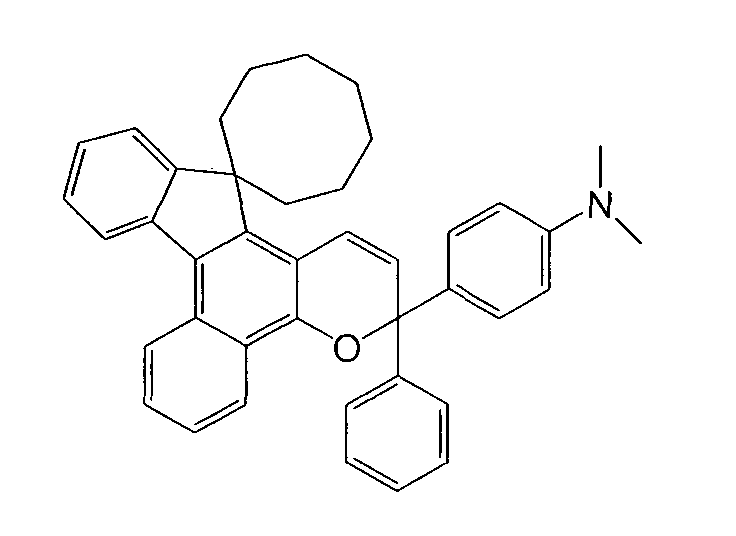
PC2: 하기 식으로 표시되는 화합물PC2: Compound represented by the following formula
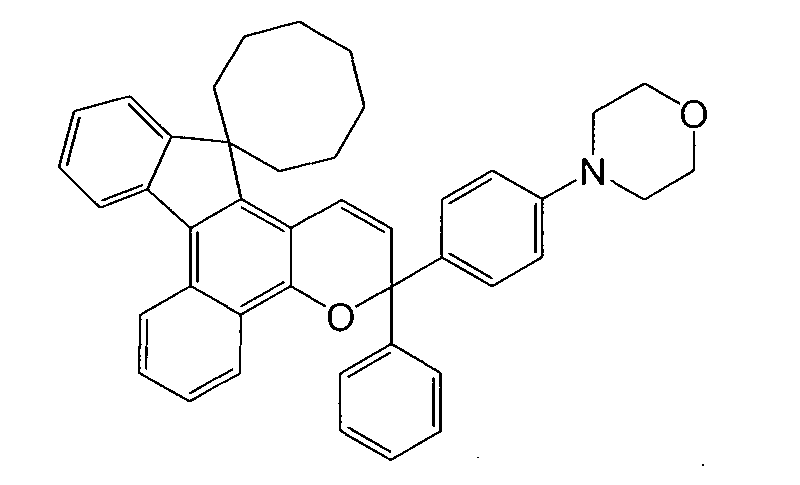
PC3: 하기 식으로 표시되는 화합물PC3: Compound represented by the following formula
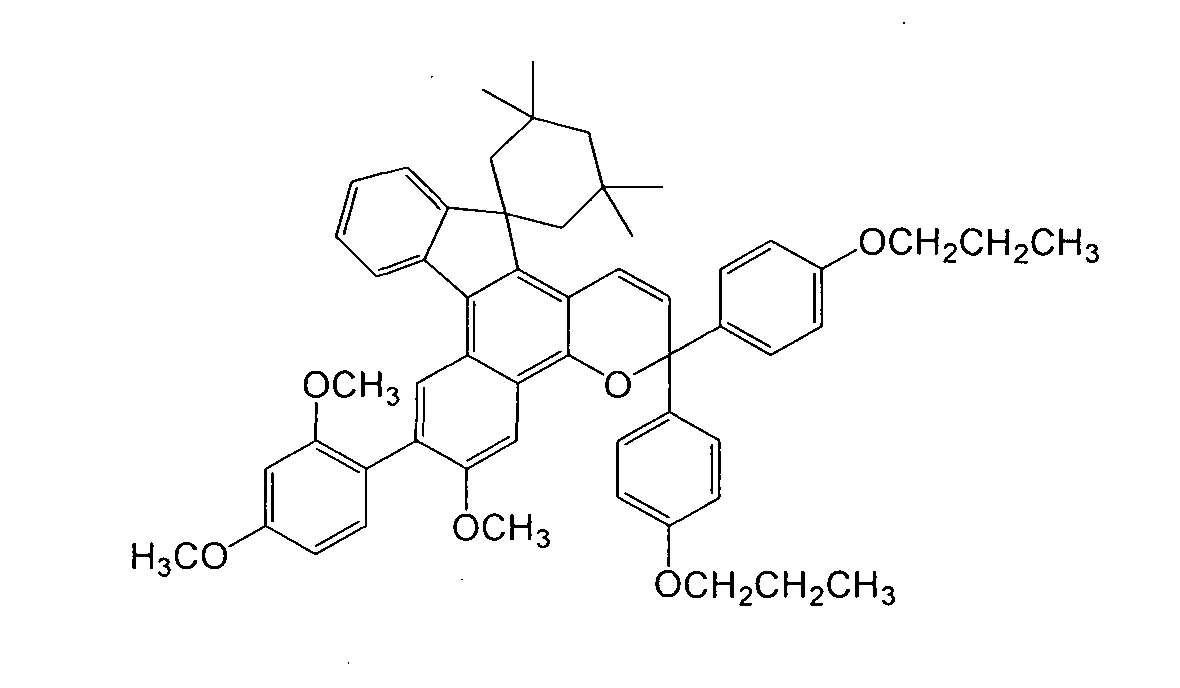
(3) 편광 필름의 조제(3) Preparation of polarizing film
두께 75㎛의 폴리비닐알코올 필름(상품명 VF-PS#7500; 쿠라레사제) 원단을, 요오드 0.04%와 요오드화칼륨 0.4%의 혼합 용액(염색 액)을 사용하여, 30℃로 유지한 상기 염색욕 중에서, 원단의 길이에 대하여 3배가 되도록 연신시키면서, 상기 필름을 염색하였다. 이 필름을 추가로 3.5% 붕산 수용액(연신욕)에 침지시켜, 원단의 6배가 되도록 연신을 행함으로써, 편광 필름(1)(두께 27㎛)을 제작하였다. 얻어진 편광 필름의 시감 투과율은 42.5%, 편광도는 99.2%였다.A fabric solution of a polyvinyl alcohol film (trade name: VF-PS # 7500; manufactured by Kuraray Co., Ltd.) having a thickness of 75 탆 was dyed with a mixed solution (dyeing solution) of 0.04% iodine and 0.4% potassium iodide, , The film was dyed while being stretched so as to be three times the length of the fabric. The film was further immersed in a 3.5% aqueous solution of boric acid (drawing bath) and stretched so as to be six times as large as the raw cloth, thereby producing polarizing film 1 (thickness 27 탆). The luminous transmittance of the obtained polarizing film was 42.5% and the degree of polarization was 99.2%.
(4) 폴리우레탄우레아 수지(U2)의 제조(4) Production of polyurethane-urea resin (U2)
(우레탄 예비 중합체의 제조)(Preparation of urethane prepolymer)
날개 직경 135mm의 맥스 블렌드 날개, 방해판을 구비하는 내경 260mm, 높이 280mm, 투입 용량 10L의 반응 용기에, 냉각관, 온도계, 질소 가스 도입관을 접속시켰다. 맥스 블렌드 날개는 100rpm으로 교반하였다.A cooling tube, a thermometer, and a nitrogen gas inlet tube were connected to a reaction vessel having an inner diameter of 260 mm, a height of 280 mm, and an insertion capacity of 10 L equipped with a blender blade having a blade diameter of 135 mm and an obstruction plate. The Max blend wing was stirred at 100 rpm.
이 반응 용기에 수 평균 분자량 1000의 폴리카르보네이트디올 800g, 이소포론디이소시아네이트 350g, 톨루엔 250g을 투입하고, 질소 분위기 하에 110℃에서 7시간 반응시켜, 말단에 이소시아네이트기를 갖는 우레탄 예비 중합체를 합성하였다. 반응의 종점은 이소시아네이트기의 역적정법에 의해 확인하였다.800 g of a polycarbonate diol having a number average molecular weight of 1,000, 350 g of isophorone diisocyanate and 250 g of toluene were charged in the reaction vessel and reacted at 110 DEG C for 7 hours in a nitrogen atmosphere to synthesize a urethane prepolymer having an isocyanate group at the terminal . The end point of the reaction was confirmed by the inverse titration method of the isocyanate group.
(폴리우레탄우레아 수지(U2)의 제조)(Production of polyurethane-urea resin (U2)) [
우레탄 예비 중합체 반응 종료 후, 반응액을 20℃ 부근까지 냉각시키고, 프로필렌글리콜-모노메틸에테르 5000g에 용해시킨 후, 액온을 20℃로 유지하였다. 이어서, 쇄연장제인 이소포론디아민 121.5g을 30분 이내에 적하하고, 20℃에서 1시간 반응시켰다. 그 후, 추가로 n-부틸아민 9g을 적하하고, 20℃에서 1시간 반응시킴으로써, 폴리우레탄우레아 수지(U2)의 프로필렌글리콜-모노메틸에테르 용액을 얻었다. 얻어진 폴리우레탄우레아 수지(U2)는 수 평균 분자량이 49,000이며, 중량 평균 분자량이 89,000이며, 다분산도가 1.82이며, 연화점이 175℃(연화 개시 온도; 약 155℃)이며, 동점도가 2,500cSt였다.After completion of the urethane prepolymer reaction, the reaction solution was cooled to about 20 캜 and dissolved in 5000 g of propylene glycol-monomethyl ether, and then the liquid temperature was maintained at 20 캜. Subsequently, 121.5 g of isophoronediamine, which is a chain extender, was added dropwise within 30 minutes, and the mixture was reacted at 20 DEG C for 1 hour. Thereafter, 9 g of n-butylamine was further added dropwise and the mixture was allowed to react at 20 占 폚 for 1 hour to obtain a propylene glycol-monomethyl ether solution of the polyurethaneurea resin (U2). The resulting polyurethaneurea resin (U2) had a number average molecular weight of 49,000, a weight average molecular weight of 89,000, a polydispersity of 1.82, a softening point of 175 占 폚 (softening start temperature: about 155 占 폚) and a kinematic viscosity of 2,500 cSt .
또한, 폴리아민 화합물인 이소포론디아민의 적하 개시 시의 반응액의 점도가 0.04kg/mㆍs, 밀도가 950kg/m3, 맥스 블렌드 날개의 회전수가 100rpm이며, 레이놀즈수(Re)가 721이 되고, 맥스 블렌드 날개에서의 nㆍθM-Re 곡선으로부터, 혼합 시간수(nㆍθM)가 12이기 때문에, 완전 혼합 시간(θM)이 7초였다.Further, the viscosity of the reaction solution at the start of the dropwise addition of the isophorone diamine polyamine compounds, and 0.04kg / m · s, a density of the number of revolutions of 100rpm 950kg / m 3, max blend blades, the Reynolds number (Re) is a 721 , And the mixing time (n 占M M ) was 12 from the n 占M M -Re curve in the Max blend wing, the complete mixing time? M was 7 seconds.
(5) 접착층용 접착제 1 조제(5) Adhesive for
폴리우레탄우레아 수지(U2)의 용액 1000g에 계면 활성제로서 DOW CORNING TORAY L-7001 0.7g을 첨가하고, 실온에서 교반ㆍ혼합을 행하여 접착층용 접착제 1을 얻었다.0.7 g of DOW CORNING TORAY L-7001 as a surfactant was added to 1,000 g of a solution of the polyurethane-urea resin (U2), and the mixture was stirred and mixed at room temperature to obtain an
(6) 적층체의 제작(6) Fabrication of laminate
(2)에서 얻어진 포토크로믹 조성물 1을, 코터(테스터 산교제)를 사용하여 (3)에서 얻어진 편광 필름 상에 도공하고, 건조 온도 80℃에서 3분간 건조시킴으로써, 막 두께 40㎛의 포토크로믹 조성물 1로 이루어지는 접착층을 갖는 편광 필름을 얻었다. 이어서, 이 포토크로믹 조성물 1로 이루어지는 접착층에 두께 300㎛의 폴리카르보네이트 시트(1축 연신의 시트; 위상차 약 4500nm)를 접합시켰다.The
또한, 상기 적층 시트의 편광 필름측에 (5)에서 얻어진 접착층용 접착제 1(U2)을, 코터(테스터 산교제)를 사용하여 도공하고, 건조 온도 80℃에서 5분간 건조시킴으로써, 막 두께 3㎛의 접착층을 적층하고, 이어서 이 접착층에 두께 300㎛의 폴리카르보네이트로 이루어지는 광학 시트를 접합시켰다.The adhesive 1 (U2) for the adhesive layer obtained in (5) on the side of the polarizing film of the laminated sheet was coated with a coater (tester acid bonding agent) and dried at a drying temperature of 80 캜 for 5 minutes, And then an optical sheet made of polycarbonate having a thickness of 300 탆 was bonded to this adhesive layer.
이 적층체를 40℃에서 1주일 방치함으로써, 총 두께 약 670㎛의 편광 특성과 포토크로믹 특성을 갖는 본 발명의 적층체를 얻었다.This laminate was allowed to stand at 40 占 폚 for one week to obtain a laminate of the present invention having a total thickness of about 670 占 퐉 and having photochromic properties and photochromic properties.
얻어진 적층체의 시감 투과율은 41.0%, 편광도가 99.1%이며, 자외선 조사 후의 포토크로믹 특성으로서의 발색 시의 시감 투과율은 11.0%이며, 퇴색 속도는 45초이며, 내구성은 93%였다. 또한, 박리 강도는 25℃가 150N/25mm, 70℃ 분위기 하에서의 박리 강도가 120N/25mm, 150℃ 분위기 하에서의 박리 강도가 20N/25mm이며, 내한 시험에서의 밀착 안정 시간은 약 400시간(408시간은 밀착성을 유지함)이었다.The luminous transmittance of the obtained laminate was 41.0%, the degree of polarization was 99.1%, the luminous transmittance at the time of color development as photochromic characteristics after irradiation with ultraviolet rays was 11.0%, the fade rate was 45 seconds, and the durability was 93%. The peel strength at 25 ° C was 150 N / 25 mm, the peel strength in an atmosphere of 70 ° C was 120 N / 25 mm, the peel strength in an atmosphere at 150 ° C was 20 N / 25 mm and the adhesion stability time in the cold test was about 400 hours Adhesion was maintained).
또한, 이들 평가는 이하와 같이 행하였다.These evaluations were carried out as follows.
[시감 투과율(발색 전)][Luminous transmittance (before color development)]
얻어진 적층체를 시료로 하고, 시마즈 세이사쿠쇼제 자외 가시 분광 광도계 UV-2550을 사용하여, 적층체의 자외선 조사 전의 시감 투과율을 측정하였다.Using the obtained laminate as a sample, the luminous transmittance of the laminate before ultraviolet irradiation was measured using an ultraviolet visible spectrophotometer UV-2550 manufactured by Shimadzu Corporation.
[편광도(발색 전)][Polarization degree (before color development)]
얻어진 적층체 2매를 시료로 하고, 시마즈 세이사쿠쇼제 자외 가시 분광 광도계 UV-2550을 사용하여, 평행 투과율(Tp) 및 직교 투과율(Tc)을 측정하여, 편광도(P)를 다음 식에 의해 구하였다.The parallel transmittance (Tp) and the quadrature transmittance (Tc) were measured using two sheets of the obtained laminate as samples and using an ultraviolet visible spectrophotometer UV-2550 manufactured by Shimadzu Seisakusho, and the degree of polarization (P) Respectively.
편광도(P)(%)={(Tp-Tc)/(Tp+Tc)}×100(%) = {(Tp-Tc) / (Tp + Tc)} 100
또한, 상기 Tp 및 Tc는 JIS Z 8701의 2도 시야(C 광원)에 의해 측정하여, 시감도 보정을 행한 Y값이다.Further, Tp and Tc are Y values obtained by performing visibility correction by measuring with a two-view field (C light source) of JIS Z 8701.
[포토크로믹 특성][Photochromic characteristics]
얻어진 적층체를 시료로 하고, 이것에 (주)하마마츠 포토닉스제의 크세논 램프 L-2480(300W) SHL-100을, 에어로매스 필터(코닝사제)를 통해 23℃, 적층체 표면에서의 빔 강도 365nm=2.4mW/cm2, 245nm=24μW/cm2로 120초간 조사하여 발색시켜, 적층체의 포토크로믹 특성을 측정하였다.The obtained laminate was used as a sample, and a xenon lamp L-2480 (300 W) SHL-100 manufactured by Hamamatsu Photonics Co., Ltd. was irradiated with a beam intensity at 23 캜 through an aeromass filter (manufactured by Corning) 365 nm = 2.4 mW / cm 2 and 245 nm = 24 μW / cm 2 for 120 seconds to develop color, and the photochromic characteristics of the laminate were measured.
포토크로믹 특성; 1) 발색 시의 시감 투과율: (주)오츠카 덴시 고교제의 분광 광도계(순간 멀티채널 포토디렉터 MCPD1000)에 의해 구한 상기 광을 120초 조사 후의 시감 투과율이다.Photochromic characteristics; 1) Luminous transmittance at the time of color development: It is the luminous transmittance after 120 seconds of irradiation of the light obtained by a spectrophotometer (instantaneous multi-channel photo director MCPD1000) manufactured by Otsuka Denshi Co.,
포토크로믹 특성; 2) 퇴색 속도[t1/2(sec.)]: 먼저, (주)오츠카 덴시 고교제의 분광 광도계(순간 멀티채널 포토디렉터 MCPD1000)에 의해, 발색 후의 최대 흡수 파장을 구하였다. 이어서, 상기 최대 흡수 파장에서의, 120초간 조사한 후의 흡광도 ε(120)과 최대 흡수 파장에서의 미조사 시의 흡광도 ε(0)의 차[ε(120)-ε(0)]를 구하고, 120초간 조사 후에 광 조사를 멈추었을 때, 시료의 상기 최대 파장에서의 흡광도가 [ε(120)-ε(0)]의 1/2까지 저하되는 데 소요되는 시간(퇴색 속도)을 구하였다. 이 시간이 짧을수록 포토크로믹성이 우수하다고 할 수 있다.Photochromic characteristics; 2) Fade-out rate [t1 / 2 (sec.)]: First, the maximum absorption wavelength after color development was determined by a spectrophotometer (instantaneous multi-channel photo director MCPD1000) manufactured by Otsuka Denshi Kogyo Co., Subsequently, the difference [? (120) -? (0)] between the absorbance? (120) after irradiation for 120 seconds at the maximum absorption wavelength and the absorbance? (0) When light irradiation was stopped after the second irradiation, the time required for the absorbance of the sample to decrease to 1/2 of [? (120) -? (0)] (fading rate) at the maximum wavelength was determined. The shorter the time, the better the photochromic property.
포토크로믹 특성; 3) 내구성(%)=[(A96/A0)×100]: 광 조사에 의한 발색의 내구성을 평가하기 위해 다음의 열화 촉진 시험을 행하였다. 즉, 얻어진 적층체를 스가 시켕키(주)제 크세논 웨더미터 X25에 의해 96시간 촉진 열화시켰다. 그 후, 상기 발색 농도의 평가를 시험 전후에 행하여, 시험 전의 발색 농도(A0) 및 시험 후의 발색 농도(A96)를 측정하고, [(A96)/A0]×100]의 값을 잔존율(%)로 하여, 발색의 내구성의 지표로 하였다. 잔존율이 높을수록 발색의 내구성이 높다.Photochromic characteristics; 3) Durability (%) = [(A96 / A0) x 100]: The following deterioration acceleration test was performed to evaluate the durability of color development by light irradiation. That is, the obtained laminate was accelerated for 96 hours by Xenon Weathermeter X25 manufactured by Suga Shikoku Co., Ltd. The color development density (A0) before the test and the color development concentration after the test (A96) were measured before and after the test, and the value of [(A96) / A0] ) Was used as an index of durability of color development. The higher the residual ratio, the higher the durability of color development.
[박리 강도][Peel strength]
얻어진 적층체를, 25×100mm의 접착 부분을 갖는 시험편으로 하고, 시험 분위기 온도가 설정 가능한 항온조를 구비한 시험기(오토그래프 AGS-500NX, 시마즈 세이사쿠쇼제)에 장착하고, 크로스헤드 속도 100mm/min으로 인장 시험을 행하여, 각각 하기 1) 내지 3)의 박리 강도를 측정하였다.The obtained laminate was mounted on a tester (Autograph AGS-500NX, Shimadzu Seisakusho Co., Ltd.) equipped with a thermostatic chamber capable of setting a test atmosphere temperature and a crosshead speed of 100 mm / min , And the peel strengths of the following 1) to 3) were measured.
박리 강도; 1) 25℃에서의 박리 강도는, 상기 사이즈로 잘라낸 시험편을 25℃로 설정한 항온조 내에서 10분 방치한 후, 상기와 같이 하여 측정하였다.Peel strength; 1) The peel strength at 25 캜 was measured in the same manner as described above after leaving the test piece cut in the above-mentioned size in a thermostatic chamber set at 25 캜 for 10 minutes.
박리 강도; 2) 70℃ 분위기 하에서의 박리 강도는, 상기 사이즈로 잘라낸 시험편을 70℃로 설정한 항온조 내에서 10분 가열한 후, 상기와 같이 하여 측정하였다.Peel strength; 2) The peel strength in an atmosphere of 70 ° C was measured in the same manner as described above after heating for 10 minutes in a thermostatic chamber set at 70 ° C in a test piece cut in the above-mentioned size.
박리 강도; 3) 150℃ 분위기 하에서의 박리 강도는, 상기 사이즈로 잘라낸 시험편을 150℃로 설정한 항온조 내에서 10분 가열한 후, 상기와 같이 하여 측정하였다.Peel strength; 3) The peel strength in an atmosphere at 150 ° C was measured in the same manner as described above after heating for 10 minutes in a thermostatic chamber set at 150 ° C in a test piece cut out to the above-mentioned size.
[내한 시험][Cold examination]
얻어진 적층체를 직경 50mm의 원형으로 잘라내고, 이 시험편의 외주를 링상의 스테인리스제 지그로 체결하였다. 별도로, 덮개를 갖는 플라스틱 용기에 인공땀(10%의 식염 및 5%의 락트산을 첨가한 증류수)을 준비하여, 이 인공땀 중에 상기 시험편을 침지시켰다. 이 시험편 및 인공땀이 들어간 플라스틱 용기를 70℃에서 보관하고, 24시간마다 시험편 단부의 박리 유무를 목시(目視) 평가하였다. 평가 결과의 수치는 안정된 접착성을 나타낸 시간(박리가 발생하는 직전까지의 시간)이다.The obtained laminate was cut into a circle having a diameter of 50 mm, and the outer periphery of the test piece was fastened with a ring-shaped stainless steel jig. Separately, artificial perspiration (distilled water containing 10% of salt and 5% of lactic acid) was prepared in a plastic container having a cover, and the test piece was immersed in the artificial perspiration. This test piece and the plastic container containing the artificial sweat were stored at 70 캜 and visually evaluated whether or not the end of the test piece was peeled off every 24 hours. The numerical value of the evaluation result is the time showing the stable adhesion (time until just before peeling occurs).
실시예 2Example 2
실시예 1에서 얻어진 적층체를 포토크로믹 조성물 1로 이루어지는 접착층측이 볼록면으로, 편광 필름층측이 오목면으로 되도록 구면 형상으로 열 굽힘 가공하였다. 열 굽힘 가공은, 금형 중심에 감압 흡인 가능한 흡인구를 갖는 오목형 금형을 준비하여, φ80mm로 모양을 뽑아낸 적층체를 포토크로믹 조성물 1로 이루어지는 접착층측이 금형측으로 되도록 배치하고, 그 후 130℃에서 5분간 감압 흡인함으로써 실시하였다. 이에 의해, 포토크로믹 조성물 1로 이루어지는 접착층측이 볼록면, 편광 필름층측이 오목면으로 된 구면 형상을 갖는 적층체를 얻었다.The laminate obtained in Example 1 was thermally bended in a spherical shape so that the adhesive layer side of the
이어서, 얻어진 구면 형상을 갖는 적층체를 사출 성형기의 오목형 금형에 설치하고, 100℃로 가열하였다. 사출 성형기에 120℃, 5시간의 예비 가열을 행한 폴리카르보네이트 수지의 펠릿(데이진 가세이제 팬라이트)을 충전시켜, 300℃, 60rpm으로 가열 용융하고, 사출 압력 14000N/cm2로 적층체의 이면측(편광 필름층측)으로 사출함으로써, 폴리카르보네이트 수지와 일체화된 플라스틱 렌즈(광학 물품)를 제조하였다. 얻어진 플라스틱 렌즈의 시감 투과율은 40.5%, 편광도가 99.1%이며, 자외선 조사 후의 포토크로믹 특성으로서의 발색 시의 시감 투과율은 11.0%이며, 퇴색 속도는 45초이며, 내구성은 93%였다. 또한, 내한 시험에서의 밀착 안정 시간은 약 1000시간(1008시간은 밀착성을 유지함)이었다. 또한, 굽힘 가공성은 A였다. 또한, 굽힘 가공성의 평가는 이하와 같이 행하였다.Subsequently, the obtained laminate having a spherical shape was placed in a concave mold of an injection molding machine and heated to 100 캜. 120 ℃ an injection molding machine, subjected to preliminary heating for 5 hours polycarbonate pellets of the carbonate resin (Teijin biasing now Pan Light) was, heated to 300 ℃, 60rpm melted, and the injection pressure laminated to 14000N / cm 2 charging body (Polarizing film layer side), thereby producing a plastic lens (optical article) integrated with the polycarbonate resin. The luminous transmittance of the obtained plastic lens was 40.5%, the degree of polarization was 99.1%, the luminous transmittance at the time of color development as photochromic characteristics after irradiation with ultraviolet rays was 11.0%, the fading rate was 45 seconds, and the durability was 93%. The adhesion stability time in the cold test was about 1000 hours (adhesion was maintained for 1008 hours). The bending workability was A. The bending workability was evaluated as follows.
[굽힘 가공성][Bending workability]
전술한 굽힘 가공을 실시했을 때, 원하는 형상대로 굽힘 가공된 것을 A, 약간 변형을 발생한 것을 B, 사출 성형기의 금형에 세트하기 어려울 정도의 변형을 발생한 것을 C로 하여, 목시 평가를 실시하였다.When the above-described bending was carried out, a bending test was performed on the bending test piece in the desired shape, a bending test with slight bending test, and a test piece C in which the bending test was performed to such a degree that it was difficult to set the mold on the mold of the injection molding machine.
실시예 3Example 3
(2)에서 얻어진 포토크로믹 조성물 1을, 코터(테스터 산교제)를 사용하여 (3)에서 얻어진 편광 필름 상에 도공하고, 건조 온도 80℃에서 3분간 건조시킴으로써, 막 두께 40㎛의 포토크로믹 조성물 1로 이루어지는 접착층을 갖는 편광 필름을 얻었다. 이어서, 이 포토크로믹 조성물 1로 이루어지는 접착층에 두께 300㎛의 폴리카르보네이트 시트(1축 연신의 시트; 위상차 약 4500nm)를 접합시켰다.The
또한, 상기 적층 시트의 편광 필름측에 아크릴계 접착제(사이덴 가가쿠사제 사이비놀 AT-245)를, 코터(테스터 산교제)를 사용하여 도공하고, 건조 온도 80℃에서 5분간 건조시킴으로써, 막 두께 10㎛의 접착층을 적층하고, 이어서 이 접착층에 두께 300㎛의 폴리카르보네이트로 이루어지는 광학 시트를 접합시켰다.Further, an acrylic adhesive (Saibinol AT-245 manufactured by Saiden Kagaku Co., Ltd.) was coated on the polarizing film side of the laminated sheet using a coater (tester acid bonding agent) and dried at a drying temperature of 80 캜 for 5 minutes, And an optical sheet made of polycarbonate having a thickness of 300 탆 was bonded to the adhesive layer.
이 적층체를 40℃에서 1주일 방치함으로써, 총 두께 약 677㎛의 편광 특성과 포토크로믹 특성을 갖는 본 발명의 적층체를 얻었다.This laminate was allowed to stand at 40 占 폚 for one week to obtain a laminate of the present invention having a total thickness of about 677 占 퐉 and having photochromic properties and photochromic properties.
얻어진 적층체의 시감 투과율은 41.0%, 편광도가 99.1%이며, 자외선 조사 후의 포토크로믹 특성으로서의 발색 시의 시감 투과율은 11.0%이며, 퇴색 속도는 45초이며, 내구성은 93%였다. 또한, 박리 강도는 실온이 120N/25mm, 70℃ 분위기 하에서의 박리 강도가 90N/25mm, 150℃ 분위기 하에서의 박리 강도가 10N/25mm이며, 내한 시험에서의 밀착 안정 시간은 약 200시간(216시간은 밀착성을 유지함)이었다.The luminous transmittance of the obtained laminate was 41.0%, the degree of polarization was 99.1%, the luminous transmittance at the time of color development as photochromic characteristics after irradiation with ultraviolet rays was 11.0%, the fade rate was 45 seconds, and the durability was 93%. The peel strength at room temperature was 120 N / 25 mm, the peel strength in an atmosphere at 70 캜 was 90 N / 25 mm, the peel strength in an atmosphere at 150 캜 was 10 N / 25 mm, the adhesion stability time in the cold test was about 200 hours Respectively.
실시예 4Example 4
실시예 3에서 얻어진 적층체를, 실시예 2와 동일한 방법으로 열 굽힘 가공 및 사출 성형을 행함으로써, 폴리카르보네이트 수지와 일체화된 플라스틱 렌즈(광학 물품)를 제조하였다. 얻어진 플라스틱 렌즈의 시감 투과율은 40.6%, 편광도가 99.1%이며, 자외선 조사 후의 포토크로믹 특성으로서의 발색 시의 시감 투과율은 11.0%이며, 퇴색 속도는 45초이며, 내구성은 93%였다. 또한, 내한 시험에서의 밀착 안정 시간은 약 500시간(504시간은 밀착성을 유지함)이었다. 또한, 굽힘 가공성은 B였다.The laminate obtained in Example 3 was subjected to thermal bending and injection molding in the same manner as in Example 2 to produce a plastic lens (optical article) integrated with a polycarbonate resin. The obtained plastic lens had a luminous transmittance of 40.6% and a polarization degree of 99.1%, a luminous transmittance of 11.0% at the time of color development as a photochromic characteristic after irradiation with ultraviolet rays, a fading rate of 45 seconds, and a durability of 93%. In addition, the adhesion stabilization time in the cold tolerance test was about 500 hours (adhesion was maintained for 504 hours). The bending workability was B.
실시예 5Example 5
(2)에서 얻어진 포토크로믹 조성물 1을, 코터(테스터 산교제)를 사용하여 (3)에서 얻어진 편광 필름 상에 도공하고, 건조 온도 80℃에서 3분간 건조시킴으로써, 막 두께 40㎛의 포토크로믹 조성물 1로 이루어지는 접착층을 갖는 편광 필름을 얻었다. 이어서, 이 포토크로믹 조성물 1로 이루어지는 접착층에 두께 300㎛의 폴리카르보네이트 시트(1축 연신의 시트; 위상차 약 4500nm)를 접합시켰다.The
또한, 상기 적층 시트의 편광 필름측에 올레핀계 접착제(도모에 고교사제 라이콘 142)를, 코터(테스터 산교제)를 사용하여 도공하고, 건조 온도 80℃에서 5분간 건조시킴으로써, 막 두께 10㎛의 접착층을 적층하고, 이어서 이 접착층에 두께 300㎛의 폴리카르보네이트로 이루어지는 광학 시트를 접합시켰다.Further, an olefin-based adhesive (lacon 142 manufactured by Tomoe Kogyo Co., Ltd.) was coated on the polarizing film side of the laminated sheet using a coater (tester acid bonding agent) and dried at a drying temperature of 80 캜 for 5 minutes, And then an optical sheet made of polycarbonate having a thickness of 300 탆 was bonded to this adhesive layer.
이 적층체를 40℃에서 1주일 방치함으로써, 총 두께 약 677㎛의 편광 특성과 포토크로믹 특성을 갖는 본 발명의 적층체를 얻었다.This laminate was allowed to stand at 40 占 폚 for one week to obtain a laminate of the present invention having a total thickness of about 677 占 퐉 and having photochromic properties and photochromic properties.
얻어진 적층체의 시감 투과율은 41.0%, 편광도가 99.1%이며, 자외선 조사 후의 포토크로믹 특성으로서의 발색 시의 시감 투과율은 11.0%이며, 퇴색 속도는 45초이며, 내구성은 93%였다. 또한, 박리 강도는 실온이 120N/25mm, 70℃ 분위기 하에서의 박리 강도가 80N/25mm, 150℃ 분위기 하에서의 박리 강도가 10N/25mm이며, 내한 시험에서의 밀착 안정 시간은 약 200시간(216시간은 밀착성을 유지함)이었다.The luminous transmittance of the obtained laminate was 41.0%, the degree of polarization was 99.1%, the luminous transmittance at the time of color development as photochromic characteristics after irradiation with ultraviolet rays was 11.0%, the fade rate was 45 seconds, and the durability was 93%. The peel strength was 120 N / 25 mm at room temperature, the peel strength was 80 N / 25 mm in an atmosphere at 70 占 폚, the peel strength in an atmosphere at 150 占 폚 was 10 N / 25 mm, the adhesion stability time in the cold test was about 200 hours Respectively.
실시예 6Example 6
실시예 5에서 얻어진 적층체를, 실시예 2와 동일한 방법으로 열 굽힘 가공 및 사출 성형을 행함으로써, 폴리카르보네이트 수지와 일체화된 플라스틱 렌즈(광학 물품)를 제조하였다. 얻어진 플라스틱 렌즈의 시감 투과율은 40.6%, 편광도가 99.1%이며, 자외선 조사 후의 포토크로믹 특성으로서의 발색 시의 시감 투과율은 11.0%이며, 퇴색 속도는 45초이며, 내구성은 93%였다. 또한, 내한 시험에서의 밀착 안정 시간은 약 400시간(408시간은 밀착성을 유지함)이었다. 또한, 굽힘 가공성은 B였다.The laminate obtained in Example 5 was subjected to thermal bending and injection molding in the same manner as in Example 2 to produce a plastic lens (optical article) integrated with a polycarbonate resin. The obtained plastic lens had a luminous transmittance of 40.6% and a polarization degree of 99.1%, a luminous transmittance of 11.0% at the time of color development as a photochromic characteristic after irradiation with ultraviolet rays, a fading rate of 45 seconds, and a durability of 93%. Also, the adhesion stability time in the cold test was about 400 hours (adhesion was maintained at 408 hours). The bending workability was B.
실시예 7Example 7
(2)에서 얻어진 포토크로믹 조성물 1을, 코터(테스터 산교제)를 사용하여 (3)에서 얻어진 편광 필름 상에 도공하고, 건조 온도 80℃에서 3분간 건조시킴으로써, 막 두께 40㎛의 포토크로믹 조성물 1로 이루어지는 접착층을 갖는 편광 필름을 얻었다. 이어서, 이 포토크로믹 조성물 1로 이루어지는 접착층에 두께 300㎛의 폴리카르보네이트 시트(1축 연신의 시트; 위상차 약 4500nm)를 접합시켰다.The
또한, 상기 적층 시트의 편광 필름측에 습기 경화형 우레탄 접착제(미쓰이 다케다 케미컬사제 다케네이트)와 트리이소시아네이트계 경화제를 혼합한 도공액을, 코터(테스터 산교제)를 사용하여 도공하고, 건조 온도 80℃에서 5분간 건조시킴으로써, 막 두께 10㎛의 접착층을 적층하고, 이어서 이 접착층에 두께 300㎛의 폴리카르보네이트로 이루어지는 광학 시트를 접합시켰다.Further, a coating liquid prepared by mixing a moisture-curing urethane adhesive (Takenate, Takenaka Chemical Co., Ltd.) and a triisocyanate curing agent on the polarizing film side of the laminated sheet was coated using a coater (tester acid bonding agent) For 5 minutes to laminate an adhesive layer having a film thickness of 10 mu m, and then an optical sheet made of polycarbonate having a thickness of 300 mu m was bonded to this adhesive layer.
이 적층체를 40℃에서 1주일 방치함으로써, 총 두께 약 677㎛의 편광 특성과 포토크로믹 특성을 갖는 본 발명의 적층체를 얻었다.This laminate was allowed to stand at 40 占 폚 for one week to obtain a laminate of the present invention having a total thickness of about 677 占 퐉 and having photochromic properties and photochromic properties.
얻어진 적층체의 시감 투과율은 41.0%, 편광도가 99.1%이며, 자외선 조사 후의 포토크로믹 특성으로서의 발색 시의 시감 투과율은 11.0%이며, 퇴색 속도는 45초이며, 내구성은 93%였다. 또한, 박리 강도는 실온이 160N/25mm, 70℃ 분위기 하에서의 박리 강도가 120N/25mm, 150℃ 분위기 하에서의 박리 강도가 20N/25mm이며, 내한 시험에서의 밀착 안정 시간은 약 450시간(456시간은 밀착성을 유지함)이었다.The luminous transmittance of the obtained laminate was 41.0%, the degree of polarization was 99.1%, the luminous transmittance at the time of color development as photochromic characteristics after irradiation with ultraviolet rays was 11.0%, the fade rate was 45 seconds, and the durability was 93%. The peel strength in the room temperature was 160 N / 25 mm, the peel strength in the atmosphere at 70 캜 was 120 N / 25 mm, the peel strength in the atmosphere at 150 캜 was 20 N / 25 mm, the adhesion stability time in the cold test was about 450 hours Respectively.
실시예 8Example 8
실시예 7에서 얻어진 적층체를, 실시예 2와 동일한 방법으로 열 굽힘 가공 및 사출 성형을 행함으로써, 폴리카르보네이트 수지와 일체화된 플라스틱 렌즈(광학 물품)를 제조하였다. 얻어진 플라스틱 렌즈의 시감 투과율은 40.6%, 편광도가 99.1%이며, 자외선 조사 후의 포토크로믹 특성으로서의 발색 시의 시감 투과율은 11.0%이며, 퇴색 속도는 45초이며, 내구성은 93%였다. 또한, 내한 시험에서의 밀착 안정 시간은 약 1000시간(1008시간은 밀착성을 유지함)이었다. 또한, 굽힘 가공성은 B였다.The laminate obtained in Example 7 was subjected to thermal bending and injection molding in the same manner as in Example 2 to produce a plastic lens (optical article) integrated with a polycarbonate resin. The obtained plastic lens had a luminous transmittance of 40.6% and a polarization degree of 99.1%, a luminous transmittance of 11.0% at the time of color development as a photochromic characteristic after irradiation with ultraviolet rays, a fading rate of 45 seconds, and a durability of 93%. The adhesion stability time in the cold test was about 1000 hours (adhesion was maintained for 1008 hours). The bending workability was B.
실시예 9Example 9
(2)에서 얻어진 포토크로믹 조성물 1을, 코터(테스터 산교제)를 사용하여 (3)에서 얻어진 편광 필름 상에 도공하고, 건조 온도 80℃에서 3분간 건조시킴으로써, 막 두께 40㎛의 포토크로믹 조성물 1로 이루어지는 접착층을 갖는 편광 필름을 얻었다. 이어서, 이 포토크로믹 조성물 1로 이루어지는 접착층에 두께 300㎛의 폴리카르보네이트 시트(1축 연신의 시트; 위상차 약 4500nm)를 접합시켰다.The
또한, 상기 적층 시트의 편광 필름측에 폴리비닐알코올계 접착제(닛폰 고세이사제 고세놀)를, 코터(테스터 산교제)를 사용하여 도공하고, 건조 온도 80℃에서 5분간 건조시킴으로써, 막 두께 10㎛의 접착층을 적층하고, 이어서 이 접착층에 두께 300㎛의 폴리카르보네이트로 이루어지는 광학 시트를 접합시켰다.Further, a polyvinyl alcohol-based adhesive (Goshenol, manufactured by Nippon Gosei Co., Ltd.) was coated on the polarizing film side of the laminated sheet using a coater (tester acid bonding agent) and dried at 80 캜 for 5 minutes, And then an optical sheet made of polycarbonate having a thickness of 300 탆 was bonded to this adhesive layer.
이 적층체를 40℃에서 1주일 방치함으로써, 총 두께 약 677㎛의 편광 특성과 포토크로믹 특성을 갖는 본 발명의 적층체를 얻었다.This laminate was allowed to stand at 40 占 폚 for one week to obtain a laminate of the present invention having a total thickness of about 677 占 퐉 and having photochromic properties and photochromic properties.
얻어진 적층체의 시감 투과율은 41.0%, 편광도가 99.1%이며, 자외선 조사 후의 포토크로믹 특성으로서의 발색 시의 시감 투과율은 11.0%이며, 퇴색 속도는 45초이며, 내구성은 93%였다. 또한, 박리 강도는 실온이 130N/25mm, 70℃ 분위기 하에서의 박리 강도가 100N/25mm, 150℃ 분위기 하에서의 박리 강도가 15N/25mm이며, 내한 시험에서의 밀착 안정 시간은 약 350시간(360시간은 밀착성을 유지함)이었다.The luminous transmittance of the obtained laminate was 41.0%, the degree of polarization was 99.1%, the luminous transmittance at the time of color development as photochromic characteristics after irradiation with ultraviolet rays was 11.0%, the fade rate was 45 seconds, and the durability was 93%. The peel strength in the room temperature was 130 N / 25 mm, the peel strength in the atmosphere of 70 캜 was 100 N / 25 mm, the peel strength in the atmosphere of 150 캜 was 15 N / 25 mm, the adhesion stability time in the cold test was about 350 hours Respectively.
실시예 10Example 10
실시예 7에서 얻어진 적층체를, 실시예 2와 동일한 방법으로 열 굽힘 가공 및 사출 성형을 행함으로써, 폴리카르보네이트 수지와 일체화된 플라스틱 렌즈(광학 물품)를 제조하였다. 얻어진 플라스틱 렌즈의 시감 투과율은 40.6%, 편광도가 99.1%이며, 자외선 조사 후의 포토크로믹 특성으로서의 발색 시의 시감 투과율은 11.0%이며, 퇴색 속도는 45초이며, 내구성은 93%였다. 또한, 내한 시험에서의 밀착 안정 시간은 약 800시간(816시간은 밀착성을 유지함)이었다. 또한, 굽힘 가공성은 B였다.The laminate obtained in Example 7 was subjected to thermal bending and injection molding in the same manner as in Example 2 to produce a plastic lens (optical article) integrated with a polycarbonate resin. The obtained plastic lens had a luminous transmittance of 40.6% and a polarization degree of 99.1%, a luminous transmittance of 11.0% at the time of color development as a photochromic characteristic after irradiation with ultraviolet rays, a fading rate of 45 seconds, and a durability of 93%. In addition, the adhesion stability time in the cold tolerance test was about 800 hours (the adhesion was maintained for 816 hours). The bending workability was B.
실시예 11Example 11
(5)에서 얻어진 접착층용 접착제 1을, 코터(테스터 산교제)를 사용하여 (3)에서 얻어진 편광 필름 상에 도공하고, 건조 온도 80℃에서 5분간 건조시킴으로써, 막 두께 3㎛의 접착층을 갖는 편광 필름을 얻었다. 이 접착층에 두께 150㎛의 폴리카르보네이트 시트(1축 연신의 시트; 위상차 약 4500nm)를 접합시켰다.The
또한, 다른 한쪽의 편광 필름면에 (5)에서 얻어진 접착층용 접착제 1을, 코터(테스터 산교제)를 사용하여 도공하고, 건조 온도 80℃에서 5분간 건조시켜 막 두께 3㎛의 접착층을 적층한 후, 이 접착층에 두께 300㎛의 폴리카르보네이트 시트를 접합시켜, 2매의 폴리카르보네이트 사이에 끼운 편광 시트를 얻었다.The
상기 편광 시트의 두께 150㎛의 폴리카르보네이트 시트(1축 연신의 시트; 위상차 약 4500nm)의 면에 (2)에서 얻어진 포토크로믹 조성물 1을, 코터(테스터 산교제)를 사용하여 도공하고, 건조 온도 80℃에서 3분간 건조시킴으로써, 막 두께 40㎛의 포토크로믹 조성물 1로 이루어지는 접착층을 갖는 편광 시트를 얻었다. 이어서, 이 포토크로믹 조성물 1로 이루어지는 접착층에 두께 150㎛의 폴리카르보네이트 시트(1축 연신의 시트; 위상차 약 4500nm)를 접합시켰다.The
이 적층체를 40℃에서 1주일 방치함으로써, 총 두께 약 673㎛의 편광 특성과 포토크로믹 특성을 갖는 적층체를 얻었다.This laminate was allowed to stand at 40 占 폚 for one week to obtain a laminate having a total thickness of about 673 占 퐉 and polarization and photochromic properties.
얻어진 적층체의 시감 투과율은 41.3%, 편광도가 99.2%이며, 자외선 조사 후의 포토크로믹 특성으로서의 발색 시의 시감 투과율은 11.0%이며, 퇴색 속도는 45초이며, 내구성은 93%였다. 또한, 박리 강도는 실온이 140N/25mm, 70℃ 분위기 하에서의 박리 강도가 110N/25mm, 150℃ 분위기 하에서의 박리 강도가 20N/25mm이며, 내한 시험에서의 밀착 안정 시간은 약 400시간(408시간은 밀착성을 유지함)이었다.The luminous transmittance of the obtained laminate was 41.3%, the degree of polarization was 99.2%, the luminous transmittance at the time of color development as photochromic characteristics after irradiation with ultraviolet light was 11.0%, the fading rate was 45 seconds, and the durability was 93%. The peel strength was 140 N / 25 mm, the peel strength in an atmosphere of 70 캜 was 110 N / 25 mm, the peel strength in an atmosphere of 150 캜 was 20 N / 25 mm, the adhesion stability time in the cold test was about 400 hours Respectively.
실시예 12Example 12
실시예 11에서 얻어진 적층체를, 실시예 2와 동일한 방법으로 열 굽힘 가공 및 사출 성형을 행함으로써, 폴리카르보네이트 수지와 일체화된 플라스틱 렌즈(광학 물품)를 제조하였다. 얻어진 플라스틱 렌즈의 시감 투과율은 40.6%, 편광도가 99.1%이며, 자외선 조사 후의 포토크로믹 특성으로서의 발색 시의 시감 투과율은 11.0%이며, 퇴색 속도는 45초이며, 내구성은 93%였다. 또한, 내한 시험에서의 밀착 안정 시간은 약 1000시간(1008시간은 밀착성을 유지함)이었다. 또한, 굽힘 가공성은 A였다.The laminate obtained in Example 11 was subjected to thermal bending and injection molding in the same manner as in Example 2 to produce a plastic lens (optical article) integrated with a polycarbonate resin. The obtained plastic lens had a luminous transmittance of 40.6% and a polarization degree of 99.1%, a luminous transmittance of 11.0% at the time of color development as a photochromic characteristic after irradiation with ultraviolet rays, a fading rate of 45 seconds, and a durability of 93%. The adhesion stability time in the cold test was about 1000 hours (adhesion was maintained for 1008 hours). The bending workability was A.
실시예 13Example 13
실시예 11에서 얻어진 적층체에 대하여, 포토크로믹 조성물 1로 이루어지는 접착층의 양측에 (5)에서 얻어진 접착층용 접착제 1을 도포한 접착층을 형성한 것 이외에는, 실시예 3과 동일한 구성의 적층체를 얻었다. 이 적층체의 총 두께는 약 680㎛였다.A laminate having the same structure as in Example 3 was obtained in the same manner as in Example 3 except that the adhesive layer for the
얻어진 적층체의 시감 투과율은 41.5%, 편광도가 99.0%이며, 자외선 조사 후의 포토크로믹 특성으로서의 발색 시의 시감 투과율은 11.0%이며, 퇴색 속도는 45초이며, 내구성은 93%였다. 또한, 박리 강도는 실온이 180N/25mm, 70℃ 분위기 하에서의 박리 강도가 125N/25mm, 150℃ 분위기 하에서의 박리 강도가 30N/25mm이며, 내한 시험에서의 밀착 안정 시간은 약 800시간(816시간은 밀착성을 유지함)이었다.The luminous transmittance of the obtained laminate was 41.5%, the degree of polarization was 99.0%, the luminous transmittance at the time of color development as photochromic characteristics after irradiation with ultraviolet rays was 11.0%, the fading rate was 45 seconds, and the durability was 93%. The peel strength was 180 N / 25 mm at room temperature, the peel strength was 125 N / 25 mm under an atmosphere of 70 占 폚, the peel strength was 30 N / 25 mm under an atmosphere of 150 占 폚 and the adhesion stabilization time in the cold endurance test was about 800 hours Respectively.
실시예 14Example 14
실시예 13에서 얻어진 적층체를, 실시예 2와 동일한 방법으로 열 굽힘 가공 및 사출 성형을 행함으로써, 폴리카르보네이트 수지와 일체화된 플라스틱 렌즈(광학 물품)를 제조하였다. 얻어진 플라스틱 렌즈의 시감 투과율은 40.8%, 편광도가 99.0%이며, 자외선 조사 후의 포토크로믹 특성으로서의 발색 시의 시감 투과율은 11.0%이며, 퇴색 속도는 45초이며, 내구성은 93%였다. 또한, 내한 시험에서의 밀착 안정 시간은 약 1400시간(1416시간은 밀착성을 유지함)이었다. 또한, 굽힘 가공성은 A였다.The laminate obtained in Example 13 was subjected to thermal bending and injection molding in the same manner as in Example 2 to produce a plastic lens (optical article) integrated with a polycarbonate resin. The obtained plastic lens had a luminous transmittance of 40.8% and a polarization degree of 99.0%, a luminous transmittance of 11.0% at the time of color development as a photochromic characteristic after irradiation with ultraviolet rays, a fade rate of 45 seconds, and a durability of 93%. In addition, the adhesion stabilization time in the cold resistance test was about 1400 hours (the adhesiveness was maintained for 1416 hours). The bending workability was A.
실시예 15Example 15
실시예 11에서 얻어진 적층체에 대하여, 포토크로믹 조성물 1로 이루어지는 접착층의 양측에 습기 경화형 우레탄 접착제(미쓰이 다케다 케미컬사제 다케네이트)와 트리이소시아네이트계 경화제를 혼합한 도공액을 도포한 접착층을 형성한 것 이외에는, 실시예 13과 동일한 구성의 적층체를 얻었다. 이 적층체의 총 두께는 약 680㎛였다.An adhesive layer formed by applying a coating solution prepared by mixing a moisture curing type urethane adhesive (Takenate, manufactured by Mitsui Takeda Chemical Co., Ltd.) and a triisocyanate curing agent on both sides of an adhesive layer made of the
얻어진 적층체의 시감 투과율은 41.5%, 편광도가 99.0%이며, 자외선 조사 후의 포토크로믹 특성으로서의 발색 시의 시감 투과율은 11.0%이며, 퇴색 속도는 45초이며, 내구성은 93%였다. 또한, 박리 강도는 실온이 170N/25mm, 70℃ 분위기 하에서의 박리 강도가 125N/25mm, 150℃ 분위기 하에서의 박리 강도가 30N/25mm이며, 내한 시험에서의 밀착 안정 시간은 약 700시간(720시간은 밀착성을 유지함)이었다.The luminous transmittance of the obtained laminate was 41.5%, the degree of polarization was 99.0%, the luminous transmittance at the time of color development as photochromic characteristics after irradiation with ultraviolet rays was 11.0%, the fading rate was 45 seconds, and the durability was 93%. The peel strength in the room temperature was 170 N / 25 mm, the peel strength in the atmosphere at 70 캜 was 125 N / 25 mm, the peel strength in the atmosphere at 150 캜 was 30 N / 25 mm, the adherence stability time in the cold test was about 700 hours Respectively.
실시예 16Example 16
실시예 15에서 얻어진 적층체를, 실시예 2와 동일한 방법으로 열 굽힘 가공 및 사출 성형을 행함으로써, 폴리카르보네이트 수지와 일체화된 플라스틱 렌즈(광학 물품)를 제조하였다. 얻어진 플라스틱 렌즈의 시감 투과율은 40.8%, 편광도가 99.0%이며, 자외선 조사 후의 포토크로믹 특성으로서의 발색 시의 시감 투과율은 11.0%이며, 퇴색 속도는 45초이며, 내구성은 93%였다. 또한, 내한 시험에서의 밀착 안정 시간은 약 1300시간(1320시간은 밀착성을 유지함)이었다. 또한, 굽힘 가공성은 B였다.The laminate obtained in Example 15 was subjected to thermal bending and injection molding in the same manner as in Example 2 to produce a plastic lens (optical article) integrated with a polycarbonate resin. The obtained plastic lens had a luminous transmittance of 40.8% and a polarization degree of 99.0%, a luminous transmittance of 11.0% at the time of color development as a photochromic characteristic after irradiation with ultraviolet rays, a fade rate of 45 seconds, and a durability of 93%. In addition, the adhesion stability time in the cold test was about 1300 hours (the adhesion was maintained for 1320 hours). The bending workability was B.
실시예 17Example 17
실시예 11에서 얻어진 적층체에 대하여, 포토크로믹 조성물 1로 이루어지는 접착층의 편측에 폴리비닐알코올계 접착제(닛폰 고세이사제 고세놀)를 도포한 접착층을 형성하고, 포토크로믹 조성물 1로 이루어지는 접착층의 다른 편측에 아크릴계 접착제(사이덴 가가쿠사제 사이비놀 AT-245)를 도포한 접착층을 형성한 것 이외에는, 실시예 13과 동일한 구성의 적층체를 얻었다. 이 적층체의 총 두께는 약 680㎛였다.An adhesive layer formed by applying a polyvinyl alcohol-based adhesive (Goshenol, manufactured by Nippon Gosei Co., Ltd.) to one side of the adhesive layer made of the
얻어진 적층체의 시감 투과율은 41.5%, 편광도가 99.0%이며, 자외선 조사 후의 포토크로믹 특성으로서의 발색 시의 시감 투과율은 11.0%이며, 퇴색 속도는 45초이며, 내구성은 93%였다. 또한, 박리 강도는 실온이 130N/25mm, 70℃ 분위기 하에서의 박리 강도가 110N/25mm, 150℃ 분위기 하에서의 박리 강도가 20N/25mm이며, 내한 시험에서의 밀착 안정 시간은 약 500시간(504시간은 밀착성을 유지함)이었다.The luminous transmittance of the obtained laminate was 41.5%, the degree of polarization was 99.0%, the luminous transmittance at the time of color development as photochromic characteristics after irradiation with ultraviolet rays was 11.0%, the fading rate was 45 seconds, and the durability was 93%. The peel strength in the room temperature was 130 N / 25 mm, the peel strength in the atmosphere at 70 캜 was 110 N / 25 mm, the peel strength in the atmosphere at 150 캜 was 20 N / 25 mm, the adhesion stability time in the cold test was about 500 hours Respectively.
실시예 18Example 18
실시예 17에서 얻어진 적층체를, 실시예 2와 동일한 방법으로 열 굽힘 가공 및 사출 성형을 행함으로써, 폴리카르보네이트 수지와 일체화된 플라스틱 렌즈(광학 물품)를 제조하였다. 얻어진 플라스틱 렌즈의 시감 투과율은 40.8%, 편광도가 99.0%이며, 자외선 조사 후의 포토크로믹 특성으로서의 발색 시의 시감 투과율은 11.0%이며, 퇴색 속도는 45초이며, 내구성은 93%였다. 또한, 내한 시험에서의 밀착 안정 시간은 약 1100시간(1104시간은 밀착성을 유지함)이었다. 또한, 굽힘 가공성은 B였다.The laminate obtained in Example 17 was subjected to thermal bending and injection molding in the same manner as in Example 2 to produce a plastic lens (optical article) integrated with a polycarbonate resin. The obtained plastic lens had a luminous transmittance of 40.8% and a polarization degree of 99.0%, a luminous transmittance of 11.0% at the time of color development as a photochromic characteristic after irradiation with ultraviolet rays, a fade rate of 45 seconds, and a durability of 93%. In addition, the adhesion stabilization time in the cold test was about 1100 hours (the adhesive property was maintained for 1104 hours). The bending workability was B.
실시예 19Example 19
편광 필름으로서는, 두께 180㎛, 시감 투과율이 43.7%인 편광 시트(스미토모 가가쿠 고교사제, 상품명 스미카란 SQ-1852A)를 사용하였다. 이 편광 시트는, 요오드계 염료를 사용하여 편광도 99.9%의 폴리비닐알코올로 생성된 두께 20㎛의 편광 필름의 양면에, 각각의 두께가 80㎛인 셀룰로오스트리아세테이트 필름을 접합시켜 이루어지는 것이다.As the polarizing film, a polarizing sheet (Sumikaran SQ-1852A, trade name, product of Sumitomo Chemical Co., Ltd.) having a thickness of 180 μm and a luminous transmittance of 43.7% was used. This polarizing sheet is obtained by bonding a cellulose triacetate film having a thickness of 80 占 퐉 on both sides of a polarizing film having a thickness of 20 占 퐉 produced from polyvinyl alcohol having a degree of polarization of 99.9% by using an iodine dye.
(5)에서 얻어진 접착층용 접착제 1을, 코터(테스터 산교제)를 사용하여 (3)기재의 편광 시트 상에 도공하고, 건조 온도 80℃에서 5분간 건조시킴으로써, 막 두께 3㎛의 접착층을 갖는 편광 시트를 얻었다. 이 접착층에 두께 300㎛의 폴리카르보네이트 시트를 접합시켰다.The
또한, 다른 한쪽의 편광 시트 상의 셀룰로오스트리아세테이트 필름면에 (2)에서 얻어진 포토크로믹 조성물 1을, 코터(테스터 산교제)를 사용하여 도공하고, 건조 온도 80℃에서 3분간 건조시켜 막 두께 40㎛의 포토크로믹 조성물 1로 이루어지는 접착층을 적층한 후, 이 포토크로믹 조성물 1로 이루어지는 접착층에 두께 150㎛의 폴리카르보네이트 시트(1축 연신의 시트; 위상차 약 4500nm)를 접합시켰다.The
이 적층체를 40℃에서 1주일 방치함으로써, 총 두께 약 673㎛의 편광 특성과 포토크로믹 특성을 갖는 적층체를 얻었다.This laminate was allowed to stand at 40 占 폚 for one week to obtain a laminate having a total thickness of about 673 占 퐉 and polarization and photochromic properties.
얻어진 적층체의 시감 투과율은 43.3%, 편광도가 99.9%이며, 자외선 조사 후의 포토크로믹 특성으로서의 발색 시의 시감 투과율은 11.0%이며, 퇴색 속도는 45초이며, 내구성은 93%였다. 또한, 박리 강도는 실온이 140N/25mm, 70℃ 분위기 하에서의 박리 강도가 110N/25mm, 150℃ 분위기 하에서의 박리 강도가 20N/25mm이며, 내한 시험에서의 밀착 안정 시간은 약 400시간(408시간은 밀착성을 유지함)이었다.The luminous transmittance of the obtained laminate was 43.3%, the degree of polarization was 99.9%, the luminous transmittance at the time of color development as the photochromic characteristic after irradiation with ultraviolet rays was 11.0%, the fading rate was 45 seconds, and the durability was 93%. The peel strength was 140 N / 25 mm, the peel strength in an atmosphere of 70 캜 was 110 N / 25 mm, the peel strength in an atmosphere of 150 캜 was 20 N / 25 mm, the adhesion stability time in the cold test was about 400 hours Respectively.
실시예 20Example 20
실시예 19에서 얻어진 적층체를, 실시예 2와 동일한 방법으로 열 굽힘 가공 및 사출 성형을 행함으로써, 폴리카르보네이트 수지와 일체화된 플라스틱 렌즈(광학 물품)를 제조하였다. 얻어진 플라스틱 렌즈의 시감 투과율은 43.2%, 편광도가 99.9%이며, 자외선 조사 후의 포토크로믹 특성으로서의 발색 시의 시감 투과율은 11.0%이며, 퇴색 속도는 45초이며, 내구성은 93%였다. 또한, 내한 시험에서의 밀착 안정 시간은 약 900시간(912시간은 밀착성을 유지함)이었다. 또한, 굽힘 가공성은 A였다.The laminate obtained in Example 19 was subjected to thermal bending and injection molding in the same manner as in Example 2 to produce a plastic lens (optical article) integrated with a polycarbonate resin. The luminous transmittance of the obtained plastic lens was 43.2%, the degree of polarization was 99.9%, the luminous transmittance at the time of color development as the photochromic characteristic after irradiation with ultraviolet rays was 11.0%, the fade rate was 45 seconds, and the durability was 93%. In addition, the adhesion stability time in the cold-proof test was about 900 hours (the adhesion was maintained for 912 hours). The bending workability was A.
실시예 21Example 21
실시예 19에서 얻어진 적층체에 대하여, 포토크로믹 조성물 1로 이루어지는 접착층의 양측에 (5)에서 얻어진 접착층용 접착제 1을 도포한 접착층을 형성한 것 이외에는, 실시예 19와 동일한 구성의 적층체를 얻었다. 이 적층체의 총 두께는 약 686㎛였다.A laminate having the same constitution as in Example 19 except that an adhesive layer obtained by applying the
얻어진 적층체의 시감 투과율은 43.3%, 편광도가 99.9%이며, 자외선 조사 후의 포토크로믹 특성으로서의 발색 시의 시감 투과율은 11.0%이며, 퇴색 속도는 45초이며, 내구성은 93%였다. 또한, 박리 강도는 실온이 180N/25mm, 70℃ 분위기 하에서의 박리 강도가 125N/25mm, 150℃ 분위기 하에서의 박리 강도가 30N/25mm이며, 내한 시험에서의 밀착 안정 시간은 약 800시간(816시간은 밀착성을 유지함)이었다.The luminous transmittance of the obtained laminate was 43.3%, the degree of polarization was 99.9%, the luminous transmittance at the time of color development as the photochromic characteristic after irradiation with ultraviolet rays was 11.0%, the fading rate was 45 seconds, and the durability was 93%. The peel strength was 180 N / 25 mm at room temperature, the peel strength was 125 N / 25 mm under an atmosphere of 70 占 폚, the peel strength was 30 N / 25 mm under an atmosphere of 150 占 폚 and the adhesion stabilization time in the cold endurance test was about 800 hours Respectively.
실시예 22Example 22
실시예 21에서 얻어진 적층체를, 실시예 2와 동일한 방법으로 열 굽힘 가공 및 사출 성형을 행함으로써, 폴리카르보네이트 수지와 일체화된 플라스틱 렌즈(광학 물품)를 제조하였다. 얻어진 플라스틱 렌즈의 시감 투과율은 43.2%, 편광도가 99.9%이며, 자외선 조사 후의 포토크로믹 특성으로서의 발색 시의 시감 투과율은 11.0%이며, 퇴색 속도는 45초이며, 내구성은 93%였다. 또한, 내한 시험에서의 밀착 안정 시간은 약 1400시간(1416시간은 밀착성을 유지함)이었다. 또한, 굽힘 가공성은 A였다.The laminate obtained in Example 21 was subjected to thermal bending and injection molding in the same manner as in Example 2 to produce a plastic lens (optical article) integrated with a polycarbonate resin. The luminous transmittance of the obtained plastic lens was 43.2%, the degree of polarization was 99.9%, the luminous transmittance at the time of color development as the photochromic characteristic after irradiation with ultraviolet rays was 11.0%, the fade rate was 45 seconds, and the durability was 93%. In addition, the adhesion stabilization time in the cold resistance test was about 1400 hours (the adhesiveness was maintained for 1416 hours). The bending workability was A.
실시예 23Example 23
폴리우레탄우레아 수지(U3)의 제조Preparation of polyurethane-urea resin (U3)
폴리아민 화합물인 비스-(4-아미노시클로헥실)메탄의 적하 개시 시의 맥스 블렌드 날개의 회전수를 40rpm으로 한 것 이외에는, 전술한 (1)과 동일한 방법으로 포토크로믹 조성물로 이루어지는 접착층용 폴리우레탄우레아 수지의 제조를 행하였다. 얻어진 폴리우레탄우레아 수지(U3)는 수 평균 분자량이 21,000이며, 중량 평균 분자량이 54,000이며, 다분산도가 2.57이며, 연화점이 100℃(연화 개시 온도; 약 50℃)이며, 동점도가 55,000cSt였다.Except that the number of revolutions of the max blend blade at the start of the dropwise addition of bis- (4-aminocyclohexyl) methane, which is a polyamine compound, was 40 rpm, a polyurethane for an adhesive layer made of a photochromic composition Urea resin was prepared. The obtained polyurethaneurea resin (U3) had a number average molecular weight of 21,000, a weight average molecular weight of 54,000, a polydispersity of 2.57, a softening point of 100 占 폚 (softening initiation temperature: about 50 占 폚) and a kinematic viscosity of 55,000 cSt .
또한, 폴리아민 화합물인 비스-(4-아미노시클로헥실)메탄의 적하 개시 시의 맥스 블렌드 날개의 회전수를 40rpm으로 변경함으로써, 레이놀즈수(Re)가 192로 되고, 맥스 블렌드 날개에서의 nㆍθM-Re 곡선으로부터, 혼합 시간수(nㆍθM)가 25이기 때문에, 완전 혼합 시간(θM)이 38초였다.Further, by changing the number of revolutions of the max blend blade at the start of dropwise addition of bis (4-aminocyclohexyl) methane, which is a polyamine compound, to 40 rpm, the Reynolds number Re becomes 192, From the M- Re curves, the mixing time (n 占M M ) was 25, so the complete mixing time? M was 38 seconds.
이어서, 폴리우레탄우레아 수지(U3)의 용액을 사용한 것 이외에는, 전술한 (2)와 동일하게 하여 포토크로믹 조성물 2를 얻었다.Subsequently, a
또한, 포토크로믹 조성물 1을 포토크로믹 조성물 2로 치환한 것 이외에는, 실시예 1에 기재된 방법과 동일하게 하여 적층체를 얻었다. 이 적층체는, 총 두께 약 670㎛의 편광 특성과 포토크로믹 특성을 갖는 적층체였다.A layered product was obtained in the same manner as in Example 1 except that the
얻어진 적층체의 시감 투과율은 41.0%, 편광도가 99.1%이며, 자외선 조사 후의 포토크로믹 특성으로서의 발색 시의 시감 투과율은 11.0%이며, 퇴색 속도는 45초이며, 내구성은 91%였다. 또한, 박리 강도는 실온이 140N/25mm, 70℃ 분위기 하에서의 박리 강도가 80N/25mm, 150℃ 분위기 하에서의 박리 강도가 20N/25mm이며, 내한 시험에서의 밀착 안정 시간은 약 100시간(96시간은 밀착성을 유지함)이었다.The luminous transmittance of the obtained laminate was 41.0%, the degree of polarization was 99.1%, the luminous transmittance at the time of color development as photochromic characteristics after irradiation with ultraviolet light was 11.0%, the fading rate was 45 seconds, and the durability was 91%. The peel strength was 140 N / 25 mm at room temperature, the peel strength in the atmosphere at 70 占 폚 was 80 N / 25 mm, the peel strength in the atmosphere at 150 占 폚 was 20 N / 25 mm, the adhesion stability time in the cold test was about 100 hours Respectively.
실시예 24Example 24
실시예 23에서 얻어진 적층체를, 실시예 2와 동일한 방법으로 열 굽힘 가공 및 사출 성형을 행함으로써, 폴리카르보네이트 수지와 일체화된 플라스틱 렌즈(광학 물품)를 제조하였다. 얻어진 플라스틱 렌즈의 시감 투과율은 40.5%, 편광도가 99.1%이며, 자외선 조사 후의 포토크로믹 특성으로서의 발색 시의 시감 투과율은 11.0%이며, 퇴색 속도는 45초이며, 내구성은 91%였다. 또한, 내한 시험에서의 밀착 안정 시간은 약 300시간(312시간은 밀착성을 유지함)이었다. 또한, 굽힘 가공성은 B였다.The laminate obtained in Example 23 was subjected to thermal bending and injection molding in the same manner as in Example 2 to produce a plastic lens (optical article) integrated with a polycarbonate resin. The luminous transmittance of the obtained plastic lens was 40.5%, the degree of polarization was 99.1%, the luminous transmittance at the time of color development as the photochromic characteristic after irradiation with ultraviolet rays was 11.0%, the fade rate was 45 seconds, and the durability was 91%. In addition, the adhesion stabilization time in the cold tolerance test was about 300 hours (adhesion was maintained at 312 hours). The bending workability was B.
실시예 25(도 5의 구성의 적층체)Example 25 (laminate having the constitution of Fig. 5)
두께 300㎛의 폴리카르보네이트 시트(1축 연신의 시트; 위상차 약 4500nm)에 (5)에서 얻어진 접착층용 접착제 1을, 코터(테스터 산교제)를 사용하여 도공하고, 건조 온도 80℃에서 5분간 건조시킴으로써, 막 두께 5㎛의 접착층(도 5의 접착층(8))을 적층하였다. 이어서, PET(폴리에틸렌테레프탈레이트)제 필름(데이진 듀퐁 필름 가부시키가이샤제 퓨렉스 필름, 실리콘 도막 가짐)에 (2)에서 얻어진 포토크로믹 조성물 1을 도포하고, 110℃에서 10분간 건조시킨 후, 막 두께 40㎛의 포토크로믹층을 제작하고, 이 포토크로믹층을 전술한 접착층(도 5의 접착층(8))와 접합시켰다.The adhesive 1 for an adhesive layer obtained in (5) was applied to a polycarbonate sheet (monoaxially stretched sheet; phase difference of about 4500 nm) having a thickness of 300 μm using a coater (tester acid bonding agent) And dried for a minute to laminate an adhesive layer (
별도로, 두께 300㎛의 폴리카르보네이트 시트에 (5)에서 얻어진 접착층용 접착제 1을, 코터(테스터 산교제)를 사용하여 도공하고, 건조 온도 80℃에서 5분간 건조시킴으로써, 막 두께 5㎛의 접착층(도 5의 접착층(8))을 적층하였다. 이어서, PET(폴리에틸렌테레프탈레이트)제 필름(데이진 듀퐁 필름 가부시키가이샤제 퓨렉스 필름, 실리콘 도막 가짐)에 이하의 (7)에서 얻어지는 접착층용 접착제 2를 도포하고, 110℃에서 10분간 건조시킨 후, 막 두께 40㎛의 해당 접착층용 접착제 2로 이루어지는 층을 제작하고, 이 해당 접착층용 접착제 2로 이루어지는 층을 전술한 폴리카르보네이트 시트 상의 접착층(도 5의 접착층(8))과 접합시켰다.Separately, the adhesive 1 for an adhesive layer obtained in (5) was coated on a polycarbonate sheet having a thickness of 300 탆 by using a coater (tester acid bonding agent) and dried at a drying temperature of 80 캜 for 5 minutes, An adhesive layer (the
상기 2종류의 시트로부터, 각각 PET제 필름을 박리하면서, 양 시트 사이에 상기 (3)의 편광 필름(1)을 끼워 넣었다. 얻어진 적층물을 40℃, 진공 하에서 24시간 정치한 후, 90℃에서 60분 가열 처리하고, 이어서 60℃, 100%RH에서 24시간의 가습 처리를 행하고, 마지막으로 40℃, 진공 하에서 24시간 정치함으로써, 총 두께 약 710㎛의 편광 특성과 포토크로믹 특성을 갖는 도 5에 나타내는 적층 구조의 적층체를 얻었다. 또한, 이 적층체는, 층 구성이 내열성적으로 대칭성을 갖는 적층체이다.The polarizing film (1) of the above (3) was sandwiched between the two sheets while peeling the PET film from the two kinds of sheets. The resulting laminate was allowed to stand at 40 DEG C under vacuum for 24 hours, then heat-treated at 90 DEG C for 60 minutes, then humidified at 60 DEG C and 100% RH for 24 hours, To obtain a laminate having the laminated structure shown in Fig. 5 having a total thickness of about 710 mu m and a photochromic property. Further, this laminate is a laminate in which the layer constitution is symmetrical in heat resistance.
(7) 접착층용 접착제 2의 조제(7) Preparation of
폴리우레탄우레아 수지(U1)의 용액 1000g, 4,4'-메틸렌비스(시클로헥실이소시아네이트)의 이성체 혼합물 43.2g, 계면 활성제로서 DOW CORNING TORAY L-700 10.5g을 첨가하고, 실온에서 교반ㆍ혼합을 행하여 접착층용 접착제 2를 얻었다. 이 접착층용 접착제 2는 포토크로믹 화합물을 포함하지 않는 것 이외에는, 상기 포토크로믹 조성물 1과 동일한 조성의 것이다.1000 g of a solution of a polyurethane-urea resin (U1), 43.2 g of an isomer mixture of 4,4'-methylenebis (cyclohexyl isocyanate) and 10.5 g of DOW CORNING TORAY L-700 as a surfactant were added and stirred at room temperature To obtain an
얻어진 적층체의 평가는 실시예 1과 동일하게 하여 실시하였다.Evaluation of the obtained laminate was carried out in the same manner as in Example 1.
실시예 26Example 26
실시예 25에서 얻어진 적층체를, 실시예 2와 동일한 방법으로 플라스틱 렌즈(광학 물품)의 제조 및 평가를 실시하였다. 평가 결과는 표 5에 기재하였다.The laminate obtained in Example 25 was subjected to the production and evaluation of plastic lenses (optical articles) in the same manner as in Example 2. The evaluation results are shown in Table 5.
실시예 27Example 27
실시예 1에서 얻어진 적층체에 대하여, 포토크로믹 조성물 1을 하기 포토크로믹 조성물 3으로 바꾼 것 이외에는 실시예 1과 동일한 조작을 실시하여, 실시예 1과 동일한 구성의 적층체를 얻고, 동일한 평가를 행하였다. 이 적층체의 총 두께는 약 670㎛였다.The laminate obtained in Example 1 was subjected to the same operation as in Example 1 except that the
(8) 포토크로믹 조성물 3의 조제(8) Preparation of
폴리우레탄우레아 수지(U1)의 용액 1000g, 포토크로믹 화합물 5.7g(PC1/PC2/PC3=4.0/1.0/0.7g), 추가로 산화 방지제로서 에틸렌비스(옥시에틸렌)비스[3-(5-tert-부틸-4-히드록시-m-톨릴)프로피오네이트] 3.6g, 계면 활성제로서 DOW CORNING TORAY L-700 10.5g을 첨가하고, 실온에서 교반ㆍ혼합을 행하여 포토크로믹 조성물 3을 얻었다.(PC1 / PC2 / PC3 = 4.0 / 1.0 / 0.7 g) as a photochromic compound and 1,000 g of a solution of a polyurethaneurea resin (U1) tert-butyl-4-hydroxy-m-tolyl) propionate] and 10.5 g of DOW CORNING TORAY L-700 as a surfactant were added and stirred at room temperature to obtain a
실시예 28Example 28
실시예 27에서 얻어진 적층체를, 실시예 2와 동일한 방법으로 플라스틱 렌즈(광학 물품)의 제조 및 평가를 실시하였다.The laminate obtained in Example 27 was subjected to the production and evaluation of a plastic lens (optical article) in the same manner as in Example 2.
실시예 29Example 29
실시예 25에서 얻어진 적층체에 대하여, 포토크로믹 조성물 1을 포토크로믹 조성물 3으로 바꾼 것 이외에는 실시예 25와 동일한 조작을 실시하여, 실시예 25와 동일한 구성의 적층체를 얻고, 동일한 평가를 행하였다. 이 적층체의 총 두께는 약 710㎛였다.The laminate obtained in Example 25 was subjected to the same operation as in Example 25 except that the
실시예 30Example 30
실시예 29에서 얻어진 적층체를 실시예 2와 동일한 방법으로 플라스틱 렌즈(광학 물품)의 제조 및 평가를 실시하였다.A plastic lens (optical article) was produced and evaluated in the same manner as in Example 2 with respect to the laminate obtained in Example 29.
실시예 31Example 31
실시예 25에서 얻어진 적층체에 대하여, 접착층용 접착제 2로부터 얻어지는 접착층의 두께를 5㎛로 한 것 이외에는 실시예 25와 동일한 조작을 실시하여, 실시예 25와 동일한 구성의 적층체를 얻고, 동일한 평가를 행하였다. 이 적층체의 총 두께는 약 675㎛였다.The laminate obtained in Example 25 was subjected to the same operation as in Example 25 except that the thickness of the adhesive layer obtained from the
실시예 32Example 32
실시예 31에서 얻어진 적층체를 실시예 2와 동일한 방법으로 플라스틱 렌즈(광학 물품)의 제조 및 평가를 실시하였다.A plastic lens (optical article) was produced and evaluated in the same manner as in Example 2 for the layered product obtained in Example 31.
실시예 33Example 33
포토크로믹 조성물 1 대신에 표 2에 나타내는 조성의 포토크로믹 조성물 5를 사용하고, 접착층용 접착제 2 대신에 표 3에 나타내는 조성의 접착층용 접착제 3을 사용한 것 이외에는, 실시예 25와 동일한 방법으로 적층체를 제작하였다. 평가 결과를 표 5에 기재하였다.Except that the
또한, 포토크로믹 조성물 5는, 전술한 (2)에서 (III) 성분으로서 (IIIA) 4,4'-메틸렌비스(시클로헥실이소시아네이트)의 이성체 혼합물에 첨가하고, (IIIB) 헥사메틸렌디이소시아네이트의 뷰렛 화합물을 표 2에 나타낸 배합 비율로 한 것 이외에는, 전술한 (2)와 동일한 방법으로 제작하였다.Further, the
접착층용 접착제 3은, 전술한 (7)에서 (III) 성분으로서 (IIIA) 4,4'-메틸렌비스(시클로헥실이소시아네이트)의 이성체 혼합물에 첨가하고, (IIIB) 헥사메틸렌디이소시아네이트의 뷰렛 화합물을 표 3에 나타낸 배합 비율로 한 것 이외에는, 전술한 (7)과 동일한 방법으로 제작하였다. 이 접착층용 접착제 3은 포토크로믹 화합물을 포함하지 않는 것 이외에는, 상기 포토크로믹 조성물 5와 동일한 조성의 것이다.The adhesive 3 for adhesive layer is obtained by adding the adhesive 3 for the adhesive layer to the isomer mixture of 4,4'-methylenebis (cyclohexylisocyanate) (IIIA) as the component (III) in the above-mentioned (7) The same procedure as in the above (7) was carried out except that the mixing ratios shown in Table 3 were used. The adhesive 3 for adhesive layer has the same composition as the
실시예 34Example 34
실시예 33에서 얻어진 적층체를 실시예 2와 동일한 방법으로 플라스틱 렌즈(광학 물품)의 제조 및 평가를 실시하였다. 평가 결과는 표 6에 기재하였다.A plastic lens (optical article) was produced and evaluated in the same manner as in Example 2 for the laminate obtained in Example 33. The evaluation results are shown in Table 6.
실시예 35Example 35
포토크로믹 조성물 1 대신에 표 2에 나타내는 조성의 포토크로믹 조성물 6을 사용하고, 접착층용 접착제 2 대신에 표 3에 나타내는 조성의 접착층용 접착제 4를 사용한 것 이외에는, 실시예 25와 동일한 방법으로 적층체를 제작하였다. 평가 결과를 표 5에 기재하였다.Except that the
또한, 포토크로믹 조성물 6은, 전술한 (2)에서 (III) 성분으로서 (IIIA) 4,4'-메틸렌비스(시클로헥실이소시아네이트)의 이성체 혼합물에 첨가하고, (IIIB) 헥사메틸렌디이소시아네이트의 뷰렛 화합물을 표 2에 나타낸 배합 비율로 한 것 이외에는, 전술한 (2)와 동일한 방법으로 제작하였다.Further, the
접착층용 접착제 4는, 전술한 (7)에서 (III) 성분으로서 (IIIA) 4,4'-메틸렌비스(시클로헥실이소시아네이트)의 이성체 혼합물에 첨가하고, (IIIB) 헥사메틸렌디이소시아네이트의 뷰렛 화합물을 표 3에 나타낸 배합 비율로 한 것 이외에는, 전술한 (7)과 동일한 방법으로 제작하였다. 이 접착층용 접착제 4는 포토크로믹 화합물을 포함하지 않는 것 이외에는, 상기 포토크로믹 조성물 6과 동일한 조성의 것이다.The
실시예 36Example 36
실시예 35에서 얻어진 적층체를 실시예 2와 동일한 방법으로 플라스틱 렌즈(광학 물품)의 제조 및 평가를 실시하였다. 평가 결과는 표 6에 기재하였다.A plastic lens (optical article) was produced and evaluated in the same manner as in Example 2 for the laminate obtained in Example 35. The evaluation results are shown in Table 6.
실시예 37Example 37
포토크로믹 조성물 1 대신에 표 2에 나타내는 조성의 포토크로믹 조성물 7을 사용하고, 접착층용 접착제 2 대신에 표 3에 나타내는 조성의 접착층용 접착제 5를 사용한 것 이외에는, 실시예 25와 동일한 방법으로 적층체를 제작하였다. 평가 결과를 표 5에 기재하였다.Except that the
또한, 포토크로믹 조성물 7은, 전술한 (2)에서 (III) 성분으로서 (IIIA) 4,4'-메틸렌비스(시클로헥실이소시아네이트)의 이성체 혼합물에 첨가하고, (IIIB) 헥사메틸렌디이소시아네이트의 뷰렛 화합물을 표 2에 나타낸 배합 비율로 한 것 이외에는, 전술한 (2)와 동일한 방법으로 제작하였다.The
접착층용 접착제 5는, 전술한 (7)에서 (III) 성분으로서 (IIIA) 4,4'-메틸렌비스(시클로헥실이소시아네이트)의 이성체 혼합물에 첨가하고, (IIIB) 헥사메틸렌디이소시아네이트의 뷰렛 화합물을 표 3에 나타낸 배합 비율로 한 것 이외에는, 전술한 (7)과 동일한 방법으로 제작하였다. 이 접착층용 접착제 5는 포토크로믹 화합물을 포함하지 않는 것 이외에는, 상기 포토크로믹 조성물 7과 동일한 조성의 것이다.The
실시예 38Example 38
실시예 37에서 얻어진 적층체를 실시예 2와 동일한 방법으로 플라스틱 렌즈(광학 물품)의 제조 및 평가를 실시하였다. 평가 결과는 표 6에 기재하였다.A plastic lens (optical article) was produced and evaluated in the same manner as in Example 2 for the laminate obtained in Example 37. The evaluation results are shown in Table 6.
실시예 39Example 39
포토크로믹 조성물 1 대신에 표 2에 나타내는 조성의 포토크로믹 조성물 8을 사용하고, 접착층용 접착제 2 대신에 표 3에 나타내는 조성의 접착층용 접착제 6을 사용한 것 이외에는, 실시예 25와 동일한 방법으로 적층체를 제작하였다. 평가 결과를 표 5에 기재하였다.Except that the
또한, 포토크로믹 조성물 8은, 전술한 (2)에서 (III) 성분으로서 (IIIA) 4,4'-메틸렌비스(시클로헥실이소시아네이트)의 이성체 혼합물에 첨가하고, (IIIB) 헥사메틸렌디이소시아네이트의 뷰렛 화합물을 표 2에 나타낸 배합 비율로 한 것 이외에는, 전술한 (2)와 동일한 방법으로 제작하였다.Further, the
접착층용 접착제 6은, 전술한 (7)에서 (III) 성분으로서 (IIIA) 4,4'-메틸렌비스(시클로헥실이소시아네이트)의 이성체 혼합물에 첨가하고, (IIIB) 헥사메틸렌디이소시아네이트의 뷰렛 화합물을 표 3에 나타낸 배합 비율로 한 것 이외에는, 전술한 (7)과 동일한 방법으로 제작하였다. 이 접착층용 접착제 6은 포토크로믹 화합물을 포함하지 않는 것 이외에는, 상기 포토크로믹 조성물 8과 동일한 조성의 것이다.The adhesive 6 for adhesive layer is obtained by adding the adhesive 6 for the adhesive layer to the isomer mixture of 4,4'-methylenebis (cyclohexylisocyanate) (IIIA) as the component (III) in the above-mentioned (7) The same procedure as in the above (7) was carried out except that the mixing ratios shown in Table 3 were used. The adhesive 6 for adhesive layer has the same composition as the
실시예 40Example 40
실시예 39에서 얻어진 적층체를 실시예 2와 동일한 방법으로 플라스틱 렌즈(광학 물품)의 제조 및 평가를 실시하였다. 평가 결과는 표 6에 기재하였다.A plastic lens (optical article) was produced and evaluated in the same manner as in Example 2 for the laminate obtained in Example 39. The evaluation results are shown in Table 6.
실시예 41Example 41
포토크로믹 조성물 1 대신에 표 2에 나타내는 조성의 포토크로믹 조성물 9를 사용하고, 접착층용 접착제 2 대신에 표 3에 나타내는 조성의 접착층용 접착제 7을 사용한 것 이외에는, 실시예 25와 동일한 방법으로 적층체를 제작하였다. 평가 결과를 표 5에 기재하였다.Except that the photochromic composition 9 having the composition shown in Table 2 was used in place of the
또한, 포토크로믹 조성물 9는, 전술한 (2)에서 (III) 성분으로서 (IIIA) 4,4'-메틸렌비스(시클로헥실이소시아네이트)의 이성체 혼합물에 첨가하고, (IIIB) 헥사메틸렌디이소시아네이트의 이소시아누레이트 화합물을 표 2에 나타낸 배합 비율로 한 것 이외에는, 전술한 (2)와 동일한 방법으로 제작하였다.In addition, the photochromic composition 9 is obtained by adding to the isomer mixture of 4,4'-methylenebis (cyclohexylisocyanate) (IIIA) as the component (III) in the above-mentioned (2) Was prepared in the same manner as in the above-mentioned (2), except that the isocyanurate compound was changed to the compounding ratio shown in Table 2.
접착층용 접착제 7은, 전술한 (7)에서 (III) 성분으로서 (IIIA) 4,4'-메틸렌비스(시클로헥실이소시아네이트)의 이성체 혼합물에 첨가하고, (IIIB) 헥사메틸렌디이소시아네이트의 이소시아누레이트 화합물을 표 3에 나타낸 배합 비율로 한 것 이외에는, 전술한 (7)과 동일한 방법으로 제작하였다. 이 접착층용 접착제 7은 포토크로믹 화합물을 포함하지 않는 것 이외에는, 상기 포토크로믹 조성물 9와 동일한 조성의 것이다.The
실시예 42Example 42
실시예 41에서 얻어진 적층체를 실시예 2와 동일한 방법으로 플라스틱 렌즈(광학 물품)의 제조 및 평가를 실시하였다. 평가 결과는 표 6에 기재하였다.A plastic lens (optical article) was produced and evaluated in the same manner as in Example 2 for the laminate obtained in Example 41. The evaluation results are shown in Table 6.
실시예 43Example 43
포토크로믹 조성물 1 대신에 표 2에 나타내는 조성의 포토크로믹 조성물 10을 사용하고, 접착층용 접착제 2 대신에 표 3에 나타내는 조성의 접착층용 접착제 8을 사용한 것 이외에는, 실시예 25와 동일한 방법으로 적층체를 제작하였다. 평가 결과를 표 5에 기재하였다.Except that the photochromic composition 10 having the composition shown in Table 2 was used in place of the
또한, 포토크로믹 조성물 10은, 전술한 (2)에서 (III) 성분으로서 (IIIA) 4,4'-메틸렌비스(시클로헥실이소시아네이트)의 이성체 혼합물에 첨가하고, (IIIB) 헥사메틸렌디이소시아네이트의 이소시아누레이트 화합물을 표 2에 나타낸 배합 비율로 한 것 이외에는, 전술한 (2)와 동일한 방법으로 제작하였다.In addition, the photochromic composition 10 is obtained by adding to the isomer mixture of 4,4'-methylenebis (cyclohexylisocyanate) (IIIA) as the component (III) in the above-mentioned (2) Was prepared in the same manner as in the above-mentioned (2), except that the isocyanurate compound was changed to the compounding ratio shown in Table 2.
접착층용 접착제 8은, 전술한 (7)에서 (III) 성분으로서 (IIIA) 4,4'-메틸렌비스(시클로헥실이소시아네이트)의 이성체 혼합물에 첨가하고, (IIIB) 헥사메틸렌디이소시아네이트의 이소시아누레이트 화합물을 표 3에 나타낸 배합 비율로 한 것 이외에는, 전술한 (7)과 동일한 방법으로 제작하였다. 이 접착층용 접착제 8은 포토크로믹 화합물을 포함하지 않는 것 이외에는, 상기 포토크로믹 조성물 10과 동일한 조성의 것이다.
실시예 44Example 44
실시예 43에서 얻어진 적층체를 실시예 2와 동일한 방법으로 플라스틱 렌즈(광학 물품)의 제조 및 평가를 실시하였다. 평가 결과는 표 6에 기재하였다.A plastic lens (optical article) was produced and evaluated in the same manner as in Example 2 for the laminate obtained in Example 43. The evaluation results are shown in Table 6.
비교예 1Comparative Example 1
(1') 포토크로믹 조성물로 이루어지는 접착층용 폴리우레탄우레아 수지의 제조(1 ') Production of a polyurethane-urea resin for an adhesive layer comprising a photochromic composition
이하의 방법에 의해, 분자쇄의 말단에 이소시아네이트기를 갖는 폴리우레탄 수지(PI) 및 분자쇄의 말단에 수산기를 갖는 폴리우레탄 수지(PII)를 합성하였다.A polyurethane resin (PI) having an isocyanate group at the terminal of the molecular chain and a polyurethane resin (PII) having a hydroxyl group at the terminal of the molecular chain were synthesized by the following method.
(폴리우레탄 수지(PI)의 합성)(Synthesis of polyurethane resin (PI)) [
교반 날개, 냉각관, 온도계, 질소 가스 도입관을 갖는 3구 플라스크에, 수 평균 분자량 1000의 폴리카프로락톤폴리올(다이셀 가가쿠 가부시끼가이샤제 플락셀) 100g, 4,4'-메틸렌비스(시클로헥실이소시아네이트) 39.5g을 투입하고, 질소 분위기 하 90℃에서 6시간 반응시켜, 말단에 이소시아네이트기를 갖는 예비 중합체(폴리우레탄 수지(PI))를 얻었다. 얻어진 예비 중합체(폴리우레탄 수지(PI))의 분자량은 폴리옥시에틸렌 환산으로 2500(이론값; 2800)이었다.100 g of a polycaprolactone polyol having a number average molecular weight of 1000 (Flaccel manufactured by Daicel Chemical Industries, Ltd.) and 4,4'-methylene bis ((meth) acrylate) were added to a three-necked flask equipped with a stirrer, a cooling tube, a thermometer, Cyclohexyl isocyanate) were charged, and the mixture was reacted at 90 占 폚 under a nitrogen atmosphere for 6 hours to obtain a prepolymer (polyurethane resin (PI)) having an isocyanate group at the terminal. The molecular weight of the obtained prepolymer (polyurethane resin (PI)) was 2500 (theoretical value: 2800) in terms of polyoxyethylene.
(폴리우레탄 수지(PII)의 합성)(Synthesis of polyurethane resin (PII)) [
교반 날개, 냉각관, 온도계, 질소 가스 도입관을 갖는 3구 플라스크에, 수 평균 분자량 1000의 폴리카프로락톤폴리올(다이셀 가가쿠 가부시끼가이샤제 플락셀) 100g, 수첨 디페닐메탄디이소시아네이트 61.3g을 투입하고, 질소 분위기 하에 90℃에서 6시간 반응시켜, 말단에 이소시아네이트기를 갖는 예비 중합체를 얻었다. 그 후, 톨루엔 200ml를 첨가한 후, 질소 분위기 하에 1,4-부탄디올 12.7g을 적하하면서 첨가하고, 적하 종료 후 90℃에서 24시간 반응시켜, 분자쇄의 말단에 수산기를 갖는 폴리우레탄 수지(PII)를 합성하였다. 얻어진 폴리우레탄 수지(PII)의 분자량은 폴리옥시에틸렌 환산으로 2만(이론값; 1만8천)이었다.In a three-necked flask equipped with a stirrer, a cooling tube, a thermometer and a nitrogen gas introducing tube, 100 g of polycaprolactone polyol having a number average molecular weight of 1000 (manufactured by Dai-ichi Kogaku K.K.), 61.3 g of hydrogenated diphenylmethane diisocyanate And the mixture was reacted at 90 DEG C for 6 hours in a nitrogen atmosphere to obtain a prepolymer having an isocyanate group at the terminal. Thereafter, 200 ml of toluene was added, and 12.7 g of 1,4-butanediol was added dropwise under a nitrogen atmosphere. After completion of the dropwise addition, reaction was carried out at 90 캜 for 24 hours to obtain a polyurethane resin having a hydroxyl group ) Were synthesized. The molecular weight of the obtained polyurethane resin (PII) was 20,000 (theoretical value: 18,000) in terms of polyoxyethylene.
(2') 포토크로믹 조성물의 조제(2 ') Preparation of photochromic composition
이상과 같이 얻어진 폴리우레탄 수지(PI) 175g, 폴리우레탄 수지(PII) 용액 376g, 포토크로믹 화합물 5.7g(PC1/PC2/PC3=4.0/1.0/0.7g), 추가로 산화 방지제로서 에틸렌비스(옥시에틸렌)비스[3-(5-tert-부틸-4-히드록시-m-톨릴)프로피오네이트] 3.6g, 계면 활성제로서 DOW CORNING TORAY L-700 10.5g을 첨가하고, 실온에서 교반ㆍ혼합을 행하여 포토크로믹 조성물을 얻었다.175 g of the polyurethane resin (PI) thus obtained, 376 g of the polyurethane resin (PII) solution and 5.7 g of the photochromic compound (PC1 / PC2 / PC3 = 4.0 / 1.0 / 0.7 g) (5-tert-butyl-4-hydroxy-m-tolyl) propionate] as a surfactant and 10.5 g of DOW CORNING TORAY L-700 as a surfactant were added, Was performed to obtain a photochromic composition.
(3) 편광 필름의 조제, (4) 접착층용 폴리우레탄우레아 수지의 제조, (5) 접착층용 접착제의 조제 및 (6) 적층체의 제작은, 실시예 1에 기재된 방법과 완전히 동일하게 하여 실시하였다.(3) preparation of a polarizing film, (4) production of a polyurethane-urea resin for an adhesive layer, (5) preparation of an adhesive for an adhesive layer and (6) production of a laminate were carried out in exactly the same manner as described in Example 1 Respectively.
얻어진 적층체의 시감 투과율은 41.0%, 편광도가 99.1%이며, 자외선 조사 후의 포토크로믹 특성으로서의 발색 시의 시감 투과율은 11.0%이며, 퇴색 속도는 45초이며, 내구성은 60%였다. 또한, 박리 강도는 초기가 80N/25mm, 70℃ 분위기 하에서의 박리 강도가 50N/25mm, 150℃ 분위기 하에서의 박리 강도가 5N/25mm이며, 내한 시험에서의 밀착 안정 시간은 24시간이었다.The luminous transmittance of the obtained laminate was 41.0%, the degree of polarization was 99.1%, the luminous transmittance at the time of color development as photochromic characteristics after irradiation with ultraviolet rays was 11.0%, the fading rate was 45 seconds, and the durability was 60%. The peel strength in the initial stage was 80 N / 25 mm, the peel strength in the atmosphere at 70 캜 was 50 N / 25 mm, the peel strength in the atmosphere at 150 캜 was 5 N / 25 mm, and the adhesion stability time in the cold end test was 24 hours.
비교예 2Comparative Example 2
비교예 1에서 얻어진 적층체를 실시예 2와 동일한 방법으로 열 굽힘 가공 및 사출 성형을 행함으로써, 폴리카르보네이트 수지와 일체화된 플라스틱 렌즈(광학 물품)를 제조하였다. 얻어진 플라스틱 렌즈의 시감 투과율은 41.0%, 편광도가 99.1%이며, 자외선 조사 후의 포토크로믹 특성으로서의 발색 시의 시감 투과율은 11.0%이며, 퇴색 속도는 45초이며, 내구성은 60%였다. 또한, 내한 시험에서의 밀착 안정 시간은 48시간이었다.The laminate obtained in Comparative Example 1 was subjected to thermal bending and injection molding in the same manner as in Example 2 to produce a plastic lens (optical article) integrated with a polycarbonate resin. The luminous transmittance of the obtained plastic lens was 41.0%, the degree of polarization was 99.1%, the luminous transmittance at the time of color development as photochromic characteristics after irradiation with ultraviolet rays was 11.0%, the fading rate was 45 seconds, and the durability was 60%. In addition, the adhesion stability time in the cold test was 48 hours.
본 발명의 접착층에 사용한 수지의 물성을 표 1, 표 2 및 표 3에, 본 발명의 적층체 층 구성을 표 4에 정리하였다. 또한, 본 발명의 적층체의 평가 결과 및 플라스틱 렌즈의 평가 결과를, 각각 표 5 및 표 6에 정리하여 기재하였다. 또한, 표 2 및 표 3에서, 포토크로믹 조성물 및 접착층용 접착제의 연화점은, 각각의 실시예ㆍ비교예와 동일한 처리를 실시하여, 얻어진 포토크로믹 조성물로 이루어지는 접착층 및 접착층용 접착제로 이루어지는 접착층의 연화점을 기재하였다.The physical properties of the resin used for the adhesive layer of the present invention are shown in Tables 1, 2 and 3, and the layer structure of the present invention is shown in Table 4. The evaluation results of the laminate of the present invention and the evaluation results of the plastic lenses are summarized in Table 5 and Table 6, respectively. In Table 2 and Table 3, the softening points of the photochromic composition and the adhesive for the adhesive layer were the same as those of the respective Examples and Comparative Examples, and the adhesive layer made of the obtained photochromic composition and the adhesive layer .
[표 1][Table 1]

[표 2][Table 2]


[표 3][Table 3]
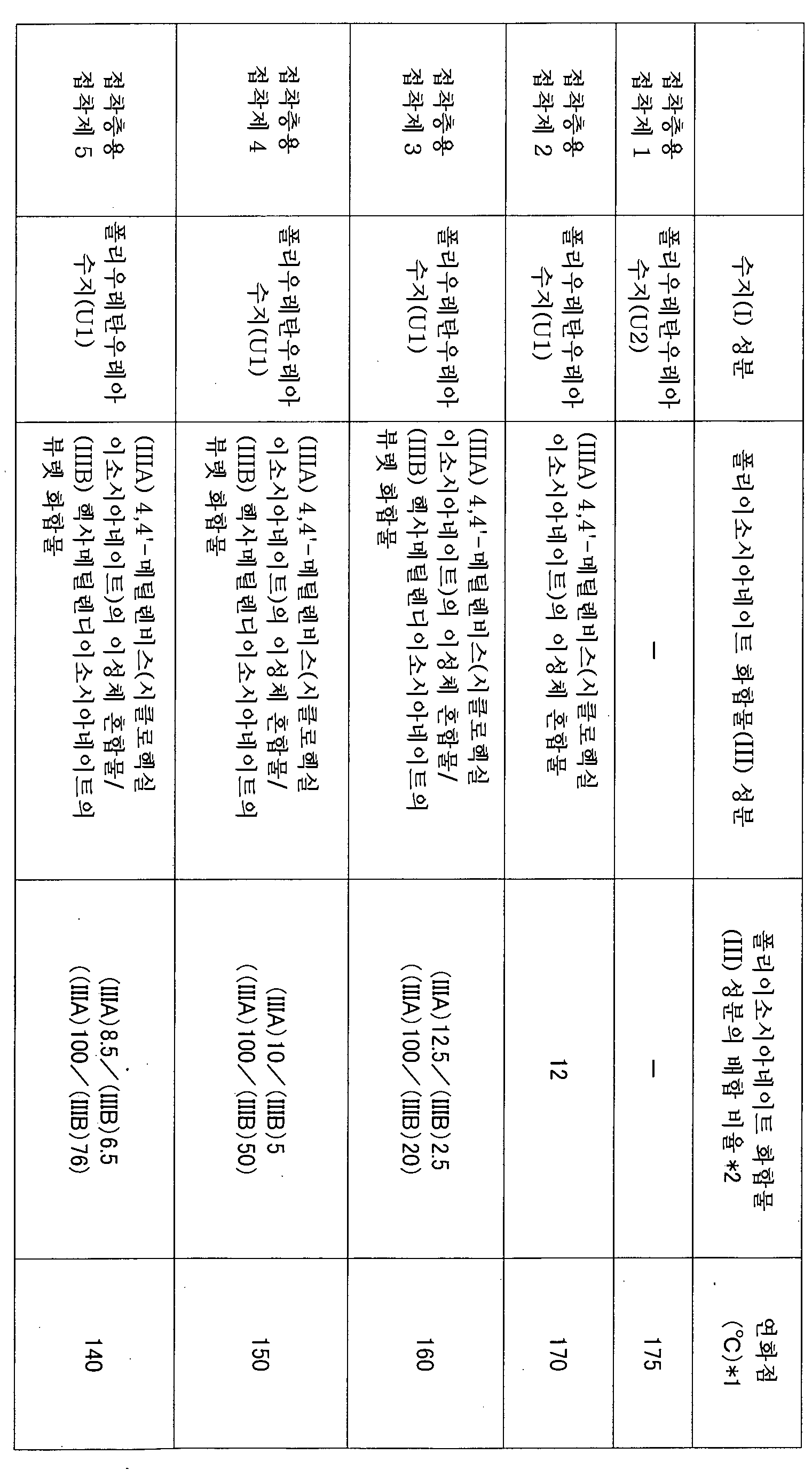
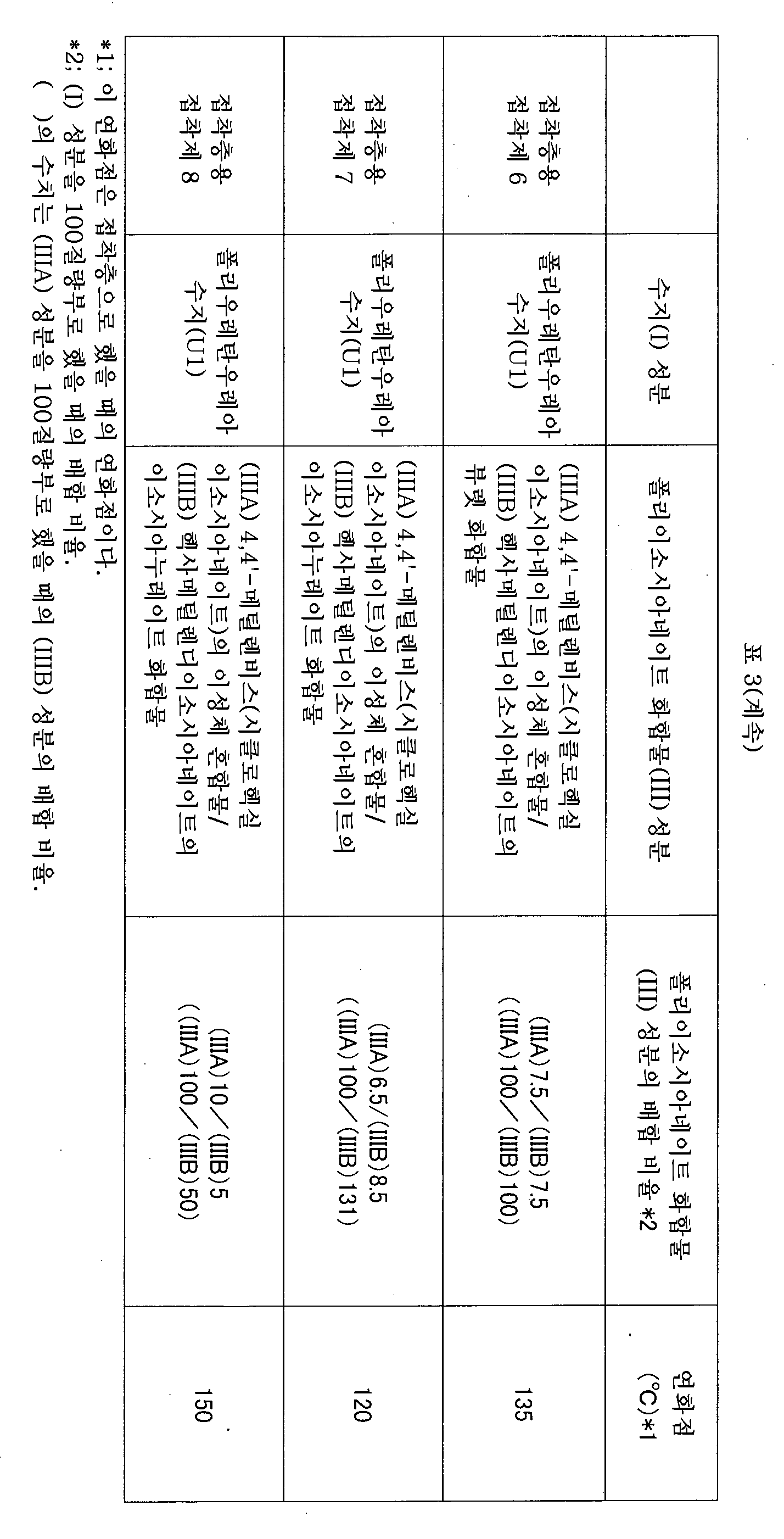
[표 4][Table 4]
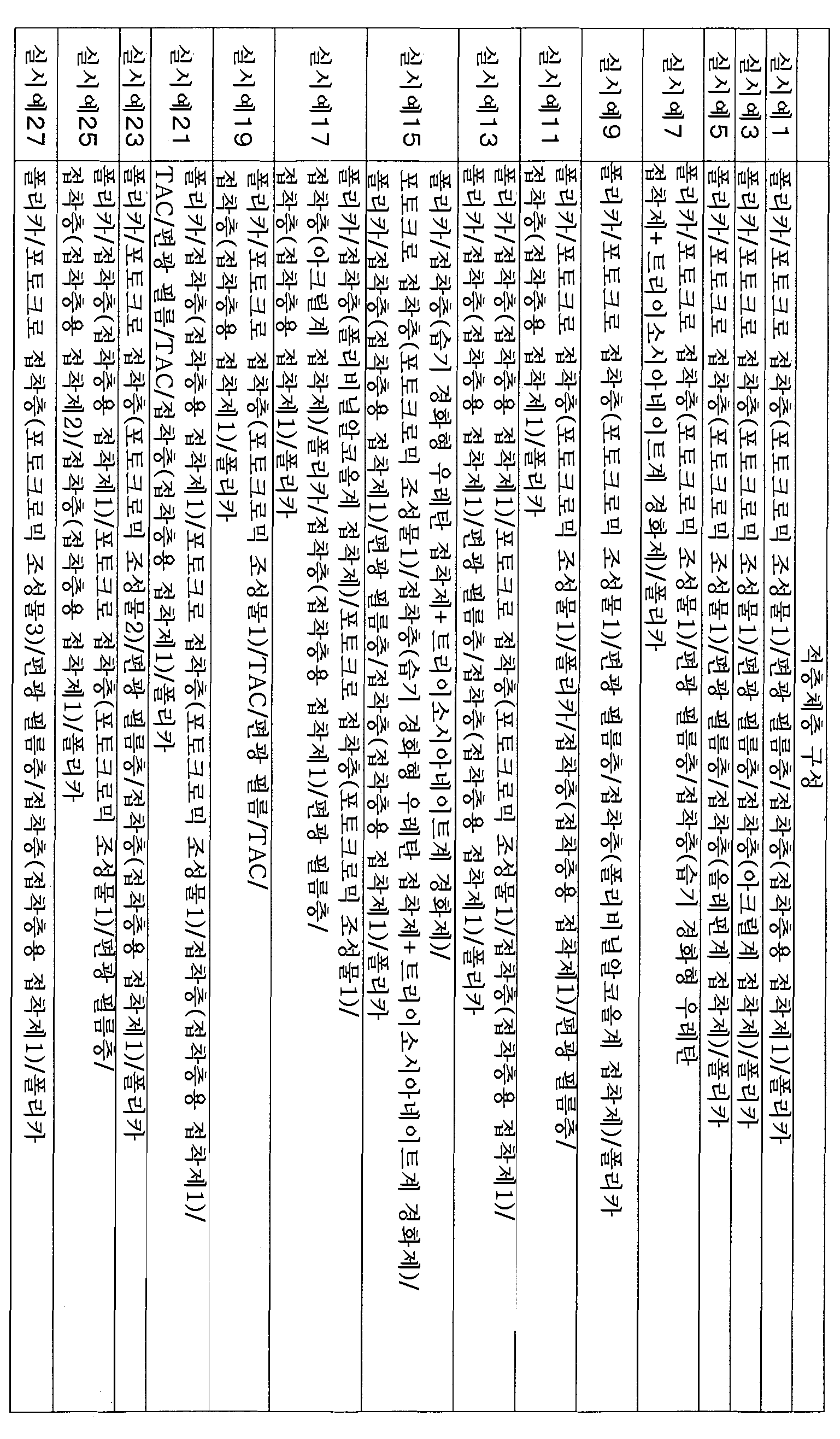

[표 5][Table 5]

[표 6][Table 6]

상기 실시예 1 내지 44로부터 명백해진 바와 같이, 포토크로믹 조성물로 이루어지는 접착층에 폴리우레탄우레아 수지를 사용한 본 발명의 적층체는, 양호한 포토크로믹 특성, 편광 특성, 및 고온이나 내한 시험에서의 우수한 밀착성을 갖고 있음을 알 수 있다.As apparent from the above Examples 1 to 44, the laminate of the present invention using the polyurethane-urea resin in the adhesive layer made of the photochromic composition is excellent in photochromic characteristics, polarization characteristics, and excellent in high temperature and cold resistance test It can be seen that it has adhesion.
한편, 비교예 1 및 2에 나타내는 바와 같이, 포토크로믹 조성물로 이루어지는 접착층에 2액기 경화형 우레탄 수지를 사용한 경우에는, 포토크로믹 특성(내구성) 및 밀착성이 불충분하였다.On the other hand, as shown in Comparative Examples 1 and 2, when the two-component curing type urethane resin was used for the adhesive layer made of the photochromic composition, the photochromic characteristics (durability) and adhesiveness were insufficient.
[발명의 효과][Effects of the Invention]
본 발명의 적층체는 우수한 밀착성, 편광 특성, 포토크로믹 특성을 나타낸다. 또한, 본 발명의 적층체를 금형에 장착하고, 해당 금형에 열가소성 수지로서 폴리카르보네이트로 이루어지는 층을 사출 성형함으로써 광학 물품을 제조한 경우에서도, 적층체뿐만 아니라 적층체와 사출한 폴리카르보네이트층 사이에서 우수한 밀착성을 발휘하고, 또한 우수한 편광 특성, 포토크로믹 특성을 유지함과 함께, 광학 변형이 발생하기 어렵다.The laminate of the present invention exhibits excellent adhesion, polarization characteristics, and photochromic properties. Even when an optical article is manufactured by mounting the laminate of the present invention on a mold and injection-molding a layer made of polycarbonate as a thermoplastic resin into the mold, not only a laminate but also a laminate and an injected polycarbon Excellent adherence is exhibited between layers of the retardation film, excellent polarizing properties and photochromic properties are maintained, and optical deformation hardly occurs.
Claims (16)
(III) 분자 내에 적어도 2개의 이소시아네이트기를 갖는 폴리이소시아네이트 화합물을 포함하는 적층체.The method of claim 1, wherein the photochromic composition further comprises
(III) A laminate comprising a polyisocyanate compound having at least two isocyanate groups in its molecule.
2급 탄소에 결합한 이소시아네이트기를 갖는 화합물, 헥사메틸렌디이소시아네이트, 헥사메틸렌디이소시아네이트의 뷰렛 화합물, 헥사메틸렌디이소시아네이트의 이소시아누레이트 화합물 및 헥사메틸렌디이소시아네이트의 어덕트 화합물로 이루어지는 군에서 선택되는 적어도 1종의 폴리이소시아네이트 화합물인 적층체.The polyisocyanate compound according to claim 3, wherein the polyisocyanate compound having at least two isocyanate groups in the molecule (III)
At least one member selected from the group consisting of a compound having an isocyanate group bonded to a secondary carbon, hexamethylene diisocyanate, a burette compound of hexamethylene diisocyanate, an isocyanurate compound of hexamethylene diisocyanate, and an adduct compound of hexamethylene diisocyanate Lt; RTI ID = 0.0 > polyisocyanate < / RTI >
(IIIA) 2급 탄소에 결합한 이소시아네이트기를 갖는 화합물과,
(IIIB) 헥사메틸렌디이소시아네이트, 헥사메틸렌디이소시아네이트의 뷰렛 화합물, 헥사메틸렌디이소시아네이트의 이소시아누레이트 화합물 및 헥사메틸렌디이소시아네이트의 어덕트 화합물로 이루어지는 군에서 선택되는 적어도 1종의 화합물
을 포함하는 적층체.The polyisocyanate compound according to claim 4, wherein the polyisocyanate compound having at least two isocyanate groups in the molecule (III)
A compound having an isocyanate group bonded to the (IIIA) secondary carbon,
(IIIB) at least one compound selected from the group consisting of hexamethylene diisocyanate, a burette compound of hexamethylene diisocyanate, an isocyanurate compound of hexamethylene diisocyanate, and an adduct compound of hexamethylene diisocyanate
≪ / RTI >
(IIIA) 2급 탄소에 결합한 이소시아네이트기를 갖는 화합물 100질량부와,
(IIIB) 헥사메틸렌디이소시아네이트, 헥사메틸렌디이소시아네이트의 뷰렛 화합물, 헥사메틸렌디이소시아네이트의 이소시아누레이트 화합물 및 헥사메틸렌디이소시아네이트의 어덕트 화합물로 이루어지는 군에서 선택되는 적어도 1종의 화합물 20 내지 150질량부
로 이루어지는 적층체.The polyisocyanate compound according to claim 5, wherein the polyisocyanate compound having at least two isocyanate groups in the molecule (III)
100 parts by mass of a compound having an isocyanate group bonded to the (IIIA) secondary carbon,
(IIIB) at least one compound selected from the group consisting of hexamethylene diisocyanate, a burette compound of hexamethylene diisocyanate, an isocyanurate compound of hexamethylene diisocyanate, and an adduct compound of hexamethylene diisocyanate 20 to 150 mass% part
≪ / RTI >
(A) 분자 말단에 이소시아네이트기를 갖는 우레탄 예비 중합체와,
(B) 분자 내에 2개 이상의 아미노기를 갖는 폴리아민 화합물과,
(C) 분자 내에 이소시아네이트기와 반응할 수 있는 기를 1개 갖는 화합물
의 반응 생성물인 적층체.The polyurethane resin composition according to claim 1, wherein the polyurethane-urea resin (I)
(A) a urethane prepolymer having an isocyanate group at the molecular end, and
(B) a polyamine compound having two or more amino groups in the molecule,
(C) a compound having one group capable of reacting with an isocyanate group in the molecule
≪ / RTI >
Applications Claiming Priority (9)
| Application Number | Priority Date | Filing Date | Title |
|---|---|---|---|
| JPJP-P-2015-255814 | 2015-12-28 | ||
| JP2015255814 | 2015-12-28 | ||
| JP2016086661 | 2016-04-25 | ||
| JPJP-P-2016-086661 | 2016-04-25 | ||
| JP2016151657 | 2016-08-02 | ||
| JPJP-P-2016-151657 | 2016-08-02 | ||
| JPJP-P-2016-211122 | 2016-10-27 | ||
| JP2016211122 | 2016-10-27 | ||
| PCT/JP2016/089226 WO2017115874A1 (en) | 2015-12-28 | 2016-12-22 | Laminate and optical article using said laminate |
Publications (1)
| Publication Number | Publication Date |
|---|---|
| KR20180098232A true KR20180098232A (en) | 2018-09-03 |
Family
ID=59225321
Family Applications (1)
| Application Number | Title | Priority Date | Filing Date |
|---|---|---|---|
| KR1020187014517A Ceased KR20180098232A (en) | 2015-12-28 | 2016-12-22 | Laminate and optical article using the laminate |
Country Status (11)
| Country | Link |
|---|---|
| US (1) | US10690943B2 (en) |
| EP (1) | EP3399368B1 (en) |
| JP (1) | JP6755887B2 (en) |
| KR (1) | KR20180098232A (en) |
| CN (1) | CN108351539B (en) |
| AU (1) | AU2016382057B2 (en) |
| ES (1) | ES2869551T3 (en) |
| MX (1) | MX2018007795A (en) |
| SG (1) | SG11201805609XA (en) |
| TW (1) | TWI712494B (en) |
| WO (1) | WO2017115874A1 (en) |
Families Citing this family (17)
| Publication number | Priority date | Publication date | Assignee | Title |
|---|---|---|---|---|
| KR102197929B1 (en) | 2016-08-02 | 2021-01-05 | 가부시끼가이샤 도꾸야마 | Adhesive composition, laminate, and optical article using the laminate |
| CN107422528A (en) * | 2017-07-28 | 2017-12-01 | 京东方科技集团股份有限公司 | A kind of blooming piece, backlight module and display device |
| JP7118876B2 (en) * | 2017-12-25 | 2022-08-16 | 株式会社トクヤマ | Laminate, optical substrate comprising said laminate, and optical article provided with said optical substrate |
| JP2021511421A (en) * | 2018-01-25 | 2021-05-06 | ノヴァル, インコーポレイテッド | Sorbitol-based cross-linked optical polymer |
| JP7422067B2 (en) | 2018-02-23 | 2024-01-25 | 株式会社トクヤマ | Functional laminates and functional lenses using functional laminates |
| JP2019164271A (en) * | 2018-03-20 | 2019-09-26 | 株式会社トクヤマ | Polarization photochromic optical article, manufacturing method of the same, and laminated article having the same |
| EP3779530B1 (en) * | 2018-04-05 | 2025-06-18 | Tokuyama Corporation | Photochromic adhesive composition, photochromic layered body, and optical article using said photochromic layered body |
| CN109239942A (en) * | 2018-09-18 | 2019-01-18 | 陈仕伟 | A kind of resin composite materials spectacle-frame or leg of spectacles and preparation method thereof |
| CN109294208A (en) * | 2018-09-30 | 2019-02-01 | 上海康耐特光学有限公司 | Photochromic polyurethane composition, preparation method and application thereof, and photochromic lens comprising the same |
| KR102241807B1 (en) * | 2019-03-26 | 2021-04-19 | 주식회사 케이에이피에스 | Polycabonate plate with improved scratch resistance and method of manufacturing the same |
| FR3095448B1 (en) * | 2019-04-26 | 2022-12-23 | Bostik Sa | LAMINATION ADHESIVE FOR STERILIZATION |
| JP2021148814A (en) * | 2020-03-16 | 2021-09-27 | 株式会社トクヤマ | Photochromic laminate, photochromic curable composition, and method for producing the composition |
| EP4328636A4 (en) * | 2021-04-21 | 2025-04-16 | Tokuyama Corporation | Optical article, spectacle lens and spectacles |
| CN117178209A (en) * | 2021-04-21 | 2023-12-05 | 株式会社德山 | Optical articles, spectacle lenses and spectacles |
| US12211385B2 (en) | 2021-09-30 | 2025-01-28 | Volkswagen Group of America Investments, LLC | Distributed method and system for vehicle identification tracking |
| EP4679147A4 (en) * | 2023-03-03 | 2026-07-01 | Tokuyama Corp | Multi-layered body, optical article, coating-bearing multi-layered body, lens, glasses and film for windows |
| WO2025263504A1 (en) * | 2024-06-21 | 2025-12-26 | 日本化薬株式会社 | Optical laminate, polarizing lens, and eyewear |
Family Cites Families (13)
| Publication number | Priority date | Publication date | Assignee | Title |
|---|---|---|---|---|
| JPS60149623A (en) * | 1984-01-13 | 1985-08-07 | Toyobo Co Ltd | Production of polyurethane elastomer molding |
| JPS62178193A (en) * | 1986-01-29 | 1987-08-05 | Mitsubishi Electric Corp | Control system of current of dc motor |
| JPS63178193A (en) * | 1987-01-20 | 1988-07-22 | Nippon Sheet Glass Co Ltd | Photochromic covering composition |
| JP2728888B2 (en) * | 1987-09-30 | 1998-03-18 | 呉羽化学工業株式会社 | Optical material with dimming action |
| WO2001077740A1 (en) | 2000-04-10 | 2001-10-18 | Mitsubishi Gas Chemical Company, Inc. | Transparent synthetic resin laminate having photochromic property |
| TW534869B (en) * | 2000-06-09 | 2003-06-01 | Mitsubishi Gas Chemical Co | Synthetic resin laminate having both polarization characteristic and photochromism characteristic, and molded article obtained therefrom |
| JP4586953B2 (en) * | 2000-06-09 | 2010-11-24 | 三菱瓦斯化学株式会社 | Synthetic resin laminate with both polarization and photochromic properties |
| US7289257B1 (en) * | 2006-07-28 | 2007-10-30 | Yasunobu Nakagoshi | Molded laminate for optical use |
| SG187762A1 (en) * | 2010-08-06 | 2013-03-28 | Tokuyama Corp | Photochromic composition |
| JP5888895B2 (en) * | 2011-08-02 | 2016-03-22 | 株式会社トクヤマ | Photochromic laminate and manufacturing method thereof |
| SG11201404363QA (en) * | 2011-12-26 | 2014-10-30 | Tokuyama Corp | Photochromic composition |
| JP6161893B2 (en) * | 2012-12-11 | 2017-07-12 | 株式会社トクヤマ | Method for producing laminated sheet |
| JP6579938B2 (en) | 2015-03-12 | 2019-09-25 | 株式会社トクヤマ | Photochromic composition, laminate comprising the composition, and article using the laminate |
-
2016
- 2016-12-22 SG SG11201805609XA patent/SG11201805609XA/en unknown
- 2016-12-22 KR KR1020187014517A patent/KR20180098232A/en not_active Ceased
- 2016-12-22 TW TW105142788A patent/TWI712494B/en active
- 2016-12-22 CN CN201680067489.1A patent/CN108351539B/en active Active
- 2016-12-22 JP JP2017559256A patent/JP6755887B2/en active Active
- 2016-12-22 WO PCT/JP2016/089226 patent/WO2017115874A1/en not_active Ceased
- 2016-12-22 AU AU2016382057A patent/AU2016382057B2/en active Active
- 2016-12-22 EP EP16881848.2A patent/EP3399368B1/en active Active
- 2016-12-22 MX MX2018007795A patent/MX2018007795A/en unknown
- 2016-12-22 ES ES16881848T patent/ES2869551T3/en active Active
- 2016-12-22 US US16/065,027 patent/US10690943B2/en active Active
Also Published As
| Publication number | Publication date |
|---|---|
| US10690943B2 (en) | 2020-06-23 |
| EP3399368B1 (en) | 2021-02-24 |
| MX2018007795A (en) | 2018-09-05 |
| CN108351539B (en) | 2022-01-14 |
| JP6755887B2 (en) | 2020-09-16 |
| EP3399368A1 (en) | 2018-11-07 |
| CN108351539A (en) | 2018-07-31 |
| TWI712494B (en) | 2020-12-11 |
| EP3399368A4 (en) | 2019-07-17 |
| US20190004336A1 (en) | 2019-01-03 |
| SG11201805609XA (en) | 2018-07-30 |
| AU2016382057B2 (en) | 2021-01-14 |
| ES2869551T3 (en) | 2021-10-25 |
| AU2016382057A1 (en) | 2018-06-14 |
| WO2017115874A1 (en) | 2017-07-06 |
| TW201738090A (en) | 2017-11-01 |
| JPWO2017115874A1 (en) | 2018-10-18 |
Similar Documents
| Publication | Publication Date | Title |
|---|---|---|
| US10690943B2 (en) | Laminate and optical article comprising the same | |
| US12065590B2 (en) | Adhesive composition, laminate and optical article comprising the laminate | |
| KR101921673B1 (en) | Photochromic composition | |
| JP5743616B2 (en) | Photochromic composition | |
| TWI508987B (en) | Photochromic composition | |
| JP6579938B2 (en) | Photochromic composition, laminate comprising the composition, and article using the laminate | |
| JPWO2012141250A1 (en) | Photochromic composition | |
| JP5888895B2 (en) | Photochromic laminate and manufacturing method thereof | |
| JP5863317B2 (en) | Photochromic composition | |
| JP5967877B2 (en) | Photochromic composition and optical article | |
| JP2016132696A (en) | Photochromic composition for spray coating and method for producing optical article having photochromic properties |
Legal Events
| Date | Code | Title | Description |
|---|---|---|---|
| PA0105 | International application |
Patent event date: 20180523 Patent event code: PA01051R01D Comment text: International Patent Application |
|
| PG1501 | Laying open of application | ||
| A201 | Request for examination | ||
| PA0201 | Request for examination |
Patent event code: PA02012R01D Patent event date: 20210930 Comment text: Request for Examination of Application |
|
| E902 | Notification of reason for refusal | ||
| PE0902 | Notice of grounds for rejection |
Comment text: Notification of reason for refusal Patent event date: 20230925 Patent event code: PE09021S01D |
|
| E601 | Decision to refuse application | ||
| PE0601 | Decision on rejection of patent |
Patent event date: 20231204 Comment text: Decision to Refuse Application Patent event code: PE06012S01D Patent event date: 20230925 Comment text: Notification of reason for refusal Patent event code: PE06011S01I |