KR102819552B1 - composite semipermeable membrane - Google Patents
composite semipermeable membrane Download PDFInfo
- Publication number
- KR102819552B1 KR102819552B1 KR1020227014164A KR20227014164A KR102819552B1 KR 102819552 B1 KR102819552 B1 KR 102819552B1 KR 1020227014164 A KR1020227014164 A KR 1020227014164A KR 20227014164 A KR20227014164 A KR 20227014164A KR 102819552 B1 KR102819552 B1 KR 102819552B1
- Authority
- KR
- South Korea
- Prior art keywords
- composite semipermeable
- semipermeable membrane
- functional layer
- separation functional
- membrane
- Prior art date
- Legal status (The legal status is an assumption and is not a legal conclusion. Google has not performed a legal analysis and makes no representation as to the accuracy of the status listed.)
- Active
Links
Images

Classifications
-
- B—PERFORMING OPERATIONS; TRANSPORTING
- B01—PHYSICAL OR CHEMICAL PROCESSES OR APPARATUS IN GENERAL
- B01D—SEPARATION
- B01D69/00—Semi-permeable membranes for separation processes or apparatus characterised by their form, structure or properties; Manufacturing processes specially adapted therefor
- B01D69/12—Composite membranes; Ultra-thin membranes
- B01D69/1216—Three or more layers
-
- B—PERFORMING OPERATIONS; TRANSPORTING
- B01—PHYSICAL OR CHEMICAL PROCESSES OR APPARATUS IN GENERAL
- B01D—SEPARATION
- B01D69/00—Semi-permeable membranes for separation processes or apparatus characterised by their form, structure or properties; Manufacturing processes specially adapted therefor
- B01D69/12—Composite membranes; Ultra-thin membranes
-
- B—PERFORMING OPERATIONS; TRANSPORTING
- B01—PHYSICAL OR CHEMICAL PROCESSES OR APPARATUS IN GENERAL
- B01D—SEPARATION
- B01D63/00—Apparatus in general for separation processes using semi-permeable membranes
- B01D63/14—Pleat-type membrane modules
-
- B—PERFORMING OPERATIONS; TRANSPORTING
- B01—PHYSICAL OR CHEMICAL PROCESSES OR APPARATUS IN GENERAL
- B01D—SEPARATION
- B01D67/00—Processes specially adapted for manufacturing semi-permeable membranes for separation processes or apparatus
- B01D67/0002—Organic membrane manufacture
- B01D67/0006—Organic membrane manufacture by chemical reactions
-
- B—PERFORMING OPERATIONS; TRANSPORTING
- B01—PHYSICAL OR CHEMICAL PROCESSES OR APPARATUS IN GENERAL
- B01D—SEPARATION
- B01D67/00—Processes specially adapted for manufacturing semi-permeable membranes for separation processes or apparatus
- B01D67/0081—After-treatment of organic or inorganic membranes
- B01D67/0093—Chemical modification
- B01D67/00931—Chemical modification by introduction of specific groups after membrane formation, e.g. by grafting
-
- B—PERFORMING OPERATIONS; TRANSPORTING
- B01—PHYSICAL OR CHEMICAL PROCESSES OR APPARATUS IN GENERAL
- B01D—SEPARATION
- B01D69/00—Semi-permeable membranes for separation processes or apparatus characterised by their form, structure or properties; Manufacturing processes specially adapted therefor
- B01D69/02—Semi-permeable membranes for separation processes or apparatus characterised by their form, structure or properties; Manufacturing processes specially adapted therefor characterised by their properties
-
- B—PERFORMING OPERATIONS; TRANSPORTING
- B01—PHYSICAL OR CHEMICAL PROCESSES OR APPARATUS IN GENERAL
- B01D—SEPARATION
- B01D69/00—Semi-permeable membranes for separation processes or apparatus characterised by their form, structure or properties; Manufacturing processes specially adapted therefor
- B01D69/10—Supported membranes; Membrane supports
-
- B—PERFORMING OPERATIONS; TRANSPORTING
- B01—PHYSICAL OR CHEMICAL PROCESSES OR APPARATUS IN GENERAL
- B01D—SEPARATION
- B01D69/00—Semi-permeable membranes for separation processes or apparatus characterised by their form, structure or properties; Manufacturing processes specially adapted therefor
- B01D69/10—Supported membranes; Membrane supports
- B01D69/107—Organic support material
-
- B—PERFORMING OPERATIONS; TRANSPORTING
- B01—PHYSICAL OR CHEMICAL PROCESSES OR APPARATUS IN GENERAL
- B01D—SEPARATION
- B01D69/00—Semi-permeable membranes for separation processes or apparatus characterised by their form, structure or properties; Manufacturing processes specially adapted therefor
- B01D69/12—Composite membranes; Ultra-thin membranes
- B01D69/1213—Laminated layers
-
- B—PERFORMING OPERATIONS; TRANSPORTING
- B01—PHYSICAL OR CHEMICAL PROCESSES OR APPARATUS IN GENERAL
- B01D—SEPARATION
- B01D69/00—Semi-permeable membranes for separation processes or apparatus characterised by their form, structure or properties; Manufacturing processes specially adapted therefor
- B01D69/12—Composite membranes; Ultra-thin membranes
- B01D69/125—In situ manufacturing by polymerisation, polycondensation, cross-linking or chemical reaction
- B01D69/1251—In situ manufacturing by polymerisation, polycondensation, cross-linking or chemical reaction by interfacial polymerisation
-
- B—PERFORMING OPERATIONS; TRANSPORTING
- B01—PHYSICAL OR CHEMICAL PROCESSES OR APPARATUS IN GENERAL
- B01D—SEPARATION
- B01D71/00—Semi-permeable membranes for separation processes or apparatus characterised by the material; Manufacturing processes specially adapted therefor
- B01D71/06—Organic material
- B01D71/56—Polyamides, e.g. polyester-amides
-
- B—PERFORMING OPERATIONS; TRANSPORTING
- B01—PHYSICAL OR CHEMICAL PROCESSES OR APPARATUS IN GENERAL
- B01D—SEPARATION
- B01D71/00—Semi-permeable membranes for separation processes or apparatus characterised by the material; Manufacturing processes specially adapted therefor
- B01D71/06—Organic material
- B01D71/76—Macromolecular material not specifically provided for in a single one of groups B01D71/08 - B01D71/74
- B01D71/82—Macromolecular material not specifically provided for in a single one of groups B01D71/08 - B01D71/74 characterised by the presence of specified groups, e.g. introduced by chemical after-treatment
-
- C—CHEMISTRY; METALLURGY
- C08—ORGANIC MACROMOLECULAR COMPOUNDS; THEIR PREPARATION OR CHEMICAL WORKING-UP; COMPOSITIONS BASED THEREON
- C08G—MACROMOLECULAR COMPOUNDS OBTAINED OTHERWISE THAN BY REACTIONS ONLY INVOLVING UNSATURATED CARBON-TO-CARBON BONDS
- C08G65/00—Macromolecular compounds obtained by reactions forming an ether link in the main chain of the macromolecule
- C08G65/34—Macromolecular compounds obtained by reactions forming an ether link in the main chain of the macromolecule from hydroxy compounds or their metallic derivatives
- C08G65/36—Furfuryl alcohol
-
- C—CHEMISTRY; METALLURGY
- C08—ORGANIC MACROMOLECULAR COMPOUNDS; THEIR PREPARATION OR CHEMICAL WORKING-UP; COMPOSITIONS BASED THEREON
- C08G—MACROMOLECULAR COMPOUNDS OBTAINED OTHERWISE THAN BY REACTIONS ONLY INVOLVING UNSATURATED CARBON-TO-CARBON BONDS
- C08G69/00—Macromolecular compounds obtained by reactions forming a carboxylic amide link in the main chain of the macromolecule
-
- C—CHEMISTRY; METALLURGY
- C08—ORGANIC MACROMOLECULAR COMPOUNDS; THEIR PREPARATION OR CHEMICAL WORKING-UP; COMPOSITIONS BASED THEREON
- C08G—MACROMOLECULAR COMPOUNDS OBTAINED OTHERWISE THAN BY REACTIONS ONLY INVOLVING UNSATURATED CARBON-TO-CARBON BONDS
- C08G69/00—Macromolecular compounds obtained by reactions forming a carboxylic amide link in the main chain of the macromolecule
- C08G69/02—Polyamides derived from amino-carboxylic acids or from polyamines and polycarboxylic acids
- C08G69/26—Polyamides derived from amino-carboxylic acids or from polyamines and polycarboxylic acids derived from polyamines and polycarboxylic acids
- C08G69/32—Polyamides derived from amino-carboxylic acids or from polyamines and polycarboxylic acids derived from polyamines and polycarboxylic acids from aromatic diamines and aromatic dicarboxylic acids with both amino and carboxylic groups aromatically bound
-
- C—CHEMISTRY; METALLURGY
- C08—ORGANIC MACROMOLECULAR COMPOUNDS; THEIR PREPARATION OR CHEMICAL WORKING-UP; COMPOSITIONS BASED THEREON
- C08G—MACROMOLECULAR COMPOUNDS OBTAINED OTHERWISE THAN BY REACTIONS ONLY INVOLVING UNSATURATED CARBON-TO-CARBON BONDS
- C08G69/00—Macromolecular compounds obtained by reactions forming a carboxylic amide link in the main chain of the macromolecule
- C08G69/48—Polymers modified by chemical after-treatment
-
- B—PERFORMING OPERATIONS; TRANSPORTING
- B01—PHYSICAL OR CHEMICAL PROCESSES OR APPARATUS IN GENERAL
- B01D—SEPARATION
- B01D2323/00—Details relating to membrane preparation
- B01D2323/15—Use of additives
- B01D2323/218—Additive materials
- B01D2323/2182—Organic additives
-
- B—PERFORMING OPERATIONS; TRANSPORTING
- B01—PHYSICAL OR CHEMICAL PROCESSES OR APPARATUS IN GENERAL
- B01D—SEPARATION
- B01D2323/00—Details relating to membrane preparation
- B01D2323/30—Cross-linking
-
- B—PERFORMING OPERATIONS; TRANSPORTING
- B01—PHYSICAL OR CHEMICAL PROCESSES OR APPARATUS IN GENERAL
- B01D—SEPARATION
- B01D2323/00—Details relating to membrane preparation
- B01D2323/36—Introduction of specific chemical groups
-
- B—PERFORMING OPERATIONS; TRANSPORTING
- B01—PHYSICAL OR CHEMICAL PROCESSES OR APPARATUS IN GENERAL
- B01D—SEPARATION
- B01D2323/00—Details relating to membrane preparation
- B01D2323/40—Details relating to membrane preparation in-situ membrane formation
-
- B—PERFORMING OPERATIONS; TRANSPORTING
- B01—PHYSICAL OR CHEMICAL PROCESSES OR APPARATUS IN GENERAL
- B01D—SEPARATION
- B01D2325/00—Details relating to properties of membranes
- B01D2325/04—Characteristic thickness
-
- B—PERFORMING OPERATIONS; TRANSPORTING
- B01—PHYSICAL OR CHEMICAL PROCESSES OR APPARATUS IN GENERAL
- B01D—SEPARATION
- B01D2325/00—Details relating to properties of membranes
- B01D2325/06—Surface irregularities
-
- B—PERFORMING OPERATIONS; TRANSPORTING
- B01—PHYSICAL OR CHEMICAL PROCESSES OR APPARATUS IN GENERAL
- B01D—SEPARATION
- B01D2325/00—Details relating to properties of membranes
- B01D2325/14—Membrane materials having negatively charged functional groups
-
- B—PERFORMING OPERATIONS; TRANSPORTING
- B01—PHYSICAL OR CHEMICAL PROCESSES OR APPARATUS IN GENERAL
- B01D—SEPARATION
- B01D2325/00—Details relating to properties of membranes
- B01D2325/26—Electrical properties
-
- B—PERFORMING OPERATIONS; TRANSPORTING
- B01—PHYSICAL OR CHEMICAL PROCESSES OR APPARATUS IN GENERAL
- B01D—SEPARATION
- B01D2325/00—Details relating to properties of membranes
- B01D2325/36—Hydrophilic membranes
-
- Y—GENERAL TAGGING OF NEW TECHNOLOGICAL DEVELOPMENTS; GENERAL TAGGING OF CROSS-SECTIONAL TECHNOLOGIES SPANNING OVER SEVERAL SECTIONS OF THE IPC; TECHNICAL SUBJECTS COVERED BY FORMER USPC CROSS-REFERENCE ART COLLECTIONS [XRACs] AND DIGESTS
- Y02—TECHNOLOGIES OR APPLICATIONS FOR MITIGATION OR ADAPTATION AGAINST CLIMATE CHANGE
- Y02A—TECHNOLOGIES FOR ADAPTATION TO CLIMATE CHANGE
- Y02A20/00—Water conservation; Efficient water supply; Efficient water use
- Y02A20/124—Water desalination
- Y02A20/131—Reverse-osmosis
Landscapes
- Chemical & Material Sciences (AREA)
- Chemical Kinetics & Catalysis (AREA)
- Health & Medical Sciences (AREA)
- Medicinal Chemistry (AREA)
- Polymers & Plastics (AREA)
- Organic Chemistry (AREA)
- Engineering & Computer Science (AREA)
- Manufacturing & Machinery (AREA)
- Transplantation (AREA)
- Inorganic Chemistry (AREA)
- General Chemical & Material Sciences (AREA)
- Separation Using Semi-Permeable Membranes (AREA)
Abstract
본 발명의 복합 반투막은, 기재 및 다공성 지지층을 포함하는 지지막과, 가교 방향족 폴리아미드를 주성분으로 하는 분리 기능층을 구비하고, 상기 분리 기능층 중에 술포기를 7.0×10⁻⁵ 내지 5.0×10⁻²g/㎡ 포함하고, 또한, 상기 분리 기능층이 상기 식 1로 표시되는 구조를 포함한다.The composite semipermeable membrane of the present invention comprises a support membrane including a substrate and a porous support layer, and a separation functional layer mainly composed of a crosslinked aromatic polyamide, wherein the separation functional layer contains 7.0×10 -5 to 5.0×10 -2 g/㎡ of sulfo groups, and further, the separation functional layer includes a structure represented by the above formula 1.
Description
본 발명은 액상 혼합물의 선택적 분리에 유용한, 복합 반투막에 관한 것이다.The present invention relates to a composite semipermeable membrane useful for selective separation of a liquid mixture.
액상 혼합물의 분리에 대해서, 용매(예를 들어 물)에 용해된 물질(예를 들어 염류)을 제거하기 위한 기술에는 여러가지 것이 있는데, 근년, 에너지 절약 및 자원 절약을 위한 프로세스로서, 막분리법의 이용이 확대되고 있다. 막분리법에 사용되는 막에는, 정밀 여과막, 한외 여과막, 나노 여과막, 역침투막 등이 있고, 이들 막은, 예를 들어 염분, 유해물을 포함한 물 등으로부터 음료수를 얻는 경우나, 공업용 초순수의 제조, 배수 처리, 유가물의 회수 등에 사용되고 있다.Regarding the separation of liquid mixtures, there are various technologies for removing substances (e.g., salts) dissolved in a solvent (e.g., water), and in recent years, the use of membrane separation has been expanding as a process for saving energy and resources. Membranes used in membrane separation include precision filtration membranes, ultrafiltration membranes, nanofiltration membranes, and reverse osmosis membranes, and these membranes are used, for example, in obtaining drinking water from water containing salts and harmful substances, as well as in the production of industrial ultrapure water, wastewater treatment, and recovery of valuable substances.
현재 시판되고 있는 역침투막 및 나노 여과막의 대부분은, 지지막 상에 염류 등의 분리 성능을 갖는 분리 기능층을 피복한 복합 반투막이며, 지지막 상에 겔층과 폴리머를 가교한 활성층을 갖는 것과, 지지막 상에서 모노머를 중축합한 활성층을 갖는 것의 2종류가 있다. 복합 반투막은, 분리 기능을 담당하는 분리 기능층과, 분리 기능층에 강도를 부여하는 지지막을 각각 독립적으로 선택할 수 있기 때문에, 분리 성능과 강도를 양립시킬 수 있다.Most of the reverse osmosis membranes and nanofiltration membranes currently on the market are composite semipermeable membranes that have a separation functional layer having a separation performance for salts, etc., coated on a support membrane. There are two types: those having an active layer in which a gel layer and a polymer are cross-linked on a support membrane, and those having an active layer in which a monomer is condensed on a support membrane. Since the separation functional layer that takes charge of the separation function and the support membrane that provides strength to the separation functional layer can be independently selected in a composite semipermeable membrane, separation performance and strength can both be achieved.
이러한 복합 반투막으로서는 다양한 것이 개시되어 있다. 예를 들어 특허문헌 1에는, 다관능 아민과 다관능 산할로겐화물을 중축합 반응시킴으로써 얻어지는, 가교 방향족 폴리아미드를 포함하는 분리 기능층을 지지막 상에 피복한 복합 반투막이 개시되어 있다.Various composite semipermeable membranes are disclosed. For example,
그러나, 종래의 가교 방향족 폴리아미드를 포함하는 분리 기능층을 갖는 복합 반투막은, 분리 성능과 투과 성능을 양립한 복합 반투막이지만, 그 분리 성능에는 한계가 있다고 하는 문제가 있었다. 또한, 오퍼레이션 미스 등을 원인으로 하는, 어느 종의 산화제와의 접촉에 의해, 분리 기능층을 구성하는 가교 방향족 폴리아미드의 분해가 발생하여, 분리 성능이 불가역적으로 손상된다는 문제도 있었다.However, the composite semipermeable membrane having a separation functional layer including a conventional cross-linked aromatic polyamide has a problem in that, although it is a composite semipermeable membrane that has both separation performance and permeation performance, its separation performance has limitations. In addition, there is also a problem in that the cross-linked aromatic polyamide constituting the separation functional layer decomposes due to contact with a certain type of oxidizing agent caused by an operation error or the like, thereby irreversibly damaging the separation performance.
따라서 본 발명은 우수한 분리 성능, 특히 양호한 염 분리 성능과, 투과 성능을 양립하고, 또한 내산화성이 우수한 복합 반투막을 제공하는 것을 목적으로 한다.Therefore, the present invention aims to provide a composite semipermeable membrane having excellent separation performance, particularly good salt separation performance, and permeation performance, and also excellent oxidation resistance.
상기 과제를 해결하기 위해서, 본 발명은 기재 및 다공성 지지층을 포함하는 지지막과, 가교 방향족 폴리아미드를 함유하고, 상기 다공성 지지층 상에 배치된 분리 기능층을 구비하고,In order to solve the above problem, the present invention comprises a support membrane including a substrate and a porous support layer, and a separation functional layer containing a crosslinked aromatic polyamide and disposed on the porous support layer.
상기 분리 기능층은 술포기를 7.0×10⁻⁵ 내지 5.0×10⁻²g/㎡ 포함하고, 또한 하기 식 1로 표시되는 구조를 포함하는, 복합 반투막을 제공한다.The above separation functional layer provides a composite semipermeable membrane including 7.0×10 -5 to 5.0×10 -2 g/㎡ of sulfo groups and further including a structure represented by the following

(단, R1은 수소 원자 또는 치환기를 갖고 있어도 되는 탄소수 1 내지 10의 탄화수소, R2 내지 R5는 수소 원자 또는 탄소수 1 내지 10의 탄화수소이며, Ar1 내지 Ar3은 치환기를 갖고 있어도 되는 탄소수 6 내지 14의 방향족환이며, R1, Ar1, Ar2, Ar3의 적어도 하나가 술포기를 갖는다.)(However, R 1 is a hydrogen atom or a hydrocarbon having 1 to 10 carbon atoms which may have a substituent, R 2 to R 5 are a hydrogen atom or a hydrocarbon having 1 to 10 carbon atoms, Ar 1 to Ar 3 are an aromatic ring having 6 to 14 carbon atoms which may have a substituent, and at least one of R 1 , Ar 1 , Ar 2 , and Ar 3 has a sulfo group.)
본 발명에 따르면, 우수한 염 분리 성능과 투과 성능을 갖고, 또한, 내산화성이 우수한 복합 반투막을 제공할 수 있다.According to the present invention, a composite semipermeable membrane having excellent salt separation performance and permeation performance, and also excellent oxidation resistance can be provided.
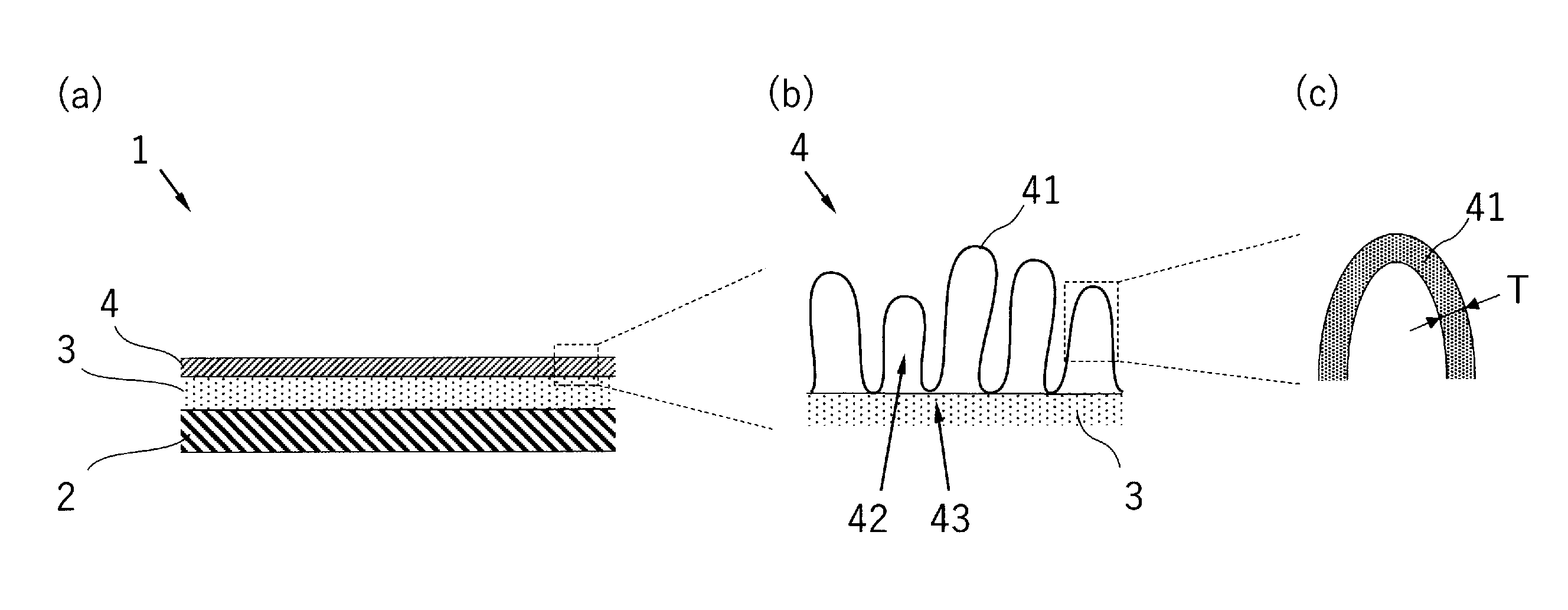
도 1은 복합 반투막의 구조를 모식적으로 도시한 단면도이며, (a)는 복합 반투막의 단면도이며, (b)는 분리 기능층의 확대도이며, (c)는 분리 기능층의 주름 구조의 확대도이다.Figure 1 is a cross-sectional view schematically illustrating the structure of a composite semipermeable membrane, (a) is a cross-sectional view of the composite semipermeable membrane, (b) is an enlarged view of the separation functional layer, and (c) is an enlarged view of the wrinkle structure of the separation functional layer.
이하에, 본 발명의 실시 형태에 대하여 상세하게 설명하지만, 본 발명은 이들에 의해 전혀 한정되지 않는다.Below, embodiments of the present invention are described in detail, but the present invention is not limited to these.
1. 복합 반투막1. Composite semipermeable membrane
도 1에 복합 반투막의 구조를 예시한다. 도 1의 (a)에 도시하는 바와 같이, 복합 반투막(1)은 기재(2), 다공성 지지층(3) 및 분리 기능층을 구비한다.The structure of a composite semipermeable membrane is illustrated in Fig. 1. As shown in (a) of Fig. 1, a composite semipermeable membrane (1) comprises a substrate (2), a porous support layer (3), and a separation functional layer.
(1-1) 지지막(1-1) Support curtain
기재(2) 및 다공성 지지층(3)을 포함하는 적층체를 지지막이라고 부른다. 지지막은 분리 기능층에 강도를 부여하기 위한 것이고, 그 자체는, 실질적으로 용질의 분리 성능을 갖지 않는다.A laminate including a substrate (2) and a porous support layer (3) is called a support membrane. The support membrane is intended to provide strength to the separation functional layer, and does not substantially have a solute separation performance by itself.
기재(2)로서는, 폴리에스테르계 중합체, 폴리아미드계 중합체, 폴리올레핀계 중합체, 및 이들의 혼합물 또는 공중합체를 포함하는 패브릭을 들 수 있다. 그 중에서도, 기계적, 열적으로 안정성이 높은 폴리에스테르계 중합체의 패브릭이 바람직하다. 패브릭의 형태로서는, 장섬유 부직포나 단섬유 부직포, 나아가 직편물을 바람직하게 사용할 수 있다.As the substrate (2), fabrics including polyester polymers, polyamide polymers, polyolefin polymers, and mixtures or copolymers thereof can be mentioned. Among them, fabrics including polyester polymers with high mechanical and thermal stability are preferable. As the form of the fabric, long-fiber nonwoven fabrics, short-fiber nonwoven fabrics, and even woven and knitted fabrics can be preferably used.
다공성 지지층(3)은 연통한 다수의 세공을 갖는다. 세공의 구멍 직경이나 구멍 직경 분포는 특별히 한정되지 않지만, 예를 들어, 균일한 구멍 직경을 포함하는 대칭 구조, 또는, 한쪽 면으로부터 다른 한쪽의 면까지 서서히 구멍 직경이 커지는 비대칭 구조이며, 또한, 구멍 직경이 작은 측의 표면에 있어서의 구멍 직경이, 0.1 내지 100㎚인, 다공성 지지층이 바람직하다.The porous support layer (3) has a plurality of interconnected pores. The pore diameter or pore diameter distribution of the pores is not particularly limited, but, for example, a porous support layer having a symmetrical structure including a uniform pore diameter or an asymmetrical structure in which the pore diameter gradually increases from one side to the other side, and further, a pore diameter on the surface on the side having a smaller pore diameter is 0.1 to 100 nm, is preferable.
다공성 지지층(3)의 소재로서는, 폴리술폰(이하, 「PSf」), 폴리에테르술폰, 폴리아미드, 폴리에스테르, 셀룰로오스계 폴리머, 비닐 폴리머, 폴리페닐렌술피드, 폴리페닐렌술피드술폰, 폴리페닐렌술폰, 폴리페닐렌옥시드 등의, 호모폴리머 또는 코폴리머를 단독으로 혹은 블렌드하여 사용할 수 있다. 여기서 셀룰로오스계 폴리머로서는, 아세트산셀룰로오스, 질산셀룰로오스 등, 비닐 폴리머로서는 폴리에틸렌, 폴리프로필렌, 폴리염화비닐, 폴리아크릴로니트릴을 들 수 있다. 그 중에서도, PSf, 폴리아미드, 폴리에스테르, 아세트산셀룰로오스, 질산셀룰로오스, 폴리염화비닐, 폴리아크릴로니트릴, 폴리페닐렌술피드, 폴리페닐렌술피드술폰 등의, 호모폴리머 또는 코폴리머가 바람직하고, 아세트산셀룰로오스, PSf, 폴리페닐렌술피드술폰, 또는 폴리페닐렌술폰이 보다 바람직하고, 화학적, 기계적, 열적으로 안정성이 높고, 성형이 용이한 것으로부터, PSf가 특히 바람직하다.As a material for the porous support layer (3), homopolymers or copolymers such as polysulfone (hereinafter, “PSf”), polyethersulfone, polyamide, polyester, cellulose-based polymer, vinyl polymer, polyphenylene sulfide, polyphenylene sulfide sulfone, polyphenylene sulfone, and polyphenylene oxide can be used alone or in a blend. Here, examples of the cellulose-based polymer include cellulose acetate and cellulose nitrate, and examples of the vinyl polymer include polyethylene, polypropylene, polyvinyl chloride, and polyacrylonitrile. Among them, homopolymers or copolymers such as PSf, polyamide, polyester, cellulose acetate, cellulose nitrate, polyvinyl chloride, polyacrylonitrile, polyphenylene sulfide, and polyphenylene sulfide sulfone are preferable, and cellulose acetate, PSf, polyphenylene sulfide sulfone, and polyphenylene sulfone are more preferable. PSf is particularly preferable because it has high chemical, mechanical, and thermal stability and is easy to mold.
PSf의 중량 평균 분자량(이하, 「Mw」)은 10000 내지 200000인 것이 바람직하고, 15000 내지 100000인 것이 보다 바람직하다. PSf의 Mw가 10000 이상인 것에 의해, 다공성 지지층으로서 바람직한 기계적 강도 및 내열성을 얻을 수 있다. 한편, PSf의 Mw가 200000 이하인 것에 의해, 다공성 지지층 원액의 점도가 적절한 범위가 되어, 양호한 성형성을 실현할 수 있다.The weight average molecular weight (hereinafter, “M w ”) of PSf is preferably 10,000 to 200,000, and more preferably 15,000 to 100,000. When the M w of PSf is 10,000 or more, desirable mechanical strength and heat resistance as a porous support layer can be obtained. On the other hand, when the M w of PSf is 200,000 or less, the viscosity of the original solution of the porous support layer becomes an appropriate range, and good formability can be realized.
기재와 다공성 지지층의 두께는, 복합 반투막의 강도 및 그것을 엘리먼트로했을 때의 충전 밀도에 영향을 준다. 양호한 기계적 강도 및 충전 밀도를 얻기 위해서, 기재와 다공성 지지층의 두께의 합계는, 30 내지 300㎛인 것이 바람직하고, 100 내지 220㎛인 것이 보다 바람직하다. 또한, 다공성 지지층의 두께는, 20 내지 100㎛인 것이 바람직하다. 또한, 기재와 다공성 지지층의 두께는, 단면 관찰에서 두께 방향에 직교하는 방향(막의 면 방향)으로 20㎛ 간격으로 측정한, 20점의 두께의 평균값을 산출함으로써 구할 수 있다.The thickness of the substrate and the porous support layer affect the strength of the composite semipermeable membrane and the packing density when it is used as an element. In order to obtain good mechanical strength and packing density, the total thickness of the substrate and the porous support layer is preferably 30 to 300 ㎛, more preferably 100 to 220 ㎛. In addition, the thickness of the porous support layer is preferably 20 to 100 ㎛. In addition, the thickness of the substrate and the porous support layer can be obtained by calculating the average value of the thickness of 20 points measured at 20 ㎛ intervals in a direction orthogonal to the thickness direction (plane direction of the membrane) in cross-sectional observation.
(1-2) 분리 기능층(1-2) Separation functional layer
분리 기능층(4)은 용질의 분리 기능을 담당하는 층이며, 가교 방향족 폴리아미드를 함유한다. 분리 기능층(4)은 가교 방향족 폴리아미드를 주성분으로 하는 것이 바람직하다.The separation functional layer (4) is a layer that performs the function of separating solutes and contains cross-linked aromatic polyamide. It is preferable that the separation functional layer (4) contains cross-linked aromatic polyamide as its main component.
가교 방향족 폴리아미드를 주성분으로 한다란, 분리 기능층 중의 가교 방향족 폴리아미드가 차지하는 비율이 50질량% 이상인 것을 말한다. 분리 기능층 중의 가교 방향족 폴리아미드가 차지하는 비율은, 80질량% 이상인 것이 바람직하고, 90질량% 이상인 것이 보다 바람직하다.The fact that the main component is a cross-linked aromatic polyamide means that the proportion of the cross-linked aromatic polyamide in the separation functional layer is 50 mass% or more. The proportion of the cross-linked aromatic polyamide in the separation functional layer is preferably 80 mass% or more, and more preferably 90 mass% or more.
분리 기능층은, 상기 식 1로 표시되는 구조를 갖는다. 상기 식 1에 있어서, R1, Ar1, Ar2, Ar3의 적어도 하나는 술포기를 갖는다. 또한, 상기 식 1에 있어서, R1이 술포기를 적어도 하나 갖는 탄소수 1 또는 2의 탄화수소인 것이 바람직하고, Ar2가 술포기를 적어도 하나 갖는 탄소수 6 내지 14의 방향족환인 것이 보다 바람직하다. 상기 식 1에 있어서, R1, Ar1, Ar2, Ar3의 적어도 하나는 술포기를 갖는다란, 가교 방향족 폴리아미드의 말단 아미노기 또는 방향족환에, 술포기를 갖는 구조가 결합하고 있는 것을 의미한다.The separation functional layer has a structure represented by the
본 발명자들은 예의 검토한 결과, 가교 방향족 폴리아미드의 아미노기, 특히 말단 아미노기가 산화 열화의 기점인 것, 및 아미노기, 아미드기나 방향족환의 전자 밀도를 저하시킴으로써 산화 열화를 억제할 수 있음을 알아냈다. 상기 식 1에 있어서, R1, Ar1, Ar2, Ar3의 적어도 하나가 전자 구인성의 치환기인 술포기를 가짐으로써, 아미노기, 아미드기나 방향족환의 전자 밀도가 저하되어, 차아염소산을 비롯한 산화제와의 반응성이 억제된, 우수한 내산화성을 갖는 복합 반투막이 얻어진다.As a result of careful examination, the present inventors have found that the amino group of a crosslinked aromatic polyamide, particularly the terminal amino group, is the starting point of oxidative degradation, and that oxidative degradation can be suppressed by lowering the electron density of the amino group, the amide group, or the aromatic ring. In the
또한, 술포기는 친수성의 치환기이며, 또한, 중성의 물 접촉 하에 있어서 전리한 상태로 존재한다. 상기 식 1에 있어서, R1, Ar1, Ar2, Ar3의 적어도 하나가 친수성 또한 부로 하전되는 술포기를 가짐으로써, 친수성에 의한 우수한 투과 성능과, 제거 대상의 염을 구성하는 음이온의 쿨롱 반발에 의한 우수한 염 분리 성능을 양립하는 복합 반투막이 얻어진다.In addition, the sulfo group is a hydrophilic substituent, and also exists in an ionized state under neutral water contact. In the
분리 기능층은, 술포기를 7.0×10⁻⁵ 내지 5.0×10⁻²g/㎡ 함유한다. 술포기의 함유량이 7.0×10⁻⁵g/㎡ 이상인 것에 의해, 아미노기, 아미드기나 방향족환의 전자 밀도 저하에 의한 내산화성, 친수성에 의한 투과 성능, 쿨롱 반발에 의한 염 분리 성능을 충분히 발휘할 수 있다. 한편, 술포기의 함유량이 5.0×10⁻²g/㎡ 이하인 것에 의해, 중성의 물 접촉 하에 있어서 부로 하전되는 술포기끼리의 쿨롱 반발에 의한, 분리 기능층의 구멍 직경 확대에 수반하는 복합 반투막의 분리 성능의 저하를 방지할 수 있다. 분리 기능층의 술포기의 함유량은 1.0×10⁻⁴ 내지 3.0×10⁻²g/㎡인 것이 바람직하고, 2.0×10⁻⁴ 내지 1.0×10⁻²g/㎡인 것이 보다 바람직하고, 5.0×10⁻⁴ 내지 7.0×10⁻³g/㎡인 것이 더욱 바람직하다.The separation functional layer contains sulfo groups in an amount of 7.0×10 -5 to 5.0×10 -2 g/㎡. When the content of sulfo groups is 7.0×10 -5 g/㎡ or more, the oxidation resistance due to the decrease in electron density of an amino group, an amide group or an aromatic ring, the permeation performance due to hydrophilicity, and the salt separation performance due to Coulomb repulsion can be sufficiently exhibited. On the other hand, when the content of sulfo groups is 5.0×10 -2 g/㎡ or less, the separation performance of the composite semipermeable membrane accompanied with the enlargement of the pore diameter of the separation functional layer due to Coulomb repulsion between negatively charged sulfo groups under contact with neutral water can be prevented. The content of the sulfo group in the separation functional layer is preferably 1.0×10 -4 to 3.0×10 -2 g/㎡, more preferably 2.0×10 -4 to 1.0×10 -2 g/㎡, and still more preferably 5.0×10 -4 to 7.0×10 -3 g/㎡.
분리 기능층의 두께 방향의 술포기 분포는, 분리 성능 및 투과 성능에 영향을 준다. 분리 기능층의 술포기 분포는, 하기 수치 C, D에 의해 구해진다.The distribution of sulfur bubbles in the thickness direction of the separation functional layer affects the separation performance and permeation performance. The distribution of sulfur bubbles in the separation functional layer is obtained by the following figures C and D.
A: X선 광전자 분광법(이하, 「XPS」라고 칭한다.)에 의해 측정되는 분리 기능층 중의 술포기 유래의 황 원자수,A: The number of sulfur atoms derived from sulfo groups in the separation functional layer measured by X-ray photoelectron spectroscopy (hereinafter referred to as “XPS”).
B: XPS에 의해 측정되는 분리 기능층 중의 전체 질소 원자수B: Total number of nitrogen atoms in the separation functional layer measured by XPS
C: 복합 반투막에 있어서의 분리 기능층의 표면에서 측정되는 A/B의 값C: A/B value measured on the surface of the separation functional layer in the composite semipermeable membrane
D: 상기 복합 반투막으로부터 추출된 상기 분리 기능층의 분체를 성형하여 얻어지는 고체에 대하여 측정되는 A/BD: A/B measured for a solid obtained by molding the powder of the separation functional layer extracted from the composite semipermeable membrane
C/D는 3 이상인 것이 바람직하고, 4 이상인 것이 보다 바람직하다. 여기서, C는 분리 기능층 표면 부근의 술포기의 밀도를 나타내고, D는 분리 기능층 전체에 있어서의 술포기의 밀도를 나타낸다. C/D가 3 이상이라는 것은, 분리 기능층 표면 부근에 술포기가 고밀도로 존재하는 것을 의미한다. 이러한 분리 기능층을 갖는 복합 반투막은, 우수한 내산화성, 염 분리 성능 및 투과 성능을 갖는다. C/D의 상한은 특별히 한정되지 않지만, C/D는 예를 들어 10 이하이다.C/D is preferably 3 or more, and more preferably 4 or more. Here, C represents the density of sulfo groups near the surface of the separation functional layer, and D represents the density of sulfo groups in the entire separation functional layer. C/D being 3 or more means that sulfo groups exist at a high density near the surface of the separation functional layer. A composite semipermeable membrane having such a separation functional layer has excellent oxidation resistance, salt separation performance, and permeation performance. The upper limit of C/D is not particularly limited, but C/D is, for example, 10 or less.
분리 기능층의 pH3에 있어서의 제타 전위는, -5mV 이하인 것이 바람직하고, -10mV 이하인 것이 보다 바람직하다. 제타 전위란, 평판상 시료 표면의 정미의 고정 전하의 척도이다. 분리 기능층에 포함되는 가교 방향족 폴리아미드는, 말단 관능기로서 아미노기, 카르복시기, 술포기를 갖고 있고, 이들의 해리도는 pH에 의존한다. pH3에 있어서, 아미노기는 주로 정으로 하전되고, 카르복시기는 주로 중성이며, 술포기는 주로 부로 하전된다. 즉, 분리 기능층의 pH3에 있어서의 제타 전위는, 주로 아미노기와 술포기의 양에 의존한다고 생각된다. 분리 기능층의 pH3에 있어서의 제타 전위가 -5mV 이하인 것에 의해, 분리 기능층 표면 부근에 술포기가 고밀도로 존재하기 때문에, 우수한 내산화성, 염 분리 성능 및 투과 성능을 갖는 복합 반투막이 얻어진다.The zeta potential of the separation functional layer at
분리 기능층의 러더포드 후방 산란 분광법(이하, 「RBS」)으로부터 구한 질소 원자 면밀도는, 4.0×10²⁰ 내지 1.2×10²¹개/㎡인 것이 바람직하고, 6.0×10²⁰ 내지 1.2×10²¹개/㎡인 것이 보다 바람직하고, 8.0×10²⁰ 내지 1.2×10²¹개/㎡인 것이 더욱 바람직하다. RBS로부터 구한 질소 원자 면밀도는, 분리 기능층의 주성분인 가교 방향족 폴리아미드의 밀도에 대응한다. RBS로부터 구한 질소 원자 면밀도가 4.0×10²⁰개/㎡ 이상인 것에 의해, 가교 방향족 폴리아미드가 고밀도로 존재하기 때문에, 치밀한 구멍 직경에 의한 우수한 분리 성능을 갖는 복합 반투막이 얻어짐과 함께, 중성의 물 접촉 하에 있어서 부로 하전되는 술포기끼리의 쿨롱 반발에 의한, 분리 기능층의 구멍 직경 확대에 수반하는 복합 반투막의 분리 성능의 저하를 방지할 수 있다. 한편, RBS로부터 구한 질소 원자 면밀도가 1.2×10²¹개/㎡ 이하인 것에 의해, 가교 방향족 폴리아미드의 밀도가 너무 높지 않아, 적절한 투과 성능을 갖는 복합 반투막이 얻어진다.The nitrogen atom area density obtained from Rutherford backscattering spectroscopy (hereinafter, “RBS”) of the separation functional layer is preferably 4.0×10 20 to 1.2×10 21 /
또한, 분리 기능층은, 하기 식 2로 표시되는 구조를 갖는 화합물을 함유하는 것이 바람직하다.In addition, it is preferable that the separation functional layer contain a compound having a structure represented by the following

(단, X, Y는 질소 원자, 산소 원자, 탄화수소의 어느 것이며, R6은 수소 원자, 또는, 탄소수 1 내지 10의 탄화수소이며, R7은 탄소수 2 내지 4의 탄화수소이다.)(Wherein, X and Y are a nitrogen atom, an oxygen atom, or a hydrocarbon, R 6 is a hydrogen atom or a hydrocarbon having 1 to 10 carbon atoms, and R 7 is a hydrocarbon having 2 to 4 carbon atoms.)
이 환상 구조를 갖는 화합물은, 그 환에 이민 구조를 포함하고, 이민 부위의 질소 원자는 수중에서 염기성을 나타낸다. 이 때문에, 분리 기능층이 물과 접촉한 상태에 있어서, 상기 식 2로 표시되는 부위는, 분리 기능층이 함유하는 가교 방향족 폴리아미드 상의 술포기와 이온쌍을 형성한다. 이에 의해, 물에 접촉한 상태에서 수소 이온이 전리되어, 부의 전하를 갖는 술포기끼리의 정전 반발과, 그에 의한 분리 기능층의 구멍 직경 확대를 피할 수 있을 것으로 생각된다. 그 결과, 양호한 투과 성능을 가지면서, 분리 성능도 우수한 복합 반투막이 얻어진다.The compound having this cyclic structure contains an imine structure in the ring, and the nitrogen atom of the imine moiety exhibits basicity in water. Therefore, when the separation functional layer is in contact with water, the moiety represented by the
분리 기능층의 형상이나 두께는, 분리 성능 및 투과 성능에 영향을 준다. 도 1의 (b)에 도시하는 바와 같이, 분리 기능층은 복수의 볼록부(42)와 오목부(43)를 구비하는 주름상의 박막(41)을 포함하는 것이 바람직하다. 분리 기능층이 주름상의 박막을 가짐으로써, 평면 구조와 비교하여 분리 기능층의 비표면적을 대폭으로 향상시킬 수 있다. 그 결과, 분리 성능을 유지하면서, 분리 기능층의 표면적에 비례하여 투과 성능을 향상시킬 수 있다. 볼록부(42) 내부(박막(41)과 다공성 지지층(3) 사이)는 공극이다.The shape and thickness of the separation functional layer affect the separation performance and permeation performance. As shown in Fig. 1 (b), it is preferable that the separation functional layer includes a wrinkled thin film (41) having a plurality of convex portions (42) and concave portions (43). Since the separation functional layer has a wrinkled thin film, the specific surface area of the separation functional layer can be significantly improved compared to a planar structure. As a result, the permeation performance can be improved in proportion to the surface area of the separation functional layer while maintaining the separation performance. The inside of the convex portions (42) (between the thin film (41) and the porous support layer (3)) is a void.
또한, 상기 박막의 두께 T의 평균값은 10 내지 20㎚인 것이 바람직하고, 10 내지 16㎚인 것이 보다 바람직하다. 상기 박막의 두께 T의 평균값이 상기 범위 내인 것에 의해, 분리 성능과 투과 성능을 양립한 복합 반투막을 얻을 수 있다.In addition, the average value of the thickness T of the above thin film is preferably 10 to 20 nm, and more preferably 10 to 16 nm. By having the average value of the thickness T of the above thin film within the above range, a composite semipermeable membrane having both separation performance and permeation performance can be obtained.
분리 대상 물질이 복합 반투막 내부에 침투하는 것을 방지하기 위해서, 분리 기능층은, 복합 반투막의 표면측에 배치되어 있는 것이 바람직하고, 또한, 여과 1차측에 배치되어 있는 것이 보다 바람직하다.In order to prevent the substance to be separated from penetrating into the composite semipermeable membrane, the separation functional layer is preferably arranged on the surface side of the composite semipermeable membrane, and more preferably, it is arranged on the primary filtration side.
(1-3) NaCl 제거율, 붕소 제거율, 막투과 유속(1-3) NaCl removal rate, boron removal rate, membrane permeation flux
복합 반투막은, NaCl 제거율이 99.75% 이상인 것이 바람직하고, 99.80% 이상인 것이 보다 바람직하고, 99.85% 이상인 것이 더욱 바람직하다. 또한, 붕소 제거율이 80% 이상인 것이 바람직하고, 85% 이상인 것이 보다 바람직하고, 90% 이상인 것이 더욱 바람직하다. 또한, 막투과 유속이 0.50㎥/㎡/일 이상인 것이 바람직하고, 0.60㎥/㎡/일 이상인 것이 보다 바람직하고, 0.70㎥/㎡/일 이상인 것이 더욱 바람직하다. 복합 반투막의 막 성능이 이들 범위 내인 것에 의해, 해수 담수화 용도의 분리막으로서 바람직하게 사용할 수 있다.The composite semipermeable membrane preferably has a NaCl rejection rate of 99.75% or higher, more preferably 99.80% or higher, and still more preferably 99.85% or higher. In addition, the boron rejection rate is preferably 80% or higher, more preferably 85% or higher, and still more preferably 90% or higher. In addition, the membrane permeation flux is preferably 0.50㎥/m2/day or higher, more preferably 0.60㎥/m2/day or higher, and still more preferably 0.70㎥/m2/day or higher. Since the membrane performance of the composite semipermeable membrane is within these ranges, it can be suitably used as a separation membrane for seawater desalination.
또한, 복합 반투막은, 염소 접촉 후의 NaCl 제거율이 99.60% 이상인 것이 바람직하고, 99.70% 이상인 것이 보다 바람직하고, 99.75% 이상인 것이 더욱 바람직하다. 또한, 염소 접촉 후의 붕소 제거율이 70% 이상인 것이 바람직하고, 75% 이상인 것이 보다 바람직하고, 80% 이상인 것이 더욱 바람직하다. 복합 반투막의 염소 접촉 후의 막 성능이 이들 범위 내인 것에 의해, 염소 누설에 의한 산화 열화 리스크가 낮은 복합 반투막으로서 바람직하게 사용할 수 있다. 염소 접촉의 조건은 실시예에서 설명한다.In addition, the composite semipermeable membrane preferably has a NaCl rejection rate of 99.60% or more after chlorine contact, more preferably 99.70% or more, and even more preferably 99.75% or more. In addition, the boron rejection rate after chlorine contact is preferably 70% or more, more preferably 75% or more, and even more preferably 80% or more. Since the membrane performance of the composite semipermeable membrane after chlorine contact is within these ranges, the composite semipermeable membrane can be preferably used as a composite semipermeable membrane with a low risk of oxidation deterioration due to chlorine leakage. The conditions for chlorine contact are described in the examples.
2. 복합 반투막의 제조 방법2. Method for manufacturing composite semipermeable membrane
본 발명의 복합 반투막의 제조 방법은, 상술한 원하는 특징을 충족하는 복합 반투막이 얻어진다면 특별히 한정되지 않지만, 예를 들어, 이하의 방법으로 제조할 수 있다.The method for producing the composite semipermeable membrane of the present invention is not particularly limited as long as a composite semipermeable membrane satisfying the desired characteristics described above is obtained, but can be produced, for example, by the following method.
(2-1) 지지막의 제막(2-1) Unveiling of the support curtain
지지막의 제막 방법에 대해서, 다공성 지지층의 소재로서 PSf를 사용하는 경우를 예로 들어서 설명한다.Regarding the method of forming a support membrane, an example of using PSf as a material for the porous support layer is explained.
먼저, PSf를, PSf의 양용매에 용해하여, 다공성 지지층 원액을 조제한다. PSf의 양용매로서는, 예를 들어, N,N-디메틸포름아미드(이하, 「DMF」)가 바람직하다.First, PSf is dissolved in a good solvent for PSf to prepare a porous support layer solution. As a good solvent for PSf, for example, N,N-dimethylformamide (hereinafter, “DMF”) is preferable.
다공성 지지층 원액 중의 PSf의 농도는, 10 내지 25질량%인 것이 바람직하고, 12 내지 20질량%인 것이 보다 바람직하다. 다공성 지지층 원액 중의 PSf의 농도가 이 범위 내인 것에 의해, 얻어지는 다공성 지지층의 강도와 투과 성능을 양립할 수 있다. 또한, 다공성 지지층 원액 중의 소재의 농도의 바람직한 범위는, 사용하는 소재, 양용매 등에 따라 적절히 조정할 수 있다.The concentration of PSf in the porous support layer original solution is preferably 10 to 25 mass%, more preferably 12 to 20 mass%. When the concentration of PSf in the porous support layer original solution is within this range, the strength and permeability of the obtained porous support layer can be achieved at the same time. In addition, the preferable range of the concentration of the material in the porous support layer original solution can be appropriately adjusted depending on the material used, the solvent, etc.
이어서, 얻어진 다공성 지지층 원액을 기재 표면에 도포하고, PSf의 비용매를 포함하는 응고욕에 침지한다.Next, the obtained porous support layer solution is applied to the surface of the substrate and immersed in a coagulation bath containing a non-solvent of PSf.
다공성 지지층 원액 도포 시의 다공성 지지층 원액의 온도는, 10 내지 60℃인 것이 바람직하다. 다공성 지지층 원액의 온도가 이 범위 내인 것에 의해, PSf가 석출되지 않고, 다공성 지지층 원액이 기재의 섬유 사이까지 충분히 함침된 뒤 응고된다. 그 결과, 앵커 효과에 의해 다공성 지지층이 기재에 견고하게 접합되어, 강도가 우수한 지지막을 얻을 수 있다. 또한, 다공성 지지층 원액의 온도의 바람직한 범위는, 사용하는 소재, 양용매 및 농도 등에 따라 적절히 조정할 수 있다.The temperature of the porous support layer solution when applying the porous support layer solution is preferably 10 to 60°C. Since the temperature of the porous support layer solution is within this range, the PSf is not precipitated, and the porous support layer solution is sufficiently impregnated between the fibers of the substrate and then solidified. As a result, the porous support layer is firmly bonded to the substrate by the anchor effect, and a support membrane having excellent strength can be obtained. In addition, the preferable temperature range of the porous support layer solution can be appropriately adjusted depending on the material used, the solvent, the concentration, etc.
다공성 지지층 원액 도포 후, 응고욕에 침지시킬 때까지의 시간은, 0.1 내지 5.0초인 것이 바람직하다. 응고욕에 침지시킬 때까지의 시간이 0.1초 이상인 것에 의해, 다공성 지지층 원액이 기재의 섬유 사이까지 충분히 함침된 뒤 응고된다. 한편, 응고욕에 침지시킬 때까지의 시간이 5.0초 이하인 것에 의해, 공기 중의 수증기에 의해 다공성 지지층 원액이 응고되기 전에, 응고욕에 침지시킬 수 있다. 또한, 응고욕에 침지시킬 때까지의 시간의 바람직한 범위는, 사용하는 소재, 양용매 및 농도 등에 따라 적절히 조정할 수 있다.After applying the porous support layer original solution, the time until immersion in the coagulation bath is preferably 0.1 to 5.0 seconds. When the time until immersion in the coagulation bath is 0.1 seconds or longer, the porous support layer original solution is sufficiently impregnated between the fibers of the substrate and then coagulated. On the other hand, when the time until immersion in the coagulation bath is 5.0 seconds or shorter, the porous support layer original solution can be immersed in the coagulation bath before being coagulated by water vapor in the air. In addition, the preferable range of the time until immersion in the coagulation bath can be appropriately adjusted depending on the material used, the solvent, the concentration, etc.
응고욕에 포함되는 PSf의 비용매로서는, 예를 들어, 물이 바람직하다. 기재 표면에 도포한 다공성 지지층 원액을, PSf의 비용매를 포함하는 응고욕에 접촉시킴으로써, 비용매 유기 상분리에 의해 다공성 지지층 원액이 응고되어, 기재 표면에 다공성 지지층이 형성된 지지막을 얻을 수 있다.As a nonsolvent of PSf included in the coagulation bath, water is preferable, for example. By contacting the porous support layer original solution applied to the surface of a substrate with a coagulation bath containing a nonsolvent of PSf, the porous support layer original solution is coagulated by nonsolvent-induced phase separation, thereby obtaining a support membrane in which a porous support layer is formed on the surface of the substrate.
응고욕은, PSf의 비용매만으로 구성되어 있어도 되지만, 다공성 지지층 원액을 응고 가능한 범위에서, PSf의 양용매를 포함하고 있어도 된다. 연속적으로 지지막을 제막하는 경우, 다공성 지지층 원액 유래의 PSf의 양용매가 응고욕에 혼입되어, 응고욕 중의 PSf의 양용매의 농도가 서서히 상승한다. 이 때문에, 응고욕의 조성이 일정 범위로 유지되도록, 적절히 응고욕을 교체하는 것이 바람직하다. 응고욕 중의 PSf의 양용매의 농도가 낮을수록, 다공성 지지층 원액의 응고가 빨라지기 때문에, 다공성 지지층의 구조가 균질화되어, 우수한 강도를 발현시킬 수 있다. 또한, 다공성 지지층 원액의 응고가 빨라지기 때문에, 제막 속도를 높여서 지지막의 생산성을 향상시킬 수 있다. 이 때문에, 응고욕 중의 PSf의 양용매의 농도는, 20% 이하인 것이 바람직하고, 15% 이하인 것이 보다 바람직하고, 10% 이하인 것이 더욱 바람직하다.The coagulation bath may be composed of only a non-solvent of PSf, but may also contain a good solvent of PSf within a range capable of coagulating the original solution of the porous support layer. When the support film is continuously formed, the good solvent of PSf derived from the original solution of the porous support layer is mixed into the coagulation bath, and the concentration of the good solvent of PSf in the coagulation bath gradually increases. Therefore, it is preferable to appropriately replace the coagulation bath so that the composition of the coagulation bath is maintained within a certain range. The lower the concentration of the good solvent of PSf in the coagulation bath, the faster the coagulation of the original solution of the porous support layer, so that the structure of the porous support layer becomes homogenized, and excellent strength can be exhibited. In addition, since the coagulation of the original solution of the porous support layer is faster, the film forming speed can be increased, thereby improving the productivity of the support film. For this reason, the concentration of the PSf solvent in the coagulation bath is preferably 20% or less, more preferably 15% or less, and even more preferably 10% or less.
응고욕의 온도는, -20 내지 100℃인 것이 바람직하고, 10 내지 50℃인 것이 보다 바람직하다. 응고욕의 온도가 -20℃ 이상인 것에 의해, 응고 속도가 적당하여, 제막성이 양호해진다. 한편, 응고욕의 온도가 100℃ 이하인 것에 의해, 열 운동에 의한 응고욕면의 진동이 심하게 되지 않아, 다공성 지지층 형성 후의 지지막 표면의 평활성이 유지된다. 또한, 응고욕의 온도의 바람직한 범위는, 사용하는 소재, 양용매 및 농도 등에 따라 적절히 조정할 수 있다.The temperature of the coagulation bath is preferably -20 to 100°C, more preferably 10 to 50°C. When the temperature of the coagulation bath is -20°C or higher, the coagulation speed is appropriate, resulting in good film-forming properties. On the other hand, when the temperature of the coagulation bath is 100°C or lower, the vibration of the coagulation bath surface due to thermal motion does not become severe, thereby maintaining the smoothness of the support membrane surface after the formation of the porous support layer. In addition, the preferable range of the temperature of the coagulation bath can be appropriately adjusted depending on the material used, the solvent, the concentration, etc.
마지막으로, 얻어진 지지막을, 막 중에 잔존하는 용매를 제거하기 위해서, 열수로 세정한다. 열수의 온도는, 40 내지 95℃인 것이 바람직하고, 60 내지 95℃인 것이 보다 바람직하다. 열수의 온도가 40℃ 이상인 것에 의해, 막 중에 잔존하는 용매를 충분히 제거할 수 있다. 한편, 열수의 온도가 95℃ 이하인 것에 의해, 지지막의 수축도가 커지지 않고, 양호한 투과 성능을 유지할 수 있다. 또한, 열수의 온도의 바람직한 범위는, 사용하는 소재, 양용매 및 농도 등에 따라 적절히 조정할 수 있다.Finally, the obtained support membrane is washed with hot water in order to remove the solvent remaining in the membrane. The temperature of the hot water is preferably 40 to 95°C, and more preferably 60 to 95°C. When the temperature of the hot water is 40°C or higher, the solvent remaining in the membrane can be sufficiently removed. On the other hand, when the temperature of the hot water is 95°C or lower, the shrinkage of the support membrane does not increase, and good permeation performance can be maintained. In addition, the preferable range of the temperature of the hot water can be appropriately adjusted depending on the material used, the good solvent, the concentration, etc.
(2-2) 분리 기능층의 중합 공정(2-2) Polymerization process of separation functional layer
가교 방향족 폴리아미드를 함유하는 분리 기능층의 형성 방법에 대해서, 「(2-1) 지지막의 제막」으로 얻어진 지지막 상에서, 다관능 방향족 아민과 다관능 방향족 산클로라이드를 중합하여 고화시키는 방법을 예로 들어서 설명한다. 중합 방법으로서는, 생산성, 성능의 관점에서 계면 중합법이 가장 바람직하다. 이하, 계면 중합의 공정에 대하여 설명한다.Regarding a method for forming a separation functional layer containing a crosslinked aromatic polyamide, a method of polymerizing and solidifying a polyfunctional aromatic amine and a polyfunctional aromatic acid chloride on a support membrane obtained by “(2-1) Formation of a support membrane” is described as an example. As a polymerization method, an interfacial polymerization method is most preferable from the viewpoints of productivity and performance. Hereinafter, the process of interfacial polymerization will be described.
계면 중합의 공정은, (a) 다관능 방향족 아민을 함유하는 수용액을 지지막에 접촉시키는 공정과, (b) 다관능 방향족 산클로라이드를 함유하는 유기 용매 용액을, 다관능 방향족 아민을 함유하는 수용액을 접촉시킨 지지막에 접촉시키는 공정과, (c) 접촉 후의 유기 용매 용액을 액절하는 공정과, (d) 유기 용매 용액을 액절한 복합 반투막을 열수로 세정하는 공정을 구비한다.The process of interfacial polymerization comprises: (a) a process of contacting a support membrane with an aqueous solution containing a polyfunctional aromatic amine, (b) a process of contacting an organic solvent solution containing a polyfunctional aromatic acid chloride with the support membrane that has been contacted with the aqueous solution containing the polyfunctional aromatic amine, (c) a process of separating the organic solvent solution after the contact, and (d) a process of washing the composite semipermeable membrane from which the organic solvent solution has been separating with hot water.
공정 (a)에 있어서, 다관능 방향족 아민으로서는, 예를 들어, o-페닐렌디아민, m-페닐렌디아민(이하, 「m-PDA」), p-페닐렌디아민, o-크실릴렌디아민, m-크실릴렌디아민, p-크실릴렌디아민, o-디아미노피리딘, m-디아미노피리딘, p-디아미노피리딘 등의 2개의 아미노기가 오르토 위치나 메타 위치, 파라 위치의 어느 위치 관계로 방향족환에 결합한 다관능 방향족 아민, 1,3,5-트리아미노벤젠, 1,2,4-트리아미노벤젠, 3,5-디아미노벤조산, 3-아미노벤질아민, 4-아미노벤질아민, 2,4-디아미노벤젠술폰산을 들 수 있다. 특히, 막의 분리 성능이나 투과 성능, 내열성을 고려하면, m-PDA, p-페닐렌디아민, 및 1,3,5-트리아미노벤젠이 적합하게 사용된다. 그 중에서도, 입수의 용이성이나 취급의 용이함으로부터, m-PDA를 사용하는 것이 보다 바람직하다. 또한, 2,4-디아미노벤젠술폰산을 사용함으로써 상기 가교 방향족 폴리아미드의 방향족환에 술포기가 도입되어, 상기 식 1로 표시되는 구조를 포함하는 분리 기능층을 형성시킬 수 있다. 이들 다관능 방향족 아민은, 단독으로 사용되어도 되고, 2종 이상이 병용되어도 된다.In process (a), examples of the polyfunctional aromatic amine include polyfunctional aromatic amines in which two amino groups are bonded to an aromatic ring at any positional relationship, such as o-phenylenediamine, m-phenylenediamine (hereinafter, “m-PDA”), p-phenylenediamine, o-xylylenediamine, m-xylylenediamine, p-xylylenediamine, o-diaminopyridine, m-diaminopyridine, and p-diaminopyridine, 1,3,5-triaminobenzene, 1,2,4-triaminobenzene, 3,5-diaminobenzoic acid, 3-aminobenzylamine, 4-aminobenzylamine, and 2,4-diaminobenzenesulfonic acid. In particular, considering the separation performance, permeation performance, and heat resistance of the membrane, m-PDA, p-phenylenediamine, and 1,3,5-triaminobenzene are suitably used. Among them, m-PDA is more preferable from the viewpoint of ease of acquisition and ease of handling. In addition, by using 2,4-diaminobenzenesulfonic acid, a sulfo group is introduced into the aromatic ring of the crosslinked aromatic polyamide, so that a separation functional layer including a structure represented by the
다관능 방향족 아민 수용액 중의 다관능 방향족 아민의 농도는, 0.1 내지 20질량%인 것이 바람직하고, 0.5 내지 15질량%인 것이 보다 바람직하고, 1.0 내지 10질량%인 것이 더욱 바람직하다. 다관능 방향족 아민의 농도가 0.1질량% 이상인 것에 의해, 용질의 분리 성능을 갖는 분리 기능층을 형성할 수 있다. 한편, 다관능 방향족 아민의 농도가 20질량% 이하인 것에 의해, 양호한 투과 성능을 갖는 분리 기능층을 형성할 수 있다. 또한, 다관능 방향족 아민 수용액에는, 중합을 저해하지 않는 범위라면, 필요에 따라, 계면 활성제, 산화 방지제 등의 화합물이 포함되어 있어도 된다.The concentration of the polyfunctional aromatic amine in the polyfunctional aromatic amine aqueous solution is preferably 0.1 to 20 mass%, more preferably 0.5 to 15 mass%, and even more preferably 1.0 to 10 mass%. When the concentration of the polyfunctional aromatic amine is 0.1 mass% or more, a separation functional layer having solute separation performance can be formed. On the other hand, when the concentration of the polyfunctional aromatic amine is 20 mass% or less, a separation functional layer having good permeation performance can be formed. Furthermore, the polyfunctional aromatic amine aqueous solution may contain compounds such as a surfactant and an antioxidant as needed, as long as it does not inhibit polymerization.
다관능 방향족 아민 수용액은, 지지막에 균일하게 또한 연속적으로 접촉시키는 것이 바람직하다. 구체적으로는, 예를 들어, 지지막 상에 다관능 방향족 아민 수용액을 코팅하는 방법이나, 지지막을 다관능 방향족 아민 수용액에 침지하는 방법을 들 수 있다. 지지막과 다관능 방향족 아민 수용액의 접촉 시간은, 1초 내지 10분인 것이 바람직하고, 10초 내지 3분인 것이 보다 바람직하다.It is preferable that the polyfunctional aromatic amine aqueous solution be brought into contact with the support membrane uniformly and continuously. Specifically, for example, a method of coating the polyfunctional aromatic amine aqueous solution on the support membrane or a method of immersing the support membrane in the polyfunctional aromatic amine aqueous solution may be mentioned. The contact time between the support membrane and the polyfunctional aromatic amine aqueous solution is preferably 1 second to 10 minutes, and more preferably 10 seconds to 3 minutes.
다관능 방향족 아민 수용액을 지지막에 접촉시킨 후에는 지지막 상에 액적이 남지 않도록 충분히 액절하는 것이 바람직하다. 충분히 액절함으로써, 복합 반투막 형성 후에 액적 잔존 부분이 막 결점이 되어서 분리 성능이 저하되는 것을 방지할 수 있다. 액절의 방법으로서는, 예를 들어, 특허문헌 2에 기재되어 있는 바와 같이, 다관능 방향족 아민 수용액 접촉 후의 지지막을 수직 방향으로 파지하여 과잉의 수용액을 자연 유하시키는 방법이나, 에어 노즐로부터 질소 등의 기류를 분사하여, 강제적으로 액절하는 방법을 들 수 있다. 또한, 액절 후, 막면을 건조시켜서 수용액의 수분을 일부 제거할 수도 있다.After bringing the polyfunctional aromatic amine aqueous solution into contact with the support membrane, it is preferable to perform sufficient liquid cutting so that no droplets remain on the support membrane. By performing sufficient liquid cutting, it is possible to prevent the remaining portion of the droplets from becoming membrane defects and lowering the separation performance after forming the composite semipermeable membrane. As a method of liquid cutting, as described in
공정 (b)에 있어서, 다관능 방향족 산클로라이드로서는, 예를 들어, 트리메스산클로라이드(이하, 「TMC」), 비페닐디카르복실산디클로라이드, 아조벤젠디카르복실산디클로라이드, 테레프탈산클로라이드, 이소프탈산클로라이드, 나프탈렌디카르복실산클로라이드, 2,5-푸란디카르복실산클로라이드를 들 수 있다. 이들 다관능 방향족 산클로라이드는, 단독으로 사용되어도 되고, 2종 이상이 병용되어도 된다.In process (b), examples of the polyfunctional aromatic acid chloride include trimesic acid chloride (hereinafter, “TMC”), biphenyl dicarboxylic acid dichloride, azobenzenedicarboxylic acid dichloride, terephthalic acid chloride, isophthalic acid chloride, naphthalenedicarboxylic acid chloride, and 2,5-furandicarboxylic acid chloride. These polyfunctional aromatic acid chlorides may be used alone, or two or more may be used in combination.
유기 용매는, 물과 비혼화성이며, 다관능 방향족 산클로라이드를 용해하고, 지지막을 침범하지 않고, 또한, 다관능 방향족 아민 및 다관능 방향족 산클로라이드에 대하여 불활성인 것이 바람직하다. 유기 용매로서는, 예를 들어, n-노난, n-데칸, n-운데칸, n-도데칸, 이소옥탄, 이소데칸, 이소도데칸 등의 탄화수소 화합물 및 이들의 혼합 용매를 들 수 있다.The organic solvent is preferably one that is immiscible with water, dissolves the polyfunctional aromatic acid chloride, does not invade the support membrane, and is inert to the polyfunctional aromatic amine and the polyfunctional aromatic acid chloride. Examples of the organic solvent include hydrocarbon compounds such as n-nonane, n-decane, n-undecane, n-dodecane, isooctane, isodecane, and isododecane, and mixed solvents thereof.
유기 용매 용액 중의 다관능 방향족 산클로라이드의 농도는, 0.01 내지 10질량%인 것이 바람직하고, 0.02 내지 4질량%인 것이 보다 바람직하고, 0.03 내지 2질량%인 것이 더욱 바람직하다. 다관능 방향족 산클로라이드의 농도가 0.01질량% 이상인 것에 의해, 충분한 반응 속도로 중합을 진행시킬 수 있다. 한편, 다관능 방향족 산클로라이드의 농도가 10질량% 이하인 것에 의해, 중합 중의 부반응의 발생을 억제할 수 있다. 또한, 유기 용매 용액에는, 중합을 저해하지 않는 범위라면, 필요에 따라, 계면 활성제 등의 화합물이 포함되어 있어도 된다.The concentration of the polyfunctional aromatic acid chloride in the organic solvent solution is preferably 0.01 to 10 mass%, more preferably 0.02 to 4 mass%, and even more preferably 0.03 to 2 mass%. When the concentration of the polyfunctional aromatic acid chloride is 0.01 mass% or more, the polymerization can proceed at a sufficient reaction rate. On the other hand, when the concentration of the polyfunctional aromatic acid chloride is 10 mass% or less, the occurrence of side reactions during the polymerization can be suppressed. Furthermore, the organic solvent solution may contain a compound such as a surfactant as necessary, as long as it does not inhibit the polymerization.
다관능 방향족 산클로라이드의 유기 용매 용액의, 다관능 방향족 아민 수용액과 접촉시킨 지지막에의 접촉의 방법은, 다관능 방향족 아민 수용액의 지지막에의 피복 방법과 마찬가지로 행하면 된다.The method of contacting a support membrane with an organic solvent solution of a polyfunctional aromatic acid chloride and an aqueous solution of a polyfunctional aromatic amine can be carried out in the same manner as the method of coating a support membrane with an aqueous solution of a polyfunctional aromatic amine.
또한, 필요에 따라, 다관능 방향족 산클로라이드의 유기 용매 용액을 접촉시킨 지지막을 가열 처리해도 된다. 가열 처리하는 경우, 가열 온도는 50 내지 180℃가 바람직하고, 60 내지 160℃가 보다 바람직하고, 80 내지 150℃가 더욱 바람직하다. 가열 시간은 반응장인 막면의 온도에 따라 최적의 시간이 다르지만, 10초 이상이 바람직하고, 20초 이상이 보다 바람직하다.In addition, if necessary, the supporting membrane that has been brought into contact with an organic solvent solution of a polyfunctional aromatic acid chloride may be heat-treated. In the case of heat-treating, the heating temperature is preferably 50 to 180°C, more preferably 60 to 160°C, and even more preferably 80 to 150°C. The optimal heating time varies depending on the temperature of the membrane surface, which is the reaction site, but is preferably 10 seconds or longer, and more preferably 20 seconds or longer.
공정 (c)에 있어서, 중합 반응 후의 복합 반투막 상의 유기 용매 용액을 액절하여 제거한다. 액절의 방법으로서는, 예를 들어, 막을 수직 방향으로 파지하여 과잉의 유기 용매 용액을 자연 유하하여 제거하는 방법, 송풍기로 바람을 분사함으로써 유기 용매를 건조 제거하는 방법, 물과 에어의 혼합 유체로 과잉의 유기 용매 용액을 제거하는 방법 등을 들 수 있다.In process (c), the organic solvent solution on the composite semipermeable membrane after the polymerization reaction is removed by liquid separation. Examples of the liquid separation method include a method in which the membrane is vertically broken to naturally flow and remove the excess organic solvent solution, a method in which the organic solvent is dried and removed by blowing air with a blower, and a method in which the excess organic solvent solution is removed using a mixed fluid of water and air.
공정 (d)에 있어서, 유기 용매를 제거한 복합 반투막을 열수로 세정한다. 열수의 온도는 40 내지 95℃가 바람직하고, 60 내지 95℃가 보다 바람직하다. 열수의 온도가 40℃ 이상인 것에 의해, 막 중에 잔존하는 미반응물이나 올리고머를 충분히 제거할 수 있다. 한편, 열수의 온도가 95℃ 이하인 것에 의해, 복합 반투막의 수축도가 커지지 않아, 양호한 투과 성능을 유지할 수 있다. 또한, 열수의 온도의 바람직한 범위는, 사용하는 다관능 방향족 아민이나 다관능 방향족 산클로라이드에 의해 적절히 조정할 수 있다.In process (d), the composite semipermeable membrane from which the organic solvent has been removed is washed with hot water. The temperature of the hot water is preferably 40 to 95°C, more preferably 60 to 95°C. When the temperature of the hot water is 40°C or higher, unreacted substances and oligomers remaining in the membrane can be sufficiently removed. On the other hand, when the temperature of the hot water is 95°C or lower, the shrinkage of the composite semipermeable membrane does not increase, so that good permeation performance can be maintained. In addition, the preferable temperature range of the hot water can be appropriately adjusted by the polyfunctional aromatic amine or polyfunctional aromatic acid chloride used.
또한, 필요에 따라, 복합 반투막을 또한 세정해도 된다. 세정 방법으로서는, 예를 들어, 복합 반투막 표면에 라디칼을 접촉시키는 방법을 들 수 있다. 라디칼로서는, 예를 들어, 히드록시 라디칼, 히드로퍼옥시 라디칼, 퍼옥시 라디칼, 알콕시 라디칼, 티일 라디칼, 아황산 라디칼을 들 수 있다. 그 중에서도, 라디칼의 강도, 농도의 제어 용이함의 점에서, 아황산 라디칼이 바람직하다. 또한, 가교 방향족 폴리아미드의 방향족환과 반응하여, 화학적인 열화를 야기하는 염소 라디칼이나 과황산 라디칼은 바람직하지 않다. 복합 반투막 표면에 라디칼을 접촉시킴으로써, 막 중에 잔존하는 미반응물이나 올리고머를 또한 제거할 수 있음과 함께, 박막의 두께를 정돈할 수도 있다. 또한, 라디칼의 강도, 농도, 온도, pH 등의 바람직한 범위는, 사용하는 라디칼의 활성에 의해 적절히 조정할 수 있다.In addition, if necessary, the composite semipermeable membrane may also be cleaned. As a cleaning method, for example, a method of contacting the surface of the composite semipermeable membrane with a radical can be mentioned. As the radical, for example, a hydroxy radical, a hydroperoxy radical, a peroxy radical, an alkoxy radical, a thiyl radical, and a sulfurous acid radical can be mentioned. Among them, a sulfurous acid radical is preferable in terms of the ease of controlling the strength and concentration of the radical. In addition, chlorine radicals or persulfate radicals, which react with the aromatic ring of the crosslinked aromatic polyamide and cause chemical deterioration, are not preferable. By contacting the surface of the composite semipermeable membrane with a radical, unreacted substances or oligomers remaining in the membrane can also be removed, and the thickness of the thin film can also be adjusted. In addition, the preferable ranges of the strength, concentration, temperature, pH, etc. of the radical can be appropriately adjusted depending on the activity of the radical used.
(2-3) 분리 기능층의 수식 공정(2-3) Formula process of separation functional layer
상기 식 1로 표시되는 구조를 포함하는 분리 기능층의 형성 방법에 대해서, 「(2-2) 분리 기능층의 중합 공정」에서 얻어진 가교 방향족 폴리아미드를 함유하는 분리 기능층에, 술포화 시약을 반응시키는 방법을 예로 들어서 설명한다.Regarding a method for forming a separation functional layer including a structure represented by the
술포화 시약으로서는, 예를 들어, 클로로술폰산, 1,3-프로판술톤, 1,4-부탄술톤, 2-브로모에탄술폰산나트륨, 메틸술포닐옥시메탄술폰산, 삼산화황피리딘 착체, N-술포말레이미드, 1,3-디술포이미다졸륨클로라이드, 술포말론산디메틸을 들 수 있다. 이들 술포화 시약을, 지지막을 변질시키지 않는 용매에 용해한 용액, 또는 용매를 사용하지 않고 시약만의 상태에서, 상기 분리 기능층에 접촉, 반응시킴으로써, 상기 가교 방향족 폴리아미드에 술포기가 도입되어, 상기 식 1로 표시되는 구조를 포함하는 분리 기능층을 형성시킬 수 있다.Examples of the sulfonating reagent include chlorosulfonic acid, 1,3-propane sultone, 1,4-butane sultone, sodium 2-bromoethane sulfonate, methylsulfonyloxymethane sulfonic acid, pyridine sulfur trioxide complex, N-sulfomaleimide, 1,3-disulfoimidazolium chloride, and dimethyl sulfomalonate. By bringing these sulfonating reagents into contact with and reacting with the separation functional layer in the form of a solution dissolved in a solvent that does not alter the support membrane, or in the form of only the reagent without using a solvent, a sulfo group is introduced into the crosslinked aromatic polyamide, so that a separation functional layer including a structure represented by the
술포화 시약의 용매로서는, 예를 들어, 물, 메탄올, 에탄올, 1-프로판올, 2-프로판올, 1-부탄올, 2-부탄올, 이소부틸알코올, tert-부틸알코올, 포름산, 아세트산, 프로피온산, 아세트산메틸, 아세트산에틸, 아세트산부틸을 들 수 있다.Examples of solvents for the sulfonating reagent include water, methanol, ethanol, 1-propanol, 2-propanol, 1-butanol, 2-butanol, isobutyl alcohol, tert-butyl alcohol, formic acid, acetic acid, propionic acid, methyl acetate, ethyl acetate, and butyl acetate.
술포화 시약 용액으로서 사용하는 경우, 술포화 시약의 농도는, 0.05 내지 20질량%가 바람직하고, 0.2 내지 10 질량%가 보다 바람직하고, 0.5 내지 7 질량%가 더욱 바람직하다. 술포화 시약의 농도가 0.05질량% 이상인 것에 의해, 가교 방향족 폴리아미드에 술포기를 충분히 도입할 수 있다. 한편, 술포화 시약의 농도가 20질량% 이하인 것에 의해, 용매나 반응 부생성물에 의한 복합 반투막의 변질을 억제할 수 있다.When used as a sulfonating reagent solution, the concentration of the sulfonating reagent is preferably 0.05 to 20 mass%, more preferably 0.2 to 10 mass%, and even more preferably 0.5 to 7 mass%. When the concentration of the sulfonating reagent is 0.05 mass% or more, a sulfo group can be sufficiently introduced into the crosslinked aromatic polyamide. On the other hand, when the concentration of the sulfonating reagent is 20 mass% or less, deterioration of the composite semipermeable membrane due to a solvent or reaction by-products can be suppressed.
술포화 시약 또는 술포화 시약 용액은, 분리 기능층에 균일하게 또한 연속적으로 접촉시키는 것이 바람직하다. 구체적으로는, 예를 들어, 분리 기능층 상에 술포화 시약 또는 술포화 시약 용액을 코팅하는 방법이나, 복합 반투막을 술포화 시약 또는 술포화 시약 용액에 침지하는 방법을 들 수 있다. 또한, 후술하는 복합 반투막 엘리먼트를 제작하고 나서, 술포화 시약 또는 술포화 시약 용액을 통액 처리하여 반응시켜도 된다. 분리 기능층과 술포화 시약 또는 술포화 시약 용액의 접촉 시간은, 1초 내지 24시간인 것이 바람직하고, 10초 내지 2시간인 것이 보다 바람직하고, 20초 내지 30분인 것이 더욱 바람직하다.It is preferable that the sulfated reagent or the sulfated reagent solution be brought into contact with the separation functional layer evenly and continuously. Specifically, for example, a method of coating the sulfated reagent or the sulfated reagent solution on the separation functional layer, or a method of immersing the composite semipermeable membrane in the sulfated reagent or the sulfated reagent solution, may be mentioned. In addition, after producing the composite semipermeable membrane element described later, the sulfated reagent or the sulfated reagent solution may be passed through the membrane to cause a reaction. The contact time between the separation functional layer and the sulfated reagent or the sulfated reagent solution is preferably 1 second to 24 hours, more preferably 10 seconds to 2 hours, and even more preferably 20 seconds to 30 minutes.
이어서, 수식 반응 후의 복합 반투막을 물로 세정한다. 물의 온도는 15 내지 95℃인 것이 바람직하고, 40 내지 95℃인 것이 보다 바람직하다. 물의 온도가 15℃ 이상인 것에 의해, 막 중에 잔존하는 미반응물이나 부생성물을 제거할 수 있다. 한편, 물의 온도가 95℃ 이하인 것에 의해, 복합 반투막의 수축도가 커지지 않고, 양호한 투과 성능을 유지할 수 있다. 또한, 물의 온도의 바람직한 범위는, 사용하는 술포화 시약에 의해 적절히 조정할 수 있다.Next, the composite semipermeable membrane after the formula reaction is washed with water. The temperature of the water is preferably 15 to 95°C, and more preferably 40 to 95°C. When the temperature of the water is 15°C or higher, unreacted substances or by-products remaining in the membrane can be removed. On the other hand, when the temperature of the water is 95°C or lower, the shrinkage of the composite semipermeable membrane does not increase, and good permeation performance can be maintained. In addition, the preferable range of the water temperature can be appropriately adjusted by the sulfonating reagent used.
상기 제조 방법에 의해 얻어지는 복합 반투막의 NaCl 제거율은 99.60% 이상인 것이 바람직하고, 99.70% 이상인 것이 보다 바람직하다. 또한, 얻어지는 복합 반투막의 붕소 제거율은 80% 이상인 것이 바람직하고, 85% 이상인 것이 보다 바람직하다. 또한, 제조 시의 막투과 유속이 0.50㎥/㎡/일 이상인 것이 바람직하고, 0.70㎥/㎡/일 이상인 것이 보다 바람직하다. 복합 반투막의 제조 시의 막 성능이 이들 범위 내인 것에 의해, 해수 담수화 용도의 분리막으로서 바람직하게 사용할 수 있다.The NaCl rejection rate of the composite semipermeable membrane obtained by the above manufacturing method is preferably 99.60% or more, and more preferably 99.70% or more. In addition, the boron rejection rate of the composite semipermeable membrane obtained is preferably 80% or more, and more preferably 85% or more. In addition, the membrane permeation flux at the time of manufacturing is preferably 0.50㎥/m2/day or more, and more preferably 0.70㎥/m2/day or more. Since the membrane performance at the time of manufacturing the composite semipermeable membrane is within these ranges, it can be suitably used as a separation membrane for seawater desalination purposes.
3. 복합 반투막의 이용3. Use of composite semipermeable membranes
복합 반투막은, 플라스틱 네트 등의 공급수 유로재와, 트리코트 등의 투과수 유로재와, 필요에 따라 내압성을 높이기 위한 필름과 함께, 다수의 구멍을 뚫어서 형성한 통 형상의 집수관의 둘레에 권회되어, 스파이럴형의 복합 반투막 엘리먼트로서 적합하게 사용된다. 또한, 이 엘리먼트를 직렬 또는 병렬로 접속하여 압력 용기에 수납한 복합 반투막 모듈로 할 수도 있다.The composite semipermeable membrane is wound around a cylindrical collecting pipe formed by drilling a number of holes, together with a supply water path material such as a plastic net, a permeable water path material such as a tricot, and a film for increasing pressure resistance as needed, and is suitably used as a spiral-shaped composite semipermeable membrane element. In addition, this element can be connected in series or in parallel to form a composite semipermeable membrane module housed in a pressure vessel.
또한, 상기 복합 반투막이나 그 엘리먼트, 모듈은, 그들에 공급수를 공급하는 펌프나, 그 공급수를 전처리하는 장치 등과 조합하여, 유체 분리 장치를 구성할 수 있다. 이 분리 장치를 사용함으로써, 공급수를 음료수 등의 투과수와 막을 투과하지 않은 농축수로 분리하여, 목적에 맞는 물을 얻을 수 있다.In addition, the above composite semipermeable membrane or its elements or modules can be combined with a pump that supplies water to them, a device that pretreats the water, etc., to form a fluid separation device. By using this separation device, the supply water can be separated into permeate water such as beverage water and concentrated water that has not permeated the membrane, thereby obtaining water suitable for the purpose.
본 발명에 관계되는 복합 반투막에 의해 처리되는 공급수로서는, 해수, 함수, 배수 등의 500mg/L 내지 100g/L의 TDS(Total Dissolved Solids: 총 용해 고형분)를 함유하는 액상 혼합물을 들 수 있다. 일반적으로, TDS는 총 용해 고형분량을 가리키고, 「질량÷체적」 혹은 「중량비」로 나타낸다. 정의에 의하면, 0.45 마이크로미터의 필터로 여과한 용액을 39.5 내지 40.5℃의 온도에서 증발시켜 잔류물의 무게로부터 산출할 수 있지만, 보다 간편하게는 실용 염분(S)으로부터 환산한다.As the feed water treated by the composite semipermeable membrane related to the present invention, there can be mentioned a liquid mixture containing 500 mg/L to 100 g/L TDS (Total Dissolved Solids), such as seawater, saline water, and wastewater. In general, TDS refers to the total dissolved solids content and is expressed as "mass ÷ volume" or "weight ratio." According to the definition, it can be calculated from the weight of the residue by evaporating a solution filtered through a 0.45 micrometer filter at a temperature of 39.5 to 40.5°C, but it is more conveniently converted from the practical salinity (S).
유체 분리 장치의 조작 압력은 높은 쪽이 용질 제거율은 향상되지만, 운전에 필요한 에너지도 증가하는 것, 또한, 복합 반투막의 내구성을 고려하면, 복합 반투막에 피처리수를 투과할 때의 조작 압력은, 0.5 내지 10MPa가 바람직하다. 공급수 온도는, 높아지면 용질 제거율이 저하되지만, 낮아짐에 따라서 막투과 유속도 감소되므로, 5 내지 45℃가 바람직하다. 또한, 공급수 pH가 높아지면, 해수 등의 고용질 농도의 공급수의 경우, 마그네슘 등의 스케일이 발생할 우려가 있고, 또한, 고pH 운전에 의한 막의 열화가 우려되기 때문에, 중성 영역에서의 운전이 바람직하다.The operating pressure of the fluid separation device is such that although the solute removal rate improves as the operating pressure is higher, the energy required for operation also increases. In addition, considering the durability of the composite semipermeable membrane, the operating pressure when permeating the treatment water through the composite semipermeable membrane is preferably 0.5 to 10 MPa. The feed water temperature is preferably 5 to 45°C because, although the solute removal rate decreases when it increases, the membrane permeation flux also decreases as it decreases. In addition, if the pH of the feed water increases, in the case of feed water with a high soluble concentration such as seawater, there is a concern that scale such as magnesium may occur. In addition, there is a concern that the membrane may deteriorate due to high pH operation. Therefore, operation in a neutral range is desirable.
실시예Example
이하에 구체적인 실시예를 들어서 본 발명을 설명하지만, 본 발명은 이들 실시예에 의해 전혀 한정되지 않는다. The present invention is described below by way of specific examples, but the present invention is not limited at all by these examples.
본 발명의 복합 반투막에 관한 물성값은, 이하의 방법으로 측정하였다.The physical properties of the composite semipermeable membrane of the present invention were measured by the following methods.
(1) 술포기량, C/D(1) Alcohol content, C/D
(i) 분리 기능층 표면 부근(i) Near the surface of the separation functional layer
복합 반투막을 한 변이 3㎝×3㎝인 정사각형으로 잘라내고, 90℃의 증류수로 10분 세정하고, 건조시켰다. 건조 후의 복합 반투막을, 분리 기능층을 측정면으로 하여, XPS(PHI제; Quantera SXM) 측정하고, 술포기 유래의 황 원자수(A), 및 전체 질소 원자수(B)를 산출하고, A/B의 값을 C로 하였다. 구체적인 측정 조건은 이와 같이 하였다.The composite semipermeable membrane was cut into a square with a side of 3 cm × 3 cm, washed with distilled water at 90°C for 10 minutes, and dried. After drying, the composite semipermeable membrane was measured by XPS (PHI; Quantera SXM) using the separation functional layer as the measuring surface, and the number of sulfur atoms derived from sulfo groups (A) and the total number of nitrogen atoms (B) were calculated, and the value of A/B was taken as C. The specific measurement conditions were as follows.
(ii) 분리 기능층 전체(ii) Entire separation functional layer
복합 반투막을 계 1㎡ 잘라내고, 90℃의 증류수로 10분 세정하고, 건조시켰다. 건조 후의 복합 반투막으로부터 기재를 박리하여 얻어지는, 다공성 지지층과 분리 기능층의 2층으로 포함하는 박리체를 디클로로메탄 중에 투입함으로써, 다공성 지지층을 형성하는 폴리머를 용출시켰다. 분리 기능층을 주성분으로 하는 침전물을, 다공성 지지층을 형성하는 폴리머를 박층 크로마토그래피로 검출할 수 없게 될 때까지 디클로로메탄으로 반복하여 세정하였다. 세정 후의 침전물을 동결 건조시킴으로써, 분리 기능층의 분체를 얻었다. 얻어진 분체를 펠릿상으로 성형하였다. 성형 후의 시료를 XPS 측정하고, 술포기 유래의 황 원자수(A), 및 전체 질소 원자수(B)를 산출하고, A/B의 값을 D로 하였다. 또한, A로부터 분리 기능층 중의 단위 면적당의 술포기량을 산출하였다. 구체적인 측정 조건은 이와 같이 하였다.A composite semipermeable membrane was cut into 1 m2, washed with distilled water at 90°C for 10 minutes, and dried. After the drying, the substrate was peeled off from the composite semipermeable membrane, and the peeled body comprising two layers of a porous support layer and a separation functional layer was placed in dichloromethane to elute the polymer forming the porous support layer. The precipitate mainly comprising the separation functional layer was repeatedly washed with dichloromethane until the polymer forming the porous support layer could no longer be detected by thin layer chromatography. The washed precipitate was freeze-dried to obtain a powder of the separation functional layer. The obtained powder was molded into a pellet shape. The molded sample was subjected to XPS measurement to calculate the number of sulfur atoms derived from sulfo groups (A) and the total number of nitrogen atoms (B), and the value of A/B was taken as D. In addition, the amount of sulfo groups per unit area in the separation functional layer was calculated from A. The specific measurement conditions were as follows.
여기 X선: monochromatic Al Kα1, 2선(1486.6eV)Here X-ray: monochromatic Al Kα1,2 line (1486.6 eV)
X선 직경: 0.2㎜ XPS에 의해 얻어지는 S2p 피크는, 황 원자의 내각 전자에 기인한다. 또한, N1s 피크는, 질소 원자의 내각 전자에 기인한다. S-C 유래의 성분은 169eV, N-C 유래의 성분은 400eV 부근에 나타난다. A는 S-C 유래의 피크 면적, B는 N-C 유래의 피크 면적으로부터 구하였다.X-ray diameter: 0.2mm The S2p peak obtained by XPS is due to the inner shell electrons of the sulfur atom. In addition, the N1s peak is due to the inner shell electrons of the nitrogen atom. The component derived from S-C appears at around 169 eV, and the component derived from N-C appears at around 400 eV. A is obtained from the peak area derived from S-C, and B is obtained from the peak area derived from N-C.
(2) 박막의 두께 T의 평균값(2) Average value of the thickness T of the thin film
복합 반투막을 한 변이 3㎝×3㎝인 정사각형으로 잘라내고, 25℃의 증류수로 24시간 세정하였다. 세정 후의 복합 반투막을 에폭시 수지로 포매한 후, 4산화오스뮴으로 염색하여 측정 샘플로 하였다. 얻어진 샘플을, 박막 단면을 관찰면으로 하여, 주사형 투과 전자 현미경(히다치 세이사꾸쇼제; HD2700) 관찰하였다. 배율 100만배의 취득 화상을 사용하여, 박막 외부 표면 상의 어떤 점으로부터 내부 표면으로의 최단 거리를 박막의 두께 T로 하였다. 무작위로 선택한 10개의 볼록부에 대해서, 볼록부 1개에 대하여 5군데의 점의 해석을 행하고, 그들의 평균값을 박막의 두께의 평균값으로 하였다.The composite semipermeable membrane was cut into a square measuring 3 cm × 3 cm on one side, and washed in distilled water at 25°C for 24 hours. The washed composite semipermeable membrane was embedded in epoxy resin, and then dyed with osmium tetroxide to prepare a measurement sample. The obtained sample was observed using a scanning transmission electron microscope (Hitachi, Ltd.; HD2700) with the thin film cross-section as the observation surface. Using an image acquired at a magnification of 1,000,000 times, the shortest distance from any point on the outer surface of the thin film to the inner surface was defined as the thickness T of the thin film. For 10 randomly selected convex portions, analyses were performed at five points for one convex portion, and their average value was defined as the average value of the thin film thickness.
(3) 질소 원자 면밀도(3) Nitrogen atom surface density
복합 반투막을 한 변이 10㎝×10㎝인 정사각형으로 잘라내고, 25℃의 증류수로 24시간 세정하였다. 세정 후의 복합 반투막을, 분리 기능층을 측정면으로 하여, RBS(National Electrostatics Corporation제; Pelletron 3SDH) 측정하고, 질소 원자 면밀도를 산출하였다. 구체적인 측정 조건은 이와 같이 하였다.The composite semipermeable membrane was cut into a square with one side measuring 10 cm × 10 cm, and washed with distilled water at 25°C for 24 hours. The washed composite semipermeable membrane was measured by RBS (National Electrostatics Corporation; Pelletron 3SDH) using the separation functional layer as the measuring surface, and the nitrogen atom area density was calculated. The specific measurement conditions were as follows.
측정 모드: RBS 단독 측정Measurement mode: RBS only measurement
입사 이온: 4He2+ Incident ion: 4 He 2+
입사 에너지: 2300keVIncident energy: 2300keV
입사각: 0°Incident angle: 0°
산란각: 160°Scattering angle: 160°
시료 전류: 4nASample current: 4nA
빔 직경: 2㎜φBeam diameter: 2mmφ
조사량: 0.8μC×126점=100.8μCAmount of investigation: 0.8μC × 126 points = 100.8μC
(4) 제타 전위(4) Zeta potential
복합 반투막을 증류수로 세정하였다. 세정 후의 복합 반투막을 평판 시료용 셀에 세트하고, 분리 기능층을 측정면으로 하여, 전기 영동 광산란 광도계(오츠카 덴시제; ELS-8000)에 의해 측정하여, 분리 기능층의 pH3에 있어서의 제타 전위를 얻었다. 측정 개소를 무작위로 5점 선택하고, 그들의 평균을 제타 전위로 하였다. 구체적인 측정 조건은 이하와 같이 하였다.The composite semipermeable membrane was washed with distilled water. The washed composite semipermeable membrane was set in a flat sample cell, and the separation functional layer was used as the measuring surface, and the zeta potential at
모니터 입자: 폴리스티렌 라텍스(히드록시프로필셀룰로오스 코팅)Monitor particle: Polystyrene latex (hydroxypropyl cellulose coating)
측정액: NaCl 수용액(10mM)Measuring solution: NaCl aqueous solution (10 mM)
pH: 3pH: 3
온도: 25℃Temperature: 25℃
광원: He-Ne 레이저Light source: He-Ne laser
(5) 중량 평균 분자량(5) Weight average molecular weight
PSf의 중량 평균 분자량(폴리스티렌 환산)을 겔 침투 크로마토그래피(도소제; HLC-8022)를 사용하여 측정하였다. 구체적인 측정 조건은 이와 같이 하였다.The weight-average molecular weight (in terms of polystyrene) of PSf was measured using gel permeation chromatography (Dosozey; HLC-8022). The specific measurement conditions were as follows.
칼럼: TSK gel SuperHM-H(도소제; 내경 6.0㎜, 길이 15㎝) 2개Column: TSK gel SuperHM-H (Dosogje; inner diameter 6.0mm, length 15cm) 2 pcs
용리액: LiBr/N-메틸피롤리돈 용액(10mM)Eluent: LiBr/N-methylpyrrolidone solution (10 mM)
샘플 농도: 0.1질량%Sample concentration: 0.1 mass%
유량: 0.5mL/minFlow rate: 0.5mL/min
온도: 40℃Temperature: 40℃
(6) NaCl 제거율(6) NaCl removal rate
복합 반투막에 대하여 NaCl 농도 35,000ppm, 붕소 농도 5ppm, 25℃, pH7로 조제한 평가수를 조작 압력 5.5MPa로 공급하여, 막여과 시험을 행하였다. 평가수 및 투과수의 전기 전도도를 멀티 수질계(도아 DKK제; MM-60R)에 의해 측정하고, 각각의 NaCl 농도(실용 염분)를 얻었다. 이와 같이 하여 얻어진 NaCl 농도로부터, 하기 식 3에 기초하여, NaCl 제거율(%)을 산출하였다.A membrane filtration test was conducted by supplying evaluation water prepared at a NaCl concentration of 35,000 ppm, a boron concentration of 5 ppm, 25°C, and pH 7 to a composite semipermeable membrane at an operating pressure of 5.5 MPa. The electrical conductivities of the evaluation water and the permeate water were measured by a multi-water quality meter (manufactured by Toa DKK; MM-60R), and each NaCl concentration (practical salinity) was obtained. From the NaCl concentration thus obtained, the NaCl removal rate (%) was calculated based on the
NaCl 제거율(%)=100×{1-(투과수 중의 NaCl 농도/평가수 중의 NaCl 농도)} …(식 3)NaCl removal rate (%) = 100 × {1-(NaCl concentration in permeate/NaCl concentration in evaluation water)} … (Formula 3)
(7) 붕소 제거율(7) Boron removal rate
「(6) NaCl 제거율」의 막여과 시험에 있어서, 평가수 및 투과수 중의 붕소 농도를 ICP 발광 분석 장치(애질런트·테크놀로지제; Agilent 5110)에 의해 측정하고, 하기 식 4에 기초하여, 붕소 제거율(%)을 산출하였다.In the membrane filtration test of “(6) NaCl removal rate,” the boron concentration in the evaluation water and permeate was measured by an ICP emission spectrometer (Agilent Technologies; Agilent 5110), and the boron removal rate (%) was calculated based on the
붕소 제거율(%)=100×{1-(투과수 중의 붕소 농도/평가수 중의 붕소 농도)} …(식 4)Boron removal rate (%) = 100 × {1-(boron concentration in permeate/boron concentration in evaluation water)} … (Formula 4)
(8) 막투과 유속(8) Membrane permeation rate
「(6) NaCl 제거율」의 막여과 시험에 있어서, 투과수량(㎥)을 측정하고, 단위 막 면적(㎡) 및 단위 시간(일)당의 수치로 환산하고, 막투과 유속(㎥/㎡/일)으로 하였다.In the membrane filtration test of “(6) NaCl removal rate,” the permeate amount (㎥) was measured and converted into a value per unit membrane area (㎡) and unit time (day), and used as the membrane permeate flux (㎥/㎡/day).
(9) 염소 접촉(9) Contact with goats
복합 반투막을, 25℃, pH7.0으로 조제한 25mg/L 차아염소산나트륨 수용액에 24시간 침지하였다. 그 후, 1000mg/L 아황산수소나트륨 수용액에 10분 침지하고, 증류수로 세정하였다.The composite semipermeable membrane was immersed in a 25 mg/L sodium hypochlorite aqueous solution prepared at 25°C and pH 7.0 for 24 hours. Thereafter, it was immersed in a 1000 mg/L sodium bisulfite aqueous solution for 10 minutes and washed with distilled water.
실시예 및 비교예에서 사용한 복합 반투막의 원료를 이하에 정리한다.The raw materials for the composite semipermeable membrane used in the examples and comparative examples are summarized below.
PSf(솔베이 스페셜티 폴리머즈제; Udel P-3500, Mw 80000)PSf (Solvay Specialty Polymers; Udel P-3500, M w 80000)
DMF(후지 필름 와코준야쿠제)DMF (Fujifilm Wako Junyakuze)
폴리에스테르 장섬유 부직포(두께 90㎛, 밀도 0.42g/㎤)Polyester long fiber non-woven fabric (thickness 90㎛, density 0.42g/cm3)
m-PDA(후지 필름 와코준야쿠제)m-PDA (made by Fujifilm Wako Junyaku)
TMC(후지 필름 와코준야쿠제)TMC (Fujifilm Wako Junyakuze)
데칸(후지 필름 와코준야쿠제)Decan (Fujifilm Wako Junyakuza)
차아염소산나트륨(후지 필름 와코준야쿠제)Sodium hypochlorite (made by Fujifilm Wako Pure Chemical Industries)
아황산수소나트륨(후지 필름 와코준야쿠제)Sodium bisulfite (manufactured by Fujifilm Wako Pure Chemical Industries)
이소프로필알코올(후지 필름 와코준야쿠제)Isopropyl alcohol (made by Fujifilm Wako Junyaku)
술파닐산(후지 필름 와코준야쿠제)Sulfanilic acid (manufactured by Fujifilm Wako Junyaku)
1,3-프로판술톤(후지 필름 와코준야쿠제)1,3-Propane sultone (made by Fujifilm Wako Junyaku)
클로로술폰산(후지 필름 와코준야쿠제)Chlorosulfonic acid (manufactured by Fujifilm Wako Pure Chemical Industries)
아세트산부틸(후지 필름 와코준야쿠제)Butyl acetate (made by Fujifilm Wako Pure Chemical Industries)
(비교예 1)(Comparative Example 1)
PSf 15질량%와 DMF 85질량%를 100℃에서 용해하여, 다공성 지지층 원액을 조제하였다. 이 다공성 지지층 원액을, 폴리에스테르 장섬유 부직포 표면에 25℃에서 도포하고, 3초 후, 25℃의 증류수를 포함하는 응고욕에 30초 침지하여 응고시키고, 80℃의 열수로 2분 세정함으로써, 기재 표면에 다공성 지지층이 형성된 지지막을 얻었다. 얻어진 지지막 중의 다공성 지지층의 두께는 50㎛였다.PSf 15 mass% and DMF 85 mass% were dissolved at 100°C to prepare a porous support layer stock solution. This porous support layer stock solution was applied to the surface of a polyester long fiber nonwoven fabric at 25°C, and after 3 seconds, it was immersed in a coagulation bath containing distilled water at 25°C for 30 seconds to coagulate, and then washed with hot water at 80°C for 2 minutes, thereby obtaining a support membrane having a porous support layer formed on the surface of a substrate. The thickness of the porous support layer in the obtained support membrane was 50 μm.
이어서, 얻어진 지지막을 m-PDA 3질량% 수용액 중에 2분 침지하고, 해당 지지막을 수직 방향으로 천천히 인상하고, 에어 노즐로부터 질소를 분사함으로써 지지막 표면으로부터 여분의 수용액을 제거하였다. 40℃로 제어한 환경에서, TMC 0.18질량%를 포함하는 40℃의 데칸 용액을 표면이 완전히 젖도록 도포하여 1분 정치하고, 그 후, 지지막을 수직으로 하여 여분의 용액을 액절하여 제거하였다. 이와 같이 해서, 지지막 상에 가교 방향족 폴리아미드를 함유하는 층을 형성하여, 복합 반투막을 얻었다. 마지막으로, 복합 반투막을 80℃의 열수로 2분 세정하였다. 얻어진 복합 반투막을 평가한 결과를 표 2에 나타내었다.Next, the obtained support membrane was immersed in a 3 mass% aqueous solution of m-PDA for 2 minutes, the support membrane was slowly pulled up vertically, and nitrogen was sprayed from an air nozzle to remove excess aqueous solution from the surface of the support membrane. In an environment controlled to 40°C, a 40°C decane solution containing 0.18 mass% of TMC was applied so that the surface was completely wetted, allowed to stand for 1 minute, and then the support membrane was placed vertically to remove excess solution by dripping. In this way, a layer containing a crosslinked aromatic polyamide was formed on the support membrane, thereby obtaining a composite semipermeable membrane. Finally, the composite semipermeable membrane was washed with hot water at 80°C for 2 minutes. The results of evaluating the obtained composite semipermeable membrane are shown in Table 2.
(비교예 2)(Comparative Example 2)
비교예 1에서 얻어진 지지막을 m-PDA 3질량% 수용액 중에 2분 침지하고, 해당 지지막을 수직 방향으로 천천히 인상하고, 에어 노즐로부터 질소를 분사함으로써 지지막 표면으로부터 여분의 수용액을 제거하였다. 45℃로 제어한 환경에서, TMC 0.2질량%를 포함하는 45℃의 데칸 용액을 표면이 완전히 젖도록 도포하여 10초 정치한 후, 120℃의 오븐에서 10분 가열하고, 그 후, 지지막을 수직으로 하여 여분의 용액을 액절하여 제거하였다. 이와 같이 해서, 지지막 상에 가교 방향족 폴리아미드를 함유하는 층을 형성하여, 복합 반투막을 얻었다. 그 후, 복합 반투막을 80℃의 열수로 2분 세정하였다. 또한, 아황산수소나트륨 수용액에 산소를 버블링함으로써 1.0×10⁻³mol/L의 아황산 라디칼을 포함하는 25℃, pH3의 수용액을 조제하고, 복합 반투막을 1시간 침지하였다. 마지막으로, 25℃의 이소프로필알코올 10질량% 수용액에 1시간 침지한 후, 25℃의 증류수에 1시간 침지하였다. 얻어진 복합 반투막을 평가한 결과를 표 2에 나타내었다.The support membrane obtained in Comparative Example 1 was immersed in a 3 mass% aqueous solution of m-PDA for 2 minutes, the support membrane was slowly pulled up vertically, and nitrogen was sprayed from an air nozzle to remove excess aqueous solution from the surface of the support membrane. In an environment controlled to 45°C, a 45°C decane solution containing 0.2 mass% of TMC was applied so that the surface was completely wet, allowed to stand for 10 seconds, heated in an oven at 120°C for 10 minutes, and then the support membrane was placed vertically to drain and remove excess solution. In this way, a layer containing a crosslinked aromatic polyamide was formed on the support membrane, thereby obtaining a composite semipermeable membrane. Thereafter, the composite semipermeable membrane was washed with hot water at 80°C for 2 minutes. In addition, an aqueous solution containing 1.0×10 -3 mol/L of sulfurous acid radicals was prepared at 25°C and
(비교예 3)(Comparative Example 3)
비교예 1에서 얻어진 복합 반투막을, 폴리아크릴산/비닐술폰산 공중합체 1질량%와 4-(4,6-디메톡시-1,3,5-트리아진-2-일)-4-메틸모르폴리늄클로라이드 0.1질량%를 포함하는 pH7의 수용액에 25℃에서 24시간 침지하였다. 해당 복합 반투막을 45℃의 증류수로 10분 세정하여, 분리 기능층을 수식한 복합 반투막을 얻었다. 얻어진 복합 반투막을 평가한 결과를 표 2에 나타내었다.The composite semipermeable membrane obtained in Comparative Example 1 was immersed in an aqueous solution (pH 7) containing 1 mass% of a polyacrylic acid/vinyl sulfonic acid copolymer and 0.1 mass% of 4-(4,6-dimethoxy-1,3,5-triazin-2-yl)-4-methylmorpholinium chloride at 25°C for 24 hours. The composite semipermeable membrane was washed with distilled water at 45°C for 10 minutes, thereby obtaining a composite semipermeable membrane having a separation functional layer modified therein. The results of evaluating the obtained composite semipermeable membrane are shown in Table 2.
(비교예 4)(Comparative Example 4)
비교예 1에서 얻어진 복합 반투막을, 폴리아크릴산/4-비닐페닐술폰산 공중합체 1질량%와 4-(4,6-디메톡시-1,3,5-트리아진-2-일)-4-메틸모르폴리늄클로라이드 0.1질량%를 포함하는 pH7의 수용액에 25℃에서 24시간 침지하였다. 해당 복합 반투막을 45℃의 증류수로 10분 세정하여, 분리 기능층을 수식한 복합 반투막을 얻었다. 얻어진 복합 반투막을 평가한 결과를 표 2에 나타내었다.The composite semipermeable membrane obtained in Comparative Example 1 was immersed in an aqueous solution (pH 7) containing 1 mass% of a polyacrylic acid/4-vinylphenylsulfonic acid copolymer and 0.1 mass% of 4-(4,6-dimethoxy-1,3,5-triazin-2-yl)-4-methylmorpholinium chloride at 25°C for 24 hours. The composite semipermeable membrane was washed with distilled water at 45°C for 10 minutes, thereby obtaining a composite semipermeable membrane having a separation functional layer modified therewith. The results of evaluating the obtained composite semipermeable membrane are shown in Table 2.
(비교예 5)(Comparative Example 5)
비교예 2에서 얻어진 복합 반투막을, 폴리아크릴산/3-(메타크릴아미드)프로필술폰산 공중합체 1질량%와 4-(4,6-디메톡시-1,3,5-트리아진-2-일)-4-메틸모르폴리늄클로라이드 0.1질량%를 포함하는 pH7의 수용액에 25℃에서 24시간 침지하였다. 해당 복합 반투막을 45℃의 증류수로 10분 세정하여, 분리 기능층을 수식한 복합 반투막을 얻었다. 얻어진 복합 반투막을 평가한 결과를 표 2에 나타내었다.The composite semipermeable membrane obtained in Comparative Example 2 was immersed in an aqueous solution (pH 7) containing 1 mass% of a polyacrylic acid/3-(methacrylamide)propylsulfonic acid copolymer and 0.1 mass% of 4-(4,6-dimethoxy-1,3,5-triazin-2-yl)-4-methylmorpholinium chloride at 25°C for 24 hours. The composite semipermeable membrane was washed with distilled water at 45°C for 10 minutes, thereby obtaining a composite semipermeable membrane having a separation functional layer modified therewith. The results of evaluating the obtained composite semipermeable membrane are shown in Table 2.
(비교예 6)(Comparative Example 6)
비교예 2에서 얻어진 복합 반투막을, 황산에 의해 pH3로 조제한 2750mg/L의 아질산나트륨 수용액에 35℃에서 45초 침지하였다. 그 후, 0.01질량%의 술파닐산과 0.1질량%의 아황산나트륨 혼합 용액에 2분 침지하였다. 해당 복합 반투막을 45℃의 증류수로 10분 세정하여, 분리 기능층을 수식한 복합 반투막을 얻었다. 얻어진 복합 반투막을 평가한 결과를 표 2에 나타내었다.The composite semipermeable membrane obtained in Comparative Example 2 was immersed in a 2750 mg/L sodium nitrite aqueous solution adjusted to
(실시예 1)(Example 1)
비교예 1에서 얻어진 복합 반투막을, 1,3-프로판술톤 1질량% 수용액에 25℃에서 24시간 침지하였다. 해당 복합 반투막을 45℃의 증류수로 10분 세정하여, 분리 기능층을 수식한 복합 반투막을 얻었다. 얻어진 복합 반투막을 평가한 결과를 표 2에 나타내었다.The composite semipermeable membrane obtained in Comparative Example 1 was immersed in a 1 mass% aqueous solution of 1,3-propane sultone at 25°C for 24 hours. The composite semipermeable membrane was washed with distilled water at 45°C for 10 minutes, thereby obtaining a composite semipermeable membrane having a separation functional layer. The results of evaluating the obtained composite semipermeable membrane are shown in Table 2.
(실시예 2)(Example 2)
비교예 1에서 얻어진 복합 반투막의 분리 기능층 상에 클로로술폰산 1질량%의 아세트산부틸 용액을 코팅하고, 25℃에서 2분 접촉시켰다. 해당 복합 반투막을 45℃의 증류수로 10분 세정하여, 분리 기능층을 수식한 복합 반투막을 얻었다. 얻어진 복합 반투막을 평가한 결과를 표 2에 나타내었다.A 1 wt% chlorosulfonic acid butyl acetate solution was coated on the separation functional layer of the composite semipermeable membrane obtained in Comparative Example 1, and contact was made at 25°C for 2 minutes. The composite semipermeable membrane was washed with distilled water at 45°C for 10 minutes, thereby obtaining a composite semipermeable membrane having a modified separation functional layer. The results of evaluating the obtained composite semipermeable membrane are shown in Table 2.
(실시예 3)(Example 3)
비교예 2에서 얻어진 복합 반투막을, 1,3-프로판술톤 1질량% 수용액에 25℃에서 24시간 침지하였다. 해당 복합 반투막을 45℃의 증류수로 10분 세정하여, 분리 기능층을 수식한 복합 반투막을 얻었다. 얻어진 복합 반투막을 평가한 결과를 표 2에 나타내었다.The composite semipermeable membrane obtained in Comparative Example 2 was immersed in a 1 mass% aqueous solution of 1,3-propane sultone at 25°C for 24 hours. The composite semipermeable membrane was washed with distilled water at 45°C for 10 minutes, thereby obtaining a composite semipermeable membrane having a separation functional layer. The results of evaluating the obtained composite semipermeable membrane are shown in Table 2.
(실시예 4)(Example 4)
비교예 2에서 얻어진 복합 반투막의 분리 기능층 상에 클로로술폰산 1질량%의 아세트산부틸 용액을 코팅하고, 25℃에서 10분 접촉시켰다. 해당 복합 반투막을 45℃의 증류수로 10분 세정하여, 분리 기능층을 수식한 복합 반투막을 얻었다. 얻어진 복합 반투막을 평가한 결과를 표 2에 나타내었다.A 1 wt% chlorosulfonic acid butyl acetate solution was coated on the separation functional layer of the composite semipermeable membrane obtained in Comparative Example 2, and contact was made at 25°C for 10 minutes. The composite semipermeable membrane was washed with distilled water at 45°C for 10 minutes, thereby obtaining a composite semipermeable membrane having a modified separation functional layer. The results of evaluating the obtained composite semipermeable membrane are shown in Table 2.
(실시예 5)(Example 5)
비교예 2에서 얻어진 복합 반투막의 분리 기능층 상에 1,3-디술포이미다졸륨클로라이드 1질량% 수용액을 코팅하고, 25℃에서 1시간 접촉시켰다. 해당 복합 반투막을 45℃의 증류수로 10분 세정하여, 분리 기능층을 수식한 복합 반투막을 얻었다. 얻어진 복합 반투막을 평가한 결과를 표 2에 나타내었다.A 1 wt% aqueous solution of 1,3-disulfoimidazolium chloride was coated on the separation functional layer of the composite semipermeable membrane obtained in Comparative Example 2, and contact was made at 25°C for 1 hour. The composite semipermeable membrane was washed with distilled water at 45°C for 10 minutes, thereby obtaining a composite semipermeable membrane having a modified separation functional layer. The results of evaluating the obtained composite semipermeable membrane are shown in Table 2.
(실시예 6)(Example 6)
비교예 2에서 얻어진 복합 반투막을 사용하여, 상술한 방법으로 복합 반투막 엘리먼트를 제작하고, 엘리먼트 내의 모든 복합 반투막이 젖도록 1,3-디술포이미다졸륨클로라이드 1질량% 수용액을 25℃에서 2시간 통액 처리하였다. 그 후, 복합 반투막 엘리먼트에 충분량의 증류수를 통액하여 세정하고, 세정 후의 복합 반투막 엘리먼트로부터 분리 기능층을 수식한 복합 반투막을 잘라냈다. 얻어진 복합 반투막을 평가한 결과를 표 2에 나타내었다.Using the composite semipermeable membrane obtained in Comparative Example 2, a composite semipermeable membrane element was produced by the above-described method, and a 1 wt% aqueous solution of 1,3-disulfoimidazolium chloride was passed through the element at 25°C for 2 hours so that all the composite semipermeable membranes in the element were wetted. Thereafter, a sufficient amount of distilled water was passed through the composite semipermeable membrane element to wash it, and a composite semipermeable membrane having a separation functional layer modified therewith was cut out from the washed composite semipermeable membrane element. The results of evaluating the obtained composite semipermeable membrane are shown in Table 2.

또한, 비교예 1 및 2에서는 술포기를 도입하고 있지 않기 때문에, C/D에 대해서는 공란으로 하고 있다.Additionally, since no sulfo-machine was introduced in Comparative Examples 1 and 2, C/D are left blank.
Claims (7)
상기 분리 기능층은 술포기를 7.0×10⁻⁵ 내지 5.0×10⁻²g/㎡ 포함하고, 또한 하기 식 1로 표시되는 구조를 포함하는,
복합 반투막.
(단, R1은 수소 원자 또는 치환기를 갖고 있어도 되는 탄소수 1 내지 10의 탄화수소, R2 내지 R5는 수소 원자 또는 탄소수 1 내지 10의 탄화수소이며, Ar1 내지 Ar3은 치환기를 갖고 있어도 되는 탄소수 6 내지 14의 방향족환이며, R1, Ar1, Ar2, Ar3의 적어도 하나가 술포기를 갖는다.)A support membrane including a substrate and a porous support layer, and a separation functional layer containing 50 mass% or more of a crosslinked aromatic polyamide and disposed on the porous support layer,
The above separation functional layer comprises 7.0×10 -5 to 5.0×10 -2 g/㎡ of sulfo groups, and further comprises a structure represented by the following formula 1.
Composite semipermeable membrane.
(However, R 1 is a hydrogen atom or a hydrocarbon having 1 to 10 carbon atoms which may have a substituent, R 2 to R 5 are a hydrogen atom or a hydrocarbon having 1 to 10 carbon atoms, Ar 1 to Ar 3 are an aromatic ring having 6 to 14 carbon atoms which may have a substituent, and at least one of R 1 , Ar 1 , Ar 2 , and Ar 3 has a sulfo group.)
상기 박막의 두께의 평균값이 10 내지 20㎚이며,
러더포드 후방 산란 분광법(RBS)으로 측정되는 상기 분리 기능층의 질소 원자 면밀도가 4.0×10²⁰ 내지 1.2×10²¹개/㎡인,
복합 반투막.In the first paragraph, the separation functional layer has a wrinkled thin film,
The average thickness of the above thin film is 10 to 20 nm,
The nitrogen atom area density of the above separation functional layer, as measured by Rutherford backscattering spectroscopy (RBS), is 4.0×10 20 to 1.2×10 21 /㎡.
Composite semipermeable membrane.
복합 반투막.
(단, X, Y는 질소 원자, 산소 원자, 탄화수소의 어느 것이며, R6은 수소 원자 또는 탄소수 1 내지 10의 탄화수소이며, R7은 탄소수 2 내지 4의 탄화수소이다.)In claim 1 or 2, a compound having a structure represented by the following formula 2 is present in the separation functional layer.
Composite semipermeable membrane.
(Wherein, X and Y are nitrogen atoms, oxygen atoms, or hydrocarbons, R6 is a hydrogen atom or a hydrocarbon having 1 to 10 carbon atoms, and R7 is a hydrocarbon having 2 to 4 carbon atoms.)
복합 반투막.
A: X선 광전자 분광법(XPS)에 의해 측정되는 술포기 유래의 황 원자수
B: XPS에 의해 측정되는 전체 질소 원자수
C: 상기 복합 반투막에 있어서 상기 분리 기능층 표면에서 측정되는 A/B
D: 상기 복합 반투막으로부터 추출된 상기 분리 기능층의 분체를 성형하여 얻어지는 고체에 대하여 측정되는 A/BIn claim 1 or 2, C/D in the separation functional layer is 3 to 10.
Composite semipermeable membrane.
A: Number of sulfur atoms derived from sulfo groups as measured by X-ray photoelectron spectroscopy (XPS)
B: Total number of nitrogen atoms measured by XPS
C: A/B measured on the surface of the separation functional layer in the above composite semipermeable membrane
D: A/B measured for a solid obtained by molding the powder of the separation functional layer extracted from the composite semipermeable membrane
복합 반투막.In claim 1 or 2, the zeta potential of the separation functional layer at pH 3 is -5 mV or less.
Composite semipermeable membrane.
Applications Claiming Priority (5)
| Application Number | Priority Date | Filing Date | Title |
|---|---|---|---|
| JP2019198702 | 2019-10-31 | ||
| JPJP-P-2019-198702 | 2019-10-31 | ||
| JPJP-P-2020-094348 | 2020-05-29 | ||
| JP2020094348 | 2020-05-29 | ||
| PCT/JP2020/040809 WO2021085599A1 (en) | 2019-10-31 | 2020-10-30 | Composite semi-permeable membrane |
Publications (2)
| Publication Number | Publication Date |
|---|---|
| KR20220069097A KR20220069097A (en) | 2022-05-26 |
| KR102819552B1 true KR102819552B1 (en) | 2025-06-12 |
Family
ID=75715180
Family Applications (1)
| Application Number | Title | Priority Date | Filing Date |
|---|---|---|---|
| KR1020227014164A Active KR102819552B1 (en) | 2019-10-31 | 2020-10-30 | composite semipermeable membrane |
Country Status (6)
| Country | Link |
|---|---|
| US (1) | US12318738B2 (en) |
| EP (1) | EP4052783B1 (en) |
| JP (1) | JP7673636B2 (en) |
| KR (1) | KR102819552B1 (en) |
| CN (1) | CN114616046B (en) |
| WO (1) | WO2021085599A1 (en) |
Families Citing this family (3)
| Publication number | Priority date | Publication date | Assignee | Title |
|---|---|---|---|---|
| JP7700605B2 (en) * | 2021-09-27 | 2025-07-01 | 東レ株式会社 | Composite semipermeable membrane |
| CN116196759B (en) * | 2023-03-30 | 2026-05-29 | 中国乐凯集团有限公司 | Composite ultrafiltration membrane and preparation method thereof |
| CN117323832A (en) * | 2023-10-30 | 2024-01-02 | 中国科学院苏州纳米技术与纳米仿生研究所 | Stable anti-pollution oil-water separation membrane and preparation method and application thereof |
Citations (1)
| Publication number | Priority date | Publication date | Assignee | Title |
|---|---|---|---|---|
| US20140295078A1 (en) * | 2013-03-27 | 2014-10-02 | Dow Global Technologies Llc | Composite polyamide membrane derived from aromatic monomer including anhydride and sulfonyl halide functional groups |
Family Cites Families (28)
| Publication number | Priority date | Publication date | Assignee | Title |
|---|---|---|---|---|
| US3993625A (en) | 1973-05-28 | 1976-11-23 | Toray Industries, Inc. | Permselective polymeric membranes of organic polyamide or polyhydrazide |
| JPS50120481A (en) | 1974-03-07 | 1975-09-20 | ||
| JPS5543367B2 (en) * | 1975-01-08 | 1980-11-06 | ||
| JPS5624007A (en) | 1979-08-06 | 1981-03-07 | Nitto Electric Ind Co Ltd | Selective permeable membrane |
| JPS5824303A (en) | 1981-08-03 | 1983-02-14 | Teijin Ltd | Oxidation resistant composite semipermeable membrane |
| JPS62121603A (en) | 1985-08-05 | 1987-06-02 | Toray Ind Inc | Composite semipermeable membrane and preparation thereof |
| US4761234A (en) | 1985-08-05 | 1988-08-02 | Toray Industries, Inc. | Interfacially synthesized reverse osmosis membrane |
| JPH0278428A (en) | 1988-06-07 | 1990-03-19 | Toray Ind Inc | Laminated semipermeable membrane and production thereof |
| IL89970A (en) * | 1989-04-14 | 1994-10-21 | Weizmann Kiryat Membrane Prod | Composite membranes containing a coated layer of crosslinked polyaromatic polymers and/or sulfonated poly (haloalkylenes) |
| US4964998A (en) | 1989-12-13 | 1990-10-23 | Filmtec Corporation | Use of treated composite polyamide membranes to separate concentrated solute |
| EP0432358A1 (en) * | 1989-12-13 | 1991-06-19 | Filmtec Corporation | Treated composite polyamide membranes to separate concentrated solute |
| US4960518A (en) | 1989-12-13 | 1990-10-02 | The Filmtec Corporation | Treatment of composite polyamide membranes with compatible oxidants |
| US4960517A (en) | 1989-12-13 | 1990-10-02 | Filmtec Corporation | Treatment of composite polyamide membranes via substitution with amine reactive reagents |
| JPH03186328A (en) | 1989-12-13 | 1991-08-14 | Tsusho Sangiyoushiyou Kiso Sangiyoukiyokuchiyou | Hollow yarn separation membrane for pervaporization |
| JPH06218254A (en) | 1993-01-28 | 1994-08-09 | Daicel Chem Ind Ltd | Composite film and performance-recovering method therefor |
| JP3646362B2 (en) | 1995-08-18 | 2005-05-11 | 東レ株式会社 | Semipermeable membrane and method for producing the same |
| JP2000202257A (en) | 1999-01-14 | 2000-07-25 | Toray Ind Inc | Composite semipermeable membrane and method for producing the same |
| JP2004050144A (en) | 2002-07-24 | 2004-02-19 | Toray Ind Inc | Separation membrane for wastewater treatment and method for producing the same |
| US20090107922A1 (en) | 2007-10-26 | 2009-04-30 | General Electric Company | Membrane, water treatment system, and associated method |
| CN102471486B (en) | 2009-07-03 | 2014-07-02 | 罗地亚经营管理公司 | Modified polyamide, process for its preparation and articles obtained from said polyamide |
| US20120152839A1 (en) | 2010-12-20 | 2012-06-21 | David Allen Olson | Modified sulfonamide polymeric matrices |
| JP2014144438A (en) | 2013-01-30 | 2014-08-14 | Toray Ind Inc | Asymmetric semipermeable membrane, production method of the same and water production method using the same |
| KR20140131810A (en) | 2013-05-06 | 2014-11-14 | 삼성전자주식회사 | Semi-permeable film, membrane including the semi-permeable film,and method of manufacturing the semi-permeable film |
| EP3162431A4 (en) * | 2014-06-30 | 2018-02-28 | Toray Industries, Inc. | Composite semipermeable membrane |
| EP3212693B1 (en) | 2014-10-31 | 2020-12-09 | Basf Se | Copolymers for making membranes |
| WO2016104781A1 (en) | 2014-12-26 | 2016-06-30 | 東レ株式会社 | Composite semipermeable membrane |
| JP2024120481A (en) | 2023-02-24 | 2024-09-05 | 学校法人立命館 | Simulated Competent Control System, Learning Method, and Simulated Competent System |
| JP2024121603A (en) | 2023-02-27 | 2024-09-06 | ブラザー工業株式会社 | Image processing device and image processing method |
-
2020
- 2020-10-30 JP JP2021519183A patent/JP7673636B2/en active Active
- 2020-10-30 EP EP20883453.1A patent/EP4052783B1/en active Active
- 2020-10-30 US US17/772,608 patent/US12318738B2/en active Active
- 2020-10-30 KR KR1020227014164A patent/KR102819552B1/en active Active
- 2020-10-30 CN CN202080075513.2A patent/CN114616046B/en active Active
- 2020-10-30 WO PCT/JP2020/040809 patent/WO2021085599A1/en not_active Ceased
Patent Citations (1)
| Publication number | Priority date | Publication date | Assignee | Title |
|---|---|---|---|---|
| US20140295078A1 (en) * | 2013-03-27 | 2014-10-02 | Dow Global Technologies Llc | Composite polyamide membrane derived from aromatic monomer including anhydride and sulfonyl halide functional groups |
Also Published As
| Publication number | Publication date |
|---|---|
| JPWO2021085599A1 (en) | 2021-05-06 |
| CN114616046B (en) | 2024-06-25 |
| US12318738B2 (en) | 2025-06-03 |
| JP7673636B2 (en) | 2025-05-09 |
| EP4052783A4 (en) | 2023-11-15 |
| CN114616046A (en) | 2022-06-10 |
| EP4052783A1 (en) | 2022-09-07 |
| US20230001363A1 (en) | 2023-01-05 |
| EP4052783B1 (en) | 2025-10-15 |
| KR20220069097A (en) | 2022-05-26 |
| WO2021085599A1 (en) | 2021-05-06 |
Similar Documents
| Publication | Publication Date | Title |
|---|---|---|
| KR102155533B1 (en) | Composite semipermeable membrane and production thereof | |
| JP6402627B2 (en) | Composite semipermeable membrane | |
| JP5978998B2 (en) | Composite semipermeable membrane, composite semipermeable membrane element, and method for producing composite semipermeable membrane | |
| KR102289642B1 (en) | Composite semipermeable membrane | |
| JP6197649B2 (en) | Composite semipermeable membrane | |
| JP6544245B2 (en) | Composite semipermeable membrane | |
| WO2013047398A1 (en) | Composite semipermeable membrane | |
| CN105008031A (en) | Composite semipermeable membrane | |
| WO2014133133A1 (en) | Composite semipermeable membrane | |
| KR102710970B1 (en) | Reverse osmosis membrane and manufacturing method thereof | |
| JP7673636B2 (en) | Composite semipermeable membrane | |
| CN105939777B (en) | Spiral Separation Membrane Element | |
| JP2025061951A (en) | Forward osmosis membrane and method for producing same | |
| WO2017057378A1 (en) | Composite semipermeable membrane | |
| CN108430612B (en) | Composite semipermeable membrane | |
| KR20250068319A (en) | Composition for forming polyamide active layer, method for preparing water treatment membrane, water treatment membrane and water treatment module prepared thereof | |
| JP2015116539A (en) | Composite semipermeable membrane and method of producing the same | |
| JP2021186749A (en) | Composite semipermeable membrane and method for producing composite semipermeable membrane |
Legal Events
| Date | Code | Title | Description |
|---|---|---|---|
| PA0105 | International application |
Patent event date: 20220427 Patent event code: PA01051R01D Comment text: International Patent Application |
|
| PA0201 | Request for examination | ||
| PG1501 | Laying open of application | ||
| E902 | Notification of reason for refusal | ||
| PE0902 | Notice of grounds for rejection |
Comment text: Notification of reason for refusal Patent event date: 20241004 Patent event code: PE09021S01D |
|
| E701 | Decision to grant or registration of patent right | ||
| PE0701 | Decision of registration |
Patent event code: PE07011S01D Comment text: Decision to Grant Registration Patent event date: 20250520 |
|
| GRNT | Written decision to grant | ||
| PR0701 | Registration of establishment |
Comment text: Registration of Establishment Patent event date: 20250609 Patent event code: PR07011E01D |
|
| PR1002 | Payment of registration fee |
Payment date: 20250610 End annual number: 3 Start annual number: 1 |
|
| PG1601 | Publication of registration |