JP7704397B2 - GAME PROGRAM, GAME PROCESSING METHOD, AND GAME DEVICE - Google Patents
GAME PROGRAM, GAME PROCESSING METHOD, AND GAME DEVICE Download PDFInfo
- Publication number
- JP7704397B2 JP7704397B2 JP2021039875A JP2021039875A JP7704397B2 JP 7704397 B2 JP7704397 B2 JP 7704397B2 JP 2021039875 A JP2021039875 A JP 2021039875A JP 2021039875 A JP2021039875 A JP 2021039875A JP 7704397 B2 JP7704397 B2 JP 7704397B2
- Authority
- JP
- Japan
- Prior art keywords
- character
- user
- reference position
- ball
- evaluation
- Prior art date
- Legal status (The legal status is an assumption and is not a legal conclusion. Google has not performed a legal analysis and makes no representation as to the accuracy of the status listed.)
- Active
Links
Images




Landscapes
- Processing Or Creating Images (AREA)
Description
特許法第30条第2項適用 1.行為1 ストア公開日 令和2年10月8日 公開場所 Apple社が運営するアプリケーションのダウンロードサービス(App Store)。 URL:https://apps.apple.com/jp/app/%E5%AE%9F%E6%B3%81%E3%83%91%E3%83%AF%E3%83%95%E3%83%AB%E3%83%97%E3%83%AD%E9%87%8E%E7%90%83/id938506958 2.行為2 ストア公開日 令和2年10月19日 公開場所 Google社が運営するアプリケーションのダウンロードサービス(Google Play)。 URL:https://play.google.com/store/apps/details?id=jp.konami.pawapuroapp 3.行為3 公開日 令和2年10月30日~11月4日 公開場所 行為1及び行為2で提供が開始されたアプリケーション「実況パワフルプロ野球」 4.行為4 公開日 令和2年12月5日 公開場所 行為1及び行為2で提供が開始されたアプリケーション「実況パワフルプロ野球」 5.行為5 ウェブサイトの掲載日 令和2年12月5日 ウェブサイトのURL URL:https://e-baseball.konami.net/pawachamp/2020/pawa_app/tour/2nd/
本発明は、ゲームプログラム、ゲーム処理方法、及びゲーム装置に関する。 The present invention relates to a game program, a game processing method, and a game device.
例えば野球ゲームにおいて、野球場のフェアゾーンを7×7のマス目に分け、ユーザの操作により打者の打球がバウンドした場所(マス)でビンゴを狙うゲームがある(例えば、非特許文献1参照)。 For example, in a baseball game, the fair zone of a baseball field is divided into 7x7 squares, and the user operates the game to aim for a bingo at the place (square) where the batter's hit ball bounces (see, for example, Non-Patent Document 1).
しかしながら、上述したゲームでは、ビンゴを狙う場所(マス)が予め決められているため、ユーザに要求される操作は決められたマス目を狙うという画一的なものであった。 However, in the above-mentioned games, the location (square) to aim for bingo is predetermined, so the operation required of the user is the same as aiming for the predetermined square.
本発明のいくつかの態様は、より戦略的な操作が要求されるゲームを実現するゲームプログラム、ゲーム処理方法、及びゲーム装置を提供することを目的の一つとする。 One of the objectives of some aspects of the present invention is to provide a game program, a game processing method, and a game device that realize a game that requires more strategic operation.
また、本発明の他の態様は、後述する実施形態に記載した作用効果を奏することを可能にするゲームプログラム、ゲーム処理方法、及びゲーム装置を提供することを目的の一つとする。 Another aspect of the present invention is to provide a game program, a game processing method, and a game device that can achieve the effects described in the embodiments described below.
上述した課題を解決するために、本発明の一態様は、ゲームの処理を実行するコンピュータに、ユーザの操作により特定のオブジェクトを移動させるステップと、前記オブジェクトの少なくとも移動方向を評価する評価基準を、過去に行われた前記ユーザの操作により移動した前記オブジェクトの移動方向に基づいて設定するステップと、を実行させるためのゲームプログラムである。 In order to solve the above-mentioned problems, one aspect of the present invention is a game program for causing a computer executing game processing to execute the steps of moving a specific object by a user's operation, and setting an evaluation criterion for evaluating at least the movement direction of the object based on the movement direction of the object moved by the user's operation in the past.
また、本発明の一態様は、ゲームの処理を実行するコンピュータに、ユーザの操作により特定のオブジェクトを移動させるステップと、前記オブジェクトの移動後の位置を評価する評価基準を、過去に行われた前記ユーザの操作により移動した前記オブジェクトの移動後の位置に基づいて区分される領域に基づいて設定するステップと、を実行させるためのゲームプログラムである。 Another aspect of the present invention is a game program for causing a computer executing game processing to execute the steps of moving a specific object by a user's operation, and setting an evaluation criterion for evaluating the position of the object after the movement based on an area that is divided based on the position of the object after the movement by a previous operation performed by the user.
また、本発明の一態様は、ゲームの処理を実行するコンピュータにより実行されるゲーム処理方法であって、ユーザの操作により特定のオブジェクトを移動させるステップと、前記オブジェクトの少なくとも移動方向を評価する評価基準を、過去に行われた前記ユーザの操作により移動した前記オブジェクトの移動方向に基づいて設定するステップと、を含むゲーム処理方法である。 Another aspect of the present invention is a game processing method executed by a computer that executes game processing, the game processing method including the steps of moving a specific object by a user's operation, and setting an evaluation criterion for evaluating at least the movement direction of the object based on the movement direction of the object that was moved by a previous operation of the user.
また、本発明の一態様は、ゲームの処理を実行するコンピュータにより実行されるゲーム処理方法であって、ユーザの操作により特定のオブジェクトを移動させるステップと、前記オブジェクトの移動後の位置を評価する評価基準を、過去に行われた前記ユーザの操作により移動した前記オブジェクトの移動後の位置に基づいて区分される領域に基づいて設定するステップと、を含むゲーム処理方法である。 Another aspect of the present invention is a game processing method executed by a computer that executes game processing, the game processing method including the steps of moving a specific object by a user's operation, and setting an evaluation criterion for evaluating the position of the object after the movement based on an area that is divided based on the position of the object after the movement by a previous operation performed by the user.
また、本発明の一態様は、ゲームの処理を実行するゲーム装置であって、ユーザの操作により特定のオブジェクトを移動させるオブジェクト移動部と、前記オブジェクトの少なくとも移動方向を評価する評価基準を、過去に行われた前記ユーザの操作により移動した前記オブジェクトの移動方向に基づいて設定する評価基準設定部と、を備えるゲーム装置である。 Another aspect of the present invention is a game device that executes game processing, and includes an object moving unit that moves a specific object in response to a user's operation, and an evaluation criterion setting unit that sets an evaluation criterion for evaluating at least the movement direction of the object based on the movement direction of the object that was moved by a previous operation of the user.
また、本発明の一態様は、ゲームの処理を実行するゲーム装置であって、ユーザの操作により特定のオブジェクトを移動させるオブジェクト移動部と、前記オブジェクトの移動後の位置を評価する評価基準を、過去に行われた前記ユーザの操作により移動した前記オブジェクトの移動後の位置に基づいて区分される領域に基づいて設定する評価基準設定部と、を備えるゲーム装置である。 Another aspect of the present invention is a game device that executes game processing, and includes an object moving unit that moves a specific object in response to a user's operation, and an evaluation criterion setting unit that sets an evaluation criterion for evaluating the position of the object after it has been moved, based on an area that is divided based on the position of the object after it has been moved in response to a previous operation by the user.
以下、本発明の一実施形態について、図面を参照して説明する。
[第1の実施形態]
まず、本発明の第1の実施形態について説明する。
Hereinafter, an embodiment of the present invention will be described with reference to the drawings.
[First embodiment]
First, a first embodiment of the present invention will be described.
〔ゲーム装置の概要〕
まず、本実施形態に係るゲーム装置で実行されるゲームの処理の一例について、その概要を説明する。本実施形態に係るゲームは、複数のキャラクタを用いて行うゲームである。キャラクタとは、ゲームに登場する人物、動物、物体(例えば、乗り物)等のゲームキャラクタであり、ゲーム画面に画像(キャラクタ画像)として表示される。具体的には、本実施形態に係るゲームの例は、育成パートと対戦パートとを備える野球ゲームである。
[Overview of the game device]
First, an overview of an example of the game processing executed by the game device according to this embodiment will be described. The game according to this embodiment is a game played using a plurality of characters. The characters are game characters such as people, animals, and objects (e.g., vehicles) that appear in the game, and are displayed as images (character images) on the game screen. Specifically, the example of the game according to this embodiment is a baseball game that includes a training part and a competition part.
育成パートは、選手に相当するキャラクタを育成するゲームパートである。育成パートでは、キャラクタの育成を行うことでキャラクタの能力を向上させることができる。
対戦パートは、育成パートで育成されたキャラクタを選手として含むチームを使用して対戦相手のチームと野球の試合で対戦を行うゲームパートである。
The training part is a game part in which characters corresponding to players are trained. In the training part, the abilities of the characters can be improved by training the characters.
The competition part is a game part in which a team including the characters trained in the training part as players plays a baseball match against an opposing team.
対戦パートには、対戦相手を選択して他のユーザまたはコンピュータと野球の試合をプレイする「試合」モード、大会に参加してリーグ戦またはトーナメント戦で対戦相手と野球の試合をプレイする「大会」モードなどが含まれる。また、対戦パートには、通常の野球の試合とは別に、特定の競技で対戦するモード(以下、「ミニゲームモード」と称する)が含まれる。本実施形態では、ミニゲームモードの一例である「ノッカーゲーム」について説明する。 The battle part includes a "match" mode in which an opponent is selected to play a baseball match against another user or the computer, and a "tournament" mode in which an opponent is played in a league or tournament by participating in a tournament. The battle part also includes a mode in which players compete in a specific sport (hereinafter referred to as a "mini-game mode") in addition to the normal baseball match. In this embodiment, the "knocker game" will be described as an example of a mini-game mode.
ノッカーゲームは、ユーザに打者として規定回数(例えば、5回)のノック(即ち、打撃)を行わせ、「良い」と評価されるノックにポイントが加算され、合計ポイントのスコアを競うゲームである。即ち、このノッカーゲームは、ユーザが守備側の操作を行うのではなく、ノックする側の操作を行うゲームである。「良い」と評価されるノックとは、所定回数のノックにおいて、当該ノックによる打球を捕球する外野手を多く移動させることである。ここで、外野手は、ユーザが操作しないNPC(Non Player Character)である。外野手は、コンピュータの制御により、打球方向へと移動して打球に到達した時点で捕球する。1回のノック毎にその打球を外野手が捕球した位置とホームベースの位置とを結ぶ線分(以下、「基準ライン」と称する)が引かれる。この基準ラインは、ユーザの操作による打球の移動方向と距離とに基づく境界であり、ノック(即ち、ユーザの操作)を評価する際の評価基準となる。即ち、この基準ラインは、打球の移動方向及び距離を評価するための評価基準である。次のノックを外野手が捕球する際に、当該外野手が過去(前回まで)のノックにより引かれた基準ライン(即ち、境界)を通過する毎にポイントが加算される。ユーザは、ノックにより外野手を誘導し、多くの基準ラインを通過させることでスコアを上昇させることを目指す。 The knocker game is a game in which the user knocks (i.e., hits) a prescribed number of times (for example, five times) as a batter, and points are added for knocks that are evaluated as "good," and the total score is competed for. In other words, in this knocker game, the user does not operate the defensive side, but operates the knocking side. A knock that is evaluated as "good" is one in which the outfielder who catches the ball by the knock is moved a lot in the prescribed number of knocks. Here, the outfielder is an NPC (Non Player Character) that is not operated by the user. The outfielder moves in the direction of the ball by computer control and catches the ball when it reaches the ball. For each knock, a line segment (hereinafter referred to as the "reference line") is drawn connecting the position where the outfielder caught the ball and the position of home base. This reference line is a boundary based on the movement direction and distance of the ball by the user's operation, and is the evaluation standard when evaluating the knock (i.e., the user's operation). In other words, this reference line is an evaluation standard for evaluating the direction and distance of movement of the batted ball. When the outfielder catches the next knock, points are added each time the outfielder passes over a reference line (i.e., a boundary) drawn by a previous knock (up to the previous knock). The user aims to increase the score by guiding the outfielder with the knock and having him pass as many reference lines as possible.
図1は、本実施形態に係るノッカーゲームの一例を説明する図である。ノッカーゲームでは、野球場のグラウンドを模したゲーム空間がゲーム画面に表示される。図1(A)から(E)への順にノッカーゲームの流れを説明する。 Figure 1 is a diagram illustrating an example of a knocker game according to this embodiment. In the knocker game, a game space that mimics the grounds of a baseball stadium is displayed on the game screen. The flow of the knocker game will be explained in the order of Figure 1 (A) to (E).
図1(A)は、ノッカーゲームの開始時点の初期状態を示している。この初期状態において、予めホームベースHBの位置からセンター方向へ向かって外野フェンスの位置まで基準ラインL0が引かれている。即ち、基準ラインL0は、グラウンドを左右に2分割するように中央にひかれている。 Figure 1 (A) shows the initial state at the start of the knocker game. In this initial state, a reference line L0 is drawn in advance from the position of home base HB toward the center field to the position of the outfield fence. In other words, the reference line L0 is drawn in the center so as to divide the ground into two, left and right.
なお、ここでは、ホームベースHBの位置からセンター方向をみたときにセンターに対してレフト側の方向を左方向とし、センターに対してライト側の方向を右方向とする。また、グラウンド面に垂直な方向を上下方向とする。 Note that, when looking toward center field from the home base HB position, the direction to the left of center field is defined as the left direction, and the direction to the right of center field is defined as the right direction. The direction perpendicular to the ground surface is defined as the up and down direction.
ノッカーキャラクタC1は、ユーザの操作に応じてノックを行う打者である。図示する例では、ノッカーキャラクタC1は、右打ちの打者であり、基準ラインL0に対して左側(3塁側)に位置している。野手キャラクタC2は、ノッカーキャラクタC1によるノックに応じた打球を捕球する外野手であり、上述したようにNPCである。野手キャラクタC2は、初期状態では、基準ラインL0に対してノッカーキャラクタC1の反対側に位置する。この図に示す例では、野手キャラクタC2は、基準ラインL0に対して右側(ライト側)に位置している。この野手キャラクタC2の初期状態の位置を「a1」とする。1球目のノックのときには、この基準ラインL0を野手キャラクタC2が通過するとポイントが加算されることになる。 The knocker character C1 is a batter who knocks in response to user operation. In the example shown, the knocker character C1 is a right-handed batter and is located to the left (third base side) of the reference line L0. The fielder character C2 is an outfielder who catches the ball hit in response to the knock by the knocker character C1, and is an NPC as described above. In the initial state, the fielder character C2 is located on the opposite side of the reference line L0 from the knocker character C1. In the example shown in this figure, the fielder character C2 is located to the right (right side) of the reference line L0. The initial position of this fielder character C2 is "a1". When knocking the first ball, points are added when the fielder character C2 passes this reference line L0.
図1(B)は、1球目に対するユーザの操作によりノッカーキャラクタC1がノックしたボールオブジェクトBO(1球目の打球)がレフト方向へ飛んでいる状態を示している。野手キャラクタC2は、「a1」の位置から移動を開始し、打球の方向へ向かって左方向(レフト方向)へと移動している。このとき、野手キャラクタC2は、移動の途中で基準ラインL0を通過したため、ポイント(例えば、ラインポイントとして10000ポイント)が加算される。この時点でのスコアは、10000ポイントとなる。 Figure 1 (B) shows the state in which the ball object BO (first hit ball) knocked by the knocker character C1 due to the user's operation for the first ball is flying toward the left. The fielder character C2 starts moving from the "a1" position, and moves toward the left (toward the left) in the direction of the hit ball. At this time, the fielder character C2 passes the reference line L0 during its movement, so points (for example, 10,000 points as line points) are added. The score at this point is 10,000 points.
図1(C)は、1球目のボールオブジェクトBO(打球)に野手キャラクタC2が到達して捕球し、ホームベースHBの方向へ返球している状態である。野手キャラクタC2がボールオブジェクトBO(打球)に到達した位置から野手キャラクタC2が返球したものとし、この到達した位置を「a2」とする。野手キャラクタC2が「a2」の位置から返球したボールオブジェクトBO(返球)の軌道に基づいて新たな基準ラインが引かれる。 Figure 1 (C) shows the state in which fielder character C2 reaches and catches the first ball object BO (hit ball), returning it in the direction of home base HB. The fielder character C2 returns the ball from the position where he reached the ball object BO (hit ball), and this position is called "a2." A new reference line is drawn based on the trajectory of the ball object BO (returned ball) returned by fielder character C2 from position "a2."
図1(D)は、野手キャラクタC2が「a2」の位置から返球した後に、引かれた基準ラインL1を示している。基準ラインL1は、野手キャラクタC2がボールオブジェクトBO(打球)に到達した「a2」の位置とホームベースHBとを結ぶ線分である。返球後、野手キャラクタC2は、所定の条件に基づいて、この基準ラインL1に対して左側または右側の位置へ少し移動する。所定の条件とは、一例として、野手キャラクタC2の左右の基準ラインの数に基づく条件である。例えば、野手キャラクタC2の「a2」の位置を中心として左側と右側で基準ライン数が少ない方へ少し移動する。図示する例では、野手キャラクタC2の「a2」の位置を中心として左側の基準ラインの数は0であり、右側の基準ラインの数は1である。そのため、野手キャラクタC2は、基準ラインL1よりも左側の「a3」の位置へ移動する。左右の基準ラインの数が等しい場合には、野手キャラクタC2は、基準ラインL0を中心として基準ラインの少ない方へ移動してもよい。 1(D) shows the reference line L1 drawn after the fielder character C2 returns the ball from the position "a2". The reference line L1 is a line segment connecting the position "a2" where the fielder character C2 reaches the ball object BO (hit ball) and the home base HB. After returning the ball, the fielder character C2 moves slightly to the left or right of this reference line L1 based on a predetermined condition. The predetermined condition is, for example, a condition based on the number of reference lines on the left and right of the fielder character C2. For example, the fielder character C2 moves slightly to the left and right side with the position "a2" of the fielder character C2 as the center and the number of reference lines is smaller. In the illustrated example, the number of reference lines on the left side of the position "a2" of the fielder character C2 as the center is 0, and the number of reference lines on the right side is 1. Therefore, the fielder character C2 moves to the position "a3" to the left of the reference line L1. If the number of reference lines on the left and right sides is equal, the fielder character C2 may move to the side with fewer reference lines with the reference line L0 as the center.
なお、野手キャラクタC2は、返球後に、ボールオブジェクトBO(打球)を捕球するために移動した方向と同じ方向へ移動してもよい。即ち、上記所定の条件は、野手キャラクタC2の捕球前の移動方向に基づく条件としてもよい。 After returning the ball, the fielder character C2 may move in the same direction as the direction in which he moved to catch the ball object BO (hit ball). In other words, the above-mentioned predetermined condition may be a condition based on the direction of movement of the fielder character C2 before catching the ball.
図1(E)は、2球目に対するユーザの操作によりノッカーキャラクタC1がノックしたボールオブジェクトBO(2球目の打球)がライト方向へ飛んでいる状態を示している。野手キャラクタC2は、「a3」の位置から移動を開始し、打球の方向へ向かって右向(ライト方向)へと移動している。このとき、野手キャラクタC2は、移動の途中で基準ラインL1と基準ラインL0との2つの基準ラインを通過したため、それぞれでポイント(例えば、ラインポイントとして10000ポイント)が加算され、合計2回分のポイント(例えば、20000ポイント)が加算される。通過する基準ラインの数が多いほど、加算されるポイントが多くなる。そして、この時点でのスコアは、1球目のラインポイント(例えば、10000ポイント)に2球目のポイント(例えば、20000ポイント)が加算されて合計30000ポイントとなる。 Figure 1 (E) shows a state in which the ball object BO (the second hit ball) knocked by the knocker character C1 due to the user's operation for the second ball is flying toward the right. The fielder character C2 starts moving from the position "a3" and moves to the right (to the right) toward the direction of the hit ball. At this time, the fielder character C2 passes through two reference lines, reference line L1 and reference line L0, and points (e.g., 10,000 points as line points) are added for each line, so that a total of two points (e.g., 20,000 points) are added. The more reference lines passed, the more points are added. The score at this point is 30,000 points in total, which is the line points for the first ball (e.g., 10,000 points) plus the points for the second ball (e.g., 20,000 points).
以降は、上記の繰り返しとなる。つまり、この2球目を捕球した位置から野手キャラクタC2が返球した後に、野手キャラクタC2が2球目のボールオブジェクトBO(打球)に到達した位置とホームベースHBとを結ぶ新たな基準ラインが引かれる。そして、3球目のノックへと移行する。1球目から4球目のノックの度に基準ラインが引かれた場合には、5球目のノックのときには、初期状態の基準ラインL0を含めて5本の基準ラインが引かれていることとなる。 The above process is repeated from then on. In other words, after fielder character C2 returns the ball from the position where he caught the second ball, a new reference line is drawn connecting the position where fielder character C2 reaches the ball object BO (hit ball) of the second ball and home base HB. Then, the process moves on to the knock of the third ball. If a reference line is drawn for each knock of the first through fourth balls, then by the time of the knock of the fifth ball, five reference lines will have been drawn, including the initial reference line L0.
このように、ノックのたびに野手キャラクタC2が基準ラインを通過する数が多いほど、即ち野手キャラクタC2を多く移動させるほど、良い評価となり多くのポイントが加算される。例えば、ユーザは、ノッカーキャラクタC1を操作する際に、ノックのたびに左右に打球を打ち分けるといったスキルが求められる。よって、このノッカーゲームは、ノックによる打球の移動方向をコントロールするスキルを競うゲームとも言える。 In this way, the more times the fielder character C2 crosses the reference line with each knock, i.e., the more the fielder character C2 moves, the better the evaluation and the more points are added. For example, when controlling the knocker character C1, the user is required to have the skill to hit the ball to the left or right with each knock. Therefore, this knocker game can also be said to be a game that competes on the skill to control the direction of the movement of the ball when knocked.
ここで、ノッカーキャラクタと野手キャラクタの選択方法について説明する。
ノッカーキャラクタは、複数の所定の選択肢の中からユーザにより選択される。全てのユーザに対して同じ選択肢が提示されてもよいし、ユーザのプレイ履歴や他のパートのプレイ状況等に応じてユーザ毎に異なる選択肢が提示されてもよい。全てのユーザに対して同じ選択肢を提示することで、プレイ履歴やプレイ状況等に関わらずミニゲームモードではどのユーザも同じ条件で挑戦することができるため、勝負の公平性を保つことができる。一方で、ユーザのプレイ履歴やプレイ状況等に応じてユーザ毎に異なる選択肢が提示されることで興趣性が増し、他のパートへのプレイ意欲を向上させることができる。また育成パートで登場する、ユーザが所持するイベントキャラクタやユーザが育成したキャラクタの中からノッカーキャラクタを選択できるようにしてもよい。イベントキャラクタは、育成パート内で行われるイベントでプレイすることによりユーザが取得可能なキャラクタである。
Here, a method for selecting a knocker character and a fielder character will be described.
The knocker character is selected by the user from among a number of predetermined options. The same options may be presented to all users, or different options may be presented to each user depending on the user's play history and play status in other parts. By presenting the same options to all users, any user can challenge the mini-game mode under the same conditions regardless of the play history and play status, etc., so that the fairness of the game can be maintained. On the other hand, by presenting different options to each user depending on the user's play history and play status, etc., the interest is increased, and the motivation to play other parts can be improved. In addition, the knocker character may be selected from the event characters owned by the user and characters trained by the user that appear in the training part. The event character is a character that the user can acquire by playing an event held in the training part.
野手キャラクタは、ノッカーキャラクタと同様に、複数の所定の選択肢の中からユーザにより選択される。選択肢についてもノッカーキャラクタと同様に、全てのユーザに対して同じ選択肢が提示されてもよいし、ユーザ毎に異なる選択肢が提示されてもよいし、ユーザが所持するイベントキャラクタやユーザが育成したキャラクタの中から選択肢が提示されてもよい。なお、ユーザが野手キャラクタを選択するのではなく、ユーザがノッカーキャラクタとして選択したキャラクタの守備の能力を用いたキャラクタを野手キャラクタとして動作させてもよい。 Like the knocker character, the fielder character is selected by the user from among a number of predetermined options. As with the knocker character, the same options may be presented to all users, different options may be presented to each user, or options may be presented from among event characters owned by the user or characters trained by the user. Note that, rather than the user selecting a fielder character, a character using the defensive ability of the character selected by the user as the knocker character may be operated as the fielder character.
以下、本実施形態に係るゲーム装置の構成について詳しく説明する。
〔ゲームシステムの構成〕
まず、本実施形態に係るゲームシステムの構成について説明する。
図2は、本実施形態に係るゲームシステム1の構成の一例を示すブロック図である。ゲームシステム1は、複数の端末装置10-1、10-2、・・・、10-n(nは自然数)と、サーバ装置30から構成されており、これらの装置は通信ネットワークNWを介して接続される。端末装置10-1、10-2、・・・、10-nは同様の構成であるため、特に区別しない場合には単に端末装置10として説明する。
The configuration of the game device according to this embodiment will be described in detail below.
[Game System Configuration]
First, the configuration of the game system according to this embodiment will be described.
2 is a block diagram showing an example of the configuration of a
端末装置10は、ゲーム制御プログラムを実行することによりゲーム装置として機能する。例えば、端末装置10は、ユーザが利用するコンピュータ装置であり、ゲーム機、PC(Personal Computer)、タブレットPC、スマートフォンやフィーチャーフォン等の携帯電話機等が適用できる。本実施形態では、端末装置10は、スマートフォンである場合を例として説明する。
The
サーバ装置30は、端末装置10でゲーム制御プログラムを実行するために必要なゲームデータやゲーム制御プログラムを管理する。例えば、サーバ装置30は、ゲーム運営会社が管理するコンピュータ装置であり、複数のサーバマシン、ストレージ、ネットワークスイッチ、ルーター・ファイアウォール等で構成されたシステムとして捉えることもできる。
The
サーバ装置30で管理するゲームデータは、端末装置10でゲーム制御プログラムを実行する場合に利用されたり、予め端末装置10に送信して利用されたりする。また、ゲームデータには、ゲーム中に表示される広告データ(他のゲームの情報)が含まれても良い。例えば、端末装置10の画面(ゲーム画面)に表示される画像は、ゲームデータの一部である。
The game data managed by the
サーバ装置30で管理するゲーム制御プログラムは、ゲーム制御の一部のプログラムが含まれる。ゲーム制御プログラムには、ゲーム開始前に端末装置10にダウンロードされるものだけなく、ゲーム開始後に端末装置10にダウンロードされるものを含む。なお、ゲーム開始前に端末装置10にダウンロードされるゲーム制御プログラムは、サーバ装置30で管理されているものに限らず、端末装置10で動作するプログラムを配信しているサーバ装置で管理されているものであってもよい。
The game control program managed by the
〔端末装置のハードウェア構成〕
次に、本実施形態に係る端末装置10の構成について詳しく説明する。
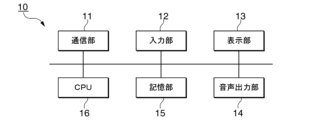
図3は、本実施形態に係る端末装置10のハードウェア構成の一例を示す図である。端末装置10は、例えば、通信部11と、入力部12と、表示部13と、音声出力部14と、記憶部15と、CPU(Central Processing Unit)16とを含んで構成される。
[Hardware configuration of terminal device]
Next, the configuration of the
3 is a diagram showing an example of a hardware configuration of the
通信部11は、端末装置10とサーバ装置30が通信可能な無線LAN、有線LAN、移動体通信(LTE)等の通信ネットワークNWの通信規格に対応した通信を行うデバイスである。
The
入力部12は、ユーザの操作による操作情報を受取ることが可能なデバイスである。本実施形態における入力部12の代表的な構成は、例えば表示部13の画面に対するユーザの操作による操作情報を受取るタッチパネルである。なお、入力部12の例としては、ボタン、キーボード、レバーなどの機械的操作による物理デバイス、タッチパネルやマウスなどのポインティングデバイス、音声やジェスチャによる認識デバイス(マイク、カメラ)などを例示できる。また、接触型のタッチパネルに限らず非接触型のタッチレスパネルであってもよい。また、入力部12は、端末装置10と一体に構成されてもよいし、有線または無線で接続される別体として構成されてもよい。入力部12は、入力された操作情報に基づく操作信号を出力する。
The
表示部13は、画像やテキスト等の情報を表示するディスプレイであり、例えば、液晶ディスプレイパネル、有機EL(ElectroLuminescence)ディスプレイパネルなどを含んで構成される。なお、表示部13は端末装置10と別体として構成されてもよく、例えば、テレビ、外付けモニター、ヘッドマウントディスプレイ(HMD)でもよい。表示部13には、ノッカーゲームのゲーム処理において、ノッカーゲームの各種ゲーム画面が表示される。
The
音声出力部14は、例えば、スピーカを含んで構成されている。また、音声出力部14は、ヘッドフォン等に音声を出力する音声出力端子などを含んで構成されてもよい。
The
記憶部15は、例えば、HDD(Hard Disk Drive)やSSD(Solid State Drive)、EEPROM(Electrically Erasable Programmable Read-Only Memory)、ROM(Read-Only Memory)、RAM(Random Access Memory)などを含み、端末装置10が処理に用いる各種情報や画像、プログラム等を記憶する。なお、記憶部15は、端末装置10に内蔵されるものに限らず、USB等のデジタル入出力ポート等によって接続された外付け型の記憶装置でもよい。
The
CPU16は、記憶部15に記憶された各種プログラムを実行し、端末装置10の各部を制御する。なお、CPU16は、端末装置10で処理を実行するプロセッサの一例である。
The
なお、端末装置10は、不図示のカメラ、ジャイロセンサ、GPS(Global Positioning System)チップ、加速度センサ、磁気センサ、環境光センサ、近接センサ、指紋センサなどを含んで構成されてもよい。
The
〔端末装置の機能構成〕
次に、図4を参照して、端末装置10の機能構成について説明する。
図4は、本実施形態に係る端末装置10の機能構成の一例を示すブロック図である。図示する端末装置10は、記憶部15に記憶されているノッカーゲームのゲームプログラムをCPU16が実行することにより実現される機能構成として、制御部160を備えている。制御部160は、操作受付部161と、ノック処理部162と、打球制御部163と、捕球制御部164と、評価基準設定部165と、評価部166と、表示制御部167とを含んで構成される。
[Functional configuration of terminal device]
Next, the functional configuration of the
4 is a block diagram showing an example of a functional configuration of the
操作受付部161は、入力部12に対する操作を受け付ける。例えば、操作受付部161は、入力部12に対するユーザの操作に基づく操作信号を入力部12から取得する。具体的には、操作受付部161は、ノッカーゲームのゲーム処理において、ゲームの進行を指示する操作や、ノッカーキャラクタC1に対する操作などに基づく操作信号を入力部12から取得する。
The
ノック処理部162は、ユーザにノックを行わせるノック処理を実行する。
図5は、本実施形態に係るノック処理におけるゲーム画面の一例を示す図である。図示するノック画面G10は、野球場のグラウンドを模したゲーム空間のうちの一部が表示される。ノック画面G10には、情報表示エリアGFが設けられている。情報表示エリアGFには、このミニゲームの名称「ノッカーゲーム」、スコア、残りの球数などが表示される。
The
5 is a diagram showing an example of a game screen in the knock process according to this embodiment. The knock screen G10 shown in the figure displays a part of a game space simulating the grounds of a baseball stadium. The knock screen G10 is provided with an information display area GF. The name of this mini-game "Knocker Game", the score, the number of remaining balls, etc. are displayed in the information display area GF.
ノック画面G10は、ユーザによるノック操作を受け付ける。ノック操作とは、投手からの投球に対して打撃を行う打撃操作である。ノック画面G10には、ユーザの打撃操作に応じてノックを行う(バットを振る)ノッカーキャラクタC1と、NPCである投手キャラクタC3とが表示されている。ユーザが不図示の「投球開始」ボタンに対する操作を行うと、ノック処理部162は、投手キャラクタC3に投球動作を行わせる。
The knock screen G10 accepts a knock operation by the user. A knock operation is a batting operation in which a ball pitched by a pitcher is hit. The knock screen G10 displays a knocker character C1 that knocks (swings the bat) in response to the user's batting operation, and a pitcher character C3, who is an NPC. When the user operates the "start pitching" button (not shown), the
ユーザは、投手キャラクタC3から投球されたボールオブジェクトBOに対して打撃操作を行う。打撃操作は、打撃位置指示操作と打撃タイミング指示操作とを含む。打撃位置指示操作は、ノッカーキャラクタC1がバットを振る位置を指示する操作である。打撃タイミング指示操作は、ノッカーキャラクタC1がバットを振るタイミングを指示する操作である。 The user performs a hitting operation on a ball object BO pitched by a pitcher character C3. The hitting operation includes a hitting position instruction operation and a hitting timing instruction operation. The hitting position instruction operation is an operation that indicates the position at which the knocker character C1 will swing the bat. The hitting timing instruction operation is an operation that indicates the timing at which the knocker character C1 will swing the bat.
ノック画面G10のノッカーキャラクタC1の横のホームベースHB上には、カーソルP11が表示される。カーソルP11は、ノッカーキャラクタC1がバットを振ったときに、バットが通る位置を示している。カーソルP11には、バットの芯が通過する部分を示す芯部P12が含まれる。ユーザがカーソルP11を移動させる打撃位置指示操作を行うことにより、ノック処理部162は、ノッカーキャラクタC1の打撃位置(バットの通る位置)を移動させることができる。
A cursor P11 is displayed on the home base HB next to the knocker character C1 on the knock screen G10. The cursor P11 indicates the position where the bat will pass when the knocker character C1 swings the bat. The cursor P11 includes a core part P12 that indicates the part where the core of the bat will pass. When the user performs a hitting position instruction operation to move the cursor P11, the
ユーザがカーソルP11を移動させる打撃位置指示操作は、例えば、ノック画面G10にタッチした指をタッチしたまま移動させる操作である。指をタッチする位置はカーソルP11の位置に限らず、ノック画面G10上の任意の位置でもよい。カーソルP11は、バットの届く範囲内で移動可能である。 The hitting position instruction operation in which the user moves the cursor P11 is, for example, an operation in which the user moves the finger that has been touching the knock screen G10 while still touching it. The position where the finger touches is not limited to the position of the cursor P11, and may be any position on the knock screen G10. The cursor P11 can be moved within the reach of the bat.
ノッカーキャラクタC1がバットを振るタイミングを指示する打撃タイミング指示操作は、ノック画面G10にタッチしている指を離す操作である。ユーザがノック画面G10にタッチしている指を離したことに応じたタイミングで、ノック処理部162は、ノッカーキャラクタC1のバットをカーソルP11(打撃位置)に向けて振らせる。
The hitting timing instruction operation that instructs the timing at which the knocker character C1 swings the bat is an operation of releasing the finger touching the knock screen G10. At the timing corresponding to the user releasing the finger touching the knock screen G10, the
投手キャラクタC3から投球されたボールオブジェクトBOがホームベースHB上付近を通過するタイミングに合わせてユーザがノック画面G10にタッチしている指を離すと、ノック処理部162は、当該指を離したタイミングにおけるカーソルP11の位置とボールオブジェクトBOの位置との位置関係とに基づいて、バットとボールオブジェクトBOとの当たり判定(打撃判定)を行う。そして、ノック処理部162は、当たり判定を行った結果、予め設定された打撃条件を満たした場合、バットがボールオブジェクトBOに当たったと判定する。例えば、ノック処理部162は、当該指を離したタイミングにおいてボールオブジェクトBOがカーソルP11の範囲内であればバットがボールオブジェクトBOに当たったと判定する。
When the user releases the finger touching the knock screen G10 at the timing when the ball object BO pitched by the pitcher character C3 passes near the home base HB, the
一方、ノック処理部162は、当該指を離したタイミングにおいてボールオブジェクトBOがカーソルP11の範囲外である場合、または投球されたボールオブジェクトBOがホームベースHB上付近を通過するタイミングとユーザがノック画面G10にタッチしている指を離すタイミングとが所定時間以上離れている場合、バットがボールオブジェクトBOに当たらなかった(空振りまたは見逃し)と判定し、打撃失敗と判定する。
On the other hand, if the ball object BO is outside the range of the cursor P11 at the time the finger is released, or if there is a predetermined time difference between when the pitched ball object BO passes near the home base HB and when the user releases the finger touching the knock screen G10, the
また、ノック処理部162は、バットがボールオブジェクトBOに当たったと判定した場合、ユーザがノック画面G10にタッチしている指を離すタイミング、及びカーソルP11とボールオブジェクトBOとの位置関係などに基づいて打球の移動方向及び加速度を決定する。移動方向には、左右方向の角度(方位角)及び上下方向の角度(仰俯角)が含まれる。なお、移動方向には、少なくとも左右方向の角度(方位角)のみが含まれてもよい。加速度は、打球の強さを示すパラメータである。加速度が大きいほどボールオブジェクトBOは速く且つ遠くへ移動する。なお、打球の強さは、速度と飛距離を示すパラメータで表されてもよい。
When the
図4に戻り、打球制御部163(オブジェクト移動部の一例)は、図5に示すノック画面G10に対するユーザの打撃操作によりボールオブジェクトBOを制御する。例えば、打球制御部163は、ノック処理部162により決定された打球の移動方向及び加速度に基づいてボールオブジェクトBOを移動させる。
Returning to FIG. 4, the hit ball control unit 163 (an example of an object moving unit) controls the ball object BO in response to a user's hitting operation on the knock screen G10 shown in FIG. 5. For example, the hit
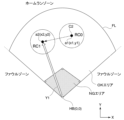
ここで、図6を参照して、本実施形態に係るノッカーゲームのゲームフィールドについて説明する。図6は、本実施形態に係るノッカーゲームのゲームフィールドの説明図である。この図において、図1に示す部分に対応する部分には同一の符号を付している。 Now, with reference to FIG. 6, we will explain the game field of the knocker game according to this embodiment. FIG. 6 is an explanatory diagram of the game field of the knocker game according to this embodiment. In this figure, parts corresponding to those shown in FIG. 1 are given the same reference numerals.
グラウンド領域FLは、図1に示す野球場のグラウンドを模した領域に対応し、野球場のフェアゾーンを示している。グラウンド領域FL外の領域であるファウルゾーン及びホームランゾーンへ打球が飛んだ場合は、打撃失敗と判定される。また、グラウンド領域FL内であっても、本塁、1塁、2塁、及び3塁の4つのベースを結ぶ四角形の領域(ダイヤモンド領域)に打球が止まった場合も、打撃失敗と判定される。このダイヤモンド領域のことを、以下では「NGエリア」と称する。即ち、グラウンド領域FLのうちのNGエリアを除く領域が、打撃成功と判定される領域(以下、「OKエリア」と称する)に設定されている。つまり、打球がOKエリアに飛んだ場合、即ち、外野手の守備範囲となり得る領域への打球である場合に、打撃成功と判定される。 The ground area FL corresponds to an area simulating the ground of a baseball field shown in FIG. 1, and indicates the fair zone of the baseball field. If the ball flies into the foul zone or home run zone, which are areas outside the ground area FL, it is determined that the hit is a failure. In addition, if the ball stops in the square area (diamond area) connecting the four bases of home plate, first base, second base, and third base, even if it is within the ground area FL, it is also determined that the hit is a failure. This diamond area is referred to as the "NG area" below. In other words, the area of the ground area FL other than the NG area is set as an area that is determined as a successful hit (hereinafter referred to as the "OK area"). In other words, if the ball flies into the OK area, that is, if it is a hit into an area that can be covered by an outfielder, it is determined that the hit is a success.
打球がOKエリアに飛んだ場合に、野手キャラクタC2が移動して捕球する。一方、打球がファウルゾーンまたはホームランゾーンへ飛んだ場合、或いは打球がNGエリアで止まった場合には、野手キャラクタC2は移動しない。 If the ball flies into an OK area, fielder character C2 moves to catch it. On the other hand, if the ball flies into a foul zone or home run zone, or if the ball stops in an NG area, fielder character C2 does not move.
捕球制御部164は、野手キャラクタC2の位置、移動及び動作と、ボールオブジェクトBOの返球による移動とを制御する。具体的には、捕球制御部164は、ノッカーキャラクタC1の位置に応じて初期状態の野手キャラクタC2の位置(例えば、図1及び図6に示す「a1」の位置)を決定する。また、捕球制御部164は、打球制御部163の制御によりボールオブジェクトBOがOKエリアへ移動することに応じて、ボールオブジェクトBOへ到達する方向へ野手キャラクタC2を移動させる。
The ball catching
この図では、1球目のノックによるボールオブジェクトBOの移動方向を矢印Y1と方位角「-α」で示している。ここでは、方位角について、基準角度(0度)を基準ラインL0の方向とし、基準ラインL0に対して左方向への角度を負方向の角度、右方向への角度を正方向の角度としている。なお、基準角度及び正負の方向は任意に定めることができる。捕球制御部164は、1球目のノックにおいて、野手キャラクタC2を「a1」の位置からボールオブジェクトBOに到達する「a2」の位置へ移動させる。
In this diagram, the direction of movement of the ball object BO due to the first knock is indicated by the arrow Y1 and the azimuth angle "-α". Here, for the azimuth angle, the reference angle (0 degrees) is set to the direction of the reference line L0, and the angle to the left of the reference line L0 is set to the negative angle, and the angle to the right is set to the positive angle. Note that the reference angle and the positive and negative directions can be set arbitrarily. During the first knock, the ball catching
捕球制御部164は、野手キャラクタC2がボールオブジェクトBOへ到達した「a2」の位置で、野手キャラクタC2にボールオブジェクトBOを捕球させ、その位置からホームベースHBへ返球させる。また、捕球制御部164は、野手キャラクタC2の返球に応じて、「a2」の位置からホームベースHBへボールオブジェクトBOを移動させる。また、捕球制御部164は、返球後の野手キャラクタC2の位置を、野手キャラクタC2の左右の基準ラインの数に基づいて、基準ライン数が少ない左側に少し移動させた「a3」の位置に決定する。
The ball catching
また、2球目のノックによるボールオブジェクトBOの移動方向を矢印Y2と方位角「+β」で示している。捕球制御部164は、2球目のノックにおいて、野手キャラクタC2を「a3」の位置からボールオブジェクトBOへ到達する「a4」の位置へ移動させる。捕球制御部164は、野手キャラクタC2がボールオブジェクトBOへ到達した「a4」の位置で、野手キャラクタC2にボールオブジェクトBOを捕球させ、その位置からホームベースHBへ返球させる。また、捕球制御部164は、野手キャラクタC2の返球に応じて、「a4」の位置からホームベースHBへボールオブジェクトBOを移動させる。
The direction of movement of ball object BO due to the second knock is indicated by arrow Y2 and azimuth angle "+β". During the second knock, the ball catching
評価基準設定部165は、初期状態において基準ラインL0を設定する。また、評価基準設定部165は、ノックの度に、ユーザの打撃操作により移動した打球(ボールオブジェクトBO)の移動方向に基づいて基準ラインを新たに設定する。即ち、評価基準設定部165は、次のノックを評価するための基準ラインを、過去(前回まで)に行われたユーザの打撃操作により移動したボールオブジェクトBOの移動方向に基づいて設定する。 The evaluation criterion setting unit 165 sets a reference line L0 in the initial state. Furthermore, for each knock, the evaluation criterion setting unit 165 sets a new reference line based on the movement direction of the ball (ball object BO) moved by the user's hitting operation. In other words, the evaluation criterion setting unit 165 sets the reference line for evaluating the next knock based on the movement direction of the ball object BO moved by the user's hitting operation performed in the past (up to the previous time).
ここで、図6に示すゲームフィールドは、ホームベースHBを原点としたXY座標面にあるものとする。この図では、ホームベースHBの位置の座標を(0,0)、「a1」の位置の座標を(x1,y1)、「a2」の位置の座標を(x2,y2)、「a3」の位置の座標を(x3,y3)、及び「a4」の位置の座標を(x4,y4)とする。また、グラウンド領域FLとホームランゾーンとの境界に当たる外野フェンス部分の弧の中央(センター方向の中央)「k0」の位置の座標を(x0,y0)とする。 The game field shown in FIG. 6 is assumed to be on an XY coordinate plane with home base HB as the origin. In this diagram, the coordinates of the position of home base HB are (0,0), the coordinates of the position of "a1" are (x1,y1), the coordinates of the position of "a2" are (x2,y2), the coordinates of the position of "a3" are (x3,y3), and the coordinates of the position of "a4" are (x4,y4). In addition, the coordinates of the position of "k0", the center (center toward center field) of the arc of the outfield fence that is the boundary between the ground area FL and the home run zone, are (x0,y0).
評価基準設定部165は、初期状態において、ホームベースHBの位置「座標(0,0)」から外野フェンス部分の弧の中央「k0」の位置「座標(x0,y0)」までの線分による境界を基準ラインL0として設定する。 In the initial state, the evaluation standard setting unit 165 sets the boundary defined by the line segment from the position of home base HB (coordinates (0,0)) to the position of the center of the arc of the outfield fence (coordinates (x0,y0)) (k0) as the reference line L0.
また、1球目のノックによるボールオブジェクトBOの移動方向は、ボールオブジェクトBOの移動元に対応するホームベースHBの位置(第1基準位置)からボールオブジェクトBOの移動先に対応する「a2」の位置(第2基準位置)への方向に対応する。評価基準設定部165は、1球目のノックによるボールオブジェクトBOに野手キャラクタC2が到達したことに基づいて、ホームベースHBの位置「座標(0,0)」から「a2」の位置「座標(x2,y2)」までの線分による境界を基準ラインL1として設定する。 The direction of movement of the ball object BO due to the first knock corresponds to the direction from the position of home base HB (first reference position) corresponding to the origin of the movement of the ball object BO to the position "a2" (second reference position) corresponding to the destination of the movement of the ball object BO. The evaluation standard setting unit 165 sets the boundary defined by the line segment from the position of home base HB "coordinates (0,0)" to the position of "a2" "coordinates (x2, y2)" as the reference line L1, based on the fact that the fielder character C2 has reached the ball object BO due to the first knock.
なお、1球目のノックによるボールオブジェクトBOの移動方向は、上述したようにホームベースHBの位置(第1基準位置)からボールオブジェクトBOの移動先に対応する「a2」の位置(第2基準位置)への方向(即ち、打球の移動方向)に対応しているが、1球目の返球によるボールオブジェクトBOの移動方向(即ち、打球の移動方向とは反対方向)に対応することとしてもよい。つまり、1球目のノックによるボールオブジェクトBOの移動方向は、1球目の返球によるボールオブジェクトBOの移動元に対応する「a2」の位置からボールオブジェクトBOの移動先に対応するホームベースHBの位置への方向と言うこともできる。野手キャラクタC2がボールオブジェクトBOに到達した位置から野手キャラクタC2が返球した場合、打球の移動方向と返球の移動方向とは互いに逆向きであるが、打球の移動方向に基づく境界と返球の移動方向に基づく境界とは同一となるため、どちらの移動方向としても同一の基準ラインが設定される。 The direction of movement of the ball object BO by the first knock corresponds to the direction from the position of home base HB (first reference position) to the position "a2" (second reference position) corresponding to the destination of the ball object BO (i.e., the direction of movement of the batted ball) as described above, but it may also correspond to the direction of movement of the ball object BO by the first return ball (i.e., the opposite direction to the direction of movement of the batted ball). In other words, the direction of movement of the ball object BO by the first knock can also be said to be the direction from the position "a2" corresponding to the origin of the movement of the ball object BO by the first return ball to the position of home base HB corresponding to the destination of the movement of the ball object BO. When the fielder character C2 returns the ball from the position where the fielder character C2 reaches the ball object BO, the direction of movement of the batted ball and the direction of movement of the return ball are opposite to each other, but the boundary based on the movement direction of the batted ball and the boundary based on the movement direction of the return ball are the same, so the same reference line is set for either direction of movement.
また、評価基準設定部165は、ノックによるボールオブジェクトBOの移動に応じて野手キャラクタC2がボールオブジェクトBOに到達して捕球する度に、ボールオブジェクトBOの移動元に対応するホームベースHBの位置(第1基準位置)とボールオブジェクトBOの移動先に対応する位置(第2基準位置)とに基づいて評価基準となる基準ラインを追加する。 In addition, each time the fielder character C2 reaches and catches the ball object BO in response to the movement of the ball object BO due to the knock, the evaluation standard setting unit 165 adds a reference line that serves as an evaluation standard based on the position of the home base HB corresponding to the origin of the movement of the ball object BO (first reference position) and the position corresponding to the destination of the movement of the ball object BO (second reference position).
例えば、2球目のノックによるボールオブジェクトBOの移動方向は、ボールオブジェクトBOの移動元に対応するホームベースHBの位置からボールオブジェクトBOの移動先に対応する「a4」の位置への方向に対応する。評価基準設定部165は、2球目のノックによるボールオブジェクトBOに野手キャラクタC2が到達したことに基づいて、ホームベースHBの位置「座標(0,0)」から「a4」の位置「座標(x4,y4)」までの線分による境界を基準ラインL2として設定する。 For example, the direction of movement of the ball object BO due to the second knock corresponds to the direction from the position of home base HB, which corresponds to the origin of the ball object BO, to the position "a4", which corresponds to the destination of the ball object BO. Based on the fact that the fielder character C2 has reached the ball object BO due to the second knock, the evaluation criterion setting unit 165 sets the boundary defined by the line segment from the position of home base HB "coordinates (0,0)" to the position of "a4" "coordinates (x4, y4)" as the reference line L2.
そして、評価基準設定部165は、基準ラインを設定する毎に、基準ラインの一端の座標と他端の座標とを関連付けた評価基準設定情報を記憶部15に記憶させる。
図7は、本実施形態に係る評価基準設定情報のデータ例を示す図である。図示する評価基準設定情報151は、基準ライン毎に始点の座標と終点の座標とが関連付けられている。ここでは、ホームベースHBの位置の座標を始点とし、野手キャラクタC2がボールオブジェクトBOへ到達した位置の座標を終点としているが、始点と終点は逆でもよい。
Then, every time a reference line is set, the evaluation standard setting unit 165 stores in the
7 is a diagram showing an example of data of evaluation criterion setting information according to the present embodiment. In the illustrated evaluation
評価部166は、ユーザの操作によるノックを評価する。例えば、評価部166は、ユーザの操作によるノックが打撃失敗と判定された場合にはミスと評価し、ポイントを付与しない。打撃失敗と判定された場合とは、バットがボールオブジェクトBOに当たらなかった(空振りまたは見逃し)と判定された場合、打球(ボールオブジェクトBO)がファウルゾーンまたはホームランゾーンへ飛んだ場合、或いは打球(ボールオブジェクトBO)がNGエリアで止まった場合である。
The
また、評価部166は、ノックによるボールオブジェクトBOがOKエリアへ飛んだ場合、ボールオブジェクトBOの移動方向を基準ラインに基づいて評価する。ノックによるボールオブジェクトBOの移動方向は、野手キャラクタC2がボールオブジェクトBOへ到達した位置に対応する。評価部166は、野手キャラクタC2がボールオブジェクトBOへ到達した位置が、基準ラインの一方側であるか或いは他方側であるかに基づいて評価する。ここで、評価部166は、図7に示す評価基準設定情報151に設定されている基準ラインを評価に用いる。即ち、評価部166は、予め設定されている基準ラインL0と、過去(前回まで)のノックにより設定された基準ラインとを用いて評価する。1球目のノックの場合には、基準ラインL0のみが評価に用いられる。
When the ball object BO flies into the OK area due to a knock, the
例えば、評価部166は、ノックによるボールオブジェクトBOの移動に応じて、野手キャラクタC2が基準ラインを通過してボールオブジェクトBOへ到達した場合、基準ラインL0を通過せずにボールオブジェクトBOへ到達するよりも高評価になるように評価する。例えば、評価部166は、野手キャラクタC2が基準ラインを通過してボールオブジェクトBOへ到達した場合には所定のポイント(例えば、10000ポイント)を付与する。一方、評価部166は、野手キャラクタC2が基準ラインを通過しないでボールオブジェクトBOへ到達した場合にはポイントを付与しない。
For example, when the fielder character C2 passes through the reference line to reach the ball object BO in response to the movement of the ball object BO due to the knock, the
なお、評価部166は、野手キャラクタC2が基準ラインを通過しないでボールオブジェクトBOへ到達した場合に、基準ラインを通過してボールオブジェクトBOへ到達した場合よりも少ないポイントを付与してもよい。つまり、評価部166は、ユーザが打撃に成功した場合には、野手キャラクタC2が基準ラインを通過しなくとも、打撃に失敗した場合よりは高評価としてもよい。換言すると、評価部166は、ノックにより移動するボールオブジェクトBOに野手キャラクタC2が到達しなかった場合、ボールオブジェクトBOに野手キャラクタC2がいずれの位置で到達した場合よりも低評価になるように評価する。ボールオブジェクトBOに野手キャラクタC2が到達しなかった場合とは、打撃失敗と判定された場合である。
The
また、評価部166は、ノックによるボールオブジェクトBOの移動に応じて、野手キャラクタC2がボールオブジェクトBOに到達するまでに基準ラインを通過した回数が多いほど高評価になるように評価する。例えば、評価部166は、野手キャラクタC2がボールオブジェクトBOに到達するまでに基準ラインを通過する毎に所定のポイント(例えば、10000ポイント)を付与する。これにより、基準ラインを通過した回数が多いほど、付与されるポイントの合計が多くなる。なお、評価部166は、基準ラインを通過する毎に付与するポイントを増加してもよい。また、評価部166は、1回目に基準ラインを通過したことに応じて所定のポイントを付与し、2回目以降に基準ラインを通過する毎に、付与したポイントを所定の係数で乗算してもよい。所定の係数は、一定であってもよいし、基準ラインを通過する毎に異なってもよい。
The
例えば、図6に示す基準ラインL0の右側の「a1」に位置する野手キャラクタC2が、1球目のノックによるボールオブジェクトBOの移動に応じて基準ラインL0を通過して左側の「a2」の位置でボールオブジェクトBOへ到達する。評価部166は、「a1」の位置の座標(x1,y1)と「a2」の位置の座標(x2,y2)とを結ぶ線分が、基準ラインL0と交差していることに基づいて、野手キャラクタC2が基準ラインL0を通過してボールオブジェクトBOへ到達したと判定する。そして、評価部166は、野手キャラクタC2が1つの基準ラインL0を通過したと判定したことにより、基準ラインを1回通過した分の所定のポイント(例えば、10000ポイント)を付与する。
For example, fielder character C2, located at "a1" on the right side of reference line L0 shown in FIG. 6, passes through reference line L0 in response to the movement of ball object BO due to the first knock, and reaches ball object BO at position "a2" on the left side. The
また、図6に示す基準ラインL1の左側の「a3」に位置する野手キャラクタC2が、2球目のノックによるボールオブジェクトBOの移動に応じて基準ラインL1及び基準ラインL0を通過して右側の「a4」の位置でボールオブジェクトBOへ到達する。評価部166は、「a3」の位置の座標(x3,y3)と「a4」の位置の座標(x4,y4)とを結ぶ線分が、基準ラインL1及び基準ラインL0と交差していることに基づいて、野手キャラクタC2が基準ラインL1及び基準ラインL0を通過してボールオブジェクトBOへ到達したと判定する。そして、評価部166は、野手キャラクタC2が基準ラインL1及び基準ラインL0の2つの基準ラインを通過したと判定したことにより、基準ラインを2回通過した分の所定のポイント(例えば、20000ポイント)を付与する。
Furthermore, the fielder character C2 located at "a3" on the left side of the reference line L1 shown in FIG. 6 passes through the reference line L1 and the reference line L0 in response to the movement of the ball object BO due to the knock of the second ball, and reaches the ball object BO at the position "a4" on the right side. The
なお、評価部166は、野手キャラクタC2がボールオブジェクトBOへ到達して捕球した場合、当該捕球がノーバウンドでの捕球である場合に追加でポイント(例えば、ボーナスポイント)を付与してもよい。また、評価部166は、ノーバウンドでの捕球でない場合でも、バウンドしてから捕球するまでの時間に応じてボーナスポイントを付与してもよい。例えば、評価部166は、バウンドしてから捕球するまでの時間が所定時間以内である場合には、バウンドしてから捕球するまでの時間が短いほど多くのポイント(ノーバウンド捕球よりは少ないポイント)をボーナスポイントとして付与してもよい。
When the fielder character C2 reaches the ball object BO and catches it, the
また、評価部166は、評価結果を記憶部15に記憶させる。
図8は、本実施形態に係る評価結果情報のデータ例を示す図である。図示する評価結果情報152は、ノック毎に、打撃情報と、基準ライン数と、ポイントと、ボーナスポイントと、スコアとが関連付けられている。打撃情報は、打撃成功または打撃失敗を示す情報である。基準ライン数は、野手キャラクタC2がボールオブジェクトBOに到達するまでに通過した基準ラインの数である。ポイントは、通過した基準ラインの数に応じて付与されたポイントの値である。ボーナスポイントは、ノーバウンド捕球などにより追加で加算されたポイントの値である。スコアは、ポイントの合計である。
Furthermore, the
8 is a diagram showing an example of evaluation result information data according to this embodiment. The illustrated evaluation result
図示する評価結果情報152の例について説明する。1球目のノックは、打撃成功で野手キャラクタC2がボールオブジェクトBOに到達するまでに通過した基準ラインの数が1であったことを示している。よって、10000ポイントが付与され、この時点でのスコアは10000ポイントとなっている。2球目のノックは、打撃成功で野手キャラクタC2がボールオブジェクトBOに到達するまでに通過した基準ラインの数が2であったことを示している。よって、20000ポイントが付与され、この時点でのスコアは、1球目のスコアに2球目のポイントが加算され30000ポイントとなっている。3球目のノックは、打撃失敗であったことを示している。よって、スコアは2球目のノック時のスコアと変わらず30000ポイントとなっている。4球目のノックは、打撃成功であったが野手キャラクタC2がボールオブジェクトBOに到達するまでに基準ラインを通過しなかったことを示している。但し、ノーバウンドで捕球したことによるボーナスポイントが10000ポイント付与されており、スコアは、3球目のスコアに4球目のボーナスポイントが加算され40000ポイントとなっている。5球目のノックは、打撃成功で野手キャラクタC2がボールオブジェクトBOに到達するまでに通過した基準ラインの数が3であったことを示している。よって、30000ポイントが付与され、スコアは、4球目のスコアに5球目のポイントが加算され70000ポイントとなっている。1回のノッカーゲームにおけるノックの回数が5回の場合、この5球目のスコアが最終スコアとなる。
An example of the
表示制御部167は、ノッカーゲームのゲーム画面に表示されるゲーム画像を表示部13に表示させる。例えば、表示制御部167は、ノッカーゲームのゲームフィールド(図1参照)、ノック画面に表示される画像(図5参照)などの各種ゲーム画面に表示されるゲーム画像を表示部13に表示させる。例えば、表示制御部167は、操作受付部161が受け付けたユーザの操作に基づいて表示部13に表示させるゲーム画像や、ゲーム画面の遷移などを制御する。また、表示制御部167は、ゲーム画像を表示部13に表示させる際に所定のフレームレートで画像を更新する。例えば、表示制御部167は、ノック処理部162、打球制御部163、捕球制御部164などの制御に基づいて、ノッカーキャラクタC1、野手キャラクタC2、投手キャラクタC3、ボールオブジェクトBOなどの移動や動作に応じた画像に所定のフレームレートで更新する。また、表示制御部167は、ノッカーゲームのプレイ結果を表示部13に表示させる。プレイ結果には、基準ラインを通過した数や合計ポイントを示すスコアなどが含まれる。
The
〔ゲーム処理の動作〕
次に、図9~12を参照して、端末装置10のCPU16が実行するノッカーゲームのゲーム処理の動作を説明する。
図9は、本実施形態に係るゲーム処理の一例を示すフローチャートである。ノッカーゲームは、1回のプレイで規定回数(例えば、5回)のノックを行う。
[Game Processing Operation]
Next, the operation of the game processing of the knocker game executed by the
9 is a flowchart showing an example of a game process according to the present embodiment. In the knocker game, knocking is performed a specified number of times (for example, five times) in one play.
CPU16は、ユーザの操作に応じてノッカーゲームのゲーム処理を開始すると、ノック回数のカウント用の変数nに初期値として「1」を代入する(ステップS110)。
When the
次に、CPU16は、ユーザにノックを行わせるノック処理を実行する(ステップS120)。ノック処理において、CPU16は、ユーザの打撃操作によりボールオブジェクトBOを移動させる。例えば、CPU16は、図5に示すノック画面G10を表示部13に表示させ、投球されたボールオブジェクトBOに対するユーザの打撃操作を受け付ける。そして、CPU16は、ユーザの打撃操作に基づいて打撃成功または打撃失敗の判定を行い、打撃成功の場合には打球の移動方向及び加速度に応じてボールオブジェクトBOを移動させる。このノック処理について詳しくは、図10を参照して後述する。
Next, the
CPU16は、ノック処理が終了すると、ノック処理における判定結果に基づいて打撃成功であるか否かを判定する(ステップS125)。CPU16は、打撃成功と判定した場合には(ステップS125:YES)、ステップS130の捕球処理へ進む。一方、CPU16は、打撃失敗と判定した場合には(ステップS125:NO)、ステップS140の評価処理に進む。
When the knock process ends, the
CPU16は、ノック処理において打撃成功と判定された場合、捕球処理を実行する(ステップS130)。捕球処理において、CPU16は、打球の方向へ野手キャラクタC2を移動させ、野手キャラクタC2が打球(ボールオブジェクトBO)に到達した位置で野手キャラクタC2に捕球させ、捕球したボールオブジェクトBOをホームベースHBへ送球させる。この捕球処理について詳しくは、図11を参照して後述する。
If the knock process determines that the hit is successful, the
CPU16は、捕球処理が終了すると、ユーザの打撃操作によるノックを評価する評価処理を実行する(ステップS140)。CPU16は、ユーザの打撃操作によるボールオブジェクトBOの少なくとも移動方向を評価するための基準ラインを用いて、ユーザの打撃操作によるノックを評価する。具体的には、CPU16は、ユーザの打撃操作により移動したボールオブジェクトBOを捕球するために移動した野手キャラクタC2が、過去のユーザの打撃操作により設定された基準ラインを通過したか否かによって評価を行う。CPU16は、基準ラインを通過したことに応じてポイントを付与する。この評価処理について詳しくは、図12を参照して後述する。
When the catching process ends, the
CPU16は、評価処理が終了すると、ユーザの打撃操作により移動したボールオブジェクトBOの移動方向に基づいて評価基準を設定する(ステップS150)。例えば、CPU16は、ホームベースHBの位置から野手キャラクタC2が打球(ボールオブジェクトBO)に到達した位置までの線分による基準ラインを評価基準として設定する。CPU16は、評価基準として設定する場合、例えば図7に示す評価基準設定情報151に新たな基準ラインを追加し、ホームベースHBの位置の座標を当該基準ラインの始点の座標、野手キャラクタC2が打球に到達した位置の座標を当該基準ラインの終点の座標として関連付けて格納する。ここで設定される基準ラインは、次回のノックの評価に使用される評価基準の一つとして追加される。
When the evaluation process ends, the
CPU16は、ノック回数のカウント用の変数nに1を加算する(ステップS160)。そして、CPU16は、変数nが規定数(例えば、5)以下であるか否かを判定する(ステップS165)。CPU16は、変数nが規定数(例えば、5)以下であると判定した場合(ステップS165:YES)、ステップS120のノック処理に戻る。一方、CPU16は、変数nが規定数(例えば、5)を超えたと判定した場合(ステップS165:YES)、規定回数(例えば、5回)のノックが終了したため、結果(最終スコアなど)を表示部13に表示させて、ノッカーゲームのゲーム処理を終了する(ステップS170)。例えば、CPU16は、図8に示す評価結果情報152に含まれる情報の少なくとも一部を最終結果として表示部13に表示させる。
The
次に、図9のステップS120のノック処理の動作の詳細について説明する。
図10は、本実施形態に係るノック処理の一例を示すフローチャートである。
CPU16は、ノック処理において、まず投球開始画像を表示部13に表示させる(ステップS201)。投球開始前画像とは、図5に示すノック画面G10において投手キャラクタC3が投球を開始する前の画像であり、投球開始を指示する操作ボタンなどが表示されている。
Next, the knock process in step S120 of FIG. 9 will be described in detail.
FIG. 10 is a flowchart showing an example of the knock process according to the present embodiment.
In the knock process, the
CPU16は、投球開始操作があったか否かを判定する(ステップS203)。CPU16は、投球開始を指示する操作ボタンに対するユーザの操作を受け付けた場合、投球開始操作があったと判定し(ステップS203:YES)、投手キャラクタC3が投球する投球画像(図5に示すノック画面G10参照)を表示部13に表示させる(ステップS205)。一方、CPU16は、投球開始を指示する操作ボタンに対するユーザの操作を受け付けない場合、投球開始操作がないと判定し(ステップS203:NO)、投球開始前画像を引き続き表示部13に表示させる。
The
CPU16は、規定時間内に、ユーザによる打撃操作を受け付けたか否かを判定する(ステップS207)。規定時間とは、投球されたボールオブジェクトBOに対して打撃操作を行うことが可能な時間として予め設定された時間である。例えば、規定時間は、投手キャラクタC3が投球を開始してから投球されたボールオブジェクトBOが仮想的な捕手に到達するまでの時間である。CPU16は、規定時間内に、ユーザによる打撃操作を受け付けなかったと判定した場合(ステップS207:NO)、見逃したものとして打撃失敗と判定する(ステップS221)。
The
一方、CPU16は、規定時間内に、ユーザによる打撃操作を受け付けた場合(ステップS207:YES)、ノッカーキャラクタC1のバットをカーソルP11(打撃位置)に向けて振らせる打撃画像を表示部13に表示させる(ステップS209)。
On the other hand, if the
次に、CPU16は、投球されたボールオブジェクトBOとバットとの当たり判定(打撃判定)を行う(ステップS211)。CPU16は、打撃判定を行った結果、予め設定された打撃条件を満たした場合、バットがボールオブジェクトBOに当たったと判定する。例えば図5を参照して説明したように、CPU16は、打撃操作において画面から指を離したタイミングにおいてボールオブジェクトBOがカーソルP11の範囲内であればバットがボールオブジェクトBOに当たったと判定する。一方、CPU16は、打撃操作において画面から指を離したタイミングにおいてボールオブジェクトBOがカーソルP11の範囲外である場合、バットがボールオブジェクトBOに当たらなかったと判定する。
Next, the
CPU16は、ステップS211の打撃判定によりバットがボールオブジェクトBOに当たらなかったと判定された場合(ステップS213:NO)、空振りしたものとして打撃失敗と判定する(ステップS221)。
If the
一方、CPU16は、ステップS211の打撃判定によりバットがボールオブジェクトBOに当たったと判定された場合(ステップS213:YES)、打球の移動方向及び加速度を決定する(ステップS215)。そして、CPU16は、ステップS215において決定された打球の移動方向及び加速度に基づいてボールオブジェクトBOの移動を開始させる(ステップS217)。
On the other hand, if the
次に、CPU16は、ステップS215において決定された打球の移動方向及び加速度に基づいてボールオブジェクトBO(打球)の移動先がOKエリアであるか否かを判定する(ステップS219)。CPU16は、打球の移動先がOKエリアであると判定した場合(ステップS219:YES)、打撃成功と判定しノック処理を終了する。なお、CPU16は、ノック処理を終了してもボールオブジェクトBOの移動を継続させる。
Next, the
一方、CPU16は、打球の移動先がOKエリアではないと判定した場合(ステップS219:NG)、打撃失敗と判定する(ステップS221)。打撃失敗とは、打球の移動先がファウルゾーンまたはホームランゾーンである場合、或いは打球がNGエリアで止まった場合である。この場合、CPU16は、ボールオブジェクトBOの移動を終了させる。
On the other hand, if the
次に、図9のステップS130の捕球処理の動作の詳細について説明する。
図11は、本実施形態に係る捕球処理の一例を示すフローチャートである。
CPU16は、野手キャラクタC2を初期状態の位置からボールオブジェクトBOへ到達する方向への移動を開始させる(ステップS301)。このとき、CPU16は、ノック処理で開始したボールオブジェクトBOの移動も継続している。
Next, the details of the ball catching process in step S130 of FIG. 9 will be described.
FIG. 11 is a flowchart showing an example of the ball catching process according to the present embodiment.
The
CPU16は、野手キャラクタC2がボールオブジェクトBOに到達したか否かを判定する(ステップS303)。例えば、CPU16は、野手キャラクタC2の位置とボールオブジェクトBOの位置とが一致または所定の距離未満となった場合に、野手キャラクタC2がボールオブジェクトBOに到達したと判定する。CPU16は、野手キャラクタC2がボールオブジェクトBOに到達していないと判定した場合(ステップS303:NO)、野手キャラクタC2及びボールオブジェクトBOを引き続き移動させ、ステップS303の判定処理を行う。
The
一方、CPU16は、野手キャラクタC2がボールオブジェクトBOに到達したと判定した場合(ステップS303:YES)、野手キャラクタC2がボールオブジェクトBOを捕球する動作を示す捕球画像を表示部13に表示させる(ステップS305)。
On the other hand, if the
また、CPU16は、野手キャラクタC2がボールオブジェクトBOをノーバウンドで捕球したか否かを判定し、判定結果を記憶部15に保存する(ステップS307)。なお、ステップS307において、CPU16は、ノーバウンドで捕球しなかった場合、バウンドしてから捕球するまでの時間を記憶部15に保存してもよい。また、CPU16は、野手キャラクタC2の初期状態の位置の座標とボールオブジェクトBOに到達した位置(到達位置)の座標とを記憶部15に保存する(ステップS309)。
The
また、CPU16は、ボールオブジェクトBOを返球する返球画像を表示部13に表示させる(ステップS311)。CPU16は、ボールオブジェクトBOを野手キャラクタC2が捕球した位置からホームベースHBへ移動させる。
The
次に、図9のステップS140の評価処理の動作の詳細について説明する。
図12は、本実施形態に係る評価処理の一例を示すフローチャートである。
CPU16は、図10に示すノック処理において打撃成功と判定されたか否かを判定する(ステップS401)。CPU16は、打撃失敗と判定された場合には(S401:NO)、ミスと評価する(ステップS403)。CPU16は、図8に示す評価結果情報152の打撃情報に打撃失敗を示す情報を格納し、ポイント及びボーナスポイントに「0」を格納する。また、CPU16は、1球目のノックの場合にはスコアに「0」を格納し、2球目以降のノックの場合には前回のスコアを格納する。そして、CPU16は、評価処理を終了する。
Next, the evaluation process in step S140 of FIG. 9 will be described in detail.
FIG. 12 is a flowchart showing an example of the evaluation process according to the present embodiment.
The
一方、CPU16は、打撃成功と判定された場合には(S401:YES)、図8に示す評価結果情報152の打撃情報に打撃成功を示す情報を格納し、野手キャラクタC2がボールオブジェクトBOに到達するまでに基準ラインを通過したか否かを判定する(ステップS405)。例えば、CPU16は、図7に示す評価基準設定情報151に設定されている基準ラインの始点及び終点の座標と、図11のステップS309で保存した野手キャラクタC2の初期状態の位置及び到達位置の座標とに基づいて、野手キャラクタC2が基準ラインを通過したか否かを判定する。
On the other hand, if the hit is determined to be successful (S401: YES), the
CPU16は、ステップS405の判定結果に基づいて、基準ラインを通過したか否かを判定する(ステップS407)。CPU16は、基準ラインを通過したと判定した場合(ステップS407:YES)、通過した基準ラインの数(即ち、基準ラインを通過した回数)に応じてポイントを付与する(ステップS409)。例えば、CPU16は、図8に示す評価結果情報152のポイントに、通過した基準ラインの数に応じたポイントを格納する。そして、ステップS411の処理に進む。なお、野手キャラクタC2がボールオブジェクトBOに到達するまでに同一の基準ラインを複数回通過しても、当該基準ラインの通過は1回とカウントされてポイントが付与される。
Based on the result of the determination in step S405, the
一方、CPU16は、基準ラインを通過していないと判定した場合(ステップS407:NO)、ポイントを付与しない。例えば、CPU16は、図8に示す評価結果情報152のポイントに「0」を格納する。そして、ステップS411の処理に進む。
On the other hand, if the
CPU16は、図11のステップS307で保存した判定結果に基づいて、ノーバウンド捕球であるか否かを判定する(ステップS411)。CPU16は、ノーバウンド捕球であると判定した場合(ステップS411:YES)、ボーナスポイントを付与する(ステップS413)。例えば、CPU16は、図8に示す評価結果情報152のボーナスポイントに、ノーバウンド捕球に応じたボーナスポイントを格納する。そして、ステップS415の処理に進む。なお、ステップS411及びS413において、CPU16は、ノーバウンド捕球でないと判定した場合でも、バウンドしてから捕球するまでの時間に応じてボーナスポイントを付与してもよい。この場合、バウンドしてから捕球するまでの時間に応じて付与されるポイント数を予め規定されており、CPU16は、図11のステップS307で保存したバウンドしてから捕球するまでの時間と上記の規定とに基づいてボーナスポイントを付与する。
The
一方、CPU16は、ノーバウンド捕球ではないと判定した場合(ステップS411:NO)、ボーナスポイントを付与しない。例えば、CPU16は、図8に示す評価結果情報152のボーナスポイントに「0」を格納する。そして、ステップS415の処理に進む。
On the other hand, if the
CPU16は、ポイントの値とボーナスポイントの値に基づいてスコアを算出する(ステップS415)。例えば、CPU16は、図8に示す評価結果情報152のポイントの値とボーナスポイントの値を積算した合計ポイントの値をスコアに格納する。
The
なお、基準ラインL0は、野手キャラクタC2が通過することによりポイントが加算される対象としなくともよい。例えば、図1及び図6において、野手キャラクタC2が「a1」の位置から基準ラインL0を通過して「a2」の位置でボールオブジェクトBOに到達しても、基準ラインL0を通過したことによるポイントが付与されなくてもよい。即ち、野手キャラクタC2がボールオブジェクトBOに到達したことによって設定された基準ライン(例えば、図1の基準ラインL1、図6の基準ラインL1及び基準ラインL2)のみを野手キャラクタC2が通過することによりポイントが加算される対象としてもよい。この場合、基準ラインL0は表示されなくてもよい。 The reference line L0 does not have to be the target for which points are added when the fielder character C2 passes through it. For example, in FIG. 1 and FIG. 6, even if the fielder character C2 passes through the reference line L0 from position "a1" and reaches the ball object BO at position "a2", points do not have to be awarded for passing through the reference line L0. In other words, only the reference lines (e.g., reference line L1 in FIG. 1, reference line L1 and reference line L2 in FIG. 6) that are set when the fielder character C2 reaches the ball object BO may be the target for which points are added when the fielder character C2 passes through them. In this case, the reference line L0 does not have to be displayed.
〔第1の実施形態のまとめ〕
以上説明してきたように、本実施形態に係る端末装置10(ゲーム装置の一例)は、ゲームプログラムを実行することによりゲーム処理を実行する。例えば、端末装置10は、ユーザの打撃操作(操作の一例)によりボールオブジェクトBO(特定のオブジェクトの一例)を移動させる。また、端末装置10は、ボールオブジェクトBOの少なくとも移動方向を評価する評価基準(例えば、基準ライン)を、過去に行われたユーザの打撃操作により移動したボールオブジェクトBOの移動方向に基づいて設定する。
Summary of the First Embodiment
As described above, the terminal device 10 (an example of a game device) according to this embodiment executes a game program to execute game processing. For example, the
これにより、端末装置10は、ユーザの操作により移動したボールオブジェクトBOの移動方向を評価する評価基準自体が過去のユーザの操作によって変化するため、より戦略的な操作が要求されるゲームを実現することができる。
As a result, the
例えば、端末装置10は、過去に行われたユーザの打撃操作により移動したボールオブジェクトBOの移動方向に基づく基準ライン(境界の一例)を、評価基準として設定する。
For example, the
これにより、端末装置10は、ユーザの操作により移動したボールオブジェクトBOの移動方向を評価するための基準ライン自体が過去のユーザの操作によって変化するため、より戦略的な操作が要求されるゲームを実現することができる。
As a result, the
一例として、ユーザの打撃操作により移動したボールオブジェクトBOの移動元に対応する第1基準位置(例えば、ホームベースHBの位置)からボールオブジェクトBOの移動先に対応する第2基準位置への方向がボールオブジェクトBOの移動方向に対応する。端末装置10は、上記第1基準位置と上記第2基準位置とを通る線分による基準ラインを、評価基準として設定する。
As an example, the direction from a first reference position (e.g., the position of home base HB) corresponding to the origin of the ball object BO moved by the user's hitting operation to a second reference position corresponding to the destination of the ball object BO corresponds to the moving direction of the ball object BO. The
これにより、端末装置10は、ユーザの操作により移動したボールオブジェクトBOの移動方向を評価する基準ラインを、ボールオブジェクトBOの移動元の位置と移動先の位置から適切に設定することができる。
This allows the
例えば、端末装置10は、上記第1基準位置から上記第2基準位置までの線分による基準ライン(境界)を、評価基準として設定する。この評価基準は、ユーザの打撃操作により移動したボールオブジェクトBOの移動方向及び移動距離を評価する評価基準に相当する。
For example, the
これにより、端末装置10は、ボールオブジェクトBOの移動元の位置から移動先の位置までを基準ラインとすることにより、ユーザの操作により移動したボールオブジェクトBOの移動方向及び移動距離を評価することができる。
As a result, the
また、端末装置10は、ユーザの打撃操作によりボールオブジェクトBOが移動することに応じてボールオブジェクトBOへ到達する方向へ野手キャラクタC2(キャラクタの一例)を移動させる。そして、上記第2基準位置は、野手キャラクタC2がボールオブジェクトBOへ到達した位置である。
The
これにより、端末装置10は、野手キャラクタC2がボールオブジェクトBOに到達した位置を含む基準ラインを用いて評価することができる。
This allows the
また、端末装置10は、ユーザの打撃操作により移動したボールオブジェクトBOの移動方向に対応する上記第2基準位置が、評価基準となる基準ラインの一方側であるか或いは他方側であるかに基づいて評価する。
In addition, the
これにより、端末装置10は、野手キャラクタC2がボールオブジェクトBOに到達した位置が基準ラインに対していずれの側であるによって、評価を異ならせることができる。即ち、端末装置10は、野手キャラクタC2が基準ラインを通過したか否かによって、評価を異ならせることができる。
This allows the
例えば、端末装置10は、評価基準となる基準ラインの一方側に位置する野手キャラクタC2が、ユーザの打撃操作によるボールオブジェクトBOの移動に応じて当該基準ラインを通過して他方側で上記第2基準位置に到達した場合、当該基準ラインを通過せずに上記第2基準位置に到達するよりも高評価になるように評価する。
For example, if a fielder character C2 located on one side of a reference line serving as the evaluation standard passes through the reference line in response to the movement of the ball object BO due to the user's hitting operation and reaches the second reference position on the other side, the
これにより、端末装置10は、野手キャラクタC2が基準ラインを通過するようにユーザが打撃操作により野手キャラクタC2を誘導することで、高評価とする(例えば、ポイントを付与する)ことができる。
As a result, the
また、端末装置10は、ユーザの打撃操作による野手キャラクタC2の移動に応じて野手キャラクタC2が上記第2基準位置に到達する度に、上記第1基準位置と上記第2基準位置とに基づいて評価基準となる基準ラインを追加する。そして、端末装置10は、ユーザの打撃操作によるボールオブジェクトBOの移動に応じて、野手キャラクタC2が上記第2基準位置に到達するまでに当該基準ラインを通過した回数が多いほど高評価になるように評価する。
The
これにより、端末装置10は、野手キャラクタC2が基準ラインをより多く通過するようにユーザが打撃操作により野手キャラクタC2を誘導することで、より高評価とする(例えば、より多くのポイントを付与する)ことができる。
As a result, the
なお、端末装置10は、ユーザの打撃操作により移動するボールオブジェクトBOに野手キャラクタC2が到達しなかった場合、ボールオブジェクトBOに野手キャラクタC2がいずれの位置で到達した場合よりも低評価になるように評価してもよい。
In addition, if the fielder character C2 does not reach the ball object BO that is moving due to the user's hitting operation, the
これにより、端末装置10は、ユーザの打撃操作により移動したボールオブジェクトBOに野手キャラクタC2が基準ラインを通過せずに到達した場合でも、ユーザの打撃操作が打撃失敗となった場合よりは高評価とすることができる。
As a result, even if the fielder character C2 reaches the ball object BO moved by the user's batting operation without passing through the reference line, the
また、端末装置10におけるゲーム処理方法は、ユーザの打撃操作(操作の一例)によりボールオブジェクトBO(特定のオブジェクトの一例)を移動させるステップと、ボールオブジェクトBOの少なくとも移動方向を評価する評価基準(例えば、基準ライン)を、過去に行われたユーザの打撃操作により移動したボールオブジェクトBOの移動方向に基づいて設定するステップと、を含む。
The game processing method in the
これにより、端末装置10は、ユーザの操作により移動したボールオブジェクトBOの移動方向を評価する評価基準自体が過去のユーザの操作によって変化するため、より戦略的な操作が要求されるゲームを実現することができる。
As a result, the
なお、本実施形態では、野手キャラクタC2がボールオブジェクトBO(打球)に到達した位置から野手キャラクタC2が返球したものとしたが、野手キャラクタC2がボールオブジェクトBOに到達した位置と野手キャラクタC2が返球した位置とが異なってもよい。この場合、基準ラインは、野手キャラクタC2がボールオブジェクトBOに到達した位置とホームベースHBとを結ぶ線分としてもよいし、野手キャラクタC2が返球した位置とホームベースHBとを結ぶ線分としてもよい。 In this embodiment, the fielder character C2 returns the ball from the position where the fielder character C2 reaches the ball object BO (hit ball), but the position where the fielder character C2 reaches the ball object BO and the position where the fielder character C2 returns the ball may be different. In this case, the reference line may be a line segment connecting the position where the fielder character C2 reaches the ball object BO and home base HB, or may be a line segment connecting the position where the fielder character C2 returns the ball and home base HB.
[第2の実施形態]
次に、本発明の第2の実施形態について説明する。第1の実施形態では、ユーザの打撃操作により移動したボールオブジェクトBOの移動元に対応する第1基準位置(例えば、ホームベースHBの位置)からボールオブジェクトBOの移動先に対応する第2基準位置(例えば、野手キャラクタC2がボールオブジェクトBOに到達した位置)までの線分を基準ラインとしたが、これに限定されるものではない。本実施形態では、ユーザの打撃操作により移動したボールオブジェクトBOの移動元に対応する第1基準位置からボールオブジェクトBOの移動先に対応する第2基準位置を通り、その先のグラウンド領域FLとホームランゾーンとの境界に当たる外野フェンス部分までの線分を基準ラインとする。
Second Embodiment
Next, a second embodiment of the present invention will be described. In the first embodiment, the reference line is a line segment from a first reference position (e.g., the position of the home base HB) corresponding to the origin of the ball object BO moved by the user's batting operation to a second reference position (e.g., the position where the fielder character C2 reaches the ball object BO) corresponding to the destination of the ball object BO, but is not limited to this. In this embodiment, the reference line is a line segment from the first reference position corresponding to the origin of the ball object BO moved by the user's batting operation, passing through the second reference position corresponding to the destination of the ball object BO, and reaching the outfield fence portion that is the boundary between the ground area FL and the home run zone.
なお、本実施形態に係るゲームシステム1及び端末装置10の基本的な構成は、図2、図3、及び図4に示す構成と同様であるため、その説明を省略し、ここでは、第1の実施形態と相違する部分について説明する。
The basic configuration of the
図13は、本実施形態に係るノッカーゲームのゲームフィールドの説明図である。この図において、図6に示す部分に対応する部分には同一の符号を付している。 Figure 13 is an explanatory diagram of the game field of the knocker game according to this embodiment. In this figure, parts corresponding to those shown in Figure 6 are given the same reference numerals.
評価基準設定部165は、第1の実施形値と同様に、初期状態において、ホームベースHBの位置「座標(0,0)」から外野フェンス部分の弧の中央「k0」の位置「座標(x0,y0)」までの線分による境界を基準ラインL0として設定する。一方、評価基準設定部165は、ノック毎の基準ラインの設定については第1の実施形態と異なる。 As in the first embodiment, the evaluation criteria setting unit 165 initially sets the boundary of the line segment from the position of home base HB (coordinates (0,0)) to the position of the center of the arc of the outfield fence (coordinates (x0,y0)) (k0) as the reference line L0. On the other hand, the evaluation criteria setting unit 165 differs from the first embodiment in the way it sets the reference line for each knock.
評価基準設定部165は、1球目のノックによるボールオブジェクトBOに野手キャラクタC2が到達したことに基づいて、ホームベースHBの位置「座標(0,0)」から「a2」の位置「座標(x2,y2)」を通り外野フェンス部分の「k1」の位置「座標(x20,y20)」までの線分による境界を基準ラインL1Aとして設定する。 Based on the fact that the fielder character C2 has reached the ball object BO due to the first knock, the evaluation standard setting unit 165 sets the boundary defined by a line segment from the home base HB position "coordinates (0,0)", through the "a2" position "coordinates (x2,y2)", to the "k1" position "coordinates (x20,y20)" of the outfield fence portion as the reference line L1A.
また、評価基準設定部165は、2球目のノックによるボールオブジェクトBOに野手キャラクタC2が到達したことに基づいて、ホームベースHBの位置「座標(0,0)」から「a4」の位置「座標(x4,y4)」を通り外野フェンス部分の「k2」の位置「座標(x40,y40)」までの線分による境界を基準ラインL2Aとして設定する。 In addition, based on the fact that the fielder character C2 has reached the ball object BO due to the second knock, the evaluation standard setting unit 165 sets the boundary defined by a line segment from the home base HB position "coordinates (0,0)", through the "a4" position "coordinates (x4,y4)", to the "k2" position "coordinates (x40,y40)" of the outfield fence portion as the reference line L2A.
評価部166は、ユーザの打撃操作により移動したボールオブジェクトBOの移動方向を、野手キャラクタC2がボールオブジェクトBOへ到達するまでに基準ラインを通過するか否かによって評価する。評価部166は、ユーザの打撃操作により移動したボールオブジェクトBOの移動方向を評価するが、移動距離については評価対象とならない点が第1の実施形態と異なる。
The
なお、基準ラインL0は、野手キャラクタC2が通過することによりポイントが加算される対象としなくともよい。例えば、図13において、野手キャラクタC2が「a1」の位置から基準ラインL0を通過して「a2」の位置でボールオブジェクトBOに到達しても、基準ラインL0を通過したことによるポイントが付与されなくてもよい。即ち、野手キャラクタC2がボールオブジェクトBOに到達したことによって設定された基準ライン(例えば、図13の基準ラインL1及び基準ラインL2)のみを野手キャラクタが通過することによりポイントが加算される対象としてもよい。この場合、基準ラインL0は表示されなくてもよい。 Note that the reference line L0 does not have to be the target for which points are added when the fielder character C2 passes through it. For example, in FIG. 13, even if the fielder character C2 passes through the reference line L0 from position "a1" and reaches the ball object BO at position "a2", points do not have to be awarded for passing through the reference line L0. In other words, points may be added only when the fielder character passes through the reference lines (e.g., the reference lines L1 and L2 in FIG. 13) that are set when the fielder character C2 reaches the ball object BO. In this case, the reference line L0 does not have to be displayed.
〔第2の実施形態のまとめ〕
以上説明したように、本実施形態に係る端末装置10(ゲーム装置の一例)は、ゲームプログラムを実行することによりゲーム処理を実行する。例えば、端末装置10は、ユーザの打撃操作(操作の一例)によりボールオブジェクトBO(特定のオブジェクトの一例)を移動させる。また、端末装置10は、ボールオブジェクトBOの少なくとも移動方向を評価する評価基準(例えば、基準ライン)を、過去に行われたユーザの打撃操作により移動したボールオブジェクトBOの移動方向に基づいて設定する。
Summary of the second embodiment
As described above, the terminal device 10 (an example of a game device) according to this embodiment executes a game program to execute game processing. For example, the
これにより、端末装置10は、ユーザの操作により移動したボールオブジェクトBOの移動方向を評価する評価基準自体が過去のユーザの操作によって変化するため、より戦略的な操作が要求されるゲームを実現することができる。
As a result, the
例えば、端末装置10は、過去に行われたユーザの打撃操作により移動したボールオブジェクトBOの移動方向に基づく基準ライン(境界の一例)を、評価基準として設定する。
For example, the
これにより、端末装置10は、ユーザの操作により移動したボールオブジェクトBOの移動方向を評価するための基準ライン自体が過去のユーザの操作によって変化するため、より戦略的な操作が要求されるゲームを実現することができる。
As a result, the
一例として、ユーザの打撃操作により移動したボールオブジェクトBOの移動元に対応する第1基準位置(例えば、ホームベースHBの位置)からボールオブジェクトBOの移動先に対応する第2基準位置への方向がボールオブジェクトBOの移動方向に対応する。端末装置10は、上記第1基準位置と上記第2基準位置とを通る線分による基準ラインを、評価基準として設定する。
As an example, the direction from a first reference position (e.g., the position of home base HB) corresponding to the origin of the ball object BO moved by the user's hitting operation to a second reference position corresponding to the destination of the ball object BO corresponds to the moving direction of the ball object BO. The
これにより、端末装置10は、ユーザの打撃操作により移動したボールオブジェクトBOの移動方向を評価する基準ラインを、ボールオブジェクトBOの移動元の位置と移動先の位置から適切に設定することができる。
This allows the
なお、第1の実施形態と同様に、野手キャラクタC2がボールオブジェクトBO(打球)に到達した位置から野手キャラクタC2が返球したものとしてもよいし、野手キャラクタC2がボールオブジェクトBOに到達した位置と野手キャラクタC2が返球した位置とが異なってもよい。つまり、基準ラインは、野手キャラクタC2がボールオブジェクトBOに到達した位置とホームベースHBとを通る線分としてもよいし、野手キャラクタC2が返球した位置とホームベースHBとを通る線分としてもよい。 As in the first embodiment, the fielder character C2 may return the ball from the position where the fielder character C2 reached the ball object BO (hit ball), or the position where the fielder character C2 reached the ball object BO may be different from the position where the fielder character C2 returned the ball. In other words, the reference line may be a line segment passing through the position where the fielder character C2 reached the ball object BO and home base HB, or may be a line segment passing through the position where the fielder character C2 returned the ball and home base HB.
[第3の実施形態]
次に、本発明の第3の実施形態について説明する。
第1及び第2の実施形態では、ボールオブジェクトBOの移動方向に基づいて評価基準となる基準ラインを設定したが、本実施形態では、ボールオブジェクトBOの移動後の位置に基づいて区分される領域に基づいて評価基準となる領域を設定する例を説明する。この評価基準となる領域のことを、以下では「基準領域」と称する。例えば、第2の実施形態で説明した例のように、ノック毎に設定する基準ラインを野手キャラクタC2がボールオブジェクトBOに到達した位置までではなく外野フェンス部分までの線分とした場合には、ノック毎にOKエリアが区分されることになる。そこで、本実施形態では、このノック毎にOKエリアが区分された領域を基準領域とし、野手キャラクタC2がボールオブジェクトBOへ到達するまでに他の基準領域に移動するか否かに基づいて評価する。これにより、第2の実施形態において野手キャラクタC2がボールオブジェクトBOへ到達するまでに基準ラインを通過するか否かと同等の評価を行うことができる。
[Third embodiment]
Next, a third embodiment of the present invention will be described.
In the first and second embodiments, the reference line serving as the evaluation standard is set based on the moving direction of the ball object BO, but in this embodiment, an example will be described in which the evaluation standard area is set based on an area divided based on the position after the ball object BO moves. The area serving as the evaluation standard is hereinafter referred to as a "reference area". For example, as in the example described in the second embodiment, if the reference line set for each knock is a line segment to the outfield fence portion rather than to the position where the fielder character C2 reaches the ball object BO, the OK area will be divided for each knock. Therefore, in this embodiment, the area divided into the OK area for each knock is used as the reference area, and evaluation is performed based on whether the fielder character C2 moves to another reference area before reaching the ball object BO. This allows for evaluation equivalent to whether the fielder character C2 passes through the reference line before reaching the ball object BO in the second embodiment.
図14を参照して、基準領域を評価基準とした場合のノッカーゲームの流れを説明する。図14は、本実施形態に係るノッカーゲームの一例を説明する図である。この図は、図1に示す第1の実施形態に係るノッカーゲームの例の一部を本実施形態に係るノッカーゲームの例に変更したものであり、図1の各部に対応する部分には同一の符号を付している。図14(A)から(E)への順に本実施形態に係るノッカーゲームの流れを説明する。 The flow of the knocker game when the reference area is used as the evaluation criterion will be described with reference to FIG. 14. FIG. 14 is a diagram illustrating an example of a knocker game according to this embodiment. This diagram shows an example of a knocker game according to this embodiment in which part of the example of the knocker game according to the first embodiment shown in FIG. 1 has been changed to an example of the knocker game according to this embodiment, and parts corresponding to the parts in FIG. 1 are given the same reference numerals. The flow of the knocker game according to this embodiment will be described in the order of FIG. 14 (A) to (E).
図14(A)は、ノッカーゲームの開始時点の初期状態を示している。この初期状態において、予めホームベースHBの位置からセンター方向へ向かって外野フェンスの位置までの線分D0により、当該線分D0の右側の基準領域R1と左側の基準領域R2とにグラウンドが区分されている。1球目のノックのときには、この基準領域R1と基準領域R2とのいずれか一方の領域から他方の領域へ野手キャラクタC2が移動するとポイントが加算されることになる。図示する例では、野手キャラクタC2の初期状態の位置は、基準領域R1内の「a1」であるため、野手キャラクタC2が打球に到達する際に基準領域R2へ移動した場合にポイントが加算される。 Figure 14 (A) shows the initial state at the start of the knocker game. In this initial state, the ground is divided into a reference area R1 on the right side of line segment D0 and a reference area R2 on the left side of line segment D0, which runs from the position of home base HB toward center field to the position of the outfield fence. When knocking the first ball, points are added when fielder character C2 moves from either reference area R1 or reference area R2 to the other area. In the example shown, the initial position of fielder character C2 is "a1" within reference area R1, so points are added if fielder character C2 moves into reference area R2 when reaching the batted ball.
図14(B)は、1球目に対するユーザの操作によりノッカーキャラクタC1がノックしたボールオブジェクトBO(1球目の打球)がレフト方向へ飛んでいる状態を示している。野手キャラクタC2は、「a1」の位置から移動を開始し、打球の方向へ向かって左方向(レフト方向)へと移動している。このとき、野手キャラクタC2は、移動の途中で基準領域R1から基準領域R2へ移動したため、ポイント(例えば、ラインポイントとして10000ポイント)が加算される。この時点でのスコアは、10000ポイントとなる。 Figure 14 (B) shows the state in which the ball object BO (first hit ball) knocked by the knocker character C1 due to the user's operation for the first ball is flying toward the left. The fielder character C2 starts moving from the "a1" position, and moves toward the left (toward the left) in the direction of the hit ball. At this time, the fielder character C2 moves from the reference area R1 to the reference area R2 during the movement, so points (for example, 10,000 points as line points) are added. The score at this point is 10,000 points.
図14(C)は、1球目のボールオブジェクトBO(打球)に野手キャラクタC2が到達して捕球し、ホームベースHBの方向へ返球している状態である。野手キャラクタC2がボールオブジェクトBO(打球)に到達した位置から野手キャラクタC2が返球したものとし、この到達した位置を「a2」とする。野手キャラクタC2が「a2」の位置からボールオブジェクトBOを返球することにより新たな基準領域が区分される。 Figure 14 (C) shows a state in which fielder character C2 reaches and catches the first ball object BO (hit ball), returning it in the direction of home base HB. The fielder character C2 returns the ball from the position where the fielder character C2 reaches the ball object BO (hit ball), and this reached position is called "a2." A new reference area is demarcated by fielder character C2 returning the ball object BO from position "a2."
図14(D)は、野手キャラクタC2がボールオブジェクトBO(打球)に到達した「a2」の位置とホームベースHBとを通る線分D1により、図14(A)~(C)の基準領域R2が新たに基準領域R2と基準領域R3とに区分されたことを示している。即ち、図14(D)では、線分D0と線分D1とにより基準領域R1、基準領域R2、及び基準領域R3の3つの基準領域に区分されている。返球後、野手キャラクタC2は、所定の条件に基づいて、この線分D1に対して左側の基準領域R3または右側の基準領域R2の位置へ少し移動する。所定の条件とは、一例として、野手キャラクタC2の左右の基準領域の数に基づく条件である。例えば、野手キャラクタC2の「a2」の位置を中心として左側と右側で基準領域の数が少ない方へ少し移動する。図示する例では、野手キャラクタC2の「a2」の位置を中心として左側の基準領域の数は1であり、右側の基準領域の数は2である。そのため、野手キャラクタC2は、「a2」の位置よりも左側の基準領域R3内の「a3」の位置へ移動する。左右の基準領域の数が等しい場合には、野手キャラクタC2は、中央の線分D0を中心として基準領域の少ない方へ移動してもよい。 Figure 14 (D) shows that the reference area R2 in Figures 14 (A) to (C) is newly divided into reference area R2 and reference area R3 by a line segment D1 that passes through the home base HB and the position "a2" where the fielder character C2 reaches the ball object BO (hit ball). That is, in Figure 14 (D), the reference area is divided into three reference areas, reference area R1, reference area R2, and reference area R3, by line segments D0 and D1. After returning the ball, the fielder character C2 moves slightly to the position of the reference area R3 on the left side of this line segment D1 or the reference area R2 on the right side based on a predetermined condition. As an example, the predetermined condition is a condition based on the number of reference areas on the left and right sides of the fielder character C2. For example, the fielder character C2 moves slightly to the left and right side with fewer reference areas centered on the position of "a2" of the fielder character C2. In the illustrated example, the number of reference areas on the left side of the "a2" position of the fielder character C2 is 1, and the number of reference areas on the right side is 2. Therefore, the fielder character C2 moves to the "a3" position in the reference area R3, which is to the left of the "a2" position. If the number of reference areas on the left and right are equal, the fielder character C2 may move to the side with fewer reference areas, centered on the central line segment D0.
なお、野手キャラクタC2は、返球後に、ボールオブジェクトBO(打球)を捕球するために移動した方向と同じ方向へ移動してもよい。即ち、上記所定の条件は、野手キャラクタC2の捕球前の移動方向に基づく条件としてもよい。 After returning the ball, the fielder character C2 may move in the same direction as the direction in which he moved to catch the ball object BO (hit ball). In other words, the above-mentioned predetermined condition may be a condition based on the direction of movement of the fielder character C2 before catching the ball.
図14(E)は、2球目に対するユーザの操作によりノッカーキャラクタC1がノックしたボールオブジェクトBO(2球目の打球)がライト方向へ飛んでいる状態を示している。野手キャラクタC2は、「a3」の位置から移動を開始し、打球の方向へ向かって右向(ライト方向)へと移動している。このとき、野手キャラクタC2は、移動の途中で基準領域R3から基準領域R2へと基準領域R2から基準領域R1へとの2回移動しため、2回分のポイント(例えば、ラインポイントとして20000ポイント)が加算される。基準領域が変わる回数が多いほど、加算されるポイントが多くなる。そして、この時点でのスコアは、1球目のラインポイントと合わせて計30000ポイントとなる。 Figure 14 (E) shows the state in which the ball object BO (the second hit ball) knocked by the knocker character C1 due to the user's operation for the second ball is flying toward the right. The fielder character C2 starts moving from the "a3" position, and moves to the right (toward the right) in the direction of the hit ball. At this time, the fielder character C2 moves twice during the movement, from the reference area R3 to the reference area R2 and from the reference area R2 to the reference area R1, so points for two times (for example, 20,000 points as line points) are added. The more times the reference area changes, the more points are added. The score at this point, including the line points for the first ball, is 30,000 points in total.
以降は、上記の繰り返しとなる。つまり、この2球目を捕球した位置から野手キャラクタC2が返球した後に、野手キャラクタC2が2球目のボールオブジェクトBO(打球)に到達した位置とホームベースHBとを通る線分により、図14(A)~(D)の基準領域R1が新たに2つの基準領域に区分される。そして、3球目のノックへと移行する。1球目から4球目のノックの度に基準領域が区分された場合には、5球目のノックのときには、6つの基準領域に区分されていることとなる。 After that, the above process is repeated. In other words, after the fielder character C2 returns the ball from the position where he caught the second ball, the reference area R1 in Figures 14(A) to (D) is divided into two new reference areas by a line segment that passes through the position where the fielder character C2 reaches the ball object BO (hit ball) of the second ball and the home base HB. Then, the process moves to the knock of the third ball. If the reference area is divided for each knock of the first through fourth balls, then by the time of the knock of the fifth ball, it will be divided into six reference areas.
図15は、本実施形態に係るノッカーゲームのゲームフィールドの説明図である。この図において、図13に示す部分に対応する部分には同一の符号を付している。この図は、1球目のノックと2球目のノックとのそれぞれで基準領域が区分され、合計4つの基準領域に区分されている例を示している。ノックの打球の移動方向及び野手キャラクタC2の移動などは図13に示す例と同様であり、基準ラインに代えて基準領域を評価基準とした場合の例を示している。ここでは、グラウンド領域FLにおいて、1塁側のファウルラインのことを1塁側ファウルラインF1、OKエリアとホームランゾーンとの境界(外野フェンス部分)のことを外野境界線F2、3塁側のファウルラインのことを3塁側ファウルラインF3とそれぞれ称する。また、NGエリアとOKエリアとの境界のうち、1塁と2塁の間の境界を第1内野境界線F4、2塁と3塁の間の境界のことを第2内野境界線F5とそれぞれ称する。 Figure 15 is an explanatory diagram of the game field of the knocker game according to this embodiment. In this figure, parts corresponding to those shown in Figure 13 are given the same reference symbols. This figure shows an example in which the reference area is divided into four reference areas for each of the first and second knocks. The movement direction of the knocking ball and the movement of the fielder character C2 are the same as in the example shown in Figure 13, and an example is shown in which the reference area is used as the evaluation standard instead of the reference line. Here, in the ground area FL, the foul line on the first base side is called the first base side foul line F1, the boundary (outfield fence part) between the OK area and the home run zone is called the outfield boundary line F2, and the foul line on the third base side is called the third base side foul line F3. In addition, among the boundaries between the NG area and the OK area, the boundary between first base and second base is called the first infield boundary line F4, and the boundary between second base and third base is called the second infield boundary line F5.
線分D0は、ホームベースHBの位置「座標(0,0)」から外野境界線F2の中央「k0」の位置「座標(x0,y0)」までの線分である。
線分D1は、ホームベースHBの位置「座標(0,0)」から「a2」の位置「座標(x2,y2)」を通り外野境界線F2の「k1」の位置「座標(x20,y20)」までの線分である。
線分D2は、ホームベースHBの位置「座標(0,0)」から「a4」の位置「座標(x4,y4)」を通り外野境界線F2の「k2」の位置「座標(x40,y40)」までの線分である。
Line segment D0 is a line segment from the position "coordinates (0,0)" of home base HB to the position "coordinates (x0,y0)" of the center "k0" of the outfield boundary line F2.
Line segment D1 is a line segment that runs from the position "coordinates (0,0)" of home base HB, through the position "coordinates (x2, y2)" of "a2," to the position "coordinates (x20, y20)" of "k1" on the outfield boundary line F2.
Line segment D2 is a line segment that runs from the position "coordinates (0,0)" of home base HB, through the position "coordinates (x4, y4)" of "a4," to the position "coordinates (x40, y40)" of "k2" on the outfield boundary line F2.
基準領域R1は、OKエリアのうちの線分D0と線分D2の間の領域である。即ち、基準領域R1は、線分D0と線分D2と外野境界線F2と第1内野境界線F4とで囲まれる範囲の領域である。
基準領域R2は、OKエリアのうちの線分D0と線分D1の間の領域である。即ち、基準領域R1は、線分D0と線分D1と外野境界線F2と第2内野境界線F5とで囲まれる範囲の領域である。
基準領域R3は、OKエリアのうちの線分D1と3塁側ファウルラインF3との間の領域である。即ち、基準領域R3は、線分D1と3塁側ファウルラインF3と外野境界線F2と第2内野境界線F5とで囲まれる範囲の領域である。
基準領域R4は、OKエリアのうちの線分D2と1塁側ファウルラインF1との間の領域である。即ち、基準領域R4は、線分D2と1塁側ファウルラインF1と外野境界線F2と第1内野境界線F4とで囲まれる範囲の領域である。
The reference region R1 is the region between the line segments D0 and D2 in the OK area. That is, the reference region R1 is the range surrounded by the line segments D0 and D2, the outfield boundary line F2, and the first infield boundary line F4.
The reference region R2 is the region between the line segments D0 and D1 in the OK area. In other words, the reference region R1 is the region surrounded by the line segments D0 and D1, the outfield boundary line F2, and the second infield boundary line F5.
The reference area R3 is the area between the line segment D1 and the third base foul line F3 in the OK area. In other words, the reference area R3 is the area surrounded by the line segment D1, the third base foul line F3, the outfield boundary line F2, and the second infield boundary line F5.
The reference area R4 is the area between the line segment D2 and the first base foul line F1 in the OK area. In other words, the reference area R4 is the area surrounded by the line segment D2, the first base foul line F1, the outfield boundary line F2, and the first infield boundary line F4.
初期状態では、図示する基準領域R1と基準領域R4とを合わせた領域が基準領域R1であり、基準領域R2と基準領域R3とを合わせた領域が基準領域R2である。評価基準設定部165は、1球目のノックによるボールオブジェクトBOに野手キャラクタC2が到達したことに基づいて、初期状態の基準領域R2を図示する基準領域R2と基準領域R3とに区分して設定する。また、評価基準設定部165は、2球目のノックによるボールオブジェクトBOに野手キャラクタC2が到達したことに基づいて、初期状態の基準領域R1を図示する基準領域R1と基準領域R4とに区分して設定する。基準領域の設定情報は、図7に示す評価基準設定情報151の基準ラインの設定情報に代えて、記憶部15に記憶される。
In the initial state, the reference region R1 is the region obtained by combining the reference region R1 and the reference region R4 shown in the figure, and the reference region R2 is the region obtained by combining the reference region R2 and the reference region R3. The evaluation criterion setting unit 165 divides and sets the reference region R2 in the initial state into the reference region R2 and the reference region R3 shown in the figure based on the fact that the fielder character C2 has reached the ball object BO due to the first knock. The evaluation criterion setting unit 165 also divides and sets the reference region R1 in the initial state into the reference region R1 and the reference region R4 shown in the figure based on the fact that the fielder character C2 has reached the ball object BO due to the second knock. The setting information of the reference region is stored in the
図16は、本実施形態に係る評価基準設定情報のデータ例を示す図である。図示する評価基準設定情報151Aは、基準領域毎に基準領域の範囲に関する基準領域情報が関連付けられている。基準領域情報には、例えば、各基準領域の端(他の領域との境界)となる直線または曲線からなる線分の座標情報が含まれる。例えば、図16に示す基準領域R1の基準領域情報には、線分D0と線分D2と外野境界線F2と第1内野境界線F4とのそれぞれについての座標情報が含まれる。
Figure 16 is a diagram showing an example of evaluation criterion setting information data according to this embodiment. The illustrated evaluation
評価部166は、野手キャラクタC2がボールオブジェクトBOへ到達するまでに他の基準領域に移動するか否かによって、ユーザの打撃操作により移動したボールオブジェクトBOの位置、即ちユーザの打撃操作を評価する。また、評価部166は、野手キャラクタC2がボールオブジェクトBOへ到達するまでに他の基準領域へ移動した回数(即ち、基準領域が変わった回数)によって上記評価を行う。このように、評価基準として基準領域を用いても、基準ラインを用いた場合と同様に、ユーザの打撃操作によるノックの評価を行うことができる。
The
図17は、本実施形態に係る評価結果情報のデータ例を示す図である。図示する評価結果情報152Aは、ノック毎に、打撃情報と、他の基準領域へ移動した回数と、ポイントと、ボーナスポイントと、スコアとが関連付けられている。他の基準領域へ移動した回数は、野手キャラクタC2がボールオブジェクトBOに到達するまでに他の基準領域へ移動した回数(即ち、基準領域が変わった回数)である。打撃情報、ポイント、ボーナスポイント、及びスコアは、図8に示す例と同様である。
Figure 17 is a diagram showing an example of evaluation result information data according to this embodiment. The illustrated evaluation result
また、本実施形態に係るゲーム処理は、図9~図12に示すゲーム処理に対して、評価基準を基準ラインから基準領域に変えることで同様に適用することができる。ここでは、図9のステップS140の評価処理についての本実施形態の詳細例を説明する。 The game processing according to this embodiment can be similarly applied to the game processing shown in Figures 9 to 12 by changing the evaluation criterion from the reference line to the reference area. Here, a detailed example of the evaluation processing of step S140 in Figure 9 according to this embodiment will be described.
図18は、本実施形態に係る評価処理の一例を示すフローチャートである。この図では、図12に示す処理に対応する処理には同一の符号を付しており、その説明を省略する。図12に対して、ステップS405A、S407A、S409Aの処理が異なる。 Figure 18 is a flowchart showing an example of the evaluation process according to this embodiment. In this figure, the processes corresponding to those shown in Figure 12 are given the same reference numerals, and their explanations are omitted. The processes in steps S405A, S407A, and S409A are different from those in Figure 12.
CPU16は、打撃成功と判定された場合には(S401:YES)、図17に示す評価結果情報152Aの打撃情報に打撃成功を示す情報を格納し、野手キャラクタC2がボールオブジェクトBOに到達するまでに他の基準領域へ移動したか否かを判定する(ステップS405A)。例えば、CPU16は、図16に示す評価基準設定情報151Aに設定されている基準領域情報と、野手キャラクタC2の移動前の位置及びボールオブジェクトBOに到達した位置の座標とに基づいて、野手キャラクタC2が他の基準領域へ移動したか否かを判定する。
If the hit is determined to be successful (S401: YES), the
CPU16は、ステップS405Aの判定結果に基づいて、他の基準領域へ移動したか否かを判定する(ステップS407A)。CPU16は、他の基準領域へ移動したと判定した場合(ステップS407A:YES)、他の基準領域へ移動した回数(即ち、基準領域が変わった回数)に応じてポイントを付与する(ステップS409A)。例えば、CPU16は、図17に示す評価結果情報152Aのポイントに、他の基準領域へ移動した回数に応じたポイントを格納する。そして、ステップS411の処理に進む。
Based on the result of the determination in step S405A, the
一方、CPU16は、他の基準領域へ移動していないと判定した場合(ステップS407A:NO)、ポイントを付与しない。例えば、CPU16は、図17に示す評価結果情報152Aのポイントに「0」を格納する。そして、ステップS411の処理に進む。
On the other hand, if the
なお、本実施形態では、図14及び図15に示すように、初期状態で線分D0により基準領域R1と基準領域R2とに区分されている例を説明したが、初期状態では基準領域が存在しなくてもよい。即ち、野手キャラクタC2がボールオブジェクトBOに到達したことによって設定された線分(例えば、図14の線分D1、図15の線分D1及び線分D2)のみにより基準領域が区分されてもよい。この場合、線分D0は表示されなくてもよい。 In this embodiment, as shown in Figs. 14 and 15, an example has been described in which the reference area is initially divided into reference area R1 and reference area R2 by line segment D0, but the reference area may not exist in the initial state. In other words, the reference area may be divided only by a line segment (e.g., line segment D1 in Fig. 14, line segments D1 and D2 in Fig. 15) that is set when fielder character C2 reaches ball object BO. In this case, line segment D0 does not need to be displayed.
〔第3の実施形態のまとめ〕
以上説明したように、本実施形態に係る端末装置10(ゲーム装置の一例)は、ユーザの打撃操作(操作の一例)によりボールオブジェクトBO(特定のオブジェクトの一例)を移動させる。また、端末装置10は、ボールオブジェクトBOの移動後の位置を評価する評価基準を、過去に行われたユーザの打撃操作により移動したボールオブジェクトBOの移動後の位置に基づいて区分される基準領域(領域の一例)に基づいて設定する。
Summary of the third embodiment
As described above, the terminal device 10 (an example of a game device) according to the present embodiment moves a ball object BO (an example of a specific object) by a hitting operation (an example of an operation) performed by a user. Furthermore, the
これにより、端末装置10は、ユーザの操作により移動したボールオブジェクトBOの移動方向を評価する評価基準自体が過去のユーザの操作によって変化するため、より戦略的な操作が要求されるゲームを実現することができる。
As a result, the
例えば、端末装置10は、ボールオブジェクトBOの移動元(例えば、ホームベースHBの位置)に対応する第1基準位置とボールオブジェクトBOの移動先に対応する第2基準位置(例えば、野手キャラクタC2がボールオブジェクトBOに到達した位置)とを通る線分により区分される基準領域を、評価基準として設定する。
For example, the
これにより、端末装置10は、ユーザの打撃操作により移動したボールオブジェクトBOの移動後の位置を評価する基準領域を、ボールオブジェクトBOの移動元の位置と移動先の位置から適切に設定することができる。
This allows the
また、端末装置10におけるゲーム処理方法は、ユーザの打撃操作(操作の一例)によりボールオブジェクトBO(特定のオブジェクトの一例)を移動させるステップと、ボールオブジェクトBOの移動後の位置を評価する評価基準を、過去に行われたユーザの打撃操作により移動したボールオブジェクトBOの移動後の位置に基づいて区分される基準領域(領域の一例)に基づいて設定するステップと、を含む。
The game processing method in the
これにより、端末装置10は、ユーザの操作により移動したボールオブジェクトBOの移動方向を評価する評価基準自体が過去のユーザの操作によって変化するため、より戦略的な操作が要求されるゲームを実現することができる。
As a result, the
なお、第1及び第2の実施形態と同様に、野手キャラクタC2がボールオブジェクトBO(打球)に到達した位置から野手キャラクタC2が返球したものとしてもよいし、野手キャラクタC2がボールオブジェクトBOに到達した位置と野手キャラクタC2が返球した位置とが異なってもよい。つまり、基準領域を区分する線分は、野手キャラクタC2がボールオブジェクトBOに到達した位置とホームベースHBとを通る線分としてもよいし、野手キャラクタC2が返球した位置とホームベースHBとを通る線分としてもよい。 As in the first and second embodiments, the fielder character C2 may return the ball from the position where the fielder character C2 reached the ball object BO (hit ball), or the position where the fielder character C2 reached the ball object BO may be different from the position where the fielder character C2 returned the ball. In other words, the line segment dividing the reference area may be a line segment passing through the position where the fielder character C2 reached the ball object BO and home base HB, or may be a line segment passing through the position where the fielder character C2 returned the ball and home base HB.
[第4の実施形態]
次に、本発明の第4の実施形態について説明する。第3の実施形態において、ユーザの打撃操作により移動したボールオブジェクトBOの移動元(例えば、ホームベースHBの位置)に対応する第1基準位置とボールオブジェクトBOの移動先に対応する第2基準位置(例えば、野手キャラクタC2がボールオブジェクトBOに到達した位置)とを通る線分により区分される基準領域を、評価基準として設定する例を説明したが、当該線分以外により基準領域が区分されてもよい。例えば、野手キャラクタC2がボールオブジェクトBOに到達した位置を含む所定範囲の領域を基準領域としてもよい。
[Fourth embodiment]
Next, a fourth embodiment of the present invention will be described. In the third embodiment, an example was described in which a reference area divided by a line passing through a first reference position corresponding to the origin of the ball object BO (e.g., the position of the home base HB) moved by the user's batting operation and a second reference position corresponding to the destination of the ball object BO (e.g., the position where the fielder character C2 reaches the ball object BO) is set as an evaluation reference, but the reference area may be divided by something other than the line. For example, a predetermined range of an area including the position where the fielder character C2 reaches the ball object BO may be set as the reference area.
図19は、本実施形態に係るノッカーゲームのゲームフィールドの説明図である。この図において、図15に示す部分に対応する部分には同一の符号を付している。図示する例では、野手キャラクタC2の位置を中心として所定半径の円形の範囲を基準領域とする例を示している。基準領域RC0は、初期状態において設定されている基準領域であり、初期状態における野手キャラクタC2の位置「a1」を中心とした円形の範囲として設定されている。基準領域RC1は、1球目のノックによるボールオブジェクトBOに野手キャラクタC2が到達した位置「a2」を中心とした円形の範囲として設定されている。 Figure 19 is an explanatory diagram of the game field of the knocker game according to this embodiment. In this figure, parts corresponding to those shown in Figure 15 are given the same reference numerals. In the example shown, a circular range of a predetermined radius centered on the position of the fielder character C2 is used as the reference area. The reference area RC0 is the reference area set in the initial state, and is set as a circular range centered on the position "a1" of the fielder character C2 in the initial state. The reference area RC1 is set as a circular range centered on the position "a2" where the fielder character C2 reaches the ball object BO due to the first knock.
例えば、本実施形態に係る基準領域に関する基準領域情報(図16の評価基準設定情報151A参照)には、基準領域毎に円形の範囲を示す中心の座標と半径とが関連付けられる。中心の座標は、野手キャラクタC2の初期状態の位置の座標、野手キャラクタC2がボールオブジェクトBOへ到達した位置の座標などである。また、半径は、予め設定された一定の値でもよいし、初期状態と初期状態以外では異なる値としてもよい。また、半径は、野手キャラクタC2がボールオブジェクトBOへ到達する度にランダムに設定されてもよいし、野手キャラクタC2がボールオブジェクトBOへ到達するまでの距離に応じて設定されてもよい。例えば、野手キャラクタC2がボールオブジェクトBOへ到達するまでの距離が長いほど、小さい半径に設定されてもよい。
For example, the reference area information (see evaluation
評価部166は、野手キャラクタC2がボールオブジェクトBOへ到達するまでに、野手キャラクタC2が現在の基準領域の外に出るか否か、或いは他の基準領域に移動するか否かによって、ユーザの打撃操作により移動したボールオブジェクトBOの位置、即ちユーザの打撃操作を評価してもよい。
The
なお、本実施形態では、図18に示すように、初期状態で基準領域RC0が設定されている例を説明したが、初期状態では基準領域が存在しなくてもよい。即ち、野手キャラクタC2がボールオブジェクトBOに到達したことによってのみ基準領域(例えば、図19の基準領域RC1)が設定されてもよい。 In this embodiment, as shown in FIG. 18, an example has been described in which the reference area RC0 is set in the initial state, but the reference area does not have to exist in the initial state. In other words, the reference area (for example, the reference area RC1 in FIG. 19) may be set only when the fielder character C2 reaches the ball object BO.
〔第4の実施形態のまとめ〕
以上説明したように、本実施形態に係る端末装置10(ゲーム装置の一例)は、ユーザの打撃操作(操作の一例)によりボールオブジェクトBO(特定のオブジェクトの一例)を移動させる。また、端末装置10は、ボールオブジェクトBOの移動後の位置を評価する評価基準を、過去に行われたユーザの打撃操作により移動したボールオブジェクトBOの移動後の位置に基づいて区分される基準領域(領域の一例)に基づいて設定する。
Summary of the Fourth Embodiment
As described above, the terminal device 10 (an example of a game device) according to the present embodiment moves a ball object BO (an example of a specific object) by a hitting operation (an example of an operation) performed by a user. Furthermore, the
これにより、端末装置10は、ユーザの操作により移動したボールオブジェクトBOの移動方向を評価する評価基準自体が過去のユーザの操作によって変化するため、より戦略的な操作が要求されるゲームを実現することができる。
As a result, the
また、端末装置10におけるゲーム処理方法は、ユーザの打撃操作(操作の一例)によりボールオブジェクトBO(特定のオブジェクトの一例)を移動させるステップと、ボールオブジェクトBOの移動後の位置を評価する評価基準を、過去に行われたユーザの打撃操作により移動したボールオブジェクトBOの移動後の位置に基づいて区分される基準領域(領域の一例)に基づいて設定するステップと、を含む。
The game processing method in the
これにより、端末装置10は、ユーザの操作により移動したボールオブジェクトBOの移動方向を評価する評価基準自体が過去のユーザの操作によって変化するため、より戦略的な操作が要求されるゲームを実現することができる。
As a result, the
なお、第1から第3の実施形態と同様に、野手キャラクタC2がボールオブジェクトBO(打球)に到達した位置から野手キャラクタC2が返球したものとしてもよいし、野手キャラクタC2がボールオブジェクトBOに到達した位置と野手キャラクタC2が返球した位置とが異なってもよい。つまり、野手キャラクタC2がボールオブジェクトBOに到達したことによって設定される基準領域は、野手キャラクタC2がボールオブジェクトBOに到達した位置に基づいて設定されてもよいし、野手キャラクタC2が返球した位置に基づいて設定されてもよい。 As in the first to third embodiments, the fielder character C2 may return the ball from the position where the fielder character C2 reached the ball object BO (hit ball), or the position where the fielder character C2 reached the ball object BO may be different from the position where the fielder character C2 returned the ball. In other words, the reference area that is set by the fielder character C2 reaching the ball object BO may be set based on the position where the fielder character C2 reached the ball object BO, or may be set based on the position where the fielder character C2 returned the ball.
[変形例]
以上、この発明の実施形態について図面を参照して詳述してきたが、具体的な構成は上述の実施形態に限られるものではなく、この発明の要旨を逸脱しない範囲の設計等も含まれる。例えば、上述の各実施形態において説明した各構成は、任意に組み合わせることができる。
[Modification]
Although the embodiments of the present invention have been described above in detail with reference to the drawings, the specific configurations are not limited to the above-mentioned embodiments, and the present invention also includes designs that do not deviate from the gist of the present invention. For example, the configurations described in the above-mentioned embodiments can be combined in any combination.
なお、上記実施形態では、ユーザが野球ゲームの一部としてのノッカーゲームを例としたが、卓球やテニスなどの野球以外のノッカーゲームとしてもよい。また、上述の実施形態において、ユーザがノッカーキャラクタに打撃をさせる打撃操作を行うことによりボールオブジェクトを移動させるノッカーゲームの例を説明したが、打撃操作に限定されるものではない。例えば、ユーザがキャラクタに投球させる操作を行うことによりボールオブジェクトを移動させるゲームとしてもよい。また、ユーザがキャラクタにボールを蹴らせる操作を行うことによりボールオブジェクトを移動させるゲームとしてもよい。また、移動させる特定のオブジェクトは、ボールオブジェクトに限定されるものではなく、例えば、バトミントンのシャトルや、フライングディスクなどであってもよい。 In the above embodiment, the user plays a knocker game as part of a baseball game, but the game may be a knocker game other than baseball, such as table tennis or tennis. In the above embodiment, the user moves a ball object by performing a hitting operation to have the knocker character hit the ball, but the game is not limited to hitting operations. For example, the game may move a ball object by performing an operation to have the character pitch the ball. The game may move a ball object by performing an operation to have the character kick the ball. The specific object to be moved is not limited to a ball object, and may be, for example, a badminton shuttlecock or a flying disc.
また、上記実施形態では、野手キャラクタC2がNPCである例を説明したが、他のユーザの操作対象のキャラクタとしてもよい。この場合、ノッカーキャラクタC1を操作対象とするユーザがノックのたびに左右に打球を打ち分けることにより野手キャラクタC2をより多く移動させることを目指し、野手キャラクタC2を操作対象とするユーザがノックされた打球を逃さず捕球することを目指すといったゲーム性を有するゲームとしてもよい。また、野手キャラクタC2が他のユーザの操作対象のキャラクタである場合、野手キャラクタC2が捕球できなかった場合でも評価基準(基準ラインまたは基準領域)を設定する仕様としてもよい。 In the above embodiment, the fielder character C2 is an NPC, but it may be a character that is operated by another user. In this case, the game may have gameplay in which the user who operates the knocker character C1 aims to move the fielder character C2 as much as possible by hitting the ball left and right with each knock, and the user who operates the fielder character C2 aims to catch the knocked ball without missing it. In addition, if the fielder character C2 is a character that is operated by another user, the evaluation standard (reference line or reference area) may be set even if the fielder character C2 fails to catch the ball.
また、上述の制御部160の機能を実現するためのプログラムをコンピュータ読み取り可能な記録媒体に記録して、この記録媒体に記録されたプログラムをコンピュータシステムに読み込ませ、実行することにより制御部160としての処理を行ってもよい。ここで、「記録媒体に記録されたプログラムをコンピュータシステムに読み込ませ、実行する」とは、コンピュータシステムにプログラムをインストールすることを含む。ここでいう「コンピュータシステム」とは、OSや周辺機器等のハードウェアを含むものとする。また、「コンピュータシステム」は、インターネットやWAN、LAN、専用回線等の通信回線を含むネットワークを介して接続された複数のコンピュータ装置を含んでもよい。また、「コンピュータ読み取り可能な記録媒体」とは、フレキシブルディスク、光磁気ディスク、ROM、CD-ROM等の可搬媒体、コンピュータシステムに内蔵されるハードディスク等の記憶装置のことをいう。このように、プログラムを記憶した記録媒体は、CD-ROM等の非一過性の記録媒体であってもよい。また、記録媒体には、当該プログラムを配信するために配信サーバからアクセス可能な内部または外部に設けられた記録媒体も含まれる。配信サーバの記録媒体に記憶されるプログラムのコードは、端末装置で実行可能な形式のプログラムのコードと異なるものでもよい。すなわち、配信サーバからダウンロードされて端末装置で実行可能な形でインストールができるものであれば、配信サーバで記憶される形式は問わない。なお、プログラムを複数に分割し、それぞれ異なるタイミングでダウンロードした後に端末装置で合体される構成や、分割されたプログラムのそれぞれを配信する配信サーバが異なっていてもよい。さらに「コンピュータ読み取り可能な記録媒体」とは、ネットワークを介してプログラムが送信された場合のサーバやクライアントとなるコンピュータシステム内部の揮発性メモリ(RAM)のように、一定時間プログラムを保持しているものも含むものとする。また、上記プログラムは、上述した機能の一部を実現するためのものであってもよい。さらに、上述した機能をコンピュータシステムに既に記録されているプログラムとの組み合わせで実現できるもの、いわゆる差分ファイル(差分プログラム)であってもよい。
In addition, a program for implementing the functions of the
また、上述の制御部160の一部または全部の機能を、LSI(Large Scale Integration)等の集積回路として実現してもよい。上述した各機能は個別にプロセッサ化してもよいし、一部、または全部を集積してプロセッサ化してもよい。また、集積回路化の手法はLSIに限らず専用回路、または汎用プロセッサで実現してもよい。また、半導体技術の進歩によりLSIに代替する集積回路化の技術が出現した場合、当該技術による集積回路を用いてもよい。
Furthermore, some or all of the functions of the
また、上記実施形態では、端末装置10が備える記憶部15に記憶されるデータの少なくとも一部は、外部接続される記憶装置に記憶されてもよい。外部接続される記憶装置は、端末装置10と有線又は無線で接続される記憶装置である。例えば、外部接続される記憶装置は、USB(Universal Serial Bus)や、無線LAN(Local Area Network)、有線LANなどで接続される記憶装置でもよいし、インターネットなどを介して接続される記憶装置(データサーバ)であってもよい。このインターネットなどを介して接続される記憶装置(データサーバ)は、クラウドコンピューティングを用いて利用されるものであってもよい。
In the above embodiment, at least a part of the data stored in the
また、制御部160が備える各部の少なくとも一部に相当する構成は、インターネットなどを介して接続されるサーバが備えてもよい。例えば、ゲームの処理がサーバで実行される、所謂クラウドゲームに上記実施形態を適用することもできる。
In addition, configurations corresponding to at least some of the components of the
[付記]
以上の記載から本発明は例えば以下のように把握される。なお、本発明の理解を容易にするために添付図面の参照符号を便宜的に括弧書きにて付記するが、それにより本発明が図示の態様に限定されるものではない。
[Additional Notes]
From the above description, the present invention can be understood, for example, as follows: In order to facilitate understanding of the present invention, reference numerals in the accompanying drawings are conveniently written in parentheses, but the present invention is not limited to the illustrated embodiments.
(付記1)本発明の一態様に係るゲームプログラムは、ゲームの処理を実行するコンピュータに、ユーザの操作により特定のオブジェクト(BO)を移動させるステップ(S120、S217)と、前記オブジェクトの少なくとも移動方向を評価する評価基準(L1、L2、L1A、L2A)を、過去に行われた前記ユーザの操作により移動した前記オブジェクトの移動方向に基づいて設定するステップ(S150)と、を実行させる。 (Supplementary Note 1) A game program according to one aspect of the present invention causes a computer executing game processing to execute steps (S120, S217) of moving a specific object (BO) by a user's operation, and a step (S150) of setting evaluation criteria (L1, L2, L1A, L2A) for evaluating at least the movement direction of the object based on the movement direction of the object moved by a previous operation by the user.
付記1の構成によれば、ゲームプログラムは、ユーザの操作により移動した特定のオブジェクト(例えば、ボールオブジェクトBO)の移動方向を評価する評価基準自体が過去のユーザの操作によって変化するため、より戦略的な操作が要求されるゲームを実現することができる。
According to the configuration of
(付記2)本発明の一態様は、付記1に記載のゲームプログラムであって、前記設定するステップ(S150)において、過去に行われた前記ユーザの操作により移動した前記オブジェクトの移動方向に基づく境界を、前記評価基準として設定する。
(Supplementary Note 2) One aspect of the present invention is the game program described in
付記2の構成によれば、ゲームプログラムは、ユーザの操作により移動した特定のオブジェクト(例えば、ボールオブジェクトBO)の移動方向を評価するための評価基準となる境界(例えば、基準ライン)自体が過去のユーザの操作によって変化するため、より戦略的な操作が要求されるゲームを実現することができる。
According to the configuration of
(付記3)本発明の一態様は、付記2に記載のゲームプログラムであって、前記設定するステップ(S150)において、前記オブジェクトの移動元に対応する第1基準位置(HB)から前記オブジェクトの移動先に対応する第2基準位置(a2、a4)への方向が前記オブジェクトの移動方向に対応し、前記第1基準位置と前記第2基準位置とを通る線分による境界(L1、L2、L1A、L2A)を、前記評価基準として設定する。
(Supplementary Note 3) One aspect of the present invention is the game program described in
付記3の構成によれば、ゲームプログラムは、ユーザの操作により移動した特定のオブジェクト(例えば、ボールオブジェクトBO)の移動方向を評価する評価基準となる境界(例えば、基準ライン)を、特定のオブジェクトの移動元の位置と移動先の位置から適切に設定することができる。
According to the configuration of
(付記4)本発明の一態様は、付記2に記載のゲームプログラムであって、前記設定するステップ(S150)において、前記オブジェクトの移動元に対応する第1基準位置から前記オブジェクトの移動先に対応する第2基準位置への方向が前記オブジェクトの移動方向に対応し、前記第1基準位置から前記第2基準位置までの線分による境界(L1、L2)を、前記評価基準として設定し、前記評価基準は、前記オブジェクトの移動方向及び移動距離を評価する評価基準である。
(Supplementary Note 4) One aspect of the present invention is the game program described in
付記4の構成によれば、ゲームプログラムは、特定のオブジェクト(例えば、ボールオブジェクトBO)の移動元の位置から移動先の位置までを評価基準となる境界(例えば、基準ライン)とすることにより、ユーザの操作により移動したボールオブジェクトBOの移動方向及び移動距離を評価することができる。 According to the configuration of Supplementary Note 4, the game program can evaluate the direction and distance of movement of a ball object BO moved by a user's operation by setting the boundary (e.g., a reference line) that serves as the evaluation criterion from the start position to the destination position of a specific object (e.g., a ball object BO).
(付記5)本発明の一態様は、付記3または付記4に記載のゲームプログラムであって、前記コンピュータに、前記オブジェクトが移動することに応じて前記オブジェクトへ到達する方向へキャラクタ(C2)を移動させるステップ(S130、S301、S303)、をさらに実行させ、前記第2基準位置は、前記キャラクタが前記オブジェクトへ到達した位置である。
(Supplementary Note 5) One aspect of the present invention is a game program as described in
付記5の構成によれば、ゲームプログラムは、キャラクタ(例えば、野手キャラクタC2)が特定のオブジェクト(例えば、ボールオブジェクトBO)に到達した位置を含む境界(例えば、基準ライン)を用いて評価することができる。 According to the configuration of Supplementary Note 5, the game program can be evaluated using a boundary (e.g., a reference line) that includes the position where a character (e.g., a fielder character C2) reaches a specific object (e.g., a ball object BO).
(付記6)本発明の一態様は、付記5に記載のゲームプログラムであって、前記コンピュータに、前記オブジェクトの移動方向に対応する前記第2基準位置が、前記評価基準となる境界の一方側であるか或いは他方側であるかに基づいて評価するステップ(S140、S405~S409)、をさらに実行させる。 (Supplementary Note 6) One aspect of the present invention is the game program described in Supplementary Note 5, which further causes the computer to execute a step (S140, S405 to S409) of evaluating based on whether the second reference position corresponding to the moving direction of the object is on one side or the other side of the boundary that serves as the evaluation reference.
付記6の構成によれば、ゲームプログラムは、キャラクタ(例えば、野手キャラクタC2)が特定のオブジェクト(例えば、ボールオブジェクトBO)に到達した位置が評価基準となる境界(例えば、基準ライン)に対していずれの側であるによって、評価を異ならせることができる。即ち、ゲームプログラムは、キャラクタが境界(例えば、基準ライン)を通過したか否かによって、評価を異ならせることができる。 According to the configuration of Supplementary Note 6, the game program can vary the evaluation depending on which side of a boundary (e.g., a reference line) that is the evaluation criterion the character (e.g., a fielder character C2) is on when the character reaches a specific object (e.g., a ball object BO). In other words, the game program can vary the evaluation depending on whether the character passes through a boundary (e.g., a reference line).
(付記7)本発明の一態様は、付記6に記載のゲームプログラムであって、前記評価するステップ(S140、S405~S409)において、前記評価基準となる境界の一方側に位置する前記キャラクタが、前記ユーザの操作による前記オブジェクトの移動に応じて当該境界を通過して他方側で前記第2基準位置に到達した場合、当該境界を通過せずに前記第2基準位置に到達するよりも高評価になるように評価する。 (Supplementary Note 7) One aspect of the present invention is the game program described in Supplementary Note 6, in which in the evaluating step (S140, S405 to S409), if the character located on one side of the boundary that is the evaluation criterion passes through the boundary in response to the movement of the object by the user's operation and reaches the second reference position on the other side, the character is evaluated so as to receive a higher evaluation than if the character reaches the second reference position without passing through the boundary.
付記7の構成によれば、ゲームプログラムは、キャラクタ(例えば、野手キャラクタC2)が評価基準となる境界(例えば、基準ライン)を通過するようにユーザが操作により当該キャラクタを誘導することで、高評価とする(例えば、ポイントを付与する)ことができる。 According to the configuration of Supplementary Note 7, the game program can give a high evaluation (e.g., award points) to a character (e.g., fielder character C2) by the user operating the character to guide the character through a boundary (e.g., a reference line) that serves as an evaluation criterion.
(付記8)本発明の一態様は、付記7に記載のゲームプログラムであって、前記設定するステップ(S150)において、前記ユーザの操作による前記オブジェクトの移動に応じて前記キャラクタが前記第2基準位置に到達する度に、前記第1基準位置と前記第2基準位置とに基づいて前記評価基準となる境界を追加し、前記評価するステップ(S140、S405~S409)において、前記ユーザの操作による前記オブジェクトの移動に応じて、前記キャラクタが前記第2基準位置に到達するまでに当該境界を通過した回数が多いほど高評価になるように評価する。 (Supplementary Note 8) One aspect of the present invention is the game program described in Supplementary Note 7, in which in the setting step (S150), a boundary is added as the evaluation criterion based on the first and second reference positions each time the character reaches the second reference position in response to the movement of the object by the user's operation, and in the evaluating step (S140, S405 to S409), the evaluation is performed such that the more times the character passes through the boundary before reaching the second reference position in response to the movement of the object by the user's operation, the higher the evaluation.
付記8の構成によれば、ゲームプログラムは、キャラクタ(例えば、野手キャラクタC2)が評価基準となる境界(例えば、基準ライン)をより多く通過するようにユーザが操作により当該キャラクタを誘導することで、より高評価とする(例えば、より多くのポイントを付与する)ことができる。 According to the configuration of Appendix 8, the game program can give a character (e.g., fielder character C2) a higher evaluation (e.g., award more points) by having the user guide the character through operations so that the character passes through more boundaries (e.g., reference lines) that serve as evaluation criteria.
(付記9)本発明の一態様は、付記5から付記8のいずれか一に記載のゲームプログラムであって、前記評価するステップ(S140)において、前記ユーザの操作により移動する前記オブジェクトに前記キャラクタが到達しなかった場合、前記オブジェクトに前記キャラクタがいずれの位置で到達した場合よりも低評価になるように評価する。 (Supplementary Note 9) One aspect of the present invention is a game program as described in any one of Supplementary Note 5 to Supplementary Note 8, in which in the evaluating step (S140), if the character does not reach the object that is moved by the user's operation, the character is evaluated so as to be lower in evaluation than if the character had reached the object at any position.
付記9の構成によれば、ゲームプログラムは、ユーザの操作により移動した特定のオブジェクト(例えば、ボールオブジェクトBO)に当該キャラクタ(例えば、野手キャラクタC2)が基準ラインを通過せずに到達した場合でも、当該キャラクタが特定のオブジェクトに到達しなかった(例えば、ユーザの打撃操作が打撃失敗となった)場合よりは高評価とすることができる。 According to the configuration of Supplementary Note 9, even if the character (e.g., fielder character C2) reaches a specific object (e.g., ball object BO) that has been moved by the user's operation without passing through the reference line, the game program can give a higher evaluation than if the character does not reach the specific object (e.g., the user's batting operation is a failed batting operation).
(付記10)本発明の一態様に係るゲームプログラムは、ゲームの処理を実行するコンピュータに、ユーザの操作により特定のオブジェクト(BO)を移動させるステップ(S120、S217)と、前記オブジェクトの移動後の位置を評価する評価基準(R1、R2、R3、R4、RC1)を、過去に行われた前記ユーザの操作により移動した前記オブジェクトの移動後の位置(a1)に基づいて区分される領域に基づいて設定するステップ(S150)と、を実行させる。 (Appendix 10) A game program according to one aspect of the present invention causes a computer executing game processing to execute steps (S120, S217) of moving a specific object (BO) by a user's operation, and a step (S150) of setting evaluation criteria (R1, R2, R3, R4, RC1) for evaluating the position of the object after the movement based on an area divided based on the position (a1) of the object after the movement by a previous operation performed by the user.
付記10の構成によれば、ゲームプログラムは、ユーザの操作により移動した特定のオブジェクト(例えば、ボールオブジェクトBO)の移動方向を評価する評価基準自体が過去のユーザの操作によって変化するため、より戦略的な操作が要求されるゲームを実現することができる。
According to the configuration of
(付記11)本発明の一態様は、付記10に記載のゲームプログラムであって,前記設定するステップ(S150)において、前記オブジェクトの移動元に対応する第1基準位置と前記オブジェクトの移動先に対応する第2基準位置とを通る線分(D1)により区分される領域(R1、R2、R3、R4)を、前記評価基準として設定する。
(Supplementary Note 11) One aspect of the present invention is the game program described in
付記11の構成によれば、ゲームプログラムは、ユーザの操作により移動した特定のオブジェクト(例えば、ボールオブジェクトBO)の移動後の位置を評価する評価基準となる基準領域を、特定のオブジェクトの移動元の位置と移動先の位置から適切に設定することができる。
According to the configuration of
(付記12)本発明の一態様に係るゲーム処理方法は、ゲームの処理を実行するコンピュータにより実行されるゲーム処理方法であって、ユーザの操作により特定のオブジェクト(BO)を移動させるステップ(S120、S217)と、前記オブジェクトの少なくとも移動方向を評価する評価基準(L1、L2、L1A、L2A)を、過去に行われた前記ユーザの操作により移動した前記オブジェクトの移動方向に基づいて設定するステップ(S150)と、を含む。 (Appendix 12) A game processing method according to one aspect of the present invention is a game processing method executed by a computer that executes game processing, and includes the steps of moving a specific object (BO) by a user's operation (S120, S217) and setting evaluation criteria (L1, L2, L1A, L2A) for evaluating at least the movement direction of the object based on the movement direction of the object moved by the user's operation in the past (S150).
付記12の構成によれば、ゲーム処理方法は、ユーザの操作により移動した特定のオブジェクト(例えば、ボールオブジェクトBO)の移動方向を評価する評価基準自体が過去のユーザの操作によって変化するため、より戦略的な操作が要求されるゲームを実現することができる。
According to the configuration of
(付記13)本発明の一態様に係るゲーム処理方法は、ゲームの処理を実行するコンピュータにより実行されるゲーム処理方法であって、ユーザの操作により特定のオブジェクト(BO)を移動させるステップ(S120、S217)と、前記オブジェクトの移動後の位置を評価する評価基準(R1、R2、R3、R4、RC1)を、過去に行われた前記ユーザの操作により移動した前記オブジェクトの移動後の位置に基づいて区分される領域に基づいて設定するステップ(S150)と、を含む。 (Appendix 13) A game processing method according to one aspect of the present invention is a game processing method executed by a computer that executes game processing, and includes the steps of moving a specific object (BO) by a user's operation (S120, S217) and setting evaluation criteria (R1, R2, R3, R4, RC1) for evaluating the position of the object after the movement based on an area divided based on the position of the object after the movement moved by a previous operation performed by the user (S150).
付記13の構成によれば、ゲーム処理方法は、ユーザの操作により移動した特定のオブジェクト(例えば、ボールオブジェクトBO)の移動方向を評価する評価基準自体が過去のユーザの操作によって変化するため、より戦略的な操作が要求されるゲームを実現することができる。
According to the configuration of
(付記14)本発明の一態様に係るゲームの処理を実行するゲーム装置(10)は、ユーザの操作により特定のオブジェクト(BO)を移動させるオブジェクト移動部(163)と、前記オブジェクトの少なくとも移動方向を評価する評価基準(L1、L2、L1A、L2A)を、過去に行われた前記ユーザの操作により移動した前記オブジェクトの移動方向に基づいて設定する評価基準設定部(165)と、を備える。 (Appendix 14) A game device (10) that executes processing of a game according to one aspect of the present invention includes an object moving unit (163) that moves a specific object (BO) by a user's operation, and an evaluation criterion setting unit (165) that sets evaluation criteria (L1, L2, L1A, L2A) for evaluating at least the movement direction of the object based on the movement direction of the object moved by the user's operation in the past.
付記14の構成によれば、ゲーム装置は、ユーザの操作により移動した特定のオブジェクト(例えば、ボールオブジェクトBO)の移動方向を評価する評価基準自体が過去のユーザの操作によって変化するため、より戦略的な操作が要求されるゲームを実現することができる。
According to the configuration of
(付記15)本発明の一態様に係るゲームの処理を実行するゲーム装置(10)は、ユーザの操作により特定のオブジェクト(BO)を移動させるオブジェクト移動部(163)と、前記オブジェクトの移動後の位置を評価する評価基準(R1、R2、R3、R4、RC1)を、過去に行われた前記ユーザの操作により移動した前記オブジェクトの移動後の位置に基づいて区分される領域に基づいて設定する評価基準設定部(165)と、を備える。 (Appendix 15) A game device (10) that executes processing of a game according to one aspect of the present invention includes an object moving unit (163) that moves a specific object (BO) by user operation, and an evaluation criterion setting unit (165) that sets evaluation criteria (R1, R2, R3, R4, RC1) for evaluating the position of the object after it has been moved, based on an area that is divided based on the position of the object after it has been moved by a previous operation performed by the user.
付記15の構成によれば、ゲーム装置は、ユーザの操作により移動した特定のオブジェクト(例えば、ボールオブジェクトBO)の移動方向を評価する評価基準自体が過去のユーザの操作によって変化するため、より戦略的な操作が要求されるゲームを実現することができる。
According to the configuration of
1 ゲームシステム、10 端末装置、11 通信部、12 入力部、13 表示部、14 音声出力部、15 記憶部、16 CPU、30 サーバ装置、151 評価基準設定情報、152 評価結果情報、160 制御部、161 操作受付部、162 ノック処理部、163 打球制御部、164 捕球制御部、165 評価基準設定部、166 評価部、167 表示制御部 1 Game system, 10 Terminal device, 11 Communication unit, 12 Input unit, 13 Display unit, 14 Audio output unit, 15 Storage unit, 16 CPU, 30 Server device, 151 Evaluation criteria setting information, 152 Evaluation result information, 160 Control unit, 161 Operation reception unit, 162 Knock processing unit, 163 Ball hitting control unit, 164 Ball catching control unit, 165 Evaluation criteria setting unit, 166 Evaluation unit, 167 Display control unit
Claims (10)
ユーザの操作により特定のオブジェクトを移動させるステップと、
前記オブジェクトの移動元に対応する第1基準位置から前記オブジェクトの移動先に対応する第2基準位置への移動方向を評価する評価基準として、前回に行われた前記ユーザの操作により移動した前記オブジェクトの移動方向における前記第1基準位置と前記第2基準位置とに基づく線分による境界を設定するステップと、
前記オブジェクトが移動することに応じて前記オブジェクトへ到達する方向へキャラクタを移動させるステップと、
前記キャラクタが前記オブジェクトへ到達した位置を前記第2基準位置として、前記評価基準となる境界の一方側に位置する前記キャラクタが、前記ユーザの操作による前記オブジェクトの移動に応じて当該境界を通過して他方側で前記第2基準位置に到達した場合、当該境界を通過せずに前記第2基準位置に到達するよりも高評価になるように評価するステップと、
を実行させ、
前記ユーザの操作は、前記オブジェクトに対して打撃を行う打撃操作である、
ゲームプログラム。 The computer that processes the game
moving a specific object by a user operation;
a step of setting a boundary by a line segment based on the first reference position and the second reference position in a moving direction of the object moved by a previous operation of the user as an evaluation criterion for evaluating a moving direction from a first reference position corresponding to a moving origin of the object to a second reference position corresponding to a moving destination of the object;
moving a character in a direction to reach the object in response to the movement of the object;
a step of setting a position where the character reaches the object as the second reference position, and when the character located on one side of a boundary serving as the evaluation reference passes through the boundary in response to a movement of the object by an operation of the user and reaches the second reference position on the other side, evaluating the character so that the character is given a higher evaluation than if the character reaches the second reference position without passing through the boundary;
Run the command,
The user's operation is a hitting operation for hitting the object.
Game program.
前記第1基準位置と前記第2基準位置とを通る線分による境界を、前記評価基準として設定する、
請求項1に記載のゲームプログラム。 In the setting step,
A boundary defined by a line segment passing through the first reference position and the second reference position is set as the evaluation criterion.
The game program according to claim 1 .
前記第1基準位置から前記第2基準位置までの線分による境界を、前記評価基準として設定し、
前記評価基準は、前記オブジェクトの移動方向及び移動距離を評価する評価基準である、
請求項1に記載のゲームプログラム。 In the setting step,
A boundary defined by a line segment from the first reference position to the second reference position is set as the evaluation criterion;
The evaluation criteria are for evaluating a moving direction and a moving distance of the object.
The game program according to claim 1 .
前記ユーザの操作による前記オブジェクトの移動に応じて前記キャラクタが前記第2基準位置に到達する度に、前記第1基準位置と前記第2基準位置とに基づいて前記評価基準となる境界を追加し、
前記評価するステップにおいて、
前記ユーザの操作による前記オブジェクトの移動に応じて、前記キャラクタが前記第2基準位置に到達するまでに当該境界を通過した回数が多いほど高評価になるように評価する、
請求項1に記載のゲームプログラム。 In the setting step,
adding a boundary serving as the evaluation criterion based on the first reference position and the second reference position each time the character reaches the second reference position in response to the movement of the object by the user operation;
In the step of evaluating,
evaluating the character such that the more times the character passes through the boundary before reaching the second reference position in response to the movement of the object by the user's operation, the higher the evaluation;
The game program according to claim 1 .
前記ユーザの操作により移動する前記オブジェクトに前記キャラクタが到達しなかった場合、前記オブジェクトに前記キャラクタがいずれの位置で到達した場合よりも低評価になるように評価する、
請求項1から請求項4のいずれか一項に記載のゲームプログラム。 In the step of evaluating,
When the character does not reach the object that is moved by the user's operation, the character is evaluated lower than when the character reaches the object at any position.
The game program according to any one of claims 1 to 4 .
ユーザの操作により特定のオブジェクトを移動させるステップと、
前記オブジェクトの移動後の位置を評価する評価基準として、前回に行われた前記ユーザの操作により移動した前記オブジェクトの移動元に対応する第1基準位置と前記オブジェクトの移動先に対応する第2基準位置とを通る線分により区分される領域を設定するステップと、
前記オブジェクトが移動することに応じて前記オブジェクトへ到達する方向へキャラクタを移動させるステップと、
前記キャラクタが前記オブジェクトへ到達した位置を前記第2基準位置として、前記評価基準となる領域のいずれか一つに位置する前記キャラクタが、前記ユーザの操作による前記オブジェクトの移動に応じて他の領域に移動して前記第2基準位置に到達した場合、他の領域に移動せずに前記第2基準位置に到達するよりも高評価になるように評価するステップと、
を実行させ、
前記ユーザの操作は、前記オブジェクトに対して打撃を行う打撃操作である、
を実行させるためのゲームプログラム。 The computer that processes the game
moving a specific object by a user operation;
setting an area partitioned by a line segment passing through a first reference position corresponding to a start point of the object moved by a previous operation of the user and a second reference position corresponding to a destination point of the object as an evaluation criterion for evaluating a position of the object after the object is moved ;
moving a character in a direction to reach the object in response to the movement of the object;
a step of setting a position where the character reaches the object as the second reference position, and when the character located in any one of the areas serving as the evaluation reference moves to another area in response to the movement of the object by the user's operation and reaches the second reference position, evaluating the character so that the character is given a higher evaluation than if the character reached the second reference position without moving to the other area ;
Run the command,
The user's operation is a hitting operation for hitting the object.
A game program for executing the above.
ユーザの操作により特定のオブジェクトを移動させるステップと、
前記オブジェクトの移動元に対応する第1基準位置から前記オブジェクトの移動先に対応する第2基準位置への移動方向を評価する評価基準として、前回に行われた前記ユーザの操作により移動した前記オブジェクトの移動方向における前記第1基準位置と前記第2基準位置とに基づく線分による境界を設定するステップと、
前記オブジェクトが移動することに応じて前記オブジェクトへ到達する方向へキャラクタを移動させるステップと、
前記キャラクタが前記オブジェクトへ到達した位置を前記第2基準位置として、前記評価基準となる境界の一方側に位置する前記キャラクタが、前記ユーザの操作による前記オブジェクトの移動に応じて当該境界を通過して他方側で前記第2基準位置に到達した場合、当該境界を通過せずに前記第2基準位置に到達するよりも高評価になるように評価するステップと、
を含むゲーム処理方法。 A game processing method executed by a computer that executes game processing,
moving a specific object by a user operation;
a step of setting a boundary by a line segment based on the first reference position and the second reference position in a moving direction of the object moved by a previous operation of the user as an evaluation criterion for evaluating a moving direction from a first reference position corresponding to a moving origin of the object to a second reference position corresponding to a moving destination of the object;
moving a character in a direction to reach the object in response to the movement of the object;
a step of setting a position where the character reaches the object as the second reference position, and when the character located on one side of a boundary serving as the evaluation reference passes through the boundary in response to a movement of the object by an operation of the user and reaches the second reference position on the other side, evaluating the character so that the character is given a higher evaluation than if the character reaches the second reference position without passing through the boundary;
A game processing method comprising:
ユーザの操作により特定のオブジェクトを移動させるステップと、
前記オブジェクトの移動後の位置を評価する評価基準として、前回に行われた前記ユーザの操作により移動元に対応する第1基準位置と前記オブジェクトの移動先に対応する第2基準位置とを通る線分により区分される領域を設定するステップと、
前記オブジェクトが移動することに応じて前記オブジェクトへ到達する方向へキャラクタを移動させるステップと、
前記キャラクタが前記オブジェクトへ到達した位置を前記第2基準位置として、前記評価基準となる領域のいずれか一つに位置する前記キャラクタが、前記ユーザの操作による前記オブジェクトの移動に応じて他の領域に移動して前記第2基準位置に到達した場合、他の領域に移動せずに前記第2基準位置に到達するよりも高評価になるように評価するステップと、
を含むゲーム処理方法。 A game processing method executed by a computer that executes game processing,
moving a specific object by a user operation;
setting an area partitioned by a line segment passing through a first reference position corresponding to the origin of the object by a previous operation of the user and a second reference position corresponding to the destination of the object as an evaluation criterion for evaluating the position of the object after the object is moved;
moving a character in a direction to reach the object in response to the movement of the object;
a step of setting a position where the character reaches the object as the second reference position, and when the character located in any one of the areas serving as the evaluation reference moves to another area in response to the movement of the object by the user's operation and reaches the second reference position, evaluating the character so that the character is given a higher evaluation than if the character reached the second reference position without moving to the other area;
A game processing method comprising:
ユーザの操作により特定のオブジェクトを移動させるオブジェクト移動部と、
前記オブジェクトの移動元に対応する第1基準位置から前記オブジェクトの移動先に対応する第2基準位置への移動方向を評価する評価基準として、前回に行われた前記ユーザの操作により移動した前記オブジェクトの移動方向における前記第1基準位置と前記第2基準位置とに基づく線分による境界を設定する評価基準設定部と、
前記オブジェクトが移動することに応じて前記オブジェクトへ到達する方向へキャラクタを移動させるキャラクタ移動部と、
前記キャラクタが前記オブジェクトへ到達した位置を前記第2基準位置として、前記評価基準となる境界の一方側に位置する前記キャラクタが、前記ユーザの操作による前記オブジェクトの移動に応じて当該境界を通過して他方側で前記第2基準位置に到達した場合、当該境界を通過せずに前記第2基準位置に到達するよりも高評価になるように評価する評価部と、
を備えるゲーム装置。 A game device that executes game processing,
an object moving unit that moves a specific object in response to a user operation;
an evaluation criterion setting unit that sets a boundary by a line segment based on the first reference position and the second reference position in a moving direction of the object moved by a previous operation of the user as an evaluation criterion for evaluating a moving direction from a first reference position corresponding to a moving origin of the object to a second reference position corresponding to a moving destination of the object;
a character moving unit that moves a character in a direction to reach the object in response to the movement of the object;
an evaluation unit that defines a position where the character reaches the object as a second reference position, and when the character located on one side of a boundary that is the evaluation reference passes through the boundary in response to a movement of the object by the user's operation and reaches the second reference position on the other side, evaluates the character so that the evaluation is higher than when the character reaches the second reference position without passing through the boundary;
A game device comprising:
ユーザの操作により特定のオブジェクトを移動させるオブジェクト移動部と、
前記オブジェクトの移動後の位置を評価する評価基準として、前回に行われた前記ユーザの操作により移動元に対応する第1基準位置と前記オブジェクトの移動先に対応する第2基準位置とを通る線分により区分される領域を設定する評価基準設定部と、
前記オブジェクトが移動することに応じて前記オブジェクトへ到達する方向へキャラクタを移動させるキャラクタ移動部と、
前記キャラクタが前記オブジェクトへ到達した位置を前記第2基準位置として、前記評価基準となる領域のいずれか一つに位置する前記キャラクタが、前記ユーザの操作による前記オブジェクトの移動に応じて他の領域に移動して前記第2基準位置に到達した場合、他の領域に移動せずに前記第2基準位置に到達するよりも高評価になるように評価する評価部と、
を備えるゲーム装置。 A game device that executes game processing,
an object moving unit that moves a specific object in response to a user operation;
an evaluation criterion setting unit that sets an area partitioned by a line segment passing through a first reference position corresponding to a source of the object by a previous operation of the user and a second reference position corresponding to a destination of the object, as an evaluation criterion for evaluating a position of the object after the object is moved ;
a character moving unit that moves a character in a direction to reach the object in response to the movement of the object;
an evaluation unit that sets a position where the character reaches the object as a second reference position, and when the character located in one of the areas serving as the evaluation reference moves to another area in response to the movement of the object by the user's operation and reaches the second reference position, evaluates the character so that the character is given a higher evaluation than when the character reaches the second reference position without moving to the other area;
A game device comprising:
Priority Applications (2)
| Application Number | Priority Date | Filing Date | Title |
|---|---|---|---|
| JP2021039875A JP7704397B2 (en) | 2021-03-12 | 2021-03-12 | GAME PROGRAM, GAME PROCESSING METHOD, AND GAME DEVICE |
| JP2025098183A JP2025120411A (en) | 2021-03-12 | 2025-06-12 | Game program, game processing method, and game device |
Applications Claiming Priority (1)
| Application Number | Priority Date | Filing Date | Title |
|---|---|---|---|
| JP2021039875A JP7704397B2 (en) | 2021-03-12 | 2021-03-12 | GAME PROGRAM, GAME PROCESSING METHOD, AND GAME DEVICE |
Related Child Applications (1)
| Application Number | Title | Priority Date | Filing Date |
|---|---|---|---|
| JP2025098183A Division JP2025120411A (en) | 2021-03-12 | 2025-06-12 | Game program, game processing method, and game device |
Publications (2)
| Publication Number | Publication Date |
|---|---|
| JP2022139469A JP2022139469A (en) | 2022-09-26 |
| JP7704397B2 true JP7704397B2 (en) | 2025-07-08 |
Family
ID=83399855
Family Applications (2)
| Application Number | Title | Priority Date | Filing Date |
|---|---|---|---|
| JP2021039875A Active JP7704397B2 (en) | 2021-03-12 | 2021-03-12 | GAME PROGRAM, GAME PROCESSING METHOD, AND GAME DEVICE |
| JP2025098183A Pending JP2025120411A (en) | 2021-03-12 | 2025-06-12 | Game program, game processing method, and game device |
Family Applications After (1)
| Application Number | Title | Priority Date | Filing Date |
|---|---|---|---|
| JP2025098183A Pending JP2025120411A (en) | 2021-03-12 | 2025-06-12 | Game program, game processing method, and game device |
Country Status (1)
| Country | Link |
|---|---|
| JP (2) | JP7704397B2 (en) |
Citations (2)
| Publication number | Priority date | Publication date | Assignee | Title |
|---|---|---|---|---|
| JP2013013475A (en) | 2011-06-30 | 2013-01-24 | Konami Digital Entertainment Co Ltd | Game system, game system control method, and program |
| JP2018068781A (en) | 2016-10-31 | 2018-05-10 | 株式会社バンク・オブ・イノベーション | Video game processing apparatus and video game processing program |
-
2021
- 2021-03-12 JP JP2021039875A patent/JP7704397B2/en active Active
-
2025
- 2025-06-12 JP JP2025098183A patent/JP2025120411A/en active Pending
Patent Citations (2)
| Publication number | Priority date | Publication date | Assignee | Title |
|---|---|---|---|---|
| JP2013013475A (en) | 2011-06-30 | 2013-01-24 | Konami Digital Entertainment Co Ltd | Game system, game system control method, and program |
| JP2018068781A (en) | 2016-10-31 | 2018-05-10 | 株式会社バンク・オブ・イノベーション | Video game processing apparatus and video game processing program |
Also Published As
| Publication number | Publication date |
|---|---|
| JP2022139469A (en) | 2022-09-26 |
| JP2025120411A (en) | 2025-08-15 |
Similar Documents
| Publication | Publication Date | Title |
|---|---|---|
| JP6796118B2 (en) | Game programs, methods, and information processing equipment | |
| EP1224960A1 (en) | Computer-readable recording medium recorded with action game program, action game control device and method, and action game program | |
| JP6748810B2 (en) | Game system, game control device, and program | |
| JP6360942B1 (en) | GAME PROGRAM, METHOD, AND INFORMATION PROCESSING DEVICE | |
| JP5323881B2 (en) | GAME DEVICE AND GAME CONTROL PROGRAM | |
| JP2020018633A (en) | Game program, method, and information processing device | |
| JP7272765B2 (en) | game program | |
| JP7704397B2 (en) | GAME PROGRAM, GAME PROCESSING METHOD, AND GAME DEVICE | |
| JP2018187404A (en) | Game program, method, and information processor | |
| JP2018083057A (en) | Game program, method and information processing device | |
| JP6278482B2 (en) | GAME CONTROL DEVICE, GAME SYSTEM, AND PROGRAM | |
| JP2019097892A (en) | Game program, method, and information processor | |
| JP2019097583A (en) | Game program, method, and information processing device | |
| JP2018008092A (en) | Game control device, game system, and program | |
| JP2022121770A (en) | Program, method, and information processor | |
| JP7221684B2 (en) | Information processing device, game processing method and program | |
| JP7546718B2 (en) | program | |
| JP2019098197A (en) | Game program, method, and information processor | |
| JP7787835B2 (en) | Program and information processing system | |
| JP2020058858A (en) | Game control device, game system and program | |
| JP7802720B2 (en) | Program and information processing system | |
| JP7115764B2 (en) | GAME SYSTEM, GAME CONTROL DEVICE, AND PROGRAM | |
| JP2019098163A (en) | Game program, method, and information processor | |
| JP2019136552A (en) | Game program, method, and information processing device | |
| WO2017170028A1 (en) | Game method and game program |
Legal Events
| Date | Code | Title | Description |
|---|---|---|---|
| A80 | Written request to apply exceptions to lack of novelty of invention |
Free format text: JAPANESE INTERMEDIATE CODE: A80 Effective date: 20210409 |
|
| A621 | Written request for application examination |
Free format text: JAPANESE INTERMEDIATE CODE: A621 Effective date: 20240226 |
|
| A977 | Report on retrieval |
Free format text: JAPANESE INTERMEDIATE CODE: A971007 Effective date: 20241218 |
|
| A131 | Notification of reasons for refusal |
Free format text: JAPANESE INTERMEDIATE CODE: A131 Effective date: 20250121 |
|
| A521 | Request for written amendment filed |
Free format text: JAPANESE INTERMEDIATE CODE: A523 Effective date: 20250318 |
|
| TRDD | Decision of grant or rejection written | ||
| A01 | Written decision to grant a patent or to grant a registration (utility model) |
Free format text: JAPANESE INTERMEDIATE CODE: A01 Effective date: 20250603 |
|
| A61 | First payment of annual fees (during grant procedure) |
Free format text: JAPANESE INTERMEDIATE CODE: A61 Effective date: 20250619 |
|
| R150 | Certificate of patent or registration of utility model |
Ref document number: 7704397 Country of ref document: JP Free format text: JAPANESE INTERMEDIATE CODE: R150 |