JP7678317B2 - Non-tempered steel and nitrided parts - Google Patents
Non-tempered steel and nitrided parts Download PDFInfo
- Publication number
- JP7678317B2 JP7678317B2 JP2021160837A JP2021160837A JP7678317B2 JP 7678317 B2 JP7678317 B2 JP 7678317B2 JP 2021160837 A JP2021160837 A JP 2021160837A JP 2021160837 A JP2021160837 A JP 2021160837A JP 7678317 B2 JP7678317 B2 JP 7678317B2
- Authority
- JP
- Japan
- Prior art keywords
- steel
- content
- less
- nitrided
- hardness
- Prior art date
- Legal status (The legal status is an assumption and is not a legal conclusion. Google has not performed a legal analysis and makes no representation as to the accuracy of the status listed.)
- Active
Links
Images
Landscapes
- Treatment Of Steel In Its Molten State (AREA)
- Solid-Phase Diffusion Into Metallic Material Surfaces (AREA)
- Heat Treatment Of Steel (AREA)
Description
本発明は、非調質鋼および窒化部品に関する。 The present invention relates to non-tempered steel and nitrided parts.
自動車、船舶、産業機械等に用いられる機械構造部品(以下、単に部品とも称する。)には、硬さ、耐摩耗性、疲労強度などの機械特性を高めるため、0.3~0.6%程度の炭素を含んだ中炭素鋼が素材として用いられる場合がある。これらの部品や素材である鋼材には、量産性、経済性の観点から、最低限の疲労強度を有し、かつ、製造コストができるだけ低いことが望まれる。 For mechanical structural parts (hereinafter simply referred to as parts) used in automobiles, ships, industrial machinery, etc., medium carbon steel containing about 0.3 to 0.6% carbon may be used as the material to improve mechanical properties such as hardness, wear resistance, and fatigue strength. From the standpoint of mass production and economic efficiency, it is desirable for the steel materials that are the materials for these parts to have a minimum level of fatigue strength and to have as low a manufacturing cost as possible.
部品の製造コストを低減するためには、素材として安価な鋼材を用いることに加え、棒鋼圧延、熱間鍛造、切削加工等の製造プロセスもできるだけ安価に実施する必要がある。多くの部品ではこれらの製造コストの内、切削加工に要するコストが大きい。そのため、製造コストを低減するためには、鋼材の被削性を高めることが有効である。 In order to reduce the manufacturing costs of parts, in addition to using inexpensive steel as the raw material, it is also necessary to carry out manufacturing processes such as bar rolling, hot forging, and cutting as inexpensively as possible. For many parts, the cost required for cutting accounts for a large portion of these manufacturing costs. Therefore, improving the machinability of steel is an effective way to reduce manufacturing costs.
鋼材の被削性を高めるためには、鋼材に多量のSを含有させ、鋼中のMnS量を増やして切りくず処理性を高めることが有効である。さらに、鋼材の被削性の向上には、焼入れ性を向上させる合金元素の含有量を抑えて硬さを低減させることも有効である。また、鋼材にCaを含有させ、CaOを生成させることで工具摩耗を抑制することも、鋼材の被削性の向上に有効に作用する。 To improve the machinability of steel, it is effective to add a large amount of S to the steel, increasing the amount of MnS in the steel and improving chip disposal. In addition, reducing the content of alloy elements that improve hardenability to reduce hardness is also effective in improving the machinability of steel. In addition, adding Ca to the steel to generate CaO to suppress tool wear is also effective in improving the machinability of steel.
そこで近年では、被削性を高めるために、熱間鍛造ままの硬さが高くなりすぎないよう合金成分を制御しつつ、多量のSを含有させ、さらにCaを含有させることで被削性を高めた種々の非調質鋼が開発されている。 In recent years, therefore, various non-tempered steels have been developed that contain large amounts of S and Ca to improve machinability while controlling the alloy components so that the hardness of the hot forged steel is not too high.
特許文献1には、安価な炭素鋼をベースとして、SにCaを複合的に含有させることでMnSの形態を変化させ、被削性を向上させる技術が示されている。この技術により得られた鋼は硬さが低く、高い被削性を有している。 Patent Document 1 shows a technology that uses inexpensive carbon steel as a base and changes the form of MnS by compounding S with Ca, thereby improving machinability. The steel obtained by this technology has low hardness and high machinability.
特許文献2には、Sの含有量と高めるとともに、鋼の組織をフェライト+パーライトにし、かつ鋼材のC濃度と、炭素等量を適切に制御することで被削性を向上させる技術が開示されている。この鋼では疲労強度を高めるために、C量を0.3%以下に低減し、0.4%以上のCrと0.03%以上のVを含有させている。 Patent Document 2 discloses a technology that increases the S content, makes the steel structure ferrite + pearlite, and improves machinability by appropriately controlling the C concentration and carbon equivalent of the steel. In order to increase fatigue strength, this steel has a reduced C content of 0.3% or less and contains 0.4% or more Cr and 0.03% or more V.
特許文献1の鋼は、疲労強度を高めるための工夫が十分になされているとはいいがたい。さらに、鋼の硬さが低いため、部品のハンドリング時における衝撃や異物のかみこみ等により変形したり、へこみが生じたりしやすいという問題があった。 The steel in Patent Document 1 does not seem to have been sufficiently devised to increase fatigue strength. Furthermore, because the hardness of the steel is low, there is a problem in that it is prone to deformation and dents due to impacts when handling the parts or the intrusion of foreign objects.
特許文献2では、CrやVを、JISに規定された機械構造用炭素鋼以上に含有させている。そのため、鋼材コストの増大につながる問題があった。さらに、鋼の硬さのばらつきを抑制するための工夫が十分ではないため、加工条件によっては十分に高い被削性が得られない場合があるという問題があった。 In Patent Document 2, the Cr and V content is greater than that of carbon steel for machine construction specified by JIS. This causes a problem of increased steel costs. Furthermore, there is a problem that sufficient ingenuity is not put into suppressing the variation in hardness of the steel, so there is a case where sufficiently high machinability cannot be obtained depending on the processing conditions.
本発明は上記事情に鑑みてなされたものであり、合金コストを抑制しつつ、優れた被削性、降伏強度および疲労強度を有する非調質鋼および窒化部品を提供することを課題とする。 The present invention was made in consideration of the above circumstances, and aims to provide non-tempered steel and nitrided parts that have excellent machinability, yield strength, and fatigue strength while keeping alloy costs down.
本発明の要旨は以下のとおりである。
(1)本発明の一態様に係る非調質鋼は、質量%で、
C:0.30~0.50%、
Si:0.05~0.35%、
Mn:0.45~1.00%、
P:0.080%以下、
S:0.035~0.100%、
Cu:0.25%以下、
Ni:0.25%以下、
Cr:0.03~0.25%、
Al:0.020%以下、
N:0.0125~0.0250%、
Ti:0.005~0.030%、
Ca:0.0003~0.0100%、
V:0~0.02%、及び
Mo:0~0.03%
を含有し、残部がFeおよび不純物からなり、
下記式(1)であらわされる固溶N量Nsolが0.008%以上であり、
金属組織において、初析フェライトの面積率が20%以上、残部組織がパーライトであり、
酸化物系介在物のうち、AlとSiの重量濃度の和が10%以上の酸化物系介在物において、CaとTiの重量濃度の和であるCTの、AlとSiの重量濃度の和であるASに対する比率CT/ASが0.50以上である。
Nsol=N-Ti/3.4 ・・・ (1)
ただし、上記式(1)中の各元素記号は、当該元素の質量%での含有量である。
The gist of the present invention is as follows.
(1) The non-heat treated steel according to one embodiment of the present invention comprises, in mass%,
C: 0.30-0.50%,
Si: 0.05-0.35%,
Mn: 0.45-1.00%,
P: 0.080% or less,
S: 0.035-0.100%,
Cu: 0.25% or less,
Ni: 0.25% or less,
Cr: 0.03-0.25%,
Al: 0.020% or less,
N: 0.0125-0.0250%,
Ti: 0.005-0.030%,
Ca: 0.0003-0.0100%,
V: 0 to 0.02%, and Mo: 0 to 0.03%
with the remainder being Fe and impurities,
The amount of solute N Nsol represented by the following formula (1) is 0.008% or more,
In the metal structure, the area ratio of pro-eutectoid ferrite is 20% or more, and the remaining structure is pearlite,
Among the oxide-based inclusions, in those having a sum of the weight concentrations of Al and Si of 10% or more, the ratio CT/AS of CT, which is the sum of the weight concentrations of Ca and Ti, to AS, which is the sum of the weight concentrations of Al and Si, is 0.50 or more.
Nsol=N-Ti/3.4... (1)
However, each element symbol in the above formula (1) represents the content of the corresponding element in mass %.
(2)本発明の一態様に係る窒化部品は、上記(1)に記載の非調質鋼からなる母材と、前記母材の表層に形成されている、化合物層と拡散層からなる窒化層とを有する。
(3)上記(2)に記載の窒化部品は、機械構造用部品であってもよい。
(2) A nitrided component according to one aspect of the present invention has a base material made of the non-heat-treated steel described in (1) above, and a nitrided layer made of a compound layer and a diffusion layer formed on a surface layer of the base material.
(3) The nitrided part described in (2) above may be a machine structural part.
本発明によれば、合金コストを抑制しつつ、優れた被削性、降伏強度および疲労強度を有する非調質鋼および窒化部品を提供することができる。そのため、本発明の非調質鋼は、例えば、自動車や産業機械などの機械構造部品の素材として好適である。 The present invention provides non-tempered steel and nitrided parts that have excellent machinability, yield strength, and fatigue strength while keeping alloy costs down. Therefore, the non-tempered steel of the present invention is suitable as a material for mechanical structural parts for automobiles, industrial machinery, etc.
以下、本発明の一実施形態に係る非調質鋼(以下、単に「鋼」もしくは「鋼材」とも称する。)および窒化部品について説明する。 The following describes a non-tempered steel (hereinafter also simply referred to as "steel" or "steel material") and nitrided parts according to one embodiment of the present invention.
本実施形態に係る非調質鋼は、本発明者らによって得られた下記の知見(a)~(i)により見出された。具体的に、説明する。 The non-tempered steel according to this embodiment was discovered based on the following findings (a) to (i) obtained by the inventors. The details will be explained below.
まず、本発明者らは、熱間加工後の硬さを抑制でき、かつ、機械加工時の工具摩耗が抑制できる鋼、すなわち被削性に優れた鋼を得るための条件について検討した。切削加工時の工具摩耗を抑制するためには、単純に硬さを低減するだけでなく、鋼中の酸化物量を低減するとともに、酸化物の組成を制御する必要がある。
具体的に得られた知見(a)~(d)は以下のとおりである。
First, the inventors have investigated the conditions for obtaining a steel that can suppress the hardness after hot working and the tool wear during machining, i.e., a steel with excellent machinability. In order to suppress the tool wear during cutting, it is necessary not only to simply reduce the hardness, but also to reduce the amount of oxides in the steel and control the composition of the oxides.
The specific findings (a) to (d) are as follows:
(a)溶鋼中にCaを添加すると、不純物である酸化物系介在物(単に、介在物との称する。)は、硬質なAl2O3やSiO2を主体とする形態から、それらにCaOが複合した複合酸化物に変化する。このような複合酸化物は軟質であるため、工具摩耗を抑制できる。
(b)溶鋼中にAlとCaを同時に添加したり、Caを先に添加後にAlを添加したりすると、粗大なCaOが単独で生成するため、複合酸化物中のCaOの比率が高くならない。
(c)溶鋼中のS濃度が高いと、CaはCaSを形成するために消費されるため、CaOが形成されにくい。その場合は、Caを添加した後の保持時間を長くすることで、複合酸化物中のCaOの割合を増加できる。ただし、保持時間が長すぎると、溶鋼中のCa濃度が低下し、目標とする鋼成分への調整が難しくなる。
(d)溶鋼中にTiを添加すると、Tiは単独で酸素や窒素と結びつき、Ti酸化物やTi窒化物が形成される。このとき、Tiの一部は、Al2O3やSiO2中に固溶し、Tiを含む複合酸化物が形成される。このTiを含む複合酸化物は軟質であるため、工具摩耗を抑制できる。
(a) When Ca is added to molten steel, oxide-based inclusions (simply referred to as inclusions), which are impurities , change from a form mainly composed of hard Al2O3 and SiO2 to a composite oxide composed of these and CaO. Since such composite oxides are soft, they can suppress tool wear.
(b) When Al and Ca are added to molten steel at the same time, or when Ca is added first and then Al, coarse CaO is generated alone, and the ratio of CaO in the composite oxide does not become high.
(c) When the S concentration in the molten steel is high, Ca is consumed to form CaS, making it difficult to form CaO. In that case, the proportion of CaO in the composite oxide can be increased by extending the holding time after adding Ca. However, if the holding time is too long, the Ca concentration in the molten steel decreases, making it difficult to adjust to the target steel composition.
(d) When Ti is added to molten steel, Ti combines with oxygen and nitrogen to form Ti oxides and Ti nitrides. At this time, a part of Ti dissolves in Al2O3 or SiO2 to form a composite oxide containing Ti. This composite oxide containing Ti is soft, so it can suppress tool wear.
このように、S量が高い成分系であっても、溶鋼中にTiとCaを含有させ、さらに溶鋼へのCaの添加のタイミングと、添加後の保持時間を制御することで、工具摩耗に対して有利な介在物とすることができる。ただし、工具摩耗を十分に抑制するためには、上記(a)~(d)に記載のような介在物の制御だけでなく、鋼組織に占める初析フェライトの分率を高め、硬さを抑制する必要がある。そこで、本発明者らは、多量のSとCaを含み、介在物を制御した鋼の成分を調整し、鋼組織にしめる初析フェライト率を高めることで、硬さを抑制する手法について検討した。その結果、以下の知見(e)~(g)を得た。 In this way, even in a composition system with a high S content, by adding Ti and Ca to the molten steel and controlling the timing of adding Ca to the molten steel and the holding time after addition, it is possible to make the inclusions advantageous against tool wear. However, in order to sufficiently suppress tool wear, it is necessary not only to control the inclusions as described above in (a) to (d), but also to increase the proportion of pro-eutectoid ferrite in the steel structure and suppress hardness. Therefore, the inventors investigated a method of suppressing hardness by adjusting the composition of a steel containing a large amount of S and Ca and controlling inclusions, and increasing the proportion of pro-eutectoid ferrite in the steel structure. As a result, the following findings (e) to (g) were obtained.
(e)鋼の硬さの増大を抑制するためには、焼入れ性を高める作用及びフェライトを固溶強化させる作用を有するCr、Si、Mnの含有量を低減すればよい。これにより、初析フェライトの分率を高めるとともに、フェライトの強化が抑制され、鋼の硬さを抑制できる。
(f)一方、ソリュートドラッグ効果を有するCrやMn等の合金元素を低減すると、熱間加工条件によっては、オーステナイト粒径が容易に粗大化しやすくなる。このような粗大なオーステナイト粒は、焼入れ性を上昇させるため、ベイナイトの生成を招く。
(g)そこで、合金元素の含有量が比較的小さい安価な鋼に対して種々の条件で熱間加工を施してもベイナイトが生成しないようにするためには、鋼の焼入れ性が十分に低くなるよう制御することに加え、第二相によるピン止めを活用すればよい。1100℃を超える温度での熱間加工中に安定的にピン止め効果を得るためにはTiNを活用するのが良い。すなわち、TiNによるピン止め効果によって、オーステナイト粒の粗大化を抑制できるため、その結果、焼入れ性の上昇を回避でき、初析フェライトの分率を高めることが可能となる。
(e) In order to suppress the increase in hardness of the steel, it is sufficient to reduce the contents of Cr, Si, and Mn, which have the effect of increasing the hardenability and the effect of solid solution strengthening of ferrite. This increases the fraction of pro-eutectoid ferrite and suppresses the strengthening of ferrite, thereby suppressing the hardness of the steel.
(f) On the other hand, when alloying elements such as Cr and Mn, which have a solute drag effect, are reduced, depending on the hot working conditions, the austenite grain size tends to become coarse. Such coarse austenite grains increase the hardenability, leading to the formation of bainite.
(g) Therefore, in order to prevent bainite from forming in inexpensive steel with a relatively small content of alloying elements even when hot working is performed under various conditions, in addition to controlling the hardenability of the steel to be sufficiently low, pinning by a second phase can be utilized. In order to obtain a stable pinning effect during hot working at temperatures exceeding 1100°C, it is good to utilize TiN. That is, the pinning effect of TiN can suppress the coarsening of austenite grains, and as a result, an increase in hardenability can be avoided and the fraction of pro-eutectoid ferrite can be increased.
以上説明したように、鋼の被削性を高めるためには、多量のSを含有させ、Si,Mn,Crの含有量を低くすることが有効であるが、一方で、これら合金元素を低減させると、部品としての、降伏強度と疲労強度が低くなってしまう。そこで、部品として必要な降伏強度と疲労強度を得るための条件に付いて検討した。その結果、下記の知見(h)、(i)を得た。 As explained above, in order to improve the machinability of steel, it is effective to include a large amount of S and reduce the content of Si, Mn, and Cr. However, reducing the content of these alloy elements reduces the yield strength and fatigue strength of the part. Therefore, we investigated the conditions for obtaining the necessary yield strength and fatigue strength for the part. As a result, we obtained the following findings (h) and (i).
(h)被削性をそこなわずに降伏強度と疲労強度を高めるためには、鋼材に含有させるN量を高めればよい。N量を多くすれば、硬さが過度に増加することなく、降伏強度と疲労強度を上昇させることができる。さらにNは、非常に安価な合金元素であるため、N量を増やしても合金コストはほとんど上昇しない。
(i)ただし、単に鋼材に含有されるN量を高めるだけでは、降伏強度は上昇しない。降伏強度を上昇させるためには、Nは固溶状態である必要がある。Tiは、NをTiNとして固定するため、Tiを含む鋼中の固溶N量を高めるためには、含有させるTi量に応じて適切なN含有量に調整する必要がある。
(h) In order to increase the yield strength and fatigue strength without impairing machinability, the amount of N contained in the steel material can be increased. Increasing the amount of N can increase the yield strength and fatigue strength without excessively increasing the hardness. Furthermore, since N is a very inexpensive alloying element, increasing the amount of N hardly increases the alloying cost.
(i) However, the yield strength does not increase simply by increasing the amount of N contained in the steel material. In order to increase the yield strength, N must be in a solid solution state. Since Ti fixes N as TiN, in order to increase the amount of solid-solution N in a steel containing Ti, it is necessary to adjust the N content to an appropriate amount according to the amount of Ti to be contained.
以上の知見に基づいて完成した本発明の一実施形態である非調質鋼は、質量%で、C:0.30~0.50%、Si:0.05~0.35%、Mn:0.45~1.00%、P:0.080%以下、S:0.035~0.100%、Cu:0.25%以下、Ni:0.25%以下、Cr:0.03~0.25%、Al:0.020%以下、N:0.0125~0.0250%、Ti:0.005~0.030%、Ca:0.0003~0.0100%、V:0~0.02%、及びMo:0~0.03%を含有し、残部がFeおよび不純物からなり、下記式(1)であらわされる固溶N量Nsolが0.008以上であり、金属組織において、初析フェライトの面積率が20%以上、残部組織がパーライトであり、酸化物系介在物のうち、AlとSiの重量濃度の和が10%以上の酸化物系介在物において、CaとTiの重量濃度の和(CT)の、AlとSiの重量濃度の和(AS)に対する比率CT/ASが0.50以上である。
Nsol=N-Ti/3.4 ・・・ (1)
ただし、上記式(1)中の各元素記号は、当該元素の質量%での含有量である。
The non-heat treated steel, which is one embodiment of the present invention that has been completed based on the above findings, has the following composition, by mass%, C: 0.30-0.50%, Si: 0.05-0.35%, Mn: 0.45-1.00%, P: 0.080% or less, S: 0.035-0.100%, Cu: 0.25% or less, Ni: 0.25% or less, Cr: 0.03-0.25%, Al: 0.020% or less, N: 0.0125-0.0250%, Ti: 0.005-0.030%, Ca: 0.0003-0.0100%, V: 0-0. The steel sheet contains: 0.02% and Mo: 0-0.03%, with the balance being Fe and impurities; the amount of solute N Nsol represented by the following formula (1) is 0.008 or more; in the metal structure, the area ratio of pro-eutectoid ferrite is 20% or more, and the balance is pearlite; and among the oxide-based inclusions, the sum of the weight concentrations of Al and Si is 10% or more, and the ratio CT/AS of the sum of the weight concentrations of Ca and Ti (CT) to the sum of the weight concentrations of Al and Si (AS) is 0.50 or more.
Nsol=N-Ti/3.4... (1)
However, each element symbol in the above formula (1) represents the content of the corresponding element in mass %.
以下、本発明の一実施形態である非調質鋼および、窒化部品について詳しく説明する。なお、本実施形態における「非調質鋼」とは、窒化部品の素材となる鋼であり、例えば、熱間鍛造に供される鋼(例えば、棒鋼)や、熱間鍛造によって粗成型された粗形材を含む。すなわち、本実施形態の「非調質鋼」は、部品加工(機械加工)前の素材(鋼材)である。また本実施形態における「窒化部品」とは、例えば、機械構造用部品である。 The non-tempered steel and nitrided parts according to one embodiment of the present invention will be described in detail below. In this embodiment, "non-tempered steel" refers to steel that is the raw material for nitrided parts, and includes, for example, steel that is subjected to hot forging (e.g., steel bar) and crude material roughly formed by hot forging. In other words, the "non-tempered steel" in this embodiment is the raw material (steel material) before part processing (machining). In addition, the "nitrided parts" in this embodiment are, for example, machine structural parts.
以下の説明において、各元素の含有量の「%」は「質量%」を意味する。また、化学組成の各元素の含有量を「元素量」と表記することがある。例えば、Cの含有量は、C量と表記することがある。更に、「~」を用いて表される数値範囲は、「~」の前後に記載される数値を下限値及び上限値として含む範囲を意味する。更にまた、「~」の前後に記載される数値に「超え」または「未満」が付されている場合の数値範囲は、これらの数値を下限値または上限値として含まない範囲を意味する。 In the following description, "%" for the content of each element means "mass %". The content of each element in the chemical composition may be expressed as "element amount". For example, the C content may be expressed as C amount. Furthermore, a numerical range expressed using "~" means a range that includes the numerical values written before and after "~" as the lower and upper limits. Furthermore, when the numerical values written before and after "~" are followed by "greater than" or "less than", the numerical range means a range that does not include these numerical values as the lower or upper limit.
[化学組成]
本実施形態による非調質鋼の化学組成は、次の元素を含有する。なお、通常、窒化部品の母材部も素材である非調質鋼と同じ成分になるので、特に断りのない限り、鋼材の成分と部品の母材部における成分は同等である。
[Chemical composition]
The chemical composition of the non-heat treated steel according to this embodiment contains the following elements. Note that, since the base material of a nitrided part usually has the same composition as the non-heat treated steel, which is the raw material, the composition of the steel material and the composition of the base material of the part are equivalent, unless otherwise specified.
C:0.30~0.50%
Cは、鋼材の硬さ、および疲労強度を高める効果を有する。C含有量が低すぎれば、上記効果が得られない。一方、C含有量が高すぎれば、初析フェライト量が不足して過度に硬さが上昇してしまい、結果、切削抵抗が上昇し、被削性が低下する。したがって、C含有量は0.30~0.50%である。C含有量は好ましくは0.33%以上であり、さらに好ましくは0.35%以上である。また、C含有量は好ましくは0.48%以下であり、さらに好ましくは0.45%以下である。
C: 0.30-0.50%
C has the effect of increasing the hardness and fatigue strength of the steel material. If the C content is too low, the above effect cannot be obtained. On the other hand, if the C content is too high, the amount of pro-eutectoid ferrite is insufficient, causing the hardness to increase excessively, resulting in an increase in cutting resistance and a decrease in machinability. Therefore, the C content is 0.30 to 0.50%. The C content is preferably 0.33% or more, and more preferably 0.35% or more. Moreover, the C content is preferably 0.48% or less, and more preferably 0.45% or less.
Si:0.05~0.35%
Siは、フェライトに固溶して鋼材を強化する効果を有する。Si含有量が低すぎれば、上記効果が得られない。一方、Si含有量が高すぎると、酸化物系介在物が硬質化し、工具摩耗を劣化させる。また、Siを過度に多く含有させると、フェライトが過度に硬くなり、被削性が低下する場合がある。したがって、Si含有量は0.05~0.35%である。Si含有量は、好ましくは0.10%以上であり、さらに好ましくは0.15%以上である。また、Si含有量は、好ましくは0.30%以下であり、さらに好ましくは0.26%以下であり、さらに好ましくは0.24%以下である。
Si: 0.05-0.35%
Si has the effect of strengthening the steel material by dissolving in ferrite. If the Si content is too low, the above effect cannot be obtained. On the other hand, if the Si content is too high, the oxide-based inclusions become hard and deteriorate the tool wear. Moreover, if the Si content is excessively large, the ferrite becomes excessively hard and the machinability may decrease. Therefore, the Si content is 0.05 to 0.35%. The Si content is preferably 0.10% or more, and more preferably 0.15% or more. Moreover, the Si content is preferably 0.30% or less, more preferably 0.26% or less, and even more preferably 0.24% or less.
Mn:0.45~1.00%
Mnは、窒化物を形成し、窒化層の硬化に寄与する。Mnはさらに、鋼材中でMnSを形成して鋼材の被削性を高める効果も有する。Mn含有量が低すぎれば、上記効果が得られない。一方、Mn含有量が高すぎれば、窒化層が過度に硬化し、曲げ矯正性が劣化する。また、Mnを過度に多く含有させると、焼入れ性が高まり、ベイナイトの生成が促進され、十分な初析フェライトを確保できない場合がある。したがって、Mn含有量は0.45~1.00%である。Mn含有量は、好ましくは0.50%以上であり、さらに好ましくは0.55%以上である。Mn含有量は好ましくは0.90%以下であり、さらに好ましくは0.80%以下であり、さらに好ましくは0.75%である。
Mn: 0.45-1.00%
Mn forms nitrides and contributes to hardening of the nitrided layer. Mn also has the effect of forming MnS in the steel material to improve the machinability of the steel material. If the Mn content is too low, the above effect cannot be obtained. On the other hand, if the Mn content is too high, the nitrided layer is excessively hardened and the bending straightening property is deteriorated. In addition, if Mn is contained in an excessive amount, the hardenability is increased, the formation of bainite is promoted, and sufficient pro-eutectoid ferrite may not be secured. Therefore, the Mn content is 0.45 to 1.00%. The Mn content is preferably 0.50% or more, more preferably 0.55% or more. The Mn content is preferably 0.90% or less, more preferably 0.80% or less, and even more preferably 0.75%.
P:0.080%以下
Pは不純物として鋼材に含まれる元素である。P含有量が高すぎれば結晶粒界に偏析し、熱間延性やじん性を劣化させる。したがって、P含有量は0.080%以下である。P含有量は好ましくは0.060%以下であり、さらに好ましくは0.040%以下である。ただし、Pはフェライトを僅かに強化し、疲労強度の増大に寄与する。また、Pを過度に低減することは脱Pのための費用の増大につながる。これらのことから、P含有量を0.002%以上としてもよい。P含有量は好ましくは0.005%以上、もしくは0.008%以上としてもよい。
P: 0.080% or less P is an element contained in steel as an impurity. If the P content is too high, it segregates at grain boundaries and deteriorates hot ductility and toughness. Therefore, the P content is 0.080% or less. The P content is preferably 0.060% or less, and more preferably 0.040% or less. However, P slightly strengthens ferrite and contributes to increasing fatigue strength. In addition, excessive reduction of P leads to increased costs for dephosphorization. For these reasons, the P content may be 0.002% or more. The P content may be preferably 0.005% or more, or 0.008% or more.
S:0.035~0.100%
Sは、鋼材中でMnと結合してMnSを形成し、鋼材の被削性を高める効果を有する。中炭素鋼水準のC量を含む鋼を安価に製造するため、また、望ましい被削性を確保するためには、S量を十分に高める必要がある。一方、S含有量が高すぎれば、粗大なMnSが形成され、疲労特性が劣化する。したがって、S含有量は0.035~0.100%である。S含有量は、好ましくは0.040%以上であり、さらに好ましくは0.045%以上である。S含有量は、好ましい上限は0.090%以下であり、さらに好ましくは0.080%以下である。
S: 0.035-0.100%
S combines with Mn in steel to form MnS, which has the effect of improving the machinability of the steel. In order to inexpensively produce steel containing a C content at the level of medium carbon steel and to ensure desirable machinability, it is necessary to sufficiently increase the S content. On the other hand, if the S content is too high, coarse MnS is formed and fatigue properties deteriorate. Therefore, the S content is 0.035 to 0.100%. The S content is preferably 0.040% or more, and more preferably 0.045% or more. The upper limit of the S content is preferably 0.090% or less, and more preferably 0.080% or less.
Cr:0.03~0.25%
Crはパーライトのラメラ間隔を微細化し、強化することで疲労強度を向上させる効果を有する。Cr含有量が低すぎれば、上記効果が得られない。一方、Cr含有量が高すぎれば、鋼材の焼入れ性が向上し、熱間鍛造条件によっては初析フェライトが十分に生成せず、パーライトが増えることで被削性が劣化するおそれがある。したがって、Cr含有量は0.03~0.25%である。Cr含有量は、好ましくは0.05%以上である。Cr含有量は、好ましくは0.20%以下であり、さらに好ましくは0.15%以下であり、さらに好ましくは0.10%以下である。
Cr: 0.03-0.25%
Cr has the effect of improving fatigue strength by refining and strengthening the lamellar spacing of pearlite. If the Cr content is too low, the above effect cannot be obtained. On the other hand, if the Cr content is too high, the hardenability of the steel material improves, and depending on the hot forging conditions, pro-eutectoid ferrite is not sufficiently generated, and the amount of pearlite increases, which may deteriorate the machinability. Therefore, the Cr content is 0.03 to 0.25%. The Cr content is preferably 0.05% or more. The Cr content is preferably 0.20% or less, more preferably 0.15% or less, and even more preferably 0.10% or less.
Cu:0.25%以下
Cuは鉄鉱石や、スクラップに含まれ、鋼を高炉、電炉で製造した場合は、鋼に不可避的に不純物として含有される。またCuは、フェライトに固溶して鋼材の強度と疲労強度を高めるために意図的に含有させる場合もある。しかしながら、Cu含有量が過度に多くなると、熱間鍛造時に鋼の粒界に偏析して熱間割れを誘起する。したがって、Cu含有量は0.25%以下である。Cu含有量は、好ましくは0.20%以下であり、さらに好ましくは0.15%以下である。Cuを含有させて効果を得る場合は、Cu含有量は0.001%以上、または0.01%以上とすることが好ましい。
Cu: 0.25% or less Cu is contained in iron ore and scrap, and is inevitably contained as an impurity in steel when steel is produced in a blast furnace or electric furnace. Cu may also be intentionally contained in order to dissolve in ferrite and increase the strength and fatigue strength of the steel. However, if the Cu content is excessively high, it will segregate at the grain boundaries of the steel during hot forging and induce hot cracking. Therefore, the Cu content is 0.25% or less. The Cu content is preferably 0.20% or less, and more preferably 0.15% or less. When Cu is contained to obtain an effect, the Cu content is preferably 0.001% or more, or 0.01% or more.
Ni:0.25%以下
Niは鉄鉱石や、スクラップに含まれ、鋼を高炉、電炉で製造した場合は、鋼に不可避的に不純物として含有される。またNiは、フェライトに固溶して鋼材の強度と疲労強度を高めるために意図的に含有させる場合もある。Niはさらに、鋼材がCuを含有する場合に、Cuに起因する熱間割れを抑制する。しかしながら、Ni含有量が多すぎれば、その効果が飽和し、製造コストが高くなる。したがって、Ni含有量は0.25%以下である。Ni含有量は、好ましくは0.20%以下であり、さらに好ましくは0.15%以下である。Niを含有させて効果を得る場合、Ni含有量は0.001%以上、または0.01%以上とすることが好ましい。
Ni: 0.25% or less Ni is contained in iron ore and scrap, and is inevitably contained as an impurity in steel when steel is produced in a blast furnace or electric furnace. Ni may also be intentionally contained in order to dissolve in ferrite and increase the strength and fatigue strength of the steel. Ni also suppresses hot cracking caused by Cu when the steel contains Cu. However, if the Ni content is too high, the effect is saturated and the manufacturing cost increases. Therefore, the Ni content is 0.25% or less. The Ni content is preferably 0.20% or less, and more preferably 0.15% or less. When the effect is obtained by containing Ni, the Ni content is preferably 0.001% or more, or 0.01% or more.
Al:0.020%以下
Alは鋼に不純物として混入する元素であるが、脱酸のために含有させてもよい。Al含有量が高すぎれば、工具摩耗を促進する硬質なAl酸化物が形成される。Al以外の元素で十分に脱酸できる場合は、Al含有量は低い方がよい。したがって、Al含有量は0.020%以下である。Al含有量は、好ましくは0.010%以下であり、さらに好ましくは0.006%以下である。Al含有量は、0%であってもよい。なお、Al含有量の下限値は特に限定しないが、脱酸のために含有させる場合、0.001%以上としてもよい。
Al: 0.020% or less Although Al is an element that is mixed into steel as an impurity, it may be contained for deoxidation. If the Al content is too high, hard Al oxides that accelerate tool wear are formed. If elements other than Al can sufficiently deoxidize, it is better to have a low Al content. Therefore, the Al content is 0.020% or less. The Al content is preferably 0.010% or less, and more preferably 0.006% or less. The Al content may be 0%. The lower limit of the Al content is not particularly limited, but when it is contained for deoxidation, it may be 0.001% or more.
Ti:0.005~0.030%
Tiは、酸化物系介在物を軟質化させる効果を有する。さらにTiは、Nと結合してTiNを形成し、ピン止め効果により熱間鍛造時のオーステナイト粒の粗大化を抑制する。粗大なオーステナイト粒の生成が抑制されると、焼入れ性が低減されるため、初析フェライトを十分に確保でき、その結果、被削性を向上させることができる。Ti含有量が低すぎれば、上記効果が得られない。一方、Ti含有量が多くなりすぎると、TiN生成のために多量のNが消費され、固溶Nが減少するため、降伏強度や疲労特性が劣化する場合がある。また、Tiを過度に多く含有させると、粗大なTiO2やTiNが生成し、疲労特性を劣化させる場合がある。したがって、Ti含有量は0.005~0.030%である。Ti含有量は、好ましくは0.025%以下であり、さらに好ましくは0.020%以下である。Ti含有量は、好ましくは0.007%以上である。
Ti: 0.005-0.030%
Ti has the effect of softening oxide-based inclusions. Furthermore, Ti combines with N to form TiN, and the pinning effect suppresses the coarsening of austenite grains during hot forging. When the generation of coarse austenite grains is suppressed, the hardenability is reduced, so that pro-eutectoid ferrite can be sufficiently secured, and as a result, the machinability can be improved. If the Ti content is too low, the above effect cannot be obtained. On the other hand, if the Ti content becomes too high, a large amount of N is consumed for the generation of TiN, and the amount of solid-solubilized N decreases, so that the yield strength and fatigue properties may deteriorate. In addition, if Ti is contained excessively, coarse TiO 2 and TiN may be generated, which may deteriorate the fatigue properties. Therefore, the Ti content is 0.005 to 0.030%. The Ti content is preferably 0.025% or less, more preferably 0.020% or less. The Ti content is preferably 0.007% or more.
N:0.0125~0.0250%
NはCと同じく非常に安価な元素であるため、安価に鋼材の強度を上昇させるために重要な元素である。Nは、鋼に固溶した状態の場合、転位上でコットレル雰囲気を作るため、降伏強度の上昇に寄与する。また、TiNとして析出した場合は、ピン止め効果によりオーステナイトの粗大化を抑制できるため、硬さのばらつきを低減できる。N含有量が低すぎれば、上記効果が得られない。一方、N量が過剰になると、鋼中に窒素ガスによる気泡が生じることがあり、疲労強度が劣化する。したがって、N含有量は0.0125~0.0250%である。N含有量は、好ましくは0.0140%以上であり、さらに好ましくは0.0160%である。N含有量は、好ましくは0.0230%以下であり、さらに好ましくは0.0200%以下である。
N: 0.0125-0.0250%
N is an extremely inexpensive element, like C, and is therefore an important element for increasing the strength of steel at low cost. When N is dissolved in steel, it creates a Cotterell atmosphere on dislocations, which contributes to increasing the yield strength. When precipitated as TiN, the pinning effect can suppress the coarsening of austenite, thereby reducing the variation in hardness. If the N content is too low, the above effect cannot be obtained. On the other hand, if the N content is excessive, bubbles due to nitrogen gas may be generated in the steel, which deteriorates the fatigue strength. Therefore, the N content is 0.0125 to 0.0250%. The N content is preferably 0.0140% or more, and more preferably 0.0160%. The N content is preferably 0.0230% or less, and more preferably 0.0200% or less.
Ca:0.0003~0.0100%以下
Caは、酸化物系介在物を、CaOが複合した軟質な複合酸化物に変化させることで、工具摩耗を抑制し、工具寿命を長寿命化させる作用を有する。この効果を安定して得るためには、Caの含有量は、0.0003%以上とする必要がある。しかしながら、Caの含有量が多過ぎると、粗大なCaOが単体で生成し、工具摩耗を悪化させる。従って、Ca含有量は0.0003~0.0100%である。Ca含有量は、好ましくは0.0005%以上であり、さらに好ましくは0.0010%である。Ca含有量は、好ましくは0.0050%以下であり、さらに好ましくは0.0035%以下である。
Ca: 0.0003 to 0.0100% Ca has the effect of suppressing tool wear and extending tool life by changing oxide-based inclusions into soft composite oxides in which CaO is combined. In order to stably obtain this effect, the Ca content needs to be 0.0003% or more. However, if the Ca content is too high, coarse CaO is generated by itself, which worsens tool wear. Therefore, the Ca content is 0.0003 to 0.0100%. The Ca content is preferably 0.0005% or more, and more preferably 0.0010%. The Ca content is preferably 0.0050% or less, and more preferably 0.0035% or less.
V:0.02%以下
Mo:0.03%以下
本実施形態の非調質鋼は、製造コストを低減するために、疲労強度や降伏強度の向上に有効なV、Moの含有量は可能な限り低減する。ただし、Mo、Vは不純物として鋼材に含有される場合があり、その場合は製造コストに悪影響を及ぼさないため、含まれていてもよい。製造コストの観点から、V含有量は0.02%以下とし、Mo含有量は0.03%以下とする。V含有量は好ましくは0.01%以下であり、Mo含有量は好ましくは0.02%以下である。V含有量、Mo含有量ともに、0%であってもよい。
V: 0.02% or less Mo: 0.03% or less In the non-tempered steel of this embodiment, the contents of V and Mo, which are effective in improving fatigue strength and yield strength, are reduced as much as possible in order to reduce manufacturing costs. However, Mo and V may be contained in the steel material as impurities, and in that case, they may be contained since they do not adversely affect manufacturing costs. From the viewpoint of manufacturing costs, the V content is 0.02% or less, and the Mo content is 0.03% or less. The V content is preferably 0.01% or less, and the Mo content is preferably 0.02% or less. Both the V content and the Mo content may be 0%.
本実施形態の非調質鋼の成分組成において、残部は、Feおよび不純物からなる。ここで、不純物とは、鋼材を工業的に製造する際に、原料としての鉱石、スクラップ、または製造環境などから混入されるものであって、本発明の窒化用鋼材に悪影響を与えない範囲で許容されるものを意味する。 In the composition of the non-tempered steel of this embodiment, the balance consists of Fe and impurities. Here, impurities refer to substances that are mixed in from raw materials such as ore and scrap, or from the manufacturing environment, during industrial production of steel, and are acceptable within a range that does not adversely affect the nitriding steel of the present invention.
上述した鋼及び非調質鋼部品の化学成分は、ICP-AES(Inductively Coupled Plasma-Atomic Emission Spectrometry)を用いて測定すればよい。なお、CおよびSは燃焼-赤外線吸収法を用い、Nは不活性ガス融解-熱伝導度法を用いて測定すればよい。 The chemical composition of the above-mentioned steel and non-tempered steel parts can be measured using ICP-AES (Inductively Coupled Plasma-Atomic Emission Spectrometry). C and S can be measured using the combustion-infrared absorption method, and N can be measured using the inert gas fusion-thermal conductivity method.
[金属組織(ミクロ組織)]
本実施形態の非調質鋼の金属組織(ミクロ組織)において、初析フェライトの面積率は20%以上、残部組織はパーライトである。すなわち、本実施形態のミクロ組織は、初析フェライトおよびパーライトを主体とする組織である。
切削時の鋼の組織にベイナイトやマルテンサイトが混入していると、硬さが増大し、被削性が劣化する。また、熱間鍛造条件の変化による硬さの変化量も大きくなる。熱間鍛造時の硬さの変化量を低減するためには、金属組織はフェライトおよびパーライト組織とする必要がある。また、金属組織に占める初析フェライトの分率が高い場合、鋼材の硬さが抑制され、被削性を向上させることができる。このように高い被削性を得るためには、金属組織に占める初析フェライトの面積率が20%以上である必要がある。初析フェライトの面積率は好ましくは30%以上であり、さらに好ましくは40%以上である。
[Metal structure (microstructure)]
In the metal structure (microstructure) of the non-heat treated steel of this embodiment, the area ratio of pro-eutectoid ferrite is 20% or more, and the remaining structure is pearlite. That is, the microstructure of this embodiment is a structure mainly composed of pro-eutectoid ferrite and pearlite.
If bainite or martensite is mixed into the structure of steel during cutting, the hardness increases and the machinability deteriorates. In addition, the amount of change in hardness due to changes in hot forging conditions also increases. In order to reduce the amount of change in hardness during hot forging, the metal structure needs to be a ferrite and pearlite structure. In addition, when the proportion of pro-eutectoid ferrite in the metal structure is high, the hardness of the steel material is suppressed and the machinability can be improved. In order to obtain such high machinability, the area ratio of pro-eutectoid ferrite in the metal structure needs to be 20% or more. The area ratio of pro-eutectoid ferrite is preferably 30% or more, and more preferably 40% or more.
本実施形態のミクロ組織は、初析フェライトおよびパーライトを主体とする組織であり、初析フェライトおよびパーライト以外の組織は含まれないことが好ましい。すなわち、初析フェライトおよびパーライトの合計面積率は100%であることが好ましい。ただし、製造条件によっては、残部組織として、ベイナイト組織が含まれ得るが、ベイナイト組織が生成すると被削性が低下する。そのため、残部組織は極力少ないことが好ましく、10%以下、または5%以下が好ましい。より好ましくは、残部組織は0%である。 The microstructure of this embodiment is a structure mainly composed of pro-eutectoid ferrite and pearlite, and preferably does not contain any structure other than pro-eutectoid ferrite and pearlite. In other words, the total area ratio of pro-eutectoid ferrite and pearlite is preferably 100%. However, depending on the manufacturing conditions, bainite structure may be included as the remaining structure, but if bainite structure is generated, machinability decreases. Therefore, it is preferable that the remaining structure is as small as possible, and 10% or less, or 5% or less is preferable. More preferably, the remaining structure is 0%.
金属組織の面積分率は、以下の方法により測定する。
金属組織を測定するサンプルを鏡面研磨したのちにナイタールでエッチングして組織を現出させる。光学顕微鏡を用いて、倍率200倍で組織を撮影する。撮影した像にメッシュ間隔50μmの正方形格子パターンを重ね、格子点が重なった部位の組織の数を数える。各組織上の格子点の数を全測定格子点の数で割った値を該当組織の面積分率とする。ただし、組織の面積分率の測定に用いる全格子点は500点以上とする。像のサイズは、上記条件を満たしていれば制限はないが、例えば、0.6mm×0.48mmの像を5枚撮影したものを使用してもよい。
The area fraction of the metal structure is measured by the following method.
The sample for measuring the metal structure is mirror-polished and then etched with nital to reveal the structure. The structure is photographed at a magnification of 200 times using an optical microscope. A square lattice pattern with a mesh spacing of 50 μm is superimposed on the photographed image, and the number of structures at the locations where the lattice points overlap is counted. The number of lattice points on each structure is divided by the number of all measured lattice points to determine the area fraction of the corresponding structure. However, the total number of lattice points used to measure the area fraction of the structure must be 500 or more. There are no limitations on the size of the image as long as it satisfies the above conditions, but for example, five images of 0.6 mm x 0.48 mm may be used.
[Nsol]
鋼材中のN含有量を増やすだけでは、疲労強度や降伏強度が向上しない場合がある。Nによって疲労強度や降伏強度を向上させるためには、固溶状態のNを増やす必要がある。熱間加工後に放冷した鋼中における固溶N量は、N含有量から、TiNとして析出するN量を引いた量となる。具体的には、固溶N量Nsolは式(1)であらわされる。
[Nsol]
In some cases, fatigue strength and yield strength are not improved simply by increasing the N content in steel. In order to improve fatigue strength and yield strength by N, it is necessary to increase the amount of N in a solid solution state. The amount of solute N in steel that has been allowed to cool after hot working is the amount of N content minus the amount of N precipitated as TiN. Specifically, the amount of solute N, Nsol, is expressed by formula (1).
Nsol=N-Ti/3.4 ・・・(1)
ただし、上記式(1)中の各元素記号は、当該元素の質量%での含有量である。
Nsol=N-Ti/3.4...(1)
However, each element symbol in the above formula (1) represents the content of the corresponding element in mass %.
固溶Nによる上記効果を得るためには、Nsolは0.008%以上にする必要がある。NsolはNの含有量が上記範囲内であれば、どれだけ大きくてもよい。すなわち、上述した本実施形態のN含有量、T含有量の範囲から、実質的なNsolの上限値は、0.0235%以下である。高い疲労強度・降伏強度が必要な場合、Nsolは、好ましくは0.009%以上であり、さらに好ましくは0.010%以上である。 To obtain the above effects of solute N, Nsol must be 0.008% or more. Nsol may be any large value as long as the N content is within the above range. In other words, based on the range of N content and T content in this embodiment described above, the actual upper limit of Nsol is 0.0235% or less. When high fatigue strength and yield strength are required, Nsol is preferably 0.009% or more, and more preferably 0.010% or more.
[酸化物系複合介在物の平均組成(CT/AS:0.50以上)]
AlとSiの重量濃度の和が10%以上の酸化物系の介在物は硬質なため、工具摩耗を劣化させる。酸化物を軟化させ工具摩耗を抑制するためには、酸化物系介在物にTiとCaを複合させて酸化物系複合介在物を確保する必要がある。この効果を得るためには、酸化物系複合介在物中のCa、Ti、Al、Siの重量濃度をそれぞれ、XCa、XTi、XAl、XSiとした場合に、下記式(2)であらわされるCaとTiの重量濃度の和(XCa+XTi)の、AlとSiの重量濃度の和(XAl+XSi)に対する比率であるCT/ASを0.50以上にする必要がある。好ましくは、0.70以上である。一方、CT/ASが高すぎると、酸化物系介在物と複合しない単独のTiOやCaOが粗大化し、工具摩耗に悪影響を及ぼす可能性があるため、CT/ASは3.0以下とすることが好ましい。
[Average composition of oxide-based composite inclusions (CT/AS: 0.50 or more)]
Oxide-based inclusions with a sum of Al and Si weight concentrations of 10% or more are hard, and therefore deteriorate tool wear. In order to soften the oxides and suppress tool wear, it is necessary to secure oxide-based composite inclusions by compounding Ti and Ca with the oxide-based inclusions. In order to obtain this effect, when the weight concentrations of Ca, Ti, Al, and Si in the oxide-based composite inclusions are XCa, XTi, XAl, and XSi, respectively, it is necessary to set CT/AS, which is the ratio of the sum of the weight concentrations of Ca and Ti (XCa+XTi) to the sum of the weight concentrations of Al and Si (XAl+XSi) expressed by the following formula (2), to 0.50 or more. It is preferably 0.70 or more. On the other hand, if CT/AS is too high, TiO or CaO that is not compounded with the oxide-based inclusions may become coarse and have a negative effect on tool wear, so it is preferable to set CT/AS to 3.0 or less.
CT/AS=(XCa+XTi)/(XAl+XSi)・・・(2) CT/AS=(XCa+XTi)/(XAl+XSi)...(2)
酸化物系複合介在物中のCa、Ti、Al、Siの重量濃度XCa、XTi、XAl、XSiは、以下の方法により測定する。 The weight concentrations XCa, XTi, XAl, and XSi of Ca, Ti, Al, and Si in oxide-based composite inclusions are measured by the following method.
介在物組成を測定するサンプルを鏡面研磨し、被検面を得る。エネルギー分散型X線分光器(EDS)が付属した走査型電子顕微鏡内で、サンプルの被検面における介在物を観察し、介在物中のCa、Ti、Al、Si、O、Feの重量分率をEDSで分析する。このとき得られるEDSスペクトルには、Ca、Ti、Al、Si、O、Fe以外の元素も検出されるが、介在物がこれらの6元素のみで構成されていると仮定して、重量分率を分析する。EDSで分析した重量分率から、バックグラウンドのFeの影響をのぞくため、Ca、Ti、Al、Si、Oの5元素の重量の和が100%になるように、各元素の重量分率を規格化する。このとき、Oの重量分率が10%未満の介在物は酸化物系の介在物ではないとみなし、今回の測定から除外することとする。 The sample for measuring the inclusion composition is mirror-polished to obtain a test surface. The inclusions on the test surface of the sample are observed in a scanning electron microscope equipped with an energy dispersive X-ray spectrometer (EDS), and the weight fractions of Ca, Ti, Al, Si, O, and Fe in the inclusions are analyzed by EDS. Although elements other than Ca, Ti, Al, Si, O, and Fe are also detected in the EDS spectrum obtained at this time, the weight fractions are analyzed assuming that the inclusions are composed of only these six elements. In order to eliminate the influence of background Fe from the weight fractions analyzed by EDS, the weight fractions of each element are normalized so that the sum of the weights of the five elements Ca, Ti, Al, Si, and O is 100%. In this case, inclusions with a weight fraction of O of less than 10% are not considered to be oxide-based inclusions and are excluded from this measurement.
次に、Oの重量分率が10%以上の介在物において、Ca、Ti、Al、Siの4元素の重量の和が100%になるように、各元素の重量分率を再度、規格化し、その値をその介在物のCa、Ti、Al、Siの重量分率とする。同様の解析を、観察視野(2mm×2mm)のすべての酸化物系の介在物の内、観察面上の面積を円に換算した場合の直径が1.0μm以上の介在物に対して行う。
そして、測定したすべての酸化物系介在物のCa、Ti、Al、Siの重量分率について、元素ごとに算術平均値を算出したものを、そのサンプルのXCa、XTi、XAl、XSiとする。これらの値を式(2)に代入して計算することで、そのサンプルのCT/ASを求める。
なお、本実施形態では観察視野を2mm×2mmとしているが、これは測定する介在物の個数を十分に確保し、測定結果のばらつきを抑えるためである。換言すれば、測定結果のばらつきを抑えることができるのであれば、視野サイズは上記範囲に限定されない。ただし、視野サイズを変更する場合は、測定結果のばらつきを抑え、安定した測定データを得る観点から、介在物が100個以上存在するような視野サイズに設定することが望ましい。
Next, for inclusions with a weight fraction of O of 10% or more, the weight fraction of each element is again normalized so that the sum of the weights of the four elements Ca, Ti, Al, and Si becomes 100%, and this value is taken as the weight fraction of Ca, Ti, Al, and Si of that inclusion. A similar analysis is performed on inclusions with a diameter of 1.0 μm or more when the area on the observation surface is converted into a circle out of all oxide-based inclusions in the observation field (2 mm × 2 mm).
The arithmetic average values of the weight fractions of Ca, Ti, Al, and Si in all the measured oxide-based inclusions are calculated for each element, and these values are designated as XCa, XTi, XAl, and XSi for that sample. These values are substituted into formula (2) to calculate the CT/AS of that sample.
In this embodiment, the observation field of view is set to 2 mm x 2 mm in order to ensure a sufficient number of inclusions to be measured and to suppress the variation in the measurement results. In other words, the field of view size is not limited to the above range as long as the variation in the measurement results can be suppressed. However, when changing the field of view size, it is desirable to set the field of view size so that 100 or more inclusions are present, from the viewpoint of suppressing the variation in the measurement results and obtaining stable measurement data.
以上、本実施形態の非調質鋼について説明したが、上記のとおり、本実施形態の非調質鋼は、部品加工(機械加工)前の素材(鋼材)であり、例えば、熱間加工に供される鋼(例えば、棒鋼)や、棒鋼を熱間鍛造することで得られる粗形材である。つまり、棒鋼や粗形材などの本実施形態の非調質鋼は、上述してきた化学組成、金属組織および介在物に関する規定をすべて満足するものである。 The above describes the non-tempered steel of this embodiment, but as mentioned above, the non-tempered steel of this embodiment is a raw material (steel material) before parts processing (machining), such as steel to be subjected to hot processing (e.g., steel bar) or a crude material obtained by hot forging a steel bar. In other words, the non-tempered steel of this embodiment, such as a steel bar or a crude material, satisfies all of the regulations regarding the chemical composition, metal structure, and inclusions described above.
[窒化部品]
次に、本実施形態の窒化部品について説明する。
本実施形態の窒化部品は、本実施形態の非調質鋼に対して、機械加工および窒化処理した部品であって、母材と窒化層とを備える。母材は、上述の非調質鋼と同一の化学組成を有する。窒化層は、母材の表層に形成されている。窒化層は化合物層と、拡散層とを含む。化合物層は、窒化層の最表層に形成されている。拡散層は、化合物層下に形成されている。
[Nitriding parts]
Next, the nitrided part of this embodiment will be described.
The nitrided part of this embodiment is a part obtained by machining and nitriding the non-heat treated steel of this embodiment, and includes a base material and a nitrided layer. The base material has the same chemical composition as the non-heat treated steel described above. The nitrided layer is formed on the surface layer of the base material. The nitrided layer includes a compound layer and a diffusion layer. The compound layer is formed on the outermost layer of the nitrided layer. The diffusion layer is formed under the compound layer.
ここで母材とは、窒化処理により窒素の侵入が及ばなかった部分、すなわち、窒化処理を経たにも関わらず、化学組成および金属組織の変動がなく、もしくは変動が無視できる程度に小さい領域であって、部品の母材となる非調質鋼と同等の成分組成を有する部位である。なお、母材の組成とは、例えば、部品表面から深さ2.0mmにおける組成であるとも言える。
窒化層とは、窒化処理により窒素が侵入した部分を指す。すなわち、窒化層とは、窒化処理の影響によって、化学組成または金属組織が変化した領域である。例えば、部品表面から深さ約1.0mmまでの領域を指す。
Here, the base material is a portion that is not penetrated by nitrogen due to the nitriding treatment, i.e., a region where there is no change in chemical composition and metal structure or where the change is negligible despite the nitriding treatment, and has a chemical composition equivalent to that of the non-tempered steel that is the base material of the part. Note that the composition of the base material can also be said to be the composition at a depth of 2.0 mm from the surface of the part, for example.
The nitrided layer refers to a portion into which nitrogen has penetrated by nitriding. In other words, the nitrided layer is a region in which the chemical composition or metal structure has changed due to the influence of nitriding. For example, the nitrided layer refers to a region from the surface of the part to a depth of about 1.0 mm.
本実施形態の非調質鋼を用いて周知の窒化処理により製造された窒化部品は、十分な疲労強度と高い降伏強度を有する。 Nitrided parts manufactured using the non-tempered steel of this embodiment through the well-known nitriding process have sufficient fatigue strength and high yield strength.
[製造方法]
本実施形態の非調質鋼および窒化部品の製造方法の一例を説明する。
本実施形態の窒化部品の製造方法は、非調質鋼を製造する鋼素材準備工程と、成型工程と、機械加工工程とを含む。以下、それぞれの工程を説明する。ただし、本実施形態に係る非調質鋼および窒化部品の製造方法は、以下の態様に限定されることはない。
[Manufacturing method]
An example of a method for manufacturing the non-heat treated steel and nitrided parts of this embodiment will be described.
The manufacturing method of the nitrided parts of this embodiment includes a steel material preparation step for manufacturing the non-heat treated steel, a molding step, and a machining step. Each step will be described below. However, the manufacturing method of the non-heat treated steel and the nitrided parts of this embodiment is not limited to the following aspects.
[鋼素材準備工程]
鋼素材準備工程では、窒化部品の素材となる非調質鋼を製造する。
まず、本実施形態の鋼の化学組成と介在物の組成を満たす溶鋼を製造する。鋼の化学成分と酸化物系複合介在物の平均組成が、上記範囲に入れば、鋼材の製造方法はどのような方法によってもよい。ここでは、その一例として真空溶解したインゴットを溶製し、非調質鋼として棒鋼を製造する方法について述べる。
[Steel material preparation process]
In the steel material preparation process, non-tempered steel that will be the material for the nitrided parts is manufactured.
First, molten steel that satisfies the chemical composition of the steel and the composition of the inclusions of this embodiment is produced. Any method may be used to produce the steel material as long as the chemical components of the steel and the average composition of the oxide-based composite inclusions are within the above ranges. Here, as one example, a method is described in which an ingot is melted in a vacuum and a steel bar is produced as non-tempered steel.
まず、鋼の原料となる電解鉄、グラファイトを加熱し溶融させる。その後、CaとTi以外の合金元素を上記範囲の化学成分になるように歩留まりを考慮し適切な量を溶鋼に含有させる。 First, the raw materials for steel, electrolytic iron and graphite, are heated and melted. After that, appropriate amounts of alloying elements other than Ca and Ti are added to the molten steel, taking into account the yield, so that the chemical composition falls within the above range.
次に、溶鋼に金属Tiを加え、その後、Caを含有させるためにSiCa合金を加える。SiCa合金を加えて200秒以上保持した後に、鋳型に鋳造する。Caは溶鋼に投入後、介在物として浮上し、取り除かれるため、Caは最終的に必要な量よりも多く溶鋼に投入する必要がある。なお、SiCa合金を加えた後の保持時間は、酸化物系複合介在物におけるCT/ASの制御のために重要な条件である。 Next, metallic Ti is added to the molten steel, and then a SiCa alloy is added to incorporate Ca. After the SiCa alloy is added and held for 200 seconds or more, the steel is cast into a mold. After being added to the molten steel, Ca floats to the surface as an inclusion and is removed, so it is necessary to add more Ca to the molten steel than the amount ultimately required. The holding time after adding the SiCa alloy is an important condition for controlling the CT/AS in oxide-based composite inclusions.
インゴットの製造方法は、酸化物系複合介在物の組成が規定内に入ればどのような手法によってもよく、SiCa添加後の保持時間を短時間にする代わりに、成分を調整した混合フラックスの添加を行う方法でもよいし、転炉法において、二次精錬時のスラグの成分を調整したものを連続鋳造する手法であってもよい。 The ingots may be manufactured by any method as long as the composition of the oxide-based composite inclusions falls within the specified range. Instead of shortening the holding time after adding SiCa, a mixed flux with adjusted composition may be added, or the slag from the secondary refining process may be continuously cast after adjusting its composition in the converter process.
次いで、インゴットを一般的な条件で加熱、熱間加工(圧延、鍛造など)、冷却して棒鋼を製造する。
熱間加工は、熱間圧延でもよいし、熱間鍛造(熱間鍛伸等)でもよい。加熱温度はいわゆる「熱間」であればよい。加熱温度は例えば、1000℃以上1300℃以下である。熱間加工後の冷却方法は特に限定されない。好ましくは、熱間加工後の冷却速度は、初析フェライト及びパーライトを主体とする組織が得られやすい冷却速度の範囲とするのが好ましく、たとえば空冷やファン風冷である。熱間加工後は焼入れ焼戻し等の調質熱処理を行う必要はない。本実施形態の鋼成分であれば、熱間加工後に室温まで放冷することで、フェライト+パーライト組織が得られる。
以上の工程により、本実施形態の非調質鋼を製造できる。
The ingot is then heated, hot worked (rolled, forged, etc.) and cooled under typical conditions to produce a steel bar.
The hot working may be hot rolling or hot forging (hot forging and stretching, etc.). The heating temperature may be so-called "hot". The heating temperature is, for example, 1000°C or more and 1300°C or less. The cooling method after the hot working is not particularly limited. Preferably, the cooling rate after the hot working is in a range of cooling rates that are likely to obtain a structure mainly composed of pro-eutectoid ferrite and pearlite, for example, air cooling or fan cooling. After the hot working, it is not necessary to perform a refining heat treatment such as quenching and tempering. With the steel composition of this embodiment, a ferrite + pearlite structure can be obtained by cooling to room temperature after the hot working.
The non-heat treated steel of this embodiment can be manufactured by the above steps.
次に、棒鋼を所定の部品形状とするために機械加工を行う。このとき、棒鋼を直接機械加工してもよいし、後述の成型工程のように、棒鋼を熱間鍛造で粗く成形して粗形材としたのちに機械加工してもよい。 Next, the steel bar is machined to give it the desired part shape. At this time, the steel bar may be machined directly, or, as in the forming process described below, the steel bar may be roughly shaped by hot forging to produce a rough shaped material, which is then machined.
[成型工程]
機械加工前に、棒鋼を一旦粗く成形する場合は、製造された上記棒鋼を熱間鍛造して、窒化部品用粗形材に成形する。熱間鍛造により窒化部品用粗形材に成形した後は、上記と同じように、空冷やファン風冷により冷却することが好ましい。なお、金属組織や上記CT/ASは、熱間加工以降の工程で変化しないため、得られる粗形材の金属組織および上記CT/ASは、ほぼ同等である。
[Molding process]
When the steel bar is roughly formed before machining, the produced steel bar is hot forged to form a raw material for nitrided parts. After being hot forged to form a raw material for nitrided parts, it is preferable to cool the raw material by air cooling or fan cooling in the same manner as described above. Note that the metal structure and the CT/AS do not change in the process after hot working, so the metal structure and the CT/AS of the obtained raw material are almost the same.
[機械加工工程]
上述の棒鋼、または成型工程後の窒化部品用粗形材に対して機械加工を実施して所定の部品形状にする。所定の部品形状とするための機械加工としては、例えば、切削加工または研削加工が挙げられる。
[Machining process]
The steel bar or the blank for nitrided parts after the forming process is machined to have a desired part shape. Examples of the machining for forming the desired part shape include cutting and grinding.
[窒化処理]
機械加工後の部品に対して、窒化処理を実施する。窒化処理は、周知のガス窒化、ガス軟窒化、塩浴軟窒化、プラズマ窒化等を適用できる。窒化処理に用いるガスは、NH3のみであってもよいし、NH3に加え、N2、H2、CO2、各種炭化水素を含有する混合気体であってもよい。窒化後の冷却は、水冷、油冷及び炉冷等、いずれの方法でもよい。
以上の工程により窒化部品が製造される。
[Nitriding treatment]
The machined parts are subjected to a nitriding treatment. The nitriding treatment may be performed by well-known gas nitriding, gas soft nitriding, salt bath soft nitriding, plasma nitriding, or the like. The gas used in the nitriding treatment may be only NH3 , or may be a mixed gas containing NH3, N2 , H2 , CO2 , and various hydrocarbons. The cooling after the nitriding may be performed by any method such as water cooling, oil cooling, or furnace cooling.
Through the above steps, nitrided parts are manufactured.
以上の製造工程により製造された非調質鋼は硬さが十分に低く、かつ、機械加工時の工具の摩耗を抑制できる。加えて、本実施形態の非調質鋼は、降伏強度が高いため疵やへこみが生じにくく、かつ必要な疲労強度を得ることができる。そのため、本実施形態の非調質鋼は、例えば、自動車や産業機械などの機械構造用部品の素材として好適である。 The non-tempered steel produced by the above manufacturing process has a sufficiently low hardness and can suppress tool wear during machining. In addition, the non-tempered steel of this embodiment has a high yield strength, so it is less likely to develop scratches or dents and can obtain the necessary fatigue strength. Therefore, the non-tempered steel of this embodiment is suitable as a material for mechanical structural parts for automobiles, industrial machinery, etc.
以上の製造工程により製造された窒化部品は、硬さが低く、かつ、硬さのばらつきが小さいため切削コストが安価で、中水準程度の負荷が加わる部品にとって十分な疲労強度と高い降伏強度を有する。 Nitrided parts manufactured using the above manufacturing process have low hardness and small hardness variation, making cutting costs low, and have sufficient fatigue strength and high yield strength for parts that are subjected to moderate levels of load.
以下、実施例によって本発明をより詳細に説明するが、本発明はこれらの実施例に何ら限定されるものではない。 The present invention will be described in more detail below with reference to examples, but the present invention is not limited to these examples.
真空溶解炉を用いて、表1に示す化学組成を有する鋼A~Rの50kgのインゴットを製造した。具体的にまず、電解鉄とグラファイトを誘導加熱で溶解させた。その後、その後、CaとTi以外の合金元素を目標の化学成分になるように歩留まりを考慮し適切な量を溶鋼に含有させた。次に、金属Tiを加え、その後、SiCa合金ワイヤを適量加えた。鋼A~G、I~Pは、表2の「保持時間」に記載のとおり、SiCa合金を加えて200秒保持した後に、鋳型に鋳造しインゴットを製造した。鋼H、Q、RはSiCa合金を加えてから、それぞれ、600秒、5秒、30秒保持後に鋳造しインゴットを製造した。なお、表1に示す化学組成のうち、Cu、Ni、V、Moの「<0.01」および「-」は、いずれも対応する元素含有量が検出限界未満であることを示す。 Using a vacuum melting furnace, 50 kg ingots of steels A to R with the chemical compositions shown in Table 1 were produced. Specifically, electrolytic iron and graphite were first melted by induction heating. After that, appropriate amounts of alloy elements other than Ca and Ti were added to the molten steel in consideration of the yield so that the target chemical composition would be achieved. Next, metallic Ti was added, and then an appropriate amount of SiCa alloy wire was added. As shown in the "holding time" in Table 2, steels A to G and I to P were cast into a mold to produce ingots after adding the SiCa alloy and holding for 200 seconds. Steels H, Q, and R were cast into ingots after adding the SiCa alloy and holding for 600 seconds, 5 seconds, and 30 seconds, respectively. In addition, in the chemical compositions shown in Table 1, "<0.01" and "-" for Cu, Ni, V, and Mo indicate that the corresponding element content is below the detection limit.
次に、得られた各インゴットを1250℃にて4時間加熱した。加熱されたインゴットを一辺が75mmの角棒に鍛造し、その後、室温まで放冷した。
放冷後の角棒に対し、部品の熱間鍛造を模擬するため、再度1250℃に加熱後、60mmの直径を有する棒鋼に鍛伸し、ファンで風をかけながら室温まで冷却した。なお、当該鍛伸は、上記の成型工程に相当し、部品形状に加工する前の粗形材成形を模擬するものである。
Next, each of the obtained ingots was heated for 4 hours at 1250° C. The heated ingots were forged into square bars with sides of 75 mm, and then allowed to cool to room temperature.
In order to simulate hot forging of parts, the square bars after cooling were heated again to 1250°C, forged into steel bars having a diameter of 60 mm, and cooled to room temperature while blowing air on them with a fan. This forging corresponds to the above-mentioned forming process, and simulates the forming of a crude material before processing into a part shape.
<評価>
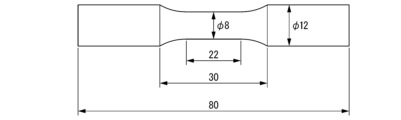
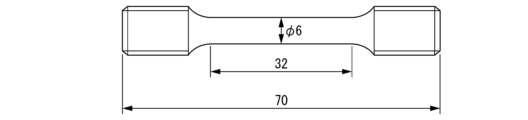
得られた棒鋼の長手方向に対して垂直な断面の、中心と表面を結んだ線分の中点付近から、図1に示すような、小野式回転曲げ疲労試験片(平行部:直径8mm、長さ22mm)と、図2に示すような、引張試験片(平行部:直径6mm、長さが32mm)と、1辺が約10mmの立方体形状の確性調査用試験片を採取した。図1および図2中の数値は、試験片の各部位の寸法(mm)を示す。
<Evaluation>
From the vicinity of the midpoint of the line segment connecting the center and the surface of the cross section perpendicular to the longitudinal direction of the obtained steel bar, an Ono-type rotating bending fatigue test piece (parallel part: diameter 8 mm,
(降伏強度)
作成した引張試験片を用い、JIS Z 2241:2011に準拠し、室温(約25℃)で、引張速度1.5mm/minの条件で引張試験に供して降伏強度YP(MPa)を測定した。被削性の指標である硬さHVに対する降伏強度YPの比(YP/HV)が2.20以上である場合、降伏強度に優れると判断した。
(yield strength)
The prepared tensile test specimens were used to measure the yield strength YP (MPa) in a tensile test at room temperature (about 25° C.) and at a tensile speed of 1.5 mm/min in accordance with JIS Z 2241: 2011. When the ratio of the yield strength YP to the hardness HV, which is an index of machinability (YP/HV), was 2.20 or more, the yield strength was determined to be excellent.
(疲労強度)
作成した回転曲げ疲労試験片を用い、室温(約25℃)で、回転数を3000rpmとして小野式回転曲げ疲労試験を実施した。応力負荷繰り返し数1.0×10⁷回まで破断しなかった試験片において、最も高い応力(最大応力)をその試験番号の疲労強度σw(MPa)と定義した。被削性の指標である硬さHVに対する疲労強度σwの比(σw/HV)が1.55以上である場合、疲労強度に優れると判断した。
(Fatigue strength)
The Ono-type rotating bending fatigue test was carried out using the prepared rotating bending fatigue test specimens at room temperature (about 25°C) and a rotation speed of 3000 rpm. The highest stress (maximum stress) of the test specimens that did not break up to 1.0 x 10⁷ stress load cycles was defined as the fatigue strength σw (MPa) of that test number. When the ratio of fatigue strength σw to hardness HV, an index of machinability (σw/HV), was 1.55 or more, it was determined that the fatigue strength was excellent.
(硬さ)
作成した確性調査用試験片を樹脂に埋め込み鏡面研磨した。鏡面研磨後の試験片の被検面の中心付近のビッカース硬さ(HV)を測定した。試験荷重は9.8Nとし5回測定を行い、その算術平均値をその試験材の硬さとした。
(Hardness)
The prepared test piece for the characterization was embedded in resin and mirror-polished. The Vickers hardness (HV) of the test piece near the center of the test surface after mirror polishing was measured. The test load was 9.8 N, and the measurement was performed five times, and the arithmetic average value was taken as the hardness of the test material.
(酸化物系複合介在物)
硬さを測定した後の確性調査用試験片を、走査電子顕微鏡(SEM)内でエネルギー分散型X線分光器(EDS)による測定に供した。観察視野は2mm×2mmとして、視野内の酸化物の内、断面上の面積を円に換算した場合に直径が1.0μm以上のすべての酸化物系介在物に対してEDS分析を行い、その結果から、CT/ASの値を算出した。このCT/ASの値は、1300℃以下の熱処理では変化せず、具体的には、本実施形態で開示した熱間鍛造処理、または窒化処理がなされたとしても、処理前後で変化しない。
(Oxide-based composite inclusions)
The specimens for the characterization after the hardness measurement were subjected to measurement by an energy dispersive X-ray spectrometer (EDS) in a scanning electron microscope (SEM). The observation field was set to 2 mm x 2 mm, and all oxide-based inclusions in the field of view that had a diameter of 1.0 μm or more when the cross-sectional area was converted into a circle were subjected to EDS analysis, and the CT/AS value was calculated from the results. This CT/AS value does not change with heat treatment at 1300 ° C. or less, and specifically, even if the hot forging treatment or nitriding treatment disclosed in this embodiment is performed, it does not change before and after the treatment.
(工具摩耗(被削性))
得られた棒鋼からφ35×200mmの試験片を作成し、旋盤を用いた切削試験に供した。切削速度は250m/minで、送りは0.20mm/rev、切込み深さは1.5mmとした。潤滑はせず、ドライ条件でP20種の超硬工具を用いて、2000m加工後の工具の逃げ面の摩耗量(μm)を測定した。摩耗量が200.0μm以下である場合、被削性に優れると判断した。
(Tool wear (machinability))
A test piece of φ35×200 mm was prepared from the obtained steel bar and subjected to a cutting test using a lathe. The cutting speed was 250 m/min, the feed was 0.20 mm/rev, and the cutting depth was 1.5 mm. The wear amount (μm) of the flank of the tool after machining 2000 m was measured using a P20 type carbide tool under dry conditions without lubrication. When the wear amount was 200.0 μm or less, it was determined that the machinability was excellent.
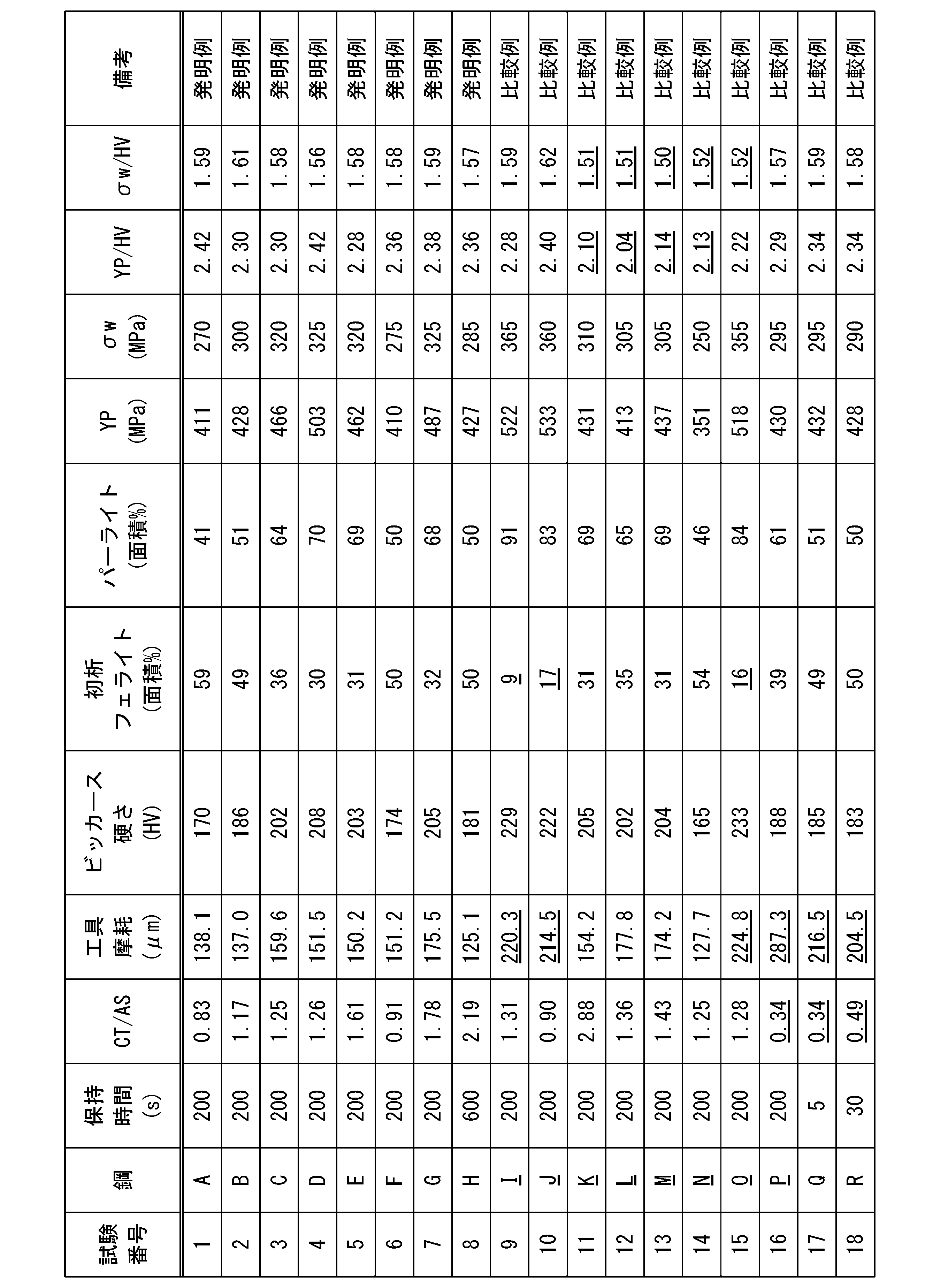
表2に、各試験の測定結果を示す。表中の保持時間は、溶鋼中にSiCa合金を加えから、鋳型に鋳造を始めるまでの間に保持する時間である。
試験番号1~8では工具摩耗が200μm以下に抑制されており、硬さに対する降伏強度の比(YP/HV)が2.20以上と高くハンドリング性に優れ、硬さに対する疲労強度の比(σw/HV)が1.55以上と疲労特性に優れていた。一方で、比較例である試験番号9~18では、目標の特性が得られなかった。
The measurement results of each test are shown in Table 2. The holding time in the table is the holding time from when the SiCa alloy is added to the molten steel until the start of casting into the mold.
In test numbers 1 to 8, tool wear was suppressed to 200 μm or less, the ratio of yield strength to hardness (YP/HV) was high at 2.20 or more, which indicated excellent handleability, and the ratio of fatigue strength to hardness (σw/HV) was 1.55 or more, which indicated excellent fatigue properties. On the other hand, in test numbers 9 to 18, which are comparative examples, the target properties were not obtained.

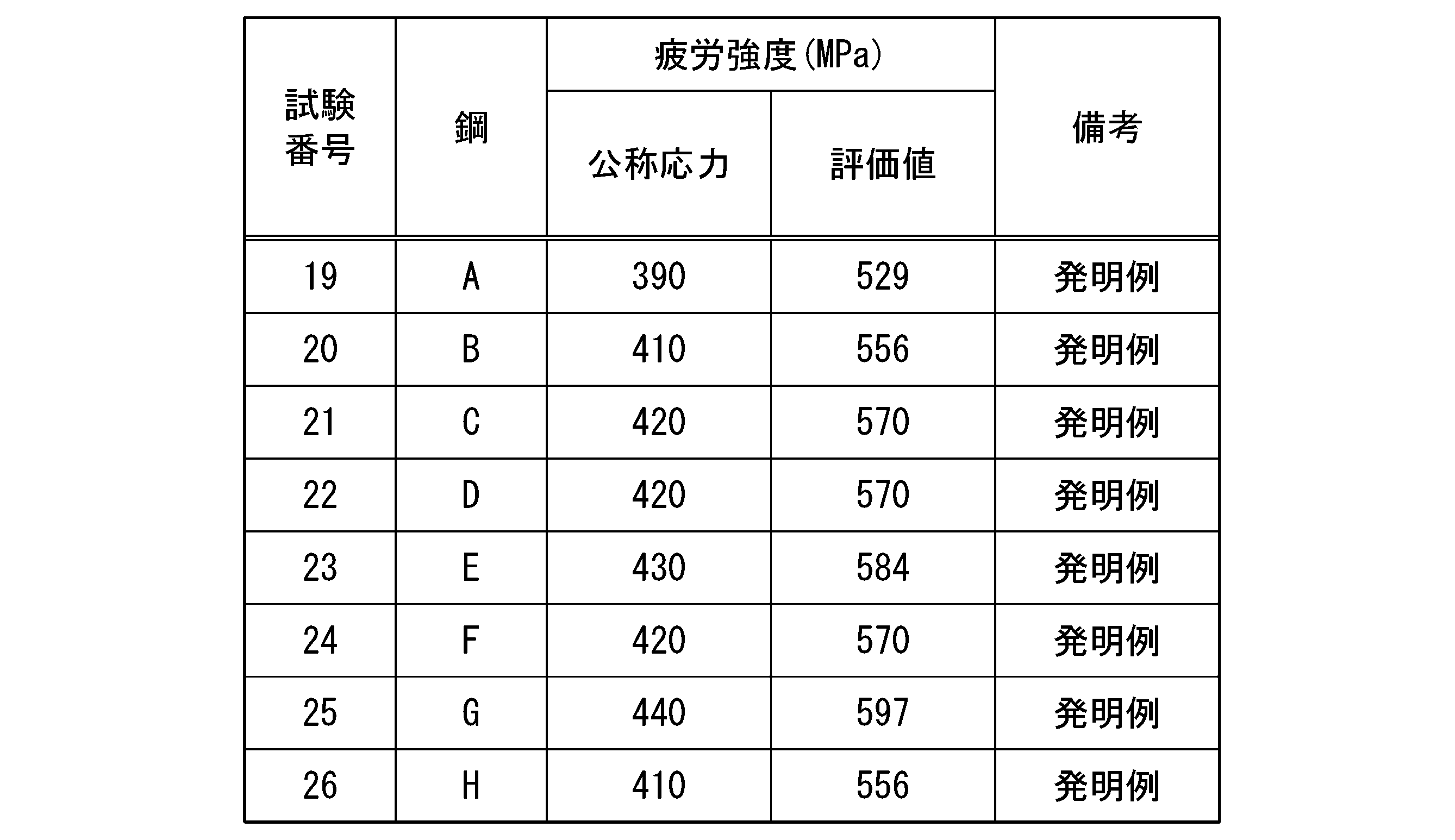
(窒化部品)
また、表2において良好な特性を示した発明例である棒鋼について、窒化処理への適用可否を確認すべく、以下の追加評価を行った。
(nitrided parts)
Further, the steel bars of the invention, which showed good properties in Table 2, were subjected to the following additional evaluation to confirm whether they could be applied to nitriding treatment.
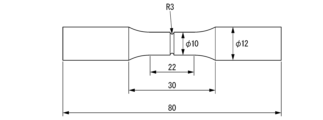
上述したφ60の棒鋼の長手方向に対して垂直な断面の、中心と表面を結んだ線分の中点付近から、図3に示すような、平行部が直径10mm、長さ22mmで、切欠き半径Rが3mm、深さが1mmの環状切欠き(切欠底:φ8)を有する小野式回転曲げ疲労試験片を採取した。 A test piece for the Ono-type rotating bending fatigue test was taken from near the midpoint of the line segment connecting the center and the surface of the cross section perpendicular to the longitudinal direction of the above-mentioned φ60 steel bar, as shown in Figure 3. The parallel part had a diameter of 10 mm, a length of 22 mm, and a circular notch (notch base: φ8) with a notch radius R of 3 mm and a depth of 1 mm.
次に、疲労試験片を590℃で2h保持し、その後に、油冷する軟窒化処理に供した。軟窒化処理は、アンモニアとRXガスの混合比が1:1である混合ガスを流しながら実施した。軟窒化処理後の試験片は、回転数3000rpmで小野式回転曲げ疲労試験に供した。1.0×10⁷回の負荷で破断しなかった試験片において、最大の応力を疲労強度とみなした。また、応力集中を考慮して評価すべく、得られた疲労強度の公称応力に応力集中係数をかけた評価値を算出した。
得られた疲労強度(公称応力)および評価値を表3に示す。
Next, the fatigue test piece was held at 590 ° C for 2 h, and then subjected to a soft nitriding treatment in which it was cooled with oil. The soft nitriding treatment was performed while flowing a mixed gas in which ammonia and RX gas were mixed in a ratio of 1:1. The test piece after the soft nitriding treatment was subjected to an Ono-type rotating bending fatigue test at a rotation speed of 3000 rpm. In the test piece that did not break under a load of 1.0 × 10 7 times, the maximum stress was regarded as the fatigue strength. In addition, in order to evaluate taking into account the stress concentration, an evaluation value was calculated by multiplying the nominal stress of the obtained fatigue strength by a stress concentration coefficient.
The obtained fatigue strength (nominal stress) and evaluation values are shown in Table 3.
いずれの試験番号においても、評価値は、未窒化材である棒鋼の疲労強度σw(表2)と比べて約1.5~2倍程度まで上昇していた。これらの結果から、発明例については、非調質鋼に窒化処理を加えて窒化部品とした後も、良好な特性が得られることが確認された。 For all test numbers, the evaluation value was approximately 1.5 to 2 times higher than the fatigue strength σw (Table 2) of unnitrided steel bars. These results confirmed that the invention examples had good properties even after the non-tempered steel was nitrided to produce nitrided parts.
本発明は、自動車や産業機械などの機械構造用部品の素材として、幅広い産業分野に利用することができる。 This invention can be used in a wide range of industrial fields as a material for mechanical structural parts such as automobiles and industrial machinery.
Claims (3)
C:0.30~0.50%、
Si:0.05~0.35%、
Mn:0.45~1.00%、
P:0.080%以下、
S:0.035~0.100%、
Cu:0.25%以下、
Ni:0.25%以下、
Cr:0.03~0.25%、
Al:0.020%以下、
N:0.0125~0.0250%、
Ti:0.005~0.030%、
Ca:0.0003~0.0100%、
V:0~0.02%、及び
Mo:0~0.03%
を含有し、残部がFeおよび不純物からなり、
下記式(1)であらわされる固溶N量Nsolが0.008%以上であり、
金属組織において、初析フェライトの面積率が20%以上、残部組織がパーライトであり、
酸化物系介在物のうち、AlとSiの重量濃度の和が10%以上の酸化物系介在物において、CaとTiの重量濃度の和であるCTの、AlとSiの重量濃度の和であるASに対する比率CT/ASが0.50以上であることを特徴とする非調質鋼。
Nsol=N-Ti/3.4 ・・・ (1)
ただし、上記式(1)中の各元素記号は、当該元素の質量%での含有量である。 In mass percent,
C: 0.30-0.50%,
Si: 0.05-0.35%,
Mn: 0.45-1.00%,
P: 0.080% or less,
S: 0.035-0.100%,
Cu: 0.25% or less,
Ni: 0.25% or less,
Cr: 0.03-0.25%,
Al: 0.020% or less,
N: 0.0125-0.0250%,
Ti: 0.005-0.030%,
Ca: 0.0003-0.0100%,
V: 0 to 0.02%, and Mo: 0 to 0.03%
with the remainder being Fe and impurities,
The amount of solute N Nsol represented by the following formula (1) is 0.008% or more,
In the metal structure, the area ratio of pro-eutectoid ferrite is 20% or more, and the remaining structure is pearlite,
A non-tempered steel characterized in that, among oxide-based inclusions, the sum of the weight concentrations of Al and Si is 10% or more, the ratio CT, which is the sum of the weight concentrations of Ca and Ti, to AS, which is the sum of the weight concentrations of Al and Si, is 0.50 or more.
Nsol=N-Ti/3.4... (1)
However, each element symbol in the above formula (1) represents the content of the corresponding element in mass %.
前記母材の表層に形成されている、化合物層と拡散層からなる窒化層とを有することを特徴とする窒化部品。 A base material made of the non-heat treated steel according to claim 1;
A nitrided part, comprising a nitrided layer formed on a surface layer of the base material, the nitrided layer being composed of a compound layer and a diffusion layer.
Priority Applications (1)
| Application Number | Priority Date | Filing Date | Title |
|---|---|---|---|
| JP2021160837A JP7678317B2 (en) | 2021-09-30 | 2021-09-30 | Non-tempered steel and nitrided parts |
Applications Claiming Priority (1)
| Application Number | Priority Date | Filing Date | Title |
|---|---|---|---|
| JP2021160837A JP7678317B2 (en) | 2021-09-30 | 2021-09-30 | Non-tempered steel and nitrided parts |
Publications (2)
| Publication Number | Publication Date |
|---|---|
| JP2023050636A JP2023050636A (en) | 2023-04-11 |
| JP7678317B2 true JP7678317B2 (en) | 2025-05-16 |
Family
ID=85805804
Family Applications (1)
| Application Number | Title | Priority Date | Filing Date |
|---|---|---|---|
| JP2021160837A Active JP7678317B2 (en) | 2021-09-30 | 2021-09-30 | Non-tempered steel and nitrided parts |
Country Status (1)
| Country | Link |
|---|---|
| JP (1) | JP7678317B2 (en) |
Families Citing this family (1)
| Publication number | Priority date | Publication date | Assignee | Title |
|---|---|---|---|---|
| JP2024021969A (en) * | 2022-08-05 | 2024-02-16 | 日本製鉄株式会社 | Steel materials and steel shapes |
Citations (6)
| Publication number | Priority date | Publication date | Assignee | Title |
|---|---|---|---|---|
| JP2003183770A (en) | 2001-10-01 | 2003-07-03 | Sumitomo Metal Ind Ltd | Steel for machine structural use and its manufacturing method |
| JP2007197812A (en) | 2005-12-28 | 2007-08-09 | Honda Motor Co Ltd | Soft nitrided non-heat treated steel |
| JP2007211272A (en) | 2006-02-07 | 2007-08-23 | Daido Steel Co Ltd | Non-tempered steel for hot forging |
| JP2014189854A (en) | 2013-03-27 | 2014-10-06 | Kobe Steel Ltd | Steel material for bearing excellent in rolling fatigue characteristic and machinability, and bearing parts |
| JP2017186658A (en) | 2016-04-05 | 2017-10-12 | 大同特殊鋼株式会社 | Steel material, crank shaft and automobile component |
| JP2019199633A (en) | 2018-05-15 | 2019-11-21 | 大同特殊鋼株式会社 | Untempered steel for nitriding, and crank shaft |
Family Cites Families (2)
| Publication number | Priority date | Publication date | Assignee | Title |
|---|---|---|---|---|
| JP3239758B2 (en) * | 1996-06-07 | 2001-12-17 | 住友金属工業株式会社 | Steel material for nitrocarburizing, nitrocarburizing component and method of manufacturing the same |
| JP3267164B2 (en) * | 1996-08-01 | 2002-03-18 | 住友金属工業株式会社 | Method for producing steel for nitriding and nitrided steel products |
-
2021
- 2021-09-30 JP JP2021160837A patent/JP7678317B2/en active Active
Patent Citations (6)
| Publication number | Priority date | Publication date | Assignee | Title |
|---|---|---|---|---|
| JP2003183770A (en) | 2001-10-01 | 2003-07-03 | Sumitomo Metal Ind Ltd | Steel for machine structural use and its manufacturing method |
| JP2007197812A (en) | 2005-12-28 | 2007-08-09 | Honda Motor Co Ltd | Soft nitrided non-heat treated steel |
| JP2007211272A (en) | 2006-02-07 | 2007-08-23 | Daido Steel Co Ltd | Non-tempered steel for hot forging |
| JP2014189854A (en) | 2013-03-27 | 2014-10-06 | Kobe Steel Ltd | Steel material for bearing excellent in rolling fatigue characteristic and machinability, and bearing parts |
| JP2017186658A (en) | 2016-04-05 | 2017-10-12 | 大同特殊鋼株式会社 | Steel material, crank shaft and automobile component |
| JP2019199633A (en) | 2018-05-15 | 2019-11-21 | 大同特殊鋼株式会社 | Untempered steel for nitriding, and crank shaft |
Also Published As
| Publication number | Publication date |
|---|---|
| JP2023050636A (en) | 2023-04-11 |
Similar Documents
| Publication | Publication Date | Title |
|---|---|---|
| JP4709944B2 (en) | Case-hardened steel, carburized parts, and method for producing case-hardened steel | |
| US9200354B2 (en) | Rolled steel bar or wire for hot forging | |
| JP7168003B2 (en) | steel | |
| JP6628014B1 (en) | Steel for parts to be carburized | |
| JPWO2020138450A1 (en) | Steel material used as a material for carburized nitriding bearing parts | |
| US20180347025A1 (en) | Steel, carburized steel component, and method for manufacturing carburized steel component | |
| JP6521089B2 (en) | Machine structural steels and induction hardened steel parts | |
| JP6729686B2 (en) | Non-heat treated steel for induction hardening | |
| JP7678317B2 (en) | Non-tempered steel and nitrided parts | |
| JP7323791B2 (en) | Carburized gear steel, carburized gear, and method for manufacturing carburized gear | |
| KR102884941B1 (en) | steel | |
| JP5737154B2 (en) | Rolled steel bar or wire rod for hot forging | |
| KR102010684B1 (en) | Hot Rolled Bar Seals, Parts and Manufacturing Method of Hot Rolled Bar Seals | |
| JP4243852B2 (en) | Steel for carburized parts or carbonitrided parts, method for producing carburized parts or carbonitrided parts | |
| JP7135485B2 (en) | Carburizing steel and parts | |
| JP7139692B2 (en) | Steel for induction hardening, materials for induction hardening parts, and induction hardening parts | |
| JPWO2002044435A1 (en) | Carburizing steel and carburizing gear | |
| JP7755138B2 (en) | Carburizing steel materials and carburizing steel parts | |
| JP2021161462A (en) | Steel material | |
| JP7552959B1 (en) | Non-tempered steel for hot forging, hot forging material and manufacturing method thereof | |
| JP7635371B2 (en) | Steel material and crankshaft made of said steel material | |
| JP7295417B2 (en) | Carburized gear steel, carburized gear, and method for manufacturing carburized gear | |
| JP2020105602A (en) | Steel for carburized steel parts | |
| JP7269522B2 (en) | steel | |
| JP2024095320A (en) | Materials for nitrided parts and nitrided parts |
Legal Events
| Date | Code | Title | Description |
|---|---|---|---|
| A621 | Written request for application examination |
Free format text: JAPANESE INTERMEDIATE CODE: A621 Effective date: 20240520 |
|
| A977 | Report on retrieval |
Free format text: JAPANESE INTERMEDIATE CODE: A971007 Effective date: 20250217 |
|
| TRDD | Decision of grant or rejection written | ||
| A01 | Written decision to grant a patent or to grant a registration (utility model) |
Free format text: JAPANESE INTERMEDIATE CODE: A01 Effective date: 20250401 |
|
| A61 | First payment of annual fees (during grant procedure) |
Free format text: JAPANESE INTERMEDIATE CODE: A61 Effective date: 20250414 |
|
| R150 | Certificate of patent or registration of utility model |
Ref document number: 7678317 Country of ref document: JP Free format text: JAPANESE INTERMEDIATE CODE: R150 |