JP7621653B2 - Method for preparing a gelling agent, the gelling agent obtained thereby and uses of said gelling agent - Google Patents
Method for preparing a gelling agent, the gelling agent obtained thereby and uses of said gelling agent Download PDFInfo
- Publication number
- JP7621653B2 JP7621653B2 JP2021530325A JP2021530325A JP7621653B2 JP 7621653 B2 JP7621653 B2 JP 7621653B2 JP 2021530325 A JP2021530325 A JP 2021530325A JP 2021530325 A JP2021530325 A JP 2021530325A JP 7621653 B2 JP7621653 B2 JP 7621653B2
- Authority
- JP
- Japan
- Prior art keywords
- gelling agent
- bigel
- propylene glycol
- oleogel
- viscosity
- Prior art date
- Legal status (The legal status is an assumption and is not a legal conclusion. Google has not performed a legal analysis and makes no representation as to the accuracy of the status listed.)
- Active
Links
Classifications
-
- A—HUMAN NECESSITIES
- A61—MEDICAL OR VETERINARY SCIENCE; HYGIENE
- A61K—PREPARATIONS FOR MEDICAL, DENTAL OR TOILETRY PURPOSES
- A61K9/00—Medicinal preparations characterised by special physical form
- A61K9/06—Ointments; Bases therefor; Other semi-solid forms, e.g. creams, sticks, gels
-
- A—HUMAN NECESSITIES
- A61—MEDICAL OR VETERINARY SCIENCE; HYGIENE
- A61K—PREPARATIONS FOR MEDICAL, DENTAL OR TOILETRY PURPOSES
- A61K47/00—Medicinal preparations characterised by the non-active ingredients used, e.g. carriers or inert additives; Targeting or modifying agents chemically bound to the active ingredient
- A61K47/06—Organic compounds, e.g. natural or synthetic hydrocarbons, polyolefins, mineral oil, petrolatum or ozokerite
- A61K47/08—Organic compounds, e.g. natural or synthetic hydrocarbons, polyolefins, mineral oil, petrolatum or ozokerite containing oxygen, e.g. ethers, acetals, ketones, quinones, aldehydes, peroxides
- A61K47/14—Esters of carboxylic acids, e.g. fatty acid monoglycerides, medium-chain triglycerides, parabens or PEG fatty acid esters
-
- A—HUMAN NECESSITIES
- A61—MEDICAL OR VETERINARY SCIENCE; HYGIENE
- A61K—PREPARATIONS FOR MEDICAL, DENTAL OR TOILETRY PURPOSES
- A61K47/00—Medicinal preparations characterised by the non-active ingredients used, e.g. carriers or inert additives; Targeting or modifying agents chemically bound to the active ingredient
- A61K47/30—Macromolecular organic or inorganic compounds, e.g. inorganic polyphosphates
- A61K47/32—Macromolecular compounds obtained by reactions only involving carbon-to-carbon unsaturated bonds, e.g. carbomers, poly(meth)acrylates, or polyvinyl pyrrolidone
-
- A—HUMAN NECESSITIES
- A61—MEDICAL OR VETERINARY SCIENCE; HYGIENE
- A61K—PREPARATIONS FOR MEDICAL, DENTAL OR TOILETRY PURPOSES
- A61K47/00—Medicinal preparations characterised by the non-active ingredients used, e.g. carriers or inert additives; Targeting or modifying agents chemically bound to the active ingredient
- A61K47/30—Macromolecular organic or inorganic compounds, e.g. inorganic polyphosphates
- A61K47/36—Polysaccharides; Derivatives thereof, e.g. gums, starch, alginate, dextrin, hyaluronic acid, chitosan, inulin, agar or pectin
- A61K47/38—Cellulose; Derivatives thereof
-
- A—HUMAN NECESSITIES
- A61—MEDICAL OR VETERINARY SCIENCE; HYGIENE
- A61K—PREPARATIONS FOR MEDICAL, DENTAL OR TOILETRY PURPOSES
- A61K8/00—Cosmetics or similar toiletry preparations
- A61K8/02—Cosmetics or similar toiletry preparations characterised by special physical form
- A61K8/04—Dispersions; Emulsions
- A61K8/042—Gels
-
- A—HUMAN NECESSITIES
- A61—MEDICAL OR VETERINARY SCIENCE; HYGIENE
- A61K—PREPARATIONS FOR MEDICAL, DENTAL OR TOILETRY PURPOSES
- A61K8/00—Cosmetics or similar toiletry preparations
- A61K8/18—Cosmetics or similar toiletry preparations characterised by the composition
- A61K8/72—Cosmetics or similar toiletry preparations characterised by the composition containing organic macromolecular compounds
- A61K8/73—Polysaccharides
- A61K8/731—Cellulose; Quaternized cellulose derivatives
-
- A—HUMAN NECESSITIES
- A61—MEDICAL OR VETERINARY SCIENCE; HYGIENE
- A61K—PREPARATIONS FOR MEDICAL, DENTAL OR TOILETRY PURPOSES
- A61K8/00—Cosmetics or similar toiletry preparations
- A61K8/18—Cosmetics or similar toiletry preparations characterised by the composition
- A61K8/72—Cosmetics or similar toiletry preparations characterised by the composition containing organic macromolecular compounds
- A61K8/84—Cosmetics or similar toiletry preparations characterised by the composition containing organic macromolecular compounds obtained by reactions otherwise than those involving only carbon-carbon unsaturated bonds
- A61K8/86—Polyethers
-
- A—HUMAN NECESSITIES
- A61—MEDICAL OR VETERINARY SCIENCE; HYGIENE
- A61K—PREPARATIONS FOR MEDICAL, DENTAL OR TOILETRY PURPOSES
- A61K9/00—Medicinal preparations characterised by special physical form
- A61K9/0012—Galenical forms characterised by the site of application
- A61K9/0014—Skin, i.e. galenical aspects of topical compositions
-
- A—HUMAN NECESSITIES
- A61—MEDICAL OR VETERINARY SCIENCE; HYGIENE
- A61Q—SPECIFIC USE OF COSMETICS OR SIMILAR TOILETRY PREPARATIONS
- A61Q19/00—Preparations for care of the skin
-
- A—HUMAN NECESSITIES
- A61—MEDICAL OR VETERINARY SCIENCE; HYGIENE
- A61K—PREPARATIONS FOR MEDICAL, DENTAL OR TOILETRY PURPOSES
- A61K2800/00—Properties of cosmetic compositions or active ingredients thereof or formulation aids used therein and process related aspects
- A61K2800/10—General cosmetic use
-
- A—HUMAN NECESSITIES
- A61—MEDICAL OR VETERINARY SCIENCE; HYGIENE
- A61K—PREPARATIONS FOR MEDICAL, DENTAL OR TOILETRY PURPOSES
- A61K2800/00—Properties of cosmetic compositions or active ingredients thereof or formulation aids used therein and process related aspects
- A61K2800/40—Chemical, physico-chemical or functional or structural properties of particular ingredients
- A61K2800/59—Mixtures
- A61K2800/592—Mixtures of compounds complementing their respective functions
- A61K2800/5922—At least two compounds being classified in the same subclass of A61K8/18
-
- A—HUMAN NECESSITIES
- A61—MEDICAL OR VETERINARY SCIENCE; HYGIENE
- A61K—PREPARATIONS FOR MEDICAL, DENTAL OR TOILETRY PURPOSES
- A61K2800/00—Properties of cosmetic compositions or active ingredients thereof or formulation aids used therein and process related aspects
- A61K2800/80—Process related aspects concerning the preparation of the cosmetic composition or the storage or application thereof
- A61K2800/88—Two- or multipart kits
- A61K2800/882—Mixing prior to application
Landscapes
- Health & Medical Sciences (AREA)
- Life Sciences & Earth Sciences (AREA)
- Animal Behavior & Ethology (AREA)
- General Health & Medical Sciences (AREA)
- Public Health (AREA)
- Veterinary Medicine (AREA)
- Chemical & Material Sciences (AREA)
- Epidemiology (AREA)
- Pharmacology & Pharmacy (AREA)
- Medicinal Chemistry (AREA)
- Birds (AREA)
- Inorganic Chemistry (AREA)
- Dermatology (AREA)
- Oil, Petroleum & Natural Gas (AREA)
- General Chemical & Material Sciences (AREA)
- Chemical Kinetics & Catalysis (AREA)
- Engineering & Computer Science (AREA)
- Dispersion Chemistry (AREA)
- Cosmetics (AREA)
- Medicinal Preparation (AREA)
- Pharmaceuticals Containing Other Organic And Inorganic Compounds (AREA)
- Colloid Chemistry (AREA)
Description
本発明は、ゲル化剤を調製するための方法、それにより得られるゲル化剤ならびにオレオゲルおよび/または安定なバイゲルを調製するための前記ゲル化剤の使用に関する。 The present invention relates to a method for preparing a gelling agent, the gelling agent obtained thereby and the use of said gelling agent for preparing oleogels and/or stable bigels.
個体への医薬品有効成分(API)の投与は、APIの送達を最適化することと、潜在的な有害な副作用を最小化することとの両方の慎重な検討および計画を必要とする。例えば、APIを皮膚に塗布する場合、APIの皮膚層への良好な透過を達成することが望ましい。APIを「輸送する」ために使用される製剤は、多くの場合ビヒクルと称され、APIの皮膚への透過は、主に角質層を通る受動拡散により生じるため、ビヒクルは良好な透過性をもたらすように構成されなければならない。 The administration of active pharmaceutical ingredients (APIs) to an individual requires careful consideration and planning to both optimize delivery of the API and minimize potential adverse side effects. For example, when applying an API to the skin, it is desirable to achieve good penetration of the API into the skin layers. The formulation used to "transport" the API is often referred to as a vehicle, and because penetration of the API into the skin occurs primarily by passive diffusion through the stratum corneum, the vehicle must be configured to provide good permeability.
ビヒクルの選択は、APIの性質、処置の部位および患者の選好に依存することになる。例えば、一部のAPIは親水性であり、すなわちそれらは好ましくは親水性ビヒクル、例えばヒドロゲルで送達される。しかし、ヒドロゲルは良好な患者コンプライアンスを有するが、ヒドロゲルの主な問題は、それらが親水性の有効成分しか輸送できないことである。さらに、それらは親水性であるため、皮膚を横切る透過への経路が限られている。対照的に、親油性APIの最良の担体であるオレオゲルは、油性の性質であるため、皮膚に脂性残留物を残すことによって脂っぽい感触をもたらすことになり、特に皮膚科学的および化粧品用途に対する低い患者コンプライアンスに帰結する。 The choice of vehicle will depend on the nature of the API, the site of treatment and the patient's preference. For example, some APIs are hydrophilic, i.e., they are preferably delivered in hydrophilic vehicles, e.g., hydrogels. However, while hydrogels have good patient compliance, the main problem with hydrogels is that they can only transport hydrophilic active ingredients. Furthermore, because they are hydrophilic, they have limited pathways for permeation across the skin. In contrast, oleogels, which are the best carriers for lipophilic APIs, are oily in nature and therefore lead to a greasy feel by leaving an oily residue on the skin, resulting in poor patient compliance, especially for dermatological and cosmetic applications.
したがって、APIおよび/または化粧品成分は、従来の方式ではエマルジョン(水中油または油中水)で、例えばクリーム、軟膏、ゲル、ペーストおよびローションの形態で皮膚に送達され、それにより油相と水相の両方の利益、例えば皮膚バリアを超えるAPIの良好な透過を得る。しかし、エマルジョンは経時的に不安定化する、例えば相分離を示すことが公知である。この効果を防止するために、エマルジョンは、その調製の際に乳化剤、界面活性剤などを組み込むことにより安定化される。しかし、そのような安定化化合物は皮膚刺激を生じることが公知であり、そのような化合物の組込みは明らかに望ましくない。 Thus, APIs and/or cosmetic ingredients are conventionally delivered to the skin in emulsions (oil-in-water or water-in-oil), e.g., in the form of creams, ointments, gels, pastes and lotions, thereby obtaining the benefits of both the oil and aqueous phases, e.g., good penetration of the API across the skin barrier. However, emulsions are known to destabilize over time, e.g., exhibit phase separation. To prevent this effect, emulsions are stabilized during their preparation by incorporating emulsifiers, surfactants, etc. However, such stabilizing compounds are known to cause skin irritation, and the incorporation of such compounds is clearly undesirable.
前記問題を克服するために、バイゲルがより一層注目を集めており、食品、医薬および化粧品産業においてますますより一層重要になっている。バイゲルは、視覚的には単一のゲルのように見えるが、その中でオレオゲルと水性ゲルが、例えば高せん断速度を適用することによって一緒に混合される、均質な半固体分散系である。バイゲルはエマルジョンではなく、バイゲルの主な利点の1つは、エマルジョン(油中水および水中油)、エマルゲル、ヒドロゲルおよびオレオゲルと比較して安定性が高いことであり、そのためバイゲルはAPIおよび/または化粧品成分の有望なビヒクルである。バイゲルの向上した物理化学安定性は、1つのゲル(例えば、オレオゲル)が他のゲル(例えば、水性ゲル)の三次元ゲルネットワークに固定化されることによる超微細コロイド状分散体の形成に起因する可能性がある。室温での保管の際、バイゲルの2つの成分は分離せず、そのためバイゲルは安定であり続ける。 To overcome the above problems, bigels have attracted more and more attention and become more and more important in the food, pharmaceutical and cosmetic industries. A bigel is a homogeneous semi-solid dispersion system in which an oleogel and an aqueous gel are mixed together, for example by applying high shear rates, while visually appearing as a single gel. A bigel is not an emulsion, and one of the main advantages of bigels is their increased stability compared to emulsions (water-in-oil and oil-in-water), emulgels, hydrogels and oleogels, making them promising vehicles for APIs and/or cosmetic ingredients. The improved physicochemical stability of bigels can be attributed to the formation of ultrafine colloidal dispersions due to the immobilization of one gel (e.g., oleogel) in the three-dimensional gel network of the other gel (e.g., aqueous gel). Upon storage at room temperature, the two components of the bigel do not separate, and therefore the bigel remains stable.
さらに、水性ゲルとオレオゲルの分離は、バイゲルが皮膚に適用された場合に検出されない。したがって、オレオゲルとヒドロゲルをバイゲルに変換することにより、そのようなバイゲルは親水性と疎水性の両方のAPIおよび/または化粧品成分を含むことができるため、個々の水相および油相の有益な効果を妥協することなく良好な患者コンプライアンスがもたらされる。2つのゲルの融合は相乗効果を有する可能性があり、親水性特性と親油性特性が両方存在することによって薬物の皮膚を越える浸透の向上に帰結する、すなわちバイゲル中の成分は、皮膚を(though)より容易に透過できることがさらに示されており、このためバイゲルは局所および/または経皮薬物送達の選択肢になり始めている。バイゲルの別の利益は、それらが電気伝導性を有するため、イオントフォレシス薬物送達のための好適な担体になることである。 Furthermore, no separation of the aqueous gel and the oleogel is detected when the bigel is applied to the skin. Thus, by converting the oleogel and hydrogel into a bigel, such a bigel can contain both hydrophilic and hydrophobic APIs and/or cosmetic ingredients, resulting in good patient compliance without compromising the beneficial effects of the individual aqueous and oil phases. It has further been shown that the fusion of the two gels may have a synergistic effect, resulting in improved penetration of drugs across the skin due to the presence of both hydrophilic and lipophilic properties, i.e. ingredients in a bigel can penetrate the skin more easily though, making bigels an option for topical and/or transdermal drug delivery. Another benefit of bigels is that they are electrically conductive, making them suitable carriers for iontophoretic drug delivery.
バイゲルは通常、ヒドロゲルとオレオゲルを個別に調製し、その後例えば高せん断速度を適用することによって2種のゲルを一緒に混合することにより得られる。そのようなバイゲルを製剤化するための方法の例は、例えばEP1083880およびEP2120865に開示されている。 Bigels are usually obtained by preparing a hydrogel and an oleogel separately and then mixing the two gels together, for example by applying high shear rates. Examples of methods for formulating such bigels are disclosed, for example, in EP 1 083 880 and EP 2 120 865.
前記刊行物から明らかなように、バイゲルは、以下の工程:
- 少なくとも1種のセルロースポリマーでゲル化された少なくとも1種の油組成物を含むオレオゲルを準備する工程;
- 水性ゲルを準備する工程;および
- オレオゲルと水性ゲルを一緒に混合して、バイゲルを形成する工程
により調製される。
As is evident from said publication, Bigel comprises the following steps:
- preparing an oleogel comprising at least one oil composition gelled with at least one cellulose polymer;
- preparing an aqueous gel; and - mixing the oleogel and the aqueous gel together to form a bigel.
ゲル化剤として使用されるセルロースポリマーは、例えばエチルセルロース、非ナトリウムカルボキシメチルセルロースおよびこれらの混合物から選択されてもよい。しかし、EP2120865における1つの好ましいゲル化剤は、Gattefosseから入手可能な製剤Emulfree(登録商標)Pである。前記化合物は、エチルセルロース、イソステアリン酸プロピレングリコールおよびラウリン酸プロピレングリコールをそれぞれ8:2:90重量%(wt%)の相対的割合で含有し、3つの成分を単一の工程で混合することにより得られる。 The cellulose polymer used as the gelling agent may be selected from, for example, ethylcellulose, non-sodium carboxymethylcellulose and mixtures thereof. However, one preferred gelling agent in EP 2120865 is the formulation Emulfree® P available from Gattefosse. The compound contains ethylcellulose, propylene glycol isostearate and propylene glycol laurate in relative proportions of 8:2:90 weight percent (wt%) respectively, and is obtained by mixing the three components in a single step.
しかし、油組成物をゲル化するためにエチルセルロースが使用される、Emulfree(登録商標)P、および他の組成物の製造に伴う主な問題の1つは、エチルセルロースを油組成物に、例えばイソステアリン酸プロピレングリコールおよびラウリン酸プロピレングリコールに溶解するために、前記組成物がエチルセルロースのガラス転移温度、およそ130~150℃より高温に加熱されなければならないことである。したがって、前記方法は高いエネルギー消費を必要とするだけでなく、それに応じて極度に高価でもある。 However, one of the main problems with the manufacture of Emulfree® P and other compositions in which ethylcellulose is used to gel an oil composition is that the composition must be heated above the glass transition temperature of ethylcellulose, approximately 130-150° C., in order to dissolve the ethylcellulose in the oil composition, e.g., propylene glycol isostearate and propylene glycol laurate. Thus, the process not only requires high energy consumption, but is correspondingly extremely expensive.
さらなる問題は、Emulfree(登録商標)Pは黄色であり、かつ得られるオレオゲルおよび結果としてバイゲルに移る可能性がある特有の匂い、物理化学的パラメータを有し、それにより最終生成物に望ましくない効果を付与する場合があり、この効果は一部の状況において、患者コンプライアンスを改善するために、例えば香料および/または顔料で隠す必要があるということである。 A further problem is that Emulfree® P is yellow in colour and has specific odours, physicochemical parameters which may be transferred to the resulting oleogel and consequently to the bigel, thereby imparting undesirable effects to the final product, which in some circumstances need to be masked, for example with fragrances and/or pigments, to improve patient compliance.
したがって、本発明の発明者らは、オレオゲルおよび/またはバイゲルを製造するための改善されたゲル化剤が必要であることを見出した。 The inventors of the present invention have therefore discovered that there is a need for improved gelling agents for producing oleogels and/or bigels.
したがって、本発明の第1の態様は、オレオゲルを準備するため、および結果として前記オレオゲルを含む安定なバイゲルを準備するためのゲル化剤を製造する新規の方法を提供することであり、
本発明の第2の態様は、これまでに公知のものより簡素かつエネルギー効率的な手段でゲル化剤を製造する新規の方法を提供することであり、
本発明の第3の態様は、オレオゲルおよび/または安定なバイゲルの生産のための改善されたゲル化剤を提供することであり、
本発明の第4の態様は、Emulfree(登録商標)Pに匹敵するゲル化特性を有するが、顕著な色および/または匂いが少ないゲル化剤を提供することである。
Thus, a first aspect of the present invention is to provide a novel method of manufacturing a gelling agent for preparing an oleogel and, consequently, a stable bigel comprising said oleogel,
A second aspect of the present invention is to provide a novel method for producing a gelling agent in a simpler and more energy efficient manner than previously known,
A third aspect of the present invention is to provide an improved gelling agent for the production of oleogels and/or stable bigels,
A fourth aspect of the present invention is to provide a gelling agent that has gelling properties comparable to Emulfree® P, but with less noticeable color and/or odor.
これらおよびさらなる態様は、本発明に従い、ゲル化剤を製造するための方法であって、以下の連続工程:
a)ラウリン酸プロピレングリコールとイソステアリン酸プロピレングリコールを混合して、第1の混合物を得る工程、
b)エチルセルロースを第1の混合物に撹拌しながら添加することにより、第2の混合物を得る工程、および
c)実質的に均一なゲル化剤が形成されるまで第2の混合物を継続的に撹拌する工程
を含み、
工程a)、b)およびc)が90℃~110℃の温度で実施される方法を提供することによって達成される。
These and further aspects relate to a method for producing a gelling agent according to the invention, comprising the following successive steps:
a) mixing propylene glycol laurate and propylene glycol isostearate to obtain a first mixture;
b) adding ethyl cellulose to the first mixture with stirring to obtain a second mixture; and c) continuously stirring the second mixture until a substantially homogenous gelling agent is formed;
This is accomplished by providing a process wherein steps a), b) and c) are carried out at a temperature of from 90°C to 110°C.
エチルセルロースは、油(油組成物)を固体ゲルネットワークへと構造化する、すなわちオレオゲルをもたらすことができる周知のポリマーである。エチルセルロースは、現在のところ唯一の直接的な食品用ポリマーゲル化剤であり、したがって前記ポリマーは、局所および/または経皮送達用のビヒクルの調製に対しても明白な候補である。 Ethylcellulose is a well-known polymer that can structure oils (oil compositions) into solid gel networks, i.e., produce oleogels. Ethylcellulose is currently the only direct food-grade polymeric gelling agent, and therefore the polymer is also an obvious candidate for the preparation of vehicles for topical and/or transdermal delivery.
エチルセルロースは、ヒドロキシル基にエトキシル置換基を有するセルロース骨格からなる半結晶性のセルロースポリマー誘導体であり、液状油の存在下で熱可逆的なゾル-ゲル転移を経る。この独特の挙動は、物理的結合により会合するポリマーの能力に基づく。 Ethylcellulose is a semicrystalline cellulose polymer derivative consisting of a cellulose backbone with ethoxyl substituents on the hydroxyl groups, which undergoes a thermoreversible sol-gel transition in the presence of liquid oil. This unique behavior is due to the ability of the polymer to associate through physical bonds.
しかし、エチルセルロースがゲル化剤として機能するために、エチルセルロース-油混合物は、エチルセルロースが油に完全に溶解することになる点であるエチルセルロースのガラス転移温度、およそ130~150℃(エチルセルロースの分子量に依存する)より高温に加熱されなければならない。このガラス転移温度より高温でのエチルセルロースの油への溶解は、ポリマー溶融物のガラス状領域が溶融し、エトキシ基の溶媒への曝露に帰結することによって生じる。 However, for ethylcellulose to function as a gelling agent, the ethylcellulose-oil mixture must be heated above the glass transition temperature of ethylcellulose, approximately 130-150°C (depending on the molecular weight of the ethylcellulose), at which point the ethylcellulose becomes completely soluble in the oil. Dissolution of ethylcellulose in oil above this glass transition temperature occurs due to melting of the glassy domains of the polymer melt, resulting in exposure of the ethoxy groups to the solvent.
しかし、本発明の発明者らは、本発明による方法を使用することにより、エチルセルロースを含む安定かつ実質的に均一なゲル化剤をエチルセルロースのガラス転移温度より十分低い温度で得ることができることを見出した。本発明者らは、驚くべきことに、エチルセルロースがラウリン酸プロピレングリコールとイソステアリン酸プロピレングリコールの混合物に90℃~110℃、好ましくは約100℃の温度で添加される場合、エチルセルロースが予想に反して前記混合物に組み込まれることになることを見出した。したがって、本発明による方法は、実質的に均一なゲル化剤を得るためのより簡素な、エネルギー消費がより低い、より安価でより容易な手段を提供する。前記ゲル化剤は、好ましくは前記ゲル化剤がオレオゲルを調製するために使用される、例えばバイゲルを調製するために使用される前に、例えば室温、すなわち約20℃に冷却される。 However, the inventors of the present invention have found that by using the method according to the present invention, a stable and substantially homogeneous gelling agent comprising ethylcellulose can be obtained at a temperature well below the glass transition temperature of ethylcellulose. The inventors have surprisingly found that when ethylcellulose is added to a mixture of propylene glycol laurate and propylene glycol isostearate at a temperature of 90°C to 110°C, preferably about 100°C, ethylcellulose is unexpectedly incorporated into said mixture. Thus, the method according to the present invention provides a simpler, less energy consuming, cheaper and easier means to obtain a substantially homogeneous gelling agent. The gelling agent is preferably cooled, e.g. to room temperature, i.e. about 20°C, before the gelling agent is used to prepare an oleogel, e.g. to prepare a bigel.
本発明(the inventing)による方法は、周囲空気中で実行することができ、したがって前記方法は、例えばN2からなる保護雰囲気中で実施される必要はない。 The method according to the invention can be carried out in ambient air, so that said method does not have to be carried out in a protective atmosphere, for example consisting of N2 .
さらに、本発明の発明者らは、本発明による方法が、公知のEmulfree(登録商標)Pと比較してより透明な透き通った外観を有し、特有の匂いが少ない液体/粘性ゲル化剤を提供することを見出した。これにより、前記方法により得られるゲル化剤は、前記ゲル化剤がオレオゲルならびに/または例えば医薬および/または化粧品用途のためのバイゲルを製造するために使用される場合、消費者の容認性を向上させることになる。 Furthermore, the inventors have found that the method according to the invention provides a liquid/viscous gelling agent with a clearer appearance and less characteristic odor compared to the known Emulfree® P. This results in the gelling agent obtained by said method having improved consumer acceptability when said gelling agent is used to prepare oleogels and/or bigels, for example for pharmaceutical and/or cosmetic applications.
化合物ラウリン酸プロピレングリコールおよびイソステアリン酸プロピレングリコールは周知のエモリエント剤である、すなわち前記化合物は、皮膚を軟化するおよび/または平滑化する特質を有する。しかし、本発明の発明者らはまた、本発明によるゲル化剤を使用して製造されるオレオゲル中に前記エモリエント剤を有することによって得られる軟化/平滑化特性に加え、エチルセルロースと前記エモリエント剤の組合せは、オレオゲルおよび/またはバイゲル中の成分(例えば、APIまたは化粧品成分)の皮膚を通過する浸透/透過の増強に役立つ相乗効果をもたらし、それにより本発明によるゲル化剤の利益を改善することを見出した。 The compounds propylene glycol laurate and propylene glycol isostearate are well-known emollients, i.e. said compounds have skin softening and/or smoothing properties. However, the inventors of the present invention have also found that in addition to the softening/smoothing properties obtained by having said emollients in an oleogel made using a gelling agent according to the present invention, the combination of said emollients with ethylcellulose provides a synergistic effect that helps enhance the penetration/permeation of ingredients (e.g. APIs or cosmetic ingredients) in the oleogel and/or bigel through the skin, thereby improving the benefits of the gelling agent according to the present invention.
好ましい実施形態では、エチルセルロースは、第1の混合物に段階的に添加される、すなわちエチルセルロースの全含有量は、第1の混合物に同時にも連続的にも添加されず、少量のエチルセルロース、例えばエチルセルロースの全量の1/10~約1/3が一連の別個の段階で第1の混合物に添加され、これは本発明の発明者らが、そのような添加は実質的に均一なゲル化剤を得るのに役立つ(aids is)および/または工程c)においてより少ない混合が必要とされることを見出したためである。 In a preferred embodiment, the ethylcellulose is added to the first mixture in stages, i.e., the entire content of ethylcellulose is not added simultaneously or continuously to the first mixture, but rather, smaller amounts of ethylcellulose, e.g., 1/10 to about 1/3 of the total amount of ethylcellulose, are added to the first mixture in a series of separate stages, as the inventors have found that such addition aids is to obtain a substantially homogeneous gelling agent and/or less mixing is required in step c).
本発明による方法は、例えば少なくとも800rpm、好ましくは少なくとも1000rpmの回転速度で一定に撹拌しながら実施されることが好ましい。しかし、唯一の必要条件は均一なゲル化剤が形成されることであるため、回転速度は、例えば混合/撹拌期間を調整することによっても変更することができる。 The process according to the invention is preferably carried out with constant stirring, for example at a rotation speed of at least 800 rpm, preferably at least 1000 rpm. However, the rotation speed can also be varied, for example by adjusting the mixing/stirring duration, since the only requirement is that a homogeneous gelling agent is formed.
多数のエチルセルロース製品が市販されており、それらが80%トルエンおよび20%エタノールに分散された場合に生じることになる溶液のセンチポアズ(cP)での粘度によって区別される。一般的に使用されるエチルセルロースは10、20または45cPの範囲に及び、これは存在するポリマーの平均分子量に基づくものであり、より高い分子量はより高い粘度に対応する。しかし、本発明では、約160,000g/molの平均分子量および/または48.0~49.5%のエトキシル置換度を有するエチルセルロースを使用することが好ましく、これはそのようなエチルセルロースの使用が、所望の特性を有するゲル化剤を得るために有益であることが示されたためである。 A number of ethylcellulose products are commercially available and are differentiated by the viscosity in centipoise (cP) of the solution that results when dispersed in 80% toluene and 20% ethanol. Commonly used ethylcelluloses range from 10, 20 or 45 cP, based on the average molecular weight of the polymer present, with higher molecular weights corresponding to higher viscosities. However, in the present invention, it is preferred to use ethylcellulose having an average molecular weight of about 160,000 g/mol and/or a degree of ethoxyl substitution of 48.0-49.5%, as the use of such ethylcellulose has been shown to be beneficial in obtaining a gelling agent with the desired properties.
本発明の発明者らはさらに、本発明による方法により得られるゲル化剤が、オレオゲルならびに/または例えば医薬および/または化粧品用途のためのバイゲル、すなわち皮膚に容易に適用することができ、皮膚に強固に密着し(洗浄後であっても)、かつ皮膚に脂っぽいまたは汚れた感触を残さないバイゲルを調製するために使用できることを保証するために、ゲル化剤が、MS DIN 1-2モジュールを備えたVRM-08LAMY粘度計を使用し、17.73s-1のせん断速度および46℃で測定して、400~500mPa.sの粘度を有することが好ましいことを見出した。 The inventors of the present invention have further found that in order to ensure that the gelling agent obtainable by the method according to the present invention can be used to prepare oleogels and/or bigels, e.g. for pharmaceutical and/or cosmetic applications, i.e. bigels which can be easily applied to the skin, which adhere strongly to the skin (even after washing) and which do not leave the skin with a greasy or dirty feeling, it is preferred that the gelling agent has a viscosity of 400-500 mPa.s, measured using a VRM-08LAMY viscometer equipped with an MS DIN 1-2 module, at a shear rate of 17.73 s and at 46°C.
そのような粘度は、本発明によるゲル化剤は、オレオゲルを調製するために少なくとも1種の油組成物(1種または複数の油化合物を含む組成物)に容易に混合する/添加する/注ぐことができるが、油組成物に組み込まれるが、油組成物に組み込まれるゲル化剤の能力に悪影響は及ばず、したがって所望のオレオゲルを調製できることをさらに保証することになる。 Such a viscosity further ensures that the gelling agent according to the present invention can be easily mixed/added/poured into at least one oil composition (a composition comprising one or more oil compounds) to prepare an oleogel, but does not adversely affect the ability of the gelling agent to be incorporated into the oil composition, thereby allowing the desired oleogel to be prepared.
本発明の発明者らはまた、工程b)で添加されるエチルセルロースの量が、ゲル化剤の全重量に対して少なくとも4wt%(重量%)かつ5wt%以下である場合にそのような粘度が得られることを見出した。好ましくは、工程b)で添加されるエチルセルロースの量は、ゲル化剤の全重量に対して約4.5wt%、約4.75wt%または約5wt%である。 The inventors of the present invention have also found that such a viscosity can be achieved when the amount of ethyl cellulose added in step b) is at least 4 wt % (weight percent) and not more than 5 wt % based on the total weight of the gelling agent. Preferably, the amount of ethyl cellulose added in step b) is about 4.5 wt %, about 4.75 wt %, or about 5 wt % based on the total weight of the gelling agent.
工程a)で添加されるラウリン酸プロピレングリコールの量は、ゲル化剤の全重量に対して少なくとも70wt%かつ90wt%以下であり、工程a)で添加されるイソステアリン酸プロピレングリコールの量は、ゲル化剤の全重量に対して少なくとも5wt%かつ25wt%以下であることがさらに好ましい。 It is further preferred that the amount of propylene glycol laurate added in step a) is at least 70 wt % and not more than 90 wt % based on the total weight of the gelling agent, and that the amount of propylene glycol isostearate added in step a) is at least 5 wt % and not more than 25 wt % based on the total weight of the gelling agent.
ゲル化剤が5wt%のエチルセルロースを含有する場合、ラウリン酸プロピレングリコールおよびイソステアリン酸プロピレングリコールの量は、最終的なゲル化剤が約25wt%のイソステアリン酸プロピレングリコールおよび約70wt%のラウリン酸プロピレングリコールを含有する、すなわちゲル化剤中のエチルセルロース、イソステアリン酸プロピレングリコールおよびラウリン酸プロピレングリコールの重量%比(wt%比)がそれぞれ5:25:70であるように適宣調整されることが好ましい。 When the gelling agent contains 5 wt% ethyl cellulose, the amounts of propylene glycol laurate and propylene glycol isostearate are preferably adjusted appropriately so that the final gelling agent contains about 25 wt% propylene glycol isostearate and about 70 wt% propylene glycol laurate, i.e., the weight percentage (wt% ratio) of ethyl cellulose, propylene glycol isostearate and propylene glycol laurate in the gelling agent is 5:25:70, respectively.
代替的な実施形態では、エチルセルロース、イソステアリン酸プロピレングリコールおよびラウリン酸プロピレングリコールのwt%比は、4.5:5.5:90である。しかし、本発明によるゲル化剤は、それぞれ4.75:5.25:90のエチルセルロース、イソステアリン酸プロピレングリコールおよびラウリン酸プロピレングリコールのwt%比を有することが好ましい。 In an alternative embodiment, the wt% ratio of ethylcellulose, propylene glycol isostearate and propylene glycol laurate is 4.5:5.5:90. However, it is preferred that the gelling agent according to the present invention has a wt% ratio of ethylcellulose, propylene glycol isostearate and propylene glycol laurate of 4.75:5.25:90, respectively.
そのような比を使用して得られるゲル化剤はすべて、Gatteforse(フランス)から入手可能な公知のEmulfree(登録商標)Pに対応する特性を有する、すなわちそれらは、対応する粘度、対応するpH値および対応する密度を有し、かつ前記ゲル化剤は、すべてEmulfree(登録商標)Pと同様の粘度を有するオレオゲルおよび/またはバイゲルをもたらすことが可能である。しかし、本発明によるゲル化剤を使用して調製されるオレオゲルは改善された匂いおよび透明度を有し、Emulfree(登録商標)Pを使用して調製されるオレオゲルと同じ粘度を有するが、前記オレオゲルを得るためにより少ないエチルセルロースが必要とされ、したがって前記オレオゲルは、より安価に製造される。 All the gelling agents obtained using such ratios have properties corresponding to those of the known Emulfree® P available from Gatteforce (France), i.e. they have a corresponding viscosity, a corresponding pH value and a corresponding density, and said gelling agents are all capable of resulting in oleogels and/or bigels with a similar viscosity to Emulfree® P. However, the oleogels prepared using the gelling agent according to the invention have an improved odor and clarity and have the same viscosity as the oleogels prepared using Emulfree® P, but less ethylcellulose is needed to obtain said oleogels, and therefore said oleogels are cheaper to produce.
本発明による方法を使用して得られるゲル化剤は、好ましくはオレオゲルを調製するために使用される。 The gelling agent obtained using the method according to the invention is preferably used to prepare an oleogel.
前記オレオゲルは、例えばAPIまたは化粧品成分を送達するためのビヒクルとして直接使用されてもよいが、例えば以下の工程:
- 本発明によるゲル化剤でゲル化された少なくとも1種の油組成物を含むオレオゲルを準備する工程;
- 水性ゲルを準備する工程;および
- オレオゲルと水性ゲルを一緒に混合して、安定なバイゲルを形成する工程
によるバイゲルの調製に使用されてもよい。
The oleogel may be used directly as a vehicle for delivering, for example, an API or cosmetic ingredient, but may also be used in a variety of applications, for example, by the following process:
- preparing an oleogel comprising at least one oil composition gelled with a gelling agent according to the invention;
- preparing an aqueous gel; and - mixing the oleogel and the aqueous gel together to form a stable bigel.
バイゲルは、好ましくはEP1083880またはEP2120865のいずれかに開示されるように調製され、主な違いは、オレオゲルを調製するために使用されるゲル化剤が、好ましくは上記に開示される好ましいwt%比の1つを有する、本発明による方法により得られるゲル化剤であるということである。 The bigel is preferably prepared as disclosed in either EP 1 083 880 or EP 2 120 865, the main difference being that the gelling agent used to prepare the oleogel is a gelling agent obtained by the method according to the invention, preferably having one of the preferred wt% ratios disclosed above.
オレオゲルを調製するために、1種または複数の油組成物が本発明によるゲル化剤を使用して、例えばゲル化剤を油組成物に撹拌しながら添加する(added)ことによってゲル化される。 To prepare an oleogel, one or more oil compositions are gelled using a gelling agent according to the invention, for example by adding the gelling agent to the oil composition with stirring.
オレオゲルを調製するために使用される油組成物は、EP1083880および/またはEP2120865に開示されるものと同じであってもよく、好ましくは合成、半合成および天然由来のモノ、ジおよびトリグリセリドならびにそれらの混合物、例えばカプリン/カプリル酸トリグリセリドの混合物から選択される。 The oil composition used to prepare the oleogel may be the same as those disclosed in EP 1 083 880 and/or EP 2 120 865, and is preferably selected from mono-, di- and triglycerides of synthetic, semi-synthetic and natural origin and mixtures thereof, such as a mixture of capric/caprylic triglycerides.
水性ゲルを調製するために、前記ゲルが、例えば水性ゲルのpH、イオン含有量、温度などを変更することによってその粘度を調整することができる少なくとも1種の成分を含むことが好ましい。一実施形態では、粘度は、塩またはイオン濃度を変更することなどの要因によってその粘度を調整することができる増粘剤の使用により調整される(is adjusting)。しかし、水性ゲルを調製するための組成物は、粘度がpH依存性である少なくとも1種の成分を含むことにより、前記成分はpHが好適に調整されるとゲル化剤として作用することが好ましい。好適な成分はカルボキシメチルセルロースナトリウムであるが、好ましい実施形態では、水性ゲルを調製するための組成物は、1種または複数のカルボマーを含む。 To prepare an aqueous gel, it is preferred that said gel comprises at least one component whose viscosity can be adjusted, for example by changing the pH, ion content, temperature, etc. of the aqueous gel. In one embodiment, the viscosity is adjusted by the use of a thickener whose viscosity can be adjusted by factors such as changing the salt or ion concentration. However, it is preferred that the composition for preparing an aqueous gel comprises at least one component whose viscosity is pH-dependent, such that said component acts as a gelling agent when the pH is suitably adjusted. A suitable component is sodium carboxymethylcellulose, but in a preferred embodiment, the composition for preparing an aqueous gel comprises one or more carbomers.
カルボマーは、ペンタエリスリトールのアリルエーテル、スクロースのアリルエーテルまたはプロピレンのアリルエーテルで架橋されたアクリル酸のホモポリマーであるカーボポールとして公知のポリマーのファミリーの一般名である。群として、これらは高い嵩密度を有する乾燥粉末であり、比較的高いpH(およそ5または6)で増粘する酸性水溶液(pHおよそ3.0)を形成する。これらは、そのpHの水溶液中で元の体積の1000倍の大きさに膨潤し、したがって水性ゲルの粘度は、水性ゲル中のカルボマーの濃度および前記ゲルのpH値を調整することによって調整することができる。そのようなカルボマーの好ましい例は、Carbopol974およびCarbopol980NFである。 Carbomer is the general name for a family of polymers known as Carbopols, which are homopolymers of acrylic acid crosslinked with allyl ethers of pentaerythritol, sucrose or propylene. As a group, they are dry powders with high bulk density and form acidic aqueous solutions (pH approximately 3.0) that thicken at relatively high pH (approximately 5 or 6). They swell to 1000 times their original volume in aqueous solutions of that pH, and thus the viscosity of the aqueous gel can be adjusted by adjusting the concentration of carbomer in the aqueous gel and the pH value of said gel. Preferred examples of such carbomers are Carbopol 974 and Carbopol 980 NF.
典型的に、その粘度がpH依存性である成分は、生産されるバイゲルの所望の粘度および他の特性に応じて、水性ゲルの全重量に対して水性ゲルの約3~約30%wt%、好ましくは5~25wt%、またはおよそ8wt%~12wt%、例えば約9wt%の割合で水性ゲル中に存在する。 Typically, the component whose viscosity is pH-dependent is present in the aqueous gel in a proportion of about 3 to about 30% wt %, preferably 5 to 25 wt %, or approximately 8 wt % to 12 wt %, for example about 9 wt %, of the aqueous gel based on the total weight of the aqueous gel, depending on the desired viscosity and other properties of the bigel to be produced.
本発明の発明者らは、水性ゲルが極度に粘性であるまたは十分に粘性でない場合、2種のゲルを一緒に混合したとき、オレオゲルを水性ゲルに適切に組み込むことが困難になりうることを示した。言い換えると、水性ゲルをオレオゲルと一緒に混合する段階において、水性ゲルに対して最適な粘度範囲が存在する。オレオゲルと混合される前の水性ゲルの好ましい粘度は、MS Din 1.9モジュールを備えたLamy RM-08を使用して、23℃で0.8s-1のせん断応力下で測定して約100~約1,000mPa.s(cP)にある。 The inventors of the present invention have shown that if the aqueous gel is too viscous or not viscous enough, it may be difficult to properly incorporate the oleogel into the aqueous gel when the two gels are mixed together. In other words, there is an optimum viscosity range for the aqueous gel at the stage of mixing the aqueous gel with the oleogel. The preferred viscosity of the aqueous gel before being mixed with the oleogel is in the range of about 100 to about 1,000 mPa.s (cP) measured at 23° C. under a shear stress of 0.8 s −1 using a Lamy RM-08 equipped with an MS Din 1.9 module.
水性ゲルの粘度が前記範囲外にある場合、水性ゲルの粘度は、好ましくはオレオゲルと混合される前に調整されてもよい。これは一実施形態では、水性ゲルを、例えば50℃未満の温度に加熱することによって得られるが、粘度を調整するための他の好適な手段も本発明の範囲内で企図される。 If the viscosity of the aqueous gel is outside the above range, the viscosity of the aqueous gel may be adjusted, preferably before being mixed with the oleogel. In one embodiment, this is achieved by heating the aqueous gel, for example to a temperature below 50°C, although other suitable means for adjusting the viscosity are also contemplated within the scope of the present invention.
本発明者らは、オレオゲルに対する好ましい粘度範囲を特定することができていない。オレオゲルの粘度に対する唯一の必要条件は、オレオゲルを容易に、すなわち好ましくは濃くも薄くもない程度まで水性ゲルと混合できることである。一実施形態では、オレオゲルの粘度は水性ゲルの粘度に対応する。所望される場合、オレオゲルの粘度は、オレオゲルを、例えば50℃未満の温度に加熱することによって低下させることができる。 The inventors have not been able to identify a preferred viscosity range for the oleogel. The only requirement for the viscosity of the oleogel is that it can be easily mixed with the aqueous gel, i.e., preferably to an extent that it is neither thick nor thin. In one embodiment, the viscosity of the oleogel corresponds to the viscosity of the aqueous gel. If desired, the viscosity of the oleogel can be reduced by heating the oleogel, for example to a temperature below 50°C.
オレオゲルと水性ゲルを一緒に混合する工程は、典型的に、実質的に均質の外観の混合物が得られるまでオレオゲルを水性ゲルに組み込むことを含む。代替的に、水性ゲルは、実質的に均質の外観の均一な混合物が得られるまでオレオゲルに組み込まれてもよい。 The step of mixing the oleogel and the aqueous gel together typically involves incorporating the oleogel into the aqueous gel until a mixture of substantially homogenous appearance is obtained. Alternatively, the aqueous gel may be incorporated into the oleogel until a uniform mixture of substantially homogenous appearance is obtained.
上記で言及されたように、本発明者らは、特にそれらが大規模に一緒に混合される場合、2種のゲルの最適な混合を得るために、水性ゲルの粘度が特定の範囲内にあることが好ましいことを認識している。しかし、これにより、意図される(indented)目的に望ましくない粘度を有するバイゲルがもたらされる可能性がある。そのような状況では、水性ゲルが、pH値を変更することによって粘度を調整することができる成分を含む(compromises)ことが好ましく、これはその後バイゲルが形成された後にpH値を調整することにより、バイゲル全体の粘度を変更することが可能になるであろうためである。したがって、本発明による方法は、pHを調整する工程であって、すなわち水性ゲルとオレオゲルを一緒に混合した後に、1種または複数のpH調整剤をバイゲルに添加する工程を含むことが好ましい。さらに、オレオゲルと比較的低粘度の水性ゲルを混合することにより、前記2種のゲルをより容易に混合できることが保証され、その後pHを調整する工程により、得られるバイゲルに最適な/所望の粘度が付与されることになる。 As mentioned above, the inventors have recognized that the viscosity of the aqueous gel is preferably within a certain range in order to obtain an optimal mix of the two gels, especially when they are mixed together on a large scale. However, this may result in a bigel having an undesirable viscosity for the indented purpose. In such circumstances, it is preferred that the aqueous gel compromises a component whose viscosity can be adjusted by modifying the pH value, since then, by adjusting the pH value after the bigel has been formed, it will be possible to modify the viscosity of the bigel as a whole. Therefore, the method according to the invention preferably includes a step of adjusting the pH, i.e. adding one or more pH adjusters to the bigel after mixing the aqueous gel and the oleogel together. Furthermore, mixing the oleogel with a relatively low viscosity aqueous gel ensures that the two gels can be mixed more easily, and the subsequent step of adjusting the pH will give the resulting bigel an optimal/desired viscosity.
好ましくは、前記pHを調整する工程は、少なくとも1種のpH調整剤を、バイゲルの全重量に対して0.01wt%~1wt%の量でバイゲルに添加することを含む。pH調整剤は、バイゲル中のpH値を調整することができる任意の化合物/組成物、例えば水酸化ナトリウム(より高いpH値が所望される場合)またはソルビン酸(より低いpH値が所望される場合)であってもよい。 Preferably, the step of adjusting the pH comprises adding at least one pH adjuster to the bigel in an amount of 0.01 wt% to 1 wt% based on the total weight of the bigel. The pH adjuster may be any compound/composition capable of adjusting the pH value in the bigel, such as sodium hydroxide (if a higher pH value is desired) or sorbic acid (if a lower pH value is desired).
好ましい実施形態では、pHを調整する工程は、生成物への空気の混入を防止するために減圧下で実施される、および/または好ましくは1、2、3以上の別個の段階として実施されてもよい。例えば、第1のpHを調整する工程では、メチルパラベンナトリウム溶液がバイゲルに添加されてもよく、第2のpHを調整する工程では、水酸化ナトリウム溶液がバイゲルに添加されてもよい。 In a preferred embodiment, the pH adjusting step is performed under reduced pressure to prevent aeration of the product, and/or may preferably be performed as one, two, three or more separate steps. For example, in a first pH adjusting step, a sodium methylparaben solution may be added to the bigel, and in a second pH adjusting step, a sodium hydroxide solution may be added to the bigel.
したがって、当業者であれば、例えば好適な濃度の以下;ゲル化剤、pH値を変更することにより粘度を調整することができる成分およびpH調整剤のうちの1種または複数を使用することにより、所望の粘度を有するバイゲルを容易に得ることができる。 Thus, a person skilled in the art can easily obtain a bigel having a desired viscosity by using, for example, one or more of the following in suitable concentrations: a gelling agent, a component capable of adjusting the viscosity by changing the pH value, and a pH adjuster.
最適な粘度は、バイゲルの意図される用途に依存する。例えば、「シャワーゲル」は、典型的に1,000~20,000cP(1~20Pa.s)の範囲内の粘度を有し、ローションは典型的に1,000~30,000cP(1~30Pa.s)の範囲内の粘度を有する一方、クリームおよび軟膏は30,000cP(30Pa.s)を超える、好ましくは80,000cP(80Pa.s)を超えるより高い粘度を有する。好適なクリームまたは軟膏は、典型的に30,000~150,000cP(30~150Pa.s)、より好ましくは80,000~140,000cP(80~140Pa.s)または90,000~120,000cP(90~120Pa.s)の範囲内の粘度を有する。すべての粘度は、適切なMS DINモジュールを使用するLamy VRM-08粘度計を使用して、23℃の温度で0.8s-1のせん断応力で測定される。 The optimum viscosity will depend on the intended use of the bigel. For example, "shower gels" will typically have a viscosity in the range of 1,000-20,000 cP (1-20 Pa.s), lotions will typically have a viscosity in the range of 1,000-30,000 cP (1-30 Pa.s), while creams and ointments will have a higher viscosity of more than 30,000 cP (30 Pa.s), preferably more than 80,000 cP (80 Pa.s). A suitable cream or ointment will typically have a viscosity in the range of 30,000-150,000 cP (30-150 Pa.s), more preferably 80,000-140,000 cP (80-140 Pa.s) or 90,000-120,000 cP (90-120 Pa.s). All viscosities are measured using a Lamy VRM-08 viscometer using the appropriate MS DIN module at a temperature of 23° C. and a shear stress of 0.8 s −1 .
当業者であれば、所望の粘度を有するバイゲルを得るために、バイゲルの粘度を測定することは必ずしも必要ではないことを理解するであろう。バイゲルがローション、クリームまたは軟膏として使用するために好適な粘度を有するかどうかは、感触によって決定されてもよい。さらに、所望の粘度を有するバイゲルを作製するための成分および条件が決定されると、同じ手順に従うことにより、その特定の粘度を有するバイゲルを再び作成することが可能である。 Those skilled in the art will appreciate that it is not necessary to measure the viscosity of a bigel to obtain a bigel having a desired viscosity. Whether a bigel has a suitable viscosity for use as a lotion, cream or ointment may be determined by feel. Furthermore, once the ingredients and conditions for making a bigel having a desired viscosity have been determined, it is possible to make a bigel having that particular viscosity again by following the same procedure.
ヒトへの局所および/または経皮使用が意図されるバイゲル製剤では、pHを調整する工程は、すなわちバイゲルのpH値をpH7に近づけることを目的とした中和工程であってもよい。当業者であれば、バイゲル中でpH値7を得る必要はなく、pHが処置部位の表皮/皮膚を害さないおよび/または刺激しないであろうpH値を得ることのみが必要とされることを理解する。 In bigel formulations intended for topical and/or transdermal use in humans, the step of adjusting the pH may be a neutralization step, i.e. aimed at bringing the pH value of the bigel closer to pH 7. The skilled person will understand that it is not necessary to obtain a pH value of 7 in the bigel, but only a pH value which will not harm and/or irritate the epidermis/skin at the treatment site.
本発明の方法によって得られるバイゲルが薬学的組成物として使用されることが意図される場合、バイゲルは、少なくとも1種の医薬品有効成分(API)を含んでもよく、バイゲルが化粧品目的のために意図される場合、前記バイゲルは化粧品有効成分を含まなくてもよく、1種または複数の化粧品有効成分を含んでもよい。有効成分(医薬品および/または化粧品)は、オレオゲルと水性ゲルのいずれかに添加されてもよく、両方に添加されてもよい。 If the bigel obtained by the method of the invention is intended to be used as a pharmaceutical composition, it may comprise at least one active pharmaceutical ingredient (API), if it is intended for cosmetic purposes, said bigel may comprise no cosmetic active ingredients or may comprise one or more cosmetic active ingredients. The active ingredients (pharmaceutical and/or cosmetic) may be added either to the oleogel or to the aqueous gel, or to both.
特定の意図される用途では、特に局所投与の目的では、バイゲルはオレオゲルと水性ゲルの両方に同じ有効成分を含んでもよい。このことは、本発明者らが、そのようなバイゲルからの皮膚への有効成分の放出プロファイルが、油性または水性の1種のゲルのみに基づく組成物を用いて得られるものに比べ相当良好であることを見出したため、有利である(比較は、所与の体積の適用された組成物、および組成物の全重量に対する所与の濃度の有効成分に対して行った)。これは、バイゲルを経皮放出系中の有効成分リザーバとして使用する場合に特に有利である。水性ゲルに溶解された有効成分は、皮膚上で表皮層によって急速に取り込まれ、これにより経皮通過を素早く開始することができる。オレオゲル中の有効成分は、その油/水分配係数の関数として、表皮層を通るためにまず水性ゲルを通らなくてはならない:したがって、オレオゲル中のこの画分は、水性ゲルに溶解された有効成分が放出された後で著しく遅れて放出される。 In certain intended applications, especially for topical administration purposes, the bigel may contain the same active ingredient in both the oleogel and the aqueous gel. This is advantageous since the inventors have found that the release profile of the active ingredient on the skin from such a bigel is considerably better than that obtained with a composition based on only one gel, oily or aqueous (comparisons are made for a given volume of applied composition and for a given concentration of active ingredient relative to the total weight of the composition). This is particularly advantageous when the bigel is used as an active ingredient reservoir in a transdermal delivery system. The active ingredient dissolved in the aqueous gel is rapidly taken up by the epidermal layer on the skin, which allows a fast start to the transdermal passage. The active ingredient in the oleogel must first pass through the aqueous gel in order to pass through the epidermal layer as a function of its oil/water partition coefficient: this fraction in the oleogel is therefore released with a significant delay after the active ingredient dissolved in the aqueous gel has been released.
一部の状況では、バイゲルに組み込まれる有効成分は、アルコールに最良の溶解度を有する。そのような成分が、ビヒクルとしてバイゲルを使用して送達されうることを確実にするために、好ましくは工程b)において、すなわちオレオゲルが水性ゲルと混合される前に、アルコール溶媒がオレオゲルに添加されるおよび/または組み込まれてもよい。アルコールは、好ましくはC1~C6アルコール、好ましくはエタノールであり、バイゲルの全重量に対して0wt%から7%wt%、好ましくは約3.5wt%の量でオレオゲルに添加されるおよび/または組み込まれる。 In some circumstances, the active ingredient to be incorporated into the bigel has best solubility in alcohol. To ensure that such ingredients can be delivered using the bigel as a vehicle, an alcohol solvent may be added and/or incorporated into the oleogel, preferably in step b), i.e. before the oleogel is mixed with the aqueous gel. The alcohol is preferably a C1-C6 alcohol, preferably ethanol, and is added and/or incorporated into the oleogel in an amount of 0 wt% to 7% wt%, preferably about 3.5 wt%, based on the total weight of the bigel.
医薬および/または化粧品用途のためのバイゲルに含まれてもよい好適な成分は、任意の望ましい有効成分、例えばホルモン;コルチコイドおよびコルチコイド誘導体;皮膚科学的有効成分;抗菌剤;抗炎症薬および創傷治癒剤であってもよい。 Suitable ingredients that may be included in bigels for pharmaceutical and/or cosmetic applications may be any desired active ingredients, such as hormones; corticoids and corticoid derivatives; dermatological active ingredients; antibacterial agents; anti-inflammatory agents and wound healing agents.
好ましい実施形態では、バイゲルは、エストラジオール(または他のエストロゲン)、プロゲステロン(またはプロゲスチン)およびテストステロンから選択されるホルモンを含み、前記ホルモンは、好ましくはバイゲルの全重量に対して0.5~2.5wt%またはさらに高く、より好ましくは0.5~1.5wt%でバイゲル中に存在する。好ましい実施形態では、バイゲルは、1wt%のホルモンを含む。 In a preferred embodiment, the bigel comprises a hormone selected from estradiol (or other estrogens), progesterone (or progestins) and testosterone, said hormone being preferably present in the bigel at 0.5-2.5 wt% or even higher, more preferably 0.5-1.5 wt%, relative to the total weight of the bigel. In a preferred embodiment, the bigel comprises 1 wt% of the hormone.
オレオゲルの重量と水性ゲルの重量との比は、約10:90~約90:10、好ましくは30:70~70:30、より好ましくは40:60~60:40であってもよい。選択される実際の比は、特に水性ゲルからのバイオアベイラビリティがより高いことが認識されているため、典型的に各ゲルに存在する有効成分に依存し、さらにバイゲルの達成されるべき所望の物理的特性に依存する。例えば、油のパーセンテージが高いほど、バイゲルに対する油性の感触は大きくなる。 The ratio of weight of oleogel to weight of aqueous gel may be from about 10:90 to about 90:10, preferably 30:70 to 70:30, more preferably 40:60 to 60:40. The actual ratio selected will typically depend on the active ingredients present in each gel, especially since it is recognized that there is greater bioavailability from aqueous gels, and also on the desired physical properties of the bigel to be achieved. For example, the higher the percentage of oil, the greater the oily feel to the bigel.
バイゲルは、テクスチャー剤、抗酸化剤、染料/着色剤、防腐剤または香料を含む、ゲル、クリームおよび軟膏のための1種または複数の標準的成分をさらに含んでもよい。前記成分をオレオゲルまたは水性ゲルに添加し、その後2種のゲルを組み合わせた後でバイゲルに混合または添加してもよい。 The bigel may further comprise one or more standard ingredients for gels, creams and ointments, including texturizing agents, antioxidants, dyes/colorants, preservatives or fragrances. Said ingredients may be added to the oleogel or aqueous gel and then mixed or added to the bigel after the two gels are combined.
実験
実験A:ゲル化剤の製造
最適なゲル化剤を見出すために、エチルセルロース、イソステアリン酸プロピレングリコールおよびラウリン酸プロピレングリコールの異なる重量比(wt%比)を用いて多数の試料を製造し、Gattefosseから入手したEmulfree(登録商標)Pと比較した。
Experimental Experiment A: Preparation of Gelling Agents In order to find the optimum gelling agent, a number of samples were prepared using different weight ratios (wt % ratios) of ethyl cellulose, propylene glycol isostearate and propylene glycol laurate and compared with Emulfree® P obtained from Gattefosse.
本発明に従い、エチルセルロース、イソステアリン酸プロピレングリコールおよびラウリン酸プロピレングリコールの異なるwt%比を有するゲル化剤試料を製造した。 In accordance with the present invention, gelling agent samples were prepared having different wt% ratios of ethyl cellulose, propylene glycol isostearate, and propylene glycol laurate.
前記10種の組成物は、以下の通り製造した:
- ラウリン酸プロピレングリコール(Gattefosseから入手したLauroglycol FCC)およびイソステアリン酸プロピレングリコール(Gattefosseから入手したHydrophilol isostearique)を、1000rpmおよび温度100℃に設定されたマグネティックスターラー(IKA(登録商標)RCT)上に置いた反応容器内で一緒に混合することにより、第1の混合物を得た、
- エチルセルロース(Aqualon/Hercules製エチルセルロースN50)を3つの部分に分け、1000rpmおよび温度100℃で継続的に撹拌しながら第1の混合物に段階的に添加することにより、第2の混合物を得た、
- 前記第2の混合物を、実質的に均一なゲル化剤が形成されるまで(これには約15分かかる)、1000rpmおよび温度100℃の一定の撹拌で撹拌した。
The ten compositions were prepared as follows:
- a first mixture was obtained by mixing together propylene glycol laurate (Lauroglycol FCC, obtained from Gattefosse) and propylene glycol isostearate (Hydrophilol isostearique, obtained from Gattefosse) in a reaction vessel placed on a magnetic stirrer (IKA® RCT) set at 1000 rpm and a temperature of 100°C;
- Ethyl cellulose (Ethyl cellulose N50 from Aqualon/Hercules) was divided into three parts and added stepwise to the first mixture under continuous stirring at 1000 rpm and a temperature of 100°C, thereby obtaining a second mixture;
- The second mixture was stirred with constant agitation at 1000 rpm and a temperature of 100°C until a substantially homogenous gelling agent was formed (this took approximately 15 minutes).
ゲル化剤を室温に冷却し、その後さらなる試験のために使用した。 The gelling agent was cooled to room temperature and then used for further testing.
10種のゲル化剤試料を製造した後、以下のパラメータを各試料および従来のEmulfree(登録商標)P組成物について試験した。 After producing the 10 gelling agent samples, the following parameters were tested for each sample and the conventional Emulfree® P composition:
外観
視覚的外観および匂いの評価は、実験設定においてヒト対象により実施した。
Appearance Visual appearance and odor evaluations were performed by human subjects in an experimental setting.
密度:
密度は、所与の体積の6mlステンレス鋼シンブルに入った試料の質量を室温で決定することによって評価した。
density:
Density was assessed by determining the mass of a sample at room temperature in a 6 ml stainless steel thimble of a given volume.
pH値:
pHは、WTW340iセットpH計を使用して測定した。
pH value:
The pH was measured using a WTW340i Set pH meter.
粘度:
粘度は、MS DIN 1-2モジュールを備えたVRM-08LAMY粘度計を使用して測定した。速度は50rpm(17.73s-1のせん断速度)に固定し、温度は46℃に固定した。時間:安定するまで。
viscosity:
Viscosity was measured using a VRM-08LAMY viscometer equipped with MS DIN 1-2 module. The speed was fixed at 50 rpm (shear rate of 17.73 s -1 ) and the temperature was fixed at 46°C. Time: until stable.
結果:
得られた結果を表1および2にまとめる。
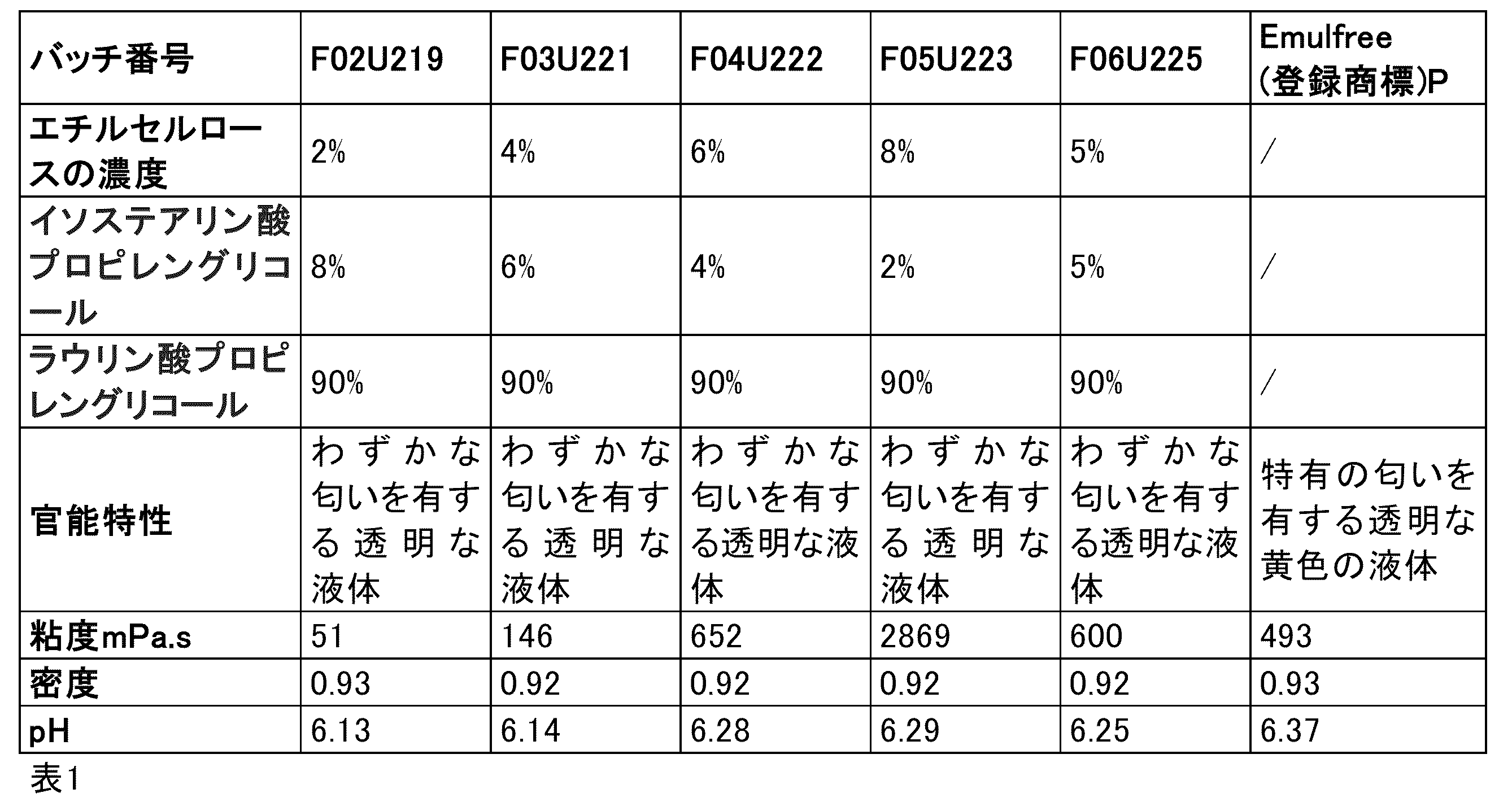

The results obtained are summarized in Tables 1 and 2.
表1および2から明らかなように、3種の組成物F07U226、F13U243およびF16U248は、従来のEmmulfree(登録商標)P製剤と類似した特性、すなわち粘度、pH値および密度を有した。 As can be seen from Tables 1 and 2, the three compositions F07U226, F13U243 and F16U248 had similar properties, i.e. viscosity, pH value and density, to the conventional Emmulfree® P formulation.
従来のEmulfree(登録商標)組成物は、エチルセルロース、イソステアリン酸プロピレングリコールおよびラウリン酸プロピレングリコールをそれぞれ8:2:90wt%の相対的割合で含有する。 The conventional Emulfree® composition contains ethylcellulose, propylene glycol isostearate and propylene glycol laurate in relative proportions of 8:2:90 wt %, respectively.
しかし、Emulfree(登録商標)Pと同一のエチルセルロース、イソステアリン酸プロピレングリコールおよびラウリン酸プロピレングリコールのwt%比(すなわち、8:2:90wt%)を有する組成物(表1におけるバッチF05U223)を本発明に従い製造した場合、得られた粘度は非常に高かった(2869mPa.s)ため、前記試料は本発明によるオレオゲルおよび/またはバイゲルを調製するためのゲル化剤として使用できなかった。 However, when a composition having the same wt% ratio of ethylcellulose, propylene glycol isostearate and propylene glycol laurate as Emulfree® P (i.e. 8:2:90 wt%) (batch F05U223 in Table 1) was produced according to the present invention, the viscosity obtained was so high (2869 mPa.s) that said sample could not be used as a gelling agent for preparing oleogels and/or bigels according to the present invention.
本発明の発明者らは、最初にラウリン酸プロピレングリコールとイソステアリン酸プロピレングリコールを混合し、その後それにより得られた溶液にエチルセルロースを添加することにより、従来のようにエチルセルロースが完全に溶解することを保証するために、混合物全体をエチルセルロースのガラス転移温度(約130~150C)またはそれより高い温度に加熱する必要はなく、前記ガラス転移温度より十分低い温度を使用することができることを見出した。 The inventors of the present invention have found that by first mixing propylene glycol laurate and propylene glycol isostearate and then adding ethyl cellulose to the resulting solution, it is not necessary to heat the entire mixture to or above the glass transition temperature of ethyl cellulose (about 130-150C) to ensure complete dissolution of the ethyl cellulose, as is conventionally the case, but rather that a temperature well below said glass transition temperature can be used.
様々な温度を試験したが、実質的に均一なゲル化剤を提供するための最良の結果は、90℃~110℃、好ましくは約100℃の温度範囲内で得られた。80℃未満の温度では、均一な組成物はもたらされなかった。 Various temperatures were tested, but best results for providing a substantially homogeneous gelling agent were obtained within a temperature range of 90°C to 110°C, preferably about 100°C. Temperatures below 80°C did not result in a homogeneous composition.
実験B:バイゲルの製造
3種のゲル化剤試料F07U226、F13U243およびF16U248のうちのいずれが従来のEmulfree(登録商標)P製剤と類似した特性を有するかを評価するために、各ゲル化剤試料およびEmulfree(登録商標)Pを使用し、200gのバイゲルを製造した。前記バイゲルは以下の通り製造した(wt%はすべて最終バイゲルに対するものである):
Experiment B: Preparation of bigels To evaluate which of the three gelling agent samples F07U226, F13U243 and F16U248 have similar properties to the conventional Emulfree® P formulation, 200 g bigels were prepared using each gelling agent sample and Emulfree® P. The bigels were prepared as follows (all wt% are of the final bigel):
65.45wt%の精製水を50℃に加熱し、次に0.10wt%のソルビン酸を、SYLVERSON(登録商標)型混合機を使用して3000rpmで10分間撹拌しながら前記水に溶解することにより、水性ゲルを調製した。それにより得られた混合物を25℃に冷却し、1.40wt%のCarbomer CARBOPOL(登録商標)980NFを、SYLVERSON(登録商標)型混合機を使用して2000~6000rpmで撹拌しながら前記混合物に分散することにより、水性ゲルを準備した。 An aqueous gel was prepared by heating 65.45 wt% purified water to 50°C and then dissolving 0.10 wt% sorbic acid in the water while stirring at 3000 rpm for 10 minutes using a SYLVERSON® type mixer. The resulting mixture was cooled to 25°C and an aqueous gel was prepared by dispersing 1.40 wt% Carbomer CARBOPOL® 980NF in the mixture while stirring at 2000-6000 rpm using a SYLVERSON® type mixer.
3.50wt%のエタノール(96.5%)を、マグネットスターラーを使用し5分間撹拌しながら21wt%のカプリル酸/カプリン酸トリグリセリドLABRAFAC CC(登録商標)に溶解し、オレオゲルを調製した。その後、4wt%のEmulfree(登録商標)または4wt%のそれぞれの3種のゲル化剤試料を、マグネットスターラーを使用して10分間撹拌しながら混合物に添加することにより、オレオゲルを作成した。 3. An oleogel was prepared by dissolving 50 wt% ethanol (96.5%) in 21 wt% caprylic/capric triglyceride LABRAFAC CC® with magnetic stirring for 5 minutes. Then, oleogels were made by adding 4 wt% Emulfree® or 4 wt% of each of the three gelling agent samples to the mixture with magnetic stirring for 10 minutes.
その後、オレオゲルを、ULTRA TURRAX(登録商標)型混合機を使用して13500rpmで10分間素早く撹拌しながら水性ゲルに添加し、それにより得られた第1の組成物を乳鉢に移した。 The oleogel was then added to the aqueous gel with rapid stirring at 13,500 rpm for 10 minutes using an ULTRA TURRAX® type mixer, and the resulting first composition was transferred to a mortar.
バイゲルのpH値を調整するために、2種のpH調整溶液であるSolAおよびSolBを調製した。 To adjust the pH value of the bigel, two pH-adjusting solutions, SolA and SolB, were prepared.
SolA:0.25wt%のメチルパラベンナトリウムを、磁気撹拌しながら3.30wt%の精製水に溶解した。 SolA: 0.25 wt% sodium methylparaben was dissolved in 3.30 wt% purified water with magnetic stirring.
SolB:0.20wt%の水酸化ナトリウムを、磁気撹拌しながら1.80wt%の精製水に溶解した。 SolB: 0.20 wt% sodium hydroxide was dissolved in 1.80 wt% purified water with magnetic stirring.
バイゲルのpHを調整する(中和する)ために、最初にSolAを混合しながらバイゲルに添加し、次にSolBを混合しながら添加した。 To adjust (neutralize) the pH of the bigel, SolA was first added to the bigel with mixing, and then SolB was added with mixing.
それにより得られたバイゲルの特性は、下の表3から明らかである。
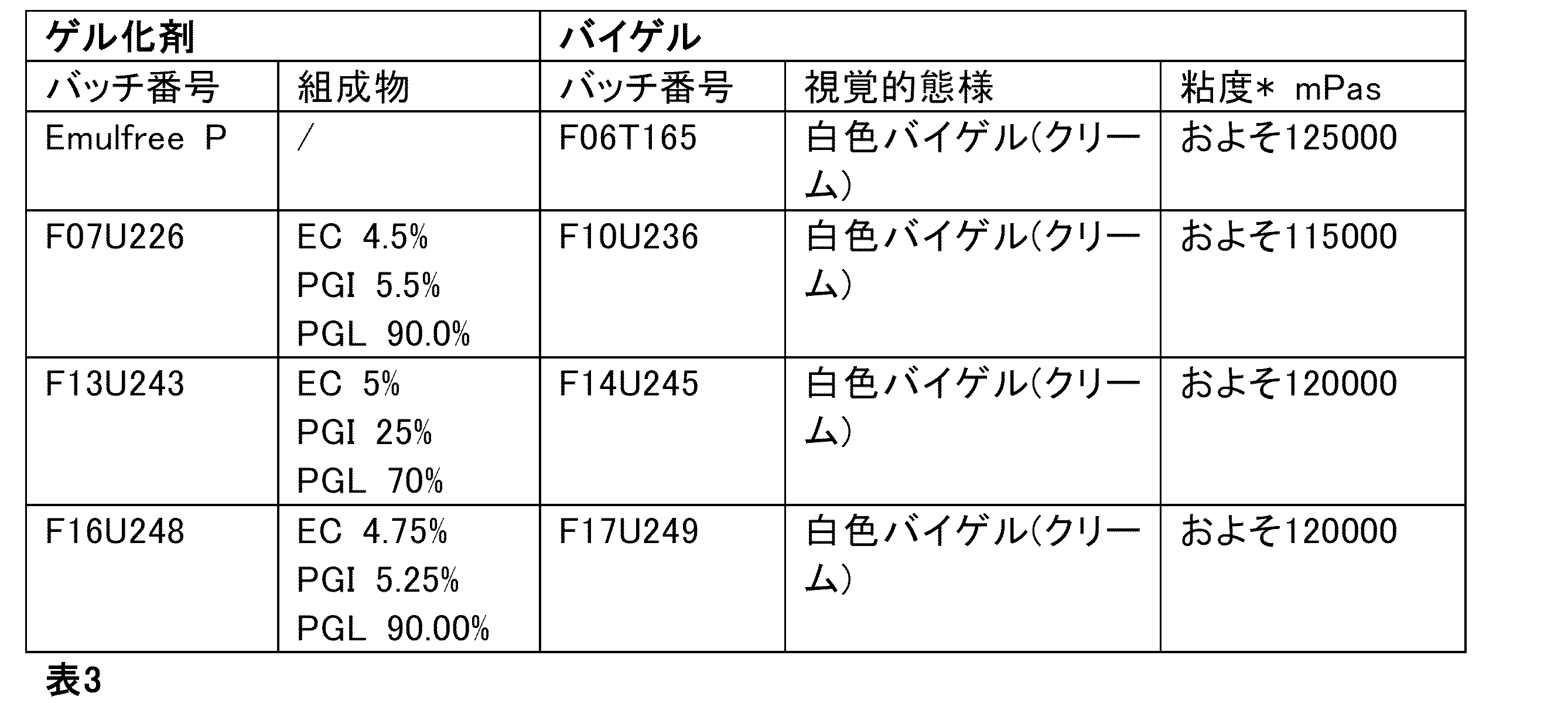
粘度は、MS DIN 1.3モジュールを備えたVRM-08LAMY粘度計を使用して測定した。速度は5rpm(0.8s-1のせん断速度)に固定し、温度は23℃に固定した。時間:10秒&30秒。 Viscosity was measured using a VRM-08LAMY viscometer equipped with MS DIN 1.3 module. The speed was fixed at 5 rpm (shear rate of 0.8 s -1 ) and temperature was fixed at 23°C. Time: 10 sec & 30 sec.
得られた結果に基づき、バッチ番号F16U248のゲル化剤をさらなる試験のために選択したが、他の2つのゲル化剤試料、バッチ番号F07U226およびF13U243も好適なゲル化剤とみなされた。 Based on the results obtained, the gelling agent from batch number F16U248 was selected for further testing, however, two other gelling agent samples, batch numbers F07U226 and F13U243, were also considered suitable gelling agents.
実験C:1wt%のテストステロンを含有するバイゲルの製造
本発明によるゲル化剤試料を使用して作成されたバイゲルがAPIを送達するための好適なビヒクルとして使用できるかを評価するために、1wt%のテストステロンを含有するバイゲルを本発明によるゲル化剤(バッチF16U248)を使用して製造し、従来のEmulfree(登録商標)P組成物を使用して製造された同様のバイゲルと比較した。
Experiment C: Preparation of bigels containing 1 wt% testosterone In order to evaluate whether bigels made using gelling agent samples according to the invention could be used as suitable vehicles for delivering API, bigels containing 1 wt% testosterone were prepared using a gelling agent according to the invention (batch F16U248) and compared to similar bigels prepared using a conventional Emulfree® P composition.
それぞれのバイゲルを以下の通り製造した(wt%はすべて最終バイゲルに対するものである): Each bigel was prepared as follows (all wt% are relative to the final bigel):
最初に65.45wt%の精製水を50℃に加熱し、次に0.10wt%のソルビン酸を、SYLVERSON(登録商標)型混合機を使用して3000rpmで10分間撹拌しながら前記水に溶解することにより、水性ゲルを調製した。それにより得られた混合物を25℃に冷却し、その後(hereafter)1.40wt%のCarbomer CARBOPOL(登録商標)980NFを、SYLVERSON(登録商標)型混合機を使用して2000~6000rpmで撹拌しながら前記混合物に分散することにより、水性ゲルを準備した。 An aqueous gel was prepared by first heating 65.45 wt% of purified water to 50°C, then dissolving 0.10 wt% of sorbic acid in the water while stirring at 3000 rpm for 10 minutes using a SYLVERSON® type mixer. The resulting mixture was cooled to 25°C, and hereafter 1.40 wt% of Carbomer CARBOPOL® 980NF was dispersed in the mixture while stirring at 2000-6000 rpm using a SYLVERSON® type mixer to prepare an aqueous gel.
1wt%のテストステロンを、ULTRA TURRAX(登録商標)型混合機を使用して8000rpmで5分間撹拌しながら20wt%のカプリル酸/カプリン酸トリグリセリドLABRAFAC CC(登録商標)に分散させることによりオレオゲルを調製し、その後3.5wt%のエタノール96.5%を、マグネティックスターラーを使用して5分間撹拌しながら前記混合物に溶解した。その後、4wt%のEmulfree(登録商標)または4wt%のゲル化剤(バッチF16U248)のいずれかを、マグネットスターラーを使用して10分間撹拌しながら混合物に添加することにより、オレオゲルを準備した。 The oleogel was prepared by dispersing 1 wt% testosterone in 20 wt% caprylic/capric triglyceride LABRAFAC CC® using an ULTRA TURRAX® type mixer with stirring at 8000 rpm for 5 minutes, then 3.5 wt% ethanol 96.5% was dissolved in the mixture with stirring using a magnetic stirrer for 5 minutes. The oleogel was then prepared by adding either 4 wt% Emulfree® or 4 wt% gelling agent (batch F16U248) to the mixture with stirring using a magnetic stirrer for 10 minutes.
その後、オレオゲルを、ULTRA TURRAX(登録商標)型混合機を使用して13500rpmで10分間素早く撹拌しながら水性ゲルに添加し、それにより得られたバイゲルを次に乳鉢に移す。 The oleogel is then added to the aqueous gel with rapid stirring using an ULTRA TURRAX® type mixer at 13,500 rpm for 10 minutes, and the resulting bigel is then transferred to a mortar.
バイゲルのpH値を調整するために、2種のpH調整溶液であるSolAおよびSolBを調製した。 To adjust the pH value of the bigel, two pH-adjusting solutions, SolA and SolB, were prepared.
SolA:0.25wt%のメチルパラベンナトリウムを、磁気撹拌しながら3.30wt%の精製水に溶解した。 SolA: 0.25 wt% sodium methylparaben was dissolved in 3.30 wt% purified water with magnetic stirring.
SolB:0.20wt%の水酸化ナトリウムを、磁気撹拌しながら1.80wt%の精製水に溶解した。 SolB: 0.20 wt% sodium hydroxide was dissolved in 1.80 wt% purified water with magnetic stirring.
バイゲルのpHを調整する(中和する)ために、最初にSolAを混合しながらバイゲルに添加し、次にSolBを混合しながら添加した。 To adjust (neutralize) the pH of the bigel, SolA was first added to the bigel with mixing, and then SolB was added with mixing.
1つはEmulfree(登録商標)Pを使用して調製され、1つは本発明によるゲル化剤(バッチF16U248)を使用して調製された2種の得られたバイゲルの物理的パラメータを下の表4において比較する。
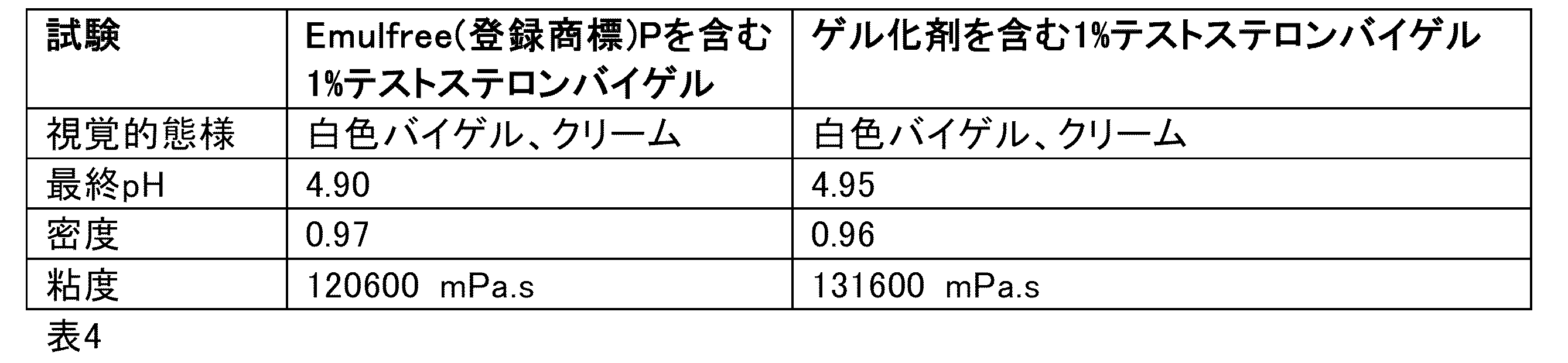
粘度は、MS DIN 1.3モジュールを備えたVRM-08LAMY粘度計を使用して測定した。速度は5rpm(0.8s-1のせん断速度)に固定し、温度は23℃に固定した。時間:30秒。 Viscosity was measured using a VRM-08LAMY viscometer equipped with an MS DIN 1.3 module. The speed was fixed at 5 rpm (shear rate of 0.8 s -1 ) and the temperature was fixed at 23°C. Time: 30 sec.
前記表から明らかなように、両方のゲルは実質的に同一の物理的特性を有し、したがって本発明による方法を使用して得られたゲル化剤は、従来のEmulfree(登録商標)P組成物の好適な代替物である。 As is evident from the table, both gels have substantially identical physical properties, and therefore the gelling agent obtained using the method according to the invention is a suitable alternative to the conventional Emulfree® P composition.
実験D:実験Cで得られた1wt%テストステロンバイゲルのin vitro溶解試験
従来の溶解試験を使用し、8時間にわたってin vitro溶解を評価した。
Experiment D: In vitro dissolution testing of 1 wt% testosterone bigel from experiment C. In vitro dissolution was assessed over a period of 8 hours using a conventional dissolution test.
表5は、Emulfree(登録商標)Pを含む1%テストステロンバイゲルのin vitro溶解の結果を表し、表6は、本発明によるゲル化剤を含む1%テストステロンバイゲルのin vitro溶解の結果を表す。


表5および6から明らかなように、テストステロンの形態の両方のバイゲルの溶解は実質的に同一であり、したがって本発明による方法を使用して得られたゲル化剤は、APIであるテストステロンの溶解に悪影響を及ぼさなかった。 As is evident from Tables 5 and 6, the dissolution of both bigels of testosterone forms was substantially identical, thus the gelling agent obtained using the method according to the present invention did not adversely affect the dissolution of the API testosterone.
実験E:本発明によるゲル化剤(ゲル化剤A)の大規模製造
以下の分量を使用して、ゲル化剤Aを実験Aに記載のように製造した:
ラウリン酸プロピレングリコール:450g=90wt%
イソステアリン酸プロピレングリコール:26.25g=5.25wt%
エチルセルロース:23.75g=4.75wt%
Experiment E: Large scale preparation of a gelling agent according to the invention (gelling agent A) Gelling agent A was prepared as described in experiment A using the following quantities:
Propylene glycol laurate: 450g = 90wt%
Propylene glycol isostearate: 26.25 g = 5.25 wt%
Ethyl cellulose: 23.75 g = 4.75 wt%
ラウリン酸プロピレングリコール/イソステアリン酸プロピレングリコール混合物へのエチルセルロースの完全な溶解は、約1時間後に生じた。 Complete dissolution of the ethylcellulose in the propylene glycol laurate/propylene glycol isostearate mixture occurred after approximately 1 hour.
ゲル化剤Aは、以下のパラメータを有した:
pH値:6.6、
密度:0.90
粘度:429mPa.s
Gellant A had the following parameters:
pH value: 6.6,
Density: 0.90
Viscosity: 429mPa. s
粘度は、MS DIN 1-2モジュールを備えたVRM-08LAMY粘度計を使用して測定した。速度は50rpm(17.73s-1のせん断速度)に固定し、温度は46℃に固定した。時間は安定するまでとした。 Viscosity was measured using a VRM-08LAMY viscometer with MS DIN 1-2 module. The speed was fixed at 50 rpm (shear rate of 17.73 s-1) and the temperature was fixed at 46°C. The time was allowed to stabilize.
ゲル化剤Aは、実験Aで調製されたバッチF16U248と実質的に同様であると結論付けることができ、したがって前記ゲル化剤の生産をスケールアップすることが可能である。 It can be concluded that gelling agent A is substantially similar to batch F16U248 prepared in experiment A, and therefore it is possible to scale up the production of said gelling agent.
実験F:1wt%テストステロンを含有するバイゲル(バイゲルA)のより大規模での製造
実験Eで得られたゲル化剤Aを使用してバイゲルAを調製し、以下の通り製造した(manufactures):
Experiment F: Larger scale production of bigel containing 1 wt% testosterone (bigel A) Bigel A was prepared using gelator A obtained in experiment E and manufactured as follows:
最初に1485.88g(65.45wt%)の精製水を50℃に加熱し、次に2.3g(0.10wt%)のソルビン酸を、TRIMIX(登録商標)型混合機を使用して1000rpmで15分間撹拌しながら前記水に溶解することにより、水性ゲルを調製した。それにより得られた混合物を25℃に冷却し、その後(hereafter)32.28g(1.40wt%)のCarbomer CARBOPOL(登録商標)980NFを、TRIMIX(登録商標)型混合機を使用して1600~3000rpmで撹拌しながら前記混合物に分散することにより、水性ゲルを準備した。 An aqueous gel was prepared by first heating 1485.88 g (65.45 wt%) of purified water to 50°C and then dissolving 2.3 g (0.10 wt%) of sorbic acid in the water while stirring at 1000 rpm for 15 minutes using a TRIMIX® type mixer. The resulting mixture was cooled to 25°C and hereafter 32.28 g (1.40 wt%) of Carbomer CARBOPOL® 980NF was dispersed in the mixture while stirring at 1600-3000 rpm using a TRIMIX® type mixer to prepare an aqueous gel.
23.05g(1wt%)のテストステロンを、ULTRA TURRAX(登録商標)型混合機を使用して8000rpmで5分間撹拌しながら、461.10g(20wt%)のカプリル酸/カプリン酸トリグリセリドLABRAFAC CC(登録商標)に分散させ、その後80.69g(3.5wt%)のエタノール96.5%を、ブレード型混合機を使用して500rpmで5分間撹拌しながら前記混合物に溶解した。 23.05 g (1 wt%) of testosterone was dispersed in 461.10 g (20 wt%) of caprylic/capric triglyceride LABRAFAC CC® using an ULTRA TURRAX® type mixer while stirring at 8000 rpm for 5 minutes, then 80.69 g (3.5 wt%) of ethanol 96.5% was dissolved in the mixture using a blade type mixer while stirring at 500 rpm for 5 minutes.
その後、92.22g(4wt%)のゲル化剤Aを、ブレード型混合機を使用して1300rpmで10分間撹拌しながら混合物に添加することにより、オレオゲルを準備した。 The oleogel was then prepared by adding 92.22 g (4 wt%) of gelling agent A to the mixture while mixing at 1300 rpm for 10 minutes using a blade mixer.
その後、オレオゲルを、TRIMIX(登録商標)型混合機(10リットルタンク)、回転子/固定子(strator)速度:3000rpm;アンカーブレード速度:9~45rpmを使用して素早く撹拌しながら水性ゲルに添加した。混合を10分後に停止し、それにより得られた第1の組成物を遊星型ブレンダーに移す。 The oleogel was then added to the aqueous gel under rapid mixing using a TRIMIX® type mixer (10 liter tank), rotor/stator speed: 3000 rpm; anchor blade speed: 9-45 rpm. Mixing was stopped after 10 minutes and the resulting first composition was transferred to a planetary blender.
バイゲルのpH値を調整するために、2種のpH調整溶液であるSolAおよびSolBを調製した。 To adjust the pH value of the bigel, two pH-adjusting solutions, SolA and SolB, were prepared.
SolA:5.76g(0.25wt%)%のメチルパラベンナトリウムを、磁気撹拌しながら76.08g(3.30wt%)の精製水に溶解した。 SolA: 5.76 g (0.25 wt%) of sodium methylparaben was dissolved in 76.08 g (3.30 wt%) of purified water with magnetic stirring.
SolB:4.61g(0.20wt%)の水酸化ナトリウムを、磁気撹拌しながら41.50g(1.80wt%)の精製水に溶解した。 SolB: 4.61 g (0.20 wt%) sodium hydroxide was dissolved in 41.50 g (1.80 wt%) purified water with magnetic stirring.
バイゲルのpHを調整する(中和する)ために、最初にSolAをKENWOOD(登録商標)の遊星型ブレンダーを速度1で使用して混合しながらバイゲルに添加し、次にSolBを同様の条件下で添加することにより、バイゲルAを準備した。 To adjust (neutralize) the pH of the bigel, bigel A was prepared by first adding Sol A to the bigel while mixing with a KENWOOD® planetary blender at speed 1, and then adding Sol B under similar conditions.
バイゲルAは、以下のパラメータを有した:
- pH値:4.8
- 密度:0.95
- 粘度:118,973mPa.s
Bigel A had the following parameters:
- pH value: 4.8
- Density: 0.95
- Viscosity: 118,973mPa. s
粘度は、MS DIN 1.3モジュールを備えたVRM-08LAMY粘度計を使用して測定した。速度は50rpm(0.8s-1のせん断速度)に固定し、温度は23℃に固定した。時間は30秒であった。 The viscosity was measured using a VRM-08LAMY viscometer equipped with an MS DIN 1.3 module, the speed was fixed at 50 rpm (shear rate of 0.8 s -1 ) and the temperature was fixed at 23°C, the time was 30 seconds.
実験G:バイゲルAのin vitro溶解試験
実験Cの溶解試験を使用してin vitro溶解を評価した。
Experiment G: In Vitro Dissolution Test of Bigel A The dissolution test of Experiment C was used to evaluate in vitro dissolution.
表7は、1%テストステロンを含有するバイゲルAのin vitro溶解の結果を表す。Emulfree(登録商標)Pを用いて調製された同様のバイゲルの溶解試験も比較のために試験し、前記結果を表8に示す。


表7および8から明らかなように、テストステロンの形態の両方のバイゲルの溶解は実質的に同一であり、したがって本発明による方法を使用して得られたゲル化剤は、APIであるテストステロンの溶解に悪影響を及ぼさなかった。 As is evident from Tables 7 and 8, the dissolution of both bigels of testosterone forms was substantially identical, thus the gelling agent obtained using the method according to the present invention did not adversely affect the dissolution of the API testosterone.
上記の原理および設計の修正および組合せが、本発明の範囲内で予測される。 Modifications and combinations of the above principles and designs are anticipated within the scope of the present invention.
Claims (8)
a)ラウリン酸プロピレングリコールとイソステアリン酸プロピレングリコールを混合して、第1の混合物を得る工程、
b)エチルセルロースを第1の混合物に撹拌しながら添加することにより、第2の混合物を得る工程、
c)実質的に均一なゲル化剤が形成されるまで第2の混合物を継続的に撹拌する工程
を含み、
工程a)、b)およびc)が約90℃~約110℃の温度で実施され、
工程b)で添加されるエチルセルロースの量が、ゲル化剤の全重量に対して4wt%~5.5wt%である、方法。 A method for preparing a gelling agent comprising the following successive steps:
a) mixing propylene glycol laurate and propylene glycol isostearate to obtain a first mixture;
b) adding ethyl cellulose to the first mixture with stirring to obtain a second mixture;
c) continuously stirring the second mixture until a substantially homogenous gelling agent is formed;
Steps a), b) and c) are carried out at a temperature of about 90° C. to about 110° C.;
The method, wherein the amount of ethyl cellulose added in step b) is 4 wt % to 5.5 wt % based on the total weight of the gelling agent.
Applications Claiming Priority (3)
| Application Number | Priority Date | Filing Date | Title |
|---|---|---|---|
| EP18209409.4 | 2018-11-30 | ||
| EP18209409.4A EP3659583B1 (en) | 2018-11-30 | 2018-11-30 | A method of preparing a gelling agent, the gelling agent obtained thereby, and the use of said gelling agent |
| PCT/EP2019/082893 WO2020109459A1 (en) | 2018-11-30 | 2019-11-28 | A method of preparing a gelling agent, the gelling agent obtained thereby, and the use of said gelling agent |
Publications (2)
| Publication Number | Publication Date |
|---|---|
| JP2022513660A JP2022513660A (en) | 2022-02-09 |
| JP7621653B2 true JP7621653B2 (en) | 2025-01-27 |
Family
ID=64901284
Family Applications (1)
| Application Number | Title | Priority Date | Filing Date |
|---|---|---|---|
| JP2021530325A Active JP7621653B2 (en) | 2018-11-30 | 2019-11-28 | Method for preparing a gelling agent, the gelling agent obtained thereby and uses of said gelling agent |
Country Status (10)
| Country | Link |
|---|---|
| US (2) | US12016953B2 (en) |
| EP (2) | EP3659583B1 (en) |
| JP (1) | JP7621653B2 (en) |
| CN (1) | CN113164385B (en) |
| AU (1) | AU2019386906B2 (en) |
| BR (1) | BR112021010370A2 (en) |
| CA (1) | CA3120931A1 (en) |
| ES (2) | ES2948955T3 (en) |
| MX (1) | MX2021006380A (en) |
| WO (1) | WO2020109459A1 (en) |
Families Citing this family (1)
| Publication number | Priority date | Publication date | Assignee | Title |
|---|---|---|---|---|
| GR1011022B (en) * | 2024-06-14 | 2025-09-01 | Χρηστος Γεωργιου Φυτας | Semisolid mastic gum-containing preparation |
Citations (5)
| Publication number | Priority date | Publication date | Assignee | Title |
|---|---|---|---|---|
| JP2004300124A (en) | 2003-03-31 | 2004-10-28 | Ikeda Corp | Composition for external use |
| US20070231355A1 (en) | 2006-01-23 | 2007-10-04 | L'oreal | Cosmetic composition comprising multiphasic particles |
| JP2010514748A (en) | 2006-12-29 | 2010-05-06 | アーダナ バイオサイエンス リミテッド | Method for preparing the composition |
| WO2017120492A1 (en) | 2016-01-07 | 2017-07-13 | Viramal Limited | Gel compositions for transdermal delivery to maximize drug concentrations in the stratum corneum and serum and methods of use thereof |
| JP2017533914A (en) | 2014-10-29 | 2017-11-16 | ヤゴテック アーゲー | Gastric retention gel preparation |
Family Cites Families (51)
| Publication number | Priority date | Publication date | Assignee | Title |
|---|---|---|---|---|
| GB8401965D0 (en) | 1984-01-25 | 1984-02-29 | Beecham Group Plc | Composition |
| JPH0735335B2 (en) | 1991-02-28 | 1995-04-19 | 五十嵐 正雄 | Remedy for endometriosis |
| GB9207988D0 (en) | 1992-04-10 | 1992-05-27 | Smithkline Beecham Plc | Topical composition |
| US5543150A (en) | 1993-09-15 | 1996-08-06 | Columbia Laboratories, Inc. | Method of progesterone delivery and affect thereof |
| GB9426409D0 (en) | 1994-12-30 | 1995-03-01 | Britannia Health Products Ltd | A composition for treating endometriosis |
| US5695505A (en) | 1995-03-09 | 1997-12-09 | Yoon; Inbae | Multifunctional spring clips and cartridges and applicators therefor |
| FR2739559B1 (en) | 1995-10-05 | 1997-11-28 | Innothera Lab Sa | GEL FOR LOCAL HORMONOTHERAPY OF VAGINAL DROUGHT |
| FR2745561B1 (en) | 1996-03-04 | 1998-05-15 | Inst Francais Du Petrole | CATALYTIC PROCESS FOR DEODORIZATION AND DEAZOTATION OF POLLUTANT EMISSIONS |
| US5993856A (en) | 1997-01-24 | 1999-11-30 | Femmepharma | Pharmaceutical preparations and methods for their administration |
| US5908631A (en) * | 1997-02-27 | 1999-06-01 | L'oreal S.A. | Monohydric alcohol-free composition for topical use comprising solubilized ethylcellulose |
| US6982091B2 (en) | 2001-08-29 | 2006-01-03 | Umd, Inc. | Vaginal delivery of chemotherapeutic agents and inhibitors of membrane efflux systems for cancer therapy |
| DK1510213T3 (en) | 1997-11-10 | 2009-03-23 | Strakan Int Ltd | Penetration-enhancing and irritation-reducing systems including testosterone |
| EP1083880B1 (en) | 1998-06-03 | 2004-09-01 | Jean-Marc Aiache | Stable gel mixture in the form of a mixture of oleogel and aqueous gel |
| FR2779438B1 (en) * | 1998-06-03 | 2004-12-24 | Jean Marc Aiache | STABLE GEL, PREPARATION METHOD THEREOF, AND PHARMACEUTICAL COMPOSITIONS COMPRISING THE SAME |
| EP1093348A4 (en) | 1998-06-29 | 2003-07-16 | Pharmaceuticals Applic Asociat | Methods and transdermal compositions for pain relief |
| JP2000159689A (en) | 1998-11-26 | 2000-06-13 | Teikoku Hormone Mfg Co Ltd | Agent for treating or preventing menstrual disorders |
| US20030180352A1 (en) | 1999-11-23 | 2003-09-25 | Patel Mahesh V. | Solid carriers for improved delivery of active ingredients in pharmaceutical compositions |
| US6967023B1 (en) | 2000-01-10 | 2005-11-22 | Foamix, Ltd. | Pharmaceutical and cosmetic carrier or composition for topical application |
| US7179483B2 (en) | 2000-04-26 | 2007-02-20 | Watson Pharmaceuticals, Inc. | Compositions and methods for transdermal oxybutynin therapy |
| US8512718B2 (en) | 2000-07-03 | 2013-08-20 | Foamix Ltd. | Pharmaceutical composition for topical application |
| EP1213025A1 (en) | 2000-12-06 | 2002-06-12 | Laboratoires Serobiologiques(Societe Anonyme) | Cosmetic and/or dermopharmaceutical composition containing extracts obtained from the leaves of Argania spinosa |
| US6872382B1 (en) | 2001-05-21 | 2005-03-29 | Alcon, Inc. | Use of selective PDE IV inhibitors to treat dry eye disorders |
| US7368122B1 (en) | 2002-03-08 | 2008-05-06 | Dow Pharmaceutical Sciences | Skin cream |
| US9211259B2 (en) | 2002-11-29 | 2015-12-15 | Foamix Pharmaceuticals Ltd. | Antibiotic kit and composition and uses thereof |
| US20040143026A1 (en) | 2002-12-31 | 2004-07-22 | Shah Kishore R. | Bioadhesive hydrophilic composition for treatment of mammalian skin |
| ES2237298B1 (en) | 2003-07-16 | 2006-11-01 | Italfarmaco, S.A. | SEMISOLID MUCOADHESIVE FORMULATIONS. |
| DE102004030044A1 (en) | 2004-06-22 | 2006-01-12 | Birken Gmbh | Triterpene-containing oleogel, triterpene-containing oleogel and process for the preparation of a triterpenhaltigen oleogel |
| WO2006082596A2 (en) | 2005-01-19 | 2006-08-10 | Kamalinder Kaur Singh | Neem oil contraceptive formulations |
| DE102005037844A1 (en) | 2005-08-04 | 2007-04-05 | Intendis Gmbh | Anhydrous multi-phase gel system |
| WO2007058935A2 (en) | 2005-11-14 | 2007-05-24 | Bausch & Lomb Incorporated | Ophthalmic composition for dry eye therapy |
| US20080039398A1 (en) | 2006-01-25 | 2008-02-14 | Ousler George W Iii | Formulations and methods for treating dry eye |
| WO2008089405A1 (en) | 2007-01-19 | 2008-07-24 | Neurosci, Inc. | Composition of multiple hormones delivered vaginally in a single cream |
| CL2009001884A1 (en) | 2008-10-02 | 2010-05-14 | Incyte Holdings Corp | Use of 3-cyclopentyl-3- [4- (7h-pyrrolo [2,3-d] pyrimidin-4-yl) -1h-pyrazol-1-yl) propanonitrile, janus kinase inhibitor, and use of a composition that understands it for the treatment of dry eye. |
| EP2174650A1 (en) | 2008-10-08 | 2010-04-14 | Polichem SA | Modified release emulsions for application to skin or vaginal mucosa |
| CN102548425B (en) | 2009-06-12 | 2017-09-29 | 马斯公司 | Chocolate composition containing ethyl cellulose |
| US8475774B2 (en) | 2010-02-08 | 2013-07-02 | Johnson & Johnson Consumer Companies, Inc. | Sunscreen compositions comprising an ultraviolet radiation-absorbing polymer |
| WO2011121604A2 (en) | 2010-03-29 | 2011-10-06 | Lincoln Pharmaceuticals Limited | A liquid vaginal spray formulation for treatment of vaginal fungal infection |
| WO2012019991A1 (en) | 2010-08-09 | 2012-02-16 | INSERM (Institut National de la Santé et de la Recherche Médicale) | Methods and pharmaceutical compositions for the treatment of hiv-1 infections |
| MX395212B (en) | 2011-05-15 | 2025-03-21 | Acerus Biopharma Inc | Controlled-release nasal gels of testosterone, methods and pre-filled multi-dose applicator systems for pernasal administration. |
| IL215224A0 (en) | 2011-09-18 | 2012-02-29 | Katz Daniel Dr | Vaginal danazol combined with non steroidal anti inflammatory drugs (nsaids) compositions |
| RS62297B1 (en) | 2011-11-23 | 2021-09-30 | Therapeuticsmd Inc | Natural combination hormone replacement formulations and therapies |
| EP2790637A4 (en) | 2011-12-16 | 2015-04-29 | Combinent Biomedical Systems Inc | Vaginal drug delivery devices and manufacturing methods |
| US10806697B2 (en) | 2012-12-21 | 2020-10-20 | Therapeuticsmd, Inc. | Vaginal inserted estradiol pharmaceutical compositions and methods |
| KR102308971B1 (en) * | 2012-06-28 | 2021-10-07 | 뉴트리션 & 바이오사이언시즈 유에스에이 1, 엘엘씨 | Method of preparing an edible oleogel |
| US11154535B2 (en) | 2012-07-31 | 2021-10-26 | Egis Pharmaceuticals Plc | Transdermal formulation containing COX inhibitors |
| WO2014026707A1 (en) | 2012-08-13 | 2014-02-20 | Edko Pazarlama Tanitim Ticaret Limited Sirketi | Anti-vaginitis compositions with improved release and adherence |
| US9180091B2 (en) | 2012-12-21 | 2015-11-10 | Therapeuticsmd, Inc. | Soluble estradiol capsule for vaginal insertion |
| WO2014193667A1 (en) | 2013-05-31 | 2014-12-04 | Dow Global Technologies Llc | Process for preparing an oleogel |
| WO2015187840A2 (en) | 2014-06-03 | 2015-12-10 | Duke University | Methods and formulations for treatment of ocular disorders |
| DE102015207621A1 (en) | 2015-04-27 | 2016-10-27 | Beiersdorf Ag | Skin cleansing preparation |
| MX2019015927A (en) | 2017-06-22 | 2020-08-06 | Viramal Ltd | Compositions for drug delivery and methods of use thereof. |
-
2018
- 2018-11-30 ES ES18209409T patent/ES2948955T3/en active Active
- 2018-11-30 EP EP18209409.4A patent/EP3659583B1/en active Active
-
2019
- 2019-11-28 ES ES19839332T patent/ES2987239T3/en active Active
- 2019-11-28 CN CN201980078626.5A patent/CN113164385B/en active Active
- 2019-11-28 CA CA3120931A patent/CA3120931A1/en active Pending
- 2019-11-28 US US17/298,266 patent/US12016953B2/en active Active
- 2019-11-28 BR BR112021010370-8A patent/BR112021010370A2/en unknown
- 2019-11-28 WO PCT/EP2019/082893 patent/WO2020109459A1/en not_active Ceased
- 2019-11-28 MX MX2021006380A patent/MX2021006380A/en unknown
- 2019-11-28 AU AU2019386906A patent/AU2019386906B2/en active Active
- 2019-11-28 EP EP19839332.4A patent/EP3886811B1/en active Active
- 2019-11-28 JP JP2021530325A patent/JP7621653B2/en active Active
-
2024
- 2024-06-11 US US18/739,626 patent/US20240366504A1/en active Pending
Patent Citations (5)
| Publication number | Priority date | Publication date | Assignee | Title |
|---|---|---|---|---|
| JP2004300124A (en) | 2003-03-31 | 2004-10-28 | Ikeda Corp | Composition for external use |
| US20070231355A1 (en) | 2006-01-23 | 2007-10-04 | L'oreal | Cosmetic composition comprising multiphasic particles |
| JP2010514748A (en) | 2006-12-29 | 2010-05-06 | アーダナ バイオサイエンス リミテッド | Method for preparing the composition |
| JP2017533914A (en) | 2014-10-29 | 2017-11-16 | ヤゴテック アーゲー | Gastric retention gel preparation |
| WO2017120492A1 (en) | 2016-01-07 | 2017-07-13 | Viramal Limited | Gel compositions for transdermal delivery to maximize drug concentrations in the stratum corneum and serum and methods of use thereof |
Also Published As
| Publication number | Publication date |
|---|---|
| AU2019386906A1 (en) | 2021-06-10 |
| EP3659583C0 (en) | 2023-06-07 |
| MX2021006380A (en) | 2021-07-15 |
| US12016953B2 (en) | 2024-06-25 |
| EP3659583A1 (en) | 2020-06-03 |
| EP3659583B1 (en) | 2023-06-07 |
| CN113164385A (en) | 2021-07-23 |
| EP3886811B1 (en) | 2024-07-17 |
| JP2022513660A (en) | 2022-02-09 |
| US20220023205A1 (en) | 2022-01-27 |
| EP3886811C0 (en) | 2024-07-17 |
| US20240366504A1 (en) | 2024-11-07 |
| CA3120931A1 (en) | 2020-06-04 |
| ES2987239T3 (en) | 2024-11-14 |
| BR112021010370A2 (en) | 2021-08-24 |
| CN113164385B (en) | 2025-06-06 |
| ES2948955T3 (en) | 2023-09-22 |
| EP3886811A1 (en) | 2021-10-06 |
| AU2019386906B2 (en) | 2025-06-12 |
| WO2020109459A1 (en) | 2020-06-04 |
Similar Documents
| Publication | Publication Date | Title |
|---|---|---|
| MXPA02004930A (en) | TOPIC STROPROGESTATIVE COMPOSITIONS WITH SYSTEMIC EFFECT. | |
| HU228863B1 (en) | Topical hormonal composition containing synthetic progestogen with systemic effect | |
| CN1845720B (en) | Concentrated and diluted stable oil-in-water emulsion | |
| GB2445539A (en) | Bigel composition | |
| JP3489703B2 (en) | Fine emulsion composition | |
| JP2004307491A (en) | External preparation for skin containing heparin-like substance | |
| US20240366504A1 (en) | Method of Preparing a Gelling Agent, the Gelling Agent Obtained Thereby, and the Use of Said Gelling Agent | |
| JPH11255640A (en) | Emulsified preparation for external use for skin | |
| JPS597106A (en) | Emulsifiable composition | |
| US7041305B2 (en) | Stable water in oil aminophylline emulsions | |
| JPH09216810A (en) | Composition for skin and oral cavity application | |
| JP6765834B2 (en) | Emulsified composition | |
| JPH045490B2 (en) | ||
| CN110251416A (en) | A kind of Ceramide Complex and preparation method thereof | |
| JP2000355519A (en) | Manufacturing method of emulsified cosmetic | |
| US20100055156A1 (en) | Composition for the topical transmission of active ingredients into the human or animal body | |
| CN117015373A (en) | Aqueous gel composition containing ethyl cellulose | |
| JP3908565B2 (en) | Oil-in-water emulsion composition and method for producing emulsion composition | |
| JP4251737B2 (en) | Gel emulsion composition for external use | |
| CN109223608B (en) | High-speed homogeneous forced solubilization method and application thereof | |
| JPS59173124A (en) | Emulsified composition | |
| KR102259691B1 (en) | Cream composition for teat protection and manufacturing method thereof | |
| JPH01176446A (en) | Hydrophile gel composition and oil-in-water type emulsified composition | |
| CN117677372A (en) | Nanocomposite compositions containing diclofenac | |
| EP4362910A1 (en) | Micellar solution comprising diclofenac |
Legal Events
| Date | Code | Title | Description |
|---|---|---|---|
| A529 | Written submission of copy of amendment under article 34 pct |
Free format text: JAPANESE INTERMEDIATE CODE: A529 Effective date: 20210726 |
|
| A621 | Written request for application examination |
Free format text: JAPANESE INTERMEDIATE CODE: A621 Effective date: 20221026 |
|
| A977 | Report on retrieval |
Free format text: JAPANESE INTERMEDIATE CODE: A971007 Effective date: 20230711 |
|
| A131 | Notification of reasons for refusal |
Free format text: JAPANESE INTERMEDIATE CODE: A131 Effective date: 20230801 |
|
| A601 | Written request for extension of time |
Free format text: JAPANESE INTERMEDIATE CODE: A601 Effective date: 20231019 |
|
| A521 | Request for written amendment filed |
Free format text: JAPANESE INTERMEDIATE CODE: A523 Effective date: 20240201 |
|
| A131 | Notification of reasons for refusal |
Free format text: JAPANESE INTERMEDIATE CODE: A131 Effective date: 20240514 |
|
| A601 | Written request for extension of time |
Free format text: JAPANESE INTERMEDIATE CODE: A601 Effective date: 20240809 |
|
| A521 | Request for written amendment filed |
Free format text: JAPANESE INTERMEDIATE CODE: A523 Effective date: 20241113 |
|
| TRDD | Decision of grant or rejection written | ||
| A01 | Written decision to grant a patent or to grant a registration (utility model) |
Free format text: JAPANESE INTERMEDIATE CODE: A01 Effective date: 20241210 |
|
| A61 | First payment of annual fees (during grant procedure) |
Free format text: JAPANESE INTERMEDIATE CODE: A61 Effective date: 20250107 |
|
| R150 | Certificate of patent or registration of utility model |
Ref document number: 7621653 Country of ref document: JP Free format text: JAPANESE INTERMEDIATE CODE: R150 |