JP7588949B2 - Ceramic powder, method for producing ceramic powder, and method for producing ceramic structure using ceramic powder - Google Patents
Ceramic powder, method for producing ceramic powder, and method for producing ceramic structure using ceramic powder Download PDFInfo
- Publication number
- JP7588949B2 JP7588949B2 JP2019039653A JP2019039653A JP7588949B2 JP 7588949 B2 JP7588949 B2 JP 7588949B2 JP 2019039653 A JP2019039653 A JP 2019039653A JP 2019039653 A JP2019039653 A JP 2019039653A JP 7588949 B2 JP7588949 B2 JP 7588949B2
- Authority
- JP
- Japan
- Prior art keywords
- particle
- ceramic powder
- particles
- ceramic
- particle group
- Prior art date
- Legal status (The legal status is an assumption and is not a legal conclusion. Google has not performed a legal analysis and makes no representation as to the accuracy of the status listed.)
- Active
Links
Images


Classifications
-
- Y—GENERAL TAGGING OF NEW TECHNOLOGICAL DEVELOPMENTS; GENERAL TAGGING OF CROSS-SECTIONAL TECHNOLOGIES SPANNING OVER SEVERAL SECTIONS OF THE IPC; TECHNICAL SUBJECTS COVERED BY FORMER USPC CROSS-REFERENCE ART COLLECTIONS [XRACs] AND DIGESTS
- Y02—TECHNOLOGIES OR APPLICATIONS FOR MITIGATION OR ADAPTATION AGAINST CLIMATE CHANGE
- Y02P—CLIMATE CHANGE MITIGATION TECHNOLOGIES IN THE PRODUCTION OR PROCESSING OF GOODS
- Y02P10/00—Technologies related to metal processing
- Y02P10/25—Process efficiency
Landscapes
- Producing Shaped Articles From Materials (AREA)
Description
本発明は、レーザー光の照射による原料粉体の熔融および凝固(原料粉体の焼結を含む)を利用した三次元造形によってセラミックス造形物を製造する際に用いる当該原料粉体、および、それを用いたセラミックス造形方法に関する。 The present invention relates to raw material powder used in producing ceramic objects by three-dimensional modeling using the melting and solidification (including sintering) of raw material powder by irradiation with laser light, and to a ceramic modeling method using the raw material powder.
近年、レーザー光を用いた付加製造法(Additive Manufacturing、または三次元造形技術とも言う)が発展し、その技術水準が高まっている。特に金属分野では、粉末床熔融結合法(粉末積層法)の一種である選択的レーザー焼結法(Selective Laser Sintering: SLS)あるいは選択的レーザー熔融法(Selective Laser Melting: SLM)により、緻密で多様性のある造形物の製造が実現している。これらの方法はレーザー描画により原料の金属粉体を所望の形状で熔融させて結着させる、あるいは焼結させるものである。描画用レーザーとしては、YAGレーザーやファイバーレーザーなど、小型で高出力かつ低価格な近赤外領域のレーザーが専ら用いられている。 In recent years, additive manufacturing (also called three-dimensional modeling technology) using laser light has developed and its technological level has improved. In particular, in the metal field, selective laser sintering (SLS) or selective laser melting (SLM), which are types of powder bed fusion bonding (powder lamination method), have made it possible to manufacture precise and diverse objects. These methods use laser drawing to melt and bond or sinter raw metal powder into the desired shape. For drawing, small, high-power, low-cost lasers in the near-infrared region, such as YAG lasers and fiber lasers, are used exclusively.
SLSあるいはSLMは、原理的にはセラミックス粉体へも適用可能である。しかしながら、一般的な絶縁性セラミックスは可視から赤外領域の光に対して透過性の高いものが多い。すなわち、原料となるセラミックス粒子はこの波長領域にあるレーザー光をほとんど吸収しない。そのため、SLSまたはSLM装置を用いてセラミックスの付加製造を行う場合には、加工部分の材料の熔融に必要な熱エネルギーと比較して過剰なパワーのレーザー光を照射する必要がある。また、その場合、照射されたレーザー光の大部分はセラミックス粒子を透過拡散するので、レーザー光のビーム径よりも大きな領域が熔融してしまい、明確な境界部の形成が困難となる。このため、従来は、SLSやSLMで高精細なセラミックス造形を行うことが困難であった。 In principle, SLS or SLM can also be applied to ceramic powder. However, many common insulating ceramics are highly transparent to light in the visible to infrared range. In other words, the raw ceramic particles hardly absorb laser light in this wavelength range. Therefore, when additive manufacturing of ceramics is performed using an SLS or SLM device, it is necessary to irradiate laser light with excessive power compared to the thermal energy required to melt the material of the processed part. In addition, in this case, most of the irradiated laser light penetrates and diffuses the ceramic particles, so an area larger than the beam diameter of the laser light is melted, making it difficult to form a clear boundary. For this reason, it was previously difficult to perform high-definition ceramic modeling using SLS or SLM.
このような問題に対し、例えば非特許文献1では、共晶系酸化物セラミックスのレーザー光照射による付加製造が提案されている。具体的には、Al2O3-ZrO2共晶系を用いることで造形用粉体の融点を低下させ、熔融に必要なレーザー光のパワーを低下させるというものである。この方法では、凝固の際に共晶系特有の微細構造が形成されることにより、高い機械強度を有するセラミックス構造物を造形することができるという利点もある。この方法により、ある程度の精細さの向上は見られたが、依然として表面突起物が多数発生するなど、造形精度はまだ十分なものではない。加えて、レーザー光によるセラミックス構造物の造形は、金属と比較して伝熱速度や反応速度が遅いために、時間がかかるという問題もある。
In response to such problems, for example, Non-Patent
本発明はこのような課題を解決するものであり、SLSおよびSLM装置によるセラミックス構造物の付加製造において、高精細なセラミックス構造物を短時間で得るためのセラミックス原料粉体を提供する。また、そのような原料粉体の製造方法およびそのような原料粉体を使用して高精細なセラミックス構造物を得るための方法を提供する。 The present invention solves these problems by providing ceramic raw material powder for obtaining high-definition ceramic structures in a short time in additive manufacturing of ceramic structures using SLS and SLM devices. It also provides a method for producing such raw material powder and a method for obtaining high-definition ceramic structures using such raw material powder.
本発明の第1の局面によれば、レーザー光を照射して造形を行う付加造形法の原料として用いられるセラミックス粉体であって、平均粒子径が10μm以上100μm以下である第一の粒子群と、前記レーザー光を吸収して高温化する吸収体からなる第二の粒子群と、を含み、前記第一の粒子群に含まれる1つの粒子の表面に前記第二の粒子群に含まれる複数の粒子が付着している複合粒子を含んでおり、該複合粒子において、前記1つの粒子の粒子径より前記複数の粒子の粒子径の方が小さく、前記高温化によって前記1つの粒子が熔融することを特徴とする、セラミックス粉体が提供される。
According to a first aspect of the present invention, there is provided a ceramic powder used as a raw material for an additive manufacturing method in which a shape is formed by irradiating laser light, the ceramic powder comprising: a first particle group having an average particle diameter of 10 μm or more and 100 μm or less; and a second particle group consisting of an absorber that absorbs the laser light and is heated to a high temperature, the ceramic powder comprising a composite particle in which a plurality of particles included in the second particle group are attached to a surface of a particle included in the first particle group, the particle diameter of the plurality of particles being smaller than the particle diameter of the one particle, and the one particle being melted by the heated temperature .
本発明の第2の局面によれば、付加製造法を用いたセラミックス構造物の製造方法であって、上に述べたセラミックス粉体を所定の厚さに敷き均す工程(i)と、所定の領域に選択的にレーザー光を照射することにより、前記セラミックス粉体を熔融させた後に凝固させる工程(ii)と、を有し、工程(i)および(ii)を繰り返して造形を行うことを特徴とする、セラミックス構造物の製造方法が提供される。 According to a second aspect of the present invention, there is provided a method for manufacturing a ceramic structure using an additive manufacturing method, comprising the steps of (i) spreading the above-mentioned ceramic powder to a predetermined thickness, and (ii) selectively irradiating a predetermined area with laser light to melt the ceramic powder and then solidify it, characterized in that steps (i) and (ii) are repeated to form a shape .
本発明の第3の局面によれば、付加製造法を用いたセラミックス構造物の製造方法であって、上に述べたセラミックス粉体を所定の箇所に噴出させ、レーザー光を該所定の箇所に照射して造形を行うことを特徴とする、セラミックス構造物の製造方法が提供される。
According to a third aspect of the present invention , there is provided a method for manufacturing a ceramic structure using an additive manufacturing method, which comprises ejecting the above -mentioned ceramic powder onto a predetermined location, and irradiating the predetermined location with laser light to form a shape .
以下、本発明を実施するための形態について説明する。
本発明は、レーザー光を用いた付加製造技術によってセラミックス構造物(造形物)を得るための原料粉体として好適に用いられる、セラミックス粉体に関する。本発明のセラミックス粉体は、セラミックス構造物の骨材となる第一の無機化合物の粒子からなる第一の粒子群と、レーザー光の吸収体である第二の無機化合物の粒子からなり平均粒子径が第一の粒子群よりも小さい第二の粒子群とを含んでいる。そして、第二の粒子群に含まれる粒子は、第一の粒子群に含まれる粒子の表面部に(通常は複数個)配置されている。このようなセラミックス粉体は、第二の粒子群によってレーザー光を吸収して昇温し、その熱を効率よく第一の粒子群に伝えることができる。その結果、レーザー光を高速で走査して熔融することが可能となり、結果として造形速度が高まる。
Hereinafter, an embodiment of the present invention will be described.
The present invention relates to a ceramic powder that is suitably used as a raw material powder for obtaining a ceramic structure (shaped object) by additive manufacturing technology using laser light. The ceramic powder of the present invention includes a first particle group consisting of particles of a first inorganic compound that serves as an aggregate of the ceramic structure, and a second particle group consisting of particles of a second inorganic compound that is an absorber of laser light and has an average particle diameter smaller than that of the first particle group. The particles contained in the second particle group are arranged (usually a plurality of particles) on the surface portion of the particles contained in the first particle group. Such a ceramic powder can absorb laser light and increase in temperature by the second particle group, and can efficiently transfer the heat to the first particle group. As a result, it becomes possible to scan the laser light at high speed to melt the ceramic structure, which results in an increased modeling speed.
本発明のセラミックス粉体は、以下の特徴を有する。
(1)レーザー光の照射により熔融および凝固が生ずる。これにより、セラミック構造物を構成することができる。
(2)第一の無機化合物の粒子からなり平均粒子径が10μm以上100μm以下である第一の粒子群を含んでいる。
(3)第二の無機化合物の粒子からなり平均粒子径が第一の粒子群より小さい第二の粒子群を含んでいる。
(4)第二の粒子群に含まれる粒子は、第一の粒子群に含まれる粒子の表面に配置され、第二の無機化合物は、レーザー光の波長に吸収帯を有する吸収体である。
以下、それぞれの特徴について詳述する。
The ceramic powder of the present invention has the following characteristics.
(1) Laser light irradiation causes melting and solidification, which allows the construction of a ceramic structure.
(2) The first particle group is made of particles of a first inorganic compound and has an average particle size of 10 μm or more and 100 μm or less.
(3) A second particle group is included, which is made of particles of a second inorganic compound and has an average particle size smaller than that of the first particle group.
(4) The particles included in the second particle group are disposed on the surfaces of the particles included in the first particle group, and the second inorganic compound is an absorber having an absorption band at the wavelength of the laser light.
The characteristics of each are described in detail below.
(特徴1)
本発明のセラミックス粉体はセラミック構造物を得るための原料であり、セラミックスを主成分として含む。また、レーザー光を照射すると照射された部位の粉体が熔融し、レーザー光の照射を止めると凝固する特性がある。なお、本発明において「熔融し凝固する」といった場合には、完全に液体(粘性流体)状になってから凝固する場合のみならず、当該粉体を構成する各粒子(の表面)が軟化して互いに結着する場合(所謂焼結する場合)をも包含する。この特性は、当該粉体が後述する特徴2、特徴3、特徴4を有することで好ましく発現される。
(Feature 1)
The ceramic powder of the present invention is a raw material for obtaining a ceramic structure, and contains ceramics as a main component. In addition, the powder has a property that the powder melts at the irradiated portion when irradiated with laser light, and solidifies when the irradiation of the laser light is stopped. In the present invention, the phrase "melt and solidify" includes not only the case where the powder becomes completely liquid (viscous fluid) and then solidifies, but also the case where the particles (surfaces) constituting the powder soften and bond to each other (so-called sintering). This property is preferably expressed when the powder has
使用するレーザーの種類に制限はないが、金属の三次元造形装置に用いられているレーザーが、そのまま使用可能である。例えば、SLS装置やSLM装置で用いられている、小型高出力で比較的安価なファイバーレーザーやYAGレーザーなどの固体レーザーを用いることができる。一般的な固体レーザーの発振波長は800nmから1200nmであり、これは所謂近赤外領域(0.75~2.5μm)に含まれる。レーザーの発振方式は、連続発振でもパルス発振でも良い。 There are no restrictions on the type of laser used, but lasers used in metal 3D modeling devices can be used as is. For example, solid-state lasers such as fiber lasers and YAG lasers, which are small, high-output, and relatively inexpensive and used in SLS and SLM devices, can be used. The oscillation wavelength of typical solid-state lasers is 800 nm to 1200 nm, which is included in the so-called near-infrared region (0.75 to 2.5 μm). The laser oscillation method can be either continuous oscillation or pulse oscillation.
高精細なセラミックス構造物(造形物)を得ようとする場合には、レーザー光の照射径は10μm以上200μm以下であることが好ましい。一方、造形速度を重視して短時間で大きな造形物を得ようとする場合には、レーザー光の照射径は200μm以上2000μm以下であることが好ましい。 When attempting to obtain a highly detailed ceramic structure (modeled object), it is preferable that the irradiation diameter of the laser light is 10 μm or more and 200 μm or less. On the other hand, when prioritizing modeling speed and attempting to obtain a large modeled object in a short time, it is preferable that the irradiation diameter of the laser light is 200 μm or more and 2000 μm or less.
図1は、本発明のセラミックス粉体にレーザー光を照射するための装置の一例を示す概略断面図である。図1は、粉末床熔融結合法の一種である選択的レーザー焼結法(SLS)の場合の装置構成である。この方式は、粉末ベッド直接造形方式とも呼ばれる。図1の装置は、粉末升11、造形ステージ部12、リコーター部13、スキャナ部14、レーザー15から構成される。粉末升11に本発明のセラミックス粉体を充填する。粉末升11と造形ステージ部12は上下方向に移動する機構があり、リコーター部13によって粉末升11から造形ステージ部12にセラミックス粉体を移送することができる。造形ステージ部12においては、目的とするセラミックス造形物の最大水平断面より広い領域にセラミックス粉体を敷き詰めるようにする。
Figure 1 is a schematic cross-sectional view showing an example of an apparatus for irradiating the ceramic powder of the present invention with laser light. Figure 1 shows the configuration of the apparatus for selective laser sintering (SLS), which is a type of powder bed fusion bonding method. This method is also called a powder bed direct modeling method. The apparatus in Figure 1 is composed of a
続いて、レーザー15とスキャナ部14によって、造形ステージ部12にあるセラミックス粉体(最上の1層分)のうち凝固させたい箇所にレーザー光を照射して描画を施す。レーザー光が照射された部分のセラミックス粉体は、第二の粒子群がレーザー光を吸収してエネルギーを熱に換え、第二の粒子群が熔融するとともに、その熱が伝わって第一の粒子群が熔融する。レーザー光の照射部が別の箇所に移ると、熔融部は冷却されて凝固する。このプロセスにより、1層の造形物が得られる。熔融しなかった部分のセラミックス粉体は同じ層に残存する。この層の上に新たに1層分のセラミックス粉体を敷き詰めてレーザー光を照射し、任意の箇所の粉体を熔融および凝固させることで、先に造形した造形物と一体となった造形物が形成される。このような工程を繰り返すことで任意の立体形状を有するセラミックス構造物(造形物)を製造することができる。
Next, the
図2は、本発明のセラミックス粉体にレーザー光を照射するための別の方式の装置の一例を示す断面概略図である。図2は、指向エネルギー堆積法、または、クラッディング方式と呼ばれる造形方式を説明する図である。クラッディングノズル21は、複数の粉体供給孔22を有しており、この粉体供給孔22から本発明のセラミックス粉体を所望の流量で噴出させる機能を有する。この噴出されたセラミックス粉体のビームが焦点を結ぶ領域にレーザー23を照射して、基体20の所望の箇所にセラミックス造形物を付加的に設けることができる。すなわち、この場合には、セラミックス粉体はクラッディングノズル21からレーザー照射部に噴出(配置)され、上記(焦点を結ぶ)領域において選択的にレーザー光の照射を受けることになる。この方式では、粉末積層法とは異なり、曲面の上に造形できるという利点がある。
Figure 2 is a schematic cross-sectional view showing an example of an apparatus for irradiating the ceramic powder of the present invention with a laser beam. Figure 2 is a diagram explaining a modeling method called the directed energy deposition method or the cladding method. The
(特徴2)
本発明のセラミックス粉体は、平均粒子径が10μm以上100μm以下である第一の粒子群を含んでいる。セラミックス造形物の骨材となる第一の粒子群の大きさを平均で10μm以上100μm以下とすることで、造形時のリコーター部やクラッディングノズルによる粉体移送に求められる流動性(例えば40秒/50g以下)を満たし、かつ、造形物に十分な強度を持たせることができる。同じ観点において、より好ましい第一の粒子群の平均粒子径は、15μm以上40μm以下である。第一の粒子群に含まれる各粒子は、流動性の観点で球形であることが好ましいが、不定形、あるいは板状、針状等の異方性のある形状であっても良い。平均粒子径は、粉体の顕微鏡写真から投影像の円相当径として算出することができる。例えば、粉体を構成する100個以上の第一の粒子群に含まれる粒子をランダムに選定し、表面部に配置された第二の粒子群に含まれる粒子を除いた円相当径の値を各粒子について求めて平均化することで、平均粒子径を得ることができる。各粒子の大きさにばらつきある場合は、観察倍率の異なる顕微鏡写真を組み合わせても良いが、各々の第一の粒子の円相当径の分散が小さく、99個数%以上の粒子の粒子径(円相当径)が10μm以上100μm以下であるとより好ましい。
(Feature 2)
The ceramic powder of the present invention includes a first particle group having an average particle diameter of 10 μm or more and 100 μm or less. By setting the size of the first particle group, which is the aggregate of the ceramic molded object, to 10 μm or more and 100 μm or less on average, the fluidity (e.g., 40 seconds/50 g or less) required for powder transfer by a recoater unit or a cladding nozzle during molding is satisfied, and the molded object can have sufficient strength. From the same viewpoint, the average particle diameter of the first particle group is more preferably 15 μm or more and 40 μm or less. Each particle contained in the first particle group is preferably spherical from the viewpoint of fluidity, but may be an anisotropic shape such as an indefinite shape, a plate shape, or a needle shape. The average particle diameter can be calculated as the circle equivalent diameter of a projected image from a micrograph of the powder. For example, the average particle diameter can be obtained by randomly selecting 100 or more particles contained in the first particle group constituting the powder, and averaging the circle equivalent diameter value for each particle excluding the particles contained in the second particle group arranged in the surface portion. When there is variation in the size of each particle, microscopic photographs with different observation magnifications may be combined, but it is more preferable that the variance of the equivalent circle diameter of each first particle is small and that the particle diameter (equivalent circle diameter) of 99% or more of the particles by number is 10 μm or more and 100 μm or less.
本発明において粉体とは、孤立した粒と認識できる粒子の集合体を指す。また、粒子群は、所定の条件を満たす粒子の集合体をいう。第一の粒子群は、上記所定の平均粒子径を有していれば、単一組成の粒子から構成されていなくてもよく、互いに組成が異なる複数種類の粒子が混合されていてもよい。 In the present invention, the powder refers to an aggregate of particles that can be recognized as isolated grains. Moreover, the particle group refers to an aggregate of particles that meets a specific condition. As long as the first particle group has the above-mentioned specific average particle diameter, it does not have to be composed of particles of a single composition, and multiple types of particles with different compositions may be mixed.
本発明において、無機化合物とは、水素を除く周期表1族から14族までの元素に、アンチモンおよびビスマスを加えた元素群のうち、1種類以上の元素を含有する酸化物、窒化物、酸窒化物、炭化物、あるいはホウ化物を指す。また、無機化合物からなる粒子は1種類の無機化合物により構成されてもよく、2種類以上の無機化合物が複合化したものでもよい。無機化合物粒子を造形用粉体の主体とすることで、レーザー光を照射したときの熔融、凝固反応の結果物をセラミックス状とすることができる。
In the present invention, the inorganic compound refers to an oxide, nitride, oxynitride, carbide, or boride containing one or more elements selected from the group consisting of antimony and bismuth in addition to the elements of
第一の粒子群に含まれる第一の無機化合物の粒子は、金属酸化物を主成分とするものからなることが望ましい。セラミックス粉体が金属酸化物を主成分とすることで、高強度の造形物を得ることができる。ここで金属酸化物とは上記元素群からホウ素、炭素、ケイ素、ゲルマニウム、並びに13族(窒素族)および14族(酸素族)の元素を除いた元素群のうち、1種類以上の元素を含有する酸化物を指す。第一の粒子群に含まれる粒子は、金属酸化物の中でも、酸化アルミニウム、二酸化ケイ素、または酸化ジルコニウムを主成分とすることが好ましい。酸化アルミニウム、二酸化ケイ素、または酸化ジルコニウムが、造形物の主成分であり、骨材となることで、機械強度、耐熱性、電気絶縁性、環境適合性に優れた造形物を作製することができる。 It is preferable that the particles of the first inorganic compound contained in the first particle group are mainly composed of a metal oxide. By using a ceramic powder mainly composed of a metal oxide, a molded product with high strength can be obtained. Here, the metal oxide refers to an oxide containing one or more elements from the above element group excluding boron, carbon, silicon, germanium, and elements of group 13 (nitrogen group) and group 14 (oxygen group). It is preferable that the particles contained in the first particle group are mainly composed of aluminum oxide, silicon dioxide, or zirconium oxide among metal oxides. By using aluminum oxide, silicon dioxide, or zirconium oxide as the main component of the molded product and as an aggregate, a molded product with excellent mechanical strength, heat resistance, electrical insulation, and environmental compatibility can be produced.
第一の粒子群に含まれる粒子は、一種類の金属酸化物で構成しても良いが、他の物質と複合的に用いることで新たな機能を発現し、さらに望ましくなる場合がある。例えば、酸化アルミニウムと酸化ジルコニウムの組み合わせ、あるいは、酸化アルミニウムと酸化ガドリニウムや酸化イットリウムなどの希土類金属酸化物の組み合わせが挙げられる。第一の粒子群に含まれる粒子がこれらの金属酸化物の組合せで構成されていると、加温時に共晶が形成されるために一種類の金属酸化物からなる場合よりも熔融温度が低下し、レーザー光照射による熔融および凝固反応が比較的容易になる。そればかりでなく、熔融後に凝固した造形物中には共晶組織が発現し、一種類の金属酸化物からなる場合よりも機械強度が高くなることがある。その観点で、第一の粒子群に含まれる粒子は酸化アルミニウムと酸化ガドリニウムを含有していることが望ましい。また、第一の粒子群の粒子は、上記金属酸化物と窒化アルミニウムや窒化ホウ素とを含んでいてもよく、これらの組成を組み合わせて第一の粒子群として用いることで、酸化物のみで用いるよりも軽量化かつ高強度化が実現されることがある。 The particles contained in the first particle group may be composed of one kind of metal oxide, but may be more desirable when used in combination with other substances to develop new functions. For example, a combination of aluminum oxide and zirconium oxide, or a combination of aluminum oxide and a rare earth metal oxide such as gadolinium oxide or yttrium oxide, may be mentioned. When the particles contained in the first particle group are composed of a combination of these metal oxides, a eutectic is formed when heated, so that the melting temperature is lower than when the particles are composed of one kind of metal oxide, and the melting and solidification reactions by laser light irradiation become relatively easy. Not only that, but a eutectic structure is formed in the shaped object solidified after melting, and the mechanical strength may be higher than when the particles are composed of one kind of metal oxide. From that point of view, it is desirable that the particles contained in the first particle group contain aluminum oxide and gadolinium oxide. In addition, the particles of the first particle group may contain the above-mentioned metal oxide and aluminum nitride or boron nitride, and by using a combination of these compositions as the first particle group, a lighter weight and higher strength may be realized than when only oxides are used.
(特徴3)
本発明のセラミックス粉体は、第一の無機化合物の粒子からなる第一の粒子群に加えて、第二の無機化合物の粒子からなり第一の粒子群よりも平均粒子径が小さい第二の粒子群を含む。第二の無機化合物は、付加造形法に用いられる波長のレーザー光に対して光吸収能を有する。そして、第二の粒子群に含まれる粒子は、第一の粒子群に含まれる粒子の表面部に配置されている。すなわち、第一の無機化合物からなる第一の粒子群と、第二の無機化合物からなる第二の粒子群とは、互いに化学組成が異なっているが、いずれも本発明のセラミックス粉体の主成分となる。
(Feature 3)
The ceramic powder of the present invention includes a first particle group consisting of particles of a first inorganic compound, and a second particle group consisting of particles of a second inorganic compound and having a smaller average particle diameter than the first particle group. The second inorganic compound has a light absorption ability for laser light of a wavelength used in additive manufacturing. The particles contained in the second particle group are arranged on the surface portion of the particles contained in the first particle group. That is, the first particle group consisting of the first inorganic compound and the second particle group consisting of the second inorganic compound have different chemical compositions, but both are the main components of the ceramic powder of the present invention.
第一の粒子群に含まれる粒子の表面部には、平均粒子径が第一の粒子群より小さい第二の粒子群に含まれる粒子が通常は複数個配置されている。図3(a)(b)は、本発明のセラミックス粉体を構成する、第一の粒子群に含まれる1つの粒子1と、その表面に配置された複数の第二の粒子群に含まれる粒子2または3を拡大して示す模式図である。本発明のセラミックス粉体は、図3(a)(b)のような形態の粒子が多数集まった集合体である。
A particle in the first particle group usually has a plurality of particles in the second particle group, the average particle size of which is smaller than that of the first particle group, arranged on the surface of the particle in the first particle group. Figures 3(a) and (b) are schematic diagrams showing an enlarged view of one
図3(a)(b)において、粒子1は略球形となっているが、本発明の効果を得るための形状は特に限定されない。粒子1の表面には、多数の粒子2または3が存在しており、これら粒子2、粒子3が第二の粒子群に含まれる粒子である。本発明の効果発現に強く関わる第二の粒子群に含まれる粒子の粒子径は、平均粒子径としては第一の粒子群に含まれる粒子より小さいが、セラミックス粉体の中に、第一の粒子群に含まれる粒子と同等以上の第二の粒子群に含まれる粒子が少量混在していても構わない。その場合、必ずしも第一の粒子群に含まれる粒子の表面部に第二の粒子群に含まれる粒子が配置されているとはいえないような複合粒子が、セラミック粉体の中に少量含まれることになるが、それでも本発明の効果発現を阻害しない程度であれば問題ない。粒子径は、粉体の顕微鏡写真から投影像の円相当径として算出することができる。下記特徴4で詳細に説明するように、第二の粒子群はレーザー光を吸収して発熱する機能がある。第二の粒子群の平均粒子径が0.05μm以上2μm以下であると、粒子1への伝熱速度がさらに大きくなるため、より好ましい。
3(a) and (b), the
図3(a)は、粒子1の表面に平均粒子径が0.05μm以上2μm以下の粒子2が配置されたときの様子を示している。粒子2の平均粒子径が0.05μm以上であると、レーザー光を照射したときの粒子2によるエネルギーの吸収効率が高くなる。他方、粒子2の平均粒子径が2μm以下であると、粒子1と粒子2の接触面積が大きくなり、粒子2から粒子1への伝熱速度が大きくなる。さらに好ましい粒子2の平均粒子径は0.05μm以上1μm未満である。
Figure 3 (a) shows the state when
図3(b)は、本発明のセラミックス粉体を構成する第一の粒子群に含まれる1つの粒子1と、その表面に配置された複数の第二の粒子群に含まれる粒子3を示す模式図で、粒子3は図3(a)の粒子2よりも相対的に大きく、粒子3は2μmより大きい(ただし10μm未満)の粒子径を有している。図3(a)と図3(b)では、粒子2と粒子3の粒子径のみが異なり、化学組成や結晶構造は同等であるとしている。さらに、粒子1は同じものを用い、粒子1に対する粒子2または粒子3の付着量も同等の質量とする。このとき、図3(a)と図3(b)のセラミックス粉体に同じ条件でレーザー光を照射すると、それぞれのセラミックス粉末において粒子2、粒子3それぞれが発生する熱量は、ほぼ同等である。
Figure 3(b) is a schematic diagram showing one
しかしながら、図3(a)のセラミックス粉体では、粒子2と粒子1との接触面積の合計が大きいため、粒子2が発生した熱は迅速に粒子1に伝わり、高速かつ高効率に粒子1の熔融が始まる。他方、図3(b)のセラミックス粉体では、粒子3と粒子1の接触面積が相対的に小さいため、伝熱速度が遅く、周辺環境に拡散して失われる熱が多い。その結果として熔融が遅くなり、図3(a)の場合と比べると造形速度が遅くなる。
However, in the ceramic powder of Figure 3(a), the total contact area between
ただし、この図3(a)と図3(b)を用いた伝熱速度の比較は、本発明の造形用粉末の範囲の中での比較であって、図3(b)の構成であっても従来の造形用粉末より短時間で造形が可能である。 However, the comparison of heat transfer rates using Figure 3(a) and Figure 3(b) is a comparison within the range of the molding powder of the present invention, and even with the configuration of Figure 3(b), molding is possible in a shorter time than with conventional molding powder.
粒子2および粒子3は、粒子1の表面に接していれば本発明の効果を得られるので、吸着の強度や方式は問わない。また、粒子1と粒子2または粒子3が化学的に結合することで、粒子1の内部に粒子2または粒子3が一部滲入していても良い。
As long as
これらの粒子2、粒子3を粒子1の表面に配置する際、粒子1に対してできるだけ高い被覆率で付着させることが望ましい。例えば、粒子1を顕微鏡で2次元的に観察した際に、粒子2または粒子3の被覆率は10面積%以上であることが望ましい。理想的な被覆率は100面積%である。
When these
粒子1の表面には、平均粒子径が0.05μm以上2μm以下の粒子2だけでなく、粒子2と一緒に平均粒子径が2μmを超える粒子3が配置されていても良いが、粒子2による被覆面積が粒子3による被覆面積を上回っていることが好ましい。
The surface of
セラミックス粉体に含まれる第一の粒子群と第二の粒子群の質量比は制限されないが、例えば、第一の粒子群に対して第二の粒子群の質量が2%以上20%以下であると、造形速度、造形精度、造形物の強度がいずれも良好となるため好ましい。以降は、粒子2と粒子3を区別せずにまとめて粒子2と記述する。
The mass ratio of the first particle group to the second particle group contained in the ceramic powder is not limited, but for example, if the mass of the second particle group is 2% or more and 20% or less of the first particle group, it is preferable because the molding speed, molding accuracy, and strength of the molded object are all good. Hereinafter,
なお、本発明のセラミックス粉体は、セラミックス粉体自体、あるいはそれから形成されたセラミックス構造物の特性を改善する目的で、第一の粒子群と第二の粒子群以外の粒子群を含んでいても良い。ただし、本発明の効果を十分に得るためには、本発明のセラミックス粉体において第一の粒子群と第二の粒子群の占める割合は、合計で80質量%以上、より好ましくは90質量%以上であることが望ましい。また、本発明のセラミックス粉体において第一の粒子群のみが占める割合は、70質量%以上であることが望ましい。 The ceramic powder of the present invention may contain particle groups other than the first and second particle groups for the purpose of improving the properties of the ceramic powder itself or the ceramic structure formed therefrom. However, in order to fully obtain the effects of the present invention, it is desirable that the total proportion of the first and second particle groups in the ceramic powder of the present invention is 80 mass% or more, more preferably 90 mass% or more. In addition, it is desirable that the proportion of only the first particle group in the ceramic powder of the present invention is 70 mass% or more.
(特徴4)
第二の粒子群は、レーザー光の波長に吸収帯を有する吸収体である第二の無機化合物の粒子で構成されている。第二の粒子群に適する吸収体は、レーザー光を効率よく吸収して、そのものの高温化を生じ、その周囲に存在する吸収能を有さない組成物にも波及して温度上昇をもたらすものである。これによりレーザー光の照射範囲における局所加熱が実現し、照射領域と非照射領域の界面部を形成し、精度の良い造形が可能となる。
(Feature 4)
The second particle group is composed of particles of a second inorganic compound that is an absorber having an absorption band at the wavelength of the laser light. An absorber suitable for the second particle group efficiently absorbs the laser light, causing the temperature to rise, which then spreads to the surrounding composition that does not have the absorbing ability, causing the temperature to rise. This realizes local heating in the irradiated area of the laser light, forms an interface between the irradiated area and the non-irradiated area, and enables accurate modeling.
第二の粒子群に含まれる第二の無機化合物の粒子は、レーザー光照射によって組成物変化が生じ、凝固後の造形物中においてそのレーザー光の吸収率がレーザー光照射前より低くなる特性を有することが好ましい。レーザー光を照射して造形プロセスが完了した後の領域において、レーザー光の吸収率が低くなっていると、その後に隣接領域にレーザー光を照射した際に造形済みの領域のセラミックスが変質することを抑えられる。 It is preferable that the particles of the second inorganic compound contained in the second particle group have a property that a composition change occurs when irradiated with laser light, and the absorptance of the laser light in the solidified molded object is lower than before the laser light irradiation. If the absorptance of the laser light is low in the area after the molding process is completed by irradiating the laser light, it is possible to prevent the ceramics in the molded area from being altered when an adjacent area is subsequently irradiated with laser light.
第二の粒子群に含まれる第二の無機化合物の粒子は金属酸化物からなり、レーザー光の吸収率の変化は金属元素の価数の変化に起因するものであることが好ましい。価数の変化によってレーザー光の吸収率が変わると体積の変化が伴わない。それに対して、吸収体である粒子からの揮発物の放出等により吸収率が変わる場合は、体積変化の影響が大きい。レーザー光の照射によって価数が変化し、レーザー光の吸収率が低下または消失する金属酸化物の例としては、Ti、V、Cr、Mn、Fe、Co、Ni、Cu、Zn、Zr、Nb、Mo、Hf、Ta、W、In、Sn、Bi、Ce、Pr、Sm、Eu、Tb、Ybの酸化物が挙げられる。これらの金属酸化物からなる粒子を複数種組み合わせて第二の粒子群として使用しても良い。 It is preferable that the particles of the second inorganic compound contained in the second particle group are made of a metal oxide, and the change in the absorptivity of the laser light is due to a change in the valence of the metal element. When the absorptivity of the laser light changes due to a change in the valence, the change in volume is not accompanied. In contrast, when the absorptivity changes due to the release of volatile matter from the absorbent particles, the effect of the volume change is large. Examples of metal oxides whose valence changes due to irradiation with laser light and whose absorptivity of the laser light decreases or disappears include oxides of Ti, V, Cr, Mn, Fe, Co, Ni, Cu, Zn, Zr, Nb, Mo, Hf, Ta, W, In, Sn, Bi, Ce, Pr, Sm, Eu, Tb, and Yb. A combination of a plurality of particles made of these metal oxides may be used as the second particle group.
セラミックス造形に用いるレーザー光としては、入手容易性や照射エネルギーの制御性の観点で、Nd:YAGレーザー、Ybファイバーレーザー等の波長が1000nm近傍のレーザーが好ましい。そして、この範囲の波長においてレーザー光の吸収率が高く、かつ、吸収率低下を起こす材料としては、4価のテルビウムを含む酸化テルビウム(Tb4O7)、または、4価のプラセオジムを含む酸化プラセオジム(Pr6O11)が好ましく用いられる。本発明の第二の粒子群が4価のテルビウムを含む酸化テルビウム、または、4価のプラセオジムを含む酸化プラセオジムを主成分とすると、レーザー光吸収により効果的に発熱したのちに、価数の減少変化によって吸収能を失う。 As the laser light used for ceramics molding, from the viewpoint of availability and controllability of irradiation energy, a laser with a wavelength of about 1000 nm, such as a Nd:YAG laser or a Yb fiber laser, is preferred. As a material that has a high absorption rate of laser light in this wavelength range and causes a decrease in absorption rate, terbium oxide (Tb 4 O 7 ) containing tetravalent terbium or praseodymium oxide (Pr 6 O 11 ) containing tetravalent praseodymium is preferably used. When the second particle group of the present invention is mainly composed of terbium oxide containing tetravalent terbium or praseodymium oxide containing tetravalent praseodymium, it effectively generates heat by absorbing laser light, and then loses its absorption ability due to a decrease in valence.
テルビウム酸化物およびプラセオジム酸化物は、金属部の価数が多様な状態を取る。テルビウム酸化物を例にとると、代表的にはTb4O7と言う状態とTb2O3と言う状態がある。前者の状態は、分子式ではTb4O7という表記であるが、金属と酸素の比率は厳密ではなく、4:7近傍の組成を含む。前者の状態におけるTb4O7の金属部はTb4+とTb3+がおおよそ半数ずつで構成されるのに対し、後者の状態におけるTb2O3の金属部はTb3+のみからなる。 The valence of the metal part of terbium oxide and praseodymium oxide can be in various states. Taking terbium oxide as an example, there are typically two states: Tb 4 O 7 and Tb 2 O 3. The former state is expressed as Tb 4 O 7 in the molecular formula, but the ratio of metal to oxygen is not strict and includes a composition of about 4:7. In the former state, the metal part of Tb 4 O 7 is composed of approximately half Tb 4+ and half Tb 3+ , while in the latter state, the metal part of Tb 2 O 3 is composed only of Tb 3+ .
Tb4O7は波長1000nm付近に高い赤外吸収率を有し、その吸収率は60%を超え70%に達する場合もある。一方で、Tb4+の分率が減少していくと吸収率は低下していき、Tb3+のみで構成されるTb2O3では吸収率が7%程度となる。よって、吸収体が4価のテルビウムを含む酸化テルビウム(Tb4O7)は本発明を実現する無機化合物粒子Bの主成分として好適である。同様に吸収体が4価のプラセオジムを含む酸化プラセオジム(Pr6O11)も本発明を実現する無機化合物粒子Bの主成分として好適である。 Tb 4 O 7 has a high infrared absorptivity at a wavelength of around 1000 nm, and the absorptivity may exceed 60% and reach 70%. On the other hand, as the fraction of Tb 4+ decreases, the absorptivity decreases, and in Tb 2 O 3 composed only of Tb 3+ , the absorptivity is about 7%. Therefore, terbium oxide (Tb 4 O 7 ) containing tetravalent terbium as an absorber is suitable as the main component of inorganic compound particle B that realizes the present invention. Similarly, praseodymium oxide (Pr 6 O 11 ) containing tetravalent praseodymium as an absorber is also suitable as the main component of inorganic compound particle B that realizes the present invention.
価数を評価する手法としては、X線吸収微細構造解析(X-ray Absorption FineStructure:XAFS)を適用することができる。吸収端の立ち上がりエネルギーが価数毎に異なるという特性を利用して、そのプロファイルから価数を評価可能である。 X-ray Absorption Fine Structure (XAFS) can be used to evaluate the valence. The absorption edge rise energy differs for each valence, and the valence can be evaluated from the profile.
(製造方法)
上記特徴を有するセラミックス粉体の製造方法は特に限定されるものではないが、以下に好ましい製造方法を説明する。本発明のセラミックス粉体の製造方法は以下の特徴を有する。
(5)第一の粒子群に含まれる粒子の表面を、第二の粒子群に含まれる粒子の前駆体となる金属成分含有液で覆う工程を有する。
(6)前記工程により金属成分含有液で覆われた第一の粒子群に含まれる粒子を加熱して、第一の粒子群に含まれる粒子の表面に第二の粒子群に含まれる粒子を配置する工程を有する。
(Production method)
The method for producing the ceramic powder having the above characteristics is not particularly limited, but a preferred method will be described below. The method for producing the ceramic powder of the present invention has the following characteristics.
(5) A step of covering the surfaces of the particles contained in the first particle group with a metal component-containing liquid that serves as a precursor of the particles contained in the second particle group.
(6) A step of heating the particles included in the first particle group covered with the metal component-containing liquid by the above step, thereby disposing the particles included in the second particle group on the surfaces of the particles included in the first particle group.
(特徴5)
本発明のセラミックス粉体を製造するのに好適な製造方法では、第一の粒子群に含まれる粒子1の表面を、第二の粒子群に含まれる粒子2の前駆体となる金属成分含有液で覆う工程を有する。
(Feature 5)
A manufacturing method suitable for producing the ceramic powder of the present invention includes a step of covering the surfaces of
粒子1として好適な素材は前述のとおりであり、例えば市販の金属酸化物粒子を用いることもできる。粒子1の表面の濡れ性および接着性を改善する目的で、粒子1の表面改質を実施しても良い。表面改質の方法としては、エネルギー線、例えば紫外線の照射、シランカップリング剤やホスホン酸誘導体などの表面改質剤の塗布または浸漬処理が挙げられる。
Suitable materials for
粒子2の前駆体となる金属酸化物含有液とは、加熱によって粒子2となりうる組成物の溶液または分散液のことである。前記組成物の例として、加水分解性または熱分解性の有機金属化合物が挙げられる。より具体的には、上記金属の金属アルコキシド、有機酸塩、β-ジケトン錯体などの金属錯体を用いることができる。金属錯体の別の例としては、アミン錯体を利用可能である。β-ジケトンについては、アセチルアセトン(=2,4-ペンタンジオン)、ヘプタフルオロブタノイルピバロイルメタン、ジピバロイルメタン、トリフルオロアセチルアセトン、ベンゾイルアセトンなどが例示できる。β-ジケトン錯体、酸素元素で金属に配位していることから金属アルコキシドの一形態とも言える。
The metal oxide-containing liquid, which is the precursor of the
例えば、粒子2の主成分を酸化テルビウムとする場合には、前駆体の金属成分含有液にテルビウムのアルコキシドを含ませるという手法がある。テルビウムのアルコキシドの例としては、テルビウム-n-ブトキシド、テルビウム-t-ブトキシド、テルビウム-メトキシプロポキシド、テルビウム-2,4-ペンタンジオネート、テルビウム-メトキシエトキシド、テルビウム-2,4-ペンタンジオネート、テルビウム-2,2,6,6-テトラメチル-3,5-ヘプタンジオネートなどが挙げられる。
For example, when the main component of the
また、プラセオジムのアルコキシドの例としては、プラセオジム-n-ブトキシド、プラセオジム-t-ブトキシド、プラセオジム-メトキシプロポキシド、プラセオジム-ヘキサフルオロペンタンジオネート、プラセオジム-2,4-ペンタンジオネート、プラセオジム-2,2,6,6-テトラメチル-3,5-ヘプタンジオネート、プラセオジム(III)-6,6,7,7,8,8,8-ヘプタフルオロ-2,2-ジメチル-3,5-オクタンジオネートなどが挙げられる。その他の金属種のアルコキシドも同様である。
Examples of alkoxides of praseodymium include praseodymium n-butoxide, praseodymium t-butoxide, praseodymium methoxypropoxide, praseodymium hexafluoropentanedionate,
金属アルコキシドおよびその溶液は、市販のものを用いても良いし、特開平9-157272号公報の請求項および[0003]に記載のような方法で合成することも可能である。各成分金属を含有する前記組成物は、適当な溶剤に溶解または分散させることで、金属成分含有液として調製できる。溶剤は、分散性、塗布性を考慮して公知の各種溶剤から適宜選択される。 Metal alkoxides and their solutions may be commercially available, or may be synthesized by the method described in the claims and [0003] of JP-A-9-157272. The composition containing each component metal can be prepared as a metal component-containing liquid by dissolving or dispersing it in a suitable solvent. The solvent is appropriately selected from various known solvents taking into consideration dispersibility and coatability.
金属成分含有液の調製に用いる溶剤としては、メタノール、エタノール、n-ブタノール、n-プロパノール、イソプロパノール等のアルコール系溶剤、テトラヒドロフラン、1,4-ジオキサン等のエーテル系溶剤、メチルセロソルブ、エチルセロソルブ等のセロソルブ系、N,N-ジメチルホルムアミド、N,N-ジメチルアセトアミド、N-メチルピロリドン系などのアミド系溶剤、アセトニトリル等のニトリル系溶剤が挙げられる。金属成分として金属アルコキシドを用いる場合にはアルコール系溶剤を用いるのが好ましい。 Solvents used in preparing the metal component-containing liquid include alcohol-based solvents such as methanol, ethanol, n-butanol, n-propanol, and isopropanol; ether-based solvents such as tetrahydrofuran and 1,4-dioxane; cellosolve-based solvents such as methyl cellosolve and ethyl cellosolve; amide-based solvents such as N,N-dimethylformamide, N,N-dimethylacetamide, and N-methylpyrrolidone; and nitrile-based solvents such as acetonitrile. When using a metal alkoxide as the metal component, it is preferable to use an alcohol-based solvent.
金属成分含有液の調製に用いられる溶剤の量は特に制限されないが、金属固形分濃度が5質量%から20質量%程度となるように溶剤量を調整すると、粒子1の表面を被覆するのに好適となる。
The amount of solvent used to prepare the metal component-containing liquid is not particularly limited, but adjusting the amount of solvent so that the metal solids concentration is about 5% to 20% by mass is suitable for coating the surface of
粒子1の表面を、前記金属成分含有液で覆う方法は、特に制限されないが、液中に粒子1を浸漬する方法、粒子1に液を加える方法、粒子1にスプレーで液を吹き付ける方法などがある。
The method for covering the surface of
(特徴6)
前記工程の後に、粒子1およびその表面に付着した金属成分含有液を同時に加熱することで、粒子1の表面に粒子2を形成する工程を実施する。
(Feature 6)
After the above step, a step of forming
この加熱により、金属成分含有液における溶剤が揮発し、さらに金属成分が酸化および粒子化して、粒子2が粒子1の表面に析出する。前駆体の組成物が加水分解性である場合は、加水分解反応が進んで金属と酸素の結合が形成されるので、粒子径1μm未満の微細な金属酸化物粒子が形成される。また、化学反応によって粒子2が形成されるので、基台である粒子1との結合は強固であり、かつ、接触面積は多くなる。よって、レーザー光の照射時に粒子2から粒子1への伝熱速度が高くなる。
This heating causes the solvent in the metal component-containing liquid to evaporate, and the metal components are further oxidized and particulated, with
加熱温度は、材料種によって最適な温度を選択するが、例えば、溶剤を揮発させるために150℃から300℃程度で加熱し、その後に550℃から750℃程度の加熱で粒子を形成するような段階的な加熱をすることが好ましい。 The heating temperature is selected optimally depending on the type of material, but it is preferable to heat the material in stages, for example at about 150°C to 300°C to volatilize the solvent, and then at about 550°C to 750°C to form particles.
加熱手段は限定されず、乾燥機、ホットプレート、電気炉、雰囲気炉等を使用できる。加熱の後に、得られた粉体を再度砕いて微粉化する処理や、粉体を篩にかけて粒子径をそろえる処理を実施しても良い。 The heating means is not limited, and a dryer, hot plate, electric furnace, atmospheric furnace, etc. can be used. After heating, the obtained powder may be crushed again to make it finer, or the powder may be sieved to make the particle size uniform.
(使用方法)
本発明のセラミックス造形用粉体を原料として使用し、これに対してレーザー照射を行うことでセラミック構造物(造形物)を製造する方法は以下の特徴を有する。
(7)本発明のセラミックス造形用粉体をレーザー照射部に配置する工程(i)を有する。
(8)レーザー照射部に配置されたセラミックス造形用粉体に選択的にレーザー光を照射することにより、セラミックス造形用粉体を焼結又は熔融させた後に凝固させる(焼結させる場合を含む)工程(ii)を有する。
(9)前記工程(i)および工程(ii)を繰り返すことによりセラミック構造物(造形物)を製造する工程(iii)を有する。
(How to use)
The method for producing a ceramic structure (shaped object) by using the ceramic shaping powder of the present invention as a raw material and irradiating it with a laser has the following features.
(7) The method includes a step (i) of placing the ceramic shaping powder of the present invention in a laser irradiation area.
(8) A step (ii) is included in which the ceramic molding powder arranged in the laser irradiation section is selectively irradiated with laser light to sinter or melt the ceramic molding powder and then solidify the powder (including the case of sintering).
(9) The method includes a step (iii) of producing a ceramic structure (shaped object) by repeating the steps (i) and (ii).
(特徴7)
本発明のセラミックス造形用粉体をレーザー照射部に配置する手法については、特徴1で述べた通りである。例えば、図1のような装置では、粉末升11に充填した本発明のセラミックス造形用粉体をリコーター部13により、造形ステージ部12に配置することが可能である。また、図2を用いて特徴1で説明したように、セラミックス造形用粉体を所定の箇所に噴出させて、その箇所にレーザー光を照射すると、曲面基台上に造形物を形成することが可能となる。
(Feature 7)
The method of placing the ceramic modeling powder of the present invention in the laser irradiation section is as described in
(特徴8)
前記セラミックス造形用粉体を熔融させた後に凝固させるためのレーザー光の選定方法は特徴1で述べた通りである。上に述べたように、本発明では、焼結することも熔融させた後に凝固させる操作の一形態とする。厳密には、焼結とは粉体を(熔融させることなく)固相のまま結着させて粒成長させる反応を指し、熔融とは粉体が液相となる反応を指すが、これらの中間的な固相と液相が混在している状態も含む。工程(ii)に先だって、レーザー照射部に配置されたセラミックス造形用粉体を敷きならしておき、その後にレーザー光を照射させると、より密度の高い造形物を得られるため好ましい。
(Feature 8)
The method of selecting the laser light for melting and then solidifying the ceramic shaping powder is as described in
(特徴9)
前記工程(i)と工程(ii)を1回ずつ実施するとパターニングされた1層のセラミックス造形物が得られる。この上に新たなセラミックス造形用粉体を敷き詰めて、異なるパターンで工程(i)と工程(ii)を繰り返すことで、所望の立体形状を有するセラミックス造形物を製造することができる。
(Feature 9)
By carrying out each of the steps (i) and (ii) once, a patterned layer of ceramic shaped object is obtained. By spreading new ceramic shaping powder on top of the layer and repeating the steps (i) and (ii) in a different pattern, a ceramic shaped object having a desired three-dimensional shape can be manufactured.
造形後に、造形物の密度上昇や強度向上、再酸化を目的として、加熱処理を実施してもよい。その際に、釉薬として有機化合物や無機化合物を塗布、含浸させることも可能である。加熱手段に制限はなく、抵抗加熱方式、誘導加熱方式、赤外線ランプ方式、レーザー方式、電子線方式など目的に応じて利用することが可能である。 After shaping, a heat treatment may be carried out to increase the density and strength of the shaped object, and to re-oxidize it. At that time, it is also possible to apply or impregnate organic or inorganic compounds as a glaze. There are no limitations on the heating method, and resistance heating, induction heating, infrared lamps, lasers, electron beams, and other methods can be used depending on the purpose.
[実施例]
以下に実施例を挙げて本発明のセラミックス粉体、その製造方法、使用方法をより具体的に説明するが、本発明は、以下の実施例により限定されるものではない。
[Example]
The ceramic powder of the present invention, its production method, and its use will be described in more detail below with reference to examples, but the present invention is not limited to the following examples.
(実施例1)
本発明のセラミックス粉体を、以下の手順で製造した。
第一の粒子群としては、工業品として市販されているAl2O3粉(純度99%以上、平均粒子径20μm)とGd2O3粉(純度99%以上、平均粒子径20μm)を質量比で1:1となるように混合したものを使用した。
Example 1
The ceramic powder of the present invention was produced by the following procedure.
As the first particle group, a mixture of commercially available industrial Al2O3 powder (purity 99% or more,
第二の粒子群を構成する粒子の前駆体となる金属成分含有液としては、加水分解性の有機金属化合物であるテルビウムの金属アルコキシド溶液を調製した。具体的には、一般試薬として市販されているテルビウム-2,4-ペンタンジオネートを溶剤としての1-メトキシ-2-プロパノールに溶解させて、金属酸化物(Tb4O7)の換算濃度が10質量%となるように調製した。 A metal alkoxide solution of terbium, which is a hydrolyzable organometallic compound, was prepared as a metal component-containing liquid that is a precursor of the particles that constitute the second particle group. Specifically, terbium-2,4-pentanedionate, which is commercially available as a general reagent, was dissolved in 1-methoxy-2-propanol as a solvent to prepare a metal oxide (Tb 4 O 7 ) conversion concentration of 10 mass %.
高純度のアルミナ製容器のなかに第一の粒子群を97g測り取って設置し、前記金属成分含有液を25g加えて、よく撹拌した。 97 g of the first particle group was weighed and placed in a high-purity alumina container, and 25 g of the metal component-containing liquid was added and thoroughly stirred.
この容器を大気雰囲気の電気炉の中に設置して、最高温度600℃を3時間保持するプログラムを実行することで加熱処理をした。電気炉が室温まで冷却されたのちに、アルミナ製容器から、内容物を取出し、解砕処理をすることで本発明のセラミックス粉体を得た。 This container was placed in an electric furnace in an air atmosphere, and a heat treatment was performed by running a program to maintain a maximum temperature of 600°C for three hours. After the electric furnace was cooled to room temperature, the contents were removed from the alumina container and crushed to obtain the ceramic powder of the present invention.
製造した粉体の一部を電子顕微鏡で拡大観察した像を図4に示す。図4は、実施例1のセラミックス粉体のうち典型的な構造が分かるように5000倍で観察した像であるが、同粉体を構成する他の粒子も同様の構造をしていた。図4において観察視野の大半を占める直径が約20μmの球形粒子は、SEM-EDX分析およびX線回折測定によると酸化アルミニウムであり、第一の粒子群に含まれる粒子1であることが分かった。粒子1の表面部に付着している微細な粒子群は、SEM-EDX分析およびX線回折測定によると酸化テルビウム(Tb4O7)であり、第二の粒子群であることが分かった。観察像を画像処理して求めた第二の粒子群の平均粒子径は、大きく見積もっても0.3μmであった。画像処理で認識できないくらい微細な粒子も第二の粒子群には含まれているため、実際の平粒子径はさらに小さいと考えられる。観察画像から計算した第二粒子群に含まれる粒子2による粒子1の被覆率は約14面積%であった。また、図4の観察像には写っていないが、この粒子の近傍には酸化ガドリニウムを粒子1とする集合体もあり、同様に微細な粒子2が付着していた。
FIG. 4 shows an image of a part of the produced powder observed by magnifying it with an electron microscope. FIG. 4 is an image observed at 5000 times magnification so that a typical structure of the ceramic powder of Example 1 can be seen, but other particles constituting the same powder had a similar structure. In FIG. 4, the spherical particles with a diameter of about 20 μm that occupy most of the observation field were found to be aluminum oxide and
実施例1のセラミックス粉体を希硫酸で加温溶解し、ICP発光分光分析法で組成分析を実施したところ、Al2O3とGd2O3とTb4O7の占める質量は、46.6対50.3対2.46であった。それ以外の成分の含有量はセラミックス粉体に対して、0.1質量%未満であった。Al2O3とGd2O3が第一の粒子群にあたり、合計で96.9質量%を占めていた。 The ceramic powder of Example 1 was dissolved by heating in dilute sulfuric acid, and the composition was analyzed by ICP emission spectrometry. The mass ratio of Al 2 O 3 , Gd 2 O 3 , and Tb 4 O 7 was 46.6:50.3:2.46. The content of other components was less than 0.1 mass% of the ceramic powder. Al 2 O 3 and Gd 2 O 3 corresponded to the first particle group, and accounted for 96.9 mass% in total.
(実施例2および実施例3)
原料種と配合比を表1に従って変化させたこと以外は、実施例1と同様にして本発明のセラミックス粉体を製造した。
第一の粒子群である酸化ジルコニウムとしては、工業品として市販されているZrO2粉(純度99%以上、平均粒子径15μm)を使用した。プラセオジムの金属アルコキシドとしては、一般試薬として市販されているプラセオジム-2,4-ペンタンジオネートを用いた。
第一の粒子群に対する第二の粒子群の前駆体となる金属成分含有液の添加量は適宜変化させた。
(Examples 2 and 3)
The ceramic powder of the present invention was produced in the same manner as in Example 1, except that the raw material types and compounding ratios were changed according to Table 1.
As the zirconium oxide of the first particle group, ZrO2 powder (purity 99% or more,
The amount of the metal component-containing liquid added to the first particle group, which serves as a precursor of the second particle group, was appropriately changed.
(実施例4および実施例5)
原料種と配合比を表1に従って変化させたこと以外は、実施例1~実施例3と同様にして本発明のセラミックス粉体を製造した。
ただし、第二粒子群には金属アルコキシド溶液由来のものを用いずに、市販のTb4O7粉(平均粒子径3μm)とPr6O11粉(平均粒子径4μm)を用いた。
(Examples 4 and 5)
The ceramic powder of the present invention was produced in the same manner as in Examples 1 to 3, except that the raw material types and compounding ratios were changed according to Table 1.
However, for the second particle group, commercially available Tb 4 O 7 powder (average particle size: 3 μm) and Pr 6 O 11 powder (average particle size: 4 μm) were used instead of those derived from the metal alkoxide solution.
(比較例1から3)
表1に示した配合比に従って、実施例1と同様にして比較用のセラミックス粉体を製造した。ただし、比較例1においては、第二の粒子群を加えずに第一の粒子群のみでセラミックス粉体を構成した。比較例2においては、第二の粒子群の前駆体となる金属成分含有液を用いずに、市販のTb4O7粉を700℃の電気炉で仮焼して作成した平均粒子径40μmの粉とPr6O11粉(平均粒子径50μm)を混合することでセラミックス造形用粉体を構成した。
(Comparative Examples 1 to 3)
A comparative ceramic powder was produced in the same manner as in Example 1 according to the compounding ratio shown in Table 1. However, in Comparative Example 1, the ceramic powder was composed of only the first particle group without adding the second particle group. In Comparative Example 2, the ceramic molding powder was produced by mixing a powder having an average particle diameter of 40 μm, which was produced by calcining a commercially available Tb 4 O 7 powder in an electric furnace at 700° C., with Pr 6 O 11 powder (average particle diameter 50 μm), without using a metal component-containing liquid that serves as a precursor of the second particle group.
表1

(セラミックス造形用粉体の使用)
各実施例および各比較例のセラミックス粉体の造形速度に関する違いを明確にするために、各粉体を平板状で十分な面積を有するアルミナ基材上に約50μm厚になるよう敷き均してから、その表面にレーザー照射を行った。レーザーの焦点サイズは100μmとし、出力は30Wとした。レーザー光は、長さ4.5mmを走査させ、50μmピッチで2本の線を描くように照射した。走査の速度は、100mm/秒、250mm/秒、500mm/秒、1000mm/秒の各条件で実施して、熔融の状態を比較した。
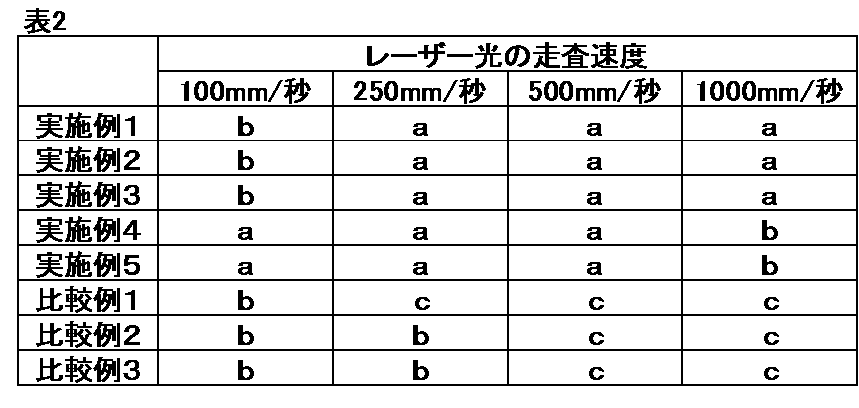
レーザー光照射部の粉体が、レーザー光照射後に凝固してセラミックス状に造形できているか否かについて、顕微鏡を用いて観察した、観察結果を表2に示す。
(Use of ceramic molding powder)
In order to clarify the difference in the molding speed of the ceramic powders in each Example and Comparative Example, each powder was spread evenly on a flat alumina substrate having a sufficient area to a thickness of about 50 μm, and then the surface was irradiated with a laser. The focal size of the laser was 100 μm, and the output was 30 W. The laser light was scanned over a length of 4.5 mm, and irradiated to draw two lines at a pitch of 50 μm. The scanning speed was 100 mm/sec, 250 mm/sec, 500 mm/sec, and 1000 mm/sec, and the melting state was compared.
The powder in the laser beam irradiated area was observed using a microscope to see whether it had solidified and been shaped into a ceramic-like substance after the laser beam irradiation. The results are shown in Table 2.
実施例1、2、3のセラミックス粉体に対してレーザー光を照射した場合は、いずれの走査速度であっても、セラミックス状の造形物を得ることができた。特に、250~1000mm/秒の走査速度の場合は、レーザー照射領域と未照射領域の境界部の幅が15μm以下であり、造形精度も高い結果となった。このように、造形精度に非常に優れたセラミックス造形物を得られた場合は、表2において「a」を記録した。他方、100mm/秒の走査速度の場合は、セラミックス造形物の境界部のラインに揺らぎがあり、その幅が40μm程度とやや大きかった。このように、セラミックス造形物を得るには十分な条件ではあるが、造形精度に少し難がある場合は、表2において「b」を記録した。 When the ceramic powders of Examples 1, 2, and 3 were irradiated with laser light, ceramic-like objects could be obtained at any scanning speed. In particular, when the scanning speed was 250 to 1000 mm/sec, the width of the boundary between the laser-irradiated area and the non-irradiated area was 15 μm or less, and the molding precision was also high. In this way, when a ceramic object with excellent molding precision was obtained, it was recorded as "a" in Table 2. On the other hand, when the scanning speed was 100 mm/sec, there was fluctuation in the boundary line of the ceramic object, and the width was somewhat large at about 40 μm. In this way, when the conditions were sufficient to obtain a ceramic object, but there were some problems with the molding precision, it was recorded as "b" in Table 2.
このように本発明の要件を満たすセラミックス造形用粉体は、大きな走査速度でもセラミックス造形が可能であり、所望の造形物を得るのに必要な時間をこれまでの2倍以上に短縮することができる。 In this way, the powder for ceramic molding that meets the requirements of the present invention makes it possible to mold ceramics even at high scanning speeds, and the time required to obtain the desired object can be more than doubled.
比較例1のセラミックス粉体に対してレーザー光を照射した場合、走査速度が100mm/秒の時はセラミックス造形物を得られたが、その境界部は不定形で、熔融が進んでいない部分も一部にあった。更に、走査速度が250mm/秒以上になると、熔融が進まずに粉体から造形物への転化が見られなかった。このように、十分な精度でセラミックス造形物が得られなかった場合は、表2において「c」を記録した。 When the ceramic powder of Comparative Example 1 was irradiated with laser light, a ceramic object was obtained when the scanning speed was 100 mm/sec, but the boundaries were amorphous and there were some areas where melting had not progressed. Furthermore, when the scanning speed was 250 mm/sec or higher, melting did not progress and no conversion from powder to a molded object was observed. In cases where a ceramic object could not be obtained with sufficient precision in this way, a "c" was recorded in Table 2.
比較例2および比較例3のセラミックス粉体に対して、レーザー光を照射した場合は、100~250mm/秒の走査速度では造形精度に優れた造形物が得られた。しかし走査速度が500mm/秒となると、粉体部分が少量含まれる造形物となり、1000mm/秒では熔融が進まずに粉体から造形物への転化が見られなかった。 When the ceramic powders of Comparative Examples 2 and 3 were irradiated with laser light, objects with excellent molding accuracy were obtained at scanning speeds of 100 to 250 mm/sec. However, when the scanning speed reached 500 mm/sec, the objects contained small amounts of powder, and at a speed of 1000 mm/sec, melting did not progress and no transformation from the powder to an object was observed.
(実施例4)
実施例1から3のセラミックス造形用粉体を図1に示すSLS装置に投入して、レーザー光の走査速度を1000mm/秒として積層造形工程を複数回繰り返すことで、所望の形状の三次元セラミックス造形物を得た。
(産業上の利用可能性)
Example 4
The ceramic modeling powders of Examples 1 to 3 were fed into the SLS apparatus shown in FIG. 1, and the additive manufacturing process was repeated multiple times with a laser light scanning speed of 1000 mm/sec to obtain a three-dimensional ceramic object of the desired shape.
(Industrial Applicability)
本発明のセラミックス造形用粉体を用いれば、精細なセラミックス造形物を三次元造形によって得ることができ、複雑形状を必要とするセラミックス部品分野において利用可能である。 By using the ceramic molding powder of the present invention, it is possible to obtain fine ceramic objects by three-dimensional molding, and it can be used in the ceramic parts field that requires complex shapes.
1 第一の粒子群に含まれる粒子
2、3 第二の粒子群に含まれる粒子
11 粉末升
12 造形ステージ部
13 リコーター部
14 スキャナ部
15 レーザー
20 基体
21 クラッディングノズル
22 粉体供給孔
23 レーザー
REFERENCE SIGNS
Claims (18)
平均粒子径が10μm以上100μm以下である第一の粒子群と、
前記レーザー光を吸収して高温化する吸収体からなる第二の粒子群と、を含み、
前記第一の粒子群に含まれる1つの粒子の表面に前記第二の粒子群に含まれる複数の粒子が付着している複合粒子を含んでおり、該複合粒子において、前記1つの粒子の粒子径より前記複数の粒子の粒子径の方が小さく、前記高温化によって前記1つの粒子が熔融することを特徴とすることを特徴とする、セラミックス粉体。 A ceramic powder used as a raw material for additive manufacturing, which is performed by irradiating a laser beam,
A first particle group having an average particle size of 10 μm or more and 100 μm or less;
A second particle group consisting of an absorber that absorbs the laser light and increases the temperature,
A ceramic powder comprising a composite particle in which a plurality of particles in the second particle group are attached to the surface of a particle in the first particle group, wherein the particle diameter of the plurality of particles in the composite particle is smaller than the particle diameter of the one particle, and the one particle is melted by the elevated temperature .
(i)請求項1乃至16のいずれか一項に記載のセラミックス粉体を所定の厚さに敷き均す工程と、
(ii)所定の領域に選択的にレーザー光を照射することにより、前記セラミックス粉体を熔融させた後に凝固させる工程と、
を有し、前記工程(i)および(ii)を繰り返して造形を行うことを特徴とする、セラミックス構造物の製造方法。 A method for manufacturing a ceramic structure using additive manufacturing, comprising:
(i) spreading the ceramic powder according to any one of claims 1 to 16 to a predetermined thickness;
(ii) selectively irradiating a predetermined area with a laser beam to melt the ceramic powder and then solidify the melted ceramic powder;
and repeating steps (i) and (ii) to form a ceramic structure.
請求項1乃至16のいずれか一項に記載のセラミックス粉体を所定の箇所に噴出させ、レーザー光を前記所定の箇所に照射して造形を行うことを特徴とする、セラミックス構造物の製造方法。 A method for manufacturing a ceramic structure using additive manufacturing, comprising:
A method for manufacturing a ceramic structure, comprising ejecting the ceramic powder according to any one of claims 1 to 16 onto a predetermined location, and irradiating the predetermined location with laser light to perform shaping.
Priority Applications (2)
| Application Number | Priority Date | Filing Date | Title |
|---|---|---|---|
| US16/366,421 US20190300441A1 (en) | 2018-04-03 | 2019-03-27 | Ceramic powder, method of manufacturing ceramic powder, and method of manufacturing ceramic object using the ceramic powder |
| JP2023169993A JP7830405B2 (en) | 2018-04-03 | 2023-09-29 | Ceramic powder, method for producing ceramic powder, and method for producing ceramic structures using ceramic powder |
Applications Claiming Priority (2)
| Application Number | Priority Date | Filing Date | Title |
|---|---|---|---|
| JP2018071442 | 2018-04-03 | ||
| JP2018071442 | 2018-04-03 |
Related Child Applications (1)
| Application Number | Title | Priority Date | Filing Date |
|---|---|---|---|
| JP2023169993A Division JP7830405B2 (en) | 2018-04-03 | 2023-09-29 | Ceramic powder, method for producing ceramic powder, and method for producing ceramic structures using ceramic powder |
Publications (3)
| Publication Number | Publication Date |
|---|---|
| JP2019181930A JP2019181930A (en) | 2019-10-24 |
| JP2019181930A5 JP2019181930A5 (en) | 2022-03-09 |
| JP7588949B2 true JP7588949B2 (en) | 2024-11-25 |
Family
ID=68338952
Family Applications (1)
| Application Number | Title | Priority Date | Filing Date |
|---|---|---|---|
| JP2019039653A Active JP7588949B2 (en) | 2018-04-03 | 2019-03-05 | Ceramic powder, method for producing ceramic powder, and method for producing ceramic structure using ceramic powder |
Country Status (1)
| Country | Link |
|---|---|
| JP (1) | JP7588949B2 (en) |
Cited By (1)
| Publication number | Priority date | Publication date | Assignee | Title |
|---|---|---|---|---|
| JP2023168446A (en) * | 2018-04-03 | 2023-11-24 | キヤノン株式会社 | Ceramic powder, ceramic powder production method and production method of ceramic structure using ceramic powder |
Families Citing this family (2)
| Publication number | Priority date | Publication date | Assignee | Title |
|---|---|---|---|---|
| JP7406900B2 (en) * | 2019-11-28 | 2023-12-28 | キヤノン株式会社 | Article manufacturing method and powder |
| CN112863972B (en) * | 2021-01-11 | 2024-02-06 | 中国科学院空天信息创新研究院 | Quick heating cathode thermal subassembly and preparation method thereof |
Family Cites Families (12)
| Publication number | Priority date | Publication date | Assignee | Title |
|---|---|---|---|---|
| JPH0730362B2 (en) * | 1987-03-20 | 1995-04-05 | 株式会社日立製作所 | Electronic component and manufacturing method thereof |
| JP3743462B2 (en) * | 1996-07-01 | 2006-02-08 | 宇部興産株式会社 | Ceramic composite material |
| US7758784B2 (en) * | 2006-09-14 | 2010-07-20 | Iap Research, Inc. | Method of producing uniform blends of nano and micron powders |
| DE102010046468B4 (en) * | 2010-09-24 | 2016-04-07 | MTU Aero Engines AG | Generative manufacturing process and powder for this purpose |
| WO2015194678A1 (en) * | 2014-06-20 | 2015-12-23 | 株式会社フジミインコーポレーテッド | Powder material to be used in powder lamination shaping and powder lamination shaping method using same |
| US11433603B2 (en) * | 2015-11-30 | 2022-09-06 | Konica Minolta, Inc. | Powder material, method for manufacturing three-dimensional modeled object, and three-dimensional-modeling device |
| WO2017104234A1 (en) * | 2015-12-14 | 2017-06-22 | コニカミノルタ株式会社 | Powdery material, method for producing three-dimensionally shaped product, and three-dimensionally shaping device |
| JP6656911B2 (en) * | 2015-12-22 | 2020-03-04 | 株式会社フジミインコーポレーテッド | Modeling materials for use in powder additive manufacturing |
| JP6857819B2 (en) * | 2017-02-13 | 2021-04-14 | 株式会社ノリタケカンパニーリミテド | Laminated molding powder |
| JP6955354B2 (en) * | 2017-03-31 | 2021-10-27 | 株式会社フジミインコーポレーテッド | Modeling material for use in additive manufacturing |
| JP7011548B2 (en) * | 2017-07-14 | 2022-01-26 | キヤノン株式会社 | Powder for ceramic molding, ceramic molding, and its manufacturing method |
| JP7039997B2 (en) * | 2017-12-26 | 2022-03-23 | 大同特殊鋼株式会社 | Manufacturing method of metal powder material |
-
2019
- 2019-03-05 JP JP2019039653A patent/JP7588949B2/en active Active
Cited By (2)
| Publication number | Priority date | Publication date | Assignee | Title |
|---|---|---|---|---|
| JP2023168446A (en) * | 2018-04-03 | 2023-11-24 | キヤノン株式会社 | Ceramic powder, ceramic powder production method and production method of ceramic structure using ceramic powder |
| JP7830405B2 (en) | 2018-04-03 | 2026-03-16 | キヤノン株式会社 | Ceramic powder, method for producing ceramic powder, and method for producing ceramic structures using ceramic powder |
Also Published As
| Publication number | Publication date |
|---|---|
| JP2019181930A (en) | 2019-10-24 |
Similar Documents
| Publication | Publication Date | Title |
|---|---|---|
| JP7830405B2 (en) | Ceramic powder, method for producing ceramic powder, and method for producing ceramic structures using ceramic powder | |
| JP7808080B2 (en) | Powder for ceramic molding, ceramic molded object, and manufacturing method thereof | |
| US11884008B2 (en) | System and method of making printed articles | |
| CN113195184B (en) | Inorganic material powder and method for producing structure | |
| JP2025126316A (en) | Method for producing ceramic article, and ceramic article | |
| CN113165207B (en) | Method for manufacturing ceramic product and ceramic product | |
| JP2019181930A (en) | Ceramic powder, ceramic powder production method and production method of ceramic structure using ceramic powder | |
| US12558810B2 (en) | Method for manufacturing ceramic article and ceramic article | |
| US12264107B2 (en) | Method for manufacturing ceramic article, metal component-containing liquid, kit for manufacturing ceramic article, and ceramic article | |
| WO2020116568A1 (en) | Ceramic article production method and ceramic article | |
| JP2019084823A (en) | Material powder for additional molding, structure, semiconductor manufacturing device component, and semiconductor manufacturing device | |
| JP7592385B2 (en) | Silicon carbide-containing articles and methods of manufacture | |
| CN118234694A (en) | Ceramic structure and method for manufacturing the same |
Legal Events
| Date | Code | Title | Description |
|---|---|---|---|
| A521 | Request for written amendment filed |
Free format text: JAPANESE INTERMEDIATE CODE: A523 Effective date: 20220301 |
|
| A621 | Written request for application examination |
Free format text: JAPANESE INTERMEDIATE CODE: A621 Effective date: 20220301 |
|
| RD01 | Notification of change of attorney |
Free format text: JAPANESE INTERMEDIATE CODE: A7421 Effective date: 20220630 |
|
| A131 | Notification of reasons for refusal |
Free format text: JAPANESE INTERMEDIATE CODE: A131 Effective date: 20221115 |
|
| A977 | Report on retrieval |
Free format text: JAPANESE INTERMEDIATE CODE: A971007 Effective date: 20221117 |
|
| A521 | Request for written amendment filed |
Free format text: JAPANESE INTERMEDIATE CODE: A523 Effective date: 20230116 |
|
| A131 | Notification of reasons for refusal |
Free format text: JAPANESE INTERMEDIATE CODE: A131 Effective date: 20230314 |
|
| A521 | Request for written amendment filed |
Free format text: JAPANESE INTERMEDIATE CODE: A523 Effective date: 20230502 |
|
| A02 | Decision of refusal |
Free format text: JAPANESE INTERMEDIATE CODE: A02 Effective date: 20230629 |
|
| A61 | First payment of annual fees (during grant procedure) |
Free format text: JAPANESE INTERMEDIATE CODE: A61 Effective date: 20241113 |
|
| R150 | Certificate of patent or registration of utility model |
Ref document number: 7588949 Country of ref document: JP Free format text: JAPANESE INTERMEDIATE CODE: R150 |