JP7520002B2 - Single domain antibodies that bind to human serum albumin - Google Patents
Single domain antibodies that bind to human serum albumin Download PDFInfo
- Publication number
- JP7520002B2 JP7520002B2 JP2021525805A JP2021525805A JP7520002B2 JP 7520002 B2 JP7520002 B2 JP 7520002B2 JP 2021525805 A JP2021525805 A JP 2021525805A JP 2021525805 A JP2021525805 A JP 2021525805A JP 7520002 B2 JP7520002 B2 JP 7520002B2
- Authority
- JP
- Japan
- Prior art keywords
- domain
- protein
- heavy chain
- antibody
- single variable
- Prior art date
- Legal status (The legal status is an assumption and is not a legal conclusion. Google has not performed a legal analysis and makes no representation as to the accuracy of the status listed.)
- Active
Links
Classifications
-
- C—CHEMISTRY; METALLURGY
- C07—ORGANIC CHEMISTRY
- C07K—PEPTIDES
- C07K16/00—Immunoglobulins [IGs], e.g. monoclonal or polyclonal antibodies
- C07K16/18—Immunoglobulins [IGs], e.g. monoclonal or polyclonal antibodies against material from animals or humans
-
- C—CHEMISTRY; METALLURGY
- C07—ORGANIC CHEMISTRY
- C07K—PEPTIDES
- C07K16/00—Immunoglobulins [IGs], e.g. monoclonal or polyclonal antibodies
- C07K16/18—Immunoglobulins [IGs], e.g. monoclonal or polyclonal antibodies against material from animals or humans
- C07K16/28—Immunoglobulins [IGs], e.g. monoclonal or polyclonal antibodies against material from animals or humans against receptors, cell surface antigens or cell surface determinants
- C07K16/2878—Immunoglobulins [IGs], e.g. monoclonal or polyclonal antibodies against material from animals or humans against receptors, cell surface antigens or cell surface determinants against the NGF-receptor/TNF-receptor superfamily, e.g. CD27, CD30, CD40, CD95
-
- A—HUMAN NECESSITIES
- A61—MEDICAL OR VETERINARY SCIENCE; HYGIENE
- A61K—PREPARATIONS FOR MEDICAL, DENTAL OR TOILETRY PURPOSES
- A61K39/00—Medicinal preparations containing antigens or antibodies
- A61K2039/505—Medicinal preparations containing antigens or antibodies comprising antibodies
-
- C—CHEMISTRY; METALLURGY
- C07—ORGANIC CHEMISTRY
- C07K—PEPTIDES
- C07K2317/00—Immunoglobulins specific features
- C07K2317/50—Immunoglobulins specific features characterized by immunoglobulin fragments
- C07K2317/51—Complete heavy chain or Fd fragment, i.e. VH + CH1
-
- C—CHEMISTRY; METALLURGY
- C07—ORGANIC CHEMISTRY
- C07K—PEPTIDES
- C07K2317/00—Immunoglobulins specific features
- C07K2317/50—Immunoglobulins specific features characterized by immunoglobulin fragments
- C07K2317/56—Immunoglobulins specific features characterized by immunoglobulin fragments variable (Fv) region, i.e. VH and/or VL
-
- C—CHEMISTRY; METALLURGY
- C07—ORGANIC CHEMISTRY
- C07K—PEPTIDES
- C07K2317/00—Immunoglobulins specific features
- C07K2317/50—Immunoglobulins specific features characterized by immunoglobulin fragments
- C07K2317/56—Immunoglobulins specific features characterized by immunoglobulin fragments variable (Fv) region, i.e. VH and/or VL
- C07K2317/565—Complementarity determining region [CDR]
-
- C—CHEMISTRY; METALLURGY
- C07—ORGANIC CHEMISTRY
- C07K—PEPTIDES
- C07K2317/00—Immunoglobulins specific features
- C07K2317/50—Immunoglobulins specific features characterized by immunoglobulin fragments
- C07K2317/56—Immunoglobulins specific features characterized by immunoglobulin fragments variable (Fv) region, i.e. VH and/or VL
- C07K2317/569—Single domain, e.g. dAb, sdAb, VHH, VNAR or nanobody®
-
- C—CHEMISTRY; METALLURGY
- C07—ORGANIC CHEMISTRY
- C07K—PEPTIDES
- C07K2317/00—Immunoglobulins specific features
- C07K2317/90—Immunoglobulins specific features characterized by (pharmaco)kinetic aspects or by stability of the immunoglobulin
- C07K2317/94—Stability, e.g. half-life, pH, temperature or enzyme-resistance
Landscapes
- Chemical & Material Sciences (AREA)
- Health & Medical Sciences (AREA)
- Organic Chemistry (AREA)
- Immunology (AREA)
- Medicinal Chemistry (AREA)
- Biophysics (AREA)
- General Health & Medical Sciences (AREA)
- Genetics & Genomics (AREA)
- Biochemistry (AREA)
- Molecular Biology (AREA)
- Proteomics, Peptides & Aminoacids (AREA)
- Life Sciences & Earth Sciences (AREA)
- Peptides Or Proteins (AREA)
- Micro-Organisms Or Cultivation Processes Thereof (AREA)
- Medicinal Preparation (AREA)
- Medicines Containing Antibodies Or Antigens For Use As Internal Diagnostic Agents (AREA)
Description
本発明は、ヒト血清アルブミンに結合する免疫グロブリン単一可変ドメイン、特に、ヒト免疫グロブリン単一可変重鎖ドメインに関する。 The present invention relates to immunoglobulin single variable domains, in particular human immunoglobulin single variable heavy chain domains, that bind to human serum albumin.
タンパク質及びペプチドの薬物動態は、吸収、生体内分布、代謝、及び排出のパラメータによって制御されている。タンパク質及びペプチドの最も一般的な排出経路には、より大きなタンパク質では肝細胞によるエンドサイトーシス及び膜輸送を介した排出、より小さなタンパク質及びペプチドでは腎臓による糸球体濾過が含まれる。 The pharmacokinetics of proteins and peptides is controlled by the parameters of absorption, biodistribution, metabolism, and excretion. The most common excretion pathways for proteins and peptides include excretion via endocytosis and membrane trafficking by hepatocytes for larger proteins and glomerular filtration by the kidney for smaller proteins and peptides.
治療及び/又は診断目的に有用であり得る活性を備えた多くの薬物は、投与されると速やかに体から排除されるため、その価値は限定されてしまう。例えば、治療上有用な活性を有する多くのポリペプチドは、腎臓を介して循環から速やかに排出されてしまう。 Many drugs with potentially useful activities for therapeutic and/or diagnostic purposes are rapidly cleared from the body after administration, limiting their value. For example, many polypeptides with therapeutically useful activities are rapidly cleared from the circulation via the kidneys.
したがって、所望の治療効果を達成するために、大用量を投与しなければならない。薬物動態特性が改善された、改善治療薬及び診断薬が必要とされている。 Therefore, large doses must be administered to achieve the desired therapeutic effect. Improved therapeutic and diagnostic agents with improved pharmacokinetic properties are needed.
そのため、より小さなタンパク質及びペプチドの薬物動態を改善するために、タンパク質及びペプチドのサイズ及び流体力学的半径を大きくすること、標的タンパク質及びペプチドの負電荷を増やすこと、又はアルブミンへの結合によってペプチド及びタンパク質の血清タンパク質結合のレベルを高めることを含む、様々な戦略が採用されてきた。これは、慢性状態において重要となる可能性がある。内在性アルブミンを標的とする半減期延長部分によって、長時間曝露が達成される。これには、生物学的に活性のあるタンパク質又はペプチドのヒト血清アルブミン(HSA)への融合、ヒト免疫グロブリン(Ig)Gの定常断片(Fc)ドメインへの融合、又はXTEN等の非構造化ポリペプチドへの融合が含まれる(Stroh 「Fusion Proteins for Half-Life Extension of Biologics as a Strategy to Make Biobetters BioDrugs」2015; 29(4): 215~239に概説されている)。 Therefore, various strategies have been employed to improve the pharmacokinetics of smaller proteins and peptides, including increasing the size and hydrodynamic radius of the proteins and peptides, increasing the negative charge of the target proteins and peptides, or increasing the level of serum protein binding of the peptides and proteins by binding to albumin, which may be important in chronic conditions. Prolonged exposure is achieved by half-life extending moieties that target endogenous albumin. These include fusion of biologically active proteins or peptides to human serum albumin (HSA), to the constant fragment (Fc) domain of human immunoglobulin (Ig)G, or to unstructured polypeptides such as XTEN (reviewed in Stroh "Fusion Proteins for Half-Life Extension of Biologics as a Strategy to Make Biobetters BioDrugs" 2015; 29(4): 215-239).
異なる適用は異なる半減期を必要とするので、オーダーメイドの半減期延長分子を提供することが依然として必要とされている。本発明は、この必要性に取り組むことを目指している。 Because different applications require different half-lives, there remains a need to provide tailor-made half-life extending molecules. The present invention aims to address this need.
本発明は、HSAに結合する免疫グロブリン単一可変ドメイン、特に、ヒト免疫グロブリン単一可変重鎖ドメイン、例えば、特に、再配置されていないヒトV、D、J遺伝子セグメントを発現しているトランスジェニックマウスから得られたか、又は得ることができるヒト免疫グロブリン単一可変重鎖ドメインに関する。 The present invention relates to immunoglobulin single variable domains, in particular human immunoglobulin single variable heavy chain domains, that bind to HSA, such as human immunoglobulin single variable heavy chain domains that have been obtained or can be obtained from transgenic mice expressing, in particular, unrearranged human V, D, J gene segments.
一態様では、本発明は、配列番号1又はそれと少なくとも75%、80%、90%、若しくは95%の配列同一性/相同性を有する配列を含むか、又はそれからなる、HSAに結合する免疫グロブリン単一可変ドメインに関する。本発明はまた、配列番号1のバリアントであり、アミノ酸置換、例えば、配列番号1と比較して1から20個のアミノ酸置換を有する、HSAに結合する免疫グロブリン単一可変ドメインに関する。本発明は、配列番号19若しくは20、又はそれらと少なくとも75%、80%、90%、若しくは95%の配列同一性/相同性を有する配列を含むか、又はそれからなる、HSAに結合する免疫グロブリン単一可変ドメインに関する。 In one aspect, the invention relates to an immunoglobulin single variable domain that binds to HSA, comprising or consisting of SEQ ID NO: 1 or a sequence having at least 75%, 80%, 90% or 95% sequence identity/homology thereto. The invention also relates to an immunoglobulin single variable domain that binds to HSA, which is a variant of SEQ ID NO: 1 and has amino acid substitutions, for example 1 to 20 amino acid substitutions compared to SEQ ID NO: 1. The invention relates to an immunoglobulin single variable domain that binds to HSA, comprising or consisting of SEQ ID NO: 19 or 20 or a sequence having at least 75%, 80%, 90% or 95% sequence identity/homology thereto.
別の態様では、本発明はまた、タンパク質を本明細書で記載したような免疫グロブリン単一可変ドメインに結合することを含む、タンパク質の半減期を延長する方法に関する。 In another aspect, the present invention also relates to a method for extending the half-life of a protein, comprising conjugating the protein to an immunoglobulin single variable domain as described herein.
本発明はまた、本明細書で記載した前記免疫グロブリン単一可変ドメインが融合タンパク質中の前記治療部分に連結されると治療部分の半減期が延長する、本明細書で記載したような免疫グロブリン単一可変ドメインの使用に関する。 The present invention also relates to the use of an immunoglobulin single variable domain as described herein, whereby the half-life of a therapeutic moiety is extended when said immunoglobulin single variable domain as described herein is linked to said therapeutic moiety in a fusion protein.
本発明は、別の標的に結合する別の部分と、例えば、ペプチドリンカーで連結した、配列番号1又はそれと少なくとも75%、80%、90%、若しくは95%の配列同一性/相同性を有する配列を含むか、又はそれからなる、HSAに結合する免疫グロブリン単一可変ドメインを含む融合タンパク質に関する。 The present invention relates to a fusion protein comprising an immunoglobulin single variable domain that binds to HSA, comprising or consisting of SEQ ID NO:1 or a sequence having at least 75%, 80%, 90% or 95% sequence identity/homology thereto, linked to another moiety that binds to another target, for example by a peptide linker.
別の態様では、本発明は、本明細書で記載したような免疫グロブリン単一可変ドメイン、又は本明細書で記載したようなタンパク質若しくは構築物を含む医薬組成物に関する。 In another aspect, the invention relates to a pharmaceutical composition comprising an immunoglobulin single variable domain as described herein, or a protein or construct as described herein.
本発明はまた、本明細書で記載したようなアミノ酸配列をコードする核酸配列に関する。 The present invention also relates to nucleic acid sequences encoding the amino acid sequences described herein.
本発明は更に、本明細書で記載したような核酸配列を含むベクターに関する。 The present invention further relates to a vector comprising a nucleic acid sequence as described herein.
本発明はまた、本明細書で記載したような核酸配列、又は本明細書で記載したようなベクターを含む宿主細胞に関する。 The present invention also relates to a host cell comprising a nucleic acid sequence as described herein, or a vector as described herein.
本発明はまた、本明細書で記載したような免疫グロブリン単一可変ドメイン、又は本明細書で記載したようなタンパク質若しくは構築物、又は本明細書で記載したような医薬組成物を含むキットに関する。 The present invention also relates to a kit comprising an immunoglobulin single variable domain as described herein, or a protein or construct as described herein, or a pharmaceutical composition as described herein.
ここでは、本発明の実施形態を更に説明する。以下の部分では、様々な実施形態を説明する。このように設定された各態様は、異議が明示されていない限り、その他のいかなる態様又は態様類と組み合わせてもよい。 Now, embodiments of the present invention will be further described. In the following sections, various embodiments are described. Each aspect thus set out may be combined with any other aspect or aspects, unless expressly stated to the contrary.
一般的に、本明細書で記載した細胞や組織の培養、病理学、腫瘍学、分子生物学、免疫学、微生物学、遺伝学、及びタンパク質や核酸の化学、及びハイブリダイゼーションに関連して使用される名称及びそれらの技術は、当技術分野でよく知られており、通常使用されている。本開示の方法及び技術は一般的に、当技術分野でよく知られている従来の方法に従って、並びに、他に指示されていない限り、本明細書全体で引用され、議論されている様々な一般的な、及びより具体的な文献に記載されている通りに、実行される。例えば、Green及びSambrookら、Molecular Cloning: A Laboratory Manual、第4編、Cold Spring Harbor Laboratory Press, Cold Spring Harbor, N.Y. (2012); Therapeutic Monoclonal Antibodies: From Bench to Clinic, Zhiqiang An (編集), Wiley, (2009);並びにAntibody Engineering,第2編、第1巻及び第2巻、Ontermann及びDubel編、Springer-Verlag, Heidelberg (2010)を参照。 Generally, the nomenclature used in connection with and techniques of cell and tissue culture, pathology, oncology, molecular biology, immunology, microbiology, genetics, and protein and nucleic acid chemistry, and hybridization described herein are well known and commonly used in the art. The methods and techniques of the present disclosure are generally performed according to conventional methods well known in the art and, unless otherwise indicated, as described in various general and more specific references cited and discussed throughout this specification. See, for example, Green and Sambrook et al., Molecular Cloning: A Laboratory Manual, 4th ed., Cold Spring Harbor Laboratory Press, Cold Spring Harbor, N.Y. (2012); Therapeutic Monoclonal Antibodies: From Bench to Clinic, Zhiqiang An (ed.), Wiley, (2009); and Antibody Engineering, 2nd ed., vols. 1 and 2, Ontermann and Dubel eds., Springer-Verlag, Heidelberg (2010).
酵素反応及び精製技術は、製造元の仕様書に従って、当技術分野で通常遂行されているように、又は本明細書で記載したように実行する。本明細書で記載されている分析化学、有機合成化学、及び医薬化学に関連して使用されている名称、並びにそれらの実験的手法及び技術は、当技術分野でよく知られており、通常使用されているものである。標準的技術は、化学合成、化学分析、医薬品調製、製剤化、及び送達、及び患者の治療に使用されている。 Enzymatic reactions and purification techniques are performed according to manufacturer's specifications, as commonly accomplished in the art, or as described herein. The nomenclature used in connection with, and the experimental procedures and techniques of, analytical chemistry, synthetic organic chemistry, and medicinal chemistry described herein are those well known and commonly used in the art. Standard techniques are used for chemical synthesis, chemical analysis, pharmaceutical preparation, formulation, and delivery, and treatment of patients.
本発明は、ヒト血清アルブミン(HSA)に結合するアミノ酸配列及びこのようなアミノ酸配列を含むタンパク質等の結合分子に関する。特に、本発明は、本明細書で記載したようなアミノ酸を有し、本明細書で記載したような治療方法及び使用、並びに医薬製剤に利用することができる、単一ドメイン抗体、免疫グロブリン単一可変ドメイン、特にヒト免疫グロブリン単一可変重鎖ドメイン(VH)抗体に関する。 The present invention relates to binding molecules such as amino acid sequences and proteins comprising such amino acid sequences which bind to human serum albumin (HSA). In particular, the present invention relates to single domain antibodies, immunoglobulin single variable domains, in particular human immunoglobulin single variable heavy domain ( VH ) antibodies, having the amino acids as described herein and which can be utilized in the methods of treatment and uses and pharmaceutical formulations as described herein.
本明細書で記載した単一ドメイン抗体は、野生型ヒト血清アルブミン(UniProtアクセッション番号Q56G89)に特異的に結合する。野生型ヒト血清アルブミンのアミノ酸配列を以下に示す(配列番号5)。
MKWVTFISLL FLFSSAYSRG VFRRDAHKSE VAHRFKDLGE ENFKALVLIA FAQYLQQCPF EDHVKLVNEV TEFAKTCVAD ESAENCDKSL HTLFGDKLCT VATLRETYGE MADCCAKQEP ERNECFLQHK DDNPNLPRLV RPEVDVMCTA FHDNEETFLK KYLYEIARRH PYFYAPELLF FAKRYKAAFT ECCQAADKAA CLLPKLDELR DEGKASSAKQ GLKCASLQKF GERAFKAWAV ARLSQRFPKA EFAEVSKLVT DLTKVHTECC HGDLLECADD RADLAKYICE NQDSISSKLK ECCEKPLLEK SHCIAEVEND EMPADLPSLA ADFVGSKDVC KNYAEAKDVF LGMFLYEYAR RHPDYSVVLL LRLAKTYETT LEKCCAAADP HECYAKVFDE FKPLVEEPQN LIKQNCELFE QLGEYKFQNA LLVRYTKKVP QVSTPTLVEV SRNLGKVGSK CCKHPEAKRM PCAEDCLSVF LNQLCVLHEK TPVSDRVTKC CTESLVNGRP CFSALEVDET YVPKEFNAET FTFHADICTL SEKERQIKKQ TALVELVKHK PKATKEQLKA VMDDFAAFVE KCCKADDKET CFAEEGKKLV AASQAALGL
The single domain antibodies described herein specifically bind to wild-type human serum albumin (UniProt Accession No. Q56G89), the amino acid sequence of which is shown below (SEQ ID NO:5).
MKWVTFISLL FLFSSAYSRG VFRRDAHKSE VAHRFKDLGE ENFKALVLIA FAQYLQQCPF EDHVKLVNEV TEFAKTCVAD ESAENCDKSL HTLFGDKLCT VATLRETYGE MADCCAKQEP ERNECFLQHK DDNPNLPRLV RPEVDVMCTA FHDNEETFLK KYLYEIARRH PYFYAPELLF FAKRYKAAFT ECCQAADKAA CLLPKLDELR DEGKASSAKQ GLKCASLQKF GERAFKAWAV ARLSQRFPKA EFAEVSKLVT DLTKVHTECC HGDLLECADD RADLAKYICE NQDSISSKLK ECCEKPLLEK SHCIAEVEND EMPADLPSLA ADFVGSKDVC KNYAEAKDVF LGMFLYEYAR RHPDYSVVLL LRLAKTYETT LEKCCAAADP HECYAKVFDE FKPLVEEPQN LIKQNCELFE QLGEYKFQNA LLVRYTKKVP QVSTPTLVEV SRNLGKVGSK CCKHPEAKRM PCAEDCLSVF LNQLCVLHEK TPVSDRVTKC CTESLVNGRP CFSALEVDET YVPKEFNAET FTFHADICTL SEKERQIKKQ TALVELVKHK PKATKEQLKA VMDD FAAFVE KCCKADDKET CFAEEGKKLV AASQAALGL
ヒト血清アルブミン(HSA、2BXN)は、血漿タンパク質の約60%を占めている。HSAは、3つの相同ドメイン(I、II、及びIII)を組み入れた長さ585アミノ酸の単一鎖から構成されている。ドメインIは残基5~197から構成され、ドメインIIは残基198~382を含み、ドメインIIIは残基383~569から形成されている。各ドメインは、A及びBと呼ばれる2つのサブドメインから構成されている(IA;残基5~107、IIA;残基108~197、IIA;残基198~296、IIB;残基297~382、IIIA;残基383~494、IIIB;残基495~569)。 Human serum albumin (HSA, 2BXN) constitutes approximately 60% of plasma proteins. HSA is composed of a single chain 585 amino acids in length incorporating three homologous domains (I, II, and III). Domain I is composed of residues 5-197, domain II includes residues 198-382, and domain III is formed by residues 383-569. Each domain is composed of two subdomains, designated A and B (IA; residues 5-107; IIA; residues 108-197; IIA; residues 198-296; IIB; residues 297-382; IIIA; residues 383-494; IIIB; residues 495-569).
目的の抗原、例えばヒト血清アルブミンに「結合する」又は「結合することができる」本発明の単一ドメイン抗体(sdAb)、免疫グロブリン単一可変ドメイン、又はタンパク質は、十分な親和性で抗原に結合するものであり、したがって、本明細書で記載したような単一ドメイン抗体は抗原ヒト血清アルブミンを発現している細胞又は組織を標的とした治療薬として有用である。 A single domain antibody (sdAb), immunoglobulin single variable domain, or protein of the invention that "binds" or is "capable of binding" to an antigen of interest, e.g., human serum albumin, is one that binds to the antigen with sufficient affinity such that single domain antibodies as described herein are useful as therapeutic agents targeted to cells or tissues expressing the antigen human serum albumin.
本明細書で記載した単一ドメイン抗体、免疫グロブリン単一可変ドメイン、又はタンパク質は、ヒト血清アルブミンに特異的に結合する。言い換えると、ヒト血清アルブミン抗原への結合は、非特異的な相互作用とは測定可能なほど異なっている。実施例で示したように、本発明の単一ドメイン抗体は、マウスヒト血清アルブミンとは交差反応しない。好ましくは、本発明の単一ドメイン抗体は、ヒト血清アルブミンに結合し、実施例に示したようにサル血清アルブミンにも結合する。 The single domain antibodies, immunoglobulin single variable domains, or proteins described herein bind specifically to human serum albumin. In other words, binding to the human serum albumin antigen is measurably distinct from non-specific interactions. As shown in the Examples, the single domain antibodies of the invention do not cross-react with mouse human serum albumin. Preferably, the single domain antibodies of the invention bind to human serum albumin and, as shown in the Examples, also bind to monkey serum albumin.
本明細書で使用したように「抗体」という用語は、2本の重鎖(H)及び2本の軽鎖(L)の4本のポリペプチド鎖からなる免疫グロブリン(Ig)分子、又はその抗原結合部分、或いはIg分子の本質的なエピトープ結合特性を保持しているその任意の機能的断片、変異体、バリアント、又は派生物を広く意味している。 As used herein, the term "antibody" refers broadly to an immunoglobulin (Ig) molecule consisting of four polypeptide chains, two heavy (H) and two light (L) chains, or an antigen-binding portion thereof, or any functional fragment, mutant, variant, or derivative thereof that retains the essential epitope-binding properties of an Ig molecule.
完全長抗体では、各重鎖は、重鎖可変領域又はドメイン(本明細書ではHCVRと略す)及び重鎖定常領域から構成されている。重鎖定常領域は、3つのドメインCH1、CH2、及びCH3から構成されている。各軽鎖は、軽鎖可変領域又はドメイン(本明細書ではLCVRと略す)及び軽鎖定常領域から構成されている。軽鎖定常領域は、1つのドメイン、CLで構成されている。 In full-length antibodies, each heavy chain is composed of a heavy chain variable region or domain (abbreviated herein as HCVR) and a heavy chain constant region. The heavy chain constant region is composed of three domains, C H 1, C H 2, and C H 3. Each light chain is composed of a light chain variable region or domain (abbreviated herein as LCVR) and a light chain constant region. The light chain constant region is composed of one domain, C L.
重鎖及び軽鎖の可変領域は、フレームワーク領域(FR)と呼ばれるより保存された領域が介在した、相補性決定領域(CDR)と呼ばれる超可変性の領域に更に分けることができる。各重鎖及び軽鎖の可変領域は、アミノ末端からカルボキシ末端まで、以下の順番:FR1、CDR1、FR2、CDR2、FR3、CDR3、FR4で配置された3個のCDR及び4個のFRから構成されている。 The heavy and light chain variable regions can be further divided into regions of hypervariability called complementarity determining regions (CDRs) interspersed with more conserved regions called framework regions (FRs). Each heavy and light chain variable region is composed of three CDRs and four FRs arranged from the amino terminus to the carboxy terminus in the following order: FR1, CDR1, FR2, CDR2, FR3, CDR3, FR4.
免疫グロブリン分子は、いかなる型(例えば、IgG、IgE、IgM、IgD、IgA、及びIgY)、クラス(例:IgG1、IgG2、IgG3、IgG4、IgA1、及びIgA2)又はサブクラスであってもよい。「CDR」という用語は、抗体可変配列内の相補性決定領域を意味する。重鎖及び軽鎖の可変領域それぞれに3つのCDRがあり、可変領域のそれぞれについてはCDR1、CDR2、及びCDR3と呼ばれている。「CDRセット」という用語は、抗原に結合することができる単一可変領域で生じる3つのCDRの群を意味する。これらのCDRの正確な境界は、当技術分野で知られている様々なシステムに従って様々に定義することができる。 Immunoglobulin molecules may be of any type (e.g., IgG, IgE, IgM, IgD, IgA, and IgY), class (e.g., IgG1, IgG2, IgG3, IgG4, IgA1, and IgA2), or subclass. The term "CDR" refers to the complementarity determining region within an antibody variable sequence. There are three CDRs in each of the heavy and light chain variable regions, designated CDR1, CDR2, and CDR3 for each variable region. The term "CDR set" refers to a group of three CDRs occurring in a single variable region capable of binding to an antigen. The exact boundaries of these CDRs can be variously defined according to different systems known in the art.
Kabatの相補性判定領域(CDR)は、配列の可変性に基づいており、最も一般的に使用されている(Kabatら、(1971) Ann. NY Acad. Sci. 190:382~391及びKabatら、(1991) Sequences of Proteins of Immunological Interest,第5編、U.S. Department of Health and Human Services, NIH 出版番号91-3242)。Chothiaは、代わりに構造的ループの位置について言及している(Chothia及びLesk J. Mol. Biol. 196:901~917(1987))。可変ドメインの残基について言及する場合には、一般的にKabatナンバリングシステムが使用されている(大体、軽鎖の残基1~107、及び重鎖の残基1~113)。別のシステムは、ImMunoGeneTics(IMGT)のナンバリング形式である。IMGTナンバリング形式は、Lefrancら、Dev. Comp. Immunol., 29, 185~203(2005)に記載されている。 The Kabat complementarity determining regions (CDRs) are based on sequence variability and are the most commonly used (Kabat et al. (1971) Ann. NY Acad. Sci. 190:382-391 and Kabat et al. (1991) Sequences of Proteins of Immunological Interest, 5th ed., U.S. Department of Health and Human Services, NIH Publication No. 91-3242). Chothia refers instead to the location of structural loops (Chothia and Lesk J. Mol. Biol. 196:901-917 (1987)). When referring to residues in the variable domain, the Kabat numbering system is commonly used (approximately residues 1-107 for the light chain and residues 1-113 for the heavy chain). An alternative system is the ImMunoGeneTics (IMGT) numbering scheme. The IMGT numbering format is described in Lefranc et al., Dev. Comp. Immunol., 29, 185-203 (2005).
本明細書ではKabatによって記載されたシステムを使用する。本明細書では「Kabatナンバリング」、「Kabat定義」及び「Kabat標識」という用語は同義に使用されている。これらの用語は、当技術分野で承認されており、抗体の重及び軽鎖可変領域におけるその他のアミノ酸残基よりも可変性の高い(すなわち、超可変性の)アミノ酸残基又は抗原結合部分をナンバリングするシステムを意味している。 The system described by Kabat is used herein. The terms "Kabat numbering," "Kabat definition," and "Kabat label" are used interchangeably herein. These terms are art-recognized and refer to a system of numbering amino acid residues or antigen-binding moieties that are more variable (i.e., hypervariable) than other amino acid residues in the heavy and light chain variable regions of an antibody.
「抗原結合部位」という用語は、抗原に特異的に結合する領域を含む抗体の一部又は抗体断片を意味する。抗原結合部位は、1つ又は複数の抗体可変ドメインによって形成されていてもよい。抗原結合部位は典型的に、抗体又は抗体断片の関連するVH及びVL内に含まれている。 The term "antigen-binding site" refers to the part of an antibody or antibody fragment that comprises the area that specifically binds to an antigen. An antigen-binding site may be formed by one or more antibody variable domains. An antigen-binding site is typically contained within the relevant VH and VL of an antibody or antibody fragment.
抗体断片は抗体の一部、例えば、F(ab')2、Fab、Fv、scFv、重鎖、軽鎖、可変重鎖(VH)、可変軽鎖(VL)ドメイン等である。完全長抗体の機能的断片は、完全な抗体の標的特異性を保持している。したがって、Fab(断片、抗体)、scFv(一本鎖可変鎖断片)及び単一ドメイン抗体(dAb)等の組換え機能抗体断片は、mAbをベースにした治療薬の代わりとなる治療薬を開発するために使用されてきた。 An antibody fragment is a portion of an antibody, such as F(ab')2, Fab, Fv, scFv, heavy chain, light chain, variable heavy ( VH ), variable light ( VL ) domains, etc. Functional fragments of a full-length antibody retain the target specificity of the complete antibody. Thus, recombinant functional antibody fragments such as Fab (fragment, antibody), scFv (single-chain variable fragment) and single domain antibodies (dAb) have been used to develop alternative therapeutics to mAb-based therapeutics.
scFv断片(約25kDa)は、2つの可変ドメイン、VH及びVLから構成されている。本来、VH及びVLドメインは、疎水性相互作用を介して非共有的に関連づけられ、解離する傾向がある。しかし、安定した断片は、単鎖Fv(scFv)を生成するために、親水性可撓性リンカーでドメインを連結することによって操作することができる。 The scFv fragment (approximately 25 kDa) is composed of two variable domains, VH and VL . In nature, the VH and VL domains are non-covalently associated through hydrophobic interactions and tend to dissociate. However, stable fragments can be engineered by linking the domains with a hydrophilic flexible linker to generate single chain Fvs (scFvs).
最小抗原結合断片は単一変数断片、すなわち、可変重鎖(VH)又は可変軽鎖(VL)ドメインである。VH及びVLドメインはそれぞれ、抗原に結合することができる。軽鎖/重鎖パートナーそれぞれへの結合、又は完全な抗体のその他の部分の実際の存在は、標的結合のために必要ではない。1つの単一ドメイン(VH又はVLドメインに対応する)のサイズに低減された抗体の抗原結合実体は一般的に、「単一ドメイン抗体」又は「免疫グロブリン単一可変ドメイン」と呼ばれる。したがって、単一ドメイン抗体(約12~15kDa)は、VH又はVLドメインのいずれを有し、すなわち、完全な抗体のその他の部分を有していない。元々軽鎖がないラクダ科の重鎖のみ抗体から得られた単一ドメイン抗体並びにヒト重鎖ドメインを有する単一ドメイン抗体について記載されたことがある。抗原結合単一VHドメインはまた、例えば、免疫したマウスの脾臓由来のゲノムDNAから増幅されたマウスVH遺伝子のライブラリーから特定され、大腸菌(E.coli)中で発現させたことがある(Wardら、1989, Nature 341: 544~546)。Wardらは、単離された単一VHドメインを「ドメイン抗体」として「dAb」と名付けた。「dAb」という用語は一般的に、抗原に特異的に結合する単一免疫グロブリン可変ドメイン(VH、VHH、又はVL)ポリペプチドを意味する。治療における使用では、ヒト単一ドメイン抗体がラクダ科由来のVHHよりも好ましいのは、主に患者に投与したとき免疫応答を誘発する可能性があまりないからである。 The smallest antigen-binding fragments are single variable fragments, i.e. variable heavy ( VH ) or variable light ( VL ) domains. Each of the VH and VL domains is capable of binding to the antigen. Binding to the respective light/heavy chain partner, or indeed the presence of the other parts of the complete antibody, is not necessary for target binding. Antigen-binding entities of antibodies reduced to the size of one single domain (corresponding to a VH or VL domain) are commonly called "single domain antibodies" or "immunoglobulin single variable domains". Thus, single domain antibodies (approximately 12-15 kDa) have either a VH or a VL domain, i.e. no other parts of the complete antibody. Single domain antibodies derived from camelid heavy chain-only antibodies originally devoid of light chains, as well as single domain antibodies with human heavy chain domains, have been described. Antigen-binding single VH domains have also been identified, for example, from libraries of mouse VH genes amplified from genomic DNA from the spleens of immunized mice and expressed in E. coli (Ward et al., 1989, Nature 341: 544-546). Ward et al. termed the isolated single VH domains "dAbs" as "domain antibodies". The term "dAb" generally refers to a single immunoglobulin variable domain ( VH , VHH , or VL ) polypeptide that specifically binds to an antigen. For therapeutic use, human single domain antibodies are preferred over camelid-derived VHHs , primarily because they are less likely to elicit an immune response when administered to a patient.
「[単一ドメイン抗体(sdAb)、単一可変ドメイン、単一可変ドメイン抗体、又は免疫グロブリン単一可変ドメイン(ISV)」という用語は全て、当技術分野ではよく知られており、標的抗原に結合する抗体の単一可変断片について述べている。これらの用語は、本明細書では同義に使用されている。「単一重鎖ドメイン抗体、単一可変重鎖ドメイン、単一可変重鎖ドメイン、免疫グロブリン単一重鎖可変ドメイン(ISV)、免疫グロブリン単一重鎖可変ドメイン、ヒトVH単一ドメイン」は、本明細書において同義に使用されており、軽鎖又はその他の抗体断片がなくても抗原への結合特異性を保持していて、単離された形態で使用される完全な抗体の単一重鎖可変断片について述べており、すなわち完全長抗体の一部ではない。単一可変重鎖ドメイン抗体は、完全長抗体のいかなるその他の鎖もドメインも含まず、いかなる軽鎖も定常ドメインも有さない。したがって、軽鎖が存在しなくても抗原に結合することができる。 The terms "single domain antibody (sdAb), single variable domain, single variable domain antibody, or immunoglobulin single variable domain (ISV)" are all well known in the art and describe a single variable fragment of an antibody that binds to a target antigen. These terms are used interchangeably herein. "Single heavy domain antibody, single variable heavy domain, single variable heavy domain, immunoglobulin single heavy variable domain (ISV), immunoglobulin single heavy variable domain, human VH single domain" are used interchangeably herein and describe a single heavy chain variable fragment of an intact antibody that retains binding specificity to an antigen in the absence of light chains or other antibody fragments and is used in isolated form, i.e., is not part of a full-length antibody. Single variable heavy domain antibodies do not include any other chains or domains of a full-length antibody and do not have any light chains or constant domains. They are therefore capable of binding to an antigen in the absence of light chains.
一態様では、本発明は、ヒト血清アルブミンに結合する免疫グロブリン単一可変ドメイン、詳細には免疫グロブリン単一重鎖可変ドメインに関する。以下に説明したように、実施形態はHSA抗原に結合する単一可変重鎖ドメイン抗体/免疫グロブリン単一可変重鎖ドメインに関する。そのため、単一可変重鎖ドメイン抗体は、軽鎖がなくても、HSAに結合することができる。ヒト単一可変重鎖ドメイン抗体(「VH単一ドメイン抗体/単一VHドメイン抗体」)が特に好ましい。このような結合分子はまた、本明細書ではHumabody(登録商標)と称される。Humabody(登録商標)は、Crescendo Biologics社の登録商標である。 In one aspect, the present invention relates to immunoglobulin single variable domains, in particular immunoglobulin single variable heavy domains, that bind human serum albumin. As explained below, embodiments relate to single variable heavy domain antibodies/immunoglobulin single variable heavy domains that bind to the HSA antigen. Single variable heavy domain antibodies are therefore able to bind to HSA even in the absence of a light chain. Human single variable heavy domain antibodies (" VH single domain antibodies/single VH domain antibodies") are particularly preferred. Such binding molecules are also referred to herein as Humabody®. Humabody® is a registered trademark of Crescendo Biologics.
したがって、一部の実施形態では、単離された結合剤/分子は、少なくとも1つの単一ドメイン抗体を含むか、又はそれらからなり、前記ドメインがヒト免疫グロブリン可変重鎖ドメインであり、それらはVLドメインやその他の抗体断片がなく、標的抗原に結合する。 Thus, in some embodiments, the isolated binding agent/molecule comprises or consists of at least one single domain antibody, which domain is a human immunoglobulin variable heavy chain domain, which is free of VL domains or other antibody fragments, and which binds to a target antigen.
「単離した」という用語は、その天然の環境から単離された部分を意味する。例えば、「単離した」という用語は、その他の単一ドメイン抗体、抗体類、又は抗体断片を実質的に含まない単一ドメイン抗体を意味する。更に、単離された単一ドメイン抗体は、その他の細胞物質及び/又は化学物質を実質的に含んでいなくてもよい。 The term "isolated" refers to a moiety that is isolated from its natural environment. For example, the term "isolated" refers to a single domain antibody that is substantially free of other single domain antibodies, antibodies, or antibody fragments. Furthermore, an isolated single domain antibody may be substantially free of other cellular material and/or chemicals.
各VHドメイン抗体は、アミノ末端からカルボキシ末端まで、以下の順番:FR1-CDR1-FR2-CDR2-FR3-CDR3-FR4で配置された3個のCDR及び4個のFRを含む。したがって、本発明の一実施形態では、ドメインは、以下の式FR1-CDR1-FR2-CDR2-FR3-CDR3-FR4のヒト可変重鎖(VH)ドメインである。 Each VH domain antibody comprises three CDRs and four FRs arranged from amino-terminus to carboxy-terminus in the following order: FR1-CDR1-FR2-CDR2-FR3-CDR3-FR4. Thus, in one embodiment of the invention, the domain is a human variable heavy chain ( VH ) domain of the following formula: FR1-CDR1-FR2-CDR2-FR3-CDR3-FR4.
本発明の単一ドメイン抗体に対して、C又はN末端のVHフレームワーク配列に修飾を加えて、その特性を改善してもよい。例えば、VHドメインは、C又はN末端伸長を含んでいてもよい。C末端伸長は、残基VTVSSで終わるVHドメイン(配列番号6)のC末端に付加することができる。 The single domain antibodies of the invention may be modified in the C- or N-terminal VH framework sequences to improve their properties. For example, the VH domain may comprise a C- or N-terminal extension. A C-terminal extension may be added to the C-terminus of the VH domain (SEQ ID NO: 6) ending at residues VTVSS.
一実施形態では、本発明の単一ドメイン抗体は、1から50残基、例えば、1から10残基のC末端伸長、例えば、1、2、3、4、5、6、7、8、9若しくは10、1~20、1~30又は1~40個の付加アミノ酸を含んでいる。一実施形態では、本発明の単一ドメイン抗体は、ヒトCH1ドメインの付加アミノ酸を含んでおり、したがってC末端がCH1ドメインに伸長している。 In one embodiment a single domain antibody of the invention comprises a C-terminal extension of 1 to 50 residues, such as 1 to 10 residues, such as 1, 2, 3, 4, 5, 6, 7, 8, 9 or 10, 1-20, 1-30 or 1-40 additional amino acids. In one embodiment a single domain antibody of the invention comprises additional amino acids of the human C H 1 domain and is therefore C-terminally extended to the C H 1 domain.
付加されたC又はN-末端残基は、例えば、本発明の単一ドメイン抗体を別の部分にコンジュゲートするために使用されるペプチドリンカー、又は分子の検出を補助するタグであってもよい。このようなタグは、当技術分野ではよく知られており、例えば、リンカーHisタグ、例えば、ヘキサ-His(HHHHHH、配列番号7)又はmycタグが含まれる。 The added C- or N-terminal residue may be, for example, a peptide linker used to conjugate the single domain antibody of the invention to another moiety, or a tag to aid in detection of the molecule. Such tags are well known in the art and include, for example, linker His tags, e.g., hexa-His (HHHHHH, SEQ ID NO: 7), or myc tags.
本明細書で使用したように、「相同性」又は「同一性」という用語は一般的に、配列を整列させた後、一部の実施形態では、最大パーセント相同性を達成するために必要に応じてギャップを導入した後に、配列同一性の一部としていかなる保存的置換も考慮しないで、比較する参照ポリペプチドの残基と同一である配列内のアミノ酸残基のパーセンテージを意味している。したがって、2つのアミノ酸配列の間のパーセント相同性は、2つの配列の間のパーセント同一性と同等である。N若しくはC末端伸長、タグ、又は挿入はいずれも、同一性又は相同性を減少させるものとして解釈されるべきではない。アラインメントの方法及びコンピュータプログラムはよく知られている。2つのアミノ酸配列の間のパーセント同一性は、よく知られた数学的アルゴリズムを使って決定することができる。 As used herein, the term "homology" or "identity" generally refers to the percentage of amino acid residues in a sequence that are identical to the residues of a reference polypeptide to which they are compared, after aligning the sequences and, in some embodiments, introducing gaps as necessary to achieve the maximum percent homology, without considering any conservative substitutions as part of the sequence identity. Thus, the percent homology between two amino acid sequences is equivalent to the percent identity between the two sequences. Neither N- or C-terminal extensions, tags, or insertions should be construed as reducing the identity or homology. Alignment methods and computer programs are well known. The percent identity between two amino acid sequences can be determined using well-known mathematical algorithms.
本明細書に記載したような単一ドメイン抗体の可変ドメインは、完全なヒト又は実質的に完全なヒトである。本明細書で使用したようなVHドメイン抗体という用語は、単一ヒト可変重鎖ドメイン抗体を示している(ラクダ科重鎖ドメインを示すVHHに対して)。本明細書で使用したように、ヒトVHドメインは、完全なヒト又は実質的に完全なヒトVHドメインを含む。本明細書で使用したように、ヒトVHドメインという用語はまた、例えば国際公開第2016/062990号パンフレット及び以下の実施例に記載されているように、特に目的の抗原(すなわちHSA)による免疫に応答して、完全なヒト免疫グロブリン重鎖遺伝子座を発現するトランスジェニックマウスによって形成された重鎖のみ抗体から単離されたVHドメインを含む。一実施形態では、ヒトVHドメインはまた、ヒトVHドメインアミノ酸から得られた、若しくはそれに基づいた、又はヒトVH核酸配列から生成された、VHドメインを含むことができる。したがって、ヒトVHドメインという用語は、ヒト免疫グロブリン配列から得られた、又はそれによってコードされた、及び、例えば、完全なヒトの再配置されていないV、D、J遺伝子セグメントを発現するトランスジェニックマウスで生成された重鎖のみ抗体から得られた、可変重鎖領域を含む。一部の実施形態では、実質的なヒトVHドメイン、或いはヒトVHドメインから得られた、又はヒトVHドメインに基づいたVHドメインは、ヒト生殖細胞系免疫グロブリン配列によってコードされていないアミノ酸残基(例えば、インビトロにおいて、例えば、ランダム若しくは部位特異的変異誘発によって導入された変異、又はインビボにおいて体細胞変異によって導入された変異)を含むことができる。したがって、「ヒトVHドメイン」という用語はまた、例えば配列の傾向を取り除くために1つ又は複数のアミノ酸残基が修飾された、実質的ヒトVHドメインを含む。例えば、実質的ヒトVHドメインでは、VHドメインは生殖細胞系ヒト配列と比較して、最大で10個、例えば1、2、3、4、5、6、7、8、9、若しくは10個、又は最大で20個のアミノ酸修飾を含むことができる。 The variable domains of single domain antibodies as described herein are fully human or substantially fully human. The term VH domain antibody as used herein denotes a single human variable heavy domain antibody (as opposed to VHH denoting a camelid heavy domain). As used herein, a human VH domain comprises a fully human or substantially fully human VH domain. As used herein, the term human VH domain also includes a VH domain isolated from a heavy chain only antibody formed by a transgenic mouse expressing a fully human immunoglobulin heavy chain locus, particularly in response to immunization with an antigen of interest (i.e. HSA), as described, for example, in WO 2016/062990 and in the Examples below. In one embodiment, a human VH domain may also comprise a VH domain derived from or based on a human VH domain amino acid or generated from a human VH nucleic acid sequence. Thus, the term human VH domain includes variable heavy chain regions derived from or encoded by human immunoglobulin sequences and derived from, for example, heavy chain-only antibodies generated in transgenic mice expressing fully human unrearranged V, D, J gene segments. In some embodiments, a substantially human VH domain, or a VH domain derived from or based on a human VH domain, can include amino acid residues not encoded by a human germline immunoglobulin sequence (e.g., mutations introduced in vitro, e.g., by random or site-directed mutagenesis, or mutations introduced in vivo by somatic mutation). Thus, the term "human VH domain" also includes substantially human VH domains in which one or more amino acid residues have been modified, e.g., to remove sequence preferences. For example, in a substantially human VH domain, the VH domain can include up to 10, e.g., 1, 2, 3, 4, 5, 6, 7, 8, 9, or 10, or up to 20 amino acid modifications compared to the germline human sequence.
しかし、本明細書で使用したように、「ヒトVHドメイン」又は「実質的ヒトVHドメイン」という用語は、マウス等の別の哺乳類種の生殖細胞から得られたCDR配列がヒトフレームワーク配列にグラフトされた抗体を含むことを意図していない。一実施形態では、本明細書で使用したように、「ヒトVHドメイン」という用語はまた、ラクダ科VHドメイン、すなわち、例えば、1つ又は複数の所定の残基をラクダ科VHHドメインに見いだすことができる特定の残基に変化させるために、インビトロにおいて、VHドメイン配列の所定の位置を選択し、所定の位置に1つ又は複数の点突然変異を導入する従来の変異誘発方法によって、特異的に改変されたヒトVHドメインを含むことを意図していない。 However, as used herein, the term "human VH domain" or "substantially human VH domain" is not intended to include antibodies in which CDR sequences derived from the germline of another mammalian species, such as mouse, have been grafted onto human framework sequences. In one embodiment, as used herein, the term "human VH domain" is also not intended to include Camelidae VH domains, i.e. human VH domains that have been specifically modified, for example by conventional in vitro mutagenesis methods that select defined positions in a VH domain sequence and introduce one or more point mutations at the defined positions in order to change one or more defined residues to specific residues that can be found in a Camelidae VHH domain.
本発明の分子は、完全なヒトであるため免疫原性がないので有利である。本発明の分子は、ヒト化する必要がない。 The molecules of the invention are advantageous because they are fully human and therefore non-immunogenic. They do not need to be humanized.
HSAは3つのドメイン、ドメインI、ドメインII及びドメインIIIを有する。ドメインIIIは血清アルブミンのFcRnへの結合に関与する。驚くべきことに、本発明者らは、配列番号1を含むか、又はそれからなる本明細書でHumabody(登録商標)1と称する単一可変重鎖ドメイン抗体がHSAのドメインIIIに結合することを示した。いかなる理論によっても拘束されることは望まないが、ドメインIIIとの相互作用は半減期の調整に有益であり得ると考えられる。この相互作用は、HSAとFcRnの相互作用に影響を与え、いくつかのアゴニスト分子に必要とされるかもしれないより短い半減期を導く可能性がある。 HSA has three domains, domain I, domain II and domain III. Domain III is involved in the binding of serum albumin to FcRn. Surprisingly, the inventors have shown that a single variable heavy domain antibody, referred to herein as Humabody® 1, comprising or consisting of SEQ ID NO: 1, binds to domain III of HSA. Without wishing to be bound by any theory, it is believed that the interaction with domain III may be beneficial for tuning the half-life. This interaction may affect the interaction of HSA with FcRn, leading to a shorter half-life than may be required for some agonist molecules.
第一の態様では、したがって、本発明はHSAのドメインIII(すなわち、HSAのアミノ酸残基383~569)に結合する免疫グロブリン単一可変重鎖ドメインに関する。一実施形態では、これはドメインI及びIIには結合しない。一実施形態では、前記免疫グロブリン単一可変ドメインは、配列番号1又はそれと少なくとも75%、80%、85%、90%、又は95%の相同性を有する配列を含むか、又はそれからなる。 In a first aspect, the invention therefore relates to an immunoglobulin single variable heavy chain domain that binds to domain III of HSA (i.e. amino acid residues 383-569 of HSA). In one embodiment, it does not bind to domains I and II. In one embodiment, said immunoglobulin single variable domain comprises or consists of SEQ ID NO: 1 or a sequence having at least 75%, 80%, 85%, 90% or 95% homology thereto.
配列番号1を以下に示す。 Sequence number 1 is shown below.

CDR1、CDR2及びCDR3の配列はそれぞれ、上記で太字で示されている。Humabody(登録商標)1のCDRは以下の配列を有する:
CDR1:HYAMH(配列番号2)
CDR2:GISWNGNKITYADSVKG(配列番号3)
CDR3:DSSLFIVGAPTFEH(配列番号4)
The sequences of CDR1, CDR2 and CDR3 are shown in bold above, respectively. The CDRs of Humabody® 1 have the following sequences:
CDR1: HYAMH (SEQ ID NO: 2)
CDR2: GISWNGNKITYADSVKG (SEQ ID NO: 3)
CDR3: DSSLFIVGAPTFEH (SEQ ID NO: 4)
配列相同性/同一性は少なくとも75%、80%、85%、90%、91%、92%、93%、94%、95%、96%、97%、98%又は99%、例えば、少なくとも95%、96%、97%、98%又は99%の配列相同性であってもよい。 The sequence homology/identity may be at least 75%, 80%, 85%, 90%, 91%, 92%, 93%, 94%, 95%, 96%, 97%, 98% or 99%, for example at least 95%, 96%, 97%, 98% or 99% sequence homology.
一実施形態では、免疫グロブリン単一可変ドメインは、
a)配列番号2又は配列番号2と1、2、3、4若しくは5個の差を有するアミノ酸配列を有するCDR1
b)配列番号3又は配列番号3と1、2、3、4、5、7、8、9、10、11、12、13、14、15、16若しくは17個の差を有するアミノ酸配列を有するCDR2、及び/又は
c)配列番号4又は配列番号4と1、2、3、4、5、6、7、8、9、10、11、12、13若しくは14個の差を有するアミノ酸配列を有するCDR3を含む。
In one embodiment, the immunoglobulin single variable domain comprises:
a) CDR1 having an amino acid sequence of SEQ ID NO:2 or having 1, 2, 3, 4 or 5 differences from SEQ ID NO:2
b) a CDR2 having an amino acid sequence of SEQ ID NO:3 or having 1, 2, 3, 4, 5, 7, 8, 9, 10, 11, 12, 13, 14, 15, 16 or 17 differences from SEQ ID NO:3, and/or
c) comprises a CDR3 having an amino acid sequence of SEQ ID NO:4 or which has 1, 2, 3, 4, 5, 6, 7, 8, 9, 10, 11, 12, 13 or 14 differences from SEQ ID NO:4.
アミノ酸配列の差は、アミノ酸の欠失、置換、又は付加であってもよい。一実施形態では、差はアミノ酸置換である。一実施形態では、免疫グロブリン単一可変ドメインは、本明細書で定義されたCDRのうちの1つ、例えば、CDR1、CDR2、又はCDR3を有している。一実施形態では、CDRは配列番号2、3、又は4それぞれから選択される。別の実施形態では、CDRはバリアントであり、上記で定義したような置換を有する。別の実施形態では、CDR配列の2つのうちの1つは、配列番号の2、3、又は4で定義された通りであり、残りのCDRは、適用できるならば、それぞれのCDR配列2、3、又は4のバリアントである。 The amino acid sequence difference may be an amino acid deletion, substitution or addition. In one embodiment, the difference is an amino acid substitution. In one embodiment, the immunoglobulin single variable domain has one of the CDRs defined herein, for example CDR1, CDR2 or CDR3. In one embodiment, the CDR is selected from SEQ ID NO: 2, 3 or 4, respectively. In another embodiment, the CDR is a variant and has a substitution as defined above. In another embodiment, one of the two CDR sequences is as defined in SEQ ID NO: 2, 3 or 4, and the remaining CDR is a variant of the respective CDR sequence 2, 3 or 4, if applicable.
一実施形態では、免疫グロブリン単一可変重鎖ドメインは、1つ又は複数のアミノ酸置換、例えば、20個まで、例えば、1、2、3、4、5、7、8、9、10、11、12、13、14、15、16、17、18、19、又は20個の置換、1つ又は複数の欠失、1つ又は複数の挿入或いはその他の修飾を有する配列番号1のバリアントであり、単一ドメイン抗体の生物学的機能を保持しており、すなわちHSAに結合する。したがって、バリアントVH単一ドメイン抗体は操作された配列であってもよい。修飾は、元の配列VH単一ドメイン抗体又はポリペプチドと比較してアミノ酸配列の変化をもたらす、単一ドメイン抗体又はポリペプチドをコードする1つ又は複数のコドンの1つ又は複数の置換、欠失又は挿入を含んでもよい。アミノ酸置換は、ロイシンとセリンの置換、すなわち、保存的アミノ酸置換等の、1つのアミノ酸と構造的及び/又は化学的に類似した特性を有する別のアミノ酸の置換の結果であってもよい。挿入又は欠失は、任意選択で、約1から25、例えば、1から5、1から10、1から15、1から20アミノ酸、例えば1、2、3、4、5、6、7、8、9又は10アミノ酸の範囲であってもよい。許容される変動は、配列においてアミノ酸の挿入、欠失又は置換を系統的に作製し、得られたバリアントを完全長又は成熟した元の配列によって示される活性について試験することによって決定することができる。 In one embodiment, the immunoglobulin single variable heavy chain domain is a variant of SEQ ID NO: 1 with one or more amino acid substitutions, for example up to 20, for example 1, 2, 3, 4, 5, 7, 8, 9, 10, 11, 12, 13, 14, 15, 16, 17, 18, 19 or 20 substitutions, one or more deletions, one or more insertions or other modifications, and retains the biological function of a single domain antibody, i.e. binding to HSA. Thus, the variant VH single domain antibody may be an engineered sequence. The modification may include one or more substitutions, deletions or insertions of one or more codons encoding the single domain antibody or polypeptide, resulting in a change in the amino acid sequence compared to the original sequence VH single domain antibody or polypeptide. The amino acid substitution may be the result of the substitution of one amino acid with another amino acid with structural and/or chemically similar properties, such as the substitution of a serine for a leucine, i.e. a conservative amino acid substitution. Insertions or deletions may optionally range from about 1 to 25, e.g., 1 to 5, 1 to 10, 1 to 15, 1 to 20 amino acids, e.g., 1, 2, 3, 4, 5, 6, 7, 8, 9 or 10 amino acids. Permitted variations can be determined by systematically making amino acid insertions, deletions or substitutions in the sequence and testing the resulting variants for activity exhibited by the full-length or mature parent sequence.
本明細書で記載したVH単一ドメイン抗体のバリアントは、バリアントではない分子に対して、少なくとも90%、91%、92%、93%、94%、95%、96%、97%、98%、又は99%の配列相同性/同一性を有する。一実施形態では、修飾は保存的配列修飾である。本明細書で使用したように、「保存的配列修飾」という用語は、アミノ酸配列を含有する抗体の結合特性に著しい影響又は変化を与えないアミノ酸修飾を指すことを意図している。このような保存的修飾には、アミノ酸置換、付加及び欠失が含まれる。修飾は、部位特異的変異誘発及びPCR媒介変異誘発等の当技術分野で知られている標準的技術によって、本発明のsdAbに導入することができる。保存的アミノ酸置換とは、アミノ酸残基が類似の側鎖を有するアミノ酸残基で置換されている置換である。当技術分野では、類似の側鎖を有するアミノ酸残基のファミリーは定義されている。これらのファミリーには、塩基性側鎖(例えば、リジン、アルギニン、ヒスチジン)、酸性側鎖(例えば、アスパラギン酸、グルタミン酸)、無荷電の極性側鎖(例えば、グリシン、アスパラギン、グルタミン、セリン、トレオニン、チロシン、システイン、トリプトファン)、非極性側鎖(例えば、アラニン、バリン、ロイシン、イソロイシン、プロリン、フェニルアラニン、メチオニン)、ベータ枝分かれ側鎖(例えば、スレオニン、バリン、イソロイシン)及び芳香族側鎖(例えば、チロシン、フェニルアラニン、トリプトファン、ヒスチジン)を有するアミノ酸が含まれる。したがって、本発明の単一ドメイン抗体のCDR領域内の1つ又は複数のアミノ酸残基は、同じ側鎖ファミリーのその他のアミノ酸で置換することができ、変化した抗体は、本明細書で記載した機能アッセイを使用して機能保持(すなわち、HSA結合)について試験することができる。 Variants of the VH single domain antibodies described herein have at least 90%, 91%, 92%, 93%, 94%, 95%, 96%, 97%, 98%, or 99% sequence homology/identity to the non-variant molecule. In one embodiment, the modification is a conservative sequence modification. As used herein, the term "conservative sequence modification" is intended to refer to an amino acid modification that does not significantly affect or change the binding characteristics of the antibody containing the amino acid sequence. Such conservative modifications include amino acid substitutions, additions, and deletions. Modifications can be introduced into the sdAbs of the invention by standard techniques known in the art, such as site-directed mutagenesis and PCR-mediated mutagenesis. Conservative amino acid substitutions are those in which an amino acid residue is replaced with an amino acid residue having a similar side chain. Families of amino acid residues having similar side chains have been defined in the art. These families include amino acids with basic side chains (e.g., lysine, arginine, histidine), acidic side chains (e.g., aspartic acid, glutamic acid), uncharged polar side chains (e.g., glycine, asparagine, glutamine, serine, threonine, tyrosine, cysteine, tryptophan), nonpolar side chains (e.g., alanine, valine, leucine, isoleucine, proline, phenylalanine, methionine), beta-branched side chains (e.g., threonine, valine, isoleucine) and aromatic side chains (e.g., tyrosine, phenylalanine, tryptophan, histidine). Thus, one or more amino acid residues within the CDR regions of the single domain antibodies of the invention can be substituted with other amino acids from the same side chain family and the altered antibodies can be tested for retained function (i.e., HSA binding) using the functional assays described herein.
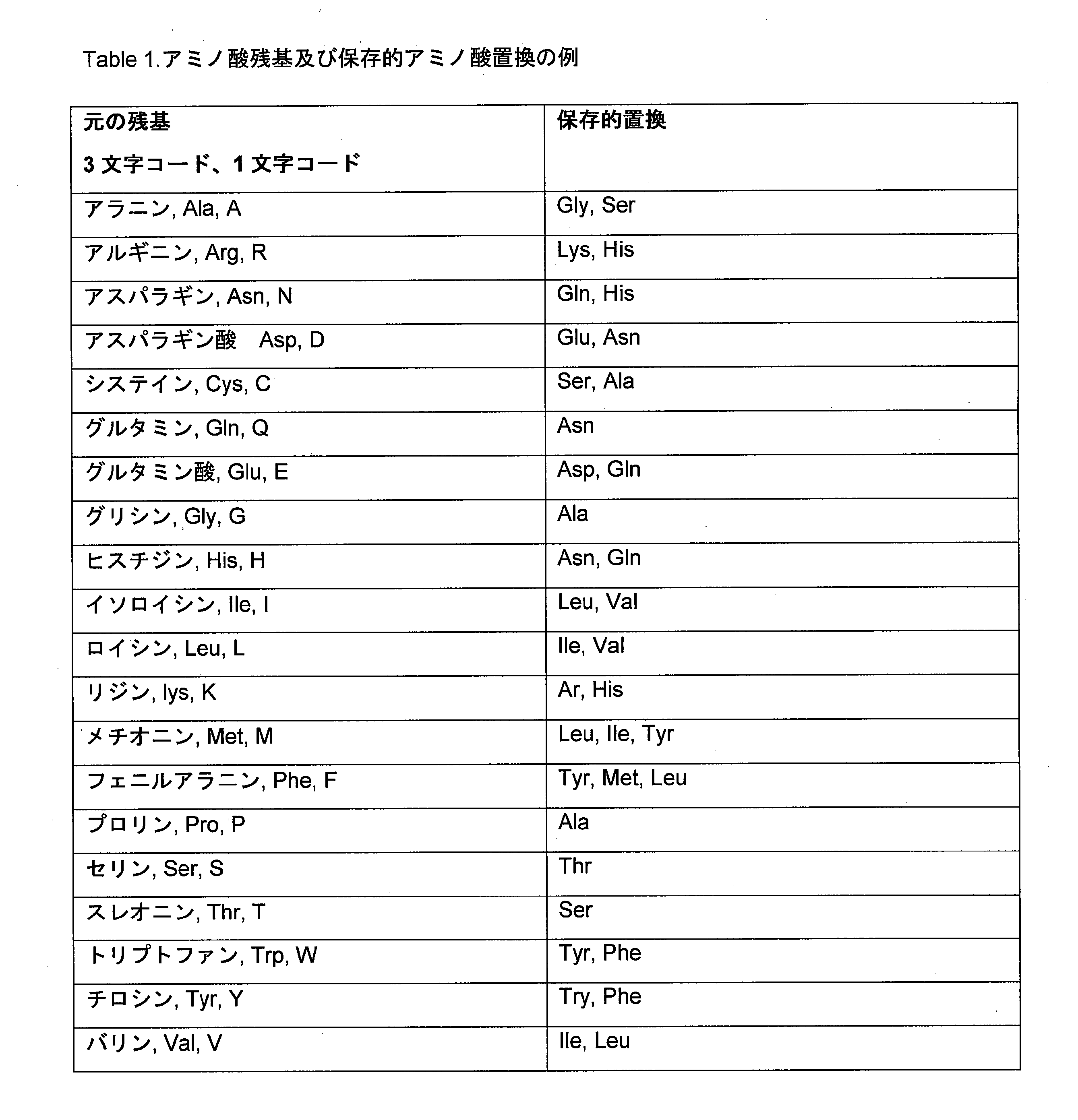
したがって、これらのアミノ酸は通常、抗原に対する親和性若しくは特異性等のポリペプチドの生物活性、機能、又はその他の所望される特性を変化させることなく変化させることができる。一般的に、ポリペプチドの重要ではない領域において単一のアミノ酸を置換しても、生物活性は実質的に変化しない。更に、構造又は機能が類似しているアミノ酸の置換は、ポリペプチドの生物活性を混乱させる可能性は少ない。本明細書で記載したポリペプチド及びペプチドを構成するアミノ酸残基及びこれらのアミノ酸残基の保存的置換の略語を以下のTable 1(表1)に示す。 Thus, these amino acids can typically be changed without altering the biological activity, function, or other desired properties of the polypeptide, such as affinity or specificity for an antigen. Generally, single amino acid substitutions in non-critical regions of a polypeptide do not substantially alter biological activity. Furthermore, substitutions of amino acids that are similar in structure or function are unlikely to disrupt biological activity of the polypeptide. The amino acid residues that make up the polypeptides and peptides described herein and abbreviations for conservative substitutions of these amino acid residues are shown in Table 1 below.
一部の実施形態では、本発明は、1つ又は複数の配列修飾を含み、未修飾の単一ドメイン抗体と比較して、結合親和性、特異性、熱安定性、発現レベル、エフェクター機能、グリコシル化、免疫原性の低下、又は溶解性等の1つ又は複数の特性が改善されている、配列番号1と比較してVH単一ドメイン抗体のバリアントであるVH単一ドメイン抗体を提供する。 In some embodiments, the invention provides VH single domain antibodies which are variants of VH single domain antibodies compared to SEQ ID NO: 1, comprising one or more sequence modifications and which have one or more improved properties, such as improved binding affinity, specificity, thermal stability, expression level, effector function, glycosylation, reduced immunogenicity, or solubility, compared to the unmodified single domain antibody.
当業者であれば、インビトロ及びインビボの発現ライブラリーを含む、本明細書で記載したような抗原結合分子を特定し、入手し、最適化する様々な方法があることを知っているだろう。これは更に実施例において説明する。ディスプレイ(例えば、リボソーム及び/又はファージディスプレイ)及び/又は変異誘発(例えば、エラープローン変異誘発)等の当技術分野で知られている最適化技術を使用することができる。したがって、本発明はまた、本明細書で記載した単一ドメイン抗体の配列最適化バリアントを含む。 The skilled artisan will know that there are various ways to identify, obtain and optimize antigen-binding molecules as described herein, including in vitro and in vivo expression libraries, as further illustrated in the Examples. Optimization techniques known in the art, such as display (e.g., ribosome and/or phage display) and/or mutagenesis (e.g., error-prone mutagenesis), can be used. Thus, the present invention also includes sequence-optimized variants of the single domain antibodies described herein.
一実施形態では、単一ドメイン抗体の免疫原性を低下させるために修飾することができる。例えば、1つの方法は、1つ又は複数のフレームワーク残基を対応するヒト生殖細胞系配列に戻すことである。更に詳細には、体細胞変異を受けた単一ドメイン抗体は、単一ドメイン抗体が得られる生殖細胞系配列とは異なるフレームワーク残基を含有していてもよい。このような残基は、単一ドメイン抗体フレームワーク配列と単一ドメイン抗体が得られる生殖細胞系配列を比較することによって特定することができる。一実施形態では、フレームワーク配列は全て生殖細胞系配列である。 In one embodiment, single domain antibodies can be modified to reduce their immunogenicity. For example, one method is to revert one or more framework residues to the corresponding human germline sequence. More specifically, a single domain antibody that has been somatically mutated may contain framework residues that differ from the germline sequence from which the single domain antibody is derived. Such residues can be identified by comparing the single domain antibody framework sequence to the germline sequence from which the single domain antibody is derived. In one embodiment, all of the framework sequences are germline sequences.
フレームワーク領域配列におけるアミノ酸残基の1つ又は複数をそれらの生殖細胞系配置に戻すために、例えば、部位特異的変異誘発又はPCR媒介変異誘発によって、体細胞変異を生殖細胞系配列に「復帰突然変異」させることができる。 To return one or more of the amino acid residues in the framework region sequences to their germline configuration, the somatic mutations can be "backmutated" to the germline sequence, e.g., by site-directed mutagenesis or PCR-mediated mutagenesis.
フレームワーク修飾の別の種類は、フレームワーク領域内の、或いは1つ又は複数のCDR領域内でもよい1つ又は複数の残基を変異させて、T細胞エピトープを除去し、それによって抗体の潜在的な免疫原性を低減することが関与している。 Another type of framework modification involves mutating one or more residues within the framework region, or possibly within one or more CDR regions, to remove T-cell epitopes, thereby reducing the potential immunogenicity of the antibody.
更に別の実施形態では、グリコシル化は修飾されている。例えば、アグリコシル化抗体が形成されてもよい(すなわち、抗体はグリコシル化が欠如している)。グリコシル化は、例えば、抗原に対する抗体の親和性を高めるために、変化させることができる。このような炭水化物修飾は、例えば、抗体配列内の1つ又は複数のグリコシル化部位の変化によって達成することができる。例えば、1つ又は複数の可変領域フレームワークグリコシル化部位の排除を引き起こし、それによってその部位におけるグリコシル化を排除するために、1つ又は複数のアミノ酸置換を行うことができる。このようなアグリコシル化は、抗原に対する抗体の親和性を増加させることができる。 In yet another embodiment, the glycosylation is modified. For example, an aglycosylated antibody may be formed (i.e., the antibody lacks glycosylation). The glycosylation can be altered, for example, to increase the affinity of the antibody for the antigen. Such carbohydrate modifications can be accomplished, for example, by alteration of one or more glycosylation sites within the antibody sequence. For example, one or more amino acid substitutions can be made to cause elimination of one or more variable region framework glycosylation sites, thereby eliminating glycosylation at that site. Such aglycosylation can increase the affinity of the antibody for the antigen.
一実施形態では、1つ又は複数の置換がCDR1、2又は3領域内にある。例えば、1、2、3、4、5個、又はそれ以上のアミノ酸置換がCDR1、2、又は3内にあってもよい。別の例では、1又は2個のアミノ酸欠失があってもよい。一実施形態では、1つ又は複数の置換はフレームワーク領域内にある。例えば、1から10個又はそれ以上のアミノ酸置換がフレームワーク領域内にあってもよい。 In one embodiment, the one or more substitutions are in the CDR1, 2 or 3 regions. For example, there may be 1, 2, 3, 4, 5 or more amino acid substitutions in CDR1, 2 or 3. In another example, there may be 1 or 2 amino acid deletions. In one embodiment, the one or more substitutions are in the framework regions. For example, there may be 1 to 10 or more amino acid substitutions in the framework regions.
一実施形態では、バリアントは、配列番号1を参照して以下の置換の1つ又は複数或いはそれらの組合せを含む。
E111→D;
R115→Q;
S100→H又はV;
V97→A;
K98→R;
13Q→H又はK;
16R→G;
19R→K;
23A→T;
24A→V;
H30→N又はD;
H31→E又はD;
G55→S;
G56→N;
K57→S、T、V、又はR;
T59→A、D、又はG;
K65R;
A89→V又はP及び/又は
I104→L。
In one embodiment, the variant includes one or more of the following substitutions, or a combination thereof, with reference to SEQ ID NO:1:
E111→D;
R115→Q;
S100→H or V;
V97→A;
K98 → R;
13Q → H or K;
16R→G;
19R→K;
23A→T;
24A→V;
H30 → N or D;
H31 → E or D;
G55 → S;
G56 → N;
K57 → S, T, V, or R;
T59 → A, D, or G;
K65R;
A89 → V or P and/or
I104→L.
一実施形態では、バリアントは上記の修飾の1、2、3、3、4、5、6、7、8、9、10、11、12、13、14、15、16、17、18又は19個を含む。したがって、修飾の組合わせは、具体的に考えられる。一実施形態では、バリアントは修飾E111→D及びR115→Qを有する。一実施形態では、バリアントは配列番号19若しくは20、又はそれらと少なくとも80%、90%、若しくは90%の配列同一性を有し、配列番号19若しくは20で示したようなCDR配列を保持している配列を有する。したがって、本発明はまた、配列番号1、19、若しくは20、又はそれらのバリアントを含むか、又はそれらからなる単一VHドメイン抗体に関する。 In one embodiment the variant comprises 1, 2, 3, 4, 5, 6, 7, 8, 9, 10, 11, 12, 13, 14, 15, 16, 17, 18 or 19 of the above modifications. Combinations of modifications are therefore specifically contemplated. In one embodiment the variant has the modifications E111→D and R115→Q. In one embodiment the variant has SEQ ID NO: 19 or 20, or a sequence having at least 80%, 90%, or 90% sequence identity thereto and retaining the CDR sequences as set out in SEQ ID NO: 19 or 20. Thus the present invention also relates to a single VH domain antibody comprising or consisting of SEQ ID NO: 1, 19 or 20, or a variant thereof.
本明細書で記載したsdAbの断片、例えば、HASへの結合を保持している配列番号1、19、又は20の断片、例えば、CDR配列の1つ又は複数を含むか、又はそれらからなるペプチドも包含される。 Also included are fragments of the sdAbs described herein, e.g., fragments of SEQ ID NOs: 1, 19, or 20 that retain binding to HAS, e.g., peptides comprising or consisting of one or more of the CDR sequences.
前述のように、本発明によって用意されたアミノ酸配列は、ヒト血清アルブミンに結合することができ、(本明細書で記載したように)ヒト血清アルブミンに特に特異的に結合することができるタンパク質である。したがって、これらは、例えば、治療化合物、部分又は実体に半減期(本明細書で定義した通り)の増加を付与するために、ヒト血清アルブミンに結合するための結合ユニット又は結合ドメインとして使用することができる。 As mentioned above, the amino acid sequences provided by the present invention are proteins capable of binding to human serum albumin, and in particular capable of binding specifically to human serum albumin (as described herein). They can therefore be used as binding units or binding domains for binding to human serum albumin, for example to confer an increased half-life (as defined herein) to a therapeutic compound, moiety or entity.
使用した「半減期」という用語は一般的に、例えば、配列若しくは化合物の分解、及び/又は自然の機構による配列若しくは化合物の排出若しくは隔離によって、インビボにおいてアミノ酸配列、化合物、又はポリペプチドの血清濃度が50%減少するためにかかる時間を意味している。本発明のアミノ酸配列、化合物又はポリペプチドのインビボ半減期は、薬物動態分析等の、それ自体知られている任意の方法で決定することができる。適切な技術は、当業者には明らかであろう。半減期は、tl/2-アルファ、tl/2-ベータ、及び曲線下面積(AUC)等のパラメータを使用して表すことができる。半減期(tアルファ及びtベータ)及びAUCは、コンジュゲート又は融合物の血清濃度の時間に対する曲線から決定することができる。したがって、本明細書で使用したような「半減期」という用語は特に、tl/2-ベータ又は最終半減期を意味している(この場合、tl/2-アルファ及び/又はAUC又はその両方は考慮に入れなくてもよい)。 The term "half-life" as used generally means the time it takes for the serum concentration of an amino acid sequence, compound or polypeptide to decrease by 50% in vivo, for example due to degradation of the sequence or compound and/or excretion or sequestration of the sequence or compound by natural mechanisms. The in vivo half-life of an amino acid sequence, compound or polypeptide of the invention can be determined by any method known per se, such as pharmacokinetic analysis. Suitable techniques will be clear to the skilled person. The half-life can be expressed using parameters such as tl/2-alpha, tl/2-beta and area under the curve (AUC). The half-life (talpha and tbeta) and AUC can be determined from the curve of serum concentration of the conjugate or fusion against time. Thus, the term "half-life" as used herein means in particular the tl/2-beta or terminal half-life (in which case tl/2-alpha and/or AUC or both may not be taken into account).
例えば、第一段階(アルファ段階)では、薬物組成物(例えば、薬物コンジュゲート、非共有薬物コンジュゲート、薬物融合物)は、一部の排除を伴うが、患者において主に分配されている。第2段階(ベータ段階)は、薬物組成物(例えば、薬物コンジュゲート、非共有薬物コンジュゲート、薬物融合物)が分配され、患者から薬物組成物が排出されるにつれて血清濃度が減少していく最終段階である。tアルファ半減期は第1段階の半減期であり、tベータ半減期は第2段階の半減期である。 For example, in the first phase (alpha phase), the drug composition (e.g., drug conjugate, noncovalent drug conjugate, drug fusion) is primarily distributed in the patient, with some elimination. The second phase (beta phase) is the final phase in which the drug composition (e.g., drug conjugate, noncovalent drug conjugate, drug fusion) is distributed and the serum concentration decreases as the drug composition is cleared from the patient. The talpha half-life is the half-life of the first phase, and the tbeta half-life is the half-life of the second phase.
本発明のHSA結合免疫グロブリン可変ドメインは、
・ ヒトにおいて1から72時間、例えば、2、4、6、8、若しくは10時間、例えば、10時間以上、例えば、10、11、12、14、14、15、16、17、18、19、20時間、例えば、約18時間、例えば、最高20時間、又は12、24、36、若しくは48時間の半減期(t1/2として表現される)を有し、及び/又は
・ 治療部分に連結した場合、得られる融合タンパク質に、ヒトにおいて1から72時間、例えば、10時間以上、例えば、2、4、6、8、若しくは10時間、例えば、10、11、12、14、14、15、16、17、18、19、20時間、例えば、約18時間、又は最高20時間、又は12、24、36、若しくは48時間の血清半減期を付与する。
The HSA-binding immunoglobulin variable domain of the present invention comprises
- has a half-life (expressed as t1/2) in humans of 1 to 72 hours, such as 2, 4, 6, 8 or 10 hours, for example more than 10 hours, such as 10, 11, 12, 14, 14, 15, 16, 17, 18, 19, 20 hours, for example about 18 hours, such as up to 20 hours, or 12, 24, 36 or 48 hours; and/or - when linked to a therapeutic moiety, confers on the resulting fusion protein a serum half-life in humans of 1 to 72 hours, such as more than 10 hours, such as 2, 4, 6, 8 or 10 hours, for example 10, 11, 12, 14, 14, 15, 16, 17, 18, 19, 20 hours, for example about 18 hours, or up to 20 hours, or 12, 24, 36 or 48 hours.
一実施形態では、本発明のHSA結合免疫グロブリン可変重鎖ドメインは、ヒト化したマウスモデルにおいて、分子、例えば、別の単一可変重鎖ドメイン抗体の半減期を約18時間延長させる。例えば、本発明のHSA結合免疫グロブリン可変重鎖ドメインは、HSA結合免疫グロブリン可変重鎖ドメインがi.v.投与によって提供される例において示されるように、genOway(登録商標)HSA/FcRnヒト化マウスモデルにおいて、分子、例えば、別の単一可変重鎖ドメイン抗体の半減期を約18時間延長させる。 In one embodiment, the HSA-binding immunoglobulin variable heavy domain of the invention extends the half-life of a molecule, e.g., another single variable heavy domain antibody, by about 18 hours in a humanized mouse model. For example, the HSA-binding immunoglobulin variable heavy domain of the invention extends the half-life of a molecule, e.g., another single variable heavy domain antibody, by about 18 hours in a genOway® HSA/FcRn humanized mouse model, as shown in an example where the HSA-binding immunoglobulin variable heavy domain is provided by i.v. administration.
本発明のHSA結合免疫グロブリン可変ドメインは、実施例8に示したように、保存安定性にも優れている。例えば、本発明のHSA結合免疫グロブリン可変ドメインは、4°で14日間安定性を維持する。これらは、実施例で示したように、VH単一ドメイン抗体の半減期を延長するのに特に適している。 The HSA-binding immunoglobulin variable domains of the invention also have excellent storage stability, as shown in Example 8. For example, the HSA-binding immunoglobulin variable domains of the invention maintain stability for 14 days at 4°. They are particularly suitable for extending the half-life of VH single domain antibodies, as shown in the Examples.
したがって、本発明はまた、配列番号1を含むか、又はそれからなる免疫グロブリン単一可変ドメイン及び別の標的に結合する第2の部分を含む結合分子、例えばHSA結合免疫グロブリン可変ドメイン及び別の部分を含むか、又はそれらからなる融合タンパク質に関する。一実施形態では、この部分は治療部分である。結合分子は、ポリペプチド、タンパク質又は構築物であってもよい。 The invention therefore also relates to a binding molecule comprising an immunoglobulin single variable domain comprising or consisting of SEQ ID NO:1 and a second moiety that binds to another target, such as a fusion protein comprising or consisting of an HSA-binding immunoglobulin variable domain and another moiety. In one embodiment, this moiety is a therapeutic moiety. The binding molecule may be a polypeptide, a protein or a construct.
一実施形態では、治療部分は、例えば、抗体又は抗体断片(例えば、Fab、F(ab')2、Fv、一本鎖Fv断片(scFv)又は単一ドメイン抗体、例えば、VH若しくはVHHドメイン)又は抗体模倣タンパク質から選択される結合分子である。一実施形態では、本発明の単一ドメイン抗体は、CH2及びCH3ドメインの1つ又は両方を含む抗体のFc領域又はその断片、並びに任意選択でヒンジ領域と連結することができる。一実施形態では、少なくとも第2の部分は単一ドメイン抗体、例えば、単一VHドメイン抗体である。 In one embodiment, the therapeutic moiety is a binding molecule selected from, for example, an antibody or antibody fragment (e.g., Fab, F(ab')2, Fv, single chain Fv fragment (scFv) or a single domain antibody, e.g., a VH or VHH domain) or an antibody mimetic protein. In one embodiment, a single domain antibody of the invention may be linked to the Fc region of an antibody or a fragment thereof comprising one or both of the C H 2 and C H 3 domains, and optionally a hinge region. In one embodiment, at least the second moiety is a single domain antibody, e.g., a single VH domain antibody.
一実施形態では、本明細書で記載したようなHSAに結合する免疫グロブリン単一可変ドメイン及び第2の部分を含むタンパク質又はポリペプチドは、融合タンパク質である。一実施形態では、本明細書で記載したようなHSAに結合する免疫グロブリン単一可変ドメイン及び第2の部分を含むタンパク質又はポリペプチドは薬物コンジュゲートである。 In one embodiment, the protein or polypeptide comprising an immunoglobulin single variable domain that binds to HSA as described herein and a second moiety is a fusion protein. In one embodiment, the protein or polypeptide comprising an immunoglobulin single variable domain that binds to HSA as described herein and a second moiety is a drug conjugate.
本明細書で使用したように、「コンジュゲート」とは、本明細書で記載したような血清アルブミンに結合する単一VHドメイン抗体が薬物に結合/コンジュゲートしている組成物を意味している。 As used herein, "conjugate" refers to a composition in which a single VH domain antibody that binds serum albumin as described herein is linked/conjugated to a drug.
このようなコンジュゲートには、血清アルブミンに結合する抗体の抗原結合断片に薬物が共有結合している「薬物コンジュゲート」、及び血清アルブミンに結合する抗体の抗原結合断片に薬物が非共有結合している「非共有薬物コンジュゲート」が含まれる。 Such conjugates include "drug conjugates" in which a drug is covalently bound to an antigen-binding fragment of an antibody that binds serum albumin, and "non-covalent drug conjugates" in which a drug is non-covalently bound to an antigen-binding fragment of an antibody that binds serum albumin.
本明細書で使用したように、「薬物コンジュゲート」とは、血清アルブミンに結合する抗体の抗原結合断片に薬物が共有結合している組成物を意味する。薬物は、適切なリンカー部分を介して抗原結合断片に直接的又は間接的に共有結合することができる。薬物は、アミノ末端、カルボキシル末端等の任意の適切な位置で、又は適切なアミノ酸側鎖を介して、抗原結合断片に結合することができる。 As used herein, "drug conjugate" refers to a composition in which a drug is covalently attached to an antigen-binding fragment of an antibody that binds serum albumin. The drug can be covalently attached directly or indirectly to the antigen-binding fragment via a suitable linker moiety. The drug can be attached to the antigen-binding fragment at any suitable position, such as the amino terminus, the carboxyl terminus, or via a suitable amino acid side chain.
一実施形態では、免疫グロブリン単一可変ドメインは、ペプチドリンカー又は2つの部分を連結するその他の適切なリンカーによって第2の部分に連結している。 In one embodiment, the immunoglobulin single variable domain is linked to the second moiety by a peptide linker or other suitable linker connecting the two moieties.
「ペプチドリンカー」という用語は、1つ又は複数のアミノ酸を含むペプチドを意味する。ペプチドリンカーは1から50個、例えば1から20個のアミノ酸を含む。ペプチドリンカーは当技術分野では知られており、非限定的な例が本明細書に記載されている。適切な、非免疫原性リンカーペプチドは、例えば、G及び/又はS残基を含むリンカー、(G4S)n、(SG4)n又はG4(SG4)nペプチドリンカーであり、ここで、「n」は一般的に、1から10の間の数であり、例えば、1、2、3、4、5、6、7、8、9、又は10である。一実施形態では、ペプチドは、例えば、GGGGS(配列番号8)、GGGGSGGGGS(配列番号9)、SGGGGSGGGG(配列番号10)、GGGGSGGGGSGGGG(配列番号11)、GSGSGSGS(配列番号12)、GGSGSGSG(配列番号13)、GGSGSG(配列番号14)、及びGGSG(配列番号15)からなる群から選択される。 The term "peptide linker" refers to a peptide comprising one or more amino acids. Peptide linkers comprise 1 to 50, e.g., 1 to 20, amino acids. Peptide linkers are known in the art, and non-limiting examples are described herein. Suitable non-immunogenic linker peptides are, for example, linkers comprising G and/or S residues, (G4S)n, (SG4)n, or G4(SG4)n peptide linkers, where "n" is generally a number between 1 and 10, e.g., 1, 2, 3, 4, 5, 6, 7, 8, 9, or 10. In one embodiment, the peptide is, for example, selected from the group consisting of GGGGS (SEQ ID NO: 8), GGGGSGGGGS (SEQ ID NO: 9), SGGGGSGGGG (SEQ ID NO: 10), GGGGSGGGGSGGGG (SEQ ID NO: 11), GSGSGSGS (SEQ ID NO: 12), GGSGSGSG (SEQ ID NO: 13), GGSGSG (SEQ ID NO: 14), and GGSG (SEQ ID NO: 15).
結合剤は、多特異性、例えば2重特異性であってもよい。一実施形態では、結合分子は、本明細書で記載したようなHSAに結合する第1のVH単一ドメイン抗体(VH(A))及び別の抗原に結合する第2のVH単一ドメイン抗体(VH(B)を含み、したがって、以下の式:VH(A)-L-VH(B)を有する。VH(A)は、例えば、ペプチドリンカーによって、VH(B)にコンジュゲートし、すなわち、VH(B)に連結している。Lはリンカーを意味する。 The binding agent may be multispecific, e.g. bispecific. In one embodiment, the binding molecule comprises a first VH single domain antibody ( VH (A)) that binds HSA as described herein and a second VH single domain antibody ( VH (B)) that binds another antigen, and thus has the following formula: VH (A) -LVH (B). VH (A) is conjugated to, i.e. linked to, VH (B), e.g. by a peptide linker. L denotes a linker.
各VHは、CDR及びFR領域を含む。したがって、結合分子は、以下の式:FR1(A)-CDR1(A)-FR2(A)-CDR2(A)-FR3(A)-CDR3(A)-FR4(A)-L-FR1(B)-CDR1(B)-FR2(B)-CDR2(B)-FR3(B)-CDR3(B)-FR4(B)を有していてもよい。 Each VH comprises CDR and FR regions. Thus, the binding molecule may have the following formula: FR1(A)-CDR1(A)-FR2(A)-CDR2(A)-FR3(A)-CDR3(A)-FR4(A)-L-FR1(B)-CDR1(B)-FR2(B)-CDR2(B)-FR3(B)-CDR3(B)-FR4(B).
単一VHドメインA及びBの順番は特に限定されていないので、本発明のポリペプチドの中で、単一可変ドメインAがN末端に位置し、単一可変ドメインBがC末端に位置していてもよいし、その逆であってもよい。 The order of the single VH domains A and B is not particularly limited, and therefore in the polypeptide of the invention, the single variable domain A may be located at the N-terminus and the single variable domain B at the C-terminus, or vice versa.
一実施形態では、結合分子は2重特異性である。したがって、一態様では、本発明は、本明細書で記載した単一ドメイン抗体が前記単一ドメイン抗体とは異なる結合特異性を有する第2の機能性部分に連結している2重特異性分子に関する。 In one embodiment, the binding molecule is bispecific. Thus, in one aspect, the invention relates to a bispecific molecule in which a single domain antibody as described herein is linked to a second functional moiety having a different binding specificity than said single domain antibody.
一実施形態では、結合分子、例えば、タンパク質又は構築物は多特異性であり、更に、すなわち、第3、第4、第5等の部分を含んでいる。 In one embodiment, the binding molecule, e.g., protein or construct, is multispecific, i.e., contains a third, fourth, fifth, etc. moiety.
多特異性タンパク質の一実施形態では、HSA結合VHドメインはタンパク質のC末端に位置している。 In one embodiment of the multispecific protein, the HSA-binding VH domain is located at the C-terminus of the protein.
第2又は更なる治療部分は、例えば、腫瘍抗原又は免疫腫瘍学的標的に結合する部分から選択することができるが、当業者であれば、本発明がこのように限定されないことを知っているであろう。 The second or further therapeutic moiety can be selected, for example, from a moiety that binds to a tumor antigen or an immuno-oncological target, although one of skill in the art will know that the invention is not so limited.
本発明はまた、請求項のいずれかに記載の免疫グロブリン単一可変ドメインが融合タンパク質において治療部分に連結している場合に、治療部分の半減期を延長する、本明細書で記載したような免疫グロブリン単一可変ドメインの使用に関する。 The present invention also relates to the use of an immunoglobulin single variable domain as described herein to extend the half-life of a therapeutic moiety when the immunoglobulin single variable domain according to any of the claims is linked to the therapeutic moiety in a fusion protein.
本発明はまた、請求項のいずれかに記載の免疫グロブリン単一可変ドメインが融合タンパク質において治療部分に連結している場合に、治療部分の半減期を延長する、本明細書で記載したような免疫グロブリン単一可変ドメインの使用に関する。例えば、本明細書で記載したように、CD137に結合するsdAb及びPSMAに結合するsdAbを含むタンパク質の半減期を延長するために使用することができる。本明細書で記載したような免疫グロブリン単一可変ドメイン、例えば、分子は、VH(A)-VH(B)-VH(C)、VH(B)-VH(A)-VH(C)、VH(C)-VH(A)-VH(B)又はVH(C)-VH(B)-VH(A)の形式であってもよく、式中、AはCD137に結合するsdAbであり、BはPSMAに結合するsdAbであり、Cは本明細書で記載したような免疫グロブリン単一可変ドメイン(例えば、配列番号1)である。例えば、この分子は配列番号17を含むか、又はそれからなる。 The invention also relates to the use of an immunoglobulin single variable domain as described herein to extend the half-life of a therapeutic moiety when the immunoglobulin single variable domain according to any of the claims is linked to the therapeutic moiety in a fusion protein. For example, it can be used to extend the half-life of a protein comprising an sdAb that binds CD137 and an sdAb that binds PSMA as described herein. An immunoglobulin single variable domain as described herein, for example a molecule, can be in the format VH (A) -VH (B) -VH (C), VH(B)-VH(A)-VH(C), VH ( C ) -VH(A)-VH(B) or VH (C) -VH (B) -VH ( A), where A is an sdAb that binds CD137, B is an sdAb that binds PSMA and C is an immunoglobulin single variable domain as described herein (for example SEQ ID NO: 1). For example, the molecule comprises or consists of SEQ ID NO: 17.
したがって、本発明の融合タンパク質では、治療部分は、例えば、腫瘍学的標的、例えば、免疫腫瘍学的標的に結合することができる。 Thus, in the fusion proteins of the invention, the therapeutic moiety can bind, for example, to an oncological target, e.g., an immuno-oncological target.
一実施形態では、単一可変重鎖ドメイン抗体は、再配置されていないヒトV、D、及びJ領域を含む導入遺伝子を発現しているトランスジェニック齧歯類、特にヒト重鎖のみ抗体を生成している齧歯類から入手されるか、又は入手可能である。一実施形態では、前記齧歯類は機能的な内在性軽鎖及び重鎖を生成しない。 In one embodiment, the single variable heavy domain antibody is obtained or obtainable from a transgenic rodent expressing a transgene comprising unrearranged human V, D, and J regions, in particular a rodent producing human heavy chain only antibodies. In one embodiment, the rodent does not produce functional endogenous light and heavy chains.
一般的に、本明細書で別段の指示がない限り、本明細書で言及した免疫グロブリン単一可変ドメイン、ポリペプチド、タンパク質、並びにその他の化合物及び構築物は、ヒト(及び/又は任意選択で温血動物、特に哺乳動物も)における疾患又は障害の予防又は治療での使用を意図するものである。したがって、一般的に、本明細書で記載した免疫グロブリン単一可変ドメイン、ポリペプチド、タンパク質、並びにその他の化合物及び構築物は、(生物学的)薬物又はその他の薬学的若しくは治療的に活性のある化合物及び/又は医薬品若しくは医薬組成物の一部として使用することができ、及び/又は適し得ることが好ましい。 Generally, unless otherwise indicated herein, the immunoglobulin single variable domains, polypeptides, proteins and other compounds and constructs mentioned herein are intended for use in the prevention or treatment of diseases or disorders in humans (and/or optionally also in warm-blooded animals, in particular mammals). Thus, in general, the immunoglobulin single variable domains, polypeptides, proteins and other compounds and constructs described herein can be and/or are preferably suitable for use as (biological) drugs or other pharmacologic or therapeutically active compounds and/or as part of medicines or pharmaceutical compositions.
したがって、本発明はまた、本明細書で記載したような免疫グロブリン単一可変ドメインポリペプチド、タンパク質又は構築物を含む医薬組成物又は製剤、例えば、本明細書で記載したようなHSA結合単一ドメインを含む結合分子又は融合タンパク質に関する。医薬組成物は、任意選択で薬学的に許容される担体を含んでいてもよい。免疫グロブリン単一可変ドメインポリペプチド、タンパク質又は構築物又は医薬組成物は、限定はしないが、経口、局所、非経口、舌下、直腸、膣内、眼内、鼻腔内、肺、皮内、硝子体内、筋肉内、腹腔内、静脈内、皮下、脳内、経皮、経粘膜、吸入によって、又は特に耳、鼻、目、若しくは皮膚へ局所的に、又は吸入を含む、任意の便利な経路によって投与することができる。 The present invention therefore also relates to a pharmaceutical composition or formulation comprising an immunoglobulin single variable domain polypeptide, protein or construct as described herein, such as a binding molecule or fusion protein comprising an HSA-binding single domain as described herein. The pharmaceutical composition may optionally comprise a pharma- ceutical acceptable carrier. The immunoglobulin single variable domain polypeptide, protein or construct or pharmaceutical composition may be administered by any convenient route, including but not limited to oral, topical, parenteral, sublingual, rectal, intravaginal, intraocular, intranasal, pulmonary, intradermal, intravitreal, intramuscular, intraperitoneal, intravenous, subcutaneous, intracerebral, transdermal, transmucosal, by inhalation, or particularly locally to the ear, nose, eye or skin, or by inhalation.
非経口投与には、例えば、静脈内、筋肉内、動脈内、腹腔内、鼻腔内、直腸内、膀胱内、皮内、局所、又は皮下投与が含まれる。好ましくは、組成物は非経口的に投与される。 Parenteral administration includes, for example, intravenous, intramuscular, intraarterial, intraperitoneal, intranasal, intrarectal, intravesical, intradermal, topical, or subcutaneous administration. Preferably, the composition is administered parenterally.
薬学的に許容される担体又は媒体は、組成物が、例えば、錠剤又は粉末の形態であるように、粒子状にすることができる。「担体」という用語は、本発明の薬物抗体コンジュゲートが一緒に投与される希釈剤、アジュバント又は賦形剤を意味する。このような薬学的担体は、水及び油等の液体であってもよく、石油、動物、植物若しくは合成物由来のものが含まれ、ピーナッツ油、大豆油、鉱物油、ゴマ油等が挙げられる。担体は、生理食塩水、アカシアガム、ゼラチン、デンプンペースト、タルク、ケラチン、コロイド状シリカ、尿素等であってもよい。更に、補助剤、安定化剤、増粘剤、潤沢剤、及び着色剤を使用することができる。一実施形態では、動物に投与する場合、本発明の単一ドメイン抗体又は組成物及び薬学的に許容される担体は滅菌する。本発明の薬物抗体コンジュゲートを静脈内投与する場合、水が好ましい担体である。生理食塩水溶液並びに水性デキストロース及びグリセロール溶液も、液体担体として、特に注射溶液に採用することができる。適切な医薬担体には、デンプン、グルコース、乳糖、スクロース、ゼラチン、麦芽、米、小麦粉、チョーク、シリカゲル、ステアリン酸ナトリウム、モノステアリン酸グリセロール、タルク、塩化ナトリウム、乾燥脱脂乳、グリセロール、プロピレングリコール、水、エタノール等の賦形剤も含まれる。本発明の組成物は、所望するならば、少量の湿潤剤若しくは乳化剤、又はpH緩衝剤も含むことができる。 The pharma- ceutically acceptable carrier or vehicle can be particulate, such that the composition is, for example, in the form of a tablet or powder. The term "carrier" refers to a diluent, adjuvant, or excipient with which the drug-antibody conjugate of the present invention is administered. Such pharmaceutical carriers can be liquids, such as water and oils, including those of petroleum, animal, vegetable, or synthetic origin, such as peanut oil, soybean oil, mineral oil, sesame oil, and the like. The carrier can be saline, gum acacia, gelatin, starch paste, talc, keratin, colloidal silica, urea, and the like. Additionally, adjuvants, stabilizers, thickeners, lubricants, and colorants can be used. In one embodiment, the single domain antibody or composition of the present invention and the pharma- ceutical acceptable carrier are sterile when administered to an animal. When the drug-antibody conjugate of the present invention is administered intravenously, water is a preferred carrier. Saline solutions and aqueous dextrose and glycerol solutions can also be employed as liquid carriers, particularly for injectable solutions. Suitable pharmaceutical carriers also include excipients such as starch, glucose, lactose, sucrose, gelatin, malt, rice, flour, chalk, silica gel, sodium stearate, glycerol monostearate, talc, sodium chloride, dried skim milk, glycerol, propylene glycol, water, ethanol, etc. The compositions of the present invention, if desired, can also contain minor amounts of wetting or emulsifying agents, or pH buffering agents.
本発明の医薬組成物は、液体、例えば、溶液、エマルジョン、又は懸濁液の形態であってもよい。液体は、注射、注入(例えば、IV注入)、又は皮下に送達するために有用であり得る。経口投与を目的とする場合、組成物は好ましくは固体又は液体の形態であり、半固体、半液体、懸濁液及びゲルの形態は、固体又は液体のいずれかとして本明細書で考慮されている形態の中に含まれる。 The pharmaceutical compositions of the present invention may be in the form of a liquid, e.g., a solution, emulsion, or suspension. The liquid may be useful for injection, infusion (e.g., IV infusion), or subcutaneous delivery. When intended for oral administration, the composition is preferably in solid or liquid form, with semi-solid, semi-liquid, suspension, and gel forms being included among the forms contemplated herein as either solid or liquid.
経口投与用の固形組成物として、組成物は粉末、顆粒、圧縮錠剤、丸薬、カプセル、チューインガム、ウエハ等の形態に製剤化することができる。このような固形組成物は通常、1つ又は複数の不活性な希釈剤を含有している。更に、以下の1つ又は複数が存在していてもよい:カルボキシメチルセルロース、エチルセルロース、微結晶セルロース、又はゼラチン等の結合剤;デンプン、乳糖、又はデキストリン等の賦形剤、アルギン酸、アルギン酸ナトリウム、トウモロコシデンプン等の崩壊剤;ステアリン酸マグネシウム等の滑沢剤;コロイド状二酸化ケイ素等の流動促進剤;スクロース又はサッカリン等の甘味料;ペパーミント、サリチル酸メチル、又はオレンジ香味料等の香味料;及び着色剤。組成物がカプセル(例えば、ゼラチンカプセル)の形態である場合、上記種類の材料に加えて、ポリエチレングリコール、シクロデキストリン、又は脂肪油等の液体担体を含有することができる。 As a solid composition for oral administration, the composition can be formulated in the form of a powder, granules, compressed tablets, pills, capsules, chewing gum, wafers, and the like. Such solid compositions usually contain one or more inert diluents. In addition, one or more of the following may be present: binders such as carboxymethylcellulose, ethylcellulose, microcrystalline cellulose, or gelatin; excipients such as starch, lactose, or dextrin; disintegrating agents such as alginic acid, sodium alginate, corn starch, and the like; lubricants such as magnesium stearate; glidants such as colloidal silicon dioxide; sweeteners such as sucrose or saccharin; flavorings such as peppermint, methyl salicylate, or orange flavoring; and coloring agents. When the composition is in the form of a capsule (e.g., a gelatin capsule), in addition to the above types of materials, it can contain a liquid carrier such as polyethylene glycol, cyclodextrin, or fatty oil.
組成物は、液体、例えば、エリキシル剤、シロップ、溶液、エマルジョン、又は懸濁液の形態であってもよい。液体は経口投与のため、又は注射による送達のために有用であり得る。経口投与を目的とする場合、組成物は甘味料、保存剤、染料/着色剤、及び風味増強剤の1つ又は複数を含んでいてもよい。注入による投与のための組成物では、界面活性剤、保存剤、湿潤剤、分散剤、懸濁剤、緩衝剤、安定化剤、及び等張剤の1つ又は複数も含んでいてもよい。 The composition may be in the form of a liquid, e.g., an elixir, syrup, solution, emulsion, or suspension. The liquid may be useful for oral administration or for delivery by injection. If intended for oral administration, the composition may contain one or more of a sweetener, a preservative, a dye/colorant, and a flavor enhancer. In a composition for administration by injection, it may also contain one or more of a surfactant, a preservative, a wetting agent, a dispersing agent, a suspending agent, a buffer, a stabilizer, and an isotonic agent.
組成物は、1つ又は複数の投薬単位の形態を取ることができる。特定の実施形態では、治療を必要とする領域に局所的に、又は静脈内注射又は注入によって組成物を投与することが望ましいことがある。 The composition may be in the form of one or more dosage units. In certain embodiments, it may be desirable to administer the composition locally to the area in need of treatment or by intravenous injection or infusion.
本発明は、本明細書で記載した医薬組成物若しくは製剤、又は本明細書で記載したようなHSA結合単一ドメインを含む結合分子若しくは融合タンパク質を投与することを含む、疾患、例えば、がんの治療のための方法に更に適用される。疾患の治療で使用するため、例えば、がんの治療で使用するために、本明細書で記載した医薬組成物若しくは製剤、又は本明細書で記載したようなHSA結合単一ドメインを含む結合分子若しくは融合タンパク質も想定される。がんの治療のための医薬の製造における、本明細書で記載した医薬組成物若しくは製剤、又は本明細書で記載したようなHSA結合単一ドメインを含む結合分子若しくは融合タンパク質の使用も想定される。 The invention further applies to a method for the treatment of a disease, e.g., cancer, comprising administering a pharmaceutical composition or formulation as described herein, or a binding molecule or fusion protein comprising an HSA-binding single domain as described herein. Also contemplated is a pharmaceutical composition or formulation as described herein, or a binding molecule or fusion protein comprising an HSA-binding single domain as described herein, for use in the treatment of a disease, e.g., for use in the treatment of cancer. Also contemplated is the use of a pharmaceutical composition or formulation as described herein, or a binding molecule or fusion protein comprising an HSA-binding single domain as described herein, in the manufacture of a medicament for the treatment of cancer.
特定の障害又は状態の治療で有効/活性のある治療薬の量は、障害又は状態の性質に左右され、標準的な臨床技術によって決定することができる。更に、最適な投薬範囲の特定を助けるために、インビトロ又はインビボアッセイを任意選択で採用することができる。組成物で採用される正確な用量はまた、投与経路及び疾患又は障害の重症度によって左右されるので、医師の判断及び各患者の状況に応じて決定するべきである。年齢、体重、性別、食事、投与時間、排泄率、宿主の状態、薬物の組合せ、反応の感度、及び疾患の重症度のような要素を考慮しなければならない。 The amount of therapeutic agent effective/active in the treatment of a particular disorder or condition will depend on the nature of the disorder or condition and can be determined by standard clinical techniques. Additionally, in vitro or in vivo assays can optionally be employed to help identify optimal dosage ranges. The precise dose to be employed in the composition will also depend on the route of administration and the severity of the disease or disorder, and should be decided according to the judgment of the practitioner and each patient's circumstances. Factors such as age, body weight, sex, diet, time of administration, excretion rate, condition of the host, drug combination, reaction sensitivity, and severity of the disease must be taken into account.
典型的には、その量は、組成物の質量によって、本発明の単一ドメイン抗体の少なくとも約0.01%である。経口投与を目的とする場合、この量は、組成物の約0.1質量%から約80質量%までの範囲になるように変化させることができる。好ましい経口組成物は、組成物の質量によって、本発明の単一ドメイン抗体の約4%から約50%までを含むことができる。 Typically, the amount is at least about 0.01% of the single domain antibody of the invention by weight of the composition. For oral administration, the amount can vary to range from about 0.1% to about 80% by weight of the composition. A preferred oral composition can contain from about 4% to about 50% of the single domain antibody of the invention by weight of the composition.
本発明の好ましい組成物は、非経口投薬単位が本発明の単一ドメイン抗体の約0.01質量%から約2質量%までを含有するように調製される。 Preferred compositions of the invention are prepared so that a parenteral dosage unit contains from about 0.01% to about 2% by weight of a single domain antibody of the invention.
注射による投与のために、組成物は、通常は対象の体重の約0.1mg/kgから約250mg/kgまで、好ましくは、動物の体重の約0.1mg/kgから約20mg/kgの間、より好ましくは、動物の体重の約1mg/kgから約10mg/kgまでを含むことができる。一実施形態では、組成物は、約1から30mg/kg、例えば、約5から25mg/kg、約10から20mg/kg、約1から5mg/kg、又は約3mg/kgの用量で投与される。投与計画は、例えば、週1回から2、3又は4週間に1回まで変化させることができる。 For administration by injection, the composition can typically comprise from about 0.1 mg/kg to about 250 mg/kg of the subject's body weight, preferably between about 0.1 mg/kg to about 20 mg/kg of the animal's body weight, more preferably from about 1 mg/kg to about 10 mg/kg of the animal's body weight. In one embodiment, the composition is administered at a dose of about 1 to 30 mg/kg, e.g., about 5 to 25 mg/kg, about 10 to 20 mg/kg, about 1 to 5 mg/kg, or about 3 mg/kg. Dosing schedules can vary, for example, from once a week to once every 2, 3, or 4 weeks.
本明細書で使用したように、「治療する」、「治療すること」又は「治療」は、疾患又は障害を阻害又は緩和することを意味する。例えば、治療は、疾患若しくは障害に関連した症状の発症の延期、及び/又は、前記疾患で発症する、又は発症すると予想されるこのような症状の重症度の軽減を含むことができる。この用語は、既存の症状の回復、更なる症状の防止、及びこのような症状の根本的な原因の回復又は防止を含む。したがって、この用語は、治療する哺乳動物、例えば、ヒト患者の少なくとも一部に有益な結果が授けられることを示している。多くの医療的治療は、治療を受けた一部の患者にとっては有効であるが、全ての患者にとっては有効ではない。 As used herein, "treat," "treating," or "treatment" means to inhibit or alleviate a disease or disorder. For example, treatment can include postponing the onset of symptoms associated with a disease or disorder and/or reducing the severity of such symptoms that occur or are expected to occur with the disease. The term includes amelioration of existing symptoms, prevention of further symptoms, and amelioration or prevention of the underlying causes of such symptoms. Thus, the term indicates that a beneficial result is conferred on at least a portion of the mammal, e.g., human patient, being treated. Many medical treatments are effective in some, but not all, patients who receive the treatment.
「対象」又は「患者」という用語は、治療、観察、又は実験の対象となる動物を意味する。単なる例として、対象には哺乳動物が含まれるが、これに限定されるものではなく、ヒト又は非ヒト哺乳動物、例えば、非ヒト霊長類、マウス、ウシ、ウマ、イヌ、ヒツジ、又はネコが挙げられるが、これらに限定されるものではない。 The term "subject" or "patient" means an animal that is the object of treatment, observation, or experiment. By way of example only, a subject includes, but is not limited to, a mammal, such as a human or a non-human mammal, such as, but not limited to, a non-human primate, mouse, cow, horse, dog, sheep, or cat.
本発明の分子又は医薬組成物は、単独の活性成分として、或いは1つ又は複数のその他の治療薬と組み合せて投与することができる。治療薬とは、疾患の治療に有用な化合物又は分子である。治療薬の例には、抗体、抗体断片、薬物、毒素、ヌクレアーゼ、ホルモン、免疫調節剤、アポトーシス促進剤、抗血管新生剤、ホウ素化合物、光活性剤又は色素及び放射性同位元素が含まれる。 The molecules or pharmaceutical compositions of the invention can be administered as the sole active ingredient or in combination with one or more other therapeutic agents. A therapeutic agent is a compound or molecule useful in the treatment of a disease. Examples of therapeutic agents include antibodies, antibody fragments, drugs, toxins, nucleases, hormones, immunomodulators, proapoptotic agents, antiangiogenic agents, boron compounds, photoactive agents or dyes, and radioisotopes.
本発明はまた、タンパク質を本明細書で記載したような免疫グロブリン単一可変ドメインに結合することを含む、タンパク質の半減期を延長する方法に関する。 The present invention also relates to a method for extending the half-life of a protein, comprising conjugating the protein to an immunoglobulin single variable domain as described herein.
本発明はまた、本明細書で記載したアミノ酸配列をコードする核酸配列に関する。一実施形態では、前記核酸は配列番号16又はそれに少なくとも75%、80%、又は90%の配列相同性を有する核酸である。一実施形態では、前記核酸配列は、リンカーによって第2の核酸配列に連結している。一実施形態では、前記第2の核酸は治療部分をコードする。一実施形態では、前記リンカーは核酸リンカーである。核酸の1例を以下に示す。しかし、当業者であれば、遺伝子コードの縮重によって、その他の配列が想定されることを理解するだろう。
GGCTTTGTGA GCGGATACAA TTATAATATG TGGAATTGTG AGCGCTCACA ATTCCACAAC GGTTTCCCTC TAGAAATAAT TTTGTTTAAC TTTTAGGAGG TAAAACATAT GAAGAAAACG GCAATCGCAA TCGCAGTCGC TCTGGCGGGT TTCGCAACTG TAGCGCAAGC CGAGGTGCAA CTGGTCGAGT CTGGTGGTGG TTTGGTGCAA CCTGGTAGAA GCTTGCGTTT GAGTTGTGCC GCTTCCGGCT TCACTTTCCA TCATTATGCT ATGCACTGGG TTCGTCAAGC TCCCGGAAAA GGTTTGGAGT GGGTTTCCGG AATTTCCTGG AATGGCAATA AGATTACGTA CGCTGATTCA GTGAAAGGAA GGTTTACAAT CAGTAGAGAT AATGCTAAAA ACTCATTGTA TCTACAAATG AACAGCCTAA GAGCAGAAGA TACCGCTCTG TACTACTGTG TTAGAGATAG CTCGTTATTC ATTGTAGGTG CACCAACTTT TGAACATTGG GGTCGGGGTA CTCTTGTGAC TGTCTCATCC GCGGCCGCAC ACCACCATCA TCACCACTAA CTCGAGCGCC TAATGAAAGC TTCCCCAAGG GCGACACCCC CTAATTAGCC CGGGCGAAAG GCCCAGTCTT TCGACTGAGC CTTTCGTTTT ATTTGATGCC TGGCAGTTCC CTACTCTCGC ATGGGGAGTC CCCACACTAC CATCGGCGCT ACGGCGTTTC ACTTCTGAGT TCGGCATGGA (配列番号16)
The present invention also relates to nucleic acid sequences encoding the amino acid sequences described herein. In one embodiment, the nucleic acid is SEQ ID NO: 16 or a nucleic acid having at least 75%, 80%, or 90% sequence homology thereto. In one embodiment, the nucleic acid sequence is linked to a second nucleic acid sequence by a linker. In one embodiment, the second nucleic acid encodes a therapeutic moiety. In one embodiment, the linker is a nucleic acid linker. An example of a nucleic acid is shown below. However, one of skill in the art will appreciate that other sequences are envisioned due to the degeneracy of the genetic code.
GGCTTTGTGA GCGGATACAA TTATAATATG TGGAATTGTG AGCGCTCACA ATTCCACAAC GGTTTCCCTC TAGAAATAAT TTTGTTTAAC TTTTAGGAGG TAAAACATAT GAAGAAAACG GCAATCGCAA TCGCAGTCGC TCTGGCGGGT TTCGCAACTG TAGCGCAAGC CGAGGTGCAA CTGGTCGAGT CTGGTGGTGG TTTGGTGCAA CCTGGTAGAA GCTTGCGT TT GAGTTGTGCC GCTTCCGGCT TCACTTTCCA TCATTATGCT ATGCACTGGG TTCGTCAAGC TCCCGGAAAA GGTTTGGAGT GGGTTTCCGG AATTTCCTGG AATGGCAATA AGATTACGTA CGCTGATTCA GTGAAAGGAA GGTTTACAAT CAGTAGAGAT AATGCTAAAA ACTCATTGTA TCTACAAATG AACAGCCTAA GAGCAGAAGA TACCGCTCTG TACTACTGTG TTAGAGATAG CTCGTTATTC ATTGTAGGTG CACCAACTTT TGAACATTGG GGTCGGGGTA CTCTTGTGAC TGTCTCATCC GCGGCCGCAC ACCACCATCA TCACCACTAA CTCGAGCGCC TAATGAAAGC TTCCCCAAGG GCGACACCCC CTAATTAGCC CGGGCGAAAG GCCCAGTCTT TCGACTGAGC CTTT CGTTTT ATTTGATGCC TGGCAGTTCC CTACTCTCGC ATGGGGAGTC CCCACACTAC CATCGGCGCT ACGGCGTTTC ACTTCTGAGT TCGGCATGGA (SEQ ID NO: 16)
本発明はまた、本明細書で記載したような核酸配列を含むベクターに関する。 The present invention also relates to a vector comprising a nucleic acid sequence as described herein.
本発明はまた、本明細書で記載したような核酸配列又は本明細書で記載したようなベクターを含む宿主細胞に関する。 The present invention also relates to a host cell comprising a nucleic acid sequence as described herein or a vector as described herein.
本発明はまた、本明細書で記載したような免疫グロブリン単一可変ドメイン又は医薬組成物、本明細書で記載したようなタンパク質若しくは構築物、又は本明細書で記載したような医薬組成物、及び任意選択で使用するための指示書を含むキットに関する。 The present invention also relates to a kit comprising an immunoglobulin single variable domain or pharmaceutical composition as described herein, a protein or construct as described herein, or a pharmaceutical composition as described herein, and optionally instructions for use.
本明細書で記載した単一ドメイン抗体は、HSA抗原で刺激すると重鎖のみ抗体を発現するトランスジェニック哺乳動物、例えば齧歯類から得ることができる。トランスジェニック齧歯類、例えばマウスは、好ましくは、内在性抗体遺伝子を発現する能力が低下している。したがって、一実施形態では、齧歯類は内在性の軽及び/又は重鎖抗体遺伝子を発現する能力が低下している。そのため、齧歯類は、機能的な軽及び/又は重鎖が生成されないように、例えば以下に更に説明するように、内在性のカッパ及びラムダ軽及び/又は重鎖抗体遺伝子の発現を妨害する修飾を含んでいてもよい。 The single domain antibodies described herein can be obtained from a transgenic mammal, e.g., a rodent, which expresses heavy chain-only antibodies upon stimulation with HSA antigen. The transgenic rodent, e.g., a mouse, preferably has a reduced capacity to express endogenous antibody genes. Thus, in one embodiment, the rodent has a reduced capacity to express endogenous light and/or heavy chain antibody genes. Thus, the rodent may contain modifications that disrupt expression of endogenous kappa and lambda light and/or heavy chain antibody genes, e.g., as further described below, such that functional light and/or heavy chains are not produced.
HSAに結合することができるヒト重鎖のみ抗体を生成する方法であって、
a)トランジェニック齧歯類、例えば、マウスをHSA抗原で免疫する工程であり、前記齧歯類が再配置されていないヒト重鎖V遺伝子を含む核酸構築物を発現しており、機能的な内在性軽若しくは重鎖を形成することができない工程と、
b)ヒト重鎖のみ抗体を単離する工程と、を含む方法も開示している。
1. A method for producing a human heavy chain only antibody capable of binding to HSA, comprising:
a) immunizing a transgenic rodent, e.g., a mouse, with an HSA antigen, wherein the rodent expresses a nucleic acid construct comprising an unrearranged human heavy chain V gene and is incapable of forming functional endogenous light or heavy chains;
b) isolating the human heavy chain-only antibody.
更なる工程は、例えば、前記齧歯類、例えばマウスからVHドメイン配列を含む配列のライブラリーを作製し、前記ライブラリーからVHドメイン配列を含む配列を単離することによって、前記重鎖のみ抗体からVHドメインを単離する工程を含むことができる。 A further step may comprise isolating the VH domain from said heavy chain only antibody, for example by generating a library of sequences comprising VH domain sequences from said rodent, such as a mouse, and isolating sequences comprising a VH domain sequence from said library.
ヒトHSAに結合することができる単一VHドメイン抗体を生成する方法であって、
a)トランジェニック齧歯類、例えば、マウスをHSA抗原で免疫する工程であり、前記齧歯類が再配置されていないヒト重鎖V遺伝子を含む核酸構築物を発現しており、機能的な内在性軽若しくは重鎖を形成することができない工程と、
b)前記齧歯類、例えば、マウスからVHドメイン配列を含む配列のライブラリーを作製する工程と、
c)前記ライブラリーからVHドメイン配列を含む配列を単離する工程と、を含む方法も開示している。
1. A method for generating a single VH domain antibody capable of binding to human HSA, comprising the steps of:
a) immunizing a transgenic rodent, e.g., a mouse, with an HSA antigen, wherein the rodent expresses a nucleic acid construct comprising an unrearranged human heavy chain V gene and is incapable of forming functional endogenous light or heavy chains;
b) generating a library of sequences comprising VH domain sequences from said rodent, e.g., mouse;
and c) isolating a sequence from said library that comprises a VH domain sequence.
更なる工程は、例えば、実施例で示したような機能的アッセイを使用することによって、HSAに結合する単一VHドメイン抗体又は重鎖のみ抗体を特定する工程を含んでいてもよい。 A further step may include identifying single VH domain or heavy chain only antibodies that bind to HSA, for example by using a functional assay as shown in the examples.
インビトロ発現ライブラリーを使用して、本明細書で記載したポリペプチド、核酸、宿主細胞、生成物及び組成物を調製又は作製する方法は、
a)アミノ酸配列をコードする核酸配列のセット、収集物又はライブラリーを提供する工程と、
b)前記セット、収集物又はライブラリーを、HSAに結合する/親和性を有することができるアミノ酸配列についてスクリーニングする工程と、
c)HSAに結合する/親和性を有することができるアミノ酸配列を単離する工程と、を含むことができる。
Methods for preparing or producing the polypeptides, nucleic acids, host cells, products and compositions described herein using in vitro expression libraries include:
a) providing a set, collection or library of nucleic acid sequences encoding amino acid sequences;
b) screening said set, collection or library for amino acid sequences capable of binding/having affinity to HSA;
c) isolating amino acid sequences capable of binding/having affinity to HSA.
上記の方法では、アミノ酸配列のセット、収集物又はライブラリーは、例えば、スクリーニングを容易にするために、ファージ、ファージミド、リボソーム、又は適切な微生物(酵母等)にディスプレイすることができる。アミノ酸配列(のセット、収集物又はライブラリー)をディスプレイ及びスクリーニングするのに適した方法、技術、及び宿主生物は、当業者には明らかであろう(例えば、Phage Display of Peptides and Proteins: A Laboratory Manual, Academic Press;第1版(1996年10月28日) Brian K. Kay, Jill Winter, John McCaffertyを参照)。ライブラリー、例えば、ファージライブラリーは、抗原特異的な重鎖のみ抗体を発現している細胞又は組織を単離し、単離した細胞又は組織から得られたmRNAからVHドメインをコードする配列をクローニングし、ライブラリーを使用してコードされたタンパク質をディスプレイすることによって作製される。VHドメインは、細菌、酵母、又はその他の発現系で発現させることができる。 In the above methods, the set, collection or library of amino acid sequences can be displayed, for example, on a phage, phagemid, ribosome, or a suitable microorganism (such as yeast) to facilitate screening. Suitable methods, techniques and host organisms for displaying and screening (sets, collections or libraries of) amino acid sequences will be apparent to those skilled in the art (see, for example, Phage Display of Peptides and Proteins: A Laboratory Manual, Academic Press; 1st ed. (October 28, 1996) Brian K. Kay, Jill Winter, John McCafferty). Libraries, for example phage libraries, are generated by isolating cells or tissues expressing antigen-specific heavy chain-only antibodies, cloning sequences encoding VH domains from mRNA obtained from the isolated cells or tissues, and displaying the encoded proteins using the library. VH domains can be expressed in bacteria, yeast, or other expression systems.
別の態様はまた、ヒトVH生殖細胞系配列の、又はそれから得られたアミノ酸生成物を含む、HSAに結合するVHドメインを含む単離されたVH単一ドメイン抗体又は単離された重鎖のみ抗体に関する。重鎖のみ抗体は、完全にヒトであってもよく、又はマウス配列を含んでいてもよい。 Another embodiment also relates to an isolated VH single domain antibody or an isolated heavy chain only antibody comprising a VH domain that binds HSA, comprising a human VH germline sequence, or an amino acid product derived therefrom. The heavy chain only antibody may be fully human or may comprise a murine sequence.
本明細書に出てくるような様々な態様及び実施形態では、齧歯類という用語は、マウス又はラットに関し得る。一実施形態では、齧歯類はマウスである。マウスは、非機能的な内在性ラムダ軽鎖遺伝子座を含んでいてもよい。したがって、マウスは機能的な内在性ラムダ軽鎖を形成しない。一実施形態では、挿入、反転、組換え事象、遺伝子編集、又は遺伝子サイレンシングによって、ラムダ軽鎖遺伝子座は一部若しくは全部が欠失しているか、又は機能しなくなっている。例えば、少なくとも定常領域遺伝子C1、C2及びC3は、前述のような挿入又はその他の修飾によって、欠失しているか、又は機能しなくなっていてもよい。一実施形態では、遺伝子座が機能的にサイレンシングされているため、マウスは機能的なラムダ軽鎖を形成しない。 In various aspects and embodiments as described herein, the term rodent may refer to a mouse or a rat. In one embodiment, the rodent is a mouse. The mouse may include a non-functional endogenous lambda light chain locus. Thus, the mouse does not form functional endogenous lambda light chains. In one embodiment, the lambda light chain locus is partially or completely deleted or non-functional by insertion, inversion, recombination events, gene editing, or gene silencing. For example, at least the constant region genes C1, C2, and C3 may be deleted or non-functional by insertion or other modification as described above. In one embodiment, the mouse does not form functional lambda light chains because the locus is functionally silenced.
更に、マウスは非機能的な内在性カッパ軽鎖遺伝子座を含んでいてもよい。したがって、マウスは機能的な内在性カッパ軽鎖を形成しない。一実施形態では、挿入、反転、組換え事象、遺伝子編集、又は遺伝子サイレンシングによって、カッパ軽鎖遺伝子座は一部若しくは全部が欠失しているか、又は機能しなくなっている。一実施形態では、遺伝子座が機能的にサイレンシングされているため、マウスは機能的なカッパ軽鎖を形成しない。 Additionally, the mouse may contain a non-functional endogenous kappa light chain locus. Thus, the mouse does not form functional endogenous kappa light chains. In one embodiment, the kappa light chain locus has been deleted in part or in whole or has been rendered non-functional by an insertion, inversion, recombination event, gene editing, or gene silencing. In one embodiment, the locus has been functionally silenced such that the mouse does not form functional kappa light chains.
機能的にサイレンシングされた内在性ラムダ及びカッパL鎖遺伝子座を有するマウスは、例えば、その全体が参照によって本明細書に組み込まれている国際公開第2003/000737号パンフレットに開示されているように作製することができる。 Mice with functionally silenced endogenous lambda and kappa light chain loci can be generated, for example, as disclosed in WO 2003/000737, which is incorporated herein by reference in its entirety.
更に、このマウスは、例えば、国際公開第2004/076618号パンフレット(その全体が参照によって本明細書に組み込まれている)に記載されているような非機能的な内在性重鎖遺伝子座を含んでいてもよい。したがって、マウスは機能的な内在性重鎖を形成しない。一実施形態では、挿入、反転、組換え事象、遺伝子編集、又は遺伝子サイレンシングによって、重鎖遺伝子座は一部若しくは全部が欠失しているか、又は機能しなくなっている。一実施形態では、遺伝子座が機能的にサイレンシングされているため、マウスは機能的な重鎖を形成しない。 Additionally, the mouse may contain a non-functional endogenous heavy chain locus, for example as described in WO 2004/076618, which is incorporated by reference in its entirety. Thus, the mouse does not form a functional endogenous heavy chain. In one embodiment, the heavy chain locus has been deleted in part or in whole or rendered non-functional by an insertion, inversion, recombination event, gene editing, or gene silencing. In one embodiment, the locus has been functionally silenced such that the mouse does not form a functional heavy chain.
一実施形態では、マウスは非機能的な内在性重鎖遺伝子座、非機能的な内在性ラムダ軽鎖遺伝子座、及び非能的な内在性カッパ軽鎖遺伝子座を含む。したがって、マウスはいかなる機能的な内在性軽又は重鎖も生成しない。したがって、マウスはトリプルノックアウト(TKO)マウスである。 In one embodiment, the mouse comprises a non-functional endogenous heavy chain locus, a non-functional endogenous lambda light chain locus, and a non-functional endogenous kappa light chain locus. Thus, the mouse does not produce any functional endogenous light or heavy chains. Thus, the mouse is a triple knockout (TKO) mouse.
トランスジェニックマウスは、異種、好ましくはヒトの重鎖遺伝子座を発現させるためのベクター、例えば、酵母の人工染色体(YAC)を含んでいてもよい。YACは、酵母における非常に大きなDNA挿入物のクローニングのために採用することができるベクターである。天然の酵母染色体のように振る舞うために不可欠な3つのシス作用構造要素(自己複製配列(ARS)、セントロメア(CEN)、及び2つのテロメア(TEL))を全て含むだけでなく、大きなDNA挿入物を受け入れる能力によって、染色体のような安定性及び酵母細胞における伝達の忠実性に必要な最小サイズ(150kb)に達することができる。YACの構造及び使用は当技術分野ではよく知られている(例えば、Bruschi, C.V.及びGjuracic, K. Yeast Artificial Chromosomes, Encyclopedia of Life Sciences, 2002 Macmillan Publishers Ltd, Nature Publishing Group)。 The transgenic mice may contain vectors for expressing heterologous, preferably human, heavy chain loci, e.g., yeast artificial chromosomes (YACs). YACs are vectors that can be employed for cloning very large DNA inserts in yeast. Not only do they contain all three cis-acting structural elements essential to behave like natural yeast chromosomes (an autonomously replicating sequence (ARS), a centromere (CEN), and two telomeres (TEL)), but their ability to accommodate large DNA inserts allows them to reach the minimum size (150 kb) required for chromosome-like stability and fidelity of transmission in yeast cells. The structure and use of YACs are well known in the art (e.g., Bruschi, C.V. and Gjuracic, K. Yeast Artificial Chromosomes, Encyclopedia of Life Sciences, 2002 Macmillan Publishers Ltd, Nature Publishing Group).
例えば、YACは、CH1ドメインを欠如したマウス免疫グロブリン定常領域遺伝子、マウスエンハンサー、及び調節領域と組み合わせて過剰な再配置されていないヒトVH、D、及びJ遺伝子を含んでいてもよい。ヒトVH、D、及びJ遺伝子は、ヒトVH、D、及びJ遺伝子座であり、それらは完全にヒトである再配置されていない遺伝子である。YACは、国際公開第2016/062990号パンフレットに記載されている通りであってもよい。 For example, the YAC may include excess unrearranged human VH, D, and J genes in combination with mouse immunoglobulin constant region genes lacking the CH1 domain, mouse enhancers, and regulatory regions. The human VH, D, and J genes are human VH, D, and J loci, which are unrearranged genes that are fully human. The YAC may be as described in WO 2016/062990.
当技術分野で知られている代替方法は、内在性マウス又はラット免疫グロブリン遺伝子の欠失又は不活性化、並びにCH1ドメインを欠如したマウス免疫グロブリン定常領域、マウスエンハンサー、及び調節領域と組み合わせたヒトV、D、及びJ遺伝子の導入のために使用することができる。 Alternative methods known in the art can be used for the deletion or inactivation of endogenous mouse or rat immunoglobulin genes and the introduction of human V, D, and J genes in combination with mouse immunoglobulin constant regions lacking the CH1 domain, mouse enhancers, and regulatory regions.
トランスジェニックマウスは、標準的技術に従って実施例で例示した通りに作出することができる。トランスジェニックマウスを作出するための最も特徴的な2つの経路は、新たに受精した卵母細胞への遺伝物質の前核マイクロインジェクション、又は桑実期若しくは胚盤胞期胚の安定的にトランスフェクトされた胚性幹細胞の導入を介する。遺伝物質の導入方法に関係なく、操作された胚は、疑似妊娠した雌レシピエントに移植され、妊娠を継続し、トランスジェニック候補の仔が生まれる。 Transgenic mice can be produced according to standard techniques as illustrated in the Examples. The two best characterized routes to producing transgenic mice are via pronuclear microinjection of genetic material into newly fertilized oocytes or via the introduction of stably transfected embryonic stem cells into morula or blastocyst stage embryos. Regardless of the method of introduction of the genetic material, the engineered embryos are implanted into pseudopregnant female recipients, allowed to continue the pregnancy, and transgenic candidate pups are born.
これらの広範囲な方法の主な違いは、トランスジェニック動物を作出するために使用する前に、ESクローンを十分にスクリーニングすることができることである。対照的に、前核マイクロインジェクションは、導入後に宿主のゲノムに統合された遺伝物質に依存しており、一般的に、導入遺伝子の組み込みの成功は、仔が生まれるまで確認することができない。 The main difference between these widespread methods is that ES clones can be thoroughly screened before being used to generate transgenic animals. In contrast, pronuclear microinjection relies on the genetic material being integrated into the host genome after introduction, and successful integration of the transgene cannot generally be confirmed until offspring are born.
導入遺伝子の統合の成功を支援し、成功したかどうかを判定するために、当技術分野では多くの方法が知られている。トランスジェニック動物は、構築物のゲノムへのランダムな統合、部位特異的統合、又は相同組換えを含む多数の手段によって作出することができる。薬物耐性マーカー(ポジティブ選択)、リコンビナーゼ、組換えによって媒介されるカセット交換、ネガティブ選択技術、及び組換えの効率を改善するためのヌクレアーゼの使用を含む、導入遺伝子統合とそれに続く修飾を推進し選択するために使用することができる様々な手段及び技術がある。これらの方法のほとんどは、ES細胞の修飾において一般的に使用されている。しかし、これらの技術のいくつかは、前核注射を介して媒介される遺伝子組換えの促進に有用であり得る。 Many methods are known in the art to aid and determine successful integration of a transgene. Transgenic animals can be produced by a number of means, including random integration of the construct into the genome, site-specific integration, or homologous recombination. There are a variety of means and techniques that can be used to drive and select for transgene integration and subsequent modification, including the use of drug resistance markers (positive selection), recombinases, recombination-mediated cassette exchange, negative selection techniques, and nucleases to improve the efficiency of recombination. Most of these methods are commonly used in the modification of ES cells. However, some of these techniques may be useful in promoting genetic recombination mediated via pronuclear injection.
所望するバックグラウンド内でより効率的に遺伝子導入株を作製するために、更なる改良を使用することができる。前述したように、好ましい実施形態では、内在性マウス免疫グロブリンの発現を抑制して、薬物の発見に利用することができる重鎖のみのレパートリーの発現のために、導入した導入遺伝子を単独で使用することができる。遺伝的に操作されたマウス、例えば、全内在性免疫グロブリン遺伝子座(マウス重鎖、マウスカッパ鎖、及びマウスラムダ鎖)が抑制されたTKOマウスを、前述のように使用することができる。導入された任意の導入遺伝子をこのTKOバックグラウンドに移すことは、従来の、又はプロセスを効率的に拡大するためのIVFステップを含めた交配によって、実現することができる。しかし、遺伝子組換え手法の間にTKOバックグラウンドを含めることも可能である。例えば、マイクロインジェクションの場合、卵母細胞はTKOドナーから得ることができる。同様に、遺伝子組換えで使用するためにTKO胚からES細胞を得ることができる。 Further improvements can be used to more efficiently generate transgenic strains in the desired background. As mentioned above, in a preferred embodiment, the expression of endogenous mouse immunoglobulins is suppressed so that the introduced transgenes can be used alone for the expression of a heavy chain-only repertoire that can be utilized in drug discovery. Genetically engineered mice, for example TKO mice in which all endogenous immunoglobulin loci (mouse heavy chain, mouse kappa chain, and mouse lambda chain) are suppressed, can be used as described above. Transfer of any introduced transgenes into this TKO background can be achieved by conventional or by breeding, including an IVF step to efficiently scale up the process. However, it is also possible to include the TKO background during the transgenic procedure. For example, for microinjection, oocytes can be obtained from the TKO donor. Similarly, ES cells can be obtained from the TKO embryos for use in transgenics.
免疫グロブリン遺伝子座を発現させるために導入遺伝子が導入されたトリプルノックアウトマウスを本明細書ではTKO/Tgと称する。 Triple knockout mice in which transgenes have been introduced to express immunoglobulin loci are referred to herein as TKO/Tg.
一実施形態では、マウスは国際公開第2016/062990号パンフレットに記載されている通りである。本発明はまた、ヒト重鎖遺伝子座を発現し、HSA抗原で免疫された齧歯類、好ましくはマウスに関する。本発明はまた、ヒトHSAに結合するヒトVHドメインを含む重鎖のみ抗体を発現する、前述のような齧歯類、好ましくはマウスに関する。好ましくは、前記齧歯類は、機能的な内在性カッパ及びラムダ軽及び/又は重鎖を形成することができない。ヒト重鎖遺伝子座は、前述の通りであってもよい導入遺伝子に位置している。 In one embodiment, the mouse is as described in WO 2016/062990. The invention also relates to a rodent, preferably a mouse, expressing a human heavy chain locus and immunized with HSA antigen. The invention also relates to a rodent, preferably a mouse, as described above, expressing a heavy chain-only antibody comprising a human VH domain that binds to human HSA. Preferably, said rodent is unable to form functional endogenous kappa and lambda light and/or heavy chains. The human heavy chain locus is located in a transgene, which may be as described above.
本発明はまた、ヒトVHドメインを含む、又はヒトHSA抗原で免疫され、ヒト重鎖遺伝子座を発現する齧歯類、好ましくはマウスから得られた又は得ることができる、抗ヒトHSA単一VHドメイン抗体又は抗ヒトHSA重鎖のみ抗体に関する。好ましくは、前記齧歯類は、機能的な内在性カッパ及びラムダ軽及び/又は重鎖を形成することができない。ヒト重鎖遺伝子座は、前述の通りであってもよい導入遺伝子に位置している。 The present invention also relates to an anti-human HSA single VH domain antibody or an anti-human HSA heavy chain only antibody, comprising a human VH domain or obtained or obtainable from a rodent, preferably a mouse, immunized with a human HSA antigen and expressing a human heavy chain locus, preferably said rodent being unable to form functional endogenous kappa and lambda light and/or heavy chains. The human heavy chain locus is located in a transgene, which may be as described above.
本明細書において特に定義しなければ、本開示に関連して使用した科学的及び技術的な用語は、当業者によって一般的に理解されている意味を有するものとする。前記の開示は、本開示を形成及び使用する方法、並びにその最良の形式を含む、本開示の範囲内に包含される対象物の一般的な説明を提供する一方で、以下の実施例は、当業者が本開示を実施することを更に可能にするために提供されている。しかし、当業者であれば、これらの実施例の詳細は、本発明を限定するものとして読まれるべきではなく、その範囲は本開示に添付された特許請求の範囲及びその同等物から理解されるべきであることを理解するであろう。本開示の様々な更なる態様及び実施形態は、本開示を考慮して当業者に明らかになるであろう。 Unless otherwise defined herein, scientific and technical terms used in connection with this disclosure shall have the meanings commonly understood by those of ordinary skill in the art. While the above disclosure provides a general description of the subject matter encompassed within the scope of this disclosure, including how to make and use the disclosure, and the best mode thereof, the following examples are provided to further enable one of ordinary skill in the art to practice the disclosure. However, one of ordinary skill in the art will appreciate that the details of these examples should not be read as limiting the invention, the scope of which should be understood from the claims appended hereto and their equivalents. Various further aspects and embodiments of the present disclosure will become apparent to those of ordinary skill in the art in view of the present disclosure.
本明細書中で言及されている文書は全て、遺伝子受入番号、科学出版物の参照、及び特許出版物の参照を含めて、その全体が参照により本明細書に組み込まれている。 All documents referred to herein are hereby incorporated by reference in their entirety, including gene accession numbers, scientific publication references, and patent publication references.
本明細書で使用した「及び/又は」とは、その他を有するか又は有さない、指定された2つの特徴又は成分のそれぞれの特定の開示として解釈されるべきである。例えば、「A及び/又はB」は、(i)A、(ii)B、並びに(iii)A及びBのそれぞれの特定の開示として、あたかもそれぞれが本明細書に個別に記載されているかのように解釈されるべきである。文脈上別段の解釈が明記されていない限り、前述の特徴の説明及び定義は、本発明の特定のいかなる態様又は実施形態に限定されるものではなく、説明されている態様及び実施形態全てに等しく適用される。 As used herein, "and/or" should be interpreted as a specific disclosure of each of the two specified features or components with or without the other. For example, "A and/or B" should be interpreted as a specific disclosure of (i) A, (ii) B, and (iii) each of A and B, as if each were set forth individually herein. Unless the context clearly indicates otherwise, the preceding feature descriptions and definitions are not intended to be limited to any particular aspect or embodiment of the present invention, but apply equally to all aspects and embodiments described.
本発明は、以下の非限定的な実施例で更に例示される。 The invention is further illustrated in the following non-limiting examples.
(実施例1)
Tg/TKOマウスの構築
内在性重及び軽鎖抗体の発現が抑制されているバックグラウンド内で生殖細胞系の構成の重鎖抗体トランスジェニック遺伝子座を有するマウス(三重ノックアウト、又はTKO)は以前に記載されたように作出された(国際公開第2004/076618号パンフレット及び国際公開第2003/000737号パンフレット、Renら、Genomics, 84, 686, 2004; Zouら、J. Immunol., 170, 1354, 2003)。簡単に説明すると、トランスジェニックマウスは、国際公開第2016/062990号パンフレットに記載されたようにCH1ドメインが欠如したマウス免疫グロブリン定常領域遺伝子、マウスエンハンサー及び調節領域と組み合わせて、過剰なヒトVH、D及びJ遺伝子を含む、酵母人工染色体(YAC)を用いた新鮮な受精卵母細胞の前核マイクロインジェクションの後に得られた。酵母人工染色体(YAC)は、酵母における非常に大きなDNA挿入物のクローニングのために採用することができるベクターである。天然の酵母染色体のように振る舞うために不可欠な3つのシス作用構造要素(自己複製配列(ARS)、セントロメア(CEN)、及び2つのテロメア(TEL))を全て含むだけでなく、大きなDNA挿入物を受け入れる能力によって、染色体のような安定性及び酵母細胞における伝達の忠実性に必要な最小サイズ(150kb)に達することができる。YACの構造及び使用は当技術分野ではよく知られている(例えば、Bruschi, C.V.及びGjuracic, K. Yeast Artificial Chromosomes, ENCYCLOPEDIA OF LIFE SCIENCES 2002 Macmillan Publishers Ltd, Nature Publishing Group / www.els.net)。
Example 1
Construction of Tg/TKO Mice Mice carrying heavy chain antibody transgenic loci in germline configuration in a background in which endogenous heavy and light chain antibody expression is suppressed (triple knockout, or TKO) were generated as previously described (WO 2004/076618 and WO 2003/000737; Ren et al., Genomics, 84, 686, 2004; Zou et al., J. Immunol., 170, 1354, 2003). Briefly, transgenic mice were obtained after pronuclear microinjection of freshly fertilized oocytes with yeast artificial chromosomes (YACs) containing excess human VH , D and J genes in combination with mouse immunoglobulin constant region genes lacking the CH1 domain, mouse enhancers and regulatory regions as described in WO 2016/062990. Yeast artificial chromosomes (YACs) are vectors that can be employed for cloning very large DNA inserts in yeast. Not only do they contain all three cis-acting structural elements (autonomously replicating sequence (ARS), centromere (CEN), and two telomeres (TEL)) that are essential for behaving like natural yeast chromosomes, but their ability to accommodate large DNA inserts allows them to reach the minimum size (150 kb) required for chromosome-like stability and fidelity of transmission in yeast cells. The structure and use of YACs are well known in the art (e.g., Bruschi, CV and Gjuracic, K. Yeast Artificial Chromosomes, ENCYCLOPEDIA OF LIFE SCIENCES 2002 Macmillan Publishers Ltd, Nature Publishing Group / www.els.net).
(実施例2)
免疫用の抗原
免疫は、組換え精製タンパク質を使用した。組換えヒトHSAタンパク質は、Sigma社(カタログ番号A9731)から購入した。
Example 2
Immunization antigens Recombinant purified proteins were used for immunization. Recombinant human HSA protein was purchased from Sigma (catalog number A9731).
(実施例3)
免疫手順
8~12週齢の3匹のCrescendoマウスはそれぞれ、完全フロイントアジュバントで乳化して皮下に送達したHSA10μgで初回免疫を受け、その後、不完全フロイントアジュバントで乳化してまた皮下に投与したHSA10μgで、初回刺激に続いて週間隔で3回追加免疫を受けた。HSAの最終用量は、アジュバントの非存在下でリン酸緩衝生理食塩水に溶かして腹腔内投与した。初回免疫の28日後にマウスを致死処置し、上腕及び鼠径リンパ節、並びに脾臓をRNAlater(Qiagen社 カタログ番号76104)中に回収した。血清は、応答を試験するために収集し、保存した。
Example 3
Immunization procedure
Three Crescendo mice, 8-12 weeks of age, were each primed with 10 μg HSA emulsified in complete Freund's adjuvant and delivered subcutaneously, then boosted three times at weekly intervals following the prime with 10 μg HSA emulsified in incomplete Freund's adjuvant and also administered subcutaneously. The final dose of HSA was administered intraperitoneally in phosphate buffered saline in the absence of adjuvant. Mice were sacrificed 28 days after the prime, and brachial and inguinal lymph nodes, as well as spleens, were harvested in RNAlater (Qiagen Cat. No. 76104). Serum was collected and stored for response testing.
(実施例4)
血清ELISA
Nunc社マキシソーププレートは、5μg/ml HSAのPBS溶液で4℃で一晩コーティングした。その後、プレートを0.05% Tween20を補給したPBSで洗浄し、続いてtween を添加していないPBSで洗浄し、3%脱脂粉乳(Marvel社)のPBS溶液で室温で少なくとも1時間ブロックした。3% Marvel/PBSに溶かした血清の希釈液をポリプロピレンチューブ又はプレートで調製し、室温で少なくとも1時間インキュベートしてから、ブロックされたELISAプレートに移し、そこで更に少なくとも1時間インキュベーションを行った。PBS/Tween及びPBSで洗浄後、PBS/3% Marvelで1:10000希釈に調製した、ビオチンをコンジュゲートしたヤギ抗マウスIgG、Fcガンマサブクラス1特異的抗体(Jackson社、115-065-205)の溶液を次に添加し、プレートを室温で少なくとも1時間インキュベートし、次いでPBS/Tween及びPBSで洗浄した。3% Marvel/PBSで1:1000に希釈したニュートラアビジン-HRP溶液(Pierce社31030)をELISAプレートに添加し、少なくとも30分間インキュベートした。更に洗浄した後、TMB基質(Sigma社カタログ番号T0440)を使用してELISAを発色させ、10分後にH2SO4 0.5M溶液の添加によって反応を停止させた。吸光度は、450nmで読み取ることにより判定した。陽性応答は、全マウスで認められた。
Example 4
Serum ELISA
Nunc Maxisorp plates were coated overnight at 4°C with 5 μg/ml HSA in PBS. The plates were then washed with PBS supplemented with 0.05% Tween 20, followed by PBS without tween, and blocked with 3% nonfat dry milk (Marvel) in PBS for at least 1 h at room temperature. Dilutions of sera in 3% Marvel/PBS were prepared in polypropylene tubes or plates, incubated at room temperature for at least 1 h, and then transferred to the blocked ELISA plates where they were further incubated for at least 1 h. After washing with PBS/Tween and PBS, a solution of biotin-conjugated goat anti-mouse IgG, Fc gamma subclass 1 specific antibody (Jackson, 115-065-205) prepared at a dilution of 1:10000 in PBS/3% Marvel was then added, the plates were incubated at room temperature for at least 1 h, and then washed with PBS/Tween and PBS. Neutravidin-HRP solution (Pierce 31030) diluted 1:1000 in 3% Marvel/PBS was added to the ELISA plate and incubated for at least 30 minutes. After further washing, the ELISA was developed using TMB substrate (Sigma Cat. No. T0440) and the reaction was stopped after 10 minutes by the addition of H2SO4 0.5M solution. Absorbance was determined by reading at 450 nm. Positive responses were observed in all mice.
(実施例5)
免疫マウスからのライブラリー作製
a.組織の処理、RNA抽出及びcDNA製造
脾臓、鼠径及び上腕リンパ節は、免疫した各動物からRNAlaterに収集した。各動物について、脾臓の1/3及び4つのリンパ節を別々に処理した。最初に、組織をホモジナイズし、組織を溶解マトリックスDビーズチューブ(MP Bio社カタログ番号116913100)に移した後、β-メルカプトエタノールを含有するRLT緩衝液(Qiagen RNeasyキット カタログ番号74104)600μlを添加してから、MP Bio Fastprepホモジナイザー(カタログ番号116004500)で、6m/s 40秒のサイクルを使用してホモジナイズした。ホモジナイズした組織を含有するチューブを氷に移し、10gで5分間微量遠心することによって残渣をペレットにした。上清400μlを取り出し、RT-PCRのために使用した。
Example 5
Library preparation from immunized mice
a. Tissue processing, RNA extraction and cDNA preparation Spleen, inguinal and brachial lymph nodes were collected from each immunized animal into RNAlater. For each animal, 1/3 of the spleen and 4 lymph nodes were processed separately. First, the tissue was homogenized and transferred to a Lysis Matrix D Beads Tube (MP Bio Cat. No. 116913100), followed by the addition of 600 μl of RLT buffer containing β-mercaptoethanol (Qiagen RNeasy Kit Cat. No. 74104) before homogenization in an MP Bio Fastprep homogenizer (Cat. No. 116004500) using a cycle of 6 m/s 40 seconds. The tube containing the homogenized tissue was transferred to ice and the debris was pelleted by microcentrifugation at 10 g for 5 minutes. 400 μl of the supernatant was removed and used for RT-PCR.
最初に、Qiagen RNeasyキット カタログ番号74104を使用して、製造元の手順に従ってRNAを抽出した。次に、各RNA試料を使用して、Superscript III RT-PCR高忠実度キット(Invitrogen社カタログ番号12574-035)を用いてcDNAを作製した。脾臓及びLNの各RNA試料について、VHファミリーのプライマーと組み合わせてVH_J/F(ロング)プライマーをそれぞれ用いて、5回のRT-PCR反応を実施した。各マウスについて、VH生成物は、標準的手順を使用して脾臓とリンパ節との混合物から増幅した。 First, RNA was extracted using Qiagen RNeasy kit Cat. No. 74104 according to the manufacturer's procedure. Each RNA sample was then used to generate cDNA using Superscript III RT-PCR High Fidelity Kit (Invitrogen Cat. No. 12574-035). For each spleen and LN RNA sample, five RT-PCR reactions were performed using VH_J/F(long) primers in combination with VH family primers, respectively. For each mouse, VH products were amplified from a mixture of spleen and lymph node using standard procedures.
b.ファージミドベクターへのクローニング
ファージミドベクター、pUCG3をこれらの研究で使用した。示したように、NcoIやXhoIを用いた制限酵素消化、ライゲーション及び形質転換等の当技術分野で広く使用されている従来の方法を使用して、VHをpUCG3にクローニングすることができる。本明細書では、以下に説明したように、VHファージミドライブラリーを構築するために、PCRをベースにした代替方法を使用した。
b. Cloning into a Phagemid Vector The phagemid vector, pUCG3, was used in these studies. As indicated, VH can be cloned into pUCG3 using conventional methods widely used in the art, such as restriction enzyme digestion with NcoI and XhoI, ligation and transformation. Herein, an alternative PCR-based method was used to construct the VH phagemid library, as described below.
精製されたVHRT-PCR生成物は、形質転換及びライブラリー作製のためのファージミド生成物を得るために、ベクターpUCG3でメガプライマーとして使用した。PCRの生成物は、1%アガロースゲルで分析した。 The purified VH RT-PCR products were used as megaprimers in vector pUCG3 to obtain phagemid products for transformation and library construction. PCR products were analyzed on a 1% agarose gel.
VH/ファージミドのPCR生成物は、元の動物によってプールされ、Fermentas PCR精製キット(カタログ番号K0702)を使用して製造元の指示に従って精製した。溶出したDNAを使用して、Bio-Rad社のGenePulser Xcellを用いたエレクトロポレーションによって、TG1大腸菌(Lucigen社、カタログ番号60502-2)を形質転換した。エレクトロポレートした細胞をプールした。形質転換体の10倍希釈系列を、2%(w/v)グルコース及びアンピシリン100μg/mlを含む2×TY寒天ペトリプレートに入れた。これらの皿で得られたコロニーを使用して、ライブラリーサイズを推定した。残りの形質転換体は、2%(w/v)グルコースとアンピシリン100μg/mlを補給した大型2×TY寒天バイオアッセイ皿に入れた。寒天プレートは全て、30℃で一晩インキュベートした。大型バイオアッセイ皿に2×TYブロス10mlを添加することによって、ライブラリーを回収した。細菌のコロニーはそっと掻き取り、OD600を記録した。同量の50%(v/v)グリセロール溶液を添加した後、少量をクライオバイアル中で-80℃で保存するか、又はファージ選択方法に直接使用した。 VH /phagemid PCR products were pooled by origin and purified using the Fermentas PCR Purification Kit (catalog no. K0702) according to the manufacturer's instructions. The eluted DNA was used to transform TG1 E. coli (Lucigen, catalog no. 60502-2) by electroporation using a Bio-Rad GenePulser Xcell. Electroporated cells were pooled. Ten-fold dilutions of the transformants were plated onto 2xTY agar Petri plates containing 2% (w/v) glucose and 100 μg/ml ampicillin. Colonies obtained on these plates were used to estimate library size. The remaining transformants were plated onto large 2xTY agar bioassay dishes supplemented with 2% (w/v) glucose and 100 μg/ml ampicillin. All agar plates were incubated overnight at 30°C. The library was harvested by adding 10 ml of 2xTY broth to the large bioassay dishes. Bacterial colonies were gently scraped off and the OD600 was recorded. After adding an equal volume of 50% (v/v) glycerol solution, a small aliquot was either stored in a cryovial at -80°C or used directly for the phage selection procedure.
(実施例6)
HSA結合VHの単離のための選択戦略
ライブラリーファージストックの調製及びファージディスプレイ選択は、公開された方法(Antibody Engineering, Benny Lo編、第8章、161~176頁、2004)に従って実施した。ほとんどの場合、結合VHドメインを単離するために、パニングアプローチと組み合わせたファージディスプレイを使用した。しかし、様々な異なる選択方法が当技術分野ではよく記載されており、可溶性選択、ストレス下(例えば、熱)で実施される選択、及び過剰な抗原又は抗原反応性VHドメインを競合として添加し、高親和性VHドメインの回収を促すか、又は特定のエピトープから選択を遠ざける競合選択が含まれる。HSAで免疫したマウスからのライブラリーについては、HSAに対するパニング選択又は可溶性選択のいずれかを1回実施した。
Example 6
Selection strategy for isolation of HSA-binding VHs Preparation of library phage stocks and phage display selections were performed according to published methods (Antibody Engineering, edited by Benny Lo, Chapter 8, pp. 161-176, 2004). In most cases, phage display combined with a panning approach was used to isolate binding VH domains. However, a variety of different selection methods are well described in the art, including soluble selection, selection performed under stress (e.g., heat), and competitive selection in which excess antigen or antigen-reactive VH domains are added as competitors to encourage the recovery of high affinity VH domains or to select away from specific epitopes. For libraries from mice immunized with HSA, one round of either panning selection against HSA or soluble selection was performed.
(実施例7)
標的結合のアッセイ
様々な選択によるVHは、以下のアッセイの1つ又は複数でスクリーニングしてHSAに結合するVHを特定した。
Example 7
Target Binding Assays The VHs from the various selections were screened in one or more of the following assays to identify VHs that bind to HSA.
a)細菌の粗ペリプラズム調製物による結合ELISA
ライブラリーの選択後、細菌宿主が発現したVHドメインの粗抽出物を使用したELISAによって、HSA特異的VH抗体を特定した。小規模な細菌のペリプラズム抽出物は、ディープウェルプレートで増殖させた培養物1mlから調製した。開始培養物を使用して、0.1%(w/v)グルコース+アンピシリン100μg/mlを補給した2XTYブロス(Melford社、M2130)を含有する96ウェルディープウェルプレート(Fisher社、カタログ番号MPA-600-030X)に接種し、37℃にて250rpmで振とうした。OD600が0.6~1に達した時、IPTG(最終濃度1mM)及びアンピシリンを補給した2XTY 100μlを添加することによってVH生成を誘導し、培養物は250rpmで振とうしながら30℃で一晩増殖させた。大腸菌を3200rpmで10分間遠心分離することによってペレットにし、上清を廃棄した。細胞ペレットを氷冷抽出緩衝液(20%(w/v)スクロース、EDTA 1mM、50mMトリス-HCl pH8.0)150μlにゆっくりピペッティングすることによって再懸濁した。細胞を氷上で30分間インキュベートした後、4℃で4500rpmで15分間遠心分離した。上清をポリプロピレンプレートに移し、1×PBSTブロッキング液でインキュベーションした後、直接ELISAに使用した。
a) Binding ELISA with crude periplasmic preparations of bacteria
After library selection, HSA-specific VH antibodies were identified by ELISA using crude extracts of the bacterial host expressed VH domain. Small scale bacterial periplasmic extracts were prepared from 1 ml of cultures grown in deep well plates. Starter cultures were used to inoculate 96-well deep well plates (Fisher, Cat. No. MPA-600-030X) containing 2XTY broth (Melford, M2130) supplemented with 0.1% (w/v) glucose + 100 μg/ml ampicillin and shaken at 250 rpm at 37°C. When the OD600 reached 0.6-1, VH production was induced by adding 100 μl of 2XTY supplemented with IPTG (final concentration 1 mM) and ampicillin, and the cultures were grown overnight at 30°C with shaking at 250 rpm. E. coli was pelleted by centrifugation at 3200 rpm for 10 min and the supernatant was discarded. The cell pellet was resuspended by gentle pipetting in 150 μl of ice-cold extraction buffer (20% (w/v) sucrose, 1 mM EDTA, 50 mM Tris-HCl pH 8.0). The cells were incubated on ice for 30 min and then centrifuged at 4500 rpm for 15 min at 4°C. The supernatant was transferred to a polypropylene plate and used directly for ELISA after incubation with 1x PBST blocking solution.
HSAは、炭酸ナトリウム緩衝液、pH9.6に1μg/mlで溶かしてマキシソーププレート(Nunc社443404)に体積50μlを添加し、4℃で一晩インキュベートすることによって固定した。コーティング後、抗原溶液を吸引し、プレートを0.05% Tween20(sigma社 P1379)を補給したPBS(PBS錠剤、Oxoid社カタログ番号BR0014Gから調製)を使用して洗浄し、その後Tweenを添加せずにPBSで洗浄した。非特異的なタンパク質相互作用をブロックするために、PBSTをウェルに添加し、プレートを室温で少なくとも1時間インキュベートした。ペリプラズム抽出液を1×PBST(最終濃度)で希釈したものをポリプロピレンチューブ又はプレートで調製し、室温で少なくとも1時間インキュベートした後、ブロックしたELISAプレートに移し、少なくとも1時間のインキュベーションを更に行った。次に、結合していないタンパク質をPBS/Tween、続いてPBSによる繰り返し洗浄で洗い流した。その後、PBSTで1:1000希釈に調製したHRPコンジュゲート抗His Ab(Miltenyi Biotec社、130-092-785)の溶液を各ウェルに添加し、室温で少なくとも1時間のインキュベーションを更に行った。結合していない検出抗体は、PBS/Tween及びPBSを使用して繰り返し洗浄によって除去した。次にELISAは、TMB基質(Sigma社カタログ番号T0440)を使用して発色させ、10~30分後にH2SO4 0.5M溶液(Sigma社カタログ番号320501)の添加によって反応を停止させた。吸光度は、450nmで読み取ることによって判定した。 HSA was fixed by adding a volume of 50 μl to Maxisorp plates (Nunc 443404) at 1 μg/ml in sodium carbonate buffer, pH 9.6, and incubating overnight at 4°C. After coating, the antigen solution was aspirated and the plates were washed using PBS (prepared from PBS tablets, Oxoid catalogue no. BR0014G) supplemented with 0.05% Tween 20 (Sigma P1379) followed by PBS without added Tween. To block non-specific protein interactions, PBST was added to the wells and the plates were incubated at room temperature for at least 1 h. Periplasmic extracts were prepared in polypropylene tubes or plates diluted in 1× PBST (final concentration) and incubated at room temperature for at least 1 h before being transferred to the blocked ELISA plates for a further incubation of at least 1 h. Unbound proteins were then washed away by repeated washing with PBS/Tween followed by PBS. A solution of HRP-conjugated anti-His Ab (Miltenyi Biotec, 130-092-785) prepared at 1:1000 dilution in PBST was then added to each well and further incubated for at least 1 hour at room temperature. Unbound detection antibody was removed by repeated washing with PBS/Tween and PBS. The ELISA was then developed using TMB substrate (Sigma Cat. No. T0440) and the reaction was stopped after 10-30 minutes by the addition of H2SO4 0.5 M solution (Sigma Cat. No. 320501). Absorbance was determined by reading at 450 nm.
b)精製VHドメインによる結合ELISA
精製したVHは、ペリプラズム抽出液のニッケル-アガロースアフィニティークロマトグラフィー精製のためにVHC末端6×HISタグを使用することによって得られた。各VHの開始培養物は、2%(w/v)グルコース及びアンピシリン100μg/mlを補給した2XTY培地(2XTYブロス)(Melford社、カタログ番号M2103)中で、250rpmで振とうしながら30℃で一晩増殖させた。次に、この一晩培養したものを使用して2XTY培地50ml~200mlに接種し、250rpmで振とうしながら37℃で約6~8時間(OD600=0.6~1.0になるまで)インキュベートした。培養物を3200rpmで10分間遠心分離し、細胞ペレットをアンピシリン100μg/ml/IPTG 1mMを含有する新しい2XTYブロスに再懸濁した。振とうフラスコは、30℃で250rpmで一晩インキュベートした。培養物を再び3200rpmで10分間遠心分離し、上清を廃棄した。細胞ペレットを氷冷抽出緩衝液(20%(w/v)スクロース、EDTA 1mM、50mM トリス-HCl pH8.0又はMOPS 50mM)にゆっくりピペッティングすることによって再懸濁し、その後1:5に希釈した氷冷抽出緩衝液で更に希釈した。細胞を氷上で30分間インキュベートした後、4℃で4500rpmで15分間遠心分離した。上清を、イミダゾール(Sigma社、カタログ番号12399)10mM及び予め平衡化したニッケルアガロースビーズ(Qiagen社、Ni-NTA50%溶液、カタログ番号30210)を含有するチューブに移した。VH結合は4℃で2時間、ゆっくり振とうして進行させた。ビーズをポリプレップカラム(BioRad社カタログ番号731-1550)に移し、重力流を利用して上清を廃棄した。カラムをPBS/0.05% Tween(登録商標)で3回洗浄した後、PBS/イミダゾール20mM 5mlで3回洗浄した。VHは、PBS/イミダゾール250mMを使用してカラムから溶出させた。イミダゾールは、NAP-5カラム(GE Healthcare社、17-0853-01)で緩衝液交換し、PBSで溶出することによって、精製したVH調製物から除去した。精製したVHの収率は分光光度法で推定し、純度はSDS PAGEを使用して評価した。
b) Binding ELISA with purified VH domains
Purified VH were obtained by using the VH C-terminal 6xHIS tag for nickel-agarose affinity chromatography purification of periplasmic extracts. A starting culture of each VH was grown overnight at 30°C with shaking at 250 rpm in 2XTY medium (2XTY broth) (Melford, Cat. No. M2103) supplemented with 2% (w/v) glucose and 100 μg/ml ampicillin. The overnight culture was then used to inoculate 50-200 ml of 2XTY medium and incubated at 37°C with shaking at 250 rpm for approximately 6-8 hours (until OD 600 =0.6-1.0). Cultures were centrifuged at 3200 rpm for 10 minutes and cell pellets were resuspended in fresh 2XTY broth containing 100 μg/ml ampicillin/1 mM IPTG. Shake flasks were incubated overnight at 30°C at 250 rpm. Cultures were centrifuged again at 3200 rpm for 10 min and the supernatant discarded. Cell pellets were resuspended by gentle pipetting in ice-cold extraction buffer (20% (w/v) sucrose, 1 mM EDTA, 50 mM Tris-HCl pH 8.0 or MOPS 50 mM) and then further diluted 1:5 with ice-cold extraction buffer. Cells were incubated on ice for 30 min and then centrifuged at 4500 rpm for 15 min at 4° C. Supernatants were transferred to tubes containing 10 mM imidazole (Sigma, Cat. No. 12399) and pre-equilibrated nickel agarose beads (Qiagen, Ni-NTA 50% solution, Cat. No. 30210). VH binding was allowed to proceed for 2 h at 4° C. with gentle shaking. Beads were transferred to a PolyPrep column (BioRad, Cat. No. 731-1550) and the supernatant was discarded using gravity flow. The column was washed 3 times with PBS/0.05% Tween® followed by 3 washes with 5 ml of PBS/imidazole 20 mM. VH was eluted from the column using PBS/imidazole 250 mM. Imidazole was removed from the purified VH preparation by buffer exchange on a NAP-5 column (GE Healthcare, 17-0853-01) and elution with PBS. The yield of purified VH was estimated spectrophotometrically and purity was assessed using SDS PAGE.
或いは、VHはpJExpressベクターを用いてW3110大腸菌の上清から精製した。この手法では、最高1Lの培養液を、TB培地中で250rpm振とうしながら37℃で増殖させた後、IPTG 1mMで一晩誘導した。得られた上清を回収し、Ni-Sepharose excel樹脂(GE Healthcare社カタログ番号17-3712-03)、続いてAKTA Pure SystemでHiLoad 26/600 Superdrex 75pgカラムを用いたサイズ排除クロマトグラフィーを使用してVHを精製した。 Alternatively, VH was purified from W3110 E. coli supernatant using the pJExpress vector. In this procedure, up to 1 L cultures were grown in TB medium at 37°C with 250 rpm shaking and then induced with IPTG 1 mM overnight. The resulting supernatant was harvested and VH was purified using Ni- Sepharose excel resin (GE Healthcare Cat. No. 17-3712-03) followed by size exclusion chromatography using a HiLoad 26/600 Superdrex 75pg column on an AKTA Pure System.
或いは、Capture Select C-タグXLアフィニティーマトリクス(Thermo Fisher社カタログ番号2943072010)、続いてAKTA Pure SystemでHiLoad 26/600 Superdrex 75pgカラムを用いたサイズ排除クロマトグラフィーを使用して、上清からVHを精製した。精製したVHの収率は分光光度法で推定し、純度はSDS PAGEを使用して評価した。 Alternatively, VH was purified from the supernatant using Capture Select C-tag XL affinity matrix (Thermo Fisher catalogue no. 2943072010) followed by size exclusion chromatography using a HiLoad 26/600 Superdrex 75pg column on an AKTA Pure System. The yield of purified VH was estimated spectrophotometrically and purity was assessed using SDS PAGE.
その後、精製したVHをPBST中で既知濃度でELISAに滴下し、いずれも炭酸ナトリウム緩衝液、pH9.6中で1μg/mlでコーティングされたHSA及びCSA(カニクイザル血清アルブミン、Equitech-Bio Inc社、カタログ番号CMSA62)の両方に対する結合を試験すること以外は、ELISAは前述のように実施した。精製したVHはHSA及びCSAに結合することが見いだされた。 ELISAs were then performed as described above, except that the purified VH was then titrated into the ELISA at known concentrations in PBST to test for binding to both HSA and CSA (Cynomolgus Monkey Serum Albumin, Equitech-Bio Inc, Catalog No. CMSA62), both coated at 1 μg/ml in sodium carbonate buffer, pH 9.6. The purified VH was found to bind to HSA and CSA.
c)結合速度論
ヒト、イヌ、及びマウス血清アルブミンとの結合研究は、ForteBio社 OCTET RED384装置を使用して実施した。血清アルブミン(HSA、CSA、MSA)は、アミン試薬カップリングキット(第2世代、ForteBio社)を使用したアミンカップリングによって、AR2Gバイオセンサーに結合させた。簡単に説明すると、AR2Gバイオセンサーを水で再水和した後、EDC/sNHS試薬を使用して10分間活性化した。活性化したバイオセンサーを、10mM酢酸ナトリウムpH5.0で10μg/mlに希釈した血清アルブミン(HSA、CSA、MSA)を含有するウェルに10分間浸漬した後、1MエタノールアミンpH8.5を使用して10分間遊離活性部位を不活性化した。次に、これらを10mMグリシンpH2.5に浸漬して表面を安定化した。その後、HSA及びCSAを付加したバイオセンサーを、1×アッセイ緩衝液(PBS/Tween-20 0.05%)に120秒間浸漬してベースラインを確立した後、血清アルブミンへの結合を起こさせる実験のために、所定の濃度のHumabody(登録商標)VHを含有するウェル(7点2倍希釈系列、最高濃度は50nM(HSAの場合)又は1500nM(MSA、CSA)に120秒かけて浸漬した。その後、バイオセンサーをアッセイ緩衝液を含有するウェルに移し、300秒かけてHumabody(登録商標)VHを血清アルブミンから解離させた。結合相互作用の動態及び親和性は、1:1結合モデルを使用してモデル化し、ForteBio解析ソフトウェアバージョン8.1以上を使用して算出した。異常な、又は適合しない曲線は解析から除外した。
c) Binding kinetics Binding studies with human, dog and mouse serum albumin were performed using a ForteBio OCTET RED384 instrument. Serum albumin (HSA, CSA, MSA) was coupled to the AR2G biosensor by amine coupling using the Amine Reagent Coupling Kit (2nd generation, ForteBio). Briefly, the AR2G biosensor was rehydrated with water and then activated with EDC/sNHS reagent for 10 min. The activated biosensor was immersed in a well containing serum albumin (HSA, CSA, MSA) diluted to 10 μg/ml in 10 mM sodium acetate pH 5.0 for 10 min, after which the free active sites were inactivated with 1 M ethanolamine pH 8.5 for 10 min. They were then immersed in 10 mM glycine pH 2.5 to stabilize the surface. The HSA and CSA loaded biosensors were then immersed in 1x assay buffer (PBS/Tween-20 0.05%) for 120 seconds to establish a baseline, followed by immersion in wells containing a given concentration of Humabody® VH (7-point 2-fold dilution series, with the highest concentration being 50 nM (for HSA) or 1500 nM (MSA, CSA) for 120 seconds for serum albumin binding experiments. The biosensors were then transferred to wells containing assay buffer, and Humabody® VH was allowed to dissociate from serum albumin for 300 seconds. The kinetics and affinity of the binding interaction were modeled using a 1:1 binding model and calculated using ForteBio analysis software version 8.1 or higher. Aberrant or unfitted curves were excluded from the analysis.
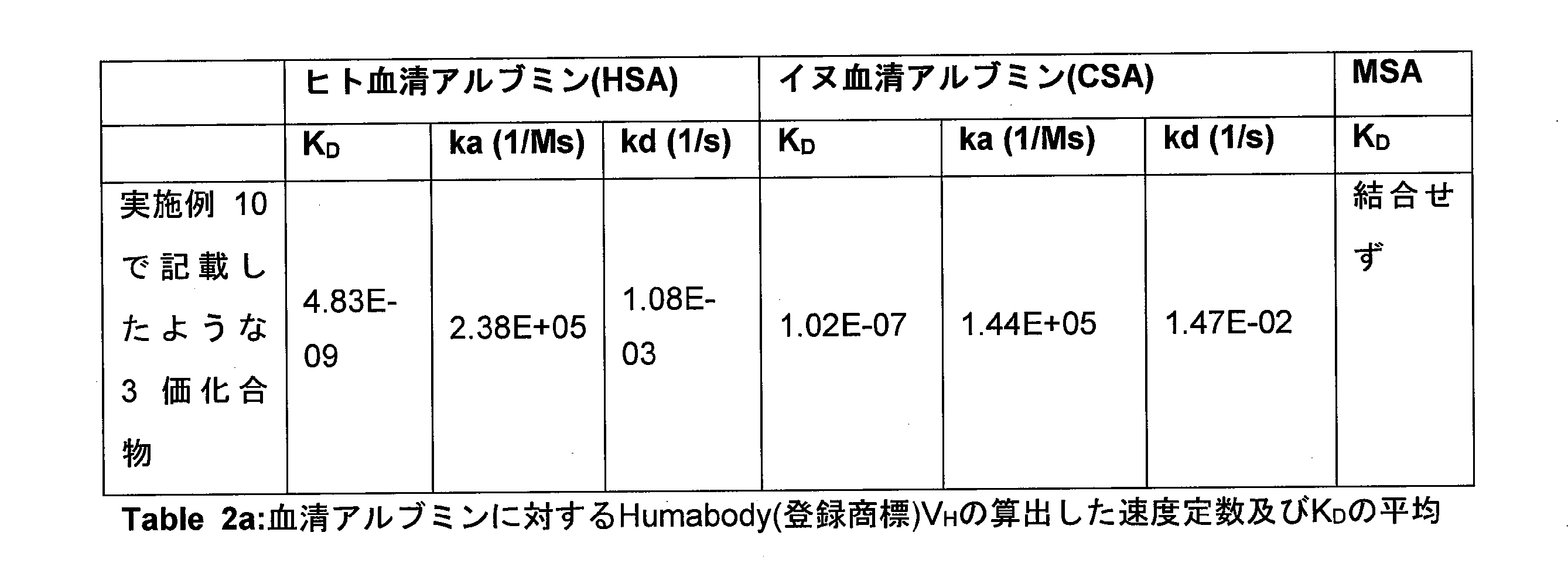

(実施例8)
VH単一ドメイン抗体は良好な安定性を示す
精製したVHをサイズ排除クロマトグラフィーに供した。簡単に説明すると、精製したVHを2mg/mlでPBS緩衝液に溶かし、4℃又は40℃で0~14日間保存した後、PDA検出器(280nmで検出)を備えたWaters H-Class Bio UPLCを使用して様々な時点で分析し、Waters ACQUITY BEH 125Å SECカラムで分離した。試料を10μlの体積で注入し、NaCl 200mM、100mMリン酸ナトリウムpH7.4+5%プロパン-1-オールを含有する移動相で、0.4ml/分の流速で流した。6分間データを収集し、保存後の試料中の単量体タンパク質のパーセンテージを算出した。
Example 8
VH single domain antibodies show good stability Purified VH was subjected to size exclusion chromatography. Briefly, purified VH was dissolved in PBS buffer at 2mg/ml and stored at 4°C or 40°C for 0-14 days and then analyzed at various time points using a Waters H-Class Bio UPLC equipped with a PDA detector (detection at 280nm) and separated on a Waters ACQUITY BEH 125Å SEC column. Samples were injected in a volume of 10μl and run at a flow rate of 0.4ml/min with a mobile phase containing NaCl 200mM, 100mM sodium phosphate pH7.4+5% propan-1-ol. Data was collected for 6 minutes and the percentage of monomeric protein in the samples after storage was calculated.
4℃で14日間インキュベーションした後、著しい変化は認められなかった。40℃でインキュベーションした後、単量体パーセンテージのわずかな低下が観察された。以下の結果は、(Humabody(登録商標)1(配列番号1)について示している。 After incubation at 4°C for 14 days, no significant changes were observed. After incubation at 40°C, a slight decrease in monomer percentage was observed. The following results are shown for (Humabody® 1 (SEQ ID NO:1).
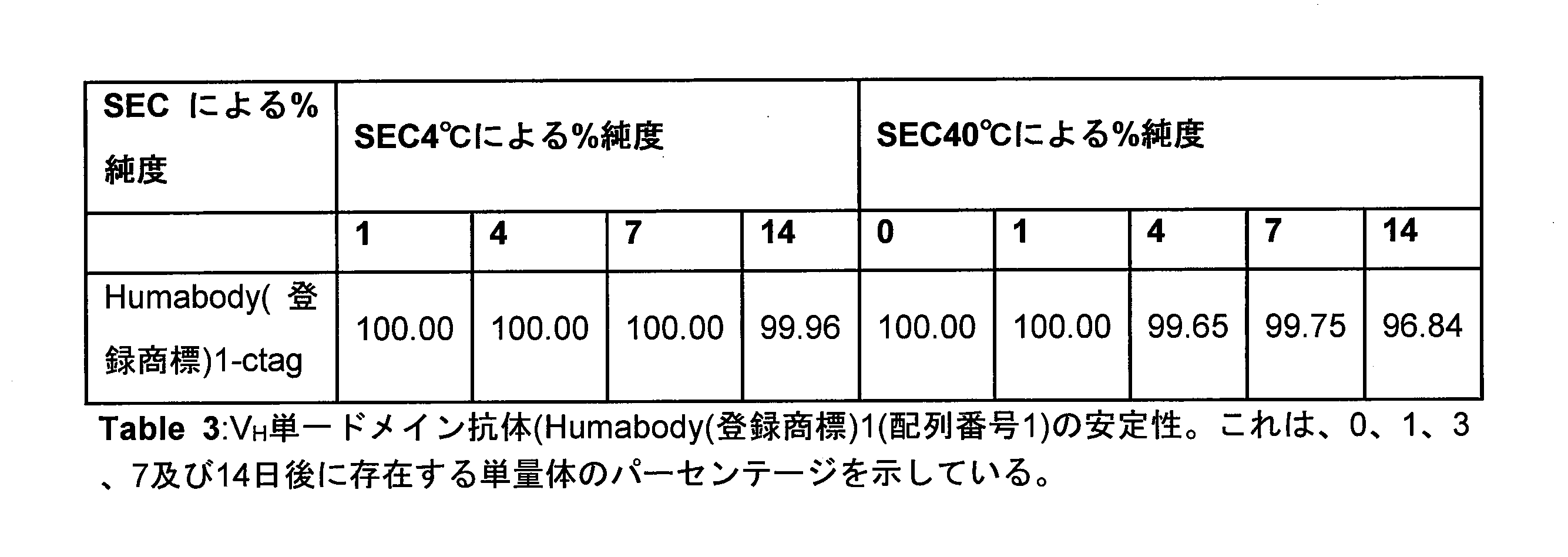
(実施例9)
2重トランスジェニックヒト化FcRn/HSAマウスにおける半減期延長分子の単回静脈内投与の薬物動態分析
genOway(登録商標)によるヒト新生児Fc受容体/ヒトアルブミンマウスモデルを使用して実験を実行した。この2重ヒト化新生児Fc受容体(FcRn)/アルブミンマウスモデルは、自己由来受容体-リガンド相互作用を維持しており、ヒトにおける生理的薬物クリアランスを模倣しているため、アルブミンに連結した低分子及び従来の薬物動態を測定し最適化するので、並びに循環する生物製剤及びバイオシミラー薬物の半減期を研究し予測するための、独特で信頼性の高い手段となっている(Viuff D, Antunes F, Evans L, Cameron J, Dyrnesli H, Thue Ravn B, Stougaard M, Thiam K, Andersen B, Kjarulff S, Howard KA. 2016. 「Generation of a double transgenic humanized neonatal Fc receptor (FcRn)/albumin mouse to study the pharmacokinetics of albumin-linked drugs.」 J Control Release)。
Example 9
Pharmacokinetic analysis of a single intravenous dose of a half-life extending molecule in double transgenic humanized FcRn/HSA mice
Experiments were performed using the human neonatal Fc receptor/human albumin mouse model by genOway®. This double humanized neonatal Fc receptor (FcRn)/albumin mouse model maintains autologous receptor-ligand interactions and mimics physiological drug clearance in humans, making it a unique and reliable tool to measure and optimize the pharmacokinetics of albumin-linked small molecules and conventional drugs, as well as to study and predict the half-life of circulating biologics and biosimilar drugs (Viuff D, Antunes F, Evans L, Cameron J, Dyrnesli H, Thue Ravn B, Stougaard M, Thiam K, Andersen B, Kjarulff S, Howard KA. 2016. "Generation of a double transgenic humanized neonatal Fc receptor (FcRn)/albumin mouse to study the pharmacokinetics of albumin-linked drugs." J Control Release).
hFcRn/HSAヒト化マウスは、WTマウスよりも予測可能な「ヒト様の」薬物動態の結果をもたらす。このモデルは、HSA結合薬物の薬物動態、分布、及び毒性のインビボ評価に非常に適している。 hFcRn/HSA humanized mice yield more predictable, "human-like" pharmacokinetic outcomes than WT mice. This model is well suited for in vivo evaluation of the pharmacokinetics, distribution, and toxicity of HSA-bound drugs.
薬物動態を試験するこれらの実験では、Humabody(登録商標)1(配列番号1)を含む3重特異性分子(配列番号17)を使用した。3価の構築物は、CD137及び前立腺特異的膜抗原(PSMA)それぞれに結合する2つのVHドメイン、並びに構築物のC末端に位置するHSA結合配列番号1を含む(3つのVHはG4Sリンカーによって連結されている)。 In these experiments to test the pharmacokinetics, a trispecific molecule (SEQ ID NO: 17) was used that contains Humabody® 1 (SEQ ID NO: 1). The trivalent construct contains two VH domains that bind CD137 and prostate specific membrane antigen (PSMA) respectively, and the HSA binding SEQ ID NO: 1 located at the C-terminus of the construct (the three VHs are linked by a G4S linker).
簡単に説明すると、雄のgenOway(登録商標)ヒトHSA/FcRn Tgマウスに尾静脈を介して単回静脈内注射で2mg/kg(n=3)を投与した。血液試料は投与前並びに薬物投与の0.083h、1h、8h、24h、48h、72h、及び96h後に伏在静脈から収集した。投与の168時間後に全動物を安楽死させ、血液を収集した。血漿を分離し、アッセイを実施するまで-80℃で保存した。血漿試料は、Gyrolab免疫アッセイプラットフォームで、ビオチン化したヒトPSMAを捕捉剤として、ヒトCD137Dylight650を検出剤として使用して分析した。データはGyrosを使用して分析し、血漿中の濃度を得た。データの薬物動態分析は、エクセルのアドオンであるPK Solver 2.0を使用して行った。 Briefly, male genOway® human HSA/FcRn Tg mice were dosed with a single intravenous injection via the tail vein at 2 mg/kg (n=3). Blood samples were collected from the saphenous vein pre-dose and at 0.083 h, 1 h, 8 h, 24 h, 48 h, 72 h, and 96 h after drug administration. All animals were euthanized and blood was collected 168 h after dosing. Plasma was separated and stored at -80°C until assays were performed. Plasma samples were analyzed on a Gyrolab immunoassay platform using biotinylated human PSMA as the capture agent and human CD137 Dylight650 as the detection agent. Data were analyzed using Gyros to obtain concentrations in plasma. Pharmacokinetic analysis of the data was performed using PK Solver 2.0, an Excel add-on.
試験の結果は、ヒトHSA/FcRn Tgマウスに2mg/kgを静脈内投与したとき、分子が18.13±0.412時間(n=3)の半減期を有することを示している。配列番号1を有さない対照は急速に排出され、1時間後には血漿中で検出されなくなった。 Results show that the molecule has a half-life of 18.13 ± 0.412 hours (n = 3) when administered intravenously at 2 mg/kg to human HSA/FcRn Tg mice. The control without SEQ ID NO: 1 was rapidly excreted and was undetectable in plasma after 1 hour.

(実施例10)
Humabody(登録商標)1の結合部位の決定
ForteBio OCTET RED384装置を使用して、Humabody(登録商標)1VHとHSAドメインI、II、及びIIIとの間の相互作用を調べた。HSAドメインは、Albumin Bioscience社から購入した。簡単に説明すると、AR2Gバイオセンサーを水で再水和した後、EDC/sNHS試薬を使用して10分間活性化した。活性化したバイオセンサーを、10mM酢酸ナトリウムpH5.0で50μg/mlに希釈したHSAドメインを含有するウェルに5分間浸漬した後、1MエタノールアミンpH8.5を使用して遊離活性部位を10分かけて不活性化した。次に、これらを10mMグリシンpH2.5に浸漬して表面を安定化させた。その後、バイオセンサーに付加したドメインHSAを、1×アッセイ緩衝液(PBS/Tween-20 0.05%)に120秒間浸漬してベースラインを確立した後、HSAへの結合を起こさせるために300nMの所定濃度のHumabody(登録商標)1VHを含有するウェルに120秒かけて浸漬した。その後、バイオセンサーをアッセイ緩衝液を含有するウェルに移し、300秒かけてHumabody(登録商標)VHをHSAドメインから解離させた。
Example 10
Determination of the Binding Site of Humabody® 1
A ForteBio OCTET RED384 instrument was used to study the interaction between Humabody® 1V H and HSA domains I, II, and III. HSA domains were purchased from Albumin Bioscience. Briefly, AR2G biosensors were rehydrated with water and then activated with EDC/sNHS reagent for 10 min. The activated biosensors were immersed in wells containing HSA domains diluted to 50 μg/ml in 10 mM sodium acetate pH 5.0 for 5 min, after which free active sites were inactivated with 1 M ethanolamine pH 8.5 for 10 min. They were then immersed in 10 mM glycine pH 2.5 to stabilize the surface. The domain HSA attached to the biosensor was then immersed in 1× assay buffer (PBS/Tween-20 0.05%) for 120 seconds to establish a baseline, followed by immersion in wells containing a given concentration of 300 nM Humabody® 1 V H for 120 seconds to allow binding to HSA. The biosensor was then transferred to wells containing assay buffer, allowing Humabody® V H to dissociate from the HSA domain for 300 seconds.
Humabody(登録商標)1はHSAのドメインIIIには結合するが、ドメインI及びIIには結合しない。 Humabody(R) 1 binds to domain III of HSA, but not to domains I and II.
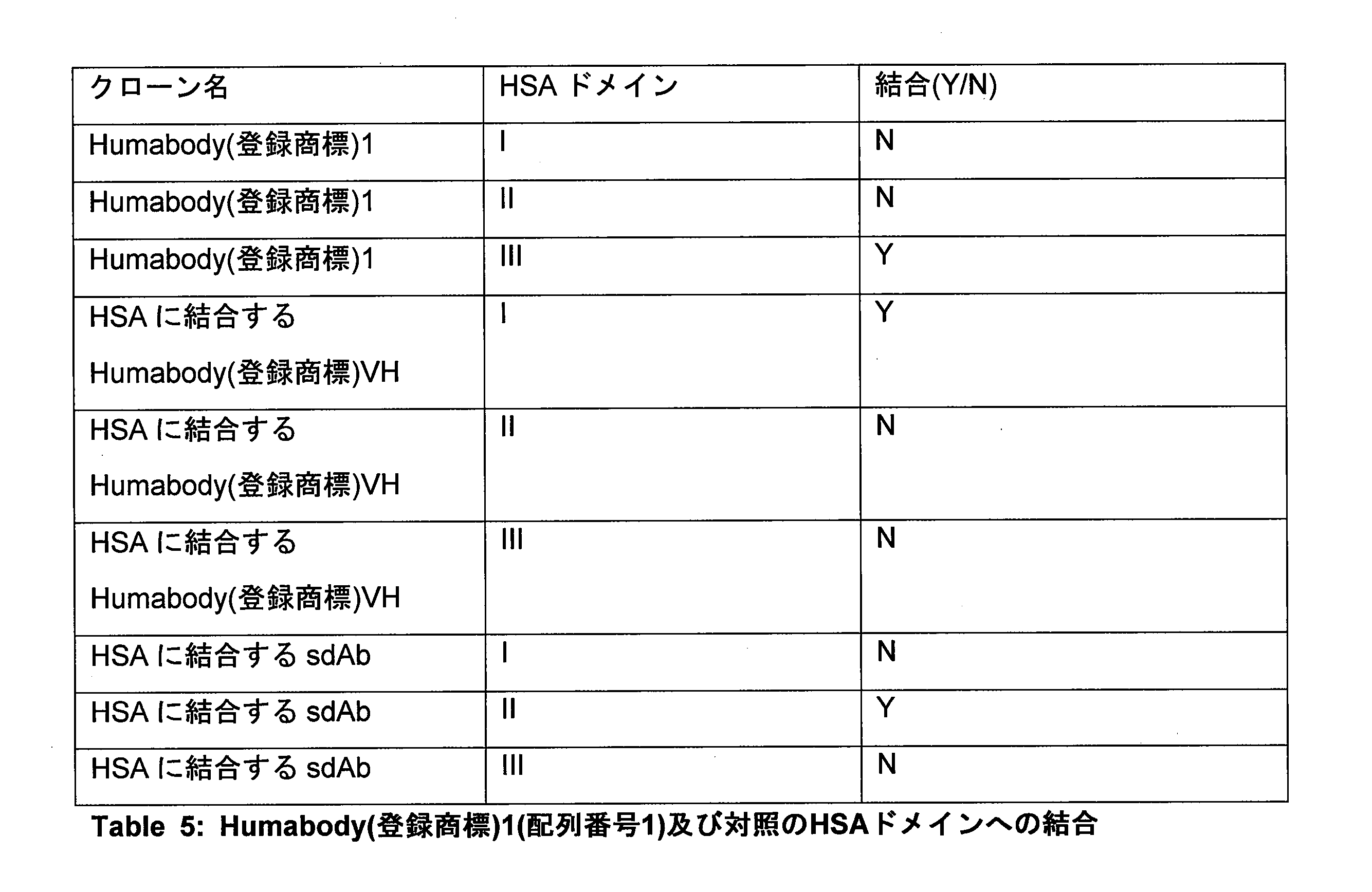
上記の実験で使用した配列
配列番号17
タンパク質
EVQLVESGGGVVQPGRSLRLSCAASGFSFSGYGMHWVRQAPGKGLEWVAYISYDGSNKYYADSVKGRFTISRDNSKNTLYLQMNSLRAEDTAVYYCAKDPAWGLRLGESSSYDFDIWGQGTMVTVSSGGGGSGGGGSGGGGSGGGGSGGGGSGGGGSEVQLVESGGGLVQPGGSLRLSCAASGFTLSNYWMNWVRQAPGKGLEWVANINQDGSERYYVDSVKGRFTISRDNAKNSLYLQMNSLRAEDTAVYYCARGGEGYGVDHYGLDVSGQGTTVTVSSGGGGSGGGGSGGGGSGGGGSGGGGSGGGGSEVQLVESGGGLVQPGRSLRLSCAASGFTFHHYAMHWVRQAPGKGLEWVSGISWNGNKITYADSVKGRFTISRDNAKNSLYLQMNSLRAEDTALYYCVRDSSLFIVGAPTFEHWGRGTLVTVSSGGGGSGGGGSGGGGSGGGGS
配列番号18のタンパク質をコードする核酸
GAGGTGCAGCTGGTGGAGTCTGGGGGAGGCGTGGTCCAGCCTGGGAGGTCCCTGAGACTCTCCTGTGCAGCCTCTGGATTCTCCTTCAGTGGCTATGGCATGCACTGGGTCCGCCAGGCTCCAGGCAAGGGACTGGAGTGGGTGGCATATATATCATATGATGGAAGTAATAAATACTATGCAGACTCCGTGAAGGGCCGATTCACCATCTCCAGAGACAATTCCAAGAACACGCTGTATCTGCAAATGAACAGCCTGAGAGCTGAGGACACGGCTGTGTATTACTGTGCGAAAGATCCGGCCTGGGGATTACGTTTGGGGGAGTCATCGTCCTATGATTTTGATATCTGGGGCCAAGGGACAATGGTCACCGTCTCCTCAGGTGGTGGCGGTTCAGGCGGAGGTGGCTCTGGAGGTGGAGGTTCAGGAGGTGGTGGTTCTGGCGGCGGTGGATCGGGTGGAGGTGGTAGTGAGGTGCAGTTAGTTGAGAGCGGAGGTGGTTTAGTTCAGCCGGGGGGCTCGCTTCGCCTGTCGTGCGCCGCCTCGGGATTCACATTATCAAACTACTGGATGAATTGGGTCCGCCAGGCTCCGGGCAAAGGTCTTGAGTGGGTGGCGAACATTAATCAGGACGGGAGCGAGCGTTATTACGTTGATTCGGTAAAAGGACGTTTCACTATCAGTCGTGACAACGCTAAAAATTCCTTGTACTTACAGATGAACTCACTTCGTGCTGAGGACACCGCAGTGTACTACTGTGCTCGCGGTGGTGAAGGATACGGCGTCGATCACTACGGCCTTGATGTATCAGGACAGGGGACTACAGTTACCGTCTCTTCCGGCGGAGGTGGCTCTGGAGGAGGCGGATCGGGGGGTGGAGGAAGTGGCGGCGGTGGTAGTGGAGGAGGTGGTTCTGGAGGCGGTGGCTCTGAAGTACAACTGGTTGAATCGGGTGGTGGATTGGTCCAACCTGGAAGATCATTGAGGCTTTCTTGTGCAGCTTCCGGATTCACCTTTCATCACTATGCTATGCACTGGGTGAGACAAGCCCCTGGTAAGGGCTTGGAATGGGTGTCCGGAATCTCCTGGAATGGTAACAAAATAACATATGCAGATTCCGTTAAGGGTAGATTTACTATTAGCCGTGATAATGCAAAAAACAGTTTATACTTGCAGATGAATTCCTTGAGGGCTGAGGATACAGCTCTTTACTATTGTGTGCGTGACTCATCGTTGTTCATTGTCGGAGCCCCAACTTTCGAACATTGGGGTAGAGGTACCCTAGTTACGGTTAGCTCAGGCGGAGGTGGCTCTGGAGGAGGCGGATCGGGGGGTGGAGGAAGTGGCGGCGGTGGTAGT
配列番号19
QVQLVESGGGLVHPGGSLKLSCAVSGFTFHHYAMHWVRQAPGKGLEWVSGISWNGNKITYADSVKGRFTISRDNAKNSLYLQMNSLRAEDTALYYCVRDSSLFIVGAPTFDHWGQGTLVTVSS
配列番号20
QVQLVESGGGLVHPGGSLKLSCAVSGFTFHHYAMHWVRQAPGKGLEWVSGISWNGNKITYADSVKGRFTISRDNAKNSLYLQMNSLRAEDTALYYCVRDSSLFIVGAPTFDHWGQGTLVTVSS
Sequence SEQ ID NO: 17 used in the above experiment
protein
EVQLVESGGGVVQPGRSLRLSCAASGSFSGYGMHWVRQAPGKGLEWVAYISYDGSNKYYADSVKGRFTISRDNSKNTLYLQMNSLRAEDTAVYYCAKDPAWGRLLGESSSYDFDIWGQGTMVTVSSGGGGSGGGGSGGGGSGGGGSGGGGSGGGGSEVQLVESGGGLVQPGGSLRLSCAASGFTLSNYWMNWVRQAPGKGLEWVANINQDGSE RYYVDSVKGRFT ISRDNAKNSLYLQMNSLRAEDTAVYYCARGGEGYGVDHYGLDVSGQGTTVTVSSGGGGSGGGGSGGGGSGGGGSGGGGSGGGGSEVQLVESGGGLVQPGRSLRLSCAASGFTFHHYAMHWVRQAPGKGLEWVSGISWNGNKITYADSVKGRFTISRDNAKNSLYLQMNSLRAEDTALYYCVRDSSLFIVGAPTFEHWGRGTLVTVSSGGGGSGGGGSGGGGSG GGGGS
A nucleic acid encoding the protein of SEQ ID NO:18
SEQ ID NO:19
QVQLVESGGGLVHPGGSLKLSCAVSGFTFHHYAMHWVRQAPGKGLEWVSGISWNGNKITYADSVKGRFTISRDNAKNSLYLQMNSLRAEDTALYYCVRDSSLFIVGAPTFDHWGQGTLVTVSS
SEQ ID NO:20
QVQLVESGGGLVHPGGSLKLSCAVSGFTFHHYAMHWVRQAPGKGLEWVSGISWNGNKITYADSVKGRFTISRDNAKNSLYLQMNSLRAEDTALYYCVRDSSLFIVGAPTFDHWGQGTLVTVSS
Claims (22)
b)配列番号3を含むCDR2、及び
c)配列番号4を含むCDR3を含む、
ヒト血清アルブミン(HSA)に結合する免疫グロブリンヒト単一可変重鎖ドメイン。 a) CDR1 comprising SEQ ID NO:2
b) CDR2 comprising SEQ ID NO:3, and
c) comprising a CDR3 comprising SEQ ID NO:4;
An immunoglobulin human single variable heavy chain domain that binds to human serum albumin (HSA).
Applications Claiming Priority (3)
| Application Number | Priority Date | Filing Date | Title |
|---|---|---|---|
| GBGB1818460.6A GB201818460D0 (en) | 2018-11-13 | 2018-11-13 | Single domain antibodies that bind human serum albumin |
| GB1818460.6 | 2018-11-13 | ||
| PCT/GB2019/053220 WO2020099871A1 (en) | 2018-11-13 | 2019-11-13 | Single domain antibodies that bind human serum albumin |
Publications (2)
| Publication Number | Publication Date |
|---|---|
| JP2022507307A JP2022507307A (en) | 2022-01-18 |
| JP7520002B2 true JP7520002B2 (en) | 2024-07-22 |
Family
ID=64739541
Family Applications (1)
| Application Number | Title | Priority Date | Filing Date |
|---|---|---|---|
| JP2021525805A Active JP7520002B2 (en) | 2018-11-13 | 2019-11-13 | Single domain antibodies that bind to human serum albumin |
Country Status (11)
| Country | Link |
|---|---|
| US (1) | US20210340233A1 (en) |
| EP (1) | EP3880703A1 (en) |
| JP (1) | JP7520002B2 (en) |
| KR (1) | KR20210091254A (en) |
| CN (1) | CN113412278B (en) |
| AU (1) | AU2019378154A1 (en) |
| CA (1) | CA3118640A1 (en) |
| GB (1) | GB201818460D0 (en) |
| IL (1) | IL282641A (en) |
| SG (1) | SG11202103741RA (en) |
| WO (1) | WO2020099871A1 (en) |
Families Citing this family (11)
| Publication number | Priority date | Publication date | Assignee | Title |
|---|---|---|---|---|
| EP3565842A1 (en) | 2017-01-06 | 2019-11-13 | Crescendo Biologics Limited | Single domain antibodies to programmed cell death (pd-1) |
| CN118955716A (en) | 2017-11-13 | 2024-11-15 | 克雷森多生物制剂有限公司 | Single domain antibodies that bind CD137 |
| GB201802573D0 (en) | 2018-02-16 | 2018-04-04 | Crescendo Biologics Ltd | Therapeutic molecules that bind to LAG3 |
| CN109942704B (en) * | 2019-04-12 | 2023-01-20 | 深圳普瑞金生物药业股份有限公司 | HSA single domain antibodies, nucleic acids and kits |
| CN117043184A (en) * | 2021-04-01 | 2023-11-10 | 南京再明医药有限公司 | Nanobodies against human serum albumin (HSA) and their applications |
| TW202313685A (en) * | 2021-06-07 | 2023-04-01 | 大陸商上海濟煜醫藥科技有限公司 | Anti-human serum albumin antigen binding protein |
| GB202205589D0 (en) | 2022-04-14 | 2022-06-01 | Crescendo Biologics Ltd | Mesothelin binders |
| CN117088975B (en) * | 2022-05-11 | 2024-06-25 | 东莞市朋志生物科技有限公司 | Anti-albumin antibody, reagent and kit for detecting albumin |
| AU2024221136A1 (en) | 2023-02-17 | 2025-10-02 | Ablynx N.V. | Polypeptides binding to the neonatal fc receptor |
| CN120025433A (en) * | 2024-01-22 | 2025-05-23 | 寻济生物科技(北京)有限公司 | Anti-albumin antibody or antigen-binding fragment thereof and application thereof |
| CN118685413B (en) * | 2024-08-28 | 2025-02-07 | 杭州嘉因生物科技有限公司 | Construction and application of an inducible stable cell line that downregulates endogenous SMN |
Citations (2)
| Publication number | Priority date | Publication date | Assignee | Title |
|---|---|---|---|---|
| JP2010518062A (en) | 2007-02-08 | 2010-05-27 | ドマンティス リミテッド | Antibody single variable domain against serum albumin |
| WO2017122018A1 (en) | 2016-01-12 | 2017-07-20 | Crescendo Biologics Limited | Molecules that bind prostate specific membrane antigen (psma) |
Family Cites Families (14)
| Publication number | Priority date | Publication date | Assignee | Title |
|---|---|---|---|---|
| GB0115256D0 (en) | 2001-06-21 | 2001-08-15 | Babraham Inst | Mouse light chain locus |
| US20060073141A1 (en) * | 2001-06-28 | 2006-04-06 | Domantis Limited | Compositions and methods for treating inflammatory disorders |
| US20050271663A1 (en) * | 2001-06-28 | 2005-12-08 | Domantis Limited | Compositions and methods for treating inflammatory disorders |
| GB2398784B (en) | 2003-02-26 | 2005-07-27 | Babraham Inst | Removal and modification of the immunoglobulin constant region gene cluster of a non-human mammal |
| LT2949668T (en) * | 2005-05-18 | 2019-11-11 | Ablynx Nv | Improved nanobodies tm against tumor necrosis factor-alpha |
| AU2007328900A1 (en) * | 2006-12-05 | 2008-06-12 | Ablynx N.V. | Peptides capable of binding to serum proteins |
| WO2012022703A2 (en) * | 2010-08-20 | 2012-02-23 | Glaxo Group Limited | Improved anti-serum albumin binding variants |
| AU2012273928A1 (en) * | 2011-06-23 | 2014-02-06 | Ablynx Nv | Immunoglobulin single variable domains directed against IgE |
| MX2014001883A (en) * | 2011-08-17 | 2014-05-27 | Glaxo Group Ltd | Modified proteins and peptides. |
| WO2014111550A1 (en) * | 2013-01-17 | 2014-07-24 | Glaxosmithkline Intellectual Property Development Limited | Modified anti-serum albumin binding proteins |
| KR20170073647A (en) | 2014-10-22 | 2017-06-28 | 크레센도 바이오로직스 리미티드 | Transgenic mice |
| GB201500464D0 (en) * | 2015-01-12 | 2015-02-25 | Crescendo Biolog Ltd | Method of producing optimised therapeutic molecules |
| KR102530742B1 (en) * | 2016-05-20 | 2023-05-09 | 하푼 테라퓨틱스, 인크. | single domain serum albumin binding protein |
| WO2018224439A1 (en) * | 2017-06-05 | 2018-12-13 | Numab Innovation Ag | Novel anti-hsa antibodies |
-
2018
- 2018-11-13 GB GBGB1818460.6A patent/GB201818460D0/en not_active Ceased
-
2019
- 2019-11-13 KR KR1020217017911A patent/KR20210091254A/en not_active Ceased
- 2019-11-13 CA CA3118640A patent/CA3118640A1/en active Pending
- 2019-11-13 JP JP2021525805A patent/JP7520002B2/en active Active
- 2019-11-13 CN CN201980088164.5A patent/CN113412278B/en active Active
- 2019-11-13 WO PCT/GB2019/053220 patent/WO2020099871A1/en not_active Ceased
- 2019-11-13 SG SG11202103741RA patent/SG11202103741RA/en unknown
- 2019-11-13 US US17/292,592 patent/US20210340233A1/en not_active Abandoned
- 2019-11-13 EP EP19809554.9A patent/EP3880703A1/en not_active Withdrawn
- 2019-11-13 AU AU2019378154A patent/AU2019378154A1/en active Pending
-
2021
- 2021-04-26 IL IL282641A patent/IL282641A/en unknown
Patent Citations (2)
| Publication number | Priority date | Publication date | Assignee | Title |
|---|---|---|---|---|
| JP2010518062A (en) | 2007-02-08 | 2010-05-27 | ドマンティス リミテッド | Antibody single variable domain against serum albumin |
| WO2017122018A1 (en) | 2016-01-12 | 2017-07-20 | Crescendo Biologics Limited | Molecules that bind prostate specific membrane antigen (psma) |
Also Published As
| Publication number | Publication date |
|---|---|
| CN113412278B (en) | 2024-06-14 |
| JP2022507307A (en) | 2022-01-18 |
| KR20210091254A (en) | 2021-07-21 |
| SG11202103741RA (en) | 2021-05-28 |
| AU2019378154A1 (en) | 2021-05-20 |
| EP3880703A1 (en) | 2021-09-22 |
| GB201818460D0 (en) | 2018-12-26 |
| IL282641A (en) | 2021-06-30 |
| WO2020099871A1 (en) | 2020-05-22 |
| US20210340233A1 (en) | 2021-11-04 |
| CN113412278A (en) | 2021-09-17 |
| CA3118640A1 (en) | 2020-05-22 |
Similar Documents
| Publication | Publication Date | Title |
|---|---|---|
| JP7520002B2 (en) | Single domain antibodies that bind to human serum albumin | |
| JP7450594B2 (en) | therapeutic molecules | |
| JP7312168B2 (en) | A single domain antibody that binds to CD137 | |
| KR102662387B1 (en) | B7-H3 antibody, antigen-binding fragment thereof and medical uses thereof | |
| CN113840835B (en) | Binding molecules | |
| IL282452A (en) | Histidine engineered light chain antibodies and genetically modified non-human animals for generating the same | |
| WO2022253302A1 (en) | Nanoantibody targeting human serum albumin (hsa) and application of nanoantibody | |
| JP2003284577A (en) | Biosynthetic binding protein for cancer marker | |
| CN107207581B (en) | Methods for preparing optimized therapeutic molecules | |
| JP7010491B2 (en) | Humanized anti-RAGE antibody | |
| US20250215616A1 (en) | Variable heavy chain only libraries, methods of preparation thereof, and uses thereof |
Legal Events
| Date | Code | Title | Description |
|---|---|---|---|
| A621 | Written request for application examination |
Free format text: JAPANESE INTERMEDIATE CODE: A621 Effective date: 20220824 |
|
| A977 | Report on retrieval |
Free format text: JAPANESE INTERMEDIATE CODE: A971007 Effective date: 20230721 |
|
| A131 | Notification of reasons for refusal |
Free format text: JAPANESE INTERMEDIATE CODE: A131 Effective date: 20230724 |
|
| A521 | Request for written amendment filed |
Free format text: JAPANESE INTERMEDIATE CODE: A523 Effective date: 20231024 |
|
| A131 | Notification of reasons for refusal |
Free format text: JAPANESE INTERMEDIATE CODE: A131 Effective date: 20231218 |
|
| A521 | Request for written amendment filed |
Free format text: JAPANESE INTERMEDIATE CODE: A523 Effective date: 20240313 |
|
| TRDD | Decision of grant or rejection written | ||
| A01 | Written decision to grant a patent or to grant a registration (utility model) |
Free format text: JAPANESE INTERMEDIATE CODE: A01 Effective date: 20240610 |
|
| A61 | First payment of annual fees (during grant procedure) |
Free format text: JAPANESE INTERMEDIATE CODE: A61 Effective date: 20240709 |
|
| R150 | Certificate of patent or registration of utility model |
Ref document number: 7520002 Country of ref document: JP Free format text: JAPANESE INTERMEDIATE CODE: R150 |