JP7519082B2 - Antibacterial agents, oral compositions, mouthwashes, dentifrices, and medicines or quasi-drugs - Google Patents
Antibacterial agents, oral compositions, mouthwashes, dentifrices, and medicines or quasi-drugs Download PDFInfo
- Publication number
- JP7519082B2 JP7519082B2 JP2020134212A JP2020134212A JP7519082B2 JP 7519082 B2 JP7519082 B2 JP 7519082B2 JP 2020134212 A JP2020134212 A JP 2020134212A JP 2020134212 A JP2020134212 A JP 2020134212A JP 7519082 B2 JP7519082 B2 JP 7519082B2
- Authority
- JP
- Japan
- Prior art keywords
- mutans
- acid residue
- inhibitory effect
- growth inhibitory
- bacteria
- Prior art date
- Legal status (The legal status is an assumption and is not a legal conclusion. Google has not performed a legal analysis and makes no representation as to the accuracy of the status listed.)
- Active
Links
- 239000000203 mixture Substances 0.000 title claims description 35
- 239000003242 anti bacterial agent Substances 0.000 title claims description 22
- 239000003814 drug Substances 0.000 title claims description 15
- 229940079593 drug Drugs 0.000 title claims description 11
- 239000002324 mouth wash Substances 0.000 title claims description 6
- 239000000551 dentifrice Substances 0.000 title 1
- 241000194019 Streptococcus mutans Species 0.000 claims description 79
- 208000002925 dental caries Diseases 0.000 claims description 38
- IPCSVZSSVZVIGE-UHFFFAOYSA-N palmitic acid group Chemical group C(CCCCCCCCCCCCCCC)(=O)O IPCSVZSSVZVIGE-UHFFFAOYSA-N 0.000 claims description 30
- 150000001875 compounds Chemical class 0.000 claims description 27
- 239000004480 active ingredient Substances 0.000 claims description 23
- QIQXTHQIDYTFRH-UHFFFAOYSA-N octadecanoic acid Chemical group CCCCCCCCCCCCCCCCCC(O)=O QIQXTHQIDYTFRH-UHFFFAOYSA-N 0.000 claims description 19
- 239000000126 substance Substances 0.000 claims description 18
- NFWKVWVWBFBAOV-MISYRCLQSA-N dehydroabietic acid Chemical group OC(=O)[C@]1(C)CCC[C@]2(C)C3=CC=C(C(C)C)C=C3CC[C@H]21 NFWKVWVWBFBAOV-MISYRCLQSA-N 0.000 claims description 16
- 239000000606 toothpaste Substances 0.000 claims description 5
- 229940051866 mouthwash Drugs 0.000 claims description 4
- 229940034610 toothpaste Drugs 0.000 claims description 3
- IAZDPXIOMUYVGZ-UHFFFAOYSA-N Dimethylsulphoxide Chemical compound CS(C)=O IAZDPXIOMUYVGZ-UHFFFAOYSA-N 0.000 description 59
- QTBSBXVTEAMEQO-UHFFFAOYSA-N Acetic acid Chemical compound CC(O)=O QTBSBXVTEAMEQO-UHFFFAOYSA-N 0.000 description 51
- PEDCQBHIVMGVHV-UHFFFAOYSA-N Glycerine Chemical compound OCC(O)CO PEDCQBHIVMGVHV-UHFFFAOYSA-N 0.000 description 48
- HEDRZPFGACZZDS-UHFFFAOYSA-N Chloroform Chemical compound ClC(Cl)Cl HEDRZPFGACZZDS-UHFFFAOYSA-N 0.000 description 46
- 230000009422 growth inhibiting effect Effects 0.000 description 43
- 238000012360 testing method Methods 0.000 description 42
- 241000894006 Bacteria Species 0.000 description 33
- OKKJLVBELUTLKV-UHFFFAOYSA-N Methanol Chemical compound OC OKKJLVBELUTLKV-UHFFFAOYSA-N 0.000 description 33
- 239000000243 solution Substances 0.000 description 30
- 150000002632 lipids Chemical class 0.000 description 28
- 239000000284 extract Substances 0.000 description 25
- 239000002609 medium Substances 0.000 description 24
- 244000005700 microbiome Species 0.000 description 24
- VLKZOEOYAKHREP-UHFFFAOYSA-N n-Hexane Chemical compound CCCCCC VLKZOEOYAKHREP-UHFFFAOYSA-N 0.000 description 24
- 238000000034 method Methods 0.000 description 23
- 239000000047 product Substances 0.000 description 22
- 150000001982 diacylglycerols Chemical class 0.000 description 20
- 238000004809 thin layer chromatography Methods 0.000 description 17
- XEKOWRVHYACXOJ-UHFFFAOYSA-N Ethyl acetate Chemical compound CCOC(C)=O XEKOWRVHYACXOJ-UHFFFAOYSA-N 0.000 description 15
- 230000009036 growth inhibition Effects 0.000 description 15
- 239000007788 liquid Substances 0.000 description 15
- JVTAAEKCZFNVCJ-UHFFFAOYSA-N lactic acid Chemical compound CC(O)C(O)=O JVTAAEKCZFNVCJ-UHFFFAOYSA-N 0.000 description 14
- LFQSCWFLJHTTHZ-UHFFFAOYSA-N Ethanol Chemical compound CCO LFQSCWFLJHTTHZ-UHFFFAOYSA-N 0.000 description 13
- 238000002290 gas chromatography-mass spectrometry Methods 0.000 description 13
- QUUCYKKMFLJLFS-UHFFFAOYSA-N Dehydroabietan Natural products CC1(C)CCCC2(C)C3=CC=C(C(C)C)C=C3CCC21 QUUCYKKMFLJLFS-UHFFFAOYSA-N 0.000 description 12
- NFWKVWVWBFBAOV-UHFFFAOYSA-N Dehydroabietic acid Natural products OC(=O)C1(C)CCCC2(C)C3=CC=C(C(C)C)C=C3CCC21 NFWKVWVWBFBAOV-UHFFFAOYSA-N 0.000 description 12
- VYPSYNLAJGMNEJ-UHFFFAOYSA-N Silicium dioxide Chemical compound O=[Si]=O VYPSYNLAJGMNEJ-UHFFFAOYSA-N 0.000 description 12
- TVXBFESIOXBWNM-UHFFFAOYSA-N Xylitol Natural products OCCC(O)C(O)C(O)CCO TVXBFESIOXBWNM-UHFFFAOYSA-N 0.000 description 12
- 229940118781 dehydroabietic acid Drugs 0.000 description 12
- HEBKCHPVOIAQTA-UHFFFAOYSA-N meso ribitol Natural products OCC(O)C(O)C(O)CO HEBKCHPVOIAQTA-UHFFFAOYSA-N 0.000 description 12
- -1 methyl dehydroabietic acid Chemical compound 0.000 description 12
- 239000000811 xylitol Substances 0.000 description 12
- HEBKCHPVOIAQTA-SCDXWVJYSA-N xylitol Chemical compound OC[C@H](O)[C@@H](O)[C@H](O)CO HEBKCHPVOIAQTA-SCDXWVJYSA-N 0.000 description 12
- 235000010447 xylitol Nutrition 0.000 description 12
- 229960002675 xylitol Drugs 0.000 description 12
- 235000021314 Palmitic acid Nutrition 0.000 description 11
- 235000021355 Stearic acid Nutrition 0.000 description 11
- WQEPLUUGTLDZJY-UHFFFAOYSA-N n-Pentadecanoic acid Natural products CCCCCCCCCCCCCCC(O)=O WQEPLUUGTLDZJY-UHFFFAOYSA-N 0.000 description 11
- OQCDKBAXFALNLD-UHFFFAOYSA-N octadecanoic acid Natural products CCCCCCCC(C)CCCCCCCCC(O)=O OQCDKBAXFALNLD-UHFFFAOYSA-N 0.000 description 11
- 238000011218 seed culture Methods 0.000 description 11
- 239000000741 silica gel Substances 0.000 description 11
- 229910002027 silica gel Inorganic materials 0.000 description 11
- 239000008117 stearic acid Substances 0.000 description 11
- 239000013641 positive control Substances 0.000 description 10
- XLYOFNOQVPJJNP-UHFFFAOYSA-N water Substances O XLYOFNOQVPJJNP-UHFFFAOYSA-N 0.000 description 10
- 229920001817 Agar Polymers 0.000 description 9
- 238000002835 absorbance Methods 0.000 description 9
- 239000008272 agar Substances 0.000 description 9
- 230000000694 effects Effects 0.000 description 9
- 125000002887 hydroxy group Chemical group [H]O* 0.000 description 9
- 238000002360 preparation method Methods 0.000 description 9
- 208000028169 periodontal disease Diseases 0.000 description 8
- 239000012153 distilled water Substances 0.000 description 7
- 239000004310 lactic acid Substances 0.000 description 7
- 235000014655 lactic acid Nutrition 0.000 description 7
- 238000001819 mass spectrum Methods 0.000 description 7
- 230000000813 microbial effect Effects 0.000 description 7
- 210000000214 mouth Anatomy 0.000 description 7
- CSCPPACGZOOCGX-UHFFFAOYSA-N Acetone Chemical compound CC(C)=O CSCPPACGZOOCGX-UHFFFAOYSA-N 0.000 description 6
- 208000002064 Dental Plaque Diseases 0.000 description 6
- FLIACVVOZYBSBS-UHFFFAOYSA-N Methyl palmitate Chemical compound CCCCCCCCCCCCCCCC(=O)OC FLIACVVOZYBSBS-UHFFFAOYSA-N 0.000 description 6
- HPEUJPJOZXNMSJ-UHFFFAOYSA-N Methyl stearate Chemical compound CCCCCCCCCCCCCCCCCC(=O)OC HPEUJPJOZXNMSJ-UHFFFAOYSA-N 0.000 description 6
- 238000004440 column chromatography Methods 0.000 description 6
- 238000009472 formulation Methods 0.000 description 6
- 238000010898 silica gel chromatography Methods 0.000 description 6
- 239000002904 solvent Substances 0.000 description 6
- 229920001503 Glucan Polymers 0.000 description 5
- 230000000844 anti-bacterial effect Effects 0.000 description 5
- 230000001580 bacterial effect Effects 0.000 description 5
- 210000003298 dental enamel Anatomy 0.000 description 5
- 238000011161 development Methods 0.000 description 5
- 235000014113 dietary fatty acids Nutrition 0.000 description 5
- 229930195729 fatty acid Natural products 0.000 description 5
- 239000000194 fatty acid Substances 0.000 description 5
- 238000005194 fractionation Methods 0.000 description 5
- 230000011987 methylation Effects 0.000 description 5
- 238000007069 methylation reaction Methods 0.000 description 5
- 230000002265 prevention Effects 0.000 description 5
- 238000007790 scraping Methods 0.000 description 5
- RTZKZFJDLAIYFH-UHFFFAOYSA-N Diethyl ether Chemical compound CCOCC RTZKZFJDLAIYFH-UHFFFAOYSA-N 0.000 description 4
- KFZMGEQAYNKOFK-UHFFFAOYSA-N Isopropanol Chemical compound CC(C)O KFZMGEQAYNKOFK-UHFFFAOYSA-N 0.000 description 4
- 108090001060 Lipase Proteins 0.000 description 4
- 102000004882 Lipase Human genes 0.000 description 4
- 239000003153 chemical reaction reagent Substances 0.000 description 4
- 201000010099 disease Diseases 0.000 description 4
- 208000037265 diseases, disorders, signs and symptoms Diseases 0.000 description 4
- 238000000605 extraction Methods 0.000 description 4
- 239000003960 organic solvent Substances 0.000 description 4
- 239000000843 powder Substances 0.000 description 4
- 230000002829 reductive effect Effects 0.000 description 4
- 238000011160 research Methods 0.000 description 4
- 238000003756 stirring Methods 0.000 description 4
- ZWEHNKRNPOVVGH-UHFFFAOYSA-N 2-Butanone Chemical compound CCC(C)=O ZWEHNKRNPOVVGH-UHFFFAOYSA-N 0.000 description 3
- UHOVQNZJYSORNB-UHFFFAOYSA-N Benzene Chemical compound C1=CC=CC=C1 UHOVQNZJYSORNB-UHFFFAOYSA-N 0.000 description 3
- 208000035473 Communicable disease Diseases 0.000 description 3
- YMWUJEATGCHHMB-UHFFFAOYSA-N Dichloromethane Chemical compound ClCCl YMWUJEATGCHHMB-UHFFFAOYSA-N 0.000 description 3
- 239000004367 Lipase Substances 0.000 description 3
- DNIAPMSPPWPWGF-UHFFFAOYSA-N Propylene glycol Chemical compound CC(O)CO DNIAPMSPPWPWGF-UHFFFAOYSA-N 0.000 description 3
- YXFVVABEGXRONW-UHFFFAOYSA-N Toluene Chemical compound CC1=CC=CC=C1 YXFVVABEGXRONW-UHFFFAOYSA-N 0.000 description 3
- 238000009395 breeding Methods 0.000 description 3
- 230000001488 breeding effect Effects 0.000 description 3
- 229940041514 candida albicans extract Drugs 0.000 description 3
- 239000003795 chemical substances by application Substances 0.000 description 3
- 230000002255 enzymatic effect Effects 0.000 description 3
- CAMHHLOGFDZBBG-UHFFFAOYSA-N epoxidized methyl oleate Natural products CCCCCCCCC1OC1CCCCCCCC(=O)OC CAMHHLOGFDZBBG-UHFFFAOYSA-N 0.000 description 3
- 150000004665 fatty acids Chemical class 0.000 description 3
- 229910052588 hydroxylapatite Inorganic materials 0.000 description 3
- 230000002401 inhibitory effect Effects 0.000 description 3
- 235000019421 lipase Nutrition 0.000 description 3
- 238000004519 manufacturing process Methods 0.000 description 3
- XYJRXVWERLGGKC-UHFFFAOYSA-D pentacalcium;hydroxide;triphosphate Chemical compound [OH-].[Ca+2].[Ca+2].[Ca+2].[Ca+2].[Ca+2].[O-]P([O-])([O-])=O.[O-]P([O-])([O-])=O.[O-]P([O-])([O-])=O XYJRXVWERLGGKC-UHFFFAOYSA-D 0.000 description 3
- 235000000346 sugar Nutrition 0.000 description 3
- 239000000725 suspension Substances 0.000 description 3
- 238000001308 synthesis method Methods 0.000 description 3
- 238000010998 test method Methods 0.000 description 3
- 239000012138 yeast extract Substances 0.000 description 3
- IJGRMHOSHXDMSA-UHFFFAOYSA-N Atomic nitrogen Chemical compound N#N IJGRMHOSHXDMSA-UHFFFAOYSA-N 0.000 description 2
- 241000304886 Bacilli Species 0.000 description 2
- 241000186000 Bifidobacterium Species 0.000 description 2
- FERIUCNNQQJTOY-UHFFFAOYSA-N Butyric acid Chemical compound CCCC(O)=O FERIUCNNQQJTOY-UHFFFAOYSA-N 0.000 description 2
- 108090000790 Enzymes Proteins 0.000 description 2
- 102000004190 Enzymes Human genes 0.000 description 2
- 206010016952 Food poisoning Diseases 0.000 description 2
- 208000019331 Foodborne disease Diseases 0.000 description 2
- 241000589970 Spirochaetales Species 0.000 description 2
- WYURNTSHIVDZCO-UHFFFAOYSA-N Tetrahydrofuran Chemical compound C1CCOC1 WYURNTSHIVDZCO-UHFFFAOYSA-N 0.000 description 2
- 238000010521 absorption reaction Methods 0.000 description 2
- 244000052616 bacterial pathogen Species 0.000 description 2
- 210000004268 dentin Anatomy 0.000 description 2
- 239000003937 drug carrier Substances 0.000 description 2
- 150000002148 esters Chemical class 0.000 description 2
- 235000013305 food Nutrition 0.000 description 2
- 238000002347 injection Methods 0.000 description 2
- 239000007924 injection Substances 0.000 description 2
- 230000002147 killing effect Effects 0.000 description 2
- 238000005259 measurement Methods 0.000 description 2
- 150000004702 methyl esters Chemical class 0.000 description 2
- 230000035755 proliferation Effects 0.000 description 2
- 238000000746 purification Methods 0.000 description 2
- 239000002994 raw material Substances 0.000 description 2
- 239000011347 resin Substances 0.000 description 2
- 229920005989 resin Polymers 0.000 description 2
- 235000003441 saturated fatty acids Nutrition 0.000 description 2
- 150000004671 saturated fatty acids Chemical class 0.000 description 2
- QZAYGJVTTNCVMB-UHFFFAOYSA-N serotonin Chemical compound C1=C(O)C=C2C(CCN)=CNC2=C1 QZAYGJVTTNCVMB-UHFFFAOYSA-N 0.000 description 2
- 239000007787 solid Substances 0.000 description 2
- 150000008163 sugars Chemical class 0.000 description 2
- 238000009210 therapy by ultrasound Methods 0.000 description 2
- 238000005406 washing Methods 0.000 description 2
- RYHBNJHYFVUHQT-UHFFFAOYSA-N 1,4-Dioxane Chemical compound C1COCCO1 RYHBNJHYFVUHQT-UHFFFAOYSA-N 0.000 description 1
- BFTGWUUHOMAGPO-UHFFFAOYSA-N 3-(hexadecanoyloxy)-2-hydroxypropyl octadecanoate Chemical compound CCCCCCCCCCCCCCCCCC(=O)OCC(O)COC(=O)CCCCCCCCCCCCCCC BFTGWUUHOMAGPO-UHFFFAOYSA-N 0.000 description 1
- 241000186046 Actinomyces Species 0.000 description 1
- 208000024827 Alzheimer disease Diseases 0.000 description 1
- 206010003210 Arteriosclerosis Diseases 0.000 description 1
- 244000063299 Bacillus subtilis Species 0.000 description 1
- 235000014469 Bacillus subtilis Nutrition 0.000 description 1
- 208000035143 Bacterial infection Diseases 0.000 description 1
- 241000195940 Bryophyta Species 0.000 description 1
- DKPFZGUDAPQIHT-UHFFFAOYSA-N Butyl acetate Natural products CCCCOC(C)=O DKPFZGUDAPQIHT-UHFFFAOYSA-N 0.000 description 1
- 241000222120 Candida <Saccharomycetales> Species 0.000 description 1
- 208000018035 Dental disease Diseases 0.000 description 1
- LCGLNKUTAGEVQW-UHFFFAOYSA-N Dimethyl ether Chemical compound COC LCGLNKUTAGEVQW-UHFFFAOYSA-N 0.000 description 1
- 241000196324 Embryophyta Species 0.000 description 1
- 108090000371 Esterases Proteins 0.000 description 1
- 229930091371 Fructose Natural products 0.000 description 1
- RFSUNEUAIZKAJO-ARQDHWQXSA-N Fructose Chemical compound OC[C@H]1O[C@](O)(CO)[C@@H](O)[C@@H]1O RFSUNEUAIZKAJO-ARQDHWQXSA-N 0.000 description 1
- 239000005715 Fructose Substances 0.000 description 1
- 241000233866 Fungi Species 0.000 description 1
- 241001465754 Metazoa Species 0.000 description 1
- 241000187654 Nocardia Species 0.000 description 1
- 208000001132 Osteoporosis Diseases 0.000 description 1
- 239000001888 Peptone Substances 0.000 description 1
- 108010080698 Peptones Proteins 0.000 description 1
- 239000002202 Polyethylene glycol Substances 0.000 description 1
- 241000605862 Porphyromonas gingivalis Species 0.000 description 1
- XBDQKXXYIPTUBI-UHFFFAOYSA-M Propionate Chemical compound CCC([O-])=O XBDQKXXYIPTUBI-UHFFFAOYSA-M 0.000 description 1
- 201000004328 Pulpitis Diseases 0.000 description 1
- 206010037464 Pulpitis dental Diseases 0.000 description 1
- 208000014151 Stomatognathic disease Diseases 0.000 description 1
- 241000194017 Streptococcus Species 0.000 description 1
- 229930006000 Sucrose Natural products 0.000 description 1
- CZMRCDWAGMRECN-UGDNZRGBSA-N Sucrose Chemical compound O[C@H]1[C@H](O)[C@@H](CO)O[C@@]1(CO)O[C@@H]1[C@H](O)[C@@H](O)[C@H](O)[C@@H](CO)O1 CZMRCDWAGMRECN-UGDNZRGBSA-N 0.000 description 1
- 241001135235 Tannerella forsythia Species 0.000 description 1
- 208000008312 Tooth Loss Diseases 0.000 description 1
- 241000589892 Treponema denticola Species 0.000 description 1
- KXKVLQRXCPHEJC-UHFFFAOYSA-N acetic acid trimethyl ester Natural products COC(C)=O KXKVLQRXCPHEJC-UHFFFAOYSA-N 0.000 description 1
- 239000000853 adhesive Substances 0.000 description 1
- 230000001070 adhesive effect Effects 0.000 description 1
- 238000005377 adsorption chromatography Methods 0.000 description 1
- 150000001298 alcohols Chemical class 0.000 description 1
- 238000004458 analytical method Methods 0.000 description 1
- 235000019730 animal feed additive Nutrition 0.000 description 1
- 208000011775 arteriosclerosis disease Diseases 0.000 description 1
- 208000022362 bacterial infectious disease Diseases 0.000 description 1
- 239000003899 bactericide agent Substances 0.000 description 1
- 230000032770 biofilm formation Effects 0.000 description 1
- 238000009835 boiling Methods 0.000 description 1
- 239000001913 cellulose Substances 0.000 description 1
- 229920002678 cellulose Polymers 0.000 description 1
- 206010008118 cerebral infarction Diseases 0.000 description 1
- 208000026106 cerebrovascular disease Diseases 0.000 description 1
- 238000004140 cleaning Methods 0.000 description 1
- 235000021270 cold food Nutrition 0.000 description 1
- 238000007796 conventional method Methods 0.000 description 1
- 239000002537 cosmetic Substances 0.000 description 1
- 239000000287 crude extract Substances 0.000 description 1
- 238000012258 culturing Methods 0.000 description 1
- 238000005520 cutting process Methods 0.000 description 1
- 239000000645 desinfectant Substances 0.000 description 1
- 206010012601 diabetes mellitus Diseases 0.000 description 1
- 235000005911 diet Nutrition 0.000 description 1
- 230000000378 dietary effect Effects 0.000 description 1
- IJKVHSBPTUYDLN-UHFFFAOYSA-N dihydroxy(oxo)silane Chemical compound O[Si](O)=O IJKVHSBPTUYDLN-UHFFFAOYSA-N 0.000 description 1
- 239000003085 diluting agent Substances 0.000 description 1
- 238000010790 dilution Methods 0.000 description 1
- 239000012895 dilution Substances 0.000 description 1
- 239000002612 dispersion medium Substances 0.000 description 1
- 239000002552 dosage form Substances 0.000 description 1
- 238000001035 drying Methods 0.000 description 1
- 230000000206 effect on caries Effects 0.000 description 1
- 239000003480 eluent Substances 0.000 description 1
- 150000002170 ethers Chemical class 0.000 description 1
- 238000002474 experimental method Methods 0.000 description 1
- 238000000855 fermentation Methods 0.000 description 1
- 230000004151 fermentation Effects 0.000 description 1
- 239000000945 filler Substances 0.000 description 1
- 239000000706 filtrate Substances 0.000 description 1
- 238000001914 filtration Methods 0.000 description 1
- 235000013373 food additive Nutrition 0.000 description 1
- 239000002778 food additive Substances 0.000 description 1
- 238000004108 freeze drying Methods 0.000 description 1
- 108010052221 glucan synthase Proteins 0.000 description 1
- 235000011187 glycerol Nutrition 0.000 description 1
- 239000001963 growth medium Substances 0.000 description 1
- 238000010438 heat treatment Methods 0.000 description 1
- FUZZWVXGSFPDMH-UHFFFAOYSA-N hexanoic acid Chemical compound CCCCCC(O)=O FUZZWVXGSFPDMH-UHFFFAOYSA-N 0.000 description 1
- 238000004128 high performance liquid chromatography Methods 0.000 description 1
- 235000021268 hot food Nutrition 0.000 description 1
- 239000003112 inhibitor Substances 0.000 description 1
- 230000005764 inhibitory process Effects 0.000 description 1
- 238000011081 inoculation Methods 0.000 description 1
- 150000002500 ions Chemical class 0.000 description 1
- 238000002955 isolation Methods 0.000 description 1
- 150000002576 ketones Chemical class 0.000 description 1
- 239000000463 material Substances 0.000 description 1
- 239000011259 mixed solution Substances 0.000 description 1
- 238000002156 mixing Methods 0.000 description 1
- 235000011929 mousse Nutrition 0.000 description 1
- 208000031225 myocardial ischemia Diseases 0.000 description 1
- 229930014626 natural product Natural products 0.000 description 1
- 230000007935 neutral effect Effects 0.000 description 1
- 229910052757 nitrogen Inorganic materials 0.000 description 1
- 231100001083 no cytotoxicity Toxicity 0.000 description 1
- 231100000252 nontoxic Toxicity 0.000 description 1
- 230000003000 nontoxic effect Effects 0.000 description 1
- 235000015097 nutrients Nutrition 0.000 description 1
- 235000019533 nutritive sweetener Nutrition 0.000 description 1
- 239000006072 paste Substances 0.000 description 1
- 235000019319 peptone Nutrition 0.000 description 1
- 125000001997 phenyl group Chemical group [H]C1=C([H])C([H])=C(*)C([H])=C1[H] 0.000 description 1
- DHRLEVQXOMLTIM-UHFFFAOYSA-N phosphoric acid;trioxomolybdenum Chemical compound O=[Mo](=O)=O.O=[Mo](=O)=O.O=[Mo](=O)=O.O=[Mo](=O)=O.O=[Mo](=O)=O.O=[Mo](=O)=O.O=[Mo](=O)=O.O=[Mo](=O)=O.O=[Mo](=O)=O.O=[Mo](=O)=O.O=[Mo](=O)=O.O=[Mo](=O)=O.OP(O)(O)=O DHRLEVQXOMLTIM-UHFFFAOYSA-N 0.000 description 1
- 239000004033 plastic Substances 0.000 description 1
- 229920003023 plastic Polymers 0.000 description 1
- 229920001223 polyethylene glycol Polymers 0.000 description 1
- 229920005862 polyol Polymers 0.000 description 1
- 150000003077 polyols Chemical class 0.000 description 1
- 230000003449 preventive effect Effects 0.000 description 1
- 230000000529 probiotic effect Effects 0.000 description 1
- 238000004366 reverse phase liquid chromatography Methods 0.000 description 1
- 239000007320 rich medium Substances 0.000 description 1
- 210000003296 saliva Anatomy 0.000 description 1
- 238000007789 sealing Methods 0.000 description 1
- 238000000926 separation method Methods 0.000 description 1
- 229940076279 serotonin Drugs 0.000 description 1
- 229930182775 sophoraflavanone Natural products 0.000 description 1
- 238000001179 sorption measurement Methods 0.000 description 1
- 239000007921 spray Substances 0.000 description 1
- 230000006641 stabilisation Effects 0.000 description 1
- 238000011105 stabilization Methods 0.000 description 1
- 230000001954 sterilising effect Effects 0.000 description 1
- 238000012916 structural analysis Methods 0.000 description 1
- 239000005720 sucrose Substances 0.000 description 1
- 239000006228 supernatant Substances 0.000 description 1
- 230000001629 suppression Effects 0.000 description 1
- 238000003786 synthesis reaction Methods 0.000 description 1
- 230000009885 systemic effect Effects 0.000 description 1
- FKHIFSZMMVMEQY-UHFFFAOYSA-N talc Chemical compound [Mg+2].[O-][Si]([O-])=O FKHIFSZMMVMEQY-UHFFFAOYSA-N 0.000 description 1
- YLQBMQCUIZJEEH-UHFFFAOYSA-N tetrahydrofuran Natural products C=1C=COC=1 YLQBMQCUIZJEEH-UHFFFAOYSA-N 0.000 description 1
- 229940124597 therapeutic agent Drugs 0.000 description 1
- 239000003053 toxin Substances 0.000 description 1
- 231100000765 toxin Toxicity 0.000 description 1
- 108700012359 toxins Proteins 0.000 description 1
- 238000006227 trimethylsilylation reaction Methods 0.000 description 1
- 238000001521 two-tailed test Methods 0.000 description 1
- 241001148471 unidentified anaerobic bacterium Species 0.000 description 1
- 235000015112 vegetable and seed oil Nutrition 0.000 description 1
- 239000008158 vegetable oil Substances 0.000 description 1
- 239000000052 vinegar Substances 0.000 description 1
- 235000021419 vinegar Nutrition 0.000 description 1
Images




Landscapes
- Cosmetics (AREA)
- Acyclic And Carbocyclic Compounds In Medicinal Compositions (AREA)
- Agricultural Chemicals And Associated Chemicals (AREA)
Description
本発明は虫歯菌ストレプトコッカス・ミュータンス(Streptococcus mutans)に対する抗菌剤およびその用途などに関する。The present invention relates to an antibacterial agent against dental caries bacterium Streptococcus mutans and its use.
現在、口腔細菌学という研究分野の中で、口腔の病原細菌が原因とされる二大疾患として、虫歯(う蝕)と歯周病が問題視されている。
また、細菌そのもの以外に歯周病菌の巣で生産された菌体成分、毒素、酵素などが生体に害を及ぼすとして、口腔内の細菌の中でも、特に、歯周病細菌と全身疾患(動脈硬化、脳梗塞、虚血性心疾患、糖尿病、アルツハイマー病、骨粗鬆症など)との関わりが注目されている。 Currently, in the research field of oral bacteriology, tooth decay (dental caries) and periodontal disease are considered to be the two major diseases caused by pathogenic bacteria in the oral cavity.
In addition to the bacteria themselves, bacterial components, toxins, enzymes, etc. produced in the nests of periodontal disease bacteria are also harmful to the body, and attention has been focused on the relationship between periodontal disease bacteria in particular and systemic diseases (such as arteriosclerosis, cerebral infarction, ischemic heart disease, diabetes, Alzheimer's disease, and osteoporosis) among the bacteria in the oral cavity.
歯を失う原因のほとんどが虫歯と歯周病であるが、まだこれらの疾患を確実に予防する方法は見つかっていない。虫歯や歯周病は、歯垢、糖、唾液、pHなどの各種要因が重なって発症する疾患であるが、近年の研究により、虫歯と歯周病はそれぞれ虫歯菌と歯周病菌などの細菌が原因となって引き起こされる感染症であることが明かとなっており、虫歯はストレプトコッカス・ミュータンス(Streptococcus mutans)(以下、S.mutans)が、歯周病はトレポネーマ・デンティコーラ(Treponema denticola)、ポルフィロモナス・ジンジバリス(Porphyromonas gingivalis)、タネレラ・フォーサイシア(Tannerella forsythia)およびスピロヘータなどが原因菌として知られている。
虫歯とは、口の中に生息するS.mutansという細菌によって歯が溶かされていく病気のことで、成人日本人の8割以上に、少なくとも一本は虫歯があるといわれている。虫歯は、歯の表面のエナメル質が虫歯の直接の原因となるS.mutansが産生する乳酸によって侵されることで進行が始まる。具体的には、まず、S.mutansが産生する菌体結合型の非水溶性グルカン合成酵素グルコシルトランスフェラーゼによってショ糖から非水溶性グルカンとよばれる粘着性物質が産生され、この粘着性物質にさらに虫歯菌をはじめとする種々の細菌が付着増殖することによって多量の歯垢が形成される。歯垢1グラム(湿重量)中には約108個の多種類の細菌が存在し、これらの細菌は互いに自然の平衡を保っているが、この種々の細菌の比率は、歯垢の成熟の度合いによって変化する。すなわち、ごく初期の歯垢は大部分がグラム陽性の球菌Streptococcus、桿菌Nocardiaであるが、時間の経過とともに糸状菌Actinomyces、桿菌ならびにスピロヘータなどが増加し、グラム陰性嫌気性菌が多くなってくる。そして、前述の非水溶性グルカンとよばれる粘着性物質が歯に歯垢を付着させ、S.mutansやそのほかの細菌の温床(バイオフィルム)を作ることになる。
口腔内のバイオフィルムはデンタルプラークとも呼ばれ、消毒剤が深部まで届きにくく、内部にいくほど嫌気度が高いといった特徴があり、病原細菌の温床となっている。そして、S.mutansによって作られた乳酸が歯の外側のエナメル質を溶かし、このとき、歯の表面が乳白色や薄茶色になる。さらに、歯の外側のエナメル質を溶かしつくし、内側の象牙質をも溶かし始めることになる。この段階では、虫歯になった部分は黒くなり、虫歯になっていくことになる。冷たいものや熱いものがしみたり、痛みを感じたりするのもこの時期で、痛みを感じたときには、外側のエナメル質は溶かされてしまった後なので、既に手遅れになってしまう。
そして最後には、エナメル質や象牙質はボロボロに侵され、歯には黒い穴が開き、S.mutansは歯髄にまで達して歯随炎を引き起こす。この後、S.mutansが歯根にまで達すると、もう歯には根本が残されているだけで、もはや形はなくなる。このように、虫歯とは、放っておくと歯が全部なくなってしまいかねない、あなどれない歯の病気である。 Most of the causes of tooth loss are dental caries and periodontal disease, but no reliable method has been found yet. Dental caries and periodontal disease are diseases caused by the overlap of various factors such as dental plaque, sugar, saliva, and pH, but recent research has revealed that dental caries and periodontal disease are infectious diseases caused by bacteria such as dental caries bacteria and periodontal disease bacteria, respectively, and the causative bacteria of dental caries are known to be Streptococcus mutans (hereinafter referred to as S. mutans), and periodontal disease is known to be caused by Treponema denticola, Porphyromonas gingivalis, Tannerella forsythia, spirochetes, etc.
Tooth decay is a disease in which teeth are dissolved by bacteria called S. mutans that live in the mouth, and it is said that more than 80% of adult Japanese people have at least one tooth decay. Tooth decay begins when the enamel on the surface of the tooth is invaded by lactic acid produced by S. mutans, which is the direct cause of tooth decay. Specifically, first, a sticky substance called water-insoluble glucan is produced from sucrose by the cell-bound water-insoluble glucan synthase glucosyltransferase produced by S. mutans, and various bacteria, including tooth decay bacteria, attach to and grow on this sticky substance, forming a large amount of dental plaque. There are about 10 8 different types of bacteria in 1 gram (wet weight), and these bacteria maintain a natural equilibrium with each other, but the ratio of these various bacteria changes depending on the degree of maturity of the dental plaque. That is, the majority of dental plaque in the very early stage is gram-positive cocci Streptococcus and bacilli Nocardia, but over time, the number of filamentous fungi Actinomyces, bacilli and spirochetes increases, and gram-negative anaerobic bacteria increases.Then, the adhesive substance called water-insoluble glucan mentioned above adheres plaque to the teeth, creating a breeding ground (biofilm) for S. mutans and other bacteria.
The biofilm in the mouth, also known as dental plaque, is characterized by the fact that disinfectants do not reach deep into the cavity, and the deeper it goes, the more anaerobic it becomes, making it a breeding ground for pathogenic bacteria. The lactic acid produced by S. mutans dissolves the outer enamel of the teeth, causing the tooth surface to turn milky white or light brown. It also dissolves the outer enamel of the teeth, and begins to dissolve the inner dentin. At this stage, the decayed areas turn black, and the tooth becomes decayed. It is also during this period that cold or hot foods start to sting or hurt, and by the time you feel pain, it is already too late, as the outer enamel has already been dissolved.
Finally, the enamel and dentin are completely destroyed, black holes appear in the teeth, and S. mutans reaches the pulp and causes pulpitis. After this, when S. mutans reaches the root of the tooth, the tooth loses all its shape except for the root. Thus, tooth decay is a serious dental disease that can lead to the loss of all teeth if left untreated.
この虫歯の予防のために最も重要なことは、口腔内のS.mutansを減らすか殺菌することである。前者のS.mutansを減らす方法としては、各種の抗菌剤によるS.mutansの生育阻害や生育抑制が中心であった。具体的には、抗菌性を有する様々な化学合成化合物(特開2013-014521号公報を参照)や天然物の抽出物(特開2006-045121号公報を参照)を用いた事例などが数多く開示されている。The most important thing for preventing dental caries is to reduce or sterilize S. mutans in the oral cavity. The former method of reducing S. mutans has mainly been the inhibition or suppression of growth of S. mutans by various antibacterial agents. Specifically, many cases have been disclosed in which various chemically synthesized compounds having antibacterial properties (see JP 2013-014521 A) and extracts of natural products (see JP 2006-045121 A) have been used.
加えて、S.mutansに対する生育阻害効果に関しての記載はないものの食酢の主成分である酢酸が有する食中毒菌に対する強力な生育阻害効果についても公開されている(非特許文献1および2を参照)。In addition, although there is no description regarding the growth inhibitory effect on S. mutans, the strong growth inhibitory effect of acetic acid, the main component of vinegar, on food poisoning bacteria has been disclosed (see Non-Patent
一方、後者のS.mutansを殺菌する方法としては、ソフォラフラバノンG-5-メチルエーテルなどの殺菌剤を用いる事例(特開2005-170885号公報を参照)などが数多く開示されているが、いずれの場合もこれらの化学合成化合物については副作用の危険性があり得ることから、近年はこれら化学合成化合物を使用しない様々な方法が開示されている。例えば、ハイドロキシアパタイト微粉末を水溶性セルロース溶液に配合して歯面上にハイドロキシアパタイト微粉末を長く滞留させる方法(特開平10-59814号公報を参照)などである。ただ、ハイドロキシアパタイトは菌の吸着により除菌するものであり、虫歯菌の増殖自体を防ぐことができないことや、S.mutansによる非水溶性グルカンの生成を抑制する効果を持たないため、除菌により残ったS.mutansの再増殖やこの再増殖したS.mutansによる非水溶性グルカンの生成が起こることになり、完全な虫歯予防とはならないのが現状であった。On the other hand, as a method for killing S. mutans, many cases have been disclosed in which bactericides such as Sophoraflavanone G-5-methyl ether are used (see JP 2005-170885 A), but in any case, since these chemically synthesized compounds may have side effects, various methods that do not use these chemically synthesized compounds have been disclosed in recent years. For example, a method in which hydroxyapatite fine powder is mixed with a water-soluble cellulose solution to allow the hydroxyapatite fine powder to remain on the tooth surface for a long time (see JP 10-59814 A). However, hydroxyapatite kills bacteria by adsorbing bacteria, and cannot prevent the proliferation of dental caries bacteria itself, and does not have the effect of suppressing the production of water-insoluble glucan by S. mutans, so that the remaining S. mutans will grow again after the killing, and the regrown S. mutans will produce water-insoluble glucan, which is not a complete prevention of dental caries.
これらの抗菌剤を用いる方法においては、その抗菌剤の有効濃度としては、100μg/mL以上を要するものがほとんどであり、安全性の面からもより低濃度で抗菌効果が期待できる抗菌剤の開発が望まれていた。In most of the methods using these antibacterial agents, an effective concentration of the antibacterial agent must be 100 μg/mL or more, and from the standpoint of safety, there has been a demand for the development of antibacterial agents that can be expected to be effective at lower concentrations.
これら以外にも、乳酸菌のプロバイオティクス効果を活用してS.mutansを除菌する方法として、数多くの虫歯予防の口腔用組成物(特開2005-298346号公報および非特許文献3を参照)や乳酸菌や乳酸菌発酵液を含有したプラーク除去効果と殺菌活性に優れた口腔用組成物、ビフィズス菌、乳酸菌や酪酸菌に属する菌とこれらの菌が資化しうる糖類を含有した虫歯予防剤や治療剤なども開示されている。In addition, as a method of sterilizing S. mutans by utilizing the probiotic effect of lactic acid bacteria, numerous compositions for oral cavity prevention (see JP 2005-298346 A and Non-Patent Document 3), oral compositions containing lactic acid bacteria or lactic acid bacteria fermentation liquid and having excellent plaque removal effect and bactericidal activity, and caries prevention and treatment agents containing bacteria belonging to bifidobacteria, lactic acid bacteria, or butyric acid bacteria and sugars that can be assimilated by these bacteria have also been disclosed.
ところで、これらの乳酸菌やビフィズス菌は、S.mutansの増殖抑制や歯垢の原因となる非水溶性グルカンの生成を抑制する効果により、虫歯予防組成物としてある程度の効果を有しているが、S.mutansを除菌する効果は無く、虫歯予防に対してそれほど大きな効果は期待できないのが現状であった。Incidentally, these lactic acid bacteria and bifidobacteria have some effectiveness as caries prevention compositions due to their effects of inhibiting the proliferation of S. mutans and inhibiting the production of water-insoluble glucan that causes dental plaque, but they have no effect in eradicating S. mutans, and therefore, the current situation is that they cannot be expected to have a significant effect on caries prevention.
また、虫歯予防性栄養甘味料を用いる方法についても、各種の方法(特開昭52-096775号公報を参照)が開示されている。さらに、キシリトールを用いる方法についても、各種の方法(特開2001-178395号公報、非特許文献4~11などを参照)が開示されているが、日常の食生活では発酵性糖類を摂取せざるを得ないことから、これらの方法はいずれも短期的な効果しか期待できない限定的なものであった。Various methods have also been disclosed for using caries-preventive nutritive sweeteners (see JP-A-52-096775).Furthermore, various methods have also been disclosed for using xylitol (see JP-A-2001-178395, Non-Patent Documents 4 to 11, etc.), but because fermentable sugars must be ingested in daily dietary life, all of these methods are limited in that only short-term effects can be expected.
S.mutansの温床となるバイオフィルム形成に対する阻害剤を用いる方法も、セロトニン(特開2015-010076号公報を参照)を用いる方法などが開示されているが、いずれも十分な虫歯予防を実現できるレベルにはなかった。Methods using inhibitors against biofilm formation, which is a breeding ground for S. mutans, and methods using serotonin (see JP 2015-010076 A) have been disclosed, but none of these methods were sufficient to prevent tooth decay.
以上のように、天然由来の安全な抗菌剤の開発が望まれているが、いまだ十分な検討には至っていないのが現状であった。As described above, there is a demand for the development of safe antibacterial agents of natural origin, but the current situation is that sufficient research has not yet been conducted.
本発明の課題は、S.mutansに対して極微量で効果が発揮され、かつ細胞毒性がなく人体への影響がない安全性の高い抗菌剤およびその用途を提供することを課題とする。An object of the present invention is to provide an antibacterial agent that is effective against S. mutans even in extremely small amounts, has no cytotoxicity, and is highly safe with no effect on the human body, and uses thereof.
本発明者等は、上記課題を解決すべく鋭意研究を重ね、イソフラボン資化性微生物No.44-3菌株(以下、イソフラボン資化性微生物)の乾燥菌体の脂質抽出物からカラムクロマトグラフィーと薄層クロマトグラフィー(以下、TLC)による単離と精製によって得られた化合物が、S.mutansに対して非常に高い生育阻害効果を有することを見いだし、ガスクロマトグラフィー/マススペクトロメトリー分析(以下、GC/MS分析)によって当該化合物の化学構造を推定するととともに、これを有効成分とするS.mutansの生育阻害のための抗菌剤および当該抗菌剤を含有する口腔内組成物として本発明を完成するに至った。The present inventors have conducted intensive research to solve the above problems, and have found that a compound obtained by isolation and purification by column chromatography and thin layer chromatography (hereinafter, TLC) from a lipid extract of dried cells of isoflavone-utilizing microorganism No. 44-3 strain (hereinafter, isoflavone-utilizing microorganism) has a very high growth inhibitory effect against S. mutans. The inventors have estimated the chemical structure of the compound by gas chromatography/mass spectrometry analysis (hereinafter, GC/MS analysis), and have completed the present invention as an antibacterial agent for inhibiting the growth of S. mutans that contains the compound as an active ingredient, and an oral composition containing the antibacterial agent.
本発明によれば、極微量で虫歯の予防及び治療に有効で、かつ人体への影響がない安全性が高いS.mutansに対する抗菌剤および口腔用組成物が提供される。According to the present invention, there are provided an antibacterial agent and an oral composition against S. mutans that are effective in preventing and treating dental caries even in very small amounts and have high safety as they have no effect on the human body.
本発明における虫歯菌ストレプトコッカス・ミュータンスに有効な抗菌剤の有効成分は、式(1)の化合物、または式(1)の化合物を1以上含む物質の混合物である。
[式中のR 1 、R 2 、R 3 は以下の(e)~(h)のいずれかの条件を満たす。
(e)R 1 がパルミチン酸残基であり、R 2 がステアリン酸残基であり、R 3 がデヒドロアビエチン酸残基である;
(f)R 1 がステアリン酸残基であり、R 2 がパルミチン酸残基であり、R 3 がデヒドロアビエチン酸残基である;
(g)R 1 がパルミチン酸残基であり、R 2 がデヒドロアビエチン酸残基であり、R 3 がステアリン酸残基である;
(h)R 1 がステアリン酸残基であり、R 2 がデヒドロアビエチン酸残基であり、R 3 がパルミチン酸残基である]
以下、本発明を詳細に説明する。
The active ingredient of the antibacterial agent of the present invention that is effective against the dental caries bacteria Streptococcus mutans is a compound of formula (1) or a mixture of substances containing one or more compounds of formula (1).
[In the formula, R 1 , R 2 and R 3 satisfy any one of the following conditions (e) to (h).
(e) R 1 is a palmitic acid residue, R 2 is a stearic acid residue, and R 3 is a dehydroabietic acid residue;
(f) R 1 is a stearic acid residue, R 2 is a palmitic acid residue, and R 3 is a dehydroabietic acid residue;
(g) R 1 is a palmitic acid residue, R 2 is a dehydroabietic acid residue, and R 3 is a stearic acid residue;
(h) R 1 is a stearic acid residue, R 2 is a dehydroabietic acid residue, and R 3 is a palmitic acid residue.
The present invention will be described in detail below.
本発明の抗菌剤の有効成分である式(1)で表わされる化合物(以下、本化合物)は、イソフラボン資化性微生物(Bacillus subtilisないしはB.methyltrophicusに属する安全性の高い細菌)の乾燥菌体より以下に述べる方法で得ることができる。 The compound represented by formula (1), which is the active ingredient of the antibacterial agent of the present invention (hereinafter, the present compound), can be obtained from the dried cells of an isoflavone-utilizing microorganism (a highly safe bacterium belonging to Bacillus subtilis or B. methyltrophicus) by the method described below.
まず、原料となるイソフラボン資化性微生物は、適切な栄養源を含む滅菌平面寒天培地を用いて30℃で48間培養した後、平面寒天培地の表面に生育した当該微生物菌体をかきとって凍結乾燥などの乾燥法によって乾燥菌体を得る。次に、この乾燥菌体をクロロホルム/メタノール/水系で超音波処理をすることで脂質成分を抽出し、このクロロホルム層から減圧濃縮で得られた本化合物を含む脂質抽出物の乾燥物を1%(w/v)濃度になるようにジメチルスルホキシド(以下、DMSO)に溶解し、S.mutansの生育阻害試験に供した。また、本化合物はイソフラボン資化性微生物より得られた当該脂質抽出物のシリカゲルなどの吸着カラムクロマトグラフィーおよびTLCにより単離と精製され、最終的にこの精製された本化合物を前記のS.mutansの生育阻害試験とともにGC/MS分析による構造解析に供した。First, the raw material isoflavone-utilizing microorganism is cultured for 48 hours at 30°C using a sterile flat agar medium containing an appropriate nutrient source, and then the microbial cells grown on the surface of the flat agar medium are scraped off to obtain dry cells by a drying method such as freeze-drying. Next, the dried cells are ultrasonically treated with a chloroform/methanol/water system to extract lipid components, and the dried lipid extract containing the compound obtained by vacuum concentration from the chloroform layer is dissolved in dimethyl sulfoxide (hereinafter, DMSO) to a concentration of 1% (w/v), and subjected to a growth inhibition test for S. mutans. In addition, the compound is isolated and purified by adsorption column chromatography such as silica gel and TLC of the lipid extract obtained from the isoflavone-utilizing microorganism, and finally, the purified compound is subjected to structural analysis by GC/MS analysis along with the growth inhibition test for S. mutans.
イソフラボン資化性微生物菌体からの脂質の抽出方法としては、一般に用いられる方法でよく、例えば、有機溶媒中に原料イソフラボン資化性微生物の乾燥菌体を長時間浸漬する方法、有機溶媒の沸点以下の温度で加温、撹拌しながら抽出を行い、ろ過して抽出物を得る方法などがある。
抽出工程に使用する有機溶媒としては、酢酸メチル、酢酸エチル、酢酸ブチルなどの低級脂肪酸エステル類、またはメタノール、エタノール、イソプロパノールなどの低級アルコール類、またはメチルエーテル、エチルエーテル、テトラヒドロフラン、ジオキサンなどのエーテル類、またはアセトン、メチルエチルケトンなどのケトン類などが挙げられ、これらの有機溶媒の混合溶媒も用いることができる。 The method for extracting lipids from the cells of an isoflavone-utilizing microorganism may be any commonly used method, such as a method in which the dried cells of the starting isoflavone-utilizing microorganism are immersed in an organic solvent for an extended period of time, or a method in which extraction is performed while heating and stirring at a temperature below the boiling point of the organic solvent, and then filtering to obtain an extract.
Examples of organic solvents used in the extraction step include lower fatty acid esters such as methyl acetate, ethyl acetate, and butyl acetate, lower alcohols such as methanol, ethanol, and isopropanol, ethers such as methyl ether, ethyl ether, tetrahydrofuran, and dioxane, and ketones such as acetone and methyl ethyl ketone. Mixtures of these organic solvents can also be used.
精製工程に使用するカラムクロマトグラフィーとしては、セライト、フロリジル、シリカゲルなどの吸着クロマトグラフィーおよびODSなどの逆相クロマトグラフィーを用いることができる。シリカゲルカラムクロマトグラフィーでは、シリカゲルを充填したカラムを用いて抽出物を吸着させ、クロロホルムとメタノールの混液などで目的の化合物を溶出して分離する。ここで用いる溶媒はヘキサン、ベンゼン、トルエン、エチルエーテル、酢酸エチル、アセトン、ジクロロメタン、クロロホルム、メタノール、エタノール、イソプロパノールなどを単独または混合して用いることができる。As column chromatography used in the purification step, adsorption chromatography using Celite, Florisil, silica gel, etc., and reverse phase chromatography using ODS, etc. can be used. In silica gel column chromatography, the extract is adsorbed using a column packed with silica gel, and the target compound is eluted and separated using a mixture of chloroform and methanol, etc. The solvent used here can be hexane, benzene, toluene, ethyl ether, ethyl acetate, acetone, dichloromethane, chloroform, methanol, ethanol, isopropanol, etc., either alone or in combination.
前記の方法により得られた本化合物の生育阻害効果については、培養器として96ウェルのマイクロプレートを用いて、S.mutansの生育用の培地にDMSOに溶解した本化合物とS.mutansの種培養液を接種して培養を行い、この培養液の濁度をマイクロプレートリーダーにより波長570nmの吸光度として測定し、本化合物の代わりにDMSOのみとS.mutansの種培養液を接種して培養を行った対照区の培養液の吸光度と比較することで容易に評価することができる。The growth inhibitory effect of the present compound obtained by the above-mentioned method can be easily evaluated by using a 96-well microplate as an incubator, inoculating a medium for the growth of S. mutans with the present compound dissolved in DMSO and a seed culture of S. mutans, and measuring the turbidity of the culture as absorbance at a wavelength of 570 nm using a microplate reader, and comparing it with the absorbance of a control culture inoculated with only DMSO and the seed culture of S. mutans instead of the present compound.
本発明においては、本化合物は前記のイソフラボン資化性微生物の乾燥菌体からの製造法以外に、グリセロールとパルミチン酸およびステアリン酸を原料とした酵素合成法や化学合成法によっても得ることができる。この場合は、グリセロールと脂肪酸から位置選択的に脂肪酸をエステル化することができる酵素リパーゼを用いた酵素合成法を利用することが望ましい。使用する酵素としては、植物、動物、微生物起源の各種のリパーゼ、エステラーゼなどが挙げられ、市販品が好適に利用される。酵素合成法としては、微生物起源のアルカリ性リパーゼを用いる方法(特開昭61-268192号公報を参照)やカンジダ(Candida)由来のリパーゼを用いる方法(非特許文献12を参照)などが挙げられる。また、生成したグリセロールの脂肪酸エステル(アシルグリセロール)は、前記したようにシリカゲルクロマトグラフィーやHPLCなどにより精製することができる。In the present invention, the compound can be obtained by an enzymatic synthesis method or a chemical synthesis method using glycerol, palmitic acid, and stearic acid as raw materials, in addition to the above-mentioned production method from dried cells of the isoflavone-utilizing microorganism. In this case, it is preferable to use an enzymatic synthesis method using an enzyme lipase that can regioselectively esterify fatty acids from glycerol and fatty acids. Examples of the enzymes used include various lipases and esterases originating from plants, animals, and microorganisms, and commercially available products are preferably used. Examples of the enzymatic synthesis method include a method using an alkaline lipase originating from microorganisms (see JP-A-61-268192) and a method using lipase derived from Candida (see Non-Patent Document 12). In addition, the produced fatty acid ester of glycerol (acylglycerol) can be purified by silica gel chromatography, HPLC, or the like, as described above.
本化合物は、安全性の高い抗菌性成分として医薬、医薬部外品、食品添加物、動物薬、動物飼料添加物などに広く利用でき、特に、虫歯の予防剤および治療剤として有用である。具体的には、練り歯磨き、洗口剤(マウスウォッシュ)、医薬および医薬部外品に配合して利用することができる。The compound is widely usable as a highly safe antibacterial component in medicines, quasi-drugs, food additives, veterinary medicines, animal feed additives, etc., and is particularly useful as a preventive and therapeutic agent for tooth decay. Specifically, the compound can be used by being blended in toothpaste, mouthwash, medicines, and quasi-drugs.
本化合物を含有させた抗菌剤の使用態様・剤型については、特に限定されることはなく、例えば、固形状、粉状、液状、ペースト状、粉末、スプレー剤、ムース剤、錠剤など、用途に応じて多岐にわたって選択され、これらへの製剤化は常套的な方法により行われ得る。The manner of use and dosage form of the antibacterial agent containing the present compound are not particularly limited, and may be selected from a wide variety of forms depending on the application, such as solid, powder, liquid, paste, powder, spray, mousse, tablet, etc., and these formulations may be prepared by conventional methods.
本発明の抗菌剤中における有効成分の含有量は、その使用態様・剤型により適宜変更しうるが、例えば、有効成分を0.000002~20重量%、好ましくは0.00002~10重量%程度含有させることが例示可能である。The content of the active ingredient in the antibacterial agent of the present invention can be appropriately changed depending on the mode of use and formulation. For example, the active ingredient can be contained in an amount of about 0.000002 to 20% by weight, preferably about 0.00002 to 10% by weight.
本発明の抗菌剤、ならびに虫歯の予防剤および/または治療剤の形態は、特に制限されないが、例えば、口腔用組成物とすることができる。The form of the antibacterial agent and the agent for preventing and/or treating dental caries of the present invention is not particularly limited, and may be, for example, a composition for oral cavity.
医薬および医薬部外品を調製する場合は、通常、前記有効成分と好ましくは薬学的に許容される担体を含む製剤として調製する。薬学的に許容される担体とは、一般的に、前記有効成分とは反応しない、不活性の、無毒の、固体または液体の、増量剤、希釈剤またはカプセル化材料などをいい、例えば、水、エタノール、ポリオール(例えば、グリセロール、プロピレングリコール、液体ポリエチレングリコールなど)、適切なそれらの混合物、植物性油などの溶媒または分散媒体などが挙げられる。When preparing medicines and quasi-drugs, they are usually prepared as preparations that contain the active ingredient and preferably pharmaceutically acceptable carrier.Pharmaceutically acceptable carrier generally refers to the inert, non-toxic, solid or liquid filler, diluent or encapsulating material that does not react with the active ingredient, such as water, ethanol, polyol (e.g., glycerol, propylene glycol, liquid polyethylene glycol, etc.), suitable mixture thereof, vegetable oil, etc. solvent or dispersion medium.
本発明の抗菌剤によってその生育が阻害され、殺菌されうる微生物としては、虫歯菌である、ストレプトコッカス・ミュータンス(S.mutans)を挙げることができる。An example of the microorganisms whose growth can be inhibited and killed by the antibacterial agent of the present invention is Streptococcus mutans (S. mutans), a dental caries-causing bacterium.
以下、試験例を挙げて本発明について更に詳細に説明するが、本発明はこれらによって何ら制限されるものではない。The present invention will be described in more detail below with reference to test examples, but the present invention is not limited to these in any way.
本試験例は本発明の有効成分の虫歯の原因とされるS.mutansに対する生育阻害効果を調べるために、次に示す試験方法(供試菌株、種培養液の調製、供試試料の調製、生育阻害試験)により実施した。This test example was carried out to examine the growth inhibitory effect of the active ingredient of the present invention against S. mutans, which is believed to cause dental caries, according to the following test methods (test strain, preparation of seed culture medium, preparation of test sample, growth inhibition test).
(1)供試菌株
虫歯の原因とされるS.mutansの被験菌としては理研JCMより分譲されたS.mutans(JCM S.mutans Clarke 1924)を用いた。まず、滅菌したLB培地(細菌用富栄養培地)の平面寒天培地を作製し、そこに上記の分譲されたS.mutansの懸濁液を無菌的に100μL塗布した後、30℃で48時間培養して形成されたコロニーを単分離してトリプティックソイ培地(以下、TSB培地)の液体培地に移植して30℃で48時間培養後、このS.mutansの培養液1容量と滅菌グリセロール1容量をよく混合したものを液体窒素中で瞬時に凍結してディープフリーザー(-81℃)に保存した。(1) Test strain As the test bacterium of S. mutans, which is considered to be the cause of dental caries, S. mutans (JCM S. mutans Clarke 1924) provided by Riken JCM was used. First, a sterilized LB medium (rich medium for bacteria) flat agar medium was prepared, and 100 μL of the suspension of the above-mentioned provided S. mutans was aseptically applied thereto, and then the colonies formed by culturing at 30 ° C for 48 hours were isolated and transplanted into a liquid medium of tryptic soy medium (hereinafter referred to as TSB medium) and cultured at 30 ° C for 48 hours, and then the mixture of 1 volume of the culture solution of S. mutans and 1 volume of sterilized glycerol was mixed well, and the mixture was instantly frozen in liquid nitrogen and stored in a deep freezer (-81 ° C).
(2)種培養液の調製
S.mutansの生育阻害試験用の種培養液の調製には、蒸留水100mLに対してTSB培地を2%(w/v)濃度とフルクトースを5%(w/v)濃度含有する滅菌液体培地(以下、TSB液体培地)を用い、このTSB液体培地10mLに対して前記の-81℃で凍結保存されたS.mutansの凍結融解液を100μL接種した後、30℃で48時間培養したものを種培養液として生育阻害試験用の本培養に用いた。(2) Preparation of seed culture solution To prepare a seed culture solution for the growth inhibition test of S. mutans, a sterile liquid medium containing TSB medium at a concentration of 2% (w/v) and fructose at a concentration of 5% (w/v) per 100 mL of distilled water (hereinafter referred to as TSB liquid medium) was used, and 100 μL of the frozen-thawed solution of S. mutans frozen and stored at −81° C. was inoculated into 10 mL of this TSB liquid medium, which was then cultured at 30° C. for 48 hours to prepare a seed culture solution for use in the main culture for the growth inhibition test.
(3)供試試料の調製
供試試料としては、イソフラボン資化性微生物由来の脂質抽出物を調製した。まず、ペプトンと酵母エキスをそれぞれ1%(w/v)含有する滅菌平面寒天培地(以下、1%(w/v)ペプトン-1%(w/v)酵母エキス平面寒天培地)に前記の予めディープフリーザー(-81℃)で保存されたイソフラボン資化性微生物の凍結融解液100μLを塗布した後、30℃で48時間培養した。これにより得られた平面寒天培地の表面の菌体を薬さじでかきとり、蒸留水に懸濁した後、この懸濁液を凍結乾燥処理した。このようにして得られた菌体の凍結乾燥物に対して、図1に示す微生物乾燥菌体からの脂質成分抽出プロトコールに従ってイソフラボン資化性微生物由来の脂質物質を含有する三つの下層(クロロホルム層)を得た。次に、これら三つのクロロホルム層を全て集めて分液ロートで分離し、分離されたクロロホルム層はロータリーエバポレーターを用いて40℃で減圧蒸留して乾燥物を得た。続いて、この乾燥物が1%(w/v)濃度になるようにDMSOに溶解したものを生育阻害試験用の供試試料とした。(3) Preparation of test samples Lipid extracts derived from isoflavone-utilizing microorganisms were prepared as test samples. First, 100 μL of the freeze-thawed solution of the isoflavone-utilizing microorganisms previously stored in a deep freezer (−81° C.) was applied to a sterile flat agar medium containing 1% (w/v) peptone and 1% (w/v) yeast extract (hereinafter, 1% (w/v) peptone-1% (w/v) yeast extract flat agar medium), and then cultured at 30° C. for 48 hours. The bacterial cells on the surface of the flat agar medium thus obtained were scraped off with a medicine spoon and suspended in distilled water, and the suspension was freeze-dried. From the freeze-dried bacterial cells thus obtained, three lower layers (chloroform layers) containing lipid substances derived from isoflavone-utilizing microorganisms were obtained according to the lipid component extraction protocol from dried microbial cells shown in FIG. 1. Next, all three of these chloroform layers were collected and separated in a separating funnel, and the separated chloroform layer was distilled under reduced pressure at 40° C. using a rotary evaporator to obtain a dried product. Next, this dried product was dissolved in DMSO to a concentration of 1% (w/v), and this was used as a test sample for the growth inhibition test.
(3)生育阻害試験
S.mutansの生育阻害試験はいずれもn=3以上で行われ、ポジティブコントロール区としては、0.1%(w/v)濃度でほぼ全ての食品腐敗細菌や食中毒細菌の生育を完全に阻止できる強力な抗菌物質である酢酸(非特許文献1および2を参照)および/またはS.mutansに対して生育阻害効果を有するキシリトールをそれぞれ0.1%(w/v)濃度で用いた。S.mutansの生育阻害試験は96ウェルのマイクロプレートを用いて滅菌TSB液体培地98μLと前述のS.mutansの種培養液100μLの合計198μLに対して前述で調製されたそれぞれの生育阻害試験用の供試試料(有効成分の乾燥物を1%(w/v)濃度含有するDMSO溶液)2μLを加えてよく混合した。次に、この混合液については、マイクロプレートリーダ(Infinite F50)を用いて波長570nmで初発の吸光度を測定した後、96ウェルのマイクロプレートを30℃で24時間培養したものについて、同様に波長570nmで吸光度を測定して対照区(DMSO1%添加区)の吸光度と比較してS.mutansに対する生育阻害効果について有意差検定(student-t、両側検定2、非等分散3)を行い、p<0.05、p<0.01およびp<0.001の有意差が認められたものを有意差ありと判定した。(3) Growth inhibition test All growth inhibition tests for S. mutans were performed with n = 3 or more, and as a positive control, acetic acid (see
この生育阻害試験では、生育阻害試験用のイソフラボン資化性微生物由来の脂質抽出物の供試試料(微生物由来の脂質抽出物の乾燥物を1%(w/v)濃度含有するDMSO溶液)2μLが新鮮TSB培地98μLと種培養液100μLの合計198μLに添加される。よって、対照区は生育阻害試験用の脂質粗抽出物の供試試料の代わりに2μLを新鮮TSB培地98μLとS.mutansの種培養液100μLからなる合計198μLに添加されることからそのDMSOは1%(w/v)濃度になる。そこで、DMSO自体のS.mutansの生育に対する影響の有無について調べるべく、予備実験を行った結果、図2に示す通り、DMSO無添加区に対してDMSOの2%(w/v)溶液でも生育に対して有意差は認められないことが確認された。
イソフラボン資化性微生物の乾燥菌体由来の脂質抽出物の乾燥物を1%(w/v)濃度含有するDMSO溶液2μLを新鮮TSB培地98μLとS.mutansの種培養液100μLからなる合計198μLに添加した試験区と前記供試試料の代わりにDMSOを2μL添加した対照区を30℃で24時間培養した培養液についてその濁度を波長570nmの吸光度として測定して、この両者について有意差検定を行ってS.mutansに対する生育阻害効果を調べた結果、図3に示す通り試験区において対照区と比較してp<0.001の有意差を持って生育阻害効果が認められた。 In this growth inhibition test, 2 μL of a test sample of lipid extract derived from isoflavone-utilizing microorganisms for growth inhibition test (DMSO solution containing 1% (w/v) concentration of dried lipid extract derived from microorganisms) is added to 98 μL of fresh TSB medium and 100 μL of seed culture liquid, totaling 198 μL. Therefore, in the control group, instead of the test sample of lipid crude extract for growth inhibition test, 2 μL is added to 98 μL of fresh TSB medium and 100 μL of S. mutans seed culture liquid, totaling 198 μL, so that the DMSO concentration is 1% (w/v). Therefore, in order to investigate the influence of DMSO itself on the growth of S. mutans, a preliminary experiment was conducted, and it was confirmed that there was no significant difference in growth even in a 2% (w/v) solution of DMSO compared to the DMSO-free group, as shown in FIG. 2.
A test group was prepared by adding 2 μL of a DMSO solution containing a 1% (w/v) concentration of a dried lipid extract derived from dried cells of an isoflavone-utilizing microorganism to a total of 198 μL consisting of 98 μL of fresh TSB medium and 100 μL of S. mutans seed culture, and a control group was prepared by adding 2 μL of DMSO instead of the test sample, and the culture was cultured at 30° C. for 24 hours. The turbidity of the culture was measured as absorbance at a wavelength of 570 nm, and a significant difference test was performed on both groups to examine the growth inhibitory effect on S. mutans. As a result, as shown in FIG. 3, a growth inhibitory effect was observed in the test group compared to the control group with a significant difference of p<0.001.
本試験例は前記のイソフラボン資化性微生物由来の脂質抽出物中のS.mutansの生育阻害効果を有する有効成分の単離と精製を行うために、次に示す試験方法(微生物菌体の大量培養と脂質抽出物の調製、カラムクロマトグラフィーによる有効成分の分画、薄層クロマトグラフィーによる有効成分の分画、有効成分の濃度と生育阻害効果)により実施した。This test example was carried out to isolate and purify the active ingredient having the growth inhibitory effect against S. mutans in the lipid extract derived from the above-mentioned isoflavone-utilizing microorganism, using the following test methods (mass culture of microbial cells and preparation of lipid extract, fractionation of active ingredients by column chromatography, fractionation of active ingredients by thin-layer chromatography, concentration of active ingredients and growth inhibitory effect).
(1)イソフラボン資化性微生物菌体の大量培養と脂質抽出物の調製
S.mutansに対して有効な生育阻害効果が認められたイソフラボン資化性微生物については、滅菌処理された1%(w/v)ペプトン-1%(w/v)酵母エキス平面寒天培地100枚(20mL/枚)に対し、予め-81℃で凍結保存された当該微生物の凍結融解液を無菌的に100μLずつ塗布して30℃で48時間培養して大量の菌体を作製した。この大量培養で得られた菌体を平面寒天培地から寒天が混ざらないようにかきとり、蒸留水50mLに懸濁し、次いで、この懸濁液を凍結乾燥させて微生物菌体の乾燥物9.15gを得た。次いで、この微生物菌体の乾燥物9.15gに対し、蒸留水110mL、クロロホルム140mL、メタノール280mLを加え、ソニケーターによる超音波処理を60分間行った後、下層のクロロホルム層を回収した。次に、上層の水層にクロロホルム138mLと蒸留水110mLを加え、ソニケーターによる超音波処理を60分間行った後、同様に下層のクロロホルム層を回収した。上層の水層に対しては、更にクロロホルム138mLとメタノール34mLを加え、超音波処理を30分間行った後、静置して分液し、下層のクロロホルム層を回収した。そして、これら三つのクロロホルム層を集めてロータリーエバポレーターを用いて40℃で減圧濃縮して脂質抽出物の乾燥物460.7mgを得た。この脂質抽出物の乾燥物をクロロホルムとメタノールの等量混合溶液10mLに対して溶解したものを8000rpmで10分間遠心処理した後、得られた上清液を乾燥させて脂質抽出物の乾燥物410.5mgを得た。(1) Mass culture of isoflavone-utilizing microbial cells and preparation of lipid extracts For isoflavone-utilizing microorganisms that were found to have an effective growth inhibitory effect against S. mutans, 100 sheets (20 mL/sheet) of sterilized 1% (w/v) peptone-1% (w/v) yeast extract flat agar medium were aseptically coated with 100 μL of the freeze-thawed solution of the microorganism, which had been frozen and stored at −81° C., and cultured at 30° C. for 48 hours to produce a large amount of bacterial cells. The bacterial cells obtained by this mass culture were scraped off from the flat agar medium without mixing with the agar, suspended in 50 mL of distilled water, and then the suspension was freeze-dried to obtain 9.15 g of dried microbial cells. Next, 110 mL of distilled water, 140 mL of chloroform, and 280 mL of methanol were added to the 9.15 g of dried microbial cells, and ultrasonicated for 60 minutes using a sonicator, after which the lower chloroform layer was collected. Next, 138 mL of chloroform and 110 mL of distilled water were added to the upper aqueous layer, and ultrasonic treatment was performed with a sonicator for 60 minutes, and then the lower chloroform layer was similarly collected. 138 mL of chloroform and 34 mL of methanol were further added to the upper aqueous layer, and ultrasonic treatment was performed for 30 minutes, and then the mixture was allowed to stand and separated, and the lower chloroform layer was collected. These three chloroform layers were then collected and concentrated under reduced pressure at 40°C using a rotary evaporator to obtain 460.7 mg of dried lipid extract. The dried lipid extract was dissolved in 10 mL of an equal mixture of chloroform and methanol, and centrifuged at 8000 rpm for 10 minutes, and the resulting supernatant was dried to obtain 410.5 mg of dried lipid extract.
(2)カラムクロマトグラフィーによる有効成分の分画
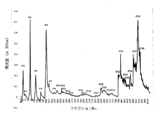
得られたイソフラボン資化性微生物由来の脂質抽出物410.5mgを用いてシリカゲルを担体としたシリカゲルクロマトグラフィーを行った。カラム(内径20mm×長さ500mm)にクロロホルムに懸濁したシリカゲル60(70~230メッシュ)を充填し、安定化させた後、クロロホルム5.0mLに脂質抽出物410.5mgを溶解したものをカラムの上部に吸着させた後、表1に示す溶離液を極性の低いクロロホルム100%から極性の高いクロロホルムとメタノールの等量混合溶液(クロロホルム:メタノール=1:1)へとそれぞれ400mLずつ順次流して、フラクションコレクターで自動分取した。これらの全てのフラクションについて、予め分光光度計を用いた吸収波長の測定において当該脂質抽出物のクロロホルム溶解液で顕著な吸収が認められた330nmの波長で吸光度を測定して図4に示す通りにクロマトグラフを作成して吸光度のピークごとに29フラクション(IF1~IF29)にまとめた。(2) Fractionation of active ingredients by column chromatography Using 410.5 mg of the lipid extract derived from the obtained isoflavone-utilizing microorganism, silica gel chromatography was carried out using silica gel as a carrier. A column (
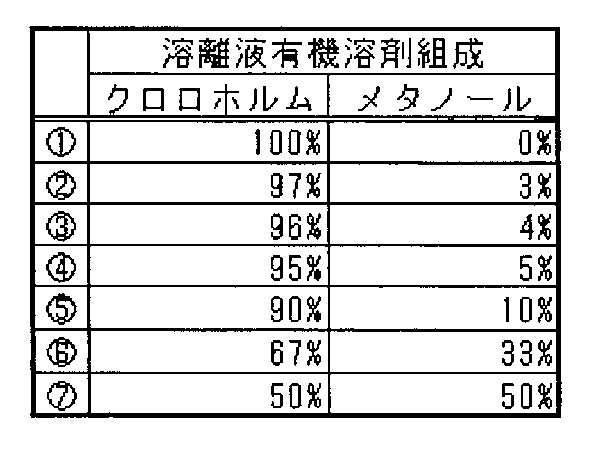
次いで、各フラクションについては、40℃減圧下で溶媒を除去し、それぞれの乾燥物を得た。乾燥物重量については表2に記載した。The solvent was then removed from each fraction under reduced pressure at 40° C. to obtain a dried product. The weights of the dried products are shown in Table 2.

前述の29フラクション(IF1~IF29)についてそれぞれの乾燥物の濃度が1%(w/v)濃度になるようにDMSOに溶解した生育阻害試験用の脂質抽出物の供試試料について、DMSOを1%(w/v)濃度含有するTSB液体培地100μLを対照区、酢酸を0.1%(w/v)濃度ないしはキシリトールを0.1%(w/v)濃度含有するTSB液体培地100μLをポジティブコントロール区および脂質抽出物の乾燥物を1%(w/v)濃度含有するDMSO溶液(供試試料)を2μL含むTSB液体培地100μLに対して、それぞれS.mutansの種培養液100μLを接種して30℃で24時間培養した培養液の波長570nmでの吸光度を比較することで、S.mutansに対する生育阻害効果を調べた結果、図5Aと図5Bに示す通り、IF1、IF6、IF7、IF8、IF9、IF10、IF12およびIF13に0.1%(w/v)濃度酢酸含有ポジティブコントロール区と同等以上の有意な生育阻害効果が認められた。For the test samples of lipid extracts for the growth inhibition test, which were prepared by dissolving each of the 29 fractions (IF1 to IF29) in DMSO to a dry matter concentration of 1% (w/v), 100 μL of TSB liquid medium containing DMSO at a concentration of 1% (w/v) was used as a control group, 100 μL of TSB liquid medium containing acetic acid at a concentration of 0.1% (w/v) or xylitol at a concentration of 0.1% (w/v) was used as a positive control group, and 100 μL of TSB liquid medium containing 2 μL of DMSO solution (test sample) containing the dried matter of the lipid extract at a concentration of 1% (w/v) was used as a positive control group. 100 μL of seed culture of S. mutans was inoculated into each of the following culture solutions, and the culture solutions were cultured at 30° C. for 24 hours, and the absorbance at a wavelength of 570 nm was compared to determine whether S. mutans was inhibited. As a result of investigating the growth inhibitory effect against S. mutans, as shown in Figures 5A and 5B, IF1, IF6, IF7, IF8, IF9, IF10, IF12 and IF13 were found to have a significant growth inhibitory effect equal to or greater than that of the positive control group containing 0.1% (w/v) acetic acid.
(3)TLCによる有効成分の分画
TLCは、シリカゲル70FM TLCプレートワコー 200mm×200mm(以下、シリカゲル薄層プレート)を必要に応じて細断してサイズを調整して使用した。Rf測定用には10~30mm×50mm、物質のかきとり用には100mm×100mmないしは100mm×200mmのシリカゲル薄層プレートを用いた。カラムクロマトグラフィーによって分画された各フラクション中に含まれる脂質抽出物はプラスチックチップを用いてTLC上に3~5回スポットした後、風乾した。展開液としては、ヘキサン:酢酸エチル=75:25~60:40やクロロホルム:メタノール=90:10~80:20などから適宜選択して用いた。展開を終えたTLCプレートは風乾して溶媒を飛散させた後、りんモリブデン酸・エタノール溶液(10gりんモリブデン酸/100mLエタノール)に5秒間浸したものを乾熱機で130℃、5~10分間加熱処理を行って発色させて各スポットのRf値を測定した。次いで、TLCの分画スポットからかきとられたシリカゲルはいずれもクロロホルムとメタノールの等量混合溶液20mLで抽出した後、ろ過を行い、このろ液はロータリーエバポレーターを用いて40℃下で減圧濃縮により溶媒を飛散させて得られる乾燥物の乾燥重量を測定した後、それぞれ乾燥物の重量%濃度が1%(w/v)になるようにDMSOに溶解したものを生育阻害試験用の供試試料に供した。(3) Fractionation of active ingredients by TLC For TLC, silica gel 70FM
当該フラクションIF1~IF29については、シリカゲル薄層プレートでTLC展開を行い、そのスポットのRf値のパターンが類似するフラクションを表3に示すように6つに再グループ化した。The fractions IF1 to IF29 were subjected to TLC development on a silica gel thin-layer plate, and fractions having similar Rf value patterns of the spots were regrouped into six groups as shown in Table 3.
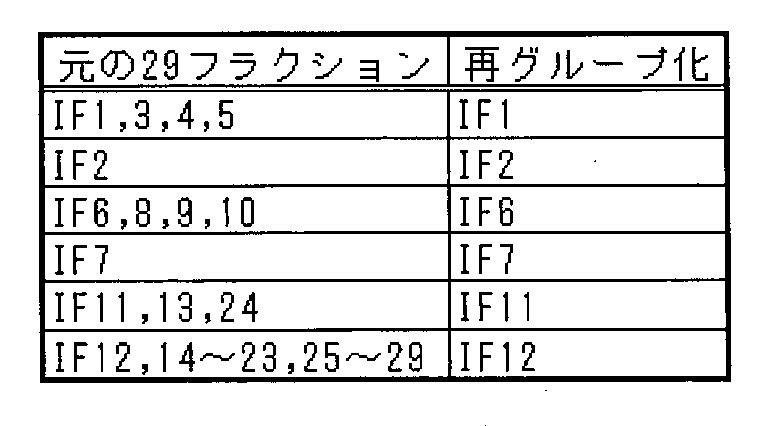
前記の再グループ化したIF1、IF2、IF6、IF7、IF11およびIF12のフラクションについては、更にシリカゲル薄層プレート(100mm×200mm)を用いてヘキサン:酢酸エチル=75:25からなる展開液にてTLC展開した結果、表4に示す31画分に分画された。The regrouped fractions IF1, IF2, IF6, IF7, IF11 and IF12 were further subjected to TLC development using a silica gel thin layer plate (100 mm x 200 mm) with a developing solution of hexane:ethyl acetate = 75:25, and were fractionated into 31 fractions as shown in Table 4.

このIF1の9画分、IF2の3画分、IF6の6画分、IF7の4画分、IF11の4画分及びIF12の5画分の合計31画分のそれぞれの乾燥物を1%(w/v)濃度含有するDMSO溶液を用いて同様の方法にてS.mutansに対する生育阻害効果を調べた結果、図6に示す通り、IF6フラクションからIF6-2画分(図6A)およびIF11フラクションからIF11-2画分(図6B)にポジティブコントロールの0.1%(w/v)濃度酢酸含有ポジティプコントロール区と同等以上の強力な生育阻害効果が認められた。The growth inhibitory effect against S. mutans was examined in the same manner using DMSO solutions containing 1% (w/v) concentration of the dried matter of each of the 31 fractions (9 fractions of IF1, 3 fractions of IF2, 6 fractions of IF6, 4 fractions of IF7, 4 fractions of IF11, and 5 fractions of IF12) in total. As a result, as shown in Figure 6, the IF6-2 fraction from the IF6 fraction (Figure 6A) and the IF11-2 fraction from the IF11 fraction (Figure 6B) showed a growth inhibitory effect equal to or greater than that of the positive control containing 0.1% (w/v) concentration of acetic acid as a positive control.
そこで、0.1%(w/v)濃度酢酸含有ポジティブコントロール区と同等以上の生育阻害効果が認められたIF6-2画分とIF11-2画分について更に異なる展開液(ヘキサン:酢酸エチル=50:50)でTLC分画した結果、それぞれIF6-2画分は、IF6-2-A、IF6-2-BおよびIF6-2-C、IF11-2画分からはIF11-2-A、IF11-2-BおよびIF11-2-Cの3つの画分に分画された。そして、それぞれの3つの画分の乾燥物を1%(w/v)濃度含有するDMSO溶液を調製した後、前記の同様の方法にてS.mutansに対する生育阻害効果を調べた結果、図7Aと図7Bに示す通り、全てにおいて対照区と比べて有意差を伴って生育阻害効果が認められたが、その中でもIF6-2-C画分とIF11-2-B画分に0.1%(w/v)濃度の酢酸含有ポジティブコントロール区以上の有意差を伴った強力な生育阻害効果が確認された。他方、これ以外のIF6-2-A、IF6-2-B、IF11-2-AおよびIF11-2-Cの4つの画分は0.1%(w/v)濃度キシリトール含有ポジティブコントロール区と同等の生育阻害効果であった。Therefore, the IF6-2 and IF11-2 fractions, which showed growth inhibitory effects equal to or greater than those of the positive control containing 0.1% (w/v) acetic acid, were further fractionated by TLC using a different developing solution (hexane:ethyl acetate = 50:50). As a result, the IF6-2 fraction was fractionated into three fractions, IF6-2-A, IF6-2-B, and IF6-2-C, and the IF11-2 fraction was fractionated into three fractions, IF11-2-A, IF11-2-B, and IF11-2-C. Then, DMSO solutions containing 1% (w/v) of the dried matter of each of the three fractions were prepared, and then the same method as above was used to culture S. As a result of examining the growth inhibitory effect against S. mutans, as shown in Figures 7A and 7B, all of the fractions showed a significant growth inhibitory effect compared to the control group, and among them, the IF6-2-C fraction and the IF11-2-B fraction showed a strong growth inhibitory effect with a significant difference greater than that of the positive control group containing 0.1% (w/v) acetic acid. On the other hand, the other four fractions, IF6-2-A, IF6-2-B, IF11-2-A, and IF11-2-C, showed the same growth inhibitory effect as the positive control group containing 0.1% (w/v) xylitol.
(4)有効成分の濃度と生育阻害効果
次に、0.1%(w/v)酢酸溶液と同等以上の生育阻害効果が確認されたIF6-2-CとIF11-2-Bのそれぞれの%(w/v)濃度と生育阻害効果について更に詳しく調べた結果、IF6-2-Cでは、図8Aに示す通り、1.0、0.5および0.25%(w/v)濃度の全てにおいて対照区と比べてp<0.001の有意差を伴って生育阻害効果が認められたと同時に、1.0%(w/v)濃度においては、S.mutansの生育を完全に阻止する強力な生育阻害効果が認められた。一方、0.5および0.25%(w/v)濃度では、生育を完全に阻害することはできないことが分かった。(4) Concentration of active ingredient and growth inhibitory effect Next, the % (w/v) concentration and growth inhibitory effect of IF6-2-C and IF11-2-B, which were confirmed to have growth inhibitory effects equal to or greater than those of 0.1% (w/v) acetic acid solution, were examined in more detail. As a result, as shown in Figure 8A, IF6-2-C showed a growth inhibitory effect at all concentrations of 1.0, 0.5 and 0.25% (w/v) with a significant difference of p<0.001 compared to the control, and at a concentration of 1.0% (w/v), a strong growth inhibitory effect that completely inhibited the growth of S. mutans was observed. On the other hand, it was found that the growth could not be completely inhibited at concentrations of 0.5 and 0.25% (w/v).
他方、IF11-2-Bでは、図8Bに示す通り、1.0、0.5および0.25%(w/v)濃度の全てにおいて対照区と比べてp<0.01以上の有意差を伴って生育阻害効果が認められたものの、1.0と0.5%(w/v)濃度では、ほぼ完全に生育を阻止できたのに対して、0.25%(w/v)濃度では、その生育を完全には阻止できなかった。On the other hand, as shown in Figure 8B, IF11-2-B showed a growth inhibitory effect at all concentrations of 1.0, 0.5, and 0.25% (w/v) with significant differences of p<0.01 or more compared to the control group. However, while growth was almost completely inhibited at the 1.0 and 0.5% (w/v) concentrations, growth was not completely inhibited at the 0.25% (w/v) concentration.
以上の結果からS.mutansの完全な生育阻害効果を発揮するために不可欠なIF6-2-CやIF11-2-Bの重量%濃度を算出すると、接種される供試試料の希釈倍数は2μL(供試試料の接種量)/200μL(全培養液量)より100倍となることから、S.mutansの完全な生育阻害効果を発揮するためのIF6-2-CやIF11-2-Bの重量%濃度としては、1%(w/v)/100=0.01%(w/v)以上と算出された。From the above results, the weight percent concentration of IF6-2-C or IF11-2-B necessary for exerting the complete growth inhibitory effect on S. mutans was calculated. Since the dilution ratio of the inoculated test sample is 2 μL (inoculation amount of test sample)/200 μL (total culture solution volume), which is 100 times, the weight percent concentration of IF6-2-C or IF11-2-B for exerting the complete growth inhibitory effect on S. mutans was calculated to be 1% (w/v)/100 = 0.01% (w/v) or more.
本試験例はイソフラボン資化性微生物由来の脂質抽出物中の有効成分IF6-2-A、IF6-2-BおよびIF6-2-C並びにIF11-2-A、IF11-2-BおよびIF11-2-Cはそれぞれ極性の異なる2種類の展開溶媒(極性の低いものと極性の高い2種類)を用いて行われたTLCで単一スポットであることを確認した後、その化学構造を明らかにするために、次に示す試験方法(トリメチルシリル化物およびメチル化物の調製、GC/MS分析)により実施した。In this test example, it was confirmed that the active ingredients IF6-2-A, IF6-2-B and IF6-2-C, as well as IF11-2-A, IF11-2-B and IF11-2-C in the lipid extract derived from isoflavone-utilizing microorganisms, each showed a single spot in TLC performed using two developing solvents with different polarities (one with low polarity and one with high polarity), and then the following test methods (preparation of trimethylsilylated and methylated products, GC/MS analysis) were used to clarify their chemical structures.
(1)有効成分IF6-2-A、IF6-2-BおよびIF6-2-Cのトリメチルシリル化物およびメチル化物の調製
トリメチルシリル化は、それぞれの乾燥物1mgに市販のシリル化剤TMSI-Hを過剰に添加して室温で2時間放置した後、ヘキサン1mLを加えて、よく撹拌した後、上層を採取し、これに蒸留水1mLを加えて撹拌・洗浄した後、それぞれの上層のヘキサン層を分取してGC/MS分析に供した。(1) Preparation of trimethylsilylated and methylated products of active ingredients IF6-2-A, IF6-2-B, and IF6-2-C Trimethylsilylation was carried out by adding an excess of a commercially available silylating agent TMSI-H to 1 mg of each dried product and allowing it to stand at room temperature for 2 hours, then adding 1 mL of hexane and stirring thoroughly, and then collecting the upper layer, adding 1 mL of distilled water to this and stirring/washing, and then separating the upper hexane layer from each product for GC/MS analysis.
メチル化は、市販の脂肪酸メチル化キットを用いてそれぞれの乾燥物1mgを密閉容器に入れ、メチル化試薬Aを0.5mL、メチル化試薬Bを0.5mL加えた。密閉後、37℃で1時間反応させ、メチル化試薬Cを加え密閉後、37℃で20分放置して反応させた。次いで、抽出試薬としてヘキサン1.0mLを加え、ボルテックスでよく混合後、二層に分離したら、境界面の白い濁った層が混ざらないように上層を別容器に移した。
次に、採取した上層に蒸留水1mLを加えて撹拌・洗浄を2回繰り返し、それぞれの上層のヘキサン層についてリトマス紙でpHが中性付近であることを確認した後、GC/MS分析に供した。 Methylation was carried out by placing 1 mg of each dried product in a sealed container using a commercially available fatty acid methylation kit, and adding 0.5 mL of methylation reagent A and 0.5 mL of methylation reagent B. After sealing, the container was reacted at 37° C. for 1 hour, and methylation reagent C was added and sealed, and the container was left to react at 37° C. for 20 minutes. Next, 1.0 mL of hexane was added as an extraction reagent, and the mixture was thoroughly mixed with a vortex mix. After separation into two layers, the upper layer was transferred to a separate container, taking care not to mix the cloudy white layer at the interface.
Next, 1 mL of distilled water was added to the collected upper layer, and stirring and washing were repeated twice. After confirming with litmus paper that the pH of each upper hexane layer was near neutral, the solution was subjected to GC/MS analysis.
(2)GC/MS分析
GC/MS分析は、フロンティアラボ社製カラムUltra ALLOY-5(MS/HT、長さ30cm、内径0.25mm、膜厚0.25μm)を装着したアジレント社製GC/MS 6890N/5973 Networkを用いて、ポリ5%フェニル95%ジメチルシロキサンでオーブン温度50~300℃(10℃/min)、注入口温度300℃、GC/MSインターフェイス温度320℃(熱分解装置-GC間およびGC-MS間の双方)、イオン源温度230℃、四重極温度150℃、試料サンプル注入量5μLで測定した。(2) GC/MS Analysis GC/MS analysis was performed using an Agilent GC/MS 6890N/5973 Network equipped with a Frontier Labs Ultra ALLOY-5 column (MS/HT,
IF6-2-A、IF6-2-BおよびIF6-2-C並びにIF11-2-A、IF11-2-BおよびIF11-2-Cのトリメチルシリル化物のGC/MS分析の結果、いずれからも図9に示す通り、グリセロールのトリメチルシリル化物(成分1)と同一の質量スペクトルが検出された。As a result of GC/MS analysis of the trimethylsilylated products of IF6-2-A, IF6-2-B, and IF6-2-C, and IF11-2-A, IF11-2-B, and IF11-2-C, the same mass spectrum as that of the trimethylsilylated product of glycerol (component 1) was detected, as shown in Figure 9.
IF6-2-A、IF6-2-BおよびIF6-2-Cのメチル化物のGC/MS分析の結果、いずれからも図10と図11に示す通り、二つの長鎖飽和脂肪酸のメチルエステルであるパルミチン酸メチル(成分2)とステアリン酸メチル(成分3)のそれぞれと同一の質量スペクトルが検出された。As a result of GC/MS analysis of the methylated products of IF6-2-A, IF6-2-B, and IF6-2-C, mass spectra identical to those of the methyl esters of two long-chain saturated fatty acids, methyl palmitate (component 2) and methyl stearate (component 3), respectively, were detected, as shown in Figures 10 and 11.
他方、IF11-2-A、IF11-2-BおよびIF11-2-Cのメチル化物のGC/MS分析の結果、いずれからも図10と図11に示す二つの長鎖飽和脂肪酸のメチルエステルであるパルミチン酸メチル(成分2)とステアリン酸メチル(成分3)に加えて図12デヒドロアビエチン酸メチル(成分4)のそれぞれと同一の質量スペクトルが検出された。On the other hand, GC/MS analysis of the methylated products of IF11-2-A, IF11-2-B and IF11-2-C detected mass spectra identical to those of methyl palmitate (component 2) and methyl stearate (component 3), which are the methyl esters of two long-chain saturated fatty acids shown in Figures 10 and 11, as well as methyl dehydroabietic acid (component 4) shown in Figure 12.
これらの事実から、IF6-2-A、IF6-2-BおよびIF6-2-Cの化学構造としては、図13に示す通り、グリセロールの二つのヒドロキシ基にパルミチン酸とステアリン酸が一分子ずつエステル結合した3種類のジアシルグリセロール(以下、DAG)と推定された。詳しくは、1-パルミトイル-2-ステアロイルジアシルグリセロール(1-PA-2-SA-DAG)、1-ステアロイル-2-パルミトイルジアシルグリセロール(1-SA-2-PA-DAG)および1-パルミトイル-3-ステアロイルジアシルグリセロール(1-PA-3-SA-DAG)(=1-ステアロイル-3-パルミトイルグリセロール(1-SA-3-PA-DAG))の3種類である。From these facts, the chemical structures of IF6-2-A, IF6-2-B and IF6-2-C were estimated to be three types of diacylglycerol (hereinafter, DAG) in which one molecule of palmitic acid and one molecule of stearic acid are ester-bonded to two hydroxyl groups of glycerol, as shown in Figure 13. In detail, there are three types: 1-palmitoyl-2-stearoyl diacylglycerol (1-PA-2-SA-DAG), 1-stearoyl-2-palmitoyl diacylglycerol (1-SA-2-PA-DAG) and 1-palmitoyl-3-stearoyl diacylglycerol (1-PA-3-SA-DAG) (= 1-stearoyl-3-palmitoyl glycerol (1-SA-3-PA-DAG)).
他方、IF11-2-A、IF11-2-BおよびIF11-2-Cの化学構造としては、図14に示す通り、グリセロールの三つのヒドロキシル基にパルミチン酸、ステアリン酸およびデヒドロアビエチン酸が一分子ずつエステル結合した3種類のデヒドロアビエチン酸ジアシルグリセロールと推定された。詳しくは、1-パルミトイル-2-ステアロイル-3-デヒドロアビエトイルジアシルグリセロール(1-PA-2-SA-3-DHA-DAG)、1-ステアロイル-2-パルミトイル-3-デヒドロアビエトイルジアシルグリセロール(1-SA-2-PA-3-DHA-DAG)および1-パルミトイル-3-ステアロイル-2-デヒドロアビエトイルジアシルグリセロール(1-PA-3-SA-2-DHA-DAG)(=1-ステアロイル-3-パルミトイル-2-デヒドロアビエトイルジアシルグリセロール(1-SA-3-PA-2-DHA-DAG))の3種類である。On the other hand, the chemical structures of IF11-2-A, IF11-2-B, and IF11-2-C were presumed to be three types of dehydroabietic acid diacylglycerol in which one molecule each of palmitic acid, stearic acid, and dehydroabietic acid was ester-bonded to the three hydroxyl groups of glycerol, as shown in Figure 14. Specifically, there are three types: 1-palmitoyl-2-stearoyl-3-dehydroabietyl diacylglycerol (1-PA-2-SA-3-DHA-DAG), 1-stearoyl-2-palmitoyl-3-dehydroabietyl diacylglycerol (1-SA-2-PA-3-DHA-DAG), and 1-palmitoyl-3-stearoyl-2-dehydroabietyl diacylglycerol (1-PA-3-SA-2-DHA-DAG) (=1-stearoyl-3-palmitoyl-2-dehydroabietyl diacylglycerol (1-SA-3-PA-2-DHA-DAG)).
次に、当該ジアシルグリセロール化合物のS.mutansに対する生育阻害効果の強さについて、ポジティブコントロールの酢酸やキシリトールと比較すると、まず、グリセロールの二つのヒドロキシ基にパルミチン酸とステアリン酸が一分子ずつエステル結合したジアシルグリセロール(DAG)と推定されるIF6-2-A、IF6-2-BおよびIF6-2-Cの場合は、そのモル分子量は596となり、その0.01%(w/v)濃度溶液のモル濃度(M)は1L中に含まれる当該ジアシルグリセロールの質量数/当該ジアシルグリセロールのモル分子量=0.10/596=0.000167M(=0.167mM)に相当することになる。Next, the strength of the growth inhibitory effect of the diacylglycerol compound against S. mutans is compared with that of the positive controls acetic acid and xylitol. First, in the case of IF6-2-A, IF6-2-B, and IF6-2-C, which are presumed to be diacylglycerol (DAG) in which one molecule each of palmitic acid and stearic acid are ester-bonded to two hydroxyl groups of glycerol, the molar molecular weight is 596, and the molar concentration (M) of the 0.01% (w/v) concentration solution corresponds to the mass number of the diacylglycerol contained in 1 L/molar molecular weight of the diacylglycerol=0.10/596=0.000167M (=0.167mM).
他方、グリセロールの三つのヒドロキシ基にパルミチン酸、ステアリン酸およびデヒドロアビエチン酸が一分子ずつエステル結合したデヒドロアビエチン酸ジアシルグリセロールと推定されるIF11-2-A、IF11-2-BおよびIF11-2-Cの場合は、そのモル分子量881となり、その0.01%(w/v)濃度溶液のモル濃度は前記と同様に計算すると、0.000114M(=0.114mM)になる。On the other hand, IF11-2-A, IF11-2-B and IF11-2-C, which are presumed to be dehydroabietic acid diacylglycerol in which one molecule each of palmitic acid, stearic acid and dehydroabietic acid is ester-bonded to the three hydroxyl groups of glycerol, have a molar molecular weight of 881, and the molar concentration of a 0.01% (w/v) solution thereof, calculated as above, is 0.000114 M (=0.114 mM).
他方、0.1%(w/v)濃度酢酸溶液の酢酸のモル濃度は1L中に含まれる酢酸の質量数/酢酸のモル分子量=1/60=0.0167M(=16.7mM)、キシリトール0.1%(w/v)溶液のモル濃度は1L中に含まれるキシリトールの質量数/キシリトールのモル分子量=1/152=0.00658M(=6.58mM)となることから、当該パルミチン酸とステアリン酸のジアシルグリセロールのS.mutansに対する生育阻害効果の強さは、酢酸に対するモル比で100倍、キシリトールに対するモル比で約39倍強い生育阻害効果が期待されるものと算出された。
即ち、当該ジアシルグリセロールは酢酸およびキシリトールと比較して、それぞれ1/100、1/39の低濃度でも同等の生育阻害効果が期待できるものと推定された。 On the other hand, the molar concentration of acetic acid in a 0.1% (w/v) concentration acetic acid solution is the mass number of acetic acid contained in 1 L/the molar molecular weight of acetic acid=1/60=0.0167 M (=16.7 mM), and the molar concentration of a 0.1% (w/v) xylitol solution is the mass number of xylitol contained in 1 L/the molar molecular weight of xylitol=1/152=0.00658 M (=6.58 mM), so that the strength of the growth inhibitory effect of the diacylglycerol of palmitic acid and stearic acid against S. mutans is expected to be 100 times stronger in molar ratio to acetic acid and about 39 times stronger in molar ratio to xylitol.
In other words, it was estimated that the diacylglycerol would be expected to have the same growth inhibitory effect as acetic acid and xylitol even at low concentrations of 1/100 and 1/39, respectively.
一方、グリセロールの残りのヒドロキシ基にデヒドロアビエチン酸がエステル結合したパルミチン酸とステアリン酸のジアシルグリセロールのS.mutansに対する生育阻害効果の強さは、酢酸に対するモル比で146倍、キシリトールに対するモル比で約58倍強い生育阻害効果が期待されるものと算出された。
即ち、当該デヒドロアビエチン酸結合ジアシルグリセロールは酢酸およびキシリトールと比較して、それぞれ1/146、1/58の低濃度でも同等の生育阻害効果が期待できるものと推定された。 On the other hand, the growth inhibitory effect of diacylglycerol of palmitic acid and stearic acid, in which dehydroabietic acid is ester-bonded to the remaining hydroxyl group of glycerol, on S. mutans was calculated to be 146 times stronger in molar ratio than that of acetic acid and about 58 times stronger in molar ratio than that of xylitol.
That is, it was estimated that the dehydroabietic acid-bound diacylglycerol would be expected to have the same growth inhibitory effect as acetic acid and xylitol even at low concentrations of 1/146 and 1/58, respectively.
本発明は練り歯磨きや洗口剤(マウスウォッシュ)などのオーラルケア、歯科器具、医療器具、医薬品、医薬部外品、水道および清掃業などの分野などにおいて利用可能である。The present invention can be used in fields such as oral care products such as toothpaste and mouthwash, dental instruments, medical instruments, pharmaceuticals, quasi-drugs, water supply and cleaning industries, etc.
以下、実施例を挙げて本発明を更に詳細に説明するが、それらによって本発明は制限されるものではない。
実験例15-28は実施例であり、実験例1-14は参考例である。
The present invention will be described in more detail below with reference to examples, but the present invention is not limited thereto.
Experimental Examples 15-28 are working examples, and Experimental Examples 1-14 are reference examples.
<実験例1~7>
グリセロールの二つのヒドロキシ基にパルミチン酸とステアリン酸を一分子ずつエステル結合する3種類のジアシルグリセロール化合物、またはこれらの化合物を1以上含む物質の混合物を有効成分とする虫歯の予防用および/または治療用の口腔組成物として、1-パルミトイル-3-ステアロイルジアシルグリセロールおよび/または1-パルミトイル-2-ステアロイルジアシルグリセロールおよび/または1-ステアロイル-2-パルミトイルジアシルグリセロールを用い、以下の表5記載の実験例1から7に示す処方にて、チューブ入り練り歯磨きを調製した。
<Experimental Examples 1 to 7>
As oral compositions for preventing and/or treating dental caries containing as active ingredients three types of diacylglycerol compounds in which one molecule each of palmitic acid and stearic acid is ester-bonded to two hydroxyl groups of glycerol, or a mixture of substances containing one or more of these compounds, tube-type toothpastes were prepared according to the formulations shown in Experimental Examples 1 to 7 in Table 5 below using 1-palmitoyl-3-stearoyldiacylglycerol and/or 1-palmitoyl-2-stearoyldiacylglycerol and/or 1-stearoyl-2-palmitoyldiacylglycerol.
<実験例8~14>
グリセロールの二つのヒドロキシ基にパルミチン酸とステアリン酸を一分子ずつエステル結合する3種類のジアシルグリセロール化合物、またはこれらの化合物を1以上含む物質の混合物を有効成分とする虫歯の予防用および/または治療用の口腔組成物として、1-ステアロイル-3-パルミトイルジアシルグリセロールおよび/または1-ステアロイル-2-パルミトイルジアシルグリセロールおよび/または1-パルミトイル-2-ステアロイルジアシルグリセロールを用い、以下の表6に記載の実験例8から14に示す処方にて、樹脂容器入り洗口剤を調製した。
<Experimental Examples 8 to 14>
As an oral composition for preventing and/or treating dental caries, which contains as an active ingredient three types of diacylglycerol compounds in which one molecule each of palmitic acid and stearic acid is ester-bonded to two hydroxyl groups of glycerol, or a mixture of substances containing one or more of these compounds, 1-stearoyl-3-palmitoyl diacylglycerol and/or 1-stearoyl-2-palmitoyl diacylglycerol and/or 1-palmitoyl-2-stearoyl diacylglycerol was used, and a mouthwash in a resin container was prepared according to the formulations shown in Experimental Examples 8 to 14 in Table 6 below.
<実験例15~21>
グリセロールの三つのヒドロキシ基にパルミチン酸、ステアリン酸およびデヒドロアビエチン酸が一分子ずつエステル結合する3種類のデヒドロアビエチン酸結合ジアシルグリセロール化合物、またはこれらの化合物を1以上含む物質の混合物を有効成分とする虫歯の予防用および/または治療用の口腔組成物として、1-パルミトイル-3-ステアロイル-2-デヒドロアビエトイルジアシルグリセロールおよび/または1-パルミトイル-2-ステアロイル-3-デヒドロアビエトイルジアシルグリセロールおよび/または1-ステアロイル-2-パルミトイル-3-デヒドロアビエトイルジアシルグリセロールを用い、以下の表7記載の実験例15から21に示す処方にて、チューブ入り練り歯磨きを調製した。
<Experimental Examples 15 to 21>
As an oral composition for preventing and/or treating dental caries containing, as an active ingredient, three types of dehydroabietic acid-bound diacylglycerol compounds in which one molecule each of palmitic acid, stearic acid and dehydroabietic acid is ester-bound to three hydroxyl groups of glycerol, or a mixture of substances containing one or more of these compounds, tube-type toothpastes were prepared according to the formulations shown in Experimental Examples 15 to 21 in Table 7 below using 1-palmitoyl-3-stearoyl-2-dehydroabietoyl diacylglycerol and/or 1-palmitoyl-2-stearoyl-3-dehydroabietoyl diacylglycerol and/or 1-stearoyl-2-palmitoyl-3-dehydroabietoyl diacylglycerol.
<実験例22~28>
グリセロールの三つのヒドロキシ基にパルミチン酸、ステアリン酸およびデヒドロアビエチン酸が一分子ずつエステル結合する3種類のデヒドロアビエチン酸結合ジアシルグリセロール化合物、またはこれらの化合物を1以上含む物質の混合物を有効成分とする虫歯の予防用および/または治療用の口腔組成物として、1-パルミトイル-3-ステアロイル-2-デヒドロアビエトイルジアシルグリセロールおよび/または1-パルミトイル-2-ステアロイル-3-デヒドロアビエトイルジアシルグリセロールおよび/または1-ステアロイル-2-パルミトイル-3-デヒドロアビエトイルジアシルグリセロールを用い、以下の表7に記載の実験例22から28に示す処方にて、樹脂容器入り洗口剤を調製した。
<Experimental Examples 22 to 28>
As an oral composition for preventing and/or treating dental caries containing as an active ingredient three types of dehydroabietic acid-bound diacylglycerol compounds in which one molecule each of palmitic acid, stearic acid and dehydroabietic acid is ester-bound to three hydroxyl groups of glycerol, or a mixture of substances containing one or more of these compounds, 1-palmitoyl-3-stearoyl-2-dehydroabietoyl diacylglycerol and/or 1-palmitoyl-2-stearoyl-3-dehydroabietoyl diacylglycerol and/or 1-stearoyl-2-palmitoyl-3-dehydroabietoyl diacylglycerol was used, and mouthwashes in resin containers were prepared according to the formulations shown in Experimental Examples 22 to 28 in Table 7 below.
Claims (5)
[式中のR1、R2、R3は以下の(e)~(h)のいずれかの条件を満たす。
(e)R1がパルミチン酸残基であり、R2がステアリン酸残基であり、R3がデヒドロアビエチン酸残基である;
(f)R1がステアリン酸残基であり、R2がパルミチン酸残基であり、R3がデヒドロアビエチン酸残基である;
(g)R1がパルミチン酸残基であり、R2がデヒドロアビエチン酸残基であり、R3がステアリン酸残基である;
(h)R1がステアリン酸残基であり、R2がデヒドロアビエチン酸残基であり、R3がパルミチン酸残基である] An antibacterial agent effective against dental caries bacterium Streptococcus mutans, comprising as an active ingredient a compound of formula (1) or a mixture of substances containing one or more compounds of formula (1).
[In the formula, R 1 , R 2 and R 3 satisfy any one of the following conditions ( e ) to (h).
(e) R 1 is a palmitic acid residue, R 2 is a stearic acid residue, and R 3 is a dehydroabietic acid residue;
(f) R 1 is a stearic acid residue, R 2 is a palmitic acid residue, and R 3 is a dehydroabietic acid residue;
(g) R 1 is a palmitic acid residue, R 2 is a dehydroabietic acid residue, and R 3 is a stearic acid residue;
(h) R 1 is a stearic acid residue, R 2 is a dehydroabietic acid residue, and R 3 is a palmitic acid residue.
Priority Applications (1)
| Application Number | Priority Date | Filing Date | Title |
|---|---|---|---|
| JP2020134212A JP7519082B2 (en) | 2020-07-14 | 2020-07-14 | Antibacterial agents, oral compositions, mouthwashes, dentifrices, and medicines or quasi-drugs |
Applications Claiming Priority (1)
| Application Number | Priority Date | Filing Date | Title |
|---|---|---|---|
| JP2020134212A JP7519082B2 (en) | 2020-07-14 | 2020-07-14 | Antibacterial agents, oral compositions, mouthwashes, dentifrices, and medicines or quasi-drugs |
Publications (2)
| Publication Number | Publication Date |
|---|---|
| JP2022027681A JP2022027681A (en) | 2022-02-14 |
| JP7519082B2 true JP7519082B2 (en) | 2024-07-19 |
Family
ID=80265056
Family Applications (1)
| Application Number | Title | Priority Date | Filing Date |
|---|---|---|---|
| JP2020134212A Active JP7519082B2 (en) | 2020-07-14 | 2020-07-14 | Antibacterial agents, oral compositions, mouthwashes, dentifrices, and medicines or quasi-drugs |
Country Status (1)
| Country | Link |
|---|---|
| JP (1) | JP7519082B2 (en) |
Families Citing this family (2)
| Publication number | Priority date | Publication date | Assignee | Title |
|---|---|---|---|---|
| JPWO2025009453A1 (en) * | 2023-07-04 | 2025-01-09 | ||
| CN120661750B (en) * | 2025-07-01 | 2026-01-02 | 青岛力腾医药科技有限公司 | Anti-adhesion liquid containing icodextrin for abdominal surgery or laparoscopic surgery and preparation method thereof |
Citations (2)
| Publication number | Priority date | Publication date | Assignee | Title |
|---|---|---|---|---|
| JP2011505415A (en) | 2007-12-04 | 2011-02-24 | ウエストゲート・バイオロジカル・リミテッド | Blends of free fatty acids and their use |
| CN103751127A (en) | 2011-10-17 | 2014-04-30 | 上海中邦斯瑞生物药业技术有限公司 | Novel telmisartan orally disintegrating tablet and preparation method thereof |
-
2020
- 2020-07-14 JP JP2020134212A patent/JP7519082B2/en active Active
Patent Citations (2)
| Publication number | Priority date | Publication date | Assignee | Title |
|---|---|---|---|---|
| JP2011505415A (en) | 2007-12-04 | 2011-02-24 | ウエストゲート・バイオロジカル・リミテッド | Blends of free fatty acids and their use |
| CN103751127A (en) | 2011-10-17 | 2014-04-30 | 上海中邦斯瑞生物药业技术有限公司 | Novel telmisartan orally disintegrating tablet and preparation method thereof |
Also Published As
| Publication number | Publication date |
|---|---|
| JP2022027681A (en) | 2022-02-14 |
Similar Documents
| Publication | Publication Date | Title |
|---|---|---|
| JP3159509B2 (en) | Protease inhibitor | |
| US7214392B2 (en) | Process and composition for inhibiting growth of microorganisms | |
| KR102194315B1 (en) | Antioxidant or skin microbiome balance cosmetic composition comprising centella asiatica fermented extract fermented by inoculating lactobacillus rhamnosus strain | |
| JPH0232255B2 (en) | ||
| JP5893324B2 (en) | Methyl mercaptan inhibitor | |
| JP2022027681A (en) | Antibacterial agents and oral compositions | |
| KR101713654B1 (en) | Oral composition containing magnolia extract and phytoncide oil | |
| JP7445910B2 (en) | Oral compositions, oral care products, and foods containing oral resident bacteria regulators | |
| EP4582075A1 (en) | Topical skin composition containing 1,3-propanediol as active ingredient for maintaining microbiome balance in skin | |
| Sofrata | Salvadora persica (MISWAK): An effective way of killing oral pathogens | |
| Maajid et al. | Antibacterial activity of fermented and non-fermented edel cacao bean extract (Theobroma cacao L.) against Porphyromonas gingivalis | |
| JP3319748B2 (en) | Caries inhibitor | |
| JP4515732B2 (en) | Glucosyltransferase inhibitors, plaque formation inhibitors, antibacterial agents, oral preparations and foods for preventing touch | |
| Alemeye et al. | Antimicrobial activities and formulations of the extracts of chewing sticks commonly used in Ethiopia for oral cleansing | |
| KR100691792B1 (en) | Antimicrobial composition containing lignan compound and oral composition for the prevention or treatment of tooth decay and periodontitis | |
| KR20000073295A (en) | Method for separating material having antibiotic activity from Curcuma xanthorrhiza Roxb., the antibiotic material, and gargling agent, toothpaste composition and gum composition containing the antibiotic material | |
| EP4640206A1 (en) | Nisin for inhibiting biofilms | |
| KR102670411B1 (en) | Cosmetic composition comprising and the complex extract or the fermented complex extract and manufacturing the same | |
| KR20090088166A (en) | Method for preparing naxoli sol from curcuma nagja and antibacterial active substance | |
| JPH107555A (en) | Antibacterial agent | |
| JPS6258324B2 (en) | ||
| KR100817599B1 (en) | Toothpaste composition for preventing dental caries | |
| JP2745019B2 (en) | Oral composition | |
| JPH05201843A (en) | Composition for oral cavity application | |
| JPH03109314A (en) | Anticarious agent |
Legal Events
| Date | Code | Title | Description |
|---|---|---|---|
| A521 | Request for written amendment filed |
Free format text: JAPANESE INTERMEDIATE CODE: A523 Effective date: 20200831 |
|
| A711 | Notification of change in applicant |
Free format text: JAPANESE INTERMEDIATE CODE: A711 Effective date: 20221220 |
|
| A621 | Written request for application examination |
Free format text: JAPANESE INTERMEDIATE CODE: A621 Effective date: 20230220 |
|
| RD02 | Notification of acceptance of power of attorney |
Free format text: JAPANESE INTERMEDIATE CODE: A7422 Effective date: 20230220 |
|
| A977 | Report on retrieval |
Free format text: JAPANESE INTERMEDIATE CODE: A971007 Effective date: 20240126 |
|
| A131 | Notification of reasons for refusal |
Free format text: JAPANESE INTERMEDIATE CODE: A131 Effective date: 20240227 |
|
| A521 | Request for written amendment filed |
Free format text: JAPANESE INTERMEDIATE CODE: A523 Effective date: 20240321 |
|
| TRDD | Decision of grant or rejection written | ||
| A01 | Written decision to grant a patent or to grant a registration (utility model) |
Free format text: JAPANESE INTERMEDIATE CODE: A01 Effective date: 20240627 |
|
| A61 | First payment of annual fees (during grant procedure) |
Free format text: JAPANESE INTERMEDIATE CODE: A61 Effective date: 20240701 |
|
| R150 | Certificate of patent or registration of utility model |
Ref document number: 7519082 Country of ref document: JP Free format text: JAPANESE INTERMEDIATE CODE: R150 |