JP7211368B2 - Copolyester film - Google Patents
Copolyester film Download PDFInfo
- Publication number
- JP7211368B2 JP7211368B2 JP2019543717A JP2019543717A JP7211368B2 JP 7211368 B2 JP7211368 B2 JP 7211368B2 JP 2019543717 A JP2019543717 A JP 2019543717A JP 2019543717 A JP2019543717 A JP 2019543717A JP 7211368 B2 JP7211368 B2 JP 7211368B2
- Authority
- JP
- Japan
- Prior art keywords
- polyester
- copolymer polyester
- layer
- copolymer
- film
- Prior art date
- Legal status (The legal status is an assumption and is not a legal conclusion. Google has not performed a legal analysis and makes no representation as to the accuracy of the status listed.)
- Active
Links
Images

Classifications
-
- B—PERFORMING OPERATIONS; TRANSPORTING
- B32—LAYERED PRODUCTS
- B32B—LAYERED PRODUCTS, i.e. PRODUCTS BUILT-UP OF STRATA OF FLAT OR NON-FLAT, e.g. CELLULAR OR HONEYCOMB, FORM
- B32B27/00—Layered products comprising a layer of synthetic resin
- B32B27/36—Layered products comprising a layer of synthetic resin comprising polyesters
-
- C—CHEMISTRY; METALLURGY
- C08—ORGANIC MACROMOLECULAR COMPOUNDS; THEIR PREPARATION OR CHEMICAL WORKING-UP; COMPOSITIONS BASED THEREON
- C08J—WORKING-UP; GENERAL PROCESSES OF COMPOUNDING; AFTER-TREATMENT NOT COVERED BY SUBCLASSES C08B, C08C, C08F, C08G or C08H
- C08J5/00—Manufacture of articles or shaped materials containing macromolecular substances
- C08J5/18—Manufacture of films or sheets
-
- G—PHYSICS
- G09—EDUCATION; CRYPTOGRAPHY; DISPLAY; ADVERTISING; SEALS
- G09F—DISPLAYING; ADVERTISING; SIGNS; LABELS OR NAME-PLATES; SEALS
- G09F9/00—Indicating arrangements for variable information in which the information is built-up on a support by selection or combination of individual elements
- G09F9/30—Indicating arrangements for variable information in which the information is built-up on a support by selection or combination of individual elements in which the desired character or characters are formed by combining individual elements
Landscapes
- Chemical & Material Sciences (AREA)
- Engineering & Computer Science (AREA)
- Manufacturing & Machinery (AREA)
- Organic Chemistry (AREA)
- Health & Medical Sciences (AREA)
- Chemical Kinetics & Catalysis (AREA)
- Medicinal Chemistry (AREA)
- Polymers & Plastics (AREA)
- Materials Engineering (AREA)
- Physics & Mathematics (AREA)
- General Physics & Mathematics (AREA)
- Theoretical Computer Science (AREA)
- Laminated Bodies (AREA)
- Manufacture Of Macromolecular Shaped Articles (AREA)
- Polyesters Or Polycarbonates (AREA)
- Shaping By String And By Release Of Stress In Plastics And The Like (AREA)
Description
本発明は、共重合ポリエステルを主成分樹脂として含有する共重合ポリエステル層を備えた共重合ポリエステルフィルムに関する。 TECHNICAL FIELD The present invention relates to a copolymer polyester film having a copolymer polyester layer containing a copolymer polyester as a main component resin.
ポリエステルフィルムとして代表的なポリエチレンテレフタレート(PET)フィルム、特に2軸延伸PETフィルムは、透明性、機械強度、耐熱性、柔軟性などに優れているため、工業材料、光学材料、電子部品材料など様々な分野に使用されている。 Polyethylene terephthalate (PET) film, which is a typical polyester film, especially biaxially stretched PET film, is excellent in transparency, mechanical strength, heat resistance, flexibility, etc. used in various fields.
この種のポリエステルフィルムに関しては、例えば特許文献1において、従来のポリエステルフィルムにない軟質性を発現し、比較的低温度および低圧力下で成型性に優れる軟質化ポリエステルフィルムとして、フィルムの弾性率E’が120℃において20MPa以下であり、かつ180℃において5MPa以下であり、フィルムヘーズが1.0%以下であり、ジオール構成成分として1,4-シクロヘキサンジメタノール単位を29~32モル%含有し、ジカルボン酸構成成分としてイソフタル酸単位を含まないことを特徴とする軟質化ポリエステルフィルムが提案されている。 Regarding this type of polyester film, for example, in Patent Document 1, as a softened polyester film that expresses softness not found in conventional polyester films and has excellent moldability under relatively low temperature and low pressure, the elastic modulus of the film E ' is 20 MPa or less at 120° C. and 5 MPa or less at 180° C., has a film haze of 1.0% or less, and contains 29 to 32 mol % of 1,4-cyclohexanedimethanol units as a diol component. , proposed a softened polyester film characterized by not containing an isophthalic acid unit as a dicarboxylic acid constituent.
近年、画像表示装置として、携帯端末の小型化及び高性能化により身体に装着可能なサイズに小型したコンピュータ(ウェアラブルコンピュータ)が注目されている。
ウェアラブルコンピュータに使われる電子デバイス(ウェアラブル端末)は、腕時計のような人体の身の回りのものに備わっていることが理想的である(特許文献2)。2. Description of the Related Art In recent years, as an image display device, attention has been paid to a computer (wearable computer) that is small enough to be worn on the body due to the miniaturization and high performance of mobile terminals.
Ideally, an electronic device (wearable terminal) used in a wearable computer should be attached to a personal item such as a wristwatch (Patent Document 2).
ほかにも、次世代の画像表示装置として、自由自在に屈曲可能なフレキシブルディスプレイが注目を浴びている。フレキシブルディスプレイには、有機エレクトロルミネッセンス(有機EL)ディスプレイが主に使用されている。
フレキシブルディスプレイには、薄いガラス基板やプラスチック基板が用いられることから、これら画像表示装置用部材に用いられるポリエステルフィルムには、従来の平面状ディスプレイパネルで必要とされた光学特性や耐久性に加えて、屈曲試験をしても折れなどが発生しないことが要求される。In addition, as a next-generation image display device, a flexible display that can be freely bent is attracting attention. Organic electroluminescence (organic EL) displays are mainly used for flexible displays.
Since flexible displays use thin glass substrates or plastic substrates, the polyester films used in these image display device components must have optical properties and durability in addition to those required for conventional flat display panels. It is required that no breakage occurs even after bending test.
前述のように、ウェアラブル端末やフレキシブルディスプレイなどにポリエステルフィルムを用いることを考えると、従来一般的に使用されているポリエステルフィルムに比べて、単に柔軟(flexible)であるばかりでなく、よりしなやか(pliable)であり、それでいて、伸度及び強度を有しているポリエステルフィルムを開発する必要があった。また、加熱された際に収縮しない耐熱性も必要であった。 As mentioned above, when considering the use of polyester film for wearable terminals and flexible displays, it is not only flexible but also more pliable than the polyester film commonly used in the past. ) and still have elongation and strength. In addition, it was necessary to have heat resistance so that it would not shrink when heated.
そこで本発明の課題は、従来一般的に使用されているポリエステルフィルムに比べて、より柔軟(flexible)であり、よりしなやか(pliable)であり、それでいて、伸度、強度及び耐熱性を兼ね備えた新たな共重合ポリエステルフィルムを提供することにある。 Therefore, an object of the present invention is to provide a new film that is more flexible and more pliable than polyester films that have been commonly used in the past, and yet has both elongation, strength and heat resistance. It is an object of the present invention to provide a copolyester film which is excellent.
本発明は、共重合ポリエステルAを主成分樹脂として含有する共重合ポリエステル層Aを備えた共重合ポリエステルフィルムであって、
前記共重合ポリエステルAは、テレフタル酸及び「その他のジカルボン酸成分」と、エチレングリコール及び「その他のアルコール成分」との共重合体であり、当該共重合ポリエステルにおいてジカルボン酸成分に占める「その他のジカルボン酸成分」の割合は5~20mol%であり、アルコール成分に占める「その他のアルコール成分」の割合は25~50mol%であり、
25℃の貯蔵弾性率が2500MPa以下であり、且つ、120℃の貯蔵弾性率が10MPa以上であることを特徴とする共重合ポリエステルフィルムを提案する。The present invention is a copolymer polyester film comprising a copolymer polyester layer A containing a copolymer polyester A as a main component resin,
The copolymer polyester A is a copolymer of terephthalic acid and "other dicarboxylic acid components" and ethylene glycol and "other alcohol components". The proportion of "acid component" is 5 to 20 mol%, the proportion of "other alcohol components" in the alcohol component is 25 to 50 mol%,
A copolymer polyester film is proposed which has a storage modulus of 2500 MPa or less at 25°C and a storage modulus of 10 MPa or more at 120°C.
本発明はまた、1種又は2種以上のポリエステルを含有する共重合ポリエステル層Aを備えた共重合ポリエステルフィルムであって、
共重合ポリエステル層Aに含まれる全ポリエステルにおいて、ジカルボン酸成分の含有量合計に占める「その他のジカルボン酸成分」の含有量合計の割合は5~20mol%であり、アルコール成分の含有量合計に占める「その他のアルコール成分」の含有量合計の割合は25~50mol%であり、
25℃の貯蔵弾性率が2500MPa以下であり、且つ、120℃の貯蔵弾性率が10MPa以上であることを特徴とする共重合ポリエステルフィルムを提案する。The present invention also provides a copolyester film comprising a copolyester layer A containing one or more polyesters,
In the total polyester contained in the copolymer polyester layer A, the ratio of the total content of "other dicarboxylic acid components" to the total content of dicarboxylic acid components is 5 to 20 mol%, and the total content of alcohol components. The ratio of the total content of "other alcohol components" is 25 to 50 mol%,
A copolymer polyester film is proposed which has a storage modulus of 2500 MPa or less at 25°C and a storage modulus of 10 MPa or more at 120°C.
本発明が提案する共重合ポリエステルフィルムは、常温で柔軟性に優れており、単に柔軟(flexible)であるだけでなく、よりしなやか(pliable)であり、それでいて、伸度及び強度を有しており、さらには実用上十分な耐熱性を有することができる。よって、本発明が提案する共重合ポリエステルフィルムは、例えば画像表示用部材、特にフレキシブルディスプレイやウェアラブル端末などの構成部材として好適に用いることができる。 The copolyester film proposed by the present invention has excellent flexibility at room temperature, is not only flexible but also more pliable, and has elongation and strength. Furthermore, it can have practically sufficient heat resistance. Therefore, the copolymer polyester film proposed by the present invention can be suitably used, for example, as a component for image display members, particularly flexible displays and wearable terminals.
次に、本発明の実施形態の一例について説明する。但し、本発明が、次に説明する実施形態に限定されるものではない。 Next, an example of an embodiment of the invention will be described. However, the present invention is not limited to the embodiments described below.
<本共重合ポリエステルフィルム>
本発明の実施形態の一例に係る共重合ポリエステルフィルム(「本共重合ポリエステルフィルム」と称する)は、共重合ポリエステルAを主成分樹脂として含有する共重合ポリエステル層Aを備えた単層又は積層のフィルムである。<This copolymer polyester film>
A copolymerized polyester film (referred to as "the present copolymerized polyester film") according to an example of an embodiment of the present invention is a single layer or laminated layer comprising a copolymerized polyester layer A containing a copolymerized polyester A as a main component resin. It's a film.
本共重合ポリエステルフィルムは、無延伸フィルム(シート)であっても延伸フィルムであってもよい。中でも、一軸方向又は二軸方向に延伸された延伸フィルムであるのが好ましい。その中でも、力学特性のバランスや平面性に優れる点で、二軸延伸フィルムであるのが好ましい。本共重合ポリエステルフィルムが、このような延伸フィルムであれば、120℃の貯蔵弾性率を10MPa以上とすることが容易となる傾向がある。 The copolymer polyester film may be a non-stretched film (sheet) or a stretched film. Among them, stretched films uniaxially or biaxially stretched are preferred. Among them, a biaxially stretched film is preferable from the viewpoint of excellent balance of mechanical properties and flatness. If the present copolymer polyester film is such a stretched film, it tends to be easy to make the storage elastic modulus at 120° C. 10 MPa or more.
<共重合ポリエステル層A>
共重合ポリエステル層Aは、共重合ポリエステルAを主成分樹脂として含有する層である。<Copolymer polyester layer A>
Copolyester layer A is a layer containing copolyester A as a main component resin.
ここで、前記「主成分樹脂」とは、共重合ポリエステル層Aを構成する樹脂のうち最も含有割合の多い樹脂の意味である。当該主成分樹脂は、共重合ポリエステル層Aを構成する樹脂のうち30質量%以上、中でも50質量%以上、その中でも80質量%以上(100質量%を含む)を占める場合がある。 Here, the above-mentioned "main component resin" means the resin having the highest content ratio among the resins constituting the copolymerized polyester layer A. The main component resin may account for 30% by mass or more, especially 50% by mass or more, and 80% by mass or more (including 100% by mass) of the resins constituting the copolyester layer A.
共重合ポリエステル層Aは、構成する樹脂が共重合ポリエステルAのみであってもよいし、共重合ポリエステルA以外の樹脂Bを含むものであってもよい。
この際、樹脂Bとしては、共重合ポリエステルAと相溶する樹脂であるのが好ましい。
共重合ポリエステル層Aが、共重合ポリエステルAと、これと相溶する樹脂Bとを含む場合については後述する。The copolyester layer A may consist of the copolyester A only, or may contain a resin B other than the copolyester A.
At this time, the resin B is preferably a resin compatible with the copolymer polyester A.
The case where the copolyester layer A contains the copolyester A and the resin B compatible therewith will be described later.
(共重合ポリエステルA)
共重合ポリエステルAは、テレフタル酸及びその他のジカルボン酸成分と、エチレングリコール及びその他のアルコール成分との共重合体である共重合ポリエステルであるのが好ましい。
共重合ポリエステルAは、結晶性であっても、非晶性であってもよい。(Copolyester A)
The copolymer polyester A is preferably a copolymer polyester which is a copolymer of terephthalic acid and other dicarboxylic acid components and ethylene glycol and other alcohol components.
Copolyester A may be crystalline or amorphous.
前記「その他のジカルボン酸成分」としては、芳香族ジカルボン酸、脂環族ジカルボン酸、脂肪族ジカルボン酸、多官能酸などを挙げることができる。
中でも、本共重合ポリエステルフィルムを柔軟化し易くする観点から、「その他のジカルボン酸成分」としては、アジピン酸、セバシン酸、ドデカン二酸、エイコ酸及びそれらの誘導体などの脂肪族ジカルボン酸、又は、ダイマー酸が好ましい。Examples of the "other dicarboxylic acid components" include aromatic dicarboxylic acids, alicyclic dicarboxylic acids, aliphatic dicarboxylic acids, and polyfunctional acids.
Among them, from the viewpoint of facilitating the softening of the present copolymer polyester film, "other dicarboxylic acid components" include aliphatic dicarboxylic acids such as adipic acid, sebacic acid, dodecanedioic acid, eicoic acid and derivatives thereof, or Dimer acid is preferred.
前記脂環族ジカルボン酸としては、1,4-シクロヘキサンジカルボン酸、1,2-シクロペンタンジカルボン酸、シクロオクタンジカルボン酸などを挙げることができる。
前記芳香族ジカルボン酸としては、イソフタル酸、2,6-ナフタレンジカルボン酸、ジフェニルジカルボン酸などを挙げることができる。Examples of the alicyclic dicarboxylic acid include 1,4-cyclohexanedicarboxylic acid, 1,2-cyclopentanedicarboxylic acid and cyclooctanedicarboxylic acid.
Examples of the aromatic dicarboxylic acid include isophthalic acid, 2,6-naphthalenedicarboxylic acid, and diphenyldicarboxylic acid.
前記「その他のジカルボン酸成分」として脂肪族ジカルボン酸、ダイマー酸から選択して用いると、伸度(破断伸度)を維持しつつ、より少量の含有割合でフィルムを柔軟化することが出来る傾向があり、中でも、ダイマー酸を用いることが最も効果的である。
「その他のジカルボン酸成分」として脂環族ジカルボン酸を用いると、耐熱性を維持しつつフィルムを柔軟化することが出来る場合がある。また、「その他のジカルボン酸成分」として芳香族ジカルボン酸を用いると、強度及び耐熱性を維持しつつフィルムを柔軟化することが出来る場合がある。
「その他のジカルボン酸成分」は2種以上を併用してもよい。このように2種以上を併用することにより、共重合ポリエステルフィルムをより効果的に柔軟化できるだけでなく、結晶構造を保持させることができ、耐熱性を有する場合もある。When selected from aliphatic dicarboxylic acids and dimer acids as the "other dicarboxylic acid component", the tendency is that the film can be softened with a smaller content while maintaining the elongation (breaking elongation). Among them, it is most effective to use dimer acid.
When an alicyclic dicarboxylic acid is used as "another dicarboxylic acid component", it may be possible to soften the film while maintaining heat resistance. Further, when an aromatic dicarboxylic acid is used as the "other dicarboxylic acid component", it may be possible to soften the film while maintaining strength and heat resistance.
Two or more of the "other dicarboxylic acid components" may be used in combination. By using two or more of them in combination, not only can the copolymerized polyester film be more effectively softened, but also the crystal structure can be maintained, and heat resistance can be obtained in some cases.
脂肪族ジカルボン酸の中でも、ガラス転移温度をより下げることができる観点から、炭素数20~80、中でも30以上或いは60以下、その中でも36以上或いは48以下の脂肪族ジカルボン酸が特に好ましい。 Among the aliphatic dicarboxylic acids, aliphatic dicarboxylic acids having 20 to 80 carbon atoms, preferably 30 or more or 60 or less, especially 36 or more or 48 or less, are particularly preferable from the viewpoint of further lowering the glass transition temperature.
前記ダイマー酸としては、不飽和脂肪酸の二量体からなるジカルボン酸であって不飽和脂肪酸の炭素数が18以上のものが好ましい。そのようなダイマー酸の例として、オレイン酸、エライジン酸、セトレイン酸、エルカ酸、ブラシジン酸、リノール酸、リノレン酸等から選ばれた互いに異なる又は同一の不飽和脂肪酸を用いて二量化したものを挙げることができる。さらに、そのような二量化後に水素添加したものも使用することができる。
なお、前記ダイマー酸は芳香族環や脂環族単環および脂環族多環を含むものでもよい。
このようなダイマー酸の中でも、ガラス転移温度をより下げることができる観点から、炭素数20~80、中でも26以上或いは60以下、その中でも30以上或いは50以下のダイマー酸が好ましい。As the dimer acid, a dicarboxylic acid composed of a dimer of an unsaturated fatty acid and having 18 or more carbon atoms in the unsaturated fatty acid is preferable. Examples of such dimer acids include those dimerized with different or identical unsaturated fatty acids selected from oleic acid, elaidic acid, cetoleic acid, erucic acid, brassic acid, linoleic acid, linolenic acid, etc. can be mentioned. Furthermore, hydrogenated products after such dimerization can also be used.
The dimer acid may contain an aromatic ring, an alicyclic monocyclic ring, or an alicyclic polycyclic ring.
Among such dimer acids, dimer acids having 20 to 80 carbon atoms, preferably 26 or more or 60 or less, especially 30 or more or 50 or less, are preferable from the viewpoint of further lowering the glass transition temperature.
共重合ポリエステルAにおいて、ジカルボン酸成分に占める「その他のジカルボン酸成分」の割合は、5~20mol%であるのが好ましく、中でも8mol%以上或いは18mol%以下、その中でも10mol%以上或いは15mol%以下であるのがさらに好ましい。ここで「その他のジカルボン酸成分」を2種以上併用する場合は、それらの合計量を意味する。
「その他のジカルボン酸成分」の割合が前記範囲であると、本共重合ポリエステルフィルムが、良好な伸度、強度及び耐熱性を有しつつ、効果的に柔軟化できる傾向がある。In the copolymer polyester A, the ratio of the "other dicarboxylic acid component" to the dicarboxylic acid component is preferably 5 to 20 mol%, especially 8 mol% or more or 18 mol% or less, and among them 10 mol% or more or 15 mol% or less. is more preferable. Here, when two or more of the "other dicarboxylic acid components" are used in combination, the total amount thereof is meant.
When the ratio of the "other dicarboxylic acid component" is within the above range, the copolymer polyester film tends to be effectively softened while having good elongation, strength and heat resistance.
前記「その他のアルコール成分(ジオール成分)」としては、1,4-ブタンジオール、1,6-ヘキサンジオール、ジエチレングリコール、トリメチレングリコール、ネオペンチルグリコール、1,4-シクロヘキサンジメタノール、ビスフェノールおよびそれらの誘導体などを挙げることができる。中でも、柔軟性および結晶性の観点から1,4-ブタンジオールが好ましい。 Examples of the above-mentioned "other alcohol components (diol components)" include 1,4-butanediol, 1,6-hexanediol, diethylene glycol, trimethylene glycol, neopentyl glycol, 1,4-cyclohexanedimethanol, bisphenol and their Derivatives etc. can be mentioned. Among them, 1,4-butanediol is preferable from the viewpoint of flexibility and crystallinity.
なお、通常、エチレングリコールを原料の1つとしてポリエステルを製造(重縮合)する場合、エチレングリコールの一部は変性してジエチレングリコールとなってポリエステル骨格に導入される。このジエチレングリコールを副生ジエチレングリコールと称し、その副生量は、重縮合の様式(エステル交換法、直接重縮合)等によっても異なるが、エチレングリコールのうち1~5モル%程度である。本発明においては、このようにエチレングリコールから副生されるジエチレングリコールも共重合成分として扱い、「その他のアルコール成分」に包含するものとする。 Generally, when polyester is produced (polycondensed) using ethylene glycol as one of the raw materials, part of the ethylene glycol is modified into diethylene glycol and introduced into the polyester skeleton. This diethylene glycol is called by-product diethylene glycol, and the amount of the by-product is about 1 to 5 mol % of ethylene glycol, depending on the polycondensation method (ester exchange method, direct polycondensation) and the like. In the present invention, such diethylene glycol by-produced from ethylene glycol is treated as a copolymerization component and included in "other alcohol components".
共重合ポリエステルAにおいて、アルコール成分(ジオール成分)に占める「その他のアルコール成分(ジオール成分)」の割合は25~50mol%であるのが好ましく、中でも27mol%以上或いは45mol%以下、その中でも30mol%以上或いは40mol%以下であるのがさらに好ましい。ここで「その他のアルコール成分」を2種以上併用する場合は、それらの合計量を意味する。
「その他のアルコール成分」の割合が前記範囲であると、本共重合ポリエステルフィルムが、良好な伸度、強度及び耐熱性を有しつつ、効果的に柔軟化できる傾向がある。
なお、「その他のアルコール成分」は2種以上を併用してもよい。2種以上を併用することにより、共重合ポリエステルフィルムをより効果的に柔軟化できるだけでなく、結晶構造を保持させることができ、耐熱性を有する場合がある。In the copolymer polyester A, the ratio of the "other alcohol component (diol component)" to the alcohol component (diol component) is preferably 25 to 50 mol%, especially 27 mol% or more or 45 mol% or less, especially 30 mol%. More preferably, it is more than or equal to or less than 40 mol %. Here, when two or more types of "other alcohol components" are used in combination, the total amount thereof is meant.
When the proportion of the "other alcohol component" is within the above range, the copolymer polyester film tends to be effectively softened while having good elongation, strength and heat resistance.
In addition, "another alcohol component" may use 2 or more types together. By using two or more kinds together, not only can the copolymerized polyester film be more effectively softened, but also the crystal structure can be maintained, and heat resistance may be obtained.
前記の中でも特に好ましい共重合ポリエステルAとして、テレフタル酸及び脂肪族ジカルボン酸もしくはダイマー酸と、エチレングリコール及び1,4-ブタンジオールとの共重合体であり、ジカルボン酸成分に占める脂肪族ジカルボン酸もしくはダイマー酸の割合が5~20mol%であり、アルコール成分に占める1,4-ブタンジオールの割合が25~50mol%であり、結晶性の共重合ポリエステルAaを挙げることができる。 A particularly preferred copolymer polyester A among the above is a copolymer of terephthalic acid and an aliphatic dicarboxylic acid or dimer acid with ethylene glycol and 1,4-butanediol, and the aliphatic dicarboxylic acid or The proportion of dimer acid is 5 to 20 mol %, the proportion of 1,4-butanediol in the alcohol component is 25 to 50 mol %, and crystalline copolyester Aa can be mentioned.
通常、共重合ポリエステルは、柔軟化する(弾性率を下げる)ために共重合成分の比率を高めると結晶性が低下し、更にその比率を高めると非晶性となる。そのため、共重合比率の高い共重合ポリエステルを原料としてフィルムを製造すると、延伸したとしても分子鎖が配向しづらく、熱処理による固定化も困難となるため、耐熱性や強度が低下する。従って、一般に柔軟性と耐熱性及び強度とは、相反関係にある。本発明では、「その他のジカルボン酸成分」と「その他のアルコール成分」をそれぞれ少なくとも1種以上用いる、換言すれば、テレフタル酸及びエチレングリコールを含めると合計4成分以上の成分で構成される共重合ポリエステルを用いれば、意外にも、当該樹脂から得られるフィルムを延伸したとしても分子鎖が配向し、熱処理による固定化も可能であることを見出したものである。その結果、柔軟性と耐熱性及び強度とを兼備したフィルムが得られることが見出された。 Generally, copolyesters become less crystalline when the ratio of the copolymer component is increased in order to soften (lower the modulus of elasticity), and when the ratio is further increased, they become amorphous. Therefore, when a film is produced using a copolyester having a high copolymerization ratio as a raw material, it is difficult to orient the molecular chains even if the film is stretched, and it is also difficult to fix the film by heat treatment, resulting in a decrease in heat resistance and strength. Therefore, flexibility, heat resistance, and strength generally have a conflicting relationship. In the present invention, at least one or more of "another dicarboxylic acid component" and "another alcohol component" are used, in other words, a copolymer composed of a total of four or more components including terephthalic acid and ethylene glycol. The inventors have unexpectedly found that, if polyester is used, even if the film obtained from the resin is stretched, the molecular chains are oriented and can be fixed by heat treatment. As a result, it was found that a film having flexibility, heat resistance and strength can be obtained.
特に、前記共重合ポリエステルAaは共重合成分の比率が高く、柔軟化(低い弾性率)を実現することができるにもかかわらず、結晶性を維持しているため、延伸後の熱処理により熱固定することができる。その結果、共重合ポリエステルAaはしなやかであり、それでいて、伸度、強度が良好であり、更に、熱収縮を抑えることができる。これは、(1)「その他のジカルボン酸成分」としてダイマー酸を選択すれば、含有比率見合での柔軟化効果が大きいこと、(2)「その他のアルコール成分」として1,4-ブタンジオールを選択すれば、テレフタル酸とエチレングリコールに基づく結晶構造(配向構造)を大きく崩すことなく柔軟化が可能であること、の相乗効果が発揮されるためであると考えられる。
なお、本発明において「柔軟性」と同義語として「低い弾性率」或いは「弾性率を下げる」という場合は、貯蔵弾性率を意味するものではなく、引張り弾性率(ヤング率)等の力学特性を意味する。In particular, the copolymer polyester Aa has a high ratio of copolymer components and can achieve softening (low elastic modulus). can do. As a result, the copolyester Aa is flexible, yet has good elongation and strength, and can suppress heat shrinkage. This is because (1) if dimer acid is selected as "other dicarboxylic acid component", the softening effect is large in proportion to the content ratio, and (2) 1,4-butanediol is used as "other alcohol component". It is considered that this is because, if selected, a synergistic effect can be exhibited in that the crystal structure (orientation structure) based on terephthalic acid and ethylene glycol can be softened without being greatly disturbed.
In the present invention, "low elastic modulus" or "lower elastic modulus" as synonymous with "flexibility" does not mean storage elastic modulus, but mechanical properties such as tensile elastic modulus (Young's modulus). means
また、「その他のジカルボン酸成分」と「その他のアルコール成分」とを合計して、3種以上を併用してもよい。共重合成分を複数併用することにより、より少量の含有割合でフィルムを柔軟化することが出来る場合がある。なお、共重合成分の種類が多すぎると、フィルムの特性を安定化させることが困難な場合があるため、「その他のジカルボン酸成分」と「その他のアルコール成分」は、合計して3~5種であることが好ましく、中でも3種又は4種であることが好ましい。 Moreover, "another dicarboxylic acid component" and "another alcohol component" may be totaled, and three or more of them may be used in combination. By using a plurality of copolymer components in combination, it may be possible to soften the film with a smaller content ratio. In addition, if there are too many types of copolymer components, it may be difficult to stabilize the properties of the film. It is preferable that it is a seed|species, and it is especially preferable that it is 3 types or 4 types.
(樹脂B)
前述したように、共重合ポリエステル層Aは、共重合ポリエステルAと、これと相溶する樹脂Bとを含む層であってもよい。
共重合ポリエステル層Aが、共重合ポリエステルA及び樹脂Bを含む層である場合、樹脂Bは、共重合ポリエステルAと相溶する樹脂であって、融点が270℃以下、或いは非晶性であり、ガラス転移温度が30~120℃である樹脂が好ましい。このような樹脂Bを選択することにより、共重合ポリエステル層Aのガラス転移温度を高くすることができ、耐熱性を高めることができる。
樹脂Bとしては、例えばポリブチレンテレフタレート(PBT)などのポリエステルを選択することにより、寸法安定性、耐熱性を付与することができる。(Resin B)
As described above, the copolyester layer A may be a layer containing the copolyester A and the resin B compatible therewith.
When the copolymer polyester layer A is a layer containing the copolymer polyester A and the resin B, the resin B is a resin compatible with the copolymer polyester A and has a melting point of 270° C. or less or is amorphous. and a resin having a glass transition temperature of 30 to 120°C. By selecting such a resin B, the glass transition temperature of the copolyester layer A can be increased, and the heat resistance can be improved.
By selecting a polyester such as polybutylene terephthalate (PBT) as the resin B, dimensional stability and heat resistance can be imparted.
共重合ポリエステル層Aにおいて、共重合ポリエステルAと樹脂Bの質量割合は98:2~50:50であるのが好ましく、中でも95:5~60:40、その中でも90:10~65:35であるのがさらに好ましい。 In the copolymer polyester layer A, the mass ratio of the copolymer polyester A and the resin B is preferably 98:2 to 50:50, especially 95:5 to 60:40, especially 90:10 to 65:35. It is more preferable to have
なお、共重合ポリエステル層Aに含まれるポリエステル全体の成分割合が、共重合ポリエステルAと同様の成分割合であれば、共重合ポリエステルAを主成分樹脂として含む場合と同様の効果を得ることができると考えられる。
よって、共重合ポリエステル層Aが2種以上のポリエステルを含有する場合、共重合ポリエステル層Aに含まれる全ポリエステルの成分量合計において、ジカルボン酸成分の含有量合計に占める「その他のジカルボン酸成分」の含有量合計の割合は5~20mol%であり、アルコール成分の含有量合計に占める「その他のアルコール成分」の含有量合計の割合が25~50mol%であれば、共重合ポリエステルAを主成分樹脂として含む場合と同様の効果を得ることができる。
この際、ジカルボン酸成分の含有量合計に占める「その他のジカルボン酸成分」の含有量合計の割合の好ましい範囲は、共重合ポリエステルAにおける、ジカルボン酸成分に占める「その他のジカルボン酸成分」の割合の好ましい範囲と同様である。また、アルコール成分の含有量合計に占める「その他のアルコール成分」の含有量合計の割合の好ましい範囲は、共重合ポリエステルAにおける、アルコール成分に占める「その他のアルコール成分」の割合の好ましい範囲と同様である。In addition, if the component ratio of the entire polyester contained in the copolymer polyester layer A is the same component ratio as the copolymer polyester A, the same effect as when the copolymer polyester A is included as the main component resin can be obtained. it is conceivable that.
Therefore, when the copolymer polyester layer A contains two or more kinds of polyesters, in the total amount of all polyester components contained in the copolymer polyester layer A, "other dicarboxylic acid components" occupying the total content of dicarboxylic acid components The ratio of the total content of is 5 to 20 mol%, and if the ratio of the total content of "other alcohol components" to the total content of alcohol components is 25 to 50 mol%, the copolymer polyester A is the main component. It is possible to obtain the same effect as when it is contained as a resin.
At this time, the preferred range of the ratio of the total content of the "other dicarboxylic acid components" to the total content of the dicarboxylic acid components is the ratio of the "other dicarboxylic acid components" to the dicarboxylic acid components in the copolymer polyester A. is the same as the preferred range of In addition, the preferred range of the ratio of the total content of the "other alcohol components" to the total content of the alcohol components is the same as the preferred range of the ratio of the "other alcohol components" to the alcohol components in the copolymer polyester A. is.
共重合ポリエステル層Aは、共重合ポリエステルAと、これと相溶しない樹脂Dとを含む層であってもよい。樹脂Dとしては、例えば、ポリオレフィン、ポリスチレン、アクリル樹脂、ウレタン樹脂等が挙げられる。 Copolyester layer A may be a layer containing copolyester A and resin D incompatible therewith. Examples of resin D include polyolefin, polystyrene, acrylic resin, and urethane resin.
<積層構成の場合>
本共重合ポリエステルフィルムは、前述したように、共重合ポリエステル層Aと他の層を備えた積層フィルムであってもよい。<In the case of laminated structure>
The present copolyester film may be a laminated film comprising the copolyester layer A and other layers, as described above.
例えば、共重合ポリエステル層Aの表裏両側に、ポリエステルCを主成分樹脂として含有するポリエステル層Cを積層してなる構成を備えた積層フィルムを挙げることができる。
この際、当該ポリエステルCは、共重合ポリエステルAが結晶性の場合は、共重合ポリエステルAの融点よりも高い融点を有するポリエステルであるのが好ましく、共重合ポリエステルAが非晶性の場合は、共重合ポリエステルAのガラス転移点よりも高い温度の融点を有するポリエステルであるのが好ましい。For example, a laminated film having a configuration in which polyester layers C containing polyester C as a main component resin are laminated on both sides of a copolymer polyester layer A can be mentioned.
At this time, when the copolyester A is crystalline, the polyester C is preferably a polyester having a melting point higher than that of the copolyester A. When the copolyester A is amorphous, A polyester having a melting point higher than the glass transition point of copolyester A is preferred.
このようなポリエステルCを主成分樹脂として含有するポリエステル層Cを積層してなる構成を備えた積層フィルムであれば、ポリエステル層C/共重合ポリエステル層A/ポリエステル層Cとなるように原料樹脂組成物を共押出などによって積層し、延伸した後、共重合ポリエステル層Aの単層からなる場合に比べて高い温度で熱固定処理することができるため、共重合ポリエステル層Aの単層では達成することができないレベルに柔軟化することができたり、耐熱性を上げたり、熱収縮をより一層防ぐことができたりする。
具体的には、本共重合ポリエステルフィルムの25℃での貯蔵弾性率を300~2500MPa、中でも500MPa以上或いは2000MPa以下、その中でも1500MPa以下、その中でも1400MPa以下とすることができる。In the case of a laminated film having a configuration in which a polyester layer C containing polyester C as a main component resin is laminated, the raw material resin composition is such that polyester layer C / copolymer polyester layer A / polyester layer C. After laminating the material by coextrusion or the like and stretching it, it can be heat-set at a higher temperature than when it is composed of a single layer of the copolymer polyester layer A, so the single layer of the copolymer polyester layer A achieves It can be flexible to a level that cannot be achieved, improve heat resistance, and further prevent heat shrinkage.
Specifically, the storage elastic modulus of the present copolymer polyester film at 25° C. can be 300 to 2500 MPa, especially 500 MPa or more or 2000 MPa or less, especially 1500 MPa or less, especially 1400 MPa or less.
前記積層フィルムにおいて、ポリエステル層Cの各層厚みは、共重合ポリエステル層Aの厚みの1~20%であるのが好ましい。
ポリエステル層Cの各層厚みが共重合ポリエステル層Aの厚みの1%以上であれば生産性を大きく損なうことなく製膜が可能であり、20%以下であれば要求される柔軟性を十分に確保できるから好ましい。
かかる観点から、ポリエステル層Cの各層厚みは、共重合ポリエステル層Aの厚みの1~20%であるのが好ましく、中でも3%以上或いは15%以下、その中でも5%以上或いは12%以下であるのがさらに好ましい。
なお、共重合ポリエステル層Aの表裏両側に存在するポリエステル層Cの厚みは、表裏で異なっていてもよいし、同一でもよい。In the laminated film, the thickness of each layer of the polyester layer C is preferably 1 to 20% of the thickness of the copolymer polyester layer A.
If the thickness of each layer of the polyester layer C is 1% or more of the thickness of the copolymer polyester layer A, film formation is possible without greatly impairing productivity, and if it is 20% or less, the required flexibility is sufficiently secured. It is preferable because it can be done.
From this point of view, the thickness of each layer of the polyester layer C is preferably 1 to 20% of the thickness of the copolymer polyester layer A, especially 3% or more or 15% or less, and among them 5% or more or 12% or less. is more preferred.
The thicknesses of the polyester layers C present on both the front and back sides of the copolymer polyester layer A may be different or the same on the front and back sides.
ポリエステルCは、共重合ポリエステルAが結晶性の場合、共重合ポリエステルAの融点よりも10~100℃高い、中でも20℃以上高い或いは90℃以下高い、その中でも40℃以上高い或いは70℃以下高い融点を有するポリエステルであるのが好ましい。他方、共重合ポリエステルAが非晶性の場合は、共重合ポリエステルAのガラス転移点よりも120~260℃高い、中でも140℃以上高い或いは230℃以下高い、その中でも160℃以上高い或いは200℃以下高い温度の融点を有するポリエステルであるのが好ましい。
なお、共重合ポリエステル層Aの表裏両側に存在するポリエステル層Cの主成分となるポリエステルCは、表裏で異なっていてもよいし同一でもよい。中でも、表裏のポリエステルCの融点が大きく異ならないこと、具体的には、表裏両側に存在するポリエステル層Cの融点の差が80℃以下、中でも60℃以下、その中でも40℃以下であることが好ましい。共重合ポリエステル層Aの表裏両側のポリエステル層Cが同一であると、2種3層の共押出成形が可能となるので、この態様も好ましい。When the copolymer polyester A is crystalline, the melting point of the polyester C is 10 to 100°C higher than the melting point of the copolymer polyester A, especially 20°C or higher or 90°C or lower, especially 40°C or higher or 70°C or lower. Polyesters having a melting point are preferred. On the other hand, when the copolyester A is amorphous, the glass transition point of the copolyester A is 120 to 260°C higher, especially 140°C or higher or 230°C or lower, especially 160°C or higher or 200°C. It is preferably a polyester having a higher melting point.
The polyester C, which is the main component of the polyester layer C present on both the front and back sides of the copolymerized polyester layer A, may be different or the same on the front and back sides. Above all, the melting points of the polyester C on the front and back sides should not differ greatly, specifically, the difference in the melting points of the polyester layer C present on both the front and back sides should be 80° C. or less, especially 60° C. or less, especially 40° C. or less. preferable. When the polyester layers C on both the front and back sides of the copolymer polyester layer A are the same, co-extrusion molding of two kinds and three layers is possible, and this aspect is also preferable.
ポリエステルCとしては、例えば、ジカルボン酸成分としてテレフタル酸を含み、アルコール成分としてエチレングリコールを含むホモポリエステル若しくは共重合ポリエステルを好適に用いることができる。但し、これに限定するものではない。 As polyester C, for example, a homopolyester or copolymer polyester containing terephthalic acid as a dicarboxylic acid component and ethylene glycol as an alcohol component can be suitably used. However, it is not limited to this.
ポリエステルCが共重合ポリエステルである場合には、テレフタル酸以外のジカルボン酸成分としては、芳香族ジカルボン酸、脂環族ジカルボン酸、脂肪族ジカルボン酸、多官能酸などを挙げることができる。
ポリエステルCにおいて、ジカルボン酸成分に占める「テレフタル酸以外のジカルボン酸成分」の割合は、1~30mol%であるのが好ましく、中でも5mol%以上或いは25mol%以下、その中でも10mol%以上或いは20mol%以下であるのがさらに好ましい。When the polyester C is a copolymerized polyester, examples of dicarboxylic acid components other than terephthalic acid include aromatic dicarboxylic acids, alicyclic dicarboxylic acids, aliphatic dicarboxylic acids, and polyfunctional acids.
In the polyester C, the ratio of the "dicarboxylic acid component other than terephthalic acid" to the dicarboxylic acid component is preferably 1 to 30 mol%, especially 5 mol% or more or 25 mol% or less, and among them 10 mol% or more or 20 mol% or less. is more preferable.
ポリエステルCが共重合ポリエステルである場合には、エチレングリコール以外のアルコール成分としては、1,4-ブタンジオール、1,6-ヘキサンジオール、ジエチレングリコール、トリメチレングリコール、ネオペンチルグリコール、1,4-シクロヘキサンジメタノール、ビスフェノールおよびそれらの誘導体などを挙げることができる。
ポリエステルCにおいて、アルコール成分に占める「エチレングリコール以外のアルコール成分」の割合は、1~100mol%であるのが好ましく、中でも5mol%以上或いは95mol%以下、その中でも10mol%以上或いは90mol%以下であるのがさらに好ましい。When the polyester C is a copolymerized polyester, alcohol components other than ethylene glycol include 1,4-butanediol, 1,6-hexanediol, diethylene glycol, trimethylene glycol, neopentyl glycol, and 1,4-cyclohexane. Examples include dimethanol, bisphenol and derivatives thereof.
In Polyester C, the ratio of "alcohol components other than ethylene glycol" to the alcohol components is preferably 1 to 100 mol%, especially 5 mol% or more or 95 mol% or less, and among them 10 mol% or more or 90 mol% or less. is more preferred.
<本共重合ポリエステルフィルムの厚み>
本共重合ポリエステルフィルムの厚みは、特に限定するものではなく、用途によって適切な厚みを選択することができる。
中でも、本共重合ポリエステルフィルムの特徴をより発揮するという観点から、フィルムの全厚みが20μmを超えるのが好ましい。
フィルムのコシ(stiffness)の強さは厚さの三乗に比例すると言われている。しかし、本共重合ポリエステルフィルムは、20μmを超える厚みを有していても、コシが弱くてしなやかであるという特徴を有しており、本発明の利益をより一層享受することができる。
かかる観点から、本共重合ポリエステルフィルムの全厚みは20μmを超えるのが好ましく、中でも23μm以上、その中でも30μm以上であるのがさらに好ましい。
一方、本共重合ポリエステルフィルムの全厚みの上限は特に限定するものではない。1000μm以下であるのが好ましく、中でも500μm以下、その中でも250μm以下、その中でも100μm以下であるのがさらに好ましい。<Thickness of the present copolymer polyester film>
The thickness of the present copolymer polyester film is not particularly limited, and an appropriate thickness can be selected depending on the application.
Above all, it is preferable that the total thickness of the film exceeds 20 μm from the viewpoint of exhibiting the characteristics of the present copolymerized polyester film more effectively.
It is said that the stiffness of a film is proportional to the cube of its thickness. However, the present copolyester film is characterized by being weak in stiffness and supple even though it has a thickness of more than 20 μm, and can further enjoy the benefits of the present invention.
From this point of view, the total thickness of the present copolymer polyester film is preferably more than 20 μm, more preferably 23 μm or more, more preferably 30 μm or more.
On the other hand, the upper limit of the total thickness of the copolymer polyester film is not particularly limited. It is preferably 1000 μm or less, more preferably 500 μm or less, more preferably 250 μm or less, and more preferably 100 μm or less.
<本共重合ポリエステルフィルムの物性>
本共重合ポリエステルフィルムは、25℃の貯蔵弾性率が2500MPa以下であるのが好ましい。
25℃すなわち常温時の貯蔵弾性率が2500MPa以下であることによって、例えばウェアラブル端末を装着時において、皮膚に十分追随することができる。
かかる観点から、本共重合ポリエステルフィルムは、25℃の貯蔵弾性率が2500MPa以下であるのが好ましく、中でも2000MPa以下、その中でも1500MPa以下、その中でも1200MPa以下であるのがさらに好ましい。
なお、当該25℃の貯蔵弾性率は、工程におけるハンドリング性の観点から、300MPa以上であるのが好ましく、中でも500MPa以上、その中でも700MPa以上であるのがさらに好ましい。
なお、25℃の貯蔵弾性率は、後述の実施例に記載された測定法によって得られる値である。<Physical properties of the present copolymer polyester film>
The copolymer polyester film preferably has a storage elastic modulus at 25° C. of 2500 MPa or less.
When the storage elastic modulus is 2500 MPa or less at 25° C., that is, normal temperature, for example, when a wearable terminal is worn, it can sufficiently follow the skin.
From this point of view, the copolyester film preferably has a storage modulus at 25° C. of 2500 MPa or less, more preferably 2000 MPa or less, more preferably 1500 MPa or less, and more preferably 1200 MPa or less.
The storage elastic modulus at 25° C. is preferably 300 MPa or more, more preferably 500 MPa or more, and more preferably 700 MPa or more, from the viewpoint of handleability in the process.
The storage elastic modulus at 25°C is a value obtained by the measurement method described in Examples below.
本共重合ポリエステルフィルムにおいて、25℃の貯蔵弾性率を前記範囲にするには、例えば、共重合ポリエステルAの共重合成分の種類と含有量を調整することによって達成することができる。
かかる観点から、共重合ポリエステルAの共重合成分は、前記「その他のジカルボン酸成分」が脂肪族ジカルボン酸もしくはダイマー酸であるのが好ましく、その含有量は5~20mol%であるのが好ましい。他方、前記「その他のアルコール成分」が1,4-ブタンジオールであるのが好ましく、その含有量は25~50mol%であるのが好ましい。
また、前記の通り、共重合ポリエステル層Aの表裏両側に、ポリエステルCを主成分樹脂として含有するポリエステル層Cを積層してなる構成を備えた積層フィルムとすることによっても、調整することができる。
更には、本発明の共重合ポリエステルフィルムを製造する際の延伸条件及びその後の熱固定条件によっても、調整することができる。In the present copolymerized polyester film, the 25° C. storage elastic modulus within the above range can be achieved, for example, by adjusting the type and content of the copolymerization component of the copolymerized polyester A.
From this point of view, in the copolymerization component of the copolymer polyester A, the above-mentioned "other dicarboxylic acid component" is preferably an aliphatic dicarboxylic acid or a dimer acid, and the content thereof is preferably 5 to 20 mol%. On the other hand, the "other alcohol component" is preferably 1,4-butanediol, and its content is preferably 25-50 mol %.
In addition, as described above, it can also be adjusted by forming a laminated film having a configuration in which polyester layers C containing polyester C as a main component resin are laminated on both the front and back sides of the copolymer polyester layer A. .
Furthermore, it can also be adjusted by the stretching conditions when producing the copolymer polyester film of the present invention and the subsequent heat setting conditions.
本共重合ポリエステルフィルムは、120℃の貯蔵弾性率が10MPa以上であるのが好ましい。
このように高温時の貯蔵弾性率が10MPa以上であることによって、十分な耐熱性を有し、加工時におけるシワの発生を抑制することができる。
かかる観点から、本共重合ポリエステルフィルムは、120℃の貯蔵弾性率が10MPa以上であるのが好ましく、中でも30MPa以上、その中でも50MPa以上であるのがさらに好ましい。
なお、本共重合ポリエステルフィルムは、加工時に必要となる熱量を抑制できる観点から、120℃の貯蔵弾性率が500MPa以下であるのが好ましく、中でも400MPa以下、その中でも300MPa以下であるのがさらに好ましい。
なお、120℃の貯蔵弾性率は、後述の実施例に記載された測定法によって得られる値である。
本共重合ポリエステルフィルムにおいて、120℃の貯蔵弾性率を前記範囲に調整するための方法は、25℃の貯蔵弾性率を調整する方法として前記した手段と同様の方法を挙げることができる。これらの中でも特に、延伸条件及びその後の熱固定条件を調整する方法が効果的である。The copolymer polyester film preferably has a storage modulus at 120° C. of 10 MPa or more.
When the storage elastic modulus at high temperatures is 10 MPa or more, the material has sufficient heat resistance and can suppress the occurrence of wrinkles during processing.
From this point of view, the copolyester film preferably has a storage modulus at 120° C. of 10 MPa or more, more preferably 30 MPa or more, and more preferably 50 MPa or more.
From the viewpoint of suppressing the amount of heat required during processing, the copolyester film preferably has a storage elastic modulus of 500 MPa or less at 120° C., more preferably 400 MPa or less, and more preferably 300 MPa or less. .
The storage elastic modulus at 120°C is a value obtained by the measurement method described in Examples below.
In the present copolymer polyester film, the method for adjusting the storage modulus at 120°C within the above range includes the same method as the method for adjusting the storage modulus at 25°C. Among these, the method of adjusting the stretching conditions and subsequent heat setting conditions is particularly effective.
本共重合ポリエステルフィルムは、25℃の損失正接(tanδ)が0.02以上であるのが好ましい。
25℃すなわち常温時の損失正接が0.02以上であることによって、例えばウェアラブル端末を装着時において、皮膚に十分追随することができる。
かかる観点から、本共重合ポリエステルフィルムは、25℃の損失正接が0.05以上であるのが好ましく、中でも0.08以上、その中でも0.10以上であるのがさらに好ましい。
なお、当該25℃の損失正接(tanδ)は、工程におけるハンドリング性の観点から、1.5以下であるのが好ましく、中でも1.0以下、その中でも0.5以下であるのがさらに好ましい。The copolymer polyester film preferably has a loss tangent (tan δ) at 25° C. of 0.02 or more.
With a loss tangent of 0.02 or more at 25° C., that is, at room temperature, for example, when a wearable terminal is worn, it can sufficiently follow the skin.
From this point of view, the copolymer polyester film preferably has a loss tangent at 25° C. of 0.05 or more, more preferably 0.08 or more, and more preferably 0.10 or more.
The loss tangent (tan δ) at 25° C. is preferably 1.5 or less, more preferably 1.0 or less, more preferably 0.5 or less, from the viewpoint of handleability in the process.
本共重合ポリエステルフィルムにおいて、25℃の損失正接を前記範囲に調整するための方法は、25℃の貯蔵弾性率を調整する方法として前記した手段と同様の方法が挙げられるが、これらの中でも特に、共重合ポリエステルAの共重合成分の種類と含有量を調整することによって、調整する方法が効果的である。かかる観点から、共重合ポリエステルAの共重合成分は、前記「その他のジカルボン酸成分」が脂肪族ジカルボン酸もしくはダイマー酸であるのが好ましく、その含有量は5~20mol%であるのが好ましい。他方、前記「その他のアルコール成分」が1,4-ブタンジオールであるのが好ましく、その含有量は25~50mol%であるのが好ましい。 In the present copolymer polyester film, the method for adjusting the loss tangent at 25°C within the above range includes the same methods as the methods for adjusting the storage modulus at 25°C, but among these, , by adjusting the type and content of the copolymerization component of the copolymerized polyester A is effective. From this point of view, in the copolymerization component of the copolymer polyester A, the above-mentioned "other dicarboxylic acid component" is preferably an aliphatic dicarboxylic acid or a dimer acid, and the content thereof is preferably 5 to 20 mol%. On the other hand, the "other alcohol component" is preferably 1,4-butanediol, and its content is preferably 25-50 mol %.
本共重合ポリエステルフィルムは、共重合ポリエステルAが結晶性の場合、結晶融解エンタルピーΔHmは3.0J/g以上であるのが好ましく、中でも5.0J/g以上、その中でも7.0J/g以上であるのがさらに好ましい。ΔHmは結晶化度の指標となるものであり、3.0J/g以上であることにより、十分な耐熱性が得られ、熱収縮性を抑えることができる。 In the present copolymer polyester film, when the copolymer polyester A is crystalline, the crystal melting enthalpy ΔHm is preferably 3.0 J/g or more, especially 5.0 J/g or more, especially 7.0 J/g or more. is more preferable. ΔHm is an index of crystallinity, and when it is 3.0 J/g or more, sufficient heat resistance can be obtained and heat shrinkage can be suppressed.
本共重合ポリエステルフィルムは、後述の実施例に記載されているたわみ測定法によって測定された垂直方向に下がった長さを(a)、水平方向に突き出た長さを(b)とした時、(a)と(b)との比の値((a)/(b))が0.3以上であることが好ましく、中でも0.5以上、その中でも1.0以上であることがさらに好ましい。
前記(a)/(b)が0.3以上であることによって、フィルムに十分なしなやかさを有することが示唆される。
一方、前記(a)/(b)の上限は特に限定されないが、工程におけるハンドリング性の観点から、15.0以下であるのが好ましく、中でも10.0以下、その中でも6.0以下であるのがさらに好ましい。In this copolymer polyester film, when the vertically lowered length (a) and the horizontally protruding length (b) are measured by the deflection measurement method described in Examples below, The ratio of (a) to (b) ((a)/(b)) is preferably 0.3 or more, more preferably 0.5 or more, and more preferably 1.0 or more. .
When (a)/(b) is 0.3 or more, it is suggested that the film has sufficient flexibility.
On the other hand, the upper limit of (a)/(b) is not particularly limited, but from the viewpoint of handling in the process, it is preferably 15.0 or less, especially 10.0 or less, and especially 6.0 or less. is more preferred.
本共重合ポリエステルフィルムにおいて、(a)/(b)を前記範囲に調整するには、先ずはフィルムの厚みを調整することが大切であり、次に、同一のフィルム厚みにおいては、共重合ポリエステルAの共重合成分の種類と含有量を調整することによって達成することができる。かかる観点から、共重合ポリエステルAの共重合成分は、前記「その他のジカルボン酸成分」が脂肪族ジカルボン酸もしくはダイマー酸であるのが好ましく、その含有量は5~20mol%であるのが好ましい。他方、前記「その他のアルコール成分」が1,4-ブタンジオールであるのが好ましく、その含有量は25~50mol%であるのが好ましい。 In order to adjust (a)/(b) in the above range in the present copolymer polyester film, it is important to first adjust the thickness of the film. It can be achieved by adjusting the type and content of the copolymer component of A. From this point of view, in the copolymerization component of the copolymer polyester A, the above-mentioned "other dicarboxylic acid component" is preferably an aliphatic dicarboxylic acid or a dimer acid, and the content thereof is preferably 5 to 20 mol%. On the other hand, the "other alcohol component" is preferably 1,4-butanediol, and its content is preferably 25-50 mol %.
<本共重合ポリエステルフィルムの製造方法>
本共重合ポリエステルフィルムの製造方法の一例として、本共重合ポリエステルフィルムが二軸延伸フィルムの場合について説明する。但し、ここで説明する製造方法に限定するものではない。<Method for producing the present copolymer polyester film>
As an example of the method for producing the present copolymer polyester film, the case where the present copolymer polyester film is a biaxially stretched film will be described. However, it is not limited to the manufacturing method described here.
先ずは、公知の方法により、原料例えばポリエステルチップを溶融押出装置に供給し、それぞれのポリマーの融点以上に加熱し、溶融ポリマーをダイから押し出し、回転冷却ドラム上でポリマーのガラス転移点以下の温度となるように冷却固化し、実質的に非晶状態の未配向シートを得るようにすればよい。
次に、当該未配向シートを、一方向にロール又はテンター方式の延伸機により延伸する。この際、延伸温度は、通常25~120℃、好ましくは35~100℃であり、延伸倍率は通常2.5~7倍、好ましくは2.8~6倍である。
次いで、一段目の延伸方向と直交する方向に延伸する。この際、延伸温度は通常50~140℃であり、延伸倍率は通常3.0~7倍、好ましくは3.5~6倍である。
そして、引き続き130~270℃の温度で緊張下または30%以内の弛緩下で熱固定処理を行い、二軸配向フィルムとしての本共重合ポリエステルフィルムを得ることができる。
なお、前記の延伸においては、一方向の延伸を2段階以上で行う方法を採用することもできる。First, by a known method, raw materials such as polyester chips are supplied to a melt extruder, heated to the melting point of each polymer or higher, the molten polymer is extruded from a die, and cooled to a temperature below the glass transition point of the polymer on a rotating cooling drum. By cooling and solidifying so as to obtain a substantially amorphous non-oriented sheet.
Next, the unoriented sheet is stretched in one direction by a roll or tenter type stretching machine. At this time, the stretching temperature is usually 25 to 120° C., preferably 35 to 100° C., and the stretching ratio is usually 2.5 to 7 times, preferably 2.8 to 6 times.
Next, the film is stretched in a direction orthogonal to the stretching direction of the first stage. At this time, the stretching temperature is usually 50 to 140° C., and the stretching ratio is usually 3.0 to 7 times, preferably 3.5 to 6 times.
Subsequently, heat setting treatment is performed at a temperature of 130 to 270° C. under tension or under relaxation of 30% or less to obtain the present copolyester film as a biaxially oriented film.
In addition, in the above stretching, a method of stretching in one direction in two or more stages can also be employed.
前記熱固定処理(「熱処理」とも称する)は、共重合ポリエステル層Aの単層からなる場合、共重合ポリエステルAの融点よりも10~70℃低い温度で行うのが好ましい。 The heat setting treatment (also referred to as “heat treatment”) is preferably performed at a temperature lower than the melting point of the copolymer polyester A by 10 to 70° C. when the copolymer polyester layer A is a single layer.
本共重合ポリエステルフィルムが共重合ポリエステル層Aとポリエステル層Cとの積層構成を備える場合、共重合ポリエステル層A及びポリエステル層Cは共押出した後、前述のように、一体のフィルムとして、延伸及び熱固定処理を行えばよい。
この際の熱固定処理は、ポリエステルCの融点よりも低い温度に加熱して熱固定処理するのが好ましい。更に、共重合ポリエステルAが結晶性である場合は、共重合ポリエステルAの融点よりも高い温度で熱固定処理するのが好ましい。そのような温度で熱固定処理することにより、共重合ポリエステル層Aの単層では達成することができないレベルに柔軟化することができる。
これは、ポリエステルCの融点よりも低い温度で熱固定することにより、表層の延伸配向が固定されるため、伸度、強度及び耐熱性(熱収縮性)が良好となる一方、共重合ポリエステルAの融点よりも高い温度で熱固定することにより、中間層の延伸配向や歪みが緩和されるため、より一層しなやかなフィルムとすることが出来るためである。When the present copolymer polyester film has a laminated structure of the copolymer polyester layer A and the polyester layer C, the copolymer polyester layer A and the polyester layer C are coextruded and then stretched and stretched as an integral film as described above. A heat setting treatment may be performed.
The heat setting treatment at this time is preferably performed by heating to a temperature lower than the melting point of the polyester C. Furthermore, when the copolyester A is crystalline, it is preferable to heat-set at a temperature higher than the melting point of the copolyester A. By heat-setting at such a temperature, the copolyester layer A can be softened to a level that cannot be achieved with a single layer.
This is because the stretching orientation of the surface layer is fixed by heat setting at a temperature lower than the melting point of the polyester C, so that the elongation, strength and heat resistance (heat shrinkability) are good, while the copolymer polyester A By heat-setting at a temperature higher than the melting point of , stretch orientation and distortion of the intermediate layer are relaxed, so that a more flexible film can be obtained.
<本共重合ポリエステルフィルムの用途>
本共重合ポリエステルフィルムは、前述したように、常温で柔軟性に優れており、単に柔軟であるだけでなく、コシが殆ど無いという特徴を有している一方、それでいて実用上の十分な耐熱性を発揮することができる。よって、例えば表面保護フィルム、画像表示用部材、特にフレキシブルディスプレイ、ウェアラブル端末などの構成部材として好適に用いることができる。
なお、本共重合ポリエステルフィルムの用途は前記に限定されるものではなく、例えば、各種包装用材料、建材、文房具、自動車部材、その他の構造部材等に用いることができる。<Uses of this copolymerized polyester film>
As mentioned above, this copolymer polyester film has excellent flexibility at room temperature, and is not only flexible, but also has almost no elasticity. can be demonstrated. Therefore, it can be suitably used as, for example, a surface protective film, an image display member, particularly a constituent member of a flexible display, a wearable terminal, or the like.
The uses of the copolymer polyester film are not limited to those described above, and can be used, for example, as various packaging materials, building materials, stationery, automobile members, other structural members, and the like.
<語句の説明など>
本発明においては、「フィルム」と称する場合でも「シート」を含むものとし、「シート」と称する場合でも「フィルム」を含むものとする。
また、画像表示パネル、保護パネル等のように「パネル」と表現する場合、板体、シート及びフィルムを包含するものである。<Explanation of terms, etc.>
In the present invention, the term "film" includes the "sheet", and the term "sheet" includes the "film".
In addition, the expression "panel" such as an image display panel, a protective panel, etc. includes a plate, a sheet and a film.
本発明において、「X~Y」(X,Yは任意の数字)と記載した場合、特にことわらない限り「X以上Y以下」の意と共に、「好ましくはXより大きい」或いは「好ましくはYより小さい」の意も包含するものである。
また、「X以上」(Xは任意の数字)と記載した場合、特にことわらない限り「好ましくはXより大きい」の意を包含し、「Y以下」(Yは任意の数字)と記載した場合、特にことわらない限り「好ましくはYより小さい」の意も包含するものである。In the present invention, when described as "X to Y" (X and Y are arbitrary numbers), unless otherwise specified, "X or more and Y or less" and "preferably larger than X" or "preferably Y It also includes the meaning of "less than".
In addition, when described as "X or more" (X is an arbitrary number), it includes the meaning of "preferably greater than X" unless otherwise specified, and is described as "Y or less" (Y is an arbitrary number). If not otherwise specified, it also includes the meaning of "preferably smaller than Y".
次に、実施例により本発明をさらに詳しく説明する。但し、本発明が、以下に説明する実施例に限定されるものではない。 Next, the present invention will be described in more detail with reference to examples. However, the present invention is not limited to the examples described below.
<評価方法>
以下において、種々の物性等の測定及び評価は次のようにして行った。<Evaluation method>
In the following, various physical properties were measured and evaluated as follows.
(1)貯蔵弾性率E'、正接損失tanδ
JIS K 7244に基づき、アイティー計測制御(株)製動的粘弾性測定装置DVA-200を用い、フィルムの幅方向(TD)について、振動周波数10Hz、歪み0.1%、昇温速度1℃/分で-100℃から200℃まで測定し、得られたデータから、25℃及び120℃での貯蔵弾性率E’と、25℃での正接損失tanδを得た。(1) Storage modulus E′, tangent loss tan δ
Based on JIS K 7244, using a dynamic viscoelasticity measuring device DVA-200 manufactured by IT Keisoku Control Co., Ltd., the width direction (TD) of the film has a vibration frequency of 10 Hz, a strain of 0.1%, and a heating rate of 1 ° C. /min from -100°C to 200°C, and the storage modulus E' at 25°C and 120°C and the tangent loss tan δ at 25°C were obtained from the data obtained.
(2)結晶融解エンタルピーΔHm
JIS K7141-2(2006年)に基づき、測定サンプルの示差走査熱量計(DSC)測定を行った。30℃から280℃まで10℃/分で昇温後、1分間保持し、次に280℃から30℃まで10℃/分で降温後、1分間保持し、更に30℃から280℃まで10℃/分で再昇温させた。このとき再昇温過程における結晶融解ピーク面積から結晶融解エンタルピー(ΔHm)を算出した。
なお、単層の場合は共重合ポリエステルフィルムを測定サンプルとし、積層の場合は中間層を測定サンプルとした。(2) Crystal melting enthalpy ΔHm
Based on JIS K7141-2 (2006), differential scanning calorimeter (DSC) measurement of the measurement sample was performed. The temperature was raised from 30°C to 280°C at a rate of 10°C/min, held for 1 minute, then lowered from 280°C to 30°C at a rate of 10°C/min, held for 1 minute, and further from 30°C to 280°C at 10°C. /min. At this time, the crystal melting enthalpy (ΔHm) was calculated from the crystal melting peak area in the reheating process.
In the case of a single layer, a copolymer polyester film was used as a measurement sample, and in the case of a laminate, an intermediate layer was used as a measurement sample.
(3)ヤング率
実施例・比較例で得た共重合ポリエステルフィルム(サンプル)について、引張試験機((株)インテスコ製、インテスコモデル2001型)を用いて温度23℃、湿度50%RHに調節された室内において、長さ300mm、巾20mmの共重合ポリエステルフィルム(サンプル)を10%/分の歪み速度で引張り、引張応力-ひずみ曲線の初め直線部分を用いて次式によって計算した。
E=Δσ/Δε
(前記式中、Eはヤング率(GPa)、Δσは直線の2点間の元の平均断面積による応力差(GPa)、Δεは同一2点間の歪み差/初期長さである)(3) Young's modulus For the copolymer polyester films (samples) obtained in Examples and Comparative Examples, a tensile tester (Intesco Model 2001, manufactured by Intesco Co., Ltd.) was used at a temperature of 23 ° C. and a humidity of 50% RH. In a controlled room, a copolymer polyester film (sample) of 300 mm length and 20 mm width was pulled at a strain rate of 10%/min.
E = Δσ/Δε
(In the above formula, E is Young's modulus (GPa), Δσ is the stress difference (GPa) due to the original average cross-sectional area between two points on the straight line, and Δε is the strain difference/initial length between the same two points)
(4)引張破断強度
実施例・比較例で得た共重合ポリエステルフィルム(サンプル)について、引張試験機((株)インテスコ製、インテスコモデル2001型)を用いて温度23℃、湿度50%RHに調節された室内において、幅15mmの共重合ポリエステル(サンプル)をチャック間50mmとなるように試験機にセットして、200mm/分の歪み速度で引張り、下記式により引張破断強度を求めた。
引張破断強度(MPa)=F/A
ただし、前記式中、Fは破断時に於ける荷重(N)であり、Aは試験片の元の断面積(mm2)である。(4) Tensile breaking strength The copolymer polyester films (samples) obtained in Examples and Comparative Examples were tested using a tensile tester (manufactured by Intesco Co., Ltd., Intesco Model 2001) at a temperature of 23 ° C. and a humidity of 50% RH. A 15 mm wide copolyester (sample) was set in a tester with a chuck distance of 50 mm in a room adjusted to 20 mm, and was pulled at a strain rate of 200 mm/min to determine the tensile strength at break according to the following formula.
Tensile breaking strength (MPa) = F/A
However, in the above formula, F is the load (N) at break, and A is the original cross-sectional area (mm 2 ) of the test piece.
(5)引張破断伸度
前記の引張破断強度と同様の試験を行い、下記式により引張破断伸度を求めた。
引張破断伸度(%)=100×(L-L0)/L0
ただし、前記式中、Lは破断時の標点間距離(mm)であり、L0は元の標点間距離(mm)である。(5) Tensile elongation at break The same test as for the tensile strength at break was performed, and the tensile elongation at break was determined by the following formula.
Tensile elongation at break (%) = 100 x (L - L0) / L0
However, in the above formula, L is the gauge length (mm) at breakage, and L0 is the original gauge length (mm).
(6)加熱収縮率
実施例・比較例で得た共重合ポリエステルフィルム(サンプル)を無張力状態で120℃に保ったオーブン中、5分又は30分間処理し、その前後の試料の長さを測定して次式にて、フィルムの長手方向(MD)及び幅方向(TD)それぞれの加熱収縮率を算出した。
加熱収縮率(%)={(L0-L1)/L0}×100
(前記式中、L0は加熱処理前のサンプル長、L1は加熱処理後のサンプル長)
フィルムの長手方向(MD)と幅方向(TD)に5点ずつ測定し、それぞれについて平均値を求めた。(6) Heat shrinkage rate Copolyester films (samples) obtained in Examples and Comparative Examples were treated in an oven maintained at 120 ° C. in a non-tensioned state for 5 minutes or 30 minutes, and the length of the sample before and after that was measured. After measurement, the heat shrinkage rate in the machine direction (MD) and the width direction (TD) of the film was calculated according to the following formula.
Heat shrinkage rate (%) = {(L0-L1)/L0} x 100
(In the above formula, L0 is the sample length before heat treatment, and L1 is the sample length after heat treatment)
Measurements were taken at 5 points each in the machine direction (MD) and the width direction (TD) of the film, and an average value was obtained for each.
(7)しなやかさ(コシ)の評価 (たわみ測定法)
試料サンプルは、実施例・比較例で得た共重合ポリエステルフィルム(サンプル)を23℃、50%RH雰囲気下で24時間静置した後に、長さ150mm、幅50mmのサイズに切り出して作製した。
図1に示すように、試料サンプルを、23℃の環境下、机の端から長さ50mm外へ突き出すように机の上に載置する共に、机の上の試料サンプルの上に200gの錘を置いて固定し、机の端から突き出たサンプルの先端側を自重によって下方向へ撓ませた。3分後、机の端から突き出たサンプルの先端部が垂直下方に撓んで垂れ下がった長さ(a)と、当該先端部が机の端から水平方向に突き出た長さ(b)とを測定した。
そして、水平方向に突き出た長さ(b)に対する撓んで垂れ下がった長さ(a)の比率((a)/(b))を計算し、0.30以上であれば「合格」、0.30未満であれば「不合格」と評価した。(7) Evaluation of suppleness (flexibility) (deflection measurement method)
Samples Samples were prepared by leaving the copolymer polyester films (samples) obtained in Examples and Comparative Examples in an atmosphere of 23° C. and 50% RH for 24 hours, and then cutting them into a size of 150 mm long and 50 mm wide.
As shown in FIG. 1, the sample is placed on the desk so as to protrude 50 mm from the edge of the desk in an environment of 23 ° C., and a weight of 200 g is placed on the sample on the desk. was placed and fixed, and the tip side of the sample protruding from the edge of the desk was bent downward by its own weight. After 3 minutes, measure the length (a) that the tip of the sample protruding from the edge of the desk bends vertically and hangs down, and the length (b) that the tip protrudes horizontally from the edge of the desk. bottom.
Then, the ratio ((a)/(b)) of the bent length (a) to the horizontally protruding length (b) was calculated. If it was less than 30, it was evaluated as "failed".
(原料)
実施例及び比較例では次の原料を使用した。(material)
The following raw materials were used in Examples and Comparative Examples.
共重合ポリエステルV(「共PSV」):酸成分がテレフタル酸88モル%及び炭素数36の水添ダイマー酸12モル%からなり、ジオール成分がエチレングリコール67モル%及び1,4-ブタンジオール33モル%からなる結晶性共重合ポリエステル、融点200℃、固有粘度0.72dl/g。
共重合ポリエステルW(「共PSW」):酸成分がテレフタル酸78モル%及びイソフタル酸22モル%からなり、ジオール成分がエチレングリコール100モル%からなる結晶性共重合ポリエステル、融点198℃、固有粘度0.70dl/g。
ポリエステルX(「PSX」):ポリエチレンテレフタレート、融点250℃、固有粘度0.64dl/g。
ポリエステルY(「PSY」):ポリブチレンテレフタレート、融点228℃、固有粘度1.33dl/g。
ポリエステルZ(「PSZ」):ポリブチレンテレフタレート、融点225℃、固有粘度1.25dl/g。Copolyester V (“co-PSV”): The acid component consists of 88 mol% terephthalic acid and 12 mol% hydrogenated dimer acid having 36 carbon atoms, and the diol component consists of 67 mol% ethylene glycol and 33 mol% 1,4-butanediol. crystalline copolyester consisting of mol %, melting point 200° C., intrinsic viscosity 0.72 dl/g.
Copolyester W (“co-PSW”): A crystalline copolyester containing 78 mol % terephthalic acid and 22 mol % isophthalic acid as an acid component and 100 mol % ethylene glycol as a diol component, melting point 198° C., intrinsic viscosity 0.70 dl/g.
Polyester X ("PSX"): polyethylene terephthalate, melting point 250°C, intrinsic viscosity 0.64 dl/g.
Polyester Y ("PSY"): Polybutylene terephthalate, melting point 228°C, intrinsic viscosity 1.33 dl/g.
Polyester Z ("PSZ"): Polybutylene terephthalate, melting point 225°C, intrinsic viscosity 1.25 dl/g.
なお、前記「共PSW」及び「PSX」は何れも、共重合成分として、エチレングリコールから副生されるジエチレングリコール成分を約2モル%含んでいたが、これらの成分はエチレングリコールに含めた。 Both "co-PSW" and "PSX" contained about 2 mol % of a diethylene glycol component by-produced from ethylene glycol as a copolymer component, but these components were included in ethylene glycol.
[実施例1]
共重合ポリエステルV(共PSV)のチップを280℃に設定したベント付き押出機に送り込み、ギヤポンプ、フィルターを介して、押出機の口金から押出し、静電印加密着法を用いて表面温度を30℃に設定した冷却ロール上で急冷固化させ、厚み800μmの未延伸シートを得た。
次いで、得られた未延伸シートを、長手方向(MD)に50℃で3.5倍延伸した後、テンターに導き、次いで幅方向(TD)に80℃で4.2倍に延伸した後、160℃で10秒間熱処理を施し、幅方向(TD)に10%弛緩して厚み50μmの二軸延伸共重合ポリエステルフィルム(サンプル)を得た。[Example 1]
Chips of copolymer polyester V (co-PSV) were sent to a vented extruder set at 280°C, extruded from the nozzle of the extruder via a gear pump and a filter, and the surface temperature was reduced to 30°C using an electrostatic contact method. It was then rapidly solidified on a cooling roll set to 20° C. to obtain an unstretched sheet having a thickness of 800 μm.
Next, the obtained unstretched sheet is stretched 3.5 times at 50 ° C. in the longitudinal direction (MD), guided to a tenter, and then stretched 4.2 times at 80 ° C. in the width direction (TD). The film was heat-treated at 160° C. for 10 seconds and relaxed 10% in the width direction (TD) to obtain a biaxially stretched copolymer polyester film (sample) having a thickness of 50 μm.
[実施例2]
中間層として、共重合ポリエステルV(共PSV)のチップを280℃に設定したメインのベント付き二軸押出機に送り込んだ。
また表層として、ポリエステルX(PSX)のチップを280℃に設定したサブのベント付き二軸押出機に送り込んだ。
ギヤポンプ、フィルターを介して、メイン押出機からのポリマーが中間層、サブ押出機からのポリマーが表層となるように2種3層(表層/中間層/表層)の層構成で共押出して口金から押出し、静電印加密着法を用いて表面温度を30℃に設定した冷却ロール上で急冷固化させ、厚み800μmの未延伸シートを得た。
次いで、得られた未延伸シートを、長手方向(MD)に85℃で3.5倍延伸した後、テンターに導き、次いで幅方向(TD)に100℃で4.1倍に延伸した後、210℃で10秒間熱処理を施し、幅方向(TD)に10%弛緩して、5μm(表層)/40μm(中間層)/5μm(表層)の厚み構成からなる厚み50μmの二軸延伸共重合ポリエステルフィルム(サンプル)を得た。[Example 2]
As an intermediate layer, copolyester V (co-PSV) chips were fed into the main vented twin-screw extruder set at 280°C.
As a surface layer, polyester X (PSX) chips were fed into a sub-vented twin-screw extruder set at 280°C.
Through a gear pump and a filter, the polymer from the main extruder becomes the intermediate layer, and the polymer from the sub-extruder becomes the surface layer. Extrusion was followed by rapid cooling and solidification on a cooling roll whose surface temperature was set to 30° C. using an electrostatic contact method to obtain an unstretched sheet with a thickness of 800 μm.
Next, the obtained unstretched sheet is stretched 3.5 times at 85 ° C. in the longitudinal direction (MD), guided to a tenter, and then stretched 4.1 times at 100 ° C. in the width direction (TD). Heat-treated at 210°C for 10 seconds, relaxed 10% in the width direction (TD), and had a thickness of 5 µm (surface layer) / 40 µm (intermediate layer) / 5 µm (surface layer). A film (sample) was obtained.
[実施例3~6]
表1に示すように条件を変更した以外は、実施例2と同様にして二軸延伸共重合ポリエステルフィルム(サンプル)を得た。
なお、表において、例えば実施例5の「PSX/共PSW=50/50」とは、PSX50質量部と共PSW50質量部とを混合したという意味であり、他の実施例についても同様に質量割合を示している。[Examples 3 to 6]
A biaxially stretched copolymer polyester film (sample) was obtained in the same manner as in Example 2, except that the conditions were changed as shown in Table 1.
In the table, for example, "PSX/co-PSW = 50/50" in Example 5 means that 50 parts by mass of PSX and 50 parts by mass of co-PSW were mixed. is shown.
[実施例7~10]
表2に示すように条件を変更した以外は、実施例1と同様にして二軸延伸共重合ポリエステルフィルム(サンプル)を得た。[Examples 7 to 10]
A biaxially stretched copolyester film (sample) was obtained in the same manner as in Example 1, except that the conditions were changed as shown in Table 2.
[実施例11]
表2に示すように条件を変更した以外は、実施例1と同様にして二軸延伸共重合ポリエステルフィルム(サンプル)を得た。[Example 11]
A biaxially stretched copolyester film (sample) was obtained in the same manner as in Example 1, except that the conditions were changed as shown in Table 2.
[比較例1,2]
表2に示すように条件を変更した以外は、実施例1と同様にして二軸延伸共重合ポリエステルフィルム(サンプル)を得た。[Comparative Examples 1 and 2]
A biaxially stretched copolyester film (sample) was obtained in the same manner as in Example 1, except that the conditions were changed as shown in Table 2.
[比較例3]
共重合ポリエステルVのチップを280℃に設定したベント付き押出機に送り込み、ギヤポンプ、フィルターを介して、押出機の口金から押出し、静電印加密着法を用いて表面温度を30℃に設定した冷却ロール上で急冷固化させ、厚み200μmの無延伸共重合ポリエステルフィルム(サンプル)を得た。[Comparative Example 3]
Copolyester V chips were fed into a vented extruder set at 280°C, extruded from the nozzle of the extruder via a gear pump and a filter, and cooled with the surface temperature set at 30°C using an electrostatic contact method. The mixture was rapidly cooled and solidified on a roll to obtain an unstretched copolymer polyester film (sample) having a thickness of 200 µm.
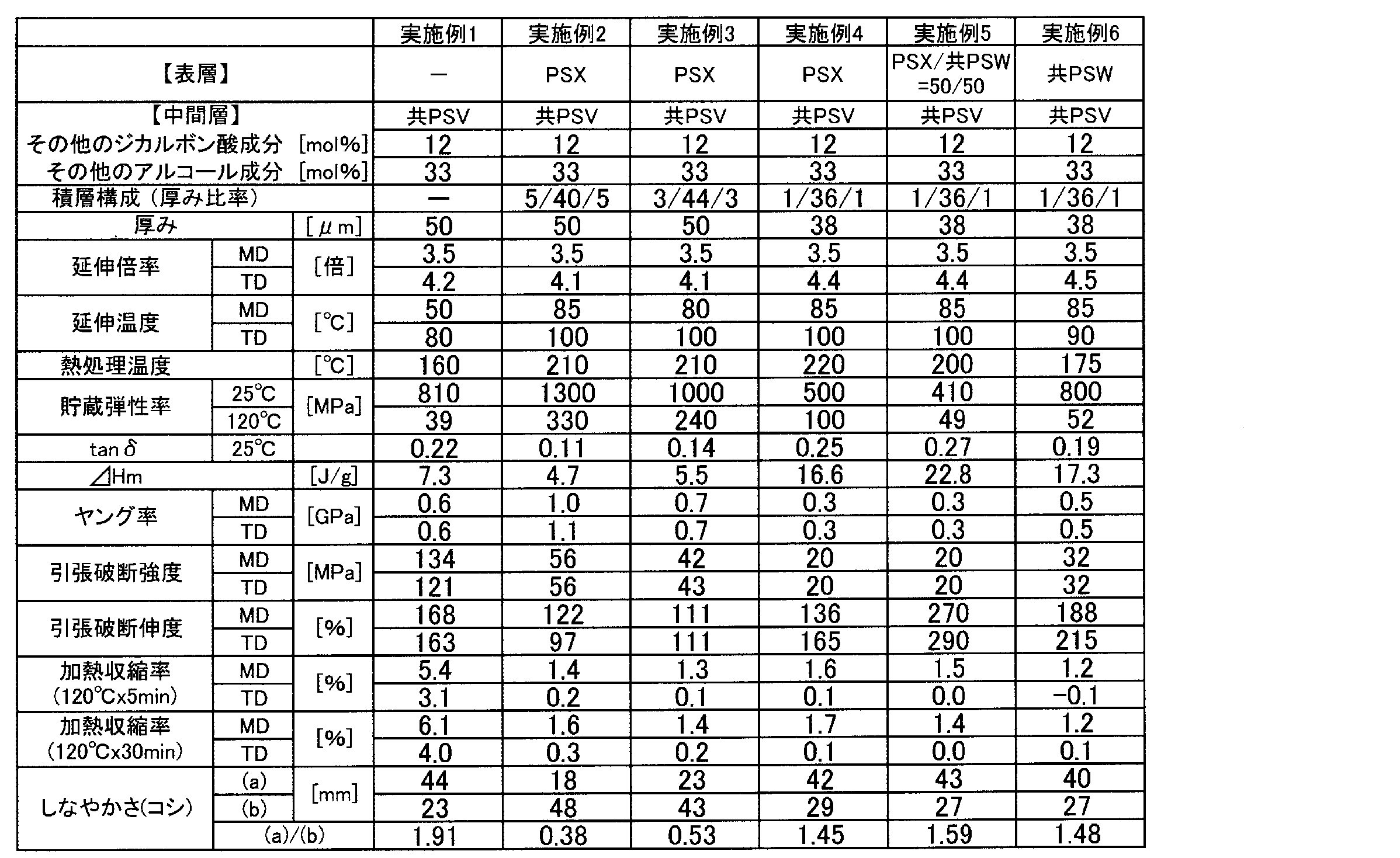

前記実施例及び発明者がこれまで行ってきた試験結果より、前記共重合ポリエステルAを主成分樹脂として含有する共重合ポリエステル層Aを備えた共重合ポリエステルフィルムであって、25℃の貯蔵弾性率が2500MPa以下であることで、常温で柔軟性に優れており、単に柔軟であるだけでなく、よりしなやかであり、それでいて、伸度及び強度を有することができる。且つ、120℃の貯蔵弾性率が10MPa以上であることで、実用上十分な耐熱性を有することができることが分かった。 From the above examples and the results of the tests conducted by the inventors so far, it was found that the copolymer polyester film provided with the copolymer polyester layer A containing the copolymer polyester A as the main component resin had a storage elastic modulus at 25 ° C. is 2500 MPa or less, it has excellent flexibility at room temperature, is not only flexible but also more supple, and can have elongation and strength. Moreover, it was found that practically sufficient heat resistance can be obtained when the storage elastic modulus at 120° C. is 10 MPa or more.
実施例2~6のように、中間層の主成分樹脂が結晶性の共重合ポリエステルである場合、表層の主成分樹脂としてのポリエステルが、前記共重合ポリエステルの融点よりも高い融点を有するポリエステルであれば、前記中間層のみからなる単層の場合に比べて、延伸後の熱処理(熱固定)温度をより高くすることができ、熱収縮性をさらに抑えることができることが確かめられた。
なお、中間層の主成分樹脂が非晶性の共重合ポリエステルである場合は、表層の主成分樹脂としてのポリエステルが、前記共重合ポリエステルのガラス転移点よりも高い融点を有するポリエステルであれば、前記中間層のみからなる単層の場合に比べて、延伸後の熱処理(熱固定)温度をより高くすることができるから、熱収縮性をさらに抑えることができると考えられる。When the main component resin of the intermediate layer is a crystalline copolyester as in Examples 2 to 6, the polyester as the main component resin of the surface layer is a polyester having a melting point higher than that of the copolyester. It was confirmed that the heat treatment (heat setting) temperature after stretching can be made higher than in the case of a single layer consisting only of the intermediate layer, and the heat shrinkability can be further suppressed.
In addition, when the main component resin of the intermediate layer is an amorphous copolyester, if the polyester as the main component resin of the surface layer has a melting point higher than the glass transition point of the copolyester, Compared to the case of a single layer consisting only of the intermediate layer, the heat treatment (heat setting) temperature after stretching can be made higher, so it is thought that the heat shrinkability can be further suppressed.
また、実施例11の物性を考慮すると、共重合ポリエステル層Aが2種類以上のポリエステルを含む場合は、2種類以上のポリエステルをまとめて、ジカルボン酸成分の合計含有量に対する「その他のジカルボン酸成分」の合計含有量の割合が5~20mol%であり、アルコール成分の合計含有量に対する「その他のアルコール成分」の合計含有量の割合が25~50mol%であるのが好ましいことが分かった。 Further, considering the physical properties of Example 11, when the copolymer polyester layer A contains two or more types of polyester, two or more types of polyester are combined, and "other dicarboxylic acid components" with respect to the total content of dicarboxylic acid components ” is 5 to 20 mol %, and the total content of “other alcohol components” to the total content of alcohol components is preferably 25 to 50 mol %.
Claims (11)
前記共重合ポリエステルAは、テレフタル酸及びダイマー酸と、エチレングリコール及び1,4-ブタンジオールとの共重合体であり、当該共重合ポリエステルにおいてジカルボン酸成分に占めるダイマー酸の割合は5~20mol%であり、アルコール成分に占める1,4-ブタンジオールの割合は25~50mol%であり、
前記ポリエステル層Cの各層の厚みは、前記共重合ポリエステル層Aの厚みの1~20%であり、
25℃の貯蔵弾性率が2500MPa以下であり、且つ、120℃の貯蔵弾性率が10MPa以上であることを特徴とする共重合ポリエステルフィルム。 Consisting of a single layer structure of a copolymer polyester layer A containing 50% by mass or more of the copolymer polyester A, or containing terephthalic acid as a dicarboxylic acid component and ethylene glycol as an alcohol component on both the front and back sides of the copolymer polyester layer A A copolymerized polyester film having a three-layer structure obtained by laminating a polyester layer C containing polyester C as a main component resin made of homopolyester containing
The copolymer polyester A is a copolymer of terephthalic acid and dimer acid , ethylene glycol and 1,4-butanediol , and the proportion of dimer acid in the dicarboxylic acid component in the copolymer polyester is 5 to 20 mol%. and the proportion of 1,4-butanediol in the alcohol component is 25 to 50 mol%,
The thickness of each layer of the polyester layer C is 1 to 20% of the thickness of the copolymer polyester layer A,
A copolymer polyester film having a storage modulus of 2500 MPa or less at 25°C and a storage modulus of 10 MPa or more at 120°C.
共重合ポリエステル層Aに含まれる全ポリエステルにおいて、ジカルボン酸成分の含有量合計に占めるダイマー酸の含有量合計の割合は5~20mol%であり、アルコール成分の含有量合計に占める1,4-ブタンジオールの含有量合計の割合は25~50mol%であり、
前記ポリエステル層Cの各層の厚みは、前記共重合ポリエステル層Aの厚みの1~20%であり、
25℃の貯蔵弾性率が2500MPa以下であり、且つ、120℃の貯蔵弾性率が10MPa以上であることを特徴とする共重合ポリエステルフィルム。 Consisting of a single layer structure of a copolymer polyester layer A containing 50% by mass or more of one or more polyesters, or containing terephthalic acid as a dicarboxylic acid component on both the front and back sides of the copolymer polyester layer A, alcohol A copolymerized polyester film having a three-layer structure obtained by laminating a polyester layer C containing a polyester C made of a homopolyester containing ethylene glycol as a component as a main component resin,
In the total polyester contained in the copolymer polyester layer A, the ratio of the total content of the dimer acid to the total content of the dicarboxylic acid component is 5 to 20 mol%, and the total content of the alcohol component is 1,4-butane . The ratio of the total content of diols is 25 to 50 mol%,
The thickness of each layer of the polyester layer C is 1 to 20% of the thickness of the copolymer polyester layer A,
A copolymer polyester film having a storage modulus of 2500 MPa or less at 25°C and a storage modulus of 10 MPa or more at 120°C.
Applications Claiming Priority (3)
| Application Number | Priority Date | Filing Date | Title |
|---|---|---|---|
| JP2017182165 | 2017-09-22 | ||
| JP2017182165 | 2017-09-22 | ||
| PCT/JP2018/034930 WO2019059322A1 (en) | 2017-09-22 | 2018-09-20 | Copolyester film |
Publications (2)
| Publication Number | Publication Date |
|---|---|
| JPWO2019059322A1 JPWO2019059322A1 (en) | 2020-11-05 |
| JP7211368B2 true JP7211368B2 (en) | 2023-01-24 |
Family
ID=65811478
Family Applications (1)
| Application Number | Title | Priority Date | Filing Date |
|---|---|---|---|
| JP2019543717A Active JP7211368B2 (en) | 2017-09-22 | 2018-09-20 | Copolyester film |
Country Status (5)
| Country | Link |
|---|---|
| JP (1) | JP7211368B2 (en) |
| KR (1) | KR102619518B1 (en) |
| CN (1) | CN111108146A (en) |
| TW (1) | TWI770282B (en) |
| WO (1) | WO2019059322A1 (en) |
Families Citing this family (6)
| Publication number | Priority date | Publication date | Assignee | Title |
|---|---|---|---|---|
| JP7439409B2 (en) * | 2019-08-05 | 2024-02-28 | 三菱ケミカル株式会社 | polyester film |
| CN111409337B (en) * | 2019-12-31 | 2022-05-31 | 树业环保科技股份有限公司 | Environment-friendly flexible matte polyester film for door plate and preparation method thereof |
| JP7505508B2 (en) * | 2020-01-30 | 2024-06-25 | 三菱ケミカル株式会社 | Copolymer polyester film, laminated film and method of using same |
| WO2021172366A1 (en) * | 2020-02-28 | 2021-09-02 | 三井化学株式会社 | Laminate |
| US20230331987A1 (en) * | 2020-09-14 | 2023-10-19 | Unitika Ltd. | Polyamide and molded body and film obtained from the same and method for producing the polyamide |
| CN113429548A (en) * | 2021-06-17 | 2021-09-24 | 四川东方绝缘材料股份有限公司 | Preparation method of flexible polyester film for foldable screen |
Citations (2)
| Publication number | Priority date | Publication date | Assignee | Title |
|---|---|---|---|---|
| JP2006219509A (en) | 2005-02-08 | 2006-08-24 | Toray Ind Inc | Polyester film |
| JP2013188946A (en) | 2012-03-14 | 2013-09-26 | Daiwa Can Co Ltd | Laminated polyester film for coating metal sheet, polyester film coated metal plate, and polyester film coated metal can |
Family Cites Families (10)
| Publication number | Priority date | Publication date | Assignee | Title |
|---|---|---|---|---|
| JP3221531B2 (en) * | 1993-08-04 | 2001-10-22 | 東洋紡績株式会社 | Polyester composite film for metal lamination |
| JP3304002B2 (en) * | 1993-08-05 | 2002-07-22 | 東洋紡績株式会社 | Polyester composite film for metal lamination |
| JP4099355B2 (en) * | 2001-06-29 | 2008-06-11 | 積水化学工業株式会社 | Sheet |
| WO2006048927A1 (en) * | 2004-11-04 | 2006-05-11 | Toray Industries, Inc. | Copolyester, process for producing the same, and polyester film |
| JP5763110B2 (en) | 2013-01-08 | 2015-08-12 | ビッグローブ株式会社 | Transmission / reception system, computer, transmission / reception apparatus, transmission / reception method, and program |
| JP6154626B2 (en) | 2013-03-02 | 2017-06-28 | 三菱ケミカル株式会社 | Softening polyester film |
| KR102084824B1 (en) * | 2013-07-05 | 2020-03-04 | 다이와 세칸 가부시키가이샤 | Copolyester resin and polyester film for covering metal plates and laminated polyester film comprising same made into film |
| JP2016093979A (en) * | 2014-11-17 | 2016-05-26 | 日本合成化学工業株式会社 | Surface protective film and method for producing the same |
| KR102402833B1 (en) * | 2014-11-28 | 2022-05-27 | 도레이 카부시키가이샤 | Polyester film |
| JP6729365B2 (en) * | 2015-03-13 | 2020-07-22 | 東レ株式会社 | Optical polyester film and polarizing plate using the same |
-
2018
- 2018-09-20 WO PCT/JP2018/034930 patent/WO2019059322A1/en not_active Ceased
- 2018-09-20 CN CN201880061316.8A patent/CN111108146A/en active Pending
- 2018-09-20 KR KR1020207011267A patent/KR102619518B1/en active Active
- 2018-09-20 JP JP2019543717A patent/JP7211368B2/en active Active
- 2018-09-21 TW TW107133392A patent/TWI770282B/en active
Patent Citations (2)
| Publication number | Priority date | Publication date | Assignee | Title |
|---|---|---|---|---|
| JP2006219509A (en) | 2005-02-08 | 2006-08-24 | Toray Ind Inc | Polyester film |
| JP2013188946A (en) | 2012-03-14 | 2013-09-26 | Daiwa Can Co Ltd | Laminated polyester film for coating metal sheet, polyester film coated metal plate, and polyester film coated metal can |
Also Published As
| Publication number | Publication date |
|---|---|
| CN111108146A (en) | 2020-05-05 |
| KR102619518B1 (en) | 2023-12-29 |
| WO2019059322A1 (en) | 2019-03-28 |
| TW201920396A (en) | 2019-06-01 |
| JPWO2019059322A1 (en) | 2020-11-05 |
| KR20200055071A (en) | 2020-05-20 |
| TWI770282B (en) | 2022-07-11 |
Similar Documents
| Publication | Publication Date | Title |
|---|---|---|
| KR102619518B1 (en) | Copolymerized polyester film | |
| JP6973584B2 (en) | Laminated film | |
| WO1999062710A1 (en) | Biodegradable card | |
| JP6884997B2 (en) | Polyester film and polarizing plate protective film | |
| JP2017206012A (en) | Laminate film and laminated glass for liquid crystal projection using the same | |
| JP5941045B2 (en) | Shrink film and manufacturing method thereof | |
| KR20090062882A (en) | Heat-shrinkable laminated film and heat-shrinkable label using same | |
| JP6760066B2 (en) | Biaxially oriented polyester film | |
| JP7505508B2 (en) | Copolymer polyester film, laminated film and method of using same | |
| JP7192869B2 (en) | Copolyester film | |
| JP2018021168A (en) | Biaxially oriented polyester film | |
| JP2022122202A (en) | Biaxially stretched film and laminated film | |
| JP2018184508A (en) | Polyester film | |
| JP7248092B2 (en) | polyester film. | |
| JP3960741B2 (en) | Heat-shrinkable polyester multilayer film | |
| JP7439409B2 (en) | polyester film | |
| JP4502118B2 (en) | Easy-bending biaxially stretched polyester film | |
| KR101920098B1 (en) | Laminated body for manufacturing flexible electronic device, biaxially-oriented polyester film used for same, flexible electronic device using same, and manufacturing method therefor | |
| JP6992259B2 (en) | Laminated film and its manufacturing method | |
| JP7861597B2 (en) | polyester film | |
| JP2015151529A (en) | Biaxially-oriented polyester film | |
| JP7645069B2 (en) | Polyester film, printing base paper, method for producing polyester film, and method for producing thermal stencil printing base paper | |
| KR20100013012A (en) | Heat-shrinkable polyester film | |
| JP4576886B2 (en) | Laminated polyester film for folding packaging | |
| JP6787080B2 (en) | Laminate |
Legal Events
| Date | Code | Title | Description |
|---|---|---|---|
| A621 | Written request for application examination |
Free format text: JAPANESE INTERMEDIATE CODE: A621 Effective date: 20210730 |
|
| A131 | Notification of reasons for refusal |
Free format text: JAPANESE INTERMEDIATE CODE: A131 Effective date: 20220712 |
|
| A521 | Request for written amendment filed |
Free format text: JAPANESE INTERMEDIATE CODE: A523 Effective date: 20220805 |
|
| A131 | Notification of reasons for refusal |
Free format text: JAPANESE INTERMEDIATE CODE: A131 Effective date: 20221101 |
|
| A521 | Request for written amendment filed |
Free format text: JAPANESE INTERMEDIATE CODE: A523 Effective date: 20221130 |
|
| TRDD | Decision of grant or rejection written | ||
| A01 | Written decision to grant a patent or to grant a registration (utility model) |
Free format text: JAPANESE INTERMEDIATE CODE: A01 Effective date: 20221213 |
|
| A61 | First payment of annual fees (during grant procedure) |
Free format text: JAPANESE INTERMEDIATE CODE: A61 Effective date: 20221226 |
|
| R151 | Written notification of patent or utility model registration |
Ref document number: 7211368 Country of ref document: JP Free format text: JAPANESE INTERMEDIATE CODE: R151 |