JP6917455B2 - Rubber composition and tires - Google Patents
Rubber composition and tires Download PDFInfo
- Publication number
- JP6917455B2 JP6917455B2 JP2019529121A JP2019529121A JP6917455B2 JP 6917455 B2 JP6917455 B2 JP 6917455B2 JP 2019529121 A JP2019529121 A JP 2019529121A JP 2019529121 A JP2019529121 A JP 2019529121A JP 6917455 B2 JP6917455 B2 JP 6917455B2
- Authority
- JP
- Japan
- Prior art keywords
- rubber composition
- particles
- rubber
- titanate compound
- compound particles
- Prior art date
- Legal status (The legal status is an assumption and is not a legal conclusion. Google has not performed a legal analysis and makes no representation as to the accuracy of the status listed.)
- Active
Links
Images

Classifications
-
- C—CHEMISTRY; METALLURGY
- C08—ORGANIC MACROMOLECULAR COMPOUNDS; THEIR PREPARATION OR CHEMICAL WORKING-UP; COMPOSITIONS BASED THEREON
- C08K—Use of inorganic or non-macromolecular organic substances as compounding ingredients
- C08K3/00—Use of inorganic substances as compounding ingredients
- C08K3/18—Oxygen-containing compounds, e.g. metal carbonyls
- C08K3/24—Acids; Salts thereof
-
- B—PERFORMING OPERATIONS; TRANSPORTING
- B60—VEHICLES IN GENERAL
- B60C—VEHICLE TYRES; TYRE INFLATION; TYRE CHANGING; CONNECTING VALVES TO INFLATABLE ELASTIC BODIES IN GENERAL; DEVICES OR ARRANGEMENTS RELATED TO TYRES
- B60C1/00—Tyres characterised by the chemical composition or the physical arrangement or mixture of the composition
-
- B—PERFORMING OPERATIONS; TRANSPORTING
- B60—VEHICLES IN GENERAL
- B60C—VEHICLE TYRES; TYRE INFLATION; TYRE CHANGING; CONNECTING VALVES TO INFLATABLE ELASTIC BODIES IN GENERAL; DEVICES OR ARRANGEMENTS RELATED TO TYRES
- B60C1/00—Tyres characterised by the chemical composition or the physical arrangement or mixture of the composition
- B60C1/0016—Compositions of the tread
-
- C—CHEMISTRY; METALLURGY
- C08—ORGANIC MACROMOLECULAR COMPOUNDS; THEIR PREPARATION OR CHEMICAL WORKING-UP; COMPOSITIONS BASED THEREON
- C08K—Use of inorganic or non-macromolecular organic substances as compounding ingredients
- C08K3/00—Use of inorganic substances as compounding ingredients
- C08K3/18—Oxygen-containing compounds, e.g. metal carbonyls
- C08K3/20—Oxides; Hydroxides
- C08K3/22—Oxides; Hydroxides of metals
-
- C—CHEMISTRY; METALLURGY
- C08—ORGANIC MACROMOLECULAR COMPOUNDS; THEIR PREPARATION OR CHEMICAL WORKING-UP; COMPOSITIONS BASED THEREON
- C08K—Use of inorganic or non-macromolecular organic substances as compounding ingredients
- C08K3/00—Use of inorganic substances as compounding ingredients
- C08K3/34—Silicon-containing compounds
- C08K3/36—Silica
-
- C—CHEMISTRY; METALLURGY
- C08—ORGANIC MACROMOLECULAR COMPOUNDS; THEIR PREPARATION OR CHEMICAL WORKING-UP; COMPOSITIONS BASED THEREON
- C08K—Use of inorganic or non-macromolecular organic substances as compounding ingredients
- C08K9/00—Use of pretreated ingredients
- C08K9/04—Ingredients treated with organic substances
- C08K9/06—Ingredients treated with organic substances with silicon-containing compounds
-
- C—CHEMISTRY; METALLURGY
- C08—ORGANIC MACROMOLECULAR COMPOUNDS; THEIR PREPARATION OR CHEMICAL WORKING-UP; COMPOSITIONS BASED THEREON
- C08L—COMPOSITIONS OF MACROMOLECULAR COMPOUNDS
- C08L9/00—Compositions of homopolymers or copolymers of conjugated diene hydrocarbons
- C08L9/06—Copolymers with styrene
-
- C—CHEMISTRY; METALLURGY
- C08—ORGANIC MACROMOLECULAR COMPOUNDS; THEIR PREPARATION OR CHEMICAL WORKING-UP; COMPOSITIONS BASED THEREON
- C08K—Use of inorganic or non-macromolecular organic substances as compounding ingredients
- C08K3/00—Use of inorganic substances as compounding ingredients
- C08K3/18—Oxygen-containing compounds, e.g. metal carbonyls
- C08K3/20—Oxides; Hydroxides
- C08K3/22—Oxides; Hydroxides of metals
- C08K2003/2237—Oxides; Hydroxides of metals of titanium
-
- C—CHEMISTRY; METALLURGY
- C08—ORGANIC MACROMOLECULAR COMPOUNDS; THEIR PREPARATION OR CHEMICAL WORKING-UP; COMPOSITIONS BASED THEREON
- C08K—Use of inorganic or non-macromolecular organic substances as compounding ingredients
- C08K2201/00—Specific properties of additives
- C08K2201/002—Physical properties
- C08K2201/003—Additives being defined by their diameter
-
- C—CHEMISTRY; METALLURGY
- C08—ORGANIC MACROMOLECULAR COMPOUNDS; THEIR PREPARATION OR CHEMICAL WORKING-UP; COMPOSITIONS BASED THEREON
- C08K—Use of inorganic or non-macromolecular organic substances as compounding ingredients
- C08K2201/00—Specific properties of additives
- C08K2201/002—Physical properties
- C08K2201/006—Additives being defined by their surface area
-
- C—CHEMISTRY; METALLURGY
- C08—ORGANIC MACROMOLECULAR COMPOUNDS; THEIR PREPARATION OR CHEMICAL WORKING-UP; COMPOSITIONS BASED THEREON
- C08K—Use of inorganic or non-macromolecular organic substances as compounding ingredients
- C08K3/00—Use of inorganic substances as compounding ingredients
- C08K3/02—Elements
- C08K3/04—Carbon
-
- Y—GENERAL TAGGING OF NEW TECHNOLOGICAL DEVELOPMENTS; GENERAL TAGGING OF CROSS-SECTIONAL TECHNOLOGIES SPANNING OVER SEVERAL SECTIONS OF THE IPC; TECHNICAL SUBJECTS COVERED BY FORMER USPC CROSS-REFERENCE ART COLLECTIONS [XRACs] AND DIGESTS
- Y02—TECHNOLOGIES OR APPLICATIONS FOR MITIGATION OR ADAPTATION AGAINST CLIMATE CHANGE
- Y02T—CLIMATE CHANGE MITIGATION TECHNOLOGIES RELATED TO TRANSPORTATION
- Y02T10/00—Road transport of goods or passengers
- Y02T10/80—Technologies aiming to reduce greenhouse gasses emissions common to all road transportation technologies
- Y02T10/86—Optimisation of rolling resistance, e.g. weight reduction
Landscapes
- Chemical & Material Sciences (AREA)
- Health & Medical Sciences (AREA)
- Chemical Kinetics & Catalysis (AREA)
- Medicinal Chemistry (AREA)
- Polymers & Plastics (AREA)
- Organic Chemistry (AREA)
- Engineering & Computer Science (AREA)
- Mechanical Engineering (AREA)
- Compositions Of Macromolecular Compounds (AREA)
- Tires In General (AREA)
Description
本発明は、充填材としてチタン酸塩化合物粒子が配合されてなるゴム組成物及びそれを用いたタイヤに関する。 The present invention relates to a rubber composition in which titaniumate compound particles are blended as a filler and a tire using the same.
雨天時の濡れた路面を自動車が走行すると、タイヤと路面との間に水が介在するため、タイヤのグリップ性が低下し、ブレーキをかけたときの制動距離が伸びる。このウェットグリップ性を高めるために、ゴム成分に充填材としてのフィラーを配合するさまざまな検討がなされている。例えば、特許文献1に、ゴム成分に平均繊維長1〜30μmのチタン酸カリウム繊維を1〜30質量部配合してなるタイヤトレッド用ゴム組成物が開示されている。 When a car runs on a wet road surface in rainy weather, water intervenes between the tires and the road surface, which reduces the grip of the tires and increases the braking distance when the brakes are applied. In order to improve this wet grip property, various studies have been made to add a filler as a filler to the rubber component. For example, Patent Document 1 discloses a rubber composition for a tire tread, which comprises 1 to 30 parts by mass of potassium titanate fiber having an average fiber length of 1 to 30 μm as a rubber component.
一方で、チタン酸カリウム繊維が配合されてなるフェノール樹脂組成物は、ブレーキの摩擦材として用いることが知られている。特に、チタン酸カリウム繊維は、摩擦調整材として用いられている。しかし、チタン酸カリウム繊維は、平均繊維径が0.1〜0.5μmであり、平均繊維長が10〜20μmのものが多く、世界保健機関(WHO)で定められたWHOファイバー(長径が5μm以上、短径が3μm以下、及びアスペクト比が3以上の繊維状粒子)を含有していることから、非繊維状のチタン酸塩化合物粒子を摩擦調整材とする配合が広まっている。 On the other hand, a phenol resin composition containing potassium titanate fibers is known to be used as a friction material for brakes. In particular, potassium titanate fiber is used as a friction adjusting material. However, most potassium titanate fibers have an average fiber diameter of 0.1 to 0.5 μm and an average fiber length of 10 to 20 μm, and are WHO fibers (major axis of 5 μm) defined by the World Health Organization (WHO). As described above, since the fibrous particles having a minor axis of 3 μm or less and an aspect ratio of 3 or more are contained), the formulation using non-fibrous titanate compound particles as a friction adjusting material is widespread.
特許文献1のゴム組成物は、繊維状のチタン酸塩化合物粒子を用いているうえに、ウェットグリップ性は十分ではなく、チタン酸塩化合物粒子の分散性も十分ではない。また、非繊維状のチタン酸塩化合物粒子を、摩擦調整材としての機能を期待してゴム成分に配合し、それをタイヤに用いることは知られていない。 The rubber composition of Patent Document 1 uses fibrous titanate compound particles, has insufficient wet grip, and does not have sufficient dispersibility of the titanate compound particles. Further, it is not known that non-fibrous titanate compound particles are blended with a rubber component in anticipation of a function as a friction adjusting material and used for a tire.
本発明の目的は、非繊維状のチタン酸塩化合物粒子が配合されてなり、該チタン酸塩化合物粒子の分散性が優れ、かつ優れたウェットグリップ性と耐摩耗性とを有するゴム組成物、及びそれを用いたタイヤを提供することにある。 An object of the present invention is a rubber composition in which non-fibrous titanate compound particles are blended, the titanate compound particles have excellent dispersibility, and have excellent wet grip and abrasion resistance. And to provide tires using it.
本発明は、以下のゴム組成物及びそれを用いたタイヤを提供する。 The present invention provides the following rubber composition and a tire using the same.
項1 ゴム成分に、平均粒子径が30μm未満であり、BET比表面積が2m2/g以上である非繊維状チタン酸塩化合物粒子と、BET比表面積が50〜250m2/gのシリカ粒子とが配合されてなる、ゴム組成物。Item 1 Rubber components include non-fibrous titanate compound particles having an average particle diameter of less than 30 μm and a BET specific surface area of 2 m 2 / g or more, and silica particles having a BET specific surface area of 50 to 250 m 2 / g. A rubber composition containing.
項2 前記非繊維状チタン酸塩化合物粒子を構成するチタン酸塩化合物が、組成式A2TinO(2n+1)〔式中、Aはアルカリ金属から選ばれる1種又は2種以上、n=2〜8〕、RxMyTi(2−y)O4〔式中、Rはリチウムを除くアルカリ金属、Mはリチウム、マグネシウム、亜鉛、ニッケル、銅、鉄、アルミニウム、ガリウム、及びマンガンから選ばれる1種又は2種以上、x=0.5〜1.0、y=0.25〜1.0〕、K0.5〜0.8Li0.27Ti1.73O3.85〜3.95、及びK0.2〜0.8Mg0.4Ti1.6O3.7〜3.95から選ばれる少なくとも1種である、項1に記載のゴム組成物。Titanate compound constituting the claim 2 wherein the non-fibrous titanate compound particles represented by the composition formula A 2 Ti n O (2n + 1) wherein, A is one or more selected from alkali metal, n = 2-8], in R x M y Ti (2- y) O 4 [wherein, alkali metal R is other than lithium, M is lithium, magnesium, zinc, nickel, copper, iron, aluminum, gallium, and manganese One or more selected, x = 0.5 to 1.0, y = 0.25 to 1.0], K 0.5 to 0.8 Li 0.27 Ti 1.73 O 3.85 Item 2. The rubber composition according to Item 1, which is at least one selected from ~ 3.95 and K 0.2 to 0.8 Mg 0.4 Ti 1.6 O 3.7 to 3.95.
項3 前記非繊維状チタン酸塩化合物粒子の表面上に表面処理剤からなる処理層が設けられている、項1又は2に記載のゴム組成物。 Item 3 The rubber composition according to Item 1 or 2, wherein a treatment layer made of a surface treatment agent is provided on the surface of the non-fibrous titanate compound particles.
項4 前記ゴム成分がジエン系ゴムである、項1〜3のいずれか一項に記載のゴム組成物。 Item 4. The rubber composition according to any one of Items 1 to 3, wherein the rubber component is a diene-based rubber.
項5 前記非繊維状チタン酸塩化合物粒子の配合量が、ゴム成分100質量部に対して1〜200質量部である、項1〜4のいずれか一項に記載のゴム組成物。 Item 5. The rubber composition according to any one of Items 1 to 4, wherein the blending amount of the non-fibrous titanate compound particles is 1 to 200 parts by mass with respect to 100 parts by mass of the rubber component.
項6 前記シリカ粒子の配合量が、ゴム成分100質量部に対して20〜120質量部である、項1〜5のいずれか一項に記載のゴム組成物。 Item 6. The rubber composition according to any one of Items 1 to 5, wherein the blending amount of the silica particles is 20 to 120 parts by mass with respect to 100 parts by mass of the rubber component.
項7 前記ゴム成分に、さらにカーボンブラック粒子が配合されてなる、項1〜6のいずれか一項に記載のゴム組成物。 Item 7. The rubber composition according to any one of Items 1 to 6, wherein carbon black particles are further blended with the rubber component.
項8 タイヤトレッド用である、項1〜7のいずれか一項に記載のゴム組成物。 Item 8. The rubber composition according to any one of Items 1 to 7, which is used for a tire tread.
項9 項1〜8のいずれか一項に記載のゴム組成物をトレッド部に用いてなる、タイヤ。 Item 9 A tire comprising the rubber composition according to any one of Items 1 to 8 in a tread portion.
本発明によれば、非繊維状のチタン酸塩化合物粒子が配合されてなり、チタン酸塩化合物粒子の分散性が優れ、かつ優れたウェットグリップ性と耐摩耗性とを有するゴム組成物、及びそれを用いたタイヤを提供することができる。 According to the present invention, a rubber composition obtained by blending non-fibrous titanate compound particles, having excellent dispersibility of the titanate compound particles, and having excellent wet grip and abrasion resistance, and a rubber composition. A tire using the tire can be provided.
以下、好ましい実施形態について説明する。但し、以下の実施形態は単なる例示であり、本発明は以下の実施形態に限定されるものではない。 Hereinafter, preferred embodiments will be described. However, the following embodiments are merely examples, and the present invention is not limited to the following embodiments.
本発明のゴム組成物は、ゴム成分に、平均粒子径が30μm未満であり、BET比表面積が2m2/g以上である非繊維状チタン酸塩化合物粒子(以下、チタン酸塩化合物粒子と略して称する場合があるものとする)と、BET比表面積が50〜250m2/gのシリカ粒子とが配合されてなり、必要に応じて、その他材料をさらに配合することができる。本発明によれば、ゴム組成物の調製時において、また調製後のゴム組成物において、チタン酸塩化合物粒子の分散性が優れ、優れたウェットグリップ性と耐摩耗性とを有するゴム組成物、及びそれを用いたタイヤを提供することができる。そして、非繊維状のチタン酸塩化合物粒子を用いていることからタイヤ摩耗粉にチタン酸塩化合物粒子由来の繊維状物が含まれるおそれがない。The rubber composition of the present invention contains non-fibrous titanate compound particles (hereinafter, abbreviated as titanate compound particles) having an average particle diameter of less than 30 μm and a BET specific surface area of 2 m 2 / g or more in the rubber component. (Sometimes referred to as), silica particles having a BET specific surface area of 50 to 250 m 2 / g are blended, and other materials can be further blended if necessary. According to the present invention, a rubber composition having excellent dispersibility of titanate compound particles and excellent wet grip and abrasion resistance at the time of preparing the rubber composition and in the prepared rubber composition. And tires using it can be provided. Further, since the non-fibrous titanate compound particles are used, there is no possibility that the tire wear powder contains fibrous substances derived from the titanate compound particles.
本発明のゴム組成物に用いるゴム成分は特に限定されないが、強度に優れている観点からジエン系ゴムを用いることが好ましい。ジエン系ゴムとしては、例えば、天然ゴム(NR)、イソプレンゴム(IR)、スチレンブタジエンゴム(SBR)、ブタジエンゴム(BR)、ブチルゴム(IIR)、エチレンプロピレンジエンゴム(EPDM)、アクリロニトリルブタジエンゴム(NBR)、スチレンイソプレンブタジエンゴム(SIBR)、又はクロロプレンゴム(CR)等が挙げられ、これらのうち1種又は2種以上を含むゴム成分が好ましい。低い転がり抵抗と高いウェットグリップ性能とのバランスの観点から、スチレンブタジエンゴム(SBR)、ブタジエンゴム(BR)を用いることがより好ましい。スチレンブタジエンゴム(SBR)とブタジエンゴム(BR)の混合比(SBR/BR)は、SBR/BR=60/40〜100/0であることが好ましい。 The rubber component used in the rubber composition of the present invention is not particularly limited, but it is preferable to use a diene-based rubber from the viewpoint of excellent strength. Examples of the diene rubber include natural rubber (NR), isoprene rubber (IR), styrene butadiene rubber (SBR), butadiene rubber (BR), butyl rubber (IIR), ethylene propylene diene rubber (EPDM), and acrylonitrile butadiene rubber (Acrylonitrile butadiene rubber). NBR), styrene isoprene butadiene rubber (SIBR), chloroprene rubber (CR) and the like, and a rubber component containing one or more of these is preferable. From the viewpoint of the balance between low rolling resistance and high wet grip performance, it is more preferable to use styrene butadiene rubber (SBR) and butadiene rubber (BR). The mixing ratio (SBR / BR) of the styrene-butadiene rubber (SBR) and the butadiene rubber (BR) is preferably SBR / BR = 60/40 to 100/0.
本発明に用いるチタン酸塩化合物粒子としては、平均粒子径が30μm未満であり、BET比表面積が2m2/g以上である球状、層状、板状、柱状、棒状、円柱状、ブロック状、多孔質状、複数の凸部を有する形状(アメーバ状、ブーメラン状、十字架状、金平糖状等)等の非繊維状の粒子(非繊維状粒子)であれば、公知のチタン酸塩化合物粒子の中から任意のものを適宜選択して用いることができる。チタン酸塩化合物粒子の形状は、例えば走査型電子顕微鏡観察から解析することができる。The titanate compound particles used in the present invention include spherical, layered, plate-shaped, columnar, rod-shaped, columnar, block-shaped, and porous having an average particle diameter of less than 30 μm and a BET specific surface area of 2 m 2 / g or more. Non-fibrous particles (non-fibrous particles) such as qualities and shapes having a plurality of convex portions (amoeba-like, boomeran-like, cruciform, gold flat sugar-like, etc.) are among known titanate compound particles. Any of these can be appropriately selected and used. The shape of the titanate compound particles can be analyzed, for example, by scanning electron microscopy.
本発明において、繊維状粒子とは、粒子に外接する直方体のうち最小の体積をもつ直方体(外接直方体)の最も長い長径L、次に長い辺を短径B、最も短い辺を厚さT(B>Tとする)として、L/T及びL/Bがいずれも5以上の粒子のことをいう。また、非繊維状粒子とは繊維状粒子を除く粒子のことをいい、粒子に外接する直方体のうち最小の体積をもつ直方体(外接直方体)の最も長い長径L、次に長い辺を短径B、最も短い辺を厚さT(B>Tとする)として、L/Bが5未満の粒子のことをいう。 In the present invention, the fibrous particles are the longest major axis L of the rectangular parallelepiped (circumscribed rectangular parallelepiped) having the smallest volume among the rectangular parallelepipeds circumscribing the particles, the next longest side is the minor axis B, and the shortest side is the thickness T (thickness T). B> T), which means particles having L / T and L / B of 5 or more. The non-fibrous particles refer to particles other than the fibrous particles, and the longest major axis L of the rectangular parallelepiped having the smallest volume among the rectangular parallelepipeds circumscribing the particles (external rectangular parallelepiped), and the next longest side is the minor axis B. , The shortest side is the thickness T (B> T), and the L / B is less than 5.
また、複数の凸部を有するとは、平面への投影形状が少なくとも通常の多角形、円、楕円等とは異なり2方向以上に凸部を有する形状を取り得るもの、いわゆる不定形状であることを意味する。具体的には、この凸部を有する形状とは、走査型電子顕微鏡による写真(投影図)に多角形、円、楕円等(基本図形)を当てはめ、それに対して突き出した部分に対応する部分をいう。 Further, having a plurality of convex portions means that the projected shape on a plane can take a shape having convex portions in two or more directions unlike a normal polygon, a circle, an ellipse, etc., that is, a so-called indefinite shape. Means. Specifically, the shape having a convex portion is a portion corresponding to a portion protruding from a polygon, a circle, an ellipse, etc. (basic figure) applied to a photograph (projection drawing) by a scanning electron microscope. say.
本発明で用いるチタン酸塩化合物粒子の平均粒子径は、30μm未満であって、好ましくは0.1μm以上、より好ましくは0.6μm以上、好ましくは3μm以下、より好ましくは1.5μm以下、さらに好ましくは1μm以下である。平均粒子径を、このような範囲に調整することにより、より一層優れた分散性、ウェットグリップ性、及び耐摩耗性を得ることができる。 The average particle size of the titanate compound particles used in the present invention is less than 30 μm, preferably 0.1 μm or more, more preferably 0.6 μm or more, preferably 3 μm or less, more preferably 1.5 μm or less, and further. It is preferably 1 μm or less. By adjusting the average particle size to such a range, even better dispersibility, wet grip property, and abrasion resistance can be obtained.
チタン酸塩化合物粒子の平均粒子径は、レーザー回折・散乱法により測定することができ、レーザー回折・散乱法により測定される粒度分布における積算基準累積50%時の粒子径(体積基準累積50%粒子径)、すなわちD50(メジアン径)である。この体積基準累積50%粒子径(D50)は、体積基準で粒度分布を求め、全体積を100%とした累積曲線において、粒子サイズの小さいものから粒子数をカウントしていき、累積値が50%となる点の粒子径である。The average particle size of the titanate compound particles can be measured by the laser diffraction / scattering method, and the particle size at the time of cumulative standard cumulative 50% in the particle size distribution measured by the laser diffraction / scattering method (volume standard cumulative 50%). Particle size), that is, D 50 (median size). For this volume-based cumulative 50% particle size (D 50 ), the particle size distribution is obtained on a volume basis, and in a cumulative curve with the total volume as 100%, the number of particles is counted from the smallest particle size, and the cumulative value is The particle size at the point where it becomes 50%.
本発明で用いるチタン酸塩化合物粒子のBET比表面積は、2m2/g以上であり、好ましくは2〜300m2/gであり、より好ましくは7〜100m2/gである。BET比表面積を、このような範囲に調整することにより、より一層優れた分散性、ウェットグリップ性及び耐摩耗性を得ることができる。チタン酸塩化合物粒子のBET比表面積は、JIS Z8830に準拠して測定することができる。BET法とは、試料粉体粒子の表面上に占有面積のわかった窒素ガスを吸着させ、その吸着量から試料粉体粒子の比表面積を求める方法であり、この方法で求めた比表面積を「BET比表面積」という。The BET specific surface area of the titanate compound particles used in the present invention is 2 m 2 / g or more, preferably 2 to 300 m 2 / g, and more preferably 7 to 100 m 2 / g. By adjusting the BET specific surface area to such a range, even more excellent dispersibility, wet grip property and wear resistance can be obtained. The BET specific surface area of the titanate compound particles can be measured according to JIS Z8830. The BET method is a method in which a nitrogen gas having a known occupied area is adsorbed on the surface of the sample powder particles, and the specific surface area of the sample powder particles is obtained from the adsorbed amount. It is called "BET specific surface area".
本発明に用いるチタン酸塩化合物粒子を構成するチタン酸塩化合物としては、アルカリ金属及びアルカリ土類金属の群から選ばれる少なくとも1種の元素の塩であることが好ましい。アルカリ金属としては、リチウム、ナトリウム、カリウム、ルビジウム、セシウム、フランシウムが挙げられ、好ましくはリチウム、ナトリウム、カリウムである。アルカリ土類金属としては、ベリリウム、マグネシウム、カルシウム、ストロンチウム、バリウム、ラジウムが挙げられ、好ましくはマグネシウム、カルシウムである。 The titanate compound constituting the titanate compound particles used in the present invention is preferably a salt of at least one element selected from the group of alkali metals and alkaline earth metals. Examples of the alkali metal include lithium, sodium, potassium, rubidium, cesium, and francium, and lithium, sodium, and potassium are preferable. Examples of the alkaline earth metal include beryllium, magnesium, calcium, strontium, barium and radium, and magnesium and calcium are preferable.
上記チタン酸塩化合物の具体例としては、例えば、組成式A2TinO(2n+1)〔式中、Aはアルカリ金属から選ばれる1種又は2種以上、n=2〜8〕、RxMyTi(2−y)O4〔式中、Rはリチウムを除くアルカリ金属、Mはリチウム、マグネシウム、亜鉛、ニッケル、銅、鉄、アルミニウム、ガリウム、及びマンガンから選ばれる1種又は2種以上、x=0.5〜1.0、y=0.25〜1.0〕、K0.5〜0.8Li0.27Ti1.73O3.85〜3.95、K0.2〜0.8Mg0.4Ti1.6O3.7〜3.95等で表されるチタン酸塩化合物を挙げることができる。これらは単独で用いてもよく、2種以上を組み合わせて用いてもよい。また、これらの中でも結晶構造がトンネル構造のA2TinO(2n+1)〔式中、Aはアルカリ金属から選ばれる1種又は2種以上、n=2〜8〕で表されるチタン酸塩化合物が好ましく、具体的には、Na2Ti6O13、Na2Ti8O17、K2Ti6O13、K2Ti8O17等を挙げることができる。トンネル構造にすることで、チタン酸塩化合物からのアルカリの溶出をより一層抑制することができる。Specific examples of the titanate compounds, for example, the composition formula A 2 Ti n O (2n + 1) wherein, A is one or more selected from alkali metal, n = 2 to 8], R x M y Ti in (2-y) O 4 [wherein, one or two or alkali metal R is other than lithium, M is selected lithium, magnesium, zinc, nickel, copper, iron, aluminum, gallium, and manganese Above, x = 0.5 to 1.0, y = 0.25 to 1.0], K 0.5 to 0.8 Li 0.27 Ti 1.73 O 3.85 to 3.95 , K 0 .2 to 0.8 Mg 0.4 Ti 1.6 O Titanate compounds represented by 3.7 to 3.95 and the like can be mentioned. These may be used alone or in combination of two or more. Also, A 2 Ti n O crystal structure tunnel structure Among these (2n + 1) wherein, A is one or more selected from alkali metal, n = 2 to 8] titanate represented by Compounds are preferable, and specific examples thereof include Na 2 Ti 6 O 13 , Na 2 Ti 8 O 17 , K 2 Ti 6 O 13 , K 2 Ti 8 O 17, and the like. By forming the tunnel structure, the elution of alkali from the titanate compound can be further suppressed.
チタン酸塩化合物粒子は、水分散pHが7〜11であることが好ましい。チタン酸塩化合物粒子の水分散pHを、このような範囲内にすることにより、チタン酸塩化合物粒子に含まれる酸性不純物による耐摩耗性の低下をより一層抑制することができる。本発明において水分散pHとは、チタン酸塩化合物粒子を20℃の水に分散させて得られる1質量%スラリーのpHのことをいう。 The titanate compound particles preferably have an aqueous dispersion pH of 7 to 11. By setting the aqueous dispersion pH of the titanate compound particles within such a range, it is possible to further suppress a decrease in wear resistance due to acidic impurities contained in the titanate compound particles. In the present invention, the aqueous dispersion pH refers to the pH of a 1% by mass slurry obtained by dispersing titaniumate compound particles in water at 20 ° C.
本発明で用いるチタン酸塩化合物粒子は、分散性のより一層の向上、ゴム成分との密着性のより一層の向上等を目的として、チタン酸塩化合物粒子の表面に表面処理剤からなる処理層が形成されていることが好ましい。表面処理剤としては、チタネートカップリング剤、シランカップリング剤、アルミネートカップリング剤、ジルコニウムカップリング剤等のカップリング剤が挙げられ、これらの中でもチタネートカップリング剤、シランカップリング剤、アルミネートカップリング剤が好ましい。これらを1種単独で用いてもよく、2種以上を混合して用いてもよい。 The titanate compound particles used in the present invention have a treatment layer made of a surface treatment agent on the surface of the titanate compound particles for the purpose of further improving dispersibility, further improving adhesion to rubber components, and the like. Is preferably formed. Examples of the surface treatment agent include coupling agents such as titanate coupling agent, silane coupling agent, aluminate coupling agent, and zirconium coupling agent. Among these, titanate coupling agent, silane coupling agent, and aluminate. Coupling agents are preferred. These may be used individually by 1 type, and may be used in mixture of 2 or more type.
チタネートカップリング剤の例としては、イソプロピルトリステアロイルチタネート、イソプロピルトリス(ジオクチルパイロホスフェート)チタネート、イソプロピルトリ(N−アミノエチル・アミノエチル)チタネート、テトラオクチルビス(ジトリデシルホスフェイト)チタネート、テトラ(2−2−ジアリルオキシメチル−1−ブチル)ビス(ジトリデシル)ホスフェイトチタネート、ビス(ジオクチルパイロホスフェート)オキシアセテートチタネート、ビス(ジオクチルパイロホスフェート)エチレンチタネート等を挙げることができる。これらのうちイソプロピルトリ(N−アミノエチル・アミノエチル)チタネートが好ましい。 Examples of titanate coupling agents include isopropyltristearoyl titanate, isopropyltris (dioctylpyrophosphate) titanate, isopropyltri (N-aminoethyl / aminoethyl) titanate, tetraoctylbis (ditridecylphosphate) titanate, tetra (2). Examples thereof include -2-diallyloxymethyl-1-butyl) bis (ditridecyl) phosphate titanate, bis (dioctylpyrophosphate) oxyacetate titanate, and bis (dioctylpyrophosphate) ethylene titanate. Of these, isopropyltri (N-aminoethyl / aminoethyl) titanate is preferable.
シランカップリング剤の例としては、スルフィド系、ポリスルフィド系、チオエステル系、チオール系、オレフィン系、エポキシ系、アミノ系、アルキル系等のシランカップリング剤が挙げられ、これらを1種単独で用いてもよく、2種以上を混合して用いてもよい。これらの中でもスルフィド系のシランカップリング剤、アミノ系のシランカップリング剤が好ましい。 Examples of silane coupling agents include sulfide-based, polysulfide-based, thioester-based, thiol-based, olefin-based, epoxy-based, amino-based, and alkyl-based silane coupling agents, and these may be used alone. Also, two or more kinds may be mixed and used. Among these, sulfide-based silane coupling agents and amino-based silane coupling agents are preferable.
スルフィド系のシランカップリング剤としては、例えば、ビス(3−トリエトキシシリルプロピル)テトラスルフィド、ビス(3−トリメトキシシリルプロピル)テトラスルフィド、ビス(3−メチルジメトキシシリルプロピル)テトラスルフィド、ビス(2−トリエトキシシリルエチル)テトラスルフィド、ビス(3−トリエトキシシリルプロピル)ジスルフィド、ビス(3−トリメトキシシリルプロピル)ジスルフィド、ビス(3−メチルジメトキシシリルプロピル)ジスルフィド、ビス(2−トリエトキシシリルエチル)ジスルフィド、ビス(3−トリエトキシシリルプロピル)トリスルフィド、ビス(3−トリメトキシシリルプロピル)トリスルフィド、ビス(3−メチルジメトキシシリルプロピル)トリスルフィド、ビス(2−トリエトキシシリルエチル)トリスルフィド、ビス(3−モノエトキシジメチルシリルプロピル)テトラスルフィド、ビス(3−モノエトキシジメチルシリルプロピル)トリスルフィド、ビス(3−モノエトキシジメチルシリルプロピル)ジスルフィド、ビス(3−モノメトキシジメチルシリルプロピル)テトラスルフィド、ビス(3−モノメトキシジメチルシリルプロピル)トリスルフィド、ビス(3−モノメトキシジメチルシリルプロピル)ジスルフィド、ビス(2−モノエトキシジメチルシリルエチル)テトラスルフィド、ビス(2−モノエトキシジメチルシリルエチル)トリスルフィド、ビス(2−モノエトキシジメチルシリルエチル)ジスルフィド等を挙げることができる。これらのうちビス(3−トリエトキシシリルプロピル)テトラスルフィドが好ましい。 Examples of the sulfide-based silane coupling agent include bis (3-triethoxysilylpropyl) tetrasulfide, bis (3-trimethoxysilylpropyl) tetrasulfide, bis (3-methyldimethoxysilylpropyl) tetrasulfide, and bis ( 2-Triethoxysilylethyl) tetrasulfide, bis (3-triethoxysilylpropyl) disulfide, bis (3-trimethoxysilylpropyl) disulfide, bis (3-methyldimethoxysilylpropyl) disulfide, bis (2-triethoxysilylpropyl) Ethyl) disulfide, bis (3-triethoxysilylpropyl) trisulfide, bis (3-trimethoxysilylpropyl) trisulfide, bis (3-methyldimethoxysilylpropyl) trisulfide, bis (2-triethoxysilylethyl) trisulfide Sulfate, bis (3-monoethoxydimethylsilylpropyl) tetrasulfide, bis (3-monoethoxydimethylsilylpropyl) trisulfide, bis (3-monoethoxydimethylsilylpropyl) disulfide, bis (3-monomethoxydimethylsilylpropyl) Tetrasulfide, bis (3-monomethoxydimethylsilylpropyl) trisulfide, bis (3-monomethoxydimethylsilylpropyl) disulfide, bis (2-monoethoxydimethylsilylethyl) tetrasulfide, bis (2-monoethoxydimethylsilylethyl) ) Trisulfide, bis (2-monoethoxydimethylsilylethyl) disulfide and the like can be mentioned. Of these, bis (3-triethoxysilylpropyl) tetrasulfide is preferable.
チオエステル系のシランカップリング剤としては、例えば、3−ヘキサノイルチオプロピルトリエトキシシラン、3−オクタノイルチオプロピルトリエトキシシラン、3−デカノイルチオプロピルトリエトキシシラン、3−ラウロイルチオプロピルトリエトキシシラン、2−ヘキサノイルチオエチルトリエトキシシラン、2−オクタノイルチオエチルトリエトキシシラン、2−デカノイルチオエチルトリエトキシシラン、2−ラウロイルチオエチルトリエトキシシラン、3−ヘキサノイルチオプロピルトリメトキシシラン、3−オクタノイルチオプロピルトリメトキシシラン、3−デカノイルチオプロピルトリメトキシシラン、3−ラウロイルチオプロピルトリメトキシシラン、2−ヘキサノイルチオエチルトリメトキシシラン、2−オクタノイルチオエチルトリメトキシシラン、2−デカノイルチオエチルトリメトキシシラン、2−ラウロイルチオエチルトリメトキシシラン等を挙げることができる。 Examples of the thioester-based silane coupling agent include 3-hexanoylthiopropyltriethoxysilane, 3-octanoylthiopropyltriethoxysilane, 3-decanoylthiopropyltriethoxysilane, and 3-lauroylthiopropyltriethoxysilane. , 2-Hexanoylthioethyltriethoxysilane, 2-octanoylthioethyltriethoxysilane, 2-decanoylthioethyltriethoxysilane, 2-lauroylthioethyltriethoxysilane, 3-hexanoylthiopropyltrimethoxysilane, 3-Octanoylthiopropyltrimethoxysilane, 3-decanoylthiopropyltrimethoxysilane, 3-lauroylthiopropyltrimethoxysilane, 2-hexanoylthioethyltrimethoxysilane, 2-octanoylthioethyltrimethoxysilane, 2 − Decanoylthioethyltrimethoxysilane, 2-lauroylthioethyltrimethoxysilane and the like can be mentioned.
チオール系のシランカップリング剤としては、例えば、3−メルカプトプロピルトリメトキシシラン、3−メルカプトプロピルトリエトキシシラン、3−メルカプトプロピルメチルジメトキシシラン等を挙げることができる。 Examples of the thiol-based silane coupling agent include 3-mercaptopropyltrimethoxysilane, 3-mercaptopropyltriethoxysilane, and 3-mercaptopropylmethyldimethoxysilane.
オレフィン系のシランカップリング剤としては、例えば、ジメトキシメチルビニルシラン、ビニルトリメトキシシラン、ジメチルエトキシビニルシラン、ジエトキシメチルビニルシラン、トリエトキシビニルシラン、ビニルトリス(2−メトキシエトキシ)シラン、アリルトリメトキシシラン、アリルトリエトキシシラン、p−スチリルトリメトキシシラン、3−(メトキシジメトキシジメチルシリル)プロピルアクリレート、3−(トリメトキシシリル)プロピルアクリレート、3−[ジメトキシ(メチル)シリル]プロピルメタクリレート、3−(トリメトキシシリル)プロピルメタクリレート、3−[ジメトキシ(メチル)シリル]プロピルメタクリレート、3−(トリエトキシシリル)プロピルメタクリレート、3−[トリス(トリメチルシロキシ)シリル]プロピルメタクリレート等を挙げることができる。 Examples of the olefin-based silane coupling agent include dimethoxymethylvinylsilane, vinyltrimethoxysilane, dimethylethoxyvinylsilane, diethoxymethylvinylsilane, triethoxyvinylsilane, vinyltris (2-methoxyethoxy) silane, allyltrimethoxysilane, and allyltri. Ethoxysilane, p-styryltrimethoxysilane, 3- (methoxydimethoxydimethylsilyl) propyl acrylate, 3- (trimethoxysilyl) propyl acrylate, 3- [dimethoxy (methyl) silyl] propyl methacrylate, 3- (trimethoxysilyl) Examples thereof include propyl methacrylate, 3- [dimethoxy (methyl) silyl] propyl methacrylate, 3- (triethoxysilyl) propyl methacrylate, 3- [tris (trimethylsiloxy) silyl] propyl methacrylate and the like.
エポキシ系のシランカップリング剤としては、例えば、3−グリシジルオキシプロピル(ジメトキシ)メチルシラン、3−グリシジルオキシプロピルトリメトキシシラン、ジエトキシ(3−グリシジルオキシプロピル)メチルシラン、トリエトキシ(3−グリシジルオキシプロピル)シラン、2−(3、4−エポキシシクロヘキシル)エチルトリメトキシシラン等を挙げることができる。 Examples of the epoxy-based silane coupling agent include 3-glycidyloxypropyl (dimethoxy) methylsilane, 3-glycidyloxypropyltrimethoxysilane, diethoxy (3-glycidyloxypropyl) methylsilane, and triethoxy (3-glycidyloxypropyl) silane. , 2- (3,4-epylcyclohexyl) ethyltrimethoxysilane and the like.
アミノ系のシランカップリング剤としては、例えば、N−2−(アミノエチル)−3−アミノプロピルメチルジメトキシシラン、N−2−(アミノエチル)−3−アミノプロピルトリメトキシシラン、3−アミノプロピルトリメトキシシラン、3−アミノプロピルトリエトキシシラン、3−エトキシシリル−N−(1,3−ジメチルブチリデン)プロピルアミン、N−フェニル−3−アミノプロピルトリメトキシシラン、N−(ビニルベンジル)−2−アミノエチル−3−アミノプロピルトリメトキシシラン等を挙げることができる。これらのうち3−アミノプロピルトリエトキシシランが好ましい。 Examples of the amino-based silane coupling agent include N-2- (aminoethyl) -3-aminopropylmethyldimethoxysilane, N-2- (aminoethyl) -3-aminopropyltrimethoxysilane, and 3-aminopropyl. Trimethoxysilane, 3-aminopropyltriethoxysilane, 3-ethoxysilyl-N- (1,3-dimethylbutylidene) propylamine, N-phenyl-3-aminopropyltrimethoxysilane, N- (vinylbenzyl)- Examples thereof include 2-aminoethyl-3-aminopropyltrimethoxysilane. Of these, 3-aminopropyltriethoxysilane is preferred.
アルキル系のシランカップリング剤としては、例えば、メチルトリメトキシシラン、ジメチルジメトキシシラン、トリメチルメトキシシラン、メチルトリエトキシシラン、エチルトリメトキシシラン、n−プロピルトリメトキシシラン、イソブチルトリメトキシシラン、イソブチルトリエトキシシラン、n−ヘキシルトリメトキシシラン、n−ヘキシルトリエトキシシラン、シクロヘキシルメチルジメトキシシラン、n−オクチルトリエトキシシラン、n−デシルトリメトキシシラン等を挙げることができる。 Examples of the alkyl-based silane coupling agent include methyltrimethoxysilane, dimethyldimethoxysilane, trimethylmethoxysilane, methyltriethoxysilane, ethyltrimethoxysilane, n-propyltrimethoxysilane, isobutyltrimethoxysilane, and isobutyltriethoxy. Examples thereof include silane, n-hexyltrimethoxysilane, n-hexyltriethoxysilane, cyclohexylmethyldimethoxysilane, n-octyltriethoxysilane, n-decyltrimethoxysilane and the like.
これらシランカップリング剤の中でも、ビス(3−トリエトキシシリルプロピル)テトラスルフィド、3−アミノプロピルトリエトキシシランを特に好ましく使用することができる。 Among these silane coupling agents, bis (3-triethoxysilylpropyl) tetrasulfide and 3-aminopropyltriethoxysilane can be particularly preferably used.
アルミネートカップリング剤の例としては、アセトアルコキシアルミニウムジイソプロピレート、アルミニウムジイソプロボキシモノエチルアセトアセテート、アルミニウムトリスエチルアセトアセテート、アルミニウムトリスアセチルアセトネート等を挙げることができる。これらのうちアセトアルコキシアルミニウムジイソプロピレートが好ましい。 Examples of the aluminate coupling agent include acetalkoxyaluminum diisopropyrate, aluminum diisoproboxymonoethylacetate, aluminumtrisethylacetate, aluminumtrisacetylacetonate and the like. Of these, acetalkoxyaluminum diisopropyrate is preferable.
ジルコネートカップリング剤の例としては、ジルコニウムテトラキスアセチルアセトネート、ジルコニウムジブトキシビスアセチルアセトネート、ジルコニウムテトラキスエチルアセトアセテート、ジルコニウムトリブトキシモノエチルアセトアセテート、ジルコニウムトリブトキシアセチルアセトネート等を挙げることができる。 Examples of the zirconate coupling agent include zirconium tetrakis acetylacetone, zirconium dibutoxybis acetylacetone, zirconium tetrakis ethyl acetone, zirconium tributoxymonoethyl acetone, zirconium tributoxyacetyl acetone and the like. ..
チタン酸塩化合物粒子の表面に表面処理剤からなる処理層を形成する方法としては、公知の表面処理方法を使用することができる。例えば、加水分解を促進する溶媒(例えば、水、アルコール又はこれらの混合溶媒)に表面処理剤を溶解して溶液として、その溶液をチタン酸塩化合物粒子に噴霧する湿式法や、ゴム成分にチタン酸塩化合物粒子と表面処理剤とを配合するインテグラルブレンド法等を使用することができる。 As a method for forming a treatment layer made of a surface treatment agent on the surface of the titanate compound particles, a known surface treatment method can be used. For example, a wet method in which a surface treatment agent is dissolved in a solvent that promotes hydrolysis (for example, water, alcohol, or a mixed solvent thereof) to prepare a solution, and the solution is sprayed onto the titanate compound particles, or titanium as a rubber component. An integral blending method or the like in which the acid compound particles and the surface treatment agent are blended can be used.
表面処理剤を本発明のチタン酸塩化合物粒子の表面へ処理する際の該表面処理剤の量は、特に限定されないが、湿式法の場合は、チタン酸塩化合物粒子100質量部に対して表面処理剤が0.1〜20質量部、好ましくは0.1〜10質量部となるように表面処理剤の溶液を噴霧すればよい。また、インテグラルブレンド法の場合は、チタン酸塩化合物粒子100質量部に対して表面処理剤が好ましくは1〜50質量部、より好ましくは10〜40質量部になるように表面処理剤をゴム成分に配合すればよい。表面処理剤の量を上記範囲内にすることで、ゴム成分との密着性が向上し、チタン酸塩化合物粒子の分散性をより一層向上することができる。 The amount of the surface treatment agent when treating the surface of the titanate compound particles of the present invention on the surface is not particularly limited, but in the case of the wet method, the surface is surfaced with respect to 100 parts by mass of the titanate compound particles. The solution of the surface treatment agent may be sprayed so that the treatment agent is 0.1 to 20 parts by mass, preferably 0.1 to 10 parts by mass. Further, in the case of the integral blend method, the surface treatment agent is rubberized so that the amount of the surface treatment agent is preferably 1 to 50 parts by mass, more preferably 10 to 40 parts by mass with respect to 100 parts by mass of the titanate compound particles. It may be added to the ingredients. By setting the amount of the surface treatment agent within the above range, the adhesion to the rubber component can be improved, and the dispersibility of the titanate compound particles can be further improved.
本発明で用いるチタン酸塩化合物粒子の製造方法としては、上述の組成、特性を得ることができれば特に制限されないが、例えば、チタン酸塩化合物の結晶粒が焼結及び/又は融着等により結合してなる多孔質チタン酸塩化合物粒子であって、細孔直径0.01〜1.0μmの範囲の積算細孔容積が5%以上である多孔質チタン酸塩化合物粒子を、公知の方法で乾式粉砕処理又は湿式粉砕処理し、必要に応じて更に乾式分級処理又は湿式分級処理することにより、平均粒子径及び比表面積を調整して製造することができる。上記の多孔質チタン酸塩化合物粒子を粉砕することにより、非繊維状の微粒子を容易に製造できるためである。また、微細なチタン酸塩化合物の粒子が焼結及び/又は融着等により結合してなる多孔質チタン酸塩化合物粒子であることから、ゴム組成物の混練時のせん断力により、更に微細になり、ゴム組成物中に均一に分散するものと考えられる。 The method for producing the titanate compound particles used in the present invention is not particularly limited as long as the above composition and characteristics can be obtained, but for example, the crystal grains of the titanate compound are bonded by sintering and / or fusion. Porous titanate compound particles having a pore diameter in the range of 0.01 to 1.0 μm and having an integrated pore volume of 5% or more can be prepared by a known method. It can be produced by adjusting the average particle size and the specific surface area by performing a dry pulverization treatment or a wet pulverization treatment, and further performing a dry classification treatment or a wet classification treatment as necessary. This is because non-fibrous fine particles can be easily produced by pulverizing the above-mentioned porous titanate compound particles. Further, since the fine titanate compound particles are porous titanate compound particles formed by bonding by sintering and / or fusion or the like, they are made finer by the shearing force at the time of kneading the rubber composition. Therefore, it is considered that the particles are uniformly dispersed in the rubber composition.
上記多孔質チタン酸塩化合物粒子の積算細孔容積は、好ましくは10%以上であり、より好ましくは15%以上である。上記積算細孔容積の好ましい上限値は40%であり、より好ましくは30%である。上記積算細孔容積が小さすぎると、微細粒子の製造が困難な場合がある。上記積算細孔容積が大きすぎると、多孔質チタン酸塩化合物粒子の結晶粒間の結合部分が弱くなり、多孔質構造が保てなくなる場合がある。上記積算細孔容積は、水銀圧入法により測定することができる。 The integrated pore volume of the porous titanate compound particles is preferably 10% or more, more preferably 15% or more. The preferable upper limit value of the integrated pore volume is 40%, more preferably 30%. If the integrated pore volume is too small, it may be difficult to produce fine particles. If the integrated pore volume is too large, the bonding portion between the crystal grains of the porous titanate compound particles may be weakened, and the porous structure may not be maintained. The integrated pore volume can be measured by the mercury press-fitting method.
また、多孔質チタン酸塩化合物粒子のBET比表面積は、1〜13m2/gの範囲内であることが好ましく、3〜9m2/gの範囲内であることがより好ましい。上記BET比表面積が小さすぎると、微細粒子の製造が困難な場合がある。上記BET比表面積が大きすぎると、焼成工程における化学反応が完結していない場合がある。Further, BET specific surface area of the porous titanate compound particles is preferably in the range of 1~13m 2 / g, more preferably in the range of 3~9m 2 / g. If the BET specific surface area is too small, it may be difficult to produce fine particles. If the BET specific surface area is too large, the chemical reaction in the firing step may not be completed.
多孔質チタン酸塩化合物粒子の粒子形状は、球状、不定形状等の粉末状であることが好ましく、非繊維状であることが好ましい。特に、球状であることが好ましい。 The particle shape of the porous titanate compound particles is preferably in the form of powder such as spherical or indefinite, and preferably in the form of non-fibrous. In particular, it is preferably spherical.
多孔質チタン酸塩化合物粒子の粒子サイズは特に制限されないが、平均粒子径が5〜500μmであることが好ましく、10〜300μmであることがより好ましく、20〜100μmであることが更に好ましい。これらの各種粒子形状及び粒子サイズは、製造条件、特に原料組成、焼成条件、粉砕処理条件等により任意に制御することができる。 The particle size of the porous titanate compound particles is not particularly limited, but the average particle size is preferably 5 to 500 μm, more preferably 10 to 300 μm, and further preferably 20 to 100 μm. These various particle shapes and particle sizes can be arbitrarily controlled by manufacturing conditions, particularly raw material composition, firing conditions, pulverization treatment conditions, and the like.
上記多孔質チタン酸塩化合物粒子の製造方法は、上述の特性を得ることができれば特に制限されないが、例えば、チタン源とアルカリ金属源とをメカニカルに粉砕をすることで得られる粉砕混合物を、乾式造粒し、焼成して製造する方法等を例示することができる。 The method for producing the porous titanate compound particles is not particularly limited as long as the above-mentioned characteristics can be obtained. For example, a pulverized mixture obtained by mechanically pulverizing a titanium source and an alkali metal source can be dried. Examples thereof include a method of granulating and firing to produce the product.
メカニカルな粉砕としては、物理的な衝撃を与えながら粉砕する方法が挙げられる。具体的には、振動ミルによる粉砕が挙げられる。振動ミルによる粉砕処理を行うことにより、混合粉体の摩砕によるせん断応力により、原子配列の乱れと原子間距離の減少が同時に起こり、異種粒子の接点部分の原子移動が起こる結果、準安定相が得られると考えられる。これにより、反応活性の高い粉砕混合物が得られ、後述の焼成温度を低くでき、粉砕混合物を造粒しても未反応物を低減することができる。メカニカルな粉砕は、原料に効率良くせん断応力を与えるため、水や溶剤を用いない乾式処理が好ましい。 Examples of mechanical crushing include a method of crushing while giving a physical impact. Specific examples include crushing with a vibration mill. By performing the crushing process with a vibration mill, the shear stress caused by grinding the mixed powder causes the atomic arrangement to be disturbed and the interatomic distance to decrease at the same time, resulting in the atomic movement of the contact points of different particles, resulting in a metastable phase. Is considered to be obtained. As a result, a pulverized mixture having high reaction activity can be obtained, the firing temperature described later can be lowered, and the unreacted product can be reduced even if the pulverized mixture is granulated. Since mechanical pulverization efficiently applies shear stress to the raw material, a dry treatment that does not use water or a solvent is preferable.
メカニカルな粉砕による処理時間は、特に制限されるものではないが、一般に0.1〜2時間の範囲内であることが好ましい。 The processing time by mechanical pulverization is not particularly limited, but is generally preferably in the range of 0.1 to 2 hours.
粉砕混合物の造粒は、水及び溶剤を用いない乾式造粒で行われる。乾式造粒は、公知の方法で行うことができ、例えば転動造粒、流動層造粒、攪拌造粒等を例示することができる。湿式造粒は、造粒物の乾燥工程において、造粒物内部での液状物の気化に伴い、結果として内部に大きな空洞を有する多孔質粒子が得られ、粉体強度が低下するため好ましくない。また、水及び溶媒を気化させるために加熱が必要となり、量産性も悪い。 Granulation of the pulverized mixture is carried out by dry granulation without using water and a solvent. Dry granulation can be performed by a known method, and examples thereof include rolling granulation, fluidized bed granulation, and stirring granulation. Wet granulation is not preferable because in the drying step of the granulated material, the vaporization of the liquid material inside the granulated material results in the formation of porous particles having large cavities inside, and the powder strength decreases. .. In addition, heating is required to vaporize water and the solvent, resulting in poor mass productivity.
造粒物を焼成する温度としては、目的とするチタン酸塩化合物の組成により適宜選択することができるが、650〜1000℃の範囲であることが好ましく、800〜950℃の範囲であることがさらに好ましい。焼成時間は、0.5〜8時間であることが好ましく、2〜6時間であることがさらに好ましい。 The temperature at which the granulated product is fired can be appropriately selected depending on the composition of the target titanate compound, but is preferably in the range of 650 to 1000 ° C, and preferably in the range of 800 to 950 ° C. More preferred. The firing time is preferably 0.5 to 8 hours, more preferably 2 to 6 hours.
チタン源は、二酸化チタン又は焼成により二酸化チタンを生成する化合物である。焼成により二酸化チタンを生成する化合物としては、チタン元素を含有して焼成により二酸化チタンの生成を阻害しない原材料であれば特に限定されないが、例えば空気中で焼成することにより二酸化チタンに導かれる化合物等がある。かかる化合物としては、例えばオルトチタン酸又はその塩、メタチタン酸又はその塩、水酸化チタン、ペルオクソチタン酸又はその塩等が挙げられる。上記チタン源は、単独で用いてもよく2種以上を組み合わせて用いてもよい。これらの中でも、二酸化チタンが好ましい。二酸化チタンの結晶系としては、ルチル型又はアナターゼ型が好ましい。 The titanium source is titanium dioxide or a compound that produces titanium dioxide by calcination. The compound that produces titanium dioxide by firing is not particularly limited as long as it is a raw material that contains a titanium element and does not inhibit the production of titanium dioxide by firing, but for example, a compound that is derived to titanium dioxide by firing in air or the like. There is. Examples of such a compound include orthotitanic acid or a salt thereof, metatitanic acid or a salt thereof, titanium hydroxide, peroxotitanic acid or a salt thereof and the like. The titanium source may be used alone or in combination of two or more. Of these, titanium dioxide is preferable. As the crystal system of titanium dioxide, a rutile type or an anatase type is preferable.
アルカリ金属源は、アルカリ金属の酸化物又は焼成によりアルカリ金属の酸化物を生成する化合物である。焼成によりアルカリ金属の酸化物を生成する化合物としては、アルカリ金属を含有して焼成によりアルカリ金属の酸化物の生成を阻害しない原材料であればよく、例えば、アルカリ金属の炭酸塩、炭酸水素塩、水酸化物、酢酸塩等の有機酸塩、硫酸塩、硝酸塩等が挙げられる。上記アルカリ金属源は、単独で用いてもよく2種以上を組み合わせて用いてもよい。これらの中でも、アルカリ金属の炭酸塩が好ましい。 The alkali metal source is an oxide of an alkali metal or a compound that produces an oxide of an alkali metal by firing. The compound that produces an alkali metal oxide by firing may be a raw material that contains an alkali metal and does not inhibit the formation of the alkali metal oxide by firing. For example, an alkali metal carbonate, a hydrogen carbonate, or the like. Examples thereof include organic acid salts such as hydroxides and acetates, sulfates and nitrates. The alkali metal source may be used alone or in combination of two or more. Of these, alkali metal carbonates are preferred.
チタン源とアルカリ金属源の混合比は、目的とするチタン酸塩化合物粒子の組成により適宜選択することができる。 The mixing ratio of the titanium source and the alkali metal source can be appropriately selected depending on the composition of the target titanate compound particles.
本発明のゴム組成物におけるチタン酸塩化合物粒子の配合量は、ゴム成分100質量部に対して1〜200質量部であることが好ましく、20〜60質量部であることがより好ましい。この範囲とすることでより一層優れたウェットグリップ性及び耐摩耗性を得ることができる。 The blending amount of the titanate compound particles in the rubber composition of the present invention is preferably 1 to 200 parts by mass, more preferably 20 to 60 parts by mass with respect to 100 parts by mass of the rubber component. Within this range, even better wet grip and wear resistance can be obtained.
本発明のゴム組成物におけるシリカ粒子は、BET比表面積が50〜250m2/gであり、好ましくは80〜210m2/gであり、より好ましくは100〜190m2/gである。BET比表面積を、このような範囲に調整することにより、より一層優れた分散性、ウェットグリップ性、及び耐摩耗性を得ることができる。シリカ粒子のBET比表面積は、JIS Z8830に準拠して測定することができる。BET法とは、試料粉体粒子の表面上に占有面積のわかった窒素ガスを吸着させ、その吸着量から試料粉体粒子の比表面積を求める方法であり、この方法で求めた比表面積を「BET比表面積」という。The silica particles in the rubber composition of the present invention have a BET specific surface area of 50 to 250 m 2 / g, preferably 80 to 210 m 2 / g, and more preferably 100 to 190 m 2 / g. By adjusting the BET specific surface area to such a range, even better dispersibility, wet grip property, and wear resistance can be obtained. The BET specific surface area of the silica particles can be measured according to JIS Z8830. The BET method is a method in which a nitrogen gas having a known occupied area is adsorbed on the surface of the sample powder particles, and the specific surface area of the sample powder particles is obtained from the adsorbed amount. It is called "BET specific surface area".
本発明のゴム組成物におけるシリカ粒子を構成するシリカとしては、狭義の二酸化ケイ素のみを示すものではなくケイ酸系充填材を意味し、従来の補強用充填材として使用されるものの中から適宜選択して用いることができる。例えば、湿式シリカ(含水ケイ酸)、乾式シリカ(無水シリカ)等を挙げることができる。これらの中でも、加工性、ウェットグリップ性及び耐摩耗性をより一層向上させる観点から、湿式シリカが好ましい。これらは1種を単独で用いてもよく、2種以上を併用してもよい。また、ゴム成分との親和性をより一層向上させるために表面に表面処理剤からなる処理層が形成されていることが好ましい。上記表面処理剤の種類は、チタン酸塩化合物粒子の説明で列挙した表面処理剤と同様のものを用いることができる。また、表面処理剤からなる処理層の形成方法も、チタン酸塩化合物粒子の場合と同様の方法を用いることができる。 The silica constituting the silica particles in the rubber composition of the present invention means not only silicon dioxide in a narrow sense but also a silicic acid-based filler, and is appropriately selected from those used as conventional reinforcing fillers. Can be used. For example, wet silica (hydrous silicic acid), dry silica (anhydrous silica) and the like can be mentioned. Among these, wet silica is preferable from the viewpoint of further improving workability, wet grip property and wear resistance. One of these may be used alone, or two or more thereof may be used in combination. Further, it is preferable that a treatment layer made of a surface treatment agent is formed on the surface in order to further improve the affinity with the rubber component. As the type of the surface treatment agent, the same type as the surface treatment agent listed in the description of the titanate compound particles can be used. Further, as a method for forming the treatment layer made of the surface treatment agent, the same method as in the case of the titanate compound particles can be used.
シリカ粒子の平均2次粒子径は、得られるゴム組成物の加工性、ウェットグリップ性、及び耐摩耗性をより一層向上する観点から、0.04〜3μmが好ましく、0.1〜1μmがより好ましく、0.2〜0.7μmがさらに好ましい。シリカ粒子の平均2次粒子径は、レーザー回折・散乱法により測定することができ、レーザー回折・散乱法により測定される粒度分布における積算基準累積50%時の粒子径(体積基準累積50%粒子径)、すなわちD50(メジアン径)である。この体積基準累積50%粒子径(D50)は、体積基準で粒度分布を求め、全体積を100%とした累積曲線において、粒子サイズの小さいものから粒子数をカウントしていき、累積値が50%となる点の粒子径である。The average secondary particle size of the silica particles is preferably 0.04 to 3 μm, more preferably 0.1 to 1 μm, from the viewpoint of further improving the processability, wet grip property, and wear resistance of the obtained rubber composition. It is preferable, and 0.2 to 0.7 μm is more preferable. The average secondary particle size of the silica particles can be measured by the laser diffraction / scattering method, and the particle size at the time of cumulative standard cumulative 50% in the particle size distribution measured by the laser diffraction / scattering method (volume standard cumulative 50% particles). Diameter), that is, D 50 (median diameter). For this volume-based cumulative 50% particle size (D 50 ), the particle size distribution is obtained on a volume basis, and in a cumulative curve with the total volume as 100%, the number of particles is counted from the smallest particle size, and the cumulative value is The particle size at the point where it becomes 50%.
本発明のゴム組成物におけるシリカ粒子の配合量は、ゴム成分100質量部に対して20〜120質量部であることが好ましく、25〜100質量部であることがより好ましく、30〜90質量部であることがさらに好ましい。この範囲とすることでより一層優れたウェットグリップ性及び耐摩耗性を得ることができる。 The blending amount of the silica particles in the rubber composition of the present invention is preferably 20 to 120 parts by mass, more preferably 25 to 100 parts by mass, and 30 to 90 parts by mass with respect to 100 parts by mass of the rubber component. Is more preferable. Within this range, even better wet grip and wear resistance can be obtained.
本発明のゴム組成物には、耐摩耗性をより一層向上させる観点から、ゴム成分にさらにカーボンブラック粒子を配合することができる。 In the rubber composition of the present invention, carbon black particles can be further added to the rubber component from the viewpoint of further improving the wear resistance.
上記カーボンブラック粒子のBET比表面積は、分散性、機械的強度、及び硬度をより一層向上させる観点から、好ましくは20〜160m2/gであり、より好ましくは40〜130m2/gであり、さらに好ましくは50〜120m2/gである。カーボンブラック粒子のBET比表面積は、JIS Z8830に準拠して測定することができる。BET法とは、試料粉体粒子の表面上に占有面積のわかった窒素ガスを吸着させ、その吸着量から試料粉体粒子の比表面積を求める方法であり、この方法で求めた比表面積を「BET比表面積」という。The BET specific surface area of the carbon black particles is preferably 20 to 160 m 2 / g, more preferably 40 to 130 m 2 / g, from the viewpoint of further improving dispersibility, mechanical strength, and hardness. More preferably, it is 50 to 120 m 2 / g. The BET specific surface area of carbon black particles can be measured according to JIS Z8830. The BET method is a method in which a nitrogen gas having a known occupied area is adsorbed on the surface of the sample powder particles, and the specific surface area of the sample powder particles is obtained from the adsorbed amount. It is called "BET specific surface area".
上記カーボンブラック粒子の平均2次粒子径としては、分散性、機械的強度及び硬度をより一層向上させる観点から、0.05〜3μmが好ましく、0.1〜1.0μmがより好ましく、0.2〜0.9μmがさらに好ましい。カーボンブラック粒子の平均2次粒子径は、レーザー回折・散乱法により測定することができ、レーザー回折・散乱法により測定される粒度分布における積算基準累積50%時の粒子径(体積基準累積50%粒子径)、すなわちD50(メジアン径)である。この体積基準累積50%粒子径(D50)は、体積基準で粒度分布を求め、全体積を100%とした累積曲線において、粒子サイズの小さいものから粒子数をカウントしていき、累積値が50%となる点の粒子径である。The average secondary particle size of the carbon black particles is preferably 0.05 to 3 μm, more preferably 0.1 to 1.0 μm, and 0. 2 to 0.9 μm is more preferable. The average secondary particle size of carbon black particles can be measured by the laser diffraction / scattering method, and the particle size at the time of cumulative standard accumulation of 50% in the particle size distribution measured by the laser diffraction / scattering method (volume standard cumulative 50%). Particle size), that is, D 50 (median size). For this volume-based cumulative 50% particle size (D 50 ), the particle size distribution is obtained on a volume basis, and in a cumulative curve with the total volume as 100%, the number of particles is counted from the smallest particle size, and the cumulative value is The particle size at the point where it becomes 50%.
上記カーボンブラック粒子を構成するカーボンブラックとしては、例えば、ファーネスブラック、サーマルブラック、アセチレンブラック、ケッチェンブラック等を挙げることができる。これらの中でも、ゴム組成物の機械強度をより一層向上させる観点から、ファーネスブラックが好ましい。これらは1種を単独で用いてもよく、2種以上を併用してもよい。また、ゴム成分との親和性をより一層向上させるために表面が有機処理されていてもよい。 Examples of the carbon black constituting the carbon black particles include furnace black, thermal black, acetylene black, and Ketjen black. Among these, furnace black is preferable from the viewpoint of further improving the mechanical strength of the rubber composition. One of these may be used alone, or two or more thereof may be used in combination. Further, the surface may be organically treated in order to further improve the affinity with the rubber component.
本発明のゴム組成物に、カーボンブラック粒子を配合する場合の配合量は、ゴム成分100質量部に対して2〜50質量部であることが好ましく、3〜30質量部であることがより好ましく、10〜20質量部であることがさらに好ましい。 When the carbon black particles are blended in the rubber composition of the present invention, the blending amount is preferably 2 to 50 parts by mass and more preferably 3 to 30 parts by mass with respect to 100 parts by mass of the rubber component. , 10 to 20 parts by mass is more preferable.
本発明のゴム組成物には、補強性充填材として、炭酸カルシウム(CaCO3)、アルミナ(Al2O3)、アルミナ水和物(Al2O3・H2O)、水酸化アルミニウム[Al(OH)3]、炭酸アルミニウム[Al2(CO3)3]、水酸化マグネシウム[Mg(OH)2]、酸化マグネシウム(MgO)、炭酸マグネシウム(MgCO3)、タルク(3MgO・4SiO2・H2O)、アタパルジャイト(5MgO・8SiO2・9H2O)、チタン白(TiO2)、チタン黒(TiO2n−1)、酸化カルシウム(CaO)、水酸化カルシウム[Ca(OH)2]、酸化アルミニウムマグネシウム(MgO・Al2O3)、クレー(Al2O3・2SiO2)、カオリン(Al2O3・2SiO2・2H2O)、パイロフィライト(Al2O3・4SiO2・H2O)、ベントナイト(Al2O3・4SiO2・2H2O)、ケイ酸アルミニウム(Al2SiO5、Al4・3SiO4・5H2O等)、ケイ酸マグネシウム(Mg2SiO4、MgSiO3等)、ケイ酸カルシウム(Ca2・SiO4等)ケイ酸アルミニウムカルシウム(Al2O3・CaO・2SiO2等)、ケイ酸マグネシウムカルシウム(CaMgSiO4)、酸化ジルコニウム(ZrO2)、水酸化ジルコニウム[ZrO(OH)2・nH2O]、炭酸ジルコニウム[Zr(CO3)2]、アクリル酸亜鉛、メタクリル酸亜鉛、各種ゼオライトのように電荷を補正する水素、アルカリ金属又はアルカリ土類金属を含む結晶性アルミノケイ酸塩等を配合することができる。これら補強性充填材は、いずれか1種又は2種以上を混合して使用することができる。補強性充填材の総配合量は、ゴム成分100質量部に対し、好ましくは5〜200質量部、より好ましくは30〜100質量部である。In the rubber composition of the present invention, as a reinforcing filler, calcium carbonate (CaCO 3 ), alumina (Al 2 O 3 ), alumina hydrate (Al 2 O 3 · H 2 O), aluminum hydroxide [Al] (OH) 3 ], aluminum carbonate [Al 2 (CO 3 ) 3 ], magnesium hydroxide [Mg (OH) 2 ], magnesium oxide (MgO), magnesium carbonate (MgCO 3 ), talc (3MgO · 4SiO 2 · H) 2 O), attapulgite (5MgO · 8SiO 2 · 9H 2 O), titanium white (TiO 2), titanium black (TiO 2n-1), calcium oxide (CaO), calcium hydroxide [Ca (OH) 2], oxidation magnesium aluminum (MgO · Al 2 O 3) , clay (Al 2 O 3 · 2SiO 2 ), kaolin (Al 2 O 3 · 2SiO 2 · 2H 2 O), pyrophyllite (Al 2 O 3 · 4SiO 2 · H 2 O), bentonite (Al 2 O 3 · 4SiO 2 · 2H 2 O), aluminum silicate (Al 2 SiO 5, Al 4 · 3SiO 4 · 5H 2 O etc.), magnesium silicate (Mg 2 SiO 4, MgSiO 3 etc.), Calcium silicate (Ca 2 · SiO 4 etc.) Aluminum calcium silicate (Al 2 O 3 · CaO · 2SiO 2 etc.), Calcium magnesium silicate (CaMgSiO 4 ), Zirconium oxide (ZrO 2 ), Aluminum hydroxide Zirconium [ZrO (OH) 2 · nH 2 O], Zirconium carbonate [Zr (CO 3 ) 2 ], zinc acrylate, zinc methacrylate, hydrogen, alkali metal or alkaline earth metal that corrects charge like various zeolites Crystalline aluminosilicates and the like containing the above can be blended. Any one or a mixture of two or more of these reinforcing fillers can be used. The total amount of the reinforcing filler is preferably 5 to 200 parts by mass, and more preferably 30 to 100 parts by mass with respect to 100 parts by mass of the rubber component.
本発明のゴム組成物には、上記各成分に加えて、加硫剤、加硫促進剤、加硫促進助剤、老化防止剤、軟化剤、可塑剤、スコーチ防止剤、オゾン防止剤、発泡剤、加硫遅延剤等のゴム業界で通常使用される配合剤を適宜配合することができる。 In addition to the above components, the rubber composition of the present invention contains a vulcanization agent, a vulcanization accelerator, a vulcanization accelerator aid, an antiaging agent, a softening agent, a plasticizer, an anti-scorch agent, an anti-ozone agent, and a foaming agent. A compounding agent usually used in the rubber industry such as an agent and a vulcanization retarder can be appropriately compounded.
加硫剤としては、有機過酸化物又は硫黄系加硫剤を配合することができる。有機過酸化物としては、例えば、ベンゾイルパーオキサイド、ジクミルパーオキサイド、ジ−t−ブチルパーオキサイド、t−ブチルクミルパーオキサイド、メチルエチルケトンパーオキサイド、クメンハイドロパーオキサイド、2,5−ジメチル−2,5−ジ(t−ブチルパーオキシ)ヘキサン、2,5−ジメチル−2,5−ジ(ベンゾイルパーオキシ)ヘキサン、2,5−ジメチル−2,5−ジ(t−ブチルパーオキシ)ヘキシン−3、1,3−ビス(t−ブチルパーオキシプロピル)ベンゼン、ジ−t−ブチルパーオキシ−ジイソプロピルベンゼン、t−ブチルパーオキシベンゼン、2,4−ジクロロベンゾイルパーオキサイド、1,1−ジ−t−ブチルパーオキシ−3,3,5−トリメチルシロキサン、n−ブチル−4,4−ジ−t−ブチルパーオキシバレレート等を配合することができる。これらの有機過酸化物の中では、ジクミルパーオキサイド、t−ブチルパーオキシベンゼン、ジ−t−ブチルパーオキシ−ジイソプロピルベンゼンが好ましい。また、硫黄系加硫剤としては、例えば、硫黄、モルホリンジスルフィド等を配合することができる。これらの硫黄系加硫剤の中では、硫黄が好ましい。 As the vulcanizing agent, an organic peroxide or a sulfur-based vulcanizing agent can be blended. Examples of the organic peroxide include benzoyl peroxide, dicumyl peroxide, di-t-butyl peroxide, t-butylcumyl peroxide, methyl ethyl ketone peroxide, cumene hydroperoxide, 2,5-dimethyl-2, 5-Di (t-butylperoxy) hexane, 2,5-dimethyl-2,5-di (benzoylperoxy) hexane, 2,5-dimethyl-2,5-di (t-butylperoxy) hexin- 3,1,3-bis (t-butylperoxypropyl) benzene, di-t-butylperoxy-diisopropylbenzene, t-butylperoxybenzene, 2,4-dichlorobenzoyl peroxide, 1,1-di- t-Butylperoxy-3,3,5-trimethylsiloxane, n-butyl-4,4-di-t-butylperoxyvalerate and the like can be blended. Among these organic peroxides, dicumyl peroxide, t-butylperoxybenzene, and di-t-butylperoxy-diisopropylbenzene are preferable. Further, as the sulfur-based vulcanizing agent, for example, sulfur, morpholine disulfide and the like can be blended. Among these sulfur-based vulcanizers, sulfur is preferable.
加硫促進剤としては、スルフェンアミド系、チアゾール系、チウラム系、チオウレア系、グアニジン系、ジチオカルバミン酸系、アルデヒド−アミン系またはアルデヒド−アンモニア系等を配合することができる。 As the vulcanization accelerator, sulfenamide type, thiazole type, thiuram type, thiourea type, guanidine type, dithiocarbamic acid type, aldehyde-amine type, aldehyde-ammonia type and the like can be blended.
スルフェンアミド系としては、例えば、CBS(N−シクロヘキシル−2−ベンゾチアジルスルフェンアミド)、TBBS(N−t−ブチル−2−ベンゾチアジルスルフェンアミド)、N,N−ジシクロヘキシル−2−ベンゾチアジルスルフェンアミド、N−オキシジエチレン−2−ベンゾチアジルスルフェンアミド、N,N−ジイソプロピル−2−ベンゾチアゾールスルフェンアミド等のスルフェンアミド系化合物等が挙げられる。 Examples of the sulfenamide system include CBS (N-cyclohexyl-2-benzothiadylsulfenamide), TBBS (Nt-butyl-2-benzothiadylsulfenamide), and N, N-dicyclohexyl-2. Examples thereof include sulfenamide compounds such as −benzothiazyl sulfenamide, N-oxydiethylene-2-benzothiazyl sulfenamide and N, N-diisopropyl-2-benzothiazole sulfenamide.
チアゾール系としては、例えば、MBT(2−メルカプトベンゾチアゾール)、MBTS(ジベンゾチアジルジスルフィド)、2−メルカプトベンゾチアゾールのナトリウム塩、亜鉛塩、銅塩、シクロヘキシルアミン塩、2−(2,4−ジニトロフェニル)メルカプトベンゾチアゾール、2−(2,6−ジエチル−4−モルホリノチオ)ベンゾチアゾール等が挙げられる。 Examples of the thiazole system include MBT (2-mercaptobenzothiazole), MBTS (dibenzothiazyldisulfide), sodium salt of 2-mercaptobenzothiazole, zinc salt, copper salt, cyclohexylamine salt, 2- (2,4-). Dinitrophenyl) mercaptobenzothiazole, 2- (2,6-diethyl-4-morpholinothio) benzothiazole and the like can be mentioned.
チウラム系としては、例えば、TMTD(テトラメチルチウラムジスルフィド)、テトラエチルチウラムジスルフィド、テトラメチルチウラムモノスルフィド、ジペンタメチレンチウラムジスルフィド、ジペンタメチレンチウラムモノスルフィド、ジペンタメチレンチウラムテトラスルフィド、ジペンタメチレンチウラムヘキサスルフィド、テトラブチルチウラムジスルフィド、ペンタメチレンチウラムテトラスルフィド等が挙げられる。 Examples of the thiuram system include TMTD (tetramethyl thiuram disulfide), tetraethyl thiuram disulfide, tetramethyl thiuram monosulfide, dipentamethylene thiuram disulfide, dipentamethylene thiuram monosulfide, dipentamethylene thiuram tetrasulfide, and dipentamethylene thiuram hexa. Examples thereof include sulfide, tetrabutyl thiuram disulfide, pentamethylene thiuram tetrasulfide and the like.
チオウレア系としては、例えば、チアカルバミド、ジエチルチオ尿素、ジブチルチオ尿素、トリメチルチオ尿素、ジオルトトリルチオ尿素などのチオ尿素化合物等が挙げられる。 Examples of the thiourea system include thiourea compounds such as thiacarbamide, diethylthiourea, dibutylthiourea, trimethylthiourea, and dioltotrilthiourea.
グアニジン系としては、例えば、ジフェニルグアニジン、ジオルトトリルグアニジン、トリフェニルグアニジン、オルトトリルビグアニド、ジフェニルグアニジンフタレート等のグアニジン系化合物が挙げられる。 Examples of the guanidine type include guanidine compounds such as diphenylguanidine, dioltotrilguanidine, triphenylguanidine, orthotrilbiguanide, and diphenylguanidinephthalate.
ジチオカルバミン酸系としては、例えば、エチルフェニルジチオカルバミン酸亜鉛、ブチルフェニルジチオカルバミン酸亜鉛、ジメチルジチオカルバミン酸ナトリウム、ジメチルジチオカルバミン酸亜鉛、ジエチルジチオカルバミン酸亜鉛、ジブチルジチオカルバミン酸亜鉛、ジアミルジチオカルバミン酸亜鉛、ジプロピルジチオカルバミン酸亜鉛、ペンタメチレンジチオカルバミン酸亜鉛とピペリジンの錯塩、ヘキサデシルイソプロピルジチオカルバミン酸亜鉛、オクタデシルイソプロピルジチオカルバミン酸亜鉛、ジベンジルジチオカルバミン酸亜鉛、ジエチルジチオカルバミン酸ナトリウム、ペンタメチレンジチオカルバミン酸ピペリジン、ジメチルジチオカルバミン酸セレン、ジエチルジチオカルバミン酸テルル、ジアミルジチオカルバミン酸カドミウム等のジチオカルバミン酸系化合物等が挙げられる。 Examples of the dithiocarbamic acid system include zinc ethylphenyldithiocarbamate, zinc butylphenyldithiocarbamate, sodium dimethyldithiocarbamate, zinc dimethyldithiocarbamate, zinc diethyldithiocarbamate, zinc dibutyldithiocarbamate, zinc diamyldithiocarbamate, and dipropyldithiocarbamic acid. Zinc, a complex salt of zinc pentamethylene dithiocarbamate and piperidine, zinc hexadecylisopropyldithiocarbamate, zinc octadecylisopropyldithiocarbamate, zinc dibenzyldithiocarbamate, sodium diethyldithiocarbamate, piperidine pentamethylene dithiocarbamate, selenium dimethyldithiocarbamate, diethyldithiocarbamate Examples thereof include dithiocarbamic acid-based compounds such as tellurium and cadmium diamyldithiocarbamate.
アルデヒド−アミン系またはアルデヒド−アンモニア系としては、例えば、アセトアルデヒド−アニリン反応物、ブチルアルデヒド−アニリン縮合物、ヘキサメチレンテトラミン、アセトアルデヒド−アンモニア反応物等が挙げられる。 Examples of the aldehyde-amine system or the aldehyde-ammonia system include acetaldehyde-aniline reactants, butyraldehyde-aniline condensates, hexamethylenetetramine, acetaldehyde-ammonia reactants and the like.
加硫促進助剤としては、ステアリン酸、亜鉛華(酸化亜鉛)等を配合することができる。 As the vulcanization accelerating aid, stearic acid, zinc oxide (zinc oxide) and the like can be blended.
老化防止剤としては、アミン系、フェノール系、イミダゾール系の各化合物、カルバミン酸金属塩、ワックス等を配合することができる。 As the anti-aging agent, amine-based, phenol-based, imidazole-based compounds, carbamic acid metal salts, waxes and the like can be blended.
軟化剤としては、プロセスオイル、潤滑油、パラフィン、流動パラフィン、石油アスファルト、ワセリン等の石油系軟化剤、ヒマシ油、アマニ油、ナタネ油、ヤシ油等の脂肪油系軟化剤;トール油、サブ、蜜ロウ、カルナバロウ、ラノリン等のワックス類;リノール酸、パルミチン酸、ステアリン酸、ラウリン酸等の脂肪酸;等を配合することができる。軟化剤を配合することで、練加工性をより一層向上することができる。 Softeners include petroleum-based softeners such as process oil, lubricating oil, paraffin, liquid paraffin, petroleum asphalt, and vaseline, and fatty oil-based softeners such as castor oil, flaxseed oil, rapeseed oil, and coconut oil; , Waxes such as beeswax, carnauba wax, and lanolin; fatty acids such as linoleic acid, palmitic acid, stearic acid, and lauric acid; and the like can be blended. By blending a softener, the kneading processability can be further improved.
可塑剤としては、DMP(フタル酸ジメチル)、DEP(フタル酸ジエチル)、DBP(フタル酸ジブチル)、DHP(フタル酸ジヘプチル)、DOP(フタル酸ジオクチル)、DINP(フタル酸ジイソノニル)、DIDP(フタル酸ジイソデシル)、BBP(フタル酸ブチルベンジル)、DLP(フタル酸ジラウリル)、DCHP(フタル酸ジシクロヘキシル)、無水ヒドロフタル酸エステル、DOZ(アゼライン酸ジ−2−エチルヘキシル)、DBS(セバシン酸ジブチル)、DOS(セバシン酸ジオクチル)、クエン酸アセチルトリエチル、クエン酸アセチルトリブチル、DBM(マレイン酸ジブチル)、DOM(マレイン酸−2−エチルヘキシル)、DBF(フマル酸ジブチル)等を配合することができる。 Plastic agents include DMP (dimethyl phthalate), DEP (diethyl phthalate), DBP (dibutyl phthalate), DHP (diheptyl phthalate), DOP (dioctyl phthalate), DINP (diisononyl phthalate), DIDP (phthalate). Diisodecyl acid), BBP (butyl phthalate phthalate), DLP (dilauryl phthalate), DCHP (dicyclohexyl phthalate), hydrophthalate anhydride, DOZ (di-2-ethylhexyl azelate), DBS (dibutyl sevacinate), DOS (Dioctyl sevacinate), acetyltriethyl citrate, acetyltributyl citrate, DBM (dibutyl maleate), DOM (-2-ethylhexyl maleate), DBF (dibutyl fumarate) and the like can be blended.
スコーチ防止剤としては、無水フタル酸、サリチル酸、安息香酸等の有機酸;N−ニトロソジフェニルアミン等のニトロソ化合物、N−シクロヘキシルチオフタルイミド;等を配合することができる。 As the scorch inhibitor, organic acids such as phthalic anhydride, salicylic acid and benzoic acid; nitroso compounds such as N-nitrosodiphenylamine, N-cyclohexylthiophthalimide; and the like can be blended.
本発明のゴム組成物は、公知の方法を用いて製造することができ、ロール等の開放式混練機や、バンバリーミキサー等の密閉式混練機等の混練機を用いて上記の配合剤を混練することによって得られ、成形加工後に例えば140〜190℃で5〜40分間加硫を行うことで、各種ゴム製品に適用することが可能である。 The rubber composition of the present invention can be produced by using a known method, and the above compounding agent is kneaded using an open kneader such as a roll or a kneader such as a closed kneader such as a Banbury mixer. It can be applied to various rubber products by, for example, vulcanizing at 140 to 190 ° C. for 5 to 40 minutes after molding.
本発明のゴム組成物は、特に、タイヤ用途として、タイヤトレッド、アンダートレッド、カーカス、サイドウォール、ビード部等の各部材に用いることができ、これらの中でも、より一層優れたウェットグリップ性及び耐摩耗性を発揮できることから、タイヤトレッド用ゴムとして好適に使用される。 The rubber composition of the present invention can be used for tire treads, under treads, carcasses, sidewalls, bead portions, and the like, especially for tire applications, and among these, even more excellent wet grip and resistance. Since it can exhibit wear resistance, it is suitably used as a rubber for tire treads.
本発明のタイヤは、上記本発明のゴム組成物をトレッド部に使用した点に特徴を有し、これにより、優れたウェットグリップ性及び耐摩耗性を備えるものである。本発明のタイヤにおいては、上記本発明のゴム組成物をトレッド部に用いる以外の点については特に制限はなく、常法に従い適宜構成することができる。 The tire of the present invention is characterized in that the rubber composition of the present invention is used for the tread portion, whereby it has excellent wet grip and wear resistance. The tire of the present invention is not particularly limited except that the rubber composition of the present invention is used for the tread portion, and can be appropriately constructed according to a conventional method.
以下、本発明について、具体的な実施例に基づいて、さらに詳細に説明する。本発明は、以下の実施例に何ら限定されるものではなく、その要旨を変更しない範囲において適宜変更して実施することができる。 Hereinafter, the present invention will be described in more detail based on specific examples. The present invention is not limited to the following examples, and can be appropriately modified and implemented without changing the gist thereof.
(実施例1〜7及び比較例1〜4)
加硫促進剤と硫黄を除く下記の表1に記載の成分を1.5Lの密閉型ミキサーで3〜5分間混練し、140〜170℃に達したときに放出したマスターバッチに下記の表1に記載の割合で加硫促進剤と硫黄を添加して10インチのオープンロールで混練し、組成物を得た。この組成物を金型中で150℃にて、40分間プレス加硫して目的とするゴム組成物の試験サンプルを作製した。(Examples 1 to 7 and Comparative Examples 1 to 4)
The components listed in Table 1 below, excluding the vulcanization accelerator and sulfur, were kneaded in a 1.5 L closed mixer for 3 to 5 minutes and released into a masterbatch when the temperature reached 140 to 170 ° C. Table 1 below. A vulcanization accelerator and sulfur were added in the proportions described in 1 and kneaded with an open roll of 10 inches to obtain a composition. This composition was press-vulcanized in a mold at 150 ° C. for 40 minutes to prepare a test sample of the target rubber composition.
なお、ゴム組成物に用いたフィラーは、下記の表2に記載の組成式、平均粒子径等のフィラーを用いた。なお、表2に示すように、フィラーA〜Gは、非繊維状チタン酸塩化合物粒子である。平均粒子径はレーザー回折式粒度分布測定装置(島津製作所社製、品番「SALD−2100」)により測定し、BET比表面積はJIS Z8830により準拠して測定し、固め比重は粉体特性評価装置(ホソカワミクロン社製、品番「パウダテスタPT−S」)により測定し、水分散pHはサンプル1gを蒸留水100mLに加えて調製したスラリーのpH(温度20℃)をpHメーター(堀場製作所社製、品番「F21」)にて測定した。 As the filler used in the rubber composition, the filler having the composition formula, average particle size, etc. shown in Table 2 below was used. As shown in Table 2, the fillers A to G are non-fibrous titanate compound particles. The average particle size is measured by a laser diffraction type particle size distribution measuring device (manufactured by Shimadzu Corporation, product number "SALD-2100"), the BET specific surface area is measured according to JIS Z8830, and the solidified specific gravity is measured by a powder characteristic evaluation device (Powder characteristic evaluation device). Measured by Hosokawa Micron Co., Ltd., product number "Powder Tester PT-S"), the aqueous dispersion pH is the pH (temperature 20 ° C.) of the slurry prepared by adding 1 g of the sample to 100 mL of distilled water, and the pH meter (manufactured by HORIBA, Ltd., product number " It was measured by F21 ”).
なお、表1に記載したフィラー以外の成分として、以下のものを用いた。 The following components were used as components other than the fillers shown in Table 1.
SBR(スチレンブタジエンゴム):商品名「タフデン2000R」、旭化成社製
BR(ブタジエンゴム):商品名「BR150B」、宇部興産社製
シランカップリング剤:商品名「Si69」、Evonik Industries社製、ビス(3−トリエトキシシリルプロピル)テトラスルフィド
ステアリン酸:Sichuan Tianyu Grease Chemical社製
酸化亜鉛:堺化学工業社製
老化防止剤:商品名「Antage 6C」、川口化学工業社製
加硫促進剤1:商品名「ノクセラーCZ−G」、大内新興化学社製
加硫促進剤2:商品名「ノクセラーD」、大内新興化学社製
硫黄:商品名「HK200−5」、細井化学工業社製SBR (Styrene-butadiene rubber): Product name "Toughden 2000R", Asahi Kasei BR (butadiene rubber): Product name "BR150B", Ube Kosan silane coupling agent: Product name "Si69", Evonik Industries, screw (3-Triethoxysilylpropyl) Tetrasulfide Steeric acid: Sichuan Tianyu Grease Chemical Co., Ltd. Zinc oxide: Sakai Chemical Industry Co., Ltd. Anti-aging agent: Product name "Antage 6C", Kawaguchi Chemical Co., Ltd. Vulcanization accelerator 1: Product Name "Noxeller CZ-G", manufactured by Ouchi Shinko Kagaku Co., Ltd. Vulcanization accelerator 2: Product name "Noxeller D", manufactured by Ouchi Shinko Kagaku Co., Ltd. Sulcanization: Product name "HK200-5", manufactured by Hosoi Chemical Industry Co., Ltd.
(製造例1:フィラーB)
Ti:K=3:1(モル比)となるように秤量した二酸化チタン及び炭酸カリウムを振動ミルにて粉砕しながら10分間混合した。得られた粉砕混合物をハイスピードミキサーにて乾式造粒した後、電気炉にて850℃で4時間焼成することで粉末を得た。(Production Example 1: Filler B)
Titanium dioxide and potassium carbonate weighed so that Ti: K = 3: 1 (molar ratio) were mixed for 10 minutes while being pulverized with a vibration mill. The obtained pulverized mixture was dry-granulated with a high-speed mixer and then calcined at 850 ° C. for 4 hours in an electric furnace to obtain a powder.
得られた粉末は、X線回折測定装置(リガク社製、品番「UltimaIV」)により、K2Ti6O13の単相であることを確認した。平均粒子径はレーザー回折式粒度分布測定装置(島津製作所社製、品番「SALD−2100」)により測定し、BET比表面積はJIS Z8830により準拠して測定し、また、固め比重は粉体特性評価装置(ホソカワミクロン社製、品番「パウダテスタPT−S」)により測定し、水分散pHはサンプル1gを蒸留水100mLに加えて調製したスラリーのpH(温度20℃)をpHメーター(堀場製作所社製、品番「F21」)にて測定し、結果を下記の表2に示した。The resulting powder, X-rays diffractometer (manufactured by Rigaku Corporation, product number "UltimaIV") was thus confirmed to be a single phase of K 2 Ti 6 O 13. The average particle size is measured with a laser diffraction type particle size distribution measuring device (manufactured by Shimadzu Corporation, product number "SALD-2100"), the BET specific surface area is measured according to JIS Z8830, and the solidified specific gravity is evaluated for powder characteristics. Measured by an apparatus (manufactured by Hosokawa Micron, product number "Powder Tester PT-S"), the water dispersion pH is the pH (temperature 20 ° C) of the slurry prepared by adding 1 g of the sample to 100 mL of distilled water, and the pH meter (manufactured by Horiba, Ltd., The measurement was performed with the product number "F21"), and the results are shown in Table 2 below.
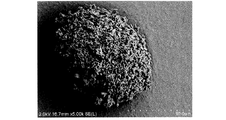
得られた粉末の形状は、電界放出型走査電子顕微鏡(SEM、日立ハイテクノロジーズ社製、品番「S−4800」)を用いて、微粒子間に1μmに満たない微細な空隙を有する非繊維状粒子であることを確認した。図1に粒子全体のSEM写真を示した。 The shape of the obtained powder is a non-fibrous particle having fine voids of less than 1 μm between fine particles using a field emission scanning electron microscope (SEM, manufactured by Hitachi High-Technologies Corporation, product number “S-4800”). I confirmed that. FIG. 1 shows an SEM photograph of the entire particle.
得られた粉末の細孔において、0.01〜1.0μmの細孔直径範囲にある積算細孔容積は21.1%、細孔分布の極大値は0.11μmであった。 In the pores of the obtained powder, the integrated pore volume in the pore diameter range of 0.01 to 1.0 μm was 21.1%, and the maximum value of the pore distribution was 0.11 μm.
(製造例2:フィラーA)
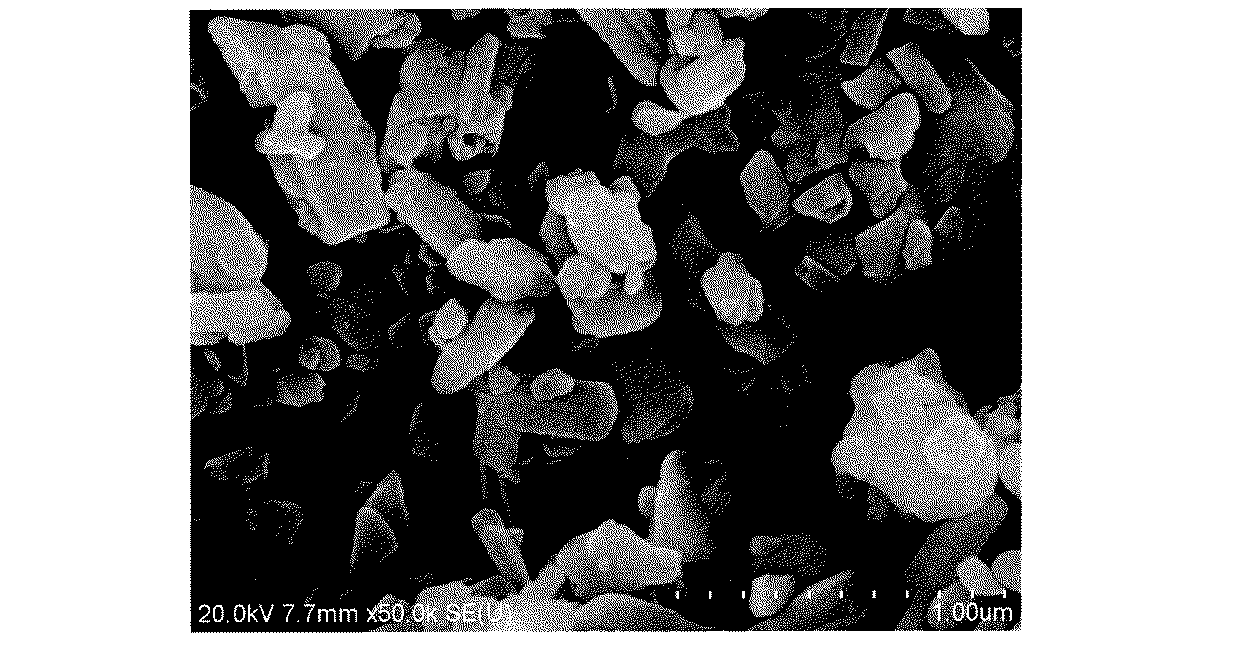
製造例1で得られたフィラーBを、振動ミルにより乾式粉砕し、得られた粉砕物を水簸分級法により分級し粉末を得た。このようにして製造したフィラーAの形状は、SEMを用いて非繊維状粒子であることを確認した。図2に粒子全体のSEM写真を示した。フィラーAにつき、平均粒子径、BET比表面積、固め比重、及び水分散pHを測定し、結果を下記の表2に示した。(Manufacturing Example 2: Filler A)
The filler B obtained in Production Example 1 was dry-pulverized by a vibration mill, and the obtained pulverized product was classified by an elutriation classification method to obtain a powder. It was confirmed by using SEM that the shape of the filler A produced in this manner was non-fibrous particles. FIG. 2 shows an SEM photograph of the entire particle. For the filler A, the average particle size, BET specific surface area, solidification specific gravity, and aqueous dispersion pH were measured, and the results are shown in Table 2 below.
(製造例3:フィラーE)
フィラーC(商品名「TERRACESS TF−SS」、大塚化学社製)に対して、カップリング剤A(商品名「KB−903」、信越化学社製、3−アミノプロピルトリエトキシシラン)の2−プロパノール溶液を用いて表面処理をすることで粉末を得た。表面処理は、フィラーC 100質量部に対して1質量部となるように行った。(Manufacturing Example 3: Filler E)
2 of Coupling Agent A (trade name "KB-903", manufactured by Shin-Etsu Chemical Co., Ltd., 3-aminopropyltriethoxysilane) with respect to filler C (trade name "TERRACESS TF-SS", manufactured by Otsuka Chemical Co., Ltd.) A powder was obtained by surface-treating with a propanol solution. The surface treatment was carried out so as to be 1 part by mass with respect to 100 parts by mass of the filler C.
得られた粉末の平均粒子径、BET比表面積、固め比重、及び水分散pHを測定し、結果を下記の表2に示した。 The average particle size, BET specific surface area, solidification specific gravity, and aqueous dispersion pH of the obtained powder were measured, and the results are shown in Table 2 below.
(製造例4:フィラーF)
フィラーCに対して、カップリング剤B(商品名「プレンアクト KR44」、味の素ファインテクノ社製、イソプロピルトリ(N−アミノエチル・アミノエチル)チタネート)の2−プロパノール溶液を用いて表面処理をすることで粉末を得た。表面処理は、フィラーC 100質量部に対して1質量部となるように行った。(Manufacturing Example 4: Filler F)
Surface treatment of filler C with a 2-propanol solution of coupling agent B (trade name "Plenact KR44", manufactured by Ajinomoto Fine-Techno, isopropyltri (N-aminoethyl / aminoethyl) titanate). Obtained powder in. The surface treatment was carried out so as to be 1 part by mass with respect to 100 parts by mass of the filler C.
得られた粉末の平均粒子径、BET比表面積、固め比重、及び水分散pHを測定し、結果を下記の表2に示した。 The average particle size, BET specific surface area, solidification specific gravity, and aqueous dispersion pH of the obtained powder were measured, and the results are shown in Table 2 below.
(製造例5:フィラーG)
フィラーCに対して、カップリング剤C(商品名「プレンアクト AL−M」、味の素ファインテクノ社製、アセトアルコキシアルミニウムジイソプロピレート)の2−プロパノール溶液を用いて表面処理をすることで粉末を得た。表面処理は、フィラーC 100質量部に対して1質量部となるように行った。(Manufacturing Example 5: Filler G)
A powder is obtained by surface-treating the filler C with a 2-propanol solution of a coupling agent C (trade name "Plenact AL-M", manufactured by Ajinomoto Fine-Techno Co., Ltd., acetalkoxyaluminum diisopropanol). rice field. The surface treatment was carried out so as to be 1 part by mass with respect to 100 parts by mass of the filler C.
得られた粉末の平均粒子径、BET比表面積、固め比重、及び水分散pHを測定し、結果を下記の表2に示した。 The average particle size, BET specific surface area, solidification specific gravity, and aqueous dispersion pH of the obtained powder were measured, and the results are shown in Table 2 below.
[評価]
実施例1〜7及び比較例1〜4で得られたゴム組成物の試験サンプルにつき、以下の評価方法にて評価を行った。結果を下記の表1に示す。[evaluation]
The test samples of the rubber compositions obtained in Examples 1 to 7 and Comparative Examples 1 to 4 were evaluated by the following evaluation methods. The results are shown in Table 1 below.
(評価方法)
1)ウェットグリップ性:
ブリティッシュ・ペンドラム・スキッドテスターを用いて、室温(25℃)の条件で測定し、比較例4を100にして指数表示した。数値が大きい程、ウェットグリップ性が優れていることを示す。(Evaluation method)
1) Wet grip:
The measurement was carried out under the condition of room temperature (25 ° C.) using a British pendulum skid tester, and Comparative Example 4 was set to 100 and displayed as an exponential notation. The larger the value, the better the wet grip.
2)耐摩耗性:
ランボーン摩耗試験(JIS K6264)により、室温、スリップ率24%の条件下にて実施した。比較例4で作製したゴム組成物をリファレンスとし、下記式に基づいて、耐摩耗性指数を算出した。耐摩耗性指数の数値が大きい程、耐摩耗性が優れていることを示す。2) Abrasion resistance:
The runbone wear test (JIS K6264) was carried out under the conditions of room temperature and a slip ratio of 24%. Using the rubber composition prepared in Comparative Example 4 as a reference, the wear resistance index was calculated based on the following formula. The larger the value of the wear resistance index, the better the wear resistance.
式:耐摩耗性指数={(比較例4のゴム組成物の摩耗量)/(各ゴム組成物の試験サンプルの摩耗量)}×100 Formula: Wear resistance index = {(wear amount of rubber composition of Comparative Example 4) / (wear amount of test sample of each rubber composition)} × 100
3)充填材の分散性:
ウェットグリップ性測定用試験サンプルをSEMで観察し、以下の評価基準によって評価した。3) Dispersibility of filler:
A test sample for measuring wet grip was observed by SEM and evaluated according to the following evaluation criteria.
[評価基準]
○:充填材の不良分散塊がなく良好なもの
△:不良分散塊が数箇所見られるもの
×:不良分散塊が目立ち、明らかに分散状態が良くないもの[Evaluation criteria]
◯: Good with no defective dispersion lumps in the filler Δ: Several defective dispersion lumps ×: Conspicuous defective dispersion lumps, clearly not in good dispersion state
Claims (8)
前記非繊維状チタン酸塩化合物粒子を構成するチタン酸塩化合物が、組成式A 2 Ti n O (2n+1) 〔式中、Aはアルカリ金属から選ばれる1種又は2種以上、n=2〜8〕、R x M y Ti (2−y) O 4 〔式中、Rはリチウムを除くアルカリ金属、Mはリチウム、マグネシウム、亜鉛、ニッケル、銅、鉄、アルミニウム、ガリウム、及びマンガンから選ばれる1種又は2種以上、x=0.5〜1.0、y=0.25〜1.0〕、K 0.5〜0.8 Li 0.27 Ti 1.73 O 3.85〜3.95 、及びK 0.2〜0.8 Mg 0.4 Ti 1.6 O 3.7〜3.95 から選ばれる少なくとも1種である、ゴム組成物。 The rubber component contains non-fibrous titanate compound particles having an average particle diameter of less than 30 μm and a BET specific surface area of 2 m 2 / g or more, and silica particles having a BET specific surface area of 50 to 250 m 2 / g. Ri name is,
The titanate compound constituting the non-fibrous titanate compound particles represented by the composition formula A 2 Ti n O (2n + 1) wherein, A is one or more selected from alkali metal, n =. 2 to 8] is selected in R x M y Ti (2- y) O 4 [wherein, alkali metal R is other than lithium, M is lithium, magnesium, zinc, nickel, copper, iron, aluminum, gallium, and manganese 1 type or 2 types or more, x = 0.5 to 1.0, y = 0.25 to 1.0], K 0.5 to 0.8 Li 0.27 Ti 1.73 O 3.85 to 3 A rubber composition which is at least one selected from .95 and K 0.2 to 0.8 Mg 0.4 Ti 1.6 O 3.7 to 3.95.
Applications Claiming Priority (3)
| Application Number | Priority Date | Filing Date | Title |
|---|---|---|---|
| JP2017136133 | 2017-07-12 | ||
| JP2017136133 | 2017-07-12 | ||
| PCT/JP2018/025806 WO2019013145A1 (en) | 2017-07-12 | 2018-07-09 | Rubber composition and tire |
Publications (2)
| Publication Number | Publication Date |
|---|---|
| JPWO2019013145A1 JPWO2019013145A1 (en) | 2020-05-07 |
| JP6917455B2 true JP6917455B2 (en) | 2021-08-11 |
Family
ID=65001728
Family Applications (1)
| Application Number | Title | Priority Date | Filing Date |
|---|---|---|---|
| JP2019529121A Active JP6917455B2 (en) | 2017-07-12 | 2018-07-09 | Rubber composition and tires |
Country Status (5)
| Country | Link |
|---|---|
| US (1) | US11434351B2 (en) |
| EP (1) | EP3653667B1 (en) |
| JP (1) | JP6917455B2 (en) |
| CN (1) | CN110832025B (en) |
| WO (1) | WO2019013145A1 (en) |
Families Citing this family (3)
| Publication number | Priority date | Publication date | Assignee | Title |
|---|---|---|---|---|
| JP7229683B2 (en) * | 2018-07-05 | 2023-02-28 | 大塚化学株式会社 | Rubber composition and tire |
| JP7349896B2 (en) * | 2019-12-19 | 2023-09-25 | 大塚化学株式会社 | rubber composition |
| JP2022003106A (en) * | 2020-06-23 | 2022-01-11 | 大塚化学株式会社 | Rubber composition and tires |
Family Cites Families (24)
| Publication number | Priority date | Publication date | Assignee | Title |
|---|---|---|---|---|
| CA2205789A1 (en) | 1997-05-22 | 1998-11-22 | Bayer Inc. | Process for hydrophobicizing particles, and their use as fillers in polymer masterbatches |
| US6342560B1 (en) | 1999-08-19 | 2002-01-29 | Ppg Industries Ohio, Inc. | Chemically modified fillers and polymeric compositions containing same |
| JP2003165871A (en) | 2001-11-28 | 2003-06-10 | Sumitomo Rubber Ind Ltd | Rubber composition for tire and tire using the rubber composition |
| CN1681876B (en) | 2002-07-09 | 2012-05-30 | 莫门蒂夫性能材料股份有限公司 | Silica-rubber compound with improved hardness |
| JP4605983B2 (en) * | 2002-11-28 | 2011-01-05 | 横浜ゴム株式会社 | Rubber composition for tire tread |
| JP2004204099A (en) | 2002-12-26 | 2004-07-22 | Bridgestone Corp | Rubber composition for white or light-color inner liner and tire using the composition |
| TWI290944B (en) | 2004-12-01 | 2007-12-11 | Saint Gobain Ceramics | Rubber formulation and methods for manufacturing same |
| EP1882716A1 (en) * | 2006-07-26 | 2008-01-30 | Sumitomo Rubber Industries, Ltd. | Rubber composition and tire having tread and/or sidewall using same |
| JP2008303334A (en) * | 2007-06-08 | 2008-12-18 | Sumitomo Rubber Ind Ltd | Rubber composition for cap tread and tire having cap tread using the same |
| JP2009096934A (en) * | 2007-10-18 | 2009-05-07 | Nippon Shokubai Co Ltd | Composition for composite dielectric, composite dielectric and electric circuit substrate containing the composite dielectric |
| EP2407507B1 (en) * | 2009-03-11 | 2016-09-28 | JSR Corporation | Rubber composition and pneumatic tire |
| JP5463582B2 (en) * | 2009-03-12 | 2014-04-09 | 国立大学法人山梨大学 | Artificial superlattice particles |
| JP2010248450A (en) * | 2009-04-20 | 2010-11-04 | Bridgestone Corp | Rubber composition and pneumatic tire using the same |
| JP2011079882A (en) | 2009-10-02 | 2011-04-21 | Bridgestone Corp | Tire |
| JP5881059B2 (en) * | 2012-04-02 | 2016-03-09 | 東洋ゴム工業株式会社 | Reinforcing agent for rubber or plastic, rubber composition, and method for producing plastic composition |
| DE112013001523B4 (en) * | 2012-04-02 | 2018-12-13 | Toyo Tire & Rubber Co., Ltd. | Silicon compound and process for producing the same and use thereof |
| JP2015071717A (en) | 2013-10-04 | 2015-04-16 | アイカ工業株式会社 | Silicone rubber composition |
| CN103881161B (en) * | 2014-01-23 | 2016-08-17 | 怡维怡橡胶研究院有限公司 | Trans polyisoprene rubber by cis-polyisoprene rubber composition and processing technique thereof |
| JP6610014B2 (en) | 2015-06-10 | 2019-11-27 | 日立化成株式会社 | Friction material composition, friction material using friction material composition, and friction member |
| CN105199171A (en) | 2015-10-15 | 2015-12-30 | 山东阳谷华泰化工股份有限公司 | Preparation method of white carbon black masterbatch, obtained product and application of product to high-wear-resistance white carbon black reinforcing material for rubber |
| CN105384979A (en) * | 2015-12-29 | 2016-03-09 | 青岛文晟汽车零部件有限公司 | Wear-resisting tire |
| JP6647052B2 (en) * | 2016-01-25 | 2020-02-14 | 大塚化学株式会社 | Rubber composition and tire |
| JP6732486B2 (en) * | 2016-03-11 | 2020-07-29 | キヤノン株式会社 | Process cartridge |
| CN106015411B (en) * | 2016-06-29 | 2019-03-12 | 芜湖德业摩擦材料有限公司 | A kind of wear-resistant brake block |
-
2018
- 2018-07-09 WO PCT/JP2018/025806 patent/WO2019013145A1/en not_active Ceased
- 2018-07-09 CN CN201880044814.1A patent/CN110832025B/en active Active
- 2018-07-09 US US16/629,382 patent/US11434351B2/en active Active
- 2018-07-09 EP EP18831784.6A patent/EP3653667B1/en active Active
- 2018-07-09 JP JP2019529121A patent/JP6917455B2/en active Active
Also Published As
| Publication number | Publication date |
|---|---|
| CN110832025B (en) | 2022-04-15 |
| WO2019013145A1 (en) | 2019-01-17 |
| US20200148862A1 (en) | 2020-05-14 |
| EP3653667B1 (en) | 2023-08-30 |
| US11434351B2 (en) | 2022-09-06 |
| EP3653667A4 (en) | 2021-04-07 |
| EP3653667A1 (en) | 2020-05-20 |
| JPWO2019013145A1 (en) | 2020-05-07 |
| CN110832025A (en) | 2020-02-21 |
Similar Documents
| Publication | Publication Date | Title |
|---|---|---|
| CN103189424B (en) | Method for manufacturing rubber composition | |
| RU2614680C2 (en) | Method for producing rubber mixture, rubber mixture and pneumatic tyre using it | |
| JP5200218B2 (en) | Treated alumina hydrate material and use thereof | |
| CN103189438A (en) | Method for manufacturing rubber composition | |
| EP3572457B1 (en) | Inorganic composite for rubber reinforcement, method for preparing the same, and rubber composition for tires comprising the same | |
| CN103619920A (en) | Method for producing rubber composition | |
| EP3636707A1 (en) | Rubber composition for tire and tire | |
| EP3653667B1 (en) | Rubber composition and tire | |
| CN114591550A (en) | Application of Low Zinc Metal-Organic Framework Materials as Active Agents in Rubber Compositions | |
| JP6896574B2 (en) | Additives, rubber compositions, and tires for imparting wear resistance and braking properties to rubber components | |
| JP7229683B2 (en) | Rubber composition and tire | |
| JP6647052B2 (en) | Rubber composition and tire | |
| JP7441114B2 (en) | Low heat build-up agent for rubber compositions, tires, and rubber | |
| WO2021124811A1 (en) | Rubber composition and tire | |
| JP2022003106A (en) | Rubber composition and tires | |
| JP6196069B2 (en) | Rubber composition for tire and pneumatic tire | |
| JP7349896B2 (en) | rubber composition | |
| JP2013056984A (en) | Rubber composition and pneumatic tire using the same | |
| JP6227849B1 (en) | Inorganic filler for rubber, rubber composition and tire | |
| JP2014214266A (en) | Rubber composition and pneumatic tire using the same | |
| JP2019052227A (en) | Rubber composition and tire | |
| JP2013108001A (en) | Rubber composition and method for producing the same |
Legal Events
| Date | Code | Title | Description |
|---|---|---|---|
| A621 | Written request for application examination |
Free format text: JAPANESE INTERMEDIATE CODE: A621 Effective date: 20200501 |
|
| A131 | Notification of reasons for refusal |
Free format text: JAPANESE INTERMEDIATE CODE: A131 Effective date: 20210511 |
|
| A521 | Request for written amendment filed |
Free format text: JAPANESE INTERMEDIATE CODE: A523 Effective date: 20210617 |
|
| TRDD | Decision of grant or rejection written | ||
| A01 | Written decision to grant a patent or to grant a registration (utility model) |
Free format text: JAPANESE INTERMEDIATE CODE: A01 Effective date: 20210706 |
|
| A61 | First payment of annual fees (during grant procedure) |
Free format text: JAPANESE INTERMEDIATE CODE: A61 Effective date: 20210719 |
|
| R150 | Certificate of patent or registration of utility model |
Ref document number: 6917455 Country of ref document: JP Free format text: JAPANESE INTERMEDIATE CODE: R150 |
|
| R250 | Receipt of annual fees |
Free format text: JAPANESE INTERMEDIATE CODE: R250 |
|
| R250 | Receipt of annual fees |
Free format text: JAPANESE INTERMEDIATE CODE: R250 |