JP6908994B2 - Dynamic cross-linked products, low air permeability film and pneumatic tires - Google Patents
Dynamic cross-linked products, low air permeability film and pneumatic tires Download PDFInfo
- Publication number
- JP6908994B2 JP6908994B2 JP2016253103A JP2016253103A JP6908994B2 JP 6908994 B2 JP6908994 B2 JP 6908994B2 JP 2016253103 A JP2016253103 A JP 2016253103A JP 2016253103 A JP2016253103 A JP 2016253103A JP 6908994 B2 JP6908994 B2 JP 6908994B2
- Authority
- JP
- Japan
- Prior art keywords
- rubber
- fatty acid
- acid amide
- crosslinked product
- cross
- Prior art date
- Legal status (The legal status is an assumption and is not a legal conclusion. Google has not performed a legal analysis and makes no representation as to the accuracy of the status listed.)
- Expired - Fee Related
Links
Landscapes
- Tires In General (AREA)
- Processes Of Treating Macromolecular Substances (AREA)
- Compositions Of Macromolecular Compounds (AREA)
Description
本発明は、動的架橋物、低空気透過性フィルム及び空気入りタイヤに関するものである。 The present invention relates to dynamically crosslinked products, low air permeable films and pneumatic tires.
従来、例えば、空気入りタイヤのガスバリア層(即ち、インナーライナー)として、連続相である熱可塑性樹脂と分散相であるゴムとの動的架橋物からなる低空気透過性フィルムを用いる技術が知られている。 Conventionally, for example, as a gas barrier layer (that is, an inner liner) of a pneumatic tire, a technique of using a low air permeable film made of a dynamically crosslinked product of a thermoplastic resin as a continuous phase and a rubber as a dispersed phase has been known. ing.
かかる動的架橋物は、架橋剤によるゴムの架橋が進行するに従い、粘度が上昇する。また、架橋ゴム分散相の微分散化が進行すると、樹脂と架橋ゴムの表面積が増えて、粘度がさらに上昇する。そのため、動的架橋物を用いてフィルムを成型する際には、通常の熱可塑性樹脂を用いたフィルム成型よりも大きな溶融粘度となり、フィルムの加工時に大きな負荷がかかる。 The viscosity of such a dynamically crosslinked product increases as the cross-linking of the rubber by the cross-linking agent progresses. Further, as the microdispersion of the crosslinked rubber dispersed phase progresses, the surface areas of the resin and the crosslinked rubber increase, and the viscosity further increases. Therefore, when the film is molded using the dynamically crosslinked product, the melt viscosity is higher than that of the film molding using a normal thermoplastic resin, and a large load is applied during the processing of the film.
この負荷を低減させるために可塑剤を添加することが考えられる。可塑剤を添加する技術として、例えば、特許文献1には、加工性と低温特性を改良するために、ナイロン樹脂及びゴム成分ととともにスルホンアミド系の可塑剤を添加して動的架橋することが提案されている。しかしながら、可塑剤を添加すると、成型時の流動性を改善することはできるものの、空気透過性が大きくなり、低空気透過性フィルムとして使用することが難しくなる場合がある。また、一般に可塑剤は発煙(アウトガス)が多く、環境負荷の観点より必ずしも望ましいとはいえない。 It is conceivable to add a plasticizer to reduce this load. As a technique for adding a plasticizer, for example, in Patent Document 1, in order to improve processability and low temperature characteristics, a sulfonamide-based plasticizer may be added together with a nylon resin and a rubber component for dynamic cross-linking. Proposed. However, although the fluidity at the time of molding can be improved by adding a plasticizer, the air permeability becomes large, and it may be difficult to use the film as a low air permeability film. In addition, plasticizers generally emit a lot of smoke (outgas), which is not always desirable from the viewpoint of environmental load.
一方、特許文献2には、フィルム成型時における押出負荷低減のために、高級脂肪酸のアルカリ土類金属塩を添加することが開示されている。しかしながら、高級脂肪酸のアルカリ土類金属塩は、外部潤滑性が悪く、フィルム成型性の改良には不十分である。 On the other hand, Patent Document 2 discloses that an alkaline earth metal salt of a higher fatty acid is added in order to reduce the extrusion load during film molding. However, alkaline earth metal salts of higher fatty acids have poor external lubricity and are insufficient for improving film moldability.
本発明の実施形態は、低空気透過性を維持しつつ、溶融粘度を下げて加工性を改善することができる動的架橋物を提供することを目的とする。 It is an object of the present invention to provide a dynamically crosslinked product capable of lowering the melt viscosity and improving workability while maintaining low air permeability.
本発明の一実施形態に係る動的架橋物は、連続相をなすナイロン樹脂と、前記連続相中に分散したゴムの架橋物と、脂肪酸アミド系滑剤と、を含むものである。 The dynamically crosslinked product according to one embodiment of the present invention includes a nylon resin forming a continuous phase, a crosslinked product of rubber dispersed in the continuous phase, and a fatty acid amide-based lubricant.
一実施形態に係る低空気透過性フィルムは、該動的架橋物からなるものである。また、一実施形態に係る空気入りタイヤは、該低空気透過性フィルムを備えたものである。 The low air permeable film according to one embodiment is made of the dynamically crosslinked product. Further, the pneumatic tire according to the embodiment is provided with the low air permeable film.
本発明の一実施形態に係る動的架橋物の製造方法は、ナイロン樹脂とゴムを架橋剤とともに混練して前記ゴムを動的に架橋し、架橋後に脂肪酸アミド系滑剤を添加し混合するものである。 The method for producing a dynamically crosslinked product according to an embodiment of the present invention is to knead a nylon resin and rubber together with a cross-linking agent to dynamically cross-link the rubber, and after cross-linking, add a fatty acid amide lubricant and mix them. be.
本実施形態によれば、脂肪酸アミド系滑剤を用いることにより、低空気透過性を維持しつつ、動的架橋物の溶融粘度を低減することができ、例えばフィルム成型時の加工性を改善することができる。 According to the present embodiment, by using the fatty acid amide-based lubricant, it is possible to reduce the melt viscosity of the dynamically crosslinked product while maintaining low air permeability, and for example, to improve the processability at the time of film molding. Can be done.
以下、本発明の実施に関連する事項について詳細に説明する。 Hereinafter, matters related to the practice of the present invention will be described in detail.
本実施形態に係る動的架橋物は、連続相をなすナイロン樹脂と、該連続相中に分散したゴムの架橋物と、脂肪酸アミド系滑剤と、を含むものである。動的架橋物は、ナイロン樹脂とゴムを溶融混練してゴムを動的架橋させることにより得られるものであり、ナイロン樹脂を連続相(マトリックス相)とし、ゴムの架橋物を分散相(ドメイン相)とした海島構造を持つ。 The dynamically crosslinked product according to the present embodiment contains a nylon resin forming a continuous phase, a crosslinked product of rubber dispersed in the continuous phase, and a fatty acid amide-based lubricant. The dynamically crosslinked product is obtained by melt-kneading nylon resin and rubber to dynamically crosslink the rubber. The nylon resin is used as a continuous phase (matrix phase), and the crosslinked product of rubber is a dispersed phase (domain phase). ) Has a sea-island structure.
ナイロン樹脂としては、例えば、ナイロン6、ナイロン66、ナイロン46、ナイロン11、ナイロン12、ナイロン610、ナイロン612、ナイロン6/66共重合体、ナイロン6/66/610共重合体、ナイロンMXD6、ナイロン6T、ナイロン6/6T共重合体などの脂肪族ポリアミド樹脂が挙げられる。これらはいずれか1種単独で用いてもよく、2種以上を組み合わせて用いてもよい。 Examples of the nylon resin include nylon 6, nylon 66, nylon 46, nylon 11, nylon 12, nylon 610, nylon 612, nylon 6/66 copolymer, nylon 6/66/610 copolymer, nylon MXD6, and nylon. Examples thereof include aliphatic polyamide resins such as 6T and nylon 6 / 6T copolymers. Any one of these may be used alone, or two or more thereof may be used in combination.
連続相を形成するナイロン樹脂には、本実施形態による効果を損なわない限り、可塑剤、軟化剤、充填剤、補強剤、加工助剤、安定剤、酸化防止剤などの添加剤を必要に応じて適宜配合してもよい。 Additives such as plasticizers, softeners, fillers, reinforcing agents, processing aids, stabilizers, and antioxidants are added to the nylon resin forming the continuous phase as needed, as long as the effects of the present embodiment are not impaired. May be appropriately blended.
分散相を形成するゴムとしては、一般に架橋(加硫)して使用される(即ち、架橋可能な)各種のゴムポリマーが用いられ、例えば、天然ゴム(NR)、エポキシ化天然ゴム(ENR)、イソプレンゴム(IR)、スチレンブタジエンゴム(SBR)、ブタジエンゴム(BR)、ニトリルゴム(NBR)、水素化ニトリルゴム(H−NBR)、水素化スチレンブタジエンゴムなどのジエン系ゴム及びその水素添加ゴム; エチレンプロピレンゴム(EPDM)、マレイン酸変性エチレンプロピレンゴム、マレイン酸変性エチレンブチレンゴム、ブチルゴム(IIR)、アクリルゴム(ACM)などのオレフィン系ゴム; ハロゲン化ブチルゴム(例えば、臭素化ブチルゴム(Br−IIR)、塩素化ブチルゴム(Cl−IIR))、クロロプレンゴム(CR)、クロロスルホン化ポリエチレンなどの含ハロゲンゴム; その他、シリコンゴム、フッ素ゴム、ポリスルフィドゴムなどが挙げられる。これらはいずれか1種を単独で用いても、2種以上を併用してもよい。一実施形態として、ブタジエンゴム(BR)、ブチルゴム(IIR)、ハロゲン化ブチルゴム、ニトリルゴム(NBR)及び水素化ニトリルゴム(H−NBR)から選択される少なくとも1種を用いてもよい。 As the rubber forming the dispersed phase, various rubber polymers generally used by cross-linking (sulfurization) (that is, cross-linkable) are used, and for example, natural rubber (NR) and epoxidized natural rubber (ENR). , Isoprene rubber (IR), styrene-butadiene rubber (SBR), butadiene rubber (BR), nitrile rubber (NBR), hydride nitrile rubber (H-NBR), hydride styrene-butadiene rubber and other diene rubbers and their hydrogenation Rubbers; Olefin rubbers such as ethylene propylene rubber (EPDM), maleic acid-modified ethylene propylene rubber, maleic acid-modified ethylene butylene rubber, butyl rubber (IIR), acrylic rubber (ACM); halogenated butyl rubber (eg, brominated butyl rubber (Br)). -IIR), chlorinated butyl rubber (Cl-IIR)), chloroprene rubber (CR), halogen-containing rubber such as chlorosulfonated polyethylene; in addition, silicon rubber, fluororubber, polysulfide rubber and the like can be mentioned. Any one of these may be used alone, or two or more thereof may be used in combination. As one embodiment, at least one selected from butadiene rubber (BR), butyl rubber (IIR), halogenated butyl rubber, nitrile rubber (NBR) and hydrogenated nitrile rubber (H-NBR) may be used.
分散相を形成するゴムには、上記ゴムポリマーを動的架橋するための架橋剤を配合してもよく、予めゴムと架橋剤を混合してマスターバッチ化しておいてもよい。架橋剤としては、硫黄や硫黄含有化合物等などの加硫剤、加硫促進剤の他、フェノール樹脂などが挙げられる。好ましくは、耐熱性等の点から、フェノール樹脂を用いることである。フェノール樹脂としては、フェノール類とホルムアルデヒドとの縮合反応により得られる樹脂が挙げられ、例えば、アルキルフェノール−ホルムアルデヒド樹脂が挙げられる。また、加硫速度を速くすることができる点から、臭素化アルキルフェノール−ホルムアルデヒド樹脂などのハロゲン化フェノール樹脂を用いてもよい。架橋剤の配合量は、ゴムを適切に架橋できる量であれば、特に限定されないが、ゴム100質量部に対して、0.1〜10質量部でもよく、0.5〜5質量部でもよい。 The rubber forming the dispersed phase may be blended with a cross-linking agent for dynamically cross-linking the rubber polymer, or the rubber and the cross-linking agent may be mixed in advance to form a masterbatch. Examples of the cross-linking agent include vulcanizing agents such as sulfur and sulfur-containing compounds, vulcanization accelerators, and phenol resins. Preferably, a phenol resin is used from the viewpoint of heat resistance and the like. Examples of the phenol resin include resins obtained by a condensation reaction between phenols and formaldehyde, and examples thereof include alkylphenol-formaldehyde resins. Further, a halogenated phenol resin such as a brominated alkylphenol-formaldehyde resin may be used because the vulcanization rate can be increased. The amount of the cross-linking agent to be blended is not particularly limited as long as it can appropriately cross-link the rubber, but may be 0.1 to 10 parts by mass or 0.5 to 5 parts by mass with respect to 100 parts by mass of the rubber. ..
分散相を形成するゴムには、例えば、充填剤や軟化剤、老化防止剤、加工助剤などの一般にゴム組成物に配合される各種添加剤を配合してもよい。 The rubber forming the dispersed phase may contain, for example, various additives generally blended in rubber compositions such as fillers, softeners, antiaging agents, and processing aids.
本実施形態に係る動的架橋物において、ナイロン樹脂とゴムとの配合比(添加剤を除いたポリマーとしての比率)は、特に限定されず、例えば、質量比(ナイロン樹脂/ゴム)で、90/10〜30/70でもよく、70/30〜40/60でもよく、60/40〜40/60でもよい。 In the dynamically crosslinked product according to the present embodiment, the compounding ratio of the nylon resin and the rubber (ratio as a polymer excluding additives) is not particularly limited, and for example, the mass ratio (nylon resin / rubber) is 90. It may be / 10 to 30/70, 70/30 to 40/60, or 60/40 to 40/60.
本実施形態に係る動的架橋物には、脂肪酸アミド系滑剤が配合される。脂肪酸アミド系滑剤としては、各種の高級脂肪酸アミドを用いることができる。例えば、ラウリン酸アミド、パルミチン酸アミド、ステアリン酸アミド、ベヘン酸アミド、オレイン酸アミド、エルカ酸アミド、ヒドロキシステアリン酸アミド等のモノアミド類、エチレンビスラウリン酸アミド、エチレンビスステアリン酸アミド、エチレンビスヒドロキシステアリン酸アミド、エチレンビスベヘン酸アミド、ヘキサメチレンビスステアリン酸アミド、エチレンビスオレイン酸アミド、ヘキサメチレンビスオレイン酸アミド等のビスアミド類が挙げられる。 A fatty acid amide-based lubricant is blended in the dynamic crosslinked product according to the present embodiment. As the fatty acid amide-based lubricant, various higher fatty acid amides can be used. For example, monoamides such as lauric acid amide, palmitic acid amide, stearic acid amide, behenic acid amide, oleic acid amide, erucic acid amide, hydroxystearic acid amide, ethylene bislauric acid amide, ethylene bisstearic acid amide, ethylene bishydroxy. Examples thereof include bisamides such as stearate amide, ethylene bisbechenic acid amide, hexamethylene bissteaic acid amide, ethylene bisoleic acid amide, and hexamethylene bisoleic acid amide.
脂肪酸アミド系滑剤としては、また、アルキレンビスアミド構造を持つことから上記ビスアミド類に属するものとして、アルキレンジアミンと高級脂肪酸とジカルボン酸との重縮合物を用いてもよい。アルキレンジアミンとしてはエチレンジアミンやヘキサメチレンジアミン等が挙げられ、高級脂肪酸としてはパルミチン酸やステアリン酸等の各種高級脂肪酸が挙げられ、ジカルボン酸としてはセバシン酸やアゼライン酸等が挙げられる。好ましい一実施形態に係る脂肪酸アミド系滑剤は、エチレンジアミンとステアリン酸とセバシン酸の重縮合物である。かかる重縮合物の具体例としては、共栄社化学(株)製の「ライトアマイドWH−215」、「ライトアマイドWH−255」等が挙げられる。 As the fatty acid amide-based lubricant, a polycondensate of an alkylene diamine, a higher fatty acid, and a dicarboxylic acid may be used as one belonging to the above-mentioned bisamides because it has an alkylene bisamide structure. Examples of the alkylenediamine include ethylenediamine and hexamethylenediamine, examples of the higher fatty acid include various higher fatty acids such as palmitic acid and stearic acid, and examples of the dicarboxylic acid include sebacic acid and azelaic acid. The fatty acid amide-based lubricant according to a preferred embodiment is a polycondensate of ethylenediamine, stearic acid and sebacic acid. Specific examples of such polycondensate products include "Light Amide WH-215" and "Light Amide WH-255" manufactured by Kyoeisha Chemical Co., Ltd.
以上の脂肪酸アミド系滑剤は、いずれか1種単独で用いてもよく、2種以上組み合わせて用いてもよい。脂肪酸アミド系滑剤としては、エチレンビスステアリン酸アミドなどのアルキレンビス脂肪酸アミド、「ライトアマイドWH−215」、「ライトアマイドWH−255」などのアルキレンビスアミド構造を持つものが好ましく用いられる。 Any one of the above fatty acid amide lubricants may be used alone, or two or more of them may be used in combination. As the fatty acid amide-based lubricant, those having an alkylene bis fatty acid amide such as ethylene bisstearic acid amide and an alkylene bisamide structure such as "light amide WH-215" and "light amide WH-255" are preferably used.
脂肪酸アミド系滑剤を構成する脂肪酸の炭素数は12以上であることが好ましく、より好ましくは12〜30であり、14〜28でもよい。なお、ここでいう炭素数は、ビスアミド類の場合、各脂肪酸の炭素数である。 The fatty acid constituting the fatty acid amide-based lubricant preferably has 12 or more carbon atoms, more preferably 12 to 30, and may be 14 to 28. In the case of bisamides, the carbon number referred to here is the carbon number of each fatty acid.
脂肪酸アミド系滑剤の配合量は、特に限定するものではないが、ナイロン樹脂100質量部に対して0.5〜10質量部であることが好ましく、より好ましくは0.6〜6質量部である。 The blending amount of the fatty acid amide-based lubricant is not particularly limited, but is preferably 0.5 to 10 parts by mass, and more preferably 0.6 to 6 parts by mass with respect to 100 parts by mass of the nylon resin. ..
脂肪酸アミド系滑剤は、連続相をなすナイロン樹脂中に含まれていることが好ましい。すなわち、脂肪酸アミド系滑剤は、分散相をなすゴム中ではなく、連続相をなすナイロン樹脂中に混在している。このように連続相をなすナイロン樹脂中に混在していることで、動的架橋物の溶融粘度を効果的に下げることができる。 The fatty acid amide-based lubricant is preferably contained in the nylon resin forming a continuous phase. That is, the fatty acid amide-based lubricant is mixed not in the rubber forming the dispersed phase but in the nylon resin forming the continuous phase. By mixing in the nylon resin forming a continuous phase in this way, the melt viscosity of the dynamically crosslinked product can be effectively reduced.
動的架橋物には、ナイロン樹脂、ゴム、架橋剤及び脂肪酸アミド系滑剤とともに、相溶化剤を配合してもよい。相溶化剤は、ナイロン樹脂とゴムとの界面張力を低下させて、両者を相溶化させるものである。相溶化剤としては、特に限定されないが、一実施形態として、エチレン−グリシジル(メタ)アクリレート共重合体(即ち、エチレン−グリシジルメタクリレート共重合体、及び/又は、エチレン−グリシジルアクリレート共重合体)を用いてもよい。相溶化剤の配合量は、特に限定されず、ナイロン樹脂とゴム(添加剤を除いたポリマーとしての量)の合計量100質量部に対して0.5〜20質量部でもよく、1〜10質量部でもよい。 The dynamically cross-linked product may contain a compatibilizer together with a nylon resin, rubber, a cross-linking agent and a fatty acid amide-based lubricant. The compatibilizer reduces the interfacial tension between the nylon resin and the rubber to make them compatible with each other. The compatibilizer is not particularly limited, but as one embodiment, an ethylene-glycidyl (meth) acrylate copolymer (that is, an ethylene-glycidyl methacrylate copolymer and / or an ethylene-glycidyl acrylate copolymer) is used. You may use it. The blending amount of the compatibilizer is not particularly limited, and may be 0.5 to 20 parts by mass with respect to 100 parts by mass of the total amount of nylon resin and rubber (amount as a polymer excluding additives), and 1 to 10 parts by mass. It may be a mass part.
本実施形態において、動的架橋物を製造するに際しては、ナイロン樹脂とゴム(即ち、未架橋ゴム)を架橋剤とともに溶融混練して、架橋剤によりゴムを動的に架橋(即ち、混練しながらゴムポリマーを架橋)させる。脂肪酸アミド系滑剤は、架橋前に添加しておいてもよいが、好ましくはゴムの架橋後に混練物に添加し混練することである。架橋後に添加することにより、脂肪酸アミド系滑剤は、架橋ゴム中には取り込まれにくいので、ナイロン樹脂中に効果的に含ませることができる。ここで、架橋後、即ち架橋が終わった段階にあるか否かは、混練物中のゴムのゲル化率により判断することができ、ゲル化率が70%以上、より好ましくは90%以上であれば、架橋後の段階にある。ゲル化率の測定方法は、以下の通りである。 In the present embodiment, when producing a dynamically crosslinked product, a nylon resin and rubber (that is, uncrosslinked rubber) are melt-kneaded together with a cross-linking agent, and the rubber is dynamically cross-linked (that is, kneaded) by the cross-linking agent. Crosslink the rubber polymer). The fatty acid amide-based lubricant may be added before the cross-linking, but is preferably added to the kneaded product after the cross-linking of the rubber and kneaded. By adding after cross-linking, the fatty acid amide-based lubricant is not easily incorporated into the cross-linked rubber, so that it can be effectively contained in the nylon resin. Here, whether or not it is in the stage after cross-linking, that is, at the stage where the cross-linking is completed can be determined by the gelation rate of the rubber in the kneaded product, and the gelation rate is 70% or more, more preferably 90% or more. If so, it is in the post-crosslinking stage. The method for measuring the gelation rate is as follows.
混練物をアセトンで抽出を行い、その後、トルエン中に3日間浸漬させ、その後乾燥させる。トルエン浸漬前の質量から浸漬後の質量を差し引いた値を未架橋のゴム質量として(即ち、未架橋のゴム質量=浸漬前の質量−浸漬後の質量)、次式によりゲル化率を算出する。
・ゲル化率(%)={(混練物中のゴム質量−未架橋のゴム質量)/混練物中のゴム質量}×100
なお、ゲル化率の測定対象とする混練物は、例えば、二軸押出機を用いて混練する場合、滑剤を投入しようとする二軸開口部から採取すればよい。
The kneaded product is extracted with acetone, then immersed in toluene for 3 days and then dried. The gelation rate is calculated by the following formula, assuming that the value obtained by subtracting the mass after immersion from the mass before immersion in toluene is the mass of uncrosslinked rubber (that is, the mass of uncrosslinked rubber = the mass before immersion-the mass after immersion). ..
-Gelification rate (%) = {(mass of rubber in kneaded product-mass of uncrosslinked rubber) / mass of rubber in kneaded product} x 100
The kneaded product whose gelation rate is to be measured may be collected from the twin-screw opening to which the lubricant is to be added, for example, when kneading using a twin-screw extruder.
脂肪酸アミド系滑剤以外の添加剤(相溶化剤及び架橋剤も含む)について、ナイロン樹脂及びゴムへの添加時期は、例えば、ナイロン樹脂とゴムとの混練前に予め添加混合しておいてもよく、混練中に添加してもよい。 Additives other than fatty acid amide lubricants (including compatibilizers and cross-linking agents) may be added to the nylon resin and rubber in advance, for example, before kneading the nylon resin and rubber. , May be added during kneading.
一実施形態として、ゴムに架橋剤等を添加してゴム組成物(マスターバッチ)のペレットを作製し、該ペレットをナイロン樹脂及び相溶化剤とともに混練機に投入し、溶融混練して動的架橋し、架橋後に脂肪酸アミド系滑剤を添加し混練することにより動的架橋物のペレットを得てもよい。 As one embodiment, a cross-linking agent or the like is added to rubber to prepare pellets of a rubber composition (master batch), the pellets are put into a kneader together with a nylon resin and a compatibilizer, and melt-kneaded for dynamic cross-linking. Then, after cross-linking, a fatty acid amide-based lubricant may be added and kneaded to obtain pellets of the dynamically cross-linked product.
混練に使用する混練機としては、特に限定されず、例えば、二軸押出機、スクリュー押出機、ニーダー、バンバリーミキサーなどが挙げられる。混練温度は、ナイロン樹脂が溶融し、かつ架橋剤が架橋反応する温度以上であればよい。 The kneading machine used for kneading is not particularly limited, and examples thereof include a twin-screw extruder, a screw extruder, a kneader, and a Banbury mixer. The kneading temperature may be equal to or higher than the temperature at which the nylon resin melts and the cross-linking agent reacts with the cross-linking agent.
このようにして得られた動的架橋物をフィルム化することにより、低空気透過性フィルムが得られる。すなわち、低空気透過性フィルムは、上記方法により得られた動的架橋物のペレットを用いて、フィルムを成形することにより製造することができる。動的架橋物のペレットをフィルム化する方法は特に限定されず、例えば押し出し成形やカレンダー成形など、通常の熱可塑性樹脂をフィルム化する方法を用いることができる。 By forming the dynamically crosslinked product thus obtained into a film, a low air permeable film can be obtained. That is, the low air permeable film can be produced by molding the film using the pellets of the dynamically crosslinked product obtained by the above method. The method of filming the pellets of the dynamically crosslinked product is not particularly limited, and a method of filming an ordinary thermoplastic resin such as extrusion molding or calendar molding can be used.
低空気透過性フィルムの空気透過性は、特に限定されないが、80℃での空気透過係数が5×10¹³fm2/Pa・s以下であることが好ましく、インナーライナーの薄肉化によるタイヤの軽量化を図ることができる。該空気透過係数は、0.1×1013〜4×1013fm2/Pa・sでもよく、0.1×1013〜1.0×1013fm2/Pa・sでもよい。ここで、空気透過係数は、JIS K7126−1「プラスチック−フィルム及びシート−ガス透過度試験方法−第1部:差圧法」に準じて、試験気体:空気、試験温度:80℃にて測定される値である。 The air permeability of the low air permeability film is not particularly limited, but the air permeability coefficient at 80 ° C. is preferably 5 × 10 13 fm 2 / Pa · s or less, and the weight of the tire is reduced by thinning the inner liner. Can be achieved. The air permeability coefficient may be 0.1 × 10 13 to 4 × 10 13 fm 2 / Pa · s, or 0.1 × 10 13 to 1.0 × 10 13 fm 2 / Pa · s. Here, the air permeability coefficient is measured at test gas: air and test temperature: 80 ° C. according to JIS K7126-1 "Plastic-Film and Sheet-Gas Permeability Test Method-Part 1: Differential Pressure Method". Value.
低空気透過性フィルムの厚みは、特に限定されず、例えば、0.02〜1.0mmでもよく、0.05〜0.5mmでもよく、0.1〜0.3mmでもよい。 The thickness of the low air permeable film is not particularly limited, and may be, for example, 0.02 to 1.0 mm, 0.05 to 0.5 mm, or 0.1 to 0.3 mm.
本実施形態に係る低空気透過性フィルムは、例えば、乗用車用タイヤ、トラックやバスなどの重荷重用タイヤを含む各種の自動車用タイヤ、また自転車を含む二輪車用タイヤなど、各種の空気入りタイヤに適用することができる。好ましくは、空気入りタイヤのガスバリア層として用いることであり、タイヤ内面の全体にわたって設けられるインナーライナーとして用いることが好ましい。但し、ガスバリア層として用いる場合、タイヤ内面に設けるインナーライナーには限定されず、タイヤ内部からの空気の透過を防止してタイヤの空気圧を保持することができる態様、即ち内圧保持のための空気透過抑制層として設けられるものであれば、例えば、カーカスプライの外面側などの種々の位置に設けることができ、特に限定されない。 The low air permeable film according to the present embodiment is applied to various pneumatic tires such as passenger car tires, various automobile tires including heavy load tires such as trucks and buses, and motorcycle tires including bicycles. can do. It is preferably used as a gas barrier layer of a pneumatic tire, and is preferably used as an inner liner provided over the entire inner surface of the tire. However, when it is used as a gas barrier layer, it is not limited to the inner liner provided on the inner surface of the tire, and it is possible to prevent the permeation of air from the inside of the tire and maintain the air pressure of the tire, that is, the air permeation for maintaining the internal pressure. As long as it is provided as a suppressing layer, it can be provided at various positions such as, for example, on the outer surface side of the carcass ply, and is not particularly limited.
かかる空気入りタイヤの製造方法としても、特に限定されず、上記低空気透過性フィルムを用いて公知の方法によりグリーンタイヤを作製し、作製したグリーンタイヤをモールド内で加硫成型することにより、一実施形態に係る空気入りタイヤが得られる。 The method for producing such a pneumatic tire is not particularly limited, and a green tire is produced by a known method using the above-mentioned low air permeable film, and the produced green tire is vulcanized and molded in a mold. A pneumatic tire according to the embodiment is obtained.
以下に、実施例に基づき具体的に説明するが、本発明はこれら実施例により限定されるものではない。 Hereinafter, the present invention will be specifically described based on Examples, but the present invention is not limited to these Examples.
下記表1に示す配合(質量部)に従い、動的架橋物を作製した。詳細には、ゴムと架橋剤を、架橋しない条件で予め混合してゴムマスターバッチのペレットを作製し、得られたペレットとナイロン樹脂と相溶化剤を、温度230℃、回転数200rpmに設定した二軸押出機((株)プラスチック工学研究所製)に投入し、溶融混練して動的架橋物のペレットを作製した。その際、滑剤及び可塑剤は、二軸押出機の混練工程における残り1/3の位置(即ち、加熱シリンダの上流側から2/3の位置)において添加した。滑剤及び可塑剤の添加は、液体のものについては液体フィーダにより、粉体についてはサイドフィーダにより行った。 A dynamically crosslinked product was prepared according to the formulation (parts by mass) shown in Table 1 below. Specifically, rubber and a cross-linking agent were mixed in advance under non-cross-linking conditions to prepare pellets of a rubber masterbatch, and the obtained pellets, nylon resin and compatibilizer were set at a temperature of 230 ° C. and a rotation speed of 200 rpm. It was put into a twin-screw extruder (manufactured by Plastic Engineering Laboratory Co., Ltd.) and melt-kneaded to prepare pellets of a dynamic crosslinked product. At that time, the lubricant and the plasticizer were added at the remaining 1/3 position (that is, the position 2/3 from the upstream side of the heating cylinder) in the kneading step of the twin-screw extruder. Lubricants and plasticizers were added using a liquid feeder for liquids and a side feeder for powders.
なお、上記混練工程の残り1/3の位置は、ゴムの架橋が終わっている段階である。このことは、比較例1の配合についてこの位置でのゲル化率を測定した結果、91.4%であったことから判明した。 The remaining 1/3 of the kneading step is at the stage where the rubber is crosslinked. This was found from the fact that the gelation rate at this position was measured for the formulation of Comparative Example 1 and found to be 91.4%.
表1中の各成分の詳細は以下の通りである。 Details of each component in Table 1 are as follows.
・ナイロン樹脂:東レ(株)製「CM6021XF」
・ゴム:BR、宇部興産(株)製「BR150L」
・架橋剤:アルキルフェノール−ホルムアルデヒド樹脂、田岡化学工業(株)製「タッキロール201」
・相溶化剤:エチレン−グリシジルメタクリレート共重合体、住友化学(株)製「ボンドファーストBF−E」
・BM−4:可塑剤、N−ブチルベンゼンスルホンアミド、大八化学工業(株)製「BM−4」
・TCP:可塑剤、トリクレジルホスフェート、大八化学工業(株)製「TCP」
・D620:可塑剤、アジピン酸系ポリエステル、(株)ジェイ・プラス製「D620」
・金属石鹸:滑剤、日油(株)製「カルシウムステアレート」
・WH−215:脂肪酸アミド系滑剤、共栄社化学(株)製「ライトアマイドWH−215」
・WH−255:脂肪酸アミド系滑剤、共栄社化学(株)製「ライトアマイドWH−255」。
-Nylon resin: "CM6021XF" manufactured by Toray Industries, Inc.
-Rubber: BR, "BR150L" manufactured by Ube Industries, Ltd.
-Crosslinking agent: Alkylphenol-formaldehyde resin, "Tackiroll 201" manufactured by Taoka Chemical Industry Co., Ltd.
-Compatible agent: Ethylene-glycidyl methacrylate copolymer, "Bond First BF-E" manufactured by Sumitomo Chemical Co., Ltd.
-BM-4: Plasticizer, N-Butylbenzene sulfonamide, "BM-4" manufactured by Daihachi Chemical Industry Co., Ltd.
-TCP: Plasticizer, tricresyl phosphate, "TCP" manufactured by Daihachi Chemical Industry Co., Ltd.
-D620: Plasticizer, adipic acid polyester, "D620" manufactured by J-PLUS Co., Ltd.
・ Metal soap: Lubricant, NOF CORPORATION "Calcium stearate"
-WH-215: Fatty acid amide lubricant, "Light Amide WH-215" manufactured by Kyoeisha Chemical Co., Ltd.
WH-255: Fatty acid amide lubricant, "Light Amide WH-255" manufactured by Kyoeisha Chemical Co., Ltd.
得られた動的架橋物について溶融粘度を測定して加工性を評価した。また、該動的架橋物のペレットをフィルム成型用の単軸押出機にて厚み0.2mmのフィルムに成型し、成型時の回転数50rpmにおけるフィルム化電流値を読み取って加工性を評価した。また、得られたフィルムの空気透過係数を測定した。各評価方法は以下の通りである。 The melt viscosity of the obtained dynamically crosslinked product was measured to evaluate the workability. Further, the pellets of the dynamically crosslinked product were molded into a film having a thickness of 0.2 mm by a single-screw extruder for film molding, and the film formation current value at a rotation speed of 50 rpm at the time of molding was read to evaluate the workability. Moreover, the air permeability coefficient of the obtained film was measured. Each evaluation method is as follows.
・溶融粘度:(株)安田精機製作所製のキャピラリーレオメーターを用いて、230℃、せん断速度800(1/s)での溶融粘度を測定し、比較例1の値を100とした指数で表示した。指数が大きいほど、溶融粘度が高く、加工性に劣ることを示す。 -Melting viscosity: Using a capillary rheometer manufactured by Yasuda Seiki Seisakusho Co., Ltd., the melt viscosity was measured at 230 ° C. and a shear rate of 800 (1 / s), and displayed as an index with the value of Comparative Example 1 as 100. did. The larger the index, the higher the melt viscosity and the worse the workability.
・フィルム化電流値:フィルム成型用の単軸押出機の温度を220℃とし、50rpmの際の電流値(機械負荷)を読み取り、比較例1の値を100とした指数で表示した。指数が大きいほど、電流値が高く、加工性に劣ることを示す。 -Film formation current value: The temperature of the single-screw extruder for film molding was set to 220 ° C., the current value (mechanical load) at 50 rpm was read, and the value of Comparative Example 1 was set to 100 and displayed as an index. The larger the index, the higher the current value and the worse the workability.
・空気透過係数:JIS K7126−1「プラスチック−フィルム及びシート−ガス透過度試験方法−第1部:差圧法」に準じて、試験気体:空気、試験温度:80℃にて、空気透過係数を測定した。表1には、空気透過係数の値とともに、比較例1の値を100とした指数の値も示す。指数が大きいほど、空気透過性が高く、低空気透過性に劣ることを示す。 -Air permeability coefficient: According to JIS K7126-1 "Plastic-Film and Sheet-Gas Permeability Test Method-Part 1: Differential Pressure Method", the air permeability coefficient is set at test gas: air and test temperature: 80 ° C. It was measured. Table 1 shows not only the value of the air permeability coefficient but also the value of the index with the value of Comparative Example 1 as 100. The larger the index, the higher the air permeability and the lower the low air permeability.
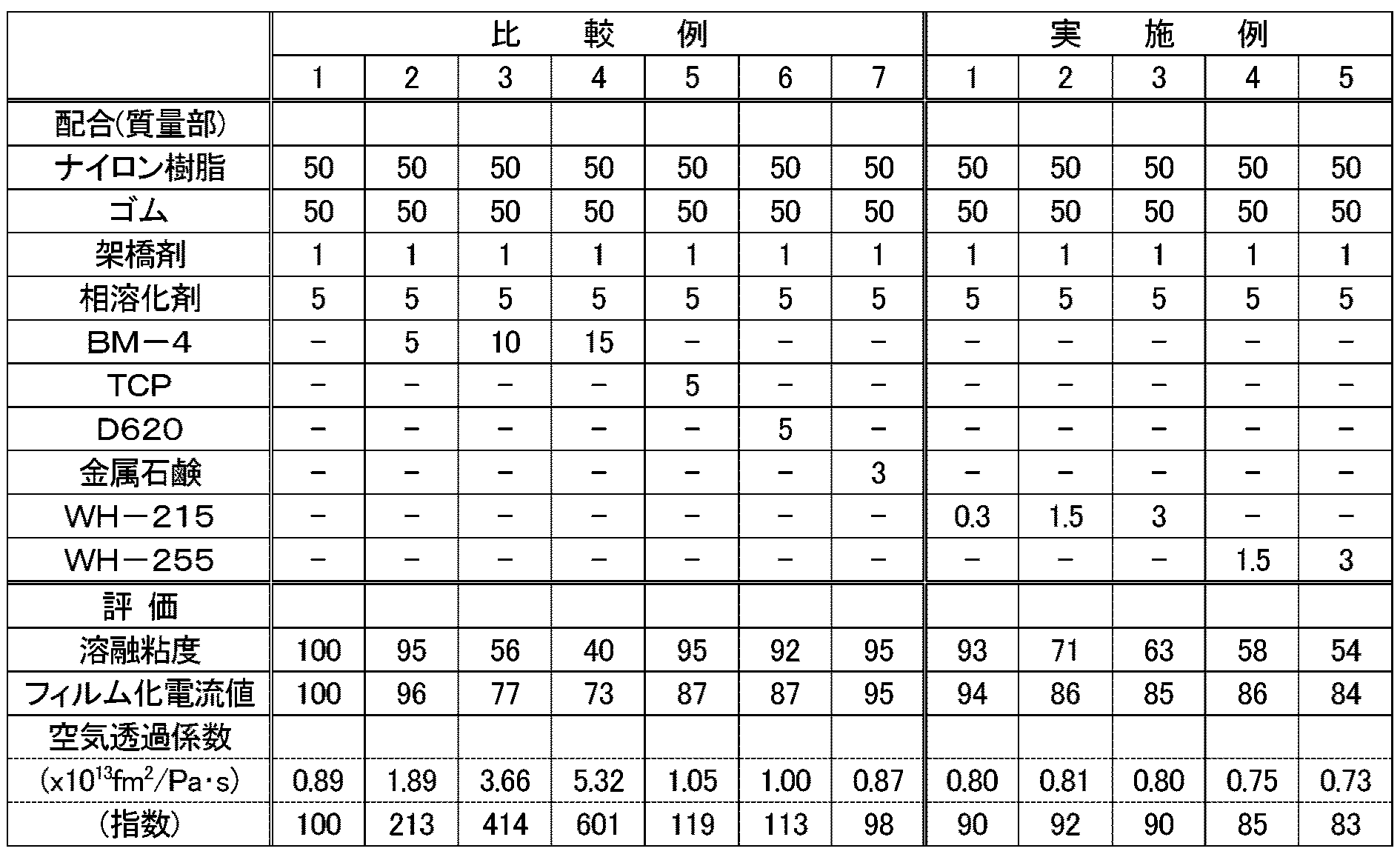
表1に示すように、滑剤及び可塑剤を添加していない比較例1に対し、比較例2〜6では可塑剤を添加したことにより、溶融粘度が下がり、フィルム化する際の電流値も小さくなって、加工性については改善されていたが、空気透過係数が大きくなり、低空気透過性が悪化した。脂肪酸金属塩を添加した比較例7では、加工性の改善効果が不十分であった。これに対し、実施例1〜5であると、脂肪酸アミド系滑剤を添加したことにより、低空気透過性を維持するだけでなく、むしろ向上しながら、動的架橋物の溶融粘度が低減しており、また、フィルム化する際の電流値も小さく、加工性を改善することができた。 As shown in Table 1, compared to Comparative Example 1 in which no lubricant and plasticizer were added, in Comparative Examples 2 to 6, the melt viscosity was lowered and the current value at the time of film formation was also small due to the addition of the plasticizer. As a result, the workability was improved, but the air permeability coefficient increased and the low air permeability deteriorated. In Comparative Example 7 to which the fatty acid metal salt was added, the effect of improving the processability was insufficient. On the other hand, in Examples 1 to 5, the addition of the fatty acid amide-based lubricant not only maintains low air permeability, but rather improves the melt viscosity of the dynamic crosslinked product. In addition, the current value at the time of forming a film was small, and the workability could be improved.
以上、本発明のいくつかの実施形態を説明したが、これら実施形態は、例として提示したものであり、発明の範囲を限定することは意図していない。これら実施形態は、その他の様々な形態で実施されることが可能であり、発明の要旨を逸脱しない範囲で、種々の省略、置き換え、変更を行うことができる。これら実施形態やその省略、置き換え、変更などは、発明の範囲や要旨に含まれると同様に、特許請求の範囲に記載された発明とその均等の範囲に含まれるものである。 Although some embodiments of the present invention have been described above, these embodiments are presented as examples and are not intended to limit the scope of the invention. These embodiments can be implemented in various other forms, and various omissions, replacements, and changes can be made without departing from the gist of the invention. These embodiments, omissions, replacements, changes, etc. thereof are included in the scope and gist of the invention, as well as in the scope of the invention described in the claims and the equivalent scope thereof.
Claims (7)
Priority Applications (1)
| Application Number | Priority Date | Filing Date | Title |
|---|---|---|---|
| JP2016253103A JP6908994B2 (en) | 2016-12-27 | 2016-12-27 | Dynamic cross-linked products, low air permeability film and pneumatic tires |
Applications Claiming Priority (1)
| Application Number | Priority Date | Filing Date | Title |
|---|---|---|---|
| JP2016253103A JP6908994B2 (en) | 2016-12-27 | 2016-12-27 | Dynamic cross-linked products, low air permeability film and pneumatic tires |
Publications (2)
| Publication Number | Publication Date |
|---|---|
| JP2018104572A JP2018104572A (en) | 2018-07-05 |
| JP6908994B2 true JP6908994B2 (en) | 2021-07-28 |
Family
ID=62785193
Family Applications (1)
| Application Number | Title | Priority Date | Filing Date |
|---|---|---|---|
| JP2016253103A Expired - Fee Related JP6908994B2 (en) | 2016-12-27 | 2016-12-27 | Dynamic cross-linked products, low air permeability film and pneumatic tires |
Country Status (1)
| Country | Link |
|---|---|
| JP (1) | JP6908994B2 (en) |
Family Cites Families (8)
| Publication number | Priority date | Publication date | Assignee | Title |
|---|---|---|---|---|
| JP2001151981A (en) * | 1999-11-22 | 2001-06-05 | Kuraray Co Ltd | Dynamically crosslinked polymer composition |
| JP4118716B2 (en) * | 2003-03-12 | 2008-07-16 | 株式会社クラレ | Thermoplastic elastomer composition and molded article thereof |
| EP1672027B1 (en) * | 2003-09-29 | 2010-01-13 | Zeon Corporation | Thermoplastic elastomer composition and formed article |
| WO2006098142A1 (en) * | 2005-03-15 | 2006-09-21 | Kaneka Corporation | Cap liner composition |
| CA2627170C (en) * | 2005-10-27 | 2012-02-21 | Exxonmobil Chemical Patents Inc. | Low permeability thermoplastic elastomer composition |
| JP2009079119A (en) * | 2007-09-26 | 2009-04-16 | Kaneka Corp | Molded product and modifier comprising resin composition |
| JP2010269588A (en) * | 2009-03-27 | 2010-12-02 | Toyo Tire & Rubber Co Ltd | Rubber product provided with air permeation suppression film and method for producing the same |
| JP6317601B2 (en) * | 2014-03-06 | 2018-04-25 | 株式会社カネカ | Thermoplastic elastomer composition |
-
2016
- 2016-12-27 JP JP2016253103A patent/JP6908994B2/en not_active Expired - Fee Related
Also Published As
| Publication number | Publication date |
|---|---|
| JP2018104572A (en) | 2018-07-05 |
Similar Documents
| Publication | Publication Date | Title |
|---|---|---|
| JP5375700B2 (en) | Method for producing an elastomer composition exhibiting no thermoplasticity | |
| JP4004518B2 (en) | Pneumatic tire using rubber laminate | |
| JP4821868B2 (en) | Thermoplastic elastomer composition | |
| JP3159941B2 (en) | Low gas permeable thermoplastic elastomer composition and method for producing the same | |
| CN101296997A (en) | Low permeability thermoplastic elastomer composition | |
| JP5521363B2 (en) | Method for producing thermoplastic elastomer composition | |
| JP4282131B2 (en) | Thermoplastic elastomer composition for tire | |
| US10889709B2 (en) | Thermoplastic resin composition, inner liner and pneumatic tire | |
| JP5668876B2 (en) | Method for producing thermoplastic elastomer composition | |
| JP4543685B2 (en) | Rubber composition for hose interlayer rubber and hose | |
| KR102470778B1 (en) | Thermoplastic polyester elastomer resin composition, method for preparing thereof and molding products comprising the composition | |
| JP4156565B2 (en) | Thermoplastic resin composition for automobile parts | |
| JP6676366B2 (en) | Method for producing air-permeable film and pneumatic tire | |
| JP4045905B2 (en) | Heat-resistant hose for automobile and its manufacturing method | |
| JP2016070347A (en) | Air hose for automobile | |
| JP5095093B2 (en) | Method for producing rubber composition and rubber composition obtained thereby | |
| WO2018008630A1 (en) | Rubber composition | |
| JP2018104572A (en) | Dynamic cross-linked product, low air permeability film and pneumatic tire | |
| JP2015189798A (en) | Rubber composition and pneumatic tire using the same | |
| JP2010215726A (en) | Method for producing thermoplastic elastomer composition | |
| JP6837830B2 (en) | Method for manufacturing dynamic crosslinked products | |
| JP4954611B2 (en) | Epichlorohydrin rubber composition and molded article comprising the same | |
| JPH1135754A (en) | Rubber composition | |
| JPH1016137A (en) | Rubber and thermoplastic elastomer laminate | |
| JP5293008B2 (en) | hose |
Legal Events
| Date | Code | Title | Description |
|---|---|---|---|
| A621 | Written request for application examination |
Free format text: JAPANESE INTERMEDIATE CODE: A621 Effective date: 20191028 |
|
| A131 | Notification of reasons for refusal |
Free format text: JAPANESE INTERMEDIATE CODE: A131 Effective date: 20201124 |
|
| A977 | Report on retrieval |
Free format text: JAPANESE INTERMEDIATE CODE: A971007 Effective date: 20201125 |
|
| TRDD | Decision of grant or rejection written | ||
| A01 | Written decision to grant a patent or to grant a registration (utility model) |
Free format text: JAPANESE INTERMEDIATE CODE: A01 Effective date: 20210615 |
|
| A61 | First payment of annual fees (during grant procedure) |
Free format text: JAPANESE INTERMEDIATE CODE: A61 Effective date: 20210702 |
|
| R150 | Certificate of patent or registration of utility model |
Ref document number: 6908994 Country of ref document: JP Free format text: JAPANESE INTERMEDIATE CODE: R150 |
|
| LAPS | Cancellation because of no payment of annual fees |