JP6504530B2 - Process for producing optically active 2- (2-fluorobiphenyl-4-yl) propanoic acid - Google Patents
Process for producing optically active 2- (2-fluorobiphenyl-4-yl) propanoic acid Download PDFInfo
- Publication number
- JP6504530B2 JP6504530B2 JP2017543596A JP2017543596A JP6504530B2 JP 6504530 B2 JP6504530 B2 JP 6504530B2 JP 2017543596 A JP2017543596 A JP 2017543596A JP 2017543596 A JP2017543596 A JP 2017543596A JP 6504530 B2 JP6504530 B2 JP 6504530B2
- Authority
- JP
- Japan
- Prior art keywords
- compound
- formula
- compound represented
- mol
- nickel
- Prior art date
- Legal status (The legal status is an assumption and is not a legal conclusion. Google has not performed a legal analysis and makes no representation as to the accuracy of the status listed.)
- Active
Links
- 0 *[C@]1N=C(C(*)(*)C2=N[C@@](*)CO2)OC1 Chemical compound *[C@]1N=C(C(*)(*)C2=N[C@@](*)CO2)OC1 0.000 description 5
- PXYFQHHKPOSAHF-JTQLQIEISA-N CCC(OC1)=N[C@@H]1c1ccccc1 Chemical compound CCC(OC1)=N[C@@H]1c1ccccc1 PXYFQHHKPOSAHF-JTQLQIEISA-N 0.000 description 2
- CVAWKJKISIPBOD-UHFFFAOYSA-N CC(C(OC(C)(C)C)=O)Br Chemical compound CC(C(OC(C)(C)C)=O)Br CVAWKJKISIPBOD-UHFFFAOYSA-N 0.000 description 1
- JPOAUYHZGGGXHU-ZDUSSCGKSA-N C[C@H](C(OC(C)(C)C)=O)c1ccc(-c2ccccc2)c(F)c1 Chemical compound C[C@H](C(OC(C)(C)C)=O)c1ccc(-c2ccccc2)c(F)c1 JPOAUYHZGGGXHU-ZDUSSCGKSA-N 0.000 description 1
- HTRNHWBOBYFTQF-UHFFFAOYSA-N Fc1cc(Br)ccc1-c1ccccc1 Chemical compound Fc1cc(Br)ccc1-c1ccccc1 HTRNHWBOBYFTQF-UHFFFAOYSA-N 0.000 description 1
Classifications
-
- C—CHEMISTRY; METALLURGY
- C07—ORGANIC CHEMISTRY
- C07C—ACYCLIC OR CARBOCYCLIC COMPOUNDS
- C07C51/00—Preparation of carboxylic acids or their salts, halides or anhydrides
- C07C51/09—Preparation of carboxylic acids or their salts, halides or anhydrides from carboxylic acid esters or lactones
-
- B—PERFORMING OPERATIONS; TRANSPORTING
- B01—PHYSICAL OR CHEMICAL PROCESSES OR APPARATUS IN GENERAL
- B01J—CHEMICAL OR PHYSICAL PROCESSES, e.g. CATALYSIS OR COLLOID CHEMISTRY; THEIR RELEVANT APPARATUS
- B01J27/00—Catalysts comprising the elements or compounds of halogens, sulfur, selenium, tellurium, phosphorus or nitrogen; Catalysts comprising carbon compounds
- B01J27/06—Halogens; Compounds thereof
- B01J27/08—Halides
- B01J27/10—Chlorides
-
- B—PERFORMING OPERATIONS; TRANSPORTING
- B01—PHYSICAL OR CHEMICAL PROCESSES OR APPARATUS IN GENERAL
- B01J—CHEMICAL OR PHYSICAL PROCESSES, e.g. CATALYSIS OR COLLOID CHEMISTRY; THEIR RELEVANT APPARATUS
- B01J31/00—Catalysts comprising hydrides, coordination complexes or organic compounds
- B01J31/02—Catalysts comprising hydrides, coordination complexes or organic compounds containing organic compounds or metal hydrides
- B01J31/0234—Nitrogen-, phosphorus-, arsenic- or antimony-containing compounds
- B01J31/0235—Nitrogen containing compounds
- B01J31/0244—Nitrogen containing compounds with nitrogen contained as ring member in aromatic compounds or moieties, e.g. pyridine
-
- C—CHEMISTRY; METALLURGY
- C07—ORGANIC CHEMISTRY
- C07C—ACYCLIC OR CARBOCYCLIC COMPOUNDS
- C07C57/00—Unsaturated compounds having carboxyl groups bound to acyclic carbon atoms
- C07C57/52—Unsaturated compounds having carboxyl groups bound to acyclic carbon atoms containing halogen
- C07C57/58—Unsaturated compounds having carboxyl groups bound to acyclic carbon atoms containing halogen containing six-membered aromatic rings
-
- C—CHEMISTRY; METALLURGY
- C07—ORGANIC CHEMISTRY
- C07C—ACYCLIC OR CARBOCYCLIC COMPOUNDS
- C07C67/00—Preparation of carboxylic acid esters
- C07C67/30—Preparation of carboxylic acid esters by modifying the acid moiety of the ester, such modification not being an introduction of an ester group
- C07C67/333—Preparation of carboxylic acid esters by modifying the acid moiety of the ester, such modification not being an introduction of an ester group by isomerisation; by change of size of the carbon skeleton
- C07C67/343—Preparation of carboxylic acid esters by modifying the acid moiety of the ester, such modification not being an introduction of an ester group by isomerisation; by change of size of the carbon skeleton by increase in the number of carbon atoms
-
- C—CHEMISTRY; METALLURGY
- C07—ORGANIC CHEMISTRY
- C07B—GENERAL METHODS OF ORGANIC CHEMISTRY; APPARATUS THEREFOR
- C07B2200/00—Indexing scheme relating to specific properties of organic compounds
- C07B2200/07—Optical isomers
-
- C—CHEMISTRY; METALLURGY
- C07—ORGANIC CHEMISTRY
- C07B—GENERAL METHODS OF ORGANIC CHEMISTRY; APPARATUS THEREFOR
- C07B53/00—Asymmetric syntheses
-
- C—CHEMISTRY; METALLURGY
- C07—ORGANIC CHEMISTRY
- C07B—GENERAL METHODS OF ORGANIC CHEMISTRY; APPARATUS THEREFOR
- C07B61/00—Other general methods
Landscapes
- Chemical & Material Sciences (AREA)
- Organic Chemistry (AREA)
- Engineering & Computer Science (AREA)
- Materials Engineering (AREA)
- Chemical Kinetics & Catalysis (AREA)
- Oil, Petroleum & Natural Gas (AREA)
- Organic Low-Molecular-Weight Compounds And Preparation Thereof (AREA)
- Low-Molecular Organic Synthesis Reactions Using Catalysts (AREA)
- Catalysts (AREA)
Description
本発明は、光学活性な2−(2−フルオロビフェニル−4−イル)プロパン酸の新規な製造法に関する。 The present invention relates to a novel process for producing optically active 2- (2-fluorobiphenyl-4-yl) propanoic acid.
2−(2−フルオロビフェニル−4−イル)プロパン酸又はその製薬学的に許容される塩は、薬剤として抗炎症作用、鎮痛作用等を有し、広く用いられていることが知られている。この2−(2−フルオロビフェニル−4−イル)プロパン酸の製法としては、例えば、2−(2−フルオロビフェニル−4−イル)マグネシウムブロミドと2−ブロモプロピオン酸の金属塩を用いることで得る方法(特許文献1)、2−(2−フルオロビフェニル−4−イル)マグネシウムブロミド、2−ブロモプロピオン酸エステルとニッケル触媒とを用いることでエステル中間体としてから得る方法(特許文献2)が報告されている。しかしながら、これらはいずれもラセミ体としての合成法であり、光学活性な2−(2−フルオロビフェニル−4−イル)プロパン酸を得るためには、この後更に光学分割を行う必要がある。光学分割法としては、例えば、光学活性アミンとの塩を形成することで一方の光学異性体の塩を優先的に結晶化させる方法が報告されているが、高光学純度の2−(2−フルオロビフェニル−4−イル)プロパン酸を得るには複数回の再結晶工程が必須であり、回収率も6割程度と低い(特許文献3)。また、不斉合成法としては例えば、2−(2−フルオロビフェニル−4−イル)アクリル酸の不斉水素化が報告されているが(非特許文献1)、工程数が長いうえに、最終工程で毒性を有するロジウム触媒を使用するため、実用的なものではない。 It is known that 2- (2-fluorobiphenyl-4-yl) propanoic acid or a pharmaceutically acceptable salt thereof has anti-inflammatory action, analgesic action and the like as a drug and is widely used. . The method for producing this 2- (2-fluorobiphenyl-4-yl) propanoic acid can be obtained, for example, by using 2- (2-fluorobiphenyl-4-yl) magnesium bromide and a metal salt of 2-bromopropionic acid. Method (Patent Document 1), a method (Patent Document 2) obtained as an ester intermediate by using 2- (2-fluorobiphenyl-4-yl) magnesium bromide, 2-bromopropionic acid ester and a nickel catalyst is reported (Patent Document 2) It is done. However, these are all synthetic methods as a racemate, and in order to obtain optically active 2- (2-fluorobiphenyl-4-yl) propanoic acid, it is necessary to carry out further optical resolution. As an optical resolution method, for example, a method of preferentially crystallizing a salt of one optical isomer by forming a salt with an optically active amine has been reported, but 2- (2- (2-) of high optical purity In order to obtain fluorobiphenyl-4-yl) propanoic acid, multiple recrystallization steps are essential, and the recovery rate is as low as about 60% (Patent Document 3). Moreover, as an asymmetric synthesis method, for example, asymmetric hydrogenation of 2- (2-fluorobiphenyl-4-yl) acrylic acid has been reported (Non-Patent Document 1), but the number of steps is long and the final It is not practical because it uses rhodium catalyst which is toxic in the process.
一方、カルボニルα位に、立体選択的に炭素‐炭素結合を構築する手法として、非特許文献2にニッケル触媒と光学活性なビスオキサゾリン配位子を用い、α−ハロケトンを基質とした不斉熊田反応が報告されており、また、非特許文献3にα−ハロアミド、非特許文献4にα−ハロケトンをそれぞれ基質とした不斉根岸反応が報告されている。しかしながら、不斉熊田反応においては−60から−40℃という低い反応温度が必要であることに加え、不斉熊田反応及び不斉根岸反応のいずれの反応においても多段階合成により得られる光学活性なビスオキサゾリン配位子を6.5から13%用いており、工業的製法としては適しておらず、またプロフェン類の合成報告、およびプロフェン類への誘導が容易なα−ハロエステルを基質とした合成報告はない。更に、プロフェン構造構築の報告としては、特許文献4、特許文献5、非特許文献5においてコバルト触媒と光学活性なビスオキサゾリン配位子を用いた不斉熊田反応が、非特許文献6において鉄触媒と光学活性なビスオキサゾリン配位子を用いた不斉熊田反応が報告されている。しかしながら、コバルト触媒を用いた不斉熊田反応は−80℃という極めて低い反応温度条件であることに加え、いずれの反応においてこれらも光学活性なビスオキサゾリン配位子を6から12%用いており、工業的製法としては適していない。 On the other hand, as a method of stereoselectively forming a carbon-carbon bond at the carbonyl α-position, Non-Patent Document 2 uses a nickel catalyst and an optically active bisoxazoline ligand and an asymmetric Kumada with an α-haloketone as a substrate The reaction has been reported, and Non-Patent Document 3 reports an asymmetric Negishi reaction using an α-haloamide as a substrate and Non-Patent Document 4 using an α-halo ketone as a substrate. However, in addition to the need for a low reaction temperature of -60 to -40 ° C in the asymmetric Kumada reaction, optically active compounds obtained by multistep synthesis in any reaction of the asymmetric Kumada reaction and the asymmetric Negishi reaction Use of 6.5 to 13% of bisoxazoline ligand, which is not suitable for industrial preparation, and also synthesis report of prophens, and synthesis report using α-haloester as a substrate easily derivable to prophens There is no. Furthermore, as a report on the construction of a prophen structure, the asymmetric Kumada reaction using a cobalt catalyst and an optically active bisoxazoline ligand in Patent Document 4, Patent Document 5, and Non-patent Document 5 and an iron catalyst in Non Patent Document 6. And the asymmetric Kumada reaction using optically active bisoxazoline ligands have been reported. However, in addition to the extremely low reaction temperature conditions of -80 ° C, the asymmetric Kumada reaction using a cobalt catalyst uses 6 to 12% of bis-oxazoline ligands which are optically active in any of the reactions, Not suitable as an industrial process.
そのため、工業的製法として適当な、光学活性な2−(2−フルオロビフェニル−4−イル)プロパン酸の製造法が求められていた。 Therefore, a method for producing optically active 2- (2-fluorobiphenyl-4-yl) propanoic acid, which is suitable as an industrial production method, has been required.
本発明の目的は、光学活性な2−(2−フルオロビフェニル−4−イル)プロパン酸の新規な製造法を提供することである。 An object of the present invention is to provide a novel process for producing optically active 2- (2-fluorobiphenyl-4-yl) propanoic acid.
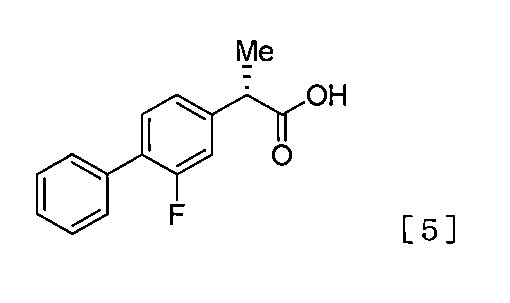
本発明者らは、上記課題を達成すべく鋭意検討を重ねた結果、スキーム1に示すように、式[1]で表される化合物(以下、化合物[1]と記載することもある)をマグネシウムと反応させ、場合によってはさらに亜鉛化合物を反応させて、調製した有機金属試薬を、触媒量のニッケル化合物、及び触媒量の式[3]で表される光学活性な化合物(以下、化合物[3]と記載することもある)の存在下、式[2]で表される化合物(以下、化合物[2]と記載することもある)と反応させて、得られた式[4]で表される化合物(以下、化合物[4]と記載することもある)を式[5]で表される化合物(以下、化合物[5]と記載することもある)又はその製薬学的に許容される塩に変換することにより、光学活性な2−(2−フルオロビフェニル−4−イル)プロパン酸を製造できることを見出した。 As a result of intensive studies to achieve the above-mentioned problems, the present inventors have found that the compound represented by the formula [1] (hereinafter sometimes referred to as compound [1]) as shown in scheme 1. The organometal reagent prepared by reacting with magnesium and, in some cases, further reacting a zinc compound, a catalytic amount of a nickel compound, and a catalytic amount of an optically active compound represented by the formula [3] (hereinafter referred to as a compound [ 3], and the compound represented by the formula [2] (hereinafter sometimes referred to as compound [2]) is reacted to give a table of the obtained formula [4] Compound (hereinafter sometimes referred to as compound [4]) is a compound represented by the formula [5] (hereinafter sometimes referred to as compound [5]) or a pharmaceutically acceptable thereof By converting to a salt, optically active 2- (2-fluorobi) can be obtained. It found to be able to produce Eniru-4-yl) propanoic acid.
スキーム1
また、本発明者らは、上記製造法では、従来の方法に比べ、より少量の触媒量のニッケル化合物、及びより少量の触媒量の式[3]で表される光学活性な化合物の存在下、式[2]で表される化合物と調製した有機金属試薬を反応させて、式[4]で表される化合物を製造できることを見出した。 Furthermore, the present inventors found that, in the above-mentioned production method, the presence of a smaller amount of a catalytic amount of a nickel compound and a smaller amount of a catalytic amount of the optically active compound represented by the formula [3] than the conventional method. It was found that the compound represented by the formula [2] can be produced by reacting the compound represented by the formula [2] with the prepared organometallic reagent.
さらに、本発明者らは、上記製造法では、従来の方法に比べ、より高い反応温度で、触媒量のニッケル化合物、及び触媒量の式[3]で表される光学活性な化合物の存在下、式[2]で表される化合物と調製した有機金属試薬を反応させて、式[4]で表される化合物を製造できることを見出した。 Furthermore, the present inventors found that, in the above-mentioned production method, at a higher reaction temperature than in the conventional method, the catalytic amount of a nickel compound and the catalytic amount of the optically active compound represented by the formula [3] It was found that the compound represented by the formula [2] can be produced by reacting the compound represented by the formula [2] with the prepared organometallic reagent.
すなわち、本発明は以下の通りである。
(1)光学活性な2−(2−フルオロビフェニル−4−イル)プロパン酸又はその製薬学的に許容される塩の製造法において、下記(a)〜(c)工程を含むことを特徴とする製造法:
(a)式[1]で表される化合物をマグネシウムと反応させることを含む、有機金属試薬を調製する工程、That is, the present invention is as follows.
(1) A process for producing optically active 2- (2-fluorobiphenyl-4-yl) propanoic acid or a pharmaceutically acceptable salt thereof, characterized by comprising the following steps (a) to (c): Production method:
(a) preparing an organometallic reagent, which comprises reacting a compound represented by the formula [1] with magnesium;
式[5]で表される化合物又はその製薬学的に許容される塩に変換する工程
なお、上記(a)〜(c)工程中、上記式[1]から[5]で表される化合物において、
X1はハロゲン原子を表し、
X2はハロゲン原子を表し、
R1はtert−ブチルジフェニルシリル、C1-6アルキル、C2-6アルケニル、C3-8シクロアルキル、フェニル、又は置換基群A1から選ばれる1から2個の基で置換されてもよいベンジルを表し、
R2及びR3は独立してC1-6アルキルを表し、
またはR2、R3、及び該置換基に隣接する炭素原子は一緒になってC3-6シクロアルカンを形成してもよく、
R4及びR5は独立してC1-6アルキル、ベンジル、フェネチル、又は置換基群A2から選ばれる1から2個の基で置換されてもよいフェニルを表し、
ここで、置換基群A1は、C1-6アルキル及びフェニルからなる群を表し、
置換基群A2は、ハロゲン原子、C1-6アルキル、ハロC1-6アルキル、C1-6アルコキシ、ハロC1-6アルコキシ、及びフェニルからなる群
を表す。
(2)工程(a)において、式[1]で表される化合物をマグネシウムと反応させた後、さらに塩化亜鉛又は臭化亜鉛を反応させて、有機金属試薬を調製する、(1)に記載の製造法。
(3)工程(b)における式[2]で表される化合物について、R1がC1-6アルキルである、(1)又は(2)に記載の製造法。
(4)工程(b)における式[2]で表される化合物について、R1がtert−ブチルである、(3)に記載の製造法。
(5)工程(b)において、式[2]で表される化合物に対して、使用するニッケル化合物の触媒量が0.03から1.00mol%であり、使用する式[3]で表される光学活性な化合物の触媒量が0.036から1.20mol%である、(2)〜(4)のいずれかに記載の製造法。
(6)工程(b)において、式[2]で表される化合物に対して、使用するニッケル化合物の触媒量が0.50から1.00mol%であり、使用する式[3]で表される光学活性な化合物の触媒量が0.60から1.20mol%である(1)、(3)又は(4)に記載の製造法。
(7)工程(b)において、反応温度が0から25℃である、(2)〜(5)のいずれかに記載の製造法。
(8)工程(b)において、反応温度が−20から0℃である(1)、(3)、(4)又は(6)に記載の製造法。
(9)工程(c)において、式[4]で表される化合物を式[5]で表される化合物に変換する工程が酸性条件下における変換である、(1)〜(8)のいずれかに記載の製造法。
(10)工程(b)における式[3]で表される光学活性な化合物について、
R2及びR3がともにメチルであり、
R4及びR5がともにフェニルである、(1)〜(9)のいずれかに記載の製造法、
(11)工程(a)において、式[1]で表される化合物とマグネシウムと反応させて調製した有機マグネシウム試薬と、さらに反応させる塩化亜鉛又は臭化亜鉛のモル比が、2:1から3:1である、(2)〜(5)、〈7〉〜(9)のいずれかに記載の製造法。
(12)工程(b)において、式[2]で表される化合物に対して、使用するニッケル化合物の触媒量が0.10mol%以下であり、使用する式[3]で表される光学活性な化合物の触媒量が0.12mol%以下である、(2)に記載の製造法。
(13)工程(b)において、式[2]で表される化合物に対して、使用するニッケル化合物の触媒量が1.00mol%以下であり、使用する式[3]で表される光学活性な化合物の触媒量が1.20mol%以下である、(1)に記載の製造法。
(14)工程(c)について、酸性条件下において、式[5]で表される化合物への変換に使用する酸が、塩酸、硫酸、ギ酸、トリフルオロ酢酸、メタンスルホン酸、及びp−トルエンスルホン酸からなる群から選ばれる酸である、(9)に記載の製造法。
(15)工程(b)において、式[2]で表される化合物に対して、使用するニッケル化合物の触媒量が1.00mol%以下であり、使用する式[3]で表される光学活性な化合物の触媒量が1.20mol%以下である、(2)に記載の製造法。
(16)工程(b)において、反応温度が0℃以上である、(15)に記載の製造法。
(17)光学活性な2−(2−フルオロビフェニル−4−イル)プロパン酸の製造法であって、
(a)式[1]で表される化合物をマグネシウムと反応させ、場合によってはさらに塩化亜鉛又は臭化亜鉛を反応させて、有機金属試薬を調製する工程、In the above-mentioned steps (a) to (c), in the compounds represented by the above formulas [1] to [5],
X 1 represents a halogen atom,
X 2 represents a halogen atom,
R 1 may be substituted with one or two groups selected from tert-butyldiphenylsilyl, C 1-6 alkyl, C 2-6 alkenyl, C 3-8 cycloalkyl, phenyl or substituent group A1 Stands for benzyl,
R 2 and R 3 independently represent C 1-6 alkyl,
Or R 2 , R 3 and the carbon atom adjacent to the substituent may be taken together to form a C 3-6 cycloalkane,
R 4 and R 5 independently represent C 1-6 alkyl, benzyl, phenethyl or phenyl optionally substituted by 1 to 2 groups selected from Substituent Group A2,
Here, Substituent Group A1 represents a group consisting of C 1-6 alkyl and phenyl,
Substituent Group A2 represents a halogen atom, C 1-6 alkyl, halo C 1-6 alkyl, C 1-6 alkoxy, halo C 1-6 alkoxy, and the group consisting of phenyl.
(2) In step (a), after the compound represented by the formula [1] is reacted with magnesium, zinc chloride or zinc bromide is further reacted to prepare an organometallic reagent, as described in (1) Manufacturing method.
(3) The production method according to (1) or (2), wherein R 1 is C 1-6 alkyl for the compound represented by the formula [2] in the step (b).
(4) The method according to (3), wherein R 1 is tert-butyl, for the compound represented by the formula [2] in the step (b).
(5) In the step (b), the catalytic amount of the nickel compound to be used is 0.03 to 1.00 mol% with respect to the compound represented by the formula [2], and is represented by the formula [3] to be used The method according to any one of (2) to (4), wherein the catalytic amount of the optically active compound is 0.036 to 1.20 mol%.
(6) In the step (b), the catalytic amount of the nickel compound to be used is 0.50 to 1.00 mol% with respect to the compound represented by the formula [2], and is represented by the formula [3] to be used (1), (3) or (4), wherein the catalytic amount of the optically active compound is 0.60 to 1.20 mol%.
(7) The process according to any one of (2) to (5), wherein in the step (b), the reaction temperature is 0 to 25 ° C.
(8) The process according to (1), (3), (4) or (6), wherein the reaction temperature is -20 to 0 ° C in the step (b).
(9) Any one of (1) to (8), wherein in the step (c), the step of converting the compound represented by the formula [4] into a compound represented by the formula [5] is conversion under acidic conditions Production method described in.
(10) The optically active compound represented by the formula [3] in the step (b)
R 2 and R 3 are both methyl,
The method according to any one of (1) to (9), wherein R 4 and R 5 are both phenyl.
(11) In the step (a), the molar ratio of zinc chloride or zinc bromide to be further reacted is 2: 1 to 3 with an organic magnesium reagent prepared by reacting the compound represented by the formula [1] with magnesium. The manufacturing method in any one of (2)-(5) and <7>-(9) which is: 1.
(12) In the step (b), the catalytic amount of the nickel compound used is 0.10 mol% or less with respect to the compound represented by the formula [2], and the optical activity represented by the formula [3] used The production method according to (2), wherein the catalytic amount of the compound is 0.12 mol% or less.
(13) In the step (b), the catalytic amount of the nickel compound used is 1.00 mol% or less with respect to the compound represented by the formula [2], and the optical activity represented by the formula [3] used The production method according to (1), wherein the catalytic amount of the compound is 1.20 mol% or less.
(14) Regarding the step (c), the acid used for conversion to the compound represented by the formula [5] under acidic conditions is hydrochloric acid, sulfuric acid, formic acid, trifluoroacetic acid, methanesulfonic acid, and p-toluene The production method according to (9), which is an acid selected from the group consisting of sulfonic acids.
(15) In the step (b), the catalytic amount of the nickel compound used is 1.00 mol% or less with respect to the compound represented by the formula [2], and the optical activity represented by the formula [3] used The production method according to (2), wherein the catalytic amount of the compound is 1.20 mol% or less.
(16) The process according to (15), wherein in the step (b), the reaction temperature is 0 ° C. or higher.
(17) A process for producing optically active 2- (2-fluorobiphenyl-4-yl) propanoic acid, which comprises
(a) reacting the compound represented by the formula [1] with magnesium, and optionally further reacting zinc chloride or zinc bromide to prepare an organometallic reagent,
式[5]で表される化合物又はその製薬学的に許容される塩に変換する工程
ここで、
上記式[1]から[5]において、
X1はハロゲン原子を表し、
X2はハロゲン原子を表し、
R1はtert−ブチルジフェニルシリル、C1-6アルキル、C2-6アルケニル、C3-8シクロアルキル、フェニル、又は置換基群A1から選ばれる1から2個の基で置換されてもよいベンジルを表し、
R2及びR3は独立してC1-6アルキルを表し、
またはR2、R3、及び該置換基に隣接する炭素原子は一緒になってC3-6シクロアルカンを形成してもよく、
R4及びR5は独立してC1-6アルキル、ベンジル、フェネチル、又は置換基群A2から選ばれる1から2個の基で置換されてもよいフェニルを表し、
ここで、置換基群A1は、C1-6アルキル及びフェニルからなる群を表し、
置換基群A2は、ハロゲン原子、C1-6アルキル、ハロC1-6アルキル、C1-6アルコキシ、ハロC1-6アルコキシ、及びフェニルからなる群
を表す、
(18)工程(a)において、式[1]で表される化合物をマグネシウムと反応させた後、さらに塩化亜鉛又は臭化亜鉛を反応させる、(17)に記載の製造法、
(19)工程(a)において、式[1]で表される化合物をマグネシウムと反応させた後、塩化亜鉛又は臭化亜鉛を反応させない、(17)に記載の製造法、
(20)工程(b)における式[2]で表される化合物について、R1がC1-6アルキルである、(17)に記載の製造法、
(21)工程(b)において、式[2]で表される化合物に対して、使用するニッケル化合物の触媒量が1.00mol%以下であり、使用する式[3]で表される光学活性な化合物の触媒量が1.20mol%以下である、(17)に記載の製造法、
(22)工程(b)において、反応温度が0℃以上である、(21)に記載の製造法、
(23)工程(c)において、式[4]で表される化合物を式[5]で表される化合物に変換する工程が酸性条件下における変換である、(17)に記載の製造法、
(24)工程(b)における式[3]で表される光学活性な化合物について、
R2及びR3がともにメチルであり、
R4及びR5がともにフェニルである、(17)に記載の製造法、
(25)工程(b)における式[2]で表される化合物について、
R1がtert−ブチルである、(20)に記載の製造法、
(26)工程(a)において、式[1]で表される化合物とマグネシウムと反応させて調製した有機マグネシウム試薬と、さらに反応させる塩化亜鉛又は臭化亜鉛のモル比が、2:1から3:1である、(18)に記載の製造法、
(27)工程(b)において、式[2]で表される化合物に対して、使用するニッケル化合物の触媒量が0.10mol%以下であり、使用する式[3]で表される光学活性な化合物の触媒量が0.12mol%以下である、(18)に記載の製造法、
(28)工程(b)において、式[2]で表される化合物に対して、使用するニッケル化合物の触媒量が0.03から0.10mol%であり、使用する式[3]で表される光学活性な化合物の触媒量が0.036から0.12mol%である、(27)に記載の製造法、
(29)工程(b)において、式[2]で表される化合物に対して、使用するニッケル化合物の触媒量が1.00mol%以下であり、使用する式[3]で表される光学活性な化合物の触媒量が1.20mol%以下である、(19)に記載の製造法、
(30)工程(b)において、式[2]で表される化合物に対して、使用するニッケル化合物の触媒量が0.50から1.00mol%であり、使用する式[3]で表される光学活性な化合物の触媒量が0.60から1.20mol%以下である、(29)に記載の製造法、
(31)工程(b)において、反応温度が0から25℃である、(22)に記載の製造法、
(32)工程(c)について、酸性条件下において、式[5]で表される化合物への変換に使用する酸が、塩酸、硫酸、ギ酸、トリフルオロ酢酸、メタンスルホン酸、及びp−トルエンスルホン酸からなる群から選ばれる酸である、(23)に記載の製造法。
here,
In the above formulas [1] to [5],
X 1 represents a halogen atom,
X 2 represents a halogen atom,
R 1 may be substituted with one or two groups selected from tert-butyldiphenylsilyl, C 1-6 alkyl, C 2-6 alkenyl, C 3-8 cycloalkyl, phenyl or substituent group A1 Stands for benzyl,
R 2 and R 3 independently represent C 1-6 alkyl,
Or R 2 , R 3 and the carbon atom adjacent to the substituent may be taken together to form a C 3-6 cycloalkane,
R 4 and R 5 independently represent C 1-6 alkyl, benzyl, phenethyl or phenyl optionally substituted by 1 to 2 groups selected from Substituent Group A2,
Here, Substituent Group A1 represents a group consisting of C 1-6 alkyl and phenyl,
Substituent group A2 represents a group consisting of a halogen atom, C 1-6 alkyl, halo C 1-6 alkyl, C 1-6 alkoxy, halo C 1-6 alkoxy, and phenyl.
(18) The production method according to (17), wherein zinc chloride or zinc bromide is further reacted after reacting the compound represented by the formula [1] with magnesium in the step (a),
(19) The production method according to (17), wherein zinc chloride or zinc bromide is not reacted after reacting the compound represented by the formula [1] with magnesium in the step (a),
(20) The production method according to (17), wherein R 1 is C 1-6 alkyl, for the compound represented by the formula [2] in the step (b)
(21) In the step (b), the catalytic amount of the nickel compound to be used is 1.00 mol% or less with respect to the compound represented by the formula [2], and the optical activity represented by the formula [3] to be used The production method according to (17), wherein the catalytic amount of the compound is 1.20 mol% or less
(22) The process according to (21), wherein in the step (b), the reaction temperature is 0 ° C. or higher,
(23) The production method according to (17), wherein in the step (c), the step of converting the compound represented by the formula [4] into a compound represented by the formula [5] is conversion under acidic conditions
(24) About the optically active compound represented by the formula [3] in the step (b)
R 2 and R 3 are both methyl,
The process according to (17), wherein R 4 and R 5 are both phenyl,
(25) About the compound represented by Formula [2] in step (b)
The process according to (20), wherein R 1 is tert-butyl,
(26) In the step (a), the molar ratio of zinc chloride or zinc bromide to be further reacted is 2: 1 to 3 with an organic magnesium reagent prepared by reacting the compound represented by the formula [1] with magnesium. The production method according to (18), which is: 1:
(27) In the step (b), the catalytic amount of the nickel compound used is 0.10 mol% or less with respect to the compound represented by the formula [2], and the optical activity represented by the formula [3] used (18), wherein the catalytic amount of the compound is 0.12 mol% or less,
(28) In the step (b), the catalytic amount of the nickel compound used is 0.03 to 0.10 mol% with respect to the compound represented by the formula [2], and is represented by the formula [3] used (27), wherein the catalytic amount of the optically active compound is 0.036 to 0.12 mol%,
(29) In the step (b), the catalytic amount of the nickel compound used is 1.00 mol% or less with respect to the compound represented by the formula [2], and the optical activity represented by the formula [3] used The production method according to (19), wherein the catalytic amount of the compound is 1.20 mol% or less
(30) In the step (b), the catalytic amount of the nickel compound to be used is 0.50 to 1.00 mol% with respect to the compound represented by the formula [2], and is represented by the formula [3] to be used (29), wherein the catalytic amount of the optically active compound is 0.60 to 1.20 mol% or less
(31) The process according to (22), wherein in the step (b), the reaction temperature is 0 to 25 ° C.,
(32) Regarding the step (c), the acid used for conversion to the compound represented by the formula [5] under acidic conditions is hydrochloric acid, sulfuric acid, formic acid, trifluoroacetic acid, methanesulfonic acid, and p-toluene The production method according to (23), which is an acid selected from the group consisting of sulfonic acids.
本発明により、2−(2−フルオロビフェニル−4−イル)プロパン酸を高い光学純度で製造することができる。また、本発明によれば、従来の方法に比べて、より少量の触媒量のニッケル化合物、及びより少量の触媒量の式[3]で表される光学活性な化合物の使用で、式[4]で表される化合物を製造することができる。さらに、本発明によれば、従来の方法に比べて、より高い反応温度で、式[4]で表される化合物を製造することができる。 According to the invention, 2- (2-fluorobiphenyl-4-yl) propanoic acid can be produced with high optical purity. Moreover, according to the present invention, the use of the catalytic compound of the smaller amount in a catalytic amount and the optically active compound represented by the formula [3] of a smaller amount of the compound in comparison with the conventional method results in the formula [4] ] The compound represented by these can be manufactured. Furthermore, according to the present invention, the compound represented by the formula [4] can be produced at a higher reaction temperature as compared with the conventional method.
本発明により、抗炎症作用、鎮痛作用を有する薬剤である光学活性な2−(2−フルオロビフェニル−4−イル)プロパン酸の工業的な製法として有用な方法を提供できる。 According to the present invention, it is possible to provide a method useful as an industrial process for producing optically active 2- (2-fluorobiphenyl-4-yl) propanoic acid which is a drug having anti-inflammatory activity and analgesic activity.
以下、本発明について、詳細に説明する。 Hereinafter, the present invention will be described in detail.
本発明により製造できる光学活性な2−(2−フルオロビフェニル−4−イル)プロパン酸は、以下に示す構造を有している。 The optically active 2- (2-fluorobiphenyl-4-yl) propanoic acid which can be produced by the present invention has the structure shown below.
本明細書において、特記ない限り、式[4]及び[5]により表される「光学活性な化合物」は、絶対配置が(S)体及び(R)体のいずれかを示す。 In the present specification, unless otherwise specified, the “optically active compound” represented by the formulas [4] and [5] has either an (S) form or an (R) form in absolute configuration.
本発明において、「n」はノルマルを、「i」はイソを、「s」及び「sec」はセカンダリーを、「t」及び「tert」はターシャリーを、「c」はシクロを、「o」はオルトを、「m」はメタを、「p」はパラを意味する。 In the present invention, “n” is normal, “i” is iso, “s” and “sec” are secondary, “t” and “tert” are tertiary, “c” is cyclo, “o” "" Means ortho, "m" means meta, and "p" means para.
「ハロゲン原子」とは、フッ素原子、塩素原子、臭素原子又はヨウ素原子である。 The "halogen atom" is a fluorine atom, a chlorine atom, a bromine atom or an iodine atom.
「C1−6アルキル」とは、炭素原子を1から6個有する直鎖又は分枝状のアルキルを示す。例えば、メチル、エチル、n−プロピル、イソプロピル、n−ブチル、イソブチル、sec−ブチル、tert−ブチル、n−ペンチル、イソペンチル、ネオペンチル、2−メチルブチル、tert−アミル、n−ヘキシル、イソヘキシル等が挙げられる。“C 1-6 alkyl” represents a linear or branched alkyl having 1 to 6 carbon atoms. For example, methyl, ethyl, n-propyl, isopropyl, n-butyl, isobutyl, sec-butyl, tert-butyl, n-pentyl, isopentyl, neopentyl, 2-methylbutyl, tert-amyl, n-hexyl, isohexyl etc. Be
「ハロC1−6アルキル」とは、ハロゲン原子で置換された、炭素原子を1から6個有する直鎖状又は分岐状のアルキルを示す。ハロゲン原子の好ましい置換数は1から5個であり、好ましいハロゲン原子はフッ素原子である。例えば、モノフルオロメチル、ジフルオロメチル、トリフルオロメチル、1−フルオロエチル、1,1−ジフルオロエチル、1,1,2,2,2−ペンタフルオロエチル、2−フルオロエチル、2−フルオロ−2−メチルプロピル、2,2−ジフルオロプロピル、1−フルオロ−2−メチルプロパン−2−イル、1,1−ジフルオロ−2−メチルプロパン−2−イル、1−フルオロペンチル、1−フルオロヘキシル等が挙げられる。"Halo C 1-6 alkyl" substituted with a halogen atom, a straight or branched alkyl having 1 to 6 carbon atoms. The preferred number of halogen atoms is 1 to 5, and the preferred halogen atom is a fluorine atom. For example, monofluoromethyl, difluoromethyl, trifluoromethyl, 1-fluoroethyl, 1,1-difluoroethyl, 1,1,2,2,2-pentafluoroethyl, 2-fluoroethyl, 2-fluoro-2- Methylpropyl, 2,2-difluoropropyl, 1-fluoro-2-methylpropan-2-yl, 1,1-difluoro-2-methylpropan-2-yl, 1-fluoropentyl, 1-fluorohexyl and the like. Be
「C2−6アルケニル」とは、炭素原子を2から6個有する直鎖又は分枝状のアルケニルを示す。例えば、エテニル、(E)−プロパ−1−エン−1−イル、(Z)−プロパ−1−エン−1−イル、プロパ−2−エン−1−イル、ブタ−3−エン−1−イル、ペンタ−4−エン−1−イル、ヘキサ−5−エン−1−イル等が挙げられる。" C2-6 alkenyl" shows linear or branched alkenyl which has 2 to 6 carbon atoms. For example, ethenyl, (E) -prop-1-en-1-yl, (Z) -prop-1-en-1-yl, prop-2-en-1-yl, but-3-ene-1-l. And penta-4-en-1-yl, hexa-5-en-1-yl and the like.
「C1−6アルコキシ」とは、炭素原子を1から6個有する直鎖又は分枝状のアルコキシを示す。例えば、メトキシ、エトキシ、n−プロポキシ、イソプロポキシ、n−ブトキシ、イソブトキシ、sec−ブトキシ、tert−ブトキシ、n−ペンチルオキシ、イソペンチルオキシ、ネオペンチルオキシ、2−メチルブトキシ、n−ヘキシルオキシ、イソヘキシルオキシが挙げられる。The "C 1-6 alkoxy" refers to straight-chain or branched alkoxy having 1 to 6 carbon atoms. For example, methoxy, ethoxy, n-propoxy, isopropoxy, n-butoxy, isobutoxy, sec-butoxy, tert-butoxy, n-pentyloxy, isopentyloxy, neopentyloxy, 2-methylbutoxy, n-hexyloxy, Isohexyloxy is mentioned.
「ハロC1−6アルコキシ」とは、ハロゲン原子で置換された、炭素原子を1から6個有する直鎖状又は分岐状のアルコキシを示す。ハロゲン原子の好ましい置換数は1から5個であり、好ましいハロゲン原子はフッ素原子である。例えば、モノフルオロメトキシ、ジフルオロメトキシ、トリフルオロメトキシ、1−フルオロエトキシ、1,1−ジフルオロエトキシ、1,1,2,2−テトラフルオロエトキシ、2−フルオロエトキシ、2,2,2−トリフルオロエトキシ、3,3,3−トリフルオロプロポキシ、1,3−ジフルオロプロパン−2−イルオキシ、2−フルオロ−2−メチルプロポキシ、2,2−ジフルオロプロポキシ、1−フルオロ−2−メチルプロパン−2−イルオキシ、1,1−ジフルオロ−2−メチルプロパン−2−イルオキシ、4,4,4−トリフルオロブトキシ等が挙げられる。"Halo C 1-6 alkoxy", substituted with a halogen atom, a straight or branched alkoxy having 1 to 6 carbon atoms. The preferred number of halogen atoms is 1 to 5, and the preferred halogen atom is a fluorine atom. For example, monofluoromethoxy, difluoromethoxy, trifluoromethoxy, 1-fluoroethoxy, 1,1-difluoroethoxy, 1,1,2,2-tetrafluoroethoxy, 2-fluoroethoxy, 2,2,2-trifluoro Ethoxy, 3,3,3-trifluoropropoxy, 1,3-difluoropropan-2-yloxy, 2-fluoro-2-methylpropoxy, 2,2-difluoropropoxy, 1-fluoro-2-methylpropane-2- Iroxy, 1,1-difluoro-2-methylpropan-2-yloxy, 4,4,4-trifluorobutoxy and the like.
「C3-6シクロアルカン」とは、炭素原子を3から6個有する環状アルカンを意味し、シクロプロパン、シクロブタン、シクロペンタン、シクロヘキサンである。The “C 3-6 cycloalkane” means a cyclic alkane having 3 to 6 carbon atoms, and is cyclopropane, cyclobutane, cyclopentane, cyclohexane.
「C3-8シクロアルキル」とは、炭素原子を3から8個有する環状のアルキルを意味し、シクロプロピル、シクロブチル、シクロペンチル、シクロヘキシル、シクロヘプチル、シクロオクチルである。“C 3-8 cycloalkyl” means cyclic alkyl having 3 to 8 carbon atoms, and is cyclopropyl, cyclobutyl, cyclopentyl, cyclohexyl, cycloheptyl, cyclooctyl.
「有機金属試薬」とは、有機化合物と金属試薬とを反応させて調製する試薬であり、該有機金属試薬は、得られた有機金属試薬へさらに別の金属試薬を反応させて調整した試薬も含む。本発明では、有機化合物とマグネシウムを反応させて調製する有機マグネシウム試薬(以下、グリニャール試薬と記載することもある)と、さらに「亜鉛化合物」を反応させて調製する有機亜鉛含有試薬(以下、「有機亜鉛試薬」という)を示す。 The "organic metal reagent" is a reagent prepared by reacting an organic compound and a metal reagent, and the organic metal reagent is also a reagent prepared by reacting another metal reagent with the obtained organometallic reagent. Including. In the present invention, an organomagnesium reagent (hereinafter sometimes referred to as a Grignard reagent) prepared by reacting an organic compound and magnesium, and an organozinc-containing reagent (hereinafter prepared as a zinc compound) are further reacted. "Organic zinc reagent" is shown.
「亜鉛化合物」とは、有機マグネシウム試薬と反応させた時に、有機亜鉛試薬として調整できるものであればよく、例えば、ハロゲン化亜鉛が挙げられる。具体的には、塩化亜鉛、臭化亜鉛、又はヨウ化亜鉛が挙げられる。 The “zinc compound” may be any as long as it can be adjusted as an organozinc reagent when reacted with an organomagnesium reagent, and examples thereof include zinc halides. Specifically, zinc chloride, zinc bromide or zinc iodide is mentioned.
「ニッケル化合物」とは、ハロゲン含有ニッケル化合物又はニッケル錯体をいい、例えば、塩化ニッケル(II)、臭化ニッケル(II)、ヨウ化ニッケル(II)、塩化ニッケル(II)・DME錯体(DME:1,2−ジメトキシエタン)、アセチルアセトンニッケル(II)、塩化ビス(トリフェニルホスフィン)ニッケル(II)が挙げられる。 The term "nickel compound" refers to a halogen-containing nickel compound or a nickel complex, such as nickel (II) chloride, nickel (II) bromide, nickel (II) iodide, nickel (II) chloride / DME complex (DME: 1,2-dimethoxyethane), acetylacetone nickel (II), and bis (triphenylphosphine) nickel chloride (II).
「エーテル系の溶媒」とは、例えば、テトラヒドロフラン、1,4−ジオキサン、メチルテトラヒドロフラン、ジエチルエーテル、ジメトキシエタン、シクロペンチルメチルエーテルが挙げられる。 Examples of the "ether solvent" include tetrahydrofuran, 1,4-dioxane, methyltetrahydrofuran, diethylether, dimethoxyethane, and cyclopentyl methyl ether.
「ベンゼン系の溶媒」とは、例えば、ベンゼン、トルエン、キシレンが挙げられる。 Examples of the "benzene-based solvent" include benzene, toluene and xylene.
「炭化水素系の溶媒」とは、例えば、トルエン、キシレン、ベンゼン、ヘプタン、ヘキサンが挙げられる。 Examples of the "hydrocarbon solvent" include toluene, xylene, benzene, heptane and hexane.
「アルコール系の溶媒」とは、例えば、メタノール、エタノール、1−プロパノール、2−プロパノール、tert−ブチルアルコールが挙げられる。 Examples of the “alcohol-based solvent” include methanol, ethanol, 1-propanol, 2-propanol and tert-butyl alcohol.
「エステル系の溶媒」とは、例えば、酢酸エチルが挙げられる。 Examples of the “ester solvent” include ethyl acetate.
「製薬学的に許容される塩」とは、例えば、グリシン塩、リジン塩、アルギニン塩、ヒスチジン塩、オルニチン塩、グルタミン酸塩、アスパラギン酸塩のようなアミノ酸塩、リチウム塩、ナトリウム塩、カリウム塩、カルシウム塩、マグネシウム塩のような無機塩、又はアンモニウム塩、トリエチルアミン塩、ジイソプロピルアミン塩、シクロヘキシルアミン塩のような有機塩基との塩が挙げられる。 “Pharmaceutically acceptable salt” is, for example, glycine salt, lysine salt, arginine salt, histidine salt, ornithine salt, glutamate, amino acid salt such as aspartate, lithium salt, sodium salt, potassium salt Inorganic salts such as calcium salts and magnesium salts or salts with ammonium salts, organic salts such as triethylamine salts, diisopropylamine salts, cyclohexylamine salts and the like.
なお、塩には、含水塩が含まれる。 The salt includes hydrated salt.
式[3]で表される光学活性な化合物について、以下に説明する。 The optically active compound represented by the formula [3] will be described below.
本発明にかかる製造法では、触媒量の式[3]で表される光学活性な化合物を使用して、触媒量のニッケル化合物の存在下、式[2]で表される化合物を工程(a)において調製した有機金属試薬と反応させることで、光学活性な式[4]で表される化合物を製造することができる。 In the production method according to the present invention, using a catalytic amount of the optically active compound represented by the formula [3], the compound represented by the formula [2] in the presence of the catalytic amount of a nickel compound is subjected to the step (a The compound represented by the optically active formula [4] can be produced by reacting with the organometallic reagent prepared in the above 4.).
ここで、絶対配置が(R,R)である式[3]で表される光学活性な化合物を使用すると、絶対配置が(S)である式[4]で表される化合物を製造することができる。また、反対に、絶対配置が(S,S)である式[3]で表される光学活性な化合物を使用すると、絶対配置が(R)である式[4]で表される化合物を製造することができる。 Here, when an optically active compound represented by the formula [3] having an absolute configuration of (R, R) is used, a compound represented by the formula [4] having an absolute configuration of (S) is produced. Can. Also, on the contrary, when using an optically active compound represented by the formula [3] having an absolute configuration of (S, S), a compound represented by the formula [4] having an absolute configuration of (R) is produced. can do.
式[3]で表される光学活性な化合物は、市販により、また文献記載による公知の方法(例えば、J. Am. Chem. Soc., 2014, 136, 17662.)により入手することができる。 The optically active compound represented by the formula [3] can be obtained commercially or by a known method described in the literature (eg, J. Am. Chem. Soc., 2014, 136, 17662.).
本明細書中の(R)及び(S)は、中心性キラリティーが存在するキラルな分子の立体配置を表示するものである。本明細書中の(Z)及び(E)は、二重結合でつながれた分子の平面部分内で二重結合をつくる原子に結合した基のうち、順位則上位のものが反対側に出ているときを(E)として、同じ側に出ているときを(Z)として、立体化学を表示するものである。 (R) and (S) in the present specification indicate the configuration of a chiral molecule in which central chirality exists. In the present specification, (Z) and (E) represent the groups bound to the atom forming a double bond in the plane part of the double bond-linked molecule, and the one above the rank rule appears on the opposite side The stereochemistry is displayed with (E) as being present and (Z) as being present on the same side.
「触媒」とは、それ自身は変化をしないが,他の物質の化学反応のなかだちとなって,反応の速度を速めたり遅らせたりする物質のことである。一般的に、触媒の使用量は、反応させる他の物質(基質)に対して等量以下でよい。本発明において、「触媒量」とは、例えば、式[2]で表される化合物と有機マグネシウム試薬を反応させる場合は、式[2]で表される化合物に対して、ニッケル化合物の使用量が10mol%以下、好ましくは1.00mol%以下、より好ましくは0.50から1.00mol%の範囲に、式[3]で表される光学活性な化合物の使用量が12mol%以下、好ましくは1.20mol%以下、より好ましくは0.60から1.20mol%の範囲にあることを意味する。また、式[2]で表される化合物と有機亜鉛試薬を反応させる場合は、式[2]で表される化合物に対して、ニッケル化合物の使用量が10mol%以下、好ましくは1.00mol%以下、より好ましくは0.03から1.00mol%の範囲に、さらに好ましくは0.10mol%以下、特に好ましくは0.03から0.10mol%の範囲に、式[3]で表される光学活性な化合物の使用量が12mol%以下、好ましくは0.036から1.20mol%の範囲に、さらに好ましくは0.12mol%以下、特に好ましくは0.036から0.12mol%の範囲にあることを意味する。 A "catalyst" is a substance that does not change on its own, but that accelerates or retards the rate of reaction in the midst of the chemical reaction of other substances. In general, the amount of catalyst used may be equal to or less than the amount of other substance (substrate) to be reacted. In the present invention, “catalytic amount” means, for example, the amount of the nickel compound used relative to the compound represented by the formula [2] when the compound represented by the formula [2] is reacted with the organic magnesium reagent The amount of the optically active compound represented by the formula [3] is 12 mol% or less, preferably 10 mol% or less, preferably 1.00 mol% or less, more preferably 0.50 to 1.00 mol%. It means that it is 1.20 mol% or less, more preferably in the range of 0.60 to 1.20 mol%. Moreover, when making the compound and organic zinc reagent which are represented by Formula [2] react, the usage-amount of a nickel compound is 10 mol% or less with respect to the compound represented by Formula [2], Preferably 1.00 mol% The optical represented by the formula [3] below, more preferably in the range of 0.03 to 1.00 mol%, still more preferably 0.10 mol% or less, particularly preferably in the range of 0.03 to 0.10 mol% The amount of the active compound used is 12 mol% or less, preferably in the range of 0.036 to 1.20 mol%, more preferably 0.12 mol% or less, particularly preferably in the range of 0.036 to 0.12 mol% Means
化合物[3]の使用量として上限は特に制限されないが、ニッケル化合物に対して過剰量使用すれば、良好に反応を進行せしめることができる。 The upper limit of the amount of compound [3] to be used is not particularly limited, but the reaction can be favorably advanced if it is used in excess with respect to the nickel compound.
化合物[3]を触媒として使用する場合、その量は、化合物[2]に対して、12mol%以下であり、式[2]で表される化合物と有機マグネシウム試薬を反応させる場合は、より好ましくは1.20mol%以下であり、さらに好ましくは0.60から1.20mol%であり、式[2]で表される化合物と有機亜鉛試薬を反応させる場合は、より好ましくは0.12mol%以下であり、さらに好ましくは0.036から0.12mol%である。 When using a compound [3] as a catalyst, the quantity is 12 mol% or less with respect to a compound [2], and when making the compound and organic magnesium reagent which are represented by Formula [2] react, it is more preferable. Is preferably 1.20 mol% or less, more preferably 0.60 to 1.20 mol%, and in the case of reacting the compound represented by the formula [2] with an organozinc reagent, more preferably 0.12 mol% or less More preferably, it is 0.036 to 0.12 mol%.
ニッケル化合物の量の上限は特に制限されない。 The upper limit of the amount of the nickel compound is not particularly limited.
ニッケル化合物を触媒として使用する場合、その量は、化合物[2]に対して、10mol%以下であり、式[2]で表される化合物と有機マグネシウム試薬を反応させる場合は、より好ましくは1.00mol%以下であり、さらに好ましくは0.50から1.00mol%であり、式[2]で表される化合物と有機亜鉛試薬を反応させる場合は、より好ましくは0.10mol%以下であり、さらに好ましくは0.03から0.10mol%である。 When a nickel compound is used as a catalyst, the amount is 10 mol% or less with respect to the compound [2], and in the case of reacting the compound represented by the formula [2] with an organomagnesium reagent, more preferably 1 In the case of reacting the compound represented by the formula [2] with an organic zinc reagent, it is more preferably 0.10 mol% or less. More preferably, it is 0.03 to 0.10 mol%.
本発明の好ましい態様は、以下の通りである。 The preferred embodiments of the present invention are as follows.
好ましいX1は塩素原子、臭素原子、又はヨウ素原子であり、より好ましいX1は臭素原子である。Desirable X 1 is a chlorine atom, a bromine atom or an iodine atom, and a more preferred X 1 is a bromine atom.
好ましいX2は塩素原子、臭素原子、又はヨウ素原子であり、より好ましいX2は塩素原子又は臭素原子である。Desirable X 2 is chlorine atom, bromine atom or iodine atom, and more preferable X 2 is chlorine atom or bromine atom.
好ましいR1はtert−ブチルジフェニルシリル、C1-6アルキル、C2-6アルケニル、C3-8シクロアルキル、フェニル、又は置換基群A1から選ばれる1から2個の基で置換されてもよいベンジルであり、より好ましいR1はtert−ブチルジフェニルシリル、C1-6アルキル、C3-8シクロアルキル、又は置換基群A1から選ばれる1から2個の基で置換されてもよいベンジルであり、さらに好ましいR1はtert−ブチルジフェニルシリル、tert−ブチル、ネオペンチル、tert−アミル、シクロへキシル、1−メチル−1−フェニルエチル、又はベンズヒドリルであり、特に好ましいR1はtert-ブチルである。Desirable R 1 is substituted by 1 to 2 groups selected from tert-butyldiphenylsilyl, C 1-6 alkyl, C 2-6 alkenyl, C 3-8 cycloalkyl, phenyl or substituent group A1. And R 1 is preferably tert-butyldiphenylsilyl, C 1-6 alkyl, C 3-8 cycloalkyl, or benzyl optionally substituted with one or two groups selected from Substituent Group A1. More preferably R 1 is tert-butyldiphenylsilyl, tert-butyl, neopentyl, tert-amyl, cyclohexyl, 1-methyl-1-phenylethyl or benzhydryl, particularly preferred R 1 is tert-butyl It is.
好ましいR2はC1-6アルキルであり、より好ましいR2はメチル又はエチルであり、さらに好ましいR2はメチルである。Preferred R 2 is C 1-6 alkyl, more preferred R 2 is methyl or ethyl, and further preferred R 2 is methyl.
好ましいR3はC1-6アルキルであり、より好ましいR3はメチル又はエチルであり、さらに好ましいR3はメチルである。Preferred R 3 is C 1-6 alkyl, more preferred R 3 is methyl or ethyl, and further preferred R 3 is methyl.
また、R2、R3、及び該置換基に隣接する炭素原子が一緒になって形成する好ましいC3-6シクロアルカンはシクロプロパンである。In addition, a preferred C 3-6 cycloalkane formed by R 2 , R 3 and a carbon atom adjacent to the substituent together is cyclopropane.
好ましいR4はC1-6アルキル又は置換基群A2から選ばれる1から2個の基で置換されてもよいフェニルであり、より好ましいR4はフェニルである。Preferred R 4 is C 1-6 alkyl or phenyl optionally substituted with one or two groups selected from Substituent Group A2, and more preferred R 4 is phenyl.
好ましいR5はC1-6アルキル又は置換基群A2から選ばれる1から2個の基で置換されてもよいフェニルであり、より好ましいR5はフェニルである。Preferred R 5 is C 1-6 alkyl or phenyl optionally substituted with one to two groups selected from Substituent Group A2, and more preferred R 5 is phenyl.
式[1]で表される化合物をマグネシウムと反応させて得られた有機マグネシウム試薬(グリニャール試薬)に、場合によってさらに反応させる好ましい亜鉛化合物は、塩化亜鉛又は臭化亜鉛である。 Preferred zinc compounds which are optionally further reacted with an organomagnesium reagent (Grignard reagent) obtained by reacting a compound represented by the formula [1] with magnesium are zinc chloride or zinc bromide.
好ましいニッケル化合物は、塩化ニッケル(II)、ヨウ化ニッケル(II)、塩化ニッケル(II)・DME錯体、アセチルアセトンニッケル(II)、又は塩化ビス(トリフェニルホスフィン)ニッケル(II)である。 Preferred nickel compounds are nickel (II) chloride, nickel (II) iodide, nickel (II) chloride / DME complex, acetylacetone nickel (II), or bis (triphenylphosphine) nickel chloride (II).
本発明において、式[4]で表される化合物を製造する、ひとつの好ましい態様は、下記スキーム2で示される製造法である。 In the present invention, one preferred embodiment for producing the compound represented by the formula [4] is the production method shown in the following scheme 2.
スキーム2
このとき、より好ましい態様は、
X1が臭素原子であり、
X2が塩素原子又は臭素原子であり、
R1がtert−ブチルであり、
R2及びR3がともにメチルであり、
R4及びR5がともにフェニルである場合である。At this time, a more preferable embodiment is
X 1 is a bromine atom,
X 2 is a chlorine atom or a bromine atom,
R 1 is tert-butyl,
R 2 and R 3 are both methyl,
In the case where R 4 and R 5 are both phenyl.
本発明において、式[4]で表される化合物を製造する、他の好ましい態様は、下記スキーム3で示される製造法である。 In the present invention, another preferred embodiment for producing the compound represented by the formula [4] is the production method shown in the following scheme 3.
スキーム3
このとき、より好ましいひとつの態様は、
X1が臭素原子であり、
X2が臭素原子であり、
R1がtert−ブチルジフェニルシリル、tert−ブチル、ネオペンチル、tert−アミル、シクロへキシル、1−メチル−1−フェニルエチル、又はベンズヒドリルであり、
R2及びR3がともにメチル又はエチルであり、
または、R2、R3、及び該置換基に隣接する炭素原子が一緒になって形成するC3-6シクロアルカンがシクロプロパンであり、
R4及びR5がともにフェニルであり、
亜鉛化合物が臭化亜鉛である場合である。At this time, one more preferable aspect is
X 1 is a bromine atom,
X 2 is a bromine atom,
R 1 is tert-butyldiphenylsilyl, tert-butyl, neopentyl, tert-amyl, cyclohexyl, 1-methyl-1-phenylethyl or benzhydryl;
R 2 and R 3 are both methyl or ethyl,
Or C 3-6 cycloalkane formed by R 2 , R 3 and a carbon atom adjacent to the substituent taken together is cyclopropane,
R 4 and R 5 are both phenyl,
In the case where the zinc compound is zinc bromide.
このとき、さらに好ましいひとつの態様は、
R2及びR3がともにメチルである場合である。At this time, one more preferable aspect is
It is a case where R 2 and R 3 are both methyl.
このとき、さらに好ましい他の態様は、
R1がtert-ブチルである場合である。At this time, another preferable embodiment is
In the case where R 1 is tert-butyl.
より好ましい他の態様は、
X1が臭素原子であり、
X2が臭素原子であり、
R1がtert−ブチル、tert−アミル、1−メチル−1−フェニルエチル、又はベンズヒドリルであり、
R2及びR3がともにメチル又はエチルであり、
または、R2、R3、及び該置換基に隣接する炭素原子が一緒になって形成するC3-6シクロアルカンがシクロプロパンであり、
R4及びR5がともにフェニルであり、
亜鉛化合物が臭化亜鉛である場合である。Another preferred embodiment is
X 1 is a bromine atom,
X 2 is a bromine atom,
R 1 is tert-butyl, tert-amyl, 1-methyl-1-phenylethyl or benzhydryl;
R 2 and R 3 are both methyl or ethyl,
Or C 3-6 cycloalkane formed by R 2 , R 3 and a carbon atom adjacent to the substituent taken together is cyclopropane,
R 4 and R 5 are both phenyl,
In the case where the zinc compound is zinc bromide.
このとき、さらに好ましいひとつの態様は、
R2及びR3がともにメチルである場合である。At this time, one more preferable aspect is
It is a case where R 2 and R 3 are both methyl.
このとき、さらに好ましい他の態様は、
R1がtert-ブチルである場合である。At this time, another preferable embodiment is
In the case where R 1 is tert-butyl.
得られた式[4]で表される化合物を式[5]で表される化合物に変換する、下記スキーム4で示される製造法において、ひとつの好ましい態様は、酸性条件下における変換である。 In the manufacturing method shown by the following scheme 4 which converts the compound represented by obtained Formula [4] into the compound represented by Formula [5], one preferable aspect is conversion under acidic conditions.
スキーム4
このとき、より好ましい態様は、
R1がtert-ブチルである場合である。At this time, a more preferable embodiment is
In the case where R 1 is tert-butyl.
このとき、式[5]で表される化合物への変換に使用する好ましい酸は、塩酸、硫酸、ギ酸、トリフルオロ酢酸、メタンスルホン酸、及びp−トルエンスルホン酸からなる群から選ばれる酸であり、より好ましい酸はギ酸である。 At this time, a preferred acid used for conversion to the compound represented by the formula [5] is an acid selected from the group consisting of hydrochloric acid, sulfuric acid, formic acid, trifluoroacetic acid, methanesulfonic acid, and p-toluenesulfonic acid. The more preferred acid is formic acid.
次に、本発明製造法における各工程について、詳細に説明する。
1.工程(a)、有機マグネシウム試薬[6]の調製法Next, each step in the production method of the present invention will be described in detail.
1. Step (a), a method of preparing an organomagnesium reagent [6]
スキーム5
この工程において、化合物[1]として、X1がハロゲン原子である化合物[1]を使用することができる。ここで、X1が塩素原子、臭素原子、又はヨウ素原子である化合物[1]の使用が好ましく、X1が臭素原子である化合物[1]の使用がより好ましい。In this step, Compound [1] in which X 1 is a halogen atom can be used as Compound [1]. Here, the use of the compound [1] in which X 1 is a chlorine atom, a bromine atom or an iodine atom is preferable, and the use of the compound [1] in which X 1 is a bromine atom is more preferable.
マグネシウムの使用量は、化合物[1]に対して、理論的には等モルでよいが、1.0から1.3当量程度とすることができる。 The amount of magnesium used may be theoretically equimolar to the compound [1], but can be about 1.0 to 1.3 equivalents.
この工程で使用できる溶媒としては、それ自身が反応の進行を阻害しなければよい。好ましい溶媒は、エーテル系の溶媒であり、より好ましい溶媒は、テトラヒドロフラン、1,4−ジオキサン、メチルテトラヒドロフラン、ジエチルエーテルであり、さらに好ましい溶媒は、テトラヒドロフランである。 As a solvent that can be used in this step, it is sufficient that the solvent itself does not inhibit the progress of the reaction. Preferred solvents are ether solvents, more preferred solvents are tetrahydrofuran, 1,4-dioxane, methyltetrahydrofuran and diethyl ether, and further preferred solvents are tetrahydrofuran.
反応温度は、0から60℃となるように調整することが好ましく、必要であれば冷却や加熱してもよい。また、グリニャール試薬の調製にはヨウ素、1,2−ジブロモエタン等の添加剤を使用してもよい。 The reaction temperature is preferably adjusted to be 0 to 60 ° C., and may be cooled or heated if necessary. In addition, additives such as iodine and 1,2-dibromoethane may be used for preparation of the Grignard reagent.
反応時間は、原料である化合物[1]の残量を確認しつつ決定すればよいが、通常、化合物[1]の添加から0.5時間以上、10時間以下とすることができる。好ましくは2から3時間である。
2.工程(b)、有機マグネシウム試薬[6]から式[4]で表される化合物の製造法The reaction time may be determined while confirming the remaining amount of the compound [1] which is a raw material, but can be usually 0.5 hours or more and 10 hours or less after the addition of the compound [1]. Preferably, it is 2 to 3 hours.
2. Process (b), a process for producing a compound represented by the formula [4] from an organomagnesium reagent [6]
スキーム6
この工程において、化合物[2]として、X2がハロゲン原子である化合物を使用することができる。ここで、X2が塩素原子又は臭素原子である化合物[2]の使用が好ましく、臭素原子である化合物[2]の使用がより好ましい。また、R1がC1-6アルキルである化合物[2]を使用することができる。ここで、R1がtert−ブチルである化合物[2]の使用が好ましい。In this step, a compound in which X 2 is a halogen atom can be used as the compound [2]. Here, the use of a compound [2] in which X 2 is a chlorine atom or a bromine atom is preferred, and the use of a compound [2] in which a bromine atom is used is more preferred. In addition, a compound [2] in which R 1 is C 1-6 alkyl can be used. Preference is given here to the use of compounds [2] in which R 1 is tert-butyl.
化合物[2]に対して反応させるグリニャール試薬は、原料の化合物[1]の使用量が、化合物[2]に対して、好ましくは1.0から1.5当量であるように用いる。 The Grignard reagent to be reacted with the compound [2] is used such that the amount of the compound [1] used as a raw material is preferably 1.0 to 1.5 equivalents relative to the compound [2].
この工程において、化合物[3]として、R2及びR3が独立してC1-6アルキルである化合物[3]を使用することができる。ここで、R2及びR3がともにメチルである化合物[3]の使用が好ましい。In this step, Compound [3] in which R 2 and R 3 are independently C 1-6 alkyl can be used as Compound [3]. Here, the use of compound [3] in which R 2 and R 3 are both methyl is preferred.
また、化合物[3]として、R4及びR5が独立してC1-6アルキル、ベンジル、フェネチル、又は置換基群A2から選ばれる1から2個の基で置換されてもよいフェニルである化合物[3]を使用することができる。ここで、R4及びR5がともにフェニルである化合物[3]の使用が好ましい。In compound [3], R 4 and R 5 each independently represent C 1-6 alkyl, benzyl, phenethyl or phenyl optionally substituted with one or two groups selected from Substituent Group A2 Compound [3] can be used. Here, the use of a compound [3] in which R 4 and R 5 are both phenyl is preferred.
化合物[3]の使用量として上限は特に制限されないが、ニッケル化合物に対して過剰量使用すれば、良好に反応を進行せしめることができる。 The upper limit of the amount of compound [3] to be used is not particularly limited, but the reaction can be favorably advanced if it is used in excess with respect to the nickel compound.
化合物[3]を触媒として使用する場合、その量は、化合物[2]に対して、12mol%以下であり、より好ましくは1.20mol%以下であり、さらに好ましくは0.60から1.20mol%である。 When the compound [3] is used as a catalyst, the amount is 12 mol% or less, more preferably 1.20 mol% or less, still more preferably 0.60 to 1.20 mol based on the compound [2]. %.
ニッケル化合物の量の上限は特に制限されないが、化合物[2]に対して0.5mol%以上とすれば、良好に反応を進行させることができる。 The upper limit of the amount of the nickel compound is not particularly limited, but the reaction can be favorably advanced if the amount is 0.5 mol% or more based on the compound [2].
ニッケル化合物を触媒として使用する場合、その量は、化合物[2]に対して、10mol%以下であり、より好ましくは1.00mol%以下であり、さらに好ましくは0.50から1.00mol%である。 When a nickel compound is used as a catalyst, the amount is 10 mol% or less, more preferably 1.00 mol% or less, and still more preferably 0.50 to 1.00 mol% with respect to compound [2]. is there.
用いるニッケル化合物としては、通常、塩化ニッケル(II)・DME錯体、塩化ニッケル(II)、塩化ビス(トリフェニルホスフィン)ニッケル(II)、ヨウ化ニッケル(II)、アセチルアセトンニッケル(II)等の公知のニッケル触媒が挙げられるが、塩化ニッケル(II)・DME錯体、アセチルアセトンニッケル(II)がより好ましく、アセチルアセトンニッケル(II)がさらに好ましい。 As the nickel compound to be used, usually, known compounds such as nickel chloride (II) / DME complex, nickel (II) chloride, bis (triphenylphosphine) nickel chloride (II) chloride, nickel (II) iodide, acetylacetone nickel (II), etc. And nickel (II) catalysts, but nickel (II) / DME complex, acetylacetone nickel (II) is more preferable, and acetylacetone nickel (II) is even more preferable.
この工程で使用できる溶媒としては、それ自身が反応の進行を阻害しなければよい。好ましい溶媒は、エーテル系、ベンゼン系の溶媒であり、より好ましい溶媒は、テトラヒドロフランである。 As a solvent that can be used in this step, it is sufficient that the solvent itself does not inhibit the progress of the reaction. Preferred solvents are ether solvents and benzene solvents, and a more preferred solvent is tetrahydrofuran.
溶媒は、単独で用いても、複数の溶媒を混合して用いても良い。その使用量としては、通常、反応に用いる化合物、及び試薬の物性によっても影響を受けるので、化合物の種類に応じて任意に設定可能である。好ましくは化合物[2]の濃度が0.05から1M、より好ましくは0.1から0.5Mである。 The solvents may be used alone or as a mixture of multiple solvents. The amount thereof to be used is generally influenced by the physical properties of the compound used for the reaction and the reagent, and can be arbitrarily set according to the type of the compound. Preferably, the concentration of compound [2] is 0.05 to 1 M, more preferably 0.1 to 0.5 M.
反応温度は−78℃から反応溶媒の沸点までのいずれでも行うことができるが、好ましくは−20℃から室温まで、より好ましくは−20℃から0℃まで、さらに好ましくは0℃で行われる。 The reaction can be carried out at any temperature from -78 ° C to the boiling point of the reaction solvent, preferably at -20 ° C to room temperature, more preferably at -20 ° C to 0 ° C, still more preferably at 0 ° C.
反応時間は、化合物[2]の残量を確認しつつ決定すればよいが、通常、有機マグネシウム試薬[6]の添加から0.5時間以上、24時間以下とすることができる。 The reaction time may be determined while confirming the remaining amount of the compound [2], but it can be usually 0.5 hours or more and 24 hours or less after the addition of the organic magnesium reagent [6].
有機マグネシウム試薬[6]と化合物[2]との「カップリング反応」で得られる、(S)体である化合物[4]は、(R)体との混合物として得られる。 The compound [4] which is the (S) isomer obtained by the “coupling reaction” of the organomagnesium reagent [6] and the compound [2] is obtained as a mixture with the (R) isomer.
所定の有機溶媒に化合物[4]を加熱溶解させた後、放冷することにより結晶を析出させ、析出した結晶をろ過、遠心分離等により溶媒と分離した後に乾燥させ、化合物[4]の結晶を得ることができる。なお、再結晶は、2度以上繰り返してもよいが、通常は1度のみ行う。 The compound [4] is dissolved in a predetermined organic solvent by heating, and then allowed to cool to precipitate crystals, and the precipitated crystals are separated from the solvent by filtration, centrifugation or the like and then dried, and the crystals of compound [4] You can get Although recrystallization may be repeated twice or more, it is usually performed only once.
冷却させる時間は、特に制限されないが、通常10分から24時間であり、好ましくは1から5時間である。 The cooling time is not particularly limited, but is usually 10 minutes to 24 hours, preferably 1 to 5 hours.
化合物[4]の再結晶で使用できる溶媒としては、アルコール系の溶媒、水であり、好ましい溶媒は、メタノール、エタノール、2−プロパノール、水であり、より好ましい溶媒は、エタノール、水である。 The solvent that can be used for recrystallization of the compound [4] is an alcohol-based solvent, water, preferred solvents are methanol, ethanol, 2-propanol and water, and more preferred solvents are ethanol and water.
また、結晶化に際しては、必要に応じて、化合物[4]の種晶を使用することができる。 In crystallization, seed crystals of compound [4] can be used, if necessary.
種晶は、晶析のための溶液が入った容器の壁をスパチュラ(Spatula)でこするなど、当業者にとって良く知られた方法で取得することができる。 Seed crystals can be obtained by methods well known to those skilled in the art, such as rubbing the wall of a vessel containing a solution for crystallization with a spatula.
結晶化の温度は、特に記載がない限り、−20℃から60℃の範囲で行なわれる。 The crystallization temperature is in the range of -20 ° C to 60 ° C, unless otherwise stated.
本工程で再結晶を行うことで、高い光学純度で(S)体である化合物[4]を得ることができる。また、本工程で再結晶を行わずに、化合物[5]又はその製薬学的に許容される塩に変換してから再結晶を行っても、高い光学純度で(S)体である化合物[5]を得ることもできる。
3.工程(a)、有機亜鉛試薬[7]の調製法By performing recrystallization in this step, it is possible to obtain the compound [4] which is the (S) isomer with high optical purity. In addition, even if recrystallization is performed after conversion to compound [5] or a pharmaceutically acceptable salt thereof without performing recrystallization in this step, a compound having high optical purity and being (S) isomer [ You can also get 5].
3. Step (a), a method of preparing an organozinc reagent [7]
スキーム7
この工程において、化合物[1]として、X1がハロゲン原子の化合物[1]を使用することができる。ここで、X1が塩素原子、臭素原子、又はヨウ素原子である化合物[1]の使用が好ましく、X1が臭素原子である化合物[1]の使用がより好ましい。In this step, Compound [1] in which X 1 is a halogen atom can be used as Compound [1]. Here, the use of the compound [1] in which X 1 is a chlorine atom, a bromine atom or an iodine atom is preferable, and the use of the compound [1] in which X 1 is a bromine atom is more preferable.
マグネシウムの使用量は、理論的には等モルでよいが、化合物[1]に対して、1.0から1.3当量程度とすることができる。亜鉛化合物としては臭化亜鉛、塩化亜鉛を用いることができるが、好ましくは臭化亜鉛である。また、亜鉛化合物の使用量は化合物[1]に対して、0.3当量から1.0当量使用することができるが、好ましくは0.3当量から0.5当量の使用であり、より好ましくは0.5当量の使用である。 The amount of magnesium used may be theoretically equimolar, but can be about 1.0 to 1.3 equivalents to the compound [1]. Although zinc bromide and zinc chloride can be used as the zinc compound, zinc bromide is preferred. In addition, the amount of the zinc compound used can be 0.3 equivalent to 1.0 equivalent based on compound [1], preferably 0.3 equivalent to 0.5 equivalent, and more preferably Is the use of 0.5 equivalents.
この工程で使用できる溶媒としては、それ自身が反応の進行を阻害しなければよい。好ましい溶媒は、エーテル系の溶媒であり、より好ましい溶媒は、テトラヒドロフラン、1,4−ジオキサン、2−メチルテトラヒドロフラン、ジエチルエーテルであり、さらに好ましい溶媒は、テトラヒドロフランである。 As a solvent that can be used in this step, it is sufficient that the solvent itself does not inhibit the progress of the reaction. Preferred solvents are ether solvents, more preferred solvents are tetrahydrofuran, 1,4-dioxane, 2-methyltetrahydrofuran, diethyl ether, and further preferred solvents are tetrahydrofuran.
溶媒は、単独で用いても、複数の溶媒を混合して用いても良い。その使用量としては、通常、反応に用いる化合物、及び試薬の物性によっても影響を受けるので、化合物の種類に応じて任意に設定可能である。好ましくは化合物[2]の濃度が0.05から1M、より好ましくは0.1から0.5Mである。 The solvents may be used alone or as a mixture of multiple solvents. The amount thereof to be used is generally influenced by the physical properties of the compound used for the reaction and the reagent, and can be arbitrarily set according to the type of the compound. Preferably, the concentration of compound [2] is 0.05 to 1 M, more preferably 0.1 to 0.5 M.
反応温度は、0から60℃となるように調整することが好ましく、必要であれば冷却や加熱してもよい。また、グリニャール試薬の調製にはヨウ素、1,2−ジブロモエタン等の添加剤を使用してもよい。 The reaction temperature is preferably adjusted to be 0 to 60 ° C., and may be cooled or heated if necessary. In addition, additives such as iodine and 1,2-dibromoethane may be used for preparation of the Grignard reagent.
反応時間は、グリニャール試薬の調製については原料である化合物[1]の残量を確認しつつ決定すればよいが、通常、化合物[1]の添加から0.5時間以上、10時間以下とすることができる。好ましくは2から3時間である。有機亜鉛試薬の調製については、グリニャール試薬に臭化亜鉛もしくは塩化亜鉛を添加してから、10分から1時間が好ましい。
4.工程(b)、有機亜鉛試薬[7]から式[4]で表される化合物の製造法The reaction time may be determined while confirming the residual amount of the compound [1] which is the raw material for preparation of the Grignard reagent, but usually, it is 0.5 hours or more and 10 hours or less after the addition of the compound [1]. be able to. Preferably, it is 2 to 3 hours. For the preparation of the organozinc reagent, zinc bromide or zinc chloride is added to the Grignard reagent, preferably for 10 minutes to 1 hour.
4. Process (b), a process for producing a compound represented by the formula [4] from an organozinc reagent [7]
スキーム8
この工程において、化合物[2]として、X2がハロゲン原子のである化合物を使用することができる。ここで、X2が臭素原子である化合物[2]の使用が好ましい。また、R1がtert−ブチルジフェニルシリル、C1-6アルキル、C2-6アルケニル、C3-8シクロアルキル、フェニル、又は置換基群A1から選ばれる1から2個の基で置換されてもよいベンジルである化合物[2]を使用することができる。ここで、R1がtert−ブチルジフェニルシリル、C1-6アルキル、C3-8シクロアルキル、又は置換基群A1から選ばれる1から2個の基で置換されてもよいベンジルである化合物[2]の使用が好ましく、R1がtert−ブチルジフェニルシリル、tert−ブチル、ネオペンチル、tert−アミル、シクロへキシル、1−メチル−1−フェニルエチル、又はベンズヒドリルである化合物[2]の使用がより好ましく、R1がtert−ブチルである化合物[2]の使用がさらに好ましい。In this step, a compound in which X 2 is a halogen atom can be used as the compound [2]. Here, the use of a compound [2] in which X 2 is a bromine atom is preferred. And R 1 is substituted by 1 to 2 groups selected from tert-butyldiphenylsilyl, C 1-6 alkyl, C 2-6 alkenyl, C 3-8 cycloalkyl, phenyl, or Substituent group A1. It is also possible to use the compound [2] which is benzyl. Here, compounds wherein R 1 is tert-butyldiphenylsilyl, C 1-6 alkyl, C 3-8 cycloalkyl, or benzyl optionally substituted with one or two groups selected from Substituent Group A1 [ 2] is preferred, and use of the compound [2] wherein R 1 is tert-butyldiphenylsilyl, tert-butyl, neopentyl, tert-amyl, cyclohexyl, 1-methyl-1-phenylethyl or benzhydryl More preferably, use of the compound [2] in which R 1 is tert-butyl is more preferred.
化合物[2]に対して反応させる有機亜鉛試薬は、原料の化合物[1]の使用量が、化合物[2]に対して、好ましくは1.0から1.5当量であるように用いる。 The organozinc reagent to be reacted with compound [2] is used such that the amount of compound [1] used as the starting material is preferably 1.0 to 1.5 equivalents relative to compound [2].
この工程において、化合物[3]として、R2及びR3が独立してC1-6アルキルである化合物[3]を使用することができる。ここで、R2及びR3がともにメチル又はエチルである化合物[3]の使用が好ましく、ともにメチルである化合物[3]の使用がより好ましい。In this step, Compound [3] in which R 2 and R 3 are independently C 1-6 alkyl can be used as Compound [3]. Here, the use of compound [3] in which R 2 and R 3 are both methyl or ethyl is preferred, and the use of compound [3] in which both R 2 and R 3 are methyl is more preferred.
また、化合物[3]として、R2、R3、及び該置換基に隣接する炭素原子が一緒になってC3-6シクロアルカンを形成する化合物[3]を使用することもできる。ここで、R2、R3、及び該置換基に隣接する炭素原子が一緒になってシクロプロパンを形成する化合物[3]の使用が好ましい。In addition, as the compound [3], a compound [3] in which R 2 , R 3 and carbon atoms adjacent to the substituent combine to form a C 3-6 cycloalkane can also be used. Here, the use of a compound [3] in which R 2 , R 3 and a carbon atom adjacent to the substituent combine to form cyclopropane is preferable.
また、化合物[3]として、R4及びR5が独立してC1-6アルキル、ベンジル、フェネチル、又は置換基群A2から選ばれる1から2個の基で置換されてもよいフェニルである化合物[3]を使用することができる。ここで、R4及びR5がともにフェニルである化合物[3]の使用が好ましい。In compound [3], R 4 and R 5 each independently represent C 1-6 alkyl, benzyl, phenethyl or phenyl optionally substituted with one or two groups selected from Substituent Group A2 Compound [3] can be used. Here, the use of a compound [3] in which R 4 and R 5 are both phenyl is preferred.
化合物[3]の使用量として上限は特に制限されないが、ニッケル化合物に対して過剰量使用すれば、良好に反応を進行せしめることができる。 The upper limit of the amount of compound [3] to be used is not particularly limited, but the reaction can be favorably advanced if it is used in excess with respect to the nickel compound.
化合物[3]を触媒として使用する場合、その量は、化合物[2]に対して、12mol%以下であり、好ましくは0.036から1.20mol%の範囲に、より好ましくは0.12mol%以下であり、さらに好ましくは0.036から0.12mol%である。 When Compound [3] is used as a catalyst, the amount is 12 mol% or less, preferably in the range of 0.036 to 1.20 mol%, more preferably 0.12 mol%, relative to Compound [2]. Or less, more preferably 0.036 to 0.12 mol%.
ニッケル化合物の量の上限は特に制限されない。 The upper limit of the amount of the nickel compound is not particularly limited.
ニッケル化合物を触媒として使用する場合、その量は、化合物[2]に対して、10mol%以下であり、好ましくは、0.03から1.00mol%の範囲、より好ましくは0.10mol%以下であり、さらに好ましくは0.03から0.10mol%である。 When a nickel compound is used as a catalyst, the amount is 10 mol% or less, preferably 0.03 to 1.00 mol%, more preferably 0.10 mol% or less based on the compound [2]. It is more preferably 0.03 to 0.10 mol%.
用いるニッケル化合物としては、塩化ニッケル(II)・DME錯体、塩化ニッケル(II)、塩化ビス(トリフェニルホスフィン)ニッケル(II)、ヨウ化ニッケル(II)、アセチルアセトンニッケル(II)等の公知のニッケル触媒が挙げられる。 Known nickel compounds such as nickel (II) chloride / DME complex, nickel (II) chloride, bis (triphenylphosphine) nickel (II) chloride, nickel (II) iodide, acetylacetone nickel (II) and the like are used as nickel compounds. A catalyst is mentioned.
この工程で使用できる溶媒としては、それ自身が反応の進行を阻害しなければよい。好ましい溶媒は、エーテル系、ベンゼン系、エステル系の溶媒であり、より好ましい溶媒は、テトラヒドロフラン、1,4−ジオキサン、2−メチルテトラヒドロフラン、トルエン、酢酸エチルであり、さらに好ましい溶媒は、テトラヒドロフランである。 As a solvent that can be used in this step, it is sufficient that the solvent itself does not inhibit the progress of the reaction. Preferred solvents are ether solvents, benzene solvents and ester solvents, more preferred solvents are tetrahydrofuran, 1,4-dioxane, 2-methyltetrahydrofuran, toluene, ethyl acetate, and further preferred solvents are tetrahydrofuran. .
溶媒は、単独で用いても、複数の溶媒を混合して用いても良い。その使用量としては、通常、反応に用いる化合物、及び試薬の物性によっても影響を受けるので、化合物の種類に応じて任意に設定可能である。好ましくは化合物[2]の濃度が0.05から1M、より好ましくは0.1から0.5Mである。 The solvents may be used alone or as a mixture of multiple solvents. The amount thereof to be used is generally influenced by the physical properties of the compound used for the reaction and the reagent, and can be arbitrarily set according to the type of the compound. Preferably, the concentration of compound [2] is 0.05 to 1 M, more preferably 0.1 to 0.5 M.
添加剤を用いる場合、単独で用いても、複数の添加剤を混合して用いても良い。用いる場合の添加剤の使用量としては、反応に用いる化合物の種類に応じて任意に設定可能であり、化合物[1]に対して0.1から50当量、好ましくは0.5から20当量、より好ましくは1から5当量である。 When an additive is used, it may be used alone or a plurality of additives may be mixed and used. The amount of the additive to be used can be optionally set according to the type of compound used in the reaction, and is 0.1 to 50 equivalents, preferably 0.5 to 20 equivalents, relative to compound [1]. More preferably, it is 1 to 5 equivalents.
反応温度は−78℃から反応溶媒の沸点までのいずれでも行うことができるが、好ましくは−20から25℃で、より好ましくは0から25℃で行われる。 The reaction can be carried out at any temperature from -78 ° C to the boiling point of the reaction solvent, preferably at -20 to 25 ° C, more preferably at 0 to 25 ° C.
反応時間は、原料化合物の残量を確認しつつ決定すればよいが、通常、有機亜鉛試薬[7]の添加から0.5時間以上、24時間以下とすることができる。 The reaction time may be determined while confirming the remaining amount of the raw material compound, but can usually be 0.5 hours or more and 24 hours or less after the addition of the organozinc reagent [7].
有機亜鉛試薬[7]と化合物[2]との「カップリング反応」で得られる、(S)体である化合物[4]は、(R)体との混合物として得られる。 The compound [4] which is the (S) form obtained by the “coupling reaction” of the organozinc reagent [7] and the compound [2] is obtained as a mixture with the (R) form.
前述したように、本工程で再結晶を行うことで、高い光学純度で(S)体である化合物[4]を得ることができる。また、本工程で再結晶を行わずに、化合物[5]又はその製薬学的に許容される塩に変換してから再結晶を行っても、高い光学純度で(S)体である化合物[5]を得ることもできる。
5.工程(c)、式[5]で表される化合物の製造法As described above, by performing recrystallization in this step, it is possible to obtain the compound [4] which is the (S) isomer with high optical purity. In addition, even if recrystallization is performed after conversion to compound [5] or a pharmaceutically acceptable salt thereof without performing recrystallization in this step, a compound having high optical purity and being (S) isomer [ You can also get 5].
5. Step (c), Method for Producing Compound Represented by Formula [5]
スキーム9
好ましいR1は前記の通りであるが、より好ましいR1はtert−ブチルである。Preferred R 1 is as described above, but more preferred R 1 is tert-butyl.
この脱保護工程としては、一般的に知られている条件を用いることができる(Theodora W. Greene, Peter G. M. Wuts、「有機合成における保護基(Greene's Protective Groups in 0rganic Synthesis, Forth Edition)」;Wiley Interscience参照)。 As this deprotection step, generally known conditions can be used (Theodora W. Greene, Peter GM Wuts, "Protecting groups in organic synthesis (Forge Edition)"; Wiley) See Interscience).
この工程において、化合物[5]への変換として、酸性条件下における変換を行うことができる。 In this step, conversion under acidic conditions can be performed as conversion to compound [5].
用いる酸としては、塩酸、硫酸、ギ酸、酢酸、トリフルオロ酢酸、リン酸、メタンスルホン酸、又はp−トルエンスルホン酸を使用することができる。塩酸、硫酸、ギ酸、トリフルオロ酢酸、メタンスルホン酸、又はp−トルエンスルホン酸の使用が好ましく、ギ酸の使用がより好ましい。 As an acid to be used, hydrochloric acid, sulfuric acid, formic acid, acetic acid, trifluoroacetic acid, phosphoric acid, methanesulfonic acid or p-toluenesulfonic acid can be used. The use of hydrochloric acid, sulfuric acid, formic acid, trifluoroacetic acid, methanesulfonic acid or p-toluenesulfonic acid is preferred, and the use of formic acid is more preferred.
この工程で使用する溶媒としては、反応を阻害しなければよい。好ましい溶媒は、ヘプタン、トルエン、酢酸、1,4−ジオキサンである。 As a solvent used in this step, the reaction should not be inhibited. Preferred solvents are heptane, toluene, acetic acid, 1,4-dioxane.
反応温度は、室温から反応溶媒の沸点までのいずれでも行うことができるが、好ましくは室温から80℃で行われる。 The reaction temperature may be from room temperature to the boiling point of the reaction solvent, but preferably from room temperature to 80 ° C.
反応時間は、原料である化合物[4]の残量を確認しつつ決定すればよいが、通常、0.5時間以上、40時間以下とすることができる。 The reaction time may be determined while confirming the remaining amount of the compound [4] which is the raw material, but can be usually 0.5 hours or more and 40 hours or less.
所定の有機溶媒に化合物[5]を加熱溶解させた後、放冷することにより結晶を析出させ、析出した結晶をろ過、遠心分離等により溶媒と分離した後に乾燥させ、化合物[5]の結晶を得ることができる。なお、再結晶は、2度以上繰り返してもよいが、通常は1度のみ行う。 The compound [5] is dissolved in a predetermined organic solvent by heating, and then allowed to cool to precipitate crystals, and the precipitated crystals are separated from the solvent by filtration, centrifugation or the like and then dried, and the crystals of compound [5] You can get Although recrystallization may be repeated twice or more, it is usually performed only once.
冷却させる時間は、特に制限されないが、通常10分から24時間であり、好ましくは1から5時間である。 The cooling time is not particularly limited, but is usually 10 minutes to 24 hours, preferably 1 to 5 hours.
化合物[5]の再結晶で使用できる溶媒としては、ベンゼン系の溶媒、炭化水素系の溶媒、アルコール系の溶媒、水であり、好ましい溶媒は、トルエン、ヘプタン、メタノール、エタノール、2−プロパノール、水であり、より好ましい溶媒は、トルエン、ヘプタンである。 Examples of solvents that can be used for recrystallization of compound [5] include benzene solvents, hydrocarbon solvents, alcohol solvents, water, and preferred solvents are toluene, heptane, methanol, ethanol, 2-propanol, Water is preferred, and more preferred solvents are toluene and heptane.
本再結晶に使用する溶媒は、単独で用いても、複数の溶媒を混合して用いても良い。 The solvent used for the present recrystallization may be used alone, or a plurality of solvents may be mixed and used.
また、結晶化に際しては、必要に応じて、化合物[5]の種晶を使用することができる。 In crystallization, seed crystals of compound [5] can be used, if necessary.
種晶は、晶析のための溶液が入った容器の壁をスパチュラ(Spatula)でこするなど、当業者にとって良く知られた方法で取得することができる。 Seed crystals can be obtained by methods well known to those skilled in the art, such as rubbing the wall of a vessel containing a solution for crystallization with a spatula.
化合物[5]の種晶は、例えば、後述の実施例9−1に記載の方法で得ることもできる。 The seed crystals of compound [5] can also be obtained, for example, by the method described in Example 9-1 described later.
結晶化の温度は、特記ない限り、−20℃から80℃の範囲で行なわれる。 The crystallization temperature is in the range of -20 ° C to 80 ° C unless otherwise stated.
上記製造法により得られた化合物は、公知の手段、例えば、再結晶や各種クロマトグラフィー等の精製操作を行うことで目的物を得ることができる。 The desired product can be obtained from the compound obtained by the above-mentioned production method by performing purification procedures such as recrystallization, various chromatography and the like by known means.
本発明は、以下の実施例によって、更に詳細に説明されるが、これらは本発明を限定するものではなく、また本発明の範囲を逸脱しない範囲で変化させてもよい。 The present invention will be described in more detail by the following examples, which are not intended to limit the present invention and may be varied within the scope of the present invention.
以下の実施例において、シリカゲルカラムクロマトグラフィーにはパックドカラム(グレース社製Reveleris(登録商標)Flash Cartridges Silica、並びにバイオタージ社製Biotage(登録商標)SNAP Cartridge HP−Sphere)を使用した。 In the following examples, packed columns (Reveleris® Flash Cartridges Silica manufactured by Grace, and Biotage® SNAP Cartridge HP-Sphere manufactured by Biotage) were used for silica gel column chromatography.
以下の実施例におけるフェーズセパレーターは、バイオタージ社製ISOLUTE(登録商標) Phase Separatorを使用した。 The phase separator in the following example used ISOTUTE (registered trademark) Phase Separator manufactured by Biotage.
核磁気共鳴(NMR)スペクトルは、室温にて、600MHz(JNM−ECA600,日本電子)、400MHz(AVANCEIII−HD400、BRUKER)、にて測定した。本明細書中の化学シフト値は、内部標準物質(テトラメチルシラン)に対するparts per million(δ)値で示した。 Nuclear magnetic resonance (NMR) spectra were measured at room temperature at 600 MHz (JNM-ECA 600, JEOL) and 400 MHz (AVANCE III-HD 400, BRUKER). Chemical shift values in the present specification are shown as parts per million (δ) values relative to the internal standard substance (tetramethylsilane).
マスペクトルは、島津LCMS−IT−TOF mass spectrometer(ESI:電子スプレーイオン化法/APCI:大気圧イオン化法 Dual)にて測定した。 Mass spectra were measured with Shimadzu LCMS-IT-TOF mass spectrometer (ESI: electron spray ionization method / APCI: atmospheric pressure ionization method Dual).
光学純度は、アジレント・テクノロジー社製Agilent1100を用いた高速液体クロマトグラフィー(HPLC)、及びウォーターズ社製AcquityUPC2を用いた超臨界流体クロマトグラフィー(SFC)にて測定した。 The optical purity was measured by high performance liquid chromatography (HPLC) using Agilent 1100 manufactured by Agilent Technologies, and supercritical fluid chromatography (SFC) using Acquity UPC 2 manufactured by Waters.
旋光度は、ルドルフ・リサーチ・アナリティカル社製AUTOPOLV旋光計にて測定した。 Optical rotations were measured with a Rudolf Research Analytical company AUTOPOLV polarimeter.
本明細書中で用いられている各略語は次を意味する。
s : シングレット(singlet)
d : ダブレット(doublet)
t : トリプレット(triplet)
q : クァルテット(quartet)
m : マルチプレット(multiplet)
J : カップリング定数(coupling constant)
Hz : ヘルツ(Hertz)
CHLOROFORM−d、CDCl3 : 重クロロホルム
NMR:核磁気共鳴
MS:マススペクトル
ee:鏡像体過剰率
HPLC:高速液体クロマトグラフィー
Et:エチル
Me:メチル
Ph:フェニル
MsOH:メシル酸、メタンスルホン酸
TsOH:トシル酸、p−トルエンスルホン酸
TFA:トリフルオロ酢酸
acac:アセチルアセトナト
PPh3:トリフェニルホスフィン
TBDPS:tert−ブチルジフェニルシリル
THF:テトラヒドロフラン
DME:1,2−ジメトキシエタン
MgSO4:無水硫酸マグネシウム
rt:室温Each abbreviation used in the present specification means the following.
s: singlet
d: doublet
t: triplet
q: quartet
m: multiplet
J: coupling constant
Hz: Hertz
CHLOROFORM-d, CDCl 3: deuterated chloroform NMR: Nuclear Magnetic Resonance MS: mass spectrum ee: enantiomeric excess HPLC: High Performance Liquid Chromatography Et: ethyl Me: methyl Ph: phenyl MsOH: mesylate, TsOH methanesulfonic acid: tosyl Acid, p-toluenesulfonic acid TFA: trifluoroacetic acid acac: acetylacetonato PPh 3 : triphenylphosphine TBDPS: tert-butyldiphenylsilyl THF: tetrahydrofuran DME: 1,2-dimethoxyethane MgSO 4 : anhydrous magnesium sulfate rt: room temperature
化合物の命名には、ACD/Name (ACD/Labs 12.01, Advanced Chemistry Development Inc.)等のソフトを使用している場合がある。 For compound naming, software such as ACD / Name (ACD / Labs 12.01, Advanced Chemistry Development Inc.) may be used.
本明細書では、室温とは20から30℃を指す。 As used herein, room temperature refers to 20 to 30 ° C.
氷冷下とは0から5℃を指す。 Under ice-cooling refers to 0 to 5 ° C.
実施例1−1
(S) −2−(2−フルオロビフェニル−4−イル)プロパン酸tert−ブチルエステルの製造法Example 1-1
Process for producing (S) -2- (2-fluorobiphenyl-4-yl) propanoic acid tert-butyl ester
(1) アルゴン雰囲気下、金属マグネシウム片(116mg、4.78mmol)に4−ブロモ−2−フルオロビフェニル(1.00g、3.98mmol)のTHF溶液(1.99mL)を加え、室温にて2時間撹拌し、グリニャール試薬を調製した。これに臭化亜鉛(448mg、1.99mmol)のTHF溶液(3.98mL)を加え、室温にて30分間撹拌することで、有機亜鉛試薬を調製した。 (1) Add THF solution (1.99 mL) of 4-bromo-2-fluorobiphenyl (1.00 g, 3.98 mmol) to metallic magnesium pieces (116 mg, 4.78 mmol) under argon atmosphere, and at room temperature 2 Stir for time to prepare a Grignard reagent. To this was added a THF solution (3.98 mL) of zinc bromide (448 mg, 1.99 mmol), and the mixture was stirred at room temperature for 30 minutes to prepare an organozinc reagent.
(2) アルゴン雰囲気下、塩化ニッケル(II)・DME錯体(11mg、0.0501mmol)、および(R,R) −2,2'−イソプロピリデンビス(4−フェニル−2−オキサゾリン) (20mg、0.0598mmol)のTHF(5mL)溶液を調整し、そのうち0.306mL(0.0031mmolの塩化ニッケル(II)・DME錯体、0.0037mmolの(R,R) −2,2'−イソプロピリデンビス(4−フェニル−2−オキサゾリン;2−ブロモプロピオン酸tert−ブチルエステルに対して、0.1mol%の塩化ニッケル(II)・DME錯体、0.12mol%の(R,R) −2,2'−イソプロピリデンビス(4−フェニル−2−オキサゾリン))を、2−ブロモプロピオン酸tert−ブチルエステル(640mg、3.06mmol)のTHF溶液(3.92mL)に0℃にて加え、同温で5分間撹拌した。さらに、上記(1)で調製した有機亜鉛試薬の全量を0℃にて滴下し、同温にて20時間撹拌した。飽和塩化アンモニウム水溶液を加えた後、クロロホルムで抽出した。フェーズセパレーターにて有機層を分離し、減圧下溶媒を留去した。残渣にメタノールを加え、室温にて30分間撹拌した後、不溶物をろ別して、ろ液を減圧下濃縮した。得られた残渣をシリカゲルカラムクロマトグラフィー(ヘキサン:酢酸エチル=98:2から85:15)にて精製し、目的の表題化合物が含まれるフラクションを集め、減圧下溶媒を留去して、表題化合物(770mg)を無色固体として得た。 (2) Nickel (II) chloride-DME complex (11 mg, 0.0501 mmol), and (R, R) -2,2'-isopropylidene bis (4-phenyl-2-oxazoline) (20 mg, under an argon atmosphere) A solution of 0.0598 mmol) in THF (5 mL) was prepared, of which 0.306 mL (0.0031 mmol of nickel chloride (II) .DME complex, 0.0037 mmol of (R, R) -2,2'-isopropylidene bis) (4-phenyl-2-oxazoline; 0.1 mol% of nickel (II) chloride-DME complex relative to 0.1 mol% of (R, R) -2,2 with respect to 2-bromopropionic acid tert-butyl ester '-Isopropylidenebis (4-phenyl-2-oxazoline)), 2-bromopropionic acid tert-butyl ester (640 mg, The mixture was added to 6 mmol) of THF solution (3.92 mL) at 0 ° C., and stirred at the same temperature for 5 minutes, and the whole amount of the organozinc reagent prepared in the above (1) was dropped at 0 ° C. The mixture was stirred for 20 hours, saturated aqueous ammonium chloride solution was added, extracted with chloroform, the organic layer was separated by a phase separator, the solvent was evaporated under reduced pressure, methanol was added to the residue, and stirred at room temperature for 30 minutes. The insolubles were removed by filtration, and the filtrate was concentrated under reduced pressure.The resulting residue was purified by silica gel column chromatography (hexane: ethyl acetate = 98: 2 to 85:15) to give the desired title compound The included fractions were collected, and the solvent was evaporated under reduced pressure to give the title compound (770 mg) as a colorless solid.
得られた化合物の収率を以下に記載する。
化学収率:84% The yields of the obtained compounds are described below.
Chemical yield: 84%
得られた化合物の1H NMR,MSを以下に記載する。
1H NMR (600 MHz, CHLOROFORM-d) δ ppm 1.43 (s, 9 H), 1.48 (d, J=7.0 Hz, 3 H), 3.64 (q, J=7.0 Hz, 1 H), 7.08 - 7.16 (m, 2 H), 7.33 - 7.40 (m, 2 H), 7.43 (t, J=7.6 Hz, 2 H), 7.54 (d, J=8.3 Hz, 2 H).
MS(ESI/APCI Dual pos.)m/z: 323[M+Na]+ The 1 H NMR and MS of the obtained compound are described below.
1 H NMR (600 MHz, CHLOROFORM-d) δ ppm 1.43 (s, 9 H), 1.48 (d, J = 7.0 Hz, 3 H), 3.64 (q, J = 7.0 Hz, 1 H), 7.08-7.16 (m, 2 H), 7.33-7.40 (m, 2 H), 7.43 (t, J = 7.6 Hz, 2 H), 7.54 (d, J = 8.3 Hz, 2 H).
MS (ESI / APCI Dual pos.) M / z: 323 [M + Na] +
得られた化合物の光学純度、及びキラルカラムを用いたHPLC分析条件を以下に記載する。
カラム名:DAICEL CHIRALPAK OJ−3(4.6mmΦ x 250mmL)
溶離液:ヘキサン:エタノール=84:16
流速:1.0mL/分
カラム温度:40℃
保持時間:R体=4.19分、S体=4.60分
光学純度:93%ee(S)The optical purity of the obtained compound and the HPLC analysis conditions using a chiral column are described below.
Column name: DAICEL CHIRALPAK OJ-3 (4.6 mm x x 250 mm L)
Eluent: hexane: ethanol = 84:16
Flow rate: 1.0 mL / min Column temperature: 40 ° C.
Retention time: R form = 4.19 minutes, S form = 4. 60 minutes Optical purity: 93% ee (S)
絶対立体配置については、得られた化合物を、後述する実施例9−6の方法により2−(2−フルオロビフェニル−4−イル)プロパン酸へ誘導した後、特許文献、CN1356304の記載([α]20 D = +45.1(c=1、EtOH))を参照して、比旋光度の測定結果により決定した。For the absolute configuration, the compound obtained is converted to 2- (2-fluorobiphenyl-4-yl) propanoic acid by the method of Example 9-6 described later, and then described in the patent document CN 1356304 ([α It was determined by the measurement results of specific rotation with reference to 20 D = + 45. 1 (c = 1, EtOH)).
得られた2−(2−フルオロビフェニル−4−イル)プロパン酸の1H NMR、MS、比旋光度の結果を以下に記載する。
1H NMR (600 MHz, CHLOROFORM-d) δ ppm 1.52 (d, J=7.0 Hz, 3 H), 3.75 (q, J=7.0 Hz, 1 H), 7.08 - 7.16 (m, 2 H), 7.29 - 7.43 (m, 4 H), 7.45 - 7.51 (m, 2 H).
MS(ESI/APCI Dual neg.)m/z: 243[M-H]-
[α]20 D = +44.9±0.05(c=1.01、EtOH)The results of 1 H NMR, MS and specific rotation of the obtained 2- (2-fluorobiphenyl-4-yl) propanoic acid are described below.
1 H NMR (600 MHz, CHLOROFORM-d) δ ppm 1.52 (d, J = 7.0 Hz, 3 H), 3.75 (q, J = 7.0 Hz, 1 H), 7.08-7.16 (m, 2 H), 7.29 -7.43 (m, 4 H), 7.45-7.51 (m, 2 H).
MS (ESI / APCI Dual neg.) M / z: 243 [MH] -
[Α] 20 D = +44.9 ± 0.05 (c = 1.01, EtOH)
得られた化合物のキラルカラムを用いたHPLC分析条件を以下に記載する。
カラム名:DAICEL CHIRALPAK AY−H/SFC(4.6mmΦ x 250mmL)
溶離液:メタノール:二酸化炭素=10:90
流速:3.0mL/分
カラム温度:40℃
保持時間:R体=2.37分、S体=3.13分
光学純度:97%ee(S)The conditions for HPLC analysis using the chiral column of the obtained compound are described below.
Column name: DAICEL CHIRALPAK AY-H / SFC (4.6 mm x x 250 mm L)
Eluent: methanol: carbon dioxide = 10: 90
Flow rate: 3.0 mL / min Column temperature: 40 ° C.
Retention time: R form = 2.37 minutes, S form = 3. 13 minutes Optical purity: 97% ee (S)
実施例2−1
2−ブロモプロピオン酸tert−ブチルエステル(640mg、3.06mmol)、塩化ニッケル(II)・DME錯体(0.0031mmol、2−ブロモプロピオン酸tert−ブチルエステルに対して0.1mol%)、(R,R) −2,2'−イソプロピリデンビス(4−フェニル−2−オキサゾリン)(0.0037mmol、2−ブロモプロピオン酸tert−ブチルエステルに対して0.12mol%)を用い、実施例1−1と同様の条件下、臭化亜鉛を塩化亜鉛へと変更して反応を実施した。使用した化合物及びその使用量、収率、並びに光学純度について表1−1に示す。 2-bromopropionic acid tert-butyl ester (640 mg, 3.06 mmol), nickel (II) chloride-DME complex (0.0031 mmol, 0.1 mol% relative to 2-bromopropionic acid tert-butyl ester), (R , R) -2,2'-isopropylidenebis (4-phenyl-2-oxazoline) (0.0037 mmol, 0.12 mol% relative to 2-bromopropionic acid tert-butyl ester), to obtain Example 1- The reaction was carried out under the same conditions as 1 while changing zinc bromide to zinc chloride. The compounds used and the amounts used thereof, the yield, and the optical purity are shown in Table 1-1.
実施例2−2
2−ブロモプロピオン酸tert−ブチルエステル(641mg、3.07mmol)、塩化ニッケル(II)・DME錯体(0.031mmol、2−ブロモプロピオン酸tert−ブチルエステルに対して1.0mol%)、(R,R) −2,2'−イソプロピリデンビス(4−フェニル−2−オキサゾリン)(0.037mmol、2−ブロモプロピオン酸tert−ブチルエステルに対して1.2mol%)を用い、金属マグネシウム片(116mg、4.78mmol)の代わりに金属マグネシウム片(101mg、4.14mmol)を用いた以外は、実施例1−1と同様の条件下、臭化亜鉛の使用量を変更し、反応を実施した。使用した化合物及びその使用量、収率、並びに光学純度について表1−1に示す。Example 2-2
2-bromopropionic acid tert-butyl ester (641 mg, 3.07 mmol), nickel (II) chloride-DME complex (0.031 mmol, 1.0 mol% relative to 2-bromopropionic acid tert-butyl ester), (R , R) -2,2'-isopropylidene bis (4-phenyl-2-oxazoline) (0.037 mmol, 1.2 mol% relative to 2-bromopropionic acid tert-butyl ester), and the metal Under the same conditions as in Example 1-1 except that metal magnesium pieces (101 mg, 4.14 mmol) were used instead of 116 mg, 4.78 mmol), the amount of zinc bromide used was changed, and the reaction was carried out . The compounds used and the amounts used thereof, the yield, and the optical purity are shown in Table 1-1.
実施例3−1及び実施例3−2
4−ブロモ−2−フルオロビフェニル(1.007g、3.99mmol)、2−ブロモプロピオン酸tert−ブチルエステル(641mg、3.07mmol)、臭化亜鉛(1.99mmol)を用い、実施例1−1と同様の条件下、反応温度を変更し、反応を実施した。使用した化合物及びその使用量、収率、並びに光学純度について表2−1に示す。 Example 1 using 4-bromo-2-fluorobiphenyl (1.007 g, 3.99 mmol), 2-bromopropionic acid tert-butyl ester (641 mg, 3.07 mmol), and zinc bromide (1.99 mmol) Under the same conditions as in 1, the reaction temperature was changed, and the reaction was carried out. The compounds used and the amounts used thereof, the yield, and the optical purity are shown in Table 2-1.
実施例3−3及び実施例3−4
4−ブロモ−2−フルオロビフェニル(1.007g、3.99mmol)、2−ブロモプロピオン酸tert−ブチルエステル(641mg、3.07mmol)、臭化亜鉛(1.99mmol)を用い、実施例1−1と同様の条件下、塩化ニッケル(II)・DME錯体及び(R,R)-2,2'-イソプロピリデンビス(4-フェニル-2-オキサゾリン)(表2−1では化合物[3−1]と表記)の使用量(各々2−ブロモプロピオン酸t−ブチルエステルに対するmol%で表記)を変更し、反応を実施した。使用した化合物及びその使用量、収率、並びに光学純度について表2−1に示す。Example 3-3 and Example 3-4
Example 1 using 4-bromo-2-fluorobiphenyl (1.007 g, 3.99 mmol), 2-bromopropionic acid tert-butyl ester (641 mg, 3.07 mmol), and zinc bromide (1.99 mmol) Under the same conditions as 1), nickel chloride (II) .DME complex and (R, R) -2,2'-isopropylidene bis (4-phenyl-2-oxazoline) (in Table 2-1, the compound [3-1 The reaction was carried out while changing the amount used (described as mol% relative to t-butyl 2-bromopropionic acid). The compounds used and the amounts used thereof, the yield, and the optical purity are shown in Table 2-1.
実施例4−1から実施例4−10
実施例1−1と同様の条件下、使用する化合物として2−ブロモプロピオン酸tert−ブチルエステルを変更し、反応を実施した(2−ブロモプロピオン酸エステル(表3−1では化合物[2−1]と表記)に対して、0.1mol%の塩化ニッケル(II)・DME錯体、0.12mol%の(R,R) −2,2'−イソプロピリデンビス(4−フェニル−2−オキサゾリン)を使用した。)。使用した化合物、収率、並びに光学純度について表3−1に示す。 Under the same conditions as in Example 1-1, 2-bromopropionic acid tert-butyl ester was changed as the compound to be used, and the reaction was carried out (2-bromopropionic acid ester (in Table 3-1, compound [2-1 0.1 mol% of nickel chloride (II) · DME complex, 0.12 mol% of (R, R) -2,2′-isopropylidene bis (4-phenyl-2-oxazoline) It was used.). The compounds used, the yield, and the optical purity are shown in Table 3-1.
実施例4−1において得られた化合物の1H NMR、MSを以下に記載する。
1H NMR (600 MHz, CHLOROFORM-d) δ ppm 1.25 (t, J=7.2 Hz, 3 H), 1.53 (d, J=7.2 Hz, 3 H), 3.74 (q, J=7.2 Hz, 1 H), 4.11 - 4.24 (m, 2 H), 7.09 - 7.18 (m, 2 H), 7.35 - 7.47 (m, 4 H), 7.50 - 7.57 (m, 2 H).
MS(ESI/APCI Dual pos.)m/z: 273[M+H]+ The 1 H NMR and MS of the compound obtained in Example 4-1 are described below.
1 H NMR (600 MHz, CHLOROFORM-d) δ ppm 1.25 (t, J = 7.2 Hz, 3 H), 1.53 (d, J = 7.2 Hz, 3 H), 3.74 (q, J = 7.2 Hz, 1 H) ), 4.11-4.24 (m, 2 H), 7.09-7.18 (m, 2 H), 7.35-7.47 (m, 4 H), 7.50-7.57 (m, 2 H).
MS (ESI / APCI Dual pos.) M / z: 273 [M + H] +
実施例4−1において得られた化合物のキラルカラムを用いたHPLC分析条件を以下に記載する。
カラム名:DAICEL CHIRALPAK OJ−3(4.6mmΦ x 250mmL)
溶離液:ヘキサン:エタノール=84:16
流速:1.0mL/分
カラム温度:40℃
保持時間:R体=5.50分、S体=6.18分The HPLC analysis conditions using the chiral column of the compound obtained in Example 4-1 are described below.
Column name: DAICEL CHIRALPAK OJ-3 (4.6 mm x x 250 mm L)
Eluent: hexane: ethanol = 84:16
Flow rate: 1.0 mL / min Column temperature: 40 ° C.
Holding time: R form = 5.50 minutes, S form = 6.18 minutes
実施例4−2において得られた化合物の1H NMR、MSを以下に記載する。
1H NMR (600 MHz, CHLOROFORM-d) δ ppm 0.88 (s, 9 H), 1.56 (d, J=7.4 Hz, 3 H), 3.73 - 3.85 (m, 3 H), 7.10 - 7.19 (m, 2 H), 7.34 - 7.47 (m, 4 H), 7.49 - 7.58 (m, 2 H).
MS(ESI/APCI Dual pos.)m/z: 337[M+Na]+ The 1 H NMR and MS of the compound obtained in Example 4-2 are described below.
1 H NMR (600 MHz, CHLOROFORM-d) δ ppm 0.88 (s, 9 H), 1.56 (d, J = 7.4 Hz, 3 H), 3.73-3.85 (m, 3 H), 7.10-7.19 (m, 2 H), 7.34-7.47 (m, 4 H), 7.49-7.58 (m, 2 H).
MS (ESI / APCI Dual pos.) M / z: 337 [M + Na] +
実施例4−2において得られた化合物のキラルカラムを用いたHPLC分析条件を以下に記載する。
カラム名:DAICEL CHIRALPAK AD−3 x 2(4.6mmΦ x 150mmL x 2)
溶離液:ヘキサン:エタノール=96:4
流速:1.0mL/分
カラム温度:40℃
保持時間:R体=4.44分、S体=5.54分The HPLC analysis conditions using the chiral column of the compound obtained in Example 4-2 are described below.
Column name: DAICEL CHIRALPAK AD-3 x 2 (4.6 mm x x 150 mm L x 2)
Eluent: hexane: ethanol = 96: 4
Flow rate: 1.0 mL / min Column temperature: 40 ° C.
Retention time: R body = 4.44 minutes, S body = 5.54 minutes
実施例4−3において得られた化合物の1H NMR、MSを以下に記載する。
1H NMR (600 MHz, CHLOROFORM-d) δ ppm 0.80 (t, J=7.6 Hz, 3 H), 1.36 - 1.43 (m, 6 H), 1.49 (d, J=7.2 Hz, 3 H), 1.70 - 1.83 (m, 2 H), 3.66 (q, J=7.2 Hz, 1 H), 7.09 - 7.17 (m, 2 H), 7.34 - 7.47 (m, 4 H), 7.49 - 7.59 (m, 2 H).
MS(ESI/APCI Dual pos.)m/z: 315[M+H]+ The 1 H NMR and MS of the compound obtained in Example 4-3 are described below.
1 H NMR (600 MHz, CHLOROFORM-d) δ ppm 0.80 (t, J = 7.6 Hz, 3 H), 1.36-1.43 (m, 6 H), 1.49 (d, J = 7.2 Hz, 3 H), 1.70 -1.83 (m, 2 H), 3.66 (q, J = 7.2 Hz, 1 H), 7.09-7.17 (m, 2 H), 7.34-7.47 (m, 4 H), 7.49-7.59 (m, 2 H) ).
MS (ESI / APCI Dual pos.) M / z: 315 [M + H] +
実施例4−3において得られた化合物のキラルカラムを用いたHPLC分析条件を以下に記載する。
カラム名:DAICEL CHIRALPAK OJ−3(4.6mmΦ x 250mmL)
溶離液:ヘキサン:エタノール=84:16
流速:1.0mL/分
カラム温度:40℃
保持時間:R体=4.02分、S体=4.31分The HPLC analysis conditions using the chiral column of the compound obtained in Example 4-3 are described below.
Column name: DAICEL CHIRALPAK OJ-3 (4.6 mm x x 250 mm L)
Eluent: hexane: ethanol = 84:16
Flow rate: 1.0 mL / min Column temperature: 40 ° C.
Retention time: R form = 4.02 minutes, S form = 4.31 minutes
実施例4−4において得られた化合物の1H NMR、MSを以下に記載する。
1H NMR (600 MHz, CHLOROFORM-d) δ ppm 1.55 (d, J=7.2 Hz, 3 H), 3.79 (q, J=7.2 Hz, 1 H), 4.55 - 4.68 (m, 2 H), 5.19 - 5.30 (m, 2 H), 5.82 - 5.95 (m, 1 H), 7.11 - 7.19 (m, 2 H), 7.34 - 7.47 (m, 4 H), 7.50 - 7.57 (m, 2 H).
MS(ESI/APCI Dual pos.)m/z: 285[M+H]+ The 1 H NMR and MS of the compound obtained in Example 4-4 are described below.
1 H NMR (600 MHz, CHLOROFORM-d) δ ppm 1.55 (d, J = 7.2 Hz, 3 H), 3.79 (q, J = 7.2 Hz, 1 H), 4.55-4.68 (m, 2 H), 5.19 -5.30 (m, 2 H), 5.82-5.95 (m, 1 H), 7.11-7.19 (m, 2 H), 7.34-7.47 (m, 4 H), 7.50-7.57 (m, 2 H).
MS (ESI / APCI Dual pos.) M / z: 285 [M + H] +
実施例4−4において得られた化合物のキラルカラムを用いたHPLC分析条件を以下に記載する。
カラム名:DAICEL CHIRALPAK OJ−3(4.6mmΦ x 250mmL)
溶離液:ヘキサン:エタノール=84:16
流速:1.0mL/分
カラム温度:40℃
保持時間:R体=6.18分、S体=6.91分The HPLC analysis conditions using the chiral column of the compound obtained in Example 4-4 are described below.
Column name: DAICEL CHIRALPAK OJ-3 (4.6 mm x x 250 mm L)
Eluent: hexane: ethanol = 84:16
Flow rate: 1.0 mL / min Column temperature: 40 ° C.
Retention time: R form = 6.18 minutes, S form = 6.91 minutes
実施例4−5において得られた化合物の1H NMR、MSを以下に記載する。
1H NMR (600 MHz, CHLOROFORM-d) δ ppm 1.14 - 1.90 (m, 10 H), 1.50 - 1.55 (m, 3 H), 3.72 (q, J=7.3 Hz, 1 H), 4.74 - 4.87 (m, 1 H), 7.10 - 7.18 (m, 2 H), 7.27 - 7.47 (m, 4 H), 7.49 - 7.59 (m, 2 H).
MS(ESI/APCI Dual pos.)m/z: 327[M+H]+ The 1 H NMR and MS of the compound obtained in Example 4-5 are described below.
1 H NMR (600 MHz, CHLOROFORM-d) δ ppm 1.14-1.90 (m, 10 H), 1.50-1.55 (m, 3 H), 3.72 (q, J = 7.3 Hz, 1 H), 4.74-4.87 ( m, 1 H), 7.10-7.18 (m, 2 H), 7.27-7.47 (m, 4 H), 7.49-7.59 (m, 2 H).
MS (ESI / APCI Dual pos.) M / z: 327 [M + H] +
実施例4−5において得られた化合物のキラルカラムを用いたHPLC分析条件を以下に記載する。
カラム名:DAICEL CHIRALPAK OJ−3(4.6mmΦ x 250mmL)
溶離液:ヘキサン:エタノール=84:16
流速:1.0mL/分
カラム温度:40℃
保持時間:R体=4.61分、S体=5.15分The HPLC analysis conditions using the chiral column of the compound obtained in Example 4-5 are described below.
Column name: DAICEL CHIRALPAK OJ-3 (4.6 mm x x 250 mm L)
Eluent: hexane: ethanol = 84:16
Flow rate: 1.0 mL / min Column temperature: 40 ° C.
Retention time: R form = 4.61 minutes, S form = 5.15 minutes
実施例4−6において得られた化合物の1H NMR、MSを以下に記載する。
1H NMR (600 MHz, CHLOROFORM-d) δ ppm 1.66 (d, J=7.0 Hz, 3 H), 4.00 (q, J=7.0 Hz, 1 H), 7.01 - 7.06 (m, 2 H), 7.19 - 7.28 (m, 3 H), 7.33 - 7.48 (m, 6 H), 7.54 - 7.58 (m, 2 H).
MS(ESI/APCI Dual pos.)m/z: 343[M+Na]+ The 1 H NMR and MS of the compound obtained in Example 4-6 are described below.
1 H NMR (600 MHz, CHLOROFORM-d) δ ppm 1.66 (d, J = 7.0 Hz, 3 H), 4.00 (q, J = 7.0 Hz, 1 H), 7.01-7.06 (m, 2 H), 7.19 -7.28 (m, 3 H), 7.33-7.48 (m, 6 H), 7.54-7.58 (m, 2 H).
MS (ESI / APCI Dual pos.) M / z: 343 [M + Na] +
実施例4−6において得られた化合物のキラルカラムを用いたHPLC分析条件を以下に記載する。
カラム名:DAICEL CHIRALPAK OJ−3(4.6mmΦ x 250mmL)
溶離液:ヘキサン:エタノール=84:16
流速:1.0mL/分
カラム温度:40℃
保持時間:R体=22.7分、S体=26.9分The HPLC analysis conditions using the chiral column of the compound obtained in Example 4-6 are described below.
Column name: DAICEL CHIRALPAK OJ-3 (4.6 mm x x 250 mm L)
Eluent: hexane: ethanol = 84:16
Flow rate: 1.0 mL / min Column temperature: 40 ° C.
Retention time: R form = 22.7 minutes, S form = 26.9 minutes
実施例4−7において得られた化合物の1H NMR、MSを以下に記載する。
1H NMR (600 MHz, CHLOROFORM-d) δ ppm 1.54 - 1.57 (m, 3 H), 3.81 (q, J=7.3 Hz, 1 H), 5.05 - 5.21 (m, 2 H), 7.09 - 7.16 (m, 2 H), 7.26 - 7.39 (m, 7 H), 7.42 - 7.47 (m, 2 H), 7.51 - 7.56 (m, 2 H).
MS(ESI/APCI Dual pos.)m/z: 357[M+Na]+ The 1 H NMR and MS of the compound obtained in Example 4-7 are described below.
1 H NMR (600 MHz, CHLOROFORM-d) δ ppm 1.54-1.57 (m, 3 H), 3.81 (q, J = 7.3 Hz, 1 H), 5.05-5.21 (m, 2 H), 7.09-7.16 ( m, 2 H), 7.26-7.39 (m, 7 H), 7.42-7.47 (m, 2 H), 7.51-7.56 (m, 2 H).
MS (ESI / APCI Dual pos.) M / z: 357 [M + Na] +
実施例4−7において得られた化合物のキラルカラムを用いたHPLC分析条件を以下に記載する。
カラム名:DAICEL CHIRALPAK OJ−3(4.6mmΦ x 250mmL)
溶離液:ヘキサン:エタノール=84:16
流速:1.0mL/分
カラム温度:40℃
保持時間:S体=10.5分、R体=12.4分The HPLC analysis conditions using the chiral column of the compound obtained in Example 4-7 are described below.
Column name: DAICEL CHIRALPAK OJ-3 (4.6 mm x x 250 mm L)
Eluent: hexane: ethanol = 84:16
Flow rate: 1.0 mL / min Column temperature: 40 ° C.
Retention time: S form = 10.5 minutes, R form = 12.4 minutes
実施例4−8において得られた化合物の1H NMR、MSを以下に記載する。
1H NMR (600 MHz, CHLOROFORM-d) δ ppm 1.49 (d, J=7.2 Hz, 3 H), 1.71 (s, 3H), 1.77 (s, 3H), 3.73 (q, J=7.2 Hz, 1 H), 7.06 - 7.15 (m, 2 H), 7.16 - 7.29 (m, 5 H), 7.32 - 7.49 (m, 4 H), 7.53 - 7.60 (m, 2 H).
MS(ESI/APCI Dual pos.)m/z: 385[M+Na]+ The 1 H NMR and MS of the compound obtained in Example 4-8 are described below.
1 H NMR (600 MHz, CHLOROFORM-d) δ ppm 1.49 (d, J = 7.2 Hz, 3 H), 1.71 (s, 3 H), 1.77 (s, 3 H), 3.73 (q, J = 7.2 Hz, 1 H), 7.06-7.15 (m, 2 H), 7.16-7.29 (m, 5 H), 7.32-7.49 (m, 4 H), 7.53-7.60 (m, 2 H).
MS (ESI / APCI Dual pos.) M / z: 385 [M + Na] +
実施例4−8において得られた化合物のキラルカラムを用いたHPLC分析条件を以下に記載する。
カラム名:DAICEL CHIRALPAK OJ−3(4.6mmΦ x 250mmL)
溶離液:ヘキサン:エタノール=84:16
流速:1.0mL/分
カラム温度:40℃
保持時間:S体=8.23分、R体=9.19分The HPLC analysis conditions using the chiral column of the compound obtained in Example 4-8 are described below.
Column name: DAICEL CHIRALPAK OJ-3 (4.6 mm x x 250 mm L)
Eluent: hexane: ethanol = 84:16
Flow rate: 1.0 mL / min Column temperature: 40 ° C.
Retention time: S form = 8.23 minutes, R form = 9.19 minutes
実施例4−9において得られた化合物の1H NMR、MSを以下に記載する。
1H NMR (600 MHz, CHLOROFORM-d) δ ppm 1.56 (d, J=7.2 Hz, 3 H), 3.87 (q, J=7.2 Hz, 1 H), 6.85 (s, 1 H), 7.06 - 7.17 (m, 4 H), 7.20 - 7.40 (m, 10 H), 7.42 - 7.48 (m, 2 H), 7.51 - 7.57 (m, 2 H).
MS(ESI/APCI Dual pos.)m/z: 433[M+Na]+ The 1 H NMR and MS of the compound obtained in Example 4-9 are described below.
1 H NMR (600 MHz, CHLOROFORM-d) δ ppm 1.56 (d, J = 7.2 Hz, 3 H), 3.87 (q, J = 7.2 Hz, 1 H), 6.85 (s, 1 H), 7.06-7.17 (m, 4 H), 7.20-7.40 (m, 10 H), 7.42-7.48 (m, 2 H), 7.51-7.57 (m, 2 H).
MS (ESI / APCI Dual pos.) M / z: 433 [M + Na] +
実施例4−9において得られた化合物のキラルカラムを用いたHPLC分析条件を以下に記載する。
カラム名:DAICEL CHIRALPAK OJ−3(4.6mmΦ x 250mmL)
溶離液:ヘキサン:エタノール=84:16
流速:1.0mL/分
カラム温度:40℃
保持時間:S体=16.2分、R体=17.7分The HPLC analysis conditions using the chiral column of the compound obtained in Example 4-9 are described below.
Column name: DAICEL CHIRALPAK OJ-3 (4.6 mm x x 250 mm L)
Eluent: hexane: ethanol = 84:16
Flow rate: 1.0 mL / min Column temperature: 40 ° C.
Retention time: S form = 16.2 minutes, R form = 17.7 minutes
実施例4−10において得られた化合物の1H NMR、MSを以下に記載する。
1H NMR (600 MHz, CHLOROFORM-d) δ ppm 1.01 (s, 9 H), 1.58 (d, J=7.2 Hz, 3 H), 3.88 (q, J=7.2 Hz, 1 H), 7.12 - 7.21 (m, 2 H), 7.29 - 7.73 (m, 16 H).
MS(ESI/APCI Dual pos.)m/z: 505[M+Na]+ The 1 H NMR and MS of the compound obtained in Example 4-10 are described below.
1 H NMR (600 MHz, CHLOROFORM-d) δ ppm 1.01 (s, 9 H), 1.58 (d, J = 7.2 Hz, 3 H), 3.88 (q, J = 7.2 Hz, 1 H), 7.12-7.21 (m, 2 H), 7.29-7.73 (m, 16 H).
MS (ESI / APCI Dual pos.) M / z: 505 [M + Na] +
得られた化合物の絶対立体配置については、得られた化合物を、実施例4−1〜4−6については後述する実施例9−6の方法により、実施例4−7〜4−10については、下記記載の方法により各々2−(2−フルオロビフェニル−4−イル)プロパン酸へ誘導した後、実施例1−1に記載のキラルカラムを用いたHPLC分析の結果によりS体であると決定した。 With regard to the absolute configuration of the obtained compound, the obtained compound was obtained according to the method of Example 9-6 described later for Examples 4-1 to 4-6, and for Examples 4-7 to 4-10. The compound was determined to be S-isomer by the results of HPLC analysis using the chiral column described in Example 1-1 after having been respectively converted to 2- (2-fluorobiphenyl-4-yl) propanoic acid by the method described below. .
実施例4−7で得られた化合物(100mg)をメタノール(3mL)に溶解し、10%パラジウム/活性炭(20mg)を加え、水素雰囲気下、室温で反応液を3時間攪拌した。反応液をセライト(登録商標)ろ過し不溶物を除いた後、ろ液を減圧濃縮した。得られた残渣をシリカゲルカラムクロマトグラフィー(ヘキサン:酢酸エチル=90:10から85:15)にて精製し、目的の表題化合物が含まれるフラクションを集め、減圧下溶媒を留去して、2−(2−フルオロビフェニル−4−イル)プロパン酸(66mg)を無色固体として得た。 The compound (100 mg) obtained in Example 4-7 was dissolved in methanol (3 mL), 10% palladium / activated carbon (20 mg) was added, and the reaction solution was stirred at room temperature under a hydrogen atmosphere for 3 hours. The reaction solution was filtered through Celite (registered trademark) to remove insolubles, and then the filtrate was concentrated under reduced pressure. The resulting residue is purified by silica gel column chromatography (hexane: ethyl acetate = 90: 10 to 85:15), fractions containing the desired title compound are collected, and the solvent is evaporated under reduced pressure to give 2- (2-fluorobiphenyl-4-yl) propanoic acid (66 mg) was obtained as a colorless solid.
得られた化合物の光学純度を、実施例1−1と同様の方法で、キラルカラムを用いたHPLC分析にて測定した。
光学純度:84%ee(S)The optical purity of the obtained compound was measured by HPLC analysis using a chiral column in the same manner as in Example 1-1.
Optical purity: 84% ee (S)
実施例4−8で得られた化合物(50mg)をクロロホルム(0.3mL)に溶解し、TFA(0.106mL)を加え、室温で反応液を3時間攪拌した。反応液に水を加え、クロロホルムで2回抽出した。フェーズセパレーターにて有機層を分離し、減圧下溶媒を留去した。得られた残渣をシリカゲルカラムクロマトグラフィー(ヘキサン:酢酸エチル=88:12から10:90)にて精製し、目的の表題化合物が含まれるフラクションを集め、減圧下溶媒を留去して、2−(2−フルオロビフェニル−4−イル)プロパン酸(29mg)を無色固体として得た。 The compound (50 mg) obtained in Example 4-8 was dissolved in chloroform (0.3 mL), TFA (0.106 mL) was added, and the reaction mixture was stirred at room temperature for 3 hours. Water was added to the reaction solution, and extracted twice with chloroform. The organic layer was separated by a phase separator, and the solvent was evaporated under reduced pressure. The resulting residue is purified by silica gel column chromatography (hexane: ethyl acetate = 88: 12 to 10:90), fractions containing the desired title compound are collected, and the solvent is evaporated under reduced pressure to give 2- (2-fluorobiphenyl-4-yl) propanoic acid (29 mg) was obtained as a colorless solid.
得られた化合物の光学純度を、実施例1−1と同様の方法で、キラルカラムを用いたHPLC分析にて測定した。
光学純度:95%ee(S)The optical purity of the obtained compound was measured by HPLC analysis using a chiral column in the same manner as in Example 1-1.
Optical purity: 95% ee (S)
実施例4−9で得られた化合物(57mg)をクロロホルム(0.3mL)に溶解し、TFA(0.106mL)を加え、反応液を室温で3時間、60℃にて3時間攪拌した。反応液に水を加え、クロロホルムで二回抽出した。フェーズセパレーターにて有機層を分離し、減圧下溶媒を留去した。得られた残渣をシリカゲルカラムクロマトグラフィー(ヘキサン:酢酸エチル=88:12から10:90)にて精製し、目的の表題化合物が含まれるフラクションを集め、減圧下溶媒を留去して、2−(2−フルオロビフェニル−4−イル)プロパン酸(34mg)を無色固体として得た。 The compound (57 mg) obtained in Example 4-9 was dissolved in chloroform (0.3 mL), TFA (0.106 mL) was added, and the reaction solution was stirred at room temperature for 3 hours and at 60 ° C. for 3 hours. Water was added to the reaction solution, and extracted twice with chloroform. The organic layer was separated by a phase separator, and the solvent was evaporated under reduced pressure. The resulting residue is purified by silica gel column chromatography (hexane: ethyl acetate = 88: 12 to 10:90), fractions containing the desired title compound are collected, and the solvent is evaporated under reduced pressure to give 2- (2-fluorobiphenyl-4-yl) propanoic acid (34 mg) was obtained as a colorless solid.
得られた化合物の光学純度を、実施例1−1と同様の方法で、キラルカラムを用いたHPLC分析にて測定した。
光学純度:89%ee(S)The optical purity of the obtained compound was measured by HPLC analysis using a chiral column in the same manner as in Example 1-1.
Optical purity: 89% ee (S)
実施例4−10で得られた化合物(30mg)をテトラヒドロフランに溶解し、テトラn−ブチルアンモニウムフルオリド・1Mテトラヒドロフラン溶液(0.124mL)を加えて室温で8時間攪拌した。反応液に水と1M塩酸を加えpHを3から4に調整後、クロロホルムで2回抽出した。フェーズセパレーターにて有機層を分離後、減圧下溶媒を留去し、2−(2−フルオロビフェニル−4−イル)プロパン酸(30mg)を無色固体として得た。 The compound (30 mg) obtained in Example 4-10 was dissolved in tetrahydrofuran, tetra n-butyl ammonium fluoride · 1 M tetrahydrofuran solution (0.124 mL) was added, and the mixture was stirred at room temperature for 8 hours. Water and 1 M hydrochloric acid were added to the reaction solution to adjust the pH to 3 to 4, and the mixture was extracted twice with chloroform. The organic layer was separated with a phase separator, and the solvent was evaporated under reduced pressure to give 2- (2-fluorobiphenyl-4-yl) propanoic acid (30 mg) as a colorless solid.
得られた化合物の光学純度を、実施例1−1と同様の方法で、キラルカラムを用いたHPLC分析にて測定した。
光学純度:91%ee(S)The optical purity of the obtained compound was measured by HPLC analysis using a chiral column in the same manner as in Example 1-1.
Optical purity: 91% ee (S)
実施例5−1から実施例5−4
実施例1−1と同様の条件下、有機亜鉛試薬のTHF溶液6.0mL(1.36mmol、2−ブロモプロピオン酸t−ブチルエステルに対して0.90当量)、及び(R,R)-2,2'-イソプロピリデンビス(4-フェニル-2-オキサゾリン)(表4−1では化合物[3−1]と表記、使用量は、2−ブロモプロピオン酸t−ブチルエステルに対するmol%として、表4−1に表記)を用い、また用いる化合物として塩化ニッケル(II)・DME錯体とその使用量(2−ブロモプロピオン酸t−ブチルエステルに対するmol%で表記)を変更し、反応を実施した。使用した化合物及びその使用量、収率、並びに光学純度について表4−1に示す。 Under the same conditions as in Example 1-1, 6.0 mL (1.36 mmol, 0.90 equivalents relative to t-butyl 2-bromopropionic acid) of an organozinc reagent in THF solution, and (R, R)- 2,2'-isopropylidenebis (4-phenyl-2-oxazoline) (in Table 4-1, it is represented as a compound [3-1], and the amount used is as mol% relative to t-butyl 2-bromopropionic acid, The reaction was carried out by changing the nickel (II) · DME complex used as the compound to be used and the amount used (expressed as mol% relative to t-butyl 2-bromopropionic acid) as the compound to be used. . The compounds used and the amounts used thereof, the yield, and the optical purity are shown in Table 4-1.
なお、本実施例において、塩化ニッケル(II)・DME錯体と化合物[3−2]については、実施例1−1と同様に、予めこれらの化合物のTHF溶液を調整し、反応に必要な量を量り取り、使用した。 In the present example, with regard to the nickel (II) chloride / DME complex and the compound [3-2], the THF solution of these compounds is prepared in advance as in Example 1-1, and the amount necessary for the reaction We weighed and used.
実施例6−1及び実施例6−2
4−ブロモ−2−フルオロビフェニル(999mg、3.98mmol)、2−ブロモプロピオン酸tert−ブチルエステル(640mg、3.06mmol)、臭化亜鉛(2.9mmol)、塩化ニッケル(II)・DME錯体(0.0031mmol、2−ブロモプロピオン酸t−ブチルエステルに対して0.1mol%)を用い、実施例1−1と同様の条件下、使用する化合物として(R,R) −2,2'−イソプロピリデンビス(4−フェニル−2−オキサゾリン)を変更し、反応を実施した。使用した化合物(表5−1では化合物[3−2])と表記)及びその使用量(2−ブロモプロピオン酸t−ブチルエステルに対するmol%で表記)、収率、並びに光学純度について表5−1に示す。 4-bromo-2-fluorobiphenyl (999 mg, 3.98 mmol), 2-bromopropionic acid tert-butyl ester (640 mg, 3.06 mmol), zinc bromide (2.9 mmol), nickel (II) chloride / DME complex As a compound to be used (0.0031 mmol, 0.1 mol% relative to t-butyl 2-bromopropionic acid) under the same conditions as in Example 1-1 (R, R) -2,2 ' The -isopropylidene bis (4-phenyl-2-oxazoline) was changed and the reaction was carried out. The compounds (represented as compound [3-2] in Table 5-1) and the amounts used (represented by mol% relative to t-butyl 2-bromopropionic acid), yield, and optical purity Shown in 1.
なお、本実施例において、塩化ニッケル(II)・DME錯体と化合物[3−2]については、実施例1−1と同様に、予めこれらの化合物のTHF溶液を調整し、反応に必要な量を量り取り、使用した。 In the present example, with regard to the nickel (II) chloride / DME complex and the compound [3-2], the THF solution of these compounds is prepared in advance as in Example 1-1, and the amount necessary for the reaction We weighed and used.
実施例7−1から実施例7−5
実施例1−1と同様の条件下、2−ブロモプロピオン酸tert−ブチルエステルの使用量を209mg(1.0mmol)とし、有機亜鉛試薬(化合物[7−1])のTHF溶液1.5ml(0.341mmol、2−ブロモプロピオン酸tert−ブチルエステルに対して0.68当量)、塩化ニッケル(II)・DME錯体(0.0010mmol、2−ブロモプロピオン酸tert−ブチルエステルに対して0.1mol%)、(R,R) −2,2'−イソプロピリデンビス(4−フェニル−2−オキサゾリン)(0.0012mmol、2−ブロモプロピオン酸tert−ブチルエステルに対して0.12mol%)を用い、使用する溶媒を変更し、反応を実施した。使用した溶媒、収率、並びに光学純度について表6−1に示す。 Under the same conditions as in Example 1-1, the used amount of 2-bromopropionic acid tert-butyl ester was changed to 209 mg (1.0 mmol), and 1.5 ml of a solution of an organozinc reagent (compound [7-1]) in THF 0.341 mmol, 0.68 equivalents relative to 2-bromopropionic acid tert-butyl ester), nickel chloride (II) .DME complex (0.0010 mmol, 0.1 mol relative to 2-bromopropionic acid tert-butyl ester) %), (R, R) -2,2'-isopropylidene bis (4-phenyl-2-oxazoline) (0.0012 mmol, 0.12 mol% relative to 2-bromopropionic acid tert-butyl ester) The solvent used was changed, and the reaction was carried out. The solvent used, the yield, and the optical purity are shown in Table 6-1.
なお、化合物[7−1]は、前述の通り、調整した有機マグネシウム試薬に対して、0.5当量の塩化亜鉛を用いて調整した。 In addition, compound [7-1] was adjusted using 0.5 equivalent of zinc chloride with respect to the adjusted organic magnesium reagent as mentioned above.
実施例8−1
実施例1−1と同様の条件下、有機亜鉛試薬を調製した後に酢酸エチル(4−ブロモ−2−フルオロビフェニルに対して20倍量)を加えてTHFとの混媒にし、2−ブロモプロピオン酸tert−ブチルエステルとのカップリング反応を3時間実施した。また、シリカゲルカラムクロマトグラフィーによる精製ではなく、エタノール−水(3:1)の混合溶媒を用いて再結晶による精製を行った。 After preparing an organozinc reagent under the same conditions as in Example 1-1, ethyl acetate (20-fold amount to 4-bromo-2-fluorobiphenyl) is added to make a mixed solvent with THF, 2-bromopropion The coupling reaction with acid tert-butyl ester was carried out for 3 hours. Further, purification by recrystallization was performed using a mixed solvent of ethanol-water (3: 1) instead of purification by silica gel column chromatography.
得られた化合物の収率を以下に記載する。
化学収率:75%The yields of the obtained compounds are described below.
Chemical yield: 75%
得られた化合物の光学純度を以下に記載する。
光学純度:99%ee(S)The optical purity of the obtained compound is described below.
Optical purity: 99% ee (S)
実施例8−2
実施例1−1と同様の条件下、有機亜鉛試薬を調製した後に臭化リチウム(2−ブロモプロピオン酸tert−ブチルエステルに対して1当量)を加えて、2−ブロモプロピオン酸tert−ブチルエステルとのカップリング反応を2時間実施した。Example 8-2
After preparing an organozinc reagent under the same conditions as in Example 1-1, lithium bromide (1 equivalent to 2-bromopropionic acid tert-butyl ester) is added to give 2-bromopropionic acid tert-butyl ester The coupling reaction with was carried out for 2 hours.
得られた化合物の収率を以下に記載する。
化学収率:55%
得られた化合物の光学純度を以下に記載する。
光学純度:89%ee(S)The yields of the obtained compounds are described below.
Chemical yield: 55%
The optical purity of the obtained compound is described below.
Optical purity: 89% ee (S)
実施例9−1
(S) −2−(2−フルオロビフェニル−4−イル)プロパン酸の製造法Example 9-1
Process for producing (S) -2- (2-fluorobiphenyl-4-yl) propanoic acid
(S) −2−(2−フルオロビフェニル−4−イル)プロパン酸tert−ブチルエステル(37.0g、123mmol)にヘプタン(111mL)、ギ酸(111mL)を加え、室温にて20時間撹拌した。トルエン(74mL)、水(111mL)を加え、内温50℃にて1時間撹拌した。有機層を分離した後、水(111mL、50℃)で洗浄した。有機層にヘプタン(333mL)を加え、内温70℃に昇温して溶解させた。撹拌放冷し、60℃にて下記により入手した種晶を加え、室温にて1時間、氷冷下1時間撹拌した。析出した固体をろ取し、ヘプタン(148mL、5℃)にて洗浄した。得られた固体を減圧下乾燥し、表題化合物(25.5g)を無色粉末として得た。収率、並びに光学純度について表7−1に示す。 Heptane (111 mL) and formic acid (111 mL) were added to (S) -2- (2-fluorobiphenyl-4-yl) propanoic acid tert-butyl ester (37.0 g, 123 mmol) and stirred at room temperature for 20 hours. Toluene (74 mL) and water (111 mL) were added and stirred at an internal temperature of 50 ° C. for 1 hour. The organic layer was separated and washed with water (111 mL, 50 ° C.). Heptane (333 mL) was added to the organic layer, and the temperature was raised to 70 ° C. to dissolve. The mixture was allowed to cool with stirring, seed crystals obtained by the following were added at 60 ° C., and stirred at room temperature for 1 hour and under ice-cooling for 1 hour. The precipitated solid was collected by filtration and washed with heptane (148 mL, 5 ° C.). The obtained solid was dried under reduced pressure to give the title compound (25.5 g) as a colorless powder. The yield and the optical purity are shown in Table 7-1.
得られた化合物の1H NMR、MSを以下に記載する。
1H NMR (600 MHz, CHLOROFORM-d) δ ppm 1.52 (d, J=7.0 Hz, 3 H), 3.75 (q, J=7.0 Hz, 1 H), 7.08 - 7.16 (m, 2 H), 7.29 - 7.43 (m, 4 H), 7.45 - 7.51 (m, 2 H).
MS(ESI/APCI Dual neg.)m/z: 243[M-H]- The 1 H NMR and MS of the obtained compound are described below.
1 H NMR (600 MHz, CHLOROFORM-d) δ ppm 1.52 (d, J = 7.0 Hz, 3 H), 3.75 (q, J = 7.0 Hz, 1 H), 7.08-7.16 (m, 2 H), 7.29 -7.43 (m, 4 H), 7.45-7.51 (m, 2 H).
MS (ESI / APCI Dual neg.) M / z: 243 [MH] -
得られた化合物のキラルカラムを用いたHPLC分析条件を以下に記載する。
カラム名:DAICEL CHIRALPAK AY−H/SFC(4.6mmΦ x 250mmL)
溶離液:メタノール:二酸化炭素=10:90
流速:3.0mL/分
カラム温度:40℃The conditions for HPLC analysis using the chiral column of the obtained compound are described below.
Column name: DAICEL CHIRALPAK AY-H / SFC (4.6 mm x x 250 mm L)
Eluent: methanol: carbon dioxide = 10: 90
Flow rate: 3.0 mL / min Column temperature: 40 ° C.
ここで、実施例9−1で用いた種晶は、以下の方法により入手した。 Here, the seed crystals used in Example 9-1 were obtained by the following method.
(S) −2−(2−フルオロビフェニル−4−イル)プロパン酸tert−ブチルエステル(4.88g、16.2mmol)を用い、実施例9−1と同様の方法で反応、後処理を実施し、得られた有機層を減圧濃縮した。得られた残渣を内温90℃にてトルエン(4.9mL)、ヘプタン(49mL)に溶解させ、撹拌放冷し、室温にて1時間、氷冷下1時間撹拌した。析出した固体をろ取し、ヘプタン(19.5mL、5℃)にて洗浄した。得られた固体を減圧下乾燥し、(S) −2−(2−フルオロビフェニル−4−イル)プロパン酸(3.51g、光学純度99%ee(S))を無色粉末として得た。得られた粉末のうちの1gを内温70℃にてトルエン(2mL)、ヘプタン(12mL)に溶解させ、撹拌放冷し、室温にて1時間、氷冷下1時間撹拌した。析出した固体をろ取し、ヘプタン(4mL、5℃)にて洗浄した。得られた固体を減圧下乾燥し、(S) −2−(2−フルオロビフェニル−4−イル)プロパン酸(950mg)を無色粉末として得、これを種晶とした。 The reaction and post-treatment are carried out in the same manner as in Example 9-1 using (S) -2- (2-fluorobiphenyl-4-yl) propanoic acid tert-butyl ester (4.88 g, 16.2 mmol). The obtained organic layer was concentrated under reduced pressure. The obtained residue was dissolved in toluene (4.9 mL) and heptane (49 mL) at an internal temperature of 90 ° C., stirred and allowed to cool, and stirred at room temperature for 1 hour and under ice-cooling for 1 hour. The precipitated solid was collected by filtration and washed with heptane (19.5 mL, 5 ° C.). The obtained solid was dried under reduced pressure to obtain (S) -2- (2-fluorobiphenyl-4-yl) propanoic acid (3.51 g, optical purity 99% ee (S)) as a colorless powder. 1 g of the obtained powder was dissolved in toluene (2 mL) and heptane (12 mL) at an internal temperature of 70 ° C., stirred and allowed to cool, and stirred at room temperature for 1 hour and under ice-cooling for 1 hour. The precipitated solid was collected by filtration and washed with heptane (4 mL, 5 ° C.). The obtained solid was dried under reduced pressure to obtain (S) -2- (2-fluorobiphenyl-4-yl) propanoic acid (950 mg) as a colorless powder, which was used as a seed crystal.
実施例9−2から実施例9−9
実施例9−1と同様の条件下、反応温度、反応時間、使用する酸と溶媒を変更し、反応を実施した。使用した化合物、収率、並びに光学純度について表7−1に示す。Example 9-2 to Example 9-9
The reaction was carried out under the same conditions as in Example 9-1 except that the reaction temperature, the reaction time, and the acid and solvent used were changed. The compounds used, the yield, and the optical purity are shown in Table 7-1.
実施例10−1
実施例例1−1(1)と同様の条件下、臭化亜鉛を加えずに、有機亜鉛試薬の代わりにグリニャール試薬を調製した。調製したグリニャール試薬(47.8mmol)、2−ブロモプロピオン酸tert−ブチルエステル(10g、47.8mmol)、塩化ニッケル(II)・DME錯体(0.478mmol、2−ブロモプロピオン酸tert−ブチルエステルに対して1mol%)、(R,R) −2,2'−イソプロピリデンビス(4−フェニル−2−オキサゾリン)(0.574mmol、2−ブロモプロピオン酸tert−ブチルエステルに対して1.2mol%)を用い、実施例1−1(2)と同様の条件下、反応温度−20℃、反応時間24時間にて、カップリング反応を実施した。Example 10-1
A Grignard reagent was prepared instead of the organozinc reagent under the same conditions as Example 1-1 (1) without adding zinc bromide. Prepared Grignard reagent (47.8 mmol), 2-bromopropionic acid tert-butyl ester (10 g, 47.8 mmol), nickel chloride (II) • DME complex (0.478 mmol, 2-bromopropionic acid tert-butyl ester) Against 1 mol%), (R, R) -2,2'-isopropylidenebis (4-phenyl-2-oxazoline) (0.574 mmol, 1.2 mol% relative to 2-bromopropionic acid tert-butyl ester) The coupling reaction was carried out under the same conditions as in Example 1-1 (2), at a reaction temperature of −20 ° C., and for a reaction time of 24 hours, using
得られた化合物の収率を以下に記載する。
化学収率:72%The yields of the obtained compounds are described below.
Chemical yield: 72%
得られた化合物の光学純度を以下に記載する。
光学純度:86%ee(S)The optical purity of the obtained compound is described below.
Optical purity: 86% ee (S)
実施例10−2
実施例1−1(1)と同様の条件下、臭化亜鉛を加えずに、有機亜鉛試薬の代わりにグリニャール試薬を調製した。調製したグリニャール試薬(12mmol)、2−ブロモプロピオン酸tert−ブチルエステル(2.09g、10mmol)、塩化ニッケル(II)・DME錯体(0.1mmol、2−ブロモプロピオン酸tert−ブチルエステルに対して1mol%)、(R,R) −2,2'−イソプロピリデンビス(4−フェニル−2−オキサゾリン)(0.12mmol、2−ブロモプロピオン酸tert−ブチルエステルに対して1.2mol%)を用い、実施例1−1(2)と同様の条件下、反応温度−20℃、反応時間24時間にて、カップリング反応を実施した。Example 10-2
Under the same conditions as Example 1-1 (1), a Grignard reagent was prepared instead of the organozinc reagent without adding zinc bromide. Grignard reagent (12 mmol), 2-bromopropionic acid tert-butyl ester (2.09 g, 10 mmol), nickel chloride (II) / DME complex (0.1 mmol, 2-bromopropionic acid tert-butyl ester) prepared 1 mol%), (R, R) -2,2'-isopropylidene bis (4-phenyl-2-oxazoline) (0.12 mmol, 1.2 mol% relative to 2-bromopropionic acid tert-butyl ester) The coupling reaction was carried out under the same conditions as in Example 1-1 (2), at a reaction temperature of -20 ° C, and for a reaction time of 24 hours.
得られた化合物の収率を以下に記載する。
化学収率:89%The yields of the obtained compounds are described below.
Chemical yield: 89%
得られた化合物の光学純度を以下に記載する。
光学純度:87%ee(S)The optical purity of the obtained compound is described below.
Optical purity: 87% ee (S)
実施例10−3
実施例1−1(1)と同様の条件下、臭化亜鉛を加えずに、有機亜鉛試薬の代わりにグリニャール試薬を調製した。調製したグリニャール試薬(10mmol)、2−ブロモプロピオン酸tert−ブチルエステル(2.09g、10mmol)、塩化ニッケル(II)・DME錯体(0.05mmol、2−ブロモプロピオン酸tert−ブチルエステルに対して0.5mol%)、(R,R) −2,2'−イソプロピリデンビス(4−フェニル−2−オキサゾリン)(0.06mmol、2−ブロモプロピオン酸tert−ブチルエステルに対して0.6mol%)を用い、実施例1−1(2)と同様の条件下、反応温度−10℃、反応時間3時間にて、カップリング反応を実施した。Example 10-3
Under the same conditions as Example 1-1 (1), a Grignard reagent was prepared instead of the organozinc reagent without adding zinc bromide. Prepared Grignard reagent (10 mmol), 2-bromopropionic acid tert-butyl ester (2.09 g, 10 mmol), nickel (II) chloride / DME complex (0.05 mmol, relative to 2-bromopropionic acid tert-butyl ester) 0.5 mol%), (R, R) -2,2'-isopropylidene bis (4-phenyl-2-oxazoline) (0.06 mmol, 0.6 mol% relative to 2-bromopropionic acid tert-butyl ester) The coupling reaction was carried out under the same conditions as in Example 1-1 (2), at a reaction temperature of −10 ° C., for a reaction time of 3 hours, using
得られた化合物の収率を以下に記載する。
化学収率:72%The yields of the obtained compounds are described below.
Chemical yield: 72%
得られた化合物の光学純度を以下に記載する。
光学純度:87%ee(S)The optical purity of the obtained compound is described below.
Optical purity: 87% ee (S)
実施例10−4
実施例1−1(1)と同様の条件下、臭化亜鉛を加えずに、有機亜鉛試薬の代わりにグリニャール試薬を調製した。調製したグリニャール試薬(10mmol)、2−ブロモプロピオン酸tert−ブチルエステル(2.09g、10mmol)、塩化ニッケル(II)・DME錯体(0.1mmol、2−ブロモプロピオン酸tert−ブチルエステルに対して1mol%)、(R,R) −2,2'−イソプロピリデンビス(4−フェニル−2−オキサゾリン)(0.12mmol、2−ブロモプロピオン酸tert−ブチルエステルに対して1.2mol%)を用い、実施例1−1(2)と同様の条件下、反応温度−10℃、反応時間3時間にて、カップリング反応を実施した。Example 10-4
Under the same conditions as Example 1-1 (1), a Grignard reagent was prepared instead of the organozinc reagent without adding zinc bromide. The prepared Grignard reagent (10 mmol), 2-bromopropionic acid tert-butyl ester (2.09 g, 10 mmol), nickel (II) chloride / DME complex (0.1 mmol, 2-bromopropionic acid tert-butyl ester) 1 mol%), (R, R) -2,2'-isopropylidene bis (4-phenyl-2-oxazoline) (0.12 mmol, 1.2 mol% relative to 2-bromopropionic acid tert-butyl ester) The coupling reaction was carried out under the same conditions as in Example 1-1 (2), at a reaction temperature of −10 ° C., and for a reaction time of 3 hours.
得られた化合物の収率を以下に記載する。
化学収率:73%The yields of the obtained compounds are described below.
Chemical yield: 73%
得られた化合物の光学純度を以下に記載する。
光学純度:89%ee(S)The optical purity of the obtained compound is described below.
Optical purity: 89% ee (S)
実施例10−5
実施例1−1(1)と同様の条件下、臭化亜鉛を加えずに、有機亜鉛試薬の代わりにグリニャール試薬を調製した。調製したグリニャール試薬(10mmol)、2−ブロモプロピオン酸tert−ブチルエステル(2.09g、10mmol)、塩化ニッケル(II)・DME錯体(0.1mmol、2−ブロモプロピオン酸tert−ブチルエステルに対して1mol%)、(R,R) −2,2'−イソプロピリデンビス(4−フェニル−2−オキサゾリン)(0.12mmol、2−ブロモプロピオン酸tert−ブチルエステルに対して1.2mol%)を用い、実施例1−1(2)と同様の条件下、反応時間3時間にて、カップリング反応を実施した。Example 10-5
Under the same conditions as Example 1-1 (1), a Grignard reagent was prepared instead of the organozinc reagent without adding zinc bromide. The prepared Grignard reagent (10 mmol), 2-bromopropionic acid tert-butyl ester (2.09 g, 10 mmol), nickel (II) chloride / DME complex (0.1 mmol, 2-bromopropionic acid tert-butyl ester) 1 mol%), (R, R) -2,2'-isopropylidene bis (4-phenyl-2-oxazoline) (0.12 mmol, 1.2 mol% relative to 2-bromopropionic acid tert-butyl ester) The coupling reaction was performed under the same conditions as in Example 1-1 (2), using a reaction time of 3 hours.
得られた化合物の収率を以下に記載する。
化学収率:72%The yields of the obtained compounds are described below.
Chemical yield: 72%
得られた化合物の光学純度を以下に記載する。
光学純度:86%ee(S)The optical purity of the obtained compound is described below.
Optical purity: 86% ee (S)
実施例10−6
実施例1−1(1)と同様の条件下、臭化亜鉛を加えずに、有機亜鉛試薬の代わりにグリニャール試薬を調製した。調製したグリニャール試薬(10mmol)、塩化ニッケル(II)・DME錯体(0.1mmol、2−クロロプロピオン酸tert−ブチルエステルに対して1mol%)、(R,R) −2,2'−イソプロピリデンビス(4−フェニル−2−オキサゾリン)(0.12mmol、2−クロロプロピオン酸tert−ブチルエステルに対して1.2mol%)を用い、実施例1−1(2)と同様の条件下、2−ブロモプロピオン酸tert−ブチルエステルの代わりに2−クロロプロピオン酸tert−ブチルエステル(1.65g、10mmol)を用い、反応時間24時間にてカップリング反応を実施した。
化学収率:60%Example 10-6
Under the same conditions as Example 1-1 (1), a Grignard reagent was prepared instead of the organozinc reagent without adding zinc bromide. Prepared Grignard reagent (10 mmol), nickel chloride (II) • DME complex (0.1 mmol, 1 mol% relative to 2-chloropropionic acid tert-butyl ester), (R, R) -2,2′-isopropylidene Under the same conditions as in Example 1-1 (2), using bis (4-phenyl-2-oxazoline) (0.12 mmol, 1.2 mol% relative to 2-chloropropionic acid tert-butyl ester) -The coupling reaction was implemented by reaction time 24 hours using 2-chloro propionic acid tert- butyl ester (1.65 g, 10 mmol) instead of-bromo propionic acid tert- butyl ester.
Chemical yield: 60%
得られた化合物の光学純度を以下に記載する。
光学純度:94%ee(S)The optical purity of the obtained compound is described below.
Optical purity: 94% ee (S)
実施例10−7
実施例1−1(1)と同様の条件下、臭化亜鉛を加えずに、有機亜鉛試薬の代わりにグリニャール試薬を調製した。調製したグリニャール試薬(10mmol)、塩化ニッケル(II)・DME錯体(0.1mmol、2−クロロプロピオン酸tert−ブチルエステルに対して1mol%)、(R,R) −2,2'−イソプロピリデンビス(4−フェニル−2−オキサゾリン)(0.12mmol、2−クロロプロピオン酸tert−ブチルエステルに対して1.2mol%)を用い、実施例1−1(2)と同様の条件下、2−ブロモプロピオン酸tert−ブチルエステルの代わりに2−クロロプロピオン酸エチルエステル(1.37g、10mmol)を用い、反応時間24時間にてカップリング反応を実施した。Example 10-7
Under the same conditions as Example 1-1 (1), a Grignard reagent was prepared instead of the organozinc reagent without adding zinc bromide. Prepared Grignard reagent (10 mmol), nickel chloride (II) • DME complex (0.1 mmol, 1 mol% relative to 2-chloropropionic acid tert-butyl ester), (R, R) -2,2′-isopropylidene Under the same conditions as in Example 1-1 (2), using bis (4-phenyl-2-oxazoline) (0.12 mmol, 1.2 mol% relative to 2-chloropropionic acid tert-butyl ester) -A coupling reaction was carried out using 2-chloropropionic acid ethyl ester (1.37 g, 10 mmol) instead of bromopropionic acid tert-butyl ester, with a reaction time of 24 hours.
得られた化合物の収率を以下に記載する。
化学収率:79%The yields of the obtained compounds are described below.
Chemical yield: 79%
得られた化合物の光学純度を以下に記載する。
光学純度:85%ee(S)The optical purity of the obtained compound is described below.
Optical purity: 85% ee (S)
実施例10−8
実施例1−1(1)と同様の条件下、臭化亜鉛を加えずに、有機亜鉛試薬の代わりにグリニャール試薬を調製した。調製したグリニャール試薬(2.0mmol)、2−ブロモプロピオン酸tert−ブチルエステル(0.42g、2.0mmol)、塩化ニッケル(II)・DME錯体(0.1mmol、2−ブロモプロピオン酸tert−ブチルエステルに対して5mol%)を用い、実施例1−1(2)と同様の条件下、(R,R) −2,2'−イソプロピリデンビス(4−フェニル−2-オキサゾリン)の代わりに(R,R) −2,2'−(ペンタン−3,3−ジイル)ビス(4−フェニル−2−オキサゾリン)(0.12mmol、2−ブロモプロピオン酸tert−ブチルエステルに対して6mol%)を用い、反応温度−20℃、反応時間3時間にて、2−ブロモプロピオン酸tert−ブチルエステルとのカップリング反応を実施した。Example 10-8
Under the same conditions as Example 1-1 (1), a Grignard reagent was prepared instead of the organozinc reagent without adding zinc bromide. Prepared Grignard reagent (2.0 mmol), 2-bromopropionic acid tert-butyl ester (0.42 g, 2.0 mmol), nickel (II) chloride • DME complex (0.1 mmol, tert-butyl 2-bromopropionate) Instead of (R, R) -2,2'-isopropylidene bis (4-phenyl-2-oxazoline) under the same conditions as in Example 1-1 (2), using 5 mol% of the ester) (R, R) -2,2 '-(pentane-3,3-diyl) bis (4-phenyl-2-oxazoline) (0.12 mmol, 6 mol% relative to 2-bromopropionic acid tert-butyl ester) The coupling reaction with 2-bromopropionic acid tert-butyl ester was carried out at a reaction temperature of −20 ° C. and a reaction time of 3 hours using
得られた化合物の収率を以下に記載する。
化学収率:53%The yields of the obtained compounds are described below.
Chemical yield: 53%
得られた化合物の光学純度を以下に記載する。
光学純度:90%ee(S)The optical purity of the obtained compound is described below.
Optical purity: 90% ee (S)
本発明により、医薬品として有用な、光学活性な2−(2−フルオロビフェニル−4−イル)プロパン酸を高い光学純度で製造することができる。 According to the present invention, optically active 2- (2-fluorobiphenyl-4-yl) propanoic acid which is useful as a pharmaceutical can be produced with high optical purity.
Claims (15)
(a)式[1]で表される化合物をマグネシウムと反応させることを含む有機金属試薬を調製する工程、
X1はハロゲン原子を表し、
X2はハロゲン原子を表し、
R1はtert−ブチルジフェニルシリル、C1-6アルキル、C2-6アルケニル、C3-8シクロアルキル、フェニル、又は置換基群A1から選ばれる1から2個の基で置換されてもよいベンジルを表し、
R2及びR3は独立してC1-6アルキルを表し、
またはR2、R3、及び該置換基に隣接する炭素原子は一緒になってC3-6シクロアルカンを形成してもよく、
R4及びR5は独立してC1-6アルキル、ベンジル、フェネチル、又は置換基群A2から選ばれる1から2個の基で置換されてもよいフェニルを表し、
ここで、置換基群A1は、C1-6アルキル及びフェニルからなる群を表し、
置換基群A2は、ハロゲン原子、C1-6アルキル、ハロC1-6アルキル、C1-6アルコキシ、ハロC1-6アルコキシ、及びフェニルからなる群
を表す。 A process for producing optically active 2- (2-fluorobiphenyl-4-yl) propanoic acid or a pharmaceutically acceptable salt thereof, comprising the following steps (a) to (c): :
(a) preparing an organometallic reagent comprising reacting a compound represented by the formula [1] with magnesium,
X 1 represents a halogen atom,
X 2 represents a halogen atom,
R 1 may be substituted with one or two groups selected from tert-butyldiphenylsilyl, C 1-6 alkyl, C 2-6 alkenyl, C 3-8 cycloalkyl, phenyl or substituent group A1 Stands for benzyl,
R 2 and R 3 independently represent C 1-6 alkyl,
Or R 2 , R 3 and the carbon atom adjacent to the substituent may be taken together to form a C 3-6 cycloalkane,
R 4 and R 5 independently represent C 1-6 alkyl, benzyl, phenethyl or phenyl optionally substituted by 1 to 2 groups selected from Substituent Group A2,
Here, Substituent Group A1 represents a group consisting of C 1-6 alkyl and phenyl,
Substituent Group A2 represents a halogen atom, C 1-6 alkyl, halo C 1-6 alkyl, C 1-6 alkoxy, halo C 1-6 alkoxy, and the group consisting of phenyl.
(a)式[1]で表される化合物をマグネシウムと反応させることを含む有機金属試薬を調製する工程、(a) preparing an organometallic reagent comprising reacting a compound represented by the formula [1] with magnesium,
XX 11 、X, X 22 、R, R 11 、R, R 22 、R, R 33 、R, R 4Four 、及びR, And R 5Five は、請求項1に定義された通りである。Is as defined in claim 1.
Applications Claiming Priority (3)
| Application Number | Priority Date | Filing Date | Title |
|---|---|---|---|
| JP2015194284 | 2015-09-30 | ||
| JP2015194284 | 2015-09-30 | ||
| PCT/JP2016/078939 WO2017057642A1 (en) | 2015-09-30 | 2016-09-29 | Method for producing optically active 2-(2-fluorobiphenyl-4-yl) propanoic acid |
Publications (2)
| Publication Number | Publication Date |
|---|---|
| JPWO2017057642A1 JPWO2017057642A1 (en) | 2018-05-24 |
| JP6504530B2 true JP6504530B2 (en) | 2019-04-24 |
Family
ID=58423941
Family Applications (1)
| Application Number | Title | Priority Date | Filing Date |
|---|---|---|---|
| JP2017543596A Active JP6504530B2 (en) | 2015-09-30 | 2016-09-29 | Process for producing optically active 2- (2-fluorobiphenyl-4-yl) propanoic acid |
Country Status (8)
| Country | Link |
|---|---|
| US (1) | US10207976B2 (en) |
| EP (1) | EP3357901A4 (en) |
| JP (1) | JP6504530B2 (en) |
| CN (1) | CN108026014B (en) |
| MY (1) | MY194792A (en) |
| PH (1) | PH12018500677B1 (en) |
| TW (1) | TWI730989B (en) |
| WO (1) | WO2017057642A1 (en) |
Families Citing this family (4)
| Publication number | Priority date | Publication date | Assignee | Title |
|---|---|---|---|---|
| IT201800003382A1 (en) * | 2018-03-08 | 2019-09-08 | Taisho Pharmaceutical Co Ltd | Crystal of tert-butyl (2S) -2- (2-fluorobiphenyl-4-yl) propanoate and process for producing the same |
| CN108558651A (en) * | 2018-06-13 | 2018-09-21 | 上海峰林生物科技有限公司 | A kind of preparation method of Flurbiprofen and the preparation method of flurbiprofen axetil |
| CN112778127A (en) * | 2020-06-25 | 2021-05-11 | 北京澳合药物研究院有限公司 | Preparation method of flurbiprofen |
| CN112457182A (en) * | 2020-12-16 | 2021-03-09 | 江苏慧聚药业有限公司 | Preparation method of flurbiprofen impurity |
Family Cites Families (15)
| Publication number | Priority date | Publication date | Assignee | Title |
|---|---|---|---|---|
| GB1459084A (en) | 1973-05-24 | 1976-12-22 | Boots Co Ltd | Preparation of arylalkanoic acid |
| ES446581A1 (en) * | 1975-04-04 | 1977-06-16 | Boots Co Ltd | Biphenylhydroxypropionic acid derivatives |
| EP0110671B1 (en) | 1982-11-24 | 1986-05-21 | Syntex Pharmaceuticals International Limited | Preparation of optically active alpha-arylalkanoic acids and precursors thereof |
| JPS6011439A (en) * | 1983-06-29 | 1985-01-21 | Daikin Ind Ltd | Production of 2-arylalkylcarboxylic acid compound |
| JPS60112735A (en) * | 1983-11-22 | 1985-06-19 | シンテツクス・フア−マシユ−テイカルズ・インタ−ナシヨナル・リミテツド | Manufacture of optically active alpha-arylalkanoic acids andprecursor therefor |
| JPS61210049A (en) * | 1984-11-21 | 1986-09-18 | Daicel Chem Ind Ltd | Production of optically active alpha-aromatic group-substituted alkanecarboxylic acid |
| US5248815A (en) * | 1991-12-27 | 1993-09-28 | Paradies Henrich H | Stereo-selective synthesis of 2-aryl-propionic acids of high optical purity by using chiral oxazolines |
| JP4191829B2 (en) | 1998-11-05 | 2008-12-03 | 大日本住友製薬株式会社 | Process for producing optically active carboxylic acid |
| JP2004339085A (en) * | 2003-05-13 | 2004-12-02 | Asahi Kasei Pharma Kk | METHOD FOR PRODUCING alpha-SUBSTITUTED PHENYL-ALKANECARBOXYLIC ESTER DERIVATIVE |
| JP2005255577A (en) * | 2004-03-10 | 2005-09-22 | Asahi Kasei Pharma Kk | Continuous production method using a tubular reactor |
| JP5803590B2 (en) * | 2011-11-14 | 2015-11-04 | 住友化学株式会社 | Optically active bisoxazoline compound, asymmetric catalyst and method for producing optically active cyclopropane compound using the same |
| JP5737255B2 (en) | 2012-09-27 | 2015-06-17 | ダイキン工業株式会社 | Method for producing thionocarboxylic acid ester |
| JP5988305B2 (en) * | 2013-03-29 | 2016-09-07 | 国立大学法人山口大学 | Process for producing optically active α-bromobenzoyl acetates |
| CN103755566B (en) | 2014-01-17 | 2015-04-29 | 中国农业大学 | Novel method for asymmetric catalytic synthesis of (S)-2-aryl propionate |
| CN103755554B (en) | 2014-01-17 | 2015-02-18 | 中国农业大学 | Novel method for asymmetric catalytic synthesis of (S)-fenoprofen |
-
2016
- 2016-09-29 PH PH1/2018/500677A patent/PH12018500677B1/en unknown
- 2016-09-29 MY MYPI2018701271A patent/MY194792A/en unknown
- 2016-09-29 US US15/764,598 patent/US10207976B2/en active Active
- 2016-09-29 WO PCT/JP2016/078939 patent/WO2017057642A1/en not_active Ceased
- 2016-09-29 TW TW105131363A patent/TWI730989B/en active
- 2016-09-29 EP EP16851813.2A patent/EP3357901A4/en not_active Withdrawn
- 2016-09-29 JP JP2017543596A patent/JP6504530B2/en active Active
- 2016-09-29 CN CN201680057083.5A patent/CN108026014B/en active Active
Also Published As
| Publication number | Publication date |
|---|---|
| TW201726593A (en) | 2017-08-01 |
| US10207976B2 (en) | 2019-02-19 |
| EP3357901A4 (en) | 2019-06-19 |
| CN108026014A (en) | 2018-05-11 |
| EP3357901A1 (en) | 2018-08-08 |
| PH12018500677B1 (en) | 2023-11-10 |
| US20180282252A1 (en) | 2018-10-04 |
| MY194792A (en) | 2022-12-15 |
| JPWO2017057642A1 (en) | 2018-05-24 |
| PH12018500677A1 (en) | 2018-10-15 |
| CN108026014B (en) | 2021-03-16 |
| TWI730989B (en) | 2021-06-21 |
| WO2017057642A1 (en) | 2017-04-06 |
Similar Documents
| Publication | Publication Date | Title |
|---|---|---|
| JP6504530B2 (en) | Process for producing optically active 2- (2-fluorobiphenyl-4-yl) propanoic acid | |
| NO327958B1 (en) | Pregabalin and method for preparing such compounds | |
| KR100978970B1 (en) | Method for preparing HMV-COA reductase inhibitory mevalonic acid derivative | |
| JP5683273B2 (en) | Process for producing optically active carboxylic acid | |
| EP2123661A1 (en) | Chiral iridium aqua complex and method for producing optically active hydroxy compound by using the same | |
| JP5108777B2 (en) | Optically active quaternary ammonium salt having axial asymmetry and method for producing α-amino acid and derivatives thereof using the same | |
| EP2792664B1 (en) | Optical resolution method for bicyclic compound using asymmetric catalyst | |
| JP5396578B2 (en) | Optically active tetraaminophosphonium salt, catalyst for asymmetric synthesis reaction, and method for producing optically active β-nitroalcohol | |
| US20100286442A1 (en) | Novel method for preparing pregabalin | |
| JP5622019B2 (en) | Asymmetric organic molecular catalyst having amino alcohol derivative salt structure and method for producing optically active compound using said asymmetric organic molecular catalyst | |
| HUE033534T2 (en) | Asymmetric synthesis of a substituted pyrrolidine-2-carboxamide | |
| KR20130090360A (en) | Method for preparing compounds through a novel michael-addition reaction using water or various acids as additives | |
| JP5569938B2 (en) | Pyrrolidine derivative and method for producing the same | |
| CA3169869A1 (en) | Process for preparing s-beflubutamid by resolving 2-bromobutanoic acid | |
| JP2013173677A (en) | Method for producing (1r,2s)-1-amino-2-vinyl cyclopropane carboxylic acid ester | |
| JP2008115178A (en) | PRODUCTION METHOD OF DIPHENYLALANINE-Ni(II) COMPLEX | |
| Błocka et al. | Structural and electronic effects of oxazolidine ligands derived from (1R, 2S)-ephedrine in the asymmetric addition of diethylzinc to aldehydes | |
| SK2792003A3 (en) | Method for producing chiral compounds | |
| WO2013135869A1 (en) | Process for the preparation of optically active 1,2-di(furan-2-yl)ethane-1,2-diols and derivates thereof | |
| HK1249498B (en) | Method for producing optically active 2- (2-fluorobiphenyl-4-yl)propanoic acid | |
| HK1249498A1 (en) | Method for producing optically active 2- (2-fluorobiphenyl-4-yl)propanoic acid | |
| US7078547B2 (en) | Catalytic asymmetric cyanosilylation of ketones, aldehydes, thioketones, thioaldehydes, imines and hydrazones | |
| US11623913B2 (en) | Method of synthesizing (1R,2R)-nitroalcohol compound | |
| CN111377850A (en) | Chiral N-substituted-3, 3-difluoro-4-hydroxypiperidine derivative and preparation method thereof | |
| KR20220088771A (en) | Process for the preparation of novel crystalline forms of 1-(4-benzyloxy-benzyl)-3-methyl-thiourea |
Legal Events
| Date | Code | Title | Description |
|---|---|---|---|
| A521 | Request for written amendment filed |
Free format text: JAPANESE INTERMEDIATE CODE: A821 Effective date: 20180117 Free format text: JAPANESE INTERMEDIATE CODE: A523 Effective date: 20180202 |
|
| A621 | Written request for application examination |
Free format text: JAPANESE INTERMEDIATE CODE: A621 Effective date: 20180202 |
|
| A131 | Notification of reasons for refusal |
Free format text: JAPANESE INTERMEDIATE CODE: A131 Effective date: 20180920 |
|
| A521 | Request for written amendment filed |
Free format text: JAPANESE INTERMEDIATE CODE: A821 Effective date: 20181119 |
|
| TRDD | Decision of grant or rejection written | ||
| A01 | Written decision to grant a patent or to grant a registration (utility model) |
Free format text: JAPANESE INTERMEDIATE CODE: A01 Effective date: 20190304 |
|
| R150 | Certificate of patent or registration of utility model |
Ref document number: 6504530 Country of ref document: JP Free format text: JAPANESE INTERMEDIATE CODE: R150 |
|
| A61 | First payment of annual fees (during grant procedure) |
Free format text: JAPANESE INTERMEDIATE CODE: A61 Effective date: 20190317 |
|
| R250 | Receipt of annual fees |
Free format text: JAPANESE INTERMEDIATE CODE: R250 |
|
| R153 | Grant of patent term extension |
Free format text: JAPANESE INTERMEDIATE CODE: R153 |
|
| R250 | Receipt of annual fees |
Free format text: JAPANESE INTERMEDIATE CODE: R250 |
|
| R250 | Receipt of annual fees |
Free format text: JAPANESE INTERMEDIATE CODE: R250 |
|
| R250 | Receipt of annual fees |
Free format text: JAPANESE INTERMEDIATE CODE: R250 |
|
| R250 | Receipt of annual fees |
Free format text: JAPANESE INTERMEDIATE CODE: R250 |