JP5259447B2 - Polypropylene resin material and method for improving physical properties of polypropylene resin material - Google Patents
Polypropylene resin material and method for improving physical properties of polypropylene resin material Download PDFInfo
- Publication number
- JP5259447B2 JP5259447B2 JP2009031802A JP2009031802A JP5259447B2 JP 5259447 B2 JP5259447 B2 JP 5259447B2 JP 2009031802 A JP2009031802 A JP 2009031802A JP 2009031802 A JP2009031802 A JP 2009031802A JP 5259447 B2 JP5259447 B2 JP 5259447B2
- Authority
- JP
- Japan
- Prior art keywords
- polypropylene resin
- resin
- cyclic olefin
- resin material
- polypropylene
- Prior art date
- Legal status (The legal status is an assumption and is not a legal conclusion. Google has not performed a legal analysis and makes no representation as to the accuracy of the status listed.)
- Expired - Fee Related
Links
Landscapes
- Compositions Of Macromolecular Compounds (AREA)
Description
本発明は、環状オレフィン系樹脂を無機充填剤の代わりに用いて、ポリプロピレン系樹脂材料の比重の増加を抑えつつポリプロピレン系樹脂材料の物性を改善する技術に関する。 The present invention relates to a technique for improving physical properties of a polypropylene resin material while suppressing an increase in specific gravity of the polypropylene resin material by using a cyclic olefin resin instead of an inorganic filler.
ポリプロピレン樹脂は、剛性、硬度及び耐熱性等に優れており、射出成形、カレンダー成形、押出成形等の種々の成形方法によって容易に所望する形状にすることができる。しかも、安価であるので広範な用途、例えば家電製品のハウジング、フィルム用途、容器用途、自動車内装用途、フェンダー、バンパー、サイドモール、マッドガード、ミラーカバー等の自動車外装用途、一般雑貨用途等に広く利用されている。 Polypropylene resin is excellent in rigidity, hardness, heat resistance and the like, and can be easily formed into a desired shape by various molding methods such as injection molding, calendar molding, and extrusion molding. Moreover, since it is inexpensive, it is widely used in a wide range of applications, such as housing for household appliances, film applications, container applications, automotive interior applications, automotive exterior applications such as fenders, bumpers, side moldings, mudguards, mirror covers, etc. Has been.
また、このような種々用途に応じて、ポリプロピレン樹脂にポリエチレン樹脂あるいはゴム成分、例えばポリイソブチレン、ポリブタジエン、非晶性あるいは低結晶性エチレン・プロピレン共重合体(EPR)等を配合して耐衝撃性を改善したポリプロピレン系樹脂材料も知られている。また、ゴム成分の配合により低下する剛性を補うために、ポリプロピレン樹脂に、ゴム成分とともにタルク等の無機充填材等を添加したポリプロピレン組成物も知られている。 In addition, depending on such various uses, polypropylene resin is blended with polyethylene resin or rubber components such as polyisobutylene, polybutadiene, amorphous or low crystalline ethylene / propylene copolymer (EPR), etc. to provide impact resistance. Also known is a polypropylene resin material with improved resistance. In addition, a polypropylene composition is also known in which an inorganic filler such as talc is added to a polypropylene resin together with a rubber component in order to compensate for the rigidity that is lowered by the blending of the rubber component.
特に、自動車用部品に用いるポリプロピレン系樹脂材料としては、軽量化を実現させつつ、且つ十分な強度を有する成形製品であることが必要になる。したがって、軽量であり、且つ剛性−耐衝撃性バランスの優れた製品を実現可能なポリプロピレン系樹脂材料が求められている。 In particular, a polypropylene resin material used for automobile parts is required to be a molded product having sufficient strength while realizing weight reduction. Accordingly, there is a need for a polypropylene-based resin material that is lightweight and can realize a product having an excellent balance between rigidity and impact resistance.
軽量であり、且つ剛性−耐衝撃性バランスの優れた材料として、特定のプロピレン系重合体50質量%から89質量%と、特定のエチレン・α−オレフィン共重合体組成物5質量%から40質量%と、無機充填剤1質量%から25質量%と、からなることを特徴とするプロピレン系樹脂材料が開示されている(特許文献1)。 As a material that is lightweight and has an excellent rigidity-impact balance, 50 to 89% by mass of a specific propylene polymer and 5 to 40% by mass of a specific ethylene / α-olefin copolymer composition are used. And a propylene-based resin material characterized by comprising 1% by mass to 25% by mass of an inorganic filler (Patent Document 1).
特許文献1に記載のプロピレン系樹脂材料では、無機充填剤として特にタルクが好ましく用いられる。このプロピレン系樹脂材料は、タルクを含むことで剛性が高まり、その結果、剛性−耐衝撃性の面では優れる。しかしながら、タルクの比重が2.8であるのに対して、ポリプロピレン樹脂の比重は、およそ0.9であり、軽量化の観点からはタルクの使用量を削減させる方が好ましい。ところが、現在では、タルクの使用量を減らすための技術は開示されていない。 In the propylene-based resin material described in Patent Document 1, talc is particularly preferably used as the inorganic filler. This propylene-based resin material contains talc, so that the rigidity is increased. As a result, the rigidity-impact resistance is excellent. However, while the specific gravity of talc is 2.8, the specific gravity of polypropylene resin is about 0.9. From the viewpoint of weight reduction, it is preferable to reduce the amount of talc used. However, at present, no technique for reducing the amount of talc used has been disclosed.
そこで、タルクを極力用いることなく、軽量でありながら剛性−耐衝撃性バランスの優れた製品を得るためのポリプロピレン系樹脂材料が強く求められている。 Therefore, there is a strong demand for a polypropylene-based resin material for obtaining a product that is lightweight and has an excellent rigidity-impact resistance balance without using talc as much as possible.
本発明は、以上の課題を解決するためになされたものであり、その目的は、タルク等の無機充填剤を極力用いることなく剛性−耐衝撃性バランスの優れ、軽量な製品を得るためのポリプロピレン系樹脂材料を提供することにある。 The present invention has been made in order to solve the above-described problems, and the object thereof is polypropylene for obtaining a lightweight product having an excellent balance between rigidity and impact resistance without using an inorganic filler such as talc as much as possible. It is to provide a resin material.
本発明者らは、上記課題を解決するために鋭意研究を重ねた。その結果、無機充填剤、特にタルクの代わりに環状オレフィン系樹脂を用い、無機充填剤の使用量を削減することで、材料の大幅な軽量化を実現し、且つ多くの自動車用部品に好ましく適用可能なポリプロピレン系樹脂材料が提供できることを見出し、本発明を完成するに至った。より具体的には、本発明は以下のものを提供する。 The inventors of the present invention have made extensive studies to solve the above problems. As a result, the use of inorganic fillers, especially cyclic olefin resins in place of talc, reduces the amount of inorganic fillers used, realizing a significant reduction in material weight, and is favorably applied to many automotive parts. The present inventors have found that a possible polypropylene-based resin material can be provided and have completed the present invention. More specifically, the present invention provides the following.
(1) ポリプロピレン樹脂と、環状オレフィン系樹脂と、を含むポリプロピレン系樹脂材料であって、前記環状オレフィン系樹脂のガラス転移点が120℃から180℃であり、比重が1.0以下であることを特徴とするポリプロピレン系樹脂材料。 (1) A polypropylene resin material containing a polypropylene resin and a cyclic olefin resin, wherein the cyclic olefin resin has a glass transition point of 120 ° C. to 180 ° C. and a specific gravity of 1.0 or less. Polypropylene resin material characterized by
(2) 前記比重が0.95以下である(1)に記載のポリプロピレン系樹脂材料。 (2) The polypropylene resin material according to (1), wherein the specific gravity is 0.95 or less.
(3) 前記環状オレフィン系樹脂は、ISO11443に準拠して280℃、剪断速度1216/秒に於いて測定した溶融粘度が50Pa・sから300Pa・sである(1)又は(2)に記載のポリプロピレン系樹脂材料。 (3) The cyclic olefin-based resin has a melt viscosity of 50 Pa · s to 300 Pa · s measured at 280 ° C. and a shear rate of 1216 / sec in accordance with ISO 11443, according to (1) or (2) Polypropylene resin material.
(4) さらにエラストマー樹脂を含むことを特徴とする(1)から(3)のいずれかに記載のポリプロピレン系樹脂材料。 (4) The polypropylene resin material according to any one of (1) to (3), further comprising an elastomer resin.
(5) 前記ポリプロピレン樹脂の含有量が90質量%から50質量%であり、前記環状オレフィン系樹脂の含有量が5質量%から45質量%であり、前記エラストマー樹脂の含有量が5質量%から30質量%である(4)に記載のポリプロピレン系樹脂材料。 (5) The content of the polypropylene resin is from 90% by mass to 50% by mass, the content of the cyclic olefin resin is from 5% by mass to 45% by mass, and the content of the elastomer resin is from 5% by mass. The polypropylene resin material according to (4), which is 30% by mass.
(6) 前記ポリプロピレン樹脂が、ブロック共重合体である(1)から(5)のいずれかに記載のポリプロピレン系樹脂材料。 (6) The polypropylene resin material according to any one of (1) to (5), wherein the polypropylene resin is a block copolymer.
(7) さらにタルク10質量%以下を含む(1)から(6)のいずれかに記載のポリプロピレン系樹脂材料。 (7) The polypropylene resin material according to any one of (1) to (6), further including 10% by mass or less of talc.
(8) 前記ポリプロピレン樹脂が、ポリプロピレン単独重合体である(7)に記載のポリプロピレン系樹脂材料。 (8) The polypropylene resin material according to (7), wherein the polypropylene resin is a polypropylene homopolymer.
(9) 少なくとも、一部のタルクの代わりに環状オレフィン系樹脂を含有させることを特徴とするポリプロピレン系樹脂材料の比重の増加を抑えつつポリプロピレン系樹脂材料の物性を改善する方法。 (9) A method for improving the physical properties of a polypropylene resin material while suppressing an increase in the specific gravity of the polypropylene resin material, which contains a cyclic olefin resin instead of at least a part of talc.
本発明によれば、比重2.8のタルク等の無機充填剤の代わりに比重1程度の高剛性の環状オレフィン系樹脂を用い、無機充填剤の使用量を削減することで、自動車用部品等として充分な剛性等の物性を維持しつつ、樹脂製品の大幅な軽量化が可能になる。 According to the present invention, instead of an inorganic filler such as talc having a specific gravity of 2.8, a high-rigidity cyclic olefin-based resin having a specific gravity of about 1 is used, and the amount of inorganic filler used is reduced, so that automobile parts and the like can be obtained. As a result, the resin product can be significantly reduced in weight while maintaining sufficient physical properties such as rigidity.
以下、本発明の実施形態について詳細に説明するが、本発明は、以下の実施形態に何ら限定されるものではなく、本発明の目的の範囲内において、適宜変更を加えて実施することができる。なお、説明が重複する箇所については、適宜説明を省略する場合があるが、発明の要旨を限定するものではない。 Hereinafter, embodiments of the present invention will be described in detail. However, the present invention is not limited to the following embodiments, and can be implemented with appropriate modifications within the scope of the object of the present invention. . In addition, although description may be abbreviate | omitted suitably about the location where description overlaps, the summary of invention is not limited.
本発明はポリプロピレン系樹脂材料が、環状オレフィン系樹脂を含有することが特徴である。先ず、ポリプロピレン系樹脂材料について説明する。なお、ポリプロピレン系樹脂材料とはポリプロピレン系樹脂組成物のことを指す。 The present invention is characterized in that the polypropylene resin material contains a cyclic olefin resin. First, the polypropylene resin material will be described. The polypropylene resin material refers to a polypropylene resin composition.
<ポリプロピレン系樹脂材料>
本発明において、ポリプロピレン系樹脂材料は、ポリプロピレン樹脂と環状オレフィン系樹脂とを必須の成分とする。本発明は、タルク等の無機充填剤の代わりに高剛性の環状オレフィン系樹脂を用い、無機充填剤の使用量を削減し、材料の軽量化を実現しつつ、所望の物性を維持できることが特徴である。即ち、比重の大きいタルク等の代わりに環状オレフィン系樹脂を用いることで、充分な剛性を樹脂製品に付与しつつ樹脂製品の大幅な軽量化も可能になる。
<Polypropylene resin material>
In the present invention, the polypropylene resin material contains a polypropylene resin and a cyclic olefin resin as essential components. The present invention uses a highly rigid cyclic olefin resin instead of an inorganic filler such as talc, reduces the amount of inorganic filler used, realizes weight reduction of the material, and can maintain desired physical properties. It is. That is, by using a cyclic olefin resin instead of talc or the like having a large specific gravity, the resin product can be significantly reduced in weight while imparting sufficient rigidity to the resin product.
[ポリプロピレン樹脂]
本発明において、ポリプロピレン樹脂とは、プロピレンを主成分とする重合体であれば特に限定されないが、プロピレンの成分量が100mol%から70mol%のものが好ましい。プロピレン成分が70mol%未満であると機械的強度の低下が大きく好ましくない。また、共重合成分は、エチレン、ブチレン、ペンテン、無水マレイン酸、メタアクリル酸、ビニルトリメトキシシラン等であり、エチレンが最も好適である。
[Polypropylene resin]
In the present invention, the polypropylene resin is not particularly limited as long as it is a polymer containing propylene as a main component, but a propylene component amount of 100 mol% to 70 mol% is preferable. When the propylene component is less than 70 mol%, the mechanical strength is largely undesirably lowered. The copolymer component is ethylene, butylene, pentene, maleic anhydride, methacrylic acid, vinyltrimethoxysilane, etc., with ethylene being most preferred.
具体的にポリプロピレン樹脂を例示すると、プロピレン単独重合体(ホモ重合体)、プロピレンと少量のエチレン等の他の共重合成分とのランダム共重合体、又は、第一工程でプロピレンを単独重合した後、第二工程でプロピレンとエチレン等の他のα−オレフィンとの共重合を行うことによって得られるポリプロピレンブロック共重合体等が挙げられる。また、優れた剛性と耐衝撃強度とがバランスした成形体を得るには、立体規則性の高い結晶性ポリプロピレンが好ましい場合が多い。なお、ポリプロピレン樹脂は上記重合体、共重合体の混合物であってもよい。 Specific examples of the polypropylene resin include a propylene homopolymer (homopolymer), a random copolymer of propylene and a small amount of other copolymer components such as ethylene, or after homopolymerizing propylene in the first step. And a polypropylene block copolymer obtained by copolymerizing propylene and another α-olefin such as ethylene in the second step. Further, in order to obtain a molded product having a balance between excellent rigidity and impact strength, crystalline polypropylene having high stereoregularity is often preferable. The polypropylene resin may be a mixture of the above polymer and copolymer.
ポリプロピレン単独重合体、ブロック共重合体、ランダム共重合体等は用途に応じて適宜変更して用いる。ポリプロピレン単独重合体は曲げ強度、曲げ弾性率が高い傾向にあり、ブロック共重合体はシャルピー衝撃値が高い傾向にあり、ランダム共重合体は、引張り伸びが高い傾向にある。 A polypropylene homopolymer, a block copolymer, a random copolymer, and the like are appropriately changed according to the use. Polypropylene homopolymers tend to have high bending strength and flexural modulus, block copolymers tend to have high Charpy impact values, and random copolymers tend to have high tensile elongation.
上記の通り、ポリプロピレン単独重合体、ブロック共重合体、ランダム共重合体にはそれぞれ特徴がある。このため、用途に応じて最も好ましいものを使用する。本発明は主に自動車用部品等の一定の水準以上の剛性等の物性、且つ軽量化が求められる部品に好適であり、自動車用部品に用いる場合には上記の通り用途にもよるが、無機充填剤としてタルクを全く使用しない場合には、ブロック共重合体が最も好ましい。本発明は軽量化のために後述する環状オレフィン系樹脂を含有させることを特徴とするが、一定の水準以上のシャルピー衝撃値を樹脂製品に付与するためには、もともとシャルピー衝撃値の高いブロック共重合体が好ましいからである。また、後述する通り、無機充填剤として少量のタルクを含むポリプロピレン系樹脂材料にする場合には、ポリプロピレン系樹脂として、ポリプロピレン単独共重合体の使用が好ましい。 As described above, each of the polypropylene homopolymer, block copolymer, and random copolymer has characteristics. For this reason, the most preferable thing is used according to a use. The present invention is suitable mainly for parts that require a certain level of rigidity and other physical properties such as automobile parts and the like, and when used for automobile parts, although depending on the application as described above, inorganic A block copolymer is most preferred when no talc is used as the filler. The present invention is characterized by containing a cyclic olefin resin, which will be described later, for weight reduction. In order to impart a Charpy impact value of a certain level or more to a resin product, the block copolymer having a high Charpy impact value is originally used. This is because a polymer is preferable. As will be described later, when a polypropylene resin material containing a small amount of talc as an inorganic filler is used, it is preferable to use a polypropylene homopolymer as the polypropylene resin.
本発明において、ポリプロピレン樹脂としては、一般的に、三塩化チタン又はTi化合物と、MgCl2等に担持した固体触媒成分と、を組み合わせてなる触媒系(いわゆるチーグラー・ナッタ触媒)を使用した通常の方法によって製造されるポリプロピレン樹脂を使用することができる。 In the present invention, as the polypropylene resin, generally used is a usual catalyst system (so-called Ziegler-Natta catalyst) comprising a combination of titanium trichloride or Ti compound and a solid catalyst component supported on MgCl 2 or the like. Polypropylene resin produced by the method can be used.
プロピレン共重合体の製造は、例えば、不活性炭化水素溶媒に可溶な3価から5価のバナジウム化合物と有機アルミニウム化合物との組み合わせからなる溶媒系によって製造する方法が挙げられる。また、上記のチーグラー・ナッタ触媒によるプロピレンの重合工程とそれに続くプロピレン共重合工程とから成る多段の重合工程によって製造する方法が挙げられる。さらに、これらを併用することも出来る。特に優れた耐衝撃強度の成形体を得るには、プロピレンブロック共重合体にバナジウム系触媒で得られるエチレン−ポリプロピレン共重合体をさらに外添して使用するのが好ましい。 The production of the propylene copolymer includes, for example, a method in which the propylene copolymer is produced by a solvent system comprising a combination of a trivalent to pentavalent vanadium compound soluble in an inert hydrocarbon solvent and an organoaluminum compound. Moreover, the manufacturing method is mentioned by the multistage polymerization process which consists of the polymerization process of propylene by said Ziegler-Natta catalyst, and the subsequent propylene copolymerization process. Furthermore, these can also be used together. In order to obtain a molded article having particularly excellent impact strength, it is preferable to further add an ethylene-polypropylene copolymer obtained with a vanadium catalyst to a propylene block copolymer.
上記の通りポリプロピレン樹脂の製造には、高立体規則性触媒が用いられる。上記触媒の代表的な製造法には、四塩化チタンを有機アルミニウム化合物で還元し、さらに各種の電子供与体及び電子受容体で処理して得た三塩化チタン組成物と、有機アルミニウム化合物及び芳香族カルボン酸エステルとを組合せる方法(特開昭56−100806号公報、特開昭56−120712号公報、特開昭58−104907号公報)、及びハロゲン化マグネシウムに四塩化チタンと各種の電子供与体を接触させる担持型触媒の方法(特開昭57−63310号公報、特開昭63−43915号公報、特開昭63−83116号公報)等、公知の方法が用いられる。 As described above, a highly stereoregular catalyst is used in the production of the polypropylene resin. A typical method for producing the above catalyst includes a titanium trichloride composition obtained by reducing titanium tetrachloride with an organoaluminum compound and then treating with various electron donors and electron acceptors, an organoaluminum compound, and an aromatic compound. A method of combining a group carboxylic acid ester (Japanese Patent Laid-Open Nos. 56-100806, 56-120712, 58-104907), titanium tetrachloride and various electrons A known method such as a method of a supported catalyst in which a donor is brought into contact (JP 57-63310 A, JP 63-43915 A, JP 63-83116 A) is used.
本発明で用いられるポリプロピレン樹脂は、JIS 7210に準拠する方法で、230℃の条件で測定したメルトフローレート(MFR)が0.1g/10分から100g/10分であることが好ましく、より好ましくは、0.5g/10分から60g/10分である。ポリプロピレン樹脂のMFRが上記範囲にあれば、成形時の流動性の観点から好ましい。 The polypropylene resin used in the present invention preferably has a melt flow rate (MFR) measured at 230 ° C. in a method based on JIS 7210 of 0.1 g / 10 min to 100 g / 10 min, more preferably 0.5 g / 10 min to 60 g / 10 min. If the MFR of the polypropylene resin is in the above range, it is preferable from the viewpoint of fluidity during molding.
プロピレン樹脂のMFRは、重合時に調整したもの、あるいは重合後ジアシル・パーオキサイド、ジアルキルパーオキサイド等の有機過酸化物で調整したものであってもよい。 The MFR of the propylene resin may be adjusted at the time of polymerization or adjusted with an organic peroxide such as diacyl peroxide or dialkyl peroxide after polymerization.
ポリプロピレン系樹脂材料中のポリプロピレン樹脂の含有量は、特に限定されず用途に応じて適宜変更して実施される。ポリプロピレン樹脂の含有量、後述する環状オレフィン系樹脂やその他の成分の含有量を調整することで樹脂製品の物性を所望の物性に調整するからである。 Content of the polypropylene resin in a polypropylene resin material is not specifically limited, It implements by changing suitably according to a use. This is because the physical properties of the resin product are adjusted to the desired physical properties by adjusting the content of the polypropylene resin and the content of the cyclic olefin resin and other components described later.
上記の通りポリプロピレン樹脂の含有量は用途に応じて適宜変更して実施されるが、一般的な自動車用部品に求められる剛性等を満たすような部品にするためには、ポリプロピレン樹脂の含有量を50質量%から90質量%に設定することが好ましく、より好ましくは、55質量%から80質量%である。ポリプロピレン樹脂の含有量を減らすと引張伸び等が低下する傾向にある。このため、充分な引張伸びが必要な場合にはポリプロピレン樹脂の含有量を80質量%以上にするか、又はエラストマー樹脂を含有させる等して、引張伸びの低下を抑える等する必要がある。 As described above, the content of the polypropylene resin is appropriately changed according to the application, but in order to satisfy the rigidity required for general automobile parts, the content of the polypropylene resin is changed. It is preferably set to 50% by mass to 90% by mass, and more preferably 55% by mass to 80% by mass. When the content of the polypropylene resin is reduced, the tensile elongation and the like tend to decrease. For this reason, when sufficient tensile elongation is required, it is necessary to suppress the decrease in tensile elongation by setting the content of the polypropylene resin to 80% by mass or more, or by containing an elastomer resin.
[環状オレフィン系樹脂]
本発明に用いられる環状オレフィン系樹脂について説明する。本発明に用いられる環状オレフィン系樹脂は、環状オレフィン成分を共重合成分として含むものであり、環状オレフィン成分を主鎖に含むポリオレフィン系樹脂であれば、特に限定されるものではない。例えば、
(a1)環状オレフィンの付加重合体又はその水素添加物、
(a2)環状オレフィンとα−オレフィンの付加共重合体又はその水素添加物、
(a3)環状オレフィンの開環(共)重合体又はその水素添加物、を挙げることができる。
[Cyclic olefin resin]
The cyclic olefin resin used in the present invention will be described. The cyclic olefin resin used in the present invention contains a cyclic olefin component as a copolymerization component, and is not particularly limited as long as it is a polyolefin resin containing a cyclic olefin component in the main chain. For example,
(A1) Cyclic olefin addition polymer or hydrogenated product thereof,
(A2) an addition copolymer of a cyclic olefin and an α-olefin or a hydrogenated product thereof,
(A3) A ring-opening (co) polymer of a cyclic olefin or a hydrogenated product thereof.
また、本発明に用いられる環状オレフィン成分を共重合成分として含む環状オレフィン系樹脂としては、
(a4)上記(a1)〜(a3)の樹脂に、さらに極性基を有する不飽和化合物をグラフト及び/又は共重合したもの。
In addition, as a cyclic olefin resin containing a cyclic olefin component used in the present invention as a copolymerization component,
(A4) A resin obtained by grafting and / or copolymerizing an unsaturated compound having a polar group to the resins (a1) to (a3).
極性基としては、例えば、カルボキシル基、酸無水物基、エポキシ基、アミド基、エステル基、ヒドロキシル基等を挙げることができ、極性基を有する不飽和化合物としては、(メタ)アクリル酸、マレイン酸、無水マレイン酸、無水イタコン酸、グリシジル(メタ)アクリレート、(メタ)アクリル酸アルキル(炭素数1〜10)エステル、マレイン酸アルキル(炭素数1〜10)エステル、(メタ)アクリルアミド、(メタ)アクリル酸−2−ヒドロキシエチル等を挙げることができる。 Examples of the polar group include a carboxyl group, an acid anhydride group, an epoxy group, an amide group, an ester group, and a hydroxyl group. Examples of the unsaturated compound having a polar group include (meth) acrylic acid and maleic acid. Acid, maleic anhydride, itaconic anhydride, glycidyl (meth) acrylate, alkyl (meth) acrylate (carbon number 1-10) ester, maleic acid alkyl (carbon number 1-10) ester, (meth) acrylamide, (meta ) 2-hydroxyethyl acrylate.
本発明においては、上記の環状オレフィン成分を共重合成分として含む環状オレフィン系樹脂(a1)〜(a4)は、1種単独であっても、二種以上を混合使用してもよい。 In the present invention, the cyclic olefin-based resins (a1) to (a4) containing the cyclic olefin component as a copolymerization component may be used alone or in combination of two or more.
また、本発明に用いられる環状オレフィン成分を共重合成分として含む環状オレフィン系樹脂としては、市販の樹脂を用いることも可能である。市販されている環状オレフィン系樹脂としては、例えば、TOPAS(登録商標)(Topas Advanced Polymers社製)、アペル(登録商標)(三井化学社製)、ゼオネックス(登録商標)(日本ゼオン社製)、ゼオノア(登録商標)(日本ゼオン社製)、アートン(登録商標)(JSR社製)等を挙げることができる。 Moreover, as the cyclic olefin-based resin containing the cyclic olefin component used in the present invention as a copolymerization component, a commercially available resin can be used. Examples of commercially available cyclic olefin-based resins include TOPAS (registered trademark) (Topas Advanced Polymers), Apel (registered trademark) (manufactured by Mitsui Chemicals), Zeonex (registered trademark) (manufactured by Nippon Zeon), Examples include ZEONOR (registered trademark) (manufactured by ZEON Corporation), ARTON (registered trademark) (manufactured by JSR Corporation), and the like.
本発明の組成物に好ましく用いられる(a2)環状オレフィンとα−オレフィンの付加共重合体としては、特に限定されるものではない。特に好ましい例としては、〔1〕炭素数2〜20のα−オレフィン成分と、〔2〕下記一般式(I)で示される環状オレフィン成分と、を含む共重合体を挙げることができる。
〔〔1〕炭素数2〜20のα−オレフィン成分〕
本発明に好ましく用いられる環状オレフィン成分とエチレン等の他の共重合成分との付加重合体の共重合成分となる炭素数2〜20のα−オレフィンは、特に限定されるものではない。例えば、特開2007−302722と同様のものを挙げることができる。また、これらのα−オレフィン成分は、1種単独でも2種以上を同時に使用してもよい。これらの中では、エチレンの単独使用が最も好ましい。
[[1] α-olefin component having 2 to 20 carbon atoms]
The C2-C20 alpha-olefin used as the copolymerization component of the addition polymer of the cyclic olefin component preferably used for this invention and other copolymerization components, such as ethylene, is not specifically limited. For example, the thing similar to Unexamined-Japanese-Patent No. 2007-302722 can be mentioned. These α-olefin components may be used alone or in combination of two or more. Of these, ethylene is most preferably used alone.
〔〔2〕一般式(I)で示される環状オレフィン成分〕
本発明に好ましく用いられる環状オレフィン成分とエチレン等の他の共重合成分との付加重合体において、共重合成分となる一般式(I)で示される環状オレフィン成分について説明する。
[[2] Cyclic olefin component represented by formula (I)]
In the addition polymer of the cyclic olefin component preferably used in the present invention and another copolymer component such as ethylene, the cyclic olefin component represented by the general formula (I) serving as the copolymer component will be described.
一般式(I)におけるR1〜R12は、それぞれ同一でも異なっていてもよく、水素原子、ハロゲン原子、及び、炭化水素基からなる群より選ばれるものである。 R 1 to R 12 in the general formula (I) may be the same or different and are selected from the group consisting of a hydrogen atom, a halogen atom, and a hydrocarbon group.
R1〜R8の具体例としては、例えば、水素原子;フッ素、塩素、臭素等のハロゲン原子;メチル基、エチル基、プロピル基、ブチル基等の低級アルキル基等を挙げることができ、これらはそれぞれ異なっていてもよく、部分的に異なっていてもよく、また、全部が同一であってもよい。 Specific examples of R 1 to R 8 include, for example, a hydrogen atom; a halogen atom such as fluorine, chlorine and bromine; a lower alkyl group such as a methyl group, an ethyl group, a propyl group and a butyl group. May be different from each other, may be partially different, or all may be the same.
また、R9〜R12の具体例としては、例えば、水素原子;フッ素、塩素、臭素等のハロゲン原子;メチル基、エチル基、プロピル基、イソプロピル基、ブチル基、イソブチル基、ヘキシル基、ステアリル基等のアルキル基;シクロヘキシル基等のシクロアルキル基;フェニル基、トリル基、エチルフェニル基、イソプロピルフェニル基、ナフチル基、アントリル基等の置換又は無置換の芳香族炭化水素基;ベンジル基、フェネチル基、その他アルキル基にアリール基が置換したアラルキル基等を挙げることができ、これらはそれぞれ異なっていてもよく、部分的に異なっていてもよく、また、全部が同一であってもよい。 Specific examples of R 9 to R 12 include, for example, hydrogen atom; halogen atom such as fluorine, chlorine, bromine; methyl group, ethyl group, propyl group, isopropyl group, butyl group, isobutyl group, hexyl group, stearyl. Alkyl group such as cyclohexyl group; cycloalkyl group such as cyclohexyl group; substituted or unsubstituted aromatic hydrocarbon group such as phenyl group, tolyl group, ethylphenyl group, isopropylphenyl group, naphthyl group, anthryl group; benzyl group, phenethyl And an aralkyl group in which an aryl group is substituted with an alkyl group, and the like. These may be different from each other, may be partially different, or all may be the same.
R9とR10、又はR11とR12とが一体化して2価の炭化水素基を形成する場合の具体例としては、例えば、エチリデン基、プロピリデン基、イソプロピリデン基等のアルキリデン基等を挙げることができる。 Specific examples of the case where R 9 and R 10 or R 11 and R 12 are integrated to form a divalent hydrocarbon group include, for example, alkylidene groups such as an ethylidene group, a propylidene group, and an isopropylidene group. Can be mentioned.
R9又はR10と、R11又はR12とが、互いに環を形成する場合には、形成される環は単環でも多環であってもよく、架橋を有する多環であってもよく、二重結合を有する環であってもよく、またこれらの環の組み合わせからなる環であってもよい。また、これらの環はメチル基等の置換基を有していてもよい。 When R 9 or R 10 and R 11 or R 12 form a ring with each other, the formed ring may be monocyclic or polycyclic, or may be a polycyclic ring having a bridge. , A ring having a double bond, or a ring composed of a combination of these rings may be used. Moreover, these rings may have a substituent such as a methyl group.
一般式(I)で示される環状オレフィン成分の具体例としては、特開2007−302722と同様のものを挙げることができる。 Specific examples of the cyclic olefin component represented by the general formula (I) include those similar to those described in JP-A-2007-302722.
これらの環状オレフィン成分は、1種単独でも、また2種以上を組み合わせて使用してもよい。上記公報に記載の具体例の中では、ビシクロ[2.2.1]ヘプタ−2−エン(慣用名:ノルボルネン)を単独使用することが好ましい。 These cyclic olefin components may be used singly or in combination of two or more. Among the specific examples described in the above publication, it is preferable to use bicyclo [2.2.1] hept-2-ene (common name: norbornene) alone.
〔1〕炭素数2〜20のα−オレフィン成分と〔2〕一般式(I)で表される環状オレフィン成分との重合方法及び得られた重合体の水素添加方法は、特に限定されるものではなく、公知の方法に従って行うことができる。ランダム共重合であっても、ブロック共重合であってもよい。 [1] A method for polymerizing an α-olefin component having 2 to 20 carbon atoms and a [2] cyclic olefin component represented by formula (I) and a method for hydrogenating the obtained polymer are particularly limited. Instead, it can be carried out according to known methods. It may be random copolymerization or block copolymerization.
また、用いられる重合触媒についても特に限定されるものではなく、チーグラー・ナッタ系、メタセシス系、メタロセン系触媒等の従来周知の触媒を用いて周知の方法により得ることができる。本発明に好ましく用いられる環状オレフィンとα−オレフィンの付加共重合体又はその水素添加物は、メタロセン系触媒やチーグラー・ナッタ系触媒を用いて製造されることが好ましい。 The polymerization catalyst used is not particularly limited, and can be obtained by a known method using a conventionally known catalyst such as a Ziegler-Natta, metathesis, or metallocene catalyst. The addition copolymer of cyclic olefin and α-olefin or the hydrogenated product thereof preferably used in the present invention is preferably produced using a metallocene catalyst or a Ziegler-Natta catalyst.
メタセシス触媒としては、シクロオレフィンの開環重合用触媒として公知のモリブデン又はタングステン系メタセシス触媒(例えば、特開昭58−127728号公報、同58−129013号公報等に記載)が挙げられる。また、メタセシス触媒で得られる重合体は無機担体担持遷移金属触媒等を用い、主鎖の二重結合を90%以上、側鎖の芳香環中の炭素−炭素二重結合の98%以上を水素添加することが好ましい。 Examples of the metathesis catalyst include molybdenum or tungsten-based metathesis catalysts (for example, described in JP-A Nos. 58-127728 and 58-129003) as a catalyst for ring-opening polymerization of cycloolefin. In addition, the polymer obtained by the metathesis catalyst uses an inorganic carrier-supported transition metal catalyst or the like, and 90% or more of the main chain double bond and 98% or more of the carbon-carbon double bond in the side chain aromatic ring are hydrogenated. It is preferable to add.
上記のような方法で得られた環状オレフィン系樹脂のガラス転移点は特に限定されないが、50℃から200℃、好ましくは70℃から190℃、さらに好ましくは120℃から185℃である。なお、ガラス転移点(Tg)は、DSC法(JIS K7121記載の方法)によって昇温速度10℃/分の条件で測定した値を採用する。 The glass transition point of the cyclic olefin-based resin obtained by the above method is not particularly limited, but is 50 ° C to 200 ° C, preferably 70 ° C to 190 ° C, and more preferably 120 ° C to 185 ° C. In addition, the glass transition point (Tg) employ | adopts the value measured by DSC method (method of JISK7121) on the temperature increase rate of 10 degree-C / min conditions.
上記ガラス転移点は、環状オレフィンに由来する繰り返し単位の含有量を変更することによって調整することができる。また、ガラス転移点の低い環状オレフィン系樹脂は、ガラス転移点の高い環状オレフィン系樹脂と比較して、引張特性、曲げ特性が高く、さらに、ガラス転移点の低い環状オレフィン系樹脂の方が、シャルピー衝撃値も高い傾向にある。したがって、ガラス転移点の低い環状オレフィン系樹脂を用いることで、ガラス転移点の高いものを用いた場合と比較して、軽量であり、且つ引張特性、曲げ特性、シャルピー衝撃値に優れたポリプロピレン系樹脂材料になる。しかしながら、環状オレフィン系樹脂のガラス転移点が低すぎると、環状オレフィン系樹脂を含有するポリプロピレン系樹脂材料の耐熱性に問題が生じる。以上のようなことを考慮すると、上記ガラス転移点が好ましい範囲になる。ただし、用途によっては、上記のガラス転移点の好ましい範囲を外れるものであっても好適な場合がある。 The glass transition point can be adjusted by changing the content of the repeating unit derived from the cyclic olefin. In addition, the cyclic olefin resin having a low glass transition point has higher tensile properties and bending properties than the cyclic olefin resin having a high glass transition point, and the cyclic olefin resin having a low glass transition point is more The Charpy impact value also tends to be high. Therefore, by using a cyclic olefin resin having a low glass transition point, it is lighter and has a superior tensile property, bending property, and Charpy impact value compared to the case of using a high glass transition point. Become a resin material. However, if the glass transition point of the cyclic olefin resin is too low, a problem arises in the heat resistance of the polypropylene resin material containing the cyclic olefin resin. Considering the above, the glass transition point is in a preferable range. However, depending on the application, it may be preferable even if it is outside the preferable range of the glass transition point.
ポリプロピレン系樹脂材料中の環状オレフィン系樹脂の含有量は特に限定されず、用途に応じて適宜変更して実施できる。環状オレフィン系樹脂の割合が多いと耐油性が低下する場合があるが、その場合は環状オレフィン系樹脂の含有量を30質量%以下とすることが望ましい。 The content of the cyclic olefin-based resin in the polypropylene-based resin material is not particularly limited, and can be appropriately changed according to the application. When the ratio of the cyclic olefin resin is large, the oil resistance may be lowered. In that case, the content of the cyclic olefin resin is preferably 30% by mass or less.
一方、環状オレフィン系樹脂の含有量が多い場合には、荷重たわみ温度が高まるという効果がある。したがって、優れた荷重たわみ温度が必要な場合には、環状オレフィン系樹脂の含有量を多めに設定する必要がある。軽量化、シャルピー衝撃値等の物性を一定水準以上に保ちつつ、荷重たわみ温度に優れたポリプロピレン形樹脂材料は、環状オレフィン系樹脂の含有量を5質量%から45質量%にすることで得られやすい。 On the other hand, when the content of the cyclic olefin resin is large, there is an effect that the deflection temperature under load is increased. Therefore, when an excellent deflection temperature under load is required, it is necessary to set a large amount of the cyclic olefin resin. A polypropylene resin material with excellent load deflection temperature while maintaining physical properties such as weight reduction and Charpy impact value above a certain level can be obtained by changing the content of cyclic olefin resin from 5 mass% to 45 mass%. Cheap.
使用する環状オレフィン系樹脂の溶融粘度は特に限定されず、用途に応じて好ましいものを使用することができる。一般的に、環状オレフィン系樹脂を含有させるとポリプロピレン系樹脂材料の引張伸び、シャルピー衝撃値は低下するが、溶融粘度の高い材料を用いることで、シャルピー衝撃値、引張伸びの低下を抑えやすい傾向にある。ISO11443に準拠して280℃、剪断速度1216/秒に於いて測定した溶融粘度が50Pa・s以上の環状オレフィン系樹脂を用いることで、シャルピー衝撃値、引張伸びの低下を抑えた優れたポリプロピレン形樹脂材料を得ることができる。 The melt viscosity of the cyclic olefin resin to be used is not particularly limited, and a preferable one can be used depending on the application. Generally, when cyclic olefin resin is included, the tensile elongation and Charpy impact value of polypropylene resin material decrease, but the use of a material with high melt viscosity tends to suppress the decrease in Charpy impact value and tensile elongation. It is in. Excellent polypropylene type with reduced Charpy impact value and reduced tensile elongation by using cyclic olefin resin with melt viscosity of 50 Pa · s or higher measured at 280 ° C and shear rate of 1216 / sec according to ISO11443 A resin material can be obtained.
〔その他共重合成分〕
本発明の組成物に特に好ましく用いられる(a2)環状オレフィンとα−オレフィンの付加共重合体は、上記の〔1〕炭素数2〜20のα−オレフィン成分と、〔2〕一般式(I)で示される環状オレフィン成分以外に、本発明の目的を損なわない範囲で、必要に応じて他の共重合可能な不飽和単量体成分を含有していてもよい。
[Other copolymer components]
The addition copolymer of (a2) cyclic olefin and α-olefin particularly preferably used in the composition of the present invention comprises [1] the α-olefin component having 2 to 20 carbon atoms and [2] the general formula (I In addition to the cyclic olefin component represented by (), other copolymerizable unsaturated monomer components may be contained as necessary within the range not impairing the object of the present invention.
任意に共重合されていてもよい不飽和単量体としては、特に限定されるものではないが、例えば、炭素−炭素二重結合を1分子内に2個以上含む炭化水素系単量体等を挙げることができる。炭素−炭素二重結合を1分子内に2個以上含む炭化水素系単量体の具体例としては、特開2007−302722と同様のものを挙げることができる。 The unsaturated monomer that may be optionally copolymerized is not particularly limited, and examples thereof include hydrocarbon monomers containing two or more carbon-carbon double bonds in one molecule. Can be mentioned. Specific examples of the hydrocarbon-based monomer having two or more carbon-carbon double bonds in one molecule include those similar to those described in JP-A-2007-302722.
[エラストマー樹脂]
エラストマー樹脂を含有させることで、ポリプロピレン系樹脂材料のシャルピー衝撃値、引張伸びの低下を大幅に抑えることができる。特に環状オレフィン系樹脂を含有させることで、シャルピー衝撃値、引張伸びが低下する傾向にあるので、エラストマー樹脂を含有させれば環状オレフィン系樹脂の欠点を補うことができる。また、エラストマー樹脂は、ポリプロピレン樹脂としてブロック共重合体を用いる場合に、ポリプロピレン系樹脂材料中に配合することが好ましい。上記ブロック共重合体の特徴を活かしつつ、得られる成形品に極めて優れた物性を付与できるからである。
[Elastomer resin]
By including the elastomer resin, it is possible to greatly suppress the decrease in Charpy impact value and tensile elongation of the polypropylene resin material. In particular, the inclusion of a cyclic olefin resin tends to lower the Charpy impact value and the tensile elongation. Therefore, the inclusion of an elastomer resin can compensate for the disadvantages of the cyclic olefin resin. Moreover, it is preferable to mix | blend an elastomer resin in a polypropylene resin material, when using a block copolymer as a polypropylene resin. This is because extremely excellent physical properties can be imparted to the resulting molded product while utilizing the characteristics of the block copolymer.
使用可能なエラストマー樹脂としては特に限定されず従来公知のものを用途に応じて使用することができる。従来公知のエラストマー樹脂としては、例えば、オレフィン系エラストマー樹脂、スチレン系エラストマー樹脂、ポリアミド系エラストマー樹脂、ポリエステル系エラストマー樹脂、ポリウレタン系エラストマー樹脂等が挙げられる。より具体的には、特開2006−291100、特開2004−156048、特開2008−006829、特開平09−48902、特開平10−158487等に記載されたエラストマー樹脂を使用することができる。 The elastomer resin that can be used is not particularly limited, and conventionally known elastomer resins can be used depending on the intended use. Examples of conventionally known elastomer resins include olefin elastomer resins, styrene elastomer resins, polyamide elastomer resins, polyester elastomer resins, polyurethane elastomer resins, and the like. More specifically, elastomer resins described in JP-A-2006-291100, JP-A-2004-156048, JP-A-2008-006829, JP-A-09-48902, JP-A-10-158487, and the like can be used.
シャルピー衝撃値、引張り伸びの低下を抑えるという観点からは、エラストマー樹脂の種類は特に限定されない。したがって、使用するポリプロピレン樹脂、環状オレフィン系樹脂の種類に応じて適宜好ましいものを使用することができる。 From the viewpoint of suppressing reduction in Charpy impact value and tensile elongation, the type of elastomer resin is not particularly limited. Therefore, what is preferable according to the kind of polypropylene resin and cyclic olefin resin to be used can be used suitably.
特に好ましいのはオレフィン系エラストマー樹脂、スチレン系エラストマー樹脂である。オレフィン系エラストマーとして好ましいものは、エチレン及び/又はプロピレンを主体とするエラストマーであり、具体的にはエチレン−プロピレンコポリマー、エチレン−1−ブテンコポリマー、エチレン−プロピレン−1−ブテンターポリマー、エチレン−プロピレン−ジエンターポリマー、エチレン−オクテンコポリマー、エチレン−エチルアクリレートコポリマー、エチレン−グリシジルメタクリレートコポリマー、エチレン−グリシジルメタクリレート−酢酸ビニルターポリマー等が挙げられるが、これに限定されるものではない。 Particularly preferred are olefin elastomer resins and styrene elastomer resins. Preferred as the olefin elastomer is an elastomer mainly composed of ethylene and / or propylene, specifically, ethylene-propylene copolymer, ethylene-1-butene copolymer, ethylene-propylene-1-butene terpolymer, ethylene-propylene. -Diene terpolymer, ethylene-octene copolymer, ethylene-ethyl acrylate copolymer, ethylene-glycidyl methacrylate copolymer, ethylene-glycidyl methacrylate-vinyl acetate terpolymer, and the like, but are not limited thereto.
オレフィン系エラストマーの具体例として、三井化学社製Nタフマー MP0610、 デュポンダウエラストマー社製エンゲージ ENR7380、エンゲージ 8003、エンゲージ8440等が挙げられる。 Specific examples of the olefin elastomer include N Tafmer MP0610 manufactured by Mitsui Chemicals, Engage ENR7380, Engage 8003, Engage 8440 manufactured by DuPont Dow Elastomer.
スチレン系エラストマーとしてはポリスチレンブロックとポリオレフィン構造のエラストマーブロックで構成されたブロック共重合体が望ましい。これらブロック共重合体としては、ポリスチレン−ポリイソプレン−ポリスチレンブロック共重合体(SIS)、ポリスチレン−ポリ(エチレン/プロピレン)−ポリスチレンブロック共重合体(SEPS)、ポリスチレン−ポリ(エチレン/ブチレン)−ポリスチレンブロック共重合体(SEBS)、ポリスチレン−ポリ(エチレン−エチレン/プロピレン)−ポリスチレンブロック共重合体(SEEPS)等が挙げられる。これらスチレン系熱可塑性エラストマーは、芳香族ビニル化合物と、オレフィン系化合物あるいは共役ジエン化合物とからなるブロック共重合体である。 As the styrenic elastomer, a block copolymer composed of a polystyrene block and an elastomer block having a polyolefin structure is desirable. These block copolymers include polystyrene-polyisoprene-polystyrene block copolymer (SIS), polystyrene-poly (ethylene / propylene) -polystyrene block copolymer (SEPS), polystyrene-poly (ethylene / butylene) -polystyrene. Examples thereof include a block copolymer (SEBS) and a polystyrene-poly (ethylene-ethylene / propylene) -polystyrene block copolymer (SEEPS). These styrenic thermoplastic elastomers are block copolymers composed of an aromatic vinyl compound and an olefinic compound or conjugated diene compound.
ブロック共重合体を構成する芳香族ビニル化合物としては、例えば、スチレン、α−メチルスチレン、o−、m−又はp−メチルスチレン、2,3−ジメチルスチレン、2,4−ジメチルスチレン、モノクロロスチレン、ジクロロスチレン、p−ブロモスチレン、2,4,5−トリブロモスチレン、2,4,6−トリブロモスチレン、o−、m−又はp−tert−ブチルスチレン、エチルスチレン等が挙げられ、芳香族ビニル化合物の1種のみを使用してもよいし、2種以上を併用してもよい。 Examples of the aromatic vinyl compound constituting the block copolymer include styrene, α-methylstyrene, o-, m- or p-methylstyrene, 2,3-dimethylstyrene, 2,4-dimethylstyrene, and monochlorostyrene. , Dichlorostyrene, p-bromostyrene, 2,4,5-tribromostyrene, 2,4,6-tribromostyrene, o-, m- or p-tert-butylstyrene, ethylstyrene, and the like. Only one type of group vinyl compound may be used, or two or more types may be used in combination.
上記ブロック共重合体を構成するオレフィン系化合物としては、ブタジエン、イソプレン、2,3−ジメチル−1,3−ブタジエン、1,3−ペンタジエン、1,3−ヘキサジエン等が挙げられる。共役ジエン化合物のブロック部は、これらの化合物の1種から構成されていてもよいし、また2種以上から構成されていてもよいが、ブタジエン、イソプレン又はこれらの混合物から構成されているのが望ましい。共役ジエン化合物のブロック部は、脂肪族炭素−炭素二重結合を側鎖に含有していてもよい。例えば、共役ジエン化合物として、ブタジエンとイソプレンの混合物又はイソプレンを使用する場合、共役ジエン化合物のブロック部は、1,2−結合及び3,4−結合に由来して側鎖に脂肪族炭素−炭素二重結合を含有することがある。この場合、共役ジエン化合物中の1,2−結合と3,4−結合の割合は特に限定されないが、1,2−結合と3,4−結合の合計が、ブロック共重合体を構成する構造単位の全量に対し30モル%以上の割合で含まれていることが好ましく、40モル%以上の割合で含まれていることがより好ましい。共役ジエン化合物のブロック部は、耐熱性を向上させるために共役ジエン化合物に由来する脂肪族炭素−炭素二重結合が水素添加されていてもよい。 Examples of the olefinic compound that constitutes the block copolymer include butadiene, isoprene, 2,3-dimethyl-1,3-butadiene, 1,3-pentadiene, 1,3-hexadiene, and the like. The block part of the conjugated diene compound may be composed of one kind of these compounds or may be composed of two or more kinds, but is composed of butadiene, isoprene or a mixture thereof. desirable. The block part of the conjugated diene compound may contain an aliphatic carbon-carbon double bond in the side chain. For example, when a mixture of butadiene and isoprene or isoprene is used as the conjugated diene compound, the block portion of the conjugated diene compound is derived from 1,2-bonds and 3,4-bonds, and aliphatic carbon-carbon in the side chain. May contain double bonds. In this case, the ratio of 1,2-bond and 3,4-bond in the conjugated diene compound is not particularly limited, but the total of 1,2-bond and 3,4-bond constitutes the block copolymer. It is preferably contained in a proportion of 30 mol% or more, more preferably 40 mol% or more with respect to the total amount of the unit. In the block part of the conjugated diene compound, an aliphatic carbon-carbon double bond derived from the conjugated diene compound may be hydrogenated in order to improve heat resistance.
スチレン系エラストマーの具体例として、クレイトン社製G1651H、ダイセル化学工業社製エポフレンドAT501、AT504、クラレ社製ハイブラー7311、セプトン2005、セプトン4055、セプトン8006、セプトン8104等が上げられる。 Specific examples of the styrene-based elastomer include G1651H manufactured by Kraton, Epofriend AT501 and AT504 manufactured by Daicel Chemical Industries, Hibler 7311 manufactured by Kuraray, Septon 2005, Septon 4055, Septon 8006, and Septon 8104.
ポリプロピレン系樹脂材料中のエラストマー樹脂の含有量は特に限定されないが、ポリプロピレン樹脂の利点を活かし、環状オレフィン系樹脂の利点を活かし、エラストマー樹脂の利点を活かすためには、エラストマー樹脂の含有量は、5質量%から35質量%であることが好ましい。 The content of the elastomer resin in the polypropylene resin material is not particularly limited, but in order to take advantage of the polypropylene resin, take advantage of the cyclic olefin resin, and take advantage of the elastomer resin, the content of the elastomer resin is The content is preferably 5% by mass to 35% by mass.
[その他の成分]
ポリプロピレン系樹脂材料には、上記ポリプロピレン樹脂、環状オレフィン系樹脂、エラストマー樹脂以外の成分を本発明の効果を害さない範囲で含有させることができる。特に、本発明は軽量化のために比重の大きいタルク等の代わりに環状オレフィン系樹脂を用いて剛性を付与することが特徴である。しかしながら、環状オレフィン系樹脂を用いると、シャルピー衝撃値、引張り伸びの低下が大きく、用途によってはシャルピー衝撃値の低下をさらに抑えることや、また、他の物性改善に無機充填剤が必要な場合がある。このような場合でも、本発明のように環状オレフィン系樹脂を用いることで剛性等の物性が改善でき、無機充填剤の使用量を削減することができるため、樹脂製品を軽量化することができる。なお、用途にもよるが無機充填剤としては、タルクが好ましい。
[Other ingredients]
In the polypropylene resin material, components other than the polypropylene resin, the cyclic olefin resin, and the elastomer resin can be contained within a range that does not impair the effects of the present invention. In particular, the present invention is characterized in that rigidity is imparted using a cyclic olefin-based resin instead of talc or the like having a large specific gravity for weight reduction. However, when cyclic olefin-based resins are used, the Charpy impact value and tensile elongation decrease greatly, and depending on the application, the decrease in Charpy impact value may be further suppressed, and other fillers may be required to improve other physical properties. is there. Even in such a case, the physical properties such as rigidity can be improved by using the cyclic olefin resin as in the present invention, and the amount of the inorganic filler used can be reduced, so that the resin product can be reduced in weight. . Depending on the application, talc is preferred as the inorganic filler.
上記の通り、環状オレフィン系樹脂の使用では不十分な点のみタルク等の無機充填剤を用いて改善することで、様々な物性の樹脂製品の軽量化を実現することができる。従来から自動車用部品等の成形に使用しているポリプロピレン系樹脂材料は、タルク等の無機充填剤を10質量%から25質量%程度含有していたが、環状オレフィン系樹脂を併せて用いることで、10質量%以下の無機充填剤の含有量であっても、充分な物性を得ることができる。このため、自動車部品等の樹脂製品の軽量化を図ることができる。特に、ポリプロピレン単独重合体とタルクとの組み合わせが、上述の通り好ましい。ポリプロピレン単独重合体とタルクとの組み合わせによれば、この材料を用いて得た成形品に対して非常に優れた物性を付与できるとともに、タルクにより成形品に高剛性を付与できるため、エラストマー樹脂を用いなくても充分に優れたポリプロピレン系樹脂材料になる。 As described above, weight reduction of resin products having various physical properties can be realized by improving the use of an inorganic filler such as talc only in the point where the use of the cyclic olefin resin is insufficient. Conventionally, polypropylene-based resin materials used for molding automotive parts and the like have contained about 10% to 25% by weight of an inorganic filler such as talc. Even if the content of the inorganic filler is 10% by mass or less, sufficient physical properties can be obtained. For this reason, it is possible to reduce the weight of resin products such as automobile parts. In particular, a combination of a polypropylene homopolymer and talc is preferable as described above. According to the combination of polypropylene homopolymer and talc, it is possible to give very good physical properties to the molded product obtained using this material, and also to give high rigidity to the molded product by talc. Even if it is not used, it becomes a sufficiently excellent polypropylene resin material.
本発明のポリプロピレン系樹脂材料には、本発明の効果を害さない範囲でその他の樹脂を含有させてもよい。また、発明の効果を害さない範囲で、核剤、カーボンブラック、無機焼成顔料等の顔料、酸化防止剤、安定剤、可塑剤、滑剤、離型剤及び難燃剤等の添加剤を添加して、所望の特性を付与した組成物も含まれる。 The polypropylene resin material of the present invention may contain other resins as long as the effects of the present invention are not impaired. In addition, additives such as nucleating agents, carbon black, pigments such as inorganic baked pigments, antioxidants, stabilizers, plasticizers, lubricants, mold release agents, flame retardants, and the like are added as long as the effects of the invention are not impaired. Also included are compositions imparted with the desired properties.
<ポリプロピレン系樹脂材料>
本発明のポリプロピレン系樹脂材料は、優れたシャルピー衝撃値、引張特性、曲げ特性、荷重たわみ温度等の物性に加えて軽量化が求められる用途に好適である。
<Polypropylene resin material>
The polypropylene resin material of the present invention is suitable for applications that require light weight in addition to excellent properties such as Charpy impact value, tensile properties, bending properties, and deflection temperature under load.
優れた耐衝撃性とは、実施例に記載の方法で測定したシャルピー衝撃値が、1.0kJ/m2以上である。シャルピー衝撃値が上記範囲にあれば、後述する自動車部品等の材料として好ましい。 With excellent impact resistance, the Charpy impact value measured by the method described in Examples is 1.0 kJ / m 2 or more. If the Charpy impact value is in the above range, it is preferable as a material for automobile parts and the like described later.
優れた引張特性とは、実施例に記載する方法で測定した引張り強度が20MPa以上であり、引張り伸びが4.0%以上である。引張り強度及び引張り伸びが上記範囲にあれば、後述する自動車用部品等の材料として好ましい。 The excellent tensile properties are that the tensile strength measured by the method described in the examples is 20 MPa or more and the tensile elongation is 4.0% or more. If the tensile strength and tensile elongation are in the above ranges, it is preferable as a material for automotive parts and the like to be described later.
優れた曲げ特性とは、実施例に記載する方法で測定した曲げ強度が35MPa以上であり、曲げ弾性率が1000MPa以上である。曲げ強度及び曲げ弾性率が上記範囲にあれば、後述する自動車用部品等の材料として好ましい。特に本発明のポリプロピレン系樹脂材料は、タルクを少量添加することで、自動車用部品として十分な物性を満たしつつ、曲げ弾性率を大きく向上させることができる。 The excellent bending property is that the bending strength measured by the method described in Examples is 35 MPa or more, and the bending elastic modulus is 1000 MPa or more. If the bending strength and flexural modulus are in the above ranges, it is preferable as a material for automotive parts and the like described later. In particular, by adding a small amount of talc, the polypropylene resin material of the present invention can greatly improve the flexural modulus while satisfying sufficient physical properties as an automotive part.
優れた荷重たわみ温度とは、実施例に記載の方法で測定した荷重たわみ温度が55℃以上である。荷重たわみ温度が上記範囲を超えるものであれば、後述する自動車用部品の材料として好ましい。 The excellent deflection temperature under load is a deflection temperature under load measured by the method described in the examples of 55 ° C. or higher. If the deflection temperature under load exceeds the above range, it is preferable as a material for automobile parts described later.
ポリプロピレン系樹脂材料の比重は、1.0以下であり、好ましくは、0.95以下である。従来のタルク等を含有したポリプロピレン系樹脂材料の比重は、1を超えるため大幅な軽量化が可能になる。本発明は、比重の大きいタルク等の無機充填剤の代わりに環状オレフィン系樹脂を用いて剛性を付与することで、上記のような一定水準以上の物性を保ちながら軽量化を実現することができる。特に本発明のポリプロピレン系樹脂材料は、ポリプロピレン樹脂としてホモ重合体を用い、タルクを少量添加することで、自動車用部品として十分な物性を満たしつつ、上記1.0以下の比重に調整することが可能であり、さらに、0.95以下の比重に調整することも可能である。 The specific gravity of the polypropylene resin material is 1.0 or less, preferably 0.95 or less. Since the specific gravity of the conventional polypropylene resin material containing talc exceeds 1, the weight can be significantly reduced. In the present invention, by using a cyclic olefin-based resin instead of an inorganic filler such as talc having a large specific gravity to give rigidity, weight reduction can be realized while maintaining the above-mentioned certain level of physical properties. . In particular, the polypropylene resin material of the present invention can be adjusted to a specific gravity of 1.0 or less while satisfying sufficient physical properties for automobile parts by using a homopolymer as a polypropylene resin and adding a small amount of talc. It is also possible to adjust the specific gravity to 0.95 or less.
上記ポリプロピレン系樹脂材料は、従来公知の成形方法により樹脂製品とすることができ、例えば射出成形、射出圧縮成形、ガスアシスト法射出成形、押出成形、多層押出成形、回転成形、熱プレス成形、ブロー成形、発泡成形等の方法により、射出成形体、チューブ、シート、フィルム、パイプ、ボトル等に成形することができる。下記の通り本発明は自動車部品用の材料として好ましく、自動車部品の成形には射出成形法が適する。また、成形は予めコンパウンドした材料を用いることが好ましい。 The polypropylene resin material can be made into a resin product by a conventionally known molding method, for example, injection molding, injection compression molding, gas assist method injection molding, extrusion molding, multilayer extrusion molding, rotational molding, hot press molding, blow molding. It can be formed into an injection-molded article, tube, sheet, film, pipe, bottle or the like by a method such as molding or foam molding. As described below, the present invention is preferred as a material for automobile parts, and an injection molding method is suitable for molding automobile parts. In addition, it is preferable to use a previously compounded material for molding.
本発明は、自動車部品用に特に好ましい。自動車用部品としては例えば、バンパー(フロントバンパー、リアバンパー)、モール、フェンダー(オーバーフェンダ等)、インストルメントパネル(インストロアパネル等)、トリム(ドアトリム等)、ガーニッシュ(リヤラッゲージガーニッシュ、サイドシルガーニッシュ、カウルトップガーニッシュ、ピラーガーニッシュ、グリルガーニッシュ等)、各種ボックス(コンソールボックス、グローブボックス、ルーフボックス等)、トレイ(リアトレイ等)、HVAC(ヒーティング&ベンチレーティングエアコンディショナー)、ケース(エアクリーナーケース、メーターケース、ヒーターケース等)、ファン・シュラウド、リザーバータンク、スピーカーグリル、ジャンクションブロック、リアマットガード、フロントマットガード、ホースコネクター、エレメントホルダー、ダクト、吸気チャンバー、サージタンク、レゾネーター、ベルトカバー、アキュームレーターピストン、サイドプロテクター、インパネファンデーション、ドアサイドモール、サイドモール、クラスターリッド、シリンダーヘッドカバー、キャニスター、シフトレバープレート、ホイールキャップ、インテークマニホールド、エンジンフード、ドアパネル、リヤラッゲージドア、ヒーターケース、ヒータードア、エアークリーナー、レジスター(バレル、ブレード、ロッド、ブッシュ)等が挙げられる。 The invention is particularly preferred for automotive parts. Automotive parts include, for example, bumpers (front bumpers, rear bumpers), moldings, fenders (over fenders, etc.), instrument panels (instrument panels, etc.), trims (door trims, etc.), garnishes (rear luggage garnish, side sill garnish, cowl top) Garnish, pillar garnish, grill garnish, etc.), various boxes (console box, glove box, roof box, etc.), tray (rear tray, etc.), HVAC (heating & ventilating air conditioner), case (air cleaner case, meter case, Heater case etc.), fan shroud, reservoir tank, speaker grill, junction block, rear mat guard, front mat guard , Hose connector, element holder, duct, intake chamber, surge tank, resonator, belt cover, accumulator piston, side protector, instrument panel foundation, door side molding, side molding, cluster lid, cylinder head cover, canister, shift lever plate, wheel Caps, intake manifolds, engine hoods, door panels, rear luggage doors, heater cases, heater doors, air cleaners, registers (barrels, blades, rods, bushes), and the like.
以下に、実施例を挙げて本発明をさらに詳細に説明するが、本発明はこれらの実施例により限定されるものではない。 Hereinafter, the present invention will be described in more detail with reference to examples, but the present invention is not limited to these examples.
<材料>
ポリプロピレン樹脂1:ランダム共重合体、MFR=30g/10分、「J227T」(プライムポリマー社製)
ポリプロピレン樹脂2:ホモ重合体、MFR=9g/10分、「J105G」(プライムポリマー社製)
ポリプロピレン樹脂3:ブロック共重合体、MFR=1.6g/10分、「BJS−MU」(プライムポリマー社製)
ポリプロピレン樹脂4:ブロック共重合体、MFR=30g/10分、「J707G」(プライムポリマー社製)
ポリプロピレン樹脂5:ブロック共重合体、MFR=9g/10分、「J715M」(プライムポリマー社製)
ポリプロピレン樹脂6:ホモ重合体、MFR=45g/10分、「J108M」(プライムポリマー社製)
環状オレフィン系樹脂1:ガラス転移点134℃、溶融粘度56Pa・s、「TOPAS 5013S−04」(ポリプラスチックス社製)
環状オレフィン系樹脂2:ガラス転移点138℃、溶融粘度115Pa ・s、「TOPAS 6013S−04」(ポリプラスチックス社製)
環状オレフィン系樹脂3:ガラス転移点158℃、溶融粘度185Pa・s、「TOPAS 6015S−04」(ポリプラスチックス社製)
環状オレフィン系樹脂4:ガラス転移点178℃、溶融粘度260Pa・s、「TOPAS 6017S−04」(ポリプラスチックス社製)
エラストマー樹脂1:無水マレイン酸変性ポリオレフィン樹脂、「Nタフマー MP0610」(三井化学社製)
エラストマー樹脂2:エチレン・ブテンコポリマー、「エンゲージ ENR7380」(デュポンダウエラストマー社製)
エラストマー樹脂3:スチレン・エチレン・ブテン ブロック共重合体、「G1651H」(クレイトン社製)
タルク1:「クラウンタルクPP」(松村産業社製)
<Material>
Polypropylene resin 1: random copolymer, MFR = 30 g / 10 min, “J227T” (manufactured by Prime Polymer)
Polypropylene resin 2: homopolymer, MFR = 9 g / 10 min, “J105G” (manufactured by Prime Polymer)
Polypropylene resin 3: block copolymer, MFR = 1.6 g / 10 min, “BJS-MU” (manufactured by Prime Polymer)
Polypropylene resin 4: block copolymer, MFR = 30 g / 10 min, “J707G” (manufactured by Prime Polymer)
Polypropylene resin 5: block copolymer, MFR = 9 g / 10 min, “J715M” (manufactured by Prime Polymer)
Polypropylene resin 6: homopolymer, MFR = 45 g / 10 min, “J108M” (manufactured by Prime Polymer Co., Ltd.)
Cyclic olefin resin 1: Glass transition point 134 ° C., melt viscosity 56 Pa · s, “TOPAS 5013S-04” (manufactured by Polyplastics)
Cyclic olefin resin 2: Glass transition point 138 ° C., melt viscosity 115 Pa · s, “TOPAS 6013S-04” (manufactured by Polyplastics)
Cyclic olefin resin 3: Glass transition point 158 ° C., melt viscosity 185 Pa · s, “TOPAS 6015S-04” (manufactured by Polyplastics)
Cyclic olefin resin 4: Glass transition point 178 ° C., melt viscosity 260 Pa · s, “TOPAS 6017S-04” (manufactured by Polyplastics Co., Ltd.)
Elastomer resin 1: Maleic anhydride-modified polyolefin resin, “N Tafmer MP0610” (Mitsui Chemicals)
Elastomer resin 2: Ethylene butene copolymer, “engage ENR7380” (manufactured by DuPont Dow Elastomer)
Elastomer resin 3: Styrene / ethylene / butene block copolymer, “G1651H” (Clayton)
Talc 1: “Crown Talc PP” (Matsumura Sangyo Co., Ltd.)
溶融粘度は、280℃、剪断速度1216/秒における溶融粘度であり、その測定は、直径(D)1mm、長さ(L)10mmのキャピラリーダイを用いて、ISO11443に準拠する方法で行った。 The melt viscosity is a melt viscosity at 280 ° C. and a shear rate of 1216 / sec. The measurement was performed by a method according to ISO 11443 using a capillary die having a diameter (D) of 1 mm and a length (L) of 10 mm.
ガラス転移点(Tg)は、DSC法(JIS K7121記載の方法)によって昇温速度10℃/分の条件で測定した。 The glass transition point (Tg) was measured by a DSC method (method described in JIS K7121) at a temperature rising rate of 10 ° C./min.
メルトフローレート(MFR)は、JIS 7210に準拠する方法で、230℃の条件で測定した。 The melt flow rate (MFR) was measured under the condition of 230 ° C. in accordance with JIS 7210.
<実施例、参考例>
表1、2、3に示す材料を表1、2、3に示す割合で混合しポリプロピレン樹脂組成物を調製した。
<Examples and reference examples >
The materials shown in Tables 1, 2, and 3 were mixed at the ratios shown in Tables 1, 2, and 3 to prepare polypropylene resin compositions.
表1、2に示す材料を予めコンパウンドし、樹脂ペレットを作製し下記成形条件にて、物性評価に必要な試験片を射出成形した。
<成形条件>
成形機; FANUC S2000i 100B
シリンダー温度:240℃から260℃
金型温度:70℃
The materials shown in Tables 1 and 2 were compounded in advance, resin pellets were prepared, and test pieces necessary for physical property evaluation were injection molded under the following molding conditions.
<Molding conditions>
Molding machine; FANUC S2000i 100B
Cylinder temperature: 240 ° C to 260 ° C
Mold temperature: 70 ℃
<比較例>
表4に示す材料を表4に示す割合で混合し、比較例のポリプロピレン樹脂組成物を調製した。その後、実施例と同様の条件で射出成形を行い評価に必要な試験片を作製した。
<Comparative example>
The materials shown in Table 4 were mixed at the ratio shown in Table 4 to prepare a polypropylene resin composition of a comparative example. Thereafter, injection molding was performed under the same conditions as in the examples to prepare test pieces necessary for evaluation.
<評価>
[引張り試験]
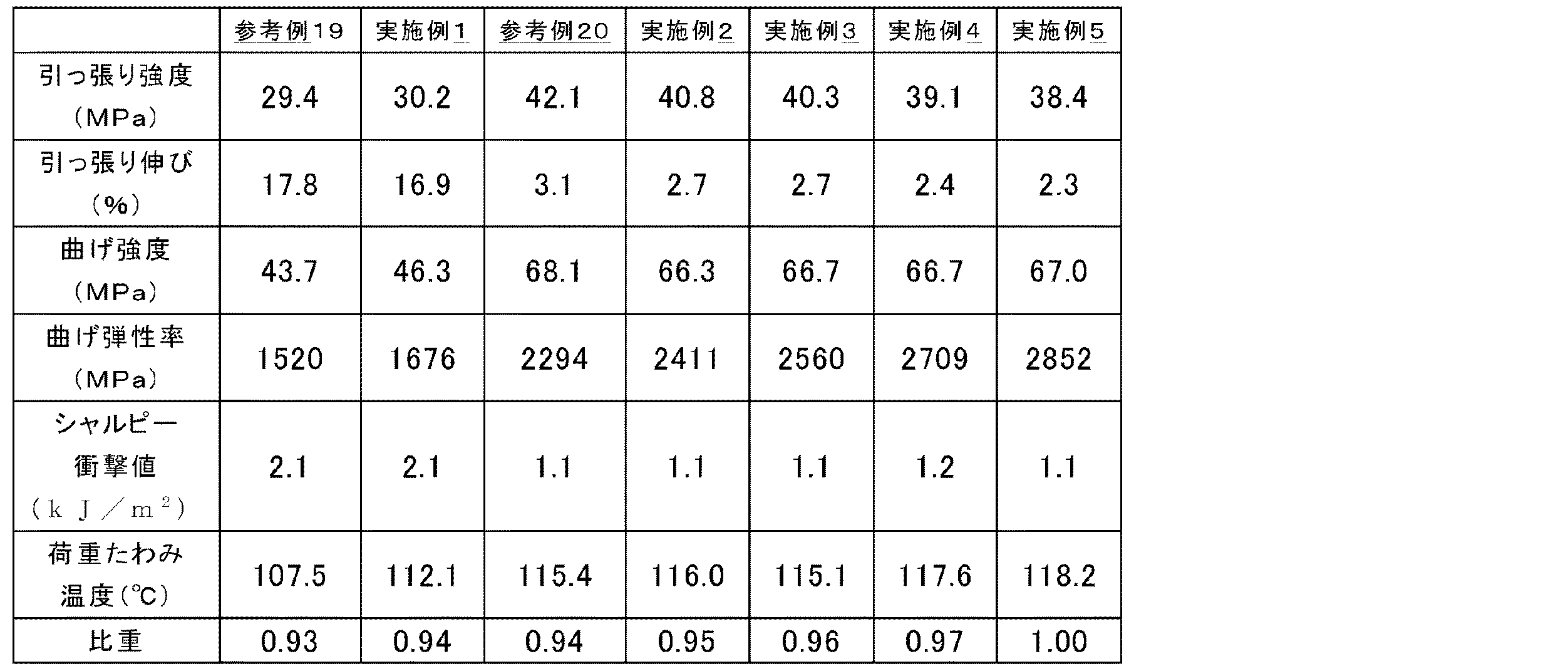
ISO527−2/1aに準拠し引張り強度、引張り伸びを測定した。測定結果を表5から8に示した。比較例2、5においては引張り伸びが200%を超える結果となり、200%に達した時点で測定を終了した。
<Evaluation>
[Tensile test]
Tensile strength and tensile elongation were measured according to ISO 527-2 / 1a. The measurement results are shown in Tables 5 to 8. In Comparative Examples 2 and 5, the tensile elongation exceeded 200%, and the measurement was terminated when it reached 200%.
[曲げ試験]
ISO178に準拠してこれらの試験片の曲げ強度、曲げ弾性率を測定した。測定結果を表5から8に示した。
[Bending test]
Based on ISO178, the bending strength and bending elastic modulus of these test pieces were measured. The measurement results are shown in Tables 5 to 8.
[シャルピー衝撃値]
ISO179/1eAに準拠して、東洋精機製作所社製、シャルピー衝撃値測定装置を用いて測定を行った。測定結果を表5から8に示した。
[Charpy impact value]
In accordance with ISO179 / 1eA, measurement was performed using a Charpy impact value measuring device manufactured by Toyo Seiki Seisakusho. The measurement results are shown in Tables 5 to 8.
[荷重たわみ温度]
ISO75−1,2に準拠して、これらの射出成形試験片の荷重たわみ温度を測定した。測定は1.8MPa荷重にて行った。測定結果を表5から8に示した。
[Load deflection temperature]
Based on ISO75-1,2, the deflection temperature under load of these injection molding test pieces was measured. The measurement was performed with a 1.8 MPa load. The measurement results are shown in Tables 5 to 8.
[比重]
比重の測定は、ISO1183に準拠して測定した。測定結果を表5から8に示した。
[specific gravity]
The specific gravity was measured according to ISO 1183. The measurement results are shown in Tables 5 to 8.
参考例1から18の結果から明らかなように、比重が1を大きく下回り、樹脂製品の軽量化が確認された。また、環状オレフィン系樹脂を含有することにより、低下する物性があるものの、一般的な自動車用部品に用いる場合には、ほとんど問題が無い程度である。そして、荷重たわみ温度、曲げ弾性率、引張り強度、曲げ強度等の物性は向上することが確認された。 As is clear from the results of Reference Examples 1 to 18, the specific gravity was significantly lower than 1, confirming the weight reduction of the resin product. Moreover, although it has the physical property which falls by containing cyclic olefin resin, when using for a general automotive part, it is a grade which hardly has a problem. And it was confirmed that physical properties, such as a deflection temperature under load, a bending elastic modulus, tensile strength, bending strength, improve.
環状オレフィン系樹脂を含有することで、シャルピー衝撃値が低下する傾向にあるが、参考例1、参考例2から7、参考例8から15の結果から明らかなように、ポリプロピレン樹脂がブロック共重合体であれば、他のポリプロピレン樹脂を用いた場合と比較してシャルピー衝撃値の値が大きくなることが確認された。 The Charpy impact value tends to decrease by containing the cyclic olefin resin, but as is clear from the results of Reference Example 1, Reference Examples 2 to 7, and Reference Examples 8 to 15, the polypropylene resin is block co-polymerized. In the case of coalescence, it was confirmed that the Charpy impact value was increased as compared with the case where other polypropylene resins were used.
参考例5と参考例6、及び参考例10と参考例11の結果から明らかなように、溶融粘度の高い環状オレフィン系樹脂を用いた方が、溶融粘度の低い環状オレフィン系樹脂を用いる場合と比較して、引張り伸びやシャルピー衝撃値が優れることが確認された。環状オレフィン系樹脂を含有することで引張り伸び、シャルピー衝撃値は低下する傾向にあるが、溶融粘度の高い環状オレフィン系樹脂を用いることで、これらの物性の低下を抑えることができる。 As is clear from the results of Reference Example 5 and Reference Example 6 and Reference Example 10 and Reference Example 11, the use of a cyclic olefin resin having a high melt viscosity and a case where a cyclic olefin resin having a low melt viscosity is used. In comparison, it was confirmed that the tensile elongation and Charpy impact value were excellent. By including the cyclic olefin resin, the tensile elongation and the Charpy impact value tend to decrease, but by using a cyclic olefin resin having a high melt viscosity, it is possible to suppress a decrease in these physical properties.
参考例3、6、7、及び参考例11、12、14の結果から、耐熱性に問題が無ければ、ガラス転移点の低い環状オレフィン系樹脂を用いた方が、シャルピー衝撃値、引張り伸びの低下が少ないことが確認された。 From the results of Reference Examples 3, 6, 7 and Reference Examples 11, 12, and 14, if there is no problem in heat resistance, the use of a cyclic olefin-based resin having a low glass transition point has a higher Charpy impact value and tensile elongation. It was confirmed that there was little decrease.
参考例14、参考例15と参考例16から17の結果から、エラストマー樹脂を含有させることで、シャルピー衝撃値、引張り伸びの低下をさらに抑えることができることが確認された。したがって、溶融粘度の高い環状オレフィン系樹脂を用い、可能な限りガラス転移点の低い環状オレフィン系樹脂を用い、エラストマー樹脂を含有させることで、引張り伸び及びシャルピー衝撃値の低下を大幅に抑えることができる。 From the results of Reference Example 14, Reference Example 15 and Reference Examples 16 to 17, it was confirmed that inclusion of an elastomer resin can further suppress the decrease in Charpy impact value and tensile elongation. Therefore, by using a cyclic olefin resin having a high melt viscosity, using a cyclic olefin resin having a glass transition point as low as possible, and containing an elastomer resin, it is possible to greatly suppress the decrease in tensile elongation and Charpy impact value. it can.
参考例2から4、及び参考例13から15の結果から、ポリプロピレン樹脂の含有量を減らし、環状オレフィン系樹脂の含有量を増加させるほど、引張り伸び、シャルピー衝撃値の値が低下することが確認された。しかし、これらの物性低下は上記の通りある程度抑えることが可能である。したがって、これらの物性の低下、及び上記の改善を調整することで所望の軽量材料を得ることができる。 From the results of Reference Examples 2 to 4 and Reference Examples 13 to 15, it is confirmed that the tensile elongation and the Charpy impact value decrease as the content of the polypropylene resin is reduced and the content of the cyclic olefin resin is increased. It was done. However, these physical property degradations can be suppressed to some extent as described above. Therefore, a desired lightweight material can be obtained by adjusting these physical properties and the above improvement.
参考例19と実施例1との比較、及び参考例20と実施例2との比較から、ポリプロピレン樹脂としてホモ重合体を用い、タルクを少量添加することで、曲げ弾性率が大きく向上することが確認された。また、参考例20、実施例2から5及び比較例6の結果から、ポリプロピレン樹脂単独で使用する場合と比較して、曲げ弾性率、曲げ強度、荷重たわみ温度、引張強度等の物性を改善できることが確認された。また、実施例22から25及び比較例7から、タルクの含有量が10質量%以下であればポリプロピレン系樹脂材料の比重は1以下になることが確認された。 From a comparison between Reference Example 19 and Example 1 and a comparison between Reference Example 20 and Example 2 , using a homopolymer as the polypropylene resin and adding a small amount of talc can greatly improve the flexural modulus. confirmed. Further, from the results of Reference Example 20, Examples 2 to 5 and Comparative Example 6, physical properties such as bending elastic modulus, bending strength, deflection temperature under load, and tensile strength can be improved as compared with the case of using polypropylene resin alone. Was confirmed. Moreover, from Examples 22 to 25 and Comparative Example 7, it was confirmed that the specific gravity of the polypropylene resin material was 1 or less when the talc content was 10% by mass or less.
Claims (1)
Priority Applications (1)
| Application Number | Priority Date | Filing Date | Title |
|---|---|---|---|
| JP2009031802A JP5259447B2 (en) | 2008-10-22 | 2009-02-13 | Polypropylene resin material and method for improving physical properties of polypropylene resin material |
Applications Claiming Priority (3)
| Application Number | Priority Date | Filing Date | Title |
|---|---|---|---|
| JP2008272101 | 2008-10-22 | ||
| JP2008272101 | 2008-10-22 | ||
| JP2009031802A JP5259447B2 (en) | 2008-10-22 | 2009-02-13 | Polypropylene resin material and method for improving physical properties of polypropylene resin material |
Publications (2)
| Publication Number | Publication Date |
|---|---|
| JP2010121103A JP2010121103A (en) | 2010-06-03 |
| JP5259447B2 true JP5259447B2 (en) | 2013-08-07 |
Family
ID=42322709
Family Applications (1)
| Application Number | Title | Priority Date | Filing Date |
|---|---|---|---|
| JP2009031802A Expired - Fee Related JP5259447B2 (en) | 2008-10-22 | 2009-02-13 | Polypropylene resin material and method for improving physical properties of polypropylene resin material |
Country Status (1)
| Country | Link |
|---|---|
| JP (1) | JP5259447B2 (en) |
Families Citing this family (3)
| Publication number | Priority date | Publication date | Assignee | Title |
|---|---|---|---|---|
| JP5345826B2 (en) * | 2008-11-06 | 2013-11-20 | ポリプラスチックス株式会社 | Light guide plate |
| JP2012025812A (en) * | 2010-07-21 | 2012-02-09 | Idemitsu Unitech Co Ltd | Resin composition, resin sheet and method for producing resin sheet |
| JP2019195913A (en) * | 2018-05-08 | 2019-11-14 | 聖州企業股▲ふん▼有限公司 | Manufacturing method of roof box, and structure of roof box thereof |
Family Cites Families (7)
| Publication number | Priority date | Publication date | Assignee | Title |
|---|---|---|---|---|
| JPH10219045A (en) * | 1997-02-06 | 1998-08-18 | Mitsubishi Chem Corp | Resin molding |
| JP2002060566A (en) * | 2000-08-11 | 2002-02-26 | Japan Polychem Corp | Resin composition for heat-shrinkable polypropylene label and film using the same |
| JP2002249625A (en) * | 2001-02-27 | 2002-09-06 | Nippon Zeon Co Ltd | Polypropylene resin composition for sheet thermoforming and polypropylene resin sheet |
| JP4691283B2 (en) * | 2001-09-13 | 2011-06-01 | 日本ポリプロ株式会社 | Polyolefin resin composition and molded article thereof |
| JP4341359B2 (en) * | 2003-09-30 | 2009-10-07 | 住友化学株式会社 | Propylene polymer composition |
| JP5160028B2 (en) * | 2005-04-29 | 2013-03-13 | 日本ポリプロ株式会社 | Resin composition for polypropylene heat-shrinkable film, polypropylene heat-shrinkable film using the same, and use thereof |
| JP2008115294A (en) * | 2006-11-06 | 2008-05-22 | Toyo Heisei Polymer Kk | Easy-open sealant resin composition and film |
-
2009
- 2009-02-13 JP JP2009031802A patent/JP5259447B2/en not_active Expired - Fee Related
Also Published As
| Publication number | Publication date |
|---|---|
| JP2010121103A (en) | 2010-06-03 |
Similar Documents
| Publication | Publication Date | Title |
|---|---|---|
| US7446147B2 (en) | Propylene resin composition | |
| JP5547471B2 (en) | Automotive interior parts with reduced squeaking noise | |
| US20210017318A1 (en) | Hydrogenated Block Copolymer, Hydrogenated Block Copolymer Composition, and Molded Article | |
| JP2010121103A (en) | Polypropylene-based resin material, and method for improving physical property of the polypropylene-based resin material | |
| CA3033174C (en) | Thermoplastic resin composition having reduced impact noise and molded body having reduced impact noise | |
| KR100293105B1 (en) | Crystalline propylene block-copolymer composition for use in automobile parts | |
| JP2012171982A (en) | Automobile exterior component made of polypropylene/polyphenylene ether-based resin composition | |
| WO1999011708A1 (en) | Polyolefin resin compositions | |
| KR101734772B1 (en) | Composition of polypropylene having high impact strength and high adhesion | |
| JP5369421B2 (en) | Resin composition and resin product | |
| JP4363604B2 (en) | Elastomer composition with excellent scratch resistance | |
| JP3238575B2 (en) | Automotive interior resin composition | |
| JPH093299A (en) | Polypropylene composition | |
| JP3119511B2 (en) | Automotive resin composition | |
| JP5305414B2 (en) | Propylene resin composition | |
| JP2012172136A (en) | Thermoplastic elastomer composition | |
| JP2000281862A (en) | Elastomer composition having excellent scratch resistance | |
| TW202212377A (en) | Resin composition, resin modifier, dispersion composition, member for automobile, and method for producing resin composition | |
| JP3119512B2 (en) | Automotive resin composition | |
| JP4368467B2 (en) | Elastomer composition | |
| JP2877886B2 (en) | Automotive parts | |
| JP2005264033A (en) | Polypropylene resin composition | |
| JP2000186177A (en) | Thermoplastic resin composition | |
| JPH1160749A (en) | Method for producing thermoplastic elastomer | |
| JPH1160749A5 (en) |
Legal Events
| Date | Code | Title | Description |
|---|---|---|---|
| A621 | Written request for application examination |
Free format text: JAPANESE INTERMEDIATE CODE: A621 Effective date: 20111222 |
|
| A977 | Report on retrieval |
Free format text: JAPANESE INTERMEDIATE CODE: A971007 Effective date: 20121009 |
|
| A131 | Notification of reasons for refusal |
Free format text: JAPANESE INTERMEDIATE CODE: A131 Effective date: 20121016 |
|
| A521 | Request for written amendment filed |
Free format text: JAPANESE INTERMEDIATE CODE: A523 Effective date: 20121102 |
|
| A131 | Notification of reasons for refusal |
Free format text: JAPANESE INTERMEDIATE CODE: A131 Effective date: 20130108 |
|
| A521 | Request for written amendment filed |
Free format text: JAPANESE INTERMEDIATE CODE: A523 Effective date: 20130129 |
|
| TRDD | Decision of grant or rejection written | ||
| A01 | Written decision to grant a patent or to grant a registration (utility model) |
Free format text: JAPANESE INTERMEDIATE CODE: A01 Effective date: 20130402 |
|
| A61 | First payment of annual fees (during grant procedure) |
Free format text: JAPANESE INTERMEDIATE CODE: A61 Effective date: 20130424 |
|
| FPAY | Renewal fee payment (event date is renewal date of database) |
Free format text: PAYMENT UNTIL: 20160502 Year of fee payment: 3 |
|
| R150 | Certificate of patent or registration of utility model |
Ref document number: 5259447 Country of ref document: JP Free format text: JAPANESE INTERMEDIATE CODE: R150 Free format text: JAPANESE INTERMEDIATE CODE: R150 |
|
| R250 | Receipt of annual fees |
Free format text: JAPANESE INTERMEDIATE CODE: R250 |
|
| R250 | Receipt of annual fees |
Free format text: JAPANESE INTERMEDIATE CODE: R250 |
|
| R250 | Receipt of annual fees |
Free format text: JAPANESE INTERMEDIATE CODE: R250 |
|
| R250 | Receipt of annual fees |
Free format text: JAPANESE INTERMEDIATE CODE: R250 |
|
| R250 | Receipt of annual fees |
Free format text: JAPANESE INTERMEDIATE CODE: R250 |
|
| R250 | Receipt of annual fees |
Free format text: JAPANESE INTERMEDIATE CODE: R250 |
|
| LAPS | Cancellation because of no payment of annual fees |