JP5154968B2 - Method for reforming and separating mixed gas containing carbon dioxide - Google Patents
Method for reforming and separating mixed gas containing carbon dioxide Download PDFInfo
- Publication number
- JP5154968B2 JP5154968B2 JP2008032713A JP2008032713A JP5154968B2 JP 5154968 B2 JP5154968 B2 JP 5154968B2 JP 2008032713 A JP2008032713 A JP 2008032713A JP 2008032713 A JP2008032713 A JP 2008032713A JP 5154968 B2 JP5154968 B2 JP 5154968B2
- Authority
- JP
- Japan
- Prior art keywords
- gas
- carbon dioxide
- blast furnace
- hydrogen
- carbon monoxide
- Prior art date
- Legal status (The legal status is an assumption and is not a legal conclusion. Google has not performed a legal analysis and makes no representation as to the accuracy of the status listed.)
- Expired - Fee Related
Links
Images
Landscapes
- Hydrogen, Water And Hydrids (AREA)
Description
本発明は、製鉄所の高炉炉頂から排出される高炉ガスなどの二酸化炭素を含有する混合ガスの改質・分離方法に関し、詳しくは、二酸化炭素を含有する混合ガス中の二酸化炭素をジメチルエーテルと反応させて一酸化炭素と水素とに改質し、混合ガス中の二酸化炭素含有量を削減または除去した上で、この混合ガスから一酸化炭素及び水素を分離・回収する方法に関するものである。 The present invention relates to a method for reforming / separating a mixed gas containing carbon dioxide such as blast furnace gas discharged from the top of a blast furnace of an ironworks. Specifically, carbon dioxide in a mixed gas containing carbon dioxide is converted to dimethyl ether. The present invention relates to a method for reforming to carbon monoxide and hydrogen by reaction to reduce or remove the carbon dioxide content in the mixed gas, and to separate and recover carbon monoxide and hydrogen from the mixed gas.
銑鋼一貫製鉄所において、鉄鉱石を還元して溶銑を製造する高炉の炉頂から排出される高炉ガスは、熱風炉燃料ガス、コークス炉燃料ガス及び発電所用燃料ガスとして有効利用されている。しかしながら高炉ガスは、その組成が、一酸化炭素:21.1〜26.2体積%、二酸化炭素:19.3〜23.2体積%、水素:2.9〜5.3体積%、窒素:52.5〜59.2体積%であり、可燃性ガス成分が少なく、その発熱量が3031〜3784kJ(723〜903kcal/Nm3)と低く(第4版鉄鋼便覧(CD-ROM)No.1第2巻製銑・製鋼、2002年7月30日発行、表42-5・7(2000)を参照)、単独で燃料ガスとして使用すると、燃焼ガス温度が低くて高温用途には適していない。そこで、高炉ガスと同様に製鉄所の副生ガスであるコークス炉ガスや転炉ガスなどの2000kcal/Nm3以上の発熱量を有する高カロリー副生ガスと混合されて、上記用途に利用されている。
Blast furnace gas discharged from the top of a blast furnace where iron ore is reduced to produce molten iron at an integrated iron and steel works is effectively used as a hot blast furnace fuel gas, a coke oven fuel gas, and a power plant fuel gas. However, the composition of the blast furnace gas is as follows: carbon monoxide: 21.1 to 26.2% by volume, carbon dioxide: 19.3 to 23.2% by volume, hydrogen: 2.9 to 5.3% by volume, nitrogen: 52.5 to 59.2% by volume, low in combustible gas components, and its calorific value is as low as 3031 to 3784 kJ (723 to 903 kcal / Nm 3 ) (Fourth Edition Steel Handbook (CD-ROM) No.1)
製鉄所における副生ガスの発生量では、高炉ガスの発生量が他の副生ガスに比べて圧倒的に多く、その利用のために大量のコークス炉ガスや転炉ガスが増熱用ガスとして消費されている。特に近年、高炉の操業は重油吹き込みから微粉炭吹き込みに転換していることから、高炉ガスの発生量が増大する傾向にあり、それに伴って増熱用高カロリー副生ガスの消費量が増加し、従来、製鉄所下工程の鋼材加熱炉で使用していた高カロリーの副生ガスの不足が懸念される事態となりつつある。高カロリーの副生ガスの代替としては、LPGやLNGなどの購入燃料が使用されることになる。 The amount of by-product gas generated at steelworks is overwhelmingly higher than that of other by-product gases, and a large amount of coke oven gas and converter gas is used as the heat increasing gas. Is consumed. In particular, in recent years, the operation of blast furnaces has shifted from heavy oil blowing to pulverized coal blowing, so there is a tendency for the amount of blast furnace gas generation to increase, and accordingly, the consumption of high-calorie by-product gas for heating increases. Conventionally, the shortage of high-calorie by-product gas that has been used in steel heating furnaces in the steelworks sub-process is becoming a concern. As an alternative to high-calorie by-product gas, purchased fuel such as LPG and LNG will be used.
そこで、高炉ガスを発熱量が高くなるように改質し、単独での利用を可能とする手段が幾つか提案されている。例えば、特許文献1には、高炉炉頂から排出される高炉ガスから二酸化炭素を分離除去して、900kcal/Nm3以上の発熱量の改質高炉ガスを製造し、この改質高炉ガスを、高炉ガス、コークス炉ガス、転炉ガス、LPGガスの何れか1種または2種以上の一部または全部と代替することが提案されている。 In view of this, several means have been proposed for reforming the blast furnace gas so as to increase the calorific value so that it can be used alone. For example, in Patent Document 1, carbon dioxide is separated and removed from the blast furnace gas discharged from the top of the blast furnace to produce a reformed blast furnace gas having a calorific value of 900 kcal / Nm 3 or more. It has been proposed to replace some or all of one or more of blast furnace gas, coke oven gas, converter gas, and LPG gas.
このようにして改質した高炉ガスを使用することにより、増熱用高カロリー副生ガスの消費量はそれなりに減少するものの、特許文献1のように、高炉ガスから二酸化炭素のみを除去した場合に生成される改質高炉ガスは、およそ70体積%程度の窒素を含有しており、その発熱量は高々1000kcal/Nm3程度にしかならない。即ち、他の副生ガスであるコークス炉ガスや転炉ガスに較べると発熱量が高いとはいえず、コークス炉ガス、転炉ガス、LPGガスのうちの何れか1種の全部と代替することはできない。また、特許文献1には、分離した二酸化炭素の利用方法については何ら記載されておらず、分離した二酸化炭素を単に空気中に放散したり、ドライアイスの原料としたりする程度では、二酸化炭素の分離のための費用を考慮すると、発熱量の増加分が少ないことから、効率的な方法とはいえない。また、発熱量をより一層高くするために、二酸化炭素を分離した後の高炉ガスから、一酸化炭素及び水素を分離・回収しようとする場合には、70体積%程度を占める窒素の影響によって、一酸化炭素及び水素の効率的な分離・回収が損なわれる。 When the reformed blast furnace gas is used, the consumption of the high-calorie by-product gas for heat increase is reduced accordingly. However, as in Patent Document 1, only carbon dioxide is removed from the blast furnace gas. The reformed blast furnace gas produced in this step contains about 70% by volume of nitrogen, and its calorific value is only about 1000 kcal / Nm 3 at most. That is, it cannot be said that the calorific value is high compared to coke oven gas or converter gas, which is another by-product gas, and is replaced with any one of coke oven gas, converter gas, and LPG gas. It is not possible. Patent Document 1 does not describe any method for using the separated carbon dioxide. To the extent that the separated carbon dioxide is simply diffused into the air or used as a raw material for dry ice, Considering the cost for separation, the increase in the calorific value is small, so it is not an efficient method. In order to further increase the calorific value, when carbon monoxide and hydrogen are to be separated and recovered from the blast furnace gas after carbon dioxide is separated, the influence of nitrogen occupying about 70% by volume, Efficient separation and recovery of carbon monoxide and hydrogen is impaired.
ところで、二酸化炭素をジメチルエーテルと反応させ、ジメチルエーテル及び二酸化炭素を、水素及び一酸化炭素を主成分とする合成ガスに改質することは公知であり、例えば特許文献2には、ジメチルエーテルに二酸化炭素を加え、製鉄所や発電所などで発生する200〜500℃の中低温排熱を利用して触媒反応させ、水素及び一酸化炭素を主成分とする合成ガスに改質し、得られた合成ガスを燃料として発電することが提案されている。しかしながら、特許文献2では、使用する二酸化炭素の出所を明示しておらず、この使用目的のために二酸化炭素を製造した場合には、ジメチルエーテルの改質コストは高価となる。
本発明は上記事情に鑑みてなされたもので、その目的とするところは、高炉ガスなどの二酸化炭素を含有する混合ガスから、発熱量を高めるなどの目的のために、一酸化炭素及び水素を分離・回収するにあたり、従来、前記混合ガスから分離・除去されていた二酸化炭素を分離・除去することなく、逆に二酸化炭素を有効活用して、前記混合ガスから高回収率且つ高効率で一酸化炭素及び水素を分離・回収することができ、その結果、前記混合ガスの発熱量を従来に比較して大幅に高めることが可能となる、二酸化炭素を含有する混合ガスの改質・分離方法を提供することである。 The present invention has been made in view of the above circumstances. The object of the present invention is to add carbon monoxide and hydrogen from the mixed gas containing carbon dioxide such as blast furnace gas for the purpose of increasing the calorific value. In separation / recovery, the carbon dioxide that has been separated / removed from the mixed gas is not separated / removed from the conventional mixed gas, but instead, the carbon dioxide is effectively used to achieve a high recovery rate and high efficiency from the mixed gas. A method for reforming / separating a mixed gas containing carbon dioxide, which can separate and recover carbon oxide and hydrogen, and as a result, can greatly increase the calorific value of the mixed gas compared to the conventional one. Is to provide.
本発明者等は、上記課題を解決するために鋭意研究・検討した。その結果、二酸化炭素を含有する混合ガスをジメチルエーテルと反応させることにより、混合ガス中の二酸化炭素を実質的に除去でき、且つ、混合ガス中の一酸化炭素及び水素の含有量を高めることができ、その結果、二酸化炭素及び窒素の少ない混合ガスに改質できることを見出した。即ち、ジメチルエーテルと混合ガスに含有される二酸化炭素とを反応させて、一酸化炭素と水素とを製造することにより、二酸化炭素を実質的に除去できると同時に、一酸化炭素及び水素の含有量が上昇し、それに応じて窒素の濃度が低下することを見出した。 The present inventors have intensively studied and studied to solve the above problems. As a result, by reacting the mixed gas containing carbon dioxide with dimethyl ether, carbon dioxide in the mixed gas can be substantially removed, and the contents of carbon monoxide and hydrogen in the mixed gas can be increased. As a result, it has been found that the gas can be reformed into a mixed gas containing little carbon dioxide and nitrogen. That is, by reacting dimethyl ether and carbon dioxide contained in the mixed gas to produce carbon monoxide and hydrogen, carbon dioxide can be substantially removed, and at the same time, the contents of carbon monoxide and hydrogen are reduced. It was found that the concentration increased and the nitrogen concentration decreased accordingly.
本発明者等は、既にジメチルエーテルと二酸化炭素とを反応させて、一酸化炭素と水素とを製造するジメチルエーテルの二酸化炭素による改質について、数多くの開発を行っており(例えば、特開2003−10684号公報など)、ジメチルエーテルの二酸化炭素による改質においては、所定の触媒を用いれば、300℃以上の反応温度にて、99%以上の反応率で一酸化炭素と水素とを製造できることを確認している。 The present inventors have already made many developments on reforming dimethyl ether with carbon dioxide to produce carbon monoxide and hydrogen by reacting dimethyl ether and carbon dioxide (for example, JP-A-2003-10684). In the reforming of dimethyl ether with carbon dioxide, it was confirmed that carbon monoxide and hydrogen could be produced at a reaction rate of 99% or higher at a reaction temperature of 300 ° C. or higher by using a predetermined catalyst. ing.
即ち、製鉄所において、高炉ガスをジメチルエーテルと反応させることにより、高炉ガス中の二酸化炭素を実質的に除去できると同時に、高炉ガス中の一酸化炭素濃度及び水素濃度を高めることができ、それによって高炉ガス中の窒素濃度が下がり、二酸化炭素を分離しなくても、改質した高炉ガスから、有用成分である一酸化炭素及び水素を効率的に分離・回収することが可能となるとの知見が得られた。 That is, by reacting the blast furnace gas with dimethyl ether at the steelworks, carbon dioxide in the blast furnace gas can be substantially removed, and at the same time, the carbon monoxide concentration and the hydrogen concentration in the blast furnace gas can be increased. There is a finding that the nitrogen concentration in the blast furnace gas is reduced, and carbon monoxide and hydrogen, which are useful components, can be efficiently separated and recovered from the modified blast furnace gas without separating carbon dioxide. Obtained.
本発明は、上記検討結果に基づいてなされたものであり、第1の発明に係る二酸化炭素を含有する混合ガスの改質・分離方法は、少なくとも二酸化炭素を含有する混合ガスを触媒の存在下でジメチルエーテルと反応させて、ジメチルエーテル及び混合ガス中の二酸化炭素を一酸化炭素と水素とに改質し、これにより、混合ガス中の二酸化炭素を削減または除去すると同時に、混合ガス中の一酸化炭素及び水素の含有量を増加させ、その後、改質した混合ガスから一酸化炭素及び水素を分離することを特徴とするものである。 The present invention has been made on the basis of the above examination results. The method for reforming / separating a mixed gas containing carbon dioxide according to the first invention is characterized in that at least a mixed gas containing carbon dioxide is added in the presence of a catalyst. The carbon dioxide in the mixed gas is reduced or removed, and at the same time, the carbon monoxide in the mixed gas is reformed with dimethyl ether and carbon dioxide in the mixed gas to carbon monoxide and hydrogen. And the hydrogen content is increased, and then carbon monoxide and hydrogen are separated from the reformed mixed gas.
第2の発明に係る二酸化炭素を含有する混合ガスの改質・分離方法は、少なくとも二酸化炭素及び窒素を含有する混合ガスを触媒の存在下でジメチルエーテルと反応させて、ジメチルエーテル及び混合ガス中の二酸化炭素を一酸化炭素と水素とに改質し、これにより、混合ガス中の二酸化炭素を削減または除去すると同時に、混合ガス中の一酸化炭素及び水素の含有量を増加させ、その後、改質した混合ガスを、一酸化炭素を主成分とするガス、水素を主成分とするガス、窒素を主成分とするガスの3種類に分離することを特徴とするものである。 The method for reforming / separating a mixed gas containing carbon dioxide according to the second aspect of the present invention comprises reacting a mixed gas containing at least carbon dioxide and nitrogen with dimethyl ether in the presence of a catalyst to obtain dimethyl ether and carbon dioxide in the mixed gas. Reforming carbon to carbon monoxide and hydrogen, thereby reducing or removing carbon dioxide in the mixed gas, and at the same time increasing the content of carbon monoxide and hydrogen in the mixed gas, and then reforming The mixed gas is separated into three types: a gas mainly composed of carbon monoxide, a gas mainly composed of hydrogen, and a gas mainly composed of nitrogen.
第3の発明に係る二酸化炭素を含有する混合ガスの改質・分離方法は、第1または第2の発明において、前記混合ガスは、製鉄所の高炉から排出される高炉ガスであることを特徴とするものである。 The method for reforming / separating a mixed gas containing carbon dioxide according to a third invention is characterized in that, in the first or second invention, the mixed gas is a blast furnace gas discharged from a blast furnace of an ironworks. It is what.
本発明によれば、ジメチルエーテルと、二酸化炭素を含有する混合ガス中の二酸化炭素とを反応させて、一酸化炭素と水素とに転化するので、改質後の混合ガス中の二酸化炭素を実質的に除去することができるとともに、改質後の混合ガス中の一酸化炭素濃度及び水素濃度を高め、且つ、窒素濃度を低下することができるので、混合ガスから二酸化炭素を分離する工程を実施することなく、改質した混合ガスから、有用成分である一酸化炭素及び水素を高回収率且つ高効率で分離・回収することができる。 According to the present invention, dimethyl ether and carbon dioxide in a mixed gas containing carbon dioxide are reacted to be converted into carbon monoxide and hydrogen. Therefore, the carbon dioxide in the mixed gas after reforming is substantially reduced. In addition, the carbon monoxide concentration and hydrogen concentration in the mixed gas after reforming can be increased, and the nitrogen concentration can be lowered. Therefore, a step of separating carbon dioxide from the mixed gas is performed. Thus, carbon monoxide and hydrogen, which are useful components, can be separated and recovered with high recovery rate and high efficiency from the reformed mixed gas.
以下、二酸化炭素を含有する混合ガスとして製鉄所の高炉から排出される高炉ガスを例として、本発明を高炉ガスに適用した場合について、具体的に説明する。 Hereinafter, the case where the present invention is applied to a blast furnace gas will be described in detail by taking as an example a blast furnace gas discharged from a blast furnace at a steelworks as a mixed gas containing carbon dioxide.
二酸化炭素を含有する混合ガスの1例である高炉ガスには、二酸化炭素(「CO2」とも記す)が19〜24体積%、一酸化炭素(「CO」とも記す)が21〜27体積%、水素(「H2」とも記す)が2〜6体積%含まれており、残りの成分は窒素(「N2」とも記す)である。本発明では、この二酸化炭素を原料としてジメチルエーテル(「CH3OCH3」とも記す)と反応させて、一酸化炭素と水素とに転化させる。この反応式を下記の(1)式に示す。 The blast furnace gas, which is an example of a mixed gas containing carbon dioxide, includes 19 to 24% by volume of carbon dioxide (also referred to as “CO 2 ”) and 21 to 27% by volume of carbon monoxide (also referred to as “CO”). , Hydrogen (also referred to as “H 2 ”) is contained in an amount of 2 to 6% by volume, and the remaining component is nitrogen (also referred to as “N 2 ”). In the present invention, this carbon dioxide is used as a raw material and reacted with dimethyl ether (also referred to as “CH 3 OCH 3 ”) to convert it into carbon monoxide and hydrogen. This reaction formula is shown in the following formula (1).
CH3OCH3+CO2 →3CO+3H2 …(1)
(1)式に示すように、この改質反応により、1モルのジメチルエーテルと1モルの二酸化炭素から、3モルの水素と3モルの一酸化炭素とが生成し、分子数が3倍に増大して体積膨張が発生することが分かる。また、この改質反応により、発熱量は、ジメチルエーテル1モル当たり58kcal増加し、ジメチルエーテルの発熱量が318kcal/molであることから、約18%の熱量増加になる。
CH 3 OCH 3 + CO 2 → 3CO + 3H 2 (1)
As shown in formula (1), this reforming reaction generates 3 moles of hydrogen and 3 moles of carbon monoxide from 1 mole of dimethyl ether and 1 mole of carbon dioxide, and the number of molecules increases three times. It can be seen that volume expansion occurs. Further, due to this reforming reaction, the calorific value increases by 58 kcal per mole of dimethyl ether, and the calorific value of dimethyl ether is 318 kcal / mol, so that the calorific value is increased by about 18%.
また、(1)式の反応は、ジメチルエーテルを残留させなくても二酸化炭素がほぼ無くなるまで進行し、従って、反応後の高炉ガスの成分は、実質的に、一酸化炭素と水素と窒素のみとなり、高炉ガスの発熱量を増加しようとする際には、二酸化炭素を分離・除去する必要がなくなるのみならず、水素及び一酸化炭素の含有量が増加し、それに伴って相対的に窒素濃度が低下することから、水素及び一酸化炭素の分離・回収工程を効率的に行うことが可能となる。 Further, the reaction of the formula (1) proceeds until almost no carbon dioxide is left even if dimethyl ether does not remain. Therefore, the components of the blast furnace gas after the reaction are substantially only carbon monoxide, hydrogen and nitrogen. When trying to increase the calorific value of the blast furnace gas, not only does it become unnecessary to separate and remove carbon dioxide, but the content of hydrogen and carbon monoxide increases, and accordingly the nitrogen concentration is relatively increased. Therefore, it is possible to efficiently perform the separation and recovery process of hydrogen and carbon monoxide.
(1)式に示す反応では触媒を用いるが、触媒は、通常、原料ガス中の硫黄分やダストによる性能の劣化が起こり、しかも、高炉ガスには、ダスト(固体粒子)や硫黄分が含まれているので、予め高炉ガスを脱硫処理及びダスト除去処理しておくことが好ましい。因みに、高炉炉頂から排出された後にダストキャッチャー及びベンチュリースクラバーを通した後の高炉ガス中には、ダスト分としては、亜鉛、マンガン、鉄などの金属粉のほかに、炭素粉が最大5mg/Nm3程度混合しており、また、硫黄分としては、硫化カルボニル及び硫化水素が最大100mg−S/Nm3含まれている。脱硫処理やダスト除去処理の方法は、吸着による硫黄分除去やフィルターによるダスト除去など、慣用の方法を用いることができる。 In the reaction shown in the formula (1), a catalyst is used, but the catalyst usually deteriorates in performance due to sulfur content and dust in the raw material gas, and the blast furnace gas contains dust (solid particles) and sulfur content. Therefore, it is preferable that the blast furnace gas is subjected to desulfurization treatment and dust removal treatment in advance. Incidentally, in the blast furnace gas after it has been discharged from the top of the blast furnace and passed through the dust catcher and venturi scrubber, in addition to metal powders such as zinc, manganese, iron, etc., carbon powder can be up to 5 mg / About Nm 3 is mixed, and the sulfur content contains carbonyl sulfide and hydrogen sulfide at a maximum of 100 mg-S / Nm 3 . As a method for the desulfurization treatment or dust removal treatment, a conventional method such as sulfur removal by adsorption or dust removal by a filter can be used.
上記(1)式の反応に用いる触媒の種類は、特に限定されるものではなく、ジメチルエーテルの二酸化炭素による改質反応を行い得る触媒である限り、どのような触媒であっても構わない。但し、特に好ましい触媒としては、本発明者等の経験から、銅及びアルミナ(Al2O3)を含有する触媒が挙げられる。 The type of catalyst used in the reaction of the above formula (1) is not particularly limited, and any catalyst may be used as long as it is a catalyst capable of performing a reforming reaction of dimethyl ether with carbon dioxide. However, as a particularly preferable catalyst, a catalyst containing copper and alumina (Al 2 O 3 ) is mentioned from the experience of the present inventors.
また、(1)式の反応を行うための反応器としては、流動床式であっても、また固定床式であってもどちらでもよいが、加熱を効率的に行うことのできる方式が望ましい。効率的な反応器の1例としては、シェルアンドチューブ方式などがある。また、反応器に供給する熱源は、250〜400℃の反応温度が得られる限り、どのような熱源を使用しても構わないが、改質費用を下げる観点から、製鉄所で発生する燃焼排ガスなどの排熱を使用することが好ましい。 Further, the reactor for carrying out the reaction of the formula (1) may be either a fluidized bed type or a fixed bed type, but a system capable of performing heating efficiently is desirable. . An example of an efficient reactor is a shell and tube method. As the heat source supplied to the reactor, any heat source may be used as long as a reaction temperature of 250 to 400 ° C. is obtained. From the viewpoint of reducing the reforming cost, combustion exhaust gas generated at the steel works It is preferable to use exhaust heat.
反応条件としては、反応温度が250〜400℃の範囲、望ましくは300〜350℃の範囲、圧力が0.01〜0.5MPaの範囲、望ましくは0.07〜0.15MPaの範囲、接触時間が0.1〜50g−cat・h/molの範囲、望ましくは10〜40g−cat・h/molの範囲である。 As reaction conditions, the reaction temperature is in the range of 250 to 400 ° C., desirably in the range of 300 to 350 ° C., the pressure is in the range of 0.01 to 0.5 MPa, desirably in the range of 0.07 to 0.15 MPa, and the contact time. Is in the range of 0.1 to 50 g-cat · h / mol, desirably in the range of 10 to 40 g-cat · h / mol.
上記の方法で得られる反応成績は、反応条件による各温度での平衡転化率まで得ることができる。例えば、350℃での反応であれば、99.9%の二酸化炭素転化率が得られるため、実質的に二酸化炭素をガス中から除去することができる。因みに、二酸化炭素が22体積%、一酸化炭素が22体積%、水素が2体積%、窒素が54体積%の高炉ガスを350℃で反応させた場合には、改質後のガス組成は、一酸化炭素が41.9体積%、水素が32.4体積%、窒素が25.7体積%となる。一方、二酸化炭素のみを除去した場合のガス組成は、一酸化炭素が28.2体積%、水素が2.6体積%、窒素が69.2体積%となる。 The reaction results obtained by the above method can be obtained up to the equilibrium conversion rate at each temperature depending on the reaction conditions. For example, if the reaction is performed at 350 ° C., a carbon dioxide conversion rate of 99.9% can be obtained, so that carbon dioxide can be substantially removed from the gas. Incidentally, when a blast furnace gas containing 22% by volume of carbon dioxide, 22% by volume of carbon monoxide, 2% by volume of hydrogen and 54% by volume of nitrogen is reacted at 350 ° C., the gas composition after reforming is Carbon monoxide is 41.9% by volume, hydrogen is 32.4% by volume, and nitrogen is 25.7% by volume. On the other hand, when only carbon dioxide is removed, the gas composition is 28.2% by volume of carbon monoxide, 2.6% by volume of hydrogen, and 69.2% by volume of nitrogen.
ジメチルエーテルの二酸化炭素による改質が施された後の高炉ガス、つまり二酸化炭素の除去された改質高炉ガスから、一酸化炭素及び水素を回収する方法は、各種の吸着法、深冷分離法、膜分離法などの方法を用いることができるが、一酸化炭素、水素、窒素をそれぞれ分離し、有用な一酸化炭素及び水素を回収する場合には、吸着法を用いることが好ましい。また、水素回収を目的とする場合には、膜分離法が最適である。ここで、改質後の高炉ガスからの一酸化炭素、水素、窒素の分離に費やす動力などのエネルギー源は、省エネルギー及び二酸化炭素発生量の削減などの観点から、高炉炉体の冷却水、転炉排ガスの冷却水、加熱炉排ガスなどの製鉄所の排熱から回収したエネルギーを利用することが好ましい。 The method of recovering carbon monoxide and hydrogen from the blast furnace gas after the reforming of dimethyl ether with carbon dioxide, that is, the modified blast furnace gas from which carbon dioxide has been removed, includes various adsorption methods, cryogenic separation methods, Although a method such as a membrane separation method can be used, it is preferable to use an adsorption method when carbon monoxide, hydrogen, and nitrogen are separated and useful carbon monoxide and hydrogen are recovered. In addition, when the purpose is hydrogen recovery, the membrane separation method is optimal. Here, energy sources such as power consumed for separation of carbon monoxide, hydrogen, and nitrogen from the reformed blast furnace gas are blast furnace furnace cooling water, conversion water, etc. from the viewpoint of energy saving and reduction of carbon dioxide generation. It is preferable to use energy recovered from the exhaust heat of the steelworks such as furnace exhaust gas cooling water and heating furnace exhaust gas.
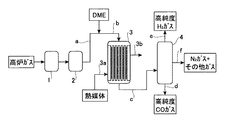
次いで、添付図面を参照して本発明の具体的な実施方法を説明する。図1は、本発明の実施形態例を示す概略工程図であり、図1において、符合1はダストフィルター、2は脱硫塔、3は改質反応器、4は吸着分離塔である。 Next, a specific implementation method of the present invention will be described with reference to the accompanying drawings. FIG. 1 is a schematic process diagram showing an embodiment of the present invention. In FIG. 1, reference numeral 1 is a dust filter, 2 is a desulfurization tower, 3 is a reforming reactor, and 4 is an adsorption separation tower.
図1に示すように、高炉から排出された高炉ガスは、先ず、ダストフィルター1に導入されてガス中に含まれる鉄分などのダストが除去され、次いで、脱硫塔2に導入されてガス中に含まれる硫黄分が除去される。このようにして、ダスト及び硫黄分の除去された高炉ガスaに、ジメチルエーテル(「DME」とも記す)を添加する。ジメチルエーテルの添加量は、高炉ガス中の二酸化炭素の当量と同一とするのが最も望ましい。つまり、ジメチルエーテルが残留することなく、しかも、高炉ガス中の二酸化炭素の全量がジメチルエーテルと反応するように添加量を設定することが最も望ましい。
As shown in FIG. 1, the blast furnace gas discharged from the blast furnace is first introduced into the dust filter 1 to remove dust such as iron contained in the gas, and then introduced into the
ジメチルエーテルが添加された高炉ガスbは、ジメチルエーテルと混合しながら、改質反応器3に供給される。改質反応器3は、シェルアンドチューブ式の反応器であり、チューブ内に、銅及びアルミナを含有する触媒が充填されている。また、改質反応器3のシェル側には、反応温度を確保するための熱媒体の供給路3a及び熱交換した後の熱媒体の排出路3bが設けられ、供給される熱媒体によって改質反応器3のチューブ内の温度が250〜400℃の範囲に維持されるようになっている。使用する熱媒体としては、前述したように、製鉄所で発生する燃焼排ガスなどの排熱を利用することが好ましい。また、改質反応器3の内部の圧力が0.01〜0.5MPaの範囲、接触時間が0.1〜50g−cat・h/molの範囲の範囲になるように、図示せぬポンプや弁によって制御されている。
The blast furnace gas b to which dimethyl ether has been added is supplied to the reforming reactor 3 while being mixed with dimethyl ether. The reforming reactor 3 is a shell and tube type reactor, and a catalyst containing copper and alumina is filled in the tube. Further, on the shell side of the reforming reactor 3, a heat
改質反応器3において、ジメチルエーテルと二酸化炭素とが混合され、且つ、熱が与えられることにより、触媒反応が進行し、ジメチルエーテルと二酸化炭素とが、一酸化炭素と水素とに転化される。 In the reforming reactor 3, when dimethyl ether and carbon dioxide are mixed and heat is applied, the catalytic reaction proceeds, and dimethyl ether and carbon dioxide are converted into carbon monoxide and hydrogen.
この改質反応によって二酸化炭素が実質的に除去された改質高炉ガスcは、吸着分離塔4に送られる。この場合、改質高炉ガスcを改質反応器3から吸着分離塔4に直接送る必要はなく、途中にガスホルダー(図示せず)などを配置して改質高炉ガスcを一旦貯留するようにしてもよい。 The reformed blast furnace gas c from which carbon dioxide has been substantially removed by this reforming reaction is sent to the adsorption separation tower 4. In this case, it is not necessary to send the reformed blast furnace gas c directly from the reforming reactor 3 to the adsorption separation tower 4, and a gas holder (not shown) or the like is arranged in the middle to temporarily store the reformed blast furnace gas c. It may be.
吸着分離塔4に充填される吸着剤としては、一酸化炭素、水素、窒素が或る程度分離され得る材料であれば何れも利用可能であり、特に指定するものではなく、市販の活性炭やゼオライトが使用可能である。また、吸着時の圧力、脱着時の圧力ともに特に指定するものではないが、操作の容易性から、吸着圧力は100〜500kPa、脱着圧力は5〜100kPaが好ましい。 Any adsorbent filled in the adsorption separation column 4 can be used as long as it can separate carbon monoxide, hydrogen, and nitrogen to some extent, and is not particularly specified. Can be used. Moreover, although the pressure at the time of adsorption | suction and the pressure at the time of desorption are not specified in particular, 100-500 kPa and a desorption pressure are 5-100 kPa from the ease of operation.
吸着分離塔4に導入された改質高炉ガスcは、一酸化炭素を主成分とするガスd、水素を主成分とするガスe、窒素を主成分とするものの、その他に一酸化炭素及び水素を含む混合ガスfに分離される。一酸化炭素を主成分とするガスdは、純度99%以上の高純度COであり、熱量3000kcal/Nm3以上の燃料ガスとして利用可能である他、化学原料としても有用である。同様に、水素を主成分とするガスeは、純度90%以上のH2である。吸着分離塔4では、吸着分離塔4へのガス導入及び吸着分離塔4からのガス排出の操作を繰り返し実施する。 The reformed blast furnace gas c introduced into the adsorptive separation tower 4 is composed of a gas d mainly composed of carbon monoxide, a gas e mainly composed of hydrogen, and nitrogen as a principal component, but also carbon monoxide and hydrogen. Into a mixed gas f containing The gas d containing carbon monoxide as a main component is high-purity CO having a purity of 99% or more, can be used as a fuel gas having a calorie of 3000 kcal / Nm 3 or more, and is also useful as a chemical raw material. Similarly, the gas e containing hydrogen as a main component is H 2 having a purity of 90% or more. In the adsorption separation tower 4, the operation of introducing gas into the adsorption separation tower 4 and discharging gas from the adsorption separation tower 4 is repeatedly performed.
このように、本発明によれば、二酸化炭素を含有する混合ガス中の二酸化炭素とジメチルエーテルとを反応させて一酸化炭素と水素とに転化するので、改質後の混合ガス中の二酸化炭素を実質的に除去することができるとともに、改質後の混合ガス中の一酸化炭素濃度及び水素濃度を高め、且つ、窒素濃度を低下することができるので、混合ガスから二酸化炭素を分離する工程を必要とせずに、改質した混合ガスから、有用成分である一酸化炭素及び水素を高回収率且つ効率的に分離・回収することが可能となる。 As described above, according to the present invention, carbon dioxide in the mixed gas containing carbon dioxide is reacted with dimethyl ether to be converted into carbon monoxide and hydrogen. The step of separating carbon dioxide from the mixed gas can be substantially removed, and the carbon monoxide concentration and hydrogen concentration in the reformed mixed gas can be increased and the nitrogen concentration can be decreased. Without being necessary, carbon monoxide and hydrogen, which are useful components, can be efficiently separated and recovered from the reformed mixed gas with a high recovery rate.
図1に示す装置及び工程で、高炉ガスの分離を行った。吸着分離塔における吸着剤としては、ゼオライトを使用し、改質反応器には、銅及びアルミナを含有する触媒を充填させた。この触媒は、以下の手順により作製した。 Blast furnace gas was separated using the apparatus and process shown in FIG. Zeolite was used as the adsorbent in the adsorption separation tower, and the reforming reactor was packed with a catalyst containing copper and alumina. This catalyst was prepared by the following procedure.
硝酸銅(Cu(NO3)2・3H2O)7.40kg、硝酸亜鉛(Zn(NO3)2・6H2O)4.68kg、及び硝酸アルミニウム(Al(NO3)3・9H2O)2.08kgをイオン交換水約20Lに溶解した水溶液と、炭酸ナトリウム(Na2CO3)約8kgをイオン交換水約20Lに溶解した水溶液とを、約60℃に保温したイオン交換水約50Lの入ったステンレス製容器中に、pHが7.0±0.5に保持されるように調整しながら、約2時間費やして滴下した。滴下終了後、そのまま約1時間熟成させた。次に、生成した沈殿を濾過した後、イオン交換水で洗浄した。得られたケーキを120℃で24時間乾燥した後、更に空気中で350℃の温度で3時間焼成した。焼成後、100μm以下まで粉砕して、銅含有粉体を得た。この銅含有粉体に対して、粒径20μmのγ−アルミナを質量比が2対1になるように混合し、この混合粉体を径3mm、高さ3mmのタブレット状に圧縮成型し、これを触媒とした。 Copper nitrate (Cu (NO 3 ) 2 .3H 2 O) 7.40 kg, zinc nitrate (Zn (NO 3 ) 2 .6H 2 O) 4.68 kg, and aluminum nitrate (Al (NO 3 ) 3 · 9H 2 O) ) About 50 L of ion-exchanged water in which 2.08 kg is dissolved in about 20 L of ion-exchanged water and about 8 kg of sodium carbonate (Na 2 CO 3 ) in about 20 L of ion-exchanged water are kept at about 60 ° C. The solution was dropped into a stainless steel container containing about 2 hours while adjusting the pH to be maintained at 7.0 ± 0.5. After completion of dropping, the mixture was aged for about 1 hour. Next, the produced precipitate was filtered and washed with ion-exchanged water. The obtained cake was dried at 120 ° C. for 24 hours, and further baked in air at a temperature of 350 ° C. for 3 hours. After firing, the powder was pulverized to 100 μm or less to obtain a copper-containing powder. To this copper-containing powder, γ-alumina with a particle size of 20 μm was mixed so that the mass ratio was 2: 1, and this mixed powder was compression molded into a tablet with a diameter of 3 mm and a height of 3 mm. Was used as a catalyst.
使用した高炉ガスの組成は、二酸化炭素が22体積%、一酸化炭素が22体積%、水素が2体積%、窒素が54体積%であり、3.8Nm3/hrの高炉ガスの改質反応器への供給流量に対し、0.84Nm3/hrの流量でジメチルエーテルを供給し、反応温度を350℃としてジメチルエーテルの二酸化炭素による改質反応を行った。この改質反応により、改質反応器の出側では、一酸化炭素が41.9体積%、水素が32.4体積%、窒素が25.7体積%のガスが得られた。 The composition of the blast furnace gas used was 22% by volume of carbon dioxide, 22% by volume of carbon monoxide, 2% by volume of hydrogen, and 54% by volume of nitrogen, and the reforming reaction of 3.8 Nm 3 / hr of blast furnace gas. Dimethyl ether was supplied at a flow rate of 0.84 Nm 3 / hr with respect to the supply flow rate to the vessel, and the reforming reaction of dimethyl ether with carbon dioxide was performed at a reaction temperature of 350 ° C. By this reforming reaction, a gas containing 41.9% by volume of carbon monoxide, 32.4% by volume of hydrogen, and 25.7% by volume of nitrogen was obtained on the outlet side of the reforming reactor.
このガスを吸着分離塔に導入し、一酸化炭素を主体とするガスと、水素を主体とするガスと、窒素を主体とするガスの3種類に分離した(本発明例)。この場合、一酸化炭素を主体とするガスは、ガス中の一酸化炭素濃度が99.5体積%以上となり、また、水素を主体とするガスは、ガス中の水素濃度が90体積%以上になるように、吸着分離塔の運転条件を設定した。 This gas was introduced into an adsorption separation column and separated into three types: a gas mainly composed of carbon monoxide, a gas mainly composed of hydrogen, and a gas mainly composed of nitrogen (example of the present invention). In this case, the gas mainly composed of carbon monoxide has a carbon monoxide concentration in the gas of 99.5% by volume or more, and the gas mainly composed of hydrogen has a hydrogen concentration in the gas of 90% by volume or more. Thus, the operation conditions of the adsorption separation tower were set.
その結果、吸着分離塔により分離・回収された一酸化炭素を主体とするガスの一酸化炭素濃度は99.5体積%で、一酸化炭素の回収率は90%であった。また、水素を主体とするガスの水素濃度は90体積%であり、水素の回収率は80%であった。ここで、一酸化炭素及び水素の回収率とは、吸着分離塔へ導入した一酸化炭素或いは水素の導入量に対する、回収した一酸化炭素または水素の回収量の百分率表示の比率である。 As a result, the concentration of carbon monoxide mainly composed of carbon monoxide separated and recovered by the adsorption separation tower was 99.5% by volume, and the recovery rate of carbon monoxide was 90%. Further, the hydrogen concentration of the gas mainly containing hydrogen was 90% by volume, and the hydrogen recovery rate was 80%. Here, the recovery rate of carbon monoxide and hydrogen is a ratio of a percentage display of the recovered amount of recovered carbon monoxide or hydrogen with respect to the introduced amount of carbon monoxide or hydrogen introduced into the adsorption separation column.
また、比較のために、高炉ガスから二酸化炭素を分離除去したガスを用い、このガスを吸着分離塔に導入し、一酸化炭素を主体とするガスと、水素を主体とするガスと、窒素を主体とするガスの3種類に分離する試験も実施した(比較例)。因みに、高炉ガスから二酸化炭素を分離除去したガスの組成は、一酸化炭素が28.2体積%、水素が2.6体積%、窒素が69.2体積%である。 For comparison, a gas obtained by separating and removing carbon dioxide from a blast furnace gas is used, and this gas is introduced into an adsorption separation tower. A gas mainly composed of carbon monoxide, a gas mainly composed of hydrogen, and nitrogen are mixed. A test to separate the main gas into three types was also conducted (comparative example). Incidentally, the composition of the gas obtained by separating and removing carbon dioxide from the blast furnace gas is 28.2% by volume of carbon monoxide, 2.6% by volume of hydrogen, and 69.2% by volume of nitrogen.
この予め二酸化炭素を分離・除去したガスから、吸着分離塔により分離・回収された一酸化炭素を主体とするガスの一酸化炭素濃度は99.5体積%で、一酸化炭素の回収率は80%となり、また、水素を主体とするガスの水素濃度は90体積%で、水素の回収率は30%であった。 The carbon monoxide concentration mainly composed of carbon monoxide separated and recovered by the adsorption separation tower from the gas from which carbon dioxide has been previously separated and removed is 99.5% by volume, and the recovery rate of carbon monoxide is 80%. Further, the hydrogen concentration of the gas mainly composed of hydrogen was 90% by volume, and the hydrogen recovery rate was 30%.
このように、本発明によれば、高炉ガスから、一酸化炭素及び水素を高回収率で回収できることが確認された。 Thus, according to the present invention, it was confirmed that carbon monoxide and hydrogen can be recovered from the blast furnace gas at a high recovery rate.
1 ダストフィルター
2 脱硫塔
3 改質反応器
4 吸着分離塔
1
Claims (2)
Priority Applications (1)
| Application Number | Priority Date | Filing Date | Title |
|---|---|---|---|
| JP2008032713A JP5154968B2 (en) | 2008-02-14 | 2008-02-14 | Method for reforming and separating mixed gas containing carbon dioxide |
Applications Claiming Priority (1)
| Application Number | Priority Date | Filing Date | Title |
|---|---|---|---|
| JP2008032713A JP5154968B2 (en) | 2008-02-14 | 2008-02-14 | Method for reforming and separating mixed gas containing carbon dioxide |
Publications (2)
| Publication Number | Publication Date |
|---|---|
| JP2009190929A JP2009190929A (en) | 2009-08-27 |
| JP5154968B2 true JP5154968B2 (en) | 2013-02-27 |
Family
ID=41073279
Family Applications (1)
| Application Number | Title | Priority Date | Filing Date |
|---|---|---|---|
| JP2008032713A Expired - Fee Related JP5154968B2 (en) | 2008-02-14 | 2008-02-14 | Method for reforming and separating mixed gas containing carbon dioxide |
Country Status (1)
| Country | Link |
|---|---|
| JP (1) | JP5154968B2 (en) |
Families Citing this family (2)
| Publication number | Priority date | Publication date | Assignee | Title |
|---|---|---|---|---|
| KR102059068B1 (en) * | 2019-04-11 | 2019-12-24 | 한국화학연구원 | Separation and recovery process of carbon monoxide from by-product gas of steel industry |
| CN115141660B (en) * | 2022-08-02 | 2023-07-21 | 江苏省环境工程技术有限公司 | Dry type fine desulfurization system and method for blast furnace gas |
Family Cites Families (4)
| Publication number | Priority date | Publication date | Assignee | Title |
|---|---|---|---|---|
| GB1534667A (en) * | 1976-07-28 | 1978-12-06 | Bergwerksverband Gmbh | Process for recovering h2 from a gas mixture |
| JPH02129014A (en) * | 1988-11-04 | 1990-05-17 | Mitsui Eng & Shipbuild Co Ltd | Production of carbon monoxide gas |
| JP2006046319A (en) * | 2004-06-30 | 2006-02-16 | Jfe Holdings Inc | Waste heat recovery device, waste heat recovery system, and waste heat recovery method |
| JP2007009069A (en) * | 2005-06-30 | 2007-01-18 | Hitachi Ltd | Steelmaking by-product gas reforming method and system |
-
2008
- 2008-02-14 JP JP2008032713A patent/JP5154968B2/en not_active Expired - Fee Related
Also Published As
| Publication number | Publication date |
|---|---|
| JP2009190929A (en) | 2009-08-27 |
Similar Documents
| Publication | Publication Date | Title |
|---|---|---|
| JP5640803B2 (en) | How to operate a blast furnace or steelworks | |
| EP2543743B1 (en) | Blast furnace operation method, iron mill operation method, and method for utilizing a gas containing carbon oxides | |
| JP5069088B2 (en) | How to use blast furnace gas | |
| JP5009829B2 (en) | Blast furnace gas reforming method and utilization method | |
| JP6019893B2 (en) | Blast furnace operation method | |
| EA033955B1 (en) | Integrated process for the production of formaldehyde-stabilized urea | |
| JP2003081605A (en) | Hydrogen production method with liquefied CO2 recovery | |
| EP2657215B1 (en) | Method and device for producing methanol | |
| JP2011202271A (en) | Method for utilizing gas containing carbon oxides | |
| EA036440B1 (en) | Process for the production of formaldehyde-stabilised urea | |
| JPWO2012067222A1 (en) | Method for producing methanol | |
| JP2013010697A (en) | Production method of methanol from gas occurring from steel plant and method for operating blast furnace | |
| KR101632888B1 (en) | Energy reduction high efficiency water gas shift reaction system | |
| JP4334577B2 (en) | Recycling method of absorbent material | |
| JP5697355B2 (en) | Method for producing reduced iron | |
| JP4473223B2 (en) | Improved shift conversion arrangement and method. | |
| US10040692B2 (en) | Systems and methods for increasing ammonia production | |
| WO2013064870A1 (en) | Process for producing direct reduced iron (dri) with less co2 emissions to the atmosphere | |
| CN103952184B (en) | Catalytic coal gasifaction prepares the method and system of shaft furnace reducing gases | |
| JP4557849B2 (en) | Method for producing hydrogen from ethanol | |
| JP2009190929A (en) | Method for reforming and separating mixed gas containing carbon dioxide | |
| JP2010173985A (en) | Method and facility for manufacturing hydrocarbon fuel | |
| KR101501655B1 (en) | A refoming process of cokes oven gas for reducing CO2 | |
| JP2008143770A (en) | Waste heat recovery system and waste heat recovery device | |
| JP2005041749A (en) | Enhancing method of co shift reaction, and manufacturing method of hydrogen gas or gas reduced in co content using it |
Legal Events
| Date | Code | Title | Description |
|---|---|---|---|
| A621 | Written request for application examination |
Free format text: JAPANESE INTERMEDIATE CODE: A621 Effective date: 20100720 |
|
| RD03 | Notification of appointment of power of attorney |
Free format text: JAPANESE INTERMEDIATE CODE: A7423 Effective date: 20120321 |
|
| RD04 | Notification of resignation of power of attorney |
Free format text: JAPANESE INTERMEDIATE CODE: A7424 Effective date: 20120327 |
|
| A977 | Report on retrieval |
Free format text: JAPANESE INTERMEDIATE CODE: A971007 Effective date: 20120718 |
|
| A131 | Notification of reasons for refusal |
Free format text: JAPANESE INTERMEDIATE CODE: A131 Effective date: 20120731 |
|
| A521 | Written amendment |
Free format text: JAPANESE INTERMEDIATE CODE: A523 Effective date: 20120907 |
|
| TRDD | Decision of grant or rejection written | ||
| A01 | Written decision to grant a patent or to grant a registration (utility model) |
Free format text: JAPANESE INTERMEDIATE CODE: A01 Effective date: 20121204 |
|
| A61 | First payment of annual fees (during grant procedure) |
Free format text: JAPANESE INTERMEDIATE CODE: A61 Effective date: 20121206 |
|
| FPAY | Renewal fee payment (event date is renewal date of database) |
Free format text: PAYMENT UNTIL: 20151214 Year of fee payment: 3 |
|
| R150 | Certificate of patent or registration of utility model |
Ref document number: 5154968 Country of ref document: JP Free format text: JAPANESE INTERMEDIATE CODE: R150 Free format text: JAPANESE INTERMEDIATE CODE: R150 |
|
| LAPS | Cancellation because of no payment of annual fees |