JP5154959B2 - Multilayer laminated biaxially oriented polyester film for molding - Google Patents
Multilayer laminated biaxially oriented polyester film for molding Download PDFInfo
- Publication number
- JP5154959B2 JP5154959B2 JP2008013625A JP2008013625A JP5154959B2 JP 5154959 B2 JP5154959 B2 JP 5154959B2 JP 2008013625 A JP2008013625 A JP 2008013625A JP 2008013625 A JP2008013625 A JP 2008013625A JP 5154959 B2 JP5154959 B2 JP 5154959B2
- Authority
- JP
- Japan
- Prior art keywords
- layer
- film
- polyester
- molding
- biaxially oriented
- Prior art date
- Legal status (The legal status is an assumption and is not a legal conclusion. Google has not performed a legal analysis and makes no representation as to the accuracy of the status listed.)
- Active
Links
Landscapes
- Injection Moulding Of Plastics Or The Like (AREA)
- Blow-Moulding Or Thermoforming Of Plastics Or The Like (AREA)
- Shaping By String And By Release Of Stress In Plastics And The Like (AREA)
- Laminated Bodies (AREA)
Description
本発明は成形加工用多層積層二軸配向ポリエステルフィルムに関し、さらに詳しくは高い伸度を有し、成形加工性に優れ、厚み斑の少ない成形加工用多層積層二軸配向ポリエステルフィルムに関する。 The present invention relates to a multilayer laminated biaxially oriented polyester film for molding processing, and more particularly relates to a multilayer laminated biaxially oriented polyester film for molding processing having high elongation, excellent molding processability and little thickness unevenness.
近年、家具や屋内装飾品、電化製品、自動車等の意匠性が重要視される中、これらに用いられる立体的な樹脂成形部品においても表面に意匠を付与することは非常に重要視されている。立体的な樹脂成形部品の表面に装飾を施す方法としては、大きく分ければ、直刷り法と転写法がある。直刷り法は、成形部品に直接印刷する方法であり、パッド印刷法、曲面シルク印刷法、静電印刷法などがある。しかし、これらの方法は複雑な形状を有する成形部品の製造には不適であり、高度な意匠性を付与することが難しい。他方、転写法には、熱転写法や水転写法がある。これらの方法は比較的コストが高い傾向にある。 In recent years, the emphasis is placed on the design of furniture, interior decorations, electrical appliances, automobiles, etc., and it is very important to give a design to the surface of three-dimensional resin molded parts used for these. . As a method for decorating the surface of a three-dimensional resin molded part, there are a direct printing method and a transfer method. The direct printing method is a method of directly printing on a molded part, and includes a pad printing method, a curved silk printing method, an electrostatic printing method, and the like. However, these methods are unsuitable for the production of molded parts having complicated shapes, and it is difficult to impart a high degree of design. On the other hand, the transfer method includes a thermal transfer method and a water transfer method. These methods tend to be relatively expensive.
これらの問題を解決するべく、立体的な樹脂成形部品に低コストで意匠性を付与する方法として、成形同時加飾法が知られている。この方法は、印刷したポリエステル系樹脂(例えば特許文献1)、ポリカーボネート系樹脂(例えば特許文献2)、アクリル系樹脂(例えば特許文献3)などのシートもしくはフィルムを、あらかじめ真空成形などによって三次元の形状に成形した後、あるいは成形せずに、射出成形金型内にインサートし、その後成形樹脂を射出成形する方法である。これにより、フィルム上に形成されていた意匠を成形部品に付与することができ、インモールド成形と称される他、インサート成形、インジェクション成形などと称されることがある。かかる成形同時加飾法によって、部品、部材の表面を表装するに際し、樹脂シートもしくはフィルムと成形樹脂を一体化させる場合と、印刷のみ成形樹脂に転写させる場合がある。 In order to solve these problems, a simultaneous molding decoration method is known as a method for imparting design properties to a three-dimensional resin molded part at a low cost. In this method, a sheet or film such as a printed polyester resin (for example, Patent Document 1), a polycarbonate resin (for example, Patent Document 2), or an acrylic resin (for example, Patent Document 3) is previously three-dimensionally formed by vacuum forming or the like. This is a method of inserting into a molding die after molding into a shape or without molding, and then injection molding a molding resin. Thereby, the design formed on the film can be imparted to the molded part, and in addition to being referred to as in-mold molding, it may be referred to as insert molding, injection molding, or the like. When the surfaces of parts and members are mounted by such a simultaneous molding decoration method, there are cases where the resin sheet or film and the molding resin are integrated, or only printing is transferred to the molding resin.
このような成形同時加飾法において、意匠性は基材となるフィルムの特性によって異なり、得られた樹脂成形部品の意匠性が十分でない場合があるため、最適な基材フィルムが求められる。
例えば、特許文献1で開示されている基材フィルムの成形加工性では、比較的単純な形状の樹脂成形部品でないと十分な意匠性が得られないことがある。また、フィルムを成形加工するのに高い荷重が必要であり、その為に樹脂の射出速度を下げる必要が生じ、生産性の点で十分でないことがある。
また特許文献2、特許文献3で開示されるフィルムを基材フィルムとして用いた場合、延伸処理を施していない為に、厚み斑が大きく、得られた意匠の色の濃淡が不均一になることがある。また基材フィルムの表面が粗いために、基材フィルム上の印刷が不明瞭になりやすく、転写する場合は印刷の再現性が十分でなく、転写された外観が劣ることがある。その他にも、未延伸フィルムである為、二軸延伸ポリエステルフィルムと同等の耐溶剤性は備えておらず、インクによってはフィルムが白化、劣化する恐れがある。
In such a simultaneous molding and decorating method, the design properties vary depending on the properties of the film serving as the substrate, and the design properties of the obtained resin molded parts may not be sufficient, so an optimal substrate film is required.
For example, in the processability of the base film disclosed in Patent Document 1, sufficient designability may not be obtained unless the resin molded part has a relatively simple shape. In addition, a high load is required to mold the film, and therefore, it is necessary to reduce the resin injection speed, which may not be sufficient in terms of productivity.
Moreover, when the film disclosed by patent document 2 and patent document 3 is used as a base film, since the stretching process is not performed, the thickness unevenness is large, and the shade of the color of the obtained design becomes uneven. There is. Further, since the surface of the base film is rough, printing on the base film tends to be unclear, and when transferring, the reproducibility of printing is not sufficient, and the transferred appearance may be inferior. In addition, since it is an unstretched film, it does not have solvent resistance equivalent to that of a biaxially stretched polyester film, and depending on the ink, the film may be whitened or deteriorated.
一方、インサート成形用ポリエステルフィルムとして、例えば特許文献4において、成型品の図柄に歪みがなく、さらに成形時の加熱温度を比較的低温で行うことができ、成型品の仕上がり性が改善されたフィルムが開示されている。かかるフィルムは共重合ポリエステルフィルムの少なくとも片面に接着性改質樹脂を含む印刷性改良層を設けてなる二軸延伸フィルムであり、共重合ポリエステルからなる基材フィルムの部分は単層のフィルムである。単層部分は実質的に結晶構造を有するため、夏期の車中のような過酷な温度環境、例えば110℃で24時間加熱による白化は生じにくく透明性に優れるものの、延伸時の応力(例えば100℃におけるF100)が高いために金型への追随性が十分ではないことがあった。 On the other hand, as a polyester film for insert molding, for example, in Patent Document 4, there is no distortion in the pattern of the molded product, and the heating temperature at the time of molding can be performed at a relatively low temperature, so that the finished quality of the molded product is improved. Is disclosed. Such a film is a biaxially stretched film in which a printability improving layer containing an adhesion modifying resin is provided on at least one side of a copolymerized polyester film, and the base film portion made of the copolymerized polyester is a single layer film. . Since the single layer portion has a substantially crystalline structure, whitening due to heating in a severe temperature environment such as in a car in summer, for example, 110 ° C. for 24 hours hardly occurs, but excellent in transparency, but stress during stretching (for example, 100 Due to the high F100) at 0 ° C., the followability to the mold may not be sufficient.
曲面、凹凸面等の非平坦表面形態である製品への加工性・成形性を高めた二軸延伸フィルムとして、特許文献5には、実質的に低結晶構造のポリエステルの層と、この層に接して両側に設けられた結晶構造のポリエステルの層とからなり、結晶構造のポリエステルの層は少なくとも2種類の不活性粒子を含有する二軸延伸ポリエステルフィルムが提案されている。
しかしながら、特許文献5におけるフィルムは実質的に低結晶構造のポリエステル層と、結晶構造のポリエステル層を含む3層構成にすることにより、延伸時の応力が比較的小さく、かつ伸度に富む成形加工性を有するものの、さらに立体的、または複雑な形状の樹脂成形部品への意匠性付与が求められた場合に、形状の再現性が十分でなく、フィルムが破れたり変形するなどして、その形状にそった精密な成形加工性が十分に得られないことがあった。
As a biaxially stretched film with improved workability and formability to products having a non-flat surface shape such as a curved surface or an uneven surface, Patent Document 5 describes a polyester layer having a substantially low crystal structure, and this layer. There has been proposed a biaxially stretched polyester film comprising a polyester layer having a crystal structure provided on both sides in contact with the polyester layer having a crystal structure and containing at least two kinds of inert particles.
However, the film in Patent Document 5 has a three-layer structure including a polyester layer having a substantially low crystal structure and a polyester layer having a crystal structure. However, when it is required to provide a design property to a resin molded part with a three-dimensional or complicated shape, the shape reproducibility is not sufficient, and the shape of the film may be torn or deformed. In some cases, it was not possible to obtain sufficient precision processability.
そのため、インモールド成形などによる成形同時加飾やプレス成形などにおいて、より立体的、または複雑な形状の成形部品への加工であっても、意匠を形成するフィルムに破れや変形が生じることがなく、また厚み斑の少ないフィルムが求められているのが現状である。 Therefore, the film forming the design is not torn or deformed even in the processing of molded parts with more three-dimensional or complex shapes in simultaneous molding decoration and press molding by in-mold molding etc. In addition, the present situation is that a film with less thickness unevenness is required.
本発明の目的は、かかる従来技術の課題を解消し、インモールド成形などによる成形同時加飾やプレス成形などにおいて、より立体的または複雑な形状の成形部品への加工であっても、意匠を形成するフィルムに破れや変形が生じることなく、また厚み斑が少ないことによって意匠層、すなわちインク層に歪みや厚み斑が生じることなく、立体的な成形部品に優れた意匠性を付与することができる、成形加工性に優れた成形加工用多層積層二軸配向ポリエステルフィルムを提供することにある。 The object of the present invention is to eliminate such problems of the prior art, and to improve the design even when processing into a molded part having a more three-dimensional or complicated shape in simultaneous molding decoration or press molding by in-mold molding or the like. It is possible to impart excellent design properties to a three-dimensional molded part without causing distortion or thickness unevenness in the design layer, i.e., the ink layer, by preventing the film to be formed from being torn or deformed and having few thickness unevenness. Another object of the present invention is to provide a multilayer laminated biaxially oriented polyester film for molding process that is excellent in molding processability.
本発明者らは、前記課題を解決するために鋭意検討した結果、融点差が一定以上異なるポリエステル層を交互に多層積層した二軸配向フィルムを用いて、例えばフィルム製膜工程における熱固定(以下、熱処理と称することがある)温度を調整し、低融点側の層を少なくとも部分的に溶融させるなどの方法を用い、配向結晶構造を有する層と低結晶構造を有する層とを一定の厚み比で交互に31層以上積層することによって、成形加工時に求められる応力を有しながらも従来得ることのできなかった非常に高い破断伸度が発現すること、また厚み均一性も具備することを見出し、本発明を完成するに至った。 As a result of diligent studies to solve the above problems, the present inventors have used a biaxially oriented film in which polyester layers having different melting points differ by a certain amount or more and alternately laminated, for example, heat setting in a film forming process (hereinafter referred to as a film forming process) (Sometimes referred to as heat treatment) by adjusting the temperature and at least partially melting the layer on the low melting point side, the layer having the oriented crystal structure and the layer having the low crystal structure have a certain thickness ratio. It is found that by alternately laminating 31 layers or more, a very high elongation at break that has not been obtained in the past can be exhibited while having a stress required at the time of molding, and thickness uniformity is also achieved. The present invention has been completed.
具体的には、従来の低結晶構造のポリエステル層の両面に結晶構造のポリエステル層が設けられた3層構造のフィルムであっても、ある程度の成形加工性を有していたのに対し、31層以上の多層積層構成にすると、クッション材となる低結晶構造層が結晶構造層を介して多数存在するため、局部的な応力集中を緩和する効果を有し、応力が分散されること、また部分的に結晶構造層が破断したとしても低結晶構造層の部分は同時に破断しないため、フィルム全体としては破断せずに、従来得られなかったような高い破断伸度が発現するものと考えられる。 Specifically, even a film having a three-layer structure in which a polyester layer having a crystal structure is provided on both sides of a conventional polyester layer having a low crystal structure has a certain degree of moldability, whereas 31 When the multi-layered structure is composed of more than one layer, there are many low crystal structure layers serving as cushioning materials through the crystal structure layer, so that there is an effect of relaxing local stress concentration, and stress is dispersed. Even if the crystal structure layer is partially broken, the portion of the low crystal structure layer is not broken at the same time. Therefore, it is considered that the entire film does not break and exhibits a high elongation at break as previously obtained. .
すなわち本発明によれば、本発明の目的は、融点が225〜275℃のポリエステル(A)を含む第1の層と、融点が210〜235℃のポリエステル(B)を含む第2の層とを31層以上交互に積層させた多層積層フィルムであって、ポリエステル(A)の融点がポリエステル(B)の融点より12℃以上高く、第1の層が結晶構造、第2の層が低結晶構造を有し、かつ第1の層が最外層を構成してなり、多層積層フィルムの総厚みに占める第1の層の総厚みの比が5〜35%であり、120℃におけるフィルム長手方向と幅方向との破断伸度の平均値が400%以上である成形加工用多層積層二軸配向ポリエステルフィルムによって達成される。 That is, according to the present invention, the object of the present invention is to provide a first layer containing polyester (A) having a melting point of 225 to 275 ° C., and a second layer containing polyester (B) having a melting point of 210 to 235 ° C. Is a multilayer laminated film in which 31 layers or more are alternately laminated, the melting point of the polyester (A) is 12 ° C. higher than the melting point of the polyester (B), the first layer is a crystalline structure, and the second layer is a low crystal has the structure and the first layer becomes to constitute an outermost layer, Ri first ratio is 5 to 35% der of the total thickness of the layer to the total thickness of the multilayer laminate film, the film lengthwise at 120 ° C. the average value of the elongation at break of the direction and the width direction is achieved by molding the multi-layer laminate biaxially oriented polyester film Ru der least 400%.
また本発明の成形加工用多層積層二軸配向ポリエステルフィルムは、その好ましい態様として、120℃におけるフィルム長手方向と幅方向との100%伸長時応力F100の平均値が5〜50MPaの範囲であること、ポリエステル(A)を構成する主たる成分がエチレンテレフタレートまたはエチレンナフタレートであること、ポリエステル(A)を構成する主たる成分以外の共重合成分が、イソフタル酸、テレフタル酸、ナフタレンジカルボン酸、ネオペンチルグリコール、1,4−シクロヘキサンジメタノールおよびジエチレングリコールからなる群から選ばれる少なくとも1種であること、ポリエステル(A)を構成する共重合成分の含有量が、第1の層を構成するポリエステル(A)の全酸成分を基準として0〜10モル%であること、ポリエステル(B)を構成する主たる成分がエチレンテレフタレートまたはエチレンナフタレートであること、ポリエステル(B)を構成する主たる成分以外の共重合成分が、イソフタル酸、テレフタル酸、ナフタレンジカルボン酸、ネオペンチルグリコール、1,4−シクロヘキサンジメタノールおよびジエチレングリコールからなる群から選ばれる少なくとも1種であること、ポリエステル(B)を構成する共重合成分の含有量が、第2の層を構成するポリエステル(B)の全酸成分を基準として9〜20モル%であること、フィルムの厚み斑がフィルム長手方向、幅方向ともに0.0%以上7.0%以下であること、全層厚みが10〜300μmであること、成形加工用途がインモールド成形加工用であること、成形加工用途がプレス成形加工用であること、の少なくともいずれか1つを具備するものも包含する。 Moreover, the multilayer laminated biaxially oriented polyester film for molding processing according to the present invention has, as a preferred embodiment thereof , an average value of stress F100 at 100% elongation in the film longitudinal direction and width direction at 120 ° C. is in the range of 5 to 50 MPa. The main component constituting the polyester (A) is ethylene terephthalate or ethylene naphthalate, and the copolymer component other than the main component constituting the polyester (A) is isophthalic acid, terephthalic acid, naphthalenedicarboxylic acid, neopentyl. Polyester (A) that is at least one selected from the group consisting of glycol, 1,4-cyclohexanedimethanol and diethylene glycol, and that the content of the copolymer component constituting polyester (A) constitutes the first layer 0 to 10 mol% based on the total acid component The main component constituting the polyester (B) is ethylene terephthalate or ethylene naphthalate, and the copolymer component other than the main component constituting the polyester (B) is isophthalic acid, terephthalic acid, naphthalenedicarboxylic acid, neo Polyester (B) which is at least one selected from the group consisting of pentyl glycol, 1,4-cyclohexanedimethanol and diethylene glycol, and the content of the copolymer component constituting the polyester (B) constitutes the second layer (B ) Based on the total acid component of 9) to 20 mol%, the film thickness unevenness in the film longitudinal direction and width direction is 0.0% or more and 7.0% or less, and the total layer thickness is 10 to 300 μm. That the molding process is for in-mold molding, molding process It is for press-forming, the others includes at least any one embraces.
本発明によれば、本発明の多層積層二軸配向ポリエステルフィルムは、成形加工時に求められる適度な応力を有しつつ、非常に高い破断伸度を有し、また厚み均一性も具備することから、インモールド成形などによる成形同時加飾やプレス成形などにおいて、より立体的または複雑な形状の成形部品への加工であっても、意匠を形成するフィルムに破れや変形が生ずることなく、精密な意匠性を立体的な樹脂成形部品に付与することができる。 According to the present invention, the multilayer laminated biaxially oriented polyester film of the present invention has a very high elongation at break while having an appropriate stress required at the time of molding, and also has a thickness uniformity. In the case of simultaneous decoration by in-mold molding, press molding, etc., even if processing into molded parts of more three-dimensional or complicated shape, the film forming the design is not torn or deformed, and precise Designability can be imparted to a three-dimensional resin molded part.
以下、本発明を詳細に説明する。
[第1の層]
本発明における第1の層は、結晶構造を有し、融点が225〜275℃のポリエステル(A)を含む層であり、かつポリエステル(A)の融点がポリエステル(B)の融点より12℃以上高いことを要する。本発明における「結晶構造」とは、第1の層が十分に結晶化している状態を指し、具体的には第1の層について示差熱量計を用いて昇温測定した場合に結晶化ピークが観察されない状態であることを指す。
Hereinafter, the present invention will be described in detail.
[First layer]
The first layer in the present invention is a layer containing a polyester (A) having a crystal structure and a melting point of 225 to 275 ° C., and the melting point of the polyester (A) is 12 ° C. or more than the melting point of the polyester (B). It needs to be expensive. “Crystal structure” in the present invention refers to a state in which the first layer is sufficiently crystallized. Specifically, when the temperature of the first layer is measured using a differential calorimeter, a crystallization peak is observed. It means that it is not observed.
かかる融点を有するポリエステル(A)として、具体的には主たる成分がエチレンテレフタレートまたはエチレンナフタレートであるポリエステルが例示される。ポリエステル(A)の主たる成分は、ポリエステル(A)を構成する全酸成分を基準として90モル%以上100モル%以下であることが好ましい。ポリエステル(A)の主たる成分は、全酸成分を基準として92モル%以上であることがより好ましく、94モル%以上であることがさらに好ましく、96モル%以上であることが特に好ましい。主たる成分がかかる範囲にあることにより、ポリエステル(A)は上述の範囲の融点を有し、第2の層を構成するポリエステル(B)よりも高融点を維持することが可能となり、例えば第2の層の融点以上の温度で熱処理を行ってもフィルムが破断することなく製膜することができる。 Specific examples of the polyester (A) having such a melting point include polyesters whose main component is ethylene terephthalate or ethylene naphthalate. The main component of the polyester (A) is preferably 90 mol% or more and 100 mol% or less based on the total acid components constituting the polyester (A). The main component of the polyester (A) is more preferably 92 mol% or more, further preferably 94 mol% or more, particularly preferably 96 mol% or more based on the total acid component. When the main component is in such a range, the polyester (A) has a melting point in the above-described range and can maintain a higher melting point than the polyester (B) constituting the second layer. Even if heat treatment is performed at a temperature equal to or higher than the melting point of this layer, the film can be formed without breaking.
ポリエステル(A)の主たる成分量が下限に満たない場合、融点が225℃よりも低下し、それに伴って第2の層を構成するポリエステル(B)の共重合成分量が増えてその上限を超えてしまい、フィルムの耐熱性が低下する。 When the main component amount of the polyester (A) is less than the lower limit, the melting point is lower than 225 ° C., and accordingly, the copolymer component amount of the polyester (B) constituting the second layer is increased and exceeds the upper limit. As a result, the heat resistance of the film decreases.
第1の層を構成するポリエステル(A)の融点は225〜275℃の範囲である。ポリエステル(A)の融点の下限は230℃以上であることが好ましく、240℃以上であることがさらに好ましく、245℃以上であることが特に好ましい。またポリエステル(A)の融点の上限は270℃以下であることが好ましく、265℃以下であることがさらに好ましく、260℃以下であることが特に好ましい。ポリエステル(A)の融点が下限よりも低いと、それに伴って第2の層を構成するポリエステル(B)の共重合成分量が増えてその上限を超えてしまい、フィルムの耐熱性が低下する。一方、ポリエステル(A)の融点の上限はポリマーの構成上おのずと限定される。 The melting point of the polyester (A) constituting the first layer is in the range of 225 to 275 ° C. The lower limit of the melting point of the polyester (A) is preferably 230 ° C. or higher, more preferably 240 ° C. or higher, and particularly preferably 245 ° C. or higher. Further, the upper limit of the melting point of the polyester (A) is preferably 270 ° C. or less, more preferably 265 ° C. or less, and particularly preferably 260 ° C. or less. When the melting point of the polyester (A) is lower than the lower limit, the amount of the copolymer component of the polyester (B) constituting the second layer is increased accordingly, exceeding the upper limit, and the heat resistance of the film is lowered. On the other hand, the upper limit of the melting point of the polyester (A) is naturally limited due to the structure of the polymer.
ポリエステル(A)を構成する主たる成分以外の共重合成分は、イソフタル酸、テレフタル酸、オルトフタル酸、ナフタレンジカルボン酸、ビフェニルジカルボン酸の如き芳香族カルボン酸;コハク酸、アジピン酸、アゼライン酸、セバシン酸、デカンジカルボン酸等の如き脂肪族ジカルボン酸;シクロヘキサンジカルボン酸の如き脂環族ジカルボン酸等の酸成分や、ジエチレングリコール、プロピレングリコール、1,4−ブタンジオール、1,5−ペンタンジオール、1,6−ヘキサンジオール、ネオペンチルグリコール等の如き脂肪族ジオール;1,4−シクロヘキサンジメタノールの如き脂環族ジオール、ポリエチレングリコール、ポリテトラメチレングリコール等のグリコール成分を好ましく挙げることができる。またナフタレンジカルボン酸として、2,6−ナフタレンジカルボン酸、2,7−ナフタレンジカルボン酸、1,5−ナフタレンジカルボン酸が例示される。
これらの共重合成分の中でも、イソフタル酸、テレフタル酸、ナフタレンジカルボン酸、ネオペンチルグリコール、1,4−シクロヘキサンジメタノールおよびジエチレングリコールからなる群から選ばれる少なくとも1種であることが好ましい。これらの共重合成分の中で、例えば主たる成分がエチレンテレフタレートの場合にはイソフタル酸、2,6−ナフタレンジカルボン酸が好ましく、さらにイソフタル酸が特に好ましい。また主たる成分がエチレンナフタレートの場合にはイソフタル酸、テレフタル酸が好ましい。これらの共重合成分は、単独で用いてもよく、また2成分以上用いることもできる。
The copolymer component other than the main component constituting the polyester (A) is an aromatic carboxylic acid such as isophthalic acid, terephthalic acid, orthophthalic acid, naphthalenedicarboxylic acid, biphenyldicarboxylic acid; succinic acid, adipic acid, azelaic acid, sebacic acid An aliphatic dicarboxylic acid such as decanedicarboxylic acid; an acid component such as alicyclic dicarboxylic acid such as cyclohexanedicarboxylic acid; diethylene glycol, propylene glycol, 1,4-butanediol, 1,5-pentanediol, 1,6 Preferred examples include aliphatic diols such as hexanediol and neopentyl glycol; alicyclic diols such as 1,4-cyclohexanedimethanol, and glycol components such as polyethylene glycol and polytetramethylene glycol. Examples of naphthalenedicarboxylic acid include 2,6-naphthalenedicarboxylic acid, 2,7-naphthalenedicarboxylic acid, and 1,5-naphthalenedicarboxylic acid.
Among these copolymer components, at least one selected from the group consisting of isophthalic acid, terephthalic acid, naphthalenedicarboxylic acid, neopentyl glycol, 1,4-cyclohexanedimethanol and diethylene glycol is preferable. Among these copolymer components, for example, when the main component is ethylene terephthalate, isophthalic acid and 2,6-naphthalenedicarboxylic acid are preferable, and isophthalic acid is particularly preferable. When the main component is ethylene naphthalate, isophthalic acid and terephthalic acid are preferred. These copolymerization components may be used alone or in combination of two or more components.
なおポリエステル(A)を構成する共重合成分の含有量は、ポリエステル(A)の全酸成分を基準として0〜10モル%であることが好ましい。また、ポリエステル(A)を構成する共重合成分の含有量の上限は、8モル%以下であることがより好ましく、6モル%以下であることがさらに好ましく、4モル%以下であることが特に好ましい。 In addition, it is preferable that content of the copolymerization component which comprises polyester (A) is 0-10 mol% on the basis of all the acid components of polyester (A). Further, the upper limit of the content of the copolymer component constituting the polyester (A) is more preferably 8 mol% or less, further preferably 6 mol% or less, and particularly preferably 4 mol% or less. preferable.
ポリエステル(A)は、公知の方法を適用して製造することができる。例えば、主たる成分の酸成分、ジカルボン酸成分、および必要に応じて共重合成分をエステル化反応させ、次いで得られる反応生成物を重縮合反応させてポリエステルとする方法で製造することができる。また、これらの原料モノマーの誘導体をエステル交換反応させ、次いで得られる反応生成物を重縮合反応させてポリエステルとする方法で製造してもよい。さらに、2種以上のポリエステルを用いて押出機内で溶融混合してエステル交換反応(再分配反応)させて得る方法であってもよい。 The polyester (A) can be produced by applying a known method. For example, it can be produced by a method in which the main component acid component, dicarboxylic acid component and, if necessary, a copolymerization component are esterified, and then the resulting reaction product is polycondensed to give a polyester. Alternatively, these raw material monomer derivatives may be transesterified, and then the resulting reaction product may be subjected to a polycondensation reaction to obtain a polyester. Further, a method may be used in which two or more kinds of polyesters are melt-mixed in an extruder and transesterified (redistribution reaction).
第1の層を構成するポリエステル(A)の固有粘度は、好ましくは0.40〜0.80dl/gであり、更には0.45〜0.75dl/gの範囲であることが好ましい。第1の層を構成するポリエステル(A)の固有粘度がかかる範囲内にない場合、第2の層を構成するポリエステル(B)の固有粘度との差が大きくなることがあり、その結果交互積層構成とした場合に層構成が乱れたり、製膜はできるものの製膜性が低下することがある。 The intrinsic viscosity of the polyester (A) constituting the first layer is preferably 0.40 to 0.80 dl / g, and more preferably in the range of 0.45 to 0.75 dl / g. When the intrinsic viscosity of the polyester (A) constituting the first layer is not within such a range, the difference from the intrinsic viscosity of the polyester (B) constituting the second layer may increase, resulting in alternating lamination. When configured, the layer structure may be disturbed, or the film forming property may be deteriorated although the film can be formed.
第1の層を構成するポリエステル(A)の融点は、第2の層を構成するポリエステル(B)の融点より12℃以上高いことを要するが、より好ましくは15℃以上、さらには18℃以上、特に20℃以上高いことが好ましい。
ポリエステル(A)とポリエステル(B)との融点差がかかる範囲に満たないと、第2の層を低結晶構造化させる方法として熱処理を施す場合に、熱処理を実施する温度の最適化が行いにくくなる。即ち、第1の層の結晶構造を破壊しない範囲で、かつ第2の層の結晶構造を緩和できるよう、ポリエステル(A)の融点とポリエステル(B)の融点の間の温度域で熱処理温度が設定される。しかしながら、ポリエステル(A)とポリエステル(B)との融点差がかかる範囲に満たないと、熱処理温度がポリエステル(B)の融点に近くなりすぎるため、ポリエステル(B)が十分に溶融せず、低結晶構造化が不十分となる。他方、熱処理温度がポリエステル層(A)のポリエステル(A)の融点に近すぎると、ポリエステル(A)の溶融が一部で起き始めるため、ポリエステル層(A)の結晶構造が失われてしまい、製造工程においてフィルムが破断しやすくなったり、厚み斑が悪化したりすることがある。
The melting point of the polyester (A) constituting the first layer needs to be 12 ° C. or more higher than the melting point of the polyester (B) constituting the second layer, more preferably 15 ° C. or more, and more preferably 18 ° C. or more. In particular, it is preferably 20 ° C. or higher.
If the difference in melting point between the polyester (A) and the polyester (B) is less than this range, it is difficult to optimize the temperature at which the heat treatment is performed when the heat treatment is performed as a method for making the second layer have a low crystal structure. Become. That is, the heat treatment temperature is within a temperature range between the melting point of the polyester (A) and the melting point of the polyester (B) so that the crystal structure of the second layer can be relaxed as long as the crystal structure of the first layer is not destroyed. Is set. However, if the difference in melting point between the polyester (A) and the polyester (B) is less than this range, the heat treatment temperature is too close to the melting point of the polyester (B), so the polyester (B) does not melt sufficiently and is low. Crystal structuring becomes insufficient. On the other hand, if the heat treatment temperature is too close to the melting point of the polyester (A) of the polyester layer (A), the melting of the polyester (A) starts to occur in part, so the crystal structure of the polyester layer (A) is lost, In the manufacturing process, the film may be easily broken or the thickness unevenness may be deteriorated.
またポリエステル(A)のガラス転移温度は、フィルムおよびその加工製品の寸法安定性、耐変形性および耐カール性の面から、60℃以上であることが好ましく、さらに好ましくは70℃以上である。
なお本発明におけるポリエステル(A)の融点とは、示差熱量計(TA Instruments社製、商品名「DSC Q100」)を用い、測定温度25℃〜320℃、昇温速度20℃/分、窒素雰囲気下で測定して得られた融解ピーク温度をいう。
また本発明におけるポリエステル(A)のガラス転移温度とは、融点と同様の測定で得られた構造変化(比熱変化)温度をいう。
The glass transition temperature of the polyester (A) is preferably 60 ° C. or higher, more preferably 70 ° C. or higher, from the viewpoint of dimensional stability, deformation resistance, and curl resistance of the film and its processed product.
The melting point of the polyester (A) in the present invention is a differential calorimeter (trade name “DSC Q100” manufactured by TA Instruments), measuring temperature 25 ° C. to 320 ° C., heating rate 20 ° C./min, nitrogen atmosphere The melting peak temperature obtained by measurement below.
Further, the glass transition temperature of the polyester (A) in the present invention refers to a structural change (specific heat change) temperature obtained by the same measurement as the melting point.
本発明の第1の層は、本発明の目的を損なわない範囲で少量の添加剤を含有していてもよく、不活性粒子などの滑剤、顔料、染料などの着色剤、安定剤、難燃剤、発泡剤、紫外線吸収剤などの添加剤が例示される。滑剤粒子として、シリカ、アルミナ、酸化チタン、炭酸カルシウム、カオリンなどの無機粒子、触媒残渣の析出粒子、シリコーン、ポリスチレン架橋体、アクリル系架橋体などの有機粒子が例示される。 The first layer of the present invention may contain a small amount of additives as long as the object of the present invention is not impaired, and includes a lubricant such as inert particles, a colorant such as a pigment and a dye, a stabilizer, and a flame retardant. And additives such as a foaming agent and an ultraviolet absorber. Examples of the lubricant particles include inorganic particles such as silica, alumina, titanium oxide, calcium carbonate, and kaolin, precipitated particles of catalyst residues, and organic particles such as silicone, polystyrene crosslinked body, and acrylic crosslinked body.
[第2の層]
本発明における第2の層は、低結晶構造を有し、融点が210〜235℃のポリエステル(B)を含む層であり、かつポリエステル(B)の融点がポリエステル(A)の融点より12℃以上低いことを要する。第2の層が低結晶構造でない場合、伸度が低下し、また成形加工時の伸長時応力が高くなり、十分な金型追随性を得ることができない。
本発明における「低結晶構造」とは、第2の層が非晶構造または一部結晶化している状態を指し、具体的には示差熱量計を用いてフィルムを昇温測定した場合に結晶化ピークが観察され、かつ第1の層について同様に示差熱量計を用いて昇温測定した場合に結晶化ピークが観察されない状態であり、結果的にフィルムについてのかかる結晶化ピークが第2の層由来と判断される状態を指す。
[Second layer]
The second layer in the present invention is a layer containing a polyester (B) having a low crystal structure and a melting point of 210 to 235 ° C., and the melting point of the polyester (B) is 12 ° C. higher than the melting point of the polyester (A). It needs to be lower than that. When the second layer does not have a low crystal structure, the elongation is lowered and the stress at the time of forming is increased, so that sufficient mold followability cannot be obtained.
The “low crystal structure” in the present invention refers to a state in which the second layer is an amorphous structure or partially crystallized. Specifically, the second layer is crystallized when the temperature of the film is measured with a differential calorimeter. When a peak is observed and the first layer is similarly heated using a differential calorimeter, the crystallization peak is not observed. As a result, the crystallization peak for the film is the second layer. It refers to the state that is determined to be derived.
かかる低結晶構造は、フィルム延伸工程において、一旦配向結晶構造が形成された後に第2の層を構成するポリエステル(B)の融点を超える温度で熱処理を施すことにより低結晶構造が発現したものであってもよく、またフィルム延伸工程によっても配向結晶化せずに低結晶構造を有する場合であってもよい。すなわち、第2の層を構成するポリエステル(B)としては、熱処理によりポリマーの結晶構造を形成し得るポリエステルであってもよく、熱処理を施してもポリマーが低結晶構造を保ったままのポリエステルのいずれであってもよいが、耐熱性の点で、熱処理によりポリマーの結晶構造を形成し得るポリエステルであることがより好ましい。 Such a low crystal structure is one in which a low crystal structure is developed by performing a heat treatment at a temperature exceeding the melting point of the polyester (B) constituting the second layer after the oriented crystal structure is once formed in the film stretching step. It may also be a case where it has a low crystal structure without being oriented and crystallized by the film stretching step. That is, the polyester (B) constituting the second layer may be a polyester capable of forming a crystal structure of a polymer by heat treatment, or a polyester that maintains a low crystal structure even after heat treatment. Any of them may be used, but a polyester capable of forming a crystal structure of a polymer by heat treatment is more preferable in terms of heat resistance.
かかる融点を有するポリエステル(B)として、具体的には主たる成分がエチレンテレフタレートまたはエチレンナフタレートであるポリエステルが例示される。ポリエステル(B)の主たる成分は、ポリエステル(B)を構成する全酸成分を基準として80モル%以上91モル%以下であることが好ましい。ポリエステル(B)の主たる成分の下限は、全酸成分を基準として85モル%以上であることがより好ましく、88モル%以上であることがさらに好ましい。ポリエステル(B)の主たる成分が下限に満たない場合、フィルムの耐熱性が低下し、例えばABS樹脂などの部材とのインサート成形などにおいて耐熱性が十分でない。一方、ポリエステル(B)の主たる成分が上限を超える場合、ポリエステル(A)との融点差が小さく、延伸後に第2の層の結晶構造を少なくとも部分的に緩和して低結晶構造化させる熱処理を施す際に温度の制御が困難となり、第2の層を低結晶構造化することが困難になることがある。 Specific examples of the polyester (B) having such a melting point include polyesters whose main component is ethylene terephthalate or ethylene naphthalate. The main component of the polyester (B) is preferably 80 mol% or more and 91 mol% or less based on the total acid components constituting the polyester (B). The lower limit of the main component of the polyester (B) is more preferably 85 mol% or more, and still more preferably 88 mol% or more based on the total acid component. When the main component of the polyester (B) is less than the lower limit, the heat resistance of the film is lowered, and the heat resistance is not sufficient, for example, in insert molding with a member such as ABS resin. On the other hand, when the main component of the polyester (B) exceeds the upper limit, the melting point difference from the polyester (A) is small, and after the stretching, the crystal structure of the second layer is at least partially relaxed to reduce the crystal structure. When applying, it becomes difficult to control the temperature, and it may be difficult to make the second layer have a low crystal structure.
第2の層を構成するポリエステル(B)の融点は、210〜235℃の範囲である。ポリエステル(B)の融点の下限は220℃以上であることが好ましく、上限は230℃以下であることが好ましい。ポリエステル(B)の融点が下限よりも低いと、フィルムの耐熱性が低下し、例えばABS樹脂材料からなる部材とのインサート成形などにおいて耐熱性が十分でない。一方、融点が上限を超えるとポリエステル(A)との融点の差が所望の範囲に満たないために延伸後に第2の層を少なくとも部分的に非晶化させる熱処理を施す際に温度の制御が困難となり、第2の層を低結晶構造化することが困難になる。 The melting point of the polyester (B) constituting the second layer is in the range of 210 to 235 ° C. The lower limit of the melting point of the polyester (B) is preferably 220 ° C. or higher, and the upper limit is preferably 230 ° C. or lower. When the melting point of the polyester (B) is lower than the lower limit, the heat resistance of the film is lowered, and the heat resistance is not sufficient, for example, in insert molding with a member made of an ABS resin material. On the other hand, if the melting point exceeds the upper limit, the difference in melting point from the polyester (A) is less than the desired range, so that the temperature is controlled when heat treatment is performed to at least partially amorphize the second layer after stretching. It becomes difficult to make the second layer have a low crystal structure.
ポリエステル(B)を構成する主たる成分以外の共重合成分は、イソフタル酸、テレフタル酸、オルトフタル酸、ナフタレンジカルボン酸、ビフェニルジカルボン酸の如き芳香族カルボン酸;コハク酸、アジピン酸、アゼライン酸、セバシン酸、デカンジカルボン酸等の如き脂肪族ジカルボン酸;シクロヘキサンジカルボン酸の如き脂環族ジカルボン酸等の酸成分や、ジエチレングリコール、プロピレングリコール、1,4−ブタンジオール、1,5−ペンタンジオール、1,6−ヘキサンジオール、ネオペンチルグリコール等の如き脂肪族ジオール;1,4−シクロヘキサンジメタノールの如き脂環族ジオール、ポリエチレングリコール、ポリテトラメチレングリコール等のグリコール成分を好ましく挙げることができる。またナフタレンジカルボン酸として、2,6−ナフタレンジカルボン酸、2,7−ナフタレンジカルボン酸、1,5−ナフタレンジカルボン酸が例示される。
これらの共重合成分の中でも、イソフタル酸、テレフタル酸、ナフタレンジカルボン酸、ネオペンチルグリコール、1,4−シクロヘキサンジメタノールおよびジエチレングリコールからなる群から選ばれる少なくとも1種であることが好ましい。これらの共重合成分の中で、例えば主たる成分がエチレンテレフタレートの場合にはイソフタル酸、2,6−ナフタレンジカルボン酸が好ましく、さらにイソフタル酸単独、2,6−ナフタレンジカルボン酸単独、またはイソフタル酸と2,6−ナフタレンジカルボン酸との併用が例示され、特にイソフタル酸単独、イソフタル酸と2,6−ナフタレンジカルボン酸との併用が好ましい。また主たる成分がエチレンナフタレートの場合にはイソフタル酸、テレフタル酸が好ましく、イソフタル酸単独、テレフタル酸単独、またはイソフタル酸とテレフタル酸との併用が例示される。
The copolymer component other than the main component constituting the polyester (B) is an aromatic carboxylic acid such as isophthalic acid, terephthalic acid, orthophthalic acid, naphthalenedicarboxylic acid, biphenyldicarboxylic acid; succinic acid, adipic acid, azelaic acid, sebacic acid An aliphatic dicarboxylic acid such as decanedicarboxylic acid; an acid component such as alicyclic dicarboxylic acid such as cyclohexanedicarboxylic acid; diethylene glycol, propylene glycol, 1,4-butanediol, 1,5-pentanediol, 1,6 Preferred examples include aliphatic diols such as hexanediol and neopentyl glycol; alicyclic diols such as 1,4-cyclohexanedimethanol, and glycol components such as polyethylene glycol and polytetramethylene glycol. Examples of naphthalenedicarboxylic acid include 2,6-naphthalenedicarboxylic acid, 2,7-naphthalenedicarboxylic acid, and 1,5-naphthalenedicarboxylic acid.
Among these copolymer components, at least one selected from the group consisting of isophthalic acid, terephthalic acid, naphthalenedicarboxylic acid, neopentyl glycol, 1,4-cyclohexanedimethanol and diethylene glycol is preferable. Among these copolymer components, for example, when the main component is ethylene terephthalate, isophthalic acid and 2,6-naphthalenedicarboxylic acid are preferable, and isophthalic acid alone, 2,6-naphthalenedicarboxylic acid alone, or isophthalic acid and The combined use with 2,6-naphthalenedicarboxylic acid is exemplified, and isophthalic acid alone or combined use of isophthalic acid and 2,6-naphthalenedicarboxylic acid is particularly preferable. When the main component is ethylene naphthalate, isophthalic acid and terephthalic acid are preferable, and examples include isophthalic acid alone, terephthalic acid alone, or a combination of isophthalic acid and terephthalic acid.
なおポリエステル(B)を構成する共重合成分の含有量は、ポリエステル(B)の全酸成分を基準として9〜20モル%であることが好ましい。また、ポリエステル(B)を構成する共重合成分の含有量の上限は、15モル%以下であることがより好ましく、12モル%以下であることがさらに好ましい。 In addition, it is preferable that content of the copolymerization component which comprises polyester (B) is 9-20 mol% on the basis of all the acid components of polyester (B). Moreover, as for the upper limit of content of the copolymerization component which comprises polyester (B), it is more preferable that it is 15 mol% or less, and it is further more preferable that it is 12 mol% or less.
ポリエステル(B)は、公知の方法を適用して製造することができる。例えば、主たる成分の酸成分、ジカルボン酸成分、および必要に応じて共重合成分をエステル化反応させ、次いで得られる反応生成物を重縮合反応させてポリエステルとする方法で製造することができる。また、これらの原料モノマーの誘導体をエステル交換反応させ、次いで得られる反応生成物を重縮合反応させてポリエステルとする方法で製造してもよい。さらに、2種以上のポリエステルを用いて押出機内で溶融混合してエステル交換反応(再分配反応)させて得る方法であってもよい。 The polyester (B) can be produced by applying a known method. For example, it can be produced by a method in which the main component acid component, dicarboxylic acid component and, if necessary, a copolymerization component are esterified, and then the resulting reaction product is polycondensed to give a polyester. Alternatively, these raw material monomer derivatives may be transesterified, and then the resulting reaction product may be subjected to a polycondensation reaction to obtain a polyester. Further, a method may be used in which two or more kinds of polyesters are melt-mixed in an extruder and transesterified (redistribution reaction).
第2の層を構成するポリエステル(B)の固有粘度は、好ましくは0.40〜0.80dl/gであり、更には0.45〜0.75dl/gの範囲であることが好ましい。第2の層を構成するポリエステル(B)の固有粘度がかかる範囲内にない場合、第1の層を構成するポリエステル(A)の固有粘度との差が大きくなることがあり、その結果交互積層構成とした場合に層構成が乱れたり、製膜はできるものの製膜性が低下することがある。 The intrinsic viscosity of the polyester (B) constituting the second layer is preferably 0.40 to 0.80 dl / g, and more preferably in the range of 0.45 to 0.75 dl / g. When the intrinsic viscosity of the polyester (B) constituting the second layer is not within such a range, the difference from the intrinsic viscosity of the polyester (A) constituting the first layer may increase, resulting in alternating lamination. When configured, the layer structure may be disturbed, or the film forming property may be deteriorated although the film can be formed.
第2の層を構成するポリエステル(B)の融点は、第1の層を構成するポリエステル(A)の融点より12℃以上低いことを要するが、好ましくは15℃以上、さらには18℃以上、特に20℃以上低いことが好ましい。
ポリエステル(A)とポリエステル(B)との融点差がかかる範囲に満たないと、第2の層を低結晶構造とする為の熱処理を実施する温度の最適化が行いにくくなるためである。
The melting point of the polyester (B) constituting the second layer needs to be 12 ° C. or more lower than the melting point of the polyester (A) constituting the first layer, preferably 15 ° C. or more, more preferably 18 ° C. or more, In particular, it is preferably 20 ° C. or lower.
This is because if the difference in melting point between the polyester (A) and the polyester (B) is less than this range, it is difficult to optimize the temperature at which the second layer is subjected to the heat treatment for making the crystal structure low.
また、ポリエステル(B)のガラス転移温度は、フィルムおよびその加工製品の寸法安定性、耐変形性および耐カール性の面から、60℃以上であることが好ましく、さらに好ましくは70℃以上である。
なお本発明におけるポリエステル(B)の融点とは、示差熱量計(TA Instruments社製、商品名「DSC Q100」)を用い、測定温度25℃〜320℃、昇温速度20℃/分、窒素雰囲気下で測定して得られた融解ピーク温度をいう。
また本発明におけるポリエステル(B)のガラス転移温度とは、融点と同様の測定で得られた構造変化(比熱変化)温度をいう。
In addition, the glass transition temperature of the polyester (B) is preferably 60 ° C. or higher, more preferably 70 ° C. or higher, from the viewpoint of dimensional stability, deformation resistance and curl resistance of the film and processed product thereof. .
The melting point of polyester (B) in the present invention is a differential calorimeter (trade name “DSC Q100” manufactured by TA Instruments), measuring temperature 25 ° C. to 320 ° C., heating rate 20 ° C./min, nitrogen atmosphere The melting peak temperature obtained by measurement below.
Further, the glass transition temperature of the polyester (B) in the present invention refers to a structural change (specific heat change) temperature obtained by the same measurement as the melting point.
本発明の第2の層は、本発明の目的を損なわない範囲で少量の添加剤を含有していてもよく、不活性粒子などの滑剤、顔料、染料などの着色剤、安定剤、難燃剤、発泡剤、紫外線吸収剤などの添加剤が例示される。滑剤粒子として、シリカ、アルミナ、酸化チタン、炭酸カルシウム、カオリンなどの無機粒子、触媒残渣の析出粒子、シリコーン、ポリスチレン架橋体、アクリル系架橋体などの有機粒子が例示される。 The second layer of the present invention may contain a small amount of additives as long as the object of the present invention is not impaired, and is a lubricant such as inert particles, a colorant such as a pigment and a dye, a stabilizer, and a flame retardant. And additives such as a foaming agent and an ultraviolet absorber. Examples of the lubricant particles include inorganic particles such as silica, alumina, titanium oxide, calcium carbonate, and kaolin, precipitated particles of catalyst residues, and organic particles such as silicone, polystyrene crosslinked body, and acrylic crosslinked body.
[フィルム積層構成]
(積層数)
本発明の多層積層二軸配向ポリエステルフィルムは、ポリエステル(A)を含む第1の層と、ポリエステル(B)を含む第2の層とを31層以上交互に積層させてなるフィルムである。多層積層フィルムの積層数の下限は、好ましくは41層以上、さらに好ましくは49層以上である。また積層数の上限は製膜可能な範囲で特に制限されないが、現在可能な範囲としては例えば1001層以下である。また生産性を考慮すると高々501層が好ましく、より好ましくは401層以下、さらに好ましくは301層以下、特に好ましくは251層以下である。多層積層フィルムの積層数が下限に満たない場合、成形加工時に求められる応力を維持しつつ、従来得られなかったような非常に高い破断伸度、例えば120℃において400%以上の高伸度の発現が難しく、また均一な厚みが得難い。
[Film lamination structure]
(Number of layers)
The multilayer laminated biaxially oriented polyester film of the present invention is a film formed by alternately laminating 31 or more layers of first layers containing polyester (A) and second layers containing polyester (B). The lower limit of the number of layers in the multilayer laminated film is preferably 41 layers or more, more preferably 49 layers or more. The upper limit of the number of layers is not particularly limited as long as the film can be formed, but the currently possible range is, for example, 1001 layers or less. In consideration of productivity, at most 501 layers are preferable, more preferably 401 layers or less, still more preferably 301 layers or less, and particularly preferably 251 layers or less. When the number of laminated multilayer films is less than the lower limit, while maintaining the stress required at the time of molding processing, a very high breaking elongation that has not been obtained conventionally, for example, a high elongation of 400% or more at 120 ° C It is difficult to express and uniform thickness is difficult to obtain.
また本発明の多層積層二軸配向ポリエステルフィルムの最外層は第1の層で構成される。最外層が第1の層で構成されることにより、第2の層よりも融点が高いために、例えば製膜工程において各種ロールへのフィルムの粘着を防止することができる。また第2の層を熱処理により非晶化させる際にポリエステル(B)の融点を超える温度で熱処理を行うことができる。 Moreover, the outermost layer of the multilayer laminated biaxially oriented polyester film of the present invention is composed of the first layer. Since the outermost layer is composed of the first layer, the melting point is higher than that of the second layer, and thus, for example, adhesion of the film to various rolls can be prevented in the film forming process. Further, when the second layer is made amorphous by heat treatment, the heat treatment can be performed at a temperature exceeding the melting point of the polyester (B).
(全層厚みに占める第1の層の総厚み比)
本発明の多層積層二軸配向ポリエステルフィルムは、該フィルムの総厚み(以下、全層厚みと称することがある)に占める第1の層の総厚み比が5〜35%である。
全層厚みに占める第1の層の総厚み比の下限は、好ましくは7%以上、さらに好ましくは10%以上である。他方、全層厚みに占める第1の層の総厚み比の上限は、より好ましくは30%以下、さらに好ましくは20%以下、特に好ましくは15%以下である。
(Total thickness ratio of the first layer in the total layer thickness)
In the multilayer laminated biaxially oriented polyester film of the present invention, the total thickness ratio of the first layer in the total thickness of the film (hereinafter sometimes referred to as total layer thickness) is 5 to 35%.
The lower limit of the total thickness ratio of the first layer in the total layer thickness is preferably 7% or more, more preferably 10% or more. On the other hand, the upper limit of the total thickness ratio of the first layer in the total layer thickness is more preferably 30% or less, still more preferably 20% or less, and particularly preferably 15% or less.
全層厚みに占める第1の層の総厚み比が下限に満たないと、第2の層を構成するポリエステル(B)が最表面に露出してしまい、フィルム製造工程における熱処理をポリエステル(B)の融点以上で行うとフィルムが破断融着したり、フィルムに厚み斑が生じたりする。一方、全層厚みに占める第1の層の総厚み比が上限を超える場合には、成形加工時の応力が高くなる他、十分な破断伸度が得られない。 If the total thickness ratio of the first layer in the total layer thickness is less than the lower limit, the polyester (B) constituting the second layer is exposed on the outermost surface, and the heat treatment in the film manufacturing process is performed on the polyester (B). If the melting point is higher than the melting point of the film, the film may be fractured and fused, or the film may have uneven thickness. On the other hand, when the total thickness ratio of the first layer occupying the total layer thickness exceeds the upper limit, the stress at the time of molding increases, and sufficient elongation at break cannot be obtained.
多層積層フィルムの総厚みに対する第1の層の総厚みの比がかかる範囲にあることによって破断伸度が向上するメカニズムは明らかでないが、第1の層と第2の層との厚み比のバランスが上述の範囲にあることにより、低結晶構造を有する第2の層によるクッション材としての機能が十分に発現可能となり、第1の層による結晶構造層への局部的な応力集中を分散させるか、また部分的に結晶構造層が破断したとしても低結晶構造層の部分は同時に破断しないため、フィルム全体としては破断せずに、従来得られなかったような高い破断伸度が発現するものと考えられる。 Although the mechanism by which the elongation at break is improved when the ratio of the total thickness of the first layer to the total thickness of the multilayer laminated film is within this range is not clear, the balance of the thickness ratio between the first layer and the second layer Is within the above-mentioned range, the function as a cushioning material by the second layer having a low crystal structure can be sufficiently expressed, and the local stress concentration on the crystal structure layer by the first layer can be dispersed. In addition, even if the crystal structure layer is partially broken, the portion of the low crystal structure layer does not break at the same time, so the whole film does not break, and a high elongation at break that has not been obtained conventionally is expressed. Conceivable.
(全層厚み)
本発明の多層積層フィルムの全層厚みは特に限定されないが、実用上好ましくは10〜300μmである。多層積層フィルムの全層厚みの下限は、より好ましくは20μm以上である。一方、多層積層フィルムの全層厚みの上限は、より好ましくは200μm以下である。多層積層フィルムの全層厚みが下限に満たない場合、フィルムにコシがなくなり、成形加工工程におけるフィルムの破断やしわの発生などのハンドリング性の低下が生じることがある。同時にこれらの問題はフィルム上に塗工したインクなどの樹脂にも影響を及ぼす。他方、多層積層フィルムの全層厚みが上限を超える場合、フィルムの腰が強すぎて成形加工時に必要な荷重が大きくなるために、結果として生産性の低下につながる。
(All layer thickness)
Although the total thickness of the multilayer laminated film of the present invention is not particularly limited, it is preferably 10 to 300 μm practically. The lower limit of the total layer thickness of the multilayer laminated film is more preferably 20 μm or more. On the other hand, the upper limit of the total layer thickness of the multilayer laminated film is more preferably 200 μm or less. When the total thickness of the multilayer laminated film is less than the lower limit, the film loses stiffness, and handling properties such as film breakage and wrinkle generation in the molding process may occur. At the same time, these problems also affect the resin such as ink coated on the film. On the other hand, if the total thickness of the multilayer laminated film exceeds the upper limit, the film is too stiff and a load required during molding is increased, resulting in a decrease in productivity.
(各層厚み)
本発明の多層積層フィルムは、第1の層の1層あたりの平均厚みが0.001〜1μm、第2の層の1層あたりの平均厚みが0.01〜5μmの範囲であることが好ましい。
なお、1層あたりの平均厚みは、かかる範囲内で、層数及び全層厚みに占める第1の層の総厚み比に対応して変化する。具体的にはかかる範囲内で、層数の増加に応じて薄くなり、また層数の減少に応じて厚くなる関係にある。またかかる範囲内で、全層厚みに占める第1の層の総厚み比の増加に応じて第1の層は厚くなり、全層厚みに占める第1の層の総厚み比の減少に応じて第1の層は薄くなる関係にある。
(Each layer thickness)
In the multilayer laminated film of the present invention, the average thickness per one layer of the first layer is preferably 0.001 to 1 μm, and the average thickness per one layer of the second layer is preferably in the range of 0.01 to 5 μm. .
In addition, the average thickness per one layer changes within the range corresponding to the total thickness ratio of the first layer to the number of layers and the total thickness. Specifically, within such a range, the thickness becomes thinner as the number of layers increases, and becomes thicker as the number of layers decreases. Also, within such a range, the first layer becomes thicker according to the increase in the total thickness ratio of the first layer in the total layer thickness, and according to the decrease in the total thickness ratio of the first layer in the total layer thickness. The first layer is in a relationship of thinning.
(塗布層)
本発明の多層積層フィルムに不活性粒子を含有させない場合など、二軸配向フィルムの加工工程において、さらに易滑性塗布層を少なくとも片面に設けることができる。塗布層を構成する組成物は、バインダー成分として、ポリエステル樹脂やアクリル樹脂が例示され、易滑性を付与させるための滑剤粒子として、シリカ、アルミナ、酸化チタン、炭酸カルシウム、カオリンなどの無機粒子、触媒残渣の析出粒子、シリコーン、ポリスチレン架橋体、アクリル系架橋体などの有機粒子が例示される。
(Coating layer)
In the processing step of the biaxially oriented film, such as when inert particles are not included in the multilayer laminated film of the present invention, a slippery coating layer can be further provided on at least one side. The composition constituting the coating layer is exemplified by polyester resins and acrylic resins as binder components, and as lubricant particles for imparting easy slipping, inorganic particles such as silica, alumina, titanium oxide, calcium carbonate, kaolin, Examples include precipitated particles of catalyst residues, organic particles such as silicone, polystyrene cross-linked bodies, and acrylic cross-linked bodies.
塗布層の塗布方法として、公知の任意の塗工法が適用できる。例えばロールコート法、グラビアコート法、ロールブラッシュ法、スプレーコート法、エアーナイフコート法、含浸法、カーテンコート法などを単独または組合せて用いることができる。なお塗布層は、必要に応じ、フィルムの片面のみに形成してもよいし、両面に形成してもよい。 Any known coating method can be applied as a coating method for the coating layer. For example, a roll coating method, a gravure coating method, a roll brush method, a spray coating method, an air knife coating method, an impregnation method, a curtain coating method and the like can be used alone or in combination. In addition, an application layer may be formed only in the single side | surface of a film as needed, and may be formed in both surfaces.
[配向フィルム]
本発明の多層積層二軸配向フィルムは、第1の層が配向状態にあるフィルムを指すものである。かかる二軸配向フィルムにおいて、第2の層は低結晶構造を有する層であれば配向状態については特に限定されないが、配向のない状態か低配向状態であることが好ましい。
該二軸配向フィルムは、延伸加工の製膜性を確保し、特性の不均一化を抑制する観点から、延伸加工時には第1の層、第2の層ともに配向状態であってもよいが、その場合は、延伸後に第2の層を少なくとも部分的に非晶状態にするための熱処理を施すことにより、最終的に得られたフィルムは第2の層は低結晶構造状態を有するものである。
第1の層の配向状態の確認は、例えば屈折率ピークから確認することができる。
[Oriented film]
The multilayer laminated biaxially oriented film of the present invention refers to a film in which the first layer is in an oriented state. In such a biaxially oriented film, the second layer is not particularly limited as long as it is a layer having a low crystal structure, but it is preferably in a state without orientation or in a low orientation state.
The biaxially oriented film may be oriented in both the first layer and the second layer at the time of stretching from the viewpoint of securing the film forming property of the stretching process and suppressing non-uniform properties. In that case, the film finally obtained by performing a heat treatment for making the second layer at least partially amorphous after stretching has a low crystal structure state in the second layer. .
The confirmation of the orientation state of the first layer can be confirmed from the refractive index peak, for example.
[フィルム特性]
(破断伸度)
本発明の多層積層二軸配向フィルムは、120℃におけるフィルム長手方向と幅方向との破断伸度の平均値が400%以上であることが好ましい。かかる破断伸度は、さらに好ましくは500%以上、特に好ましくは550%以上である。フィルムの破断伸度が下限に満たないと、インサート成形やインジェクション成形などを用いた成形同時加飾やプレス加工において、立体性の高い形状や複雑な形状への成形、もしくは射出速度が高速な条件、射出圧力が高い条件での成形により、意匠を形成するフィルムに破れや変形が生じることがある。
なおフィルム長手方向とは、フィルムの連続製膜方向を指し、製膜方向、縦方向、MD方向と称することがある。またフィルム幅方向とは長手方向と直交方向を指し、横方向、TD方向と称することがある。
[Film characteristics]
(Elongation at break)
In the multilayer laminated biaxially oriented film of the present invention, the average value of the elongation at break in the film longitudinal direction and the width direction at 120 ° C. is preferably 400% or more. Such elongation at break is more preferably 500% or more, and particularly preferably 550% or more. If the elongation at break of the film is less than the lower limit, it is necessary to form at a high degree of three-dimensionality or a complex shape, or to have a high injection speed in simultaneous molding and press molding using insert molding or injection molding. The film forming the design may be broken or deformed by molding under a condition where the injection pressure is high.
In addition, a film longitudinal direction refers to the continuous film forming direction of a film, and may be called a film forming direction, a vertical direction, and MD direction. Further, the film width direction refers to a direction orthogonal to the longitudinal direction, and may be referred to as a horizontal direction or a TD direction.
かかる破断伸度は、第1の層と第2の層の結晶状態、全層に占める第1の層の厚み比、および層数によって達成される。多層積層構造が破断伸度の向上に寄与するメカニズムとして、31層以上の多層積層構成にすると、クッション材となる低結晶構造層が結晶構造層を介して多数存在するため、局部的な応力集中を緩和する効果を有し、応力が分散されること、また部分的に結晶構造層が破断したとしても低結晶構造層の部分は同時に破断しないため、フィルム全体としては破断せずに、従来得られなかったような高い破断伸度が発現するものと考えられる。 Such breaking elongation is achieved by the crystalline state of the first layer and the second layer, the thickness ratio of the first layer to the total layer, and the number of layers. As a mechanism that the multilayer laminated structure contributes to the improvement of the elongation at break, when a multilayer laminated structure of 31 layers or more is present, a number of low crystal structure layers serving as cushioning materials exist through the crystal structure layer, so local stress concentration Since the stress is dispersed, and even if the crystal structure layer is partially broken, the low crystal structure layer is not broken at the same time. It is considered that a high elongation at break like that which has not been obtained appears.
(100%伸長時応力F100)
本発明の多層積層フィルムは、120℃におけるフィルム長手方向と幅方向との100%伸長時応力F100の平均値が5〜50MPaの範囲であることが好ましい。かかる伸長時応力の上限は、さらに好ましくは30MPa以下、特に好ましくは20MPa以下である。かかる伸長時応力が上限を超える場合、成形加工時に型にフィルムが追従できず、十分な加工性が得られないことがある。一方、該伸長時応力が下限に満たない場合、成形加工時にフィルムのコシが不足してしまい、しわが発生しやすくなる。
かかる伸長時応力は、第1の層の結晶構造、第2の層の低結晶構造および全層に占める第1の層の厚み比によって達成される。
(100% elongation stress F100)
In the multilayer laminated film of the present invention, the average value of the stress F100 at 100% elongation in the film longitudinal direction and the width direction at 120 ° C. is preferably in the range of 5 to 50 MPa. The upper limit of the elongation stress is more preferably 30 MPa or less, and particularly preferably 20 MPa or less. When the stress at the time of elongation exceeds the upper limit, the film cannot follow the mold during the molding process, and sufficient workability may not be obtained. On the other hand, when the stress at the time of extension is less than the lower limit, the stiffness of the film is insufficient at the time of forming and wrinkles are likely to occur.
Such elongation stress is achieved by the crystal structure of the first layer, the low crystal structure of the second layer, and the thickness ratio of the first layer in the entire layer.
(フィルム厚み斑)
本発明の多層積層フィルムは、フィルムの厚み斑がフィルム長手方向、幅方向ともに0.0%以上7.0%以下であることが好ましい。フィルム厚み斑の下限は、さらに好ましくは3.0%以上である。フィルム厚み斑の上限は、さらに好ましくは6.0%以下、特に好ましくは5.0%以下である。フィルムの厚み斑が上限を超える場合、フィルム上に塗工したインクなどの樹脂の厚み斑が悪化し、色の濃淡斑の原因となることがある。フィルムの厚み斑はかかる範囲内でより小さい方が好ましい。
(Film thickness unevenness)
In the multilayer laminated film of the present invention, the film thickness variation is preferably 0.0% or more and 7.0% or less in both the film longitudinal direction and the width direction. The lower limit of the film thickness unevenness is more preferably 3.0% or more. The upper limit of the film thickness unevenness is more preferably 6.0% or less, and particularly preferably 5.0% or less. When the thickness unevenness of the film exceeds the upper limit, the thickness unevenness of the resin such as ink applied on the film is deteriorated, which may cause color shading. The thickness unevenness of the film is preferably smaller within such a range.
ここでフィルム厚み斑とは、長手方向の測定長2m、幅方向の測定長3mにおいて、それぞれ等間隔で100点ずつフィルム厚みを測定し、それぞれの方向について平均値を求めてフィルム厚み(単位:μm)とし、各方向について、フィルム厚みの最大値と最小値の差をフィルム厚みの平均値で割った値を厚み斑(単位:%)とした。フィルム厚みの測定は打点式厚み測定器(アンリツ(株)製)を用いて行った。 Here, the film thickness unevenness is measured at 100 points at regular intervals in a measurement length of 2 m in the longitudinal direction and a measurement length of 3 m in the width direction, and an average value is obtained for each direction to determine the film thickness (unit: μm), and for each direction, a value obtained by dividing the difference between the maximum value and the minimum value of the film thickness by the average value of the film thickness was defined as thickness unevenness (unit:%). The film thickness was measured using a dot-type thickness measuring instrument (manufactured by Anritsu Corporation).
フィルム厚み斑をかかる範囲にするための達成手段は、第1の層を構成するポリエステル(A)および第2の層を構成するポリエステル(B)の組成および延伸製膜時の製膜温度に加え、層数が31層以上であることで延伸時応力を分散させて均一に成形できることが重要である。 The achievement means for making the film thickness unevenness in such a range is in addition to the composition of the polyester (A) constituting the first layer and the polyester (B) constituting the second layer and the film forming temperature during stretch film formation. It is important that when the number of layers is 31 or more, stress can be uniformly formed by dispersing stress during stretching.
[成形加工用途]
本発明の多層積層フィルムは破断伸度が極めて高いことから、インモールド成形などによる成形同時加飾法やプレス成形などの成形加工用途の意匠性フィルムとして用いた場合に、より立体的または複雑な形状の成形部品への加工でもフィルム破れや変形が生じにくくなる特性を有しており、より立体的な樹脂成形部品に意匠性を付与することができる。
[Forming applications]
Since the multilayer laminated film of the present invention has a very high elongation at break, it is more three-dimensional or more complex when used as a designable film for molding processing applications such as a molding simultaneous decorating method such as in-mold molding and press molding. Even when processed into a molded part having a shape, the film has a characteristic that the film is not easily broken or deformed, and design properties can be imparted to a three-dimensional resin molded part.
本発明における成形加工の具体例として、例えば成形同時加飾法を用いた成形加工が挙げられ、インモールド成形、インサート成形、インジェクション成形を含む概念である。また、本発明における成形加工の他の具体例としてプレス成形加工が挙げられ、本発明のフィルムを単独で用いる形態、本発明のフィルムを金属板に貼り合せた積層体を用いる形態、本発明のフィルムを他の樹脂フィルムに貼り合せた積層体を用いる形態のいずれの形態を用いてプレス加工を行ってもよい。 As a specific example of the molding process in the present invention, for example, a molding process using a simultaneous molding decoration method is cited, which is a concept including in-mold molding, insert molding, and injection molding. Further, as another specific example of the molding process in the present invention, a press molding process may be mentioned. A form using the film of the present invention alone, a form using a laminate in which the film of the present invention is bonded to a metal plate, You may press-process using any form of the form using the laminated body which bonded the film on the other resin film.
[製造方法]
以下に、本発明の多層積層フィルムの製造方法について、49層積層フィルムを例に説明するが、かかる方法に限定されるものではない。
多層積層フィルムは、公知の共押出製膜法で製造することができる。まず第1の層用に調製したポリエステル(A)のペレットを乾燥、溶融する。これと並行して第2の層用に調製したポリエステル(B)のペレットを乾燥、溶融する。続いて、これらの溶融ポリマーの吐出量を所定の吐出比に設定し、それぞれの押出機から押出し、多層フィードブロック装置によりダイ内部で溶融状態で交互に49層に積層し、その後、冷却ドラム上にキャスティングしてシート状物(多層積層の未延伸フィルム)とする。なおフィードブロックは、第1の層の各層厚み、第2の層の各層厚みについて、それぞれ均一な厚みとなるように制御されることが好ましい。
なお、吐出比により全層厚みに占める第1の層の総厚み比を調整することができる。かかると吐出比は、得られたフィルムの厚み比を測定した上で、所望の厚み比になるよう調整することが好ましい。
[Production method]
Below, although the 49 layer laminated film is demonstrated to an example about the manufacturing method of the multilayer laminated film of this invention, it is not limited to this method.
The multilayer laminated film can be produced by a known coextrusion film forming method. First, the polyester (A) pellets prepared for the first layer are dried and melted. In parallel with this, the pellets of polyester (B) prepared for the second layer are dried and melted. Subsequently, the discharge amount of these molten polymers is set to a predetermined discharge ratio, extruded from the respective extruders, and laminated in 49 layers alternately in the molten state inside the die by the multilayer feed block device, and then on the cooling drum. To form a sheet (multi-layer unstretched film). The feed block is preferably controlled to have a uniform thickness with respect to each layer thickness of the first layer and each layer thickness of the second layer.
Note that the total thickness ratio of the first layer in the total layer thickness can be adjusted by the discharge ratio. In such a case, the discharge ratio is preferably adjusted to a desired thickness ratio after measuring the thickness ratio of the obtained film.
吐出比は、下記式(1)から算出して求められる。
総ポリエステル吐出量に占めるポリエステル(A)の吐出量の比=((A)/((A)+(B)))×100(%) ・・・(1)
(上式中、(A)はポリエステルAの吐出量(Kg/min)、(B)はポリエステル(B)の吐出量(Kg/min)をそれぞれ表わす)
The discharge ratio is calculated from the following formula (1).
Ratio of discharge amount of polyester (A) in the total discharge amount of polyester = ((A) / ((A) + (B))) × 100 (%) (1)
(In the above formula, (A) represents the discharge amount (Kg / min) of polyester A, and (B) represents the discharge amount (Kg / min) of polyester (B).)
このようにして得られたシート状物は、続いてフィルム長手方向に延伸され、その後、その直交方向である幅方向に延伸される。
長手方向の延伸温度は、第1の層を構成するポリエステル(A)のガラス転移温度(TgA)−30℃からTgA+5℃の温度で予熱処理を行った後、(TgA−10)℃〜(TgA+50)℃の温度で、長手方向に2.7〜3.3倍の延伸倍率で延伸処理を行うのが好ましく、さらに好ましい延伸倍率は2.9〜3.1倍の範囲である。
幅方向の延伸温度は、TgA〜(TgA+30)℃の温度で予熱処理を行った後、(TgA+30)℃〜(TgA+70)℃の温度で、幅方向に2.7〜3.3倍の延伸倍率で延伸処理を行うのが好ましく、さらに好ましい延伸倍率は2.9〜3.1倍の範囲である。
2方向に延伸する際の延伸方法は、逐次二軸延伸であっても同時二軸延伸であってもよい。
The sheet-like material thus obtained is subsequently stretched in the film longitudinal direction, and then stretched in the width direction, which is the orthogonal direction.
The longitudinal stretching temperature is (Tg A -10) after pre-heat treatment at a glass transition temperature (Tg A ) of -30 ° C to Tg A + 5 ° C of the polyester (A) constituting the first layer. It is preferable to perform a stretching treatment at a stretching ratio of 2.7 to 3.3 times in the longitudinal direction at a temperature of from ℃ to (Tg A +50) ℃, and a more preferable stretching ratio is in a range of 2.9 to 3.1 times. It is.
The stretching temperature in the width direction is a temperature of (Tg A +30) ° C. to (Tg A +70) ° C. after pre-heat treatment at a temperature of Tg A to (Tg A +30) ° C. The stretching treatment is preferably performed at a stretching ratio of 3.3 times, and a more preferable stretching ratio is in a range of 2.9 to 3.1 times.
The stretching method for stretching in two directions may be sequential biaxial stretching or simultaneous biaxial stretching.
第1の層、第2の層を構成するポリエステルがそれぞれ延伸により配向性を有している場合は、このようにして得られた状態では、第1の層、第2の層が共に延伸配向の状態にある。かかる場合は、延伸工程後に熱処理を行い、第2の層の配向状態を緩和させて低結晶構造とすることが好ましい。第2の層が延伸工程後も配向を形成せず、低結晶構造である場合には熱処理は必須で行う必要はない。 When the polyester constituting the first layer and the second layer has orientation by stretching, in the state obtained in this way, both the first layer and the second layer are stretched and oriented. It is in the state of. In such a case, it is preferable that a heat treatment is performed after the stretching step to relax the orientation state of the second layer to form a low crystal structure. If the second layer does not form an orientation even after the stretching process and has a low crystal structure, the heat treatment is indispensable.
延伸工程後に第2の層が配向結晶を有する場合に施す熱処理の温度は、(TmA−6)℃以下(ここでTmAとはポリエステル(A)の融点を表わす)の温度で、かつ(TmB+6)℃以上(ここでTmBとはポリエステル(B)の融点を表わす)の温度の範囲で行うことが好ましい。 The temperature of the heat treatment applied when the second layer has oriented crystals after the stretching step is (Tm A −6) ° C. or less (where Tm A represents the melting point of the polyester (A)), and ( Tm B +6) It is preferably carried out at a temperature in the range of not lower than ° C. (where Tm B represents the melting point of polyester (B)).
熱処理温度の上限は、より好ましくは(TmB+25)℃以下、さらに好ましくは(TmB+20)℃以下、特に好ましくは(TmB+15)℃以下、最も好ましくは(TmB+10)℃以下である。 The upper limit of the heat treatment temperature is more preferably (Tm B +25) ° C. or less, further preferably (Tm B +20) ° C. or less, particularly preferably (Tm B +15) ° C. or less, and most preferably (Tm B +10) ° C. or less. is there.
また熱処理時間は2〜180秒の範囲が好ましく、さらに好ましくは3〜100秒である。熱処理は通常、幅方向への延伸の直後に、フィルムの両端をステンターのクリップで保持した状態で実施する。 The heat treatment time is preferably in the range of 2 to 180 seconds, more preferably 3 to 100 seconds. The heat treatment is usually carried out in a state where both ends of the film are held by a clip of a stenter immediately after stretching in the width direction.
熱処理温度が下限に満たない場合、第2の層の分子鎖の配向結晶構造を緩和させる効果が不十分であり、十分な破断伸度および成形加工時の低応力化が発現しないことがある。一方、熱処理温度が上限を超える場合、製膜中に溶融破断してしまうことがある。 When the heat treatment temperature is less than the lower limit, the effect of relaxing the oriented crystal structure of the molecular chains of the second layer is insufficient, and sufficient elongation at break and low stress during forming may not be exhibited. On the other hand, when the heat treatment temperature exceeds the upper limit, melt fracture may occur during film formation.
かかる熱処理を行うことにより、第2の層を構成するポリエステル(B)の少なくとも一部が溶融し、配向結晶構造が形成されていたとしても、低結晶構造に変化し、高い破断伸度および成形加工時の低応力化が発現する。また、かかる熱処理によって第1の層自体は結晶化がすすみ、通常の熱固定処理と同じ効果が得られる。 By performing such heat treatment, even if at least a part of the polyester (B) constituting the second layer melts and an oriented crystal structure is formed, it changes to a low crystal structure, and has a high elongation at break and molding. Reduces stress during processing. Moreover, the first layer itself is crystallized by this heat treatment, and the same effect as the normal heat setting treatment can be obtained.
また、塗布層を設ける場合は、例えば縦延伸後に、フィルムの片面ないし両面に水分散性の塗剤を塗布し、横延伸の前に乾燥してフィルムに塗布層を形成させることが好ましい。塗工方法は特に限定されないが、リバースロールコーターによる塗工が好ましい。 Moreover, when providing a coating layer, it is preferable to apply | coat a water-dispersible coating agent to the single side | surface or both surfaces of a film, for example after longitudinal stretching, and to dry before horizontal stretching and to form a coating layer in a film. The coating method is not particularly limited, but coating by a reverse roll coater is preferable.
以下、実施例を挙げて、本発明をさらに具体的に説明する。
なお、実施例および比較例において用いた特性の測定方法ならびに評価方法は、次のとおりである。
Hereinafter, the present invention will be described more specifically with reference to examples.
In addition, the measuring method and evaluation method of the characteristic used in the Example and the comparative example are as follows.
(1)ポリエステル成分量
フィルムサンプルの各層について、1H−NMR測定よりポリエステルの成分および共重合成分及び各成分量を特定した。
(1) Polyester component amount About each layer of the film sample, the component of the polyester, the copolymerization component, and the amount of each component were specified by 1 H-NMR measurement.
(2)固有粘度
ポリエステルの固有粘度([η]dl/g)は、25℃のo−クロロフェノール溶液で測定した。
(2) Intrinsic viscosity The intrinsic viscosity ([η] dl / g) of the polyester was measured with an o-chlorophenol solution at 25 ° C.
(3)ポリエステルの融点、結晶化温度およびガラス転移点
フィルムサンプルを約10mgサンプリングし、示差熱量計(TA Instruments社製、商品名「DSC Q100」)を用い、測定温度25℃〜320℃、昇温速度20℃/分の条件で、ガラス転移点、結晶化温度および融点を測定する。なお試料パンにはアルミニウムパンを用い、窒素雰囲気下で測定を行った。
ガラス転移点(Tg)は補外ガラス転移開始温度および補外ガラス転移修了温度の各ベースラインの延長した直線から縦軸方向に等距離にある直線とガラス転移の階段状変化部分の曲線とが交わる点の温度である。また結晶化温度は結晶化ピークの頂点温度とする。結晶化温度は、ガラス転移点以上、融解温度以下の範囲に認められる。融点は融解ピークの頂点温度より求める。
(3) Melting point, crystallization temperature and glass transition point of polyester
About 10 mg of a film sample was sampled, and using a differential calorimeter (trade name “DSC Q100” manufactured by TA Instruments) under the conditions of a measurement temperature of 25 ° C. to 320 ° C. and a heating rate of 20 ° C./min, The crystallization temperature and melting point are measured. Note that an aluminum pan was used as a sample pan, and measurement was performed in a nitrogen atmosphere.
The glass transition point (Tg) is a straight line equidistant from the extended straight line of each baseline of the extrapolated glass transition start temperature and the extrapolated glass transition completion temperature, and a curve of the stepwise change portion of the glass transition. It is the temperature at the point of intersection. The crystallization temperature is the peak temperature of the crystallization peak. The crystallization temperature is found in the range from the glass transition point to the melting temperature. The melting point is determined from the peak temperature of the melting peak.
(4)各層厚み、層数
フィルムサンプルを三角形に切り出し、包埋カプセルに固定後、エポキシ樹脂にて包埋する。そして、包埋されたサンプルをミクロトーム(ULTR(A)CUT−S、製造元:ライヘルト社)で製膜方向と厚み方向に沿って切断し、厚さ50nmの薄膜切片にした。得られた薄膜切片を、透過型電子顕微鏡(製造元:日本電子(株)、商品名:JEM2010、以下TEMと称することがある)を用いて、加速電圧100kVにて観察・撮影し、写真から第1の層、第2の層の各層の厚みおよび層数を測定し、それぞれについて平均値より各層厚みを求めた。
(4) Each layer thickness, the number of layers A film sample is cut into a triangle, fixed to an embedding capsule, and then embedded with an epoxy resin. And the embedded sample was cut | disconnected along the film forming direction and thickness direction with the microtome (ULTR (A) CUT-S, manufacturer: Reichert), and it was set as the thin film slice | slice of thickness 50nm. The obtained thin film slice was observed and photographed at an acceleration voltage of 100 kV using a transmission electron microscope (manufacturer: JEOL Ltd., trade name: JEM2010, hereinafter sometimes referred to as TEM). The thickness and the number of layers of each of the first layer and the second layer were measured, and the thickness of each layer was determined from the average value.
(5)全層厚みに占める第1の層の総厚み比
全層厚みに占める第1の層の総厚み比は、下記式(2)により算出した。
なお、下記式中、Aは(4)の方法で求めた第1の層厚みの平均値に第1の層数を乗じて得られた第1の層厚みの総計(μm)を表わしており、Bは(4)の方法で求めた第2の層厚みの平均値に第2の層数を乗じて得られた第2の層厚みの総計(μm)を表わしている。
フィルム全層厚みに占める第1の層の総厚み比=(A/(A+B))×100[%]・・(2)
(5) Total thickness ratio of the first layer in the total layer thickness The total thickness ratio of the first layer in the total layer thickness was calculated by the following formula (2).
In the following formula, A represents the total (μm) of the first layer thickness obtained by multiplying the average value of the first layer thickness obtained by the method (4) by the number of the first layers. , B represents the total (μm) of the second layer thickness obtained by multiplying the average value of the second layer thickness obtained by the method (4) by the number of the second layers.
Total thickness ratio of the first layer in the total film thickness = (A / (A + B)) × 100 [%] (2)
(6)フィルム厚み斑
長手方向の測定長2m、幅方向の測定長3mにおいて、それぞれ等間隔で100点ずつフィルム厚みを測定し、それぞれの方向について平均値を求めてフィルム厚み(単位:μm)とし、各方向について、フィルム厚みの最大値と最小値の差をフィルム厚みの平均値で割った値を厚み斑(単位:%)とした。フィルム厚みの測定は打点式厚み測定器(アンリツ(株)製)を用いて行った。
(6) Film thickness unevenness In the measurement length of 2 m in the longitudinal direction and the measurement length of 3 m in the width direction, the film thickness was measured at 100 points at regular intervals, and the average value was obtained for each direction to obtain the film thickness (unit: μm). In each direction, a value obtained by dividing the difference between the maximum value and the minimum value of the film thickness by the average value of the film thickness was defined as thickness unevenness (unit:%). The film thickness was measured using a dot-type thickness measuring instrument (manufactured by Anritsu Corporation).
(7)結晶構造、低結晶構造の評価
第1の層の結晶構造
(3)の方法に準じ、第1の層について示差熱量計(TA Instruments社製、商品名「DSC Q100」)を用いて昇温測定した場合に結晶化ピークが観察されなければ結晶構造を有していると判断した。なお第1の層は最外層を液体窒素で冷却しながら削り確認した。
また、第1の層が第2の層よりも相対的に結晶構造であることは、(4)のTEM写真の濃淡からも観察することができ、濃い方がより結晶化していることを示している。
(7) Evaluation of crystal structure and low crystal structure Crystal structure of first layer According to the method of (3), a differential calorimeter (trade name “DSC Q100” manufactured by TA Instruments) is used for the first layer. If no crystallization peak was observed when the temperature was measured, it was determined that the crystal structure was present. The first layer was confirmed by shaving while cooling the outermost layer with liquid nitrogen.
In addition, the fact that the first layer has a relatively crystalline structure as compared with the second layer can be observed from the shade of the TEM photograph of (4), indicating that the darker layer is more crystallized. ing.
第2の層の低結晶構造
(3)の方法に準じ、示差熱量計(TA Instruments社製、商品名「DSC Q100」)を用いてフィルムを昇温測定した場合の結晶化ピークの有無を観察した。フィルムとして結晶化ピークが観察され、一方第1の層について結晶化ピークが観察されなければ、フィルムを測定して観察された結晶化ピークは第2の層に由来するものとして判断した。
また、第2の層が第1の層よりも相対的に低結晶構造であることは、(4)のTEM写真の濃淡からも観察することができ、薄い方がより低結晶であることを示している。
Low crystal structure of the second layer According to the method of (3), the presence or absence of a crystallization peak when the temperature of the film was measured with a differential calorimeter (trade name “DSC Q100”, manufactured by TA Instruments) was observed. did. If a crystallization peak was observed for the film, while no crystallization peak was observed for the first layer, it was determined that the crystallization peak observed by measuring the film was derived from the second layer.
In addition, the fact that the second layer has a relatively low crystal structure than the first layer can also be observed from the density of the TEM photograph of (4), and that the thinner one is the lower crystal. Show.
(8)120℃における破断伸度および100%伸長時応力F100
120℃における破断伸度および100%伸長時応力F100は、測定装置として引張試験機(東洋ボールドウィン社製、商品名「テンシロン」)を用い、試験片およびチャック部を加熱チャンバーで覆って測定した。フィルムサンプルを試料片の幅(短辺)10mm×長さ(長辺)150mmに切り出し、長辺が測定方向となるようチャック間隔を50mmに設定してチャックで固定した。その際、引張試験機のチャック部分に設置されている加熱チャンバーにより、サンプルの存在する雰囲気下は120℃に保った。50mm/分の速度で引張り、試験機に装着されたロードセルで荷重を測定した。荷伸曲線の100%での伸長時の荷重を読取り、引張前のサンプル断面積で割って100%伸張時応力(F100)(単位:MPa)を計算した。また破断伸度は試験片が破断するまで50mm/分の速度で引張り、破断時の伸度を求めた。
なおフィルム長手方向の値は、試験片の長辺が長手方向(MD)のサンプルから求めた値であり、フィルム幅方向(TD)の値は、試験片の長辺が幅方向(TD)のサンプルから求めた値である。またフィルム長手方向と幅方向との平均値とは、それぞれの方向についてn=5の平均値を求め、さらに長手方向と幅方向の平均値より求めた値を表わす。
(8) Breaking elongation at 120 ° C. and stress at 100% elongation F100
The elongation at break at 120 ° C. and the stress F100 at 100% elongation were measured by using a tensile tester (trade name “Tensilon” manufactured by Toyo Baldwin Co., Ltd.) as a measuring device and covering the test piece and the chuck part with a heating chamber. A film sample was cut into a sample piece having a width (short side) of 10 mm × length (long side) of 150 mm, and the chuck interval was set to 50 mm so that the long side was in the measurement direction, and the sample was fixed with a chuck. At that time, the atmosphere in which the sample exists was maintained at 120 ° C. by a heating chamber installed in the chuck portion of the tensile tester. Pulling was performed at a speed of 50 mm / min, and the load was measured with a load cell attached to the testing machine. The load during elongation at 100% of the load elongation curve was read and divided by the cross-sectional area of the sample before tension to calculate the stress at 100% elongation (F100) (unit: MPa). The elongation at break was pulled at a rate of 50 mm / min until the test piece broke, and the elongation at break was determined.
The value in the film longitudinal direction is a value obtained from a sample in which the long side of the test piece is in the longitudinal direction (MD), and the value in the film width direction (TD) is the value in which the long side of the test piece is in the width direction (TD). The value obtained from the sample. Moreover, the average value of the film longitudinal direction and the width direction represents the value calculated | required from the average value of the longitudinal direction and the width direction which calculated | required the average value of n = 5 about each direction.
(9)成形性
350mm×350mmサイズのフィルムを、プレヒート温度170℃、プレヒート時間1minでフィルムを予熱した後、長さ180mm、幅140mm、深さ100mmの金型で成形圧力3Kg/cm2でプレス成形し、下記の基準で判断した。
○:ポケットの形状は金型通りであり、ポケット間のフィルムにしわの発生もない
△:ポケットにしわがあり、また角の部分の形状が金型通りでない
×:フィルム破れが発生するか、側面または底部の形状が金型通りでない
(9) Formability A film of 350 mm × 350 mm size is preheated at a preheating temperature of 170 ° C. and a preheating time of 1 min, and then pressed with a mold having a length of 180 mm, a width of 140 mm, and a depth of 100 mm at a molding pressure of 3 kg / cm 2 . Molded and judged according to the following criteria.
○: The shape of the pocket is the same as the mold, and there is no wrinkle on the film between the pockets.
Δ: There are wrinkles in the pockets, and the shape of the corners is not according to the mold ×: Film tearing occurs, or the shape of the side or bottom is not according to the mold
(ポリエステルペレットの作成)
(ポリエチレンテレフタレート)
出発原料としてテレフタル酸ジメチルとエチレングリコールを用い、常法によりエステル交換反応、重縮合反応を実施し、得られたポリマーを反応釜から吐出、冷却して、ポリエチレンテレフタレートのペレット(以下「PET」と略記する)を得た。得られたPETのガラス転移温度は80℃、融点は256℃、固有粘度は0.65dL/gであった。
(Making polyester pellets)
(polyethylene terephthalate)
Using dimethyl terephthalate and ethylene glycol as starting materials, a transesterification reaction and a polycondensation reaction were carried out by a conventional method, and the resulting polymer was discharged from a reaction kettle and cooled to pellets of polyethylene terephthalate (hereinafter referred to as “PET”). Abbreviated). The obtained PET had a glass transition temperature of 80 ° C., a melting point of 256 ° C., and an intrinsic viscosity of 0.65 dL / g.
(イソフタル酸共重合ポリエチレンテレフタレート)
出発原料としてテレフタル酸ジメチル88モル%(全酸成分に対し)、イソフタル酸ジメチル12モル%(全酸成分に対し)およびエチレングリコールを用いる以外は、上記PETと同様に、エステル交換反応、重縮合反応を実施し、得られたポリマーを反応釜から吐出、冷却して、イソフタル酸共重合ポリエチレンテレフタレートのペレット(以下、「IA−PET」と略記する)を得た。得られたIA−PETのガラス転移温度は66℃、融点は226℃、固有粘度は0.62dL/gであった。
(Isophthalic acid copolymerized polyethylene terephthalate)
Transesterification and polycondensation in the same manner as PET except that 88 mol% dimethyl terephthalate (based on the total acid component), 12 mol% dimethyl isophthalate (based on the total acid component) and ethylene glycol are used as starting materials. The reaction was carried out, and the obtained polymer was discharged from a reaction kettle and cooled to obtain pellets of isophthalic acid copolymerized polyethylene terephthalate (hereinafter abbreviated as “IA-PET”). The glass transition temperature of the obtained IA-PET was 66 ° C., the melting point was 226 ° C., and the intrinsic viscosity was 0.62 dL / g.
(ナフタレンジカルボン酸共重合ポリエチレンテレフタレート)
出発原料としてテレフタル酸ジメチル88モル%(全酸成分に対し)、2,6−ナフタレンジカルボン酸ジメチル12モル%(全酸成分に対し)およびエチレングリコールを用いる以外は、上記PETと同様に、エステル交換反応、重縮合反応を実施し、得られたポリマーを反応釜から吐出、冷却して、ナフタレンジカルボン酸共重合ポリエチレンテレフタレートのペレット(以下「NDC−PET」と略記する)を得た。得られたNDC−PETのガラス転移温度は82℃、融点は226℃、固有粘度は0.66dL/gであった。
(Naphthalenedicarboxylic acid copolymerized polyethylene terephthalate)
Esters are similar to PET except that 88 mol% dimethyl terephthalate (based on total acid components), 12 mol% dimethyl 2,6-naphthalenedicarboxylate (based on total acid components) and ethylene glycol are used as starting materials. An exchange reaction and a polycondensation reaction were carried out, and the resulting polymer was discharged from a reaction kettle and cooled to obtain naphthalenedicarboxylic acid copolymerized polyethylene terephthalate pellets (hereinafter abbreviated as “NDC-PET”). The obtained NDC-PET had a glass transition temperature of 82 ° C., a melting point of 226 ° C., and an intrinsic viscosity of 0.66 dL / g.
[実施例1]
第1の層を構成するポリエステル(A)として上記のPETおよびIA−PETを(PET)/(IA−PET)=67/33重量%となるように混合した混合物を準備し、160℃で4時間乾燥した。また第2の層を構成するポリエステル(B)として上記のIA−PETを160℃で4時間乾燥した。乾燥したペレットをそれぞれの単軸スクリュー押出機に供給し、287℃の溶融押出温度で溶融混練した後、第1の層用ポリエステル(A)を25層、第2の層用ポリエステル(B)を24層に分岐させた後、第1の層を最外層とし、第1の層と第2の層が交互に積層するような多層フィードブロック装置を使用して、その積層状態を保持したままダイへと導き、この状態で冷却ドラム上にキャスティングし、49層の未延伸多層積層フィルムを得た。このとき総吐出量に占めるポリエステル(A)の吐出量の比は10%であった。なお、フィルムにした時の第1の層の各層厚み、第2の層の各層厚みが均一となるようにフィードブロック間隔が調整されたフィードブロックを使用した。
[Example 1]
As a polyester (A) constituting the first layer, a mixture was prepared by mixing the above PET and IA-PET so as to be (PET) / (IA-PET) = 67/33 wt%. Dry for hours. Moreover, said IA-PET was dried at 160 degreeC for 4 hours as polyester (B) which comprises a 2nd layer. After supplying the dried pellets to each single screw extruder and melt-kneading at a melt extrusion temperature of 287 ° C., 25 layers of the first layer polyester (A) and the second layer polyester (B) After branching into 24 layers, a multilayer feedblock device in which the first layer is the outermost layer and the first layer and the second layer are alternately stacked, and the stacked state is maintained and the die is maintained. In this state, the film was cast on a cooling drum to obtain a 49-layer unstretched multilayer laminated film. At this time, the ratio of the discharge amount of polyester (A) to the total discharge amount was 10%. In addition, the feed block in which the feed block interval was adjusted so that each layer thickness of the first layer and each layer thickness of the second layer when the film was formed was uniform.
続いて、この未延伸多層積層フィルムをフィルム連続製膜方向に110℃で3.0倍延伸した後、25℃の金属ロールに接触させ冷却した。次いで、ステンターに投入して120〜140℃の温度勾配をかけた延伸ゾーンにおいて、幅方向に3.0倍に延伸した後、236℃で15秒間熱固定し、積層数49層でフィルム全層厚みが75μmの多層積層フィルムを得た。得られた多層積層フィルムの構成と特性を表1に示す。
本実施例のフィルムは、フィルムとしての結晶化ピークは観察されたものの第1の層由来の結晶化ピークは観察されず、かかる結晶化ピークは第2の層由来と判断して、第1の層の結晶構造および第2の層の低結晶構造を確認した。
Subsequently, this unstretched multilayer laminated film was stretched 3.0 times at 110 ° C. in the film continuous film-forming direction, and then cooled by contacting with a metal roll at 25 ° C. Next, the film was put into a stenter and stretched 3.0 times in the width direction in a stretching zone to which a temperature gradient of 120 to 140 ° C. was applied, and then heat-fixed at 236 ° C. for 15 seconds, and the film was laminated with 49 layers. A multilayer laminated film having a thickness of 75 μm was obtained. Table 1 shows the structure and properties of the obtained multilayer laminated film.
In the film of this example, although the crystallization peak as a film was observed, the crystallization peak derived from the first layer was not observed, and the crystallization peak was determined to be derived from the second layer. The crystal structure of the layer and the low crystal structure of the second layer were confirmed.
[実施例2]
第1の層を構成するポリエステル(A)および熱固定温度を表1に記載のように変更した以外は、実施例1と同様の方法で49層の多層積層フィルムを得た。得られた多層積層フィルムの構成と特性を表1に示す。
本実施例のフィルムは、フィルムとしての結晶化ピークは観察されたものの第1の層由来の結晶化ピークは観察されず、かかる結晶化ピークは第2の層由来と判断して、第1の層の結晶構造および第2の層の低結晶構造を確認した。
[Example 2]
A 49-layer multilayer film was obtained in the same manner as in Example 1 except that the polyester (A) constituting the first layer and the heat setting temperature were changed as shown in Table 1. Table 1 shows the structure and properties of the obtained multilayer laminated film.
In the film of this example, although the crystallization peak as a film was observed, the crystallization peak derived from the first layer was not observed, and the crystallization peak was determined to be derived from the second layer. The crystal structure of the layer and the low crystal structure of the second layer were confirmed.
[実施例3]
第2の層を構成するポリエステル(B)を表1に記載のように変更した以外は、実施例1と同様の方法で49層の多層積層フィルムを得た。得られた多層積層フィルムの構成と特性を表1に示す。かかるポリエステル(B)はIA−PETおよびNDC−PETを(IA−PET)/(NDC−PET)=50/50重量%となるように混合して準備した。
本実施例のフィルムは、フィルムとしての結晶化ピークは観察されたものの第1の層由来の結晶化ピークは観察されず、かかる結晶化ピークは第2の層由来と判断して、第1の層の結晶構造および第2の層の低結晶構造を確認した。
[Example 3]
A 49-layer multilayer film was obtained in the same manner as in Example 1 except that the polyester (B) constituting the second layer was changed as shown in Table 1. Table 1 shows the structure and properties of the obtained multilayer laminated film. The polyester (B) was prepared by mixing IA-PET and NDC-PET so that (IA-PET) / (NDC-PET) = 50/50 wt%.
In the film of this example, although the crystallization peak as a film was observed, the crystallization peak derived from the first layer was not observed, and the crystallization peak was determined to be derived from the second layer. The crystal structure of the layer and the low crystal structure of the second layer were confirmed.
[実施例4]
積層数を201層とし、フィルム厚みを188μmとした以外は実施例1と同様の方法で多層積層フィルムを得た。得られた多層積層フィルムの構成と特性を表1に示す。
本実施例のフィルムは、フィルムとしての結晶化ピークは観察されたものの第1の層由来の結晶化ピークは観察されず、かかる結晶化ピークは第2の層由来と判断して、第1の層の結晶構造および第2の層の低結晶構造を確認した。
[Example 4]
A multilayer laminated film was obtained in the same manner as in Example 1 except that the number of laminated layers was 201 and the film thickness was 188 μm. Table 1 shows the structure and properties of the obtained multilayer laminated film.
In the film of this example, although the crystallization peak as a film was observed, the crystallization peak derived from the first layer was not observed, and the crystallization peak was determined to be derived from the second layer. The crystal structure of the layer and the low crystal structure of the second layer were confirmed.
[実施例5]
総吐出量に占めるポリエステル(A)の吐出量の比を7%とした以外は、実施例1と同様の方法で49層の多層積層フィルムを得た。得られた多層積層フィルムの構成と特性を表1に示す。
本実施例のフィルムは、フィルムとしての結晶化ピークは観察されたものの第1の層由来の結晶化ピークは観察されず、かかる結晶化ピークは第2の層由来と判断して、第1の層の結晶構造および第2の層の低結晶構造を確認した。
[Example 5]
A 49-layer multilayer film was obtained in the same manner as in Example 1 except that the ratio of the discharge amount of polyester (A) to the total discharge amount was 7%. Table 1 shows the structure and properties of the obtained multilayer laminated film.
In the film of this example, although the crystallization peak as a film was observed, the crystallization peak derived from the first layer was not observed, and the crystallization peak was determined to be derived from the second layer. The crystal structure of the layer and the low crystal structure of the second layer were confirmed.
[実施例6]
総吐出量に占めるポリエステル(A)の吐出量の比を20%とした以外は、実施例1と同様の方法で49層の多層積層フィルムを得た。得られた多層積層フィルムの構成と特性を表1に示す。
本実施例のフィルムは、フィルムとしての結晶化ピークは観察されたものの第1の層由来の結晶化ピークは観察されず、かかる結晶化ピークは第2の層由来と判断して、第1の層の結晶構造および第2の層の低結晶構造を確認した。
[Example 6]
A 49-layer multilayer film was obtained in the same manner as in Example 1 except that the ratio of the discharge amount of polyester (A) to the total discharge amount was 20%. Table 1 shows the structure and properties of the obtained multilayer laminated film.
In the film of this example, although the crystallization peak as a film was observed, the crystallization peak derived from the first layer was not observed, and the crystallization peak was determined to be derived from the second layer. The crystal structure of the layer and the low crystal structure of the second layer were confirmed.
[実施例7]
総吐出量に占めるポリエステル(A)の吐出量の比を24%とした以外は、実施例1と同様の方法で49層の多層積層フィルムを得た。得られた多層積層フィルムの構成と特性を表1に示す。
本実施例のフィルムは、フィルムとしての結晶化ピークは観察されたものの第1の層由来の結晶化ピークは観察されず、かかる結晶化ピークは第2の層由来と判断して、第1の層の結晶構造および第2の層の低結晶構造を確認した。
[Example 7]
A 49-layer multilayer film was obtained in the same manner as in Example 1 except that the ratio of the discharge amount of polyester (A) to the total discharge amount was 24%. Table 1 shows the structure and properties of the obtained multilayer laminated film.
In the film of this example, although the crystallization peak as a film was observed, the crystallization peak derived from the first layer was not observed, and the crystallization peak was determined to be derived from the second layer. The crystal structure of the layer and the low crystal structure of the second layer were confirmed.
[実施例8]
熱固定温度を表1に記載のように変更した以外は、実施例1と同様の方法で49層の多層積層フィルムを得た。得られた多層積層フィルムの構成と特性を表1に示す。
本実施例のフィルムは、フィルムとしての結晶化ピークは観察されたものの第1の層由来の結晶化ピークは観察されず、かかる結晶化ピークは第2の層由来と判断して、第1の層の結晶構造および第2の層の低結晶構造を確認した。
[Example 8]
A 49-layer multilayer film was obtained in the same manner as in Example 1 except that the heat setting temperature was changed as shown in Table 1. Table 1 shows the structure and properties of the obtained multilayer laminated film.
In the film of this example, although the crystallization peak as a film was observed, the crystallization peak derived from the first layer was not observed, and the crystallization peak was determined to be derived from the second layer. The crystal structure of the layer and the low crystal structure of the second layer were confirmed.
[実施例9]
積層数を33層とした以外は実施例1と同様の方法で多層積層フィルムを得た。得られた多層積層フィルムの構成と特性を表1に示す。
本実施例のフィルムは、フィルムとしての結晶化ピークは観察されたものの第1の層由来の結晶化ピークは観察されず、かかる結晶化ピークは第2の層由来と判断して、第1の層の結晶構造および第2の層の低結晶構造を確認した。
[Example 9]
A multilayer laminated film was obtained in the same manner as in Example 1 except that the number of laminated layers was 33. Table 1 shows the structure and properties of the obtained multilayer laminated film.
In the film of this example, although the crystallization peak as a film was observed, the crystallization peak derived from the first layer was not observed, and the crystallization peak was determined to be derived from the second layer. The crystal structure of the layer and the low crystal structure of the second layer were confirmed.
[実施例10]
第1の層を構成するポリエステル(A)および(B)ならびに熱固定温度を表1に記載のように変更した以外は、実施例1と同様の方法で49層の多層積層フィルムを得た。得られた多層積層フィルムの構成と特性を表1に示す。
本実施例のフィルムは、フィルムとしての結晶化ピークは観察されたものの第1の層由来の結晶化ピークは観察されず、かかる結晶化ピークは第2の層由来と判断して、第1の層の結晶構造および第2の層の低結晶構造を確認した。
[Example 10]
A 49-layer multilayer film was obtained in the same manner as in Example 1 except that the polyesters (A) and (B) constituting the first layer and the heat setting temperature were changed as shown in Table 1. Table 1 shows the structure and properties of the obtained multilayer laminated film.
In the film of this example, although the crystallization peak as a film was observed, the crystallization peak derived from the first layer was not observed, and the crystallization peak was determined to be derived from the second layer. The crystal structure of the layer and the low crystal structure of the second layer were confirmed.
[実施例11]
熱固定温度を表1に記載のように変更した以外は、実施例1と同様の方法で49層の多層積層フィルムを得た。得られた多層積層フィルムの構成と特性を表1に示す。
本実施例のフィルムは、フィルムとしての結晶化ピークは観察されたものの第1の層由来の結晶化ピークは観察されず、かかる結晶化ピークは第2の層由来と判断して、第1の層の結晶構造および第2の層の低結晶構造を確認した。
[Example 11]
A 49-layer multilayer film was obtained in the same manner as in Example 1 except that the heat setting temperature was changed as shown in Table 1. Table 1 shows the structure and properties of the obtained multilayer laminated film.
In the film of this example, although the crystallization peak as a film was observed, the crystallization peak derived from the first layer was not observed, and the crystallization peak was determined to be derived from the second layer. The crystal structure of the layer and the low crystal structure of the second layer were confirmed.
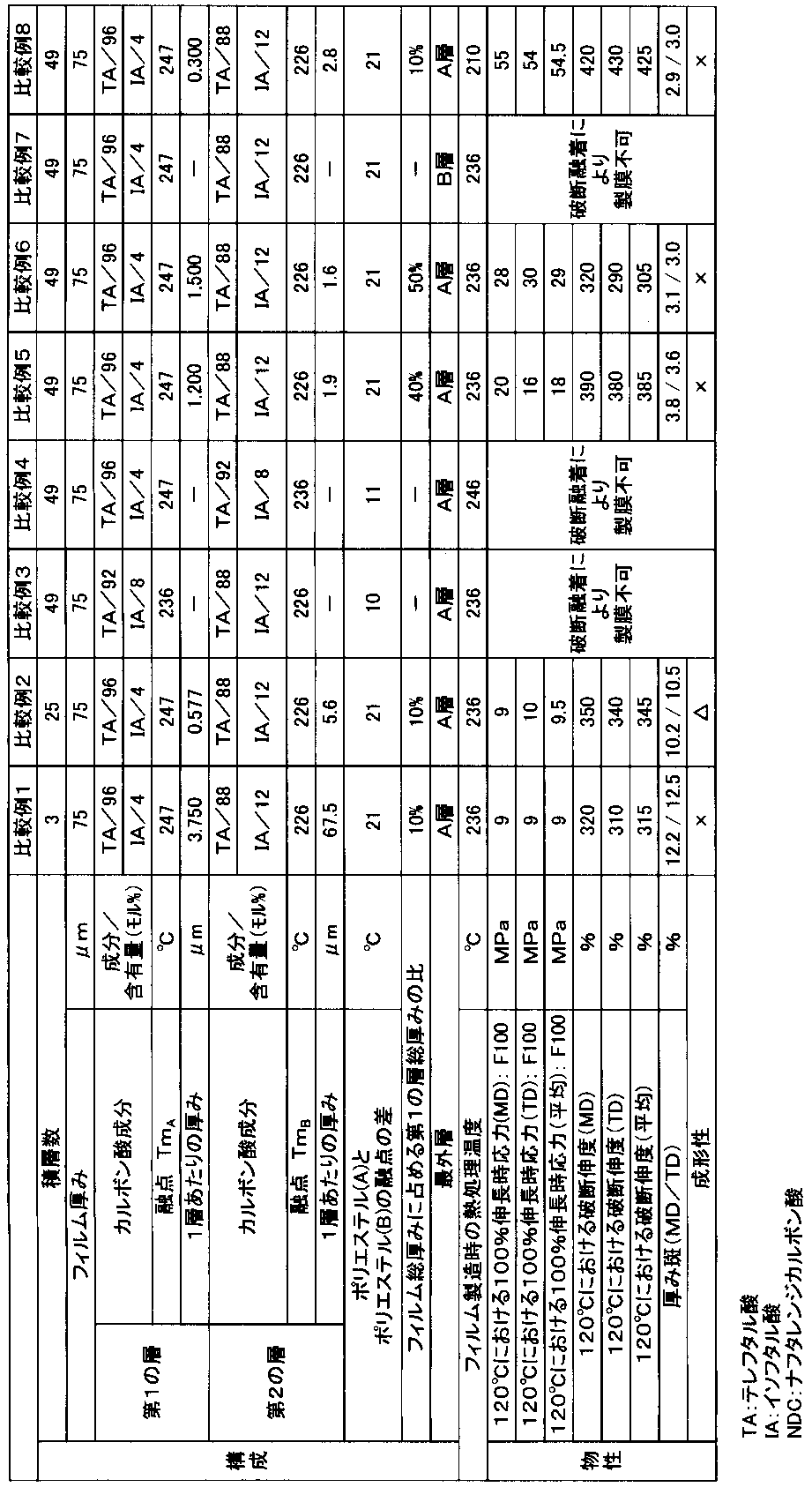
[比較例1〜8]
積層数、ポリエステル(A)およびポリエステル(B)の融点差、熱固定温度、ならびに最外層の種類を表1に記載のように変更した以外は、実施例1と同様の方法で多層積層フィルムを得た。また、比較例5は総吐出量に占めるポリエステル(A)の吐出量の比を40%、比較例6は総吐出量に占めるポリエステル(A)の吐出量の比を50%とした以外は実施例1と同様の方法で多層積層フィルムを得た。得られた多層積層フィルムの構成と特性を表2に示す。
[Comparative Examples 1-8]
A multilayer laminated film was prepared in the same manner as in Example 1 except that the number of laminations, the melting point difference between polyester (A) and polyester (B), the heat setting temperature, and the type of outermost layer were changed as shown in Table 1. Obtained. Comparative Example 5 was carried out except that the ratio of the discharge amount of polyester (A) in the total discharge amount was 40%, and Comparative Example 6 was performed except that the ratio of the discharge amount of polyester (A) in the total discharge amount was 50%. A multilayer laminated film was obtained in the same manner as in Example 1. Table 2 shows the structure and properties of the obtained multilayer laminated film.
比較例1および2で得られたフィルムは、積層数が所望の数に達しないため、成形性および厚み斑の特性に劣るものであった。なお比較例1、2のフィルムは、フィルムとしての結晶化ピークは観察されたものの第1の層由来の結晶化ピークは観察されず、かかる結晶化ピークは第2の層由来と判断して、第1の層の結晶構造および第2の層の低結晶構造を確認した。 The films obtained in Comparative Examples 1 and 2 were inferior in moldability and thickness spot characteristics because the number of laminated layers did not reach the desired number. In the films of Comparative Examples 1 and 2, although the crystallization peak as a film was observed, the crystallization peak derived from the first layer was not observed, and the crystallization peak was determined to be derived from the second layer. The crystal structure of the first layer and the low crystal structure of the second layer were confirmed.
比較例3で得られたフィルムは、積層数は所望の層数であるものの、ポリエステル(A)とポリエステル(B)との融点差が小さく、第2の層の配向結晶構造を緩和させるための熱処理温度に設定してしまうと製膜中に破断融着してしまい、製膜できなかった。
また比較例4で得られたフィルムは、積層数は所望の層数であるものの、ポリエステル(B)の融点が高いためにポリエステル(A)とポリエステル(B)との融点差が小さく、第2の層の配向結晶構造を緩和させるための熱処理温度に設定してしまうと製膜中に破断融着してしまい、製膜できなかった。
Although the film obtained in Comparative Example 3 has a desired number of layers, the difference in melting point between the polyester (A) and the polyester (B) is small, and the oriented crystal structure of the second layer is relaxed. When the heat treatment temperature was set, the film was broken and fused during film formation, and the film could not be formed.
In addition, the film obtained in Comparative Example 4 has a desired number of layers, but since the melting point of the polyester (B) is high, the difference in melting point between the polyester (A) and the polyester (B) is small. If the heat treatment temperature for relaxing the oriented crystal structure of this layer was set, the film was broken and fused during film formation and could not be formed.
比較例5、6で得られたフィルムは、厚み斑も良好で、積層数は所望の層数であるものの、総吐出量に占めるポリエステル(A)の吐出量の比が高く、成形性に劣るものであった。なお比較例5、6のフィルムは、フィルムとしての結晶化ピークは観察されたものの第1の層由来の結晶化ピークは観察されず、かかる結晶化ピークは第2の層由来と判断して、第1の層の結晶構造および第2の層の低結晶構造を確認した。 The films obtained in Comparative Examples 5 and 6 have good thickness unevenness and the number of layers is the desired number of layers, but the ratio of the discharge amount of polyester (A) in the total discharge amount is high and the moldability is poor. It was a thing. In the films of Comparative Examples 5 and 6, although the crystallization peak as a film was observed, the crystallization peak derived from the first layer was not observed, and the crystallization peak was determined to be derived from the second layer, The crystal structure of the first layer and the low crystal structure of the second layer were confirmed.
比較例7で得られたフィルムは、厚み斑も良好で、積層数は所望の層数であるものの、最外層がB層であるため、ロールに融着しやすいものであった。
比較例8で得られたフィルムは、厚み斑も良好で、積層数は所望の層数であるものの、熱固定温度が所望の温度に達しておらず、フィルムとしての結晶化ピークが観察されず、第1の層、第2の層ともに結晶構造であったため、成形加工時の伸長時応力が高く、金型追随性が低かった。
Although the film obtained in Comparative Example 7 had good thickness unevenness and the number of laminated layers was a desired number of layers, the outermost layer was the B layer, so that it was easily fused to a roll.
The film obtained in Comparative Example 8 has good thickness unevenness and the desired number of layers, but the heat setting temperature does not reach the desired temperature, and no crystallization peak as a film is observed. Since both the first layer and the second layer had a crystal structure, the stress during elongation during molding was high, and the mold followability was low.
本発明の多層積層ポリエステルフィルムは、成形加工時に求められる適度な応力を有しつつ、非常に高い破断伸度を有し、また厚み均一性も具備することから、インモールド成形などによる成形同時加飾やプレス成形などにおいて、より立体的または複雑な形状の成形部品への加工であっても、意匠を形成するフィルムに破れや変形が生ずることなく、精密な意匠性を立体的な樹脂成形部品に付与することができる。 The multilayer laminated polyester film of the present invention has an extremely high elongation at break while having an appropriate stress required at the time of molding, and also has a uniform thickness. Three-dimensional resin-molded parts that provide precise design without tearing or deformation in the film forming the design, even in processing of molded parts with more three-dimensional or complex shapes, such as decoration and press molding Can be granted.
Claims (12)
Priority Applications (1)
| Application Number | Priority Date | Filing Date | Title |
|---|---|---|---|
| JP2008013625A JP5154959B2 (en) | 2008-01-24 | 2008-01-24 | Multilayer laminated biaxially oriented polyester film for molding |
Applications Claiming Priority (1)
| Application Number | Priority Date | Filing Date | Title |
|---|---|---|---|
| JP2008013625A JP5154959B2 (en) | 2008-01-24 | 2008-01-24 | Multilayer laminated biaxially oriented polyester film for molding |
Publications (2)
| Publication Number | Publication Date |
|---|---|
| JP2009172864A JP2009172864A (en) | 2009-08-06 |
| JP5154959B2 true JP5154959B2 (en) | 2013-02-27 |
Family
ID=41028524
Family Applications (1)
| Application Number | Title | Priority Date | Filing Date |
|---|---|---|---|
| JP2008013625A Active JP5154959B2 (en) | 2008-01-24 | 2008-01-24 | Multilayer laminated biaxially oriented polyester film for molding |
Country Status (1)
| Country | Link |
|---|---|
| JP (1) | JP5154959B2 (en) |
Families Citing this family (4)
| Publication number | Priority date | Publication date | Assignee | Title |
|---|---|---|---|---|
| JP5667526B2 (en) * | 2011-06-22 | 2015-02-12 | 東洋機械金属株式会社 | Method of performing in-mold molding of complex shape, transfer sheet used for in-mold molding, and resin molded product formed by the method |
| JP6058949B2 (en) * | 2011-09-01 | 2017-01-11 | ユニチカ株式会社 | Biaxially stretched polyester film for in-mold molding |
| MY172346A (en) | 2013-08-29 | 2019-11-21 | Mitsui Chemicals Tohcello Inc | Adhesive film and method for manufacturing semiconductor device |
| JP6902273B2 (en) * | 2016-01-29 | 2021-07-14 | ユニチカ株式会社 | Release film for semiconductor package manufacturing method and semiconductor package manufacturing process |
Family Cites Families (4)
| Publication number | Priority date | Publication date | Assignee | Title |
|---|---|---|---|---|
| AU2003207216A1 (en) * | 2002-02-21 | 2003-09-09 | Teijin Limited | Multilayered polyester film and process for producing the same |
| JP4661073B2 (en) * | 2004-04-05 | 2011-03-30 | 東レ株式会社 | Laminated film |
| JP4857795B2 (en) * | 2006-02-06 | 2012-01-18 | 東レ株式会社 | Circuit mounted sheet, IC card, IC label |
| JP4804193B2 (en) * | 2006-03-30 | 2011-11-02 | 帝人デュポンフィルム株式会社 | Biaxially stretched multilayer laminated film |
-
2008
- 2008-01-24 JP JP2008013625A patent/JP5154959B2/en active Active
Also Published As
| Publication number | Publication date |
|---|---|
| JP2009172864A (en) | 2009-08-06 |
Similar Documents
| Publication | Publication Date | Title |
|---|---|---|
| CN100537230C (en) | Multilayer polyester film and its preparation method | |
| JP5990983B2 (en) | Laminated film for simultaneous molding transfer | |
| JP4839012B2 (en) | Polyester film for in-mold molding | |
| JPWO2007094382A1 (en) | Polyester film for molded parts | |
| JP4487228B2 (en) | Polyester film for molding and molded member using the same | |
| JP5127296B2 (en) | Polyester film for deep drawing molding simultaneous transfer foil | |
| JP4955480B2 (en) | Biaxially stretched laminated polyester film for simultaneous decoration | |
| CN101484317A (en) | Laminated polyester film for molding and its manufacturing process | |
| JP2010065065A (en) | Polyester film for molding | |
| JP5674227B2 (en) | Polyester film for in-mold transfer | |
| JP5115079B2 (en) | Polyester film for molded transfer foil | |
| JP5096242B2 (en) | Multilayer laminated biaxially oriented polyester film for molding | |
| JP5887824B2 (en) | Polyester film for molding | |
| JP2002120280A (en) | Biaxially oriented polyester film for molding | |
| CN107529335A (en) | Mold release polyester film for simultaneous transfer printing | |
| JP2009172864A (en) | Multilayer laminated biaxially oriented polyester film for molding | |
| JP5450941B2 (en) | Biaxially stretched laminated polyester film for molding | |
| JP2007203571A (en) | Polyester film for simultaneous decoration | |
| JP5127295B2 (en) | Polyester film for molded simultaneous transfer foil | |
| JP4655409B2 (en) | Laminated polyester film for molding | |
| KR101008675B1 (en) | Molding polyester film | |
| JP4361419B2 (en) | Multilayer film | |
| JP5116241B2 (en) | Laminated sheet, embossed design sheet and embossed design sheet coated metal plate | |
| JP2002120279A (en) | Biaxially oriented polyester film for molding | |
| JP5225828B2 (en) | Polyester film for in-mold transfer foil |
Legal Events
| Date | Code | Title | Description |
|---|---|---|---|
| A621 | Written request for application examination |
Free format text: JAPANESE INTERMEDIATE CODE: A621 Effective date: 20101027 |
|
| RD02 | Notification of acceptance of power of attorney |
Free format text: JAPANESE INTERMEDIATE CODE: A7422 Effective date: 20110706 |
|
| RD04 | Notification of resignation of power of attorney |
Free format text: JAPANESE INTERMEDIATE CODE: A7424 Effective date: 20110706 |
|
| A977 | Report on retrieval |
Free format text: JAPANESE INTERMEDIATE CODE: A971007 Effective date: 20111207 |
|
| A131 | Notification of reasons for refusal |
Free format text: JAPANESE INTERMEDIATE CODE: A131 Effective date: 20120207 |
|
| A521 | Request for written amendment filed |
Free format text: JAPANESE INTERMEDIATE CODE: A523 Effective date: 20120405 |
|
| TRDD | Decision of grant or rejection written | ||
| A01 | Written decision to grant a patent or to grant a registration (utility model) |
Free format text: JAPANESE INTERMEDIATE CODE: A01 Effective date: 20121113 |
|
| A61 | First payment of annual fees (during grant procedure) |
Free format text: JAPANESE INTERMEDIATE CODE: A61 Effective date: 20121206 |
|
| FPAY | Renewal fee payment (event date is renewal date of database) |
Free format text: PAYMENT UNTIL: 20151214 Year of fee payment: 3 |
|
| R150 | Certificate of patent or registration of utility model |
Free format text: JAPANESE INTERMEDIATE CODE: R150 Ref document number: 5154959 Country of ref document: JP Free format text: JAPANESE INTERMEDIATE CODE: R150 |
|
| S531 | Written request for registration of change of domicile |
Free format text: JAPANESE INTERMEDIATE CODE: R313531 |
|
| S533 | Written request for registration of change of name |
Free format text: JAPANESE INTERMEDIATE CODE: R313533 |
|
| R350 | Written notification of registration of transfer |
Free format text: JAPANESE INTERMEDIATE CODE: R350 |
|
| R250 | Receipt of annual fees |
Free format text: JAPANESE INTERMEDIATE CODE: R250 |
|
| S111 | Request for change of ownership or part of ownership |
Free format text: JAPANESE INTERMEDIATE CODE: R313111 |
|
| R350 | Written notification of registration of transfer |
Free format text: JAPANESE INTERMEDIATE CODE: R350 |
|
| R250 | Receipt of annual fees |
Free format text: JAPANESE INTERMEDIATE CODE: R250 |
|
| S531 | Written request for registration of change of domicile |
Free format text: JAPANESE INTERMEDIATE CODE: R313531 |
|
| R371 | Transfer withdrawn |
Free format text: JAPANESE INTERMEDIATE CODE: R371 |
|
| S531 | Written request for registration of change of domicile |
Free format text: JAPANESE INTERMEDIATE CODE: R313531 |
|
| R350 | Written notification of registration of transfer |
Free format text: JAPANESE INTERMEDIATE CODE: R350 |
|
| R250 | Receipt of annual fees |
Free format text: JAPANESE INTERMEDIATE CODE: R250 |
|
| R250 | Receipt of annual fees |
Free format text: JAPANESE INTERMEDIATE CODE: R250 |
|
| R250 | Receipt of annual fees |
Free format text: JAPANESE INTERMEDIATE CODE: R250 |
|
| R250 | Receipt of annual fees |
Free format text: JAPANESE INTERMEDIATE CODE: R250 |