JP5116329B2 - Nonaqueous electrolyte secondary battery - Google Patents
Nonaqueous electrolyte secondary battery Download PDFInfo
- Publication number
- JP5116329B2 JP5116329B2 JP2007076208A JP2007076208A JP5116329B2 JP 5116329 B2 JP5116329 B2 JP 5116329B2 JP 2007076208 A JP2007076208 A JP 2007076208A JP 2007076208 A JP2007076208 A JP 2007076208A JP 5116329 B2 JP5116329 B2 JP 5116329B2
- Authority
- JP
- Japan
- Prior art keywords
- electrolyte secondary
- secondary battery
- aqueous electrolyte
- positive electrode
- battery
- Prior art date
- Legal status (The legal status is an assumption and is not a legal conclusion. Google has not performed a legal analysis and makes no representation as to the accuracy of the status listed.)
- Expired - Fee Related
Links
- 239000011255 nonaqueous electrolyte Substances 0.000 title claims description 141
- 239000007774 positive electrode material Substances 0.000 claims description 47
- VAYTZRYEBVHVLE-UHFFFAOYSA-N 1,3-dioxol-2-one Chemical compound O=C1OC=CO1 VAYTZRYEBVHVLE-UHFFFAOYSA-N 0.000 claims description 35
- 150000004292 cyclic ethers Chemical class 0.000 claims description 33
- 229910052744 lithium Inorganic materials 0.000 claims description 32
- WHXSMMKQMYFTQS-UHFFFAOYSA-N Lithium Chemical compound [Li] WHXSMMKQMYFTQS-UHFFFAOYSA-N 0.000 claims description 30
- 239000002905 metal composite material Substances 0.000 claims description 24
- YLQBMQCUIZJEEH-UHFFFAOYSA-N Furan Chemical group C=1C=COC=1 YLQBMQCUIZJEEH-UHFFFAOYSA-N 0.000 claims description 19
- 239000003792 electrolyte Substances 0.000 claims description 8
- 239000003125 aqueous solvent Substances 0.000 claims description 7
- 150000005676 cyclic carbonates Chemical class 0.000 claims description 7
- 239000012046 mixed solvent Substances 0.000 claims description 6
- 229910052782 aluminium Inorganic materials 0.000 claims description 5
- 150000005678 chain carbonates Chemical class 0.000 claims description 4
- 229910052791 calcium Inorganic materials 0.000 claims description 3
- 229910052749 magnesium Inorganic materials 0.000 claims description 3
- 229910052748 manganese Inorganic materials 0.000 claims description 3
- 150000001875 compounds Chemical class 0.000 claims 1
- 239000002904 solvent Substances 0.000 claims 1
- PXHVJJICTQNCMI-UHFFFAOYSA-N Nickel Chemical compound [Ni] PXHVJJICTQNCMI-UHFFFAOYSA-N 0.000 description 37
- 230000000052 comparative effect Effects 0.000 description 37
- WYURNTSHIVDZCO-UHFFFAOYSA-N Tetrahydrofuran Chemical compound C1CCOC1 WYURNTSHIVDZCO-UHFFFAOYSA-N 0.000 description 18
- 229910052759 nickel Inorganic materials 0.000 description 18
- RTZKZFJDLAIYFH-UHFFFAOYSA-N Diethyl ether Chemical compound CCOCC RTZKZFJDLAIYFH-UHFFFAOYSA-N 0.000 description 17
- 239000000203 mixture Substances 0.000 description 13
- 238000002360 preparation method Methods 0.000 description 13
- 238000003860 storage Methods 0.000 description 11
- 238000006243 chemical reaction Methods 0.000 description 10
- 238000004519 manufacturing process Methods 0.000 description 10
- 239000008151 electrolyte solution Substances 0.000 description 8
- VQKFNUFAXTZWDK-UHFFFAOYSA-N 2-Methylfuran Chemical compound CC1=CC=CO1 VQKFNUFAXTZWDK-UHFFFAOYSA-N 0.000 description 6
- XLYOFNOQVPJJNP-UHFFFAOYSA-N water Substances O XLYOFNOQVPJJNP-UHFFFAOYSA-N 0.000 description 6
- 230000007423 decrease Effects 0.000 description 5
- 229910005702 Li1.05Ni0.80Co0.17Al0.03O2 Inorganic materials 0.000 description 4
- 229910012851 LiCoO 2 Inorganic materials 0.000 description 4
- XGZVUEUWXADBQD-UHFFFAOYSA-L lithium carbonate Chemical compound [Li+].[Li+].[O-]C([O-])=O XGZVUEUWXADBQD-UHFFFAOYSA-L 0.000 description 4
- 229910052808 lithium carbonate Inorganic materials 0.000 description 4
- 239000002002 slurry Substances 0.000 description 4
- JWUJQDFVADABEY-UHFFFAOYSA-N 2-methyltetrahydrofuran Chemical compound CC1CCCO1 JWUJQDFVADABEY-UHFFFAOYSA-N 0.000 description 3
- -1 LiCF 3 SO 3 Inorganic materials 0.000 description 3
- 229910001228 Li[Ni1/3Co1/3Mn1/3]O2 (NCM 111) Inorganic materials 0.000 description 3
- 229910052751 metal Inorganic materials 0.000 description 3
- 239000002184 metal Substances 0.000 description 3
- 238000005096 rolling process Methods 0.000 description 3
- VDFVNEFVBPFDSB-UHFFFAOYSA-N 1,3-dioxane Chemical compound C1COCOC1 VDFVNEFVBPFDSB-UHFFFAOYSA-N 0.000 description 2
- RYHBNJHYFVUHQT-UHFFFAOYSA-N 1,4-Dioxane Chemical compound C1COCCO1 RYHBNJHYFVUHQT-UHFFFAOYSA-N 0.000 description 2
- OKTJSMMVPCPJKN-UHFFFAOYSA-N Carbon Chemical compound [C] OKTJSMMVPCPJKN-UHFFFAOYSA-N 0.000 description 2
- 229920002134 Carboxymethyl cellulose Polymers 0.000 description 2
- KMTRUDSVKNLOMY-UHFFFAOYSA-N Ethylene carbonate Chemical compound O=C1OCCO1 KMTRUDSVKNLOMY-UHFFFAOYSA-N 0.000 description 2
- 229910013870 LiPF 6 Inorganic materials 0.000 description 2
- WMFOQBRAJBCJND-UHFFFAOYSA-M Lithium hydroxide Chemical compound [Li+].[OH-] WMFOQBRAJBCJND-UHFFFAOYSA-M 0.000 description 2
- HBBGRARXTFLTSG-UHFFFAOYSA-N Lithium ion Chemical compound [Li+] HBBGRARXTFLTSG-UHFFFAOYSA-N 0.000 description 2
- SECXISVLQFMRJM-UHFFFAOYSA-N N-Methylpyrrolidone Chemical compound CN1CCCC1=O SECXISVLQFMRJM-UHFFFAOYSA-N 0.000 description 2
- XAGFODPZIPBFFR-UHFFFAOYSA-N aluminium Chemical compound [Al] XAGFODPZIPBFFR-UHFFFAOYSA-N 0.000 description 2
- MTHSVFCYNBDYFN-UHFFFAOYSA-N anhydrous diethylene glycol Natural products OCCOCCO MTHSVFCYNBDYFN-UHFFFAOYSA-N 0.000 description 2
- 239000007864 aqueous solution Substances 0.000 description 2
- 239000011230 binding agent Substances 0.000 description 2
- 239000001768 carboxy methyl cellulose Substances 0.000 description 2
- 235000010948 carboxy methyl cellulose Nutrition 0.000 description 2
- 239000008112 carboxymethyl-cellulose Substances 0.000 description 2
- 239000011248 coating agent Substances 0.000 description 2
- 238000000576 coating method Methods 0.000 description 2
- 230000003247 decreasing effect Effects 0.000 description 2
- 230000000694 effects Effects 0.000 description 2
- JBTWLSYIZRCDFO-UHFFFAOYSA-N ethyl methyl carbonate Chemical compound CCOC(=O)OC JBTWLSYIZRCDFO-UHFFFAOYSA-N 0.000 description 2
- 239000007789 gas Substances 0.000 description 2
- 239000007770 graphite material Substances 0.000 description 2
- 229910001416 lithium ion Inorganic materials 0.000 description 2
- 239000000463 material Substances 0.000 description 2
- 239000007773 negative electrode material Substances 0.000 description 2
- 239000006228 supernatant Substances 0.000 description 2
- 239000002562 thickening agent Substances 0.000 description 2
- CXBDYQVECUFKRK-UHFFFAOYSA-N 1-methoxybutane Chemical compound CCCCOC CXBDYQVECUFKRK-UHFFFAOYSA-N 0.000 description 1
- XQQZRZQVBFHBHL-UHFFFAOYSA-N 12-crown-4 Chemical compound C1COCCOCCOCCO1 XQQZRZQVBFHBHL-UHFFFAOYSA-N 0.000 description 1
- VFTFKUDGYRBSAL-UHFFFAOYSA-N 15-crown-5 Chemical compound C1COCCOCCOCCOCCO1 VFTFKUDGYRBSAL-UHFFFAOYSA-N 0.000 description 1
- BVKZGUZCCUSVTD-UHFFFAOYSA-L Carbonate Chemical compound [O-]C([O-])=O BVKZGUZCCUSVTD-UHFFFAOYSA-L 0.000 description 1
- RYGMFSIKBFXOCR-UHFFFAOYSA-N Copper Chemical compound [Cu] RYGMFSIKBFXOCR-UHFFFAOYSA-N 0.000 description 1
- OIFBSDVPJOWBCH-UHFFFAOYSA-N Diethyl carbonate Chemical compound CCOC(=O)OCC OIFBSDVPJOWBCH-UHFFFAOYSA-N 0.000 description 1
- 229910000733 Li alloy Inorganic materials 0.000 description 1
- 229910015015 LiAsF 6 Inorganic materials 0.000 description 1
- 229910013063 LiBF 4 Inorganic materials 0.000 description 1
- 229910013372 LiC 4 Inorganic materials 0.000 description 1
- 229910013684 LiClO 4 Inorganic materials 0.000 description 1
- 229910017164 Ni0.80Co0.17Al0.03(OH)2 Inorganic materials 0.000 description 1
- 239000002033 PVDF binder Substances 0.000 description 1
- 239000004743 Polypropylene Substances 0.000 description 1
- 230000002411 adverse Effects 0.000 description 1
- 229910021383 artificial graphite Inorganic materials 0.000 description 1
- QVGXLLKOCUKJST-UHFFFAOYSA-N atomic oxygen Chemical compound [O] QVGXLLKOCUKJST-UHFFFAOYSA-N 0.000 description 1
- 229910052799 carbon Inorganic materials 0.000 description 1
- 239000003575 carbonaceous material Substances 0.000 description 1
- 239000007795 chemical reaction product Substances 0.000 description 1
- 239000006258 conductive agent Substances 0.000 description 1
- 239000011889 copper foil Substances 0.000 description 1
- 150000003983 crown ethers Chemical class 0.000 description 1
- 125000004122 cyclic group Chemical group 0.000 description 1
- 125000004177 diethyl group Chemical group [H]C([H])([H])C([H])([H])* 0.000 description 1
- IEJIGPNLZYLLBP-UHFFFAOYSA-N dimethyl carbonate Chemical compound COC(=O)OC IEJIGPNLZYLLBP-UHFFFAOYSA-N 0.000 description 1
- 238000007599 discharging Methods 0.000 description 1
- 239000002612 dispersion medium Substances 0.000 description 1
- 238000005868 electrolysis reaction Methods 0.000 description 1
- 238000000605 extraction Methods 0.000 description 1
- 239000011888 foil Substances 0.000 description 1
- 229910002804 graphite Inorganic materials 0.000 description 1
- 239000010439 graphite Substances 0.000 description 1
- XLYOFNOQVPJJNP-UHFFFAOYSA-M hydroxide Chemical compound [OH-] XLYOFNOQVPJJNP-UHFFFAOYSA-M 0.000 description 1
- 238000003780 insertion Methods 0.000 description 1
- 230000037431 insertion Effects 0.000 description 1
- 239000005001 laminate film Substances 0.000 description 1
- 239000007788 liquid Substances 0.000 description 1
- 150000002641 lithium Chemical class 0.000 description 1
- 239000001989 lithium alloy Substances 0.000 description 1
- 229910000625 lithium cobalt oxide Inorganic materials 0.000 description 1
- ACFSQHQYDZIPRL-UHFFFAOYSA-N lithium;bis(1,1,2,2,2-pentafluoroethylsulfonyl)azanide Chemical compound [Li+].FC(F)(F)C(F)(F)S(=O)(=O)[N-]S(=O)(=O)C(F)(F)C(F)(F)F ACFSQHQYDZIPRL-UHFFFAOYSA-N 0.000 description 1
- BFZPBUKRYWOWDV-UHFFFAOYSA-N lithium;oxido(oxo)cobalt Chemical compound [Li+].[O-][Co]=O BFZPBUKRYWOWDV-UHFFFAOYSA-N 0.000 description 1
- 238000012986 modification Methods 0.000 description 1
- 230000004048 modification Effects 0.000 description 1
- 239000004570 mortar (masonry) Substances 0.000 description 1
- 238000006864 oxidative decomposition reaction Methods 0.000 description 1
- 229910052760 oxygen Inorganic materials 0.000 description 1
- 239000001301 oxygen Substances 0.000 description 1
- 239000002245 particle Substances 0.000 description 1
- 229920001155 polypropylene Polymers 0.000 description 1
- 229920002981 polyvinylidene fluoride Polymers 0.000 description 1
- 238000003825 pressing Methods 0.000 description 1
- RUOJZAUFBMNUDX-UHFFFAOYSA-N propylene carbonate Chemical compound CC1COC(=O)O1 RUOJZAUFBMNUDX-UHFFFAOYSA-N 0.000 description 1
- 239000000243 solution Substances 0.000 description 1
- 229920003048 styrene butadiene rubber Polymers 0.000 description 1
- 229910052723 transition metal Inorganic materials 0.000 description 1
- 150000003624 transition metals Chemical class 0.000 description 1
- 238000005406 washing Methods 0.000 description 1
Images


Classifications
-
- H—ELECTRICITY
- H01—ELECTRIC ELEMENTS
- H01M—PROCESSES OR MEANS, e.g. BATTERIES, FOR THE DIRECT CONVERSION OF CHEMICAL ENERGY INTO ELECTRICAL ENERGY
- H01M10/00—Secondary cells; Manufacture thereof
- H01M10/05—Accumulators with non-aqueous electrolyte
- H01M10/052—Li-accumulators
- H01M10/0525—Rocking-chair batteries, i.e. batteries with lithium insertion or intercalation in both electrodes; Lithium-ion batteries
-
- H—ELECTRICITY
- H01—ELECTRIC ELEMENTS
- H01M—PROCESSES OR MEANS, e.g. BATTERIES, FOR THE DIRECT CONVERSION OF CHEMICAL ENERGY INTO ELECTRICAL ENERGY
- H01M4/00—Electrodes
- H01M4/02—Electrodes composed of, or comprising, active material
- H01M4/36—Selection of substances as active materials, active masses, active liquids
- H01M4/48—Selection of substances as active materials, active masses, active liquids of inorganic oxides or hydroxides
- H01M4/485—Selection of substances as active materials, active masses, active liquids of inorganic oxides or hydroxides of mixed oxides or hydroxides for inserting or intercalating light metals, e.g. LiTi2O4 or LiTi2OxFy
-
- H—ELECTRICITY
- H01—ELECTRIC ELEMENTS
- H01M—PROCESSES OR MEANS, e.g. BATTERIES, FOR THE DIRECT CONVERSION OF CHEMICAL ENERGY INTO ELECTRICAL ENERGY
- H01M10/00—Secondary cells; Manufacture thereof
- H01M10/05—Accumulators with non-aqueous electrolyte
- H01M10/052—Li-accumulators
-
- H—ELECTRICITY
- H01—ELECTRIC ELEMENTS
- H01M—PROCESSES OR MEANS, e.g. BATTERIES, FOR THE DIRECT CONVERSION OF CHEMICAL ENERGY INTO ELECTRICAL ENERGY
- H01M10/00—Secondary cells; Manufacture thereof
- H01M10/05—Accumulators with non-aqueous electrolyte
- H01M10/056—Accumulators with non-aqueous electrolyte characterised by the materials used as electrolytes, e.g. mixed inorganic/organic electrolytes
- H01M10/0564—Accumulators with non-aqueous electrolyte characterised by the materials used as electrolytes, e.g. mixed inorganic/organic electrolytes the electrolyte being constituted of organic materials only
- H01M10/0566—Liquid materials
- H01M10/0567—Liquid materials characterised by the additives
-
- H—ELECTRICITY
- H01—ELECTRIC ELEMENTS
- H01M—PROCESSES OR MEANS, e.g. BATTERIES, FOR THE DIRECT CONVERSION OF CHEMICAL ENERGY INTO ELECTRICAL ENERGY
- H01M4/00—Electrodes
- H01M4/02—Electrodes composed of, or comprising, active material
- H01M4/13—Electrodes for accumulators with non-aqueous electrolyte, e.g. for lithium-accumulators; Processes of manufacture thereof
- H01M4/131—Electrodes based on mixed oxides or hydroxides, or on mixtures of oxides or hydroxides, e.g. LiCoOx
-
- H—ELECTRICITY
- H01—ELECTRIC ELEMENTS
- H01M—PROCESSES OR MEANS, e.g. BATTERIES, FOR THE DIRECT CONVERSION OF CHEMICAL ENERGY INTO ELECTRICAL ENERGY
- H01M4/00—Electrodes
- H01M4/02—Electrodes composed of, or comprising, active material
- H01M4/13—Electrodes for accumulators with non-aqueous electrolyte, e.g. for lithium-accumulators; Processes of manufacture thereof
- H01M4/133—Electrodes based on carbonaceous material, e.g. graphite-intercalation compounds or CFx
-
- H—ELECTRICITY
- H01—ELECTRIC ELEMENTS
- H01M—PROCESSES OR MEANS, e.g. BATTERIES, FOR THE DIRECT CONVERSION OF CHEMICAL ENERGY INTO ELECTRICAL ENERGY
- H01M4/00—Electrodes
- H01M4/02—Electrodes composed of, or comprising, active material
- H01M4/36—Selection of substances as active materials, active masses, active liquids
- H01M4/48—Selection of substances as active materials, active masses, active liquids of inorganic oxides or hydroxides
- H01M4/52—Selection of substances as active materials, active masses, active liquids of inorganic oxides or hydroxides of nickel, cobalt or iron
- H01M4/525—Selection of substances as active materials, active masses, active liquids of inorganic oxides or hydroxides of nickel, cobalt or iron of mixed oxides or hydroxides containing iron, cobalt or nickel for inserting or intercalating light metals, e.g. LiNiO2, LiCoO2 or LiCoOxFy
-
- H—ELECTRICITY
- H01—ELECTRIC ELEMENTS
- H01M—PROCESSES OR MEANS, e.g. BATTERIES, FOR THE DIRECT CONVERSION OF CHEMICAL ENERGY INTO ELECTRICAL ENERGY
- H01M2300/00—Electrolytes
- H01M2300/0017—Non-aqueous electrolytes
- H01M2300/0025—Organic electrolyte
-
- Y—GENERAL TAGGING OF NEW TECHNOLOGICAL DEVELOPMENTS; GENERAL TAGGING OF CROSS-SECTIONAL TECHNOLOGIES SPANNING OVER SEVERAL SECTIONS OF THE IPC; TECHNICAL SUBJECTS COVERED BY FORMER USPC CROSS-REFERENCE ART COLLECTIONS [XRACs] AND DIGESTS
- Y02—TECHNOLOGIES OR APPLICATIONS FOR MITIGATION OR ADAPTATION AGAINST CLIMATE CHANGE
- Y02E—REDUCTION OF GREENHOUSE GAS [GHG] EMISSIONS, RELATED TO ENERGY GENERATION, TRANSMISSION OR DISTRIBUTION
- Y02E60/00—Enabling technologies; Technologies with a potential or indirect contribution to GHG emissions mitigation
- Y02E60/10—Energy storage using batteries
Landscapes
- Chemical & Material Sciences (AREA)
- General Chemical & Material Sciences (AREA)
- Chemical Kinetics & Catalysis (AREA)
- Electrochemistry (AREA)
- Engineering & Computer Science (AREA)
- Inorganic Chemistry (AREA)
- Manufacturing & Machinery (AREA)
- Materials Engineering (AREA)
- General Physics & Mathematics (AREA)
- Condensed Matter Physics & Semiconductors (AREA)
- Physics & Mathematics (AREA)
- Secondary Cells (AREA)
- Battery Electrode And Active Subsutance (AREA)
Description
本発明は、層状構造を有するリチウム含有金属複合酸化物からなる正極活物質を用いた正極と、負極と、非水系溶媒に電解質が溶解された非水電解液とを備えた非水電解質二次電池に係り、特に、電池の高容量化のために、正極活物質にニッケルが多く含有されたリチウム含有金属複合酸化物を用いた非水電解質二次電池において、充電状態で保存した場合に電池が膨化するのを防止すると共に、電池容量が低下するのを抑制するようにした点に特徴を有するものである。 The present invention relates to a non-aqueous electrolyte secondary comprising a positive electrode using a positive electrode active material comprising a lithium-containing metal composite oxide having a layered structure, a negative electrode, and a non-aqueous electrolyte in which an electrolyte is dissolved in a non-aqueous solvent. The present invention relates to a battery, in particular, in a non-aqueous electrolyte secondary battery using a lithium-containing metal composite oxide containing a large amount of nickel as a positive electrode active material in order to increase the capacity of the battery, when the battery is stored in a charged state. This is characterized in that the battery capacity is prevented from expanding and the battery capacity is prevented from decreasing.
近年、高出力,高エネルギー密度の新型二次電池として、非水電解液を用い、リチウムイオンを正極と負極との間で移動させて充放電を行うようにした非水電解質二次電池が広く利用されるようになった。 In recent years, non-aqueous electrolyte secondary batteries using a non-aqueous electrolyte and charging / discharging by moving lithium ions between the positive and negative electrodes are widely used as new secondary batteries with high output and high energy density. It came to be used.
そして、このような非水電解質二次電池においては、正極における正極活物質として、一般に安定性や充放電特性に優れた層状構造を有するコバルト酸リチウムLiCoO2が広く使用されている。 In such non-aqueous electrolyte secondary batteries, lithium cobalt oxide LiCoO 2 having a layered structure that is generally excellent in stability and charge / discharge characteristics is widely used as a positive electrode active material in the positive electrode.
しかし、このコバルト酸リチウムに使用されるCoは希少な資源であり、生産コストが高くつくと共に、安定した供給が困難になる等の問題があり、また近年においては、上記のような非水電解質二次電池がハイブリッド自動車等の各種の電源に利用されるようになり、さらに高容量の非水電解質二次電池が要望されている。 However, Co used in this lithium cobaltate is a scarce resource, and there are problems such as high production costs and difficulty in stable supply. In recent years, non-aqueous electrolytes such as those described above have been used. Secondary batteries have come to be used for various power sources such as hybrid vehicles, and there is a demand for non-aqueous electrolyte secondary batteries with higher capacity.
このため、正極活物質として、上記のコバルト酸リチウムよりも単位重量当りの充放電容量が大きいニッケルが多く含有されたリチウム含有金属複合酸化物を用いることが検討されている。 For this reason, use of a lithium-containing metal composite oxide containing a large amount of nickel having a charge / discharge capacity per unit weight larger than that of the above-described lithium cobaltate as the positive electrode active material has been studied.
しかし、ニッケルが多く含有されたリチウム含有金属複合酸化物を正極活物質に使用した非水電解質二次電池の場合、充電状態で高温環境下において保存すると、この正極活物質と非水電解液とが反応し、この反応により生じたガスによって電池が膨化し、またこの反応生成物によって電池抵抗が増加し、充放電特性が低下するという問題があった。 However, in the case of a non-aqueous electrolyte secondary battery using a lithium-containing metal composite oxide containing a large amount of nickel as a positive electrode active material, when stored in a charged state under a high temperature environment, the positive electrode active material and the non-aqueous electrolyte solution Reaction, the battery is expanded by the gas generated by the reaction, and the reaction product increases the battery resistance, resulting in a decrease in charge / discharge characteristics.
そして、近年においては、正極活物質と非水電解液との反応により生じたガスによって電池が膨化するのを抑制するため、特許文献1に示されるように、上記のようなニッケルが多く含有されたリチウム含有金属複合酸化物からなる正極活物質の炭酸リチウムの量を低減させて、そのpH値が10〜11.5の範囲になるようにしたものや、特許文献2に示されるように、ニッケルが多く含有されたリチウム含有金属複合酸化物からなる正極活物質を水洗させて、炭酸リチウム等を除去するようにしたものが提案されている。 In recent years, in order to suppress the battery from expanding due to the gas generated by the reaction between the positive electrode active material and the non-aqueous electrolyte, a large amount of nickel as described above is contained as shown in Patent Document 1. The amount of lithium carbonate in the positive electrode active material comprising a lithium-containing metal composite oxide is reduced so that the pH value is in the range of 10 to 11.5, and as shown in Patent Document 2, A positive electrode active material made of a lithium-containing metal composite oxide containing a large amount of nickel is washed with water to remove lithium carbonate and the like.
しかし、特許文献1に示されるように、炭酸リチウムの量を低減させてpH値が10〜11.5の範囲になるようにしたものを用いた場合においても、上記のように充電状態で高温環境下において保存した場合に、この正極活物質と非水電解液とが反応するのを十分に抑制することができず、依然として、電池が膨化するという問題があった。 However, as shown in Patent Document 1, even when using a lithium carbonate having a reduced amount of lithium carbonate so that the pH value is in the range of 10 to 11.5, the temperature is high in the charged state as described above. When stored in an environment, the reaction between the positive electrode active material and the non-aqueous electrolyte cannot be sufficiently suppressed, and the battery still swells.
また、特許文献2に示されるように、ニッケルが多く含有されたリチウム含有金属複合酸化物からなる正極活物質を水洗させた場合、充電状態で高温環境下において保存した場合に、この正極活物質と非水電解液とが反応するのが抑制されるようになるが、この水洗により、リチウム含有金属複合酸化物に含まれるニッケルがリチウムサイトに入り込む量が増加し、正極活物質表面の抵抗が大きくなって放電性能が低下し、高容量の非水電解質二次電池が得られなくなるという問題があった。
本発明は、層状構造を有するリチウム含有金属複合酸化物からなる正極活物質を用いた正極と、負極と、非水系溶媒に電解質が溶解された非水電解液とを備えた非水電解質二次電池において、前記のように電池の高容量化のために、正極活物質にニッケルが多く含有されたリチウム含有金属複合酸化物を用いた場合における上記のような問題を解決することを課題とするものである。 The present invention relates to a non-aqueous electrolyte secondary comprising a positive electrode using a positive electrode active material comprising a lithium-containing metal composite oxide having a layered structure, a negative electrode, and a non-aqueous electrolyte in which an electrolyte is dissolved in a non-aqueous solvent. In the battery, as described above, in order to increase the capacity of the battery, it is an object to solve the above-described problems when a lithium-containing metal composite oxide containing a large amount of nickel is used as the positive electrode active material. Is.
すなわち、本発明においては、上記のように正極活物質にニッケルが多く含有されたリチウム含有金属複合酸化物を用いた非水電解質二次電池を充電状態で保存した場合に、この正極活物質と非水電解液とが反応して電池が膨化するのを防止すると共に、この非水電解質二次電池の電池容量が低下するのを抑制することを課題とするものである。 That is, in the present invention, when a non-aqueous electrolyte secondary battery using a lithium-containing metal composite oxide containing a large amount of nickel in the positive electrode active material as described above is stored in a charged state, An object of the present invention is to prevent the battery from expanding due to a reaction with the nonaqueous electrolyte, and to suppress a decrease in the battery capacity of the nonaqueous electrolyte secondary battery.
本発明においては、上記のような課題を解決するため、層状構造を有するリチウム含有金属複合酸化物からなる正極活物質を用いた正極と、負極と、非水系溶媒に電解質が溶解された非水電解液とを備えた非水電解質二次電池において、上記のリチウム含有金属複合酸化物におけるリチウムを除く金属中にニッケルが50モル%以上含有された正極活物質を用いると共に、上記の非水電解液に、環状エーテルを0.1〜2体積%の範囲で添加させた。 In the present invention, in order to solve the above problems, a non-aqueous solution in which an electrolyte is dissolved in a positive electrode using a positive electrode active material composed of a lithium-containing metal composite oxide having a layered structure, a negative electrode, and a non-aqueous solvent. In the non-aqueous electrolyte secondary battery comprising the electrolytic solution, a positive electrode active material containing 50 mol% or more of nickel in the metal excluding lithium in the lithium-containing metal composite oxide is used, and the non-aqueous electrolysis described above Cyclic ether was added to the liquid in the range of 0.1 to 2% by volume.
本発明の非水電解質二次電池においては、リチウム含有金属複合酸化物におけるリチウムを除く金属中にニッケルが50モル%以上含有された正極活物質を用いるようにしたため、重量当りの充放電容量が大きくなって、高容量の非水電解質二次電池が得られるようになる。 In the non-aqueous electrolyte secondary battery of the present invention, since the positive electrode active material containing 50 mol% or more of nickel in the metal excluding lithium in the lithium-containing metal composite oxide is used, the charge / discharge capacity per weight is high. A large capacity non-aqueous electrolyte secondary battery can be obtained.
また、本発明の非水電解質二次電池においては、非水電解液に環状エーテルを0.1〜2体積%の範囲で添加させたため、この非水電解質二次電池の初回の充電時に、この環状エーテルが分解されて、上記の正極活物質の表面に被膜が形成され、この被膜により上記の正極活物質が非水電解液と反応するのが抑制されるようになる。なお、非水電解液に添加させる環状エーテルの量を0.1〜2体積%の範囲にしたのは、環状エーテルの量が0.1体積%未満では、上記の正極活物質の表面に被膜を十分に形成することが困難になる一方、この環状エーテルの量が2体積%を超えると、初回の充電時にこの環状エーテルが分解されずに残り、電池容量や放電性能に悪影響を及ぼすと共に、この環状エーテルがさらに上記の正極活物質と反応して分解されるようになり、これにより電池が膨化するためである。 Further, in the nonaqueous electrolyte secondary battery of the present invention, since cyclic ether is added to the nonaqueous electrolyte in the range of 0.1 to 2% by volume, when this nonaqueous electrolyte secondary battery is charged for the first time, The cyclic ether is decomposed to form a film on the surface of the positive electrode active material, and this film suppresses the reaction of the positive electrode active material with the non-aqueous electrolyte. The amount of the cyclic ether added to the non-aqueous electrolyte is in the range of 0.1 to 2% by volume because when the amount of the cyclic ether is less than 0.1% by volume, the surface of the positive electrode active material is coated. However, when the amount of the cyclic ether exceeds 2% by volume, the cyclic ether remains undecomposed at the first charge, which adversely affects battery capacity and discharge performance. This is because the cyclic ether further reacts with the positive electrode active material to be decomposed, thereby expanding the battery.
この結果、本発明の非水電解質二次電池においては、正極活物質を水洗した場合のように、非水電解質二次電池の容量が低下するということがなく、充電状態で高温環境下において保存した場合にも、上記の正極活物質が非水電解液と反応するのが抑制されて、電池が膨化するのが防止されるようになる。 As a result, in the non-aqueous electrolyte secondary battery of the present invention, the capacity of the non-aqueous electrolyte secondary battery does not decrease as in the case where the positive electrode active material is washed with water, and is stored in a charged state in a high-temperature environment. Also in this case, the positive electrode active material is prevented from reacting with the nonaqueous electrolytic solution, and the battery is prevented from expanding.
次に、本発明の非水電解質二次電池における具体的な実施形態について説明する。 Next, specific embodiments of the nonaqueous electrolyte secondary battery of the present invention will be described.
本発明の非水電解質二次電池においては、上記のように正極活物質として、リチウム含有金属複合酸化物におけるリチウムを除く金属中にニッケルが50モル%以上含有されたものを用いると共に、非水電解液に環状エーテルを0.1〜2体積%の範囲で添加させるようにする。 In the non-aqueous electrolyte secondary battery of the present invention, as described above, a positive electrode active material containing 50 mol% or more of nickel in the metal excluding lithium in the lithium-containing metal composite oxide is used. The cyclic ether is added to the electrolytic solution in the range of 0.1 to 2% by volume.
ここで、上記の正極活物質における単位重量当りの充放電容量を高めて、高容量の非水電解質二次電池が得られるようにするためには、正極活物質として、一般式LiaNibCocMdO2+e(式中、Mは、Al,Mn,Mg,Caから選択される少なくとも1種であり、a,b,c,d,eは、0.2≦a≦1.2,0.6≦b≦0.9,0.1≦c≦0.4,0≦d≦0.2,−0.2≦e≦0.2,b+c+d=1の条件を満たす。)で表されるリチウム含有金属複合酸化物を用いることが好ましい。 Here, in order to increase the charge / discharge capacity per unit weight in the positive electrode active material and to obtain a high-capacity non-aqueous electrolyte secondary battery, as the positive electrode active material, the general formula Li a Ni b Co c M d O 2 + e (wherein M is at least one selected from Al, Mn, Mg, and Ca, and a, b, c, d, and e are 0.2 ≦ a ≦ 1) .2, 0.6 ≦ b ≦ 0.9, 0.1 ≦ c ≦ 0.4, 0 ≦ d ≦ 0.2, −0.2 ≦ e ≦ 0.2, and b + c + d = 1. It is preferable to use a lithium-containing metal composite oxide represented by
ここで、上記の一般式に示されるリチウム含有金属複合酸化物において、Niのモル比bを0.6以上にするのは、単位重量当りの充放電容量を高めるためである。 Here, in the lithium-containing metal composite oxide represented by the above general formula, the Ni molar ratio b is set to 0.6 or more in order to increase the charge / discharge capacity per unit weight.
また、上記の一般式に示されるリチウム含有金属複合酸化物にCoを含有させるのは、正極活物質における放電性能を向上させるためであり、Coのモル比cを0.1≦c≦0.4の範囲にするのは、Coのモル比cが0.1未満では放電性能を十分に向上させることが困難になる一方、0.4を越えると、正極活物質における単位重量当りの充放電容量が少なくなるためである。 The reason why Co is contained in the lithium-containing metal composite oxide represented by the above general formula is to improve the discharge performance in the positive electrode active material, and the molar ratio c of Co is 0.1 ≦ c ≦ 0. When the molar ratio c of Co is less than 0.1, it is difficult to sufficiently improve the discharge performance. On the other hand, when it exceeds 0.4 , charge / discharge per unit weight of the positive electrode active material is difficult. This is because the capacity is reduced.
また、上記の一般式に示されるリチウム含有金属複合酸化物に、Mとして、Al,Mn,Mg,Caから選択される元素を含有させることが可能であり、このような元素を含有させると、熱安定性が向上すると共に、ニッケルがリチウムサイトに入り込むのが抑制されて、抵抗が増加するのが抑制されるようになる。但し、上記のMのモル比dが多くなると、単位重量当りの充放電容量が少なくなるため、Mのモル比dを0.2以下にすることが好ましい。 Further, the lithium-containing metal composite oxide represented by the above general formula can contain an element selected from Al, Mn, Mg, and Ca as M. When such an element is contained, The thermal stability is improved, and nickel is prevented from entering the lithium site, and the resistance is prevented from increasing. However, since the charge / discharge capacity per unit weight decreases as the M molar ratio d increases, the M molar ratio d is preferably 0.2 or less.
また、非水電解液に添加させる環状エーテルとしては、例えば、フラン、2−メチルフラン、テトラヒドロフラン、2−メチルテトラヒドロフラン、1,4−ジオキサン、1,3−ジオキサン、クラウンエーテル(12−クラウン−4エーテル、15−クラウン−5エーテル)等を用いることができ、特に、上記のように非水電解質二次電池の初回の充電時に、この環状エーテルが適切に分解されて、上記の正極活物質の表面に適切な被膜が形成されるようにするためには、フランや2−メチルフラン等の不飽和結合を有する環状エーテルを用いることが好ましい。 Examples of the cyclic ether added to the non-aqueous electrolyte include furan, 2-methylfuran, tetrahydrofuran, 2-methyltetrahydrofuran, 1,4-dioxane, 1,3-dioxane, crown ether (12-crown-4). Ether, 15-crown-5 ether) and the like. In particular, when the non-aqueous electrolyte secondary battery is charged for the first time as described above, the cyclic ether is appropriately decomposed, and In order to form an appropriate film on the surface, it is preferable to use a cyclic ether having an unsaturated bond such as furan or 2-methylfuran.
また、上記の環状エーテルを含有させる非水電解液としては、非水電解質二次電池において一般に使用されている非水系溶媒に電解質を溶解させたものを用いることができる。 Moreover, as a non-aqueous electrolyte solution containing the cyclic ether, a solution obtained by dissolving an electrolyte in a non-aqueous solvent generally used in a non-aqueous electrolyte secondary battery can be used.
そして、上記の非水系溶媒としては、非水電解質二次電池において一般に使用されているものを用いることができ、例えば、エチレンカーボネート、プロピレンカーボネート等の環状カーボネートと、ジメチルカーボネート、エチルメチルカーボネート、ジエチルカーボネート等の鎖状カーボネートとの混合溶媒を用いることができる。 And as said non-aqueous solvent, what is generally used in a non-aqueous electrolyte secondary battery can be used, for example, cyclic carbonates, such as ethylene carbonate and propylene carbonate, and dimethyl carbonate, ethyl methyl carbonate, diethyl A mixed solvent with a chain carbonate such as carbonate can be used.
ここで、上記の混合溶媒中における環状カーボネートの量が多くなると、充電状態における上記の正極活物質と高温条件下において反応しやすくなる一方、この環状カーボネートの量が少ないと、上記の電解質が十分にイオン解離されなくなり、非水電解液におけるリチウムイオン伝導度が低下して、十分な電池容量が得られなくなるため、混合溶媒中における環状カーボネートの量を10〜30体積%の範囲にすることが好ましい。また、上記の鎖状カーボネートとしては、充電状態における上記の正極活物質との高温条件下における酸化分解反応が進行しにくいジエチルカーボネートを含有させることが好ましい。 Here, when the amount of the cyclic carbonate in the mixed solvent is increased, the reaction with the positive electrode active material in a charged state is likely to occur under high temperature conditions. On the other hand, when the amount of the cyclic carbonate is small, the electrolyte is sufficient. In this case, the amount of cyclic carbonate in the mixed solvent may be in the range of 10 to 30% by volume because the lithium ion conductivity in the non-aqueous electrolyte is lowered and sufficient battery capacity cannot be obtained. preferable. Moreover, as said chain carbonate, it is preferable to contain the diethyl carbonate in which an oxidative decomposition reaction with the said positive electrode active material in a charged state does not advance easily on high temperature conditions.
また、上記の非水系溶媒に溶解させる電解質としても、非水電解質二次電池において一般に使用されているものを用いることができ、例えば、LiPF6、LiBF4、LiCF3SO3、LiC4F9SO3、LiN(CF3SO2)2、LiN(C2F5SO2)2、LiAsF6、LiN(CF3SO2)(C4F9SO2)、LiC(CF3SO2)3、LiC(C2F5SO2)3、LiClO4、Li2B10Cl10、LiB(C2O4)2、LiB(C2O4)F2、LiP(C2O4)3、LiP(C2O4)2F2、Li2B12Cl12及びこれらの混合物等を用いることができる。 Further, as the electrolyte dissolved in the non-aqueous solvent, those commonly used in non-aqueous electrolyte secondary batteries can be used, for example, LiPF 6 , LiBF 4 , LiCF 3 SO 3 , LiC 4 F 9. SO 3 , LiN (CF 3 SO 2 ) 2 , LiN (C 2 F 5 SO 2 ) 2 , LiAsF 6 , LiN (CF 3 SO 2 ) (C 4 F 9 SO 2 ), LiC (CF 3 SO 2 ) 3 , LiC (C 2 F 5 SO 2 ) 3 , LiClO 4 , Li 2 B 10 Cl 10 , LiB (C 2 O 4 ) 2 , LiB (C 2 O 4 ) F 2 , LiP (C 2 O 4 ) 3 , LiP (C 2 O 4 ) 2 F 2 , Li 2 B 12 Cl 12 and mixtures thereof can be used.
また、上記の非水電解質二次電池を充電状態で高温下において保存させた場合に、電池抵抗が増加するのを抑制するため、上記の非水電解液にさらにビニレンカーボネートを0.5〜4重量%の範囲で添加させることが好ましい。これは、ビニレンカーボネートを添加させることにより、上記の正極活物質の表面により適切な被膜に形成されるようになるためであると考えられる。 In addition, when the nonaqueous electrolyte secondary battery is stored in a charged state at a high temperature, vinylene carbonate is further added to the nonaqueous electrolyte in an amount of 0.5 to 4 in order to suppress an increase in battery resistance. It is preferable to add in the range of% by weight. This is considered to be due to the addition of vinylene carbonate to form an appropriate film on the surface of the positive electrode active material.
また、本発明における非水電解質二次電池において、その負極に用いる負極活物質としては、一般に使用されている公知のものを用いることができ、電池のエネルギー密度を向上させる観点からは、リチウム金属や、リチウム合金や、黒鉛等の炭素材料等の充放電反応の電位が比較的低い材料を用いることが望ましく、特に黒鉛材料を用いることが好ましい。これは、黒鉛材料の場合、リチウムの挿入・脱離反応の可逆性に優れると共に重量当りの充放電容量が大きく、高容量の電池が得られるためである。 In the non-aqueous electrolyte secondary battery according to the present invention, as the negative electrode active material used for the negative electrode, a publicly known material can be used. From the viewpoint of improving the energy density of the battery, lithium metal In addition, it is desirable to use a material having a relatively low charge / discharge reaction potential, such as a lithium alloy or a carbon material such as graphite, and it is particularly preferable to use a graphite material. This is because the graphite material is excellent in reversibility of lithium insertion / extraction reaction and has a large charge / discharge capacity per weight, and a high-capacity battery can be obtained.
また、非水電解質二次電池の電池容量を高めるためには、上記の負極の合剤密度を高くすることが好ましいが、この負極の合剤密度が高くなり過ぎると、この負極への非水電解液の浸透量が減少し、これにより電池の放電性能が悪くなって電池容量が低下するため、負極の合剤密度を1.5〜1.9g/cm3の範囲にすることが好ましい。 In order to increase the battery capacity of the nonaqueous electrolyte secondary battery, it is preferable to increase the density of the negative electrode mixture. However, if the density of the negative electrode mixture is too high, Since the permeation amount of the electrolytic solution is reduced, and thus the discharge performance of the battery is deteriorated and the battery capacity is lowered, the mixture density of the negative electrode is preferably in the range of 1.5 to 1.9 g / cm 3 .
以下、この発明に係る非水電解質二次電池について実施例を挙げて具体的に説明すると共に、この実施例における非水電解質二次電池においては、充電状態で高温環境下において保存した場合において、電池が膨化するのが抑制されることを、比較例を挙げて明らかにする。なお、本発明の非水電解質二次電池は下記の実施例に示したものに限定されるものではなく、その要旨を変更しない範囲において適宜変更して実施できるものである。 Hereinafter, the nonaqueous electrolyte secondary battery according to the present invention will be specifically described with examples, and in the nonaqueous electrolyte secondary battery in this example, when stored in a charged state in a high temperature environment, A comparative example will clarify that the battery is prevented from expanding. The nonaqueous electrolyte secondary battery of the present invention is not limited to those shown in the following examples, and can be implemented with appropriate modifications within the scope not changing the gist thereof.
(実施例1)
実施例1においては、下記のようにして作製した正極と負極と非水電解液とを用いるようにした。
[正極の作製]
正極を作製するにあたっては、LiOHと、ニッケルを主成分とする金属複合水酸化物であるNi0.80 Co 0.17Al0.03(OH)2とを、モル比が1.05:1となるようにして石川式らいかい乳鉢により混合し、これを酸素雰囲気中において720℃で20時間熱処理した後、これを粉砕して、平均粒径が約10μmで組成がLi1.05Ni0.80 Co 0.17Al0.03O2になったリチウム含有遷移金属複合酸化物からなる正極活物質を得た。ここで、上記の正極活物質2gを100gの水に入れて10分間攪拌した後、その上澄み液のpHを測定した結果、上澄み液のpHは10.8であった。
Example 1
In Example 1, a positive electrode, a negative electrode, and a non-aqueous electrolyte prepared as described below were used.
[Production of positive electrode]
In producing the positive electrode, LiOH and Ni 0.80 Co 0.17 Al 0.03 (OH) 2 , which is a metal composite hydroxide containing nickel as a main component, are adjusted to have a molar ratio of 1.05: 1. The mixture was mixed in a conventional mortar, heat-treated in an oxygen atmosphere at 720 ° C. for 20 hours, and then pulverized to an average particle size of about 10 μm and a composition of Li 1.05 Ni 0.80 Co 0.17 Al 0.03 O 2 . A positive electrode active material comprising a lithium-containing transition metal composite oxide was obtained. Here, 2 g of the positive electrode active material was put into 100 g of water and stirred for 10 minutes, and then the pH of the supernatant was measured. As a result, the pH of the supernatant was 10.8.
そして、上記のLi1.05Ni0.80 Co 0.17Al0.03O2からなる正極活物質と、導電剤の炭素と、結着剤のポリフッ化ビニリデンとが95:2.5:2.5の重量比になるようにして、これらを分散媒のN−メチル−2−ピロリドンに加え、これを混練して正極合剤スラリーを作製した。そして、この正極合剤スラリーをアルミニウム箔からなる正極集電体の両面に塗布した後、これを乾燥し、圧延ローラーにより圧延させて正極の合剤密度が3.50g/cm3になった正極を作製し、この正極に正極集電タブを取り付けた。 The positive electrode active material made of the above Li 1.05 Ni 0.80 Co 0.17 Al 0.03 O 2 , the conductive agent carbon, and the binder polyvinylidene fluoride are in a weight ratio of 95: 2.5: 2.5. Thus, these were added to the dispersion medium N-methyl-2-pyrrolidone and kneaded to prepare a positive electrode mixture slurry. And after apply | coating this positive mix slurry on both surfaces of the positive electrode electrical power collector which consists of aluminum foil, this was dried and rolled with the rolling roller, and the positive mix mixture density became 3.50 g / cm < 3 > The positive electrode current collection tab was attached to this positive electrode.
[負極の作製]
負極を作製するにあたっては、増粘剤のカルボキシメチルセルロースを水に溶解させた水溶液中に、負極活物質の人造黒鉛と、結着剤のスチレン−ブタジエンゴムと、増粘剤のカルボキシメチルセルロースとが97.5:1.5:1の重量比になるように加え、これらを混練して負極合剤スラリーを作製した。そして、この負極合剤スラリーを銅箔からなる負極集電体の両面に塗布した後、これを乾燥し、圧延ローラーにより圧延させて負極の合剤密度が1.60g/cm3になった負極を作製し、この負極に負極集電タブを取り付けた。
[Production of negative electrode]
In preparing the negative electrode, an artificial graphite as a negative electrode active material, a styrene-butadiene rubber as a binder, and a carboxymethyl cellulose as a thickener were added to an aqueous solution in which carboxymethyl cellulose as a thickener was dissolved in water. They were added so as to have a weight ratio of 5: 1.5: 1, and these were kneaded to prepare a negative electrode mixture slurry. And after apply | coating this negative mix slurry on both surfaces of the negative electrode collector which consists of copper foil, this was dried, the negative electrode mixture density was 1.60 g / cm < 3 > rolled with the rolling roller The negative electrode current collection tab was attached to this negative electrode.
[非水電解液の作製]
非水電解液を作製するにあたっては、環状カーボネートのエチレンカーボネートと、鎖状カーボネートのエチルメチルカーボネートとを3:7の体積比で混合させた混合溶媒に、電解質としてヘキサフルオロリン酸リチウムLiPF6を1mol/lの濃度になるように溶解させた非水電解液に対して、ビニレンカーボネート(VC)を2.0重量%と、不飽和結合を有する環状エーテルの2−メチルフランを1.0体積%添加させるようにした。
[Preparation of non-aqueous electrolyte]
In preparing the non-aqueous electrolyte, lithium hexafluorophosphate LiPF 6 was used as an electrolyte in a mixed solvent in which ethylene carbonate of cyclic carbonate and ethyl methyl carbonate of chain carbonate were mixed at a volume ratio of 3: 7. 2.0% by weight of vinylene carbonate (VC) and 1.0 volume of 2-methylfuran, a cyclic ether having an unsaturated bond, with respect to the non-aqueous electrolyte dissolved so as to have a concentration of 1 mol / l. % Was added.
そして、電池を作製するにあたっては、図1(A),(B)に示すように、上記の正極11と負極12とを、ポリプロピレン製の微多孔膜からなるセパレータ13を介して対向するようにして巻回し、これをプレスして扁平電極体10を作製した。
In manufacturing the battery, as shown in FIGS. 1A and 1B, the
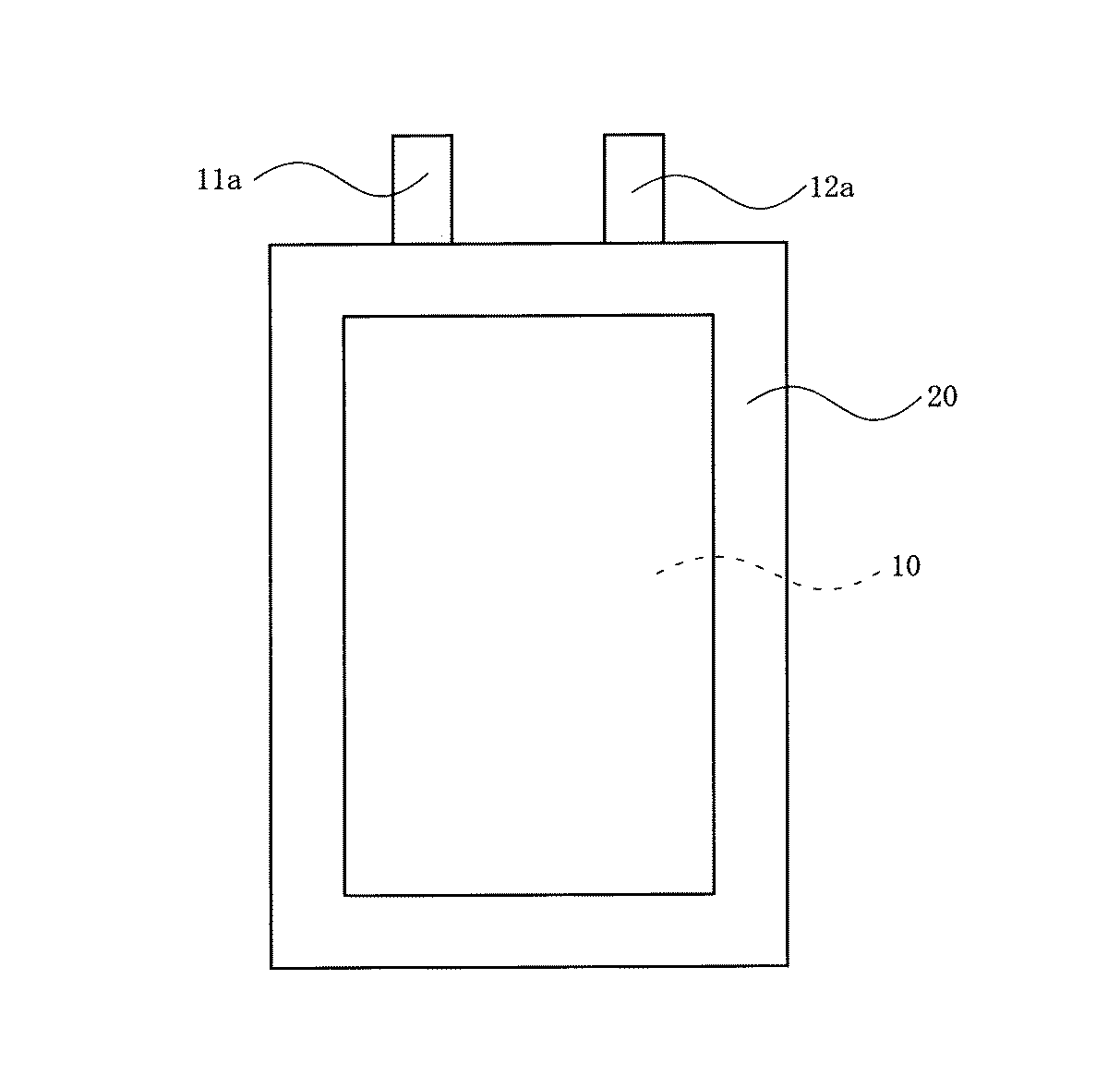
次いで、図2に示すように、上記の扁平電極体10をアルミニウムラミネートフィルムで構成された電池容器20内に収容させると共に、この電池容器20内に上記の非水電解液を加え、上記の正極11に設けた正極集電タブ11aと負極12に設けた負極集電タブ12aとを外部に取り出すようにして、上記の電池容器20の開口部を封口させて、電池規格サイズとして縦6.2cm,横3.5cm,厚み3.6mmになった非水電解質二次電池を作製した。
(実施例2)
実施例2においては、上記の実施例1における非水電解液の作製において、上記の非水電解液に対して、ビニレンカーボネート(VC)を2.0重量%と、不飽和結合を有する環状エーテルであるフランを0.5体積%添加させるようにし、それ以外は、上記の実施例1の場合と同様にして、非水電解質二次電池を作製した。
Next, as shown in FIG. 2, the
(Example 2)
In Example 2, in the preparation of the non-aqueous electrolyte in Example 1 above, 2.0% by weight of vinylene carbonate (VC) with respect to the non-aqueous electrolyte and a cyclic ether having an unsaturated bond A nonaqueous electrolyte secondary battery was fabricated in the same manner as in Example 1 except that 0.5% by volume of furan was added.
(実施例3)
実施例3においては、上記の実施例1における非水電解液の作製において、上記の非水電解液に対して、ビニレンカーボネート(VC)を2.0重量%と、不飽和結合を有していない環状エーテルであるテトラヒドロフラン(THF)を1.0体積%添加させるようにし、それ以外は、上記の実施例1の場合と同様にして、非水電解質二次電池を作製した。
(Example 3)
In Example 3, in the preparation of the non-aqueous electrolyte in Example 1, the vinylene carbonate (VC) is 2.0% by weight and has an unsaturated bond with respect to the non-aqueous electrolyte. A nonaqueous electrolyte secondary battery was fabricated in the same manner as in Example 1 except that 1.0% by volume of tetrahydrofuran (THF), which is not a cyclic ether, was added.
(実施例4)
実施例4においては、上記の実施例1における非水電解液の作製において、上記の非水電解液に対して、ビニレンカーボネート(VC)を添加させずに、不飽和結合を有していない環状エーテルであるテトラヒドロフラン(THF)だけを1.0体積%添加させるようにし、それ以外は、上記の実施例1の場合と同様にして、非水電解質二次電池を作製した。
Example 4
In Example 4, in the preparation of the non-aqueous electrolyte in Example 1 above, a cyclic structure having no unsaturated bond without adding vinylene carbonate (VC) to the above-mentioned non-aqueous electrolyte. A nonaqueous electrolyte secondary battery was produced in the same manner as in Example 1 except that 1.0% by volume of tetrahydrofuran (THF), which was ether, was added.
(実施例5)
実施例5においては、上記の実施例1における非水電解液の作製において、上記の非水電解液に対して、ビニレンカーボネート(VC)を2.0重量%と、不飽和結合を有していない環状エーテルである2−メチル−テトラヒドロフラン(2Me−THF)を1.0体積%添加させるようにし、それ以外は、上記の実施例1の場合と同様にして、非水電解質二次電池を作製した。
(Example 5)
In Example 5, in the preparation of the non-aqueous electrolyte in Example 1, the vinylene carbonate (VC) is 2.0% by weight and has an unsaturated bond with respect to the non-aqueous electrolyte. A nonaqueous electrolyte secondary battery was prepared in the same manner as in Example 1 except that 1.0% by volume of 2-methyl-tetrahydrofuran (2Me-THF), which is not a cyclic ether, was added. did.
(実施例6)
実施例6においては、上記の実施例1における非水電解液の作製において、上記の非水電解液に対して、ビニレンカーボネート(VC)を2.0重量%と、不飽和結合を有していない環状エーテルである1,4−ジオキサンを1.0体積%添加させるようにし、それ以外は、上記の実施例1の場合と同様にして、非水電解質二次電池を作製した。
(Example 6)
In Example 6, in preparation of the non-aqueous electrolyte in Example 1 described above, vinylene carbonate (VC) is 2.0% by weight and has an unsaturated bond with respect to the non-aqueous electrolyte. A nonaqueous electrolyte secondary battery was fabricated in the same manner as in Example 1 except that 1.0 vol% of 1,4-dioxane, which is a non-cyclic ether, was added.
(実施例7)
実施例7においては、上記の実施例1における非水電解液の作製において、上記の非水電解液に対して、ビニレンカーボネート(VC)を2.0重量%と、不飽和結合を有していない環状エーテルである1,3−ジオキサンを1.0体積%添加させるようにし、それ以外は、上記の実施例1の場合と同様にして、非水電解質二次電池を作製した。
(Example 7)
In Example 7, in preparation of the non-aqueous electrolyte in Example 1 described above, vinylene carbonate (VC) was 2.0% by weight with respect to the non-aqueous electrolyte and had an unsaturated bond. A nonaqueous electrolyte secondary battery was fabricated in the same manner as in Example 1 except that 1.0 volume% of 1,3-dioxane, which is a non-cyclic ether, was added.
(比較例1)
比較例1においては、上記の実施例1における非水電解液の作製において、上記の非水電解液に対して、ビニレンカーボネート(VC)だけを2.0重量%添加させるようにし、それ以外は、上記の実施例1の場合と同様にして、非水電解質二次電池を作製した。
(Comparative Example 1)
In Comparative Example 1, in the preparation of the non-aqueous electrolyte in Example 1 above, only 2.0% by weight of vinylene carbonate (VC) was added to the above-mentioned non-aqueous electrolyte. A nonaqueous electrolyte secondary battery was produced in the same manner as in Example 1 above.
(比較例2)
比較例2においては、上記の実施例1における非水電解液の作製において、上記の非水電解液に対して、ビニレンカーボネート(VC)を2.0重量%と、鎖状エーテルのジエチルエーテル(DEE)を2.0体積%添加させるようにし、それ以外は、上記の実施例1の場合と同様にして、非水電解質二次電池を作製した。
(Comparative Example 2)
In Comparative Example 2, in the preparation of the non-aqueous electrolyte in Example 1 above, 2.0% by weight of vinylene carbonate (VC) and chain ether diethyl ether ( A nonaqueous electrolyte secondary battery was produced in the same manner as in Example 1 except that 2.0% by volume of DEE) was added.
(比較例3)
比較例3においては、上記の実施例1における非水電解液の作製において、上記の非水電解液に対して、ビニレンカーボネート(VC)を2.0重量%と、鎖状エーテルのジエチレングリコールジメチルエーテル(DDE)を1.0体積%添加させるようにし、それ以外は、上記の実施例1の場合と同様にして、非水電解質二次電池を作製した。
(比較例4)
比較例4においては、上記の実施例1における非水電解液の作製において、上記の非水電解液に対して、ビニレンカーボネート(VC)を2.0重量%と、鎖状エーテルのブチルメチルエーテルを1.0体積%添加させるようにし、それ以外は、上記の実施例1の場合と同様にして、非水電解質二次電池を作製した。
(Comparative Example 3)
In Comparative Example 3, in the preparation of non-aqueous electrolytic solution in Example 1 above, to the non-aqueous electrolyte described above, the vinylene carbonate (VC) 2.0 wt%, diethylene glycol methyl chain ether A nonaqueous electrolyte secondary battery was fabricated in the same manner as in Example 1 except that 1.0% by volume of ether (DDE) was added.
(Comparative Example 4)
In Comparative Example 4, in the preparation of the non-aqueous electrolyte in Example 1, the vinylene carbonate (VC) was 2.0% by weight with respect to the non-aqueous electrolyte, and butyl methyl ether of a chain ether. A nonaqueous electrolyte secondary battery was fabricated in the same manner as in Example 1 except that 1.0% by volume was added.
そして、上記のようにして作製した実施例1〜7及び比較例1〜4の各非水電解質二次電池を、それぞれ室温条件の下で、800mAの定電流で電池電圧が4.2Vになるまで充電させ、さらに4.2Vの定電圧で電流値が40mAになるまで充電させた後、800mAの定電流で電池電圧が2.5Vに達するまで放電させて、初回の充放電を行った。 The nonaqueous electrolyte secondary batteries of Examples 1 to 7 and Comparative Examples 1 to 4 manufactured as described above have a battery voltage of 4.2 V at a constant current of 800 mA under room temperature conditions. The battery was charged until the current value reached 40 mA at a constant voltage of 4.2 V, and then discharged at a constant current of 800 mA until the battery voltage reached 2.5 V, and the first charge / discharge was performed.
次いで、上記の各非水電解質二次電池を、それぞれ室温条件の下で、800mAの定電流で電池電圧が4.2Vになるまで充電させ、さらに4.2Vの定電圧で電流値が40mAになるまで充電させて、各非水電解質二次電池における充電状態での保存前の電池厚みを測定した。 Next, each of the above non-aqueous electrolyte secondary batteries is charged at a constant current of 800 mA until the battery voltage reaches 4.2 V under a room temperature condition, and the current value is increased to 40 mA at a constant voltage of 4.2 V. The battery thickness before storage in the charged state in each non-aqueous electrolyte secondary battery was measured.
次いで、このように充電させた状態にある各非水電解質二次電池を85℃の恒温槽中で3時間保存させた後、各非水電解質二次電池を取り出して室温で1時間放冷させて、保存後における各非水電解質二次電池の電池厚みを測定した。 Next, after each non-aqueous electrolyte secondary battery thus charged is stored in a thermostatic bath at 85 ° C. for 3 hours, each non-aqueous electrolyte secondary battery is taken out and allowed to cool at room temperature for 1 hour. Then, the battery thickness of each non-aqueous electrolyte secondary battery after storage was measured.
そして、各非水電解質二次電池における保存前の電池厚みに対する保存後の電池厚みの増加分を求め、比較例1の非水電解質二次電池における電池厚み増加分を100として、各非水電解質二次電池における電池厚み増加分を算出し、その結果を下記の表1に示した。 Then, an increase in the battery thickness after storage with respect to the battery thickness before storage in each nonaqueous electrolyte secondary battery is obtained, and the increase in battery thickness in the nonaqueous electrolyte secondary battery of Comparative Example 1 is defined as 100. The increase in battery thickness in the secondary battery was calculated, and the results are shown in Table 1 below.
この結果から明らかなように、Li1.05Ni0.80 Co 0.17Al0.03O2からなるニッケルが多く含有された正極活物質を用いた非水電解質二次電池において、非水電解液に環状エーテルを添加させた実施例1〜7の各非水電解質二次電池は、環状エーテルを添加させていない比較例1の非水電解質二次電池や、環状エーテルに代えて鎖状エーテルを添加させた比較例2〜4の各非水電解質二次電池に比べて、充電状態で高温条件下に保存した場合における電池厚み増加分が大きく低減されていた。特に、上記の環状エーテルとして、不飽和結合を有する環状エーテルを添加させた実施例1,2の非水電解質二次電池においては、上記の電池厚み増加分がさらに大きく減少していた。 As is clear from this result, in a non-aqueous electrolyte secondary battery using a positive electrode active material containing a large amount of nickel composed of Li 1.05 Ni 0.80 Co 0.17 Al 0.03 O 2 , cyclic ether was added to the non-aqueous electrolyte. The nonaqueous electrolyte secondary batteries of Examples 1 to 7 are the nonaqueous electrolyte secondary battery of Comparative Example 1 in which cyclic ether is not added, or Comparative Example 2 in which chain ether is added instead of cyclic ether. Compared with each nonaqueous electrolyte secondary battery of -4, the increase in battery thickness when stored under high temperature conditions in a charged state was greatly reduced. In particular, in the nonaqueous electrolyte secondary batteries of Examples 1 and 2 in which a cyclic ether having an unsaturated bond was added as the cyclic ether, the battery thickness increase was further greatly reduced.
また、上記の実施例3,4の非水電解質二次電池について、上記のように充電状態で高温条件下に保存する前と保存した後とにおける電池の内部抵抗を測定し、保存前の電池の内部抵抗に対する保存後の内部抵抗の増加分(mΩ)を求め、その結果を下記の表2に示した。 For the nonaqueous electrolyte secondary batteries of Examples 3 and 4 above, the internal resistance of the battery before and after being stored under high temperature conditions in a charged state as described above was measured, and the battery before storage The increase (mΩ) of the internal resistance after storage with respect to the internal resistance was determined, and the results are shown in Table 2 below.
この結果、非水電解液に対して、環状エーテルと共にビニレンカーボネートを添加させた実施例3の非水電解質二次電池は、ビニレンカーボネートを添加させていない実施例4の非水電解質二次電池に比べて、充電状態で高温条件下に保存した後における上記の電池厚み増加分及び電池の内部抵抗の上昇が抑制されていた。 As a result, the non-aqueous electrolyte secondary battery of Example 3 in which vinylene carbonate and cyclic ether were added to the non-aqueous electrolyte was changed to the non-aqueous electrolyte secondary battery of Example 4 in which vinylene carbonate was not added. In comparison, the increase in the battery thickness and the increase in the internal resistance of the battery after storage under high temperature conditions in the charged state were suppressed.
(比較例5)
比較例5においては、上記の実施例1における正極の作製において、正極活物質にLiCoO2を用いて正極を作製すると共に、実施例1における非水電解液の作製において、上記の実施例3と同様に、非水電解液に対して、ビニレンカーボネート(VC)を2.0重量%と、テトラヒドロフラン(THF)を1.0体積%添加させるようにし、それ以外は、上記の実施例1の場合と同様にして、非水電解質二次電池を作製した。
(Comparative Example 5)
In Comparative Example 5, in the production of the positive electrode in Example 1 above, the positive electrode was produced using LiCoO 2 as the positive electrode active material, and in the production of the non-aqueous electrolyte in Example 1, Similarly, 2.0% by weight of vinylene carbonate (VC) and 1.0% by volume of tetrahydrofuran (THF) are added to the nonaqueous electrolytic solution. Otherwise, the case of Example 1 above In the same manner as described above, a non-aqueous electrolyte secondary battery was produced.
(比較例6)
比較例6においては、上記の実施例1における正極の作製において、比較例5と同様に、正極活物質にLiCoO2を用いて正極を作製すると共に、実施例1における非水電解液の作製において、上記の比較例1と同様に、非水電解液に対して、ビニレンカーボネート(VC)だけを2.0重量%添加させるようにし、それ以外は、上記の実施例1の場合と同様にして、非水電解質二次電池を作製した。
(Comparative Example 6)
In Comparative Example 6, in the production of the positive electrode in Example 1 above, as in Comparative Example 5, the positive electrode was produced using LiCoO 2 as the positive electrode active material, and in the production of the non-aqueous electrolyte in Example 1 As in Comparative Example 1 above, only 2.0% by weight of vinylene carbonate (VC) is added to the non-aqueous electrolyte, and the rest is the same as in Example 1 above. A non-aqueous electrolyte secondary battery was produced.
そして、上記のようにして作製した比較例5,6の各非水電解質二次電池についても、上記の場合と同様にして、充電させた状態にある各非水電解質二次電池を85℃の恒温槽中で3時間保存させる前の電池厚みに対する、保存させた後の電池厚みの増加分を求め、比較例6の非水電解質二次電池における電池厚み増加分を100として、比較例5の非水電解質二次電池における電池厚み増加分を算出し、その結果を下記の表3に示した。 And also about each nonaqueous electrolyte secondary battery of the comparative examples 5 and 6 produced as mentioned above, each nonaqueous electrolyte secondary battery in the charged state is 85 degreeC like the said case. The amount of increase in battery thickness after storage with respect to the battery thickness before storage for 3 hours in a thermostatic bath was determined, and the amount of increase in battery thickness in the nonaqueous electrolyte secondary battery of Comparative Example 6 was set to 100. The increase in battery thickness in the nonaqueous electrolyte secondary battery was calculated, and the results are shown in Table 3 below.
この結果、正極活物質にLiCoO2を用いた比較例5,6の非水電解質二次電池においては、非水電解液に対して環状エーテルを添加させた比較例5の非水電解質二次電池の方が、環状エーテルを添加させていない比較例6の非水電解質二次電池に比べて、充電状態で高温条件下において保存した場合における電池厚み増加分が少し減少していたが、Li1.05Ni0.80 Co 0.17Al0.03O2からなるニッケルが多く含有された正極活物質を用いた上記の各実施例の非水電解質二次電池に比べると、電池厚み増加分の減少は少なく、環状エーテルを添加させることによる効果は低くなっていた。 As a result, in the nonaqueous electrolyte secondary batteries of Comparative Examples 5 and 6 using LiCoO 2 as the positive electrode active material, the nonaqueous electrolyte secondary battery of Comparative Example 5 in which cyclic ether was added to the nonaqueous electrolyte solution. who is, as compared with the non-aqueous electrolyte secondary battery of Comparative example 6 that has not been added to the cyclic ether, although battery thickness increase when stored under high temperature conditions in a charged state was slightly decreased, Li 1.05 Compared with the non-aqueous electrolyte secondary battery of each of the above examples using a positive electrode active material containing a large amount of nickel consisting of Ni 0.80 Co 0.17 Al 0.03 O 2 , the decrease in the increase in battery thickness was small, and cyclic ether was used. The effect by adding was low.
(比較例7)
比較例7においては、上記の実施例1における正極の作製において、正極活物質にLiNi1/3Co1/3Mn1/3O2を用いて正極を作製すると共に、実施例1における非水電解液の作製において、上記の実施例3と同様に、非水電解液に対して、ビニレンカーボネート(VC)を2.0重量%と、テトラヒドロフラン(THF)を1.0体積%添加させるようにし、それ以外は、上記の実施例1の場合と同様にして、非水電解質二次電池を作製した。
(Comparative Example 7)
In Comparative Example 7, in the production of the positive electrode in Example 1 above, a positive electrode was produced using LiNi 1/3 Co 1/3 Mn 1/3 O 2 as the positive electrode active material, and non-aqueous in Example 1 was used. In the preparation of the electrolytic solution, as in Example 3 above, 2.0% by weight of vinylene carbonate (VC) and 1.0% by volume of tetrahydrofuran (THF) were added to the nonaqueous electrolytic solution. Other than that, a non-aqueous electrolyte secondary battery was produced in the same manner as in Example 1 above.
(比較例8)
比較例8においては、上記の実施例1における正極の作製において、比較例7と同様に、正極活物質にLiNi1/3Co1/3Mn1/3O2を用いて正極を作製すると共に、実施例1における非水電解液の作製において、上記の比較例1と同様に、非水電解液に対して、ビニレンカーボネート(VC)だけを2.0重量%添加させるようにし、それ以外は、上記の実施例1の場合と同様にして、非水電解質二次電池を作製した。
(Comparative Example 8)
In Comparative Example 8, in the production of the positive electrode in Example 1 above, as in Comparative Example 7, a positive electrode was produced using LiNi 1/3 Co 1/3 Mn 1/3 O 2 as the positive electrode active material. In the preparation of the non-aqueous electrolyte in Example 1, only 2.0% by weight of vinylene carbonate (VC) was added to the non-aqueous electrolyte in the same manner as in Comparative Example 1 above. A nonaqueous electrolyte secondary battery was produced in the same manner as in Example 1 above.
そして、上記のようにして作製した比較例7,8の各非水電解質二次電池についても、上記の場合と同様にして、充電させた状態にある各非水電解質二次電池を85℃の恒温槽中で3時間保存させる前の電池厚みに対する、保存させた後の電池厚みの増加分を求め、比較例8の非水電解質二次電池における電池厚み増加分を100として、比較例7の非水電解質二次電池における電池厚み増加分を算出し、その結果を下記の表4に示した。 And also about each nonaqueous electrolyte secondary battery of the comparative examples 7 and 8 produced as mentioned above, each nonaqueous electrolyte secondary battery in the charged state is 85 degreeC similarly to the said case. The increase in battery thickness after storage with respect to the battery thickness before storage for 3 hours in a thermostatic bath was determined, and the increase in battery thickness in the nonaqueous electrolyte secondary battery of Comparative Example 8 was taken as 100. The increase in battery thickness in the nonaqueous electrolyte secondary battery was calculated, and the results are shown in Table 4 below.
この結果、正極活物質にLiNi1/3Co1/3Mn1/3O2を用いた比較例7,8の非水電解質二次電池においては、Li1.05Ni0.80 Co 0.17Al0.03O2からなるニッケルが多く含有された正極活物質を用いた非水電解質二次電池の場合とは逆に、非水電解液に対して環状エーテルを添加させた比較例7の非水電解質二次電池の方が、非水電解液に対して環状エーテルを添加させていない比較例8の非水電解質二次電池に比べて、充電状態で高温条件下において保存した場合における電池厚み増加分が増加しており、上記の各実施例の非水電解質二次電池における効果は得られなかった。 As a result, in the nonaqueous electrolyte secondary batteries of Comparative Examples 7 and 8 using LiNi 1/3 Co 1/3 Mn 1/3 O 2 as the positive electrode active material, Li 1.05 Ni 0.80 Co 0.17 Al 0.03 O 2 Contrary to the case of the non-aqueous electrolyte secondary battery using the positive electrode active material containing a large amount of nickel, the non-aqueous electrolyte secondary battery of Comparative Example 7 in which cyclic ether was added to the non-aqueous electrolyte was used. However, compared with the non-aqueous electrolyte secondary battery of Comparative Example 8 in which no cyclic ether was added to the non-aqueous electrolyte, the increase in battery thickness when stored under high temperature conditions in a charged state increased. Thus, the effect of the nonaqueous electrolyte secondary battery of each of the above examples was not obtained.
10 扁平電極体
11 正極
11a 正極集電タブ
12 負極
12a 負極集電タブ
13 セパレータ
20 電池容器
DESCRIPTION OF
Claims (5)
前記の正極活物質が、一般式Li a Ni b Co c M d O 2+e (式中、Mは、Al,Mn,Mg,Caから選択される少なくとも1種であり、a,b,c,d,eは、0.2≦a≦1.2,0.6≦b≦0.9,0.1≦c≦0.4,0≦d≦0.2,−0.2≦e≦0.2,b+c+d=1の条件を満たす。)で表されるリチウム含有金属複合酸化物で表されるリチウム含有金属複合酸化物であり、
上記の非水電解液に、環状エーテルを0.1〜2体積%の範囲で添加させたことを特徴とする非水電解質二次電池。 In a non-aqueous electrolyte secondary battery comprising a positive electrode using a positive electrode active material comprising a lithium-containing metal composite oxide having a layered structure, a negative electrode, and a non-aqueous electrolyte in which an electrolyte is dissolved in a non-aqueous solvent,
The positive electrode active material has a general formula Li a Ni b Co c M d O 2 + e (wherein M is at least one selected from Al, Mn, Mg, and Ca, and a, b, c , D, e are 0.2 ≦ a ≦ 1.2, 0.6 ≦ b ≦ 0.9, 0.1 ≦ c ≦ 0.4, 0 ≦ d ≦ 0.2, −0.2 ≦ e. ≦ 0.2, b + c + d = 1.) A lithium-containing metal composite oxide represented by a lithium-containing metal composite oxide represented by
The non-aqueous electrolyte above SL, a non-aqueous electrolyte secondary battery characterized in that is added in the range of cyclic ethers 0.1-2% by volume.
Priority Applications (4)
| Application Number | Priority Date | Filing Date | Title |
|---|---|---|---|
| JP2007076208A JP5116329B2 (en) | 2007-03-23 | 2007-03-23 | Nonaqueous electrolyte secondary battery |
| CN2007101993539A CN101271987B (en) | 2007-03-23 | 2007-12-17 | Non-aqueous electrolyte secondary battery |
| KR1020080026180A KR20080086829A (en) | 2007-03-23 | 2008-03-21 | Nonaqueous electrolyte secondary battery |
| US12/053,940 US20080233485A1 (en) | 2007-03-23 | 2008-03-24 | Non-aqueous electrolyte secondary battery |
Applications Claiming Priority (1)
| Application Number | Priority Date | Filing Date | Title |
|---|---|---|---|
| JP2007076208A JP5116329B2 (en) | 2007-03-23 | 2007-03-23 | Nonaqueous electrolyte secondary battery |
Publications (2)
| Publication Number | Publication Date |
|---|---|
| JP2008235147A JP2008235147A (en) | 2008-10-02 |
| JP5116329B2 true JP5116329B2 (en) | 2013-01-09 |
Family
ID=39775082
Family Applications (1)
| Application Number | Title | Priority Date | Filing Date |
|---|---|---|---|
| JP2007076208A Expired - Fee Related JP5116329B2 (en) | 2007-03-23 | 2007-03-23 | Nonaqueous electrolyte secondary battery |
Country Status (4)
| Country | Link |
|---|---|
| US (1) | US20080233485A1 (en) |
| JP (1) | JP5116329B2 (en) |
| KR (1) | KR20080086829A (en) |
| CN (1) | CN101271987B (en) |
Cited By (1)
| Publication number | Priority date | Publication date | Assignee | Title |
|---|---|---|---|---|
| US8549728B2 (en) | 2007-03-14 | 2013-10-08 | Nikon Corporation | Manufacturing method for vibration body and manufacturing method for vibration actuator |
Families Citing this family (16)
| Publication number | Priority date | Publication date | Assignee | Title |
|---|---|---|---|---|
| KR20090050951A (en) * | 2007-11-16 | 2009-05-20 | 산요덴키가부시키가이샤 | Nonaqueous Electrolyte Secondary Battery |
| EP2555283A1 (en) * | 2010-04-01 | 2013-02-06 | Sanyo Electric Co., Ltd. | Nonaqueous electrolyte secondary battery |
| JP5789744B2 (en) * | 2010-11-15 | 2015-10-07 | パナソニックIpマネジメント株式会社 | Lithium primary battery |
| KR101309492B1 (en) | 2012-02-20 | 2013-09-16 | 주식회사 윈터치 | Tablet having flexible and transparent sensing area |
| CN103515666B (en) * | 2012-06-22 | 2017-03-01 | 日立麦克赛尔株式会社 | Lithium secondary battery |
| CN104508896B (en) | 2012-07-31 | 2017-06-09 | 宇部兴产株式会社 | Nonaqueous electrolytic solution and the electric energy storage device of the nonaqueous electrolytic solution is used |
| JP5614431B2 (en) * | 2012-08-31 | 2014-10-29 | Tdk株式会社 | Non-aqueous electrolyte for lithium ion secondary battery and lithium ion secondary battery |
| KR101630210B1 (en) * | 2014-06-30 | 2016-06-15 | 전자부품연구원 | Electrolyte having ionic liquid type meterial, and manufacturing of the same, and lithium-ion secondary battery having cathode containing excess amount of nickel |
| KR20180061259A (en) | 2015-10-05 | 2018-06-07 | 히타치가세이가부시끼가이샤 | Energy device Resin for electrodes, Energy device Compositions for electrode formation, Positive electrodes and energy devices for energy devices |
| FR3044830B1 (en) * | 2015-12-08 | 2020-06-12 | Commissariat A L'energie Atomique Et Aux Energies Alternatives | ELECTROCHEMICAL CELL FOR LITHIUM BATTERY COMPRISING A SPECIFIC ELECTROLYTE |
| WO2018154787A1 (en) | 2017-02-27 | 2018-08-30 | 日立化成株式会社 | Composite resin for energy device electrode, composition for forming energy device electrode, positive electrode for energy device, and energy device |
| CN110945705B (en) * | 2017-07-27 | 2023-05-09 | 株式会社村田制作所 | Electrolyte for secondary batteries, secondary batteries, battery packs, electric vehicles, power storage systems, electric tools and electronic equipment |
| CN113381072A (en) * | 2017-12-06 | 2021-09-10 | 宁德新能源科技有限公司 | Electrolyte and battery containing the same |
| CN109687025B (en) | 2019-01-25 | 2024-09-03 | 宁德新能源科技有限公司 | Electrolyte, electrochemical device and electronic device containing the same |
| CN112968157B (en) * | 2021-02-06 | 2022-11-01 | 苏州精诚智造智能科技有限公司 | Preparation method of power lithium ion battery |
| KR102310250B1 (en) | 2021-03-25 | 2021-10-08 | 에스케이이노베이션 주식회사 | Cathode active material for lithium secondary battery and lithium secondary battery including the same |
Family Cites Families (14)
| Publication number | Priority date | Publication date | Assignee | Title |
|---|---|---|---|---|
| JP2000299129A (en) * | 1999-04-16 | 2000-10-24 | Sanyo Electric Co Ltd | Gel polyelectrolyte |
| KR100390099B1 (en) * | 2000-09-28 | 2003-07-04 | 가부시끼가이샤 도시바 | Nonaqueous electrolyte and nonaqueous electrolyte secondary cell |
| US6861175B2 (en) * | 2000-09-28 | 2005-03-01 | Kabushiki Kaisha Toshiba | Nonaqueous electrolyte and nonaqueous electrolyte secondary battery |
| JP2002203601A (en) * | 2000-12-28 | 2002-07-19 | Sony Corp | Non-aqueous electrolyte secondary battery |
| JP2003017060A (en) * | 2001-04-25 | 2003-01-17 | Sony Corp | Cathode active material and non-aqueous electrolyte battery |
| KR100527827B1 (en) * | 2003-03-13 | 2005-11-09 | 삼성에스디아이 주식회사 | A non-aqueous electrolyte and a lithium secondary battery comprising the same |
| CN100502132C (en) * | 2004-02-10 | 2009-06-17 | 株式会社Lg化学 | Non-aqueous electrolyte and lithium secondary battery using the same |
| JP4237074B2 (en) * | 2004-02-16 | 2009-03-11 | ソニー株式会社 | Cathode active material for non-aqueous electrolyte secondary battery and non-aqueous electrolyte secondary battery |
| US8007938B2 (en) * | 2004-04-20 | 2011-08-30 | Mitsubishi Chemical Corporation | Nonaqueous electrolyte solution and lithium secondary battery using same |
| JP4364066B2 (en) * | 2004-06-11 | 2009-11-11 | 株式会社東芝 | Non-aqueous electrolyte battery |
| JP4739778B2 (en) * | 2005-02-28 | 2011-08-03 | 三洋電機株式会社 | Nonaqueous electrolyte secondary battery |
| JP5004475B2 (en) * | 2006-01-30 | 2012-08-22 | 三洋電機株式会社 | Nonaqueous electrolyte secondary battery |
| CN101188282B (en) * | 2006-03-20 | 2010-09-08 | 日立麦克赛尔株式会社 | Non-aqueous secondary battery and method of use thereof |
| JP5100024B2 (en) * | 2006-03-30 | 2012-12-19 | 住友金属鉱山株式会社 | Cathode active material for non-aqueous electrolyte secondary battery and non-aqueous electrolyte secondary battery using the same |
-
2007
- 2007-03-23 JP JP2007076208A patent/JP5116329B2/en not_active Expired - Fee Related
- 2007-12-17 CN CN2007101993539A patent/CN101271987B/en not_active Expired - Fee Related
-
2008
- 2008-03-21 KR KR1020080026180A patent/KR20080086829A/en not_active Ceased
- 2008-03-24 US US12/053,940 patent/US20080233485A1/en not_active Abandoned
Cited By (1)
| Publication number | Priority date | Publication date | Assignee | Title |
|---|---|---|---|---|
| US8549728B2 (en) | 2007-03-14 | 2013-10-08 | Nikon Corporation | Manufacturing method for vibration body and manufacturing method for vibration actuator |
Also Published As
| Publication number | Publication date |
|---|---|
| CN101271987A (en) | 2008-09-24 |
| KR20080086829A (en) | 2008-09-26 |
| US20080233485A1 (en) | 2008-09-25 |
| JP2008235147A (en) | 2008-10-02 |
| CN101271987B (en) | 2011-11-30 |
Similar Documents
| Publication | Publication Date | Title |
|---|---|---|
| JP5116329B2 (en) | Nonaqueous electrolyte secondary battery | |
| JP4679112B2 (en) | Non-aqueous electrolyte secondary battery and manufacturing method thereof | |
| JP3844733B2 (en) | Nonaqueous electrolyte secondary battery | |
| JP6399388B2 (en) | Nonaqueous electrolyte secondary battery | |
| JP4798964B2 (en) | Nonaqueous electrolyte secondary battery | |
| JP2009224307A (en) | Nonaqueous electrolyte secondary battery and method for manufacturing the same | |
| JP5004475B2 (en) | Nonaqueous electrolyte secondary battery | |
| JP2008071569A (en) | Positive electrode material for nonaqueous electrolyte secondary battery, and nonaqueous electrolyte secondary battery | |
| CN100499220C (en) | Nonaqueous electrolyte secondary battery | |
| JP2011181427A (en) | Lithium secondary battery | |
| JP5026629B2 (en) | Positive electrode for non-aqueous electrolyte battery and non-aqueous electrolyte battery | |
| JP2008311211A (en) | Nonaqueous electrolyte secondary battery | |
| JP4530822B2 (en) | Nonaqueous electrolyte secondary battery and charging method thereof | |
| JP2009266791A (en) | Nonaqueous electrolyte secondary battery | |
| JP2011014254A (en) | Manufacturing method of nonaqueous electrolyte secondary battery | |
| JP2008251212A (en) | Non-aqueous electrolyte secondary battery | |
| JP4651279B2 (en) | Nonaqueous electrolyte secondary battery | |
| JP2010238385A (en) | Non-aqueous electrolyte for secondary battery and non-aqueous electrolyte secondary battery | |
| JP2006202529A (en) | Non-aqueous electrolyte secondary battery and charging method thereof | |
| JP2007250440A (en) | Nonaqueous electrolyte secondary battery | |
| JP2004158352A (en) | Nonaqueous electrolyte secondary battery | |
| JP5463754B2 (en) | Active material for lithium secondary battery, lithium secondary battery, and method for producing active material for lithium secondary battery | |
| JP2009176528A (en) | Nonaqueous electrolyte secondary battery and method for manufacturing same | |
| JP2005285630A (en) | Nonaqueous electrolyte secondary battery | |
| JP2008235146A (en) | Nonaqueous secondary battery |
Legal Events
| Date | Code | Title | Description |
|---|---|---|---|
| A621 | Written request for application examination |
Free format text: JAPANESE INTERMEDIATE CODE: A621 Effective date: 20100215 |
|
| A977 | Report on retrieval |
Free format text: JAPANESE INTERMEDIATE CODE: A971007 Effective date: 20120215 |
|
| A131 | Notification of reasons for refusal |
Free format text: JAPANESE INTERMEDIATE CODE: A131 Effective date: 20120221 |
|
| A521 | Written amendment |
Free format text: JAPANESE INTERMEDIATE CODE: A523 Effective date: 20120417 |
|
| TRDD | Decision of grant or rejection written | ||
| A01 | Written decision to grant a patent or to grant a registration (utility model) |
Free format text: JAPANESE INTERMEDIATE CODE: A01 Effective date: 20120918 |
|
| A01 | Written decision to grant a patent or to grant a registration (utility model) |
Free format text: JAPANESE INTERMEDIATE CODE: A01 |
|
| A61 | First payment of annual fees (during grant procedure) |
Free format text: JAPANESE INTERMEDIATE CODE: A61 Effective date: 20121016 |
|
| FPAY | Renewal fee payment (event date is renewal date of database) |
Free format text: PAYMENT UNTIL: 20151026 Year of fee payment: 3 |
|
| LAPS | Cancellation because of no payment of annual fees |