JP5032002B2 - Battery separator and alkaline battery - Google Patents
Battery separator and alkaline battery Download PDFInfo
- Publication number
- JP5032002B2 JP5032002B2 JP2005167537A JP2005167537A JP5032002B2 JP 5032002 B2 JP5032002 B2 JP 5032002B2 JP 2005167537 A JP2005167537 A JP 2005167537A JP 2005167537 A JP2005167537 A JP 2005167537A JP 5032002 B2 JP5032002 B2 JP 5032002B2
- Authority
- JP
- Japan
- Prior art keywords
- separator
- battery
- mass
- alkaline
- polymer compound
- Prior art date
- Legal status (The legal status is an assumption and is not a legal conclusion. Google has not performed a legal analysis and makes no representation as to the accuracy of the status listed.)
- Expired - Lifetime
Links
Classifications
-
- D—TEXTILES; PAPER
- D21—PAPER-MAKING; PRODUCTION OF CELLULOSE
- D21H—PULP COMPOSITIONS; PREPARATION THEREOF NOT COVERED BY SUBCLASSES D21C OR D21D; IMPREGNATING OR COATING OF PAPER; TREATMENT OF FINISHED PAPER NOT COVERED BY CLASS B31 OR SUBCLASS D21G; PAPER NOT OTHERWISE PROVIDED FOR
- D21H13/00—Pulp or paper, comprising synthetic cellulose or non-cellulose fibres or web-forming material
- D21H13/10—Organic non-cellulose fibres
- D21H13/12—Organic non-cellulose fibres from macromolecular compounds obtained by reactions only involving carbon-to-carbon unsaturated bonds
- D21H13/16—Polyalkenylalcohols; Polyalkenylethers; Polyalkenylesters
-
- D—TEXTILES; PAPER
- D21—PAPER-MAKING; PRODUCTION OF CELLULOSE
- D21H—PULP COMPOSITIONS; PREPARATION THEREOF NOT COVERED BY SUBCLASSES D21C OR D21D; IMPREGNATING OR COATING OF PAPER; TREATMENT OF FINISHED PAPER NOT COVERED BY CLASS B31 OR SUBCLASS D21G; PAPER NOT OTHERWISE PROVIDED FOR
- D21H17/00—Non-fibrous material added to the pulp, characterised by its constitution; Paper-impregnating material characterised by its constitution
- D21H17/20—Macromolecular organic compounds
- D21H17/33—Synthetic macromolecular compounds
- D21H17/34—Synthetic macromolecular compounds obtained by reactions only involving carbon-to-carbon unsaturated bonds
- D21H17/37—Polymers of unsaturated acids or derivatives thereof, e.g. polyacrylates
-
- D—TEXTILES; PAPER
- D21—PAPER-MAKING; PRODUCTION OF CELLULOSE
- D21H—PULP COMPOSITIONS; PREPARATION THEREOF NOT COVERED BY SUBCLASSES D21C OR D21D; IMPREGNATING OR COATING OF PAPER; TREATMENT OF FINISHED PAPER NOT COVERED BY CLASS B31 OR SUBCLASS D21G; PAPER NOT OTHERWISE PROVIDED FOR
- D21H17/00—Non-fibrous material added to the pulp, characterised by its constitution; Paper-impregnating material characterised by its constitution
- D21H17/20—Macromolecular organic compounds
- D21H17/33—Synthetic macromolecular compounds
- D21H17/46—Synthetic macromolecular compounds obtained otherwise than by reactions only involving carbon-to-carbon unsaturated bonds
- D21H17/54—Synthetic macromolecular compounds obtained otherwise than by reactions only involving carbon-to-carbon unsaturated bonds obtained by reactions forming in the main chain of the macromolecule a linkage containing nitrogen
- D21H17/56—Polyamines; Polyimines; Polyester-imides
-
- H—ELECTRICITY
- H01—ELECTRIC ELEMENTS
- H01M—PROCESSES OR MEANS, e.g. BATTERIES, FOR THE DIRECT CONVERSION OF CHEMICAL ENERGY INTO ELECTRICAL ENERGY
- H01M50/00—Constructional details or processes of manufacture of the non-active parts of electrochemical cells other than fuel cells, e.g. hybrid cells
- H01M50/40—Separators; Membranes; Diaphragms; Spacing elements inside cells
- H01M50/409—Separators, membranes or diaphragms characterised by the material
- H01M50/411—Organic material
- H01M50/414—Synthetic resins, e.g. thermoplastics or thermosetting resins
- H01M50/42—Acrylic resins
-
- H—ELECTRICITY
- H01—ELECTRIC ELEMENTS
- H01M—PROCESSES OR MEANS, e.g. BATTERIES, FOR THE DIRECT CONVERSION OF CHEMICAL ENERGY INTO ELECTRICAL ENERGY
- H01M50/00—Constructional details or processes of manufacture of the non-active parts of electrochemical cells other than fuel cells, e.g. hybrid cells
- H01M50/40—Separators; Membranes; Diaphragms; Spacing elements inside cells
- H01M50/409—Separators, membranes or diaphragms characterised by the material
- H01M50/431—Inorganic material
-
- H—ELECTRICITY
- H01—ELECTRIC ELEMENTS
- H01M—PROCESSES OR MEANS, e.g. BATTERIES, FOR THE DIRECT CONVERSION OF CHEMICAL ENERGY INTO ELECTRICAL ENERGY
- H01M50/00—Constructional details or processes of manufacture of the non-active parts of electrochemical cells other than fuel cells, e.g. hybrid cells
- H01M50/40—Separators; Membranes; Diaphragms; Spacing elements inside cells
- H01M50/409—Separators, membranes or diaphragms characterised by the material
- H01M50/44—Fibrous material
-
- H—ELECTRICITY
- H01—ELECTRIC ELEMENTS
- H01M—PROCESSES OR MEANS, e.g. BATTERIES, FOR THE DIRECT CONVERSION OF CHEMICAL ENERGY INTO ELECTRICAL ENERGY
- H01M50/00—Constructional details or processes of manufacture of the non-active parts of electrochemical cells other than fuel cells, e.g. hybrid cells
- H01M50/40—Separators; Membranes; Diaphragms; Spacing elements inside cells
- H01M50/409—Separators, membranes or diaphragms characterised by the material
- H01M50/446—Composite material consisting of a mixture of organic and inorganic materials
-
- H—ELECTRICITY
- H01—ELECTRIC ELEMENTS
- H01M—PROCESSES OR MEANS, e.g. BATTERIES, FOR THE DIRECT CONVERSION OF CHEMICAL ENERGY INTO ELECTRICAL ENERGY
- H01M6/00—Primary cells; Manufacture thereof
- H01M6/04—Cells with aqueous electrolyte
- H01M6/06—Dry cells, i.e. cells wherein the electrolyte is rendered non-fluid
-
- H—ELECTRICITY
- H01—ELECTRIC ELEMENTS
- H01M—PROCESSES OR MEANS, e.g. BATTERIES, FOR THE DIRECT CONVERSION OF CHEMICAL ENERGY INTO ELECTRICAL ENERGY
- H01M6/00—Primary cells; Manufacture thereof
- H01M6/04—Cells with aqueous electrolyte
- H01M6/06—Dry cells, i.e. cells wherein the electrolyte is rendered non-fluid
- H01M6/08—Dry cells, i.e. cells wherein the electrolyte is rendered non-fluid with cup-shaped electrodes
-
- H—ELECTRICITY
- H01—ELECTRIC ELEMENTS
- H01M—PROCESSES OR MEANS, e.g. BATTERIES, FOR THE DIRECT CONVERSION OF CHEMICAL ENERGY INTO ELECTRICAL ENERGY
- H01M50/00—Constructional details or processes of manufacture of the non-active parts of electrochemical cells other than fuel cells, e.g. hybrid cells
- H01M50/40—Separators; Membranes; Diaphragms; Spacing elements inside cells
- H01M50/409—Separators, membranes or diaphragms characterised by the material
- H01M50/449—Separators, membranes or diaphragms characterised by the material having a layered structure
- H01M50/454—Separators, membranes or diaphragms characterised by the material having a layered structure comprising a non-fibrous layer and a fibrous layer superimposed on one another
-
- H—ELECTRICITY
- H01—ELECTRIC ELEMENTS
- H01M—PROCESSES OR MEANS, e.g. BATTERIES, FOR THE DIRECT CONVERSION OF CHEMICAL ENERGY INTO ELECTRICAL ENERGY
- H01M50/00—Constructional details or processes of manufacture of the non-active parts of electrochemical cells other than fuel cells, e.g. hybrid cells
- H01M50/40—Separators; Membranes; Diaphragms; Spacing elements inside cells
- H01M50/489—Separators, membranes, diaphragms or spacing elements inside the cells, characterised by their physical properties, e.g. swelling degree, hydrophilicity or shut down properties
-
- Y—GENERAL TAGGING OF NEW TECHNOLOGICAL DEVELOPMENTS; GENERAL TAGGING OF CROSS-SECTIONAL TECHNOLOGIES SPANNING OVER SEVERAL SECTIONS OF THE IPC; TECHNICAL SUBJECTS COVERED BY FORMER USPC CROSS-REFERENCE ART COLLECTIONS [XRACs] AND DIGESTS
- Y02—TECHNOLOGIES OR APPLICATIONS FOR MITIGATION OR ADAPTATION AGAINST CLIMATE CHANGE
- Y02E—REDUCTION OF GREENHOUSE GAS [GHG] EMISSIONS, RELATED TO ENERGY GENERATION, TRANSMISSION OR DISTRIBUTION
- Y02E60/00—Enabling technologies; Technologies with a potential or indirect contribution to GHG emissions mitigation
- Y02E60/10—Energy storage using batteries
-
- Y—GENERAL TAGGING OF NEW TECHNOLOGICAL DEVELOPMENTS; GENERAL TAGGING OF CROSS-SECTIONAL TECHNOLOGIES SPANNING OVER SEVERAL SECTIONS OF THE IPC; TECHNICAL SUBJECTS COVERED BY FORMER USPC CROSS-REFERENCE ART COLLECTIONS [XRACs] AND DIGESTS
- Y10—TECHNICAL SUBJECTS COVERED BY FORMER USPC
- Y10T—TECHNICAL SUBJECTS COVERED BY FORMER US CLASSIFICATION
- Y10T428/00—Stock material or miscellaneous articles
- Y10T428/29—Coated or structually defined flake, particle, cell, strand, strand portion, rod, filament, macroscopic fiber or mass thereof
- Y10T428/2913—Rod, strand, filament or fiber
Landscapes
- Chemical & Material Sciences (AREA)
- Chemical Kinetics & Catalysis (AREA)
- Electrochemistry (AREA)
- General Chemical & Material Sciences (AREA)
- Engineering & Computer Science (AREA)
- Manufacturing & Machinery (AREA)
- Inorganic Chemistry (AREA)
- Composite Materials (AREA)
- Materials Engineering (AREA)
- Cell Separators (AREA)
- Primary Cells (AREA)
Abstract
Description
本発明は、アルカリマンガン電池、水銀電池、酸化銀電池、空気亜鉛電池等のアルカリ一次電池に好適な電池用セパレータ、及び該電池用セパレータを具備してなるアルカリ一次電池に関する。さらに詳しくは、耐アルカリ性繊維を含む湿式不織布に、特定のケイ酸塩化合物を含有する架橋型高吸水性高分子化合物を付着させ、架橋させてなる、アルカリ一次電池用セパレータ、及び該電池用セパレータを具備してなるアルカリ一次電池に関する。 The present invention relates to a battery separator suitable for an alkaline primary battery such as an alkaline manganese battery, a mercury battery, a silver oxide battery, and an air zinc battery, and an alkaline primary battery comprising the battery separator. More specifically, a separator for an alkaline primary battery obtained by adhering a cross-linked superabsorbent polymer compound containing a specific silicate compound to a wet nonwoven fabric containing alkali-resistant fibers, and the battery separator, and the battery separator The present invention relates to an alkaline primary battery.
一般にアルカリ一次電池には、正極活物質と負極活物質を隔離するためのセパレータが用いられている。このセパレータには
1.前記正極活物質と負極活物質の内部短絡を防止すること、
2.十分な起電反応を生じさせるために高い電解液吸液性を有し、イオン伝導性が良好で電気抵抗が低いこと、
3.電池内部に組込まれた際の占有率が小さく、正極活物質・負極活物質等の量を増やせる(電池使用可能時間を長くできる)こと、
4.電池内部に組み込まれた際、電池の搬送や携帯時に振動・落下による衝撃によってセパレータ自体が座屈せず、内部短絡を引き起こさないこと、
などの様々な性能が要求される。
上記の性能を達成すべく、耐薬品性、親水性、機械的性能等に優れるポリビニルアルコール系繊維を用い、さらに電解液吸液性等を高めるためにセルロース系繊維等を併用した電池用セパレータが提案されている(特許文献1参照)。
しかしながら、電解液中での水素の発生を抑えるために負極を構成する亜鉛に添加されているアルミニウム成分の作用によって、針状の酸化亜鉛が析出するいわゆるデンドライトに起因した短絡が生じて電圧の異常低下を引き起こし、結果として電池寿命が短くなるという問題がある。
また、従来のアルカリマンガン電池の正極合剤として使用される二酸化マンガンと黒鉛の混合物は、高温保存下ではアルカリマンガン電池用セパレータと正極合剤との接触面に存在するセルロース繊維を酸化劣化させ、その結果、正極容量が低下し電池性能が低下するという問題もある。
In general, a separator for separating a positive electrode active material and a negative electrode active material is used in an alkaline primary battery. This separator has 1. Preventing an internal short circuit between the positive electrode active material and the negative electrode active material,
2. It has a high electrolyte solution absorbency in order to generate a sufficient electromotive reaction, has good ionic conductivity and low electrical resistance,
3. It has a small occupancy when incorporated inside the battery, and can increase the amount of positive electrode active material, negative electrode active material, etc. (can extend the battery operating time),
4). When assembled inside the battery, the separator itself will not buckle due to the impact of vibration or dropping when transporting or carrying the battery, and it will not cause an internal short circuit.
Various performances are required.
In order to achieve the above performance, there is a battery separator that uses polyvinyl alcohol fibers that are excellent in chemical resistance, hydrophilicity, mechanical performance, etc., and further uses cellulosic fibers etc. in order to enhance electrolyte solution absorbability, etc. It has been proposed (see Patent Document 1).
However, due to the action of the aluminum component added to the zinc that constitutes the negative electrode in order to suppress the generation of hydrogen in the electrolyte, a short circuit occurs due to so-called dendrites in which acicular zinc oxide is deposited, resulting in abnormal voltage. There is a problem that the battery life is shortened as a result.
In addition, a mixture of manganese dioxide and graphite used as a positive electrode mixture of a conventional alkaline manganese battery causes oxidative degradation of cellulose fibers present on the contact surface between the separator for the alkaline manganese battery and the positive electrode mixture under high temperature storage, As a result, there is a problem that the positive electrode capacity is lowered and the battery performance is lowered.
一方、近年の各種デジタル機器の急速な普及、高機能化により、アルカリ電池にはより一層の電池特性の改善が求められている。これら電池が使用される機器の負荷電力は次第に大きくなり、強負荷放電性能に優れる電池が要望されている。そこで、正極活物質として二酸化マンガンにオキシ水酸化ニッケルを混合し、強負荷放電特性を向上させたアルカリ電池も実用化されている。しかし、オキシ水酸化ニッケルは、二酸化マンガンよりも酸化力が強いので、上記アルカリ電池用セパレータでは、正極合剤との接触面に存在するセルロース繊維が非常に速く酸化劣化し、強負荷電池性能が低下する問題が指摘されている。 On the other hand, due to the rapid spread and high functionality of various digital devices in recent years, alkaline batteries are required to be further improved in battery characteristics. The load power of the equipment in which these batteries are used is gradually increased, and a battery excellent in heavy load discharge performance is desired. Therefore, alkaline batteries in which nickel oxyhydroxide is mixed with manganese dioxide as a positive electrode active material to improve heavy load discharge characteristics have been put into practical use. However, since nickel oxyhydroxide has a stronger oxidizing power than manganese dioxide, in the alkaline battery separator described above, the cellulose fibers existing on the contact surface with the positive electrode mixture deteriorate and oxidize very quickly, and the performance of the heavy load battery is high. Declining problems have been pointed out.
また、正極活物質と負極活物質との内部短絡を防止するために、耐アルカリ性繊維として、ポリビニルアルコール系繊維とセルロース系繊維を叩解し、繊維密度の高い緻密層と密度の低い保液層(粗層)を組み合わせた二層構造の電池用セパレータが提案されている(特許文献2参照)。しかしながら、良好な吸液性能と内部短絡防止機能を両立させるのは難しく、デンドライトによる短絡を防止するために緻密層の比率を多くすると吸液量が少なくなり、液切れによる内部短絡が生じて電池寿命が短くなるという問題がある。また緻密層にセルロース繊維の高叩解品を使用するとセパレータ自体のコシが低下するために、電池の搬送や携帯時における振動・落下の衝撃によってセパレータ自体が座屈し、内部短絡を生じてしまう事象も発生する。
さらに、正極活物質に使用されている二酸化マンガンとの接触面に存在するセルロース繊維が酸化劣化を受け、電池寿命が短くなる問題があり、当然オキシ水酸化ニッケルを混合した正極合剤を使用した高性能(強負荷放電特性に優れる)電池内では、さらに速くセルロース繊維が酸化劣化し、強負荷放電性能が低下する問題がある。
Further, in order to prevent an internal short circuit between the positive electrode active material and the negative electrode active material, beating the polyvinyl alcohol fiber and the cellulose fiber as the alkali-resistant fiber, a dense layer having a high fiber density and a liquid retaining layer having a low density ( A battery separator having a two-layer structure in which a coarse layer is combined has been proposed (see Patent Document 2). However, it is difficult to achieve both good liquid absorption performance and internal short circuit prevention function, and if the ratio of the dense layer is increased to prevent short circuit due to dendrites, the amount of liquid absorption decreases and internal short circuit occurs due to liquid shortage. There is a problem that the lifetime is shortened. In addition, the use of a highly beaten cellulose fiber in the dense layer reduces the stiffness of the separator itself, and the separator itself buckles due to vibration / dropping impacts during battery transportation and carrying, causing an internal short circuit. appear.
Furthermore, there is a problem that the cellulose fiber present on the contact surface with manganese dioxide used as the positive electrode active material is subjected to oxidative degradation, and the battery life is shortened. Naturally, a positive electrode mixture mixed with nickel oxyhydroxide was used. In a high-performance battery (excellent in heavy load discharge characteristics), there is a problem that cellulose fibers are more rapidly oxidized and deteriorated, and the high load discharge performance is lowered.
一方、内部短絡を防止するために耐アルカリ性繊維とセルロース繊維を併用した紙または不織布と、セロハンフィルムを併用したものが採用されている。しかし該セパレータは吸液性能に劣り、吸液量を確保するには紙基材を多くする必要がある。そのため、電池内部でのセパレータの占有率が増え、正極・負極活物質の量が制限され、さらにセロハンフィルムを使用すること、及び紙基材を多くしたことによって極間距離が長くなり内部抵抗の上昇を招き、結果的に大容量の放電性能が得られなくなるという問題がある。 On the other hand, in order to prevent an internal short circuit, the paper or nonwoven fabric which used together the alkali resistant fiber and the cellulose fiber, and the cellophane film were used together. However, the separator is inferior in liquid absorption performance, and it is necessary to increase the paper base material in order to secure the liquid absorption amount. For this reason, the occupancy ratio of the separator inside the battery is increased, the amount of the positive electrode / negative electrode active material is limited, and further, the use of cellophane film and the increase of the paper base increase the distance between the electrodes, thereby reducing the internal resistance. As a result, there is a problem that large capacity discharge performance cannot be obtained.
また、耐アルカリ性繊維を用いた紙基材に吸液性能を増やすために、架橋型高吸水高分子を0.5〜10.0g/m2含浸・塗布した電池用セパレータが提案されている(特許文献3〜5参照)が、かかるセパレータもデンドライトの成長を抑制できないため、デンドライトによる短絡を高度に防止することは難しく、内部短絡を生じてしまうという問題がある。 Further, in order to increase the liquid absorption performance of a paper base material using an alkali-resistant fiber, a battery separator impregnated with 0.5 to 10.0 g / m 2 of a crosslinked superabsorbent polymer has been proposed ( However, since such a separator also cannot suppress the growth of dendrite, it is difficult to highly prevent a short circuit due to dendrite and an internal short circuit occurs.
一方、ゲル状電解液からなる負極合剤中にケイ素元素を含む化合物を特定量含有させたアルカリ電池が提案されている(特許文献6参照)が、放電特性(3.9Ωで1日に5分間放電させ、60℃で1ヶ月保存後の放電試験)は満足するものの、落下時にセパレータ自体の座屈が確認され、内部短絡を生じる問題や、従来のアルカリ電池に使用されている二酸化マンガンと黒鉛を主成分とする正極合剤および、さらに二酸化マンガンに酸化力の強いオキシ水酸化ニッケルを使用した高性能(強負荷放電特性に優れる)電池の正極合剤に接触する面におけるセルロース繊維が酸化劣化することで空隙が大きくなり、内部短絡が発生したり、正極容量が低下して電池性能が低下するといった問題がある。 On the other hand, an alkaline battery in which a specific amount of a compound containing silicon element is contained in a negative electrode mixture made of a gel electrolyte has been proposed (see Patent Document 6), but discharge characteristics (3.9Ω, 5 per day) are proposed. The discharge test after 1 minute discharge and storage at 60 ° C. for 1 month is satisfactory, but the buckling of the separator itself is confirmed when dropped, causing problems such as internal short circuit, and the manganese dioxide used in conventional alkaline batteries Cellulose fibers on the surface that contacts the positive electrode mixture of a high-performance battery (excellent in high-load discharge characteristics) using a positive electrode mixture mainly composed of graphite and manganese dioxide with strong oxidizing power in manganese dioxide are oxidized. As a result of the deterioration, there is a problem that the gap becomes larger, an internal short circuit occurs, or the positive electrode capacity decreases and the battery performance decreases.
本発明は、上記のような現状に鑑み、電解液の吸液性を高め、電解液を長時間保持でき、正極合剤に使用されている二酸化マンガンやオキシ水酸化ニッケル混合物からの酸化劣化を受け難く、さらに負極におけるデンドライトの成長を抑制することで内部短絡を防止し、且つセパレータ自身の電気抵抗も低く、さらには電解液吸液後の厚さを抑制し、正極合剤および負極合剤の容量を増やすことを可能としたアルカリ電池用セパレータを提供することを目的とする。さらに、本発明の目的は、電池の搬送や携帯時の振動・落下による衝撃を受けても内部短絡を防止できるアルカリ一次電池、特に円筒型アルカリ一次電池を提供することにある。 In view of the present situation as described above, the present invention improves the liquid absorption of the electrolytic solution, can hold the electrolytic solution for a long time, and prevents oxidative deterioration from the manganese dioxide or nickel oxyhydroxide mixture used in the positive electrode mixture. It is difficult to receive and further prevents the internal short circuit by suppressing the dendrite growth in the negative electrode, and the separator itself has a low electrical resistance, and further suppresses the thickness after the electrolyte is absorbed, and the positive electrode mixture and the negative electrode mixture An object of the present invention is to provide an alkaline battery separator capable of increasing the capacity of the battery. Furthermore, an object of the present invention is to provide an alkaline primary battery, particularly a cylindrical alkaline primary battery, which can prevent an internal short circuit even when subjected to an impact caused by vibration or dropping when the battery is transported or carried.
上記目的を達成すべく、本発明者らは鋭意検討を重ねた。その結果、耐アルカリ性繊維を用いた湿式不織布に対し、ケイ酸塩化合物をセパレータ単位面積当りに1.0×10⁻⁴mg〜10mg/cm2含むように添加したカルボキシル基を有する架橋型高吸水性高分子化合物を特定量塗布・含浸し、架橋させてなるセパレータを用いると、電解液を吸液・膨潤させ、不織布の細孔を詰めるとともに高吸液性能を長時間保持することが可能であり、且つ、正極活物質である二酸化マンガンや、強酸化剤であるオキシ水酸化ニッケル混合物による酸化劣化を受け難く、さらにデンドライトの成長を抑制するとともにデンドライトによる短絡を高度に防止し、且つ落下衝撃性にも耐え得ることができることを見出し、この知見に基づいて本発明を完成した。 In order to achieve the above object, the present inventors have made extensive studies. As a result, cross-linked superabsorbent water having a carboxyl group in which a silicate compound is added to a wet nonwoven fabric using alkali-resistant fibers so as to contain 1.0 × 10 −4 mg to 10 mg / cm 2 per unit area of the separator. Using a separator that has been coated, impregnated with a specific amount of a conductive polymer compound, and crosslinked, it is possible to absorb and swell the electrolyte solution, to fill the pores of the nonwoven fabric, and to maintain high liquid absorption performance for a long time. In addition, it is less susceptible to oxidative degradation due to manganese dioxide, which is a positive electrode active material, and a nickel oxyhydroxide mixture, which is a strong oxidant. Further, it suppresses dendrite growth and highly prevents short-circuiting due to dendrite. Based on this finding, the present invention has been completed.
すなわち、本発明は、
耐アルカリ性繊維を含む湿式不織布に、カルボキシル基を有する架橋型高吸水性高分子化合物を5.0〜45.0g/m2付着させ、架橋させてなるアルカリ電池用セパレータであって、該架橋型高吸水性高分子化合物中に、ケイ酸塩化合物をセパレータ単位面積当りに1.0×10-4〜10mg/cm2含むように添加したことを特徴とするアルカリ電池用セパレータである。
That is, the present invention
A separator for an alkaline battery in which 5.0 to 45.0 g / m 2 of a cross-linked superabsorbent polymer compound having a carboxyl group is attached to a wet nonwoven fabric containing alkali-resistant fibers, and the cross-linked separator A separator for an alkaline battery, wherein a silicate compound is added to a superabsorbent polymer compound so as to contain 1.0 × 10 −4 to 10 mg / cm 2 per unit area of the separator.
本発明によれば、電解液の吸液性を高め、電解液を長時間保持でき、正極合剤による酸化劣化を受け難く、さらにデンドライトの成長を抑制することで内部短絡を防止し、セパレータ自身の電気抵抗も低く、電解液吸液後の厚さを抑制することで電池内の正・負極合剤の容量も増やすことを可能とした電池セパレータを得ることができる。また、該セパレータを具備することにより、搬送や携帯時の振動・落下に対する衝撃に耐え得るアルカリ電池を得ることができる。 According to the present invention, it is possible to improve the liquid absorption of the electrolytic solution, hold the electrolytic solution for a long time, be less susceptible to oxidative deterioration due to the positive electrode mixture, further prevent the internal short circuit by suppressing the growth of dendrite, and the separator itself Therefore, a battery separator that can increase the capacity of the positive and negative electrode mixture in the battery can be obtained by suppressing the thickness after absorbing the electrolyte. In addition, by providing the separator, an alkaline battery that can withstand an impact against vibration and dropping during transportation and carrying can be obtained.
以下、本発明について詳細に説明する。
本発明において使用する架橋型高吸水性高分子化合物は、分子内、または末端にカルボキシル基を有するものであり、且つ架橋型の高分子であって、耐アルカリ性に優れるものであれば、いずれも使用できる。カルボキシル基を有する架橋型高吸水性高分子化合物としては、例えば、カルボキシメチルセルロース、ポリアクリル酸、ポリアクリル酸塩、ポリメタクリル酸、ポリメタクリル酸塩、ポリイタコン酸、ポリイタコン酸塩、ポリマレイン酸、ポリマレイン酸塩、ポリクロトン酸、ポリクロトン酸塩、無水マレイン酸共重合体(イソブチル−無水マレイン酸共重合体、メチルビニルエーテルと無水マレイン酸共重合体、スチレン−無水マレイン酸共重合体、ポリアクリル−無水マレイン酸共重合体)等が好適に使用できる。また、上記ポリアクリル酸塩、ポリメタクリル酸塩、ポリイタコン酸塩、ポリクロトン酸塩としては、ナトリウム塩に限定されるわけではなく、カリウム塩、リチウム塩などを採用することができるが、中でもカリウム塩が好適に使用される。これらの中でも、特にポリアクリル酸カリウム塩や無水マレイン酸共重合体は、不織布への含浸・塗布工程通過性、及び電池セパレータでの遮蔽性と高吸液性能の点から好適に使用できる。
Hereinafter, the present invention will be described in detail.
The crosslinkable superabsorbent polymer compound used in the present invention has any carboxyl group in the molecule or at the end, and is a crosslinkable polymer having excellent alkali resistance. Can be used. Examples of the crosslinked superabsorbent polymer compound having a carboxyl group include carboxymethylcellulose, polyacrylic acid, polyacrylate, polymethacrylic acid, polymethacrylate, polyitaconate, polyitaconate, polymaleic acid, polymaleic acid Salt, polycrotonic acid, polycrotonate, maleic anhydride copolymer (isobutyl-maleic anhydride copolymer, methyl vinyl ether and maleic anhydride copolymer, styrene-maleic anhydride copolymer, polyacrylic-maleic anhydride Copolymer) and the like can be preferably used. The polyacrylate, polymethacrylate, polyitaconate, and polycrotonate are not limited to sodium salts, and potassium salts, lithium salts, and the like can be used. Are preferably used. Among these, in particular, polyacrylic acid potassium salt and maleic anhydride copolymer can be suitably used from the viewpoints of impregnation / application process through nonwoven fabric, shielding property in battery separator and high liquid absorption performance.
上記架橋型高吸水性高分子化合物の分子量は、特に制限するものではないが、平均分子量としては1,000〜1,000,000の範囲のものが好ましく使用され、粘性を有する溶液の取り扱い、及び不織布への含浸・塗布工程を考慮して、5,000〜800,000のものがより好ましく使用され、10,000〜500,000のものがさらに好ましく使用される。 The molecular weight of the cross-linked superabsorbent polymer compound is not particularly limited, but the average molecular weight is preferably in the range of 1,000 to 1,000,000, handling of a viscous solution, In consideration of the impregnation and coating process on the nonwoven fabric, those having a viscosity of 5,000 to 800,000 are more preferably used, and those having a thickness of 10,000 to 500,000 are more preferably used.
また、架橋剤としては、グリセロールポリグリシジルエーテルに代表される水溶性エポキシ樹脂やポリエチレンイミン等が挙げられる。これらの架橋剤を上記のカルボキシル基を有する架橋型高吸水性高分子化合物に添加して、加熱等により、該架橋型高吸水性高分子化合物を架橋させることができる。 Moreover, as a crosslinking agent, the water-soluble epoxy resin represented by glycerol polyglycidyl ether, polyethyleneimine, etc. are mentioned. These crosslinking agents can be added to the above-mentioned crosslinked superabsorbent polymer compound having a carboxyl group, and the crosslinked superabsorbent polymer compound can be crosslinked by heating or the like.
上記架橋剤の分子量は、特に制限されるものではないが、20,000以下のものが好ましく使用され、15,000以下のものがより好ましく使用される。分子量が20,000を越えると粘度が高くなり、取り扱い性が困難になる。また、架橋剤の使用量は特に制限されるものではないが、例えば、架橋型高吸水性高分子化合物として水溶性ポリアクリル酸(分子量が200,000〜300,000)を使用する場合、架橋型高吸水性高分子化合物に対して、架橋剤を0.01〜30質量%、より好ましくは0.01〜15質量%で使用することが望ましい。架橋剤の添加量が0.01質量%未満の場合は、架橋型高吸水性高分子化合物が充分に架橋されない場合がある。また架橋には30質量%程度で十分であり、30質量%を越えて添加する必要はない。 The molecular weight of the crosslinking agent is not particularly limited, but is preferably 20,000 or less, more preferably 15,000 or less. When the molecular weight exceeds 20,000, the viscosity increases and handling becomes difficult. The amount of the crosslinking agent used is not particularly limited. For example, when water-soluble polyacrylic acid (molecular weight: 200,000 to 300,000) is used as the crosslinked superabsorbent polymer compound, crosslinking is performed. It is desirable to use the crosslinking agent in an amount of 0.01 to 30% by mass, more preferably 0.01 to 15% by mass with respect to the type superabsorbent polymer compound. When the addition amount of the crosslinking agent is less than 0.01% by mass, the crosslinked superabsorbent polymer compound may not be sufficiently crosslinked. Further, about 30% by mass is sufficient for crosslinking, and it is not necessary to add more than 30% by mass.
本発明の電池用セパレータに使用する不織布としては、耐アルカリ性に優れた合成繊維、及び/又はフィブリル化可能な耐アルカリ性セルロース繊維を用いて、湿式法にて抄造された不織布が好適である。耐アルカリ性に優れる合成繊維としては、ポリビニルアルコール系繊維、エチレン−ビニルアルコール系共重合体繊維、ポリプロピレン繊維、ポリエチレン繊維、ポリアミド繊維、ポリプロピレン/ポリエチレン複合繊維、ポリプロピレン/エチレン−ビニルアルコール系共重合体複合繊維、ポリアミド/変性ポリアミド複合繊維から選択された1種又は複数のものを使用することができる。中でも電解液との親和性(濡れ性)に優れるポリビニルアルコール系繊維を主体繊維、バインダー繊維に使用することが望ましい。 As the nonwoven fabric used for the battery separator of the present invention, a nonwoven fabric made by a wet method using synthetic fibers excellent in alkali resistance and / or alkali-resistant cellulose fibers capable of fibrillation is suitable. Synthetic fibers excellent in alkali resistance include polyvinyl alcohol fibers, ethylene-vinyl alcohol copolymer fibers, polypropylene fibers, polyethylene fibers, polyamide fibers, polypropylene / polyethylene composite fibers, polypropylene / ethylene-vinyl alcohol copolymer composites. One or more fibers selected from fibers and polyamide / modified polyamide composite fibers can be used. In particular, it is desirable to use polyvinyl alcohol fibers excellent in affinity (wetting properties) with the electrolyte solution as the main fibers and binder fibers.
該ポリビニルアルコール系繊維を主体繊維として使用する場合には、水中溶解温度90℃以上、特に100℃以上の繊維が好ましい。具体的には平均重合度1000〜5000、鹸化度95モル%以上のビニルアルコール系ポリマーからなる繊維が好適に挙げられる。該ビニルアルコール系ポリマーは他の共重合成分により共重合されていてもよいが、耐水性等の点から共重合量は20モル%以下、特に10モル%以下であるのが好ましい。また、アセタール化等の処理が施されていることが望ましい。 When the polyvinyl alcohol fiber is used as a main fiber, a fiber having a water dissolution temperature of 90 ° C. or higher, particularly 100 ° C. or higher is preferable. Specifically, fibers made of a vinyl alcohol polymer having an average degree of polymerization of 1000 to 5000 and a saponification degree of 95 mol% or more are preferable. The vinyl alcohol polymer may be copolymerized with other copolymerization components, but the copolymerization amount is preferably 20 mol% or less, particularly preferably 10 mol% or less, from the viewpoint of water resistance. Further, it is desirable that a treatment such as acetalization is performed.
該ポリビニルアルコール系繊維は、ビニルアルコール系ポリマーのみから構成されている必要はなく、他のポリマーを含んでいても構わないし、他のポリマーとの複合紡糸繊維、混合紡糸繊維(海島繊維)であっても構わない。電解液吸液性等の点からはビニルアルコール系ポリマーを30質量%以上、特に50質量%以上、さらには80質量%以上含むポリビニルアルコール繊維を用いることが好ましい。該繊維の繊度は、セパレート性、薄型化の点から3.3dtex以下、特に1.5dtex以下であるのが好ましく、抄紙性の点から0.01dtex以上、さらに0.07dtex以上であるのものが好ましい。繊維長は単繊維繊度に応じて適宜設定すればよいが、抄紙性等の点から繊維長0.5〜10mm、特に1〜5mmとするのが好ましい。 The polyvinyl alcohol fiber need not be composed only of a vinyl alcohol polymer, and may contain other polymers, and is a composite spun fiber or mixed spun fiber (sea island fiber) with another polymer. It doesn't matter. From the viewpoint of electrolytic solution absorbability and the like, it is preferable to use a polyvinyl alcohol fiber containing a vinyl alcohol polymer of 30% by mass or more, particularly 50% by mass or more, and further 80% by mass or more. The fineness of the fiber is preferably 3.3 dtex or less, particularly 1.5 dtex or less from the viewpoint of separation properties and thinning, and more preferably 0.01 dtex or more, and further 0.07 dtex or more from the viewpoint of papermaking properties. preferable. The fiber length may be appropriately set according to the single fiber fineness, but the fiber length is preferably 0.5 to 10 mm, particularly preferably 1 to 5 mm from the viewpoint of papermaking properties.
本発明の電池用セパレータを構成する不織布に使用するフィブリル化可能な耐アルカリ性セルロース繊維としては、レーヨン繊維(ポリノジックレーヨン繊維、有機溶剤系セルロース繊維を含む)、アセテート系繊維、マーセル化天然パルプ(木材パルプ、コットンリンターパルプ、麻パルプ等)が挙げられる。これらフィブリル化可能な耐アルカリ性セルロース繊維の1種または2種以上を水に分散させ、ビーター、ディスクリファイナーまたは高速叩解機等の製紙用叩解機で所定の濾水度まで叩解して使用することができる。フィブリル化可能な耐アルカリ性セルロース繊維を用いる場合は、叩解の程度が濾水度(CSF)の値で0〜700ml、好ましくは、0〜550mlの範囲とし、該フィブリル化可能な耐アルカリ性セルロース繊維の配合量を0〜70質量%の範囲、好ましくは20〜60質量%の範囲とすることが望ましい。70質量%を越えて耐アルカリ性セルロース繊維を含有すると、セパレータのコシ強力が弱くなり、電池の搬送や携帯時に振動・落下による衝撃によってセパレータ自体が座屈し、内部短絡を生じる恐れがある。なお、ここでいう濾水度とは、CSF(カナダ標準形濾水度、Canadian Standard Freeness)で、JIS P 8121に規定のカナダ標準形の方法で測定した値である。
また、耐アルカリ性セルロース繊維を用いない場合としては、耐アルカリ性合成繊維として例えば、繭形断面、扁平断面、若しくは丸形断面を有するポリビニルアルコール系繊維の0.6dtex以下を用いるのが好ましく、ポリビニルアルコール系繊維を叩解し、細繊度化して使用することや、ポリビニルアルコール系扁平断面繊維を叩解せずに使用することも可能である。
Fibrilizable alkali-resistant cellulose fibers used in the nonwoven fabric constituting the battery separator of the present invention include rayon fibers (including polynosic rayon fibers and organic solvent-based cellulose fibers), acetate fibers, mercerized natural pulp (wood) Pulp, cotton linter pulp, hemp pulp, etc.). One or more types of these alkali-resistant cellulose fibers that can be fibrillated are dispersed in water and used after being beaten to a predetermined freeness with a paper beating machine such as a beater, a disc refiner, or a high-speed beating machine. it can. When using alkali-resistant cellulose fibers that can be fibrillated, the degree of beating is 0 to 700 ml, preferably 0 to 550 ml in terms of freeness (CSF). The blending amount is in the range of 0 to 70% by mass, preferably in the range of 20 to 60% by mass. If the alkali-resistant cellulose fiber is contained in excess of 70% by mass, the stiffness of the separator is weakened, and the separator itself may buckle due to vibration or dropping when the battery is transported or carried, and an internal short circuit may occur. Here, the freeness is a value measured by a Canadian standard type method stipulated in JIS P 8121 by CSF (Canadian Standard Freeness).
In addition, when alkali-resistant cellulose fibers are not used, it is preferable to use, for example, 0.6 dtex or less of polyvinyl alcohol fibers having a saddle-shaped cross section, a flat cross-section, or a round cross-section as the alkali-resistant synthetic fibers. It is also possible to beat the fiber and use it after making it finer, or to use the polyvinyl alcohol flat cross-section fiber without beating.
本発明に用いるバインダーとしては、耐アルカリ性、電解液吸液性の点からポリビニルアルコール系バインダーが用いられる。形態としては、繊維状、粉末状、溶液状のものがあるが、湿式抄造によってセパレータを抄造する場合は、繊維状バインダーが好ましい。繊維状バインダーを用いた場合は、乾燥前の持ち込み水分をコントロールすることにより、バインダーを完全に溶解させず、繊維形態を残したままバインダー繊維と主体繊維との交点のみを点接着させることができるため、電解液吸液性の低下、電池内部抵抗の上昇を招くことなくセパレータの強力を保持することができるので、繊維状バインダーを使用するのが好ましい。
繊維状バインダーとして、ポリビニルアルコール系バインダー繊維を用いる場合、その水中溶解温度としては、60〜90℃が好ましく、さらに好ましくは、70〜90℃である。また平均重合度は500〜3000程度、鹸化度97〜99モル%のポリビニルアルコール系ポリマーから構成された繊維が好適に使用される。勿論、他のポリマーとの複合紡糸繊維、混合紡糸繊維(海島繊維)であっても構わない。電解液吸液性、機械的性能等の点からはビニルアルコール系ポリマーを30質量%以上、さらに好ましくは50質量%以上、特に80質量%以上含むポリビニルアルコール系バインダー繊維を用いることが好ましい。繊度は、水分散性、他成分との接着性、ポアサイズ等の点から0.01〜3dtex程度であるのが好ましく、繊維長は、1〜5mm程度であるのが好ましい。勿論、上記繊維以外の他の繊維を配合しても構わない。またバインダー繊維の配合量は、5〜30質量%が望ましい。バインダーの配合量が5質量%未満の場合は、電池組立工程に必要なセパレータの引張強力が得られなかったり、架橋型高吸水性高分子化合物を塗布・含浸工程時の湿強力が保持されず、塗布・含浸工程通過性が困難になる。また30質量%を越える場合には、電解液吸液性が劣る点、及び不織布内の繊維間の細孔を塞ぐため電気抵抗を上昇させる点で望ましくない。
As the binder used in the present invention, a polyvinyl alcohol-based binder is used from the viewpoint of alkali resistance and electrolyte solution absorbability. Although there are fibrous, powdery, and solution-like forms, a fibrous binder is preferred when the separator is made by wet papermaking. When a fibrous binder is used, by controlling the moisture brought in before drying, the binder is not completely dissolved, and only the intersection between the binder fiber and the main fiber can be point-bonded while leaving the fiber form. For this reason, it is preferable to use a fibrous binder because the strength of the separator can be maintained without causing a decrease in electrolyte solution absorbability and an increase in battery internal resistance.
When a polyvinyl alcohol-based binder fiber is used as the fibrous binder, the dissolution temperature in water is preferably 60 to 90 ° C, and more preferably 70 to 90 ° C. A fiber composed of a polyvinyl alcohol polymer having an average degree of polymerization of about 500 to 3000 and a saponification degree of 97 to 99 mol% is preferably used. Of course, it may be a composite spun fiber or a mixed spun fiber (sea island fiber) with another polymer. From the standpoint of electrolyte absorption, mechanical performance, etc., it is preferable to use a polyvinyl alcohol-based binder fiber containing 30% by mass or more, more preferably 50% by mass or more, particularly 80% by mass or more of a vinyl alcohol polymer. The fineness is preferably about 0.01 to 3 dtex from the viewpoint of water dispersibility, adhesion to other components, pore size, and the like, and the fiber length is preferably about 1 to 5 mm. Of course, you may mix | blend fibers other than the said fiber. Moreover, as for the compounding quantity of a binder fiber, 5-30 mass% is desirable. When the blending amount of the binder is less than 5% by mass, the tensile strength of the separator necessary for the battery assembly process cannot be obtained, or the wet strength during the application / impregnation process of the crosslinked superabsorbent polymer compound is not maintained. , Passing through the coating / impregnation step becomes difficult. On the other hand, if it exceeds 30% by mass, the electrolyte solution absorbability is inferior, and the pores between the fibers in the nonwoven fabric are blocked, which is not desirable.
次に本発明の電池用セパレータに使用する不織布の製造方法について説明する。上記した耐アルカリ性合成繊維及び/又はフィブリル化可能な耐アルカリ性セルロース繊維を所定の濾水度に叩解し、これに耐アルカリ性繊維、及びポリビニルアルコール系繊維バインダーを添加混合して原料としたものを用いて、湿式法にて不織布化することにより本発明の電池用セパレータに使用する不織布が得られる。湿式法での不織布化については特に限定されないが、例えば一般の湿式抄紙機を用いることにより効率的に所望の不織布を製造できる。用いる抄き網としては、円網、短網、及び長網等が挙げられ、通常の抄紙方法で抄紙することができる。また場合によっては、異種の網を組み合せ、抄紙しても構わない。
その後、湿式法にて得られた不織布を接触型(ヤンキー型)乾燥機で乾燥させ、本発明の電池用セパレータに使用する不織布を得る。
Next, the manufacturing method of the nonwoven fabric used for the battery separator of this invention is demonstrated. The above-mentioned alkali-resistant synthetic fiber and / or fibrillable alkali-resistant cellulose fiber is beaten to a predetermined freeness, and an alkali-resistant fiber and a polyvinyl alcohol fiber binder are added to and mixed with this as a raw material. And the nonwoven fabric used for the separator for batteries of the present invention is obtained by making it into a nonwoven fabric by a wet method. Although there is no particular limitation on making the nonwoven fabric by a wet method, a desired nonwoven fabric can be efficiently produced by using, for example, a general wet paper machine. Examples of the papermaking net used include a circular net, a short net, and a long net, and papermaking can be performed by a normal papermaking method. In some cases, different types of nets may be combined to make paper.
Thereafter, the nonwoven fabric obtained by the wet method is dried with a contact type (yankee type) dryer to obtain a nonwoven fabric used for the battery separator of the present invention.
次いで得られた不織布に、架橋型高吸水性高分子化合物を5.0〜45.0g/m2、好ましくは8.0〜35.0g/m2の範囲で付着するように塗布または含浸する。該架橋型高吸水性高分子化合物の付着量が5.0g/m2未満であると、針状のデンドライトによる内部短絡を十分防止できなくなる。逆に架橋型高吸水性高分子化合物の付着量が45.0g/m2を越えると、セパレータ自体のインピーダンス(抵抗値)が高くなり、電池性能が劣る。また電池性能電解液吸液後のセパレータが厚くなり、電池内部でのセパレータの占有率が多くなるため、正・負極剤の容量が制限されることとなり重放電の放電性能が得られなくなる。
また、このときに、架橋型高吸水性高分子化合物中に対し、ケイ酸塩化合物をセパレータ単位面積当り1.0×10⁻⁴〜10mg/cm2の範囲で含まれるように添加する。該ケイ酸塩化合物を架橋型高吸水性高分子化合物内に上記した量添加することで、ケイ酸塩化合物が適度な分子間でのネットワーク構造を形成し、これによりデンドライトによる短絡を高度に防止するだけでなく、電池の搬送や携帯時の振動・落下に対する耐衝撃性が大きく向上する。
ケイ酸塩化合物の添加量が1.0×10⁻⁴mg/cm2未満では、針状のデンドライトの抑制効果は少なく、逆に10mg/cm2を越えて架橋型高吸水性高分子化合物内に添加した場合、粘度が急激に上昇するとともにケイ酸塩化合物が凝集して沈殿物となり、不織布への塗布・含浸工程時に均一に付与することが困難となる。また放電容量が低下してしまい、維持電圧も低下する場合がある。デンドライト抑制および耐衝撃性向上の点からケイ酸塩化合物の添加量は、5.0×10-3〜5mg/cm2が好ましく、より好ましくは5.0×10-2〜1mg/cm2である。
Then the resulting nonwoven fabric, 5.0~45.0g / m 2 the highly hygroscopic macromolecular compound of the crosslinking type, preferably coated or impregnated to adhere the range of 8.0~35.0g / m 2 . When the adhesion amount of the crosslinked superabsorbent polymer compound is less than 5.0 g / m 2 , internal short circuit due to needle-like dendrites cannot be sufficiently prevented. On the other hand, when the adhesion amount of the crosslinkable superabsorbent polymer compound exceeds 45.0 g / m 2 , the impedance (resistance value) of the separator itself becomes high and the battery performance is inferior. In addition, the separator after the battery performance electrolyte is absorbed becomes thick, and the occupancy of the separator in the battery increases, so that the capacity of the positive / negative electrode agent is limited and the discharge performance of heavy discharge cannot be obtained.
At this time, the silicate compound is added to the cross-linked superabsorbent polymer compound so as to be contained in the range of 1.0 × 10 −4 to 10 mg / cm 2 per unit area of the separator. By adding the above-mentioned amount of the silicate compound into the cross-linked superabsorbent polymer compound, the silicate compound forms an appropriate intermolecular network structure, thereby highly preventing short circuit due to dendrite. In addition, the impact resistance against vibration and dropping during battery transportation and carrying is greatly improved.
When the amount of the silicate compound added is less than 1.0 × 10 −4 mg / cm 2 , the effect of suppressing the needle-like dendrite is small, and conversely, the amount exceeds 10 mg / cm 2 and the cross-linked superabsorbent polymer compound When added to, the viscosity increases rapidly and the silicate compound aggregates to form a precipitate, which makes it difficult to apply uniformly during the coating and impregnation step on the nonwoven fabric. In addition, the discharge capacity may decrease, and the sustain voltage may also decrease. The addition amount of the silicate compound is preferably 5.0 × 10 −3 to 5 mg / cm 2 , more preferably 5.0 × 10 −2 to 1 mg / cm 2 from the viewpoint of dendrite suppression and impact resistance improvement. is there.
本発明に使用するケイ酸塩化合物としては、ケイ酸カリウム、ケイ酸ナトリウム、ケイ酸カルシウムやケイ酸マグネシウム等のケイ酸塩が挙げられ、粉末であってもよいし液体でも構わない。中でも特にケイ酸カリウムが好適に使用される。 Examples of the silicate compound used in the present invention include silicates such as potassium silicate, sodium silicate, calcium silicate and magnesium silicate, which may be powder or liquid. Of these, potassium silicate is particularly preferably used.
該架橋型高吸水性高分子化合物の付与方法は、湿式法によって得られた不織布に含浸または塗布すればよく、特にその方法に制限されるものではない。塗布方法としては、ローラー転写(ロールコータ)、エアナイフコータ、ブレードコータ等の種々の方法があるが、特に制限されない。 The method for providing the cross-linked superabsorbent polymer compound may be impregnated or coated on a nonwoven fabric obtained by a wet method, and is not particularly limited to the method. The application method includes various methods such as roller transfer (roll coater), air knife coater, blade coater and the like, but is not particularly limited.
次に乾燥工程、及びキュアリング工程について説明する。乾燥工程に使用する乾燥機は接触型乾燥機(ヤンキー型、多筒式乾燥機等)、非接触型乾燥機(熱風スルー乾燥機、オーブン乾燥機、電熱(赤外線))等いずれの乾燥機でも使用することができる。
接触型乾燥機にて乾燥する場合は、乾燥機表面に架橋型高吸水性高分子化合物を塗布した層を接触させて乾燥させることが好ましい。また、非接触型乾燥機を使用する場合も同様に架橋型高吸水性高分子化合物を塗布した層の側に熱源を設置するのが好ましい。例えば、熱風スルー乾燥機の場合であれば、熱風の当る面が架橋型高吸水性高分子化合物を塗布した層であるのが好ましい。
キュアリング工程において、熱処理する機器は、上記乾燥工程と同様に接触型乾燥機、非接触型乾燥機のいずれでも使用できる。キュアリング時の熱処理条件は100℃以上とするのが望ましい。100℃未満であれば1時間以上の熱処理時間が必要となり、実生産には不向きであるため、100℃以上であることが望ましく、150℃以上が好ましく、さらに生産効率を上げるためには180℃以上の温度で処理することがより好ましい。
Next, a drying process and a curing process will be described. The dryer used in the drying process is any dryer such as contact dryer (yankee type, multi-cylinder dryer, etc.), non-contact dryer (hot air through dryer, oven dryer, electric heat (infrared)), etc. Can be used.
When drying with a contact-type dryer, it is preferable to dry the surface of the dryer by bringing the layer coated with the crosslinked superabsorbent polymer compound into contact therewith. Similarly, when a non-contact dryer is used, it is preferable to install a heat source on the side of the layer coated with the crosslinked superabsorbent polymer compound. For example, in the case of a hot air through dryer, the surface to which the hot air hits is preferably a layer coated with a crosslinkable superabsorbent polymer compound.
In the curing process, the equipment for heat treatment can be either a contact-type dryer or a non-contact-type dryer as in the drying process. The heat treatment conditions during curing are preferably 100 ° C. or higher. If it is less than 100 ° C., a heat treatment time of 1 hour or more is required, and it is not suitable for actual production. Therefore, the temperature is desirably 100 ° C. or more, preferably 150 ° C. or more, and 180 ° C. in order to further increase production efficiency. It is more preferable to perform the treatment at the above temperature.
また乾燥工程、及びキュアリング工程を経たセパレータは、必要に応じて熱プレスまたは冷間プレスによって目的とする厚さに調整することも可能である。 Moreover, the separator which passed through the drying process and the curing process can also be adjusted to the target thickness by hot pressing or cold pressing as necessary.
本発明のアルカリ電池用セパレータにおいて、デンドライトによる内部短絡をより高度に防止できる遮蔽度の範囲として、15秒/20cm3以上であることが好ましく、より好ましくは100秒/20cm3以上、さらに好ましくは、15〜300秒/20cm3である。遮蔽度が15秒/20cm3以上であると、遮蔽性が十分となり、酸化亜鉛の針状のデンドライトによる内部短絡を防ぐことができ、保液量不足もなく、電池性能及び電池寿命の低下を防止することができる。ここで、本発明にいう遮蔽度は、アルカリ電池用のセパレータの「緻密度」の指標となるものであり、後述する方法により求めることができる。 In the separator for alkaline batteries of the present invention, the range of the degree of shielding that can prevent internal short circuit due to dendrites is preferably 15 seconds / 20 cm 3 or more, more preferably 100 seconds / 20 cm 3 or more, and still more preferably. 15 to 300 seconds / 20 cm 3 . When the shielding degree is 15 seconds / 20 cm 3 or more, the shielding property is sufficient, and an internal short circuit due to zinc oxide needle-shaped dendrites can be prevented, and there is no shortage of liquid retention, and battery performance and battery life are reduced. Can be prevented. Here, the degree of shielding referred to in the present invention serves as an index of “denseness” of the separator for alkaline batteries, and can be determined by a method described later.
また、本発明のアルカリ電池用セパレータは、電池の搬送や携帯時の振動・落下による衝撃によるセパレータ自体の座屈、内部短絡を防止する観点から、コシ強力を1.96N以上とすることが好ましく、より好ましくは、1.96〜5.88Nである。本発明にいうコシ強力は、電池用セパレータにおけるいわゆる「硬さ」の指標となるものであり、後述する方法により求めることができる。 In addition, the alkaline battery separator of the present invention preferably has a stiffness of 1.96 N or more from the viewpoint of preventing buckling of the separator itself and an internal short circuit due to an impact caused by vibration or dropping when the battery is carried or carried. More preferably, it is 1.96-5.88N. The firm strength referred to in the present invention is an index of so-called “hardness” in a battery separator, and can be determined by a method described later.
上記したように、電池を高性能化および長寿命化するためには、正・負極剤の容量を増やし、セパレータの占有率を少なくすることが必要である。かかる観点からセパレータの電解液吸液後の厚さは、0.08〜0.300mmが好ましく、さらには0.08〜0.250mmが好ましい。 As described above, in order to improve the performance and extend the life of the battery, it is necessary to increase the capacity of the positive / negative electrode agent and reduce the occupancy rate of the separator. From this point of view, the thickness of the separator after absorbing the electrolyte is preferably 0.08 to 0.300 mm, more preferably 0.08 to 0.250 mm.
また、十分な起電反応を生じさせるために、イオン伝導性が良好でセパレータ自身のインピーダンス(抵抗値)が小さいものが良い。特に、電池寿命の延命化のためには、電池反応末期において電解液が少なくなった状態でもセパレータ自身が電解液を保液し、インピーダンスの小さいものが良い。電池寿命の基準として、電気抵抗値(特に、液切れ状態時:遠心脱水後の電気抵抗値)を1.0Ω以下とすることが好ましく、0.5〜0.8Ωがより好ましい。 Further, in order to cause a sufficient electromotive reaction, it is preferable that the ion conductivity is good and the separator itself has a small impedance (resistance value). In particular, in order to prolong the battery life, it is preferable that the separator itself retains the electrolytic solution even when the electrolytic solution is low at the end of the battery reaction and has a low impedance. As a standard for battery life, the electrical resistance value (especially in the state of running out of liquid: electrical resistance value after centrifugal dehydration) is preferably 1.0Ω or less, more preferably 0.5 to 0.8Ω.
本発明のアルカリ電池用セパレータを用いることで、強負荷放電性能にも耐え得る高性能且つ、長寿命であるアルカリ電池を得ることができる。アルカリ電池内のセパレータ形状としては、特に制限されず、クロストリップ(十字構造有底円筒状セパレータ)、ラウンドストリップ(筒捲円筒状セパレータ)、スパイラル(螺旋捲き構造セパレータ)等が挙げられる。特に、本発明のアルカリ電池用セパレータをアルカリ電池に組み込む際には、架橋型高吸水性高分子化合物を塗布した面が負極側に面するよう配置することが好ましい。 By using the separator for alkaline batteries of the present invention, a high-performance and long-life alkaline battery that can withstand heavy load discharge performance can be obtained. The shape of the separator in the alkaline battery is not particularly limited, and examples thereof include a cross trip (cylindrical bottomed cylindrical separator), a round strip (cylindrical cylindrical separator), and a spiral (spiral separator). In particular, when the alkaline battery separator of the present invention is incorporated into an alkaline battery, it is preferable that the surface on which the cross-linked superabsorbent polymer compound is applied faces the negative electrode side.
該アルカリ電池を構成する極剤は、負極活物質として酸化亜鉛、電解液として40質量%の水酸化カリウム水溶液、ゲル化剤、亜鉛粉末から構成されるゲル状物を用いることができる。亜鉛粉末は、水銀、カドミウム、鉛が添加されていないものを使用するのが望ましい。特に該亜鉛粉末中にビスマス、インジウム、カルシウムおよびアルミニウムから選ばれた少なくとも一種を含有した亜鉛合金粉末が好適に使用される。一方、正極には二酸化マンガンと黒鉛を主構成材料とした正極合剤を用いることができる。また、強負荷放電性能に優れるアルカリ電池に使用されているオキシ水酸化ニッケルを含有させた正極合剤を使用することが好ましい。なお、強負荷放電特性とその保存性能の優位性を確保する観点から、二酸化マンガンとオキシ水酸化ニッケルのより好ましい含有比率は、二酸化マンガン:オキシ水酸化ニッケル=(80質量部:20質量部)〜(40質量部:60質量部)である。 As the electrode material constituting the alkaline battery, zinc oxide can be used as the negative electrode active material, and a gel-like material composed of 40% by mass potassium hydroxide aqueous solution, gelling agent, and zinc powder can be used as the electrolyte. It is desirable to use zinc powder to which mercury, cadmium and lead are not added. In particular, a zinc alloy powder containing at least one selected from bismuth, indium, calcium and aluminum is preferably used in the zinc powder. On the other hand, a positive electrode mixture mainly composed of manganese dioxide and graphite can be used for the positive electrode. Moreover, it is preferable to use the positive electrode mixture containing the nickel oxyhydroxide used for the alkaline battery excellent in a heavy load discharge performance. In addition, from the viewpoint of securing the strong load discharge characteristics and the superiority of the storage performance, a more preferable content ratio of manganese dioxide and nickel oxyhydroxide is manganese dioxide: nickel oxyhydroxide = (80 parts by mass: 20 parts by mass). (40 parts by mass: 60 parts by mass).
本発明のアルカリ電池用セパレータは、円筒型電池の底紙としても用いることができる。湿式法によって得られた不織布に、上記架橋型高吸水性高分子化合物を20.0〜45.0g/m2の範囲で、付着し、架橋することにより得られたセパレータを用いると、電解液を吸液・膨潤させ、不織布の細孔を詰めることで遮蔽性を確保し、高吸液性能を長時間保持することが可能となり、現在使用されている底紙(紙/セロハン/紙)と同等の性能を発揮することができ、本発明のアルカリ電池用セパレータを底紙として問題なく使用することができる。 The separator for alkaline batteries of the present invention can also be used as a bottom paper for cylindrical batteries. When a separator obtained by adhering the cross-linked superabsorbent polymer compound to a non-woven fabric obtained by a wet method in the range of 20.0 to 45.0 g / m 2 and crosslinking is used, an electrolyte solution is obtained. It absorbs and swells and fills the pores of the non-woven fabric to ensure shielding and to maintain high liquid absorption performance for a long time. With the currently used bottom paper (paper / cellophane / paper) The equivalent performance can be exhibited, and the alkaline battery separator of the present invention can be used as a base paper without any problem.
以下、実施例により本発明をさらに具体的に説明するが、本発明はこれら実施例に何ら限定されるものではない。なお、実施例中の各物性値は下記の方法により測定したものである。 EXAMPLES Hereinafter, the present invention will be described more specifically with reference to examples. However, the present invention is not limited to these examples. In addition, each physical-property value in an Example is measured with the following method.
(1)水中溶解温度(℃)
400mlの水(20℃)に試料繊維を2.6g投入し、昇温速度1℃/min、攪拌速度280rpmの条件で攪拌しながら昇温し、繊維が完全に溶解したときの温度を水中溶解温度とする。
(1) Water dissolution temperature (° C)
2.6 g of sample fiber is put into 400 ml of water (20 ° C.), and the temperature is raised while stirring under the conditions of a heating rate of 1 ° C./min and a stirring rate of 280 rpm, and the temperature when the fiber is completely dissolved is dissolved in water. Let it be temperature.
(2)濾水度(CSF)(ml)
JIS P 8121「パルプの濾水度試験方法」に準じてカナダ標準濾水度を測定する。
(2) Freeness (CSF) (ml)
The Canadian standard freeness is measured according to JIS P 8121 “Testing method for freeness of pulp”.
(3)坪量(g/m2)
JIS P 8124「紙のメートル坪量測定方法」に準じて測定する。
(3) Basis weight (g / m 2 )
Measured according to JIS P 8124 “Measuring basis weight of paper”.
(4)厚さ(mm)及び密度 (g/cm3)
厚さは、得られたセパレータの5ヵ所を標準環境下(20℃×65%RH)に4時間以上放置した後、PEACOCK Dial-Thickness Gauge H Type(φ10mm×180g/cm2)にて測定した。密度は、坪量を厚さで除して算出する。
(4) Thickness (mm) and density (g / cm 3 )
The thickness was measured with PEACOCK Dial-Thickness Gauge H Type (φ10 mm × 180 g / cm 2 ) after leaving the five separators in a standard environment (20 ° C. × 65% RH) for 4 hours or longer. . The density is calculated by dividing the basis weight by the thickness.
(5)電解液吸液後厚さ(mm)
試料を35質量%KOH水溶液(20℃)に30分浸漬し、次いで正方形の試料の2辺が交わる頂点の1つを持ち上げた状態で30秒間静止させ、自然液切りした後、PEACOCK Dial-Thickness Gauge H Type(φ10mm×180g/cm2)にてセパレータの厚さを測定する。
(5) Thickness after electrolyte absorption (mm)
The sample was immersed in a 35% by weight aqueous KOH solution (20 ° C.) for 30 minutes, and then, one of the apexes where the two sides of the square sample intersected was lifted and allowed to stand for 30 seconds. After draining naturally, PEACOCK Dial-Thickness The thickness of the separator is measured with Gauge H Type (φ10 mm × 180 g / cm 2 ).
(6)通気度(cm3/cm2/秒)
フラジール通気度試験機((株)東洋精機製作所製)にて測定する。
(6) Air permeability (cm 3 / cm 2 / sec)
Measured with a Frasir air permeability tester (manufactured by Toyo Seiki Seisakusho).
(7)遮蔽度(秒/20cm3)
セパレータを35質量%KOH水溶液(20℃)に30分浸漬し、正方形の試料の2辺が交わる頂点の1つを持ち上げた状態で30秒間静止させ、自然液切りした後、メンブレンフィルターカートリッジ(ADVANTEC(株)製(ハウジング材:PP製)内径23mmφ)の中に入れ、気密性を有するように締め、上から注射器を差込み、その注射器の上に荷重500gを掛け、20cm3の空気が通過するのに要する時間(秒/20cm3)を測定する。
(7) Degree of shielding (sec / 20cm 3 )
The separator is immersed in a 35% by weight KOH aqueous solution (20 ° C.) for 30 minutes, and one of the apexes where the two sides of the square sample intersect is lifted for 30 seconds, drained naturally, and then the membrane filter cartridge (ADVANTEC) It is put in (made by Co., Ltd.) (housing material: PP, inner diameter: 23 mmφ), tightened so as to have airtightness, a syringe is inserted from above, a load of 500 g is applied on the syringe, and 20 cm 3 of air passes. The time (second / 20 cm 3 ) required for the measurement is measured.
(8)吸液量(g/25cm2)
50mm×50mmの試料を35質量%KOH水溶液(20℃)に浴比1/100の条件で30分間浸漬し、正方形の試料の2辺が交わる頂点の1つを持ち上げた状態で30秒間静止させ、自然液切りした後、遠心分離機(himac CT 5DL:日立製作所(株)製)にて遠心脱水(3,000rpm×10分)を行った後の重量を測定して、下記の式より算出する。
吸液量(g/25cm2)=WA/(10000/25)×(W2−W1)/W1
WA=試料の坪量、W1=試料の質量、W2=遠心脱水後の質量
(8) Liquid absorption (g / 25cm 2 )
A 50 mm x 50 mm sample was immersed in a 35 wt% KOH aqueous solution (20 ° C) for 30 minutes under a bath ratio of 1/100, and was allowed to stand still for 30 seconds with one of the apexes where two sides of the square sample intersected. After the natural liquid was drained, the weight after centrifugal dehydration (3,000 rpm × 10 minutes) was measured with a centrifuge (himac CT 5DL: manufactured by Hitachi, Ltd.), and calculated from the following formula. To do.
Liquid absorption (g / 25 cm 2 ) = WA / (10000/25) × (W2−W1) / W1
WA = basis weight of sample, W1 = mass of sample, W2 = mass after centrifugal dehydration
(9)コシ強力(N)
試料(45mm×50mm)を筒状に2重捲きにし、内径8mmφ×長さ40mmのPP製の筒の中に挿入し、その後35質量%KOH水溶液を添加し、筒状に入れたセパレータの上部先端(高さ45mm)まで濡れるようにした。その後、カトーテック(株)製ハンディー圧縮試験機(KES−G5)を使用し、加圧板(2cm2)を圧縮速度1mm/secにて降下させ、筒から出た試料5mmの圧縮強力を測定する。
(9) Strong strength (N)
Sample (45 mm x 50 mm) is double-rolled into a cylinder, inserted into a PP cylinder with an inner diameter of 8 mmφ x length of 40 mm, and then 35% by mass KOH aqueous solution is added to the upper part of the separator placed in the cylinder The tip (height 45 mm) was wetted. Thereafter, using a handy compression tester (KES-G5) manufactured by Kato Tech Co., Ltd., the pressure plate (2 cm 2 ) is lowered at a compression speed of 1 mm / sec, and the compression strength of the sample 5 mm coming out of the cylinder is measured. .
(10)インピーダンス(抵抗値)
試料を上記トータル吸液量、及び繊維分吸液量測定時と同じ方法で、35%質量KOH水溶液(20℃)に30分浸漬し、保液十分な状態(正方形の試料の2辺が交わる頂点の1つを持ち上げた状態で30秒間静止し、液切りした状態)と、同一試料を遠心分離機(himac CT 5DL:日立製作所(株)製)にて、遠心脱水(3,000rpm×10分)を行ない液切れ状態としたものをそれぞれ20℃×65%RHの測定雰囲気下にてインピーダンス測定器(国洋電気工業(株)製 KC−547 LCR METER)で厚さを一定(0.100mm)にして測定する。
(10) Impedance (resistance value)
The sample is immersed in a 35% mass KOH aqueous solution (20 ° C.) for 30 minutes in the same manner as when measuring the total liquid absorption and fiber absorption, and the liquid is sufficiently retained (the two sides of the square sample intersect. With one of the vertices lifted, the sample was stopped for 30 seconds and drained), and the same sample was centrifuged with a centrifuge (himac CT 5DL: manufactured by Hitachi, Ltd.) (3,000 rpm × 10 The thickness was kept constant with an impedance measuring instrument (KC-547 LCR METER manufactured by Kuniyo Denki Kogyo Co., Ltd.) in a measurement atmosphere of 20 ° C. × 65% RH. 100 mm) and measure.
(11)電池性能評価
電池性能評価方法として、単3(LR6)サイズのアルカリ乾電池を作製し、その組立直後、及び高温保存(80℃で3日間保存)後における放電性能を比較した。放電性能は、環境温度20℃において、3.9Ω負荷で1日5分間ずつの間欠放電したときの終止電圧0.9Vに至るまでの放電時間で評価した。セパレータを組み込み、正極剤に二酸化マンガンと黒鉛混合物を使用したアルカリ電池(実施例1〜5)について性能を評価したものは、比較例1で得られた電池における、組立直後、及び高温保存後での放電時間をそれぞれ100としたときの相対値で示した。また、二酸化マンガンにオキシ水酸化ニッケルを混合させた正極合剤を使用したアルカリ電池(実施例6、7)については、比較例6で得られた電池における組み立て直後、および高温保存後での放電時間を100としたときの相対値で示した。組立直後及び、高温保存後の放電時間の相対値が100以上であれば長寿命且つ、内部短絡せず、酸化劣化していないと判断した。相対値が100以上105未満であれば○、105以上であれば◎、また100未満では×と判断した。
なお、電池作製法は実施例1および実施例6にて詳細に記述する。
(11) Battery performance evaluation As a battery performance evaluation method, AA (LR6) size alkaline batteries were prepared, and the discharge performance was compared immediately after assembly and after high temperature storage (storage at 80 ° C for 3 days). The discharge performance was evaluated by the discharge time to reach a final voltage of 0.9 V when intermittent discharge was performed for 5 minutes each day at 3.9Ω load at an environmental temperature of 20 ° C. What evaluated the performance about the alkaline battery (Examples 1-5) which incorporated the separator and used the manganese dioxide and graphite mixture for the positive electrode agent is the battery obtained in Comparative Example 1 immediately after assembly and after high-temperature storage. The relative discharge time when the discharge time was 100 was shown. Moreover, about the alkaline battery (Examples 6 and 7) using the positive electrode mixture which mixed nickel oxyhydroxide with manganese dioxide, discharge immediately after the assembly in the battery obtained in Comparative Example 6, and after high-temperature storage The relative value when the time is 100 is shown. If the relative value of the discharge time immediately after assembly and after storage at high temperature was 100 or more, it was judged that the lifetime was long, the internal short circuit did not occur, and the oxidative deterioration did not occur. When the relative value was 100 or more and less than 105, it was judged as ◯, when it was 105 or more, ◎, and when it was less than 100, it was judged as x.
The battery manufacturing method will be described in detail in Example 1 and Example 6.
(12)耐落下試験
電池組立後、10個の電池を高さ1mから落下させ、落下後の電池が1個でも短絡した場合を×、短絡が全く起きなかった場合を○と評価した。
(12) Drop resistance test After assembling the batteries, 10 batteries were dropped from a height of 1 m, and even when one of the dropped batteries was short-circuited, the case was evaluated as x, and the case where no short circuit occurred was evaluated as ◯.
実施例1
ポリビニルアルコール系主体繊維(VPB103×3:(株)クラレ製<繭形断面>)1.1dtex×3mm(水中溶解温度100℃以上)80質量%、ポリビニルアルコール系バインダー繊維(ビニロンバインダー:繭形断面)1.1dtex×3mm(水中溶解温度70℃)20質量%を加えて混合して原料とし、これを長網抄紙機にて抄紙し、ヤンキー型乾燥機にて乾燥して、坪量30.5g/m2、厚さ0.110mmの湿式不織布基材を得た。
カルボキシル基を有する架橋型高吸水性高分子化合物として、ポリアクリル酸(ジュリマーAC‐10LHP:日本純薬(株)製<平均分子量250,000>)を用い、これに水酸化カリウム水溶液を混合してポリアクリル酸カリウムとし、これに架橋剤としてポリエチレンイミン(エポミンSP-200:(株)日本触媒製<分子量10,000>)を架橋型高吸水性高分子化合物に対し1質量%添加し、さらにケイ酸カリウムがセパレータ単位面積当り8.0×10⁻²mg/cm2含まれるようにケイ酸カリウム水溶液(オーカシール:東京応化工業(株)製)を加えて、得られた湿式不織布基材の片面にナイフコータにて塗布し、10.5g/m2の架橋型高吸水性高分子化合物を付着させた。その後、熱風スルー乾燥機にて乾燥したあと、熱風スルー乾燥機にてキュアリングを200℃×1分にて実施した。次にカレンダーにて厚さ調整を行い、坪量が41.0g/m2、厚さ0.130mmの電池用セパレータを得た。
Example 1
Polyvinyl alcohol-based main fiber (VPB103 × 3: Kuraray Co., Ltd. <saddle-shaped cross-section> 1.1 dtex × 3 mm (water melting temperature of 100 ° C. or higher) 80% by mass, polyvinyl alcohol-based binder fiber (vinylon binder: saddle-shaped cross-section) ) 1.1 dtex × 3 mm (dissolving temperature in water: 70 ° C.) 20% by mass and mixed to obtain a raw material, which is made with a long paper machine and dried with a Yankee-type dryer. A wet nonwoven fabric substrate having a thickness of 5 g / m 2 and a thickness of 0.110 mm was obtained.
Polyacrylic acid (Jurimer AC-10LHP: manufactured by Nippon Pure Chemical Co., Ltd. <average molecular weight 250,000>) is used as a crosslinkable superabsorbent polymer compound having a carboxyl group, and an aqueous potassium hydroxide solution is mixed with this. 1% by weight of polyethylenimine (Epomin SP-200: manufactured by Nippon Shokubai Co., Ltd. <Molecular weight 10,000>) as a cross-linking agent is added to the cross-linked superabsorbent polymer compound. Furthermore, an aqueous potassium silicate solution (Oceal: manufactured by Tokyo Ohka Kogyo Co., Ltd.) was added so that potassium silicate was contained at 8.0 × 10 −2 mg / cm 2 per unit area of the separator. A 10.5 g / m 2 cross-linked superabsorbent polymer compound was adhered to one side of the film using a knife coater. Then, after drying with a hot air through dryer, curing was performed at 200 ° C. for 1 minute with a hot air through dryer. Next, the thickness was adjusted with a calendar to obtain a battery separator having a basis weight of 41.0 g / m 2 and a thickness of 0.130 mm.
次に電池評価のために、二酸化マンガン94.3質量%、黒鉛粉末4.8質量%、および電解液である40質量%のKOH水溶液0.93質量%からなる正極剤をミキサーで均一に混合し、一定粒度に調整した。
なお、二酸化マンガンは粒径20〜50μm、黒鉛粉末は粒径10〜25μmの範囲のものを分級した。続いて、一定粒度に調整された正極剤を短筒状のペレットに圧縮成型した。
Next, for battery evaluation, a cathode agent comprising 94.3% by mass of manganese dioxide, 4.8% by mass of graphite powder, and 0.93% by mass of 40% by mass of KOH aqueous solution as an electrolytic solution was uniformly mixed with a mixer. And adjusted to a constant particle size.
Manganese dioxide was classified in a particle size range of 20 to 50 μm, and graphite powder was classified in a range of particle size in the range of 10 to 25 μm. Subsequently, the positive electrode agent adjusted to a constant particle size was compression-molded into short cylindrical pellets.
一方、負極合剤としては、ゲル化剤であるポリアクリル酸ナトリウム1質量%、40質量%のKOH水溶液33質量%、亜鉛合金粉末66質量%、さらにケイ素元素濃度が亜鉛粉末に対して、50質量ppmになるようにケイ酸カリウムを添加したゲル状の負極剤を用いた。なお、亜鉛合金粉末として、亜鉛粉末に対し、ビスマスを200質量%、インジウムを500質量%およびアルミニウムを30質量%添加したものを用いた。 On the other hand, as the negative electrode mixture, 1% by mass of sodium polyacrylate as a gelling agent, 33% by mass of 40% by mass of KOH aqueous solution, 66% by mass of zinc alloy powder, and the silicon element concentration is 50% with respect to the zinc powder. A gelled negative electrode agent to which potassium silicate was added so as to have a mass ppm was used. As the zinc alloy powder, a zinc powder having 200% by mass of bismuth, 500% by mass of indium and 30% by mass of aluminum was used.
得られた正極合剤ペレット、ゲル状負極合剤、および得られたセパレータと底紙(ビニロン不織布/セロハン/ビニロン不織布複合体)を用いて、セパレータがラウンドストリップ(筒捲円筒状セパレータ)型構造となるよう電池を組み立て、耐落下試験及び電池性能評価を行った。その結果を表1に示す。 Using the obtained positive electrode mixture pellet, gelled negative electrode mixture, and the obtained separator and bottom paper (vinylon nonwoven fabric / cellophane / vinylon nonwoven fabric composite), the separator is a round strip (cylindrical cylindrical separator) type structure The battery was assembled so that a drop resistance test and battery performance evaluation were performed. The results are shown in Table 1.
実施例2
実施例1と同じく、ポリビニルアルコール系主体繊維(VPB103×3:(株)クラレ製<繭形断面>、)1.1dtex×3mm(水中溶解温度100℃以上)35質量%、マーセル化パルプをディスクリファイナーにてCSF=550mlにまで叩解したもの50質量%、ポリビニルアルコール系バインダー繊維(VPB105-1×3:繭形断面)1.1dtex×3mm(水中溶解温度70℃)15質量%とを混合し、これを短網−円網にて2層抄き合せを行い、ヤンキー型乾燥機にて乾燥し、坪量34.1g/m2、厚さ0.110mmの湿式不織布基材を得た。カルボキシル基を有する架橋型高吸水性高分子化合物として、イソブチル−マレイン酸共重合体(イソバン−10:(株)クラレ製<平均分子量160,000>)を用い、これに架橋剤としてポリエチレンイミン(エポミンSP-200:(株)日本触媒製<分子量10,000>)を架橋型高吸水性高分子化合物に対して1質量%添加し、さらにケイ酸カリウムがセパレータ単位面積当り5.0×10-3mg/cm2含まれるようにケイ酸カリウム水溶液(オーカシール:東京応化工業(株)製)を加えたものを、得られた湿式不織布基材の片面にナイフコータにて塗布し、12.2g/m2の架橋型高吸水性高分子化合物を付着させた。実施例1と同様に乾燥、キュアリング、及び厚さ調整を経て、坪量46.3g/m2、厚さ0.138mmの電池用セパレータを得た。該セパレータと実施例1で用いたのと同様の底紙を使用して、実施例1と同様の電池を作製し、耐落下試験及び、電池性能評価を行った。その結果を表1に示す。
Example 2
As in Example 1, polyvinyl alcohol-based main fiber (VPB103 × 3: manufactured by Kuraray Co., Ltd. <saddle-shaped cross section>) 1.1 dtex × 3 mm (water melting temperature of 100 ° C. or higher) 35% by mass, mercerized pulp was disc 50% by mass of CSF = 550 ml beaten with a refiner and 15% by mass of polyvinyl alcohol binder fiber (VPB105-1 × 3: saddle-shaped cross section) 1.1 dtex × 3 mm (water dissolution temperature 70 ° C.) Then, the two layers were combined with a short net-circular net and dried with a Yankee type dryer to obtain a wet nonwoven fabric substrate having a basis weight of 34.1 g / m 2 and a thickness of 0.110 mm. As a crosslinkable superabsorbent polymer compound having a carboxyl group, an isobutyl-maleic acid copolymer (Isoban-10: manufactured by Kuraray Co., Ltd. <average molecular weight 160,000>) is used, and polyethyleneimine ( Epomin SP-200: manufactured by Nippon Shokubai Co., Ltd. <Molecular weight 10,000>) is added in an amount of 1% by mass with respect to the cross-linked superabsorbent polymer compound, and further potassium silicate is 5.0 × 10 per unit area of the separator. -3 mg / cm 2 of potassium silicate aqueous solution (Okaseal: manufactured by Tokyo Ohka Kogyo Co., Ltd.) was added to one side of the obtained wet nonwoven fabric substrate with a knife coater, and 12.2 g A / m 2 cross-linked superabsorbent polymer compound was adhered. A battery separator having a basis weight of 46.3 g / m 2 and a thickness of 0.138 mm was obtained through drying, curing, and thickness adjustment in the same manner as in Example 1. Using the separator and the same bottom paper as used in Example 1, a battery similar to that in Example 1 was produced, and a drop resistance test and battery performance evaluation were performed. The results are shown in Table 1.
実施例3
実施例1と同じく、主体繊維としてポリビニルアルコール系主体繊維(VPB103×3:繭形断面)1.1dtex×3mm(水中溶解温度100℃以上)40質量%、有機溶剤系レーヨン繊維1.7dtex×2mm(テンセル:レンチング社製)を高速離解機にてCSF=300mlにまで叩解したもの45質量%、ポリビニルアルコール系バインダー繊維(ビニロンバインダー:繭断面)1.1dtex×3mm(水中溶解温度70℃)15質量%とを混合し、これを短網−円網抄紙機にて2層抄き合せ抄紙を行い、ヤンキー型乾燥機にて乾燥し、坪量23.0g/m2、厚さ0.115mmの湿式不織布基材を得た。実施例1と同様のポリアクリル酸(ジュリマーAC‐10LHP:日本純薬(株)製<平均分子量250,000>)に水酸化カリウム水溶液を混合してポリアクリル酸カリウムとし、架橋剤のポリエチレンイミン(エポミンSP-200:(株)日本触媒製)を架橋型高吸水性高分子化合物に対し、1質量%添加し、さらにケイ酸カリウムがセパレータ単位面積当り1.0×10-1mg/cm2含まれるようにケイ酸カリウム水溶液(和光純薬工業(株)製)を加えたものを、得られた湿式不織布基材の片面にローラー転写にて塗布し、スクレーパーにて搾液を実施して8.0g/m2の架橋型高吸水性高分子化合物を付着させた。実施例1と同様に乾燥、キュアリング、及び厚さ調整を経て、坪量31.0g/m2、厚さ0.148mmの電池用セパレータを得た。該セパレータと実施例1で用いたのと同様の底紙を使用し、負極剤中の亜鉛合金粉末から、ケイ素元素を含まないものを負極剤に使用したこと以外は、実施例1と同様の電池を作製し、耐落下試験及び、電池性能評価を行った。その結果を表1に示す。
Example 3
As in Example 1, polyvinyl alcohol-based main fiber (VPB103 × 3: bowl-shaped cross section) 1.1 dtex × 3 mm (water melting temperature of 100 ° C. or higher) 40% by mass, organic solvent-based rayon fiber 1.7 dtex × 2 mm 45% by mass of Tencel (manufactured by Lenzing) beaten to CSF = 300 ml with a high-speed disintegrator, polyvinyl alcohol-based binder fiber (vinylon binder: cross-section) 1.1 dtex × 3 mm (water dissolution temperature 70 ° C.) 15 This is mixed with a mass%, and two-layered paper is made with a short net-circular paper machine and dried with a Yankee type dryer. The basis weight is 23.0 g / m 2 and the thickness is 0.115 mm. A wet nonwoven fabric substrate was obtained. Polyacrylic acid similar to Example 1 (Julimer AC-10LHP: manufactured by Nippon Pure Chemical Co., Ltd. <average molecular weight 250,000>) is mixed with an aqueous potassium hydroxide solution to form potassium polyacrylate, and polyethyleneimine as a crosslinking agent (Epomin SP-200: manufactured by Nippon Shokubai Co., Ltd.) is added in an amount of 1% by mass to the crosslinked superabsorbent polymer compound, and further potassium silicate is 1.0 × 10 −1 mg / cm per unit area of the separator. 2 Apply a solution of potassium silicate aqueous solution (Wako Pure Chemical Industries, Ltd.) to be included on one side of the obtained wet nonwoven fabric substrate by roller transfer, and squeeze with a scraper 8.0 g / m 2 of a crosslinked superabsorbent polymer compound was adhered. A battery separator having a basis weight of 31.0 g / m 2 and a thickness of 0.148 mm was obtained through drying, curing, and thickness adjustment in the same manner as in Example 1. The separator and the same bottom paper as used in Example 1 were used, and from the zinc alloy powder in the negative electrode agent, the one containing no silicon element was used as the negative electrode agent. A battery was prepared, and a drop resistance test and battery performance evaluation were performed. The results are shown in Table 1.
実施例4
ポリビニルアルコール系主体繊維(VPB053×3:(株)クラレ製<繭断面>)0.6dtex×3mm(水中溶解温度100℃以上)30質量%、ポリビニルアルコール系主体繊維(VPB103×3:(株)クラレ製<繭形断面>)1.1dtex×3mm(水中溶解温度100℃以上)50質量%、ポリビニルアルコール系バインダー繊維(VPB105−1×3:(株)クラレ製<繭形断面>)1.1dtex×3mm(水中溶解温度70℃)20質量%を加えて混合して原料とした。この原料を用い、短網抄紙機にて抄紙し、ヤンキー型乾燥機にて乾燥し、坪量38.0g/m2、厚さ0.120mmの湿式不織布基材を得た。カルボキシル基を有する架橋型高吸水性高分子化合物として、実施例1と同様のポリアクリル酸(ジュリマーAC‐10LHP:日本純薬(株)製<平均分子量250,000>)を用い、これに水酸化ナトリウム水溶液を混合してポリアクリル酸ソーダとし、架橋剤としてポリエチレンイミン(エポミンSP-200:(株)日本触媒製)を架橋型高吸水性高分子化合物に対し、1質量%添加し、さらにケイ酸カリウムがセパレータ単位面積当り4.0×10-2mg/cm2含まれるようにケイ酸カリウム水溶液(オーカシール:東京応化工業(株)製)を加えたものを、得られた湿式不織布基材にナイフコータにて塗布し、12.0g/m2の架橋型高吸水性高分子化合物を付着させた。実施例1と同様に乾燥、キュアリング、及び厚さ調整を経て、坪量が50.0g/m2、厚さ0.130mmの電池用セパレータを得た。該セパレータと実施例1で用いた底紙を使用し、実施例1と同様の電池を作製し、耐落下試験及び、電池性能評価を行った。その結果を表1に示す。
Example 4
Polyvinyl alcohol main fiber (VPB053 × 3: manufactured by Kuraray Co., Ltd. <Cross section>) 0.6 dtex × 3 mm (water melting temperature 100 ° C. or higher) 30% by mass, polyvinyl alcohol main fiber (VPB103 × 3: Co., Ltd.) 1. Kuraray <saddle-shaped cross section> 1.1 dtex × 3 mm (water melting temperature 100 ° C. or higher) 50% by mass, polyvinyl alcohol binder fiber (VPB105-1 × 3: Kuraray Co., Ltd. <saddle-shaped cross section>) 20% by mass of 1 dtex × 3 mm (water dissolution temperature 70 ° C.) was added and mixed to obtain a raw material. Using this raw material, paper was made with a short net paper machine and dried with a Yankee-type dryer to obtain a wet nonwoven fabric substrate having a basis weight of 38.0 g / m 2 and a thickness of 0.120 mm. The same polyacrylic acid (Jurimer AC-10LHP: manufactured by Nippon Pure Chemical Co., Ltd. <average molecular weight 250,000>) as in Example 1 was used as the crosslinked superabsorbent polymer compound having a carboxyl group. Sodium oxide aqueous solution is mixed to make sodium polyacrylate, and 1% by mass of polyethyleneimine (Epomin SP-200: manufactured by Nippon Shokubai Co., Ltd.) as a crosslinking agent is added to the crosslinked superabsorbent polymer compound. A wet nonwoven fabric base obtained by adding an aqueous potassium silicate solution (Oceal: manufactured by Tokyo Ohka Kogyo Co., Ltd.) so that potassium silicate is contained at 4.0 × 10 −2 mg / cm 2 per unit area of the separator. The material was coated with a knife coater, and 12.0 g / m 2 of a crosslinked superabsorbent polymer compound was adhered. A battery separator having a basis weight of 50.0 g / m 2 and a thickness of 0.130 mm was obtained through drying, curing, and thickness adjustment in the same manner as in Example 1. Using the separator and the bottom paper used in Example 1, a battery similar to that in Example 1 was produced, and a drop resistance test and battery performance evaluation were performed. The results are shown in Table 1.
実施例5
ポリビニルアルコール系主体繊維(VPB103×3:(株)クラレ製<繭断面>)1.1dtex×3mm(水中溶解温度100℃以上)60質量%、マーセル化パルプを20質量%、ポリビニルアルコール系バインダー繊維(VPB105−1×3:(株)クラレ製<繭形断面>)1.1dtex×3mm(水中溶解温度70℃)20質量%を加えて混合して原料とした。この原料を用い、短網抄紙機にて抄紙し、ヤンキー型乾燥機にて乾燥し、坪量38.2g/m2、厚さ0.120mmの湿式不織布基材を得た。カルボキシル基を有する架橋型高吸水性高分子化合物として、実施例1と同様のポリアクリル酸(ジュリマーAC‐10LHP:日本純薬(株)製<平均分子量250,000>)を用い、これに水酸化カリウム水溶液を混合してポリアクリル酸カリウムとし、架橋剤のポリエチレンイミン(エポミンSP-200:(株)日本触媒製)を架橋型高吸水性高分子化合物に対し、1質量%添加し、さらにケイ酸カリウムがセパレータ単位面積当り5.0×10-2mg/cm2含まれるようにケイ酸カリウム水溶液(和光純薬工業(株)製)を加えたものを、得られた湿式不織布基材にナイフコータにて塗布し、9.5g/m2の架橋型高吸水性高分子化合物を付着させた。実施例1と同様に乾燥、キュアリング、及び厚さ調整を経て、坪量が47.7g/m2、厚さ0.126mmの電池用セパレータを得た。
Example 5
Polyvinyl alcohol main fiber (VPB103 × 3: manufactured by Kuraray Co., Ltd. <Cross section>) 1.1 dtex × 3 mm (water melting temperature of 100 ° C. or higher) 60% by mass, mercerized pulp 20% by mass, polyvinyl alcohol binder fiber (VPB105-1 × 3: manufactured by Kuraray Co., Ltd. <cone-shaped cross section>) 1.1 dtex × 3 mm (dissolving temperature in water: 70 ° C.) 20 mass% was added and mixed to obtain a raw material. Using this raw material, paper was made with a short net paper machine and dried with a Yankee type dryer to obtain a wet nonwoven fabric substrate having a basis weight of 38.2 g / m 2 and a thickness of 0.120 mm. The same polyacrylic acid (Jurimer AC-10LHP: manufactured by Nippon Pure Chemical Co., Ltd. <average molecular weight 250,000>) as in Example 1 was used as the crosslinked superabsorbent polymer compound having a carboxyl group. A potassium oxide aqueous solution is mixed to make potassium polyacrylate, and 1% by mass of a crosslinking agent polyethyleneimine (Epomin SP-200: manufactured by Nippon Shokubai Co., Ltd.) is added to the crosslinked superabsorbent polymer compound. A wet nonwoven fabric base material obtained by adding an aqueous potassium silicate solution (manufactured by Wako Pure Chemical Industries, Ltd.) so that potassium silicate is contained at 5.0 × 10 −2 mg / cm 2 per unit area of the separator. Then, a 9.5 g / m 2 cross-linked superabsorbent polymer compound was adhered thereto. A battery separator having a basis weight of 47.7 g / m 2 and a thickness of 0.126 mm was obtained through drying, curing, and thickness adjustment in the same manner as in Example 1.
次に電池評価のために、強負荷放電性能が優れるアルカリ電池の正極合剤に使用されている、オキシ水酸化ニッケル46.9質量%、二酸化マンガン46.9質量%、黒鉛粉末4.8質量%、ポリエチレン粉末0.47質量%および電解液である40質量%の水酸化カリウム水溶液0.93質量%をミキサーで均一に混合し、一定粒度に調整した。なお、オキシ水酸化ニッケルは粒径5〜15μm、二酸化マンガンは粒径20〜50μm、黒鉛粉末は粒径10〜25μm、およびポリエチレン粉末は粒径5〜15μmの範囲のものを分級化した。続いて、一定粒度に調整された正極合剤を短筒状のペレットに圧縮成型した。 Next, for battery evaluation, 46.9% by mass of nickel oxyhydroxide, 46.9% by mass of manganese dioxide, 4.8% by mass of graphite powder, which are used in a positive electrode mixture of an alkaline battery having excellent heavy load discharge performance. %, Polyethylene powder 0.47% by mass and electrolytic solution 40% by mass of potassium hydroxide aqueous solution 0.93% by mass were uniformly mixed with a mixer to adjust to a constant particle size. Nickel oxyhydroxide was classified in the range of 5 to 15 μm, manganese dioxide in the range of 20 to 50 μm, graphite powder in the range of 10 to 25 μm, and polyethylene powder in the range of 5 to 15 μm. Subsequently, the positive electrode mixture adjusted to a certain particle size was compression molded into short cylindrical pellets.
該セパレータと実施例1で用いたのと同様の底紙を使用し、上記二酸化マンガンにオキシ水酸化ニッケルを混合した正極合剤を使用し、負極剤は実施例1に記載しているものから、ケイ素元素を含まないものを使用したこと以外は、実施例1と同様の電池を作製し耐落下試験及び、電池性能評価を行った。その結果を表1に示す。 The separator and the same bottom paper as used in Example 1 were used, and a positive electrode mixture in which nickel oxyhydroxide was mixed with the above manganese dioxide was used. The negative electrode agent was as described in Example 1. A battery similar to that of Example 1 was prepared and a drop resistance test and a battery performance evaluation were performed except that a silicon element-free material was used. The results are shown in Table 1.
実施例6
ポリビニルアルコール系主体繊維(VPB033×3:(株)クラレ製<繭形断面>)0.4dtex×3mm(水中溶解温度100℃以上)30質量%、ポリビニルアルコール系主体繊維(VPB033×3:(株)クラレ製<繭形断面>)1.1dtex×3mm(水中溶解温度100℃以上)50質量%、ポリビニルアルコール系バインダー繊維(VPB105−1×3:(株)クラレ製<繭形断面>)1.1dtex×3mm(水中溶解温度70℃)20質量%を加えて混合して原料とした。この原料を用い、短網抄紙機にて抄紙し、ヤンキー型乾燥機にて乾燥し、坪量30.2g/m2、厚さ0.117mmの湿式不織布基材を得た。カルボキシル基を有する架橋型高吸水性高分子化合物として、実施例1と同様のポリアクリル酸(ジュリマーAC‐10LHP:日本純薬(株)製<平均分子量250,000>)を用い、これに水酸化カリウム水溶液を混合してポリアクリル酸カリウムとし、架橋剤のポリエチレンイミン(エポミンSP-200:(株)日本触媒製)を架橋型高吸水性高分子化合物に対して1質量%添加し、さらにケイ酸カリウムがセパレータ単位面積当り8.0×10-2mg/cm2含まれるようにケイ酸カリウム水溶液(オーカシール:東京応化工業(株)製)を加えたものを、得られた湿式不織布基材にナイフコータにて塗布し、28.0g/m2の架橋型高吸水性高分子化合物を付着させた。実施例1と同様に乾燥、キュアリング、及び厚さ調整を経て、坪量が58.2g/m2、厚さ0.157mmの電池用セパレータを得た。該セパレータと該セパレータを底紙として使用し、実施例5と同様にオキシ水酸化ニッケルが混合された正極合剤を使用し、負極剤としてケイ素元素を含まないものを使用した電池を作製し、耐落下試験及び、電池性能評価を行った。その結果を表1に示す。
Example 6
Polyvinyl alcohol main fiber (VPB033 × 3: manufactured by Kuraray Co., Ltd. <Cross section>) 0.4 dtex × 3 mm (water melting temperature of 100 ° C. or higher) 30% by mass, polyvinyl alcohol main fiber (VPB033 × 3: (stock) ) Made by Kuraray <Saddle-shaped cross section>) 1.1 dtex × 3 mm (water melting temperature 100 ° C. or higher) 50% by mass, polyvinyl alcohol-based binder fiber (VPB105-1 × 3: Kuraray Co., Ltd. <Saddle-shaped cross section>) 1 .1 dtex × 3 mm (water dissolution temperature 70 ° C.) 20% by mass was added and mixed to obtain a raw material. Using this raw material, paper was made with a short net paper machine and dried with a Yankee-type dryer to obtain a wet nonwoven fabric substrate having a basis weight of 30.2 g / m 2 and a thickness of 0.117 mm. The same polyacrylic acid (Jurimer AC-10LHP: manufactured by Nippon Pure Chemical Co., Ltd. <average molecular weight 250,000>) as in Example 1 was used as the crosslinked superabsorbent polymer compound having a carboxyl group. A potassium oxide aqueous solution is mixed to make potassium polyacrylate, and a crosslinking agent polyethyleneimine (Epomin SP-200: manufactured by Nippon Shokubai Co., Ltd.) is added in an amount of 1% by mass to the crosslinked superabsorbent polymer compound. A wet nonwoven fabric base obtained by adding an aqueous potassium silicate solution (Oceal: Tokyo Ohka Kogyo Co., Ltd.) so that potassium silicate is contained at 8.0 × 10 −2 mg / cm 2 per unit area of the separator. The material was coated with a knife coater, and 28.0 g / m 2 of a crosslinked superabsorbent polymer compound was adhered. A battery separator having a basis weight of 58.2 g / m 2 and a thickness of 0.157 mm was obtained through drying, curing, and thickness adjustment in the same manner as in Example 1. Using the separator and the separator as a bottom paper, using a positive electrode mixture in which nickel oxyhydroxide was mixed in the same manner as in Example 5, producing a battery using a negative electrode agent containing no silicon element, A drop resistance test and battery performance evaluation were performed. The results are shown in Table 1.
比較例1
ポリビニルアルコール系主体繊維(VPB033×2:(株)クラレ製<繭形断面>)0.4dtex×2mm(水中溶解温度100℃以上)35質量%、有機溶剤系レーヨン繊維(テンセル:レンチング社製)1.7dtex×2mm(CSF=300ml)50質量%、ポリビニルアルコール系バインダー繊維(VP105−1×3:(株)クラレ製<繭形断面>)1.1dtex×3mm(水中溶解温度70℃)15質量%とを混合して原料とし、これを短網−円網抄紙機にて2層抄きあわせ抄紙を行い、ヤンキー型乾燥機にて乾燥して、坪量34.8g/m2、厚さ0.114mmの電池用セパレータを得た。該セパレータと実施例1で用いたのと同様の底紙を使用して実施例1と同様の電池を作製し、耐落下試験及び、電池性能評価を行った。その結果を表2に示す。
Comparative Example 1
Polyvinyl alcohol-based main fiber (VPB033 × 2: Kuraray Co., Ltd. <saddle-shaped cross section> 0.4 dtex × 2 mm (water melting temperature 100 ° C. or higher) 35% by mass, organic solvent-based rayon fiber (Tencel: manufactured by Lenzing) 1.7 dtex × 2 mm (CSF = 300 ml) 50% by mass, polyvinyl alcohol binder fiber (VP105-1 × 3: manufactured by Kuraray Co., Ltd. <saddle-shaped cross section>) 1.1 dtex × 3 mm (dissolution temperature in water: 70 ° C.) 15 The raw material is mixed with 2% by mass, and the two-layer paper is made by using a short net-circular paper machine, and then dried by a Yankee type dryer. The basis weight is 34.8 g / m 2 , the thickness is A battery separator having a thickness of 0.114 mm was obtained. Using the separator and the same bottom paper as used in Example 1, a battery similar to that in Example 1 was produced, and a drop resistance test and battery performance evaluation were performed. The results are shown in Table 2.
比較例2
緻密層に、ポリビニルアルコール系主体繊維(VPB053×2:(株)クラレ製<繭形断面>)0.6dtex×2mm(水中溶解温度100℃以上)25重量%、有機溶剤系レーヨン繊維(テンセル:レンチング社製)1.7dtex×2mm(CSF=10ml)70質量%、ポリビニルアルコール系バインダー繊維(VPB105-1:(株)クラレ製<繭形断面>)1.1dtex×3mm(水中溶解温度70℃)5質量%を加えて混合して原料とした。また、粗層用として、ポリビニルアルコール系主体繊維(VPB053×2:(株)クラレ製<繭形断面>)0.6dtex×2mm(水中溶解温度100℃以上)25質量%、ポリノジックレーヨン繊維0.6dtex×2mm(未叩解:CSF=740ml)60質量%、ポリビニルアルコール系バインダー繊維(VPB105-1×3:(株)クラレ製<繭形断面>)1.1dtex×3mm(水中溶解温度70℃)15質量%とを混合して原料とした。これらの原料を短網−円網抄紙機にて2層積層抄紙した。抄紙に際し、緻密層の坪量を20.0g/m2、粗層の坪量を23.0g/m2となるように調整し、ヤンキー型乾燥機にて乾燥して、坪量43.2g/m2、厚さ0.120mmの電池用セパレータを得た。該セパレータと実施例1で用いたのと同様の底紙を使用して実施例2と同様の電池を作製し、耐落下試験及び、電池性能評価を行った。その結果を表1に示す。
Comparative Example 2
In the dense layer, polyvinyl alcohol-based main fiber (VPB053 × 2: Kuraray Co., Ltd. <saddle-shaped cross-section>) 0.6 dtex × 2 mm (water melting temperature of 100 ° C. or higher) 25% by weight, organic solvent-based rayon fiber (Tencel: (Manufactured by Lenzing Co., Ltd.) 1.7 dtex × 2 mm (CSF = 10 ml) 70% by mass, polyvinyl alcohol binder fiber (VPB105-1: Kuraray Co., Ltd. <saddle-shaped cross section) 1.1 dtex × 3 mm (water dissolution temperature 70 ° C. ) 5% by mass was added and mixed to obtain a raw material. For coarse layers, polyvinyl alcohol-based main fiber (VPB053 × 2: Kuraray Co., Ltd. <繭 -shaped cross section>) 0.6 dtex × 2 mm (water melting temperature of 100 ° C. or higher) 25% by mass, polynosic rayon fiber 0. 6 dtex × 2 mm (unbeaten: CSF = 740 ml) 60% by mass, polyvinyl alcohol binder fiber (VPB105-1 × 3: manufactured by Kuraray Co., Ltd. <saddle-shaped cross section> 1.1 dtex × 3 mm (dissolving temperature in water: 70 ° C.) 15% by mass was used as a raw material. These raw materials were subjected to two-layer lamination paper making with a short-mesh paper machine. Upon papermaking, adjusting the basis weight of the dense layer 20.0 g / m 2, the basis weight of the coarse layer so that 23.0 g / m 2, and dried by a Yankee drier, basis weight 43.2g A battery separator having a thickness of 0.120 mm / m 2 was obtained. Using the separator and the same bottom paper as used in Example 1, a battery similar to that in Example 2 was produced, and a drop resistance test and battery performance evaluation were performed. The results are shown in Table 1.
比較例3
ポリビニルアルコール系主体繊維(VPB103×3:(株)クラレ製<繭形断面>)1.1dtex×3mm(水中溶解温度100℃以上)55質量%、レーヨン繊維1.7dtex×3mm(未叩解:CSF=760ml)30質量%、ポリビニルアルコール系バインダー繊維(VPB105-1×3:(株)クラレ製<繭断面>)1.1dtex×3mm(水中溶解温度70℃)15質量%とを混合して原料とし、これを短網−円網抄紙機にて2層抄きあわせ抄紙を行い、ヤンキー型乾燥機にて乾燥して、坪量31.0g/m2、厚さ0.110mmの電池用セパレータを得た。この電池セパレータとセロハンフィルム#300(二村化学(株)製:坪量30g/m2、厚さ0.020mm)を併用して使用し、実施例1と同様の正極剤、負極剤を使用し、クロストリップ型セパレータ方式にて電池を作製し、耐落下試験及び電池性能評価を行った。その結果を表2に示す。
Comparative Example 3
Polyvinyl alcohol-based main fiber (VPB103 × 3: manufactured by Kuraray Co., Ltd. <saddle-shaped cross section> 1.1 dtex × 3 mm (water melting temperature of 100 ° C. or higher) 55% by mass, rayon fiber 1.7 dtex × 3 mm (unbeaten: CSF = 760 ml) 30% by mass, polyvinyl alcohol binder fiber (VPB105-1 × 3: manufactured by Kuraray Co., Ltd. <Cross section>) 1.1 dtex × 3 mm (water dissolution temperature 70 ° C.) 15% by mass This is made into a two-layer paper by a short net-circular paper machine, dried with a Yankee dryer, and a battery separator having a basis weight of 31.0 g / m 2 and a thickness of 0.110 mm. Got. This battery separator and cellophane film # 300 (manufactured by Nimura Chemical Co., Ltd .: basis weight 30 g / m 2 , thickness 0.020 mm) are used in combination, and the same positive electrode agent and negative electrode agent as in Example 1 are used. A battery was produced by a cross-trip type separator system, and a drop resistance test and battery performance evaluation were performed. The results are shown in Table 2.
比較例4
ポリビニルアルコール系主体繊維(VPB103×3:(株)クラレ製<繭形断面>)1.1dtex×3mm(水中溶解温度100℃以上)40質量%、CSF=550mlに叩解したマーセル化パルプを50重量%、ポリビニルアルコール系バインダー繊維(VPB105-1×3:(株)クラレ製<繭形断面>)1.1dtex×3mm(水中溶解温度70℃)10質量%を加えて混合して原料とし、これらの原料を長網抄紙機にて抄紙し、ヤンキー型乾燥機にて乾燥して、坪量34.6g/m2、厚さ0.110mmの湿式不織布基材を得た。カルボキシル基を有する架橋型高吸水性高分子化合物として、実施例1と同様のポリアクリル酸(ジュリマーAC‐10LHP:日本純薬(株)製<平均分子量250,000>)を用い、これに水酸化カリウム水溶液を混合してポリアクリル酸カリウムとし、架橋剤のポリエチレンイミン(エポミンSP-200:(株)日本触媒製)を架橋型高吸水性高分子化合物に対し、1質量%添加したものを、得られた湿式不織布基材の片面にローラー転写にて塗布し、スクレーパーにて搾液して5.0g/m2の架橋型高吸水性高分子化合物を付着させ、実施例1と同様に乾燥、キュアリング、及び厚さ調整を経て、坪量39.6g/m2、厚さ0.120mmの電池用セパレータを得た。該セパレータと実施例1で用いたのと同様の底紙を使用して実施例1と同様の電池を作製した。耐落下試験及び、電池性能評価の結果を表2に示す。
Comparative Example 4
Polyvinyl alcohol-based fiber (VPB103 × 3: Kuraray Co., Ltd. <saddle-shaped cross-section> 1.1 dtex × 3 mm (water melting temperature of 100 ° C. or higher) 40% by mass, CSF = 550 ml of mercerized pulp beaten to 550 ml %, Polyvinyl alcohol binder fiber (VPB105-1 × 3: manufactured by Kuraray Co., Ltd. <繭 -shaped cross section>) 1.1 dtex × 3 mm (dissolving temperature in water: 70 ° C.) 10% by mass and mixed to obtain raw materials. The raw material was paper-made with a long paper machine and dried with a Yankee-type dryer to obtain a wet nonwoven fabric substrate having a basis weight of 34.6 g / m 2 and a thickness of 0.110 mm. The same polyacrylic acid (Jurimer AC-10LHP: manufactured by Nippon Pure Chemical Co., Ltd. <average molecular weight 250,000>) as in Example 1 was used as the crosslinked superabsorbent polymer compound having a carboxyl group. A solution obtained by adding potassium oxide aqueous solution to make potassium polyacrylate, and adding 1% by mass of a crosslinking agent polyethyleneimine (Epomin SP-200: manufactured by Nippon Shokubai Co., Ltd.) to the crosslinked superabsorbent polymer compound. Then, it was applied to one side of the obtained wet nonwoven fabric substrate by roller transfer, and squeezed with a scraper to adhere 5.0 g / m 2 of a crosslinked superabsorbent polymer compound. A battery separator having a basis weight of 39.6 g / m 2 and a thickness of 0.120 mm was obtained through drying, curing, and thickness adjustment. Using the separator and the same bottom paper as used in Example 1, a battery similar to that in Example 1 was produced. The results of the drop resistance test and the battery performance evaluation are shown in Table 2.
比較例5
ポリビニルアルコール系主体繊維(VPB053×2:(株)クラレ製<繭形断面>)0.6dtex×2mm(水中溶解温度100℃以上)30質量%、有機溶剤系レーヨン繊維(テンセル:レンチング社製)1.7dtex×2mm(CSF=300ml)55質量%、ポリビニルアルコール系バインダー繊維(VPB105-1×3:(株)クラレ製<繭形断面>)1.1dtex×3mm(水中溶解温度70℃)15質量%を加えて混合して原料とし、これらの原料を短網抄紙機にて抄紙し、ヤンキー型乾燥機にて乾燥して、坪量35.1g/m2、厚さ0.116mmの湿式不織布基材を得た。カルボキシル基を有する架橋型高吸水性高分子化合物として、実施例1と同様のポリアクリル酸(ジュリマーAC‐10LHP:日本純薬(株)製<平均分子量250,000>)を用い、これに水酸化カリウム水溶液を混合してポリアクリル酸カリウムとし、架橋剤のポリエチレンイミン(エポミンSP-200:(株)日本触媒製)を架橋型高吸水性高分子化合物に対し、1質量%添加し、さらにケイ酸カリウムがセパレータ単位面積当り8.2×10-2mg/cm2含まれるようにケイ酸カリウム水溶液(オーカシール:東京応化工業(株)製)を加えたものを、得られた湿式不織布基材を含浸させ、スクレーパーにて搾液して3.0g/m2の架橋型高吸水性高分子化合物を付着させた。実施例1と同様に乾燥、キュアリング、及び厚さ調整を経て、坪量38.1g/m2、厚さ0.130mmの電池用セパレータを得た。該セパレータと実施例1で用いたのと同様の底紙を使用して実施例1と同様に電池を作製し、耐落下試験及び、電池性能評価を行った。その結果を表2に示す。
Comparative Example 5
Polyvinyl alcohol-based main fiber (VPB053 × 2: Kuraray Co., Ltd. <繭 -shaped cross-section>) 0.6 dtex × 2 mm (water dissolution temperature of 100 ° C. or higher) 30% by mass, organic solvent-based rayon fiber (Tencel: manufactured by Lenzing) 1.7 dtex × 2 mm (CSF = 300 ml) 55 mass%, polyvinyl alcohol-based binder fiber (VPB105-1 × 3: manufactured by Kuraray Co., Ltd. <saddle-shaped cross section) 1.1 dtex × 3 mm (dissolving temperature in water: 70 ° C.) 15 The raw materials are mixed by adding mass%, and these raw materials are made with a short net paper machine and dried with a Yankee type dryer, and are wet with a basis weight of 35.1 g / m 2 and a thickness of 0.116 mm. A nonwoven substrate was obtained. The same polyacrylic acid (Jurimer AC-10LHP: manufactured by Nippon Pure Chemical Co., Ltd. <average molecular weight 250,000>) as in Example 1 was used as the crosslinked superabsorbent polymer compound having a carboxyl group. A potassium oxide aqueous solution is mixed to make potassium polyacrylate, and 1% by mass of a crosslinking agent polyethyleneimine (Epomin SP-200: manufactured by Nippon Shokubai Co., Ltd.) is added to the crosslinked superabsorbent polymer compound. A wet nonwoven fabric base obtained by adding an aqueous potassium silicate solution (Oceal: manufactured by Tokyo Ohka Kogyo Co., Ltd.) so that potassium silicate is contained at 8.2 × 10 −2 mg / cm 2 per unit area of the separator. The material was impregnated and squeezed with a scraper to adhere 3.0 g / m 2 of a crosslinked superabsorbent polymer compound. A battery separator having a basis weight of 38.1 g / m 2 and a thickness of 0.130 mm was obtained through drying, curing, and thickness adjustment in the same manner as in Example 1. Using this separator and the same bottom paper as used in Example 1, a battery was prepared in the same manner as in Example 1, and a drop resistance test and battery performance evaluation were performed. The results are shown in Table 2.
比較例6
ポリビニルアルコール系主体繊維(VPB053×2:(株)クラレ製<繭形断面>)0.6dtex×2mm(水中溶解温度100℃以上)30質量%、マーセル化パルプを55質量%、ポリビニルアルコール系バインダー繊維(VPB105-1×3:(株)クラレ製<繭形断面>)1.1dtex×3mm(水中溶解温度70℃)15質量%を加えて混合して原料とし、これらの原料を短網抄紙機にて抄紙し、ヤンキー型乾燥機にて乾燥して、坪量20.9g/m2、厚さ0.090mmの湿式不織布基材を得た。カルボキシル基を有する架橋型高吸水性高分子化合物として、実施例1で使用したポリアクリル酸(ジュリマーAC‐10LHP:日本純薬(株)製<平均分子量250,000>)を用い、これに水酸化カリウム水溶液を混合してポリアクリル酸カリウムとし、架橋剤のポリエチレンイミン(エポミンSP-200:(株)日本触媒製)を架橋型高吸水性高分子化合物に対して1質量%添加し、さらにケイ酸カリウムがセパレータ単位面積当り1.0×10-1mg/cm2含まれるようにケイ酸カリウム水溶液(和光純薬工業(株)製)を加えたものを得られた湿式不織布基材を含浸させ、スクレーパーにて搾液して55.0g/m2の架橋型高吸水性高分子化合物を付着させた。実施例1と同様に乾燥、キュアリング、及び厚さ調整を経て、坪量75.9g/m2、厚さ0.175mmの電池用セパレータを得た。該セパレータと実施例1で用いたのと同様の底紙を使用して実施例1と同様の電池を作製し、耐落下試験及び、電池性能評価を行った。その結果を表2に示す。
Comparative Example 6
Polyvinyl alcohol-based main fiber (VPB053 × 2: Kuraray Co., Ltd. <繭 -shaped cross section>) 0.6 dtex × 2 mm (water melting temperature of 100 ° C. or higher) 30% by mass, mercerized pulp 55% by mass, polyvinyl alcohol-based binder Fiber (VPB105-1 × 3: manufactured by Kuraray Co., Ltd. <saddle-shaped cross section) 1.1 dtex × 3 mm (dissolving temperature in water: 70 ° C.) 15% by mass and mixed to make raw materials. Paper was made with a machine and dried with a Yankee type dryer to obtain a wet nonwoven fabric substrate having a basis weight of 20.9 g / m 2 and a thickness of 0.090 mm. As the cross-linked superabsorbent polymer compound having a carboxyl group, the polyacrylic acid used in Example 1 (Durimer AC-10LHP: manufactured by Nippon Pure Chemical Co., Ltd. <average molecular weight 250,000>) was used. A potassium oxide aqueous solution is mixed to make potassium polyacrylate, and a crosslinking agent polyethyleneimine (Epomin SP-200: manufactured by Nippon Shokubai Co., Ltd.) is added in an amount of 1% by mass to the crosslinked superabsorbent polymer compound. A wet nonwoven fabric substrate obtained by adding a potassium silicate aqueous solution (manufactured by Wako Pure Chemical Industries, Ltd.) so that potassium silicate is contained at 1.0 × 10 −1 mg / cm 2 per separator unit area. It was impregnated and squeezed with a scraper to adhere 55.0 g / m 2 of a crosslinked superabsorbent polymer compound. A battery separator having a basis weight of 75.9 g / m 2 and a thickness of 0.175 mm was obtained through drying, curing, and thickness adjustment in the same manner as in Example 1. Using the separator and the same bottom paper as used in Example 1, a battery similar to that in Example 1 was produced, and a drop resistance test and battery performance evaluation were performed. The results are shown in Table 2.
比較例7
実施例1と同様の原料を用い、抄紙方法も同様にして坪量30.8g/m2、厚さ0.108mmの湿式不織布を得た。カルボキシル基を有する架橋型高吸水性高分子化合物として、実施例1と同様のポリアクリル酸(ジュリマーAC−10LHP:日本純薬(株)製<平均分子量250,000>)を用い、これに水酸化カリウム水溶液を混合してポリアクリル酸カリウムとし、架橋剤のポリエチレンイミン(エポミンSP-200:(株)日本触媒製)を架橋型高吸水性高分子化合物に対して1質量%添加し、さらに、セパレータ単位面積当り2.3×10-6mg/cm2含まれるようにケイ酸カリウム水溶液(和光純薬工業(株)製)を加えたものを、得られた湿式不織布基材にナイフコータにて塗布し、7.0g/m2の架橋型高吸水性高分子化合物を付着させた。実施例1と同様に乾燥、キュアリング、及び厚さ調整を経て、坪量37.8g/m2、厚さ0.130mmの電池用セパレータを得た。該セパレータと実施例1で用いたのと同様の底紙を使用して実施例1と同様の電池を作製し、耐落下試験及び、電池性能評価を行った。その結果を表2に示す。
Comparative Example 7
A wet nonwoven fabric having a basis weight of 30.8 g / m 2 and a thickness of 0.108 mm was obtained using the same raw materials as in Example 1 and the papermaking method. The same polyacrylic acid (Jurimer AC-10LHP: manufactured by Nippon Pure Chemical Co., Ltd. <average molecular weight 250,000>) as in Example 1 was used as the crosslinked superabsorbent polymer compound having a carboxyl group. A potassium oxide aqueous solution is mixed to make potassium polyacrylate, and a crosslinking agent polyethyleneimine (Epomin SP-200: manufactured by Nippon Shokubai Co., Ltd.) is added in an amount of 1% by mass to the crosslinked superabsorbent polymer compound. A solution obtained by adding an aqueous potassium silicate solution (manufactured by Wako Pure Chemical Industries, Ltd.) so as to contain 2.3 × 10 −6 mg / cm 2 per unit area of the separator is applied to the obtained wet nonwoven fabric substrate as a knife coater. Then, 7.0 g / m 2 of a crosslinked superabsorbent polymer compound was adhered. A battery separator having a basis weight of 37.8 g / m 2 and a thickness of 0.130 mm was obtained through drying, curing, and thickness adjustment in the same manner as in Example 1. Using the separator and the same bottom paper as used in Example 1, a battery similar to that in Example 1 was produced, and a drop resistance test and battery performance evaluation were performed. The results are shown in Table 2.
比較例8
実施例1と同様の原料を用い、抄紙方法も同様にして坪量30.5g/m2、厚さ0.110mmの湿式不織布を得た。カルボキシル基を有する架橋型高吸水性高分子化合物として、実施例1と同様のポリアクリル酸(ジュリマーAC−10LHP:日本純薬(株)製<平均分子量250,000>)を用い、これに水酸化カリウム水溶液を混合してポリアクリル酸カリウムとし、架橋剤のポリエチレンイミン(エポミンSP-200:(株)日本触媒製)を架橋型高吸水性高分子化合物に対して1質量%添加し、さらにケイ酸カリウムがセパレータ単位面積当り15mg/cm2含まれるようにケイ酸カリウム水溶液(オーカシール:東京応化工業(株)製)を加えたものを、得られた湿式不織布基材にナイフコーターにて塗布し、20.0g/m2の架橋型高吸水性高分子化合物を付着させた。実施例1と同様に乾燥、キュアリング、及び厚さ調整を経て、坪量50.5g/m2、厚さ0.145mmの電池用セパレータを得た。該セパレータと実施例1で用いたのと同様の底紙を使用して実施例1と同様の電池を作製し、耐落下試験及び、電池性能評価を行った。その結果を表2に示す。
Comparative Example 8
The same raw material as in Example 1 was used, and the wet paper nonwoven fabric having a basis weight of 30.5 g / m 2 and a thickness of 0.110 mm was obtained in the same manner as in the papermaking method. The same polyacrylic acid (Jurimer AC-10LHP: manufactured by Nippon Pure Chemical Co., Ltd. <average molecular weight 250,000>) as in Example 1 was used as the crosslinked superabsorbent polymer compound having a carboxyl group. A potassium oxide aqueous solution is mixed to make potassium polyacrylate, and a crosslinking agent polyethyleneimine (Epomin SP-200: manufactured by Nippon Shokubai Co., Ltd.) is added in an amount of 1% by mass to the crosslinked superabsorbent polymer compound. A solution obtained by adding a potassium silicate aqueous solution (Oceal Seal: manufactured by Tokyo Ohka Kogyo Co., Ltd.) so that potassium silicate is contained at 15 mg / cm 2 per unit area of the separator is applied to the obtained wet nonwoven fabric substrate with a knife coater. Then, 20.0 g / m 2 of a crosslinked superabsorbent polymer compound was adhered. A battery separator having a basis weight of 50.5 g / m 2 and a thickness of 0.145 mm was obtained through drying, curing, and thickness adjustment in the same manner as in Example 1. Using the separator and the same bottom paper as used in Example 1, a battery similar to that in Example 1 was produced, and a drop resistance test and battery performance evaluation were performed. The results are shown in Table 2.
比較例9
比較例1と同様のセパレータ及び、底紙を使用し、電池を構成する極剤として実施例6で用いた正極剤を使用し、負極剤として実施例1で用いたのと同様のゲル剤を使用して電池を作製し、耐落下試験及び、電池性能評価を行った。その結果を表2に示す。
Comparative Example 9
Using the same separator and bottom paper as in Comparative Example 1, using the positive electrode agent used in Example 6 as the polar agent constituting the battery, and using the same gel agent as used in Example 1 as the negative electrode agent A battery was prepared using the drop resistance test and battery performance evaluation. The results are shown in Table 2.
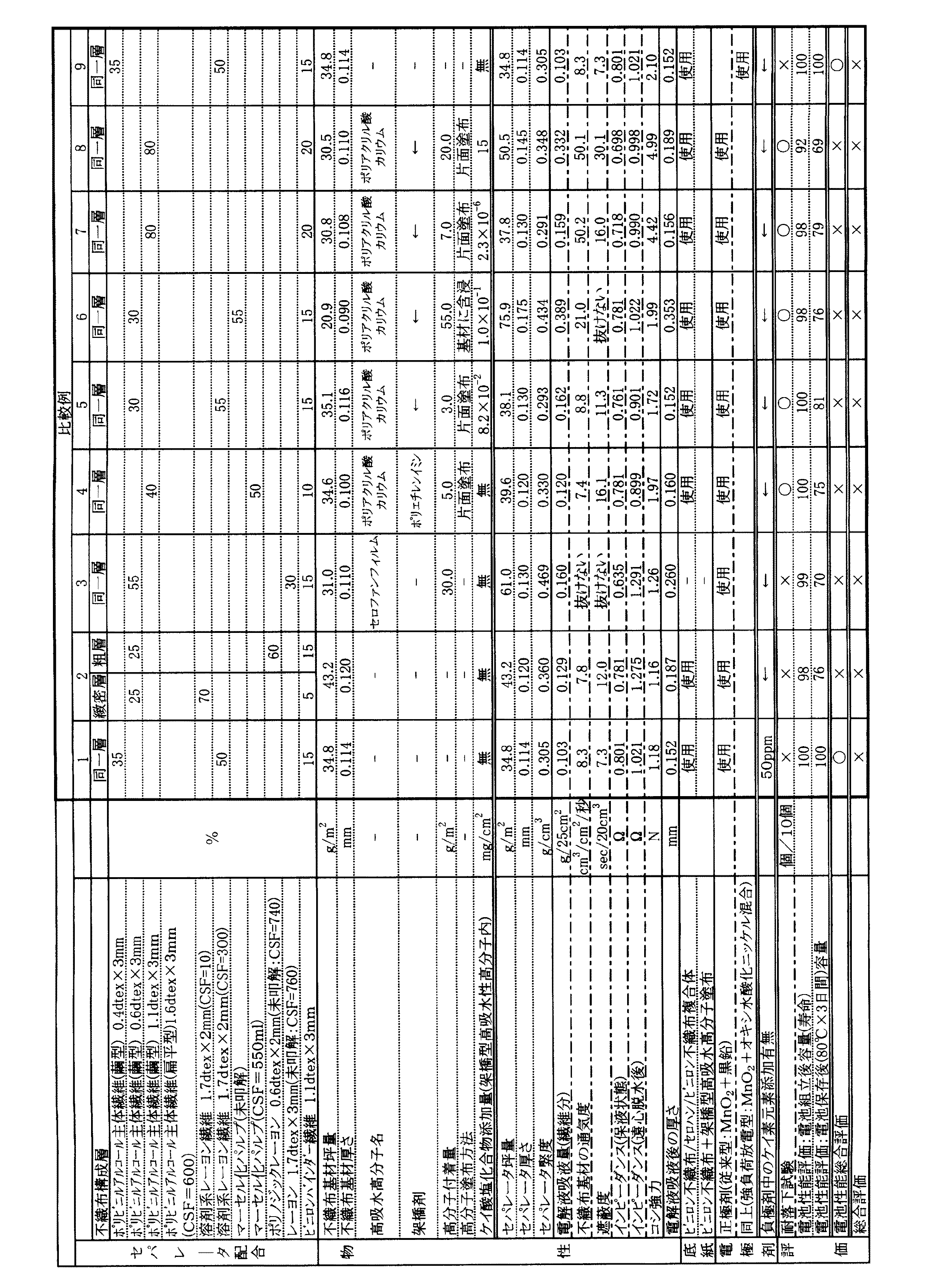
表1及び表2に示した通り、実施例1、2は耐アルカリ性繊維を使用した湿式不織布の片面にカルボキシル基を有する架橋型高吸水性高分子化合物にケイ酸塩化合物を添加した高分子を塗布し、架橋させたセパレータである。単位面積当りの電解液吸液量、特に繊維分吸液量は、架橋した高吸水性高分子化合物が付着していないもの(比較例1、2、3)に比し、略同等から1.5倍以上を確保している。特にインピーダンス(液切り状態想定:遠心脱水後)が1.00Ω以下の低い抵抗値となり、電池寿命が長くなる傾向が見られる。
また針状デンドライトを防止するために必要な遮蔽性を確保・維持することが出来た。また、コシ強力も1.96N以上であり、落下衝撃にも耐え得るセパレータが得られていることが分かる。電池性能評価でも比較例1に比し、80℃で3日間保存後の放電性能も約5〜9%向上し、優れていることがわかる。
As shown in Table 1 and Table 2, Examples 1 and 2 are polymers obtained by adding a silicate compound to a crosslinked superabsorbent polymer compound having a carboxyl group on one side of a wet nonwoven fabric using alkali-resistant fibers. It is the separator which apply | coated and bridge | crosslinked. The electrolyte solution absorption amount per unit area, particularly the fiber component absorption amount, is approximately equivalent to 1. compared with the case where the crosslinked superabsorbent polymer compound does not adhere (Comparative Examples 1, 2, and 3). 5 times or more is secured. In particular, the impedance (assuming the state of drainage: after centrifugal dehydration) has a low resistance value of 1.00Ω or less, and the battery life tends to be long.
In addition, the shielding required to prevent acicular dendrites could be secured and maintained. Further, the stiffness is 1.96 N or more, and it can be seen that a separator that can withstand a drop impact is obtained. It can be seen that the battery performance evaluation is superior to Comparative Example 1 in that the discharge performance after storage at 80 ° C. for 3 days is improved by about 5 to 9%.
実施例3の結果から、耐アルカリ性繊維を使用した湿式不織布を用い、カルボキシル基を有する架橋型高吸水性高分子化合物中にケイ酸塩化合物を添加した高分子を塗布し、架橋させたセパレータであれば、負極剤の亜鉛合金中にケイ素元素を添加しなくても針状のデンドライトの成長を抑制する効果があり、電池性能においても実施例1、2に比較しても性能自体変わらず、問題なく使用できることがわかる。 From the results of Example 3, using a wet nonwoven fabric using an alkali-resistant fiber, a polymer added with a silicate compound in a crosslinked superabsorbent polymer compound having a carboxyl group, and a crosslinked separator If present, there is an effect of suppressing the growth of needle-shaped dendrites without adding silicon element in the zinc alloy of the negative electrode agent, the performance itself does not change even in battery performance compared to Examples 1 and 2, You can see that it can be used without problems.
実施例4の結果から、ナトリウム塩でも問題なく使用できるが、カルボキシル基を有する架橋型高吸水性高分子のポリアクリル酸塩としてはナトリウム塩よりもカリウム塩の方が、好ましい結果となっていることがわかる。 From the results of Example 4, sodium salt can be used without any problem, but as a polyacrylate of a crosslinked superabsorbent polymer having a carboxyl group, potassium salt is more preferable than sodium salt. I understand that.
実施例5の結果から、強負荷放電性能を向上させる目的で二酸化マンガンにオキシ水酸化ニッケルを混合させた正極合剤を用いたアルカリ乾電池内においても問題なく使用でき、従来の合成繊維とセルロース系繊維を使用したセパレータに比し、性能が著しく向上することがわかる。また、従来のアルカリ電池よりも強負荷放電性能を向上させるためオキシ水酸化ニッケルを混合させた正極合剤を使用したアルカリ電池において性能はより向上する。 From the results of Example 5, it can be used without problems even in an alkaline dry battery using a positive electrode mixture in which nickel oxyhydroxide is mixed with manganese dioxide for the purpose of improving heavy load discharge performance. It can be seen that the performance is remarkably improved as compared with the separator using fibers. Moreover, the performance is further improved in an alkaline battery using a positive electrode mixture mixed with nickel oxyhydroxide in order to improve the heavy load discharge performance as compared with the conventional alkaline battery.
実施例6の結果から、耐アルカリ性繊維を使用した湿式不織布を用い、カルボキシル基を有する架橋型高吸水性高分子にケイ酸塩化合物を添加した高分子を塗布し、架橋させてなるセパレータを底紙として使用した実施例7の電池は耐落下性、電池性能において実施例5と同様の結果で問題なく使用できることがわかる。 From the results of Example 6, using a wet non-woven fabric using alkali-resistant fibers, a polymer obtained by adding a silicate compound to a cross-linked superabsorbent polymer having a carboxyl group and applying a cross-linked separator to the bottom It can be seen that the battery of Example 7 used as paper can be used without problems with the same results as Example 5 in terms of drop resistance and battery performance.
比較例1は吸液量、吸上速度は満足しているものの、遮蔽度が13秒以下となり、遮蔽性の面で劣り、析出するデンドライトを防止することは困難である。また、遠心脱水後のインピーダンスも高く、コシ強力も1.96N未満となっているため、電池の搬送や携帯時に振動・落下による衝撃によってセパレータ自体が座屈し、電池内で内部短絡を生じた。 In Comparative Example 1, although the liquid absorption amount and the wicking speed are satisfied, the shielding degree is 13 seconds or less, the shielding property is inferior, and it is difficult to prevent the deposited dendrites. Moreover, since the impedance after centrifugal dehydration is high and the stiffness is less than 1.96 N, the separator itself buckles due to the impact of vibration / dropping when the battery is transported or carried, causing an internal short circuit in the battery.
比較例2は遮蔽度が13秒未満であり、また遠心脱水後のインピーダンスも高いために、電池寿命の延長にはならない。セパレータのコシ強力が1.96N未満となるため、電池の搬送や携帯時に振動・落下による衝撃によってセパレータ自体が座屈し、電池内で内部短絡を生じた。 In Comparative Example 2, the degree of shielding is less than 13 seconds and the impedance after centrifugal dehydration is high, so that the battery life is not extended. Since the stiffness of the separator was less than 1.96 N, the separator itself buckled due to the impact of vibration and dropping when the battery was transported or carried, causing an internal short circuit within the battery.
比較例3は遮蔽性に優れているものの、遠心脱水後のインピーダンスが高く、高温保存後の電池性能は低下する。またコシ強力も1.96N未満となるため、電池の搬送や携帯時に電動・落下により衝撃によってセパレータ自体が座屈し、電池内で内部短絡を生じた。 Although Comparative Example 3 has excellent shielding properties, the impedance after centrifugal dehydration is high, and the battery performance after high-temperature storage is reduced. In addition, since the stiffness was less than 1.96 N, the separator itself buckled due to impact by electric / dropping when the battery was transported or carried, causing an internal short circuit within the battery.
比較例4は繊維分吸液量も満足し、遮蔽度も15秒以上、セパレータのコシ強力も1.96N以上を確保し、遠心脱水後のインピーダンスも低いものの、80℃で3日間保存後の放電性能が劣り、デンドライトによる内部短絡を防止することは不可能であった。 In Comparative Example 4, the amount of absorbed fiber was satisfied, the shielding degree was 15 seconds or more, the stiffness of the separator was 1.96 N or more, and the impedance after centrifugal dehydration was low, but after storage at 80 ° C. for 3 days. Discharge performance was inferior, and it was impossible to prevent internal short circuit due to dendrite.
比較例5は、繊維分電解液吸液量も確保し、遠心脱水後のインピーダンスも低く、コシ強力も1.96N以上を確保しているものの、遮蔽度が15秒未満であるために遮蔽性が不足している。また架橋型高吸水性高分子がセパレータ自体を覆うことは難しく、成長するデンドライトを防止することは不可能であった。さらに架橋型高吸水性高分子化合物にてセパレータ自体が覆われていないために、正極剤である二酸化マンガンと接触していた湿式不織布のマーセル化パルプが酸化劣化し、80℃で3日間保存後の放電性能が劣っている。 In Comparative Example 5, although the fiber electrolyte solution absorption amount is ensured, the impedance after centrifugal dehydration is low, and the stiffness is 1.96 N or more, the shielding degree is less than 15 seconds. Is lacking. Moreover, it is difficult for the cross-linked superabsorbent polymer to cover the separator itself, and it is impossible to prevent the growing dendrite. Furthermore, because the separator itself is not covered with the crosslinkable superabsorbent polymer compound, the wet non-woven mercerized pulp that has been in contact with manganese dioxide as the positive electrode agent is oxidized and deteriorated, and stored at 80 ° C. for 3 days. The discharge performance is inferior.
比較例6は、繊維分電解液吸液量も確保し、コシ強力が1.96N以上、遮蔽度が15秒以上を保有しているものの、遠心脱水後のインピーダンスも高いため、電池性能が劣る。また、電解液吸液後の厚さが大きく、負極剤の容量を増やすことが困難であるため、電池寿命の短い電池となった。 In Comparative Example 6, the fiber electrolyte absorption amount is secured, the stiffness is 1.96 N or more, and the shielding degree is 15 seconds or more. However, the battery performance is poor because the impedance after centrifugal dehydration is high. . Moreover, since the thickness after electrolyte solution absorption was large and it was difficult to increase the capacity | capacitance of a negative electrode agent, it became a battery with a short battery life.
比較例7は、吸液量も確保し、遮蔽度も15秒以上、コシ強力も1.96N以上を確保しているものの、ケイ酸塩化合物の添加量が少なく、成長するデンドライトをセパレータ表面で防ぐことは困難であり、また異常放電が見られた。 In Comparative Example 7, the liquid absorption amount is secured, the shielding degree is 15 seconds or more, and the koshi strength is 1.96 N or more, but the amount of silicate compound added is small, and the growing dendrite is formed on the separator surface. It was difficult to prevent and abnormal discharge was observed.
比較例8は、吸液量も確保し、遮蔽度も15秒以上、コシ強力も1.96N以上を確保しているものの、ケイ酸塩化合物の添加量が多く、低電圧となり、80℃で3日間保存後の放電性能が劣っている。 In Comparative Example 8, the liquid absorption amount was also secured, the shielding degree was 15 seconds or more, and the stiffness was 1.96 N or more, but the amount of silicate compound added was large, resulting in a low voltage at 80 ° C. Discharge performance after storage for 3 days is inferior.
比較例9は、吸液量は確保しているものの、遮蔽性が劣り、析出するデンドライトを防止することは困難である。またインピーダンスも高く、コシ強力も1.96N未満となっているので、耐落下性に劣り、セパレータ自体が座屈して内部短絡を発生した。また高負荷放電性能の優れる正極合剤にオキシ水酸化ニッケルを混合させたアルカリ電池に使用すると、正極合剤と接触していた有機溶剤系セルロースのフィブリル化物が酸化劣化し、内部短絡が発生し、電池寿命の短い電池となった。
Although the comparative example 9 has secured the amount of liquid absorption, it is inferior in shielding property and it is difficult to prevent the dendrite to precipitate. Moreover, since the impedance was high and the stiffness was less than 1.96 N, the drop resistance was poor, and the separator itself buckled and an internal short circuit occurred. In addition, when used in an alkaline battery in which nickel oxyhydroxide is mixed with a positive electrode mixture with excellent high-load discharge performance, the fibrillated organic solvent cellulose that has been in contact with the positive electrode mixture deteriorates due to oxidation and internal short circuit occurs. The battery has a short battery life.
Claims (6)
Priority Applications (1)
| Application Number | Priority Date | Filing Date | Title |
|---|---|---|---|
| JP2005167537A JP5032002B2 (en) | 2004-06-17 | 2005-06-07 | Battery separator and alkaline battery |
Applications Claiming Priority (3)
| Application Number | Priority Date | Filing Date | Title |
|---|---|---|---|
| JP2004179327 | 2004-06-17 | ||
| JP2004179327 | 2004-06-17 | ||
| JP2005167537A JP5032002B2 (en) | 2004-06-17 | 2005-06-07 | Battery separator and alkaline battery |
Publications (2)
| Publication Number | Publication Date |
|---|---|
| JP2006032320A JP2006032320A (en) | 2006-02-02 |
| JP5032002B2 true JP5032002B2 (en) | 2012-09-26 |
Family
ID=35510017
Family Applications (1)
| Application Number | Title | Priority Date | Filing Date |
|---|---|---|---|
| JP2005167537A Expired - Lifetime JP5032002B2 (en) | 2004-06-17 | 2005-06-07 | Battery separator and alkaline battery |
Country Status (8)
| Country | Link |
|---|---|
| US (1) | US7754387B2 (en) |
| EP (1) | EP1770803B1 (en) |
| JP (1) | JP5032002B2 (en) |
| KR (1) | KR101201103B1 (en) |
| CN (1) | CN100492718C (en) |
| AU (1) | AU2005255736A1 (en) |
| BR (1) | BRPI0512132A (en) |
| WO (1) | WO2005124895A1 (en) |
Families Citing this family (33)
| Publication number | Priority date | Publication date | Assignee | Title |
|---|---|---|---|---|
| JP4931436B2 (en) * | 2006-02-22 | 2012-05-16 | 株式会社クラレ | Battery separator and alkaline battery |
| JP2007287672A (en) * | 2006-03-24 | 2007-11-01 | Matsushita Electric Ind Co Ltd | Alkaline battery |
| EP1962357B1 (en) | 2006-06-28 | 2013-01-16 | Panasonic Corporation | Alkaline dry battery |
| JP2009076420A (en) | 2007-09-25 | 2009-04-09 | Panasonic Corp | Battery can, battery using the same, and method for producing battery can |
| JP2009080998A (en) * | 2007-09-25 | 2009-04-16 | Fdk Energy Co Ltd | Separator material for alkaline cell, and alkaline cell |
| UA97720C2 (en) * | 2007-12-11 | 2012-03-12 | Пи.Эйч. Глетфелтер Компани | Plate assembly for lead-acid battery (embodiments) and multilayer composite sheet therefor |
| JP2009170157A (en) | 2008-01-11 | 2009-07-30 | Panasonic Corp | AA alkaline batteries |
| JP2009259706A (en) * | 2008-04-18 | 2009-11-05 | Panasonic Corp | Aa alkaline battery |
| JP5237680B2 (en) | 2008-04-18 | 2013-07-17 | パナソニック株式会社 | AA alkaline batteries and AAA alkaline batteries |
| US20100062342A1 (en) * | 2008-09-09 | 2010-03-11 | Lin-Feng Li | Polymer membrane utilized as a separator in rechargeable zinc cells |
| JP5454847B2 (en) * | 2008-11-14 | 2014-03-26 | 日立マクセル株式会社 | Alkaline battery |
| JPWO2011001603A1 (en) | 2009-06-29 | 2012-12-10 | パナソニック株式会社 | Alkaline battery |
| CN103119752B (en) * | 2010-09-16 | 2016-02-10 | 株式会社可乐丽 | Alkaline cell barrier film and use its alkaline cell |
| EP2623317A4 (en) * | 2010-09-30 | 2014-07-09 | Mitsubishi Plastics Inc | POROUS LAMINATED FILM, SEPARATOR FOR NONAQUEOUS ELECTROLYTE SECONDARY BATTERY, AND NONAQUEOUS ELECTROLYTE SECONDARY BATTERY |
| US9917288B2 (en) | 2011-10-13 | 2018-03-13 | Energizer Brands, Llc | Lithium iron disulfide battery |
| AT512460B1 (en) * | 2011-11-09 | 2013-11-15 | Chemiefaser Lenzing Ag | Dispersible non-woven textiles |
| JP6035029B2 (en) * | 2012-02-14 | 2016-11-30 | Fdkエナジー株式会社 | Separator material for alkaline battery, separator, alkaline battery, method for producing separator material for alkaline battery |
| JP2013168252A (en) * | 2012-02-14 | 2013-08-29 | Fdk Energy Co Ltd | Separator material for alkaline dry cell, separator, and alkaline dry cell |
| DE102013205585A1 (en) * | 2013-03-28 | 2014-10-16 | Siemens Aktiengesellschaft | Cellulosic material with impregnation and use of this cellulosic material |
| US11021584B2 (en) | 2014-08-21 | 2021-06-01 | William Winchin Yen | Microporous sheet product and methods for making and using the same |
| WO2016073558A1 (en) | 2014-11-05 | 2016-05-12 | William Winchin Yen | Microporous sheet product and methods for making and using the same |
| US10829600B2 (en) | 2014-11-05 | 2020-11-10 | William Winchin Yen | Microporous sheet product and methods for making and using the same |
| CN104988809B (en) * | 2015-06-26 | 2017-08-25 | 浙江凯恩特种材料股份有限公司 | A kind of high voltage withstanding electrolytic capacitor paper and preparation method thereof |
| CN108028340B (en) * | 2015-09-15 | 2019-06-14 | 株式会社可乐丽 | Separator for alkaline batteries |
| EP3392930A4 (en) * | 2015-12-14 | 2019-08-14 | Nippon Kodoshi Corporation | SEPARATOR FOR ALKALINE BATTERIES AND ALKALINE BATTERY |
| US20180254449A1 (en) * | 2017-03-02 | 2018-09-06 | GM Global Technology Operations LLC | Composite porous separator including lithium ion-exchanged zeolite particles |
| US11600823B2 (en) * | 2017-12-08 | 2023-03-07 | Lg Energy Solution, Ltd. | Binder for secondary battery electrode, secondary battery electrode and secondary battery including same, composition for secondary battery electrode for producing said secondary battery electrode, and method for producing said secondary battery electrode |
| CN108978354A (en) * | 2018-09-10 | 2018-12-11 | 浙江凯恩特种纸业有限公司 | A kind of enhanced super electrolytic capacitor diaphragm paper and its production method |
| EP4097786A1 (en) | 2020-05-22 | 2022-12-07 | Duracell U.S. Operations, Inc. | Seal assembly for a battery cell |
| CN115966842B (en) * | 2021-10-09 | 2025-02-18 | 宁德时代新能源科技股份有限公司 | Separator, secondary battery comprising same and electricity utilization device |
| JP2023114675A (en) * | 2022-02-07 | 2023-08-18 | Fdk株式会社 | Battery and battery manufacturing method |
| KR102835842B1 (en) * | 2024-09-11 | 2025-07-18 | 한국해양과학기술원 | A method of preventing sea level rise by increasing friction under the ice sheet |
| US12609413B1 (en) * | 2025-09-04 | 2026-04-21 | King Fahd University Of Petroleum And Minerals | Aqueous zinc-ion battery cell |
Family Cites Families (20)
| Publication number | Priority date | Publication date | Assignee | Title |
|---|---|---|---|---|
| DE1279795B (en) * | 1965-01-29 | 1968-10-10 | Grace W R & Co | Process for the production of a microporous battery separator |
| US3585081A (en) * | 1968-09-16 | 1971-06-15 | Alfred Harris Mirman | Battery separator |
| CA993502A (en) * | 1972-09-21 | 1976-07-20 | Union Carbide Corporation | Battery separators |
| US4085241A (en) * | 1976-09-07 | 1978-04-18 | The United States Of America As Represented By The United States National Aeronautics And Space Administration | Inorganic-organic separators for alkaline batteries |
| JPS5491721A (en) | 1977-12-28 | 1979-07-20 | Toshiba Ray O Vac | Method of producing alkaline cell |
| US4224394A (en) * | 1979-07-13 | 1980-09-23 | Kimberly Clark Corporation | Alkaline battery, separator therefore |
| JPS57105958A (en) | 1980-12-22 | 1982-07-01 | Toshiba Battery Co Ltd | Alkaline dry cell |
| JPS57105957A (en) | 1980-12-22 | 1982-07-01 | Toshiba Battery Co Ltd | Alkaline dry cell |
| US4650730A (en) | 1985-05-16 | 1987-03-17 | W. R. Grace & Co. | Battery separator |
| US5126219A (en) * | 1987-12-21 | 1992-06-30 | Entek Manufacturing Inc. | Microporous filaments and fibers, and articles made therefrom |
| JPH0278150A (en) | 1988-09-12 | 1990-03-19 | Toshiba Battery Co Ltd | Alkaline dry battery |
| JPH044557A (en) * | 1990-04-19 | 1992-01-09 | Hitachi Maxell Ltd | Alkaline storage battery |
| JPH0676807A (en) | 1992-07-10 | 1994-03-18 | Asahi Chem Ind Co Ltd | Compound film for separator of alkaline battery |
| US5389471A (en) * | 1993-04-16 | 1995-02-14 | W. R. Grace & Co.-Conn. | Wettable battery separator for alkaline batteries |
| JP3370486B2 (en) * | 1995-07-21 | 2003-01-27 | 松下電器産業株式会社 | Alkaline battery |
| CN1239591A (en) * | 1997-05-12 | 1999-12-22 | 日本工业技术院长代表之日本国 | Separator for battery and alkaline secondary battery using same |
| JPH11260339A (en) * | 1998-03-13 | 1999-09-24 | Kurashiki Seni Kako Kk | Separator for alkaline battery |
| JPWO2002023663A1 (en) * | 2000-09-11 | 2004-01-29 | 松下電器産業株式会社 | Alkaline zinc secondary battery and method of manufacturing the same |
| JP2003045399A (en) * | 2001-08-01 | 2003-02-14 | Sony Corp | Separator and alkaline battery |
| JP4253172B2 (en) * | 2002-10-18 | 2009-04-08 | 東芝電池株式会社 | Sealed nickel zinc primary battery |
-
2005
- 2005-06-07 JP JP2005167537A patent/JP5032002B2/en not_active Expired - Lifetime
- 2005-06-13 EP EP05748961.9A patent/EP1770803B1/en not_active Expired - Lifetime
- 2005-06-13 CN CNB2005800197517A patent/CN100492718C/en not_active Expired - Lifetime
- 2005-06-13 WO PCT/JP2005/010763 patent/WO2005124895A1/en not_active Ceased
- 2005-06-13 AU AU2005255736A patent/AU2005255736A1/en not_active Abandoned
- 2005-06-13 US US11/570,135 patent/US7754387B2/en active Active
- 2005-06-13 KR KR1020067026530A patent/KR101201103B1/en not_active Expired - Fee Related
- 2005-06-13 BR BRPI0512132-9A patent/BRPI0512132A/en not_active Application Discontinuation
Also Published As
| Publication number | Publication date |
|---|---|
| JP2006032320A (en) | 2006-02-02 |
| WO2005124895A1 (en) | 2005-12-29 |
| CN100492718C (en) | 2009-05-27 |
| EP1770803B1 (en) | 2016-08-10 |
| CN1969406A (en) | 2007-05-23 |
| AU2005255736A1 (en) | 2005-12-29 |
| BRPI0512132A (en) | 2008-02-06 |
| EP1770803A4 (en) | 2011-10-19 |
| US7754387B2 (en) | 2010-07-13 |
| KR20070034497A (en) | 2007-03-28 |
| KR101201103B1 (en) | 2012-11-13 |
| EP1770803A1 (en) | 2007-04-04 |
| US20080274409A1 (en) | 2008-11-06 |
Similar Documents
| Publication | Publication Date | Title |
|---|---|---|
| JP2006032320A (en) | Battery separator and alkaline battery | |
| JP4611426B2 (en) | Alkaline battery separator, method for producing the same, and battery | |
| JP5739755B2 (en) | Alkaline battery separator and alkaline battery | |
| JP5160111B2 (en) | Battery separator, method for producing the same, and battery comprising the same | |
| CA2866451C (en) | Battery electrode plate reinforcement mat having improved wettability characteristics and methods of use therefor | |
| JP6872493B2 (en) | Alkaline battery separator and alkaline battery | |
| WO2017150439A1 (en) | Alkaline battery separator and alkaline battery | |
| TW202101812A (en) | Separator for alkaline batteries, and alkaline battery | |
| JPH02119049A (en) | Separator paper of alkaline battery | |
| JP4739696B2 (en) | Alkaline battery separator and alkaline primary battery | |
| JP2010232205A (en) | Storage device separator | |
| JP4926800B2 (en) | Battery separator, method for producing the same, and battery comprising the same | |
| JP2017157348A (en) | Alkali battery separator and alkali battery | |
| JP2017135043A (en) | Cellulose microporous film and method of producing the same, and electrochemical element | |
| JP4931436B2 (en) | Battery separator and alkaline battery | |
| JP2005011726A (en) | Battery separator and alkaline primary battery | |
| JP2014005568A (en) | Fine fiber structure | |
| JPH11233093A (en) | Alkaline batteries | |
| JP2002279957A (en) | Separator paper for alkaline batteries | |
| JP2014005569A (en) | Fine fiber structure | |
| JP2001210554A (en) | Separator for electric double layer capacitor |
Legal Events
| Date | Code | Title | Description |
|---|---|---|---|
| A621 | Written request for application examination |
Free format text: JAPANESE INTERMEDIATE CODE: A621 Effective date: 20080226 |
|
| A977 | Report on retrieval |
Free format text: JAPANESE INTERMEDIATE CODE: A971007 Effective date: 20110414 |
|
| A131 | Notification of reasons for refusal |
Free format text: JAPANESE INTERMEDIATE CODE: A131 Effective date: 20110928 |
|
| A521 | Request for written amendment filed |
Free format text: JAPANESE INTERMEDIATE CODE: A523 Effective date: 20111026 |
|
| TRDD | Decision of grant or rejection written | ||
| A01 | Written decision to grant a patent or to grant a registration (utility model) |
Free format text: JAPANESE INTERMEDIATE CODE: A01 Effective date: 20120619 |
|
| A01 | Written decision to grant a patent or to grant a registration (utility model) |
Free format text: JAPANESE INTERMEDIATE CODE: A01 |
|
| A61 | First payment of annual fees (during grant procedure) |
Free format text: JAPANESE INTERMEDIATE CODE: A61 Effective date: 20120628 |
|
| R150 | Certificate of patent or registration of utility model |
Ref document number: 5032002 Country of ref document: JP Free format text: JAPANESE INTERMEDIATE CODE: R150 Free format text: JAPANESE INTERMEDIATE CODE: R150 |
|
| FPAY | Renewal fee payment (event date is renewal date of database) |
Free format text: PAYMENT UNTIL: 20150706 Year of fee payment: 3 |
|
| R250 | Receipt of annual fees |
Free format text: JAPANESE INTERMEDIATE CODE: R250 |
|
| R250 | Receipt of annual fees |
Free format text: JAPANESE INTERMEDIATE CODE: R250 |
|
| R250 | Receipt of annual fees |
Free format text: JAPANESE INTERMEDIATE CODE: R250 |
|
| R250 | Receipt of annual fees |
Free format text: JAPANESE INTERMEDIATE CODE: R250 |
|
| S111 | Request for change of ownership or part of ownership |
Free format text: JAPANESE INTERMEDIATE CODE: R313117 |
|
| R350 | Written notification of registration of transfer |
Free format text: JAPANESE INTERMEDIATE CODE: R350 |
|
| EXPY | Cancellation because of completion of term |