JP4476552B2 - Non-invasive system for measuring analytes in body fluids - Google Patents
Non-invasive system for measuring analytes in body fluids Download PDFInfo
- Publication number
- JP4476552B2 JP4476552B2 JP2003032015A JP2003032015A JP4476552B2 JP 4476552 B2 JP4476552 B2 JP 4476552B2 JP 2003032015 A JP2003032015 A JP 2003032015A JP 2003032015 A JP2003032015 A JP 2003032015A JP 4476552 B2 JP4476552 B2 JP 4476552B2
- Authority
- JP
- Japan
- Prior art keywords
- body tissue
- light
- analyte
- glucose
- skin
- Prior art date
- Legal status (The legal status is an assumption and is not a legal conclusion. Google has not performed a legal analysis and makes no representation as to the accuracy of the status listed.)
- Expired - Lifetime
Links
- 210000001124 body fluid Anatomy 0.000 title claims description 19
- 239000010839 body fluid Substances 0.000 title claims description 18
- 230000003595 spectral effect Effects 0.000 claims description 67
- 239000012491 analyte Substances 0.000 claims description 20
- 238000012545 processing Methods 0.000 claims description 12
- WQZGKKKJIJFFOK-GASJEMHNSA-N Glucose Natural products OC[C@H]1OC(O)[C@H](O)[C@@H](O)[C@@H]1O WQZGKKKJIJFFOK-GASJEMHNSA-N 0.000 description 100
- 239000008103 glucose Substances 0.000 description 100
- 210000003491 skin Anatomy 0.000 description 54
- 239000008280 blood Substances 0.000 description 27
- 210000004369 blood Anatomy 0.000 description 27
- 238000012360 testing method Methods 0.000 description 27
- 238000000034 method Methods 0.000 description 21
- 238000004458 analytical method Methods 0.000 description 20
- 210000001519 tissue Anatomy 0.000 description 20
- 239000013078 crystal Substances 0.000 description 15
- 239000000835 fiber Substances 0.000 description 15
- 229910052594 sapphire Inorganic materials 0.000 description 15
- 239000010980 sapphire Substances 0.000 description 15
- 239000013307 optical fiber Substances 0.000 description 12
- 230000005540 biological transmission Effects 0.000 description 10
- 238000005259 measurement Methods 0.000 description 10
- 238000001228 spectrum Methods 0.000 description 9
- 238000002835 absorbance Methods 0.000 description 7
- 210000003722 extracellular fluid Anatomy 0.000 description 7
- 239000000463 material Substances 0.000 description 7
- 230000008569 process Effects 0.000 description 7
- 230000002068 genetic effect Effects 0.000 description 6
- 230000008859 change Effects 0.000 description 5
- 239000000499 gel Substances 0.000 description 5
- 238000009499 grossing Methods 0.000 description 5
- 238000010438 heat treatment Methods 0.000 description 5
- 238000012937 correction Methods 0.000 description 4
- 230000006870 function Effects 0.000 description 4
- 230000003287 optical effect Effects 0.000 description 4
- 230000009467 reduction Effects 0.000 description 4
- 239000000126 substance Substances 0.000 description 4
- LAJZODKXOMJMPK-UHFFFAOYSA-N tellurium dioxide Chemical compound O=[Te]=O LAJZODKXOMJMPK-UHFFFAOYSA-N 0.000 description 4
- 230000000875 corresponding effect Effects 0.000 description 3
- 230000000694 effects Effects 0.000 description 3
- 125000002791 glucosyl group Chemical group C1([C@H](O)[C@@H](O)[C@H](O)[C@H](O1)CO)* 0.000 description 3
- 238000000411 transmission spectrum Methods 0.000 description 3
- 229910000530 Gallium indium arsenide Inorganic materials 0.000 description 2
- 208000013016 Hypoglycemia Diseases 0.000 description 2
- 208000034693 Laceration Diseases 0.000 description 2
- VYPSYNLAJGMNEJ-UHFFFAOYSA-N Silicium dioxide Chemical compound O=[Si]=O VYPSYNLAJGMNEJ-UHFFFAOYSA-N 0.000 description 2
- KXNLCSXBJCPWGL-UHFFFAOYSA-N [Ga].[As].[In] Chemical compound [Ga].[As].[In] KXNLCSXBJCPWGL-UHFFFAOYSA-N 0.000 description 2
- 230000002159 abnormal effect Effects 0.000 description 2
- 238000013459 approach Methods 0.000 description 2
- 238000000149 argon plasma sintering Methods 0.000 description 2
- 230000017531 blood circulation Effects 0.000 description 2
- 210000004027 cell Anatomy 0.000 description 2
- KYKAJFCTULSVSH-UHFFFAOYSA-N chloro(fluoro)methane Chemical compound F[C]Cl KYKAJFCTULSVSH-UHFFFAOYSA-N 0.000 description 2
- 238000002790 cross-validation Methods 0.000 description 2
- 238000010586 diagram Methods 0.000 description 2
- 230000008030 elimination Effects 0.000 description 2
- 238000003379 elimination reaction Methods 0.000 description 2
- 210000003811 finger Anatomy 0.000 description 2
- 239000012530 fluid Substances 0.000 description 2
- 210000000245 forearm Anatomy 0.000 description 2
- 238000007429 general method Methods 0.000 description 2
- 201000001421 hyperglycemia Diseases 0.000 description 2
- 230000002218 hypoglycaemic effect Effects 0.000 description 2
- AKUCEXGLFUSJCD-UHFFFAOYSA-N indium(3+);selenium(2-) Chemical compound [Se-2].[Se-2].[Se-2].[In+3].[In+3] AKUCEXGLFUSJCD-UHFFFAOYSA-N 0.000 description 2
- NOESYZHRGYRDHS-UHFFFAOYSA-N insulin Chemical compound N1C(=O)C(NC(=O)C(CCC(N)=O)NC(=O)C(CCC(O)=O)NC(=O)C(C(C)C)NC(=O)C(NC(=O)CN)C(C)CC)CSSCC(C(NC(CO)C(=O)NC(CC(C)C)C(=O)NC(CC=2C=CC(O)=CC=2)C(=O)NC(CCC(N)=O)C(=O)NC(CC(C)C)C(=O)NC(CCC(O)=O)C(=O)NC(CC(N)=O)C(=O)NC(CC=2C=CC(O)=CC=2)C(=O)NC(CSSCC(NC(=O)C(C(C)C)NC(=O)C(CC(C)C)NC(=O)C(CC=2C=CC(O)=CC=2)NC(=O)C(CC(C)C)NC(=O)C(C)NC(=O)C(CCC(O)=O)NC(=O)C(C(C)C)NC(=O)C(CC(C)C)NC(=O)C(CC=2NC=NC=2)NC(=O)C(CO)NC(=O)CNC2=O)C(=O)NCC(=O)NC(CCC(O)=O)C(=O)NC(CCCNC(N)=N)C(=O)NCC(=O)NC(CC=3C=CC=CC=3)C(=O)NC(CC=3C=CC=CC=3)C(=O)NC(CC=3C=CC(O)=CC=3)C(=O)NC(C(C)O)C(=O)N3C(CCC3)C(=O)NC(CCCCN)C(=O)NC(C)C(O)=O)C(=O)NC(CC(N)=O)C(O)=O)=O)NC(=O)C(C(C)CC)NC(=O)C(CO)NC(=O)C(C(C)O)NC(=O)C1CSSCC2NC(=O)C(CC(C)C)NC(=O)C(NC(=O)C(CCC(N)=O)NC(=O)C(CC(N)=O)NC(=O)C(NC(=O)C(N)CC=1C=CC=CC=1)C(C)C)CC1=CN=CN1 NOESYZHRGYRDHS-UHFFFAOYSA-N 0.000 description 2
- 238000012986 modification Methods 0.000 description 2
- 230000004048 modification Effects 0.000 description 2
- 238000012544 monitoring process Methods 0.000 description 2
- 238000010238 partial least squares regression Methods 0.000 description 2
- 238000007781 pre-processing Methods 0.000 description 2
- 238000002360 preparation method Methods 0.000 description 2
- 210000003813 thumb Anatomy 0.000 description 2
- 102000004877 Insulin Human genes 0.000 description 1
- 108090001061 Insulin Proteins 0.000 description 1
- 229910000661 Mercury cadmium telluride Inorganic materials 0.000 description 1
- 206010044565 Tremor Diseases 0.000 description 1
- 229910052770 Uranium Inorganic materials 0.000 description 1
- 208000027418 Wounds and injury Diseases 0.000 description 1
- 238000010521 absorption reaction Methods 0.000 description 1
- 239000013543 active substance Substances 0.000 description 1
- WQZGKKKJIJFFOK-VFUOTHLCSA-N beta-D-glucose Chemical compound OC[C@H]1O[C@@H](O)[C@H](O)[C@@H](O)[C@@H]1O WQZGKKKJIJFFOK-VFUOTHLCSA-N 0.000 description 1
- 230000015572 biosynthetic process Effects 0.000 description 1
- 230000036772 blood pressure Effects 0.000 description 1
- 238000009530 blood pressure measurement Methods 0.000 description 1
- 210000004204 blood vessel Anatomy 0.000 description 1
- 238000009529 body temperature measurement Methods 0.000 description 1
- MCMSPRNYOJJPIZ-UHFFFAOYSA-N cadmium;mercury;tellurium Chemical compound [Cd]=[Te]=[Hg] MCMSPRNYOJJPIZ-UHFFFAOYSA-N 0.000 description 1
- 150000001875 compounds Chemical class 0.000 description 1
- 230000002596 correlated effect Effects 0.000 description 1
- 210000004207 dermis Anatomy 0.000 description 1
- 238000013461 design Methods 0.000 description 1
- 238000011161 development Methods 0.000 description 1
- 206010012601 diabetes mellitus Diseases 0.000 description 1
- 201000010099 disease Diseases 0.000 description 1
- 208000037265 diseases, disorders, signs and symptoms Diseases 0.000 description 1
- 238000005516 engineering process Methods 0.000 description 1
- 238000002474 experimental method Methods 0.000 description 1
- 238000001914 filtration Methods 0.000 description 1
- 229910052736 halogen Inorganic materials 0.000 description 1
- 230000035876 healing Effects 0.000 description 1
- 230000006872 improvement Effects 0.000 description 1
- RPQDHPTXJYYUPQ-UHFFFAOYSA-N indium arsenide Chemical compound [In]#[As] RPQDHPTXJYYUPQ-UHFFFAOYSA-N 0.000 description 1
- 208000015181 infectious disease Diseases 0.000 description 1
- 238000001802 infusion Methods 0.000 description 1
- 229940125396 insulin Drugs 0.000 description 1
- 230000001678 irradiating effect Effects 0.000 description 1
- XCAUINMIESBTBL-UHFFFAOYSA-N lead(ii) sulfide Chemical compound [Pb]=S XCAUINMIESBTBL-UHFFFAOYSA-N 0.000 description 1
- 239000007788 liquid Substances 0.000 description 1
- 230000005226 mechanical processes and functions Effects 0.000 description 1
- 230000007246 mechanism Effects 0.000 description 1
- VCEXCCILEWFFBG-UHFFFAOYSA-N mercury telluride Chemical compound [Hg]=[Te] VCEXCCILEWFFBG-UHFFFAOYSA-N 0.000 description 1
- 238000003825 pressing Methods 0.000 description 1
- 238000000513 principal component analysis Methods 0.000 description 1
- 238000012628 principal component regression Methods 0.000 description 1
- 238000011160 research Methods 0.000 description 1
- 239000000377 silicon dioxide Substances 0.000 description 1
- 239000007787 solid Substances 0.000 description 1
- 230000007480 spreading Effects 0.000 description 1
- 238000010561 standard procedure Methods 0.000 description 1
- 210000004243 sweat Anatomy 0.000 description 1
- 210000000106 sweat gland Anatomy 0.000 description 1
- 238000010408 sweeping Methods 0.000 description 1
- 206010042772 syncope Diseases 0.000 description 1
- JFALSRSLKYAFGM-UHFFFAOYSA-N uranium(0) Chemical compound [U] JFALSRSLKYAFGM-UHFFFAOYSA-N 0.000 description 1
Images




Classifications
-
- A—HUMAN NECESSITIES
- A61—MEDICAL OR VETERINARY SCIENCE; HYGIENE
- A61B—DIAGNOSIS; SURGERY; IDENTIFICATION
- A61B5/00—Measuring for diagnostic purposes; Identification of persons
- A61B5/145—Measuring characteristics of blood in vivo, e.g. gas concentration or pH-value ; Measuring characteristics of body fluids or tissues, e.g. interstitial fluid or cerebral tissue
- A61B5/14532—Measuring characteristics of blood in vivo, e.g. gas concentration or pH-value ; Measuring characteristics of body fluids or tissues, e.g. interstitial fluid or cerebral tissue for measuring glucose, e.g. by tissue impedance measurement
-
- A—HUMAN NECESSITIES
- A61—MEDICAL OR VETERINARY SCIENCE; HYGIENE
- A61B—DIAGNOSIS; SURGERY; IDENTIFICATION
- A61B5/00—Measuring for diagnostic purposes; Identification of persons
- A61B5/145—Measuring characteristics of blood in vivo, e.g. gas concentration or pH-value ; Measuring characteristics of body fluids or tissues, e.g. interstitial fluid or cerebral tissue
- A61B5/1455—Measuring characteristics of blood in vivo, e.g. gas concentration or pH-value ; Measuring characteristics of body fluids or tissues, e.g. interstitial fluid or cerebral tissue using optical sensors, e.g. spectral photometrical oximeters
-
- A—HUMAN NECESSITIES
- A61—MEDICAL OR VETERINARY SCIENCE; HYGIENE
- A61B—DIAGNOSIS; SURGERY; IDENTIFICATION
- A61B5/00—Measuring for diagnostic purposes; Identification of persons
- A61B5/145—Measuring characteristics of blood in vivo, e.g. gas concentration or pH-value ; Measuring characteristics of body fluids or tissues, e.g. interstitial fluid or cerebral tissue
- A61B5/1495—Calibrating or testing of in-vivo probes
-
- G—PHYSICS
- G01—MEASURING; TESTING
- G01N—INVESTIGATING OR ANALYSING MATERIALS BY DETERMINING THEIR CHEMICAL OR PHYSICAL PROPERTIES
- G01N21/00—Investigating or analysing materials by the use of optical means, i.e. using sub-millimetre waves, infrared, visible or ultraviolet light
- G01N21/17—Systems in which incident light is modified in accordance with the properties of the material investigated
- G01N21/25—Colour; Spectral properties, i.e. comparison of effect of material on the light at two or more different wavelengths or wavelength bands
- G01N21/31—Investigating relative effect of material at wavelengths characteristic of specific elements or molecules, e.g. atomic absorption spectrometry
- G01N21/35—Investigating relative effect of material at wavelengths characteristic of specific elements or molecules, e.g. atomic absorption spectrometry using infrared light
- G01N21/359—Investigating relative effect of material at wavelengths characteristic of specific elements or molecules, e.g. atomic absorption spectrometry using infrared light using near infrared light
-
- A—HUMAN NECESSITIES
- A61—MEDICAL OR VETERINARY SCIENCE; HYGIENE
- A61B—DIAGNOSIS; SURGERY; IDENTIFICATION
- A61B5/00—Measuring for diagnostic purposes; Identification of persons
- A61B5/72—Signal processing specially adapted for physiological signals or for diagnostic purposes
- A61B5/7235—Details of waveform analysis
- A61B5/7253—Details of waveform analysis characterised by using transforms
- A61B5/726—Details of waveform analysis characterised by using transforms using Wavelet transforms
-
- G—PHYSICS
- G01—MEASURING; TESTING
- G01N—INVESTIGATING OR ANALYSING MATERIALS BY DETERMINING THEIR CHEMICAL OR PHYSICAL PROPERTIES
- G01N21/00—Investigating or analysing materials by the use of optical means, i.e. using sub-millimetre waves, infrared, visible or ultraviolet light
- G01N21/17—Systems in which incident light is modified in accordance with the properties of the material investigated
- G01N21/25—Colour; Spectral properties, i.e. comparison of effect of material on the light at two or more different wavelengths or wavelength bands
- G01N21/27—Colour; Spectral properties, i.e. comparison of effect of material on the light at two or more different wavelengths or wavelength bands using photo-electric detection ; circuits for computing concentration
- G01N21/274—Calibration, base line adjustment, drift correction
-
- G—PHYSICS
- G01—MEASURING; TESTING
- G01N—INVESTIGATING OR ANALYSING MATERIALS BY DETERMINING THEIR CHEMICAL OR PHYSICAL PROPERTIES
- G01N2201/00—Features of devices classified in G01N21/00
- G01N2201/06—Illumination; Optics
- G01N2201/067—Electro-optic, magneto-optic, acousto-optic elements
Landscapes
- Health & Medical Sciences (AREA)
- Life Sciences & Earth Sciences (AREA)
- Physics & Mathematics (AREA)
- General Health & Medical Sciences (AREA)
- Pathology (AREA)
- Surgery (AREA)
- Medical Informatics (AREA)
- Veterinary Medicine (AREA)
- Public Health (AREA)
- Animal Behavior & Ethology (AREA)
- Molecular Biology (AREA)
- Optics & Photonics (AREA)
- Biophysics (AREA)
- Engineering & Computer Science (AREA)
- Biomedical Technology (AREA)
- Heart & Thoracic Surgery (AREA)
- Spectroscopy & Molecular Physics (AREA)
- Emergency Medicine (AREA)
- Chemical & Material Sciences (AREA)
- Biochemistry (AREA)
- Immunology (AREA)
- General Physics & Mathematics (AREA)
- Analytical Chemistry (AREA)
- Measurement Of The Respiration, Hearing Ability, Form, And Blood Characteristics Of Living Organisms (AREA)
Description
【0001】
【発明の属する技術分野】
本発明は、一般に、体液内の分析対象物の測定システムに関し、より詳細には体液内の分析対象物の非浸襲測定システムに関する。
【0002】
【従来の技術】
血中グルコース濃度のレベルが異常な患者は、血中グルコース濃度のレベルを定期的に自分でモニタすることが医学上要求される。異常な血中グルコース濃度のレベルは、糖尿病などの疾病を含む様々な原因で引き起こされる。血中グルコース濃度のレベルをモニタする目的は、血中グルコース濃度のレベルを測定し、そのレベルの高低に基づいて適切な措置を取り、そのレベルを正常な範囲に戻すことである。適切な手段を講じないと、重大な結果につながる場合がある。血中グルコースレベルが異常に低下(低血糖症として知られている状態)したときには、患者は緊張し、体が震えたり、思考が混乱する。そのような人は、判断力を失い、失神に至ることもある。血中グルコースレベルが異常に高い(高血糖症として知られている状態)場合も、人は健康を損なう。低血糖症と高血糖症との双方の状態は、生命を脅かす緊急事態となる可能性のある病気である。
【0003】
人の血中グルコースのレベルをモニタする通常の方法は、本来、浸襲的な方法である。例えば、血中グルコースレベルをチェックするために、穿刺装置を用いて指先から血液を得る。指先に血液滴を生じさせて、その血液をテストセンサにより収集する。テストセンサは、テスト装置に挿入されており、血液滴に接触する。テストセンサは、テスト装置の内部に血液を吸いこみ、テスト装置は、血液中のグルコース濃度を測定する。
【0004】
このタイプの分析に関する1つの問題は、指先の穿刺に伴うある程度の痛みである。糖尿病患者は一日に数回、自分自身を定期的に自己測定しなければならない。テスト毎に別々の穿刺を要し、利用者が痛みを感ずる場合を含む。さらに、穿刺の度に利用者の皮膚に裂傷が生じ、通常の傷と同様、治癒には時間がかかり、感染症にかかりやすくなる。
【0005】
人の血中グルコースレベルを分析する他の方法は、本来非浸襲的なものもある。一般に、この技術は、人の皮膚を透過した光、又は皮膚から反射した光に関連したスペクトル情報を解析する。このタイプの非浸襲的な分析は痛みを伴わず、また、皮膚の裂傷も起こさない点で優れている。しかし、これまで、このような手法は、分析に影響を与える多くの問題を認識していないため、信頼性が低いことが実証されてきている。例えば、反射率ないし透過率に基づく多くの非浸襲的なシステムでは、得られたスペクトルデータには、分析される体組織の部分からのグルコース情報を全体として含み、血中グルコースに限定されないという事実を考慮していない。他の手法は、分析中に、または分析の間に生じ得る器具のドリフト、分析状態にある組織内の温度変化、圧力の変化による組織のスペクトル特性の変化等による、分析対象物のスペクトル信号の不規則さを考慮していない。このような不規則さがあると、非浸襲的に集められたスペクトルデータから分析対象物の濃度を測定するために使用される較正モデルやアルゴリズムの質に影響する。これらの不規則さを有するスペクトルデータは、分析対象物の濃度を決定するためのアルゴリズムに用いることはできない。
【0006】
【発明が解決しようとする課題】
体液内の分析対象物を測定するための信頼性のある非浸襲的システムが必要とされている。
【0007】
【課題を解決するための手段】
体組織内の少なくとも1種類の体液内の分析対象物の濃度を測定するシステムは、赤外光源、体組織インターフェース、検出器、および中央処理装置を含む。体組織インターフェースは体組織に接触し、赤外光源からの光を接触する体組織に照射するように適合されている。検出器は測定される体組織の一部を透過した赤外光に対応するスペクトル情報を受け、受けたスペクトル情報を受けたスペクトル情報であることを示す電気信号に変換するように適合されている。中央処理装置は、電気信号を、体液内の分析対象物との相関に基づいて作成されたアルゴリズムと比較するように適合され、このアルゴリズムは、受けたスペクトル情報を少なくとも一つの体液中の分析対象物の濃度に変換するように適合されている。
【0008】
【実施例】
最初に図1を参照すると、体液内の分析対象物を測定するための、透過型をベースとする非浸襲システム10(以下、「システム 10」)が機能的に示されている。本発明を患者のグルコースレベルの測定に関連して説明するが、本発明はスペクトル特性を示す体液内のいかなる分析対象物の分析にも応用可能である。要するにシステム10は、近赤外光を皮膚の一部、例えば患者の人差し指と親指との間の皮膚の「ウェブ」に照射し、患者のグルコースレベルを測定するために、皮膚の一部を通って透過した光を記録する。通常、患者のグルコースレベルは、患者の血糖値と呼ばれる。しかし、血糖値と言う場合には、患者の細胞外物質と細胞間物質とに含まれるグルコース量を無視することを含む。したがって、本発明の発明者等は患者のグルコースレベルと呼ぶことを好む。
【0009】
人の皮膚は、約50〜60%が細胞間物質であり、残りは細胞外物質からなる。細胞外物質は、約3分の1の血漿(血液)と、約3分の2の組織間液(ISF)とを含む。したがって、患者の皮膚を透過した光からグルコースのスペクトル特性を検査する場合、患者の血中内のグルコースのみよりもむしろ、その皮膚の部分中のグルコース全体として考慮することが重要である。透過した光の大部分は、血液ではなくISFを透過した光である。逆に例えば、10μlの血液滴を患者の指先で採取する浸襲的な検査の場合には、測定されたグルコース濃度は、主に患者の血液中のグルコースの濃度を表す。
【0010】
システム10は、患者からの透過スペクトル情報を得るために使用される。例えば、被験者のグルコース濃度が複数の異なる濃度レベルに調整されるようなテストにおいて、システム10は使用される。このようなテストの1つは、グルコースクランプテストであり、被験者のグルコースレベルが、テスト期間中にわたって異なるレベルに上下する。一実施態様によると、グルコースクランプテストは、50〜300mg/dlの濃度範囲に分布する6つの一定域領域に被験者のグルコースレベルを導くように設計されている。一定域の各々は、領域の各々をが明確に区別できるよう、約50mg/dl毎に分離されている。クランプテストが行われている間にわたって、ISFおよび血漿サンプルが採取される。サンプルは5分毎に採取され、グルコース含有量が分析される。この測定は、グルコースまたはインシュリンの注入を調節して、血漿のグルコース濃度を約25分間、特定の目標とする一定域領域で維持する。極めて一般的には、テストの過程にわたって得られたスペクトルデータは、実際の(浸襲的手法を用いて測定された)グルコースレベルと比較される。このデータから、較正アルゴリズムが組立てられ、患者の皮膚を通して透過した光のスペクトル特性に基づいて患者の実際のグルコースレべルが予測される。この較正アルゴリズムを、図1に示すシステム10の携帯版装置に組み込むことができる。
【0011】
このような携帯装置は、使用者のグルコース濃度レベルを使用者が非浸襲的にモニタすることを可能にする。使用者は、装置を自分の皮膚に接触させ、使用者の皮膚からスペクトル情報を得る。その後、装置は、短時間の後に使用者のグルコース濃度レベルの測定値を使用者に与えることができる。
【0012】
図1に戻ると、音響光学可変波長フィルター(AOTF)分光計が、破線12で概略的に示されている。AOTF分光計12は、単色変調光ビーム14を、レンズ18を介して光ファイバケーブル16に出力する。AOTF分光計12は光源20を含む。1つの実施態様では、光源20は、タングステン・ハロゲン光源であり、これは十分な光量(275ワット等)を出力する廉価かつ安定な光源である。代替の光源は、発光ダイオード(LED)、ウランドープファイバを含むドープファイバ、およびレーザダイオードを含む。光源は、近赤外領域(波長750〜2500nm)において光ビーム22を発生させる。
【0013】
一般に、AOTF分光計12は、電子的に可変波長なスペクトル帯域通過フィルタとして機能し、所望の範囲内の波長を有する単色光ビーム14を出力する。AOTF12は、結晶19からなる固体光電デバイスであり、無線周波数(RF)での音響(振動)波が、広帯域光源からの単一の波長の光を分離するために使用される。波長の選択は、結晶19に印加されるRF周波数の関数である。AOTFデバイスに使用される結晶19は、多くの化合物から作製できる。本発明の1つの実施態様によると、2酸化テルル(TeO2)の結晶が使用される。TeO2結晶は、1200〜3000nmのスペクトル領域で光を使用する場合に良い結果が得られる。一実施態様では、結晶19は、非同一直線的な配置で使用され、結晶19を通過した音波および光波(路)は、互いに非常に異なる角度を有する。結晶の片側には変換器(図示しない)が結合されている。この変換器は、RFが変換器に印加されると振動(音波)を発生する。変換器からの音波が結晶19に至ると、結晶19は、交互に圧縮し、緩和し、屈折率が変動して透過型回折格子のように作動する。しかし、古典的な格子と異なり、結晶は1つの特定の波長の光だけを回折し、回折格子というよりもフィルターのように作動をする。回折される光の波長は、TeO2結晶の複屈折と、音波の速度及び周波数と、ならびにAOTFの設計に固有なパラメータと、に基づく位相整合条件により決定される。選択される波長は、印加されるRFの周波数を単に変えることにより変化する。回折した光は、我々が正及び負ビームと呼ぶ2つの一次ビームに導かれる。残りの非回折光は、非回折ゼロ次ビームとして通過する。2つの正及び負ビームは、直交偏光している。正ビームは、以下に説明するように、オプトイド(optoid)に送られ、負ビームは、以下で述べるように光源の強度の変動の補正またはAOTFの効率の補正に基準ビームとして使用される。
【0014】
1つの実施態様によると、AOTF分光計から出力された光ビーム14は、約4〜10nmの分解能又は帯域幅を有する。この帯域幅は、約1400〜2500nmの波長範囲にわたって(前後に)掃引される。換言すれば、AOTF分光計12は、1400〜2500nmにわたって連続的に広がる波長を有する光を出力し、4〜10nmの分解能を有する。掃引のタイミングは、約1秒から数秒の範囲である。適切なAOTF分光計は、カリフォルニア州パロアルトのCrystal Technologies Inc社からOTF Model 2536-01として市販されている。AOTF分光計は、RFドライバ、混合器、RF発振器(図示しない)を含み、単色ビーム光14を約20,000Hzで変調する。電圧制御発振器(図示しない)は、周波数、変調および0〜5.0ワットの範囲の電力レベルが制御する。適切な電圧制御発振器は、ニュージャージー州NorthvaleのInrad Corporation社からModel DVCO-075A010として市販されている。電力は、音響変換器に送られ、複屈折結晶体19の特性を変化する音波を生成し、その結果、全スペクトル光は、特定の周波数に関連した波長に分離され、残りの光は、ゼロ次光として通過する。
【0015】
AOTF分光計12の結晶19は、光ビーム22を第1ビーム14と第2ビーム23に分離する。第2ビーム23は、皮膚に照射される光の測定および記録のために、基準検出器24に導かれる。さらに、基準検出器24は、作動時間の長さとその間の機器の温度の変動とにより生じ得る光源とAOTFとに伴う機器のドリフトのために光23を測定し記録する。
【0016】
AOTF分光計12により出力された光14は、レンズ18に導かれ、それは、光ビームの直径を小さくし、光ファイバケーブル16の一端に光ビーム14を合焦する。レンズ18は、効果的にAOTF分光計12を光ファイバケーブル16に結合する。光ファイバケーブル16は、低OH(好ましくは、シリカ内において約0.3ppm)光ファイバケーブルであり、ケーブル長にわたって高い減衰量を有する。OHが多いほど、特に2100nmよりも長い波長領域においてファイバの固有吸光度が大きくなる。他の実施態様では、光ファイバケーブルは、約0.12ppmよりも少ないOHを有する。光ファイバケーブル16に入力された光の品質は、光ファイバケーブル16の他端33において患者の皮膚に到達したときの品質を実質的に維持する。光ファイバケーブル16の出力端33は、発明者がオプトイド34と呼ぶ装置に接続される。概して、オプトイド34は、患者の皮膚とのインターフェースとして機能するハードウェアから構成される。オプトイド34は、第1プレート46と第2プレート48を含み、これらは分析される組織、例えば人指し指よ親指の間の人の手の皮膚のウェブ52をクランプする。オプトイド34は、サファイヤロッド42を含み、それは、光ファイバケーブル16からの光をウェブ52に送る。サファイヤロッド42は、1つの実施態様では約3mmの直径を有し、ウェブ52に入力される光ビームの直径を増大させる。光ファイバケーブルは、一般的には直径が約2mmに限定されている。より幅広い直径のサファイヤロッド42は、ビーム直径を3mmまでにでき、皮膚に送られる結合光の有効手段を提供する。光の幅広いビーム(例えば、光ファイバの直径2mmに対してサファイヤロッドの3mm)を送ることにより、より広範囲の皮膚をカバーし、皮膚特性のわずかな不規則性の影響を制限する。サファイヤロッド42は、第1プレート46の内面と同一平面上にある。
【0017】
サファイヤロッド42を介してウェブ52に導かれた光は、ウェブ52を透過し、第2プレート48内に配置された第2サファイヤロッド54(直径は同じく3mm)に導かれる。ウェブ52を通過した光は、一般的に矢印56で示される。ウェブ52を透過する光量は非常に少ない。典型的には、第1サファイヤロッド42を出る光の約2%より少ない光が第2サファイヤロッド54に入射する。ウェブ52を透過した光は、第2サファイヤロッド54によって検出器58に導かれる。本発明の1つの実施態様では、検出器58は、伸長したインジウム・ガリウム・砒素(InGaAs)検出器であり、直径3mmの円形活性面を有し、1300〜2500nmのスペクトル領域にわたって応答できる。そのような検出器は、ハママツ・コーポレーションから市販される。本発明の1つの実施態様では、基準検出器24と検出器58とは同様のタイプの検出器である。本発明の他の実施態様で用いることができるその他のタイプの検出器は、ヒ化インジウム(InAs)、セレン化インジウム(InSe)、硫化鉛(PbS)、テルル化水銀カドミウム(MCT)、およびDTG検出器である。その他の検出器も、グルコース濃度レベルを測定するために分析すべき所望するスペクトル領域に応じて使用可能である。図2に関連して後に詳細に説明するように、グルコースは約1450〜1850nmおよび約2200〜2500nmのスペクトル領域において固有のスペクトル特性を示す。検出器58は、検出した透過光を示す電気信号を生成し、これは以下に詳細に説明するように処理される。
【0018】
ウェブ52を通過する透過光のためのメカニズムを設ける他に、オプトイド34は、他の機械的な機能を果たす。まず、可動の第1および第2プレート46、48(顎部とも呼ぶ)は、ウェブ52を圧縮するよう圧力を与えることにより、ウェブ52を通過する光路を一定に維持する。ウェブ52を圧縮することにより、テストプロセスの整合性をより高める。1つの実施態様では、プレート46,48は、皮膚組織を約6%圧縮する。また、組織を圧縮することにより、皮膚ウェブとプレート46,48と間の空気間隙が除去されて皮膚のウェブとプレート46、48との間で同一高さの界面が形成され、第1サファイヤロッド42からの透過光がウェブ52に直接入射される。オプトイド34は、皮膚ウェブ52への接触圧を測定するロードセル56を含む。分析中に、圧力測定と温度測定とが得られ、圧力や温度の変化に関連する異常が以下でより詳細に説明するように明らかになる。
【0019】
第2に、プレート46,48は、それぞれ熱電ヒータ(図示しない)を含み、これは皮膚ウェブ52を均一の温度に加熱する。本発明の1つの実施態様では、熱電ヒータはウェブを華氏約100度±0.1度に加熱する。それぞれのプレートに組み込まれる熱電ヒータは、非常に正確な温度調節が可能である。典型的には、皮膚表面と内部の温度差は華氏5〜7度である。皮膚を実質的に均一レベルに加熱することにより、温度勾配による皮膚を透過する光の散乱を減らし、その結果より安定した分析に至る。さらに、皮膚を華氏約100度に加熱することにより毛細血管を拡張し、毛細血管内の血流量が約300%増大し、その結果より多くのグルコースが分析領域に運ばれる。
【0020】
上述したように、AOTF12は光ビーム14を変調し、オプトイド34を介して皮膚を透過する変調すべき光ビームを生じる。変調は、スペクトル情報の質に影響を与え得る機器ドリフトに関連するいくつかの問題の解決を支援する。変調された透過光は検出器58により受光され、変調透過光は、検出器58の活性物質に達し、検出器により受光量を示す電流に変換される。1つの実施態様では、検出器58により発生された電気信号は、増幅器(図示しない)により増幅され、ロックイン増幅器70に送られ、復調される。本発明の1つの実施例において、適切なロックイン増幅器70はStanford Research Instruments社からModel SR 810 DSPとして入手可能である。または、ロックイン増幅器は、本発明の上述の電子的ハードウェアを構成する集積回路上に組み込むこともできる。
【0021】
復調信号は、次にアナログからデジタルへの(AD)変換器72によりデジタル化される。本発明の1つの実施態様では、AD変換器は、16ビットの変換器であり、米国テキサス州オースチンのNational Instruments Corporation社から入手可能である。または、デジタル化を、本発明の上述した電子的ハードウェアを含む集積回路上に組み込むこともできる。別の実施態様では、デジタル化は18ビット以上のビットレートで行う。
【0022】
スペクトルデータは、場合によって高周波フィルタ74を通して高周波ノイズを除去し、次に低周波フィルタ78を通して低周波ドリフトを除去する。この低周波ドリフトは、測定の過程にわたって患者の皮膚内のゆるやかな変化や、機器または光ファイバ内で観測できるドリフトにより発生する。このような方法で信号をフィルタすることにより、全体的な信号対ノイズの比を向上させることができる。
【0023】
信号は、次に中央処理装置(CPU)78に送られる。CPU78は、受信した信号を毎分ごとに平均化し、約500分間のテスト中にわたって、約500個のデータポイントを得る。次いで、データポイントは、CPU78のメモリに記憶される。データは、オプトイド14に入力される光の波長のトラッキング、および検出器58から生成される対応スペクトル信号と共に保存される。スペクトル信号は、また、皮膚温度、室内温度、測定中に皮膚に加えられた圧力、ならびに血圧値に関連付けられて時間と共に記憶される。この情報は、スペクトル信号のあらゆる異常が、これらの種類の因子の変化によるものであるか、グルコース濃度の変化によるものでないかどうかを判断する際に役立つ。データは、次に、データの信号対ノイズ特性を改善するため、かつ、スペクトルデータの質を低下させ得るアーチファクトを除去するために処理される。本発明の別の実施態様において、信号対ノイズ比を改善する方法は、様々な方法で行うことができる。例えば、1つの実施態様では、ウェーブレット変換を用いて高周波ノイズおよび低周波ベースラインドリフト型ノイズ(グルコースレベルに対応する情報エントロピーにより決定される関連しないスペクトル変動)を除去することにより、信号の信号対ノイズの質を改善することができる。別の実施態様では、Savitsky-Golayマルチポイント平滑化のような古典的方法を使用して、信号対ノイズの質を向上させることができる。さらに別の実施態様では、一次微分分析を用いて、ベースラインドリフト型ノイズのようなベースライン問題に対処することもできる。
【0024】
さらに、本発明の別の実施例による関連するグルコース情報に対応していないスペクトル情報を取り除くことにより、信号内のノイズを改善することができる。遺伝的アルゴリズムを適用して、グルコース変化に最も関連する波長領域を選択し、それ以外の領域を除去することにより行われる。このプロセスにより、オーバーフィッティングの問題を大幅に低減するロバスト較正アルゴリズムの開発に至る。さらに別の実施態様では、直交信号補正(Orthogonal Signal Correction; OSC)が、信号から非グルコーススペクトル情報の除去の助けとなる。この方法は、グルコース関連データ中の、温度および時間ドリフトに関連した変化の痕跡を除去するのに有用であると分かっている。分析の過程にわたっての圧力および温度変化に関連するデータを除去することにより、より良い較正アルゴリズムが得られ、その結果、スペクトルデータに基づくより良いグルコース予測につながる。複数のアプローチを組み合わせて使用することにより、異なるアプローチを個別に用いた場合に比べて信号をより改善することができる。例えば、ウェーブレットプロセスとOSCとを併用することにより、優れた結果が得られることを確認した。さらに、本発明者は、遺伝的アルゴリズムをOSCと併用することにより、優れた結果が得られることを確認した。
【0025】
同様に、基準検出器14は、オプトイドに供給される光14を表す光ビーム23を検出し、「基準信号」を生成する。基準信号は、検出器58により出力される信号と同様に処理される。
【0026】
図2を参照すると、ウェブを透過する光の割合を波長(nm)に対してプロットしたグラフが示される。グラフ中の約1450〜1850nmおよび約2200〜2500nmに位置するピークは、組織を透過した光56の高い吸光度を示す。これらのスペクトル領域での高い吸光度は、部分的には皮膚内に含まれる水分による吸収による。皮膚内のグルコースは、大部分、皮膚内の水分が位置する場所である。グルコースは、これら2つの波長領域で固有のスペクトル特性を示す。
【0027】
上述したように、グルコースクランプテスト中で、透過スペクトルデータに加えて、被検者(すなわちテストの対象である患者)から血液とISFのサンプルとを得て、被検者の実際の血中グルコースレベルが測定される。グルコースクランプテストの1つの例では、テストは、約500分の長さにわたって行われる。血液およびISFサンプルは、約5分毎に得られ、全部で約100個のサンプルが得られる。それらの値が、500分のテスト期間にわたって内挿され、約500個のグルコース濃度値が得られる。
【0028】
透過光のデジタルスペクトル信号は、毎分平均化されて保存され、テスト期間にわたって約500個のデータポイントが得られる。このデータを分析及び処理(以下に詳細を説明する)して、透過光のスペクトル特性の検査から実際のグルコース濃度レベルを予測するための較正アルゴリズムが作成される。
【0029】
図3に示すように、測定されたグルコース値に対する(透過光のスペクトル特性から求められた)予測グルコース値をプロットしたグラフが示される。図3のグラフに示すように、予測グルコース濃度と測定されたグルコース濃度との間には、高い相関性がある。
【0030】
図3にプロットされた予測値を得るためには、透過スペクトル信号(検出器58によって生成された信号)からグルコース濃度を予測する較正アルゴリズムを作成しなければならない。スペクトル信号が高周波および低周波フィルタ74,78によりフィルタをかけられた後、信号を正規化して、ウェブ52を透過した光のスペクトル散乱、およびウェブ52をクランプしているオプトイド34の圧力の作用により生ずるスペクトル信号の変動を補正する。これらの変動を補正しないと、グルコースに関連するスペクトル情報が不明瞭となり得る。上記したように、皮膚のウェブ52に入力された光の約2%未満が、検出器58にまで透過する。したがって、誤差を導き得るこれらの種類の変動や異常を明確にする必要がある。上述したAOTF分光計からの未処理の信号は先ず一定のエネルギーに正規化され、次に平均を中心にしてスペクトルの一定領域を除去することにより、正規化および前処理されたスペクトル系列を作成し、このスペクトル系列を公知の標準的な方法により外れ値に関してチェックする。さらにOSCリダクションとウェーブレット分析フィルタ処理による前処理により、グルコース信号を強調し、水分およびその他のバックグラウンドノイズを低減する。得られたスペクトルの組は、部分最小二乗(PLS)回帰により、上述のデータの一部または全部においてベネシャン ブラインド(Venetian blinds)交差検定を使用して較正モデルが作成される。上記のデータ準備の別の実施態様では、バックグラウンド信号の低減または除去のための一般的な方法を含み、一次微分平滑化、二次微分平滑化、遺伝アルゴリズムによる波長選択、ウェーブレット処理、および主成分分析には制限されない。較正モデルを生成するための別の実施態様では、多くの様々な形式の回帰手法、リッジ回帰法、通常の(逆)最小二乗回帰により、達成できる。
【0031】
次いで、正規化された信号から、グルコース濃度を予測するための較正アルゴリズムが作成される。直交信号補正プロセスは、時間に関連付けられた温度と圧力情報とを組み合わせて、これらの因子に関連しておりグルコース濃度の変化には厳密に関連していないスペクトル部分を認識する。このプロセスは、相関データ(浸襲的に測定された血漿とISF液のグルコース濃度)と組み合わせて用い、グルコースの変化ではなくその他の測定値の変化に関連しているスペクトルデータ情報を除去する。その結果、グルコース濃度の変化により明確に関連付けられ、グルコース濃度に偶発的に相関しているアーチファクトとの関連のより少ない較正アルゴリズムが得られる。その他のデータ改善プロセスでは、遺伝アルゴリズムやウェーブレット分析のようなより一般的なケモメトリクスの使用を含み、さらに、スペクトル情報を最も効率的な情報に改良する。遺伝アルゴリズムやウェーブレット分析は、較正アルゴリズムをグルコース濃度の特定の変化に焦点を合わせるスペクトル中の、グルコースに特に関連した波長を選択することができる。グルコース関連の最大のピークが位置するスペクトルの領域に基づいて波長が選択されるが、組織濃度の変化による組織の屈折率の変化に関連するスペクトル領域に基づいても波長が選択される。この波長選択プロセスにより、最良の較正アルゴリズムを生成するための波長情報を保持する。
【0032】
図4を参照すると、本発明の1つの実施態様によって、グルコース較正アルゴリズムを生成するための方法を表すフローチャートを示す。先ず、上述したように、グルコースクランプ実験が行われ、少なくとも第1および第2の被験者の体組織からスペクトル情報が得られる。この情報は、第1データセット82と第2データセット83に記憶される。1つの実施態様では、第1および第2データセット82,83はそれぞれ、複数の被験者から得られたスペクトル情報を含む。その他の情報、例えば体組織温度、組織に加えられた圧力、浸襲的に測定されたグルコース濃度レベルは、それぞれの被験者から所定の間隔でグルコースクランプテスト中に得られる。
【0033】
1人以上の被験者から得られたスペクトルデータからなる結合データセット(第1および第2スペクトルデータセット82,84)が、作成され、データを提供した被験者すべてのグルコースレベルの予測に有用なモデルを生成するために用いられる。上記したAOTF分光計から得られた第1、第2データセット82,84に保存された未処理の信号は、先ずステップ84で、被験者それぞれからのデータに対して一定のエネルギーに正規化される。それぞれの被験者のデータの一部は、ステップ85で、結合されて単一の結合スペクトルセットが形成され、これはステップ86で、平均化されて、スペクトルの一定領域が除去され、正規化および前処理されたスペクトル系列が作成され、このスペクトル系列は、公知の通常の方法により、外れ値に関してチェックされる。さらに、OSCリダクションとウェーブレット分析フィルタ処理による前処理を施すことにより、グルコース信号を強調し、水分およびその他のバックグラウンドノイズを低減する。ステップ87では、得られたスペクトルセットを用いて、部分最小二乗(PLS)回帰により、上述のデータの一部または全部においてベネシャン ブラインド(Venetian blinds)交差検定を使用して較正モデルが作成される。上記のデータの準備の別の実施態様では、バックグラウンド信号の低減または除去のための一般的な方法を含み、一次微分平滑化、二次微分平滑化、遺伝アルゴリズムによる波長選択、ウェーブレット処理、および主成分分析には制限されない。較正モデルを生成するための別の実施態様では、多くの様々な形式の回帰手法、主成分回帰法、リッジ回帰法、通常の(逆)最小二乗法を含む。
【0034】
ステップ87で生成されたPLSモデルを、ステップ89で、直交信号補正および正規化された第1データセットに適用し、ステップ90で、グルコース較正アルゴリズムが得られる。グルコース較正アルゴリズム90は、被験者から得られたスペクトル情報に基づいてグルコース濃度を予測するために使用される。換言すれば、グルコース較正アルゴリズムは、被験者のグルコース濃度をスペクトル情報(透過または反射スペクトル情報)に基づいて決定できる。次に、グルコース較正アルゴリズム90は、ステップ91で、直交信号補正および正規化された第2スペクトルデータセットに適用され、ステップ92で、第2ステップデータセット83の被験者のグルコース濃度レベルが予測される。次いで、ステップ92で予測されたグルコース濃度レベルは、ステップ93で、グルコースクランプテスト中に浸襲的に測定されたグルコース濃度と比較され、グルコース較正アルゴリズムの精度がチェックされる。
【0035】
本発明の別の実施態様では、グルコース較正アルゴリズムの作成の際、OSCステップ88に続いてそれぞれのデータセットに対してウェーブレット分析が行われ、データは、フィルタに通される。さらに本発明の別の実施態様では、スペクトルデータセット82,83は、グルコースクランプテストの際に得られたグルコース濃度レベルの範囲外となった濃度レベルのモデル化されたスペクトルデータを含む。1つの実施態様では、AOTF分光計16を使用して、グルコースクランプテストの間に得られた範囲外のスペクトルデータを生成するために用いることができる。
【0036】
図5a、5bを参照すると、体液内の分析対象物を測定するための反射型をベースとした非浸襲的システム90(システム90)が機能的に示されている。簡単に説明すると、システム90は、患者の前腕部等の皮膚の一部に近赤外光を照射し、皮膚からの反射光の量を記録することにより、患者のグルコースレベルを測定する。
【0037】
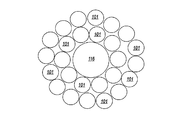
光ファイバケーブル101のバンドル100に、単色光ビームが入力される。図5bでは、バンドル100が、光ファイバケーブル101の2つの同心円または列を示すが、光ファイバケーブルの適当な数列の数を用いることができる。単色光ビームは、図1に関して説明したのと同様の方法で発生する。AOTF分光計(図示しない)から4〜10nmの解像度を有する光ビーム94が出力され、約2200〜4500nmの周波数範囲にわたって(前後に)スウィープしながら光ファイバケーブルバンドル100に入力される。光ファイバケーブルバンドル100は、光94をオプトイド104に送る。オプトイド104は、患者の皮膚と結びつけるハードウェアを構成する。オプトイド104は、窓108を有するプレート106を含む。光102は、窓108を介して患者の皮膚110に導かれる。1つの実施態様では、窓108はサファイヤの窓である。
【0038】
オプトイド104は、用いられるときには、患者の前腕部等の皮膚110に接触し、皮膚110は、プレート106と窓108とに支えられる。光102は、窓108を介して皮膚110に導かれる。光は、皮膚110の約300ミクロンの深さまで到達し、次いで、皮膚110の内部から反射される。反射光は、矢印112で示されている。反射光112は、光ファイババンドル100内に配設されたサファイヤロッド116を介して、検出器114に導かれる。反射光112は、図1に関して説明した透過光56と同様の方法で、検出器114によって検出される。
【0039】
反射型をベースにした非浸襲的システム90の別の実施態様では、光ファイバケーブル101の一部のみが、光をオプトイド104へ送るために使用され、その結果、送られる光路長が変化する。例えば、1つの実施態様では光ファイバケーブル101の内側のリングのみが使用され、別の実施態様では外側のリングのみが使用される。光路長を変化させることにより、組織内の様々な深さからの反射光をサンプリングできる。他のいくつかの実施態様では、光路長の変化を利用して、例えば散乱等の個々の組織特性を補正することができる。
【0040】
反射型をベースとした非浸襲的システム90のオプトイド104により、反射信号を捕捉する皮膚領域の温度が制御される。本発明の1つの実施態様では、オプトイドのプレート106は、皮膚を華氏約100度±0.1度に加熱するための熱電ヒータを含む。再び、皮膚を均一の温度に加熱することにより、温度の関数である光の散乱が低減される。さらに、上記のように、皮膚の加熱により毛細血管が拡張し、血管内の血流量が約300%増大する。
【0041】
本発明の1つの実施態様では、屈折率整合材112が、皮膚110とサファイヤ窓108との間に配設され、皮膚110に導かれる光102と皮膚112からの反射光との屈折率を一定に整合状態に維持する。屈折率整合ゲルは、通常皮膚と空気層と間に生ずる大きな屈折率の変化を低減する。そのような大きな変化があるとフレネル損失が生じ、これは特に反射型をベースにした分析において著しく、スペクトル信号に大きな変化をもたらす。本発明の1つの実施態様では、屈折率整合材112は、クロロフルオロカーボン・ゲルである。この種のインデックス材は、いくつかの有利な特性を有する。先ず第1に、クロロフルオロカーボン・ゲルが、それを透過するスペクトル信号に与える影響は極めて小さい。第2に、この屈折率整合材は、高い流体温度点を有するため、分析中およびテスト条件においてゲル状状態を維持できる。第3に、このゲルは疎水性を有するため、汗腺を封止し、汗によるサファイヤファイヤ窓108の曇り(気液形成)を防止する。第4に、この種の屈折率整合材は、分析中、真皮層(stratum corium)に吸収されない。
【0042】
検出器114の出力は、上記した透過型をベースとしたシステム10と共に説明した場合と同様の方法でフィルタに通されおよび処理される。
【0043】
図6を参照すると、皮膚に入射した光の吸光度対波長のグラフを示す。図6を見てわかるように、1350〜1600nmおよび1850〜2100nmのスペクトル領域で高い吸光度が観察される。
【0044】
反射型をベースとしたシステム用の較正アルゴリズムは、透過型をベースとしたシステムに関して説明した同様のデータ処理手法を用いて作成される。図7は、較正アルゴリズムを使用して予測されたグルコース濃度と対(浸襲的に得られた)測定したグルコース濃度のグラフを示す。透過型をベースとしたシステム10の場合と同様、反射型をベースとしたシステム90により被験者のグルコース濃度を正確に予測可能である。
【0045】
以上、本発明を1つ以上の特定の実施例により説明したが、当業者であれば本発明の精神及び範囲から離れることなく、多くの変更をし得ることを理解できる。これらの実施例及び明らかな変更の各々は、請求項に記載した発明の精神及び範囲の範囲内に収まるように考えられたものである。
【図面の簡単な説明】
【図1】本発明の一実施態様による体液内の分析対象物を測定する透過型をベースとしたシステムの機能ブロック図である。
【図2】図1に示した透過型をベースとしたシステムの一実施例による透過光の吸光度対透過光の波長を表すグラフである。
【図3】図1に示した透過型をベースとしたシステムの一実施例による予測グルコース濃度対測定グルコース濃度を表すグラフである。
【図4】本発明の一実施例によるグルコース較正アルゴリズムを作成するための方法を示すフローチャートである。
【図5a】本発明の一実施例による体液内の分析対象物を測定するための反射型をベースとしたシステムの機能ブロック図である。
【図5b】図5aの線5bに沿った断面図である。
【図6】図5aに示した反射型をベースとしたシステムの一実施例による反射光の吸光度対反射光の波長を表すグラフである。
【図7】図5aに示した反射型をベースとしたシステムの実施例による予測グルコース濃度対測定グルコース濃度を表すグラフである。
【符号の説明】
10 透過型をベースとした非浸襲的測定システム
12 AOTF分光計
14 第1光ビーム
16 光ファイバケーブル
18 レンズ
23 第2光ビーム
34 オプトイド
46 第1プレート
48 第2プレート
52 皮膚ウェブ
54 サファイヤロッド
56 ロードセル
58 検出器
90 反射型をベースとした非浸襲的測定システム
100 光ファイババンドル
101 光ファイバケーブル
102 光ビーム
104 オプトイド
106 プレート
108 窓
110 皮膚
112 屈折率整合材
114 検出器
116 サファイヤロッド[0001]
BACKGROUND OF THE INVENTION
The present invention relates generally to a measurement system for an analyte in a body fluid, and more particularly to a non-invasive measurement system for an analyte in a body fluid.
[0002]
[Prior art]
Patients with abnormal blood glucose levels are medically required to regularly monitor their blood glucose levels regularly. Abnormal blood glucose levels are caused by a variety of causes including illness such as diabetes. The purpose of monitoring the level of blood glucose concentration is to measure the level of blood glucose concentration, take appropriate measures based on the level of the level, and return the level to the normal range. Failure to take appropriate measures can lead to serious consequences. When blood glucose levels are abnormally low (a condition known as hypoglycemia), the patient is tense, trembling and thinking is confused. Such a person can lose judgment and lead to fainting. People are also unhealthy when blood glucose levels are abnormally high (a condition known as hyperglycemia). Both hypoglycemia and hyperglycemia are diseases that can be life threatening emergencies.
[0003]
The usual way of monitoring a person's blood glucose level is by nature an invasive method. For example, to check blood glucose levels, blood is obtained from the fingertip using a puncture device. A blood drop is formed on the fingertip, and the blood is collected by a test sensor. The test sensor is inserted into the test device and contacts the blood drop. The test sensor sucks blood into the test device, and the test device measures the glucose concentration in the blood.
[0004]
One problem with this type of analysis is the degree of pain associated with a fingertip puncture. Diabetics must self-measure themselves regularly several times a day. Each test requires a separate puncture and includes cases where the user feels pain. Furthermore, a laceration occurs on the user's skin each time a puncture is made, and like a normal wound, healing takes time and an infection is likely to occur.
[0005]
Other methods of analyzing a person's blood glucose level are non-invasive in nature. In general, this technique analyzes spectral information associated with light transmitted through or reflected from a person's skin. This type of non-invasive analysis is superior in that it is painless and does not cause skin laceration. However, until now, such techniques have proven to be unreliable because they do not recognize many problems that affect analysis. For example, in many non-invasive systems based on reflectance or transmission, the resulting spectral data includes glucose information from the part of the body tissue being analyzed as a whole and is not limited to blood glucose. Does not consider the facts. Other techniques include the drift of instruments that may occur during or during analysis, temperature changes in the tissue under analysis, changes in the spectral characteristics of the tissue due to changes in pressure, etc. Does not consider irregularities. Such irregularities affect the quality of calibration models and algorithms used to measure analyte concentrations from non-invasively collected spectral data. Spectral data having these irregularities cannot be used in an algorithm for determining the concentration of the analyte.
[0006]
[Problems to be solved by the invention]
There is a need for a reliable non-invasive system for measuring analytes in body fluids.
[0007]
[Means for Solving the Problems]
A system for measuring the concentration of an analyte in at least one body fluid in body tissue includes an infrared light source, a body tissue interface, a detector, and a central processing unit. The body tissue interface is adapted to contact the body tissue and to irradiate the contacting body tissue with light from an infrared light source. The detector is adapted to receive spectral information corresponding to infrared light transmitted through a portion of the body tissue to be measured and convert the received spectral information into an electrical signal indicating the received spectral information. . The central processing unit is adapted to compare the electrical signal with an algorithm created based on a correlation with the analyte in the body fluid, which algorithm receives the received spectral information into the analyte in the at least one body fluid. It is adapted to convert to the concentration of matter.
[0008]
【Example】
Referring initially to FIG. 1, a transmission-based non-invasive system 10 (hereinafter “system 10”) for measuring an analyte in a body fluid is functionally shown. Although the present invention will be described in connection with measuring a patient's glucose level, the present invention is applicable to the analysis of any analyte in a body fluid that exhibits spectral characteristics. In essence, the system 10 irradiates a portion of the skin, eg, the “web” of the skin between the patient's index finger and thumb, and passes through the portion of the skin to measure the patient's glucose level. And record the transmitted light. Usually, the patient's glucose level is called the patient's blood glucose level. However, the blood glucose level includes ignoring the amount of glucose contained in the extracellular substance and intercellular substance of the patient. Thus, the inventors of the present invention prefer to refer to the patient's glucose level.
[0009]
About 50 to 60% of human skin is composed of intercellular substances, and the rest is composed of extracellular substances. Extracellular material includes about one third of plasma (blood) and about two thirds of interstitial fluid (ISF). Therefore, when examining the spectral characteristics of glucose from light transmitted through the patient's skin, it is important to consider the whole glucose in that portion of the skin rather than just the glucose in the patient's blood. Most of the transmitted light is light transmitted through the ISF, not blood. Conversely, for example, in the case of an invasive test in which a 10 μl blood drop is taken at the patient's fingertip, the measured glucose concentration mainly represents the concentration of glucose in the patient's blood.
[0010]
System 10 is used to obtain transmission spectrum information from a patient. For example, the system 10 is used in a test where the subject's glucose concentration is adjusted to a plurality of different concentration levels. One such test is a glucose clamp test, where the subject's glucose level rises and falls to different levels over the duration of the test. According to one embodiment, the glucose clamp test is designed to guide a subject's glucose level into six constant regions distributed over a concentration range of 50-300 mg / dl. Each of the constant areas is separated by about 50 mg / dl so that each of the areas can be clearly distinguished. ISF and plasma samples are taken during the clamp test. Samples are taken every 5 minutes and analyzed for glucose content. This measurement regulates glucose or insulin infusion to maintain plasma glucose concentration in a specific targeted range of region for approximately 25 minutes. Very generally, the spectral data obtained over the course of the test is compared to the actual glucose level (measured using an invasive technique). From this data, a calibration algorithm is assembled to predict the patient's actual glucose level based on the spectral characteristics of the light transmitted through the patient's skin. This calibration algorithm can be incorporated into the portable version of system 10 shown in FIG.
[0011]
Such a portable device allows the user to non-invasively monitor the user's glucose concentration level. The user contacts the device with his skin and obtains spectral information from the user's skin. The device can then provide the user with a measurement of the user's glucose concentration level after a short period of time.
[0012]
Returning to FIG. 1, an acousto-optic tunable wavelength filter (AOTF) spectrometer is schematically illustrated by dashed
[0013]
In general, the
[0014]
According to one embodiment, the
[0015]
The
[0016]
The light 14 output by the
[0017]
The light guided to the
[0018]
In addition to providing a mechanism for transmitted light through the
[0019]
Second, the
[0020]
As described above, the
[0021]
The demodulated signal is then digitized by an analog to digital (AD)
[0022]
The spectral data optionally removes high frequency noise through a high frequency filter 74 and then removes low frequency drift through a
[0023]
The signal is then sent to a central processing unit (CPU) 78. The
[0024]
Furthermore, noise in the signal can be improved by removing spectral information that does not correspond to associated glucose information according to another embodiment of the present invention. This is done by applying a genetic algorithm to select the wavelength region most relevant to glucose change and removing the other regions. This process leads to the development of a robust calibration algorithm that greatly reduces overfitting problems. In yet another embodiment, Orthogonal Signal Correction (OSC) helps remove non-glucose spectral information from the signal. This method has been found useful in removing traces of changes related to temperature and time drift in glucose related data. By removing data related to pressure and temperature changes over the course of the analysis, a better calibration algorithm is obtained resulting in better glucose prediction based on the spectral data. By using a plurality of approaches in combination, the signal can be improved more than when different approaches are used individually. For example, it has been confirmed that excellent results can be obtained by using the wavelet process and OSC together. Furthermore, the present inventors have confirmed that excellent results can be obtained by using a genetic algorithm in combination with OSC.
[0025]
Similarly, the
[0026]
Referring to FIG. 2, a graph plotting the percentage of light transmitted through the web versus wavelength (nm) is shown. The peaks located at about 1450-1850 nm and about 2200-2500 nm in the graph indicate high absorbance of light 56 transmitted through the tissue. High absorbance in these spectral regions is due in part to absorption by moisture contained within the skin. Glucose in the skin is mostly where moisture in the skin is located. Glucose exhibits unique spectral characteristics in these two wavelength regions.
[0027]
As described above, during the glucose clamp test, in addition to the transmission spectrum data, blood and ISF samples are obtained from the subject (ie, the patient being tested) and the subject's actual blood glucose is obtained. Level is measured. In one example of a glucose clamp test, the test is performed over a length of about 500 minutes. Blood and ISF samples are obtained about every 5 minutes, for a total of about 100 samples. These values are interpolated over a 500 minute test period, resulting in approximately 500 glucose concentration values.
[0028]
The transmitted digital spectrum signal is averaged and stored every minute, resulting in approximately 500 data points over the test period. This data is analyzed and processed (described in detail below) to create a calibration algorithm for predicting the actual glucose concentration level from examination of the spectral characteristics of the transmitted light.
[0029]
As shown in FIG. 3, a graph plotting predicted glucose values (determined from the spectral characteristics of transmitted light) against the measured glucose values is shown. As shown in the graph of FIG. 3, there is a high correlation between the predicted glucose concentration and the measured glucose concentration.
[0030]
To obtain the predicted values plotted in FIG. 3, a calibration algorithm must be created that predicts the glucose concentration from the transmission spectrum signal (the signal generated by detector 58). After the spectral signal has been filtered by the high and low frequency filters 74, 78, the signal is normalized to effect the spectral scattering of the light transmitted through the
[0031]
A calibration algorithm is then created to predict the glucose concentration from the normalized signal. The orthogonal signal correction process combines temperature and pressure information associated with time to recognize portions of the spectrum that are related to these factors and not strictly related to changes in glucose concentration. This process is used in conjunction with correlation data (invasively measured plasma and ISF fluid glucose concentrations) to remove spectral data information related to other measurement changes rather than glucose changes. The result is a calibration algorithm that is more clearly associated with changes in glucose concentration and less associated with artifacts that are accidentally correlated to glucose concentration. Other data improvement processes include the use of more general chemometrics such as genetic algorithms and wavelet analysis, and further improve spectral information to the most efficient information. Genetic algorithms and wavelet analysis can select wavelengths that are particularly relevant to glucose in the spectrum that focuses the calibration algorithm on specific changes in glucose concentration. The wavelength is selected based on the region of the spectrum where the largest glucose-related peak is located, but the wavelength is also selected based on the spectral region associated with the change in the refractive index of the tissue due to the change in tissue concentration. This wavelength selection process preserves the wavelength information for generating the best calibration algorithm.
[0032]
Referring to FIG. 4, a flowchart depicting a method for generating a glucose calibration algorithm according to one embodiment of the present invention is shown. First, as described above, a glucose clamp experiment is performed, and spectral information is obtained from at least the body tissues of the first and second subjects. This information is stored in the
[0033]
A combined data set of spectral data obtained from one or more subjects (first and second spectral data sets 82, 84) has been generated and a model useful for predicting glucose levels of all subjects who provided the data. Used to generate. The raw signals stored in the first and second data sets 82 and 84 obtained from the AOTF spectrometer described above are first normalized to constant energy with respect to the data from each subject in
[0034]
The PLS model generated in
[0035]
In another embodiment of the present invention, during creation of the glucose calibration algorithm, a wavelet analysis is performed on each data set following
[0036]
Referring to FIGS. 5a and 5b, a reflective based non-invasive system 90 (system 90) for measuring an analyte in a bodily fluid is functionally shown. Briefly, the
[0037]
A monochromatic light beam is input to the
[0038]
When used, the optoid 104 contacts the
[0039]
In another embodiment of the reflective-based
[0040]
The
[0041]
In one embodiment of the present invention, the refractive
[0042]
The output of the detector 114 is filtered and processed in the same manner as described with the transmission based system 10 described above.
[0043]
Referring to FIG. 6, a graph of absorbance versus wavelength of light incident on the skin is shown. As can be seen in FIG. 6, high absorbance is observed in the spectral regions of 1350-1600 nm and 1850-2100 nm.
[0044]
Calibration algorithms for reflective based systems are created using similar data processing techniques described for transmission based systems. FIG. 7 shows a graph of the glucose concentration predicted using the calibration algorithm versus the measured glucose concentration (obtained invasively). As with the transmissive-based system 10, the subject's glucose concentration can be accurately predicted by the reflective-based
[0045]
While the invention has been described in terms of one or more specific embodiments, those skilled in the art will recognize that many modifications can be made without departing from the spirit and scope of the invention. Each of these embodiments and obvious modifications is contemplated to be within the spirit and scope of the claimed invention.
[Brief description of the drawings]
FIG. 1 is a functional block diagram of a transmission-based system for measuring an analyte in a body fluid according to one embodiment of the present invention.
FIG. 2 is a graph showing the absorbance of transmitted light versus the wavelength of transmitted light according to an embodiment of the transmission-based system shown in FIG.
FIG. 3 is a graph showing predicted glucose concentration versus measured glucose concentration according to one embodiment of the transmission-based system shown in FIG. 1;
FIG. 4 is a flowchart illustrating a method for creating a glucose calibration algorithm according to one embodiment of the present invention.
FIG. 5a is a functional block diagram of a reflective based system for measuring an analyte in a body fluid according to one embodiment of the present invention.
5b is a cross-sectional view taken along
FIG. 6 is a graph illustrating the absorbance of reflected light versus the wavelength of reflected light according to one embodiment of the reflective-based system shown in FIG. 5a.
FIG. 7 is a graph showing predicted glucose concentration versus measured glucose concentration according to an example of the reflection-based system shown in FIG. 5a.
[Explanation of symbols]
10 Non-invasive measurement system based on transmission type
12 AOTF spectrometer
14 First light beam
16 Optical fiber cable
18 lenses
23 Second light beam
34 Optooid
46 1st plate
48 Second plate
52 skin web
54 Sapphire Rod
56 load cell
58 Detector
90 Non-invasive measurement system based on reflection type
100 optical fiber bundle
101 optical fiber cable
102 Light beam
104 optooid
106 plates
108 windows
110 skin
112 Refractive index matching material
114 detector
116 Sapphire Rod
Claims (10)
赤外光源と、
体組織に接触し、かつ、接触した体組織に赤外光源からの光を送るように適合された体組織インターフェースであって、体組織と接触する2つのプレートを有するクランプ装置を含む体組織インターフェースと、
分析される体組織の部分を透過した赤外光に対応するスペクトル情報を受け取り、かつ、受け取ったスペクトル情報であることを示す電気信号に受け取ったスペクトル情報を変換するように適合された検出器と、
クランプ装置により体組織に加えられた圧力量を測定するためのロードセルと、
スペクトル情報及びロードセルからの測定された圧力を、体液中の分析対象物との相関に基づいて作成されたアルゴリズムで使用するように適合された中央処理装置であって、アルゴリズムが、受け取ったスペクトル情報を、少なくとも1種類の体液中の分析対象物の濃度に変換するように適合されている中央処理装置と、を含む、分析対象物の濃度測定システム。A system for measuring the concentration of an analyte in at least one body fluid in body tissue,
An infrared light source;
A body tissue interface adapted to contact body tissue and to transmit light from an infrared light source to the contacted body tissue, comprising a clamping device having two plates in contact with the body tissue And
A detector adapted to receive spectral information corresponding to infrared light transmitted through the portion of body tissue to be analyzed and to convert the received spectral information into an electrical signal indicating the received spectral information; ,
A load cell for measuring the amount of pressure applied to the body tissue by the clamping device;
Spectral information the measured pressure from the spectral information and the load cell, a adapted central processing unit to be used in the algorithm created based on the correlation between the analyte in the body fluid, the algorithm, the received And a central processing unit adapted to convert the analyte to a concentration of the analyte in at least one body fluid.
赤外光源と、
体組織に接触し、かつ、赤外光源からの光を接触した体組織に送るように適合された体組織インターフェースであって、体組織に接触する2つのプレートを含むクランプ装置を含む体組織インターフェースと、
体液からの反射光を受け、かつ、受けた反射光であることを示す電気信号に受けた反射光を変換するように適合された検出器と、
クランプ装置により体組織に加えられた圧力量を測定するためのロードセルと、
スペクトル情報を示す信号及びロードセルからの測定された圧力を、体液中の分析対象物との相関に基づいて作成されたアルゴリズムで使用するように適合された中央処理装置であって、アルゴリズムが、受けたスペクトル情報を、少なくとも1種類の体液内の分析対象物の濃度に変換する中央処理装置と、を備えた、
分析対象物の濃度を測定するシステム。A system for measuring the concentration of an analyte in at least one body fluid in body tissue,
An infrared light source;
A body tissue interface adapted to contact body tissue and to transmit light from an infrared light source to the contacted body tissue, comprising a clamping device comprising two plates in contact with the body tissue When,
A detector adapted to receive the reflected light from the body fluid and to convert the received reflected light into an electrical signal indicating the received reflected light;
A load cell for measuring the amount of pressure applied to the body tissue by the clamping device;
A central processing unit adapted to use a signal indicative of spectral information and a measured pressure from a load cell in an algorithm created based on a correlation with an analyte in a body fluid , the algorithm receiving the the spectral information, comprising: a central processing unit for converting to the concentration of an analyte in at least one body fluid, and
A system that measures the concentration of an analyte.
Applications Claiming Priority (2)
| Application Number | Priority Date | Filing Date | Title |
|---|---|---|---|
| US35535802P | 2002-02-11 | 2002-02-11 | |
| US60/355,358 | 2002-02-11 |
Publications (3)
| Publication Number | Publication Date |
|---|---|
| JP2003235832A JP2003235832A (en) | 2003-08-26 |
| JP2003235832A5 JP2003235832A5 (en) | 2006-03-30 |
| JP4476552B2 true JP4476552B2 (en) | 2010-06-09 |
Family
ID=27613551
Family Applications (1)
| Application Number | Title | Priority Date | Filing Date |
|---|---|---|---|
| JP2003032015A Expired - Lifetime JP4476552B2 (en) | 2002-02-11 | 2003-02-10 | Non-invasive system for measuring analytes in body fluids |
Country Status (5)
| Country | Link |
|---|---|
| US (4) | US7299079B2 (en) |
| EP (2) | EP1335199A1 (en) |
| JP (1) | JP4476552B2 (en) |
| AU (1) | AU2003200359A1 (en) |
| CA (1) | CA2418399A1 (en) |
Families Citing this family (161)
| Publication number | Priority date | Publication date | Assignee | Title |
|---|---|---|---|---|
| US6391005B1 (en) | 1998-03-30 | 2002-05-21 | Agilent Technologies, Inc. | Apparatus and method for penetration with shaft having a sensor for sensing penetration depth |
| US6949816B2 (en) * | 2003-04-21 | 2005-09-27 | Motorola, Inc. | Semiconductor component having first surface area for electrically coupling to a semiconductor chip and second surface area for electrically coupling to a substrate, and method of manufacturing same |
| US6522903B1 (en) | 2000-10-19 | 2003-02-18 | Medoptix, Inc. | Glucose measurement utilizing non-invasive assessment methods |
| US8641644B2 (en) | 2000-11-21 | 2014-02-04 | Sanofi-Aventis Deutschland Gmbh | Blood testing apparatus having a rotatable cartridge with multiple lancing elements and testing means |
| US9795747B2 (en) | 2010-06-02 | 2017-10-24 | Sanofi-Aventis Deutschland Gmbh | Methods and apparatus for lancet actuation |
| WO2002100460A2 (en) | 2001-06-12 | 2002-12-19 | Pelikan Technologies, Inc. | Electric lancet actuator |
| US9427532B2 (en) | 2001-06-12 | 2016-08-30 | Sanofi-Aventis Deutschland Gmbh | Tissue penetration device |
| US7344507B2 (en) | 2002-04-19 | 2008-03-18 | Pelikan Technologies, Inc. | Method and apparatus for lancet actuation |
| US7981056B2 (en) | 2002-04-19 | 2011-07-19 | Pelikan Technologies, Inc. | Methods and apparatus for lancet actuation |
| CA2448902C (en) | 2001-06-12 | 2010-09-07 | Pelikan Technologies, Inc. | Self optimizing lancing device with adaptation means to temporal variations in cutaneous properties |
| US7041068B2 (en) | 2001-06-12 | 2006-05-09 | Pelikan Technologies, Inc. | Sampling module device and method |
| AU2002348683A1 (en) | 2001-06-12 | 2002-12-23 | Pelikan Technologies, Inc. | Method and apparatus for lancet launching device integrated onto a blood-sampling cartridge |
| US8337419B2 (en) | 2002-04-19 | 2012-12-25 | Sanofi-Aventis Deutschland Gmbh | Tissue penetration device |
| US9226699B2 (en) | 2002-04-19 | 2016-01-05 | Sanofi-Aventis Deutschland Gmbh | Body fluid sampling module with a continuous compression tissue interface surface |
| EP1335199A1 (en) | 2002-02-11 | 2003-08-13 | Bayer Corporation | Non-invasive system for the determination of analytes in body fluids |
| US8221334B2 (en) | 2002-04-19 | 2012-07-17 | Sanofi-Aventis Deutschland Gmbh | Method and apparatus for penetrating tissue |
| US9314194B2 (en) | 2002-04-19 | 2016-04-19 | Sanofi-Aventis Deutschland Gmbh | Tissue penetration device |
| US7901362B2 (en) | 2002-04-19 | 2011-03-08 | Pelikan Technologies, Inc. | Method and apparatus for penetrating tissue |
| US7331931B2 (en) | 2002-04-19 | 2008-02-19 | Pelikan Technologies, Inc. | Method and apparatus for penetrating tissue |
| US7976476B2 (en) | 2002-04-19 | 2011-07-12 | Pelikan Technologies, Inc. | Device and method for variable speed lancet |
| US7232451B2 (en) | 2002-04-19 | 2007-06-19 | Pelikan Technologies, Inc. | Method and apparatus for penetrating tissue |
| US8360992B2 (en) | 2002-04-19 | 2013-01-29 | Sanofi-Aventis Deutschland Gmbh | Method and apparatus for penetrating tissue |
| US7674232B2 (en) | 2002-04-19 | 2010-03-09 | Pelikan Technologies, Inc. | Method and apparatus for penetrating tissue |
| US7892183B2 (en) | 2002-04-19 | 2011-02-22 | Pelikan Technologies, Inc. | Method and apparatus for body fluid sampling and analyte sensing |
| US7547287B2 (en) | 2002-04-19 | 2009-06-16 | Pelikan Technologies, Inc. | Method and apparatus for penetrating tissue |
| US7229458B2 (en) | 2002-04-19 | 2007-06-12 | Pelikan Technologies, Inc. | Method and apparatus for penetrating tissue |
| US9795334B2 (en) | 2002-04-19 | 2017-10-24 | Sanofi-Aventis Deutschland Gmbh | Method and apparatus for penetrating tissue |
| US8267870B2 (en) | 2002-04-19 | 2012-09-18 | Sanofi-Aventis Deutschland Gmbh | Method and apparatus for body fluid sampling with hybrid actuation |
| US7909778B2 (en) | 2002-04-19 | 2011-03-22 | Pelikan Technologies, Inc. | Method and apparatus for penetrating tissue |
| US7491178B2 (en) | 2002-04-19 | 2009-02-17 | Pelikan Technologies, Inc. | Method and apparatus for penetrating tissue |
| US8702624B2 (en) | 2006-09-29 | 2014-04-22 | Sanofi-Aventis Deutschland Gmbh | Analyte measurement device with a single shot actuator |
| US9248267B2 (en) | 2002-04-19 | 2016-02-02 | Sanofi-Aventis Deustchland Gmbh | Tissue penetration device |
| US7297122B2 (en) | 2002-04-19 | 2007-11-20 | Pelikan Technologies, Inc. | Method and apparatus for penetrating tissue |
| US7226461B2 (en) | 2002-04-19 | 2007-06-05 | Pelikan Technologies, Inc. | Method and apparatus for a multi-use body fluid sampling device with sterility barrier release |
| US7892185B2 (en) | 2002-04-19 | 2011-02-22 | Pelikan Technologies, Inc. | Method and apparatus for body fluid sampling and analyte sensing |
| US8579831B2 (en) | 2002-04-19 | 2013-11-12 | Sanofi-Aventis Deutschland Gmbh | Method and apparatus for penetrating tissue |
| US8784335B2 (en) | 2002-04-19 | 2014-07-22 | Sanofi-Aventis Deutschland Gmbh | Body fluid sampling device with a capacitive sensor |
| CN100406872C (en) * | 2002-11-04 | 2008-07-30 | 天津市先石光学技术有限公司 | Composite spectrum measurement method and its spectrum detection instrument |
| US8574895B2 (en) | 2002-12-30 | 2013-11-05 | Sanofi-Aventis Deutschland Gmbh | Method and apparatus using optical techniques to measure analyte levels |
| US7153256B2 (en) | 2003-03-07 | 2006-12-26 | Neuronetics, Inc. | Reducing discomfort caused by electrical stimulation |
| US8118722B2 (en) | 2003-03-07 | 2012-02-21 | Neuronetics, Inc. | Reducing discomfort caused by electrical stimulation |
| KR100464324B1 (en) | 2003-03-17 | 2005-01-03 | 삼성전자주식회사 | Method and apparatus for measuring concentration of constituents in body fluids |
| EP2238892A3 (en) | 2003-05-30 | 2011-02-09 | Pelikan Technologies Inc. | Apparatus for body fluid sampling |
| ES2490740T3 (en) | 2003-06-06 | 2014-09-04 | Sanofi-Aventis Deutschland Gmbh | Apparatus for blood fluid sampling and analyte detection |
| WO2006001797A1 (en) | 2004-06-14 | 2006-01-05 | Pelikan Technologies, Inc. | Low pain penetrating |
| EP1671096A4 (en) | 2003-09-29 | 2009-09-16 | Pelikan Technologies Inc | METHOD AND APPARATUS FOR AN IMPROVED SAMPLING INTERFERENCE DEVICE |
| EP1680014A4 (en) | 2003-10-14 | 2009-01-21 | Pelikan Technologies Inc | METHOD AND APPARATUS PROVIDING A VARIABLE USER INTERFACE |
| JP2005192611A (en) * | 2003-12-26 | 2005-07-21 | Olympus Corp | Glucose concentration measuring apparatus |
| US7822454B1 (en) | 2005-01-03 | 2010-10-26 | Pelikan Technologies, Inc. | Fluid sampling device with improved analyte detecting member configuration |
| WO2005065414A2 (en) | 2003-12-31 | 2005-07-21 | Pelikan Technologies, Inc. | Method and apparatus for improving fluidic flow and sample capture |
| US8828203B2 (en) | 2004-05-20 | 2014-09-09 | Sanofi-Aventis Deutschland Gmbh | Printable hydrogels for biosensors |
| EP1765194A4 (en) | 2004-06-03 | 2010-09-29 | Pelikan Technologies Inc | METHOD AND APPARATUS FOR MANUFACTURING A DEVICE FOR SAMPLING LIQUIDS |
| US9775553B2 (en) | 2004-06-03 | 2017-10-03 | Sanofi-Aventis Deutschland Gmbh | Method and apparatus for a fluid sampling device |
| US8652831B2 (en) | 2004-12-30 | 2014-02-18 | Sanofi-Aventis Deutschland Gmbh | Method and apparatus for analyte measurement test time |
| US7468284B2 (en) * | 2005-02-28 | 2008-12-23 | Silverbrook Research Pty Ltd | Method of bonding substrates |
| US7341330B2 (en) | 2005-02-28 | 2008-03-11 | Silverbrook Research Pty Ltd | Substrates adapted for adhesive bonding |
| US7425052B2 (en) * | 2005-02-28 | 2008-09-16 | Silverbrook Research Pty Ltd | Printhead assembly having improved adhesive bond strength |
| WO2006089337A1 (en) * | 2005-02-28 | 2006-08-31 | Silverbrook Research Pty Ltd | Method of bonding substrates |
| US7372145B2 (en) * | 2005-02-28 | 2008-05-13 | Silverbrook Research Pty Ltd | Bonded assembly having improved adhesive bond strength |
| US7287831B2 (en) * | 2005-02-28 | 2007-10-30 | Silverbrook Research Pty Ltd | Printhead integrated circuit adapted for adhesive bonding |
| WO2006113476A2 (en) * | 2005-04-15 | 2006-10-26 | Bayer Healthcare Llc | Non-invasive system for measuring glucose in the body |
| GB0606891D0 (en) * | 2006-04-05 | 2006-05-17 | Council Cent Lab Res Councils | Raman Analysis Of Pharmaceutical Tablets |
| JP3992064B2 (en) * | 2006-01-20 | 2007-10-17 | 住友電気工業株式会社 | Optical analyzer |
| JP4928849B2 (en) * | 2006-06-27 | 2012-05-09 | 東芝メディカルシステムズ株式会社 | Non-invasive measuring device |
| US7973925B2 (en) * | 2007-02-06 | 2011-07-05 | C8 Medisensors Inc. | Apparatus for stabilizing mechanical, thermal, and optical properties and for reducing the fluorescence of biological samples for optical evaluation |
| US8417311B2 (en) | 2008-09-12 | 2013-04-09 | Optiscan Biomedical Corporation | Fluid component analysis system and method for glucose monitoring and control |
| US7782191B2 (en) * | 2007-07-25 | 2010-08-24 | Tomas Flores | Portable alarm apparatus for warning persons |
| EP3868284A1 (en) | 2007-10-10 | 2021-08-25 | Optiscan Biomedical Corporation | Fluid component analysis system and method for glucose monitoring and control |
| CN101918581B (en) | 2007-10-10 | 2015-04-15 | 普凯尔德诊断技术有限公司 | A system for the identification of bacteria in urine |
| CN107132185B (en) | 2008-02-05 | 2020-05-29 | 普凯尔德诊断技术有限公司 | System for identifying bacteria in biological samples |
| JP4914388B2 (en) * | 2008-03-07 | 2012-04-11 | 日本電信電話株式会社 | Component concentration measuring device |
| EP2265324B1 (en) | 2008-04-11 | 2015-01-28 | Sanofi-Aventis Deutschland GmbH | Integrated analyte measurement system |
| US20110160555A1 (en) * | 2008-07-31 | 2011-06-30 | Jacques Reifman | Universal Models for Predicting Glucose Concentration in Humans |
| US7959598B2 (en) | 2008-08-20 | 2011-06-14 | Asante Solutions, Inc. | Infusion pump systems and methods |
| US9375169B2 (en) | 2009-01-30 | 2016-06-28 | Sanofi-Aventis Deutschland Gmbh | Cam drive for managing disposable penetrating member actions with a single motor and motor and control system |
| US8309897B2 (en) | 2009-02-06 | 2012-11-13 | Pocared Diagnostics Ltd. | Optical measurement arrangement |
| US10288632B2 (en) | 2009-09-21 | 2019-05-14 | Pocared Diagnostics Ltd. | System for conducting the identification of bacteria in biological samples |
| US8965476B2 (en) | 2010-04-16 | 2015-02-24 | Sanofi-Aventis Deutschland Gmbh | Tissue penetration device |
| US20110313680A1 (en) * | 2010-06-22 | 2011-12-22 | Doyle Iii Francis J | Health Monitoring System |
| US8804114B2 (en) | 2010-11-03 | 2014-08-12 | Pocared Diagnostics Ltd. | Optical cup |
| US8411265B2 (en) | 2011-06-14 | 2013-04-02 | C8 Medisensors Inc. | Apparatus for stabilizing mechanical, thermal, and optical properties and for reducing the fluorescence of biological samples for optical evaluation |
| JP5426644B2 (en) * | 2011-12-06 | 2014-02-26 | 東芝メディカルシステムズ株式会社 | Non-invasive measuring device |
| US9351671B2 (en) | 2012-07-16 | 2016-05-31 | Timothy Ruchti | Multiplexed pathlength resolved noninvasive analyzer apparatus and method of use thereof |
| US9585604B2 (en) * | 2012-07-16 | 2017-03-07 | Zyomed Corp. | Multiplexed pathlength resolved noninvasive analyzer apparatus with dynamic optical paths and method of use thereof |
| US9351672B2 (en) | 2012-07-16 | 2016-05-31 | Timothy Ruchti | Multiplexed pathlength resolved noninvasive analyzer apparatus with stacked filters and method of use thereof |
| US20150018646A1 (en) * | 2013-07-12 | 2015-01-15 | Sandeep Gulati | Dynamic sample mapping noninvasive analyzer apparatus and method of use thereof |
| US9065554B2 (en) * | 2012-08-01 | 2015-06-23 | Comcast Cable Communications, Llc | System and method for analyzing a network |
| US20140058224A1 (en) * | 2012-08-21 | 2014-02-27 | Opticks, Inc. | Systems and methods for detection of carotenoid-related compounds in biological tissue |
| US10067054B2 (en) | 2012-10-16 | 2018-09-04 | K Sciences Gp, Llc | Simple sugar concentration sensor and method |
| US8743355B2 (en) | 2012-10-16 | 2014-06-03 | K Sciences Gp, Llc | Simple sugar concentration sensor and method |
| US9862920B2 (en) | 2012-12-11 | 2018-01-09 | Pocared Diagnostics Ltd. | Optics cup with curved bottom |
| US9561324B2 (en) | 2013-07-19 | 2017-02-07 | Bigfoot Biomedical, Inc. | Infusion pump system and method |
| US10395134B2 (en) * | 2013-07-26 | 2019-08-27 | University Of Utah Research Foundation | Extraction of spectral information |
| GB2523989B (en) | 2014-01-30 | 2020-07-29 | Insulet Netherlands B V | Therapeutic product delivery system and method of pairing |
| DE102014108424B3 (en) | 2014-06-16 | 2015-06-11 | Johann Wolfgang Goethe-Universität | Non-invasive substance analysis |
| CN104200090B (en) * | 2014-08-27 | 2017-07-14 | 百度在线网络技术(北京)有限公司 | Forecasting Methodology and device based on multi-source heterogeneous data |
| WO2016054079A1 (en) | 2014-09-29 | 2016-04-07 | Zyomed Corp. | Systems and methods for blood glucose and other analyte detection and measurement using collision computing |
| US10206581B2 (en) * | 2014-10-29 | 2019-02-19 | Zoll Medical Corporation | Transesophageal or transtracheal cardiac monitoring by optical spectroscopy |
| US10737024B2 (en) | 2015-02-18 | 2020-08-11 | Insulet Corporation | Fluid delivery and infusion devices, and methods of use thereof |
| GB2555229B (en) * | 2015-03-05 | 2021-03-24 | Synaptive Medical Inc | An optical coherence tomography system including a planarizing transparent material |
| CN105319181A (en) * | 2015-11-02 | 2016-02-10 | 南京航空航天大学 | Biological tissue thermal damage parameter measurement method |
| US11426100B1 (en) | 2015-12-08 | 2022-08-30 | Socrates Health Solutions, Inc. | Blood glucose trend meter |
| EP3524962A1 (en) | 2015-12-09 | 2019-08-14 | Diamontech GmbH | Device and method for analysing a material |
| US10876965B2 (en) | 2015-12-09 | 2020-12-29 | Diamontech Ag | Apparatus and method for analyzing a material |
| WO2017123525A1 (en) | 2016-01-13 | 2017-07-20 | Bigfoot Biomedical, Inc. | User interface for diabetes management system |
| US10780223B2 (en) | 2016-01-14 | 2020-09-22 | Bigfoot Biomedical, Inc. | Adjusting insulin delivery rates |
| US10610643B2 (en) | 2016-01-14 | 2020-04-07 | Bigfoot Biomedical, Inc. | Occlusion resolution in medication delivery devices, systems, and methods |
| US9554738B1 (en) | 2016-03-30 | 2017-01-31 | Zyomed Corp. | Spectroscopic tomography systems and methods for noninvasive detection and measurement of analytes using collision computing |
| US12383166B2 (en) | 2016-05-23 | 2025-08-12 | Insulet Corporation | Insulin delivery system and methods with risk-based set points |
| US10765807B2 (en) | 2016-09-23 | 2020-09-08 | Insulet Corporation | Fluid delivery device with sensor |
| KR20180050946A (en) * | 2016-11-07 | 2018-05-16 | 삼성전자주식회사 | Apparatus and method for providing health state of cardiovascular system |
| US11096624B2 (en) | 2016-12-12 | 2021-08-24 | Bigfoot Biomedical, Inc. | Alarms and alerts for medication delivery devices and systems |
| EP3568860B1 (en) | 2017-01-13 | 2025-12-10 | Insulet Corporation | Insulin delivery methods, systems and devices |
| US10500334B2 (en) | 2017-01-13 | 2019-12-10 | Bigfoot Biomedical, Inc. | System and method for adjusting insulin delivery |
| WO2018132765A1 (en) | 2017-01-13 | 2018-07-19 | Mazlish Bryan | Insulin delivery methods, systems and devices |
| US10583250B2 (en) | 2017-01-13 | 2020-03-10 | Bigfoot Biomedical, Inc. | System and method for adjusting insulin delivery |
| US10758675B2 (en) | 2017-01-13 | 2020-09-01 | Bigfoot Biomedical, Inc. | System and method for adjusting insulin delivery |
| EP3568862B1 (en) | 2017-01-13 | 2026-03-18 | Insulet Corporation | System and method for adjusting insulin delivery |
| KR102515832B1 (en) * | 2017-03-27 | 2023-03-29 | 삼성전자주식회사 | Glucose feature extraction method, Glucose monitoring apparatus and method |
| US10980484B2 (en) * | 2017-03-27 | 2021-04-20 | Samsung Electronics Co., Ltd. | Method of enabling feature extraction for glucose monitoring using near-infrared (NIR) spectroscopy |
| WO2019019119A1 (en) * | 2017-07-27 | 2019-01-31 | Vita-Course Technologies (Hainan) Co., Ltd. | Systems and methods for determining blood pressure of subject |
| KR102487058B1 (en) | 2017-11-17 | 2023-01-09 | 삼성전자주식회사 | Apparatus and method for measuring bio-information |
| KR102715921B1 (en) * | 2018-02-23 | 2024-10-10 | 삼성전자주식회사 | Apparatus and method for estimation concentration of blood compound |
| EP3531110B1 (en) * | 2018-02-23 | 2025-04-02 | Samsung Electronics Co., Ltd. | Apparatus and method for estimating concentration of blood compound |
| USD928199S1 (en) | 2018-04-02 | 2021-08-17 | Bigfoot Biomedical, Inc. | Medication delivery device with icons |
| CN118750687A (en) | 2018-05-04 | 2024-10-11 | 英赛罗公司 | Safety constraints for drug delivery systems based on control algorithms |
| US12562251B1 (en) | 2018-05-09 | 2026-02-24 | Bigfoot Biomedical, Inc. | Computing architecture for assuring the provenance of medication therapy related parameters, and related systems, methods and devices |
| JP2022501139A (en) | 2018-09-28 | 2022-01-06 | インスレット コーポレイション | Activity mode for artificial pancreas system |
| US11565039B2 (en) | 2018-10-11 | 2023-01-31 | Insulet Corporation | Event detection for drug delivery system |
| USD920343S1 (en) | 2019-01-09 | 2021-05-25 | Bigfoot Biomedical, Inc. | Display screen or portion thereof with graphical user interface associated with insulin delivery |
| US11744491B2 (en) * | 2019-05-14 | 2023-09-05 | The Regents Of The University Of California | Noninvasive method and apparatus for peripheral assessment of vascular health |
| CA3143026A1 (en) * | 2019-06-12 | 2020-12-17 | Automotive Coalition For Traffic Safety, Inc. | System for non-invasive measurement of an analyte in a vehicle driver |
| US11801344B2 (en) | 2019-09-13 | 2023-10-31 | Insulet Corporation | Blood glucose rate of change modulation of meal and correction insulin bolus quantity |
| US11935637B2 (en) | 2019-09-27 | 2024-03-19 | Insulet Corporation | Onboarding and total daily insulin adaptivity |
| US11957875B2 (en) | 2019-12-06 | 2024-04-16 | Insulet Corporation | Techniques and devices providing adaptivity and personalization in diabetes treatment |
| US11833329B2 (en) | 2019-12-20 | 2023-12-05 | Insulet Corporation | Techniques for improved automatic drug delivery performance using delivery tendencies from past delivery history and use patterns |
| JP7512395B2 (en) | 2020-01-06 | 2024-07-08 | インスレット コーポレイション | Predicting dietary and/or exercise behavior based on persistence residuals |
| EP4100958A1 (en) | 2020-02-03 | 2022-12-14 | Insulet Corporation | Use of fuzzy logic in predicting user behavior affecting blood glucose concentration |
| US11551802B2 (en) | 2020-02-11 | 2023-01-10 | Insulet Corporation | Early meal detection and calorie intake detection |
| US11986630B2 (en) | 2020-02-12 | 2024-05-21 | Insulet Corporation | Dual hormone delivery system for reducing impending hypoglycemia and/or hyperglycemia risk |
| US11547800B2 (en) | 2020-02-12 | 2023-01-10 | Insulet Corporation | User parameter dependent cost function for personalized reduction of hypoglycemia and/or hyperglycemia in a closed loop artificial pancreas system |
| US11324889B2 (en) | 2020-02-14 | 2022-05-10 | Insulet Corporation | Compensation for missing readings from a glucose monitor in an automated insulin delivery system |
| US12495994B2 (en) | 2020-02-20 | 2025-12-16 | Insulet Corporation | Meal bolus subcategories in model based insulin therapy |
| US11607493B2 (en) | 2020-04-06 | 2023-03-21 | Insulet Corporation | Initial total daily insulin setting for user onboarding |
| US12121700B2 (en) | 2020-07-22 | 2024-10-22 | Insulet Corporation | Open-loop insulin delivery basal parameters based on insulin delivery records |
| US11684716B2 (en) | 2020-07-31 | 2023-06-27 | Insulet Corporation | Techniques to reduce risk of occlusions in drug delivery systems |
| US12569619B2 (en) | 2020-09-21 | 2026-03-10 | Insulet Corporation | Techniques for determining automated insulin delivery dosages |
| EP4221588A1 (en) | 2020-09-30 | 2023-08-09 | Insulet Corporation | Secure wireless communications between a glucose monitor and other devices |
| US12128215B2 (en) | 2020-09-30 | 2024-10-29 | Insulet Corporation | Drug delivery device with integrated optical-based glucose monitor |
| US11160925B1 (en) | 2021-01-29 | 2021-11-02 | Insulet Corporation | Automatic drug delivery system for delivery of a GLP-1 therapeutic |
| US12431229B2 (en) | 2021-03-10 | 2025-09-30 | Insulet Corporation | Medicament delivery device with an adjustable and piecewise analyte level cost component to address persistent positive analyte level excursions |
| US11904140B2 (en) | 2021-03-10 | 2024-02-20 | Insulet Corporation | Adaptable asymmetric medicament cost component in a control system for medicament delivery |
| US12592306B2 (en) | 2021-04-28 | 2026-03-31 | Insulet Corporation | Devices and methods for initialization of drug delivery devices using measured analyte sensor information |
| US12496398B2 (en) | 2021-05-28 | 2025-12-16 | Insulet Corporation | Threshold based automatic glucose control response |
| US12406760B2 (en) | 2021-06-07 | 2025-09-02 | Insulet Corporation | Exercise safety prediction based on physiological conditions |
| US12514980B2 (en) | 2021-06-30 | 2026-01-06 | Insulet Corporation | Adjustment of medicament delivery by a medicament delivery device based on menstrual cycle phase |
| US12521486B2 (en) | 2021-07-16 | 2026-01-13 | Insulet Corporation | Method for modification of insulin delivery during pregnancy in automatic insulin delivery systems |
| EP4409581A1 (en) | 2021-09-27 | 2024-08-07 | Insulet Corporation | Techniques enabling adaptation of parameters in aid systems by user input |
| US11439754B1 (en) | 2021-12-01 | 2022-09-13 | Insulet Corporation | Optimizing embedded formulations for drug delivery |
| EP4243030A1 (en) | 2022-03-09 | 2023-09-13 | Insulet Corporation | Adjusting medicament delivery parameters in an open loop medicament delivery mode |
| CN120457493A (en) | 2023-01-06 | 2025-08-08 | 英赛罗公司 | Automatic or manually initiated mealtime bolus delivery with subsequent automatic safety restraint relaxation |
Family Cites Families (50)
| Publication number | Priority date | Publication date | Assignee | Title |
|---|---|---|---|---|
| US4526568A (en) * | 1982-09-29 | 1985-07-02 | Miles Laboratories, Inc. | Diagnostic method and apparatus for clamping blood glucose concentration |
| US5137023A (en) * | 1990-04-19 | 1992-08-11 | Worcester Polytechnic Institute | Method and apparatus for monitoring blood analytes noninvasively by pulsatile photoplethysmography |
| US5178142A (en) * | 1989-05-23 | 1993-01-12 | Vivascan Corporation | Electromagnetic method and apparatus to measure constituents of human or animal tissue |
| US5183042A (en) * | 1989-05-23 | 1993-02-02 | Vivascan Corporation | Electromagnetic method and apparatus to measure constituents of human or animal tissue |
| EP0401453B1 (en) * | 1989-05-23 | 1992-09-02 | Biosensors Technology, Inc. | Method for determining by absorption of radiations the concentration of substances in absorbing and turbid matrices |
| US4975581A (en) * | 1989-06-21 | 1990-12-04 | University Of New Mexico | Method of and apparatus for determining the similarity of a biological analyte from a model constructed from known biological fluids |
| US5039855A (en) * | 1990-03-05 | 1991-08-13 | Bran+Luebbe Analyzing Technologies, Inc. | Dual beam acousto-optic tunable spectrometer |
| US5120961A (en) | 1990-03-16 | 1992-06-09 | Infrared Fiber Systems, Inc. | High sensitivity acousto-optic tunable filter spectrometer |
| US5115133A (en) * | 1990-04-19 | 1992-05-19 | Inomet, Inc. | Testing of body fluid constituents through measuring light reflected from tympanic membrane |
| US5090418A (en) * | 1990-11-09 | 1992-02-25 | Del Mar Avionics | Method and apparatus for screening electrocardiographic (ECG) data |
| AU2245092A (en) * | 1991-12-31 | 1993-07-28 | Vivascan Corporation | Blood constituent determination based on differential spectral analysis |
| US5370114A (en) * | 1992-03-12 | 1994-12-06 | Wong; Jacob Y. | Non-invasive blood chemistry measurement by stimulated infrared relaxation emission |
| US6222189B1 (en) * | 1992-07-15 | 2001-04-24 | Optix, Lp | Methods of enhancing optical signals by mechanical manipulation in non-invasive testing |
| US5348003A (en) * | 1992-09-03 | 1994-09-20 | Sirraya, Inc. | Method and apparatus for chemical analysis |
| US6172743B1 (en) * | 1992-10-07 | 2001-01-09 | Chemtrix, Inc. | Technique for measuring a blood analyte by non-invasive spectrometry in living tissue |
| US5435309A (en) * | 1993-08-10 | 1995-07-25 | Thomas; Edward V. | Systematic wavelength selection for improved multivariate spectral analysis |
| CA2174719C (en) | 1993-08-24 | 2005-07-26 | Mark R. Robinson | A robust accurate non-invasive analyte monitor |
| US5459317A (en) * | 1994-02-14 | 1995-10-17 | Ohio University | Method and apparatus for non-invasive detection of physiological chemicals, particularly glucose |
| US5560356A (en) * | 1994-02-23 | 1996-10-01 | Vitrophage, Inc. | Diagnostic system and method using an implanted reflective device |
| TW275570B (en) * | 1994-05-05 | 1996-05-11 | Boehringer Mannheim Gmbh | |
| US5477321A (en) * | 1994-08-31 | 1995-12-19 | Bayer Corporation | Dual beam tunable spectrometer |
| US5571401A (en) * | 1995-03-27 | 1996-11-05 | California Institute Of Technology | Sensor arrays for detecting analytes in fluids |
| SG38866A1 (en) * | 1995-07-31 | 1997-04-17 | Instrumentation Metrics Inc | Liquid correlation spectrometry |
| US5606164A (en) * | 1996-01-16 | 1997-02-25 | Boehringer Mannheim Corporation | Method and apparatus for biological fluid analyte concentration measurement using generalized distance outlier detection |
| US5655530A (en) * | 1995-08-09 | 1997-08-12 | Rio Grande Medical Technologies, Inc. | Method for non-invasive blood analyte measurement with improved optical interface |
| US5636633A (en) * | 1995-08-09 | 1997-06-10 | Rio Grande Medical Technologies, Inc. | Diffuse reflectance monitoring apparatus |
| US6174424B1 (en) * | 1995-11-20 | 2001-01-16 | Cirrex Corp. | Couplers for optical fibers |
| EP0889703B1 (en) * | 1996-02-05 | 2001-11-21 | Diasense, Inc. | Apparatus for non-invasive glucose sensing |
| WO1998003847A2 (en) * | 1996-07-19 | 1998-01-29 | Mills Alexander K | Device for noninvasive determination of blood parameters |
| WO1998037805A1 (en) * | 1997-02-26 | 1998-09-03 | Diasense, Inc. | Individual calibration of blood glucose for supporting noninvasive self-monitoring blood glucose |
| TW352335B (en) * | 1997-03-25 | 1999-02-11 | Matsushita Electric Works Ltd | Method of determining a glucose concentration in a target by using near-infrared spectroscopy |
| JP3758823B2 (en) * | 1997-08-06 | 2006-03-22 | 倉敷紡績株式会社 | Biological positioning device |
| US6558351B1 (en) * | 1999-06-03 | 2003-05-06 | Medtronic Minimed, Inc. | Closed loop system for controlling insulin infusion |
| US5815277A (en) | 1997-06-20 | 1998-09-29 | The Board Of Trustees Of The Leland Stanford Junior Univesity | Deflecting light into resonant cavities for spectroscopy |
| GB2328279B (en) * | 1997-08-12 | 2001-10-10 | Abbott Lab | Optical glucose detector |
| US6070093A (en) * | 1997-12-02 | 2000-05-30 | Abbott Laboratories | Multiplex sensor and method of use |
| US6119026A (en) * | 1997-12-04 | 2000-09-12 | Hewlett-Packard Company | Radiation apparatus and method for analysis of analytes in sample |
| US6721582B2 (en) | 1999-04-06 | 2004-04-13 | Argose, Inc. | Non-invasive tissue glucose level monitoring |
| US6241663B1 (en) * | 1998-05-18 | 2001-06-05 | Abbott Laboratories | Method for improving non-invasive determination of the concentration of analytes in a biological sample |
| US6662030B2 (en) | 1998-05-18 | 2003-12-09 | Abbott Laboratories | Non-invasive sensor having controllable temperature feature |
| US6064897A (en) * | 1998-06-01 | 2000-05-16 | Abbott Laboratories | Sensor utilizing Raman spectroscopy for non-invasive monitoring of analytes in biological fluid and method of use |
| US6441388B1 (en) * | 1998-10-13 | 2002-08-27 | Rio Grande Medical Technologies, Inc. | Methods and apparatus for spectroscopic calibration model transfer |
| US6157041A (en) * | 1998-10-13 | 2000-12-05 | Rio Grande Medical Technologies, Inc. | Methods and apparatus for tailoring spectroscopic calibration models |
| JP2000186998A (en) | 1998-12-22 | 2000-07-04 | Matsushita Electric Works Ltd | Living body spectrum measuring device |
| US6725073B1 (en) * | 1999-08-17 | 2004-04-20 | Board Of Regents, The University Of Texas System | Methods for noninvasive analyte sensing |
| IL135077A0 (en) * | 2000-03-15 | 2001-05-20 | Orsense Ltd | A probe for use in non-invasive measurements of blood related parameters |
| US6862091B2 (en) | 2001-04-11 | 2005-03-01 | Inlight Solutions, Inc. | Illumination device and method for spectroscopic analysis |
| WO2003012486A2 (en) * | 2001-08-02 | 2003-02-13 | Jonathan Gerlitz | Non-invasive glucose-meter |
| EP1335199A1 (en) | 2002-02-11 | 2003-08-13 | Bayer Corporation | Non-invasive system for the determination of analytes in body fluids |
| WO2005004712A1 (en) | 2003-07-09 | 2005-01-20 | Glucon Inc. | Wearable glucometer |
-
2003
- 2003-02-04 EP EP03002185A patent/EP1335199A1/en not_active Withdrawn
- 2003-02-04 AU AU2003200359A patent/AU2003200359A1/en not_active Abandoned
- 2003-02-04 CA CA002418399A patent/CA2418399A1/en not_active Abandoned
- 2003-02-04 EP EP11178959A patent/EP2400288A1/en not_active Withdrawn
- 2003-02-10 JP JP2003032015A patent/JP4476552B2/en not_active Expired - Lifetime
- 2003-02-11 US US10/361,895 patent/US7299079B2/en not_active Expired - Lifetime
-
2007
- 2007-10-10 US US11/973,790 patent/US8452359B2/en active Active
- 2007-10-12 US US11/974,477 patent/US8160666B2/en active Active
-
2013
- 2013-04-26 US US13/871,116 patent/US9554735B2/en not_active Expired - Fee Related
Also Published As
| Publication number | Publication date |
|---|---|
| EP2400288A1 (en) | 2011-12-28 |
| US20130261406A1 (en) | 2013-10-03 |
| EP1335199A1 (en) | 2003-08-13 |
| US20080045820A1 (en) | 2008-02-21 |
| US9554735B2 (en) | 2017-01-31 |
| US8452359B2 (en) | 2013-05-28 |
| US20080045821A1 (en) | 2008-02-21 |
| AU2003200359A1 (en) | 2003-08-28 |
| CA2418399A1 (en) | 2003-08-11 |
| US20040092804A1 (en) | 2004-05-13 |
| US7299079B2 (en) | 2007-11-20 |
| US8160666B2 (en) | 2012-04-17 |
| JP2003235832A (en) | 2003-08-26 |
Similar Documents
| Publication | Publication Date | Title |
|---|---|---|
| JP5001934B2 (en) | Non-invasive system and method for measuring body glucose | |
| US8160666B2 (en) | System for determining the concentration of an analyte | |
| EP0919180B1 (en) | Method and apparatus for noninvasive measurement of blood glucose by photoacoustics | |
| US8452360B2 (en) | System and method for non-invasive photothermal radiometric measurement | |
| US5372135A (en) | Blood constituent determination based on differential spectral analysis | |
| KR100871074B1 (en) | Non-invasive blood glucose measurement device and method | |
| US7356364B1 (en) | Device for optical monitoring of constituent in tissue or body fluid sample using wavelength modulation spectroscopy, such as for blood glucose levels | |
| US5460177A (en) | Method for non-invasive measurement of concentration of analytes in blood using continuous spectrum radiation | |
| US7016713B2 (en) | Non-invasive determination of direction and rate of change of an analyte | |
| JP3212996B2 (en) | Apparatus for measuring blood glucose level in a living body | |
| EP1647225B1 (en) | Biological information measurement device | |
| WO2006079797A2 (en) | Apparatus for measurement of analyte concentration | |
| JP2001513351A (en) | Optical glucose detector | |
| US20040225206A1 (en) | Non-invasive analyte measurement device having increased signal to noise ratios | |
| WO1999043255A1 (en) | Near infrared-transmission spectroscopy of tongue tissue | |
| JP3694291B2 (en) | Blood glucose level non-invasive measurement device | |
| US20050137469A1 (en) | Single detector infrared ATR glucose measurement system | |
| KR102466236B1 (en) | Photoacoustic diagnosis apparatus and method using a combination of laser having a single wavelength. | |
| JP2023029143A (en) | Non-invasive blood sugar measuring device | |
| Talukdar | Non-Invasive Measurement of Glucose Content in Human Body: A Comparative Study | |
| JP2000131322A (en) | Method and instrument for determining glucose concentration | |
| Shih et al. | Introduction to spectroscopy for noninvasive glucose sensing |
Legal Events
| Date | Code | Title | Description |
|---|---|---|---|
| A521 | Written amendment |
Free format text: JAPANESE INTERMEDIATE CODE: A523 Effective date: 20060209 |
|
| A621 | Written request for application examination |
Free format text: JAPANESE INTERMEDIATE CODE: A621 Effective date: 20060209 |
|
| A131 | Notification of reasons for refusal |
Free format text: JAPANESE INTERMEDIATE CODE: A131 Effective date: 20090203 |
|
| A601 | Written request for extension of time |
Free format text: JAPANESE INTERMEDIATE CODE: A601 Effective date: 20090421 |
|
| A602 | Written permission of extension of time |
Free format text: JAPANESE INTERMEDIATE CODE: A602 Effective date: 20090424 |
|
| A601 | Written request for extension of time |
Free format text: JAPANESE INTERMEDIATE CODE: A601 Effective date: 20090601 |
|
| A602 | Written permission of extension of time |
Free format text: JAPANESE INTERMEDIATE CODE: A602 Effective date: 20090604 |
|
| A601 | Written request for extension of time |
Free format text: JAPANESE INTERMEDIATE CODE: A601 Effective date: 20090702 |
|
| A602 | Written permission of extension of time |
Free format text: JAPANESE INTERMEDIATE CODE: A602 Effective date: 20090707 |
|
| A521 | Written amendment |
Free format text: JAPANESE INTERMEDIATE CODE: A523 Effective date: 20090730 |
|
| TRDD | Decision of grant or rejection written | ||
| A01 | Written decision to grant a patent or to grant a registration (utility model) |
Free format text: JAPANESE INTERMEDIATE CODE: A01 Effective date: 20100209 |
|
| A01 | Written decision to grant a patent or to grant a registration (utility model) |
Free format text: JAPANESE INTERMEDIATE CODE: A01 |
|
| A61 | First payment of annual fees (during grant procedure) |
Free format text: JAPANESE INTERMEDIATE CODE: A61 Effective date: 20100310 |
|
| R150 | Certificate of patent or registration of utility model |
Free format text: JAPANESE INTERMEDIATE CODE: R150 |
|
| FPAY | Renewal fee payment (event date is renewal date of database) |
Free format text: PAYMENT UNTIL: 20130319 Year of fee payment: 3 |