JP4358917B2 - Tricyclic compounds, their production and agents - Google Patents
Tricyclic compounds, their production and agents Download PDFInfo
- Publication number
- JP4358917B2 JP4358917B2 JP26811098A JP26811098A JP4358917B2 JP 4358917 B2 JP4358917 B2 JP 4358917B2 JP 26811098 A JP26811098 A JP 26811098A JP 26811098 A JP26811098 A JP 26811098A JP 4358917 B2 JP4358917 B2 JP 4358917B2
- Authority
- JP
- Japan
- Prior art keywords
- group
- alkyl
- compound
- reaction
- aryl
- Prior art date
- Legal status (The legal status is an assumption and is not a legal conclusion. Google has not performed a legal analysis and makes no representation as to the accuracy of the status listed.)
- Expired - Lifetime
Links
- 0 *C(*c(cc1)c2c3c1OCCC3)C2=C* Chemical compound *C(*c(cc1)c2c3c1OCCC3)C2=C* 0.000 description 10
- RYYNBBSULBXPJL-BJMVGYQFSA-N NC/C=C1/c2c(CCO3)c3ccc2CC1 Chemical compound NC/C=C1/c2c(CCO3)c3ccc2CC1 RYYNBBSULBXPJL-BJMVGYQFSA-N 0.000 description 1
Classifications
-
- C—CHEMISTRY; METALLURGY
- C07—ORGANIC CHEMISTRY
- C07D—HETEROCYCLIC COMPOUNDS
- C07D263/00—Heterocyclic compounds containing 1,3-oxazole or hydrogenated 1,3-oxazole rings
- C07D263/52—Heterocyclic compounds containing 1,3-oxazole or hydrogenated 1,3-oxazole rings condensed with carbocyclic rings or ring systems
-
- A—HUMAN NECESSITIES
- A61—MEDICAL OR VETERINARY SCIENCE; HYGIENE
- A61P—SPECIFIC THERAPEUTIC ACTIVITY OF CHEMICAL COMPOUNDS OR MEDICINAL PREPARATIONS
- A61P15/00—Drugs for genital or sexual disorders; Contraceptives
-
- A—HUMAN NECESSITIES
- A61—MEDICAL OR VETERINARY SCIENCE; HYGIENE
- A61P—SPECIFIC THERAPEUTIC ACTIVITY OF CHEMICAL COMPOUNDS OR MEDICINAL PREPARATIONS
- A61P15/00—Drugs for genital or sexual disorders; Contraceptives
- A61P15/16—Masculine contraceptives
-
- A—HUMAN NECESSITIES
- A61—MEDICAL OR VETERINARY SCIENCE; HYGIENE
- A61P—SPECIFIC THERAPEUTIC ACTIVITY OF CHEMICAL COMPOUNDS OR MEDICINAL PREPARATIONS
- A61P15/00—Drugs for genital or sexual disorders; Contraceptives
- A61P15/18—Feminine contraceptives
-
- A—HUMAN NECESSITIES
- A61—MEDICAL OR VETERINARY SCIENCE; HYGIENE
- A61P—SPECIFIC THERAPEUTIC ACTIVITY OF CHEMICAL COMPOUNDS OR MEDICINAL PREPARATIONS
- A61P25/00—Drugs for disorders of the nervous system
-
- A—HUMAN NECESSITIES
- A61—MEDICAL OR VETERINARY SCIENCE; HYGIENE
- A61P—SPECIFIC THERAPEUTIC ACTIVITY OF CHEMICAL COMPOUNDS OR MEDICINAL PREPARATIONS
- A61P25/00—Drugs for disorders of the nervous system
- A61P25/20—Hypnotics; Sedatives
-
- A—HUMAN NECESSITIES
- A61—MEDICAL OR VETERINARY SCIENCE; HYGIENE
- A61P—SPECIFIC THERAPEUTIC ACTIVITY OF CHEMICAL COMPOUNDS OR MEDICINAL PREPARATIONS
- A61P25/00—Drugs for disorders of the nervous system
- A61P25/24—Antidepressants
-
- A—HUMAN NECESSITIES
- A61—MEDICAL OR VETERINARY SCIENCE; HYGIENE
- A61P—SPECIFIC THERAPEUTIC ACTIVITY OF CHEMICAL COMPOUNDS OR MEDICINAL PREPARATIONS
- A61P25/00—Drugs for disorders of the nervous system
- A61P25/28—Drugs for disorders of the nervous system for treating neurodegenerative disorders of the central nervous system, e.g. nootropic agents, cognition enhancers, drugs for treating Alzheimer's disease or other forms of dementia
-
- A—HUMAN NECESSITIES
- A61—MEDICAL OR VETERINARY SCIENCE; HYGIENE
- A61P—SPECIFIC THERAPEUTIC ACTIVITY OF CHEMICAL COMPOUNDS OR MEDICINAL PREPARATIONS
- A61P43/00—Drugs for specific purposes, not provided for in groups A61P1/00-A61P41/00
-
- A—HUMAN NECESSITIES
- A61—MEDICAL OR VETERINARY SCIENCE; HYGIENE
- A61P—SPECIFIC THERAPEUTIC ACTIVITY OF CHEMICAL COMPOUNDS OR MEDICINAL PREPARATIONS
- A61P5/00—Drugs for disorders of the endocrine system
-
- C—CHEMISTRY; METALLURGY
- C07—ORGANIC CHEMISTRY
- C07D—HETEROCYCLIC COMPOUNDS
- C07D265/00—Heterocyclic compounds containing six-membered rings having one nitrogen atom and one oxygen atom as the only ring hetero atoms
- C07D265/28—1,4-Oxazines; Hydrogenated 1,4-oxazines
- C07D265/34—1,4-Oxazines; Hydrogenated 1,4-oxazines condensed with carbocyclic rings
-
- C—CHEMISTRY; METALLURGY
- C07—ORGANIC CHEMISTRY
- C07D—HETEROCYCLIC COMPOUNDS
- C07D307/00—Heterocyclic compounds containing five-membered rings having one oxygen atom as the only ring hetero atom
- C07D307/77—Heterocyclic compounds containing five-membered rings having one oxygen atom as the only ring hetero atom ortho- or peri-condensed with carbocyclic rings or ring systems
- C07D307/93—Heterocyclic compounds containing five-membered rings having one oxygen atom as the only ring hetero atom ortho- or peri-condensed with carbocyclic rings or ring systems condensed with a ring other than six-membered
-
- C—CHEMISTRY; METALLURGY
- C07—ORGANIC CHEMISTRY
- C07D—HETEROCYCLIC COMPOUNDS
- C07D311/00—Heterocyclic compounds containing six-membered rings having one oxygen atom as the only hetero atom, condensed with other rings
- C07D311/02—Heterocyclic compounds containing six-membered rings having one oxygen atom as the only hetero atom, condensed with other rings ortho- or peri-condensed with carbocyclic rings or ring systems
- C07D311/94—Heterocyclic compounds containing six-membered rings having one oxygen atom as the only hetero atom, condensed with other rings ortho- or peri-condensed with carbocyclic rings or ring systems condensed with rings other than six-membered or with ring systems containing such rings
-
- C—CHEMISTRY; METALLURGY
- C07—ORGANIC CHEMISTRY
- C07D—HETEROCYCLIC COMPOUNDS
- C07D317/00—Heterocyclic compounds containing five-membered rings having two oxygen atoms as the only ring hetero atoms
- C07D317/08—Heterocyclic compounds containing five-membered rings having two oxygen atoms as the only ring hetero atoms having the hetero atoms in positions 1 and 3
- C07D317/44—Heterocyclic compounds containing five-membered rings having two oxygen atoms as the only ring hetero atoms having the hetero atoms in positions 1 and 3 ortho- or peri-condensed with carbocyclic rings or ring systems
- C07D317/70—Heterocyclic compounds containing five-membered rings having two oxygen atoms as the only ring hetero atoms having the hetero atoms in positions 1 and 3 ortho- or peri-condensed with carbocyclic rings or ring systems condensed with ring systems containing two or more relevant rings
-
- C—CHEMISTRY; METALLURGY
- C07—ORGANIC CHEMISTRY
- C07D—HETEROCYCLIC COMPOUNDS
- C07D319/00—Heterocyclic compounds containing six-membered rings having two oxygen atoms as the only ring hetero atoms
- C07D319/10—1,4-Dioxanes; Hydrogenated 1,4-dioxanes
- C07D319/14—1,4-Dioxanes; Hydrogenated 1,4-dioxanes condensed with carbocyclic rings or ring systems
-
- C—CHEMISTRY; METALLURGY
- C07—ORGANIC CHEMISTRY
- C07D—HETEROCYCLIC COMPOUNDS
- C07D491/00—Heterocyclic compounds containing in the condensed ring system both one or more rings having oxygen atoms as the only ring hetero atoms and one or more rings having nitrogen atoms as the only ring hetero atoms, not provided for by groups C07D451/00 - C07D459/00, C07D463/00, C07D477/00 or C07D489/00
- C07D491/02—Heterocyclic compounds containing in the condensed ring system both one or more rings having oxygen atoms as the only ring hetero atoms and one or more rings having nitrogen atoms as the only ring hetero atoms, not provided for by groups C07D451/00 - C07D459/00, C07D463/00, C07D477/00 or C07D489/00 in which the condensed system contains two hetero rings
- C07D491/04—Ortho-condensed systems
-
- C—CHEMISTRY; METALLURGY
- C07—ORGANIC CHEMISTRY
- C07D—HETEROCYCLIC COMPOUNDS
- C07D491/00—Heterocyclic compounds containing in the condensed ring system both one or more rings having oxygen atoms as the only ring hetero atoms and one or more rings having nitrogen atoms as the only ring hetero atoms, not provided for by groups C07D451/00 - C07D459/00, C07D463/00, C07D477/00 or C07D489/00
- C07D491/02—Heterocyclic compounds containing in the condensed ring system both one or more rings having oxygen atoms as the only ring hetero atoms and one or more rings having nitrogen atoms as the only ring hetero atoms, not provided for by groups C07D451/00 - C07D459/00, C07D463/00, C07D477/00 or C07D489/00 in which the condensed system contains two hetero rings
- C07D491/04—Ortho-condensed systems
- C07D491/044—Ortho-condensed systems with only one oxygen atom as ring hetero atom in the oxygen-containing ring
- C07D491/052—Ortho-condensed systems with only one oxygen atom as ring hetero atom in the oxygen-containing ring the oxygen-containing ring being six-membered
Landscapes
- Chemical & Material Sciences (AREA)
- Organic Chemistry (AREA)
- Health & Medical Sciences (AREA)
- Engineering & Computer Science (AREA)
- Bioinformatics & Cheminformatics (AREA)
- Chemical Kinetics & Catalysis (AREA)
- Public Health (AREA)
- General Chemical & Material Sciences (AREA)
- Medicinal Chemistry (AREA)
- Nuclear Medicine, Radiotherapy & Molecular Imaging (AREA)
- Veterinary Medicine (AREA)
- Pharmacology & Pharmacy (AREA)
- Life Sciences & Earth Sciences (AREA)
- Animal Behavior & Ethology (AREA)
- General Health & Medical Sciences (AREA)
- Neurology (AREA)
- Biomedical Technology (AREA)
- Neurosurgery (AREA)
- Endocrinology (AREA)
- Reproductive Health (AREA)
- Psychiatry (AREA)
- Diabetes (AREA)
- Hospice & Palliative Care (AREA)
- Pain & Pain Management (AREA)
- Anesthesiology (AREA)
- Gynecology & Obstetrics (AREA)
- Pharmaceuticals Containing Other Organic And Inorganic Compounds (AREA)
- Nitrogen Condensed Heterocyclic Rings (AREA)
- Preparation Of Compounds By Using Micro-Organisms (AREA)
- Heterocyclic Carbon Compounds Containing A Hetero Ring Having Oxygen Or Sulfur (AREA)
- Heterocyclic Carbon Compounds Containing A Hetero Ring Having Nitrogen And Oxygen As The Only Ring Hetero Atoms (AREA)
- Pyrane Compounds (AREA)
- Heterocyclic Compounds That Contain Two Or More Ring Oxygen Atoms (AREA)
- Furan Compounds (AREA)
- Nitrogen And Oxygen Or Sulfur-Condensed Heterocyclic Ring Systems (AREA)
- Indole Compounds (AREA)
Abstract
Description
【0001】
【発明の属する技術分野】
本発明は、優れたメラトニン受容体親和性を有する三環性化合物、その製造法および剤に関する。
【0002】
【従来の技術】
メラトニン(N−アセチル−5−メトキシトリプタミン)は主に脳の松果体で合成、分泌されるホルモンで、暗環境で増加し、明環境で減少する。メラトニンは色素細胞や女性生殖腺に抑制的に働き、また光周期情報伝達に関与して生物時計の同調因子として作用している。それゆえメラトニンは、生殖及び内分泌障害、睡眠−覚醒リズム障害、時差ボケ、老化に伴う各種障害等のメラトニン活性と関連した疾患の治療に用いることが考えられている。
また、最近ではメラトニンの生成量が老化とともに減少することが明らかになっており、 メラトニンの生成量を維持することにより、 老化そのものを防止できるとの報告〔アンナールズ オブ ザ ニューヨーク アカデミー オブ サイエンスイズ(Ann.N.Y.Acad.Sci.),719巻,456-460頁(1994)〕もある。 しかしながら、メラトニンは生体内の代謝酵素により容易に代謝されること〔臨床検査 38巻,11号,282-284頁, 1994年〕が報告されていることから薬物として適しているとは言えない。
【0003】
メラトニン作用物質またはその拮抗物質として、
(1)EP−A−578620には
【化17】
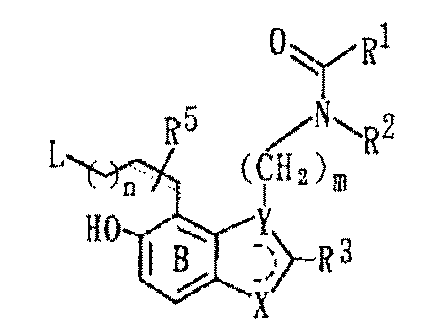
(2)US−411675には
【化18】
(3)EP−A−447285には
【化19】
(4)FR−014630には
【化20】
(5)EP−A−591057には
【化21】
(6)EP−A−527687には
【化22】
(7)EP−A−506539には
【化23】
また、環状エーテル部分を有する三環性以上の多環性化合物としては、
(1)テトラヘドロン・レターズ(Tetrahedron Lett.)、36巻、7019頁(1995年)に
【化24】
(2)ジャーナル・オブ・メディシナル・ケミストリー(J.Med.Chem.)、35巻、3625頁(1992年)に
【化25】
(3)テトラヘドロン(Tetrahedron)、48巻、1039頁(1992年)に
【化26】
(4)テトラヘドロン・レターズ(Tetrahedron Lett.)、32巻、3345頁(1991年)に
【化27】
(5)バイオオーガニック・ケミストリー(Bioorg.Chem.)、18巻、291頁(1990)に
【化28】
(6)ジャーナル・オブ・エレクトロアナリティカル・ケミストリー・オブ・インターフェイシアル・エレクトロケミストリー(J.Electroanal.Chem.Interfacial Electrochem.)278巻、249頁(1990)に
【化29】
しかしながら、これらの化合物とメラトニン受容体との関係については全く報告されていない。
【0004】
また、三環性のメラトニン受容体親和性化合物として
【化30】
R2は−CR3R4(CH2)pNR5COR6〔R3,R4およびR5はそれぞれ同一または異なって、水素原子またはC1-6アルキル基、R6はC1-6アルキル基またはC3-7シクロアルキル基を示す。〕、
nは2ないし4の整数およびpは1ないし4の整数を示す。]で表される化合物(WO−A−9517405)および
【化31】
R2は水素原子、ハロゲン原子、C1-6アルキル基、OR7またはCO2R7〔R7は水素原子またはC1-6アルキル基を示す。〕(但し、qが2の場合、R2は同一または異なって水素原子、ハロゲン原子、C1-6アルキル基、OR7またはCO2R7を示す)、
nは0ないし2の整数、pは1ないし4の整数およびqは1または2を示す]で表される化合物(WO−A−9529173)が知られている。
【0005】
【発明が解決しようとする課題】
メラトニンと構造が異なり、メラトニン受容体に対する親和性に優れ、脳内移行性、代謝安定性にも優れたメラトニンアゴニストは、治療上メラトニンよりも優れた効果を期待することができる。
現状では、メラトニン受容体活性、代謝安定性、および脳内移行性等の点で十分満足できるものが見いだされていない。そこで、上記の公知化合物とは化学構造が異なり、優れたメラトニン受容体作動活性または拮抗活性を有し、医薬品として十分満足できる化合物の開発が切望されている。
【0006】
【課題を解決するための手段】
本発明者らは、種々検討した結果、式
【化32】
【化33】
R2は水素原子または置換基を有していてもよい炭化水素基、
R3は水素原子、置換基を有していてもよい炭化水素基または置換基を有していてもよい複素環基、
XはCHR4、NR4、OまたはS(R4は水素原子または置換基を有していてもよい炭化水素基を示す。)、
【化34】
B環は置換基を有していてもよいベンゼン環、および
mは1ないし4の整数を示す]で表される新規な化合物またはその塩〔以下、化合物(I)と略記〕の創製に初めて成功し、さらにこの化合物(I)が予想外にもメラトニンアゴニストとしての優れた性質を有しており、医薬として十分満足できるものであることを見出し、これらの知見に基づいて本発明を完成した。
【0007】
即ち、本発明は、
(1)化合物(I)、
(2)R1が(i)ハロゲン原子、ニトロ基、シアノ基、ヒドロキシ基、ハロゲン化されていてもよいC1-6アルキル基、C1-6アルコキシ基、アミノ基、モノ−C1-6アルキルアミノ基、ジ−C1-6アルキルアミノ基、カルボキシル基、C1-6アルキル−カルボニル基、C1-6アルコキシ−カルボニル基、カルバモイル基、モノ−C1-6アルキル−カルバモイル基、ジ−C1-6アルキル−カルバモイル基、C6-10アリール−カルバモイル基、C6-10アリール基、C6-10アリールオキシ基またはハロゲン化されていてもよいC1-6アルキル−カルボニルアミノ基で1ないし5個置換されていてもよい(a)C1-6アルキル基、(b)C2-6アルケニル基、(c)C2-6アルキニル基、(d)C3-6シクロアルキル基または(e)C6-14アリール基、
(ii)ハロゲン原子、ニトロ基、シアノ基、ヒドロキシ基、ハロゲン化されていてもよいC1-6アルキル基、C1-6アルコキシ基、アミノ基、モノ−C1-6アルキルアミノ基、ジ−C1-6アルキルアミノ基、カルボキシル基、C1-6アルキル−カルボニル基、C1-6アルコキシ−カルボニル基、カルバモイル基、モノ−C1-6アルキル−カルバモイル基、ジ−C1-6アルキル−カルバモイル基、C6-10アリール−カルバモイル基、C6-10アリール基、C6-10アリールオキシ基またはハロゲン化されていてもよいC1-6アルキル−カルボニルアミノ基で1ないし5個置換されていてもよい(a)C1-6アルキル基、(b)C2-6アルケニル基、(c)C2-6アルキニル基、(d)C3-6シクロアルキル基または(e)C6-14アリール基を1または2個有していてもよいアミノ基、または
(iii)ハロゲン原子、C1-6アルキル基、C3-6シクロアルキル基、C2-6アルキニル基、C2-6アルケニル基、C7-11アラルキル基、C6-10アリール基、C1-6アルコキシ基、C6-10アリールオキシ基、ホルミル基、C1-6アルキル−カルボニル基、C6-10アリール−カルボニル基、ホルミルオキシ基、C1-6アルキル−カルボニルオキシ基、C6-10アリール−カルボニルオキシ基、カルボキシル基、C1-6アルコキシ−カルボニル基、C7-11アラルキルオキシ−カルボニル基、カルバモイル基、ハロゲン化されていてもよいC1-4アルキル基、オキソ基、アミジノ基、イミノ基、アミノ基、モノ−C1-4アルキルアミノ基、ジ−C1-4アルキルアミノ基、3ないし6員の環状アミノ基、C1-3アルキレンジオキシ基、ヒドロキシ基、ニトロ基、シアノ基、メルカプト基、スルホ基、スルフィノ基、ホスホノ基、スルファモイル基、モノ−C1-6アルキルスルファモイル基、ジ−C1-6アルキルスルファモイル基、C1-6アルキルチオ基、C6-10アリールチオ基、C1-6アルキルスルフィニル基、C6-10アリールスルフィニル基、C1-6アルキルスルホニル基またはC6-10アリールスルホニル基で1ないし5個置換されていてもよい、炭素原子以外に、窒素原子、酸素原子および硫黄原子から選ばれたヘテロ原子を1ないし3個含む5ないし14員の複素環基;
R2が(i)水素原子または(ii)ハロゲン原子、ニトロ基、シアノ基、ヒドロキシ基、ハロゲン化されていてもよいC1-6アルキル基、C1-6アルコキシ基、アミノ基、モノ−C1-6アルキルアミノ基、ジ−C1-6アルキルアミノ基、カルボキシル基、C1-6アルキル−カルボニル基、C1-6アルコキシ−カルボニル基、カルバモイル基、モノ−C1-6アルキル−カルバモイル基、ジ−C1-6アルキル−カルバモイル基、C6-10アリール−カルバモイル基、C6-10アリール基、C6-10アリールオキシ基またはハロゲン化されていてもよいC1-6アルキル−カルボニルアミノ基で1ないし5個置換されていてもよい(a)C1-6アルキル基、(b)C2-6アルケニル基、(c)C2-6アルキニル基、(d)C3-6シクロアルキル基または(e)C6-14アリール基;
R3が(i)水素原子、
(ii)ハロゲン原子、ニトロ基、シアノ基、ヒドロキシ基、ハロゲン化されていてもよいC1-6アルキル基、C1-6アルコキシ基、アミノ基、モノ−C1-6アルキルアミノ基、ジ−C1-6アルキルアミノ基、カルボキシル基、C1-6アルキル−カルボニル基、C1-6アルコキシ−カルボニル基、カルバモイル基、モノ−C1-6アルキル−カルバモイル基、ジ−C1-6アルキル−カルバモイル基、C6-10アリール−カルバモイル基、C6-10アリール基、C6-10アリールオキシ基またはハロゲン化されていてもよいC1-6アルキル−カルボニルアミノ基で1ないし5個置換されていてもよい(a)C1-6アルキル基、(b)C2-6アルケニル基、(c)C2-6アルキニル基、(d)C3-6シクロアルキル基または(e)C6-14アリール基、または
(iii)ハロゲン原子、C1-6アルキル基、C3-6シクロアルキル基、C2-6アルキニル基、C2-6アルケニル基、C7-11アラルキル基、C6-10アリール基、C1-6アルコキシ基、C6-10アリールオキシ基、ホルミル基、C1-6アルキル−カルボニル基、C6-10アリール−カルボニル基、ホルミルオキシ基、C1-6アルキル−カルボニルオキシ基、C6-10アリール−カルボニルオキシ基、カルボキシル基、C1-6アルコキシ−カルボニル基、C7-11アラルキルオキシ−カルボニル基、カルバモイル基、ハロゲン化されていてもよいC1-4アルキル基、オキソ基、アミジノ基、イミノ基、アミノ基、モノ−C1-4アルキルアミノ基、ジ−C1-4アルキルアミノ基、3ないし6員の環状アミノ基、C1-3アルキレンジオキシ基、ヒドロキシ基、ニトロ基、シアノ基、メルカプト基、スルホ基、スルフィノ基、ホスホノ基、スルファモイル基、モノ−C1-6アルキルスルファモイル基、ジ−C1-6アルキルスルファモイル基、C1-6アルキルチオ基、C6-10アリールチオ基、C1-6アルキルスルフィニル基、C6-10アリールスルフィニル基、C1-6アルキルスルホニル基またはC6-10アリールスルホニル基で1ないし5個置換されていてもよい、炭素原子以外に、窒素原子、酸素原子および硫黄原子から選ばれたヘテロ原子を1ないし3個含む5ないし14員の複素環基;
R4が(i)水素原子または(ii)ハロゲン原子、ニトロ基、シアノ基、ヒドロキシ基、ハロゲン化されていてもよいC1-6アルキル基、C1-6アルコキシ基、アミノ基、モノ−C1-6アルキルアミノ基、ジ−C1-6アルキルアミノ基、カルボキシル基、C1-6アルキル−カルボニル基、C1-6アルコキシ−カルボニル基、カルバモイル基、モノ−C1-6アルキル−カルバモイル基、ジ−C1-6アルキル−カルバモイル基、C6-10アリール−カルバモイル基、C6-10アリール基、C6-10アリールオキシ基またはハロゲン化されていてもよいC1-6アルキル−カルボニルアミノ基で1ないし5個置換されていてもよい(a)C1-6アルキル基、(b)C2-6アルケニル基、(c)C2-6アルキニル基、(d)C3-6シクロアルキル基または(e)C6-14アリール基;
A環が(i)ハロゲン原子、ニトロ基、シアノ基、ヒドロキシ基、ハロゲン化されていてもよいC1-6アルキル基、C1-6アルコキシ基、アミノ基、モノ−C1-6アルキルアミノ基、ジ−C1-6アルキルアミノ基、カルボキシル基、C1-6アルキル−カルボニル基、C1-6アルコキシ−カルボニル基、カルバモイル基、モノ−C1-6アルキル−カルバモイル基、ジ−C1-6アルキル−カルバモイル基、C6-10アリール−カルバモイル基、C6-10アリール基、C6-10アリールオキシ基またはハロゲン化されていてもよいC1-6アルキル−カルボニルアミノ基で1ないし5個置換されていてもよい(a)C1-6アルキル基、(b)C2-6アルケニル基、(c)C2-6アルキニル基、(d)C3-6シクロアルキル基または(e)C6-14アリール基、(ii)ハロゲン原子、(iii)C1-6アルコキシ基、(iv)C6-10アリールオキシ基、(v)ホルミル基、(vi)C1-6アルキル−カルボニル基、(vii)C6-10アリール−カルボニル基、(viii)ホルミルオキシ着、(ix)C1-6アルキル−カルボニルオキシ基、(x)C6-10アリール−カルボニルオキシ基、(xi)カルボキシル基、(xii)C1-6アルコキシ−カルボニル基、(xiii)C7-11アラルキルオキシ−カルボニル基、(xiv)カルバモイル基、(xv)ハロゲン化されていてもよいC1-4アルキル基、(xvi)オキソ基、(xvii)アミジノ基、(xviii)イミノ基、(xix)アミノ基、(xx)モノ−C1-4アルキルアミノ基、(xxi)ジ−C1-4アルキルアミノ基、(xxii)3ないし6員の環状アミノ基、(xxiii)C1-3アルキレンジオキシ基、(xxiv)ヒドロキシ基、(xxv)ニトロ基、(xxvi)シアノ基、(xxvii)メルカプト基、(xxviii)スルホ基、(xxix)スルフィノ基、(xxx)ホスホノ基、(xxxi)スルファモイル基、(xxxii)モノ−C1-6アルキルスルファモイル基、(xxxiii)ジ−C1-6アルキルスルファモイル基、(xxxiv)C1-6アルキルチオ基、(xxxv)C6-10アリールチオ基、(xxxvi)C1-6アルキルスルフィニル基、(xxxvii)C6-10アリールスルフィニル基、(xxxviii)C1-6アルキルスルホニル基または(xxxix)C6-10アリールスルホニル基で1ないし4個置換されていてもよい、炭素原子および酸素原子以外に、窒素原子、酸素原子および硫黄原子から選ばれたヘテロ原子を1ないし3個含んでいてもよい5ないし7員の複素環;および
B環が(i)ハロゲン原子、(ii)ハロゲン原子、ニトロ基、シアノ基、ヒドロキシ基、ハロゲン化されていてもよいC1-6アルキル基、C1-6アルコキシ基、アミノ基、モノ−C1-6アルキルアミノ基、ジ−C1-6アルキルアミノ基、カルボキシル基、C1-6アルキル−カルボニル基、C1-6アルコキシ−カルボニル基、カルバモイル基、モノ−C1-6アルキル−カルバモイル基、ジ−C1-6アルキル−カルバモイル基、C6-10アリール−カルバモイル基、C6-10アリール基、C6-10アリールオキシ基またはハロゲン化されていてもよいC1-6アルキル−カルボニルアミノ基で1ないし5個置換されていてもよい(a)C1-6アルキル基、(b)C2-6アルケニル基、(c)C2-6アルキニル基、(d)C3-6シクロアルキル基または(e)C6-14アリール基、(iii)ハロゲン原子、ニトロ基、シアノ基、ヒドロキシ基、ハロゲン化されていてもよいC1-6アルキル基、C1-6アルコキシ基、アミノ基、モノ−C1-6アルキルアミノ基、ジ−C1-6アルキルアミノ基、カルボキシル基、C1-6アルキル−カルボニル基、C1-6アルコキシ−カルボニル基、カルバモイル基、モノ−C1-6アルキル−カルバモイル基、ジ−C1-6アルキル−カルバモイル基、C6-10アリール−カルバモイル基、C6-10アリール基、C6-10アリールオキシ基またはハロゲン化されていてもよいC1-6アルキル−カルボニルアミノ基で1ないし5個置換されていてもよい(a)C1-6アルキル基、(b)C2-6アルケニル基、(c)C2-6アルキニル基、(d)C3-6シクロアルキル基または(e)C6-14アリール基を1または2個有していてもよいアミノ基、
(iv)C1-6アルカノイルアミノ基、(v)ハロゲン原子、ニトロ基、シアノ基、ヒドロキシ基、ハロゲン化されていてもよいC1-6アルキル基、C1-6アルコキシ基、アミノ基、モノ−C1-6アルキルアミノ基、ジ−C1-6アルキルアミノ基、カルボキシル基、C1-6アルキル−カルボニル基、C1-6アルコキシ−カルボニル基、カルバモイル基、モノ−C1-6アルキル−カルバモイル基、ジ−C1-6アルキル−カルバモイル基、C6-10アリール−カルバモイル基、C6-10アリール基、C6-10アリールオキシ基またはハロゲン化されていてもよいC1-6アルキル−カルボニルアミノ基で1ないし3個置換されていてもよいC1-6アルコキシ基または(vi)C1-3アルキレンジオキシ基で1ないし2個置換されていてもよいベンゼン環である前記(1)記載の化合物、
【0008】
(3)
【化35】
(4)式
【化36】
nは0ないし2の整数、
【化37】
(5)R1が(i)置換基を有していてもよいC1-6アルキル基、(ii)置換基を有していてもよいC3-6シクロアルキル基、(iii)置換基を有していてもよいC2-6アルケニル基、(iv)置換基を有していてもよいC6-14アリール基、(v)置換基を有していてもよい、モノ−またはジ−C1-6アルキルアミノ基、(vi)置換基を有していてもよいC6-14アリールアミノ基または(vii)置換基を有していてもよい5または6員含窒素複素環基である前記(1)記載の化合物、
(6)R1がハロゲン化されていてもよいC1-6アルキル基である前記(1)記載の化合物、
(7)R2が水素原子または置換基を有していてもよいC1-6アルキル基である前記(1)記載の化合物、
(8)R2が水素原子である前記(1)記載の化合物、
(9)R3が水素原子または置換基を有していてもよい炭化水素基である前記(1)記載の化合物、
(10)R3が水素原子である前記(1)記載の化合物、
(11)R4が水素原子または置換基を有していてもよいC1-6アルキル基である前記(1)記載の化合物、
(12)XがCHR4(R4は前記と同意義を示す)である前記(1)記載の化合物、
(13)XがCHR4(R4は前記と同意義を示す)および
【化38】
(15)XがNR4(R4は前記と同意義を示す)である前記(1)記載の化合物、
(16)YがCまたはCHである前記(1)記載の化合物、
(17)YがCHである前記(1)記載の化合物、
(18)mが2である前記(1)記載の化合物、
(19)A環がテトラヒドロフラン環である前記(1)記載の化合物、
(20)A環が無置換である前記(1)記載の化合物、
(21)B環が無置換である前記(1)記載の化合物、
(22)nが0または1である前記(4)記載の化合物、
(23)式
【化39】
Eaは CH2CH2、CH=CH、CH2O、CH=N、CONH または
CH2NH、
naは0または1、
A''環はヒドロキシ基で置換されていてもよいC1-6アルキル基1または2個を有していてもよい酸素原子を含む5または6員複素環、および
B'環はハロゲン原子で置換されていてもよいベンゼン環を示す]で表される前記(1)記載の化合物、
(24)
【化40】
(26)N−[2−(1,6,7,8−テトラヒドロ−2H−フロ[3,2−e]インドール−8−イル)エチル]ブチルアミドである前記(1)記載の化合物、
(27)N−[2−(7−フェニル−1,6−ジヒドロ−2H−インデノ[5,4−b]フラン−8−イル)エチル]プロピオンアミドである前記(1)記載の化合物、
(28)N−[2−(7−フェニル−1,6−ジヒドロ−2H−インデノ[5,4−b]フラン−8−イル)エチル]ブチルアミドである前記(1)記載の化合物、
【0009】
(29)式(i)
【化41】
(ii)
【化42】
R1COOH(式中、R1は前記と同意義を示す)で表される化合物、その塩またはその反応性誘導体とを反応させ、所望に応じ、さらに還元反応および(または)アルキル化反応を行うことを特徴とする前記(1)記載の化合物の製造法、
(30)式
【化43】
(31)式
【化44】
(32)式
【化45】
(33)前記(1)記載の化合物を含有してなる医薬組成物、
(34)メラトニン受容体親和性組成物である前記(33)記載の組成物、
(35)生体リズム調節剤である前記(34)記載の組成物、
(36)睡眠覚醒リズム調節剤である前記(34)記載の組成物、
(37)時差ボケ調節剤である前記(34)記載の組成物、および
(38)睡眠障害治療剤である前記(34)記載の組成物などに関する。
【0010】
本明細書中で用いられる用語「置換基を有していてもよい炭化水素基」の「炭化水素基」としては、例えば、脂肪族炭化水素基、単環式飽和炭化水素基および芳香族炭化水素基などがあげられ、炭素数1ないし16個のものが好ましい。具体的には、例えばアルキル基、アルケニル基、アルキニル基、シクロアルキル基およびアリール基などが用いられる。
「アルキル基」は、例えば低級アルキル基などが好ましく、例えばメチル、エチル、プロピル、イソプロピル、ブチル、イソブチル、sec−ブチルおよびtert−ブチル、ペンチル、ヘキシルなどのC1-6アルキル基などが汎用される。
「アルケニル基」は、例えば低級アルケニル基などが好ましく、例えばビニル、1−プロペニル、アリル、イソプロペニル、ブテニルおよびイソブテニルなどのC2-6アルケニル基などが汎用される。
「アルキニル基」は、例えば低級アルキニル基などが好ましく、例えばエチニル、プロパルギルおよび1−プロピニルなどのC2-6アルキニル基などが汎用される。
「シクロアルキル基」は、例えば低級シクロアルキル基などが好ましく、例えばシクロプロピル、シクロブチル、シクロペンチルおよびシクロヘキシルなどのC3-6シクロアルキル基などが汎用される。
「アリール基」は、例えばフェニル、1−ナフチル、2−ナフチル、ビフェニリルおよび2−アンスリルなどのC6-14アリール基などが好ましく、例えばフェニル基などが汎用される。
【0011】
「置換基を有していてもよい炭化水素基」の「炭化水素基」が有していてもよい置換基としては、例えばハロゲン原子(例えば、フッ素、塩素、臭素、ヨウ素など)、ニトロ基、シアノ基、ヒドロキシ基、ハロゲン化されていてもよい低級アルキル基(例えば、メチル、クロロメチル、ジフルオロメチル、トリクロロメチル、トリフルオロメチル、エチル、2−ブロモエチル、2,2,2−トリフルオロエチル、ペンタフルオロエチル、プロピル、3,3,3−トリフルオロプロピル、イソプロピル、ブチル、イソブチル、sec−ブチル、tert−ブチル、4,4,4−トリフルオロブチル、ペンチル、イソペンチル、ネオペンチル、5,5,5−トリフルオロペンチル、ヘキシル、6,6,6−トリフルオロヘキシルなどのハロゲン化されていてもよいC1-6アルキル基)、低級アルコキシ基(例えば、メトキシ、エトキシ、プロポキシ、イソプロポキシ、ブトキシ、イソブトキシ、ペンチルオキシ、ヘキシルオキシなどのC1-6アルコキシ基など)、アミノ基、モノ−低級アルキルアミノ基(例えば、メチルアミノ、エチルアミノなどのモノ−C1-6アルキルアミノ基など)、ジ−低級アルキルアミノ基(例えば、ジメチルアミノ、ジエチルアミノなどのジ−C1-6アルキルアミノ基など)、カルボキシル基、低級アルキルカルボニル基(例えば、アセチル、プロピオニルなどのC1-6アルキル−カルボニル基など)、低級アルコキシカルボニル基(例えば、メトキシカルボニル、エトキシカルボニル、プロポキシカルボニル、ブトキシカルボニルなどのC1-6アルコキシ−カルボニル基など)、カルバモイル基、モノ−低級アルキルカルバモイル基(例えば、メチルカルバモイル、エチルカルバモイルなどのモノ−C1-6アルキル−カルバモイル基など)、ジ−低級アルキルカルバモイル基(例えば、ジメチルカルバモイル、ジエチルカルバモイルなどのジ−C1-6アルキル−カルバモイル基など)、アリールカルバモイル基(例えば、フェニルカルバモイル、ナフチルカルバモイルなどのC6-10アリール−カルバモイル基)、アリール基(例えば、フェニル、ナフチルなどのC6-10アリール基)、アリールオキシ基(例えば、フェニルオキシ、ナフチルオキシなどのC6-10アリールオキシ基)、ハロゲン化されていてもよい低級アルキルカルボニルアミノ基(例えば、アセチルアミノ、トリフルオロアセチルアミノなどのハロゲン化されていてもよいC1-6アルキル−カルボニルアミノ基など)、オキソ基などが用いられる。該「置換基を有していてもよい炭化水素基」の「炭化水素基」は、前記の置換基を、炭化水素基の置換可能な位置に1ないし5個、好ましくは1ないし3個有していてもよく、置換基数が2個以上の場合は各置換基は同一または異なっていてもよい。
【0012】
本明細書中で用いられる用語「置換基を有していてもよい複素環基」の「複素環基」としては、例えば炭素原子以外に窒素原子、酸素原子および硫黄原子から選ばれた1種または2種1ないし4個(好ましくは1ないし3個)のヘテロ原子を含む5ないし14員(好ましくは5ないし10員)の(単環式ないし3環式、好ましくは単環式または2環式)複素環基などがあげられる。例えば2−または3−チエニル、2−または3−フリル、1−、2−または3−ピロリル、1−、2−または3−ピロリジニル、2−、4−または5−オキサゾリル、3−、4−または5−イソオキサゾリル、2−、4−または5−チアゾリル、3−、4−または5−イソチアゾリル、3−、4−または5−ピラゾリル、2−、3−または4−ピラゾリジニル、2−、4−または5−イミダゾリル、1,2,3−トリアゾリル、1,2,4−トリアゾリル、1H−または2H−テトラゾリル等の炭素原子以外に酸素原子、硫黄原子および窒素原子から選ばれたヘテロ原子を1ないし4個含む5員環基、例えば2−、3−または4−ピリジル、N−オキシド−2−、3−または4−ピリジル、2−、4−または5−ピリミジニル、N−オキシド−2−、4−または5−ピリミジニル、チオモルホリニル、モルホリニル、ピペリジノ、2−、3−または4−ピペリジル、チオピラニル、1,4−オキサジニル、1,4−チアジニル、1,3−チアジニル、ピペラジニル、トリアジニル、3−または4−ピリダジニル、ピラジニル、N−オキシド−3−または4−ピリダジニル等の炭素原子以外に酸素原子、硫黄原子および窒素原子から選ばれたヘテロ原子を1ないし4個含む6員環基、例えばインドリル、ベンゾフリル、ベンゾチアゾリル、ベンズオキサゾリル、ベンズイミダゾリル、キノリル、イソキノリル、フタラジニル、キナゾリニル、キノキサリニル、インドリジニル、キノリジニル、1,8−ナフチリジニル、ジベンゾフラニル、カルバゾリル、アクリジニル、フェナントリジニル、クロマニル、フェノチアジニル、フェノキサジニル等の炭素原子以外に酸素原子、硫黄原子および窒素原子から選ばれたヘテロ原子を1ないし4個含む2環性または3環性縮合環基(好ましくは、上述の5ないし6員環が炭素原子以外に酸素原子、硫黄原子および窒素原子から選ばれるヘテロ原子を1ないし4個含んでいてもよい5ないし6員環基1ないし2個と縮合して形成される基)等が用いられる。中でも、炭素原子以外に酸素原子、硫黄原子および窒素原子から選ばれるヘテロ原子を1ないし3個含む5ないし7員(好ましくは5または6員)の複素環基が好ましい。
【0013】
該「置換基を有していてもよい複素環基」の「複素環基」が有していてもよい置換基としては、例えばハロゲン原子(例えば、フッ素、塩素、臭素、ヨウ素など)、低級アルキル基(例えば、メチル、エチル、プロピル、イソプロピル、ブチル、イソブチル、sec−ブチル、tert−ブチル、ペンチル、ヘキシルなどのC1-6アルキル基など)、シクロアルキル基(例えば、シクロプロピル、シクロブチル、シクロペンチル、シクロヘキシル等のC3-6シクロアルキル基など)、低級アルキニル基(例えば、エチニル、1-プロピニル、プロパルギル等のC2-6アルキニル基など)、低級アルケニル基(例えば、ビニル、アリル、イソプロペニル、ブテニル、イソブテニルなどのC2-6アルケニル基など)、アラルキル基(例えばベンジル、α-メチルベンジル、フェネチル等のC7-11アラルキル基など)、アリール基(例えば、フェニル、ナフチルなどのC6-10アリール基等、好ましくはフェニル基)、低級アルコキシ基(例えばメトキシ、エトキシ、プロポキシ、イソプロポキシ、ブトキシ、イソブトキシ、sec-ブトキシ、tert-ブトキシ等のC1-6アルコキシ基など)、アリールオキシ基(例えば、フェノキシ等のC6-10アリールオキシ基等)、低級アルカノイル基(例えば、ホルミル;アセチル、プロピオニル、ブチリル、イソブチリル等のC1-6アルキル−カルボニル基など)、アリールカルボニル(例えば、ベンゾイル基、ナフトイル基等のC6-10アリール−カルボニル基など)、低級アルカノイルオキシ基(例えば、ホルミルオキシ;アセチルオキシ、プロピオニルオキシ、ブチリルオキシ、イソブチリルオキシ等のC1-6アルキル−カルボニルオキシ基など)、アリールカルボニルオキシ基(例えば、ベンゾイルオキシ、ナフトイルオキシ等のC6-10アリール−カルボニルオキシ基など)、カルボキシル基、低級アルコキシカルボニル基(例えば、メトキシカルボニル、エトキシカルボニル、プロポキシカルボニル、イソプロポキシカルボニル、ブトキシカルボニル、イソブトキシカルボニル、tert-ブトキシカルボニル等のC1-6アルコキシ−カルボニル基など)、アラルキルオキシカルボニル(例えば、ベンジルオキシカルボニル等のC7-11アラルキルオキシカルボニル基など)、カルバモイル基、モノ−、ジ−またはトリ−ハロゲノ−低級アルキル基(例えば、クロロメチル、ジクロロメチル、トリフルオロメチル、2,2,2−トリフルオロエチル等のモノ−、ジ−またはトリ−ハロゲノ−C1-4アルキル基など)、オキソ基、アミジノ基、イミノ基、アミノ基、モノ−低級アルキルアミノ基(例えば、メチルアミノ、エチルアミノ、プロピルアミノ、イソプロピルアミノ、ブチルアミノ等のモノ−C1-4アルキルアミノ基など)、ジ−低級アルキルアミノ基(例えば、ジメチルアミノ、ジエチルアミノ、ジプロピルアミノ、ジイソプロピルアミノ、ジブチルアミノ、メチルエチルアミノ等のジ−C1-4アルキルアミノ基など)、炭素原子と1個の窒素原子以外に酸素原子、硫黄原子および窒素原子から選ばれたヘテロ原子を1ないし3個含んでいてもよい3ないし6員の環状アミノ基(例えば、アジリジニル、アゼチジニル、ピロリジニル、ピロリニル、ピロリル、イミダゾリル、ピラゾリル、イミダゾリジニル、ピペリジル、モルホリニル、ジヒドロピリジル、ピリジル、N-メチルピペラジニル、N-エチルピペラジニル等の3ないし6員の環状アミノ基など)、アルキレンジオキシ基(例えば、メチレンジオキシ、エチレンジオキシ等のC1-3アルキレンジオキシ基など)、ヒドロキシ基、ニトロ基、シアノ基、メルカプト基、スルホ基、スルフィノ基、ホスホノ基、スルファモイル基、モノアルキルスルファモイル基(例えば、N-メチルスルファモイル、N-エチルスルファモイル、N-プロピルスルファモイル、N-イソプロピルスルファモイル、N-ブチルスルファモイル等のモノ−C1-6アルキルスルファモイル基など)、ジアルキルスルファモイル基(例えば、N,N-ジメチルスルファモイル、N,N-ジエチルスルファモイル、N,N-ジプロピルスルファモイル、N,N-ジブチルスルファモイル等のジ−C1-6アルキルスルファモイル基など)、アルキルチオ基(例えば、メチルチオ、エチルチオ、プロピルチオ、イソプロピルチオ、ブチルチオ、sec-ブチルチオ、tert-ブチルチオ等のC1-6アルキルチオ基など)、アリールチオ基(例えば、フェニルチオ、ナフチルチオ等のC6-10アリールチオ基など)、低級アルキルスルフィニル基(例えば、メチルスルフィニル、エチルスルフィニル、プロピルスルフィニル、ブチルスルフィニル等のC1-6アルキルスルフィニル基など)、アリールスルフィニル基(例えば、フェニルスルフィニル、ナフチルスルフィニル等のC6-10アリールスルフィニル基など)、低級アルキルスルホニル基(例えば、メチルスルホニル、エチルスルホニル、プロピルスルホニル、ブチルスルホニル等のC1-6アルキルスルホニル基など)、アリールスルホニル基(例えば、フェニルスルホニル、ナフチルスルホニル等のC6-10アリールスルホニル基など)などが用いられる。
該「置換基を有していてもよい複素環基」の「複素環基」は、前記の置換基を、複素環基の置換可能な位置に1ないし5個、好ましくは1ないし3個有していてもよく、置換基数が2個以上の場合は各置換基は同一または異なっていてもよい。
【0014】
本明細書中で用いられる用語「置換基を有していてもよいアミノ基」は、置換基として例えば前記「置換基を有していてもよい炭化水素基」などを1または2個有していてもよいアミノ基などがあげられる。この「アミノ基」が有していてもよい置換基の好ましいものとしては、例えば置換基を有していてもよいC1-6アルキル基、置換基を有していてもよいC6-10アリール基などである。該「C1-6アルキル基」、「C6-10アリール基」が有していてもよい置換基としては、前記「炭化水素基」が有していてもよい置換基と同様のものが用いられる。
本明細書中で用いられる用語「置換基を有していてもよい低級アルキル基」の「低級アルキル基」は、例えばメチル、エチル、プロピル、イソプロピル、ブチル、イソブチル、sec−ブチルおよびtert−ブチルなどのC1-6アルキル基などを示し、置換基として、例えば前記「炭化水素基」が有していてもよい置換基などを1ないし3個有していてもよい。
本明細書中で用いられる用語「置換基を有していてもよい低級アルコキシ基」の「低級アルコキシ基」は、例えばメトキシ、エトキシ、プロポキシ、イソプロポキシ、ブトキシ、イソブトキシ、sec−ブトキシおよびtert−ブトキシなどのC1-6アルコキシ基などを示し、置換基として、例えば前記「炭化水素基」が有していてもよい置換基などを1ないし3個有していてもよい。
【0015】
本明細書中で用いられる用語「置換基を有していてもよいベンゼン環」としては、例えばハロゲン原子(例えば、フッ素、塩素、臭素、ヨウ素など)、置換基を有していてもよい炭化水素基、置換基を有していてもよいアミノ基、アミド基(例えば、ホルムアミド、アセトアミドなどのC1-3アシルアミノ基など)、置換基を有していてもよい低級アルコキシ基、低級アルキレンジオキシ基(例えば、メチレンジオキシ、エチレンジオキシなどのC1-3アルキレンジオキシ基など)などから選ばれる1ないし2個の置換基を置換可能な位置に有していてもよいベンゼン環を示す。
これらの「置換基を有していてもよい炭化水素基」、「置換基を有していてもよいアミノ基」および「置換基を有していてもよい低級アルコキシ基」としては、例えば前記で詳述したものと同様のものが用いられる。これらの「炭化水素基」、「アミノ基」および「低級アルコキシ基」が有する置換基の数が2個以上の場合、各置換基は同一または異なっていてもよい。
該「置換基を有していてもよいベンゼン環」は、例えばハロゲン原子(例えば、フッ素、塩素など)、C1-6アルキル基(例えば、メチル、エチルなど)、およびモノ−C1-6アルキルアミノ基から選ばれた1ないし2個の置換基で置換されていてもよいベンゼン環などが好ましい。
【0016】
前記式中、R1は置換基を有していてもよい炭化水素基、置換基を有していてもよいアミノ基または置換基を有していてもよい複素環基を示す。
R1で示される「置換基を有していてもよい炭化水素基」の「炭化水素基」の好ましいものは、例えばアルキル基(例えば、メチル、エチル、プロピル、イソプロピルなどのC1-6アルキル基など)、アルケニル基(例えば、ビニルなどのC2-6アルケニル基など)、アルキニル基(例えば、エチニルなどのC2-6アルキニル基など)、シクロアルキル基(例えば、シクロプロピル、シクロブチル、シクロペンチル、シクロヘキシルなどのC3-6シクロアルキル基など)およびアリール基(例えば、フェニルなどのC6-14アリール基など)など、特にアルキル基(例えば、メチルなどのC1-6アルキル基など)およびシクロアルキル基(例えば、シクロプロピルなどのC3-6シクロプロピルなど)などが汎用される。該「アルキル基」、「アルケニル基」、「アルキニル基」、「シクロアルキル基」、「アリール基」は、例えば前記「炭化水素基」が有していてもよい置換基(好ましくは、フッ素などのハロゲン原子など)などを1ないし5個、好ましくは1ないし3個有していてもよい。
【0017】
R1で示される「置換基を有していてもよいアミノ基」の置換基の好ましいものとしては、例えば置換基を有していてもよい低級アルキル基および置換基を有していてもよいアリール基などが1または2個用いられ、特に置換基を有していてもよい低級アルキル基などが1個用いられる。該「低級アルキル基」は、例えばメチル、エチル、プロピル、イソプロピル、ブチル、イソブチル、sec−ブチルおよびtert−ブチルなどのC1-6アルキル基などが用いられる。該「低級アルキル基」は、例えば前記「炭化水素基」が有していてもよい置換基などを1ないし3個有していてもよい。該「アリール基」は、例えばフェニル基などのC6-10アリール基などが用いられる。該「アリール基」は、例えば前記「炭化水素基」が有していてもよい置換基(好ましくは、フッ素、塩素などのハロゲン原子、メトキシ、エトキシなどのC1-6アルコキシ基など)を1ないし5個、好ましくは1ないし3個有していてもよい。該「置換基を有していてもよいアミノ基」としては、例えば1ないし3個の低級アルコキシ基(例、メトキシなどのC1-4アルコキシ基など)で置換されたフェニルアミノ基、または低級アルキル基(例、メチル、エチル、プロピル、ブチル、tert-ブチルなどのC1-4アルキル基など)で置換されたモノアルキルアミノ基などが汎用される。
【0018】
R1で示される「置換基を有していてもよい複素環基」の「複素環基」の好ましいものとしては、例えば炭素原子以外に窒素原子、酸素原子および硫黄原子から選ばれた1ないし3個のヘテロ原子を含む5または6員複素環基などが用いられる。具体的には、例えば1−,2−または3−ピロリジニル、2−または4−イミダゾリニル、2−、3−または4−ピラゾリジニル、ピペリジノ、2−、3−または4−ピペリジル、1−または2−ピペラジニル、モルホリニル、2−または3−チエニル、2−、3−または4−ピリジル、2−フリルまたは3−フリル、ピラジニル、2−ピリミジニル、3−ピロリル、3−ピリダジニル、3−イソチアゾリル、3−イソオキサゾリルなどがあげられる。特に好ましくは、6員含窒素複素環基(例、ピリジル等)などが用いられる。
R1で示される「置換基を有していてもよい複素環基」の置換基の好ましいものとしては、例えばハロゲン原子(例えば塩素、フッ素等)、C1-6アルキル基(例えばメチル、エチル等)、C1-6アルコキシ基(例えばメトキシ、エトキシ等)、アラルキルオキシカルボニル基(例えばベンジルオキシカルボニル等のC7-12アラルキルオキシ−カルボニル等)等などが用いられる。
【0019】
R1は、例えば(i)置換基を有していてもよい低級アルキル基、(ii)置換基を有していてもよい低級シクロアルキル基、(iii)置換基を有していてもよい低級アルケニル基、(iv)置換基を有していてもよいアリール基、(v)置換基を有していてもよいモノまたはジ低級アルキルアミノ基、(vi)置換基を有していてもよいアリールアミノ基または(vii)置換基を有していてもよい5または6員含窒素複素環基などが好ましい。
前記「低級アルキル基」は、例えばメチル、エチル、プロピル、イソプロピル、ブチル、ペンチル、ヘキシルなどのC1-6アルキル基などが好ましい。「低級シクロアルキル基」は、例えばシクロプロピル、シクロブチル、シクロペンチル、シクロヘキシルなどのC3-6シクロアルキル基などが好ましい。「低級アルケニル基」は、例えばビニル、1−プロペニル、ブテニルなどのC2-6アルケニル基などが好ましい。「アリール基」は、例えばフェニル、1−ナフチル、2−ナフチルなどのC6-10アリール基などが好ましい。「低級アルキルアミノ基」は、例えばメチルアミノ、エチルアミノ、プロピルアミノ、イソプロピルアミノ、ブチルアミノ、tert-ブチルアミノ、ジメチルアミノ、ジエチルアミノ、メチルエチルアミノなどのモノ−またはジ−C1-6アルキルアミノ基などが好ましい。「アリールアミノ基」は、例えばフェニルアミノなどのC6-10アリールアミノ基などが好ましい。「5または6員含窒素複素環基」は、例えば2−、3−または4−ピリジルなどの5または6員含窒素複素環基などが好ましい。これらの基が有していてもよい置換基としては、例えば前記「炭化水素基」が有していてもよい置換基などが1〜5個用いられる。
【0020】
R1のさらに好ましい例は、i)ハロゲンまたはC1-6アルコキシ基でそれぞれ1〜4個置換されていてもよいC1-6アルキル基、ii)C3-6シクロアルキル基、iii)C2-6アルケニル基、iv)C1-6アルコキシ、ニトロ、ハロゲノC1-6アルキル−カルボニルアミノまたはハロゲン原子でそれぞれ1〜4個置換されていてもよいC6-10アリール基、v)モノ−またはジ−C1-6アルキルアミノ基、vi)1〜3個のC1-6アルコキシ基で置換されていてもよいC6-10アリールアミノ基またはvii)C7-11アラルキルオキシカルボニル基で1〜2個置換されていてもよい6員含窒素複素環基などである。特に、ハロゲン化されていてもよいC1-6アルキル基(例えば、メチル、クロロメチル、ジフルオロメチル、トリクロロメチル、トリフルオロメチル、エチル、2−ブロモエチル、2,2,2−トリフルオロエチル、ペンタフルオロエチル、プロピル、3,3,3−トリフルオロプロピル、イソプロピル、ブチル、イソブチル、sec−ブチル、tert−ブチル、4,4,4−トリフルオロブチル、ペンチル、イソペンチル、ネオペンチル、5,5,5−トリフルオロペンチル、ヘキシル、6,6,6−トリフルオロヘキシルなど)、C3-6シクロアルキル基(例えば、シクロプロピル、シクロブチル、シクロペンチル、シクロヘキシルなど)またはモノ−C1-6アルキルアミノ基(例えば、メチルアミノ、エチルアミノ、プロピルアミノ、イソプロピルアミノ、ブチルアミノ、tert-ブチルアミノなど)などが汎用され、中でも、ハロゲン化されていてもよいC1-6アルキル基またはモノ−C1-6アルキルアミノ基、特にハロゲン化されていてもよいC1-6アルキル基、とりわけC1-3アルキル基(例えばメチル、エチル、プロピルなど)が好ましい。
【0021】
前記式中、R2は水素原子または置換基を有していてもよい炭化水素基を示す。
R2としては水素原子または置換基を有していてもよい低級(C1-6)アルキル基が好ましく用いられ、より好ましくは、水素原子または低級(C1-6)アルキル基、特に水素原子が汎用される。
前記式中、R3は水素原子、置換基を有していてもよい炭化水素基または置換基を有していてもよい複素環基を示す。
R3で示される「置換基を有していてもよい炭化水素基」の「炭化水素基」の好ましいものは、例えばアルキル基(例えば、メチル、エチル、プロピル、イソプロピルなどのC1-6アルキル基など)、アルケニル基(例えば、ビニルなどのC2-6アルケニル基など)、アルキニル基(例えば、エチニルなどのC2-6アルキニル基など)、シクロアルキル基(例えば、シクロプロピル、シクロブチル、シクロペンチル、シクロヘキシルなどのC3-6シクロアルキル基など)およびアリール基(例えば、フェニルなどのC6-14アリール基など)など、特にアルキル基(例えば、メチルなどのC1-6アルキル基など)およびアリール基(例えば、フェニルなどのC6-14アリール基など)などが汎用される。該「アルキル基」、「アルケニル基」、「アルキニル基」、「シクロアルキル基」、「アリール基」は、例えば前記「炭化水素基」が有していてもよい置換基(好ましくは、フッ素などのハロゲン原子など)などを1ないし5個、好ましくは1ないし3個有していてもよい。
【0022】
R3で示される「置換基を有していてもよい複素環基」の「複素環基」の好ましいものとしては、例えば炭素原子以外に窒素原子、酸素原子および硫黄原子から選ばれた1ないし3個のヘテロ原子を含む5または6員複素環基などが用いられる。具体的には、例えば1−,2−または3−ピロリジニル、2−または4−イミダゾリニル、2−、3−または4−ピラゾリジニル、ピペリジノ、2−、3−または4−ピペリジル、1−または2−ピペラジニル、モルホリニル、2−または3−チエニル、2−、3−または4−ピリジル、2−または3−フリル、ピラジニル、2−ピリミジニル、3−ピロリル、3−ピリダジニル、3−イソチアゾリル、3−イソオキサゾリルなどがあげられる。特に好ましくは、6員含窒素複素環基(例、ピリジル等)などが用いられる。
R3で示される「置換基を有していてもよい複素環基」の置換基の好ましいものとしては、例えばハロゲン原子(例えば塩素、フッ素等)、C1-6アルキル基(例えばメチル、エチル等)、C1-6アルコキシ基(例えばメトキシ、エトキシ等)、アラルキルオキシカルボニル基(例えばベンジルオキシカルボニル等のC7-12アラルキルオキシ−カルボニル等)、アミノ基、モノ−C1-6アルキルアミノ基(例えばメチルアミノ、エチルアミノ等)、ジ−C1-6アルキルアミノ基(例えばジメチルアミノ、ジエチルアミノ等)等などが用いられる。
R3は、例えば(i)水素原子、(ii)置換基を有していてもよい低級アルキル基、(iii)置換基を有していてもよいアリール基、(iv)置換基を有していてもよい5または6員複素環基などが好ましく、さらに例えば(i)水素原子、(ii)低級アルキル基、(iii)置換基を有していてもよいC6-10アリール基、(iv)置換基を有していてもよい6員含窒素複素環基などが好ましい。該置換基としてはハロゲン原子、C1-6アルキル基、C1-6アルコキシ基、アミノ基、モノ−C1-6アルキルアミノ基、ジ−C1-6アルキルアミノ基等が挙げられる。さらに好ましくは、R3は水素原子、フェニル基、2−、3−または4−ピリジル基である。特に好ましくは水素原子である。
【0023】
前記式中、XはCHR4、NR4、OまたはS(R4は水素原子または置換基を有していてもよい炭化水素基を示す)を示す。
XaはCHR4a、NR4a、OまたはS(R4aは水素原子または置換基を有していてもよい炭化水素基を示す)を示す。
R4またはR4aとしてはそれぞれ水素原子または置換基を有していてもよい低級(C1-6)アルキル基が好ましく、水素原子が汎用される。
Xは好ましくは、CHR4(R4は前記と同意義を示す)、OまたはSである。あるいは、XはCHR4またはNR4(R4は前記と同意義を示す)が好ましい。
XaはCHR4aまたはNR4a(R4aは前記と同意義を示す)が好ましい。
前記式中、YはC、CHまたはNを示す。好ましくはCまたはCHである。
YaはC、CHまたはNを示す。好ましくはCまたはCHである。
【0024】
前記式中、A環またはA’環は置換基を有していてもよい5ないし7員の酸素原子を含む複素環を示す。
該「5ないし7員の酸素原子を含む複素環」とは、炭素原子および酸素原子以外に窒素原子、酸素原子および硫黄原子から選ばれた1種または2種を1ないし3個(好ましくは1または2個)含んでいてもよい5ないし7員(好ましくは5または6員)の複素環などがあげられる。該環としては、式
【化46】
Eは(i)CH2CH2、(ii)CH=CH、(iii)CH2O、(iv)OCH2、(v)CH2NH、(vi)NHCH2、(vii)N=N、(viii)CH=Nまたは(ix)N=CHが好ましく、特に(i)CH2CH2または(ii)CH=CHが好ましい。
具体的には、例えば2,3−ジヒドロフラン、フラン、1,3−ジオキソール、オキサゾリン、イソオキサゾール、1,2,3−オキサジアゾール、オキサゾールなどの酸素原子を含む5員複素環、例えば2H−3,4−ジヒドロピラン、2H−ピラン、2,3−デヒドロ−1,4−ジオキサン、2,3−デヒドロモルホリンなどの酸素原子を含む6員複素環などが好ましい。
更に好ましくは、式
【化47】
具体的には、例えば、2,3−ジヒドロフラン、フラン、2H−3,4−ジヒドロピラン、2H−ピランが汎用される。
【0025】
A環およびA’環の置換基としては、例えばハロゲン原子(例えば、フッ素、塩素、臭素、ヨウ素など)、置換基を有していてもよい低級アルキル基、置換基を有していてもよいシクロアルキル基、置換基を有していてもよい低級アルキニル基、置換基を有していてもよい低級アルケニル基、置換基を有していてもよいアリール基、低級アルコキシ基(例えばメトキシ、エトキシ、プロポキシ、イソプロポキシ、ブトキシ、イソブトキシ、sec-ブトキシ、tert-ブトキシ等のC1-6アルコキシ基など)、アリールオキシ基(例えば、フェノキシ等のC6-10アリールオキシ基等)、低級アルカノイル基(例えば、ホルミル;アセチル、プロピオニル、ブチリル、イソブチリル等のC1-6アルキル−カルボニル基など)、アリールカルボニル基(例えば、ベンゾイル基、ナフトイル基などのC6-10アリール−カルボニル基など)、低級アルカノイルオキシ基(例えば、ホルミルオキシ;アセチルオキシ、プロピオニルオキシ、ブチリルオキシ、イソブチリルオキシ等のC1-6アルキル−カルボニルオキシ基など)、アリールカルボニルオキシ基(例えば、ベンゾイルオキシ、ナフトイルオキシ等のC6-10アリール−カルボニルオキシ基など)、カルボキシル基、低級アルコキシカルボニル基(例えば、メトキシカルボニル、エトキシカルボニル、プロポキシカルボニル、イソプロポキシカルボニル、ブトキシカルボニル、イソブトキシカルボニル、tert-ブトキシカルボニル等のC1-6アルコキシ−カルボニル基など)、アラルキルオキシカルボニル(例えば、ベンジルオキシカルボニル等のC7-11アラルキルオキシ−カルボニル基など)、カルバモイル基、モノ−、ジ−またはトリ−ハロゲノ−低級アルキル基(例えば、クロロメチル、ジクロロメチル、トリフルオロメチル、2,2,2−トリフルオロエチル等のモノ−、ジ−またはトリ−ハロゲノ−C1-4アルキル基など)、オキソ基、アミジノ基、イミノ基、アミノ基、モノ−低級アルキルアミノ基(例えば、メチルアミノ、エチルアミノ、プロピルアミノ、イソプロピルアミノ、ブチルアミノ等のモノ−C1-4アルキルアミノ基など)、ジ−低級アルキルアミノ基(例えば、ジメチルアミノ、ジエチルアミノ、ジプロピルアミノ、ジイソプロピルアミノ、ジブチルアミノ、メチルエチルアミノ等のジ−C1-4アルキルアミノ基など)、炭素原子と1個の窒素原子以外に酸素原子、硫黄原子および窒素原子から選ばれたヘテロ原子を1ないし3個含んでいてもよい3ないし6員の環状アミノ基(例えば、アジリジニル、アゼチジニル、ピロリジニル、ピロリニル、ピロリル、イミダゾリル、ピラゾリル、イミダゾリジニル、ピペリジル、モルホリニル、ジヒドロピリジル、ピリジル、N-メチルピペラジニル、N-エチルピペラジニル等の3ないし6員の環状アミノ基など)、アルキレンジオキシ基(例えば、メチレンジオキシ、エチレンジオキシ等のC1-3アルキレンジオキシ基など)、ヒドロキシ基、ニトロ基、シアノ基、メルカプト基、スルホ基、スルフィノ基、ホスホノ基、スルファモイル基、モノアルキルスルファモイル基(例えば、N-メチルスルファモイル、N-エチルスルファモイル、N-プロピルスルファモイル、N-イソプロピルスルファモイル、N-ブチルスルファモイル等のモノ−C1-6アルキルスルファモイル基など)、ジアルキルスルファモイル基(例えば、N,N-ジメチルスルファモイル、N,N-ジエチルスルファモイル、N,N-ジプロピルスルファモイル、N,N-ジブチルスルファモイル等のジ−C1-6アルキルスルファモイル基など)、アルキルチオ基(例えば、メチルチオ、エチルチオ、プロピルチオ、イソプロピルチオ、ブチルチオ、sec-ブチルチオ、tert-ブチルチオ等のC1-6アルキルチオ基など)、アリールチオ基(例えば、フェニルチオ、ナフチルチオ等のC6-10アリールチオ基など)、低級アルキルスルフィニル基(例えば、メチルスルフィニル、エチルスルフィニル、プロピルスルフィニル、ブチルスルフィニル等のC1-6アルキルスルフィニル基など)、アリールスルフィニル基(例えば、フェニルスルフィニル、ナフチルスルフィニル等のC6-10アリールスルフィニル基など)、低級アルキルスルホニル基(例えば、メチルスルホニル、エチルスルホニル、プロピルスルホニル、ブチルスルホニル等のC1-6アルキルスルホニル基など)、アリールスルホニル基(例えば、フェニルスルホニル、ナフチルスルホニル等のC6-10アリールスルホニル基など)などが用いられる。該「低級アルキル基」、「低級アルケニル基」、「低級アルキニル基」、「低級シクロアルキル基」、「アリール基」は、例えば、前記「炭化水素基」が有していてもよい置換基などを1ないし5個、好ましくは1ないし3個有していてもよい。
【0026】
A環およびA'環の置換基として好ましくは、ハロゲン原子、置換基を有していてもよいC1-6アルキル基、置換基を有していてもよいC1-6アルコキシ基、水酸基、ニトロ基、シアノ基、置換基を有していてもよいアミノ基、オキソ基などが挙げられる。該「置換基を有していてもよいC1-6アルキル基」、「置換基を有していてもよいC1-6アルコキシ基」、「置換基を有していてもよいアミノ基」の「置換基」は例えば、前記「炭化水素基」が有していてもよい置換基を示す。
該A環およびA’環は、前記の置換基を、環の大きさに応じて、置換可能な位置に1ないし4個、好ましくは1ないし2個有していてもよく、置換基数が2個以上の場合は各置換基は同一または異なっていてもよい。
A環およびA’環としては、例えば、
【化48】
【0027】
前記式中、B環は置換基を有していてもよいベンゼン環を示す。
B環の置換基としては、例えば上記「置換基を有していてもよいベンゼン環」の「置換基」が挙げられる。中でも、ハロゲン原子または置換基を有していてもよい低級(C1-6)アルキル基が好ましく、特にハロゲン原子または低級(C1-6)アルキル基(好ましくはメチル)が汎用される。該「置換基を有していてもよい低級(C1-6)アルキル基」の「置換基」は例えば、前記「炭化水素基」が有していてもよい置換基を示す。
B環は該置換基を置換可能な位置に1または2個、好ましくは1個有していてもよく、置換基数が2個の場合は各置換基は同一または異なっていてもよい。
B環としては、例えば、
【化49】
【0028】
前記式中、mは1ないし4の整数を示す。mは1ないし3の整数が好ましい。さらに、mは2または3が好ましく、特に、mは2のときが好ましい。
前記式中、nは0ないし2の整数を示す。nは0または1の整数が好ましい。
特に、nは0のときが好ましい。
【化50】
R4'は好ましくは置換基を有していてもよい低級(C1-3)アルキルである。
【0029】
【化51】
【化52】
【化53】
このうち、
【化54】
【化55】
【0030】
【化56】
【化57】
中でも、
【化58】
【0031】
【化59】
このうち、
【化60】
また、
【化61】
【化62】
【0032】
本発明の化合物(I)は、例えば以下の構造式を有するものなどが特に汎用される。
【化63】
化合物(I)の好ましい例として、式
【化64】
【0033】
また、化合物(I)の好ましい例としては、
R1が(i)置換基を有していてもよい低級アルキル基、(ii)置換基を有していてもよい低級シクロアルキル基、(iii)置換基を有していてもよい低級アルケニル基、(iv)置換基を有していてもよいアリール基、(v)置換基を有していてもよいモノまたはジ低級アルキルアミノ基、(vi)置換基を有していてもよいアリールアミノ基または(vii)置換基を有していてもよい5または6員含窒素複素環基、
R2が水素原子または置換基を有していてもよい低級(C1-6)アルキル基、
R3が(i)水素原子、(ii)置換基を有していてもよい低級アルキル基または(iii)置換基を有していてもよいアリール基、
XがCHR4またはNR4(R4は水素原子またはオキソ基で置換されていてもよい低級(C1-6)アルキル基を示す)、
【化65】
B環が置換基を有していてもよいベンゼン環、および
mが1または2である化合物などが挙げられる。
【0034】
さらに好ましくは、
R1が i)ハロゲンまたはC1-6アルコキシ基でそれぞれ1〜4個置換されていてもよいC1-6アルキル基、ii)C3-6シクロアルキル基、iii)C2-6アルケニル基、iv)C1-6アルコキシ、ニトロ、ハロゲノC1-6アルキル−カルボニルアミノまたはハロゲン原子でそれぞれ1〜4個置換されていてもよいC6-10アリール基、v)モノ−またはジ−C1-6アルキルアミノ基、vi)1〜3個のC1-6アルコキシ基で置換されていてもよいC6-10アリールアミノ基またはvii)C7-11アラルキルオキシ−カルボニル基で1〜2個置換されていてもよい6員含窒素複素環基、R2が水素原子または低級(C1-6)アルキル基、
R3が、(i)水素原子、(ii)低級(C1-6)アルキル基または(iii)C6-14アリール基、
XがCHR4またはNR4(R4は水素原子またはオキソ基で置換されていてもよい低級(C1-6)アルキル基を示す)、
【化66】
【化67】
B環が
【化68】
mが1または2である化合物などが挙げられる。
【0035】
このうち、式
【化69】
【化70】
N−[2−(1,6,7,8−テトラヒドロ−2H−インデノ[5,4−b]フラン−8−イル)エチル]ブチルアミド、
N−[2−(1,6,7,8−テトラヒドロ−2H−インデノ[5,4−b]フラン−8−イル)エチル]プロピオンアミド、
N−[2−(3,7,8,9−テトラヒドロピラノ[3,2−e]インドール−1−イル)エチル]プロピオンアミド、
N−[2−(5−フルオロ−3,7,8,9−テトラヒドロシクロペンタ[f][l]ベンゾピラン−9−イル)エチル]プロピオンアミド、
N−[2−(3,7,8,9−テトラヒドロピラノ[3,2−e]インドール−1−イル)エチル]ブチルアミド、
N−[2−(1,2,3,7,8,9−ヘキサヒドロピラノ[3,2−e]インドール−1−イル)エチル]プロピオンアミド、
N−[2−(1,2,3,7,8,9−ヘキサヒドロピラノ[3,2−e]インドール−1−イル)エチル]ブチルアミド、
N−[2−(4−フルオロ−1,6,7,8−テトラヒドロ−2H−インデノ[5,4−b]フラン−8−イル)エチル]ブチルアミド、
N−[2−(4−フルオロ−1,6,7,8−テトラヒドロ−2H−インデノ[5,4−b]フラン−8−イル)エチル]プロピオンアミド、
(S)−N−[2−(1,6,7,8−テトラヒドロ−2H−インデノ[5,4−b]フラン−8−イル)エチル]プロピオンアミド、
(R)−N−[2−(1,6,7,8−テトラヒドロ−2H−インデノ[5,4−b]フラン−8−イル)エチル]プロピオンアミド、
N−[2−(1,6,7,8−テトラヒドロ−2H−インデノ[5,4−b]フラン−8−イル)エチル]ブチルアミド、
N−[2−(1,6−ジヒドロ−2H−インデノ[5,4−b]フラン−8−イル)エチル]アセトアミド、
N−[2−(1,6−ジヒドロ−2H−インデノ[5,4−b]フラン−8−イル)エチル]プロピオンアミド、
N−[2−(1,6−ジヒドロ−2H−インデノ[5,4−b]フラン−8−イル)エチル]ブチルアミド、
N−[2−(7,8−ジヒドロ−6H−インデノ[4,5−d]−1,3−ジオキソール−8−イル)エチル]プロピオンアミド、
N−[2−(7,8−ジヒドロ−6H−インデノ[4,5−d]−1,3−ジオキソール−8−イル)エチル]ブチルアミド、
N−[2−(2,3,8,9−テトラヒドロ−7H−インデノ[4,5−b]−1,4−ジオキシン−9−イル)エチル]プロピオンアミド、
N−[2−(2,3,8,9−テトラヒドロ−7H−インデノ[4,5−b]−1,4−ジオキシン−9−イル)エチル]ブチルアミド、
N−[2−(1,6,7,8−テトラヒドロ−2H−フロ[3,2−e]インドール−8−イル)エチル]プロピオンアミド、
N−[2−(1,6,7,8−テトラヒドロ−2H−フロ[3,2−e]インドール−8−イル)エチル]ブチルアミド、
N−[2−(7−フェニル−1,6−ジヒドロ−2H−インデノ[5,4−b]フラン−8−イル)エチル]プロピオンアミド、
N−[2−(7−フェニル−1,6−ジヒドロ−2H−インデノ[5,4−b]フラン−8−イル)エチル]ブチルアミドなどが好ましいものとして挙げられる。
【0036】
さらに好ましくは、N−[2−(1,6,7,8−テトラヒドロ−2H−インデノ[5,4−b]フラン−8−イル)エチル]アセトアミド、
N−[2−(1,6,7,8−テトラヒドロ−2H−インデノ[5,4−b]フラン−8−イル)エチル]プロピオンアミド、
N−[2−(5−フルオロ−3,7,8,9−テトラヒドロシクロペンタ[f][1]ベンゾピラン−9−イル)エチル]プロピオンアミド、
N−[2−(5−フルオロ−1,2,3,7,8,9−ヘキサヒドロシクロペンタ[f][1]ベンゾピラン−9−イル)エチル]プロピオンアミド、
(S)−N−[2−(1,6,7,8−テトラヒドロ−2H−インデノ[5,4−b]フラン−8−イル)エチル]プロピオンアミド、
(R)−N−[2−(1,6,7,8−テトラヒドロ−2H−インデノ[5,4−b]フラン−8−イル)エチル]プロピオンアミド、
N−[2−(1,6,7,8−テトラヒドロ−2H−インデノ[5,4−b]フラン−8−イル)エチル]ブチルアミド、
N−[2−(1,6−ジヒドロ−2H−インデノ[5,4−b]フラン−8−イル)エチル]アセトアミド、
N−[2−(1,6−ジヒドロ−2H−インデノ[5,4−b]フラン−8−イル)エチル]プロピオンアミド、
N−[2−(1,6−ジヒドロ−2H−インデノ[5,4−b]フラン−8−イル)エチル]ブチルアミド、
N−[2−(1,6,7,8−テトラヒドロ−2H−フロ[3,2−e]インドール−8−イル)エチル]プロピオンアミド、
N−[2−(1,6,7,8−テトラヒドロ−2H−フロ[3,2−e]インドール−8−イル)エチル]ブチルアミド、
N−[2−(7−フェニル−1,6−ジヒドロ−2H−インデノ[5,4−b]フラン−8−イル)エチル]プロピオンアミド、
N−[2−(7−フェニル−1,6−ジヒドロ−2H−インデノ[5,4−b]フラン−8−イル)エチル]ブチルアミドである。
特に好ましくは、(S)−N−[2−(1,6,7,8−テトラヒドロ−2H−インデノ[5,4−b]フラン−8−イル)エチル]プロピオンアミド、
N−[2−(1,6,7,8−テトラヒドロ−2H−フロ[3,2−e]インドール−8−イル)エチル]プロピオンアミド、
N−[2−(1,6,7,8−テトラヒドロ−2H−フロ[3,2−e]インドール−8−イル)エチル]ブチルアミド、
N−[2−(7−フェニル−1,6−ジヒドロ−2H−インデノ[5,4−b]フラン−8−イル)エチル]プロピオンアミド、
N−[2−(7−フェニル−1,6−ジヒドロ−2H−インデノ[5,4−b]フラン−8−イル)エチル]ブチルアミドである。
【0037】
本発明の化合物(I)の塩としては、例えば薬理学的に許容される塩などが用いられる。例えば、無機塩基との塩、有機塩基との塩、無機酸との塩、有機酸との塩、塩基性または酸性アミノ酸との塩などがあげられる。無機塩基との塩の好適な例としては、例えばナトリウム塩、カリウム塩などのアルカリ金属塩、カルシウム塩、マグネシウム塩などのアルカリ土類金属塩、ならびにアルミニウム塩、アンモニウム塩などが挙げられる。有機塩基との塩の好適な例としては、例えばトリメチルアミン、トリエチルアミン、ピリジン、ピコリン、2,6−ルチジン、エタノールアミン、ジエタノールアミン、トリエタノールアミン、シクロヘキシルアミン、ジシクロヘキシルアミン、N,N’−ジベンジルエチレンジアミンなどとの塩があげられる。無機酸との塩の好適な例としては、例えば塩酸、臭化水素酸、硝酸、硫酸、リン酸などとの塩が挙げられる。有機酸との塩の好適な例としては、例えばギ酸、酢酸、トリフルオロ酢酸、フタル酸、フマル酸、シュウ酸、酒石酸、マレイン酸、クエン酸、コハク酸、リンゴ酸、メタンスルホン酸、ベンゼンスルホン酸、p−トルエンスルホン酸などとの塩があげられる。塩基性アミノ酸との塩の好適な例としては、例えばアルギニン、リジン、オルニチンなどとの塩が挙げられ、酸性アミノ酸との塩の好適な例としては、例えばアスパラギン酸、グルタミン酸などとの塩があげられる。
中でも薬学的に許容可能な塩が好ましく、その例としては、化合物(I)内に塩基性官能基を有する場合には、例えば塩酸、臭化水素酸、硝酸、硫酸、リン酸など無機酸との塩、例えば酢酸、フタル酸、フマル酸、酒石酸、マレイン酸、クエン酸、コハク酸、メタンスルホン酸、p−トルエンスルホン酸などの有機酸との塩があげられ、酸性官能基を有する場合には、例えばナトリウム塩、カリウム塩などのアルカリ金属塩、カルシウム塩、マグネシウム塩などのアルカリ土類金属塩、アンモニウム塩などがあげられる。
また、本発明の化合物(I)は、水和物であっても、非水和物であってもよい。
【0038】
本発明の化合物(I)の製造法について以下に述べる。
本発明の化合物(I)は、例えば以下の反応式で示される方法またはこれに準じた方法等により得られる。
式中の化合物(III)〜(LXXIV)は、塩を形成している場合も含み、この様な塩としては、例えば化合物(I)の塩と同様のものなどが用いられる。
以下にその反応式の略図を示すが、略図中の化合物の各記号は前記と同意義を示す。
【0039】
(反応1)
【化71】
化合物(III)は自体公知の方法、例えば第4版実験化学講座、第21巻、1-148頁(日本化学会編)などに記載の方法、またはこれらに準じた方法に従って製造することができる。
化合物(VI)〔式中、Lはハロゲン原子、アルキルスルホニル、アルキルスルホニルオキシまたはアリールスルホニルオキシなどの脱離基、R7は置換されていてもよい炭化水素基を示す〕は自体公知の方法、例えばブレタン オブ ザ ケミカル ソサイエティー オブ ジャパン(Bull. Chem. Soc. Jpn.),64巻, 1410頁 (1991)、ジャーナル オブ ジ インディアン ケミカル ソサイエティー(J. Indian Chem. Soc.), 66巻, 656頁 (1989)、ジャーナル オブ メディシナル ケミストリー(J. Med. Chem.), 29巻, 1586頁, 1904頁 (1986)などに記載の方法、またはこれらに準じた方法に従って製造することができる。
【0041】
化合物(XIII)は自体公知の方法、例えばジャーナル オブ ザ ケミカル ソサイエティ(J. Chem. Soc.), 4691頁(1963)、 ケミストリー レターズ(Chem. Lett.), 165頁(1986)などに記載の方法、またはこれらに準じた方法に従って製造することができる。
Lで示されるハロゲン原子としては、例えばフッ素、塩素、臭素、ヨウ素などが挙げられる。Lで示されるアルキルスルホニル基としては、例えばC1-5アルキルスルホニル基(例えばメタンスルホニル、エタンスルホニルなど)などが挙げられる。Lで示されるアルキルスルホニルオキシ基としては、例えばハロゲン化されていてもよいC1-5アルキルスルホニルオキシ基(例えばメタンスルホニルオキシ、エタンスルホニルオキシ、トリクロロメタンスルホニルオキシなど)などが挙げられる。Lで示されるアリールスルホニルオキシ基としては、例えば置換されていてもよいベンゼンスルホニルオキシ基(例えばp−トルエンスルホニルオキシ、ベンゼンスルホニルオキシなど)などが挙げられる。
また、式中の化合物が市販されている場合には市販品をそのまま用いることもできる。
【0042】
化合物(IV)は、Knoevenagel縮合により塩基の存在下、化合物(III)とマロン酸から製造される。化合物(III)1モルに対しマロン酸を約1.0〜5.0モル、好ましくは約1.0〜2.0モル用いる。塩基としては、例えば水酸化ナトリウム、水酸化カリウムなどの無機塩基類、炭酸ナトリウム、炭酸カリウム、炭酸セシウム、炭酸水素ナトリウムなどの塩基性塩類、ピリジン、ルチジンなどの芳香族アミン類、トリエチルアミン、トリプロピルアミン、トリブチルアミン、シクロヘキシルジメチルアミン、4−ジメチルアミノピリジン、N,N−ジメチルアニリン、N−メチルピペリジン、N−メチルピロリジン、N−メチルモルホリンなどの第3級アミン類などが挙げられる。これら塩基の使用量は、化合物(III)1モルに対し約0.1〜10.0モル、好ましくは約0.1〜5.0モル用いる。本反応は反応に不活性な溶媒を用いて行うのが有利である。このような溶媒として反応が進行する限り特に限定されないが、例えばメタノール、エタノール、プロパノールなどのアルコール類、ベンゼン、トルエン、シクロヘキサン、ヘキサンなどの炭化水素類、N,N−ジメチルホルムアミド、N,N−ジメチルアセトアミドなどのアミド類、ギ酸、酢酸などの有機酸類、ジクロロメタン、クロロホルム、四塩化炭素、1,2−ジクロロエタンなどのハロゲン化炭化水素類などの溶媒もしくはそれらの混合溶媒などが好ましい。反応時間は用いる試薬や溶媒により異なるが通常30分〜24時間、好ましくは30分〜8時間である。反応温度は通常0〜150℃、好ましくは0〜130℃である。生成物(IV)は反応液のままか粗製物として次の反応に用いることもできるが、常法に従って反応混合物から単離することもでき、再結晶、蒸留、クロマトグラフィーなどの分離手段により容易に精製することができる。
【0043】
化合物(VIII)(式中、R9は炭化水素基を示す)はアルキルホスホン酸ジエステルの塩基処理により生成するホスホナートカルボアニオンと化合物(III)とを反応させて、E体あるいはZ体の配置異性体単独またはEおよびZ異性体の混合物として得られる。R9で示される「炭化水素基」としては、例えば前記の「炭化水素基」等があげられ、そのうち低級アルキル基(例えば、メチル、エチル、イソプロピルなどのC1-6アルキルなど)や置換基を有していてもよいベンジル基等が好ましい。該「置換基を有していてもよいベンジル基」は、ベンジル基の置換可能な位置に1ないし3個の、例えばハロゲン原子、C1-3アルキル等の置換基を有していてもよく、具体例としては、例えばベンジル、p−クロロベンジル、p−メチルベンジルなどが挙げられる。
アルキルホスホン酸ジエステルとしては、例えばジエチルホスホノ酢酸エチルなどが用いられる。化合物(III)1モルに対しアルキルホスホン酸ジエステルを約1.0〜3.0モル、好ましくは約1.0〜1.5モル用いる。塩基としては、例えば水素化ナトリウム、水素化カリウムなどのアルカリ金属水素化物類、ナトリウムアミド、リチウムジイソプロピルアミド、リチウムヘキサメチルジシラジドなどの金属アミド類、ナトリウムメトキシド、ナトリウムエトキシド、カリウム第三ブトキシドなどの金属アルコキシド類などが挙げられる。これら塩基の使用量は化合物(III)1モルに対し約1.0〜5.0モル、好ましくは約1.0〜1.5モルである。本反応は反応に不活性な溶媒を用いて行うのが有利である。このような溶媒として反応が進行する限り特に限定されないが、例えばメタノール、エタノール、プロパノールなどのアルコール類、ジエチルエーテル、テトラヒドロフラン、ジオキサン、1,2−ジメトキシエタンなどのエーテル類、ベンゼン、トルエン、シクロヘキサン、ヘキサンなどの炭化水素類、N,N−ジメチルホルムアミド、N,N−ジメチルアセトアミドなどのアミド類、ジメチルスルホキシドなどのスルホキシド類などの溶媒もしくはそれらの混合溶媒などが好ましい。反応時間は通常1時間〜50時間、好ましくは1時間〜10時間である。反応温度は通常−78〜200℃、好ましくは0〜150℃である。化合物(VIII)の異性体混合物は反応液のままか粗製物として次の反応に用いることもできるが、常法に従って反応混合物から単離することもでき、再結晶、蒸留、クロマトグラフィーなどの分離手段により容易に精製することができる。
【0044】
化合物(IX)は、酸あるいは塩基を用いて化合物(VIII)のエステル基を加水分解することにより製造される。酸加水分解には、 一般に塩酸、 硫酸などの鉱酸類や三塩化ホウ素、三臭化ホウ素などのルイス酸類、ルイス酸とチオールまたはスルフィドの併用、トリフルオロ酢酸、p−トルエンスルホン酸などの有機酸類が用いられる。アルカリ加水分解には、 水酸化ナトリウム、水酸化カリウム、 水酸化バリウムなどの無機塩基類、炭酸ナトリウム、炭酸カリウムなどの塩基性塩類、ナトリウムメトキシド、ナトリウムエトキシド、カリウム第三ブトキシドなどの金属アルコキシド類、 トリエチルアミン、イミダゾール、ホルムアミジンなどの有機塩基類などが用いられる。これら酸および塩基は、化合物(VIII)1モルに対して約0.5〜10モル、好ましくは約0.5〜6.0モル用いる。本反応は無溶媒で行うか、反応に不活性な溶媒を用いて行うのが有利である。このような溶媒としては反応が進行する限り特に限定されないが、例えばメタノール、エタノール、プロパノールなどのアルコール類、ベンゼン、トルエンなどの芳香族炭化水素類、シクロヘキサン、ヘキサンなどの飽和炭化水素類、ギ酸、酢酸などの有機酸類、テトラヒドロフラン、ジオキサン、1,2−ジメトキシエタンなどのエーテル類、N,N−ジメチルホルムアミド、N,N−ジメチルアセトアミドなどのアミド類、ジクロロメタン、クロロホルム、四塩化炭素、1,2−ジクロロエタンなどのハロゲン化炭化水素類、アセトニトリル、プロピオニトリルなどのニトリル類、アセトン、メチルエチルケトンなどのケトン類、ジメチルスルホキシドなどのスルホキシド類、水などの溶媒もしくはそれらの混合溶媒などが好ましい。反応時間は通常10分〜60時間、好ましくは10分〜12時間である。反応温度は通常−10〜200℃、好ましくは0〜120℃である。生成物(IX)は反応液のままか粗製物として次の反応に用いることもできるが、常法に従って反応混合物から単離することもでき、再結晶、蒸留、クロマトグラフィーなどの分離手段により容易に精製することができる。
化合物(VII)(式中、R9は炭化水素基を示す)は、化合物(VI)と式 R3CH2COOR9(式中、R3およびR9は前記と同意義を示す)で表されるエステル誘導体とを、塩基の存在下で反応させることにより製造される。
【0045】
化合物(VI)1モルに対し該エステル誘導体を約1.0〜5.0モル、好ましくは約1.0〜2.0モル用いる。塩基としては、例えば水酸化ナトリウム、水酸化カリウムなどの無機塩基類、炭酸ナトリウム、炭酸カリウム、炭酸セシウム、炭酸水素ナトリウムなどの塩基性塩類、ピリジン、ルチジンなどの芳香族アミン類、トリエチルアミン、トリプロピルアミン、トリブチルアミン、シクロヘキシルジメチルアミン、4−ジメチルアミノピリジン、N,N−ジメチルアニリン、N−メチルピペリジン、N−メチルピロリジン、N−メチルモルホリンなどの第3級アミン類、水素化ナトリウム、水素化カリウムなどのアルカリ金属水素化物類、ナトリウムアミド、リチウムジイソプロピルアミド、リチウムヘキサメチルジシラジドなどの金属アミド類、ナトリウムメトキシド、ナトリウムエトキシド、カリウム第三ブトキシドなどの金属アルコキシド類などが挙げられる。これら塩基の使用量は、化合物(VI)1モルに対し約1.0〜5.0モル、好ましくは約1.0〜2.0モル用いる。本反応は反応に不活性な溶媒を用いて行うのが有利である。このような溶媒として反応が進行する限り特に限定されないが、例えばメタノール、エタノール、プロパノールなどのアルコール類、ジエチルエーテル、テトラヒドロフラン、ジオキサン、1,2−ジメトキシエタンなどのエーテル類、ベンゼン、トルエン、シクロヘキサン、ヘキサンなどの炭化水素類、N,N−ジメチルホルムアミド、N,N−ジメチルアセトアミドなどのアミド類、ジクロロメタン、クロロホルム、四塩化炭素、1,2−ジクロロエタンなどのハロゲン化炭化水素類、アセトニトリル、プロピオニトリルなどのニトリル類、アセトン、メチルエチルケトンなどのケトン類、ジメチルスルホキシドなどのスルホキシド類などの溶媒もしくはそれらの混合溶媒などが好ましい。反応時間は通常30分〜48時間、好ましくは30分〜5時間である。反応温度は通常−20〜200℃、好ましくは−10〜150℃である。生成物(VII)は反応液のままか粗製物として次の反応に用いることもできるが、常法に従って反応混合物から単離することもでき、再結晶、蒸留、クロマトグラフィーなどの分離手段により容易に精製することができる。
【0046】
化合物(VII)のうち、R3およびR4が水素である化合物は、化合物(VIII)を水素雰囲気下、種々の触媒を共存させた接触還元反応に付すことによっても製造される。使用される触媒としては、例えば酸化白金、白金付活性炭、パラジウム付活性炭、パラジウム付硫酸バリウム、ニッケル、銅−クロム酸化物、ロジウム、コバルト、ルテニウム等が用いられる。触媒の使用量は、化合物(VIII)に対して約5〜1000重量%、好ましくは約5〜300重量%である。本反応は反応に不活性な溶媒を用いて行うのが有利である。このような溶媒として反応が進行する限り特に限定されないが、例えばメタノール、エタノール、プロパノールなどのアルコール類、ジエチルエーテル、テトラヒドロフラン、ジオキサン、1,2−ジメトキシエタンなどのエーテル類、シクロヘキサン、ヘキサンなどの飽和炭化水素類、N,N−ジメチルホルムアミド、N,N−ジメチルアセトアミドなどのアミド類、ギ酸、酢酸などの有機酸類、水などの溶媒もしくはそれらの混合溶媒などが好ましい。反応時間は用いる触媒の活性および量によって異なるが、通常30分〜24時間、好ましくは30分〜6時間である。反応温度は通常0〜120℃、好ましくは20〜80℃である。圧力は通常1〜100気圧である。反応系に触媒能の上昇をもたらす添加物(促進剤)を添加してもよい。酸性添加物としては、例えば、塩酸、硫酸、硝酸、過塩素酸、臭化水素酸、リン酸などの無機酸類、酢酸、トリフルオロ酢酸、シュウ酸、フタル酸、フマル酸、酒石酸、クエン酸、コハク酸、メタンスルホン酸、p−トルエンスルホン酸、10−カンファースルホン酸などの有機酸類などが好ましい。塩基性添加物としては、水酸化ナトリウム、水酸化カリウムなどが好ましい。生成物(VII)は反応液のままか粗製物として次の反応に用いることもできるが、常法に従って反応混合物から単離することもでき、再結晶、蒸留、クロマトグラフィーなどの分離手段により容易に精製することができる。
【0047】
化合物(V)のうち、R3およびR4が水素である化合物は、化合物(IV)あるいは化合物(IX)を水素雰囲気下、化合物(VII)を製造する工程と同様の接触還元反応に付すことによって製造される。
化合物(V)は、酸あるいは塩基を用いて化合物(VII)のエステル基を加水分解することによっても製造される。酸加水分解には、 一般に塩酸、 硫酸などの鉱酸類や三塩化ホウ素、三臭化ホウ素などのルイス酸類、ルイス酸とチオールまたはスルフィドの併用、トリフルオロ酢酸、p−トルエンスルホン酸などの有機酸類が用いられる。アルカリ加水分解には、 水酸化ナトリウム、水酸化カリウム、 水酸化バリウムなどの無機塩基類、炭酸ナトリウム、炭酸カリウムなどの塩基性塩類、ナトリウムメトキシド、ナトリウムエトキシド、カリウム第三ブトキシドなどの金属アルコキシド類、 トリエチルアミン、イミダゾール、ホルムアミジンなどの有機塩基類などが用いられる。これら酸および塩基は、化合物(VII)1モルに対して約0.5〜10モル、好ましくは約0.5〜6.0モル用いる。本反応は無溶媒で行うか、反応に不活性な溶媒を用いて行うのが有利である。このような溶媒としては反応が進行する限り特に限定されないが、例えばメタノール、エタノール、プロパノールなどのアルコール類、ベンゼン、トルエンなどの芳香族炭化水素類、シクロヘキサン、ヘキサンなどの飽和炭化水素類、ギ酸、酢酸などの有機酸類、テトラヒドロフラン、ジオキサン、1,2−ジメトキシエタンなどのエーテル類、N,N−ジメチルホルムアミド、N,N−ジメチルアセトアミドなどのアミド類、ジクロロメタン、クロロホルム、四塩化炭素、1,2−ジクロロエタンなどのハロゲン化炭化水素類、アセトニトリル、プロピオニトリルなどのニトリル類、アセトン、メチルエチルケトンなどのケトン類、ジメチルスルホキシドなどのスルホキシド類、水などの溶媒もしくはそれらの混合溶媒などが好ましい。反応時間は通常10分〜60時間、好ましくは10分〜12時間である。反応温度は通常−10〜200℃、好ましくは0〜120℃である。生成物(V)は反応液のままか粗製物として次の反応に用いることもできるが、常法に従って反応混合物から単離することもでき、再結晶、蒸留、クロマトグラフィーなどの分離手段により容易に精製することができる。
【0048】
化合物(XIV)は、アルドール縮合により塩基の存在下、化合物(XIII)と式R4CHO[R4は前記と同意義を示す]で表されるアルデヒド誘導体から、E体あるいはZ体の配置異性体単独またはEおよびZ異性体の混合物として製造される。化合物(XIII)1モルに対し該アルデヒド誘導体を約1.0〜5.0モル、好ましくは約1.0〜2.0モル用いる。塩基としては、例えば水酸化ナトリウム、水酸化カリウムなどの無機塩基類、例えば炭酸ナトリウム、炭酸カリウム、炭酸セシウム、炭酸水素ナトリウムなどの塩基性塩類、ピリジン、ルチジンなどの芳香族アミン類、トリエチルアミン、トリプロピルアミン、トリブチルアミン、シクロヘキシルジメチルアミン、4−ジメチルアミノピリジン、N,N−ジメチルアニリン、N−メチルピペリジン、N−メチルピロリジン、N−メチルモルホリンなどの第3級アミン類、水素化ナトリウム、水素化カリウムなどのアルカリ金属水素化物類、ナトリウムアミド、リチウムジイソプロピルアミド、リチウムヘキサメチルジシラジドなどの金属アミド類、ナトリウムメトキシド、ナトリウムエトキシド、カリウム第三ブトキシドなどの金属アルコキシド類などが挙げられる。これら塩基の使用量は、化合物(XIII)1モルに対し約1.0〜5.0モル、好ましくは約1.0〜2.5モル用いる。本反応は反応に不活性な溶媒を用いて行うのが有利である。このような溶媒として反応が進行する限り特に限定されないが、例えばメタノール、エタノール、プロパノールなどのアルコール類、ジエチルエーテル、テトラヒドロフラン、ジオキサン、1,2−ジメトキシエタンなどのエーテル類、ベンゼン、トルエン、シクロヘキサン、ヘキサンなどの炭化水素類、N,N−ジメチルホルムアミド、N,N−ジメチルアセトアミドなどのアミド類、ジクロロメタン、クロロホルム、四塩化炭素、1,2−ジクロロエタンなどのハロゲン化炭化水素類、アセトニトリル、プロピオニトリルなどのニトリル類、ジメチルスルホキシドなどのスルホキシド類などの溶媒もしくはそれらの混合溶媒などが好ましい。反応時間は通常30分〜48時間、好ましくは30分〜5時間である。反応温度は通常−78〜200℃、好ましくは−10〜150℃である。またリチウムジイソプロピルアミド等の塩基の存在下で得られるアルドール型中間体を、p−トルエンスルホン酸などの酸触媒存在下室温〜加熱下脱水させることによっても製造することができる。生成物(XIV)は反応液のままか粗製物として次の反応に用いることもできるが、常法に従って反応混合物から単離することもでき、再結晶、蒸留、クロマトグラフィーなどの分離手段により容易に精製することができる。
【0049】
化合物(X)は、化合物(V)または化合物(XIV)を自体公知の閉環反応に付して製造される。例えば、加熱による方法、酸性物質を用いる方法、ハロゲン化剤と反応させた後、ルイス酸存在下で環化させる方法、およびこれらに準じる方法などが用いられる。
加熱により閉環する場合は無溶媒で行うか、反応に不活性な溶媒を用いて行うのが有利である。このような溶媒としては反応が進行する限り特に限定されないが、例えば1,2,3,4−テトラヒドロナフタレンなどの高沸点炭化水素類、ジフェニルエーテル、ジエチレングリコールジメチルエーテルなどの高沸点エーテル類などの溶媒もしくはそれらの混合溶媒などが好ましい。反応時間は通常10分〜24時間、好ましくは10分〜10時間である。反応温度は通常100〜300℃、好ましくは100〜200℃である。
酸性物質を用いて閉環する場合、例えばオキシ塩化リン、五塩化リン、三塩化リン、チオニルクロリド、塩酸、硫酸、ポリリン酸、p−トルエンスルホン酸などの酸性物質が用いられる。化合物(V)または(XIV)1モルに対して酸性物質を約0.5〜100モル、好ましくは約5.0〜20モル用いる。本反応は無溶媒で行うか、反応に不活性な溶媒を用いて行うのが有利である。このような溶媒としては反応が進行する限り特に限定されないが、例えばベンゼン、トルエンなどの芳香族炭化水素類、シクロヘキサン、ヘキサンなどの飽和炭化水素類、テトラヒドロフラン、ジオキサン、1,2−ジメトキシエタンなどのエーテル類、N,N−ジメチルホルムアミド、N,N−ジメチルアセトアミドなどのアミド類、ジクロロメタン、クロロホルム、四塩化炭素、1,2−ジクロロエタンなどのハロゲン化炭化水素類、無水酢酸などの酸無水物類、ジメチルスルホキシドなどのスルホキシド類などの溶媒もしくはそれらの混合溶媒などが好ましい。反応時間は通常30分〜12時間、好ましくは30分〜6時間である。反応温度は通常0〜200℃、好ましくは0〜150℃である。
【0050】
ハロゲン化剤と反応させた後、ルイス酸存在下で閉環する場合、ハロゲン化剤としては、例えば塩化チオニル、臭化チオニルなどのハロゲン化チオニル類、塩化ホスホリル、臭化ホスホリルなどのハロゲン化ホスホリル類、五塩化リン、三塩化リン、五臭化リン、三臭化リンなどのハロゲン化リン類、オキサリルクロリドなどのオキサリルハライド類、ホスゲンなどが挙げられる。化合物(V)1モルに対してハロゲン化剤を約1.0〜30モル、好ましくは約1.0〜10モル用いる。本反応は無溶媒で行うか、反応に不活性な溶媒を用いて行うのが有利である。このような溶媒としては反応が進行する限り特に限定されないが、例えばベンゼン、トルエンなどの芳香族炭化水素類、シクロヘキサン、ヘキサンなどの飽和炭化水素類、テトラヒドロフラン、ジオキサン、1,2−ジメトキシエタンなどのエーテル類、N,N−ジメチルホルムアミド、N,N−ジメチルアセトアミドなどのアミド類、ジクロロメタン、クロロホルム、四塩化炭素、1,2−ジクロロエタンなどのハロゲン化炭化水素類などの溶媒もしくはそれらの混合溶媒などが好ましい。反応時間は通常10分〜12時間、好ましくは10分〜5時間である。反応温度は通常−10〜200℃、好ましくは−10〜120℃である。生成物は反応液のままか粗製物として次の反応に用いることもできるが、常法に従って反応混合物から単離することもでき、再結晶、蒸留、クロマトグラフィーなどの分離手段により容易に精製することができる。次の環化反応に用いられるルイス酸としては、例えば無水塩化アルミニウム、無水塩化亜鉛、無水塩化鉄などが挙げられる。化合物(V)1モルに対してルイス酸を約0.1〜20モル、好ましくは約0.2〜5.0モル用いる。本反応は無溶媒で行うか、反応に不活性な溶媒を用いて行うのが有利である。このような溶媒としては反応が進行する限り特に限定されないが、例えばベンゼン、トルエンなどの芳香族炭化水素類、モノクロロベンゼン、o−ジクロロベンゼン、1,2,4−トリクロロベンゼン、ジクロロメタン、クロロホルム、四塩化炭素、1,2−ジクロロエタンなどのハロゲン化炭化水素類などの溶媒もしくはそれらの混合溶媒などが好ましい。反応時間は通常30分〜12時間、好ましくは30分〜6時間である。反応温度は通常−20〜200℃、好ましくは−5〜120℃である。前記の環化反応により得られた生成物(X)は反応液のままか粗製物として次の反応に用いることもできるが、常法に従って反応混合物から単離することもでき、再結晶、蒸留、クロマトグラフィーなどの分離手段により容易に精製することができる。
【0051】
化合物(XII)はアセトニトリルを塩基処理して生成するカルボアニオンと化合物(X)とを反応させて化合物(XI)を得、次いで脱水反応に付すことによって製造される。化合物(XII)はE体あるいはZ体の配置異性体単独またはEおよびZ体の混合物として得られる。化合物(X)1モルに対しアセトニトリルを約1.0〜3.0モル、好ましくは約1.0〜1.3モル用いる。塩基としては、例えば水素化ナトリウム、水素化カリウムなどのアルカリ金属水素化物類、ナトリウムアミド、リチウムジイソプロピルアミド、リチウムヘキサメチルジシラジドなどの金属アミド類、ナトリウムメトキシド、ナトリウムエトキシド、カリウム第三ブトキシドなどの金属アルコキシド類などが挙げられ、これら塩基の使用量は化合物(X)1モルに対し約1.0〜5.0モル、好ましくは約1.0〜1.5モルである。本反応は反応に不活性な溶媒を用いて行うのが有利である。このような溶媒として反応が進行する限り特に限定されないが、例えばメタノール、エタノール、プロパノールなどのアルコール類、ジエチルエーテル、テトラヒドロフラン、ジオキサン、1,2−ジメトキシエタンなどのエーテル類、ベンゼン、トルエン、シクロヘキサン、ヘキサンなどの炭化水素類、N,N−ジメチルホルムアミド、N,N−ジメチルアセトアミドなどのアミド類、ジクロロメタン、クロロホルム、四塩化炭素、1,2−ジクロロエタンなどのハロゲン化炭化水素類などの溶媒もしくはそれらの混合溶媒などが好ましい。反応時間は通常30分〜48時間、好ましくは30分〜5時間である。反応温度は通常−78〜100℃、好ましくは−78〜50℃である。生成物は反応液のままか粗製物として次の反応に用いることもできるが、常法に従って反応混合物から単離することもでき、再結晶、蒸留、クロマトグラフィーなどの分離手段により容易に精製することができる。
【0052】
脱水反応に用いられる触媒としては、例えば塩酸、硫酸、リン酸、硫酸水素カリウム、シュウ酸、p−トルエンスルホン酸、10−カンファースルホン酸、三フッ化ホウ素エーテル錯体などの酸性触媒、水酸化ナトリウム、水酸化カリウムなどの塩基性触媒などが挙げられるが、さらに例えばN,N’−ジシクロヘキシルカルボジイミドなどの脱水剤、アルミナ、二酸化ナトリウム、オキシ塩化リン、塩化チオニル、メタンスルホニルクロリドなどを用いてもよい。本反応は無溶媒で行うか、反応に不活性な溶媒を用いて行うのが有利である。このような溶媒として反応が進行する限り特に限定されないが、例えばメタノール、エタノール、プロパノールなどのアルコール類、ジエチルエーテル、テトラヒドロフラン、ジオキサン、1,2−ジメトキシエタンなどのエーテル類、ベンゼン、トルエン、シクロヘキサン、ヘキサンなどの炭化水素類、N,N−ジメチルホルムアミド、N,N−ジメチルアセトアミドなどのアミド類、ジメチルスルホキシドなどのスルホキシド類などの溶媒もしくはそれらの混合溶媒などが好ましい。反応時間は通常30分〜24時間、好ましくは30分〜5時間である。反応温度は通常0〜200℃、好ましくは0〜150℃である。
【0053】
化合物(XII)はアルキルホスホン酸ジエステルの塩基処理により生成するホスホナートカルボアニオンと化合物(X)とを反応させて、E体あるいはZ体の配置異性体単独またはEおよびZ異性体の混合物としても得られる。アルキルホスホン酸ジエステルとしては、例えばジエチルシアノメチルホスホナートなどが用いられる。化合物(X)1モルに対しアルキルホスホン酸ジエステルを約1.0〜3.0モル、好ましくは約1.0〜1.5モル用いる。塩基としては、例えば水素化ナトリウム、水素化カリウムなどのアルカリ金属水素化物類、ナトリウムアミド、リチウムジイソプロピルアミド、リチウムヘキサメチルジシラジドなどの金属アミド類、ナトリウムメトキシド、ナトリウムエトキシド、カリウム第三ブトキシドなどの金属アルコキシド類などが挙げられ、これら塩基の使用量は化合物(X)1モルに対し約1.0〜5.0モル、好ましくは約1.0〜1.5モルが好ましい。本反応は反応に不活性な溶媒を用いて行うのが有利である。このような溶媒として反応が進行する限り特に限定されないが、例えばメタノール、エタノール、プロパノールなどのアルコール類、ジエチルエーテル、テトラヒドロフラン、ジオキサン、1,2−ジメトキシエタンなどのエーテル類、ベンゼン、トルエン、シクロヘキサン、ヘキサンなどの炭化水素類、N,N−ジメチルホルムアミド、N,N−ジメチルアセトアミドなどのアミド類、ジメチルスルホキシドなどのスルホキシド類などの溶媒もしくはそれらの混合溶媒などが好ましい。反応時間は通常1時間〜50時間、好ましくは1時間〜10時間である。反応温度は通常−78〜200℃、好ましくは0〜150℃である。化合物(XII)の異性体混合物は反応液のままか粗製物として次の反応に用いることもできるが、常法に従って反応混合物から単離することもでき、再結晶、蒸留、クロマトグラフィーなどの分離手段により容易に精製することができる。
【0054】
化合物(XII)の側鎖の炭素鎖を延長する場合、公知の炭素鎖延長反応に準じて行えばよく、例えばシアノ基をアルカリ性または酸性条件下で加水分解して、カルボキシル基とした後、あるいは該カルボキシル基をエステル体に導いた後、還元反応に付してアルコール体とし、次いでハロゲン化、シアノ化を経る反応などが採用される。
化合物(XV)は、化合物(XII)を還元反応に付すことによって製造される。使用される還元剤としては、例えば水素化アルミニウム、水素化ジイソブチルアルミニウムなどの金属水素化物類、水素化リチウムアルミニウム、水素化ホウ素ナトリウムなどの金属水素錯化合物類、 または水素添加触媒として例えばラネーニッケル、ラネーコバルト等の触媒等が用いられる。還元剤の使用量は、例えば金属水素化物の場合、化合物(XII)1モルに対して約1.0〜10モル、好ましくは約1.0〜3.0モル、金属水素錯化合物の場合、化合物(XII)1モルに対して約1.0〜10モル、好ましくは約1.0〜3.0モル、水素添加の場合、ラネーニッケル、ラネーコバルト等の触媒を化合物(XII)に対して約10〜1000重量%、好ましくは約80〜300重量%である。本反応は反応に不活性な溶媒を用いて行うのが有利である。このような溶媒として反応が進行する限り特に限定されないが、例えばメタノール、エタノール、プロパノールなどのアルコール類、ジエチルエーテル、テトラヒドロフラン、ジオキサン、1,2−ジメトキシエタンなどのエーテル類、ベンゼン、トルエン、シクロヘキサンなどの炭化水素類、N,N−ジメチルホルムアミド、N,N−ジメチルアセトアミドなどのアミド類、ギ酸、酢酸などの有機酸類などの溶媒もしくはそれらの混合溶媒などが好ましい。ラネーニッケルやラネーコバルト触媒を用いる際には副反応を抑えるために、さらにアンモニア等のアミン類を添加してもよい。反応時間は用いる触媒の活性および量によって異なるが、通常1時間〜100時間、好ましくは1時間〜50時間である。反応温度は通常0〜120℃、好ましくは20〜80℃である。ラネーニッケル、ラネーコバルト等の触媒を用いた場合、水素の圧力は通常1〜100 気圧である。生成物(XV)は反応液のままか粗製物として次の反応に用いることもできるが、常法に従って反応混合物から単離することもでき、再結晶、蒸留、クロマトグラフィーなどの分離手段により容易に精製することができる。
【0055】
化合物(XVI)のうちm=2または3の化合物は、 化合物(XV)を酸処理し、異性化させることにより製造される。 酸触媒としては、例えば塩酸、硫酸、硝酸、臭化水素酸、リン酸などの無機酸類、酢酸、トリフルオロ酢酸、シュウ酸、フタル酸、フマル酸、酒石酸、マレイン酸、クエン酸、コハク酸、メタンスルホン酸、p−トルエンスルホン酸、10−カンファースルホン酸などの有機酸類、三フッ化ホウ素エーテル錯体などが好ましい。これら酸触媒の使用量は化合物(XV)1モルに対し約0.01〜10モル、好ましくは約0.01〜5.0モルである。本反応は無溶媒で行うか、反応に不活性な溶媒を用いて行うのが有利である。このような溶媒として反応が進行する限り特に限定されないが、例えばメタノール、エタノール、プロパノールなどのアルコール類、ジエチルエーテル、テトラヒドロフラン、ジオキサン、1,2−ジメトキシエタンなどのエーテル類、ベンゼン、トルエン、シクロヘキサン、ヘキサンなどの炭化水素類、N,N−ジメチルホルムアミド、N,N−ジメチルアセトアミドなどのアミド類、ジメチルスルホキシドなどのスルホキシド類、 水などの溶媒もしくはそれらの混合溶媒などが好ましい。反応時間は通常10分〜12時間、好ましくは10分〜2時間である。反応温度は通常−10〜200℃、好ましくは−10〜100℃である。生成物(XVI)は反応液のままか粗製物として次の反応に用いることもできるが、常法に従って反応混合物から単離することもでき、再結晶、蒸留、クロマトグラフィーなどの分離手段により容易に精製することができる。
化合物(XVI)のうちm=1の化合物は、 化合物(X)をルイス酸の存在下トリメチルシリルシアニドで処理し、生じたトリメチルシリルオキシ基を酸で脱離させ続いてシアノ基を還元することにより製造される。 ルイス酸としては、例えばヨウ化亜鉛、無水塩化アルミニウム、無水塩化亜鉛、無水塩化鉄などが挙げられる。これらルイス酸触媒の使用量は化合物(X)1モルに対し約0.01〜10モル、好ましくは約0.01〜1.0モルである。本反応は無溶媒で行うか、反応に不活性な溶媒を用いて行うのが有利である。このような溶媒として反応が進行する限り特に限定されないが、例えばジエチルエーテル、テトラヒドロフラン、ジオキサン、1,2−ジメトキシエタンなどのエーテル類、ベンゼン、トルエン、シクロヘキサン、ヘキサンなどの炭化水素類などの溶媒もしくはそれらの混合溶媒などが好ましい。反応時間は通常10分〜12時間、好ましくは30分〜3時間である。反応温度は通常−10〜200℃、好ましくは−10〜100℃である。生成物は反応液のままか粗製物として次の反応に用いることもできるが、常法に従って反応混合物から単離することもでき、再結晶、蒸留、クロマトグラフィーなどの分離手段により容易に精製することができる。次に酸を用いて処理する。酸としては、例えば塩酸、硫酸、硝酸、臭化水素酸、リン酸などの無機酸類、酢酸、トリフルオロ酢酸、シュウ酸、フタル酸、フマル酸、酒石酸、マレイン酸、クエン酸、コハク酸、メタンスルホン酸、p−トルエンスルホン酸、10−カンファースルホン酸などの有機酸類、三フッ化ホウ素エーテル錯体などが好ましい。これら酸の使用量は化合物(X)1モルに対し約1〜100モル、好ましくは約1〜10モルである。本反応は無溶媒で行うか、反応に不活性な溶媒を用いて行うのが有利である。このような溶媒として反応が進行する限り特に限定されないが、例えばジエチルエーテル、テトラヒドロフラン、ジオキサン、1,2−ジメトキシエタンなどのエーテル類、ベンゼン、トルエン、シクロヘキサン、ヘキサンなどの炭化水素類、N,N−ジメチルホルムアミド、N,N−ジメチルアセトアミドなどのアミド類、ジメチルスルホキシドなどのスルホキシド類などの溶媒もしくはそれらの混合溶媒などが好ましい。反応時間は通常30分〜12時間、好ましくは30分〜5時間である。反応温度は通常0〜200℃、好ましくは20〜150℃である。シアノ基の還元は、化合物(XII)から化合物(XV)を製造する際に用いられる条件で行うことができる。生成物(XVI)は反応液のままか粗製物として次の反応に用いることもできるが、常法に従って反応混合物から単離することもでき、再結晶、蒸留、クロマトグラフィーなどの分離手段により容易に精製することができる。
【0056】
化合物(XVII)は、 化合物(XVI)と、カルボン酸、その塩またはその反応性誘導体とを反応させることにより行われる。該カルボン酸としては、例えば式 R1−COOH(式中、R1は前記と同意義を示す)で表される化合物が挙げられる。該カルボン酸の反応性誘導体としては、例えば酸ハロゲン化物(例、酸塩化物、酸臭化物など)、酸アミド(例、ピラゾール、イミダゾール、ベンゾトリアゾールなどとの酸アミドなど)、酸無水物(例、無水酢酸、無水プロピオン酸、無水酪酸などのC1-6脂肪族カルボン酸無水物など)、酸アジド、活性エステル(例、ジエトキシリン酸エステル、ジフェノキシリン酸エステル、p−ニトロフェニルエステル、2,4−ジニトロフェニルエステル、シアノメチルエステル、ペンタクロロフェニルエステル、N−ヒドロキシスクシンイミドとのエステル、N−ヒドロキシフタルイミドとのエステル、1−ヒドロキシベンゾトリアゾールとのエステル、6−クロロ−1−ヒドロキシベンゾトリアゾールとのエステル、1−ヒドロキシ−1H−2−ピリドンとのエステルなど)、活性チオエステル(例、2−ピリジルチオエステル、2−ベンゾチアゾリルチオエステルなど)などが用いられる。
【0057】
また該反応性誘導体を用いる代わりに、該カルボン酸またはその塩を適当な縮合剤の存在下、直接化合物(XVI)と反応させても良い。縮合剤としては、例えばN,N'−ジシクロヘキシルカルボジイミド、1−エチル−3−(3−ジメチルアミノプロピル)カルボジイミド(WSC)塩酸塩などのN,N'−ジ置換カルボジイミド類、N,N'−カルボニルジイミダゾールなどのアゾライド類、N−エトキシカルボニル−2−エトキシ−1,2−ジヒドロキノリン、オキシ塩化リン、アルコキシアセチレンなどの脱水剤、2−クロロメチルピリジニウムヨージド、2−フルオロ−1−メチルピリジニウムヨージドなどの2−ハロゲノピリジニウム塩などが用いられる。これらの縮合剤を用いた場合、反応はカルボン酸の反応性誘導体を経て進行すると考えられる。式 R1−COOH(R1は前記と同意義)で表されるカルボン酸またはその反応性誘導体は、化合物(XVI)1モルに対し通常約1.0〜5.0モル、好ましくは約1.0〜2.0モル用いる。本反応は反応に不活性な溶媒を用いて行うのが有利である。このような溶媒として反応が進行する限り特に限定されないが、例えばジエチルエーテル、テトラヒドロフラン、ジオキサン、1,2−ジメトキシエタンなどのエーテル類、ベンゼン、トルエン、シクロヘキサンなどの炭化水素類、N,N−ジメチルホルムアミド、N,N−ジメチルアセトアミドなどのアミド類、ジクロロメタン、クロロホルム、四塩化炭素、1,2−ジクロロエタンなどのハロゲン化炭化水素類、アセトニトリル、プロピオニトリルなどのニトリル類、 ジメチルスルホキシドなどのスルホキシド類、水などの溶媒もしくはそれらの混合溶媒などが好ましい。カルボン酸の反応性誘導体として酸ハロゲン化物を用いる場合は、放出されるハロゲン化水素を反応系内から除去する目的で、脱酸剤の存在下に反応を行うことができる。このような脱酸剤としては、例えば炭酸ナトリウム、炭酸カリウム、炭酸水素ナトリウムなどの塩基性塩類、ピリジン、ルチジンなどの芳香族アミン類、トリエチルアミン、トリプロピルアミン、トリブチルアミン、シクロヘキシルジメチルアミン、4−ジメチルアミノピリジン、N,N−ジメチルアニリン、N−メチルピペリジン、N−メチルピロリジン、N−メチルモルホリンなどの第3級アミン類などを加えておくのが望ましい。反応時間は用いる試薬や溶媒により異なるが通常30分〜24時間、好ましくは30分〜4時間である。反応温度は通常0〜100℃、好ましくは0〜70℃である。
【0058】
また化合物(XVII)は、 化合物(XV)に式 R1−COOH(R1は前記と同意義)で表されるカルボン酸またはその反応性誘導体を加え、酸性条件下で5分〜3時間、好ましくは10分〜1時間、0〜100℃、好ましくは0〜70℃で撹拌した後に、前記の脱酸剤を加えてアシル化反応に付すことにより、 系内で異性化を伴いながら製造することもできる。該カルボン酸またはその反応性誘導体は、化合物(XV)1モルに対し通常約1.0〜5.0モル、好ましくは約1.0〜2.0モル用いる。本反応は反応に不活性な溶媒を用いて行うのが有利である。このような溶媒として反応が進行する限り特に限定されないが、例えばジエチルエーテル、テトラヒドロフラン、ジオキサン、1,2−ジメトキシエタンなどのエーテル類、ベンゼン、トルエン、シクロヘキサンなどの炭化水素類、N,N−ジメチルホルムアミド、N,N−ジメチルアセトアミドなどのアミド類、ジクロロメタン、クロロホルム、四塩化炭素、1,2−ジクロロエタンなどのハロゲン化炭化水素類、アセトニトリル、プロピオニトリルなどのニトリル類、 ジメチルスルホキシドなどのスルホキシド類などの溶媒もしくはそれらの混合溶媒などが好ましい。こうして得られた生成物(XVII)は反応液のままか粗製物として次の反応に用いることもできるが、常法に従って反応混合物から単離することもでき、再結晶、蒸留、クロマトグラフィーなどの分離手段により容易に精製することができる。
【0059】
光学活性な化合物(XVII)を製造するためには、 化合物(XV)を遷移金属−光学活性ホスフィン錯体などの不斉還元触媒を用いて還元し、続いてアシル化を行う方法等が用いられる。該遷移金属−光学活性ホスフィン錯体としては、例えばルテニウム−光学活性ホスフィン錯体が挙げられ、好ましくはジルテニウムテトラクロロ ビス[2,2’−ビス(ジフェニルホスフィノ)−1,1’−ビナフチル]トリエチルアミン、[2,2’−ビス(ジフェニルホスフィノ)−1,1’−ビナフチル]ルテニウム ジアセテートなどのルテニウム−2,2’−ビス(ジフェニルホスフィノ)−1,1’−ビナフチル誘導体等が用いられる。反応条件は、後述の化合物(XXXV)から光学活性なアミノアルキル体を製造する時の条件と同様である。 得られた光学活性なアミノアルキル体のアシル化の条件としては、後述の化合物(XXXVI)から化合物(I)を製造する時と同様の条件が用いられる。
また、光学活性な化合物(XVII)を製造するために、 化合物(XV)をアシル化した後に遷移金属−光学活性ホスフィン錯体などの不斉還元触媒を用いて還元を行う方法等も用いられる。該遷移金属−光学活性ホスフィン錯体としては、例えばルテニウム−光学活性ホスフィン錯体が挙げられ、好ましくはジルテニウムテトラクロロ ビス[2,2’−ビス(ジフェニルホスフィノ)−1,1’−ビナフチル]トリエチルアミン、[2,2’−ビス(ジフェニルホスフィノ)−1,1’−ビナフチル]ルテニウム ジアセテートなどのルテニウム−2,2’−ビス(ジフェニルホスフィノ)−1,1’−ビナフチル誘導体等が用いられる。反応条件は、後述の化合物(XXXV)から光学活性なアミノアルキル体を製造する時の条件と同様である。化合物(XV)のアシル化の条件としては、後述の化合物(XXXVI)から化合物(I)を製造する時と同様の条件が用いられる。
【0060】
さらに、化合物(XVII)のうちR2がアルキル基の場合には、上記アシル化の後、対応するアルキル化剤(例えば、アルキルハライド、アルコールのスルホン酸エステルなど)を用いて、塩基の存在下アルキル化反応を行う。化合物(XVII)1モルに対しアルキル化剤を約1.0〜5.0モル、好ましくは約1.0〜2.0モル用いる。塩基としては、例えば水酸化ナトリウム、水酸化カリウムなどの無機塩基類、炭酸ナトリウム、炭酸カリウム、炭酸セシウム、炭酸水素ナトリウムなどの塩基性塩類、ピリジン、ルチジンなどの芳香族アミン類、トリエチルアミン、トリプロピルアミン、トリブチルアミン、シクロヘキシルジメチルアミン、4−ジメチルアミノピリジン、N,N−ジメチルアニリン、N−メチルピペリジン、N−メチルピロリジン、N−メチルモルホリンなどの第3級アミン類、水素化ナトリウム、水素化カリウムなどのアルカリ金属水素化物類、ナトリウムアミド、リチウムジイソプロピルアミド、リチウムヘキサメチルジシラジドなどの金属アミド類、ナトリウムメトキシド、ナトリウムエトキシド、カリウム第三ブトキシドなどの金属アルコキシド類などが挙げられる。化合物(XVII)1モルに対し塩基を約1.0〜5.0モル、好ましくは約1.0〜2.0モル用いる。本反応は反応に不活性な溶媒を用いて行うのが有利である。このような溶媒として反応が進行する限り特に限定されないが、例えばメタノール、エタノール、プロパノールなどのアルコール類、ジエチルエーテル、テトラヒドロフラン、ジオキサン、1,2−ジメトキシエタンなどのエーテル類、ベンゼン、トルエン、シクロヘキサン、ヘキサンなどの炭化水素類、N,N−ジメチルホルムアミド、N,N−ジメチルアセトアミドなどのアミド類、ジクロロメタン、クロロホルム、四塩化炭素、1,2−ジクロロエタンなどのハロゲン化炭化水素類、アセトニトリル、プロピオニトリルなどのニトリル類、ジメチルスルホキシドなどのスルホキシド類などの溶媒もしくはそれらの混合溶媒などが好ましい。反応時間は通常30分〜48時間、好ましくは30分〜6時間である。反応温度は通常−20〜200℃、好ましくは−10〜150℃である。生成物(XVII)は反応液のままか粗製物として次の反応に用いることもできるが、常法に従って反応混合物から単離することもでき、再結晶、蒸留、クロマトグラフィーなどの分離手段により容易に精製することができる。
【0061】
化合物(XVII)のうち二重結合部分が還元された化合物を製造する場合は、化合物(VIII)から化合物(VII)を製造する操作と同様の操作により、化合物(XVII)の二重結合部分を接触還元することにより製造される。
化合物(XVIII)は、化合物(XVII)の水酸基の保護基を脱保護することにより製造される。本脱保護工程は、一般的な公知操作に基づいて行われる。例えば、T.W.グリーンの「Protective Groups in Organic Synthesis」 (2版、1991年)記載の、「Protection for Phenols and Catechols」の章に従って行うことができる。
化合物(XIX)は、化合物(XVIII)と対応するアルキル化剤(例えば、アルキルハライド、アルコールのスルホン酸エステルなど)とを、塩基の存在下で反応させることにより製造される。化合物(XVIII)1モルに対しアルキル化剤を約1.0〜5.0モル、好ましくは約1.0〜2.0モル用いる。塩基としては、例えば水酸化ナトリウム、水酸化カリウムなどの無機塩基類、炭酸ナトリウム、炭酸カリウム、炭酸セシウム、炭酸水素ナトリウムなどの塩基性塩類、ピリジン、ルチジンなどの芳香族アミン類、トリエチルアミン、トリプロピルアミン、トリブチルアミン、シクロヘキシルジメチルアミン、4−ジメチルアミノピリジン、N,N−ジメチルアニリン、N−メチルピペリジン、N−メチルピロリジン、N−メチルモルホリンなどの第3級アミン類、水素化ナトリウム、水素化カリウムなどのアルカリ金属水素化物類、ナトリウムアミド、リチウムジイソプロピルアミド、リチウムヘキサメチルジシラジドなどの金属アミド類、ナトリウムメトキシド、ナトリウムエトキシド、カリウム第三ブトキシドなどの金属アルコキシド類などが挙げられる。化合物(XVIII)1モルに対し塩基を約1.0〜5.0モル、好ましくは約1.0〜2.0モル用いる。本反応は反応に不活性な溶媒を用いて行うのが有利である。このような溶媒として反応が進行する限り特に限定されないが、例えばメタノール、エタノール、プロパノールなどのアルコール類、ジエチルエーテル、テトラヒドロフラン、ジオキサン、1,2−ジメトキシエタンなどのエーテル類、ベンゼン、トルエン、シクロヘキサン、ヘキサンなどの炭化水素類、N,N−ジメチルホルムアミド、N,N−ジメチルアセトアミドなどのアミド類、ジクロロメタン、クロロホルム、四塩化炭素、1,2−ジクロロエタンなどのハロゲン化炭化水素類、アセトニトリル、プロピオニトリルなどのニトリル類、ジメチルスルホキシドなどのスルホキシド類などの溶媒もしくはそれらの混合溶媒などが好ましい。反応時間は通常30分〜48時間、好ましくは1時間〜24時間である。反応温度は通常−20〜200℃、好ましくは0〜150℃である。生成物(XIX)は反応液のままか粗製物として次の反応に用いることもできるが、常法に従って反応混合物から単離することもでき、再結晶、蒸留、クロマトグラフィーなどの分離手段により容易に精製することができる。
【0062】
化合物(XX)[式中、R8は水素原子、ハロゲン原子、置換基を有していてもよい炭化水素基、置換基を有していてもよいアルコキシ基、ヒドロキシ基、ニトロ基、シアノ基または置換基を有していてもよいアミノ基、R9は炭化水素基を示し、その他の各記号は前記と同意義を示す]は、化合物(XVIII)と対応するα−ハロケトン(例、α−クロロケトン、α−ブロモケトン、α−ヨードケトン等)とを、塩基の存在下で反応させることにより製造される。化合物(XVIII)1モルに対しα−ハロケトンを約1.0〜5.0モル、好ましくは約1.0〜2.0モル用いる。塩基としては、例えば水酸化ナトリウム、水酸化カリウムなどの無機塩基類、炭酸ナトリウム、炭酸カリウム、炭酸セシウム、炭酸水素ナトリウムなどの塩基性塩類、ピリジン、ルチジンなどの芳香族アミン類、トリエチルアミン、トリプロピルアミン、トリブチルアミン、シクロヘキシルジメチルアミン、4−ジメチルアミノピリジン、N,N−ジメチルアニリン、N−メチルピペリジン、N−メチルピロリジン、N−メチルモルホリンなどの第3級アミン類、水素化ナトリウム、水素化カリウムなどのアルカリ金属水素化物類、ナトリウムアミド、リチウムジイソプロピルアミド、リチウムヘキサメチルジシラジドなどの金属アミド類、ナトリウムメトキシド、ナトリウムエトキシド、カリウム第三ブトキシドなどの金属アルコキシド類などが挙げられる。化合物(XVIII)1モルに対し塩基を約1.0〜5.0モル、好ましくは約1.0〜2.0モル用いる。本反応は反応に不活性な溶媒を用いて行うのが有利である。このような溶媒として反応が進行する限り特に限定されないが、例えばメタノール、エタノール、プロパノールなどのアルコール類、ジエチルエーテル、テトラヒドロフラン、ジオキサン、1,2−ジメトキシエタンなどのエーテル類、ベンゼン、トルエン、シクロヘキサン、ヘキサンなどの炭化水素類、アセトン、メチルエチルケトンなどのケトン類、N,N−ジメチルホルムアミド、N,N−ジメチルアセトアミドなどのアミド類、ジクロロメタン、クロロホルム、四塩化炭素、1,2−ジクロロエタンなどのハロゲン化炭化水素類、アセトニトリル、プロピオニトリルなどのニトリル類、ジメチルスルホキシドなどのスルホキシド類などの溶媒もしくはそれらの混合溶媒などが好ましい。反応時間は通常30分〜48時間、好ましくは1時間〜24時間である。反応温度は通常−20〜200℃、好ましくは0〜150℃である。生成物(XX)は反応液のままか粗製物として次の反応に用いることもできるが、常法に従って反応混合物から単離することもでき、再結晶、蒸留、クロマトグラフィーなどの分離手段により容易に精製することができる。
【0063】
化合物(XXI)は、化合物(XVIII)と対応するアルキル化剤(例えば、置換アセチレンアルキルハライド、置換アセチレンアルコールのスルホン酸エステルなど)とを、塩基の存在下で反応させることにより製造される。化合物(XVIII)1モルに対しアルキル化剤を約1.0〜20.0モル、好ましくは約1.0〜10.0モル用いる。塩基としては、例えば水酸化ナトリウム、水酸化カリウムなどの無機塩基類、炭酸ナトリウム、炭酸カリウム、炭酸セシウム、炭酸水素ナトリウムなどの塩基性塩類、ピリジン、ルチジンなどの芳香族アミン類、トリエチルアミン、トリプロピルアミン、トリブチルアミン、シクロヘキシルジメチルアミン、4−ジメチルアミノピリジン、N,N−ジメチルアニリン、N−メチルピペリジン、N−メチルピロリジン、N−メチルモルホリンなどの第3級アミン類、水素化ナトリウム、水素化カリウムなどのアルカリ金属水素化物類、ナトリウムアミド、リチウムジイソプロピルアミド、リチウムヘキサメチルジシラジドなどの金属アミド類、ナトリウムメトキシド、ナトリウムエトキシド、カリウム第三ブトキシドなどの金属アルコキシド類などが挙げられる。化合物(XVIII)1モルに対し塩基を約1.0〜10.0モル、好ましくは約1.0〜5.0モル用いる。本反応は反応に不活性な溶媒を用いて行うのが有利である。このような溶媒として反応が進行する限り特に限定されないが、例えばメタノール、エタノール、プロパノールなどのアルコール類、ジエチルエーテル、テトラヒドロフラン、ジオキサン、1,2−ジメトキシエタンなどのエーテル類、ベンゼン、トルエン、シクロヘキサン、ヘキサンなどの炭化水素類、N,N−ジメチルホルムアミド、N,N−ジメチルアセトアミドなどのアミド類、ジクロロメタン、クロロホルム、四塩化炭素、1,2−ジクロロエタンなどのハロゲン化炭化水素類、アセトニトリル、プロピオニトリルなどのニトリル類、ジメチルスルホキシドなどのスルホキシド類などの溶媒もしくはそれらの混合溶媒などが好ましい。反応時間は通常30分〜48時間、好ましくは1時間〜24時間である。反応温度は通常−20〜200℃、好ましくは0〜150℃である。生成物(XXI)は反応液のままか粗製物として次の反応に用いることもできるが、常法に従って反応混合物から単離することもでき、再結晶、蒸留、クロマトグラフィーなどの分離手段により容易に精製することができる。
【0064】
化合物(I)は、化合物(XIX)、(XX)または(XXI)を自体公知の閉環反応に付して製造される。例えば、加熱による方法、酸性物質を用いる方法、塩基性物質を用いる方法、およびこれらに準じる方法などが用いられる。
加熱により閉環する場合は無溶媒で行うか、反応に不活性な溶媒を用いて行うのが有利である。このような溶媒としては反応が進行する限り特に限定されないが、例えば1,2,3,4−テトラヒドロナフタレン、ブロモベンゼンなどの高沸点炭化水素類、ジフェニルエーテル、ジエチレングリコールジメチルエーテルなどの高沸点エーテル類、N,N−ジメチルアニリン、N,N−ジエチルアニリンなどの溶媒もしくはそれらの混合溶媒などが好ましい。反応時間は通常10分〜24時間、好ましくは10分〜10時間である。反応温度は通常100〜300℃、好ましくは150〜250℃である。
酸性物質を用いて閉環する場合、例えばオキシ塩化リン、五塩化リン、五酸化リン、三塩化リン、チオニルクロリド、臭化水素酸、塩酸、硫酸、リン酸、ポリリン酸、p−トルエンスルホン酸などの酸性物質が用いられる。化合物(XIX)、(XX)または(XXI)1モルに対して酸性物質を約0.5〜100モル、好ましくは約5.0〜20モル用いる。本反応は無溶媒で行うか、反応に不活性な溶媒を用いて行うのが有利である。このような溶媒としては反応が進行する限り特に限定されないが、例えばベンゼン、トルエンなどの芳香族炭化水素類、シクロヘキサン、ヘキサンなどの飽和炭化水素類、テトラヒドロフラン、ジオキサン、1,2−ジメトキシエタンなどのエーテル類、N,N−ジメチルホルムアミド、N,N−ジメチルアセトアミドなどのアミド類、ジクロロメタン、クロロホルム、四塩化炭素、1,2−ジクロロエタンなどのハロゲン化炭化水素類、無水酢酸などの酸無水物類、ジメチルスルホキシドなどのスルホキシド類、水などの溶媒もしくはそれらの混合溶媒などが好ましい。反応時間は通常30分〜12時間、好ましくは30分〜6時間である。反応温度は通常0〜200℃、好ましくは0〜150℃である。
【0065】
塩基性物質を用いて閉環する場合、例えば水酸化ナトリウム、水酸化カリウム、炭酸ナトリウム、炭酸カリウム、炭酸水素ナトリウムなどの塩基性物質が用いられる。化合物(XIX)、(XX)または(XXI)1モルに対して塩基性物質を約0.5〜100モル、好ましくは約5.0〜20モル用いる。本反応は無溶媒で行うか、反応に不活性な溶媒を用いて行うのが有利である。このような溶媒としては反応が進行する限り特に限定されないが、例えばメタノール、エタノール、プロパノールなどのアルコール類、アセトン、メチルエチルケトンなどのケトン類、水などの溶媒もしくはそれらの混合溶媒などが好ましい。反応時間は通常30分〜12時間、好ましくは30分〜6時間である。反応温度は通常0〜200℃、好ましくは0〜150℃である。
前記の環化反応により得られた生成物(I)は常法に従って反応混合物から単離することができ、再結晶、蒸留、クロマトグラフィーなどの分離手段により容易に精製することができる。
化合物(I)のうち二重結合部分が還元された化合物を製造する場合は、化合物(VIII)から化合物(VII)を製造する操作と同様の操作により、化合物(I)の二重結合部分を接触還元することにより製造される。
【0066】
(反応2)
【化74】
化合物(XXII)は、化合物(X)をアルキル化反応に付し、ついで臭化水素酸で処理することにより製造される。アルキル化反応は、シクロプロピルブロミドとマグネシウムから調製されるグリニャール試薬を不活性な溶媒で希釈した後、化合物(X)と反応させる。シクロプロピルブロミドからグリニャール試薬を調製する方法は、公知の方法に準じて行えばよい。シクロプロピルブロミド1モルに対してマグネシウムを約1.0〜5.0モル、好ましくは約1.0〜1.5モル用いる。本反応は反応に不活性な溶媒を用いて行うのが有利である。このような溶媒としては反応が進行する限り特に限定されないが、例えばベンゼン、トルエンなどの芳香族炭化水素類、シクロヘキサン、ヘキサンなどの飽和炭化水素類、テトラヒドロフラン、ジオキサン、1,2−ジメトキシエタンなどのエーテル類などの溶媒もしくはそれらの混合溶媒などが好ましい。反応時間は通常10分〜10時間、好ましくは15分〜3時間である。反応温度は通常0〜150℃、好ましくは40〜80℃である。反応の際に、少量のヨウ素を存在させてもよい。反応終了後生成したグリニャール試薬は室温で放置して反応を完結させた後、溶媒を留去、あるいは留去することなく溶媒を添加して希釈し、化合物(X)を滴下して反応させる。 該グリニャール試薬1モルに対して化合物(X)を約0.4〜3.0モル、好ましくは約0.4〜1.0モル用いる。希釈に使用される溶媒としては反応が進行する限り特に限定されないが、例えばベンゼン、トルエンなどの芳香族炭化水素類、シクロヘキサン、ヘキサンなどの飽和炭化水素類、クロロトルエンなどのハロゲン化炭化水素類、テトラヒドロフラン、ジオキサン、1,2−ジメトキシエタンなどのエーテル類などの溶媒もしくはそれらの混合溶媒などが好ましい。希釈に使用される溶媒の量は、該グリニャール試薬に対し容量で約1.0〜30倍、好ましくは約1.0〜15倍量用いる。反応時間は通常10分〜10時間、好ましくは15分〜3時間である。反応温度は通常0〜150℃、好ましくは40〜100℃である。生成物は反応液のままか粗製物として次の反応に用いることもできるが、常法に従って反応混合物から単離することもでき、再結晶、蒸留、クロマトグラフィーなどの分離手段により容易に精製することができる。臭化水素酸の使用量は、 化合物(X)1モルに対し約1.0〜30モル、好ましくは約1.0〜5.0モルが好ましい。本反応は反応に不活性な溶媒を用いて行うのが有利である。このような溶媒として反応が進行する限り特に限定されないが、例えばメタノール、エタノール、プロパノールなどのアルコール類、ギ酸、酢酸などの有機酸類、ベンゼン、トルエン、シクロヘキサン、ヘキサンなどの炭化水素類、ジメチルスルホキシドなどのスルホキシド類、水などの溶媒もしくはそれらの混合溶媒などが好ましい。反応時間は通常1時間〜60時間、好ましくは1時間〜15時間である。反応温度は通常0〜200℃、好ましくは0〜80℃である。生成物(XXII)は反応液のままか粗製物として次の反応に用いることもできるが、常法に従って反応混合物から単離することもでき、再結晶、蒸留、クロマトグラフィーなどの分離手段により容易に精製することができる。
【0068】
化合物(XXIII)は、化合物(XXII)とフタルイミドカリウムを反応させることにより製造される。フタルイミドカリウムは化合物(XXII)1モルに対し約1.0〜5.0モル、好ましくは約1.0〜1.5モル用いる。化合物(XXII)とフタルイミドカリウムとの縮合は所望により塩基の存在下、無溶媒もしくは不活性な溶媒を用いて行うのが有利である。塩基としては、例えば水酸化ナトリウム、水酸化カリウムなどの無機塩基類、炭酸ナトリウム、炭酸カリウム、炭酸セシウム、炭酸水素ナトリウムなどの塩基性塩類、ピリジン、ルチジンなどの芳香族アミン類、トリエチルアミン、トリプロピルアミン、トリブチルアミン、シクロヘキシルジメチルアミン、4−ジメチルアミノピリジン、N,N−ジメチルアニリン、N−メチルピペリジン、N−メチルピロリジン、N−メチルモルホリンなどの第3級アミン類、水素化ナトリウム、水素化カリウムなどのアルカリ金属水素化物類、ナトリウムアミド、リチウムジイソプロピルアミド、リチウムヘキサメチルジシラジドなどの金属アミド類、ナトリウムメトキシド、ナトリウムエトキシド、カリウム第三ブトキシドなどの金属アルコキシド類などが挙げられ、これらの使用量は化合物(XXII)1モルに対し塩基を約1.0〜5.0モル、好ましくは約1.0〜2.0モル用いる。溶媒としては、例えばメタノール、エタノール、プロパノールなどのアルコール類、ジエチルエーテル、テトラヒドロフラン、ジオキサン、1,2−ジメトキシエタンなどのエーテル類、ベンゼン、トルエン、シクロヘキサン、ヘキサンなどの炭化水素類、N,N−ジメチルホルムアミド、N,N−ジメチルアセトアミドなどのアミド類、ジクロロメタン、クロロホルム、四塩化炭素、1,2−ジクロロエタンなどのハロゲン化炭化水素類、アセトニトリル、プロピオニトリルなどのニトリル類、ジメチルスルホキシドなどのスルホキシド類などの溶媒もしくはそれらの混合溶媒などが好ましい。反応時間は通常30分〜20時間、好ましくは30分〜8時間である。反応温度は通常0〜150℃、好ましくは20〜80℃である。生成物(XXIII)は反応液のままか粗製物として次の反応に用いることもできるが、常法に従って反応混合物から単離することもでき、再結晶、蒸留、クロマトグラフィーなどの分離手段により容易に精製することができる。
【0069】
化合物(XXIV)は、化合物(XXII)とシアノ化合物とを反応させることにより製造される。シアノ化合物としては、 例えばシアン化ナトリウム、 シアン化カリウムおよびこれらの混合物が挙げられる。 また反応系中でシアン化水素と、 例えば水酸化ナトリウム、水酸化カリウム、炭酸ナトリウム、炭酸カリウムなどの塩基性物質とを反応させることによって調製して用いることもできる。シアノ化合物は、化合物(XXII)1モルに対し約0.8〜10モル、好ましくは約1.0〜2.0モルが好ましい。本反応は反応に不活性な溶媒を用いて行うのが有利である。このような溶媒として反応が進行する限り特に限定されないが、例えばジエチルエーテル、テトラヒドロフラン、ジオキサン、1,2−ジメトキシエタンなどのエーテル類、ベンゼン、トルエン、シクロヘキサン、ヘキサンなどの炭化水素類、N,N−ジメチルホルムアミド、N,N−ジメチルアセトアミドなどのアミド類、ジクロロメタン、クロロホルム、四塩化炭素、1,2−ジクロロエタン、クロロベンゼン、オルトジクロロベンゼンなどのハロゲン化炭化水素類、ジメチルスルホキシドなどのスルホキシド類などの溶媒もしくはそれらの混合溶媒などが好ましい。また相関移動触媒の存在下、水と水に不溶、 または難溶の上記有機溶媒を用いることもできる。相関移動触媒としては、例えば臭化テトラブチルアンモニウム、塩化ベンジルトリエチルアンモニウムなどの4級アンモニウム塩類、4級ホスホニウム塩類が挙げられる。相関移動触媒の使用量は、化合物(XXII)1モルに対し約0.001〜10モル、好ましくは約0.005〜0.5モル用いる。反応時間は通常30分〜20時間、好ましくは30分〜8時間である。反応温度は通常0〜200℃、好ましくは20〜150℃である。生成物(XXIV)は反応液のままか粗製物として次の反応に用いることもできるが、常法に従って反応混合物から単離することもでき、再結晶、蒸留、クロマトグラフィーなどの分離手段により容易に精製することができる。
【0070】
化合物(XVI)は、 化合物(XXIII)のイミド基を分解することによって製造される。 化合物(XXIII)1モルに対し、例えばメチルアミン、エチルアミンなどのアミン類、ヒドラジン、フェニルヒドラジンなどのヒドラジン類、硫化ナトリウム、硫化カリウムなどの硫化アルカリ金属類、塩酸、硫酸などの鉱酸類などを通常約1.0モル〜20モル、好ましくは約1.0モル〜5.0モル用いる。本反応は反応に不活性な溶媒を用いて行うのが有利である。このような溶媒として反応が進行する限り特に限定されないが、例えばメタノール、エタノール、プロパノールなどのアルコール類、ジエチルエーテル、テトラヒドロフラン、ジオキサン、1,2−ジメトキシエタンなどのエーテル類、ベンゼン、トルエン、シクロヘキサン、ヘキサンなどの炭化水素類、N,N−ジメチルホルムアミド、N,N−ジメチルアセトアミドなどのアミド類、ジメチルスルホキシドなどのスルホキシド類などの溶媒もしくはそれらの混合溶媒などが好ましい。反応時間は通常30分〜12時間、好ましくは30分〜5時間である。反応温度は通常0〜200℃、好ましくは20〜100℃である。生成物(XVI)は反応液のままか粗製物として次の反応に用いることもできるが、常法に従って反応混合物から単離することもでき、再結晶、蒸留、クロマトグラフィーなどの分離手段により容易に精製することができる。
化合物(XVI)は、 化合物(XII)から化合物(XV)を製造する操作と同様の操作により、 化合物(XXIV)のシアノ基を還元することによっても製造される。
【0071】
(反応3)
【化75】
化合物(XXV)は自体公知の方法、例えばジャーナル オブ オーガニック ケミストリー(J. Org. Chem.), 49巻, 409頁 (1984)、 ジャーナル オブ ジインディアン ケミカル ソサイエティー(J. Indian Chem. Soc.), 36巻, 76頁 (1959)などに記載の方法、またはこれらに準じた方法に従って製造することができる。
化合物(XXVIII)〔式中、Lはハロゲン原子、アルキルスルホニル基、アルキルスルホニルオキシ基またはアリールスルホニルオキシ基などの脱離基を示す〕は自体公知の方法、例えばジャーナル オブ ザ ケミカル ソサエティ(J. Chem. Soc.), 2455頁(1956)、4665頁(1958)、 などに記載の方法、またはこれらに準じた方法に従って製造することができる。
【0073】
Lで示されるハロゲン原子としては、例えばフッ素、塩素、臭素、ヨウ素などが挙げられる。Lで示されるアルキルスルホニル基としては、例えばC1-5アルキルスルホニル基(例えばメタンスルホニル、エタンスルホニルなど)などが挙げられる。Lで示されるアルキルスルホニルオキシ基としては、例えばハロゲン化されていてもよいC1-5アルキルスルホニルオキシ基(例えばメタンスルホニルオキシ、エタンスルホニルオキシ、トリクロロメタンスルホニルオキシなど)などが挙げられる。Lで示されるアリールスルホニルオキシ基としては、例えば置換されていてもよいベンゼンスルホニルオキシ基(例えばp−トルエンスルホニルオキシ、ベンゼンスルホニルオキシなど)などが挙げられる。
また、式中の化合物が市販されている場合には市販品をそのまま用いることもできる。
化合物(XXVI)は、前記の化合物(III)から化合物(IV)を製造する方法と同様にして、Knoevenagel縮合により塩基の存在下、化合物(XXV)とマロン酸から製造される。化合物(XXV)1モルに対しマロン酸を約1.0〜5.0モル、好ましくは約1.0〜2.0モル用いる。塩基としては、例えば水酸化ナトリウム、水酸化カリウムなどの無機塩基類、炭酸ナトリウム、炭酸カリウム、炭酸セシウム、炭酸水素ナトリウムなどの塩基性塩類、ピリジン、ルチジンなどの芳香族アミン類、トリエチルアミン、トリプロピルアミン、トリブチルアミン、シクロヘキシルジメチルアミン、ピリジン、4−ジメチルアミノピリジン、N,N−ジメチルアニリン、ピペリジン、N−メチルピペリジン、N−メチルピロリジン、N−メチルモルホリンなどの第3級アミン類などが挙げられる。これら塩基の使用量は、化合物(XXV)1モルに対し約0.1〜10.0モル、好ましくは約0.1〜5.0モル用いる。本反応は反応に不活性な溶媒を用いて行うのが有利である。このような溶媒として反応が進行する限り特に限定されないが、例えばメタノール、エタノール、プロパノールなどのアルコール類、ベンゼン、トルエン、シクロヘキサン、ヘキサンなどの炭化水素類、N,N−ジメチルホルムアミド、N,N−ジメチルアセトアミドなどのアミド類、ギ酸、酢酸などの有機酸類、ジクロロメタン、クロロホルム、四塩化炭素、1,2−ジクロロエタンなどのハロゲン化炭化水素類などの溶媒もしくはそれらの混合溶媒などが好ましい。反応時間は用いる試薬や溶媒により異なるが通常30分〜24時間、好ましくは30分〜8時間である。反応温度は通常0〜150℃、好ましくは0〜130℃である。生成物(XXVI)は反応液のままか粗製物として次の反応に用いることもできるが、常法に従って反応混合物から単離することもでき、再結晶、蒸留、クロマトグラフィーなどの分離手段により容易に精製することができる。
【0074】
化合物(XXX)は前記の化合物(III)から化合物(VIII)を製造する操作と同様にしてアルキルホスホン酸ジエステルの塩基処理により生成するホスホナートカルボアニオンと化合物(XXV)とを反応させて、E体あるいはZ体の配置異性体単独またはEおよびZ異性体の混合物として得られる。アルキルホスホン酸ジエステルとしては、前記と同じく、例えばジエチルホスホノ酢酸エチルなどが用いられる。化合物(XXV)1モルに対しアルキルホスホン酸ジエステルを約1.0〜3.0モル、好ましくは約1.0〜1.5モル用いる。塩基としては、例えば水素化ナトリウム、水素化カリウムなどのアルカリ金属水素化物類、ナトリウムアミド、リチウムジイソプロピルアミド、リチウムヘキサメチルジシラジドなどの金属アミド類、ナトリウムメトキシド、ナトリウムエトキシド、カリウム第三ブトキシドなどの金属アルコキシド類などが挙げられる。これら塩基の使用量は化合物(XXV)1モルに対し約1.0〜5.0モル、好ましくは約1.0〜1.5モルである。本反応は反応に不活性な溶媒を用いて行うのが有利である。このような溶媒として反応が進行する限り特に限定されないが、例えばメタノール、エタノール、プロパノールなどのアルコール類、ジエチルエーテル、テトラヒドロフラン、ジオキサン、1,2−ジメトキシエタンなどのエーテル類、ベンゼン、トルエン、シクロヘキサン、ヘキサンなどの炭化水素類、N,N−ジメチルホルムアミド、N,N−ジメチルアセトアミドなどのアミド類、ジメチルスルホキシドなどのスルホキシド類などの溶媒もしくはそれらの混合溶媒などが好ましい。反応時間は通常1時間〜50時間、好ましくは1時間〜10時間である。反応温度は通常−78〜200℃、好ましくは0〜150℃である。化合物(XXX)の異性体混合物は反応液のままか粗製物として次の反応に用いることもできるが、常法に従って反応混合物から単離することもでき、再結晶、蒸留、クロマトグラフィーなどの分離手段により容易に精製することができる。
【0075】
化合物(XXXI)は、前記の化合物(VIII)から化合物(IX)を製造する方法と同様にして、酸あるいは塩基を用いて化合物(XXX)のエステル基を加水分解することにより製造される。酸加水分解には、 一般に塩酸、 硫酸などの鉱酸類や三塩化ホウ素、三臭化ホウ素などのルイス酸類、ルイス酸とチオールまたはスルフィドの併用、トリフルオロ酢酸、p−トルエンスルホン酸などの有機酸類が用いられる。アルカリ加水分解には、 水酸化ナトリウム、水酸化カリウム、 水酸化バリウムなどの金属水酸化物類、炭酸ナトリウム、炭酸カリウムなどの金属炭酸塩類、ナトリウムメトキシド、ナトリウムエトキシド、カリウム第三ブトキシドなどの金属アルコキシド類、 トリエチルアミン、イミダゾール、ホルムアミジンなどの有機塩基類などが用いられる。これら酸および塩基は、化合物(XXX)1モルに対して約0.5〜10モル、好ましくは約0.5〜3.0モル用いる。本反応は無溶媒で行うか、反応に不活性な溶媒を用いて行うのが有利である。このような溶媒としては反応が進行する限り特に限定されないが、例えばメタノール、エタノール、プロパノールなどのアルコール類、ベンゼン、トルエンなどの芳香族炭化水素類、シクロヘキサン、ヘキサンなどの飽和炭化水素類、ギ酸、酢酸などの有機酸類、テトラヒドロフラン、ジオキサン、1,2−ジメトキシエタンなどのエーテル類、N,N−ジメチルホルムアミド、N,N−ジメチルアセトアミドなどのアミド類、ジクロロメタン、クロロホルム、四塩化炭素、1,2−ジクロロエタンなどのハロゲン化炭化水素類、アセトニトリル、プロピオニトリルなどのニトリル類、アセトン、メチルエチルケトンなどのケトン類、ジメチルスルホキシドなどのスルホキシド類、水などの溶媒もしくはそれらの混合溶媒などが好ましい。反応時間は通常10分〜60時間、好ましくは10分〜12時間である。反応温度は通常−10〜200℃、好ましくは0〜120℃である。生成物(XXXI)は反応液のままか粗製物として次の反応に用いることもできるが、常法に従って反応混合物から単離することもでき、再結晶、蒸留、クロマトグラフィーなどの分離手段により容易に精製することができる。
【0076】
化合物(XXIX)は前記の化合物(VI)から化合物(VII)を製造する方法と同様にして、式 R3CH2COOR9で表される(式中、R3,R9は前記と同意義を示す)で表されるエステル誘導体と化合物(XXVIII)を、塩基の存在下で反応させることにより製造される。R9で示される「炭化水素基」としては、例えば前記の「炭化水素基」等があげられ、そのうち低級アルキル基(例えば、メチル、エチル、イソプロピルなどのC1-6アルキルなど)や置換基を有していてもよいベンジル基等が好ましい。該「置換基を有していてもよいベンジル基」は、ベンジル基の置換可能な位置に1ないし3個の、例えばハロゲン原子、C1-3アルキル等の置換基を有していてもよく、具体例としては、例えばベンジル、p−クロロベンジル、p−メチルベンジルなどが挙げられる。
化合物(XXVIII)1モルに対し該エステル誘導体を約1.0〜5.0モル、好ましくは約1.0〜2.0モル用いる。塩基としては、例えば炭酸ナトリウム、炭酸カリウム、炭酸水素ナトリウムなどの無機塩基類、ピリジン、ルチジンなどの芳香族アミン類、トリエチルアミン、トリプロピルアミン、トリブチルアミン、シクロヘキシルジメチルアミン、4−ジメチルアミノピリジン、N,N−ジメチルアニリン、N−メチルピペリジン、N−メチルピロリジン、N−メチルモルホリンなどの第3級アミン類、水素化ナトリウム、水素化カリウムなどのアルカリ金属水素化物類、ナトリウムアミド、リチウムジイソプロピルアミド、リチウムヘキサメチルジシラジドなどの金属アミド類、ナトリウムメトキシド、ナトリウムエトキシド、カリウム第三ブトキシドなどの金属アルコキシド類などが挙げられる。これら塩基の使用量は、化合物(XXVIII)1モルに対し約1.0〜5.0モル、好ましくは約1.0〜2.0モル用いる。本反応は反応に不活性な溶媒を用いて行うのが有利である。このような溶媒として反応が進行する限り特に限定されないが、例えばメタノール、エタノール、プロパノールなどのアルコール類、ジエチルエーテル、テトラヒドロフラン、ジオキサン、1,2−ジメトキシエタンなどのエーテル類、ベンゼン、トルエン、シクロヘキサン、ヘキサンなどの炭化水素類、N,N−ジメチルホルムアミド、N,N−ジメチルアセトアミドなどのアミド類、ジクロロメタン、クロロホルム、四塩化炭素、1,2−ジクロロエタンなどのハロゲン化炭化水素類、アセトニトリル、プロピオニトリルなどのニトリル類、アセトン、メチルエチルケトンなどのケトン類、ジメチルスルホキシドなどのスルホキシド類などの溶媒もしくはそれらの混合溶媒などが好ましい。反応時間は通常30分〜48時間、好ましくは30分〜5時間である。反応温度は通常−20〜200℃、好ましくは−10〜150℃である。生成物(XXIX)は反応液のままか粗製物として次の反応に用いることもできるが、常法に従って反応混合物から単離することもでき、再結晶、蒸留、クロマトグラフィーなどの分離手段により容易に精製することができる。
【0077】
化合物(XXIX)は、前記の化合物(VIII)から化合物(VII)を製造する方法と同様にして、化合物(XXX)を水素雰囲気下、種々の触媒を共存させた接触還元反応に付すことによっても製造される。使用される触媒としては、例えば酸化白金、白金付活性炭、パラジウム付活性炭、パラジウム付硫酸バリウム、ニッケル、銅−クロム酸化物、ロジウム、コバルト、ルテニウム等が用いられる。触媒の使用量は、化合物(XXX)に対して約5〜1000重量%、好ましくは約5〜300重量%である。本反応は反応に不活性な溶媒を用いて行うのが有利である。このような溶媒として反応が進行する限り特に限定されないが、例えばメタノール、エタノール、プロパノールなどのアルコール類、ジエチルエーテル、テトラヒドロフラン、ジオキサン、1,2−ジメトキシエタンなどのエーテル類、シクロヘキサン、ヘキサンなどの飽和炭化水素類、N,N−ジメチルホルムアミド、N,N−ジメチルアセトアミドなどのアミド類、ギ酸、酢酸などの有機酸類、水などの溶媒もしくはそれらの混合溶媒などが好ましい。反応時間は用いる触媒の活性および量によって異なるが、通常30分〜24時間、好ましくは30分〜6時間である。反応温度は通常0〜120℃、好ましくは20〜80℃である。圧力は通常1〜100 気圧である。反応系に添加することにより触媒能の上昇をもたらす添加物(促進剤)を添加してもよい。酸性添加物としては、例えば、塩酸、硫酸、硝酸、過塩素酸、臭化水素酸、リン酸などの無機酸類、酢酸、トリフルオロ酢酸、シュウ酸、フタル酸、フマル酸、酒石酸、クエン酸、コハク酸、メタンスルホン酸、p−トルエンスルホン酸、10−カンファースルホン酸などの有機酸類などが好ましい。塩基性添加物としては、水酸化ナトリウム、水酸化カリウムなどが好ましい。生成物(XXIX)は反応液のままか粗製物として次の反応に用いることもできるが、常法に従って反応混合物から単離することもでき、再結晶、蒸留、クロマトグラフィーなどの分離手段により容易に精製することができる。
【0078】
化合物(XXVII)は、前記の化合物(IV)あるいは化合物(IX)から化合物(V)を製造する方法、または化合物(XXX)から化合物(XXIX)を製造する方法と同様にして、水素雰囲気下、接触還元反応に化合物(XXVI)あるいは化合物(XXXI)を付すことによって製造される。
化合物(XXVII)は、前記の化合物(VII)から化合物(V)を製造する方法と同様にして、酸あるいは塩基を用いて化合物(XXIX)のエステル基を加水分解することによっても製造される。酸加水分解には、 一般に塩酸、 硫酸などの鉱酸類や三塩化ホウ素、三臭化ホウ素などのルイス酸類、ルイス酸とチオールまたはスルフィドの併用、トリフルオロ酢酸、p−トルエンスルホン酸などの有機酸類が用いられる。アルカリ加水分解には、 水酸化ナトリウム、水酸化カリウム、 水酸化バリウムなどの金属水酸化物類、炭酸ナトリウム、炭酸カリウムなどの金属炭酸塩類、ナトリウムメトキシド、ナトリウムエトキシド、カリウム第三ブトキシドなどの金属アルコキシド類、 トリエチルアミン、イミダゾール、ホルムアミジンなどの有機塩基類などが用いられる。これら酸および塩基は、化合物(XXIX)1モルに対して約0.5〜10モル、好ましくは約0.5〜6.0モル用いる。本反応は無溶媒で行うか、反応に不活性な溶媒を用いて行うのが有利である。このような溶媒としては反応が進行する限り特に限定されないが、例えばメタノール、エタノール、プロパノールなどのアルコール類、ベンゼン、トルエンなどの芳香族炭化水素類、シクロヘキサン、ヘキサンなどの飽和炭化水素類、ギ酸、酢酸などの有機酸類、テトラヒドロフラン、ジオキサン、1,2−ジメトキシエタンなどのエーテル類、N,N−ジメチルホルムアミド、N,N−ジメチルアセトアミドなどのアミド類、ジクロロメタン、クロロホルム、四塩化炭素、1,2−ジクロロエタンなどのハロゲン化炭化水素類、アセトニトリル、プロピオニトリルなどのニトリル類、アセトン、メチルエチルケトンなどのケトン類、ジメチルスルホキシドなどのスルホキシド類、水などの溶媒もしくはそれらの混合溶媒などが好ましい。反応時間は通常10分〜60時間、好ましくは10分〜12時間である。反応温度は通常−10〜200℃、好ましくは0〜120℃である。生成物(XXVII)は反応液のままか粗製物として次の反応に用いることもできるが、常法に従って反応混合物から単離することもでき、再結晶、蒸留、クロマトグラフィーなどの分離手段により容易に精製することができる。
【0079】
化合物(XXXII)は、前記の化合物(V)を閉環反応に付して化合物(X)を製造する方法と同様にして、化合物(XXVII)を自体公知の閉環反応に付して製造される。例えば、加熱による方法、酸性物質を用いる方法、ハロゲン化剤と反応させた後、ルイス酸存在下で環化させる方法、およびこれらに準じる方法などが用いられる。
加熱により閉環する場合は無溶媒で行うか、反応に不活性な溶媒を用いて行うのが有利である。このような溶媒としては反応が進行する限り特に限定されないが、例えば1,2,3,4−テトラヒドロナフタレンなどの高沸点炭化水素類、ジフェニルエーテル、ジエチレングリコールジメチルエーテルなどの高沸点エーテル類などの溶媒もしくはそれらの混合溶媒などが好ましい。反応時間は通常10分〜24時間、好ましくは10分〜10時間である。反応温度は通常100〜300℃、好ましくは100〜200℃である。
酸性物質を用いて閉環する場合、例えばオキシ塩化リン、五塩化リン、三塩化リン、チオニルクロリド、塩酸、硫酸、ポリリン酸、p−トルエンスルホン酸などの酸性物質が用いられる。化合物(XXVII)1モルに対して酸性物質を約0.5〜100モル、好ましくは約5.0〜20モル用いる。本反応は無溶媒で行うか、反応に不活性な溶媒を用いて行うのが有利である。このような溶媒としては反応が進行する限り特に限定されないが、例えばベンゼン、トルエンなどの芳香族炭化水素類、シクロヘキサン、ヘキサンなどの飽和炭化水素類、テトラヒドロフラン、ジオキサン、1,2−ジメトキシエタンなどのエーテル類、N,N−ジメチルホルムアミド、N,N−ジメチルアセトアミドなどのアミド類、ジクロロメタン、クロロホルム、四塩化炭素、1,2−ジクロロエタンなどのハロゲン化炭化水素類、無水酢酸などの酸無水物類、ジメチルスルホキシドなどのスルホキシド類などの溶媒もしくはそれらの混合溶媒などが好ましい。反応時間は通常30分〜12時間、好ましくは30分〜6時間である。反応温度は通常0〜200℃、好ましくは0〜150℃である。
【0080】
ハロゲン化剤と反応させた後、ルイス酸存在下で閉環する場合、ハロゲン化剤としては、例えば塩化チオニル、臭化チオニルなどのハロゲン化チオニル類、塩化ホスホリル、臭化ホスホリルなどのハロゲン化ホスホリル類、五塩化リン、三塩化リン、五臭化リン、三臭化リンなどのハロゲン化リン類、オキサリルクロリドなどのオキサリルハライド類、ホスゲンなどが挙げられる。化合物(XXVII)1モルに対してハロゲン化剤を約1.0〜30モル、好ましくは約1.0〜10モル用いる。本反応は無溶媒で行うか、反応に不活性な溶媒を用いて行うのが有利である。このような溶媒としては反応が進行する限り特に限定されないが、例えばベンゼン、トルエンなどの芳香族炭化水素類、シクロヘキサン、ヘキサンなどの飽和炭化水素類、テトラヒドロフラン、ジオキサン、1,2−ジメトキシエタンなどのエーテル類、N,N−ジメチルホルムアミド、N,N−ジメチルアセトアミドなどのアミド類、ジクロロメタン、クロロホルム、四塩化炭素、1,2−ジクロロエタンなどのハロゲン化炭化水素類などの溶媒もしくはそれらの混合溶媒などが好ましい。反応時間は通常10分〜12時間、好ましくは10分〜5時間である。反応温度は通常−10〜200℃、好ましくは−10〜120℃である。生成物は反応液のままか粗製物として次の反応に用いることもできるが、常法に従って反応混合物から単離することもでき、再結晶、蒸留、クロマトグラフィーなどの分離手段により容易に精製することができる。次の環化反応に用いられるルイス酸としては、例えば無水塩化アルミニウム、無水塩化亜鉛、無水塩化鉄などが挙げられる。化合物(XXVII)1モルに対してルイス酸を約0.1〜20モル、好ましくは約.0.2〜5.0モル用いる。本反応は無溶媒で行うか、反応に不活性な溶媒を用いて行うのが有利である。このような溶媒としては反応が進行する限り特に限定されないが、例えばベンゼン、トルエンなどの芳香族炭化水素類、モノクロロベンゼン、o−ジクロロベンゼン、1,2,4−トリクロロベンゼン、ジクロロメタン、クロロホルム、四塩化炭素、1,2−ジクロロエタンなどのハロゲン化炭化水素類などの溶媒もしくはそれらの混合溶媒などが好ましい。反応時間は通常30分〜12時間、好ましくは30分〜6時間である。反応温度は通常−20〜200℃、好ましくは−5〜120℃である。前記の環化反応により得られた生成物(XXXII)は反応液のままか粗製物として次の反応に用いることもできるが、常法に従って反応混合物から単離することもでき、再結晶、蒸留、クロマトグラフィーなどの分離手段により容易に精製することができる。
【0081】
これらの閉環反応において望む方向への閉環を優先的に行わせるために、ベンゼン環上の望ましくない位置をハロゲン原子で置換した後、閉環反応を行うこともできる。この場合のハロゲン化としては、ハロゲン化剤(例、臭素、塩素などのハロゲン)などを使用する通常のハロゲン化の方法、ハロゲン化剤と共に鉄などの金属触媒を用いたハロゲン化、四塩化チタン−トリフルオロ酢酸を用いた塩素化、ハロゲン化銅を用いたハロゲン化、塩化スルフリル−塩化アルミニウムを用いる塩素化等の方法も用いられる。このうち、最初のハロゲン化を通常の方法で行い、必要に応じ、次工程のハロゲン化を鉄を触媒として用いる方法で行うのが好ましい。本反応で用いられるハロゲン化剤の量は、化合物(XXVII)1モルに対して0.8〜3モル、好ましくは1〜2モルである。また用いられる触媒としての鉄の量は、化合物(XXVII)1モルに対し0.01〜0.5当量、好ましくは0.05〜0.2当量である。本反応は無溶媒下で行うか、または反応に不活性な溶媒を用いて行う。該溶媒としては、反応が進行する限り特に限定されないが、例えばシクロヘキサン、ヘキサン等の炭化水素類、テトラヒドロフラン、ジオキサン、1,2−ジメトキシエタン、ジエチルエーテル等のエーテル類、N,N−ジメチルホルムアミド、N,N−ジメチルアセトアミド等のアミド類、ジクロロメタン、クロロホルム、四塩化炭素、1,2−ジクロロエタン等のハロゲン化炭化水素類、酢酸、プロピオン酸等の有機酸類、あるいはこれらの混合溶媒が挙げられる。反応時間は通常10分〜10時間、好ましくは20分〜5時間である。反応温度は通常−20〜120℃、好ましくは−10〜80℃である。また、2または3段階のハロゲン化を一工程で行わせることも可能であり、この場合、ハロゲン化剤は前記の使用量の2倍量が用いられる。
【0082】
化合物(XXXIV)は前記の化合物(X)から化合物(XII)を製造する方法と同様にして、アセトニトリルを塩基処理して生成するカルボアニオンと化合物(XXXII)とを反応させて化合物(XXXIII)を得、次いで脱水反応に付すことによって製造される。化合物(XXXIV)はE体あるいはZ体の配置異性体単独またはEおよびZ体の混合物として得られる。化合物(XXXII)1モルに対しアセトニトリルを約1.0〜3.0モル、好ましくは約1.0〜1.3モル用いる。塩基としては、例えば水素化ナトリウム、水素化カリウムなどのアルカリ金属水素化物類、ナトリウムアミド、リチウムジイソプロピルアミド、リチウムヘキサメチルジシラジドなどの金属アミド類、ナトリウムメトキシド、ナトリウムエトキシド、カリウム第三ブトキシドなどの金属アルコキシド類などが挙げられ、これら塩基の使用量は化合物(XXXII)1モルに対し約1.0〜5.0モル、好ましくは約1.0〜1.5モルである。本反応は反応に不活性な溶媒を用いて行うのが有利である。このような溶媒として反応が進行する限り特に限定されないが、例えばメタノール、エタノール、プロパノールなどのアルコール類、ジエチルエーテル、テトラヒドロフラン、ジオキサン、1,2−ジメトキシエタンなどのエーテル類、ベンゼン、トルエン、シクロヘキサン、ヘキサンなどの炭化水素類、N,N−ジメチルホルムアミド、N,N−ジメチルアセトアミドなどのアミド類、ジクロロメタン、クロロホルム、四塩化炭素、1,2−ジクロロエタンなどのハロゲン化炭化水素類などの溶媒もしくはそれらの混合溶媒などが好ましい。反応時間は通常30分〜48時間、好ましくは30分〜5時間である。反応温度は通常−78〜100℃、好ましくは−78〜50℃である。生成物は反応液のままか粗製物として次の反応に用いることもできるが、常法に従って反応混合物から単離することもでき、再結晶、蒸留、クロマトグラフィーなどの分離手段により容易に精製することができる。
【0083】
脱水反応に用いられる触媒としては、例えば塩酸、硫酸、リン酸、硫酸水素カリウム、シュウ酸、p−トルエンスルホン酸、10−カンファースルホン酸、三フッ化ホウ素エーテル錯体などの酸性触媒、水酸化ナトリウム、水酸化カリウムなどの塩基性触媒などが挙げられるが、さらに例えばN,N−シクロヘキシルカルボジイミドなどの脱水剤、アルミナ、二酸化ナトリウム、オキシ塩化リン、塩化チオニル、メタンスルホニルクロリドなどを用いてもよい。本反応は無溶媒で行うか、反応に不活性な溶媒を用いて行うのが有利である。このような溶媒として反応が進行する限り特に限定されないが、例えばメタノール、エタノール、プロパノールなどのアルコール類、ジエチルエーテル、テトラヒドロフラン、ジオキサン、1,2−ジメトキシエタンなどのエーテル類、ベンゼン、トルエン、シクロヘキサン、ヘキサンなどの炭化水素類、N,N−ジメチルホルムアミド、N,N−ジメチルアセトアミドなどのアミド類、ジメチルスルホキシドなどのスルホキシド類などの溶媒もしくはそれらの混合溶媒などが好ましい。反応時間は通常30分〜24時間、好ましくは30分〜5時間である。反応温度は通常0〜200℃、好ましくは0〜150℃である。
【0084】
化合物(XXXIV)は前記の化合物(X)から化合物(XII)を製造する方法と同様にして、アルキルホスホン酸ジエステルの塩基処理により生成するホスホナートカルボアニオンと化合物(XXXII)とを反応させて、E体あるいはZ体の配置異性体単独またはEおよびZ異性体の混合物としても得られる。アルキルホスホン酸ジエステルとしては、例えばジエチルシアノメチルホスホナートなどが用いられる。化合物(XXXII)1モルに対しアルキルホスホン酸ジエステルを約1.0〜3.0モル、好ましくは約1.0〜1.5モル用いる。塩基としては、例えば水素化ナトリウム、水素化カリウムなどのアルカリ金属水素化物類、ナトリウムアミド、リチウムジイソプロピルアミド、リチウムヘキサメチルジシラジドなどの金属アミド類、ナトリウムメトキシド、ナトリウムエトキシド、カリウム第三ブトキシドなどの金属アルコキシド類などが挙げられ、これら塩基の使用量は化合物(XXXII)1モルに対し約1.0〜5.0モル、好ましくは約1.0〜1.5モルが好ましい。本反応は反応に不活性な溶媒を用いて行うのが有利である。このような溶媒として反応が進行する限り特に限定されないが、例えばメタノール、エタノール、プロパノールなどのアルコール類、ジエチルエーテル、テトラヒドロフラン、ジオキサン、1,2−ジメトキシエタンなどのエーテル類、ベンゼン、トルエン、シクロヘキサン、ヘキサンなどの炭化水素類、N,N−ジメチルホルムアミド、N,N−ジメチルアセトアミドなどのアミド類、ジメチルスルホキシドなどのスルホキシド類などの溶媒もしくはそれらの混合溶媒などが好ましい。反応時間は通常1時間〜50時間、好ましくは1時間〜10時間である。反応温度は通常−78〜200℃、好ましくは0〜150℃である。化合物(XXXIV)の異性体混合物は反応液のままか粗製物として次の反応に用いることもできるが、常法に従って反応混合物から単離することもでき、再結晶、蒸留、クロマトグラフィーなどの分離手段により容易に精製することができる。
化合物(XXXIV)の側鎖の炭素鎖を延長する場合、公知の炭素鎖延長反応に準じて行えばよく、例えばシアノ基をアルカリ性または酸性条件下で加水分解して、カルボキシル基とした後、あるいは該カルボキシル基をエステル体に導いた後、還元反応に付してアルコール体とし、次いでハロゲン化、シアノ化を経る反応などが採用される。
【0085】
化合物(XXXV)は、前記の化合物(XII)から化合物(XV)を製造する方法と同様にして、化合物(XXXIV)を還元反応に付すことによって製造される。使用される還元剤としては、例えば水素化アルミニウム、水素化ジイソブチルアルミニウムなどの金属水素化物類、水素化リチウムアルミニウム、水素化ホウ素ナトリウムなどの金属水素錯化合物類、 または水素添加触媒として例えばラネーニッケル、ラネーコバルト等の触媒等が用いられる。還元剤の使用量は、例えば金属水素化物の場合、化合物(XXXIV)1モルに対して約1.0〜10モル、好ましくは約1.0〜3.0モル、金属水素錯化合物の場合、化合物(XXXIV)1モルに対して約1.0〜10モル、好ましくは約1.0〜3.0モル、水素添加の場合、ラネーニッケル、ラネーコバルト等の触媒を化合物(XXXIV)に対して約10〜1000重量%、好ましくは約80〜300重量%である。本反応は反応に不活性な溶媒を用いて行うのが有利である。このような溶媒として反応が進行する限り特に限定されないが、例えばメタノール、エタノール、プロパノールなどのアルコール類、ジエチルエーテル、テトラヒドロフラン、ジオキサン、1,2−ジメトキシエタンなどのエーテル類、ベンゼン、トルエン、シクロヘキサンなどの炭化水素類、N,N−ジメチルホルムアミド、N,N−ジメチルアセトアミドなどのアミド類、ギ酸、酢酸などの有機酸類などの溶媒もしくはそれらの混合溶媒などが好ましい。ラネーニッケルやラネーコバルト触媒を用いる際には副反応を抑えるために、さらにアンモニア等のアミン類を添加してもよい。反応時間は用いる触媒の活性および量によって異なるが、通常1時間〜100時間、好ましくは1時間〜50時間である。反応温度は通常0〜120℃、好ましくは20〜80℃である。ラネーニッケル、ラネーコバルト等の触媒を用いた場合、水素の圧力は通常1〜100 気圧である。生成物(XXXV)は反応液のままか粗製物として次の反応に用いることもできるが、常法に従って反応混合物から単離することもでき、再結晶、蒸留、クロマトグラフィーなどの分離手段により容易に精製することができる。
また、化合物(XXXV)を製造するときの反応条件を強くする(例、反応温度を上げる、反応時間を長くする等)ことにより、シアノ基の還元と同時に二重結合部分の還元を行うことも可能である。
【0086】
光学活性な化合物(I)を製造するためには、化合物(XXXV)を不斉還元触媒等を用いた還元反応に付し、続いてアシル化反応に付す方法等が用いられる。
該不斉還元触媒としては、例えば遷移金属−光学活性ホスフィン錯体などが挙げられる。遷移金属−光学活性ホスフィン錯体としては、例えばルテニウム−光学活性ホスフィン錯体が挙げられ、なかでもジルテニウムテトラクロロ ビス[2,2'−ビス(ジフェニルホスフィノ)−1,1'−ビナフチル]トリエチルアミンなどのルテニウム−2,2'−ビス(ジフェニルホスフィノ)−1,1'−ビナフチル誘導体などが汎用される。
ルテニウム−光学活性ホスフィン錯体中の光学活性な三級ホスフィンには、(R)配置および(S)配置の2種の光学異性体が存在する。ルテニウム−光学活性ホスフィン錯体中の光学活性三級ホスフィンの(R)配置または(S)配置のどちらかの光学異性体を適宜選択し、目的とする方の光学活性化合物を選択的(実質的に純粋に)に得ることができる。
該還元反応は、オートクレーブ中などで加圧条件下、以下に述べる水素圧下、加熱、撹拌することにより行うことができる。
ルテニウム−光学活性ホスフィン触媒の量は、化合物(XXXV)に対し、1/2〜1/1000倍モル、好ましくは1/10〜1/500倍モルである。
【0087】
本反応は、有機溶媒中で行うことができる。該有機溶媒としては、例えばトルエン、ベンゼン、クロロベンゼンなどの芳香族炭化水素類、酢酸エチル、酢酸n-プロピル、酢酸n-ブチルなどの脂肪族エステル類、イソプロピルエーテル、ジエチルエーテル、テトラヒドロフランなどのエーテル類、ジクロロメタン、ジクロロエタンなどのハロゲン化炭化水素類、メタノール、エタノール、イソプロパノールなどのアルコール類、N,N−ジメチルホルムアミドなどのアミド類などの溶媒もしくはそれらの混合溶媒などが挙げられる。このうち好ましくはアルコール類、さらに好ましくはメタノールが挙げられる。
該反応において、有機溶媒の使用量は、化合物(XXXV)1重量部に対し、通常1〜1000倍容量、好ましくは2〜20倍容量である。反応温度は、通常0〜150℃、好ましくは5〜100℃、さらに好ましくは10〜80℃である。反応における水素気圧は、通常5〜150kg/cm2、好ましくは30〜110kg/cm2 である。反応時間は、通常0.5〜100時間、好ましくは1〜50時間、さらに好ましくは5〜25時間である。
該反応においては反応液中に、所望により、ルイス酸、プロトン酸などを添加してもよい。
該反応においては、生成物である化合物のうち目的とする方の光学活性化合物を、原料である化合物(XXXV)1重量部に対し、通常1/200〜1/5倍重量、好ましくは1/100〜1/10倍重量をあらかじめ加えて、反応をさせてもよい。
【0088】
化合物(XXXV)から目的とする光学活性化合物への変換率は、次に示す方法により求めることができる。
すなわち、例えば反応後の反応液を適当量サンプリングし、自体公知の適当なキラルカラム(例えば Chiralpak AS(ダイセル化学工業株式会社製),ULTRON ES-OVM(SHINWA CHEMICAL INDUSTRIES LTD.)など)を用いる高速液体クロマトグラフィー(HPLC)法により、原料化合物(XXXV)または目的とする光学活性化合物のそれぞれの量を測定することができる。
上記の反応によって得られた反応液から、自体公知の方法(例えば溶媒抽出、転溶、晶出、再結晶、クロマトグラフィーなど)により、光学活性アミン誘導体を得ることができる。
光学活性な化合物(I)はこのようにして得られた光学活性アミン体をアシル化することにより製造される。反応条件等は後述の化合物(XXXVI)から化合物(I)を製造する時と同様の条件が用いられる。
【0089】
化合物(XXXVI)のうちm=2または3の化合物は、 上記の化合物(XV)から化合物(XVI)を製造する方法と同様にして、化合物(XXXV)を酸処理し、異性化させることにより製造される。 酸触媒としては、例えば塩酸、硫酸、硝酸、臭化水素酸、リン酸などの無機酸類、酢酸、トリフルオロ酢酸、シュウ酸、フタル酸、フマル酸、酒石酸、マレイン酸、クエン酸、コハク酸、メタンスルホン酸、p−トルエンスルホン酸、10−カンファースルホン酸などの有機酸類、三フッ化ホウ素エーテル錯体などが好ましい。これら酸触媒の使用量は化合物(XXXV)1モルに対し約0.01〜10モル、好ましくは約0.01〜5.0モルである。本反応は無溶媒で行うか、反応に不活性な溶媒を用いて行うのが有利である。このような溶媒として反応が進行する限り特に限定されないが、例えばメタノール、エタノール、プロパノールなどのアルコール類、ジエチルエーテル、テトラヒドロフラン、ジオキサン、1,2−ジメトキシエタンなどのエーテル類、ベンゼン、トルエン、シクロヘキサン、ヘキサンなどの炭化水素類、N,N−ジメチルホルムアミド、N,N−ジメチルアセトアミドなどのアミド類、ジメチルスルホキシドなどのスルホキシド類、 水などの溶媒もしくはそれらの混合溶媒などが好ましい。反応時間は通常10分〜12時間、好ましくは10分〜2時間である。反応温度は通常−10〜200℃、好ましくは−10〜100℃である。生成物(XXXVI)は反応液のままか粗製物として次の反応に用いることもできるが、常法に従って反応混合物から単離することもでき、再結晶、蒸留、クロマトグラフィーなどの分離手段により容易に精製することができる。
【0090】
化合物(XXXVI)のうちm=1の化合物は、 上記の化合物(X)から化合物(XVI)を製造する方法と同様にして、化合物(XXXII)をルイス酸の存在下トリメチルシリルシアニドで処理し、生じたトリメチルシリルオキシ基を酸で脱離させ続いてシアノ基を還元することにより製造される。 ルイス酸としては、例えばヨウ化亜鉛、無水塩化アルミニウム、無水塩化亜鉛、無水塩化鉄などが挙げられる。これらルイス酸触媒の使用量は化合物(XXXII)1モルに対し約0.01〜10モル、好ましくは約0.01〜1.0モルである。本反応は無溶媒で行うか、反応に不活性な溶媒を用いて行うのが有利である。このような溶媒として反応が進行する限り特に限定されないが、例えばジエチルエーテル、テトラヒドロフラン、ジオキサン、1,2−ジメトキシエタンなどのエーテル類、ベンゼン、トルエン、シクロヘキサン、ヘキサンなどの炭化水素類などの溶媒もしくはそれらの混合溶媒などが好ましい。反応時間は通常10分〜12時間、好ましくは30分〜3時間である。反応温度は通常−10〜200℃、好ましくは−10〜100℃である。生成物は反応液のままか粗製物として次の反応に用いることもできるが、常法に従って反応混合物から単離することもでき、再結晶、蒸留、クロマトグラフィーなどの分離手段により容易に精製することができる。次に酸を用いて処理する。酸としては、例えば塩酸、硫酸、硝酸、臭化水素酸、リン酸などの無機酸類、酢酸、トリフルオロ酢酸、シュウ酸、フタル酸、フマル酸、酒石酸、マレイン酸、クエン酸、コハク酸、メタンスルホン酸、p−トルエンスルホン酸、10−カンファースルホン酸などの有機酸類、三フッ化ホウ素エーテル錯体などが好ましい。これら酸の使用量は化合物(XXXII)1モルに対し約1〜100モル、好ましくは約1〜10モルである。本反応は無溶媒で行うか、反応に不活性な溶媒を用いて行うのが有利である。このような溶媒として反応が進行する限り特に限定されないが、例えばジエチルエーテル、テトラヒドロフラン、ジオキサン、1,2−ジメトキシエタンなどのエーテル類、ベンゼン、トルエン、シクロヘキサン、ヘキサンなどの炭化水素類、N,N−ジメチルホルムアミド、N,N−ジメチルアセトアミドなどのアミド類、ジメチルスルホキシドなどのスルホキシド類などの溶媒もしくはそれらの混合溶媒などが好ましい。反応時間は通常30分〜12時間、好ましくは30分〜5時間である。反応温度は通常0〜200℃、好ましくは20〜150℃である。シアノ基の還元は、化合物(XII)から化合物(XV)を製造する際に用いられる条件で行うことができる。生成物(XXXVI)は反応液のままか粗製物として次の反応に用いることもできるが、常法に従って反応混合物から単離することもでき、再結晶、蒸留、クロマトグラフィーなどの分離手段により容易に精製することができる。
【0091】
化合物(I)は、 化合物(XXXVI)と、カルボン酸、その塩またはその反応性誘導体とを反応させることによっても製造される。該カルボン酸としては、例えば式 R1−COOH(式中、R1は前記と同意義を示す)で表される化合物が挙げられる。該カルボン酸の反応性誘導体としては、例えば酸ハロゲン化物(例、酸塩化物、酸臭化物など)、酸アミド(例、ピラゾール、イミダゾール、ベンゾトリアゾールなどとの酸アミドなど)、酸無水物(例、無水酢酸、無水プロピオン酸、無水酪酸などのC1-6脂肪族カルボン酸無水物など)、酸アジド、活性エステル(例、ジエトキシリン酸エステル、ジフェノキシリン酸エステル、p−ニトロフェニルエステル、2,4−ジニトロフェニルエステル、シアノメチルエステル、ペンタクロロフェニルエステル、N−ヒドロキシスクシンイミドとのエステル、N−ヒドロキシフタルイミドとのエステル、1−ヒドロキシベンゾトリアゾールとのエステル、6−クロロ−1−ヒドロキシベンゾトリアゾールとのエステル、1−ヒドロキシ−1H−2−ピリドンとのエステルなど)、活性チオエステル(例、2−ピリジルチオエステル、2−ベンゾチアゾリルチオエステルなど)などが用いられる。
【0092】
また該反応性誘導体を用いる代わりに、該カルボン酸またはその塩を適当な縮合剤の存在下、直接化合物(XXXVI)と反応させても良い。縮合剤としては、例えばN,N'−ジシクロヘキシルカルボジイミド、1−エチル−3−(3−ジメチルアミノプロピル)カルボジイミド(WSC)塩酸塩などのN,N'−ジ置換カルボジイミド類、N,N'−カルボニルジイミダゾールなどのアゾライド類、N−エトキシカルボニル−2−エトキシ−1,2−ジヒドロキノリン、オキシ塩化リン、アルコキシアセチレンなどの脱水剤、2−クロロメチルピリジニウムヨージド、2−フルオロ−1−メチルピリジニウムヨージドなどの2−ハロゲノピリジニウム塩などが用いられる。これらの縮合剤を用いた場合、反応はカルボン酸の反応性誘導体を経て進行すると考えられる。式 R1−COOH(R1は前記と同意義)で表されるカルボン酸またはその反応性誘導体は、化合物(XXXVI)1モルに対し通常約1.0〜5.0モル、好ましくは約1.0〜2.0モル用いる。本反応は反応に不活性な溶媒を用いて行うのが有利である。このような溶媒として反応が進行する限り特に限定されないが、例えばジエチルエーテル、テトラヒドロフラン、ジオキサン、1,2−ジメトキシエタンなどのエーテル類、ベンゼン、トルエン、シクロヘキサンなどの炭化水素類、N,N−ジメチルホルムアミド、N,N−ジメチルアセトアミドなどのアミド類、ジクロロメタン、クロロホルム、四塩化炭素、1,2−ジクロロエタンなどのハロゲン化炭化水素類、アセトニトリル、プロピオニトリルなどのニトリル類、 ジメチルスルホキシドなどのスルホキシド類、水などの溶媒もしくはそれらの混合溶媒などが好ましい。カルボン酸の反応性誘導体として酸ハロゲン化物を用いる場合は、放出されるハロゲン化水素を反応系内から除去する目的で、脱酸剤の存在下に反応を行うことができる。このような脱酸剤としては、例えば炭酸ナトリウム、炭酸カリウム、炭酸水素ナトリウムなど炭酸塩類、ピリジン、ルチジンなどの芳香族アミン類、トリエチルアミン、トリプロピルアミン、トリブチルアミン、シクロヘキシルジメチルアミン、4−ジメチルアミノピリジン、N,N−ジメチルアニリン、N−メチルピペリジン、N−メチルピロリジン、N−メチルモルホリンなどの第3級アミン類などが使用される。反応時間は用いる試薬や溶媒により異なるが通常30分〜24時間、好ましくは30分〜4時間である。反応温度は通常0〜100℃、好ましくは0〜70℃である。
【0093】
化合物(I)は、 化合物(XXXV)に式 R1−COOH(R1は前記と同意義)で表されるカルボン酸、その塩またはその反応性誘導体を加え、酸性条件下で5分〜3時間、好ましくは10分〜1時間、0〜100℃、好ましくは0〜70℃で撹拌した後に、前記の脱酸剤を加えてアシル化反応に付すことにより、 系内で異性化を伴いながら製造することもできる。該カルボン酸またはその反応性誘導体は、化合物(XXXV)1モルに対し通常約1.0〜5.0モル、好ましくは約1.0〜2.0モル用いる。本反応は反応に不活性な溶媒を用いて行うのが有利である。このような溶媒として反応が進行する限り特に限定されないが、例えばジエチルエーテル、テトラヒドロフラン、ジオキサン、1,2−ジメトキシエタンなどのエーテル類、ベンゼン、トルエン、シクロヘキサンなどの炭化水素類、N,N−ジメチルホルムアミド、N,N−ジメチルアセトアミドなどのアミド類、ジクロロメタン、クロロホルム、四塩化炭素、1,2−ジクロロエタンなどのハロゲン化炭化水素類、アセトニトリル、プロピオニトリルなどのニトリル類、 ジメチルスルホキシドなどのスルホキシド類などの溶媒もしくはそれらの混合溶媒などが好ましい。こうして得られた生成物(I)は常法に従って反応混合物から単離することもでき、再結晶、蒸留、クロマトグラフィーなどの分離手段により容易に精製することができる。
【0094】
さらに、化合物(I)のうちR2がアルキル基の場合には、上記アシル化の後、対応するアルキル化剤(例えば、アルキルハライド、アルコールのスルホン酸エステルなど)を用いて、塩基の存在下アルキル化反応を行う。化合物(I)1モルに対しアルキル化剤を約1.0〜5.0モル、好ましくは約1.0〜2.0モル用いる。塩基としては、例えば水酸化ナトリウム、水酸化カリウムなどの無機塩基類、炭酸ナトリウム、炭酸カリウム、炭酸セシウム、炭酸水素ナトリウムなどの塩基性塩類、ピリジン、ルチジンなどの芳香族アミン類、トリエチルアミン、トリプロピルアミン、トリブチルアミン、シクロヘキシルジメチルアミン、4−ジメチルアミノピリジン、N,N−ジメチルアニリン、N−メチルピペリジン、N−メチルピロリジン、N−メチルモルホリンなどの第3級アミン類、水素化ナトリウム、水素化カリウムなどのアルカリ金属水素化物類、ナトリウムアミド、リチウムジイソプロピルアミド、リチウムヘキサメチルジシラジドなどの金属アミド類、ナトリウムメトキシド、ナトリウムエトキシド、カリウム第三ブトキシドなどの金属アルコキシド類などが挙げられる。化合物(I)1モルに対し塩基を約1.0〜5.0モル、好ましくは約1.0〜2.0モル用いる。本反応は反応に不活性な溶媒を用いて行うのが有利である。このような溶媒として反応が進行する限り特に限定されないが、例えばメタノール、エタノール、プロパノールなどのアルコール類、ジエチルエーテル、テトラヒドロフラン、ジオキサン、1,2−ジメトキシエタンなどのエーテル類、ベンゼン、トルエン、シクロヘキサン、ヘキサンなどの炭化水素類、N,N−ジメチルホルムアミド、N,N−ジメチルアセトアミドなどのアミド類、ジクロロメタン、クロロホルム、四塩化炭素、1,2−ジクロロエタンなどのハロゲン化炭化水素類、アセトニトリル、プロピオニトリルなどのニトリル類、ジメチルスルホキシドなどのスルホキシド類などの溶媒もしくはそれらの混合溶媒などが好ましい。反応時間は通常30分〜48時間、好ましくは30分〜6時間である。反応温度は通常−20〜200℃、好ましくは−10〜150℃である。生成物(I)は常法に従って反応混合物から単離することもでき、再結晶、蒸留、クロマトグラフィーなどの分離手段により容易に精製することができる。
【0095】
化合物(I)のうち二重結合部分が還元された化合物を製造する場合は、化合物(VIII)から化合物(VII)を製造する操作と同様の操作により、化合物(I)の二重結合部分を接触還元することにより製造される。
【0096】
(反応4)
【化77】
化合物(XXXVII)は自体公知の方法、例えばジャーナル オブ ザ ケミカルソサエティ(J. Chem. Soc.), 2525頁(1952)、 1165頁(1954)、 ジャーナルオブ オーガニック ケミストリー(J. Org. Chem.), 49巻, 4833頁 (1984)、 ジャーナル オブ ヘテロサイクリック ケミストリー(J. Heterocyclic Chem.), 24巻, 941頁 (1987)、 ジャーナル オブ メディシナル ケミストリー(J. Med. Chem.), 17巻, 747頁 (1974)、 ヘルベチカ キミカ アクタ(Helv. Chim. Acta), 48巻, 252頁 (1965)などに記載の方法、またはこれらに準じた方法に従って製造することができる。
【0098】
化合物(XXXVIII)は、化合物(XXXVII)と対応するアルキル化剤(例えば、アルキルハライド、アルコールのスルホン酸エステルなど)とを、塩基の存在下で反応させることにより製造される。化合物(XXXVII)1モルに対しアルキル化剤を約0.5〜5.0モル、好ましくは約0.8〜2.0モル用いる。塩基としては、例えば水酸化ナトリウム、水酸化カリウムなどの無機塩基類、炭酸ナトリウム、炭酸カリウム、炭酸セシウム、炭酸水素ナトリウムなどの塩基性塩類、ピリジン、ルチジンなどの芳香族アミン類、トリエチルアミン、トリプロピルアミン、トリブチルアミン、シクロヘキシルジメチルアミン、4−ジメチルアミノピリジン、N,N−ジメチルアニリン、N−メチルピペリジン、N−メチルピロリジン、N−メチルモルホリンなどの第3級アミン類、水素化ナトリウム、水素化カリウムなどのアルカリ金属水素化物類、ナトリウムアミド、リチウムジイソプロピルアミド、リチウムヘキサメチルジシラジドなどの金属アミド類、ナトリウムメトキシド、ナトリウムエトキシド、カリウム第三ブトキシドなどの金属アルコキシド類などが挙げられる。化合物(XXXVII)1モルに対し塩基を約1.0〜5.0モル、好ましくは約1.0〜2.0モル用いる。本反応は反応に不活性な溶媒を用いて行うのが有利である。このような溶媒として反応が進行する限り特に限定されないが、例えばメタノール、エタノール、プロパノールなどのアルコール類、ジエチルエーテル、テトラヒドロフラン、ジオキサン、1,2−ジメトキシエタンなどのエーテル類、ベンゼン、トルエン、シクロヘキサン、ヘキサンなどの炭化水素類、N,N−ジメチルホルムアミド、N,N−ジメチルアセトアミドなどのアミド類、ジクロロメタン、クロロホルム、四塩化炭素、1,2−ジクロロエタンなどのハロゲン化炭化水素類、アセトニトリル、プロピオニトリルなどのニトリル類、ジメチルスルホキシドなどのスルホキシド類などの溶媒もしくはそれらの混合溶媒などが好ましい。反応時間は通常30分〜48時間、好ましくは1時間〜24時間である。反応温度は通常−20〜200℃、好ましくは0〜150℃である。生成物(XXXVIII)は反応液のままか粗製物として次の反応に用いることもできるが、常法に従って反応混合物から単離することもでき、再結晶、蒸留、クロマトグラフィーなどの分離手段により容易に精製することができる。
【0099】
化合物(XXXIX)は、化合物(XXXVII)と対応するα−ハロケトンとを、塩基の存在下で反応させることにより製造される。化合物(XXXVII)1モルに対しα−ハロケトンを約1.0〜5.0モル、好ましくは約1.0〜2.0モル用いる。塩基としては、例えば水酸化ナトリウム、水酸化カリウムなどの無機塩基類、炭酸ナトリウム、炭酸カリウム、炭酸セシウム、炭酸水素ナトリウムなどの塩基性塩類、ピリジン、ルチジンなどの芳香族アミン類、トリエチルアミン、トリプロピルアミン、トリブチルアミン、シクロヘキシルジメチルアミン、4−ジメチルアミノピリジン、N,N−ジメチルアニリン、N−メチルピペリジン、N−メチルピロリジン、N−メチルモルホリンなどの第3級アミン類、水素化ナトリウム、水素化カリウムなどのアルカリ金属水素化物類、ナトリウムアミド、リチウムジイソプロピルアミド、リチウムヘキサメチルジシラジドなどの金属アミド類、ナトリウムメトキシド、ナトリウムエトキシド、カリウム第三ブトキシドなどの金属アルコキシド類などが挙げられる。化合物(XXXVII)1モルに対し塩基を約1.0〜5.0モル、好ましくは約1.0〜2.0モル用いる。本反応は反応に不活性な溶媒を用いて行うのが有利である。このような溶媒として反応が進行する限り特に限定されないが、例えばメタノール、エタノール、プロパノールなどのアルコール類、ジエチルエーテル、テトラヒドロフラン、ジオキサン、1,2−ジメトキシエタンなどのエーテル類、ベンゼン、トルエン、シクロヘキサン、ヘキサンなどの炭化水素類、アセトン、メチルエチルケトンなどのケトン類、N,N−ジメチルホルムアミド、N,N−ジメチルアセトアミドなどのアミド類、ジクロロメタン、クロロホルム、四塩化炭素、1,2−ジクロロエタンなどのハロゲン化炭化水素類、アセトニトリル、プロピオニトリルなどのニトリル類、ジメチルスルホキシドなどのスルホキシド類などの溶媒もしくはそれらの混合溶媒などが好ましい。反応時間は通常30分〜48時間、好ましくは1時間〜24時間である。反応温度は通常−20〜200℃、好ましくは0〜150℃である。生成物(XXXIX)は反応液のままか粗製物として次の反応に用いることもできるが、常法に従って反応混合物から単離することもでき、再結晶、蒸留、クロマトグラフィーなどの分離手段により容易に精製することができる。
【0100】
化合物(XL)は、化合物(XXXVII)と対応するアルキル化剤(例えば、置換アセチレンアルキルハライド、置換アセチレンアルコールのスルホン酸エステルなど)とを、塩基の存在下で反応させることにより製造される。化合物(XXXVII)1モルに対しアルキル化剤を約1.0〜20.0モル、好ましくは約1.0〜10.0モル用いる。塩基としては、例えば水酸化ナトリウム、水酸化カリウムなどの無機塩基類、炭酸ナトリウム、炭酸カリウム、炭酸セシウム、炭酸水素ナトリウムなどの塩基塩類、ピリジン、ルチジンなどの芳香族アミン類、トリエチルアミン、トリプロピルアミン、トリブチルアミン、シクロヘキシルジメチルアミン、4−ジメチルアミノピリジン、N,N−ジメチルアニリン、N−メチルピペリジン、N−メチルピロリジン、N−メチルモルホリンなどの第3級アミン類、水素化ナトリウム、水素化カリウムなどのアルカリ金属水素化物類、ナトリウムアミド、リチウムジイソプロピルアミド、リチウムヘキサメチルジシラジドなどの金属アミド類、ナトリウムメトキシド、ナトリウムエトキシド、カリウム第三ブトキシドなどの金属アルコキシド類などが挙げられる。化合物(XXXVII)1モルに対し塩基を約1.0〜10.0モル、好ましくは約1.0〜5.0モル用いる。本反応は反応に不活性な溶媒を用いて行うのが有利である。このような溶媒として反応が進行する限り特に限定されないが、例えばメタノール、エタノール、プロパノールなどのアルコール類、ジエチルエーテル、テトラヒドロフラン、ジオキサン、1,2−ジメトキシエタンなどのエーテル類、ベンゼン、トルエン、シクロヘキサン、ヘキサンなどの炭化水素類、N,N−ジメチルホルムアミド、N,N−ジメチルアセトアミドなどのアミド類、ジクロロメタン、クロロホルム、四塩化炭素、1,2−ジクロロエタンなどのハロゲン化炭化水素類、アセトニトリル、プロピオニトリルなどのニトリル類、ジメチルスルホキシドなどのスルホキシド類などの溶媒もしくはそれらの混合溶媒などが好ましい。反応時間は通常30分〜48時間、好ましくは1時間〜24時間である。反応温度は通常−20〜200℃、好ましくは0〜150℃である。生成物(XXXX)は反応液のままか粗製物として次の反応に用いることもできるが、常法に従って反応混合物から単離することもでき、再結晶、蒸留、クロマトグラフィーなどの分離手段により容易に精製することができる。
【0101】
前記のアルキル化反応において、水酸基へのアルキル化が選択的に進行しない場合は、必要に応じてアミノ基の保護、脱保護を行う。アミノ基の保護、脱保護工程は、一般的な公知操作に基づいて行われる。例えば、T.W.グリーンの「Protecting Groups in Organic Synthesis」(2版、1991年)記載の、「Protection for the Amino Group」の章に従って行うことができる。化合物(XLI)は、化合物(XXXVIII)、(XXXIX)または(XL)を自体公知の閉環反応に付して製造される。例えば、加熱による方法、酸性物質を用いる方法、塩基性物質を用いる方法、およびこれらに準じる方法などが用いられる。 加熱により閉環する場合は無溶媒で行うか、反応に不活性な溶媒を用いて行うのが有利である。このような溶媒としては反応が進行する限り特に限定されないが、例えば1,2,3,4−テトラヒドロナフタレン、ブロモベンゼンなどの高沸点炭化水素類、ジフェニルエーテル、ジエチレングリコールジメチルエーテルなどの高沸点エーテル類、N,N−ジメチルアニリン、N,N−ジエチルアニリンなどの溶媒もしくはそれらの混合溶媒などが好ましい。反応時間は通常10分〜24時間、好ましくは10分〜10時間である。反応温度は通常100〜300℃、好ましくは100〜250℃である。
【0102】
酸性物質を用いて閉環する場合、例えばオキシ塩化リン、五塩化リン、五酸化リン、三塩化リン、チオニルクロリド、臭化水素酸、塩酸、硫酸、リン酸、ポリリン酸、p−トルエンスルホン酸などの酸性物質が用いられる。化合物(XXXVIII)、(XXXIX)または(XL)1モルに対して酸性物質を約0.5〜100モル、好ましくは約5.0〜20モル用いる。本反応は無溶媒で行うか、反応に不活性な溶媒を用いて行うのが有利である。このような溶媒としては反応が進行する限り特に限定されないが、例えばベンゼン、トルエンなどの芳香族炭化水素類、シクロヘキサン、ヘキサンなどの飽和炭化水素類、テトラヒドロフラン、ジオキサン、1,2−ジメトキシエタンなどのエーテル類、N,N−ジメチルホルムアミド、N,N−ジメチルアセトアミドなどのアミド類、ジクロロメタン、クロロホルム、四塩化炭素、1,2−ジクロロエタンなどのハロゲン化炭化水素類、無水酢酸などの酸無水物類、ジメチルスルホキシドなどのスルホキシド類、水などの溶媒もしくはそれらの混合溶媒などが好ましい。反応時間は通常30分〜12時間、好ましくは30分〜6時間である。反応温度は通常0〜200℃、好ましくは0〜150℃である。
【0103】
塩基性物質を用いて閉環する場合、例えば水酸化ナトリウム、水酸化カリウム、炭酸ナトリウム、炭酸カリウム、炭酸水素ナトリウムなどの塩基性物質が用いられる。化合物(XXXVIII)、(XXXIX)または(XL)1モルに対して塩基性物質を約0.5〜100モル、好ましくは約5.0〜20モル用いる。本反応は無溶媒で行うか、反応に不活性な溶媒を用いて行うのが有利である。このような溶媒としては反応が進行する限り特に限定されないが、例えばメタノール、エタノール、プロパノールなどのアルコール類、アセトン、メチルエチルケトンなどのケトン類、水などの溶媒もしくはそれらの混合溶媒などが好ましい。反応時間は通常30分〜12時間、好ましくは30分〜6時間である。反応温度は通常0〜200℃、好ましくは0〜150℃である。
前記の環化反応により新たに形成された環の二重結合部分は、必要に応じて上記の化合物(VIII)から化合物(VII)を製造する操作と同様の操作により還元することもできる。
前記の環化反応により得られた生成物(XLI)は反応液のままか粗製物として次の反応に用いることもできるが、常法に従って反応混合物から単離することもでき、再結晶、蒸留、クロマトグラフィーなどの分離手段により容易に精製することができる。
【0104】
化合物(XLII)は、公知の方法、例えばザ ケミストリー オブ ヘテロサイクリック コンパウンズ(The Chemistry of Heterocyclic Compounds), 25巻,パート 3 (W. J. Houlihan, ed, John Wiley and Sons, Inc., New York), 361頁(1979)、ジャーナル オブ ザ ケミカル ソサエティ(J. Chem. Soc.), 3842頁(1954)、 テトラヘドロン(Tetrahedron), 36巻, 2505頁 (1980)、 モナシェフテ フュア ケミー(Monatsh. Chem.), 117巻, 375頁 (1986)などに記載の方法、またはこれらに準じた方法に従って化合物(XLI)から製造することができる。
化合物(XLIII)は、アルドール縮合により塩基触媒の存在下、化合物(XLII)とニトロメタンから、E体あるいはZ体の配置異性体単独またはEおよびZ異性体の混合物として製造される。化合物(XLII)1モルに対しニトロメタンを約1.0〜100モル、好ましくは約1.0〜50モル用いる。塩基としては、例えば水酸化ナトリウム、水酸化カリウムなどの無機塩基類、炭酸ナトリウム、炭酸カリウム、炭酸セシウム、炭酸水素ナトリウムなどの塩基性塩類、メチルアミン、プロピルアミン、ブチルアミン、ベンジルアミン、アニリンなどの第1級アミン類、酢酸アンモニウム、アルミナなどが挙げられる。これら塩基の使用量は、化合物(XLII)1モルに対し約0.01〜5.0モル、好ましくは約0.1〜1.0モル用いる。本反応は反応に不活性な溶媒を用いて行うのが有利である。このような溶媒として反応が進行する限り特に限定されないが、例えばメタノール、エタノール、プロパノールなどのアルコール類、ベンゼン、トルエン、シクロヘキサン、ヘキサンなどの炭化水素類、N,N−ジメチルホルムアミド、N,N−ジメチルアセトアミドなどのアミド類、水などの溶媒もしくはそれらの混合溶媒などが好ましい。反応時間は通常30分〜72時間、好ましくは30分〜24時間である。反応温度は通常−20〜200℃、好ましくは−10〜150℃である。生成物(XLIII)は反応液のままか粗製物として次の反応に用いることもできるが、常法に従って反応混合物から単離することもでき、再結晶、蒸留、クロマトグラフィーなどの分離手段により容易に精製することができる。
【0105】
化合物(XLIV)は、前記の化合物(XLIII)を還元反応に付すことによって製造される。使用される還元剤としては、例えば水素化アルミニウム、水素化ジイソブチルアルミニウムなどの金属水素化物類、水素化リチウムアルミニウム、水素化ホウ素ナトリウム、 水素化ホウ素リチウム、 シアノ水素化ホウ素ナトリウムなどの金属水素錯化合物類、 または水素添加触媒として例えばラネーニッケル、 酸化白金、白金付活性炭、パラジウム付活性炭、パラジウム付硫酸バリウム、ニッケル、銅−クロム酸化物、ロジウム、コバルト、ルテニウム等の触媒等が用いられる。また例えば反応系に添加することにより触媒能の上昇をもたらす添加物(促進剤)を添加してもよい。酸性添加物としては、例えば、塩酸、硫酸、硝酸、過塩素酸、臭化水素酸、リン酸などの無機酸類、酢酸、トリフルオロ酢酸、シュウ酸、フタル酸、フマル酸、酒石酸、マレイン酸、クエン酸、コハク酸、メタンスルホン酸、p−トルエンスルホン酸、10−カンファースルホン酸などの有機酸類などが好ましい。塩基性添加物としては、水酸化ナトリウム、水酸化カリウムなどが好ましい。還元剤の使用量は、例えば金属水素化物の場合、化合物(XLIII)1モルに対して約1.0〜10モル、好ましくは約1.0〜3.0モル、金属水素錯化合物の場合、化合物(XLIII)1モルに対して約1.0〜10モル、好ましくは約1.0〜3.0モル、水素添加の場合、ラネーニッケル等の触媒を化合物(XLIII)に対して約10〜1000重量%、好ましくは約100〜300重量%である。本反応は反応に不活性な溶媒を用いて行うのが有利である。このような溶媒として反応が進行する限り特に限定されないが、例えばメタノール、エタノール、プロパノールなどのアルコール類、ジエチルエーテル、テトラヒドロフラン、ジオキサン、1,2−ジメトキシエタンなどのエーテル類、ベンゼン、トルエン、シクロヘキサンなどの炭化水素類、N,N−ジメチルホルムアミド、N,N−ジメチルアセトアミドなどのアミド類、ギ酸、酢酸などの有機酸類などの溶媒もしくはそれらの混合溶媒などが好ましい。反応時間は用いる還元剤や触媒の活性および量によって異なるが、通常1時間〜100時間、好ましくは1時間〜50時間である。反応温度は通常0〜120℃、好ましくは20〜80℃である。ラネーニッケル等の触媒を用いた場合、水素の圧力は通常1〜100気圧である。生成物(XLIV)は反応液のままか粗製物として次の反応に用いることもできるが、常法に従って反応混合物から単離することもでき、再結晶、蒸留、クロマトグラフィーなどの分離手段により容易に精製することができる。また化合物(XLIV)は自体公知の方法、例えばジャーナル オブ メディシナル ケミストリー(J. Med. Chem.), 35巻, 3625頁 (1992)、 テトラヘドロン(Tetrahedron), 48巻, 1039頁 (1992)などに記載の方法、 またはこれらに準じた方法に従って製造することもできる。
【0106】
化合物(I)は、 化合物(XLIV)と、カルボン酸、その塩またはその反応性誘導体とを反応させることによって製造される。該カルボン酸としては、例えば式R1−COOH(式中、R1は前記と同意義を示す)で表される化合物が挙げられる。該カルボン酸の反応性誘導体としては、例えば酸ハロゲン化物(例、酸塩化物、酸臭化物など)、酸アミド(例、ピラゾール、イミダゾール、ベンゾトリアゾールなどとの酸アミドなど)、酸無水物(例、無水酢酸、無水プロピオン酸、無水酪酸などのC1-6脂肪族カルボン酸無水物など)、酸アジド、活性エステル(例、ジエトキシリン酸エステル、ジフェノキシリン酸エステル、p−ニトロフェニルエステル、2,4−ジニトロフェニルエステル、シアノメチルエステル、ペンタクロロフェニルエステル、N−ヒドロキシスクシンイミドとのエステル、N−ヒドロキシフタルイミドとのエステル、1−ヒドロキシベンゾトリアゾールとのエステル、6−クロロ−1−ヒドロキシベンゾトリアゾールとのエステル、1−ヒドロキシ−1H−2−ピリドンとのエステルなど)、活性チオエステル(例、2−ピリジルチオエステル、2−ベンゾチアゾリルチオエステルなど)などが用いられる。
【0107】
また該反応性誘導体を用いる代わりに、該カルボン酸またはその塩を適当な縮合剤の存在下、直接化合物(XLIV)と反応させても良い。縮合剤としては、例えばN,N'−ジシクロヘキシルカルボジイミド、1−エチル−3−(3−ジメチルアミノプロピル)カルボジイミド(WSC)塩酸塩などのN,N'−ジ置換カルボジイミド類、N,N'−カルボニルジイミダゾールなどのアゾライド類、N−エトキシカルボニル−2−エトキシ−1,2−ジヒドロキノリン、オキシ塩化リン、アルコキシアセチレンなどの脱水剤、2−クロロメチルピリジニウムヨージド、2−フルオロ−1−メチルピリジニウムヨージドなどの2−ハロゲノピリジニウム塩などが用いられる。これらの縮合剤を用いた場合、反応はカルボン酸の反応性誘導体を経て進行すると考えられる。式 R1−COOH(R1は前記と同意義)で表されるカルボン酸またはその反応性誘導体は、化合物(XLIV)1モルに対し通常約1.0〜5.0モル、好ましくは約1.0〜2.0モル用いる。本反応は反応に不活性な溶媒を用いて行うのが有利である。このような溶媒として反応が進行する限り特に限定されないが、例えばジエチルエーテル、テトラヒドロフラン、ジオキサン、1,2−ジメトキシエタンなどのエーテル類、ベンゼン、トルエン、シクロヘキサンなどの炭化水素類、N,N−ジメチルホルムアミド、N,N−ジメチルアセトアミドなどのアミド類、ジクロロメタン、クロロホルム、四塩化炭素、1,2−ジクロロエタンなどのハロゲン化炭化水素類、アセトニトリル、プロピオニトリルなどのニトリル類、 ジメチルスルホキシドなどのスルホキシド類、水などの溶媒もしくはそれらの混合溶媒などが好ましい。カルボン酸の反応性誘導体として酸ハロゲン化物を用いる場合は、放出されるハロゲン化水素を反応系内から除去する目的で、脱酸剤の存在下に反応を行うことができる。このような脱酸剤としては、例えば炭酸ナトリウム、炭酸カリウム、炭酸水素ナトリウムなどの炭酸塩類、ピリジン、ルチジンなどの芳香族アミン類、トリエチルアミン、トリプロピルアミン、トリブチルアミン、シクロヘキシルジメチルアミン、4−ジメチルアミノピリジン、N,N−ジメチルアニリン、N−メチルピペリジン、N−メチルピロリジン、N−メチルモルホリンなどの第3級アミン類などが使用される。反応時間は用いる試薬や溶媒により異なるが通常30分〜24時間、好ましくは30分〜4時間である。反応温度は通常0〜100℃、好ましくは0〜70℃である。
【0108】
さらに、化合物(I)のうちR2がアルキル基の場合には、上記アシル化の後、対応するアルキル化剤(例えば、アルキルハライド、アルコールのスルホン酸エステルなど)を用いて、塩基の存在下アルキル化反応を行う。化合物(I)1モルに対しアルキル化剤を約1.0〜5.0モル、好ましくは約1.0〜2.0モル用いる。塩基としては、例えば水酸化ナトリウム、水酸化カリウムなどの無機塩基類、炭酸ナトリウム、炭酸カリウム、炭酸セシウム、炭酸水素ナトリウムなどの塩基性塩類、ピリジン、ルチジンなどの芳香族アミン類、トリエチルアミン、トリプロピルアミン、トリブチルアミン、シクロヘキシルジメチルアミン、4−ジメチルアミノピリジン、N,N−ジメチルアニリン、N−メチルピペリジン、N−メチルピロリジン、N−メチルモルホリンなどの第3級アミン類、水素化ナトリウム、水素化カリウムなどのアルカリ金属水素化物類、ナトリウムアミド、リチウムジイソプロピルアミド、リチウムヘキサメチルジシラジドなどの金属アミド類、ナトリウムメトキシド、ナトリウムエトキシド、カリウム第三ブトキシドなどの金属アルコキシド類などが挙げられる。化合物(I)1モルに対し塩基を約1.0〜5.0モル、好ましくは約1.0〜2.0モル用いる。本反応は反応に不活性な溶媒を用いて行うのが有利である。このような溶媒として反応が進行する限り特に限定されないが、例えばメタノール、エタノール、プロパノールなどのアルコール類、ジエチルエーテル、テトラヒドロフラン、ジオキサン、1,2−ジメトキシエタンなどのエーテル類、ベンゼン、トルエン、シクロヘキサン、ヘキサンなどの炭化水素類、N,N−ジメチルホルムアミド、N,N−ジメチルアセトアミドなどのアミド類、ジクロロメタン、クロロホルム、四塩化炭素、1,2−ジクロロエタンなどのハロゲン化炭化水素類、アセトニトリル、プロピオニトリルなどのニトリル類、ジメチルスルホキシドなどのスルホキシド類などの溶媒もしくはそれらの混合溶媒などが好ましい。反応時間は通常30分〜48時間、好ましくは30分〜6時間である。反応温度は通常−20〜200℃、好ましくは−10〜150℃である。生成物(I)は常法に従って反応混合物から単離することもでき、再結晶、蒸留、クロマトグラフィーなどの分離手段により容易に精製することができる。
化合物(I)のうち二重結合部分が還元された化合物を製造する場合は、化合物(VIII)から化合物(VII)を製造する操作と同様の操作により製造される。
【0109】
(反応5)
【化78】
化合物(XLV)は、例えば、5−ヒドロキシトリプタミン(5−HT)の一級アミノ基の保護により製造される。R10は保護基を示し、該「保護基」としては、後述の「アミノ基の保護基」があげられる。アミノ基の保護は、一般的な公知操作に基づいて行われる。例えば、T.W.グリーンの「Protecting Groups in Organic Synthesis」(2版、1991年)記載の、「Protection for the Amino Group」の章に従って行うことができる。
化合物(XLVI)は、化合物(XXXVII)から化合物(XXXVIII)を製造する操作と同様の操作により、化合物(XLV)から製造される。
化合物(XLVII)は、化合物(XXXVII)から化合物(XXXIX)を製造する操作と同様の操作により、化合物(XLV)から製造される。
化合物(XLIII)は、化合物(XXXVII)から化合物(XL)を製造する操作と同様の操作により、化合物(XLV)から製造される。
化合物(XLIX)は、化合物(XXXVIII)、(XXXIX)または(XL)から化合物(XLI)を製造する操作と同様の操作により、化合物(XLVI)、(XLVII)または(XLVIII)から製造される。また自体公知の方法、例えばテトラヘドロン レターズ(Tetrahedron Lett.), 36巻, 7019頁 (1995)などに記載の方法、 またはこれらに準じた方法に従って製造することもできる。 さらに二重結合部分が還元された化合物は、化合物(VIII)から化合物(VII)を製造する操作と同様の操作により製造される。
【0111】
化合物(I)は、化合物(XLIX)の側鎖アミノ基の保護基を除去することにより製造される化合物を、化合物(XLIV)から化合物(I)を製造する操作と同様の操作に付すことより製造される。アミノ基の脱保護は、一般的な公知操作に基づいて行われる。例えば、T.W.グリーンの「Protecting Groups in Organic Synthesis」(2版、1991年)記載の、「Protection for the Amino Group」の章に従って行うことができる。
【0112】
(反応6)
【化79】
【0113】
化合物(LI)は、化合物(L)をクライゼン転位反応に付すことにより製造される。クライゼン転位反応は自体公知の方法、 例えば新実験化学講座,第14巻,有機化合物の合成と反応(I),3・2 フェノール,559頁(日本化学会編)、オーガニック リアクションズ(Organic Reactions),2巻,1-48頁,22巻,1-252頁などに記載の方法、またはこれらに準じた方法に従って製造することができる。具体的には、 化合物(LI)を無溶媒またN−は溶媒中で加熱することにより転位反応が進行する。 このような溶媒として、 N,N−ジエチルアニリン、 ジフェニルエーテル、 1,2,3,4−テトラメチルベンゼンなどの高沸点溶媒が用いられる。 反応時間は通常30分〜48時間、好ましくは1時間〜24時間である。反応温度は通常150〜250℃、好ましくは180〜220℃である。生成物(LI)は反応液のままか粗製物として次の反応に用いることもできるが、常法に従って反応混合物から単離することもでき、再結晶、蒸留、クロマトグラフィーなどの分離手段により容易に精製することができる。
【0114】
化合物(LII)は、化合物(LI)の二重結合部分を酸化的に開裂させ、 引き続いて還元に付すことにより製造される。化合物(LII)中Lで示される脱離基としては、ヒドロキシ、ハロゲン原子、アルキルスルホナート、アリールスルホナートなどの脱離基が好ましい。酸化的開裂の方法は、自体公知の方法、例えば過マンガン酸塩、過マンガン酸塩−過ヨウ素酸塩、クロム酸、四酢酸鉛−N3複合体、オゾン、四酸化オスミウム−過酸化水素、四酸化オスミウム−過ヨウ素酸、四酸化ルテニウム、ヨードシル化合物、酸素、過酸化水素または有機過酸化物、有機過酸、ニトロベンゼン、陽極酸化などを用いた方法、 例えば新実験化学講座、第15巻、酸化と還元(日本化学会編)などに記載の方法またはこれらに準じた方法に従って行うことができる。例えばオゾン酸化の場合、溶媒としては反応が進行する限り特に限定されないが、例えばメタノール、エタノール、プロパノールなどのアルコール類、ジエチルエーテル、テトラヒドロフラン、ジオキサン、1,2−ジメトキシエタンなどのエーテル類、ベンゼン、トルエン、シクロヘキサン、ヘキサンなどの炭化水素類、酢酸エチルなどのエステル類、N,N−ジメチルホルムアミド、N,N−ジメチルアセトアミドなどのアミド類、ジクロロメタン、クロロホルム、四塩化炭素、1,2−ジクロロエタンなどのハロゲン化炭化水素類、アセトニトリル、プロピオニトリルなどのニトリル類、アセトンなどのケトン類、ジメチルスルホキシドなどのスルホキシド類などの溶媒もしくはそれらの混合溶媒などが用いられる。反応時間はオゾン発生機のオゾン発生能力にもよるが、通常5分〜48時間、好ましくは5分〜12時間である。反応温度は通常−100〜0℃、好ましくは−75〜−20℃である。続く還元反応において使用される還元剤としては、例えば水素化アルミニウム、水素化ジイソブチルアルミニウムなどの金属水素化物類、水素化リチウムアルミニウム、水素化ホウ素ナトリウムなどの金属水素錯化合物類等が用いられる。還元剤の使用量は、例えば金属水素化物の場合、化合物(LI)1モルに対して約1.0〜20モル、好ましくは約1.0〜10モル、金属水素錯化合物の場合、化合物(LI)1モルに対して約1.0〜20モル、好ましくは約1.0〜10モルである。本反応は反応に不活性な溶媒を用いて行うのが有利である。このような溶媒として反応が進行する限り特に限定されないが、例えばメタノール、エタノール、プロパノールなどのアルコール類、ジエチルエーテル、テトラヒドロフラン、ジオキサン、1,2−ジメトキシエタンなどのエーテル類、ベンゼン、トルエン、シクロヘキサンなどの炭化水素類、N,N−ジメチルホルムアミド、N,N−ジメチルアセトアミドなどのアミド類、ギ酸、酢酸などの有機酸類などの溶媒もしくはそれらの混合溶媒などが好ましい。反応時間は用いる試薬の活性および量によって異なるが、通常5分〜100時間、好ましくは5分〜50時間である。反応温度は通常−78℃〜120℃、好ましくは−78℃〜50℃である。生成物(LII)は反応液のままか粗製物として次の反応に用いることもできるが、常法に従って反応混合物から単離することもでき、再結晶、蒸留、クロマトグラフィーなどの分離手段により容易に精製することができる。
【0115】
化合物(Ia)は、化合物(LII)(例、Lがヒドロキシである化合物)をスルホナート化合物またはハロゲン化物に変換した上で、閉環反応に付して製造される。
スルホナート化合物は、化合物(LII)と対応するスルホニルクロリド化合物(例えば、ベンゼンスルホニルクロリド、トルエンスルホニルクロリド、炭素数1−4のアルキルスルホニルクロリド例えばメタンスルホニルクロリドなど)とを、塩基の存在下で反応させることにより製造される。化合物(LII)1モルに対しスルホニルクロリド化合物を約1.0〜10.0モル、好ましくは約1.0〜1.5モル用いる。塩基としては、例えば炭酸ナトリウム、炭酸カリウム、炭酸水素ナトリウムなどの塩基性塩類、ピリジン、ルチジンなどの芳香族アミン類、トリエチルアミン、トリプロピルアミン、トリブチルアミン、シクロヘキシルジメチルアミン、4−ジメチルアミノピリジン、N,N−ジメチルアニリン、N−メチルピペリジン、N−メチルピロリジン、N−メチルモルホリンなどの第3級アミン類、水素化ナトリウム、水素化カリウムなどのアルカリ金属水素化物類、ナトリウムアミド、リチウムジイソプロピルアミド、リチウムヘキサメチルジシラジドなどの金属アミド類、ナトリウムメトキシド、ナトリウムエトキシド、カリウム第三ブトキシドなどの金属アルコキシド類などが挙げられる。化合物(LII)1モルに対し塩基を約1.0〜50.0モル、好ましくは約1.0〜20モル用いる。本反応は反応に不活性な溶媒を用いて行うのが有利である。このような溶媒として反応が進行する限り特に限定されないが、例えばジエチルエーテル、テトラヒドロフラン、ジオキサン、1,2−ジメトキシエタンなどのエーテル類、ベンゼン、トルエン、シクロヘキサン、ヘキサンなどの炭化水素類、N,N−ジメチルホルムアミド、N,N−ジメチルアセトアミドなどのアミド類、ジクロロメタン、クロロホルム、四塩化炭素、1,2−ジクロロエタンなどのハロゲン化炭化水素類、アセトニトリル、プロピオニトリルなどのニトリル類、ジメチルスルホキシドなどのスルホキシド類などの溶媒もしくはそれらの混合溶媒などが好ましい。反応時間は通常10分〜6時間、好ましくは10分〜2時間である。反応温度は通常−78〜150℃、好ましくは−30〜30℃である。得られたスルホナート化合物は反応液のままか粗製物として次の反応に用いることもできるが、常法に従って反応混合物から単離することもでき、再結晶、蒸留、クロマトグラフィーなどの分離手段により容易に精製することができる。
【0116】
ハロゲン化物は、化合物(LII)とハロゲン化剤(例えば、三塩化リン、オキシ塩化リン、五塩化リン、三臭化リンなどのリンハロゲン化物、ハロゲン、塩化チオニルなど)とを反応させることにより製造される。化合物(LII)1モルに対しハロゲン化剤を約1.0〜100モル、好ましくは約1.0〜10モル用いる。本反応は反応に無溶媒もしくは不活性な溶媒を用いて行うのが有利である。このような溶媒として反応が進行する限り特に限定されないが、例えばジエチルエーテル、テトラヒドロフラン、ジオキサン、1,2−ジメトキシエタンなどのエーテル類、ベンゼン、トルエン、シクロヘキサン、ヘキサンなどの炭化水素類、N,N−ジメチルホルムアミド、N,N−ジメチルアセトアミドなどのアミド類、ジクロロメタン、クロロホルム、四塩化炭素、1,2−ジクロロエタンなどのハロゲン化炭化水素類、アセトニトリル、プロピオニトリルなどのニトリル類、ジメチルスルホキシドなどのスルホキシド類などの溶媒もしくはそれらの混合溶媒などが好ましい。反応時間は通常10分〜24時間、好ましくは30分〜12時間である。反応温度は通常0〜200℃、好ましくは10〜100℃である。得られたハロゲン化物は反応液のままか粗製物として次の反応に用いることもできるが、常法に従って反応混合物から単離することもでき、再結晶、蒸留、クロマトグラフィーなどの分離手段により容易に精製することができる。
【0117】
化合物(Ia)は、このようにして得られたスルホナート化合物またはハロゲン化物を塩基の存在下で閉環反応させることにより製造される。塩基としては、例えば水酸化ナトリウム、 水酸化カリウムなどの無機塩基類、 酸ナトリウム、炭酸カリウム、炭酸セシウム、炭酸水素ナトリウムなどの塩基性塩類、ピリジン、ルチジンなどの芳香族アミン類、トリエチルアミン、トリプロピルアミン、トリブチルアミン、シクロヘキシルジメチルアミン、4−ジメチルアミノピリジン、N,N−ジメチルアニリン、N−メチルピペリジン、N−メチルピロリジン、N−メチルモルホリンなどの第3級アミン類、水素化ナトリウム、水素化カリウムなどのアルカリ金属水素化物類、ナトリウムアミド、リチウムジイソプロピルアミド、リチウムヘキサメチルジシラジドなどの金属アミド類、ナトリウムメトキシド、ナトリウムエトキシド、カリウム第三ブトキシドなどの金属アルコキシド類などが挙げられる。スルホナート化合物またはハロゲン化物1モルに対し塩基を約1.0〜50モル、好ましくは約1.0〜10モル用いる。本反応は反応に不活性な溶媒を用いて行うのが有利である。このような溶媒として反応が進行する限り特に限定されないが、例えばメタノール、エタノール、プロパノールなどのアルコール類、ジエチルエーテル、テトラヒドロフラン、ジオキサン、1,2−ジメトキシエタンなどのエーテル類、ベンゼン、トルエン、シクロヘキサン、ヘキサンなどの炭化水素類、N,N−ジメチルホルムアミド、N,N−ジメチルアセトアミドなどのアミド類、ジクロロメタン、クロロホルム、四塩化炭素、1,2−ジクロロエタンなどのハロゲン化炭化水素類、アセトニトリル、プロピオニトリルなどのニトリル類、酢酸エチルなどのエステル類、ジメチルスルホキシドなどのスルホキシド類、水などの溶媒もしくはそれらの混合溶媒などが好ましい。反応時間は通常10分〜6時間、好ましくは10分〜2時間である。反応温度は通常0〜250℃、好ましくは10〜120℃である。生成物(Ia)は、常法に従って反応混合物から単離することもでき、再結晶、蒸留、クロマトグラフィーなどの分離手段により容易に精製することができる。
【0118】
(反応7)
【化80】
化合物(LIV)は、化合物(XVII)から化合物(XVIII)を製造する操作と同様に、化合物(LIII)の水酸基の保護基を脱保護することにより製造される。本脱保護反応は、一般的な公知操作に基づいて行われる。例えば、T.W.グリーンの「Protective Groups in Organic Synthesis」 (2版、1991年)「Protection for Phenols and Catechols」の章等の記載の方法に従って行うことができる。
化合物(Ib)は、化合物(LIV)のジオール部分で環形成反応を行うことによって製造される。該反応は、一般的な公知操作に基づいて行われ、例えば、T.W.グリーンの「Protective Groups in Organic Synthesis」 (2版、1991年)「Protection for 1,2- and 1,3-diols」の章、シンセシス(Synthesis),839頁(1986)、テトラヘドロン レターズ(Tetrahedron Letters),32巻,2461頁(1991),33巻,4165頁(1992)、 ジャーナル オブ ヘテロサイクリックケミストリー(J. Heterocyclic. Chem.), 26巻, 193頁(1989)などに記載の方法、またはこれらに準じた方法に従って行うことができる。
【0119】
(反応8)
【化81】
【0120】
化合物(LVII)は、前記の化合物(X)から化合物(XII)を製造する方法と同様にして、アセトニトリルを塩基処理して生成するカルボアニオンと化合物(LV)とを反応させて化合物(LVI)を得、次いで脱水反応に付すことによって製造される。化合物(LVII)はE体あるいはZ体の配置異性体単独またはEおよびZ体の混合物として得られる。化合物(LV)1モルに対しアセトニトリルを約1.0〜3.0モル、好ましくは約1.0〜1.3モル用いる。塩基としては、例えば水素化ナトリウム、水素化カリウムなどのアルカリ金属水素化物類、ナトリウムアミド、リチウムジイソプロピルアミド、リチウムヘキサメチルジシラジドなどの金属アミド類、ナトリウムメトキシド、ナトリウムエトキシド、カリウム第三ブトキシドなどの金属アルコキシド類などが挙げられ、これら塩基の使用量は化合物(LV)1モルに対し約1.0〜5.0モル、好ましくは約1.0〜1.5モルである。本反応は反応に不活性な溶媒を用いて行うのが有利である。このような溶媒として反応が進行する限り特に限定されないが、例えばメタノール、エタノール、プロパノールなどのアルコール類、ジエチルエーテル、テトラヒドロフラン、ジオキサン、1,2−ジメトキシエタンなどのエーテル類、ベンゼン、トルエン、シクロヘキサン、ヘキサンなどの炭化水素類、N,N−ジメチルホルムアミド、N,N−ジメチルアセトアミドなどのアミド類、ジクロロメタン、クロロホルム、四塩化炭素、1,2−ジクロロエタンなどのハロゲン化炭化水素類などの溶媒もしくはそれらの混合溶媒などが好ましい。反応時間は通常30分〜48時間、好ましくは30分〜5時間である。反応温度は通常−78〜100℃、好ましくは−78〜50℃である。生成物は反応液のままか粗製物として次の反応に用いることもできるが、常法に従って反応混合物から単離することもでき、再結晶、蒸留、クロマトグラフィーなどの分離手段により容易に精製することができる。
【0121】
脱水反応に用いられる触媒としては、例えば塩酸、硫酸、リン酸、硫酸水素カリウム、シュウ酸、p−トルエンスルホン酸、10−カンファースルホン酸、三フッ化ホウ素エーテル錯体などの酸性触媒、水酸化ナトリウム、水酸化カリウムなどの塩基性触媒などが挙げられ、さらに、例えばN,N−シクロヘキシルカルボジイミドなどの脱水剤、アルミナ、二酸化ナトリウム、オキシ塩化リン、塩化チオニル、メタンスルホニルクロリドなどを用いてもよい。本反応は無溶媒で行うか、反応に不活性な溶媒を用いて行うのが有利である。このような溶媒として反応が進行する限り特に限定されないが、例えばメタノール、エタノール、プロパノールなどのアルコール類、ジエチルエーテル、テトラヒドロフラン、ジオキサン、1,2−ジメトキシエタンなどのエーテル類、ベンゼン、トルエン、シクロヘキサン、ヘキサンなどの炭化水素類、N,N−ジメチルホルムアミド、N,N−ジメチルアセトアミドなどのアミド類、ジメチルスルホキシドなどのスルホキシド類などの溶媒もしくはそれらの混合溶媒などが好ましい。反応時間は通常30分〜24時間、好ましくは30分〜5時間である。反応温度は通常0〜200℃、好ましくは0〜150℃である。
【0122】
化合物(LVII)は前記の化合物(X)から化合物(XII)を製造する方法と同様にして、アルキルホスホン酸ジエステルの塩基処理により生成するホスホナートカルボアニオンと化合物(LV)とを反応させて、E体あるいはZ体の配置異性体単独またはEおよびZ異性体の混合物としても得られる。アルキルホスホン酸ジエステルとしては、例えばジエチルシアノメチルホスホナートなどが用いられる。化合物(LV)1モルに対しアルキルホスホン酸ジエステルを約1.0〜3.0モル、好ましくは約1.0〜1.5モル用いる。塩基としては、例えば水素化ナトリウム、水素化カリウムなどのアルカリ金属水素化物類、ナトリウムアミド、リチウムジイソプロピルアミド、リチウムヘキサメチルジシラジドなどの金属アミド類、ナトリウムメトキシド、ナトリウムエトキシド、カリウム第三ブトキシドなどの金属アルコキシド類などが挙げられ、これら塩基の使用量は化合物(LV)1モルに対し約1.0〜5.0モル、好ましくは約1.0〜1.5モルが好ましい。本反応は反応に不活性な溶媒を用いて行うのが有利である。このような溶媒として反応が進行する限り特に限定されないが、例えばメタノール、エタノール、プロパノールなどのアルコール類、ジエチルエーテル、テトラヒドロフラン、ジオキサン、1,2−ジメトキシエタンなどのエーテル類、ベンゼン、トルエン、シクロヘキサン、ヘキサンなどの炭化水素類、N,N−ジメチルホルムアミド、N,N−ジメチルアセトアミドなどのアミド類、ジメチルスルホキシドなどのスルホキシド類などの溶媒もしくはそれらの混合溶媒などが好ましい。反応時間は通常1時間〜50時間、好ましくは1時間〜10時間である。反応温度は通常−78〜200℃、好ましくは0〜150℃である。化合物(LVII)の異性体混合物は反応液のままか粗製物として次の反応に用いることもできるが、常法に従って反応混合物から単離することもでき、再結晶、蒸留、クロマトグラフィーなどの分離手段により容易に精製することができる。
【0123】
化合物(LVII)の側鎖の炭素鎖を延長する場合、公知の炭素鎖延長反応に準じて行えばよく、例えばシアノ基をアルカリ性または酸性条件下で加水分解してカルボキシル基とした後、または必要に応じ該カルボキシル基をエステル体に導いた後、還元反応に付してアルコール体とし、次いでハロゲン化、シアノ化を経る反応などが採用される。
化合物(LVIII)は、後述の(LXII)のニトロ基の還元に用いる方法とラネーニッケルによる還元法を用いることにより化合物(LVII)から製造される。使用される還元剤としては、例えば水素化アルミニウム、水素化ジイソブチルアルミニウムなどの金属水素化物類、水素化リチウムアルミニウム、水素化ホウ素ナトリウムなどの金属水素錯化合物類、 または使用される水素添加触媒としては例えばラネーニッケル、ラネーコバルト等の触媒、 またはそれらを組み合わせた方法等が用いられる。還元剤の使用量は、例えば金属水素化物の場合、化合物(LVII)1モルに対して約1.0〜10モル、好ましくは約1.0〜3.0モル、金属水素錯化合物の使用量は、化合物(LVII)1モルに対して約1.0〜10モル、好ましくは約1.0〜3.0モル、水素添加の場合、ラネーニッケル、ラネーコバルト等の触媒の使用量は化合物(LVII)に対して約10〜1000重量%、好ましくは約80〜300重量%である。本反応は反応に不活性な溶媒を用いて行うのが有利である。このような溶媒として反応が進行する限り特に限定されないが、例えばメタノール、エタノール、プロパノールなどのアルコール類、ジエチルエーテル、テトラヒドロフラン、ジオキサン、1,2−ジメトキシエタンなどのエーテル類、ベンゼン、トルエン、シクロヘキサンなどの炭化水素類、N,N−ジメチルホルムアミド、N,N−ジメチルアセトアミドなどのアミド類、ギ酸、酢酸などの有機酸類などの溶媒もしくはそれらの混合溶媒などが好ましい。ラネーニッケルやラネーコバルト触媒を用いる際には副反応を抑えるために、さらにアンモニア等のアミン類を添加してもよい。反応時間は用いる試薬の活性および量によって異なるが、通常1時間〜100時間、好ましくは1時間〜50時間である。反応温度は通常0〜120℃、好ましくは20〜80℃である。ラネーニッケル、ラネーコバルト等の触媒を用いた場合、水素の圧力は通常1〜100気圧である。生成物(LVIII)は反応液のままか粗製物として次の反応に用いることもできるが、常法に従って反応混合物から単離することもでき、再結晶、蒸留、クロマトグラフィーなどの分離手段により容易に精製することができる。
【0124】
化合物(LIX)のうちm=1の化合物は、 上記の化合物(X)から化合物(XVI)を製造する方法と同様にして、化合物(LV)をルイス酸の存在下トリメチルシリルシアニドで処理し、生じたトリメチルシリルオキシ基を酸で脱離させ、次いでシアノ基および二重結合部分を還元し、得られたアミン体をアシル化することにより製造される。 最初の工程で用いられるルイス酸としては、例えばヨウ化亜鉛、無水塩化アルミニウム、無水塩化亜鉛、無水塩化鉄などが挙げられる。これらルイス酸触媒の使用量は化合物(LV)1モルに対し約0.01〜10モル、好ましくは約0.01〜1.0モルである。本反応は無溶媒で行うか、反応に不活性な溶媒を用いて行うのが有利である。このような溶媒として反応が進行する限り特に限定されないが、例えばジエチルエーテル、テトラヒドロフラン、ジオキサン、1,2−ジメトキシエタンなどのエーテル類、ベンゼン、トルエン、シクロヘキサン、ヘキサンなどの炭化水素類などの溶媒もしくはそれらの混合溶媒などが好ましい。反応時間は通常10分〜12時間、好ましくは30分〜3時間である。反応温度は通常−10〜200℃、好ましくは−10〜100℃である。生成物は反応液のままか粗製物として次の反応に用いることもできるが、常法に従って反応混合物から単離することもでき、再結晶、蒸留、クロマトグラフィーなどの分離手段により容易に精製することができる。次のトリメチルシリルオキシ基の脱離に用いられる酸としては、例えば塩酸、硫酸、硝酸、臭化水素酸、リン酸などの無機酸類、酢酸、トリフルオロ酢酸、シュウ酸、フタル酸、フマル酸、酒石酸、マレイン酸、クエン酸、コハク酸、メタンスルホン酸、p−トルエンスルホン酸、10−カンファースルホン酸などの有機酸類、三フッ化ホウ素エーテル錯体などが好ましい。該酸の使用量は化合物(LV)1モルに対し約1〜100モル、好ましくは約1〜10モルである。本反応は無溶媒で行うか、反応に不活性な溶媒を用いて行うのが有利である。このような溶媒として反応が進行する限り特に限定されないが、例えばジエチルエーテル、テトラヒドロフラン、ジオキサン、1,2−ジメトキシエタンなどのエーテル類、ベンゼン、トルエン、シクロヘキサン、ヘキサンなどの炭化水素類、N,N−ジメチルホルムアミド、N,N−ジメチルアセトアミドなどのアミド類、ジメチルスルホキシドなどのスルホキシド類などの溶媒もしくはそれらの混合溶媒などが好ましい。反応時間は通常30分〜12時間、好ましくは30分〜5時間である。反応温度は通常0〜200℃、好ましくは20〜150℃である。シアノ基および二重結合部分の還元は、化合物(XII)から化合物(XV)を製造する際に用いられる条件で同様に行うことができる。次工程のアシル化は、化合物(XVI)から化合物(XVII)を製造する際に用いられる条件で同様に行うことができる。生成物(LIX)は反応液のままか粗製物として次の反応に用いることもできるが、常法に従って反応混合物から単離することもでき、再結晶、蒸留、クロマトグラフィーなどの分離手段により容易に精製することができる。
【0125】
化合物(LIX)のうちm=2または3の化合物のアシル化は、 化合物(XVI)から化合物(XVII)を製造する際に用いられる条件で行うことができる。生成物(LIX)は反応液のままか粗製物として次の反応に用いることもできるが、常法に従って反応混合物から単離することもでき、再結晶、蒸留、クロマトグラフィーなどの分離手段により容易に精製することができる。
化合物(Ic)は化合物(LIX)のフェノール性水酸基の保護基であるR7を脱保護した後、環化反応に付しオキサゾール環を形成させることにより製造される。 脱保護は、 通常酸触媒の存在下で行われ、そのような酸としては三臭化ホウ素や無水塩化アルミニウムなどのルイス酸、塩酸、臭化水素酸などの鉱酸などが用いられる。これら酸の使用量は化合物(LIX)1モルに対し約0.1〜100モル、好ましくは約1〜10モルである。本反応は無溶媒で行うか、反応に不活性な溶媒を用いて行うのが有利である。このような溶媒として反応が進行する限り特に限定されないが、例えばジクロロエタン、クロロホルム、四塩化炭素、1,2−ジクロロエタンなどのハロゲン化炭化水素類、ベンゼン、トルエン、シクロヘキサン、ヘキサンなどの炭化水素類、N,N−ジメチルホルムアミド、N,N−ジメチルアセトアミドなどのアミド類、ジメチルスルホキシドなどのスルホキシド類、水などの溶媒もしくはそれらの混合溶媒などが好ましい。反応時間は通常30分〜12時間、好ましくは30分〜5時間である。反応温度は通常−10〜120℃、好ましくは0〜80℃である。生成物は反応液のままか粗製物として次の反応に用いることもできるが、常法に従って反応混合物から単離することもでき、再結晶、蒸留、クロマトグラフィーなどの分離手段により容易に精製することができる。環化反応は自体公知の方法、例えばシンセティック コミュニケーション(Synth.Commun.), 16巻, 365頁 (1986)、 オーガニック プリパレーション プロシーディング インターナショナル(Org. Prep. Proc. Int.), 22巻, 613頁 (1990) などに記載の方法、またはこれらに準じた方法に従って行うことができる。
【0126】
さらに、化合物(Ic)のうちR2がアルキル基の場合には、上記環化反応の後、対応するアルキル化剤(例えば、アルキルハライド、アルコールのスルホン酸エステルなど)を用いて、塩基の存在下アルキル化反応を行う。化合物(Ic)1モルに対しアルキル化剤を約1.0〜5.0モル、好ましくは約1.0〜2.0モル用いる。塩基としては、例えば水酸化ナトリウム、水酸化カリウムなどの無機塩基類、炭酸ナトリウム、炭酸カリウム、炭酸水素ナトリウムなどの塩基性塩類、ピリジン、ルチジンなどの芳香族アミン類、トリエチルアミン、トリプロピルアミン、トリブチルアミン、シクロヘキシルジメチルアミン、4−ジメチルアミノピリジン、N,N−ジメチルアニリン、N−メチルピペリジン、N−メチルピロリジン、N−メチルモルホリンなどの第3級アミン類、水素化ナトリウム、水素化カリウムなどのアルカリ金属水素化物類、ナトリウムアミド、リチウムジイソプロピルアミド、リチウムヘキサメチルジシラジドなどの金属アミド類、ナトリウムメトキシド、ナトリウムエトキシド、カリウム第三ブトキシドなどの金属アルコキシド類などが挙げられる。化合物(Ic)1モルに対し塩基を約1.0〜5.0モル、好ましくは約1.0〜2.0モル用いる。本反応は反応に不活性な溶媒を用いて行うのが有利である。このような溶媒として反応が進行する限り特に限定されないが、例えばメタノール、エタノール、プロパノールなどのアルコール類、ジエチルエーテル、テトラヒドロフラン、ジオキサン、1,2−ジメトキシエタンなどのエーテル類、ベンゼン、トルエン、シクロヘキサン、ヘキサンなどの炭化水素類、N,N−ジメチルホルムアミド、N,N−ジメチルアセトアミドなどのアミド類、ジクロロメタン、クロロホルム、四塩化炭素、1,2−ジクロロエタンなどのハロゲン化炭化水素類、アセトニトリル、プロピオニトリルなどのニトリル類、ジメチルスルホキシドなどのスルホキシド類などの溶媒もしくはそれらの混合溶媒などが好ましい。反応時間は通常30分〜48時間、好ましくは30分〜6時間である。反応温度は通常−20〜200℃、好ましくは−10〜150℃である。生成物(Ic)は常法に従って反応混合物から単離することもでき、再結晶、蒸留、クロマトグラフィーなどの分離手段により容易に精製することができる。
【0127】
(反応9)
【化82】
化合物(LXII)は、化合物(XVIII)から化合物(XX)を製造する操作と同様の操作により、対応するα−ハロエステルなどのアルキル剤との反応で化合物(LXI)から製造される。
化合物(LXII)から化合物(LXIII)へは、 化合物(LXII)のニトロ基を還元剤で還元あるいは接触還元したのちに、 環化させることにより製造する。還元反応は、自体公知の方法、 例えば新実験化学講座、第15巻、酸化と還元(日本化学会編)などに記載の方法、またはこれらに準じた方法に従って行えばよく、例えば亜鉛、鉄、スズなどの金属、塩化スズ(II)などのハロゲン化金属、硫化ナトリウム、ナトリウムヒドロスルフィド、亜二チオン酸ナトリウム、硫化アンモニウムなどの硫化物、水素化アルミニウムリチウムなどの金属水素錯化合物などの還元剤による還元法、または白金、ラネーニッケル、ラネーコバルト、白金黒、パラジウム炭素、ロジウム−アルミナなどの触媒を用いた接触還元法などが用いられる。還元剤の使用量は、例えば金属水素錯化合物の場合、化合物(LXII)1モルに対して約1.0〜10モル、好ましくは約1.0〜3.0モルである。触媒の使用量は、化合物(LXII)に対して約10〜1000重量%、好ましくは約80〜300重量%である。本反応は反応に不活性な溶媒を用いて行うのが有利である。このような溶媒として反応が進行する限り特に限定されないが、例えばメタノール、エタノール、プロパノールなどのアルコール類、ジエチルエーテル、テトラヒドロフラン、ジオキサン、1,2−ジメトキシエタンなどのエーテル類、ベンゼン、トルエン、シクロヘキサンなどの炭化水素類、N,N−ジメチルホルムアミド、N,N−ジメチルアセトアミドなどのアミド類、ギ酸、酢酸などの有機酸類などの溶媒もしくはそれらの混合溶媒などが好ましい。反応時間は用いる試薬の活性および量によって異なるが、通常1時間〜100時間、好ましくは1時間〜50時間である。反応温度は通常0〜120℃、好ましくは20〜80℃である。パラジウム炭素、ラネーニッケル、ラネーコバルト等の触媒を用いた場合、水素の圧力は通常1〜100気圧である。生成物は反応液のままか粗製物として次の反応に用いることもできるが、常法に従って反応混合物から単離することもでき、再結晶、蒸留、クロマトグラフィーなどの分離手段により容易に精製することができる。続く環化反応は、 加熱あるいは塩基触媒下に行う。塩基としては例えばナトリウムメトキシド、 ナトリウムエトキシド、 カリウム第三ブトキシドなどの金属アルコキシド類、 水素化ナトリウム、 水素化カリウムなどの金属水素化物、 ブチルリチウム、 フェニルリチウムなどのリチウム試薬、 メチルマグネシウムブロミド、フェニルマグネシウムブロミドなどのグリニャール試薬などが用いられ、その量は通常0.01〜5当量、好ましくは0.05〜0.5当量である。本反応は反応に不活性な溶媒を用いて行うのが有利である。このような溶媒として反応が進行する限り特に限定されないが、例えばメタノール、エタノール、プロパノールなどのアルコール類、ジエチルエーテル、テトラヒドロフラン、ジオキサン、1,2−ジメトキシエタンなどのエーテル類、ベンゼン、トルエン、シクロヘキサン、ヘキサンなどの炭化水素類、N,N−ジメチルホルムアミド、N,N−ジメチルアセトアミドなどのアミド類、ジクロロメタン、クロロホルム、四塩化炭素、1,2−ジクロロエタンなどのハロゲン化炭化水素類、アセトニトリル、プロピオニトリルなどのニトリル類、ジメチルスルホキシドなどのスルホキシド類などの溶媒もしくはそれらの混合溶媒などが好ましい。反応時間は通常30分〜48時間、好ましくは30分〜12時間である。反応温度は通常−20〜200℃、好ましくは−10〜150℃である。生成物(LXIII)は常法に従って反応混合物から単離することもでき、再結晶、蒸留、クロマトグラフィーなどの分離手段により容易に精製することができる。
【0128】
化合物(LXIV)は、化合物(X)から化合物(XII)を製造する操作と同様の操作により、化合物(LXIII)から製造される。
化合物(LXIV)の側鎖の炭素鎖を延長する場合、公知の炭素鎖延長反応に準じて行えばよく、例えばシアノ基をアルカリ性または酸性条件下で加水分解して、カルボキシル基とした後、または必要に応じ該カルボキシル基をエステル体に導いた後、還元反応に付してアルコール体とし、次いでハロゲン化、シアノ化を経る反応などが採用される。
化合物(LXV)は、化合物(XII)から化合物(XV)を製造する操作と同様の操作により、化合物(LXIV)から製造される。(LXVI)は(LXV)を接触水素添加反応に付すことにより製造される。また化合物(LXVI)は、 (LXIV)から(LXV)を製造する時の反応条件をさらに強くする(例、温度を上げる、反応時間を長くする等)ことにより化合物(LXIV)から直接得ることもできる。
化合物(LXVII)は、化合物(LXVI)のアミド部分を還元することにより製造される。還元剤としては金属水素錯化合物(水素化アルミニウムリチウムなど) などが用いられる。通常溶媒としてジエチルエーテル、 テトラヒドロフランなどのエーテル系溶媒、または、エーテル類と不活性な溶媒(例えばヘキサン、 シクロヘキサン等)との混合物が用いられる。 反応に用いられる還元剤は通常1〜30当量、好ましくは3〜10当量である。反応温度は−20〜150℃、好ましくは10〜100℃である。生成物(LXVII)は常法に従って反応混合物から単離することもでき、再結晶、蒸留、クロマトグラフィーなどの分離手段により容易に精製することができる。
化合物(Id)および(Ie)は、化合物(XVI)から化合物(XVII)を製造する操作と同様の操作により、それぞれ化合物(LXVI)および化合物(LXVII)から製造される。
【0129】
(反応10)
【化83】
化合物(LXIX)は、化合物(XVI)から化合物(XVII)を製造する操作と同様の操作により、化合物(LXVIII)から製造される。
化合物(LXX)は、化合物(XVIII)から化合物(L)を製造する操作と同様の操作により、化合物(LXIX)から製造される。
化合物(LXXI)は、化合物(L)から化合物(LI)を製造する操作と同様の操作により、化合物(LXX)から製造される。
【0130】
化合物(LXXII)は、化合物(LXXI)を還元反応に付し、 続いてホルミル化を行うことにより製造される。 還元剤としてはナトリウムシアノボロヒドリドなどの金属水素錯化合物が汎用される。通常溶媒としては、例えば酢酸、プロピオン酸などの有機酸類およびこれらと不活性な溶媒(例えばジエチルエーテル、 テトラヒドロフランなどのエーテル類、ヘキサン、 シクロヘキサン等の炭化水素類など)との混合溶媒が用いられる。 反応に用いられる還元剤は通常1〜30当量、好ましくは3〜10当量である。反応温度は−20〜100℃、好ましくは0〜80℃である。 反応時間は通常30分〜12時間、好ましくは30分〜3時間である。続くホルミル化反応は、自体公知の方法、例えばT.W.グリーンによるプロテクティブ グループス イン オーガニック シンセシス「Protective Groups in Organic Synthesis」(2版、1991年)、「Protection for the Amino Group」の章に記載の方法などに従って行えばよい。 生成物(LXXII)は常法に従って反応混合物から単離することもでき、再結晶、蒸留、クロマトグラフィーなどの分離手段により容易に精製することができる。
【0131】
化合物(LXXIII)は、化合物(LI)から化合物(LII)を製造する操作と同様の操作により、化合物(LXXII)から製造される。
化合物(LXXIV)は、化合物(LII)から化合物(Ia)を製造する操作と同様の操作により、化合物(LXXIII)から製造される。
また化合物(LXXIV)は化合物(LXXII)を、公知の方法、例えば酸触媒(例、塩酸、硫酸、三フッ化ホウ素ジエチルエーテル錯体など)、有機過酸類(例、m−クロロ過安息香酸など)、ハロゲン(例、ヨウ素、臭素など)などを用いて環化させることにより製造される。
化合物(If)は、化合物(LXXIV)のホルミル基を酸触媒あるいは塩基触媒により除去することにより製造される。該反応は、自体公知の方法、例えば T.W.グリーンによるプロテクティブ グループス イン オーガニック シンセシス「Protective Groups in Organic Synthesis」(2版、1991年)、「Protection for the Amino Group」の章等に記載の方法などに準じて行えばよい。 また所望により、アルキル化、インドリンからインドールへの酸化などを行って目的物を得てもよい。
【0132】
前記の化合物(XII)、(XV)、(XXXIV)、(XXXV)、(LVII)、(LXIV)または(LXV)の配置異性体(E,Z体)については異性化が生じた時点で、例えば抽出、再結晶、蒸留、クロマトグラフィーなどの通常の分離手段により単離、精製することができ、純粋な化合物を製造することができる。また新実験化学講座14(日本化学会編)251〜253頁、第4版実験化学講座19(日本化学会編)273〜274頁記載の方法およびそれに準じる方法に従って、加熱、酸触媒、遷移金属錯体、金属触媒、ラジカル種触媒、光照射あるいは強塩基触媒などにより二重結合の異性化を進行させ、対応する純粋な異性体を得ることもできる。
化合物(I)は置換基の種類によっては立体異性体が生ずるが、この異性体単独のみならず、それらの混合物も本発明に含まれる。
上記の反応工程において、さらに所望により、公知の脱保護反応、アシル化反応、アルキル化反応、水素添加反応、酸化反応、還元反応、炭素鎖延長反応、置換基交換反応を各々、単独あるいはその二以上を組み合わせて行うことによっても化合物(I)を合成することができる。これらの反応は、例えば「新実験化学講座 第14,15巻 日本化学会編 昭和52,53年発行」等に記載された方法に準じて行えばよい。
【0133】
前記本発明の各反応および原料化合物合成の各反応において、原料化合物が置換基としてアミノ基、カルボキシル基、ヒドロキシ基を有する場合、これらの基にペプチド化学などで一般的に用いられるような保護基が導入されていてもよく、反応後に必要に応じて保護基を除去することにより目的化合物を得ることができる。
アミノ基の保護基としては、例えばホルミル基、C1-6アルキル−カルボニル基(例、アセチル、プロピオニルなど)、C1-6アルキルオキシカルボニル基(例、メトキシカルボニル、エトキシカルボニルなど)、C6-10アリールカルボニル基(例、ベンゾイルなど)、C7-11アラルキル−カルボニル基(例、ベンジルカルボニルなど)、トリチル基、フタロイル基、N,N−ジメチルアミノメチレン基などが用いられる。これらの基は、1ないし3個のハロゲン原子(例、フッ素、塩素、臭素、ヨウ素など)、ニトロ基などで置換されていてもよい。
カルボキシル基の保護基としては、例えばC1-6アルキル基(例、メチル、エチル、プロピル、イソプロピル、ブチル、tert−ブチルなど)、C6-10アリール基(例、フェニルなど)、トリチル基、シリル基などが用いられる。これらの基は、1ないし3個のハロゲン原子(例、フッ素、塩素、臭素、ヨウ素など)、ホルミル基、C1-6アルキル−カルボニル基(例、アセチル、プロピオニル、ブチルカルボニルなど)、ニトロ基などで置換されていてもよい。
ヒドロキシ基の保護基としては、例えばC1-6アルキル基(例、メチル、エチル、プロピル、イソプロピル、ブチル、tert−ブチルなど)、C6-10アリール基(例、フェニルなど)、C7-11アラルキル基(例、ベンジルなど)、C1-6アルキル−カルボニル基(例、アセチル、プロピオニルなど)、C6-10アリールカルボニル基(例、ベンゾイル基)、C7-11アラルキル−カルボニル基(例、ベンジルカルボニルなど)、テトラヒドロピラニル基、テトラヒドロフラニル基、シリル基などが用いられる。これらの基は、1ないし3個のハロゲン原子(例、フッ素、塩素、臭素、ヨウ素など)、C1-6アルキル基(例、メチル、エチル、プロピルなど)、C6-10アリール基(例、フェニルなど)、C7-11アラルキル基(例、ベンジルなど)、ニトロ基などで置換されていてもよい。
また、これらの保護基の除去方法としては、自体公知またはそれに準じる方法が用いられるが、例えば酸、塩基、紫外光、ヒドラジン、フェニルヒドラジン、N−メチルジチオカルバミン酸ナトリウム、テトラブチルアンモニウムフルオリド、酢酸パラジウムなどを使用する方法、還元などが用いられる。
【0134】
本発明の化合物(I)は、公知の手段、例えば溶媒抽出、液性変換、転溶、晶出、再結晶、クロマトグラフィーなどによって単離精製することができる。また、本発明の化合物(I)の原料化合物またはその塩は、前記と同様の公知の手段などによって単離精製することができるが、単離することなくそのまま反応混合物として次の工程の原料として供されてもよい。
化合物(I)を再結晶により精製する場合、例えば、水、アルコール類(例えば、メタノール、エタノール、n−プロパノール、イソプロパノールなど)、芳香族炭化水素類(例えば、ベンゼン、トルエン、キシレンなど)、ハロゲン化炭化水素類(例えば、ジクロロメタン、クロロホルムなど)、飽和炭化水素類(例えば、ヘキサン、ヘプタン、シクロヘキサンなど)、エーテル類(例えば、ジエチルエーテル、イソプロピルエーテル、テトラヒドロフラン、ジオキサンなど)、ケトン類(例えば、アセトン、メチルエチルケトンなど)、ニトリル類(例えば、アセトニトリルなど)、スルホキシド類(例えば、ジメチルスルホキシドなど)、酸アミド類(例えば、N,N−ジメチルホルムアミドなど)、エステル類(例えば、酢酸エチルなど)、カルボン酸(例えば、酢酸、プロピオン酸など)などが用いられ、これらは単独で用いることもできるし、また必要に応じて二種以上の多種類を適当な割合例えば1:1〜1:10の割合で混合して用いてもよい。
上記反応によって、目的物が遊離の状態で得られる場合には、常法に従って塩に変換してもよく、また塩として得られる場合には、常法に従って遊離体または他の塩に変換することもできる。かくして得られる化合物(I)は、公知の手段、例えば転溶、濃縮、溶媒抽出、分溜、結晶化、再結晶、クロマトグラフィー等により反応溶液から単離、精製することができる。
なお、化合物(I)が、コンフィギュレーショナル アイソマー(配置異性体)、ジアステレオマー、コンフォーマー等として存在する場合には、所望により、前記分離、精製手段によりそれぞれを単離することができる。また、化合物(I)が光学活性体である場合には、ラセミ体を通常の光学分割手段により+体、−体に分離することができる。
【0135】
前記化合物(I)を得る反応工程で得られる式(i)
【化84】
(ii)
【化85】
2−(1,6−ジヒドロ−2H−インデノ[5,4−b]フラン−8−イル)エチルアミン、
2−(1,6,7,8−テトラヒドロ−2H−インデノ[5,4−b]フラン−8−イル)エチルアミンまたはそれらの塩があげられる。
【0136】
本発明の化合物(I)は、メラトニン受容体に対し高い親和性を示し、化合物(I)は特にML−1受容体に対する選択性が高い。また毒性が低く、かつ、副作用も少ないため、医薬品として有用である。
本発明の化合物(I)は、哺乳動物(例えば、マウス、ラット、ハムスター、ウサギ、ネコ、イヌ、ウシ、ヒツジ、サル、ヒトなど)に対して、メラトニンアゴニストまたはアンタゴニストとして作用し、メラトニン受容体親和性組成物、特にメラトニン受容体作動組成物として有用であり、生体リズム調節障害などのメラトニンにより影響される可能性のある疾患、例えば睡眠覚醒リズム障害、時差ボケ(jet lag)、三交替勤務等による体調の変調、季節的憂鬱病、生殖および神経内分泌疾患、老人性痴呆、アルツハイマー病、老化に伴う各種障害(例えば、老化防止など)、脳循環障害(脳卒中など)、頭部外傷、骨髄損傷、ストレス、てんかん、痙攣、不安、うつ病、パーキンソン病、高血圧、緑内症、癌、不眠症、糖尿病などの予防・治療に使用でき、さらに、免疫調節、向知能、精神安定または排卵調整(例、避妊)に対しても有効である。本発明の化合物(I)は、例えば生体リズム調節剤、好ましくは睡眠障害治療剤(例えば、睡眠導入剤など)、睡眠覚醒リズム調節剤(睡眠覚醒リズム調整作用も含む)、時間帯域変化症候群、いわゆる時差ボケ(jet lag)治療剤等として用いられる。
【0137】
本発明の化合物(I)は、毒性が低く、そのままあるいは自体公知の方法に従って、薬理学的に許容される担体を混合した医薬組成物、例えば錠剤(糖衣錠、フィルムコーティング錠を含む)、散剤、顆粒剤、カプセル剤、(ソフトカプセルを含む)、液剤、注射剤、坐剤、徐放剤、貼布剤など、さらにはチューインガム等として、経口的または非経口的(例、局所、直腸、静脈投与等)に安全に投与することができる。化合物(I)の本発明製剤中の含有量は、製剤全体の約0.01ないし100重量%である。該投与量は、投与対象、投与ルート、疾患などによっても異なるが、例えば睡眠障害治療剤として、成人に対し、経口剤として投与する場合、有効成分である化合物(I)として約0.0005ないし2mg/kg体重、好ましくは約0.001ないし1mg/kg体重、さらに好ましくは約0.001ないし0.5mg/kg体重であって、1日1ないし数回に分けて投与することができる。さらに他の活性成分(例えばベンゾジアゼピン系化合物であるトリアゾラム、ジアゼパム、アルプラゾラム、エスタゾラムなどのベンゾジアゼピン系薬剤、例えば脂肪酸誘導体であるブトクタミドまたはその塩などの睡眠リズム調整剤、シス−9,10−オクタデセノアミドなどの睡眠物質など)と併用してもよい。該その他の活性成分と化合物(I)とを自体公知の方法にしたがって混合し、医薬組成物(例えば錠剤、散剤、顆粒剤、カプセル剤(ソフトカプセルを含む)、液剤、注射剤、坐剤、徐放剤など)として併用してもよく、あるいは別途、製剤化したものを、同時にまたは時間差をおいて同一対象に投与してもよい。
【0138】
本発明製剤の製造に用いられてもよい薬理学的に許容される担体としては、製剤素材として慣用の各種有機あるいは無機担体物質があげられ、例えば固形製剤における賦形剤、滑沢剤、結合剤、崩壊剤;液状製剤における溶剤、溶解補助剤、懸濁化剤、等張化剤、緩衝剤、無痛化剤などがあげられる。また、必要に応じて、通常の防腐剤、抗酸化剤、着色剤、甘味剤、吸着剤、湿潤剤などの添加物を用いることもできる。
賦形剤としては、例えば乳糖、白糖、D−マンニトール、デンプン、コーンスターチ、結晶セルロース、軽質無水ケイ酸などが挙げられる。
滑沢剤としては、例えばステアリン酸マグネシウム、ステアリン酸カルシウム、タルク、コロイドシリカなどが挙げられる。
結合剤としては、例えば結晶セルロース、白糖、D−マンニトール、デキストリン、ヒドロキシプロピルセルロース、ヒドロキシプロピルメチルセルロース、ポリビニルピロリドン、デンプン、ショ糖、ゼラチン、メチルセルロース、カルボキシメチルセルロースナトリウムなどが挙げられる。
崩壊剤としては、例えばデンプン、カルボキシメチルセルロース、カルボキシメチルセルロースカルシウム、クロスカルメロースナトリウム、カルボキシメチルスターチナトリウム、L−ヒドロキシプロピルセルロースなどが挙げられる。
溶剤としては、例えば注射用水、アルコール、プロピレングリコール、マクロゴール、ゴマ油、トウモロコシ油、オリーブ油などが挙げられる。
【0139】
溶解補助剤としては、例えばポリエチレングリコール、プロピレングリコール、D−マンニトール、安息香酸ベンジル、エタノール、トリスアミノメタン、コレステロール、トリエタノールアミン、炭酸ナトリウム、クエン酸ナトリウムなどが挙げられる。
懸濁化剤としては、例えばステアリルトリエタノールアミン、ラウリル硫酸ナトリウム、ラウリルアミノプロピオン酸、レシチン、塩化ベンザルコニウム、塩化ベンゼトニウム、モノステアリン酸グリセリン、などの界面活性剤;例えばポリビニルアルコール、ポリビニルピロリドン、カルボキシメチルセルロースナトリウム、メチルセルロース、ヒドロキシメチルセルロース、ヒドロキシエチルセルロース、ヒドロキシプロピルセルロースなどの親水性高分子などが挙げられる。
等張化剤としては、例えばブドウ糖、 D−ソルビトール、塩化ナトリウム、グリセリン、D−マンニトールなどが挙げられる。
緩衝剤としては、例えばリン酸塩、酢酸塩、炭酸塩、クエン酸塩などの緩衝液などが挙げられる。
無痛化剤としては、例えばベンジルアルコールなどが挙げられる。
防腐剤としては、例えばパラオキシ安息香酸エステル類、クロロブタノール、ベンジルアルコール、フェネチルアルコール、デヒドロ酢酸、ソルビン酸などが挙げられる。
抗酸化剤としては、例えば亜硫酸塩、アスコルビン酸、α−トコフェロールなどが挙げられる。
【0140】
【発明の実施の形態】
本発明は、さらに以下の参考例、実施例、製剤例および実験例によって詳しく説明されるが、これらの例は単なる実施であって、本発明を限定するものではなく、また本発明の範囲を逸脱しない範囲で変化させてもよい。
以下の参考例、実施例中の「室温」は通常約10℃から35℃を示す。%は特記しない限り重量パーセントを示す。
その他の本文中で用いられている略号は下記の意味を示す。
s : シングレット(singlet)
d : ダブレット(doublet)
t : トリプレット(triplet)
q : クァルテット(quartet)
m : マルチプレット(multiplet)
br : ブロード(broad)
J : カップリング定数(coupling constant)
Hz : ヘルツ(Hertz)
CDCl3 : 重クロロホルム
d6-DMSO : 重ジメチルスルホキシド
D2O : 重水
NMR : プロトン核磁気共鳴
BINAP : 2,2'-bis(diphenylphosphino)-1,1'-binaphthyl
T-BINAP : 2,2'-bis[di(4-methylphenyl)phosphino]-1,1'-binaphthyl
DM-BINAP : 2,2'-bis[di(3,5-dimethylphenyl)phosphino]-1,1'-
binaphthyl
【0141】
【実施例】
参考例1 2,3−ジヒドロベンゾフラン−5−カルバルデヒド
2,3−ジヒドロベンゾフラン(10.0g、83.2mmol)およびジクロロメチルメチルエーテル(11.3mL、0.125mol)のジクロロメタン(100mL)溶液に、氷冷下で四塩化チタン(28mL)を滴下した。混合物を氷冷下で1時間攪拌した後、水を加えた。ジクロロメタンを減圧下で濃縮した後、残渣を酢酸エチルで抽出した。抽出液を飽和食塩水で洗浄した後無水硫酸マグネシウムで乾燥して、減圧下で濃縮した。残渣をシリカゲルカラムクロマトグラフィー(ヘキサン:酢酸エチル=1:1)で精製して、表題化合物(収量11.4g、収率92%)を得た。
油状。
NMR(CDCl3 )δ:3.28(2H,t,J=8.8Hz),4.70(2H,t,J=8.8Hz),6.88(1H,d,J=8.4Hz),7.67(1H,dd,J=1.0Hz,8.4Hz),7.75(1H,d,J=1.0Hz), 9.83(1H,s)。
【0142】
参考例2 (E)−3−(2,3−ジヒドロベンゾフラン−5−イル)−2−プロペン酸エチル
ホスホノ酢酸トリエチル(19.0g、84.6mmol)のテトラヒドロフラン(150mL)溶液に60%水素化ナトリウム(3.39g、84.6mmol)を氷冷下で加え、混合物を20分間攪拌した。これに2,3−ジヒドロベンゾフラン−5−カルバルデヒド(11.4g、76.9mmol)のテトラヒドロフラン(15mL)溶液を滴下して、さらに1時間攪拌した。反応液に水を加えた後、酢酸エチルで抽出した。抽出液を飽和食塩水で洗浄した後無水硫酸マグネシウムで乾燥して、減圧下で濃縮した。残渣をシリカゲルカラムクロマトグラフィー(ヘキサン:酢酸エチル=95:5から9:1)で精製して、表題化合物(収量14.7g、収率88%)を得た。
油状。
NMR(CDCl3 )δ:1.33(3H,t,J=7.2Hz),3.23(2H,t,J=8.8Hz),4.25(2H,q,J=7.2Hz),4.63(2H,t,J=8.8Hz),6.28(1H,d,J=16.0Hz),6.79(1H,d,J=8.4Hz),7.31(1H,d,J=8.4Hz),7.41(1H,s),7.64(1H,d,J=16.0Hz)。
【0143】
参考例3 3−(2,3−ジヒドロベンゾフラン−5−イル)プロピオン酸エチル
(E)−3−(2,3−ジヒドロベンゾフラン−5−イル)−2−プロペン酸エチル(14.7g、66.7mmol)のエタノール(150mL)溶液に5%パラジウム炭素(1g、50%含水品)を加え、混合物を水素雰囲気下、室温で2時間攪拌した。反応液をろ過した後ろ液を減圧下で濃縮して、表題化合物(収量14.6g、収率99%)を得た。
油状。
NMR(CDCl3 )δ:1.24(3H,t,J=7.2Hz),2.57(2H,t,J=7.8Hz),2.88(2H,t,J=7.8Hz),3.18(2H,t,J=8.6Hz),4.13(2H,q,J=7.2Hz),4.55(2H,t,J=8.6Hz),6.70(1H,d,J=8.2Hz),6.94(1H,d,J=8.2Hz),7.05(1H,s)。得られた表題化合物はこれ以上精製せずに、次の反応に用いた。
【0144】
参考例4 3−(7−ブロモ−2,3−ジヒドロベンゾフラン−5−イル)プロピオン酸エチル
3−(2,3−ジヒドロベンゾフラン−5−イル)プロピオン酸エチル(14.5g、65.8mmol)および酢酸ナトリウム(5.94g、72.4mmol)の酢酸(150mL)溶液に臭素(10.5g、65.8mmol)を滴下して、混合物を室温で1時間攪拌した。反応液をろ過して、ろ液を減圧下で濃縮した。残渣に水を加えて、酢酸エチルで抽出した。抽出液を飽和食塩水で洗浄した後、無水硫酸マグネシウムで乾燥した。減圧下で濃縮して、表題化合物(収量19.2g、収率97%)を得た。
油状。
NMR(CDCl3 )δ:1.25(3H,t,J=7.2Hz),2.57(2H,t,J=7.6Hz),2.85(2H,t,J=7.6Hz),3.28(2H,t,J=8.8Hz),4.13(2H,q,J=7.2Hz),4.65(2H,t,J=8.8Hz),6.97(1H,s),7.11(1H,s)。
得られた表題化合物はこれ以上精製せずに、次の反応に用いた。
【0145】
参考例5 3−(7−ブロモ−2,3−ジヒドロベンゾフラン−5−イル)プロピオン酸
3−(7−ブロモ−2,3−ジヒドロベンゾフラン−5−イル)プロピオン酸エチル(19.1g、63.8mmol)のテトラヒドロフラン(20mL)溶液に水酸化ナトリウム(15g)水溶液(100mL)を加え、混合物を室温で3時間攪拌した。反応液に塩酸を加えて酸性にした後、酢酸エチルで抽出した。抽出液を飽和食塩水で洗浄した後無水硫酸マグネシウムで乾燥して、減圧下で濃縮した。残渣を酢酸エチル/ヘキサンから再結晶して、表題化合物(収量12.8g、収率73%)を得た。
融点117−118℃。
NMR(CDCl3 )δ:2.64(2H,t,J=7.4Hz),2.87(2H,t,J=7.4Hz),3.82(2H,t,J=8.8Hz),4.65(2H,t,J=8.8Hz),6.97(1H,s),7.11(1H,s),1H は隠れて見えない。
【0146】
参考例6 4−ブロモ−1,2,6,7−テトラヒドロ−8H−インデノ[5,4−b]フラン−8−オン
3−(7−ブロモ−2,3−ジヒドロベンゾフラン−5−イル)プロピオン酸(12.7g、46.2mmol)に塩化チオニル(10.1mL、0.139mol)を加えて、混合物を75℃で30分間攪拌した後反応液を減圧下で濃縮して、酸クロリドを得た。無水塩化アルミニウム(6.77g、50.8mmol)の1,2−ジクロロエタン(100mL)懸濁液に先に調製した酸クロリドを氷冷下で滴下して、混合物を30分間攪拌した。反応液を水に注いだ後、酢酸エチルで抽出した。抽出液を飽和食塩水で洗浄した後無水硫酸マグネシウムで乾燥して、減圧下で濃縮した。残渣をシリカゲルカラムクロマトグラフィー(ヘキサン:酢酸エチル=8:2)で精製した後酢酸エチル/イソプロピルエーテルから再結晶して、表題化合物(収量1.00g、収率9%)を得た。
融点149−150℃。
NMR(CDCl3 )δ:2.64-2.72(2H,m),3.08(2H,t,J=5.8Hz),3.57(2H,t,J=9.0Hz),4.76(2H,t,J=9.0Hz),7.41-7.43(1H,m)。
【0147】
参考例7 (E)−(4−ブロモ−1,6,7,8−テトラヒドロ−2H−インデノ[5,4−b]フラン−8−イリデン)アセトニトリル
シアノメチルホスホン酸ジエチル(0.77g、4.35mmol)のテトラヒドロフラン(20mL)溶液に60%水素化ナトリウム(0.17g、4.35mmol)を氷冷下で加え、混合物を20分間攪拌した。これに4−ブロモ−1,2,6,7−テトラヒドロ−8H−インデノ[5,4−b]フラン−8−オン(1.00g、3.95mmol)のテトラヒドロフラン(10mL)溶液を加え、混合物をさらに室温で2時間攪拌した。反応液に水を加え、酢酸エチルで抽出した。抽出液を飽和食塩水で洗浄した後無水硫酸マグネシウムで乾燥して、減圧下で濃縮した。残渣をシリカゲルカラムクロマトグラフィー(ヘキサン:酢酸エチル=85:15から8:2)で精製した後酢酸エチル/イソプロピルエーテルから再結晶して、表題化合物(収量0.47g、収率43%)を得た。
融点200−203℃。
NMR(CDCl3 )δ:3.02-3.18(4H,m),3.41(2H,t,J=8.8Hz),4.77(2H,t,J=8.8Hz),5.42-5.46(1H,m),7.31(1H,s)。
【0148】
参考例8 3−(3−フルオロ−4−メトキシフェニル)プロピオン酸
3−フルオロ−4−メトキシベンズアルデヒド(10.1g、65.5mmol)のピリジン(20mL)溶液に、マロン酸(7.5g、72.1mmol)およびピペリジン(0.84g、9.83mmol)を加え、混合物を120℃で7時間加熱攪拌した。反応液を氷水に注いだ後、析出した粉末を濾取した。この粉末を乾燥後これ以上精製することなく酢酸(300mL)に溶かし、5%パラジウム炭素(3g、50%含水品)を加え、混合物を水素雰囲気下、室温で2時間攪拌した。反応液をろ過した後ろ液を減圧下で濃縮して、表題化合物(収量8.54g、収率66%)を得た。
融点114−117℃。
NMR(CDCl3 )δ:2.65(2H,t,J=7.5Hz),2.89(2H,t,J=7.5Hz),3.87(3H,s),6.80-7.00(3H,m),1H は隠れて見えない。
【0149】
参考例9 5−フルオロ−6−メトキシ−1−インダノン
参考例6と同様の方法により、3−(3−フルオロ−4−メトキシフェニル)プロピオン酸から表題化合物を得た(収率91%)。
融点152−153℃(メタノール/酢酸エチルから再結晶)。
NMR(CDCl3 )δ:2.71(2H,t,J=5.7Hz),3.08(2H,t,J=5.7Hz),3.92(3H,s),7.17(1H,d,J=10.3Hz),7.29(1H,d,J=8.1Hz)。
元素分析値:C10H9FO2として
計算値:C,66.66;H,5.03。
実測値:C,66.82;H,5.06。
【0150】
参考例10 (E)−(5−フルオロ−6−メトキシインダン−1−イリデン)アセトニトリル
参考例7と同様の方法により、5−フルオロ−6−メトキシ−1−インダノンおよびシアノメチルホスホン酸ジエチルから表題化合物を得た(収率75%)。融点197−199℃(ヘキサン/酢酸エチルから再結晶)。
NMR(CDCl3 )δ:3.00-3.19(4H,m),3.92(3H,s),5.53(1H,t,J=2.2Hz),7.02(1H,d,J=7.6Hz),7.07(1H,d,J=10.3Hz)。
元素分析値:C12H10FNOとして
計算値:C,70.93;H,4.96;N,6.89。
実測値:C,70.65;H,5.13;N,6.99。
【0151】
参考例11 2−(5−フルオロ−6−メトキシインダン−1−イル)エチルアミン
後述の実施例18と同様の方法により、(E)−(5−フルオロ−6−メトキシインダン−1−イリデン)アセトニトリルから表題化合物を得た(収率88%)。
油状。
NMR(CDCl3 )δ:1.50-1.80(2H,m),1.90-2.08(1H,m),2.20-2.40(1H,m),2.67-2.90(4H,m),3.00-3.20(1H,m),3.87(3H,s),6.80(1H,d,J=8.1Hz),6.92(1H,d,J=11.0Hz),2H は隠れて見えない。
【0152】
参考例12 N−[2−(5−フルオロ−6−メトキシインダン−1−イル)エチル]プロピオンアミド
2−(5−フルオロ−6−メトキシインダン−1−イル)エチルアミン(4.35g、20.8mmol)およびトリエチルアミン(4.21g、41.6mmol)のテトラヒドロフラン(20mL)溶液に、塩化プロピオニル(2.5g、27.0mmol)を氷冷下で徐々に滴下した。室温で2時間攪拌した後、反応液を水に注いで、有機物を酢酸エチルで抽出した。抽出液を飽和食塩水および水で洗浄した後、無水硫酸マグネシウムで乾燥し、減圧下で溶媒を留去した。得られた残渣をシリカゲルカラムクロマトグラフィー(酢酸エチル:ヘキサン=90:10)で精製して、表題化合物(収量4.87g、収率88%)を得た。融点76−78℃。
NMR(CDCl3 )δ:1.16(3H,t,J=7.7Hz),1.47-1.81(2H,m),1.94-2.41(2H,m),2.21(2H,q,J=7.7Hz),2.70-2.90(2H,m),3.00-3.20(1H,m),3.38(2H,q,J=7.3Hz),3.87(3H,s),5.50(1H,br s),6.82(1H,d,J=8.1Hz),6.92(1H,d,J=11.4Hz)。
元素分析値:C15H20NFO2として
計算値:C,67.90;H,7.60;N,5.28。
実測値:C,67.83;H,7.27;N,5.25。
【0153】
参考例13 N−[2−(5−フルオロ−6−ヒドロキシインダン−1−イル)エチル]プロピオンアミド
N−[2−(5−フルオロ−6−メトキシインダン−1−イル)エチル]プロピオンアミド(4.18g、15.8mmol)のジクロロメタン(100mL)溶液に、三臭化ほう素(7.9g、31.5mmol)を氷冷下で徐々に滴下した。氷冷下で2時間攪拌した後、反応液を氷水に注いでさらに室温で3時間攪拌し、有機物を酢酸エチルで抽出した。抽出液を飽和食塩水および水で洗浄した後、無水硫酸マグネシウムで乾燥し、減圧下で溶媒を留去した。得られた残渣をシリカゲルカラムクロマトグラフィー(酢酸エチル:ヘキサン=9:1)で精製して、表題化合物(収量3.68g、収率93%)を得た。
融点93−96℃(酢酸エチル/ヘキサンから再結晶)。
NMR(CDCl3 )δ:1.20(3H,t,J=7.7Hz),1.47-1.80(2H,m),1.88-2.10(1H,m),2.22(2H,q,J=7.7Hz),2.20-2.40(1H,m),2.65-2.90(2H,m),2.95-3.13(1H,m),3.37(2H,q,J=7.5Hz),5.59(1H,br s),6.09(1H,br s),6.83(1H,d,J=8.4Hz),6.89(1H,d,J=10.6Hz)。
元素分析値:C14H18NFO2として
計算値:C,66.91;H,7.22;N,5.57。
実測値:C,66.84;H,7.10;N,5.54。
【0154】
参考例14 N−[2−(5−フルオロ−6−(2−プロピニルオキシ)インダン−1−イル)エチル]プロピオンアミド
N−[2−(5−フルオロ−6−ヒドロキシインダン−1−イル)エチル]プロピオンアミド(0.5g、1.99mmol)のジメチルホルムアミド(10mL)溶液に、炭酸カリウム(1.37g、9.95mmol)および臭化プロパルギル(2.4g、19.9mmol)を加えて120℃で2時間攪拌した。反応液を水に注いで、有機物を酢酸エチルで抽出した。抽出液を飽和食塩水および水で洗浄した後、無水硫酸マグネシウムで乾燥し、減圧下で溶媒を留去した。得られた残渣をシリカゲルカラムクロマトグラフィー(酢酸エチル)で精製して、表題化合物(収量0.56g、収率97%)を得た。
融点78−81℃(酢酸エチルから再結晶)。
NMR(CDCl3 )δ:1.16(3H,t,J=7.5Hz),1.50-1.83(2H,m),1.91-2.11(1H,m),2.21(2H,q,J=7.5Hz),2.20-2.41(1H,m),2.55(1H,t,J=2.3Hz),2.65-2.95(2H,m),3.00-3.20(1H,m),3.38(2H,q,J=7.5Hz),4.74(2H,d,J=2.2Hz),5.47(1H,br s),6.91(1H,s),6.96(1H,s)。
【0155】
参考例15 3−(6,7−ジブロモ−2,3−ジヒドロベンゾフラン−5−イル)プロピオン酸エチル
3−(7−ブロモ−2,3−ジヒドロベンゾフラン−5−イル)プロピオン酸エチル(1.0g,3.34mmol)および鉄(10mg)の酢酸(10mL)懸濁液に臭素(0.80g,5.01mmol)を滴下して、反応混合物を50℃で5時間加熱撹拌した。反応液をろ過して、ろ液を減圧下で濃縮した。残渣に水を加えて有機物を酢酸エチルで抽出した。抽出液を飽和重層水、飽和食塩水および水で洗浄した後、無水硫酸マグネシウムで乾燥し、減圧下で溶媒を留去した。残渣をシリカゲルカラムクロマトグラフィー(酢酸エチル:ヘキサン=1:3)で精製して表題化合物(収量0.67g、収率53%)を得た。
融点42−43℃
NMR(CDCl3 )δ:1.25(3H,t,J=7.3Hz),2.60(2H,t,J=7.7Hz),3.07(2H,t,J=7.7Hz),3.27(2H,t,J=8.8Hz),4.14(2H,q,J=7.3Hz),4.68(2H,t,J=8.8Hz),7.06(1H,s)。
【0156】
参考例16 3−(6,7−ジブロモ−2,3−ジヒドロベンゾフラン−5−イル)プロピオン酸
参考例5と同様の方法により、3−(6,7−ジブロモ−2,3−ジヒドロベンゾフラン−5−イル)プロピオン酸エチルから表題化合物を得た(収率93%)。
融点177−178℃(酢酸エチル/ヘキサンから再結晶)。
NMR(CDCl3 )δ:2.67(2H,t,J=7.5Hz),3.08(2H,t,J=7.5Hz),3.27(2H,t,J=8.8Hz),4.68(2H,t,J=8.8Hz),7.07(1H,s)。
【0157】
参考例17 4,5−ジブロモ−1,2,6,7−テトラヒドロ−8H−インデノ[5,4−b]フラン−8−オン
参考例6と同様の方法により、3−(6,7−ジブロモ−2,3−ジヒドロベンゾフラン−5−イル)プロピオン酸から表題化合物を得た(収率88%)。
融点224−226℃(クロロホルム/イソプロピルエーテルから再結晶)。
NMR(CDCl3 )δ:2.72(2H,t,J=5.9Hz),3.05(2H,t,J=5.9Hz),3.55(2H,t,J=9.0Hz),4.79(2H,t,J=9.0Hz)。
【0158】
参考例18 1,2,6,7−テトラヒドロ−8H−インデノ[5,4−b]フラン−8−オン
4,5−ジブロモ−1,2,6,7−テトラヒドロ−8H−インデノ[5,4−b]フラン−8−オン(29.0g,87.4mmol)の酢酸(550mL)溶液に、5%パラジウムカーボン(50%含水,2.9g)および酢酸ナトリウム(17.9g,0.22mol)を加え、 混合物を水素雰囲気下、常温常圧で接触還元した。計算量の水素添加後、パラジウムカーボンをろ去して、減圧下で溶媒を留去した。残渣に水を加えて有機物を酢酸エチルで抽出した。抽出液を飽和重層水、飽和食塩水および水で洗浄した後、無水硫酸マグネシウムで乾燥し、減圧下で溶媒を留去した。得られた残渣をシリカゲルカラムクロマトグラフィー(酢酸エチル:ヘキサン=15:85)で精製して表題化合物を得た(収量13.5g,89%)。
融点133−134℃(酢酸エチル/ヘキサンから再結晶)。
NMR(CDCl3 )δ:2.68(2H,t,J=5.9Hz),3.08(2H,t,J=5.9Hz),3.47(2H,t,J=8.8Hz),4.65(2H,t,J=8.8Hz),7.01(1H,d,J=8.1Hz),7.21(1H,d,J=8.1Hz)。
元素分析値:C11H10O2として
計算値:C,75.84;H,5.79。
実測値:C,75.69;H,5.75。
【0159】
参考例19 (E)−(1,6,7,8−テトラヒドロ−2H−インデノ[5,4−b]フラン−8−イリデン)アセトニトリル
参考例7と同様の方法により、1,2,6,7−テトラヒドロ−8H−インデノ[5,4−b]フラン−8−オンおよびシアノメチルホスホン酸ジエチルから表題化合物を得た(収率60%)。
融点149−151℃(メタノールから再結晶)。
NMR(CDCl3 )δ:3.00-3.20(4H,m),3.31(2H,t,J=8.8Hz),4.67(2H,t,J=8.8Hz),5.45(1H,t,J=2.4Hz),6.86(1H,d,J=8.1Hz),7.11(1H,d,J=8.1Hz)。
元素分析値:C13H11NOとして
計算値:C,79.17;H,5.62;N,7.10。
実測値:C,79.21;H,5.82;N,7.18。
【0160】
参考例20 (S)−2−(1,6,7,8−テトラヒドロ−2H−インデノ[5,4−b]フラン−8−イル)エチルアミン塩酸塩
ハステロイオートクレーブ(200mL)に、(E)−2−(1,6,7,8−テトラヒドロ−2H−インデノ[5,4−b]フラン−8−イリデン)エチルアミン(1.00g、5.00mmol)、Ru2Cl4[(R)−BINAP]2NEt3(21.0mg)、メタノール(10mL)を窒素雰囲気下で挿入し、ついで水素ガスを100気圧まで圧入した。50℃で20時間加熱撹拌した後、反応液を常圧に戻し、反応転化率と生成物((S)−2−(1,6,7,8−テトラヒドロ−2H−インデノ[5,4−b]フラン−8−イル)エチルアミン)の光学純度を高速液体クロマトグラフィーにて測定したところ、反応転化率100%、光学純度88.8%e.e.であった。
減圧濃縮を行なって得られた残留物(1.02g)にトルエン(10mL)を加え、氷浴にて冷却、撹拌しながら2%塩酸(10mL)を加えた。この反応液を30分撹拌した後、減圧濃縮を行なって残留物(1.21g)を得た。この残留物をメタノール(5mL)に溶解し、得られた溶液にアセトン(10mL)を加え、0℃に冷却した後に濾過して表題化合物(0.64g)を得た。さらに濾液を減圧濃縮して得られた残渣(0.34g)をメタノール(1.5mL)およびアセトン(3.0mL)の混合溶媒から再結晶して表題化合物(0.17g、総収量0.81g、収率68%)を得た。この塩酸塩を5%水酸化ナトリウム水溶液で処理し、得られた(S)−2−(1,6,7,8−テトラヒドロ−2H−インデノ[5,4−b]フラン−8−イル)エチルアミンの光学純度を高速液体クロマトグラフィーを用いて測定したところ100%e.e.であった。
【0161】
参考例21 (S)−2−(1,6,7,8−テトラヒドロ−2H−インデノ[5,4−b]フラン−8−イル)エチルアミン
ハステロイオートクレーブ(200mL)に、(S)−2−(1,6,7,8−テトラヒドロ−2H−インデノ[5,4−b]フラン−8−イル)エチルアミン(0.20g、1.00mmol)、Ru2Cl4[(R)−BINAP]2NEt3(0.42g)、メタノール(20mL)および塩化メチレン(5mL)を窒素雰囲気下で挿入し、50℃に加熱後、水素ガスを50気圧まで圧入した。50℃で15分間加熱撹拌後、室温まで冷却し、常圧まで戻した後、(E)−2−(1,6,7,8−テトラヒドロ−2H−インデノ[5,4−b]フラン−8−イリデン)エチルアミン(20.0g、99.4mmol)をメタノール(30mL)に溶解した溶液を加えて、再度水素ガスを100気圧まで圧入した。55℃で20時間加熱撹拌した後、反応液を常圧に戻し、反応転化率と生成物((S)−2−(1,6,7,8−テトラヒドロ−2H−インデノ[5,4−b]フラン−8−イル)エチルアミン)の光学純度を高速液体クロマトグラフィーにて測定したところ、反応転化率100%、光学純度90.3%e.e.であった。
【0162】
参考例22 (S)−2−(1,6,7,8−テトラヒドロ−2H−インデノ[5,4−b]フラン−8−イル)エチルアミン
ハステロイオートクレーブ(100mL)に、(E)−2−(1,6,7,8−テトラヒドロ−2H−インデノ[5,4−b]フラン−8−イリデン)エチルアミン(0.50g、2.50mmol)、Ru2Cl4[(R)−T−BINAP]2NEt3(5.0mg)、メタノール(5.0mL)を窒素雰囲気下で挿入し、ついで水素ガスを100気圧まで圧入した。50℃で20時間加熱撹拌した後、反応液を常圧に戻し、反応転化率と生成物(S)−2−(1,6,7,8−テトラヒドロ−2H−インデノ[5,4−b]フラン−8−イル)エチルアミンの光学純度を高速液体クロマトグラフィーにて測定したところ、反応転化率100%、光学純度74.0%e.e.であった。
【0163】
参考例23〜25
参考例22における触媒のみを Ru(OCOCH3)2[(R)−BINAP]、Ru(OCOCH3)2[(R)−T−BINAP]またはRu2Cl4[(R)−DM−BINAP]2NEt3 に置き換えて、参考例22と同様に水素化反応を行ない以下の結果を得た。
上述の参考例20〜25における高速液体クロマトグラフィーによる反応転化率および光学純度の測定には、以下の条件を用いた。
高速液体クロマトグラフィー:SHIMAZU SCL−10A
カラム:ULTRON ES−OVM(4.6mm×150mm、SHINWA CHEMICAL INDUSTRIES LTD.)
移動相:40mmol/L KH2PO4 水溶液/エタノール=90/10
(pH=7.5 NaOH)
波長:UV 280nm
流量:1.0mL/min
【0165】
参考例26 (E)−(6−メトキシインダン−1−イリデン)アセトニトリル
参考例7と同様の方法により、6−メトキシ−1−インダノンおよびシアノメチルホスホン酸ジエチルから表題化合物を得た(収率73%)。
融点92−95℃(酢酸エチルから再結晶)。
NMR(CDCl3 )δ:2.97-3.20(4H,m),3.84(3H,s),5.61(1H,t,J=2.6Hz),6.95-7.03(2H,m),7.26(1H,dd,J=0.7Hz,8.1Hz)。
元素分析値:C12H11NOとして
計算値:C,77.81;H,5.99;N,7.56。
実測値:C,77.79;H,6.01;N,7.58。
【0166】
参考例27 (E)−2−(6−メトキシインダン−1−イリデン)エチルアミン塩酸塩
(E)−(6−メトキシインダン−1−イリデン)アセトニトリル(5.0g、27mmol)のエタノール(50mL)溶液に、飽和アンモニア/エタノール溶液(250mL)およびラネーコバルト(10g)を加え、反応混合物を水素雰囲気下(5kgf/cm2)、室温で5時間撹拌した。ラネーコバルトをろ去した後、減圧下で溶媒を留去して、(E)−2−(6−メトキシインダン−1−イリデン)エチルアミンを得た。このオイル状残渣をエタノール(20mL)に溶解後、−40℃に冷却して飽和塩化水素/エタノール溶液を加えた。析出した結晶を濾取して表題化合物(収量4.3g,収率71%)を得た。
融点177−179℃。
NMR(d6−DMSO,D2O)δ:2.76-3.00(4H,m),3.40-3.65(2H,m),3.77(3H,s),5.98(1H,t,J=7.5Hz),6.85(1H,dd,J=2.2Hz,8.4Hz),7.01(1H,d,J=2.2Hz),7.22(1H,d,J=8.4Hz),8.22(2H,br s)。
元素分析値:C12H15NO・HClとして
計算値:C,63.85;H,7.14;N,6.21;Cl,15.71。
実測値:C,63.53;H,6.85;N,6.16;Cl,15.40。
【0167】
参考例28 (E)−N−[2−(6−メトキシインダン−1−イリデン)エチル]プロピオンアミド
参考例12と同様の方法により、(E)−2−(6−メトキシインダン−1−イリデン)エチルアミンおよび塩化プロピオニルから表題化合物を得た(収率78%)。
融点129−131℃(酢酸エチルから再結晶)。
NMR(CDCl3 )δ:1.18(3H,t,J=7.5Hz),2.24(2H,q,J=7.5Hz),2.73-2.86(2H,m),2.90-3.20(2H,m),3.81(3H,s),4.04(2H,t,J=6.2Hz),5.55(1H,br s),5.88(1H,m),6.79(1H,dd,J=2.4Hz,8.1Hz),6.93(1H,d,J=2.4Hz),7.14(1H,d,J=8.1Hz)。
元素分析値:C15H19NO2として
計算値:C,73.44;H,7.81;N,5.71。
実測値:C,72.91;H,7.81;N,5.58。
【0168】
参考例29 (S)−N−[2−(6−メトキシインダン−1−イル)エチル]プロピオンアミド
(E)−N−[2−(6−メトキシインダン−1−イリデン)エチル]プロピオンアミド(3.5g、14.26mmol)および Ru(OCOCH3)2[(S)−BINAP](120mg、142μmol)を脱気した無水メタノール(70mL)に加え、得られた溶液をオートクレーブ中(水素気圧90atm)、70℃で3時間加熱撹拌した。反応液をキラルカラムを用いた高速液体クロマトグラフィーで分析した結果、(S)−N−[2−(6−メトキシインダン−1−イル)エチル]プロピオンアミドの不斉収率は95%e.e.,化学収率は99%であった。
反応液を減圧下で濃縮乾固し、得られたオイル状残渣をショートカラムクロマトグラフィー(シリカゲル7g)で精製し、さらに酢酸エチル/ヘキサンから再結晶して光学純度99%e.e.以上、化学純度99%以上の表題化合物(収量2.92g,収率83%)を得た。
[α]D 20=−7.0゜(c 1.000, エタノール)。
融点:76−77℃(酢酸エチル/ヘキサンから再結晶)。
NMR(CDCl3 )δ:1.15(3H,t,J=8Hz),1.56-1.64(1H,m),1.72(1H,qd,J=8Hz,13Hz),2.04(1H,dtd,J=4Hz,8Hz,13Hz),2.19(2H,q,J=8Hz),2.32(1H,dtd,J=4Hz,8Hz,13Hz),2.77(1H,td,J=8Hz,16Hz),2.85(1H,dtd,J=4Hz,8Hz,16Hz),3.11(1H,ddt,J=4Hz,8Hz,14Hz),3.34(3H,s),3.37-3.41(2H,m),5.53(1H, br s),6.71(1H,dd,J=2Hz,8Hz),6.75(1H,d,J=2Hz), 7.10(1H,d,J=8Hz)。
元素分析値:C15H21NO2として
計算値:C,72.84;H,8.56;N,5.66。
実測値:C,72.59;H,8.50;N,5.84。
【0169】
参考例30 (S)−N−[2−(5−ブロモ−6−メトキシインダン−1−イル)エチル]プロピオンアミド
参考例4と同様の方法により、(S)−N−[2−(6−メトキシインダン−1−イル)エチル]プロピオンアミドおよび臭素から表題化合物を得た(収率86%)。
[α]D 20=+5.2゜(c 1.000, エタノール)。
融点:105−107℃(酢酸エチル/ヘキサンから再結晶)。
NMR(CDCl3 )δ:1.16(3H,t,J=7.7Hz),1.49-1.81(2H,m),1.98-2.41(2H,m),2.21(2H,q,J=7.7Hz),2.69-2.98(2H,m),3.00-3.20(1H,m),3.39(2H,q,J=7.3Hz),3.88(3H,s),5.48(1H,br s),6.78(1H,s),7.37(1H,s)。
元素分析値:C15H20BrNO2として
計算値:C,55.23;H,6.18;N,4.29。
実測値:C,55.15;H,6.18;N,4.25。
【0170】
参考例31 (S)−N−[2−(5−ブロモ−6−ヒドロキシインダン−1−イル)エチル]プロピオンアミド
(S)−N−[2−(5−ブロモ−6−メトキシインダン−1−イル)エチル]プロピオンアミド(56.7g、174mmol)のジクロロメタン(400mL)溶液を−30℃に冷却し、三臭化ほう素(95.8g、382mmol)を徐々に滴下した。反応液を−20℃〜−15℃に保ちながら30分間攪拌した後、反応液を氷水に注いでさらに室温で10分間攪拌し、有機物を酢酸エチルで抽出した。抽出液を飽和食塩水および水で洗浄した後、無水硫酸マグネシウムで乾燥し、減圧下で溶媒を留去した。得られた残渣をシリカゲルカラムクロマトグラフィー(酢酸エチル)で精製して、表題化合物(収量51.12g、収率94%)を得た。
[α]D 20=+2.7゜(c 1.001, エタノール)。
融点146−148℃(酢酸エチルから再結晶)。
NMR(CDCl3 )δ:1.16(3H,t,J=7.5Hz),1.50-1.80(2H,m),1.90-2.40(1H,m),2.20-2.40(1H,m), 2.24(2H,q,J=7.5Hz),2.65-2.95(2H,m),3.00-3.18(1H,m),3.38(2H,q,J=7.1Hz),5.82(1H,br s),6.86(1H,s),7.27(1H,s),1H は隠れて見えない。
元素分析値:C14H18BrNO2として
計算値:C,53.86;H,5.81;N,4.49。
実測値:C,53.85;H,5.78;N,4.52。
【0171】
参考例32 (S)−N−[2−(6−アリルオキシ−5−ブロモインダン−1−イル)エチル]プロピオンアミド
(S)−N−[2−(5−ブロモ−6−ヒドロキシインダン−1−イル)エチル]プロピオンアミド(48.8g、156mmol)のN,N−ジメチルホルムアミド(110mL)溶液を氷冷して、水素化ナトリウム(6.35g、172mmol、含量65%)を徐々に加えた。約15分間撹拌して水素ガスの発泡が収まった時点で、臭化アリル(22.7g、188mmol)を加えて氷冷下で30分間攪拌した。反応液を氷水に注いで希塩酸で中和後、有機物を酢酸エチルで抽出した。抽出液を飽和食塩水および水で洗浄した後、無水硫酸マグネシウムで乾燥し、減圧下で溶媒を留去した。得られた残渣をシリカゲルカラムクロマトグラフィー(酢酸エチル)で精製して、表題化合物(収量52.97g、収率96%)を得た。
[α]D 20=+3.7゜(c 1.003, エタノール)。
融点86−87℃(酢酸エチル/ヘキサンから再結晶)。
NMR(CDCl3 )δ:1.16(3H,t,J=7.5Hz),1.48-1.80(2H,m),1.90-2.40(2H,m),2.20(2H,q,J=7.5Hz),2.70-2.91(2H,m),3.00-3.20(1H,m),3.37(2H,q,J=7.4Hz),4.59(2H,m),5.25-5.60(3H,m),5.97-6.20(1H,m),6.76(1H,s),7.37(1H,s)。
元素分析値:C17H22BrNO2として
計算値:C,57.96;H,6.29;N,3.98。
実測値:C,57.91;H,6.28;N,4.04。
【0172】
参考例33 (S)−N−[2−(7−アリル−5−ブロモ−6−ヒドロキシインダン−1−イル)エチル]プロピオンアミド
(S)−N−[2−(6−アリルオキシ−5−ブロモインダン−1−イル)エチル]プロピオンアミド(50.75g、144mmol)のN,N−ジエチルアニリン(150mL)懸濁液をアルゴン置換して、200−205℃で2.5時間加熱攪拌した。反応液を冷却後、減圧下でN,N−ジエチルアニリンを留去した。オイル状残渣に水(50mL)、2N塩酸(50mL)および酢酸エチル(100mL)を加えて有機物を2度抽出した。抽出液を飽和食塩水および水で洗浄した後、無水硫酸マグネシウムで乾燥し、減圧下で溶媒を留去した。得られた残渣をシリカゲルカラムクロマトグラフィー(酢酸エチル:ヘキサン=7:3)で精製して、表題化合物(収量40.6g、収率80%)を得た。
[α]D 20=−51.3゜(c 1.003, エタノール)。
融点85−87℃(酢酸エチル/ヘキサンから再結晶)。
NMR(CDCl3 )δ:1.14(3H,t,J=7.6Hz),1.45-2.13(4H,m),2.18(2H,q,J=7.6Hz),2.68-3.65(7H,m),4.93-5.13(2H,m),5.41(1H,br s),5.49(1H,s),5.89-6.10(1H,m),7.20(1H,s)。
元素分析値:C17H22BrNO2として
計算値:C,57.96;H,6.29;N,3.98;Br,22.68。
実測値:C,57.95;H,6.22;N,4.00;Br,22.52。
【0173】
参考例34 (S)−N−[2−(5−ブロモ−6−ヒドロキシ−7−(2−ヒドロキシエチル)インダン−1−イル)エチル]プロピオンアミド
(S)−N−[2−(7−アリル−5−ブロモ−6−ヒドロキシインダン−1−イル)エチル]プロピオンアミド(588mg、1.67mmol)のメタノール(30mL)溶液を−70℃前後に冷却して、オゾンを5分間注入した。原料の消失を確認した後、過剰の水素化ほう素ナトリウム(510mg、13.4mmol)の粉末を、−70℃前後で反応液に加えてオゾニドを分解した。室温まで昇温して希塩酸で中和後、有機物を酢酸エチル:ブタノール=1:1の混合溶媒で抽出した。抽出液を無水硫酸マグネシウムで乾燥し、減圧下で溶媒を留去後ジエチルエーテルで洗浄することにより、表題化合物(収量0.59g、収率99%)を得た。
[α]D 20=−43.7゜(c 1.002, エタノール)。
融点85−87℃(酢酸エチル/メタノールから再結晶)。
NMR(CDCl3 )δ:1.13(3H,t,J=7.5Hz),1.40-2.10(4H,m),2.17(2H,q,J=7.5Hz),2.62-3.01(4H,m),3.07-3.22(1H,m),3.28(2H,q,J=6.8Hz),3.89(2H,br s),5.47(1H,t,J=3.7Hz),6.31(1H,br s),7.20(1H,s),9.07(1H,s)。
元素分析値:C16H22BrNO3として
計算値:C,53.94;H,6.22;N,3.93;Br,22.43。
実測値:C,53.97;H,6.09;N,3.97;Br,22.40。
【0174】
参考例35 (S)−N−[2−(6−ヒドロキシ−7−(2−ヒドロキシエチル)インダン−1−イル)エチル]プロピオンアミド
(S)−N−[2−(5−ブロモ−6−ヒドロキシ−7−(2−ヒドロキシエチル)インダン−1−イル)エチル]プロピオンアミド(590mg、1.66mmol)、トリエチルアミン(184mg、1.82mmol)および5%パラジウム炭素(100mg)のメタノール懸濁液を水素雰囲気下で接触還元した。計算量の水素を吸収した時点で触媒を濾過して除き、希塩酸で弱酸性にした後、有機物を酢酸エチル:ブタノール=1:1の混合溶媒で抽出した。抽出液を無水硫酸マグネシウムで乾燥し、減圧下で溶媒を留去後ジエチルエーテルで洗浄することにより、表題化合物(収量0.42g、収率91%)を得た。
[α]D 20=−69.7゜(c 1.002, エタノール)。
融点144−146℃(酢酸エチル/メタノールから再結晶)。
NMR(CDCl3 )δ:1.12(3H,t,J=7.7Hz),1.45-2.10(4H,m),2.16(2H,q,J=7.7Hz),2.60-3.00(4H,m),3.10-3.23(1H,m),3.29(2H,q,J=6.8Hz),3.86(2H,q,J=5.5Hz),5.00(1H,t,J=4.4Hz),6.41(1H,br s),6.69(1H,d,J=7.9Hz),6.91(1H,d,J=7.9Hz),8.86(1H,s)。
元素分析値:C16H23NO3として
計算値:C,69.29;H,8.36;N,5.05。
実測値:C,69.46;H,8.28;N,5.11。
【0175】
参考例36 6,7−ジメトキシ−1−インダノン
参考例18と同様の方法により、4−ブロモ−6,7−ジメトキシ−1−インダノンから表題化合物を得た(収率84%)。
油状。
NMR(CDCl3 )δ:2.69(2H,t,J=6.0Hz),3.04(2H,t,J=6.0Hz),3.89(3H,s),4.00(3H,s),7.10(1H,d,J=8.4Hz),7.19(1H,d,J=8.4Hz)。
【0176】
参考例37 (E)−(6,7−ジメトキシインダン−1−イリデン)アセトニトリル
参考例7と同様の方法により、6,7−ジメトキシ−1−インダノンおよびシアノメチルホスホン酸ジエチルから表題化合物を得た(収率81%)。
融点111−113℃(酢酸エチルから再結晶)。
NMR(CDCl3 )δ:2.95-3.15(4H,m),3.87(3H,s),3.91(3H,s),6.24(1H,t,J=2.4Hz),6.95(1H,d,J=8.6Hz),7.00(1H,d,J=8.6Hz)。
元素分析値:C13H13NO2として
計算値:C,72.54;H,6.09;N,6.51。
実測値:C,72.38;H,6.11;N,6.53。
【0177】
参考例38 2−(6,7−ジメトキシインダン−1−イル)エチルアミン塩酸塩
(E)−(6,7−ジメトキシインダン−1−イリデン)アセトニトリル(1.8g、8.36mmol)のエタノール(10mL)懸濁液にラネーニッケル(2.5g、W2)および4Mアンモニア/エタノール溶液(20mL)を加えて、水素雰囲気下(4から5気圧)、60℃で6時間加熱攪拌した。反応液をろ過した後、ろ液を減圧下で濃縮した。残渣をエタノール(50mL)に溶解した後、5%パラジウム炭素(0.2g、50%含水品)を加えて水素雰囲気下(常圧)、室温で4時間攪拌した。反応液をろ過した後、ろ液を減圧下で濃縮して、(E)−2−(6,7−ジメトキシインダン−1−イル)エチルアミンを得た。さらにこれをエタノール(2mL)に溶かし、飽和塩化水素/エタノール溶液を加えて析出した結晶を濾取することにより、表題化合物(収量1.68g、収率78%)を得た。
融点141−143℃(エタノールから再結晶)。
NMR(d6−DMSO)δ:1.59-1.83(2H,m),1.95-2.26(2H,m),2.60-2.94(4H,m),3.21-3.41(1H,m),3.75(3H,s),3.76(3H,s),6.83(1H,d,J=8.4Hz),6.89(1H,d,J=8.4Hz),7.99(2H,br s)。
元素分析値:C13H19NO2・HClとして
計算値:C,60.58;H,7.82;N,5.43;Cl,13.75。
実測値:C,60.03;H,7.55;N,5.66;Cl,14.11。
【0178】
参考例39 N−[2−(6,7−ジメトキシインダン−1−イル)エチル]アセトアミド
参考例12と同様の方法により、2−(6,7−ジメトキシインダン−1−イル)エチルアミンおよび塩化アセチルから表題化合物を得た(収率83%)。
融点79−81℃(酢酸エチル/ヘキサンから再結晶)。
NMR(CDCl3 )δ:1.70-1.93(3H,m),1.95(3H,s),2.15-2.36(1H,m),2.67-3.21(3H,m),3.25-3.53(2H,m),3.85(3H,s),3.87(3H,s),5.90(1H,br s),6.75(1H,d,J=8.1Hz), 6.91(1H,d,J=8.1Hz)。
元素分析値:C15H21NO3として
計算値:C,68.42;H,8.94;N,5.32。
実測値:C,68.16;H,7.78;N,5.35。
【0179】
参考例40 N−[2−(6,7−ジメトキシインダン−1−イル)エチル]プロピオンアミド
参考例12と同様の方法により、2−(6,7−ジメトキシインダン−1−イル)エチルアミンおよび塩化プロピオニルから表題化合物を得た(収率86%)。
融点90−92℃(酢酸エチル/ヘキサンから再結晶)。
NMR(CDCl3 )δ:1.14(3H,t,J=7.7Hz),1.70-1.94(3H,m),2.10-2.36(1H,m),2.18(2H,q,J=7.7Hz),2.65-3.20(3H,m),3.25-3.55(2H,m),3.85(3H,s),3.87(3H,s),5.90(1H,br s),6.75(1H,d,J=8.0Hz),6.90(1H,d,J=8.0Hz)。
元素分析値:C16H23NO3として
計算値:C,69.29;H,8.36;N,5.05。
実測値:C,69.23;H,8.09;N,5.14。
【0180】
参考例41 N−[2−(6,7−ジメトキシインダン−1−イル)エチル]ブチルアミド
参考例12と同様の方法により、2−(6,7−ジメトキシインダン−1−イル)エチルアミンおよび塩化ブチリルから表題化合物を得た(収率84%)。
融点66−68℃(酢酸エチル/ヘキサンから再結晶)。
NMR(CDCl3 )δ:0.94(3H,t,J=7.3Hz),1.57-1.95(5H,m),2.10-2.35(1H,m),2.13(2H,t,J=7.3Hz),2.66-3.20(3H,m),3.26-3.55(2H,m),3.85(3H,s),3.87(3H,s),5.87(1H,br s),6.75(1H,d,J=8.1Hz),6.90(1H,d,J=8.1Hz)。
元素分析値:C17H25NO3として
計算値:C,70.07;H,8.65;N,4.81。
実測値:C,69.84;H,8.43;N,4.80。
【0181】
参考例42 N−[2−(6,7−ジヒドロキシインダン−1−イル)エチル]プロピオンアミド
参考例31と同様の方法により、N−[2−(6,7−ジメトキシインダン−1−イル)エチル]プロピオンアミドから表題化合物を得た(収率73%)。
融点98−101℃(酢酸エチル/ヘキサンから再結晶)。
NMR(CDCl3 )δ:1.21(3H,t,J=7.5Hz),1.60-1.98(3H,m),2.10-2.30(1H,m),2.31(2H,q,J=7.5Hz),2.60-3.15(3H,m),3.22-3.40(1H,m),3.52-3.75(1H,m),5.95(1H,s),6.01(1H,br s),6.63(1H,d,J=7.9Hz),6.74(1H,d,J=7.9Hz),9.62(1H,s)。
元素分析値:C14H19NO3として
計算値:C,67.45;H,7.68;N,5.62。
実測値:C,67.35;H,7.60;N,5.66。
【0182】
参考例43 N−[2−(6,7−ジヒドロキシインダン−1−イル)エチル]ブチルアミド
参考例31と同様の方法により、N−[2−(6,7−ジメトキシインダン−1−イル)エチル]ブチルアミドから表題化合物を得た(収率92%)。
油状。
NMR(CDCl3 )δ:0.96(3H,t,J=7.5Hz),1.60-2.00(5H,m),2.10-2.30(1H,m),2.23(2H,t,J=7.5Hz),2.60-2.78(1H,m),2.80-3.00(1H,m),3.03-3.21(1H,m),3.22-3.40(1H,m),3.42-3.61(1H,m),6.20(1H,br s),6.38(1H,br s),6.62(1H,d,J=7.7Hz),6.74(1H,d,J=7.7Hz),9.13(1H,br s)。
【0183】
参考例44 6−メトキシ−7−ニトロ−1−インダノン
6−メトキシ−1−インダノン(30.0g、185mmol)の濃硫酸溶液(130mL)に、硝酸カリウム(24.3g、0.24mol)の濃硫酸溶液(100mL)を内温を0℃以下に保ちながら加えた。同温で20分間撹拌した後、反応液を氷水にあけ酢酸エチルで抽出した。抽出液を水及び炭酸水素ナトリウム水溶液で洗浄後、無水硫酸マグネシウムで乾燥して減圧下で溶媒を留去した。残渣を酢酸エチル/ヘキサンから再結晶して、表題化合物(収量21.7g、収率58%)を得た。
融点155−158℃。
NMR(CDCl3)δ:2.78(2H,t,J=5.6Hz),3.13(2H,t,J=5.6Hz),3.94(3H,s),7.34(1H,d,J=8.4Hz),7.56(1H,d,J=8.4Hz)。
【0184】
参考例45 (E)−(6−メトキシ−7−ニトロインダン−1−イリデン)アセトニトリル
参考例7と同様の方法により、6−メトキシ−7−ニトロ−1−インダノンおよびシアノメチルホスホン酸ジエチルから表題化合物を得た(収率84%)。
融点138-141℃(酢酸エチル/イソプロピルエ−テルから再結晶)。
NMR(CDCl3)δ:3.00-3.20(4H,m),3.92(3H,s),5.42(1H,t,J=2.6Hz),7.14(1H,d,J=8.6Hz),7.43(1H,d,J=8.6Hz)。
【0185】
参考例46 (E)−(7−アミノ−6−メトキシインダン−1−イリデン)アセトニトリル
参考例3と同様の方法により、(E)−(6−メトキシ−7−ニトロインダン−1−イリデン)アセトニトリルから表題化合物を得た(収率79%)。
融点119-121℃(ヘキサン/酢酸エチルから再結晶)。
NMR(CDCl3)δ:2.90-3.20(4H,m),3.87(3H,s),4.23(2H,br s),5.60(1H,t,J=2.2Hz),6.69(1H,d,J=8.0Hz),6.84(1H,d,J=8.0Hz)。
【0186】
参考例47 N−[2−(7−アミノ−6−メトキシインダン−1−イル)エチル]アセトアミド
参考例38と同様の方法により、(E)−(7−アミノ−6−メトキシインダン−1−イリデン)アセトニトリルから、2−(7−アミノ−6−メトキシインダン−1−イル)エチルアミンを得た。得られた粗生成物は、これ以上精製することなく以下に述べる反応に用いた。塩酸1−エチル−3−(3−ジメチルアミノプロピル)カルボジイミド(3.3g、17.2mmol)および1−ヒドロキシベンゾトリアゾール一水和物(2.2g、14.4mmol)をN,N−ジメチルホルムアミド(30mL)に懸濁させ、氷冷下で酢酸(0.65mL)を加えた。この反応液を室温で1時間攪拌した後、再び氷冷し、これに上記の粗2−(7−アミノ−6−メトキシインダン−1−イル)エチルアミンのN,N−ジメチルホルムアミド(10mL)溶液を滴下した。30分撹拌した後、反応液を水に注いで有機物を酢酸エチルで抽出した。有機層から塩酸塩を2N塩酸で抽出し、次いで得られた水層を4N水酸化ナトリウム水溶液でpH=10に調整した。水層から有機物を酢酸エチルで抽出後、無水硫酸マグネシウムで乾燥し、減圧下で溶媒を留去した。得られた残渣をシリカゲルカラムクロマトグラフィ−(酢酸エチル:エタノール=10:1)で精製して、表題化合物(収量1.6g、収率66%)を得た。
融点94-97℃(酢酸エチル/イソプロピルエーテルから再結晶)。
NMR(CDCl3)δ:1.60-2.10(6H,m),2.20(1H,m),2.74(1H,m),2.92(1H,m),3.18(1H,m),3.32(2H,q,J=5.0Hz),3.78(2H,br s),3.83(3H,s),5.70(1H,br s),6.59(1H,d,J=8.0Hz),6.60(1H,d,J=8.0Hz)。
【0187】
参考例48 N−[2−(7−アミノ−6−メトキシインダン−1−イル)エチル]プロピオンアミド
参考例47と同様の方法により、(E)−(7−アミノ−6−メトキシインダン−1−イリデン)アセトニトリルとプロピオン酸から表題化合物を得た(収率40%)。
融点71-73℃(酢酸エチル/イソプロピルエーテルから再結晶)。
NMR(CDCl3)δ:1.09(3H,t,J=7.5Hz),1.6-2.0(3H,m),2.12(2H,q,J=7.5Hz),2.25(1H,m),2.7-3.2(3H,m),3.34(2H,q,J=5.0Hz),3.80(2H,br s),3.83(3H,s),5.67(1H,br s),6.59(1H,d,J=8.0Hz),6.66(1H,d,J=8.0Hz)。
【0188】
参考例49 N−[2−(7−アミノ−6−メトキシインダン−1−イル)エチル]ブチルアミド
参考例47と同様の方法により、(E)−(7−アミノ−6−メトキシインダン−1−イリデン)アセトニトリルと酪酸から表題化合物を得た(収率71%)。
融点65-68℃(酢酸エチル/イソプロピルエーテルから再結晶)。
NMR(CDCl3)δ:0.91(3H,t,J=7.3Hz),1.50-2.40(8H,m),2.60-3.20(3H,m),3.34(2H,q,J=5.1Hz),3.80(2H,br s),3.83(3H,s),5.67(1H,br s),6.59(1H,d,J=8.2Hz),6.66(1H,d,J=8.2Hz)。
【0189】
参考例50 N−[2−(7−アミノ−6−ヒドロキシインダン−1−イル)エチル]アセトアミド塩酸塩
N−[2−(7−アミノ−6−メトキシインダン−1−イル)エチル]アセトアミド(1.1g、4.4mmol)のジクロロメタン(20mL)溶液に、三臭化ほう素(2.1mL、22.1mmol)を室温で徐々に滴下した。同温で30分間攪拌した後、反応液を氷水に注いで10%メタノール/クロロホルムで抽出した。抽出液を無水硫酸マグネシウムで乾燥後、減圧下で溶媒を留去した。得られた残渣をシリカゲルカラムクロマトグラフィ−(クロロホルム:メタノール=10:1)で精製して、N−[2−(7−アミノ−6−ヒドロキシインダン−1−イル)エチル]アセトアミド(収量630mg、収率61%)を得た。一部をエタノールに溶解後、飽和塩化水素/エタノール溶液を加えた。減圧下で溶媒を留去後、析出した結晶をエタノールから再結晶して表題化合物を得た。
融点225-228℃(エタノールから再結晶)。
NMR(d6−DMSO)δ:1.30-1.80(2H,m),1.83(3H,s),1.90-2.20(2H,m),2.60-3.50(5H,m),6.79(1H,d,J=8.2Hz),6.99(1H,d,J=8.2Hz),7.96(1H,br s),10.32(1H,br s), 2H は隠れて見えない。
【0190】
参考例51 N−[2−(7−アミノ−6−ヒドロキシインダン−1−イル)エチル]プロピオンアミド
参考例50と同様の方法により、N−[2−(7−アミノ−6−メトキシインダン−1−イル)エチル]プロピオンアミドから表題化合物を得た(収率88%)。
油状。
NMR(CDCl3)δ:1.11(3H,t,J=7.5Hz),1.60-2.00(3H,m),2.14(2H,q,J=7.5Hz),2.23(1H,m),2.70-2.90(2H,m),3.19(1H,m),3.34(2H,q,J=5.1Hz),4.10(2H,br s),5.69(1H,br s),6.52(1H,d,J=7.6Hz),6.60(1H,d,J=7.6Hz),1Hは隠れて見えない。
【0191】
参考例52 N−[2−(7−アミノ−6−ヒドロキシインダン−1−イル)エチル]ブチルアミド
参考例50と同様の方法により、N−[2−(7−アミノ−6−メトキシインダン−1−イル)エチル]ブチルアミドから表題化合物を得た(収率89%)。油状。
NMR(CDCl3)δ:0.90(3H,t,J=7.2Hz),1.50-1.90(6H,m),2.04(2H,t,J=7.2Hz),2.23(1H,m),2.60-2.90(2H,m),3.10-3.40(3H,m),4.40(2H,br s),5.86(1H,br s),6.50(1H,d,J=8.0Hz),6.62(1H,d,J=8.0Hz)。
【0192】
参考例53 N−[2−(5−ブロモ−6−(2−プロピニル)オキシインダン−1−イル)エチル]プロピオンアミド
参考例32と同様の方法により、N−[2−(5−ブロモ−6−ヒドロキシインダン−1−イル)エチル]プロピオンアミドおよび臭化プロパルギルから表題化合物を得た(収率99%)。
融点104−107℃(酢酸エチル/ヘキサンから再結晶)。
NMR(CDCl3)δ:1.16(3H,t,J=7.6Hz), 1.50-2.40(6H,m), 2.55(1H,t,J=2.3Hz), 2.7-3.2(3H,m), 3.38(2H,q,J=7.6Hz), 4.76(2H,d,J=2.3Hz), 5.48(1H,br s), 6.93(1H,s), 7.38(1H,s)。
【0193】
参考例54 N−[2−(6−アリルオキシ−5−ブロモインダン−1−イル)エチル]プロピオンアミド
参考例32と同様の方法により、N−[2−(5−ブロモ−6−ヒドロキシインダン−1−イル)エチル]プロピオンアミドおよび臭化アリルから表題化合物を得た(収率93%)。本化合物は精製することなく次の反応に用いた。
NMR(CDCl3)δ:1.16(3H,t,J=7.5Hz), 1.60-2.20(4H,m), 2.32(2H,q,J=7.5Hz), 2.6-3.2(3H,m), 3.32(2H,q,J=5.3Hz), 4.60(2H,d,J=4.6Hz) , 5.28(1H,d,J=10.6Hz) , 5.43(1H,s), 5.52(1H,br s), 6.05(1H,m), 6.78(1H,s) , 7.35(1H,s)。
【0194】
参考例55 N−[2−(5−ブロモ−6−(2−メチル−2−プロペニル)オキシインダン−1−イル)エチル]プロピオンアミド
参考例32と同様の方法により、N−[2−(5−ブロモ−6−ヒドロキシインダン−1−イル)エチル]プロピオンアミドおよび塩化メタリルから表題化合物を得た(収率84%)。
融点105−108℃(酢酸エチル/ヘキサンから再結晶)。
NMR(CDCl3)δ:1.16(3H,t,J=7.6Hz), 1.86(3H,s), 1.9-2.4(6H,m), 2.80(2H,m), 3.08(1H,m), 3.38(2H,q,J=7.6Hz), 4.47(2H,s), 5.00(1H,s), 5.17(1H,s), 5.40(1H,br s), 6.76(1H,s), 7.37(1H,s)。
【0195】
参考例56 N−[2−(7−アリル−5−ブロモ−6−ヒドロキシインダン−1−イル)エチル]プロピオンアミド
参考例33と同様の方法により、N−[2−(5−ブロモ−6−アリルオキシインダン−1−イル)エチル]プロピオンアミドから表題化合物を得た(収率87%)。
油状。
NMR(CDCl3)δ:1.14(3H,t,J=7.6Hz),1.50-2.10(4H,m),2.18(2H,q,J=7.6Hz),2.70-3.70(7H,m),4.90-5.20(2H,m),5.41(1H,br s),5.49(1H,s),5.90-6.20(1H,m),7.20(1H,s)。
【0196】
参考例57 N−[2−(5−ブロモ−6−ヒドロキシ−7−(2−メチル−2−プロペニル)インダン−1−イル)エチル]プロピオンアミド
参考例33と同様の方法により、N−[2−(5−ブロモ−6−(2−メチル−2−プロペニル)オキシインダン−1−イル)エチル]プロピオンアミドから表題化合物を得た(収率91%)。
融点89−91℃(酢酸エチル/ヘキサンから再結晶)。
NMR(CDCl3)δ : 1.14(3H,t,J=7.6Hz), 1.40-1.80(2H,m) , 1.80(3H,s), 1.90-2.10(2H,m), 2.17(2H,q,J=7.6Hz), 2.60-3.50(7H,m), 4.49(1H,s), 4.79(1H,s), 5.32(1H,br s), 5.47(1H,s), 7.21(1H,s)。
【0197】
参考例58 (R)−N−[2−(6−メトキシインダン−1−イル)エチル]アセトアミド
(E)−N−[2−(6−メトキシインダン−1−イリデン)エチル]アセトアミド(119.0mg,0.515mmol)およびRu(OCOCH3)2[(R)−BINAP](40mg,50μmol)に脱気した無水メタノール(70mL)を加えた溶液をオートクレーブに移し、水素気圧100atm、50℃で6時間加熱撹拌した。キラルカラムを用いた高速液体クロマトグラフィーによる分析の結果、(R)−N−[2−(6−メトキシインダン−1−イル)エチル]アセトアミドの不斉収率は81%e.e. で、化学収率は82%であった。
【0198】
参考例59 (S)−N−[2−(6−エトキシインダン−1−イル)エチル]プロピオンアミド
(E)−N−[2−(6−エトキシインダン−1−イリデン)エチル]プロピオンアミド(239.5mg,0.924mmol)およびRu(OCOCH3)2[(S)−BINAP](78mg,93μmol)に、脱気した無水メタノール(70mL)を加えた溶液をオートクレーブに移し、水素気圧100atm、50℃で6時間加熱撹拌した。キラルカラムを用いた高速液体クロマトグラフィーによる分析の結果、(S)−N−[2−(6−エトキシインダン−1−イル)エチル]プロピオンアミドの不斉収率は95%e.e.で、化学収率は88%であった。
【0199】
参考例60 (R)−N−[2−(6−メトキシインダン−1−イル)エチル]プロピオンアミド
(Z)−N−[2−(6−メトキシインダン−1−イリデン)エチル]プロピオンアミド(258.5mg,1.05mmol)およびRu(OCOCH3)2[(S)−BINAP](84mg,100μmol)に、脱気した無水メタノール(70mL)を加えた溶液をオートクレーブに移し、水素気圧100atm、70℃で3時間加熱撹拌した。キラルカラムを用いた高速液体クロマトグラフィーによる分析の結果、(R)−N−[2−(6−メトキシインダン−1−イル)エチル]プロピオンアミドの不斉収率は80%e.e.で、化学収率は95%であった。
【0200】
参考例61 (R)−N−[2−(6−メトキシインダン−1−イル)エチル]プロピオンアミド
(Z)−N−[2−(6−メトキシインダン−1−イリデン)エチル]プロピオンアミド(245.5mg,1.0mmol)およびRu2Cl4[(S)−BINAP]2NEt3(169mg,100μmol)に脱気した無水メタノール(70mL)を加えた溶液をオートクレーブに移し、水素気圧100atm、70℃で6時間加熱撹拌した。キラルカラムを用いた高速液体クロマトグラフィーによる分析の結果、(R)−N−[2−(6−メトキシインダン−1−イル)エチル]プロピオンアミドの不斉収率は86%e.e.で、化学収率は82%であった。
【0201】
参考例62 6−ヒドロキシ−7−ニトロ−1−インダノン
参考例44と同様の方法により、6−ヒドロキシ−1−インダノンから表題化合物を得た(収率61%)。
融点218-220℃(エタノール/ヘキサンから再結晶)。
NMR(CDCl3)δ : 2.37(2H,t,J=5.5Hz),2.74(2H,t,J=5.5Hz),2.95(1H,s),6.95(1H,d,J=8.4Hz),7.15(1H,d,J=8.4Hz)。
【0202】
参考例63 [(4−ニトロ−3−オキソインダン−5−イル)オキシ]酢酸エチル
6−ヒドロキシ−7−ニトロ−1−インダノン(8.0g、41mmol)のN,N−ジメチルホルムアミド(50mL)溶液に、炭酸カリウム(11.7g、82mmol)を加えて氷冷下で撹拌した。これにブロモ酢酸エチル(5.5mL、50mmol)を滴下し、滴下終了後、反応液を室温で1時間撹拌した。反応液を氷水に注いで有機物を酢酸エチルで抽出した。抽出液を飽和食塩水および水で洗浄した後、無水硫酸マグネシウムで乾燥し、減圧下で溶媒を留去した。析出した結晶を濾取して、ヘキサンで洗浄することにより表題化合物(収量10.8g、収率94%)を得た。
融点137−139℃(酢酸エチル/ヘキサンから再結晶)。
NMR(CDCl3)δ : 1.29(3H,t,J=7.1Hz), 2.79(2H,t,J=6.0Hz), 3.14(2H,t,J=6.0Hz), 4.25(2H,q,J=7.1Hz), 4.74(2H,s),7.25(1H,d,J=8.4Hz),7.55(1H,d,J=8.4Hz)。
【0203】
参考例64 [(4−アミノ−3−オキソインダン−5−イル)オキシ]酢酸エチル
参考例3と同様の方法により、[(4−ニトロ−3−オキソインダン−5−イル)オキシ]酢酸エチルから表題化合物を得た(収率98%)
NMR(CDCl3)δ : 1.29(3H,t,J=7.1Hz),2.3-3.0(4H,m),4.28(2H,q,J=7.1Hz),4.61(2H,s),5.89(2H,br s),6.53(1H,d,J=8.2Hz),6.87(1H,d,J=8.2Hz)。
【0204】
参考例65 7,8−ジヒドロインデノ[5,4−b][1,4]オキサジン−2,9(1H,3H)−ジオン
[(4−アミノ−3−オキソインダン−5−イル)オキシ]酢酸エチル(8.7g、34.9mmol)のトルエン(200mL)溶液に、カリウム 第三ブトキシド(400mg、3.6mmol)を加えアルゴン雰囲気下、12時間加熱還流した。反応液を冷却後水に注いで希塩酸で中和して、有機物を酢酸エチルで抽出した。抽出液を飽和食塩水および水で洗浄した後、無水硫酸マグネシウムで乾燥し、減圧下で溶媒を留去した。得られた残渣をシリカゲルカラムクロマトグラフィー(ヘキサン:酢酸エチル=1:1)で精製して、表題化合物(収量4.8g、収率66%)を得た。
融点136−139℃(酢酸エチル/ヘキサンから再結晶)。
NMR(CDCl3)δ :2.74(2H,t,J=5.8Hz),3.10(2H,t,J=5.8Hz),4.68(2H,s),7.01(1H,d,J=7.2Hz),7.17(1H,d,J=7.2Hz),9.52(1H,br s)。
【0205】
参考例66 (E)−(1,2,3,7,8,9−ヘキサヒドロ−2−オキソインデノ[5,4−b][1,4]オキサジン−9−イリデン)アセトニトリル参考例7と同様の方法により、7,8−ジヒドロインデノ[5,4−b][1,4]オキサジン−2,9(1H,3H)−ジオンおよびシアノメチルホスホン酸ジエチルから表題化合物を得た(収率86%)。
融点158−161℃(クロロホルムから再結晶)。
NMR(CDCl3)δ :3.00-3.20(4H,m), 4.62(2H,s), 5.62(1H,t,J=2.3Hz), 6.97(1H,d,J=8.2Hz), 7.06(1H,d,J=8.2Hz), 8.07(1H,br s)。
【0206】
参考例67 N−[2−(5−ヒドロキシインドール−3−イル)エチル]プロピオンアミド
セロトニン塩酸塩(10g、47.5mmol)の水(50mL)溶液にアルゴン雰囲気下、テトラヒドロフラン(20mL)と炭酸ナトリウム(5.3g)の水(20mL)溶液を加え、0℃に冷却した。この溶液に無水プロピオン酸(6.2g、49.9mmol)を加え、室温で2時間撹拌した。生成物を酢酸エチルで抽出し、抽出液を1規定塩酸、飽和炭酸水素ナトリウム水および水で洗い、乾燥後濃縮し、油状の表題化合物(収量10.0g、収率98.0%)を得た。本化合物はこれ以上精製する事なく次の反応に用いた。
NMR(d6−DMSO)δ:1.01(3H,t,J=7.6Hz), 2.09(2H,q,J=7.6Hz), 2.73(2H,t,J=7.2Hz), 3.30(2H,q,J=7.2Hz), 3.72(1H,br s),6.61(1H,dd,J=8.8Hz,2.2Hz),6.85(1H,d,J=2.2Hz),7.04(1H,s),7.15(1H,d,J=8.8Hz),7.91(1H,t,J=7.2Hz),10.45(1H,s)。
【0207】
参考例68 N−[2−(5−アリルオキシインドール−3−イル)エチル]プロピオンアミド
N−[2−(5−ヒドロキシインドール−3−イル)エチル]プロピオンアミド(20.0g、92.5mmol)、炭酸セシウム(31.6g、97mmol)およびN,N−ジメチルホルムアミド(150mL)の混合物に臭化アリル(11g、90.8mmol)をアルゴン雰囲気下0℃で加えた。反応液を50℃で1時間撹拌し、水を加えて生成物を酢酸エチルで抽出した。抽出液を水洗、乾燥後、溶媒を留去し、油状の表題化合物(収量20.0g、収率79.4%)を得た。本化合物はこれ以上精製する事なく次の反応に用いた。
NMR(CDCl3)δ:1.11(3H,t,J=7.6Hz),2.14(2H,q,J=7.6Hz),2.92(2H,t,J=7.0Hz),3.58(2H,q,J=7.0Hz),4.57(2H,dt,J=5.6Hz,1.6Hz),5.28(1H,dq,J=10.6Hz,1.4Hz),5.35(1H,dq,J=17.2Hz,1.4Hz),5.61(1H,t,J=7.0Hz),6.10(1H,m),6.89(1H,dd,J=8.8Hz,2.2Hz),6.99(1H,d,J=2.2Hz),7.05(1H,d,J=2.6Hz),7.25(1H,d,J=8.8Hz),8.33(1H,br s)。
【0208】
参考例69 N−[2−(4−アリル−5−ヒドロキシインドール−3−イル)エチル]プロピオンアミド
N−[2−(5−アリルオキシインドール−3−イル)エチル]プロピオンアミド(20.0g、73.4mmol)をN,N−ジエチルアニリン(100mL)に溶かし、アルゴン雰囲気下、200℃に6時間加熱した。冷却後、分離した溶媒を除去し、残渣を酢酸エチルに溶かした。この溶液を1規定塩酸、飽和炭酸水素ナトリウム水溶液で洗い、乾燥後濃縮しシリカゲルカラムクロマトグラフィー(ヘキサン:酢酸エチル=8:2)により精製して表題化合物(収量14.1g,収率71%)を得た。
NMR(d6−DMSO)δ:1.03(3H,t,J=7.2Hz),2.11(2H,q,J=7.2Hz),2.91(2H,t,J=7.4Hz),3.31(2H,q,J=7.4Hz),3.67(2H,d,J=5.2Hz),4.86(1H,d,J=9.2Hz),4.90(1H,d,J=8.0Hz),6.00(1H,m),6.68(1H,d,J=8.4Hz),7.02(1H,d,J=8.4Hz),7.87(1H,t,J=5.0Hz),8.35(1H,s),10.49(1H,s),1H は隠れて見えない。
【0209】
参考例70 N−[2−(4−アリル−2,3−ジヒドロ−5−ヒドロキシインドール−3−イル)エチル]プロピオンアミド
N−[2−(4−アリル−5−ヒドロキシインドール−3−イル)エチル]プロピオンアミド(3.73g、14.3mmol)を酢酸(20mL)に溶かし、内温を15℃に保ちながらシアノ水素化ほう素ナトリウム(2.7g、43.0mmol)を徐々に加えた。さらに反応混合物を15−20℃に保ちながら1時間撹拌した後、反応液を水に注ぎ、有機物を酢酸エチルで抽出した。抽出液を重曹水、飽和食塩水および水で洗浄した後、無水硫酸マグネシウムで乾燥し、減圧下で溶媒を留去した。得られたオイル状残渣はこれ以上精製せずに、次の反応に用いた。
【0210】
参考例71 N−[2−(4−アリル−1−ホルミル−2,3−ジヒドロ−5−ヒドロキシインドール−3−イル)エチル]プロピオンアミド
氷冷下のギ酸(3.3g、71.7mmol)に、無水酢酸(7.32g、71.7mmol)を滴下して、混合物を氷冷下で10分間撹拌した。これをギ酸(10mL)に溶かした上記の粗N−[2−(4−アリル−2,3−ジヒドロ−5−ヒドロキシインドール−3−イル)エチル]プロピオンアミド溶液に、氷冷下で滴下した。さらに反応混合物を氷冷下で1時間撹拌した後、反応液を水に注ぎ、有機物を10%メタノール/酢酸エチルで抽出した。抽出液を重曹水、飽和食塩水および水で洗浄した後、無水硫酸マグネシウムで乾燥し、減圧下で溶媒を留去した。得られた残渣をシリカゲルカラムクロマトグラフィー(酢酸エチル:メタノール=9:1)で精製して、表題化合物(収量2.0g、収率46% 参考例70からの通算収率)を得た。
融点173−175℃(メタノール/酢酸エチルから再結晶)。
NMR(d6−DMSO)δ:1.01(3H,dt,J=1.6Hz,7.6Hz),1.30-1.50(1H,m),1.60-1.87(1H,m),2.08(2H,dq,J=1.6Hz,7.6Hz),3.00-3.50(5H,m),3.60-4.10(2H,m),4.90-5.10(2H,m),5.80-6.04(1H,m),6.65(1H,d,J=8.4Hz),7.08,7.59(1H,d×2,J=8.4Hz),7.86(1H,br s),8.36,8.85(1H,s×2),9.17,9.23(1H,s×2)。
元素分析値:C17H22N2O3として
計算値:C,67.53;H,7.33;N,9.26。
実測値:C,67.25;H,7.26;N,9.25。
【0211】
参考例72 N−[2−[1−ホルミル−2,3−ジヒドロ−5−ヒドロキシ−4−(2−ヒドロキシエチル)インドール−3−イル]エチル]プロピオンアミド
参考例34と同様の方法により、N−[2−(4−アリル−1−ホルミル−2,3−ジヒドロ−5−ヒドロキシインドール−3−イル)エチル]プロピオンアミドから表題化合物を得た(収率66%)。
油状。
NMR(d6−DMSO)δ:1.00(3H,dt,J=2.2Hz,7.4Hz),1.30-1.55(1H,m),1.58-2.02(1H,m),2.06(2H,dq,J=2.2Hz,7.4Hz),2.50-2.80(2H,m),2.95-3.20(2H,m),3.22-4.00(5H,m),4.70-4.80(1H,m),6.62(1H,d,J=8.4Hz),7.05,7.57(1H,d×2,J=8.4Hz),7.81(1H,br s),8.36,8.84(1H,s×2),9.16,9.21(1H,s×2)。
【0212】
参考例73 N−[2−(5−ヒドロキシインドール−3−イル)エチル]ブチルアミド
参考例67と同様の方法により、セロトニン塩酸塩と塩化ブチリルから表題化合物を得た(収率39%)。
油状。
NMR(d6−DMSO)δ:0.86(3H,t,J=7.4Hz), 1.49(2H,sextet,J=7.4Hz) , 2.05(2H,q,J=7.4Hz), 2.72(2H,t,J=7.4Hz), 3.29(2H,q,J=6.8Hz), 6.59(1H,dd,J=8.4Hz,1.8Hz),6.83(1H,d,J=1.8Hz),7.03(1H,s),7.12(1H,d,J=8.4Hz),7.87(1H,t,J=7.4Hz),8.59(1H,s) , 10.47(1H,s)。
【0213】
参考例74 N−[2−(5−アリルオキシインドール−3−イル)エチル]ブチルアミド
参考例68と同様の方法により、N−[2−(5−ヒドロキシインドール−3−イル)エチル]ブチルアミドとアリルブロミドから表題化合物を得た(収率91%)。
油状。
NMR(CDCl3)δ:0.90(3H,t,J=7.4Hz)1.62(2H,sextet,J=7.4Hz) ,2.09(2H,t,J=7.4Hz),2.92(2H,t,J=7.0Hz),3.61(2H,q,J=7.0Hz),4.57(2H,d,J=5.6Hz),5.27(1H,dq,J=10.2Hz,1.4Hz),5.43(1H,dq,J=17.2Hz,1.4Hz),5.63(1H,t,J=7.0Hz),5.80-6.20(1H,m),6.89(1H,dd,J=8.8Hz,2.2Hz),6.98(1H,d,J=1.8Hz),7.05(1H,d,J=2.2Hz),7.25(1H,d,J=8.8Hz),8.37(1H,br s)。
【0214】
参考例75 N−[2−(4−アリル−5−ヒドロキシインドール−3−イル)エチル]ブチルアミド
参考例69と同様の方法により、N−[2−(5−アリルオキシインドール−3−イル)エチル]ブチルアミドから表題化合物を得た(収率90%)。
油状。
NMR(d6−DMSO)δ:0.88(3H,t,J=7.4Hz),1.54(2H,sextet,J=7.4Hz) , 2.07(2H,t,J=7.4Hz),2.90(2H,t,J=7.4Hz),3.31(2H,q,J=7.4Hz),3.67(2H,d,J=5.2Hz),4.86(1H,dd,J=9.2Hz,1.8Hz),4.93(1H,d,J=1.4Hz),5.80-6.20(1H,m),6.68(1H,d,J=8.4Hz),6.99(1H,s) , 7.02(1H,d,J=8.4Hz),7.90(1H,t,J=5.0Hz),8.36(1H,s),10.49(1H,s)。
【0215】
参考例76 N−[2−(4−アリル−2,3−ジヒドロ−5−ヒドロキシインドール−3−イル)エチル]ブチルアミド
参考例70と同様の方法により、N−[2−(4−アリル−5−ヒドロキシインドール−3−イル)エチル]ブチルアミドおよびシアノ水素化ほう素ナトリウムから表題化合物(収率84%)を得た。
NMR(d6−DMSO)δ:0.86(3H,t,J=7.3Hz),1.40-1.80(4H,m),2.06(2H,t,J=7.3Hz),3.00-3.70(8H,m),4.91-5.07(2H,m),5.80-6.01(1H,m),6.63(1H,d,J=8.3Hz),6.71(1H,d,J=8.3Hz),7.88(1H,t,J=5.5Hz),9.13(1H,s)。
【0216】
参考例77 N−[2−(4−アリル−1−ホルミル−2,3−ジヒドロ−5−ヒドロキシインドール−3−イル)エチル]ブチルアミド
参考例71と同様の方法により、N−[2−(4−アリル−2,3−ジヒドロ−5−ヒドロキシインドール−3−イル)エチル]ブチルアミドから表題化合物(収率75%)を得た。
融点172−174℃(メタノール/酢酸エチル/ヘキサンから再結晶)。
NMR(d6−DMSO)δ:0.86(3H,t,J=7.3Hz),1.25-1.83(4H,m),2.04(2H,t,J=7.3Hz),3.00-3.40(5H,m),3.60-4.03(2H,m),4.90-5.10(2H,m),5.80-6.01(1H,m),6.64(1H,d,J=8.4Hz),7.08,7.59(1H,d×2,J=8.4Hz),7.88(1H,br s),8.36,8.85(1H,s×2),9.17,9.22(1H,s×2)。
元素分析値:C18H24N2O3として
計算値:C,68.33;H,7.65;N,8.85。
実測値:C,68.17;H,7.65;N,8.99。
【0217】
参考例78 N−[2−[1−ホルミル−2,3−ジヒドロ−5−ヒドロキシ−4−(2−ヒドロキシエチル)インドール−3−イル]エチル]ブチルアミド参考例34と同様の方法により、N−[2−(4−アリル−1−ホルミル−2,3−ジヒドロ−5−ヒドロキシインドール−3−イル)エチル]ブチルアミドから表題化合物(収率69%)を得た。
油状。
NMR(d6−DMSO)δ:0.85(3H,t,J=7.3Hz),1.38-1.81(4H,m),2.03(2H,t,J=7.3Hz),2.50-2.82(2H,m),2.98-4.00(7H,m),4.74-4.83(1H,m),6.62(1H,d,J=8.1Hz),7.06,7.57(1H,d×2,J=8.1Hz),7.83(1H,br s),8.35,8.83(1H,s×2),9.17,9.22(1H,s×2)。
参考例79 (2,3−ジヒドロベンゾフラン−5−イル)メタノール
2,3−ジヒドロベンゾフラン−5−カルバルデヒド(30.0g、0.202mol)のメタノール(150mL)溶液に、氷冷下、水素化ホウ素ナトリウム(3.83g、0.101mol)を加えた。混合物を15分間撹拌した後に水を加え、酢酸エチルで抽出した。抽出液を飽和食塩水で洗浄した後無水硫酸マグネシウムで乾燥して、溶媒を減圧下で留去した。残渣をシリカゲルカラムクロマトグラフィー(ヘキサン:酢酸エチル=1:1)で精製して、表題化合物(収量27.6g、収率91%)を得た。
油状。
NMR(CDCl3)δ:1.67(1H,s),3.20(2H,t,J=8.6Hz),4.57(2H,t,J=8.6Hz),4.58(2H,s),6.76(1H,d,J=8.0Hz),7.10(1H,d,J=8.0Hz),7.22(1H,s)。
【0218】
参考例80 5−ブロモメチル−2,3−ジヒドロベンゾフラン
(2,3−ジヒドロベンゾフラン−5−イル)メタノール(29.0g、0.193mol)のテトラヒドロフラン(150mL)溶液を氷塩水で冷却した後、三臭化リン(34.8g、0.129mol)を滴下し、混合物を20分間撹拌した。反応液を水に注ぎ、酢酸エチルで抽出した。抽出液を飽和食塩水で洗浄した後無水硫酸マグネシウムで乾燥した。減圧下で濃縮し、5−ブロモメチル−2,3−ジヒドロベンゾフランを得た(収量41.0g、収率100%)。本化合物はこれ以上精製することなく、次の反応に用いた。
融点57−60℃。
NMR(CDCl3)δ:3.20(2H,t,J=8.8Hz),4.51(2H,s),4.59(2H,t,J=8.8Hz),6.73(1H,d,J=8.2Hz),7.14(1H,d,J=8.2Hz),7.24(1H,s)。
参考例81 3−(2,3−ジヒドロベンゾフラン−5−イル)−2−フェニルプロピオン酸エチル
アルゴン雰囲気下、−78℃で1,1,1,3,3,3−ヘキサメチルジシラザン(37.4g、0.232mol)のテトラヒドロフラン(150mL)溶液に1.6Mブチルリチウムヘキサン溶液(127mL、0.203mol)を滴下し、15分間撹拌した。これにフェニル酢酸エチル(33.3g、0.203mol)のテトラヒドロフラン(20mL)溶液を滴下し、さらに15分間撹拌した。さらに5−ブロモメチル−2,3−ジヒドロベンゾフラン(41.0g、0.193mol)のテトラヒドロフラン(50mL)溶液を滴下し、20分間撹拌した。反応液に水を加え室温まで昇温した後、酢酸エチルで抽出した。抽出液を水および飽和食塩水で洗浄した後無水硫酸マグネシウム乾燥し、減圧下で濃縮した。残渣をシリカゲルカラムクロマトグラフィー(ヘキサン:酢酸エチル=9:1)で精製して、表題化合物(収量54.5g、収率95%)を得た。
油状。
NMR(CDCl3)δ:1.13(3H,t,J=6.8Hz),2.93(1H,dd,J=6.2Hz,13.8Hz),3.14(2H,t,J=8.8Hz),3.32(1H,dd,J=9.0Hz,13.8Hz),3.78(1H,dd,J=6.2Hz,9.0Hz),4.00-4.15(2H,m),4.52(2H,t,J=8.8Hz),6.64(1H,d,J=8.2Hz),6.87(1H,d,J=8.2Hz),6.96(1H,s),7.21-7.38(5H,m)。
【0219】
参考例82 3−(7−ブロモ−2,3−ジヒドロベンゾフラン−5−イル)−2−フェニルプロピオン酸エチル
参考例4と同様の方法により、3−(2,3−ジヒドロベンゾフラン−5−イル)−2−フェニルプロピオン酸エチルから表題化合物を得た(収率97%)。油状。
NMR(CDCl3)δ:1.15(3H,t,J=7.2Hz),2.89(1H,dd,J=6.2Hz,13.8Hz),3.23(2H,t,J=8.6Hz),3.29(1H,dd,J=8.8Hz,13.8Hz),3.75(1H,dd,J=6.2Hz,8.8Hz),4.12(2H,q,J=7.2Hz),4.62(2H,t,J=8.6Hz),6.87(1H,s),7.04(1H,s),7.30-7.32(5H,m)。
【0220】
参考例83 3−(6,7−ジブロモ−2,3−ジヒドロベンゾフラン−5−イル)−2−フェニルプロピオン酸エチル
参考例15と同様の方法により、3−(7−ブロモ−2,3−ジヒドロベンゾフラン−5−イル)−2−フェニルプロピオン酸エチルから表題化合物を得た(収率35%)。
油状。
NMR(CDCl3)δ:1.14(3H,t,J=7.0Hz),3.11(1H,dd,J=5.4Hz,14.0Hz),3.19(2H,t,J=8.8Hz),3.50(1H,dd,J=9.4Hz,14.0Hz),3.96(1H,dd,J=5.4Hz,9.4Hz),4.08(2H,q,J=7.0Hz),4.64(2H,t,J=8.8Hz),6.92(1H,s),7.28-7.32(5H,m)。
【0221】
参考例84 3−(6,7−ジブロモ−2,3−ジヒドロベンゾフラン−5−イル)−2−フェニルプロピオン酸
参考例5と同様の方法により、3−(6,7−ジブロモ−2,3−ジヒドロベンゾフラン−5−イル)−2−フェニルプロピオン酸エチルから表題化合物を得た(収率56%)。
融点188−189℃(酢酸エチル/ヘキサンから再結晶)。
NMR(CDCl3)δ:3.06-3.21(3H,m),3.50(1H,dd,J=8.8Hz,14.0Hz),4.01(1H,dd,J=5.8Hz,8.8Hz),4.63(2H,t,J=8.8Hz),6.85(1H,s),7.32(5H,s),1H は隠れて見えない。
参考例85 4,5−ジブロモ−1,2,6,7−テトラヒドロ−7−フェニル−8H−インデノ[5,4−b]フラン−8−オン
参考例6と同様の方法により、3−(6,7−ジブロモ−2,3−ジヒドロベンゾフラン−5−イル)−2−フェニルプロピオン酸から表題化合物を得た(収率81%)。
融点208−211℃
NMR(CDCl3)δ:3.19(1H,dd,J=3.9Hz,17.7Hz),3.55(2H,t,J=9.0Hz),3.61(1H,dd,J=8.3Hz,17.7Hz),3.92(1H,dd,J=3.9Hz,8.3Hz),4.81(2H,t,J=9.0Hz),7.15-7.45(5H,m)。
【0222】
参考例86 1,2,6,7−テトラヒドロ−7−フェニル−8H−インデノ[5,4−b]フラン−8−オン
参考例18と同様の方法により、4,5−ジブロモ−1,2,6,7−テトラヒドロ−7−フェニル−8H−インデノ[5,4−b]フラン−8−オンから表題化合物を得た(収率70%)。
融点108−110℃
NMR(CDCl3)δ:3.12(1H,dd,J=4.0Hz,16.8Hz),3.38(2H,t,J=8.8Hz),3.53(1H,dd,J=8.1Hz,16.8Hz),3.79(1H,dd,J=4.0Hz,8.1Hz),4.57(2H,t,J=8.8Hz),6.98(1H,d,J=8.4Hz),7.07-7.29(6H,m)。
【0223】
参考例87 (E)−(1,6,7,8−テトラヒドロ−7−フェニル−2H−インデノ[5,4−b]フラン−8−イリデン)アセトニトリル、および
(1,6−ジヒドロ−7−フェニル−2H−インデノ[5,4−b]フラン−8−イル)アセトニトリル
還流中の1,2,6,7−テトラヒドロ−7−フェニル−8H−インデノ[5,4−b]フラン−8−オン(4.4g、17.6mmol)のテトラヒドロフラン(100mL)溶液に、シアノメチルホスホン酸ジエチル(3.27g、18.5mmol)、60%水素化ナトリウム(0.73g、18.5mmol)及びテトラヒドロフラン(80mL)から調製したホスホネートイリド溶液を滴下した。反応液を1.5時間加熱還流した後、さらに同量のホスホネートイリド溶液を滴下した。反応液を30分間加熱還流した後、室温に冷却し水を加えた。生成物を酢酸エチルで抽出し、抽出液を水洗、乾燥後濃縮した。残渣をシリカゲルカラムクロマトグラフィー(ヘキサン:酢酸エチル=4:1)で精製し、続いて酢酸エチル/イソプロピルエーテルから結晶化させて(E)−(1,6,7,8−テトラヒドロ−7−フェニル−2H−インデノ[5,4−b]フラン−8−イリデン)アセトニトリル(Aと略記)と(1,6−ジヒドロ−7−フェニル−2H−インデノ[5,4−b]フラン−8−イル)アセトニトリル(Bと略記)の混合物(A:B=約1:2)を得た。
融点123−126℃(酢酸エチル/イソプロピルエーテルから再結晶)。
NMR(CDCl3)δ:(A)3.03(1H,dd,J=17.2Hz,1.8Hz),3.32(2H,dt,J=11.4Hz,2.2Hz),3.59 (1H,dd,J=17.2Hz,8.4Hz),4.48(1H,dt,J=8.4Hz,1.8Hz),4.68(2H,t,J=11.4Hz),5.53(1H,d,J=1.8Hz),6.91(1H,d,J=8.0Hz),7.10-7.60(6H,m)。
(B)3.61(2H,t,J=8.8Hz),3.68(2H,s),3.75(2H,s),4.68(2H,t,J=8.8Hz),6.73(1H,d,J=8.0Hz),7.10-7.60(6H,m)。
【0224】
実施例1 N−[2−(1,6,7,8−テトラヒドロ−2H−インデノ[5,4−b]フラン−8−イル)エチル]アセトアミド
2−(1,6,7,8−テトラヒドロ−2H−インデノ[5,4−b]フラン−8−イル)エチルアミン臭化水素酸塩(0.10g、0.352mmol)のテトラヒドロフラン(1.5mL)溶液に1N水酸化ナトリウム水溶液(1.5mL)および無水酢酸(0.050mL、0.528mmol)を加え、混合物を室温で30分間攪拌した。反応液に水を加えて、酢酸エチルで抽出した。抽出液を飽和食塩水で洗浄した後無水硫酸マグネシウムで乾燥して、減圧下で濃縮した。残渣をイソプロピルエーテル/ヘキサンから再結晶して、表題化合物(収量0.057g、収率66%)を得た。
融点78−79℃。
NMR(CDCl3 )δ:1.53-2.12(3H,m),1.96(3H,s),2.20-2.38(1H,m),2.70-2.96(2H,m),3.02-3.40(5H,m),4.45-4.68(2H,m),5.46(1H,br s),6.62(1H,d,J=8.0Hz),6.96(1H,d,J=8.0Hz)。
元素分析値:C15H19NO2として
計算値:C,73.44;H,7.81;N,5.71。
実測値:C,73.55;H,7.90;N,5.60。
【0225】
実施例2 N−[2−(1,6,7,8−テトラヒドロ−2H−インデノ[5,4−b]フラン−8−イル)エチル]プロピオンアミド
実施例1と同様の方法により、2−(1,6,7,8−テトラヒドロ−2H−インデノ[5,4−b]フラン−8−イル)エチルアミン臭化水素酸塩および塩化プロピオニルから表題化合物を得た(収率78%)。
融点102−104℃(イソプロピルエーテル/ヘキサンから再結晶)。
NMR(CDCl3 )δ:1.14(3H,t,J=7.6Hz),1.55-2.38(4H,m),2.18(2H,q,J=7.6Hz),2.69-2.99(2H,m),3.02-3.40(5H,m),4.42-4.63(2H,m),5.61(1H,br s),6.62(1H,d,J=7.8Hz),6.95(1H,d,J=7.8Hz)。
元素分析値:C16H21NO2として
計算値:C,74.10;H,8.16;N,5.40。
実測値:C,74.20;H,8.37;N,5.25。
【0226】
実施例3 N−[2−(3,7,8,9−テトラヒドロピラノ[3,2−e]インドール−1−イル)エチル]アセトアミド
実施例1と同様の方法により、2−(3,7,8,9−テトラヒドロピラノ[3,2−e]インドール−1−イル)エチルアミンおよび無水酢酸から表題化合物を得た(収率54%)。
融点185−186℃(メタノール/イソプロピルエーテルから再結晶)。
NMR(CDCl3 )δ:1.96(3H,s),2.03-2.15(2H,m),3.09(2H,t,J=6.8Hz),3.20(2H,t,J=6.8Hz),3.56(2H,q,J=6.4Hz),4.18(2H,t,J=7.0Hz),5.60(1H,br s),6.73(1H,d,J=8.8Hz),6.96(1H,d,J=2.2Hz),7.09(1H,d,J=8.8Hz),7.98(1H,br s)。
元素分析値:C15H18N2O2として
計算値:C,69.74;H,7.02;N,10.84。
実測値:C,69.69;H,7.09;N,10.79。
【0227】
実施例4 N−[2−(3,7,8,9−テトラヒドロピラノ[3,2−e]インドール−1−イル)エチル]プロピオンアミド
実施例1と同様の方法により、2−(3,7,8,9−テトラヒドロピラノ[3,2−e]インドール−1−イル)エチルアミンおよび塩化プロピオニルから表題化合物を得た(収率67%)。
融点147−148℃(メタノール/イソプロピルエーテルから再結晶)。
NMR(CDCl3 )δ:1.14(3H,t,J=7.6Hz),2.02-2.16(2H,m),2.17(2H,q,J=7.6Hz),3.08(2H,t,J=7.0Hz),3.19(2H,t,J=7.0Hz),3.57(2H,q,J=6.2Hz),4.18(2H,t,J=5.0Hz),5.60(1H,br s),6.72(1H,d,J=8.4Hz),6.94(1H,d,J=2.2Hz),7.09(1H,d,J=8.4Hz),8.11(1H,br s)。
元素分析値:C16H20N2O2として
計算値:C,70.56;H,7.40;N,10.29。
実測値:C,70.69;H,7.54;N,10.27。
【0228】
実施例5 N−[2−(3,7,8,9−テトラヒドロピラノ[3,2−e]インドール−1−イル)エチル]ブチルアミド
実施例1と同様の方法により、2−(3,7,8,9−テトラヒドロピラノ[3,2−e]インドール−1−イル)エチルアミンおよび塩化ブチリルから表題化合物を得た(収率62%)。
融点154−155℃(メタノール/イソプロピルエーテルから再結晶)。
NMR(CDCl3 )δ:0.93(3H,t,J=7.2Hz),1.57-1.73(2H,m),2.06-2.16(4H,m),3.08(2H,t,J=6.8Hz),3.19(2H,t,J=6.4Hz),3.52-3.63(2H,m),4.18(2H,t,J=5.2Hz),5.58(1H,br s),6.72(1H,d,J=8.4Hz),6.94(1H,d,J=2.6Hz),7.09(1H,d,J=8.4Hz),8.05(1H,br s)。
元素分析値:C17H22N2O2として
計算値:C,71.30;H,7.74;N,9.78。
実測値:C,71.45;H,7.86;N,9.78。
【0229】
実施例6 N−[2−(1,2,3,7,8,9−ヘキサヒドロピラノ[3,2−e]インドール−1−イル)エチル]アセトアミド
N−[2−(3,7,8,9−テトラヒドロピラノ[3,2−e]インドール−1−イル)エチル]アセトアミド(0.90g、3.48mmol)のエタノール(40mL)懸濁液に酸化白金(45mg)および塩酸(2mL)を加え、混合物を水素雰囲気下(4から5気圧)、50℃で6時間攪拌した。反応液をろ過した後ろ液を減圧下で濃縮した。残渣を飽和炭酸水素ナトリウム水で中和した後食塩を飽和させ、これを酢酸エチルで抽出した。抽出液を飽和食塩水で洗浄した後無水硫酸マグネシウムで乾燥して、減圧下で濃縮した。残渣を酢酸エチル/イソプロピルエーテルから再結晶して、表題化合物(収量0.53g、収率59%)を得た。
融点137−138℃。
NMR(CDCl3 )δ:1.78-2.05(4H,m),1.90(3H,s),2.68(2H,t,J=6.6Hz),2.96-3.14(1H,m),3.31-3.50(3H,m),3.65(1H,t,J=9.4Hz),3.98-4.10(1H,m),4.15-4.26(1H,m),6.13(1H,br s),6.49(1H,d,J=8.4Hz),6.57(1H,d,J=8.4Hz),1H は隠れて見えない。
元素分析値:C15H20N2O2として
計算値:C,69.20;H,7.74;N,10.76。
実測値:C,69.05;H,7.74;N,10.61。
【0230】
実施例7 N−[2−(1,2,3,7,8,9−ヘキサヒドロピラノ[3,2−e]インドール−1−イル)エチル]プロピオンアミド
実施例6と同様の方法により、N−[2−(3,7,8,9−テトラヒドロピラノ[3,2−e]インドール−1−イル)エチル]プロピオンアミドから表題化合物を得た(収率42%)。
融点106−107℃(酢酸エチル/イソプロピルエーテルから再結晶)。
NMR(CDCl3 )δ:1.11(3H,t,J=7.6Hz),1.76-2.08(4H,m),2.13(2H,q,J=7.6Hz),2.68(2H,t,J=6.4Hz),2.99-3.16(1H,m),3.31-3.51(3H,m),3.65(1H,t,J=9.4Hz),3.98-4.10(1H,m),4.15-4.24(1H,m),6.10(1H,br s),6.48(1H,d,J=8.4Hz),6.56(1H,d,J=8.4Hz),1H は隠れて見えない。
元素分析値:C16H22N2O2として
計算値:C,70.04;H,8.08;N,10.21。
実測値:C,70.18;H,8.34;N,10.13。
【0231】
実施例8 N−[2−(1,2,3,7,8,9−ヘキサヒドロピラノ[3,2−e]インドール−1−イル)エチル]ブチルアミド
実施例6と同様の方法により、N−[2−(3,7,8,9−テトラヒドロピラノ[3,2−e]インドール−1−イル)エチル]ブチルアミドから表題化合物を得た(収率55%)。
融点91−93℃(酢酸エチル/イソプロピルエーテルから再結晶)。
NMR(CDCl3 )δ:0.92(3H,t,J=7.2Hz),1.53-1.71(2H,m),1.76-1.88(2H,m),1.91-2.10(2H,m),2.05(2H,q,J=8.2Hz),2.68(2H,t,J=6.6Hz),2.99-3.16(1H,m),3.30-3.50(3H,m),3.64(1H,t,J=9.2Hz),3.98-4.09(1H,m),4.15-4.23(1H,m),6.11(1H,br s),6.48(1H,d,J=8.4Hz),6.56(1H,d,J=8.4Hz),1H は隠れて見えない。
元素分析値:C17H24N2O2として
計算値:C,70.80;H,8.39;N,9.71。
実測値:C,70.55;H,8.45;N,9.68。
【0232】
実施例9 N−[2−(5−フルオロ−3,7,8,9−テトラヒドロシクロペンタ[f][1]ベンゾピラン−9−イル)エチル]プロピオンアミド
N−[2−(5−フルオロ−6−(2−プロピニルオキシ)インダン−1−イル)エチル]プロピオンアミド(0.55g、1.90mmol)のブロモベンゼン(15mL)溶液を封管中、250℃で8時間攪拌した。反応液を冷却後、減圧下で溶媒を留去した。得られた残渣をシリカゲルカラムクロマトグラフィー(酢酸エチル)で精製して、表題化合物(収量0.27g、収率49%)を得た。
融点108−110℃(酢酸エチル/ヘキサンから再結晶)。
NMR(CDCl3 )δ:1.14(3H,t,J=7.5Hz),1.50-1.81(2H,m),1.89-2.30(2H,m),2.18(2H,q,J=7.5Hz),2.55-3.00(2H,m),3.16-3.40(3H,m),4.66-4.92(2H,m),5.40(1H,br s),5.88(1H,dt,J=9.9Hz,3.7Hz),6.43-6.53(1H,m),6.80(1H,d,J=10.6Hz)。
【0233】
実施例10 N−[2−(5−フルオロ−1,2,3,7,8,9−ヘキサヒドロシクロペンタ[f][1]ベンゾピラン−9−イル)エチル]プロピオンアミド
参考例3と同様の方法により、N−[2−(5−フルオロ−3,7,8,9−テトラヒドロシクロペンタ[f][1]ベンゾピラン−9−イル)エチル]プロピオンアミドから表題化合物を得た(収率80%)を得た。
融点106−108℃(酢酸エチル/ヘキサンから再結晶)。
NMR(CDCl3 )δ:1.14(3H,t,J=7.7Hz),1.47-1.84(2H,m),1.84-2.27(4H,m),2.17(2H,q,J=7.7Hz),2.60-3.01(4H,m),3.05-3.20(1H,m),3.21-3.41(2H,m),4.05-4.20(1H,m),4.27-4.39(1H,m),5.40(1H,br s),6.77(1H,d,J=10.6Hz)。
【0234】
実施例11 (S)−N−[2−(1,6,7,8−テトラヒドロ−2H−インデノ[5,4−b]フラン−8−イル)エチル]プロピオンアミド
N−[2−(1,6,7,8−テトラヒドロ−2H−インデノ[5,4−b]フラン−8−イル)エチル]プロピオンアミドを高速液体クロマトグラフィー(機器:LC Module 1(日本ミリポアリミテッド製)、カラム:Ceramospher RU−1(10(i.d.)×250mm 資生堂製)、移動相:メタノール、流速:4.4mL/min、カラム温度:50℃、試料濃度:17%(w/v)、注入量:8.5mg)を用いて分取して表題化合物を得た。
[α]D 20=−57.8゜(c 1.004,クロロホルム)。
融点113−115℃(酢酸エチルから再結晶)。
NMR(CDCl3 )δ:1.14(3H,t,J=7.7Hz),1.52-2.40(4H,m),2.17(2H,q,J=7.7Hz),2.69-3.00(2H,m),3.01-3.40(5H,m),4.42-4.64(2H,m),5.40(1H,br s),6.62(1H,d,J=7.7Hz),6.95(1H,d,J=7.7Hz)。
元素分析値:C16H21NO2として
計算値:C,74.10;H,8.16;N,5.40。
実測値:C,73.86;H,7.97;N,5.47。
【0235】
実施例12 (R)−N−[2−(1,6,7,8−テトラヒドロ−2H−インデノ[5,4−b]フラン−8−イル)エチル]プロピオンアミド
実施例11と同様の方法により、N−[2−(1,6,7,8−テトラヒドロ−2H−インデノ[5,4−b]フラン−8−イル)エチル]プロピオンアミドを高速液体クロマトグラフィーを用いて分取して表題化合物を得た。
[α]D 20=+57.8゜(c 1.005,クロロホルム)。
融点113−115℃(酢酸エチルから再結晶)。
NMR(CDCl3 )δ:1.14(3H,t,J=7.7Hz),1.52-2.40(4H,m),2.17(2H,q,J=7.7Hz),2.69-3.00(2H,m),3.01-3.40(5H,m),4.42-4.64(2H,m),5.40(1H,br s),6.62(1H,d,J=7.7Hz),6.95(1H,d,J=7.7Hz)。
元素分析値:C16H21NO2として
計算値:C,74.10;H,8.16;N,5.40。
実測値:C,73.97;H,7.97;N,5.47。
【0236】
実施例13 N−[2−(1,6,7,8−テトラヒドロ−2H−インデノ[5,4−b]フラン−8−イル)エチル]ブチルアミド
実施例1と同様の方法により、2−(1,6,7,8−テトラヒドロ−2H−インデノ[5,4−b]フラン−8−イル)エチルアミン塩酸塩および塩化ブチリルから表題化合物を得た(収率67%)。
融点55−57℃(酢酸エチルから再結晶)
NMR(CDCl3 )δ:0.94(3H,t,J=7.3Hz),1.51-1.90(4H,m),1.92-2.08(1H,m),2.12(2H,t,J=7.3Hz),2.17-2.38(1H,m),2.68-2.98(2H,m),3.00-3.40(5H,m),4.41-4.68(2H,m),5.43(1H,br s),6.62(1H,d,J=8.0Hz),6.96(1H,d,J=8.0Hz)。
元素分析値:C17H23NO2として
計算値:C,74.69;H,8.48;N,5.12。
実測値:C,74.59;H,8.33;N,5.36。
【0237】
実施例14 N−[2−(1,6−ジヒドロ−2H−インデノ[5,4−b]フラン−8−イル)エチル]アセトアミド
2−(1,6−ジヒドロ−2H−インデノ[5,4−b]フラン−8−イル)エチルアミン塩酸塩(0.6g,2.52mmol)およびトリエチルアミン(0.64g,6.31mmol)のN,N−ジメチルホルムアミド(60mL)溶液に、 アセチルクロリド(0.24g,3.03mmol)を氷冷下で徐々に滴下した。 室温で一晩撹拌した後、反応液を濃縮し、これを水に注いで有機物を酢酸エチルで抽出した。抽出液を飽和食塩水および水で洗浄した後、無水硫酸マグネシウムで乾燥し、減圧下で溶媒を留去した。得られた残渣をシリカゲルカラムクロマトグラフィー(酢酸エチル:メタノール=98:2)で精製し、さらに酢酸エチルから再結晶して表題化合物を得た(収量425mg,収率70%)。
融点153−155℃(酢酸エチルから再結晶)。
NMR(CDCl3 )δ:1.98(3H,s),2.80(2H,m),3.31(2H,br s),3.43(2H,t,J=8.6Hz),3.57(2H,q,J=7.0Hz),4.60(2H,d,J=8.6Hz),5.62(1H,br s),6.30(1H,s),6.67(1H,d,J=7.9Hz),7.18(1H,d,J=7.9Hz)。元素分析値:C15H17NO2として
計算値:C,74.05;H,7.04;N,5.76。
実測値:C,73.98;H,7.06;N,5.92。
【0238】
実施例15 N−[2−(1,6−ジヒドロ−2H−インデノ[5,4−b]フラン−8−イル)エチル]プロピオンアミド
実施例14と同様の方法により、2−(1,6−ジヒドロ−2H−インデノ[5,4−b]フラン−8−イル)エチルアミン塩酸塩および塩化プロピオニルから表題化合物を得た(収率90%)。
融点131−133℃(酢酸エチル/ヘキサンから再結晶)。
NMR(CDCl3 )δ:1.15(3H,t,J=7.7Hz),2.20(2H,q,J=7.7Hz),2.80(2H,m),3.31(2H,br s),3.44(2H,t,J=8.6Hz),3.58(2H,q,J=7.0Hz),4.60(2H,d,J=8.6Hz),5.60(1H,br s),6.29(1H,s),6.68(1H,d,J=7.9Hz),7.19(1H,d,J=7.9Hz)。
元素分析値:C16H19NO2として
計算値:C,74.68;H,7.44;N,5.44。
実測値:C,74.59;H,7.34;N,5.71。
【0239】
実施例16 N−[2−(1,6−ジヒドロ−2H−インデノ[5,4−b]フラン−8−イル)エチル]ブチルアミド
実施例14と同様の方法により、2−(1,6−ジヒドロ−2H−インデノ[5,4−b]フラン−8−イル)エチルアミン塩酸塩および塩化ブチリルから表題化合物を得た(収率95%)。
融点131−133℃(酢酸エチル/ヘキサンから再結晶)。
NMR(CDCl3 )δ:0.94(3H,t,J=7.3Hz),1.58-1.76(2H,m),2.14(2H,q,J=7.5Hz),2.80(2H,m),3.31(2H,br s),3.44(2H,t,J=8.6Hz),3.58(2H,q,J=6.8Hz),4.60(2H,d,J=8.6Hz),5.60(1H,br s),6.29(1H,s),6.67(1H,d,J=7.9Hz),7.18(1H,d,J=7.9Hz)。
元素分析値:C17H21NO2として
計算値:C,75.25;H,7.80;N,5.16。
実測値:C,75.25;H,7.73;N,5.23。
【0240】
〔表1〕に、実施例1〜16で得られた化合物の構造式を示す。
【表1】
実施例17 2−(1,6−ジヒドロ−2H−インデノ[5,4−b]フラン−8−イル)エチルアミン 塩酸塩
【化86】
融点243−245℃(エタノールから再結晶)。
NMR(d6−DMSO,D2O)δ:2.90(2H,t,J=7.7Hz),3.13(2H,t,J=7.7Hz),3.28(2H,s), 3.40(2H,t,J=8.7Hz),4.56(2H,t,J=8.7Hz),6.41(1H,s),6.62(1H,d,J=7.9Hz),7.19(1H,d,J=7.9Hz)。
元素分析値:C13H15NO・HClとして
計算値:C,65.68;H,6.78;N,5.89;Cl,14.91。
実測値:C,65.81;H,6.83;N,5.90;Cl,14.89。
【0242】
実施例18 2−(1,6,7,8−テトラヒドロ−2H−インデノ[5,4−b]フラン−8−イル)エチルアミン 臭化水素酸塩
【化87】
非晶。
NMR(CDCl3 )δ:1.58-1.83(2H,m),1.97-2.36(2H,m),2.70-2.96(6H,m),3.03-3.36(3H,m),4.42-4.64(2H,m),6.61(1H,d,J=8.2Hz),6.95(1H,d,J=8.2Hz)。
【0243】
実施例19 (S)−N−[2−(1,6,7,8−テトラヒドロ−2H−インデノ[5,4−b]フラン−8−イル)エチル]プロピオンアミド
(S)−2−(1,6,7,8−テトラヒドロ−2H−インデノ[5,4−b]フラン−8−イル)エチルアミン塩酸塩(5.55g、23.1mmol)およびトリエチルアミン(4.7g、46.3mmol)のN,N−ジメチルホルムアミド(100mL)溶液に、塩化プロピオニル(2.57g、27.8mmol)を氷冷下で徐々に滴下した。室温で1時間攪拌した後、反応液を水に注いで、有機物を酢酸エチルで抽出した。抽出液を飽和食塩水および水で洗浄した後、無水硫酸マグネシウムで乾燥し、減圧下で溶媒を留去した。得られた残渣をシリカゲルカラムクロマトグラフィー(酢酸エチル:メタノール=98:2)で精製して、表題化合物(収量5.25g、収率88%)を得た。
融点113−115℃(酢酸エチルから再結晶)。
NMR(CDCl3 )δ:1.14(3H,t,J=7.7Hz),1.52-2.40(4H,m),2.17(2H,q,J=7.7Hz),2.69-3.00(2H,m),3.01-3.40(5H,m),4.42-4.64(2H,m),5.40(1H,br s),6.62(1H,d,J=7.7Hz),6.95(1H,d,J=7.7Hz)。
元素分析値:C16H21NO2として
計算値:C,74.10;H,8.16;N,5.40。
実測値:C,73.83;H,8.12;N,5.23。
【0244】
実施例20 (S)−N−[2−(1,6,7,8−テトラヒドロ−2H−インデノ[5,4−b]フラン−8−イル)エチル]プロピオンアミド
(S)−N−[2−(6−ヒドロキシ−7−(2−ヒドロキシエチル)インダン−1−イル)エチル]プロピオンアミド(5g、18mmol)のピリジン(14.6mL)溶液を氷冷して−10℃程度に保ちながら、メタンスルホニルクロリド(1.4mL、18mmol)を滴下した。反応液を−10℃〜−5℃の範囲で25分間攪拌した。さらにメタンスルホニルクロリド(0.7mL、9mmol)を反応液に滴下して、−10℃〜−5℃の範囲でさらに25分間攪拌した。反応液に酢酸エチル(10mL)および飽和重曹水(10mL)を徐々に加え、室温に戻して30分間撹拌した。有機物を酢酸エチルで抽出し、これを2N塩酸および水で洗浄した後、無水硫酸マグネシウムで乾燥し減圧下で溶媒を留去した。得られた残渣を酢酸エチル(20mL)に溶解し、トリエチルアミン(4.6g、45.1mmol)を加えて40分間加熱還流した。反応液に2N塩酸を加えて酢酸エチルで抽出し、抽出液を飽和重曹水および水で洗浄した後、無水硫酸マグネシウムで乾燥し減圧下で溶媒を留去した。得られた残渣をシリカゲルカラムクロマトグラフィー(酢酸エチル)で精製して、表題化合物(収量4.04g、収率86%)を得た。
[α]D 20=−57.8°(c 1.004,クロロホルム)。
融点113−115℃(酢酸エチルから再結晶)。
NMR(CDCl3)δ:1.14(3H,t,J=7.7Hz),1.52-2.40(4H,m),2.17(2H,q,J=7.7Hz),2.69-3.00(2H,m),3.01-3.40(5H,m),4.42-4.64(2H,m),5.40(1H,br s),6.62(1H,d,J=7.7Hz),6.95(1H,d,J=7.7Hz)。
元素分析値:C16H21NO2として
計算値:C,74.10;H,8.16;N,5.40。
実測値:C,73.86;H,7.97;N,5.47。
【0245】
実施例21 N−[2−(7,8−ジヒドロ−6H−インデノ[4,5−d]−1,3−ジオキソール−8−イル)エチル]プロピオンアミド
ヘキサメチルホスホルアミド(5mL)を氷冷して、水素化ナトリウム(0.28g、7.5mmol、含量65%)を徐々に加えた。これにN−[2−(6,7−ジヒドロキシインダン−1−イル)エチル]プロピオンアミド(0.85g、3.41mmol)のヘキサメチルホスホルアミド(5mL)溶液を、室温で6分間かけて滴下した。水素ガスの発砲が収まった時点で、ジヨードメタン(1.1g、4.1mmol)を滴下し、室温で2時間攪拌した。反応液を水に注いで希塩酸で中和後、有機物を酢酸エチルで抽出した。抽出液を飽和食塩水および水で洗浄した後、無水硫酸マグネシウムで乾燥し、減圧下で溶媒を留去した。得られた残渣をシリカゲルカラムクロマトグラフィー(酢酸エチル)で精製して、表題化合物(収量280mg、収率31%)を得た。
融点102−104℃(酢酸エチル/ヘキサンから再結晶)。
NMR(CDCl3 )δ:1.16(3H,t,J=7.7Hz),1.70-1.89(2H,m),1.90-2.10(1H,m),2.15-2.40(1H,m),2.20(2H,q,J=7.7Hz),2.68-3.00(2H,m),3.13-3.36(2H,m),3.40-3.59(1H,m),3.68(1H,br s),5.92(2H,dd,J=1.5Hz,9.9Hz),6.67(2H,s)。
元素分析値:C15H19NO3として
計算値:C,68.94;H,7.33;N,5.36。
実測値:C,68.89;H,7.28;N,5.42。
【0246】
実施例22 N−[2−(7,8−ジヒドロ−6H−インデノ[4,5−d]−1,3−ジオキソール−8−イル)エチル]ブチルアミド
N−[2−(6,7−ジヒドロキシインダン−1−イル)エチル]ブチルアミド(1.13g、4.29mmol)、ジブロモメタン(2.98g、17.2mmol)、炭酸カリウム(1.78g、12.9mmol)および酸化銅(II)(34mg、0.43mmol)のN,N−ジメチルホルムアミド(15mL)溶液を110℃で3時間加熱攪拌した。反応液を冷却し、水に注いで希塩酸で中和後、有機物を酢酸エチルで抽出した。抽出液を飽和食塩水および水で洗浄した後、無水硫酸マグネシウムで乾燥し、減圧下で溶媒を留去した。得られた残渣をシリカゲルカラムクロマトグラフィー(酢酸エチル)で精製して、表題化合物(収量785mg、収率67%)を得た。
融点71−73℃(酢酸エチル/ヘキサンから再結晶)。
NMR(CDCl3 )δ:0.95(3H,t,J=7.3Hz),1.57-2.40(6H,m),2.15(2H,t,J=7.5Hz),2.67-3.00(2H,m),3.15-3.34(2H,m),3.39-3.58(1H,m),5.67(1H,s),5.91(2H,dd,J=1.5Hz,9.5Hz),6.67(2H,s)。
元素分析値:C16H21NO3として
計算値:C,69.79;H,7.69;N,5.09。
実測値:C,69.75;H,7.40;N,5.28。
【0247】
実施例23 N−[2−(2,3,8,9−テトラヒドロ−7H−インデノ[4,5−b]−1,4−ジオキシン−9−イル)エチル]プロピオンアミド
実施例22と同様の方法により、N−[2−(6,7−ジヒドロキシインダン−1−イル)エチル]プロピオンアミドおよび1,2−ジブロモエタンから表題化合物を得た(収率90%)。
融点120−122℃(酢酸エチル/ヘキサンから再結晶)。
NMR(CDCl3 )δ:1.15(3H,t,J=7.5Hz),1.60-2.00(3H,m),2.10-2.32(1H,m),2.19(2H,q,J=7.5Hz),2.61-3.01(2H,m),3.08-3.53(3H,m),4.25(4H,br s),5.67(1H,br s),6.69(2H,s)。
元素分析値:C16H21NO3として
計算値:C,69.79;H,7.69;N,5.09。
実測値:C,69.90;H,7.61;N,5.20。
【0248】
実施例24 N−[2−(2,3,8,9−テトラヒドロ−7H−インデノ[4,5−b]−1,4−ジオキシン−9−イル)エチル]ブチルアミド
実施例22と同様の方法により、N−[2−(6,7−ジヒドロキシインダン−1−イル)エチル]ブチルアミドおよび1,2−ジブロモエタンから表題化合物を得た(収率90%)。
融点84−87℃(酢酸エチル/ジエチルエーテル/石油エーテルから再結晶)。
NMR(CDCl3 )δ:0.95(3H,t,J=7.7Hz),1.57-2.00(5H,m),2.14(2H,t,J=7.3Hz),2.18-2.34(1H,m),2.61-3.01(2H,m),3.10-3.55(3H,m),4.25(4H,s),5.65(1H,br s),6.60(2H,s)。
元素分析値:C17H23NO3として
計算値:C,70.56;H,8.01;N,4.84。
実測値:C,70.45;H,7.85;N,4.98。
【0249】
実施例25 N−[2−(7,8−ジヒドロ−6H−インデノ[4,5−d]オキサゾール−8−イル)エチル]アセトアミド
N−[2−(7−アミノ−6−ヒドロキシインダン−1−イル)エチル]アセトアミド(630mg、2.7mmol)のメタノール(5mL)溶液に、オルトギ酸メチル(7.4mL、67.3mmol)と飽和塩化水素/メタノール(1.4mL)溶液を氷冷下で加えた。反応液を室温で30分間、さらに60℃で1時間加熱攪拌した。冷却後、反応液を氷水に注いで、有機物をクロロホルムで抽出した。抽出液を飽和食塩水および水で洗浄した後、無水硫酸マグネシウムで乾燥し、減圧下で溶媒を留去した。得られた残渣をシリカゲルカラムクロマトグラフィ−(クロロホルム:メタノール=20:1)で精製して、表題化合物(520mg、収率79%)を得た。
融点89-92℃(酢酸エチル/イソプロピルエーテルから再結晶)。
NMR(CDCl3)δ:1.88-2.02(3H,m),2.04(3H,s),2.34-2.53(1H,m),2.86-3.19(3H,m),3.59-3.72(2H,m),6.94(1H,br s),7.25(1H,d,J=8.4Hz),7.40(1H,d,J=8.4Hz),8.09(1H,s)。
元素分析値:C14H16N2O2として
計算値:C,68.83;H,6.60;N,11.47。
実測値:C,68.64;H,6.43;N,11.50。
【0250】
実施例26 N−[2−(7,8−ジヒドロ−6H−インデノ[4,5−d]オキサゾール−8−イル)エチル]プロピオンアミド
実施例25と同様の方法により、N−[2−(7−アミノ−6−ヒドロキシインダン−1−イル)エチル]プロピオンアミドおよびオルトギ酸メチルから表題化合物を得た(収率79%)。
融点81-84℃(酢酸エチル/イソプロピルエーテルから再結晶)。
NMR(CDCl3)δ:1.20(3H,t,J=7.5Hz),1.80-2.10(3H,m),2.27(2H,q,J=7.5Hz),2.37-2.53(1H,m),2.80-3.20(3H,m),3.55-3.80(2H,m),6.93(1H,br s),7.25(1H,d,J=8.8Hz),7.40(1H,d,J=8.8Hz),8.09(1H,s)。
元素分析値:C15H18N2O2として
計算値:C,69.75;H,7.02;N,10.84。
実測値:C,69.76;H,6.90;N,10.76。
【0251】
実施例27 N−[2−(7,8−ジヒドロ−6H−インデノ[4,5−d]オキサゾール−8−イル)エチル]ブチルアミド
実施例25と同様の方法により、N−[2−(7−アミノ−6−ヒドロキシインダン−1−イル)エチル]ブチルアミドおよびオルトギ酸メチルから表題化合物を得た(収率90%)。
融点65-68℃(酢酸エチル/イソプロピルエーテルから再結晶)。
NMR(CDCl3)δ:0.97(3H,t,J=7.4Hz),1.67-1.80(2H,m),1.80-2.12(3H,m),2.22(2H,q,J=7.5Hz),2.33-2.53(1H,m),2.80-3.20(3H,m),3.50-3.73(2H,m),6.90(1H,br s),7.25(1H,d,J=8.0Hz),7.40(1H,d,J=8.0Hz),8.08(1H,s)。
元素分析値:C16H20N2O2として
計算値:C,70.56;H,7.40;N,10.29。
実測値:C,70.48;H,7.30;N,10.45。
【0252】
実施例28 N−[2−(5−ブロモ−3,7,8,9−テトラヒドロシクロペンタ[f][1]ベンゾピラン−9−イル)エチル]プロピオンアミド
N−[2−(5−ブロモ−6−(2−プロピニル)オキシインダン−1−イル)エチル]プロピオンアミド(2.9g、8.4mmol)のブロモベンゼン(30mL)溶液を、封管中アルゴン雰囲気下、200℃で18時間加熱撹拌した。冷却後減圧下で溶媒を留去し、得られた残渣をシリカゲルカラムクロマトグラフィー(酢酸エチル)で精製して、表題化合物(収量2.5g、収率85%)を得た。
融点110−111℃(酢酸エチル/ヘキサンから再結晶)。
NMR(CDCl3)δ : 1.14(3H,t,J=7.5Hz), 1.50-2.50(5H,m), 2.60-3.10(3H,m), 3.15-3.25(1H,m), 3.32(2H,q,J=7.5Hz), 4.80-4.90(2H,m), 5.40(1H,br s), 5.88(1H,dt,J=10.0Hz,3.8Hz), 6.45(1H,dd,J=1.6Hz,9.8Hz), 7.18(1H,s)。
元素分析値:C17H20BrNO2として
計算値:C,58.30;H,5.76;N,4.00;Br,22.81。
実測値:C,58.17;H,5.54;N,3.98;Br,22.65。
【0253】
実施例29 N−[2−(5−ブロモ−1,2,3,7,8,9−ヘキサヒドロシクロペンタ[f][1]ベンゾピラン−9−イル)エチル]プロピオンアミド
N−[2−(5−ブロモ−3,7,8,9−テトラヒドロシクロペンタ[f][1]ベンゾピラン−9−イル)エチル]プロピオンアミド(1.2g、3.4mmol)のエタノール(10mL)溶液に5%パラジウム炭素(120mg、50%含水品)を加え、混合物を水素雰囲気下、室温で1時間撹拌した。反応液を濾過した後、濾液を減圧下で濃縮して、得られた残渣をシリカゲルカラムクロマトグラフィー(酢酸エチル)で精製して、表題化合物(収量327mg、収率27%)を得た。
融点114−116℃(酢酸エチル/ヘキサンから再結晶)。
NMR(CDCl3)δ : 1.14(3H,t,J=7.6Hz), 1.50-2.30(7H,m), 2.60-3.20(6H,m), 3.30(2H,q,J=7.6Hz), 4.10-4.22(1H,m), 4.30-4.42(1H,m), 5.40(1H,br s), 7.22(1H,s)。
元素分析値:C17H22BrNO2として
計算値:C,57.96;H,6.29;N,3.98;Br,22.68。
実測値:C,57.84;H,6.20;N,4.01;Br,22.42。
【0254】
実施例30 N−[2−(1,2,3,7,8,9−ヘキサヒドロシクロペンタ[f][1]ベンゾピラン−9−イル)エチル]プロピオンアミド
N−[2−(5−ブロモ−1,2,3,7,8,9−ヘキサヒドロシクロペンタ[f][1]ベンゾピラン−9−イル)エチル]プロピオンアミド(200mg、0.6mmol)のエタノール溶液(5mL)溶液に5%パラジウム炭素(200mg、50%含水品)を加え、混合物を水素雰囲気下、室温で3時間撹拌した。反応液を濾過した後、濾液を減圧下で濃縮して、得られた残渣をシリカゲルカラムクロマトグラフィー(ヘキサン:酢酸エチル=1:1)で精製して、表題化合物(収量130mg、収率85%)を得た。
融点85−88℃(酢酸エチル/イソプロピルエーテルから再結晶)。
NMR(CDCl3)δ : 1.16(3H,t,J=7.6Hz), 1.80-2.10(6H,m), 2.15(2H,q,J=7.6Hz), 2.60-3.50(7H,m), 4.00-4.30(2H,m), 5.35(1H,br s), 6.63(1H,d,J=8.2Hz), 6.94(1H,d,J=8.2Hz)。
元素分析値:C17H23NO2として
計算値:C,74.69;H,8.48;N,5.12。
実測値:C,74.56;H,8.25;N,5.16。
【0255】
実施例31 N−[2−(4−ブロモ−2,2−ジメチル−1,6,7,8−テトラヒドロ−2H−インデノ[5,4−b]フラン−8−イル)エチル]プロピオンアミド
N−[2−(5−ブロモ−6−ヒドロキシ−7−(2−メチルー2−プロペニル)インダン−1−イル)エチル]プロピオンアミド(2.4g、6.5mmol)の塩化メチレン(40mL)溶液を氷冷し、三フッ化ホウ素ジエチルエーテル錯体(4.0mL、32.5mmol)を徐々に滴下した。反応液を氷冷下で3時間撹拌した後、反応液を氷水に注いで有機物を酢酸エチルで抽出した。抽出液を水および飽和重曹水溶液で洗浄した後、無水硫酸マグネシウムで乾燥し、減圧下で溶媒を留去した。得られた残渣を酢酸エチル/イソプロピルエーテルから再結晶して、表題化合物(収量2.1g、収率89%)を得た。
融点98−101℃(酢酸エチル/イソプロピルエーテルから再結晶)。
NMR(CDCl3)δ : 1.15(3H,t,J=7.5Hz), 1.48(3H,s), 1.54(3H,s), 1.76-2.02(2H,m), 2.19(2H,q,J=7.5Hz), 2.25-2.38(1H,m), 2.62-3.16(6H,m), 3.32(2H,q,J=5.3Hz), 5.41(1H,br s), 7.11(1H,s)。
元素分析値:C18H24BrNO2として
計算値:C,59.02;H,6.60;N,3.82;Br,21.81。
実測値:C,58.94;H,6.48;N,3.98;Br,21.97。
【0256】
実施例32 N−[2−(2,2−ジメチル−1,6,7,8−テトラヒドロ−2H−インデノ[5,4−b]フラン−8−イル)エチル]プロピオンアミド参考例35と同様の方法により、N−[2−(4−ブロモ−2,2−ジメチル−1,6,7,8−テトラヒドロ−2H−インデノ[5,4−b]フラン−8−イル)エチル]プロピオンアミドから表題化合物を得た(収率76%)。
融点69−72℃(酢酸エチル/イソプロピルエーテルから再結晶)。
NMR(CDCl3)δ : 1.14(3H,s), 1.43(3H,s), 1.50(3H,s), 1.60-2.10(2H,m), 2.13(2H,q,J=7.5Hz), 2.24-2.40(1H,m), 2.60-3.20(6H,s), 3.35(2H,q,J=5.3Hz), 5.39(1H,br s), 6.55(1H,d,J=7.6Hz), 6.95(1H,d,J=7.6Hz)。
元素分析値:C18H25NO2として
計算値:C,75.22;H,8.77;N,4.87。
実測値:C,74.98;H,8.74;N,4.96。
【0257】
実施例33 N−[2−(4−ブロモ−2−メチル−1,6,7,8−テトラヒドロ−2H−インデノ[5,4−b]フラン−8−イル)エチル]プロピオンアミド
実施例31と同様の方法により、N−[2−(5−ブロモ−6−ヒドロキシ−7−アリルインダン−1−イル)エチル]プロピオンアミドから表題化合物を得た(収率65%)。
融点131-133℃(酢酸エチル/イソプロピルエーテルから再結晶)。
NMR(CDCl3)δ : 1.15(3H,t,J=7.6Hz), 1.46-2.40(9H,m), 2.60-3.40(7H,m) , 4.90-5.03(1H,m) , 5.42(1H,br s), 7.11(1H,s)。
元素分析値:C17H22BrNO2として
計算値:C,57.96;H,6.29;N,3.98;Br,22.68。
実測値:C,58.08;H,6.28;N,4.07;Br,22.80。
【0258】
実施例34 N−[2−(4−ブロモ−2−ヒドロキシメチル−2−メチル−1,6,7,8−テトラヒドロ−2H−インデノ[5,4−b]フラン−8−イル)エチル]プロピオンアミド
N−[2−(5−ブロモ−6−ヒドロキシ−7−(2−メチル−2−プロペニル)インダン−1−イル)エチル]プロピオンアミド(550mg、1.5mmol)のジクロロメタン(5mL)溶液を氷冷して、トリエチルアミン(0.2mL、1.5mmol)およびm−クロロ過安息香酸(1.0g、4.1mmol)を加え、反応液を室温で2時間撹拌した。反応液をチオ硫酸ナトリウム水溶液に注いで、有機物を酢酸エチルで抽出した。抽出液を1規定塩酸、飽和重曹水溶液で洗浄した後、無水硫酸マグネシウムで乾燥し、減圧下で溶媒を留去した。得られた残渣をジクロロメタン(5mL)に溶解させ、トリエチルアミン(1mL)を加えて室温で2時間撹拌した。減圧下で溶媒を留去し、得られた残渣をシリカゲルカラムクロマトグラフィー(クロロホルム:メタノール=10:1)で精製して、表題化合物(収量420mg、収率73%)を得た。
油状物。
NMR(CDCl3)δ : 1.00-1.20(3H,m), 1.50-2.40(10H,m), 2.60-3.81(9H,m), 5.50(1H,br s), 7.11(1H,s)。
元素分析値:C18H24BrNO3・0.5H2Oとして
計算値:C,55.25;H,6.44;N,3.58;Br,20.42。
実測値:C,55.58;H,6.46;N,3.58;Br,20.28。
【0259】
実施例35 N−[2−(2−メチル−1,6,7,8−テトラヒドロ−2H−インデノ[5,4−b]フラン−8−イル)エチル]プロピオンアミド
参考例35と同様の方法により、N−[2−(4−ブロモ−2−メチル−1,6,7,8−テトラヒドロ−2H−インデノ[5,4−b]フラン−8−イル)エチル]プロピオンアミドから表題化合物を得た(収率76%)。
融点68-72℃(酢酸エチル/イソプロピルエーテルから再結晶)。
NMR(CDCl3)δ:1.14(3H,t,J=7.2Hz),1.43(1.2H,d,J=6.2Hz),1.50(1.8H,d,J=6.2Hz) , 1.60-2.40(6H,m),2.60-3.40(7H,m),4.80-5.00(1H,m),5.30-5.45(1H,m),6.58(1H,d,J=8.0Hz),6.95(1H,d,J=8.0Hz)。
元素分析値:C17H23NO2として
計算値:C,74.69;H,8.48;N,5.12。
実測値:C,74.62;H,8.55;N,5.24。
実施例36 N−[2−(1,2,3,7,8,9−ヘキサヒドロ−2−オキソインデノ[5,4−b][1,4]オキサジン−9−イル)エチル]プロピオンアミド
塩酸1−エチル−3−(3−ジメチルアミノプロピル)カルボジイミド(372.0mg、1.9mmol)および1−ヒドロキシベンゾトリアゾール一水和物(257mg、1.7mmol)をN,N−ジメチルホルムアミド(2.5mL)溶液に懸濁させ、氷冷下でプロピオン酸(0.11mL、1.4mmol)を加えた。この反応液を室温で1時間攪拌した後、再び氷冷して9−(2−アミノエチル)−1,7,8,9−テトラヒドロインデノ[5,4−b][1,4]オキサジン−2(3H)−オン(300mg、1.3mmol)のN,N−ジメチルホルムアミド(1.5mL)溶液を滴下した。氷冷下で1時間撹拌後、反応液を水に注いで有機物を酢酸エチルで抽出した。抽出液を無水硫酸マグネシウムで乾燥し、減圧下で溶媒を留去した。得られた残渣をシリカゲルカラムクロマトグラフィ−(クロロホルム:メタノール=10:1)で精製して、表題化合物(収量253.0mg、収率88%)を得た。
融点216−219℃(酢酸エチル/メタノールから再結晶)。
NMR(CDCl3)δ:1.18(3H,d,J=7.5Hz), 1.50-2.00(3H,m), 2.10-2.30(3H,m), 2.70-3.10(2H,m), 3.30-3.50(3H,m), 4.59(2H,s), 5.97(1H,br s), 6.81(2H,s), 9.77(1H,br s)。
【0260】
実施例37 N−[2−(1,2,3,7,8,9−ヘキサヒドロ−2−オキソインデノ[5,4−b][1,4]オキサジン−9−イル)エチル]ブチルアミド
実施例36と同様の方法により、9−(2−アミノエチル)−1,7,8,9−テトラヒドロインデノ[5,4−b][1,4]オキサジン−2(3H)−オンおよび酪酸から表題化合物を得た(収率64%)。
融点209−212℃(酢酸エチル/ヘキサンから再結晶)。
NMR(CDCl3)δ:0.95(3H,t,J=7.3Hz), 1.50−2.00(5H,m), 2.10−2.30(3H,m),2.70−3.10(2H,m), 3.20−3.50(3H,m), 4.58(2H,s), 5.93(1H,br s), 6.80(2H,s), 9.72(1H,br s)。
実施例38 N−[2−(1,2,3,7,8,9−ヘキサヒドロインデノ[5,4−b][1,4]オキサジン−9−イル)エチル]プロピオンアミド
9−(2−アミノエチル)−1,7,8,9−テトラヒドロインデノ[5,4−b][1,4]オキサジン−2(3H)−オン(1.2g、5.3mmol)のテトラヒドロフラン(30mL)溶液を氷冷して、水素化リチウムアルミニウム(0.8g、21.4mmol)を加え、アルゴン雰囲気下で18時間加熱還流した。冷却後に水(0.8mL)、15%水酸化ナトリウム水溶液(0.8mL)および水(2.4mL)を順次加え、室温で30分間撹拌した。不溶物を濾別し、減圧下で濾液を濃縮した。以後は実施例36と同様の方法により、得られた2−(1,2,3,7,8,9−ヘキサヒドロインデノ[5,4−b][1,4]オキサジン−9−イル)エチルアミンとプロピオン酸から表題化合物を得た(収量250mg、収率51%)。
融点80−83℃(酢酸エチル/ヘキサンから再結晶)。
NMR(CDCl3)δ:1.11(3H,t,J=7.5Hz), 1.50-2.30(6H,m), 2.60-3.20(3H,m), 3.32(2H,q,J=6.7Hz),3.43(2H,t,J=4.4Hz), 3.85(1H,br s), 4.20(2H,t,J=4.4Hz), 5.84(1H,br s), 6.50(1H,d,J=8.0Hz), 6.62(1H,d,J=8.0Hz)。
【0261】
実施例39 N−[2−(1,2,3,7,8,9−ヘキサヒドロインデノ[5,4−b][1,4]オキサジン−9−イル)エチル]ブチルアミド
実施例38と同様の方法により、9−(2−アミノエチル)−1,7,8,9−テトラヒドロインデノ[5,4−b][1,4]オキサジン−2(3H)−オンおよび酪酸から表題化合物を得た(収率61%)。
融点115−118℃(酢酸エチル/ヘキサンから再結晶)。
NMR(CDCl3)δ:0.93(3H,t,J=7.3Hz), 1.50-2.30(8H, m), 2.60-3.20(3H,m), 3.32(2H,q,J=6.7Hz), 3.45(2H,t,J=4.4Hz), 3.80(1H,br s), 4.22(2H,t,J=4.4Hz), 5.54(1H,br s), 6.52(1H,d,J=8.0Hz), 6.63(1H,d,J=8.0Hz)。
実施例40 N−[2−(6−ホルミル−1,6,7,8−テトラヒドロ−2H−フロ[3,2−e]インドール−8−イル)エチル]プロピオンアミド
N−[2−[1−ホルミル−2,3−ジヒドロ−5−ヒドロキシ−4−(2−ヒドロキシエチル)インドール−3−イル]エチル]プロピオンアミド(0.8g、2.61mmol)のピリジン(10mL)溶液を氷冷して−10℃程度に保ちながら、メタンスルホニルクロリド(0.2mL、2.61mmol)を滴下した。反応液を−10℃〜−5℃の範囲で20分間攪拌した。さらにメタンスルホニルクロリド(0.1mL、1.3mmol)を反応液に滴下して、−10℃〜−5℃の範囲でさらに15分間攪拌した。反応液に酢酸エチル(10mL)および飽和重曹水(10mL)を徐々に加え、室温に戻して30分間撹拌した。有機物を酢酸エチルで抽出し、これを2N塩酸および水で洗浄した後、無水硫酸マグネシウムで乾燥し減圧下で溶媒を留去した。得られた残渣をシリカゲルカラムクロマトグラフィー(クロロホルム:メタノール=9:1)で精製して、表題化合物(収量0.25g、収率33%)を得た。
融点139−141℃(酢酸エチルから再結晶)。
NMR(CDCl3 )δ:1.15(3H,t,J=7.6Hz),1.62-2.11(2H,m),2.19(2H,q,J=7.6Hz),3.01-3.50(5H,m),3.70-3.95(1H,m),4.07-4.30(1H,m),4.48-4.71(2H,m),5.70(1H,br s),6.63,6.65(1H,d×2,J=8.4Hz),6.92,7.87(1H,d×2,J=8.4Hz),8.43,8.80(1H,s×2)。
元素分析値:C16H20N2O3として
計算値:C,66.65;H,6.99;N,9.72。
実測値:C,66.43;H,7.01;N,9.73。
【0262】
実施例41 N−[2−(1,6,7,8−テトラヒドロ−2H−フロ[3,2−e]インドール−8−イル)エチル]プロピオンアミド
1)N−[2−(6−ホルミル−1,6,7,8−テトラヒドロ−2H−フロ[3,2−e]インドール−8−イル)エチル]プロピオンアミド(0.18g、0.62mmol)のエタノール(5mL)溶液に、飽和塩化水素/エタノール溶液(15mL)を加え、80℃で1.5時間加熱攪拌した。反応液を冷却後、減圧下で溶媒を留去することにより表題化合物の塩酸塩(アモルファス)を得た。
NMR(d6−DMSO)δ:1.01(3H,t,J=7.5Hz),1.54-1.76(1H,m),1.88-2.10(1H,m),2.08(2H,q,J=7.5Hz),3.00-3.95(7H,m),4.61(2H,q,J=8.1Hz),6.76(1H,d,J=8.4Hz),7.16(1H,d,J=8.4Hz),7.98(1H,br s),11.23(1H,br s)。
2)得られた化合物を飽和重曹水に加え、有機物を10%メタノール/クロロホルムで抽出した。抽出液を飽和食塩水および水で洗浄した後、無水硫酸マグネシウムで乾燥し減圧下で溶媒を留去した。得られた残渣をシリカゲルカラムクロマトグラフィー(クロロホルム:メタノール=9:1)で精製し、さらに酢酸エチル/ヘキサンから再結晶して表題化合物(収量97mg、収率60%)を得た。融点96−98℃(酢酸エチル/ヘキサンから再結晶)。
NMR(CDCl3)δ:1.12(3H,t,J=7.6Hz),1.70-2.06(2H,m),2.15(2H,q,J=7.6Hz),2.99-3.50(6H,m),3.68(1H,t,J=8.3Hz),4.40-4.63(2H,m),5.86(1H,br s),6.44(1H,d,J=8.2Hz),6.52(1H,d,J=8.2Hz),1Hは隠れて見えない。
元素分析値:C15H20N2O2として
計算値:C,69.20;H,7.74;N,10.76。
実測値:C,68.80;H,7.48;N,10.73。
実施例42 N−[2−(6−ホルミル−1,6,7,8−テトラヒドロ−2H−フロ[3,2−e]インドール−8−イル)エチル]ブチルアミド
実施例40と同様の方法により、N−[2−[1−ホルミル−2,3−ジヒドロ−5−ヒドロキシ−4−(2−ヒドロキシエチル)インドール−3−イル]エチル]ブチルアミドから表題化合物を得た(収率55%)。
アモルファス。
NMR(CDCl3)δ:0.94(3H,t,J=7.3Hz),1.30-1.80(4H,m),2.17(2H,t,J=7.3Hz),2.82-3.60(5H,m),3.80-4.26(2H,m),4.40-4.60(2H,m),5.77(1H,br s),6.61,6.63(1H,d×2,J=8.3Hz),6.92,7.96(1H,d×2,J=8.3Hz),8.40,8.78(1H,s×2)。
【0263】
実施例43 N−[2−(1,6,7,8−テトラヒドロ−2H−フロ[3,2−e]インドール−8−イル)エチル]ブチルアミド
実施例41と同様の方法により、N−[2−(6−ホルミル−1,6,7,8−テトラヒドロ−2H−フロ[3,2−e]インドール−8−イル)エチル]ブチルアミドから表題化合物を得た(収率64%)。
アモルファス。
NMR(CDCl3 )δ:0.93(3H,t,J=7.3Hz),1.50-1.90(4H,m),2.13(2H,t,J=7.3Hz),3.00-3.50(6H,m),3.67(1H,m),4.40-4.60(2H,m),6.00(1H,br s),6.47(1H,d,J=8.2Hz),6.55(1H,d,J=8.2Hz),1Hは隠れて見えない。
実施例44 N−[2−(7−フェニル−1,6−ジヒドロ−2H−インデノ[5,4−b]フラン−8−イル)エチル]アセトアミド
実施例14と同様の方法により、2−(7−フェニル−1,6−ジヒドロ−2H−インデノ[5,4−b]フラン−8−イル)エチルアミン塩酸塩および塩化アセチルから表題化合物を得た(収率69%)。
融点150−153℃(酢酸エチル/ヘキサンから再結晶)。
NMR(CDCl3)δ:1.78(3H,s),2.96(2H,t,J=7.2Hz),3.42(2H,q,J=7.2Hz),3.53(2H,t,J=8.6Hz),3.70(2H,s),4.63(2H,t,J=8.6Hz),5.41(1H,br s),6.70(1H,d,J=7.9Hz),7.21(1H,d,J=7.9Hz),7.26-7.50(5H,m)。実施例45 N−[2−(7−フェニル−1,6−ジヒドロ−2H−インデノ[5,4−b]フラン−8−イル)エチル]プロピオンアミド
実施例1と同様の方法により、2−(7−フェニル−1,6−ジヒドロ−2H−インデノ[5,4−b]フラン−8−イル)エチルアミン塩酸塩および無水プロピオン酸から表題化合物を得た(収率67%)。
融点166−168℃(酢酸エチル/ヘキサンから再結晶)。
NMR(CDCl3)δ:1.02(3H,t,J=7.7Hz),2.01(2H,q,J=7.7Hz),2.96(2H,t,J=7.3Hz),3.44(2H,q,J=7.3Hz),3.54(2H,t,J=8.6Hz),3.70(2H,s),4.63(2H,t,J=8.6Hz),5.40(1H,br s),6.70(1H,d,J=8.1Hz),7.21(1H,d,J=8.1Hz),7.26-7.50(5H,m)。
実施例46 N−[2−(7−フェニル−1,6−ジヒドロ−2H−インデノ[5,4−b]フラン−8−イル)エチル]ブチルアミド
実施例14と同様の方法により、2−(7−フェニル−1,6−ジヒドロ−2H−インデノ[5,4−b]フラン−8−イル)エチルアミン塩酸塩と塩化ブチリルから表題化合物を得た(収率71%)。
融点172−175℃(酢酸エチル/ヘキサンから再結晶)。
NMR(CDCl3)δ:0.86(3H,t,J=7.3Hz),1.40-1.62(2H,m),1.95(2H,t,J=7.3Hz),2.96(2H,t,J=7.1Hz),3.44(2H,q,J=7.1Hz),3.54(2H,t,J=8.8Hz),3.70(2H,s),4.63(2H,t,J=8.8Hz),5.41(1H,br s),6.70(1H,d,J=7.7Hz),7.21(1H,d,J=7.7Hz),7.26-7.50(5H,m)。
【0264】
〔表2〕に、実施例19〜46で得られた化合物の構造式を示す。
【表2】
実施例47 (E)−2−(1,6,7,8−テトラヒドロ−2H−インデノ[5,4−b]フラン−8−イリデン)エチルアミン
【化88】
油状。
NMR(CDCl3)δ:2.61-2.78(2H, m), 2.80-2.94(2H,m), 3.20-3.38(4H,m), 4.56(2H,t,J=8.8Hz), 5.83(1H,m), 6.60(1H,d,J=8.1Hz), 6.99(1H,d,J=8.1Hz),2H は隠れて見えない。
実施例48 9−(2−アミノエチル)−1,7,8,9−テトラヒドロインデノ[5,4−b][1,4]オキサジン−2(3H)−オン
【化89】
融点128−134℃(酢酸エチル/イソプロピルエーテルから再結晶)。
NMR(CDCl3)δ:1.40-1.90(6H,m), 2.20-2.50(2H,m), 2.70(1H,dd, J=8.0,15.4Hz), 2.90-3.00(2H,m), 3.40(1H,q,J=7.9Hz), 4.44(1H,d,J=15.0Hz), 4.58(1H,d,J=15.0Hz), 6.75(1H,d,J=8.0Hz), 6.79(1H,d,J=8.0Hz)。
【0266】
実施例49 2−(1,2,3,7,8,9−ヘキサヒドロインデノ[5,4−b][1,4]オキサジン−9−イル)エチルアミン
【化90】
NMR(CDCl3)δ:1.10-3.20(12H,m), 3.41(2H,m), 4.20(2H,m), 6.49(1H,d,J=8.0Hz), 6.61(1H,d,J=8.0Hz)。
実施例50 2−(1,6−ジヒドロ−7−フェニル−2H−インデノ[5,4−b]フラン−8−イル)エチルアミン塩酸塩
【化91】
融点165−168℃(エタノールから再結晶)。
NMR(d6−DMSO)δ:2.87-3.14(4H,m),3.51(2H,t,J=8.4Hz),3.72(2H,s),4.58(2H,t,J=8.4Hz),6.63(1H,d,J=7.9Hz),7.19(1H,d,J=7.9Hz),7.30-7.58(5H,m),8.33(2H,br s)。
【0267】
製剤例1
(1)実施例1で得られた化合物 10.0g
(2)乳糖 60.0g
(3)コーンスターチ 35.0g
(4)ゼラチン 3.0g
(5)ステアリン酸マグネシウム 2.0g
実施例1で得られた化合物10.0gと乳糖60.0gおよびコーンスターチ35.0gの混合物を10重量%ゼラチン水溶液30ml(ゼラチンとして3.0g)を用い、1mmメッシュの篩を通して顆粒化した後、40℃で乾燥し再び篩過した。得られた顆粒をステアリン酸マグネシウム2.0gと混合し、圧縮した。得られた中心錠を、蔗糖、二酸化チタン、タルクおよびアラビアゴムの水懸濁液による糖衣でコーティングした。コーティングが施された錠剤をミツロウで艶出して1000錠のコート錠を得た。
【0268】
製剤例2
(1)実施例1で得られた化合物 10.0g
(2)乳糖 70.0g
(3)コーンスターチ 50.0g
(4)可溶性デンプン 7.0g
(5)ステアリン酸マグネシウム 3.0g
実施例1で得られた化合物10.0gとステアリン酸マグネシウム3.0gを可溶性デンプンの水溶液70ml(可溶性デンプンとして7.0g)で顆粒化した後、乾燥し、乳糖70.0gおよびコーンスターチ50.0gと混合した。混合物を圧縮して1000錠の錠剤を得た。
【0269】
製剤例3
(1)実施例19で得られた化合物 1.0g
(2)乳糖 60.0g
(3)コーンスターチ 35.0g
(4)ゼラチン 3.0g
(5)ステアリン酸マグネシウム 2.0g
実施例19で得られた化合物1.0gと乳糖60.0gおよびコーンスターチ35.0gの混合物を10重量%ゼラチン水溶液30ml(ゼラチンとして3.0g)を用い、1mmメッシュの篩を通して顆粒化した後、40℃で乾燥し再び篩過した。得られた顆粒をステアリン酸マグネシウム2.0gと混合し、圧縮した。得られた中心錠を、蔗糖、二酸化チタン、タルクおよびアラビアゴムの水懸濁液による糖衣でコーティングした。コーティングが施された錠剤をミツロウで艶出して1000錠のコート錠を得た。
【0270】
実験例1 2−〔125I〕ヨードメラトニン結合の阻害作用
生後7日のヒヨコ(白色レグホン)より前脳を摘出し、氷冷したアッセイ緩衝液(50mM トリス−HCl,pH7.7,25℃)でホモジネートを調製し、44,000× g、10分間の遠心により沈渣を得た。これを同緩衝液で1回洗浄した後に0.3−0.4mg タンパク/mLとなるようにアッセイ緩衝液でホモジナイズして膜サンプルとした。試験管に薬液、膜サンプル、リガンド(80pM 2−〔125I〕ヨードメラトニン、約100,000dpm)を全量0.5mlで混合し、25℃、90分間インキュベートした。氷冷したアッセイ緩衝液3mLを加えて直ちにワットマン(Whatman)GF/B上に吸引濾過し、フィルターはさらに氷冷したアッセイ緩衝液3mLで2回洗った後にγ−カウンターで放射活性を測定した。10μMメラトニン存在下の結合をノンスペシフィックバインディングとして差し引いた値をスペシフィックバインディングとした。50%阻害濃度(IC50)をログプロビット(log−probit)法により算出し、その結果を〔表3〕に示す。
【0271】
【表3】
【0272】
【発明の効果】
本発明の化合物(I)またはその塩は、メラトニン受容体に対する優れた親和性を示すので、生体内におけるメラトニンの作用と関連した疾患の臨床上有用な予防・治療剤を提供することができる。また、本発明の化合物(I)またはその塩は体内動態にも優れ、さらに水溶性も優れている。[0001]
BACKGROUND OF THE INVENTION
The present invention relates to a tricyclic compound having excellent melatonin receptor affinity, a production method thereof and an agent.
[0002]
[Prior art]
Melatonin (N-acetyl-5-methoxytryptamine) is a hormone synthesized and secreted mainly in the pineal gland of the brain, increasing in the dark environment and decreasing in the bright environment. Melatonin acts inhibitory on pigment cells and female gonads, and is involved in photoperiod signaling and acts as a synchronizer for biological clocks. Therefore, melatonin is considered to be used for the treatment of diseases associated with melatonin activity, such as reproduction and endocrine disorders, sleep-wake rhythm disorders, jet lag, and various disorders associated with aging.
Recently, it has been clarified that the amount of melatonin produced decreases with aging. By maintaining the amount of melatonin produced, aging itself can be prevented [Annals of the New York Academy of Sciences (Ann N.Y.Acad.Sci.), 719, 456-460 (1994)]. However, since it has been reported that melatonin is easily metabolized by metabolic enzymes in the body [Clinical examination 38, 11, pp. 282-284, 1994], it cannot be said that it is suitable as a drug.
[0003]
As a melatonin agonist or its antagonist,
(1) In EP-A-578620
Embedded image
(2) In US-411675
Embedded image
(3) EP-A-447285
Embedded image
(4) In FR-014630
Embedded image
(5) EP-A-591057
Embedded image
(6) In EP-A-527687
Embedded image
(7) In EP-A-506539
Embedded image
In addition, as a tricyclic or more polycyclic compound having a cyclic ether moiety,
(1) Tetrahedron Lett., 36, 7019 (1995)
Embedded image
(2) Journal of Medicinal Chemistry (J. Med. Chem.), 35, 3625 (1992)
Embedded image
(3) Tetrahedron, 48, 1039 (1992)
Embedded image
(4) Tetrahedron Lett., 32, 3345 (1991)
Embedded image
(5) Bioorganic Chemistry (Vol.18), p.291 (1990)
Embedded image
(6) Journal of Electro-Analytical Chemistry of Interfacial Electrochemistry (J. Electroanal. Chem. Interfacial Electrochem.) 278, 249 (1990)
Embedded image
However, the relationship between these compounds and melatonin receptors has never been reported.
[0004]
As a tricyclic melatonin receptor affinity compound
Embedded image
R2Is -CRThreeRFour(CH2PNRFiveCOR6[RThree, RFourAnd RFiveAre the same or different and each represents a hydrogen atom or C1-6Alkyl group, R6Is C1-6An alkyl group or C3-7A cycloalkyl group; ],
n represents an integer of 2 to 4, and p represents an integer of 1 to 4. ] (WO-A-9517405) and
Embedded image
R2Is a hydrogen atom, halogen atom, C1-6Alkyl group, OR7Or CO2R7[R7Is a hydrogen atom or C1-6Indicates an alkyl group. (However, when q is 2, R2Are the same or different and are a hydrogen atom, a halogen atom, C1-6Alkyl group, OR7Or CO2R7),
n is an integer of 0 to 2, p is an integer of 1 to 4, and q is 1 or 2.] (WO-A-9529173) is known.
[0005]
[Problems to be solved by the invention]
Melatonin agonists that are different in structure from melatonin, have excellent affinity for melatonin receptors, and are excellent in intracerebral transferability and metabolic stability can be expected to have therapeutically superior effects than melatonin.
Under the present circumstances, what is sufficiently satisfactory in terms of melatonin receptor activity, metabolic stability, intracerebral transferability, etc. has not been found. Therefore, development of a compound that has a chemical structure different from that of the above-mentioned known compounds, has excellent melatonin receptor agonistic activity or antagonistic activity, and is sufficiently satisfactory as a pharmaceutical product is desired.
[0006]
[Means for Solving the Problems]
As a result of various studies, the present inventors have
Embedded image
Embedded image
R2Is a hydrogen atom or an optionally substituted hydrocarbon group,
RThreeIs a hydrogen atom, an optionally substituted hydrocarbon group or an optionally substituted heterocyclic group,
X is CHRFour, NRFour, O or S (RFourRepresents a hydrogen atom or a hydrocarbon group which may have a substituent. ),
Embedded image
Ring B is an optionally substituted benzene ring, and
m represents an integer of 1 to 4], a novel compound or a salt thereof [hereinafter abbreviated as compound (I)] was successfully created for the first time, and this compound (I) was unexpectedly a melatonin agonist. The present invention has been found to be sufficiently satisfactory as a medicine, and the present invention has been completed based on these findings.
[0007]
That is, the present invention
(1) Compound (I),
(2) R1(I) halogen atom, nitro group, cyano group, hydroxy group, C which may be halogenated1-6Alkyl group, C1-6Alkoxy group, amino group, mono-C1-6Alkylamino group, di-C1-6Alkylamino group, carboxyl group, C1-6Alkyl-carbonyl group, C1-6Alkoxy-carbonyl group, carbamoyl group, mono-C1-6Alkyl-carbamoyl group, di-C1-6Alkyl-carbamoyl group, C6-10Aryl-carbamoyl group, C6-10Aryl group, C6-10Aryloxy group or optionally halogenated C1-6Optionally substituted with 1 to 5 alkyl-carbonylamino groups (a) C1-6Alkyl group, (b) C2-6An alkenyl group, (c) C2-6Alkynyl group, (d) C3-6A cycloalkyl group or (e) C6-14An aryl group,
(Ii) Halogen atom, nitro group, cyano group, hydroxy group, optionally halogenated C1-6Alkyl group, C1-6Alkoxy group, amino group, mono-C1-6Alkylamino group, di-C1-6Alkylamino group, carboxyl group, C1-6Alkyl-carbonyl group, C1-6Alkoxy-carbonyl group, carbamoyl group, mono-C1-6Alkyl-carbamoyl group, di-C1-6Alkyl-carbamoyl group, C6-10Aryl-carbamoyl group, C6-10Aryl group, C6-10Aryloxy group or optionally halogenated C1-6Optionally substituted with 1 to 5 alkyl-carbonylamino groups (a) C1-6Alkyl group, (b) C2-6An alkenyl group, (c) C2-6Alkynyl group, (d) C3-6A cycloalkyl group or (e) C6-14An amino group optionally having one or two aryl groups, or
(Iii) halogen atom, C1-6Alkyl group, C3-6A cycloalkyl group, C2-6Alkynyl group, C2-6Alkenyl group, C7-11Aralkyl group, C6-10Aryl group, C1-6Alkoxy group, C6-10Aryloxy group, formyl group, C1-6Alkyl-carbonyl group, C6-10Aryl-carbonyl group, formyloxy group, C1-6Alkyl-carbonyloxy group, C6-10Aryl-carbonyloxy group, carboxyl group, C1-6Alkoxy-carbonyl group, C7-11Aralkyloxy-carbonyl group, carbamoyl group, optionally halogenated C1-4Alkyl group, oxo group, amidino group, imino group, amino group, mono-C1-4Alkylamino group, di-C1-4Alkylamino group, 3- to 6-membered cyclic amino group, C1-3Alkylenedioxy group, hydroxy group, nitro group, cyano group, mercapto group, sulfo group, sulfino group, phosphono group, sulfamoyl group, mono-C1-6Alkylsulfamoyl group, di-C1-6Alkylsulfamoyl group, C1-6Alkylthio group, C6-10Arylthio group, C1-6Alkylsulfinyl group, C6-10Arylsulfinyl group, C1-6Alkylsulfonyl group or C6-10A 5- to 14-membered heterocyclic group containing 1 to 3 heteroatoms selected from a nitrogen atom, an oxygen atom and a sulfur atom in addition to a carbon atom, which may be substituted with 1 to 5 arylsulfonyl groups;
R2(I) a hydrogen atom or (ii) a halogen atom, a nitro group, a cyano group, a hydroxy group, or an optionally halogenated C1-6Alkyl group, C1-6Alkoxy group, amino group, mono-C1-6Alkylamino group, di-C1-6Alkylamino group, carboxyl group, C1-6Alkyl-carbonyl group, C1-6Alkoxy-carbonyl group, carbamoyl group, mono-C1-6Alkyl-carbamoyl group, di-C1-6Alkyl-carbamoyl group, C6-10Aryl-carbamoyl group, C6-10Aryl group, C6-10Aryloxy group or optionally halogenated C1-6Optionally substituted with 1 to 5 alkyl-carbonylamino groups (a) C1-6Alkyl group, (b) C2-6An alkenyl group, (c) C2-6Alkynyl group, (d) C3-6A cycloalkyl group or (e) C6-14An aryl group;
RThree(I) a hydrogen atom,
(Ii) Halogen atom, nitro group, cyano group, hydroxy group, optionally halogenated C1-6Alkyl group, C1-6Alkoxy group, amino group, mono-C1-6Alkylamino group, di-C1-6Alkylamino group, carboxyl group, C1-6Alkyl-carbonyl group, C1-6Alkoxy-carbonyl group, carbamoyl group, mono-C1-6Alkyl-carbamoyl group, di-C1-6Alkyl-carbamoyl group, C6-10Aryl-carbamoyl group, C6-10Aryl group, C6-10Aryloxy group or optionally halogenated C1-6Optionally substituted with 1 to 5 alkyl-carbonylamino groups (a) C1-6Alkyl group, (b) C2-6An alkenyl group, (c) C2-6Alkynyl group, (d) C3-6A cycloalkyl group or (e) C6-14An aryl group, or
(Iii) halogen atom, C1-6Alkyl group, C3-6A cycloalkyl group, C2-6Alkynyl group, C2-6Alkenyl group, C7-11Aralkyl group, C6-10Aryl group, C1-6Alkoxy group, C6-10Aryloxy group, formyl group, C1-6Alkyl-carbonyl group, C6-10Aryl-carbonyl group, formyloxy group, C1-6Alkyl-carbonyloxy group, C6-10Aryl-carbonyloxy group, carboxyl group, C1-6Alkoxy-carbonyl group, C7-11Aralkyloxy-carbonyl group, carbamoyl group, optionally halogenated C1-4Alkyl group, oxo group, amidino group, imino group, amino group, mono-C1-4Alkylamino group, di-C1-4Alkylamino group, 3- to 6-membered cyclic amino group, C1-3Alkylenedioxy group, hydroxy group, nitro group, cyano group, mercapto group, sulfo group, sulfino group, phosphono group, sulfamoyl group, mono-C1-6Alkylsulfamoyl group, di-C1-6Alkylsulfamoyl group, C1-6Alkylthio group, C6-10Arylthio group, C1-6Alkylsulfinyl group, C6-10Arylsulfinyl group, C1-6Alkylsulfonyl group or C6-10A 5- to 14-membered heterocyclic group containing 1 to 3 heteroatoms selected from a nitrogen atom, an oxygen atom and a sulfur atom in addition to a carbon atom, which may be substituted with 1 to 5 arylsulfonyl groups;
RFour(I) a hydrogen atom or (ii) a halogen atom, a nitro group, a cyano group, a hydroxy group, or an optionally halogenated C1-6Alkyl group, C1-6Alkoxy group, amino group, mono-C1-6Alkylamino group, di-C1-6Alkylamino group, carboxyl group, C1-6Alkyl-carbonyl group, C1-6Alkoxy-carbonyl group, carbamoyl group, mono-C1-6Alkyl-carbamoyl group, di-C1-6Alkyl-carbamoyl group, C6-10Aryl-carbamoyl group, C6-10Aryl group, C6-10Aryloxy group or optionally halogenated C1-6Optionally substituted with 1 to 5 alkyl-carbonylamino groups (a) C1-6Alkyl group, (b) C2-6An alkenyl group, (c) C2-6Alkynyl group, (d) C3-6A cycloalkyl group or (e) C6-14An aryl group;
Ring A is (i) a halogen atom, a nitro group, a cyano group, a hydroxy group, or an optionally halogenated C1-6Alkyl group, C1-6Alkoxy group, amino group, mono-C1-6Alkylamino group, di-C1-6Alkylamino group, carboxyl group, C1-6Alkyl-carbonyl group, C1-6Alkoxy-carbonyl group, carbamoyl group, mono-C1-6Alkyl-carbamoyl group, di-C1-6Alkyl-carbamoyl group, C6-10Aryl-carbamoyl group, C6-10Aryl group, C6-10Aryloxy group or optionally halogenated C1-6Optionally substituted with 1 to 5 alkyl-carbonylamino groups (a) C1-6Alkyl group, (b) C2-6An alkenyl group, (c) C2-6Alkynyl group, (d) C3-6A cycloalkyl group or (e) C6-14Aryl group, (ii) halogen atom, (iii) C1-6An alkoxy group, (iv) C6-10Aryloxy group, (v) formyl group, (vi) C1-6Alkyl-carbonyl group, (vii) C6-10Aryl-carbonyl group, (viii) formyloxy, (ix) C1-6Alkyl-carbonyloxy group, (x) C6-10Aryl-carbonyloxy group, (xi) carboxyl group, (xii) C1-6An alkoxy-carbonyl group, (xiii) C7-11Aralkyloxy-carbonyl group, (xiv) carbamoyl group, (xv) optionally halogenated C1-4Alkyl group, (xvi) oxo group, (xvii) amidino group, (xviii) imino group, (xix) amino group, (xx) mono-C1-4An alkylamino group, (xxi) di-C1-4An alkylamino group, (xxii) a 3-6 membered cyclic amino group, (xxiii) C1-3Alkylenedioxy group, (xxiv) hydroxy group, (xxv) nitro group, (xxvi) cyano group, (xxvii) mercapto group, (xxviii) sulfo group, (xxix) sulfino group, (xxx) phosphono group, (xxxi) Sulfamoyl group, (xxxii) mono-C1-6Alkylsulfamoyl group, (xxxiii) di-C1-6Alkylsulfamoyl group, (xxxiv) C1-6Alkylthio group, (xxxv) C6-10Arylthio group, (xxxvi) C1-6Alkylsulfinyl group, (xxxvii) C6-10Arylsulfinyl group, (xxxviii) C1-6An alkylsulfonyl group or (xxxix) C6-101 to 4 optionally substituted with an arylsulfonyl group may contain 1 to 3 heteroatoms selected from nitrogen, oxygen and sulfur atoms in addition to carbon and oxygen atoms. A member heterocycle; and
Ring B is (i) a halogen atom, (ii) a halogen atom, a nitro group, a cyano group, a hydroxy group, or an optionally halogenated C1-6Alkyl group, C1-6Alkoxy group, amino group, mono-C1-6Alkylamino group, di-C1-6Alkylamino group, carboxyl group, C1-6Alkyl-carbonyl group, C1-6Alkoxy-carbonyl group, carbamoyl group, mono-C1-6Alkyl-carbamoyl group, di-C1-6Alkyl-carbamoyl group, C6-10Aryl-carbamoyl group, C6-10Aryl group, C6-10Aryloxy group or optionally halogenated C1-6Optionally substituted with 1 to 5 alkyl-carbonylamino groups (a) C1-6Alkyl group, (b) C2-6An alkenyl group, (c) C2-6Alkynyl group, (d) C3-6A cycloalkyl group or (e) C6-14Aryl group, (iii) halogen atom, nitro group, cyano group, hydroxy group, optionally halogenated C1-6Alkyl group, C1-6Alkoxy group, amino group, mono-C1-6Alkylamino group, di-C1-6Alkylamino group, carboxyl group, C1-6Alkyl-carbonyl group, C1-6Alkoxy-carbonyl group, carbamoyl group, mono-C1-6Alkyl-carbamoyl group, di-C1-6Alkyl-carbamoyl group, C6-10Aryl-carbamoyl group, C6-10Aryl group, C6-10Aryloxy group or optionally halogenated C1-6Optionally substituted with 1 to 5 alkyl-carbonylamino groups (a) C1-6Alkyl group, (b) C2-6An alkenyl group, (c) C2-6Alkynyl group, (d) C3-6A cycloalkyl group or (e) C6-14An amino group optionally having one or two aryl groups,
(Iv) C1-6Alkanoylamino group, (v) halogen atom, nitro group, cyano group, hydroxy group, optionally halogenated C1-6Alkyl group, C1-6Alkoxy group, amino group, mono-C1-6Alkylamino group, di-C1-6Alkylamino group, carboxyl group, C1-6Alkyl-carbonyl group, C1-6Alkoxy-carbonyl group, carbamoyl group, mono-C1-6Alkyl-carbamoyl group, di-C1-6Alkyl-carbamoyl group, C6-10Aryl-carbamoyl group, C6-10Aryl group, C6-10Aryloxy group or optionally halogenated C1-6C 1-3 optionally substituted with alkyl-carbonylamino group1-6An alkoxy group or (vi) C1-3The compound according to the above (1), which is a benzene ring optionally substituted by 1 to 2 alkylenedioxy groups,
[0008]
(3)
Embedded image
(4) Formula
Embedded image
n is an integer from 0 to 2,
Embedded image
(5) R1(I) C which may have a substituent1-6An alkyl group, (ii) an optionally substituted C3-6A cycloalkyl group, (iii) an optionally substituted C2-6An alkenyl group, (iv) an optionally substituted C6-14Aryl group, (v) mono- or di-C optionally having substituent (s)1-6An alkylamino group, (vi) an optionally substituted C6-14The compound according to the above (1), which is an arylamino group or (vii) a 5- or 6-membered nitrogen-containing heterocyclic group which may have a substituent,
(6) R1C may be halogenated1-6The compound according to (1), which is an alkyl group,
(7) R2C may have a hydrogen atom or a substituent1-6The compound according to (1), which is an alkyl group,
(8) R2The compound according to (1), wherein is a hydrogen atom,
(9) RThreeThe compound according to (1), wherein is a hydrogen atom or a hydrocarbon group which may have a substituent,
(10) RThreeThe compound according to (1), wherein is a hydrogen atom,
(11) RFourC may have a hydrogen atom or a substituent1-6The compound according to (1), which is an alkyl group,
(12) X is CHRFour(RFourIs the same as defined above), the compound according to (1),
(13) X is CHRFour(RFourIs as defined above) and
Embedded image
(15) X is NRFour(RFourIs the same as defined above), the compound according to (1),
(16) The compound according to (1), wherein Y is C or CH,
(17) The compound according to (1), wherein Y is CH,
(18) The compound according to (1), wherein m is 2.
(19) The compound according to the above (1), wherein the A ring is a tetrahydrofuran ring,
(20) The compound according to (1), wherein the A ring is unsubstituted,
(21) The compound according to (1), wherein the B ring is unsubstituted,
(22) The compound according to (4), wherein n is 0 or 1,
(23) Formula
Embedded image
EaIs CH2CH2, CH = CH, CH2O, CH = N, CONH or
CH2NH,
naIs 0 or 1,
A ″ ring may be substituted with a hydroxy group C1-6A 5- or 6-membered heterocycle containing an oxygen atom optionally having one or two alkyl groups, and
B ′ ring represents a benzene ring which may be substituted with a halogen atom], the compound according to (1) above,
(24)
Embedded image
(26) The compound according to (1) above, which is N- [2- (1,6,7,8-tetrahydro-2H-furo [3,2-e] indol-8-yl) ethyl] butyramide,
(27) The compound according to the above (1), which is N- [2- (7-phenyl-1,6-dihydro-2H-indeno [5,4-b] furan-8-yl) ethyl] propionamide,
(28) The compound according to the above (1), which is N- [2- (7-phenyl-1,6-dihydro-2H-indeno [5,4-b] furan-8-yl) ethyl] butyramide,
[0009]
(29) Formula (i)
Embedded image
(Ii)
Embedded image
R1COOH (wherein R1Wherein the compound is represented by the same meaning as described above, a salt thereof or a reactive derivative thereof, and a reduction reaction and / or an alkylation reaction are further performed as desired. ) A method for producing the described compound,
(30) Formula
Embedded image
(31) Formula
Embedded image
Equation (32)
Embedded image
(33) A pharmaceutical composition comprising the compound according to (1),
(34) The composition according to the above (33), which is a melatonin receptor affinity composition,
(35) The composition according to the above (34), which is a biological rhythm regulating agent,
(36) The composition according to the above (34), which is a sleep / wake rhythm regulator,
(37) The composition according to the above (34), which is a time difference blur adjusting agent, and
(38) The composition according to the above (34), which is a therapeutic agent for sleep disorders.
[0010]
As used herein, the term “hydrocarbon group” of the term “hydrocarbon group optionally having substituent (s)” includes, for example, an aliphatic hydrocarbon group, a monocyclic saturated hydrocarbon group, and an aromatic hydrocarbon group. Examples thereof include a hydrogen group, and those having 1 to 16 carbon atoms are preferred. Specifically, for example, an alkyl group, an alkenyl group, an alkynyl group, a cycloalkyl group, and an aryl group are used.
The “alkyl group” is preferably, for example, a lower alkyl group, for example, C such as methyl, ethyl, propyl, isopropyl, butyl, isobutyl, sec-butyl and tert-butyl, pentyl, hexyl and the like.1-6Alkyl groups are widely used.
The “alkenyl group” is preferably a lower alkenyl group, for example, C, such as vinyl, 1-propenyl, allyl, isopropenyl, butenyl and isobutenyl.2-6Alkenyl groups are widely used.
The “alkynyl group” is preferably, for example, a lower alkynyl group, for example, C such as ethynyl, propargyl and 1-propynyl.2-6Alkynyl groups are widely used.
The “cycloalkyl group” is preferably, for example, a lower cycloalkyl group, for example, C, such as cyclopropyl, cyclobutyl, cyclopentyl and cyclohexyl.3-6A cycloalkyl group is generally used.
“Aryl group” means C, such as phenyl, 1-naphthyl, 2-naphthyl, biphenylyl and 2-anthryl.6-14An aryl group and the like are preferable, and for example, a phenyl group is generally used.
[0011]
Examples of the substituent that the “hydrocarbon group” of the “hydrocarbon group that may have a substituent” may have include, for example, a halogen atom (eg, fluorine, chlorine, bromine, iodine, etc.), a nitro group , Cyano group, hydroxy group, optionally halogenated lower alkyl group (for example, methyl, chloromethyl, difluoromethyl, trichloromethyl, trifluoromethyl, ethyl, 2-bromoethyl, 2,2,2-trifluoroethyl) , Pentafluoroethyl, propyl, 3,3,3-trifluoropropyl, isopropyl, butyl, isobutyl, sec-butyl, tert-butyl, 4,4,4-trifluorobutyl, pentyl, isopentyl, neopentyl, 5,5 C, which may be halogenated, such as 1,5-trifluoropentyl, hexyl, 6,6,6-trifluorohexyl1-6Alkyl group), lower alkoxy group (for example, C such as methoxy, ethoxy, propoxy, isopropoxy, butoxy, isobutoxy, pentyloxy, hexyloxy, etc.)1-6Alkoxy groups), amino groups, mono-lower alkylamino groups (for example, mono-C such as methylamino, ethylamino, etc.)1-6Alkyl-amino groups), di-lower alkylamino groups (for example, di-C such as dimethylamino, diethylamino, etc.)1-6Alkylamino group), carboxyl group, lower alkylcarbonyl group (for example, C such as acetyl, propionyl)1-6Alkyl-carbonyl group, etc.), lower alkoxycarbonyl groups (eg, methoxycarbonyl, ethoxycarbonyl, propoxycarbonyl, butoxycarbonyl, etc.)1-6Alkoxy-carbonyl group, etc.), carbamoyl group, mono-lower alkylcarbamoyl group (for example, mono-C such as methylcarbamoyl, ethylcarbamoyl)1-6Alkyl-carbamoyl groups), di-lower alkylcarbamoyl groups (for example, di-C such as dimethylcarbamoyl, diethylcarbamoyl)1-6Alkyl-carbamoyl group, etc.), arylcarbamoyl groups (eg, phenylcarbamoyl, naphthylcarbamoyl, etc.)6-10Aryl-carbamoyl group), aryl group (for example, C such as phenyl, naphthyl, etc.)6-10Aryl group), aryloxy group (for example, C such as phenyloxy, naphthyloxy, etc.)6-10Aryloxy group), lower alkylcarbonylamino group which may be halogenated (for example, C which may be halogenated such as acetylamino, trifluoroacetylamino)1-6Alkyl-carbonylamino group and the like), oxo group and the like are used. The “hydrocarbon group” of the “hydrocarbon group optionally having substituent (s)” has 1 to 5, preferably 1 to 3 of the above substituents at substitutable positions of the hydrocarbon group. When the number of substituents is 2 or more, each substituent may be the same or different.
[0012]
As the term “heterocyclic group” in the term “optionally substituted heterocyclic group” used in the present specification, for example, one kind selected from a nitrogen atom, an oxygen atom and a sulfur atom in addition to a carbon atom Or 5- to 14-membered (preferably 5- to 10-membered) (monocyclic to tricyclic, preferably monocyclic or bicyclic) containing 2 to 1 (preferably 1 to 3) heteroatoms Formula) heterocyclic groups and the like. For example 2- or 3-thienyl, 2- or 3-furyl, 1-, 2- or 3-pyrrolyl, 1-, 2- or 3-pyrrolidinyl, 2-, 4- or 5-oxazolyl, 3-, 4- Or 5-isoxazolyl, 2-, 4- or 5-thiazolyl, 3-, 4- or 5-isothiazolyl, 3-, 4- or 5-pyrazolyl, 2-, 3- or 4-pyrazolidinyl, 2-, 4- Or a heteroatom selected from an oxygen atom, a sulfur atom and a nitrogen atom in addition to a carbon atom such as 5-imidazolyl, 1,2,3-triazolyl, 1,2,4-triazolyl, 1H- or 2H-tetrazolyl; 4 5-membered cyclic groups such as 2-, 3- or 4-pyridyl, N-oxide-2-, 3- or 4-pyridyl, 2-, 4- or 5-pyrimidinyl, N-oxide-2- 4-, 5-pyrimidinyl, thiomorpholinyl, morpholinyl, piperidino, 2-, 3- or 4-piperidyl, thiopyranyl, 1,4-oxazinyl, 1,4-thiazinyl, 1,3-thiazinyl, piperazinyl, triazinyl, 3- Or a 6-membered cyclic group containing 1 to 4 heteroatoms selected from oxygen, sulfur and nitrogen atoms in addition to carbon atoms such as 4-pyridazinyl, pyrazinyl, N-oxide-3- or 4-pyridazinyl, such as indolyl , Benzofuryl, benzothiazolyl, benzoxazolyl, benzimidazolyl, quinolyl, isoquinolyl, phthalazinyl, quinazolinyl, quinoxalinyl, indolizinyl, quinolidinyl, 1,8-naphthyridinyl, dibenzofuranyl, carbazolyl, acridinyl, phenanthridinyl Bicyclic or tricyclic condensed ring groups containing 1 to 4 heteroatoms selected from oxygen, sulfur and nitrogen atoms in addition to carbon atoms such as manyl, phenothiazinyl and phenoxazinyl (preferably the above 5 to 5 6-membered ring is a group formed by condensing with 1 to 2 5- to 6-membered ring groups which may contain 1 to 4 heteroatoms selected from oxygen atom, sulfur atom and nitrogen atom in addition to carbon atoms) Etc. are used. Among these, a 5- to 7-membered (preferably 5- or 6-membered) heterocyclic group containing 1 to 3 heteroatoms selected from oxygen atoms, sulfur atoms and nitrogen atoms in addition to carbon atoms is preferable.
[0013]
Examples of the substituent that the “heterocyclic group” of the “heterocyclic group which may have a substituent” may have include, for example, a halogen atom (eg, fluorine, chlorine, bromine, iodine, etc.), lower Alkyl groups (eg, C such as methyl, ethyl, propyl, isopropyl, butyl, isobutyl, sec-butyl, tert-butyl, pentyl, hexyl, etc.1-6Alkyl groups, etc.), cycloalkyl groups (eg, C, such as cyclopropyl, cyclobutyl, cyclopentyl, cyclohexyl, etc.)3-6A cycloalkyl group, etc.), a lower alkynyl group (for example, C such as ethynyl, 1-propynyl, propargyl, etc.)2-6Alkynyl group, etc.), lower alkenyl groups (eg, vinyl, allyl, isopropenyl, butenyl, isobutenyl, etc.)2-6Alkenyl groups, etc.), aralkyl groups (eg C, such as benzyl, α-methylbenzyl, phenethyl, etc.)7-11Aralkyl groups, etc.), aryl groups (eg, phenyl, naphthyl, etc. C)6-10Aryl groups and the like, preferably phenyl groups), lower alkoxy groups (eg methoxy, ethoxy, propoxy, isopropoxy, butoxy, isobutoxy, sec-butoxy, tert-butoxy, etc.)1-6Alkoxy groups), aryloxy groups (for example, C such as phenoxy)6-10Aryloxy groups, etc.), lower alkanoyl groups (eg formyl; C such as acetyl, propionyl, butyryl, isobutyryl)1-6Alkyl-carbonyl group, etc.), arylcarbonyl (for example, C such as benzoyl group, naphthoyl group, etc.)6-10Aryl-carbonyl groups, etc.), lower alkanoyloxy groups (for example, formyloxy; C such as acetyloxy, propionyloxy, butyryloxy, isobutyryloxy, etc.)1-6Alkyl-carbonyloxy groups, etc.), arylcarbonyloxy groups (eg, benzoyloxy, naphthoyloxy, etc.)6-10Aryl-carbonyloxy group, etc.), carboxyl group, lower alkoxycarbonyl group (for example, methoxycarbonyl, ethoxycarbonyl, propoxycarbonyl, isopropoxycarbonyl, butoxycarbonyl, isobutoxycarbonyl, tert-butoxycarbonyl, etc.)1-6Alkoxy-carbonyl group, etc.), aralkyloxycarbonyl (eg, C such as benzyloxycarbonyl)7-11An aralkyloxycarbonyl group), a carbamoyl group, a mono-, di- or tri-halogeno-lower alkyl group (for example, mono- such as chloromethyl, dichloromethyl, trifluoromethyl, 2,2,2-trifluoroethyl, Di- or tri-halogeno-C1-4Alkyl groups, etc.), oxo groups, amidino groups, imino groups, amino groups, mono-lower alkylamino groups (for example, mono-C such as methylamino, ethylamino, propylamino, isopropylamino, butylamino, etc.)1-4Alkyl-amino groups), di-lower alkylamino groups (for example, di-C such as dimethylamino, diethylamino, dipropylamino, diisopropylamino, dibutylamino, methylethylamino, etc.)1-4An alkylamino group, etc.), a 3- to 6-membered cyclic amino group which may contain 1 to 3 heteroatoms selected from oxygen atom, sulfur atom and nitrogen atom in addition to carbon atom and 1 nitrogen atom (for example, 3- or 6-membered cyclic amino groups such as aziridinyl, azetidinyl, pyrrolidinyl, pyrrolinyl, pyrrolyl, imidazolyl, pyrazolyl, imidazolidinyl, piperidyl, morpholinyl, dihydropyridyl, pyridyl, N-methylpiperazinyl, etc. ), An alkylenedioxy group (for example, C such as methylenedioxy, ethylenedioxy, etc.)1-3Alkylenedioxy group, etc.), hydroxy group, nitro group, cyano group, mercapto group, sulfo group, sulfino group, phosphono group, sulfamoyl group, monoalkylsulfamoyl group (for example, N-methylsulfamoyl, N-ethyl) Mono-C such as sulfamoyl, N-propylsulfamoyl, N-isopropylsulfamoyl, N-butylsulfamoyl1-6Alkylsulfamoyl group, etc.), dialkylsulfamoyl groups (eg N, N-dimethylsulfamoyl, N, N-diethylsulfamoyl, N, N-dipropylsulfamoyl, N, N-dibutylsulfa) G-C such as Moyle1-6Alkylsulfamoyl groups, etc.), alkylthio groups (eg, methylthio, ethylthio, propylthio, isopropylthio, butylthio, sec-butylthio, tert-butylthio, etc.)1-6Alkylthio groups, etc.), arylthio groups (eg, phenylthio, naphthylthio, etc.)6-10Arylthio groups, etc.), lower alkylsulfinyl groups (eg, methylsulfinyl, ethylsulfinyl, propylsulfinyl, butylsulfinyl, etc.)1-6Alkylsulfinyl groups, etc.), arylsulfinyl groups (eg, phenylsulfinyl, naphthylsulfinyl, etc.)6-10Arylsulfinyl group, etc.), lower alkylsulfonyl groups (for example, C such as methylsulfonyl, ethylsulfonyl, propylsulfonyl, butylsulfonyl, etc.)1-6Alkylsulfonyl groups, etc.), arylsulfonyl groups (eg, phenylsulfonyl, naphthylsulfonyl, etc.)6-10Arylsulfonyl group and the like).
The “heterocyclic group” of the “heterocyclic group optionally having substituent (s)” has 1 to 5, preferably 1 to 3 of the above substituents at substitutable positions of the heterocyclic group. When the number of substituents is 2 or more, each substituent may be the same or different.
[0014]
As used herein, the term “amino group optionally having substituent (s)” includes, for example, one or two of the above-mentioned “hydrocarbon group optionally having substituent (s)” as a substituent. And an amino group which may be present. Preferred examples of the substituent which this “amino group” may have include, for example, C which may have a substituent.1-6C which may have an alkyl group or a substituent6-10An aryl group and the like. The “C1-6Alkyl group "," C6-10As the substituent that the “aryl group” may have, the same substituents as the substituent that the “hydrocarbon group” may have are used.
As used herein, the term “lower alkyl group” of the term “optionally substituted lower alkyl group” means, for example, methyl, ethyl, propyl, isopropyl, butyl, isobutyl, sec-butyl and tert-butyl. C such as1-6An alkyl group or the like is shown, and as a substituent, for example, 1 to 3 substituents that the above-mentioned “hydrocarbon group” may have may be included.
As used herein, the term “lower alkoxy group” of the term “optionally substituted lower alkoxy group” means, for example, methoxy, ethoxy, propoxy, isopropoxy, butoxy, isobutoxy, sec-butoxy and tert- C such as butoxy1-6An alkoxy group or the like is shown, and the substituent may have, for example, 1 to 3 substituents that the “hydrocarbon group” may have.
[0015]
As used herein, the term “optionally substituted benzene ring” includes, for example, a halogen atom (eg, fluorine, chlorine, bromine, iodine, etc.), and optionally substituted carbon. Hydrogen group, optionally substituted amino group, amide group (for example, C such as formamide, acetamide, etc.)1-3An acylamino group, etc.), an optionally substituted lower alkoxy group, a lower alkylenedioxy group (for example, C such as methylenedioxy, ethylenedioxy, etc.)1-3A benzene ring optionally having 1 to 2 substituents selected from an alkylenedioxy group and the like at substitutable positions.
As these “hydrocarbon group optionally having substituent (s)”, “amino group optionally having substituent (s)” and “lower alkoxy group optionally having substituent (s)”, for example, The same as described in detail above is used. When these “hydrocarbon group”, “amino group” and “lower alkoxy group” have two or more substituents, each substituent may be the same or different.
The “optionally substituted benzene ring” is, for example, a halogen atom (for example, fluorine, chlorine, etc.), C1-6Alkyl groups (eg, methyl, ethyl, etc.), and mono-C1-6A benzene ring which may be substituted with 1 to 2 substituents selected from alkylamino groups is preferred.
[0016]
In the above formula, R1Represents a hydrocarbon group which may have a substituent, an amino group which may have a substituent, or a heterocyclic group which may have a substituent.
R1Preferred examples of the “hydrocarbon group” of the “hydrocarbon group optionally having substituent (s)” shown above are alkyl groups (for example, C such as methyl, ethyl, propyl, isopropyl and the like).1-6Alkyl group), alkenyl group (for example, C such as vinyl)2-6An alkenyl group), an alkynyl group (for example, C such as ethynyl)2-6An alkynyl group), a cycloalkyl group (for example, C such as cyclopropyl, cyclobutyl, cyclopentyl, cyclohexyl, etc.)3-6Cycloalkyl groups and the like) and aryl groups (eg C such as phenyl)6-14Aryl groups, etc., especially alkyl groups (eg C1-6Alkyl groups, etc.) and cycloalkyl groups (eg, C, such as cyclopropyl)3-6Cyclopropyl etc.) are widely used. The “alkyl group”, “alkenyl group”, “alkynyl group”, “cycloalkyl group”, and “aryl group” are, for example, substituents that the above “hydrocarbon group” may have (preferably fluorine, etc.) 1 to 5 and preferably 1 to 3 halogen atoms.
[0017]
R1Preferred examples of the substituent of the “amino group optionally having substituent (s)” represented by the above include a lower alkyl group optionally having substituent and an aryl group optionally having substituent (s) 1 or 2 are used, and in particular, one lower alkyl group which may have a substituent is used. The “lower alkyl group” is, for example, C, such as methyl, ethyl, propyl, isopropyl, butyl, isobutyl, sec-butyl and tert-butyl.1-6An alkyl group or the like is used. The “lower alkyl group” may have 1 to 3 substituents which the “hydrocarbon group” may have, for example. The “aryl group” is, for example, a C such as a phenyl group.6-10An aryl group or the like is used. The “aryl group” is, for example, a substituent that the above “hydrocarbon group” may have (preferably a halogen atom such as fluorine or chlorine, or a C atom such as methoxy or ethoxy).1-6It may have 1 to 5, preferably 1 to 3 alkoxy groups. Examples of the “amino group optionally having substituent (s)” include 1 to 3 lower alkoxy groups (eg, C1-4A phenylamino group substituted with an alkoxy group or the like, or a lower alkyl group (eg, C such as methyl, ethyl, propyl, butyl, tert-butyl)1-4A monoalkylamino group substituted with an alkyl group) is generally used.
[0018]
R1Preferred examples of the “heterocyclic group” in the “heterocyclic group optionally having substituent (s)” include 1 to 3 selected from nitrogen atom, oxygen atom and sulfur atom in addition to carbon atom Or a 5- or 6-membered heterocyclic group containing a heteroatom. Specifically, for example, 1-, 2- or 3-pyrrolidinyl, 2- or 4-imidazolinyl, 2-, 3- or 4-pyrazolidinyl, piperidino, 2-, 3- or 4-piperidyl, 1- or 2- Piperazinyl, morpholinyl, 2- or 3-thienyl, 2-, 3- or 4-pyridyl, 2-furyl or 3-furyl, pyrazinyl, 2-pyrimidinyl, 3-pyrrolyl, 3-pyridazinyl, 3-isothiazolyl, 3-isoxazolyl Etc. Particularly preferably, a 6-membered nitrogen-containing heterocyclic group (eg, pyridyl etc.) is used.
R1Preferred examples of the substituent of the “heterocyclic group which may have a substituent” represented by the above include, for example, a halogen atom (for example, chlorine, fluorine, etc.), C1-6An alkyl group (eg, methyl, ethyl, etc.), C1-6Alkoxy groups (eg methoxy, ethoxy, etc.), aralkyloxycarbonyl groups (eg benzyloxycarbonyl, etc. C)7-12Aralkyloxy-carbonyl etc.) etc. are used.
[0019]
R1Is, for example, (i) a lower alkyl group which may have a substituent, (ii) a lower cycloalkyl group which may have a substituent, and (iii) a lower alkenyl which may have a substituent. A group, (iv) an aryl group which may have a substituent, (v) a mono or di-lower alkylamino group which may have a substituent, and (vi) an aryl which may have a substituent A 5- or 6-membered nitrogen-containing heterocyclic group which may have an amino group or (vii) substituent is preferable.
The “lower alkyl group” is, for example, C such as methyl, ethyl, propyl, isopropyl, butyl, pentyl, hexyl and the like.1-6An alkyl group and the like are preferable. “Lower cycloalkyl group” means C, such as cyclopropyl, cyclobutyl, cyclopentyl, cyclohexyl, etc.3-6A cycloalkyl group and the like are preferable. “Lower alkenyl group” means C, such as vinyl, 1-propenyl, butenyl and the like.2-6Alkenyl groups are preferred. The “aryl group” is, for example, C such as phenyl, 1-naphthyl, 2-naphthyl and the like.6-10An aryl group and the like are preferable. “Lower alkylamino group” means mono- or di-C such as methylamino, ethylamino, propylamino, isopropylamino, butylamino, tert-butylamino, dimethylamino, diethylamino, methylethylamino and the like.1-6An alkylamino group and the like are preferable. An “arylamino group” is, for example, a C such as phenylamino.6-10An arylamino group and the like are preferable. The “5- or 6-membered nitrogen-containing heterocyclic group” is preferably a 5- or 6-membered nitrogen-containing heterocyclic group such as 2-, 3- or 4-pyridyl. Examples of the substituent that these groups may have include 1 to 5 substituents that the “hydrocarbon group” may have.
[0020]
R1More preferred examples of i) are halogen) or C1-6C each optionally substituted by 1 to 4 alkoxy groups1-6Alkyl group, ii) C3-6A cycloalkyl group, iii) C2-6An alkenyl group, iv) C1-6Alkoxy, nitro, halogeno C1-6Each optionally substituted with 1 to 4 alkyl-carbonylamino or halogen atoms6-10Aryl groups, v) mono- or di-C1-6Alkylamino group, vi) 1-3 C1-6C optionally substituted with an alkoxy group6-10Arylamino group or vii) C7-11And a 6-membered nitrogen-containing heterocyclic group which may be substituted with 1 to 2 aralkyloxycarbonyl groups. In particular, C which may be halogenated1-6An alkyl group (eg, methyl, chloromethyl, difluoromethyl, trichloromethyl, trifluoromethyl, ethyl, 2-bromoethyl, 2,2,2-trifluoroethyl, pentafluoroethyl, propyl, 3,3,3-trifluoro; Propyl, isopropyl, butyl, isobutyl, sec-butyl, tert-butyl, 4,4,4-trifluorobutyl, pentyl, isopentyl, neopentyl, 5,5,5-trifluoropentyl, hexyl, 6,6,6- Trifluorohexyl), C3-6A cycloalkyl group (eg, cyclopropyl, cyclobutyl, cyclopentyl, cyclohexyl, etc.) or mono-C1-6Alkylamino groups (for example, methylamino, ethylamino, propylamino, isopropylamino, butylamino, tert-butylamino, etc.) are widely used, and in particular, they may be halogenated C1-6An alkyl group or mono-C1-6Alkylamino groups, in particular C which may be halogenated1-6Alkyl groups, especially C1-3Alkyl groups (eg methyl, ethyl, propyl etc.) are preferred.
[0021]
In the above formula, R2Represents a hydrogen atom or a hydrocarbon group which may have a substituent.
R2As a lower atom (C) which may have a hydrogen atom or a substituent.1-6) Alkyl group is preferably used, more preferably a hydrogen atom or lower (C1-6) Alkyl groups, especially hydrogen atoms, are commonly used.
In the above formula, RThreeRepresents a hydrogen atom, a hydrocarbon group which may have a substituent, or a heterocyclic group which may have a substituent.
RThreePreferred examples of the “hydrocarbon group” of the “hydrocarbon group optionally having substituent (s)” shown above are alkyl groups (for example, C such as methyl, ethyl, propyl, isopropyl and the like).1-6Alkyl group), alkenyl group (for example, C such as vinyl)2-6An alkenyl group), an alkynyl group (for example, C such as ethynyl)2-6An alkynyl group), a cycloalkyl group (for example, C such as cyclopropyl, cyclobutyl, cyclopentyl, cyclohexyl, etc.)3-6Cycloalkyl groups and the like) and aryl groups (eg C such as phenyl)6-14Aryl groups, etc., especially alkyl groups (eg C1-6Alkyl groups) and aryl groups (e.g., C such as phenyl)6-14An aryl group and the like are widely used. The “alkyl group”, “alkenyl group”, “alkynyl group”, “cycloalkyl group”, and “aryl group” are, for example, substituents that the above “hydrocarbon group” may have (preferably fluorine, etc.) 1 to 5 and preferably 1 to 3 halogen atoms.
[0022]
RThreePreferred examples of the “heterocyclic group” in the “heterocyclic group optionally having substituent (s)” include 1 to 3 selected from nitrogen atom, oxygen atom and sulfur atom in addition to carbon atom Or a 5- or 6-membered heterocyclic group containing a heteroatom. Specifically, for example, 1-, 2- or 3-pyrrolidinyl, 2- or 4-imidazolinyl, 2-, 3- or 4-pyrazolidinyl, piperidino, 2-, 3- or 4-piperidyl, 1- or 2- Piperazinyl, morpholinyl, 2- or 3-thienyl, 2-, 3- or 4-pyridyl, 2- or 3-furyl, pyrazinyl, 2-pyrimidinyl, 3-pyrrolyl, 3-pyridazinyl, 3-isothiazolyl, 3-isoxazolyl, etc. Can be given. Particularly preferably, a 6-membered nitrogen-containing heterocyclic group (eg, pyridyl etc.) is used.
RThreePreferred examples of the substituent of the “heterocyclic group which may have a substituent” represented by the above include, for example, a halogen atom (for example, chlorine, fluorine, etc.), C1-6An alkyl group (eg, methyl, ethyl, etc.), C1-6Alkoxy groups (eg methoxy, ethoxy, etc.), aralkyloxycarbonyl groups (eg benzyloxycarbonyl, etc. C)7-12Aralkyloxy-carbonyl, etc.), amino group, mono-C1-6Alkylamino group (for example, methylamino, ethylamino, etc.), di-C1-6An alkylamino group (for example, dimethylamino, diethylamino, etc.) and the like are used.
RThreeAre, for example, (i) a hydrogen atom, (ii) a lower alkyl group which may have a substituent, (iii) an aryl group which may have a substituent, and (iv) a substituent. 5 or 6-membered heterocyclic group may be preferable, and for example, (i) a hydrogen atom, (ii) a lower alkyl group, and (iii) an optionally substituted C6-10An aryl group, (iv) a 6-membered nitrogen-containing heterocyclic group which may have a substituent, and the like are preferable. The substituent includes a halogen atom, C1-6Alkyl group, C1-6Alkoxy group, amino group, mono-C1-6Alkylamino group, di-C1-6Examples thereof include an alkylamino group. More preferably, RThreeIs a hydrogen atom, phenyl group, 2-, 3- or 4-pyridyl group. Particularly preferred is a hydrogen atom.
[0023]
In the above formula, X is CHR.Four, NRFour, O or S (RFourRepresents a hydrogen atom or a hydrocarbon group which may have a substituent.
XaIs CHR4a, NR4a, O or S (R4aRepresents a hydrogen atom or a hydrocarbon group which may have a substituent.
RFourOr R4aAre each a hydrogen atom or a lower group (C1-6) An alkyl group is preferable, and a hydrogen atom is generally used.
X is preferably CHRFour(RFourIs as defined above), O or S. Or X is CHRFourOr NRFour(RFourAre as defined above.
XaIs CHR4aOr NR4a(R4aAre as defined above.
In the above formula, Y represents C, CH or N. Preferably it is C or CH.
YaRepresents C, CH or N. Preferably it is C or CH.
[0024]
In the above formula, A ring or A ′ ring represents a heterocyclic ring containing a 5- to 7-membered oxygen atom which may have a substituent.
The “heterocycle containing a 5- to 7-membered oxygen atom” means 1 to 3 (preferably 1 or 2) selected from a nitrogen atom, an oxygen atom and a sulfur atom in addition to a carbon atom and an oxygen atom. Or 2) optionally 5 to 7 membered (preferably 5 or 6 membered) heterocyclic ring. The ring includes the formula
Embedded image
E is (i) CH2CH2, (Ii) CH = CH, (iii) CH2O, (iv) OCH2, (V) CH2NH, (vi) NHCH2(Vii) N = N, (viii) CH = N or (ix) N = CH, particularly (i) CH2CH2Or (ii) CH = CH is preferred.
Specifically, for example, a 5-membered heterocyclic ring containing an oxygen atom such as 2,3-dihydrofuran, furan, 1,3-dioxole, oxazoline, isoxazole, 1,2,3-oxadiazole, oxazole, for example 2H Preferred are 6-membered heterocycles containing oxygen atoms such as 3,4-dihydropyran, 2H-pyran, 2,3-dehydro-1,4-dioxane and 2,3-dehydromorpholine.
More preferably, the formula
Embedded image
Specifically, for example, 2,3-dihydrofuran, furan, 2H-3,4-dihydropyran, and 2H-pyran are widely used.
[0025]
Examples of the substituent for the A ring and the A ′ ring include a halogen atom (for example, fluorine, chlorine, bromine, iodine, etc.), a lower alkyl group which may have a substituent, and a substituent. A cycloalkyl group, an optionally substituted lower alkynyl group, an optionally substituted lower alkenyl group, an optionally substituted aryl group, a lower alkoxy group (eg, methoxy, ethoxy , Propoxy, isopropoxy, butoxy, isobutoxy, sec-butoxy, tert-butoxy, etc.1-6Alkoxy groups), aryloxy groups (for example, C such as phenoxy)6-10Aryloxy groups, etc.), lower alkanoyl groups (eg formyl; C such as acetyl, propionyl, butyryl, isobutyryl)1-6Alkyl-carbonyl group, etc.), arylcarbonyl group (for example, C such as benzoyl group, naphthoyl group)6-10Aryl-carbonyl groups, etc.), lower alkanoyloxy groups (for example, formyloxy; C such as acetyloxy, propionyloxy, butyryloxy, isobutyryloxy, etc.)1-6Alkyl-carbonyloxy groups, etc.), arylcarbonyloxy groups (eg, benzoyloxy, naphthoyloxy, etc.)6-10Aryl-carbonyloxy group, etc.), carboxyl group, lower alkoxycarbonyl group (for example, methoxycarbonyl, ethoxycarbonyl, propoxycarbonyl, isopropoxycarbonyl, butoxycarbonyl, isobutoxycarbonyl, tert-butoxycarbonyl, etc.)1-6Alkoxy-carbonyl group, etc.), aralkyloxycarbonyl (eg, C such as benzyloxycarbonyl)7-11Aralkyloxy-carbonyl groups, etc.), carbamoyl groups, mono-, di- or tri-halogeno-lower alkyl groups (eg mono- such as chloromethyl, dichloromethyl, trifluoromethyl, 2,2,2-trifluoroethyl, etc.) Di- or tri-halogeno-C1-4Alkyl groups, etc.), oxo groups, amidino groups, imino groups, amino groups, mono-lower alkylamino groups (for example, mono-C such as methylamino, ethylamino, propylamino, isopropylamino, butylamino, etc.)1-4Alkyl-amino groups), di-lower alkylamino groups (for example, di-C such as dimethylamino, diethylamino, dipropylamino, diisopropylamino, dibutylamino, methylethylamino, etc.)1-4An alkylamino group, etc.), a 3- to 6-membered cyclic amino group which may contain 1 to 3 heteroatoms selected from oxygen atom, sulfur atom and nitrogen atom in addition to carbon atom and 1 nitrogen atom (for example, 3- or 6-membered cyclic amino groups such as aziridinyl, azetidinyl, pyrrolidinyl, pyrrolinyl, pyrrolyl, imidazolyl, pyrazolyl, imidazolidinyl, piperidyl, morpholinyl, dihydropyridyl, pyridyl, N-methylpiperazinyl, etc. ), An alkylenedioxy group (for example, C such as methylenedioxy, ethylenedioxy, etc.)1-3Alkylenedioxy group, etc.), hydroxy group, nitro group, cyano group, mercapto group, sulfo group, sulfino group, phosphono group, sulfamoyl group, monoalkylsulfamoyl group (for example, N-methylsulfamoyl, N-ethyl) Mono-C such as sulfamoyl, N-propylsulfamoyl, N-isopropylsulfamoyl, N-butylsulfamoyl1-6Alkylsulfamoyl group, etc.), dialkylsulfamoyl groups (eg N, N-dimethylsulfamoyl, N, N-diethylsulfamoyl, N, N-dipropylsulfamoyl, N, N-dibutylsulfa) G-C such as Moyle1-6Alkylsulfamoyl groups, etc.), alkylthio groups (eg, methylthio, ethylthio, propylthio, isopropylthio, butylthio, sec-butylthio, tert-butylthio, etc.)1-6Alkylthio groups, etc.), arylthio groups (eg, phenylthio, naphthylthio, etc.)6-10Arylthio groups, etc.), lower alkylsulfinyl groups (eg, methylsulfinyl, ethylsulfinyl, propylsulfinyl, butylsulfinyl, etc.)1-6Alkylsulfinyl groups, etc.), arylsulfinyl groups (eg, phenylsulfinyl, naphthylsulfinyl, etc.)6-10Arylsulfinyl group, etc.), lower alkylsulfonyl groups (for example, C such as methylsulfonyl, ethylsulfonyl, propylsulfonyl, butylsulfonyl, etc.)1-6Alkylsulfonyl groups, etc.), arylsulfonyl groups (eg, phenylsulfonyl, naphthylsulfonyl, etc.)6-10Arylsulfonyl group and the like). The “lower alkyl group”, “lower alkenyl group”, “lower alkynyl group”, “lower cycloalkyl group”, “aryl group” are, for example, substituents that the “hydrocarbon group” may have, etc. May be 1 to 5, preferably 1 to 3.
[0026]
As a substituent of the A ring and the A ′ ring, preferably a halogen atom or an optionally substituted C1-6C which may have an alkyl group or a substituent1-6Examples thereof include an alkoxy group, a hydroxyl group, a nitro group, a cyano group, an amino group which may have a substituent, and an oxo group. The “optionally substituted C1-6Alkyl group "and" C which may have a substituent. "1-6The “substituent” of the “alkoxy group” and “amino group optionally having substituent (s)” is, for example, a substituent that the “hydrocarbon group” may have.
The A ring and A ′ ring may have 1 to 4, preferably 1 to 2 substituents at the substitutable positions depending on the size of the ring. In the case of more than one, each substituent may be the same or different.
Examples of the A ring and the A ′ ring include, for example,
Embedded image
[0027]
In said formula, B ring shows the benzene ring which may have a substituent.
Examples of the substituent of the B ring include the “substituent” of the above “optionally substituted benzene ring”. Among them, a halogen atom or a lower group (C1-6) Alkyl groups are preferred, especially halogen atoms or lower (C1-6) Alkyl groups (preferably methyl) are commonly used. The “lower optionally substituted (C1-6The “substituent” of “) alkyl group” represents, for example, a substituent that the “hydrocarbon group” may have.
Ring B may have one or two, preferably one, at the substitutable position, and when the number of substituents is 2, each substituent may be the same or different.
As the B ring, for example,
Embedded image
[0028]
In the above formula, m represents an integer of 1 to 4. m is preferably an integer of 1 to 3. Further, m is preferably 2 or 3, particularly preferably when m is 2.
In the above formula, n represents an integer of 0 to 2. n is preferably an integer of 0 or 1.
In particular, n is preferably 0.
Embedded image
RFour'Is preferably a lower group (C1-3) Alkyl.
[0029]
Embedded image
Embedded image
Embedded image
this house,
Embedded image
Embedded image
[0030]
Embedded image
Embedded image
Above all,
Embedded image
[0031]
Embedded image
this house,
Embedded image
Also,
Embedded image
Embedded image
[0032]
As the compound (I) of the present invention, for example, those having the following structural formulas are particularly widely used.
Embedded image
Preferred examples of compound (I) include compounds of the formula
Embedded image
[0033]
Moreover, as a preferable example of compound (I),
R1(I) a lower alkyl group which may have a substituent, (ii) a lower cycloalkyl group which may have a substituent, (iii) a lower alkenyl group which may have a substituent, (iv) an aryl group which may have a substituent, (v) a mono- or di-lower alkylamino group which may have a substituent, (vi) an arylamino group which may have a substituent Or (vii) a 5- or 6-membered nitrogen-containing heterocyclic group which may have a substituent,
R2May have a hydrogen atom or a lower group (C1-6) An alkyl group,
RThree(I) a hydrogen atom, (ii) an optionally substituted lower alkyl group, or (iii) an optionally substituted aryl group,
X is CHRFourOr NRFour(RFourIs lower (C) optionally substituted with a hydrogen atom or an oxo group1-6) Represents an alkyl group),
Embedded image
A benzene ring optionally having a substituent on ring B, and
Examples include compounds in which m is 1 or 2.
[0034]
More preferably,
R1I) Halogen or C1-6C each optionally substituted by 1 to 4 alkoxy groups1-6Alkyl group, ii) C3-6A cycloalkyl group, iii) C2-6An alkenyl group, iv) C1-6Alkoxy, nitro, halogeno C1-6Each optionally substituted with 1 to 4 alkyl-carbonylamino or halogen atoms6-10Aryl groups, v) mono- or di-C1-6Alkylamino group, vi) 1-3 C1-6C optionally substituted with an alkoxy group6-10Arylamino group or vii) C7-11A 6-membered nitrogen-containing heterocyclic group optionally substituted by 1 to 2 aralkyloxy-carbonyl groups, R2Is a hydrogen atom or lower (C1-6) An alkyl group,
RThreeAre (i) a hydrogen atom, (ii) a lower (C1-6) Alkyl group or (iii) C6-14An aryl group,
X is CHRFourOr NRFour(RFourIs lower (C) optionally substituted with a hydrogen atom or an oxo group1-6) Represents an alkyl group),
Embedded image
Embedded image
Ring B is
Embedded image
Examples include compounds in which m is 1 or 2.
[0035]
Of these, the formula
Embedded image
Embedded image
N- [2- (1,6,7,8-tetrahydro-2H-indeno [5,4-b] furan-8-yl) ethyl] butyramide,
N- [2- (1,6,7,8-tetrahydro-2H-indeno [5,4-b] furan-8-yl) ethyl] propionamide,
N- [2- (3,7,8,9-tetrahydropyrano [3,2-e] indol-1-yl) ethyl] propionamide,
N- [2- (5-fluoro-3,7,8,9-tetrahydrocyclopenta [f] [l] benzopyran-9-yl) ethyl] propionamide,
N- [2- (3,7,8,9-tetrahydropyrano [3,2-e] indol-1-yl) ethyl] butyramide,
N- [2- (1,2,3,7,8,9-hexahydropyrano [3,2-e] indol-1-yl) ethyl] propionamide,
N- [2- (1,2,3,7,8,9-hexahydropyrano [3,2-e] indol-1-yl) ethyl] butyramide,
N- [2- (4-Fluoro-1,6,7,8-tetrahydro-2H-indeno [5,4-b] furan-8-yl) ethyl] butyramide;
N- [2- (4-Fluoro-1,6,7,8-tetrahydro-2H-indeno [5,4-b] furan-8-yl) ethyl] propionamide,
(S) -N- [2- (1,6,7,8-tetrahydro-2H-indeno [5,4-b] furan-8-yl) ethyl] propionamide,
(R) -N- [2- (1,6,7,8-tetrahydro-2H-indeno [5,4-b] furan-8-yl) ethyl] propionamide,
N- [2- (1,6,7,8-tetrahydro-2H-indeno [5,4-b] furan-8-yl) ethyl] butyramide,
N- [2- (1,6-dihydro-2H-indeno [5,4-b] furan-8-yl) ethyl] acetamide,
N- [2- (1,6-dihydro-2H-indeno [5,4-b] furan-8-yl) ethyl] propionamide,
N- [2- (1,6-dihydro-2H-indeno [5,4-b] furan-8-yl) ethyl] butyramide,
N- [2- (7,8-dihydro-6H-indeno [4,5-d] -1,3-dioxol-8-yl) ethyl] propionamide,
N- [2- (7,8-dihydro-6H-indeno [4,5-d] -1,3-dioxol-8-yl) ethyl] butyramide,
N- [2- (2,3,8,9-tetrahydro-7H-indeno [4,5-b] -1,4-dioxin-9-yl) ethyl] propionamide,
N- [2- (2,3,8,9-tetrahydro-7H-indeno [4,5-b] -1,4-dioxin-9-yl) ethyl] butyramide,
N- [2- (1,6,7,8-tetrahydro-2H-furo [3,2-e] indol-8-yl) ethyl] propionamide,
N- [2- (1,6,7,8-tetrahydro-2H-furo [3,2-e] indol-8-yl) ethyl] butyramide,
N- [2- (7-phenyl-1,6-dihydro-2H-indeno [5,4-b] furan-8-yl) ethyl] propionamide,
Preferred examples include N- [2- (7-phenyl-1,6-dihydro-2H-indeno [5,4-b] furan-8-yl) ethyl] butyramide.
[0036]
More preferably, N- [2- (1,6,7,8-tetrahydro-2H-indeno [5,4-b] furan-8-yl) ethyl] acetamide,
N- [2- (1,6,7,8-tetrahydro-2H-indeno [5,4-b] furan-8-yl) ethyl] propionamide,
N- [2- (5-fluoro-3,7,8,9-tetrahydrocyclopenta [f] [1] benzopyran-9-yl) ethyl] propionamide,
N- [2- (5-Fluoro-1,2,3,7,8,9-hexahydrocyclopenta [f] [1] benzopyran-9-yl) ethyl] propionamide,
(S) -N- [2- (1,6,7,8-tetrahydro-2H-indeno [5,4-b] furan-8-yl) ethyl] propionamide,
(R) -N- [2- (1,6,7,8-tetrahydro-2H-indeno [5,4-b] furan-8-yl) ethyl] propionamide,
N- [2- (1,6,7,8-tetrahydro-2H-indeno [5,4-b] furan-8-yl) ethyl] butyramide,
N- [2- (1,6-dihydro-2H-indeno [5,4-b] furan-8-yl) ethyl] acetamide,
N- [2- (1,6-dihydro-2H-indeno [5,4-b] furan-8-yl) ethyl] propionamide,
N- [2- (1,6-dihydro-2H-indeno [5,4-b] furan-8-yl) ethyl] butyramide,
N- [2- (1,6,7,8-tetrahydro-2H-furo [3,2-e] indol-8-yl) ethyl] propionamide,
N- [2- (1,6,7,8-tetrahydro-2H-furo [3,2-e] indol-8-yl) ethyl] butyramide,
N- [2- (7-phenyl-1,6-dihydro-2H-indeno [5,4-b] furan-8-yl) ethyl] propionamide,
N- [2- (7-phenyl-1,6-dihydro-2H-indeno [5,4-b] furan-8-yl) ethyl] butyramide.
Particularly preferably, (S) -N- [2- (1,6,7,8-tetrahydro-2H-indeno [5,4-b] furan-8-yl) ethyl] propionamide,
N- [2- (1,6,7,8-tetrahydro-2H-furo [3,2-e] indol-8-yl) ethyl] propionamide,
N- [2- (1,6,7,8-tetrahydro-2H-furo [3,2-e] indol-8-yl) ethyl] butyramide,
N- [2- (7-phenyl-1,6-dihydro-2H-indeno [5,4-b] furan-8-yl) ethyl] propionamide,
N- [2- (7-phenyl-1,6-dihydro-2H-indeno [5,4-b] furan-8-yl) ethyl] butyramide.
[0037]
As the salt of the compound (I) of the present invention, for example, a pharmacologically acceptable salt and the like are used. Examples include salts with inorganic bases, salts with organic bases, salts with inorganic acids, salts with organic acids, salts with basic or acidic amino acids, and the like. Preferable examples of the salt with an inorganic base include alkali metal salts such as sodium salt and potassium salt, alkaline earth metal salts such as calcium salt and magnesium salt, aluminum salt and ammonium salt. Preferable examples of the salt with an organic base include, for example, trimethylamine, triethylamine, pyridine, picoline, 2,6-lutidine, ethanolamine, diethanolamine, triethanolamine, cyclohexylamine, dicyclohexylamine, N, N′-dibenzylethylenediamine. And salt. Preferable examples of the salt with inorganic acid include salts with hydrochloric acid, hydrobromic acid, nitric acid, sulfuric acid, phosphoric acid and the like. Preferable examples of the salt with organic acid include formic acid, acetic acid, trifluoroacetic acid, phthalic acid, fumaric acid, oxalic acid, tartaric acid, maleic acid, citric acid, succinic acid, malic acid, methanesulfonic acid, and benzenesulfone. And salts with acid, p-toluenesulfonic acid and the like. Preferable examples of salts with basic amino acids include salts with arginine, lysine, ornithine and the like, and preferable examples of salts with acidic amino acids include salts with aspartic acid, glutamic acid and the like. It is done.
Among them, a pharmaceutically acceptable salt is preferable. For example, when the compound (I) has a basic functional group, for example, an inorganic acid such as hydrochloric acid, hydrobromic acid, nitric acid, sulfuric acid, phosphoric acid, Salts of organic acids such as acetic acid, phthalic acid, fumaric acid, tartaric acid, maleic acid, citric acid, succinic acid, methanesulfonic acid, p-toluenesulfonic acid, etc., and having an acidic functional group Examples thereof include alkali metal salts such as sodium salt and potassium salt, alkaline earth metal salts such as calcium salt and magnesium salt, ammonium salt and the like.
In addition, the compound (I) of the present invention may be a hydrate or a non-hydrate.
[0038]
The production method of the compound (I) of the present invention is described below.
Compound (I) of the present invention can be obtained, for example, by the method shown by the following reaction formula or a method analogous thereto.
Compounds (III) to (LXXIV) in the formula include the case where a salt is formed, and as such a salt, for example, the same salt as the salt of compound (I) is used.
A schematic diagram of the reaction formula is shown below, and each symbol of the compound in the schematic diagram has the same meaning as described above.
[0039]
(Reaction 1)
Embedded image
Compound (III) can be produced according to a method known per se, for example, the method described in the 4th edition, Experimental Chemistry Course, Vol. 21, pages 1-148 (edited by the Chemical Society of Japan), or a method analogous thereto. .
Compound (VI) wherein L is a leaving group such as a halogen atom, alkylsulfonyl, alkylsulfonyloxy or arylsulfonyloxy, R7Represents an optionally substituted hydrocarbon group], a method known per se, for example, Bulletin of the Chemical Society of Japan (Bull. Chem. Soc. Jpn.), 64, 1410 (1991), Journal of the Described in J. Indian Chem. Soc., 66, 656 (1989), Journal of Medicinal Chemistry, 29, 1586, 1904 (1986), etc. It can manufacture according to the method or the method according to these.
[0041]
Compound (XIII) is a method known per se, for example, the method described in Journal of the Chemical Society (J. Chem. Soc.), Page 4691 (1963), Chemistry Letters (page 165) (1986), etc. Or according to a method according to these methods.
Examples of the halogen atom represented by L include fluorine, chlorine, bromine and iodine. Examples of the alkylsulfonyl group represented by L include C.1-5Examples thereof include alkylsulfonyl groups (for example, methanesulfonyl, ethanesulfonyl, etc.). Examples of the alkylsulfonyloxy group represented by L include C which may be halogenated.1-5Examples thereof include alkylsulfonyloxy groups (for example, methanesulfonyloxy, ethanesulfonyloxy, trichloromethanesulfonyloxy, etc.). Examples of the arylsulfonyloxy group represented by L include an optionally substituted benzenesulfonyloxy group (for example, p-toluenesulfonyloxy, benzenesulfonyloxy and the like).
Moreover, when the compound in a formula is marketed, a commercial item can also be used as it is.
[0042]
Compound (IV) is produced from compound (III) and malonic acid in the presence of a base by Knoevenagel condensation. The malonic acid is used in an amount of about 1.0 to 5.0 mol, preferably about 1.0 to 2.0 mol, per 1 mol of compound (III). Examples of the base include inorganic bases such as sodium hydroxide and potassium hydroxide, basic salts such as sodium carbonate, potassium carbonate, cesium carbonate and sodium bicarbonate, aromatic amines such as pyridine and lutidine, triethylamine and tripropyl. And tertiary amines such as amine, tributylamine, cyclohexyldimethylamine, 4-dimethylaminopyridine, N, N-dimethylaniline, N-methylpiperidine, N-methylpyrrolidine, and N-methylmorpholine. The amount of these bases to be used is about 0.1-10.0 mol, preferably about 0.1-5.0 mol, per 1 mol of compound (III). This reaction is advantageously performed using a solvent inert to the reaction. The reaction is not particularly limited as long as the reaction proceeds as such a solvent. For example, alcohols such as methanol, ethanol and propanol, hydrocarbons such as benzene, toluene, cyclohexane and hexane, N, N-dimethylformamide, N, N- Amides such as dimethylacetamide, organic acids such as formic acid and acetic acid, solvents such as halogenated hydrocarbons such as dichloromethane, chloroform, carbon tetrachloride and 1,2-dichloroethane, or a mixed solvent thereof are preferable. While the reaction time varies depending on the reagent and solvent to be used, it is generally 30 min to 24 hr, preferably 30 min to 8 hr. The reaction temperature is usually 0 to 150 ° C, preferably 0 to 130 ° C. The product (IV) can be used as it is in the reaction solution or as a crude product for the next reaction, but can be isolated from the reaction mixture according to a conventional method, and can be easily separated by means of separation such as recrystallization, distillation, chromatography, etc. Can be purified.
[0043]
Compound (VIII) (wherein R9Represents a hydrocarbon group) by reacting a compound (III) with a phosphonate carbanion produced by base treatment of an alkylphosphonic acid diester, and the configuration isomer of E or Z isomer alone or E and Z isomers. Obtained as a mixture. R9Examples of the “hydrocarbon group” represented by the above include the above-mentioned “hydrocarbon group” and the like, among which a lower alkyl group (for example, C such as methyl, ethyl, isopropyl, etc.).1-6Alkyl and the like) and an optionally substituted benzyl group are preferred. The “benzyl group optionally having substituent (s)” may be substituted with 1 to 3, for example, a halogen atom, C, at the substitutable position of the benzyl group.1-3It may have a substituent such as alkyl, and specific examples thereof include benzyl, p-chlorobenzyl, p-methylbenzyl and the like.
As the alkylphosphonic acid diester, for example, ethyl diethylphosphonoacetate is used. The alkylphosphonic acid diester is used in an amount of about 1.0 to 3.0 mol, preferably about 1.0 to 1.5 mol, per 1 mol of compound (III). Examples of the base include alkali metal hydrides such as sodium hydride and potassium hydride, metal amides such as sodium amide, lithium diisopropylamide and lithium hexamethyldisilazide, sodium methoxide, sodium ethoxide, potassium Examples thereof include metal alkoxides such as butoxide. The amount of these bases to be used is about 1.0 to 5.0 mol, preferably about 1.0 to 1.5 mol, per 1 mol of compound (III). This reaction is advantageously performed using a solvent inert to the reaction. The reaction is not particularly limited as long as the reaction proceeds as such a solvent, for example, alcohols such as methanol, ethanol and propanol, ethers such as diethyl ether, tetrahydrofuran, dioxane and 1,2-dimethoxyethane, benzene, toluene, cyclohexane, Preferred are hydrocarbons such as hexane, amides such as N, N-dimethylformamide, N, N-dimethylacetamide, sulfoxides such as dimethyl sulfoxide, or a mixed solvent thereof. The reaction time is usually 1 hour to 50 hours, preferably 1 hour to 10 hours. The reaction temperature is usually -78 to 200 ° C, preferably 0 to 150 ° C. The isomer mixture of compound (VIII) can be used in the next reaction as a reaction solution or as a crude product, but can also be isolated from the reaction mixture according to conventional methods, and separated by recrystallization, distillation, chromatography, etc. It can be easily purified by means.
[0044]
Compound (IX) is produced by hydrolyzing the ester group of compound (VIII) using an acid or a base. For acid hydrolysis, mineral acids such as hydrochloric acid and sulfuric acid, Lewis acids such as boron trichloride and boron tribromide, combined use of Lewis acid and thiol or sulfide, organic acids such as trifluoroacetic acid and p-toluenesulfonic acid are generally used. Is used. For alkaline hydrolysis, inorganic bases such as sodium hydroxide, potassium hydroxide and barium hydroxide, basic salts such as sodium carbonate and potassium carbonate, metal alkoxides such as sodium methoxide, sodium ethoxide and potassium tert-butoxide And organic bases such as triethylamine, imidazole and formamidine are used. These acids and bases are used in an amount of about 0.5 to 10 mol, preferably about 0.5 to 6.0 mol, per 1 mol of compound (VIII). This reaction is advantageously carried out without a solvent or using a solvent inert to the reaction. Such a solvent is not particularly limited as long as the reaction proceeds. For example, alcohols such as methanol, ethanol and propanol, aromatic hydrocarbons such as benzene and toluene, saturated hydrocarbons such as cyclohexane and hexane, formic acid, Organic acids such as acetic acid, ethers such as tetrahydrofuran, dioxane and 1,2-dimethoxyethane, amides such as N, N-dimethylformamide and N, N-dimethylacetamide, dichloromethane, chloroform, carbon tetrachloride, 1,2 -Halogenated hydrocarbons such as dichloroethane, nitriles such as acetonitrile and propionitrile, ketones such as acetone and methyl ethyl ketone, sulfoxides such as dimethyl sulfoxide, solvents such as water or a mixed solvent thereof are preferable. The reaction time is usually 10 minutes to 60 hours, preferably 10 minutes to 12 hours. The reaction temperature is usually −10 to 200 ° C., preferably 0 to 120 ° C. The product (IX) can be used as it is in the reaction solution or as a crude product for the next reaction, but can also be isolated from the reaction mixture according to a conventional method, and can be easily separated by means of separation such as recrystallization, distillation, chromatography, etc. Can be purified.
Compound (VII) (wherein R9Is a hydrocarbon group) is compound (VI) and RThreeCH2COOR9(Wherein RThreeAnd R9Is produced by reacting with an ester derivative represented by the above in the presence of a base.
[0045]
The ester derivative is used in an amount of about 1.0 to 5.0 mol, preferably about 1.0 to 2.0 mol, per 1 mol of compound (VI). Examples of the base include inorganic bases such as sodium hydroxide and potassium hydroxide, basic salts such as sodium carbonate, potassium carbonate, cesium carbonate and sodium bicarbonate, aromatic amines such as pyridine and lutidine, triethylamine and tripropyl. Tertiary amines such as amine, tributylamine, cyclohexyldimethylamine, 4-dimethylaminopyridine, N, N-dimethylaniline, N-methylpiperidine, N-methylpyrrolidine, N-methylmorpholine, sodium hydride, hydrogenation Alkali metal hydrides such as potassium, metal amides such as sodium amide, lithium diisopropylamide, lithium hexamethyldisilazide, metal alkoxides such as sodium methoxide, sodium ethoxide, potassium tert-butoxide Etc., and the like. The amount of these bases to be used is about 1.0 to 5.0 mol, preferably about 1.0 to 2.0 mol, per 1 mol of compound (VI). This reaction is advantageously performed using a solvent inert to the reaction. The reaction is not particularly limited as long as the reaction proceeds as such a solvent, for example, alcohols such as methanol, ethanol and propanol, ethers such as diethyl ether, tetrahydrofuran, dioxane and 1,2-dimethoxyethane, benzene, toluene, cyclohexane, Hydrocarbons such as hexane, amides such as N, N-dimethylformamide, N, N-dimethylacetamide, halogenated hydrocarbons such as dichloromethane, chloroform, carbon tetrachloride, 1,2-dichloroethane, acetonitrile, propio Nitriles such as nitriles, ketones such as acetone and methyl ethyl ketone, sulfoxides such as dimethyl sulfoxide, or a mixed solvent thereof are preferable. The reaction time is usually 30 minutes to 48 hours, preferably 30 minutes to 5 hours. The reaction temperature is generally −20 to 200 ° C., preferably −10 to 150 ° C. The product (VII) can be used as it is in the reaction solution or as a crude product for the next reaction, but can be isolated from the reaction mixture according to a conventional method, and can be easily separated by means of separation such as recrystallization, distillation or chromatography. Can be purified.
[0046]
Among compounds (VII), RThreeAnd RFourA compound in which is hydrogen can also be produced by subjecting compound (VIII) to a catalytic reduction reaction in the presence of various catalysts in a hydrogen atmosphere. Examples of the catalyst used include platinum oxide, activated carbon with platinum, activated carbon with palladium, barium sulfate with palladium, nickel, copper-chromium oxide, rhodium, cobalt, and ruthenium. The amount of the catalyst to be used is about 5-1000% by weight, preferably about 5-300% by weight, relative to compound (VIII). This reaction is advantageously performed using a solvent inert to the reaction. The solvent is not particularly limited as long as the reaction proceeds, but for example, alcohols such as methanol, ethanol and propanol, ethers such as diethyl ether, tetrahydrofuran, dioxane and 1,2-dimethoxyethane, and saturation such as cyclohexane and hexane. Preferred are hydrocarbons, amides such as N, N-dimethylformamide and N, N-dimethylacetamide, organic acids such as formic acid and acetic acid, solvents such as water, or a mixed solvent thereof. While the reaction time varies depending on the activity and amount of the catalyst used, it is generally 30 min to 24 hr, preferably 30 min to 6 hr. The reaction temperature is usually 0 to 120 ° C, preferably 20 to 80 ° C. The pressure is usually 1 to 100 atmospheres. You may add the additive (promoter) which brings about the raise of a catalyst ability to a reaction system. Examples of acidic additives include inorganic acids such as hydrochloric acid, sulfuric acid, nitric acid, perchloric acid, hydrobromic acid, phosphoric acid, acetic acid, trifluoroacetic acid, oxalic acid, phthalic acid, fumaric acid, tartaric acid, citric acid, Organic acids such as succinic acid, methanesulfonic acid, p-toluenesulfonic acid, and 10-camphorsulfonic acid are preferred. As the basic additive, sodium hydroxide, potassium hydroxide and the like are preferable. The product (VII) can be used as it is in the reaction solution or as a crude product for the next reaction, but can be isolated from the reaction mixture according to a conventional method, and can be easily separated by means of separation such as recrystallization, distillation or chromatography. Can be purified.
[0047]
Among compounds (V), RThreeAnd RFourA compound in which is hydrogen is produced by subjecting compound (IV) or compound (IX) to a catalytic reduction reaction similar to the step of producing compound (VII) under a hydrogen atmosphere.
Compound (V) can also be produced by hydrolyzing the ester group of compound (VII) using an acid or a base. For acid hydrolysis, mineral acids such as hydrochloric acid and sulfuric acid, Lewis acids such as boron trichloride and boron tribromide, combined use of Lewis acid and thiol or sulfide, organic acids such as trifluoroacetic acid and p-toluenesulfonic acid are generally used. Is used. For alkaline hydrolysis, inorganic bases such as sodium hydroxide, potassium hydroxide and barium hydroxide, basic salts such as sodium carbonate and potassium carbonate, metal alkoxides such as sodium methoxide, sodium ethoxide and potassium tert-butoxide And organic bases such as triethylamine, imidazole and formamidine are used. These acids and bases are used in an amount of about 0.5 to 10 mol, preferably about 0.5 to 6.0 mol, per 1 mol of compound (VII). This reaction is advantageously carried out without a solvent or using a solvent inert to the reaction. Such a solvent is not particularly limited as long as the reaction proceeds. For example, alcohols such as methanol, ethanol and propanol, aromatic hydrocarbons such as benzene and toluene, saturated hydrocarbons such as cyclohexane and hexane, formic acid, Organic acids such as acetic acid, ethers such as tetrahydrofuran, dioxane and 1,2-dimethoxyethane, amides such as N, N-dimethylformamide and N, N-dimethylacetamide, dichloromethane, chloroform, carbon tetrachloride, 1,2 -Halogenated hydrocarbons such as dichloroethane, nitriles such as acetonitrile and propionitrile, ketones such as acetone and methyl ethyl ketone, sulfoxides such as dimethyl sulfoxide, solvents such as water or a mixed solvent thereof are preferable. The reaction time is usually 10 minutes to 60 hours, preferably 10 minutes to 12 hours. The reaction temperature is usually −10 to 200 ° C., preferably 0 to 120 ° C. The product (V) can be used as it is in the reaction solution or as a crude product for the next reaction, but can be isolated from the reaction mixture according to a conventional method, and can be easily separated by means of separation such as recrystallization, distillation, chromatography, etc. Can be purified.
[0048]
Compound (XIV) can be converted to compound R with compound (XIII) in the presence of a base by aldol condensation.FourCHO [RFourIs the same as defined above], and is produced as a configuration isomer of E form or Z form alone or as a mixture of E and Z isomers. The aldehyde derivative is used in an amount of about 1.0 to 5.0 mol, preferably about 1.0 to 2.0 mol, per 1 mol of compound (XIII). Examples of the base include inorganic bases such as sodium hydroxide and potassium hydroxide, basic salts such as sodium carbonate, potassium carbonate, cesium carbonate and sodium hydrogen carbonate, aromatic amines such as pyridine and lutidine, triethylamine and triethylamine. Tertiary amines such as propylamine, tributylamine, cyclohexyldimethylamine, 4-dimethylaminopyridine, N, N-dimethylaniline, N-methylpiperidine, N-methylpyrrolidine, N-methylmorpholine, sodium hydride, hydrogen Alkali metal hydrides such as potassium halide, metal amides such as sodium amide, lithium diisopropylamide, lithium hexamethyldisilazide, metal alkoxides such as sodium methoxide, sodium ethoxide, potassium tert-butoxide Such as earth and the like. The amount of these bases to be used is about 1.0 to 5.0 mol, preferably about 1.0 to 2.5 mol, per 1 mol of compound (XIII). This reaction is advantageously performed using a solvent inert to the reaction. The reaction is not particularly limited as long as the reaction proceeds as such a solvent, for example, alcohols such as methanol, ethanol and propanol, ethers such as diethyl ether, tetrahydrofuran, dioxane and 1,2-dimethoxyethane, benzene, toluene, cyclohexane, Hydrocarbons such as hexane, amides such as N, N-dimethylformamide, N, N-dimethylacetamide, halogenated hydrocarbons such as dichloromethane, chloroform, carbon tetrachloride, 1,2-dichloroethane, acetonitrile, propio A nitrile such as nitrile, a solvent such as sulfoxide such as dimethyl sulfoxide, or a mixed solvent thereof is preferable. The reaction time is usually 30 minutes to 48 hours, preferably 30 minutes to 5 hours. The reaction temperature is usually −78 to 200 ° C., preferably −10 to 150 ° C. Alternatively, the aldol-type intermediate obtained in the presence of a base such as lithium diisopropylamide can also be produced by dehydration under heating in the presence of an acid catalyst such as p-toluenesulfonic acid. The product (XIV) can be used as it is in the reaction solution or as a crude product for the next reaction, but can be isolated from the reaction mixture according to a conventional method, and can be easily separated by means of separation such as recrystallization, distillation, chromatography, etc. Can be purified.
[0049]
Compound (X) is produced by subjecting compound (V) or compound (XIV) to a ring closure reaction known per se. For example, a method using heating, a method using an acidic substance, a method of reacting with a halogenating agent and then cyclizing in the presence of a Lewis acid, a method according to these, and the like are used.
In the case of ring closure by heating, it is advantageously carried out without solvent or using a solvent inert to the reaction. Such a solvent is not particularly limited as long as the reaction proceeds. For example, solvents such as high boiling point hydrocarbons such as 1,2,3,4-tetrahydronaphthalene, high boiling point ethers such as diphenyl ether and diethylene glycol dimethyl ether, or the like A mixed solvent of The reaction time is usually 10 minutes to 24 hours, preferably 10 minutes to 10 hours. The reaction temperature is usually 100 to 300 ° C, preferably 100 to 200 ° C.
In the case of ring closure using an acidic substance, acidic substances such as phosphorus oxychloride, phosphorus pentachloride, phosphorus trichloride, thionyl chloride, hydrochloric acid, sulfuric acid, polyphosphoric acid, and p-toluenesulfonic acid are used. The acidic substance is used in an amount of about 0.5 to 100 mol, preferably about 5.0 to 20 mol, per 1 mol of compound (V) or (XIV). This reaction is advantageously carried out without a solvent or using a solvent inert to the reaction. Such a solvent is not particularly limited as long as the reaction proceeds, but for example, aromatic hydrocarbons such as benzene and toluene, saturated hydrocarbons such as cyclohexane and hexane, tetrahydrofuran, dioxane, 1,2-dimethoxyethane and the like. Ethers, amides such as N, N-dimethylformamide and N, N-dimethylacetamide, halogenated hydrocarbons such as dichloromethane, chloroform, carbon tetrachloride and 1,2-dichloroethane, and acid anhydrides such as acetic anhydride Solvents such as sulfoxides such as dimethyl sulfoxide or a mixed solvent thereof are preferable. The reaction time is usually 30 minutes to 12 hours, preferably 30 minutes to 6 hours. The reaction temperature is usually 0 to 200 ° C, preferably 0 to 150 ° C.
[0050]
In the case of ring closure in the presence of a Lewis acid after reacting with a halogenating agent, examples of the halogenating agent include halogenated thionyls such as thionyl chloride and thionyl bromide, and halogenated phosphoryls such as phosphoryl chloride and phosphoryl bromide. , Phosphorus halides such as phosphorus pentachloride, phosphorus trichloride, phosphorus pentabromide and phosphorus tribromide, oxalyl halides such as oxalyl chloride, and phosgene. The halogenating agent is used in an amount of about 1.0 to 30 mol, preferably about 1.0 to 10 mol, per 1 mol of compound (V). This reaction is advantageously carried out without a solvent or using a solvent inert to the reaction. Such a solvent is not particularly limited as long as the reaction proceeds, but for example, aromatic hydrocarbons such as benzene and toluene, saturated hydrocarbons such as cyclohexane and hexane, tetrahydrofuran, dioxane, 1,2-dimethoxyethane and the like. Solvents such as ethers, amides such as N, N-dimethylformamide, N, N-dimethylacetamide, halogenated hydrocarbons such as dichloromethane, chloroform, carbon tetrachloride, 1,2-dichloroethane, or a mixed solvent thereof Is preferred. The reaction time is usually 10 minutes to 12 hours, preferably 10 minutes to 5 hours. The reaction temperature is usually −10 to 200 ° C., preferably −10 to 120 ° C. The product can be used as it is in the reaction solution or as a crude product for the next reaction, but can be isolated from the reaction mixture according to a conventional method, and can be easily purified by separation means such as recrystallization, distillation, chromatography, etc. be able to. Examples of the Lewis acid used in the next cyclization reaction include anhydrous aluminum chloride, anhydrous zinc chloride, and anhydrous iron chloride. About 0.1 to 20 mol, preferably about 0.2 to 5.0 mol of Lewis acid is used per 1 mol of compound (V). This reaction is advantageously carried out without a solvent or using a solvent inert to the reaction. Such a solvent is not particularly limited as long as the reaction proceeds. For example, aromatic hydrocarbons such as benzene and toluene, monochlorobenzene, o-dichlorobenzene, 1,2,4-trichlorobenzene, dichloromethane, chloroform, four Solvents such as halogenated hydrocarbons such as carbon chloride and 1,2-dichloroethane or a mixed solvent thereof are preferable. The reaction time is usually 30 minutes to 12 hours, preferably 30 minutes to 6 hours. The reaction temperature is generally −20 to 200 ° C., preferably −5 to 120 ° C. The product (X) obtained by the cyclization reaction can be used as it is in the reaction solution or as a crude product for the next reaction, but can also be isolated from the reaction mixture according to a conventional method, recrystallized and distilled. It can be easily purified by separation means such as chromatography.
[0051]
Compound (XII) is produced by reacting a carbanion produced by base treatment of acetonitrile with compound (X) to obtain compound (XI), followed by a dehydration reaction. Compound (XII) is obtained as a configuration isomer of E form or Z form alone or a mixture of E and Z forms. Acetonitrile is used in an amount of about 1.0 to 3.0 mol, preferably about 1.0 to 1.3 mol, per 1 mol of compound (X). Examples of the base include alkali metal hydrides such as sodium hydride and potassium hydride, metal amides such as sodium amide, lithium diisopropylamide and lithium hexamethyldisilazide, sodium methoxide, sodium ethoxide, potassium Examples include metal alkoxides such as butoxide, and the amount of these bases to be used is about 1.0 to 5.0 mol, preferably about 1.0 to 1.5 mol, per 1 mol of compound (X). This reaction is advantageously performed using a solvent inert to the reaction. The reaction is not particularly limited as long as the reaction proceeds as such a solvent, for example, alcohols such as methanol, ethanol and propanol, ethers such as diethyl ether, tetrahydrofuran, dioxane and 1,2-dimethoxyethane, benzene, toluene, cyclohexane, Solvents such as hydrocarbons such as hexane, amides such as N, N-dimethylformamide, N, N-dimethylacetamide, halogenated hydrocarbons such as dichloromethane, chloroform, carbon tetrachloride, 1,2-dichloroethane, or the like A mixed solvent of The reaction time is usually 30 minutes to 48 hours, preferably 30 minutes to 5 hours. The reaction temperature is generally −78 to 100 ° C., preferably −78 to 50 ° C. The product can be used as it is in the reaction solution or as a crude product for the next reaction, but can be isolated from the reaction mixture according to a conventional method, and can be easily purified by separation means such as recrystallization, distillation, chromatography, etc. be able to.
[0052]
Examples of the catalyst used in the dehydration reaction include hydrochloric acid, sulfuric acid, phosphoric acid, potassium hydrogen sulfate, oxalic acid, p-toluenesulfonic acid, 10-camphorsulfonic acid, boron trifluoride ether complex and other acidic catalysts, sodium hydroxide And basic catalysts such as potassium hydroxide, etc., and dehydrating agents such as N, N′-dicyclohexylcarbodiimide, alumina, sodium dioxide, phosphorus oxychloride, thionyl chloride, methanesulfonyl chloride and the like may be used. . This reaction is advantageously carried out without a solvent or using a solvent inert to the reaction. The reaction is not particularly limited as long as the reaction proceeds as such a solvent, for example, alcohols such as methanol, ethanol and propanol, ethers such as diethyl ether, tetrahydrofuran, dioxane and 1,2-dimethoxyethane, benzene, toluene, cyclohexane, Preferred are hydrocarbons such as hexane, amides such as N, N-dimethylformamide, N, N-dimethylacetamide, sulfoxides such as dimethyl sulfoxide, or a mixed solvent thereof. The reaction time is usually 30 minutes to 24 hours, preferably 30 minutes to 5 hours. The reaction temperature is usually 0 to 200 ° C, preferably 0 to 150 ° C.
[0053]
Compound (XII) can be obtained by reacting a phosphonate carbanion produced by base treatment of an alkylphosphonic acid diester with compound (X) to form a configuration isomer of E or Z isomer alone or a mixture of E and Z isomers. can get. As the alkylphosphonic acid diester, for example, diethyl cyanomethylphosphonate is used. The alkylphosphonic acid diester is used in an amount of about 1.0 to 3.0 mol, preferably about 1.0 to 1.5 mol, per 1 mol of compound (X). Examples of the base include alkali metal hydrides such as sodium hydride and potassium hydride, metal amides such as sodium amide, lithium diisopropylamide and lithium hexamethyldisilazide, sodium methoxide, sodium ethoxide, potassium Examples include metal alkoxides such as butoxide, and the use amount of these bases is about 1.0 to 5.0 mol, preferably about 1.0 to 1.5 mol, per 1 mol of compound (X). This reaction is advantageously performed using a solvent inert to the reaction. The reaction is not particularly limited as long as the reaction proceeds as such a solvent, for example, alcohols such as methanol, ethanol and propanol, ethers such as diethyl ether, tetrahydrofuran, dioxane and 1,2-dimethoxyethane, benzene, toluene, cyclohexane, Preferred are hydrocarbons such as hexane, amides such as N, N-dimethylformamide, N, N-dimethylacetamide, sulfoxides such as dimethyl sulfoxide, or a mixed solvent thereof. The reaction time is usually 1 hour to 50 hours, preferably 1 hour to 10 hours. The reaction temperature is usually -78 to 200 ° C, preferably 0 to 150 ° C. The isomer mixture of compound (XII) can be used in the next reaction as a reaction solution or as a crude product, but can also be isolated from the reaction mixture according to conventional methods, and separated by recrystallization, distillation, chromatography, etc. It can be easily purified by means.
[0054]
When extending the carbon chain of the side chain of compound (XII), it may be carried out according to a known carbon chain extension reaction, for example, after hydrolyzing a cyano group under alkaline or acidic conditions to form a carboxyl group, or After introducing the carboxyl group into an ester, a reduction reaction is performed to obtain an alcohol, and then a reaction through halogenation or cyanation is employed.
Compound (XV) is produced by subjecting compound (XII) to a reduction reaction. Examples of the reducing agent used include metal hydrides such as aluminum hydride and diisobutylaluminum hydride, metal hydrogen complex compounds such as lithium aluminum hydride and sodium borohydride, and hydrogenation catalysts such as Raney nickel and Raney. A catalyst such as cobalt is used. The amount of the reducing agent to be used is, for example, about 1.0 to 10 mol, preferably about 1.0 to 3.0 mol, in the case of metal hydride, in the case of metal hydride, about 1.0 to 10 mol, preferably about 1.0 to 3.0 mol. About 1.0 to 10 mol, preferably about 1.0 to 3.0 mol, relative to 1 mol of compound (XII), in the case of hydrogenation, a catalyst such as Raney nickel or Raney cobalt is added to about compound (XII). It is 10 to 1000% by weight, preferably about 80 to 300% by weight. This reaction is advantageously performed using a solvent inert to the reaction. Although it does not specifically limit as long as reaction advances as such a solvent, For example, ethers, such as methanol, ethanol, propanol, diethyl ether, tetrahydrofuran, a dioxane, 1, 2- dimethoxyethane, benzene, toluene, cyclohexane, etc. Of these, hydrocarbons such as N, N-dimethylformamide, amides such as N, N-dimethylacetamide, organic acids such as formic acid and acetic acid, or mixed solvents thereof are preferred. When using Raney nickel or Raney cobalt catalyst, amines such as ammonia may be further added to suppress side reactions. While the reaction time varies depending on the activity and amount of the catalyst used, it is generally 1 hour to 100 hours, preferably 1 hour to 50 hours. The reaction temperature is usually 0 to 120 ° C, preferably 20 to 80 ° C. When a catalyst such as Raney nickel or Raney cobalt is used, the hydrogen pressure is usually 1 to 100 atm. The product (XV) can be used as it is in the reaction solution or as a crude product for the next reaction, but can be isolated from the reaction mixture according to a conventional method, and can be easily separated by means of separation such as recrystallization, distillation, chromatography, etc. Can be purified.
[0055]
Among compounds (XVI), m = 2 or 3 is produced by acid-treating compound (XV) and isomerization. Examples of the acid catalyst include inorganic acids such as hydrochloric acid, sulfuric acid, nitric acid, hydrobromic acid, phosphoric acid, acetic acid, trifluoroacetic acid, oxalic acid, phthalic acid, fumaric acid, tartaric acid, maleic acid, citric acid, succinic acid, Preference is given to organic acids such as methanesulfonic acid, p-toluenesulfonic acid, 10-camphorsulfonic acid, boron trifluoride ether complex and the like. The amount of these acid catalysts to be used is about 0.01 to 10 mol, preferably about 0.01 to 5.0 mol, per 1 mol of compound (XV). This reaction is advantageously carried out without a solvent or using a solvent inert to the reaction. The reaction is not particularly limited as long as the reaction proceeds as such a solvent, for example, alcohols such as methanol, ethanol and propanol, ethers such as diethyl ether, tetrahydrofuran, dioxane and 1,2-dimethoxyethane, benzene, toluene, cyclohexane, Preferred are hydrocarbons such as hexane, amides such as N, N-dimethylformamide and N, N-dimethylacetamide, sulfoxides such as dimethyl sulfoxide, solvents such as water, or a mixed solvent thereof. The reaction time is usually 10 minutes to 12 hours, preferably 10 minutes to 2 hours. The reaction temperature is usually −10 to 200 ° C., preferably −10 to 100 ° C. The product (XVI) can be used as it is in the reaction solution or as a crude product for the next reaction, but can also be isolated from the reaction mixture according to conventional methods, and can be easily separated by means of separation such as recrystallization, distillation, chromatography, etc. Can be purified.
Among compounds (XVI), m = 1 is obtained by treating compound (X) with trimethylsilylcyanide in the presence of Lewis acid, removing the resulting trimethylsilyloxy group with an acid, and subsequently reducing the cyano group. Manufactured. Examples of the Lewis acid include zinc iodide, anhydrous aluminum chloride, anhydrous zinc chloride, and anhydrous iron chloride. The amount of these Lewis acid catalysts to be used is about 0.01 to 10 mol, preferably about 0.01 to 1.0 mol, per 1 mol of compound (X). This reaction is advantageously carried out without a solvent or using a solvent inert to the reaction. Such a solvent is not particularly limited as long as the reaction proceeds, for example, ethers such as diethyl ether, tetrahydrofuran, dioxane and 1,2-dimethoxyethane, solvents such as hydrocarbons such as benzene, toluene, cyclohexane and hexane, or Those mixed solvents are preferred. The reaction time is usually 10 minutes to 12 hours, preferably 30 minutes to 3 hours. The reaction temperature is usually −10 to 200 ° C., preferably −10 to 100 ° C. The product can be used as it is in the reaction solution or as a crude product for the next reaction, but can be isolated from the reaction mixture according to a conventional method, and can be easily purified by separation means such as recrystallization, distillation, chromatography, etc. be able to. Next, it is treated with an acid. Examples of acids include inorganic acids such as hydrochloric acid, sulfuric acid, nitric acid, hydrobromic acid, phosphoric acid, acetic acid, trifluoroacetic acid, oxalic acid, phthalic acid, fumaric acid, tartaric acid, maleic acid, citric acid, succinic acid, methane Preferred are organic acids such as sulfonic acid, p-toluenesulfonic acid, 10-camphorsulfonic acid, and boron trifluoride ether complex. The amount of these acids to be used is about 1-100 mol, preferably about 1-10 mol, per 1 mol of compound (X). This reaction is advantageously carried out without a solvent or using a solvent inert to the reaction. Such a solvent is not particularly limited as long as the reaction proceeds. For example, ethers such as diethyl ether, tetrahydrofuran, dioxane and 1,2-dimethoxyethane, hydrocarbons such as benzene, toluene, cyclohexane and hexane, N, N -Solvents such as amides such as dimethylformamide and N, N-dimethylacetamide, sulfoxides such as dimethyl sulfoxide, or a mixed solvent thereof are preferable. The reaction time is usually 30 minutes to 12 hours, preferably 30 minutes to 5 hours. The reaction temperature is usually 0 to 200 ° C, preferably 20 to 150 ° C. The reduction of the cyano group can be carried out under the conditions used when the compound (XV) is produced from the compound (XII). The product (XVI) can be used as it is in the reaction solution or as a crude product for the next reaction, but can also be isolated from the reaction mixture according to conventional methods, and can be easily separated by means of separation such as recrystallization, distillation, chromatography, etc. Can be purified.
[0056]
Compound (XVII) is obtained by reacting compound (XVI) with a carboxylic acid, a salt thereof or a reactive derivative thereof. Examples of the carboxylic acid include the formula R1-COOH (wherein R1Represents the same meaning as described above). Examples of the reactive derivative of the carboxylic acid include acid halides (eg, acid chlorides, acid bromides), acid amides (eg, acid amides with pyrazole, imidazole, benzotriazole, etc.), acid anhydrides (eg, , C such as acetic anhydride, propionic anhydride, butyric anhydride1-6Aliphatic carboxylic acid anhydride, etc.), acid azide, active ester (eg, diethoxyphosphate, diphenoxyphosphate, p-nitrophenyl ester, 2,4-dinitrophenyl ester, cyanomethyl ester, pentachlorophenyl ester, N Esters with -hydroxysuccinimide, esters with N-hydroxyphthalimide, esters with 1-hydroxybenzotriazole, esters with 6-chloro-1-hydroxybenzotriazole, esters with 1-hydroxy-1H-2-pyridone, etc. ), Active thioesters (eg, 2-pyridylthioester, 2-benzothiazolylthioester, etc.) and the like.
[0057]
Instead of using the reactive derivative, the carboxylic acid or a salt thereof may be directly reacted with the compound (XVI) in the presence of a suitable condensing agent. Examples of the condensing agent include N, N′-disubstituted carbodiimides such as N, N′-dicyclohexylcarbodiimide, 1-ethyl-3- (3-dimethylaminopropyl) carbodiimide (WSC) hydrochloride, N, N′— Azolides such as carbonyldiimidazole, dehydrating agents such as N-ethoxycarbonyl-2-ethoxy-1,2-dihydroquinoline, phosphorus oxychloride, alkoxyacetylene, 2-chloromethylpyridinium iodide, 2-fluoro-1-methyl A 2-halogenopyridinium salt such as pyridinium iodide is used. When these condensing agents are used, the reaction is considered to proceed through a reactive derivative of carboxylic acid. Formula R1-COOH (R1Is the same as defined above) or a reactive derivative thereof is usually about 1.0 to 5.0 mol, preferably about 1.0 to 2.0 mol, per 1 mol of compound (XVI). . This reaction is advantageously performed using a solvent inert to the reaction. The solvent is not particularly limited as long as the reaction proceeds. For example, ethers such as diethyl ether, tetrahydrofuran, dioxane and 1,2-dimethoxyethane, hydrocarbons such as benzene, toluene and cyclohexane, N, N-dimethyl Amides such as formamide and N, N-dimethylacetamide, halogenated hydrocarbons such as dichloromethane, chloroform, carbon tetrachloride, and 1,2-dichloroethane, nitriles such as acetonitrile and propionitrile, and sulfoxides such as dimethyl sulfoxide A solvent such as water or a mixed solvent thereof is preferred. When an acid halide is used as the reactive derivative of the carboxylic acid, the reaction can be performed in the presence of a deoxidizing agent for the purpose of removing the released hydrogen halide from the reaction system. Examples of such a deoxidizer include basic salts such as sodium carbonate, potassium carbonate, and sodium hydrogen carbonate, aromatic amines such as pyridine and lutidine, triethylamine, tripropylamine, tributylamine, cyclohexyldimethylamine, 4- It is desirable to add tertiary amines such as dimethylaminopyridine, N, N-dimethylaniline, N-methylpiperidine, N-methylpyrrolidine and N-methylmorpholine. While the reaction time varies depending on the reagent and solvent to be used, it is generally 30 min to 24 hr, preferably 30 min to 4 hr. The reaction temperature is usually 0 to 100 ° C., preferably 0 to 70 ° C.
[0058]
In addition, compound (XVII) is converted to compound R1-COOH (R1Is the same as defined above) or a reactive derivative thereof, and is added under acidic conditions for 5 minutes to 3 hours, preferably 10 minutes to 1 hour, 0 to 100 ° C., preferably 0 to 70 ° C. After stirring, it can also be produced with isomerization in the system by adding the deoxidizing agent and subjecting it to an acylation reaction. The carboxylic acid or reactive derivative thereof is generally used in an amount of about 1.0 to 5.0 mol, preferably about 1.0 to 2.0 mol, per 1 mol of compound (XV). This reaction is advantageously performed using a solvent inert to the reaction. The solvent is not particularly limited as long as the reaction proceeds. For example, ethers such as diethyl ether, tetrahydrofuran, dioxane and 1,2-dimethoxyethane, hydrocarbons such as benzene, toluene and cyclohexane, N, N-dimethyl Amides such as formamide and N, N-dimethylacetamide, halogenated hydrocarbons such as dichloromethane, chloroform, carbon tetrachloride, and 1,2-dichloroethane, nitriles such as acetonitrile and propionitrile, and sulfoxides such as dimethyl sulfoxide Or a mixed solvent thereof is preferred. The product (XVII) thus obtained can be used in the next reaction as a reaction solution or as a crude product, but can also be isolated from the reaction mixture according to a conventional method, such as recrystallization, distillation, chromatography, etc. It can be easily purified by separation means.
[0059]
In order to produce the optically active compound (XVII), a method of reducing the compound (XV) using an asymmetric reduction catalyst such as a transition metal-optically active phosphine complex, followed by acylation is used. Examples of the transition metal-optically active phosphine complex include a ruthenium-optically active phosphine complex, preferably diruthenium tetrachlorobis [2,2′-bis (diphenylphosphino) -1,1′-binaphthyl] triethylamine. Ruthenium-2,2′-bis (diphenylphosphino) -1,1′-binaphthyl derivatives such as [2,2′-bis (diphenylphosphino) -1,1′-binaphthyl] ruthenium diacetate It is done. The reaction conditions are the same as the conditions for producing an optically active aminoalkyl form from the compound (XXXV) described later. As the conditions for acylation of the obtained optically active aminoalkyl compound, the same conditions as in the production of compound (I) from compound (XXXVI) described later are used.
Further, in order to produce an optically active compound (XVII), a method in which the compound (XV) is acylated and then reduced using an asymmetric reduction catalyst such as a transition metal-optically active phosphine complex is used. Examples of the transition metal-optically active phosphine complex include a ruthenium-optically active phosphine complex, preferably diruthenium tetrachlorobis [2,2′-bis (diphenylphosphino) -1,1′-binaphthyl] triethylamine. Ruthenium-2,2′-bis (diphenylphosphino) -1,1′-binaphthyl derivatives such as [2,2′-bis (diphenylphosphino) -1,1′-binaphthyl] ruthenium diacetate It is done. The reaction conditions are the same as the conditions for producing an optically active aminoalkyl form from the compound (XXXV) described later. As the conditions for acylation of compound (XV), the same conditions as in the production of compound (I) from compound (XXXVI) described later are used.
[0060]
Furthermore, R of compounds (XVII)2When is an alkyl group, after the acylation, an alkylation reaction is performed in the presence of a base using a corresponding alkylating agent (for example, alkyl halide, sulfonate ester of alcohol, etc.). The alkylating agent is used in an amount of about 1.0 to 5.0 mol, preferably about 1.0 to 2.0 mol, per 1 mol of compound (XVII). Examples of the base include inorganic bases such as sodium hydroxide and potassium hydroxide, basic salts such as sodium carbonate, potassium carbonate, cesium carbonate and sodium bicarbonate, aromatic amines such as pyridine and lutidine, triethylamine and tripropyl. Tertiary amines such as amine, tributylamine, cyclohexyldimethylamine, 4-dimethylaminopyridine, N, N-dimethylaniline, N-methylpiperidine, N-methylpyrrolidine, N-methylmorpholine, sodium hydride, hydrogenation Alkali metal hydrides such as potassium, metal amides such as sodium amide, lithium diisopropylamide, lithium hexamethyldisilazide, metal alkoxides such as sodium methoxide, sodium ethoxide, potassium tert-butoxide Etc., and the like. The base is used in an amount of about 1.0 to 5.0 mol, preferably about 1.0 to 2.0 mol, per 1 mol of compound (XVII). This reaction is advantageously performed using a solvent inert to the reaction. The reaction is not particularly limited as long as the reaction proceeds as such a solvent, for example, alcohols such as methanol, ethanol and propanol, ethers such as diethyl ether, tetrahydrofuran, dioxane and 1,2-dimethoxyethane, benzene, toluene, cyclohexane, Hydrocarbons such as hexane, amides such as N, N-dimethylformamide, N, N-dimethylacetamide, halogenated hydrocarbons such as dichloromethane, chloroform, carbon tetrachloride, 1,2-dichloroethane, acetonitrile, propio A nitrile such as nitrile, a solvent such as sulfoxide such as dimethyl sulfoxide, or a mixed solvent thereof is preferable. The reaction time is usually 30 minutes to 48 hours, preferably 30 minutes to 6 hours. The reaction temperature is generally −20 to 200 ° C., preferably −10 to 150 ° C. The product (XVII) can be used as it is in the reaction solution or as a crude product for the next reaction, but can be isolated from the reaction mixture according to a conventional method, and can be easily separated by means of separation such as recrystallization, distillation, chromatography, etc. Can be purified.
[0061]
In the case of producing a compound in which the double bond portion of compound (XVII) is reduced, the double bond portion of compound (XVII) is prepared by the same operation as that for producing compound (VII) from compound (VIII). Manufactured by catalytic reduction.
Compound (XVIII) is produced by deprotecting the hydroxyl-protecting group of compound (XVII). This deprotection step is performed based on general known operations. For example, T.W. W. It can be performed according to the chapter “Protection for Phenols and Catechols” described in Green's “Protective Groups in Organic Synthesis” (2nd edition, 1991).
Compound (XIX) is produced by reacting compound (XVIII) with a corresponding alkylating agent (for example, alkyl halide, sulfonate ester of alcohol, etc.) in the presence of a base. The alkylating agent is used in an amount of about 1.0 to 5.0 mol, preferably about 1.0 to 2.0 mol, per 1 mol of compound (XVIII). Examples of the base include inorganic bases such as sodium hydroxide and potassium hydroxide, basic salts such as sodium carbonate, potassium carbonate, cesium carbonate and sodium bicarbonate, aromatic amines such as pyridine and lutidine, triethylamine and tripropyl. Tertiary amines such as amine, tributylamine, cyclohexyldimethylamine, 4-dimethylaminopyridine, N, N-dimethylaniline, N-methylpiperidine, N-methylpyrrolidine, N-methylmorpholine, sodium hydride, hydrogenation Alkali metal hydrides such as potassium, metal amides such as sodium amide, lithium diisopropylamide, lithium hexamethyldisilazide, metal alkoxides such as sodium methoxide, sodium ethoxide, potassium tert-butoxide Etc., and the like. The base is used in an amount of about 1.0 to 5.0 mol, preferably about 1.0 to 2.0 mol, per 1 mol of compound (XVIII). This reaction is advantageously performed using a solvent inert to the reaction. The reaction is not particularly limited as long as the reaction proceeds as such a solvent, for example, alcohols such as methanol, ethanol and propanol, ethers such as diethyl ether, tetrahydrofuran, dioxane and 1,2-dimethoxyethane, benzene, toluene, cyclohexane, Hydrocarbons such as hexane, amides such as N, N-dimethylformamide, N, N-dimethylacetamide, halogenated hydrocarbons such as dichloromethane, chloroform, carbon tetrachloride, 1,2-dichloroethane, acetonitrile, propio A nitrile such as nitrile, a solvent such as sulfoxide such as dimethyl sulfoxide, or a mixed solvent thereof is preferable. The reaction time is usually 30 minutes to 48 hours, preferably 1 hour to 24 hours. The reaction temperature is usually -20 to 200 ° C, preferably 0 to 150 ° C. The product (XIX) can be used as it is in the reaction mixture or as a crude product for the next reaction, but can also be isolated from the reaction mixture according to conventional methods, and can be easily separated by means of separation such as recrystallization, distillation, chromatography, etc. Can be purified.
[0062]
Compound (XX) [wherein R8May have a hydrogen atom, a halogen atom, a hydrocarbon group which may have a substituent, an alkoxy group which may have a substituent, a hydroxy group, a nitro group, a cyano group or a substituent. Amino group, R9Represents a hydrocarbon group, and other symbols are as defined above] represents a compound (XVIII) and a corresponding α-haloketone (eg, α-chloroketone, α-bromoketone, α-iodoketone, etc.), It is produced by reacting in the presence of a base. The α-haloketone is used in an amount of about 1.0 to 5.0 mol, preferably about 1.0 to 2.0 mol, per 1 mol of compound (XVIII). Examples of the base include inorganic bases such as sodium hydroxide and potassium hydroxide, basic salts such as sodium carbonate, potassium carbonate, cesium carbonate and sodium bicarbonate, aromatic amines such as pyridine and lutidine, triethylamine and tripropyl. Tertiary amines such as amine, tributylamine, cyclohexyldimethylamine, 4-dimethylaminopyridine, N, N-dimethylaniline, N-methylpiperidine, N-methylpyrrolidine, N-methylmorpholine, sodium hydride, hydrogenation Alkali metal hydrides such as potassium, metal amides such as sodium amide, lithium diisopropylamide, lithium hexamethyldisilazide, metal alkoxides such as sodium methoxide, sodium ethoxide, potassium tert-butoxide Etc., and the like. The base is used in an amount of about 1.0 to 5.0 mol, preferably about 1.0 to 2.0 mol, per 1 mol of compound (XVIII). This reaction is advantageously performed using a solvent inert to the reaction. The reaction is not particularly limited as long as the reaction proceeds as such a solvent, for example, alcohols such as methanol, ethanol and propanol, ethers such as diethyl ether, tetrahydrofuran, dioxane and 1,2-dimethoxyethane, benzene, toluene, cyclohexane, Hydrocarbons such as hexane, ketones such as acetone and methyl ethyl ketone, amides such as N, N-dimethylformamide and N, N-dimethylacetamide, halogenation such as dichloromethane, chloroform, carbon tetrachloride, 1,2-dichloroethane Preferred are hydrocarbons, nitriles such as acetonitrile and propionitrile, sulfoxides such as dimethyl sulfoxide, and mixed solvents thereof. The reaction time is usually 30 minutes to 48 hours, preferably 1 hour to 24 hours. The reaction temperature is usually -20 to 200 ° C, preferably 0 to 150 ° C. The product (XX) can be used as it is in the reaction solution or as a crude product for the next reaction, but can also be isolated from the reaction mixture according to a conventional method, and can be easily separated by means of separation such as recrystallization, distillation, chromatography, etc. Can be purified.
[0063]
Compound (XXI) is produced by reacting compound (XVIII) with a corresponding alkylating agent (for example, substituted acetylene alkyl halide, sulfonate ester of substituted acetylene alcohol, etc.) in the presence of a base. The alkylating agent is used in an amount of about 1.0 to 20.0 mol, preferably about 1.0 to 10.0 mol, per 1 mol of compound (XVIII). Examples of the base include inorganic bases such as sodium hydroxide and potassium hydroxide, basic salts such as sodium carbonate, potassium carbonate, cesium carbonate and sodium bicarbonate, aromatic amines such as pyridine and lutidine, triethylamine and tripropyl. Tertiary amines such as amine, tributylamine, cyclohexyldimethylamine, 4-dimethylaminopyridine, N, N-dimethylaniline, N-methylpiperidine, N-methylpyrrolidine, N-methylmorpholine, sodium hydride, hydrogenation Alkali metal hydrides such as potassium, metal amides such as sodium amide, lithium diisopropylamide, lithium hexamethyldisilazide, metal alkoxides such as sodium methoxide, sodium ethoxide, potassium tert-butoxide Etc., and the like. The base is used in an amount of about 1.0 to 10.0 mol, preferably about 1.0 to 5.0 mol, per 1 mol of compound (XVIII). This reaction is advantageously performed using a solvent inert to the reaction. The reaction is not particularly limited as long as the reaction proceeds as such a solvent, for example, alcohols such as methanol, ethanol and propanol, ethers such as diethyl ether, tetrahydrofuran, dioxane and 1,2-dimethoxyethane, benzene, toluene, cyclohexane, Hydrocarbons such as hexane, amides such as N, N-dimethylformamide, N, N-dimethylacetamide, halogenated hydrocarbons such as dichloromethane, chloroform, carbon tetrachloride, 1,2-dichloroethane, acetonitrile, propio A nitrile such as nitrile, a solvent such as sulfoxide such as dimethyl sulfoxide, or a mixed solvent thereof is preferable. The reaction time is usually 30 minutes to 48 hours, preferably 1 hour to 24 hours. The reaction temperature is usually -20 to 200 ° C, preferably 0 to 150 ° C. The product (XXI) can be used as it is in the reaction solution or as a crude product in the next reaction, but can be isolated from the reaction mixture according to a conventional method, and can be easily separated by means of separation such as recrystallization, distillation or chromatography. Can be purified.
[0064]
Compound (I) is produced by subjecting compound (XIX), (XX) or (XXI) to a ring closure reaction known per se. For example, a method using heating, a method using an acidic substance, a method using a basic substance, a method according to these, and the like are used.
In the case of ring closure by heating, it is advantageously carried out without solvent or using a solvent inert to the reaction. Such a solvent is not particularly limited as long as the reaction proceeds, but for example, high-boiling hydrocarbons such as 1,2,3,4-tetrahydronaphthalene and bromobenzene, high-boiling ethers such as diphenyl ether and diethylene glycol dimethyl ether, N , N-dimethylaniline, a solvent such as N, N-diethylaniline or a mixed solvent thereof is preferable. The reaction time is usually 10 minutes to 24 hours, preferably 10 minutes to 10 hours. The reaction temperature is usually 100 to 300 ° C, preferably 150 to 250 ° C.
In the case of ring closure using an acidic substance, for example, phosphorus oxychloride, phosphorus pentachloride, phosphorus pentoxide, phosphorus trichloride, thionyl chloride, hydrobromic acid, hydrochloric acid, sulfuric acid, phosphoric acid, polyphosphoric acid, p-toluenesulfonic acid, etc. The acidic substance is used. The acidic substance is used in an amount of about 0.5 to 100 mol, preferably about 5.0 to 20 mol, per 1 mol of compound (XIX), (XX) or (XXI). This reaction is advantageously carried out without a solvent or using a solvent inert to the reaction. Such a solvent is not particularly limited as long as the reaction proceeds, but for example, aromatic hydrocarbons such as benzene and toluene, saturated hydrocarbons such as cyclohexane and hexane, tetrahydrofuran, dioxane, 1,2-dimethoxyethane and the like. Ethers, amides such as N, N-dimethylformamide and N, N-dimethylacetamide, halogenated hydrocarbons such as dichloromethane, chloroform, carbon tetrachloride and 1,2-dichloroethane, and acid anhydrides such as acetic anhydride Sulphoxides such as dimethyl sulfoxide, solvents such as water or mixed solvents thereof are preferred. The reaction time is usually 30 minutes to 12 hours, preferably 30 minutes to 6 hours. The reaction temperature is usually 0 to 200 ° C, preferably 0 to 150 ° C.
[0065]
In the case of ring closure using a basic substance, for example, a basic substance such as sodium hydroxide, potassium hydroxide, sodium carbonate, potassium carbonate, or sodium bicarbonate is used. The basic substance is used in an amount of about 0.5 to 100 mol, preferably about 5.0 to 20 mol, per 1 mol of compound (XIX), (XX) or (XXI). This reaction is advantageously carried out without a solvent or using a solvent inert to the reaction. Such a solvent is not particularly limited as long as the reaction proceeds. For example, alcohols such as methanol, ethanol and propanol, ketones such as acetone and methyl ethyl ketone, a solvent such as water, or a mixed solvent thereof is preferable. The reaction time is usually 30 minutes to 12 hours, preferably 30 minutes to 6 hours. The reaction temperature is usually 0 to 200 ° C, preferably 0 to 150 ° C.
The product (I) obtained by the cyclization reaction can be isolated from the reaction mixture according to a conventional method, and can be easily purified by separation means such as recrystallization, distillation, chromatography and the like.
In the case of producing a compound in which the double bond portion of compound (I) is reduced, the double bond portion of compound (I) is prepared by the same operation as the production of compound (VII) from compound (VIII). Manufactured by catalytic reduction.
[0066]
(Reaction 2)
Embedded image
Compound (XXII) is produced by subjecting compound (X) to an alkylation reaction and then treating with hydrobromic acid. In the alkylation reaction, a Grignard reagent prepared from cyclopropyl bromide and magnesium is diluted with an inert solvent and then reacted with compound (X). The Grignard reagent may be prepared from cyclopropyl bromide according to a known method. Magnesium is used in an amount of about 1.0 to 5.0 mol, preferably about 1.0 to 1.5 mol, per 1 mol of cyclopropyl bromide. This reaction is advantageously performed using a solvent inert to the reaction. Such a solvent is not particularly limited as long as the reaction proceeds, but for example, aromatic hydrocarbons such as benzene and toluene, saturated hydrocarbons such as cyclohexane and hexane, tetrahydrofuran, dioxane, 1,2-dimethoxyethane and the like. A solvent such as ethers or a mixed solvent thereof is preferable. The reaction time is usually 10 minutes to 10 hours, preferably 15 minutes to 3 hours. The reaction temperature is usually 0 to 150 ° C., preferably 40 to 80 ° C. A small amount of iodine may be present during the reaction. The Grignard reagent produced after completion of the reaction is allowed to stand at room temperature to complete the reaction, and then the solvent is distilled off or diluted by adding a solvent without distilling off, and the compound (X) is added dropwise to react. The compound (X) is used in an amount of about 0.4 to 3.0 mol, preferably about 0.4 to 1.0 mol, per 1 mol of the Grignard reagent. The solvent used for dilution is not particularly limited as long as the reaction proceeds. For example, aromatic hydrocarbons such as benzene and toluene, saturated hydrocarbons such as cyclohexane and hexane, halogenated hydrocarbons such as chlorotoluene, Solvents such as ethers such as tetrahydrofuran, dioxane, 1,2-dimethoxyethane, or a mixed solvent thereof are preferable. The amount of the solvent used for the dilution is about 1.0 to 30 times, preferably about 1.0 to 15 times the volume of the Grignard reagent. The reaction time is usually 10 minutes to 10 hours, preferably 15 minutes to 3 hours. The reaction temperature is generally 0 to 150 ° C, preferably 40 to 100 ° C. The product can be used as it is in the reaction solution or as a crude product for the next reaction, but can be isolated from the reaction mixture according to a conventional method, and can be easily purified by separation means such as recrystallization, distillation, chromatography, etc. be able to. The amount of hydrobromic acid to be used is about 1.0-30 mol, preferably about 1.0-5.0 mol, per 1 mol of compound (X). This reaction is advantageously performed using a solvent inert to the reaction. Although it does not specifically limit as long as reaction advances as such a solvent, For example, alcohols, such as methanol, ethanol, and propanol, organic acids, such as formic acid and an acetic acid, hydrocarbons, such as benzene, toluene, cyclohexane, and hexane, dimethyl sulfoxide Of these sulfoxides, a solvent such as water or a mixed solvent thereof is preferred. The reaction time is usually 1 hour to 60 hours, preferably 1 hour to 15 hours. The reaction temperature is usually 0 to 200 ° C, preferably 0 to 80 ° C. The product (XXII) can be used as it is in the reaction solution or as a crude product for the next reaction, but can also be isolated from the reaction mixture according to conventional methods, and can be easily separated by means of separation such as recrystallization, distillation, chromatography, etc. Can be purified.
[0068]
Compound (XXIII) is produced by reacting compound (XXII) with potassium phthalimide. Potassium phthalimide is used in an amount of about 1.0 to 5.0 mol, preferably about 1.0 to 1.5 mol, per 1 mol of compound (XXII). The condensation of compound (XXII) with potassium phthalimide is advantageously carried out using a solvent-free or inert solvent in the presence of a base if desired. Examples of the base include inorganic bases such as sodium hydroxide and potassium hydroxide, basic salts such as sodium carbonate, potassium carbonate, cesium carbonate and sodium bicarbonate, aromatic amines such as pyridine and lutidine, triethylamine and tripropyl. Tertiary amines such as amine, tributylamine, cyclohexyldimethylamine, 4-dimethylaminopyridine, N, N-dimethylaniline, N-methylpiperidine, N-methylpyrrolidine, N-methylmorpholine, sodium hydride, hydrogenation Alkali metal hydrides such as potassium, metal amides such as sodium amide, lithium diisopropylamide, lithium hexamethyldisilazide, metal alkoxides such as sodium methoxide, sodium ethoxide, potassium tert-butoxide Etc. include, these usage compound (XXII) 1 mole of base to about 1.0 to 5.0 moles, preferably about 1.0 to 2.0 mols. Examples of the solvent include alcohols such as methanol, ethanol and propanol, ethers such as diethyl ether, tetrahydrofuran, dioxane and 1,2-dimethoxyethane, hydrocarbons such as benzene, toluene, cyclohexane and hexane, N, N- Amides such as dimethylformamide and N, N-dimethylacetamide, halogenated hydrocarbons such as dichloromethane, chloroform, carbon tetrachloride and 1,2-dichloroethane, nitriles such as acetonitrile and propionitrile, sulfoxides such as dimethyl sulfoxide Or a solvent mixture thereof is preferred. The reaction time is usually 30 minutes to 20 hours, preferably 30 minutes to 8 hours. The reaction temperature is generally 0 to 150 ° C, preferably 20 to 80 ° C. The product (XXIII) can be used as it is in the reaction solution or as a crude product for the next reaction, but can also be isolated from the reaction mixture according to conventional methods, and can be easily separated by means of separation such as recrystallization, distillation, chromatography, etc. Can be purified.
[0069]
Compound (XXIV) is produced by reacting compound (XXII) with a cyano compound. Examples of the cyano compound include sodium cyanide, potassium cyanide and a mixture thereof. It can also be prepared and used by reacting hydrogen cyanide with a basic substance such as sodium hydroxide, potassium hydroxide, sodium carbonate or potassium carbonate in the reaction system. The cyano compound is used in an amount of about 0.8 to 10 mol, preferably about 1.0 to 2.0 mol, per 1 mol of compound (XXII). This reaction is advantageously performed using a solvent inert to the reaction. Such a solvent is not particularly limited as long as the reaction proceeds. For example, ethers such as diethyl ether, tetrahydrofuran, dioxane and 1,2-dimethoxyethane, hydrocarbons such as benzene, toluene, cyclohexane and hexane, N, N -Amides such as dimethylformamide and N, N-dimethylacetamide, halogenated hydrocarbons such as dichloromethane, chloroform, carbon tetrachloride, 1,2-dichloroethane, chlorobenzene and orthodichlorobenzene, and sulfoxides such as dimethyl sulfoxide A solvent or a mixed solvent thereof is preferable. In addition, in the presence of a phase transfer catalyst, the above organic solvent insoluble or hardly soluble in water and water can also be used. Examples of the phase transfer catalyst include quaternary ammonium salts such as tetrabutylammonium bromide and benzyltriethylammonium chloride, and quaternary phosphonium salts. The amount of the phase transfer catalyst to be used is about 0.001 to 10 mol, preferably about 0.005 to 0.5 mol, per 1 mol of compound (XXII). The reaction time is usually 30 minutes to 20 hours, preferably 30 minutes to 8 hours. The reaction temperature is usually 0 to 200 ° C, preferably 20 to 150 ° C. The product (XXIV) can be used as it is in the reaction solution or as a crude product for the next reaction, but can be isolated from the reaction mixture according to a conventional method, and can be easily separated by means of separation such as recrystallization, distillation, chromatography, etc. Can be purified.
[0070]
Compound (XVI) is produced by decomposing the imide group of compound (XXIII). For example, amines such as methylamine and ethylamine, hydrazines such as hydrazine and phenylhydrazine, alkali metals such as sodium sulfide and potassium sulfide, mineral acids such as hydrochloric acid and sulfuric acid, etc. are usually used per 1 mole of compound (XXIII). About 1.0 mol to 20 mol, preferably about 1.0 mol to 5.0 mol is used. This reaction is advantageously performed using a solvent inert to the reaction. The reaction is not particularly limited as long as the reaction proceeds as such a solvent, for example, alcohols such as methanol, ethanol and propanol, ethers such as diethyl ether, tetrahydrofuran, dioxane and 1,2-dimethoxyethane, benzene, toluene, cyclohexane, Preferred are hydrocarbons such as hexane, amides such as N, N-dimethylformamide, N, N-dimethylacetamide, sulfoxides such as dimethyl sulfoxide, or a mixed solvent thereof. The reaction time is usually 30 minutes to 12 hours, preferably 30 minutes to 5 hours. The reaction temperature is usually 0 to 200 ° C, preferably 20 to 100 ° C. The product (XVI) can be used as it is in the reaction solution or as a crude product for the next reaction, but can also be isolated from the reaction mixture according to conventional methods, and can be easily separated by means of separation such as recrystallization, distillation, chromatography, etc. Can be purified.
Compound (XVI) can also be produced by reducing the cyano group of compound (XXIV) by the same procedure as the procedure for producing compound (XV) from compound (XII).
[0071]
(Reaction 3)
Embedded image
Compound (XXV) can be obtained by a method known per se, for example, Journal of Organic Chemistry (J. Org. Chem.), 49, 409 (1984), Journal of Organic Chemistry Society (J. Indian Chem. Soc.), 36. Volume, page 76 (1959), etc., or a method analogous thereto.
Compound (XXVIII) [wherein L represents a leaving group such as a halogen atom, an alkylsulfonyl group, an alkylsulfonyloxy group, or an arylsulfonyloxy group] can be obtained by a method known per se, such as Journal of the Chemical Society (J. Chem). Soc.), Page 2455 (1956), page 4665 (1958), etc., or a method analogous thereto.
[0073]
Examples of the halogen atom represented by L include fluorine, chlorine, bromine and iodine. Examples of the alkylsulfonyl group represented by L include C.1-5Examples thereof include alkylsulfonyl groups (for example, methanesulfonyl, ethanesulfonyl, etc.). Examples of the alkylsulfonyloxy group represented by L include C which may be halogenated.1-5Examples thereof include alkylsulfonyloxy groups (for example, methanesulfonyloxy, ethanesulfonyloxy, trichloromethanesulfonyloxy, etc.). Examples of the arylsulfonyloxy group represented by L include an optionally substituted benzenesulfonyloxy group (for example, p-toluenesulfonyloxy, benzenesulfonyloxy and the like).
Moreover, when the compound in a formula is marketed, a commercial item can also be used as it is.
Compound (XXVI) is produced from compound (XXV) and malonic acid in the presence of a base by Knoevenagel condensation in the same manner as in the production of compound (IV) from compound (III). Malonic acid is used in an amount of about 1.0 to 5.0 mol, preferably about 1.0 to 2.0 mol, per 1 mol of compound (XXV). Examples of the base include inorganic bases such as sodium hydroxide and potassium hydroxide, basic salts such as sodium carbonate, potassium carbonate, cesium carbonate and sodium bicarbonate, aromatic amines such as pyridine and lutidine, triethylamine and tripropyl. Tertiary amines such as amine, tributylamine, cyclohexyldimethylamine, pyridine, 4-dimethylaminopyridine, N, N-dimethylaniline, piperidine, N-methylpiperidine, N-methylpyrrolidine, N-methylmorpholine, and the like. It is done. The amount of these bases to be used is about 0.1-10.0 mol, preferably about 0.1-5.0 mol, per 1 mol of compound (XXV). This reaction is advantageously performed using a solvent inert to the reaction. The reaction is not particularly limited as long as the reaction proceeds as such a solvent. For example, alcohols such as methanol, ethanol and propanol, hydrocarbons such as benzene, toluene, cyclohexane and hexane, N, N-dimethylformamide, N, N- Amides such as dimethylacetamide, organic acids such as formic acid and acetic acid, solvents such as halogenated hydrocarbons such as dichloromethane, chloroform, carbon tetrachloride and 1,2-dichloroethane, or a mixed solvent thereof are preferable. While the reaction time varies depending on the reagent and solvent to be used, it is generally 30 min to 24 hr, preferably 30 min to 8 hr. The reaction temperature is usually 0 to 150 ° C, preferably 0 to 130 ° C. The product (XXVI) can be used as it is in the reaction solution or as a crude product in the next reaction, but can also be isolated from the reaction mixture according to conventional methods, and can be easily separated by means of separation such as recrystallization, distillation, chromatography, etc. Can be purified.
[0074]
Compound (XXX) is obtained by reacting phosphonate carbanion produced by base treatment of alkylphosphonic acid diester with compound (XXV) in the same manner as in the production of compound (VIII) from compound (III), Or Z configuration isomers alone or a mixture of E and Z isomers. As the alkylphosphonic acid diester, for example, ethyl diethylphosphonoacetate is used as described above. The alkylphosphonic acid diester is used in an amount of about 1.0 to 3.0 mol, preferably about 1.0 to 1.5 mol, per 1 mol of compound (XXV). Examples of the base include alkali metal hydrides such as sodium hydride and potassium hydride, metal amides such as sodium amide, lithium diisopropylamide and lithium hexamethyldisilazide, sodium methoxide, sodium ethoxide, potassium Examples thereof include metal alkoxides such as butoxide. The amount of these bases to be used is about 1.0 to 5.0 mol, preferably about 1.0 to 1.5 mol, per 1 mol of compound (XXV). This reaction is advantageously performed using a solvent inert to the reaction. The reaction is not particularly limited as long as the reaction proceeds as such a solvent, for example, alcohols such as methanol, ethanol and propanol, ethers such as diethyl ether, tetrahydrofuran, dioxane and 1,2-dimethoxyethane, benzene, toluene, cyclohexane, Preferred are hydrocarbons such as hexane, amides such as N, N-dimethylformamide, N, N-dimethylacetamide, sulfoxides such as dimethyl sulfoxide, or a mixed solvent thereof. The reaction time is usually 1 hour to 50 hours, preferably 1 hour to 10 hours. The reaction temperature is usually -78 to 200 ° C, preferably 0 to 150 ° C. The isomer mixture of compound (XXX) can be used in the next reaction as the reaction mixture or as a crude product, but can also be isolated from the reaction mixture according to a conventional method, and separated by recrystallization, distillation, chromatography, etc. It can be easily purified by means.
[0075]
Compound (XXXI) is produced by hydrolyzing the ester group of compound (XXX) using an acid or a base in the same manner as in the production of compound (IX) from compound (VIII). For acid hydrolysis, mineral acids such as hydrochloric acid and sulfuric acid, Lewis acids such as boron trichloride and boron tribromide, combined use of Lewis acid and thiol or sulfide, organic acids such as trifluoroacetic acid and p-toluenesulfonic acid are generally used. Is used. Alkaline hydrolysis includes metal hydroxides such as sodium hydroxide, potassium hydroxide and barium hydroxide, metal carbonates such as sodium carbonate and potassium carbonate, sodium methoxide, sodium ethoxide and potassium tert-butoxide. Metal alkoxides, organic bases such as triethylamine, imidazole and formamidine are used. These acid and base are used in an amount of about 0.5 to 10 mol, preferably about 0.5 to 3.0 mol, per 1 mol of compound (XXX). This reaction is advantageously carried out without a solvent or using a solvent inert to the reaction. Such a solvent is not particularly limited as long as the reaction proceeds. For example, alcohols such as methanol, ethanol and propanol, aromatic hydrocarbons such as benzene and toluene, saturated hydrocarbons such as cyclohexane and hexane, formic acid, Organic acids such as acetic acid, ethers such as tetrahydrofuran, dioxane and 1,2-dimethoxyethane, amides such as N, N-dimethylformamide and N, N-dimethylacetamide, dichloromethane, chloroform, carbon tetrachloride, 1,2 -Halogenated hydrocarbons such as dichloroethane, nitriles such as acetonitrile and propionitrile, ketones such as acetone and methyl ethyl ketone, sulfoxides such as dimethyl sulfoxide, solvents such as water or a mixed solvent thereof are preferable. The reaction time is usually 10 minutes to 60 hours, preferably 10 minutes to 12 hours. The reaction temperature is usually −10 to 200 ° C., preferably 0 to 120 ° C. The product (XXXI) can be used as it is in the reaction solution or as a crude product for the next reaction, but can also be isolated from the reaction mixture according to a conventional method, and can be easily separated by means of separation such as recrystallization, distillation, chromatography, etc. Can be purified.
[0076]
Compound (XXIX) is prepared in the same manner as in the production of compound (VII) from compound (VI).ThreeCH2COOR9(Wherein RThree, R9Is the same as defined above) and the compound (XXVIII) is reacted in the presence of a base. R9Examples of the “hydrocarbon group” represented by the above include the above-mentioned “hydrocarbon group” and the like, among which a lower alkyl group (for example, C such as methyl, ethyl, isopropyl, etc.).1-6Alkyl and the like) and an optionally substituted benzyl group are preferred. The “benzyl group optionally having substituent (s)” may be substituted with 1 to 3, for example, a halogen atom, C, at the substitutable position of the benzyl group.1-3It may have a substituent such as alkyl, and specific examples thereof include benzyl, p-chlorobenzyl, p-methylbenzyl and the like.
The ester derivative is used in an amount of about 1.0 to 5.0 mol, preferably about 1.0 to 2.0 mol, per 1 mol of compound (XXVIII). Examples of the base include inorganic bases such as sodium carbonate, potassium carbonate and sodium hydrogen carbonate, aromatic amines such as pyridine and lutidine, triethylamine, tripropylamine, tributylamine, cyclohexyldimethylamine, 4-dimethylaminopyridine, N , N-dimethylaniline, N-methylpiperidine, N-methylpyrrolidine, tertiary amines such as N-methylmorpholine, alkali metal hydrides such as sodium hydride and potassium hydride, sodium amide, lithium diisopropylamide, Examples thereof include metal amides such as lithium hexamethyldisilazide, metal alkoxides such as sodium methoxide, sodium ethoxide, and potassium tert-butoxide. The amount of these bases to be used is about 1.0 to 5.0 mol, preferably about 1.0 to 2.0 mol, per 1 mol of compound (XXVIII). This reaction is advantageously performed using a solvent inert to the reaction. The reaction is not particularly limited as long as the reaction proceeds as such a solvent, for example, alcohols such as methanol, ethanol and propanol, ethers such as diethyl ether, tetrahydrofuran, dioxane and 1,2-dimethoxyethane, benzene, toluene, cyclohexane, Hydrocarbons such as hexane, amides such as N, N-dimethylformamide, N, N-dimethylacetamide, halogenated hydrocarbons such as dichloromethane, chloroform, carbon tetrachloride, 1,2-dichloroethane, acetonitrile, propio Nitriles such as nitriles, ketones such as acetone and methyl ethyl ketone, sulfoxides such as dimethyl sulfoxide, or a mixed solvent thereof are preferable. The reaction time is usually 30 minutes to 48 hours, preferably 30 minutes to 5 hours. The reaction temperature is generally −20 to 200 ° C., preferably −10 to 150 ° C. The product (XXIX) can be used as it is in the reaction solution or as a crude product for the next reaction, but can also be isolated from the reaction mixture according to conventional methods, and can be easily separated by means of separation such as recrystallization, distillation, chromatography, etc. Can be purified.
[0077]
Compound (XXIX) can also be obtained by subjecting Compound (XXX) to a catalytic reduction reaction in the presence of various catalysts in a hydrogen atmosphere in the same manner as in the method for producing Compound (VII) from Compound (VIII). Manufactured. Examples of the catalyst used include platinum oxide, activated carbon with platinum, activated carbon with palladium, barium sulfate with palladium, nickel, copper-chromium oxide, rhodium, cobalt, and ruthenium. The amount of the catalyst used is about 5 to 1000% by weight, preferably about 5 to 300% by weight, relative to compound (XXX). This reaction is advantageously performed using a solvent inert to the reaction. The solvent is not particularly limited as long as the reaction proceeds, but for example, alcohols such as methanol, ethanol and propanol, ethers such as diethyl ether, tetrahydrofuran, dioxane and 1,2-dimethoxyethane, and saturation such as cyclohexane and hexane. Preferred are hydrocarbons, amides such as N, N-dimethylformamide and N, N-dimethylacetamide, organic acids such as formic acid and acetic acid, solvents such as water, or a mixed solvent thereof. While the reaction time varies depending on the activity and amount of the catalyst used, it is generally 30 min to 24 hr, preferably 30 min to 6 hr. The reaction temperature is usually 0 to 120 ° C, preferably 20 to 80 ° C. The pressure is usually 1 to 100 atmospheres. You may add the additive (promoter) which brings about the raise of a catalyst ability by adding to a reaction system. Examples of acidic additives include inorganic acids such as hydrochloric acid, sulfuric acid, nitric acid, perchloric acid, hydrobromic acid, phosphoric acid, acetic acid, trifluoroacetic acid, oxalic acid, phthalic acid, fumaric acid, tartaric acid, citric acid, Organic acids such as succinic acid, methanesulfonic acid, p-toluenesulfonic acid, and 10-camphorsulfonic acid are preferred. As the basic additive, sodium hydroxide, potassium hydroxide and the like are preferable. The product (XXIX) can be used as it is in the reaction solution or as a crude product for the next reaction, but can also be isolated from the reaction mixture according to conventional methods, and can be easily separated by means of separation such as recrystallization, distillation, chromatography, etc. Can be purified.
[0078]
Compound (XXVII) is produced in the same manner as in the method for producing compound (V) from compound (IV) or compound (IX) or the method for producing compound (XXIX) from compound (XXX), under a hydrogen atmosphere. It is produced by subjecting compound (XXVI) or compound (XXXI) to a catalytic reduction reaction.
Compound (XXVII) can also be produced by hydrolyzing the ester group of compound (XXIX) using an acid or a base in the same manner as in the method for producing compound (V) from compound (VII) described above. For acid hydrolysis, mineral acids such as hydrochloric acid and sulfuric acid, Lewis acids such as boron trichloride and boron tribromide, combined use of Lewis acid and thiol or sulfide, organic acids such as trifluoroacetic acid and p-toluenesulfonic acid are generally used. Is used. Alkaline hydrolysis includes metal hydroxides such as sodium hydroxide, potassium hydroxide and barium hydroxide, metal carbonates such as sodium carbonate and potassium carbonate, sodium methoxide, sodium ethoxide and potassium tert-butoxide. Metal alkoxides, organic bases such as triethylamine, imidazole and formamidine are used. These acid and base are used in an amount of about 0.5-10 mol, preferably about 0.5-6.0 mol, per 1 mol of compound (XXIX). This reaction is advantageously carried out without a solvent or using a solvent inert to the reaction. Such a solvent is not particularly limited as long as the reaction proceeds. For example, alcohols such as methanol, ethanol and propanol, aromatic hydrocarbons such as benzene and toluene, saturated hydrocarbons such as cyclohexane and hexane, formic acid, Organic acids such as acetic acid, ethers such as tetrahydrofuran, dioxane and 1,2-dimethoxyethane, amides such as N, N-dimethylformamide and N, N-dimethylacetamide, dichloromethane, chloroform, carbon tetrachloride, 1,2 -Halogenated hydrocarbons such as dichloroethane, nitriles such as acetonitrile and propionitrile, ketones such as acetone and methyl ethyl ketone, sulfoxides such as dimethyl sulfoxide, solvents such as water or a mixed solvent thereof are preferable. The reaction time is usually 10 minutes to 60 hours, preferably 10 minutes to 12 hours. The reaction temperature is usually −10 to 200 ° C., preferably 0 to 120 ° C. The product (XXVII) can be used as it is in the reaction solution or as a crude product for the next reaction, but can also be isolated from the reaction mixture according to conventional methods, and can be easily separated by means of separation such as recrystallization, distillation, chromatography, etc. Can be purified.
[0079]
Compound (XXXII) is produced by subjecting compound (XXVII) to a known ring-closing reaction in the same manner as in the method of producing compound (X) by subjecting compound (V) to a ring-closing reaction. For example, a method using heating, a method using an acidic substance, a method of reacting with a halogenating agent and then cyclizing in the presence of a Lewis acid, a method according to these, and the like are used.
In the case of ring closure by heating, it is advantageously carried out without solvent or using a solvent inert to the reaction. Such a solvent is not particularly limited as long as the reaction proceeds. For example, solvents such as high boiling point hydrocarbons such as 1,2,3,4-tetrahydronaphthalene, high boiling point ethers such as diphenyl ether and diethylene glycol dimethyl ether, or the like A mixed solvent of The reaction time is usually 10 minutes to 24 hours, preferably 10 minutes to 10 hours. The reaction temperature is usually 100 to 300 ° C, preferably 100 to 200 ° C.
In the case of ring closure using an acidic substance, acidic substances such as phosphorus oxychloride, phosphorus pentachloride, phosphorus trichloride, thionyl chloride, hydrochloric acid, sulfuric acid, polyphosphoric acid, and p-toluenesulfonic acid are used. The acidic substance is used in an amount of about 0.5 to 100 mol, preferably about 5.0 to 20 mol, per 1 mol of compound (XXVII). This reaction is advantageously carried out without a solvent or using a solvent inert to the reaction. Such a solvent is not particularly limited as long as the reaction proceeds, but for example, aromatic hydrocarbons such as benzene and toluene, saturated hydrocarbons such as cyclohexane and hexane, tetrahydrofuran, dioxane, 1,2-dimethoxyethane and the like. Ethers, amides such as N, N-dimethylformamide and N, N-dimethylacetamide, halogenated hydrocarbons such as dichloromethane, chloroform, carbon tetrachloride and 1,2-dichloroethane, and acid anhydrides such as acetic anhydride Solvents such as sulfoxides such as dimethyl sulfoxide or a mixed solvent thereof are preferable. The reaction time is usually 30 minutes to 12 hours, preferably 30 minutes to 6 hours. The reaction temperature is usually 0 to 200 ° C, preferably 0 to 150 ° C.
[0080]
In the case of ring closure in the presence of a Lewis acid after reacting with a halogenating agent, examples of the halogenating agent include halogenated thionyls such as thionyl chloride and thionyl bromide, and halogenated phosphoryls such as phosphoryl chloride and phosphoryl bromide. , Phosphorus halides such as phosphorus pentachloride, phosphorus trichloride, phosphorus pentabromide and phosphorus tribromide, oxalyl halides such as oxalyl chloride, and phosgene. The halogenating agent is used in an amount of about 1.0 to 30 mol, preferably about 1.0 to 10 mol, per 1 mol of compound (XXVII). This reaction is advantageously carried out without a solvent or using a solvent inert to the reaction. Such a solvent is not particularly limited as long as the reaction proceeds, but for example, aromatic hydrocarbons such as benzene and toluene, saturated hydrocarbons such as cyclohexane and hexane, tetrahydrofuran, dioxane, 1,2-dimethoxyethane and the like. Solvents such as ethers, amides such as N, N-dimethylformamide, N, N-dimethylacetamide, halogenated hydrocarbons such as dichloromethane, chloroform, carbon tetrachloride, 1,2-dichloroethane, or a mixed solvent thereof Is preferred. The reaction time is usually 10 minutes to 12 hours, preferably 10 minutes to 5 hours. The reaction temperature is usually −10 to 200 ° C., preferably −10 to 120 ° C. The product can be used as it is in the reaction solution or as a crude product for the next reaction, but can be isolated from the reaction mixture according to a conventional method, and can be easily purified by separation means such as recrystallization, distillation, chromatography, etc. be able to. Examples of the Lewis acid used in the next cyclization reaction include anhydrous aluminum chloride, anhydrous zinc chloride, and anhydrous iron chloride. About 0.1 to 20 mol, preferably about 0.1 mol of Lewis acid per mol of compound (XXVII). 0.2 to 5.0 mol is used. This reaction is advantageously carried out without a solvent or using a solvent inert to the reaction. Such a solvent is not particularly limited as long as the reaction proceeds. For example, aromatic hydrocarbons such as benzene and toluene, monochlorobenzene, o-dichlorobenzene, 1,2,4-trichlorobenzene, dichloromethane, chloroform, four Solvents such as halogenated hydrocarbons such as carbon chloride and 1,2-dichloroethane or a mixed solvent thereof are preferable. The reaction time is usually 30 minutes to 12 hours, preferably 30 minutes to 6 hours. The reaction temperature is generally −20 to 200 ° C., preferably −5 to 120 ° C. The product (XXXII) obtained by the cyclization reaction can be used in the next reaction as a reaction solution or as a crude product, but can also be isolated from the reaction mixture according to a conventional method, recrystallized and distilled. It can be easily purified by separation means such as chromatography.
[0081]
In order to preferentially perform the ring closing in the desired direction in these ring closing reactions, it is also possible to perform the ring closing reaction after substituting an undesired position on the benzene ring with a halogen atom. As halogenation in this case, a normal halogenation method using a halogenating agent (eg, halogen such as bromine or chlorine), halogenation using a metal catalyst such as iron together with the halogenating agent, titanium tetrachloride A method such as chlorination using trifluoroacetic acid, halogenation using copper halide, or chlorination using sulfuryl chloride-aluminum chloride is also used. Among these, it is preferable to perform the first halogenation by a usual method and, if necessary, the halogenation in the next step is performed by a method using iron as a catalyst. The amount of the halogenating agent used in this reaction is 0.8 to 3 mol, preferably 1 to 2 mol, relative to 1 mol of compound (XXVII). The amount of iron used as the catalyst is 0.01 to 0.5 equivalents, preferably 0.05 to 0.2 equivalents, per 1 mol of compound (XXVII). This reaction is carried out without solvent or using a solvent inert to the reaction. The solvent is not particularly limited as long as the reaction proceeds. For example, hydrocarbons such as cyclohexane and hexane, ethers such as tetrahydrofuran, dioxane, 1,2-dimethoxyethane, diethyl ether, N, N-dimethylformamide, Examples thereof include amides such as N, N-dimethylacetamide, halogenated hydrocarbons such as dichloromethane, chloroform, carbon tetrachloride and 1,2-dichloroethane, organic acids such as acetic acid and propionic acid, and mixed solvents thereof. The reaction time is usually 10 minutes to 10 hours, preferably 20 minutes to 5 hours. The reaction temperature is usually -20 to 120 ° C, preferably -10 to 80 ° C. It is also possible to carry out two or three stages of halogenation in one step. In this case, the halogenating agent is used in an amount twice the amount used.
[0082]
Compound (XXXIV) is prepared by reacting a carbanion produced by base treatment with acetonitrile and compound (XXXII) in the same manner as in the production of compound (XII) from compound (X). And then subjected to a dehydration reaction. Compound (XXXIV) can be obtained as a configuration isomer of E form or Z form alone or as a mixture of E and Z forms. Acetonitrile is used in an amount of about 1.0 to 3.0 mol, preferably about 1.0 to 1.3 mol, per 1 mol of compound (XXXII). Examples of the base include alkali metal hydrides such as sodium hydride and potassium hydride, metal amides such as sodium amide, lithium diisopropylamide and lithium hexamethyldisilazide, sodium methoxide, sodium ethoxide, potassium Examples include metal alkoxides such as butoxide, and the amount of these bases to be used is about 1.0 to 5.0 mol, preferably about 1.0 to 1.5 mol, per 1 mol of compound (XXXII). This reaction is advantageously performed using a solvent inert to the reaction. The reaction is not particularly limited as long as the reaction proceeds as such a solvent, for example, alcohols such as methanol, ethanol and propanol, ethers such as diethyl ether, tetrahydrofuran, dioxane and 1,2-dimethoxyethane, benzene, toluene, cyclohexane, Solvents such as hydrocarbons such as hexane, amides such as N, N-dimethylformamide, N, N-dimethylacetamide, halogenated hydrocarbons such as dichloromethane, chloroform, carbon tetrachloride, 1,2-dichloroethane, or the like A mixed solvent of The reaction time is usually 30 minutes to 48 hours, preferably 30 minutes to 5 hours. The reaction temperature is generally −78 to 100 ° C., preferably −78 to 50 ° C. The product can be used as it is in the reaction solution or as a crude product for the next reaction, but can be isolated from the reaction mixture according to a conventional method, and can be easily purified by separation means such as recrystallization, distillation, chromatography, etc. be able to.
[0083]
Examples of the catalyst used in the dehydration reaction include hydrochloric acid, sulfuric acid, phosphoric acid, potassium hydrogen sulfate, oxalic acid, p-toluenesulfonic acid, 10-camphorsulfonic acid, boron trifluoride ether complex and other acidic catalysts, sodium hydroxide And basic catalysts such as potassium hydroxide, and the like. Further, for example, dehydrating agents such as N, N-cyclohexylcarbodiimide, alumina, sodium dioxide, phosphorus oxychloride, thionyl chloride, methanesulfonyl chloride and the like may be used. This reaction is advantageously carried out without a solvent or using a solvent inert to the reaction. The reaction is not particularly limited as long as the reaction proceeds as such a solvent, for example, alcohols such as methanol, ethanol and propanol, ethers such as diethyl ether, tetrahydrofuran, dioxane and 1,2-dimethoxyethane, benzene, toluene, cyclohexane, Preferred are hydrocarbons such as hexane, amides such as N, N-dimethylformamide, N, N-dimethylacetamide, sulfoxides such as dimethyl sulfoxide, or a mixed solvent thereof. The reaction time is usually 30 minutes to 24 hours, preferably 30 minutes to 5 hours. The reaction temperature is usually 0 to 200 ° C, preferably 0 to 150 ° C.
[0084]
Compound (XXXIV) is reacted with a phosphonate carbanion produced by base treatment of an alkylphosphonic acid diester with compound (XXXII) in the same manner as in the method of producing compound (XII) from compound (X) described above. It can also be obtained as a configuration isomer of E or Z isomers alone or as a mixture of E and Z isomers. As the alkylphosphonic acid diester, for example, diethyl cyanomethylphosphonate is used. The alkylphosphonic acid diester is used in an amount of about 1.0 to 3.0 mol, preferably about 1.0 to 1.5 mol, per 1 mol of compound (XXXII). Examples of the base include alkali metal hydrides such as sodium hydride and potassium hydride, metal amides such as sodium amide, lithium diisopropylamide and lithium hexamethyldisilazide, sodium methoxide, sodium ethoxide, potassium Examples include metal alkoxides such as butoxide, and the amount of these bases to be used is about 1.0 to 5.0 mol, preferably about 1.0 to 1.5 mol, per 1 mol of compound (XXXII). This reaction is advantageously performed using a solvent inert to the reaction. The reaction is not particularly limited as long as the reaction proceeds as such a solvent, for example, alcohols such as methanol, ethanol and propanol, ethers such as diethyl ether, tetrahydrofuran, dioxane and 1,2-dimethoxyethane, benzene, toluene, cyclohexane, Preferred are hydrocarbons such as hexane, amides such as N, N-dimethylformamide, N, N-dimethylacetamide, sulfoxides such as dimethyl sulfoxide, or a mixed solvent thereof. The reaction time is usually 1 hour to 50 hours, preferably 1 hour to 10 hours. The reaction temperature is usually -78 to 200 ° C, preferably 0 to 150 ° C. The isomer mixture of compound (XXXIV) can be used in the next reaction as the reaction mixture or as a crude product, but can also be isolated from the reaction mixture according to a conventional method, and separated by recrystallization, distillation, chromatography, etc. It can be easily purified by means.
When extending the carbon chain of the side chain of the compound (XXXIV), it may be carried out according to a known carbon chain extension reaction, for example, after hydrolyzing a cyano group under alkaline or acidic conditions to form a carboxyl group, or After introducing the carboxyl group into an ester, a reduction reaction is performed to obtain an alcohol, and then a reaction through halogenation or cyanation is employed.
[0085]
Compound (XXXV) is produced by subjecting compound (XXXIV) to a reduction reaction in the same manner as in the production of compound (XV) from compound (XII). Examples of the reducing agent used include metal hydrides such as aluminum hydride and diisobutylaluminum hydride, metal hydrogen complex compounds such as lithium aluminum hydride and sodium borohydride, and hydrogenation catalysts such as Raney nickel and Raney. A catalyst such as cobalt is used. The amount of the reducing agent used is, for example, about 1.0 to 10 mol, preferably about 1.0 to 3.0 mol, in the case of metal hydride, in the case of metal hydride, about 1.0 to 10 mol, preferably about 1.0 to 3.0 mol. About 1.0 to 10 mol, preferably about 1.0 to 3.0 mol, relative to 1 mol of compound (XXXIV), in the case of hydrogenation, a catalyst such as Raney nickel or Raney cobalt is added to about compound (XXXIV). It is 10 to 1000% by weight, preferably about 80 to 300% by weight. This reaction is advantageously performed using a solvent inert to the reaction. Although it does not specifically limit as long as reaction advances as such a solvent, For example, ethers, such as methanol, ethanol, propanol, diethyl ether, tetrahydrofuran, a dioxane, 1, 2- dimethoxyethane, benzene, toluene, cyclohexane, etc. Of these, hydrocarbons such as N, N-dimethylformamide, amides such as N, N-dimethylacetamide, organic acids such as formic acid and acetic acid, or mixed solvents thereof are preferred. When using Raney nickel or Raney cobalt catalyst, amines such as ammonia may be further added to suppress side reactions. While the reaction time varies depending on the activity and amount of the catalyst used, it is generally 1 hour to 100 hours, preferably 1 hour to 50 hours. The reaction temperature is usually 0 to 120 ° C, preferably 20 to 80 ° C. When a catalyst such as Raney nickel or Raney cobalt is used, the hydrogen pressure is usually 1 to 100 atm. The product (XXXV) can be used as it is in the reaction solution or as a crude product for the next reaction, but can also be isolated from the reaction mixture according to a conventional method, and can be easily separated by means of separation such as recrystallization, distillation, chromatography, etc. Can be purified.
In addition, it is possible to reduce the double bond portion simultaneously with the reduction of the cyano group by increasing the reaction conditions when producing the compound (XXXV) (eg, increasing the reaction temperature, increasing the reaction time, etc.). Is possible.
[0086]
In order to produce the optically active compound (I), a method in which the compound (XXXV) is subjected to a reduction reaction using an asymmetric reduction catalyst or the like, followed by an acylation reaction, or the like is used.
Examples of the asymmetric reduction catalyst include transition metal-optically active phosphine complexes. Examples of transition metal-optically active phosphine complexes include ruthenium-optically active phosphine complexes, among which diruthenium tetrachlorobis [2,2′-bis (diphenylphosphino) -1,1′-binaphthyl] triethylamine and the like. Ruthenium-2,2′-bis (diphenylphosphino) -1,1′-binaphthyl derivatives and the like are widely used.
The optically active tertiary phosphine in the ruthenium-optically active phosphine complex has two optical isomers of (R) configuration and (S) configuration. The optically active tertiary phosphine complex in the ruthenium-optically active phosphine complex is appropriately selected from either the (R) configuration or (S) configuration optical isomer, and the desired optically active compound is selectively (substantially substantially). Can be obtained purely).
The reduction reaction can be performed by heating and stirring under the hydrogen pressure described below under pressure in an autoclave or the like.
The amount of the ruthenium-optically active phosphine catalyst is 1/2 to 1/1000 times mol, preferably 1/10 to 1/500 times mol of the compound (XXXV).
[0087]
This reaction can be carried out in an organic solvent. Examples of the organic solvent include aromatic hydrocarbons such as toluene, benzene and chlorobenzene, aliphatic esters such as ethyl acetate, n-propyl acetate and n-butyl acetate, ethers such as isopropyl ether, diethyl ether and tetrahydrofuran. And solvents such as halogenated hydrocarbons such as dichloromethane and dichloroethane, alcohols such as methanol, ethanol and isopropanol, amides such as N, N-dimethylformamide, and mixed solvents thereof. Of these, alcohols are preferable, and methanol is more preferable.
In the reaction, the amount of the organic solvent to be used is generally 1 to 1000 times volume, preferably 2 to 20 times volume, based on 1 part by weight of compound (XXXV). The reaction temperature is usually 0 to 150 ° C, preferably 5 to 100 ° C, more preferably 10 to 80 ° C. The hydrogen pressure in the reaction is usually 5 to 150 kg / cm.2, Preferably 30-110 kg / cm2 It is. The reaction time is usually 0.5 to 100 hours, preferably 1 to 50 hours, more preferably 5 to 25 hours.
In the reaction, a Lewis acid, a proton acid or the like may be added to the reaction solution as desired.
In the reaction, the desired optically active compound of the product compound is usually 1/200 to 1/5 times the weight of 1 part by weight of the starting compound (XXXV), preferably 1 / The reaction may be carried out by adding 100 to 1/10 times the weight in advance.
[0088]
The conversion rate from the compound (XXXV) to the target optically active compound can be determined by the following method.
That is, for example, a high-speed liquid using an appropriate chiral column known per se (for example, Chiralpak AS (manufactured by Daicel Chemical Industries), ULTRON ES-OVM (SHINWA CHEMICAL INDUSTRIES LTD.), Etc.) The amount of each of the starting compound (XXXV) or the target optically active compound can be measured by a chromatography (HPLC) method.
From the reaction solution obtained by the above reaction, an optically active amine derivative can be obtained by a method known per se (for example, solvent extraction, phase transfer, crystallization, recrystallization, chromatography, etc.).
The optically active compound (I) is produced by acylating the optically active amine thus obtained. The reaction conditions and the like are the same as those used when producing compound (I) from compound (XXXVI) described later.
[0089]
Among compounds (XXXVI), m = 2 or 3 is produced by subjecting compound (XXXV) to acid treatment and isomerization in the same manner as in the production of compound (XVI) from compound (XV) above. Is done. Examples of the acid catalyst include inorganic acids such as hydrochloric acid, sulfuric acid, nitric acid, hydrobromic acid, phosphoric acid, acetic acid, trifluoroacetic acid, oxalic acid, phthalic acid, fumaric acid, tartaric acid, maleic acid, citric acid, succinic acid, Preference is given to organic acids such as methanesulfonic acid, p-toluenesulfonic acid, 10-camphorsulfonic acid, boron trifluoride ether complex and the like. The amount of these acid catalysts to be used is about 0.01-10 mol, preferably about 0.01-5.0 mol, per 1 mol of compound (XXXV). This reaction is advantageously carried out without a solvent or using a solvent inert to the reaction. The reaction is not particularly limited as long as the reaction proceeds as such a solvent, for example, alcohols such as methanol, ethanol and propanol, ethers such as diethyl ether, tetrahydrofuran, dioxane and 1,2-dimethoxyethane, benzene, toluene, cyclohexane, Preferred are hydrocarbons such as hexane, amides such as N, N-dimethylformamide and N, N-dimethylacetamide, sulfoxides such as dimethyl sulfoxide, solvents such as water, or a mixed solvent thereof. The reaction time is usually 10 minutes to 12 hours, preferably 10 minutes to 2 hours. The reaction temperature is usually −10 to 200 ° C., preferably −10 to 100 ° C. The product (XXXVI) can be used as it is in the reaction solution or as a crude product for the next reaction, but can also be isolated from the reaction mixture according to conventional methods, and can be easily separated by means of separation such as recrystallization, distillation, chromatography, etc. Can be purified.
[0090]
In the compound (XXXVI), the compound of m = 1 is treated with trimethylsilylcyanide in the presence of a Lewis acid in the same manner as in the production of the compound (XVI) from the compound (X). The produced trimethylsilyloxy group is eliminated with an acid, followed by reduction of the cyano group. Examples of the Lewis acid include zinc iodide, anhydrous aluminum chloride, anhydrous zinc chloride, and anhydrous iron chloride. The amount of the Lewis acid catalyst to be used is about 0.01 to 10 mol, preferably about 0.01 to 1.0 mol, per 1 mol of compound (XXXII). This reaction is advantageously carried out without a solvent or using a solvent inert to the reaction. Such a solvent is not particularly limited as long as the reaction proceeds, for example, ethers such as diethyl ether, tetrahydrofuran, dioxane and 1,2-dimethoxyethane, solvents such as hydrocarbons such as benzene, toluene, cyclohexane and hexane, or Those mixed solvents are preferred. The reaction time is usually 10 minutes to 12 hours, preferably 30 minutes to 3 hours. The reaction temperature is usually −10 to 200 ° C., preferably −10 to 100 ° C. The product can be used as it is in the reaction solution or as a crude product for the next reaction, but can be isolated from the reaction mixture according to a conventional method, and can be easily purified by separation means such as recrystallization, distillation, chromatography, etc. be able to. Next, it is treated with an acid. Examples of acids include inorganic acids such as hydrochloric acid, sulfuric acid, nitric acid, hydrobromic acid, phosphoric acid, acetic acid, trifluoroacetic acid, oxalic acid, phthalic acid, fumaric acid, tartaric acid, maleic acid, citric acid, succinic acid, methane Preferred are organic acids such as sulfonic acid, p-toluenesulfonic acid, 10-camphorsulfonic acid, and boron trifluoride ether complex. The amount of these acids to be used is about 1-100 mol, preferably about 1-10 mol, per 1 mol of compound (XXXII). This reaction is advantageously carried out without a solvent or using a solvent inert to the reaction. Such a solvent is not particularly limited as long as the reaction proceeds. For example, ethers such as diethyl ether, tetrahydrofuran, dioxane and 1,2-dimethoxyethane, hydrocarbons such as benzene, toluene, cyclohexane and hexane, N, N -Solvents such as amides such as dimethylformamide and N, N-dimethylacetamide, sulfoxides such as dimethyl sulfoxide, or a mixed solvent thereof are preferable. The reaction time is usually 30 minutes to 12 hours, preferably 30 minutes to 5 hours. The reaction temperature is usually 0 to 200 ° C, preferably 20 to 150 ° C. The reduction of the cyano group can be carried out under the conditions used when the compound (XV) is produced from the compound (XII). The product (XXXVI) can be used as it is in the reaction solution or as a crude product for the next reaction, but can also be isolated from the reaction mixture according to conventional methods, and can be easily separated by means of separation such as recrystallization, distillation, chromatography, etc. Can be purified.
[0091]
Compound (I) can also be produced by reacting compound (XXXVI) with a carboxylic acid, a salt thereof or a reactive derivative thereof. Examples of the carboxylic acid include the formula R1-COOH (wherein R1Represents the same meaning as described above). Examples of the reactive derivative of the carboxylic acid include acid halides (eg, acid chlorides, acid bromides), acid amides (eg, acid amides with pyrazole, imidazole, benzotriazole, etc.), acid anhydrides (eg, , C such as acetic anhydride, propionic anhydride, butyric anhydride1-6Aliphatic carboxylic acid anhydride, etc.), acid azide, active ester (eg, diethoxyphosphate, diphenoxyphosphate, p-nitrophenyl ester, 2,4-dinitrophenyl ester, cyanomethyl ester, pentachlorophenyl ester, N Esters with -hydroxysuccinimide, esters with N-hydroxyphthalimide, esters with 1-hydroxybenzotriazole, esters with 6-chloro-1-hydroxybenzotriazole, esters with 1-hydroxy-1H-2-pyridone, etc. ), Active thioesters (eg, 2-pyridylthioester, 2-benzothiazolylthioester, etc.) and the like.
[0092]
Instead of using the reactive derivative, the carboxylic acid or a salt thereof may be directly reacted with the compound (XXXVI) in the presence of a suitable condensing agent. Examples of the condensing agent include N, N′-disubstituted carbodiimides such as N, N′-dicyclohexylcarbodiimide, 1-ethyl-3- (3-dimethylaminopropyl) carbodiimide (WSC) hydrochloride, N, N′— Azolides such as carbonyldiimidazole, dehydrating agents such as N-ethoxycarbonyl-2-ethoxy-1,2-dihydroquinoline, phosphorus oxychloride, alkoxyacetylene, 2-chloromethylpyridinium iodide, 2-fluoro-1-methyl A 2-halogenopyridinium salt such as pyridinium iodide is used. When these condensing agents are used, the reaction is considered to proceed through a reactive derivative of carboxylic acid. Formula R1-COOH (R1Is the same as defined above) or the reactive derivative thereof is usually about 1.0 to 5.0 mol, preferably about 1.0 to 2.0 mol, per 1 mol of compound (XXXVI). . This reaction is advantageously performed using a solvent inert to the reaction. The solvent is not particularly limited as long as the reaction proceeds. For example, ethers such as diethyl ether, tetrahydrofuran, dioxane and 1,2-dimethoxyethane, hydrocarbons such as benzene, toluene and cyclohexane, N, N-dimethyl Amides such as formamide and N, N-dimethylacetamide, halogenated hydrocarbons such as dichloromethane, chloroform, carbon tetrachloride, and 1,2-dichloroethane, nitriles such as acetonitrile and propionitrile, and sulfoxides such as dimethyl sulfoxide A solvent such as water or a mixed solvent thereof is preferred. When an acid halide is used as the reactive derivative of the carboxylic acid, the reaction can be performed in the presence of a deoxidizing agent for the purpose of removing the released hydrogen halide from the reaction system. Examples of such deoxidizers include carbonates such as sodium carbonate, potassium carbonate, and sodium bicarbonate, aromatic amines such as pyridine and lutidine, triethylamine, tripropylamine, tributylamine, cyclohexyldimethylamine, 4-dimethylamino. Tertiary amines such as pyridine, N, N-dimethylaniline, N-methylpiperidine, N-methylpyrrolidine and N-methylmorpholine are used. While the reaction time varies depending on the reagent and solvent to be used, it is generally 30 min to 24 hr, preferably 30 min to 4 hr. The reaction temperature is usually 0 to 100 ° C., preferably 0 to 70 ° C.
[0093]
Compound (I) is converted to Compound (XXXV) with the formula R1-COOH (R1Is the same as defined above), a carboxylic acid, a salt thereof or a reactive derivative thereof is added, and the reaction is performed under acidic conditions for 5 minutes to 3 hours, preferably 10 minutes to 1 hour, 0 to 100 ° C., preferably 0 to After stirring at 70 ° C., the above-mentioned deoxidizing agent is added and subjected to acylation reaction, whereby it can be produced with isomerization in the system. The carboxylic acid or reactive derivative thereof is generally used in an amount of about 1.0 to 5.0 mol, preferably about 1.0 to 2.0 mol, per 1 mol of compound (XXXV). This reaction is advantageously performed using a solvent inert to the reaction. The solvent is not particularly limited as long as the reaction proceeds. For example, ethers such as diethyl ether, tetrahydrofuran, dioxane and 1,2-dimethoxyethane, hydrocarbons such as benzene, toluene and cyclohexane, N, N-dimethyl Amides such as formamide and N, N-dimethylacetamide, halogenated hydrocarbons such as dichloromethane, chloroform, carbon tetrachloride, and 1,2-dichloroethane, nitriles such as acetonitrile and propionitrile, and sulfoxides such as dimethyl sulfoxide Or a mixed solvent thereof is preferred. The product (I) thus obtained can be isolated from the reaction mixture according to a conventional method, and can be easily purified by separation means such as recrystallization, distillation, chromatography and the like.
[0094]
Further, R of the compounds (I)2When is an alkyl group, after the acylation, an alkylation reaction is performed in the presence of a base using a corresponding alkylating agent (for example, alkyl halide, sulfonate ester of alcohol, etc.). The alkylating agent is used in an amount of about 1.0 to 5.0 mol, preferably about 1.0 to 2.0 mol, per 1 mol of compound (I). Examples of the base include inorganic bases such as sodium hydroxide and potassium hydroxide, basic salts such as sodium carbonate, potassium carbonate, cesium carbonate and sodium bicarbonate, aromatic amines such as pyridine and lutidine, triethylamine and tripropyl. Tertiary amines such as amine, tributylamine, cyclohexyldimethylamine, 4-dimethylaminopyridine, N, N-dimethylaniline, N-methylpiperidine, N-methylpyrrolidine, N-methylmorpholine, sodium hydride, hydrogenation Alkali metal hydrides such as potassium, metal amides such as sodium amide, lithium diisopropylamide, lithium hexamethyldisilazide, metal alkoxides such as sodium methoxide, sodium ethoxide, potassium tert-butoxide Etc., and the like. The base is used in an amount of about 1.0 to 5.0 mol, preferably about 1.0 to 2.0 mol, per 1 mol of compound (I). This reaction is advantageously performed using a solvent inert to the reaction. The reaction is not particularly limited as long as the reaction proceeds as such a solvent, for example, alcohols such as methanol, ethanol and propanol, ethers such as diethyl ether, tetrahydrofuran, dioxane and 1,2-dimethoxyethane, benzene, toluene, cyclohexane, Hydrocarbons such as hexane, amides such as N, N-dimethylformamide, N, N-dimethylacetamide, halogenated hydrocarbons such as dichloromethane, chloroform, carbon tetrachloride, 1,2-dichloroethane, acetonitrile, propio A nitrile such as nitrile, a solvent such as sulfoxide such as dimethyl sulfoxide, or a mixed solvent thereof is preferable. The reaction time is usually 30 minutes to 48 hours, preferably 30 minutes to 6 hours. The reaction temperature is generally −20 to 200 ° C., preferably −10 to 150 ° C. The product (I) can be isolated from the reaction mixture according to a conventional method, and can be easily purified by separation means such as recrystallization, distillation, chromatography and the like.
[0095]
In the case of producing a compound in which the double bond portion of compound (I) is reduced, the double bond portion of compound (I) is prepared by the same operation as the production of compound (VII) from compound (VIII). Manufactured by catalytic reduction.
[0096]
(Reaction 4)
Embedded image
Compound (XXXVII) may be obtained by a method known per se, for example, Journal of the Chemical Society (J. Chem. Soc.), 2525 (1952), 1165 (1954), Journal of Organic Chemistry (J. Org. Chem.), 49, 4833 (1984), Journal of Heterocyclic Chem. (J. Heterocyclic Chem.), 24, 941 (1987), Journal of Medicinal Chemistry (J. Med. Chem.), 17, 747 (1974), Helve. Chim. Acta, 48, 252 (1965) or the like, or a method analogous thereto.
[0098]
Compound (XXXVIII) is produced by reacting compound (XXXVII) with a corresponding alkylating agent (eg, alkyl halide, sulfonate ester of alcohol, etc.) in the presence of a base. The alkylating agent is used in an amount of about 0.5 to 5.0 mol, preferably about 0.8 to 2.0 mol, per 1 mol of compound (XXXVII). Examples of the base include inorganic bases such as sodium hydroxide and potassium hydroxide, basic salts such as sodium carbonate, potassium carbonate, cesium carbonate and sodium bicarbonate, aromatic amines such as pyridine and lutidine, triethylamine and tripropyl. Tertiary amines such as amine, tributylamine, cyclohexyldimethylamine, 4-dimethylaminopyridine, N, N-dimethylaniline, N-methylpiperidine, N-methylpyrrolidine, N-methylmorpholine, sodium hydride, hydrogenation Alkali metal hydrides such as potassium, metal amides such as sodium amide, lithium diisopropylamide, lithium hexamethyldisilazide, metal alkoxides such as sodium methoxide, sodium ethoxide, potassium tert-butoxide Etc., and the like. The base is used in an amount of about 1.0 to 5.0 mol, preferably about 1.0 to 2.0 mol, per 1 mol of compound (XXXVII). This reaction is advantageously performed using a solvent inert to the reaction. The reaction is not particularly limited as long as the reaction proceeds as such a solvent, for example, alcohols such as methanol, ethanol and propanol, ethers such as diethyl ether, tetrahydrofuran, dioxane and 1,2-dimethoxyethane, benzene, toluene, cyclohexane, Hydrocarbons such as hexane, amides such as N, N-dimethylformamide, N, N-dimethylacetamide, halogenated hydrocarbons such as dichloromethane, chloroform, carbon tetrachloride, 1,2-dichloroethane, acetonitrile, propio A nitrile such as nitrile, a solvent such as sulfoxide such as dimethyl sulfoxide, or a mixed solvent thereof is preferable. The reaction time is usually 30 minutes to 48 hours, preferably 1 hour to 24 hours. The reaction temperature is usually -20 to 200 ° C, preferably 0 to 150 ° C. The product (XXXVIII) can be used as it is in the reaction solution or as a crude product in the next reaction, but can be isolated from the reaction mixture according to a conventional method, and can be easily separated by means of separation such as recrystallization, distillation, chromatography, etc. Can be purified.
[0099]
Compound (XXXIX) is produced by reacting compound (XXXVII) with the corresponding α-haloketone in the presence of a base. The α-haloketone is used in an amount of about 1.0 to 5.0 mol, preferably about 1.0 to 2.0 mol, per 1 mol of compound (XXXVII). Examples of the base include inorganic bases such as sodium hydroxide and potassium hydroxide, basic salts such as sodium carbonate, potassium carbonate, cesium carbonate and sodium bicarbonate, aromatic amines such as pyridine and lutidine, triethylamine and tripropyl. Tertiary amines such as amine, tributylamine, cyclohexyldimethylamine, 4-dimethylaminopyridine, N, N-dimethylaniline, N-methylpiperidine, N-methylpyrrolidine, N-methylmorpholine, sodium hydride, hydrogenation Alkali metal hydrides such as potassium, metal amides such as sodium amide, lithium diisopropylamide, lithium hexamethyldisilazide, metal alkoxides such as sodium methoxide, sodium ethoxide, potassium tert-butoxide Etc., and the like. The base is used in an amount of about 1.0 to 5.0 mol, preferably about 1.0 to 2.0 mol, per 1 mol of compound (XXXVII). This reaction is advantageously performed using a solvent inert to the reaction. The reaction is not particularly limited as long as the reaction proceeds as such a solvent, for example, alcohols such as methanol, ethanol and propanol, ethers such as diethyl ether, tetrahydrofuran, dioxane and 1,2-dimethoxyethane, benzene, toluene, cyclohexane, Hydrocarbons such as hexane, ketones such as acetone and methyl ethyl ketone, amides such as N, N-dimethylformamide and N, N-dimethylacetamide, halogenation such as dichloromethane, chloroform, carbon tetrachloride, 1,2-dichloroethane Preferred are hydrocarbons, nitriles such as acetonitrile and propionitrile, sulfoxides such as dimethyl sulfoxide, and mixed solvents thereof. The reaction time is usually 30 minutes to 48 hours, preferably 1 hour to 24 hours. The reaction temperature is usually -20 to 200 ° C, preferably 0 to 150 ° C. The product (XXXIX) can be used as it is in the reaction solution or as a crude product for the next reaction, but can also be isolated from the reaction mixture according to conventional methods, and can be easily separated by means of separation such as recrystallization, distillation, chromatography, etc. Can be purified.
[0100]
Compound (XL) is produced by reacting compound (XXXVII) with a corresponding alkylating agent (for example, a substituted acetylene alkyl halide, a sulfonate ester of a substituted acetylene alcohol, etc.) in the presence of a base. The alkylating agent is used in an amount of about 1.0 to 20.0 mol, preferably about 1.0 to 10.0 mol, per 1 mol of compound (XXXVII). Examples of the base include inorganic bases such as sodium hydroxide and potassium hydroxide, base salts such as sodium carbonate, potassium carbonate, cesium carbonate and sodium bicarbonate, aromatic amines such as pyridine and lutidine, triethylamine and tripropylamine. , Tertiary amines such as tributylamine, cyclohexyldimethylamine, 4-dimethylaminopyridine, N, N-dimethylaniline, N-methylpiperidine, N-methylpyrrolidine, N-methylmorpholine, sodium hydride, potassium hydride Alkali metal hydrides such as sodium amide, lithium diisopropylamide, metal amides such as lithium hexamethyldisilazide, metal alkoxides such as sodium methoxide, sodium ethoxide, potassium tert-butoxide And the like. The base is used in an amount of about 1.0-10.0 mol, preferably about 1.0-5.0 mol, per 1 mol of compound (XXXVII). This reaction is advantageously performed using a solvent inert to the reaction. The reaction is not particularly limited as long as the reaction proceeds as such a solvent, for example, alcohols such as methanol, ethanol and propanol, ethers such as diethyl ether, tetrahydrofuran, dioxane and 1,2-dimethoxyethane, benzene, toluene, cyclohexane, Hydrocarbons such as hexane, amides such as N, N-dimethylformamide, N, N-dimethylacetamide, halogenated hydrocarbons such as dichloromethane, chloroform, carbon tetrachloride, 1,2-dichloroethane, acetonitrile, propio A nitrile such as nitrile, a solvent such as sulfoxide such as dimethyl sulfoxide, or a mixed solvent thereof is preferable. The reaction time is usually 30 minutes to 48 hours, preferably 1 hour to 24 hours. The reaction temperature is usually -20 to 200 ° C, preferably 0 to 150 ° C. The product (XXXX) can be used as it is in the reaction solution or as a crude product for the next reaction, but can be isolated from the reaction mixture according to a conventional method, and can be easily separated by means of separation such as recrystallization, distillation, chromatography, etc. Can be purified.
[0101]
In the alkylation reaction, when the alkylation to the hydroxyl group does not proceed selectively, the amino group is protected or deprotected as necessary. The protection and deprotection steps of the amino group are performed based on general known operations. For example, T.W. W. This can be done according to the “Protection for the Amino Group” chapter of Green's “Protecting Groups in Organic Synthesis” (2nd edition, 1991). Compound (XLI) is produced by subjecting compound (XXXVIII), (XXXIX) or (XL) to a ring-closing reaction known per se. For example, a method using heating, a method using an acidic substance, a method using a basic substance, a method according to these, and the like are used. In the case of ring closure by heating, it is advantageously carried out without solvent or using a solvent inert to the reaction. Such a solvent is not particularly limited as long as the reaction proceeds, but for example, high-boiling hydrocarbons such as 1,2,3,4-tetrahydronaphthalene and bromobenzene, high-boiling ethers such as diphenyl ether and diethylene glycol dimethyl ether, N , N-dimethylaniline, a solvent such as N, N-diethylaniline or a mixed solvent thereof is preferable. The reaction time is usually 10 minutes to 24 hours, preferably 10 minutes to 10 hours. The reaction temperature is usually 100 to 300 ° C, preferably 100 to 250 ° C.
[0102]
In the case of ring closure using an acidic substance, for example, phosphorus oxychloride, phosphorus pentachloride, phosphorus pentoxide, phosphorus trichloride, thionyl chloride, hydrobromic acid, hydrochloric acid, sulfuric acid, phosphoric acid, polyphosphoric acid, p-toluenesulfonic acid, etc. The acidic substance is used. The acidic substance is used in an amount of about 0.5 to 100 mol, preferably about 5.0 to 20 mol, per 1 mol of compound (XXXVIII), (XXXIX) or (XL). This reaction is advantageously carried out without a solvent or using a solvent inert to the reaction. Such a solvent is not particularly limited as long as the reaction proceeds, but for example, aromatic hydrocarbons such as benzene and toluene, saturated hydrocarbons such as cyclohexane and hexane, tetrahydrofuran, dioxane, 1,2-dimethoxyethane and the like. Ethers, amides such as N, N-dimethylformamide and N, N-dimethylacetamide, halogenated hydrocarbons such as dichloromethane, chloroform, carbon tetrachloride and 1,2-dichloroethane, and acid anhydrides such as acetic anhydride Sulphoxides such as dimethyl sulfoxide, solvents such as water or mixed solvents thereof are preferred. The reaction time is usually 30 minutes to 12 hours, preferably 30 minutes to 6 hours. The reaction temperature is usually 0 to 200 ° C, preferably 0 to 150 ° C.
[0103]
In the case of ring closure using a basic substance, for example, a basic substance such as sodium hydroxide, potassium hydroxide, sodium carbonate, potassium carbonate, or sodium bicarbonate is used. The basic substance is used in an amount of about 0.5 to 100 mol, preferably about 5.0 to 20 mol, per 1 mol of compound (XXXVIII), (XXXIX) or (XL). This reaction is advantageously carried out without a solvent or using a solvent inert to the reaction. Such a solvent is not particularly limited as long as the reaction proceeds. For example, alcohols such as methanol, ethanol and propanol, ketones such as acetone and methyl ethyl ketone, a solvent such as water, or a mixed solvent thereof is preferable. The reaction time is usually 30 minutes to 12 hours, preferably 30 minutes to 6 hours. The reaction temperature is usually 0 to 200 ° C, preferably 0 to 150 ° C.
The double bond part of the ring newly formed by the cyclization reaction can be reduced, if necessary, by an operation similar to the operation for producing the compound (VII) from the compound (VIII).
The product (XLI) obtained by the cyclization reaction can be used as it is in the reaction solution or as a crude product for the next reaction, but can also be isolated from the reaction mixture according to a conventional method, recrystallized and distilled. It can be easily purified by separation means such as chromatography.
[0104]
Compound (XLII) can be obtained by known methods such as The Chemistry of Heterocyclic Compounds, 25, part 3 (WJ Houlihan, ed, John Wiley and Sons, Inc., New York), 361. (1979), Journal of the Chemical Society (J. Chem. Soc.), 3842 (1954), Tetrahedron, 36, 2505 (1980), Monatshte. Chem., 117, 375 (1986) or the like, or a method analogous thereto, can be produced from compound (XLI).
Compound (XLIII) is produced by aldol condensation from compound (XLII) and nitromethane as an E-form or Z-form configurational isomer alone or a mixture of E and Z isomers in the presence of a base catalyst. Nitromethane is used in an amount of about 1.0 to 100 mol, preferably about 1.0 to 50 mol, per 1 mol of compound (XLII). Examples of the base include inorganic bases such as sodium hydroxide and potassium hydroxide, basic salts such as sodium carbonate, potassium carbonate, cesium carbonate and sodium bicarbonate, methylamine, propylamine, butylamine, benzylamine and aniline. Examples include primary amines, ammonium acetate, and alumina. The amount of these bases to be used is about 0.01-5.0 mol, preferably about 0.1-1.0 mol, per 1 mol of compound (XLII). This reaction is advantageously performed using a solvent inert to the reaction. The reaction is not particularly limited as long as the reaction proceeds as such a solvent. For example, alcohols such as methanol, ethanol and propanol, hydrocarbons such as benzene, toluene, cyclohexane and hexane, N, N-dimethylformamide, N, N- Amides such as dimethylacetamide, a solvent such as water, or a mixed solvent thereof is preferable. The reaction time is usually 30 minutes to 72 hours, preferably 30 minutes to 24 hours. The reaction temperature is generally −20 to 200 ° C., preferably −10 to 150 ° C. The product (XLIII) can be used as it is in the reaction solution or as a crude product for the next reaction, but can also be isolated from the reaction mixture according to conventional methods, and can be easily separated by means of separation such as recrystallization, distillation, chromatography, etc. Can be purified.
[0105]
Compound (XLIV) is produced by subjecting the above compound (XLIII) to a reduction reaction. Examples of the reducing agent used include metal hydrides such as aluminum hydride and diisobutylaluminum hydride, metal hydride complex compounds such as lithium aluminum hydride, sodium borohydride, lithium borohydride, and sodium cyanoborohydride. For example, Raney nickel, platinum oxide, activated carbon with platinum, activated carbon with palladium, barium sulfate with palladium, nickel, copper-chromium oxide, rhodium, cobalt, ruthenium, etc. are used as the hydrogenation catalyst. Moreover, you may add the additive (promoter) which brings about the raise of a catalyst ability, for example by adding to a reaction system. Examples of acidic additives include inorganic acids such as hydrochloric acid, sulfuric acid, nitric acid, perchloric acid, hydrobromic acid, phosphoric acid, acetic acid, trifluoroacetic acid, oxalic acid, phthalic acid, fumaric acid, tartaric acid, maleic acid, Organic acids such as citric acid, succinic acid, methanesulfonic acid, p-toluenesulfonic acid, and 10-camphorsulfonic acid are preferred. As the basic additive, sodium hydroxide, potassium hydroxide and the like are preferable. The amount of the reducing agent to be used is, for example, about 1.0 to 10 mol, preferably about 1.0 to 3.0 mol, in the case of metal hydride, in the case of metal hydride, about 1.0 to 10 mol, preferably about 1.0 to 3.0 mol. About 1.0 to 10 moles, preferably about 1.0 to 3.0 moles per mole of compound (XLIII), in the case of hydrogenation, a catalyst such as Raney nickel is used at about 10 to 1000 moles relative to compound (XLIII). % By weight, preferably about 100-300% by weight. This reaction is advantageously performed using a solvent inert to the reaction. Although it does not specifically limit as long as reaction advances as such a solvent, For example, ethers, such as methanol, ethanol, propanol, diethyl ether, tetrahydrofuran, a dioxane, 1, 2- dimethoxyethane, benzene, toluene, cyclohexane, etc. Of these, hydrocarbons such as N, N-dimethylformamide, amides such as N, N-dimethylacetamide, organic acids such as formic acid and acetic acid, or mixed solvents thereof are preferred. While the reaction time varies depending on the activity and amount of the reducing agent and catalyst used, it is generally 1 hour to 100 hours, preferably 1 hour to 50 hours. The reaction temperature is usually 0 to 120 ° C, preferably 20 to 80 ° C. When a catalyst such as Raney nickel is used, the hydrogen pressure is usually 1 to 100 atm. The product (XLIV) can be used as it is in the reaction solution or as a crude product for the next reaction, but can also be isolated from the reaction mixture according to a conventional method, and can be easily separated by means of separation such as recrystallization, distillation, chromatography, etc. Can be purified. Compound (XLIV) can be obtained by a method known per se, such as Journal of Medicinal Chemistry (J. Med. Chem.), 35, 3625 (1992), Tetrahedron, 48, 1039 (1992), etc. It can also be produced according to the method described or a method analogous thereto.
[0106]
Compound (I) is produced by reacting compound (XLIV) with a carboxylic acid, a salt thereof or a reactive derivative thereof. Examples of the carboxylic acid include the formula R1-COOH (wherein R1Represents the same meaning as described above). Examples of the reactive derivative of the carboxylic acid include acid halides (eg, acid chlorides, acid bromides), acid amides (eg, acid amides with pyrazole, imidazole, benzotriazole, etc.), acid anhydrides (eg, , C such as acetic anhydride, propionic anhydride, butyric anhydride1-6Aliphatic carboxylic acid anhydride, etc.), acid azide, active ester (eg, diethoxyphosphate, diphenoxyphosphate, p-nitrophenyl ester, 2,4-dinitrophenyl ester, cyanomethyl ester, pentachlorophenyl ester, N Esters with -hydroxysuccinimide, esters with N-hydroxyphthalimide, esters with 1-hydroxybenzotriazole, esters with 6-chloro-1-hydroxybenzotriazole, esters with 1-hydroxy-1H-2-pyridone, etc. ), Active thioesters (eg, 2-pyridylthioester, 2-benzothiazolylthioester, etc.) and the like.
[0107]
Instead of using the reactive derivative, the carboxylic acid or a salt thereof may be directly reacted with the compound (XLIV) in the presence of a suitable condensing agent. Examples of the condensing agent include N, N′-disubstituted carbodiimides such as N, N′-dicyclohexylcarbodiimide, 1-ethyl-3- (3-dimethylaminopropyl) carbodiimide (WSC) hydrochloride, N, N′— Azolides such as carbonyldiimidazole, dehydrating agents such as N-ethoxycarbonyl-2-ethoxy-1,2-dihydroquinoline, phosphorus oxychloride, alkoxyacetylene, 2-chloromethylpyridinium iodide, 2-fluoro-1-methyl A 2-halogenopyridinium salt such as pyridinium iodide is used. When these condensing agents are used, the reaction is considered to proceed through a reactive derivative of carboxylic acid. Formula R1-COOH (R1Is the same as defined above) or the reactive derivative thereof is usually about 1.0 to 5.0 mol, preferably about 1.0 to 2.0 mol, per 1 mol of compound (XLIV). . This reaction is advantageously performed using a solvent inert to the reaction. The solvent is not particularly limited as long as the reaction proceeds. For example, ethers such as diethyl ether, tetrahydrofuran, dioxane and 1,2-dimethoxyethane, hydrocarbons such as benzene, toluene and cyclohexane, N, N-dimethyl Amides such as formamide and N, N-dimethylacetamide, halogenated hydrocarbons such as dichloromethane, chloroform, carbon tetrachloride, and 1,2-dichloroethane, nitriles such as acetonitrile and propionitrile, and sulfoxides such as dimethyl sulfoxide A solvent such as water or a mixed solvent thereof is preferred. When an acid halide is used as the reactive derivative of the carboxylic acid, the reaction can be performed in the presence of a deoxidizing agent for the purpose of removing the released hydrogen halide from the reaction system. Examples of such a deoxidizer include carbonates such as sodium carbonate, potassium carbonate, and sodium bicarbonate, aromatic amines such as pyridine and lutidine, triethylamine, tripropylamine, tributylamine, cyclohexyldimethylamine, and 4-dimethyl. Tertiary amines such as aminopyridine, N, N-dimethylaniline, N-methylpiperidine, N-methylpyrrolidine and N-methylmorpholine are used. While the reaction time varies depending on the reagent and solvent to be used, it is generally 30 min to 24 hr, preferably 30 min to 4 hr. The reaction temperature is usually 0 to 100 ° C., preferably 0 to 70 ° C.
[0108]
Further, R of the compounds (I)2When is an alkyl group, after the acylation, an alkylation reaction is performed in the presence of a base using a corresponding alkylating agent (for example, alkyl halide, sulfonate ester of alcohol, etc.). The alkylating agent is used in an amount of about 1.0 to 5.0 mol, preferably about 1.0 to 2.0 mol, per 1 mol of compound (I). Examples of the base include inorganic bases such as sodium hydroxide and potassium hydroxide, basic salts such as sodium carbonate, potassium carbonate, cesium carbonate and sodium bicarbonate, aromatic amines such as pyridine and lutidine, triethylamine and tripropyl. Tertiary amines such as amine, tributylamine, cyclohexyldimethylamine, 4-dimethylaminopyridine, N, N-dimethylaniline, N-methylpiperidine, N-methylpyrrolidine, N-methylmorpholine, sodium hydride, hydrogenation Alkali metal hydrides such as potassium, metal amides such as sodium amide, lithium diisopropylamide, lithium hexamethyldisilazide, metal alkoxides such as sodium methoxide, sodium ethoxide, potassium tert-butoxide Etc., and the like. The base is used in an amount of about 1.0 to 5.0 mol, preferably about 1.0 to 2.0 mol, per 1 mol of compound (I). This reaction is advantageously performed using a solvent inert to the reaction. The reaction is not particularly limited as long as the reaction proceeds as such a solvent, for example, alcohols such as methanol, ethanol and propanol, ethers such as diethyl ether, tetrahydrofuran, dioxane and 1,2-dimethoxyethane, benzene, toluene, cyclohexane, Hydrocarbons such as hexane, amides such as N, N-dimethylformamide, N, N-dimethylacetamide, halogenated hydrocarbons such as dichloromethane, chloroform, carbon tetrachloride, 1,2-dichloroethane, acetonitrile, propio A nitrile such as nitrile, a solvent such as sulfoxide such as dimethyl sulfoxide, or a mixed solvent thereof is preferable. The reaction time is usually 30 minutes to 48 hours, preferably 30 minutes to 6 hours. The reaction temperature is generally −20 to 200 ° C., preferably −10 to 150 ° C. The product (I) can be isolated from the reaction mixture according to a conventional method, and can be easily purified by separation means such as recrystallization, distillation, chromatography and the like.
In the case of producing a compound in which the double bond portion is reduced among the compounds (I), it is produced by an operation similar to the operation for producing the compound (VII) from the compound (VIII).
[0109]
(Reaction 5)
Embedded image
Compound (XLV) is produced, for example, by protecting the primary amino group of 5-hydroxytryptamine (5-HT). RTenRepresents a protecting group, and examples of the “protecting group” include the following “protecting group for amino group”. The protection of the amino group is performed based on general known operations. For example, T.W. W. This can be done according to the “Protection for the Amino Group” chapter of Green's “Protecting Groups in Organic Synthesis” (2nd edition, 1991).
Compound (XLVI) is produced from compound (XLV) by an operation similar to the production of compound (XXXVIII) from compound (XXXVII).
Compound (XLVII) is produced from compound (XLV) by an operation similar to the production of compound (XXXIX) from compound (XXXVII).
Compound (XLIII) is produced from compound (XLV) by an operation similar to that for producing compound (XL) from compound (XXXVII).
Compound (XLIX) is produced from compound (XLVI), (XLVII) or (XLVIII) by an operation similar to the production of compound (XLI) from compound (XXXVIII), (XXXIX) or (XL). It can also be produced according to a method known per se, for example, the method described in Tetrahedron Lett., 36, 7019 (1995), or the like. Further, the compound in which the double bond moiety is reduced is produced by the same operation as the production of compound (VII) from compound (VIII).
[0111]
Compound (I) is obtained by subjecting a compound produced by removing the protecting group of the side chain amino group of compound (XLIX) to an operation similar to the production of compound (I) from compound (XLIV). Manufactured. Deprotection of the amino group is performed based on general known operations. For example, T.W. W. This can be done according to the “Protection for the Amino Group” chapter of Green's “Protecting Groups in Organic Synthesis” (2nd edition, 1991).
[0112]
(Reaction 6)
Embedded image
[0113]
Compound (LI) is produced by subjecting compound (L) to a Claisen rearrangement reaction. The Claisen rearrangement reaction is a method known per se, for example, New Experimental Chemistry Course, Volume 14, Synthesis and Reaction of Organic Compounds (I), 3.2 Phenol, 559 (Japan Chemical Society), Organic Reactions, It can be produced according to the method described in Vol. 2, pp. 1-48, Vol. 22, pp. 1-252, or the like. Specifically, the rearrangement reaction proceeds by heating the compound (LI) without solvent or N- in a solvent. As such a solvent, a high boiling point solvent such as N, N-diethylaniline, diphenyl ether, 1,2,3,4-tetramethylbenzene is used. The reaction time is usually 30 minutes to 48 hours, preferably 1 hour to 24 hours. The reaction temperature is usually 150 to 250 ° C, preferably 180 to 220 ° C. The product (LI) can be used as it is in the reaction solution or as a crude product for the next reaction, but can also be isolated from the reaction mixture according to a conventional method, and can be easily separated by means of separation such as recrystallization, distillation, chromatography, etc. Can be purified.
[0114]
Compound (LII) is produced by oxidative cleavage of the double bond portion of compound (LI), followed by reduction. The leaving group represented by L in the compound (LII) is preferably a leaving group such as hydroxy, a halogen atom, an alkyl sulfonate, or an aryl sulfonate. The method of oxidative cleavage is a per se known method such as permanganate, permanganate-periodate, chromic acid, lead tetraacetate-N.ThreeUses composites, ozone, osmium tetroxide-hydrogen peroxide, osmium tetroxide-periodic acid, ruthenium tetroxide, iodosyl compounds, oxygen, hydrogen peroxide or organic peroxides, organic peracids, nitrobenzene, anodic oxidation, etc. For example, the method described in New Experimental Chemistry Course, Volume 15, Oxidation and Reduction (Edited by the Chemical Society of Japan) or a method analogous thereto. For example, in the case of ozone oxidation, the solvent is not particularly limited as long as the reaction proceeds. For example, alcohols such as methanol, ethanol and propanol, ethers such as diethyl ether, tetrahydrofuran, dioxane and 1,2-dimethoxyethane, benzene, Hydrocarbons such as toluene, cyclohexane, hexane, esters such as ethyl acetate, amides such as N, N-dimethylformamide, N, N-dimethylacetamide, dichloromethane, chloroform, carbon tetrachloride, 1,2-dichloroethane, etc. And a solvent such as a nitrile such as acetonitrile or propionitrile, a ketone such as acetone, a sulfoxide such as dimethyl sulfoxide, or a mixed solvent thereof. The reaction time is usually 5 minutes to 48 hours, preferably 5 minutes to 12 hours, although it depends on the ozone generation ability of the ozone generator. The reaction temperature is generally −100 to 0 ° C., preferably −75 to −20 ° C. Examples of the reducing agent used in the subsequent reduction reaction include metal hydrides such as aluminum hydride and diisobutylaluminum hydride, and metal hydride complex compounds such as lithium aluminum hydride and sodium borohydride. For example, in the case of a metal hydride, the reducing agent is used in an amount of about 1.0 to 20 mol, preferably about 1.0 to 10 mol, and in the case of a metal hydride complex, compound (LI). LI) About 1.0 to 20 mol, preferably about 1.0 to 10 mol, per 1 mol. This reaction is advantageously performed using a solvent inert to the reaction. Although it does not specifically limit as long as reaction advances as such a solvent, For example, ethers, such as methanol, ethanol, propanol, diethyl ether, tetrahydrofuran, a dioxane, 1, 2- dimethoxyethane, benzene, toluene, cyclohexane, etc. Of these, hydrocarbons such as N, N-dimethylformamide, amides such as N, N-dimethylacetamide, organic acids such as formic acid and acetic acid, or mixed solvents thereof are preferred. While the reaction time varies depending on the activity and amount of the reagent used, it is generally 5 min to 100 hr, preferably 5 min to 50 hr. The reaction temperature is generally -78 ° C to 120 ° C, preferably -78 ° C to 50 ° C. The product (LII) can be used as it is in the reaction solution or as a crude product for the next reaction, but can be isolated from the reaction mixture according to a conventional method, and can be easily separated by means of separation such as recrystallization, distillation, chromatography, etc. Can be purified.
[0115]
Compound (Ia) is produced by subjecting compound (LII) (eg, a compound in which L is hydroxy) to a sulfonate compound or a halide, followed by a ring closure reaction.
The sulfonate compound reacts the compound (LII) with the corresponding sulfonyl chloride compound (for example, benzenesulfonyl chloride, toluenesulfonyl chloride, C 1-4 alkylsulfonyl chloride such as methanesulfonyl chloride, etc.) in the presence of a base. It is manufactured by. The sulfonyl chloride compound is used in an amount of about 1.0 to 10.0 mol, preferably about 1.0 to 1.5 mol, per 1 mol of compound (LII). Examples of the base include basic salts such as sodium carbonate, potassium carbonate and sodium hydrogen carbonate, aromatic amines such as pyridine and lutidine, triethylamine, tripropylamine, tributylamine, cyclohexyldimethylamine, 4-dimethylaminopyridine, N , N-dimethylaniline, N-methylpiperidine, N-methylpyrrolidine, tertiary amines such as N-methylmorpholine, alkali metal hydrides such as sodium hydride and potassium hydride, sodium amide, lithium diisopropylamide, Examples thereof include metal amides such as lithium hexamethyldisilazide, metal alkoxides such as sodium methoxide, sodium ethoxide, and potassium tert-butoxide. The base is used in an amount of about 1.0 to 50.0 mol, preferably about 1.0 to 20 mol, per 1 mol of compound (LII). This reaction is advantageously performed using a solvent inert to the reaction. Such a solvent is not particularly limited as long as the reaction proceeds. For example, ethers such as diethyl ether, tetrahydrofuran, dioxane and 1,2-dimethoxyethane, hydrocarbons such as benzene, toluene, cyclohexane and hexane, N, N -Amides such as dimethylformamide and N, N-dimethylacetamide, halogenated hydrocarbons such as dichloromethane, chloroform, carbon tetrachloride and 1,2-dichloroethane, nitriles such as acetonitrile and propionitrile, dimethyl sulfoxide and the like Solvents such as sulfoxides or mixed solvents thereof are preferred. The reaction time is usually 10 minutes to 6 hours, preferably 10 minutes to 2 hours. The reaction temperature is generally −78 to 150 ° C., preferably −30 to 30 ° C. The obtained sulfonate compound can be used as it is in the reaction solution or as a crude product for the next reaction, but can be isolated from the reaction mixture according to a conventional method, and can be easily separated by means of separation such as recrystallization, distillation, chromatography, etc. Can be purified.
[0116]
Halides are produced by reacting compound (LII) with a halogenating agent (eg, phosphorus halides such as phosphorus trichloride, phosphorus oxychloride, phosphorus pentachloride, phosphorus tribromide, halogen, thionyl chloride, etc.). Is done. The halogenating agent is used in an amount of about 1.0 to 100 mol, preferably about 1.0 to 10 mol, per 1 mol of compound (LII). This reaction is advantageously performed using no solvent or an inert solvent for the reaction. Such a solvent is not particularly limited as long as the reaction proceeds. For example, ethers such as diethyl ether, tetrahydrofuran, dioxane and 1,2-dimethoxyethane, hydrocarbons such as benzene, toluene, cyclohexane and hexane, N, N -Amides such as dimethylformamide and N, N-dimethylacetamide, halogenated hydrocarbons such as dichloromethane, chloroform, carbon tetrachloride and 1,2-dichloroethane, nitriles such as acetonitrile and propionitrile, dimethyl sulfoxide and the like Solvents such as sulfoxides or mixed solvents thereof are preferred. The reaction time is usually 10 minutes to 24 hours, preferably 30 minutes to 12 hours. The reaction temperature is usually 0 to 200 ° C, preferably 10 to 100 ° C. The obtained halide can be used as it is in the reaction solution or as a crude product for the next reaction, but can be isolated from the reaction mixture according to a conventional method, and can be easily separated by means of separation such as recrystallization, distillation, chromatography, etc. Can be purified.
[0117]
Compound (Ia) is produced by subjecting the sulfonate compound or halide thus obtained to a ring-closing reaction in the presence of a base. Examples of the base include inorganic bases such as sodium hydroxide and potassium hydroxide, basic salts such as sodium acid, potassium carbonate, cesium carbonate and sodium hydrogen carbonate, aromatic amines such as pyridine and lutidine, triethylamine and tripropyl. Tertiary amines such as amine, tributylamine, cyclohexyldimethylamine, 4-dimethylaminopyridine, N, N-dimethylaniline, N-methylpiperidine, N-methylpyrrolidine, N-methylmorpholine, sodium hydride, hydrogenation Alkali metal hydrides such as potassium, metal amides such as sodium amide, lithium diisopropylamide, lithium hexamethyldisilazide, metal alkoxides such as sodium methoxide, sodium ethoxide, potassium tert-butoxide Etc., and the like. The base is used in an amount of about 1.0 to 50 mol, preferably about 1.0 to 10 mol, per 1 mol of the sulfonate compound or halide. This reaction is advantageously performed using a solvent inert to the reaction. The reaction is not particularly limited as long as the reaction proceeds as such a solvent, for example, alcohols such as methanol, ethanol and propanol, ethers such as diethyl ether, tetrahydrofuran, dioxane and 1,2-dimethoxyethane, benzene, toluene, cyclohexane, Hydrocarbons such as hexane, amides such as N, N-dimethylformamide, N, N-dimethylacetamide, halogenated hydrocarbons such as dichloromethane, chloroform, carbon tetrachloride, 1,2-dichloroethane, acetonitrile, propio Nitriles such as nitrile, esters such as ethyl acetate, sulfoxides such as dimethyl sulfoxide, solvents such as water or mixed solvents thereof are preferable. The reaction time is usually 10 minutes to 6 hours, preferably 10 minutes to 2 hours. The reaction temperature is usually 0 to 250 ° C., preferably 10 to 120 ° C. The product (Ia) can be isolated from the reaction mixture according to a conventional method, and can be easily purified by separation means such as recrystallization, distillation, chromatography and the like.
[0118]
(Reaction 7)
Embedded image
Compound (LIV) is produced by deprotecting the hydroxyl-protecting group of compound (LIII) in the same manner as in the production of compound (XVIII) from compound (XVII). This deprotection reaction is performed based on general known operations. For example, T.W. W. It can be carried out according to the method described in the chapter “Protection Groups in Organic Synthesis” (2nd edition, 1991) “Protection for Phenols and Catechols”.
Compound (Ib) is produced by performing a ring formation reaction with the diol moiety of compound (LIV). The reaction is carried out based on general known procedures. W. Green's “Protective Groups in Organic Synthesis” (2nd edition, 1991) “Protection for 1,2- and 1,3-diols” chapter, Synthesis, page 839 (1986), Tetrahedron Letters ), 32, 2461 (1991), 33, 4165 (1992), Journal of Heterocyclic Chemistry (J. Heterocyclic. Chem.), 26, 193 (1989), or the like, or It can carry out according to the method according to these.
[0119]
(Reaction 8)
Embedded image
[0120]
Compound (LVII) is prepared by reacting a carbanion produced by base treatment of acetonitrile with compound (LV) in the same manner as in the method for producing compound (XII) from compound (X). And then subjected to a dehydration reaction. Compound (LVII) is obtained as a configuration isomer of E form or Z form alone or as a mixture of E and Z forms. Acetonitrile is used in an amount of about 1.0 to 3.0 mol, preferably about 1.0 to 1.3 mol, per 1 mol of compound (LV). Examples of the base include alkali metal hydrides such as sodium hydride and potassium hydride, metal amides such as sodium amide, lithium diisopropylamide and lithium hexamethyldisilazide, sodium methoxide, sodium ethoxide, potassium Examples include metal alkoxides such as butoxide, and the amount of these bases to be used is about 1.0 to 5.0 mol, preferably about 1.0 to 1.5 mol, per 1 mol of compound (LV). This reaction is advantageously performed using a solvent inert to the reaction. The reaction is not particularly limited as long as the reaction proceeds as such a solvent, for example, alcohols such as methanol, ethanol and propanol, ethers such as diethyl ether, tetrahydrofuran, dioxane and 1,2-dimethoxyethane, benzene, toluene, cyclohexane, Solvents such as hydrocarbons such as hexane, amides such as N, N-dimethylformamide, N, N-dimethylacetamide, halogenated hydrocarbons such as dichloromethane, chloroform, carbon tetrachloride, 1,2-dichloroethane, or the like A mixed solvent of The reaction time is usually 30 minutes to 48 hours, preferably 30 minutes to 5 hours. The reaction temperature is generally −78 to 100 ° C., preferably −78 to 50 ° C. The product can be used as it is in the reaction solution or as a crude product for the next reaction, but can be isolated from the reaction mixture according to a conventional method, and can be easily purified by separation means such as recrystallization, distillation, chromatography, etc. be able to.
[0121]
Examples of the catalyst used in the dehydration reaction include hydrochloric acid, sulfuric acid, phosphoric acid, potassium hydrogen sulfate, oxalic acid, p-toluenesulfonic acid, 10-camphorsulfonic acid, boron trifluoride ether complex and other acidic catalysts, sodium hydroxide Basic catalysts such as potassium hydroxide, and the like, and dehydrating agents such as N, N-cyclohexylcarbodiimide, alumina, sodium dioxide, phosphorus oxychloride, thionyl chloride, methanesulfonyl chloride, and the like may also be used. This reaction is advantageously carried out without a solvent or using a solvent inert to the reaction. The reaction is not particularly limited as long as the reaction proceeds as such a solvent, for example, alcohols such as methanol, ethanol and propanol, ethers such as diethyl ether, tetrahydrofuran, dioxane and 1,2-dimethoxyethane, benzene, toluene, cyclohexane, Preferred are hydrocarbons such as hexane, amides such as N, N-dimethylformamide, N, N-dimethylacetamide, sulfoxides such as dimethyl sulfoxide, or a mixed solvent thereof. The reaction time is usually 30 minutes to 24 hours, preferably 30 minutes to 5 hours. The reaction temperature is usually 0 to 200 ° C, preferably 0 to 150 ° C.
[0122]
Compound (LVII) is reacted with a phosphonate carbanion produced by base treatment of an alkylphosphonic acid diester with compound (LV) in the same manner as in the production of compound (XII) from compound (X). It can also be obtained as a configuration isomer of E or Z isomers alone or as a mixture of E and Z isomers. As the alkylphosphonic acid diester, for example, diethyl cyanomethylphosphonate is used. The alkylphosphonic acid diester is used in an amount of about 1.0 to 3.0 mol, preferably about 1.0 to 1.5 mol, per 1 mol of compound (LV). Examples of the base include alkali metal hydrides such as sodium hydride and potassium hydride, metal amides such as sodium amide, lithium diisopropylamide and lithium hexamethyldisilazide, sodium methoxide, sodium ethoxide, potassium Examples include metal alkoxides such as butoxide, and the amount of these bases to be used is about 1.0 to 5.0 mol, preferably about 1.0 to 1.5 mol, per 1 mol of compound (LV). This reaction is advantageously performed using a solvent inert to the reaction. The reaction is not particularly limited as long as the reaction proceeds as such a solvent, for example, alcohols such as methanol, ethanol and propanol, ethers such as diethyl ether, tetrahydrofuran, dioxane and 1,2-dimethoxyethane, benzene, toluene, cyclohexane, Preferred are hydrocarbons such as hexane, amides such as N, N-dimethylformamide, N, N-dimethylacetamide, sulfoxides such as dimethyl sulfoxide, or a mixed solvent thereof. The reaction time is usually 1 hour to 50 hours, preferably 1 hour to 10 hours. The reaction temperature is usually -78 to 200 ° C, preferably 0 to 150 ° C. The isomer mixture of compound (LVII) can be used in the next reaction as the reaction mixture or as a crude product, but can also be isolated from the reaction mixture according to conventional methods, and separated by recrystallization, distillation, chromatography, etc. It can be easily purified by means.
[0123]
When extending the carbon chain of the side chain of the compound (LVII), it may be carried out according to a known carbon chain extension reaction, for example, after hydrolysis of the cyano group under alkaline or acidic conditions to form a carboxyl group, or necessary Depending on the reaction, the carboxyl group is led to an ester, and then subjected to a reduction reaction to obtain an alcohol, followed by a reaction through halogenation or cyanation.
The compound (LVIII) is produced from the compound (LVII) by using a method for reducing the nitro group of (LXII) described later and a method for reducing with Raney nickel. Examples of the reducing agent used include metal hydrides such as aluminum hydride and diisobutylaluminum hydride, metal hydrogen complex compounds such as lithium aluminum hydride and sodium borohydride, or hydrogenation catalysts used. For example, a catalyst such as Raney nickel or Raney cobalt, or a method combining them is used. For example, in the case of metal hydride, the reducing agent is used in an amount of about 1.0 to 10 mol, preferably about 1.0 to 3.0 mol, based on 1 mol of compound (LVII). Is about 1.0 to 10 moles, preferably about 1.0 to 3.0 moles per mole of compound (LVII). In the case of hydrogenation, the amount of catalyst such as Raney nickel or Raney cobalt used is the amount of compound (LVII). ) To about 10 to 1000% by weight, preferably about 80 to 300% by weight. This reaction is advantageously performed using a solvent inert to the reaction. Although it does not specifically limit as long as reaction advances as such a solvent, For example, ethers, such as methanol, ethanol, propanol, diethyl ether, tetrahydrofuran, a dioxane, 1, 2- dimethoxyethane, benzene, toluene, cyclohexane, etc. Of these, hydrocarbons such as N, N-dimethylformamide, amides such as N, N-dimethylacetamide, organic acids such as formic acid and acetic acid, or mixed solvents thereof are preferred. When using Raney nickel or Raney cobalt catalyst, amines such as ammonia may be further added to suppress side reactions. While the reaction time varies depending on the activity and amount of the reagent to be used, it is generally 1 hr to 100 hr, preferably 1 hr to 50 hr. The reaction temperature is usually 0 to 120 ° C, preferably 20 to 80 ° C. When a catalyst such as Raney nickel or Raney cobalt is used, the hydrogen pressure is usually 1 to 100 atm. The product (LVIII) can be used as it is in the reaction solution or as a crude product for the next reaction, but can also be isolated from the reaction mixture according to conventional methods, and can be easily separated by means of separation such as recrystallization, distillation, chromatography, etc. Can be purified.
[0124]
In the compound (LIX), the compound of m = 1 is treated with trimethylsilylcyanide in the presence of a Lewis acid in the same manner as in the production of the compound (XVI) from the compound (X). The resulting trimethylsilyloxy group is eliminated with an acid, and then the cyano group and double bond moiety are reduced, and the resulting amine compound is acylated. Examples of the Lewis acid used in the first step include zinc iodide, anhydrous aluminum chloride, anhydrous zinc chloride, and anhydrous iron chloride. The amount of the Lewis acid catalyst to be used is about 0.01 to 10 mol, preferably about 0.01 to 1.0 mol, per 1 mol of compound (LV). This reaction is advantageously carried out without a solvent or using a solvent inert to the reaction. Such a solvent is not particularly limited as long as the reaction proceeds, for example, ethers such as diethyl ether, tetrahydrofuran, dioxane and 1,2-dimethoxyethane, solvents such as hydrocarbons such as benzene, toluene, cyclohexane and hexane, or Those mixed solvents are preferred. The reaction time is usually 10 minutes to 12 hours, preferably 30 minutes to 3 hours. The reaction temperature is usually −10 to 200 ° C., preferably −10 to 100 ° C. The product can be used as it is in the reaction solution or as a crude product for the next reaction, but can be isolated from the reaction mixture according to a conventional method, and can be easily purified by separation means such as recrystallization, distillation, chromatography, etc. be able to. Examples of the acid used for the subsequent elimination of the trimethylsilyloxy group include inorganic acids such as hydrochloric acid, sulfuric acid, nitric acid, hydrobromic acid, phosphoric acid, acetic acid, trifluoroacetic acid, oxalic acid, phthalic acid, fumaric acid, tartaric acid. Maleic acid, citric acid, succinic acid, methanesulfonic acid, p-toluenesulfonic acid, organic acids such as 10-camphorsulfonic acid, boron trifluoride ether complex and the like are preferable. The amount of the acid to be used is about 1-100 mol, preferably about 1-10 mol, per 1 mol of compound (LV). This reaction is advantageously carried out without a solvent or using a solvent inert to the reaction. Such a solvent is not particularly limited as long as the reaction proceeds. For example, ethers such as diethyl ether, tetrahydrofuran, dioxane and 1,2-dimethoxyethane, hydrocarbons such as benzene, toluene, cyclohexane and hexane, N, N -Solvents such as amides such as dimethylformamide and N, N-dimethylacetamide, sulfoxides such as dimethyl sulfoxide, or a mixed solvent thereof are preferable. The reaction time is usually 30 minutes to 12 hours, preferably 30 minutes to 5 hours. The reaction temperature is usually 0 to 200 ° C, preferably 20 to 150 ° C. The reduction of the cyano group and the double bond moiety can be carried out in the same manner under the conditions used for producing the compound (XV) from the compound (XII). The acylation in the next step can be carried out in the same manner under the conditions used for producing compound (XVII) from compound (XVI). The product (LIX) can be used as it is in the reaction solution or as a crude product for the next reaction, but can be isolated from the reaction mixture according to a conventional method, and can be easily separated by means of separation such as recrystallization, distillation, chromatography, etc. Can be purified.
[0125]
The acylation of the compound of m = 2 or 3 in the compound (LIX) can be carried out under the conditions used for producing the compound (XVII) from the compound (XVI). The product (LIX) can be used as it is in the reaction solution or as a crude product for the next reaction, but can be isolated from the reaction mixture according to a conventional method, and can be easily separated by means of separation such as recrystallization, distillation, chromatography, etc. Can be purified.
Compound (Ic) is a protecting group for the phenolic hydroxyl group of compound (LIX).7Is deprotected and then subjected to a cyclization reaction to form an oxazole ring. Deprotection is usually carried out in the presence of an acid catalyst. Examples of such acids include Lewis acids such as boron tribromide and anhydrous aluminum chloride, and mineral acids such as hydrochloric acid and hydrobromic acid. The amount of these acids to be used is about 0.1-100 mol, preferably about 1-10 mol, per 1 mol of compound (LIX). This reaction is advantageously carried out without a solvent or using a solvent inert to the reaction. The reaction is not particularly limited as long as the reaction proceeds as such a solvent, for example, halogenated hydrocarbons such as dichloroethane, chloroform, carbon tetrachloride, 1,2-dichloroethane, hydrocarbons such as benzene, toluene, cyclohexane, hexane, Preferred are amides such as N, N-dimethylformamide and N, N-dimethylacetamide, sulfoxides such as dimethyl sulfoxide, solvents such as water, or a mixed solvent thereof. The reaction time is usually 30 minutes to 12 hours, preferably 30 minutes to 5 hours. The reaction temperature is generally −10 to 120 ° C., preferably 0 to 80 ° C. The product can be used as it is in the reaction solution or as a crude product for the next reaction, but can be isolated from the reaction mixture according to a conventional method, and can be easily purified by separation means such as recrystallization, distillation, chromatography, etc. be able to. The cyclization reaction is a method known per se, for example, Synth.Commun., 16, 365 (1986), Organic Preparation Proceeding International (Org. Prep. Proc. Int.), 22, 613 ( 1990) or the like, or a method analogous thereto.
[0126]
Further, R of the compounds (Ic)2When is an alkyl group, after the cyclization reaction, an alkylation reaction is carried out in the presence of a base using a corresponding alkylating agent (for example, alkyl halide, sulfonate ester of alcohol, etc.). The alkylating agent is used in an amount of about 1.0 to 5.0 mol, preferably about 1.0 to 2.0 mol, per 1 mol of compound (Ic). Examples of the base include inorganic bases such as sodium hydroxide and potassium hydroxide, basic salts such as sodium carbonate, potassium carbonate and sodium hydrogen carbonate, aromatic amines such as pyridine and lutidine, triethylamine, tripropylamine, Tertiary amines such as butylamine, cyclohexyldimethylamine, 4-dimethylaminopyridine, N, N-dimethylaniline, N-methylpiperidine, N-methylpyrrolidine, N-methylmorpholine, sodium hydride, potassium hydride, etc. Examples include alkali metal hydrides, metal amides such as sodium amide, lithium diisopropylamide, and lithium hexamethyldisilazide, and metal alkoxides such as sodium methoxide, sodium ethoxide, and potassium tert-butoxide. . The base is used in an amount of about 1.0 to 5.0 mol, preferably about 1.0 to 2.0 mol, per 1 mol of compound (Ic). This reaction is advantageously performed using a solvent inert to the reaction. The reaction is not particularly limited as long as the reaction proceeds as such a solvent, for example, alcohols such as methanol, ethanol and propanol, ethers such as diethyl ether, tetrahydrofuran, dioxane and 1,2-dimethoxyethane, benzene, toluene, cyclohexane, Hydrocarbons such as hexane, amides such as N, N-dimethylformamide, N, N-dimethylacetamide, halogenated hydrocarbons such as dichloromethane, chloroform, carbon tetrachloride, 1,2-dichloroethane, acetonitrile, propio A nitrile such as nitrile, a solvent such as sulfoxide such as dimethyl sulfoxide, or a mixed solvent thereof is preferable. The reaction time is usually 30 minutes to 48 hours, preferably 30 minutes to 6 hours. The reaction temperature is generally −20 to 200 ° C., preferably −10 to 150 ° C. The product (Ic) can be isolated from the reaction mixture according to a conventional method, and can be easily purified by separation means such as recrystallization, distillation, chromatography and the like.
[0127]
(Reaction 9)
Embedded image
Compound (LXII) is produced from compound (LXI) by a reaction with a corresponding alkyl agent such as α-haloester by the same procedure as that for producing compound (XX) from compound (XVIII).
Compound (LXII) to compound (LXIII) is produced by reducing or catalytically reducing the nitro group of compound (LXII) with a reducing agent, followed by cyclization. The reduction reaction may be carried out according to a method known per se, for example, the method described in New Experimental Chemistry Course, Volume 15, Oxidation and Reduction (Edited by Chemical Society of Japan), or a method analogous thereto, such as zinc, iron, Reducing agents such as metals such as tin, metal halides such as tin (II) chloride, sulfides such as sodium sulfide, sodium hydrosulfide, sodium dithionite, ammonium sulfide, and metal hydrogen complex compounds such as lithium aluminum hydride Or a catalytic reduction method using a catalyst such as platinum, Raney nickel, Raney cobalt, platinum black, palladium carbon, rhodium-alumina, or the like. The amount of the reducing agent used is, for example, about 1.0 to 10 mol, preferably about 1.0 to 3.0 mol, per 1 mol of the compound (LXII) in the case of a metal hydrogen complex compound. The amount of the catalyst to be used is about 10 to 1000% by weight, preferably about 80 to 300% by weight, relative to compound (LXII). This reaction is advantageously performed using a solvent inert to the reaction. Although it does not specifically limit as long as reaction advances as such a solvent, For example, ethers, such as methanol, ethanol, propanol, diethyl ether, tetrahydrofuran, a dioxane, 1, 2- dimethoxyethane, benzene, toluene, cyclohexane, etc. Of these, hydrocarbons such as N, N-dimethylformamide, amides such as N, N-dimethylacetamide, organic acids such as formic acid and acetic acid, or mixed solvents thereof are preferred. While the reaction time varies depending on the activity and amount of the reagent to be used, it is generally 1 hr to 100 hr, preferably 1 hr to 50 hr. The reaction temperature is usually 0 to 120 ° C, preferably 20 to 80 ° C. When a catalyst such as palladium carbon, Raney nickel, Raney cobalt or the like is used, the hydrogen pressure is usually 1 to 100 atm. The product can be used as it is in the reaction solution or as a crude product for the next reaction, but can be isolated from the reaction mixture according to a conventional method, and can be easily purified by separation means such as recrystallization, distillation, chromatography, etc. be able to. The subsequent cyclization reaction is carried out with heating or under a basic catalyst. Examples of the base include metal alkoxides such as sodium methoxide, sodium ethoxide, potassium tert-butoxide, metal hydrides such as sodium hydride and potassium hydride, lithium reagents such as butyl lithium and phenyl lithium, methyl magnesium bromide, phenyl A Grignard reagent such as magnesium bromide is used, and the amount is usually 0.01 to 5 equivalents, preferably 0.05 to 0.5 equivalents. This reaction is advantageously performed using a solvent inert to the reaction. The reaction is not particularly limited as long as the reaction proceeds as such a solvent, for example, alcohols such as methanol, ethanol and propanol, ethers such as diethyl ether, tetrahydrofuran, dioxane and 1,2-dimethoxyethane, benzene, toluene, cyclohexane, Hydrocarbons such as hexane, amides such as N, N-dimethylformamide, N, N-dimethylacetamide, halogenated hydrocarbons such as dichloromethane, chloroform, carbon tetrachloride, 1,2-dichloroethane, acetonitrile, propio A nitrile such as nitrile, a solvent such as sulfoxide such as dimethyl sulfoxide, or a mixed solvent thereof is preferable. The reaction time is usually 30 minutes to 48 hours, preferably 30 minutes to 12 hours. The reaction temperature is generally −20 to 200 ° C., preferably −10 to 150 ° C. The product (LXIII) can be isolated from the reaction mixture according to a conventional method, and can be easily purified by separation means such as recrystallization, distillation, chromatography and the like.
[0128]
Compound (LXIV) is produced from compound (LXIII) by an operation similar to that for producing compound (XII) from compound (X).
When extending the carbon chain of the side chain of the compound (LXIV), it may be carried out according to a known carbon chain extension reaction, for example, after hydrolyzing a cyano group under alkaline or acidic conditions to form a carboxyl group, or If necessary, the carboxyl group is introduced into an ester form, and then subjected to a reduction reaction to obtain an alcohol form, followed by a reaction through halogenation or cyanation.
Compound (LXV) is produced from compound (LXIV) by the same operation as the production of compound (XV) from compound (XII). (LXVI) is produced by subjecting (LXV) to a catalytic hydrogenation reaction. Compound (LXVI) can also be obtained directly from compound (LXIV) by further strengthening the reaction conditions when producing (LXV) from (LXIV) (eg, increasing the temperature, increasing the reaction time, etc.). it can.
Compound (LXVII) is produced by reducing the amide moiety of compound (LXVI). As the reducing agent, metal hydride complex compounds (such as lithium aluminum hydride) are used. Usually, an ether solvent such as diethyl ether or tetrahydrofuran, or a mixture of an ether and an inert solvent (for example, hexane, cyclohexane, etc.) is used as the solvent. The reducing agent used for reaction is 1-30 equivalent normally, Preferably it is 3-10 equivalent. The reaction temperature is -20 to 150 ° C, preferably 10 to 100 ° C. The product (LXVII) can be isolated from the reaction mixture according to a conventional method, and can be easily purified by separation means such as recrystallization, distillation, chromatography and the like.
Compounds (Id) and (Ie) are produced from compound (LXVI) and compound (LXVII), respectively, by the same operations as those for producing compound (XVII) from compound (XVI).
[0129]
(Reaction 10)
Embedded image
Compound (LXIX) is produced from compound (LXVIII) by an operation similar to that for producing compound (XVII) from compound (XVI).
Compound (LXX) is produced from compound (LXIX) by an operation similar to that for producing compound (L) from compound (XVIII).
Compound (LXXI) is produced from compound (LXX) by the same operation as the production of compound (LI) from compound (L).
[0130]
Compound (LXXII) is produced by subjecting compound (LXXI) to a reduction reaction, followed by formylation. As the reducing agent, metal hydrogen complex compounds such as sodium cyanoborohydride are widely used. As the normal solvent, for example, organic acids such as acetic acid and propionic acid and mixed solvents thereof with inert solvents (for example, ethers such as diethyl ether and tetrahydrofuran, hydrocarbons such as hexane and cyclohexane, etc.) are used. The reducing agent used for reaction is 1-30 equivalent normally, Preferably it is 3-10 equivalent. The reaction temperature is -20 to 100 ° C, preferably 0 to 80 ° C. The reaction time is usually 30 minutes to 12 hours, preferably 30 minutes to 3 hours. The subsequent formylation reaction is a method known per se, such as the method described in the chapters “Protective Groups in Organic Synthesis” (2nd edition, 1991) by TW Green, “Protection for the Amino Group”, etc. Follow the instructions below. The product (LXXII) can be isolated from the reaction mixture according to a conventional method, and can be easily purified by separation means such as recrystallization, distillation, chromatography and the like.
[0131]
Compound (LXXIII) is produced from compound (LXXII) by the same operation as the production of compound (LII) from compound (LI).
Compound (LXXIV) is produced from compound (LXXIII) by an operation similar to that for producing compound (Ia) from compound (LII).
The compound (LXXIV) is obtained by converting the compound (LXXII) from a known method, for example, an acid catalyst (eg, hydrochloric acid, sulfuric acid, boron trifluoride diethyl ether complex), organic peracids (eg, m-chloroperbenzoic acid, etc.) , Halogen (eg, iodine, bromine, etc.) and the like.
Compound (If) is produced by removing the formyl group of compound (LXXIV) with an acid catalyst or a base catalyst. The reaction is carried out according to a method known per se, such as the method described in the chapter of “Protective Groups in Organic Synthesis” (2nd edition, 1991), “Protection for the Amino Group”, etc. by TW Green. It may be done according to this. If desired, the desired product may be obtained by performing alkylation or oxidation of indoline to indole.
[0132]
For the configurational isomer (E, Z form) of the compound (XII), (XV), (XXXIV), (XXXV), (LVII), (LXIV) or (LXV), when isomerization occurs, For example, it can be isolated and purified by usual separation means such as extraction, recrystallization, distillation, chromatography, etc., and a pure compound can be produced. In addition, according to the method described in New Experimental Chemistry Course 14 (Edition of the Chemical Society of Japan) pp. 251-253 and the 4th edition of Experimental Chemistry Course 19 (Edition of the Chemical Society of Japan) pp. 273-274 and a method analogous thereto, heating, acid catalyst, transition metal The corresponding pure isomer can also be obtained by proceeding with isomerization of the double bond by a complex, a metal catalyst, a radical species catalyst, light irradiation or a strong base catalyst.
The compound (I) may have a stereoisomer depending on the kind of the substituent, and not only this isomer alone but also a mixture thereof is also included in the present invention.
In the above reaction step, a known deprotection reaction, acylation reaction, alkylation reaction, hydrogenation reaction, oxidation reaction, reduction reaction, carbon chain extension reaction, and substituent exchange reaction may be performed alone or in combination, respectively, as desired. Compound (I) can also be synthesized by combining the above. These reactions may be carried out according to the method described in, for example, “New Experimental Chemistry Course Vol. 14, 15 edited by The Chemical Society of Japan, published in Showa 52, 53”.
[0133]
In each reaction of the present invention and each reaction of raw material compound synthesis, when the raw material compound has an amino group, a carboxyl group, or a hydroxy group as a substituent, a protective group that is generally used in peptide chemistry or the like for these groups. May be introduced, and the target compound can be obtained by removing the protecting group as necessary after the reaction.
Examples of amino-protecting groups include formyl group, C1-6Alkyl-carbonyl groups (eg, acetyl, propionyl, etc.), C1-6Alkyloxycarbonyl group (eg, methoxycarbonyl, ethoxycarbonyl, etc.), C6-10Arylcarbonyl groups (eg, benzoyl, etc.), C7-11Aralkyl-carbonyl groups (eg, benzylcarbonyl, etc.), trityl groups, phthaloyl groups, N, N-dimethylaminomethylene groups and the like are used. These groups may be substituted with 1 to 3 halogen atoms (eg, fluorine, chlorine, bromine, iodine, etc.), nitro group and the like.
Examples of the protecting group for the carboxyl group include C1-6An alkyl group (eg, methyl, ethyl, propyl, isopropyl, butyl, tert-butyl, etc.), C6-10An aryl group (eg, phenyl), a trityl group, a silyl group, and the like are used. These groups have 1 to 3 halogen atoms (eg, fluorine, chlorine, bromine, iodine, etc.), formyl group, C1-6It may be substituted with an alkyl-carbonyl group (eg, acetyl, propionyl, butylcarbonyl, etc.), a nitro group or the like.
Examples of the protecting group for hydroxy group include C1-6An alkyl group (eg, methyl, ethyl, propyl, isopropyl, butyl, tert-butyl, etc.), C6-10Aryl groups (eg, phenyl, etc.), C7-11Aralkyl groups (eg, benzyl, etc.), C1-6Alkyl-carbonyl groups (eg, acetyl, propionyl, etc.), C6-10Arylcarbonyl group (eg, benzoyl group), C7-11Aralkyl-carbonyl groups (eg, benzylcarbonyl, etc.), tetrahydropyranyl groups, tetrahydrofuranyl groups, silyl groups and the like are used. These groups have 1 to 3 halogen atoms (eg, fluorine, chlorine, bromine, iodine, etc.), C1-6Alkyl groups (eg, methyl, ethyl, propyl, etc.), C6-10Aryl groups (eg, phenyl, etc.), C7-11It may be substituted with an aralkyl group (eg, benzyl etc.), a nitro group or the like.
In addition, as a method for removing these protecting groups, a method known per se or a method equivalent thereto is used. For example, acid, base, ultraviolet light, hydrazine, phenylhydrazine, sodium N-methyldithiocarbamate, tetrabutylammonium fluoride, acetic acid A method using palladium or the like, reduction or the like is used.
[0134]
Compound (I) of the present invention can be isolated and purified by a known means such as solvent extraction, liquid conversion, phase transfer, crystallization, recrystallization, chromatography and the like. The starting compound of the compound (I) of the present invention or a salt thereof can be isolated and purified by the same known means as described above, but as it is as a starting material for the next step as it is without isolation. May be provided.
When the compound (I) is purified by recrystallization, for example, water, alcohols (eg, methanol, ethanol, n-propanol, isopropanol, etc.), aromatic hydrocarbons (eg, benzene, toluene, xylene, etc.), halogen Hydrocarbons (eg, dichloromethane, chloroform, etc.), saturated hydrocarbons (eg, hexane, heptane, cyclohexane, etc.), ethers (eg, diethyl ether, isopropyl ether, tetrahydrofuran, dioxane, etc.), ketones (eg, Acetone, methyl ethyl ketone, etc.), nitriles (eg, acetonitrile, etc.), sulfoxides (eg, dimethyl sulfoxide, etc.), acid amides (eg, N, N-dimethylformamide, etc.), esters (eg, ethyl acetate ), Carboxylic acids (for example, acetic acid, propionic acid, etc.) and the like can be used, and these can be used singly or, if necessary, two or more kinds can be used in an appropriate ratio, for example, 1: 1 to 1. : You may mix and use in the ratio of 10.
When the desired product is obtained in the free state by the above reaction, it may be converted into a salt according to a conventional method. When it is obtained as a salt, it is converted into a free form or other salt according to a conventional method. You can also. The compound (I) thus obtained can be isolated and purified from the reaction solution by known means such as phase transfer, concentration, solvent extraction, fractional distillation, crystallization, recrystallization, chromatography and the like.
In addition, when compound (I) exists as a configurational isomer (configuration isomer), diastereomer, conformer or the like, each can be isolated by the separation and purification means as desired. When compound (I) is an optically active substance, the racemate can be separated into a + form and a-form by a conventional optical resolution means.
[0135]
Formula (i) obtained in the reaction step to obtain the compound (I)
Embedded image
(Ii)
Embedded image
2- (1,6-dihydro-2H-indeno [5,4-b] furan-8-yl) ethylamine,
2- (1,6,7,8-tetrahydro-2H-indeno [5,4-b] furan-8-yl) ethylamine or a salt thereof.
[0136]
The compound (I) of the present invention exhibits high affinity for the melatonin receptor, and the compound (I) has particularly high selectivity for the ML-1 receptor. In addition, it is useful as a pharmaceutical because it has low toxicity and few side effects.
Compound (I) of the present invention acts as a melatonin agonist or antagonist on mammals (eg, mice, rats, hamsters, rabbits, cats, dogs, cows, sheep, monkeys, humans, etc.), and melatonin receptors Diseases that are useful as affinity compositions, especially melatonin receptor agonists, and that can be affected by melatonin, such as impaired biological rhythm, such as sleep-wake rhythm disorders, jet lag, three shift work Physical condition modulation, seasonal depression, reproductive and neuroendocrine diseases, senile dementia, Alzheimer's disease, various disorders associated with aging (for example, prevention of aging), cerebral circulation disorder (such as stroke), head trauma, bone marrow Prevention / injury, stress, epilepsy, convulsions, anxiety, depression, Parkinson's disease, hypertension, glaucoma, cancer, insomnia, diabetes, etc. It can be used for treatment and is also effective for immune regulation, nootropic, mental stability or ovulation regulation (eg, contraception). The compound (I) of the present invention is, for example, a biological rhythm regulator, preferably a sleep disorder therapeutic agent (for example, a sleep inducer), a sleep / wake rhythm regulator (including a sleep / wake rhythm regulating action), a time zone change syndrome, It is used as a so-called jet lag treatment agent.
[0137]
Compound (I) of the present invention has low toxicity, and as such or according to a method known per se, a pharmaceutical composition in which a pharmacologically acceptable carrier is mixed, such as tablets (including sugar-coated tablets and film-coated tablets), powders, Oral or parenteral (eg, topical, rectal, intravenous administration) as granules, capsules (including soft capsules), liquids, injections, suppositories, sustained-release agents, patches, chewing gums, etc. Etc.) can be safely administered. The content of compound (I) in the preparation of the present invention is about 0.01 to 100% by weight of the whole preparation. The dose varies depending on the administration subject, administration route, disease and the like, but when administered as an oral agent to an adult, for example, as a sleep disorder therapeutic agent, it is about 0.0005 to about 0.0005 as the compound (I) as an active ingredient The dose is 2 mg / kg body weight, preferably about 0.001 to 1 mg / kg body weight, more preferably about 0.001 to 0.5 mg / kg body weight, and can be administered once or several times a day. Furthermore, other active ingredients (for example, benzodiazepines such as benzodiazepines such as triazolam, diazepam, alprazolam, estazolam, sleep rhythm regulators such as butactamide or its salt as a fatty acid derivative, cis-9,10-octadeseno A sleeping substance such as an amide) may be used in combination. The other active ingredient and compound (I) are mixed according to a method known per se, and a pharmaceutical composition (for example, tablet, powder, granule, capsule (including soft capsule), liquid, injection, suppository, gradual May be used together as a release agent, etc., or may be separately formulated and administered to the same subject at the same time or with a time difference.
[0138]
Examples of the pharmacologically acceptable carrier that may be used in the preparation of the preparation of the present invention include various organic or inorganic carrier substances that are commonly used as preparation materials. For example, excipients, lubricants, binding agents in solid preparations. Agents, disintegrants; solvents, solubilizers, suspending agents, isotonic agents, buffers, soothing agents, etc. in liquid preparations. Further, if necessary, additives such as ordinary preservatives, antioxidants, coloring agents, sweetening agents, adsorbents, wetting agents and the like can be used.
Examples of the excipient include lactose, sucrose, D-mannitol, starch, corn starch, crystalline cellulose, and light anhydrous silicic acid.
Examples of the lubricant include magnesium stearate, calcium stearate, talc, colloidal silica and the like.
Examples of the binder include crystalline cellulose, sucrose, D-mannitol, dextrin, hydroxypropylcellulose, hydroxypropylmethylcellulose, polyvinylpyrrolidone, starch, sucrose, gelatin, methylcellulose, sodium carboxymethylcellulose, and the like.
Examples of the disintegrant include starch, carboxymethyl cellulose, carboxymethyl cellulose calcium, croscarmellose sodium, carboxymethyl starch sodium, L-hydroxypropyl cellulose, and the like.
Examples of the solvent include water for injection, alcohol, propylene glycol, macrogol, sesame oil, corn oil, olive oil and the like.
[0139]
Examples of the solubilizer include polyethylene glycol, propylene glycol, D-mannitol, benzyl benzoate, ethanol, trisaminomethane, cholesterol, triethanolamine, sodium carbonate, sodium citrate and the like.
Examples of the suspending agent include surfactants such as stearyltriethanolamine, sodium lauryl sulfate, laurylaminopropionic acid, lecithin, benzalkonium chloride, benzethonium chloride, glyceryl monostearate; for example, polyvinyl alcohol, polyvinylpyrrolidone, Examples thereof include hydrophilic polymers such as sodium carboxymethyl cellulose, methyl cellulose, hydroxymethyl cellulose, hydroxyethyl cellulose, and hydroxypropyl cellulose.
Examples of isotonic agents include glucose, D-sorbitol, sodium chloride, glycerin, D-mannitol and the like.
Examples of the buffer include buffer solutions of phosphate, acetate, carbonate, citrate and the like.
Examples of soothing agents include benzyl alcohol.
Examples of the preservative include p-hydroxybenzoates, chlorobutanol, benzyl alcohol, phenethyl alcohol, dehydroacetic acid, sorbic acid and the like.
Examples of the antioxidant include sulfite, ascorbic acid, α-tocopherol and the like.
[0140]
DETAILED DESCRIPTION OF THE INVENTION
The present invention will be further described in detail by the following Reference Examples, Examples, Formulation Examples and Experimental Examples, which are merely implementations and do not limit the present invention. You may change in the range which does not deviate.
“Room temperature” in the following Reference Examples and Examples usually indicates about 10 ° C. to 35 ° C. % Indicates weight percent unless otherwise specified.
Other abbreviations used in the text have the following meanings.
s: singlet
d: doublet
t: triplet
q: quartet
m: multiplet
br: broad
J: coupling constant
Hz: Hertz
CDClThree : Deuterated chloroform
d6-DMSO: Heavy dimethyl sulfoxide
D2O: Heavy water
NMR: Proton nuclear magnetic resonance
BINAP: 2,2'-bis (diphenylphosphino) -1,1'-binaphthyl
T-BINAP: 2,2'-bis [di (4-methylphenyl) phosphino] -1,1'-binaphthyl
DM-BINAP: 2,2'-bis [di (3,5-dimethylphenyl) phosphino] -1,1'-
binaphthyl
[0141]
【Example】
Reference Example 1 2,3-Dihydrobenzofuran-5-carbaldehyde
To a solution of 2,3-dihydrobenzofuran (10.0 g, 83.2 mmol) and dichloromethyl methyl ether (11.3 mL, 0.125 mol) in dichloromethane (100 mL) was added dropwise titanium tetrachloride (28 mL) under ice cooling. . The mixture was stirred for 1 hour under ice cooling, and then water was added. After dichloromethane was concentrated under reduced pressure, the residue was extracted with ethyl acetate. The extract was washed with saturated brine, dried over anhydrous magnesium sulfate, and concentrated under reduced pressure. The residue was purified by silica gel column chromatography (hexane: ethyl acetate = 1: 1) to obtain the title compound (yield 11.4 g, yield 92%).
Oily.
NMR (CDClThree ) Δ: 3.28 (2H, t, J = 8.8Hz), 4.70 (2H, t, J = 8.8Hz), 6.88 (1H, d, J = 8.4Hz), 7.67 (1H, dd, J = 1.0Hz, 8.4Hz), 7.75 (1H, d, J = 1.0Hz), 9.83 (1H, s).
[0142]
Reference Example 2 (E) -3- (2,3-Dihydrobenzofuran-5-yl) -2-propenoic acid ethyl ester
To a solution of triethyl phosphonoacetate (19.0 g, 84.6 mmol) in tetrahydrofuran (150 mL) was added 60% sodium hydride (3.39 g, 84.6 mmol) under ice cooling, and the mixture was stirred for 20 minutes. To this was added dropwise a solution of 2,3-dihydrobenzofuran-5-carbaldehyde (11.4 g, 76.9 mmol) in tetrahydrofuran (15 mL), and the mixture was further stirred for 1 hour. Water was added to the reaction mixture, and the mixture was extracted with ethyl acetate. The extract was washed with saturated brine, dried over anhydrous magnesium sulfate, and concentrated under reduced pressure. The residue was purified by silica gel column chromatography (hexane: ethyl acetate = 95: 5 to 9: 1) to obtain the title compound (yield 14.7 g, yield 88%).
Oily.
NMR (CDClThree ) Δ: 1.33 (3H, t, J = 7.2Hz), 3.23 (2H, t, J = 8.8Hz), 4.25 (2H, q, J = 7.2Hz), 4.63 (2H, t, J = 8.8Hz) , 6.28 (1H, d, J = 16.0Hz), 6.79 (1H, d, J = 8.4Hz), 7.31 (1H, d, J = 8.4Hz), 7.41 (1H, s), 7.64 (1H, d, J = 16.0Hz).
[0143]
Reference Example 3 Ethyl 3- (2,3-dihydrobenzofuran-5-yl) propionate
(E) -3- (2,3-dihydrobenzofuran-5-yl) -2-propenoic acid ethyl (14.7 g, 66.7 mmol) in ethanol (150 mL) in 5% palladium on carbon (1 g, 50% water content) And the mixture was stirred under a hydrogen atmosphere at room temperature for 2 hours. The back solution obtained by filtering the reaction solution was concentrated under reduced pressure to obtain the title compound (yield 14.6 g, yield 99%).
Oily.
NMR (CDClThree ) Δ: 1.24 (3H, t, J = 7.2Hz), 2.57 (2H, t, J = 7.8Hz), 2.88 (2H, t, J = 7.8Hz), 3.18 (2H, t, J = 8.6Hz) , 4.13 (2H, q, J = 7.2Hz), 4.55 (2H, t, J = 8.6Hz), 6.70 (1H, d, J = 8.2Hz), 6.94 (1H, d, J = 8.2Hz), 7.05 (1H, s). The obtained title compound was used in the next reaction without further purification.
[0144]
Reference Example 4 Ethyl 3- (7-bromo-2,3-dihydrobenzofuran-5-yl) propionate
Bromine (10.5 g) in a solution of ethyl 3- (2,3-dihydrobenzofuran-5-yl) propionate (14.5 g, 65.8 mmol) and sodium acetate (5.94 g, 72.4 mmol) in acetic acid (150 mL). 65.8 mmol) was added dropwise and the mixture was stirred at room temperature for 1 hour. The reaction solution was filtered, and the filtrate was concentrated under reduced pressure. Water was added to the residue and extracted with ethyl acetate. The extract was washed with saturated brine, and dried over anhydrous magnesium sulfate. Concentration under reduced pressure afforded the title compound (19.2 g, 97% yield).
Oily.
NMR (CDClThree ) Δ: 1.25 (3H, t, J = 7.2Hz), 2.57 (2H, t, J = 7.6Hz), 2.85 (2H, t, J = 7.6Hz), 3.28 (2H, t, J = 8.8Hz) 4.13 (2H, q, J = 7.2Hz), 4.65 (2H, t, J = 8.8Hz), 6.97 (1H, s), 7.11 (1H, s).
The obtained title compound was used in the next reaction without further purification.
[0145]
Reference Example 5 3- (7-Bromo-2,3-dihydrobenzofuran-5-yl) propionic acid
To a solution of ethyl 3- (7-bromo-2,3-dihydrobenzofuran-5-yl) propionate (19.1 g, 63.8 mmol) in tetrahydrofuran (20 mL) was added aqueous sodium hydroxide (15 g) (100 mL), The mixture was stirred at room temperature for 3 hours. The reaction mixture was acidified with hydrochloric acid and extracted with ethyl acetate. The extract was washed with saturated brine, dried over anhydrous magnesium sulfate, and concentrated under reduced pressure. The residue was recrystallized from ethyl acetate / hexane to give the title compound (yield 12.8 g, yield 73%).
Melting point 117-118 ° C.
NMR (CDClThree ) Δ: 2.64 (2H, t, J = 7.4Hz), 2.87 (2H, t, J = 7.4Hz), 3.82 (2H, t, J = 8.8Hz), 4.65 (2H, t, J = 8.8Hz) , 6.97 (1H, s), 7.11 (1H, s), 1H are hidden and invisible.
[0146]
Reference Example 6 4-Bromo-1,2,6,7-tetrahydro-8H-indeno [5,4-b] furan-8-one
To 3- (7-bromo-2,3-dihydrobenzofuran-5-yl) propionic acid (12.7 g, 46.2 mmol) was added thionyl chloride (10.1 mL, 0.139 mol) and the mixture was added at 75 ° C. After stirring for 30 minutes, the reaction solution was concentrated under reduced pressure to obtain acid chloride. The acid chloride prepared previously was added dropwise to a suspension of anhydrous aluminum chloride (6.77 g, 50.8 mmol) in 1,2-dichloroethane (100 mL) under ice cooling, and the mixture was stirred for 30 minutes. The reaction mixture was poured into water and extracted with ethyl acetate. The extract was washed with saturated brine, dried over anhydrous magnesium sulfate, and concentrated under reduced pressure. The residue was purified by silica gel column chromatography (hexane: ethyl acetate = 8: 2) and recrystallized from ethyl acetate / isopropyl ether to obtain the title compound (yield 1.00 g, yield 9%).
Mp 149-150 ° C.
NMR (CDClThree ) Δ: 2.64-2.72 (2H, m), 3.08 (2H, t, J = 5.8Hz), 3.57 (2H, t, J = 9.0Hz), 4.76 (2H, t, J = 9.0Hz), 7.41 7.43 (1H, m).
[0147]
Reference Example 7 (E)-(4-Bromo-1,6,7,8-tetrahydro-2H-indeno [5,4-b] furan-8-ylidene) acetonitrile
To a solution of diethyl cyanomethylphosphonate (0.77 g, 4.35 mmol) in tetrahydrofuran (20 mL) was added 60% sodium hydride (0.17 g, 4.35 mmol) under ice cooling, and the mixture was stirred for 20 minutes. To this was added a solution of 4-bromo-1,2,6,7-tetrahydro-8H-indeno [5,4-b] furan-8-one (1.00 g, 3.95 mmol) in tetrahydrofuran (10 mL) and the mixture. The mixture was further stirred at room temperature for 2 hours. Water was added to the reaction mixture, and the mixture was extracted with ethyl acetate. The extract was washed with saturated brine, dried over anhydrous magnesium sulfate, and concentrated under reduced pressure. The residue was purified by silica gel column chromatography (hexane: ethyl acetate = 85: 15 to 8: 2) and then recrystallized from ethyl acetate / isopropyl ether to give the title compound (yield 0.47 g, 43%). It was.
Mp 200-203 ° C.
NMR (CDClThree ) Δ: 3.02-3.18 (4H, m), 3.41 (2H, t, J = 8.8Hz), 4.77 (2H, t, J = 8.8Hz), 5.42-5.46 (1H, m), 7.31 (1H, s) ).
[0148]
Reference Example 8 3- (3-Fluoro-4-methoxyphenyl) propionic acid
To a solution of 3-fluoro-4-methoxybenzaldehyde (10.1 g, 65.5 mmol) in pyridine (20 mL) was added malonic acid (7.5 g, 72.1 mmol) and piperidine (0.84 g, 9.83 mmol), The mixture was heated and stirred at 120 ° C. for 7 hours. The reaction solution was poured into ice water, and the precipitated powder was collected by filtration. The powder was dried and dissolved in acetic acid (300 mL) without further purification, 5% palladium carbon (3 g, 50% water-containing product) was added, and the mixture was stirred at room temperature for 2 hours in a hydrogen atmosphere. The back solution obtained by filtering the reaction solution was concentrated under reduced pressure to obtain the title compound (yield 8.54 g, 66% yield).
Mp 114-117 ° C.
NMR (CDClThree ) Δ: 2.65 (2H, t, J = 7.5Hz), 2.89 (2H, t, J = 7.5Hz), 3.87 (3H, s), 6.80-7.00 (3H, m), 1H are hidden and invisible.
[0149]
Reference Example 9 5-Fluoro-6-methoxy-1-indanone
In the same manner as in Reference Example 6, the title compound was obtained from 3- (3-fluoro-4-methoxyphenyl) propionic acid (yield 91%).
Melting point 152-153 ° C. (recrystallization from methanol / ethyl acetate).
NMR (CDClThree ) Δ: 2.71 (2H, t, J = 5.7Hz), 3.08 (2H, t, J = 5.7Hz), 3.92 (3H, s), 7.17 (1H, d, J = 10.3Hz), 7.29 (1H, d, J = 8.1 Hz).
Elemental analysis value: CTenH9FO2As
Calculated value: C, 66.66; H, 5.03.
Found: C, 66.82; H, 5.06.
[0150]
Reference Example 10 (E)-(5-Fluoro-6-methoxyindan-1-ylidene) acetonitrile
In the same manner as in Reference Example 7, the title compound was obtained from 5-fluoro-6-methoxy-1-indanone and diethyl cyanomethylphosphonate (yield 75%). Melting point 197-199 ° C. (recrystallization from hexane / ethyl acetate).
NMR (CDClThree ) Δ: 3.00-3.19 (4H, m), 3.92 (3H, s), 5.53 (1H, t, J = 2.2Hz), 7.02 (1H, d, J = 7.6Hz), 7.07 (1H, d, J = 10.3Hz).
Elemental analysis value: C12HTenAs FNO
Calculated: C, 70.93; H, 4.96; N, 6.89.
Found: C, 70.65; H, 5.13; N, 6.99.
[0151]
Reference Example 11 2- (5-Fluoro-6-methoxyindan-1-yl) ethylamine
In the same manner as in Example 18 described later, the title compound was obtained from (E)-(5-fluoro-6-methoxyindan-1-ylidene) acetonitrile (yield 88%).
Oily.
NMR (CDClThree ) Δ: 1.50-1.80 (2H, m), 1.90-2.08 (1H, m), 2.20-2.40 (1H, m), 2.67-2.90 (4H, m), 3.00-3.20 (1H, m), 3.87 ( 3H, s), 6.80 (1H, d, J = 8.1Hz), 6.92 (1H, d, J = 11.0Hz), 2H are hidden and invisible.
[0152]
Reference Example 12 N- [2- (5-Fluoro-6-methoxyindan-1-yl) ethyl] propionamide
To a solution of 2- (5-fluoro-6-methoxyindan-1-yl) ethylamine (4.35 g, 20.8 mmol) and triethylamine (4.21 g, 41.6 mmol) in tetrahydrofuran (20 mL) was added propionyl chloride (2. 5 g, 27.0 mmol) was gradually added dropwise under ice cooling. After stirring at room temperature for 2 hours, the reaction solution was poured into water, and the organic matter was extracted with ethyl acetate. The extract was washed with saturated brine and water, dried over anhydrous magnesium sulfate, and the solvent was distilled off under reduced pressure. The obtained residue was purified by silica gel column chromatography (ethyl acetate: hexane = 90: 10) to obtain the title compound (yield 4.87 g, yield 88%). Melting point 76-78 ° C.
NMR (CDClThree ) Δ: 1.16 (3H, t, J = 7.7Hz), 1.47-1.81 (2H, m), 1.94.2.41 (2H, m), 2.21 (2H, q, J = 7.7Hz), 2.70-2.90 (2H) , m), 3.00-3.20 (1H, m), 3.38 (2H, q, J = 7.3Hz), 3.87 (3H, s), 5.50 (1H, br s), 6.82 (1H, d, J = 8.1Hz) ), 6.92 (1H, d, J = 11.4Hz).
Elemental analysis value: C15H20NFO2As
Calculated: C, 67.90; H, 7.60; N, 5.28.
Found: C, 67.83; H, 7.27; N, 5.25.
[0153]
Reference Example 13 N- [2- (5-Fluoro-6-hydroxyindan-1-yl) ethyl] propionamide
To a solution of N- [2- (5-fluoro-6-methoxyindan-1-yl) ethyl] propionamide (4.18 g, 15.8 mmol) in dichloromethane (100 mL) was added boron tribromide (7.9 g, 31.5 mmol) was gradually added dropwise under ice cooling. After stirring for 2 hours under ice cooling, the reaction solution was poured into ice water and further stirred at room temperature for 3 hours, and the organic matter was extracted with ethyl acetate. The extract was washed with saturated brine and water, dried over anhydrous magnesium sulfate, and the solvent was distilled off under reduced pressure. The obtained residue was purified by silica gel column chromatography (ethyl acetate: hexane = 9: 1) to obtain the title compound (yield 3.68 g, yield 93%).
Melting point 93-96 ° C. (recrystallization from ethyl acetate / hexane).
NMR (CDClThree ) Δ: 1.20 (3H, t, J = 7.7Hz), 1.47-1.80 (2H, m), 1.88-2.10 (1H, m), 2.22 (2H, q, J = 7.7Hz), 2.20-2.40 (1H , m), 2.65-2.90 (2H, m), 2.95-3.13 (1H, m), 3.37 (2H, q, J = 7.5Hz), 5.59 (1H, br s), 6.09 (1H, br s), 6.83 (1H, d, J = 8.4Hz), 6.89 (1H, d, J = 10.6Hz).
Elemental analysis value: C14H18NFO2As
Calculated: C, 66.91; H, 7.22; N, 5.57.
Found: C, 66.84; H, 7.10; N, 5.54.
[0154]
Reference Example 14 N- [2- (5-Fluoro-6- (2-propynyloxy) indan-1-yl) ethyl] propionamide
To a solution of N- [2- (5-fluoro-6-hydroxyindan-1-yl) ethyl] propionamide (0.5 g, 1.99 mmol) in dimethylformamide (10 mL) was added potassium carbonate (1.37 g, 9. 95 mmol) and propargyl bromide (2.4 g, 19.9 mmol) were added and stirred at 120 ° C. for 2 hours. The reaction solution was poured into water, and the organic matter was extracted with ethyl acetate. The extract was washed with saturated brine and water, dried over anhydrous magnesium sulfate, and the solvent was distilled off under reduced pressure. The obtained residue was purified by silica gel column chromatography (ethyl acetate) to obtain the title compound (yield 0.56 g, yield 97%).
Melting point 78-81 ° C. (recrystallization from ethyl acetate).
NMR (CDClThree ) Δ: 1.16 (3H, t, J = 7.5Hz), 1.50-1.83 (2H, m), 1.91-2.11 (1H, m), 2.21 (2H, q, J = 7.5Hz), 2.20-2.41 (1H , m), 2.55 (1H, t, J = 2.3Hz), 2.65-2.95 (2H, m), 3.00-3.20 (1H, m), 3.38 (2H, q, J = 7.5Hz), 4.74 (2H, d, J = 2.2Hz), 5.47 (1H, br s), 6.91 (1H, s), 6.96 (1H, s).
[0155]
Reference Example 15 Ethyl 3- (6,7-dibromo-2,3-dihydrobenzofuran-5-yl) propionate
A suspension of ethyl 3- (7-bromo-2,3-dihydrobenzofuran-5-yl) propionate (1.0 g, 3.34 mmol) and iron (10 mg) in acetic acid (10 mL) bromine (0.80 g, 5.01 mmol) was added dropwise and the reaction mixture was heated and stirred at 50 ° C. for 5 hours. The reaction solution was filtered, and the filtrate was concentrated under reduced pressure. Water was added to the residue, and the organic matter was extracted with ethyl acetate. The extract was washed with saturated multistory water, saturated brine and water and then dried over anhydrous magnesium sulfate, and the solvent was distilled off under reduced pressure. The residue was purified by silica gel column chromatography (ethyl acetate: hexane = 1: 3) to obtain the title compound (yield 0.67 g, yield 53%).
Melting point 42-43 ° C
NMR (CDClThree ) Δ: 1.25 (3H, t, J = 7.3Hz), 2.60 (2H, t, J = 7.7Hz), 3.07 (2H, t, J = 7.7Hz), 3.27 (2H, t, J = 8.8Hz) 4.14 (2H, q, J = 7.3 Hz), 4.68 (2H, t, J = 8.8 Hz), 7.06 (1H, s).
[0156]
Reference Example 16 3- (6,7-Dibromo-2,3-dihydrobenzofuran-5-yl) propionic acid
In the same manner as in Reference Example 5, the title compound was obtained from ethyl 3- (6,7-dibromo-2,3-dihydrobenzofuran-5-yl) propionate (yield 93%).
Melting point 177-178 ° C. (recrystallization from ethyl acetate / hexane).
NMR (CDClThree ) Δ: 2.67 (2H, t, J = 7.5Hz), 3.08 (2H, t, J = 7.5Hz), 3.27 (2H, t, J = 8.8Hz), 4.68 (2H, t, J = 8.8Hz) , 7.07 (1H, s).
[0157]
Reference Example 17 4,5-dibromo-1,2,6,7-tetrahydro-8H-indeno [5,4-b] furan-8-one
In the same manner as in Reference Example 6, the title compound was obtained from 3- (6,7-dibromo-2,3-dihydrobenzofuran-5-yl) propionic acid (yield 88%).
Melting point 224-226 ° C. (recrystallized from chloroform / isopropyl ether).
NMR (CDClThree ) Δ: 2.72 (2H, t, J = 5.9Hz), 3.05 (2H, t, J = 5.9Hz), 3.55 (2H, t, J = 9.0Hz), 4.79 (2H, t, J = 9.0Hz) .
[0158]
Reference Example 18 1,2,6,7-tetrahydro-8H-indeno [5,4-b] furan-8-one
To a solution of 4,5-dibromo-1,2,6,7-tetrahydro-8H-indeno [5,4-b] furan-8-one (29.0 g, 87.4 mmol) in acetic acid (550 mL), 5% Palladium carbon (50% water content, 2.9 g) and sodium acetate (17.9 g, 0.22 mol) were added, and the mixture was catalytically reduced at room temperature and normal pressure in a hydrogen atmosphere. After adding the calculated amount of hydrogen, palladium carbon was removed by filtration, and the solvent was distilled off under reduced pressure. Water was added to the residue, and the organic matter was extracted with ethyl acetate. The extract was washed with saturated multistory water, saturated brine and water and then dried over anhydrous magnesium sulfate, and the solvent was distilled off under reduced pressure. The obtained residue was purified by silica gel column chromatography (ethyl acetate: hexane = 15: 85) to obtain the title compound (yield 13.5 g, 89%).
Melting point 133-134 ° C. (recrystallization from ethyl acetate / hexane).
NMR (CDClThree ) Δ: 2.68 (2H, t, J = 5.9Hz), 3.08 (2H, t, J = 5.9Hz), 3.47 (2H, t, J = 8.8Hz), 4.65 (2H, t, J = 8.8Hz) 7.01 (1H, d, J = 8.1 Hz), 7.21 (1 H, d, J = 8.1 Hz).
Elemental analysis value: C11HTenO2As
Calculated value: C, 75.84; H, 5.79.
Found: C, 75.69; H, 5.75.
[0159]
Reference Example 19 (E)-(1,6,7,8-tetrahydro-2H-indeno [5,4-b] furan-8-ylidene) acetonitrile
In the same manner as in Reference Example 7, the title compound was obtained from 1,2,6,7-tetrahydro-8H-indeno [5,4-b] furan-8-one and diethyl cyanomethylphosphonate (yield 60%). ).
Melting point 149-151 ° C. (recrystallization from methanol).
NMR (CDClThree ) Δ: 3.00-3.20 (4H, m), 3.31 (2H, t, J = 8.8Hz), 4.67 (2H, t, J = 8.8Hz), 5.45 (1H, t, J = 2.4Hz), 6.86 ( 1H, d, J = 8.1 Hz), 7.11 (1H, d, J = 8.1 Hz).
Elemental analysis value: C13H11As NO
Calculated: C, 79.17; H, 5.62; N, 7.10.
Found: C, 79.21; H, 5.82; N, 7.18.
[0160]
Reference Example 20 (S) -2- (1,6,7,8-tetrahydro-2H-indeno [5,4-b] furan-8-yl) ethylamine hydrochloride
To Hastelloy autoclave (200 mL), (E) -2- (1,6,7,8-tetrahydro-2H-indeno [5,4-b] furan-8-ylidene) ethylamine (1.00 g, 5.00 mmol) , Ru2ClFour[(R) -BINAP]2NEtThree(21.0 mg) and methanol (10 mL) were inserted under a nitrogen atmosphere, and then hydrogen gas was injected under a pressure of 100 atm. After heating and stirring at 50 ° C. for 20 hours, the reaction solution was returned to normal pressure, and the reaction conversion rate and product ((S) -2- (1,6,7,8-tetrahydro-2H-indeno [5,4- b] The optical purity of furan-8-yl) ethylamine) was measured by high performance liquid chromatography. The reaction conversion rate was 100% and the optical purity was 88.8% ee.
Toluene (10 mL) was added to the residue (1.02 g) obtained by concentration under reduced pressure, and 2% hydrochloric acid (10 mL) was added with cooling and stirring in an ice bath. The reaction solution was stirred for 30 minutes and then concentrated under reduced pressure to obtain a residue (1.21 g). This residue was dissolved in methanol (5 mL), acetone (10 mL) was added to the resulting solution, and the mixture was cooled to 0 ° C. and filtered to give the title compound (0.64 g). The filtrate was concentrated under reduced pressure, and the resulting residue (0.34 g) was recrystallized from a mixed solvent of methanol (1.5 mL) and acetone (3.0 mL) to give the title compound (0.17 g, total yield 0.81 g). Yield 68%). This hydrochloride was treated with 5% aqueous sodium hydroxide solution to obtain (S) -2- (1,6,7,8-tetrahydro-2H-indeno [5,4-b] furan-8-yl). When the optical purity of ethylamine was measured using high performance liquid chromatography, it was 100% ee.
[0161]
Reference Example 21 (S) -2- (1,6,7,8-tetrahydro-2H-indeno [5,4-b] furan-8-yl) ethylamine
To a Hastelloy autoclave (200 mL) was added (S) -2- (1,6,7,8-tetrahydro-2H-indeno [5,4-b] furan-8-yl) ethylamine (0.20 g, 1.00 mmol). , Ru2ClFour[(R) -BINAP]2NEtThree(0.42 g), methanol (20 mL) and methylene chloride (5 mL) were inserted under a nitrogen atmosphere, heated to 50 ° C., and then hydrogen gas was injected under a pressure of 50 atm. After heating and stirring at 50 ° C. for 15 minutes, the mixture was cooled to room temperature and returned to normal pressure. A solution of 8-ylidene) ethylamine (20.0 g, 99.4 mmol) dissolved in methanol (30 mL) was added, and hydrogen gas was injected again to 100 atm. After heating and stirring at 55 ° C. for 20 hours, the reaction solution was returned to normal pressure, and the reaction conversion rate and product ((S) -2- (1,6,7,8-tetrahydro-2H-indeno [5,4- b] The optical purity of furan-8-yl) ethylamine) was measured by high performance liquid chromatography. The reaction conversion rate was 100% and the optical purity was 90.3% ee.
[0162]
Reference Example 22 (S) -2- (1,6,7,8-tetrahydro-2H-indeno [5,4-b] furan-8-yl) ethylamine
To Hastelloy autoclave (100 mL), (E) -2- (1,6,7,8-tetrahydro-2H-indeno [5,4-b] furan-8-ylidene) ethylamine (0.50 g, 2.50 mmol) , Ru2ClFour[(R) -T-BINAP]2NEtThree(5.0 mg) and methanol (5.0 mL) were inserted under a nitrogen atmosphere, and then hydrogen gas was injected under a pressure of 100 atm. After heating and stirring at 50 ° C. for 20 hours, the reaction solution was returned to normal pressure, and the reaction conversion rate and product (S) -2- (1,6,7,8-tetrahydro-2H-indeno [5,4-b The optical purity of furan-8-yl) ethylamine was measured by high performance liquid chromatography. The reaction conversion rate was 100% and the optical purity was 74.0% ee.
[0163]
Reference Examples 23-25
Only the catalyst in Reference Example 22 is Ru (OCOCHThree)2[(R) -BINAP], Ru (OCOCHThree)2[(R) -T-BINAP] or Ru2ClFour[(R) -DM-BINAP]2NEtThree The hydrogenation reaction was carried out in the same manner as in Reference Example 22 to obtain the following results.
The following conditions were used for measurement of reaction conversion and optical purity by high performance liquid chromatography in Reference Examples 20 to 25 described above.
High performance liquid chromatography: SHIMAZU SCL-10A
Column: ULTRON ES-OVM (4.6 mm x 150 mm, SHINWA CHEMICAL INDUSTRIES LTD.)
Mobile phase: 40 mmol / L KH2POFour Aqueous solution / ethanol = 90/10
(PH = 7.5 NaOH)
Wavelength: UV 280nm
Flow rate: 1.0mL / min
[0165]
Reference Example 26 (E)-(6-Methoxyindan-1-ylidene) acetonitrile
In the same manner as in Reference Example 7, the title compound was obtained from 6-methoxy-1-indanone and diethyl cyanomethylphosphonate (yield 73%).
Melting point 92-95 ° C. (recrystallization from ethyl acetate).
NMR (CDClThree ) Δ: 2.97-3.20 (4H, m), 3.84 (3H, s), 5.61 (1H, t, J = 2.6Hz), 6.95-7.03 (2H, m), 7.26 (1H, dd, J = 0.7Hz) , 8.1Hz).
Elemental analysis value: C12H11As NO
Calculated: C, 77.81; H, 5.99; N, 7.56.
Found: C, 77.79; H, 6.01; N, 7.58.
[0166]
Reference Example 27 (E) -2- (6-Methoxyindan-1-ylidene) ethylamine hydrochloride
To a solution of (E)-(6-methoxyindan-1-ylidene) acetonitrile (5.0 g, 27 mmol) in ethanol (50 mL) was added saturated ammonia / ethanol solution (250 mL) and Raney cobalt (10 g), and the reaction mixture was Under hydrogen atmosphere (5 kgf / cm2) And stirred at room temperature for 5 hours. After Raney cobalt was removed by filtration, the solvent was distilled off under reduced pressure to obtain (E) -2- (6-methoxyindan-1-ylidene) ethylamine. This oily residue was dissolved in ethanol (20 mL), cooled to −40 ° C., and a saturated hydrogen chloride / ethanol solution was added. The precipitated crystals were collected by filtration to give the title compound (yield 4.3 g, yield 71%).
Melting point 177-179 [deg.] C.
NMR (d6-DMSO, D2O) δ: 2.76-3.00 (4H, m), 3.40-3.65 (2H, m), 3.77 (3H, s), 5.98 (1H, t, J = 7.5Hz), 6.85 (1H, dd, J = 2.2) Hz, 8.4Hz), 7.01 (1H, d, J = 2.2Hz), 7.22 (1H, d, J = 8.4Hz), 8.22 (2H, br s).
Elemental analysis value: C12H15As NO / HCl
Calculated: C, 63.85; H, 7.14; N, 6.21; Cl, 15.71.
Found: C, 63.53; H, 6.85; N, 6.16; Cl, 15.40.
[0167]
Reference Example 28 (E) -N- [2- (6-methoxyindan-1-ylidene) ethyl] propionamide
In the same manner as in Reference Example 12, the title compound was obtained from (E) -2- (6-methoxyindan-1-ylidene) ethylamine and propionyl chloride (yield 78%).
Melting point 129-131 ° C. (recrystallization from ethyl acetate).
NMR (CDClThree ) Δ: 1.18 (3H, t, J = 7.5Hz), 2.24 (2H, q, J = 7.5Hz), 2.73-2.86 (2H, m), 2.90-3.20 (2H, m), 3.81 (3H, s ), 4.04 (2H, t, J = 6.2Hz), 5.55 (1H, br s), 5.88 (1H, m), 6.79 (1H, dd, J = 2.4Hz, 8.1Hz), 6.93 (1H, d, J = 2.4Hz), 7.14 (1H, d, J = 8.1Hz).
Elemental analysis value: C15H19NO2As
Calculated values: C, 73.44; H, 7.81; N, 5.71.
Found: C, 72.91; H, 7.81; N, 5.58.
[0168]
Reference Example 29 (S) -N- [2- (6-methoxyindan-1-yl) ethyl] propionamide
(E) -N- [2- (6-Methoxyindan-1-ylidene) ethyl] propionamide (3.5 g, 14.26 mmol) and Ru (OCOCHThree)2[(S) -BINAP] (120 mg, 142 μmol) was added to degassed anhydrous methanol (70 mL), and the obtained solution was heated and stirred in an autoclave (hydrogen pressure 90 atm) at 70 ° C. for 3 hours. As a result of analyzing the reaction solution by high performance liquid chromatography using a chiral column, the asymmetric yield of (S) -N- [2- (6-methoxyindan-1-yl) ethyl] propionamide was 95% ee. The chemical yield was 99%.
The reaction solution was concentrated to dryness under reduced pressure, and the resulting oily residue was purified by short column chromatography (silica gel 7 g), and recrystallized from ethyl acetate / hexane to give an optical purity of 99% ee or more. The title compound (yield 2.92 g, yield 83%) with a chemical purity of 99% or more was obtained.
[α]D 20= -7.0 ° (c 1.000, ethanol).
Melting point: 76-77 ° C. (recrystallized from ethyl acetate / hexane).
NMR (CDClThree ) Δ: 1.15 (3H, t, J = 8Hz), 1.56-1.64 (1H, m), 1.72 (1H, qd, J = 8Hz, 13Hz), 2.04 (1H, dtd, J = 4Hz, 8Hz, 13Hz) , 2.19 (2H, q, J = 8Hz), 2.32 (1H, dtd, J = 4Hz, 8Hz, 13Hz), 2.77 (1H, td, J = 8Hz, 16Hz), 2.85 (1H, dtd, J = 4Hz, 8Hz, 16Hz), 3.11 (1H, ddt, J = 4Hz, 8Hz, 14Hz), 3.34 (3H, s), 3.37-3.41 (2H, m), 5.53 (1H, br s), 6.71 (1H, dd, J = 2Hz, 8Hz), 6.75 (1H, d, J = 2Hz), 7.10 (1H, d, J = 8Hz).
Elemental analysis value: C15Htwenty oneNO2As
Calculated: C, 72.84; H, 8.56; N, 5.66.
Found: C, 72.59; H, 8.50; N, 5.84.
[0169]
Reference Example 30 (S) -N- [2- (5-Bromo-6-methoxyindan-1-yl) ethyl] propionamide
In the same manner as in Reference Example 4, the title compound was obtained from (S) -N- [2- (6-methoxyindan-1-yl) ethyl] propionamide and bromine (yield 86%).
[α]D 20= + 5.2 ° (c 1.000, ethanol).
Melting point: 105-107 ° C. (recrystallization from ethyl acetate / hexane).
NMR (CDClThree ) Δ: 1.16 (3H, t, J = 7.7Hz), 1.49-1.81 (2H, m), 1.98-2.41 (2H, m), 2.21 (2H, q, J = 7.7Hz), 2.69-2.98 (2H , m), 3.00-3.20 (1H, m), 3.39 (2H, q, J = 7.3Hz), 3.88 (3H, s), 5.48 (1H, br s), 6.78 (1H, s), 7.37 (1H , s).
Elemental analysis value: C15H20BrNO2As
Calculated: C, 55.23; H, 6.18; N, 4.29.
Found: C, 55.15; H, 6.18; N, 4.25.
[0170]
Reference Example 31 (S) -N- [2- (5-Bromo-6-hydroxyindan-1-yl) ethyl] propionamide
A solution of (S) -N- [2- (5-bromo-6-methoxyindan-1-yl) ethyl] propionamide (56.7 g, 174 mmol) in dichloromethane (400 mL) was cooled to −30 ° C. to give three odors. Boron bromide (95.8 g, 382 mmol) was slowly added dropwise. The reaction solution was stirred for 30 minutes while maintaining at −20 ° C. to −15 ° C., then the reaction solution was poured into ice water and further stirred at room temperature for 10 minutes, and the organic matter was extracted with ethyl acetate. The extract was washed with saturated brine and water, dried over anhydrous magnesium sulfate, and the solvent was distilled off under reduced pressure. The obtained residue was purified by silica gel column chromatography (ethyl acetate) to obtain the title compound (yield 51.12 g, yield 94%).
[α]D 20= + 2.7 ° (c 1.001, ethanol).
Melting point 146-148 ° C. (recrystallization from ethyl acetate).
NMR (CDClThree ) Δ: 1.16 (3H, t, J = 7.5Hz), 1.50-1.80 (2H, m), 1.90-2.40 (1H, m), 2.20-2.40 (1H, m), 2.24 (2H, q, J = 7.5Hz), 2.65-2.95 (2H, m), 3.00-3.18 (1H, m), 3.38 (2H, q, J = 7.1Hz), 5.82 (1H, br s), 6.86 (1H, s), 7.27 (1H, s), 1H is hidden and invisible.
Elemental analysis value: C14H18BrNO2As
Calculated: C, 53.86; H, 5.81; N, 4.49.
Found: C, 53.85; H, 5.78; N, 4.52.
[0171]
Reference Example 32 (S) -N- [2- (6-allyloxy-5-bromoindan-1-yl) ethyl] propionamide
A solution of (S) -N- [2- (5-bromo-6-hydroxyindan-1-yl) ethyl] propionamide (48.8 g, 156 mmol) in N, N-dimethylformamide (110 mL) was ice-cooled. Sodium hydride (6.35 g, 172 mmol, content 65%) was added slowly. After stirring for about 15 minutes and hydrogen gas bubbling stopped, allyl bromide (22.7 g, 188 mmol) was added and stirred for 30 minutes under ice cooling. The reaction solution was poured into ice water and neutralized with dilute hydrochloric acid, and the organic matter was extracted with ethyl acetate. The extract was washed with saturated brine and water, dried over anhydrous magnesium sulfate, and the solvent was distilled off under reduced pressure. The obtained residue was purified by silica gel column chromatography (ethyl acetate) to obtain the title compound (yield 52.97 g, yield 96%).
[α]D 20= +3.7 [deg.] (C 1.003, ethanol).
Melting point 86-87 ° C. (recrystallization from ethyl acetate / hexane).
NMR (CDClThree ) Δ: 1.16 (3H, t, J = 7.5Hz), 1.48-1.80 (2H, m), 1.90-2.40 (2H, m), 2.20 (2H, q, J = 7.5Hz), 2.70-2.91 (2H , m), 3.00-3.20 (1H, m), 3.37 (2H, q, J = 7.4Hz), 4.59 (2H, m), 5.25-5.60 (3H, m), 5.97-6.20 (1H, m), 6.76 (1H, s), 7.37 (1H, s).
Elemental analysis value: C17Htwenty twoBrNO2As
Calculated: C, 57.96; H, 6.29; N, 3.98.
Found: C, 57.91; H, 6.28; N, 4.04.
[0172]
Reference Example 33 (S) -N- [2- (7-allyl-5-bromo-6-hydroxyindan-1-yl) ethyl] propionamide
(S) -N- [2- (6-Allyloxy-5-bromoindan-1-yl) ethyl] propionamide (50.75 g, 144 mmol) in N, N-diethylaniline (150 mL) suspension was purged with argon Then, the mixture was heated and stirred at 200 to 205 ° C. for 2.5 hours. After cooling the reaction solution, N, N-diethylaniline was distilled off under reduced pressure. Water (50 mL), 2N hydrochloric acid (50 mL) and ethyl acetate (100 mL) were added to the oily residue to extract the organic matter twice. The extract was washed with saturated brine and water, dried over anhydrous magnesium sulfate, and the solvent was distilled off under reduced pressure. The obtained residue was purified by silica gel column chromatography (ethyl acetate: hexane = 7: 3) to give the title compound (yield 40.6 g, yield 80%).
[α]D 20= -51.3 ° (c 1.003, ethanol).
Melting point 85-87 ° C. (recrystallization from ethyl acetate / hexane).
NMR (CDClThree ) Δ: 1.14 (3H, t, J = 7.6Hz), 1.45-2.13 (4H, m), 2.18 (2H, q, J = 7.6Hz), 2.68-3.65 (7H, m), 4.93-5.13 (2H) m), 5.41 (1H, br s), 5.49 (1H, s), 5.89-6.10 (1H, m), 7.20 (1H, s).
Elemental analysis value: C17Htwenty twoBrNO2As
Calculated: C, 57.96; H, 6.29; N, 3.98; Br, 22.68.
Found: C, 57.95; H, 6.22; N, 4.00; Br, 22.52.
[0173]
Reference Example 34 (S) -N- [2- (5-Bromo-6-hydroxy-7- (2-hydroxyethyl) indan-1-yl) ethyl] propionamide
A solution of (S) -N- [2- (7-allyl-5-bromo-6-hydroxyindan-1-yl) ethyl] propionamide (588 mg, 1.67 mmol) in methanol (30 mL) was brought to around -70 ° C. Cooled and injected with ozone for 5 minutes. After confirming the disappearance of the raw materials, an excess of sodium borohydride (510 mg, 13.4 mmol) powder was added to the reaction solution at around −70 ° C. to decompose the ozonide. After raising the temperature to room temperature and neutralizing with dilute hydrochloric acid, the organic matter was extracted with a mixed solvent of ethyl acetate: butanol = 1: 1. The extract was dried over anhydrous magnesium sulfate, the solvent was distilled off under reduced pressure, and the residue was washed with diethyl ether to obtain the title compound (yield 0.59 g, yield 99%).
[α]D 20= -43.7 [deg.] (C 1.002, ethanol).
Melting point 85-87 ° C. (recrystallization from ethyl acetate / methanol).
NMR (CDClThree ) Δ: 1.13 (3H, t, J = 7.5Hz), 1.40-2.10 (4H, m), 2.17 (2H, q, J = 7.5Hz), 2.62-3.01 (4H, m), 3.07-3.22 (1H , m), 3.28 (2H, q, J = 6.8Hz), 3.89 (2H, br s), 5.47 (1H, t, J = 3.7Hz), 6.31 (1H, br s), 7.20 (1H, s) , 9.07 (1H, s).
Elemental analysis value: C16Htwenty twoBrNOThreeAs
Calculated: C, 53.94; H, 6.22; N, 3.93; Br, 22.43.
Found: C, 53.97; H, 6.09; N, 3.97; Br, 22.40.
[0174]
Reference Example 35 (S) -N- [2- (6-hydroxy-7- (2-hydroxyethyl) indan-1-yl) ethyl] propionamide
(S) -N- [2- (5-Bromo-6-hydroxy-7- (2-hydroxyethyl) indan-1-yl) ethyl] propionamide (590 mg, 1.66 mmol), triethylamine (184 mg, 1. 82 mmol) and a methanol suspension of 5% palladium on carbon (100 mg) were catalytically reduced under a hydrogen atmosphere. When the calculated amount of hydrogen was absorbed, the catalyst was filtered off and made weakly acidic with dilute hydrochloric acid, and then the organic substance was extracted with a mixed solvent of ethyl acetate: butanol = 1: 1. The extract was dried over anhydrous magnesium sulfate, the solvent was distilled off under reduced pressure, and the residue was washed with diethyl ether to obtain the title compound (yield 0.42 g, yield 91%).
[α]D 20= -69.7 [deg.] (C 1.002, ethanol).
Mp 144-146 ° C. (recrystallized from ethyl acetate / methanol).
NMR (CDClThree ) Δ: 1.12 (3H, t, J = 7.7Hz), 1.45-2.10 (4H, m), 2.16 (2H, q, J = 7.7Hz), 2.60-3.00 (4H, m), 3.10-3.23 (1H , m), 3.29 (2H, q, J = 6.8Hz), 3.86 (2H, q, J = 5.5Hz), 5.00 (1H, t, J = 4.4Hz), 6.41 (1H, br s), 6.69 ( 1H, d, J = 7.9Hz), 6.91 (1H, d, J = 7.9Hz), 8.86 (1H, s).
Elemental analysis value: C16Htwenty threeNOThreeAs
Calculated: C, 69.29; H, 8.36; N, 5.05.
Found: C, 69.46; H, 8.28; N, 5.11.
[0175]
Reference Example 36 6,7-dimethoxy-1-indanone
In the same manner as in Reference Example 18, the title compound was obtained from 4-bromo-6,7-dimethoxy-1-indanone (yield 84%).
Oily.
NMR (CDClThree ) Δ: 2.69 (2H, t, J = 6.0Hz), 3.04 (2H, t, J = 6.0Hz), 3.89 (3H, s), 4.00 (3H, s), 7.10 (1H, d, J = 8.4) Hz), 7.19 (1H, d, J = 8.4Hz).
[0176]
Reference Example 37 (E)-(6,7-dimethoxyindan-1-ylidene) acetonitrile
In the same manner as in Reference Example 7, the title compound was obtained from 6,7-dimethoxy-1-indanone and diethyl cyanomethylphosphonate (yield 81%).
Melting point 111-113 ° C. (recrystallization from ethyl acetate).
NMR (CDClThree ) Δ: 2.95-3.15 (4H, m), 3.87 (3H, s), 3.91 (3H, s), 6.24 (1H, t, J = 2.4Hz), 6.95 (1H, d, J = 8.6Hz), 7.00 (1H, d, J = 8.6Hz).
Elemental analysis value: C13H13NO2As
Calculated: C, 72.54; H, 6.09; N, 6.51.
Found: C, 72.38; H, 6.11; N, 6.53.
[0177]
Reference Example 38 2- (6,7-Dimethoxyindan-1-yl) ethylamine hydrochloride
A suspension of (E)-(6,7-dimethoxyindan-1-ylidene) acetonitrile (1.8 g, 8.36 mmol) in ethanol (10 mL) was added to Raney nickel (2.5 g, W2) and 4M ammonia / ethanol solution ( 20 mL) was added, and the mixture was heated and stirred at 60 ° C. for 6 hours under a hydrogen atmosphere (4 to 5 atm). After filtering the reaction solution, the filtrate was concentrated under reduced pressure. The residue was dissolved in ethanol (50 mL), 5% palladium carbon (0.2 g, 50% water-containing product) was added, and the mixture was stirred at room temperature for 4 hours in a hydrogen atmosphere (normal pressure). After the reaction solution was filtered, the filtrate was concentrated under reduced pressure to obtain (E) -2- (6,7-dimethoxyindan-1-yl) ethylamine. Further, this was dissolved in ethanol (2 mL), a saturated hydrogen chloride / ethanol solution was added, and the precipitated crystals were collected by filtration to obtain the title compound (yield 1.68 g, yield 78%).
Melting point 141-143 ° C. (recrystallization from ethanol).
NMR (d6-DMSO) δ: 1.59-1.83 (2H, m), 1.95-2.26 (2H, m), 2.60-2.94 (4H, m), 3.21-3.41 (1H, m), 3.75 (3H, s), 3.76 ( 3H, s), 6.83 (1H, d, J = 8.4 Hz), 6.89 (1H, d, J = 8.4 Hz), 7.99 (2H, br s).
Elemental analysis value: C13H19NO2・ As HCl
Calculated: C, 60.58; H, 7.82; N, 5.43; Cl, 13.75.
Found: C, 60.03; H, 7.55; N, 5.66; Cl, 14.11.
[0178]
Reference Example 39 N- [2- (6,7-dimethoxyindan-1-yl) ethyl] acetamide
In the same manner as in Reference Example 12, the title compound was obtained from 2- (6,7-dimethoxyindan-1-yl) ethylamine and acetyl chloride (yield 83%).
Melting point 79-81 ° C. (recrystallization from ethyl acetate / hexane).
NMR (CDClThree ) Δ: 1.70-1.93 (3H, m), 1.95 (3H, s), 2.15-2.36 (1H, m), 2.67-3.21 (3H, m), 3.25-3.53 (2H, m), 3.85 (3H, s), 3.87 (3H, s), 5.90 (1H, br s), 6.75 (1H, d, J = 8.1Hz), 6.91 (1H, d, J = 8.1Hz).
Elemental analysis value: C15Htwenty oneNOThreeAs
Calculated: C, 68.42; H, 8.94; N, 5.32.
Found: C, 68.16; H, 7.78; N, 5.35.
[0179]
Reference Example 40 N- [2- (6,7-dimethoxyindan-1-yl) ethyl] propionamide
In the same manner as in Reference Example 12, the title compound was obtained from 2- (6,7-dimethoxyindan-1-yl) ethylamine and propionyl chloride (yield 86%).
Melting point 90-92 ° C. (recrystallization from ethyl acetate / hexane).
NMR (CDClThree ) Δ: 1.14 (3H, t, J = 7.7Hz), 1.70-1.94 (3H, m), 2.10-2.36 (1H, m), 2.18 (2H, q, J = 7.7Hz), 2.65-3.20 (3H , m), 3.25-3.55 (2H, m), 3.85 (3H, s), 3.87 (3H, s), 5.90 (1H, br s), 6.75 (1H, d, J = 8.0Hz), 6.90 (1H , d, J = 8.0 Hz).
Elemental analysis value: C16Htwenty threeNOThreeAs
Calculated: C, 69.29; H, 8.36; N, 5.05.
Found: C, 69.23; H, 8.09; N, 5.14.
[0180]
Reference Example 41 N- [2- (6,7-dimethoxyindan-1-yl) ethyl] butyramide
In the same manner as in Reference Example 12, the title compound was obtained from 2- (6,7-dimethoxyindan-1-yl) ethylamine and butyryl chloride (yield 84%).
Melting point 66-68 ° C. (recrystallization from ethyl acetate / hexane).
NMR (CDClThree ) Δ: 0.94 (3H, t, J = 7.3Hz), 1.57-1.95 (5H, m), 2.10-2.35 (1H, m), 2.13 (2H, t, J = 7.3Hz), 2.66-3.20 (3H , m), 3.26-3.55 (2H, m), 3.85 (3H, s), 3.87 (3H, s), 5.87 (1H, br s), 6.75 (1H, d, J = 8.1Hz), 6.90 (1H , d, J = 8.1 Hz).
Elemental analysis value: C17Htwenty fiveNOThreeAs
Calculated values: C, 70.07; H, 8.65; N, 4.81.
Found: C, 69.84; H, 8.43; N, 4.80.
[0181]
Reference Example 42 N- [2- (6,7-dihydroxyindan-1-yl) ethyl] propionamide
In the same manner as in Reference Example 31, the title compound was obtained from N- [2- (6,7-dimethoxyindan-1-yl) ethyl] propionamide (yield 73%).
Melting point 98-101 ° C. (recrystallization from ethyl acetate / hexane).
NMR (CDClThree ) Δ: 1.21 (3H, t, J = 7.5Hz), 1.60-1.98 (3H, m), 2.10-2.30 (1H, m), 2.31 (2H, q, J = 7.5Hz), 2.60-3.15 (3H , m), 3.22-3.40 (1H, m), 3.52-3.75 (1H, m), 5.95 (1H, s), 6.01 (1H, br s), 6.63 (1H, d, J = 7.9Hz), 6.74 (1H, d, J = 7.9Hz), 9.62 (1H, s).
Elemental analysis value: C14H19NOThreeAs
Calculated: C, 67.45; H, 7.68; N, 5.62.
Found: C, 67.35; H, 7.60; N, 5.66.
[0182]
Reference Example 43 N- [2- (6,7-dihydroxyindan-1-yl) ethyl] butyramide
In the same manner as in Reference Example 31, the title compound was obtained from N- [2- (6,7-dimethoxyindan-1-yl) ethyl] butyramide (yield 92%).
Oily.
NMR (CDClThree ) Δ: 0.96 (3H, t, J = 7.5Hz), 1.60-2.00 (5H, m), 2.10-2.30 (1H, m), 2.23 (2H, t, J = 7.5Hz), 2.60-2.78 (1H , m), 2.80-3.00 (1H, m), 3.03-3.21 (1H, m), 3.22-3.40 (1H, m), 3.42-3.61 (1H, m), 6.20 (1H, br s), 6.38 ( 1H, br s), 6.62 (1H, d, J = 7.7Hz), 6.74 (1H, d, J = 7.7Hz), 9.13 (1H, br s).
[0183]
Reference Example 44 6-methoxy-7-nitro-1-indanone
To a concentrated sulfuric acid solution (130 mL) of 6-methoxy-1-indanone (30.0 g, 185 mmol), a concentrated sulfuric acid solution (100 mL) of potassium nitrate (24.3 g, 0.24 mol) was maintained at an internal temperature of 0 ° C. or lower. added. After stirring at the same temperature for 20 minutes, the reaction solution was poured into ice water and extracted with ethyl acetate. The extract was washed with water and an aqueous sodium hydrogen carbonate solution, dried over anhydrous magnesium sulfate, and the solvent was distilled off under reduced pressure. The residue was recrystallized from ethyl acetate / hexane to give the title compound (Yield 21.7 g, Yield 58%).
Melting point 155-158 [deg.] C.
NMR (CDClThree) Δ: 2.78 (2H, t, J = 5.6Hz), 3.13 (2H, t, J = 5.6Hz), 3.94 (3H, s), 7.34 (1H, d, J = 8.4Hz), 7.56 (1H, d, J = 8.4 Hz).
[0184]
Reference Example 45 (E)-(6-Methoxy-7-nitroindan-1-ylidene) acetonitrile
In the same manner as in Reference Example 7, the title compound was obtained from 6-methoxy-7-nitro-1-indanone and diethyl cyanomethylphosphonate (yield 84%).
Melting point 138-141 ° C. (recrystallization from ethyl acetate / isopropyl ether).
NMR (CDClThree) Δ: 3.00-3.20 (4H, m), 3.92 (3H, s), 5.42 (1H, t, J = 2.6Hz), 7.14 (1H, d, J = 8.6Hz), 7.43 (1H, d, J = 8.6Hz).
[0185]
Reference Example 46 (E)-(7-amino-6-methoxyindan-1-ylidene) acetonitrile
In the same manner as in Reference Example 3, the title compound was obtained from (E)-(6-methoxy-7-nitroindan-1-ylidene) acetonitrile (yield 79%).
Melting point 119-121 ° C. (recrystallization from hexane / ethyl acetate).
NMR (CDClThree) Δ: 2.90-3.20 (4H, m), 3.87 (3H, s), 4.23 (2H, br s), 5.60 (1H, t, J = 2.2Hz), 6.69 (1H, d, J = 8.0Hz) , 6.84 (1H, d, J = 8.0Hz).
[0186]
Reference Example 47 N- [2- (7-amino-6-methoxyindan-1-yl) ethyl] acetamide
In the same manner as in Reference Example 38, 2- (7-amino-6-methoxyindan-1-yl) ethylamine was obtained from (E)-(7-amino-6-methoxyindan-1-ylidene) acetonitrile. . The obtained crude product was used for the reaction described below without further purification. 1-Ethyl-3- (3-dimethylaminopropyl) carbodiimide hydrochloride (3.3 g, 17.2 mmol) and 1-hydroxybenzotriazole monohydrate (2.2 g, 14.4 mmol) were combined with N, N-dimethylformamide. (30 mL) and acetic acid (0.65 mL) was added under ice cooling. The reaction solution was stirred at room temperature for 1 hour, and then ice-cooled again. To this, a solution of the above crude 2- (7-amino-6-methoxyindan-1-yl) ethylamine in N, N-dimethylformamide (10 mL) was added. Was dripped. After stirring for 30 minutes, the reaction solution was poured into water and the organic matter was extracted with ethyl acetate. The hydrochloride was extracted from the organic layer with 2N hydrochloric acid, and the resulting aqueous layer was adjusted to pH = 10 with 4N aqueous sodium hydroxide solution. The organic substance was extracted from the aqueous layer with ethyl acetate, dried over anhydrous magnesium sulfate, and the solvent was distilled off under reduced pressure. The obtained residue was purified by silica gel column chromatography (ethyl acetate: ethanol = 10: 1) to obtain the title compound (yield 1.6 g, yield 66%).
Melting point 94-97 ° C. (recrystallization from ethyl acetate / isopropyl ether).
NMR (CDClThree) Δ: 1.60-2.10 (6H, m), 2.20 (1H, m), 2.74 (1H, m), 2.92 (1H, m), 3.18 (1H, m), 3.32 (2H, q, J = 5.0Hz) ), 3.78 (2H, br s), 3.83 (3H, s), 5.70 (1H, br s), 6.59 (1H, d, J = 8.0Hz), 6.60 (1H, d, J = 8.0Hz).
[0187]
Reference Example 48 N- [2- (7-Amino-6-methoxyindan-1-yl) ethyl] propionamide
In the same manner as in Reference Example 47, the title compound was obtained from (E)-(7-amino-6-methoxyindan-1-ylidene) acetonitrile and propionic acid (yield 40%).
Melting point 71-73 ° C. (recrystallization from ethyl acetate / isopropyl ether).
NMR (CDClThree) Δ: 1.09 (3H, t, J = 7.5Hz), 1.6-2.0 (3H, m), 2.12 (2H, q, J = 7.5Hz), 2.25 (1H, m), 2.7-3.2 (3H, m) ), 3.34 (2H, q, J = 5.0Hz), 3.80 (2H, br s), 3.83 (3H, s), 5.67 (1H, br s), 6.59 (1H, d, J = 8.0Hz), 6.66 (1H, d, J = 8.0Hz).
[0188]
Reference Example 49 N- [2- (7-Amino-6-methoxyindan-1-yl) ethyl] butyramide
In the same manner as in Reference Example 47, the title compound was obtained from (E)-(7-amino-6-methoxyindan-1-ylidene) acetonitrile and butyric acid (yield 71%).
Melting point 65-68 ° C. (recrystallization from ethyl acetate / isopropyl ether).
NMR (CDClThree) Δ: 0.91 (3H, t, J = 7.3Hz), 1.50-2.40 (8H, m), 2.60-3.20 (3H, m), 3.34 (2H, q, J = 5.1Hz), 3.80 (2H, br) s), 3.83 (3H, s), 5.67 (1H, br s), 6.59 (1H, d, J = 8.2Hz), 6.66 (1H, d, J = 8.2Hz).
[0189]
Reference Example 50 N- [2- (7-amino-6-hydroxyindan-1-yl) ethyl] acetamide hydrochloride
To a solution of N- [2- (7-amino-6-methoxyindan-1-yl) ethyl] acetamide (1.1 g, 4.4 mmol) in dichloromethane (20 mL) was added boron tribromide (2.1 mL, 22 0.1 mmol) was gradually added dropwise at room temperature. After stirring at the same temperature for 30 minutes, the reaction solution was poured into ice water and extracted with 10% methanol / chloroform. The extract was dried over anhydrous magnesium sulfate, and the solvent was distilled off under reduced pressure. The obtained residue was purified by silica gel column chromatography (chloroform: methanol = 10: 1) to give N- [2- (7-amino-6-hydroxyindan-1-yl) ethyl] acetamide (yield 630 mg, yield). 61%) was obtained. A portion was dissolved in ethanol, and then a saturated hydrogen chloride / ethanol solution was added. After evaporating the solvent under reduced pressure, the precipitated crystals were recrystallized from ethanol to obtain the title compound.
Melting point 225-228 ° C. (recrystallization from ethanol).
NMR (d6-DMSO) δ: 1.30-1.80 (2H, m), 1.83 (3H, s), 1.90-2.20 (2H, m), 2.60-3.50 (5H, m), 6.79 (1H, d, J = 8.2Hz) , 6.99 (1H, d, J = 8.2Hz), 7.96 (1H, br s), 10.32 (1H, br s), 2H are hidden and cannot be seen.
[0190]
Reference Example 51 N- [2- (7-Amino-6-hydroxyindan-1-yl) ethyl] propionamide
In the same manner as in Reference Example 50, the title compound was obtained from N- [2- (7-amino-6-methoxyindan-1-yl) ethyl] propionamide (yield 88%).
Oily.
NMR (CDClThree) Δ: 1.11 (3H, t, J = 7.5Hz), 1.60-2.00 (3H, m), 2.14 (2H, q, J = 7.5Hz), 2.23 (1H, m), 2.70-2.90 (2H, m) ), 3.19 (1H, m), 3.34 (2H, q, J = 5.1Hz), 4.10 (2H, br s), 5.69 (1H, br s), 6.52 (1H, d, J = 7.6Hz), 6.60 (1H, d, J = 7.6Hz), 1H is hidden and invisible.
[0191]
Reference Example 52 N- [2- (7-amino-6-hydroxyindan-1-yl) ethyl] butyramide
In the same manner as in Reference Example 50, the title compound was obtained from N- [2- (7-amino-6-methoxyindan-1-yl) ethyl] butyramide (yield 89%). Oily.
NMR (CDClThree) Δ: 0.90 (3H, t, J = 7.2Hz), 1.50-1.90 (6H, m), 2.04 (2H, t, J = 7.2Hz), 2.23 (1H, m), 2.60-2.90 (2H, m) ), 3.10-3.40 (3H, m), 4.40 (2H, br s), 5.86 (1H, br s), 6.50 (1H, d, J = 8.0Hz), 6.62 (1H, d, J = 8.0Hz) .
[0192]
Reference Example 53 N- [2- (5-Bromo-6- (2-propynyl) oxyindan-1-yl) ethyl] propionamide
The title compound was obtained from N- [2- (5-bromo-6-hydroxyindan-1-yl) ethyl] propionamide and propargyl bromide by the same method as in Reference Example 32 (yield 99%).
Melting point 104-107 ° C. (recrystallization from ethyl acetate / hexane).
NMR (CDClThree) Δ: 1.16 (3H, t, J = 7.6Hz), 1.50-2.40 (6H, m), 2.55 (1H, t, J = 2.3Hz), 2.7-3.2 (3H, m), 3.38 (2H, q , J = 7.6Hz), 4.76 (2H, d, J = 2.3Hz), 5.48 (1H, br s), 6.93 (1H, s), 7.38 (1H, s).
[0193]
Reference Example 54 N- [2- (6-Allyloxy-5-bromoindan-1-yl) ethyl] propionamide
In the same manner as in Reference Example 32, the title compound was obtained from N- [2- (5-bromo-6-hydroxyindan-1-yl) ethyl] propionamide and allyl bromide (yield 93%). This compound was used in the next reaction without purification.
NMR (CDClThree) Δ: 1.16 (3H, t, J = 7.5Hz), 1.60-2.20 (4H, m), 2.32 (2H, q, J = 7.5Hz), 2.6-3.2 (3H, m), 3.32 (2H, q , J = 5.3Hz), 4.60 (2H, d, J = 4.6Hz), 5.28 (1H, d, J = 10.6Hz), 5.43 (1H, s), 5.52 (1H, br s), 6.05 (1H, m), 6.78 (1H, s), 7.35 (1H, s).
[0194]
Reference Example 55 N- [2- (5-Bromo-6- (2-methyl-2-propenyl) oxyindan-1-yl) ethyl] propionamide
In the same manner as in Reference Example 32, the title compound was obtained from N- [2- (5-bromo-6-hydroxyindan-1-yl) ethyl] propionamide and methallyl chloride (yield 84%).
Melting point 105-108 ° C. (recrystallization from ethyl acetate / hexane).
NMR (CDClThree) Δ: 1.16 (3H, t, J = 7.6Hz), 1.86 (3H, s), 1.9-2.4 (6H, m), 2.80 (2H, m), 3.08 (1H, m), 3.38 (2H, q , J = 7.6Hz), 4.47 (2H, s), 5.00 (1H, s), 5.17 (1H, s), 5.40 (1H, br s), 6.76 (1H, s), 7.37 (1H, s).
[0195]
Reference Example 56 N- [2- (7-allyl-5-bromo-6-hydroxyindan-1-yl) ethyl] propionamide
In the same manner as in Reference Example 33, the title compound was obtained from N- [2- (5-bromo-6-allyloxyindan-1-yl) ethyl] propionamide (yield 87%).
Oily.
NMR (CDClThree) Δ: 1.14 (3H, t, J = 7.6Hz), 1.50-2.10 (4H, m), 2.18 (2H, q, J = 7.6Hz), 2.70-3.70 (7H, m), 4.90-5.20 (2H) m), 5.41 (1H, br s), 5.49 (1H, s), 5.90-6.20 (1H, m), 7.20 (1H, s).
[0196]
Reference Example 57 N- [2- (5-Bromo-6-hydroxy-7- (2-methyl-2-propenyl) indan-1-yl) ethyl] propionamide
In the same manner as in Reference Example 33, the title compound was obtained from N- [2- (5-bromo-6- (2-methyl-2-propenyl) oxyindan-1-yl) ethyl] propionamide (yield) 91%).
Melting point 89-91 ° C. (recrystallization from ethyl acetate / hexane).
NMR (CDClThree) Δ: 1.14 (3H, t, J = 7.6Hz), 1.40-1.80 (2H, m), 1.80 (3H, s), 1.90-2.10 (2H, m), 2.17 (2H, q, J = 7.6Hz) ), 2.60-3.50 (7H, m), 4.49 (1H, s), 4.79 (1H, s), 5.32 (1H, br s), 5.47 (1H, s), 7.21 (1H, s).
[0197]
Reference Example 58 (R) -N- [2- (6-Methoxyindan-1-yl) ethyl] acetamide
(E) -N- [2- (6-Methoxyindan-1-ylidene) ethyl] acetamide (119.0 mg, 0.515 mmol) and Ru (OCOCHThree)2A solution obtained by adding degassed anhydrous methanol (70 mL) to [(R) -BINAP] (40 mg, 50 μmol) was transferred to an autoclave, and heated and stirred at 50 ° C. under a hydrogen pressure of 100 atm. As a result of analysis by high performance liquid chromatography using a chiral column, the asymmetric yield of (R) -N- [2- (6-methoxyindan-1-yl) ethyl] acetamide was 81% ee and the chemical yield was 82%.
[0198]
Reference Example 59 (S) -N- [2- (6-Ethoxyindan-1-yl) ethyl] propionamide
(E) -N- [2- (6-Ethoxyindan-1-ylidene) ethyl] propionamide (239.5 mg, 0.924 mmol) and Ru (OCOCHThree)2A solution obtained by adding degassed anhydrous methanol (70 mL) to [(S) -BINAP] (78 mg, 93 μmol) was transferred to an autoclave, and heated and stirred at a hydrogen pressure of 100 atm and 50 ° C. for 6 hours. As a result of analysis by high performance liquid chromatography using a chiral column, the asymmetric yield of (S) -N- [2- (6-ethoxyindan-1-yl) ethyl] propionamide was 95% ee, chemical yield. Was 88%.
[0199]
Reference Example 60 (R) -N- [2- (6-methoxyindan-1-yl) ethyl] propionamide
(Z) -N- [2- (6-Methoxyindan-1-ylidene) ethyl] propionamide (258.5 mg, 1.05 mmol) and Ru (OCOCHThree)2A solution obtained by adding degassed anhydrous methanol (70 mL) to [(S) -BINAP] (84 mg, 100 μmol) was transferred to an autoclave, and heated and stirred at a hydrogen pressure of 100 atm and 70 ° C. for 3 hours. As a result of analysis by high performance liquid chromatography using a chiral column, the asymmetric yield of (R) -N- [2- (6-methoxyindan-1-yl) ethyl] propionamide was 80% ee, chemical yield. Was 95%.
[0200]
Reference Example 61 (R) -N- [2- (6-methoxyindan-1-yl) ethyl] propionamide
(Z) -N- [2- (6-Methoxyindan-1-ylidene) ethyl] propionamide (245.5 mg, 1.0 mmol) and Ru2ClFour[(S) -BINAP]2NEtThreeA solution obtained by adding degassed anhydrous methanol (70 mL) to (169 mg, 100 μmol) was transferred to an autoclave, and heated and stirred at a hydrogen pressure of 100 atm and 70 ° C. for 6 hours. As a result of analysis by high performance liquid chromatography using a chiral column, the asymmetric yield of (R) -N- [2- (6-methoxyindan-1-yl) ethyl] propionamide was 86% ee, chemical yield. Was 82%.
[0201]
Reference Example 62 6-hydroxy-7-nitro-1-indanone
The title compound was obtained from 6-hydroxy-1-indanone by the same method as in Reference Example 44 (yield 61%).
Melting point 218-220 ° C. (recrystallization from ethanol / hexane).
NMR (CDClThree) Δ: 2.37 (2H, t, J = 5.5Hz), 2.74 (2H, t, J = 5.5Hz), 2.95 (1H, s), 6.95 (1H, d, J = 8.4Hz), 7.15 (1H, d, J = 8.4 Hz).
[0202]
Reference Example 63 [(4-Nitro-3-oxoindan-5-yl) oxy] ethyl acetate
To a solution of 6-hydroxy-7-nitro-1-indanone (8.0 g, 41 mmol) in N, N-dimethylformamide (50 mL), potassium carbonate (11.7 g, 82 mmol) was added and stirred under ice cooling. Ethyl bromoacetate (5.5 mL, 50 mmol) was added dropwise thereto, and after completion of the addition, the reaction solution was stirred at room temperature for 1 hour. The reaction solution was poured into ice water, and the organic matter was extracted with ethyl acetate. The extract was washed with saturated brine and water, dried over anhydrous magnesium sulfate, and the solvent was distilled off under reduced pressure. The precipitated crystals were collected by filtration and washed with hexane to obtain the title compound (10.8 g, 94% yield).
Melting point 137-139 ° C. (recrystallization from ethyl acetate / hexane).
NMR (CDClThree) Δ: 1.29 (3H, t, J = 7.1Hz), 2.79 (2H, t, J = 6.0Hz), 3.14 (2H, t, J = 6.0Hz), 4.25 (2H, q, J = 7.1Hz) , 4.74 (2H, s), 7.25 (1H, d, J = 8.4Hz), 7.55 (1H, d, J = 8.4Hz).
[0203]
Reference Example 64 [(4-Amino-3-oxoindan-5-yl) oxy] ethyl acetate
In the same manner as in Reference Example 3, the title compound was obtained from [[4-nitro-3-oxoindan-5-yl) oxy] ethyl acetate (yield 98%).
NMR (CDClThree) Δ: 1.29 (3H, t, J = 7.1Hz), 2.3-3.0 (4H, m), 4.28 (2H, q, J = 7.1Hz), 4.61 (2H, s), 5.89 (2H, br s) 6.53 (1H, d, J = 8.2Hz), 6.87 (1H, d, J = 8.2Hz).
[0204]
Reference Example 65 7,8-Dihydroindeno [5,4-b] [1,4] oxazine-2,9 (1H, 3H) -dione
To a solution of ethyl [(4-amino-3-oxoindan-5-yl) oxy] ethyl acetate (8.7 g, 34.9 mmol) in toluene (200 mL) was added potassium tert-butoxide (400 mg, 3.6 mmol) and an argon atmosphere. Under reflux for 12 hours. The reaction mixture was cooled, poured into water, neutralized with dilute hydrochloric acid, and the organic matter was extracted with ethyl acetate. The extract was washed with saturated brine and water, dried over anhydrous magnesium sulfate, and the solvent was distilled off under reduced pressure. The obtained residue was purified by silica gel column chromatography (hexane: ethyl acetate = 1: 1) to obtain the title compound (yield 4.8 g, yield 66%).
Melting point 136-139 ° C. (recrystallization from ethyl acetate / hexane).
NMR (CDClThree) Δ: 2.74 (2H, t, J = 5.8Hz), 3.10 (2H, t, J = 5.8Hz), 4.68 (2H, s), 7.01 (1H, d, J = 7.2Hz), 7.17 (1H, d, J = 7.2Hz), 9.52 (1H, br s).
[0205]
Reference Example 66 (E)-(1,2,3,7,8,9-Hexahydro-2-oxoindeno [5,4-b] [1,4] oxazine-9-ylidene) acetonitrile Similar to Reference Example 7 By the method, the title compound was obtained from 7,8-dihydroindeno [5,4-b] [1,4] oxazine-2,9 (1H, 3H) -dione and diethyl cyanomethylphosphonate (yield 86%). ).
Melting point 158-161 ° C. (recrystallized from chloroform).
NMR (CDClThree) Δ: 3.00-3.20 (4H, m), 4.62 (2H, s), 5.62 (1H, t, J = 2.3Hz), 6.97 (1H, d, J = 8.2Hz), 7.06 (1H, d, J = 8.2Hz), 8.07 (1H, br s).
[0206]
Reference Example 67 N- [2- (5-hydroxyindol-3-yl) ethyl] propionamide
To a solution of serotonin hydrochloride (10 g, 47.5 mmol) in water (50 mL) was added an aqueous solution of tetrahydrofuran (20 mL) and sodium carbonate (5.3 g) in water (20 mL) under an argon atmosphere, and the mixture was cooled to 0 ° C. To this solution was added propionic anhydride (6.2 g, 49.9 mmol) and stirred at room temperature for 2 hours. The product was extracted with ethyl acetate, and the extract was washed with 1N hydrochloric acid, saturated aqueous sodium hydrogen carbonate and water, dried and concentrated to give the title compound (yield 10.0 g, 98.0%) as an oil. It was. This compound was used in the next reaction without further purification.
NMR (d6-DMSO) δ: 1.01 (3H, t, J = 7.6Hz), 2.09 (2H, q, J = 7.6Hz), 2.73 (2H, t, J = 7.2Hz), 3.30 (2H, q, J = 7.2 Hz), 3.72 (1H, br s), 6.61 (1H, dd, J = 8.8Hz, 2.2Hz), 6.85 (1H, d, J = 2.2Hz), 7.04 (1H, s), 7.15 (1H, d , J = 8.8Hz), 7.91 (1H, t, J = 7.2Hz), 10.45 (1H, s).
[0207]
Reference Example 68 N- [2- (5-allyloxyindol-3-yl) ethyl] propionamide
A mixture of N- [2- (5-hydroxyindol-3-yl) ethyl] propionamide (20.0 g, 92.5 mmol), cesium carbonate (31.6 g, 97 mmol) and N, N-dimethylformamide (150 mL) Allyl bromide (11 g, 90.8 mmol) was added at 0 ° C. under an argon atmosphere. The reaction was stirred at 50 ° C. for 1 hour, water was added and the product was extracted with ethyl acetate. The extract was washed with water and dried, and then the solvent was evaporated to give the title compound (yield 20.0 g, yield 79.4%) as an oil. This compound was used in the next reaction without further purification.
NMR (CDClThree) Δ: 1.11 (3H, t, J = 7.6Hz), 2.14 (2H, q, J = 7.6Hz), 2.92 (2H, t, J = 7.0Hz), 3.58 (2H, q, J = 7.0Hz) , 4.57 (2H, dt, J = 5.6Hz, 1.6Hz), 5.28 (1H, dq, J = 10.6Hz, 1.4Hz), 5.35 (1H, dq, J = 17.2Hz, 1.4Hz), 5.61 (1H, t, J = 7.0Hz), 6.10 (1H, m), 6.89 (1H, dd, J = 8.8Hz, 2.2Hz), 6.99 (1H, d, J = 2.2Hz), 7.05 (1H, d, J = 2.6Hz), 7.25 (1H, d, J = 8.8Hz), 8.33 (1H, br s).
[0208]
Reference Example 69 N- [2- (4-Allyl-5-hydroxyindol-3-yl) ethyl] propionamide
N- [2- (5-allyloxyindol-3-yl) ethyl] propionamide (20.0 g, 73.4 mmol) was dissolved in N, N-diethylaniline (100 mL), and the mixture was heated to 200 ° C. under an argon atmosphere. Heated for hours. After cooling, the separated solvent was removed and the residue was dissolved in ethyl acetate. This solution was washed with 1N hydrochloric acid and saturated aqueous sodium hydrogen carbonate solution, dried, concentrated, and purified by silica gel column chromatography (hexane: ethyl acetate = 8: 2) to give the title compound (yield 14.1 g, yield 71%). Got.
NMR (d6−DMSO) δ: 1.03 (3H, t, J = 7.2 Hz), 2.11 (2H, q, J = 7.2 Hz), 2.91 (2H, t, J = 7.4 Hz), 3.31 (2H, q, J = 7.4) Hz), 3.67 (2H, d, J = 5.2Hz), 4.86 (1H, d, J = 9.2Hz), 4.90 (1H, d, J = 8.0Hz), 6.00 (1H, m), 6.68 (1H, d, J = 8.4Hz), 7.02 (1H, d, J = 8.4Hz), 7.87 (1H, t, J = 5.0Hz), 8.35 (1H, s), 10.49 (1H, s), 1H are hidden can not see.
[0209]
Reference Example 70 N- [2- (4-Allyl-2,3-dihydro-5-hydroxyindol-3-yl) ethyl] propionamide
N- [2- (4-allyl-5-hydroxyindol-3-yl) ethyl] propionamide (3.73 g, 14.3 mmol) was dissolved in acetic acid (20 mL), and the cyanohydrogen was maintained at an internal temperature of 15 ° C. Sodium borohydride (2.7 g, 43.0 mmol) was added slowly. The reaction mixture was further stirred for 1 hour while maintaining at 15 to 20 ° C., and then the reaction solution was poured into water, and the organic matter was extracted with ethyl acetate. The extract was washed with aqueous sodium hydrogen carbonate, saturated brine and water, dried over anhydrous magnesium sulfate, and the solvent was evaporated under reduced pressure. The obtained oily residue was used in the next reaction without further purification.
[0210]
Reference Example 71 N- [2- (4-Allyl-1-formyl-2,3-dihydro-5-hydroxyindol-3-yl) ethyl] propionamide
Acetic anhydride (7.32 g, 71.7 mmol) was added dropwise to formic acid (3.3 g, 71.7 mmol) under ice cooling, and the mixture was stirred for 10 minutes under ice cooling. This was added dropwise to the above crude N- [2- (4-allyl-2,3-dihydro-5-hydroxyindol-3-yl) ethyl] propionamide solution dissolved in formic acid (10 mL) under ice cooling. . The reaction mixture was further stirred for 1 hour under ice cooling, and then the reaction mixture was poured into water, and the organic matter was extracted with 10% methanol / ethyl acetate. The extract was washed with aqueous sodium hydrogen carbonate, saturated brine and water, dried over anhydrous magnesium sulfate, and the solvent was evaporated under reduced pressure. The obtained residue was purified by silica gel column chromatography (ethyl acetate: methanol = 9: 1) to obtain the title compound (yield 2.0 g, yield 46%, total yield from Reference Example 70).
Melting point 173-175 ° C. (recrystallization from methanol / ethyl acetate).
NMR (d6-DMSO) δ: 1.01 (3H, dt, J = 1.6Hz, 7.6Hz), 1.30-1.50 (1H, m), 1.60-1.87 (1H, m), 2.08 (2H, dq, J = 1.6Hz, 7.6) Hz), 3.00-3.50 (5H, m), 3.60-4.10 (2H, m), 4.90-5.10 (2H, m), 5.80-6.04 (1H, m), 6.65 (1H, d, J = 8.4Hz) , 7.08, 7.59 (1H, d x 2, J = 8.4Hz), 7.86 (1H, br s), 8.36, 8.85 (1H, s x 2), 9.17, 9.23 (1H, s x 2).
Elemental analysis value: C17Htwenty twoN2OThreeAs
Calculated: C, 67.53; H, 7.33; N, 9.26.
Found: C, 67.25; H, 7.26; N, 9.25.
[0211]
Reference Example 72 N- [2- [1-formyl-2,3-dihydro-5-hydroxy-4- (2-hydroxyethyl) indol-3-yl] ethyl] propionamide
The title compound was obtained from N- [2- (4-allyl-1-formyl-2,3-dihydro-5-hydroxyindol-3-yl) ethyl] propionamide by the same method as in Reference Example 34 (yield). 66%).
Oily.
NMR (d6-DMSO) δ: 1.00 (3H, dt, J = 2.2Hz, 7.4Hz), 1.30-1.55 (1H, m), 1.58-2.02 (1H, m), 2.06 (2H, dq, J = 2.2Hz, 7.4) Hz), 2.50-2.80 (2H, m), 2.95-3.20 (2H, m), 3.22-4.00 (5H, m), 4.70-4.80 (1H, m), 6.62 (1H, d, J = 8.4Hz) , 7.05, 7.57 (1H, d x 2, J = 8.4Hz), 7.81 (1H, br s), 8.36, 8.84 (1H, s x 2), 9.16, 9.21 (1H, s x 2).
[0212]
Reference Example 73 N- [2- (5-hydroxyindol-3-yl) ethyl] butyramide
In the same manner as in Reference Example 67, the title compound was obtained from serotonin hydrochloride and butyryl chloride (yield 39%).
Oily.
NMR (d6-DMSO) δ: 0.86 (3H, t, J = 7.4Hz), 1.49 (2H, sextet, J = 7.4Hz), 2.05 (2H, q, J = 7.4Hz), 2.72 (2H, t, J = 7.4 Hz), 3.29 (2H, q, J = 6.8Hz), 6.59 (1H, dd, J = 8.4Hz, 1.8Hz), 6.83 (1H, d, J = 1.8Hz), 7.03 (1H, s), 7.12 (1H, d, J = 8.4Hz), 7.87 (1H, t, J = 7.4Hz), 8.59 (1H, s), 10.47 (1H, s).
[0213]
Reference Example 74 N- [2- (5-allyloxyindol-3-yl) ethyl] butyramide
In the same manner as in Reference Example 68, the title compound was obtained from N- [2- (5-hydroxyindol-3-yl) ethyl] butyramide and allyl bromide (yield 91%).
Oily.
NMR (CDClThree) Δ: 0.90 (3H, t, J = 7.4Hz) 1.62 (2H, sextet, J = 7.4Hz), 2.09 (2H, t, J = 7.4Hz), 2.92 (2H, t, J = 7.0Hz), 3.61 (2H, q, J = 7.0Hz), 4.57 (2H, d, J = 5.6Hz), 5.27 (1H, dq, J = 10.2Hz, 1.4Hz), 5.43 (1H, dq, J = 17.2Hz, 1.4Hz), 5.63 (1H, t, J = 7.0Hz), 5.80-6.20 (1H, m), 6.89 (1H, dd, J = 8.8Hz, 2.2Hz), 6.98 (1H, d, J = 1.8Hz) ), 7.05 (1H, d, J = 2.2Hz), 7.25 (1H, d, J = 8.8Hz), 8.37 (1H, br s).
[0214]
Reference Example 75 N- [2- (4-Allyl-5-hydroxyindol-3-yl) ethyl] butyramide
In the same manner as in Reference Example 69, the title compound was obtained from N- [2- (5-allyloxyindol-3-yl) ethyl] butyramide (yield 90%).
Oily.
NMR (d6−DMSO) δ: 0.88 (3H, t, J = 7.4 Hz), 1.54 (2H, sextet, J = 7.4 Hz), 2.07 (2H, t, J = 7.4 Hz), 2.90 (2H, t, J = 7.4) Hz), 3.31 (2H, q, J = 7.4Hz), 3.67 (2H, d, J = 5.2Hz), 4.86 (1H, dd, J = 9.2Hz, 1.8Hz), 4.93 (1H, d, J = 1.4Hz), 5.80-6.20 (1H, m), 6.68 (1H, d, J = 8.4Hz), 6.99 (1H, s), 7.02 (1H, d, J = 8.4Hz), 7.90 (1H, t, J = 5.0Hz), 8.36 (1H, s), 10.49 (1H, s).
[0215]
Reference Example 76 N- [2- (4-Allyl-2,3-dihydro-5-hydroxyindol-3-yl) ethyl] butyramide
In the same manner as in Reference Example 70, the title compound (yield 84%) was obtained from N- [2- (4-allyl-5-hydroxyindol-3-yl) ethyl] butyramide and sodium cyanoborohydride. .
NMR (d6-DMSO) δ: 0.86 (3H, t, J = 7.3Hz), 1.40-1.80 (4H, m), 2.06 (2H, t, J = 7.3Hz), 3.00-3.70 (8H, m), 4.91-5.07 (2H, m), 5.80-6.01 (1H, m), 6.63 (1H, d, J = 8.3Hz), 6.71 (1H, d, J = 8.3Hz), 7.88 (1H, t, J = 5.5Hz) , 9.13 (1H, s).
[0216]
Reference Example 77 N- [2- (4-Allyl-1-formyl-2,3-dihydro-5-hydroxyindol-3-yl) ethyl] butyramide
The title compound (yield 75%) was obtained from N- [2- (4-allyl-2,3-dihydro-5-hydroxyindol-3-yl) ethyl] butyramide in the same manner as in Reference Example 71.
Melting point 172-174 ° C. (recrystallization from methanol / ethyl acetate / hexane).
NMR (d6-DMSO) δ: 0.86 (3H, t, J = 7.3Hz), 1.25-1.83 (4H, m), 2.04 (2H, t, J = 7.3Hz), 3.00-3.40 (5H, m), 3.60-4.03 (2H, m), 4.90-5.10 (2H, m), 5.80-6.01 (1H, m), 6.64 (1H, d, J = 8.4Hz), 7.08, 7.59 (1H, d × 2, J = 8.4Hz) ), 7.88 (1H, br s), 8.36, 8.85 (1H, s × 2), 9.17, 9.22 (1H, s × 2).
Elemental analysis value: C18Htwenty fourN2OThreeAs
Calculated: C, 68.33; H, 7.65; N, 8.85.
Found: C, 68.17; H, 7.65; N, 8.99.
[0217]
Reference Example 78 N- [2- [1-Formyl-2,3-dihydro-5-hydroxy-4- (2-hydroxyethyl) indol-3-yl] ethyl] butyramide In the same manner as in Reference Example 34, N The title compound (69% yield) was obtained from-[2- (4-allyl-1-formyl-2,3-dihydro-5-hydroxyindol-3-yl) ethyl] butyramide.
Oily.
NMR (d6-DMSO) δ: 0.85 (3H, t, J = 7.3Hz), 1.38-1.81 (4H, m), 2.03 (2H, t, J = 7.3Hz), 2.50-2.82 (2H, m), 2.98-4.00 (7H, m), 4.74-4.83 (1H, m), 6.62 (1H, d, J = 8.1Hz), 7.06, 7.57 (1H, d × 2, J = 8.1Hz), 7.83 (1H, br s) , 8.35, 8.83 (1H, s x 2), 9.17, 9.22 (1H, s x 2).
Reference Example 79 (2,3-dihydrobenzofuran-5-yl) methanol
Sodium borohydride (3.83 g, 0.101 mol) was added to a methanol (150 mL) solution of 2,3-dihydrobenzofuran-5-carbaldehyde (30.0 g, 0.202 mol) under ice cooling. The mixture was stirred for 15 minutes, water was added, and the mixture was extracted with ethyl acetate. The extract was washed with saturated brine, dried over anhydrous magnesium sulfate, and the solvent was evaporated under reduced pressure. The residue was purified by silica gel column chromatography (hexane: ethyl acetate = 1: 1) to obtain the title compound (yield 27.6 g, yield 91%).
Oily.
NMR (CDClThree) Δ: 1.67 (1H, s), 3.20 (2H, t, J = 8.6Hz), 4.57 (2H, t, J = 8.6Hz), 4.58 (2H, s), 6.76 (1H, d, J = 8.0) Hz), 7.10 (1H, d, J = 8.0Hz), 7.22 (1H, s).
[0218]
Reference Example 80 5-Bromomethyl-2,3-dihydrobenzofuran
A solution of (2,3-dihydrobenzofuran-5-yl) methanol (29.0 g, 0.193 mol) in tetrahydrofuran (150 mL) was cooled with ice brine, and phosphorus tribromide (34.8 g, 0.129 mol) was added. Add dropwise and stir the mixture for 20 minutes. The reaction mixture was poured into water and extracted with ethyl acetate. The extract was washed with saturated brine and dried over anhydrous magnesium sulfate. Concentration under reduced pressure gave 5-bromomethyl-2,3-dihydrobenzofuran (yield 41.0 g, yield 100%). This compound was used in the next reaction without further purification.
Melting point 57-60 ° C.
NMR (CDClThree) Δ: 3.20 (2H, t, J = 8.8Hz), 4.51 (2H, s), 4.59 (2H, t, J = 8.8Hz), 6.73 (1H, d, J = 8.2Hz), 7.14 (1H, d, J = 8.2Hz), 7.24 (1H, s).
Reference Example 81 Ethyl 3- (2,3-dihydrobenzofuran-5-yl) -2-phenylpropionate
A solution of 1,1,1,3,3,3-hexamethyldisilazane (37.4 g, 0.232 mol) in tetrahydrofuran (150 mL) at −78 ° C. in an argon atmosphere at 1.6 M butyllithium hexane solution (127 mL, 0.203 mol) was added dropwise and stirred for 15 minutes. A solution of ethyl phenylacetate (33.3 g, 0.203 mol) in tetrahydrofuran (20 mL) was added dropwise thereto, and the mixture was further stirred for 15 minutes. Further, a solution of 5-bromomethyl-2,3-dihydrobenzofuran (41.0 g, 0.193 mol) in tetrahydrofuran (50 mL) was added dropwise and stirred for 20 minutes. Water was added to the reaction solution, the temperature was raised to room temperature, and the mixture was extracted with ethyl acetate. The extract was washed with water and saturated brine, dried over anhydrous magnesium sulfate, and concentrated under reduced pressure. The residue was purified by silica gel column chromatography (hexane: ethyl acetate = 9: 1) to obtain the title compound (yield 54.5 g, yield 95%).
Oily.
NMR (CDClThree) Δ: 1.13 (3H, t, J = 6.8Hz), 2.93 (1H, dd, J = 6.2Hz, 13.8Hz), 3.14 (2H, t, J = 8.8Hz), 3.32 (1H, dd, J = 9.0Hz, 13.8Hz), 3.78 (1H, dd, J = 6.2Hz, 9.0Hz), 4.00-4.15 (2H, m), 4.52 (2H, t, J = 8.8Hz), 6.64 (1H, d, J = 8.2Hz), 6.87 (1H, d, J = 8.2Hz), 6.96 (1H, s), 7.21-7.38 (5H, m).
[0219]
Reference Example 82 Ethyl 3- (7-bromo-2,3-dihydrobenzofuran-5-yl) -2-phenylpropionate
In the same manner as in Reference Example 4, the title compound was obtained from ethyl 3- (2,3-dihydrobenzofuran-5-yl) -2-phenylpropionate (yield 97%). Oily.
NMR (CDClThree) Δ: 1.15 (3H, t, J = 7.2Hz), 2.89 (1H, dd, J = 6.2Hz, 13.8Hz), 3.23 (2H, t, J = 8.6Hz), 3.29 (1H, dd, J = 8.8Hz, 13.8Hz), 3.75 (1H, dd, J = 6.2Hz, 8.8Hz), 4.12 (2H, q, J = 7.2Hz), 4.62 (2H, t, J = 8.6Hz), 6.87 (1H, s), 7.04 (1H, s), 7.30-7.32 (5H, m).
[0220]
Reference Example 83 Ethyl 3- (6,7-dibromo-2,3-dihydrobenzofuran-5-yl) -2-phenylpropionate
In the same manner as in Reference Example 15, the title compound was obtained from ethyl 3- (7-bromo-2,3-dihydrobenzofuran-5-yl) -2-phenylpropionate (yield 35%).
Oily.
NMR (CDClThree) Δ: 1.14 (3H, t, J = 7.0Hz), 3.11 (1H, dd, J = 5.4Hz, 14.0Hz), 3.19 (2H, t, J = 8.8Hz), 3.50 (1H, dd, J = 9.4Hz, 14.0Hz), 3.96 (1H, dd, J = 5.4Hz, 9.4Hz), 4.08 (2H, q, J = 7.0Hz), 4.64 (2H, t, J = 8.8Hz), 6.92 (1H, s), 7.28-7.32 (5H, m).
[0221]
Reference Example 84 3- (6,7-Dibromo-2,3-dihydrobenzofuran-5-yl) -2-phenylpropionic acid
In the same manner as in Reference Example 5, the title compound was obtained from ethyl 3- (6,7-dibromo-2,3-dihydrobenzofuran-5-yl) -2-phenylpropionate (yield 56%).
Melting point 188-189 ° C. (recrystallization from ethyl acetate / hexane).
NMR (CDClThree) Δ: 3.06-3.21 (3H, m), 3.50 (1H, dd, J = 8.8Hz, 14.0Hz), 4.01 (1H, dd, J = 5.8Hz, 8.8Hz), 4.63 (2H, t, J = 8.8Hz), 6.85 (1H, s), 7.32 (5H, s), 1H are hidden and invisible.
Reference Example 85 4,5-Dibromo-1,2,6,7-tetrahydro-7-phenyl-8H-indeno [5,4-b] furan-8-one
In the same manner as in Reference Example 6, the title compound was obtained from 3- (6,7-dibromo-2,3-dihydrobenzofuran-5-yl) -2-phenylpropionic acid (yield 81%).
Melting point 208-211 ° C
NMR (CDClThree) Δ: 3.19 (1H, dd, J = 3.9Hz, 17.7Hz), 3.55 (2H, t, J = 9.0Hz), 3.61 (1H, dd, J = 8.3Hz, 17.7Hz), 3.92 (1H, dd , J = 3.9Hz, 8.3Hz), 4.81 (2H, t, J = 9.0Hz), 7.15-7.45 (5H, m).
[0222]
Reference Example 86 1,2,6,7-tetrahydro-7-phenyl-8H-indeno [5,4-b] furan-8-one
In the same manner as in Reference Example 18, the title compound was obtained from 4,5-dibromo-1,2,6,7-tetrahydro-7-phenyl-8H-indeno [5,4-b] furan-8-one. (Yield 70%).
Melting point 108-110 ° C
NMR (CDClThree) Δ: 3.12 (1H, dd, J = 4.0Hz, 16.8Hz), 3.38 (2H, t, J = 8.8Hz), 3.53 (1H, dd, J = 8.1Hz, 16.8Hz), 3.79 (1H, dd , J = 4.0Hz, 8.1Hz), 4.57 (2H, t, J = 8.8Hz), 6.98 (1H, d, J = 8.4Hz), 7.07-7.29 (6H, m).
[0223]
Reference Example 87 (E)-(1,6,7,8-tetrahydro-7-phenyl-2H-indeno [5,4-b] furan-8-ylidene) acetonitrile, and
(1,6-Dihydro-7-phenyl-2H-indeno [5,4-b] furan-8-yl) acetonitrile
To a solution of 1,2,6,7-tetrahydro-7-phenyl-8H-indeno [5,4-b] furan-8-one (4.4 g, 17.6 mmol) in tetrahydrofuran (100 mL) under reflux was added cyano. A phosphonate ylide solution prepared from diethyl methylphosphonate (3.27 g, 18.5 mmol), 60% sodium hydride (0.73 g, 18.5 mmol) and tetrahydrofuran (80 mL) was added dropwise. The reaction solution was heated to reflux for 1.5 hours, and then the same amount of phosphonate ylide solution was added dropwise. The reaction was heated to reflux for 30 minutes, then cooled to room temperature and water added. The product was extracted with ethyl acetate, and the extract was washed with water, dried and concentrated. The residue was purified by silica gel column chromatography (hexane: ethyl acetate = 4: 1) followed by crystallization from ethyl acetate / isopropyl ether to give (E)-(1,6,7,8-tetrahydro-7-phenyl -2H-indeno [5,4-b] furan-8-ylidene) acetonitrile (abbreviated as A) and (1,6-dihydro-7-phenyl-2H-indeno [5,4-b] furan-8-yl ) A mixture of acetonitrile (abbreviated as B) (A: B = about 1: 2) was obtained.
Melting point 123-126 ° C. (recrystallization from ethyl acetate / isopropyl ether).
NMR (CDClThree) Δ: (A) 3.03 (1H, dd, J = 17.2Hz, 1.8Hz), 3.32 (2H, dt, J = 11.4Hz, 2.2Hz), 3.59 (1H, dd, J = 17.2Hz, 8.4Hz) , 4.48 (1H, dt, J = 8.4Hz, 1.8Hz), 4.68 (2H, t, J = 11.4Hz), 5.53 (1H, d, J = 1.8Hz), 6.91 (1H, d, J = 8.0Hz) ), 7.10-7.60 (6H, m).
(B) 3.61 (2H, t, J = 8.8Hz), 3.68 (2H, s), 3.75 (2H, s), 4.68 (2H, t, J = 8.8Hz), 6.73 (1H, d, J = 8.0 Hz), 7.10-7.60 (6H, m).
[0224]
Example 1 N- [2- (1,6,7,8-tetrahydro-2H-indeno [5,4-b] furan-8-yl) ethyl] acetamide
2- (1,6,7,8-tetrahydro-2H-indeno [5,4-b] furan-8-yl) ethylamine hydrobromide (0.10 g, 0.352 mmol) in tetrahydrofuran (1.5 mL) ) To the solution was added 1N aqueous sodium hydroxide solution (1.5 mL) and acetic anhydride (0.050 mL, 0.528 mmol) and the mixture was stirred at room temperature for 30 minutes. Water was added to the reaction mixture, and the mixture was extracted with ethyl acetate. The extract was washed with saturated brine, dried over anhydrous magnesium sulfate, and concentrated under reduced pressure. The residue was recrystallized from isopropyl ether / hexane to give the title compound (yield 0.057 g, yield 66%).
Mp 78-79 ° C.
NMR (CDClThree ) Δ: 1.53-2.12 (3H, m), 1.96 (3H, s), 2.20-2.38 (1H, m), 2.70-2.96 (2H, m), 3.02-3.40 (5H, m), 4.45-4.68 ( 2H, m), 5.46 (1H, br s), 6.62 (1H, d, J = 8.0Hz), 6.96 (1H, d, J = 8.0Hz).
Elemental analysis value: C15H19NO2As
Calculated values: C, 73.44; H, 7.81; N, 5.71.
Found: C, 73.55; H, 7.90; N, 5.60.
[0225]
Example 2 N- [2- (1,6,7,8-Tetrahydro-2H-indeno [5,4-b] furan-8-yl) ethyl] propionamide
The title compound from 2- (1,6,7,8-tetrahydro-2H-indeno [5,4-b] furan-8-yl) ethylamine hydrobromide and propionyl chloride by a method similar to that of Example 1 (Yield 78%).
Melting point 102-104 ° C. (recrystallization from isopropyl ether / hexane).
NMR (CDClThree ) Δ: 1.14 (3H, t, J = 7.6Hz), 1.55-2.38 (4H, m), 2.18 (2H, q, J = 7.6Hz), 2.69-2.99 (2H, m), 3.02-3.40 (5H) , m), 4.42-4.63 (2H, m), 5.61 (1H, br s), 6.62 (1H, d, J = 7.8Hz), 6.95 (1H, d, J = 7.8Hz).
Elemental analysis value: C16Htwenty oneNO2As
Calculated: C, 74.10; H, 8.16; N, 5.40.
Found: C, 74.20; H, 8.37; N, 5.25.
[0226]
Example 3 N- [2- (3,7,8,9-tetrahydropyrano [3,2-e] indol-1-yl) ethyl] acetamide
In the same manner as in Example 1, the title compound was obtained from 2- (3,7,8,9-tetrahydropyrano [3,2-e] indol-1-yl) ethylamine and acetic anhydride (yield 54 %).
Melting point 185-186 ° C. (recrystallization from methanol / isopropyl ether).
NMR (CDClThree ) Δ: 1.96 (3H, s), 2.03-2.15 (2H, m), 3.09 (2H, t, J = 6.8Hz), 3.20 (2H, t, J = 6.8Hz), 3.56 (2H, q, J = 6.4Hz), 4.18 (2H, t, J = 7.0Hz), 5.60 (1H, br s), 6.73 (1H, d, J = 8.8Hz), 6.96 (1H, d, J = 2.2Hz), 7.09 (1H, d, J = 8.8Hz), 7.98 (1H, br s).
Elemental analysis value: C15H18N2O2As
Calculated: C, 69.74; H, 7.02; N, 10.84.
Found: C, 69.69; H, 7.09; N, 10.79.
[0227]
Example 4 N- [2- (3,7,8,9-tetrahydropyrano [3,2-e] indol-1-yl) ethyl] propionamide
In the same manner as in Example 1, the title compound was obtained from 2- (3,7,8,9-tetrahydropyrano [3,2-e] indol-1-yl) ethylamine and propionyl chloride (yield 67 %).
Melting point 147-148 ° C. (recrystallization from methanol / isopropyl ether).
NMR (CDClThree ) Δ: 1.14 (3H, t, J = 7.6Hz), 2.02-2.16 (2H, m), 2.17 (2H, q, J = 7.6Hz), 3.08 (2H, t, J = 7.0Hz), 3.19 ( 2H, t, J = 7.0Hz), 3.57 (2H, q, J = 6.2Hz), 4.18 (2H, t, J = 5.0Hz), 5.60 (1H, br s), 6.72 (1H, d, J = 8.4Hz), 6.94 (1H, d, J = 2.2Hz), 7.09 (1H, d, J = 8.4Hz), 8.11 (1H, br s).
Elemental analysis value: C16H20N2O2As
Calculated: C, 70.56; H, 7.40; N, 10.29.
Found: C, 70.69; H, 7.54; N, 10.27.
[0228]
Example 5 N- [2- (3,7,8,9-tetrahydropyrano [3,2-e] indol-1-yl) ethyl] butyramide
In the same manner as in Example 1, the title compound was obtained from 2- (3,7,8,9-tetrahydropyrano [3,2-e] indol-1-yl) ethylamine and butyryl chloride (yield 62 %).
Melting point 154-155 ° C. (recrystallization from methanol / isopropyl ether).
NMR (CDClThree ) Δ: 0.93 (3H, t, J = 7.2Hz), 1.57-1.73 (2H, m), 2.06-2.16 (4H, m), 3.08 (2H, t, J = 6.8Hz), 3.19 (2H, t , J = 6.4Hz), 3.52-3.63 (2H, m), 4.18 (2H, t, J = 5.2Hz), 5.58 (1H, br s), 6.72 (1H, d, J = 8.4Hz), 6.94 ( 1H, d, J = 2.6Hz), 7.09 (1H, d, J = 8.4Hz), 8.05 (1H, br s).
Elemental analysis value: C17Htwenty twoN2O2As
Calculated: C, 71.30; H, 7.74; N, 9.78.
Found: C, 71.45; H, 7.86; N, 9.78.
[0229]
Example 6 N- [2- (1,2,3,7,8,9-Hexahydropyrano [3,2-e] indol-1-yl) ethyl] acetamide
A suspension of N- [2- (3,7,8,9-tetrahydropyrano [3,2-e] indol-1-yl) ethyl] acetamide (0.90 g, 3.48 mmol) in ethanol (40 mL). To the mixture was added platinum oxide (45 mg) and hydrochloric acid (2 mL), and the mixture was stirred at 50 ° C. for 6 hours under a hydrogen atmosphere (4 to 5 atm). The back solution obtained by filtering the reaction solution was concentrated under reduced pressure. The residue was neutralized with saturated aqueous sodium hydrogen carbonate, saturated with sodium chloride, and extracted with ethyl acetate. The extract was washed with saturated brine, dried over anhydrous magnesium sulfate, and concentrated under reduced pressure. The residue was recrystallized from ethyl acetate / isopropyl ether to obtain the title compound (0.53 g, 59% yield).
Melting point 137-138 ° C.
NMR (CDClThree ) Δ: 1.78-2.05 (4H, m), 1.90 (3H, s), 2.68 (2H, t, J = 6.6Hz), 2.96-3.14 (1H, m), 3.31-3.50 (3H, m), 3.65 (1H, t, J = 9.4Hz), 3.98-4.10 (1H, m), 4.15-4.26 (1H, m), 6.13 (1H, br s), 6.49 (1H, d, J = 8.4Hz), 6.57 (1H, d, J = 8.4Hz), 1H is hidden and invisible.
Elemental analysis value: C15H20N2O2As
Calculated: C, 69.20; H, 7.74; N, 10.76.
Found: C, 69.05; H, 7.74; N, 10.61.
[0230]
Example 7 N- [2- (1,2,3,7,8,9-Hexahydropyrano [3,2-e] indol-1-yl) ethyl] propionamide
In the same manner as in Example 6, the title compound was obtained from N- [2- (3,7,8,9-tetrahydropyrano [3,2-e] indol-1-yl) ethyl] propionamide ( Yield 42%).
Melting point 106-107 ° C. (recrystallization from ethyl acetate / isopropyl ether).
NMR (CDClThree ) Δ: 1.11 (3H, t, J = 7.6Hz), 1.76-2.08 (4H, m), 2.13 (2H, q, J = 7.6Hz), 2.68 (2H, t, J = 6.4Hz), 2.99- 3.16 (1H, m), 3.31-3.51 (3H, m), 3.65 (1H, t, J = 9.4Hz), 3.98-4.10 (1H, m), 4.15 to 4.24 (1H, m), 6.10 (1H, br s), 6.48 (1H, d, J = 8.4Hz), 6.56 (1H, d, J = 8.4Hz), 1H are hidden and invisible.
Elemental analysis value: C16Htwenty twoN2O2As
Calculated: C, 70.04; H, 8.08; N, 10.21.
Found: C, 70.18; H, 8.34; N, 10.13.
[0231]
Example 8 N- [2- (1,2,3,7,8,9-Hexahydropyrano [3,2-e] indol-1-yl) ethyl] butyramide
The title compound was obtained from N- [2- (3,7,8,9-tetrahydropyrano [3,2-e] indol-1-yl) ethyl] butyramide in the same manner as in Example 6 (yield). Rate 55%).
Melting point 91-93 ° C. (recrystallization from ethyl acetate / isopropyl ether).
NMR (CDClThree ) Δ: 0.92 (3H, t, J = 7.2Hz), 1.53-1.71 (2H, m), 1.76-1.88 (2H, m), 1.91-2.10 (2H, m), 2.05 (2H, q, J = 8.2Hz), 2.68 (2H, t, J = 6.6Hz), 2.99-3.16 (1H, m), 3.30-3.50 (3H, m), 3.64 (1H, t, J = 9.2Hz), 3.98-4.09 ( 1H, m), 4.15 to 4.23 (1H, m), 6.11 (1H, br s), 6.48 (1H, d, J = 8.4Hz), 6.56 (1H, d, J = 8.4Hz), 1H is hidden can not see.
Elemental analysis value: C17Htwenty fourN2O2As
Calculated: C, 70.80; H, 8.39; N, 9.71.
Found: C, 70.55; H, 8.45; N, 9.68.
[0232]
Example 9 N- [2- (5-Fluoro-3,7,8,9-tetrahydrocyclopenta [f] [1] benzopyran-9-yl) ethyl] propionamide
A solution of N- [2- (5-fluoro-6- (2-propynyloxy) indan-1-yl) ethyl] propionamide (0.55 g, 1.90 mmol) in bromobenzene (15 mL) was placed in a sealed tube with 250 Stir at 8 ° C. for 8 hours. After cooling the reaction solution, the solvent was distilled off under reduced pressure. The obtained residue was purified by silica gel column chromatography (ethyl acetate) to obtain the title compound (yield 0.27 g, yield 49%).
Melting point 108-110 ° C. (recrystallization from ethyl acetate / hexane).
NMR (CDClThree ) Δ: 1.14 (3H, t, J = 7.5Hz), 1.50-1.81 (2H, m), 1.89-2.30 (2H, m), 2.18 (2H, q, J = 7.5Hz), 2.55-3.00 (2H) , m), 3.16-3.40 (3H, m), 4.66-4.92 (2H, m), 5.40 (1H, br s), 5.88 (1H, dt, J = 9.9Hz, 3.7Hz), 6.43-6.53 (1H , m), 6.80 (1H, d, J = 10.6Hz).
[0233]
Example 10 N- [2- (5-Fluoro-1,2,3,7,8,9-hexahydrocyclopenta [f] [1] benzopyran-9-yl) ethyl] propionamide
In the same manner as in Reference Example 3, the title compound was obtained from N- [2- (5-fluoro-3,7,8,9-tetrahydrocyclopenta [f] [1] benzopyran-9-yl) ethyl] propionamide. Obtained (yield 80%).
Melting point 106-108 ° C. (recrystallization from ethyl acetate / hexane).
NMR (CDClThree ) Δ: 1.14 (3H, t, J = 7.7Hz), 1.47-1.84 (2H, m), 1.84-2.27 (4H, m), 2.17 (2H, q, J = 7.7Hz), 2.60-3.01 (4H , m), 3.05-3.20 (1H, m), 3.21-3.41 (2H, m), 4.05-4.20 (1H, m), 4.27-4.39 (1H, m), 5.40 (1H, br s), 6.77 ( 1H, d, J = 10.6Hz).
[0234]
Example 11 (S) -N- [2- (1,6,7,8-tetrahydro-2H-indeno [5,4-b] furan-8-yl) ethyl] propionamide
N- [2- (1,6,7,8-tetrahydro-2H-indeno [5,4-b] furan-8-yl) ethyl] propionamide was subjected to high performance liquid chromatography (instrument: LC Module 1 (Nippon Millipore Limited), column: Ceramosphere RU-1 (10 (id) x 250 mm, manufactured by Shiseido), mobile phase: methanol, flow rate: 4.4 mL / min, column temperature: 50 ° C., sample concentration: 17% (w / V), injection amount: 8.5 mg) to give the title compound.
[Α]D 20= -57.8 ° (c 1.004, chloroform).
Melting point 113-115 ° C. (recrystallization from ethyl acetate).
NMR (CDClThree ) Δ: 1.14 (3H, t, J = 7.7Hz), 1.52-2.40 (4H, m), 2.17 (2H, q, J = 7.7Hz), 2.69-3.00 (2H, m), 3.01-3.40 (5H , m), 4.42-4.64 (2H, m), 5.40 (1H, br s), 6.62 (1H, d, J = 7.7Hz), 6.95 (1H, d, J = 7.7Hz).
Elemental analysis value: C16Htwenty oneNO2As
Calculated: C, 74.10; H, 8.16; N, 5.40.
Found: C, 73.86; H, 7.97; N, 5.47.
[0235]
Example 12 (R) -N- [2- (1,6,7,8-tetrahydro-2H-indeno [5,4-b] furan-8-yl) ethyl] propionamide
In the same manner as in Example 11, N- [2- (1,6,7,8-tetrahydro-2H-indeno [5,4-b] furan-8-yl) ethyl] propionamide was subjected to high performance liquid chromatography. To give the title compound.
[Α]D 20= + 57.8 ° (c 1.005, chloroform).
Melting point 113-115 ° C. (recrystallization from ethyl acetate).
NMR (CDClThree ) Δ: 1.14 (3H, t, J = 7.7Hz), 1.52-2.40 (4H, m), 2.17 (2H, q, J = 7.7Hz), 2.69-3.00 (2H, m), 3.01-3.40 (5H , m), 4.42-4.64 (2H, m), 5.40 (1H, br s), 6.62 (1H, d, J = 7.7Hz), 6.95 (1H, d, J = 7.7Hz).
Elemental analysis value: C16Htwenty oneNO2As
Calculated: C, 74.10; H, 8.16; N, 5.40.
Found: C, 73.97; H, 7.97; N, 5.47.
[0236]
Example 13 N- [2- (1,6,7,8-tetrahydro-2H-indeno [5,4-b] furan-8-yl) ethyl] butyramide
In the same manner as in Example 1, the title compound was obtained from 2- (1,6,7,8-tetrahydro-2H-indeno [5,4-b] furan-8-yl) ethylamine hydrochloride and butyryl chloride. (Yield 67%).
Melting point 55-57 ° C (recrystallized from ethyl acetate)
NMR (CDClThree ) Δ: 0.94 (3H, t, J = 7.3Hz), 1.51-1.90 (4H, m), 1.92-2.08 (1H, m), 2.12 (2H, t, J = 7.3Hz), 2.17-2.38 (1H , m), 2.68-2.98 (2H, m), 3.00-3.40 (5H, m), 4.41-4.68 (2H, m), 5.43 (1H, br s), 6.62 (1H, d, J = 8.0Hz) 6.96 (1H, d, J = 8.0 Hz).
Elemental analysis value: C17Htwenty threeNO2As
Calculated: C, 74.69; H, 8.48; N, 5.12.
Found: C, 74.59; H, 8.33; N, 5.36.
[0237]
Example 14 N- [2- (1,6-Dihydro-2H-indeno [5,4-b] furan-8-yl) ethyl] acetamide
2- (1,6-dihydro-2H-indeno [5,4-b] furan-8-yl) ethylamine hydrochloride (0.6 g, 2.52 mmol) and triethylamine (0.64 g, 6.31 mmol) N , N-dimethylformamide (60 mL), acetyl chloride (0.24 g, 3.03 mmol) was gradually added dropwise under ice cooling. After stirring at room temperature overnight, the reaction mixture was concentrated, poured into water, and the organic matter was extracted with ethyl acetate. The extract was washed with saturated brine and water, dried over anhydrous magnesium sulfate, and the solvent was distilled off under reduced pressure. The obtained residue was purified by silica gel column chromatography (ethyl acetate: methanol = 98: 2), and further recrystallized from ethyl acetate to obtain the title compound (yield 425 mg, yield 70%).
Melting point 153-155 ° C. (recrystallization from ethyl acetate).
NMR (CDClThree ) Δ: 1.98 (3H, s), 2.80 (2H, m), 3.31 (2H, br s), 3.43 (2H, t, J = 8.6Hz), 3.57 (2H, q, J = 7.0Hz), 4.60 (2H, d, J = 8.6Hz), 5.62 (1H, br s), 6.30 (1H, s), 6.67 (1H, d, J = 7.9Hz), 7.18 (1H, d, J = 7.9Hz). Elemental analysis value: C15H17NO2As
Calculated: C, 74.05; H, 7.04; N, 5.76.
Found: C, 73.98; H, 7.06; N, 5.92.
[0238]
Example 15 N- [2- (1,6-Dihydro-2H-indeno [5,4-b] furan-8-yl) ethyl] propionamide
In the same manner as in Example 14, the title compound was obtained from 2- (1,6-dihydro-2H-indeno [5,4-b] furan-8-yl) ethylamine hydrochloride and propionyl chloride (yield 90 %).
Melting point 131-133 ° C. (recrystallization from ethyl acetate / hexane).
NMR (CDClThree ) Δ: 1.15 (3H, t, J = 7.7Hz), 2.20 (2H, q, J = 7.7Hz), 2.80 (2H, m), 3.31 (2H, br s), 3.44 (2H, t, J = 8.6Hz), 3.58 (2H, q, J = 7.0Hz), 4.60 (2H, d, J = 8.6Hz), 5.60 (1H, br s), 6.29 (1H, s), 6.68 (1H, d, J = 7.9Hz), 7.19 (1H, d, J = 7.9Hz).
Elemental analysis value: C16H19NO2As
Calculated: C, 74.68; H, 7.44; N, 5.44.
Found: C, 74.59; H, 7.34; N, 5.71.
[0239]
Example 16 N- [2- (1,6-Dihydro-2H-indeno [5,4-b] furan-8-yl) ethyl] butyramide
The title compound was obtained from 2- (1,6-dihydro-2H-indeno [5,4-b] furan-8-yl) ethylamine hydrochloride and butyryl chloride by the same method as in Example 14 (yield 95 %).
Melting point 131-133 ° C. (recrystallization from ethyl acetate / hexane).
NMR (CDClThree ) Δ: 0.94 (3H, t, J = 7.3Hz), 1.58-1.76 (2H, m), 2.14 (2H, q, J = 7.5Hz), 2.80 (2H, m), 3.31 (2H, br s) , 3.44 (2H, t, J = 8.6Hz), 3.58 (2H, q, J = 6.8Hz), 4.60 (2H, d, J = 8.6Hz), 5.60 (1H, br s), 6.29 (1H, s ), 6.67 (1H, d, J = 7.9 Hz), 7.18 (1 H, d, J = 7.9 Hz).
Elemental analysis value: C17Htwenty oneNO2As
Calculated: C, 75.25; H, 7.80; N, 5.16.
Found: C, 75.25; H, 7.73; N, 5.23.
[0240]
Table 1 shows the structural formulas of the compounds obtained in Examples 1 to 16.
[Table 1]
Example 17 2- (1,6-Dihydro-2H-indeno [5,4-b] furan-8-yl) ethylamine hydrochloride
[Chemical Formula 86]
Melting point 243-245 ° C. (recrystallization from ethanol).
NMR (d6-DMSO, D2O) δ: 2.90 (2H, t, J = 7.7Hz), 3.13 (2H, t, J = 7.7Hz), 3.28 (2H, s), 3.40 (2H, t, J = 8.7Hz), 4.56 (2H , t, J = 8.7 Hz), 6.41 (1H, s), 6.62 (1H, d, J = 7.9 Hz), 7.19 (1H, d, J = 7.9 Hz).
Elemental analysis value: C13H15As NO / HCl
Calculated: C, 65.68; H, 6.78; N, 5.89; Cl, 14.91.
Found: C, 65.81; H, 6.83; N, 5.90; Cl, 14.89.
[0242]
Example 18 2- (1,6,7,8-Tetrahydro-2H-indeno [5,4-b] furan-8-yl) ethylamine hydrobromide
Embedded image
Amorphous.
NMR (CDClThree ) Δ: 1.58-1.83 (2H, m), 1.97-2.36 (2H, m), 2.70-2.96 (6H, m), 3.03-3.36 (3H, m), 4.42-4.64 (2H, m), 6.61 ( 1H, d, J = 8.2Hz), 6.95 (1H, d, J = 8.2Hz).
[0243]
Example 19 (S) -N- [2- (1,6,7,8-tetrahydro-2H-indeno [5,4-b] furan-8-yl) ethyl] propionamide
(S) -2- (1,6,7,8-tetrahydro-2H-indeno [5,4-b] furan-8-yl) ethylamine hydrochloride (5.55 g, 23.1 mmol) and triethylamine (4. 7 g, 46.3 mmol) in N, N-dimethylformamide (100 mL) was slowly added dropwise with propionyl chloride (2.57 g, 27.8 mmol) under ice cooling. After stirring at room temperature for 1 hour, the reaction solution was poured into water, and the organic matter was extracted with ethyl acetate. The extract was washed with saturated brine and water, dried over anhydrous magnesium sulfate, and the solvent was distilled off under reduced pressure. The obtained residue was purified by silica gel column chromatography (ethyl acetate: methanol = 98: 2) to obtain the title compound (yield 5.25 g, yield 88%).
Melting point 113-115 ° C. (recrystallization from ethyl acetate).
NMR (CDClThree ) Δ: 1.14 (3H, t, J = 7.7Hz), 1.52-2.40 (4H, m), 2.17 (2H, q, J = 7.7Hz), 2.69-3.00 (2H, m), 3.01-3.40 (5H , m), 4.42-4.64 (2H, m), 5.40 (1H, br s), 6.62 (1H, d, J = 7.7Hz), 6.95 (1H, d, J = 7.7Hz).
Elemental analysis value: C16Htwenty oneNO2As
Calculated: C, 74.10; H, 8.16; N, 5.40.
Found: C, 73.83; H, 8.12; N, 5.23.
[0244]
Example 20 (S) -N- [2- (1,6,7,8-tetrahydro-2H-indeno [5,4-b] furan-8-yl) ethyl] propionamide
A solution of (S) -N- [2- (6-hydroxy-7- (2-hydroxyethyl) indan-1-yl) ethyl] propionamide (5 g, 18 mmol) in pyridine (14.6 mL) was ice-cooled. Methanesulfonyl chloride (1.4 mL, 18 mmol) was added dropwise while maintaining the temperature at about −10 ° C. The reaction solution was stirred in the range of −10 ° C. to −5 ° C. for 25 minutes. Further, methanesulfonyl chloride (0.7 mL, 9 mmol) was added dropwise to the reaction solution, and the mixture was further stirred in the range of −10 ° C. to −5 ° C. for 25 minutes. Ethyl acetate (10 mL) and saturated aqueous sodium hydrogen carbonate (10 mL) were gradually added to the reaction mixture, and the mixture was returned to room temperature and stirred for 30 min. The organic matter was extracted with ethyl acetate, washed with 2N hydrochloric acid and water, dried over anhydrous magnesium sulfate, and the solvent was distilled off under reduced pressure. The obtained residue was dissolved in ethyl acetate (20 mL), triethylamine (4.6 g, 45.1 mmol) was added, and the mixture was heated to reflux for 40 min. 2N Hydrochloric acid was added to the reaction mixture, and the mixture was extracted with ethyl acetate. The extract was washed with saturated aqueous sodium hydrogen carbonate and water, dried over anhydrous magnesium sulfate, and the solvent was evaporated under reduced pressure. The obtained residue was purified by silica gel column chromatography (ethyl acetate) to obtain the title compound (yield 4.04 g, yield 86%).
[Α]D 20= -57.8 [deg.] (C 1.004, chloroform).
Melting point 113-115 ° C. (recrystallization from ethyl acetate).
NMR (CDClThree) Δ: 1.14 (3H, t, J = 7.7Hz), 1.52-2.40 (4H, m), 2.17 (2H, q, J = 7.7Hz), 2.69-3.00 (2H, m), 3.01-3.40 (5H , m), 4.42-4.64 (2H, m), 5.40 (1H, br s), 6.62 (1H, d, J = 7.7Hz), 6.95 (1H, d, J = 7.7Hz).
Elemental analysis value: C16Htwenty oneNO2As
Calculated: C, 74.10; H, 8.16; N, 5.40.
Found: C, 73.86; H, 7.97; N, 5.47.
[0245]
Example 21 N- [2- (7,8-Dihydro-6H-indeno [4,5-d] -1,3-dioxol-8-yl) ethyl] propionamide
Hexamethylphosphoramide (5 mL) was ice-cooled and sodium hydride (0.28 g, 7.5 mmol, content 65%) was gradually added. To this was added a solution of N- [2- (6,7-dihydroxyindan-1-yl) ethyl] propionamide (0.85 g, 3.41 mmol) in hexamethylphosphoramide (5 mL) at room temperature over 6 minutes. It was dripped. When hydrogen gas firing was stopped, diiodomethane (1.1 g, 4.1 mmol) was added dropwise and stirred at room temperature for 2 hours. The reaction mixture was poured into water and neutralized with dilute hydrochloric acid, and the organic matter was extracted with ethyl acetate. The extract was washed with saturated brine and water, dried over anhydrous magnesium sulfate, and the solvent was distilled off under reduced pressure. The obtained residue was purified by silica gel column chromatography (ethyl acetate) to obtain the title compound (yield 280 mg, yield 31%).
Melting point 102-104 ° C. (recrystallization from ethyl acetate / hexane).
NMR (CDClThree ) Δ: 1.16 (3H, t, J = 7.7Hz), 1.70-1.89 (2H, m), 1.90-2.10 (1H, m), 2.15-2.40 (1H, m), 2.20 (2H, q, J = 7.7Hz), 2.68-3.00 (2H, m), 3.13-3.36 (2H, m), 3.40-3.59 (1H, m), 3.68 (1H, br s), 5.92 (2H, dd, J = 1.5Hz, 9.9Hz), 6.67 (2H, s).
Elemental analysis value: C15H19NOThreeAs
Calculated: C, 68.94; H, 7.33; N, 5.36.
Found: C, 68.89; H, 7.28; N, 5.42.
[0246]
Example 22 N- [2- (7,8-Dihydro-6H-indeno [4,5-d] -1,3-dioxol-8-yl) ethyl] butyramide
N- [2- (6,7-dihydroxyindan-1-yl) ethyl] butyramide (1.13 g, 4.29 mmol), dibromomethane (2.98 g, 17.2 mmol), potassium carbonate (1.78 g, 12 0.9 mmol) and copper (II) oxide (34 mg, 0.43 mmol) in N, N-dimethylformamide (15 mL) were heated and stirred at 110 ° C. for 3 hours. The reaction solution was cooled, poured into water, neutralized with dilute hydrochloric acid, and the organic matter was extracted with ethyl acetate. The extract was washed with saturated brine and water, dried over anhydrous magnesium sulfate, and the solvent was distilled off under reduced pressure. The obtained residue was purified by silica gel column chromatography (ethyl acetate) to obtain the title compound (yield 785 mg, yield 67%).
Melting point 71-73 ° C. (recrystallization from ethyl acetate / hexane).
NMR (CDClThree ) Δ: 0.95 (3H, t, J = 7.3Hz), 1.57-2.40 (6H, m), 2.15 (2H, t, J = 7.5Hz), 2.67-3.00 (2H, m), 3.15-3.34 (2H) , m), 3.39-3.58 (1H, m), 5.67 (1H, s), 5.91 (2H, dd, J = 1.5Hz, 9.5Hz), 6.67 (2H, s).
Elemental analysis value: C16Htwenty oneNOThreeAs
Calculated: C, 69.79; H, 7.69; N, 5.09.
Found: C, 69.75; H, 7.40; N, 5.28.
[0247]
Example 23 N- [2- (2,3,8,9-tetrahydro-7H-indeno [4,5-b] -1,4-dioxin-9-yl) ethyl] propionamide
In the same manner as in Example 22, the title compound was obtained from N- [2- (6,7-dihydroxyindan-1-yl) ethyl] propionamide and 1,2-dibromoethane (yield 90%).
120-122 ° C. (recrystallized from ethyl acetate / hexane).
NMR (CDClThree ) Δ: 1.15 (3H, t, J = 7.5Hz), 1.60-2.00 (3H, m), 2.10-2.32 (1H, m), 2.19 (2H, q, J = 7.5Hz), 2.61-3.01 (2H) , m), 3.08-3.53 (3H, m), 4.25 (4H, br s), 5.67 (1H, br s), 6.69 (2H, s).
Elemental analysis value: C16Htwenty oneNOThreeAs
Calculated: C, 69.79; H, 7.69; N, 5.09.
Found: C, 69.90; H, 7.61; N, 5.20.
[0248]
Example 24 N- [2- (2,3,8,9-tetrahydro-7H-indeno [4,5-b] -1,4-dioxin-9-yl) ethyl] butyramide
In the same manner as in Example 22, the title compound was obtained from N- [2- (6,7-dihydroxyindan-1-yl) ethyl] butyramide and 1,2-dibromoethane (yield 90%).
Melting point 84-87 ° C. (recrystallization from ethyl acetate / diethyl ether / petroleum ether).
NMR (CDClThree ) Δ: 0.95 (3H, t, J = 7.7Hz), 1.57-2.00 (5H, m), 2.14 (2H, t, J = 7.3Hz), 2.18-2.34 (1H, m), 2.61-3.01 (2H) , m), 3.10-3.55 (3H, m), 4.25 (4H, s), 5.65 (1H, br s), 6.60 (2H, s).
Elemental analysis value: C17Htwenty threeNOThreeAs
Calculated: C, 70.56; H, 8.01; N, 4.84.
Found: C, 70.45; H, 7.85; N, 4.98.
[0249]
Example 25 N- [2- (7,8-Dihydro-6H-indeno [4,5-d] oxazol-8-yl) ethyl] acetamide
To a solution of N- [2- (7-amino-6-hydroxyindan-1-yl) ethyl] acetamide (630 mg, 2.7 mmol) in methanol (5 mL), methyl orthoformate (7.4 mL, 67.3 mmol) and A saturated hydrogen chloride / methanol (1.4 mL) solution was added under ice cooling. The reaction solution was heated and stirred at room temperature for 30 minutes and further at 60 ° C. for 1 hour. After cooling, the reaction solution was poured into ice water, and the organic matter was extracted with chloroform. The extract was washed with saturated brine and water, dried over anhydrous magnesium sulfate, and the solvent was distilled off under reduced pressure. The obtained residue was purified by silica gel column chromatography (chloroform: methanol = 20: 1) to obtain the title compound (520 mg, yield 79%).
Melting point 89-92 ° C. (recrystallization from ethyl acetate / isopropyl ether).
NMR (CDClThree) Δ: 1.88-2.02 (3H, m), 2.04 (3H, s), 2.34-2.53 (1H, m), 2.86-3.19 (3H, m), 3.59-3.72 (2H, m), 6.94 (1H, br s), 7.25 (1H, d, J = 8.4Hz), 7.40 (1H, d, J = 8.4Hz), 8.09 (1H, s).
Elemental analysis value: C14H16N2O2As
Calculated: C, 68.83; H, 6.60; N, 11.47.
Found: C, 68.64; H, 6.43; N, 11.50.
[0250]
Example 26 N- [2- (7,8-Dihydro-6H-indeno [4,5-d] oxazol-8-yl) ethyl] propionamide
In the same manner as in Example 25, the title compound was obtained from N- [2- (7-amino-6-hydroxyindan-1-yl) ethyl] propionamide and methyl orthoformate (yield 79%).
Melting point 81-84 ° C. (recrystallization from ethyl acetate / isopropyl ether).
NMR (CDClThree) Δ: 1.20 (3H, t, J = 7.5Hz), 1.80-2.10 (3H, m), 2.27 (2H, q, J = 7.5Hz), 2.37-2.53 (1H, m), 2.80-3.20 (3H , m), 3.55-3.80 (2H, m), 6.93 (1H, br s), 7.25 (1H, d, J = 8.8Hz), 7.40 (1H, d, J = 8.8Hz), 8.09 (1H, s ).
Elemental analysis value: C15H18N2O2As
Calculated: C, 69.75; H, 7.02; N, 10.84.
Found: C, 69.76; H, 6.90; N, 10.76.
[0251]
Example 27 N- [2- (7,8-dihydro-6H-indeno [4,5-d] oxazol-8-yl) ethyl] butyramide
In the same manner as in Example 25, the title compound was obtained from N- [2- (7-amino-6-hydroxyindan-1-yl) ethyl] butyramide and methyl orthoformate (yield 90%).
Melting point 65-68 ° C. (recrystallization from ethyl acetate / isopropyl ether).
NMR (CDClThree) Δ: 0.97 (3H, t, J = 7.4Hz), 1.67-1.80 (2H, m), 1.80-2.12 (3H, m), 2.22 (2H, q, J = 7.5Hz), 2.33-2.53 (1H , m), 2.80-3.20 (3H, m), 3.50-3.73 (2H, m), 6.90 (1H, br s), 7.25 (1H, d, J = 8.0Hz), 7.40 (1H, d, J = 8.0Hz), 8.08 (1H, s).
Elemental analysis value: C16H20N2O2As
Calculated: C, 70.56; H, 7.40; N, 10.29.
Found: C, 70.48; H, 7.30; N, 10.45.
[0252]
Example 28 N- [2- (5-Bromo-3,7,8,9-tetrahydrocyclopenta [f] [1] benzopyran-9-yl) ethyl] propionamide
A solution of N- [2- (5-bromo-6- (2-propynyl) oxyindan-1-yl) ethyl] propionamide (2.9 g, 8.4 mmol) in bromobenzene (30 mL) was added to a sealed tube with argon. The mixture was heated and stirred at 200 ° C. for 18 hours under an atmosphere. After cooling, the solvent was distilled off under reduced pressure, and the resulting residue was purified by silica gel column chromatography (ethyl acetate) to obtain the title compound (yield 2.5 g, yield 85%).
Melting point 110-111 ° C. (recrystallization from ethyl acetate / hexane).
NMR (CDClThree) Δ: 1.14 (3H, t, J = 7.5Hz), 1.50-2.50 (5H, m), 2.60-3.10 (3H, m), 3.15-3.25 (1H, m), 3.32 (2H, q, J = 7.5Hz), 4.80-4.90 (2H, m), 5.40 (1H, br s), 5.88 (1H, dt, J = 10.0Hz, 3.8Hz), 6.45 (1H, dd, J = 1.6Hz, 9.8Hz) , 7.18 (1H, s).
Elemental analysis value: C17H20BrNO2As
Calculated values: C, 58.30; H, 5.76; N, 4.00; Br, 22.81.
Found: C, 58.17; H, 5.54; N, 3.98; Br, 22.65.
[0253]
Example 29 N- [2- (5-Bromo-1,2,3,7,8,9-hexahydrocyclopenta [f] [1] benzopyran-9-yl) ethyl] propionamide
N- [2- (5-Bromo-3,7,8,9-tetrahydrocyclopenta [f] [1] benzopyran-9-yl) ethyl] propionamide (1.2 g, 3.4 mmol) in ethanol (10 mL ) 5% palladium on carbon (120 mg, 50% water containing product) was added to the solution and the mixture was stirred for 1 hour at room temperature under hydrogen atmosphere. After the reaction solution was filtered, the filtrate was concentrated under reduced pressure, and the resulting residue was purified by silica gel column chromatography (ethyl acetate) to obtain the title compound (yield 327 mg, 27%).
Melting point 114-116 ° C. (recrystallization from ethyl acetate / hexane).
NMR (CDClThree) Δ: 1.14 (3H, t, J = 7.6Hz), 1.50-2.30 (7H, m), 2.60-3.20 (6H, m), 3.30 (2H, q, J = 7.6Hz), 4.10-4.22 (1H m), 4.30-4.42 (1H, m), 5.40 (1H, br s), 7.22 (1H, s).
Elemental analysis value: C17Htwenty twoBrNO2As
Calculated: C, 57.96; H, 6.29; N, 3.98; Br, 22.68.
Found: C, 57.84; H, 6.20; N, 4.01; Br, 22.42.
[0254]
Example 30 N- [2- (1,2,3,7,8,9-Hexahydrocyclopenta [f] [1] benzopyran-9-yl) ethyl] propionamide
Of N- [2- (5-Bromo-1,2,3,7,8,9-hexahydrocyclopenta [f] [1] benzopyran-9-yl) ethyl] propionamide (200 mg, 0.6 mmol) To an ethanol solution (5 mL) solution was added 5% palladium carbon (200 mg, 50% water-containing product), and the mixture was stirred at room temperature for 3 hours under a hydrogen atmosphere. After the reaction solution was filtered, the filtrate was concentrated under reduced pressure, and the resulting residue was purified by silica gel column chromatography (hexane: ethyl acetate = 1: 1) to give the title compound (yield 130 mg, 85%). )
Melting point 85-88 ° C. (recrystallization from ethyl acetate / isopropyl ether).
NMR (CDClThree) Δ: 1.16 (3H, t, J = 7.6Hz), 1.80-2.10 (6H, m), 2.15 (2H, q, J = 7.6Hz), 2.60-3.50 (7H, m), 4.00-4.30 (2H) m), 5.35 (1H, br s), 6.63 (1H, d, J = 8.2 Hz), 6.94 (1H, d, J = 8.2 Hz).
Elemental analysis value: C17Htwenty threeNO2As
Calculated: C, 74.69; H, 8.48; N, 5.12.
Found: C, 74.56; H, 8.25; N, 5.16.
[0255]
Example 31 N- [2- (4-Bromo-2,2-dimethyl-1,6,7,8-tetrahydro-2H-indeno [5,4-b] furan-8-yl) ethyl] propionamide
N- [2- (5-Bromo-6-hydroxy-7- (2-methyl-2-propenyl) indan-1-yl) ethyl] propionamide (2.4 g, 6.5 mmol) in methylene chloride (40 mL) Was cooled on ice, and boron trifluoride diethyl ether complex (4.0 mL, 32.5 mmol) was gradually added dropwise. The reaction solution was stirred for 3 hours under ice cooling, then the reaction solution was poured into ice water, and the organic matter was extracted with ethyl acetate. The extract was washed with water and a saturated aqueous sodium bicarbonate solution, dried over anhydrous magnesium sulfate, and the solvent was distilled off under reduced pressure. The obtained residue was recrystallized from ethyl acetate / isopropyl ether to obtain the title compound (yield 2.1 g, yield 89%).
Melting point 98-101 ° C. (recrystallization from ethyl acetate / isopropyl ether).
NMR (CDClThree) Δ: 1.15 (3H, t, J = 7.5Hz), 1.48 (3H, s), 1.54 (3H, s), 1.76-2.02 (2H, m), 2.19 (2H, q, J = 7.5Hz), 2.25-2.38 (1H, m), 2.62-3.16 (6H, m), 3.32 (2H, q, J = 5.3Hz), 5.41 (1H, br s), 7.11 (1H, s).
Elemental analysis value: C18Htwenty fourBrNO2As
Calculated values: C, 59.02; H, 6.60; N, 3.82; Br, 21.81.
Found: C, 58.94; H, 6.48; N, 3.98; Br, 21.97.
[0256]
Example 32 N- [2- (2,2-dimethyl-1,6,7,8-tetrahydro-2H-indeno [5,4-b] furan-8-yl) ethyl] propionamide Same as Reference Example 35 N- [2- (4-Bromo-2,2-dimethyl-1,6,7,8-tetrahydro-2H-indeno [5,4-b] furan-8-yl) ethyl] propionamide Gave the title compound (76% yield).
Melting point 69-72 ° C. (recrystallization from ethyl acetate / isopropyl ether).
NMR (CDClThree) Δ: 1.14 (3H, s), 1.43 (3H, s), 1.50 (3H, s), 1.60-2.10 (2H, m), 2.13 (2H, q, J = 7.5Hz), 2.24-2.40 (1H) , m), 2.60-3.20 (6H, s), 3.35 (2H, q, J = 5.3Hz), 5.39 (1H, br s), 6.55 (1H, d, J = 7.6Hz), 6.95 (1H, d , J = 7.6Hz).
Elemental analysis value: C18Htwenty fiveNO2As
Calculated: C, 75.22; H, 8.77; N, 4.87.
Found: C, 74.98; H, 8.74; N, 4.96.
[0257]
Example 33 N- [2- (4-Bromo-2-methyl-1,6,7,8-tetrahydro-2H-indeno [5,4-b] furan-8-yl) ethyl] propionamide
In the same manner as in Example 31, the title compound was obtained from N- [2- (5-bromo-6-hydroxy-7-allylindan-1-yl) ethyl] propionamide (yield 65%).
Melting point 131-133 ° C. (recrystallization from ethyl acetate / isopropyl ether).
NMR (CDClThree) Δ: 1.15 (3H, t, J = 7.6Hz), 1.46-2.40 (9H, m), 2.60-3.40 (7H, m), 4.90-5.03 (1H, m), 5.42 (1H, br s), 7.11 (1H, s).
Elemental analysis value: C17Htwenty twoBrNO2As
Calculated: C, 57.96; H, 6.29; N, 3.98; Br, 22.68.
Found: C, 58.08; H, 6.28; N, 4.07; Br, 22.80.
[0258]
Example 34 N- [2- (4-Bromo-2-hydroxymethyl-2-methyl-1,6,7,8-tetrahydro-2H-indeno [5,4-b] furan-8-yl) ethyl] Propionamide
A solution of N- [2- (5-bromo-6-hydroxy-7- (2-methyl-2-propenyl) indan-1-yl) ethyl] propionamide (550 mg, 1.5 mmol) in dichloromethane (5 mL) was added to ice. Upon cooling, triethylamine (0.2 mL, 1.5 mmol) and m-chloroperbenzoic acid (1.0 g, 4.1 mmol) were added and the reaction was stirred at room temperature for 2 hours. The reaction solution was poured into an aqueous sodium thiosulfate solution, and the organic matter was extracted with ethyl acetate. The extract was washed with 1N hydrochloric acid and saturated aqueous sodium hydrogen carbonate solution, dried over anhydrous magnesium sulfate, and the solvent was distilled off under reduced pressure. The obtained residue was dissolved in dichloromethane (5 mL), triethylamine (1 mL) was added, and the mixture was stirred at room temperature for 2 hr. The solvent was distilled off under reduced pressure, and the resulting residue was purified by silica gel column chromatography (chloroform: methanol = 10: 1) to obtain the title compound (yield 420 mg, yield 73%).
Oily substance.
NMR (CDClThree): 1.00-1.20 (3H, m), 1.50-2.40 (10H, m), 2.60-3.81 (9H, m), 5.50 (1H, br s), 7.11 (1H, s).
Elemental analysis value: C18Htwenty fourBrNOThree・ 0.5H2As O
Calculated: C, 55.25; H, 6.44; N, 3.58; Br, 20.42.
Found: C, 55.58; H, 6.46; N, 3.58; Br, 20.28.
[0259]
Example 35 N- [2- (2-Methyl-1,6,7,8-tetrahydro-2H-indeno [5,4-b] furan-8-yl) ethyl] propionamide
N- [2- (4-Bromo-2-methyl-1,6,7,8-tetrahydro-2H-indeno [5,4-b] furan-8-yl) ethyl was prepared in the same manner as in Reference Example 35. The title compound was obtained from propionamide (76% yield).
Melting point 68-72 ° C. (recrystallization from ethyl acetate / isopropyl ether).
NMR (CDClThree) Δ: 1.14 (3H, t, J = 7.2Hz), 1.43 (1.2H, d, J = 6.2Hz), 1.50 (1.8H, d, J = 6.2Hz), 1.60-2.40 (6H, m), 2.60-3.40 (7H, m), 4.80-5.00 (1H, m), 5.30-5.45 (1H, m), 6.58 (1H, d, J = 8.0Hz), 6.95 (1H, d, J = 8.0Hz) .
Elemental analysis value: C17Htwenty threeNO2As
Calculated: C, 74.69; H, 8.48; N, 5.12.
Found: C, 74.62; H, 8.55; N, 5.24.
Example 36 N- [2- (1,2,3,7,8,9-hexahydro-2-oxoindeno [5,4-b] [1,4] oxazin-9-yl) ethyl] propionamide
1-Ethyl-3- (3-dimethylaminopropyl) carbodiimide hydrochloride (372.0 mg, 1.9 mmol) and 1-hydroxybenzotriazole monohydrate (257 mg, 1.7 mmol) were added to N, N-dimethylformamide (2 (5 mL) solution and propionic acid (0.11 mL, 1.4 mmol) was added under ice cooling. The reaction solution was stirred at room temperature for 1 hour, and then ice-cooled again to give 9- (2-aminoethyl) -1,7,8,9-tetrahydroindeno [5,4-b] [1,4] oxazine. -(3H) -one (300 mg, 1.3 mmol) in N, N-dimethylformamide (1.5 mL) was added dropwise. After stirring for 1 hour under ice-cooling, the reaction mixture was poured into water and the organic matter was extracted with ethyl acetate. The extract was dried over anhydrous magnesium sulfate and the solvent was distilled off under reduced pressure. The obtained residue was purified by silica gel column chromatography (chloroform: methanol = 10: 1) to obtain the title compound (yield 253.0 mg, yield 88%).
Melting point 216-219 ° C. (recrystallization from ethyl acetate / methanol).
NMR (CDClThree) Δ: 1.18 (3H, d, J = 7.5Hz), 1.50-2.00 (3H, m), 2.10-2.30 (3H, m), 2.70-3.10 (2H, m), 3.30-3.50 (3H, m) , 4.59 (2H, s), 5.97 (1H, br s), 6.81 (2H, s), 9.77 (1H, br s).
[0260]
Example 37 N- [2- (1,2,3,7,8,9-hexahydro-2-oxoindeno [5,4-b] [1,4] oxazin-9-yl) ethyl] butyramide
In a manner similar to that in Example 36, 9- (2-aminoethyl) -1,7,8,9-tetrahydroindeno [5,4-b] [1,4] oxazin-2 (3H) -one and The title compound was obtained from butyric acid (64% yield).
Melting point 209-212 ° C. (recrystallization from ethyl acetate / hexane).
NMR (CDClThree) Δ: 0.95 (3H, t, J = 7.3Hz), 1.50-2.00 (5H, m), 2.10-2.30 (3H, m), 2.70-3.10 (2H, m), 3.20-3.50 (3H, m) , 4.58 (2H, s), 5.93 (1H, br s), 6.80 (2H, s), 9.72 (1H, br s).
Example 38 N- [2- (1,2,3,7,8,9-hexahydroindeno [5,4-b] [1,4] oxazin-9-yl) ethyl] propionamide
Of 9- (2-aminoethyl) -1,7,8,9-tetrahydroindeno [5,4-b] [1,4] oxazin-2 (3H) -one (1.2 g, 5.3 mmol) The tetrahydrofuran (30 mL) solution was ice-cooled, lithium aluminum hydride (0.8 g, 21.4 mmol) was added, and the mixture was heated to reflux for 18 hours under an argon atmosphere. After cooling, water (0.8 mL), 15% aqueous sodium hydroxide solution (0.8 mL) and water (2.4 mL) were sequentially added, and the mixture was stirred at room temperature for 30 minutes. Insoluble material was filtered off, and the filtrate was concentrated under reduced pressure. Thereafter, 2- (1,2,3,7,8,9-hexahydroindeno [5,4-b] [1,4] oxazin-9-yl obtained by the same method as in Example 36. ) The title compound was obtained from ethylamine and propionic acid (yield 250 mg, yield 51%).
Melting point 80-83 ° C. (recrystallization from ethyl acetate / hexane).
NMR (CDClThree) Δ: 1.11 (3H, t, J = 7.5Hz), 1.50-2.30 (6H, m), 2.60-3.20 (3H, m), 3.32 (2H, q, J = 6.7Hz), 3.43 (2H, t , J = 4.4Hz), 3.85 (1H, br s), 4.20 (2H, t, J = 4.4Hz), 5.84 (1H, br s), 6.50 (1H, d, J = 8.0Hz), 6.62 (1H , d, J = 8.0 Hz).
[0261]
Example 39 N- [2- (1,2,3,7,8,9-hexahydroindeno [5,4-b] [1,4] oxazin-9-yl) ethyl] butyramide
In a manner similar to that in Example 38, 9- (2-aminoethyl) -1,7,8,9-tetrahydroindeno [5,4-b] [1,4] oxazin-2 (3H) -one and The title compound was obtained from butyric acid (61% yield).
Melting point 115-118 ° C. (recrystallization from ethyl acetate / hexane).
NMR (CDClThree) Δ: 0.93 (3H, t, J = 7.3Hz), 1.50-2.30 (8H, m), 2.60-3.20 (3H, m), 3.32 (2H, q, J = 6.7Hz), 3.45 (2H, t , J = 4.4Hz), 3.80 (1H, br s), 4.22 (2H, t, J = 4.4Hz), 5.54 (1H, br s), 6.52 (1H, d, J = 8.0Hz), 6.63 (1H , d, J = 8.0 Hz).
Example 40 N- [2- (6-Formyl-1,6,7,8-tetrahydro-2H-furo [3,2-e] indol-8-yl) ethyl] propionamide
N- [2- [1-formyl-2,3-dihydro-5-hydroxy-4- (2-hydroxyethyl) indol-3-yl] ethyl] propionamide (0.8 g, 2.61 mmol) in pyridine ( 10 mL) The solution was ice-cooled, and methanesulfonyl chloride (0.2 mL, 2.61 mmol) was added dropwise while maintaining the temperature at about −10 ° C. The reaction solution was stirred in the range of −10 ° C. to −5 ° C. for 20 minutes. Further, methanesulfonyl chloride (0.1 mL, 1.3 mmol) was added dropwise to the reaction solution, followed by further stirring for 15 minutes in the range of −10 ° C. to −5 ° C. Ethyl acetate (10 mL) and saturated aqueous sodium hydrogen carbonate (10 mL) were gradually added to the reaction mixture, and the mixture was returned to room temperature and stirred for 30 min. The organic matter was extracted with ethyl acetate, washed with 2N hydrochloric acid and water, dried over anhydrous magnesium sulfate, and the solvent was distilled off under reduced pressure. The obtained residue was purified by silica gel column chromatography (chloroform: methanol = 9: 1) to obtain the title compound (yield 0.25 g, yield 33%).
Melting point 139-141 ° C. (recrystallization from ethyl acetate).
NMR (CDClThree ) Δ: 1.15 (3H, t, J = 7.6Hz), 1.62-2.11 (2H, m), 2.19 (2H, q, J = 7.6Hz), 3.01-3.50 (5H, m), 3.70-3.95 (1H , m), 4.07-4.30 (1H, m), 4.48-4.71 (2H, m), 5.70 (1H, br s), 6.63, 6.65 (1H, d × 2, J = 8.4Hz), 6.92, 7.87 ( 1H, d × 2, J = 8.4Hz), 8.43, 8.80 (1H, s × 2).
Elemental analysis value: C16H20N2OThreeAs
Calculated: C, 66.65; H, 6.99; N, 9.72.
Found: C, 66.43; H, 7.01; N, 9.73.
[0262]
Example 41 N- [2- (1,6,7,8-tetrahydro-2H-furo [3,2-e] indol-8-yl) ethyl] propionamide
1) N- [2- (6-Formyl-1,6,7,8-tetrahydro-2H-furo [3,2-e] indol-8-yl) ethyl] propionamide (0.18 g, 0.62 mmol) ) In ethanol (5 mL) was added a saturated hydrogen chloride / ethanol solution (15 mL), and the mixture was heated and stirred at 80 ° C. for 1.5 hours. After cooling the reaction solution, the solvent was distilled off under reduced pressure to obtain the hydrochloride (amorphous) of the title compound.
NMR (d6-DMSO) δ: 1.01 (3H, t, J = 7.5Hz), 1.54-1.76 (1H, m), 1.88-2.10 (1H, m), 2.08 (2H, q, J = 7.5Hz), 3.00-3.95 (7H, m), 4.61 (2H, q, J = 8.1Hz), 6.76 (1H, d, J = 8.4Hz), 7.16 (1H, d, J = 8.4Hz), 7.98 (1H, br s), 11.23 (1H, br s).
2) The obtained compound was added to saturated aqueous sodium hydrogen carbonate, and the organic matter was extracted with 10% methanol / chloroform. The extract was washed with saturated brine and water, dried over anhydrous magnesium sulfate, and the solvent was distilled off under reduced pressure. The obtained residue was purified by silica gel column chromatography (chloroform: methanol = 9: 1), and further recrystallized from ethyl acetate / hexane to give the title compound (yield 97 mg, yield 60%). Melting point 96-98 ° C. (recrystallization from ethyl acetate / hexane).
NMR (CDClThree) Δ: 1.12 (3H, t, J = 7.6Hz), 1.70-2.06 (2H, m), 2.15 (2H, q, J = 7.6Hz), 2.99-3.50 (6H, m), 3.68 (1H, t , J = 8.3Hz), 4.40-4.63 (2H, m), 5.86 (1H, br s), 6.44 (1H, d, J = 8.2Hz), 6.52 (1H, d, J = 8.2Hz), 1H Hidden and invisible.
Elemental analysis value: C15H20N2O2As
Calculated: C, 69.20; H, 7.74; N, 10.76.
Found: C, 68.80; H, 7.48; N, 10.73.
Example 42 N- [2- (6-Formyl-1,6,7,8-tetrahydro-2H-furo [3,2-e] indol-8-yl) ethyl] butyramide
The title compound was obtained from N- [2- [1-formyl-2,3-dihydro-5-hydroxy-4- (2-hydroxyethyl) indol-3-yl] ethyl] butyramide by a method similar to that in Example 40. Obtained (yield 55%).
amorphous.
NMR (CDClThree) Δ: 0.94 (3H, t, J = 7.3Hz), 1.30-1.80 (4H, m), 2.17 (2H, t, J = 7.3Hz), 2.82-3.60 (5H, m), 3.80-4.26 (2H) , m), 4.40-4.60 (2H, m), 5.77 (1H, br s), 6.61,6.63 (1H, d × 2, J = 8.3Hz), 6.92,7.96 (1H, d × 2, J = 8.3) Hz), 8.40, 8.78 (1H, s x 2).
[0263]
Example 43 N- [2- (1,6,7,8-tetrahydro-2H-furo [3,2-e] indol-8-yl) ethyl] butyramide
The title was obtained from N- [2- (6-formyl-1,6,7,8-tetrahydro-2H-furo [3,2-e] indol-8-yl) ethyl] butyramide by a method similar to that in Example 41. The compound was obtained (yield 64%).
amorphous.
NMR (CDClThree ) Δ: 0.93 (3H, t, J = 7.3Hz), 1.50-1.90 (4H, m), 2.13 (2H, t, J = 7.3Hz), 3.00-3.50 (6H, m), 3.67 (1H, m) ), 4.40-4.60 (2H, m), 6.00 (1H, br s), 6.47 (1H, d, J = 8.2Hz), 6.55 (1H, d, J = 8.2Hz), 1H is hidden and invisible.
Example 44 N- [2- (7-Phenyl-1,6-dihydro-2H-indeno [5,4-b] furan-8-yl) ethyl] acetamide
In the same manner as in Example 14, the title compound was obtained from 2- (7-phenyl-1,6-dihydro-2H-indeno [5,4-b] furan-8-yl) ethylamine hydrochloride and acetyl chloride. (Yield 69%).
Melting point 150-153 ° C. (recrystallization from ethyl acetate / hexane).
NMR (CDClThree) Δ: 1.78 (3H, s), 2.96 (2H, t, J = 7.2Hz), 3.42 (2H, q, J = 7.2Hz), 3.53 (2H, t, J = 8.6Hz), 3.70 (2H, s), 4.63 (2H, t, J = 8.6Hz), 5.41 (1H, br s), 6.70 (1H, d, J = 7.9Hz), 7.21 (1H, d, J = 7.9Hz), 7.26-7.50 (5H, m). Example 45 N- [2- (7-Phenyl-1,6-dihydro-2H-indeno [5,4-b] furan-8-yl) ethyl] propionamide
In the same manner as in Example 1, the title compound was obtained from 2- (7-phenyl-1,6-dihydro-2H-indeno [5,4-b] furan-8-yl) ethylamine hydrochloride and propionic anhydride. (Yield 67%).
Melting point 166-168 ° C. (recrystallization from ethyl acetate / hexane).
NMR (CDClThree) Δ: 1.02 (3H, t, J = 7.7Hz), 2.01 (2H, q, J = 7.7Hz), 2.96 (2H, t, J = 7.3Hz), 3.44 (2H, q, J = 7.3Hz) , 3.54 (2H, t, J = 8.6Hz), 3.70 (2H, s), 4.63 (2H, t, J = 8.6Hz), 5.40 (1H, br s), 6.70 (1H, d, J = 8.1Hz) ), 7.21 (1H, d, J = 8.1Hz), 7.26-7.50 (5H, m).
Example 46 N- [2- (7-phenyl-1,6-dihydro-2H-indeno [5,4-b] furan-8-yl) ethyl] butyramide
In the same manner as in Example 14, the title compound was obtained from 2- (7-phenyl-1,6-dihydro-2H-indeno [5,4-b] furan-8-yl) ethylamine hydrochloride and butyryl chloride. (Yield 71%).
Melting point 172-175 ° C. (recrystallization from ethyl acetate / hexane).
NMR (CDClThree) Δ: 0.86 (3H, t, J = 7.3Hz), 1.40-1.62 (2H, m), 1.95 (2H, t, J = 7.3Hz), 2.96 (2H, t, J = 7.1Hz), 3.44 ( 2H, q, J = 7.1Hz), 3.54 (2H, t, J = 8.8Hz), 3.70 (2H, s), 4.63 (2H, t, J = 8.8Hz), 5.41 (1H, br s), 6.70 (1H, d, J = 7.7Hz), 7.21 (1H, d, J = 7.7Hz), 7.26-7.50 (5H, m).
[0264]
Table 2 shows the structural formulas of the compounds obtained in Examples 19 to 46.
[Table 2]
Example 47 (E) -2- (1,6,7,8-tetrahydro-2H-indeno [5,4-b] furan-8-ylidene) ethylamine
Embedded image
Oily.
NMR (CDClThree) Δ: 2.61-2.78 (2H, m), 2.80-2.94 (2H, m), 3.20-3.38 (4H, m), 4.56 (2H, t, J = 8.8Hz), 5.83 (1H, m), 6.60 (1H, d, J = 8.1Hz), 6.99 (1H, d, J = 8.1Hz), 2H are hidden and invisible.
Example 48 9- (2-Aminoethyl) -1,7,8,9-tetrahydroindeno [5,4-b] [1,4] oxazin-2 (3H) -one
Embedded image
Melting point 128-134 ° C. (recrystallization from ethyl acetate / isopropyl ether).
NMR (CDClThree) Δ: 1.40-1.90 (6H, m), 2.20-2.50 (2H, m), 2.70 (1H, dd, J = 8.0,15.4Hz), 2.90-3.00 (2H, m), 3.40 (1H, q, J = 7.9Hz), 4.44 (1H, d, J = 15.0Hz), 4.58 (1H, d, J = 15.0Hz), 6.75 (1H, d, J = 8.0Hz), 6.79 (1H, d, J = 8.0Hz).
[0266]
Example 49 2- (1,2,3,7,8,9-Hexahydroindeno [5,4-b] [1,4] oxazin-9-yl) ethylamine
Embedded image
NMR (CDClThree): 1.10-3.20 (12H, m), 3.41 (2H, m), 4.20 (2H, m), 6.49 (1H, d, J = 8.0Hz), 6.61 (1H, d, J = 8.0Hz).
Example 50 2- (1,6-Dihydro-7-phenyl-2H-indeno [5,4-b] furan-8-yl) ethylamine hydrochloride
Embedded image
Melting point 165-168 ° C. (recrystallization from ethanol).
NMR (d6-DMSO) δ: 2.87-3.14 (4H, m), 3.51 (2H, t, J = 8.4Hz), 3.72 (2H, s), 4.58 (2H, t, J = 8.4Hz), 6.63 (1H, d , J = 7.9Hz), 7.19 (1H, d, J = 7.9Hz), 7.30-7.58 (5H, m), 8.33 (2H, br s).
[0267]
Formulation Example 1
(1) 10.0 g of the compound obtained in Example 1
(2) Lactose 60.0g
(3) Cornstarch 35.0g
(4) Gelatin 3.0g
(5) Magnesium stearate 2.0g
A mixture of 10.0 g of the compound obtained in Example 1, 60.0 g of lactose and 35.0 g of corn starch was granulated through a 1 mm mesh sieve using 30 ml of 10% by weight aqueous gelatin solution (3.0 g as gelatin). It dried at 40 degreeC and sieved again. The obtained granules were mixed with 2.0 g of magnesium stearate and compressed. The obtained center tablet was coated with a sugar coating with an aqueous suspension of sucrose, titanium dioxide, talc and gum arabic. The coated tablets were polished with beeswax to obtain 1000 coated tablets.
[0268]
Formulation Example 2
(1) 10.0 g of the compound obtained in Example 1
(2) Lactose 70.0g
(3) Cornstarch 50.0g
(4) 7.0g soluble starch
(5) Magnesium stearate 3.0 g
10.0 g of the compound obtained in Example 1 and 3.0 g of magnesium stearate are granulated with 70 ml of an aqueous solution of soluble starch (7.0 g as soluble starch), then dried, 70.0 g of lactose and 50.0 g of corn starch. Mixed with. The mixture was compressed to obtain 1000 tablets.
[0269]
Formulation Example 3
(1) 1.0 g of the compound obtained in Example 19
(2) Lactose 60.0g
(3) Cornstarch 35.0g
(4) Gelatin 3.0g
(5) Magnesium stearate 2.0g
A mixture of 1.0 g of the compound obtained in Example 19, 60.0 g of lactose and 35.0 g of corn starch was granulated through a 1 mm mesh sieve using 30 ml of 10% by weight aqueous gelatin solution (3.0 g as gelatin). It dried at 40 degreeC and sieved again. The obtained granules were mixed with 2.0 g of magnesium stearate and compressed. The obtained center tablet was coated with a sugar coating with an aqueous suspension of sucrose, titanium dioxide, talc and gum arabic. The coated tablets were polished with beeswax to obtain 1000 coated tablets.
[0270]
Experimental Example 1 2- [125I] Inhibition of iodomelatonin binding
The forebrain was removed from a 7-day-old chick (white leghorn), and a homogenate was prepared with an ice-cooled assay buffer (50 mM Tris-HCl, pH 7.7, 25 ° C.), 44,000 × g for 10 minutes. A sediment was obtained by centrifugation. This was washed once with the same buffer, and then homogenized with an assay buffer to give a membrane sample of 0.3 to 0.4 mg protein / mL. Add chemical, membrane sample, ligand (80 pM 2- [125I] iodomelatonin (about 100,000 dpm) was mixed in a total volume of 0.5 ml and incubated at 25 ° C. for 90 minutes. 3 mL of ice-cold assay buffer was added and immediately filtered with suction over Whatman GF / B. The filter was further washed twice with 3 mL of ice-cold assay buffer and radioactivity was measured with a γ-counter. A value obtained by subtracting the binding in the presence of 10 μM melatonin as non-specific binding was defined as specific binding. 50% inhibitory concentration (IC50) Is calculated by the log-probit method, and the results are shown in [Table 3].
[0271]
[Table 3]
[0272]
【The invention's effect】
Since the compound (I) or a salt thereof of the present invention exhibits an excellent affinity for melatonin receptors, it can provide a clinically useful preventive / therapeutic agent for diseases associated with the action of melatonin in vivo. In addition, the compound (I) or a salt thereof of the present invention is excellent in pharmacokinetics, and further excellent in water solubility.
Claims (36)
R2は水素原子または置換基を有していてもよい炭化水素基、
R3は水素原子、置換基を有していてもよい炭化水素基または置換基を有していてもよい複素環基、
B環は置換基を有していてもよいベンゼン環、
R 4 は水素原子または置換基を有していてもよい炭化水素基、および、
R 4' は置換基を有していてもよい炭化水素基を示す)、および、
mは1ないし4の整数を示す]で表される化合物またはその塩(ただし、(S)−N−[2−(1,6,7,8−テトラヒドロ−2H−インデノ[5,4−b]フラン−8−イル)エチル]プロピオンアミドを除く)。formula
R 2 represents a hydrogen atom or an optionally substituted hydrocarbon group,
R 3 is a hydrogen atom, an optionally substituted hydrocarbon group or an optionally substituted heterocyclic group,
Ring B is an optionally substituted benzene ring,
R 4 is a hydrogen atom or an optionally substituted hydrocarbon group, and
R 4 'represents a hydrocarbon group which may have a substituent), and,
m represents an integer of 1 to 4, or a salt thereof (provided that (S) -N- [2- (1,6,7,8-tetrahydro-2H-indeno [5,4-b ] Except furan-8-yl) ethyl] propionamide).
(ii)ハロゲン原子、ニトロ基、シアノ基、ヒドロキシ基、ハロゲン化されていてもよいC1-6アルキル基、C1-6アルコキシ基、アミノ基、モノ−C1-6アルキルアミノ基、ジ−C1-6アルキルアミノ基、カルボキシル基、C1-6アルキル−カルボニル基、C1-6アルコキシ−カルボニル基、カルバモイル基、モノ−C1-6アルキル−カルバモイル基、ジ−C1-6アルキル−カルバモイル基、C6-10アリール−カルバモイル基、C6-10アリール基、C6-10アリールオキシ基またはハロゲン化されていてもよいC1-6アルキル−カルボニルアミノ基で1ないし5個置換されていてもよい(a)C1-6アルキル基、(b)C2-6アルケニル基、(c)C2-6アルキニル基、(d)C3-6シクロアルキル基または(e)C6-14アリール基を1または2個有していてもよいアミノ基、または
(iii)ハロゲン原子、C1-6アルキル基、C3-6シクロアルキル基、C2-6アルキニル基、C2-6アルケニル基、C7-11アラルキル基、C6-10アリール基、C1-6アルコキシ基、C6-10アリールオキシ基、ホルミル基、C1-6アルキル−カルボニル基、C6-10アリール−カルボニル基、ホルミルオキシ基、C1-6アルキル−カルボニルオキシ基、C6-10アリール−カルボニルオキシ基、カルボキシル基、C1-6アルコキシ−カルボニル基、C7-11アラルキルオキシ−カルボニル基、カルバモイル基、ハロゲン化されていてもよいC1-4アルキル基、オキソ基、アミジノ基、イミノ基、アミノ基、モノ−C1-4アルキルアミノ基、ジ−C1-4アルキルアミノ基、3ないし6員の環状アミノ基、C1-3アルキレンジオキシ基、ヒドロキシ基、ニトロ基、シアノ基、メルカプト基、スルホ基、スルフィノ基、ホスホノ基、スルファモイル基、モノ−C1-6アルキルスルファモイル基、ジ−C1-6アルキルスルファモイル基、C1-6アルキルチオ基、C6-10アリールチオ基、C1-6アルキルスルフィニル基、C6-10アリールスルフィニル基、C1-6アルキルスルホニル基またはC6-10アリールスルホニル基で1ないし5個置換されていてもよい、炭素原子以外に、窒素原子、酸素原子および硫黄原子から選ばれたヘテロ原子を1ないし3個含む5ないし14員の複素環基;
R2が(i)水素原子または(ii)ハロゲン原子、ニトロ基、シアノ基、ヒドロキシ基、ハロゲン化されていてもよいC1-6アルキル基、C1-6アルコキシ基、アミノ基、モノ−C1-6アルキルアミノ基、ジ−C1-6アルキルアミノ基、カルボキシル基、C1-6アルキル−カルボニル基、C1-6アルコキシ−カルボニル基、カルバモイル基、モノ−C1-6アルキル−カルバモイル基、ジ−C1-6アルキル−カルバモイル基、C6-10アリール−カルバモイル基、C6-10アリール基、C6-10アリールオキシ基またはハロゲン化されていてもよいC1-6アルキル−カルボニルアミノ基で1ないし5個置換されていてもよい(a)C1-6アルキル基、(b)C2-6アルケニル基、(c)C2-6アルキニル基、(d)C3-6シクロアルキル基または(e)C6-14アリール基;R3が(i)水素原子、(ii)ハロゲン原子、ニトロ基、シアノ基、ヒドロキシ基、ハロゲン化されていてもよいC1-6アルキル基、C1-6アルコキシ基、アミノ基、モノ−C1-6アルキルアミノ基、ジ−C1-6アルキルアミノ基、カルボキシル基、C1-6アルキル−カルボニル基、C1-6アルコキシ−カルボニル基、カルバモイル基、モノ−C1-6アルキル−カルバモイル基、ジ−C1-6アルキル−カルバモイル基、C6-10アリール−カルバモイル基、C6-10アリール基、C6-10アリールオキシ基またはハロゲン化されていてもよいC1-6アルキル−カルボニルアミノ基で1ないし5個置換されていてもよい(a)C1-6アルキル基、(b)C2-6アルケニル基、(c)C2-6アルキニル基、(d)C3-6シクロアルキル基または(e)C6-14アリール基、または(iii)ハロゲン原子、C1-6アルキル基、C3-6シクロアルキル基、C2-6アルキニル基、C2-6アルケニル基、C7-11アラルキル基、C6-10アリール基、C1-6アルコキシ基、C6-10アリールオキシ基、ホルミル基、C1-6アルキル−カルボニル基、C6-10アリール−カルボニル基、ホルミルオキシ基、C1-6アルキル−カルボニルオキシ基、C6-10アリール−カルボニルオキシ基、カルボキシル基、C1-6アルコキシ−カルボニル基、C7-11アラルキルオキシ−カルボニル基、カルバモイル基、ハロゲン化されていてもよいC1-4アルキル基、オキソ基、アミジノ基、イミノ基、アミノ基、モノ−C1-4アルキルアミノ基、ジ−C1-4アルキルアミノ基、3ないし6員の環状アミノ基、C1-3アルキレンジオキシ基、ヒドロキシ基、ニトロ基、シアノ基、メルカプト基、スルホ基、スルフィノ基、ホスホノ基、スルファモイル基、モノ−C1-6アルキルスルファモイル基、ジ−C1-6アルキルスルファモイル基、C1-6アルキルチオ基、C6-10アリールチオ基、C1-6アルキルスルフィニル基、C6-10アリールスルフィニル基、C1-6アルキルスルホニル基またはC6-10アリールスルホニル基で1ないし5個置換されていてもよい、炭素原子以外に、窒素原子、酸素原子および硫黄原子から選ばれたヘテロ原子を1ないし3個含む5ないし14員の複素環基;
R4が(i)水素原子または(ii)ハロゲン原子、ニトロ基、シアノ基、ヒドロキシ基、ハロゲン化されていてもよいC1-6アルキル基、C1-6アルコキシ基、アミノ基、モノ−C1-6アルキルアミノ基、ジ−C1-6アルキルアミノ基、カルボキシル基、C1-6アルキル−カルボニル基、C1-6アルコキシ−カルボニル基、カルバモイル基、モノ−C1-6アルキル−カルバモイル基、ジ−C1-6アルキル−カルバモイル基、C6-10アリール−カルバモイル基、C6-10アリール基、C6-10アリールオキシ基またはハロゲン化されていてもよいC1-6アルキル−カルボニルアミノ基で1ないし5個置換されていてもよい(a)C1-6アルキル基、(b)C2-6アルケニル基、(c)C2-6アルキニル基、(d)C3-6シクロアルキル基または(e)C6-14アリール基;A環が(i)ハロゲン原子、ニトロ基、シアノ基、ヒドロキシ基、ハロゲン化されていてもよいC1-6アルキル基、C1-6アルコキシ基、アミノ基、モノ−C1-6アルキルアミノ基、ジ−C1-6アルキルアミノ基、カルボキシル基、C1-6アルキル−カルボニル基、C1-6アルコキシ−カルボニル基、カルバモイル基、モノ−C1-6アルキル−カルバモイル基、ジ−C1-6アルキル−カルバモイル基、C6-10アリール−カルバモイル基、C6-10アリール基、C6-10アリールオキシ基またはハロゲン化されていてもよいC1-6アルキル−カルボニルアミノ基で1ないし5個置換されていてもよい(a)C1-6アルキル基、(b)C2-6アルケニル基、(c)C2-6アルキニル基、(d)C3-6シクロアルキル基または(e)C6-14アリール基、(ii)ハロゲン原子、(iii)C1-6アルコキシ基、(iv)C6-10アリールオキシ基、(v)ホルミル基、(vi)C1-6アルキル−カルボニル基、(vii)C6-10アリール−カルボニル基、(viii)ホルミルオキシ着、(ix)C1-6アルキル−カルボニルオキシ基、(x)C6-10アリール−カルボニルオキシ基、(xi)カルボキシル基、(xii)C1-6アルコキシ−カルボニル基、(xiii)C7-11アラルキルオキシ−カルボニル基、(xiv)カルバモイル基、(xv)ハロゲン化されていてもよいC1-4アルキル基、(xvi)オキソ基、(xvii)アミジノ基、(xviii)イミノ基、(xix)アミノ基、(xx)モノ−C1-4アルキルアミノ基、(xxi)ジ−C1-4アルキルアミノ基、(xxii)3ないし6員の環状アミノ基、(xxiii)C1-3アルキレンジオキシ基、(xxiv)ヒドロキシ基、(xxv)ニトロ基、(xxvi)シアノ基、(xxvii)メルカプト基、(xxviii)スルホ基、(xxix)スルフィノ基、(xxx)ホスホノ基、(xxxi)スルファモイル基、(xxxii)モノ−C1-6アルキルスルファモイル基、(xxxiii)ジ−C1-6アルキルスルファモイル基、(xxxiv)C1-6アルキルチオ基、(xxxv)C6-10アリールチオ基、(xxxvi)C1-6アルキルスルフィニル基、(xxxvii)C6-10アリールスルフィニル基、(xxxviii)C1-6アルキルスルホニル基または(xxxix)C6-10アリールスルホニル基で1ないし4個置換されていてもよい、炭素原子および酸素原子以外に、窒素原子、酸素原子および硫黄原子から選ばれたヘテロ原子を1ないし3個含んでいてもよい5ないし7員の複素環;およびB環が(i)ハロゲン原子、(ii)ハロゲン原子、ニトロ基、シアノ基、ヒドロキシ基、ハロゲン化されていてもよいC1-6アルキル基、C1-6アルコキシ基、アミノ基、モノ−C1-6アルキルアミノ基、ジ−C1-6アルキルアミノ基、カルボキシル基、C1-6アルキル−カルボニル基、C1-6アルコキシ−カルボニル基、カルバモイル基、モノ−C1-6アルキル−カルバモイル基、ジ−C1-6アルキル−カルバモイル基、C6-10アリール−カルバモイル基、C6-10アリール基、C6-10アリールオキシ基またはハロゲン化されていてもよいC1-6アルキル−カルボニルアミノ基で1ないし5個置換されていてもよい(a)C1-6アルキル基、(b)C2-6アルケニル基、(c)C2-6アルキニル基、(d)C3-6シクロアルキル基または(e)C6-14アリール基、(iii)ハロゲン原子、ニトロ基、シアノ基、ヒドロキシ基、ハロゲン化されていてもよいC1-6アルキル基、C1-6アルコキシ基、アミノ基、モノ−C1-6アルキルアミノ基、ジ−C1-6アルキルアミノ基、カルボキシル基、C1-6アルキル−カルボニル基、C1-6アルコキシ−カルボニル基、カルバモイル基、モノ−C1-6アルキル−カルバモイル基、ジ−C1-6アルキル−カルバモイル基、C6-10アリール−カルバモイル基、C6-10アリール基、C6-10アリールオキシ基またはハロゲン化されていてもよいC1-6アルキル−カルボニルアミノ基で1ないし5個置換されていてもよい(a)C1-6アルキル基、(b)C2-6アルケニル基、(c)C2-6アルキニル基、(d)C3-6シクロアルキル基または(e)C6-14アリール基を1または2個有していてもよいアミノ基、(iv)C1-6アルカノイルアミノ基、(v)ハロゲン原子、ニトロ基、シアノ基、ヒドロキシ基、ハロゲン化されていてもよいC1-6アルキル基、C1-6アルコキシ基、アミノ基、モノ−C1-6アルキルアミノ基、ジ−C1-6アルキルアミノ基、カルボキシル基、C1-6アルキル−カルボニル基、C1-6アルコキシ−カルボニル基、カルバモイル基、モノ−C1-6アルキル−カルバモイル基、ジ−C1-6アルキル−カルバモイル基、C6-10アリール−カルバモイル基、C6-10アリール基、C6-10アリールオキシ基またはハロゲン化されていてもよいC1-6アルキル−カルボニルアミノ基で1ないし3個置換されていてもよいC1-6アルコキシ基または(vi)C1-3アルキレンジオキシ基で1ないし2個置換されていてもよいベンゼン環である請求項1記載の化合物。R 1 is (i) a halogen atom, nitro group, cyano group, hydroxy group, optionally halogenated C 1-6 alkyl group, C 1-6 alkoxy group, amino group, mono-C 1-6 alkylamino Group, di-C 1-6 alkylamino group, carboxyl group, C 1-6 alkyl-carbonyl group, C 1-6 alkoxy-carbonyl group, carbamoyl group, mono-C 1-6 alkyl-carbamoyl group, di-C 1-6 alkyl-carbamoyl group, C 6-10 aryl-carbamoyl group, C 6-10 aryl group, C 6-10 aryloxy group or optionally halogenated C 1-6 alkyl-carbonylamino group is 1 Or (5) an optionally substituted (a) C 1-6 alkyl group, (b) a C 2-6 alkenyl group, (c) a C 2-6 alkynyl group, (d) a C 3-6 cycloalkyl group, (e) C 6-14 aryl group,
(Ii) a halogen atom, a nitro group, a cyano group, a hydroxy group, an optionally halogenated C 1-6 alkyl group, a C 1-6 alkoxy group, an amino group, a mono-C 1-6 alkylamino group, di -C 1-6 alkylamino group, carboxyl group, C 1-6 alkyl-carbonyl group, C 1-6 alkoxy-carbonyl group, carbamoyl group, mono-C 1-6 alkyl-carbamoyl group, di-C 1-6 1 to 5 alkyl-carbamoyl groups, C 6-10 aryl-carbamoyl groups, C 6-10 aryl groups, C 6-10 aryloxy groups or optionally halogenated C 1-6 alkyl-carbonylamino groups Optionally substituted (a) C 1-6 alkyl group, (b) C 2-6 alkenyl group, (c) C 2-6 alkynyl group, (d) C 3-6 cycloalkyl group or (e) Amino optionally having 1 or 2 C 6-14 aryl groups Group or (iii) a halogen atom, a C 1-6 alkyl group, a C 3-6 cycloalkyl group, a C 2-6 alkynyl group, a C 2-6 alkenyl group, a C 7-11 aralkyl group, a C 6-10 aryl Group, C 1-6 alkoxy group, C 6-10 aryloxy group, formyl group, C 1-6 alkyl-carbonyl group, C 6-10 aryl-carbonyl group, formyloxy group, C 1-6 alkyl-carbonyloxy Group, C 6-10 aryl-carbonyloxy group, carboxyl group, C 1-6 alkoxy-carbonyl group, C 7-11 aralkyloxy-carbonyl group, carbamoyl group, C 1-4 alkyl group which may be halogenated Oxo group, amidino group, imino group, amino group, mono-C 1-4 alkylamino group, di-C 1-4 alkylamino group, 3- to 6-membered cyclic amino group, C 1-3 alkylenedioxy group , Hydroxy group, nitro group, cyan Group, a mercapto group, a sulfo group, sulfino group, phosphono group, a sulfamoyl group, a mono -C 1-6 alkylsulfamoyl group, a di -C 1-6 alkylsulfamoyl group, C 1-6 alkylthio group, C 6 -10 arylthio group, C 1-6 alkylsulfinyl group, C 6-10 arylsulfinyl group, C 1-6 alkylsulfonyl group or C 6-10 may be to 1 with an arylsulfonyl group has five substituted, carbon atoms In addition, a 5- to 14-membered heterocyclic group containing 1 to 3 heteroatoms selected from a nitrogen atom, an oxygen atom and a sulfur atom;
R 2 is (i) a hydrogen atom or (ii) a halogen atom, a nitro group, a cyano group, a hydroxy group, an optionally halogenated C 1-6 alkyl group, a C 1-6 alkoxy group, an amino group, a mono- C 1-6 alkylamino group, di-C 1-6 alkylamino group, carboxyl group, C 1-6 alkyl-carbonyl group, C 1-6 alkoxy-carbonyl group, carbamoyl group, mono-C 1-6 alkyl- A carbamoyl group, a di-C 1-6 alkyl-carbamoyl group, a C 6-10 aryl-carbamoyl group, a C 6-10 aryl group, a C 6-10 aryloxy group or an optionally halogenated C 1-6 alkyl -1 to 5 substituted with a carbonylamino group (a) C 1-6 alkyl group, (b) C 2-6 alkenyl group, (c) C 2-6 alkynyl group, (d) C 3 -6 cycloalkyl group or (e) a C 6-14 aryl group; R 3 is (i) Hydrogen atom, (ii) halogen atom, nitro group, cyano group, hydroxy group, optionally halogenated C 1-6 alkyl group, C 1-6 alkoxy group, amino group, mono-C 1-6 alkylamino Group, di-C 1-6 alkylamino group, carboxyl group, C 1-6 alkyl-carbonyl group, C 1-6 alkoxy-carbonyl group, carbamoyl group, mono-C 1-6 alkyl-carbamoyl group, di-C 1-6 alkyl-carbamoyl group, C 6-10 aryl-carbamoyl group, C 6-10 aryl group, C 6-10 aryloxy group or optionally halogenated C 1-6 alkyl-carbonylamino group is 1 to 5 which may be substituted (a) C 1-6 alkyl group, (b) C 2-6 alkenyl group, (c) C 2-6 alkynyl group, (d) C 3-6 cycloalkyl group or (E) a C 6-14 aryl group, or (iii) a halogen atom C 1-6 alkyl group, C 3-6 cycloalkyl group, C 2-6 alkynyl group, C 2-6 alkenyl group, C 7-11 aralkyl group, C 6-10 aryl group, C 1-6 alkoxy group C 6-10 aryloxy group, formyl group, C 1-6 alkyl-carbonyl group, C 6-10 aryl-carbonyl group, formyloxy group, C 1-6 alkyl-carbonyloxy group, C 6-10 aryl- Carbonyloxy group, carboxyl group, C 1-6 alkoxy-carbonyl group, C 7-11 aralkyloxy-carbonyl group, carbamoyl group, optionally halogenated C 1-4 alkyl group, oxo group, amidino group, imino Group, amino group, mono-C 1-4 alkylamino group, di-C 1-4 alkylamino group, 3- to 6-membered cyclic amino group, C 1-3 alkylenedioxy group, hydroxy group, nitro group, cyano Group, mercapto group, sulfo group Sulfino group, a phosphono group, a sulfamoyl group, a mono -C 1-6 alkylsulfamoyl group, a di -C 1-6 alkylsulfamoyl group, C 1-6 alkylthio group, C 6-10 arylthio group, C 1- In addition to carbon atoms, nitrogen atoms, oxygen atoms, which may be substituted with 1 to 5 alkyl groups such as 6 alkylsulfinyl groups, C 6-10 arylsulfinyl groups, C 1-6 alkylsulfonyl groups or C 6-10 arylsulfonyl groups And a 5- to 14-membered heterocyclic group containing 1 to 3 heteroatoms selected from sulfur atoms;
R 4 is (i) a hydrogen atom or (ii) a halogen atom, nitro group, cyano group, hydroxy group, optionally halogenated C 1-6 alkyl group, C 1-6 alkoxy group, amino group, mono- C 1-6 alkylamino group, di-C 1-6 alkylamino group, carboxyl group, C 1-6 alkyl-carbonyl group, C 1-6 alkoxy-carbonyl group, carbamoyl group, mono-C 1-6 alkyl- a carbamoyl group, a di -C 1-6 alkyl - carbamoyl group, C 6-10 aryl - carbamoyl group, C 6-10 aryl group, C 6-10 aryloxy group or optionally halogenated C 1-6 alkyl -1 to 5 substituted with a carbonylamino group (a) C 1-6 alkyl group, (b) C 2-6 alkenyl group, (c) C 2-6 alkynyl group, (d) C 3 -6 cycloalkyl group or (e) C 6-14 aryl group; A ring is (i Halogen atom, a nitro group, a cyano group, a hydroxy group, a C 1-6 alkyl group which may be halogenated, C 1-6 alkoxy group, an amino group, a mono -C 1-6 alkylamino group, di -C 1 -6 alkylamino group, carboxyl group, C 1-6 alkyl-carbonyl group, C 1-6 alkoxy-carbonyl group, carbamoyl group, mono-C 1-6 alkyl-carbamoyl group, di-C 1-6 alkyl-carbamoyl group 1 to 5 substituted by a group, a C 6-10 aryl-carbamoyl group, a C 6-10 aryl group, a C 6-10 aryloxy group or an optionally halogenated C 1-6 alkyl-carbonylamino group (A) C 1-6 alkyl group, (b) C 2-6 alkenyl group, (c) C 2-6 alkynyl group, (d) C 3-6 cycloalkyl group, or (e) C 6- 14 aryl group, (ii) a halogen atom, (iii) C 1-6 alkoxy Group, (iv) C 6-10 aryloxy group, (v) formyl group, (vi) C 1-6 alkyl - carbonyl group, (vii) C 6-10 aryl - carbonyl group, (viii) formyloxy wear, (Ix) C 1-6 alkyl-carbonyloxy group, (x) C 6-10 aryl-carbonyloxy group, (xi) carboxyl group, (xii) C 1-6 alkoxy-carbonyl group, (xiii) C 7- 11 aralkyloxy-carbonyl group, (xiv) carbamoyl group, (xv) optionally halogenated C 1-4 alkyl group, (xvi) oxo group, (xvii) amidino group, (xviii) imino group, (xix ) amino group, (xx) mono--C 1-4 alkylamino group, (xxi) di -C 1-4 alkylamino group, (xxii) 3 to 6-membered cyclic amino group, (xxiii) C 1-3 alkyl Rangeoxy group, (xxiv) hydroxy group, (xxv) nitro group, (xxvi) cyano group, (xxvii) merca Pto group, (xxviii) sulfo group, (xxix) sulfino group, (xxx) phosphono group, (xxxi) sulfamoyl group, (xxxii) mono-C 1-6 alkylsulfamoyl group, (xxxiii) di-C 1- 6 alkylsulfamoyl group, (xxxiv) C 1-6 alkylthio group, (xxxv) C 6-10 arylthio group, (xxxvi) C 1-6 alkylsulfinyl group, (xxxvii) C 6-10 arylsulfinyl group, ( xxxviii) selected from a nitrogen atom, an oxygen atom and a sulfur atom in addition to a carbon atom and an oxygen atom, optionally substituted by 1 to 4 C 1-6 alkylsulfonyl groups or (xxxix) C 6-10 arylsulfonyl groups A 5- to 7-membered heterocycle optionally containing 1 to 3 heteroatoms; and ring B is (i) a halogen atom, (ii) a halogen atom, a nitro group, a cyano group, a hydroxy group, halogenated which may be C 1-6 A Kill group, C 1-6 alkoxy group, an amino group, a mono -C 1-6 alkylamino group, di -C 1-6 alkylamino group, a carboxyl group, C 1-6 alkyl - carbonyl group, C 1-6 alkoxy -Carbonyl group, carbamoyl group, mono-C 1-6 alkyl-carbamoyl group, di-C 1-6 alkyl-carbamoyl group, C 6-10 aryl-carbamoyl group, C 6-10 aryl group, C 6-10 aryl (A) a C 1-6 alkyl group, (b) a C 2-6 alkenyl group optionally substituted by 1 to 5 oxy groups or an optionally halogenated C 1-6 alkyl-carbonylamino group, (C) C 2-6 alkynyl group, (d) C 3-6 cycloalkyl group or (e) C 6-14 aryl group, (iii) halogen atom, nitro group, cyano group, hydroxy group, halogenated It is a C 1-6 alkyl group, C 1-6 alkoxy groups, amino Group, mono--C 1-6 alkylamino group, di -C 1-6 alkylamino group, a carboxyl group, C 1-6 alkyl - carbonyl group, C 1-6 alkoxy - carbonyl group, a carbamoyl group, a mono -C 1 -6 alkyl-carbamoyl group, di-C 1-6 alkyl-carbamoyl group, C 6-10 aryl-carbamoyl group, C 6-10 aryl group, C 6-10 aryloxy group or optionally halogenated C 1-6 alkyl - to 1 in carbonylamino group which may be five substituents (a) C 1-6 alkyl group, (b) C 2-6 alkenyl group, (c) C 2-6 alkynyl group, ( d) an amino group optionally having one or two C 3-6 cycloalkyl groups or (e) a C 6-14 aryl group, (iv) a C 1-6 alkanoylamino group, (v) a halogen atom, nitro group, cyano group, hydroxy group, an optionally halogenated C 1-6 Alkyl group, C 1-6 alkoxy group, an amino group, a mono -C 1-6 alkylamino group, di -C 1-6 alkylamino group, a carboxyl group, C 1-6 alkyl - carbonyl group, C 1-6 alkoxy -Carbonyl group, carbamoyl group, mono-C 1-6 alkyl-carbamoyl group, di-C 1-6 alkyl-carbamoyl group, C 6-10 aryl-carbamoyl group, C 6-10 aryl group, C 6-10 aryl 1 to 3 C 1-6 alkoxy groups or (vi) C 1-3 alkylenedioxy groups optionally substituted with 1 to 3 oxy groups or optionally halogenated C 1-6 alkyl-carbonylamino groups 2. The compound according to claim 1, which is a benzene ring which may be substituted by two.
nは0ないし2の整数、
Yは、CまたはCH、
その他の各記号は請求項1記載と同意義を示す(但し、
n is an integer from 0 to 2,
Y is C or CH,
Each other symbol has the same meaning as described in claim 1 (however,
(i)置換基を有していてもよいC1-6アルキル基、
(ii)置換基を有していてもよいC3-6シクロアルキル基、
(iii)置換基を有していてもよいC2-6アルケニル基、
(iv)置換基を有していてもよいC6-14アリール基、
(v)置換基を有していてもよい、モノ−またはジ−C1-6アルキルアミノ基、
(vi)置換基を有していてもよいC6-14アリールアミノ基、または
(vii)置換基を有していてもよい5または6員含窒素複素環基である請求項1記載の化合物。R 1 is (i) an optionally substituted C 1-6 alkyl group,
(Ii) an optionally substituted C 3-6 cycloalkyl group,
(Iii) an optionally substituted C 2-6 alkenyl group,
(Iv) an optionally substituted C 6-14 aryl group,
(V) a mono- or di-C 1-6 alkylamino group which may have a substituent,
The compound according to claim 1, which is (vi) a C 6-14 arylamino group which may have a substituent, or (vii) a 5- or 6-membered nitrogen-containing heterocyclic group which may have a substituent. .
(ii)
Applications Claiming Priority (7)
| Application Number | Priority Date | Filing Date | Title |
|---|---|---|---|
| JP8-51491 | 1996-03-08 | ||
| JP5149196 | 1996-03-08 | ||
| JP18366796 | 1996-07-12 | ||
| JP8-183667 | 1996-07-12 | ||
| JP2918597 | 1997-02-13 | ||
| JP9-29185 | 1997-02-13 | ||
| PCT/JP1997/000677 WO1997032871A1 (en) | 1996-03-08 | 1997-03-05 | Tricyclic compounds, their production and use |
Related Parent Applications (1)
| Application Number | Title | Priority Date | Filing Date |
|---|---|---|---|
| JP5217597A Division JP2884153B2 (en) | 1996-03-08 | 1997-03-07 | Tricyclic compound, its production method and agent |
Publications (2)
| Publication Number | Publication Date |
|---|---|
| JPH11152281A JPH11152281A (en) | 1999-06-08 |
| JP4358917B2 true JP4358917B2 (en) | 2009-11-04 |
Family
ID=27286462
Family Applications (1)
| Application Number | Title | Priority Date | Filing Date |
|---|---|---|---|
| JP26811098A Expired - Lifetime JP4358917B2 (en) | 1996-03-08 | 1998-09-22 | Tricyclic compounds, their production and agents |
Country Status (19)
| Country | Link |
|---|---|
| US (1) | US6218429B1 (en) |
| EP (2) | EP0885210B2 (en) |
| JP (1) | JP4358917B2 (en) |
| KR (1) | KR100494214B1 (en) |
| CN (3) | CN100441574C (en) |
| AT (1) | ATE219071T1 (en) |
| CA (1) | CA2241666C (en) |
| CZ (1) | CZ291626B6 (en) |
| DE (1) | DE69713294T3 (en) |
| DK (1) | DK0885210T5 (en) |
| ES (1) | ES2175350T5 (en) |
| HU (1) | HU224220B1 (en) |
| NO (1) | NO322205B1 (en) |
| NZ (1) | NZ330656A (en) |
| PL (1) | PL188093B1 (en) |
| PT (1) | PT885210E (en) |
| SK (1) | SK283970B9 (en) |
| TW (1) | TW562803B (en) |
| WO (1) | WO1997032871A1 (en) |
Families Citing this family (61)
| Publication number | Priority date | Publication date | Assignee | Title |
|---|---|---|---|---|
| FR2773798B1 (en) | 1998-01-16 | 2001-02-02 | Adir | NOVEL TRICYCLIC COMPOUNDS, PROCESS FOR THEIR PREPARATION AND THE PHARMACEUTICAL COMPOSITIONS CONTAINING THEM |
| CN1206996C (en) * | 1998-06-09 | 2005-06-22 | 武田药品工业株式会社 | Pharmaceutical composition for treating or preventing sleep disorders |
| CA2382418A1 (en) | 1999-08-20 | 2001-03-01 | Shigenori Ohkawa | Dihydrobenzofuran derivatives, process for preparing thereof and agents |
| WO2001013950A1 (en) | 1999-08-20 | 2001-03-01 | Takeda Chemical Industries, Ltd. | Percutaneous absorption agents |
| JP4721495B2 (en) * | 1999-08-20 | 2011-07-13 | 武田薬品工業株式会社 | Dihydrobenzofuran derivative, process for producing the same and agent |
| JP4632499B2 (en) * | 1999-08-26 | 2011-02-16 | 武田薬品工業株式会社 | Nasal mucosa adhesion matrix |
| PL201229B1 (en) * | 1999-09-08 | 2009-03-31 | Aventis Cropscience Uk Ltd | New herbicidal compositions |
| WO2002040053A1 (en) * | 2000-11-17 | 2002-05-23 | Takeda Chemical Industries, Ltd. | Pharmaceutical preparation containing talc/barium sulfate |
| CA2650698C (en) * | 2000-11-17 | 2013-05-28 | Takeda Pharmaceutical Company Limited | Copolyvidone-containing preparation |
| US6800648B2 (en) * | 2001-04-26 | 2004-10-05 | Wyeth | Antipsychotic aminomethyl derivatives of 7,8-dihydro-3H-1,6,9-trioxa-3-AZA-cyclopenta[a]naphthalen-2-one |
| IL149377A (en) * | 2002-04-28 | 2012-10-31 | Neurim Pharma 1991 | Pharmaceutical formulation comprising melatonin for the potentiation of the effect of hypnotic compounds |
| TWI400220B (en) * | 2004-09-13 | 2013-07-01 | Takeda Pharmaceutical | Method for preparing photoactive amine derivatives |
| TW200626137A (en) * | 2004-12-13 | 2006-08-01 | Takeda Pharmaceuticals Co | Preventive or therapeutic agent for sleep disorder |
| MY142214A (en) * | 2005-04-04 | 2010-11-15 | Takeda Pharmaceutical | Prophylactic or therapeutic agent for depression or anxiety disorder |
| KR20080027783A (en) * | 2005-06-22 | 2008-03-28 | 다케다 야쿠힌 고교 가부시키가이샤 | Tablets containing poorly soluble active ingredients |
| KR101146807B1 (en) | 2005-07-29 | 2012-05-21 | 반다 파마슈티칼즈, 인코퍼레이티드. | Method of improving wakefulness |
| CA2644181A1 (en) * | 2006-03-20 | 2007-09-27 | Takeda Pharmaceutical Company Limited | Prophylactic or therapeutic agent for irritable bowel syndrome |
| TWI402261B (en) * | 2006-06-19 | 2013-07-21 | Takeda Pharmaceutical | Tricyclic compound and pharmaceutical use thereof |
| ATE548371T1 (en) * | 2006-12-08 | 2012-03-15 | Takeda Pharmaceutical | TRICYCLIC COMPOUND AND MEDICAL USE THEREOF |
| WO2008083204A2 (en) * | 2006-12-28 | 2008-07-10 | Braincells, Inc. | Modulation of neurogenesis by melatoninergic ligands |
| JP5291470B2 (en) | 2006-12-28 | 2013-09-18 | 武田薬品工業株式会社 | Tricyclic compounds and their pharmaceutical uses |
| WO2008106179A1 (en) * | 2007-02-26 | 2008-09-04 | Teva Pharmaceutical Industries Ltd. | Intermediates and processes for the synthesis of ramelteon |
| US8110585B2 (en) | 2007-04-26 | 2012-02-07 | Takeda Pharmaceutical Company Limited | Bicyclic compound and pharmaceutical use thereof |
| EP2069320A2 (en) | 2007-05-31 | 2009-06-17 | Teva Pharmaceutical Industries Ltd. | Process for the synthesis of ramelteon and its intermediates |
| WO2009060318A2 (en) * | 2007-07-12 | 2009-05-14 | Teva Pharmaceutical Industries Ltd. | Polymorphic forms of ramelteon and processes for preparation thereof |
| ES2324849A1 (en) * | 2007-10-25 | 2009-08-17 | Ferrer Internacional, S.A. | Indane compounds |
| US7470814B1 (en) * | 2007-10-31 | 2008-12-30 | Ferrer Internacional, S.A. | Process for the preparation of substituted 7-allyl-6-hydroxy-indanes |
| US20090281176A1 (en) * | 2007-11-01 | 2009-11-12 | Vinod Kumar Kansal | Process for the synthesis of ramelteon and its intermediates |
| WO2009096564A1 (en) * | 2008-01-31 | 2009-08-06 | Takeda Pharmaceutical Company Limited | Prophylactic or therapeutic agent for attention deficit/hyperactivity disorder |
| US8871807B2 (en) | 2008-03-28 | 2014-10-28 | Ecolab Usa Inc. | Detergents capable of cleaning, bleaching, sanitizing and/or disinfecting textiles including sulfoperoxycarboxylic acids |
| EP2271616B1 (en) | 2008-03-28 | 2020-11-11 | Ecolab USA Inc. | Sulfoperoxycarboxylic acids, their preparation and methods of use as bleaching and antimicrobial agents |
| US12203056B2 (en) | 2008-03-28 | 2025-01-21 | Ecolab Usa Inc. | Sulfoperoxycarboxylic acids, their preparation and methods of use as bleaching and antimicrobial agents |
| US8809392B2 (en) | 2008-03-28 | 2014-08-19 | Ecolab Usa Inc. | Sulfoperoxycarboxylic acids, their preparation and methods of use as bleaching and antimicrobial agents |
| JP2011529477A (en) * | 2008-07-30 | 2011-12-08 | フエルレル インターナショナル,ソシエダッド アノニマ | 1,6-dihydro-2H-3-oxa-6-aza-AS-indacene compound |
| US20100152468A1 (en) * | 2008-10-16 | 2010-06-17 | Teva Pharmaceutical Industries Ltd. | Process for the synthesis of ramelteon and its intermediates |
| WO2010055481A1 (en) * | 2008-11-14 | 2010-05-20 | Watson Pharma Private Limited | Process for the preparation of ramelteon |
| WO2010074753A1 (en) | 2008-12-23 | 2010-07-01 | Map Pharmaceuticals, Inc. | Inhalation devices and related methods for administration of sedative hypnotic compounds |
| EP2396309A1 (en) | 2009-02-12 | 2011-12-21 | LEK Pharmaceuticals d.d. | Synthesis of (s)-n-ý2-(1,6,7,8-tetrahydro-2h-indeno-ý5,4-b¨furan-8-yl)ethyl¨propionamide |
| EP2406242B1 (en) * | 2009-03-10 | 2013-06-05 | Industriale Chimica S.R.L. | Process for the preparation of ramelteon |
| EP2243775A1 (en) | 2009-04-07 | 2010-10-27 | LEK Pharmaceuticals d.d. | Synthesis of 1-(2,3-Dihydrobenzofuran-4-YL)ethanone as intermediate in the preparation of ramelteon |
| EP2483258A1 (en) | 2009-09-29 | 2012-08-08 | Lonza Ltd. | Process for preparing 1,2,6,7-tetrahydro-8h-indeno[5,4-b]furan-8-one |
| AU2010306750B2 (en) * | 2009-10-15 | 2014-11-13 | Children's Medical Center Corporation | Sepiapterin reductase inhibitors for the treatment of pain |
| WO2012035303A2 (en) | 2010-09-17 | 2012-03-22 | Cipla Limited Et Al | A novel process for synthesis of ramelteon, and key intermediates for the synthesis of ramelteon |
| CN102321056B (en) * | 2011-07-29 | 2014-05-14 | 宁波人健药业集团股份有限公司 | Method for synthesizing Ramelteon |
| CN102391220A (en) * | 2011-10-10 | 2012-03-28 | 四川大学 | Tricyclic ethanol compound, as well as preparation method and usages thereof |
| US9321664B2 (en) | 2011-12-20 | 2016-04-26 | Ecolab Usa Inc. | Stable percarboxylic acid compositions and uses thereof |
| CA2867565C (en) | 2012-03-30 | 2021-01-19 | Victor KEASLER | Use of peracetic acid/hydrogen peroxide and peroxide-reducing agents for treatment of drilling fluids, frac fluids, flowback water and disposal water |
| AR091699A1 (en) | 2012-07-10 | 2015-02-25 | Astellas Pharma Inc | DERIVATIVE OF INDOL CARBOXAMIDA |
| WO2014010603A1 (en) | 2012-07-10 | 2014-01-16 | アステラス製薬株式会社 | Pharmaceutical composition for treating or preventing stress urinary incontinence or mixed incontinence, and method for screening compounds to be included in said pharmaceutical composition |
| CN103724357B (en) * | 2012-10-11 | 2016-06-08 | 中国药科大学 | The synthetic method of a kind of 3,4-dihydropyrane also [3,2-b] indole-2-ketone compound |
| CN102924410A (en) * | 2012-10-29 | 2013-02-13 | 华润赛科药业有限责任公司 | Preparation method and intermediate of ramelteon |
| US20140256811A1 (en) | 2013-03-05 | 2014-09-11 | Ecolab Usa Inc. | Efficient stabilizer in controlling self accelerated decomposition temperature of peroxycarboxylic acid compositions with mineral acids |
| US8822719B1 (en) | 2013-03-05 | 2014-09-02 | Ecolab Usa Inc. | Peroxycarboxylic acid compositions suitable for inline optical or conductivity monitoring |
| US10165774B2 (en) | 2013-03-05 | 2019-01-01 | Ecolab Usa Inc. | Defoamer useful in a peracid composition with anionic surfactants |
| ES2694049T3 (en) | 2014-01-14 | 2018-12-17 | Astellas Pharma Inc. | Indole compound |
| JP6893476B2 (en) | 2016-01-08 | 2021-06-23 | 武田薬品工業株式会社 | Preventive or therapeutic agents for autism spectrum disorders |
| AU2017205519B2 (en) | 2016-01-08 | 2022-01-27 | Takeda Pharmaceutical Company Limited | Prophylactic or therapeutic agent for delirium |
| CR20210551A (en) | 2019-05-31 | 2021-12-14 | Ecolab Usa Inc | METHOD FOR MONITORING PERACID CONCENTRATIONS THROUGH PERACID CONDUCTIVITY AND COMPOSITION MEASURES |
| US12096768B2 (en) | 2019-08-07 | 2024-09-24 | Ecolab Usa Inc. | Polymeric and solid-supported chelators for stabilization of peracid-containing compositions |
| CN110776485B (en) * | 2019-11-22 | 2022-09-30 | 山东邹平大展新材料有限公司 | Preparation method of ramelteon impurity |
| WO2023059546A1 (en) * | 2021-10-04 | 2023-04-13 | Psilosterics, Llc | Serotonin receptor agonists and methods of making and using the same |
Family Cites Families (7)
| Publication number | Priority date | Publication date | Assignee | Title |
|---|---|---|---|---|
| FR2680366B1 (en) * | 1991-08-13 | 1995-01-20 | Adir | NOVEL ARYLETHYLAMINE DERIVATIVES, PROCESSES FOR THEIR PREPARATION AND THE PHARMACEUTICAL COMPOSITIONS CONTAINING THEM. |
| FR2681862B1 (en) | 1991-09-27 | 1993-11-12 | Adir Cie | NOVELS (BENZOCYCLOALKYL) ALKYLAMINES, THEIR PREPARATION PROCESS, AND THE PHARMACEUTICAL COMPOSITIONS CONTAINING THEM. |
| FR2713636B1 (en) | 1993-12-07 | 1996-01-05 | Adir | New naphthalene derivatives, process for their preparation, and pharmaceutical compositions containing them. |
| GB9326192D0 (en) * | 1993-12-22 | 1994-02-23 | Glaxo Group Ltd | Chemical compounds |
| GB9407919D0 (en) * | 1994-04-21 | 1994-06-15 | Glaxo Group Ltd | Chemical compounds |
| FR2725985B1 (en) † | 1994-10-21 | 1996-11-15 | Adir | NOVEL TRICYCLIC COMPOUNDS, PROCESS FOR THEIR PREPARATION AND THE PHARMACEUTICAL COMPOSITIONS CONTAINING THEM |
| US5661186A (en) | 1995-02-24 | 1997-08-26 | Bristol-Myers Squibb Co. | Tetralinyl-and indanyl-ethylamides |
-
1997
- 1997-03-05 EP EP97905450A patent/EP0885210B2/en not_active Expired - Lifetime
- 1997-03-05 EP EP04027766A patent/EP1550655A1/en not_active Withdrawn
- 1997-03-05 HU HU9900616A patent/HU224220B1/en active IP Right Grant
- 1997-03-05 DE DE69713294T patent/DE69713294T3/en not_active Expired - Lifetime
- 1997-03-05 CN CNB2005100916061A patent/CN100441574C/en not_active Expired - Lifetime
- 1997-03-05 NZ NZ330656A patent/NZ330656A/en not_active IP Right Cessation
- 1997-03-05 CA CA002241666A patent/CA2241666C/en not_active Expired - Lifetime
- 1997-03-05 ES ES97905450T patent/ES2175350T5/en not_active Expired - Lifetime
- 1997-03-05 CZ CZ19982775A patent/CZ291626B6/en not_active IP Right Cessation
- 1997-03-05 PT PT97905450T patent/PT885210E/en unknown
- 1997-03-05 KR KR10-1998-0707080A patent/KR100494214B1/en not_active Expired - Lifetime
- 1997-03-05 SK SK115098A patent/SK283970B9/en not_active IP Right Cessation
- 1997-03-05 CN CNA200610100063XA patent/CN1900067A/en active Pending
- 1997-03-05 PL PL97328726A patent/PL188093B1/en unknown
- 1997-03-05 CN CNB971927006A patent/CN100443480C/en not_active Expired - Lifetime
- 1997-03-05 WO PCT/JP1997/000677 patent/WO1997032871A1/en not_active Ceased
- 1997-03-05 AT AT97905450T patent/ATE219071T1/en active
- 1997-03-05 DK DK97905450T patent/DK0885210T5/en active
- 1997-03-06 TW TW086102717A patent/TW562803B/en not_active IP Right Cessation
-
1998
- 1998-08-28 NO NO19983970A patent/NO322205B1/en not_active IP Right Cessation
- 1998-09-22 JP JP26811098A patent/JP4358917B2/en not_active Expired - Lifetime
-
1999
- 1999-05-10 US US09/309,519 patent/US6218429B1/en not_active Expired - Lifetime
Also Published As
Similar Documents
| Publication | Publication Date | Title |
|---|---|---|
| JP4358917B2 (en) | Tricyclic compounds, their production and agents | |
| US6034239A (en) | Tricyclic compounds, their production and use | |
| JP2884153B2 (en) | Tricyclic compound, its production method and agent | |
| EP0781271B1 (en) | Benzocycloalkene compounds, their production and use | |
| KR20020069215A (en) | Novel Substituted Tricyclic Compounds | |
| JP3908798B2 (en) | Benzocycloalkenes, production methods and agents thereof | |
| EP1199304A1 (en) | Bicyclic compounds and pharmaceutical composition containing tricyclic compound for treating or preventing sleep disorders | |
| AU706610C (en) | Tricyclic compounds, their production and use | |
| WO2001014385A1 (en) | Dihydrobenzofuran derivatives, process for the preparation thereof and agents | |
| JP4721494B2 (en) | Tricyclic dihydrofuran derivatives, process for producing the same and agents | |
| HK1087112B (en) | Tricyclic compounds, their production and use | |
| JP4721495B2 (en) | Dihydrobenzofuran derivative, process for producing the same and agent | |
| JP3868034B2 (en) | Benzocycloalkenes, production methods and agents thereof | |
| JPH09118660A (en) | Aromatic hydroxamic acid derivative, production and agent | |
| JPWO2001014384A1 (en) | Tricyclic dihydrobenzofuran derivatives, their production method and preparation | |
| JP2006117699A (en) | Benzocycloalkenes, their preparation method and agent | |
| EP0229467A1 (en) | 1,5-Benzoxathiepin derivatives, their production and use | |
| JPH0971568A (en) | Quinoline compounds, their production, intermediate and agent | |
| JPWO2001014385A1 (en) | Dihydrobenzofuran derivatives, their production method and preparation |
Legal Events
| Date | Code | Title | Description |
|---|---|---|---|
| A131 | Notification of reasons for refusal |
Free format text: JAPANESE INTERMEDIATE CODE: A131 Effective date: 20061024 |
|
| A521 | Request for written amendment filed |
Free format text: JAPANESE INTERMEDIATE CODE: A523 Effective date: 20061221 |
|
| RD04 | Notification of resignation of power of attorney |
Free format text: JAPANESE INTERMEDIATE CODE: A7424 Effective date: 20061225 |
|
| A131 | Notification of reasons for refusal |
Free format text: JAPANESE INTERMEDIATE CODE: A131 Effective date: 20080729 |
|
| A521 | Request for written amendment filed |
Free format text: JAPANESE INTERMEDIATE CODE: A523 Effective date: 20080917 |
|
| A131 | Notification of reasons for refusal |
Free format text: JAPANESE INTERMEDIATE CODE: A131 Effective date: 20090407 |
|
| A521 | Request for written amendment filed |
Free format text: JAPANESE INTERMEDIATE CODE: A523 Effective date: 20090521 |
|
| TRDD | Decision of grant or rejection written | ||
| A01 | Written decision to grant a patent or to grant a registration (utility model) |
Free format text: JAPANESE INTERMEDIATE CODE: A01 Effective date: 20090728 |
|
| A01 | Written decision to grant a patent or to grant a registration (utility model) |
Free format text: JAPANESE INTERMEDIATE CODE: A01 |
|
| A61 | First payment of annual fees (during grant procedure) |
Free format text: JAPANESE INTERMEDIATE CODE: A61 Effective date: 20090807 |
|
| FPAY | Renewal fee payment (event date is renewal date of database) |
Free format text: PAYMENT UNTIL: 20120814 Year of fee payment: 3 |
|
| R150 | Certificate of patent or registration of utility model |
Free format text: JAPANESE INTERMEDIATE CODE: R150 |
|
| FPAY | Renewal fee payment (event date is renewal date of database) |
Free format text: PAYMENT UNTIL: 20120814 Year of fee payment: 3 |
|
| FPAY | Renewal fee payment (event date is renewal date of database) |
Free format text: PAYMENT UNTIL: 20120814 Year of fee payment: 3 |
|
| FPAY | Renewal fee payment (event date is renewal date of database) |
Free format text: PAYMENT UNTIL: 20120814 Year of fee payment: 3 |
|
| FPAY | Renewal fee payment (event date is renewal date of database) |
Free format text: PAYMENT UNTIL: 20130814 Year of fee payment: 4 |
|
| FPAY | Renewal fee payment (event date is renewal date of database) |
Free format text: PAYMENT UNTIL: 20130814 Year of fee payment: 4 |
|
| R250 | Receipt of annual fees |
Free format text: JAPANESE INTERMEDIATE CODE: R250 |
|
| R250 | Receipt of annual fees |
Free format text: JAPANESE INTERMEDIATE CODE: R250 |
|
| R250 | Receipt of annual fees |
Free format text: JAPANESE INTERMEDIATE CODE: R250 |
|
| R250 | Receipt of annual fees |
Free format text: JAPANESE INTERMEDIATE CODE: R250 |
|
| EXPY | Cancellation because of completion of term |