JP4265738B2 - Alkaline battery - Google Patents
Alkaline battery Download PDFInfo
- Publication number
- JP4265738B2 JP4265738B2 JP2002302450A JP2002302450A JP4265738B2 JP 4265738 B2 JP4265738 B2 JP 4265738B2 JP 2002302450 A JP2002302450 A JP 2002302450A JP 2002302450 A JP2002302450 A JP 2002302450A JP 4265738 B2 JP4265738 B2 JP 4265738B2
- Authority
- JP
- Japan
- Prior art keywords
- positive electrode
- mass
- parts
- active material
- electrode active
- Prior art date
- Legal status (The legal status is an assumption and is not a legal conclusion. Google has not performed a legal analysis and makes no representation as to the accuracy of the status listed.)
- Expired - Fee Related
Links
Images
Classifications
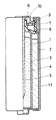
-
- Y02E60/12—
Landscapes
- Battery Electrode And Active Subsutance (AREA)
- Primary Cells (AREA)
Description
【0001】
【発明の属する技術分野】
本発明は、アルカリ電池に関し、さらに詳しくは、オキシ水酸化ニッケルを正極活物質として含有し、亜鉛を負極活物質として含有するアルカリ電池に関する。
【0002】
【従来の技術】
従来、アルカリ電池としては、二酸化マンガンを正極活物質として用いたアルカリマンガン電池が主流を占めていたが、このアルカリマンガン電池では、電池性能の向上を図るため、正極合剤中に黒鉛を添加することが行われていた(例えば、特許文献1参照)。
【0003】
【特許文献1】
特開平7−142060号公報(第3頁第3欄)
【0004】
また、近年、高出力・重負荷用途にオキシ水酸化ニッケルを正極活物質として用いたアルカリ電池が開発されており、その場合においても、正極合剤の調製にあたって黒鉛を添加することが行なわれている(例えば、特許文献2参照)。
【0005】
【特許文献2】
特開2002−83599号公報(第1頁)
【0006】
しかしながら、上記特開2002−83599号公報では、黒鉛だけでは充分な導電性を付与することができないため、酸化コバルトや酸化インジウムなどの導電性金属酸化物を添加しているが、その導電性金属酸化物の添加に伴って活物質のオキシ水酸化ニッケルの充填量が減少し、容量が低下するという問題があった。
【0007】
【発明が解決しようとする課題】
本発明は、上記のような従来のオキシ水酸化ニッケルを正極活物質として用いたアルカリ電池における問題点を解決し、重負荷放電特性が優れたアルカリ電池を提供することを目的とする。
【0008】
【課題を解決するための手段】
本発明は、オキシ水酸化ニッケルを正極活物質として含有する正極合剤、亜鉛を負極活物質として含有するゲル状負極およびアルカリ水溶液からなる電解液を有するアルカリ電池において、前記正極合剤に平均粒径0.5〜3μmの黒鉛を正極活物質100質量部に対して2〜8質量部含有させることによって、前記課題を解決したものである。
【0009】
【発明の実施の形態】
本発明においては、前記のように、正極合剤に平均粒径0.5〜3μmの黒鉛を正極活物質100質量部に対して2〜8質量部含有させるが、これは次の理由に基づいている。すなわち、まず、黒鉛の平均粒径に関して述べると、黒鉛の平均粒径が0.5μmより小さい場合は、正極合剤の成形体で構成される正極の強度が不充分になって、貯蔵中などに正極が膨潤して正極活物質と黒鉛との接触が充分に保てなくなって重負荷放電特性を充分に向上させることができず、また、黒鉛の平均粒径が3μmより大きい場合は、黒鉛と正極活物質との接触面積が不充分になって、重負荷放電特性の向上効果が充分に発現しないためである。また、前記黒鉛の含有量に関して説明すると、黒鉛の含有量が正極活物質100質量部に対して2質量部より少ない場合は、正極合剤に充分な導電性を付与することができないため電池性能が低下し、また、8質量部より多い場合は、正極活物質の充填量が低下して高容量化を達成できなくなるからである。
【0010】
本発明においては、正極合剤に平均粒径0.5〜3μmの黒鉛を正極活物質100質量部に対して2〜8質量部含有させるが、それ以外は従来と同様の構成を採用することができる。ただし、後に詳述するように正極合剤中にポリテトラフルオロエチレンを正極活物質100質量部に対して0.1〜7質量部含有させることが好ましい。
【0011】
正極の作製にあたっては、オキシ水酸化ニッケルを含む正極活物質に、前記のように平均粒径0.5〜3μmの黒鉛を正極活物質100質量部に対して2〜8質量部と、必要に応じてバインダーを加えて乾式混合した後、さらにアルカリ水溶液を加えて湿式混合して、アルカリ水溶液を含んだ状態で正極合剤を調製し、そのアルカリ水溶液を含む正極合剤を加圧成形するか、あるいは前記正極活物質と前記黒鉛とバインダーとを混合してアルカリ水溶液を含まない正極合剤を調製し、そのアルカリ水溶液を含まない正極合剤を加圧成形することが行われ、その正極合剤の成形体が正極として用いられる。ただし、正極の作製方法は、上記例示の方法に限られることなく、他の方法によってもよい。
【0012】
そして、上記正極合剤の調製にあたって、バインダーとしてポリテトラフルオロエチレンを用い、そのポリテトラフルオロエチレンを正極活物質100質量部に対して0.1〜7質量部の割合で含有させると、正極合剤の成形体で構成される正極の強度が向上し、また、高温貯蔵においても正極の膨潤が抑制されて、重負荷放電特性および高温貯蔵特性が向上するので好ましい。
【0013】
また、正極合剤の調製にあたって、正極活物質としては、オキシ水酸化ニッケルを単独で用いる以外に、二酸化マンガンなどの金属酸化物をオキシ水酸化ニッケルと併用することができる。上記のように金属酸化物をオキシ水酸化ニッケルと併用する場合、金属酸化物の占める量は全正極活物質中(すなわち、オキシ水酸化ニッケルと金属酸化物との合計中)30質量%以下にすることが好ましいが、80質量%程度になっても使用することができる。
【0014】
ゲル状負極は従来構成のものでもよく、例えば、負極活物質としての亜鉛と、アルカリ水溶液からなる電解液と、ゲル化剤とを混合することによって調製される。また、電解液としては、例えば、水酸化カリウム、水酸化ナトリウム、水酸化リチウムなどのアルカリ金属の水酸化物の水溶液を用いることができ、セパレータとしては、例えば、ビニロンとレーヨンを主体とする不織布、ビニヨン・レーヨン不織布、ポリアミド不織布、ポリオレフィン・レーヨン不織布、ビニロン紙、ビニロン・リンターパルプ紙、ビニロン・マーセル化パルプ紙などを用いることができる。
【0015】
【実施例】
つぎに、実施例を挙げて本発明をより具体的に説明する。ただし、本発明はそれらの実施例のみに限定されるものではない。なお、以下の実施例などにおいて、溶液などの濃度を示す%はいずれも質量基準によるものである。
【0016】
実施例1
正極活物質としてのオキシ水酸化ニッケル100質量部、平均粒径1μmの黒鉛3質量部およびポリテトラフルオロエチレン粉末0.5質量部を攪拌機で乾式混合し、これに水酸化カリウムを56%と酸化亜鉛を2.9%含むアルカリ水溶液6質量部を加えて湿式混合し、得られた混合物をプレス・粉砕を経たのち造粒して顆粒状正極合剤を得た。この顆粒状正極合剤を金型で成形し、円筒状の正極合剤の成形体からなる正極を得た。
【0017】
得られた円筒形正極を単3形の電池缶内に挿入した後、ビニロンとレーヨンを主体とする不織布からなる公知のアルカリ電池用セパレータを筒形に巻いて前記の円筒形正極の内部に接触するように収納した後、電解液として水酸化カリウム水溶液を30%含みかつ酸化亜鉛を2%含むアルカリ水溶液をセパレータの繊維の隙間に完全に染み渡るように注入した。
【0018】
ゲル状負極は以下に示すように作製した。前記の水酸化カリウムを30%含みかつ酸化亜鉛を2%含むアルカリ水溶液からなる電解液47.2質量部にポリアクリル酸ナトリウム0.57質量部とポリアクリル酸0.35質量部を加え、一晩放置してゲル状にした。このようにして得られたゲル状電解液をよく混合し、その中にガスアトマイズ法で作製した35メッシュから200メッシュの粒度分布を持つ亜鉛粉末100質量部を添加し、さらによく混合してゲル状負極を得た。このようにして得られたゲル状負極を脱泡した後、上記円筒状セパレータの内周側の空間内に充填し、以後、常法に準じて封口を行い、図1に示す構造で単3形のアルカリ電池を作製した。
【0019】
ここで、図1に示す電池について説明すると、前記の正極1は端子付きの正極缶2内に収納されており、この正極缶2内の正極1の内周側にはセパレータ3を介して前記の構成からなるゲル状負極4が充填されている。そして、5は負極集電体、6は封口体、7は金属ワッシャー、8は樹脂ワッシャー、9は絶縁キャップ、10は負極端子板、11は樹脂外装体であるが、負極集電体5以降のものは、いずれも公知の構成からなるものである。
【0020】
実施例2
平均粒径1μmの黒鉛に代えて、平均粒径3μmの黒鉛を用いた以外は、実施例1と同様にして単3形のアルカリ電池を作製した。
【0021】
実施例3
平均粒径3μmの黒鉛の含有量を正極活物質100質量部に対して5質量部にした以外は、実施例2と同様にして単3形のアルカリ電池を作製した。
【0022】
実施例4
平均粒径3μmの黒鉛の含有量を正極活物質100質量部に対して7質量部にした以外は、実施例2と同様にして単3形のアルカリ電池を作製した。
【0023】
比較例1
平均粒径1μmの黒鉛に代えて、平均粒径10μmの黒鉛を用いた以外は、実施例1と同様にして単3形のアルカリ電池を作製した。
【0024】
比較例2
平均粒径3μmの黒鉛の含有量を正極活物質100質量部に対して12質量部にした以外は、実施例1と同様にして単3形のアルカリ電池を作製した。
【0025】
比較例3
平均粒径1μmの黒鉛に代えて、平均粒径8μmの黒鉛を用いた以外は、実施例1と同様にして単3形のアルカリ電池を作製した。
【0026】
比較例4
平均粒径3μmの黒鉛の含有量を正極活物質100質量部に対して10質量部にした以外は、実施例1と同様にして単3形のアルカリ電池を作製した。
【0027】
比較例5
平均粒径1μmの黒鉛に代えて、平均粒径0.1μmの黒鉛を用いた以外は、実施例1と同様にして単3形のアルカリ電池を作製した。
【0028】
比較例6
平均粒径3μmの黒鉛の含有量を正極活物質100質量部に対して1質量部にした以外は、実施例1と同様にして単3形のアルカリ電池を作製した。
【0029】
上記実施例1〜4の電池および比較例1〜6の電池のそれぞれ10個ずつについて、1分間隔で1Aのパルス電流を10秒間流すパルス放電試験を行い、1Aのパルス電流が流れた時点の電圧が1.0V以下に低下するまでに要するパルス放電の回数を測定して、それぞれ10個ずつについての平均値を求め、パルス放電特性を評価した。その結果を表1に示す。ただし、表1への表示にあたっては、比較例1の電池のパルス放電回数を100としたときの指数で示す。すなわち、実施例1〜4の電池および比較例2〜6の電池のパルス放電回数を比較例1の電池のパルス放電回数を100としたときの比率で示す。また、表1には正極合剤に含有させた黒鉛の平均粒径および黒鉛の正極活物質100質量部に対する含有量についても示す。
【0030】
【表1】
表1に示す結果から明らかなように、実施例1〜4の電池は、比較例1〜6の電池に比べて、1Aという重負荷でのパルス放電回数が多く、重負荷放電特性が優れていた。
【0032】
実施例5
正極活物質としてのオキシ水酸化ニッケル100質量部と、平均粒径1μmの黒鉛3質量部とを攪拌機で乾式混合し、これに水酸化カリウムを56%と酸化亜鉛を2.9%含むアルカリ水溶液6質量部を加えて湿式混合し、得られた混合物をプレス・粉砕を経たのち造粒して顆粒状正極合剤を得た。この顆粒状正極合剤を金型で成形し、円筒状の正極合剤の成形体からなる正極を得た。
【0033】
上記のようにして得られた正極を用いた以外は、実施例1と同様にして単3形のアルカリ電池を作製した。
【0034】
実施例6
実施例5における正極合剤の調製にあたって、ポリテトラフルオロエチレンを1質量部(正極活物質100質量部に対して1質量部)添加した以外は、実施例1と同様にして単3形のアルカリ電池を作製した。
【0035】
実施例7
ポリテトラフルオロエチレンの添加量を1質量部から2質量部に変更した以外は、実施例6と同様にして単3形のアルカリ電池を作製した。
【0036】
実施例8
ポリテトラフルオロエチレンの添加量を1質量部から7質量部に変更した以外は、実施例6と同様にして単3形のアルカリ電池を作製した。
【0037】
上記実施例5〜8の電池について実施例1と同様にパルス放電回数を調べた結果を表2に示す。ただし、これら実施例5〜8の電池のパルス放電回数の表2への表示にあたっては、前記実施例1の場合などと同様に、比較例1の電池のパルス放電回数を100としたときの指数で示す。
【0038】
また、上記とは別に、前記実施例1の電池と実施例5〜8の電池を各20個ずつ用意し、まず、そのうちの10個ずつの電池を1Aの放電電流で放電させて0.9Vになるまでの放電時間を測定し、その平均時間を貯蔵前の放電時間とし、次に、残りの10個ずつの電池を60℃の恒温槽中に20日間貯蔵し、取り出してから1日室温で冷却後、同じく1Aの放電電流で放電させて0.9V以下になるまでの放電時間を測定し、その平均時間を貯蔵後の放電時間とし、貯蔵前の放電時間に対する貯蔵後の放電時間の割合を容量保持率として求め、高温での電池の貯蔵特性を評価した。その結果を表2に示す。ただし、表2への表示にあたっては、それらの電池の記載順序をポリテトラフルオロエチレンの含有量の少ないものの順、すなわち、正極合剤にポリテトラフルオロエチレンを含有させていない実施例5の電池、ポリテトラフルオロエチレンを0.5質量部含有させた実施例1の電池、ポリテトラフルオロエチレンを1質量部含有させた実施例6の電池、ポリテトラフルオロエチレンを2質量部含有させた実施例7の電池、ポリテトラフルオロエチレンを7質量部含有させた実施例8の電池の順にして示す。
【0039】
【表2】
表2に示す結果から明らかなように、ポリテトラフルオロエチレンを含有させていない実施例5の電池より、ポリテトラフルオロエチレンを含有させた実施例1および実施例6〜8の電池の容量保持率が高く貯蔵特性が優れていた。
【0041】
すなわち、ポリテトラフルオロエチレンを含有させた実施例1および実施例6〜8の電池は、ポリテトラフルオロエチレンを含有させていない実施例5の電池に比べて、60℃という高温で20日間貯蔵後の1Aという重負荷放電での容量保持率が高く、高温貯蔵後の重負荷放電でも良好な放電特性を示し、高温貯蔵特性が優れていた。
【0042】
【発明の効果】
以上説明したように、本発明によれば、重負荷放電特性が優れたアルカリ電池を提供することができる。また、正極合剤にポリテトラフルオロエチレンを含有させることにより、高温貯蔵特性を向上させることができる。
【図面の簡単な説明】
【図1】本発明に係るアルカリ電池の一例を模式的に示す部分縦断面図である。
【符号の説明】
1 正極(正極合剤成形体)
4 ゲル状負極[0001]
BACKGROUND OF THE INVENTION
The present invention relates to an alkaline battery, and more particularly to an alkaline battery containing nickel oxyhydroxide as a positive electrode active material and zinc as a negative electrode active material.
[0002]
[Prior art]
Conventionally, as alkaline batteries, alkaline manganese batteries using manganese dioxide as a positive electrode active material have been the mainstream, but in this alkaline manganese battery, graphite is added to the positive electrode mixture in order to improve battery performance. (For example, refer to Patent Document 1).
[0003]
[Patent Document 1]
Japanese Patent Application Laid-Open No. 7-142060 (
[0004]
In recent years, alkaline batteries using nickel oxyhydroxide as a positive electrode active material have been developed for high output and heavy load applications, and even in this case, graphite is added to prepare a positive electrode mixture. (For example, refer to Patent Document 2).
[0005]
[Patent Document 2]
JP 2002-83599 A (first page)
[0006]
However, in the above Japanese Patent Laid-Open No. 2002-83599, since sufficient conductivity cannot be imparted only by graphite, a conductive metal oxide such as cobalt oxide or indium oxide is added. With the addition of the oxide, there is a problem that the filling amount of the nickel oxyhydroxide as the active material is reduced and the capacity is lowered.
[0007]
[Problems to be solved by the invention]
An object of the present invention is to solve the problems in the alkaline battery using the above-described conventional nickel oxyhydroxide as a positive electrode active material, and to provide an alkaline battery excellent in heavy load discharge characteristics.
[0008]
[Means for Solving the Problems]
The present invention provides a positive electrode mixture containing nickel oxyhydroxide as a positive electrode active material, a gelled negative electrode containing zinc as a negative electrode active material, and an alkaline battery having an electrolyte solution comprising an alkaline aqueous solution. The above-mentioned problem is solved by adding graphite having a diameter of 0.5 to 3 μm to 2 to 8 parts by mass with respect to 100 parts by mass of the positive electrode active material.
[0009]
DETAILED DESCRIPTION OF THE INVENTION
In the present invention, as described above, the positive electrode mixture contains 2 to 8 parts by mass of graphite having an average particle size of 0.5 to 3 μm with respect to 100 parts by mass of the positive electrode active material. This is based on the following reason. ing. That is, first, regarding the average particle diameter of graphite, when the average particle diameter of graphite is smaller than 0.5 μm, the strength of the positive electrode constituted by the molded body of the positive electrode mixture becomes insufficient, during storage, etc. When the positive electrode swells and contact between the positive electrode active material and graphite cannot be maintained sufficiently, the heavy load discharge characteristics cannot be sufficiently improved, and when the average particle size of graphite is larger than 3 μm, This is because the contact area between the electrode and the positive electrode active material becomes insufficient, and the effect of improving the heavy load discharge characteristics is not sufficiently exhibited. Further, the graphite content will be described. When the graphite content is less than 2 parts by mass with respect to 100 parts by mass of the positive electrode active material, battery performance cannot be obtained because sufficient conductivity cannot be imparted to the positive electrode mixture. This is because when the amount is more than 8 parts by mass, the filling amount of the positive electrode active material is reduced, and the increase in capacity cannot be achieved.
[0010]
In the present invention, graphite having an average particle size of 0.5 to 3 μm is contained in the positive electrode mixture in an amount of 2 to 8 parts by mass with respect to 100 parts by mass of the positive electrode active material. Can do. However, as described in detail later, it is preferable to contain 0.1 to 7 parts by mass of polytetrafluoroethylene in 100 parts by mass of the positive electrode active material in the positive electrode mixture.
[0011]
In preparation of the positive electrode, as described above, 2-8 parts by mass of graphite having an average particle size of 0.5-3 μm with respect to 100 parts by mass of the positive electrode active material is necessary for the positive electrode active material containing nickel oxyhydroxide. Depending on whether the binder is added and dry-mixed, then an alkaline aqueous solution is further added and wet-mixed to prepare a positive electrode mixture containing the alkaline aqueous solution, and the positive electrode mixture containing the alkaline aqueous solution is pressure-molded. Alternatively, the positive electrode active material, the graphite, and the binder are mixed to prepare a positive electrode mixture that does not include an alkaline aqueous solution, and the positive electrode mixture that does not include the alkaline aqueous solution is pressure-molded. A molded product of the agent is used as the positive electrode. However, the method for manufacturing the positive electrode is not limited to the above-described method, and other methods may be used.
[0012]
In preparing the positive electrode mixture, when polytetrafluoroethylene is used as a binder and the polytetrafluoroethylene is contained at a ratio of 0.1 to 7 parts by mass with respect to 100 parts by mass of the positive electrode active material, the positive electrode mixture is obtained. The strength of the positive electrode composed of the molded product of the agent is improved, and the swelling of the positive electrode is suppressed even during high temperature storage, so that the heavy load discharge characteristics and the high temperature storage characteristics are improved, which is preferable.
[0013]
In preparing the positive electrode mixture, as the positive electrode active material, besides using nickel oxyhydroxide alone, a metal oxide such as manganese dioxide can be used in combination with nickel oxyhydroxide. When the metal oxide is used in combination with nickel oxyhydroxide as described above, the amount of the metal oxide is 30% by mass or less in the total positive electrode active material (that is, in the total of nickel oxyhydroxide and metal oxide). Although it is preferable, it can be used even if it becomes about 80 mass%.
[0014]
The gelled negative electrode may have a conventional structure, and is prepared, for example, by mixing zinc as a negative electrode active material, an electrolytic solution composed of an alkaline aqueous solution, and a gelling agent. As the electrolytic solution, for example, an aqueous solution of an alkali metal hydroxide such as potassium hydroxide, sodium hydroxide, or lithium hydroxide can be used. As the separator, for example, a nonwoven fabric mainly composed of vinylon and rayon. Vinylon rayon nonwoven fabric, polyamide nonwoven fabric, polyolefin rayon nonwoven fabric, vinylon paper, vinylon linter pulp paper, vinylon mercerized pulp paper, and the like can be used.
[0015]
【Example】
Next, the present invention will be described more specifically with reference to examples. However, this invention is not limited only to those Examples. In the following examples and the like, all percentages indicating the concentration of the solution and the like are based on mass.
[0016]
Example 1
100 parts by mass of nickel oxyhydroxide as a positive electrode active material, 3 parts by mass of graphite having an average particle diameter of 1 μm and 0.5 parts by mass of polytetrafluoroethylene powder were dry-mixed with a stirrer, and this was oxidized to 56% potassium hydroxide. 6 parts by mass of an alkaline aqueous solution containing 2.9% zinc was added and wet-mixed. The obtained mixture was pressed and pulverized and then granulated to obtain a granular positive electrode mixture. This granular positive electrode mixture was molded with a mold to obtain a positive electrode formed of a cylindrical positive electrode mixture.
[0017]
After the obtained cylindrical positive electrode is inserted into an AA battery can, a known alkaline battery separator made of a nonwoven fabric mainly composed of vinylon and rayon is wound into a cylindrical shape and brought into contact with the inside of the cylindrical positive electrode Then, an alkaline aqueous solution containing 30% potassium hydroxide aqueous solution and 2% zinc oxide as an electrolytic solution was poured so as to completely penetrate into the gaps of the separator fibers.
[0018]
The gelled negative electrode was produced as shown below. 0.57 parts by mass of sodium polyacrylate and 0.35 parts by mass of polyacrylic acid were added to 47.2 parts by mass of an electrolytic solution containing 30% potassium hydroxide and 2% zinc oxide. The gel was left standing overnight. The gel electrolyte thus obtained was mixed well, and 100 parts by mass of zinc powder having a particle size distribution of 35 mesh to 200 mesh prepared by the gas atomization method was added therein, and further mixed well to form a gel. A negative electrode was obtained. The gelled negative electrode thus obtained was degassed and then filled into the space on the inner peripheral side of the cylindrical separator, and thereafter sealed according to a conventional method, with the structure shown in FIG. A shaped alkaline battery was prepared.
[0019]
Here, the battery shown in FIG. 1 will be described. The
[0020]
Example 2
An AA alkaline battery was produced in the same manner as in Example 1 except that graphite having an average particle diameter of 3 μm was used instead of graphite having an average particle diameter of 1 μm.
[0021]
Example 3
AA alkaline batteries were produced in the same manner as in Example 2, except that the content of graphite having an average particle size of 3 μm was changed to 5 parts by mass with respect to 100 parts by mass of the positive electrode active material.
[0022]
Example 4
AA alkaline batteries were produced in the same manner as in Example 2, except that the content of graphite having an average particle size of 3 μm was changed to 7 parts by mass with respect to 100 parts by mass of the positive electrode active material.
[0023]
Comparative Example 1
An AA alkaline battery was fabricated in the same manner as in Example 1 except that graphite having an average particle diameter of 10 μm was used instead of graphite having an average particle diameter of 1 μm.
[0024]
Comparative Example 2
AA alkaline batteries were produced in the same manner as in Example 1, except that the content of graphite having an average particle size of 3 μm was 12 parts by mass with respect to 100 parts by mass of the positive electrode active material.
[0025]
Comparative Example 3
An AA alkaline battery was fabricated in the same manner as in Example 1 except that graphite having an average particle size of 8 μm was used instead of graphite having an average particle size of 1 μm.
[0026]
Comparative Example 4
AA alkaline batteries were produced in the same manner as in Example 1 except that the content of graphite having an average particle size of 3 μm was changed to 10 parts by mass with respect to 100 parts by mass of the positive electrode active material.
[0027]
Comparative Example 5
An AA alkaline battery was produced in the same manner as in Example 1 except that graphite having an average particle diameter of 0.1 μm was used instead of graphite having an average particle diameter of 1 μm.
[0028]
Comparative Example 6
AA alkaline batteries were produced in the same manner as in Example 1, except that the content of graphite having an average particle size of 3 μm was 1 part by mass with respect to 100 parts by mass of the positive electrode active material.
[0029]
A pulse discharge test was conducted for 10 seconds each of the batteries of Examples 1 to 4 and Comparative Examples 1 to 6 with a 1 A pulse current flowing at 1 minute intervals for 10 seconds. The number of pulse discharges required for the voltage to drop to 1.0 V or less was measured, and the average value for each 10 was determined to evaluate the pulse discharge characteristics. The results are shown in Table 1. However, in the display in Table 1, it shows by the index when the number of pulse discharges of the battery of Comparative Example 1 is 100. That is, the number of pulse discharges of the batteries of Examples 1 to 4 and the batteries of Comparative Examples 2 to 6 is shown as a ratio when the number of pulse discharges of the battery of Comparative Example 1 is 100. Table 1 also shows the average particle diameter of graphite contained in the positive electrode mixture and the content of graphite with respect to 100 parts by mass of the positive electrode active material.
[0030]
[Table 1]
As is clear from the results shown in Table 1, the batteries of Examples 1 to 4 have a larger number of pulse discharges at a heavy load of 1A than the batteries of Comparative Examples 1 to 6, and are excellent in heavy load discharge characteristics. It was.
[0032]
Example 5
100 parts by mass of nickel oxyhydroxide as a positive electrode active material and 3 parts by mass of graphite having an average particle diameter of 1 μm are dry-mixed with a stirrer, and an alkaline aqueous solution containing 56% potassium hydroxide and 2.9% zinc oxide. 6 parts by mass was added and wet-mixed. The resulting mixture was pressed and pulverized and then granulated to obtain a granular positive electrode mixture. This granular positive electrode mixture was molded with a mold to obtain a positive electrode formed of a cylindrical positive electrode mixture.
[0033]
AA alkaline batteries were produced in the same manner as in Example 1 except that the positive electrode obtained as described above was used.
[0034]
Example 6
In the preparation of the positive electrode mixture in Example 5, AA type alkali was added in the same manner as in Example 1 except that 1 part by mass of polytetrafluoroethylene (1 part by mass with respect to 100 parts by mass of the positive electrode active material) was added. A battery was produced.
[0035]
Example 7
AA alkaline batteries were produced in the same manner as in Example 6 except that the amount of polytetrafluoroethylene added was changed from 1 part by mass to 2 parts by mass.
[0036]
Example 8
AA alkaline batteries were produced in the same manner as in Example 6 except that the amount of polytetrafluoroethylene added was changed from 1 part by mass to 7 parts by mass.
[0037]
Table 2 shows the results of examining the number of pulse discharges for the batteries of Examples 5 to 8 in the same manner as in Example 1. However, when displaying the number of pulse discharges of the batteries of Examples 5 to 8 in Table 2, as in the case of Example 1, the index when the number of pulse discharges of the battery of Comparative Example 1 is 100 is used. It shows with.
[0038]
Separately from the above, 20 batteries each of Example 1 and Examples 5 to 8 were prepared. First, 10 of them were discharged with a discharge current of 1 A to 0.9 V. The average discharge time was measured as the discharge time before storage, and then the remaining 10 batteries were stored in a constant temperature bath at 60 ° C. for 20 days, taken out, and taken out at room temperature for 1 day. After cooling, the discharge time from the discharge current of 1A to 0.9V or less is measured, the average time is taken as the discharge time after storage, and the discharge time after storage relative to the discharge time before storage The percentage was determined as the capacity retention, and the storage characteristics of the battery at high temperature were evaluated. The results are shown in Table 2. However, in the display in Table 2, the order of description of these batteries is the order of the content of polytetrafluoroethylene with a small content, that is, the battery of Example 5 in which the positive electrode mixture does not contain polytetrafluoroethylene, The battery of Example 1 containing 0.5 parts by mass of polytetrafluoroethylene, the battery of Example 6 containing 1 part by mass of polytetrafluoroethylene, and Example 7 containing 2 parts by mass of polytetrafluoroethylene And the battery of Example 8 containing 7 parts by mass of polytetrafluoroethylene.
[0039]
[Table 2]
As is apparent from the results shown in Table 2, the capacity retention rates of the batteries of Example 1 and Examples 6 to 8 containing polytetrafluoroethylene than the battery of Example 5 not containing polytetrafluoroethylene. And storage characteristics were excellent.
[0041]
That is, the batteries of Example 1 and Examples 6 to 8 containing polytetrafluoroethylene were stored at a temperature as high as 60 ° C. for 20 days as compared with the battery of Example 5 not containing polytetrafluoroethylene. The capacity retention rate at heavy load discharge of 1A was high, and good discharge characteristics were exhibited even at heavy load discharge after high temperature storage, and the high temperature storage characteristics were excellent.
[0042]
【The invention's effect】
As described above, according to the present invention, an alkaline battery excellent in heavy load discharge characteristics can be provided. Moreover, a high temperature storage characteristic can be improved by making a positive electrode mixture contain polytetrafluoroethylene.
[Brief description of the drawings]
FIG. 1 is a partial longitudinal sectional view schematically showing an example of an alkaline battery according to the present invention.
[Explanation of symbols]
1 Positive electrode (positive electrode mixture molding)
4 Gelled negative electrode
Claims (2)
Priority Applications (1)
| Application Number | Priority Date | Filing Date | Title |
|---|---|---|---|
| JP2002302450A JP4265738B2 (en) | 2002-10-17 | 2002-10-17 | Alkaline battery |
Applications Claiming Priority (1)
| Application Number | Priority Date | Filing Date | Title |
|---|---|---|---|
| JP2002302450A JP4265738B2 (en) | 2002-10-17 | 2002-10-17 | Alkaline battery |
Publications (2)
| Publication Number | Publication Date |
|---|---|
| JP2004139806A JP2004139806A (en) | 2004-05-13 |
| JP4265738B2 true JP4265738B2 (en) | 2009-05-20 |
Family
ID=32450505
Family Applications (1)
| Application Number | Title | Priority Date | Filing Date |
|---|---|---|---|
| JP2002302450A Expired - Fee Related JP4265738B2 (en) | 2002-10-17 | 2002-10-17 | Alkaline battery |
Country Status (1)
| Country | Link |
|---|---|
| JP (1) | JP4265738B2 (en) |
Families Citing this family (1)
| Publication number | Priority date | Publication date | Assignee | Title |
|---|---|---|---|---|
| JP7146545B2 (en) * | 2018-09-21 | 2022-10-04 | Fdk株式会社 | Cathode mixture for alkaline batteries |
-
2002
- 2002-10-17 JP JP2002302450A patent/JP4265738B2/en not_active Expired - Fee Related
Also Published As
| Publication number | Publication date |
|---|---|
| JP2004139806A (en) | 2004-05-13 |
Similar Documents
| Publication | Publication Date | Title |
|---|---|---|
| JP3866884B2 (en) | Alkaline battery | |
| KR101822666B1 (en) | Carbon Fiber Zinc Negative Electrode | |
| EP1195832A1 (en) | A high-temperature nickel-hydrogen battery and producing method thereof | |
| DE60007138T2 (en) | ALKALINE CELL WITH IMPROVED ANODE | |
| CN100511804C (en) | Alkaline cell with improved anode | |
| JPH07502145A (en) | Cathode of zinc manganese dioxide battery with barium additive | |
| EP1958278B1 (en) | Rechargeable alkaline manganese cell having reduced capacity fade and improved cycle life | |
| JP3866903B2 (en) | Alkaline battery | |
| JP4253172B2 (en) | Sealed nickel zinc primary battery | |
| JP3568408B2 (en) | Positive electrode active material for alkaline secondary batteries and alkaline secondary batteries | |
| JP2004047321A (en) | Alkaline battery and method of manufacturing the same | |
| JP4121774B2 (en) | Alkaline battery | |
| EP0952621A1 (en) | Alkaline storage battery and method for charging battery | |
| WO2003009406A1 (en) | Alkaline dry battery | |
| JP3552194B2 (en) | Alkaline battery | |
| US20070099083A1 (en) | Alkaline battery | |
| JPH09180736A (en) | Alkaline manganese battery | |
| JP3969075B2 (en) | Cylindrical nickel zinc battery | |
| JP2006040887A (en) | Alkaline battery | |
| JP3263603B2 (en) | Alkaline storage battery | |
| JP4089952B2 (en) | Alkaline primary battery | |
| JP2004139806A (en) | Alkaline battery | |
| JP4233299B2 (en) | Alkaline battery | |
| JP2003323914A (en) | Nickel-hydrogen battery | |
| JP2003317798A (en) | Nickel-hydrogen battery and method of manufacturing the same |
Legal Events
| Date | Code | Title | Description |
|---|---|---|---|
| A621 | Written request for application examination |
Free format text: JAPANESE INTERMEDIATE CODE: A621 Effective date: 20050418 |
|
| A977 | Report on retrieval |
Free format text: JAPANESE INTERMEDIATE CODE: A971007 Effective date: 20081104 |
|
| A131 | Notification of reasons for refusal |
Free format text: JAPANESE INTERMEDIATE CODE: A131 Effective date: 20081119 |
|
| A521 | Written amendment |
Free format text: JAPANESE INTERMEDIATE CODE: A523 Effective date: 20090115 |
|
| RD03 | Notification of appointment of power of attorney |
Effective date: 20090115 Free format text: JAPANESE INTERMEDIATE CODE: A7423 |
|
| TRDD | Decision of grant or rejection written | ||
| A01 | Written decision to grant a patent or to grant a registration (utility model) |
Free format text: JAPANESE INTERMEDIATE CODE: A01 Effective date: 20090210 |
|
| A01 | Written decision to grant a patent or to grant a registration (utility model) |
Free format text: JAPANESE INTERMEDIATE CODE: A01 |
|
| A61 | First payment of annual fees (during grant procedure) |
Effective date: 20090210 Free format text: JAPANESE INTERMEDIATE CODE: A61 |
|
| R150 | Certificate of patent (=grant) or registration of utility model |
Free format text: JAPANESE INTERMEDIATE CODE: R150 |
|
| FPAY | Renewal fee payment (prs date is renewal date of database) |
Free format text: PAYMENT UNTIL: 20120227 Year of fee payment: 3 |
|
| FPAY | Renewal fee payment (prs date is renewal date of database) |
Year of fee payment: 3 Free format text: PAYMENT UNTIL: 20120227 |
|
| FPAY | Renewal fee payment (prs date is renewal date of database) |
Free format text: PAYMENT UNTIL: 20120227 Year of fee payment: 3 |
|
| S111 | Request for change of ownership or part of ownership |
Free format text: JAPANESE INTERMEDIATE CODE: R313111 |
|
| R350 | Written notification of registration of transfer |
Free format text: JAPANESE INTERMEDIATE CODE: R350 |
|
| FPAY | Renewal fee payment (prs date is renewal date of database) |
Free format text: PAYMENT UNTIL: 20120227 Year of fee payment: 3 |
|
| FPAY | Renewal fee payment (prs date is renewal date of database) |
Year of fee payment: 3 Free format text: PAYMENT UNTIL: 20120227 |
|
| FPAY | Renewal fee payment (prs date is renewal date of database) |
Year of fee payment: 3 Free format text: PAYMENT UNTIL: 20120227 |
|
| FPAY | Renewal fee payment (prs date is renewal date of database) |
Year of fee payment: 3 Free format text: PAYMENT UNTIL: 20120227 |
|
| LAPS | Cancellation because of no payment of annual fees |