JP4046875B2 - Slide bearing device - Google Patents
Slide bearing device Download PDFInfo
- Publication number
- JP4046875B2 JP4046875B2 JP34345598A JP34345598A JP4046875B2 JP 4046875 B2 JP4046875 B2 JP 4046875B2 JP 34345598 A JP34345598 A JP 34345598A JP 34345598 A JP34345598 A JP 34345598A JP 4046875 B2 JP4046875 B2 JP 4046875B2
- Authority
- JP
- Japan
- Prior art keywords
- sliding
- resin
- bearing device
- compounding agent
- tetrafluoroethylene
- Prior art date
- Legal status (The legal status is an assumption and is not a legal conclusion. Google has not performed a legal analysis and makes no representation as to the accuracy of the status listed.)
- Expired - Lifetime
Links
- 239000000463 material Substances 0.000 claims description 63
- 229920005989 resin Polymers 0.000 claims description 44
- 239000011347 resin Substances 0.000 claims description 44
- 238000013329 compounding Methods 0.000 claims description 30
- BFKJFAAPBSQJPD-UHFFFAOYSA-N tetrafluoroethene Chemical group FC(F)=C(F)F BFKJFAAPBSQJPD-UHFFFAOYSA-N 0.000 claims description 30
- 239000003795 chemical substances by application Substances 0.000 claims description 29
- 230000001050 lubricating effect Effects 0.000 claims description 19
- 238000000465 moulding Methods 0.000 claims description 17
- 230000013011 mating Effects 0.000 claims description 14
- 239000011159 matrix material Substances 0.000 claims description 11
- 229920001296 polysiloxane Polymers 0.000 claims description 11
- 239000011342 resin composition Substances 0.000 claims description 11
- OKTJSMMVPCPJKN-UHFFFAOYSA-N Carbon Chemical compound [C] OKTJSMMVPCPJKN-UHFFFAOYSA-N 0.000 claims description 10
- -1 polysiloxane Polymers 0.000 claims description 10
- 229920002313 fluoropolymer Polymers 0.000 claims description 8
- 239000004811 fluoropolymer Substances 0.000 claims description 8
- 239000011737 fluorine Substances 0.000 claims description 7
- 229910052731 fluorine Inorganic materials 0.000 claims description 7
- 239000007849 furan resin Substances 0.000 claims description 7
- 229910002804 graphite Inorganic materials 0.000 claims description 7
- 239000010439 graphite Substances 0.000 claims description 6
- 239000003822 epoxy resin Substances 0.000 claims description 5
- 125000000962 organic group Chemical group 0.000 claims description 5
- 229920000647 polyepoxide Polymers 0.000 claims description 5
- PXGOKWXKJXAPGV-UHFFFAOYSA-N Fluorine Chemical compound FF PXGOKWXKJXAPGV-UHFFFAOYSA-N 0.000 claims 1
- 239000000843 powder Substances 0.000 description 25
- 239000000835 fiber Substances 0.000 description 20
- 239000011248 coating agent Substances 0.000 description 16
- 229920001343 polytetrafluoroethylene Polymers 0.000 description 16
- 239000004810 polytetrafluoroethylene Substances 0.000 description 16
- 238000000576 coating method Methods 0.000 description 15
- 229920000049 Carbon (fiber) Polymers 0.000 description 14
- 239000004917 carbon fiber Substances 0.000 description 14
- 229920000642 polymer Polymers 0.000 description 11
- 239000000126 substance Substances 0.000 description 11
- 229920001187 thermosetting polymer Polymers 0.000 description 10
- 229920001721 polyimide Polymers 0.000 description 9
- 239000009719 polyimide resin Substances 0.000 description 9
- OSGAYBCDTDRGGQ-UHFFFAOYSA-L calcium sulfate Chemical compound [Ca+2].[O-]S([O-])(=O)=O OSGAYBCDTDRGGQ-UHFFFAOYSA-L 0.000 description 8
- 230000006835 compression Effects 0.000 description 8
- 238000007906 compression Methods 0.000 description 8
- 238000000034 method Methods 0.000 description 8
- VNWKTOKETHGBQD-UHFFFAOYSA-N methane Chemical compound C VNWKTOKETHGBQD-UHFFFAOYSA-N 0.000 description 7
- XLOMVQKBTHCTTD-UHFFFAOYSA-N Zinc monoxide Chemical compound [Zn]=O XLOMVQKBTHCTTD-UHFFFAOYSA-N 0.000 description 6
- 238000002156 mixing Methods 0.000 description 6
- YCKRFDGAMUMZLT-UHFFFAOYSA-N Fluorine atom Chemical compound [F] YCKRFDGAMUMZLT-UHFFFAOYSA-N 0.000 description 5
- 239000000945 filler Substances 0.000 description 5
- 150000001282 organosilanes Chemical class 0.000 description 5
- CSNNHWWHGAXBCP-UHFFFAOYSA-L Magnesium sulfate Chemical compound [Mg+2].[O-][S+2]([O-])([O-])[O-] CSNNHWWHGAXBCP-UHFFFAOYSA-L 0.000 description 4
- SECXISVLQFMRJM-UHFFFAOYSA-N N-Methylpyrrolidone Chemical compound CN1CCCC1=O SECXISVLQFMRJM-UHFFFAOYSA-N 0.000 description 4
- 239000004809 Teflon Substances 0.000 description 4
- 229920006362 Teflon® Polymers 0.000 description 4
- 235000008429 bread Nutrition 0.000 description 4
- 229910052799 carbon Inorganic materials 0.000 description 4
- 125000000524 functional group Chemical group 0.000 description 4
- 239000003365 glass fiber Substances 0.000 description 4
- 239000000203 mixture Substances 0.000 description 4
- 150000002894 organic compounds Chemical class 0.000 description 4
- 150000003839 salts Chemical class 0.000 description 4
- XLYOFNOQVPJJNP-UHFFFAOYSA-N water Substances O XLYOFNOQVPJJNP-UHFFFAOYSA-N 0.000 description 4
- ZWEHNKRNPOVVGH-UHFFFAOYSA-N 2-Butanone Chemical compound CCC(C)=O ZWEHNKRNPOVVGH-UHFFFAOYSA-N 0.000 description 3
- ZMXDDKWLCZADIW-UHFFFAOYSA-N N,N-Dimethylformamide Chemical compound CN(C)C=O ZMXDDKWLCZADIW-UHFFFAOYSA-N 0.000 description 3
- VYPSYNLAJGMNEJ-UHFFFAOYSA-N Silicium dioxide Chemical compound O=[Si]=O VYPSYNLAJGMNEJ-UHFFFAOYSA-N 0.000 description 3
- YXFVVABEGXRONW-UHFFFAOYSA-N Toluene Chemical compound CC1=CC=CC=C1 YXFVVABEGXRONW-UHFFFAOYSA-N 0.000 description 3
- 239000011324 bead Substances 0.000 description 3
- 230000000052 comparative effect Effects 0.000 description 3
- 230000000694 effects Effects 0.000 description 3
- 239000007789 gas Substances 0.000 description 3
- 150000002484 inorganic compounds Chemical class 0.000 description 3
- 229910010272 inorganic material Inorganic materials 0.000 description 3
- 238000004898 kneading Methods 0.000 description 3
- 239000002245 particle Substances 0.000 description 3
- 239000005011 phenolic resin Substances 0.000 description 3
- 238000010298 pulverizing process Methods 0.000 description 3
- 239000002994 raw material Substances 0.000 description 3
- 239000010935 stainless steel Substances 0.000 description 3
- 229910001220 stainless steel Inorganic materials 0.000 description 3
- 239000011787 zinc oxide Substances 0.000 description 3
- XLLIQLLCWZCATF-UHFFFAOYSA-N 2-methoxyethyl acetate Chemical compound COCCOC(C)=O XLLIQLLCWZCATF-UHFFFAOYSA-N 0.000 description 2
- 239000004962 Polyamide-imide Substances 0.000 description 2
- 229920006361 Polyflon Polymers 0.000 description 2
- 239000002253 acid Substances 0.000 description 2
- 239000000853 adhesive Substances 0.000 description 2
- 230000001070 adhesive effect Effects 0.000 description 2
- 239000004760 aramid Substances 0.000 description 2
- 125000003118 aryl group Chemical group 0.000 description 2
- 238000001723 curing Methods 0.000 description 2
- 238000001125 extrusion Methods 0.000 description 2
- 239000012765 fibrous filler Substances 0.000 description 2
- 125000001153 fluoro group Chemical group F* 0.000 description 2
- 239000008187 granular material Substances 0.000 description 2
- 238000010438 heat treatment Methods 0.000 description 2
- 238000005461 lubrication Methods 0.000 description 2
- 229910052943 magnesium sulfate Inorganic materials 0.000 description 2
- 235000019341 magnesium sulphate Nutrition 0.000 description 2
- 239000003921 oil Substances 0.000 description 2
- 229920002312 polyamide-imide Polymers 0.000 description 2
- 229920001225 polyester resin Polymers 0.000 description 2
- 239000004645 polyester resin Substances 0.000 description 2
- 230000000379 polymerizing effect Effects 0.000 description 2
- 239000007779 soft material Substances 0.000 description 2
- 239000000243 solution Substances 0.000 description 2
- 239000002904 solvent Substances 0.000 description 2
- 230000003746 surface roughness Effects 0.000 description 2
- HXDLWJWIAHWIKI-UHFFFAOYSA-N 2-hydroxyethyl acetate Chemical compound CC(=O)OCCO HXDLWJWIAHWIKI-UHFFFAOYSA-N 0.000 description 1
- KXGFMDJXCMQABM-UHFFFAOYSA-N 2-methoxy-6-methylphenol Chemical compound [CH]OC1=CC=CC([CH])=C1O KXGFMDJXCMQABM-UHFFFAOYSA-N 0.000 description 1
- FGLBSLMDCBOPQK-UHFFFAOYSA-N 2-nitropropane Chemical compound CC(C)[N+]([O-])=O FGLBSLMDCBOPQK-UHFFFAOYSA-N 0.000 description 1
- 229910000838 Al alloy Inorganic materials 0.000 description 1
- 229920006357 Algoflon Polymers 0.000 description 1
- 239000004593 Epoxy Substances 0.000 description 1
- VGGSQFUCUMXWEO-UHFFFAOYSA-N Ethene Chemical compound C=C VGGSQFUCUMXWEO-UHFFFAOYSA-N 0.000 description 1
- 239000005977 Ethylene Substances 0.000 description 1
- WSFSSNUMVMOOMR-UHFFFAOYSA-N Formaldehyde Chemical compound O=C WSFSSNUMVMOOMR-UHFFFAOYSA-N 0.000 description 1
- 229920006360 Hostaflon Polymers 0.000 description 1
- UFHFLCQGNIYNRP-UHFFFAOYSA-N Hydrogen Chemical compound [H][H] UFHFLCQGNIYNRP-UHFFFAOYSA-N 0.000 description 1
- FXHOOIRPVKKKFG-UHFFFAOYSA-N N,N-Dimethylacetamide Chemical compound CN(C)C(C)=O FXHOOIRPVKKKFG-UHFFFAOYSA-N 0.000 description 1
- ISWSIDIOOBJBQZ-UHFFFAOYSA-N Phenol Chemical compound OC1=CC=CC=C1 ISWSIDIOOBJBQZ-UHFFFAOYSA-N 0.000 description 1
- 239000004696 Poly ether ether ketone Substances 0.000 description 1
- 239000004642 Polyimide Substances 0.000 description 1
- BLRPTPMANUNPDV-UHFFFAOYSA-N Silane Chemical compound [SiH4] BLRPTPMANUNPDV-UHFFFAOYSA-N 0.000 description 1
- GWEVSGVZZGPLCZ-UHFFFAOYSA-N Titan oxide Chemical compound O=[Ti]=O GWEVSGVZZGPLCZ-UHFFFAOYSA-N 0.000 description 1
- 229920004695 VICTREX™ PEEK Polymers 0.000 description 1
- 150000007513 acids Chemical class 0.000 description 1
- 239000003570 air Substances 0.000 description 1
- 239000003513 alkali Substances 0.000 description 1
- 125000003277 amino group Chemical group 0.000 description 1
- 229920006231 aramid fiber Polymers 0.000 description 1
- 229920003235 aromatic polyamide Polymers 0.000 description 1
- 239000002585 base Substances 0.000 description 1
- 230000005540 biological transmission Effects 0.000 description 1
- 230000015572 biosynthetic process Effects 0.000 description 1
- 239000006229 carbon black Substances 0.000 description 1
- 125000003178 carboxy group Chemical group [H]OC(*)=O 0.000 description 1
- 239000008119 colloidal silica Substances 0.000 description 1
- 125000000853 cresyl group Chemical group C1(=CC=C(C=C1)C)* 0.000 description 1
- 230000001419 dependent effect Effects 0.000 description 1
- NJLLQSBAHIKGKF-UHFFFAOYSA-N dipotassium dioxido(oxo)titanium Chemical compound [K+].[K+].[O-][Ti]([O-])=O NJLLQSBAHIKGKF-UHFFFAOYSA-N 0.000 description 1
- 238000010556 emulsion polymerization method Methods 0.000 description 1
- 229920006332 epoxy adhesive Polymers 0.000 description 1
- 125000003700 epoxy group Chemical group 0.000 description 1
- 125000004185 ester group Chemical group 0.000 description 1
- 125000001033 ether group Chemical group 0.000 description 1
- 125000003709 fluoroalkyl group Chemical group 0.000 description 1
- 235000013305 food Nutrition 0.000 description 1
- 235000011389 fruit/vegetable juice Nutrition 0.000 description 1
- 239000011521 glass Substances 0.000 description 1
- 125000003055 glycidyl group Chemical group C(C1CO1)* 0.000 description 1
- 238000013007 heat curing Methods 0.000 description 1
- 229920001519 homopolymer Polymers 0.000 description 1
- 229910052739 hydrogen Inorganic materials 0.000 description 1
- 239000001257 hydrogen Substances 0.000 description 1
- 125000002887 hydroxy group Chemical group [H]O* 0.000 description 1
- 238000002347 injection Methods 0.000 description 1
- 239000007924 injection Substances 0.000 description 1
- IQPQWNKOIGAROB-UHFFFAOYSA-N isocyanate group Chemical group [N-]=C=O IQPQWNKOIGAROB-UHFFFAOYSA-N 0.000 description 1
- 239000000314 lubricant Substances 0.000 description 1
- 238000004519 manufacturing process Methods 0.000 description 1
- 229910052751 metal Inorganic materials 0.000 description 1
- 239000002184 metal Substances 0.000 description 1
- 229910044991 metal oxide Inorganic materials 0.000 description 1
- 150000004706 metal oxides Chemical class 0.000 description 1
- 239000010445 mica Substances 0.000 description 1
- 229910052618 mica group Inorganic materials 0.000 description 1
- CWQXQMHSOZUFJS-UHFFFAOYSA-N molybdenum disulfide Chemical compound S=[Mo]=S CWQXQMHSOZUFJS-UHFFFAOYSA-N 0.000 description 1
- 229910052982 molybdenum disulfide Inorganic materials 0.000 description 1
- 230000003287 optical effect Effects 0.000 description 1
- 229920002866 paraformaldehyde Polymers 0.000 description 1
- 125000005010 perfluoroalkyl group Chemical group 0.000 description 1
- 229920001568 phenolic resin Polymers 0.000 description 1
- 229920000058 polyacrylate Polymers 0.000 description 1
- 229920002530 polyetherether ketone Polymers 0.000 description 1
- 229920006254 polymer film Polymers 0.000 description 1
- 239000002861 polymer material Substances 0.000 description 1
- 238000006116 polymerization reaction Methods 0.000 description 1
- BWHMMNNQKKPAPP-UHFFFAOYSA-L potassium carbonate Substances [K+].[K+].[O-]C([O-])=O BWHMMNNQKKPAPP-UHFFFAOYSA-L 0.000 description 1
- 239000003507 refrigerant Substances 0.000 description 1
- 230000002787 reinforcement Effects 0.000 description 1
- 239000012744 reinforcing agent Substances 0.000 description 1
- 230000003014 reinforcing effect Effects 0.000 description 1
- 239000010865 sewage Substances 0.000 description 1
- 229910000077 silane Inorganic materials 0.000 description 1
- 239000000377 silicon dioxide Substances 0.000 description 1
- 229920002050 silicone resin Polymers 0.000 description 1
- 239000007787 solid Substances 0.000 description 1
- 239000007921 spray Substances 0.000 description 1
- 238000005507 spraying Methods 0.000 description 1
- 239000007858 starting material Substances 0.000 description 1
- 125000001174 sulfone group Chemical group 0.000 description 1
- 238000010558 suspension polymerization method Methods 0.000 description 1
- 239000010729 system oil Substances 0.000 description 1
- 239000000454 talc Substances 0.000 description 1
- 229910052623 talc Inorganic materials 0.000 description 1
- 229920001169 thermoplastic Polymers 0.000 description 1
- 229920006259 thermoplastic polyimide Polymers 0.000 description 1
- 239000004416 thermosoftening plastic Substances 0.000 description 1
- 125000003396 thiol group Chemical group [H]S* 0.000 description 1
- OGIDPMRJRNCKJF-UHFFFAOYSA-N titanium oxide Inorganic materials [Ti]=O OGIDPMRJRNCKJF-UHFFFAOYSA-N 0.000 description 1
Landscapes
- Sliding-Contact Bearings (AREA)
- Compositions Of Macromolecular Compounds (AREA)
Description
【0001】
【発明の属する技術分野】
本発明は四フッ化エチレン系樹脂樹脂組成物を成形してなるすべり材と、潤滑性被膜が表面に形成されてなる相手材との組み合わせによるすべり軸受装置に関する。
【0002】
【従来の技術】
四フッ化エチレン樹脂は耐熱性、耐薬品性、低摩擦性に優れた自己潤滑性材料として知られている。一方、耐摩耗特性、耐圧縮特性に劣ることから、ガラス繊維、炭素繊維、各種ウィスカなどの短繊維類、各種充填剤、補強剤、固体潤滑剤などを配合した四フッ化エチレン樹脂組成物が実用化されている(特公平03-2385 等)。
また、すべり軸受装置を構成する相手材としてアルミニウム合金あるいはステンレス等の軟質材あるいは樹脂材が用いられる場合、四フッ化エチレン樹脂組成物を成形してなるすべり材は、相手材を攻撃し、異常摩耗を発生させる場合がある。これは主にガラス繊維、炭素繊維等の繊維状充填剤の先端が軟質材を攻撃し、さらにその摩耗粉が研磨粉の働きをして悪化させると考えられている。対策として、繊維状充填剤を摺動方向に対して水平に並ぶように成形時に配向させる方法や、特に炭素繊維においては出発原料の異なるピッチ系、パン系の差、引張り弾性率の差および範囲限定、アスペクト比の限定(特開平02-219895 )、あるいは熱処理温度の限定等検討されたがいずれも十分でなかった。
比較的相手材への攻撃性が少ない有機繊維物であるアラミド繊維も、高荷重が負荷される条件では相手材を攻撃する傾向があり、また、耐圧縮特性への寄与効果がほとんどない。このため、製品の最低必要なレベルの耐圧縮特性を得ようとすれば別の充填剤の添加が必要となり、結局はその添加した充填剤が相手材を攻撃するという問題があった。
次に、りん片状の充填剤としてマイカ、タルク、黒鉛等も試されたが、相手材を攻撃することに改善はなく、球状充填剤として全芳香族ポリエステル樹脂やポリイミド樹脂硬化粉砕粉では相手材を攻撃することはなかったが耐摩耗性に対する補強性が十分に望めなかった(特開平04-258653 )。
上述したように、四フッ化エチレン樹脂組成物を成形してなるすべり材と従来の相手材との組み合わせによるすべり軸受装置は、高荷重の条件下では相互に相手材への攻撃性が少なく、かつ摺動特性に優れたものが得られていない。
【0003】
【発明が解決しようとする課題】
一般的に、乾燥摩擦条件での高分子材料をマトリクス材とするすべり材の摩擦係数は荷重に対する依存性が大きく、また、相手材種および相手材の表面あらさにも強く影響される。例えば、四フッ化エチレン樹脂組成物を成形してなるすべり材の場合、 15MPaの荷重で約 0.1、 30MPaの荷重で約 0.06 が摩擦係数の最小値とされている。
しかし、近年では装置の小型軽量化が求められ、それとともに用いられるすべり軸受装置もより低い摩擦係数が求められている。例えば、コンプレッサなどでは媒体の高圧化および駆動力の低減を目標とし、四フッ化エチレン樹脂組成物を成形してなるすべり材であっても、その摩擦係数を従来の約 1/2にするとともに、相手材への非攻撃性にも優れた四フッ化エチレン樹脂組成物を成形してなるすべり材を用いたすべり軸受装置が求められているが、高荷重の条件に使用できるすべり軸受装置はいまだ得られていないという問題がある。
【0004】
本発明は、このような問題に対処するためになされたもので、高荷重下、例えば 30MPaの荷重下で約 0.03 の摩擦係数を有するすべり材と相手材からなるすべり軸受装置を提供することを目的とする。
【0005】
【課題を解決するための手段】
本発明は、すべり材と、このすべり材と摺動する相手材とを備え、回転軸、直線または曲線上を往復する部分のすべり運動を拘束し、かつその負荷を受けて支持する機械要素を含むすべり軸受装置であって、上記すべり材は、四フッ化エチレン単位と、四フッ化エチレンのフッ素が他の有機基で置換された置換四フッ化エチレン単位とから構成される変性四フッ化エチレン樹脂100体積部に対して繊維状配合剤および粉末状配合剤の少なくとも一つの配合剤を5〜40体積部配合する樹脂組成物を成形してなり、上記相手材は、エポキシ樹脂またはフラン樹脂から選ばれた少なくとも一つの樹脂をマトリクスとする樹脂100体積部に対して、平均分子量50,000以下の含フッ素重合体またはポリシロキサンから選ばれた少なくとも一つの低分子量潤滑成分を5〜40体積部配合した潤滑性被膜が表面に形成されてなることを特徴とする。
また、上記すべり材と、このすべり材と摺動する相手材とを 30MPaの荷重下で摺動させたときに 0.05 以下の摩擦係数を有することを特徴とする。
【0007】
配合される粉末状配合剤が球状であることを特徴とする。
また、上記熱硬化性樹脂がフラン樹脂であることを特徴とする。
【0008】
上記すべり軸受装置において、四フッ化エチレン系樹脂を主成分とする樹脂に配合される配合剤が炭素質またはグラファイト質であることを特徴とする。
【0010】
本発明のすべり軸受装置は、すべり材が四フッ化エチレン系樹脂を主成分とする樹脂組成物を成形してなり、相手材が熱硬化性樹脂をマトリクスとする樹脂内に低分子量の潤滑成分を配合した潤滑性被膜が表面に形成されることにより、 30MPa程度の高荷重下でも約 0.03 の摩擦係数を得ることができる。
【0011】
【発明の実施の形態】
四フッ化エチレン系樹脂を主成分とする樹脂の中で、四フッ化エチレン樹脂(PTFE)は四フッ化エチレン(テトラフルオロエチレン)の単独重合体であって、アルゴフロン(Ausimont社製)、テフロン(Du Pont社製)、フルオン(ICI社製)、ポリフロン(ダイキン工業社製)等の商標名で市販されているフッ素樹脂であり、 310〜 390℃で軟化して圧縮成形および押出成形は可能であるが射出成形は不可能な樹脂である。さらに本発明においてPTFEは、粉状のものが均質に混合し易く好ましい。
【0012】
本発明においては、すべり軸受面の許容面圧を考慮し、変性四フッ化エチレン系樹脂(変性PTFE)が好ましい。
本発明に好適な変性PTFEは、四フッ化エチレン単位と、四フッ化エチレンのフッ素が他の有機基(−X)で置換された置換四フッ化エチレン単位とから構成される変性PTFEである。その一般式を化1に示す。有機基(−X)は特に限定するものではないが、パ−フルオロアルキルエーテル基あるいはフルオロアルキル基などが好ましい。化1に示す変性PTFEを用いた場合、耐クリープ特性が向上し、すべり面における許容面圧が 30MPa程度まで許容される。それに伴い、すべり面を小さくでき、すべり軸受装置を含む装置の小型化が可能となる。
【化1】
PTFE、変性PTFEの重合方法は一般的なモールディングパウダーを重合する懸濁重合法、ファインパウダーを重合する乳化重合法のいずれも採用できるが、分子量は約 50 万から 1,000万が好ましく、さらに限定すれば 100万から 700万が好ましい。
上市されている変性PTFEを具体的に例示すると、テフロン TG70J(三井・デュポンフロロケミカル社製)、ポリフロンM111、M112(いずれもダイキン工業社製)、ホスタフロンTFM1600、TFM1700(いずれもHoechst社製)等を挙げることができる。
【0014】
PTFE、変性PTFEに配合することのできる配合剤は繊維状配合剤または粉末状配合剤単独あるいは混合物を用いることができる。以下に代表的な配合剤の例を述べる。
繊維状配合剤はガラス繊維あるいは炭素繊維が挙げられる。炭素繊維はピッチ系あるいはパン系炭素繊維のいずれでもよい。
炭素繊維の繊維長は 0.05mm以上、0.1mm以下のミルド繊維であることが好ましい。また、糸種は特に限定しないが、 2,000℃焼成あるいはそれ以上の温度での処理品(黒鉛化品)より 1,000℃焼成品(炭化品)の方が好ましい。また、低弾性を狙った低温焼成品あるいは高弾性を狙った高温焼成品いずれも使用することができる。繊維径はφ 20 μm 以下、好ましくは、φ 5μm 〜φ 15 μm であり、アスペクト比は 5〜 80 、好ましくは 20 〜 50 である。
上市されている炭素繊維を具体的に例示すると、ピッチ系炭素繊維としてクレカミルド M101S、M201S(いずれも呉羽化学社製)、ドナカーボン S241、S244(いずれも大阪ガスケミカル社製)、パン系炭素繊維としてベスファイト HTA−CMF0160−0H、HTA−CMF0070−0H(いずれも東邦レーヨン社製)等を挙げることができる。
【0015】
繊維状配合剤の他の例として、短繊維の各種ウィスカを挙げることができる。
ウィスカは、硫酸カルシウムウィスカ、チタン酸カリウムウィスカ、酸化亜鉛ウィスカ、硫酸マグネシウムウィスカ等が挙げられる。
上述の炭素繊維とウィスカとを併用すれば、炭素繊維は基材を大きく補強するのに対して、これらのウィスカはミクロ補強の役割を果たすので、すべり材の耐クリープ性、耐摩耗性が著しく向上する。また、ウィスカは炭素繊維に比べて短繊維であるため摩擦面での存在割合が大きく、ほとんどの摩擦せん断を受け持つために、潤滑性被膜が形成された相手材を損傷しない。しかし、ウィスカの繊維長が短かすぎると十分な耐クリープ性、耐摩耗性は得られず、繊維長は炭素繊維よりもわずかに短い 50 μm 前後であることが好ましい。これに該当するウィスカとしては、硫酸カルシウムウィスカの無水塩型、半水塩型が挙げられ、好ましくは無水塩型である。
上市されているウィスカを具体的には例示すると、硫酸カルシウムウィスカとしてフランクリンファイバーA−30(無水塩型)、フランクリンファイバーH−30(半水塩型)(繊維長 50〜 60μm 、大日精化工業社製)、チタン酸カリウムウィスカとしてティスモN(繊維長 10〜 20μm 、大塚化学社製)、タイブレック(繊維長 20μm 、川鉄鉱業社製)、酸化亜鉛ウィスカとしてパナテトラ(繊維長 2〜 50μm 、松下電器産業社製)、硫酸マグネシウムウィスカとしてモスハイジ(繊維長 10〜 30μm 、宇部興産社製)等を挙げることができる。
【0016】
粉末状配合剤は、有機化合物系粉末配合剤と無機化合物系粉末配合剤とを挙げることができる。
有機化合物系粉末配合剤は、PTFEの成形温度 380℃に耐えうる粉末であることが好ましい。例えば、熱可塑性ポリイミド樹脂(三井化学社製)、熱硬化性ポリイミド樹脂(Furon社製,宇部興産社製)、ポリエーテルエーテルケトン樹脂(Victrex MC社製)、全芳香族ポリエステル樹脂(住友化学工業社製)、アラミド粉末、ポリアミドイミド樹脂(三菱化成社製)等を挙げることができる。また、成形性などを考慮すれば、熱硬化性樹脂を硬化後、 500℃以上の高温で熱処理、粉砕した有機化合物系粉末が好ましい。さらに 1,000℃以上で炭化処理したもの、 2,000℃以上で黒鉛化処理したものが好ましい。熱硬化性樹脂の例は、エポキシ樹脂、ポリイミド樹脂、フェノール樹脂などがある。粉砕後の平均粒径は 50μm 以下、好ましくは 25μm 以下であり、形状は球状が好ましい。特にフェノール樹脂をパラフォルム溶液中で硬化後、 500℃以上の高温で熱処理、粉砕された球状の粉末が好ましい。
市販されている球状の黒鉛化処理された粉末を例示すると、メソカーボンビーズ(大阪ガスケミカル社製)、ベルパール(鐘紡社製)、ユニベックス(ユニチカ社製)、マイクロカーボンビーズ(日本カーボン社製)等を挙げることができる。
【0017】
無機化合物系粉末は、二硫化モリブデン、酸化亜鉛、酸化チタン、黒鉛、金属酸化粉末、ガラスビーズ、シリカ粉末等を挙げることができる。
すべり軸受装置を考慮した場合、相手材への攻撃性および多方向への安定したすべり性より、配合剤は繊維状よりも粉末状が好ましい。また、その形状は球状であることが相手材への非攻撃性および低摩擦特性に優れ好ましい。具体的には黒鉛化処理された球状粉末が好ましい。
【0018】
配合剤の配合量は変性PTFEまたはPTFE 100体積部に対して 5〜 40 体積部であることが好ましい。配合剤が 40 体積部を越えると成形性に問題が生じたり、相手材の潤滑性被膜を損傷する場合がある。ただし、 5体積部未満であれば補強効果に乏しく、十分な耐クリープ性、耐摩耗性が得られない。
【0019】
以上述べたこの発明に用いる諸原料を混合・混練する手段は特に限定するものではなく粉末原料のみをヘンシェルミキサー、ボールミキサー、リボンブレンダー、レディゲミキサー、ウルトラヘンシェルミキサー等にて乾式混合すればよい。さらに、湿式法などにより成形方法に合致する所定の粒径の粒状に造粒することが好ましい。
成形について述べれば、一般的に知られた方法を採用することができる。例示すれば、フリーベーキング、ホットモールディング、アイソスタチックモールディング、連続ラム押し出し成形、ペースト押し出し、ダイレクトモールド等を挙げることができる。
すべり材としてシート状で用いる場合、その一般的なシートを得る工程としては、フリーベーキングの後、スカイブにより所定のシート厚みとする。ハウジング等の保持部材にすべり材を接合するには、すべり材の片面をエッチングし、接着可能状態とする。その後、エポキシ系、フェノール系あるいはポリイミド系接着剤により保持部材と接合させる。
【0020】
次に上記すべり材と摺動する相手材の表面に形成される潤滑性被膜について説明する。潤滑性被膜はポリイミド系樹脂および熱硬化性樹脂から選ばれた少なくとも一つの樹脂をマトリクスとする樹脂内に低分子量の潤滑成分を含有するコーティング剤を塗布および焼成することにより得られる。
マトリクス樹脂は、耐候性などを考慮し、ポリアミドイミド樹脂、熱可塑性および熱硬化性ポリイミド樹脂等のポリイミド系樹脂、あるいは熱硬化性樹脂のエポキシ樹脂、ポリイミド樹脂、フェノール樹脂、フラン樹脂などを溶剤に分散させたものが好ましい。特にフラン樹脂は、耐候性が特に優れており好ましい。
溶剤類を例示すれば、N,N−ジメチルホルムアミド、N,N−ジメチルアセトアミド、N−メチル−2−ピロリドン(NMP)、メチルエチルケトン、メチルグリコールアセテート、2−ニトロプロパン、エチレングリコールアセテート、トルエン、クレシル酸などが挙げられ、これらの混合物であってもよい。
また、マトリクス樹脂に混合させることのできる低分子量の潤滑成分とは平均分子量 50,000以下、好ましくは 10,000以下の含フッ素重合体およびポリシロキサンが好ましい。
【0021】
含フッ素重合体は、ポリフルオロアルキル重合体またはフルオロポリエーテル重合体などの含フッ素重合体が好ましい。
ここで、ポリフルオロアルキル重合体とは、例えば、CF3(CF2)7−、H(CF2)6−、CF2Cl (CF2)CF11−、(CF3)2CF(CF2)7−、CF2Cl (CF3)CF(CF2)7−などのポリフルオロアルキル基を有する重合体であり、フルオロポリエーテル重合体は、一般式、−CXF2X−O−(X は 1〜4 の整数)で示される単位を主要構造単位とし、数平均分子量が 1,000 〜50,000の重合体である。このような含フッ素重合体で、金属等の平滑部材に対して親和性の高い官能基、例えばグリシジル基、エポキシ基、アミノ基、カルボキシル基、水酸基、メルカプト基、イソシアネート基、スルフォン基、エステル基等を含有しているものがあるが、これらの官能基を有する含フッ素重合体はすべり特性や耐候性が満足しないおそれがあるため、官能基を有さない含フッ素重合体が好ましい。
【0022】
官能基を含まないポリオルガノシロキサン、例えば線状オルガノポリシロキサンブロックを主体とするポリシロキサンの一般式を化2に示す。また、その一例を化3に示す。
【化2】
【化3】
【0023】
ポリシロキサンの他の形態は、アルコキシシランもしくはカーボンファンクショナルシランを主体に構成されたオルガノシランである。これらのオルガノシランを組み合わせても、またこれらのオルガノシランにコロイド状シリカもしくはアクリルポリマーなどを配合したものであってもよい。好ましいオルガノシランとしては、例えば化4に例示することができる。
【化4】
【0024】
上記の含フッ素重合体あるいはポリシロキサンの保持材として、有機化合物としてはシリコーン樹脂粉末、無機化合物としては一般的なカーボン粉末あるいは黒鉛粉末を配合してもよい。ただし、これらの配合剤の粒径は 1〜10μm が好ましい。
また、含フッ素重合体あるいはポリシロキサンの配合量は、マトリクス樹脂 100体積部に対して 5〜 40 体積部であることが好ましい。配合量が 40 体積部を越えると被膜の密着強度が低下したり、耐摩耗特性が低下する場合がある。また、 5体積部未満であると低摩擦係数が得られなくなる。
被膜の膜厚は 5μm 以上、30μm 以下が好ましい。なぜならば、 5μm 未満であれば、耐久性に劣り、30μm を越えると塗布作業性が困難となり、安定した被膜が得られにくい。
また、被膜の表面あらさは算術平均あらさRaにて 0.5〜2.5 μm が好ましく、すべり材が平坦な板の場合、全体の形状は凹形状より、むしろ、中央部への緩やかな凸形状(0.1〜1.0mm)が好ましい。
【0025】
以上述べた本発明に用いる諸原料を混合・混練する手段は特に限定するものではなくマトリクス樹脂、およびその他配合剤をボールタンブラミキサーなどに一括配合し、所定時間混練すればよい。また、被膜の形成方法は、一般的なスプレーコーティング後、焼成すればよい。
【0026】
本発明のすべり軸受装置は、低摩擦係数のすべり材を使用するので、荷重、速度などに依存することなく使用することができる。特に高荷重での効果が大きいと考える。また、潤滑条件は乾燥摩擦であっても、油などによる境界潤滑の条件でも接触部の低摩擦効果を得ることができる。本発明のすべり軸受装置は、例えば、具体的に次のような軸受装置に利用することができる。
コンプレッサにおいて媒体(冷媒、水、エア、特殊ガスなど)の漏れを防止するすべり軸受、自動車・二輪車等のオイルシール周辺のすべり軸受、ガソリン供給系オイルシール周辺のすべり軸受、吸排気系シール周辺のすべり軸受、トランスミッション周辺の軸受、ステアリング周辺の軸受、工作機器のスライド部のすべり軸受または回転部のすべり軸受、コンパクトディスクあるいはDVDなどの光ピックアップのすべり軸受、テープ類のガイドローラとなるすべり軸受、電子式複写機のトナー周辺のすべり軸受、電子式複写機の通紙部のすべり軸受、カップジュース自動販売機の切り替えバルブ用周辺のすべり軸受、家庭用浄水器・混合栓用周辺のすべり軸受、一般製造ラインの切り替えバルブ用周辺のすべり軸受、パン・餅等食品混練機用周辺のすべり軸受、上水・下水用止水バルブ類周辺のすべり軸受、工業用ピストン類のすべり軸受を例示することができる。
【0027】
【実施例】
実施例および比較例に用いる材料を以下に示す。また、これら材料を用いた実施例および比較例の配合割合を表1および表2に示す。
1.四フッ化エチレン系樹脂
(1)変性PTFE テフロンTG70J(三井・デュポンフロロケミカル社製)
(2)一般PTFE テフロン7J(三井・デュポンフロロケミカル社製)
2.配合剤
(1)CF−1(ピッチ系炭素繊維) クレカミルドM101S(呉羽化学社製)
(2)球状黒鉛 ベルパールC2000(鐘紡社製)
(3)硫酸カルシウムウィスカ フランクリンファイバーA−30(無水塩型)(大日精化工業社製)
(4)ガラス繊維 MF−KAC(旭ファイバーグラス社製)
(5)黒鉛 ACP(日本黒鉛社製)
3.マトリクス樹脂
(1)エポキシ樹脂
(2)フラン樹脂
4.低分子量潤滑成分
(1)含フッ素重合体 フォンブリンZ25(Ausimont社製)
(2)ポリシロキサン ジメチルシロキサン(東レ・ダウコーニング社製)
5.その他
(1)カーボンブラック FEF(東海カーボン社製)
(2)シリコーン粉末 E501(東レ・ダウコーニング社製)
【0028】
上記材料を用いてすべり材1〜すべり材10、および潤滑性被膜形成のためのコーティング材1〜コーティング材10を以下の方法で作製した。
すべり材は、表1に示す組成をヘンシェル乾式混合機を用いてドライブレンドし、プレス機を用いてφ124mm×φ64mm× 100mmの円筒素形材を予備成形し、 370℃× 4時間、フリーベーキング法にて焼成した。さらにスカイビング加工により 1mm×80mm×1,000mm のシート試験片を得た。シートの片面をアルカリ処理によりエッチングし、接着可能とした。ステンレス製治具( 20mm × 20mm × 10mm )の一面にエポキシ系接着剤を用いて、接合し、摩擦係数μ測定用のすべり材試験片とした。
【0029】
【表1】
一方、コーティング材は、表2に示す組成をボールミルタンブラを用いて、混練し、コーティング液とした。ステンレス板( 40mm × 40mm ×180mm )の一面にスプレーコーティングし、 200℃で約 30 分間焼成し、潤滑性被膜が形成された平滑板とした。なお、膜厚は約 10 から 15 μm であった。
【0031】
【表2】
実施例1〜実施例14および比較例1〜比較例6
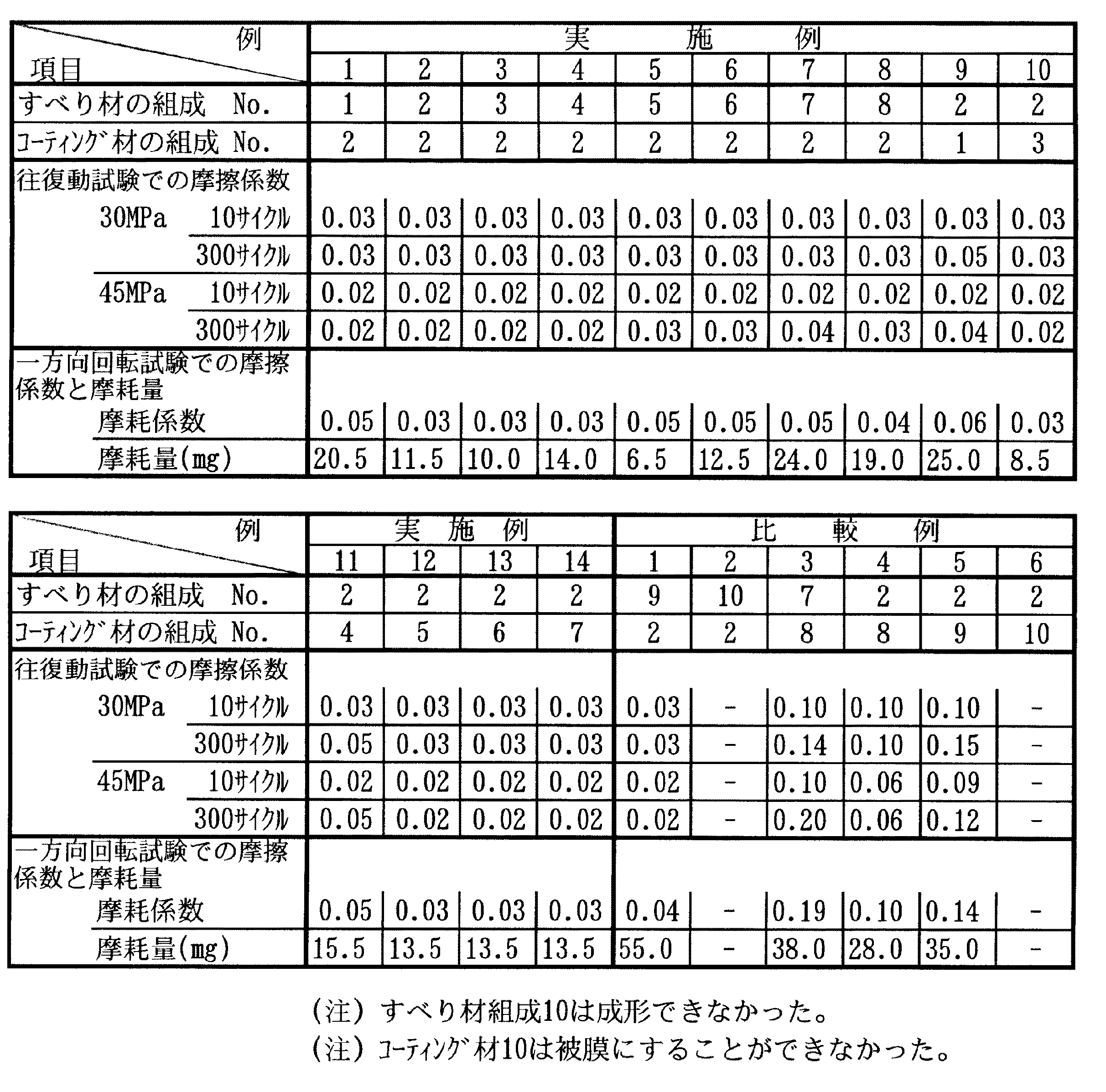
すべり材とコーティング材とを、表3に示すように組み合わせて、その摩擦摩耗試験を行なった。試験は往復動型試験機を用いた。試験条件は、すべり速度 15cm/sec、荷重 30MPa、 45MPa、ストローク±35mmで 300サイクルの往復動運転を行ない、10サイクル時および 300サイクル時の摩擦係数を測定した。また、一方向回転試験での摩擦係数と摩耗量を測定した。結果を表3に示す。
また、すべり材の圧縮特性を圧縮クリープにより求めた。圧縮クリープは、ASTM D621を参照し、常温にて面圧 30MPaおよび 45MPaで圧縮し、 24 時間後の最大変形率を求めた。結果を表1に示す。
【0033】
【表3】
表1および表3の結果から明らかなように、本発明のすべり軸受装置に用いるすべり材の圧縮クリープ特性は、 24 時間後の最大変形率が 30MPaで 15 %以下であり、 30MPaという高面圧でも使用できることが認められた。
また、本発明に係るコーティング材から得られる潤滑性被膜との組み合わせにより、実際の往復動の数十倍にあたる 300サイクルまで摩擦係数μは約 0.03 と小さく安定していた。
【0035】
【発明の効果】
本発明のすべり軸受装置は、すべり材が四フッ化エチレン系樹脂を主成分とする樹脂に繊維状配合剤および粉末状配合剤の少なくとも一つの配合剤を配合してなる樹脂組成物を成形してなり、相手材がポリイミド系樹脂および熱硬化性樹脂から選ばれた少なくとも一つの樹脂をマトリクスとする樹脂内に低分子量の潤滑成分を配合した潤滑性被膜が表面に形成されてなるので、高荷重下でも低い摩擦係数を有するすべり軸受装置が得られる。
【0036】
また、四フッ化エチレン系樹脂が変性四フッ化エチレン樹脂であるので、耐クリープ特性が向上し、すべり面を小さくでき、すべり軸受装置を含む装置の小型化が可能となる。
【0037】
四フッ化エチレン系樹脂に配合する粉末状配合剤が球状であるので、また、特に熱硬化性樹脂がフラン樹脂であるので、高荷重下、特に 30MPa程度の荷重下において、低い摩擦係数、例えば 0.03値を有するすべり軸受装置が得られる。
【0038】
相手材に配合される低分子量の潤滑成分が含フッ素重合体およびポリシロキサンから選ばれた少なくとも一つの潤滑成分であるので、上記特性がより向上する。また、すべり材、相手材相互への攻撃性が少なく、かつ摺動特性に優れる。[0001]
BACKGROUND OF THE INVENTION
The present invention relates to a sliding bearing device comprising a combination of a sliding material formed by molding a tetrafluoroethylene-based resin resin composition and a counterpart material having a lubricating coating formed on the surface thereof.
[0002]
[Prior art]
Tetrafluoroethylene resin is known as a self-lubricating material excellent in heat resistance, chemical resistance and low friction. On the other hand, because it is inferior in wear resistance and compression resistance, a tetrafluoroethylene resin composition containing short fibers such as glass fibers, carbon fibers, various whiskers, various fillers, reinforcing agents, solid lubricants, etc. It has been put into practical use (Japanese Patent Publication No. 03-2385).
In addition, when a soft material such as aluminum alloy or stainless steel or a resin material is used as the counterpart material constituting the slide bearing device, the slide material formed by molding the tetrafluoroethylene resin composition attacks the counterpart material, Wear may occur. It is thought that this is mainly because the tip of the fibrous filler such as glass fiber or carbon fiber attacks the soft material, and the wear powder acts as an abrasive powder to deteriorate it. As countermeasures, a method in which fibrous fillers are aligned during molding so as to be aligned horizontally with respect to the sliding direction, especially for carbon fibers, different pitch systems, bread systems, differences in tensile modulus and range of starting materials are different. Although limitation, limitation of aspect ratio (Japanese Patent Laid-Open No. 02-219895), or limitation of heat treatment temperature were studied, none of them was sufficient.
Aramid fibers, which are organic fibers that have relatively little attack on the mating material, also tend to attack the mating material under high load conditions, and have little contribution to compression resistance. For this reason, in order to obtain the minimum required level of compression resistance of the product, it is necessary to add another filler, and eventually the added filler attacks the counterpart material.
Next, mica, talc, graphite, etc. were also tried as flake-like fillers, but there was no improvement in attacking the other material, and as a spherical filler, the other material was used as a wholly aromatic polyester resin or polyimide resin cured pulverized powder. Although the material was not attacked, the reinforcement against wear resistance could not be expected sufficiently (Japanese Patent Laid-Open No. 04-258653).
As described above, a sliding bearing device formed by combining a sliding material formed by molding a tetrafluoroethylene resin composition and a conventional mating material is less aggressive to the mating material under high load conditions. In addition, an excellent sliding property has not been obtained.
[0003]
[Problems to be solved by the invention]
In general, the friction coefficient of a sliding material using a polymer material as a matrix material under dry friction conditions is highly dependent on the load, and is also strongly influenced by the mating material type and the surface roughness of the mating material. For example, in the case of a sliding material formed by molding a tetrafluoroethylene resin composition, the minimum friction coefficient is about 0.1 at a load of 15 MPa and about 0.06 at a load of 30 MPa.
However, in recent years, a reduction in size and weight of the device has been demanded, and a sliding bearing device used therewith is also demanded to have a lower friction coefficient. For example, with a compressor or the like, the goal is to increase the pressure of the medium and reduce the driving force, and even if it is a slip material formed by molding a tetrafluoroethylene resin composition, its friction coefficient is reduced to about 1/2 of the conventional one. There is a demand for a sliding bearing device using a sliding material formed by molding a tetrafluoroethylene resin composition that is also excellent in non-aggressiveness to the counterpart material, but a sliding bearing device that can be used under high load conditions is There is a problem that it has not been obtained yet.
[0004]
The present invention has been made to cope with such problems, and provides a sliding bearing device comprising a sliding material having a friction coefficient of about 0.03 under a high load, for example, a load of 30 MPa, and a counterpart material. Objective.
[0005]
[Means for Solving the Problems]
The present invention includes a sliding member and a mating member that slides with the sliding member, and restrains a sliding motion of a portion reciprocating on a rotating shaft, a straight line, or a curved line, and a mechanical element that supports and receives the load. A sliding bearing device comprising: a modified tetrafluoride comprising a tetrafluoroethylene unit and a substituted tetrafluoroethylene unit in which the fluorine of the tetrafluoroethylene is substituted with another organic group. A resin composition in which 5 to 40 parts by volume of at least one of a fiber compounding agent and a powder compounding agent is compounded with respect to 100 parts by volume of an ethylene resin is formed, and the counterpart material is an epoxy resin or a furan resin at least one resin relative to 100 parts by volume of resin to a matrix selected from an average molecular weight of 50,000 at least a selected from the following fluoropolymer or polysiloxane Lubricious coating the low molecular weight lubricating component by blending 5 to 40 parts by volume of the is characterized by comprising on the surface.
The sliding material and a mating material sliding with the sliding material have a coefficient of friction of 0.05 or less when slid under a load of 30 MPa.
[0007]
The powdery compounding agent to be blended is characterized by being spherical.
The thermosetting resin is a furan resin.
[0008]
In the above-mentioned plain bearing device, the compounding agent blended in the resin mainly composed of a tetrafluoroethylene resin is carbonaceous or graphite.
[0010]
In the sliding bearing device of the present invention, the sliding material is formed by molding a resin composition whose main component is a tetrafluoroethylene-based resin, and the other material is a low molecular weight lubricating component in a resin whose matrix is a thermosetting resin. By forming a lubricious coating containing, a friction coefficient of about 0.03 can be obtained even under a high load of about 30 MPa.
[0011]
DETAILED DESCRIPTION OF THE INVENTION
Among the resins mainly composed of tetrafluoroethylene resin, tetrafluoroethylene resin (PTFE) is a homopolymer of tetrafluoroethylene (tetrafluoroethylene), Algoflon (manufactured by Ausimont), Teflon (Du Pont), Fullon (ICI), Polyflon (Daikin Kogyo) and other commercially available fluororesins are softened at 310-390 ° C and compressed and extruded. It is a resin that is possible but cannot be injection molded. Furthermore, in the present invention, it is preferable that PTFE is easily mixed in a powder form.
[0012]
In the present invention, a modified tetrafluoroethylene-based resin (modified PTFE) is preferable in consideration of the allowable surface pressure of the plain bearing surface.
The modified PTFE suitable for the present invention is a modified PTFE composed of a tetrafluoroethylene unit and a substituted tetrafluoroethylene unit in which the fluorine of tetrafluoroethylene is substituted with another organic group (-X). . The general formula is shown in Chemical Formula 1. The organic group (-X) is not particularly limited, but is preferably a perfluoroalkyl ether group or a fluoroalkyl group. When the modified PTFE shown in Chemical Formula 1 is used, the creep resistance is improved and the allowable surface pressure on the sliding surface is allowed to about 30 MPa. Along with this, the sliding surface can be reduced, and the size of the device including the sliding bearing device can be reduced.
[Chemical 1]
As a polymerization method of PTFE and modified PTFE, either a suspension polymerization method for polymerizing a general molding powder or an emulsion polymerization method for polymerizing a fine powder can be adopted, but the molecular weight is preferably about 500,000 to 10 million, and further limited. 1 to 7 million is preferable.
Specific examples of commercially available modified PTFE include Teflon TG70J (Mitsui / DuPont Fluoro Chemical Co., Ltd.), Polyflon M111 and M112 (both made by Daikin Industries, Ltd.), Hostaflon TFM1600, TFM1700 (both manufactured by Hoechst), etc. Can be mentioned.
[0014]
As the compounding agent that can be incorporated into PTFE and modified PTFE, a fibrous compounding agent or a powdery compounding agent alone or a mixture can be used. The example of a typical compounding agent is described below.
Examples of the fibrous compounding agent include glass fiber or carbon fiber. The carbon fiber may be either pitch-based or bread-based carbon fiber.
The fiber length of the carbon fiber is preferably a milled fiber having a length of 0.05 mm or more and 0.1 mm or less. The yarn type is not particularly limited, but a 1,000 ° C. fired product (carbonized product) is preferable to a product (graphitized product) fired at 2,000 ° C. or higher. Moreover, either a low-temperature fired product aiming at low elasticity or a high-temperature fired product aiming at high elasticity can be used. The fiber diameter is φ20 μm or less, preferably φ5 μm to φ15 μm, and the aspect ratio is 5 to 80, preferably 20 to 50.
Specific examples of commercially available carbon fibers include Crecamildo M101S and M201S (both manufactured by Kureha Chemical Co., Ltd.), Donna Carbon S241 and S244 (all manufactured by Osaka Gas Chemical Co., Ltd.), and bread-based carbon fibers. Examples include Besfight HTA-CMF0160-0H, HTA-CMF0070-0H (both manufactured by Toho Rayon Co., Ltd.) and the like.
[0015]
Other examples of fibrous compounding agents include various whiskers of short fibers.
Examples of the whisker include calcium sulfate whisker, potassium titanate whisker, zinc oxide whisker, and magnesium sulfate whisker.
If the above-mentioned carbon fibers and whiskers are used in combination, the carbon fibers greatly reinforce the base material, whereas these whiskers play a role of micro-reinforcement, so that the creep resistance and wear resistance of the slip material are remarkably high. improves. In addition, whiskers are short fibers compared to carbon fibers, and therefore have a large presence ratio on the friction surface, and since they are responsible for most frictional shear, they do not damage the counterpart material on which the lubricating coating is formed. However, if the whisker fiber length is too short, sufficient creep resistance and wear resistance cannot be obtained, and the fiber length is preferably about 50 μm, which is slightly shorter than the carbon fiber. The whisker corresponding to this includes anhydrous salt type and hemihydrate type of calcium sulfate whisker, preferably anhydrous salt type.
Specific examples of commercially available whiskers include: Franklin fiber A-30 (anhydrous salt type), Franklin fiber H-30 (hemihydrate type) (fiber length 50-60 μm, Dainichi Seika Kogyo Co., Ltd.) ) Tismo N (fiber length 10-20 μm, manufactured by Otsuka Chemical Co., Ltd.), Thaibrak (fiber length 20 μm, manufactured by Kawatetsu Mining Co., Ltd.), and zinc oxide whisker Panatetra (fiber length 2-50 μm, Matsushita) Moss Heidi (fiber length: 10 to 30 μm, manufactured by Ube Industries Co., Ltd.) and the like can be mentioned as magnesium sulfate whiskers.
[0016]
Examples of the powder compounding agent include an organic compound powder compounding agent and an inorganic compound powder compounding agent.
The organic compound powder compounding agent is preferably a powder that can withstand a molding temperature of PTFE of 380 ° C. For example, thermoplastic polyimide resin (Mitsui Chemicals), thermosetting polyimide resin (Furon, Ube Industries), polyether ether ketone resin (Victrex MC), wholly aromatic polyester resin (Sumitomo Chemical) And aramid powder, polyamideimide resin (manufactured by Mitsubishi Kasei Co., Ltd.), and the like. In consideration of moldability and the like, an organic compound powder obtained by heat-curing and pulverizing the thermosetting resin at a high temperature of 500 ° C. or higher after curing is preferable. Further, carbonized at 1,000 ° C. or higher and graphitized at 2,000 ° C. or higher are preferable. Examples of the thermosetting resin include an epoxy resin, a polyimide resin, and a phenol resin. The average particle size after pulverization is 50 μm or less, preferably 25 μm or less, and the shape is preferably spherical. Particularly preferred is a spherical powder obtained by curing a phenolic resin in a paraform solution, followed by heat treatment and pulverization at a high temperature of 500 ° C. or higher.
Examples of commercially available spherical graphitized powder include mesocarbon beads (manufactured by Osaka Gas Chemical Co., Ltd.), bell pearl (manufactured by Kanebo Co., Ltd.), unibex (manufactured by Unitika Ltd.), and microcarbon beads (manufactured by Nippon Carbon Co., Ltd.). Etc.
[0017]
Examples of the inorganic compound powder include molybdenum disulfide, zinc oxide, titanium oxide, graphite, metal oxide powder, glass beads, and silica powder.
In consideration of the sliding bearing device, the compounding agent is preferably in the form of powder rather than the fiber because of the aggressiveness to the mating material and the stable slipping property in multiple directions. Further, it is preferable that the shape thereof is spherical because of excellent non-aggressiveness and low frictional properties against the counterpart material. Specifically, graphitized spherical powder is preferable.
[0018]
The compounding amount of the compounding agent is preferably 5 to 40 parts by volume with respect to 100 parts by volume of the modified PTFE or PTFE. If the compounding agent exceeds 40 parts by volume, there may be a problem in moldability and the lubricating coating of the counterpart material may be damaged. However, if it is less than 5 parts by volume, the reinforcing effect is poor and sufficient creep resistance and wear resistance cannot be obtained.
[0019]
The means for mixing and kneading the various raw materials used in the present invention described above is not particularly limited, and only the powder raw material may be dry-mixed with a Henschel mixer, ball mixer, ribbon blender, ladyge mixer, ultra Henschel mixer, or the like. . Furthermore, it is preferable to granulate into a granule having a predetermined particle size that matches the molding method by a wet method or the like.
As for the molding, a generally known method can be adopted. Examples include free baking, hot molding, isostatic molding, continuous ram extrusion, paste extrusion, direct molding and the like.
When used in the form of a sheet as a slip material, as a step of obtaining the general sheet, after free baking, a predetermined sheet thickness is obtained by skiving. In order to join the sliding member to a holding member such as a housing, one surface of the sliding member is etched to be in an adhesive state. Thereafter, the holding member is joined with an epoxy, phenol or polyimide adhesive.
[0020]
Next, the lubricating film formed on the surface of the mating material that slides with the sliding material will be described. The lubricating coating is obtained by applying and baking a coating agent containing a low molecular weight lubricating component in a resin having at least one resin selected from a polyimide resin and a thermosetting resin as a matrix.
In consideration of weather resistance, the matrix resin uses polyimide resin such as polyamideimide resin, thermoplastic and thermosetting polyimide resin, or epoxy resin, polyimide resin, phenol resin, furan resin, etc. of thermosetting resin as a solvent. Those dispersed are preferred. In particular, furan resins are preferable because they have particularly excellent weather resistance.
Examples of solvents include N, N-dimethylformamide, N, N-dimethylacetamide, N-methyl-2-pyrrolidone (NMP), methyl ethyl ketone, methyl glycol acetate, 2-nitropropane, ethylene glycol acetate, toluene, cresyl An acid etc. are mentioned, A mixture thereof may be sufficient.
The low molecular weight lubricating component that can be mixed into the matrix resin is preferably a fluoropolymer and polysiloxane having an average molecular weight of 50,000 or less, preferably 10,000 or less.
[0021]
The fluorine-containing polymer is preferably a fluorine-containing polymer such as a polyfluoroalkyl polymer or a fluoropolyether polymer.
Here, the polyfluoroalkyl polymer, for example, CF 3 (CF 2) 7 -, H (CF 2) 6 -, CF 2 Cl (CF 2) CF 11 -, (CF 3) 2 CF (CF 2 ) 7 -, CF 2 Cl ( CF 3) CF (CF 2) 7 - is a polymer having a polyfluoroalkyl group, such as, fluoropolyether polymer have the general formula, -C X F 2X -O- ( X is an integer of 1 to 4). The polymer is a polymer having a main structural unit and a number average molecular weight of 1,000 to 50,000. In such a fluoropolymer, a functional group having a high affinity for a smooth member such as a metal, for example, glycidyl group, epoxy group, amino group, carboxyl group, hydroxyl group, mercapto group, isocyanate group, sulfone group, ester group The fluorine-containing polymer having these functional groups is preferably a fluorine-containing polymer having no functional group because there is a possibility that the sliding properties and weather resistance may not be satisfied.
[0022]
A general formula of a polyorganosiloxane containing no functional group, for example, a polysiloxane mainly composed of a linear organopolysiloxane block is shown in Chemical Formula 2. An example is shown in Chemical formula 3.
[Chemical 2]
[Chemical 3]
[0023]
Another form of polysiloxane is an organosilane composed mainly of alkoxysilane or carbon functional silane. These organosilanes may be combined, or these organosilanes may be blended with colloidal silica or acrylic polymer. Preferable organosilanes can be exemplified by chemical formula 4, for example.
[Formula 4]
[0024]
As the above-mentioned fluoropolymer or polysiloxane holding material, a silicone resin powder as the organic compound and a general carbon powder or graphite powder as the inorganic compound may be blended. However, the particle size of these compounding agents is preferably 1 to 10 μm.
The blending amount of the fluoropolymer or polysiloxane is preferably 5 to 40 parts by volume with respect to 100 parts by volume of the matrix resin. If the blending amount exceeds 40 parts by volume, the adhesion strength of the film may be lowered, and the wear resistance may be lowered. If the amount is less than 5 parts by volume, a low friction coefficient cannot be obtained.
The film thickness is preferably 5 μm or more and 30 μm or less. This is because if the thickness is less than 5 μm, the durability is inferior, and if it exceeds 30 μm, the coating workability becomes difficult, and a stable coating is difficult to obtain.
The surface roughness of the film is preferably 0.5 to 2.5 μm in terms of arithmetic mean roughness Ra. When the sliding material is a flat plate, the overall shape is not a concave shape but rather a gentle convex shape (0.1 to 1.0 mm) is preferred.
[0025]
The means for mixing and kneading the raw materials used in the present invention described above is not particularly limited, and the matrix resin and other compounding agents may be mixed together in a ball tumbler mixer and kneaded for a predetermined time. Moreover, what is necessary is just to bake after the general spray coating for the formation method of a film.
[0026]
Since the sliding bearing device of the present invention uses a sliding material having a low friction coefficient, it can be used without depending on the load, speed, and the like. In particular, it is considered that the effect at high load is great. Even if the lubrication condition is dry friction or the boundary lubrication condition with oil or the like, the low friction effect of the contact portion can be obtained. The sliding bearing device of the present invention can be used for a bearing device specifically as follows, for example.
Slide bearings that prevent leakage of media (refrigerant, water, air, special gas, etc.) in compressors, slide bearings around oil seals of automobiles and motorcycles, slide bearings around gasoline supply system oil seals, around intake and exhaust system seals Slide bearings, bearings around transmissions, bearings around steering gears, slide bearings of machine parts, slide bearings of rotating parts, slide bearings of optical pickups such as compact disks or DVDs, slide bearings that serve as guide rollers for tapes, Slide bearings around toner in electronic copiers, slide bearings in paper passages in electronic copiers, slide bearings around switching valves for cup juice vending machines, slide bearings around water purifiers and mixer taps for household use, Kneading of foods such as plain bearings, breads and gruels for switching valves in general production lines Sliding bearing around use, water supply and sewage water stop valves near the sliding bearing, the sliding bearing industrial piston acids can be exemplified.
[0027]
【Example】
The material used for an Example and a comparative example is shown below. Tables 1 and 2 show the blending ratios of Examples and Comparative Examples using these materials.
1. Tetrafluoroethylene resin (1) Modified PTFE Teflon TG70J (Mitsui / DuPont Fluorochemicals)
(2) General PTFE Teflon 7J (Mitsui / DuPont Fluorochemicals)
2. Compounding agent (1) CF-1 (pitch-based carbon fiber) Crecamill M101S (Kureha Chemical Co., Ltd.)
(2) Spheroidal graphite Bell Pearl C2000 (manufactured by Kanebo Co., Ltd.)
(3) Calcium sulfate whisker Franklin fiber A-30 (anhydrous salt type) (Daiichi Seika Kogyo Co., Ltd.)
(4) Glass fiber MF-KAC (Asahi Fiber Glass Co., Ltd.)
(5) Graphite ACP (Nippon Graphite Co., Ltd.)
3. 3. Matrix resin (1) Epoxy resin (2) Furan resin Low molecular weight lubricating component (1) Fluoropolymer Fomblin Z25 (Ausimont)
(2) Polysiloxane Dimethylsiloxane (made by Toray Dow Corning)
5. Others (1) Carbon Black FEF (Tokai Carbon Co., Ltd.)
(2) Silicone powder E501 (Toray Dow Corning)
[0028]
Using the above materials, sliding materials 1 to 10 and coating materials 1 to 10 for forming a lubricating film were prepared by the following method.
The slip material is dry blended with the composition shown in Table 1 using a Henschel dry mixer, and pre-formed into a cylindrical shape of φ124mm x φ64mm x 100mm using a press machine, 370 ° C x 4 hours, free baking method Baked in. Furthermore, sheet test pieces of 1 mm x 80 mm x 1,000 mm were obtained by skiving. One side of the sheet was etched by alkali treatment to allow adhesion. One surface of a stainless steel jig (20 mm × 20 mm × 10 mm) was bonded with an epoxy adhesive to obtain a sliding material test piece for measuring the friction coefficient μ.
[0029]
[Table 1]
On the other hand, the coating material was kneaded with the composition shown in Table 2 using a ball mill tumbler to obtain a coating solution. One surface of a stainless steel plate (40 mm × 40 mm × 180 mm) was spray coated and baked at 200 ° C for about 30 minutes to obtain a smooth plate on which a lubricating film was formed. The film thickness was about 10 to 15 μm.
[0031]
[Table 2]
Examples 1 to 14 and Comparative Examples 1 to 6
The sliding material and the coating material were combined as shown in Table 3, and the friction and wear test was performed. A reciprocating tester was used for the test. The test conditions were a reciprocating operation of 300 cycles at a sliding speed of 15 cm / sec, a load of 30 MPa and 45 MPa, a stroke of ± 35 mm, and the friction coefficient at 10 cycles and 300 cycles was measured. Moreover, the friction coefficient and the amount of wear in the unidirectional rotation test were measured. The results are shown in Table 3.
Further, the compression characteristics of the sliding material were determined by compression creep. For compression creep, ASTM D621 was referred to, and compression was performed at room temperature at 30 MPa and 45 MPa, and the maximum deformation rate after 24 hours was determined. The results are shown in Table 1.
[0033]
[Table 3]
As is apparent from the results of Tables 1 and 3, the compression creep characteristics of the sliding material used in the sliding bearing device of the present invention has a maximum deformation rate of 15 MPa or less at 30 MPa after 24 hours, and a high surface pressure of 30 MPa. But it was recognized that it could be used.
In addition, the combination with the lubricating coating obtained from the coating material according to the present invention, the friction coefficient μ was as small as about 0.03 and stable up to 300 cycles, which is several tens of times the actual reciprocation.
[0035]
【The invention's effect】
The sliding bearing device of the present invention is formed by molding a resin composition in which a sliding material is a resin containing a tetrafluoroethylene-based resin as a main component and at least one compounding agent of a fiber compounding agent and a powder compounding agent. Since the mating material is formed on the surface with a lubricating film in which a low molecular weight lubricating component is blended in a resin having at least one resin selected from a polyimide resin and a thermosetting resin as a matrix. A plain bearing device having a low coefficient of friction even under load can be obtained.
[0036]
Further, since the tetrafluoroethylene-based resin is a modified tetrafluoroethylene resin, the creep resistance is improved, the sliding surface can be reduced, and the size of the device including the sliding bearing device can be reduced.
[0037]
Since the powdery compounding agent blended with the tetrafluoroethylene-based resin is spherical, and especially the thermosetting resin is a furan resin, a low coefficient of friction, for example, under a load of about 30 MPa, for example, under a high load. A plain bearing device having a 0.03 value is obtained.
[0038]
Since the low molecular weight lubricating component blended in the counterpart material is at least one lubricating component selected from a fluoropolymer and polysiloxane, the above characteristics are further improved. In addition, there is little attacking property against the sliding material and the mating material, and excellent sliding properties.
Claims (4)
前記すべり材は、四フッ化エチレン単位と、四フッ化エチレンのフッ素が他の有機基で置換された置換四フッ化エチレン単位とから構成される変性四フッ化エチレン樹脂100体積部に対して繊維状配合剤および粉末状配合剤の少なくとも一つの配合剤を5〜40体積部配合する樹脂組成物を成形してなり、
前記相手材は、エポキシ樹脂またはフラン樹脂から選ばれた少なくとも一つの樹脂をマトリクスとする樹脂100体積部に対して、平均分子量50,000以下の含フッ素重合体またはポリシロキサンから選ばれた少なくとも一つの低分子量潤滑成分を5〜40体積部配合した潤滑性被膜が表面に形成されてなることを特徴とするすべり軸受装置。A sliding bearing device comprising a sliding member and a mechanical element that includes a sliding member and a mating member that slides with the sliding member, restrains the sliding motion of a portion reciprocating on a rotating shaft, a straight line, or a curved line, and supports it under the load. Because
The sliding material is based on 100 parts by volume of a modified tetrafluoroethylene resin composed of a tetrafluoroethylene unit and a substituted tetrafluoroethylene unit in which fluorine of tetrafluoroethylene is substituted with another organic group. Molding a resin composition containing 5 to 40 parts by volume of at least one compounding agent of a fibrous compounding agent and a powdery compounding agent,
The counterpart material is at least one selected from a fluoropolymer having an average molecular weight of 50,000 or less or polysiloxane with respect to 100 parts by volume of a resin having at least one resin selected from epoxy resin or furan resin as a matrix. A sliding bearing device comprising a lubricating film containing 5 to 40 parts by volume of a low molecular weight lubricating component formed on the surface.
Priority Applications (1)
| Application Number | Priority Date | Filing Date | Title |
|---|---|---|---|
| JP34345598A JP4046875B2 (en) | 1998-12-02 | 1998-12-02 | Slide bearing device |
Applications Claiming Priority (1)
| Application Number | Priority Date | Filing Date | Title |
|---|---|---|---|
| JP34345598A JP4046875B2 (en) | 1998-12-02 | 1998-12-02 | Slide bearing device |
Publications (2)
| Publication Number | Publication Date |
|---|---|
| JP2000170770A JP2000170770A (en) | 2000-06-20 |
| JP4046875B2 true JP4046875B2 (en) | 2008-02-13 |
Family
ID=18361661
Family Applications (1)
| Application Number | Title | Priority Date | Filing Date |
|---|---|---|---|
| JP34345598A Expired - Lifetime JP4046875B2 (en) | 1998-12-02 | 1998-12-02 | Slide bearing device |
Country Status (1)
| Country | Link |
|---|---|
| JP (1) | JP4046875B2 (en) |
Families Citing this family (6)
| Publication number | Priority date | Publication date | Assignee | Title |
|---|---|---|---|---|
| JP4944323B2 (en) * | 2001-09-26 | 2012-05-30 | オイレス工業株式会社 | Polyacetal resin composition and sliding member formed by molding the same |
| JP4953222B2 (en) * | 2005-05-20 | 2012-06-13 | 本田技研工業株式会社 | Sphere seal |
| JP2007224118A (en) * | 2006-02-22 | 2007-09-06 | Unitika Ltd | Resin composition |
| JP4812823B2 (en) * | 2008-10-27 | 2011-11-09 | Ntn株式会社 | Multilayer bearing manufacturing method |
| JP2011241308A (en) * | 2010-05-19 | 2011-12-01 | Du Pont Mitsui Fluorochem Co Ltd | Modified polytetrafluoroethylene composition |
| WO2023068102A1 (en) * | 2021-10-21 | 2023-04-27 | トライス株式会社 | Graphite bearing and method for manufacturing same |
Family Cites Families (9)
| Publication number | Priority date | Publication date | Assignee | Title |
|---|---|---|---|---|
| JPS6249017A (en) * | 1985-08-28 | 1987-03-03 | Koyo Seiko Co Ltd | Rolling bearing |
| JP3590412B2 (en) * | 1992-07-30 | 2004-11-17 | オイレス工業株式会社 | Multi-layer sliding member |
| JPH06184385A (en) * | 1992-12-18 | 1994-07-05 | Ntn Corp | Tetrafluoroethylene resin composition |
| JPH0687718U (en) * | 1993-05-31 | 1994-12-22 | 日星電気株式会社 | Bearing device |
| JP3050048B2 (en) * | 1994-07-27 | 2000-06-05 | 株式会社阪上製作所 | Fluororesin composition for sliding members |
| JPH1036868A (en) * | 1996-07-30 | 1998-02-10 | Hitachi Chem Co Ltd | Carbon sliding material and method for producing the same |
| JPH10146485A (en) * | 1996-11-18 | 1998-06-02 | Hirose Mfg Co Ltd | Rotating hook of sewing machine |
| JPH1121405A (en) * | 1997-06-30 | 1999-01-26 | Ntn Corp | Pressure-resistant sliding polytetrafluoroethylene resin composition |
| JP2000074136A (en) * | 1998-08-28 | 2000-03-07 | Oiles Ind Co Ltd | Sliding structure combining two sliding members and slide bearing device using the same |
-
1998
- 1998-12-02 JP JP34345598A patent/JP4046875B2/en not_active Expired - Lifetime
Also Published As
| Publication number | Publication date |
|---|---|
| JP2000170770A (en) | 2000-06-20 |
Similar Documents
| Publication | Publication Date | Title |
|---|---|---|
| CN103201531B (en) | Composite sliding bearings | |
| JPH07268126A (en) | Lubricating resin composition | |
| CN107110212B (en) | Water-lubricated bearing material | |
| JP5616981B2 (en) | Seal ring for continuously variable transmission | |
| CN104945795B (en) | Seals for motor vehicles or seals or sliding members for industrial gas compressors | |
| CN110099973A (en) | Polymer material based on polyether ketone ketone is used to reduce the purposes of abrasion | |
| JP5444420B2 (en) | Seal member | |
| JP4046875B2 (en) | Slide bearing device | |
| JP2001089780A (en) | Lubricating resin composition and seal ring | |
| JPH083538A (en) | Sealant composition for scroll-type compressor | |
| JP4262341B2 (en) | Slip isolation device and isolation structure | |
| US6255380B1 (en) | Pressure-resistant, sliding tetrafluoroethylene resin composition | |
| JP2007192242A (en) | Piston ring made of melt-moldable thermoplastic polyimide resin | |
| JPH10158456A (en) | Lubricating resin composition | |
| JPH08231165A (en) | Guide shoe | |
| JPH0920883A (en) | Seal member composition for scroll type compressor | |
| JP3629306B2 (en) | V ring | |
| JP2002128981A (en) | Pressure-resistant sliding tetrafluoroethylene resin composition | |
| JPH0987533A (en) | Composition for sliding member | |
| JPH1121405A (en) | Pressure-resistant sliding polytetrafluoroethylene resin composition | |
| JP3576253B2 (en) | Seal member composition for scroll compressor | |
| JPH09151313A (en) | Heat-resistant and lubricating resin composition | |
| JPH0649438A (en) | Valve stem oil seal material | |
| JP2975215B2 (en) | Tip seal | |
| JPH0920861A (en) | Sealing member composition for scroll-type compressor |
Legal Events
| Date | Code | Title | Description |
|---|---|---|---|
| A621 | Written request for application examination |
Free format text: JAPANESE INTERMEDIATE CODE: A621 Effective date: 20040407 |
|
| A131 | Notification of reasons for refusal |
Free format text: JAPANESE INTERMEDIATE CODE: A131 Effective date: 20060801 |
|
| A977 | Report on retrieval |
Free format text: JAPANESE INTERMEDIATE CODE: A971007 Effective date: 20060728 |
|
| A521 | Written amendment |
Free format text: JAPANESE INTERMEDIATE CODE: A523 Effective date: 20061002 |
|
| A02 | Decision of refusal |
Free format text: JAPANESE INTERMEDIATE CODE: A02 Effective date: 20070410 |
|
| A521 | Written amendment |
Free format text: JAPANESE INTERMEDIATE CODE: A523 Effective date: 20070608 |
|
| A521 | Written amendment |
Free format text: JAPANESE INTERMEDIATE CODE: A523 Effective date: 20070720 |
|
| A911 | Transfer to examiner for re-examination before appeal (zenchi) |
Free format text: JAPANESE INTERMEDIATE CODE: A911 Effective date: 20070726 |
|
| TRDD | Decision of grant or rejection written | ||
| A01 | Written decision to grant a patent or to grant a registration (utility model) |
Free format text: JAPANESE INTERMEDIATE CODE: A01 Effective date: 20071106 |
|
| A61 | First payment of annual fees (during grant procedure) |
Free format text: JAPANESE INTERMEDIATE CODE: A61 Effective date: 20071121 |
|
| FPAY | Renewal fee payment (event date is renewal date of database) |
Free format text: PAYMENT UNTIL: 20101130 Year of fee payment: 3 |
|
| R150 | Certificate of patent or registration of utility model |
Free format text: JAPANESE INTERMEDIATE CODE: R150 |
|
| FPAY | Renewal fee payment (event date is renewal date of database) |
Free format text: PAYMENT UNTIL: 20111130 Year of fee payment: 4 |
|
| FPAY | Renewal fee payment (event date is renewal date of database) |
Free format text: PAYMENT UNTIL: 20121130 Year of fee payment: 5 |
|
| FPAY | Renewal fee payment (event date is renewal date of database) |
Free format text: PAYMENT UNTIL: 20121130 Year of fee payment: 5 |
|
| FPAY | Renewal fee payment (event date is renewal date of database) |
Free format text: PAYMENT UNTIL: 20131130 Year of fee payment: 6 |
|
| R250 | Receipt of annual fees |
Free format text: JAPANESE INTERMEDIATE CODE: R250 |
|
| R250 | Receipt of annual fees |
Free format text: JAPANESE INTERMEDIATE CODE: R250 |
|
| R250 | Receipt of annual fees |
Free format text: JAPANESE INTERMEDIATE CODE: R250 |
|
| R250 | Receipt of annual fees |
Free format text: JAPANESE INTERMEDIATE CODE: R250 |
|
| R250 | Receipt of annual fees |
Free format text: JAPANESE INTERMEDIATE CODE: R250 |
|
| EXPY | Cancellation because of completion of term |