JP4040799B2 - Paste for electrode, paste-type hydrogen storage alloy electrode, method for producing this electrode, and nickel hydrogen storage battery - Google Patents
Paste for electrode, paste-type hydrogen storage alloy electrode, method for producing this electrode, and nickel hydrogen storage battery Download PDFInfo
- Publication number
- JP4040799B2 JP4040799B2 JP21840299A JP21840299A JP4040799B2 JP 4040799 B2 JP4040799 B2 JP 4040799B2 JP 21840299 A JP21840299 A JP 21840299A JP 21840299 A JP21840299 A JP 21840299A JP 4040799 B2 JP4040799 B2 JP 4040799B2
- Authority
- JP
- Japan
- Prior art keywords
- paste
- electrode
- hydrogen storage
- storage alloy
- nickel
- Prior art date
- Legal status (The legal status is an assumption and is not a legal conclusion. Google has not performed a legal analysis and makes no representation as to the accuracy of the status listed.)
- Expired - Fee Related
Links
Images
Classifications
-
- Y—GENERAL TAGGING OF NEW TECHNOLOGICAL DEVELOPMENTS; GENERAL TAGGING OF CROSS-SECTIONAL TECHNOLOGIES SPANNING OVER SEVERAL SECTIONS OF THE IPC; TECHNICAL SUBJECTS COVERED BY FORMER USPC CROSS-REFERENCE ART COLLECTIONS [XRACs] AND DIGESTS
- Y02—TECHNOLOGIES OR APPLICATIONS FOR MITIGATION OR ADAPTATION AGAINST CLIMATE CHANGE
- Y02E—REDUCTION OF GREENHOUSE GAS [GHG] EMISSIONS, RELATED TO ENERGY GENERATION, TRANSMISSION OR DISTRIBUTION
- Y02E60/00—Enabling technologies; Technologies with a potential or indirect contribution to GHG emissions mitigation
- Y02E60/10—Energy storage using batteries
Landscapes
- Battery Electrode And Active Subsutance (AREA)
- Secondary Cells (AREA)
Description
【0001】
【発明の属する技術分野】
本発明は、水素吸蔵合金を活物質とする電極用ペ―ストと、これを導電性基材に塗布し、乾燥してなるペ―スト式水素吸蔵合金電極と、この電極の製造方法と、さらにこの電極を負極として用いたニツケル水素蓄電池とに関する。
【0002】
【従来の技術】
ニツケル水素蓄電池は、水素を負極活物質として動作するものであり、可逆的に水素を吸蔵・放出することができる水素吸蔵合金を導電性基材に担持させてなる水素吸蔵合金電極と、通常、正極活物質として動作するニツケル水酸化物を導電性基材に担持してなるニツケル極とを、セパレ―タを介してアルカリ電解液中に配置することにより、構成されている。
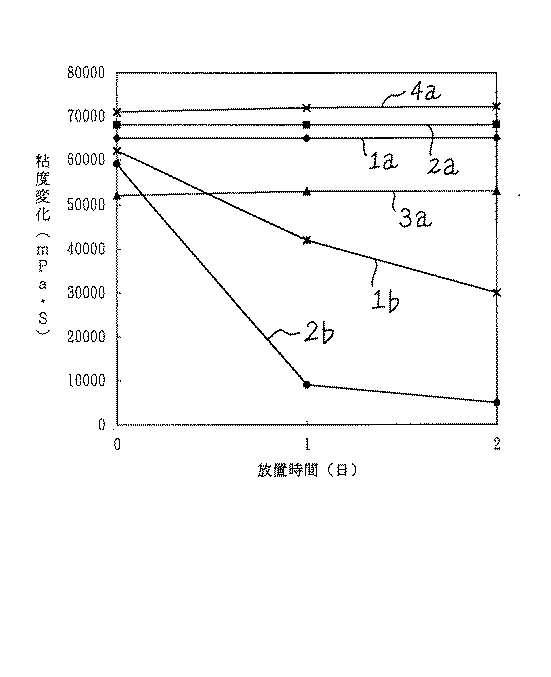
【0003】
上記の水素吸蔵合金電極は、たとえば、粉末状の水素吸蔵合金を活物質とし、これを高分子結着剤などとともに溶剤に分散させた電極用ペ―ストを調製し、これを導電性基材に塗布し、乾燥することにより、製造される。
【0004】
このようなペ―スト式水素吸蔵合金電極を工業的に量産するには、電極用ペ―ストを塗布工程に連続的に供給して、ラインを停止することなく連続塗布する方法が採用される。この場合、ペ―スト調製時から塗布完了時までに長時間を要しているのが実状であり、したがつて、電極用ペ―ストには成分、組成、粘度などの経時変化の少ない安定性が求められる。とくに、上記の量産化方法では塗布速度の問題から塗布工程が律速段階となり、ペ―スト調製時から塗布時までに数日間かかることが多く、長時間の安定性が要求される。
【0005】
【発明が解決しようとする課題】
しかるに、従来の電極用ペ―ストは、調製後、経時的に粘度が低下する傾向があり、このため、得られる水素吸蔵合金電極は、連続塗布における塗布開始時と塗布終了時とで電極重量などの特性面で均一性が損なわれ、とくに高容量化のために水素吸蔵合金粉末の充填性を高めたものでは、ペ―ストの安定性がさらに劣化するため、上記均一性がより一段と損なわれやすい。その結果、この水素吸蔵合金電極を用いて組み立てられたニツケル水素蓄電池は、容量のバラツキが生じやすくなり、歩留りの低下を招くという問題があつた。
【0006】
また、上記の電極用ペ―ストは、本来、結着剤や増粘剤を含有して粘着性が高いため、連続塗布の立ち上げ時に流動性が不足し、塗布開始後所定の厚みになるまでの塗布分は、性状の安定しない、電極への利用が不可能な不要部分として、廃棄している。すなわち、基材上の上記塗布分のペ―スト乾燥物をかき落として廃棄したり、また基材が発泡体であるときは発泡体内部にペ―ストが充填されているため、かき落とすこともできず、基材に充填したままの状態で廃棄している。しかし、このような廃棄は、省資源や製品の歩留りの点で問題があつた。
【0007】
電極用ペ―ストの安定性に関しては、特開平5−280363号、同7−114923号、同9−204917号などの公報には、ペ―ストの調製にあたつて一定温度以上に制御したり、ペ―ストの調製後および塗布時の温度を10〜15℃に保持したり、調製後のペ―ストを一定時間放置して粘度を増大させ、その後再度混練して塗布するなどの改良方法が種々提案されている。しかし、いずれの提案によつても、十分な安定性は得られていない。また、特開平4−82161号公報には、ペ―スト中にキレ―ト剤を添加して、ペ―スト自体の安定性を向上させるという提案がなされているが、キレ―ト剤を添加することにより電池容量が低下するという別の問題があつた。さらに、上記いずれの提案によつても、塗布立ち上げ時の不要部分のペ―スト乾燥物の廃棄による省資源や製品の歩留りの問題については、なんら解決できるものではなかつた。
【0008】
本発明は、かかる事情に照らし、上記とは異なる手法により粘度などの経時変化が長時間にわたり起こりにくい安定性にすぐれた電極用ペ―ストを得ること、また、このペ―ストを用いて連続塗布における塗布開始時と塗布終了時とで電極重量などの特性面での均一性が保持されたペ―スト式水素吸蔵合金電極を得ること、さらに、このような電極の製造にあたり、塗布立ち上げ時の不要部分のペ―スト乾燥物の廃棄による省資源や製品の歩留りの問題を回避すること、また、上記の水素吸蔵合金電極を負極に用いて容量のバラツキの少ない生産性にすぐれたニツケル水素蓄電池を得ることを目的としている。
【0009】
【課題を解決するための手段】
本発明者らは、上記の目的を達成するため、鋭意検討した結果、水素吸蔵合金を活物質とする電極用ペ―スト中にポリN−ビニルアセトアミドまたはこれとゴム系高分子を含ませると、粘度などの経時変化が長時間にわたり起こりにくい安定性にすぐれた電極用ペ―ストを得ることができ、このペ―ストを用いることにより連続塗布における塗布開始時と塗布終了時とで電極重量などの特性面での均一性が保持されたペ―スト式水素吸蔵合金電極が得られ、またこのような電極の製造にあたり、塗布立ち上げ時の不要部分のペ―スト乾燥物を回収してこれに溶剤を加えると、上記とほぼ同様の安定性にすぐれた電極用ペ―ストを再生でき、これを再利用することで、従来のような不要部分の廃棄による省資源や製品の歩留りの問題を回避することができ、さらに上記の水素吸蔵合金電極を負極に用いることで容量のバラツキの少ない生産性にすぐれたニツケル水素蓄電池が得られることを知り、本発明を完成するに至つたものである。
【0010】
すなわち、本発明は、水素吸蔵合金を活物質とする電極用ペ―ストにおいて、ポリN−ビニルアセトアミドとゴム系高分子を含むことを特徴とする電極用ペ―スト(請求項1)に係るものである。また、本発明は、導電性基材に上記構成の電極用ペ―ストを塗布し、乾燥してなるペ―スト式水素吸蔵合金電極(請求項2)と、このような電極の製造方法として、導電性基材上の不要部分のペ―スト乾燥物を回収し、これに溶剤を加えて電極用ペ―ストとして再利用することを特徴とするペ―スト式水素吸蔵合金電極の製造方法(請求項3)に係るものである。
さらに、本発明は、上記の水素吸蔵合金電極からなる負極と、ニツケル極からなる正極と、上記の負極と正極との間に介装されたセパレ―タと、アルカリ電解液とを備えていることを特徴とするニツケル水素蓄電池(請求項4)に係るものである。
【0011】
【発明の実施の形態】
本発明において、ポリN−ビニルアセトアミドが電極用ペ―ストの安定性に好結果を与える理由は、つぎのように考えられる。水素吸蔵合金は表面が活性で、ペ―ストの調製後、長時間放置すると合金中の一部の遷移金属イオンが溶出し、これがペ―スト中の結着剤や増粘剤などの有機物の酸化分解を促進し、上記有機物の分子量を低下させて粘度を低下させ、また分解物が水素吸蔵合金表面に不可逆的に吸着して粘度低下を助長する。このペ―スト中にポリN−ビニルアセトアミドを含ませると、これが水素吸蔵合金表面に優先的に吸着して有機層を形成し、この有機層がペ―スト中の結着剤や増粘剤などの酸化分解を抑え、かつこの有機層自体は遷移金属イオンにより主鎖が切断されにくい構造的に安定な化合物のため、ペ―ストの安定性が高度に向上してくるものと思われる。
【0012】
本発明に用いられるポリN−ビニルアセトアミドとしては、重量平均分子量が10,000〜10,000,000、好ましくは50,000〜5,000,000であるのがよい。重量平均分子量を10,000以上とすることにより、水素吸蔵合金表面への高い吸着効果が得られ、また、重量平均分子量を10,000,000以下とすることにより、ペ―ストの極端な増粘を抑制でき、高容量化のために薄膜化した水素吸蔵合金電極とする場合でも、連続塗布性にすぐれたペ―ストを得ることができる。
【0013】
このようなポリN−ビニルアセトアミドの使用量は、水素吸蔵合金100重量部に対して、通常0.03〜5重量部、好ましくは0.1〜3重量部、より好ましくは0.2〜2重量部とするのがよい。0.03重量部以上とすることにより、ポリN−ビニルアセトアミドの吸着層が水素吸蔵合金表面を十分に被覆でき、結着剤や増粘剤などの酸化分解を抑制して、長時間放置後でも粘度の低下を極めて少なくすることができ、また5重量部以下とすることにより、活物質である水素吸蔵合金の充填性を向上させることができる。
【0014】
本発明において、上記のポリN−ビニルアセトアミドとともに、ゴム系高分子を併用すると、ペ―ストの安定性がより一層向上する。このようなゴム系高分子としては、スチレンと2−エチルヘキシルアクリレ―トを主成分とした共重合体が最も好ましく、その他、スチレン−ブタジエン共重合体、天然ゴム、スチレン−イソプレン共重合体、シリコンゴムなどが用いられる。
【0015】
このようなゴム系高分子は、水素吸蔵合金との相互作用が少ないため、長時間放置により合金表面から遷移金属イオンが溶出しても、酸化分解される量が少なく、ポリN−ビニルアセトアミドの酸化分解の抑制効果がより良く発揮されるとともに、少量の使用で導電性基材へのペ―ストの結着性を向上でき、水素吸蔵合金の充填性の向上に寄与させることができる。
【0016】
上記のゴム系高分子の使用量としては、水素吸蔵合金100重量部に対して、通常0.1〜5重量部、好ましくは0.2〜2重量部とするのがよい。0.1重量部以上とすることにより、ペ―ストの導電性基材への良好な結着性を確保することができ、また5重量部以下にすることにより、ペ―スト中の水素吸蔵合金の充填密度の低下を防止することができる。
【0017】
本発明においては、水素吸蔵合金を活物質とし、これに上記のポリN−ビニルアセトアミドを含ませ、また好ましくはさらに上記のゴム系高分子を含ませて、これらを常法によりペ―スト化することにより、電極用ペ―ストを調製する。このペ―ストの調製にあたり、溶剤として、たとえば、水またはメタノ―ル、エタノ―ル、イソプロパノ―ルなどのアルコ―ル性溶剤が用いられる。これらは、それぞれを単独で用いてもよいし、2種以上を併用してもよい。
【0018】
水素吸蔵合金としては、Zr、Ni、Mnなどを主体としたAB2型合金、Mm(La、Ce、Nd、Pr)−Ni系などのAB5型合金があり、これらの中でも、Mm−Ni系の合金でNiの一部をMn、Co、Al、Mg、Cu、Crからなる群から選ばれる少なくとも1種で置換した合金が好ましく、これらは低い水素平衡圧で高容量化を期待できるが、遷移金属にMnを含む合金では、Mnがイオンとしてペ―スト中に溶出しやすく、ペ―スト調製時の粘度変化が大きいことから、本発明にとくに有用である。また、複数の遷移金属で置換した水素吸蔵合金の中でも、Mm中の希土類元素のLaなどの含有量を多くした高容量の非化学量論組成の水素吸蔵合金(たとえば、Mm1に対して他のNi、Co、Mn、Alなどの合計量が5.02〜5.45である水素吸蔵合金)は、遷移金属が合金表面に多く存在し、遷移金属イオンの溶出量が多くなるため、本発明にとくに有用である。
【0019】
この電極用ペ―スト中には、必要により、従来から用いられている結着剤や増粘剤を配合してもよい。結着剤としては、ポリテトラフルオロエチレン、ポリエチレンなどが挙げられ、増粘剤としては、メチルセルロ―ス、ヒドロキシプロピルセルロ―ス、カルボキシメチルセルロ―ス、ポリアクリルアミド、ポリビニルピロリドン、ポリエチレンオキシド、ポリビニルアルコ―ルなどが挙げられる。これらの結着剤や増粘剤の使用量としては、遷移金属イオンによる酸化分解および水素吸蔵合金の充填性を考えると、水素吸蔵合金100重量部に対して、通常0.01〜1重量部とするのが好ましい。
【0020】
また、上記のペ―スト中には、従来から用いられている導電剤を配合してもよい。この導電剤にはニツケル粉、コバルト粉、銅粉、カ―ボン粉などがあるが、これらの中でも、粒径が5μm以下で、酸素含有量が0.2〜1.5重量%であるニツケル粉を用いるのが最も好ましい。導電剤は、水素吸蔵合金の導電性を高めて負極としての集電能を向上させ、また水素吸蔵合金の充填性を向上させるため、微粒子状態のものが用いられるが、このような微粒子状態のものは、通常、粒子同士が凝集しやすく、均一なペ―ストの調製に難があり、増粘化しやすい。しかし、上記の特定酸素含有量のニツケル粉は、結着剤の吸着形態を改善し、また少量の結着剤量でもニツケル粉の分散性が良くなり、均一なペ―ストの調製を可能にするとともに、ペ―ストの増粘化も低下できる。
【0021】
本発明においては、このように調製される電極用ペ―ストを、導電性基材に塗布し、乾燥することにより、またその後必要によりプレス処理することにより、ペ―スト式水素吸蔵合金電極を作製する。上記の導電性基材としては、パンチングメタル、発泡メタルなどの耐アルカリ性金属多孔体などが用いられる。パンチングメタルは、三次元構造を有する発泡メタルに比べて、集電能に劣るが、導電剤である前記ニツケル粉を用いることにより、集電効果が高められる。
【0022】
また、上記の塗布工程では、量産化のために、連続塗布方式が採用されるが、電極用ペ―ストの長時間安定性により、塗布開始時から塗布終了時にわたつて安定した塗布量を確保でき、その結果、得られるペ―スト式水素吸蔵合金電極は、重量などの特性面で均一性が保たれたものとなる。さらに、乾燥工程では、乾燥温度を50〜100℃の範囲に設定するのが望ましい。50℃以上とすることにより、塗布ペ―ストを十分に乾燥でき、その後のブレス処理による圧延を良好に行える。また、100℃以下とすることにより、結着剤や増粘剤の酸化を防ぎ、分解を抑制することができるので、ペ―スト乾燥物を再利用するために溶剤を加えた場合に、初期のペ―スト粘度を保持させることができる。
【0023】
このようなペ―スト式水素吸蔵合金電極の製造においては、既述のとおり、連続塗布の立ち上げ時にペ―スト乾燥物の不要部分が発生する。本発明では、この不要部分を廃棄することなく、導電性基材上よりかき落とすなどして回収し、これに溶剤を加えて電極用ペ―ストとして再生することができる。その際、新たな添加剤などを加える必要はなく、溶剤を加えて均一に混練するだけの簡単な操作により、初期ペ―ストとほぼ同じ粘度を有する安定性の良好な電極用ペ―ストを再生できる。したがつて、この再生ペ―ストは、初期ペ―ストの場合と同様に、導電性基材への塗布用として再利用でき、これにより、重量などの特性面で均一性が保たれたペ―スト式水素吸蔵合金電極を製造できる。その結果、従来のような廃棄による省資源や製品の歩留りの問題を回避することができる。
【0024】
上記の再生ペ―ストの調製において、使用する溶剤としては、前記した初期ペ―ストの場合と同様の溶剤、つまり、水またはメタノ―ル、エタノ―ル、イソプロパノ―ルなどのアルコ―ル性溶剤が用いられ、これらは、それぞれを単独で用いてもよいし、2種以上を併用してもよい。
【0025】
本発明において、このような溶剤を加えるだけの簡単な操作で、初期ペ―ストとほとんど変わらない再生ペ―ストを調製できる理由は、以下のように、考えられる。すなわち、ペ―スト乾燥物には、水素吸蔵合金の粒子表面に初期ペ―ストに加えたポリN−ビニルアセトアミドが吸着しており、これに水などの溶剤を加えると、上記のポリN−ビニルアセトアミドが分子内に極性のアミド基を持つ上記溶剤との親和性の高い分子構造を有しているため、上記溶剤に容易に再溶解して増粘効果を発揮するためではないかと思われる。
【0026】
本発明のニツケル水素蓄電池は、ニツケル極からなる正極に対し、上記構成の水素吸蔵合金電極を負極としたことを特徴としており、上記水素吸蔵合金電極の重量などの特性面での均一性により、容量のバラツキの少ない生産性(歩留り)にすぐれたニツケル水素蓄電池を提供できる。とくに、上記構成の水素吸蔵合金電極の製造にあたり、前記した再生ペ―ストを用いたときでも、上記容量のバラツキの少ないニツケル水素蓄電池を提供でき、再生ペ―ストの再利用によつて、省資源化とさらに生産性(歩留り)のさらなる向上に貢献できる。
【0027】
このニツケル水素蓄電池は、たとえば、上記構成の水素吸蔵合金電極からなる負極とニツケル極からなる正極とを、セパレ―タを介して積層し、これを電池缶に挿入したのち、アルカリ電解液を注入することにより、作製される。ここで、上記のニツケル極は、たとえば、水酸化ニツケル粉、導電剤および結着剤を水の存在下で混合分散させてペ―ストとし、これを耐アルカリ性金属多孔体などからなる導電性基材に塗布し、乾燥したのち、圧延処理し、所定サイズに裁断することにより、つくられる。また、上記のセパレ―タとしては、ポリオレフイン繊維やポリアミド繊維などからなる不織布に親水基を付与したものなどが好ましく用いられる。また、上記のアルカリ電解液としては、リチウム塩などの電解質を溶解した水酸化カリウム水溶液などが好ましく用いられる。
【0028】
【実施例】
以下、本発明の実施例を記載して、より具体的に説明する。ただし、本発明はこれらの実施例にのみ限定されるものでなく、本発明の思想を逸脱しない範囲内で適宜変更可能であることはいうまでもない。なお、以下の実施例において、部とあるのは重量部を意味するものとする。
【0029】
実施例1
組成がMmNi4.05Co0.45Mn0.5 Al0.35(Mmの組成がLa:0.32原子%、Ce:0.48原子%、Nd:0.15原子%、Pr:0.04原子%で、Mmlに対してNi、Co、MnおよびAlの合計が5.35)で示される水素吸蔵合金粉末100部に、導電剤としてニツケル粉(粒径2μm、酸素含有量1.0重量%)2部、濃度10重量%のポリN−ビニルアセトアミド(重量平均分子量:3,000,000)水溶液12部、濃度42.5重量%のスチレン−2−エチルヘキシルアクリレ―ト共重合体(スチレンユニツト35モル%、2−エチルヘキシルアクリレ―トユニツト65モル%)水分散液1.6部(固形分として水素吸蔵合金100部に対して0.68部)を配合し、これらをよく混合して、電極用ペ―ストを調製した。
【0030】
実施例2
ポリN−ビニルアセトアミド水溶液の使用部数を12部から20部に変更するとともに、スチレン−2−エチルヘキシルアクリレ―ト共重合体水分散液の使用部数を1.6部から0.5部に変更した以外は、実施例1と同様にして、電極用ペ―ストを調製した。
【0031】
実施例3
ポリN−ビニルアセトアミド水溶液の使用部数を12部から4部に変更するとともに、スチレン−2−エチルヘキシルアクリレ―ト共重合体水分散液の使用部数を1.6部から4.7部に変更した以外は、実施例1と同様にして、電極用ペ―ストを調製した。
【0032】
実施例4
ポリN−ビニルアセトアミド水溶液の使用部数を12部から20部に変更し、かつスチレン−2−エチルヘキシルアクリレ―ト共重合体水分散液の使用を省いた以外は、実施例1と同様にして、電極用ペ―ストを調製した。
【0033】
比較例1
ポリN−ビニルアセトアミド水溶液12部およびスチレン−2−エチルヘキシルアクリレ―ト共重合体水分散液1.6部の代わりに、濃度10重量%のポリビニルアルコ―ル水溶液20部を使用した以外は、実施例1と同様にして、電極用ペ―ストを調製した。
【0034】
比較例2
ポリN−ビニルアセトアミド水溶液12部およびスチレン−2−エチルヘキシルアクリレ―ト共重合体水分散液1.6部の代わりに、濃度10重量%のポリエチレンオキシド水溶液20部を使用した以外は、実施例1と同様にして、電極用ペ―ストを調製した。
【0035】
上記の実施例1〜4および比較例1,2の各電極用ペ―ストの安定性を、以下のように調べた。すなわち、各ペ―スト100gをビ―カに採取し、20℃で2日間放置し、その粘度変化をB型粘度計で追跡した。これらの結果は、図1に示されるとおりであつた。なお、図1中、曲線−1aは実施例1の結果、曲線−2aは実施例2の結果、曲線−3aは実施例3の結果、曲線−4aは実施例4の結果、曲線−1bは比較例1の結果、曲線−2bは比較例2の結果である。
【0036】
図1から明らかなように、本発明のポリN−ビニルアセトアミドまたはこれとゴム系高分子であるスチレン−2−エチルヘキシルアクリレ―ト共重合体を含ませた実施例1〜4の各電極用ペ―ストは、非化学両論組成の水素吸蔵合金を活物質とした場合でも、長時間放置後の粘度低下がほとんどみられず、安定性にすぐれていることがわかる。これに対して、ポリN−ビニルアセトアミドを含ませなかつた比較例1,2の両電極用ペ―ストは、調製直後から粘度が低下しはじめており、安定性に非常に劣つている。
【0037】
つぎに、上記の実施例1〜4および比較例1,2の各電極用ペ―ストを用い、下記の方法により、ペ―スト式水素吸蔵合金電極を作製し、均一性の評価を行つた。結果は、表1に示されるとおりであつた。
【0038】
<ペ―スト式水素吸蔵合金電極の作製とその評価>
導電性基材として、厚さが60μm、幅が135mm、長さが240mのパンチングメタルを使用し、この基材の両面に電極用ペ―ストを連続塗布方式により乾燥後の総厚が500μmになるように塗布し、70℃で乾燥したのち、圧延処理して、シ―ト状物とした。このシ―ト状物の塗布開始部分と塗布終了部分とをそれぞれ幅36mm、長さ67mmに裁断して、各1,000枚の水素吸蔵合金電極を作製し、その重量を測定して、平均値およびバラツキを調べた。
【0039】
上記の表1から明らかなように、本発明の実施例1〜4の電極用ペ―ストを用いて連続塗布方式により作製したペ―スト式水素吸蔵合金電極は、塗布開始時と塗布終了時とで重量に変化がなく、バラツキもほぼ同じであり、連続塗布方式でも均質な電極を作製できるものであることがわかる。これに対し、比較例1,2の電極用ペ―ストを用いて作製したペ―スト式水素吸蔵合金電極は、塗布開始時と塗布終了時とで重量にかなりの差があり、塗布終了時では重量のバラツキが大きく、電極の歩留りに問題を生じやすく、安定した連続塗布を行いにくい。
【0041】
つぎに、上記の方法で作製した各1,000枚のペ―スト式水素吸蔵合金電極を負極に用いて、以下の方法により、ニツケル水素蓄電池を作製し、均一性の評価を行つた。結果は、表2に示されるとおりであつた。
【0042】
<ニツケル水素蓄電池の作製とその評価>
上記の各ペ―スト式水素吸蔵合金電極からなる負極と公知のペ―スト式ニツケル正極とを組み合わせ、これらをナイロン不織布製のセパレ―タを介して捲回して、単4サイズの電極缶に入れ、これにアルカリ電解液(30重量%の水酸化カリウム水溶液1リツトルにLiOHを17gと酸化亜鉛33gを溶解させた水溶液)を注入したのち、密閉して、60℃で17時間保存し、295mAで2.5時間充電し、380mAで放電した。この充放電サイクルを放電容量が一定になるまで繰り返して、ニツケル水素蓄電池を作製した。この電池を145mAで満充電し、1時間休止後100mAで電池電圧が1Vとなるまで放電して、標準容量を求めた。各1,000個の電池の平均値およびバラツキを評価した。
【0043】
上記の表2から明らかなように、本発明の実施例1〜4の電極用ペ―ストから連続塗布方式で作製したペ―スト式水素吸蔵合金電極を負極に用いた各ニツケル水素蓄電池は、上記の連続塗布方式における塗布開始時と塗布終了時とで電池容量のバラツキが少なく、安定した生産が可能であり、電池の歩留りを大きく向上できるものであることがわかる。とくにポリN−ビニルアセトアミドとともに、ゴム系高分子を併用した実施例1〜3の上記ニツケル水素蓄電池では、塗布終了時でも高い電池容量が得られており、高容量化に適している。これに対し、比較例1,2の電極用ペ―ストから連続塗布方式で作製したペ―スト式水素吸蔵合金電極を負極に用いたニツケル水素蓄電池は、上記電池容量のバラツキが大きく、安定した生産が困難であり、電池の歩留りが大きく低下する。
【0045】
つぎに、塗布立ち上げ時の不要部分のペ―スト乾燥物を回収し、再生ペ―ストとして電極用ペ―ストに再利用したときの試験結果を、以下に説明する。まず、実施例1で得た初期の電極用ペ―ストを、厚さが60μm、幅が135mm、長さが240mのパンチングメタルからなる導電性基材の両面に、連続塗布方式にて乾燥後の総厚が500μmになるように塗布し、70℃で乾燥して、ペ―スト式水素吸蔵合金電極を作製する方法において、塗布立ち上げ時に発生した不要部分のペ―スト乾燥物を、上記の基材上よりかき落として回収した。このように回収したペ―スト乾燥物の1Kgに水を加えて均一に混練し、水素吸蔵合金を含有する電極用ペ―ストとしての再生ペ―ストを調製した。
【0046】
この再生ペ―ストの初期粘度は64,5000mPa/s(30℃)であり、実施例1の初期粘度65,000mPa/s(30℃)とほぼ同じであり、初期ペ―ストと同様の再生ペ―ストを調製できるものであることがわかつた。また、この再生ペ―ストを用いて、実施例1と同様にして、ペ―スト式水素吸蔵合金電極を作製し、その塗布開始部分の電極を負極に用いて、実施例1と同様にして、ニツケル水素蓄電池を作製した。この電池の標準容量を測定したところ、581mAhであり、実施例1の塗布開始部分の電極を負極に用いたニツケル水素蓄電池の標準容量平均値580mAhとほとんど同じであることがわかつた。
【0047】
【発明の効果】
以上のように、本発明では、水素吸蔵合金を活物質とする電極用ペ―スト中にポリN−ビニルアセトアミドまたはこれとゴム系高分子を含ませる構成としたことにより、長時間の安定性にすぐれた電極用ペ―ストを得ることができ、連続塗布方式でも均一性が保持されたペ―スト式水素吸蔵合金電極と、さらに容量のバラツキの少ない生産性にすぐれたニツケル水素蓄電池を得ることができる。とくに、Mm−Ni系合金でNiの一部をMnなどの遷移金属で置換した水素吸蔵合金に対し、本発明を適用した場合でも、安定性にすぐれた電極用ペ―ストと均一なペ―スト式水素吸蔵合金電極が得られる。また、本発明の上記電極用ペ―ストでは、従来廃棄処理していた塗布立ち上げ時に発生する不要部分のペ―スト乾燥物を有効に再利用することができる。
【図面の簡単な説明】
【図1】実施例1〜4の電極用ペ―ストと比較例1,2の電極用ペ―ストとについて、粘度の経日変化を示す特性図である。
【符号の説明】
1a 実施例1の電極用ペ―ストの特性曲線
2a 実施例2の電極用ペ―ストの特性曲線
3a 実施例3の電極用ペ―ストの特性曲線
4a 実施例4の電極用ペ―ストの特性曲線
1b 比較例1の電極用ペ―ストの特性曲線
2b 比較例2の電極用ペ―ストの特性曲線[0001]
BACKGROUND OF THE INVENTION
The present invention includes a paste for an electrode using a hydrogen storage alloy as an active material, a paste type hydrogen storage alloy electrode obtained by applying the paste to a conductive substrate and drying, a method for producing the electrode, Furthermore, the present invention relates to a nickel hydrogen storage battery using this electrode as a negative electrode.
[0002]
[Prior art]
A nickel hydrogen storage battery operates using hydrogen as a negative electrode active material, and a hydrogen storage alloy electrode in which a hydrogen storage alloy capable of reversibly storing and releasing hydrogen is supported on a conductive base material, A nickel electrode formed by supporting nickel hydroxide that operates as a positive electrode active material on a conductive base material is disposed in an alkaline electrolyte solution via a separator.
[0003]
The above-mentioned hydrogen storage alloy electrode is prepared, for example, by preparing a paste for an electrode using a powdered hydrogen storage alloy as an active material and dispersing it in a solvent together with a polymer binder and the like. It is manufactured by applying to and drying.
[0004]
In order to industrially mass-produce such a paste-type hydrogen storage alloy electrode, a method is adopted in which the paste for electrode is continuously supplied to the coating process and continuously applied without stopping the line. . In this case, the actual situation is that it takes a long time from the preparation of the paste to the completion of the application. Therefore, the electrode paste is stable with little change over time in components, composition, viscosity, etc. Sex is required. In particular, in the mass production method described above, the coating process becomes a rate-determining step due to the problem of coating speed, and it often takes several days from the time of paste preparation to the time of coating, and long-term stability is required.
[0005]
[Problems to be solved by the invention]
However, the conventional paste for electrodes tends to decrease in viscosity over time after preparation. Therefore, the obtained hydrogen storage alloy electrode has an electrode weight at the start of coating and at the end of coating in continuous coating. Uniformity is impaired in terms of characteristics such as, especially when the filling capacity of the hydrogen storage alloy powder is increased for higher capacity, the stability of the paste is further deteriorated, so the above uniformity is further impaired. It is easy. As a result, the nickel hydride storage battery assembled using this hydrogen storage alloy electrode has a problem in that the capacity tends to vary and the yield decreases.
[0006]
In addition, the above-mentioned electrode paste inherently contains a binder and a thickener and has high adhesiveness. Therefore, the fluidity is insufficient at the start of continuous application, and a predetermined thickness is obtained after the start of application. The coatings up to are discarded as unnecessary parts whose properties are not stable and cannot be used for electrodes. In other words, the paste dried material on the base material is scraped off and discarded, or when the base material is a foam, the paste is filled inside the foam. It is not possible to dispose of the base material as it is filled. However, such disposal has problems in terms of resource saving and product yield.
[0007]
Regarding the stability of the paste for electrodes, the publications such as JP-A-5-280363, JP-A-7-114923, and JP-A-9-204917 control the paste to a certain temperature or more in preparation. Improvements such as keeping the temperature at 10-15 ° C. after preparing and applying the paste, leaving the prepared paste for a certain period of time to increase the viscosity, and then kneading and applying again. Various methods have been proposed. However, none of the proposals have provided sufficient stability. Japanese Patent Laid-Open No. 4-82161 has proposed that a chelating agent is added to the paste to improve the stability of the paste itself. This causes another problem that the battery capacity decreases. Furthermore, none of the above proposals can solve the problem of resource saving and product yield due to the disposal of the paste dry matter at the time of starting up the coating.
[0008]
In light of such circumstances, the present invention provides a paste for an electrode having excellent stability in which a change over time such as viscosity is unlikely to occur over a long period of time by a method different from the above, and using this paste, To obtain a paste-type hydrogen storage alloy electrode that maintains uniformity in characteristics, such as electrode weight, at the start and end of application in coating, and in the production of such an electrode, start up the coating. This eliminates the problem of resource saving and product yield due to the disposal of the paste waste of unnecessary parts, and also uses the above-mentioned hydrogen storage alloy electrode for the negative electrode, which provides excellent productivity with low capacity variation. The aim is to obtain a hydrogen storage battery.
[0009]
[Means for Solving the Problems]
As a result of intensive studies to achieve the above object, the present inventors have found that poly N-vinylacetamide or this and a rubber-based polymer are included in an electrode paste using a hydrogen storage alloy as an active material. It is possible to obtain a paste for an electrode having excellent stability in which changes with time such as viscosity do not occur over a long period of time. By using this paste, the electrode weight at the start and end of application in continuous application. A paste-type hydrogen storage alloy electrode that maintains uniformity in characteristics such as the above can be obtained, and in the manufacture of such an electrode, the paste dry matter of the unnecessary part at the start of coating can be recovered. By adding a solvent to this, it is possible to recycle the electrode paste with excellent stability similar to the above, and by reusing it, it is possible to save resources and reduce product yield by discarding unnecessary parts as in the past. Avoid problems Bets can be further learned that nickel hydride storage battery having excellent little variation productive capacity by using a hydrogen storage alloy electrode of the negative electrode is obtained, but was Itaritsu completed the present invention.
[0010]
That is, the present invention relates to a poly N-vinylacetamide in an electrode paste using a hydrogen storage alloy as an active material. And rubber polymer A paste for an electrode, characterized in that In It is concerned. The present invention also provides a conductive substrate. the above A paste-type hydrogen storage alloy electrode obtained by applying a paste for an electrode and drying it 2 ) And, as a method of manufacturing such an electrode, it is characterized by recovering a paste dry matter of an unnecessary part on the conductive base material, adding a solvent to this, and reusing it as an electrode paste. Method for producing paste type hydrogen storage alloy electrode (claim) 3 ).
Furthermore, the present invention includes a negative electrode made of the above hydrogen storage alloy electrode, a positive electrode made of a nickel electrode, a separator interposed between the negative electrode and the positive electrode, and an alkaline electrolyte. Nickel hydrogen storage battery (claim) 4 ).
[0011]
DETAILED DESCRIPTION OF THE INVENTION
In the present invention, the reason why poly N-vinylacetamide gives good results in the stability of the electrode paste is considered as follows. The surface of the hydrogen storage alloy is active, and after the paste is prepared, if it is left for a long time, some transition metal ions in the alloy will elute, and this will cause organic substances such as binders and thickeners in the paste to elute. Oxidation decomposition is promoted, the molecular weight of the organic substance is lowered to lower the viscosity, and the decomposition product is irreversibly adsorbed on the surface of the hydrogen storage alloy to promote the viscosity reduction. When poly N-vinylacetamide is included in the paste, it preferentially adsorbs on the surface of the hydrogen storage alloy to form an organic layer, and this organic layer forms a binder or thickener in the paste. The organic layer itself is a structurally stable compound that prevents the main chain from being cleaved by transition metal ions, and thus the stability of the paste is considered to be highly improved.
[0012]
The poly N-vinylacetamide used in the present invention has a weight average molecular weight of 10,000 to 10,000,000, preferably 50,000 to 5,000,000. When the weight average molecular weight is 10,000 or more, a high adsorption effect on the surface of the hydrogen storage alloy can be obtained, and when the weight average molecular weight is 10,000,000 or less, the paste is extremely increased. Even in the case of using a hydrogen storage alloy electrode that can suppress viscosity and is thinned for high capacity, a paste excellent in continuous coating property can be obtained.
[0013]
The amount of such poly N-vinylacetamide used is usually 0.03 to 5 parts by weight, preferably 0.1 to 3 parts by weight, more preferably 0.2 to 2 parts per 100 parts by weight of the hydrogen storage alloy. It is preferable to use parts by weight. By using 0.03 parts by weight or more, the adsorption layer of poly N-vinylacetamide can sufficiently cover the surface of the hydrogen storage alloy, and after being left for a long time, suppressing oxidative decomposition of binders and thickeners. However, the decrease in viscosity can be extremely reduced, and by setting the content to 5 parts by weight or less, the filling property of the hydrogen storage alloy as the active material can be improved.
[0014]
In the present invention, when a rubber polymer is used in combination with the above poly N-vinylacetamide, the stability of the paste is further improved. As such a rubber polymer, a copolymer having styrene and 2-ethylhexyl acrylate as the main components is most preferable, and in addition, a styrene-butadiene copolymer, a natural rubber, a styrene-isoprene copolymer, Silicon rubber or the like is used.
[0015]
Since such a rubber polymer has little interaction with the hydrogen storage alloy, even if transition metal ions are eluted from the surface of the alloy by standing for a long time, the amount of oxidative decomposition is small, and poly N-vinylacetamide The effect of suppressing the oxidative decomposition is better exhibited, and the binding property of the paste to the conductive substrate can be improved with a small amount of use, which can contribute to the improvement of the filling property of the hydrogen storage alloy.
[0016]
The amount of the rubber polymer used is usually 0.1 to 5 parts by weight, preferably 0.2 to 2 parts by weight with respect to 100 parts by weight of the hydrogen storage alloy. By setting the amount to 0.1 parts by weight or more, good binding property of the paste to the conductive base material can be secured, and by setting the amount to 5 parts by weight or less, hydrogen storage in the paste is achieved. A decrease in the packing density of the alloy can be prevented.
[0017]
In the present invention, a hydrogen storage alloy is used as an active material, and the above poly N-vinylacetamide is contained therein, and preferably, the above rubber polymer is further contained, and these are pasted by a conventional method. As a result, an electrode paste is prepared. In preparing the paste, for example, water or an alcoholic solvent such as methanol, ethanol or isopropanol is used as a solvent. These may be used alone or in combination of two or more.
[0018]
Examples of hydrogen storage alloys include AB2 type alloys mainly composed of Zr, Ni, Mn, etc., and AB5 type alloys such as Mm (La, Ce, Nd, Pr) —Ni. Among these, Mm—Ni type alloys are also included. An alloy in which a part of Ni is replaced with at least one selected from the group consisting of Mn, Co, Al, Mg, Cu, and Cr is preferable, and these can be expected to increase in capacity at a low hydrogen equilibrium pressure. An alloy containing Mn in the metal is particularly useful in the present invention because Mn is likely to elute into the paste as ions and the viscosity change during paste preparation is large. Further, among hydrogen storage alloys substituted with a plurality of transition metals, a high capacity non-stoichiometric hydrogen storage alloy (for example, other than Mm1 with respect to Mm1 other than La, which is a rare earth element in Mm) In the hydrogen storage alloy in which the total amount of Ni, Co, Mn, Al, etc. is 5.02 to 5.45, a large amount of transition metal is present on the alloy surface, and the amount of transition metal ions eluted increases. It is particularly useful for
[0019]
In this electrode paste, if necessary, a conventionally used binder or thickener may be blended. Examples of the binder include polytetrafluoroethylene and polyethylene, and examples of the thickener include methyl cellulose, hydroxypropyl cellulose, carboxymethyl cellulose, polyacrylamide, polyvinyl pyrrolidone, polyethylene oxide, and polyvinyl alcohol. -Le. The amount of these binders and thickeners used is usually 0.01 to 1 part by weight with respect to 100 parts by weight of the hydrogen storage alloy considering the oxidative decomposition by transition metal ions and the filling properties of the hydrogen storage alloy. Is preferable.
[0020]
Further, a conductive agent conventionally used may be blended in the paste. Examples of the conductive agent include nickel powder, cobalt powder, copper powder, and carbon powder. Among these, nickel having a particle size of 5 μm or less and an oxygen content of 0.2 to 1.5% by weight. Most preferably, powder is used. The conductive agent is in a fine particle state in order to increase the conductivity of the hydrogen storage alloy to improve the current collecting ability as a negative electrode and to improve the filling property of the hydrogen storage alloy. In general, particles tend to aggregate with each other, it is difficult to prepare a uniform paste, and the viscosity tends to increase. However, the above-mentioned nickel powder with a specific oxygen content improves the adsorption form of the binder, and even with a small amount of binder, the dispersibility of the nickel powder improves, making it possible to prepare a uniform paste. In addition, the thickening of the paste can be reduced.
[0021]
In the present invention, the paste-type hydrogen storage alloy electrode is prepared by applying the paste for an electrode thus prepared to a conductive substrate and drying it, and then pressing it as necessary. Make it. As the conductive substrate, an alkali-resistant metal porous body such as punching metal or foam metal is used. The punching metal is inferior in current collecting ability compared to the foam metal having a three-dimensional structure, but the current collecting effect is enhanced by using the nickel powder as a conductive agent.
[0022]
Also, in the above coating process, a continuous coating method is adopted for mass production, but the long-term stability of the electrode paste ensures a stable coating amount from the start of coating to the end of coating. As a result, the obtained paste-type hydrogen storage alloy electrode can maintain uniformity in terms of characteristics such as weight. Furthermore, in the drying step, it is desirable to set the drying temperature in the range of 50 to 100 ° C. By setting the temperature to 50 ° C. or higher, the coated paste can be sufficiently dried, and the subsequent rolling can be performed satisfactorily. In addition, by setting the temperature to 100 ° C. or lower, it is possible to prevent the oxidation of the binder and the thickener and to suppress the decomposition. Therefore, when a solvent is added to reuse the paste dry product, The paste viscosity can be maintained.
[0023]
In the manufacture of such a paste-type hydrogen storage alloy electrode, as described above, an unnecessary portion of the paste dry matter is generated at the start of continuous coating. In the present invention, this unnecessary portion can be recovered by scraping it off from the conductive base material without discarding it, and can be regenerated as an electrode paste by adding a solvent thereto. At that time, there is no need to add a new additive, etc., and a stable electrode paste having almost the same viscosity as the initial paste is obtained by a simple operation of adding a solvent and kneading uniformly. Can play. Therefore, the recycled paste can be reused for application to a conductive substrate, as in the case of the initial paste, thereby maintaining uniformity in terms of characteristics such as weight. -A strike type hydrogen storage alloy electrode can be manufactured. As a result, it is possible to avoid the problem of resource saving and product yield due to the conventional disposal.
[0024]
In the preparation of the above recycle paste, the solvent used is the same solvent as in the case of the above-mentioned initial paste, that is, alcohol or alcohol such as water or methanol, ethanol or isopropanol. A solvent is used, and these may be used alone or in combination of two or more.
[0025]
In the present invention, the reason why a regenerated paste that is almost the same as the initial paste can be prepared by a simple operation by simply adding such a solvent is considered as follows. That is, in the dry paste, the poly N-vinylacetamide added to the initial paste is adsorbed on the surface of the hydrogen storage alloy particles, and when a solvent such as water is added thereto, the poly N- Since vinylacetamide has a molecular structure with high affinity with the above solvent having a polar amide group in the molecule, it seems that it may be easily re-dissolved in the solvent to exert a thickening effect. .
[0026]
The nickel hydrogen storage battery of the present invention is characterized in that the hydrogen storage alloy electrode having the above configuration is used as the negative electrode with respect to the positive electrode composed of the nickel electrode, and due to the uniformity in characteristics such as the weight of the hydrogen storage alloy electrode, It is possible to provide a nickel hydrogen storage battery with excellent productivity (yield) with little variation in capacity. In particular, in the production of the hydrogen storage alloy electrode having the above-described configuration, even when the above-described regenerated paste is used, a nickel hydrogen storage battery with a small variation in the above-mentioned capacity can be provided. It can contribute to further improvement of resources and productivity (yield).
[0027]
In this nickel hydrogen storage battery, for example, a negative electrode composed of a hydrogen storage alloy electrode having the above structure and a positive electrode composed of a nickel electrode are laminated via a separator, and after inserting this into a battery can, an alkaline electrolyte is injected. It is produced by doing. Here, the nickel electrode is, for example, a nickel hydroxide powder, a conductive agent and a binder mixed and dispersed in the presence of water to form a paste, which is a conductive group comprising an alkali-resistant metal porous body. It is made by applying to a material, drying, rolling, and cutting to a predetermined size. In addition, as the above separator, a nonwoven fabric made of a polyolefin fiber, a polyamide fiber or the like provided with a hydrophilic group is preferably used. Moreover, as said alkaline electrolyte, the potassium hydroxide aqueous solution etc. which melt | dissolved electrolytes, such as lithium salt, are used preferably.
[0028]
【Example】
Hereinafter, examples of the present invention will be described in more detail. However, it is needless to say that the present invention is not limited only to these examples and can be appropriately changed without departing from the spirit of the present invention. In the following examples, “parts” means “parts by weight”.
[0029]
Example 1
Composition is MmNi 4.05 Co 0.45 Mn 0.5 Al 0.35 (The composition of Mm is La: 0.32 atomic%, Ce: 0.48 atomic%, Nd: 0.15 atomic%, Pr: 0.04 atomic%, and Ni, Co, Mn and Al with respect to Mml. A total of 5.35) of hydrogen storage alloy powder, 100 parts of nickel powder (particle size 2 μm, oxygen content 1.0% by weight) as a conductive agent, poly N-vinylacetamide (concentration 10% by weight) Styrene-2-ethylhexyl acrylate copolymer (weight average molecular weight: 3,000,000)
[0030]
Example 2
The number of parts used in the poly N-vinylacetamide aqueous solution was changed from 12 parts to 20 parts, and the part used in the aqueous dispersion of styrene-2-ethylhexyl acrylate copolymer was changed from 1.6 parts to 0.5 parts. An electrode paste was prepared in the same manner as in Example 1 except that.
[0031]
Example 3
The number of parts used in the poly N-vinylacetamide aqueous solution was changed from 12 parts to 4 parts, and the number of parts used in the aqueous dispersion of styrene-2-ethylhexyl acrylate copolymer was changed from 1.6 parts to 4.7 parts. An electrode paste was prepared in the same manner as in Example 1 except that.
[0032]
Example 4
The same procedure as in Example 1 was carried out except that the number of parts used in the poly N-vinylacetamide aqueous solution was changed from 12 parts to 20 parts and the use of the aqueous styrene-2-ethylhexyl acrylate copolymer dispersion was omitted. An electrode paste was prepared.
[0033]
Comparative Example 1
Instead of using 12 parts of a poly N-vinylacetamide aqueous solution and 1.6 parts of a styrene-2-ethylhexyl acrylate copolymer aqueous dispersion, 20 parts of a polyvinyl alcohol aqueous solution having a concentration of 10% by weight was used. In the same manner as in Example 1, an electrode paste was prepared.
[0034]
Comparative Example 2
Examples were used except that 20 parts of a 10% strength by weight polyethylene oxide aqueous solution was used instead of 12 parts of a poly N-vinylacetamide aqueous solution and 1.6 parts of an aqueous dispersion of styrene-2-ethylhexyl acrylate copolymer. In the same manner as in Example 1, an electrode paste was prepared.
[0035]
The stability of each electrode paste of Examples 1 to 4 and Comparative Examples 1 and 2 was examined as follows. That is, 100 g of each paste was collected in a beaker and allowed to stand at 20 ° C. for 2 days, and the viscosity change was followed with a B-type viscometer. These results were as shown in FIG. In FIG. 1, curve-1a is the result of Example 1, curve-2a is the result of Example 2, curve-3a is the result of Example 3, curve-4a is the result of Example 4, and curve-1b is the result of Example 1. As a result of Comparative Example 1, curve-2b is the result of Comparative Example 2.
[0036]
As is clear from FIG. 1, each of the electrodes of Examples 1 to 4 including the poly N-vinylacetamide of the present invention or a rubber polymer styrene-2-ethylhexyl acrylate copolymer. It can be seen that the paste is excellent in stability even when a hydrogen storage alloy having a non-stoichiometric composition is used as an active material, with almost no decrease in viscosity after standing for a long time. On the other hand, the pastes for both electrodes of Comparative Examples 1 and 2, which did not contain poly N-vinylacetamide, began to decrease in viscosity immediately after preparation and were very poor in stability.
[0037]
Next, using the pastes for the electrodes of Examples 1 to 4 and Comparative Examples 1 and 2 described above, a paste-type hydrogen storage alloy electrode was produced by the following method, and the uniformity was evaluated. . The results were as shown in Table 1.
[0038]
<Preparation and evaluation of paste type hydrogen storage alloy electrode>
As a conductive base material, a punching metal having a thickness of 60 μm, a width of 135 mm, and a length of 240 m is used, and a paste for electrodes is applied to both surfaces of the base material by a continuous coating method so that the total thickness after drying is 500 μm. After coating at 70 ° C. and rolling, a rolling process was performed to obtain a sheet-like material. The sheet start portion and the coating end portion were cut into a width of 36 mm and a length of 67 mm, respectively, to prepare 1,000 hydrogen storage alloy electrodes, and the weights were measured. Values and variability were examined.
[0039]
As apparent from Table 1 above, the paste-type hydrogen storage alloy electrodes produced by the continuous application method using the electrode pastes of Examples 1 to 4 of the present invention are shown at the start of application and at the end of application. Thus, it can be seen that there is no change in weight and the variation is almost the same, and that a uniform electrode can be produced even by a continuous coating method. In contrast, the paste-type hydrogen storage alloy electrodes manufactured using the electrode pastes of Comparative Examples 1 and 2 have a considerable difference in weight between the start of application and the end of application. However, the variation in weight is large, and it is easy to cause a problem in the yield of the electrode, and it is difficult to perform stable continuous coating.
[0041]
Next, using each of the 1,000 paste-type hydrogen storage alloy electrodes produced by the above method as a negative electrode, a nickel hydrogen storage battery was produced by the following method, and the uniformity was evaluated. The results were as shown in Table 2.
[0042]
<Production and evaluation of Nickel hydrogen storage battery>
Combine the negative electrode composed of each of the above-mentioned paste-type hydrogen storage alloy electrodes with a known paste-type nickel positive electrode, and wind them through a separator made of nylon nonwoven fabric to form a single-size electrode can. Into this, an alkaline electrolyte (an aqueous solution in which 17 g of LiOH and 33 g of zinc oxide were dissolved in 1 liter of a 30 wt% aqueous potassium hydroxide solution) was injected, then sealed, stored at 60 ° C. for 17 hours, and stored at 295 mA. For 2.5 hours and discharged at 380 mA. This charge / discharge cycle was repeated until the discharge capacity became constant, thereby producing a nickel hydrogen storage battery. This battery was fully charged at 145 mA, and after resting for 1 hour, it was discharged at 100 mA until the battery voltage reached 1 V, and the standard capacity was determined. The average value and variation of each 1,000 batteries were evaluated.
[0043]
As is apparent from Table 2 above, each of the nickel hydrogen storage batteries using the paste type hydrogen storage alloy electrode produced by the continuous application method from the electrode paste of Examples 1 to 4 of the present invention as the negative electrode, It can be seen that there is little variation in battery capacity between the start of application and the end of application in the above-described continuous application method, stable production is possible, and the yield of the battery can be greatly improved. In particular, in the above-described nickel hydrogen storage batteries of Examples 1 to 3, which use a rubber polymer together with poly N-vinylacetamide, a high battery capacity is obtained even at the end of coating, and is suitable for high capacity. On the other hand, the nickel hydrogen storage battery using the paste type hydrogen storage alloy electrode produced by the continuous application method from the electrode pastes of Comparative Examples 1 and 2 as the negative electrode has a large variation in the battery capacity and is stable. Production is difficult and the yield of batteries is greatly reduced.
[0045]
Next, the test results when an unnecessary portion of the paste dry product at the time of starting the application is collected and reused as a recycle paste for the electrode paste will be described below. First, the initial paste for electrodes obtained in Example 1 was dried by continuous coating on both surfaces of a conductive substrate made of punched metal having a thickness of 60 μm, a width of 135 mm, and a length of 240 m. In the method for producing a paste-type hydrogen storage alloy electrode by applying the paste to a total thickness of 500 μm and drying at 70 ° C. It was recovered by scraping from the substrate. Water was added to 1 kg of the paste dry matter collected in this way and kneaded uniformly to prepare a regenerated paste as an electrode paste containing a hydrogen storage alloy.
[0046]
The initial viscosity of this recycled paste is 64,5000 mPa / s (30 ° C.), which is almost the same as the initial viscosity of 65,000 mPa / s (30 ° C.) in Example 1, and the same regeneration as the initial paste. It was found that the paste can be prepared. Also, using this regenerated paste, a paste-type hydrogen storage alloy electrode was prepared in the same manner as in Example 1, and the electrode at the coating start portion was used as the negative electrode in the same manner as in Example 1. A nickel hydrogen storage battery was produced. When the standard capacity of this battery was measured, it was 581 mAh, which was found to be almost the same as the standard capacity average value 580 mAh of a nickel hydrogen storage battery using the electrode at the coating start portion of Example 1 as the negative electrode.
[0047]
【The invention's effect】
As described above, in the present invention, long-term stability is obtained by including poly N-vinylacetamide or a rubber polymer in the paste for an electrode using a hydrogen storage alloy as an active material. A paste-type hydrogen-absorbing alloy electrode that maintains uniformity even with a continuous coating method, and a nickel-metal hydride battery with excellent productivity with little variation in capacity. be able to. In particular, even when the present invention is applied to a hydrogen storage alloy in which a part of Ni is replaced with a transition metal such as Mn in an Mm—Ni-based alloy, an electrode paste having excellent stability and a uniform paste can be obtained. A strike type hydrogen storage alloy electrode is obtained. Further, in the above-described electrode paste of the present invention, it is possible to effectively recycle the unnecessary portion of the dry paste generated at the time of starting up the coating, which has been conventionally disposed of.
[Brief description of the drawings]
FIG. 1 is a characteristic diagram showing changes in viscosity over time for electrode pastes of Examples 1 to 4 and electrode pastes of Comparative Examples 1 and 2;
[Explanation of symbols]
1a Characteristic curve of paste for electrode of Example 1
2a Characteristic curve of electrode paste of Example 2
3a Characteristic curve of electrode paste of Example 3
4a Characteristic curve of electrode paste of Example 4
1b Characteristic curve of paste for electrode of Comparative Example 1
2b Characteristic curve of electrode paste of Comparative Example 2
Claims (4)
Priority Applications (1)
| Application Number | Priority Date | Filing Date | Title |
|---|---|---|---|
| JP21840299A JP4040799B2 (en) | 1998-08-04 | 1999-08-02 | Paste for electrode, paste-type hydrogen storage alloy electrode, method for producing this electrode, and nickel hydrogen storage battery |
Applications Claiming Priority (5)
| Application Number | Priority Date | Filing Date | Title |
|---|---|---|---|
| JP22089098 | 1998-08-04 | ||
| JP18531899 | 1999-06-30 | ||
| JP11-185318 | 1999-06-30 | ||
| JP10-220890 | 1999-06-30 | ||
| JP21840299A JP4040799B2 (en) | 1998-08-04 | 1999-08-02 | Paste for electrode, paste-type hydrogen storage alloy electrode, method for producing this electrode, and nickel hydrogen storage battery |
Publications (2)
| Publication Number | Publication Date |
|---|---|
| JP2001076729A JP2001076729A (en) | 2001-03-23 |
| JP4040799B2 true JP4040799B2 (en) | 2008-01-30 |
Family
ID=27325538
Family Applications (1)
| Application Number | Title | Priority Date | Filing Date |
|---|---|---|---|
| JP21840299A Expired - Fee Related JP4040799B2 (en) | 1998-08-04 | 1999-08-02 | Paste for electrode, paste-type hydrogen storage alloy electrode, method for producing this electrode, and nickel hydrogen storage battery |
Country Status (1)
| Country | Link |
|---|---|
| JP (1) | JP4040799B2 (en) |
Families Citing this family (1)
| Publication number | Priority date | Publication date | Assignee | Title |
|---|---|---|---|---|
| WO2023012993A1 (en) * | 2021-08-05 | 2023-02-09 | カワサキモータース株式会社 | Paste-type electrode for proton conductive secondary battery and proton conductive secondary battery provided with same |
-
1999
- 1999-08-02 JP JP21840299A patent/JP4040799B2/en not_active Expired - Fee Related
Also Published As
| Publication number | Publication date |
|---|---|
| JP2001076729A (en) | 2001-03-23 |
Similar Documents
| Publication | Publication Date | Title |
|---|---|---|
| JP3736842B2 (en) | Electrode for alkaline electrolyte battery and alkaline electrolyte battery using the same | |
| FR2906084A1 (en) | COMPOSITION FOR NEGATIVE ELECTRODE OF ALKALINE ELECTROLYTE BATTERY. | |
| JP2003068292A (en) | Electrode and battery using the same | |
| JP4399662B2 (en) | Electrode and battery using the same | |
| JPH0855618A (en) | Sealed alkaline storage battery | |
| JP2001076729A (en) | Paste for electrode, paste-type hydrogen storage alloy electrode, method for producing this electrode, and nickel hydrogen storage battery | |
| JP3174030B2 (en) | Paste for positive electrode, paste-type nickel hydroxide positive electrode and alkaline storage battery | |
| JPH11297352A (en) | Alkaline storage battery | |
| JP3263603B2 (en) | Alkaline storage battery | |
| JP2002075343A (en) | Hydrogen storage alloy electrode and secondary battery using the same | |
| JP3088649B2 (en) | Manufacturing method of hydrogen storage alloy electrode | |
| JPH06280079A (en) | Slurry for hydrogen storage alloy electrode and method for manufacturing hydrogen storage alloy electrode using the same | |
| JPH097591A (en) | Hydrogen storage alloy, method for producing the same, and hydrogen storage alloy electrode using the same | |
| JP3744306B2 (en) | Manufacturing method of sintered nickel electrode for alkaline storage battery | |
| JP2919555B2 (en) | Method for producing hydrogen storage alloy electrode for alkaline storage battery | |
| JP2001216969A (en) | Paste type hydrogen storage alloy electrode and nickel hydrogen storage battery | |
| JPH0513077A (en) | Manufacturing method of hydrogen storage alloy electrode | |
| JP3003218B2 (en) | Method for producing nickel electrode plate and method for producing alkaline storage battery | |
| JPH0760681B2 (en) | Method for producing nickel positive electrode | |
| JPH11149920A (en) | Nickel electrode for alkaline secondary battery and alkaline secondary battery | |
| JP2001202953A (en) | Method for producing paste type nickel electrode | |
| JP2000030697A (en) | Nickel hydrogen storage battery | |
| JP3462673B2 (en) | Manufacturing method of hydrogen storage alloy electrode | |
| JPH10334898A (en) | Alkaline storage battery, its electrode, and its manufacturing method | |
| JPH09245827A (en) | Manufacture of alkaline storage battery |
Legal Events
| Date | Code | Title | Description |
|---|---|---|---|
| A621 | Written request for application examination |
Free format text: JAPANESE INTERMEDIATE CODE: A621 Effective date: 20040520 |
|
| A977 | Report on retrieval |
Free format text: JAPANESE INTERMEDIATE CODE: A971007 Effective date: 20061129 |
|
| A131 | Notification of reasons for refusal |
Free format text: JAPANESE INTERMEDIATE CODE: A131 Effective date: 20070731 |
|
| A521 | Written amendment |
Free format text: JAPANESE INTERMEDIATE CODE: A523 Effective date: 20070913 |
|
| TRDD | Decision of grant or rejection written | ||
| A01 | Written decision to grant a patent or to grant a registration (utility model) |
Free format text: JAPANESE INTERMEDIATE CODE: A01 Effective date: 20071023 |
|
| A61 | First payment of annual fees (during grant procedure) |
Free format text: JAPANESE INTERMEDIATE CODE: A61 Effective date: 20071108 |
|
| FPAY | Renewal fee payment (event date is renewal date of database) |
Free format text: PAYMENT UNTIL: 20101116 Year of fee payment: 3 |
|
| R150 | Certificate of patent or registration of utility model |
Free format text: JAPANESE INTERMEDIATE CODE: R150 |
|
| FPAY | Renewal fee payment (event date is renewal date of database) |
Free format text: PAYMENT UNTIL: 20101116 Year of fee payment: 3 |
|
| FPAY | Renewal fee payment (event date is renewal date of database) |
Free format text: PAYMENT UNTIL: 20101116 Year of fee payment: 3 |
|
| FPAY | Renewal fee payment (event date is renewal date of database) |
Free format text: PAYMENT UNTIL: 20111116 Year of fee payment: 4 |
|
| FPAY | Renewal fee payment (event date is renewal date of database) |
Free format text: PAYMENT UNTIL: 20111116 Year of fee payment: 4 |
|
| S111 | Request for change of ownership or part of ownership |
Free format text: JAPANESE INTERMEDIATE CODE: R313111 |
|
| R350 | Written notification of registration of transfer |
Free format text: JAPANESE INTERMEDIATE CODE: R350 |
|
| FPAY | Renewal fee payment (event date is renewal date of database) |
Free format text: PAYMENT UNTIL: 20111116 Year of fee payment: 4 |
|
| FPAY | Renewal fee payment (event date is renewal date of database) |
Free format text: PAYMENT UNTIL: 20111116 Year of fee payment: 4 |
|
| FPAY | Renewal fee payment (event date is renewal date of database) |
Free format text: PAYMENT UNTIL: 20111116 Year of fee payment: 4 |
|
| FPAY | Renewal fee payment (event date is renewal date of database) |
Free format text: PAYMENT UNTIL: 20111116 Year of fee payment: 4 |
|
| FPAY | Renewal fee payment (event date is renewal date of database) |
Free format text: PAYMENT UNTIL: 20121116 Year of fee payment: 5 |
|
| FPAY | Renewal fee payment (event date is renewal date of database) |
Free format text: PAYMENT UNTIL: 20121116 Year of fee payment: 5 |
|
| FPAY | Renewal fee payment (event date is renewal date of database) |
Free format text: PAYMENT UNTIL: 20121116 Year of fee payment: 5 |
|
| FPAY | Renewal fee payment (event date is renewal date of database) |
Free format text: PAYMENT UNTIL: 20131116 Year of fee payment: 6 |
|
| S111 | Request for change of ownership or part of ownership |
Free format text: JAPANESE INTERMEDIATE CODE: R313111 |
|
| FPAY | Renewal fee payment (event date is renewal date of database) |
Free format text: PAYMENT UNTIL: 20131116 Year of fee payment: 6 |
|
| R350 | Written notification of registration of transfer |
Free format text: JAPANESE INTERMEDIATE CODE: R350 |
|
| FPAY | Renewal fee payment (event date is renewal date of database) |
Free format text: PAYMENT UNTIL: 20131116 Year of fee payment: 6 |
|
| LAPS | Cancellation because of no payment of annual fees |