JP4015259B2 - Cervical spine orthosis - Google Patents
Cervical spine orthosis Download PDFInfo
- Publication number
- JP4015259B2 JP4015259B2 JP04433798A JP4433798A JP4015259B2 JP 4015259 B2 JP4015259 B2 JP 4015259B2 JP 04433798 A JP04433798 A JP 04433798A JP 4433798 A JP4433798 A JP 4433798A JP 4015259 B2 JP4015259 B2 JP 4015259B2
- Authority
- JP
- Japan
- Prior art keywords
- cervical
- cervical spine
- orthosis
- present
- neck
- Prior art date
- Legal status (The legal status is an assumption and is not a legal conclusion. Google has not performed a legal analysis and makes no representation as to the accuracy of the status listed.)
- Expired - Lifetime
Links
- 229920002379 silicone rubber Polymers 0.000 claims description 8
- 239000004945 silicone rubber Substances 0.000 claims description 7
- 230000000694 effects Effects 0.000 description 10
- 239000000463 material Substances 0.000 description 5
- 230000006378 damage Effects 0.000 description 4
- 238000005452 bending Methods 0.000 description 3
- 208000037265 diseases, disorders, signs and symptoms Diseases 0.000 description 3
- 208000010201 Exanthema Diseases 0.000 description 2
- 208000035475 disorder Diseases 0.000 description 2
- 229920001971 elastomer Polymers 0.000 description 2
- 201000005884 exanthem Diseases 0.000 description 2
- 239000002184 metal Substances 0.000 description 2
- 238000000465 moulding Methods 0.000 description 2
- 239000003921 oil Substances 0.000 description 2
- 229920001296 polysiloxane Polymers 0.000 description 2
- 206010037844 rash Diseases 0.000 description 2
- 206010039073 rheumatoid arthritis Diseases 0.000 description 2
- XLYOFNOQVPJJNP-UHFFFAOYSA-N water Substances O XLYOFNOQVPJJNP-UHFFFAOYSA-N 0.000 description 2
- JOYRKODLDBILNP-UHFFFAOYSA-N Ethyl urethane Chemical compound CCOC(N)=O JOYRKODLDBILNP-UHFFFAOYSA-N 0.000 description 1
- 206010023201 Joint contracture Diseases 0.000 description 1
- 206010023204 Joint dislocation Diseases 0.000 description 1
- 208000007101 Muscle Cramp Diseases 0.000 description 1
- 208000010428 Muscle Weakness Diseases 0.000 description 1
- 206010028289 Muscle atrophy Diseases 0.000 description 1
- 206010028372 Muscular weakness Diseases 0.000 description 1
- 239000004698 Polyethylene Substances 0.000 description 1
- 206010039203 Road traffic accident Diseases 0.000 description 1
- 206010040880 Skin irritation Diseases 0.000 description 1
- 208000005392 Spasm Diseases 0.000 description 1
- 230000032683 aging Effects 0.000 description 1
- 238000003287 bathing Methods 0.000 description 1
- 230000001419 dependent effect Effects 0.000 description 1
- 201000010099 disease Diseases 0.000 description 1
- 238000005516 engineering process Methods 0.000 description 1
- 230000002708 enhancing effect Effects 0.000 description 1
- 238000002474 experimental method Methods 0.000 description 1
- 239000006260 foam Substances 0.000 description 1
- 230000000977 initiatory effect Effects 0.000 description 1
- 238000007689 inspection Methods 0.000 description 1
- 230000007774 longterm Effects 0.000 description 1
- 238000000034 method Methods 0.000 description 1
- 230000007659 motor function Effects 0.000 description 1
- 230000020763 muscle atrophy Effects 0.000 description 1
- 201000000585 muscular atrophy Diseases 0.000 description 1
- 201000001119 neuropathy Diseases 0.000 description 1
- 230000007823 neuropathy Effects 0.000 description 1
- 230000000399 orthopedic effect Effects 0.000 description 1
- 208000033808 peripheral neuropathy Diseases 0.000 description 1
- -1 polyethylene Polymers 0.000 description 1
- 229920000573 polyethylene Polymers 0.000 description 1
- 230000002035 prolonged effect Effects 0.000 description 1
- 230000035807 sensation Effects 0.000 description 1
- 230000036556 skin irritation Effects 0.000 description 1
- 231100000475 skin irritation Toxicity 0.000 description 1
- 210000003625 skull Anatomy 0.000 description 1
- 210000004243 sweat Anatomy 0.000 description 1
- 208000024891 symptom Diseases 0.000 description 1
- 238000010998 test method Methods 0.000 description 1
- 238000002560 therapeutic procedure Methods 0.000 description 1
- 230000000472 traumatic effect Effects 0.000 description 1
- 210000001364 upper extremity Anatomy 0.000 description 1
- 208000029761 vertebral disease Diseases 0.000 description 1
Images
Classifications
-
- A—HUMAN NECESSITIES
- A41—WEARING APPAREL
- A41H—APPLIANCES OR METHODS FOR MAKING CLOTHES, e.g. FOR DRESS-MAKING OR FOR TAILORING, NOT OTHERWISE PROVIDED FOR
- A41H37/00—Machines, appliances or methods for setting fastener-elements on garments
- A41H37/001—Methods
-
- A—HUMAN NECESSITIES
- A61—MEDICAL OR VETERINARY SCIENCE; HYGIENE
- A61F—FILTERS IMPLANTABLE INTO BLOOD VESSELS; PROSTHESES; DEVICES PROVIDING PATENCY TO, OR PREVENTING COLLAPSING OF, TUBULAR STRUCTURES OF THE BODY, e.g. STENTS; ORTHOPAEDIC, NURSING OR CONTRACEPTIVE DEVICES; FOMENTATION; TREATMENT OR PROTECTION OF EYES OR EARS; BANDAGES, DRESSINGS OR ABSORBENT PADS; FIRST-AID KITS
- A61F5/00—Orthopaedic methods or devices for non-surgical treatment of bones or joints; Nursing devices ; Anti-rape devices
- A61F5/01—Orthopaedic devices, e.g. long-term immobilising or pressure directing devices for treating broken or deformed bones such as splints, casts or braces
- A61F5/04—Devices for stretching or reducing fractured limbs; Devices for distractions; Splints
- A61F5/05—Devices for stretching or reducing fractured limbs; Devices for distractions; Splints for immobilising
- A61F5/055—Cervical collars
-
- Y—GENERAL TAGGING OF NEW TECHNOLOGICAL DEVELOPMENTS; GENERAL TAGGING OF CROSS-SECTIONAL TECHNOLOGIES SPANNING OVER SEVERAL SECTIONS OF THE IPC; TECHNICAL SUBJECTS COVERED BY FORMER USPC CROSS-REFERENCE ART COLLECTIONS [XRACs] AND DIGESTS
- Y10—TECHNICAL SUBJECTS COVERED BY FORMER USPC
- Y10S—TECHNICAL SUBJECTS COVERED BY FORMER USPC CROSS-REFERENCE ART COLLECTIONS [XRACs] AND DIGESTS
- Y10S128/00—Surgery
- Y10S128/23—Cervical collars
Landscapes
- Health & Medical Sciences (AREA)
- Engineering & Computer Science (AREA)
- Vascular Medicine (AREA)
- Orthopedic Medicine & Surgery (AREA)
- Biomedical Technology (AREA)
- Heart & Thoracic Surgery (AREA)
- Nursing (AREA)
- Life Sciences & Earth Sciences (AREA)
- Animal Behavior & Ethology (AREA)
- General Health & Medical Sciences (AREA)
- Public Health (AREA)
- Veterinary Medicine (AREA)
- Textile Engineering (AREA)
- Orthopedics, Nursing, And Contraception (AREA)
Description
【0001】
【発明の属する技術分野】
本発明は、小型軽量であって装着が容易であり、しかも装用感に優れた頸椎用装具の構造に関するものである。
【0002】
【従来の技術】
頸椎は、重量のある頭部を支え、上肢を懸垂し、且つ非常に大きな可動域を有する部位である。それ故、障害にさらされやすく老化しやすい脊椎であると言える。事実、軽度の自動車事故でも障害を起こしやすい部位として知られており「ムチ打ち症」自体或いはその後遺症に悩む人の数は相当のものである。
【0003】
また自動車事故に代表される外傷性疾患以外にも、頸椎は障害を起こすことがある。例えば、慢性関節リウマチ患者の約30%に環軸椎の亜脱臼(大半は前方亜脱臼)がみられ、局所の疼痛のみならず、重度の神経障害を来す場合すらあることが知られている。そしてこうした頸椎障害に対しても、装具を用いるいわゆる保存療法が通常適用される。一般に装具は現在そのデザインから、「カラー」「フィラデルフィア・カラー」「モールド式装具」「支柱付き装具」に大別されており、それぞれが有する長所短所と、疾患所見とを勘案し、適当なタイプの装具を採用するのを原則としている。
【0004】
「カラー」は、頸椎の前後への屈曲伸展運動、回旋運動、側屈運動いずれに対しても制御効果が小さい装具であるが高さや硬さの調整も含め取扱いは簡便である。局所の保温や心理的な支持効果と快適性という点では現在これにすぐるものはない。且つ通常既製品として製造されている(通常は、LL、L、M、Sの4種類)ので安価なものが多い。
【0005】
「フィラデルフィア・カラー」は、発泡ポリエチレン板を成型加工して作られるもので、装用感の良いのが特徴となっている。またこれは、頭部の中で下顎部と後頭部の支持力が「カラー」に比して強化されているので、頸椎の正常な屈曲伸展運動の約30%を制限するが、回旋や側屈に対しての制限力は弱いと言われている。
【0006】
「モールド式装具」「支柱付き装具」は、頭部の支持力、頸椎運動の制御力共極めて高いものであり、頸椎の欠損又は破壊によって骨格の支持性を失った場合等重度障害には必要となる装具である。これ以上の固定性が求められる不安定椎に対しては、もはや頭蓋骨の直達固定術しかない。材質も硬質であり、採型装具であるため、どうしても高価なものとなるし、装用感は悪い。
【0007】
このように頸椎装具には多種の形態のものが存在している。また元来、頸椎装具に求められる臨床上の治療目的は、頸椎の可動性増大に伴う疼痛や筋攣縮を緩減させることにある。但し過剰な治療や長期装用は、筋力低下や筋萎縮、関節拘縮、場合によっては却って症状悪化を招いたり、装具依存心理に由来する心因的な諸問題を引き起こしかねないので、必要最小限の軽度の装具を短期装着させるように努めるべきである。また、現実には制御効果の高い装具を必要とするケースは稀であり、外来通院で足り、日常生活を過ごす中で装具を装用するといった患者の大半は、軽い装具を与えて障害の意識を患者に喚起させ、首の動きを減少させることによって治療の目的が達成できることが多い。なお、例えば慢性リウマチに起因する頸椎障害を持つ患者の多くがそうであるように、手指変形を起こしていたり運動機能が不自由となっていることも予想されるので、着脱の容易さも装具決定の際の重要な条件の一つとなり、「モールド式装具」や「支柱付き装具」は採用しがたいことが多い。
【0008】
【発明が解決しようとする課題】
このような患者(頸部の障害の程度が軽い、又は比較的軽い患者)に対して処方される頸椎装具は、上記したように頭部の重量支持能力や伸屈固定能力の向上よりも、過度の運動さえ制限できれば装用感の良いもの、心理的な支持効果の高いものが適していると言える。
【0009】
ところが、従来のこうした軽度装具の場合、装用感や保温効果を求めるために制御効果が皆無といって良いほどに低く、いわゆる「皮膚感覚によるフィードバック効果」に依存するだけの装具がほとんどであった。
【0010】
また、装用時患部に生じる「ムレ」の問題についても考慮されているものはなく、スポンジやウレタンフォームなどを使用して成る「快適」とされている部類の装具でさえ、老人や皮膚刺激を避けたい患者、夜間装用も行なう患者には不愉快なものであった。そこで、ある程度の制御能力は具備しつつ装用感の良好な、しかも安価に提供できる頸椎用装具の出現が待たれていた。
【0011】
【課題を解決するための手段】
そこで本発明者は、上記諸点に鑑み鋭意研究の結果遂に本発明頸椎装具を完成したものでありその特徴とするところは、頸椎部位を周回して係止することで頸椎を支持固定する装具であって、少なくとも頸部に密着する面のほぼ全体にわたり多数の凹凸が設けられており、且つ主体部分はシリコーンラバーにより成る点にある。
【0012】
即ち本発明は、材質としてシリコーンラバーを採用したこと、少なくとも頸部に密着する面には多数の凹凸が設けられていること、の二点を特徴とするものである。シリコーンは耐油耐水性に優れており発汗を伴うところに長時間置かれても変質しにくい、皮膚とのなじみが良好で接触してもかぶれにくい、洗浄や乾燥が容易であるので衛生保持しやすい、といった特性を有しており、好適な材料である。また、頸部との密着面に多数の凹凸があると、装用時それらの凸部分が頸部を適当に押圧刺激するので心理的な安心感も得られることになる。また、例えば縦方向に多数の凸条を設けるといった形態で凹凸を形成させると、頭部荷重の支持力は確保しながら、湾曲させ頸部に周回固定することは容易になる。なお、頸部と密着する側とは反対の面についても凹凸を設けておくと、頭部荷重の支持性といった点に関しては貢献することになる。
【0013】
シリコンラバーの硬度に関しては、構造が同一ならば、高硬度とすれば支持力が大きくなるため制御効果は高くなるが装用感は次第に悪くなり、低硬度とすればその逆となることを勘案し適当な硬度のものを採用すれば良く本発明においては特に限定しないものとする。但し、本発明者が種々試作実験した範囲では、無発泡シリコーンラバーであって、JIS A(Shore A)ゴム硬度検査法による数値で言えば、40〜60度程度のものを採用した場合、頸椎支持に充分な強度を確保するために必要な厚さ(平均厚さ)が、5mm前後となり、軽量軟性装具の材料として理想的なものとなる。
【0014】
本発明装具は、基本的には可撓性のある細幅の板状体であり、力を加えない状態では平たいものであるが、本発明装具が頸椎部位を周回させて使用するものであることから、円筒状に湾曲した状態が自然状態であるように成形したものを採用しても良い。そうした形状とすると、装着は容易となるし、周回後両端を係止するために要する力は小さくて済む。なおこうして両端を係止する手段については、金属部品を使用せず係止箇所の微調整が可能であることから「面ファスナー」が好適であるが、これに限定するものではない。
【0015】
【発明の実施の形態】
以下図面に基づき本発明を更に詳細に説明する。
【0016】
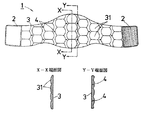
図1は、本発明に係る頸椎用装具1(以下本発明装具1という)の一例を示すものであり、本例の本発明装具1は図より明らかなように、中央付近の幅が広くなった板状体である。両端(上図では左右端)には夫々一枚の面ファスナー2が接着されている。これらは、同一面には存在しておらず一つ(図では右側)は表側に他方(図では左側)は裏側に配置されている。本発明装具1は、主体部3とこの面ファスナー2のみにより形成されており他の部材は設けられていない。
【0017】
主体部3は無発泡タイプのシリコーンラバーであり、JIS A(Shore A)ゴム硬度検査法による硬度表示で45度のものを使用している。主体部3の表面は平坦ではなく、面ファスナー2の取設部分を除くと表裏面共多数の球面状の突起31が形成されており、また主体部3にはその表裏を貫通する通気用の小孔4がところどころに刻設されている。なお個々の突起31は、平板上に球体の一部を多数、幅方向については重複させながら配置した如き形状である(勿論実際には一体成形品である)。こうした表面形状であるので、幅方向の距離(図では上下端の距離)を小さくさせるような湾曲に要する力は、長さ方向の距離(図では左右端の距離)を小さくさせるような湾曲に要する力に比して大きくなる。突起31の位置は、表裏で一致しておらず、長さ方向にずれている。本図の中X−X端面図、Y−Y端面図はそれを示すもので、表側の谷部分であるY−Y線部分が、裏面側では山部となっている。そのため、突起31が存在していない谷部分が表裏で揃うということがなくなり、特に薄い箇所というものが存在しなくなるために、強度が確保され、また頸部に周回させる際の湾曲形状はなだらかなものとなる。
【0018】
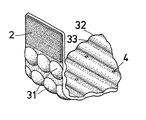
図2は、主体部3に設けられる凹凸に関する他の例を示すものである。主体部3の表側(頸部に密着する面の反対側)の表面には幅方向に沿って凸条32、凹溝33が多数平行に設けられてなだらかな凹凸を形成している。裏側表面については、図1のものと同様の突起31が設けられており、装用時これらの凸部分が頸部を押圧刺激して装用感の向上を約束している。
【0019】
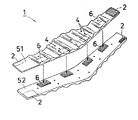
次に図3は、本発明の更に他の例を示すもので、幅方向で2分割された主体部51、52との組合せ構造により本発明装具1が構成されている。この主体部51と52は、長さ方向に沿って断続的に配置される複数の面ファスナー6によって互いに係止されるので、前例までの本発明装具1と異なり、幅(高さ)の微調整が可能な装具となっている。なお、本例の場合双方の主体部51、52は、51の上面には凸条32、凹溝33が、52の下面には図1で示したような突起31(図からははっきりとは見えない)が設けられているが、その対向面側は凹凸のない平坦なものである。ここに、幅調整しても支障のないような形で凹凸を設けるようにしても良い(図示せず)。本例の本発明装具1は、使用に際しては、医師等の専門家にて設定された幅になるように重複させて係止した本発明装具1を、頸部に周回固定するだけであり、着脱に技術を要するということはない。こうした構造の本発明装具を既製品化した場合、わずかな種類の製品でほとんどの患者に対応できることになるため、低コスト化が容易に図れることになる。
【0020】
【発明の効果】
以上詳細に説明したように、本発明に係る頸椎用装具は、頸椎部位を周回して係止することで頸椎を支持固定する装具であって、少なくとも頸部に密着する面のほぼ全体にわたり多数の凹凸が設けられており、且つ主体部分はシリコーンラバーにより成るものであることを特徴とするものであり、以下述べる如き種々の効果を有する極めて高度な発明である。
【0021】
▲1▼ 金属部材を使用しない軟性装具であるので、かさばらず軽量であって、装用感が良好である。
▲2▼ 耐油耐水性に優れたシリコーンラバーより成るので、装用したままの入浴やシャワーが可能であり、また、劣化しにくいものであるため、初期の効果を永く維持する。
▲3▼ シリコーンは皮膚とのなじみが良く長時間接触させてもかぶれにくい。
▲4▼ 主体部表面には多数の凹凸があり、装用時その凸部が頸部を押圧刺激するため、マッサージ効果が期待できるだけでなく、装具によって頸部が保護されていることを常時認識させるので安心感を得る効果が大きい。
【図面の簡単な説明】
【図1】本発明に係る頸椎用装具の一例を示すものであり、2つの端面図を含む平面図である。
【図2】主体部表面に設けられる凹凸に関する他の例を示す概略斜視図である。
【図3】本発明の更に他の例を示す概略斜視図である。
【符号の説明】
1 本発明に係る頸椎用装具
2 面ファスナー
3 主体部
31 突起
32 凸条
33 凹溝
4 小孔
51 主体部
52 主体部
6 面ファスナー[0001]
BACKGROUND OF THE INVENTION
The present invention relates to a structure of a cervical spine device that is small and lightweight, easy to wear, and excellent in wearing feeling.
[0002]
[Prior art]
The cervical spine is a part that supports a heavy head, hangs the upper limb, and has a very large range of motion. Therefore, it can be said that it is a spine that is easily exposed to disability and is aging. In fact, it is known as a site that is prone to damage even in a minor car accident, and the number of people who suffer from "whipping" itself or its sequelae is considerable.
[0003]
In addition to traumatic diseases such as automobile accidents, the cervical spine may cause damage. For example, at least 30% of patients with rheumatoid arthritis have subaxial dislocation (mostly anterior subluxation) of the atlanto-vertebra, which is known to cause not only local pain but also severe neuropathy. Yes. So-called conservative therapy using a brace is usually applied to such cervical spine disorders. In general, orthopedic devices are classified into “color”, “Philadelphia color”, “molded device”, and “supported device with braces” from the design, and considering the advantages and disadvantages of each, and appropriate findings. The principle is to use a type of orthosis.
[0004]
The “collar” is a brace that has a small control effect for any of the flexion / extension movement, rotation movement, and lateral bending movement of the cervical spine, but is easy to handle including adjustment of height and hardness. There is no current improvement in terms of local heat retention, psychological support and comfort. In addition, since they are usually manufactured as off-the-shelf products (usually four types of LL, L, M, and S), many are inexpensive.
[0005]
“Philadelphia Color” is made by molding a foamed polyethylene plate and is characterized by a good wearing feeling. This also limits the support of the lower jaw and occipital region in the head compared to the “collar”, which limits about 30% of normal flexion and extension movements of the cervical spine, but does not allow rotation or lateral bending. It is said that the limit power against is weak.
[0006]
“Molded braces” and “prop braces” are extremely high in head support and cervical spine control, and are necessary for severe disorders such as loss of skeletal support due to cervical spine loss or destruction It is an orthosis. For unstable vertebrae that require higher fixation, there is no longer direct skull fixation. Since the material is also hard and it is a molding tool, it is inevitably expensive and the feeling of wearing is bad.
[0007]
As described above, there are various types of cervical spine orthoses. In addition, the purpose of clinical treatment originally required for the cervical spine is to reduce pain and muscle spasm associated with increased mobility of the cervical spine. However, excessive treatment and long-term wearing may cause muscle weakness, muscle atrophy, joint contracture, and in some cases, worsening the symptoms or causing various psychological problems derived from orthosis-dependent psychology. Try to wear a light brace for a short period of time. In reality, there are rare cases where high-control devices are required, and most patients who need only outpatient clinics and wear them while spending their daily lives are given a light device to raise awareness of their disability. Often the purpose of treatment can be achieved by alerting the patient and reducing neck movements. In addition, as many patients with cervical vertebral disorder caused by rheumatoid arthritis, for example, it is expected that fingers are deformed and motor functions are inconvenient. It is one of the important conditions in this case, and it is often difficult to adopt “molded brace” and “post brace”.
[0008]
[Problems to be solved by the invention]
The cervical orthosis prescribed for such patients (patients with mild or relatively mild neck damage), as described above, is better than the improvement of head weight support ability and flexion fixation ability. As long as excessive exercise can be restricted, it can be said that one with good wearing feeling and one with high psychological support effect are suitable.
[0009]
However, in the case of these conventional light braces, most of the braces depend only on the so-called “feedback effect by skin sensation” so that the control effect is low so as to obtain a feeling of wearing and a heat retaining effect. .
[0010]
In addition, there is nothing to consider about the problem of stuffiness that occurs in the affected area when worn, and even a class of devices that are considered to be “comfortable” using sponges, urethane foam, etc., can stimulate the elderly and skin irritation. It was unpleasant for the patients who wanted to avoid and those who were wearing at night. Therefore, the emergence of a cervical spine that can be provided at a low cost while having a certain level of control ability has been awaited.
[0011]
[Means for Solving the Problems]
Therefore, the present inventor has finally completed the cervical vertebra orthosis of the present invention as a result of intensive studies in view of the above points, and is characterized by an orthosis that supports and fixes the cervical vertebra by rotating around the cervical vertebra part. In addition, a large number of projections and depressions are provided over almost the entire surface that is in close contact with the neck, and the main portion is made of silicone rubber.
[0012]
That is, the present invention is characterized by the fact that a silicone rubber is used as a material, and that a large number of irregularities are provided at least on the surface closely contacting the neck. Silicone is excellent in oil resistance and water resistance, it does not change easily even if it is left in a place with sweat for a long time, it is well-familiar with the skin and does not rash even when in contact, and it is easy to wash and dry, so it is easy to maintain hygiene It is a suitable material. In addition, if there are a large number of irregularities on the contact surface with the neck, these convex portions appropriately press and stimulate the neck when worn, so that a psychological relief can be obtained. Further, for example, if the projections and depressions are formed in a form in which a large number of ridges are provided in the vertical direction, it becomes easy to bend and fix to the neck portion while securing the supporting force of the head load. In addition, if unevenness is provided also on the surface opposite to the side in close contact with the neck, it contributes in terms of supportability of the head load.
[0013]
With regard to the hardness of the silicon rubber, if the structure is the same, the bearing strength will be greater if the hardness is higher, and the control effect will be higher, but the wearing feeling will gradually deteriorate, and the opposite will be the opposite if the hardness is lower. A material having an appropriate hardness may be employed and is not particularly limited in the present invention. However, in the range in which the inventor conducted various prototype experiments, when a non-foamed silicone rubber having a value of about 40 to 60 degrees according to JIS A (Shore A) rubber hardness test method is adopted, The thickness (average thickness) necessary for securing sufficient strength for support is around 5 mm, which makes it an ideal material for lightweight flexible appliances.
[0014]
The orthosis of the present invention is basically a flexible narrow plate-like body that is flat when no force is applied, but the orthosis of the present invention is used by orbiting the cervical spine region. For this reason, it is also possible to adopt a shape that is shaped so that the cylindrically curved state is a natural state. With such a shape, mounting becomes easy, and the force required to lock both ends after the lap is small. As a means for locking both ends in this manner, a “surface fastener” is preferable because it is possible to finely adjust the locking position without using metal parts, but the invention is not limited to this.
[0015]
DETAILED DESCRIPTION OF THE INVENTION
Hereinafter, the present invention will be described in more detail with reference to the drawings.
[0016]
FIG. 1 shows an example of a cervical spine apparatus 1 (hereinafter referred to as the present invention apparatus 1) according to the present invention, and the
[0017]
The
[0018]
FIG. 2 shows another example regarding the unevenness provided in the
[0019]
Next, FIG. 3 shows still another example of the present invention, and the
[0020]
【The invention's effect】
As described in detail above, the cervical spine device according to the present invention is a brace that supports and fixes the cervical vertebra by turning around and locking the cervical vertebra site, and has a large number over at least the entire surface closely contacting the cervical region. The main part is made of silicone rubber, and is an extremely advanced invention having various effects as described below.
[0021]
(1) Since it is a soft appliance that does not use a metal member, it is not bulky and lightweight, and the feeling of wearing is good.
{Circle around (2)} Since it is made of silicone rubber having excellent oil and water resistance, it can be used for bathing and showering while being worn, and it is difficult to deteriorate, so the initial effect is maintained for a long time.
(3) Silicone is well-familiar with the skin and is less susceptible to rash even after prolonged contact.
(4) There are many irregularities on the surface of the main part, and the convex part presses and stimulates the neck when worn, so that not only a massage effect can be expected, but also always recognize that the neck is protected by the brace So the effect of getting a sense of security is great.
[Brief description of the drawings]
FIG. 1 shows an example of a cervical spine orthosis according to the present invention, and is a plan view including two end views.
FIG. 2 is a schematic perspective view showing another example of the unevenness provided on the surface of the main body.
FIG. 3 is a schematic perspective view showing still another example of the present invention.
[Explanation of symbols]
DESCRIPTION OF
Claims (2)
Priority Applications (4)
| Application Number | Priority Date | Filing Date | Title |
|---|---|---|---|
| JP04433798A JP4015259B2 (en) | 1998-02-09 | 1998-02-09 | Cervical spine orthosis |
| EP99101628A EP0934732B1 (en) | 1998-02-09 | 1999-02-04 | Cervical orthosis |
| DE69910462T DE69910462T2 (en) | 1998-02-09 | 1999-02-04 | Cervical |
| US09/247,477 US6027467A (en) | 1998-02-09 | 1999-02-09 | Cervical orthosis |
Applications Claiming Priority (1)
| Application Number | Priority Date | Filing Date | Title |
|---|---|---|---|
| JP04433798A JP4015259B2 (en) | 1998-02-09 | 1998-02-09 | Cervical spine orthosis |
Publications (2)
| Publication Number | Publication Date |
|---|---|
| JPH11221245A JPH11221245A (en) | 1999-08-17 |
| JP4015259B2 true JP4015259B2 (en) | 2007-11-28 |
Family
ID=12688713
Family Applications (1)
| Application Number | Title | Priority Date | Filing Date |
|---|---|---|---|
| JP04433798A Expired - Lifetime JP4015259B2 (en) | 1998-02-09 | 1998-02-09 | Cervical spine orthosis |
Country Status (4)
| Country | Link |
|---|---|
| US (1) | US6027467A (en) |
| EP (1) | EP0934732B1 (en) |
| JP (1) | JP4015259B2 (en) |
| DE (1) | DE69910462T2 (en) |
Families Citing this family (29)
| Publication number | Priority date | Publication date | Assignee | Title |
|---|---|---|---|---|
| SE514690C2 (en) * | 1998-09-15 | 2001-04-02 | Camp Scandinavia Ab | Hallux valgus orthosis |
| DE29917514U1 (en) * | 1999-10-05 | 2000-02-17 | Thämert Orthopädische Hilfsmittel GmbH & Co. KG, 30938 Burgwedel | Upholstery with soft elastic area |
| US6458090B1 (en) * | 2000-05-03 | 2002-10-01 | Lionel A. Walpin | Multi-positional support device |
| US20050197606A1 (en) * | 2004-03-08 | 2005-09-08 | Alejandro Freire | Adjustable soft neck brace |
| DE102004040800A1 (en) * | 2004-08-23 | 2006-03-02 | Bauerfeind Ag | With a padded joint bandage |
| EP2630937B1 (en) * | 2008-12-03 | 2015-10-14 | Ossur HF | Cervical collar having height and circumferential adjustment |
| US8679044B2 (en) | 2008-12-03 | 2014-03-25 | Ossur Hf | Cervical collar with reduced vascular obstruction |
| US10292856B2 (en) | 2009-08-10 | 2019-05-21 | Ossur Hf | Cervical collar having height and circumferential adjustment |
| ES2392778B1 (en) * | 2010-11-04 | 2013-10-18 | Manuel MUÑOZ SÁIZ | THERAPEUTIC COLLARIN FOR THE TREATMENT OF THE APNEA OF THE DREAM AND THE RONQUIDS |
| WO2011054985A2 (en) * | 2009-11-09 | 2011-05-12 | Munoz Saiz Manuel | System and method for treating sleep apnoea and snoring |
| ES2392625B1 (en) * | 2009-11-09 | 2013-10-18 | Manuel Muñoz Saiz | SYSTEM FOR THE TREATMENT OF THE APNEA OF THE DREAM AND THE RONQUIDS |
| USD616996S1 (en) | 2009-09-14 | 2010-06-01 | Ossur Hf | Orthopedic device |
| USD616997S1 (en) | 2009-09-14 | 2010-06-01 | Ossur Hf | Orthopedic device |
| USD616555S1 (en) | 2009-09-14 | 2010-05-25 | Ossur Hf | Orthopedic device |
| US8657768B1 (en) | 2010-07-22 | 2014-02-25 | Salvatore Calabrese | Cervical collar having flexible chin support |
| USD647623S1 (en) | 2010-08-06 | 2011-10-25 | Ossur Hf | Height adjustment mechanism for cervical collar |
| USD647624S1 (en) | 2010-08-06 | 2011-10-25 | Ossur Hf | Cervical collar |
| CA2807099C (en) * | 2012-03-09 | 2020-09-22 | Joe Camillo | Wearable sports guard |
| EP2852359B1 (en) | 2012-05-21 | 2018-08-29 | Ossur Hf | Cervical collar |
| CN103083129A (en) * | 2012-10-26 | 2013-05-08 | 吴亚军 | Cervical vertebra appliance |
| US9839551B2 (en) * | 2015-01-28 | 2017-12-12 | Aspen Medical Partners, Llc | Pneumatic orthosis |
| EP3280367B1 (en) | 2015-04-06 | 2020-07-29 | Ossur Iceland EHF | Cervical collar having height adjustment |
| EP3419570B1 (en) | 2016-02-25 | 2019-12-18 | Ossur Iceland EHF | Cervical collar having height adjustment |
| CN109803615B (en) | 2016-09-19 | 2021-08-03 | 奥索冰岛有限公司 | collar |
| CN107411867A (en) * | 2017-06-30 | 2017-12-01 | 芜湖启泽信息技术有限公司 | A kind of 3D printing medical treatment neck sheath |
| USD870899S1 (en) | 2017-09-06 | 2019-12-24 | Ossur Iceland Ehf | Cervical collar |
| USD866773S1 (en) | 2017-09-06 | 2019-11-12 | Ossur Iceland Ehf | Cervical collar |
| US20240252339A1 (en) * | 2023-01-30 | 2024-08-01 | Deroyal Industries, Inc. | Cervical collar |
| US20260224386A1 (en) * | 2023-01-30 | 2026-08-06 | Deroyal Industries, Inc. | A cervical collar and associated methods of use |
Family Cites Families (13)
| Publication number | Priority date | Publication date | Assignee | Title |
|---|---|---|---|---|
| US2366274A (en) * | 1942-06-03 | 1945-01-02 | Brunswick Balke Collender Co | Plastic fastening means and method of applying the same |
| DE1049085B (en) * | 1955-09-28 | 1959-01-22 | Siemens Ag | Process for the formation of rivet heads of rivets from a thermally stretched thermoplastic insulating material, in particular polystyrene |
| GB893375A (en) * | 1959-10-16 | 1962-04-11 | George Sheldon Walsall Ltd | Improvements relating to seams of saddlery, straps, belts, dog collars and the like |
| US3164151A (en) * | 1962-12-14 | 1965-01-05 | Nicoll Esmond D Vere | Inflatable splint |
| CA945313A (en) * | 1970-05-27 | 1974-04-16 | Gopal C. Bhagat | Method of binding |
| US3916885A (en) * | 1974-11-14 | 1975-11-04 | Medical Specialties Inc | Adjustable cervical collar |
| DE3235327A1 (en) * | 1982-09-24 | 1984-03-29 | Ina-Katarina 6209 Heidenrod Lukoschat | Pull-over device for a shoe |
| US4702233A (en) * | 1986-03-19 | 1987-10-27 | Omicioli Florio F | Ventilated neck brace and related structures |
| JPS63272339A (en) * | 1987-04-30 | 1988-11-09 | Toray Ind Inc | Intestinal forceps |
| US4822671A (en) * | 1987-12-31 | 1989-04-18 | Gencorp Inc. | Heat riveting rubber for effecting a mechanical lock |
| US4881529A (en) * | 1988-08-10 | 1989-11-21 | Richard Santos | Neck support collar |
| DE3827697A1 (en) * | 1988-08-16 | 1990-02-22 | Knebel & Roettger Fa | Single-lever mixer battery |
| DE3902434A1 (en) * | 1989-01-27 | 1990-08-02 | Uhl Sportartikel Karl | SUPPORT BANDAGES FOR LIMBS AND / OR JOINTS |
-
1998
- 1998-02-09 JP JP04433798A patent/JP4015259B2/en not_active Expired - Lifetime
-
1999
- 1999-02-04 EP EP99101628A patent/EP0934732B1/en not_active Expired - Lifetime
- 1999-02-04 DE DE69910462T patent/DE69910462T2/en not_active Expired - Lifetime
- 1999-02-09 US US09/247,477 patent/US6027467A/en not_active Expired - Lifetime
Also Published As
| Publication number | Publication date |
|---|---|
| EP0934732A2 (en) | 1999-08-11 |
| JPH11221245A (en) | 1999-08-17 |
| US6027467A (en) | 2000-02-22 |
| EP0934732A3 (en) | 2000-02-09 |
| DE69910462T2 (en) | 2004-06-24 |
| EP0934732B1 (en) | 2003-08-20 |
| DE69910462D1 (en) | 2003-09-25 |
Similar Documents
| Publication | Publication Date | Title |
|---|---|---|
| JPH11221245A (en) | Cervical spine orthosis | |
| US5746218A (en) | Therapeutic pillow | |
| US4854306A (en) | Cervical/occipital support | |
| US6182311B1 (en) | Therapeutic between-the-legs support pillow assembly | |
| US4969222A (en) | Contoured support pillow | |
| US4114612A (en) | Tension relieving device | |
| JPH07503647A (en) | Lumbar support removably secured to a fixation belt | |
| US6071257A (en) | Linkably segmented device having protruding contact elements | |
| US20080319365A1 (en) | Adhesive Posture Supports | |
| US6113563A (en) | Traction device for physical therapy | |
| US5069203A (en) | Soft hand and wrist splint | |
| KR20180004993A (en) | Rolling Shiatsu massage pillow for cervical treatment with functionality | |
| RU2692218C2 (en) | Modular back protection device | |
| Hunt Herman et al. | Seating and positioning to manage spasticity after brain injury | |
| US6810543B2 (en) | Orthopedic body segment support | |
| US10799416B2 (en) | Self-treating upper neck system for therapeutic mobilization | |
| KR200381377Y1 (en) | Slim liner disk | |
| US5570703A (en) | Contoured therapeutic spinal support | |
| US20050133042A1 (en) | Neck collars for relieving neck pains | |
| KR200351286Y1 (en) | Knee protector | |
| KR20020011618A (en) | Chair for keeping good posture without spinal deformity such as scoliosis | |
| CN2838567Y (en) | Neck and shoulder pad | |
| KR950010248Y1 (en) | Low needle with height adjustment and arc surface available | |
| JPS5828580Y2 (en) | Posture correction equipment for sitting cross-legged or sideways | |
| CN2196471Y (en) | Multi-function cervical spondylopathy health-care pillow |
Legal Events
| Date | Code | Title | Description |
|---|---|---|---|
| A621 | Written request for application examination |
Free format text: JAPANESE INTERMEDIATE CODE: A621 Effective date: 20050207 |
|
| A977 | Report on retrieval |
Free format text: JAPANESE INTERMEDIATE CODE: A971007 Effective date: 20070115 |
|
| A131 | Notification of reasons for refusal |
Free format text: JAPANESE INTERMEDIATE CODE: A131 Effective date: 20070619 |
|
| A521 | Request for written amendment filed |
Free format text: JAPANESE INTERMEDIATE CODE: A523 Effective date: 20070710 |
|
| TRDD | Decision of grant or rejection written | ||
| A01 | Written decision to grant a patent or to grant a registration (utility model) |
Free format text: JAPANESE INTERMEDIATE CODE: A01 Effective date: 20070821 |
|
| A61 | First payment of annual fees (during grant procedure) |
Free format text: JAPANESE INTERMEDIATE CODE: A61 Effective date: 20070913 |
|
| FPAY | Renewal fee payment (event date is renewal date of database) |
Free format text: PAYMENT UNTIL: 20100921 Year of fee payment: 3 |
|
| R150 | Certificate of patent or registration of utility model |
Free format text: JAPANESE INTERMEDIATE CODE: R150 |
|
| FPAY | Renewal fee payment (event date is renewal date of database) |
Free format text: PAYMENT UNTIL: 20110921 Year of fee payment: 4 |
|
| FPAY | Renewal fee payment (event date is renewal date of database) |
Free format text: PAYMENT UNTIL: 20120921 Year of fee payment: 5 |
|
| FPAY | Renewal fee payment (event date is renewal date of database) |
Free format text: PAYMENT UNTIL: 20120921 Year of fee payment: 5 |
|
| FPAY | Renewal fee payment (event date is renewal date of database) |
Free format text: PAYMENT UNTIL: 20130921 Year of fee payment: 6 |
|
| R250 | Receipt of annual fees |
Free format text: JAPANESE INTERMEDIATE CODE: R250 |
|
| R250 | Receipt of annual fees |
Free format text: JAPANESE INTERMEDIATE CODE: R250 |
|
| R250 | Receipt of annual fees |
Free format text: JAPANESE INTERMEDIATE CODE: R250 |
|
| R250 | Receipt of annual fees |
Free format text: JAPANESE INTERMEDIATE CODE: R250 |
|
| R250 | Receipt of annual fees |
Free format text: JAPANESE INTERMEDIATE CODE: R250 |
|
| EXPY | Cancellation because of completion of term |