JP3856552B2 - Pressure-sensitive adhesive sheets for silicon oxide-containing materials - Google Patents
Pressure-sensitive adhesive sheets for silicon oxide-containing materials Download PDFInfo
- Publication number
- JP3856552B2 JP3856552B2 JP34612497A JP34612497A JP3856552B2 JP 3856552 B2 JP3856552 B2 JP 3856552B2 JP 34612497 A JP34612497 A JP 34612497A JP 34612497 A JP34612497 A JP 34612497A JP 3856552 B2 JP3856552 B2 JP 3856552B2
- Authority
- JP
- Japan
- Prior art keywords
- sensitive adhesive
- pressure
- weight
- acrylic
- meth
- Prior art date
- Legal status (The legal status is an assumption and is not a legal conclusion. Google has not performed a legal analysis and makes no representation as to the accuracy of the status listed.)
- Expired - Fee Related
Links
Landscapes
- Adhesive Tapes (AREA)
- Adhesives Or Adhesive Processes (AREA)
Description
【0001】
【発明の属する技術分野】
本発明は、ガラス、タイルなどのSiO2 を主成分とした無機質材料を被着体とする、ケイ素酸化物含有材用の感圧接着シ―ト類に関する。
【0002】
【従来の技術】
作業の簡便化や安全衛生の向上を目的に、これまでの液状の接着剤から感圧接着テ―プを用いて接着処理することが定着してきている。感圧接着テ―プの使用用途が拡がるにつれ、要求特性も厳しくなつてきた。この要求特性のなかでも、実用的な特性として、耐湿熱性が挙げられる。家電・OA機器用、自動車用いずれの用途においても、温度、湿度の影響は避けられない。なかでも、浴場まわりのような環境では温度よりもむしろ、湿度の影響を強く受ける。しかし、従来、一般に用いられているアクリル系感圧接着剤は、ガラスやタイルなどのSiO2 を主成分とした無機質材料に対して十分な耐湿熱性を有しておらず、高温多湿下で接着性を失い、固定部材の脱落に至るという問題がある。
【0003】
ガラスに対する接着性を改良するため、ガラス表面にあらかじめシランカツプリング剤を処理する方法が一般的に用いられている。また、アクリル系感圧接着剤中にシランカツプリング剤をブレンドする方法(特公昭62−30233号公報)も開示されている。しかし、前者は、高温で乾燥処理する必要があり、設備や時間がかかり、また一度施工したガラス窓に適用することが難しく、後者は、シランカツプリング剤中のアルコキシシランのポツトライフが短いため、保存湿度条件・期間に強く制約を受け、いずれも、実用性に欠ける。
【0004】
また、感圧接着テ―プにおいて、貼着固定した部材に加わる外力や振動を分散緩和したり、部材表面の凹凸への追従性を良くするため、ウレタン、ポリエチレン、アクリルフオ―ムなどの発泡基材を用いることはよく知られている。この種の両面感圧接着シ―トについても、高温多湿下の環境にさらされると、発泡基材中に湿気が浸透し、その水分が感圧接着剤層の背面側からガラス界面へ侵入し、接着力の低下が起こる。耐湿性を改良した感圧接着剤を用いたとしても、発泡基材からの水分の侵入は防げず、同様に接着力の低下が起こる。
【0005】
【発明が解決しようとする課題】
このように、従来の技術では、ガラスやタイルなどの無機質材料に対して、耐湿熱性にすぐれた実用的な感圧接着シ―ト類は知られておらず、とくに外力や振動の分散緩和、部材表面の凹凸への追従性を良くするために発泡基材を用いたもので、上記特性にすぐれたものはほとんどみられない。したがつて、本発明は、上記の事情に照らし、シランカツプリング剤を用いなくても、ガラスやタイルなどの無機質材料に対して高い接着性を示し、とくに耐湿熱性にすぐれた実用的な感圧接着シ―ト類を提供することを目的としている。
【0006】
【課題を解決するための手段】
本発明者らは、上記の目的を達成するために、鋭意検討するにあたり、まず、従来のアクリル系感圧接着剤がガラスに対して接着力が低くなる、とくにこの現象が多湿下で顕著となることについて、以下のように考察した。ガラスの主成分であるSiO2 は表面が酸性であることが知られており、一方、従来のアクリル系感圧接着剤は一般にアクリル系単量体と酸性基を有する単量体との共重合体を主成分としており、接着剤としてやはり酸性である。このため、感圧接着剤とガラスとの間で、酸性基同志の電気的斥力が働き、強い接着力を発揮できない。とくに水が存在すると、酸性基の解離イオンが増大し電気的斥力がより一層働き、同時に吸水による凝集力の低下も起こり、接着力が低下する。
【0007】
そこで、本発明者らは、この考察を踏まえて、感圧接着シ―ト類において、外力や振動の分散緩和、部材表面の凹凸への追従性を良くするために発泡基材を用いるにあたり、この発泡基材から感圧接着剤層への水分の侵入を制御し、かつ感圧接着剤の組成に塩基性セグメントを導入することで、上記問題を解決できないかと考え、さらに検討を続けた。その結果、発泡基材の吸水率を特定し、かつアクリル系感圧接着剤中に特定の塩基性セグメントを導入する組み合わせ構成としたときに、ガラスやタイルなどのケイ素酸化物含有材に対して、シランカツプリング剤の処理を施さなくても、すぐれた接着性を得ることができ、とくに高温多湿下でも高い接着性を示す、耐湿熱性にすぐれた感圧接着シ―ト類が得られることを知り、本発明を完成するに至つたものである。
【0008】
すなわち、本発明は、40℃の温水に24時間浸漬したのちの吸水率が15重量%未満である発泡基材の少なくとも片面に、a)一般式(1):CH2=C(R1 )COOR2(式中、R1は水素またはメチル基、R2は炭素数が4〜14個のアルキル基である)で表されるアクリル系単量体60〜94重量%と、b)一般式(2):CH2=C(R3)CONR4R5(式中、R3は水素またはメチル基、R4 はアルキル基、R5はアルキル基であるか、またはR4と結合しこれとN原子とで複素環を構成する有機基である)で表される(メタ)アクリルアミド5〜40重量%と、c)酸性基を含む単量体1〜10重量%との共重合体を主成分とするアクリル系感圧接着剤からなる層を有することを特徴とするケイ素酸化物含有材用の感圧接着シ―ト類に係るものである。
【0009】
【発明の実施の形態】
本発明に用いられる発泡基材は、40℃の温水に24時間浸漬したのちの吸水率が15重量%未満、好ましくは10重量%未満であればよい。材質は限定されないが、主成分として、ブチルゴム、クロロプレンゴム、ウレタン、ポリエチレン、アクリル、エピクロルヒドリンゴム、シリコ─ンゴムなどが用いられる。厚さも限定されないが、厚すぎると部材を固定したときに荷重により変形し、部材からはみ出して外観(意匠性)が悪くなり、薄すぎると凹凸への追従性が失われるため、好ましくは0.5〜2mmの範囲とするのがよい。
【0010】
上記の吸水率が15重量%以上となると、発泡基材から感圧接着剤の層への水の移行を抑制できず、耐湿熱性の低下が起こる。発泡基材の上記吸水率を15重量%未満に設定する手段は任意であり、たとえば、基材中に含ませる各種添加剤の種類や量を選択したり、製造条件などを適宜設定することにより、容易に上記吸水率に設定できる。このような吸水率に設定した市販品の入手も可能であり、この市販品をそのまま使用してもよい。
【0011】
本発明に用いられるアクリル系感圧接着剤は、a)一般式(1):CH2=C(R1)COOR2(式中、R1は水素またはメチル基、R2は炭素数が4〜14個のアルキル基である)で表されるアクリル系単量体60〜94重量%と、b)一般式(2):CH2=C(R3)CONR4R5(式中、R3は水素またはメチル基、R4 はアルキル基、R5はアルキル基であるか、あるいはR4と結合しこれとN原子とで複素環を構成する有機基である)で表される(メタ)アクリルアミド5〜40重量%と、c)酸性基を含む単量体1〜10重量%との共重合体を主成分とした感圧接着剤である。
【0012】
a成分のアクリル系単量体は、一般式(1)中のR2 がブチル基、イソブチル基、イソアミル基、ヘキシル基、ヘプチル基、2−エチルヘキシル基、イソオクチル基、イソノニル基、イソデシル基などの炭素数4〜14個のアルキル基からなるアクリル酸またはメタクリル酸のアルキルエステルである。R2 の炭素数が4個未満となると、感圧接着剤のぬれ性が低下して初期接着性が悪くなり、また14個を超えると、接着力に劣る。このa成分のアクリル系単量体は、単量体全体の60〜94重量%の範囲で、その1種または2種以上が用いられる。60重量%未満となると、アクリル系感圧接着剤としての性能を発揮させにくくなり、94重量%を超えてしまうと、b成分の(メタ)アクリルアミドが不足して、ガラスなどに対する接着性能が不十分となる。
【0013】
b成分の(メタ)アクリルアミドには、一般式(2)で表される、N,N−ジ置換(メタ)アクリルアミドからなる非環状の(メタ)アクリルアミドと、環状の(メタ)アクリルアミドとが含まれる。たとえば、N,N−ジメチルアクリルアミド、N,N−ジエチル(メタ)アクリルアミド、N,N−ジブチル(メタ)アクリルアミド、N−(メタ)アクリロイルモルホリン、N−(メタ)アクリロイルピロリドン、N−(メタ)アクリロイルピペリジン、N−(メタ)アクリロイルピロリジン、N−(メタ)アクリロイル−4−ピペリドンなどが挙げられる。このb成分は、単量体全体の5〜40重量%、好ましくは10〜35重量%の範囲で、その1種または2種以上が用いられる。5重量%未満では、ガラスなどに対し接着性能が不十分となり、40重量%を超えると、弾性率が増大して室温下でのぬれ性が低下する。
【0014】
c成分の酸性基を含む単量体としては、アクリル酸、メタクリル酸、イタコン酸、クロトン酸などのカルボキシル基含有単量体や、その他、2−ヒドロキシエチルアクリロイルホスフエ―ト、2−ヒドロキシプロピルアクリロイルホスフエ―トなどのリン酸基含有単量体などが用いられる。このc成分の単量体は、単量体全体の1〜10重量%、好ましくは2〜8重量%の範囲で、その1種または2種以上が用いられる。1重量%未満では、凝集力が不足し耐熱保持性が低下し、10重量%を超えると、酸成分が増えガラスなどに対する接着性能が悪くなり、室温付近における接着力が低下しやすい。
【0015】
共重合体は、上記のa成分、b成分およびc成分からなる単量体混合物を、常法により、溶液重合法、乳化重合法、塊状重合法、懸濁重合法などの方法により共重合させることにより、得ることができ、塊状重合法では、紫外線照射による重合方式が好ましい。共重合に際し、ベンゾイルパ―オキサイド、ラウロイルパ―オキサイド、クメンパ―オキサイドなどの有機過酸化物、2,2´−アゾビスイソブチロニトリル、2,2´−アゾビス(2,4−ジメチルバレロニトリル)などのアゾ系化合物、2,2´−ジメトキシ−2−フエニルアセトフエノン、2,2´−ジエトキシアセトフエノンなどのアセトフエノン系化合物、ベンゾインエチルエ―テル、ベンゾインイソプロピルエ―テルなどのベンゾインエ―テル系化合物、ベンゾフエノン、ベンゾイル安息香酸などのベンゾフエノン系化合物などの熱重合開始剤や光重合開始剤が用いられる。
【0016】
本発明のアクリル系感圧接着剤は、このような共重合体を主成分とし、これに通常は適宜の架橋剤を含ませて架橋処理し、耐熱保持性にすぐれた感圧接着剤とされる。架橋剤としては、ポリイソシアネ―ト化合物、ポリエポキシ化合物、アジリジン化合物などの公知の各種の多官能性化合物が用いられるが、これらの中でも、ポリイソシアネ―ト化合物が好ましい。
【0017】
ポリイソシアネ―ト化合物としては、エチレンジイソシアネ―ト、ブチレンジイソシアネ―ト、ヘキサメチレンジイソシアネ―トなどの脂肪族ポリイソシアネ―ト類、シクロペンチレンジイソシアネ―ト、シクロヘキシレンジイソシアネ―ト、イソホロンジイソシアネ―トなどの脂環族ポリイソシアネ―ト類、2,4−トリレンジイソシアネ―ト、4,4´ジフエニルメタンジイソシアネ―ト、キシリレンジイソシアネ―トなどの芳香族ポリイソシアネ―ト類などや、トリメチロ―ルプロパンのトリレンジイソシアネ―ト付加物などが挙げられる。
【0018】
また、上記の架橋剤に代えて、前記の共重合に際し、内部架橋剤を含ませて上記同様の耐熱保持性にすぐれた感圧接着剤とすることもできる。このような内部架橋剤としては、たとえば、トリメチロ―ルプロパントリ(メタ)アクリレ―ト、ペンタエリスリト―ルテトラ(メタ)アクリレ―ト、1,2−エチレングリコ―ルジ(メタ)アクリレ―ト、1,6−ヘキサンジオ―ルジ(メタ)アクリレ―ト、1,12−ドデカンジオ―ルジ(メタ)アクリレ―トなどの多官能(メタ)アクリレ―トを挙げることができる。
【0019】
本発明のアクリル系感圧接着剤には、上記成分のほかに、さらに必要により、粘着付与樹脂、老化防止剤、紫外線吸収剤、着色剤、充填剤、難燃剤、帯電防止剤などの公知の各種の添加剤を加えることができる。これらの添加剤と前記の架橋剤などは、その種類に応じた通常の使用量で用いられる。
【0020】
本発明においては、前記特定吸水率の発泡基材の少なくとも片面に、上記構成の特定のアクリル系感圧接着剤からなる層を設けて、シ―ト状やテ―プ状などの感圧接着シ―ト類とする。上記層の厚さは、とくに限定されないが、通常は片面で約5〜200μmとすればよい。上記層を片面にのみ設ける場合、他方の面に上記基材との投錨性にすぐれる他の一般の感圧接着剤、たとえば、ゴム系、アクリル系、シリコ─ン系などの感圧接着剤からなる層を設けてもよい。
【0021】
本発明の感圧接着シ―ト類は、ガラス、タイルなどのSiO2 を主成分とした無機質材料からなる被着体に対し、上記特定のアクリル系感圧接着剤からなる層を接着界面とすることにより、すぐれた接着性が得られ、とくに高温多湿下の環境でも高い接着性を維持する、すぐれた耐湿熱性が得られることから、ケイ素酸化物含有材用の感圧接着シ―ト類として非常に適している。
【0022】
【実施例】
つぎに、本発明の実施例を記載して、より具体的に説明する。ただし、本発明はこれらの実施例によりなんら限定されるものではない。以下、部とあるのは、重量部を意味するものとする。
【0023】
参考例1
冷却管、窒素導入管、温度計、紫外線照射装置および攪拌装置を備えた反応容器に、イソノニルアクリレ―ト79部、アクリロイルモルホリン14部、アクリル酸7部、光重合開始剤として2,2−ジメトキシ−2−フエニルアセトフエノン0.07部を入れて、光重合し、重合率15重量%のポリマ―・モノマ―混合物を得た。さらに、この混合物の固形分100部に対し、トリメチロ―ルプロパントリアクリレ―ト0.1部を加えて、シロツプとした。このシロツプを、厚さが25μmの剥離処理したポリエステルフイルム上に、硬化後の厚さが50μmとなるように塗布したのち、紫外線を照射して硬化させることにより、アクリル系感圧接着剤からなる層を形成した。
【0024】
参考例2
冷却管、窒素導入管、温度計および攪拌装置を備えた反応容器に、2−エチルヘキシルアクリレ―ト85部、アクリル酸15部、重合開始剤として2,2−アゾビスイソブチロニトリル0.14部と、これらの混合物100部に対し、酢酸エチル100部を入れて、60℃で12時間反応させてポリマ―溶液を得た。さらに、この混合物の固形分100部に対し、トリメチロ―ルプロパンのトリレンジイソシアネ―ト付加物〔日本ポリウレタン(株)製の「コロネ―トL」〕1部を加えて、感圧接着剤溶液とした。この感圧接着剤溶液を、厚さが25μmの剥離処理したポリエステルフイルム上に、乾燥後の厚さが50μmとなるように塗布したのち、乾燥し、アクリル系感圧接着剤からなる層を形成した。
【0025】
参考例3
エピクロルヒドリン−エチレンオキサイド−アリルグリシジルエ―テル三元共重合体〔ダイソ―(株)製のエピクロマ―CG〕100部、炭酸カルシウム30部、カ―ボンブラツク30部、2−メルカプトイミダゾリン0.7部、尿素系発泡助剤3部、N,N´−ジニトロソペンタメチレンテトラミン3部、2,2,4−トリメチル−1,2−ジヒドロキノリンの重合体3部、ステアリン酸1部からなる配合組成物を調製した。これをミキシングロ―ルで混練したのち、0.6mmの厚さに圧延してシ―トを成形した。ついで、このシ―トを160℃で10分間加熱し、加硫、発泡させて、厚さが0.8mmの発泡基材を得た。
【0026】
このようにして得られた発泡基材は、40℃の温水に24時間浸漬したのちの吸水率が10重量%であつた。なお、上記の吸水率は、100mm角の発泡基材を40℃の温水に24時間浸漬し、浸漬前後の重量を測定して、吸水率(重量%)=〔浸漬後の重量(g)/浸漬前の重量(g)〕×100として、算出した。以下の吸水率も、これと同様にして、測定、算出した。
【0027】
参考例4
配合組成物中、カ―ボンブラツク30部に代えて、ホワイトカ―ボン30部を使用するようにした以外は、参考例3と同様にシ―ト成形し、加熱、発泡して、厚さが0.8mmの発泡基材を得た。この発泡基材の40℃の温水に24時間浸漬したのちの吸水率は、35重量%であつた。
【0028】
実施例1
参考例3で得た厚さが0.8mm、40℃の温水に24時間浸漬したのちの吸水率が10重量%である発泡基材の片面に、参考例1で得たアクリル系感圧接着剤からなる層を貼り合わせて、感圧接着シ―トを作製した。
【0029】
実施例2
厚さが0.8mm、40℃の温水に24時間浸漬したのちの吸水率が5重量%である市販のポリエチレンフオ―ムからなる発泡基材の片面に、参考例1で得たアクリル系感圧接着剤からなる層を貼り合わせて、感圧接着シ―トを作製した。
【0030】
比較例1
参考例1で得たアクリル系感圧接着剤からなる層に代えて、参考例2で得たアクリル系感圧接着剤からなる層を貼り合わせるようにした以外は、実施例1と同様にして、感圧接着シ―トを作製した。
【0031】
比較例2
参考例1で得たアクリル系感圧接着剤からなる層に代えて、参考例2で得たアクリル系感圧接着剤からなる層を貼り合わせるようにした以外は、実施例2と同様にして、感圧接着シ―トを作製した。
【0032】
比較例3
参考例4で得た厚さが0.8mm、40℃の温水に24時間浸漬したのちの吸水率が35重量%である発泡基材の片面に、参考例1で得たアクリル系感圧接着剤からなる層を貼り合わせて、感圧接着シ―トを作製した。
【0033】
比較例4
厚さが0.8mm、40℃の温水に24時間浸漬したのちの吸水率が30重量%である市販のウレタンフオ―ムからなる発泡基材の片面に、参考例1で得たアクリル系感圧接着剤からなる層を貼り合わせて、感圧接着シ―トを作製した。
【0034】
比較例5
厚さが0.8mm、40℃の温水に24時間浸漬したのちの吸水率が25重量%である市販のアクリルフオ―ムからなる発泡基材の片面に、参考例1で得たアクリル系感圧接着剤からなる層を貼り合わせて、感圧接着シ―トを作製した。
【0035】
上記の実施例1,2および比較例1〜5の各感圧接着シ―トについて、下記の方法により、初期接着力、高温放置後(40℃で7日間放置後)の接着力および高温多湿放置後(40℃,92%RH下で7日間放置後)の接着力を測定した。これらの結果は、後記の表1に示されるとおりであつた。
【0036】
<接着力の測定>
感圧接着シ―トを幅20mm,長さ100mmの大きさに裁断し、市販のポリエチレンテレフタレ―トフイルムを基材とした感圧接着テ―プで裏打ちしたのち、ガラス板に対して2kgロ―ラを往復させる方法で圧着して、試験片を作製した。この試験片を、下記(1)〜(3)の条件で放置後、万能引張試験機により速度50mm/分で180度剥離接着力を測定した。
(1)23℃,65%RH雰囲気下で20分間放置後(初期接着力)
(2)(1)の後、40℃の乾燥機に7日投入したのち、取り出して23℃,65%RH雰囲気下で20分間放置後(高温放置後の接着力)
(3)(1)の後、40℃,92%RHの加熱加湿機に7日間投入したのち、取り出して23℃,65%RH雰囲気下で20分間放置後(高温多湿放置後の接着力)
【0037】
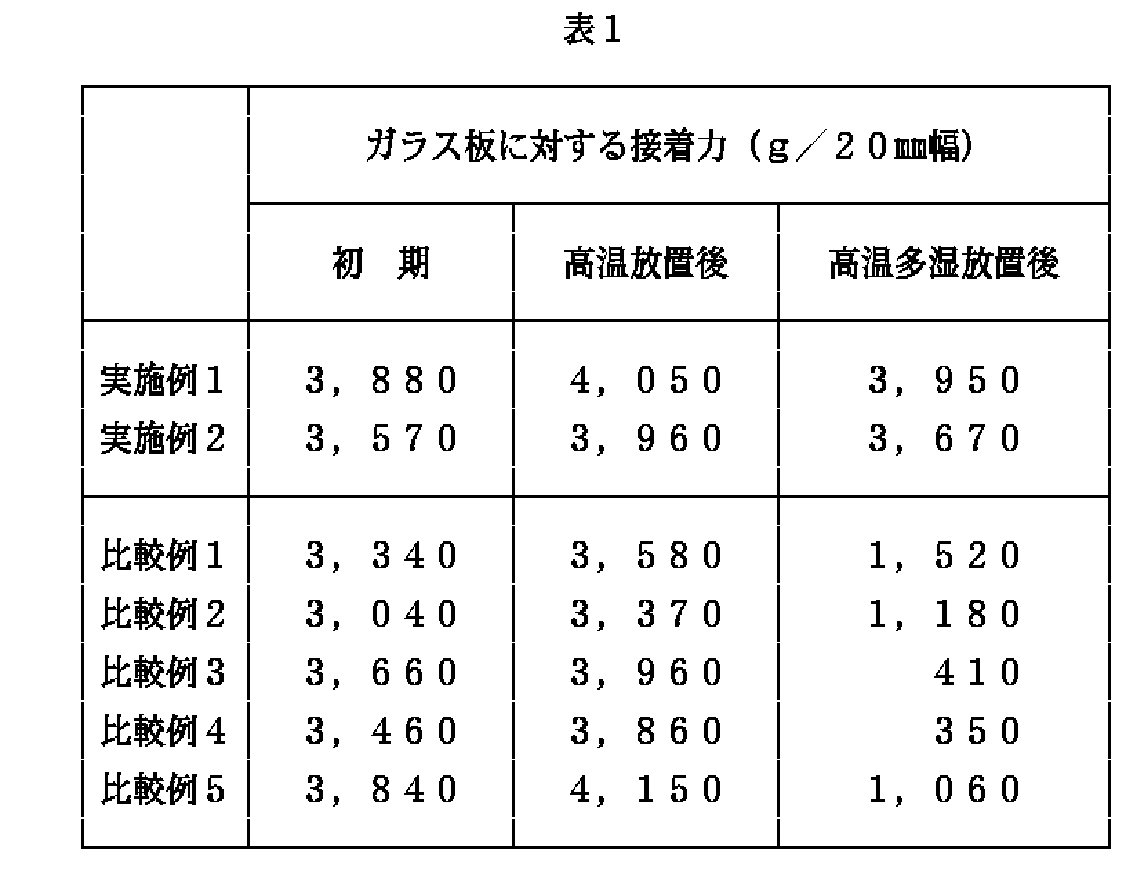
上記の表1より明らかなように、本発明の実施例1,2の感圧接着シ―トは、ガラス板に対し、初期および高温放置後の接着力が大きく、かつ高温多湿放置後でも非常に高い接着力を維持しており、耐湿熱性にすぐれていることがわかる。これに対し、比較例1〜5の感圧接着シ―トは、初期の接着力が不足する場合がある以外に、高温多湿放置後に接着力の急激な低下がみられる。
【0039】
【発明の効果】
以上のように、本発明は、特定吸水率の発泡基材の少なくとも片面に特定のアクリル系感圧接着剤からなる層を設ける構成としたことにより、ガラスやタイルなどのケイ素酸化物含有材に対して、シランカツプリング剤の処理を施さなくても、すぐれた接着性を示す、とくに高温多湿下でも高い接着性を示す、耐湿熱性にすぐれた感圧接着シ―ト類を提供することができる。[0001]
BACKGROUND OF THE INVENTION
The present invention relates to a pressure-sensitive adhesive sheet for a silicon oxide-containing material having an inorganic material mainly composed of SiO 2 such as glass and tile as an adherend.
[0002]
[Prior art]
For the purpose of simplifying work and improving safety and hygiene, it has become well established to use a pressure-sensitive adhesive tape from conventional liquid adhesives. As the use of pressure-sensitive adhesive tapes expanded, the required properties became stricter. Among these required characteristics, moist heat resistance is a practical characteristic. The effects of temperature and humidity are inevitable in both home appliance / OA equipment and automotive applications. In particular, the environment around the bathhouse is strongly influenced by humidity rather than temperature. However, conventionally, in general acrylic pressure-sensitive adhesive that is used does not have a sufficient moisture and heat resistance with respect to inorganic material mainly composed of SiO 2, such as glass or tile, adhesive under high temperature and high humidity There is a problem that the fixing member is lost due to loss of the property.
[0003]
In order to improve the adhesion to glass, a method of treating a glass surface with a silane coupling agent in advance is generally used. Also disclosed is a method of blending a silane coupling agent into an acrylic pressure sensitive adhesive (Japanese Patent Publication No. 62-30233). However, the former needs to be dried at a high temperature, takes equipment and time, and is difficult to apply to a glass window once constructed, and the latter is because the pot life of alkoxysilane in the silane coupling agent is short, The storage humidity conditions and period are strongly restricted, and none of them are practical.
[0004]
In pressure-sensitive adhesive tapes, foaming groups such as urethane, polyethylene, and acrylic foam are used to disperse and mitigate external forces and vibrations applied to the bonded and fixed members and to improve the followability of the surface of the members. It is well known to use materials. With this type of double-sided pressure-sensitive adhesive sheet, when exposed to an environment of high temperature and high humidity, moisture penetrates into the foamed substrate, and the moisture penetrates from the back side of the pressure-sensitive adhesive layer to the glass interface. , The adhesive strength is reduced. Even if a pressure-sensitive adhesive with improved moisture resistance is used, the intrusion of moisture from the foamed substrate cannot be prevented, and the adhesive strength is similarly reduced.
[0005]
[Problems to be solved by the invention]
Thus, in the prior art, practical pressure-sensitive adhesive sheets with excellent heat and moisture resistance are not known for inorganic materials such as glass and tiles. A foam base material is used to improve the followability to the unevenness on the surface of the member, and almost no excellent properties are observed. Therefore, in light of the above circumstances, the present invention exhibits high adhesion to inorganic materials such as glass and tiles without using a silane coupling agent, and has a practical feeling particularly excellent in moisture and heat resistance. The purpose is to provide pressure bonding sheets.
[0006]
[Means for Solving the Problems]
In order to achieve the above object, the inventors of the present invention have made extensive studies. First, conventional acrylic pressure-sensitive adhesives have low adhesive strength to glass, and this phenomenon is particularly noticeable under high humidity. Was considered as follows. SiO 2 , the main component of glass, is known to have an acidic surface. On the other hand, conventional acrylic pressure-sensitive adhesives generally use a co-polymer of an acrylic monomer and a monomer having an acidic group. The main component is coalescence, and it is also acidic as an adhesive. For this reason, the electric repulsion between the acidic groups works between the pressure sensitive adhesive and the glass, and the strong adhesive force cannot be exhibited. In particular, when water is present, the dissociated ions of the acidic group increase and the electric repulsion further works, and at the same time, the cohesive force is reduced due to water absorption, and the adhesive force is reduced.
[0007]
Therefore, based on this consideration, the present inventors, in pressure-sensitive adhesive sheets, in using a foamed base material in order to improve the dispersion and relaxation of external force and vibration, and to follow the unevenness of the member surface, The inventors considered that the above problem could be solved by controlling the intrusion of moisture from the foamed base material into the pressure-sensitive adhesive layer and introducing a basic segment into the composition of the pressure-sensitive adhesive. As a result, when the water absorption rate of the foamed base material is specified and a combination configuration in which a specific basic segment is introduced into the acrylic pressure-sensitive adhesive, the silicon oxide-containing material such as glass or tile is used. Excellent pressure-sensitive adhesive sheets with excellent moisture and heat resistance can be obtained without silane coupling agent treatment, and excellent adhesion can be obtained even under high temperature and high humidity. This has led to the completion of the present invention.
[0008]
That is, the present invention provides: a) General formula (1): CH 2 ═C (R 1 ) 60 to 94% by weight of an acrylic monomer represented by COOR 2 (wherein R 1 is hydrogen or a methyl group, and R 2 is an alkyl group having 4 to 14 carbon atoms), and b) a general formula (2): CH 2 = C (R 3 ) CONR 4 R 5 (wherein R 3 is hydrogen or a methyl group, R 4 is an alkyl group, R 5 is an alkyl group, or bonded to R 4 A copolymer of 5 to 40% by weight of (meth) acrylamide represented by 1) to 10% by weight of a monomer containing an acidic group. Pressure-sensitive adhesive for silicon oxide-containing materials characterized by having a layer composed of an acrylic pressure-sensitive adhesive as a main component - it relates to a door class.
[0009]
DETAILED DESCRIPTION OF THE INVENTION
The foamed substrate used in the present invention may have a water absorption of less than 15% by weight, preferably less than 10% by weight after being immersed in warm water at 40 ° C. for 24 hours. The material is not limited, but butyl rubber, chloroprene rubber, urethane, polyethylene, acrylic, epichlorohydrin rubber, silicone rubber, etc. are used as the main component. The thickness is not limited, but if it is too thick, it deforms due to a load when the member is fixed, it protrudes from the member and the appearance (designability) deteriorates, and if it is too thin, the ability to follow irregularities is lost. It is good to set it as the range of 5-2 mm.
[0010]
When the water absorption is 15% by weight or more, the water transfer from the foamed base material to the pressure-sensitive adhesive layer cannot be suppressed, and the moisture and heat resistance is lowered. The means for setting the water absorption rate of the foamed base material to less than 15% by weight is arbitrary. For example, by selecting the type and amount of various additives to be included in the base material, or by appropriately setting the manufacturing conditions, etc. The water absorption rate can be easily set. A commercial product set to such a water absorption rate is also available, and this commercial product may be used as it is.
[0011]
The acrylic pressure-sensitive adhesive used in the present invention has a) general formula (1): CH 2 = C (R 1 ) COOR 2 (wherein R 1 is hydrogen or a methyl group, R 2 has 4 carbon atoms) 60 to 94% by weight of an acrylic monomer represented by ˜14 alkyl groups) and b) General formula (2): CH 2 ═C (R 3 ) CONR 4 R 5 (wherein R 3 is hydrogen or a methyl group, R 4 is an alkyl group, R 5 is an alkyl group, or an organic group that is bonded to R 4 and forms a heterocyclic ring with this N atom. It is a pressure-sensitive adhesive mainly composed of a copolymer of 5) 40% by weight of acrylamide and 1) 10% by weight of a monomer containing an acidic group.
[0012]
The acrylic monomer of component a is such that R 2 in general formula (1) is butyl, isobutyl, isoamyl, hexyl, heptyl, 2-ethylhexyl, isooctyl, isononyl, isodecyl, etc. An alkyl ester of acrylic acid or methacrylic acid comprising an alkyl group having 4 to 14 carbon atoms. When the carbon number of R 2 is less than 4, the wettability of the pressure-sensitive adhesive is lowered and the initial adhesiveness is deteriorated, and when it exceeds 14, the adhesive strength is inferior. The acrylic monomer of component a is used in the range of 60 to 94% by weight of the whole monomer, and one or more of them are used. If it is less than 60% by weight, it will be difficult to exert the performance as an acrylic pressure-sensitive adhesive, and if it exceeds 94% by weight, the (meth) acrylamide of component b will be insufficient, resulting in poor adhesion to glass. It will be enough.
[0013]
The (meth) acrylamide component b, represented by the general formula (2), N, contains an N- disubstituted (meth) acyclic consisting of acrylamide (meth) acrylamide, an annular (meth) acrylamide It is. For example , N, N-dimethylacrylamide , N, N-diethyl (meth) acrylamide, N, N-dibutyl (meth) acrylamide, N- (meth) acryloylmorpholine, N- (meth) acryloylpyrrolidone, N- (meth) Examples include acryloylpiperidine, N- (meth) acryloylpyrrolidine, N- (meth) acryloyl-4-piperidone and the like. The component b is used in an amount of 5 to 40% by weight, preferably 10 to 35% by weight, based on the whole monomer, and one or more of them are used. If it is less than 5% by weight, the adhesion performance to glass or the like becomes insufficient, and if it exceeds 40% by weight, the elastic modulus increases and the wettability at room temperature decreases.
[0014]
As the monomer containing an acidic group of component c, a carboxyl group-containing monomer such as acrylic acid, methacrylic acid, itaconic acid, crotonic acid, and others, 2-hydroxyethylacryloyl phosphate, 2-hydroxypropyl Phosphoric acid group-containing monomers such as acryloyl phosphate are used. The monomer of component c is used in the range of 1 to 10% by weight, preferably 2 to 8% by weight of the whole monomer, and one or more of them are used. If the amount is less than 1% by weight, the cohesive force is insufficient and the heat resistance retention is lowered. If the amount exceeds 10% by weight, the acid component increases and the adhesion performance to glass or the like deteriorates, and the adhesion force near room temperature tends to decrease.
[0015]
The copolymer is obtained by copolymerizing the monomer mixture composed of the components a, b, and c by a conventional method such as a solution polymerization method, an emulsion polymerization method, a bulk polymerization method, or a suspension polymerization method. In the bulk polymerization method, a polymerization method by ultraviolet irradiation is preferable. In copolymerization, organic peroxides such as benzoyl peroxide, lauroyl peroxide, cumene peroxide, 2,2'-azobisisobutyronitrile, 2,2'-azobis (2,4-dimethylvaleronitrile), etc. Azo compounds, 2,2′-dimethoxy-2-phenylacetophenone, acetophenone compounds such as 2,2′-diethoxyacetophenone, benzoin ethers such as benzoin ethyl ether and benzoin isopropyl ether -Thermal polymerization initiators and photopolymerization initiators such as tellurium compounds, benzophenone compounds such as benzophenone and benzoylbenzoic acid are used.
[0016]
The acrylic pressure-sensitive adhesive of the present invention is composed of such a copolymer as a main component, and is usually a pressure-sensitive adhesive excellent in heat resistance retention by being subjected to a crosslinking treatment by including an appropriate crosslinking agent. The As the crosslinking agent, various known polyfunctional compounds such as a polyisocyanate compound, a polyepoxy compound, and an aziridine compound are used, and among these, a polyisocyanate compound is preferable.
[0017]
Polyisocyanate compounds include aliphatic polyisocyanates such as ethylene diisocyanate, butylene diisocyanate, hexamethylene diisocyanate, cyclopentylene diisocyanate, cyclohexylene diisocyanate. -Cycloaliphatic polyisocyanates such as isophorone diisocyanate, 2,4-tolylene diisocyanate, 4,4 'diphenylmethane diisocyanate, xylylene diisocyanate, etc. Aromatic polyisocyanates, and tolylene diisocyanate adducts of trimethylolpropane.
[0018]
Moreover, it can replace with said crosslinking agent and can also be set as the pressure sensitive adhesive which was excellent in the heat-resistant retention similar to the above by including an internal crosslinking agent in the case of the said copolymerization. Examples of such an internal crosslinking agent include trimethylolpropane tri (meth) acrylate, pentaerythritol tetra (meth) acrylate, 1,2-ethylene glycol di (meth) acrylate, 1, Examples thereof include polyfunctional (meth) acrylates such as 6-hexanediol di (meth) acrylate and 1,12-dodecanediol di (meth) acrylate.
[0019]
In addition to the above-mentioned components, the acrylic pressure-sensitive adhesive of the present invention may further include a known tackifier resin, anti-aging agent, ultraviolet absorber, colorant, filler, flame retardant, antistatic agent, etc., if necessary. Various additives can be added. These additives and the above-mentioned cross-linking agents are used in normal amounts depending on their types.
[0020]
In the present invention, a layer made of the specific acrylic pressure-sensitive adhesive having the above-described configuration is provided on at least one surface of the foam substrate having the specific water absorption rate, so that a pressure-sensitive adhesive such as a sheet shape or a tape shape is provided. Sheets are used. Although the thickness of the said layer is not specifically limited, Usually, what is necessary is just to be about 5-200 micrometers on one side. When the above-mentioned layer is provided only on one side, other general pressure-sensitive adhesives excellent in anchoring property with the above-mentioned substrate on the other side, for example, rubber-based, acrylic-based, silicone-based pressure-sensitive adhesives, etc. You may provide the layer which consists of.
[0021]
The pressure-sensitive adhesive sheet of the present invention has a layer composed of the above specific acrylic pressure-sensitive adhesive as an adhesive interface with respect to an adherend composed of an inorganic material mainly composed of SiO 2 such as glass and tile. As a result, excellent adhesiveness can be obtained, and in particular, high heat and humidity resistance that maintains high adhesiveness even in high-temperature and high-humidity environments can be obtained, so pressure-sensitive adhesive sheets for silicon oxide-containing materials As very suitable.
[0022]
【Example】
Next, examples of the present invention will be described in more detail. However, the present invention is not limited to these examples. Hereinafter, “parts” means parts by weight.
[0023]
Reference example 1
In a reaction vessel equipped with a cooling tube, a nitrogen introduction tube, a thermometer, an ultraviolet irradiation device and a stirring device, 79 parts of isononyl acrylate, 14 parts of acryloylmorpholine, 7 parts of acrylic acid, 2,2 as a photopolymerization initiator -0.07 part of dimethoxy-2-phenylacetophenone was added and photopolymerized to obtain a polymer-monomer mixture having a polymerization rate of 15% by weight. Further, 0.1 part of trimethylolpropane triacrylate was added to 100 parts of the solid content of this mixture to prepare a syrup. This syrup is made of an acrylic pressure-sensitive adhesive by applying it to a peeled polyester film having a thickness of 25 μm so that the thickness after curing is 50 μm, and then curing it by irradiating with ultraviolet rays. A layer was formed.
[0024]
Reference example 2
In a reaction vessel equipped with a cooling tube, a nitrogen introducing tube, a thermometer and a stirrer, 85 parts of 2-ethylhexyl acrylate, 15 parts of acrylic acid, 2,2-azobisisobutyronitrile as a polymerization initiator, 0. 14 parts and 100 parts of these mixtures were charged with 100 parts of ethyl acetate and reacted at 60 ° C. for 12 hours to obtain a polymer solution. Furthermore, to 100 parts of the solid content of this mixture, 1 part of a trimethylolpropane tolylene diisocyanate adduct [“Coronate L” manufactured by Nippon Polyurethane Co., Ltd.] was added to form a pressure-sensitive adhesive solution. It was. This pressure-sensitive adhesive solution was applied onto a 25 μm-thick peeled polyester film so that the thickness after drying was 50 μm, and then dried to form a layer made of an acrylic pressure-sensitive adhesive. did.
[0025]
Reference example 3
Epichlorohydrin-ethylene oxide-allylglycidyl ether terpolymer [Epichroma-CG manufactured by Daiso Co., Ltd.] 100 parts, calcium carbonate 30 parts, carbon black 30 parts, 2-mercaptoimidazoline 0.7 parts, Formulation composition comprising 3 parts of urea foaming aid, 3 parts of N, N'-dinitrosopentamethylenetetramine, 3 parts of a polymer of 2,2,4-trimethyl-1,2-dihydroquinoline, and 1 part of stearic acid Was prepared. This was kneaded with mixin gall and then rolled to a thickness of 0.6 mm to form a sheet. Subsequently, this sheet was heated at 160 ° C. for 10 minutes, vulcanized and foamed to obtain a foamed substrate having a thickness of 0.8 mm.
[0026]
The foamed substrate thus obtained had a water absorption of 10% by weight after being immersed in warm water at 40 ° C. for 24 hours. The water absorption rate was determined by immersing a 100 mm square foamed base material in warm water at 40 ° C. for 24 hours, measuring the weight before and after immersion, and the water absorption rate (% by weight) = [weight after immersion (g) / It was calculated as weight before immersion (g)] × 100. The following water absorption was also measured and calculated in the same manner.
[0027]
Reference example 4
In the blended composition, except that 30 parts of white black is used instead of 30 parts of carbon black, sheet molding is performed in the same manner as in Reference Example 3, and the thickness is increased by heating and foaming. A 0.8 mm foam substrate was obtained. The water absorption after the foamed substrate was immersed in warm water at 40 ° C. for 24 hours was 35% by weight.
[0028]
Example 1
The acrylic pressure-sensitive adhesive obtained in Reference Example 1 was applied to one side of a foamed substrate having a water absorption of 10% by weight after being immersed in warm water of 0.8 mm thickness and 40 ° C. obtained in Reference Example 3 for 24 hours. A pressure-sensitive adhesive sheet was prepared by laminating layers made of an agent.
[0029]
Example 2
Acrylic feeling obtained in Reference Example 1 on one side of a foamed base material made of a commercially available polyethylene foam having a water absorption of 5% by weight after being immersed in warm water of 0.8 mm in thickness and 40 ° C. for 24 hours. A pressure sensitive adhesive sheet was prepared by laminating layers made of pressure adhesive.
[0030]
Comparative Example 1
Instead of the layer made of the acrylic pressure-sensitive adhesive obtained in Reference Example 1, the layer made of the acrylic pressure-sensitive adhesive obtained in Reference Example 2 was attached in the same manner as in Example 1 A pressure sensitive adhesive sheet was prepared.
[0031]
Comparative Example 2
Instead of the layer made of the acrylic pressure-sensitive adhesive obtained in Reference Example 1, instead of the layer made of the acrylic pressure-sensitive adhesive obtained in Reference Example 2, the same procedure as in Example 2 was performed. A pressure sensitive adhesive sheet was prepared.
[0032]
Comparative Example 3
The acrylic pressure-sensitive adhesive obtained in Reference Example 1 was applied to one surface of a foamed substrate having a water absorption of 35% by weight after being immersed in warm water of 0.8 mm and 40 ° C. obtained in Reference Example 4 for 24 hours. A pressure-sensitive adhesive sheet was prepared by laminating layers made of an agent.
[0033]
Comparative Example 4
Acrylic pressure sensitivity obtained in Reference Example 1 on one side of a foamed base material made of a commercially available urethane foam having a water absorption of 30% by weight after being immersed in warm water of 0.8 mm in thickness and 40 ° C. for 24 hours. A pressure-sensitive adhesive sheet was prepared by laminating layers made of an adhesive.
[0034]
Comparative Example 5
The acrylic pressure-sensitive pressure obtained in Reference Example 1 was applied to one side of a foamed base material made of a commercially available acrylic foam having a water absorption of 25% by weight after being immersed in warm water of 0.8 mm in thickness and 40 ° C. for 24 hours. A pressure-sensitive adhesive sheet was prepared by laminating layers made of an adhesive.
[0035]
For each of the pressure-sensitive adhesive sheets of Examples 1 and 2 and Comparative Examples 1 to 5, initial adhesive strength, adhesive strength after standing at high temperature (after standing at 40 ° C. for 7 days), and high temperature and humidity are as follows. The adhesive strength after standing (after leaving for 7 days at 40 ° C. and 92% RH) was measured. These results were as shown in Table 1 below.
[0036]
<Measurement of adhesive strength>
The pressure-sensitive adhesive sheet is cut to a size of 20 mm in width and 100 mm in length, backed with a pressure-sensitive adhesive tape based on a commercially available polyethylene terephthalate film, and then 2 kg lower than the glass plate. -A test piece was prepared by pressure bonding by reciprocating the roller. The test piece was left under the following conditions (1) to (3), and then the 180 ° peel adhesion was measured at a speed of 50 mm / min with a universal tensile tester.
(1) After standing for 20 minutes in an atmosphere of 23 ° C. and 65% RH (initial adhesive strength)
(2) After (1), after being put into a dryer at 40 ° C. for 7 days, it is taken out and left for 20 minutes in an atmosphere of 23 ° C. and 65% RH (adhesive strength after leaving at high temperature).
(3) After (1), after being put in a heating humidifier at 40 ° C. and 92% RH for 7 days, it is taken out and left for 20 minutes in an atmosphere at 23 ° C. and 65% RH (adhesive strength after leaving at high temperature and high humidity)
[0037]
As is apparent from Table 1 above, the pressure-sensitive adhesive sheets of Examples 1 and 2 of the present invention have a high adhesive strength after standing at high temperatures and at high temperatures on glass plates, and are extremely It can be seen that it has a high adhesive strength and is excellent in heat and moisture resistance. On the other hand, the pressure-sensitive adhesive sheets of Comparative Examples 1 to 5 show a sharp decrease in the adhesive strength after leaving at high temperature and high humidity, in addition to the case where the initial adhesive strength may be insufficient.
[0039]
【The invention's effect】
As described above, the present invention provides a silicon oxide-containing material such as glass or tile by providing a layer made of a specific acrylic pressure-sensitive adhesive on at least one surface of a foam base material having a specific water absorption rate. On the other hand, it is possible to provide pressure-sensitive adhesive sheets that exhibit excellent adhesion without treatment with a silane coupling agent, and that exhibit high adhesion even under high temperature and high humidity, excellent in moisture and heat resistance. it can.
Claims (1)
Priority Applications (5)
| Application Number | Priority Date | Filing Date | Title |
|---|---|---|---|
| JP34612497A JP3856552B2 (en) | 1997-12-16 | 1997-12-16 | Pressure-sensitive adhesive sheets for silicon oxide-containing materials |
| US09/210,602 US6337128B1 (en) | 1997-12-16 | 1998-12-15 | Pressure-sensitive adhesion sheets for silicone oxide-containing material |
| DE69815269T DE69815269T2 (en) | 1997-12-16 | 1998-12-16 | Pressure-sensitive films |
| EP19980123911 EP0924060B1 (en) | 1997-12-16 | 1998-12-16 | Pressure-sensitive adhesion sheets |
| US10/005,165 US20020076545A1 (en) | 1997-12-16 | 2001-12-07 | Pressure-sensitive adhesion sheets for silicone oxide-containing material |
Applications Claiming Priority (1)
| Application Number | Priority Date | Filing Date | Title |
|---|---|---|---|
| JP34612497A JP3856552B2 (en) | 1997-12-16 | 1997-12-16 | Pressure-sensitive adhesive sheets for silicon oxide-containing materials |
Publications (2)
| Publication Number | Publication Date |
|---|---|
| JPH11172208A JPH11172208A (en) | 1999-06-29 |
| JP3856552B2 true JP3856552B2 (en) | 2006-12-13 |
Family
ID=18381300
Family Applications (1)
| Application Number | Title | Priority Date | Filing Date |
|---|---|---|---|
| JP34612497A Expired - Fee Related JP3856552B2 (en) | 1997-12-16 | 1997-12-16 | Pressure-sensitive adhesive sheets for silicon oxide-containing materials |
Country Status (1)
| Country | Link |
|---|---|
| JP (1) | JP3856552B2 (en) |
Families Citing this family (3)
| Publication number | Priority date | Publication date | Assignee | Title |
|---|---|---|---|---|
| WO2015041052A1 (en) * | 2013-09-20 | 2015-03-26 | Dic株式会社 | Adhesive tape and electronic apparatus |
| TWI818233B (en) * | 2016-02-08 | 2023-10-11 | 日商三菱化學股份有限公司 | Transparent double-sided adhesive sheet and adhesive sheet laminate |
| JP2018101016A (en) * | 2016-12-19 | 2018-06-28 | デクセリアルズ株式会社 | Functional film |
-
1997
- 1997-12-16 JP JP34612497A patent/JP3856552B2/en not_active Expired - Fee Related
Also Published As
| Publication number | Publication date |
|---|---|
| JPH11172208A (en) | 1999-06-29 |
Similar Documents
| Publication | Publication Date | Title |
|---|---|---|
| TWI326299B (en) | Acrylic pressure-sensitive adhesive composition | |
| JP4149473B2 (en) | Polymer composition for pressure-sensitive adhesive, pressure-sensitive adhesive composition for surface protective film, and surface protective film | |
| JP4776272B2 (en) | Polymer composition for pressure-sensitive adhesive, pressure-sensitive adhesive composition for surface protective film, and surface protective film | |
| EP2135906A2 (en) | Pressure-sensitive adhesive composition and use thereof | |
| EP2135908A2 (en) | Pressure-sensitive adhesive composition and pressure-sensitive adhesive sheet to be attached to metal surface | |
| US5318835A (en) | Pressure-sensitive adhesive tape | |
| CN1174224A (en) | Pressure-sensitive adhesive composition and pressure-sensitive adhesive sheet | |
| JPH11158453A (en) | Acrylic adhesive composition and adhesive processed product | |
| EP2500388A1 (en) | Process for production of acrylic adhesive sheet | |
| EP2518122A1 (en) | Pressure-sensitive adhesive composition and pressure-sensitive adhesive sheet | |
| EP0924060B1 (en) | Pressure-sensitive adhesion sheets | |
| JP4067173B2 (en) | Adhesive composition | |
| JP2026003017A (en) | Pressure-sensitive adhesive composition, pressure-sensitive adhesive layer, pressure-sensitive adhesive film, and pressure-sensitive adhesive layer-attached optical film | |
| JP6602201B2 (en) | Adhesive composition for polarizing plate, polarizing plate with adhesive, and display device | |
| JP7606573B2 (en) | Adhesive Film | |
| JP2003049129A (en) | Method for producing acrylic adhesive tape and acrylic adhesive tape | |
| JPH08209078A (en) | Acrylic adhesive tape | |
| JP7522814B2 (en) | Pressure-sensitive adhesive layer, pressure-sensitive adhesive film, and optical film with pressure-sensitive adhesive layer | |
| JPH11172208A (en) | Pressure-sensitive adhesive sheets for silicon oxide-containing materials | |
| JP2000038555A (en) | Pressure sensitive adhesive sheets for silicon oxide containing materials | |
| JP6744289B2 (en) | Adhesive layer and adhesive film | |
| JP3856553B2 (en) | Pressure-sensitive adhesive sheets for silicon oxide-containing materials | |
| JPH07278512A (en) | Acrylic adhesive composition | |
| JP7465318B2 (en) | Adhesive layer, adhesive film, and optical film with adhesive layer | |
| CN116034027A (en) | Reinforcing films, optical components, and electronic components |
Legal Events
| Date | Code | Title | Description |
|---|---|---|---|
| A977 | Report on retrieval |
Free format text: JAPANESE INTERMEDIATE CODE: A971007 Effective date: 20060526 |
|
| A131 | Notification of reasons for refusal |
Free format text: JAPANESE INTERMEDIATE CODE: A131 Effective date: 20060606 |
|
| A521 | Written amendment |
Free format text: JAPANESE INTERMEDIATE CODE: A523 Effective date: 20060804 |
|
| TRDD | Decision of grant or rejection written | ||
| A01 | Written decision to grant a patent or to grant a registration (utility model) |
Free format text: JAPANESE INTERMEDIATE CODE: A01 Effective date: 20060905 |
|
| A61 | First payment of annual fees (during grant procedure) |
Free format text: JAPANESE INTERMEDIATE CODE: A61 Effective date: 20060912 |
|
| R150 | Certificate of patent or registration of utility model |
Free format text: JAPANESE INTERMEDIATE CODE: R150 |
|
| FPAY | Renewal fee payment (event date is renewal date of database) |
Free format text: PAYMENT UNTIL: 20120922 Year of fee payment: 6 |
|
| FPAY | Renewal fee payment (event date is renewal date of database) |
Free format text: PAYMENT UNTIL: 20120922 Year of fee payment: 6 |
|
| FPAY | Renewal fee payment (event date is renewal date of database) |
Free format text: PAYMENT UNTIL: 20150922 Year of fee payment: 9 |
|
| R250 | Receipt of annual fees |
Free format text: JAPANESE INTERMEDIATE CODE: R250 |
|
| LAPS | Cancellation because of no payment of annual fees |