JP3824512B2 - Method for producing water repellent thermal adhesive sheet - Google Patents
Method for producing water repellent thermal adhesive sheet Download PDFInfo
- Publication number
- JP3824512B2 JP3824512B2 JP2001307037A JP2001307037A JP3824512B2 JP 3824512 B2 JP3824512 B2 JP 3824512B2 JP 2001307037 A JP2001307037 A JP 2001307037A JP 2001307037 A JP2001307037 A JP 2001307037A JP 3824512 B2 JP3824512 B2 JP 3824512B2
- Authority
- JP
- Japan
- Prior art keywords
- water
- melt adhesive
- hot melt
- fiber
- adhesive powder
- Prior art date
- Legal status (The legal status is an assumption and is not a legal conclusion. Google has not performed a legal analysis and makes no representation as to the accuracy of the status listed.)
- Expired - Lifetime
Links
Images


Landscapes
- Adhesives Or Adhesive Processes (AREA)
- Vehicle Interior And Exterior Ornaments, Soundproofing, And Insulation (AREA)
- Adhesive Tapes (AREA)
- Nonwoven Fabrics (AREA)
Description
【0001】
【産業上の利用分野】
本発明は例えば自動車のエンジンルームのフードサイレンサー等に使用される撥水性熱接着シートの製造方法に関するものである。
【0002】
【従来の技術】
例えば自動車のエンジンルームのフードサイレンサーは、多孔質シート表面に繊維シートからなる表皮材を接着した構成を有する。上記多孔質シート表面に上記表皮材を接着する場合には通常ホットメルトシートが使用されていたが、該ホットメルトシートは通気性がなく、フードサイレンサーの防音性を阻害する。
【0003】
したがって最近では多孔質シート表面に表皮材を接着する場合、ホットメルト接着剤粉末が使用されている。この場合には表皮材接着面にホットメルト接着剤粉末を付着させておき、該表皮材を多孔質シート表面に重ねて加熱圧着する。
【0004】
上記表皮材接着面にホットメルト接着剤粉末を付着させる方法としては、該表皮材接着面にホットメルト接着剤粉末を散布する方法や、ホットメルト接着剤を水に分散させた水性分散液をスプレーし乾燥する方法等が適用される。
【0005】
しかし表皮材である繊維シートの表面にはケバがあり、ホットメルト接着剤粉末がケバの根本まで入り込むと、該ホットメルト接着剤粉末がケバで被覆され、接着に有効に働かなくなる恐れがある。
そこで最近ではホットメルト接着剤粉末の水性分散液に構造粘性を付与した上で繊維シート接着面にスプレーすることが提案されている(WO00/52110)。
【0006】
【発明が解決しようとする課題】
例えば自動車のエンジンルームのフードサイレンサーの場合には、表皮材表面に水が付着しても浸み込まないように撥水処理が施される。表皮材に撥水処理を施すには、(1) まず表皮材に撥水剤水性液を含浸せしめ加熱乾燥してから、接着面にホットメルト接着剤粉末水性分散液をスプレーし加熱乾燥する方法、(2) ホットメルト接着剤粉末水性分散液に撥水剤を添加して表皮材接着面にスプレーする方法。
【0007】
上記(1) の方法にあっては、加熱乾燥工程が2度必要となり、特に長尺シートを加工する場合には加熱乾燥炉を2個通さなければならないので手間がかゝり設備費も高くなる。
特に最初に表皮材に撥水剤水性液を含浸せしめて加熱乾燥すると、その後に表皮材接着面にホットメルト接着剤粉末水性分散液をスプレーした際、該水性分散液にはじきを生じて均一に該水性分散液を塗布することが出来ないと云う問題点がある。
【0008】
上記(2) の方法にあっては、加熱乾燥工程は1段となるが、ホットメルト接着剤粉末水性分散液が構造粘性を有しているから、該撥水剤を含む水性分散液は表皮材接着面にとどまり、表皮材表面には浸透しにくいので表皮材表面に撥水性が充分付与されない。
【0009】
【課題を解決するための手段】
本発明は、上記課題を解決するために、撥水剤水性液を繊維シート(3A)に含浸せしめた後、未乾燥状態において該繊維シート(3A)表面に構造粘性を有するホットメルト接着剤粉末(4) 水性分散液をスプレーし、乾燥することによって該繊維シート(3A)表面のケバ上端部に該ホットメルト接着剤粉末(4) を付着せしめる撥水性熱接着シート(1) の製造方法を提供するものである。
該ホットメルト接着剤粉末(4) 水性分散液はアルカリ増粘タイプの増粘剤によって構造粘性を付与されていることが好ましく、また該撥水剤水性液および/また該ホットメルト接着剤粉末(4) 水性分散液には難燃剤が添加されていてもよい。
【0010】
【作用】
繊維シート(3A)に該撥水剤水性液を含浸せしめた後、未乾燥状態において該繊維シート表面にホットメルト接着剤粉末(4) 水性分散液をスプレーするから、該水性分散液は該繊維シート(3A)接着面においてはじかれることがなく、均一に塗布される。
更に該水性分散液は構造粘性を有するから、該繊維シート(3A)接着面にスプレーした場合、該水性分散液は該繊維シート(3A)接着面でたれ等を起こしにくいので、該水性分散液を該繊維シート(3A)接着面に所定量均一に塗布することが容易になり、かつ該水性分散液は該繊維シート(3A)接着面のケバの内部まで入りにくいので、ホットメルト接着剤粉末(4) は殆どケバの先端面に付着することになる。
【0011】
【発明の実施の形態】
以下、本発明を詳細に説明する。
〔撥水剤水性液〕
本発明において繊維シートの撥水処理に使用される撥水剤としてはパラフィン、ワックス等の炭化水素誘導体、脂肪酸誘導体、オルガノポリシロキサン、フルオロカーボン、脂肪酸ジルコニウム塩等の一般的なものが使用され、これら撥水剤は水性分散液あるいは水性エマルジョン等の水性液の形で使用される。上記水性液中、撥水剤は通常0.05〜20重量%の範囲で含有される。
【0012】
〔ホットメルト接着剤粉末水性分散液〕
本発明において用いられるホットメルト接着剤は、例えばポリエチレン、ポリプロピレン、エチレン−酢酸ビニル共重合体、エチレン−エチルアクリレート共重合体等のポリオレフィン系樹脂、または該ポリオレフィン系樹脂の変性物、ポリ塩化ビニル、ポリウレタン、ポリエステル、ポリエステル共重合体、ポリアミド、ポリアミド共重合体等の単独または二種以上の混合物であり、該ホットメルト接着剤の粉末は、通常50〜300メッシュ程度のサイズとされる。
【0013】
上記ホットメルト接着剤粉末は水に分散され水性分散液が調製されるが、該水性分散液に構造粘性を与えるには、水溶性の増粘剤を添加する。上記水溶性の増粘剤としてはポリアクリル酸ナトリウム、ポリアクリル酸アンモニウム、ポリメタクリル酸ナトリウム、ポリメタクリル酸アンモニウム等のポリアクリル酸やポリメタクリル酸の塩類、ポリビニルアルコール、ポリエチレンオキサイド、カルボキシメチルセルロース、メチルセルロース、ビスコース、澱粉、変性澱粉、カゼイン、ゼラチン、アラビアガム、ペクチン等が例示される。
上記水溶性増粘剤は水に溶解させる場合に継粉になり易い。したがって本発明において特に望ましい増粘剤は、アルカリ増粘タイプの増粘剤である。
【0014】
上記アルカリ増粘タイプの増粘剤として望ましい第1の増粘剤は、アルカリ増粘タイプのアクリル系共重合体エマルジョンであり、望ましい第2の増粘剤は、微架橋型のポリアクリル酸である。
該アルカリ増粘タイプのアクリル系共重合体としては、アクリル酸エステルとα,β−不飽和カルボン酸との共重合体や、アクリル酸エステルと、該アクリル酸エステルと共重合可能な他のビニル単量体と、α,β−不飽和カルボン酸との多元共重合体等を使用することができる。
【0015】
該アクリル酸エステルとしては、メチルアクリレート、エチルアクリレート、n-プロピルアクリレート、イソプロピルアクリレート、n-ブチルアクリレート、イソブチルアクリレート、t-ブチルアクリレート、2-エチルヘキシルアクリレート、シクロヘキシルアクリレート、テトラヒドロフルフリルアクリレート、メチルメタクリレート、エチルメタクリレート、n-プロピルメタクリレート、イソプロピルメタクリレート、n-ブチルメタクリレート、イソブチルメタクリレート、2-エチルヘキシルメタクリレート、シクロヘキシルメタクリレート、テトラヒドロフルフリルメタクリレート、ステアリルメタクリレート、ラウリルメタクリレート、β−ヒドロキシエチルアクリレート、β−ヒドロキシエチルメタクリレート、β−ヒドロキシエチルメタクリレート、β−ヒドロキシプロピルアクリレート、β−ヒドロキシプロピルメタアクリレート、ジメチルアミノエチルアクリレート、ジメチルアミノエチルメタクリレート、グリシジルアクリレート、グリシジルメタクリレート等が挙げられる。
【0016】
該α,β−不飽和カルボン酸としては、例えばアクリル酸、メタクリル酸、マレイン酸、イタコン酸、クロトン酸、アトロパ酸、シトラコン酸等が挙げられる。
【0017】
上記アクリル酸エステルと共重合可能な他のビニル単量体としては、例えば、メチルビニルエーテル、エチルビニルエーテル、n−プロピルビニルエーテル、n−ブチルビニルエーテル、イソブチルビニルエーテル等のエーテル類、スチレン、α−メチルスチレン等のスチレン類、(メタ)アクリロニトリル等のシアノ基含有単量体、(メタ)アクリロイルイソシアネート、m−イソプロペニル−α,α―ジメチルベンジルイソシアネート等のイソシアネート基含有単量体、ジアセトンアクリルアミド、N−ビニルホルムアミド、N―ビニルアセトアミド等のアミド基含有単量体、p−スルホン酸スチレン、2−(アクリロイルアミノ)−2−メチルプロパンスルホン酸等のスルホン基含有単量体、メルカプトプロピルトリメトキシシラン、メルカプトプロピルトリメトキシシラン、メルカプトプロピルトリエトキシシラン、メルカプトプロピルトリメトキシシラン等のメルカプト基含有単量体等が挙げられる。
【0018】
上記アクリル系共重合体エマルジョンにおいて、該α,β−不飽和カルボン酸は、該α,β−不飽和カルボン酸をアルカリによって塩にしたときに、該アクリル系共重合体が水溶性になるのに十分な量で該アクリル系共重合体に含まれる。該α,β−不飽和カルボン酸の量は、上記アクリル酸エステル、他のビニル単量体または該α,β−不飽和カルボン酸の種類によって異なるが、通常、共重合体中に20〜60重量%、好ましくは30〜50重量%含まれる。
【0019】
上記アクリル系共重合体は、その水溶性に悪影響を及ぼさない程度に架橋されていてもよい。この場合には、該共重合体中にジビニルベンゼン、メチレンビスアクリルアミド、エチレングリコールジメタクリレート、ポリエチレングリコールジメタクリレート、トリメチロールプロパンジメタクリレート、トリメチロールプロパントリメタクリレート、ジアリルフタレート等の多官能ビニル単量体を導入する。
【0020】
上記アルカリ増粘タイプのアクリル系共重合体エマルジョンを増粘剤としたホットメルト接着剤粉末水性分散液を調製するには、まず、該アクリル系共重合体エマルジョンおよびホットメルト接着剤の粉末を水に添加攪拌して、分散液とするのが好ましい。この段階では、該アクリル系共重合体エマルジョンは増粘していないため、均一に水に分散させることは極めて容易である。
なお、該ホットメルト接着剤の粉末は、アクリル系共重合体エマルジョンと同時に水に添加する必要はなく、任意の段階で水に添加すればよいが、好ましくは増粘前に添加する。
【0021】
上記ホットメルト接着剤粉末は、通常水に1〜60重量%の範囲で分散され、また上記アクリル系共重合体エマルジョンは、アルカリ増粘後の該ホットメルト接着剤水性分散液の粘度が50〜2000 mPa・s /25℃となるように該水に添加される。例えば、エチルアクリレートとメタクリル酸とを6:4の重量比で共重合させた共重合体の30重量%エマルジョンを使用する場合、該エマルジョンの添加量は0.1〜10重量%程度である。
【0022】
上記のようにアクリル系共重合体エマルジョンおよびホットメルト接着剤の粉末を水に添加し、均一に混合したら、アルカリを添加する。そうすると、該アクリル系共重合体に含まれるα,β−不飽和カルボン酸に由来するカルボン酸が塩となり、該共重合体は水溶性となって該分散液を増粘する。
該アルカリとしては、アンモニア、アミン;水酸化ナトリウム、水酸化カリウム、水酸化バリウム、水酸化カルシウム等のアルカリ金属やアルカリ土類金属の水酸化物;石灰等のアルカリ土類金属の酸化物;炭酸ナトリウム、亜硫酸ナトリウム、酢酸ナトリウム、燐酸ナトリウム等のアルカリ金属の弱酸塩類等を使用することができる。
該アルカリの添加量は、通常分散液のpHが6〜9程度になるのを目安として決定する。
このようにアルカリ増粘タイプのアクリル系共重合体エマルジョンを増粘剤としたホットメルト接着剤粉末水性分散液は、塑性流動を示し、該ホットメルト接着剤粉末の沈降が実質的に防止される。
【0023】
一方、望ましい第2の増粘剤である微架橋型のポリアクリル酸は、通常、以下の析出重合法によって製造することができる。
溶媒として、アクリル酸は溶解し、ポリアクリル酸は溶解しないもの、例えばベンゼン、酢酸エチル、シクロヘキサン、トルエン等の有機溶剤またはこれらの混合物を使用し、該溶媒中にてアクリル酸、架橋剤および重合開始剤を混合する。
架橋剤としては、例えば、ジビニルベンゼン、ジアリルフタレート、テトラアリロキシエタン、エチレングリコールジメタクリレート、ポリエチレングリコールジメタクリレート、トリメチロールプロパンジメタクリレート等の多官能ビニル単量体や、アリルサッカロース等の糖類などを使用することができる。該架橋剤は、アクリル酸に対して通常1%以下、好ましくは0.05%前後の量で使用される。
【0024】
重合開始剤としては、例えば、過酸化ベンゾイル、メチルエチルケトンパーオキサイド、クメンハイドロパーオキサイド、t−ブチルハイドロパーオキサイド、シクロヘキサノンパーオキサイド、t−ブチルパーオキサイド、t−ブチルパーオキシベンゾエート、t−ブチルパーオキシ−2−エチルヘキサナート、t−ブチルパーオキシピバレート、t−ブチルパーオキシネオデカノエート、3,5,5−トリメチルヘキサノイルパーオキサイド、ジイソプロピルベンゼンハイドロパーオキサイド、ラウロイルパーオキサイド、ジクミルパーオキサイド等の過酸化物系重合開始剤や、2,2’−アゾビスイソブチロニトリル、2,2’−アゾビス−2−メチルブチロニトロニトリル、2,2’−アゾビス−2,4’−ジメチルバレロニトリル、2,2’−アゾビス−2−シクロプロピルプロピオニトリル、2,2’−アゾビス−4−メトキシ−2,4−ジメチルバレロニトリル、1,1’−アゾビスシクロヘキサン−1−カルボニトリル、2−フェニラゾ−4−メトキシ−2,4−ジメチルバレロニトリル、2,2’−アゾビス−N,N’−ジメチレンイソブチラミジン等のアゾ系重合開始剤を使用することができる。
【0025】
以上のようにして溶媒中にてアクリル酸を重合させると、微架橋型のポリアクリル酸が粉状に析出する。析出したポリアクリル酸は、乾燥させて粉末とする。このようにして得られるポリアクリル酸は、水溶性が維持される程度の低密度で架橋されている。なお、該ポリアクリル酸の架橋密度が高くなると、該ポリアクリル酸は水膨潤性になって水に溶解し難くなり、架橋密度が更に高くなると水不溶性になる。
【0026】
上記微架橋型のポリアクリル酸を増粘剤としたホットメルト接着剤粉末水性分散液を調製するには、まず、該微架橋型のポリアクリル酸およびホットメルト接着剤の粉末を水に添加攪拌して、分散液とするのが好ましい。この段階では、該微架橋型のポリアクリル酸はあまり増粘しておらず、また継粉になり難いため、均一に水に分散させることは比較的簡単である。
なお、該ホットメルト接着剤の粉末は、微架橋型のポリアクリル酸と同時に水に添加する必要はなく、任意の段階で水に添加すればよいが、好ましくは増粘前に添加する。
上記ホットメルト接着剤粉末は、通常水に1〜60重量%の範囲で分散され、また上記微架橋型のポリアクリル酸は、最終的に(中和増粘させる場合も含めて)該ホットメルト接着剤分散液の粘度が50〜2000 mPa・s /25℃となるように該水に添加される。
【0027】
上記のように水に添加した微架橋型のポリアクリル酸は、溶解して該水(分散液)を増粘するが、更に粘度を上げるためには、アルカリで中和する。アルカリで中和すると、該ポリアクリル酸のポリマー骨格に沿ってマイナス電荷が発生し、該マイナス電荷が相互に反発することにより、屈曲・彎曲している該ポリマー骨格が伸び、該水を更に増粘(または少量で増粘)せしめることができる。
該アルカリとしては、アンモニアや、トリエタノールアミン、ジイソプロパノールアミン、アミノメチルプロパノール、トロメタミン、テトラヒドロキシプロピルエチレンジアミン等のアミン類を使用するのが好ましいが、水酸化ナトリウム、水酸化カリウム等を使用することもできる。該アルカリの添加量は、通常分散液のpHが6〜9程度になるのを目安として決定する。
【0028】
なお、上記微架橋型のポリアクリル酸中におけるカルボキシル基の一部は、アルカリによってあらかじめ塩にされていてもよいが、中和度が高いと水に分散したときに継粉になり易いため、中和度は継粉にならない程度に低く設定する必要がある。
【0029】
このように微架橋型のポリアクリル酸を増粘剤としたホットメルト接着剤粉末水性分散液は、塑性流動を示し、該ホットメルト接着剤粉末の沈降が実質的に防止される。
【0030】
なお、本発明のホットメルト接着剤粉末水性分散液における増粘剤として、アルカリ増粘タイプのアクリル系共重合体エマルジョンと、微架橋型のポリアクリル酸とを併用することもできる。
【0031】
上記ホットメルト接着剤粉末水性分散液には、例えば高級アルコールサルフェート(Na塩またはアミン塩)、アルキルアリルスルホン酸塩(Na塩またはアミン塩)、アルキルナフタレンスルホン酸塩(Na塩またはアミン塩)、アルキルナフタレンスルホン酸塩縮合物、アルキルホスフェート、ジアルキルスルホサクシネート、ロジン石鹸、脂肪酸塩(Na塩またはアミン塩)等のアニオン性界面活性剤、ポリオキシエチレンアルキルエーテル、ポリオキシエチレンアルキルフェノールエーテル、ポリオキシエチレンアルキルエステル、ポリオキシエチレンアルキルアミン、ポリオキシエチレンアルキロールアミン、ポリオキシエチレンアルキルアマイド、ソルビタンアルキルエステル、ポリオキシエチレンソルビタンアルキルエステル等のノニオン性界面活性剤、オクタデシルアミンアセテート、イミダゾリン誘導体アセテート、ポリアルキレンポリアミン誘導体またはその塩、オクタデシルトリメチルアンモニウムクロライド、トリメチルアミノエチルアルキルアミドハロゲニド、アルキルピリジニウム硫酸塩、アルキルトリメチルアンモニウムハロゲニド等のカチオン性界面活性剤等の界面活性剤の一種または二種以上を分散剤として添加してもよい。
【0032】
また、上記ホットメルト接着剤粉末水性分散液には、更に、例えばポリエチレン、ポリプロピレン、エチレン−プロピレン共重合体、エチレン−酢酸ビニル共重合体、塩化ビニル系樹脂、塩化ビニリデン系樹脂、スチレン系樹脂、酢酸ビニル系樹脂、フッ素系樹脂、熱可塑性アクリル系樹脂、熱可塑性ポリエステル、熱可塑性ポリアミド、熱可塑性ウレタン樹脂、エポキシ樹脂、メラミン樹脂、尿素樹脂、フェノール樹脂、レゾルシン樹脂、アルキルレゾルシン樹脂等の熱硬化性樹脂、アクリロニトリル−ブタジエン共重合体、スチレン−ブタジエン共重合体、アクリロニトリル−ブタジエン−スチレン共重合体等の合成樹脂エマルジョン;アクリルゴム、ブチルゴム、ケイ素ゴム、ウレタンゴム、フッ化物系ゴム、多硫化物系ゴム、グラフトゴム、ブタジエンゴム、イソプレンゴム、クロロプレンゴム、ポリイソブチレンゴム、ポリブテンゴム、イソブテン−イソプレンゴム、アクリレート−ブタジエンゴム、スチレン−ブタジエンゴム、アクリロニトリル−ブタジエンゴム、ピリジン−ブタジエンゴム、スチレン−イソプレンゴム、アクリロニトリル−クロロプレンゴム、スチレン−クロロプレンゴム、スチレン−ブタジエン−スチレン共重合体、スチレン−イソプレン−スチレン共重合体、スチレン−水素添加ポリオレフィン−スチレン共重合体、ブタジエン−スチレンプロック共重合体、スチレン−ゴム中間ブロック−スチレン共重合体等のブロック共重合体等の合成ゴムまたはエラストマーの粉末またはそれらのエマルジョンを添加してもよい。更に必要ならば、炭酸カルシウム、タルク、石膏、シリカ、カーボンブラック、木粉、クルミ粉、ヤシガラ粉、澱粉等の充填剤、カルボキシメチルセルロース、メチルセルロース、ヒドロキシメチルセルロース等のセルロース類、顔料、染料、防虫剤、防腐剤、老化防止剤、紫外線吸収剤、蛍光染料、界面活性剤、発泡剤、あるいはパラフィン、ワックス、シリコーン等の軟化剤、撥油剤、離型剤、可塑剤等を添加してもよい。
【0033】
なお、上記ホットメルト接着剤の粉末を水に分散せしめた分散液が、上記第三成分によってまたは別途添加されたアルカリによってアルカリ性になっている場合には、該分散液に上記アルカリ増粘タイプの増粘剤を添加混合することにより増粘せしめることができる。
【0034】
〔熱接着性シート〕
本発明の熱接着性シートに使用される繊維シートとしては、例えばポリエステル繊維、ポリエチレン繊維、ポリプロピレン繊維、ポリアミド繊維、アクリル繊維、ウレタン繊維、ポリ塩化ビニル繊維、ポリ塩化ビニリデン繊維、アセテート繊維等の合成繊維、パルプ、木綿、羊毛、ヤシ繊維、麻繊維、竹繊維等の天然繊維、ガラス繊維、炭素繊維、セラミック繊維、石綿等の無機繊維、あるいはこれらの繊維を使用した繊維製品のスクラップを解繊して得られた再生繊維等の一種または二種以上の繊維からなる編織物または不織布等がある。上記繊維シートの表面にはニードリングまたはタフティングによって立毛層が形成されてもよい。望ましい繊維シートとしては250℃以上の融点を有するポリエステル繊維、ポリアミド繊維、天然繊維、無機繊維等に200℃以下の融点を有するポリエステル繊維、ポリアミド繊維、ポリエチレン繊維、ポリプロピレン繊維等の一種または二種以上を混合した熱成形性不織布がある。
上記繊維シートにはまず撥水処理が施される。
【0035】
上記撥水処理にあっては、上記繊維シートを撥水剤水性液中に浸漬する。上記撥水剤の含浸量は該撥水剤水性液中の撥水剤濃度あるいは該撥水剤水性液の含浸量によって制御される。該撥水剤水性液の含浸量の制御は撥水剤水性液中において該繊維シートを絞りロールで絞ったり、該撥水剤水性液から繊維シートを取出した後、該繊維シートを絞りロールで絞ることによって行なわれる。
通常該繊維シート中に該撥水剤は固形分として0.01g/m2 〜20g/m2 程度含浸される。
【0036】
上記繊維シートに上記撥水剤水性液をスプレー法あるいは浸漬法等によって含浸した後、該繊維シート内に含浸されている該撥水剤水性液が乾燥しないうちに、上記ホットメルト接着剤粉末水性分散液を該繊維シート接着面にスプレーする。
上記ホットメルト接着剤粉末水性分散液を繊維シートの接着面にスプレーする方法としては、該水性分散液に直接高圧を加えて該水性分散液をエアスプレーする方法が好ましい。かかる方法によれば、該ホットメルト接着剤粉末水性分散液の粘度が高い場合であっても、該水性分散液を効率よくスプレー塗布することができる。このとき、該ホットメルト接着剤粉末水性分散液は必ずしも攪拌する必要はないが、攪拌してもよい。塗布量は、通常、固形分として1〜100g/m2 である。
なお、上記ホットメルト接着剤粉末水性分散液は、あらかじめ高濃度で製造しておき、使用時に水で所望の濃度に希釈して使用してもよい。
以上のようにしてスプレー塗布された該ホットメルト接着剤粉末水性分散液は、構造粘性を有するため、繊維シート接着面のケバの間に入り込まず、該ケバ表面に付着し、乾燥後には該ケバの先端部にホットメルト接着剤粉末が効率良く付着した状態が得られる。また、該ホットメルト接着剤粉末水性分散液は沈降のない状態で塗布されるため、該ホットメルト接着剤粉末は被塗面に均一に付着し得る。
【0037】
上記ホットメルト接着剤粉末水性分散液を該繊維シート接着面にスプレーする場合には、該接着面と反対の面から吸引するのが好ましい。このように吸引することにより、該ホットメルト接着剤粉末のスプレー時の衝撃による跳ね返りを防止し、該ホットメルト接着剤粉末を該繊維シート接着面に確実に吸着させることができる。
上記のように水性分散液をスプレー塗布したら、該繊維シートを加熱乾燥する。該加熱乾燥の条件としては、使用したホットメルト接着剤の融点以上の温度であり、通常70℃以上で1〜10分程度である。このようにして熱接着性シートが製造される。
【0038】
〔難燃化処理〕
上記熱接着性シートが例えばエンジンルームのフードサイレンサーのように、発熱体の近くに配される内装材の表皮材として使用される場合には、難燃化処理を施すことが望ましい。
難燃化処理に使用される難燃化剤としては、例えば臭化アンモニウム、塩化アンモニウム、リン酸アンモニウム、硫酸アンモニウム、塩化亜鉛、水酸化アルミニウム、水酸化マグネシウム、三酸化アンチモン、五酸化アンチモン、ホウ酸亜鉛、メタホウ酸バリウム、酸化モリブデン等の無機難燃化剤、ハロゲン系化合物、リン系化合物、窒素系化合物、イオウ系化合物等の有機難燃化剤、塩化ビニリデン樹脂、塩化ビニル樹脂等の塩素系合成樹脂、フッ化ビニリデン樹脂等のフッ素系合成樹脂等の難燃性合成樹脂等の一般的なものが使用され、これら難燃化剤は二種以上混合されてもよく、特に無機系と有機系とを併用すると優れた難燃化効果が得られる。
これらの燃化剤は撥水剤水性液やホットメルト接着剤粉末水性分散液に添加されることが好ましい。
【0039】
以上のようにして得られる本発明の熱接着性シートは、自動車エンジンルームのフードサイレンサーのような自動車内装材の表皮材や、自動車内装材の基材の裏打ち材、自動車床敷用カーペット、あるいは衣服等の芯材等に使用することができる。
【0040】
〔内装材〕
本発明の内装材は、上記熱接着性シートを表皮材として、該表皮材が内装材基材の表面に接着されてなるものである。
上記内装材基材としては、例えばポリエステル繊維、ポリエチレン繊維、ポリプロピレン繊維、ポリアミド繊維、アラミド繊維、アクリル繊維、ウレタン繊維、ポリ塩化ビニル繊維、ポリ塩化ビニリデン繊維、アセテート繊維、レーヨン、キュプラ等の合成繊維、パルプ、木片等の木質繊維、木綿、羊毛、絹、麻、ケナフ繊維、ヤシ繊維等天然繊維、ガラス繊維、石綿、セラミック繊維、カーボン繊維、金属繊維等の無機繊維、または上記繊維の二種以上の混合繊維、あるいは上記繊維を使用した製品のスクラップを解繊して得られた再生繊維をポリエチレン、ポリプロピレン、エチレン−プロピレン共重合体、エチレン−酢酸ビニル共重合体、ポリ塩化ビニル、ポリ塩化ビニリデン、ポリスチレン、ポリ酢酸ビニル、フッ素樹脂、熱可塑性アクリル樹脂、熱可塑性ポリエステル、熱可塑性ポリアミド、熱可塑性ウレタン樹脂、アクリロニトリル−ブタジエン共重合体、スチレン−ブタジエン共重合体、アクリロニトリル−ブタジエン−スチレン共重合体等の熱可塑性合成樹脂やウレタン樹脂、メラミン樹脂、熱硬化型アクリル樹脂、尿素樹脂、フェノール樹脂、レゾルシン樹脂、アルキルレゾルシン樹脂、エポキシ樹脂、熱硬化型ポリエステル等のような熱硬化性合成樹脂、ウレタン樹脂プレポリマー、エポキシ樹脂プレポリマー、メラミン樹脂プレポリマー、尿素樹脂プレポリマー、フェノール樹脂プレポリマー、ジアリルフタレートプレポリマー、アクリルオリゴマー、多価イソシアナート、メタクリルエステルモノマー、ジアリルフタレートモノマー等のプレポリマー、オリゴマー、モノマー等の合成樹脂前駆体で結着した繊維シート、該繊維のカードウェブをニードルパンチングによって結着したニードルパンチフェルト、該ニードルパンチフェルトに上記合成樹脂および/または合成樹脂前駆体を含浸せしめた合成樹脂含浸フェルト、上記繊維に融点200℃以下のポリエチレン繊維、ポリプロピレン繊維、ポリエステル繊維、ポリアミド繊維等の低融点繊維の一種または二種以上を混合し所望なればニードルパンチングおよび/または加熱セッティングによって結着した熱可塑性フェルト、メラミン樹脂、ポリウレタン、ポリスチレン、ポリ塩化ビニル等の合成樹脂発泡体シート、上記繊維を補強繊維として混合した繊維補強合成樹脂発泡体シート、上記合成樹脂および/または合成樹脂前駆体を上記合成樹脂発泡体シートに含浸せしめた合成樹脂含浸合成樹脂発泡体シート、上記合成樹脂および/または合成樹脂前駆体を含浸した厚紙や故紙、あるいは上記基材の二種以上を積層した積層基材等がある。上記内装材基材に使用される合成樹脂または合成樹脂前駆体には発泡剤が添加されたものであってもよい。上記内装材基材は、結着剤若しくは含浸剤として使用されている合成樹脂若しくは合成樹脂前駆体または低融点繊維等によって成形性を付与される。
【0041】
上記内装材基材においては、上記熱硬化性合成樹脂の初期縮合物を多孔質材料に含浸せしめることが望ましく、更には該初期縮合物を含浸した多孔質材料を加熱乾燥すると共に該初期縮合物を若干縮合せしめてB状態とすることが望ましい。
該多孔質材料に含浸させた初期縮合物をB状態とすることにより、該初期縮合物の硬化時間を短くすることができ、短時間のホットプレスにより該内装材基材に良好な成形性を付与することができると共に、該内装材基材は長期間の保管が可能となる。かかる内装材基材においては、ホットプレスによってB状態の熱硬化性合成樹脂が完全硬化するため、形状保持性および耐熱性に優れた内装材基材が得られる。
【0042】
該熱硬化性合成樹脂の初期縮合物としては、一価フェノールおよび/または多価フェノールとアルデヒドとの初期縮合物であるフェノール系初期縮合物を使用するのが好ましく、該フェノール系初期縮合物は、スルホメチル化および/またはスルフィメチル化するのが好ましい。
【0043】
上記多孔質材料としては、有機あるいは無機繊維の不織布、フェルト、編織物、それらの積層物等の繊維集合体、連続気泡を有するポリウレタン発泡体、ポリエチレン、ポリプロピレン等のポリオレフィン発泡体、ポリ塩化ビニル発泡体、ポリスチレン発泡体、メラミン樹脂、尿素樹脂等のアミノ系樹脂発泡体、フェノール樹脂発泡体等の連続起泡構造プラスチック発泡体、プラスチックビースの焼結体等がある。
【0044】
上記表皮材を上記内装材基材に接着するには、該表皮材の裏面に付着形成されたホットメルト接着剤粉末を加熱軟化させた上で、両者を貼り合わせる。該内装材基材を所望の形状に成形する場合、該内装材基材の成形は、該表皮材を貼り合わせる前、該表皮材を貼り合わせる時同時に、または該表皮材を貼り合わせた後のいずれの時点で行ってもよい。
成形方法としては、該内装材基材に熱可塑性の合成樹脂または低融点繊維が含まれている場合には、通常該内装材基材を加熱して該熱可塑性合成樹脂または低融点繊維を軟化させた上で冷間プレス成形する方法、あるいは表皮材が非通気性の場合には真空成形する方法が適用され、該内装材基材に熱硬化性の合成樹脂が含まれている場合には、通常該内装材基材をホットプレス成形する方法が適用される。
【0045】
上記表皮材は繊維シートからなり、接着面にはホットメルト接着剤粉末が点在しているので通気性を有し、内装材基材に該表皮材を貼り合わせてから成形する場合には、該内装材基材に含まれている空気または該内装材基材に含まれている合成樹脂から発生するガス(例えばフェノール樹脂の場合にはホルマリンガス、多価イソシアナートの場合には水または炭酸ガス)は、成形時に該繊維シート接着面に点在するホットメルト接着剤粉末(の軟化物)相互の間隙を通過して、該表皮材から順調に外界へ排出されるので、製造される内装材にはパンク現象が発生せず、また残存ガスによる臭気の問題も解消される。
【0046】
本発明の内装材は、種々の用途に使用することができ、例えば、自動車のエンジンルームのフードサイレンサー、トランクルーム内装材やダッシュボード内装材等として好適である。該内装材において、ホットメルト接着剤粉末による接着剤層は点状に散在しているため、該接着剤層の剛性は内装材の成形形状や表面の凹凸形状に影響せず、したがって該内装材の成形形状や凹凸形状がシャープに成形される。また表皮材は通気性を有し該接着剤層も通気性を有するので、得られる内装材は優れた防音性を有する。
【0047】
以下、実施例により本発明を更に具体的に説明するが、本発明の範囲はこれらの実施例に限定されるものではない。
〔実施例1〕
粒度250メッシュ全通のポリアミド接着剤粉末を水に分散させた後、該分散液を攪拌しながら、30%固形分のアクリル酸エチル−メタクリル酸共重合体のエマルジョンを増粘剤aとして加え、あるいは微架橋型のポリアクリル酸(日本純薬(株)製,ジュンロンPW−110)を増粘剤bとして加え、均一になるように攪拌した後、アンモニア水を加えて増粘せしめた。各成分の配合割合を表1に示す。
得られたホットメルト接着剤粉末分散液A1〜8を200ccのガラス瓶に入れ、室温で2ヶ月放置し、該分散液A1〜8の放置安定性を調べた。結果を表1に示す。
【0048】
【表1】

〔比較例1〕
上記増粘剤a,bおよびアンモニア水を使用しない以外、実施例1と同様にしてホットメルト接着剤粉末分散液A9〜12を製造し、放置安定性を調べた。各成分の配合割合および放置安定性の結果を表2に示す。
【0050】
【表2】
〔比較例2〕
上記増粘剤a,bおよびアンモニア水の替わりに0.5%ポリアクリル酸ソーダを使用する以外、実施例1と同様にしてホットメルト接着剤粉末分散液A13〜16を製造し、放置安定性を調べた。各成分の配合割合および放置安定性の結果を表3に示す。
【0052】
【表3】
実施例1および比較例1,2から明らかなように、ホットメルト接着剤粉末分散液を単に増粘させるだけでは放置安定性は向上せず、アルカリ増粘タイプのアクリル系共重合体エマルジョンまたは微架橋型のポリアクリル酸を使用することにより、はじめて放置安定性が飛躍的に向上する。
【0054】
〔実施例2〕
粒度200メッシュ全通のエチレン−酢酸ビニル共重合体(EVA)粉末15重量部に、分散剤としてジアルキルスルホコハク酸ナトリウムからなる界面活性剤0.1重量部および増粘剤としてn−ブチルメタクリレート−イタコン酸共重合体のエマルジョン1.5重量部を加え、攪拌しながら更にアンモニア水を添加し、pH8.0、粘度310 mPa・s /25℃のホットメルト接着剤粉末分散液Bを得た。
得られた分散液Bを室温下で放置したところ、3ヶ月以上たっても分離することはなく、極めて安定していた。
【0055】
また、粒度200メッシュ全通のエチレン−酢酸ビニル共重合体(EVA)粉末15重量部に、分散剤としてジアルキルスルホコハク酸ナトリウムからなる界面活性剤0.1重量部および増粘剤として微架橋型のポリアクリル酸(日本純薬(株)製,ジュンロンPW−150)0.5重量部を加え、攪拌しながら更にアンモニア水を添加し、pH8.0、粘度720 mPa・s /25℃のホットメルト接着剤粉末分散液Cを得た。
得られた分散液Cを室温下で放置したところ、3ヶ月以上たっても分離することはなく、極めて安定していた。
【0056】
上記ホットメルト接着剤粉末分散液BおよびCをそれぞれ使用し、次のようにして熱接着性の表皮材および内装材を製造した。
表皮材(繊維シート)としては、ポリエステル繊維からなるニードルパンチ不織布(目付量120g/m2 )を使用した。
図1に示すように、繊維シート(3A)はロール(15)から引き出され、フルオロカーボン系撥水剤の2重量%水分散液を充填した処理槽(16)にガイドロール(17,18,19)を介して浸漬され、該繊維シート(3A)は該処理槽(16)から取出され、絞りロール(20)によって撥水剤含有量を0.5g/m2 (固形分)に制御される。該繊維シート(3A)はネット、フェルト等からなる通気性ベルトコンベア(21)上に導入され、該ベルトコンベア(21)裏面に当接されている吸引ボックス(22)によって裏側から真空吸引された。該吸引ボックス(22)には、バルブ(24)付きの真空経路(23)が連絡している。この状態で、未乾燥状態の該繊維シート(3A)表面に対して、上方からスプレー装置(25)によって上記ホットメルト接着剤粉末分散液B,Cがスプレーされた。該スプレー装置(25)のスプレータンク(26)には該分散液B,Cが充填されており、該分散液B,Cは攪拌機(28)によって攪拌されつつ、圧力管(27)から導入される高圧空気によって加圧され、スプレーされる。
上記ホットメルト接着剤粉末分散液B,Cは、上記スプレーによって上記繊維シート(3A)の表面に固形分として5g/m2 (乾燥)の量で塗布された。このとき、該繊維シート(3A)は、裏側から吸引ボックス(22)によって吸引されるため、該分散液B,C中のホットメルト接着剤粉末は、該繊維シート(3A)の表面でスプレー衝撃によって跳ね返り飛散することなく吸着された。
上記分散液B,Cをスプレー塗布した後、該繊維シート(3A)を乾燥室(29)に導入し、170℃で2分間加熱乾燥した。このようにして、図2に示すようにポリエステル繊維ニードルパンチ不織布である繊維シート(3A)上にEVA粉末が固着され、接着面に点状に散在している接着剤層(4) が形成された撥水性熱接着シート(1) が得られる。該撥水性熱接着シート(1) は、カッター(30)によって所定寸法にカットされ表皮材(3) とされた。
【0057】
一方、ポリエステル繊維とポリプロピレン繊維とを1:1の重量比で混合した混合繊維をニードルパンチによって交絡し、その後加熱処理によって該ポリプロピレン繊維を軟化させて該混合繊維を結着し、シート状の内装材基材とした。
図3に示すように、得られた内装材基材をクッション層(2) として、250℃で30秒加熱することによって該クッション層(2) のポリプロピレン繊維を軟化させ、その上に上記表皮材(3) を重ねて、下型(32)と上型(33)とを具備する冷間プレス装置(31)にセットした。
該冷間プレス装置(31)により冷間プレスを行い、該クッション層(2) 表面に凹凸を形成すると同時に、該クッション層(2) のポリプロピレン繊維を加熱軟化せしめた余熱によって該表皮材(3) の接着剤層(4) を軟化させ、該表皮材(3) を該接着剤層(4) を介して該クッション層(2) に接着した。
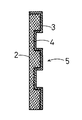
このようにして、図4に示されるようにシャープな凹凸が形成された自動車のトランクルームの内装材(5) が製造された。
【0058】
〔実施例3〕
実施例2で製造した表皮材を、熱硬化型フェノール樹脂含浸ガラスウールからなる内装材基材の表面に重ね、熱圧成形したところ、該表皮材の接着性および成形性の良好な内装材が得られた。該内装材は自動車のエンジンルームのフードサイレンサーとして有用である。
【0059】
〔実施例4〕
上記表皮材の替わりに、アクリル/ポリエステルからなる不織布(目付量50g/m2 )を用い、撥水剤水分散液に更に難燃剤として塩素化パラフィン3重量%、酸化アンチモン2重量%を添加し、ホットメルト接着剤粉末分散液B,Cの塗布量を10g/m2 (乾燥)とする以外、実施例2と同様にして撥水性熱接着性シートを製造した。
製造した撥水性熱接着性シートを、熱硬化型フェノール樹脂含浸ガラスウールに重ね、熱圧成形したところ、難燃性、撥水性および撥油性に優れ、該シートの接着性および成形性の良好な成形物が得られた。
【0060】
〔実施例5〕
ポリエステル繊維からなる不織布を用い、裏側からの真空吸引を行わない以外、実施例2と同様にして熱接着性シートを製造した。
製造された熱接着性シートの接着剤付着面に、接着剤が塗布されていない布を重ね、掛け面140℃のアイロンでプレスして両者を熱接着した。この熱接着後に該熱接着性シートの表面を観察した結果、該シート表面には該ホットメルト接着剤の移行によるブツブツは認められなかった。その後、得られた貼合わせ試料について、引張り試験機を用いて180°引剥がし試験を行った結果、接着強度は1.2kg/cm2 であった。
【0061】
〔実施例6〕
粒度250メッシュ全通のポリエステル共重合体接着剤粉末40重量部に、増粘剤としてのエチルアクリレート−メタクリル酸共重合体のエマルジョン1重量部および蛍光染料0.001重量部を加え、攪拌しながら更にアンモニア水2.5重量部を添加し、pH8.0、粘度620 mPa・s /25℃のホットメルト接着剤粉末分散液Dを得た。
得られた分散液Dを室温下で放置したところ、4ヶ月以上たっても分離することはなく、極めて安定していた。
【0062】
また、粒度250メッシュ全通のポリエステル共重合体接着剤粉末40重量部に、増粘剤として微架橋型ポリアクリル酸の部分中和物(日本純薬(株)製,レオジック250H)0.1重量部および蛍光染料0.001重量部を加え、攪拌しながら更にアンモニア水1.5重量部を添加し、pH8.0、粘度1500 mPa・s /25℃のホットメルト接着剤粉末分散液Eを得た。
得られた分散液Eを室温下で放置したところ、4ヶ月以上たっても分離することはなく、極めて安定していた。
【0063】
アクリル/綿からなるカーペット本体の表面にシリコン系撥水剤の1重量%水分散液を120g/m2 にの割合でスプレーした。上記カーペット本体を未乾燥状態において、その裏面に、上記分散液DまたはEを塗布量60g/m2 (乾燥)でスプレー塗布した後、加熱乾燥し、ホットメルト接着剤が点状に散在する撥水性熱接着シートであるバッキング材を形成した。このようにしてバッキング材が形成されたカーペットの裏面に、ポリエステル繊維からなる不織布(目付量15g/m2 )を重ね、熱圧したところ、該不織布とカーペット本体との接着性の優れ撥水性のあるカーペット積層物が製造された。
【0064】
【発明の効果】
本発明の撥水性熱接着性シートは熱接着性、通気性かつ撥水性に優れ、自動車の天井材、ドアトリム、リアパーセル、トランクルーム内装材、エンジンルームのフードサイレンサー等の内装材の表皮材や、自動車内装材の基材の裏打ち材、あるいは衣服等の芯材等に有用である。
【図面の簡単な説明】
【図1】本発明の一実施形態による撥水性熱接着性シート(表皮材)製造工程を示す概略側面図である。
【図2】本発明の一実施形態による撥水性熱接着性シート(表皮材)の側断面図である。
【図3】図2における撥水性熱接着性シート(表皮材)を内装材基材(クッション層)に接着する状態を示す概略側面図である。
【図4】本発明の一実施形態による内装材の側断面図である。
【符号の説明】
1 撥水性熱接着性シート
2 クッション層(内装材基材)
3A 繊維シート
3 表皮材
4 接着剤層
5 内装材[0001]
[Industrial application fields]
The present invention relates to a method for producing a water-repellent thermal adhesive sheet used for, for example, a hood silencer in an automobile engine room.
[0002]
[Prior art]
For example, a hood silencer in an engine room of an automobile has a configuration in which a skin material made of a fiber sheet is bonded to the surface of a porous sheet. In the case where the skin material is bonded to the surface of the porous sheet, a hot melt sheet is usually used. However, the hot melt sheet is not breathable and impairs the sound insulation of the hood silencer.
[0003]
Therefore, recently, hot melt adhesive powder has been used for bonding a skin material to the surface of a porous sheet. In this case, hot melt adhesive powder is adhered to the skin material bonding surface, and the skin material is laminated on the surface of the porous sheet and heat-pressed.
[0004]
As a method of attaching the hot melt adhesive powder to the skin material adhesive surface, a method of spraying the hot melt adhesive powder on the skin material adhesive surface or an aqueous dispersion in which the hot melt adhesive is dispersed in water is sprayed. Then, a method of drying is applied.
[0005]
However, there is a mark on the surface of the fiber sheet as the skin material, and when the hot melt adhesive powder penetrates to the root of the mark, the hot melt adhesive powder is covered with the mark and may not work effectively for bonding.
Therefore, recently, it has been proposed to impart structural viscosity to an aqueous dispersion of hot melt adhesive powder and then spray the fiber sheet adhesive surface (WO00 / 52110).
[0006]
[Problems to be solved by the invention]
For example, in the case of a hood silencer in an automobile engine room, water repellent treatment is performed so that water does not penetrate even if water adheres to the surface of the skin material. To apply a water repellent treatment to the skin material, (1) First, impregnate the skin material with an aqueous water repellent aqueous solution and heat dry, then spray and heat dry the hot melt adhesive powder aqueous dispersion on the adhesive surface (2) A method in which a water repellent is added to an aqueous dispersion of hot melt adhesive powder and sprayed onto the skin surface.
[0007]
In the above method (1), the heating and drying process is required twice. Especially when processing long sheets, two heating and drying furnaces must be passed. Become.
In particular, when the skin material is first impregnated with a water repellent aqueous solution and dried by heating, when the hot melt adhesive powder aqueous dispersion is sprayed on the surface of the skin material, the aqueous dispersion is repelled uniformly. There is a problem that the aqueous dispersion cannot be applied.
[0008]
In the above method (2), the heating and drying step is one stage. However, since the aqueous dispersion of hot melt adhesive powder has a structural viscosity, the aqueous dispersion containing the water repellent is used for the epidermis. It remains on the material adhesion surface and does not easily penetrate the surface of the skin material, so that the surface of the skin material is not sufficiently imparted with water repellency.
[0009]
[Means for Solving the Problems]
In order to solve the above problems, the present invention provides a hot melt adhesive powder having a structural viscosity on the surface of the fiber sheet (3A) in an undried state after impregnating the fiber sheet (3A) with a water repellent aqueous liquid. (4) A method for producing a water-repellent thermal adhesive sheet (1) in which the hot melt adhesive powder (4) is adhered to the upper end of the fiber sheet (3A) surface by spraying and drying an aqueous dispersion. It is to provide.
The hot melt adhesive powder (4) is preferably provided with a structural viscosity by an alkali thickening type thickener, and the water repellent aqueous liquid and / or the hot melt adhesive powder ( 4) A flame retardant may be added to the aqueous dispersion.
[0010]
[Action]
After the fiber sheet (3A) is impregnated with the water repellent aqueous solution, the surface of the fiber sheet is sprayed with the hot melt adhesive powder (4) in an undried state. The sheet (3A) is applied uniformly without being repelled on the adhesive surface.
Further, since the aqueous dispersion has a structural viscosity, when sprayed onto the fiber sheet (3A) adhesive surface, the aqueous dispersion is unlikely to sag on the fiber sheet (3A) adhesive surface. It is easy to uniformly apply a predetermined amount to the fiber sheet (3A) adhesive surface, and the aqueous dispersion does not easily enter the incision on the fiber sheet (3A) adhesive surface. (4) almost adheres to the tip of the kerva.
[0011]
DETAILED DESCRIPTION OF THE INVENTION
Hereinafter, the present invention will be described in detail.
[Water repellent aqueous solution]
As the water repellent used in the water-repellent treatment of the fiber sheet in the present invention, common ones such as hydrocarbon derivatives such as paraffin and wax, fatty acid derivatives, organopolysiloxane, fluorocarbon, and fatty acid zirconium salts are used. The water repellent is used in the form of an aqueous liquid such as an aqueous dispersion or an aqueous emulsion. In the aqueous liquid, the water repellent is usually contained in the range of 0.05 to 20% by weight.
[0012]
[Hot melt adhesive powder aqueous dispersion]
The hot melt adhesive used in the present invention is, for example, a polyolefin resin such as polyethylene, polypropylene, ethylene-vinyl acetate copolymer, ethylene-ethyl acrylate copolymer, or a modified product of the polyolefin resin, polyvinyl chloride, It is a single or a mixture of two or more of polyurethane, polyester, polyester copolymer, polyamide, polyamide copolymer, etc. The powder of the hot melt adhesive is usually about 50 to 300 mesh.
[0013]
The hot melt adhesive powder is dispersed in water to prepare an aqueous dispersion. To impart structural viscosity to the aqueous dispersion, a water-soluble thickener is added. Examples of the water-soluble thickener include polyacrylic acid and polymethacrylic acid salts such as sodium polyacrylate, ammonium polyacrylate, sodium polymethacrylate, and ammonium polymethacrylate, polyvinyl alcohol, polyethylene oxide, carboxymethylcellulose, and methylcellulose. And viscose, starch, modified starch, casein, gelatin, gum arabic, pectin and the like.
The water-soluble thickener tends to become a spatter when dissolved in water. Therefore, a particularly desirable thickener in the present invention is an alkali thickening type thickener.
[0014]
The first thickener desirable as the alkali thickening type thickener is an alkali thickening type acrylic copolymer emulsion, and the desirable second thickener is a microcrosslinked polyacrylic acid. is there.
Examples of the alkali thickening type acrylic copolymer include a copolymer of an acrylate ester and an α, β-unsaturated carboxylic acid, an acrylate ester, and another vinyl copolymerizable with the acrylate ester. A multi-component copolymer of a monomer and an α, β-unsaturated carboxylic acid can be used.
[0015]
Examples of the acrylic esters include methyl acrylate, ethyl acrylate, n-propyl acrylate, isopropyl acrylate, n-butyl acrylate, isobutyl acrylate, t-butyl acrylate, 2-ethylhexyl acrylate, cyclohexyl acrylate, tetrahydrofurfuryl acrylate, methyl methacrylate, Ethyl methacrylate, n-propyl methacrylate, isopropyl methacrylate, n-butyl methacrylate, isobutyl methacrylate, 2-ethylhexyl methacrylate, cyclohexyl methacrylate, tetrahydrofurfuryl methacrylate, stearyl methacrylate, lauryl methacrylate, β-hydroxyethyl acrylate, β-hydroxyethyl methacrylate, β-hydroxyethyl ester Acrylate, beta-hydroxypropyl acrylate, beta-hydroxypropyl methacrylate, dimethylaminoethyl acrylate, dimethylaminoethyl methacrylate, glycidyl acrylate, glycidyl methacrylate and the like.
[0016]
Examples of the α, β-unsaturated carboxylic acid include acrylic acid, methacrylic acid, maleic acid, itaconic acid, crotonic acid, atropic acid, citraconic acid and the like.
[0017]
Examples of other vinyl monomers copolymerizable with the acrylic acid ester include ethers such as methyl vinyl ether, ethyl vinyl ether, n-propyl vinyl ether, n-butyl vinyl ether, isobutyl vinyl ether, styrene, α-methyl styrene, etc. Styrenes, cyano group-containing monomers such as (meth) acrylonitrile, isocyanate group-containing monomers such as (meth) acryloyl isocyanate, m-isopropenyl-α, α-dimethylbenzyl isocyanate, diacetone acrylamide, N- Amide group-containing monomers such as vinylformamide and N-vinylacetamide, p-sulfonic acid styrene, sulfone group-containing monomers such as 2- (acryloylamino) -2-methylpropanesulfonic acid, mercaptopropyltrimethoxysilane, Me Mercaptopropyltrimethoxysilane, mercaptopropyltriethoxysilane, mercapto group-containing monomer such as mercaptopropyl trimethoxysilane.
[0018]
In the acrylic copolymer emulsion, when the α, β-unsaturated carboxylic acid is salted with an alkali, the acrylic copolymer becomes water-soluble. The acrylic copolymer is contained in a sufficient amount. The amount of the α, β-unsaturated carboxylic acid varies depending on the acrylic ester, other vinyl monomer, or the type of the α, β-unsaturated carboxylic acid, but is usually 20 to 60 in the copolymer. % By weight, preferably 30-50% by weight.
[0019]
The acrylic copolymer may be crosslinked to such an extent that it does not adversely affect its water solubility. In this case, a polyfunctional vinyl monomer such as divinylbenzene, methylenebisacrylamide, ethylene glycol dimethacrylate, polyethylene glycol dimethacrylate, trimethylolpropane dimethacrylate, trimethylolpropane trimethacrylate, diallyl phthalate or the like in the copolymer. Is introduced.
[0020]
In order to prepare an aqueous dispersion of hot melt adhesive powder using the above-mentioned alkali thickening type acrylic copolymer emulsion as a thickener, first, the acrylic copolymer emulsion and the hot melt adhesive powder are mixed with water. It is preferable to add and stir to form a dispersion. At this stage, since the acrylic copolymer emulsion is not thickened, it is very easy to uniformly disperse it in water.
The hot melt adhesive powder need not be added to water at the same time as the acrylic copolymer emulsion, and may be added to water at any stage, but is preferably added before thickening.
[0021]
The hot melt adhesive powder is usually dispersed in water in the range of 1 to 60% by weight, and the acrylic copolymer emulsion has a viscosity of the hot melt adhesive aqueous dispersion after alkali thickening of 50 to 50%. Add to the water to 2000 mPa · s / 25 ° C. For example, when a 30% by weight emulsion of a copolymer obtained by copolymerizing ethyl acrylate and methacrylic acid at a weight ratio of 6: 4 is used, the added amount of the emulsion is about 0.1 to 10% by weight.
[0022]
As described above, the acrylic copolymer emulsion and the hot melt adhesive powder are added to water, and when mixed uniformly, alkali is added. Then, the carboxylic acid derived from the α, β-unsaturated carboxylic acid contained in the acrylic copolymer becomes a salt, and the copolymer becomes water-soluble and thickens the dispersion.
Examples of the alkali include ammonia, amines; hydroxides of alkali metals and alkaline earth metals such as sodium hydroxide, potassium hydroxide, barium hydroxide and calcium hydroxide; oxides of alkaline earth metals such as lime; carbonic acid Alkali metal weak acid salts such as sodium, sodium sulfite, sodium acetate, and sodium phosphate can be used.
The amount of the alkali added is usually determined with reference to the pH of the dispersion being about 6-9.
Thus, the hot melt adhesive powder aqueous dispersion using the alkali thickening type acrylic copolymer emulsion as a thickener exhibits plastic flow, and the settling of the hot melt adhesive powder is substantially prevented. .
[0023]
On the other hand, the microcrosslinked polyacrylic acid, which is a desirable second thickener, can usually be produced by the following precipitation polymerization method.
A solvent that dissolves acrylic acid but does not dissolve polyacrylic acid, for example, an organic solvent such as benzene, ethyl acetate, cyclohexane, toluene, or a mixture thereof, in which acrylic acid, a crosslinking agent, and a polymerization agent are used. Mix initiator.
Examples of the crosslinking agent include polyfunctional vinyl monomers such as divinylbenzene, diallyl phthalate, tetraallyloxyethane, ethylene glycol dimethacrylate, polyethylene glycol dimethacrylate, and trimethylolpropane dimethacrylate, and sugars such as allyl saccharose. Can be used. The crosslinking agent is usually used in an amount of 1% or less, preferably around 0.05% with respect to acrylic acid.
[0024]
Examples of the polymerization initiator include benzoyl peroxide, methyl ethyl ketone peroxide, cumene hydroperoxide, t-butyl hydroperoxide, cyclohexanone peroxide, t-butyl peroxide, t-butyl peroxybenzoate, and t-butyl peroxy. 2-ethylhexanate, t-butylperoxypivalate, t-butylperoxyneodecanoate, 3,5,5-trimethylhexanoyl peroxide, diisopropylbenzene hydroperoxide, lauroyl peroxide, dicumylper Peroxide-based polymerization initiators such as oxide, 2,2′-azobisisobutyronitrile, 2,2′-azobis-2-methylbutyronitronitrile, 2,2′-azobis-2,4 ′ -Dimethylvaleronitrile, 2, 2'-azobis-2-cyclopropylpropionitrile, 2,2'-azobis-4-methoxy-2,4-dimethylvaleronitrile, 1,1'-azobiscyclohexane-1-carbonitrile, 2-phenylazo- An azo polymerization initiator such as 4-methoxy-2,4-dimethylvaleronitrile and 2,2′-azobis-N, N′-dimethyleneisobutyridine can be used.
[0025]
When acrylic acid is polymerized in the solvent as described above, finely crosslinked polyacrylic acid is precipitated in powder form. The precipitated polyacrylic acid is dried to a powder. The polyacrylic acid obtained in this way is crosslinked at a low density that maintains water solubility. In addition, when the crosslinking density of the polyacrylic acid is increased, the polyacrylic acid becomes water-swellable and hardly dissolves in water, and when the crosslinking density is further increased, the polyacrylic acid becomes water-insoluble.
[0026]
To prepare an aqueous dispersion of hot melt adhesive powder using the finely crosslinked polyacrylic acid as a thickener, first, add the finely crosslinked polyacrylic acid and hot melt adhesive powder to water and stir Thus, a dispersion is preferable. At this stage, the micro-crosslinked polyacrylic acid does not thicken much and is difficult to become a powder, so that it is relatively easy to uniformly disperse in water.
The hot melt adhesive powder need not be added to water at the same time as the microcrosslinked polyacrylic acid, and may be added to water at any stage, but is preferably added before thickening.
The hot melt adhesive powder is usually dispersed in water in the range of 1 to 60% by weight, and the micro-crosslinked polyacrylic acid is finally (including when neutralized and thickened) the hot melt It is added to the water so that the viscosity of the adhesive dispersion is 50 to 2000 mPa · s / 25 ° C.
[0027]
The finely crosslinked polyacrylic acid added to water as described above dissolves to thicken the water (dispersion), but is further neutralized with an alkali to further increase the viscosity. When neutralized with alkali, negative charges are generated along the polymer skeleton of the polyacrylic acid, and the negative charges repel each other, so that the bent / curved polymer skeleton is stretched and the water is further increased. Can be thickened (or thickened with a small amount).
As the alkali, it is preferable to use amines such as ammonia, triethanolamine, diisopropanolamine, aminomethylpropanol, tromethamine, tetrahydroxypropylethylenediamine, but sodium hydroxide, potassium hydroxide, etc. should be used. You can also. The amount of the alkali added is usually determined with reference to the pH of the dispersion being about 6-9.
[0028]
In addition, a part of the carboxyl groups in the micro-crosslinked polyacrylic acid may be previously salted with an alkali, but when the degree of neutralization is high, it tends to become a spatter when dispersed in water, The degree of neutralization needs to be set so low that it does not become a splint.
[0029]
As described above, the aqueous dispersion of hot melt adhesive powder using the finely-crosslinked polyacrylic acid as a thickener exhibits plastic flow, and the settling of the hot melt adhesive powder is substantially prevented.
[0030]
In addition, as a thickener in the hot-melt adhesive powder aqueous dispersion of the present invention, an alkali-thickening type acrylic copolymer emulsion and a micro-crosslinked polyacrylic acid can be used in combination.
[0031]
The hot melt adhesive powder aqueous dispersion includes, for example, higher alcohol sulfate (Na salt or amine salt), alkyl allyl sulfonate (Na salt or amine salt), alkyl naphthalene sulfonate (Na salt or amine salt), Anionic surfactants such as alkyl naphthalene sulfonate condensate, alkyl phosphate, dialkyl sulfosuccinate, rosin soap, fatty acid salt (Na salt or amine salt), polyoxyethylene alkyl ether, polyoxyethylene alkylphenol ether, polyoxy Ethylene alkyl ester, polyoxyethylene alkylamine, polyoxyethylene alkylolamine, polyoxyethylene alkylamide, sorbitan alkyl ester, polyoxyethylene sorbitan alkyl ester Nonionic surfactant, octadecylamine acetate, imidazoline derivative acetate, polyalkylene polyamine derivative or its salt, octadecyltrimethylammonium chloride, trimethylaminoethylalkylamide halide, alkylpyridinium sulfate, alkyltrimethylammonium halide, etc. One or more surfactants such as a surfactant may be added as a dispersant.
[0032]
In addition, the hot melt adhesive powder aqueous dispersion further includes, for example, polyethylene, polypropylene, ethylene-propylene copolymer, ethylene-vinyl acetate copolymer, vinyl chloride resin, vinylidene chloride resin, styrene resin, Thermosetting of vinyl acetate resin, fluorine resin, thermoplastic acrylic resin, thermoplastic polyester, thermoplastic polyamide, thermoplastic urethane resin, epoxy resin, melamine resin, urea resin, phenol resin, resorcin resin, alkyl resorcin resin, etc. Resin emulsion, synthetic resin emulsion such as acrylonitrile-butadiene copolymer, styrene-butadiene copolymer, acrylonitrile-butadiene-styrene copolymer; acrylic rubber, butyl rubber, silicon rubber, urethane rubber, fluoride rubber, polysulfide Rubber, graph Rubber, butadiene rubber, isoprene rubber, chloroprene rubber, polyisobutylene rubber, polybutene rubber, isobutene-isoprene rubber, acrylate-butadiene rubber, styrene-butadiene rubber, acrylonitrile-butadiene rubber, pyridine-butadiene rubber, styrene-isoprene rubber, acrylonitrile- Chloroprene rubber, styrene-chloroprene rubber, styrene-butadiene-styrene copolymer, styrene-isoprene-styrene copolymer, styrene-hydrogenated polyolefin-styrene copolymer, butadiene-styrene block copolymer, styrene-rubber intermediate block -A synthetic rubber such as a block copolymer such as a styrene copolymer or an elastomer powder or an emulsion thereof may be added. Further, if necessary, fillers such as calcium carbonate, talc, gypsum, silica, carbon black, wood powder, walnut powder, coconut powder, starch, celluloses such as carboxymethyl cellulose, methyl cellulose, hydroxymethyl cellulose, pigments, dyes, insect repellents , Preservatives, anti-aging agents, ultraviolet absorbers, fluorescent dyes, surfactants, foaming agents, softeners such as paraffin, wax, silicone, oil repellents, release agents, plasticizers, and the like may be added.
[0033]
In addition, when the dispersion liquid in which the powder of the hot melt adhesive is dispersed in water is alkaline due to the third component or an alkali added separately, the alkali thickening type is added to the dispersion liquid. Thickening can be achieved by adding and mixing a thickener.
[0034]
[Thermal adhesive sheet]
Examples of the fiber sheet used for the heat-adhesive sheet of the present invention include polyester fiber, polyethylene fiber, polypropylene fiber, polyamide fiber, acrylic fiber, urethane fiber, polyvinyl chloride fiber, polyvinylidene chloride fiber, acetate fiber and the like. Fiber, pulp, cotton, wool, palm fiber, hemp fiber, bamboo fiber and other natural fibers, glass fiber, carbon fiber, ceramic fiber, asbestos and other inorganic fibers, or scraps of textile products using these fibers There are knitted fabrics or non-woven fabrics composed of one kind or two or more kinds of fibers such as regenerated fibers. A napped layer may be formed on the surface of the fiber sheet by needling or tufting. Desirable fiber sheet is one or more of polyester fiber, polyamide fiber, polyethylene fiber, polypropylene fiber, etc. having a melting point of 200 ° C. or lower for polyester fiber, polyamide fiber, natural fiber, inorganic fiber, etc. having a melting point of 250 ° C. or higher. There is a thermoformable non-woven fabric mixed with
The fiber sheet is first subjected to water repellent treatment.
[0035]
In the water repellent treatment, the fiber sheet is immersed in a water repellent aqueous solution. The impregnation amount of the water repellent agent is controlled by the water repellent concentration in the water repellent aqueous solution or the impregnation amount of the water repellent aqueous solution. The amount of impregnation of the water repellent aqueous liquid is controlled by squeezing the fiber sheet with a squeezing roll in the water repellent aqueous liquid, or after taking out the fiber sheet from the water repellent aqueous liquid, It is done by squeezing.
Usually, the water repellent in the fiber sheet is 0.01 g / m as a solid content. 2 ~ 20g / m 2 Impregnated to a degree.
[0036]
After the water repellent aqueous liquid is impregnated into the fiber sheet by spraying or dipping, etc., the aqueous water repellent liquid impregnated in the fiber sheet is not dried and the hot melt adhesive powder aqueous The dispersion is sprayed on the fiber sheet bonding surface.
As a method for spraying the hot melt adhesive powder aqueous dispersion onto the adhesive surface of the fiber sheet, a method in which high pressure is directly applied to the aqueous dispersion and the aqueous dispersion is air sprayed is preferable. According to this method, even when the viscosity of the hot melt adhesive powder aqueous dispersion is high, the aqueous dispersion can be efficiently spray-coated. At this time, the hot-melt adhesive powder aqueous dispersion does not necessarily need to be stirred, but may be stirred. The coating amount is usually 1 to 100 g / m as a solid content. 2 It is.
In addition, the said hot-melt-adhesive-powder powder aqueous dispersion may be previously manufactured by high concentration, and may be used by diluting to a desired density | concentration with water at the time of use.
The hot-melt adhesive powder aqueous dispersion spray-coated as described above has a structural viscosity, so that it does not enter between the fibers on the fiber sheet bonding surface, and adheres to the surface of the fiber sheet. A state in which the hot melt adhesive powder is efficiently attached to the tip portion of the film is obtained. In addition, since the aqueous dispersion of hot melt adhesive powder is applied without settling, the hot melt adhesive powder can uniformly adhere to the surface to be coated.
[0037]
When spraying the hot melt adhesive powder aqueous dispersion onto the fiber sheet bonding surface, it is preferable to suck from the surface opposite to the bonding surface. By sucking in this way, it is possible to prevent the hot-melt adhesive powder from rebounding due to impact during spraying, and to reliably adsorb the hot-melt adhesive powder to the fiber sheet adhesive surface.
When the aqueous dispersion is spray-coated as described above, the fiber sheet is heated and dried. The heat drying condition is a temperature equal to or higher than the melting point of the used hot melt adhesive, and is usually about 70 ° C. or higher and about 1 to 10 minutes. In this way, a heat-adhesive sheet is produced.
[0038]
[Flame-retardant treatment]
When the heat-adhesive sheet is used as a skin material for an interior material disposed near a heating element such as a hood silencer in an engine room, for example, it is desirable to perform a flame-retardant treatment.
Examples of the flame retardant used in the flame retardant treatment include ammonium bromide, ammonium chloride, ammonium phosphate, ammonium sulfate, zinc chloride, aluminum hydroxide, magnesium hydroxide, antimony trioxide, antimony pentoxide, and boric acid. Inorganic flame retardants such as zinc, barium metaborate, molybdenum oxide, organic flame retardants such as halogen compounds, phosphorus compounds, nitrogen compounds, sulfur compounds, and chlorine-based compounds such as vinylidene chloride resin and vinyl chloride resin General materials such as synthetic resins and flame retardant synthetic resins such as fluorine-based synthetic resins such as vinylidene fluoride resins are used, and two or more of these flame retardants may be mixed, particularly inorganic and organic When used in combination with the system, an excellent flame retardant effect is obtained.
These flame retardants are preferably added to a water repellent aqueous liquid or a hot melt adhesive powder aqueous dispersion.
[0039]
The heat-adhesive sheet of the present invention obtained as described above is a skin material of an automobile interior material such as a hood silencer of an automobile engine room, a backing material of a base material of an automobile interior material, an automobile flooring carpet, or It can be used for core materials such as clothes.
[0040]
[Interior material]
The interior material of the present invention is obtained by bonding the above-mentioned heat-adhesive sheet as a skin material to the surface of the interior material base material.
Examples of the interior material base material include polyester fibers, polyethylene fibers, polypropylene fibers, polyamide fibers, aramid fibers, acrylic fibers, urethane fibers, polyvinyl chloride fibers, polyvinylidene chloride fibers, acetate fibers, rayon, and cupra. Wood fiber such as pulp, wood, cotton, wool, silk, hemp, kenaf fiber, palm fiber, etc. natural fiber, glass fiber, asbestos, ceramic fiber, carbon fiber, metal fiber, etc., or two of the above fibers Polyethylene, polypropylene, ethylene-propylene copolymer, ethylene-vinyl acetate copolymer, polyvinyl chloride, polychlorinated fiber obtained by defibrating the above mixed fibers or scraps of products using the above fibers Vinylidene, polystyrene, polyvinyl acetate, fluororesin, thermoplastic Thermoplastic synthetic resins such as krill resin, thermoplastic polyester, thermoplastic polyamide, thermoplastic urethane resin, acrylonitrile-butadiene copolymer, styrene-butadiene copolymer, acrylonitrile-butadiene-styrene copolymer, urethane resin, melamine resin , Thermosetting acrylic resin, urea resin, phenol resin, resorcin resin, alkyl resorcin resin, epoxy resin, thermosetting synthetic resin such as thermosetting polyester, urethane resin prepolymer, epoxy resin prepolymer, melamine resin pre Polymer, urea resin prepolymer, phenol resin prepolymer, diallyl phthalate prepolymer, acrylic oligomer, polyvalent isocyanate, methacrylic ester monomer, diallyl phthalate monomer, etc. Fiber sheet bound with synthetic resin precursors such as sesame, monomer, etc., needle punch felt bound with card web of the fiber by needle punching, and impregnating the needle punch felt with the above synthetic resin and / or synthetic resin precursor. A synthetic resin impregnated felt, one or more of low melting point fibers such as polyethylene fiber, polypropylene fiber, polyester fiber, polyamide fiber or the like having a melting point of 200 ° C. or less are mixed with the above fiber, and if desired, by needle punching and / or heating setting Bonded thermoplastic felt, melamine resin, synthetic resin foam sheet such as polyurethane, polystyrene, polyvinyl chloride, etc., fiber reinforced synthetic resin foam sheet in which the above fibers are mixed as reinforcing fibers, the above synthetic resin and / or synthetic resin precursor The above synthetic tree Synthetic resin impregnated synthetic resin foam sheet impregnated with a fat foam sheet, cardboard and waste paper impregnated with the above synthetic resin and / or synthetic resin precursor, or a laminated base material in which two or more of the above base materials are laminated is there. The synthetic resin or synthetic resin precursor used for the interior material base material may be one in which a foaming agent is added. The interior material base is provided with moldability by a synthetic resin or a synthetic resin precursor, a low melting point fiber, or the like used as a binder or an impregnating agent.
[0041]
In the interior material base material, it is desirable to impregnate the porous material with the initial condensate of the thermosetting synthetic resin, and further, the porous material impregnated with the initial condensate is dried by heating and the initial condensate It is desirable to slightly condense to a B state.
By setting the initial condensate impregnated in the porous material to the B state, the curing time of the initial condensate can be shortened, and the interior material base material has good moldability by a short hot press. The interior material base material can be stored for a long period of time. In such an interior material base material, since the thermosetting synthetic resin in the B state is completely cured by hot pressing, an interior material base material having excellent shape retention and heat resistance can be obtained.
[0042]
As the initial condensate of the thermosetting synthetic resin, it is preferable to use a monohydric phenol and / or a phenol-based initial condensate that is an initial condensate of a polyhydric phenol and an aldehyde. Sulfomethylation and / or sulfimethylation are preferred.
[0043]
Examples of the porous material include fiber aggregates such as nonwoven fabrics of organic or inorganic fibers, felts, knitted fabrics, laminates thereof, polyurethane foams having open cells, polyolefin foams such as polyethylene and polypropylene, and polyvinyl chloride foams. Body, polystyrene foam, amino resin foam such as melamine resin and urea resin, continuous foam structure plastic foam such as phenol resin foam, and plastic bead sintered body.
[0044]
In order to adhere the skin material to the interior material base material, the hot melt adhesive powder formed on the back surface of the skin material is heat-softened and then bonded together. When the interior material base material is molded into a desired shape, the interior material base material is molded before the skin material is pasted, simultaneously when the skin material is pasted, or after the skin material is pasted. It can be done at any time.
As a molding method, when the interior material base material contains a thermoplastic synthetic resin or low melting point fiber, the interior material base material is usually heated to soften the thermoplastic synthetic resin or low melting point fiber. And then cold press-molding, or if the skin material is non-breathable, vacuum molding is applied, and if the interior base material contains a thermosetting synthetic resin Usually, a method of hot press molding the interior material substrate is applied.
[0045]
The skin material is made of a fiber sheet, and since the hot melt adhesive powder is scattered on the adhesive surface, it has air permeability, and when the skin material is bonded to the interior material base material, Gas generated from the air contained in the interior material base material or synthetic resin contained in the interior material base material (for example, formalin gas in the case of phenol resin, water or carbonic acid in the case of polyvalent isocyanate) Gas) passes through the gaps between the hot melt adhesive powders (softened products) scattered on the fiber sheet bonding surface during molding and is smoothly discharged from the skin material to the outside. The puncture phenomenon does not occur in the material, and the problem of odor due to residual gas is also eliminated.
[0046]
The interior material of the present invention can be used for various applications, and is suitable, for example, as a hood silencer for an automobile engine room, a trunk room interior material, a dashboard interior material, and the like. In the interior material, since the adhesive layer made of hot melt adhesive powder is scattered in the form of dots, the rigidity of the adhesive layer does not affect the molded shape of the interior material and the uneven shape of the surface. The molding shape and the uneven shape are formed sharply. Further, since the skin material has air permeability and the adhesive layer also has air permeability, the obtained interior material has excellent soundproofing properties.
[0047]
EXAMPLES Hereinafter, the present invention will be described more specifically with reference to examples. However, the scope of the present invention is not limited to these examples.
[Example 1]
After the polyamide adhesive powder having a particle size of 250 mesh is dispersed in water, an emulsion of 30% solid ethyl acrylate-methacrylic acid copolymer is added as a thickener a while stirring the dispersion. Alternatively, a slightly cross-linked polyacrylic acid (manufactured by Nippon Pure Chemical Co., Ltd., Junron PW-110) was added as a thickener b, and the mixture was stirred to be uniform and then ammonia water was added to increase the viscosity. Table 1 shows the blending ratio of each component.
The obtained hot melt adhesive powder dispersions A1 to A8 were placed in a 200 cc glass bottle and allowed to stand at room temperature for 2 months, and the storage stability of the dispersions A1 to A8 was examined. The results are shown in Table 1.
[0048]
[Table 1]
[Comparative Example 1]
Hot melt adhesive powder dispersions A9 to A12 were produced in the same manner as in Example 1 except that the thickeners a and b and aqueous ammonia were not used, and the standing stability was examined. Table 2 shows the blending ratio of each component and the results of standing stability.
[0050]
[Table 2]
[Comparative Example 2]
Hot melt adhesive powder dispersions A13 to 16 were produced in the same manner as in Example 1 except that 0.5% sodium polyacrylate was used instead of the thickeners a and b and ammonia water, and the standing stability was increased. I investigated. Table 3 shows the blending ratio of each component and the results of standing stability.
[0052]
[Table 3]
As is clear from Example 1 and Comparative Examples 1 and 2, simply increasing the viscosity of the hot-melt adhesive powder dispersion does not improve the standing stability, and the alkali-thickening type acrylic copolymer emulsion or Only when cross-linked polyacrylic acid is used, the storage stability is dramatically improved.
[0054]
[Example 2]
15 parts by weight of ethylene-vinyl acetate copolymer (EVA) powder having a particle size of 200 mesh, 0.1 parts by weight of a surfactant composed of sodium dialkylsulfosuccinate as a dispersant, and n-butyl methacrylate-itacon as a thickener An aqueous acid copolymer emulsion (1.5 parts by weight) was added, and ammonia water was further added with stirring to obtain a hot melt adhesive powder dispersion B having a pH of 8.0 and a viscosity of 310 mPa · s / 25 ° C.
When the obtained dispersion B was allowed to stand at room temperature, it did not separate even after 3 months or more and was extremely stable.
[0055]
In addition, 15 parts by weight of ethylene-vinyl acetate copolymer (EVA) powder having a particle size of 200 mesh, 0.1 parts by weight of a surfactant composed of sodium dialkylsulfosuccinate as a dispersing agent, and a slightly crosslinked type as a thickening agent Add 0.5 parts by weight of polyacrylic acid (manufactured by Nippon Pure Chemicals Co., Ltd., Junron PW-150), add ammonia water while stirring, hot melt with a pH of 8.0 and a viscosity of 720 mPa · s / 25 ° C. An adhesive powder dispersion C was obtained.
When the obtained dispersion C was allowed to stand at room temperature, it did not separate even after 3 months or more and was extremely stable.
[0056]
Using the hot melt adhesive powder dispersions B and C, respectively, a heat-adhesive skin material and an interior material were produced as follows.
As a skin material (fiber sheet), a needle punch nonwoven fabric made of polyester fiber (weight per unit area 120 g / m) 2 )It was used.
As shown in FIG. 1, the fiber sheet (3A) is drawn from the roll (15), and the guide rolls (17, 18, 19) are placed in a treatment tank (16) filled with a 2% by weight aqueous dispersion of a fluorocarbon water repellent. The fiber sheet (3A) is taken out from the treatment tank (16) and the water repellent content is 0.5 g / m by the squeeze roll (20). 2 (Solid content). The fiber sheet (3A) was introduced onto a breathable belt conveyor (21) made of a net, felt, etc., and vacuum sucked from the back side by a suction box (22) in contact with the back surface of the belt conveyor (21). . A vacuum path (23) with a valve (24) communicates with the suction box (22). In this state, the hot melt adhesive powder dispersions B and C were sprayed from above on the surface of the fiber sheet (3A) in an undried state by a spray device (25). The spray tank (26) of the spray device (25) is filled with the dispersions B and C, and the dispersions B and C are introduced from the pressure pipe (27) while being stirred by the stirrer (28). Pressurized and sprayed with high pressure air.
The hot melt adhesive powder dispersions B and C are 5 g / m in solid content on the surface of the fiber sheet (3A) by spraying. 2 It was applied in the amount of (dry). At this time, since the fiber sheet (3A) is sucked from the back side by the suction box (22), the hot melt adhesive powder in the dispersions B and C is sprayed on the surface of the fiber sheet (3A). It was adsorbed without splashing and splashing.
After spraying the dispersions B and C, the fiber sheet (3A) was introduced into a drying chamber (29) and dried by heating at 170 ° C. for 2 minutes. In this way, as shown in FIG. 2, the EVA powder is fixed on the fiber sheet (3A), which is a polyester fiber needle punch nonwoven fabric, and the adhesive layer (4) scattered in the form of dots on the adhesive surface is formed. A water-repellent thermal adhesive sheet (1) is obtained. The water repellent thermal adhesive sheet (1) was cut to a predetermined size by a cutter (30) to obtain a skin material (3).
[0057]
On the other hand, mixed fibers in which polyester fibers and polypropylene fibers are mixed at a weight ratio of 1: 1 are entangled by a needle punch, and then the polypropylene fibers are softened by heat treatment to bind the mixed fibers to form a sheet-like interior A material base was used.
As shown in FIG. 3, the obtained interior material base material is used as a cushion layer (2), and the polypropylene fiber of the cushion layer (2) is softened by heating at 250 ° C. for 30 seconds. (3) was stacked and set in a cold press device (31) having a lower die (32) and an upper die (33).
Cold pressing is performed by the cold pressing device (31) to form irregularities on the surface of the cushion layer (2), and at the same time, the skin material (3) is formed by heat remaining after softening the polypropylene fibers of the cushion layer (2). ) Was softened, and the skin material (3) was adhered to the cushion layer (2) via the adhesive layer (4).
In this way, an interior material (5) for an automobile trunk room in which sharp irregularities were formed as shown in FIG. 4 was manufactured.
[0058]
Example 3
When the skin material produced in Example 2 was superposed on the surface of an interior material base material made of thermosetting phenol resin-impregnated glass wool and subjected to hot-pressure molding, an interior material having good adhesion and formability of the skin material was obtained. Obtained. The interior material is useful as a hood silencer for an automobile engine room.
[0059]
Example 4
Non-woven fabric made of acrylic / polyester (weight per unit area 50 g / m) 2 ), 3% by weight of chlorinated paraffin and 2% by weight of antimony oxide are added as a flame retardant to the water repellent aqueous dispersion, and the coating amount of the hot melt adhesive powder dispersions B and C is 10 g / m. 2 A water-repellent heat-adhesive sheet was produced in the same manner as in Example 2 except that (dry).
The manufactured water-repellent heat-adhesive sheet is layered on thermosetting phenol resin-impregnated glass wool and hot-press molded, and is excellent in flame retardancy, water repellency and oil repellency, and has good adhesion and moldability. A molding was obtained.
[0060]
Example 5
A heat-adhesive sheet was produced in the same manner as in Example 2 except that a non-woven fabric made of polyester fiber was used and vacuum suction from the back side was not performed.
A cloth not coated with an adhesive was layered on the adhesive-adhering surface of the manufactured heat-adhesive sheet, and both were thermally bonded by pressing with an iron having a hanging surface of 140 ° C. As a result of observing the surface of the heat-adhesive sheet after this heat-bonding, no sag due to transfer of the hot-melt adhesive was observed on the sheet surface. Thereafter, the obtained bonded sample was subjected to a 180 ° peeling test using a tensile tester. As a result, the adhesive strength was 1.2 kg / cm. 2 Met.
[0061]
Example 6
While adding 1 part by weight of an emulsion of ethyl acrylate-methacrylic acid copolymer as a thickener and 0.001 part by weight of a fluorescent dye to 40 parts by weight of a polyester copolymer adhesive powder having a total particle size of 250 mesh, while stirring. Further, 2.5 parts by weight of aqueous ammonia was added to obtain a hot melt adhesive powder dispersion D having a pH of 8.0 and a viscosity of 620 mPa · s / 25 ° C.
When the obtained dispersion D was allowed to stand at room temperature, it did not separate even after 4 months or more and was extremely stable.
[0062]
Further, 40 parts by weight of a polyester copolymer adhesive powder having a particle size of 250 mesh is partially added to a partially neutralized product of finely crosslinked polyacrylic acid as a thickener (manufactured by Nippon Pure Chemical Co., Ltd., Rhegic 250H) 0.1. Part by weight and 0.001 part by weight of a fluorescent dye were added, and 1.5 parts by weight of ammonia water was further added while stirring to prepare a hot melt adhesive powder dispersion E having a pH of 8.0 and a viscosity of 1500 mPa · s / 25 ° C. Obtained.
When the obtained dispersion E was allowed to stand at room temperature, it did not separate even after 4 months or more and was extremely stable.
[0063]
120 g / m of a 1% by weight aqueous dispersion of a silicone water repellent on the surface of an acrylic / cotton carpet body 2 Sprayed at a rate of When the carpet body is in an undried state, the dispersion D or E is applied on the back surface thereof at a coating amount of 60 g / m. 2 After spray coating by (drying), it was dried by heating to form a backing material which is a water-repellent thermal adhesive sheet in which hot-melt adhesives are scattered in a dot shape. A nonwoven fabric made of polyester fiber (weight per unit area 15 g / m) is formed on the back surface of the carpet thus formed with the backing material. 2 ) And hot pressing, a carpet laminate having excellent adhesion between the nonwoven fabric and the carpet body and water repellency was produced.
[0064]
【The invention's effect】
The water-repellent heat-adhesive sheet of the present invention is excellent in heat adhesion, breathability and water repellency, and is used for automobile ceiling materials, door trims, rear parcels, trunk room interior materials, skin materials for interior materials such as engine room hood silencers, It is useful as a backing material for automobile interior materials or as a core material for clothes.
[Brief description of the drawings]
FIG. 1 is a schematic side view showing a process for producing a water-repellent thermal adhesive sheet (skin material) according to an embodiment of the present invention.
FIG. 2 is a side sectional view of a water-repellent thermal adhesive sheet (skin material) according to an embodiment of the present invention.
3 is a schematic side view showing a state in which the water-repellent heat-adhesive sheet (skin material) in FIG. 2 is bonded to an interior material base material (cushion layer).
FIG. 4 is a side sectional view of an interior material according to an embodiment of the present invention.
[Explanation of symbols]
1 Water repellent thermal adhesive sheet
2 Cushion layer (interior material base material)
3A Fiber sheet
3 Skin material
4 Adhesive layer
5 Interior materials
Claims (3)
Priority Applications (2)
| Application Number | Priority Date | Filing Date | Title |
|---|---|---|---|
| JP2001307037A JP3824512B2 (en) | 2001-10-03 | 2001-10-03 | Method for producing water repellent thermal adhesive sheet |
| AU27644/02A AU783940B2 (en) | 2001-10-03 | 2002-03-25 | A method for manufacturing heat-bondable sheet having water repellency |
Applications Claiming Priority (1)
| Application Number | Priority Date | Filing Date | Title |
|---|---|---|---|
| JP2001307037A JP3824512B2 (en) | 2001-10-03 | 2001-10-03 | Method for producing water repellent thermal adhesive sheet |
Publications (2)
| Publication Number | Publication Date |
|---|---|
| JP2003113357A JP2003113357A (en) | 2003-04-18 |
| JP3824512B2 true JP3824512B2 (en) | 2006-09-20 |
Family
ID=19126570
Family Applications (1)
| Application Number | Title | Priority Date | Filing Date |
|---|---|---|---|
| JP2001307037A Expired - Lifetime JP3824512B2 (en) | 2001-10-03 | 2001-10-03 | Method for producing water repellent thermal adhesive sheet |
Country Status (2)
| Country | Link |
|---|---|
| JP (1) | JP3824512B2 (en) |
| AU (1) | AU783940B2 (en) |
Cited By (2)
| Publication number | Priority date | Publication date | Assignee | Title |
|---|---|---|---|---|
| US10021319B2 (en) | 2013-07-12 | 2018-07-10 | Samsung Electronics Co., Ltd. | Electronic device and method for controlling image display |
| US10243893B2 (en) | 2010-12-15 | 2019-03-26 | Samsung Electronics Co., Ltd. | Interface for managing messages in a mobile terminal |
Families Citing this family (8)
| Publication number | Priority date | Publication date | Assignee | Title |
|---|---|---|---|---|
| US7348378B2 (en) * | 2003-12-18 | 2008-03-25 | 3M Innovative Properties Company | Adhesive |
| JP2007034254A (en) * | 2005-06-23 | 2007-02-08 | Bridgestone Kbg Co Ltd | Porous material-based sound absorbing material with improved sound absorbing performance |
| JP4716414B2 (en) * | 2005-08-25 | 2011-07-06 | ミヨシ油脂株式会社 | Fiber treatment agent for nonwoven fabric of sanitary products and fiber treatment method for nonwoven fabric of sanitary products |
| US8256177B2 (en) | 2008-03-12 | 2012-09-04 | Masonite Corporation | Impact resistant door skin, door including the same, and method of manufacturing an impact resistant door skin from a pre-formed door skin |
| FR2931127A1 (en) * | 2008-05-14 | 2009-11-20 | Cera | Inner trim component e.g. roof, fabricating method for motor vehicle, involves depositing surface-active product on rear surface of fabric covering material, and adhering rear surface on body by hot compression |
| CN103468163B (en) * | 2013-08-13 | 2016-02-10 | 蚌埠市鸿安精密机械有限公司 | A kind of flame-retardant hot-melt adhesive containing modified flame-retardant agent |
| JP2016108364A (en) * | 2014-12-02 | 2016-06-20 | 住友精化株式会社 | ANIONIC AQUEOUS DISPERSION OF α-OLEFIN-VINYL ACETATE-BASED ELASTOMER PARTICLES, METHOD FOR PRODUCING THE SAME, MOLDED PRODUCT AND RESORCIN-FORMALIN-LATEX ADHESIVE AGENT |
| KR102579995B1 (en) * | 2022-11-23 | 2023-09-20 | 배규호 | Composite waterproof sheet including heat dissipation and heat shielding function and composite waterproofing method using the same |
Family Cites Families (1)
| Publication number | Priority date | Publication date | Assignee | Title |
|---|---|---|---|---|
| DE60010195T2 (en) * | 1999-02-26 | 2005-01-13 | Nagoya Oilchemical Co., Ltd., Tokai | DISPERSION OF FUSED ADHESIVE PARTICLES, HEAT-CONNECTABLE RAIL MATERIAL, INTERIOR MATERIAL, HEAT-SHAPED TEXTILE RAIL MATERIAL AND CARPET |
-
2001
- 2001-10-03 JP JP2001307037A patent/JP3824512B2/en not_active Expired - Lifetime
-
2002
- 2002-03-25 AU AU27644/02A patent/AU783940B2/en not_active Ceased
Cited By (4)
| Publication number | Priority date | Publication date | Assignee | Title |
|---|---|---|---|---|
| US10243893B2 (en) | 2010-12-15 | 2019-03-26 | Samsung Electronics Co., Ltd. | Interface for managing messages in a mobile terminal |
| US10728188B2 (en) | 2010-12-15 | 2020-07-28 | Samsung Electronics Co., Ltd. | Interface for managing messages in a mobile terminal |
| US11171894B2 (en) | 2010-12-15 | 2021-11-09 | Samsung Electronics Co., Ltd. | Interface for managing messages in a mobile terminal |
| US10021319B2 (en) | 2013-07-12 | 2018-07-10 | Samsung Electronics Co., Ltd. | Electronic device and method for controlling image display |
Also Published As
| Publication number | Publication date |
|---|---|
| JP2003113357A (en) | 2003-04-18 |
| AU2764402A (en) | 2003-04-10 |
| AU783940B2 (en) | 2006-01-05 |
Similar Documents
| Publication | Publication Date | Title |
|---|---|---|
| WO2000052110A1 (en) | Dispersion of hot-melt adhesive particles, heat-bondable sheet, interior material, thermoformable textile sheet, and carpet | |
| TWI285695B (en) | Non-flammable fiber sheet and the moldings thereof | |
| JP3824512B2 (en) | Method for producing water repellent thermal adhesive sheet | |
| EP0572569B1 (en) | Water soluble alcohol based nonwoven binder composition | |
| JP3619714B2 (en) | Hot melt adhesive powder dispersion for spray coating, thermal adhesive sheet, interior material, thermoformable fiber sheet and carpet | |
| JP2000327797A (en) | Molding material, interior material using the same, and method of manufacturing molding material | |
| JP2013119169A (en) | Sound absorbing material | |
| JP3537351B2 (en) | Thermal adhesive sheet and interior material | |
| JP3859847B2 (en) | Interior material | |
| JP2000014522A (en) | Carpet manufacturing method and carpet | |
| JPH11263170A (en) | Interior material and manufacturing method thereof | |
| JP2003253233A (en) | Hot melt adhesive powder dispersion | |
| JP3679172B2 (en) | Thermal bonding cloth | |
| JP5876280B2 (en) | Laminated body | |
| JP4252589B2 (en) | Interior material | |
| JP2002210856A (en) | Interior materials | |
| JPS63146945A (en) | Antisliding sheet | |
| JPH11152456A (en) | Method for producing heat-adhesive sheet | |
| JP2022061908A (en) | Bilayer sound absorber | |
| JP2001303002A (en) | Method of bonding seam of sponge fabric and bonded structure | |
| JP2004051833A (en) | Method and apparatus for producing pressure-sensitive adhesive tape | |
| JP3223680B2 (en) | Latex type coating material | |
| CN113201941A (en) | Artificial leather and its making method | |
| JP3799999B2 (en) | Adhesive processing method | |
| JP2767374B2 (en) | Manufacturing method of carpet |
Legal Events
| Date | Code | Title | Description |
|---|---|---|---|
| A621 | Written request for application examination |
Free format text: JAPANESE INTERMEDIATE CODE: A621 Effective date: 20040917 |
|
| A977 | Report on retrieval |
Free format text: JAPANESE INTERMEDIATE CODE: A971007 Effective date: 20060602 |
|
| TRDD | Decision of grant or rejection written | ||
| A01 | Written decision to grant a patent or to grant a registration (utility model) |
Free format text: JAPANESE INTERMEDIATE CODE: A01 Effective date: 20060613 |
|
| A61 | First payment of annual fees (during grant procedure) |
Free format text: JAPANESE INTERMEDIATE CODE: A61 Effective date: 20060627 |
|
| R150 | Certificate of patent or registration of utility model |
Free format text: JAPANESE INTERMEDIATE CODE: R150 Ref document number: 3824512 Country of ref document: JP Free format text: JAPANESE INTERMEDIATE CODE: R150 |
|
| R250 | Receipt of annual fees |
Free format text: JAPANESE INTERMEDIATE CODE: R250 |
|
| R250 | Receipt of annual fees |
Free format text: JAPANESE INTERMEDIATE CODE: R250 |
|
| R250 | Receipt of annual fees |
Free format text: JAPANESE INTERMEDIATE CODE: R250 |
|
| R250 | Receipt of annual fees |
Free format text: JAPANESE INTERMEDIATE CODE: R250 |
|
| R250 | Receipt of annual fees |
Free format text: JAPANESE INTERMEDIATE CODE: R250 |
|
| R250 | Receipt of annual fees |
Free format text: JAPANESE INTERMEDIATE CODE: R250 |
|
| R250 | Receipt of annual fees |
Free format text: JAPANESE INTERMEDIATE CODE: R250 |