JP3781439B2 - Chlorosilane and hydrogen reactor - Google Patents
Chlorosilane and hydrogen reactor Download PDFInfo
- Publication number
- JP3781439B2 JP3781439B2 JP12935693A JP12935693A JP3781439B2 JP 3781439 B2 JP3781439 B2 JP 3781439B2 JP 12935693 A JP12935693 A JP 12935693A JP 12935693 A JP12935693 A JP 12935693A JP 3781439 B2 JP3781439 B2 JP 3781439B2
- Authority
- JP
- Japan
- Prior art keywords
- reactor
- carbon fiber
- composite material
- silicon carbide
- fiber composite
- Prior art date
- Legal status (The legal status is an assumption and is not a legal conclusion. Google has not performed a legal analysis and makes no representation as to the accuracy of the status listed.)
- Expired - Lifetime
Links
- UFHFLCQGNIYNRP-UHFFFAOYSA-N Hydrogen Chemical compound [H][H] UFHFLCQGNIYNRP-UHFFFAOYSA-N 0.000 title claims description 21
- 239000001257 hydrogen Substances 0.000 title claims description 21
- 229910052739 hydrogen Inorganic materials 0.000 title claims description 21
- KOPOQZFJUQMUML-UHFFFAOYSA-N chlorosilane Chemical compound Cl[SiH3] KOPOQZFJUQMUML-UHFFFAOYSA-N 0.000 title claims description 20
- 239000005046 Chlorosilane Substances 0.000 title claims description 17
- VNWKTOKETHGBQD-UHFFFAOYSA-N methane Chemical compound C VNWKTOKETHGBQD-UHFFFAOYSA-N 0.000 claims description 39
- HBMJWWWQQXIZIP-UHFFFAOYSA-N silicon carbide Chemical compound [Si+]#[C-] HBMJWWWQQXIZIP-UHFFFAOYSA-N 0.000 claims description 36
- 229910010271 silicon carbide Inorganic materials 0.000 claims description 36
- 229920000049 Carbon (fiber) Polymers 0.000 claims description 33
- 239000004917 carbon fiber Substances 0.000 claims description 33
- 238000006243 chemical reaction Methods 0.000 claims description 33
- 239000002131 composite material Substances 0.000 claims description 31
- 238000010438 heat treatment Methods 0.000 claims description 29
- OKTJSMMVPCPJKN-UHFFFAOYSA-N Carbon Chemical compound [C] OKTJSMMVPCPJKN-UHFFFAOYSA-N 0.000 claims description 27
- 229910052581 Si3N4 Inorganic materials 0.000 claims description 21
- HQVNEWCFYHHQES-UHFFFAOYSA-N silicon nitride Chemical compound N12[Si]34N5[Si]62N3[Si]51N64 HQVNEWCFYHHQES-UHFFFAOYSA-N 0.000 claims description 21
- 229910052799 carbon Inorganic materials 0.000 claims description 19
- 239000011159 matrix material Substances 0.000 claims description 5
- 239000012212 insulator Substances 0.000 claims description 3
- 238000000034 method Methods 0.000 description 15
- 239000000463 material Substances 0.000 description 14
- FDNAPBUWERUEDA-UHFFFAOYSA-N silicon tetrachloride Chemical compound Cl[Si](Cl)(Cl)Cl FDNAPBUWERUEDA-UHFFFAOYSA-N 0.000 description 13
- 230000008569 process Effects 0.000 description 10
- 238000000576 coating method Methods 0.000 description 9
- 239000011248 coating agent Substances 0.000 description 8
- 239000007789 gas Substances 0.000 description 8
- 229910002804 graphite Inorganic materials 0.000 description 8
- 239000010439 graphite Substances 0.000 description 8
- ZDHXKXAHOVTTAH-UHFFFAOYSA-N trichlorosilane Chemical compound Cl[SiH](Cl)Cl ZDHXKXAHOVTTAH-UHFFFAOYSA-N 0.000 description 8
- 239000005052 trichlorosilane Substances 0.000 description 8
- 239000006227 byproduct Substances 0.000 description 7
- 239000011810 insulating material Substances 0.000 description 6
- 239000000203 mixture Substances 0.000 description 5
- 230000008646 thermal stress Effects 0.000 description 5
- IJGRMHOSHXDMSA-UHFFFAOYSA-N Atomic nitrogen Chemical compound N#N IJGRMHOSHXDMSA-UHFFFAOYSA-N 0.000 description 4
- VYPSYNLAJGMNEJ-UHFFFAOYSA-N Silicium dioxide Chemical compound O=[Si]=O VYPSYNLAJGMNEJ-UHFFFAOYSA-N 0.000 description 4
- 230000015556 catabolic process Effects 0.000 description 4
- 238000006731 degradation reaction Methods 0.000 description 4
- 238000013461 design Methods 0.000 description 4
- 239000000615 nonconductor Substances 0.000 description 4
- VEXZGXHMUGYJMC-UHFFFAOYSA-N Hydrochloric acid Chemical compound Cl VEXZGXHMUGYJMC-UHFFFAOYSA-N 0.000 description 3
- 239000003575 carbonaceous material Substances 0.000 description 3
- 239000000470 constituent Substances 0.000 description 3
- 230000006378 damage Effects 0.000 description 3
- 238000011156 evaluation Methods 0.000 description 3
- IXCSERBJSXMMFS-UHFFFAOYSA-N hydrogen chloride Substances Cl.Cl IXCSERBJSXMMFS-UHFFFAOYSA-N 0.000 description 3
- 229910000041 hydrogen chloride Inorganic materials 0.000 description 3
- 238000005984 hydrogenation reaction Methods 0.000 description 3
- 238000009413 insulation Methods 0.000 description 3
- UGFAIRIUMAVXCW-UHFFFAOYSA-N Carbon monoxide Chemical compound [O+]#[C-] UGFAIRIUMAVXCW-UHFFFAOYSA-N 0.000 description 2
- 229910002091 carbon monoxide Inorganic materials 0.000 description 2
- 238000002144 chemical decomposition reaction Methods 0.000 description 2
- 238000001816 cooling Methods 0.000 description 2
- 239000005350 fused silica glass Substances 0.000 description 2
- 239000007770 graphite material Substances 0.000 description 2
- 238000010030 laminating Methods 0.000 description 2
- 229910052757 nitrogen Inorganic materials 0.000 description 2
- 239000002245 particle Substances 0.000 description 2
- 238000010926 purge Methods 0.000 description 2
- 239000000376 reactant Substances 0.000 description 2
- 230000035939 shock Effects 0.000 description 2
- 239000010703 silicon Substances 0.000 description 2
- 229910052710 silicon Inorganic materials 0.000 description 2
- 230000009471 action Effects 0.000 description 1
- 238000003763 carbonization Methods 0.000 description 1
- 230000008859 change Effects 0.000 description 1
- 238000005229 chemical vapour deposition Methods 0.000 description 1
- 238000011109 contamination Methods 0.000 description 1
- 238000005137 deposition process Methods 0.000 description 1
- MROCJMGDEKINLD-UHFFFAOYSA-N dichlorosilane Chemical compound Cl[SiH2]Cl MROCJMGDEKINLD-UHFFFAOYSA-N 0.000 description 1
- 239000012772 electrical insulation material Substances 0.000 description 1
- 238000005516 engineering process Methods 0.000 description 1
- 230000003628 erosive effect Effects 0.000 description 1
- 239000000835 fiber Substances 0.000 description 1
- 238000001030 gas--liquid chromatography Methods 0.000 description 1
- 239000008246 gaseous mixture Substances 0.000 description 1
- 239000011521 glass Substances 0.000 description 1
- -1 graphite Chemical compound 0.000 description 1
- 238000001513 hot isostatic pressing Methods 0.000 description 1
- 150000002431 hydrogen Chemical class 0.000 description 1
- 238000007327 hydrogenolysis reaction Methods 0.000 description 1
- 238000005470 impregnation Methods 0.000 description 1
- 230000006872 improvement Effects 0.000 description 1
- 238000011065 in-situ storage Methods 0.000 description 1
- 239000012774 insulation material Substances 0.000 description 1
- 238000004519 manufacturing process Methods 0.000 description 1
- 229910052751 metal Inorganic materials 0.000 description 1
- 239000002184 metal Substances 0.000 description 1
- 150000002739 metals Chemical class 0.000 description 1
- 150000001367 organochlorosilanes Chemical class 0.000 description 1
- 230000009257 reactivity Effects 0.000 description 1
- 230000008439 repair process Effects 0.000 description 1
- 239000011347 resin Substances 0.000 description 1
- 229920005989 resin Polymers 0.000 description 1
- 239000004065 semiconductor Substances 0.000 description 1
- 239000000377 silicon dioxide Substances 0.000 description 1
- 229910001220 stainless steel Inorganic materials 0.000 description 1
- 239000010935 stainless steel Substances 0.000 description 1
- 238000010561 standard procedure Methods 0.000 description 1
- 239000000126 substance Substances 0.000 description 1
- 238000012546 transfer Methods 0.000 description 1
- 230000004584 weight gain Effects 0.000 description 1
- 235000019786 weight gain Nutrition 0.000 description 1
- 230000004580 weight loss Effects 0.000 description 1
- 238000004804 winding Methods 0.000 description 1
Images


Classifications
-
- B—PERFORMING OPERATIONS; TRANSPORTING
- B01—PHYSICAL OR CHEMICAL PROCESSES OR APPARATUS IN GENERAL
- B01J—CHEMICAL OR PHYSICAL PROCESSES, e.g. CATALYSIS OR COLLOID CHEMISTRY; THEIR RELEVANT APPARATUS
- B01J19/00—Chemical, physical or physico-chemical processes in general; Their relevant apparatus
- B01J19/02—Apparatus characterised by being constructed of material selected for its chemically-resistant properties
-
- C—CHEMISTRY; METALLURGY
- C01—INORGANIC CHEMISTRY
- C01B—NON-METALLIC ELEMENTS; COMPOUNDS THEREOF; METALLOIDS OR COMPOUNDS THEREOF NOT COVERED BY SUBCLASS C01C
- C01B33/00—Silicon; Compounds thereof
- C01B33/08—Compounds containing halogen
- C01B33/107—Halogenated silanes
-
- B—PERFORMING OPERATIONS; TRANSPORTING
- B01—PHYSICAL OR CHEMICAL PROCESSES OR APPARATUS IN GENERAL
- B01J—CHEMICAL OR PHYSICAL PROCESSES, e.g. CATALYSIS OR COLLOID CHEMISTRY; THEIR RELEVANT APPARATUS
- B01J2219/00—Chemical, physical or physico-chemical processes in general; Their relevant apparatus
- B01J2219/02—Apparatus characterised by their chemically-resistant properties
- B01J2219/0204—Apparatus characterised by their chemically-resistant properties comprising coatings on the surfaces in direct contact with the reactive components
- B01J2219/0218—Apparatus characterised by their chemically-resistant properties comprising coatings on the surfaces in direct contact with the reactive components of ceramic
-
- B—PERFORMING OPERATIONS; TRANSPORTING
- B01—PHYSICAL OR CHEMICAL PROCESSES OR APPARATUS IN GENERAL
- B01J—CHEMICAL OR PHYSICAL PROCESSES, e.g. CATALYSIS OR COLLOID CHEMISTRY; THEIR RELEVANT APPARATUS
- B01J2219/00—Chemical, physical or physico-chemical processes in general; Their relevant apparatus
- B01J2219/02—Apparatus characterised by their chemically-resistant properties
- B01J2219/0204—Apparatus characterised by their chemically-resistant properties comprising coatings on the surfaces in direct contact with the reactive components
- B01J2219/0227—Apparatus characterised by their chemically-resistant properties comprising coatings on the surfaces in direct contact with the reactive components of graphite
Landscapes
- Chemical & Material Sciences (AREA)
- Organic Chemistry (AREA)
- Inorganic Chemistry (AREA)
- Chemical Kinetics & Catalysis (AREA)
- Ceramic Products (AREA)
- Reinforced Plastic Materials (AREA)
- Silicon Compounds (AREA)
Description
【0001】
【産業上の利用分野】
本発明は、クロロシランの水素添加用反応器に関するものである。該反応器は、反応室と炭化ケイ素で被覆した炭素繊維複合材料で作った発熱体を特徴とし、該発熱体を電気的に絶縁する窒化ケイ素を使用している。
【0002】
【従来の技術】
超高純度の半導体等級シリコンを製造する典型的な方法において、トリクロロシラン・ガスは水素の存在下で還元されて、加熱体上に蒸着する。該方法に供給されるトリクロロシラン・ガスのかなりの部分は脱水素されて、副生成物のテトラクロロシランを生成する。この副生物のテトラクロロシランを再びトリクロロシランに転化して、それを蒸着プロセスへ再循環させることが望ましい。
【0003】
1980年8月12日付けワイゲルト(Weigert)らによる米国特許第4,217,334号は、テトラクロロシランをトリクロロシランに転化する優れた方法に関する。その方法はトリクロロシランと水素を600℃〜1200℃の温度で反応させ(テトラクロロシランと水素の混合体はトリクロロシラン及び塩化水素との平衡下で1:1〜1:50のモル組成を有する)、その混合体を300℃以下に急冷させることから成る。そのワイゲルトらの方法は炭素で作った気密管内で実施された。
【0004】
反応室を構成する黒鉛のような炭素と炭素を主成分とした材料の使用は多くの欠点をもつ。例えば、反応器の経験する差圧、高温および急激な温度変化は反応器の構成要素に極端な熱応力をもたらし、しばしば修理のために反応器を停止しなければならない。さらに、炭素を主成分とした材料は供給されるクロロシラン及び水素と反応して炭化ケイ素、メタンおよび一酸化炭素のような副産物を生成する。これらの反応は反応器の劣化をもたらすのみならず、必要な水素添加クロロシランを炭素および微量の金属で汚染する恐れがある。
【0005】
本発明は、これらの問題を解消するように設計された構成の材料を用いる反応器である。特許請求した炭素繊維複合材料は高強度と良好な弾性を与え、従って反応器の圧力及び熱応力損傷に対して優れた耐性を与える。さらに、炭素繊維複合材料の膨脹係数を炭化ケイ素被膜の値によく合致するように仕立てることができる。従って、炭素繊維複合材料の熱膨脹は炭化ケイ素被膜の熱破損をもたらすことはない。炭素繊維複合材料上に配置した炭化ケイ素被膜は、反応室および発熱体の劣化および水素添加クロロシランの汚染をもたらす恐れのある還元性プロセスに対して保護作用をする。
【0006】
1988年4月12日付けのレビン(Levin)による米国特許第4,737,348号は、1500℃以上の温度で水素ガスとテトラクロロシランを反応させてケイ素を生成する反応器を記載している。その反応器は壁を炭素又は黒鉛で作り、その壁に炭化ケイ素被膜を現場で形成している。レビンはその炭化ケイ素被膜が化学的分解に対して極めて耐性があると記載している。レビンは、反応器の高温および加熱、冷却に伴う熱衝撃の問題も差圧に起因する材料の破壊問題も取扱っていない。
【0007】
本発明は、反応室を加熱するために使用する発熱体を電気的に絶縁する窒化ケイ素を使用することもできる。クロロシランと水素を反応させる典型的な反応器おいては、反応室を完全にシールして反応物の漏れを防ぐことができない。従って、発熱体を電気的に絶縁するのに用いる材料は高温でクロロシランと水素にさらすことができる。本発明者らは、窒化ケイ素が典型的なプロセスの条件下で劣化しない優れた電気絶縁材料であることを見出した。ウイッター(Witter)らの米国特許第4,710,260号は、窒化ケイ素粒子上でトリクロロシランの水素分解法を記載している。窒化ケイ素は絶縁材料としての使用を考えず、前記のプロセス条件下で著しく劣化することが報告されている。従って、本発明者らが窒化ケイ素は水素とクロロシランを反応させる反応器に用いるのに適当な電気絶縁材料であること、およびそれは水素添加クロロシランの汚染をしないということを発見したことは驚くべきことである。
【0008】
【発明が解決しようとする課題】
従って、本発明の目的は、反応室および発熱体の構成材料として炭化ケイ素を被覆した炭素繊維複合材料を使用する水素とクロロシランの反応用反応器を提供することである。この材料は還元性プロセスに優れた耐性および高熱衝撃耐性を提供する。該反応器は発熱体を電気的絶縁する窒化ケイ素を使用することもできる。窒化ケイ素は高絶縁特性および反応器に存在する反応物質による化学的侵食に対して優れた耐性を提供する。
【0009】
【課題を解決するための手段】
本発明により、約600℃以上の温度におけるクロロシランの水素添加用反応器が提供される。該反応器は、(1)炭化ケイ素をコーテイングした炭素繊維複合材料で成形された反応室、(2)炭化ケイ素をコーテイングした炭素繊維複合材料で成形された発熱体、および(3)その発熱体を電気的絶縁する窒化ケイ素絶縁体という改良点からなる。
【0010】
一般に、その反応プロセスは800℃〜1200℃の範囲内の温度で行って作業能率を上げることが望ましい。これらのプロセス温度を得るために、反応室および発熱体の壁は1600℃の高温に維持される。
【0011】
【作用】
炭素および黒鉛材料は、このプロセスを実施する反応室の形成および反応室を加熱する発熱体の形成に使用できることが知られている。しかしながら、必要な高温において、高温にさらされる反応室、発熱体および反応器の他の部分の構成材料には著しい熱応力が加わる。その上、水素、クロロシラン並びに塩化水素のような腐食性副産物が反応器の構成材料と反応して劣化する。熱応力による破損および高温反応器を構成する炭素および黒鉛材料の化学的劣化は、反応器の停止時間を増し作業能率を下げることになる。
【0012】
本発明者らは、反応器の反応室および発熱体の構成材料として炭化ケイ素を被覆した炭素繊維複合材料を使用できること、そしてその炭化ケイ素を被覆した炭素繊維複合材料は圧力および熱応力破損、および供給材料および腐食性副産物との反応による劣化に対して優れた耐性を有することを見出した。
【0013】
本発明に有用な炭素繊維複合材料は、約1600℃までの温度で安定なマトリックス材料に固定された炭素繊維からなる。そのマトリックス材料は、例えば炭素、黒鉛又は炭化ケイ素にすることができる。マトリックス材料が炭素のときが望ましい。その炭素繊維複合材料は普通の方法で成形することができる。例えば、マトリックス材料が炭素のときには、炭素繊維にピッチや樹脂のような適当な炭素源を含浸させ、特定の方向に巻き又は積層することによって必要な形状に固定する、又は型内に積層する。この材料は次に圧力下で炭化される。含浸工程および炭化工程は、必要な密度が得られるまで反復することができる。一般に、約1.5〜2.0/ccの範囲内の密度をもった炭素繊維複合材料が有用であることがわかった。炭素繊維は複合材料の約20〜80体積%にすることができるが、約50〜70体積%が望ましい。
【0014】
本発明に使用される複合材料に有用な炭素繊維は、約1.5〜2.0g/ccの密度、約200〜600GN/m2 の範囲内のヤング率および約1500〜8000N/mm2 の範囲内の引張強さを有する。
【0015】
炭素繊維複合材料は、供給材料および塩化水素のような腐食性副産物にさらされるための劣化から炭素繊維複合材料を保護するために炭化ケイ素被膜をコーテイングする。炭化ケイ素被膜は、標準の方法、例えばオルガノクロロシランのような原料ガスを使用して化学蒸着法によって付加することができる。炭化ケイ素被膜の有効な厚さは約0.01〜1.0mmであるが、約0.02〜0.13mmの範囲内の厚さをもった炭化ケイ素被膜が望ましい。
【0016】
さらに、本発明者らは、窒化ケイ素が反応器の高温および供給材料および副産物の反応性および腐食性に耐えることができる有効な絶縁材料であることを見出した。
【0017】
本法によって水素添加できるクロロシランはテトラクロロシラン、トリクロロシラン、ジクロロシランおよびクロロシランを含む。
【0018】
【実施例】
本発明はさらに説明するために、図1を参照する。図1は、本発明の実施例の破断側面図である。水素とクロロシランを反応させる反応器はステンス鋼からなる外殻1からなる。外殻1の内表面は断熱材2よって発熱体3から断熱される。断熱材2は標準の高温絶縁材料、例えば炭素又は黒鉛のフエルトと一体シートから作ることができる。断熱材2が1992年6月30日付けのブルギイ−(Burgie)の米国特許第5,126,112号に記載されているものに類似の絶縁系が望ましい。
【0019】
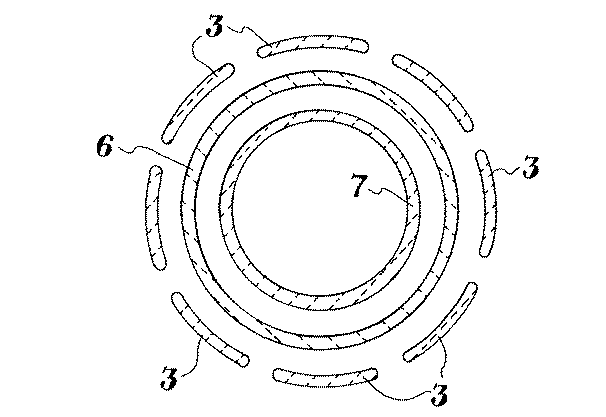
発熱体3は、例えば炭素、黒鉛又は炭化ケイ素をコーテイングした炭素複合材料から作ることができる。発熱体3が炭化ケイ素をコーテイングした炭素複合材料で作るのが望ましい。発熱体3は標準の形状、例えば、反応室の外側の回りに配置された1個以上の棒又はストレートにすることができる。発熱体3が図2に示したものに類似の杭垣状の設計が望ましい。発熱体3は、外部エネルギー源に接続する手段を提供する電極へ接続される。
【0020】
発熱体3は、電気絶縁体4によって反応器の残部から電気的に絶縁される。電気絶縁体4は、標準の高温および化学的耐性の電気絶縁材料、例えば、溶融シリカ又は窒化ケイ素から作ることができる。電気絶縁体4は窒化ケイ素、すなわちSiN4で作るのが望ましいが、焼結するために熱間静水圧プレスした窒化ケイ素粒子から成形するが一層望ましい。
【0021】
発熱体3は反応室を囲んでいる。図1の反応室は同心配置の2つの管によって形成された外室と内室をもった二重室設計のものである。その外室は管6と管7の間に形成される。内室は管7によって形成される。反応室の上部はダイバータ8によって形成される。
【0022】
管6、管7およびダイバータ8は、高温反応器の標準構成材料、例えば、炭素、黒鉛、炭化ケイ素被覆の炭素および炭化ケイ素被覆の黒鉛;又は炭化ケイ素被覆の炭素繊維複合材料で作ることができる。管6および管7を炭化ケイ素被覆の炭素繊維複合材料で作るのが望ましい、管6、管7およびダイバータ8を炭化ケイ素被覆の炭素繊維複合材料で作るのがさらに望ましい。
【0023】
反応器は、熱交換器9に接続し、そこで反応器へ供給される水素とクロロシランは管6と管7の間に形成された外室に通す前に予熱される。これらのガスは別の流路を通り、そこで発熱体3によってさらに加熱され、そしてダイバータ8によって向きを変えられて管7によって形成される内室を逆向きに流れる。管7を排出する加熱されたガスは次に熱交換器9を通って、熱を流入する供給ガスに伝達する。熱交換器9は標準の設計にすることができる。例えば、熱交換器9は、ヒラード(Hillard)の米国特許第2,821,369号;マッククラリー(McCrary)らの米国特許第3,250,322号;および米国特許第3,391,016号に開示されている設計に類似したものにできる。
【0024】
次の実施例は、水素とクロロシランの反応用反応器の構成材料としての炭化ケイ素被覆の炭素繊維組成物および窒化ケイ素の適合性を示す。これらの実施例は、特許請求の範囲の限定を意図していない。
【0025】
実施例1
水素とテトラクロロシランの環境における窒化ケイ素の安定性を評価した。評価は5.1cm(2in)の水平管炉で行った。試験する材料は管炉内で窒素パージ下72時間乾燥した。次にその炉に25モル%のテトラクロロシランと75モル%の水素(TCS/H2 )からなるガス状混合体を464cc/分の流量で供給して、反応器内に2〜3秒の滞留時間を与えた。各材料試料はTCS/H2 フイードに合計約21時間暴露した。その暴露の中で最初の6時間は約1150℃の温度で、そして残りの15時間は約1350℃の温度で暴露した。暴露期間中に、フレームイオン化検出器を使用した気液クロマトグラフイ−(GLC−FID)によって炉から出るガスのメタンと一酸化炭素を監視した。それらの結果を体積を基準にしたppmv値で示す。
【0026】
試験した材料は、熱圧した窒化ケイ素(米国マサチュセッツ州ノ−スボロに在るノルトン社)の商品名ノラライド(Noralide)NC−132/HP;反応接合した窒化ケイ素(同じくノルトン社の商品名NCX−5301)および溶融シリカ(米国ミシガン州ベイ・シテイに在るWYSEガラス社製)であった。それらの結果を表1に示す。
【0027】
【表1】
水素およびテトラクロロシランの環境における炭化ケイ素被覆の炭素繊維複合材料の安定性を評価した。評価の方法は実施例1で記載した方法と同様であった。試験した材料は炭化ケイ素被覆の炭素繊維複合材料で55〜65%の繊維体積率と1.6〜1.7g/cm3 のかさ密度を有するもの(米国ウイスコンシン州メノモニー・フオールスに在るSchunk Graphite Technology社製のカタログNo.CF222/P22);および被覆しない炭素繊維複合材料(米国オレゴン州ポートランドにあるTT America社製のカタログNo.CX−21)であった。
【0028】
【表2】
【0029】
実施例3
テトラクロロシランの水素添加用商業反応器内で長時間水素およびテトラクロロシランの環境において窒化ケイ素試料の安定性を評価した。試験する試料は炉内窒素パ−ジ下で約72時間乾燥した後、反応器へ移した。反応器への供給材料は約25モル%のテトラクロロシランと75%の水素からなるガス混合体であった。その反応器内で試料は800℃の温度に暴露した。試料は表3に示した時間で反応器から取り出して重量損失を測定した。次に試料を反応器に戻して、そのプロセスを続けた。それらの結果を表3に示す。試験した試料は、全て前に記載したSi3N4(NC132/HP),Si3N4 (NCX5301)および溶解シリカ(WYSE)であった。
【0030】
【表3】
炭化ケイ素を被覆した炭素繊維複合材料の安定性を商業反応器内で長期間評価した。評価の方法は実施例3と類似したが、例外は試料の暴露温度が約1200℃であったことである。試験した試料は炭化ケイ素を被覆した炭素繊維複合材料(CF222/P22)と無被覆の炭素繊維複合材料(CF212)であった、これらは共に実施例2で既に記載したもにである。それらの結果を表4に示す。
【表4】
【図面の簡単な説明】
【図1】 本発明の実施例の破断側面図である。
【図2】 本発明の破断平面図であって、二重室反応器を囲む杭垣状発熱体を示す。
【符号の説明】
1 外殻
2 断熱材
3 発熱体
4 電気絶縁体
5 電極
6 管
7 管
8 ダイバータ
9 熱交換器[0001]
[Industrial application fields]
The present invention relates to a reactor for hydrogenation of chlorosilane. The reactor features a reaction chamber and a heating element made of a carbon fiber composite material coated with silicon carbide, and uses silicon nitride to electrically insulate the heating element.
[0002]
[Prior art]
In a typical method for producing ultra-high purity semiconductor grade silicon, trichlorosilane gas is reduced in the presence of hydrogen and deposited on a heating element. A significant portion of the trichlorosilane gas fed to the process is dehydrogenated to produce the by-product tetrachlorosilane. It is desirable to convert this by-product tetrachlorosilane back to trichlorosilane, which is recycled to the deposition process.
[0003]
U.S. Pat. No. 4,217,334 dated August 12, 1980 to Weigert et al. Relates to an excellent method for converting tetrachlorosilane to trichlorosilane. The process involves reacting trichlorosilane with hydrogen at a temperature of 600 ° C. to 1200 ° C. (a mixture of tetrachlorosilane and hydrogen has a molar composition of 1: 1 to 1:50 in equilibrium with trichlorosilane and hydrogen chloride). , Rapidly cooling the mixture to below 300 ° C. The Weigert et al. Method was performed in an airtight tube made of carbon.
[0004]
The use of carbon, such as graphite, which constitutes the reaction chamber, and materials based on carbon have many drawbacks. For example, the differential pressure, high temperatures and rapid temperature changes experienced by the reactor can cause extreme thermal stress on the reactor components and often the reactor must be shut down for repair. In addition, carbon-based materials react with the supplied chlorosilane and hydrogen to produce by-products such as silicon carbide, methane and carbon monoxide. These reactions not only cause reactor degradation, but can contaminate the necessary hydrogenated chlorosilanes with carbon and trace amounts of metals.
[0005]
The present invention is a reactor using a material having a structure designed to eliminate these problems. The claimed carbon fiber composite material provides high strength and good elasticity, thus providing excellent resistance to reactor pressure and thermal stress damage. Furthermore, the expansion coefficient of the carbon fiber composite material can be tailored to closely match the value of the silicon carbide coating. Thus, thermal expansion of the carbon fiber composite material does not result in thermal failure of the silicon carbide coating. Silicon carbide coatings placed on carbon fiber composites protect against reducing processes that can result in degradation of reaction chambers and heating elements and contamination of hydrogenated chlorosilanes.
[0006]
U.S. Pat. No. 4,737,348 to Levin dated April 12, 1988 describes a reactor that produces silicon by reacting hydrogen gas with tetrachlorosilane at a temperature of 1500 ° C. or higher. . The reactor is made of carbon or graphite walls and a silicon carbide coating is formed in situ on the walls. Levin states that the silicon carbide coating is extremely resistant to chemical degradation. Levin does not deal with the problem of thermal shock associated with the high temperature and heating and cooling of the reactor, nor the problem of material destruction due to differential pressure.
[0007]
The present invention can also use silicon nitride that electrically insulates the heating element used to heat the reaction chamber. In a typical reactor where chlorosilane and hydrogen are reacted, the reaction chamber cannot be completely sealed to prevent reactant leakage. Thus, the material used to electrically insulate the heating element can be exposed to chlorosilane and hydrogen at high temperatures. The inventors have found that silicon nitride is an excellent electrical insulating material that does not degrade under typical process conditions. Witter et al., U.S. Pat. No. 4,710,260, describes a process for the hydrogenolysis of trichlorosilane over silicon nitride particles. Silicon nitride is not considered for use as an insulating material and has been reported to deteriorate significantly under the process conditions described above. It is therefore surprising that the inventors have discovered that silicon nitride is a suitable electrical insulating material for use in a reactor that reacts hydrogen with chlorosilane and that it does not contaminate hydrogenated chlorosilane. It is.
[0008]
[Problems to be solved by the invention]
Accordingly, an object of the present invention is to provide a reactor for reaction of hydrogen and chlorosilane using a carbon fiber composite material coated with silicon carbide as a constituent material of a reaction chamber and a heating element. This material provides excellent resistance to reducing processes and high thermal shock resistance. The reactor can also use silicon nitride to electrically insulate the heating element. Silicon nitride provides high insulation properties and excellent resistance to chemical erosion by reactants present in the reactor.
[0009]
[Means for Solving the Problems]
The present invention provides a reactor for the hydrogenation of chlorosilane at a temperature of about 600 ° C. or higher. The reactor includes (1) a reaction chamber molded with a carbon fiber composite material coated with silicon carbide, (2) a heating element molded with a carbon fiber composite material coated with silicon carbide, and (3) the heating element. It consists of an improvement of a silicon nitride insulator that electrically insulates.
[0010]
Generally, it is desirable to increase the working efficiency by performing the reaction process at a temperature within the range of 800 ° C to 1200 ° C. To obtain these process temperatures, the reaction chamber and heating element walls are maintained at a high temperature of 1600 ° C.
[0011]
[Action]
It is known that carbon and graphite materials can be used to form a reaction chamber for carrying out this process and a heating element for heating the reaction chamber. However, at the high temperatures required, significant thermal stress is applied to the constituent materials of the reaction chambers, heating elements and other parts of the reactor that are exposed to high temperatures. In addition, corrosive by-products such as hydrogen, chlorosilane and hydrogen chloride react with the reactor components and degrade. Damage due to thermal stress and chemical degradation of the carbon and graphite materials that make up the high temperature reactor will increase reactor downtime and reduce operating efficiency.
[0012]
The present inventors can use a carbon fiber composite material coated with silicon carbide as a constituent material of the reaction chamber and heating element of the reactor, and the carbon fiber composite material coated with silicon carbide is subjected to pressure and thermal stress failure, and It has been found that it has excellent resistance to degradation due to reaction with feed materials and corrosive by-products.
[0013]
Carbon fiber composites useful in the present invention consist of carbon fibers fixed to a matrix material that is stable at temperatures up to about 1600 ° C. The matrix material can be, for example, carbon, graphite or silicon carbide. Desirably, the matrix material is carbon. The carbon fiber composite material can be formed by an ordinary method. For example, when the matrix material is carbon, carbon fibers are impregnated with a suitable carbon source such as pitch or resin and fixed in a required shape by winding or laminating in a specific direction, or laminating in a mold. This material is then carbonized under pressure. The impregnation and carbonization steps can be repeated until the required density is obtained. In general, carbon fiber composite materials with densities in the range of about 1.5 to 2.0 / cc have been found useful. The carbon fibers can be about 20-80% by volume of the composite material, but preferably about 50-70% by volume.
[0014]
Carbon fibers useful in the composite material used in the present invention have a density of about 1.5-2.0 g / cc, a Young's modulus in the range of about 200-600 GN / m 2 and about 1500-8000 N / mm 2 . Has a tensile strength in the range.
[0015]
The carbon fiber composite material is coated with a silicon carbide coating to protect the carbon fiber composite material from degradation due to exposure to corrosive by-products such as feedstock and hydrogen chloride. The silicon carbide coating can be applied by standard methods, for example, chemical vapor deposition using a source gas such as organochlorosilane. The effective thickness of the silicon carbide coating is about 0.01 to 1.0 mm, but a silicon carbide coating with a thickness in the range of about 0.02 to 0.13 mm is desirable.
[0016]
Furthermore, the present inventors have found that silicon nitride is an effective insulating material able to withstand the reactivity and corrosivity of high temperature and feed and byproducts in the reactor.
[0017]
Chlorosilanes that can be hydrogenated by this method include tetrachlorosilane, trichlorosilane, dichlorosilane, and chlorosilane.
[0018]
【Example】
The present invention refers to FIG. 1 for further explanation. FIG. 1 is a cutaway side view of an embodiment of the present invention. The reactor for reacting hydrogen and chlorosilane comprises an outer shell 1 made of stainless steel. The inner surface of the outer shell 1 is thermally insulated from the
[0019]
The
[0020]
The
[0021]
A
[0022]
[0023]
The reactor is connected to a heat exchanger 9 where the hydrogen and chlorosilane fed to the reactor are preheated before passing through the outer chamber formed between
[0024]
The following examples demonstrate the suitability of silicon carbide coated carbon fiber compositions and silicon nitride as components of a reactor for the reaction of hydrogen and chlorosilane. These examples are not intended to limit the scope of the claims.
[0025]
Example 1
The stability of silicon nitride in hydrogen and tetrachlorosilane environment was evaluated. The evaluation was performed in a horizontal tube furnace of 5.1 cm (2 inches). The material to be tested was dried in a tube furnace for 72 hours under a nitrogen purge. Next, a gaseous mixture consisting of 25 mol% tetrachlorosilane and 75 mol% hydrogen (TCS / H 2 ) was supplied to the furnace at a flow rate of 464 cc / min, and the reactor was held for 2 to 3 seconds. Gave time. Each material sample was exposed to the TCS / H 2 feed for a total of about 21 hours. The first 6 hours of the exposure were at a temperature of about 1150 ° C and the remaining 15 hours at a temperature of about 1350 ° C. During the exposure period, the gas exiting the furnace was monitored for methane and carbon monoxide by gas-liquid chromatography (GLC-FID) using a flame ionization detector. The results are shown as ppmv values based on volume.
[0026]
Tested materials, hot pressed silicon nitride - trade name Noraraido (Noralide) (US Massachusetts Roh Noruton Inc. located in Suboro) NC-132 / HP; reaction bonded silicon nitride (also Noruton trade name NC X -5301 ) and fused silica (WYSE Glass, Inc., Bay City, Michigan, USA). The results are shown in Table 1.
[0027]
[Table 1]
The stability of silicon carbide coated carbon fiber composites in hydrogen and tetrachlorosilane environment was evaluated. The evaluation method was the same as the method described in Example 1. The materials tested were silicon carbide coated carbon fiber composites having a fiber volume fraction of 55-65% and a bulk density of 1.6-1.7 g / cm 3 (Schunk Graphite, Menomonee Foals, Wisconsin, USA). Technology Catalog No. CF222 / P22); and uncoated carbon fiber composites (Catalog No. CX-21 from TT America, Portland, Oregon, USA).
[0028]
[Table 2]
[0029]
Example 3
The stability of silicon nitride samples was evaluated in a hydrogen and tetrachlorosilane environment for a long time in a commercial reactor for tetrachlorosilane hydrogenation. The sample to be tested was dried for about 72 hours under an in-furnace nitrogen purge and then transferred to the reactor. The feed to the reactor was a gas mixture consisting of about 25 mol% tetrachlorosilane and 75% hydrogen. The sample was exposed to a temperature of 800 ° C. in the reactor. Samples were removed from the reactor at the times shown in Table 3 and weight loss was measured. The sample was then returned to the reactor and the process continued. The results are shown in Table 3. The samples tested were all Si 3 N 4 (NC132 / HP), Si 3 N 4 ( NCX5301) and dissolved silica ( W YSE) described previously.
[0030]
[Table 3]
The stability of carbon fiber composites coated with silicon carbide was evaluated in a commercial reactor for a long time. The evaluation method was similar to Example 3, with the exception that the sample exposure temperature was about 1200 ° C. The samples tested were a silicon carbide coated carbon fiber composite (CF222 / P22) and an uncoated carbon fiber composite (CF212), both of which have already been described in Example 2 . The results are shown in Table 4.
[Table 4]
[Brief description of the drawings]
FIG. 1 is a cutaway side view of an embodiment of the present invention.
FIG. 2 is a cutaway plan view of the present invention showing a pile fence heating element surrounding a double chamber reactor.
[Explanation of symbols]
DESCRIPTION OF SYMBOLS 1
Claims (7)
Applications Claiming Priority (2)
| Application Number | Priority Date | Filing Date | Title |
|---|---|---|---|
| US07/891,132 US5906799A (en) | 1992-06-01 | 1992-06-01 | Chlorosilane and hydrogen reactor |
| US07/891132 | 1992-06-01 |
Publications (2)
| Publication Number | Publication Date |
|---|---|
| JPH06293511A JPH06293511A (en) | 1994-10-21 |
| JP3781439B2 true JP3781439B2 (en) | 2006-05-31 |
Family
ID=25397675
Family Applications (1)
| Application Number | Title | Priority Date | Filing Date |
|---|---|---|---|
| JP12935693A Expired - Lifetime JP3781439B2 (en) | 1992-06-01 | 1993-05-31 | Chlorosilane and hydrogen reactor |
Country Status (3)
| Country | Link |
|---|---|
| US (1) | US5906799A (en) |
| JP (1) | JP3781439B2 (en) |
| DE (1) | DE4317905C2 (en) |
Cited By (17)
| Publication number | Priority date | Publication date | Assignee | Title |
|---|---|---|---|---|
| WO2008053786A1 (en) | 2006-10-31 | 2008-05-08 | Mitsubishi Materials Corporation | Trichlorosilane production apparatus |
| WO2008053759A1 (en) | 2006-10-31 | 2008-05-08 | Mitsubishi Materials Corporation | Trichlorosilane production apparatus |
| WO2008053760A1 (en) | 2006-10-31 | 2008-05-08 | Mitsubishi Materials Corporation | Trichlorosilane production apparatus |
| WO2008065838A1 (en) | 2006-11-30 | 2008-06-05 | Mitsubishi Materials Corporation | Process for producing trichlorosilane and apparatus for producing trichlorosilane |
| WO2008146741A1 (en) | 2007-05-25 | 2008-12-04 | Mitsubishi Materials Corporation | Process and apparatus for producing trichlorosilane and process for producing polycrystalline silicon |
| JP2009256114A (en) * | 2008-04-11 | 2009-11-05 | Mitsubishi Materials Corp | Apparatus for producing trichlorosilane |
| EP2233436A1 (en) | 2009-03-11 | 2010-09-29 | Mitsubishi Materials Corporation | Apparatus and method for producing trichlorosilane |
| JP2011026156A (en) * | 2009-07-23 | 2011-02-10 | Mitsubishi Materials Corp | Apparatus for producing trichlorosilane |
| EP2357156A1 (en) | 2010-02-17 | 2011-08-17 | Mitsubishi Materials Corporation | Apparatus for producing trichlorosilane and method for producing trichlorosilane |
| EP2364772A1 (en) | 2010-03-04 | 2011-09-14 | Mitsubishi Materials Corporation | Apparatus for producing trichlorosilane and method for producing trichlorosilane |
| EP2368626A1 (en) | 2010-03-15 | 2011-09-28 | Mitsubishi Materials Corporation | Apparatus for producing trichlorosilane |
| US8168152B2 (en) | 2008-10-30 | 2012-05-01 | Mitsubishi Materials Corporation | Method for producing trichlorosilane and method for utilizing trichlorosilane |
| US8221691B2 (en) | 2006-11-21 | 2012-07-17 | Mitsubishi Materials Corporation | Apparatus for producing trichlorosilane |
| JP2015506834A (en) * | 2012-01-30 | 2015-03-05 | ヘムロック・セミコンダクター・コーポレーション | Method for repairing and / or protecting the surface in a reactor |
| US9168502B2 (en) | 2011-11-28 | 2015-10-27 | Mitsubishi Materials Corporation | Apparatus for producing trichlorosilane |
| US9416014B2 (en) | 2006-10-31 | 2016-08-16 | Mitsubishi Materials Corporation | Method for producing trichlorosilane |
| US9468042B2 (en) | 2010-03-08 | 2016-10-11 | Mitsubishi Materials Corporation | Apparatus for producing trichlorosilane |
Families Citing this family (39)
| Publication number | Priority date | Publication date | Assignee | Title |
|---|---|---|---|---|
| US5422088A (en) * | 1994-01-28 | 1995-06-06 | Hemlock Semiconductor Corporation | Process for hydrogenation of tetrachlorosilane |
| DE10057481A1 (en) * | 2000-11-20 | 2002-05-23 | Solarworld Ag | Production of high-purity granular silicon comprises decomposing a silicon-containing gas in a reactor made of carbon-fiber-reinforced silicon carbide |
| US7033561B2 (en) * | 2001-06-08 | 2006-04-25 | Dow Corning Corporation | Process for preparation of polycrystalline silicon |
| US7083771B2 (en) * | 2002-07-10 | 2006-08-01 | Advanced Composite Materials Corporation | Process for producing silicon carbide fibers essentially devoid of whiskers |
| US20040009112A1 (en) * | 2002-07-10 | 2004-01-15 | Advanced Composite Materials Corporation | Silicon carbide fibers essentially devoid of whiskers and method for preparation thereof |
| US20040173597A1 (en) * | 2003-03-03 | 2004-09-09 | Manoj Agrawal | Apparatus for contacting gases at high temperature |
| RU2278076C2 (en) * | 2004-08-16 | 2006-06-20 | Федеральное государственное унитарное предприятие "Государственный научно-исследовательский и проектный институт редкометаллической промышленности "Гиредмет" | Device for hydrogenation of silicon tetrachloride |
| DE102005005044A1 (en) * | 2005-02-03 | 2006-08-10 | Consortium für elektrochemische Industrie GmbH | Process for the preparation of trichlorosilane by means of thermal hydrogenation of silicon tetrachloride |
| DE102005046703A1 (en) * | 2005-09-29 | 2007-04-05 | Wacker Chemie Ag | Hydrogenation of chlorosilane comprises contacting silicon-containing compound and hydrogen with surface of reaction chamber and surface of heater such that silicon carbide coating is formed in situ on the surfaces in first process step |
| US20070235450A1 (en) * | 2006-03-30 | 2007-10-11 | Advanced Composite Materials Corporation | Composite materials and devices comprising single crystal silicon carbide heated by electromagnetic radiation |
| JP5601438B2 (en) * | 2006-11-07 | 2014-10-08 | 三菱マテリアル株式会社 | Trichlorosilane production method and trichlorosilane production apparatus |
| JP5119856B2 (en) * | 2006-11-29 | 2013-01-16 | 三菱マテリアル株式会社 | Trichlorosilane production equipment |
| WO2009128888A1 (en) * | 2008-04-14 | 2009-10-22 | Hemlock Semiconductor Corporation | Manufacturing apparatus for depositing a material and an electrode for use therein |
| JP2011517734A (en) * | 2008-04-14 | 2011-06-16 | ヘムロック・セミコンダクター・コーポレーション | Manufacturing apparatus for depositing materials and electrodes used in the apparatus |
| KR101639577B1 (en) * | 2008-04-14 | 2016-07-14 | 헴로크세미컨덕터코포레이션 | Manufacturing apparatus for depositing a material on an electrode for use therein |
| CN102112885A (en) * | 2008-08-08 | 2011-06-29 | 日本发条株式会社 | Electric contact member and contact probe |
| US9663363B2 (en) | 2009-06-09 | 2017-05-30 | Sundrop Fuels, Inc. | Various methods and apparatuses for multi-stage synthesis gas generation |
| US20100242352A1 (en) | 2009-06-09 | 2010-09-30 | Sundrop Fuels, Inc. | Systems and methods for reactor and receiver control of flux profile |
| US8814961B2 (en) | 2009-06-09 | 2014-08-26 | Sundrop Fuels, Inc. | Various methods and apparatuses for a radiant-heat driven chemical reactor |
| US8298490B2 (en) * | 2009-11-06 | 2012-10-30 | Gtat Corporation | Systems and methods of producing trichlorosilane |
| JP5633375B2 (en) * | 2010-01-27 | 2014-12-03 | 三菱マテリアル株式会社 | Trichlorosilane production equipment |
| DE102010007916B4 (en) * | 2010-02-12 | 2013-11-28 | Centrotherm Sitec Gmbh | Process for the hydrogenation of chlorosilanes and use of a converter for carrying out the process |
| CN102939260B (en) * | 2010-05-28 | 2016-01-20 | 株式会社钟化 | Method for improving flatness of graphite film, graphite film and manufacturing method thereof |
| JP5820479B2 (en) | 2010-09-27 | 2015-11-24 | ジーティーエイティー・コーポレーション | HEATER AND RELATED METHOD FOR HEATER |
| DE102011002436A1 (en) | 2011-01-04 | 2012-07-05 | Evonik Degussa Gmbh | Hydrogenation of organochlorosilanes and silicon tetrachloride |
| US20120199323A1 (en) | 2011-02-03 | 2012-08-09 | Memc Electronic Materials Spa | Shell and tube heat exchangers and methods of using such heat exchangers |
| DE102011005647A1 (en) | 2011-03-16 | 2012-10-04 | Evonik Degussa Gmbh | Composite process for the conversion of STC-containing and OCS-containing side streams to hydrogen-containing chlorosilanes |
| DE102011005643A1 (en) | 2011-03-16 | 2012-09-20 | Evonik Degussa Gmbh | Reactor concept for the conversion of organochlorosilanes and silicon tetrachloride to hydrogen-containing chlorosilanes |
| KR101912486B1 (en) | 2011-06-21 | 2018-10-26 | 지티에이티 코포레이션 | apparatus and methods for conversion of silicon tetrachloride to trichlorosilane |
| DE102012223784A1 (en) * | 2012-12-19 | 2014-06-26 | Wacker Chemie Ag | Process for converting silicon tetrachloride to trichlorosilane |
| WO2014182397A1 (en) | 2013-05-07 | 2014-11-13 | Bruce Hazeltine | Monolithic heat exchanger and apparatus and methods for hydrogenation of a halosilane |
| DE102014205001A1 (en) | 2014-03-18 | 2015-09-24 | Wacker Chemie Ag | Process for the preparation of trichlorosilane |
| FR3024049A1 (en) | 2014-07-28 | 2016-01-29 | Total Raffinage Chimie | DEVICE FOR TERMINATING A REACTOR OF A FLUID CATALYTIC CRACKING UNIT |
| FR3024053B1 (en) * | 2014-07-28 | 2020-07-24 | Total Raffinage Chimie | GAS INJECTION ELEMENT IN A REGENERATOR OF A FLUID CATALYTIC CRACKING UNIT |
| FR3024051A1 (en) | 2014-07-28 | 2016-01-29 | Total Raffinage Chimie | CERAMIC MATERIAL PLATE ROOM FOR FLUID CATALYTIC CRACKING UNIT |
| FR3024050A1 (en) * | 2014-07-28 | 2016-01-29 | Total Raffinage Chimie | FUEL INJECTION ELEMENT IN A REGENERATOR OF A FLUID CATALYTIC CRACKING UNIT |
| FR3024054B1 (en) | 2014-07-28 | 2020-07-10 | Total Raffinage Chimie | INJECTOR IN CERAMIC MATERIAL FOR FLUID CATALYTIC CRACKING UNIT |
| RU206768U1 (en) * | 2021-07-27 | 2021-09-28 | Федеральное государственное бюджетное учреждение науки Федеральный исследовательский центр «Коми научный центр Уральского отделения Российской академии наук» | Reactor for producing composite carbon-silicon carbide fibers with a core-shell structure |
| US11819815B2 (en) | 2021-11-19 | 2023-11-21 | Infinium Technology, Llc | Catalytic reactor for the conversion of carbon dioxide and hydrogen to syngas |
Family Cites Families (18)
| Publication number | Priority date | Publication date | Assignee | Title |
|---|---|---|---|---|
| GB756327A (en) * | 1952-10-14 | 1956-09-05 | Lorraine Carbone | Improvements in or relating to heat exchangers |
| US3250322A (en) * | 1964-02-07 | 1966-05-10 | Texas Instruments Inc | Corrosive fluid heat exchanger |
| US3391016A (en) * | 1964-02-07 | 1968-07-02 | Texas Instruments Inc | Silicon carbide coating on graphite bores of heat exchanger |
| US3933985A (en) * | 1971-09-24 | 1976-01-20 | Motorola, Inc. | Process for production of polycrystalline silicon |
| US4217334A (en) * | 1972-02-26 | 1980-08-12 | Deutsche Gold- Und Silber-Scheideanstalt Vormals Roessler | Process for the production of chlorosilanes |
| US3895219A (en) * | 1973-11-23 | 1975-07-15 | Norton Co | Composite ceramic heating element |
| US4373006A (en) * | 1979-08-09 | 1983-02-08 | United Technologies Corporation | Silicon carbide coated carbon fibers and composites |
| US4668452A (en) * | 1980-02-26 | 1987-05-26 | Ngk Spark Plug Co., Ltd. | Process for producing silicon carbide heating elements |
| US4702960A (en) * | 1980-07-30 | 1987-10-27 | Avco Corporation | Surface treatment for carbon and product |
| US4668493A (en) * | 1982-06-22 | 1987-05-26 | Harry Levin | Process for making silicon |
| US4737348A (en) * | 1982-06-22 | 1988-04-12 | Harry Levin | Apparatus for making molten silicon |
| US4560589A (en) * | 1982-09-22 | 1985-12-24 | Shin-Etsu Chemical Co., Ltd. | Method for providing a coating layer of silicon carbide on substrate surface |
| JPS59106572A (en) * | 1982-12-06 | 1984-06-20 | 信越化学工業株式会社 | Carbon fiber surface treatment method |
| US4710260A (en) * | 1982-12-22 | 1987-12-01 | Texas Instruments Incorporated | Deposition of silicon at temperatures above its melting point |
| US4671997A (en) * | 1985-04-08 | 1987-06-09 | United Technologies Corporation | Gas turbine composite parts |
| JPS6449081A (en) * | 1987-08-19 | 1989-02-23 | Chuo Hatsujo Kk | Pronunciation training apparatus |
| DE4022707C2 (en) * | 1989-07-18 | 2002-01-31 | Hemlock Semiconductor Corp | Isolation system for a chlorosilane and hydrogen reactor |
| US5084606A (en) * | 1990-05-17 | 1992-01-28 | Caterpillar Inc. | Encapsulated heating filament for glow plug |
-
1992
- 1992-06-01 US US07/891,132 patent/US5906799A/en not_active Expired - Lifetime
-
1993
- 1993-05-28 DE DE4317905A patent/DE4317905C2/en not_active Expired - Fee Related
- 1993-05-31 JP JP12935693A patent/JP3781439B2/en not_active Expired - Lifetime
Cited By (25)
| Publication number | Priority date | Publication date | Assignee | Title |
|---|---|---|---|---|
| US9493359B2 (en) | 2006-10-31 | 2016-11-15 | Mitsubishi Materials Corporation | Apparatus for producing trichlorosilane |
| WO2008053760A1 (en) | 2006-10-31 | 2008-05-08 | Mitsubishi Materials Corporation | Trichlorosilane production apparatus |
| US9416014B2 (en) | 2006-10-31 | 2016-08-16 | Mitsubishi Materials Corporation | Method for producing trichlorosilane |
| WO2008053759A1 (en) | 2006-10-31 | 2008-05-08 | Mitsubishi Materials Corporation | Trichlorosilane production apparatus |
| US7998428B2 (en) | 2006-10-31 | 2011-08-16 | Mitsubishi Materials Corporation | Apparatus for producing trichlorosilane |
| WO2008053786A1 (en) | 2006-10-31 | 2008-05-08 | Mitsubishi Materials Corporation | Trichlorosilane production apparatus |
| US8221691B2 (en) | 2006-11-21 | 2012-07-17 | Mitsubishi Materials Corporation | Apparatus for producing trichlorosilane |
| WO2008065838A1 (en) | 2006-11-30 | 2008-06-05 | Mitsubishi Materials Corporation | Process for producing trichlorosilane and apparatus for producing trichlorosilane |
| US9994455B2 (en) | 2007-05-25 | 2018-06-12 | Mitsubishi Materials Corporation | Apparatus and method for manufacturing trichlorosilane and method for manufacturing polycrystalline silicon |
| WO2008146741A1 (en) | 2007-05-25 | 2008-12-04 | Mitsubishi Materials Corporation | Process and apparatus for producing trichlorosilane and process for producing polycrystalline silicon |
| JP2009256114A (en) * | 2008-04-11 | 2009-11-05 | Mitsubishi Materials Corp | Apparatus for producing trichlorosilane |
| US8168152B2 (en) | 2008-10-30 | 2012-05-01 | Mitsubishi Materials Corporation | Method for producing trichlorosilane and method for utilizing trichlorosilane |
| EP2233436A1 (en) | 2009-03-11 | 2010-09-29 | Mitsubishi Materials Corporation | Apparatus and method for producing trichlorosilane |
| US8491862B2 (en) | 2009-03-11 | 2013-07-23 | Mitsubishi Materials Corporation | Apparatus and method for producing trichlorosilane |
| JP2011026156A (en) * | 2009-07-23 | 2011-02-10 | Mitsubishi Materials Corp | Apparatus for producing trichlorosilane |
| EP2357156A1 (en) | 2010-02-17 | 2011-08-17 | Mitsubishi Materials Corporation | Apparatus for producing trichlorosilane and method for producing trichlorosilane |
| US20110200510A1 (en) * | 2010-02-17 | 2011-08-18 | Mitsubishi Materials Corporation | Apparatus for producing trichlorosilane and method for producing trichlorosilane |
| US8663573B2 (en) * | 2010-02-17 | 2014-03-04 | Mitsubishi Materials Corporation | Apparatus for producing trichlorosilane and method for producing trichlorosilane |
| US8809746B2 (en) | 2010-03-04 | 2014-08-19 | Mitsubishi Materials Corporation | Apparatus for producing trichlorosilane and method for producing trichlorosilane |
| EP2364772A1 (en) | 2010-03-04 | 2011-09-14 | Mitsubishi Materials Corporation | Apparatus for producing trichlorosilane and method for producing trichlorosilane |
| US9468042B2 (en) | 2010-03-08 | 2016-10-11 | Mitsubishi Materials Corporation | Apparatus for producing trichlorosilane |
| US8372346B2 (en) | 2010-03-15 | 2013-02-12 | Mitsubishi Materials Corporation | Apparatus for producing trichlorosilane |
| EP2368626A1 (en) | 2010-03-15 | 2011-09-28 | Mitsubishi Materials Corporation | Apparatus for producing trichlorosilane |
| US9168502B2 (en) | 2011-11-28 | 2015-10-27 | Mitsubishi Materials Corporation | Apparatus for producing trichlorosilane |
| JP2015506834A (en) * | 2012-01-30 | 2015-03-05 | ヘムロック・セミコンダクター・コーポレーション | Method for repairing and / or protecting the surface in a reactor |
Also Published As
| Publication number | Publication date |
|---|---|
| US5906799A (en) | 1999-05-25 |
| DE4317905A1 (en) | 1993-12-02 |
| JPH06293511A (en) | 1994-10-21 |
| DE4317905C2 (en) | 2003-03-06 |
Similar Documents
| Publication | Publication Date | Title |
|---|---|---|
| JP3781439B2 (en) | Chlorosilane and hydrogen reactor | |
| US5422088A (en) | Process for hydrogenation of tetrachlorosilane | |
| JP5674527B2 (en) | Equipment suitable for contact with hot gases | |
| US8425855B2 (en) | Reactor with silicide-coated metal surfaces | |
| RU2079569C1 (en) | Method of passivation of inner surface or reactor subjected to coking, and reactor | |
| KR101914535B1 (en) | Fluidized bed reactor and method for producing polycrystalline silicon granules | |
| KR102471401B1 (en) | Corrosion protected reformer tubes with internal heat exchanger | |
| US5178844A (en) | Method and apparatus for producing nitride products | |
| US20180134629A1 (en) | Gas-tight, heat-permeable multilayer ceramic composite tube | |
| JPS58194712A (en) | Regeneration of oxygen from carbon oxide exhaust gas | |
| JP3215407B2 (en) | High temperature reactor | |
| EP1365219B1 (en) | Thermocouple protective tube | |
| KR20120023678A (en) | Processes and an apparatus for manufacturing high purity polysilicon | |
| AU2017294020A1 (en) | Corrosion-protected reformer tube with internal heat exchange | |
| JPH0649569B2 (en) | Method and apparatus for producing trichlorosilane | |
| WO1996029445A1 (en) | Chemical vapor deposition of rhenium on carbon substrates | |
| US4836898A (en) | Methane conversion reactor | |
| KR20130116311A (en) | Process and apparatus for conversion of silicon tetrachloride to trichlorosilane | |
| CA2034809C (en) | Method and apparatus for producing carbide products | |
| JP3442077B2 (en) | Method for producing CVD silicon nitride | |
| US5204071A (en) | Method and apparatus for producing carbide products | |
| CN106256763B (en) | Susceptor configuration for a reactor and method of heating process gas for use in a reactor | |
| JPH0762183B2 (en) | High-purity titanium purification method | |
| JP3676416B2 (en) | Vapor grown carbon fiber production equipment | |
| JPH03100160A (en) | Production of perforated body of molybdenum silicide |
Legal Events
| Date | Code | Title | Description |
|---|---|---|---|
| A61 | First payment of annual fees (during grant procedure) |
Free format text: JAPANESE INTERMEDIATE CODE: A61 Effective date: 20060307 |
|
| R150 | Certificate of patent or registration of utility model |
Free format text: JAPANESE INTERMEDIATE CODE: R150 |
|
| FPAY | Renewal fee payment (event date is renewal date of database) |
Free format text: PAYMENT UNTIL: 20100317 Year of fee payment: 4 |
|
| FPAY | Renewal fee payment (event date is renewal date of database) |
Free format text: PAYMENT UNTIL: 20110317 Year of fee payment: 5 |
|
| FPAY | Renewal fee payment (event date is renewal date of database) |
Free format text: PAYMENT UNTIL: 20110317 Year of fee payment: 5 |
|
| FPAY | Renewal fee payment (event date is renewal date of database) |
Free format text: PAYMENT UNTIL: 20120317 Year of fee payment: 6 |
|
| FPAY | Renewal fee payment (event date is renewal date of database) |
Free format text: PAYMENT UNTIL: 20130317 Year of fee payment: 7 |
|
| FPAY | Renewal fee payment (event date is renewal date of database) |
Free format text: PAYMENT UNTIL: 20130317 Year of fee payment: 7 |
|
| FPAY | Renewal fee payment (event date is renewal date of database) |
Free format text: PAYMENT UNTIL: 20140317 Year of fee payment: 8 |
|
| EXPY | Cancellation because of completion of term |