JP3772672B2 - Cold drawn tube manufacturing method - Google Patents
Cold drawn tube manufacturing method Download PDFInfo
- Publication number
- JP3772672B2 JP3772672B2 JP2000390731A JP2000390731A JP3772672B2 JP 3772672 B2 JP3772672 B2 JP 3772672B2 JP 2000390731 A JP2000390731 A JP 2000390731A JP 2000390731 A JP2000390731 A JP 2000390731A JP 3772672 B2 JP3772672 B2 JP 3772672B2
- Authority
- JP
- Japan
- Prior art keywords
- alkali metal
- metal salt
- boric acid
- tube
- coating
- Prior art date
- Legal status (The legal status is an assumption and is not a legal conclusion. Google has not performed a legal analysis and makes no representation as to the accuracy of the status listed.)
- Expired - Fee Related
Links
Landscapes
- Metal Extraction Processes (AREA)
Description
【0001】
【発明の属する技術分野】
本発明は、炭素鋼、合金鋼あるいはステンレス鋼等の冷間引抜管の製造方法に関する。詳しくは、冷間引抜加工時の焼付きの発生を抑制し、かつ、冷間引抜加工後の熱処理における浸リンを防止する冷間引抜管の製造方法に関する。
【0002】
【従来の技術】
炭素鋼、合金鋼あるいはステンレス鋼などの鋼管の冷間引抜加工の前処理として、冷間引抜加工を行うべき素管の表面に予めリン酸亜鉛の化成被膜を形成させ、この上に金属石鹸の潤滑被膜を形成する方法が用いられている。しかし、この方法では、引抜加工後の管表面にリン酸亜鉛や金属石鹸の一部がスケール状に固着して、管の金属光沢が損なわれるという問題がある。
【0003】
そこで、この問題を解決する方法として、引抜加工前に素管の表面にリン酸塩等の化成被膜を形成し、その化成被膜の上に液状の潤滑剤を塗布する方法が提案されている。
【0004】
例えば、特開平4−33998号公報には、チタン含有化合物とアルカリ性リン酸塩との反応物から形成されるコロイダルチタンを0.001〜0.5g/l含有しているpH8〜11のコロイダルチタン含有液と接触させたのち乾燥し、次いで硫黄分が23〜30重量%の油脂とオレフィンとの化合物および硫黄分が23〜30重量%の高級エステル化合物とオレフィンとの化合物から選ばれる1種または2種以上の混合物40〜95重量%と、油溶性高分子化合物、油脂、合成油、鉱物油、高級脂肪酸および高級脂肪酸のアミンから選ばれる1種または2種以上を5〜50重量%含み、必要であれば更にリン系極圧剤を含み、かつ20℃における粘度を100〜3000センチポアズの範囲内に調整した潤滑油を塗布する潤滑処理方法が開示されている。
【0005】
また、特開平9−295038号公報には、炭素鋼鋼管を冷間引抜加工前に、チタン含有化合物とリン酸塩からなるpH8〜11の化合物液に、リン酸付着量が100mg/m2 以下になるように浸漬したのち乾燥し、次いで硫黄分が21重量%以上の油脂とオレフィンとの化合物とからなる潤滑油を塗布しつつ、加工度が45%以上の冷間引抜加工をする方法が開示されている。
【0006】
また、特開昭61−74726号公報には、予め管材表面にリン酸塩等の被膜を形成させ、次いで特定重量%の硫黄分を含む硫化油脂と所定濃度の熱可塑性高分子ポリマー粉体からなる組成物を潤滑剤として抽伸加工する方法が開示されている。
【0007】
【発明が解決しようとする課題】
しかしながら、上記特開平4−33998号公報に開示された方法は、例えば、Crを0.5%以上含有する合金鋼では冷間引抜後の熱処理によって浸リンが発生するため、熱処理前に脱脂処理が必要であるという問題点を有している。
【0008】
また、特開平9−295038号公報や特開昭61−74726号公報に開示された方法は、リン付着量が100mg/m2 を超えると熱処理により浸リンが生じるため、リン付着量や熱処理温度が制約されるという問題がある。
【0009】
また、これらの公報に開示された方法は何れも下地処理がリン酸塩系の化成被膜であるため、化成処理後に行われる被膜の乾燥が不十分な場合、或いは雨天時などの高湿度環境下では、被膜が水分を吸収し易いことから被膜の潤滑機能が低下し、引抜加工時に焼付きやかじりが発生する、或いは引抜用工具のびびり振動により管の寸法精度が悪化し、最悪の場合、引抜工具が破損するという問題がある。
【0010】
本発明の課題は、高湿度環境であっても、引抜加工の際の焼付きやかじりの発生ならびにびびり振動の発生が抑制され、さらに、引抜加工後の熱処理における浸りんの問題のない高品質の冷間引抜管が得られる冷間引抜管の製造方法を提供することにある。
【0011】
【課題を解決するための手段】
本発明者らは、冷間引抜加工前の酸洗後の素管表面にホウ酸塩系被膜を形成し、その被膜の上に液状潤滑剤を供給しながら冷間引抜加工をおこなう方法にて、高湿度環境であっても素管と引抜用工具との間の焼付きやかじりの発生が抑制され、かつ、引抜用工具のびびり振動が抑制され、さらに熱処理における浸リンのない高品質の引抜管が得らえることを知見した。
【0012】
本発明は、上記知見に基づいて完成されたもので、その要旨は以下のとおりである。
(1)アルカリ金属塩としてホウ酸のアルカリ金属塩のみ含有する水溶液に素管を浸漬して、該素管の内外面にホウ酸のアルカリ金属塩の被膜を形成し、その上に液状潤滑剤を塗布して冷間引抜加工をおこなうことを特徴とする冷間引抜管の製造方法。
【0013】
(2)アルカリ金属塩としてホウ酸のアルカリ金属塩と脂肪酸のアルカリ金属塩のみ含有する水溶液に素管を浸漬して、該素管の内外面にホウ酸のアルカリ金属塩と脂肪酸のアルカリ金属塩との被膜を形成し、その上に液状潤滑剤を塗布して冷間引抜加工をおこなうことを特徴とする冷間引抜管の製造方法。
【0014】
(3)水溶液中、ホウ酸のアルカリ金属塩の含有量が、質量%で、ホウ酸のアルカリ金属塩の含有量と飽和脂肪酸のアルカリ金属塩の含有量の合計の70%以上であることを特徴とする上記(2)項に記載の冷間引抜管の製造方法。
【0015】
(4)上記ホウ酸のアルカリ金属塩がホウ酸カリウムであることを特徴とする上記(1)項〜(3)項のいずれかに記載の冷間引抜管の製造方法。
(5)上記被膜の厚さが0.4〜20μmであることを特徴とする上記(1)項〜(4)項のいずれかに記載の冷間引抜管の製造方法。
【0016】
【発明の実施の形態】
本発明は、冷間引抜加工により炭素鋼、合金鋼あるいはステンレス鋼等の引抜管を製造する際、予め素管をホウ酸のアルカリ金属塩を含有する水溶液に浸漬し、素管の内外面にホウ酸のアルカリ金属塩の被膜を形成し、その被膜の上に液状潤滑剤を塗布して冷間引抜加工をおこなう。
【0017】
また、本発明では、予め素管をホウ酸のアルカリ金属塩と飽和脂肪酸のアルカリ金属塩とを含有する水溶液に浸漬し、素管の内外面にホウ酸のアルカリ金属塩と飽和脂肪酸のアルカリ金属塩との被膜を形成し、その被膜の上に液状潤滑剤を塗布して冷間引き抜き加工をおこなってもよい。
【0018】
ホウ酸のアルカリ金属塩の被膜あるいはホウ酸のアルカリ金属塩と飽和脂肪酸のアルカリ金属塩との被膜は、耐吸湿性に優れ、かつ、素管との密着性が良好であり、また、被膜の上に塗布される液状潤滑剤の保持性に優れている。したがって、被膜の形成と液状潤滑剤の塗布との組み合わせにより、冷間引抜加工の際の素管と引抜用工具との間の摩擦力が安定的に低減し、素管と引抜用工具との焼付きが抑制され、かつ、びびり振動の発生が抑制され、寸法精度の優れた良好な引抜管を得ることができる。また、引抜加工後の熱処理における浸リンを防止することができる。
【0019】
ホウ酸のアルカリ金属塩としては、ホウ酸リチウム、ホウ酸カリウム、ホウ酸ナトリウム等が挙げられる。好ましくは、ホウ酸カリウムである。
ホウ酸のアルカリ金属塩は、被膜の耐吸湿性を高め、かつ、被膜と素管との密着性を高め、更に、被膜の上に塗布される液状潤滑剤の保持性を高める。この効果を高めるために、水溶液中、ホウ酸のアルカリ金属塩の含有量は、質量%で、ホウ酸のアルカリ金属塩と後述する飽和脂肪酸のアルカリ金属塩の含有量の合計の70%以上とするのが望ましい。
【0020】
飽和脂肪酸のアルカリ金属塩としては、C6 〜C30の脂肪酸とリチウム、カリウム、ナトリウムなどのアルカリ金属との塩を挙げることができ、C12〜C18の脂肪酸、すなわち、ラウリル酸、パルミチン酸、ステアリン酸、オレイル酸などのアルカリ金属塩が好ましい。ラウリル酸(C11H23COOH)やステアリン酸(C17H35COOH)は天然油脂から容易に入手できる。しかし、分子量が小さいものは、水分を吸収し易いため、ラウリン酸のアルカリ金属塩を含む被膜では、所謂ブロッキング現象と呼ばれる固化が生じやすい。従って、比較的分子量の大きいステアリン酸のアルカリ金属塩、例えば耐吸湿性の高いステアリン酸ナトリウムを使用するのがより好ましい。
【0021】
液状潤滑剤の主剤としては、ラード、牛脂、鯨油、パーム油、ヤシ油、ナタネ油等の動植物油脂や硫化油脂等が挙げられる。好ましくは硫化油脂であるが、硫化油脂中の硫黄分が熱処理の際に析出する恐れがあるので、更に好ましくは硫黄分の添加量が30質量%以下の硫化油脂である。
【0022】
被膜厚が20μmを超えると、被膜が剥離し易くなる。更に、液状潤滑剤が管の表面に残留し易く、熱処理後、管表面の残渣物の除去が必要になることがある。また、被膜厚が0.4μm未満では、素管と引抜用工具の直接的な接触が生じ、かつ、液状潤滑剤の保持力が低下するため、潤滑性が低下することがある。したがって、好ましくは、被膜厚は0.4μm以上、20μm以下である。
【0023】
次に被膜の形成方法を、ホウ酸のアルカリ金属塩と脂肪酸のアルカリ金属塩との被膜を例に説明する。
ホウ酸のアルカリ金属塩と飽和脂肪酸のアルカリ金属塩とを含む水溶液に、処理後の被膜の厚みが所定値となるように、好ましくは、0.4μm以上、20μm以下となるように素管を浸漬する。被膜の厚さは、浸漬時間や水溶液の温度などで調節する。なお、水溶液中、ホウ酸のアルカリ金属塩と飽和脂肪酸のアルカリ金属塩の濃度は、被膜厚さ、浸漬時間などにより決定されるが、例えば、水溶液中の濃度は、合計で2〜10質量%の範囲とされる。また、水溶液の温度は、例えば、70〜100℃の範囲とされる。
【0024】
次いで、浸漬した素管を乾燥させて、素管の内外面に飽和脂肪酸のアルカリ金属塩とホウ酸のアルカリ金属塩の被膜を形成する。なお、乾燥は、通常、150℃程度の乾燥室に装入する方法でおこなわれる。
【0025】
液状潤滑剤を素管に塗布する方法は、公知の方法でおこなうことができる。例えば、素管の外周囲に配置したノズルから液状潤滑剤を素管の外面に供給する方法により、また、素管の内部に挿入する中空マンドレルバーに設けた孔から液状潤滑剤を素管の内面に供給する方法により可能である。
【0026】
【実施例】
以下、本発明の効果を説明する。実施例1では実験室規模での潤滑性、耐吸湿性および耐ブロッキング性に関する試験結果を、実施例2では実際の製造ラインでの潤滑性に関する試験結果を詳述する。
(実施例1)
バウデン式摩擦試験機で潤滑性を評価した。板厚0.8mm、板巾12mm、長さ100mmの冷延鋼板(SPCC−SD)を、60℃に加温した10%硫酸水溶液に40分間浸漬して酸洗後、水洗した。その後、ホウ酸のアルカリ金属塩を含有する水溶液、あるいは、ホウ酸のアルカリ金属塩と脂肪酸のアルカリ金属塩とを含有する水溶液に浸漬し、次いで150℃の乾燥器に装入して乾燥させて、冷延鋼板の表面にホウ酸のアルカリ金属塩の被膜、あるいは、ホウ酸のアルカリ金属塩と脂肪酸のアルカリ金属塩との被膜を形成した試験材を準備した。
【0027】
なお、水溶液中、ホウ酸塩のアルカリ金属塩の濃度、ならびに、ホウ酸のアルカリ金属塩と飽和脂肪酸のアルカリ金属塩との合計濃度は、ともに2.4質量%で、水溶液温度は80℃、浸漬時間は30秒間とした。また、ホウ酸のアルカリ金属塩としてはホウ酸カリウムを、脂肪酸のアルカリ金属塩としてはラウリン酸ナトリウムまたはステアリン酸ナトリウムを用いた。
【0028】
比較のため、上記と同様の冷延鋼板を酸洗、水洗後、濃度0.5質量%のリン酸ナトリウムの水溶液(温度80℃)に浸漬し、次いで150℃の乾燥器に装入し乾燥させてリン酸ナトリウムの化成被膜を形成した試験材と、冷延鋼板を酸洗、水洗しただけで被膜を形成しない試験材とを準備した。
【0029】
表1に、水溶液中のアルカリ金属塩に対する各アルカリ金属塩の含有量の割合を質量%で、また、被膜厚をμmで示す。
【0030】
【表1】
次いで、上記試験材を温度30℃、湿度90%の恒温恒湿槽に24時間装入した後、バウデン式摩擦試験機で潤滑性を評価した。
【0032】
バウデン式摩擦試験機による潤滑性の評価試験では、試験材を180℃に昇温後、表1の試験No.1〜9、15〜18、23では被膜の上に、試験No.24では試験材の表面に、表2に示す液状潤滑剤AまたはBを0.2ml塗布し、材質がSUJ−2で3/16インチ球の圧子を荷重19.6Nで押付け、10mmの摺動巾で往復運動させた。摺動速度は、3.85mm/秒とした。
【0033】
【表2】
試験材と圧子との間の摩擦係数を測定するとともに、試験材の耐焼付き性を調査した。摩擦係数は摺動開始から10往復までの摩擦係数を測定し、その平均値を求めた。また、試験後の試験材の摺動面を光学顕微鏡で観察し、摺動巾に対するすじ状疵の発生割合を求めて耐焼付き性を評価した。表3に摩擦係数の平均値と耐焼付き性とを示す。ここで、耐焼付き性は、すじ状疵の発生割合が0%の場合:◎印、0%超え10%以下の場合:○印、10%を超え50%以下の場合:△印、50%超える場合:×印とした。
【0035】
【表3】
表3に示すように、試験No.1〜9、15〜18は、摩擦係数が小さく、かつ焼付きの発生もなく、試験No.23、24に比べ、良好な潤滑性を示した。
【0037】
特に、ホウ酸カリウムの含有量が70質量%以上の試験No.1〜9は、より良好であった。試験No.23は、リン酸塩の被膜を有しているが、高湿気雰囲気下で水分を吸収して潤滑性が低下し、焼き付きが発生したものと推察される。
【0038】
次に、上記と同様に酸洗・水洗した冷延鋼板をホウ酸のアルカリ金属塩と脂肪酸のアルカリ金属塩とを含有する水溶液に浸漬し、次いで150℃の乾燥室に装入して乾燥させ、冷延鋼板の表面にホウ酸のアルカリ金属塩と脂肪酸のアルカリ金属塩との被膜を形成した試験材を準備した。
【0039】
この際、水溶液に浸漬する時間を変えて被膜厚みを調整した。水溶液中、ホウ酸塩のアルカリ金属塩と飽和脂肪酸のアルカリ金属塩の合計濃度は、2.4質量%で、水溶液温度は80℃とした。なお、ホウ酸のアルカリ金属塩としてはホウ酸カリウムを、脂肪酸のアルカリ金属塩としてはラウリン酸ナトリウムまたはステアリン酸ナトリウムを用いた。
【0040】
表4に、水溶液中のアルカリ金属塩に対する各アルカリ金属塩の含有量の割合を質量%で、また、被膜厚を示す。
【0041】
【表4】
次いで、上記試験材を温度30℃、湿度90%の恒温恒湿槽に24時間装入した後、上記と同様にバウデン式摩擦試験機で潤滑性を評価した。ただし、液状潤滑剤は表2に示す液状潤滑剤Bを用いた。
【0043】
摩擦係数の平均値と、すじ状疵の発生割合を表5に示す。
【0044】
【表5】
表5に示すように、特に被膜厚みが0.4μm以上、20μm以下の範囲である試験No.5、10〜14は摩擦係数が小さく、耐焼付き性も良好であった。
【0046】
次に、表1に示す種類A〜I、K〜Oを対象に、潤滑性に影響のある耐吸湿性および耐ブロッキング性(耐固化性)について調査した。
a.耐吸湿性の評価
以下示す要領で耐吸湿性を調査した。
【0047】
十分に乾燥させ、粒子径をほぼ同等とした上記A〜I、K〜Oのアルカリ金属塩の粉体を温度30℃、湿度:90%の恒温恒湿槽に2時間装入し、粉体の質量変化を測定し、以下に示す式で吸湿率を求めた。
【0048】
上記A〜I、K〜Oのアルカリ金属塩の粉体に荷重10Nの負荷を加えて8時間放置した時点で固化した粉体の割合を調査し、耐ブロッキング性を評価した。
【0049】
表6に耐吸湿性と耐ブロッキング性の調査結果を示す。耐吸湿性は、吸湿率0%:◎印、0%超〜5%以下:○印、5%超〜10%以下:△印、10%超:×印とし、耐ブロッキング性は、固化率10%未満:○印、10%以上〜50%未満:△印、50%以上:×印として表す。
【0050】
【表6】
表6に示すように、ホウ酸のアルカリ金属塩の粉体、あるいは、ホウ酸のアルカリ金属塩と飽和脂肪酸のアルカリ金属塩との粉体は、リン酸ナトリウムの粉体に比べの水分の吸収が少なく耐吸湿性に優れ、固化率が小さく耐ブロッキング性も良好であった。特に、ホウ酸カリウムの含有量が70質量%以上の試験No.1〜9は良好であった。
【0052】
一方、リン酸ナトリウムの粉体は水分を吸収し易く、固化率が高く耐ブロッキング性が不良であった。
(実施例2)
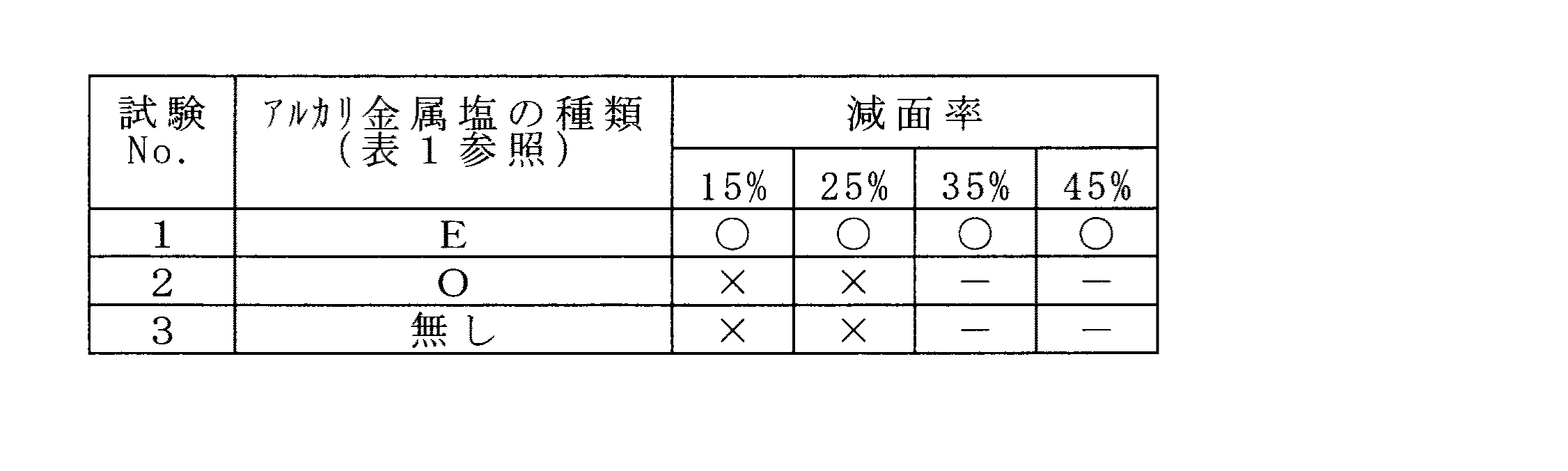
炭素鋼(S45C)製の外径:28mm、肉厚:5.5mm、長さ:1.5mの素管を10%硫酸で酸洗処理した後、ホウ酸カリウム:80質量%と、ステアリン酸ナトリウム:20質量%とからなるアルカリ金属塩を含有する濃度:2.5質量%の水溶液に浸漬し、次いで、150℃の乾燥室の装入して素管の内外面にホウ酸カリウムとステアリン酸ナトリウムとからなる被膜を形成した。その後、上記被膜を形成した素管を温度:30℃、湿度90%の恒温恒湿槽に24時間装入し、次いで冷間引抜試験を行い潤滑性の指標である引抜用工具である中空マンドレルバーのびびり振動の有無を調査した。
【0053】
冷間引抜加工は、テーパー型ダイスと外径が12.5mmの中空マンドレルバーとを備える装置を用い、引抜加工度(減面率)を変化させて実施した。なお、比較のため、内外面にリン酸ナトリウムの被膜を形成した素管を用いた試験、ならびに、被膜の形成のない素管を用いた試験も実施した。なお、引抜加工前には、上記と同様に素管を温度30℃、湿度90%の恒温恒湿槽に24時間装入した。
【0054】
冷間引抜に際しては、テーパ型ダイスの入側に設けたノズルから液状潤滑剤を素管の外面に供給するとともに、中空マンドレルバーに設けた単孔から液状潤滑剤を素管の内面に供給した。液状潤滑剤は表2の液状潤滑剤Aを用い、素管の外面と内面への液状潤滑剤の供給量は、それぞれ100ml、50mlとし、素管の引抜速度は40m/minとした。
【0055】
表7に試験結果を、びびり振動が発生しなかった場合を○印、びびり振動が発生した場合を×印で示す。
【0056】
【表7】
表7に示すように、ホウ酸カリウムとステアリン酸ナトリウムとの被膜を有する素管を用いた試験No.1は、減面率が45%でもびびり振動が発生せず極めて良好であった。すなわち、上記被膜は高湿度環境下を経ても優れた潤滑性を維持することが判った。一方、リン酸ナトリウムの被膜を有する素管を用いた試験No.2ならびに被膜のない素管を用いた試験No.3は、減面率が15%でびびり振動が生じた。
【0058】
【発明の効果】
本発明によれば、高湿度環境であっても、引抜加工の際の焼付きやかじりの発生ならびにびびり振動の発生が抑制され、さらに引抜加工後の熱処理における浸りんの発生を防止できる。したがって、高品質の冷間引抜管が得られる。[0001]
BACKGROUND OF THE INVENTION
The present invention relates to a method for producing a cold drawn tube such as carbon steel, alloy steel or stainless steel. More specifically, the present invention relates to a method for manufacturing a cold drawn tube that suppresses the occurrence of seizure during cold drawing and prevents immersion phosphorus in the heat treatment after the cold drawing.
[0002]
[Prior art]
As a pretreatment for cold drawing of steel pipes such as carbon steel, alloy steel or stainless steel, a zinc phosphate conversion coating is formed in advance on the surface of the raw pipe to be cold drawn, and a metal soap is formed on this. A method for forming a lubricating coating is used. However, in this method, there is a problem that a part of zinc phosphate or metal soap adheres to the surface of the tube after the drawing process, and the metallic luster of the tube is impaired.
[0003]
Therefore, as a method for solving this problem, there has been proposed a method in which a chemical conversion film such as phosphate is formed on the surface of the raw tube before drawing, and a liquid lubricant is applied on the chemical conversion film.
[0004]
For example, JP-A-4-33998 discloses colloidal titanium having a pH of 8 to 11 containing 0.001 to 0.5 g / l of colloidal titanium formed from a reaction product of a titanium-containing compound and an alkaline phosphate. One type selected from a compound of an oil and an olefin having a sulfur content of 23 to 30% by weight and a compound of a higher ester compound and an olefin having a sulfur content of 23 to 30% by weight. 40 to 95% by weight of a mixture of two or more, and 5 to 50% by weight of one or more selected from oil-soluble polymer compounds, fats and oils, synthetic oils, mineral oils, higher fatty acids and higher fatty acid amines, If necessary, a lubrication treatment method may further include applying a lubricating oil further containing a phosphorus-based extreme pressure agent and having a viscosity at 20 ° C. adjusted within a range of 100 to 3000 centipoise. It is shown.
[0005]
JP-A-9-295038 discloses that the amount of phosphoric acid adhered to a compound solution having a pH of 8 to 11 consisting of a titanium-containing compound and phosphate before cold drawing of a carbon steel pipe is 100 mg / m 2 or less. And then dry, and then apply a lubricating oil composed of a fat and olefin compound having a sulfur content of 21% by weight or more, and cold-drawing with a working degree of 45% or more. It is disclosed.
[0006]
Japanese Patent Application Laid-Open No. 61-74726 discloses that a coating film such as phosphate is formed on the surface of a pipe material in advance, and then a sulfurized fat and oil containing a specific weight percent of sulfur and a thermoplastic polymer polymer powder having a predetermined concentration are used. A method of drawing a composition as a lubricant is disclosed.
[0007]
[Problems to be solved by the invention]
However, the method disclosed in the above Japanese Patent Laid-Open No. 4-33998 has a degreasing treatment before heat treatment because, for example, in alloy steel containing 0.5% or more of Cr, immersion phosphorus is generated by heat treatment after cold drawing. Has a problem that it is necessary.
[0008]
Further, in the methods disclosed in Japanese Patent Application Laid-Open Nos. 9-295038 and 61-74726, when the phosphorus adhesion amount exceeds 100 mg / m 2 , phosphorous is formed by heat treatment. There is a problem that is restricted.
[0009]
In addition, in any of the methods disclosed in these publications, since the base treatment is a phosphate-based chemical conversion coating, the coating performed after the chemical conversion treatment is insufficiently dried or in a high humidity environment such as rainy weather. Then, since the film easily absorbs moisture, the lubrication function of the film decreases, seizure or galling occurs during drawing, or the dimensional accuracy of the tube deteriorates due to chatter vibration of the drawing tool. There is a problem that the extraction tool is damaged.
[0010]
The object of the present invention is to suppress the occurrence of seizure and galling and chatter vibration during the drawing process even in a high humidity environment, and further, high quality without the problem of phosphorus immersion in the heat treatment after the drawing process. Another object of the present invention is to provide a method for manufacturing a cold drawn tube from which a cold drawn tube is obtained.
[0011]
[Means for Solving the Problems]
The present inventors have formed a borate-based coating on the surface of the base tube after pickling before cold drawing and performs cold drawing while supplying a liquid lubricant on the coating. Even in high-humidity environments, seizure and galling between the tube and the drawing tool is suppressed, chatter vibration of the drawing tool is suppressed, and high quality without immersion phosphorus in heat treatment. It was found that a drawn tube can be obtained.
[0012]
The present invention has been completed based on the above findings, and the gist thereof is as follows.
(1) an alkali metal salt only alkali metal salts of boric acid by immersing the raw tube in an aqueous solution containing a coating of an alkali metal salt of boric acid is formed on the inner and outer surfaces of the plain tube, liquid lubricant thereon A method for producing a cold drawn tube, characterized in that cold drawing is carried out by applying a coating.
[0013]
(2) an alkali metal salt only alkali metal salts of an alkali metal salt and a fatty acid boric acid by immersing the raw tube in an aqueous solution containing alkali metal salts of an alkali metal salt and a fatty acid of boric acid on the inner and outer surfaces of the the plain tube And a cold drawing process is performed by applying a liquid lubricant on the coating film.
[0014]
(3) In the aqueous solution, the content of the alkali metal salt of boric acid is 70% by mass and is 70% or more of the total content of the alkali metal salt of boric acid and the alkali metal salt of saturated fatty acid. The method for producing a cold drawn tube according to item (2), which is characterized in that
[0015]
(4) The method for producing a cold drawn tube according to any one of (1) to (3), wherein the alkali metal salt of boric acid is potassium borate.
(5) The method for producing a cold drawn tube according to any one of (1) to (4) above, wherein the thickness of the coating is 0.4 to 20 μm.
[0016]
DETAILED DESCRIPTION OF THE INVENTION
In the present invention, when a drawn tube such as carbon steel, alloy steel or stainless steel is manufactured by cold drawing, the raw tube is previously immersed in an aqueous solution containing an alkali metal salt of boric acid, and the inner and outer surfaces of the raw tube are immersed. A coating of an alkali metal salt of boric acid is formed, and a liquid lubricant is applied on the coating and cold drawing is performed.
[0017]
Further, in the present invention, the raw tube is previously immersed in an aqueous solution containing an alkali metal salt of boric acid and an alkali metal salt of a saturated fatty acid, and an alkali metal salt of boric acid and an alkali metal of a saturated fatty acid are formed on the inner and outer surfaces of the raw tube. A cold-drawing process may be performed by forming a film with salt and applying a liquid lubricant on the film.
[0018]
A coating of an alkali metal salt of boric acid or a coating of an alkali metal salt of boric acid and an alkali metal salt of a saturated fatty acid is excellent in moisture absorption resistance and good adhesion to the bare tube. Excellent retention of liquid lubricant applied on top. Therefore, the combination of the formation of the film and the application of the liquid lubricant stably reduces the frictional force between the blank tube and the drawing tool during the cold drawing process. The seizure is suppressed, the occurrence of chatter vibration is suppressed, and a good drawn tube with excellent dimensional accuracy can be obtained. Moreover, immersion phosphorus in the heat treatment after the drawing process can be prevented.
[0019]
Examples of the alkali metal salt of boric acid include lithium borate, potassium borate, sodium borate and the like. Preferably, it is potassium borate.
The alkali metal salt of boric acid increases the moisture absorption resistance of the coating, improves the adhesion between the coating and the raw tube, and further improves the retention of the liquid lubricant applied on the coating. In order to enhance this effect, the content of the alkali metal salt of boric acid in the aqueous solution is mass%, and 70% or more of the total content of the alkali metal salt of boric acid and the alkali metal salt of saturated fatty acid described later. It is desirable to do.
[0020]
Examples of the alkali metal salt of a saturated fatty acid include salts of a C 6 to C 30 fatty acid and an alkali metal such as lithium, potassium, and sodium. C 12 to C 18 fatty acids, that is, lauric acid, palmitic acid Alkali metal salts such as stearic acid and oleic acid are preferred. Lauric acid (C 11 H 23 COOH) and stearic acid (C 17 H 35 COOH) are readily available from natural fats and oils. However, since a film having a small molecular weight easily absorbs moisture, a film containing an alkali metal salt of lauric acid is likely to be solidified as a so-called blocking phenomenon. Accordingly, it is more preferable to use an alkali metal salt of stearic acid having a relatively high molecular weight, such as sodium stearate having high moisture absorption resistance.
[0021]
Examples of the main component of the liquid lubricant include animal and vegetable fats and oils such as lard, beef tallow, whale oil, palm oil, coconut oil, and rapeseed oil. Sulfurized fats and oils are preferred, but sulfur parts in sulfurized fats and oils may be precipitated during heat treatment, and therefore sulfurized fats and oils with a sulfur content of 30% by mass or less are more preferred.
[0022]
When the film thickness exceeds 20 μm, the coating is easily peeled off. Furthermore, the liquid lubricant tends to remain on the surface of the tube, and it may be necessary to remove the residue on the surface of the tube after the heat treatment. On the other hand, when the film thickness is less than 0.4 μm, direct contact between the blank tube and the drawing tool occurs, and the holding power of the liquid lubricant is reduced, so that the lubricity may be lowered. Therefore, the film thickness is preferably 0.4 μm or more and 20 μm or less.
[0023]
Next, a method for forming a film will be described using a film of an alkali metal salt of boric acid and an alkali metal salt of fatty acid as an example.
In an aqueous solution containing an alkali metal salt of boric acid and an alkali metal salt of a saturated fatty acid, an element tube is preferably used so that the thickness of the coating film after treatment becomes a predetermined value, preferably 0.4 μm or more and 20 μm or less. Immerse. The thickness of the coating is adjusted by the dipping time and the temperature of the aqueous solution. In addition, although the density | concentration of the alkali metal salt of boric acid and the alkali metal salt of saturated fatty acid in aqueous solution is determined by film thickness, immersion time, etc., the density | concentration in aqueous solution is 2-10 mass% in total, for example. It is considered as a range. Moreover, the temperature of aqueous solution shall be the range of 70-100 degreeC, for example.
[0024]
Next, the immersed pipe is dried to form a coating of an alkali metal salt of saturated fatty acid and an alkali metal salt of boric acid on the inner and outer surfaces of the pipe. In addition, drying is normally performed by the method of charging in a drying room at about 150 ° C.
[0025]
The method of applying the liquid lubricant to the raw tube can be performed by a known method. For example, the liquid lubricant is supplied to the outer surface of the raw pipe from a nozzle arranged on the outer periphery of the raw pipe, and the liquid lubricant is supplied from the hole provided in the hollow mandrel bar inserted into the raw pipe. This is possible by supplying the inner surface.
[0026]
【Example】
The effects of the present invention will be described below. Example 1 details test results on laboratory-scale lubricity, moisture absorption resistance and blocking resistance, and Example 2 details test results on lubricity in an actual production line.
Example 1
Lubricity was evaluated using a Bowden friction tester. A cold-rolled steel plate (SPCC-SD) having a plate thickness of 0.8 mm, a plate width of 12 mm, and a length of 100 mm was immersed in a 10% sulfuric acid aqueous solution heated to 60 ° C. for 40 minutes, pickled, and then washed with water. Then, it is immersed in an aqueous solution containing an alkali metal salt of boric acid, or an aqueous solution containing an alkali metal salt of boric acid and an alkali metal salt of fatty acid, and then charged in a dryer at 150 ° C. and dried. A test material in which a coating of an alkali metal salt of boric acid or a coating of an alkali metal salt of boric acid and an alkali metal salt of a fatty acid was prepared on the surface of the cold-rolled steel sheet was prepared.
[0027]
In the aqueous solution, the concentration of the alkali metal salt of borate and the total concentration of the alkali metal salt of boric acid and the alkali metal salt of saturated fatty acid were both 2.4% by mass, and the aqueous solution temperature was 80 ° C. The immersion time was 30 seconds. Further, potassium borate was used as the alkali metal salt of boric acid, and sodium laurate or sodium stearate was used as the alkali metal salt of fatty acid.
[0028]
For comparison, the cold-rolled steel sheet similar to the above was pickled, washed with water, then immersed in an aqueous solution of sodium phosphate having a concentration of 0.5% by mass (temperature: 80 ° C.), then charged in a dryer at 150 ° C. and dried. Thus, a test material in which a sodium phosphate conversion film was formed and a test material in which a cold-rolled steel sheet was simply pickled and washed and not formed into a film were prepared.
[0029]
Table 1 shows the ratio of the content of each alkali metal salt to the alkali metal salt in the aqueous solution in mass%, and the film thickness in μm.
[0030]
[Table 1]
Next, the test material was placed in a constant temperature and humidity chamber having a temperature of 30 ° C. and a humidity of 90% for 24 hours, and the lubricity was evaluated with a Bowden friction tester.
[0032]
In the evaluation test of lubricity using a Bowden friction tester, after the test material was heated to 180 ° C., the test No. 1 in Table 1 was performed. In Nos. 1 to 9, 15 to 18, and 23, the test No. In No. 24, 0.2 ml of the liquid lubricant A or B shown in Table 2 was applied to the surface of the test material, and a 3/16 inch ball indenter was pressed with a load of 19.6 N with a material of SUJ-2, and a sliding of 10 mm. Reciprocated with a width. The sliding speed was 3.85 mm / second.
[0033]
[Table 2]
The coefficient of friction between the test material and the indenter was measured, and the seizure resistance of the test material was investigated. As the friction coefficient, the friction coefficient from the start of sliding to 10 reciprocations was measured, and the average value was obtained. Further, the sliding surface of the test material after the test was observed with an optical microscope, and the occurrence ratio of streaks to the sliding width was determined to evaluate the seizure resistance. Table 3 shows the average coefficient of friction and seizure resistance. Here, the seizure resistance is as follows: when the generation ratio of streaks is 0%: ◎, when 0% and over 10%: ○, when over 10% and 50% or less: △, 50% When exceeding: It was set as x mark.
[0035]
[Table 3]
As shown in Table 3, test no. Nos. 1-9 and 15-18 have a small friction coefficient and no seizure. Compared with 23 and 24, good lubricity was exhibited.
[0037]
In particular, Test No. with a potassium borate content of 70 mass% or more. 1-9 were better. Test No. Although No. 23 has a phosphate coating, it is presumed that the moisture was absorbed in a high-humidity atmosphere, the lubricity was lowered, and seizure occurred.
[0038]
Next, the cold-rolled steel sheet pickled and washed in the same manner as above is immersed in an aqueous solution containing an alkali metal salt of boric acid and an alkali metal salt of fatty acid, and then charged in a drying chamber at 150 ° C. and dried. A test material was prepared in which a coating of an alkali metal salt of boric acid and an alkali metal salt of fatty acid was formed on the surface of the cold rolled steel sheet.
[0039]
At this time, the film thickness was adjusted by changing the time of immersion in the aqueous solution. In the aqueous solution, the total concentration of the alkali metal salt of borate and the alkali metal salt of saturated fatty acid was 2.4% by mass, and the aqueous solution temperature was 80 ° C. In addition, potassium borate was used as the alkali metal salt of boric acid, and sodium laurate or sodium stearate was used as the alkali metal salt of the fatty acid.
[0040]
Table 4 shows the ratio of the content of each alkali metal salt to the alkali metal salt in the aqueous solution in mass%, and the film thickness.
[0041]
[Table 4]
Next, the test material was placed in a constant temperature and humidity chamber having a temperature of 30 ° C. and a humidity of 90% for 24 hours, and the lubricity was evaluated using a Bowden friction tester in the same manner as described above. However, the liquid lubricant B shown in Table 2 was used as the liquid lubricant.
[0043]
Table 5 shows the average value of the coefficient of friction and the generation ratio of streaks.
[0044]
[Table 5]
As shown in Table 5, the test No. in which the film thickness is in the range of 0.4 μm or more and 20 μm or less is particularly preferable. Nos. 5 and 10 to 14 had a small coefficient of friction and good seizure resistance.
[0046]
Next, for the types A to I and K to O shown in Table 1, the moisture absorption resistance and the blocking resistance (solidification resistance) that affect the lubricity were investigated.
a. Evaluation of hygroscopic resistance The hygroscopic resistance was investigated as follows.
[0047]
The powders of alkali metal salts A to I and K to O, which are sufficiently dried and have substantially the same particle diameter, are placed in a constant temperature and humidity chamber at a temperature of 30 ° C. and a humidity of 90% for 2 hours. The mass change was measured, and the moisture absorption rate was determined by the following formula.
[0048]
[0049]
Table 6 shows the survey results of moisture absorption resistance and blocking resistance. Moisture absorption resistance is 0%: ◎ mark, more than 0% to 5% or less: ◯ mark, more than 5% to 10% or less: △ mark, more than 10%: x mark, blocking resistance is solidification rate Less than 10%: O mark, 10% or more to less than 50%: Δ mark, 50% or more: Expressed as X mark.
[0050]
[Table 6]
As shown in Table 6, the powder of an alkali metal salt of boric acid, or the powder of an alkali metal salt of boric acid and an alkali metal salt of a saturated fatty acid, absorbs moisture compared to the powder of sodium phosphate. The moisture absorption resistance was small, the solidification rate was small, and the blocking resistance was good. In particular, Test No. with a potassium borate content of 70 mass% or more. 1-9 were good.
[0052]
On the other hand, the sodium phosphate powder easily absorbs moisture, has a high solidification rate, and has poor blocking resistance.
(Example 2)
After carbon steel (S45C) outer diameter: 28 mm, wall thickness: 5.5 mm, length: 1.5 m, pickling treatment with 10% sulfuric acid, potassium borate: 80% by mass, stearic acid Immersion in an aqueous solution containing an alkali metal salt consisting of 20% by mass of sodium: 2.5% by mass, and then charged in a drying chamber at 150 ° C. and potassium borate and stearin on the inner and outer surfaces of the raw tube. A film composed of sodium acid was formed. After that, the blank tube on which the coating film was formed was placed in a constant temperature and humidity chamber at a temperature of 30 ° C. and a humidity of 90% for 24 hours. The presence or absence of chatter vibration of the bar was investigated.
[0053]
The cold drawing was performed using an apparatus including a taper type die and a hollow mandrel bar having an outer diameter of 12.5 mm and changing the drawing degree (reduction area). For comparison, a test using a pipe with a sodium phosphate coating formed on the inner and outer surfaces and a test using a pipe without a coating were also performed. Prior to the drawing process, the blank tube was charged in a constant temperature and humidity chamber having a temperature of 30 ° C. and a humidity of 90% for 24 hours in the same manner as above.
[0054]
During cold drawing, the liquid lubricant was supplied to the outer surface of the base tube from the nozzle provided on the entry side of the taper die, and the liquid lubricant was supplied to the inner surface of the base tube from a single hole provided in the hollow mandrel bar. . As the liquid lubricant, liquid lubricant A shown in Table 2 was used, the supply amount of the liquid lubricant to the outer surface and the inner surface of the tube was 100 ml and 50 ml, respectively, and the drawing speed of the tube was 40 m / min.
[0055]
The test results are shown in Table 7 with ◯ marks when chatter vibration did not occur and with x marks when chatter vibration occurred.
[0056]
[Table 7]
As shown in Table 7, test No. 1 using a tube having a coating of potassium borate and sodium stearate. No. 1 was very good with no chatter vibration even when the area reduction rate was 45%. That is, it was found that the coating film maintained excellent lubricity even under a high humidity environment. On the other hand, test No. using a raw tube having a sodium phosphate coating. No. 2 and Test No. using an uncoated pipe. In No. 3, chatter vibration occurred with a reduction in area of 15%.
[0058]
【The invention's effect】
According to the present invention, even in a high-humidity environment, the occurrence of seizure or galling and chatter vibration during the drawing process can be suppressed, and the occurrence of phosphorus in the heat treatment after the drawing process can be prevented. Therefore, a high quality cold drawn tube is obtained.
Claims (5)
Priority Applications (1)
| Application Number | Priority Date | Filing Date | Title |
|---|---|---|---|
| JP2000390731A JP3772672B2 (en) | 2000-12-22 | 2000-12-22 | Cold drawn tube manufacturing method |
Applications Claiming Priority (1)
| Application Number | Priority Date | Filing Date | Title |
|---|---|---|---|
| JP2000390731A JP3772672B2 (en) | 2000-12-22 | 2000-12-22 | Cold drawn tube manufacturing method |
Publications (2)
| Publication Number | Publication Date |
|---|---|
| JP2002192220A JP2002192220A (en) | 2002-07-10 |
| JP3772672B2 true JP3772672B2 (en) | 2006-05-10 |
Family
ID=18857039
Family Applications (1)
| Application Number | Title | Priority Date | Filing Date |
|---|---|---|---|
| JP2000390731A Expired - Fee Related JP3772672B2 (en) | 2000-12-22 | 2000-12-22 | Cold drawn tube manufacturing method |
Country Status (1)
| Country | Link |
|---|---|
| JP (1) | JP3772672B2 (en) |
Families Citing this family (2)
| Publication number | Priority date | Publication date | Assignee | Title |
|---|---|---|---|---|
| JP4788101B2 (en) * | 2003-12-19 | 2011-10-05 | 住友金属工業株式会社 | Manufacturing method of cold drawn steel pipe |
| JP2009191334A (en) * | 2008-02-15 | 2009-08-27 | Kobe Steel Ltd | Steel member for plastic working, method for producing the same, and plastic-worked product |
-
2000
- 2000-12-22 JP JP2000390731A patent/JP3772672B2/en not_active Expired - Fee Related
Also Published As
| Publication number | Publication date |
|---|---|
| JP2002192220A (en) | 2002-07-10 |
Similar Documents
| Publication | Publication Date | Title |
|---|---|---|
| JP3517522B2 (en) | Water-based lubricant for cold plastic working of metallic materials | |
| CA1198655A (en) | Process for the cold forming of iron and steel | |
| EP1449936A1 (en) | Process for producing metal wire rod for plastic working | |
| JPH0566436B2 (en) | ||
| US10479957B2 (en) | Lubricant for metal cold forming processes and methods of use of the same | |
| GB2175611A (en) | Processes for lubrication of metal surfaces | |
| JPWO2007132851A1 (en) | Lubricant for cold working of steel pipe and cold working method | |
| US6107260A (en) | Aluminium or aluminium alloy moulding process lubricant, and aluminium or aluminium alloy plate for moulding processes | |
| JP2002264252A (en) | Metallic material for plastic working having inclined two-layer lubricating film and method for producing the same | |
| CA1154745A (en) | Metal drawing compound composition and method of use | |
| KR101798804B1 (en) | Non-phosphorus chemical conversion treatment agent and treatment liquid for plastic working, chemical conversion coating, and metal material having chemical conversion coating | |
| JPS6099200A (en) | Lubrication treatment of metal | |
| US4999241A (en) | Coiled steel strip with solid lubricant coating | |
| JP5299084B2 (en) | Lubricated steel sheet and treatment liquid for forming lubricating film | |
| US5091100A (en) | Fatty triglyceride-in-water solid film high temperature prelube emulsion for hot rolled steel | |
| JP2002192220A (en) | Manufacturing method of cold drawn tube | |
| JP2004099949A (en) | Method for producing metal material for plastic working having inclined two-layer lubricating film | |
| US2935432A (en) | Metal treatment | |
| US4350034A (en) | Metal drawing compound composition and method of use | |
| JP7727282B2 (en) | Metal surface pretreatment agent | |
| JP4788101B2 (en) | Manufacturing method of cold drawn steel pipe | |
| JPH09295038A (en) | Cold drawing method and manufacturing method of carbon steel pipe | |
| JP2000119862A (en) | Lubrication method for cold plastic working of steel | |
| WO1989012669A1 (en) | Lubricant composition for hot-rolling of steel | |
| JPH09248619A (en) | Lubrication method for alloy steel pipe and its manufacturing method |
Legal Events
| Date | Code | Title | Description |
|---|---|---|---|
| A621 | Written request for application examination |
Free format text: JAPANESE INTERMEDIATE CODE: A621 Effective date: 20040120 |
|
| A977 | Report on retrieval |
Free format text: JAPANESE INTERMEDIATE CODE: A971007 Effective date: 20041202 |
|
| A131 | Notification of reasons for refusal |
Free format text: JAPANESE INTERMEDIATE CODE: A131 Effective date: 20051025 |
|
| A521 | Written amendment |
Free format text: JAPANESE INTERMEDIATE CODE: A523 Effective date: 20051219 |
|
| TRDD | Decision of grant or rejection written | ||
| A01 | Written decision to grant a patent or to grant a registration (utility model) |
Free format text: JAPANESE INTERMEDIATE CODE: A01 Effective date: 20060124 |
|
| A61 | First payment of annual fees (during grant procedure) |
Free format text: JAPANESE INTERMEDIATE CODE: A61 Effective date: 20060206 |
|
| R150 | Certificate of patent or registration of utility model |
Ref document number: 3772672 Country of ref document: JP Free format text: JAPANESE INTERMEDIATE CODE: R150 Free format text: JAPANESE INTERMEDIATE CODE: R150 |
|
| FPAY | Renewal fee payment (event date is renewal date of database) |
Free format text: PAYMENT UNTIL: 20100224 Year of fee payment: 4 |
|
| FPAY | Renewal fee payment (event date is renewal date of database) |
Free format text: PAYMENT UNTIL: 20100224 Year of fee payment: 4 |
|
| FPAY | Renewal fee payment (event date is renewal date of database) |
Free format text: PAYMENT UNTIL: 20110224 Year of fee payment: 5 |
|
| FPAY | Renewal fee payment (event date is renewal date of database) |
Free format text: PAYMENT UNTIL: 20120224 Year of fee payment: 6 |
|
| FPAY | Renewal fee payment (event date is renewal date of database) |
Free format text: PAYMENT UNTIL: 20120224 Year of fee payment: 6 |
|
| FPAY | Renewal fee payment (event date is renewal date of database) |
Free format text: PAYMENT UNTIL: 20130224 Year of fee payment: 7 |
|
| FPAY | Renewal fee payment (event date is renewal date of database) |
Free format text: PAYMENT UNTIL: 20130224 Year of fee payment: 7 |
|
| S111 | Request for change of ownership or part of ownership |
Free format text: JAPANESE INTERMEDIATE CODE: R313111 |
|
| FPAY | Renewal fee payment (event date is renewal date of database) |
Free format text: PAYMENT UNTIL: 20130224 Year of fee payment: 7 |
|
| R350 | Written notification of registration of transfer |
Free format text: JAPANESE INTERMEDIATE CODE: R350 |
|
| FPAY | Renewal fee payment (event date is renewal date of database) |
Free format text: PAYMENT UNTIL: 20140224 Year of fee payment: 8 |
|
| S533 | Written request for registration of change of name |
Free format text: JAPANESE INTERMEDIATE CODE: R313533 |
|
| R350 | Written notification of registration of transfer |
Free format text: JAPANESE INTERMEDIATE CODE: R350 |
|
| LAPS | Cancellation because of no payment of annual fees |