JP3661963B2 - Electronic musical instruments - Google Patents
Electronic musical instruments Download PDFInfo
- Publication number
- JP3661963B2 JP3661963B2 JP23147896A JP23147896A JP3661963B2 JP 3661963 B2 JP3661963 B2 JP 3661963B2 JP 23147896 A JP23147896 A JP 23147896A JP 23147896 A JP23147896 A JP 23147896A JP 3661963 B2 JP3661963 B2 JP 3661963B2
- Authority
- JP
- Japan
- Prior art keywords
- chord
- data
- sound
- information
- turning
- Prior art date
- Legal status (The legal status is an assumption and is not a legal conclusion. Google has not performed a legal analysis and makes no representation as to the accuracy of the status listed.)
- Expired - Fee Related
Links
Images






Landscapes
- Electrophonic Musical Instruments (AREA)
Description
【0001】
【発明の属する技術分野】
本発明は自動伴奏装置を備えた電子楽器に関し、特に弦楽器やハーモニカなど、鍵盤楽器とは異なるコード構成を有する音色において、より実際の楽器に近い和音で伴奏を行うことが可能な自動伴奏装置を備えた電子楽器に関するものである。
【0002】
【従来の技術】
従来、電子ピアノやシンセサイザ等の電子楽器において、自動伴奏装置を備えたものが広く知られている。この自動伴奏装置は、例えばロックやワルツといったリズム毎に、例えばCメジャーを基準として作成された伴奏パターンデータを予め記憶しておく。この伴奏パターンデータの各発音情報は、例えば図11(a)に示すように、音の高さを表す音高データ、発音タイミングデータ、発音持続時間データ、音量データからなっている。そして、自動伴奏装置は、この伴奏パターンデータと、メジャー、マイナー等の和音の種類(コードタイプ)およびC、D、E等の根音(コードルート)からなるコード情報の列であるコード進行情報に基づき、伴奏用の発音データを生成するように構成されている。また、コード情報は、鍵盤から入力されるコード情報を検出することによってリアルタイムに指定することも行われている。
【0003】
伴奏パターンデータとコード情報とに基づいて伴奏用の発音データを生成する方法としては、次の2つの方法が知られており、通常パート毎に2つの方法の内の1つが指定されて使用される。1つはノートシフトテーブルを使用したものであり、現在のコード情報のコードタイプに対応した音高変換データを検索し、その音高変換データによって伴奏パターンの発音データの音高を上下にシフトする方法である。もう1つは、自動伴奏中に発音する和音の音域が一定範囲に収まるような方法であり、予め記憶されているコード転回テーブルを使用し、発音中の音高等を参照して和音発生用のコードの転回形を選択する方法である。
自動伴奏パターンデータを作成する場合には、ドラム、ベース、コード1、コード2等複数のパートに分けて作成されるが、和音中心のパートや単音(メロディ)中心のパートがあるので、パート毎に最適なコード転回方法を選択して作成される。
【0004】
【発明が解決しようとする課題】
従来の自動伴奏装置においては、和音中心に構成されるパートはコード転回テーブルを使用した転回方法が行われていたが、このテーブルは鍵盤楽器の和音の転回形を基に作成されていたので、ギター、スチールギター、マンドリン、三味線等の弦楽器や、ハーモニカなどのその他の和音構成で演奏される楽器のパートの伴奏を行うには適していないという問題点があった。また、鍵盤の和音は通常3〜4音によって構成されているのに対し、ギターのコードの構成音は最大6音によって構成されているので、従来のコード転回テーブルの構成音を組み替えただけではギターの構成音を発生できないという問題点もあった。
【0005】
更に、ギターの和音は、同じコードでもスタイル(ジャンル)によって高音部の弦を中心に用いるもの、低音部の弦を中心に用いるもの、全部の弦を用いるものなど様々であり、また同じコードタイプでもコードルートによって構成音が異なるが、従来のコード転回テーブルを使用する方式では、スタイルやコードルートを考慮に入れたコード転回を行うことができないという問題点もあった。
本発明の目的は、前記のような従来技術の問題点を解決し、鍵盤楽器以外のパートの和音も適切に転回可能な自動伴奏装置を備えた電子楽器を提供することにある。
【0006】
【課題を解決するための手段】
本発明は、コードタイプ毎に各弦の音高情報が格納された複数のコード転回データを記憶したコード転回テーブルと、スタイル毎に使用する弦情報を記憶した弦指定テーブルとを使用することによって、スタイルに対応した構成音を選択する構成に特徴がある。
【0007】
本発明は、コードタイプ毎に各弦の音高情報が格納された複数のコード転回データを記憶したコード転回テーブルを使用してコード転回を行うので、スタイルに合った和音を簡単な構成で発生させることができる。
【0008】
【発明の実施の形態】
以下、本発明の実施の形態を図面を参照して詳細に説明する。図1は、本発明を適用した電子ピアノの構成を示すブロック図である。CPU1は、ROM2に格納されている制御プログラムに基づき、電子ピアノ全体の制御を行う中央処理装置である。CPU1にはハードウェアタイマ割り込み回路も設けられている。ROM2には制御プログラム、音色パラメータ、自動伴奏用の伴奏パターンデータ等が記憶されている。音色パラメータには波形メモリに記憶されている楽音波形のアドレス情報、エンベロープ制御情報等がある。
【0009】
RAM3はワークエリアおよびバッファとして使用され、使用者が書き込んだ伴奏パターンやコード進行情報も記憶される。また、バッテリ等によりバックアップされていてもよい。パネル回路4は、音色選択などのための各種スイッチおよび液晶やLEDにより文字等を表示する表示装置からなり、パネルインターフェース回路5によりバス13に接続されている。鍵盤6は、例えばそれぞれ2つのスイッチを備えた複数の鍵から成り、鍵盤インターフェース回路7は、各鍵のスイッチの状態をスキャンし、その状態変化を検出してキーイベント情報やタッチ情報を生成する。
【0010】
音源回路8は、例えば波形読み出し方式により所望の楽音信号を発生する回路であり、デジタル楽音波形サンプル値が記憶されている波形メモリ9から、発音すべき音高に比例したアドレス間隔で順次波形データを読み出し、補間演算を行って楽音波形信号を発生させる。また、エンベロープ発生回路を有し、設定されたエンベロープパラメータに基づいて発生したエンベロープ信号を楽音波形信号に乗算してエンベロープを付与し、楽音信号を出力する。音源回路8は、複数(例えば32)の楽音発生チャネルを有しているが、実際には、1つの楽音発生回路を時分割多重動作させることにより、同時に複数の楽音信号を独立して発生可能に構成されている。
【0011】
D/A変換器10はデジタル楽音信号をアナログ信号に変換し、アンプ11によって増幅された楽音信号はスピーカ12から発音される。バス13は電子ピアノ内の各回路を接続している。なお、必要に応じて、MIDIインターフェース回路、メモリカードインターフェース回路、フロッピィディスク装置等を備えていてもよい。
【0012】
図6は、CPU1のメイン処理を示すフローチャートである。電源が投入されると、ステップS1においては装置内のRAM3や音源回路8内のデータ設定状態を初期状態に戻す。ステップS2においては鍵盤インターフェース回路7からキーオンあるいはキーオフの鍵盤イベントの発生が通知されたか否かが判定され、鍵盤イベントが発生していた場合には、ステップS3においてそれぞれ対応する処理を行う。
【0013】
ステップS4においては、パネル4の各種スイッチの状態変化があったか否かが判定され、状態変化が検出された場合にはステップS5において対応する処理を行う。ステップS6においては、周知のコード検出処理が行われる。このコード検出処理においては、例えば鍵盤を2つの領域に分割し、左側の領域でキーオンされている鍵のパターンからコードを検出する。ステップS7においては、ステップS6においてコードが検出されたか否かが判定され、結果が肯定の場合にはステップS8に移行して、後述するコード更新処理を行う。
【0014】
ステップS9においては自動伴奏中か否かが判定され、結果が否定の場合にはステップS22に移行するが、肯定の場合にはステップS10に移行する。ステップS10においては、ステップ処理済みか否か、即ち自動伴奏用のステップカウンタが後述するタイマ割り込み処理によって更新された場合における自動伴奏パターンデータのチェックが済んでいるか否かが判定され、結果が否定の場合にはステップS11に移行する。
【0015】
ステップS11においてはステップ処理フラグをリセットし、ステップS12においては次に発音すべき伴奏パターン中の発音データを1つ読み出す。ステップS13においては、まず、現在発音中のチャネルに対応するゲートカウンタを全て1だけ減算する。発音情報は、図11(a)に示すように、全て発音継続時間情報であるゲートタイムデータを有しており、発音開始時にこのデータが発音チャネルに対応するゲートカウンタにセットされている。ステップS14においてはゲートカウンタの値が0であるチャネルが有るか否かが判定され、結果が肯定の場合にはステップS15に移行して、該チャネルの消音処理を行う。
【0016】
ステップS16においては、ステップS12において読み出した発音データのステップタイムデータ(発音タイミングデータ)とステップカウンタの値とが一致するか否かが判定され、一致する場合にはステップS17に移行する。ステップS17においては発音データがギターパートのデータであるか否かが判定され、結果が肯定の場合にはステップS18に移行するが、否定の場合にはステップS19に移行する。
【0017】
ステップS18においては、ギター用のコード構成音データを参照して、伴奏パターンの発音データの音高が変更される。またステップS19においては、鍵盤用のコード構成音データを参照して、伴奏パターンの発音データの音高が変更される。
図5は、鍵盤用およびギター用のコード構成音データを格納するエリアを示す説明図である。このエリアには、後述するコード更新処理において、現在のコード情報に基づき、鍵盤パート及びギターパートそれぞれについて4個のコード構成音が設定される。ステップS18あるいはS19においては、発音データと該コード構成音のいずれかが一致しない場合には、コード構成音に一致するように音高が変更される。
【0018】
ステップS20においては自動伴奏用の発音データについて発音処理が行われ、空きチャネルが割り当てられ、発音パラメータがセットされて発音が開始される。ステップS20においては、消音タイミングを計測するために、該発音データのゲートタイムデータが発音チャネル対応のゲートカウンタにセットされる。ステップS22においては、自動演奏処理、MIDI処理、音響効果付与処理等の処理が実行される。
【0019】
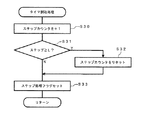
図7は、本発明に関するタイマ割り込み処理の内容を示すフローチャートである。この処理は、所定の周期で発生するハードウェアタイマ割り込みにより起動される。ステップS30においてはステップカウンタに1が加算される。ステップS31においてはステップカウンタ値が所定値L以上になったか否かが判定され、結果が肯定の場合にはステップS32に移行して、ステップカウンタをリセットする。ステップS33においてはステップカウンタが更新されたので、図6のステップS11以降のステップ処理が必要であることを示すステップ処理フラグをセットする。
【0020】
図8は、図6のステップS8のコード更新処理の内容を示すフローチャートである。ステップS40においては、ステップS6において検出されたコード情報に基づき、自動伴奏用のコードルート、コードタイプデータを更新する。ステップS41においては変数kを0にリセットする。以下の処理においては、このkが0である場合には鍵盤パートのコード構成音決定処理が行われ、またkが1である場合にはギターパートのコード構成音決定処理が行われる。
【0021】
ステップS42においては、kが2より小さいか否かが判定され、結果が否定の場合には処理を終了するが、肯定の場合にはステップS43に移行する。ステップS43においてはkが1か否かが判定され、結果が肯定の場合にはステップS45に移行するが、否定の場合にはステップS44に移行する。
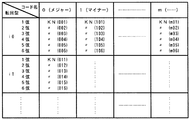
ステップS44においては鍵盤パート用のコード構成音を決定するために、図2に示す鍵盤パート用のコード転回テーブルの該当するコードタイプ欄を検索し、各転回型i0〜inにおける最高音をそれぞれ読み出す。図2は、鍵盤パート用のコード転回テーブルの例を示す説明図である。このテーブルには、各コード名(コードタイプ)毎に複数のコード転回型i0〜inのコード構成音KN(…)が登録されている。
【0022】
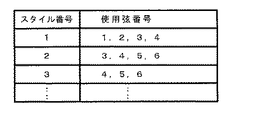
一方、ステップS45においてはギターパートのコード構成音を決定するために、まず予め設定されている音楽のスタイルに基づき、弦指定テーブルから使用する弦の情報を読み出す。図4は弦指定テーブルの例を示す説明図である。このテーブルには、音楽の各スタイル毎に伴奏に使用する弦の番号を予め登録してある。例えばスタイル1においては1〜4の弦を使用し、スタイル2においては3〜6の弦を使用する。
【0023】
ステップS46においては、図3に示すギター用のコード転回テーブルの該当するコードタイプ欄を検索し、各転回型i0〜in毎に当該スタイルにおける使用弦の最高音をそれぞれ読み出す。図3は、ギターパート用のコード転回テーブルの例を示す説明図である。このテーブルには、各コード名(コードタイプ)毎に複数のコード転回型i0〜inの弦毎のコード構成音KN(…)が登録されている。
【0024】
ステップS47以降の処理は、複数のコード転回型の中から所定の規則に基づいて1つの転回型を決定する処理であり、この実施例においては最高音がなるべく変化しないような転回型を選択する方式を採用しているが、他の任意の規則を採用することも可能である。
【0025】
ステップS47においては、コードの各転回型の最高音[i0〜in]にコードルートの基準コード(例えばC)からの相対距離値を加算する。ステップS48においては、予め設定されている基準最高音と前回のコードの最高音が不一致であるか否かが判定され、結果が否定、即ち一致していた場合にはステップS49に移行し、ステップS49〜52の処理において、今回の転回型の中から最高音が前回と同じものを検索する。そして、もし前回の最高音と同じ最高音の転回型が有った場合にはステップS51からステップS0に移行するが、一致するものが無かった場合にはステップS50からステップS53に移行する。ステップS53〜59においては、各転回型の中で、最高音が基準最高音に最も近いものを選択し、ステップS54からステップS60に移行した時点における変数iが選択された転回型の番号を表している。
【0026】
ステップS60においては、kの値に基づき、対応するコード転回テーブルの該当するコードタイプ欄を参照し、i番目のコード転回型のコード構成音データを読み出す。ステップS61においては、読み出した構成音データにコードルートの基準コードからの相対距離値を加算する。ステップS62においては、kの値に基づいて図5に示すコード転回用音名バッファの該当するパートのエリアに構成音データを書き込み、ステップS63においてはkに1を加算してステップS42に移行する。
【0027】
以上のような処理により、コードが変化する度に、各パートに対応する、図5に示すコード転回用構成音バッファの内容が更新され、このバッファの内容に基づいて、各パートの自動伴奏パターンが変更されて発音されるので、各パート毎に最適なコード構成音による伴奏が可能となる。
【0028】
本発明では、曲のスタイルによって使用する弦を選択している。図9に示すように、各スタイル毎にコード転回型テーブルを独立して設けるようにすることも考えられるが、多くのコード転回型テーブルを用意する必要がある。
【0029】
ギター等のコードのローコードにおける構成音は、例えば同じメジャーコードでもコードルートによって異なっている。従って、上記実施例のような、1つのコード転回テーブルのデータをコードルートに従って移調する処理では、ギターのコードを忠実に表現できないが、図10に示すように、コードルート毎に独立したコード転回テーブルを設けるようにすれば、同じメジャーコードであっても、ルート毎に異なるパターンのコード構成音データを設定することが可能となり、ギター等のコードを忠実に表現することが可能となる。
【0030】
更に、図11(b)に示すように、伴奏パターンデータの発音データとして、キーナンバの代わりに弦ナンバ/ポジションデータを記憶するようにして、コード転回時には図5のコード構成音バッファを参照して、対応する弦ナンバの構成音データに変換して発音するようにすることも考えられるが、発音データを記憶させるのに手間がかかる。
【0031】
以上、実施例を説明したが、次に示すような変形例も考えられる。実施例では鍵盤からコードをリアルタイムで入力する例を開示したが、コード進行情報を予め入力しておき、テンポカウンタによって自動的にコードを更新するようにしてもよい。
【0033】
【発明の効果】
以上述べたように、本発明においては、コードタイプ毎に各弦の音高情報が格納された複数のコード転回データを記憶したコード転回テーブルを使用してコード転回を行うので、スタイルに合った和音を簡単な構成で発生させることができるという効果がある。
【図面の簡単な説明】
【図1】本発明を適用した電子ピアノの構成を示すブロック図である。
【図2】鍵盤パート用のコード転回テーブルの例を示す説明図である。
【図3】ギターパート用のコード転回テーブルの例を示す説明図である。
【図4】弦指定テーブルの例を示す説明図である。
【図5】コード構成音データを格納するエリアを示す説明図である。
【図6】CPU1のメイン処理を示すフローチャートである。
【図7】タイマ割り込み処理の内容を示すフローチャートである。
【図8】コード更新処理の内容を示すフローチャートである。
【図9】他のコード転回テーブルを示す説明図である。
【図10】他のコード転回テーブルを示す説明図である。
【図11】伴奏パターンを構成する発音データ例を示す説明図である。[0001]
BACKGROUND OF THE INVENTION
The present invention relates to an electronic musical instrument provided with an automatic accompaniment apparatus, and more particularly to an automatic accompaniment apparatus capable of performing accompaniment with a chord closer to an actual musical instrument in a timbre having a chord configuration different from that of a keyboard instrument such as a stringed instrument or a harmonica. It relates to the electronic musical instrument provided.
[0002]
[Prior art]
2. Description of the Related Art Conventionally, electronic musical instruments such as electronic pianos and synthesizers that have an automatic accompaniment device are widely known. This automatic accompaniment device stores in advance accompaniment pattern data created based on, for example, C major for each rhythm such as rock or waltz. Each piece of pronunciation information of the accompaniment pattern data is composed of pitch data representing the pitch, tone generation timing data, tone generation duration data, and volume data, for example, as shown in FIG. Then, the automatic accompaniment apparatus has chord progression information which is a string of chord information composed of the accompaniment pattern data, the chord type (chord type) such as major and minor, and the root note (chord root) such as C, D and E. Based on the above, it is configured to generate sound data for accompaniment. The chord information is also specified in real time by detecting chord information input from the keyboard.
[0003]
The following two methods are known as methods for generating accompaniment pronunciation data based on accompaniment pattern data and chord information, and usually one of the two methods is designated and used for each part. The One uses a note shift table, searches for pitch conversion data corresponding to the chord type of the current chord information, and shifts the pitch of the pronunciation data of the accompaniment pattern up and down by the pitch conversion data. Is the method. The other is a method in which the range of chords generated during automatic accompaniment falls within a certain range, and a chord rotation table stored in advance is used to refer to pitches during sound generation, etc. This is a method for selecting the inverted form of the code.
When creating automatic accompaniment pattern data, it is created in multiple parts such as drum, bass,
[0004]
[Problems to be solved by the invention]
In conventional automatic accompaniment apparatus is configured chord center part is turning method using a code turn table has been carried out, since this table was created based on the inversion type of the chord keyboard instrument, There is a problem that it is not suitable for accompaniment of stringed instruments such as guitars, steel guitars, mandolin, shamisen, and other instruments that are played in other chord configurations such as harmonica. In addition, the chords of the keyboard are usually composed of 3 to 4 sounds, whereas the guitar chords are composed of up to 6 sounds. There was also a problem that the sound of the guitar could not be generated.
[0005]
Furthermore, the chords of the guitar vary depending on the style (genre) of the same chord, such as those that use mainly the strings of the treble part, those that use the strings of the bass part, and those that use all the strings. However, although the configuration sound differs depending on the chord route, the conventional method using the chord turning table has a problem that chord turning in consideration of the style and chord route cannot be performed.
An object of the present invention is to solve the above-mentioned problems of the prior art and to provide an electronic musical instrument provided with an automatic accompaniment device that can appropriately turn chords of parts other than keyboard instruments.
[0006]
[Means for Solving the Problems]
The present invention, by using a code turn table pitch information Kakutsuru each co Dotaipu and stored by a plurality of code turning data stored, and a string designation table storing strings information used for each category , characterized by the structure to select the configuration sound corresponding to the style there Ru.
[0007]
The present invention performs chord turn using a chord turn table storing a plurality of chord turn data in which pitch information of each string is stored for each chord type , so that a chord suitable for the style can be generated with a simple configuration Can be made.
[0008]
DETAILED DESCRIPTION OF THE INVENTION
Hereinafter, embodiments of the present invention will be described in detail with reference to the drawings. FIG. 1 is a block diagram showing a configuration of an electronic piano to which the present invention is applied. The
[0009]
The
[0010]
The
[0011]
The D /
[0012]
FIG. 6 is a flowchart showing the main processing of the
[0013]
In step S4, it is determined whether or not the state of the various switches of
[0014]
In step S9, it is determined whether or not automatic accompaniment is being performed. If the result is negative, the process proceeds to step S22. If the result is affirmative, the process proceeds to step S10. In step S10, it is determined whether or not step processing has been completed, that is, whether or not the automatic accompaniment pattern data has been checked when the automatic accompaniment step counter is updated by timer interrupt processing described later. In this case, the process proceeds to step S11.
[0015]
In step S11, the step processing flag is reset, and in step S12, one sounding data in the accompaniment pattern to be sounded next is read out. In step S13, first, all the gate counters corresponding to the currently sounding channel are decremented by one. As shown in FIG. 11 (a), all the pronunciation information has gate time data which is pronunciation duration information, and this data is set in the gate counter corresponding to the tone generation channel at the start of the pronunciation. In step S14, it is determined whether or not there is a channel whose gate counter value is 0. If the result is affirmative, the process proceeds to step S15, and the channel is silenced.
[0016]
In step S16, it is determined whether or not the step time data (sound generation timing data) of the sound generation data read in step S12 matches the value of the step counter. If they match, the process proceeds to step S17. In step S17, it is determined whether or not the pronunciation data is guitar part data. If the result is affirmative, the process proceeds to step S18. If the result is negative, the process proceeds to step S19.
[0017]
In step S18, the pitch of the sound data of the accompaniment pattern is changed with reference to the chord constituent sound data for guitar. In step S19, the pitch of the sound data of the accompaniment pattern is changed with reference to the chord constituent sound data for the keyboard.
FIG. 5 is an explanatory diagram showing an area for storing chord constituent sound data for keyboard and guitar. In this area, four chord constituent sounds are set for each of the keyboard part and the guitar part based on the current chord information in the chord update process described later. In step S18 or S19, if any of the tone generation data and the chord constituent sound does not match, the pitch is changed to match the chord constituent sound.
[0018]
In step S20, sound generation processing is performed on the sound data for automatic accompaniment, an empty channel is allocated, sound generation parameters are set, and sound generation is started. In step S20, in order to measure the mute timing, the gate time data of the sound generation data is set in the gate counter corresponding to the sound generation channel. In step S22, processing such as automatic performance processing, MIDI processing, and sound effect provision processing is executed.
[0019]
FIG. 7 is a flowchart showing the contents of the timer interrupt processing according to the present invention. This process is started by a hardware timer interrupt that occurs at a predetermined cycle. In step S30, 1 is added to the step counter. In step S31, it is determined whether or not the step counter value is equal to or greater than a predetermined value L. If the result is affirmative, the process proceeds to step S32 and the step counter is reset. In step S33, since the step counter has been updated, a step processing flag indicating that step processing after step S11 in FIG. 6 is necessary is set.
[0020]
FIG. 8 is a flowchart showing the contents of the code update process in step S8 of FIG. In step S40, the chord root and chord type data for automatic accompaniment are updated based on the chord information detected in step S6. In step S41, the variable k is reset to zero. In the following processing, when k is 0, the chord component sound determination process for the keyboard part is performed, and when k is 1, the chord component sound determination process for the guitar part is performed.
[0021]
In step S42, it is determined whether or not k is smaller than 2. If the result is negative, the process ends. If the result is positive, the process proceeds to step S43. In step S43, it is determined whether or not k is 1. If the result is affirmative, the process proceeds to step S45, but if not, the process proceeds to step S44.
In step S44, in order to determine the chord constituent sound for the keyboard part, the corresponding chord type column of the chord turning table for the keyboard part shown in FIG. 2 is searched to read out the highest sound in each of the turning types i0 to in. . FIG. 2 is an explanatory diagram showing an example of a chord turning table for a keyboard part. In this table, a plurality of chord composing sounds i0 to inn for each chord name (chord type) is registered.
[0022]
On the other hand, in step S45, in order to determine the chord constituent sound of the guitar part, first, information on strings to be used is read from the string designation table based on a preset music style. FIG. 4 is an explanatory diagram showing an example of a string designation table. In this table, the numbers of strings used for accompaniment for each style of music are registered in advance. For example, in
[0023]
In step S46, the corresponding chord type column of the chord turning table for guitar shown in FIG. 3 is searched, and the highest tone of the string used in the style is read for each turning type i0 to in. FIG. 3 is an explanatory diagram showing an example of a chord turning table for a guitar part. In this table, for each chord name (chord type), chord constituent sounds KN (...) For a plurality of chord turning types i0 to in are registered.
[0024]
The processing after step S47 is a process of determining one turning type from a plurality of chord turning types based on a predetermined rule. In this embodiment, a turning type is selected such that the highest sound does not change as much as possible. Although the method is adopted, other arbitrary rules can be adopted.
[0025]
In step S47, the relative distance value from the chord root reference chord (for example, C) is added to the highest note [i0 to in] of each turning type of the chord. In step S48, it is determined whether or not the preset reference highest sound and the highest sound of the previous chord are inconsistent. If the result is negative, that is, if they match, the process proceeds to step S49. In the processing of S49-52, the current turn type is searched for the same highest sound as the previous one. If there is a turning type with the same highest sound as the previous highest sound, the process proceeds from step S51 to step S0. If there is no match, the process proceeds from step S50 to step S53. In Steps S53 to S59, the one with the highest sound closest to the reference highest sound is selected from each of the turn types, and the variable i at the time of moving from Step S54 to Step S60 represents the number of the turn type selected. ing.
[0026]
In step S60, based on the value of k, the corresponding chord type column of the corresponding chord turning table is referred to read out the i-th chord turning chord constituent sound data. In step S61, the relative distance value from the chord root reference chord is added to the read constituent sound data. In step S62, the constituent sound data is written in the corresponding part area of the chord turning pitch name buffer shown in FIG. 5 based on the value of k. In step S63, 1 is added to k, and the process proceeds to step S42. .
[0027]
With the above processing, every time the chord changes, the contents of the chord turning component sound buffer shown in FIG. 5 corresponding to each part are updated. Based on the contents of this buffer, the automatic accompaniment pattern of each part is updated. Is changed and pronounced, so that it is possible to perform accompaniment with an optimum chord constituent sound for each part.
[0028]
In the present invention, the string to be used is selected according to the style of the song . As shown in FIG. 9, it is conceivable to provide a code turntable table independently for each style, but it is necessary to prepare many code turntable tables.
[0029]
Configuration sound in a low code in such guitar is different by a code routes also for example in the same major chord. Accordingly, in the process of transposing data of one chord turn table according to the chord root as in the above embodiment, the chord of the guitar cannot be expressed faithfully, but as shown in FIG. 10, independent chord turn for each chord root. If a table is provided, even if the major chord is the same, it is possible to set chord constituent sound data of a different pattern for each route, and it is possible to faithfully represent a chord of a guitar or the like.
[0030]
Furthermore, as shown in FIG. 11 (b), as the sound data of the accompaniment pattern data, so as to store the string number / position data in place of the key number, by referring to the chord member buffers code turn sometimes 5 Although it is conceivable that the sound is converted into the corresponding sound data of the string number, it takes time to store the sound data.
[0031]
Although the embodiments have been described above, the following modifications are also conceivable. In the embodiment, an example in which a chord is input from the keyboard in real time has been disclosed. However, chord progression information may be input in advance and the chord may be automatically updated by a tempo counter.
[0033]
【The invention's effect】
As described above, in the present invention, the chord turn is performed using the chord turn table storing a plurality of chord turn data in which the pitch information of each string is stored for each chord type , so that it matches the style. effect that it is possible to generate a chord with a simple structure there Ru.
[Brief description of the drawings]
FIG. 1 is a block diagram showing a configuration of an electronic piano to which the present invention is applied.
FIG. 2 is an explanatory diagram showing an example of a chord turning table for a keyboard part.
FIG. 3 is an explanatory diagram showing an example of a chord turning table for a guitar part.
FIG. 4 is an explanatory diagram showing an example of a string designation table.
FIG. 5 is an explanatory diagram showing an area for storing chord constituent sound data;
FIG. 6 is a flowchart showing main processing of the
FIG. 7 is a flowchart showing the contents of timer interrupt processing.
FIG. 8 is a flowchart showing the contents of a code update process.
9 is an explanatory view showing another code turn table.
10 is an explanatory view showing another code turn table.
FIG. 11 is an explanatory diagram showing an example of pronunciation data constituting an accompaniment pattern.
Claims (2)
スタイル毎に使用する弦情報を記憶した弦指定テーブル手段と、
指定されたコード情報およびスタイルに基づき、弦指定テーブル手段から使用する弦情報を読み出し、コード転回テーブル手段から使用する弦の音高情報を読み出して出力するコード転回手段とを備えた自動伴奏手段を有することを特徴とする電子楽器。A chord turning table means for storing a plurality of chord turning data in which pitch information of each string is stored for each chord type;
String designation table means for storing string information to be used for each style,
Automatic accompaniment means comprising: chord turning means for reading out string information to be used from the chord turning table means and reading out and outputting the pitch information of the strings to be used from the chord turning table means based on the designated chord information and style An electronic musical instrument characterized by comprising:
Priority Applications (1)
| Application Number | Priority Date | Filing Date | Title |
|---|---|---|---|
| JP23147896A JP3661963B2 (en) | 1996-08-13 | 1996-08-13 | Electronic musical instruments |
Applications Claiming Priority (1)
| Application Number | Priority Date | Filing Date | Title |
|---|---|---|---|
| JP23147896A JP3661963B2 (en) | 1996-08-13 | 1996-08-13 | Electronic musical instruments |
Publications (2)
| Publication Number | Publication Date |
|---|---|
| JPH1063268A JPH1063268A (en) | 1998-03-06 |
| JP3661963B2 true JP3661963B2 (en) | 2005-06-22 |
Family
ID=16924131
Family Applications (1)
| Application Number | Title | Priority Date | Filing Date |
|---|---|---|---|
| JP23147896A Expired - Fee Related JP3661963B2 (en) | 1996-08-13 | 1996-08-13 | Electronic musical instruments |
Country Status (1)
| Country | Link |
|---|---|
| JP (1) | JP3661963B2 (en) |
Families Citing this family (2)
| Publication number | Priority date | Publication date | Assignee | Title |
|---|---|---|---|---|
| JP5104293B2 (en) * | 2007-12-26 | 2012-12-19 | ヤマハ株式会社 | Automatic performance device |
| JP4900233B2 (en) * | 2007-12-26 | 2012-03-21 | ヤマハ株式会社 | Automatic performance device |
-
1996
- 1996-08-13 JP JP23147896A patent/JP3661963B2/en not_active Expired - Fee Related
Also Published As
| Publication number | Publication date |
|---|---|
| JPH1063268A (en) | 1998-03-06 |
Similar Documents
| Publication | Publication Date | Title |
|---|---|---|
| US6175072B1 (en) | Automatic music composing apparatus and method | |
| JP2562370B2 (en) | Automatic accompaniment device | |
| US4708046A (en) | Electronic musical instrument equipped with memorized randomly modifiable accompaniment patterns | |
| US6100462A (en) | Apparatus and method for generating melody | |
| JPH0527763A (en) | Phrase playing device | |
| JP3661963B2 (en) | Electronic musical instruments | |
| JPH0769698B2 (en) | Automatic accompaniment device | |
| JP2587737B2 (en) | Automatic accompaniment device | |
| JPS6256517B2 (en) | ||
| JP2640992B2 (en) | Pronunciation instruction device and pronunciation instruction method for electronic musical instrument | |
| JP3933070B2 (en) | Arpeggio generator and program | |
| JPH0527762A (en) | Electronic musical instrument | |
| JP4093000B2 (en) | Storage medium storing score display data, score display apparatus and program using the score display data | |
| JP3398983B2 (en) | Automatic accompaniment device | |
| JP3424989B2 (en) | Automatic accompaniment device for electronic musical instruments | |
| JPH05188961A (en) | Automatic accompaniment device | |
| JP2636393B2 (en) | Automatic performance device | |
| JPH0535268A (en) | Automatic playing device | |
| JP2000029466A (en) | Electronic keyboard instrument | |
| JPH06337677A (en) | Automatic accompaniment device | |
| JP2670944B2 (en) | Electronic keyboard instrument | |
| JPH07104753A (en) | Electronic musical instrument automatic tuning device | |
| JP2640179B2 (en) | Code processing device and code processing method | |
| JP2000172253A (en) | Electronic musical instrument | |
| JP3434403B2 (en) | Automatic accompaniment device for electronic musical instruments |
Legal Events
| Date | Code | Title | Description |
|---|---|---|---|
| A977 | Report on retrieval |
Free format text: JAPANESE INTERMEDIATE CODE: A971007 Effective date: 20041027 |
|
| A131 | Notification of reasons for refusal |
Free format text: JAPANESE INTERMEDIATE CODE: A131 Effective date: 20041104 |
|
| A521 | Written amendment |
Free format text: JAPANESE INTERMEDIATE CODE: A523 Effective date: 20041221 |
|
| TRDD | Decision of grant or rejection written | ||
| A01 | Written decision to grant a patent or to grant a registration (utility model) |
Free format text: JAPANESE INTERMEDIATE CODE: A01 Effective date: 20050316 |
|
| A61 | First payment of annual fees (during grant procedure) |
Free format text: JAPANESE INTERMEDIATE CODE: A61 Effective date: 20050318 |
|
| R150 | Certificate of patent (=grant) or registration of utility model |
Free format text: JAPANESE INTERMEDIATE CODE: R150 |
|
| LAPS | Cancellation because of no payment of annual fees |