JP3649829B2 - Expandable styrene resin particles and method for producing the same - Google Patents
Expandable styrene resin particles and method for producing the same Download PDFInfo
- Publication number
- JP3649829B2 JP3649829B2 JP33096596A JP33096596A JP3649829B2 JP 3649829 B2 JP3649829 B2 JP 3649829B2 JP 33096596 A JP33096596 A JP 33096596A JP 33096596 A JP33096596 A JP 33096596A JP 3649829 B2 JP3649829 B2 JP 3649829B2
- Authority
- JP
- Japan
- Prior art keywords
- weight
- particles
- nucleating agent
- styrene
- polymerization
- Prior art date
- Legal status (The legal status is an assumption and is not a legal conclusion. Google has not performed a legal analysis and makes no representation as to the accuracy of the status listed.)
- Expired - Lifetime
Links
Images
Landscapes
- Manufacture Of Porous Articles, And Recovery And Treatment Of Waste Products (AREA)
- Compositions Of Macromolecular Compounds (AREA)
Description
【0001】
【発明の属する技術分野】
本発明は、発泡性スチレン系樹脂粒子およびその製造方法に関するものである。発泡性スチレン系樹脂粒子は、水蒸気や熱風などにより加熱すると、粒子内に多数の気泡が生成し、予備発泡樹脂粒子となる。この予備発泡樹脂粒子を所望の形状を有する金型内に充填し蒸気により加熱すると、予備発泡樹脂粒子が互いに融着し発泡成形体を得ることができる。
【0002】
【従来の技術】
スチレン系樹脂発泡体は、比較的安価・軽量で良好な緩衝性能、断熱性能を有するため、食品容器、緩衝材、断熱材などに利用されている。しかし、使用される用途によって要求される発泡体の特性は異なり、また、それぞれの特性のバランスも様々である。鮮魚などを入れる魚箱を例に取ると、当然ながら魚を入れ運搬する際に箱の底が抜けたり取手の部分が割れたりしないように、充分な機械的強度が必要とされる。また、成形体表面の粒子間隙が少なく表面の平滑性が高いほうが、見た目が美しく印刷の載りもよいため、表面平滑性も商品価値を決める上で重要なファクターとなる。さらに、成形直後に成形体の表面に印刷を施すばあいがあり、この時表面が柔らかいと印刷機のローラーの痕が表面に残り、成形体としての商品価値を損なう。よって、成形直後の成形体の表面の硬さ(表面硬度)も重要である。
【0003】
しかしながら、機械的強度、表面平滑性、成形直後の表面硬度のすべてを高い次元でバランスさせることは非常に困難であり、このような発泡成形体がいまだ得られていないのが現状である。
【0004】
【発明が解決しようとする課題】
発泡成形体の表面平滑性を改善する方法として、特開昭63−69843号公報、特開昭63−69844号公報、特開平1−299843号公報等において、発泡性スチレン系樹脂粒子の表面近傍に存在する発泡剤を逸散させる方法が提案されている。しかし、この方法によると表面平滑性は改善されるものの機械的強度は必ずしも充分ではなかった。
【0005】
【課題を解決するための手段】
かかる実状に鑑み、本発明者は、機械的強度、表面平滑性、成形直後の表面硬度という相容れない3つの特性を高い次元でバランスさせるべく鋭意研究を重ねた結果、意外にも造核剤を発泡性粒子表面近傍には少なく、粒子内部には多く存在させることにより、目的を達せられることを見出し、本発明を完成するに至った。
【0006】
すなわち、本発明は、スチレン系樹脂100重量部に対し、易揮発性発泡剤3〜20重量部、造核剤0.001〜1重量部を含有する発泡性スチレン系樹脂粒子において、該粒子が、造核剤の全部または50重量%以上を含有する脱水乾燥したスチレン系樹脂種粒子を水性分散媒中に懸濁せしめた後、スチレン系単量体を該分散媒中に連続的もしくは断続的に添加して該種粒子に含浸させながら重合せしめ、易揮発性発泡剤を重合中または重合終了後に添加して得られる粒子であり、粒子表面近傍の造核剤の濃度が、粒子内部の造核剤の濃度より低いことおよび該種粒子の量が重合終了後の全樹脂量の5〜50重量%であることを特徴とする発泡性スチレン系樹脂粒子、ならびに
スチレン系樹脂100重量部に対し、易揮発性発泡剤3〜20重量部、造核剤0.001〜1.0重量部を含有する発泡性スチレン系樹脂粒子において、該粒子が、造核剤の50重量%以上を含有する脱水乾燥したスチレン系樹脂種粒子を水性分散媒中に懸濁せしめた後、スチレン系単量体を該分散媒中に連続的もしくは断続的に添加して該種粒子に含浸させながら重合せしめ、易揮発性発泡剤を重合中または重合終了後に添加して得られる粒子であり、前記種粒子の量が重合終了後の全樹脂量の5〜50重量%であることを特徴とする発泡性スチレン系樹脂粒子
を提供するものである。
【0007】
また、本発明は、水性分散媒中にスチレン系樹脂種粒子を懸濁せしめた後、スチレン系単量体を該分散媒中に連続的もしくは断続的に添加して該種粒子に含浸させながら重合せしめ、易揮発性発泡剤を重合中に添加するか、あるいは重合終了後に添加して発泡性スチレン系樹脂粒子を得る方法(シード重合法ともいう)において、該スチレン系単量体を添加する前の段階で、最終的に得られるスチレン系樹脂粒子100重量部に対し造核剤0.001〜1重量部の全部または50重量%以上を該種粒子中に存在させること、スチレン系樹脂粒子表面近傍の造核剤の濃度が、粒子内部の造核剤の濃度より低いこと、該種粒子の量が重合終了後の全樹脂量の5〜50重量%であること、易揮発性発泡剤をスチレン系樹脂100重量部に対して3〜20重量部含有させることおよび水性分散媒中に懸濁せしめる種粒子が脱水乾燥したものであることを特徴とする発泡性スチレン系樹脂粒子の製造方法、ならびに
水性分散媒中にスチレン系樹脂種粒子を懸濁せしめた後、スチレン系単量体を該分散媒中に連続的もしくは断続的に添加して該種粒子に含浸させながら重合せしめ、易揮発性発泡剤を重合中または重合終了後に添加して発泡性スチレン系樹脂粒子を得る方法において、該スチレン系単量体を添加する前の段階で、最終的に得られるスチレン系樹脂粒子100重量部中の造核剤0.001〜1重量部の50重量%以上を該種粒子中に存在させること、該種粒子の量が重合終了後の全樹脂量の5〜50重量%であること、易揮発性発泡剤をスチレン系樹脂100重量部に対して3〜20重量部含有させることおよび水性分散媒中に懸濁せしめる種粒子が脱水乾燥したものであることを特徴とする発泡性スチレン系樹脂粒子の製造方法
を提供するものである。
【0008】
【発明の実施の形態】
本発明におけるスチレン系樹脂種粒子は、一般に知られているスチレン系樹脂の粒状物であり、このような粒子としては、スチレン、α−メチルスチレン、パラメチルスチレン、t−ブチルスチレン、クロルスチレンなどのスチレン系誘導体、メチルアクリレート、ブチルアクリレート、メチルメタクリレート、エチルメタクリレート、セチルメタクリレートなどのアクリル酸およびメタクリル酸のエステル、あるいはアクリロニトリル、ジメチルフマレート、エチルフマレートなどの各種単量体の単独重合粒子、または混合による共重合体粒子などが挙げられる。また、ジビニルベンゼン、アルキレングリコールジメタクリレートなどの2官能性単量体を併用してもよい。
【0009】
このような樹脂種粒子は、(1)通常の懸濁重合法、(2)重合性単量体を規則的な振動下にノズルを通すことにより液滴群として水性媒体中に分散させ、合着および付加的な分散を生じせしめることなく重合させる方法などによって得られる。均一な粒子径のものが必要な場合は(2)の方法を用いるのが好ましいが、(1)の懸濁重合法で得られた樹脂粒子を分級してもよい。
【0010】
これらの粒子の使用量としては、重合終了後の全樹脂量の5〜50重量%であるのが好ましい。使用量が少なすぎる場合は、添加した単量体が粒子に含浸されないまま粉末状の単独の重合体となる割合が増すので好ましくなく、また、使用量が多すぎると種粒子に対する成長粒子の粒子径の比率が小さくなり、経済的に不利になる。
【0011】
本発明において用いられるスチレン系単量体としては、スチレン、α−メチルスチレン、パラメチルスチレン、t−ブチルスチレン、クロルスチレンなどのスチレン系誘導体、メチルアクリレート、ブチルアクリレート、メチルメタクリレート、エチルメタクリレート、セチルメタクリレートなどのアクリル酸およびメタクリル酸のエステル、あるいはアクリロニトリル、ジメチルフマレート、エチルフマレートなどの各種単量体が挙げられ、これらの単量体を単独もしくは2種以上を混合して用いることができる。また、ジビニルベンゼン、アルキレングリコールジメタクリレートなどの2官能性単量体を併用してもよい。
【0012】
本発明における上記単量体の重合開始剤としては、一般に熱可塑性重合体の製造に用いられるラジカル発生型重合開始剤を用いることができ、代表的なものとしては、例えばベンゾイルパーオキサイド、ラウロイルパーオキサイド、t−ブチルパーベンゾエート、t−ブチルパーピバレート、t−ブチルパーオキシイソプロピルカーボネート、t−ブチルパーオキシアセテート、2,2−ジ−t−ブチルパーオキシブタン、t−ブチルパーオキシ−3,3,5−トリメチルシクロヘキサノエート、ジ−t−ブチルパーオキシヘキサハイドロテレフタレート、1,1−ジ−t−ブチルパーオキシ−3,3,5−トリメチルシクロヘキサンなどの有機過酸化物や、アゾビスイソブチロニトリル、アゾビスジメチルバレロニトリルなどのアゾ化合物が挙げられる。これらの重合開始剤は単独もしくは2種以上を混合して用いることができる。
【0013】
本発明において用いる水性分散媒としては、たとえば水などがあげられる。
【0014】
本発明において用いる分散剤は、一般によく知られた例えばポリビニルアルコール、メチルセルロース、ポリビニルピロリドン、ポリアクリルアミドなどの水溶性高分子や、第三燐酸カルシウム、ハイドロキシアパタイト、燐酸マグネシウム、ピロリン酸マグネシウムなどの水に難溶な無機物質などが挙げられる。水に難溶な無機物質を用いる場合は、ドデシルベンゼンスルホン酸ソーダなどのアニオン界面活性剤を併用すると分散安定効果は増大する。また、水溶性高分子と水に難溶性の無機物質の併用も効果的である。
【0015】
本発明において用いる易揮発性発泡剤としては、プロパン、ブタン、ペンタン、ヘキサンなどの脂肪族炭化水素、シクロブタン、シクロペンタン、シクロヘキサンなどの脂環族炭化水素、ジフルオロエタン、テトラフルオロエタンなどのオゾン破壊係数がゼロであるフッ化炭化水素および二酸化炭素などが挙げられる。これらは、単独もしくは2種以上を併せて用いることができ、重合工程中に添加してもよいし、重合工程終了後に添加してもよい。
【0016】
本発明においては、スチレン系樹脂マトリックス中で微分散可能な造核剤を用いる。例えば、メタクリル酸エステル重合体、メタクリル酸エステル−アクリル酸エステル共重合体、メチルメタクリレート−ブタジエン−スチレン共重合体などのメタクリル酸エステル系重合体、スチレン−ブタジエン共重合体、ハイインパクトポリスチレン、スチレン−ブタジエン−スチレンブロック共重合体、スチレン−ブタジエン−スチレンブロック共重合体の水添物、アクリロニトリル−スチレン共重合体などのスチレン系共重合体、ポリエチレンワックス、エチレン−酢酸ビニル共重合体ワックスなどのオレフィン系ワックス、グリセリンモノステアレート、グリセリンモノベヘネート、グリセリンモノ12−ヒドロキシステアレート、グリセリンモノラウレート、グリセリントリ12−ヒドロキシステアレート、グリセリントリステアレート、グリセリントリパルミテート、グリセリントリラウレート、グリセリントリベヘネート、ペンタエリトールテトラステアレートなどの脂肪酸エステル、ヒマシ硬化油、大豆硬化油、ナタネ硬化油などの硬化植物油、脂肪酸アミド、脂肪酸ジカルボン酸ジアミド、芳香族ビスアミド、芳香族ジカルボン酸ジアミドなどのアミド類、ステアリン酸、ベヘン酸、オレイン酸、リノール酸、リノレン酸、乳酸などの高級脂肪酸、ステアリン酸亜鉛、ステアリン酸カルシウムなどの脂肪酸金属塩、ポリエチレングリコールモノステアレート、ポリオキシエチレンステアリルエーテル、ポリオキシエチレンラウリルエーテルなどの界面活性剤から選ばれた1種もしくは2種以上の混合物が挙げられる。
【0017】
これらの造核剤は、スチレン系樹脂100重量部に対して0.001〜1.0重量部使用される。使用量が0.001重量部未満では、発泡して得られるセルが不均一で、かつ、粗大になってしまい、その結果成形直後の成形体の表面硬度が低くなってしまうし、1.0重量部をこえると発泡して得られるセルが微細になり過ぎ、成形体表面の平滑性が損なわれるだけでなく、経済的にも不利になってしまう。
【0018】
本発明においては、粒子表面近傍の造核剤の濃度が、粒子内部の造核剤の濃度より低いこと、好ましくは表面近傍の造核剤の濃度が粒子内部の造核剤の濃度の90%以下であること、さらに好ましくは80%以下であることが重要である。また、表面近傍には造核剤がなくてもよい。ここでいう粒子表面近傍とは、粒子表面から粒子半径の10%までの深さの部分を示し、残りの部分は内部という。粒子表層近傍の造核剤の濃度が、粒子内部の造核剤の濃度と同じかもしくは高くなると、機械的強度と成形体表面の平滑性が悪化する。
【0019】
また、粒子表面近傍と内部において、用いる造核剤の種類が異なってもよい。
【0020】
造核剤の濃度測定の手段としては、次のようにして行う。300〜600番のサンドペーパーを厚さ5mm前後の板に張り付けたものを2枚用意し、その1枚をサンドペーパー面が上になるようにして台の上に置き、その上に予め粒子半径xμmと造核剤濃度A(重量%)が既知の樹脂粒子を約1グラム乗せる。もう1枚の板をサンドペーパーの面が下になるように樹脂粒子の上に載せ、その上から軽く手で加重し円を描くように動かすと粒子表面が削られていく。粒子半径の約10%が削られたところで樹脂粒子を取り出し、その造核剤濃度を測定することで粒子内部の造核剤濃度B(重量%)がわかり、粒子表面近傍に存在する造核剤の濃度C(重量%)は次式によって導くことができる。また、造核剤の濃度の測定は、たとえばメタクリル酸エステル重合体を用いたばあいは赤外分光光度計を用いてエステルのC=0吸収帯(1750〜1735cm-1)の吸光度よりポリマー中の濃度を測定した。
【0021】
【数1】

本発明においては、造核剤の全部もしくは一部、好ましくは造核剤の50重量%以上、さらに好ましくは造核剤の実質的に全量をスチレン系樹脂種粒子中に存在させる。その方法としては、(1)種粒子を製造する際にあらかじめ使用する単量体中に造核剤の全部または一部を溶解もしくは分散しておく方法、(2)造核剤を含む種粒子を水性分散媒中に分散させた後、スチレン系単量体を添加する前の段階で、造核剤を単独で、または少量の溶剤もしくはスチレン系単量体中に溶解または分散させた形で該水性分散媒中に添加して該種粒子中に含浸させる方法が挙げられる。また、これらの造核剤の残部は、添加するスチレン系単量体中に溶解または分散して使用してもよい。
【0023】
また、本発明においては、上記した原料物質以外に、可塑剤、溶剤、難燃剤などの発泡性熱可塑性樹脂粒子の製造に一般的に使用されている物質を本発明の効果を損なわない範囲で併用することができる。
【0024】
【実施例】
次に、本発明を実施例、比較例によってさらに詳細に説明するが、本発明はこれら実施例に限定されるものではない。
【0025】
実施例1〜4および比較例1〜2
下部に導入口を有する平板の攪拌翼付き5リットル反応器に、第三リン酸カルシウム微粉末が3000ppm、ポリビニルアルコール(ゴーセノールPH−20:日本合成化学工業(株)製)が50ppm、ドデシルベンゼンスルフォン酸ソーダが50ppmとなるように調合した水性分散媒3リットルを投入し攪拌を開始した。
【0026】
次に、スチレン単量体700gにベンゾイルパーオキサイド2.1gおよび造核剤として表1または2に示す量のメチルメタクリレート−ブチルアクリレート共重合体(鐘淵化学工業(株)製カネエースPA−20)を溶解し、これを第1図に示す如き0.2mmφのノズル5個を有する液滴生成装置に0.8リットル/hrの速度で供給し、500Hzの機械的振動を与えて液敵群8を水性分散媒中7に生成させ、これを液滴導入管5を通して上記5リットル反応器中に浮力を利用して導入した。500gの液滴を導入したら液滴の生成を止め、反応器中の分散液を90℃に昇温して3時間重合させた。さらに分散液を110℃に昇温して1時間保持して重合を完結させた。反応器中のスラリーを冷却し、脱水乾燥して重合体粒子群を得た。得られた粒子群を種粒子と称する。
【0027】
続いて攪拌機を具備した5リットル反応器に、純水1.8リットル、第三リン酸カルシウム7.2g、ドデシルベンゼンスルフォン酸ソーダ1重量%水溶液21cc、塩化ナトリウム1.8g、種粒子180gを入れ、攪拌下に反応器中の分散液を90℃に昇温した。次いで、ジオクチルフタレート18g、ベンゾイルパーオキサイド4.9g、1,1−ビス−t−ブチルパーオキシ−3,3,5−トリメチルシクロヘキサン1.8gをスチレン単量体1620gに溶解した溶液を7時間かけて反応器中に仕込みながら重合した。単量体溶液の仕込みが終了した後、直ちに発泡剤としてブタン144g、シクロヘキサン1.8gを添加し、120℃に昇温して3時間、後重合および発泡剤の含浸を行った。冷却後、得られた発泡性樹脂粒子を取り出し脱水・乾燥した。この粒子中の造核剤濃度は表1および2のようであった。
【0028】
さらに、得られた発泡性樹脂粒子をバッチ式予備発泡機で蒸気により加熱を行い、見掛け体積で約60倍の予備発泡粒子を得た。該予備発泡粒子を大気中で24時間養生乾燥した後、Fu−300自動成形機(東洋機械金属(株)製)を用いて外寸で縦30×横40×高さ20cm(厚さ25mm)の箱型の成形体を得た。得られた成形体の曲げ強度(kgf/cm2)、表面平滑性、表面硬度(kgf/cm2)を以下の方法で評価した。結果を表1および2に示す。
【0029】
評価方法
1.曲げ強度
成形体の底面を取り出し、JIS A9511に準拠した方法で曲げ強度を測定した。
【0030】
2.表面平滑性
成形体表面の粒子間隙の量を目視で評価した。粒子間隙が全くないものをA、わずかしかないものをB、多いものをC、粒子間隙が全く埋まっていないものをDとした。
【0031】
3.成形直後の表面硬度
成形後30分たった成形体の表面に硬度計(アスカー TYPECS(高分子計器))を押し当て、そのときの最高値を読み取った。これを4カ所について行い、その平均値を表面硬度とした。
【0032】
実施例5〜8および比較例3〜4
造核剤にメチルメタクリレート−ブタジエン−スチレン共重合体(鐘淵化学工業(株)製 カネエースB−56)を表1および2に示す量で用いた以外は実施例1と同様の操作を行った。得られた粒子中の造核剤濃度及び得られた成形体の曲げ強度、表面平滑性、表面硬度を表1および2に示す。
【0033】
実施例9〜11
造核剤にハイインパクトポリスチレン(旭化成工業(株)製 EXG−11)を表1および2に示す量で用いた以外は実施例1と同様の操作を行った。得られた粒子中の造核剤濃度及び得られた成形体の曲げ強度、表面平滑性、表面硬度を表1および2に示す。
【0034】
実施例12〜15
造核剤にペンタエリトールテトラステアレート(理研ビタミン(株)製 EW−400)を表1に示す量で用いた以外は実施例1と同様の操作を行った。得られた粒子中の造核剤濃度および得られた成形体の曲げ強度、表面平滑性、表面硬度を表1に示す。
【0037】
実施例16
実施例1と同様にして種粒子を得た後、攪拌機を具備した5リットル反応器に、純水1.8リットル、第三リン酸カルシウム7.2g、ドデシルベンゼンスルフォン酸ソーダ1重量%水溶液21cc、塩化ナトリウム1.8g、種粒子180gを入れ、撹拌下に反応器中の分散液を90℃に昇温した。次いで、ジオクチルフタレート18g、ベンゾイルパーオキサイド4.9g、1,1−ビス−t−ブチルパーオキシ−3,3,5−トリメチルシクロヘキサン1.8g、造核剤としてメチルメタクリレート−ブチルアクリレート共重合体(鐘淵化学工業(株)製カネエースPA−20)0.09gをスチレン単量体1620gに溶解した溶液を7時間かけて反応器中に仕込みながら重合した。単量体溶液の仕込みが終了した後、直ちに発泡剤としてブタン144g、シクロヘキサン1.8gを添加し、120℃に昇温して3時間、後重合及び発泡剤の含浸を行った。冷却後、得られた発泡性樹脂粒子を取り出し脱水・乾燥した。この粒子中の造核剤濃度は表1のようであった。
【0038】
さらに、得られた発泡性樹脂粒子をバッチ式予備発泡機で蒸気により加熱を行い、見掛け体積で約60倍の予備発泡粒子を得た。該予備発泡粒子を大気中で24時間養生乾燥した後、Fu−300自動成形機(東洋機械金属(株)製)を用いて外寸で縦30×横40×高さ20cm(厚さ25mm)の箱型の成形体を得た。得られた成形体の曲げ強度、表面平滑性、表面硬度を表1に示す。
【0039】
比較例5〜8
攪拌機付き5Lオートクレーブに水1800gを入れ、次に分散剤として第三リン酸カルシウム10.8g、ドデシルベンゼンスルフォン酸ナトリウム0.054gを添加し、攪拌により均一に分散させ、これに重合開始剤としてベンゾイルパーオキサイド5.4g、t−ブチルパーオキシベンゾエート3.6g、造核剤として表2に示すものをスチレン単量体1800gに溶解し、この単量体溶液をオートクレーブ内に導入した。窒素置換した後90℃で7時間保持し、次いで発泡剤としてブタン135gを圧入して105℃に昇温して3時間保持した。冷却後、得られた発泡性樹脂粒子を取り出し脱水・乾燥した。この粒子中の造核剤濃度は表2のようであった。
【0040】
さらに、得られた発泡性樹脂粒子を実施例1と同様にして予備発泡・成形した。得られた成形体の曲げ強度、表面平滑性、表面硬度を表2に示す。
【0041】
【表1】
【表2】
【発明の効果】
本発明によれば、機械的強度、表面平滑性および成形直後の表面硬度をバランスよく向上させた発泡成形体を提供しうる発泡性スチレン系樹脂粒子を得ることができる。
【図面の簡単な説明】
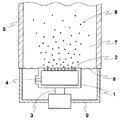
【図1】本発明の実施例および比較例で用いた液滴生成装置の概要図である。
【符号の説明】
1 ノズルボックス
2 ノズル板
3 加振機振動部
4 スチレン系単量体導入部
5 液滴導入管
6 ダイヤフラム
7 水性分散媒
8 スチレン系単量体液滴群
9 加振機支持枠[0001]
BACKGROUND OF THE INVENTION
The present invention relates to expandable styrene resin particles and a method for producing the same. When the expandable styrenic resin particles are heated with water vapor or hot air, a large number of bubbles are generated in the particles and become pre-expanded resin particles. When the pre-expanded resin particles are filled in a mold having a desired shape and heated with steam, the pre-expanded resin particles are fused to each other to obtain a foamed molded product.
[0002]
[Prior art]
Styrenic resin foams are relatively inexpensive and lightweight, and have good buffering performance and heat insulation performance, so they are used for food containers, buffer materials, heat insulation materials, and the like. However, the required properties of the foam vary depending on the application used, and the balance of the properties varies. Taking a fish box containing fresh fish as an example, it is a matter of course that sufficient mechanical strength is required so that the bottom of the box does not come off and the handle portion does not break when the fish is placed and transported. In addition, the smaller the particle gap on the surface of the molded body and the higher the smoothness of the surface, the better the appearance and the better the printing, so the surface smoothness is an important factor in determining the commercial value. Furthermore, printing may be performed on the surface of the molded body immediately after molding. If the surface is soft at this time, the marks on the rollers of the printing press remain on the surface, which impairs the commercial value of the molded body. Therefore, the surface hardness (surface hardness) of the molded body immediately after molding is also important.
[0003]
However, it is very difficult to balance all of mechanical strength, surface smoothness, and surface hardness immediately after molding at a high level, and such a foamed molded product has not yet been obtained.
[0004]
[Problems to be solved by the invention]
As a method for improving the surface smoothness of the foam molded article, in the vicinity of the surface of the expandable styrene resin particles in JP-A-63-69843, JP-A-63-69844, JP-A-1-299984, and the like A method of dissipating the blowing agent present in the water has been proposed. However, according to this method, although the surface smoothness is improved, the mechanical strength is not always sufficient.
[0005]
[Means for Solving the Problems]
In view of this situation, the present inventor has unexpectedly expanded the nucleating agent as a result of intensive research to balance three incompatible properties of mechanical strength, surface smoothness, and surface hardness immediately after molding. The present invention has been completed by finding that the object can be achieved by making it exist in the vicinity of the surface of the conductive particles and existing in the interior of the particles.
[0006]
That is, the present invention relates to an expandable styrene resin particle containing 3 to 20 parts by weight of a readily volatile foaming agent and 0.001 to 1 part by weight of a nucleating agent with respect to 100 parts by weight of a styrene resin. After suspending dehydrated and dried styrene resin seed particles containing 50% by weight or more of the nucleating agent in an aqueous dispersion medium, the styrene monomer is continuously or intermittently dispersed in the dispersion medium. Added to the seed particles and polymerized while impregnating the seed particles, and a volatile foaming agent is added during or after the polymerization, and the concentration of the nucleating agent in the vicinity of the particle surface With respect to 100 parts by weight of expandable styrene resin particles, characterized in that the concentration is lower than the concentration of the nucleating agent and the amount of the seed particles is 5 to 50% by weight of the total resin amount after the completion of polymerization, and styrene resin , Easily volatile foaming agent 3-20 Expandable styrenic resin particles containing 0.001 to 1.0 parts by weight of a nucleating agent, wherein the particles are dehydrated and dried styrene resin seed particles containing 50% by weight or more of the nucleating agent. After suspending in an aqueous dispersion medium, a styrene monomer is continuously or intermittently added to the dispersion medium and polymerized while impregnating the seed particles. It is a particle obtained by adding after the completion of polymerization, and provides the expandable styrene resin particles, wherein the amount of the seed particles is 5 to 50% by weight of the total resin amount after the completion of the polymerization. .
[0007]
In the present invention, after suspending the styrene resin seed particles in the aqueous dispersion medium, the seed particles are impregnated by continuously or intermittently adding the styrene monomer to the dispersion medium. In the method of polymerizing and adding a readily volatile foaming agent during the polymerization or after the completion of the polymerization to obtain expandable styrene resin particles (also referred to as a seed polymerization method), the styrene monomer is added. In the previous stage, 0.001 to 1 part by weight of the nucleating agent or 50% by weight or more of the nucleating agent is present in the seed particles with respect to 100 parts by weight of the styrene resin particles finally obtained; The concentration of the nucleating agent in the vicinity of the surface is lower than the concentration of the nucleating agent inside the particles, the amount of the seed particles is 5 to 50% by weight of the total resin amount after the completion of polymerization, and a readily
[0008]
DETAILED DESCRIPTION OF THE INVENTION
The styrene resin seed particles in the present invention are generally known styrene resin granules, and examples of such particles include styrene, α-methylstyrene, paramethylstyrene, t-butylstyrene, chlorostyrene, and the like. Styrene-based derivatives, acrylic acid such as methyl acrylate, butyl acrylate, methyl methacrylate, ethyl methacrylate, cetyl methacrylate, and esters of methacrylic acid, or homopolymerized particles of various monomers such as acrylonitrile, dimethyl fumarate, ethyl fumarate, Or the copolymer particle by mixing etc. are mentioned. Moreover, you may use together bifunctional monomers, such as divinylbenzene and alkylene glycol dimethacrylate.
[0009]
Such resin seed particles are dispersed in an aqueous medium as a group of droplets by (1) normal suspension polymerization, and (2) passing a polymerizable monomer through a nozzle under regular vibration. It is obtained by a method of polymerizing without causing adhesion and additional dispersion. When a particle having a uniform particle size is required, the method (2) is preferably used, but the resin particles obtained by the suspension polymerization method (1) may be classified.
[0010]
The amount of these particles used is preferably 5 to 50% by weight of the total resin amount after the completion of polymerization. If the amount is too a little is not preferable because the rate of monomer added will remain powdery single polymer not impregnated into the particles increases, also the growth particles the amount used is too large for the seed particles The ratio of the particle size is reduced, which is economically disadvantageous.
[0011]
Examples of the styrene monomer used in the present invention include styrene derivatives such as styrene, α-methyl styrene, paramethyl styrene, t-butyl styrene, chlorostyrene, methyl acrylate, butyl acrylate, methyl methacrylate, ethyl methacrylate, cetyl. Examples include acrylic acid and methacrylic acid esters such as methacrylate, and various monomers such as acrylonitrile, dimethyl fumarate, and ethyl fumarate. These monomers can be used alone or in admixture of two or more. . Moreover, you may use together bifunctional monomers, such as divinylbenzene and alkylene glycol dimethacrylate.
[0012]
As the polymerization initiator for the monomer in the present invention, a radical generating polymerization initiator generally used in the production of thermoplastic polymers can be used, and typical examples thereof include benzoyl peroxide and lauroyl peroxide. Oxide, t-butyl perbenzoate, t-butyl perpivalate, t-butyl peroxyisopropyl carbonate, t-butyl peroxyacetate, 2,2-di-t-butyl peroxybutane, t-butyl peroxy-3 , 3,5-trimethylcyclohexanoate, di-t-butylperoxyhexahydroterephthalate, 1,1-di-t-butylperoxy-3,3,5-trimethylcyclohexane, and other organic peroxides, azo Azo compounds such as bisisobutyronitrile and azobisdimethylvaleronitrile And the like. These polymerization initiators can be used alone or in admixture of two or more.
[0013]
Examples of the aqueous dispersion medium used in the present invention include water.
[0014]
The dispersant used in the present invention is generally well known in water such as polyvinyl alcohol, methyl cellulose, polyvinyl pyrrolidone, polyacrylamide and water such as tribasic calcium phosphate, hydroxyapatite, magnesium phosphate, magnesium pyrophosphate. Examples include hardly soluble inorganic substances. In the case of using an inorganic substance that is hardly soluble in water, the dispersion stabilizing effect is increased by using an anionic surfactant such as sodium dodecylbenzenesulfonate together. It is also effective to use a water-soluble polymer and a water-insoluble inorganic substance in combination.
[0015]
Examples of the readily volatile blowing agent used in the present invention include aliphatic hydrocarbons such as propane, butane, pentane and hexane, alicyclic hydrocarbons such as cyclobutane, cyclopentane and cyclohexane, ozone depletion coefficients such as difluoroethane and tetrafluoroethane. And fluorinated hydrocarbons and carbon dioxide in which is zero. These may be used alone or in combination of two or more thereof, and may be added during the polymerization step, or may be added after the completion of the polymerization step.
[0016]
In the present invention, a nucleating agent that can be finely dispersed in a styrenic resin matrix is used. For example, methacrylic acid ester polymers, methacrylic acid ester-acrylic acid ester copolymers, methacrylic acid ester polymers such as methyl methacrylate-butadiene-styrene copolymers, styrene-butadiene copolymers, high impact polystyrene, styrene- Olefin such as butadiene-styrene block copolymer, hydrogenated styrene-butadiene-styrene block copolymer, styrene copolymer such as acrylonitrile-styrene copolymer, polyethylene wax, ethylene-vinyl acetate copolymer wax, etc. Wax, glycerol monostearate, glycerol monobehenate, glycerol mono12-hydroxystearate, glycerol monolaurate, glycerol tri12-hydroxystearate, glycerol tristearate Fatty acid esters such as rate, glycerin tripalmitate, glycerin trilaurate, glycerin tribehenate, pentaerythritol tetrastearate, hydrogenated vegetable oils such as castor hardened oil, soybean hardened oil, rapeseed hardened oil, fatty acid amide, fatty acid dicarboxylic acid Amides such as acid diamide, aromatic bisamide, aromatic dicarboxylic acid diamide, stearic acid, behenic acid, oleic acid, linoleic acid, linolenic acid, higher fatty acids such as lactic acid, fatty acid metal salts such as zinc stearate, calcium stearate, Examples thereof include one or a mixture of two or more selected from surfactants such as polyethylene glycol monostearate, polyoxyethylene stearyl ether, and polyoxyethylene lauryl ether.
[0017]
These nucleating agents are used in an amount of 0.001 to 1.0 part by weight based on 100 parts by weight of the styrene resin. When the amount used is less than 0.001 part by weight, the cells obtained by foaming are non-uniform and coarse, and as a result, the surface hardness of the molded body immediately after molding becomes low. too the cells obtained fine foamed and exceeds the parts, not only the smoothness of the surface of the molded product is impaired, resulting in a disadvantage economically.
[0018]
In the present invention, the concentration of the nucleating agent near the particle surface is lower than the concentration of the nucleating agent inside the particle, preferably the concentration of the nucleating agent near the surface is 90% of the concentration of the nucleating agent inside the particle. It is important that it is less than or equal to 80% or less. Further, there may be no nucleating agent in the vicinity of the surface. The vicinity of the particle surface as used herein refers to a portion having a depth from the particle surface to 10% of the particle radius, and the remaining portion is referred to as the inside. When the concentration of the nucleating agent in the vicinity of the particle surface layer is the same as or higher than the concentration of the nucleating agent inside the particle, the mechanical strength and the smoothness of the surface of the molded product deteriorate.
[0019]
Moreover, the kind of nucleating agent to be used may be different in the vicinity and inside of the particle surface.
[0020]
The means for measuring the concentration of the nucleating agent is as follows. Prepare two sheets of No. 300-600 sandpaper pasted on a plate with a thickness of around 5 mm, place one on the table with the sandpaper surface facing up, and pre-set the particle radius on it. About 1 gram of resin particles with known x μm and nucleating agent concentration A (wt%) are placed. When the other plate is placed on the resin particles so that the surface of the sandpaper is facing down, the surface of the particles is shaved by moving it in a circle by lightly weighting it by hand. The resin particle is taken out when about 10% of the particle radius is scraped, and the concentration of the nucleating agent B (% by weight) inside the particle is determined by measuring the concentration of the nucleating agent. The concentration C (% by weight) can be derived from the following equation. The concentration of the nucleating agent is measured in the polymer from the absorbance in the C = 0 absorption band (1750 to 1735 cm −1 ) of the ester using, for example, a methacrylic acid ester polymer using an infrared spectrophotometer. The concentration of was measured.
[0021]
[Expression 1]
In the present invention, all or part of the nucleating agent, preferably 50% by weight or more of the nucleating agent, more preferably substantially all of the nucleating agent is present in the styrene resin seed particles. As the method, (1) a method in monomer previously dissolved or dispersed all or part of a nucleating agent in advance used in making the seed particles, (2) nucleating agent including seeds After the particles are dispersed in the aqueous dispersion medium and before adding the styrenic monomer, the nucleating agent is dissolved alone or dissolved or dispersed in a small amount of solvent or styrenic monomer. And adding to the aqueous dispersion medium to impregnate the seed particles. The remainder of these nucleating agents may be used by dissolving or dispersing in the styrene monomer to be added.
[0023]
In addition, in the present invention, in addition to the above-mentioned raw materials, substances generally used for the production of expandable thermoplastic resin particles such as plasticizers, solvents, flame retardants, and the like are within a range that does not impair the effects of the present invention. Can be used together.
[0024]
【Example】
EXAMPLES Next, although an Example and a comparative example demonstrate this invention further in detail, this invention is not limited to these Examples.
[0025]
Examples 1-4 and Comparative Examples 1-2
In a 5-liter reactor with a flat stirring blade having an inlet at the bottom, tricalcium phosphate fine powder is 3000 ppm, polyvinyl alcohol (GOHSENOL PH-20: manufactured by Nippon Synthetic Chemical Industry Co., Ltd.) is 50 ppm, dodecyl
[0026]
Then, 700 g of styrene monomer, 2.1 g of benzoyl peroxide and a methyl methacrylate-butyl acrylate copolymer in the amount shown in Table 1 or 2 as a nucleating agent (Kaneace PA-20, Kaneka Chemical Co., Ltd.) 1 is supplied at a rate of 0.8 liter / hr to a droplet generator having five 0.2 mmφ nozzles as shown in FIG. Was produced in an aqueous dispersion medium 7 and introduced into the 5 liter reactor through the
[0027]
Subsequently, 1.8 liters of pure water, 7.2 g of tribasic calcium phosphate, 21 cc of 1 wt% sodium dodecylbenzenesulfonate, 1.8 g of sodium chloride and 180 g of seed particles were placed in a 5 liter reactor equipped with a stirrer and stirred. Below, the dispersion in the reactor was heated to 90 ° C. Next, a solution of 18 g of dioctyl phthalate, 4.9 g of benzoyl peroxide, and 1.8 g of 1,1-bis-t-butylperoxy-3,3,5-trimethylcyclohexane in 1620 g of styrene monomer was taken over 7 hours. The polymerization was conducted while charging into the reactor. Immediately after the preparation of the monomer solution, 144 g of butane and 1.8 g of cyclohexane were added as blowing agents, and the temperature was raised to 120 ° C. and post-polymerization and impregnation with the blowing agent were performed for 3 hours. After cooling, the obtained expandable resin particles were taken out and dehydrated and dried. The concentration of the nucleating agent in the particles was as shown in Tables 1 and 2.
[0028]
Further, the obtained expandable resin particles were heated with steam in a batch type prefoaming machine to obtain preexpanded particles having an apparent volume of about 60 times. After the pre-expanded particles are cured and dried in the air for 24 hours, the outer dimensions are 30 × 40 × 20 cm in height (25 mm in thickness) using a Fu-300 automatic molding machine (manufactured by Toyo Machine Metal Co., Ltd.). A box-shaped molded body was obtained. The bending strength (kgf / cm 2 ), surface smoothness, and surface hardness (kgf / cm 2 ) of the obtained molded body were evaluated by the following methods. The results are shown in Tables 1 and 2.
[0029]
Evaluation method 1. The bottom surface of the bending strength molded body was taken out, and the bending strength was measured by a method based on JIS A9511.
[0030]
2. The amount of particle gaps on the surface of the surface smooth molded product was visually evaluated. The sample with no particle gap was designated as A, the sample with few particles as B, the sample with many particles as C, and the sample with no particle gaps filled as D.
[0031]
3. Surface hardness immediately after molding A hardness meter (Asker TYPECS (polymer meter)) was pressed against the surface of the molded product 30 minutes after molding, and the maximum value at that time was read. This was performed at four locations, and the average value was defined as the surface hardness.
[0032]
Examples 5-8 and Comparative Examples 3-4
The same operation as in Example 1 was carried out except that methyl methacrylate-butadiene-styrene copolymer (Kanesu Chemical Industry Co., Ltd., Kane Ace B-56) was used as the nucleating agent in the amounts shown in Tables 1 and 2. . Tables 1 and 2 show the concentration of the nucleating agent in the obtained particles and the bending strength, surface smoothness, and surface hardness of the obtained molded product.
[0033]
Examples 9-11
The same operation as in Example 1 was performed except that high-impact polystyrene (EXG-11 manufactured by Asahi Kasei Kogyo Co., Ltd.) was used as the nucleating agent in the amounts shown in Tables 1 and 2. Tables 1 and 2 show the concentration of the nucleating agent in the obtained particles and the bending strength, surface smoothness, and surface hardness of the obtained molded product.
[0034]
Examples 12-15
The same operation as in Example 1 was performed except that pentaerythritol tetrastearate (EW-400 manufactured by Riken Vitamin Co., Ltd.) was used as the nucleating agent in the amount shown in Table 1. Table 1 shows the concentration of the nucleating agent in the obtained particles and the bending strength, surface smoothness and surface hardness of the obtained molded product.
[0037]
Example 16
After seed particles were obtained in the same manner as in Example 1, 1.8 liters of pure water, 7.2 g of calcium triphosphate, 21 cc of a 1% by weight aqueous solution of sodium dodecylbenzenesulfonate, 21 cc of chloride were added to a 5 liter reactor equipped with a stirrer. 1.8 g of sodium and 180 g of seed particles were added, and the dispersion in the reactor was heated to 90 ° C. with stirring. Next, 18 g of dioctyl phthalate, 4.9 g of benzoyl peroxide, 1.8 g of 1,1-bis-t-butylperoxy-3,3,5-trimethylcyclohexane, and a methyl methacrylate-butyl acrylate copolymer ( Polymerization was performed while charging a solution obtained by dissolving 0.09 g of Kaneace PA-20 (manufactured by Kaneka Chemical Industry Co., Ltd.) in 1620 g of styrene monomer into the reactor over 7 hours. Immediately after the preparation of the monomer solution was completed, 144 g of butane and 1.8 g of cyclohexane were added as a blowing agent, and the temperature was raised to 120 ° C. and post-polymerization and impregnation with the blowing agent were performed for 3 hours. After cooling, the obtained expandable resin particles were taken out and dehydrated and dried. Table 1 shows the concentration of the nucleating agent in the particles.
[0038]
Further, the obtained expandable resin particles were heated with steam in a batch type prefoaming machine to obtain preexpanded particles having an apparent volume of about 60 times. After the pre-expanded particles are cured and dried in the air for 24 hours, the outer dimensions are 30 × 40 × 20 cm in height (25 mm in thickness) using a Fu-300 automatic molding machine (manufactured by Toyo Machine Metal Co., Ltd.). A box-shaped molded body was obtained. Table 1 shows the bending strength, surface smoothness, and surface hardness of the obtained molded body.
[0039]
Comparative Examples 5-8
1800 g of water is put into a 5 L autoclave with a stirrer, and then 10.8 g of tribasic calcium phosphate and 0.054 g of sodium dodecylbenzenesulfonate are added as dispersing agents and dispersed uniformly by stirring, and benzoyl peroxide as a polymerization initiator is added thereto 5.4 g, t-butyl peroxybenzoate 3.6 g, and the nucleating agent shown in Table 2 were dissolved in 1800 g of styrene monomer, and this monomer solution was introduced into the autoclave. After purging with nitrogen, it was maintained at 90 ° C. for 7 hours, and then 135 g of butane was injected as a blowing agent, heated to 105 ° C. and maintained for 3 hours. After cooling, the obtained expandable resin particles were taken out and dehydrated and dried. Table 2 shows the concentration of the nucleating agent in the particles.
[0040]
Further, the obtained expandable resin particles were prefoamed and molded in the same manner as in Example 1. Table 2 shows the bending strength, surface smoothness, and surface hardness of the obtained molded body.
[0041]
[Table 1]
[Table 2]
【The invention's effect】
ADVANTAGE OF THE INVENTION According to this invention, the expandable styrene-type resin particle which can provide the foaming molding which improved mechanical strength, surface smoothness, and the surface hardness immediately after shaping | molding with sufficient balance can be obtained.
[Brief description of the drawings]
FIG. 1 is a schematic diagram of a droplet generating apparatus used in examples and comparative examples of the present invention.
[Explanation of symbols]
DESCRIPTION OF SYMBOLS 1 Nozzle box 2
Claims (7)
Priority Applications (1)
| Application Number | Priority Date | Filing Date | Title |
|---|---|---|---|
| JP33096596A JP3649829B2 (en) | 1996-12-11 | 1996-12-11 | Expandable styrene resin particles and method for producing the same |
Applications Claiming Priority (1)
| Application Number | Priority Date | Filing Date | Title |
|---|---|---|---|
| JP33096596A JP3649829B2 (en) | 1996-12-11 | 1996-12-11 | Expandable styrene resin particles and method for producing the same |
Publications (2)
| Publication Number | Publication Date |
|---|---|
| JPH10168217A JPH10168217A (en) | 1998-06-23 |
| JP3649829B2 true JP3649829B2 (en) | 2005-05-18 |
Family
ID=18238363
Family Applications (1)
| Application Number | Title | Priority Date | Filing Date |
|---|---|---|---|
| JP33096596A Expired - Lifetime JP3649829B2 (en) | 1996-12-11 | 1996-12-11 | Expandable styrene resin particles and method for producing the same |
Country Status (1)
| Country | Link |
|---|---|
| JP (1) | JP3649829B2 (en) |
Families Citing this family (6)
| Publication number | Priority date | Publication date | Assignee | Title |
|---|---|---|---|---|
| JP2001294701A (en) * | 2000-04-12 | 2001-10-23 | Mitsubishi Kagaku Form Plastic Kk | Method for producing styrene-based expandable resin particles |
| US6319576B1 (en) * | 2000-11-20 | 2001-11-20 | The Coca-Cola Company | Method to increase the crystallization rate of polyesters |
| CN101925647B (en) * | 2008-01-30 | 2013-01-23 | 积水化成品工业株式会社 | Expandable polystyrene resin particle, method for producing same, pre-expanded particle and foamed molded article |
| JP2012233132A (en) * | 2011-05-09 | 2012-11-29 | Nitto Denko Corp | Thermally expandable resin composition, thermally expandable resin sheet, foam and method for producing the same |
| JP7538642B2 (en) * | 2020-03-26 | 2024-08-22 | 株式会社カネカ | Expandable polystyrene resin particles, pre-expanded polystyrene particles, and foamed molded articles. |
| JP7603493B2 (en) * | 2021-03-18 | 2024-12-20 | 株式会社カネカ | Styrenic seed resin particles for seed polymerization and their use |
-
1996
- 1996-12-11 JP JP33096596A patent/JP3649829B2/en not_active Expired - Lifetime
Also Published As
| Publication number | Publication date |
|---|---|
| JPH10168217A (en) | 1998-06-23 |
Similar Documents
| Publication | Publication Date | Title |
|---|---|---|
| JP5284987B2 (en) | Expandable polystyrene resin particles and method for producing the same, pre-expanded particles, and expanded molded body | |
| JP4056087B2 (en) | Expandable polystyrene resin particles, process for producing the same, and foam using the same | |
| JPWO1998029485A1 (en) | Expandable polystyrene resin particles, their production method, and foams using the same | |
| JP3168882B2 (en) | Styrene-based expandable resin particles and method for producing the same | |
| JP3171001B2 (en) | Styrenic expandable resin particles and suspension polymerization method for obtaining the same | |
| JP4326034B2 (en) | Styrenic expandable resin particles | |
| JPH073068A (en) | Bead-shaped expandable styrene polymer | |
| JP2933707B2 (en) | Method for producing expandable styrene polymer particles | |
| JPH0212258B2 (en) | ||
| JP4066337B2 (en) | Expandable styrene resin particles for building materials and foamed molded articles thereof | |
| JP5824263B2 (en) | Expandable thermoplastic resin particles | |
| JPH10168217A (en) | Expandable styrene resin particles and method for producing the same | |
| JP4653278B2 (en) | Expandable styrene resin particles | |
| JP3955782B2 (en) | Styrenic resin pre-expanded particles, method for producing the same, and expanded resin molded article | |
| JP2003064212A (en) | Expandable polystyrene resin particles and expanded polystyrene resin | |
| JP3599450B2 (en) | Styrene-based expandable resin particles and method for producing the same | |
| JP3597109B2 (en) | Method for producing expandable styrene resin particles, expandable styrene resin particles, and molded foam | |
| JP7603493B2 (en) | Styrenic seed resin particles for seed polymerization and their use | |
| JPH11152364A (en) | Method for producing expandable styrene polymer particles | |
| JP2004018782A (en) | Expandable polystyrene resin particles | |
| JP3024522B2 (en) | Styrene-based expandable resin particles and expanded molded article obtained using the same | |
| JP2832467B2 (en) | Method for producing expandable thermoplastic polymer particles | |
| JP3572493B2 (en) | Method for producing expandable styrene polymer particles | |
| JP2000302903A (en) | Polystyrene resin for food container, polystyrene resin foam sheet for food container and polystyrene resin foam sheet food container | |
| JPH05295160A (en) | Production of expandable styrene resin particle |
Legal Events
| Date | Code | Title | Description |
|---|---|---|---|
| A977 | Report on retrieval |
Free format text: JAPANESE INTERMEDIATE CODE: A971007 Effective date: 20040316 |
|
| A131 | Notification of reasons for refusal |
Free format text: JAPANESE INTERMEDIATE CODE: A131 Effective date: 20040323 |
|
| A521 | Request for written amendment filed |
Free format text: JAPANESE INTERMEDIATE CODE: A523 Effective date: 20040520 |
|
| A521 | Request for written amendment filed |
Free format text: JAPANESE INTERMEDIATE CODE: A821 Effective date: 20040520 |
|
| A131 | Notification of reasons for refusal |
Free format text: JAPANESE INTERMEDIATE CODE: A131 Effective date: 20040824 |
|
| A521 | Request for written amendment filed |
Free format text: JAPANESE INTERMEDIATE CODE: A523 Effective date: 20041022 |
|
| TRDD | Decision of grant or rejection written | ||
| A01 | Written decision to grant a patent or to grant a registration (utility model) |
Free format text: JAPANESE INTERMEDIATE CODE: A01 Effective date: 20050208 |
|
| A61 | First payment of annual fees (during grant procedure) |
Free format text: JAPANESE INTERMEDIATE CODE: A61 Effective date: 20050216 |
|
| R150 | Certificate of patent or registration of utility model |
Free format text: JAPANESE INTERMEDIATE CODE: R150 |
|
| FPAY | Renewal fee payment (event date is renewal date of database) |
Free format text: PAYMENT UNTIL: 20080225 Year of fee payment: 3 |
|
| FPAY | Renewal fee payment (event date is renewal date of database) |
Free format text: PAYMENT UNTIL: 20090225 Year of fee payment: 4 |
|
| FPAY | Renewal fee payment (event date is renewal date of database) |
Free format text: PAYMENT UNTIL: 20090225 Year of fee payment: 4 |
|
| FPAY | Renewal fee payment (event date is renewal date of database) |
Free format text: PAYMENT UNTIL: 20100225 Year of fee payment: 5 |
|
| FPAY | Renewal fee payment (event date is renewal date of database) |
Free format text: PAYMENT UNTIL: 20100225 Year of fee payment: 5 |
|
| FPAY | Renewal fee payment (event date is renewal date of database) |
Free format text: PAYMENT UNTIL: 20110225 Year of fee payment: 6 |
|
| FPAY | Renewal fee payment (event date is renewal date of database) |
Free format text: PAYMENT UNTIL: 20120225 Year of fee payment: 7 |
|
| FPAY | Renewal fee payment (event date is renewal date of database) |
Free format text: PAYMENT UNTIL: 20130225 Year of fee payment: 8 |
|
| FPAY | Renewal fee payment (event date is renewal date of database) |
Free format text: PAYMENT UNTIL: 20140225 Year of fee payment: 9 |
|
| S531 | Written request for registration of change of domicile |
Free format text: JAPANESE INTERMEDIATE CODE: R313531 |
|
| FPAY | Renewal fee payment (event date is renewal date of database) |
Free format text: PAYMENT UNTIL: 20140225 Year of fee payment: 9 |
|
| R350 | Written notification of registration of transfer |
Free format text: JAPANESE INTERMEDIATE CODE: R350 |
|
| R250 | Receipt of annual fees |
Free format text: JAPANESE INTERMEDIATE CODE: R250 |
|
| R250 | Receipt of annual fees |
Free format text: JAPANESE INTERMEDIATE CODE: R250 |
|
| R250 | Receipt of annual fees |
Free format text: JAPANESE INTERMEDIATE CODE: R250 |
|
| EXPY | Cancellation because of completion of term |