JP3607039B2 - High strength corrosion resistant wear resistant alloy - Google Patents
High strength corrosion resistant wear resistant alloy Download PDFInfo
- Publication number
- JP3607039B2 JP3607039B2 JP10752397A JP10752397A JP3607039B2 JP 3607039 B2 JP3607039 B2 JP 3607039B2 JP 10752397 A JP10752397 A JP 10752397A JP 10752397 A JP10752397 A JP 10752397A JP 3607039 B2 JP3607039 B2 JP 3607039B2
- Authority
- JP
- Japan
- Prior art keywords
- alloy
- content
- strength
- wear
- resistant
- Prior art date
- Legal status (The legal status is an assumption and is not a legal conclusion. Google has not performed a legal analysis and makes no representation as to the accuracy of the status listed.)
- Expired - Fee Related
Links
- 239000000956 alloy Substances 0.000 title claims description 51
- 229910045601 alloy Inorganic materials 0.000 title claims description 46
- 238000005260 corrosion Methods 0.000 title claims description 27
- 230000007797 corrosion Effects 0.000 title claims description 27
- 239000012535 impurity Substances 0.000 claims description 3
- 239000000463 material Substances 0.000 description 10
- 238000005452 bending Methods 0.000 description 9
- 238000012360 testing method Methods 0.000 description 9
- 239000000203 mixture Substances 0.000 description 8
- 230000000694 effects Effects 0.000 description 5
- 229920006351 engineering plastic Polymers 0.000 description 5
- 238000005245 sintering Methods 0.000 description 5
- 239000011230 binding agent Substances 0.000 description 4
- 230000007423 decrease Effects 0.000 description 4
- 238000010137 moulding (plastic) Methods 0.000 description 4
- 230000015572 biosynthetic process Effects 0.000 description 3
- 238000001125 extrusion Methods 0.000 description 3
- 238000001746 injection moulding Methods 0.000 description 3
- 239000002245 particle Substances 0.000 description 3
- 238000005728 strengthening Methods 0.000 description 3
- LFQSCWFLJHTTHZ-UHFFFAOYSA-N Ethanol Chemical compound CCO LFQSCWFLJHTTHZ-UHFFFAOYSA-N 0.000 description 2
- VEXZGXHMUGYJMC-UHFFFAOYSA-N Hydrochloric acid Chemical compound Cl VEXZGXHMUGYJMC-UHFFFAOYSA-N 0.000 description 2
- 229910017318 Mo—Ni Inorganic materials 0.000 description 2
- 229910000676 Si alloy Inorganic materials 0.000 description 2
- 150000001875 compounds Chemical class 0.000 description 2
- 239000000843 powder Substances 0.000 description 2
- 239000011347 resin Substances 0.000 description 2
- 229920005989 resin Polymers 0.000 description 2
- 238000005204 segregation Methods 0.000 description 2
- 239000006104 solid solution Substances 0.000 description 2
- 239000000243 solution Substances 0.000 description 2
- -1 Ni 3 B are produced Chemical class 0.000 description 1
- 229910000831 Steel Inorganic materials 0.000 description 1
- 238000005299 abrasion Methods 0.000 description 1
- 239000000654 additive Substances 0.000 description 1
- 239000013078 crystal Substances 0.000 description 1
- 230000003247 decreasing effect Effects 0.000 description 1
- 235000019441 ethanol Nutrition 0.000 description 1
- 239000003063 flame retardant Substances 0.000 description 1
- 238000000227 grinding Methods 0.000 description 1
- 238000007654 immersion Methods 0.000 description 1
- 239000011256 inorganic filler Substances 0.000 description 1
- 229910003475 inorganic filler Inorganic materials 0.000 description 1
- 238000004519 manufacturing process Methods 0.000 description 1
- 238000000034 method Methods 0.000 description 1
- 238000000465 moulding Methods 0.000 description 1
- 238000005121 nitriding Methods 0.000 description 1
- 238000011056 performance test Methods 0.000 description 1
- 238000013001 point bending Methods 0.000 description 1
- 239000002994 raw material Substances 0.000 description 1
- 229910021484 silicon-nickel alloy Inorganic materials 0.000 description 1
- 239000010959 steel Substances 0.000 description 1
- 238000004381 surface treatment Methods 0.000 description 1
- 238000010998 test method Methods 0.000 description 1
Landscapes
- Injection Moulding Of Plastics Or The Like (AREA)
Description
【0001】
【発明の属する技術分野】
本発明は、高強度耐食耐摩耗合金に係り、特に、プラスチック成型機のシリンダ、スクリュー、逆止弁などのように耐食性、耐摩耗性および強度が同時に要求される各種機械部品の材料として利用できる高強度耐食耐摩耗合金に関する。
【0002】
【従来の技術】
射出成形機や押出成形機の重要な構成部品であるシリンダ、スクリュー、逆止弁などの部材は、高温、高圧で圧送される樹脂に常に接触している。近年、特にエンジニアリングプラスチック(以下、エンプラという。)の使用分野の拡大とともに、エンプラの性能向上を目的として樹脂に難燃材や無機フィラーが添加されている。これらの添加物のために、前記の部品の腐食や摩耗が大きな問題となっている。
【0003】
従来、この種の高耐食性、耐摩耗性機械部品の材料として、(イ)Ni基自溶合金、(ロ)WC粒子分散Ni基自溶合金、(ハ)Mo−Ni系複硼化物合金、および(ニ)耐食、耐摩耗Ni基合金が使用されている。
【0004】
(イ)Ni基自溶合金は、Ni−Cr−B−Si合金であり、窒化処理などの表面処理に較べて耐食性、耐摩耗性に優れているため、鋼材表面の硬化材料として広く用いられてきた。
【0005】
(ロ)WC粒子分散Ni基自溶合金は、Ni−Cr−B−Si合金にWC粒子を微細に分散させた合金であり、耐食性、耐摩耗性に優れているためプラスチック成形機のバレル等の機械部品の材料として使われている(特開昭62−197264号公報)。
【0006】
また、(ハ)Mo−Ni系複硼化物合金は、Mo2 NiB2 を主体とした硬質相をNi基の結合相によって結合した合金であり、耐摩耗性材料として十分な機械的性質だけでなく耐食性に優れているため、高腐食環境下で使用される耐摩耗材料に適しているものである(特公平5−5889号公報)。
【0007】
さらに、(ニ)耐食、耐摩耗Ni基合金は、Cr−Mo−W−V−B−Si−Ni合金であり、耐食性、耐摩耗性を必要とする射出成形機、押出成形機の各種構成部材として有用な合金材料である(特開平6−57360号公報)。
【0008】
【発明が解決しようとする課題】
これらの合金材料は、耐摩耗性のあるものは耐食性が不十分であったり、耐摩耗性と耐食性が十分であっても強度の点で十分でなかったりというように、耐摩耗性、耐食性、および強度を併せ持った材料は見当たらないのが現状である。
【0009】
また、最近の技術動向であるエンプラ製品の軽量化をねらいとした薄肉化のため、成形圧力がより高圧になり、材料の機械的性質としては、耐食性、耐摩耗性に加えて、ますます高強度が要求されるようになっている。
【0010】
本出願人は、プラスチック成形機の部品に適用することを目的に、耐食性、耐摩耗性にすぐれた「Ni W2 B2 基合金」を提案した(特願平8−196609号)。この合金は、抗析力が、1.56〜1.85GPaと、従来の耐食耐摩耗合金に比較して強度が改良されている。
【0011】
しかし、最近のエンプラの高性能化にともなう上記の動向により、プラスチック成形機の構成部品(シリンダ、スクリュ、逆止弁など)に求められる強度の水準に対して、前記の「Ni W2 B2 基合金」の強度は、必ずしも十分とはいえない状況にある。
【0012】
そこで、本発明は、耐食性、耐摩耗性に優れ、かつ高強度を有しプラスチック成形機の構成部品の材料に適した合金材料を提供することを目的としている。
【0013】
【課題を解決するための手段】
上述した目的を達成するために、本発明に係る高強度耐食耐摩耗合金は、重量比で、(W+Ta)の含有量が60〜80%であり、かつTaの含有量がW含有量に対して0.6〜40%であり、前記(W+Ta)の含有量に対応してB/(W+Ta)原子比で0.6〜1.2の範囲のBを含有し、さらに残部がNiおよび不可避的不純物の組成からなることを特徴としている。
【0014】
以下、本発明に係る合金について更に具体的に説明する。なお、以下の記載において量比を表す「%」は、特に断らない限り重量%である。
本発明合金中の各成分の添加目的および組成限定の理由は、次のとおりである。
1.W+ Taの含有量
WとTaとを合わせた含有量は、全組成物に対する重量比で60〜80%であること。
WおよびTaは、高温焼結時にB、Niと反応し微細な複硼化物Ni(W,Ta)2 B2 を合金中に形成し、合金の抗折力と硬度を高めるのに寄与する。特に、合金の硬度は複硼化物Ni(W,Ta)2 B2 の形成量が増えるにともなって増加する。
W添加量の増加にともなって、複硼化物Ni(W,Ta)2 B2 の生成量も増加する。この複硼化物Ni(W,Ta)2 B2 の生成量の増加にともなって、合金の硬度が高まり合金の耐摩耗性の著しい向上がもたらされるともに、合金の強度の著しい向上がもたらされる。
【0015】
Ni(W,Ta)2 B2 の生成量の増加は、耐食性の向上にも効果を現す。この効果を現すのは(W+ Ta)の含有量が60%以上からである。(W+ Ta)が60%以下では硬度が低下するので好ましくない。また、(W+ Ta)の含有量が80%を越えると抗折力が急激に低下するので好ましくない。これは、残量のNi量が減少することにより、Ni(W,Ta)2 B2 粒子を結合する合金中の結合相が不足し、合金中に微小空孔が形成されるためと考えられる。
よって(W+ Ta)の含有量は60〜80%とする。
2.Taの含有量
Taの含有量は、Wの含有量の0.6〜40%であること。
【0016】
このTaの添加によって合金の硬さおよび強度は大きく向上する。この強度向上の機構は、いまのところ解明されていないが、Taは、W、B、Niと反応してNi(W,Ta)2 B2 を形成するものと考えられる。このNi(W,Ta)2 B2 が合金に高硬度をもたらす。
【0017】
また、Taの添加による高強度化は、後述する合金の結合相であるNiの中にTaが固溶し、固溶強化に起因するものと考えられる。いずれにしろ、Taの添加は、合金の高強度化に寄与し、合金の機械的性質を大きく向上させる。
【0018】
このTaの添加量は、Wの含有量との相対的な関係で、Wの0.6%から効果が現れるが、40%を越えると、逆に強度低下をきたす。これは、Taの添加量が40%を臨界としてこれを越えるとより高硬度化し、合金が脆化することに起因する。
3.Bの含有量
Bの含有量については、(W+ Ta)の含有量に応じて変化させ、Bと(W+ Ta)の原子比B/(W+ Ta)を0.6〜1.2とするように含有量を決定する。
Bは、前述のように、W、Ni、Taと複硼化物Ni(W,Ta)2 B2 を形成する元素であり、合金の抗折力と硬さを高める。
B添加量の増加、すなわちB/(W+ Ta)原子比が大きくなるに伴い、合金の硬度が増加する。しかし、B/(W+ Ta)原子比が大きくなると抗折力が急激に低下する。硬度と抗折力のバランスからB/(W+ Ta)原子比の上限は1.2であり、これを超えると、Ni3 B等のNi−B化合物が生成され、これが抗折力を低下させるので好ましくない。
【0019】
これに対して、B/(W+ Ta)原子比が小さく、0.6以下ではNi(W,Ta)2 B2 の形成量が少くなるため十分な硬度が得られず、従って耐摩耗性も不十分なものとなる。また、焼結温度が高くなるとともに抗折力も低下するので好ましくない。この場合の抗析力の低下は、焼結温度の上昇により、合金の結晶粒が粗大化するためである。
よってB/W原子比は0.6〜1.2とする。
4.Niの含有量
Ni:残部
Niは、B、W、Taと反応し、Ni(W,Ta)2 B2 粒子を形成するとともに、Ni(W,Ta)2 B2 の形成に消費された後、残りのNiが合金の結合相を形成する。Ni量が多い場合には、硬度が低下し、Ni量が限度以下になると、Ni(W,Ta)2 B2 の形成のみに消費され、結合相が形成されずに合金の強度が著しく低下する。Niの結合相中には、WおよびTaが固溶し、合金を固溶強化する。
【0020】
以上より、本発明に係る合金の組成は、重量比で、(W+Ta)の含有量が60〜80%であり、かつTaの含有量がW含有量に対して0.6〜40%であり、前記(W+Ta)の含有量に対応してB/(W+Ta)原子比で0.6〜1.2の範囲のBを含有し、さらに残部がNiおよび不可避的不純物の組成とされる。
【0021】
この組成は、本発明特有の効果を奏する範囲内で、必要とされる耐食性、耐摩耗性および強度のバランスに応じて任意に選定しうる範囲を示したものである。以上、これらの組成を確保するために、W、Ta、B、Niはそれぞれ単体で配合しても良いが、例えば、WB、TaB2 、NiBなどの化合物を用いてもよい。
【0022】
【実施例】
以下、本発明を実施例に基づいて更に具体的に説明する。
まず、下記表1に示す実施例1〜8の組成に原料粉を配合し、回転ボールミルによりエチルアルコール中で混合粉砕した。表2は、実施例1〜8の組成を示すものである。
【0023】
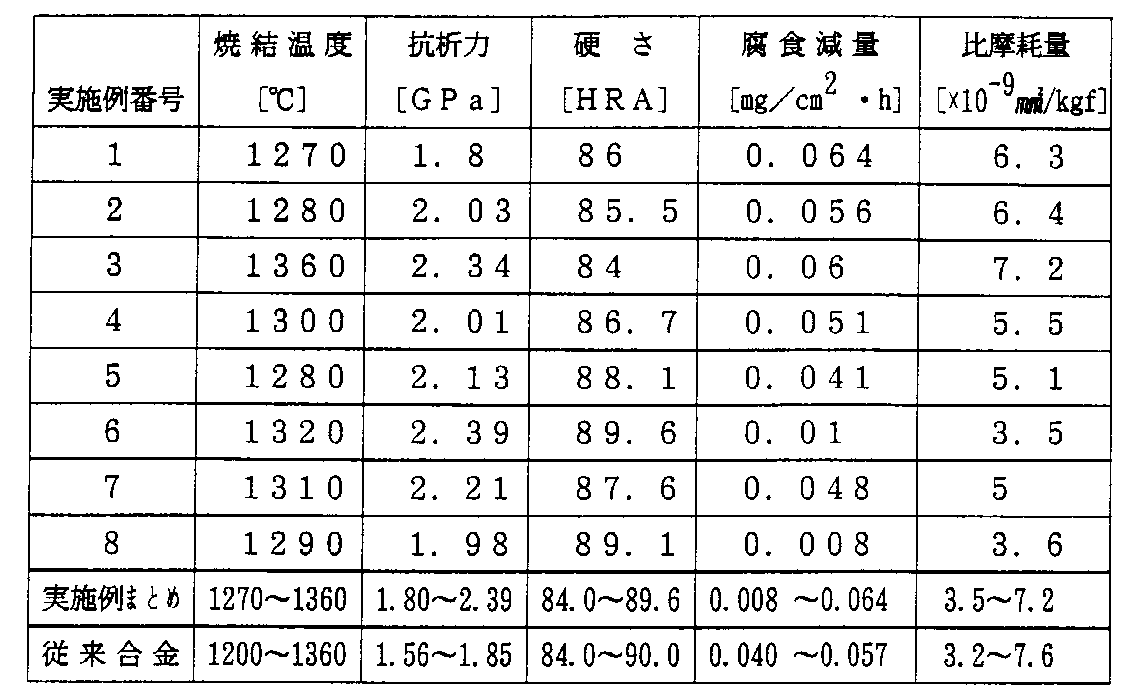
次いで、この混合粉砕粉末を乾燥、プレス成形し、真空中で焼結した。この実施例1〜8の焼結温度を表3に示す。焼結時間はいずれも10分間である。
【0024】
この製造方法により得た試料について、硬さ、比摩耗量、耐食性、抗折力の各種性能試験を行なった。各試験条件は以下の通りである。これらの試験結果を表3に示す。この表3には、従来の耐食、耐摩耗Ni基合金の例を比較のため示す。
(1)摩耗試験(比摩耗量)
試験機:大越式迅速摩耗試験機
試験条件:
摩擦速度 2.0m/sec
摩擦距離 600m
最終荷重 18.6kgf
相手材料 SKD11(HRC58)
(2)腐食試験
腐食液 塩酸20%溶液(22℃)
浸漬時間 5Hr
(3)抗折試験(抗折力)
試験方法 三点曲げ抗折試験(JIS H5501による)
試験片の寸法 4×8×24mm、研削加工
【0025】
【表1】
【表2】
【表3】
【0028】
【発明の効果】
以上のように本発明によれば、耐食性、耐摩耗性に優れるとともに、かつ、高強度を併せ持ち、高負荷のかかる、例えば、射出成形機や押出成形機のシリンダ、スクリュー、逆止弁などの機械部品に適した合金材料が得られる。[0001]
BACKGROUND OF THE INVENTION
The present invention relates to a high-strength, corrosion-resistant and wear-resistant alloy, and in particular, can be used as a material for various machine parts that require corrosion resistance, wear resistance and strength at the same time, such as cylinders, screws and check valves in plastic molding machines. It relates to a high-strength, corrosion-resistant and wear-resistant alloy.
[0002]
[Prior art]
Members such as cylinders, screws, and check valves, which are important components of injection molding machines and extrusion molding machines, are always in contact with the resin being pumped at high temperature and pressure. In recent years, flame retardants and inorganic fillers have been added to resins for the purpose of improving the performance of engineering plastics, especially with the expansion of the field of use of engineering plastics (hereinafter referred to as engineering plastics). Because of these additives, corrosion and wear of the above parts are a major problem.
[0003]
Conventionally, as a material of this type of high corrosion resistance and wear resistant mechanical parts, (a) Ni-based self-fluxing alloy, (b) WC particle-dispersed Ni-based self-fluxing alloy, (c) Mo-Ni-based double boride alloy, And (d) corrosion-resistant and wear-resistant Ni-based alloys are used.
[0004]
(B) Ni-based self-fluxing alloy is a Ni-Cr-B-Si alloy, which has excellent corrosion resistance and wear resistance compared to surface treatment such as nitriding, and is therefore widely used as a hardening material for steel surfaces. I came.
[0005]
(B) The WC particle-dispersed Ni-based self-fluxing alloy is an alloy in which WC particles are finely dispersed in a Ni-Cr-B-Si alloy and has excellent corrosion resistance and wear resistance. It is used as a material for machine parts (Japanese Patent Laid-Open No. 62-197264).
[0006]
In addition, (c) Mo—Ni-based double boride alloy is an alloy in which a hard phase mainly composed of Mo 2 NiB 2 is bonded by a Ni-based bonded phase, and only has sufficient mechanical properties as an abrasion resistant material. Therefore, it is suitable for wear-resistant materials used in highly corrosive environments (Japanese Patent Publication No. 5-5889).
[0007]
Furthermore, (d) Corrosion-resistant and wear-resistant Ni-based alloys are Cr—Mo—W—V—B—Si—Ni alloys, and various configurations of injection molding machines and extrusion molding machines that require corrosion resistance and wear resistance. It is an alloy material useful as a member (JP-A-6-57360).
[0008]
[Problems to be solved by the invention]
As for these alloy materials, those with wear resistance have insufficient corrosion resistance, and wear resistance, corrosion resistance, However, there is no material that has both strength and strength.
[0009]
In addition, due to the thinning of engineering plastic products, which is a recent technological trend, the molding pressure has become higher, and the mechanical properties of the material are increasingly higher in addition to corrosion resistance and wear resistance. Strength is required.
[0010]
The present applicant has proposed “Ni W 2 B 2 base alloy” having excellent corrosion resistance and wear resistance for the purpose of being applied to parts of a plastic molding machine (Japanese Patent Application No. Hei 8-196609). This alloy has an anti-segregation strength of 1.56-1.85 GPa, which is improved in strength as compared with conventional corrosion-resistant and wear-resistant alloys.
[0011]
However, due to the above-mentioned trend accompanying the recent improvement in the performance of engineering plastics, the above-mentioned “Ni W 2 B 2 ” is compared with the strength level required for the components (cylinders, screws, check valves, etc.) of plastic molding machines. The strength of the “base alloy” is not necessarily sufficient.
[0012]
Accordingly, an object of the present invention is to provide an alloy material that is excellent in corrosion resistance and wear resistance and has high strength and is suitable as a material for a component of a plastic molding machine.
[0013]
[Means for Solving the Problems]
In order to achieve the above-described object, the high-strength corrosion-resistant wear-resistant alloy according to the present invention has a weight ratio of (W + Ta) content of 60 to 80% and Ta content with respect to W content. 0.6 to 40%, corresponding to the content of (W + Ta), containing B in the range of 0.6 to 1.2 in terms of B / (W + Ta) atomic ratio, and the balance being Ni and inevitable It is characterized by comprising a composition of mechanical impurities.
[0014]
Hereinafter, the alloy according to the present invention will be described in more detail. In the following description, “%” representing the quantity ratio is% by weight unless otherwise specified.
The purpose of addition of each component in the alloy of the present invention and the reason for limiting the composition are as follows.
1. W + Ta content The total content of W and Ta is 60 to 80% by weight with respect to the total composition.
W and Ta react with B and Ni during high-temperature sintering to form fine double boride Ni (W, Ta) 2 B 2 in the alloy and contribute to increasing the bending strength and hardness of the alloy. In particular, the hardness of the alloy increases as the amount of double boride Ni (W, Ta) 2 B 2 is increased.
As the amount of W added increases, the amount of double boride Ni (W, Ta) 2 B 2 generated also increases. As the amount of the double boride Ni (W, Ta) 2 B 2 is increased, the hardness of the alloy is increased and the wear resistance of the alloy is remarkably improved, and the strength of the alloy is remarkably improved.
[0015]
An increase in the amount of Ni (W, Ta) 2 B 2 produced also has an effect on improving corrosion resistance. This effect is exhibited when the content of (W + Ta) is 60% or more. If (W + Ta) is 60% or less, the hardness is not preferable. On the other hand, when the content of (W + Ta) exceeds 80%, the bending strength is rapidly lowered, which is not preferable. This is thought to be because the amount of Ni in the remaining amount decreases, the binding phase in the alloy that binds Ni (W, Ta) 2 B 2 particles is insufficient, and microvoids are formed in the alloy. .
Therefore, the content of (W + Ta) is set to 60 to 80%.
2. Ta content Ta content is 0.6 to 40% of W content.
[0016]
The addition of Ta greatly increases the hardness and strength of the alloy. The mechanism for improving the strength has not been elucidated so far, but it is considered that Ta reacts with W, B, and Ni to form Ni (W, Ta) 2 B 2 . This Ni (W, Ta) 2 B 2 brings high hardness to the alloy.
[0017]
Further, the increase in strength by the addition of Ta is considered to be caused by solid solution strengthening of Ta in Ni which is a binder phase of an alloy described later, and solid solution strengthening. In any case, the addition of Ta contributes to increasing the strength of the alloy and greatly improves the mechanical properties of the alloy.
[0018]
The effect of Ta added relative to the W content is effective from 0.6% of W, but when it exceeds 40%, the strength is reduced. This is due to the fact that when the amount of Ta added exceeds 40%, the hardness becomes higher and the alloy becomes brittle.
3. The content of B The content of B is changed according to the content of (W + Ta) so that the atomic ratio B / (W + Ta) between B and (W + Ta) is 0.6 to 1.2. The content is determined.
As described above, B is an element that forms W, Ni, Ta and double boride Ni (W, Ta) 2 B 2 and increases the bending strength and hardness of the alloy.
As the B addition amount increases, that is, the B / (W + Ta) atomic ratio increases, the hardness of the alloy increases. However, when the B / (W + Ta) atomic ratio is increased, the bending strength is rapidly decreased. The upper limit of the B / (W + Ta) atomic ratio is 1.2 from the balance between hardness and bending strength. When this ratio is exceeded, Ni—B compounds such as Ni 3 B are produced, which lowers the bending strength. Therefore, it is not preferable.
[0019]
On the other hand, the B / (W + Ta) atomic ratio is small, and if it is 0.6 or less, the formation amount of Ni (W, Ta) 2 B 2 is small, so that sufficient hardness cannot be obtained, and therefore the wear resistance is also low. It will be insufficient. Further, it is not preferable because the sintering temperature increases and the bending strength also decreases. The decrease in the anti-segregation force in this case is because the crystal grains of the alloy become coarse due to an increase in the sintering temperature.
Therefore, the B / W atomic ratio is set to 0.6 to 1.2.
4). Ni content Ni: Remaining Ni reacts with B, W, Ta to form Ni (W, Ta) 2 B 2 particles and after being consumed in the formation of Ni (W, Ta) 2 B 2 The remaining Ni forms a binder phase of the alloy. When the amount of Ni is large, the hardness decreases, and when the Ni amount falls below the limit, it is consumed only for the formation of Ni (W, Ta) 2 B 2 , and the strength of the alloy is significantly reduced without forming a binder phase. To do. In the binder phase of Ni, W and Ta are dissolved, strengthening the alloy.
[0020]
From the above, the composition of the alloy according to the present invention is such that the content of (W + Ta) is 60 to 80% by weight, and the content of Ta is 0.6 to 40% with respect to the W content. Corresponding to the content of (W + Ta), B / (W + Ta) is contained in the range of 0.6 to 1.2 in atomic ratio, and the balance is Ni and inevitable impurities.
[0021]
This composition shows a range that can be arbitrarily selected in accordance with the balance of required corrosion resistance, wear resistance, and strength within the range that exhibits the effects specific to the present invention. As described above, in order to ensure these compositions, W, Ta, B, and Ni may be blended alone, but for example, compounds such as WB, TaB 2 , and NiB may be used.
[0022]
【Example】
Hereinafter, the present invention will be described more specifically based on examples.
First, raw material powders were blended in the compositions of Examples 1 to 8 shown in Table 1 below, and mixed and ground in ethyl alcohol by a rotating ball mill. Table 2 shows the compositions of Examples 1-8.
[0023]
Next, the mixed and pulverized powder was dried, press-molded, and sintered in a vacuum. Table 3 shows sintering temperatures of Examples 1 to 8. The sintering time is 10 minutes for all.
[0024]
The samples obtained by this production method were subjected to various performance tests on hardness, specific wear, corrosion resistance, and bending strength. Each test condition is as follows. These test results are shown in Table 3. Table 3 shows examples of conventional corrosion-resistant and wear-resistant Ni-based alloys for comparison.
(1) Wear test (specific wear)
Testing machine: Ogoshi quick wear testing machine Test conditions:
Friction speed 2.0m / sec
Friction distance 600m
Final load 18.6kgf
Counterpart material SKD11 (HRC58)
(2) Corrosion test corrosive solution 20% hydrochloric acid solution (22 ° C)
Immersion time 5Hr
(3) Folding test (bending strength)
Test method Three-point bending resistance test (according to JIS H5501)
Dimension of specimen 4 × 8 × 24mm, grinding process
[Table 1]
[Table 2]
[Table 3]
[0028]
【The invention's effect】
As described above, according to the present invention, it has excellent corrosion resistance and wear resistance, and has both high strength and high load, such as cylinders, screws, check valves, etc. of injection molding machines and extrusion molding machines. Alloy materials suitable for machine parts can be obtained.
Claims (1)
前記(W+Ta)の含有量に対応してB/(W+Ta)原子比で0.6〜1.2の範囲のBを含有し、
さらに残部がNiおよび不可避的不純物の組成からなることを特徴とする高強度耐食耐摩耗合金。In weight ratio, the content of (W + Ta) is 60-80%, and the content of Ta is 0.6-40% with respect to the W content,
Corresponding to the content of (W + Ta), containing B in the range of 0.6 to 1.2 in terms of B / (W + Ta) atomic ratio,
A high-strength corrosion-resistant wear-resistant alloy, wherein the balance is composed of Ni and inevitable impurities.
Priority Applications (1)
| Application Number | Priority Date | Filing Date | Title |
|---|---|---|---|
| JP10752397A JP3607039B2 (en) | 1997-04-24 | 1997-04-24 | High strength corrosion resistant wear resistant alloy |
Applications Claiming Priority (1)
| Application Number | Priority Date | Filing Date | Title |
|---|---|---|---|
| JP10752397A JP3607039B2 (en) | 1997-04-24 | 1997-04-24 | High strength corrosion resistant wear resistant alloy |
Publications (2)
| Publication Number | Publication Date |
|---|---|
| JPH10298693A JPH10298693A (en) | 1998-11-10 |
| JP3607039B2 true JP3607039B2 (en) | 2005-01-05 |
Family
ID=14461360
Family Applications (1)
| Application Number | Title | Priority Date | Filing Date |
|---|---|---|---|
| JP10752397A Expired - Fee Related JP3607039B2 (en) | 1997-04-24 | 1997-04-24 | High strength corrosion resistant wear resistant alloy |
Country Status (1)
| Country | Link |
|---|---|
| JP (1) | JP3607039B2 (en) |
-
1997
- 1997-04-24 JP JP10752397A patent/JP3607039B2/en not_active Expired - Fee Related
Also Published As
| Publication number | Publication date |
|---|---|
| JPH10298693A (en) | 1998-11-10 |
Similar Documents
| Publication | Publication Date | Title |
|---|---|---|
| JP5484899B2 (en) | Ferrous sintered alloy for valve seat and valve seat for internal combustion engine | |
| JP2777373B2 (en) | Heat- and wear-resistant iron-based sintered alloy | |
| JP2660455B2 (en) | Heat resistant hard sintered alloy | |
| JP5470825B2 (en) | Wear-resistant cast iron | |
| JP2872571B2 (en) | Tungsten carbide composite lining material for centrifugal casting and tungsten carbide composite lining layer | |
| JPS6112847A (en) | Sintered hard alloy containing fine tungsten carbide particles | |
| JP3487935B2 (en) | High corrosion and wear resistant composite material | |
| JP3607039B2 (en) | High strength corrosion resistant wear resistant alloy | |
| JP2634103B2 (en) | High temperature bearing alloy and method for producing the same | |
| JP2001089823A (en) | Double boride sintered hard alloy, and screw for resin processing machine using the alloy | |
| KR20220141725A (en) | Aluminum alloy | |
| JPH0586435A (en) | Tool parts material having high corrosion resistance and high wear resistance | |
| JPH07268524A (en) | High corrosion and abrasion resistance composite material | |
| JP3373372B2 (en) | Si-added NiW2B base alloy and mechanical structural member | |
| JP4279935B2 (en) | Hard grain dispersed sintered steel and method for producing the same | |
| JPH1036935A (en) | Nickel-tungsten2-boron2-alloy, and member for machine structure use | |
| JPH10298698A (en) | Cemented carbide | |
| JPH1121652A (en) | High strength wc grain dispersion w strengthened ni-base alloy | |
| JPH10298699A (en) | Cemented carbide | |
| JPH05132734A (en) | Wear and corrosion resistant composite materials | |
| JP4058807B2 (en) | Hard molybdenum alloy, wear-resistant alloy, wear-resistant sintered alloy and method for producing the same | |
| JPH09125188A (en) | Si-added mo-ni-b alloy | |
| JPH04337047A (en) | Composite material having high corrosion resistance and wear resistance | |
| JPH0860278A (en) | Corrosion and abrasion resistant material with excellent cavitation erosion resistance | |
| CN1166798C (en) | A wear-resistant cobalt-based alloy material |
Legal Events
| Date | Code | Title | Description |
|---|---|---|---|
| TRDD | Decision of grant or rejection written | ||
| A01 | Written decision to grant a patent or to grant a registration (utility model) |
Free format text: JAPANESE INTERMEDIATE CODE: A01 Effective date: 20040910 |
|
| A61 | First payment of annual fees (during grant procedure) |
Free format text: JAPANESE INTERMEDIATE CODE: A61 Effective date: 20041006 |
|
| R150 | Certificate of patent or registration of utility model |
Free format text: JAPANESE INTERMEDIATE CODE: R150 |
|
| FPAY | Renewal fee payment (event date is renewal date of database) |
Free format text: PAYMENT UNTIL: 20081015 Year of fee payment: 4 |
|
| FPAY | Renewal fee payment (event date is renewal date of database) |
Free format text: PAYMENT UNTIL: 20081015 Year of fee payment: 4 |
|
| S531 | Written request for registration of change of domicile |
Free format text: JAPANESE INTERMEDIATE CODE: R313531 |
|
| FPAY | Renewal fee payment (event date is renewal date of database) |
Free format text: PAYMENT UNTIL: 20081015 Year of fee payment: 4 |
|
| R350 | Written notification of registration of transfer |
Free format text: JAPANESE INTERMEDIATE CODE: R350 |
|
| FPAY | Renewal fee payment (event date is renewal date of database) |
Free format text: PAYMENT UNTIL: 20081015 Year of fee payment: 4 |
|
| FPAY | Renewal fee payment (event date is renewal date of database) |
Free format text: PAYMENT UNTIL: 20091015 Year of fee payment: 5 |
|
| FPAY | Renewal fee payment (event date is renewal date of database) |
Free format text: PAYMENT UNTIL: 20091015 Year of fee payment: 5 |
|
| FPAY | Renewal fee payment (event date is renewal date of database) |
Free format text: PAYMENT UNTIL: 20101015 Year of fee payment: 6 |
|
| FPAY | Renewal fee payment (event date is renewal date of database) |
Free format text: PAYMENT UNTIL: 20111015 Year of fee payment: 7 |
|
| FPAY | Renewal fee payment (event date is renewal date of database) |
Free format text: PAYMENT UNTIL: 20111015 Year of fee payment: 7 |
|
| FPAY | Renewal fee payment (event date is renewal date of database) |
Free format text: PAYMENT UNTIL: 20121015 Year of fee payment: 8 |
|
| FPAY | Renewal fee payment (event date is renewal date of database) |
Free format text: PAYMENT UNTIL: 20131015 Year of fee payment: 9 |
|
| LAPS | Cancellation because of no payment of annual fees |