JP2021136880A - Providing and using odor component compositions used for olfactory training - Google Patents
Providing and using odor component compositions used for olfactory training Download PDFInfo
- Publication number
- JP2021136880A JP2021136880A JP2020035243A JP2020035243A JP2021136880A JP 2021136880 A JP2021136880 A JP 2021136880A JP 2020035243 A JP2020035243 A JP 2020035243A JP 2020035243 A JP2020035243 A JP 2020035243A JP 2021136880 A JP2021136880 A JP 2021136880A
- Authority
- JP
- Japan
- Prior art keywords
- odor component
- olfactory
- responsiveness
- olfactory receptor
- odor
- Prior art date
- Legal status (The legal status is an assumption and is not a legal conclusion. Google has not performed a legal analysis and makes no representation as to the accuracy of the status listed.)
- Pending
Links
- 239000000203 mixture Substances 0.000 title claims abstract description 136
- 238000012549 training Methods 0.000 title claims abstract description 65
- 108050002069 Olfactory receptors Proteins 0.000 claims abstract description 210
- 102000012547 Olfactory receptors Human genes 0.000 claims abstract description 201
- 230000004043 responsiveness Effects 0.000 claims abstract description 98
- 238000000034 method Methods 0.000 claims abstract description 87
- 238000011156 evaluation Methods 0.000 claims abstract description 21
- 230000003993 interaction Effects 0.000 claims description 22
- 238000004519 manufacturing process Methods 0.000 claims description 14
- 230000000694 effects Effects 0.000 claims description 11
- -1 2AK2 Proteins 0.000 claims description 9
- IAZDPXIOMUYVGZ-UHFFFAOYSA-N Dimethylsulphoxide Chemical compound CS(C)=O IAZDPXIOMUYVGZ-UHFFFAOYSA-N 0.000 claims description 9
- 108060001084 Luciferase Proteins 0.000 claims description 7
- 230000001953 sensory effect Effects 0.000 claims description 7
- 239000005089 Luciferase Substances 0.000 claims description 6
- 230000001629 suppression Effects 0.000 claims description 4
- 101000968746 Homo sapiens Olfactory receptor 10G3 Proteins 0.000 claims description 3
- 101000586045 Homo sapiens Olfactory receptor 1A1 Proteins 0.000 claims description 3
- 101000982242 Homo sapiens Olfactory receptor 2B2 Proteins 0.000 claims description 3
- 102100021055 Olfactory receptor 10G3 Human genes 0.000 claims description 3
- 102100030043 Olfactory receptor 1A1 Human genes 0.000 claims description 3
- 102100026696 Olfactory receptor 2B2 Human genes 0.000 claims description 3
- 230000002708 enhancing effect Effects 0.000 claims description 3
- 101000968748 Homo sapiens Olfactory receptor 10A3 Proteins 0.000 claims description 2
- 101000968755 Homo sapiens Olfactory receptor 10A6 Proteins 0.000 claims description 2
- 101000611343 Homo sapiens Olfactory receptor 1D2 Proteins 0.000 claims description 2
- 101000982234 Homo sapiens Olfactory receptor 2C3 Proteins 0.000 claims description 2
- 101001121147 Homo sapiens Olfactory receptor 2J2 Proteins 0.000 claims description 2
- 101001121143 Homo sapiens Olfactory receptor 2L3 Proteins 0.000 claims description 2
- 101001121140 Homo sapiens Olfactory receptor 2M3 Proteins 0.000 claims description 2
- 101001137086 Homo sapiens Olfactory receptor 2W1 Proteins 0.000 claims description 2
- 101000614009 Homo sapiens Olfactory receptor 4S2 Proteins 0.000 claims description 2
- 101000721757 Homo sapiens Olfactory receptor 51E2 Proteins 0.000 claims description 2
- 101000721769 Homo sapiens Olfactory receptor 51L1 Proteins 0.000 claims description 2
- 101000982762 Homo sapiens Olfactory receptor 51V1 Proteins 0.000 claims description 2
- 101000586069 Homo sapiens Olfactory receptor 5K1 Proteins 0.000 claims description 2
- 101000992266 Homo sapiens Olfactory receptor 5P3 Proteins 0.000 claims description 2
- 101001121137 Homo sapiens Olfactory receptor 7G2 Proteins 0.000 claims description 2
- 101001137117 Homo sapiens Olfactory receptor 8D1 Proteins 0.000 claims description 2
- 101001137112 Homo sapiens Olfactory receptor 8H1 Proteins 0.000 claims description 2
- 102100021048 Olfactory receptor 10A3 Human genes 0.000 claims description 2
- 102100021094 Olfactory receptor 10A6 Human genes 0.000 claims description 2
- 102100040776 Olfactory receptor 1D2 Human genes 0.000 claims description 2
- 102100026699 Olfactory receptor 2C3 Human genes 0.000 claims description 2
- 102100026578 Olfactory receptor 2J2 Human genes 0.000 claims description 2
- 102100026576 Olfactory receptor 2L3 Human genes 0.000 claims description 2
- 102100026571 Olfactory receptor 2M3 Human genes 0.000 claims description 2
- 102100035554 Olfactory receptor 2W1 Human genes 0.000 claims description 2
- 102100040567 Olfactory receptor 4S2 Human genes 0.000 claims description 2
- 102100025128 Olfactory receptor 51E2 Human genes 0.000 claims description 2
- 102100025091 Olfactory receptor 51L1 Human genes 0.000 claims description 2
- 102100026978 Olfactory receptor 51V1 Human genes 0.000 claims description 2
- 102100030046 Olfactory receptor 5K1 Human genes 0.000 claims description 2
- 102100031850 Olfactory receptor 5P3 Human genes 0.000 claims description 2
- 102100026572 Olfactory receptor 7G2 Human genes 0.000 claims description 2
- 102100035641 Olfactory receptor 8D1 Human genes 0.000 claims description 2
- 102100035643 Olfactory receptor 8H1 Human genes 0.000 claims description 2
- 101001122133 Homo sapiens Olfactory receptor 11H4 Proteins 0.000 claims 2
- 102100027075 Olfactory receptor 11H4 Human genes 0.000 claims 2
- 230000004044 response Effects 0.000 abstract description 17
- 238000010586 diagram Methods 0.000 abstract 1
- 235000019645 odor Nutrition 0.000 description 266
- 230000008786 sensory perception of smell Effects 0.000 description 17
- 210000004027 cell Anatomy 0.000 description 16
- 108090000623 proteins and genes Proteins 0.000 description 16
- PFRGXCVKLLPLIP-UHFFFAOYSA-N diallyl disulfide Chemical compound C=CCSSCC=C PFRGXCVKLLPLIP-UHFFFAOYSA-N 0.000 description 14
- 102000005962 receptors Human genes 0.000 description 12
- 108020003175 receptors Proteins 0.000 description 12
- 230000035945 sensitivity Effects 0.000 description 12
- 230000007423 decrease Effects 0.000 description 10
- 239000000243 solution Substances 0.000 description 9
- 230000032683 aging Effects 0.000 description 7
- DTGKSKDOIYIVQL-WEDXCCLWSA-N (+)-borneol Chemical compound C1C[C@@]2(C)[C@@H](O)C[C@@H]1C2(C)C DTGKSKDOIYIVQL-WEDXCCLWSA-N 0.000 description 6
- REPVLJRCJUVQFA-UHFFFAOYSA-N (-)-isopinocampheol Natural products C1C(O)C(C)C2C(C)(C)C1C2 REPVLJRCJUVQFA-UHFFFAOYSA-N 0.000 description 6
- 108700028369 Alleles Proteins 0.000 description 6
- CRZQGDNQQAALAY-UHFFFAOYSA-N Methyl benzeneacetate Chemical compound COC(=O)CC1=CC=CC=C1 CRZQGDNQQAALAY-UHFFFAOYSA-N 0.000 description 6
- 229940116229 borneol Drugs 0.000 description 6
- CKDOCTFBFTVPSN-UHFFFAOYSA-N borneol Natural products C1CC2(C)C(C)CC1C2(C)C CKDOCTFBFTVPSN-UHFFFAOYSA-N 0.000 description 6
- DTGKSKDOIYIVQL-UHFFFAOYSA-N dl-isoborneol Natural products C1CC2(C)C(O)CC1C2(C)C DTGKSKDOIYIVQL-UHFFFAOYSA-N 0.000 description 6
- 239000011259 mixed solution Substances 0.000 description 6
- VSMOENVRRABVKN-UHFFFAOYSA-N oct-1-en-3-ol Chemical compound CCCCCC(O)C=C VSMOENVRRABVKN-UHFFFAOYSA-N 0.000 description 6
- RAOIDOHSFRTOEL-UHFFFAOYSA-N tetrahydrothiophene Chemical compound C1CCSC1 RAOIDOHSFRTOEL-UHFFFAOYSA-N 0.000 description 6
- PHXATPHONSXBIL-UHFFFAOYSA-N xi-gamma-Undecalactone Chemical compound CCCCCCCC1CCC(=O)O1 PHXATPHONSXBIL-UHFFFAOYSA-N 0.000 description 6
- 108700008625 Reporter Genes Proteins 0.000 description 5
- 150000001875 compounds Chemical class 0.000 description 5
- WWZKQHOCKIZLMA-UHFFFAOYSA-N octanoic acid Chemical compound CCCCCCCC(O)=O WWZKQHOCKIZLMA-UHFFFAOYSA-N 0.000 description 5
- MFEIKQPHQINPRI-UHFFFAOYSA-N 3-Ethylpyridine Chemical compound CCC1=CC=CN=C1 MFEIKQPHQINPRI-UHFFFAOYSA-N 0.000 description 4
- RHLVCLIPMVJYKS-UHFFFAOYSA-N 3-octanone Chemical compound CCCCCC(=O)CC RHLVCLIPMVJYKS-UHFFFAOYSA-N 0.000 description 4
- 239000003205 fragrance Substances 0.000 description 4
- 230000006870 function Effects 0.000 description 4
- 238000012216 screening Methods 0.000 description 4
- 239000007921 spray Substances 0.000 description 4
- NQPDZGIKBAWPEJ-UHFFFAOYSA-N valeric acid Chemical compound CCCCC(O)=O NQPDZGIKBAWPEJ-UHFFFAOYSA-N 0.000 description 4
- VSMOENVRRABVKN-MRVPVSSYSA-N 1-Octen-3-ol Natural products CCCCC[C@H](O)C=C VSMOENVRRABVKN-MRVPVSSYSA-N 0.000 description 3
- CRBJBYGJVIBWIY-UHFFFAOYSA-N 2-isopropylphenol Chemical compound CC(C)C1=CC=CC=C1O CRBJBYGJVIBWIY-UHFFFAOYSA-N 0.000 description 3
- YDXQPTHHAPCTPP-UHFFFAOYSA-N 3-Octen-1-ol Natural products CCCCC=CCCO YDXQPTHHAPCTPP-UHFFFAOYSA-N 0.000 description 3
- QTBSBXVTEAMEQO-UHFFFAOYSA-N Acetic acid Chemical compound CC(O)=O QTBSBXVTEAMEQO-UHFFFAOYSA-N 0.000 description 3
- WTEVQBCEXWBHNA-UHFFFAOYSA-N Citral Natural products CC(C)=CCCC(C)=CC=O WTEVQBCEXWBHNA-UHFFFAOYSA-N 0.000 description 3
- 102000008130 Cyclic AMP-Dependent Protein Kinases Human genes 0.000 description 3
- 108010049894 Cyclic AMP-Dependent Protein Kinases Proteins 0.000 description 3
- 150000001413 amino acids Chemical group 0.000 description 3
- GONOPSZTUGRENK-UHFFFAOYSA-N benzyl(trichloro)silane Chemical compound Cl[Si](Cl)(Cl)CC1=CC=CC=C1 GONOPSZTUGRENK-UHFFFAOYSA-N 0.000 description 3
- 102000023732 binding proteins Human genes 0.000 description 3
- 108091008324 binding proteins Proteins 0.000 description 3
- 229940043350 citral Drugs 0.000 description 3
- PHXATPHONSXBIL-JTQLQIEISA-N gamma-Undecalactone Natural products CCCCCCC[C@H]1CCC(=O)O1 PHXATPHONSXBIL-JTQLQIEISA-N 0.000 description 3
- 229940020436 gamma-undecalactone Drugs 0.000 description 3
- WTEVQBCEXWBHNA-JXMROGBWSA-N geranial Chemical compound CC(C)=CCC\C(C)=C\C=O WTEVQBCEXWBHNA-JXMROGBWSA-N 0.000 description 3
- 230000001965 increasing effect Effects 0.000 description 3
- 238000004020 luminiscence type Methods 0.000 description 3
- 239000002609 medium Substances 0.000 description 3
- 238000002156 mixing Methods 0.000 description 3
- FUZZWVXGSFPDMH-UHFFFAOYSA-N n-hexanoic acid Natural products CCCCCC(O)=O FUZZWVXGSFPDMH-UHFFFAOYSA-N 0.000 description 3
- 230000007436 olfactory function Effects 0.000 description 3
- 102000054765 polymorphisms of proteins Human genes 0.000 description 3
- 239000002904 solvent Substances 0.000 description 3
- 230000004936 stimulating effect Effects 0.000 description 3
- VKWJULLMBKNPEC-GQCTYLIASA-N (e)-4-methylhex-3-enoic acid Chemical compound CC\C(C)=C\CC(O)=O VKWJULLMBKNPEC-GQCTYLIASA-N 0.000 description 2
- BBMCTIGTTCKYKF-UHFFFAOYSA-N 1-heptanol Chemical compound CCCCCCCO BBMCTIGTTCKYKF-UHFFFAOYSA-N 0.000 description 2
- QQOMQLYQAXGHSU-UHFFFAOYSA-N 2,3,6-Trimethylphenol Chemical compound CC1=CC=C(C)C(O)=C1C QQOMQLYQAXGHSU-UHFFFAOYSA-N 0.000 description 2
- QQZOPKMRPOGIEB-UHFFFAOYSA-N 2-Oxohexane Chemical compound CCCCC(C)=O QQZOPKMRPOGIEB-UHFFFAOYSA-N 0.000 description 2
- CFAKWWQIUFSQFU-UHFFFAOYSA-N 2-hydroxy-3-methylcyclopent-2-en-1-one Chemical compound CC1=C(O)C(=O)CC1 CFAKWWQIUFSQFU-UHFFFAOYSA-N 0.000 description 2
- ZPVFWPFBNIEHGJ-UHFFFAOYSA-N 2-octanone Chemical compound CCCCCCC(C)=O ZPVFWPFBNIEHGJ-UHFFFAOYSA-N 0.000 description 2
- WRMNZCZEMHIOCP-UHFFFAOYSA-N 2-phenylethanol Chemical compound OCCC1=CC=CC=C1 WRMNZCZEMHIOCP-UHFFFAOYSA-N 0.000 description 2
- VXIXUWQIVKSKSA-UHFFFAOYSA-N 4-hydroxycoumarin Chemical compound C1=CC=CC2=C1OC(=O)C=C2O VXIXUWQIVKSKSA-UHFFFAOYSA-N 0.000 description 2
- 108091003079 Bovine Serum Albumin Proteins 0.000 description 2
- FERIUCNNQQJTOY-UHFFFAOYSA-N Butyric acid Chemical compound CCCC(O)=O FERIUCNNQQJTOY-UHFFFAOYSA-N 0.000 description 2
- 102000001764 CREB-Binding Protein Human genes 0.000 description 2
- 108010040163 CREB-Binding Protein Proteins 0.000 description 2
- OKTJSMMVPCPJKN-UHFFFAOYSA-N Carbon Chemical compound [C] OKTJSMMVPCPJKN-UHFFFAOYSA-N 0.000 description 2
- 108090000331 Firefly luciferases Proteins 0.000 description 2
- 241000282412 Homo Species 0.000 description 2
- 230000004913 activation Effects 0.000 description 2
- 102000030621 adenylate cyclase Human genes 0.000 description 2
- 108060000200 adenylate cyclase Proteins 0.000 description 2
- 230000002238 attenuated effect Effects 0.000 description 2
- 210000004556 brain Anatomy 0.000 description 2
- FUSUHKVFWTUUBE-UHFFFAOYSA-N buten-2-one Chemical compound CC(=O)C=C FUSUHKVFWTUUBE-UHFFFAOYSA-N 0.000 description 2
- 239000002775 capsule Substances 0.000 description 2
- 230000008859 change Effects 0.000 description 2
- NEHNMFOYXAPHSD-UHFFFAOYSA-N citronellal Chemical compound O=CCC(C)CCC=C(C)C NEHNMFOYXAPHSD-UHFFFAOYSA-N 0.000 description 2
- 230000019771 cognition Effects 0.000 description 2
- KSMVZQYAVGTKIV-UHFFFAOYSA-N decanal Chemical compound CCCCCCCCCC=O KSMVZQYAVGTKIV-UHFFFAOYSA-N 0.000 description 2
- 230000003247 decreasing effect Effects 0.000 description 2
- XBDQKXXYIPTUBI-UHFFFAOYSA-N dimethylselenoniopropionate Natural products CCC(O)=O XBDQKXXYIPTUBI-UHFFFAOYSA-N 0.000 description 2
- 201000010099 disease Diseases 0.000 description 2
- 208000037265 diseases, disorders, signs and symptoms Diseases 0.000 description 2
- CBOQJANXLMLOSS-UHFFFAOYSA-N ethyl vanillin Chemical group CCOC1=CC(C=O)=CC=C1O CBOQJANXLMLOSS-UHFFFAOYSA-N 0.000 description 2
- KVFIJIWMDBAGDP-UHFFFAOYSA-N ethylpyrazine Chemical compound CCC1=CN=CC=N1 KVFIJIWMDBAGDP-UHFFFAOYSA-N 0.000 description 2
- 239000012091 fetal bovine serum Substances 0.000 description 2
- JBFHTYHTHYHCDJ-UHFFFAOYSA-N gamma-caprolactone Chemical compound CCC1CCC(=O)O1 JBFHTYHTHYHCDJ-UHFFFAOYSA-N 0.000 description 2
- JARKCYVAAOWBJS-UHFFFAOYSA-N hexanal Chemical compound CCCCCC=O JARKCYVAAOWBJS-UHFFFAOYSA-N 0.000 description 2
- AOGQPLXWSUTHQB-UHFFFAOYSA-N hexyl acetate Chemical compound CCCCCCOC(C)=O AOGQPLXWSUTHQB-UHFFFAOYSA-N 0.000 description 2
- XMGQYMWWDOXHJM-UHFFFAOYSA-N limonene Chemical compound CC(=C)C1CCC(C)=CC1 XMGQYMWWDOXHJM-UHFFFAOYSA-N 0.000 description 2
- 239000007788 liquid Substances 0.000 description 2
- VAMXMNNIEUEQDV-UHFFFAOYSA-N methyl anthranilate Chemical compound COC(=O)C1=CC=CC=C1N VAMXMNNIEUEQDV-UHFFFAOYSA-N 0.000 description 2
- 125000002496 methyl group Chemical group [H]C([H])([H])* 0.000 description 2
- NUKZAGXMHTUAFE-UHFFFAOYSA-N methyl hexanoate Chemical compound CCCCCC(=O)OC NUKZAGXMHTUAFE-UHFFFAOYSA-N 0.000 description 2
- GYHFUZHODSMOHU-UHFFFAOYSA-N nonanal Chemical compound CCCCCCCCC=O GYHFUZHODSMOHU-UHFFFAOYSA-N 0.000 description 2
- FBUKVWPVBMHYJY-UHFFFAOYSA-N nonanoic acid Chemical compound CCCCCCCCC(O)=O FBUKVWPVBMHYJY-UHFFFAOYSA-N 0.000 description 2
- NUJGJRNETVAIRJ-UHFFFAOYSA-N octanal Chemical compound CCCCCCCC=O NUJGJRNETVAIRJ-UHFFFAOYSA-N 0.000 description 2
- IWDCLRJOBJJRNH-UHFFFAOYSA-N p-cresol Chemical compound CC1=CC=C(O)C=C1 IWDCLRJOBJJRNH-UHFFFAOYSA-N 0.000 description 2
- XNLICIUVMPYHGG-UHFFFAOYSA-N pentan-2-one Chemical compound CCCC(C)=O XNLICIUVMPYHGG-UHFFFAOYSA-N 0.000 description 2
- HGBOYTHUEUWSSQ-UHFFFAOYSA-N pentanal Chemical compound CCCCC=O HGBOYTHUEUWSSQ-UHFFFAOYSA-N 0.000 description 2
- DTUQWGWMVIHBKE-UHFFFAOYSA-N phenylacetaldehyde Chemical compound O=CCC1=CC=CC=C1 DTUQWGWMVIHBKE-UHFFFAOYSA-N 0.000 description 2
- 230000002829 reductive effect Effects 0.000 description 2
- 239000012679 serum free medium Substances 0.000 description 2
- 239000007790 solid phase Substances 0.000 description 2
- UCSJYZPVAKXKNQ-HZYVHMACSA-N streptomycin Chemical compound CN[C@H]1[C@H](O)[C@@H](O)[C@H](CO)O[C@H]1O[C@@H]1[C@](C=O)(O)[C@H](C)O[C@H]1O[C@@H]1[C@@H](NC(N)=N)[C@H](O)[C@@H](NC(N)=N)[C@H](O)[C@H]1O UCSJYZPVAKXKNQ-HZYVHMACSA-N 0.000 description 2
- UHEPJGULSIKKTP-UHFFFAOYSA-N sulcatone Chemical compound CC(C)=CCCC(C)=O UHEPJGULSIKKTP-UHFFFAOYSA-N 0.000 description 2
- 238000012360 testing method Methods 0.000 description 2
- CWERGRDVMFNCDR-UHFFFAOYSA-N thioglycolic acid Chemical compound OC(=O)CS CWERGRDVMFNCDR-UHFFFAOYSA-N 0.000 description 2
- NOOLISFMXDJSKH-KXUCPTDWSA-N (-)-Menthol Chemical compound CC(C)[C@@H]1CC[C@@H](C)C[C@H]1O NOOLISFMXDJSKH-KXUCPTDWSA-N 0.000 description 1
- MBDOYVRWFFCFHM-SNAWJCMRSA-N (2E)-hexenal Chemical compound CCC\C=C\C=O MBDOYVRWFFCFHM-SNAWJCMRSA-N 0.000 description 1
- UFLHIIWVXFIJGU-ARJAWSKDSA-N (Z)-hex-3-en-1-ol Chemical compound CC\C=C/CCO UFLHIIWVXFIJGU-ARJAWSKDSA-N 0.000 description 1
- XTQLWNAWEPKOLB-SNAWJCMRSA-N (e)-2-methylhex-3-enoic acid Chemical compound CC\C=C\C(C)C(O)=O XTQLWNAWEPKOLB-SNAWJCMRSA-N 0.000 description 1
- GOLORTLGFDVFDW-UHFFFAOYSA-N 3-(1h-benzimidazol-2-yl)-7-(diethylamino)chromen-2-one Chemical compound C1=CC=C2NC(C3=CC4=CC=C(C=C4OC3=O)N(CC)CC)=NC2=C1 GOLORTLGFDVFDW-UHFFFAOYSA-N 0.000 description 1
- KWOLFJPFCHCOCG-UHFFFAOYSA-N Acetophenone Chemical compound CC(=O)C1=CC=CC=C1 KWOLFJPFCHCOCG-UHFFFAOYSA-N 0.000 description 1
- 240000002234 Allium sativum Species 0.000 description 1
- 208000024827 Alzheimer disease Diseases 0.000 description 1
- OYPRJOBELJOOCE-UHFFFAOYSA-N Calcium Chemical compound [Ca] OYPRJOBELJOOCE-UHFFFAOYSA-N 0.000 description 1
- 102000014914 Carrier Proteins Human genes 0.000 description 1
- 108010078791 Carrier Proteins Proteins 0.000 description 1
- 108091026890 Coding region Proteins 0.000 description 1
- 108020004414 DNA Proteins 0.000 description 1
- 238000002965 ELISA Methods 0.000 description 1
- 241000257465 Echinoidea Species 0.000 description 1
- 206010016952 Food poisoning Diseases 0.000 description 1
- 208000019331 Foodborne disease Diseases 0.000 description 1
- 108091006027 G proteins Proteins 0.000 description 1
- 102000030782 GTP binding Human genes 0.000 description 1
- 108091000058 GTP-Binding Proteins 0.000 description 1
- 101000721767 Homo sapiens Olfactory receptor 51I2 Proteins 0.000 description 1
- 240000000599 Lentinula edodes Species 0.000 description 1
- 235000001715 Lentinula edodes Nutrition 0.000 description 1
- 239000000232 Lipid Bilayer Substances 0.000 description 1
- 108010047357 Luminescent Proteins Proteins 0.000 description 1
- 102000006830 Luminescent Proteins Human genes 0.000 description 1
- 208000012898 Olfaction disease Diseases 0.000 description 1
- 102100025119 Olfactory receptor 51I2 Human genes 0.000 description 1
- 208000018737 Parkinson disease Diseases 0.000 description 1
- ONIBWKKTOPOVIA-UHFFFAOYSA-N Proline Natural products OC(=O)C1CCCN1 ONIBWKKTOPOVIA-UHFFFAOYSA-N 0.000 description 1
- MTCFGRXMJLQNBG-UHFFFAOYSA-N Serine Natural products OCC(N)C(O)=O MTCFGRXMJLQNBG-UHFFFAOYSA-N 0.000 description 1
- 230000005856 abnormality Effects 0.000 description 1
- 230000009471 action Effects 0.000 description 1
- OBETXYAYXDNJHR-UHFFFAOYSA-N alpha-ethylcaproic acid Natural products CCCCC(CC)C(O)=O OBETXYAYXDNJHR-UHFFFAOYSA-N 0.000 description 1
- 230000036528 appetite Effects 0.000 description 1
- 235000019789 appetite Nutrition 0.000 description 1
- 230000003115 biocidal effect Effects 0.000 description 1
- 238000009835 boiling Methods 0.000 description 1
- 229910052791 calcium Inorganic materials 0.000 description 1
- 239000011575 calcium Substances 0.000 description 1
- 229910052799 carbon Inorganic materials 0.000 description 1
- 210000000170 cell membrane Anatomy 0.000 description 1
- 229930003633 citronellal Natural products 0.000 description 1
- 235000000983 citronellal Nutrition 0.000 description 1
- 230000003930 cognitive ability Effects 0.000 description 1
- 238000004891 communication Methods 0.000 description 1
- 238000007796 conventional method Methods 0.000 description 1
- 238000012258 culturing Methods 0.000 description 1
- 230000001419 dependent effect Effects 0.000 description 1
- 238000001514 detection method Methods 0.000 description 1
- 230000006866 deterioration Effects 0.000 description 1
- 239000012895 dilution Substances 0.000 description 1
- 238000010790 dilution Methods 0.000 description 1
- 229940073505 ethyl vanillin Drugs 0.000 description 1
- 235000013305 food Nutrition 0.000 description 1
- 235000011389 fruit/vegetable juice Nutrition 0.000 description 1
- 235000004611 garlic Nutrition 0.000 description 1
- LHGVFZTZFXWLCP-UHFFFAOYSA-N guaiacol Chemical compound COC1=CC=CC=C1O LHGVFZTZFXWLCP-UHFFFAOYSA-N 0.000 description 1
- MNWFXJYAOYHMED-UHFFFAOYSA-N heptanoic acid Chemical compound CCCCCCC(O)=O MNWFXJYAOYHMED-UHFFFAOYSA-N 0.000 description 1
- 235000008216 herbs Nutrition 0.000 description 1
- 238000003384 imaging method Methods 0.000 description 1
- 230000001771 impaired effect Effects 0.000 description 1
- 230000006872 improvement Effects 0.000 description 1
- 230000006698 induction Effects 0.000 description 1
- 230000005764 inhibitory process Effects 0.000 description 1
- 229910010272 inorganic material Inorganic materials 0.000 description 1
- 239000011147 inorganic material Substances 0.000 description 1
- 230000003834 intracellular effect Effects 0.000 description 1
- KQNPFQTWMSNSAP-UHFFFAOYSA-N isobutyric acid Chemical compound CC(C)C(O)=O KQNPFQTWMSNSAP-UHFFFAOYSA-N 0.000 description 1
- 239000003446 ligand Substances 0.000 description 1
- 235000001510 limonene Nutrition 0.000 description 1
- 229940087305 limonene Drugs 0.000 description 1
- CDOSHBSSFJOMGT-UHFFFAOYSA-N linalool Chemical compound CC(C)=CCCC(C)(O)C=C CDOSHBSSFJOMGT-UHFFFAOYSA-N 0.000 description 1
- 238000003670 luciferase enzyme activity assay Methods 0.000 description 1
- 238000003468 luciferase reporter gene assay Methods 0.000 description 1
- 230000000873 masking effect Effects 0.000 description 1
- 235000012054 meals Nutrition 0.000 description 1
- 238000010197 meta-analysis Methods 0.000 description 1
- 229940102398 methyl anthranilate Drugs 0.000 description 1
- 230000035772 mutation Effects 0.000 description 1
- 239000005445 natural material Substances 0.000 description 1
- 230000001613 neoplastic effect Effects 0.000 description 1
- 239000002773 nucleotide Substances 0.000 description 1
- 125000003729 nucleotide group Chemical group 0.000 description 1
- 239000011368 organic material Substances 0.000 description 1
- 230000037361 pathway Effects 0.000 description 1
- 229940049954 penicillin Drugs 0.000 description 1
- CFNJLPHOBMVMNS-UHFFFAOYSA-N pentyl butyrate Chemical compound CCCCCOC(=O)CCC CFNJLPHOBMVMNS-UHFFFAOYSA-N 0.000 description 1
- 239000000825 pharmaceutical preparation Substances 0.000 description 1
- 229940127557 pharmaceutical product Drugs 0.000 description 1
- 229940100595 phenylacetaldehyde Drugs 0.000 description 1
- 229940067107 phenylethyl alcohol Drugs 0.000 description 1
- 229920000729 poly(L-lysine) polymer Polymers 0.000 description 1
- 238000002360 preparation method Methods 0.000 description 1
- 125000001500 prolyl group Chemical group [H]N1C([H])(C(=O)[*])C([H])([H])C([H])([H])C1([H])[H] 0.000 description 1
- 235000019260 propionic acid Nutrition 0.000 description 1
- IUVKMZGDUIUOCP-BTNSXGMBSA-N quinbolone Chemical compound O([C@H]1CC[C@H]2[C@H]3[C@@H]([C@]4(C=CC(=O)C=C4CC3)C)CC[C@@]21C)C1=CCCC1 IUVKMZGDUIUOCP-BTNSXGMBSA-N 0.000 description 1
- 238000011160 research Methods 0.000 description 1
- 230000000717 retained effect Effects 0.000 description 1
- 230000019491 signal transduction Effects 0.000 description 1
- 241000894007 species Species 0.000 description 1
- 150000003431 steroids Chemical class 0.000 description 1
- 230000000638 stimulation Effects 0.000 description 1
- 229960005322 streptomycin Drugs 0.000 description 1
- 239000000126 substance Substances 0.000 description 1
- OHEFFKYYKJVVOX-UHFFFAOYSA-N sulcatol Natural products CC(O)CCC=C(C)C OHEFFKYYKJVVOX-UHFFFAOYSA-N 0.000 description 1
- 239000008704 toki-shakuyaku-san Substances 0.000 description 1
- 238000012546 transfer Methods 0.000 description 1
- 230000001131 transforming effect Effects 0.000 description 1
- 229940005605 valeric acid Drugs 0.000 description 1
- MWOOGOJBHIARFG-UHFFFAOYSA-N vanillin Chemical compound COC1=CC(C=O)=CC=C1O MWOOGOJBHIARFG-UHFFFAOYSA-N 0.000 description 1
- FGQOOHJZONJGDT-UHFFFAOYSA-N vanillin Natural products COC1=CC(O)=CC(C=O)=C1 FGQOOHJZONJGDT-UHFFFAOYSA-N 0.000 description 1
- 235000012141 vanillin Nutrition 0.000 description 1
- 108700026220 vif Genes Proteins 0.000 description 1
- 239000011782 vitamin Substances 0.000 description 1
- 229940088594 vitamin Drugs 0.000 description 1
- 229930003231 vitamin Natural products 0.000 description 1
- 235000013343 vitamin Nutrition 0.000 description 1
Images
Landscapes
- Investigating Or Analysing Biological Materials (AREA)
- Investigating Or Analysing Materials By The Use Of Chemical Reactions (AREA)
- Measuring Or Testing Involving Enzymes Or Micro-Organisms (AREA)
- Pharmaceuticals Containing Other Organic And Inorganic Compounds (AREA)
- Acyclic And Carbocyclic Compounds In Medicinal Compositions (AREA)
Abstract
【課題】嗅覚受容体の応答性に関する情報の生成方法、及び、前記情報を利用した、嗅覚トレーニングのためのにおい成分組成物の決定方法の提供。
【解決手段】a)2種以上のにおい成分候補を選択すること、(b)前記2種以上のにおい成分候補からなる群から選択される2種以上を含む組成物候補に対する嗅覚受容体の応答性を評価すること、を含み、前記応答性の評価結果を、嗅覚トレーニングのためのにおい成分組成物を決定するための応答性情報として取得する。
【選択図】なしPROBLEM TO BE SOLVED: To provide a method for generating information on the responsiveness of an olfactory receptor and a method for determining an odor component composition for olfactory training using the information.
SOLUTION: a) selection of two or more kinds of odor component candidates, (b) response of an olfactory receptor to a composition candidate containing two or more kinds selected from the group consisting of the two or more kinds of odor component candidates. The evaluation result of the responsiveness is acquired as responsiveness information for determining the odor component composition for the olfactory training, including the evaluation of sex.
[Selection diagram] None
Description
本明細書は、嗅覚トレーニングに用いるにおい成分組成物の提供及びその利用に関し、より具体的には、嗅覚トレーニングに用いるにおい成分組成物のスクリーニング方法、当該組成物の生産方法、当該組成物のための情報の生成方法及び当該組成物を用いた嗅覚トレーニング方法等に関する。 The present specification relates to the provision and use of an odor component composition used for odor training, and more specifically, for a method for screening an odor component composition used for odor training, a method for producing the composition, and the composition. The present invention relates to a method for generating information on the above, a method for odor training using the composition, and the like.
ヒトの嗅覚のにおい成分に対する嗅覚感度(検知域値)や応答性は、加齢に応じて低下する場合があることが知られている。嗅覚機能の低下を放置すると、例えば、腐敗臭に気が付かずに食中毒に罹患しやすくなったり、食事の風味がわからず食欲減退を招くことになったりなど、QOLが低下する場合がある。 It is known that the olfactory sensitivity (detection range value) and responsiveness to the odor component of the human sense of smell may decrease with aging. If the decrease in the sense of smell is left unattended, the QOL may decrease, for example, the person may be liable to suffer from food poisoning without noticing the putrid odor, or the taste of the meal may not be known, leading to a decrease in appetite.
加齢に伴う嗅覚機能低下は、主に、嗅覚感度に認められるが、その主な要因としては、嗅覚受容体を生産し発現している嗅細胞の異常(新生能力低下)と考えられている(非特許文献1)。 The decline in olfactory function with aging is mainly observed in the sensory sensitivity, and the main factor is considered to be abnormalities in the olfactory cells that produce and express olfactory receptors (decreased neoplastic ability). (Non-Patent Document 1).
嗅覚障害で嗅覚外来を受診すると、ステロイドや漢方薬(当帰芍薬散)、ビタミン剤などが処方される場合がある。近年では、嗅覚トレーニングによる機能改善効果が報告されており、臨床においても注目されている(非特許文献2,3)。嗅覚トレーニングは、定期的に「香り」を嗅ぐという単純な行為である。
If you visit an outpatient department for olfaction due to olfaction disorder, you may be prescribed steroids, Chinese herbs (Tokishakuyakusan), vitamins, etc. In recent years, the effect of improving the function of the sense of smell training has been reported, and it has been attracting attention in clinical practice (Non-Patent
嗅覚トレーニングによる嗅覚機能改善効果は、多数報告されている。しかしながら、嗅覚トレーニングに使用する最適なにおい成分や濃度については、特段検討されているわけではない。 Many reports have been made on the effects of improving the sense of smell by smell training. However, the optimum odor component and concentration used for the sense of smell training have not been specifically investigated.
嗅覚トレーニングにおいては、経鼻的な嗅ぐ行為によって、嗅いだガスに含まれるにおい成分は嗅覚受容体で認識され、その信号が脳に伝達される。一度の「嗅ぐ」という行為により、確実に特定の嗅覚受容体を、あるいは、多数の嗅覚受容体を一挙に刺激することができれば、効率的な嗅覚トレーニングが可能となる。しかしながら、かかる効率的なトレーニングについては全く検討されていないし、そのためのにおい成分の組み合わせやその濃度も全く検討されていない。 In the sense of smell training, the odor component contained in the smelled gas is recognized by the olfactory receptor and the signal is transmitted to the brain by the act of nasal sniffing. Efficient olfactory training will be possible if a specific olfactory receptor or a large number of olfactory receptors can be stimulated at once by the act of "sniffing" once. However, such efficient training has not been investigated at all, and the combination of odor components and its concentration for that purpose have not been examined at all.
また、嗅覚機能は、加齢によって低下することが知られているほか、SNPsなどによって個体によっても嗅覚感度や応答性が異なることが知られている。こうした個体特異性を反映した嗅覚トレーニングについても未だ検討されていない。 In addition, it is known that the olfactory function decreases with aging, and that the olfactory sensitivity and responsiveness differ depending on the individual depending on SNPs and the like. The sense of smell training that reflects such individual specificity has not yet been investigated.
本明細書は、嗅覚トレーニングのためのにおい成分組成物の提供等に関する。 The present specification relates to the provision of an odor component composition for odor training and the like.
本発明者らは、効率的な嗅覚トレーニングをするためには、個人の嗅覚特性の状況に応じて、特定の嗅覚受容体をターゲットとすることが重要であり、特定の嗅覚受容体をターゲットとするにおい成分の組成物の提供を着想した。 In order to carry out efficient olfactory training, it is important for the present inventors to target a specific olfactory receptor according to the situation of the individual's olfactory characteristics, and the present inventors target a specific olfactory receptor. The idea was to provide a composition of odor components.
現在、約400種類のヒト嗅覚受容体に対して、これらの嗅覚受容体がそれぞれ応答するにおい成分が判明しつつある。しかしながら、本発明者らによれば、におい成分は、同時に複数の嗅覚受容体を刺激しうる一方で、互いに嗅覚受容体の応答性を阻害してしまうことが多いことがわかった。 At present, the odor components to which these olfactory receptors respond to about 400 types of human olfactory receptors are being clarified. However, according to the present inventors, it has been found that while the odor components can stimulate a plurality of olfactory receptors at the same time, they often inhibit the responsiveness of the olfactory receptors to each other.
このような状況の下、本発明者らは、ターゲットとなる嗅覚受容体を刺激できるにおい成分組成物を効率的に構築できる方法を見出した。本明細書は、かかる知見に基づき以下の手段を提供する。 Under such circumstances, the present inventors have found a method capable of efficiently constructing an odor component composition capable of stimulating a target olfactory receptor. The present specification provides the following means based on such findings.
[1]嗅覚受容体の応答性に関する情報の生成方法であって、
(a)2種以上のにおい成分候補を選択すること、
(b)前記2種以上のにおい成分候補からなる群から選択される2種以上を含む組成物候補に対する嗅覚受容体の応答性を評価すること、
を含み、
前記応答性の評価結果を、嗅覚トレーニングのためのにおい成分組成物を決定するための応答性情報として取得する、方法。
[2]さらに、
(c)前記(b)において得られた応答性の評価結果と、前記組成物候補に含まれる2種以上のにおい成分候補のそれぞれが本来的に応答性を有する嗅覚受容体の応答性とを比較すること、
を、含み、
前記2種以上のにおい成分候補の組み合わせによる、前記嗅覚受容体の応答性の増強又は抑制に関する相互作用情報を取得する、[1]に記載の方法。
[3]前記(a)において、嗅覚受容体が応答するにおい成分に関する嗅覚受容体−におい成分情報に基づいて、前記2種以上のにおい成分候補を選択する、[1]又は[2]に記載の方法。
[4]前記(b)において、前記組成物候補に対して、前記におい成分候補のそれぞれに本来的に応答性を有する嗅覚受容体の応答性を評価すること、
を含む、[3]に記載の方法。
[5]前記(a)において、2種又は3種以上の標的嗅覚受容体を刺激する前記2種以上のにおい成分候補を選択する、[1]〜[4]のいずれかに記載の方法。
[6]前記(a)において、3種又は4種以上のにおい成分候補を選択する、[1]〜[5]のいずれかに記載の方法。
[7]前記(a)において、前記2種以上のにおい成分候補を、さらに、嗅覚トレーニング対象者の嗅覚受容体多型に関連付けされた多型応答性情報に基づいて選択する、[1]〜[6]のいずれかに記載の方法。
[8]前記(a)において、前記2種以上のにおい成分候補を、さらに、予め取得した、前記2種以上のにおい成分候補中の少なくとも2種のにおい成分候補間における嗅覚受容体の相互作用に関する相互作用情報に基づいて選択する、[1]〜[7]のいずれかに記載の方法。
[9]前記相互作用情報は、嗅覚受容体の応答性の増強及び/又は抑制の双方又はいずれかである、[8]に記載の方法。
[10]前記(b)において、前記2種以上のにおい成分候補を異なる2種以上の濃度で含む前記組成物候補に対して前記嗅覚受容体の応答性を評価する、[1]〜[9]のいずれかに記載の方法。
[11]前記(b)において、前記2種以上のにおい成分候補は、その濃度に応じて異なる嗅覚受容体が応答するにおい成分候補である、[1]〜[10]のいずれかに記載の方法。
[12]前記嗅覚受容体−におい成分情報は、OR1A1、OR1D2、2AK2、OR2B2、OR2C3、OR2J2、OR2L3、OR2M3、OR2W1、OR4S2、OR5K1、OR5P3、OR7G2、OR10A3、OR10A6、OR10G3、OR11H4、OR51A2、OR51E1、OR51I2、OR51L1、OR51E2、OR51V1、OR8H1、及びOR8D1からなる群から選択される1種以上の嗅覚受容体が応答するにおい成分の情報である、[1]〜[11]のいずれかに記載の方法。
[13]前記嗅覚受容体−におい成分情報は、前記1種以上の嗅覚受容体が応答する以下の表に示すにおい成分からなる群から選択される、[12]に記載の方法。
[14]嗅覚トレーニングのためのにおい成分組成物を決定する方法であって、
(a)2種以上のにおい成分候補を選択すること、
(b)前記2種以上のにおい成分候補を含むからなる群から選択される2種以上を含む組成物候補に対する嗅覚受容体の応答性を評価すること、
(c)嗅覚トレーニングの標的とする嗅覚受容体の応答性が肯定された前記組成物候補を、前記におい成分組成物として選択すること、
を含む、方法。
[15]前記(a)において、前記2種以上のにおい成分候補を、さらに、予め取得した、前記2種以上のにおい成分候補中の少なくとも2種のにおい成分候補間における嗅覚受容体の相互作用に関する相互作用情報に基づいて選択する、[14]に記載の方法。
[16]前記(a)において、前記2種以上のにおい成分候補を、さらに、嗅覚トレーニング対象者の嗅覚受容体多型に関連付けされた多型応答性情報に基づいて選択する、[114]又は[15]に記載の方法。
[17]嗅覚トレーニングのためのにおい成分組成物を決定する方法であって、
嗅覚受容体−におい成分情報に基づいて標的とする嗅覚受容体を刺激する1種のにおい成分候補を選択すること、
を含む、方法。
[18]嗅覚トレーニング用のにおい成分組成物の生産方法であって、
(a)2種以上のにおい成分候補を選択すること、
(b)前記2種以上のにおい成分候補からなる群から選択される2種以上を含む組成物候補に対する嗅覚受容体の応答性を評価すること、
(c)前記1種又は2種以上の組成物候補のうち、標的とする嗅覚受容体の応答性が肯定された組成物候補を、前記におい成分組成物として選択すること、
(d)前記(c)で選択された前記におい成分組成物を調製すること、
を含む、方法。
[19]嗅覚トレーニング方法であって、
嗅覚トレーニング対象者の嗅覚特性に応じて選択される1種以上の標的嗅覚受容体を刺激するように選択された2種以上のにおい成分を含むにおい成分組成物を経鼻的に前記嗅覚トレーニング対象者に供給する、方法。
[1] A method for generating information on the responsiveness of olfactory receptors.
(A) Select two or more odor component candidates,
(B) To evaluate the responsiveness of the olfactory receptor to a composition candidate containing two or more selected from the group consisting of the two or more odor component candidates.
Including
A method of acquiring the responsiveness evaluation result as responsiveness information for determining an odor component composition for olfactory training.
[2] Furthermore
(C) The responsiveness evaluation result obtained in (b) above and the responsiveness of the olfactory receptor in which each of the two or more odor component candidates contained in the composition candidate is inherently responsive. To compare,
, Including
The method according to [1], wherein the interaction information regarding the enhancement or suppression of the responsiveness of the olfactory receptor by the combination of the two or more kinds of odor component candidates is obtained.
[3] In the above (a), the two or more kinds of odor component candidates are selected based on the olfactory receptor-odor component information regarding the odor component to which the olfactory receptor responds, according to [1] or [2]. the method of.
[4] In (b), evaluating the responsiveness of an olfactory receptor that is inherently responsive to each of the odor component candidates with respect to the composition candidate.
The method according to [3], which comprises.
[5] The method according to any one of [1] to [4], wherein in the above (a), two or more kinds of odor component candidates that stimulate two or three or more kinds of target olfactory receptors are selected.
[6] The method according to any one of [1] to [5], wherein three or four or more kinds of odor component candidates are selected in the above (a).
[7] In the above (a), the two or more kinds of odor component candidates are further selected based on the polymorphism responsiveness information associated with the olfactory receptor polymorphism of the olfactory training subject, [1] to [1] to The method according to any one of [6].
[8] In the above (a), the interaction of the olfactory receptor between at least two kinds of odor component candidates among the two or more kinds of odor component candidates obtained in advance from the two or more kinds of odor component candidates. The method according to any one of [1] to [7], which is selected based on the interaction information regarding the above.
[9] The method according to [8], wherein the interaction information is both / or an enhancement of the responsiveness of the olfactory receptor.
[10] In the above (b), the responsiveness of the olfactory receptor to the composition candidate containing the two or more kinds of odor component candidates at different concentrations of two or more kinds is evaluated, [1] to [9]. ] The method described in any of.
[11] In the above (b), the two or more kinds of odor component candidates are the odor component candidates in which different olfactory receptors respond according to their concentrations, according to any one of [1] to [10]. Method.
[12] The olfactory receptor-odor component information includes OR1A1, OR1D2, 2AK2, OR2B2, OR2C3, OR2J2, OR2L3, OR2M3, OR2W1, OR4S2, OR5K1, OR5P3, OR7G2, OR10A3, OR10A6, OR10G3, OR11 , OR51I2, OR51L1, OR51E2, OR51V1, OR8H1, and OR8D1, which is information on the odor component to which one or more olfactory receptors selected from the group respond. Method.
[13] The method according to [12], wherein the olfactory receptor-odor component information is selected from the group consisting of the odor components shown in the following table in which the one or more kinds of olfactory receptors respond.
[14] A method for determining an odor component composition for sensory training.
(A) Select two or more odor component candidates,
(B) To evaluate the responsiveness of the olfactory receptor to a composition candidate containing two or more kinds selected from the group consisting of the two or more kinds of odor component candidates.
(C) To select the composition candidate whose responsiveness of the olfactory receptor targeted for olfactory training is affirmed as the odor component composition.
Including methods.
[15] In the above (a), the interaction of the olfactory receptor between at least two kinds of odor component candidates among the two or more kinds of odor component candidates obtained in advance from the two or more kinds of odor component candidates. The method according to [14], which is selected based on the interaction information with respect to.
[16] In the above (a), the two or more kinds of odor component candidates are further selected based on the polymorphism responsiveness information associated with the olfactory receptor polymorphism of the subject of the olfactory training subject, [114] or The method according to [15].
[17] A method for determining an odor component composition for sensory training.
Olfactory Receptor-Selecting one odor component candidate that stimulates the target olfactory receptor based on the odor component information,
Including methods.
[18] A method for producing an odor component composition for odor training.
(A) Select two or more odor component candidates,
(B) To evaluate the responsiveness of the olfactory receptor to a composition candidate containing two or more selected from the group consisting of the two or more odor component candidates.
(C) Among the one or more composition candidates, the composition candidate in which the responsiveness of the target olfactory receptor is affirmed is selected as the odor component composition.
(D) To prepare the odor component composition selected in the above (c).
Including methods.
[19] This is an olfactory training method.
The odor component composition containing two or more odor components selected to stimulate one or more target olfactory receptors selected according to the olfactory characteristics of the subject for olfactory training is nasally subjected to the olfactory training target. How to supply a person.
本明細書の開示は、嗅覚トレーニング用のにおい成分組成物の提供及びその利用に関する。本明細書に開示される嗅覚トレーニング用のにおい成分組成物(以下、単に、本組成物ともいう。)を決定するための情報の生成方法(以下、単に、本生成方法ともいう。)によれば、効率的にかつ確実に嗅覚受容体を刺激して、嗅覚受容体の応答性能の維持、改善及び向上を図ることができる本組成物を効率的に決定するための情報を生成できる。また、意図した嗅覚受容体、例えば、個人の嗅覚特性等に応じてトレーニングすることが好ましい又は必要な嗅覚受容体を刺激できる本組成物を決定するための情報を生成できる。 The disclosure of the present specification relates to the provision and use of an odor component composition for olfactory training. According to the method for generating information (hereinafter, also simply referred to as the present generation method) for determining the odor component composition for olfactory training disclosed in the present specification (hereinafter, also simply referred to as the present composition). For example, it is possible to generate information for efficiently determining the present composition which can efficiently and surely stimulate the olfactory receptor and maintain, improve and improve the response performance of the olfactory receptor. In addition, it is possible to generate information for determining the composition capable of stimulating the intended olfactory receptors, for example, the olfactory receptors that are preferable or necessary to be trained according to the olfactory characteristics of an individual.
また、本明細書に開示される本組成物の決定方法(以下、単に、本決定方法ともいう。)は、本組成物を構成するにおい成分を決定するのに有用であり、本明細書に開示される本組成物の生産方法(以下、単に、本生産方法ともいう。)は、本組成物を生産するのに有用であり、本明細書に開示される嗅覚トレーニング方法(以下、単に、本トレーニング方法ともいう。)は、嗅覚を効率的にトレーニングするのに有用である。 In addition, the method for determining the composition disclosed in the present specification (hereinafter, also simply referred to as the present determination method) is useful for determining the odorous components constituting the composition, and is described in the present specification. The disclosed production method of the composition (hereinafter, also simply referred to as the production method) is useful for producing the composition, and the olfactory training method disclosed in the present specification (hereinafter, simply referred to as the production method). This training method) is useful for efficiently training the sense of smell.
なお、本明細書において、においとは、ヒトが嗅覚によって検知される内容(質)又は当該内容を与える経鼻的摂取される組成物を意味し、においを構成する化合物自体を意図しない。また、本明細書において、におい成分とは、ヒトの嗅覚で検知されるにおいを構成する単一の化合物を意味する。 In addition, in this specification, the odor means the content (quality) detected by the human sense of smell or the composition which is ingested nasally to give the content, and does not mean the compound itself which constitutes the odor. Further, in the present specification, the odor component means a single compound constituting the odor detected by the human sense of smell.
なお、一塩基多型(single nucleotide polymorphism:SNP)は、一般的には、遺伝子の塩基配列において一つの塩基だけ異なる状態およびその部位をいう。また、遺伝子多型とは、一般的には、母集団中1%以上の頻度で存在する2以上の対立遺伝子(アレル)をいう。本明細書において、SNPは、好ましくは、当業者が自由に利用可能な公開されたデータベースに登録されたSNPであって、そのリファレンス番号から特定できるSNPである。 In addition, single nucleotide polymorphism (SNP) generally refers to a state in which only one base differs in the base sequence of a gene and its site. In addition, the gene polymorphism generally refers to two or more alleles (alleles) that are present at a frequency of 1% or more in the population. In the present specification, the SNP is preferably an SNP registered in a public database freely available to those skilled in the art and can be identified from its reference number.
以下、本組成物の提供及びその利用に関する実施形態について以下に詳細に説明する。 Hereinafter, embodiments relating to the provision of the present composition and its use will be described in detail below.
(嗅覚受容体の応答性に関する情報の生成方法)
本生成方法は、(a)2種以上のにおい成分候補を選択すること、及び(b)前記2種以上のにおい成分候補からなる群から選択される2種以上を含む組成物候補について嗅覚受容体の応答性を評価すること、を含むことができる。
(Method of generating information on the responsiveness of olfactory receptors)
In this production method, (a) two or more kinds of odor component candidates are selected, and (b) a composition candidate containing two or more kinds selected from the group consisting of the two or more kinds of odor component candidates is olfactory receptor. It can include assessing the responsiveness of the body.
本生成方法は、2種以上のにおい成分候補を選択して組成物としたときの、嗅覚受容体の応答性を評価することで、2種以上のにおい成分候補が同時に存在するときの嗅覚受容体の応答性についての応答性情報を取得することができる。におい成分が概して複数の嗅覚受容体を刺激することが知られている。しかしながら、におい成分の混合物のとき、それぞれが本来刺激する嗅覚受容体の応答性を増強(混合物のときにのみ嗅覚受容体を刺激する場合を含む。)する又は低下(混合物のときに嗅覚受容体応答性が消失する場合を含む。)させることがある。本生成方法は、こうした混合時の嗅覚受容体の応答性情報を、嗅覚トレーニングのためのにおい成分組成物を決定するための応答性情報として取得する。かかる応答性情報は、嗅覚トレーニングのために標的とする1種又は2種以上の嗅覚受容体を、少ないにおい成分で効率的にかつ確実に刺激する本組成物を得るのに有用である。 This production method evaluates the responsiveness of the olfactory receptor when two or more kinds of odor component candidates are selected and used as a composition, and is used to evaluate the olfactory receptor when two or more kinds of odor component candidates are present at the same time. It is possible to obtain responsiveness information about the responsiveness of the body. It is known that odor components generally stimulate multiple olfactory receptors. However, when a mixture of odor components is used, the responsiveness of the olfactory receptors that are originally stimulated is enhanced (including the case where the olfactory receptors are stimulated only when the mixture is used) or decreased (the olfactory receptors are used when the mixture is used). Including the case where the responsiveness is lost.) In this generation method, the responsive information of the olfactory receptor at the time of mixing is acquired as the responsive information for determining the odor component composition for the olfactory training. Such responsive information is useful for obtaining the composition which efficiently and surely stimulates one or more target olfactory receptors for olfactory training with a small amount of odor components.
<(a)2種以上のにおい成分候補を選択すること>
(a)においては、2種以上のにおい成分候補を選択する。嗅覚トレーニングは、概して、QOLの向上を目的として行われる。におい成分候補の選択は、種々の基準を採用して、適宜選択される。例えば、刺激できる嗅覚受容体の数を基準として、例えば、3個以上、4個以上、5個以上、6個以上などの嗅覚受容体を一挙に刺激するという基準で選択することもできる。また例えば、におい成分に着目して選択することもできる。さらにまた、嗅覚受容体に着目して選択することもできる。また例えば、嗅覚感度(閾値又は識別)を改善すべきにおい成分が判明している場合には、当該におい成分をにおい成分候補として選択できる。
<(A) Select two or more odor component candidates>
In (a), two or more kinds of odor component candidates are selected. The sense of smell training is generally performed for the purpose of improving QOL. The selection of odor component candidates is appropriately selected by adopting various criteria. For example, based on the number of olfactory receptors that can be stimulated, for example, it is possible to select by stimulating three or more, four or more, five or more, six or more olfactory receptors at once. Further, for example, it is possible to select by paying attention to the odor component. Furthermore, it is also possible to select by focusing on the olfactory receptor. Further, for example, when an odor component whose olfactory sensitivity (threshold value or discrimination) should be improved is known, the odor component can be selected as an odor component candidate.
におい成分候補は、におい成分に着目して選択される。例えば、加齢や疾患によって特定のにおい又はにおい成分に対する感度が低下している場合、当該においに貢献しているにおい成分や上記におい成分が、におい成分候補として選択される。におい等に対する感度の低下は、例えば、公知の嗅覚テスト等によって判断することができる。なお、においは、1種又は2種以上のにおい成分が貢献している。このため、特定のにおいに貢献するにおい成分のうち1種若しくは2種以上のにおい成分を、におい成分候補とすることができる。 The odor component candidate is selected by paying attention to the odor component. For example, when the sensitivity to a specific odor or odor component is reduced due to aging or disease, the odor component contributing to the odor or the above-mentioned odor component is selected as an odor component candidate. The decrease in sensitivity to odors and the like can be determined by, for example, a known odor test or the like. In addition, one kind or two or more kinds of odor components contribute to the odor. Therefore, one or more odor components among the odor components that contribute to a specific odor can be candidates for the odor component.
また例えば、個体の特性として特定のにおいに対する感度が低下している場合、当該においに貢献するにおい成分がにおい成分候補として選択される。 Further, for example, when the sensitivity to a specific odor is lowered as a characteristic of an individual, an odor component that contributes to the odor is selected as an odor component candidate.
また例えば、嗅覚トレーニング対象者が、特定のにおい又はにおい成分に対する感度を高めたい場合(例えば、ワインなどの食品のテイスティング・ブレンディング、香料等のブレンディング等,特定のガス等)、当該においに貢献するにおい成分や上記におい成分がにおい成分候補として選択される。 Also, for example, when a person subject to sensory training wants to increase the sensitivity to a specific odor or odor component (for example, tasting / blending of foods such as wine, blending of fragrances, etc., specific gas, etc.), it contributes to the odor. The odor component and the above odor component are selected as odor component candidates.
なお、においに貢献するにおい成分が判明していない場合には、当該においに応答する嗅覚受容体を特定した上、これらの嗅覚受容体を刺激するにおい成分をにおい成分候補として選択することができる。また、においの構成成分を化学的に分析するなどして、このにおいに貢献するにおい成分を特定し、当該におい成分をにおい成分候補として選択することができる。 If the odor components that contribute to the odor are not known, the olfactory receptors that respond to the odor can be identified, and the odor components that stimulate these olfactory receptors can be selected as odor component candidates. .. In addition, the odor components that contribute to this odor can be identified by chemically analyzing the odor components, and the odor components can be selected as odor component candidates.
また、におい成分候補は、嗅覚受容体に着目して選択される。例えば、トレーニングしようとする嗅覚受容体が決定されることに伴って選択される場合がある。例えば、加齢によって嗅覚感度(閾値や認知)が低下することがわかっているにおい成分に応答する嗅覚受容体が判明していれば、当該嗅覚受容体を刺激するにおい成分が選択される。 In addition, the odor component candidate is selected by paying attention to the olfactory receptor. For example, it may be selected as the olfactory receptor to be trained is determined. For example, if an olfactory receptor that responds to an olfactory receptor that is known to decrease in olfactory sensitivity (threshold or cognition) with aging is known, the odor component that stimulates the olfactory receptor is selected.
例えば、におい成分候補は、その濃度を伴って選択される。におい成分は、多くの場合、複数の嗅覚受容体によって認識され、嗅覚受容体の応答曲線は、におい成分の濃度に対してジグモイド曲線を描くが、その濃度によって、異なる嗅覚受容体が応答する場合がある。したがって、例えば、濃度が薄いときと濃いときとでは、応答する嗅覚受容体の数と種類が異なる場合があり、結果として、においの質が異なって感じられることになる。この種のにおい成分に応答する嗅覚受容体が特定されている場合(例えば、そのにおい質などに基づいて)には、におい成分候補は、当該嗅覚受容体が応答する濃度とともに選択される。また、この種のにおい成分に当該濃度でにおい成分に応答する嗅覚受容体が特定されていない場合には、におい成分候補は、複数種類の濃度が組み合わされて選択される。 For example, odor component candidates are selected according to their concentration. The odor component is often recognized by multiple olfactory receptors, and the response curve of the olfactory receptor draws a jigmoid curve with respect to the concentration of the odor component, but different olfactory receptors respond depending on the concentration. There is. Thus, for example, the number and type of olfactory receptors that respond may differ between when the concentration is low and when the concentration is high, and as a result, the quality of the odor is perceived differently. If an olfactory receptor that responds to this type of odorant component has been identified (eg, based on its odor quality, etc.), the odorant component candidates are selected along with the concentration at which the olfactory receptor responds. Further, when an olfactory receptor that responds to the odor component at the concentration is not specified for this type of odor component, the odor component candidate is selected by combining a plurality of types of concentrations.
また例えば、認知などの機能低下や疾患との関連が報告されている嗅覚受容体があり、嗅覚受容体機能が低下している場合には、当該嗅覚受容体を刺激するにおい成分が選択される。 In addition, for example, if there is an olfactory receptor that has been reported to be associated with functional deterioration such as cognition or a disease, and the olfactory receptor function is reduced, an odor component that stimulates the olfactory receptor is selected. ..
また例えば、嗅覚受容体をコードする遺伝子に多型や変異がある場合があり、当該嗅覚受容体の機能が低下している場合には、当該嗅覚受容体を刺激するにおい成分が選択される。 Further, for example, when the gene encoding the olfactory receptor may have a polymorphism or a mutation and the function of the olfactory receptor is deteriorated, an odor component that stimulates the olfactory receptor is selected.
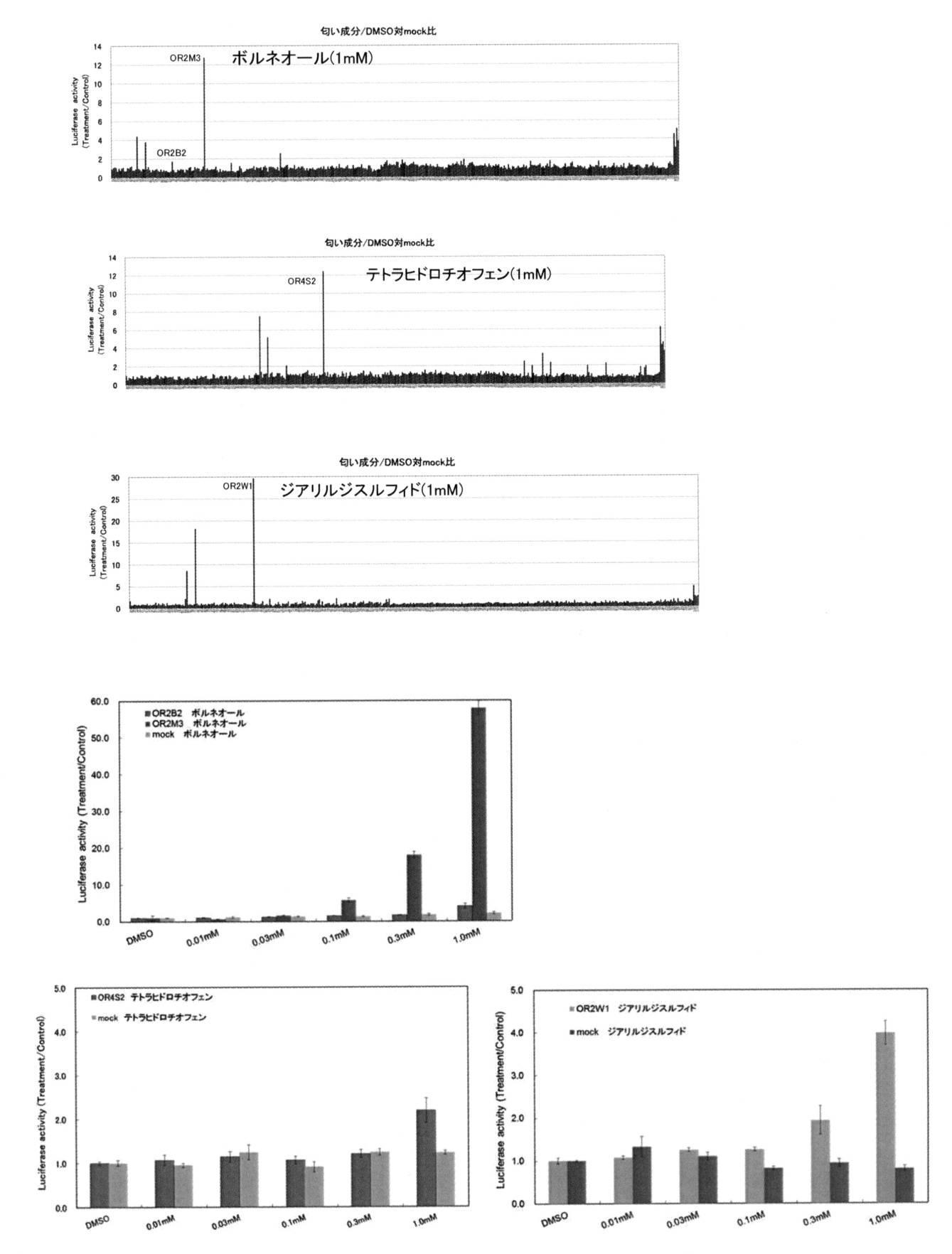
特定の嗅覚受容体を刺激するにおい成分候補の選択にあたっては、嗅覚受容体が応答するにおい成分に関する嗅覚受容体−におい成分情報に基づくことができる。以下に、嗅覚受容体−におい成分情報の一例を図5A及び図5Bに示す。こうした嗅覚受容体とにおい成分との関係は、当業者であれば、特定の嗅覚受容体を刺激する化合物をスクリーニングすることにより得ることもできるし、特定の化合物に応答する嗅覚受容体をスクリーニングすることにより得ることもできる。 The selection of odor component candidates that stimulate a specific olfactory receptor can be based on the olfactory receptor-odor component information regarding the odor component that the olfactory receptor responds to. An example of the olfactory receptor-odor component information is shown in FIGS. 5A and 5B below. Such a relationship between the olfactory receptor and the odor component can be obtained by a person skilled in the art by screening a compound that stimulates a specific olfactory receptor, or a olfactory receptor that responds to a specific compound is screened. It can also be obtained by.
図5A及び図5Bに示す嗅覚受容体は、1A1、1D2、2AK2、2B2、2C3、2J2、2L3、2M3、2W1、4S2、5K1、5P3、7G2、10A3、10A6、10G3、11H4、51A2、51E1、51I2、51L1、51E2、51V1、8H1及び8D1である。トレーニングしようとする嗅覚受容体は、これらの嗅覚受容体からなる群から選択される1種以上とすることができる。 The olfactory receptors shown in FIGS. 5A and 5B are 1A1, 1D2, 2AK2, 2B2, 2C3, 2J2, 2L3, 2M3, 2W1, 4S2, 5K1, 5P3, 7G2, 10A3, 10A6, 10G3, 11H4, 51A2, 51E1, 51I2, 51L1, 51E2, 51V1, 8H1 and 8D1. The olfactory receptor to be trained can be one or more selected from the group consisting of these olfactory receptors.
なお、これらの嗅覚受容体遺伝子を含めヒトなどの嗅覚受容体の塩基配列及びアミノ酸配列については、例えば、NCBI(https://www.ncbi.nlm.nih.gov/gene)のほか、HUGO Gene Nomenclature Committee (1583116876862_0)において取得できる。また、これらの嗅覚受容体のSNPやその頻度情報については、The Human Olfactory Data Explorer (https://genome.weizmann.ac.il/horde/)や東北メディカル・メガバンク統合データベースdbTMMカタログ(http://www.dist.megabank.tohoku.ac.jp/about/data/index.html)等を参照することができる。 Regarding the base sequence and amino acid sequence of olfactory receptors such as humans including these olfactory receptor genes, for example, NCBI (https://www.ncbi.nlm.nih.gov/gene) and HUGO Gene It can be obtained from the Nomenclature Committee (1583116876862_0). For SNPs of these olfactory receptors and their frequency information, see The Human Olfactory Data Explorer (https://genome.weizmann.ac.il/horde/) and Tohoku Medical Megabank Integrated Database dbTMM Catalog (http: /). /www.dist.megabank.tohoku.ac.jp/about/data/index.html) etc. can be referred to.
また、図5A及び図5Bに示すにおい成分は、ヘプタン酸、ペンタナール、ヘキサナール、2−ペンタノン、2−ヘキサノン、p−シメン、p−クレゾール、o−メトキシフェノール、2,3,6−トリメチルフェノール、o−イソプロピルフェノール、6−メチル−5−ヘプテン−2−オン、メチルビニルケトン、3−エチルピリジン、2−エチルピラジン、ヘキサン酸メチル、マルトール、ヒノキチオール、1−オクテン−3−オール、フェニルアセトアルデヒド、アセトフェノン、シクロテン、フェニルエチルアルコール、γ−ウンデカラクトン、γ−カプロラクトン、オクタナール、メルカプト酢酸、ノナンチオール、オクタン酸、4−メチル−3−ヘキセン酸、L−メントール、シトロネラール、i−吉草酸、スカトール、1−ヘプタノール、3−オクタノン、2−オクタノン、2−ノナノン、酢酸ヘキシル、酪酸ペンチル、ヘキサン酸、ノナン酸、酢酸、プロピオン酸、i−酪酸、n−酪酸、n−吉草酸、(+)−カルボン、(−)−カルボン、青葉アルコール、バニリン、エチルバニリン、リモネン、クマリン、リナロール、4−ヒドロキシクマリン、2−クマラノン、デカナール、(−)−カンファ、(+)−カンファ、(+)−プレゴン、ノナナール、青葉アルデヒド、ボルネオール、テトラヒドロチオフェン、ジアリルジスルフィド、フェニル酢酸メチル、アントラニル酸メチル及びシトラールである。これらのにおい成分からなる群から選択される2種以上を選択することができる。 The odor components shown in FIGS. 5A and 5B are heptanic acid, pentanal, hexanal, 2-pentanone, 2-hexanone, p-simene, p-cresol, o-methoxyphenol, 2,3,6-trimethylphenol, o-Isopropylphenol, 6-methyl-5-hepten-2-one, methylvinylketone, 3-ethylpyridine, 2-ethylpyrazine, methylhexanoate, maltor, hinokithiol, 1-octen-3-ol, phenylacetaldehyde, Acetphenone, cycloten, phenylethyl alcohol, γ-undecalactone, γ-caprolactone, octanal, mercaptoacetic acid, nonanthiol, octanoic acid, 4-methyl-3-hexenoic acid, L-menthol, citronellal, i-valeric acid, scator , 1-heptanol, 3-octanone, 2-octanone, 2-nonanonone, hexyl acetate, pentyl butyrate, hexanoic acid, nonanoic acid, acetic acid, propionic acid, i-butyric acid, n-butyric acid, n-valeric acid, (+) -Carbon, (-)-Carbon, green leaf alcohol, vanillin, ethyl vanillin, limonene, coumarin, linalol, 4-hydroxycoumarin, 2-cumalanone, decanal, (-)-campa, (+)-campa, (+)- Pregon, nonanal, green leaf aldehyde, borneol, tetrahydrothiophene, diallyl disulfide, methyl phenylacetate, methyl anthranylate and citral. Two or more kinds selected from the group consisting of these odor components can be selected.
これらのなかでも、ヘキサン酸、n−吉草酸、(−)−カルボン、バニリン、ボルネオール、テトラヒドロチオフェン、ジアリルジスルフィド、フェニル酢酸メチル、アントラニル酸メチル及びシトラールからなる群から選択される1種又は2種以上のにおい成分と嗅覚受容体に関する嗅覚受容体−におい成分情報に基づくことができる。なかでも、ボルネオール、テトラヒドロチオフェン、ジアリルジスルフィド、フェニル酢酸メチル、アントラニル酸メチル及びシトラールからなる群から選択される1種又は2種以上のにおい成分についての嗅覚受容体−におい成分情報に基づくことができる。 Among these, one or two selected from the group consisting of hexanoic acid, n-valeric acid, (-)-carboxylic acid, vanillin, borneol, tetrahydrothiophene, diallyl disulfide, methyl phenylacetate, methyl anthraniate and citral. It can be based on the above olfactory receptor-smell component information regarding the odor component and the olfactory receptor. Among them, it can be based on the olfactory receptor-odor component information for one or more odor components selected from the group consisting of borneol, tetrahydrothiophene, diallyl disulfide, methyl phenylacetate, methyl anthranilate and citral. ..
また、α−イソプロピルフェノール、ヒノキチオール、1−オクテン−3−オール、シクロテン、γ−ウンデカラクトン、2−メチル−3−ヘキセン酸及び3−オクタノンからなる群から選択される1種又は2種以上のにおい成分と嗅覚受容体に関する嗅覚受容体−におい成分情報に基づくことができる。 In addition, one or more selected from the group consisting of α-isopropylphenol, hinokithiol, 1-octen-3-ol, cycloten, γ-undecalactone, 2-methyl-3-hexenoic acid and 3-octanone. Smell components and olfactory receptors related to olfactory receptors-can be based on odor component information.
におい成分候補の選択にあたっては、例えば、嗅覚トレーニング対象者の嗅覚受容体多型に関連付けされた多型に基づく応答性情報(以下、多型応答性情報ともいう。)に基づくこともできる。嗅覚受容体遺伝子の多型により、本来応答するにおい成分への応答性が減弱若しくは消失又は増強、応答性が変化する。 In selecting the odor component candidate, for example, responsive information based on the polymorphism associated with the olfactory receptor polymorphism of the subject of the olfactory training subject (hereinafter, also referred to as polymorphism responsive information) can be used. The polymorphism of the olfactory receptor gene diminishes, eliminates, or enhances the responsiveness to the odor component that originally responds, and changes the responsiveness.
例えば、本発明者が知得している、リガンドが判明している嗅覚受容体遺伝子とそのSNP(表2においては、嗅覚受容体遺伝子によってコードされる嗅覚受容体タンパク質のアミノ酸配列におけるSNPに基づくアミノ酸変化(例えば、OR1A1−P285S(285位のP(プロリン)がS(セリン)に変化))として表す。)又はその組合せとrs番号のリスト、並びにその多型の出現割合(%)を表2に示す。表2からも明らかであるように、嗅覚受容体遺伝子においては、SNPの現れる割合(%)が高い傾向にあり、嗅覚受容体遺伝子は多様性に富む傾向があるといえる。なお、表2中、東北メディカルメガバンクdataの遺伝子型の割合(%)は、メジャーホモ又はそれぞれの遺伝子多型をマイナーホモで持つ確率を表す。例えば、OR1A1については、当該遺伝子型をホモで持っている人の割合を示し、OR1A1-P285Sについては、当該SNPをホモで持っている人の割合を示す。また、表2中、1000 Genomes Project data(allele frequency)における遺伝子型の割合(%)は、対立遺伝子頻度を表す。例えば、ひとつの遺伝子座に対して、複数の対立遺伝子が存在する場合、それぞれの対立遺伝子の集団中における頻度を表す。表3には、これらの嗅覚受容体遺伝子多型とにおい成分応答性との関係について示す。 For example, it is based on the olfactory receptor gene whose ligand is known and its SNP (in Table 2, in Table 2, the SNP in the amino acid sequence of the olfactory receptor protein encoded by the olfactory receptor gene, which the present inventor knows. Amino acid changes (eg, OR1A1-P285S (P (proline) at position 285 changes to S (serine))) or combinations thereof, a list of rs numbers, and the appearance rate (%) of the polymorphisms are shown in the table. Shown in 2. As is clear from Table 2, in the olfactory receptor genes, the rate (%) at which SNP appears tends to be high, and it can be said that the olfactory receptor genes tend to be rich in diversity. In Table 2, the genotype ratio (%) of Tohoku Medical Megabank data represents the probability of having major homozygotes or each gene polymorphism as minor homozygotes. For example, for OR1A1, the proportion of people who have the genotype homozygous is shown, and for OR1A1-P285S, the proportion of people who have the SNP homozygous is shown. In Table 2, the genotype ratio (%) in 1000 Genomes Project data (allele frequency) represents the allele frequency. For example, when there are multiple alleles for one locus, it represents the frequency of each allele in the population. Table 3 shows the relationship between these olfactory receptor gene polymorphisms and odor component responsiveness.
こうした情報に基づき、トレーニング対象者が多型を有することがわかっている場合、多型がある嗅覚受容体を刺激するにおい成分候補を選択しあるいは選択を回避することが可能である。具体的には、なお、こうした多型応答性情報は、既に報告されているほか、適宜取得することもできる。 Based on this information, if it is known that the trainee has a polymorphism, it is possible to select or avoid the selection of odor component candidates that stimulate the olfactory receptor with the polymorphism. Specifically, such polymorphism responsiveness information has already been reported and can be obtained as appropriate.
におい成分候補の選択にあたっては、予め取得した、2種以上のにおい成分候補中の少なくとも2種のにおい成分候補間における嗅覚受容体の相互作用に関する相互作用情報に基づいて選択してもよい。相互作用情報は、具体的には、少なくとも2つのにおい成分が同時に存在することで、結果として、それぞれが本来的に有する嗅覚受容体の少なくとも一部の応答性を変化させる(増強又は抑制)ようになる事象に関連している。応答性を増強するとは、少なくとも2つのにおい成分によって刺激される嗅覚受容体の少なくとも一部の応答感度の増大、閾値の低下及び新たな嗅覚受容体の応答性の発現を含むものである。また、応答性の抑制とは、少なくとも2つのにおい成分によって刺激される嗅覚受容体の少なくとも一部の応答性の応答感度の低下、閾値の増大、応答性の消失を含むものである。少なくとも2つのにおい成分の組み合わせの相互作用は、増強及び抑制のいずれか又は双方を含むことができる。 In selecting the odor component candidate, the selection may be made based on the interaction information regarding the interaction of the olfactory receptor between at least two kinds of odor component candidates among the two or more kinds of odor component candidates obtained in advance. The interaction information specifically states that the presence of at least two odor components at the same time will result in altering (enhancing or suppressing) the responsiveness of at least some of the inherent olfactory receptors of each. Is related to the event of becoming. Enhancing responsiveness includes increasing the response sensitivity of at least some of the olfactory receptors stimulated by at least two odor components, lowering the threshold and developing the responsiveness of new olfactory receptors. In addition, suppression of responsiveness includes a decrease in responsiveness of at least a part of the olfactory receptor stimulated by at least two odor components, an increase in threshold value, and loss of responsiveness. The interaction of the combination of at least two odor components can include either or both enhancement and inhibition.
こうした相互作用情報を伴うにおい成分を、相互作用情報に基づいて選択してもよいし、選択を回避してもよい。例えば、標的とする嗅覚受容体が、2つのにおい成分が共存することで抑制される場合には、これらのうちの一方のにおい成分を用いることを回避することが有用な場合がある。標的とする嗅覚受容体が、2つのにおい成分が共存することで応答性が増強される場合には、これら2つのにおい成分選択することが有用な場合がある。こうすることで、より効率的ににおい成分候補を選択することができる。 The odor component accompanied by such interaction information may be selected based on the interaction information, or the selection may be avoided. For example, if the target olfactory receptor is suppressed by the coexistence of two odor components, it may be useful to avoid using one of these odor components. If the target olfactory receptor has enhanced responsiveness due to the coexistence of two odor components, it may be useful to select these two odor components. By doing so, the odor component candidates can be selected more efficiently.
(a)においては、2種又は3種以上の標的嗅覚受容体を刺激する組成物を意図して、こうした標的嗅覚受容体を刺激するにおい成分候補を選択することができる。標的嗅覚受容体として複数であることが、嗅覚受容体のトレーニングとしては効率的であるからである。標的とする嗅覚受容体の数は、また例えば、4種以上であり、また例えば、5種以上であり、また例えば、6種以上であり、また例えば、7種以上である。 In (a), odor component candidates that stimulate such target olfactory receptors can be selected with the intention of a composition that stimulates two or three or more target olfactory receptors. This is because having a plurality of target olfactory receptors is efficient for training the olfactory receptors. The number of target olfactory receptors is also, for example, 4 or more, and is, for example, 5 or more, and is, for example, 6 or more, and is, for example, 7 or more.
(a)においては、例えば、3種又は4種以上のにおい成分候補を選択することができる。3種以上のにおい成分候補を選択することで、より多くの嗅覚受容体を一挙に刺激することができる。におい成分候補は、また例えば、5種以上であり、また例えば、6種以上であり、また例えば、7種以上である。 In (a), for example, three or four or more kinds of odor component candidates can be selected. By selecting three or more kinds of odor component candidates, more olfactory receptors can be stimulated at once. The odor component candidates are, for example, 5 or more, 6 or more, and 7 or more, for example.
<(b)組成物候補に対する嗅覚受容体の応答性を評価すること>
(b)においては、2種以上のにおい成分候補からなる群から選択される2種以上を含む組成物候補に対する嗅覚受容体の応答性を評価する。におい成分は共存するとき、嗅覚受容体に対してそれぞれ単独で刺激する場合とは異なる挙動を示す場合がある。したがって、共存時の応答性を評価することが有用である。
<(B) To evaluate the responsiveness of the olfactory receptor to the composition candidate>
In (b), the responsiveness of the olfactory receptor to a composition candidate containing two or more selected from a group consisting of two or more odor component candidates is evaluated. When the odor components coexist, they may behave differently than when they stimulate the olfactory receptors alone. Therefore, it is useful to evaluate the responsiveness at the time of coexistence.
(b)では、例えば、従来公知の、ある種のにおい成分がどの嗅覚受容体を刺激するかをスクリーニングする方法を適用して、組成物候補に対する嗅覚受容体の応答性を評価できる。例えば、これらのにおい成分が応答する可能性ある嗅覚受容体、標的としたい嗅覚受容体又は網羅的に準備された嗅覚受容体に対して、組成物候補を適用して、その応答性を評価することができる。 In (b), for example, a conventionally known method of screening which olfactory receptor is stimulated by a certain odor component can be applied to evaluate the responsiveness of the olfactory receptor to a composition candidate. For example, a composition candidate is applied to an olfactory receptor to which these odor components may respond, an olfactory receptor to be targeted, or a comprehensively prepared olfactory receptor, and its responsiveness is evaluated. be able to.
応答性の評価にあたっては、2種以上のにおい成分候補からなる群から選択される2種以上を含む組成物候補を調製する。例えば、におい成分成分候補が5種類ある場合には、これら5種類から選択される2種類以上の組み合わせである26種類の組成の組成物候補の調製が可能となる。こうした可能性ある組成物候補の少なくとも一つにつき、嗅覚受容体の応答性を評価することができる。 In the evaluation of responsiveness, composition candidates containing two or more selected from the group consisting of two or more odor component candidates are prepared. For example, when there are five types of odor component component candidates, it is possible to prepare composition candidates having 26 types of compositions, which are combinations of two or more types selected from these five types. The responsiveness of the olfactory receptor can be evaluated for at least one of these potential composition candidates.
組成物候補の調製にあたっては、各におい成分候補の濃度を適宜調製することができる。におい成分候補の濃度については、既に説明したように、その濃度に応じて当該におい成分候補に応答する嗅覚受容体の種類が異なる場合がある。このため、こうしたにおい成分−嗅覚受容体に関する情報に基づいて、組成物候補中のにおい成分候補の濃度は同一でもよいし、異なっていてもよい。また、1又は2以上のにおい成分候補の濃度の異なる2種類以上の組成物候補を調製してもよい。 In preparing the composition candidates, the concentration of each odor component candidate can be appropriately adjusted. As for the concentration of the odor component candidate, as described above, the type of olfactory receptor that responds to the odor component candidate may differ depending on the concentration. Therefore, the concentrations of the odor component candidates in the composition candidates may be the same or different based on the information on the odor component-olfactory receptor. Further, two or more kinds of composition candidates having different concentrations of one or more odor component candidates may be prepared.
候補組成物における各におい成分候補の濃度の設定は、におい成分−嗅覚受容体に関する情報や、嗅覚受容体の応答性評価試験で得られるシグナル強度の調整や実際に用いる本組成物におけるにおい成分濃度を考慮して決定することができる。各におい成分候補の濃度は、例えば、0.01mM〜10mMの範囲で適宜設定される。 The concentration of each odor component candidate in the candidate composition can be set by adjusting the information on the odor component-olfactory receptor, adjusting the signal intensity obtained in the olfactory receptor responsiveness evaluation test, and the odor component concentration in the present composition actually used. Can be determined in consideration of. The concentration of each odor component candidate is appropriately set in the range of, for example, 0.01 mM to 10 mM.
そのほか、嗅覚受容体応答性評価に用いる組成物候補の調製は、従来公知の嗅覚受容体の応答性評価手法に準じることができる。 In addition, the preparation of the composition candidate used for the evaluation of the responsiveness of the olfactory receptor can be based on the conventionally known method for evaluating the responsiveness of the olfactory receptor.
(b)において用いる嗅覚受容体の評価において対象とする嗅覚受容体は、例えば、組成物候補に含まれるにおい成分候補に本来的に応答性を有する又は応答性を有する可能性ある嗅覚受容体であってもよいし、標的としたい嗅覚受容体であってもよいし、網羅的に準備された嗅覚受容体であってもよい。におい成分候補に応答性を有する嗅覚受容体は、、既述の嗅覚受容体−におい成分情報のほか、におい成分候補について予め応答する嗅覚受容体を特定しておいてもよい。 The target olfactory receptor in the evaluation of the olfactory receptor used in (b) is, for example, an olfactory receptor that is inherently responsive to or may have responsiveness to the odor component candidate contained in the composition candidate. It may be an olfactory receptor that you want to target, or it may be a comprehensively prepared olfactory receptor. As the olfactory receptor having responsiveness to the odor component candidate, in addition to the above-mentioned olfactory receptor-odor component information, the olfactory receptor that responds to the odor component candidate in advance may be specified.
(b)において用いる嗅覚受容体の評価手法は、特に限定するものではなく、公知の方法を採用できる。例えば、嗅覚受容体は、ヒトから単離された嗅覚受容器若しくは嗅細胞等の天然に受容体を発現する組織や細胞、又はそれらの培養物のほか、当該嗅覚受容体を発現するように遺伝的に操作された組換え細胞又はその培養物の形態で、又は嗅覚受容体を有する人工脂質二重膜等の形態で使用され得る。嗅覚受容体は、嗅覚受容体毎に個別の細胞に発現させるようにすることが好ましい。こうした各種形態の嗅覚受容体は当業者であれば公知技術に基づいて適宜準備することができる。 The method for evaluating the olfactory receptor used in (b) is not particularly limited, and a known method can be adopted. For example, an olfactory receptor is a tissue or cell that naturally expresses a receptor such as an olfactory receptor or an olfactory cell isolated from humans, or a culture thereof, or is inherited to express the olfactory receptor. It can be used in the form of chemically engineered recombinant cells or cultures thereof, or in the form of artificial lipid bilayers with olfactory receptors. It is preferable that the olfactory receptors are expressed in individual cells for each olfactory receptor. Those skilled in the art can appropriately prepare these various forms of olfactory receptors based on known techniques.
なお、組換え細胞の場合、嗅覚受容体をコードする遺伝子を組み込んだベクターを用いて細胞を形質転換することで作製することができる。嗅覚受容体を発現させる細胞には、受容体輸送タンパク質1S(RTP1s)をコードする遺伝子を共に導入することが好ましい。RTP1sは、受容体の細胞膜発現を補助する機能を有している。上記組換え細胞の作製に使用できるRTP1sとしては、例えば、ヒトRTP1sが挙げられる。なお、RTP1s遺伝子の代わりにRTP1s変異体遺伝子を用いてもよい。 In the case of recombinant cells, it can be produced by transforming the cells with a vector incorporating a gene encoding an olfactory receptor. It is preferable to introduce a gene encoding the receptor transport protein 1S (RTP1s) into cells expressing the olfactory receptor. RTP1s has a function of assisting the cell membrane expression of the receptor. Examples of RTP1s that can be used for producing the recombinant cells include human RTP1s. The RTP1s mutant gene may be used instead of the RTP1s gene.
嗅覚受容体多型の応答性を評価するには、組成物候補と嗅覚受容体とを接触させる工程を実施する。例えば、組成物候補の存在下で嗅覚受容体を保持する細胞を培養して実施することができる。培養条件は、嗅覚受容体発現細胞の培養条件を適宜選択することができる。例えば、培地は、適当な抗生物質を含有する無血清培地を用いることができる。なお、培養時間は、受容体による応答評価が可能な程度な時間行う必要がある。例えば、1時間以上数時間以下程度とすることができる。 To evaluate the responsiveness of the olfactory receptor polymorphism, a step of contacting the composition candidate with the olfactory receptor is performed. For example, cells that retain the olfactory receptor can be cultured in the presence of composition candidates. As the culture conditions, the culture conditions for the cells expressing the olfactory receptor can be appropriately selected. For example, as the medium, a serum-free medium containing a suitable antibiotic can be used. The culture time should be such that the response by the receptor can be evaluated. For example, it can be about 1 hour or more and several hours or less.
嗅覚受容体の応答性評価は、従来と同様の手法で実施できる。例えば、組成物候補の応答を、受容体を介したCRE結合タンパク質の活性化を利用して評価する形態等を利用できる。当該形態のためのプロトコールは特に限定されない。例えば、活性化したCRE結合タンパク質がCREに結合して下流の遺伝子の発現を促進することを利用して、当該下流の遺伝子として、レポーター遺伝子を導入し、当該レポーター遺伝子の発現レベルを測定してもよい。レポーター遺伝子としては、公知の発光タンパク質をコードする遺伝子など、当業者であれば適宜選択できる。またレポーター遺伝子の発現レベルは、用いるレポーター遺伝子の種類に応じて適宜決定される。 The responsiveness evaluation of the olfactory receptor can be carried out by the same method as before. For example, a form in which the response of the composition candidate is evaluated by utilizing the activation of the CRE-binding protein via the receptor can be used. The protocol for this form is not particularly limited. For example, by utilizing the fact that an activated CRE-binding protein binds to CRE and promotes the expression of a downstream gene, a reporter gene is introduced as the downstream gene, and the expression level of the reporter gene is measured. May be good. As the reporter gene, a gene encoding a known luminescent protein or the like can be appropriately selected by those skilled in the art. The expression level of the reporter gene is appropriately determined according to the type of reporter gene used.
嗅覚受容体を介したCRE結合タンパク質の活性化経路は、当業者において周知である。受容体と各種のにおい分子とを接触させこれらを結合させることで、細胞内において、Gタンパク質、アデニル酸シクラーゼ(AC)が順次活性化されて、cAMPが上昇する。これに伴いプロテインキナーゼA(PKA)がリン酸化されて下流のシグナル伝達系を活性化する。その一方でPKAが核内に移行して、転写因子CRE結合タンパク質(CREB)を活性化するものである。 The pathway of activation of CRE-binding proteins via the olfactory receptor is well known to those of skill in the art. By contacting the receptor with various odor molecules and binding them, the G protein and adenylate cyclase (AC) are sequentially activated in the cell, and cAMP is increased. Along with this, protein kinase A (PKA) is phosphorylated and activates the downstream signal transduction system. On the other hand, PKA translocates into the nucleus and activates the transcription factor CREB-binding protein (CREB).
なお、上昇したcAMP量を測定する方法としては、ELISA法を用いることもできる。さらに、例えば、受容体の応答は、受容体の応答を測定する方法として当該分野で知られている任意の方法、例えば、カルシウムイメージング法等によって行ってもよい。 An ELISA method can also be used as a method for measuring the increased amount of cAMP. Further, for example, the receptor response may be performed by any method known in the art as a method for measuring the receptor response, for example, a calcium imaging method or the like.
こうすることで、組成物候補に対する嗅覚受容体の応答性を取得することができる。すなわち、嗅覚トレーニングのためのにおい成分組成物を決定するための応答性情報を取得することができる。 By doing so, the responsiveness of the olfactory receptor to the composition candidate can be obtained. That is, it is possible to obtain responsive information for determining the odor component composition for the sense of smell training.
応答性情報は、組成物候補毎に得ることができる。2種以上のにおい成分候補につき、多くの組成物候補を調製し、嗅覚受容体の応答性を評価することにより、組成物候補及び2種以上のにおい成分候補が共存するときの応答性について多くの情報を取得できる。 Responsiveness information can be obtained for each composition candidate. By preparing many composition candidates for two or more kinds of odor component candidates and evaluating the responsiveness of the olfactory receptor, many of the responsiveness when the composition candidate and the two or more kinds of odor component candidates coexist Information can be obtained.
(b)において得られた組成物候補としての応答性情報と、組成物候補に含まれる2種以上のにおい成分候補のそれぞれが本来的に応答性を有する嗅覚受容体の応答性とを比較することもできる。こうすることで、2種以上のにおい成分候補が共存する場合の種々の応答性の変化(増強や抑制)に関するにおい成分についての相互作用情報を取得できる。かかる相互情報は、組成物候補の効率的な選択ひいてはにおい成分組成物を決定するのに有用な情報となる。なお、応答性情報と対比するにおい成分候補がそれぞれ本来的に応答性を有する嗅覚受容体の応答性は、既述の嗅覚受容体−におい成分情報に基づいて取得できるほか、適宜、におい成分候補に応答する嗅覚受容体をスクリーニングすることによって得ることができる。 The responsiveness information as the composition candidate obtained in (b) is compared with the responsiveness of the olfactory receptor in which each of the two or more odor component candidates contained in the composition candidate is inherently responsive. You can also do it. By doing so, it is possible to obtain interaction information about the odor component regarding various changes in responsiveness (enhancement or suppression) when two or more kinds of odor component candidates coexist. Such mutual information will be useful information for efficient selection of composition candidates and thus determination of an odor component composition. The responsiveness of the olfactory receptor to which the odor component candidate to be compared with the responsive information is inherently responsive can be obtained based on the above-mentioned olfactory receptor-odor component information, and the odor component candidate can be appropriately obtained. It can be obtained by screening for olfactory receptors that respond to.
<嗅覚トレーニングのためのにおい成分組成物を決定する方法>
本明細書に開示される嗅覚トレーニングのためのにおい成分組成物を決定する方法は、(a)2種以上のにおい成分候補を選択すること、及び(b)前記2種以上のにおい成分候補を含むからなる群から選択される2種以上を含む組成物候補に対する嗅覚受容体の応答性を評価すること、(c)嗅覚トレーニングの標的とする嗅覚受容体の応答性が肯定された前記組成物候補を、前記におい成分組成物として選択すること、を含むことができる。本決定方法によれば、標的嗅覚受容体の応答性が肯定された組成物候補を得ることができる。かかる組成物候補をトレーニング用のにおい成分組成物とすることで、標的とする嗅覚受容体を刺激するトレーニング用のにおい成分組成物を得ることができる。
<How to determine the odor component composition for odor training>
The methods for determining the odor component composition for the sense of smell training disclosed herein are (a) selecting two or more odor component candidates, and (b) selecting the two or more odor component candidates. To evaluate the responsiveness of the olfactory receptor to a composition candidate containing two or more selected from the group consisting of containing, and (c) the composition in which the responsiveness of the olfactory receptor targeted for olfactory training was affirmed. Candidates can include selecting as the odor component composition. According to this determination method, composition candidates in which the responsiveness of the target olfactory receptor is affirmed can be obtained. By using such a composition candidate as a training odor component composition, a training odor component composition that stimulates the target olfactory receptor can be obtained.
上記(a)及び上記(b)は、本生成方法と同様に実施することができる。本決定方法では、応答性情報として、標的嗅覚受容体の応答性が肯定される組成物候補が得られるようにすることが意図されている。 The above (a) and (b) can be carried out in the same manner as in the present generation method. The present determination method is intended to obtain composition candidates in which the responsiveness of the target olfactory receptor is affirmed as responsive information.
におい成分候補は、例えば、既述の嗅覚受容体−におい成分情報に基づいて選択することもできるほか、本生成方法と同様に選択することができる。また例えば、既述の相互作用情報に基づいて選択することもできるし、多型応答性情報に基づいて選択することもできる。 The odor component candidate can be selected based on, for example, the above-mentioned olfactory receptor-odor component information, or can be selected in the same manner as in the present generation method. Further, for example, the selection can be made based on the above-mentioned interaction information, or can be selected based on the polymorphism responsiveness information.
なお、標的とする嗅覚受容体が1種又は2種以上あり、これらの嗅覚受容体を1種のにおい成分候補で刺激可能な場合もある。この場合には、このにおい成分候補のみでにおい成分組成物を決定することができる。例えば、こうしたにおい成分候補は、図1等に示す嗅覚受容体−におい成分情報に基づいて選択することができる。 In some cases, there are one or more target olfactory receptors, and these olfactory receptors can be stimulated with one odor component candidate. In this case, the odor component composition can be determined only by the odor component candidates. For example, such odor component candidates can be selected based on the olfactory receptor-odor component information shown in FIG. 1 and the like.
<嗅覚トレーニング用のにおい成分組成物の生産方法>
本明細書に開示されるにおい成分組成物の生産方法は、(a)2種以上のにおい成分候補を選択すること、(b)前記2種以上のにおい成分候補からなる群から選択される2種以上を含む組成物候補に対する嗅覚受容体の応答性を評価すること、(c)前記1種又は2種以上の組成物候補のうち、前記1種以上の標的嗅覚受容体の応答性が肯定された組成物候補を、前記におい成分組成物として選択すること、(d)前記(c)で選択された前記におい成分組成物を調製すること、を含む生産方法である。
<Production method of odor component composition for odor training>
The method for producing the odor component composition disclosed in the present specification is (a) selecting two or more kinds of odor component candidates, and (b) being selected from the group consisting of the two or more kinds of
本生産方法における、上記(a)及び(b)は、本生成方法に関して記載された各種態様をそのまま適用でき、上記(c)は、本決定方法に関して記載された各種態様をそのまま適用できる。及び(c)は、本生成方法に記載された各種態様をそのまま適用することができる。 In the present production method, the above (a) and (b) can be applied as they are with the various aspects described with respect to the present production method, and the above (c) can be applied with the various aspects described with respect to the present determination method as they are. And (c) can apply various aspects described in this production method as they are.
(d)においては、こうして決定されたにおい成分組成物を調製する。嗅覚トレーニングのためのにおい成分組成物は、種々の形態を採ることができる。例えば、におい成分の混合液、におい成分を溶解した溶液、におい成分が吸着又は含浸された固相体、におい成分の混合ガス等である。におい成分組成物の形態は、嗅覚トレーニング方法やにおい成分の種類や特性(溶解性、沸点等)等によって適宜決定される。 In (d), the odor component composition thus determined is prepared. The odor component composition for olfactory training can take various forms. For example, a mixed solution of an odor component, a solution in which the odor component is dissolved, a solid phase compound in which the odor component is adsorbed or impregnated, a mixed gas of the odor component, and the like. The form of the odor component composition is appropriately determined depending on the odor training method, the type and characteristics of the odor component (solubility, boiling point, etc.) and the like.
におい成分の混合液は、におい成分が互いに相溶可能な場合等に採りうる態様である。かかる混合液は、例えば、ストック用又は希釈用として調製されるほか、適当な噴霧ガスにより噴霧される体として調製される。液体又はガスとしてトレーニング対象者に供給される。 The mixed solution of the odor components is an embodiment that can be taken when the odor components are compatible with each other. Such a mixture is prepared, for example, for stocking or dilution, or as a body sprayed with a suitable spray gas. It is supplied to the trainee as a liquid or gas.
におい成分を溶解した溶液は、におい成分を適用な溶媒に溶解したものである。かかる溶液における溶媒は、におい成分による嗅覚トレーニングを阻害しないものが選択される。この場合、におい成分は、液体又はガスとしてトレーニング対象者に供給される。 The solution in which the odor component is dissolved is the solution in which the odor component is dissolved in an applicable solvent. The solvent in such a solution is selected so as not to interfere with the odor training by the odor component. In this case, the odor component is supplied to the trainee as a liquid or gas.
におい成分が吸着又は含浸された固相体は、例えば、繊維状体から構成される多孔質体、連通孔及び/又は閉塞孔などを有する天然材料、有機材料や無機材料の多孔質体などに対して、におい成分混合液を供給して保持させたものや、におい成分溶液を供給して溶媒を蒸発等させたものなどが挙げられる。この場合、におい成分は、ガスとしてトレーニング対象者に供給される。 The solid phase body in which the odor component is adsorbed or impregnated can be used in, for example, a porous body composed of a fibrous body, a natural material having communication holes and / or closed holes, a porous body made of an organic material or an inorganic material, and the like. On the other hand, those in which the odor component mixed solution is supplied and retained, and those in which the odor component solution is supplied to evaporate the solvent and the like can be mentioned. In this case, the odor component is supplied to the trainee as a gas.
におい成分の混合ガスは、におい成分が常温でガスの場合における混合ガスの他、におい成分混合液やにおい成分溶液のヘッドスペースガスが挙げられる。この場合、におい成分は、ガスとしてトレーニング対象者に供給される。 Examples of the mixed gas of the odor component include a mixed gas when the odor component is a gas at room temperature, a mixed solution of the odor component, and a headspace gas of the odor component solution. In this case, the odor component is supplied to the trainee as a gas.
こうしたにおい成分組成物は、その形態等において、種々の形態の容器に収容されうる。におい成分の揮発や濃度変化を抑制するためである。例えば、におい成分溶液等が複数個の密封されたウェルやカプセルに充填されており、用時に、ウェルやカプセルを破壊又は開封することにより、におい成分組成物を使用することができるようになっていてもよい。また、スプレー容器ににおい成分混合液やにおい成分溶液等が充填されて、用時に、スプレー容器から噴霧できるようになっていてもよい。さらにまた、におい成分が含浸されたスティック、タブレット及びストリップが容器に密封されて収容されており、用時に、開封してスティック等のにおいを嗅ぐようにするようにしてもよい。 Such odor component compositions may be contained in various forms of containers, such as in their form. This is to suppress volatilization and concentration changes of odor components. For example, a plurality of sealed wells or capsules are filled with an odor component solution or the like, and the odor component composition can be used by destroying or opening the wells or capsules at the time of use. You may. Further, the spray container may be filled with an odor component mixed solution, an odor component solution, or the like so that the spray container can be sprayed at the time of use. Furthermore, sticks, tablets and strips impregnated with an odor component may be sealed and contained in a container so that the stick or the like can be smelled at the time of use.
<嗅覚トレーニング方法>
本明細書に開示される嗅覚受容体トレーニング方法は、嗅覚トレーニング対象者の嗅覚特性に応じて選択される1種以上の標的嗅覚受容体を刺激するように選択された2種以上のにおい成分を含むにおい成分組成物を経鼻的に前記嗅覚トレーニング対象者に供給することを含む。嗅覚トレーニング方法によれば、標的とする嗅覚受容体を直接刺激できるため、効率的に嗅覚をトレーニングできる。
<Smell training method>
The olfactory receptor training method disclosed herein uses two or more odor components selected to stimulate one or more target olfactory receptors selected according to the olfactory characteristics of the subject to be olfactory trained. It includes supplying the odor component composition containing the odor component nasally to the subject of the olfactory training. According to the olfactory training method, the target olfactory receptor can be directly stimulated, so that the olfactory sense can be trained efficiently.
におい成分組成物を経鼻的に嗅覚トレーニング対象者に供給する方法は特に限定されない。医薬品に適用される種々の経鼻的投与方法のほか、より簡易な適用方法であってもよい。簡易な方法としては、例えば、上記した各種形態のにおい成分組成物のように、トレーニング対象者のごく近傍において、におい成分組成物を噴霧する装置等により又はにおい成分組成物を当該近傍に準備して、供給されたにおい成分組成物、トレーニング対象者が嗅ぐという行為によってもよい。 The method of supplying the odor component composition nasally to the subject of the sensory training is not particularly limited. In addition to various nasal administration methods applied to pharmaceutical products, a simpler application method may be used. As a simple method, for example, like the above-mentioned various forms of the odor component composition, the odor component composition is prepared in the immediate vicinity of the trainee by a device or the like that sprays the odor component composition or in the vicinity thereof. The supplied odor component composition may be used by the trainee to smell it.
また、嗅覚トレーニングは、種々の形態で実施できる。例えば、1日あたり任意に複数回あるいは一定回数実施してもよいし、一定期間に渡り、1日一回以上実施してもよい。また、異なる濃度でにおい成分を供給するようにして、閾値感度の向上を確認できるように実施してもよい。 In addition, the sense of smell training can be carried out in various forms. For example, it may be carried out arbitrarily a plurality of times or a certain number of times per day, or may be carried out once or more a day for a certain period of time. Further, the odor component may be supplied at different concentrations so that the improvement in the threshold sensitivity can be confirmed.
以下、本明細書の開示をより具体的に説明するために具体例としての実施例を記載する。以下の実施例は、本明細書の開示を説明するためのものであって、その範囲を限定するものではない。 Hereinafter, examples as specific examples will be described in order to more specifically explain the disclosure of the present specification. The following examples are intended to illustrate the disclosure herein and are not intended to limit its scope.
(ボルネオール、テトラヒドロチオフェン、ジアリルジスルフィドに応答する嗅覚受容体の特定)
ボルネオール(墨汁)、テトラヒドロチオフェン(家庭用ガス)、ジアリルジスルフィド(炒めたニンニク)に対する全ヒト嗅覚受容体応答評価を行った。
(Identification of olfactory receptors that respond to borneol, tetrahydrothiophene, and diallyl disulfide)
All human olfactory receptor responses to borneol (ink juice), tetrahydrothiophene (household gas), and diallyl disulfide (stir-fried garlic) were evaluated.
ヒト嗅覚受容体は、登録されている配列情報を基にPCR法によりクローニングした。PCR法により増幅した各遺伝子をFlexi Vector(Promega)に常法に従って組み込み、SgfIとPmeIサイトを利用して、pF5K CMV−neo Flexi−OR Vectorを作製した。次いで、HEK293細胞を10%ウシ胎児血清(FBS)−ペニシリン/ストレプトマイシンを含むDME培地にて培養した。 The human olfactory receptor was cloned by the PCR method based on the registered sequence information. Each gene amplified by the PCR method was incorporated into Flexi Vector (Promega) according to a conventional method, and pF5K CMV-neo Flexi-OR Vector was prepared using SgfI and PmeI sites. HEK293 cells were then cultured in DME medium containing 10% fetal bovine serum (FBS) -penicillin / streptomycin.
表4に示す組成の反応液を調製し、クリーンベンチ内で30分放置した後、384ウェル(ポリーL−リジンコート・ホワイトプレート)の各ウェルに添加した。次いで、HEK293細胞を3.0×10⁵/cm2の割合で各ウェルに播種し、CO2インキュベータ内で24時間培養した。 A reaction solution having the composition shown in Table 4 was prepared, left in a clean bench for 30 minutes, and then added to each well of 384 wells (Poly-L-lysine coated white plate). HEK293 cells were then seeded in each well at a rate of 3.0 × 10 5 / cm 2 and cultured in a CO 2 incubator for 24 hours.
CRE応答の測定には、細胞内cAMP量の増加をホタルルシフェラーゼ遺伝子由来の発光値としてモニターするルシフェラーゼレポータージーンアッセイを用いた。また、CMVプロモーター下流にウミシイタケルシフェラーゼ遺伝子を融合させたものを同時に遺伝子導入し、遺伝子導入効率や細胞数の誤差を補正する内部標準として用いた。24時間培養後、培地を取り除き、無血清培地で調整した対象におい物質(各1mM)を添加し、4時間CO2インキュベータ内に放置した。 To measure the CRE response, a luciferase reporter gene assay was used, in which an increase in the amount of intracellular cAMP was monitored as a luminescence value derived from the firefly luciferase gene. In addition, a gene fused with a sea urchin shiitake luciferase gene downstream of the CMV promoter was simultaneously introduced and used as an internal standard for correcting errors in gene transfer efficiency and cell number. After culturing for 24 hours, the medium was removed, a target odorant (1 mM each) prepared in a serum-free medium was added, and the mixture was left in a CO 2 incubator for 4 hours.
ルシフェラーゼ活性はDual-Glo Luciferase assay system(Promega社)の添付プロトコルに準じて測定した。におい物質刺激により誘導されたホタルルシフェラーゼ由来の発光値をコントロール群(におい非処理群)の発光値で割った値をFold induction of luciferaseとして、応答強度の指標とした。結果を図1に示す。更に、評価したにおい成分に対する濃度依存的な応答を評価した。実施例1と同様の手順でOR2B2,同2M3,同4S2,同2W1をRTP1sとともにそれぞれ発現させた細胞を作製し、各におい成分(ボルネオール、テトラヒドロチオフェン及びジアリルジスルフィド)の各濃度(10、30、100、300、1000μM)に対する応答性を調べた。結果を併せて図1に示す。 Luciferase activity was measured according to the attached protocol of the Dual-Glo Luciferase assay system (Promega). The value obtained by dividing the luminescence value derived from firefly luciferase induced by odor substance stimulation by the luminescence value of the control group (non-odor treatment group) was used as the Fold induction of luciferase as an index of response intensity. The results are shown in FIG. Furthermore, the concentration-dependent response to the evaluated odor component was evaluated. Cells expressing OR2B2, 2M3, 4S2, and 2W1 together with RTP1s were prepared in the same procedure as in Example 1, and the concentrations (10, 30, and diallyl disulfide) of each odor component (borneol, tetrahydrothiophene, and diallyl disulfide) were prepared. The responsiveness to 100, 300, 1000 μM) was examined. The results are also shown in FIG.
図1に示すように、それぞれのにおい成分に対して特異的に応答する嗅覚受容体(OR)があることが明らかになった。これらの嗅覚受容体は、加齢、アルツハイマー病及びパーキンソン病において有意に認知能力の低下が認められるにおい又はにおい成分に関連している。これらの嗅覚受容体が、これらのにおい成分に特異的に応答することは初めて見出された。 As shown in FIG. 1, it was revealed that there are olfactory receptors (OR) that specifically respond to each odor component. These olfactory receptors are associated with odorous or odorous components that are significantly impaired in cognitive ability in aging, Alzheimer's disease and Parkinson's disease. For the first time, it has been found that these olfactory receptors respond specifically to these odor components.
表2及び表3に示したヒト嗅覚受容体遺伝子多型を含むDNA(コード領域)を合成した。合成した各遺伝子につき、実施例1と同様にして、pF5K CMV−neo Flexi Vector−ORを作製し、4−メチル−3−ヘキセン酸等の各種におい成分に対する応答性評価を評価した。結果を、図2〜図4に示す。また、表3には、これらの結果に基づく応答強度を示した。表3には、応答強度が2以下を「−」とし、2〜10を「+」とし、10〜50を「+++」と表記している。また、この表記には該当しないが、明らかに応答強度に変化がある場合には、「↑」(強度向上)又は「↓」(強度低下)を示した。これらの結果から、これらに示す嗅覚受容体遺伝子の1種又は2種以上のSNPで、嗅覚受容体応答性の強度変化が認められた。このことから、こうしたSNPsを備えるヒト個体における嗅覚の感受性(応答性)が異なることが予測された。 DNA (coding region) containing the human olfactory receptor gene polymorphisms shown in Tables 2 and 3 was synthesized. For each of the synthesized genes, pF5K CMV-neo Flexi Vector-OR was prepared in the same manner as in Example 1, and the responsiveness evaluation to various odor components such as 4-methyl-3-hexenoic acid was evaluated. The results are shown in FIGS. 2 to 4. Table 3 shows the response intensities based on these results. In Table 3, a response intensity of 2 or less is indicated as “−”, 2 to 10 are indicated as “+”, and 10 to 50 are indicated as “+++”. In addition, although it does not correspond to this notation, when there is a clear change in the response intensity, "↑" (increase in intensity) or "↓" (decrease in intensity) is indicated. From these results, an intensity change in the olfactory receptor responsiveness was observed in one or more SNPs of the olfactory receptor genes shown in these. From this, it was predicted that the sensitivity (responsiveness) of the sense of smell in human individuals equipped with such SNPs would be different.
(全ヒト嗅覚受容体の応答評価)
<評価方法>
登録されている配列情報を基に、396種類のヒト嗅覚受容体をPCR法により増幅し、実施例1と同様にして、pF5K CMV−neo Flexi Vector−ORを作製した。
(Evaluation of response of all human olfactory receptors)
<Evaluation method>
Based on the registered sequence information, 396 kinds of human olfactory receptors were amplified by the PCR method to prepare pF5K CMV-neo Flexi Vector-OR in the same manner as in Example 1.
<におい成分混合液>
公知の情報のほか、実施例1及び実施例2の結果に基づく嗅覚受容体−におい成分リストである、図5A及び図5Bに基づき、できるだけ多くの受容体に応答するにおい成分組成物(においカクテル)候補を作製する目的で、各0.3mMとなるように調整した5種類のにおい混合液(3−エチルピリジン、1−オクテン−3−オール、γ−ウンデカラクトン、ヘキサン酸、(−)−カルボン)を作製して嗅覚受容体応答を調べた。結果を図6に示す。
<Smell component mixture>
In addition to known information, an odor component composition (odor cocktail) that responds to as many receptors as possible based on FIGS. 5A and 5B, which is a list of olfactory receptor-odor components based on the results of Examples 1 and 2. ) Five kinds of odor mixture (3-ethylpyridine, 1-octen-3-ol, γ-undecalactone, hexanoic acid, (-) adjusted to 0.3 mM each for the purpose of preparing candidates. -Carbon) was prepared and the olfactory receptor response was examined. The results are shown in FIG.
図6に示すように、混合液にするとにおい成分間でマスキング作用(抑制作用)が生じるため、単一成分投与時に認められた受容体が必ずしも全て応答する訳ではないが、6種類(1A1、1D2、2C3、2W1、5P3、10A6)以上の嗅覚受容体が応答した。 As shown in FIG. 6, since a masking action (suppressive action) occurs between the odor components when the mixed solution is used, not all the receptors recognized when the single component is administered respond, but 6 types (1A1, 1A1, 1D2, 2C3, 2W1, 5P3, 10A6) or higher olfactory receptors responded.
この組成物は、応答性を示した嗅覚受容体のトレーニングのためのにおい成分組成物として用いることができる。また、単一のにおい成分に応答する嗅覚受容体であっても、混合時に応答性が減弱された嗅覚受容体(例えば、2AK2、4S2、5K1、10A3、51I2、51L1、51V1、8H1)は、その嗅覚受容体を刺激するにおい成分以外の他のにおい成分の少なくとも1種によって応答性が減弱されたものと考えられた。 This composition can be used as an odor component composition for training of responsive olfactory receptors. Further, even if the olfactory receptor responds to a single odor component, the olfactory receptor whose responsiveness is attenuated when mixed (for example, 2AK2, 4S2, 5K1, 10A3, 51I2, 51L1, 51V1, 8H1) can be used. It was considered that the responsiveness was attenuated by at least one of the odor components other than the odor component that stimulates the olfactory receptor.
以上のことから、複数のにおい成分を組み合わせた組成物候補につき、嗅覚受容体の応答性を評価することで、組成物としての応答性情報を取得できることがわかる。また、単一のにおい成分に応答する嗅覚受容体の応答性と組成物としての応答性とを対比することで、におい成分組成物にふくまれる他のにおい成分との相互作用に関する相互作用情報を取得できることがわかる。また、様々なにおい成分組成物候補につき、応答性の評価を行い、必要に応じて単一成分時の応答性と対比することで、例えば、個人の嗅覚特性などに応じて意図した嗅覚受容体を刺激できるにおい成分組成物として利用できる組み合わせを決定できることがわかる。 From the above, it can be seen that the responsiveness information as a composition can be obtained by evaluating the responsiveness of the olfactory receptor for the composition candidate in which a plurality of odor components are combined. In addition, by comparing the responsiveness of the olfactory receptor that responds to a single odor component with the responsiveness of the composition, interaction information regarding the interaction with other odor components included in the odor component composition can be obtained. You can see that you can get it. In addition, the responsiveness of various odor component composition candidates is evaluated, and if necessary, the responsiveness of a single component is compared with the olfactory receptor intended according to the individual's olfactory characteristics. It can be seen that the combination that can be used as an odor component composition that can stimulate the body can be determined.
Claims (19)
(a)2種以上のにおい成分候補を選択すること、
(b)前記2種以上のにおい成分候補からなる群から選択される2種以上を含む組成物候補に対する嗅覚受容体の応答性を評価すること、
を含み、
前記応答性の評価結果を、嗅覚トレーニングのためのにおい成分組成物を決定するための応答性情報として取得する、方法。 A method of generating information on the responsiveness of olfactory receptors.
(A) Select two or more odor component candidates,
(B) To evaluate the responsiveness of the olfactory receptor to a composition candidate containing two or more selected from the group consisting of the two or more odor component candidates.
Including
A method of acquiring the responsiveness evaluation result as responsiveness information for determining an odor component composition for olfactory training.
(c)前記(b)において得られた応答性の評価結果と、前記組成物候補に含まれる前記2種以上のにおい成分候補のそれぞれが本来的に応答性を有する嗅覚受容体の応答性とを比較すること、
を、含み、
前記2種以上のにおい成分候補の組み合わせによる、前記嗅覚受容体の応答性の増強又は抑制に関する相互作用情報を取得する、請求項1に記載の方法。 Moreover,
(C) The evaluation result of the responsiveness obtained in the above (b) and the responsiveness of the olfactory receptor in which each of the two or more kinds of odor component candidates contained in the composition candidate is inherently responsive. To compare,
, Including
The method according to claim 1, wherein the interaction information regarding the enhancement or suppression of the responsiveness of the olfactory receptor by the combination of the two or more kinds of odor component candidates is obtained.
を含む、請求項3に記載の方法。 In (b), evaluating the responsiveness of an olfactory receptor that is inherently responsive to each of the odor component candidates with respect to the composition candidate.
3. The method of claim 3.
(a)2種以上のにおい成分候補を選択すること、
(b)前記2種以上のにおい成分候補を含むからなる群から選択される2種以上を含む組成物候補に対する嗅覚受容体の応答性を評価すること、
(c)嗅覚トレーニングの標的とする嗅覚受容体の応答性が肯定された前記組成物候補を、前記におい成分組成物として選択すること、
を含む、方法。 A method of determining the odor component composition for sensory training,
(A) Select two or more odor component candidates,
(B) To evaluate the responsiveness of the olfactory receptor to a composition candidate containing two or more kinds selected from the group consisting of the two or more kinds of odor component candidates.
(C) To select the composition candidate whose responsiveness of the olfactory receptor targeted for olfactory training is affirmed as the odor component composition.
Including methods.
嗅覚受容体−におい成分情報に基づいて標的とする嗅覚受容体を刺激する1種のにおい成分候補を選択すること、
を含む、方法。 A method of determining the odor component composition for sensory training,
Olfactory Receptor-Selecting one odor component candidate that stimulates the target olfactory receptor based on the odor component information,
Including methods.
(a)2種以上のにおい成分候補を選択すること、
(b)前記2種以上のにおい成分候補からなる群から選択される2種以上を含む組成物候補に対する嗅覚受容体の応答性を評価すること、
(c)前記1種又は2種以上の組成物候補のうち、標的とする嗅覚受容体の応答性が肯定された組成物候補を、前記におい成分組成物として選択すること、
(d)前記(c)で選択された前記におい成分組成物を調製すること、
を含む、方法。 A method for producing an odor component composition for olfactory training.
(A) Select two or more odor component candidates,
(B) To evaluate the responsiveness of the olfactory receptor to a composition candidate containing two or more selected from the group consisting of the two or more odor component candidates.
(C) Among the one or more composition candidates, the composition candidate in which the responsiveness of the target olfactory receptor is affirmed is selected as the odor component composition.
(D) To prepare the odor component composition selected in the above (c).
Including methods.
嗅覚トレーニング対象者の嗅覚特性に応じて選択される1種以上の標的嗅覚受容体を刺激するように選択された2種以上のにおい成分を含むにおい成分組成物を経鼻的に前記嗅覚トレーニング対象者に供給する、方法。
It ’s a method of olfactory training.
The odor component composition containing two or more odor components selected to stimulate one or more target olfactory receptors selected according to the olfactory characteristics of the subject for olfactory training is nasally subjected to the olfactory training target. How to supply a person.
Priority Applications (1)
| Application Number | Priority Date | Filing Date | Title |
|---|---|---|---|
| JP2020035243A JP2021136880A (en) | 2020-03-02 | 2020-03-02 | Providing and using odor component compositions used for olfactory training |
Applications Claiming Priority (1)
| Application Number | Priority Date | Filing Date | Title |
|---|---|---|---|
| JP2020035243A JP2021136880A (en) | 2020-03-02 | 2020-03-02 | Providing and using odor component compositions used for olfactory training |
Publications (1)
| Publication Number | Publication Date |
|---|---|
| JP2021136880A true JP2021136880A (en) | 2021-09-16 |
Family
ID=77666702
Family Applications (1)
| Application Number | Title | Priority Date | Filing Date |
|---|---|---|---|
| JP2020035243A Pending JP2021136880A (en) | 2020-03-02 | 2020-03-02 | Providing and using odor component compositions used for olfactory training |
Country Status (1)
| Country | Link |
|---|---|
| JP (1) | JP2021136880A (en) |
Cited By (3)
| Publication number | Priority date | Publication date | Assignee | Title |
|---|---|---|---|---|
| CN116179757A (en) * | 2023-04-27 | 2023-05-30 | 汉王科技股份有限公司 | Use of olfactory receptors for the recognition of gamma-undecalactone and method for detecting gamma-undecalactone |
| WO2023149441A1 (en) * | 2022-02-03 | 2023-08-10 | 味の素株式会社 | Method for screening substance that suppresses 4-methylacetophenone odor, and method for suppressing 4-methyl acetophenone odor |
| WO2026023658A1 (en) * | 2024-07-26 | 2026-01-29 | 住友化学株式会社 | Composition for use in contact with receptor protein |
-
2020
- 2020-03-02 JP JP2020035243A patent/JP2021136880A/en active Pending
Cited By (4)
| Publication number | Priority date | Publication date | Assignee | Title |
|---|---|---|---|---|
| WO2023149441A1 (en) * | 2022-02-03 | 2023-08-10 | 味の素株式会社 | Method for screening substance that suppresses 4-methylacetophenone odor, and method for suppressing 4-methyl acetophenone odor |
| CN116179757A (en) * | 2023-04-27 | 2023-05-30 | 汉王科技股份有限公司 | Use of olfactory receptors for the recognition of gamma-undecalactone and method for detecting gamma-undecalactone |
| CN116179757B (en) * | 2023-04-27 | 2023-09-01 | 汉王科技股份有限公司 | Use of olfactory receptors for the recognition of gamma-undecalactone and method for detecting gamma-undecalactone |
| WO2026023658A1 (en) * | 2024-07-26 | 2026-01-29 | 住友化学株式会社 | Composition for use in contact with receptor protein |
Similar Documents
| Publication | Publication Date | Title |
|---|---|---|
| US9249453B2 (en) | Method for identifying a malodor inhibitor | |
| JP6434661B2 (en) | How to select odor control substances | |
| EP3194978B1 (en) | Methods for identifying a receptor for a ligand and uses thereof | |
| EP2806031B1 (en) | Method for searching for malodor control agent | |
| JP5798382B2 (en) | Odor control agent | |
| Sato-Akuhara et al. | Ligand specificity and evolution of mammalian musk odor receptors: effect of single receptor deletion on odor detection | |
| JP6588715B2 (en) | Search method for urine odor suppressor | |
| JP7016491B2 (en) | Evaluation method using olfactory receptors | |
| Wallrabenstein et al. | The smelling of Hedione results in sex-differentiated human brain activity | |
| JP6243698B2 (en) | Odor control by furaneol | |
| JP2016224039A (en) | How to select odor control substances | |
| JP5982044B2 (en) | Odor control agent | |
| WO2016194788A1 (en) | Method for selecting odor-controlling substance | |
| Newcomb et al. | Heritable differences in chemosensory ability among humans | |
| JP6276555B2 (en) | Search method of odor control agent by furaneol | |
| JP6393505B2 (en) | Search method for raw dry odor control agent | |
| JP6422665B2 (en) | Search method for odor control agent | |
| JP2020501505A (en) | Screening method using olfactory receptor and novel compound identified using the same | |
| JP2016208951A (en) | Odor evaluation using olfactory receptors | |
| JP5520173B2 (en) | How to search for Meuge fragrance material | |
| JP2023034932A (en) | Method for predicting smell perception for or7a17 ligand | |
| JP6646596B2 (en) | Evaluation method of unpleasant odor | |
| JP6395426B2 (en) | Search method for butyl acrylate odor suppressor | |
| JP2016161281A (en) | Taste enhancement compound screening method, taste enhancer, and food and drink containing taste enhancer | |
| Hurst et al. | The “scents” of ownership |