JP2017036498A - Surface-treated aluminum material excellent in resin adhesion, method for producing the same, and surface-treated aluminum material / resin bonded body - Google Patents
Surface-treated aluminum material excellent in resin adhesion, method for producing the same, and surface-treated aluminum material / resin bonded body Download PDFInfo
- Publication number
- JP2017036498A JP2017036498A JP2016145908A JP2016145908A JP2017036498A JP 2017036498 A JP2017036498 A JP 2017036498A JP 2016145908 A JP2016145908 A JP 2016145908A JP 2016145908 A JP2016145908 A JP 2016145908A JP 2017036498 A JP2017036498 A JP 2017036498A
- Authority
- JP
- Japan
- Prior art keywords
- oxide film
- aluminum material
- film layer
- aluminum oxide
- resin
- Prior art date
- Legal status (The legal status is an assumption and is not a legal conclusion. Google has not performed a legal analysis and makes no representation as to the accuracy of the status listed.)
- Granted
Links
Images
Classifications
-
- C—CHEMISTRY; METALLURGY
- C25—ELECTROLYTIC OR ELECTROPHORETIC PROCESSES; APPARATUS THEREFOR
- C25D—PROCESSES FOR THE ELECTROLYTIC OR ELECTROPHORETIC PRODUCTION OF COATINGS; ELECTROFORMING; APPARATUS THEREFOR
- C25D11/00—Electrolytic coating by surface reaction, i.e. forming conversion layers
- C25D11/02—Anodisation
- C25D11/04—Anodisation of aluminium or alloys based thereon
-
- C—CHEMISTRY; METALLURGY
- C25—ELECTROLYTIC OR ELECTROPHORETIC PROCESSES; APPARATUS THEREFOR
- C25D—PROCESSES FOR THE ELECTROLYTIC OR ELECTROPHORETIC PRODUCTION OF COATINGS; ELECTROFORMING; APPARATUS THEREFOR
- C25D11/00—Electrolytic coating by surface reaction, i.e. forming conversion layers
- C25D11/02—Anodisation
- C25D11/04—Anodisation of aluminium or alloys based thereon
- C25D11/06—Anodisation of aluminium or alloys based thereon characterised by the electrolytes used
-
- B—PERFORMING OPERATIONS; TRANSPORTING
- B05—SPRAYING OR ATOMISING IN GENERAL; APPLYING FLUENT MATERIALS TO SURFACES, IN GENERAL
- B05D—PROCESSES FOR APPLYING FLUENT MATERIALS TO SURFACES, IN GENERAL
- B05D3/00—Pretreatment of surfaces to which liquids or other fluent materials are to be applied; After-treatment of applied coatings, e.g. intermediate treating of an applied coating preparatory to subsequent applications of liquids or other fluent materials
- B05D3/007—After-treatment
-
- B—PERFORMING OPERATIONS; TRANSPORTING
- B05—SPRAYING OR ATOMISING IN GENERAL; APPLYING FLUENT MATERIALS TO SURFACES, IN GENERAL
- B05D—PROCESSES FOR APPLYING FLUENT MATERIALS TO SURFACES, IN GENERAL
- B05D7/00—Processes, other than flocking, specially adapted for applying liquids or other fluent materials to particular surfaces or for applying particular liquids or other fluent materials
- B05D7/24—Processes, other than flocking, specially adapted for applying liquids or other fluent materials to particular surfaces or for applying particular liquids or other fluent materials for applying particular liquids or other fluent materials
-
- C—CHEMISTRY; METALLURGY
- C25—ELECTROLYTIC OR ELECTROPHORETIC PROCESSES; APPARATUS THEREFOR
- C25D—PROCESSES FOR THE ELECTROLYTIC OR ELECTROPHORETIC PRODUCTION OF COATINGS; ELECTROFORMING; APPARATUS THEREFOR
- C25D11/00—Electrolytic coating by surface reaction, i.e. forming conversion layers
- C25D11/02—Anodisation
- C25D11/024—Anodisation under pulsed or modulated current or potential
-
- C—CHEMISTRY; METALLURGY
- C25—ELECTROLYTIC OR ELECTROPHORETIC PROCESSES; APPARATUS THEREFOR
- C25D—PROCESSES FOR THE ELECTROLYTIC OR ELECTROPHORETIC PRODUCTION OF COATINGS; ELECTROFORMING; APPARATUS THEREFOR
- C25D11/00—Electrolytic coating by surface reaction, i.e. forming conversion layers
- C25D11/02—Anodisation
- C25D11/04—Anodisation of aluminium or alloys based thereon
- C25D11/18—After-treatment, e.g. pore-sealing
-
- C—CHEMISTRY; METALLURGY
- C25—ELECTROLYTIC OR ELECTROPHORETIC PROCESSES; APPARATUS THEREFOR
- C25D—PROCESSES FOR THE ELECTROLYTIC OR ELECTROPHORETIC PRODUCTION OF COATINGS; ELECTROFORMING; APPARATUS THEREFOR
- C25D11/00—Electrolytic coating by surface reaction, i.e. forming conversion layers
- C25D11/02—Anodisation
- C25D11/04—Anodisation of aluminium or alloys based thereon
- C25D11/18—After-treatment, e.g. pore-sealing
- C25D11/24—Chemical after-treatment
Landscapes
- Chemical & Material Sciences (AREA)
- Engineering & Computer Science (AREA)
- Chemical Kinetics & Catalysis (AREA)
- Electrochemistry (AREA)
- Materials Engineering (AREA)
- Metallurgy (AREA)
- Organic Chemistry (AREA)
- General Chemical & Material Sciences (AREA)
- Life Sciences & Earth Sciences (AREA)
- Wood Science & Technology (AREA)
- Laminated Bodies (AREA)
- Water Treatment By Electricity Or Magnetism (AREA)
Abstract
【課題】樹脂密着性に優れた表面処理アルミニウム材及びその製造方法、ならびに、前記表面処理アルミニウム材と、その酸化皮膜が形成された表面に被覆した樹脂とからなる表面処理アルミニウム材/樹脂の接合体を提供する。【解決手段】表面に酸化皮膜が形成されており、前記酸化皮膜は表面側に形成された厚さ20〜500nmの多孔性アルミニウム酸化皮膜層と素地側に形成された厚さ3〜30nmのバリア型アルミニウム酸化皮膜層とから成り、前記多孔性アルミニウム酸化皮膜層には直径5〜30nmの小孔が形成されており、前記多孔性アルミニウム酸化皮膜層とバリア型アルミニウム酸化皮膜層との境界に生じる亀裂長さが当該境界長さの50%以下である樹脂密着性に優れた表面処理アルミニウム材及びその製造方法、ならびに、前記表面処理アルミニウム材と、その酸化皮膜が形成された表面に被覆した樹脂とからなる表面処理アルミニウム材/樹脂の接合体。【選択図】図1Surface-treated aluminum material having excellent resin adhesion, method for producing the same, and surface-treated aluminum material / resin bonding comprising the surface-treated aluminum material and a resin coated on the surface on which the oxide film is formed Provide the body. An oxide film is formed on the surface, and the oxide film has a porous aluminum oxide film layer having a thickness of 20 to 500 nm formed on the surface side and a barrier having a thickness of 3 to 30 nm formed on the substrate side. The porous aluminum oxide film layer is formed with small pores having a diameter of 5 to 30 nm, and is formed at the boundary between the porous aluminum oxide film layer and the barrier type aluminum oxide film layer. Surface-treated aluminum material excellent in resin adhesion having a crack length of 50% or less of the boundary length, a method for producing the same, and a resin coated on the surface on which the surface-treated aluminum material and its oxide film are formed A surface-treated aluminum / resin assembly comprising: [Selection] Figure 1
Description
本発明は、表面処理を施したアルミニウム材及びその製造方法に関し、詳細には、表面にアルミニウム酸化皮膜を有する樹脂密着性に優れた表面処理アルミニウム材、ならびに、これを安定して製造する方法に関し、更に、この表面処理アルミニウム材/樹脂の接合体に関する。 The present invention relates to a surface-treated aluminum material and a method for producing the same, and more particularly to a surface-treated aluminum material having an aluminum oxide film on the surface and excellent resin adhesion, and a method for stably producing the surface-treated aluminum material. Furthermore, the present invention relates to a surface-treated aluminum material / resin bonded body.
純アルミニウム材又はアルミニウム合金材(以下、「アルミニウム材」と記す)は、軽量で適度な機械的特性を有し、かつ、美感、成形加工性、耐食性等に優れた特徴を有しているため、各種容器類、構造材、機械部品等に広く使われている。これらのアルミニウム材は、そのまま用いられることもある一方、各種表面処理を施すことで、耐食性、耐摩耗性、樹脂密着性、親水性、撥水性、抗菌性、意匠性、赤外放射性、高反射性等の機能を付加及び向上させて使用されることも多い。 Pure aluminum materials or aluminum alloy materials (hereinafter referred to as “aluminum materials”) are lightweight, have appropriate mechanical properties, and have excellent characteristics such as aesthetics, moldability, and corrosion resistance. Widely used in various containers, structural materials, machine parts, etc. While these aluminum materials may be used as they are, by applying various surface treatments, corrosion resistance, abrasion resistance, resin adhesion, hydrophilicity, water repellency, antibacterial properties, design properties, infrared radiation, high reflectivity In many cases, functions such as sex are added and improved.
例えば、耐食性及び耐摩耗性を向上させる表面処理法として、陽極酸化処理(いわゆるアルマイト処理)が広く用いられている。具体的には、非特許文献1、2に記載されている通り、アルミニウム材を酸性の電解液に浸漬して直流電流により電解処理を行うことによって、アルミニウム材表面に厚さ数〜数十μmの陽極酸化皮膜を形成させるもので、用途に応じて種々の処理方法が提案されている。
For example, anodizing (so-called alumite treatment) is widely used as a surface treatment method for improving corrosion resistance and wear resistance. Specifically, as described in
また、特に樹脂密着性を向上させる表面処理法として、特許文献1のようなアルカリ交流電解法が提案されている。すなわち、アルミニウム材表面に厚さ20〜500nmの多孔性アルミニウム酸化皮膜層と素地側に形成された厚さ3〜30nmのバリア型アルミニウム酸化皮膜層とから成り、前記多孔性アルミニウム酸化皮膜層には直径5〜30nmの小孔が形成されており、当該アルミニウム材表面全体における前記多孔性アルミニウム酸化皮膜層とバリア型アルミニウム酸化皮膜層との合計厚さの変動幅が、当該合計厚さの算術平均値の±50%以内となる酸化皮膜を形成させるものである。具体的には、アルミニウム材の電極と対電極とを用い、pH9〜13で液温35〜80℃であり、かつ、溶存アルミニウム濃度が5ppm以上1000ppm以下のアルカリ性水溶液を電解溶液とし、周波数20〜100Hz、電流密度4〜50A/dm2及び電解時間5〜60秒間の条件で交流電解処理することで、上記酸化皮膜が得られる。 In particular, as a surface treatment method for improving resin adhesion, an alkaline alternating current electrolysis method as in Patent Document 1 has been proposed. That is, it is composed of a porous aluminum oxide film layer having a thickness of 20 to 500 nm on the aluminum material surface and a barrier type aluminum oxide film layer having a thickness of 3 to 30 nm formed on the substrate side. Small holes having a diameter of 5 to 30 nm are formed, and the fluctuation width of the total thickness of the porous aluminum oxide film layer and the barrier type aluminum oxide film layer on the entire surface of the aluminum material is an arithmetic average of the total thickness. An oxide film that is within ± 50% of the value is formed. Specifically, using an aluminum electrode and a counter electrode, an alkaline aqueous solution having a pH of 9 to 13 and a liquid temperature of 35 to 80 ° C. and a dissolved aluminum concentration of 5 ppm to 1000 ppm is used as an electrolytic solution, and a frequency of 20 to The above oxide film can be obtained by subjecting it to AC electrolytic treatment under the conditions of 100 Hz, current density of 4 to 50 A / dm 2 and electrolysis time of 5 to 60 seconds.
しかしながら、特許文献1の技術を用いて、同一の電解条件で処理を行った場合でも、製造設備の構成によっては必ずしも樹脂密着性が向上しない場合があることが近年判明した。具体的には、コイル状に巻き取られたアルミニウム板や長尺の押出アルミニウム形材のような長大なアルミニウム材に対して上記電解処理を行うにあたり、生産性向上のためアルミニウム材と対極との間に常時通電するとともに、電解槽中にアルミニウム材を連続的に搬送供給するという、いわゆる連続処理を行った場合において、樹脂密着性が発揮されない場合があることが判明した。 However, in recent years, it has been found that even when the treatment is performed under the same electrolysis conditions using the technique of Patent Document 1, the resin adhesion may not necessarily be improved depending on the configuration of the manufacturing equipment. Specifically, when performing the above electrolytic treatment on a long aluminum material such as an aluminum plate wound in a coil shape or a long extruded aluminum shape, an aluminum material and a counter electrode are used to improve productivity. It has been found that the resin adhesion may not be exhibited when a so-called continuous treatment is performed in which an electric current is always supplied in between and an aluminum material is continuously conveyed and supplied into the electrolytic cell.
本発明は上記事情に鑑みてなされたものであり、主に長尺のアルミニウム材に連続処理を施す場合において、樹脂密着性に優れた表面処理アルミニウム材及びその製造方法、ならびに、この表面処理アルミニウム材/樹脂の接合体の提供を目的とする。 The present invention has been made in view of the above circumstances, and in the case of mainly subjecting a long aluminum material to a continuous treatment, a surface-treated aluminum material excellent in resin adhesion, a method for producing the same, and the surface-treated aluminum. The object is to provide a material / resin bonded body.
本発明者らは、上記課題を解決するために鋭意検討を重ねた結果、連続処理を施したアルミニウム材の樹脂密着性が必ずしも向上しないのは、電解が終了した後のアルミニウム材における電解電流の挙動が影響していることを見出した。具体的には、アルミニウム材が例えば特許文献1に規定された条件にて電解された後、電解槽から取り出されるまでの間において、アルミニウム材に流れる電流が長時間にわたって徐々に減衰するような環境に晒された場合に樹脂密着性が低下することを見出した。こうした状況は、特に連続処理にて電解する場合に生じ易く、本発明者らは更に検討を重ねて本発明を完成させるに至ったものである。 As a result of intensive studies in order to solve the above problems, the inventors of the present invention do not necessarily improve the resin adhesion of an aluminum material subjected to continuous treatment. It was found that the behavior was affecting. Specifically, an environment in which the current flowing through the aluminum material is gradually attenuated over a long period of time after the aluminum material is electrolyzed under the conditions specified in Patent Document 1, for example, until it is taken out from the electrolytic cell. It has been found that the resin adhesion decreases when exposed to. Such a situation is likely to occur particularly when electrolysis is performed by continuous treatment, and the present inventors have further studied and completed the present invention.
すなわち、本発明は請求項1において、表面に酸化皮膜が形成されており、前記酸化皮膜は表面側に形成された厚さ20〜500nmの多孔性アルミニウム酸化皮膜層と素地側に形成された厚さ3〜30nmのバリア型アルミニウム酸化皮膜層とから成り、前記多孔性アルミニウム酸化皮膜層には直径5〜30nmの小孔が形成されており、前記多孔性アルミニウム酸化皮膜層とバリア型アルミニウム酸化皮膜層との境界に生じる亀裂長さが当該境界長さの50%以下であることを特徴とする樹脂密着性に優れた表面処理アルミニウム材とした。 That is, according to the present invention, in claim 1, an oxide film is formed on the surface, and the oxide film is formed on the surface side with a porous aluminum oxide film layer having a thickness of 20 to 500 nm formed on the surface side. The porous aluminum oxide film layer has a small hole with a diameter of 5 to 30 nm, and the porous aluminum oxide film layer and the barrier type aluminum oxide film have a thickness of 3 to 30 nm. A surface-treated aluminum material having excellent resin adhesion, wherein the crack length generated at the boundary with the layer is 50% or less of the boundary length.
また本発明は請求項2において、請求項1に記載の表面処理アルミニウム材の製造方法であって、連続的に電解溶液中に搬送供給されるアルミニウム材の電極と固定された対電極とを用い、前記電解溶液がpH9〜13で液温35〜85℃のアルカリ性水溶液であり、周波数10〜100Hz、電流密度4〜50A/dm2及び電解時間5〜300秒間の条件で交流電解処理することにより、前記対電極に対向するアルミニウム材部分の表面に酸化皮膜を形成する方法において、前記アルミニウム材の電極と対電極は連続的に通電されており、前記電解時間が終了してから電解処理されたアルミニウム材部分に流れる電流密度が1A/dm2未満になるまでの時間が10.0秒以下であることを特徴とする樹脂密着性に優れた表面処理アルミニウム材の製造方法とした。 Further, the present invention provides the method for producing a surface-treated aluminum material according to claim 1, wherein an aluminum material electrode and a counter electrode fixed to the electrolytic solution are continuously fed into the electrolytic solution. The electrolytic solution is an alkaline aqueous solution having a pH of 9 to 13 and a liquid temperature of 35 to 85 ° C., and is subjected to alternating current electrolytic treatment under conditions of a frequency of 10 to 100 Hz, a current density of 4 to 50 A / dm 2 and an electrolysis time of 5 to 300 seconds. In the method of forming an oxide film on the surface of the aluminum material portion facing the counter electrode, the electrode of the aluminum material and the counter electrode are continuously energized and subjected to electrolysis after the electrolysis time is finished. surface treatment Al of time until the current density flowing to the aluminum material portion is less than 1A / dm 2 and an excellent resin adhesion to equal to or less than 10.0 seconds It was a method of manufacturing a chloride material.
本発明は請求項3では請求項2において、前記アルミニウム材の電極と対電極との電極間距離が2〜150mmであるものとした。 According to a third aspect of the present invention, in the second aspect, the distance between the electrode of the aluminum material and the counter electrode is 2 to 150 mm.
更に、本発明は請求項4において、請求項1に記載の表面処理アルミニウム材と、当該表面処理アルミニウム材の酸化皮膜が形成された表面に被覆した樹脂とからなることを特徴とする表面処理アルミニウム材/樹脂の接合体とした。
Further, the present invention provides the surface-treated aluminum according to
本発明により、アルミニウム材の表面に樹脂などに対して高密着性の酸化皮膜が形成されるため、樹脂密着性に優れた表面処理アルミニウム材を連続的に得ることができる。更に、この表面処理アルミニウム材と樹脂の接合体は、優れた密着性を有する。 According to the present invention, since an oxide film having high adhesion to a resin or the like is formed on the surface of the aluminum material, a surface-treated aluminum material excellent in resin adhesion can be obtained continuously. Further, the joined body of the surface-treated aluminum material and the resin has excellent adhesion.
具体的には、アルミニウム材表面の酸化皮膜を多孔性アルミニウム酸化皮膜層とバリア型アルミニウム酸化皮膜層との二層構造とする。そして、アルミニウム材の表面側に形成された20〜500nmの厚さを有し、かつ、直径5〜30nmの小孔を有する多孔性アルミニウム酸化皮膜層によって、それ自身の凝集破壊を抑制しつつその表面積を増大させることにより樹脂等の被接合部材との密着性を向上させる。また、アルミニウム材の素地側に形成された3〜30nmの厚さを有するバリア型アルミニウム酸化皮膜層によって、それ自身の凝集破壊を抑制しつつアルミニウム素地と多孔性アルミニウム酸化皮膜層とを結合して接着性及び密着性を向上させる。そしてこの際、多孔性アルミニウム酸化皮膜層とバリア型アルミニウム酸化皮膜層の境界に生じた亀裂の長さを当該境界長さの50%以下に抑制することで、酸化皮膜自身の凝集破壊を抑制することができる。 Specifically, the oxide film on the surface of the aluminum material has a two-layer structure of a porous aluminum oxide film layer and a barrier type aluminum oxide film layer. And the porous aluminum oxide film layer having a thickness of 20 to 500 nm formed on the surface side of the aluminum material and having a small hole with a diameter of 5 to 30 nm suppresses its own cohesive failure. By increasing the surface area, the adhesion with a member to be joined such as resin is improved. Also, the barrier-type aluminum oxide film layer having a thickness of 3 to 30 nm formed on the aluminum material substrate side binds the aluminum substrate and the porous aluminum oxide film layer while suppressing its own cohesive failure. Improve adhesion and adhesion. At this time, the crack length generated at the boundary between the porous aluminum oxide film layer and the barrier type aluminum oxide film layer is suppressed to 50% or less of the boundary length, thereby suppressing the cohesive failure of the oxide film itself. be able to.
以下に、本発明の詳細を順に説明する。本発明に係る表面処理アルミニウム材は、その表面に酸化皮膜が形成されており、この酸化皮膜は表面側に形成された多孔性アルミニウム酸化皮膜層と素地側に形成されたバリア型アルミニウム酸化皮膜層とから成る。そして、多孔性アルミニウム酸化皮膜層には小孔が形成されている。 Below, the detail of this invention is demonstrated in order. The surface-treated aluminum material according to the present invention has an oxide film formed on the surface thereof, and the oxide film has a porous aluminum oxide film layer formed on the surface side and a barrier type aluminum oxide film layer formed on the substrate side. It consists of. Small pores are formed in the porous aluminum oxide film layer.
A.アルミニウム材
本発明に用いるアルミニウム材としては、純アルミニウム(例えば、99.0mass%以上)又はアルミニウム合金が用いられる。アルミニウム合金の成分には特に制限は無く、JISに規定される合金をはじめとする各種合金を使用することができる。形状としては特に制限されるものではないが、後述の通り連続処理を行うことから、コイル状に巻き取られたアルミニウム板や長尺の押出アルミニウム形材のような長大なアルミニウム材が好適に用いられる。またアルミニウム板においては、用途に応じてその板厚を適宜選択することができるが、軽量化と成形性の観点から0.05〜2.0mmが好ましく、0.1〜1.0mmが更に好ましい。
A. Aluminum Material As the aluminum material used in the present invention, pure aluminum (for example, 99.0 mass% or more) or an aluminum alloy is used. There is no restriction | limiting in particular in the component of an aluminum alloy, Various alloys including the alloy prescribed | regulated to JIS can be used. The shape is not particularly limited, but since a continuous treatment is performed as described later, a long aluminum material such as an aluminum plate wound in a coil shape or a long extruded aluminum shape is preferably used. It is done. Moreover, in an aluminum plate, the plate | board thickness can be suitably selected according to a use, However, 0.05-2.0 mm is preferable from a viewpoint of weight reduction and a moldability, and 0.1-1.0 mm is still more preferable. .
B.製造方法
本発明の具体的な内容として、連続的に電解溶液中に搬送供給されるアルミニウム材の電極と固定された対電極とを用い、電解溶液がpH9〜13で液温35〜85℃のアルカリ性水溶液であり、周波数10〜100Hz、電流密度4〜50A/dm2及び電解時間5〜300秒間の条件で交流電解処理することにより、対電極に対向するアルミニウム材部分の表面に酸化皮膜を形成する方法であって、前記アルミニウム材の電極と対電極は連続的に通電されており、上記電解時間が終了してから電解処理されたアルミニウム材部分に流れる電流密度が1A/dm2未満になるまでの時間を10.0秒以下とする方法を挙げることができる。
B. Manufacturing Method As a specific content of the present invention, an aluminum electrode and a counter electrode fixed and fed continuously into an electrolytic solution are used, and the electrolytic solution has a pH of 9 to 13 and a liquid temperature of 35 to 85 ° C. It is an alkaline aqueous solution and forms an oxide film on the surface of the aluminum material facing the counter electrode by subjecting it to AC electrolysis under conditions of a frequency of 10-100 Hz, a current density of 4-50 A / dm 2 and an electrolysis time of 5-300 seconds. The aluminum material electrode and the counter electrode are energized continuously, and the current density flowing in the aluminum material portion subjected to the electrolytic treatment after the electrolysis time ends is less than 1 A / dm 2. The method of making time to 10.0 second or less can be mentioned.
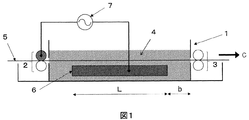
連続的に電解溶液中に搬送供給されるアルミニウム材として、例えばコイル状に巻かれた長尺のアルミニウム板材1を用いることができる。これを巻きほぐしながら電解槽に浸漬しつつ電解処理を行ない、電解処理したアルミニウム板材を電解槽外に巻き取る方法や;押出材や引抜材といった長尺のアルミニウム形材を送り出しながら電解槽に浸漬しつつ電解処理を行ない、電解処理した長尺のアルミニウム材を電解槽外に取り出す方法などが挙げられる。具体的に例示すれば、図1に示すように、電解槽1に搬入される前位置、ならびに、電解槽から搬出される後位置に、それぞれ一対の送りロール2、3を配設して、電解溶液4中にアルミニウム材5を通す。電解処理前のアルミニウム材5は、不図示のコイル状に巻かれたものが巻きほぐされながら電解槽1の前位置の一対のロール2を介して電解溶液4中に搬送供給される。一方、電解処理後のアルミニウム材5は、電解槽1の後位置の一対のロール3を介して不図示のロールに巻き回されてコイル状とされる。また、電解溶液4中には、搬送されるアルミニウム材5の一部と対向するように対電極6が配設される。対向するアルミニウム材5の表面と対電極6の対向面とは、平行となるように配設するのが好ましい。ここで、対電極6をアルミニウム材5の両面にそれぞれ配置すれば、アルミニウム材5の両面に効率的に電解処理を施すこともできる。なお、送りロール2を通じてアルミニウム材5と交流電源7が接続されている。また、アルミニウム材5の電極と対電極6は、交流電源7によって連続的に通電される。
As the aluminum material that is continuously conveyed and supplied into the electrolytic solution, for example, a long aluminum plate 1 wound in a coil shape can be used. Unwinding this, immersing it in the electrolytic bath, performing the electrolytic treatment, winding the electrolytically treated aluminum plate outside the electrolytic bath; immersing it in the electrolytic bath while feeding out a long aluminum shape such as extruded or drawn material However, there is a method of performing electrolytic treatment while taking out the long aluminum material subjected to electrolytic treatment out of the electrolytic cell. Specifically, as shown in FIG. 1, a pair of
また、アルミニウム材5と対電極6の配置は共に水平位置、水平位置から傾斜させた位置又は垂直位置のいずれの方法でもよい。更に、アルミニウム材5の電極と対電極6との電極間距離との電極間距離は2〜150mmが好ましく、より好ましくは、5〜100mmである。前記極間距離が2mm未満では、アルミニウム材5の電極と対電極6との間が狭くなり過ぎ、スパークが発生することがある上、近傍において発生するガスの気泡が散逸し難くなり板面にムラが生じることがある。前記極間距離が150mmを超えると、アルミニウム材5を搬送している際に、アルミニウム材5の電極と対電極6との極間に生じる液対流の影響が少なくなるため、電解皮膜の形成速度が極端に遅くなることがある。
Further, the
交流電解処理工程において、電解溶液として用いるアルカリ水溶液は、りん酸ナトリウム、りん酸水素カリウム、ピロりん酸ナトリウム、ピロりん酸カリウム及びメタりん酸ナトリウム等のりん酸塩や;水酸化ナトリウム及び水酸化カリウム等のアルカリ金属水酸化物や;炭酸ナトリウム、炭酸水素ナトリウム、炭酸カリウム等の炭酸塩や;水酸化アンモニウム;或いは、これらの混合物の水溶液を用いることができる。後述するように電解溶液のpHを特定の範囲に保つ必要があることから、バッファー効果の期待できるりん酸塩系物質を含有するアルカリ水溶液を用いるのが好ましい。このようなアルカリ成分の濃度は、電解溶液のpHが所望の値になるように調整されるが、通常、好ましくは1×10⁻⁴〜1モル/リットル、より好ましくは1×10−3〜0.8モル/リットルである。なお、これらのアルカリ性水溶液には、汚れ成分に対する除去能力の向上のために界面活性剤を添加してもよい。 The alkaline aqueous solution used as the electrolytic solution in the AC electrolytic treatment step includes phosphates such as sodium phosphate, potassium hydrogen phosphate, sodium pyrophosphate, potassium pyrophosphate and sodium metaphosphate; sodium hydroxide and hydroxide An alkali metal hydroxide such as potassium; carbonates such as sodium carbonate, sodium hydrogen carbonate, potassium carbonate; and ammonium hydroxide; or an aqueous solution of a mixture thereof can be used. Since it is necessary to keep the pH of the electrolytic solution in a specific range as will be described later, it is preferable to use an alkaline aqueous solution containing a phosphate-based substance that can be expected to have a buffer effect. The concentration of such an alkali component is adjusted so that the pH of the electrolytic solution becomes a desired value, but is usually preferably 1 × 10 −4 to 1 mol / liter, more preferably 1 × 10 −3 to 0.8 mol / liter. In addition, you may add surfactant to these alkaline aqueous solution for the improvement of the removal capability with respect to a soil component.
電解溶液のpHは9〜13とする必要があり、9.5〜12とするのが好ましい。pHが9未満の場合には、電解溶液のアルカリエッチング力が不足するため多孔性アルミニウム酸化皮膜層の多孔質構造が不完全となる。一方、pHが13を超えると、アルカリエッチング力が過剰になるため多孔性アルミニウム酸化皮膜層が成長し難くなり、更にバリア型アルミニウム酸化皮膜層の形成も阻害される。 The pH of the electrolytic solution needs to be 9 to 13, and preferably 9.5 to 12. When the pH is less than 9, the alkaline etching power of the electrolytic solution is insufficient, so that the porous structure of the porous aluminum oxide film layer is incomplete. On the other hand, when the pH exceeds 13, the alkaline etching power becomes excessive, so that the porous aluminum oxide film layer is difficult to grow, and the formation of the barrier type aluminum oxide film layer is further inhibited.
電解溶液温度は35〜85℃とする必要があり、40〜70℃とするのが好ましい。電解溶液温度が35℃未満では、アルカリエッチング力が不足するため多孔性アルミニウム酸化皮膜層の多孔質構造が不完全となる。一方、85℃を超えるとアルカリエッチング力が過剰になるため、多孔性アルミニウム酸化皮膜層及びバリア型アルミニウム酸化皮膜層ともに成長が阻害される。 The electrolytic solution temperature needs to be 35 to 85 ° C, preferably 40 to 70 ° C. When the electrolytic solution temperature is less than 35 ° C., the alkaline etching ability is insufficient, and the porous structure of the porous aluminum oxide film layer becomes incomplete. On the other hand, when the temperature exceeds 85 ° C., the alkaline etching force becomes excessive, and thus growth is inhibited in both the porous aluminum oxide film layer and the barrier type aluminum oxide film layer.
アルカリ交流電解においては、多孔性アルミニウム酸化皮膜層とバリア型アルミニウム酸化皮膜層を含めた酸化皮膜全体の厚さは、電気量、すなわち電流密度と電解時間の積によって制御され、基本的に電気量が多いほど酸化皮膜全体の厚さが増加する。このような観点から、多孔性アルミニウム酸化皮膜層及びバリア型アルミニウム酸化皮膜層の交流電解条件は以下の通りとする。 In alkaline alternating current electrolysis, the thickness of the entire oxide film including the porous aluminum oxide film layer and the barrier type aluminum oxide film layer is controlled by the quantity of electricity, that is, the product of the current density and the electrolysis time, and basically the quantity of electricity. As the amount increases, the thickness of the entire oxide film increases. From such a viewpoint, the AC electrolysis conditions of the porous aluminum oxide film layer and the barrier type aluminum oxide film layer are as follows.
用いる周波数は10〜100Hz、好ましくは20〜90Hzとする。10Hz未満では、電気分解としては直流的要素が高まる結果、多孔性アルミニウム酸化皮膜層の多孔質構造の形成が進行せず、緻密構造となってしまう。一方、100Hzを超えると、陽極と陰極の反転が速すぎるため、酸化皮膜全体の形成が極端に遅くなり、多孔性アルミニウム酸化皮膜層及びバリア型アルミニウム酸化皮膜層ともに、所定の厚さを得るには極めて長時間を要することになる。 The frequency used is 10 to 100 Hz, preferably 20 to 90 Hz. If the frequency is less than 10 Hz, a direct current element increases as electrolysis. As a result, the formation of the porous structure of the porous aluminum oxide film layer does not proceed, resulting in a dense structure. On the other hand, when the frequency exceeds 100 Hz, the reversal of the anode and the cathode is too fast, so that the formation of the entire oxide film becomes extremely slow, and both the porous aluminum oxide film layer and the barrier type aluminum oxide film layer have a predetermined thickness. Takes an extremely long time.
電流密度は4〜50A/dm2、好ましくは5〜45A/dm2とする。電流密度が4A/dm2未満では、バリア型アルミニウム酸化皮膜層のみが優先的に形成されるために多孔性アルミニウム酸化皮膜層が得られない。一方、50A/dm2を超えると、電流密度が過大になるため多孔性アルミニウム酸化皮膜層及びバリア型アルミニウム酸化皮膜層の厚さ制御が困難となり処理ムラが起こり易い。 The current density is 4 to 50 A / dm 2 , preferably 5 to 45 A / dm 2 . When the current density is less than 4 A / dm 2 , since only the barrier type aluminum oxide film layer is formed preferentially, a porous aluminum oxide film layer cannot be obtained. On the other hand, if it exceeds 50 A / dm 2 , the current density becomes excessive, so that it is difficult to control the thickness of the porous aluminum oxide film layer and the barrier type aluminum oxide film layer, and processing unevenness is likely to occur.
電解時間は5〜300秒、好ましくは10〜240秒とする。ここで、電解時間とは、図1において、電解溶液4中を移動するアルミニウム材5の所定位置が、対電極6の表面と対向している時間をいうものとする。図1に示すように、アルミニウム材5の搬送方向cに沿った対電極6の長さをL(mm)とし、アルミニウム材5の搬送速度をv(mm/秒)とすると、電解時間は(L/v)<秒>で表わされる。電解時間が5秒未満の処理時間では、多孔性アルミニウム酸化皮膜層及びバリア型アルミニウム酸化皮膜層の形成が急激過ぎるため、いずれの酸化皮膜層も十分に形成されず、不定形のアルミニウム酸化物から構成される酸化皮膜となるためである。一方、300秒を超えると、多孔性アルミニウム酸化皮膜層及びバリア型アルミニウム酸化皮膜層が厚くなり過ぎたり再溶解したりする虞があるだけでなく、生産性も低下する。
The electrolysis time is 5 to 300 seconds, preferably 10 to 240 seconds. Here, the electrolysis time refers to the time during which the predetermined position of the
アルミニウム材と対電極が連続的に通電されている処理に特有の規定として、上記電解時間が終了してから電解処理されたアルミニウム材部分に流れる電流密度が1A/dm2未満になるまでの時間が、10.0秒以下、好ましくは5.0秒以下となるようにする。また、この時間は0秒とするのが最も好ましい。後述するように、この時間が10.0秒を超えると、すなわち電解が終了した後も電解処理されたアルミニウム材部分に比較的弱い電流が流れ続けると、多孔性アルミニウム酸化皮膜層とバリア型アルミニウム酸化皮膜層の境界に亀裂が発生し易くなる。 As a rule peculiar to the process in which the aluminum material and the counter electrode are continuously energized, the time from the end of the electrolysis time until the current density flowing in the electrolytically treated aluminum material portion becomes less than 1 A / dm 2 Is set to 10.0 seconds or shorter, preferably 5.0 seconds or shorter. The time is most preferably 0 seconds. As will be described later, when this time exceeds 10.0 seconds, that is, when a relatively weak current continues to flow through the electrolytically treated aluminum material portion even after the electrolysis is finished, the porous aluminum oxide film layer and the barrier type aluminum Cracks are likely to occur at the boundary of the oxide film layer.
これは電解終了後、過渡的に弱い電流が流れ続けた場合、その電流によって多孔性アルミニウム酸化皮膜層の直下に不安定な酸化皮膜層が生成し、わずかな応力によって部分的に凝集破壊するためである。なお、電流密度が1A/dm2未満になるまでとしたのは、電流密度が1A/dm2未満まで低下すれば、このような不安定な酸化皮膜層がほとんど生成しないので上述する境界亀裂の発生は顕現しない。なお、ここで言う亀裂とは、多孔性アルミニウム酸化皮膜層とバリア型アルミニウム酸化皮膜層の境界に生じる凝集破壊した上記不安定な酸化皮膜層のことである。 This is because when a weak current continues to flow after the end of electrolysis, an unstable oxide film layer is generated immediately below the porous aluminum oxide film layer due to the current, and partial cohesive failure occurs due to slight stress. It is. The reason was until the current density is less than 1A / dm 2, if reduced current density to less than 1A / dm 2, the boundary fissure above since such unstable oxide layer does not generate almost The outbreak does not manifest. In addition, the crack said here is the said unstable oxide film layer which carried out the cohesive failure produced in the boundary of a porous aluminum oxide film layer and a barrier type aluminum oxide film layer.
こうした過渡的な電流密度の変化については直接的に測定することができないものの、電解設備の構成から計算することができる。具体的には、図1に示すように、アルミニウム材5の搬送方向に沿った対電極6の終端から同方向に沿った電解槽の終端までの距離をb(mm)、電解時の設定電流密度をI、アルミニウム材の搬送速度をv(mm/秒)とした場合、電流密度が1A/dm2を下回るまでの時間を{b(I−1)/vI}(秒)と見積もることが可能である。ここで、Iは上述のように、4〜50A/dm2の範囲とされるので、{b(I−1)/vI}が10.0秒以下となるようにbとvをそれぞれ適切に設定すればよい。なお、bが過大となるか、或いは、vが過小となると、上記メカニズムに基づいた亀裂発生を回避するのは困難である。
Although such a transient change in current density cannot be measured directly, it can be calculated from the configuration of the electrolytic equipment. Specifically, as shown in FIG. 1, the distance from the end of the counter electrode 6 along the conveying direction of the
なお、電流密度が1A/dm2未満になるまでの時間を10.0秒以下とすることで、多孔性アルミニウム酸化皮膜層とバリア型アルミニウム酸化皮膜層との境界の亀裂長さを当該境界長さの50%以下、好ましくは30%以下に抑制することができる。また、この比率は0%が最も好ましい。しかしながら、電流密度が1A/dm2未満になった後のアルミニウム材は、できるだけ早く電解溶液中から引き出すことが望ましい。すなわち、電解溶液はアルカリ性であるので、電解終了後もアルミニウム材を電解溶液中に浸漬し続けることで酸化皮膜の溶解が進行し、所定の皮膜厚さが得られない虞があるためである。 By setting the time until the current density is less than 1 A / dm 2 to 10.0 seconds or less, the crack length at the boundary between the porous aluminum oxide film layer and the barrier type aluminum oxide film layer is determined as the boundary length. 50% or less, preferably 30% or less. Further, this ratio is most preferably 0%. However, it is desirable that the aluminum material after the current density becomes less than 1 A / dm 2 is drawn out from the electrolytic solution as soon as possible. That is, since the electrolytic solution is alkaline, dissolution of the oxide film proceeds by continuing to immerse the aluminum material in the electrolytic solution even after completion of electrolysis, and a predetermined film thickness may not be obtained.
なお、本発明に係る製造方法において、酸化皮膜の厚み変動を小さくする目的で、電解溶液に含有される溶存アルミニウム濃度を、好ましくは5ppm以上1000ppm以下、より好ましくは10ppm以上900ppm以下に規制しても良い。溶存アルミニウム濃度が5ppm未満の場合は、電解反応初期における酸化皮膜の形成反応が急激に生起するため、処理工程のバラツキ(アルミニウム材表面の汚れ状態やアルミニウム材の取り付け状態など)の影響を受け易い。その結果、局部的に厚い酸化皮膜が形成されることになる。一方、溶存アルミニウム濃度が1000ppmを超える場合は、電解溶液の粘度が増大して電解工程においてアルミニウム材表面付近の均一な対流が妨げられるのと同時に、溶存アルミニウムが皮膜形成を抑制する方向に作用する。その結果、局部的に薄い酸化皮膜が形成されることになる。 In the production method according to the present invention, for the purpose of reducing the thickness variation of the oxide film, the concentration of dissolved aluminum contained in the electrolytic solution is preferably regulated to 5 ppm to 1000 ppm, more preferably 10 ppm to 900 ppm. Also good. When the dissolved aluminum concentration is less than 5 ppm, the formation reaction of the oxide film at the initial stage of the electrolytic reaction takes place rapidly, so that it is easily affected by variations in the treatment process (such as the contamination state of the aluminum material surface and the attachment state of the aluminum material). . As a result, a locally thick oxide film is formed. On the other hand, when the dissolved aluminum concentration exceeds 1000 ppm, the viscosity of the electrolytic solution increases, and uniform convection near the surface of the aluminum material is hindered in the electrolysis process, and at the same time, dissolved aluminum acts in a direction to suppress film formation. . As a result, a thin oxide film is locally formed.
交流電解処理に使用する一対の電極のうち一方の電極は、電解処理されるべきアルミニウム材である。他方の対電極としては、例えば、黒鉛、アルミニウム、チタン等の公知の電極を用いることができるが、本発明においては、電解溶液のアルカリ成分や温度に対して劣化せず、導電性に優れ、更に、それ自身が電気化学的反応を起こさない材質のものを使用する必要がある。このような点から、対電極としては黒鉛電極が好適に用いられる。これは、黒鉛電極が化学的に安定であり、かつ、安価で入手が容易であることに加え、黒鉛電極に存在する多くの気孔の作用により交流電解工程において電気力線が適度に拡散するため、多孔性アルミニウム酸化皮膜層及びバリア型アルミニウム酸化皮膜層が共により均一になり易いためである。 One electrode of the pair of electrodes used for the alternating current electrolytic treatment is an aluminum material to be electrolytically treated. As the other counter electrode, for example, a known electrode such as graphite, aluminum, titanium, etc. can be used, but in the present invention, it does not deteriorate with respect to the alkaline component or temperature of the electrolytic solution, and has excellent conductivity, Furthermore, it is necessary to use a material which does not cause an electrochemical reaction. From such points, a graphite electrode is preferably used as the counter electrode. This is because the graphite electrode is chemically stable, inexpensive and easily available, and due to the action of many pores existing in the graphite electrode, the electric lines of force diffuse moderately in the AC electrolysis process. This is because the porous aluminum oxide film layer and the barrier type aluminum oxide film layer tend to be more uniform.
C.酸化皮膜
本発明に用いるアルミニウム材の表面には、表面側に形成された多孔性アルミニウム酸化皮膜層と素地側に形成されたバリア型アルミニウム酸化皮膜層とが設けられている。すなわち、アルミニウム材表面には、多孔性アルミニウム酸化皮膜層とバリア型アルミニウム酸化皮膜層の二層によって構成される酸化皮膜が設けられている。多孔性アルミニウム酸化皮膜層が強力な接着性や密着性を発揮する一方で、バリア型アルミニウム酸化皮膜層によって、アルミニウム酸化皮膜層全体とアルミニウム素地を強固に結合する。さらに、多孔性アルミニウム酸化皮膜層とバリア型アルミニウム酸化皮膜層の境界に生じた亀裂の長さを同境界長さの50%以下とすることで、多孔性アルミニウム酸化皮膜層の脱落を抑制することができる。
C. Oxide Film A surface of the aluminum material used in the present invention is provided with a porous aluminum oxide film layer formed on the surface side and a barrier type aluminum oxide film layer formed on the substrate side. That is, an oxide film composed of two layers of a porous aluminum oxide film layer and a barrier type aluminum oxide film layer is provided on the surface of the aluminum material. While the porous aluminum oxide film layer exhibits strong adhesion and adhesion, the entire aluminum oxide film layer and the aluminum substrate are firmly bonded by the barrier type aluminum oxide film layer. Furthermore, the drop of the porous aluminum oxide film layer is suppressed by setting the length of the crack generated at the boundary between the porous aluminum oxide film layer and the barrier type aluminum oxide film layer to 50% or less of the boundary length. Can do.
C−1.多孔性アルミニウム酸化皮膜層
多孔性アルミニウム酸化皮膜層の厚さは、20〜500nm、好ましくは50〜400nmである。20nm未満では厚さが十分でないため、後述する小孔構造の形成が不十分になり易く接着力や密着力が低下する。一方、500nmを超えると、多孔性アルミニウム酸化皮膜層自体が凝集破壊し易くなり接着力や密着力が低下する。
C-1. Porous aluminum oxide film layer The thickness of the porous aluminum oxide film layer is 20 to 500 nm, preferably 50 to 400 nm. If the thickness is less than 20 nm, the thickness is not sufficient, so that the formation of a small pore structure, which will be described later, is likely to be insufficient, and the adhesive force and adhesion force are reduced. On the other hand, when the thickness exceeds 500 nm, the porous aluminum oxide film layer itself tends to cohesively break down, and the adhesive force and adhesion force are reduced.
多孔性アルミニウム酸化皮膜層は、その表面から深さ方向に向かう小孔を備える。小孔の直径は5〜30nmであり、好ましくは10〜20nmである。この小孔は、樹脂層や接着剤などとアルミニウム酸化皮膜との接触面積を増大させ、その接着力や密着力を増大させる効果を発揮するものである。小孔の直径が5nm未満であると、接触面積が不足するため十分な接着力や密着力が得られない。一方、小孔の直径が30nmを超えると、多孔性アルミニウム酸化皮膜層全体が脆くなって凝集破壊を生じ接着力や密着力が低下する。 A porous aluminum oxide-film layer is provided with the small hole which goes to the depth direction from the surface. The diameter of the small holes is 5 to 30 nm, preferably 10 to 20 nm. This small hole increases the contact area between the resin layer, the adhesive, and the like and the aluminum oxide film, and exhibits the effect of increasing the adhesive force and the adhesive force. If the diameter of the small hole is less than 5 nm, the contact area is insufficient, and sufficient adhesive force and adhesion force cannot be obtained. On the other hand, if the diameter of the small holes exceeds 30 nm, the entire porous aluminum oxide film layer becomes brittle and causes cohesive failure, resulting in a decrease in adhesion and adhesion.
多孔性アルミニウム酸化皮膜層の表面積に対する小孔の全孔面積の比については、特に制限されるものではない。多孔性アルミニウム酸化皮膜層の見かけ上の表面積(表面の微小な凹凸等を考慮せず、長さと幅の乗算で表される面積)に対する小孔の全孔面積の比として、25〜75%が好ましく、30〜70%がより好ましい。25%未満では、接触面積が不足して十分な接着力や密着力が得られない場合がある。一方、75%を超えると、多孔性アルミニウム酸化皮膜層全体が脆くなって凝集破壊を生じ接着力や密着力が低下する場合がある。 The ratio of the total pore area of the small holes to the surface area of the porous aluminum oxide film layer is not particularly limited. The ratio of the total pore area of the small pores to the apparent surface area of the porous aluminum oxide film layer (the area represented by multiplication of the length and width without considering minute irregularities on the surface) is 25 to 75%. Preferably, 30 to 70% is more preferable. If it is less than 25%, the contact area may be insufficient and sufficient adhesive force or adhesion may not be obtained. On the other hand, if it exceeds 75%, the entire porous aluminum oxide film layer becomes brittle and may cause cohesive failure, resulting in a decrease in adhesion and adhesion.
C−2.バリア型アルミニウム酸化皮膜層
バリア型アルミニウム酸化皮膜層の厚さは、3〜30nm、好ましくは5〜25nmである。3nm未満では、介在層として多孔性アルミニウム酸化皮膜層とアルミニウム素地との結合に十分な結合力を付与することができず、特に、高温・多湿等の過酷環境における結合力が不十分となる。一方、30nmを超えると、その緻密性ゆえにバリア型アルミニウム酸化皮膜層が凝集破壊し易くなり、かえって接着力や密着力が低下する。
C-2. Barrier type aluminum oxide film layer The thickness of the barrier type aluminum oxide film layer is 3 to 30 nm, preferably 5 to 25 nm. If the thickness is less than 3 nm, a sufficient bonding force cannot be imparted to the bonding between the porous aluminum oxide film layer and the aluminum substrate as the intervening layer, and the bonding force particularly in a severe environment such as high temperature and high humidity becomes insufficient. On the other hand, if the thickness exceeds 30 nm, the barrier type aluminum oxide film layer tends to cohesively break due to its denseness, and on the contrary, the adhesive strength and the adhesive strength are lowered.
C−3.多孔性アルミニウム酸化皮膜層とバリア型アルミニウム酸化皮膜層の境界に生じた亀裂
C−1及びC−2にて規定された酸化皮膜は、連続的に形成されていることが望ましく、それらの間に生じた亀裂長さはこの境界の全長の50%以下、好ましくは30%以下、最も好ましくは0%となることが求められる。電解条件との関係では、電解時間が終了してから電解処理されたアルミニウム材部分に流れる電流密度が1A/dm2未満になるまでの時間を10.0秒以下とすることにより、このような境界全長に対する亀裂長さの比率が達成される。上記比率が50%を上回った場合、この亀裂を起点とした酸化皮膜全体の脱落が容易に生じ、樹脂密着性の著しい低下をもたらす。ここで、亀裂長さの境界の全長に対する比率とは、具体的には以下のようにして決定される。すなわち、上述の亀裂は電解時間終了後の電流減衰挙動に起因する不安定な酸化皮膜層が部分的に凝集破壊するものであり、多孔性アルミニウム酸化皮膜層とバリア型アルミニウム酸化皮膜層の境界に平行して発生する。ここで、境界の全長(M)に対する亀裂長さ(m)を後述の断面TEM観察等で観察し、(m/M)として規定することができる。
C-3. Cracks formed at the boundary between the porous aluminum oxide film layer and the barrier-type aluminum oxide film layer The oxide film defined by C-1 and C-2 is preferably formed continuously, The generated crack length is required to be 50% or less, preferably 30% or less, and most preferably 0% of the total length of the boundary. In relation to the electrolysis conditions, the time from the end of the electrolysis time until the current density flowing through the electrolytically treated aluminum material portion becomes less than 1 A / dm 2 is set to 10.0 seconds or less. A ratio of crack length to total boundary length is achieved. When the ratio exceeds 50%, the oxide film as a whole starts to drop off easily starting from this crack, resulting in a significant decrease in resin adhesion. Here, the ratio of the crack length boundary to the total length is specifically determined as follows. That is, the above-mentioned crack is a phenomenon in which the unstable oxide film layer due to the current decay behavior after the end of the electrolysis time is partially agglomerated and broken at the boundary between the porous aluminum oxide film layer and the barrier type aluminum oxide film layer. It occurs in parallel. Here, the crack length (m) with respect to the full length (M) of the boundary can be observed by a cross-sectional TEM observation or the like described later, and can be defined as (m / M).
C−4.酸化皮膜の全体厚さの変動幅
酸化皮膜全体の厚さ、すなわち、C−1に記載の多孔性アルミニウム酸化皮膜層とC−2に記載のバリア型アルミニウム酸化皮膜層との厚さの合計は、アルミニウム材のいかなる場所で測定しても、その変動幅が±50%以内であることが好ましく、±20%以内であることが更に好ましい。すなわち、アルミニウム材表面における任意の複数箇所(10箇所以上が望ましく、これら各箇所においても10点以上の測定点とするのが望ましい)で測定した酸化皮膜全体厚さの算術平均をT(nm)とした場合、これら複数測定箇所における酸化皮膜全体厚さが(0.5×T)〜(1.5×T)の範囲にあることが好ましい。(0.5×T)未満の箇所が存在すると、その箇所の酸化皮膜がその周囲より薄くなる。そうすると、この薄い箇所では、接着すべき接着剤や密着すべき樹脂層などと酸化皮膜との間に隙間が生じ易くなり、十分な接触面積を確保できずに接着力や密着力が低下する場合がある。一方、(1.5×T)を超える箇所が存在すると、その箇所の酸化皮膜が周囲より厚くなる。そうすると、この厚い箇所では、密着すべき樹脂層などからの応力が集中し、酸化皮膜での凝集破壊を誘発して接着力や密着力が低下する場合がある。
C-4. Variation width of the total thickness of the oxide film The total thickness of the oxide film, that is, the total thickness of the porous aluminum oxide film layer described in C-1 and the barrier-type aluminum oxide film layer described in C-2 is Even if it is measured at any location of the aluminum material, the fluctuation range is preferably within ± 50%, and more preferably within ± 20%. That is, the arithmetic average of the total thickness of the oxide film measured at any plurality of locations on the aluminum material surface (preferably 10 locations or more and preferably 10 or more measurement points in each location) is T (nm). In this case, it is preferable that the total thickness of the oxide film at these multiple measurement locations is in the range of (0.5 × T) to (1.5 × T). When a location less than (0.5 × T) exists, the oxide film at that location becomes thinner than the surrounding area. Then, in this thin part, gaps are likely to occur between the oxide film and the adhesive to be adhered or the resin layer to be adhered, and the adhesive force and adhesion force are reduced without securing a sufficient contact area. There is. On the other hand, if there is a location exceeding (1.5 × T), the oxide film at that location becomes thicker than the surroundings. Then, in this thick portion, stress from a resin layer or the like to be in close contact is concentrated, and cohesive failure in the oxide film may be induced to reduce the adhesive force or the adhesive force.
なお、上記のような酸化皮膜の全体厚さが薄い箇所や厚い箇所では、周囲と比較して光学的特性が異なるため、茶褐色や白濁色といった色調の変化として目視可能な場合がある。 In addition, since the optical characteristics are different in the portion where the total thickness of the oxide film as described above is thin or thick, it may be visible as a change in color tone such as brownish brown or cloudy color.
D.酸化皮膜の観察手段
本発明における多孔性アルミニウム酸化皮膜層とバリア型アルミニウム酸化皮膜層の構造観察と厚さの測定、ならびに、多孔性アルミニウム酸化皮膜層とバリア型アルミニウム酸化皮膜層の境界に生じた亀裂の長さの測定には、透過型電子顕微鏡(TEM)による断面観察が好適に用いられる。具体的には、ウルトラミクロトームや集束イオンビーム(FIB)加工装置等により厚み方向に垂直な方向に沿って切り出した薄片試料を作製する。次いで、これをTEM観察する。薄片試料の作製にあたっては、対象物に亀裂が生じている可能性があるため、FIB加工装置を用いることがより好ましい。また亀裂長さの測定及び比率計算にあたっては、TEM観察倍率を低め(5000〜10000倍程度)に設定するとともに、複数視野を観察することによって定量化することができる。
D. Oxidation film observation means Structure observation and thickness measurement of porous aluminum oxide film layer and barrier type aluminum oxide film layer in the present invention, and occurred at the boundary between porous aluminum oxide film layer and barrier type aluminum oxide film layer For measurement of the crack length, cross-sectional observation with a transmission electron microscope (TEM) is preferably used. Specifically, a thin piece sample cut out along a direction perpendicular to the thickness direction is produced by an ultramicrotome, a focused ion beam (FIB) processing apparatus, or the like. Then, this is observed by TEM. In producing the thin piece sample, it is more preferable to use the FIB processing apparatus because there is a possibility that the object is cracked. In measuring the crack length and calculating the ratio, the TEM observation magnification can be set low (about 5000 to 10,000 times) and quantified by observing a plurality of visual fields.
E.表面処理アルミニウム材と樹脂との接合体
上記のようにして製造される表面処理アルミニウム材はその優れた接着性により、酸化皮膜を形成した処理面に更に樹脂を被覆することで、様々な用途に応じて使用できる。ここで、樹脂は、熱硬化性樹脂でも、熱可塑性樹脂でもどちらも用いることができ、本発明に係る表面処理アルミニウム材における処理面に形成される特定の酸化皮膜と相まって、様々な効果が付与される。
E. Bonded body of surface-treated aluminum material and resin The surface-treated aluminum material produced as described above can be used for various applications by coating the treated surface with an oxide film on the treated surface due to its excellent adhesion. Can be used as required. Here, either a thermosetting resin or a thermoplastic resin can be used as the resin, and various effects are imparted in combination with a specific oxide film formed on the treated surface of the surface-treated aluminum material according to the present invention. Is done.
例えば、アルミニウム材と樹脂との接合体は、アルミニウム材に比べて樹脂の熱膨張率が一般に大きいことから、界面において剥離や割れが発生し易い。しかしながら、本発明に係る表面処理アルミニウム材と樹脂との接合体においては、本発明における酸化皮膜は非常に薄く、かつ、上述したように特定の形状を成すので、柔軟性に優れ、樹脂の膨張に追従し易く、剥離や割れが発生し難くい。このように、本発明に係る表面処理アルミニウム材と熱可塑性樹脂との接合体は、軽量、高剛性の複合材料として好適に用いることができる。また、本発明に係る表面処理アルミニウム材と熱硬化性樹脂との接合体は、プリント配線基板用途として好適に用いることができる。 For example, since a bonded body of an aluminum material and a resin generally has a higher thermal expansion coefficient than that of an aluminum material, peeling and cracking are likely to occur at the interface. However, in the joined body of the surface-treated aluminum material and the resin according to the present invention, the oxide film in the present invention is very thin and has a specific shape as described above. It is easy to follow, and peeling and cracking are hard to occur. Thus, the joined body of the surface-treated aluminum material and the thermoplastic resin according to the present invention can be suitably used as a lightweight and highly rigid composite material. Moreover, the joined body of the surface-treated aluminum material and the thermosetting resin according to the present invention can be suitably used as a printed wiring board application.
上記樹脂としては、各種の熱可塑性樹脂及び熱硬化性樹脂を用いることができる。具体的には、熱可塑性樹脂においては、熱を加えて流動状態とした樹脂を多孔性アルミニウム酸化皮膜層に接触・浸透させ、これを冷却固化することにより樹脂層が形成される。熱可塑性樹脂としては、例えば、ポリオレフィン(ポリエチレン、ポリプロピレン等)、ポリ塩化ビニル、ポリエステル(ポリエチレンテレフタレート、ポリブチレンテレフタレート等)、ポリアミド、ポリフェニレンスルファイド、芳香族ポリエーテルケトン(ポリエーテルエーテルケトン、ポリエーテルケトン等)、ポリスチレン、各種フッ素樹脂(ポリテトラフルオロエチレン、ポリクロロトリフルオロエチレン等)、アクリル樹脂(ポリメタクリル酸メチル等)、ABS樹脂、ポリカーボネート、熱可塑性ポリイミド等を用いることができる。 As the resin, various thermoplastic resins and thermosetting resins can be used. Specifically, in a thermoplastic resin, a resin layer is formed by contacting and infiltrating a porous aluminum oxide film layer with a resin in a fluid state by applying heat, and cooling and solidifying it. Examples of the thermoplastic resin include polyolefin (polyethylene, polypropylene, etc.), polyvinyl chloride, polyester (polyethylene terephthalate, polybutylene terephthalate, etc.), polyamide, polyphenylene sulfide, aromatic polyether ketone (polyether ether ketone, polyether). Ketone, etc.), polystyrene, various fluororesins (polytetrafluoroethylene, polychlorotrifluoroethylene, etc.), acrylic resins (polymethyl methacrylate, etc.), ABS resin, polycarbonate, thermoplastic polyimide, etc. can be used.
また、熱硬化性樹脂においては、硬化前の流動性を有する状態において多孔性アルミニウム酸化皮膜層に接触・浸透させ、これをその後に硬化させればよい。熱硬化性樹脂としては、例えば、フェノール樹脂、エポキシ樹脂、メラミン樹脂、尿素樹脂、不飽和ポリエステル樹脂、アルキド樹脂、ポリウレタン、熱硬化性ポリイミド等を用いることができる。 Moreover, in a thermosetting resin, what is necessary is just to make it contact and osmose | permeate a porous aluminum oxide film layer in the state which has the fluidity | liquidity before hardening, and to harden this after that. As the thermosetting resin, for example, phenol resin, epoxy resin, melamine resin, urea resin, unsaturated polyester resin, alkyd resin, polyurethane, thermosetting polyimide and the like can be used.
なお、上記熱可塑性樹脂と熱硬化性樹脂は、それぞれを単一で用いてもよく、複数種の熱可塑性樹脂又は複数種の熱硬化性樹脂を混合したポリマーアロイとして用いてもよい。また、各種フィラーを添加することで、樹脂の強度や熱膨張率等の物性を改善してもよい。具体的には、ガラス繊維、炭素繊維、アラミド繊維等の各種繊維や、炭酸カルシウム、炭酸マグネシウム、シリカ、タルク、ガラス、粘土等の公知物質のフィラーを用いることができる。 The thermoplastic resin and the thermosetting resin may be used singly or as a polymer alloy in which a plurality of types of thermoplastic resins or a plurality of types of thermosetting resins are mixed. Moreover, you may improve physical properties, such as the intensity | strength of a resin, and a thermal expansion coefficient, by adding various fillers. Specifically, various fibers such as glass fiber, carbon fiber, and aramid fiber, and fillers of known substances such as calcium carbonate, magnesium carbonate, silica, talc, glass, and clay can be used.
以下、実施例に基づいて本発明の好適な実施の形態を具体的に説明する。
本発明例1〜24及び比較例1〜12
Hereinafter, preferred embodiments of the present invention will be described specifically based on examples.
Invention Examples 1 to 24 and Comparative Examples 1 to 12
アルミニウム材として、幅200mm×板厚1.0mmのコイル状のJIS5052−H34合金板を使用した。このアルミニウム合金板を一方の電極に用い、対電極には幅300mm×長さ10mm×板厚2.0mmの平板形状を有する黒鉛板を用いた。図1に示すように、アルミニウム合金板5の片面を対電極6に対面させ、この対面した片面表層に、表面側の多孔性アルミニウム酸化皮膜層と素地側のバリア型アルミニウム酸化皮膜層が形成されるように、両電極を電解槽1に入れた電解溶液4中に配置した。電解溶液4には、ピロりん酸ナトリウムを主成分とするアルカリ水溶液を用いた。電解溶液のアルカリ成分濃度は、0.5モル/リットルとするとともに、塩酸及び水酸化ナトリウム水溶液(いずれも濃度0.1モル/リットル)によってpHの調整を行なった。表1、2に示す電解条件にて交流電解処理を実施して多孔性アルミニウム酸化皮膜層及びバリア型アルミニウム酸化皮膜層を形成した供試材を作製した。電解時間は、対電極長さ及び材料の搬送速度を変化させて調整した。なお、表1、2には、アルミニウム材の電極と対電極との電極間距離aも記載した。
As the aluminum material, a coiled JIS5052-H34 alloy plate having a width of 200 mm and a plate thickness of 1.0 mm was used. This aluminum alloy plate was used as one electrode, and a graphite plate having a flat plate shape of width 300 mm × length 10 mm × plate thickness 2.0 mm was used as the counter electrode. As shown in FIG. 1, one side of an
以上のようにして作製した供試材に対し、TEMによる断面観察を実施した。TEM断面観察においては、多孔性アルミニウム酸化皮膜層とバリア型アルミニウム酸化皮膜層の厚さ、多孔性アルミニウム酸化皮膜層の小孔の直径及び多孔性アルミニウム酸化皮膜層とバリア型アルミニウム酸化皮膜層の境界に発生した亀裂の長さを測定するために、FIB加工装置を用いて同じ供試材から断面観察用薄片試料を10個作製した。 A cross-sectional observation by TEM was performed on the specimen prepared as described above. In TEM cross-sectional observation, the thickness of the porous aluminum oxide film layer and the barrier type aluminum oxide film layer, the diameter of the small holes in the porous aluminum oxide film layer, and the boundary between the porous aluminum oxide film layer and the barrier type aluminum oxide film layer In order to measure the length of the cracks generated in the sample, ten slice specimens for cross-sectional observation were prepared from the same specimen using an FIB processing apparatus.
多孔性アルミニウム酸化皮膜層とバリア型アルミニウム酸化皮膜層の厚さ、ならびに、多孔性アルミニウム酸化皮膜層の小孔の直径は、上記試料それぞれについて任意の10点を選択して測定し、各点の測定結果から同一の試料について合計100点の測定値の算術平均値として決定した。また、亀裂の長さについても、上記試料それぞれについて任意の10点を選択して測定し、各点の測定結果から同一の試料について合計100点の測定値の算術平均値として決定した。なお、亀裂の長さの測定では、TEMの観察視野を1μm×1μmに設定した。上述のように、このようにして得られた亀裂長さを、多孔性アルミニウム酸化皮膜層とバリア型アルミニウム酸化皮膜層の境界長さで除算し、亀裂長さ比とした。さらに、酸化皮膜全体の厚さ(多孔性アルミニウム酸化皮膜層とバリア型アルミニウム酸化皮膜層の合計厚さ)のばらつき判定として、上記測定点100点(試料10個×測定点10点)のうち、算術平均値の50%以上150%以内となる測定点の数を記録した。結果を表3、4に示す。 The thickness of the porous aluminum oxide film layer and the barrier type aluminum oxide film layer, and the diameter of the small holes in the porous aluminum oxide film layer were measured by selecting 10 points for each of the above samples. From the measurement result, the same sample was determined as an arithmetic average value of a total of 100 measured values. Further, the length of cracks was also measured by selecting arbitrary 10 points for each of the above samples, and determined as an arithmetic average value of a total of 100 measured values for the same sample from the measurement results at each point. In the measurement of the crack length, the observation field of TEM was set to 1 μm × 1 μm. As described above, the crack length thus obtained was divided by the boundary length between the porous aluminum oxide film layer and the barrier-type aluminum oxide film layer to obtain a crack length ratio. Furthermore, as a variation determination of the thickness of the entire oxide film (total thickness of the porous aluminum oxide film layer and the barrier type aluminum oxide film layer), among the 100 measurement points (10 samples × 10 measurement points), The number of measurement points that were 50% or more and 150% or less of the arithmetic average value was recorded. The results are shown in Tables 3 and 4.
上記供試材に対し、以下の方法にて接着剤を用いた接着性を評価した。 The adhesiveness using the adhesive agent was evaluated by the following method with respect to the test material.
〔一次密着性試験〕
上記供試材から、長さ50mm、幅25mmに切断したものを2枚用意した。これら2枚の供試材同士を全幅方向に重ね合わせつつ、長さ方向には幅10mmをもって重ね合わせ、市販の2液型エポキシ接着剤(ニチバン株式会社製、アラルダイトラピッド、型番:AR−R30、重量混合比=主剤100/硬化剤100)によって重ね合わせ部分を接着し、せん断試験片を作製した。せん断試験片の長さ方向の両端部を引張試験機により100mm/分の速度にて長さ方向に沿って反対向きに引張り、その荷重(せん断応力に換算)と剥離状態によって接着性を下記の基準で評価した。なお、せん断試験片は同じ供試材から10組の試験片を作製して、それぞれについて評価した。
○:せん断応力が20N/mm2以上で、かつ、接着剤層自身が凝集破壊した状態
△:せん断応力が20N/mm2以上であるものの、接着剤層と供試材が界面剥離した状態
×:せん断応力が20N/mm2未満で、かつ、接着剤層と供試材が界面剥離した状態
[Primary adhesion test]
Two pieces of the above-mentioned specimens cut to a length of 50 mm and a width of 25 mm were prepared. While superposing these two specimens in the full width direction, they are superposed with a width of 10 mm in the length direction, and a commercially available two-component epoxy adhesive (manufactured by Nichiban Co., Ltd., Araldai Rapid, model number: AR-R30, The overlapped portion was bonded by weight mixing ratio = main agent 100 / curing agent 100) to prepare a shear test piece. Both ends in the length direction of the shear test piece were pulled in the opposite direction along the length direction at a speed of 100 mm / min with a tensile tester, and the adhesiveness was changed according to the load (converted to shear stress) and the peeled state as follows. Evaluated by criteria. In addition, the shear test piece produced 10 sets of test pieces from the same test material, and evaluated each.
○: The shear stress is 20 N / mm 2 or more and the adhesive layer itself is agglomerated and broken Δ: The shear stress is 20 N / mm 2 or more, but the adhesive layer and the test material are separated at the interface × : Shear stress is less than 20 N / mm 2 , and the adhesive layer and the test material are peeled off at the interface
結果を表5、6に示す。同表には、10組の試験片のうちの上記○、△、×の組数をそれぞれ示すが、10組の全てが○の場合を判定が合格とし、それ以外を判定が不合格とした。 The results are shown in Tables 5 and 6. The table shows the number of the above-mentioned ○, Δ, and × of the 10 test pieces, respectively, but if all 10 sets are ○, the judgment is acceptable, and the others are judged as unacceptable. .
本発明例1〜24ではいずれも、酸化皮膜が本発明の規定を満たすため、一次密着性がいずれも合格判定であった。これに対して比較例1〜12では、下記の理由により不合格判定となった。 In any of Invention Examples 1 to 24, since the oxide film satisfied the provisions of the present invention, the primary adhesion was all judged as acceptable. On the other hand, in Comparative Examples 1-12, it became a rejection determination for the following reason.
比較例1では、交流電解処理における電解溶液のpHが低過ぎたため、アルカリエッチング力が不足した。そのため、多孔性アルミニウム酸化皮膜層の小孔直径が不足し、一次密着性が不合格であった。 In Comparative Example 1, the alkaline etching power was insufficient because the pH of the electrolytic solution in the alternating current electrolytic treatment was too low. Therefore, the small hole diameter of the porous aluminum oxide film layer was insufficient, and the primary adhesion was unacceptable.
比較例2では、交流電解処理における電解溶液のpHが高過ぎたため、アルカリエッチング力が過剰になった。そのため、多孔性アルミニウム酸化皮膜層及びバリア型アルミニウム酸化皮膜層の厚さが不足し、また多孔性アルミニウム皮膜の小孔直径が過大となり、一次密着性が不合格であった。 In Comparative Example 2, the alkaline etching power became excessive because the pH of the electrolytic solution in the alternating current electrolytic treatment was too high. Therefore, the thickness of the porous aluminum oxide film layer and the barrier type aluminum oxide film layer was insufficient, and the pore diameter of the porous aluminum film was excessive, and the primary adhesion was not acceptable.
比較例3では、交流電解処理における電解溶液の温度が低過ぎたため、アルカリエッチング力が不足した。そのため、多孔性アルミニウム酸化皮膜層の多孔質構造が不完全となり小孔直径が不足し、一次密着性が不合格であった。 In Comparative Example 3, the alkaline etching power was insufficient because the temperature of the electrolytic solution in the alternating current electrolytic treatment was too low. Therefore, the porous structure of the porous aluminum oxide film layer was incomplete, the small pore diameter was insufficient, and the primary adhesion was not acceptable.
比較例4では、交流電解処理における電解溶液の温度が高過ぎたため、アルカリエッチング力が過剰になった。そのため、多孔性アルミニウム皮膜層及びバリア型アルミニウム酸化皮膜層の厚さが不足し、一次密着性が不合格であった。 In Comparative Example 4, since the temperature of the electrolytic solution in the alternating current electrolytic treatment was too high, the alkali etching power became excessive. Therefore, the thickness of the porous aluminum coating layer and the barrier type aluminum oxide coating layer was insufficient, and the primary adhesion was not acceptable.
比較例5では、交流電解処理における周波数が低過ぎたため、電気的状態が直流電解に近づいた。そのため、多孔性アルミニウム酸化皮膜層の形成が進行せず、また小孔も形成されず、バリア型アルミニウム酸化皮膜層の厚さが過大となった。そのため、一次密着性が不合格であった。 In Comparative Example 5, since the frequency in the alternating current electrolysis treatment was too low, the electrical state approached direct current electrolysis. For this reason, the formation of the porous aluminum oxide film layer did not proceed and no small holes were formed, and the thickness of the barrier type aluminum oxide film layer was excessive. Therefore, primary adhesiveness was disqualified.
比較例6では、交流電解処理における周波数が高過ぎたため、陽極と陰極の反転が速過ぎた。そのため、多孔性アルミニウム酸化皮膜層の形成が極端に遅くなりその厚さが不足し、一次密着性が不合格であった。 In Comparative Example 6, since the frequency in the alternating current electrolytic treatment was too high, the anode and the cathode were reversed too quickly. Therefore, the formation of the porous aluminum oxide film layer was extremely slow, the thickness thereof was insufficient, and the primary adhesion was unacceptable.
比較例7では、交流電解処理における電流密度が低過ぎたため、バリア型アルミニウム酸化皮膜層が優先的に形成された。そのため、多孔性アルミニウム酸化皮膜層の厚さが不足し、一次密着性が不合格であった。 In Comparative Example 7, since the current density in the alternating current electrolytic treatment was too low, the barrier type aluminum oxide film layer was preferentially formed. Therefore, the thickness of the porous aluminum oxide film layer was insufficient, and the primary adhesion was not acceptable.
比較例8では、交流電解処理における電流密度が高過ぎたため、電解処理において電解溶液中にスパークが発生する等、制御が不安定になった。そのため、酸化膜全体が過剰に形成され、多孔性アルミニウム酸化皮膜層及びバリア型アルミニウム酸化皮膜層の厚さが過大となった。その結果、一次密着性が不合格であった。 In Comparative Example 8, since the current density in the alternating current electrolysis treatment was too high, the control became unstable, for example, sparks were generated in the electrolytic solution during the electrolysis treatment. For this reason, the entire oxide film was excessively formed, and the thicknesses of the porous aluminum oxide film layer and the barrier type aluminum oxide film layer were excessive. As a result, the primary adhesion was unacceptable.
比較例9では、交流電解処理における電解処理時間が短過ぎたため、多孔性アルミニウム酸化皮膜層及びバリア型アルミニウム酸化皮膜層が十分に形成されなかった。そのため、多孔性アルミニウム酸化皮膜層及びバリア型アルミニウム酸化皮膜層の厚さが不足し、一次密着性が不合格であった。 In Comparative Example 9, since the electrolytic treatment time in the alternating current electrolytic treatment was too short, the porous aluminum oxide film layer and the barrier type aluminum oxide film layer were not sufficiently formed. Therefore, the thickness of the porous aluminum oxide film layer and the barrier type aluminum oxide film layer was insufficient, and the primary adhesion was not acceptable.
比較例10では、交流電解処理における電解処理時間が長過ぎたため、酸化膜全体が過剰に形成された。そのため、多孔性アルミニウム酸化皮膜層及びバリア型アルミニウム酸化皮膜層が厚くなり過ぎ、一次密着性が不合格であった。 In Comparative Example 10, since the electrolytic treatment time in the alternating current electrolytic treatment was too long, the entire oxide film was excessively formed. Therefore, the porous aluminum oxide film layer and the barrier type aluminum oxide film layer were too thick, and the primary adhesion was not acceptable.
比較例11及び12では、多孔性アルミニウム酸化皮膜層及びバリア型アルミニウム酸化皮膜層の形状は本発明の規定を満たした。しかしながら、電解終了後にアルミニウム材に流れる電流密度が1A/dm2未満になるまでの時間が10秒を上回り、多孔性アルミニウム酸化皮膜層とバリア型アルミニウム酸化皮膜層の境界に生じた亀裂の長さが同境界長さの50%を超えたため、一時密着性が不合格であった。 In Comparative Examples 11 and 12, the shapes of the porous aluminum oxide film layer and the barrier type aluminum oxide film layer satisfied the provisions of the present invention. However, the time until the current density flowing through the aluminum material after the completion of electrolysis is less than 1 A / dm 2 exceeds 10 seconds, and the length of the crack generated at the boundary between the porous aluminum oxide film layer and the barrier type aluminum oxide film layer Was over 50% of the boundary length, so the temporary adhesion was unacceptable.
なお、比較例2、4〜7及び9において、表4における酸化皮膜層厚さが算術平均値の50〜150%となった測定点が100未満であったのは、これら比較例における条件では、酸化皮膜厚が非常に薄く、かつ形成が不安定であったため、溶存Al濃度が5〜1000ppmでも酸化皮膜厚のバラツキが大きくなったためである。 In Comparative Examples 2, 4 to 7 and 9, the measurement point at which the oxide film layer thickness in Table 4 was 50 to 150% of the arithmetic average value was less than 100 under the conditions in these Comparative Examples. This is because the thickness of the oxide film was very thin and the formation was unstable, so that the variation of the oxide film thickness became large even when the dissolved Al concentration was 5 to 1000 ppm.
本発明によれば、高い生産性を有する連続処理により、接着性及び密着性に優れた表面処理アルミニウム材を生産することができる。更に、この表面処理アルミニウム材と樹脂の接合体は、優れた接合性を有する。 ADVANTAGE OF THE INVENTION According to this invention, the surface treatment aluminum material excellent in adhesiveness and adhesiveness can be produced by the continuous process which has high productivity. Furthermore, the joined body of the surface-treated aluminum material and the resin has excellent bondability.
1・・・電解槽
2・・・電解槽に搬入される前位置に配設された一対のロール
3・・・電解槽から搬出される後位置に配設された一対のロール
4・・・電解溶液
5・・・アルミニウム材
6・・・対電極
7・・・交流電源
b・・・アルミニウム材の搬送方向に沿った対電極の終端から同方向に沿った電解槽の終端までの距離
c・・・アルミニウム材の搬送方向
L・・・アルミニウム材の搬送方向に沿った対電極の長さ
DESCRIPTION OF SYMBOLS 1 ...
Claims (4)
Priority Applications (6)
| Application Number | Priority Date | Filing Date | Title |
|---|---|---|---|
| US15/751,409 US11560641B2 (en) | 2015-08-13 | 2016-08-08 | Surface-treated aluminum material having excellent adhesiveness to resins, method for manufacturing the same, and surface-treated aluminum material-resin bonded body |
| PCT/JP2016/073351 WO2017026461A1 (en) | 2015-08-13 | 2016-08-08 | Surface-treated aluminum material having excellent resin adhesion, method for manufacturing same, and surface-treated aluminum material/resin joined body |
| KR1020187000098A KR102491868B1 (en) | 2015-08-13 | 2016-08-08 | Surface-treated aluminum material with excellent resin adhesion, manufacturing method thereof, and surface-treated aluminum material/resin junction |
| CN201680035520.3A CN107709631B (en) | 2015-08-13 | 2016-08-08 | Surface-treated aluminum material having excellent resin adhesion, method for producing same, and surface-treated aluminum material/resin assembly |
| MYPI2018700553A MY185682A (en) | 2015-08-13 | 2016-08-08 | Surface-treated aluminum material having excellent adhesiveness to resins, method for manufacturing the same, and surface-treated aluminum material-resin bonded body |
| TW105125847A TWI696728B (en) | 2015-08-13 | 2016-08-12 | Surface-treatment aluminum profile with an excellent property in resin adhesion, a method for producing the same, and a surface-treatment aluminum profile/resin combination |
Applications Claiming Priority (2)
| Application Number | Priority Date | Filing Date | Title |
|---|---|---|---|
| JP2015159748 | 2015-08-13 | ||
| JP2015159748 | 2015-08-13 |
Publications (2)
| Publication Number | Publication Date |
|---|---|
| JP2017036498A true JP2017036498A (en) | 2017-02-16 |
| JP6829961B2 JP6829961B2 (en) | 2021-02-17 |
Family
ID=58047736
Family Applications (1)
| Application Number | Title | Priority Date | Filing Date |
|---|---|---|---|
| JP2016145908A Active JP6829961B2 (en) | 2015-08-13 | 2016-07-26 | Surface-treated aluminum material with excellent resin adhesion and its manufacturing method, and surface-treated aluminum material / resin joint |
Country Status (5)
| Country | Link |
|---|---|
| US (1) | US11560641B2 (en) |
| JP (1) | JP6829961B2 (en) |
| KR (1) | KR102491868B1 (en) |
| CN (1) | CN107709631B (en) |
| TW (1) | TWI696728B (en) |
Families Citing this family (1)
| Publication number | Priority date | Publication date | Assignee | Title |
|---|---|---|---|---|
| CN116288593A (en) * | 2023-03-22 | 2023-06-23 | 西安稀有金属材料研究院有限公司 | Composite hard anodic oxidation treatment method for aluminum alloy structural parts for aero-engine |
Citations (3)
| Publication number | Priority date | Publication date | Assignee | Title |
|---|---|---|---|---|
| JP2006322067A (en) * | 2005-04-18 | 2006-11-30 | Fujifilm Holdings Corp | Method for producing structure |
| JP2014028454A (en) * | 2012-07-31 | 2014-02-13 | Uacj Corp | Aluminum composite material and method for manufacturing the same |
| WO2015015768A1 (en) * | 2013-08-01 | 2015-02-05 | 株式会社Uacj | Treated surface aluminum material and manufacturing method therefor |
Family Cites Families (11)
| Publication number | Priority date | Publication date | Assignee | Title |
|---|---|---|---|---|
| US2883045A (en) * | 1957-03-08 | 1959-04-21 | Central States Paper & Bag Co | Packaging covers for coiled sheet material |
| JPS5922395B2 (en) * | 1981-02-02 | 1984-05-26 | 株式会社フジクラ | Printed wiring board manufacturing method |
| CA1212073A (en) * | 1981-02-02 | 1986-09-30 | Seizo Murayama | Impregnating anodic oxide film with polymerizable compound and polymerizing and resulting wiring board |
| CN101080514B (en) * | 2004-12-17 | 2011-04-20 | 赫克赛尔公司 | Anodized aluminum foil sheets and expanded aluminum foil (EAF) sheets and methods of making and using the same |
| JP5145092B2 (en) * | 2008-03-24 | 2013-02-13 | 古河スカイ株式会社 | Aluminum material for printed wiring board and method for producing the same |
| JP5275701B2 (en) * | 2008-06-20 | 2013-08-28 | 古河スカイ株式会社 | Aluminum material for printed wiring board and method for producing the same |
| JP5545707B2 (en) | 2009-07-17 | 2014-07-09 | 株式会社Uacj | Aluminum substrate and manufacturing method thereof |
| JP5473885B2 (en) * | 2010-02-08 | 2014-04-16 | 富士フイルム株式会社 | Metal substrate with insulating layer and manufacturing method thereof, semiconductor device and manufacturing method thereof, solar cell and manufacturing method thereof |
| KR101540870B1 (en) | 2010-12-27 | 2015-07-30 | 닛폰 피스톤 린구 가부시키가이샤 | Composite chromium plating film, and sliding member equipped with the film |
| MY164612A (en) | 2012-02-12 | 2018-01-30 | Uacj Corp | Surface treated aluminum material, method for producing same, and resin-coated surface treated aluminum material |
| JP5936873B2 (en) | 2012-02-20 | 2016-06-22 | 株式会社Uacj | An aluminum material for use welded through an oxide film, and a welded structure using the aluminum materials for the welding purpose. |
-
2016
- 2016-07-26 JP JP2016145908A patent/JP6829961B2/en active Active
- 2016-08-08 US US15/751,409 patent/US11560641B2/en active Active
- 2016-08-08 KR KR1020187000098A patent/KR102491868B1/en active Active
- 2016-08-08 CN CN201680035520.3A patent/CN107709631B/en active Active
- 2016-08-12 TW TW105125847A patent/TWI696728B/en active
Patent Citations (3)
| Publication number | Priority date | Publication date | Assignee | Title |
|---|---|---|---|---|
| JP2006322067A (en) * | 2005-04-18 | 2006-11-30 | Fujifilm Holdings Corp | Method for producing structure |
| JP2014028454A (en) * | 2012-07-31 | 2014-02-13 | Uacj Corp | Aluminum composite material and method for manufacturing the same |
| WO2015015768A1 (en) * | 2013-08-01 | 2015-02-05 | 株式会社Uacj | Treated surface aluminum material and manufacturing method therefor |
Also Published As
| Publication number | Publication date |
|---|---|
| TW201716643A (en) | 2017-05-16 |
| CN107709631B (en) | 2019-10-29 |
| TWI696728B (en) | 2020-06-21 |
| JP6829961B2 (en) | 2021-02-17 |
| US20180230618A1 (en) | 2018-08-16 |
| KR102491868B1 (en) | 2023-01-27 |
| CN107709631A (en) | 2018-02-16 |
| US11560641B2 (en) | 2023-01-24 |
| KR20180039618A (en) | 2018-04-18 |
Similar Documents
| Publication | Publication Date | Title |
|---|---|---|
| JP6001573B2 (en) | Surface-treated aluminum material, method for producing the same, and resin-coated surface-treated aluminum material | |
| CN105408527B (en) | Surface treated aluminum material and its manufacturing method | |
| JP6041566B2 (en) | Aluminum composite material and manufacturing method thereof | |
| JP6575968B2 (en) | Surface-treated aluminum material, method for producing the same, and surface-treated aluminum material / resin layer assembly | |
| JP6829961B2 (en) | Surface-treated aluminum material with excellent resin adhesion and its manufacturing method, and surface-treated aluminum material / resin joint | |
| WO2017026461A1 (en) | Surface-treated aluminum material having excellent resin adhesion, method for manufacturing same, and surface-treated aluminum material/resin joined body | |
| JP6168723B2 (en) | Surface-treated aluminum material and method for producing the same | |
| US11230785B2 (en) | Surface-treated aluminum material and method for manufacturing same; and bonded body of surface-treated aluminum material and bonding member comprising said surface-treated aluminum material, and bonding member such as resin, and method for manufacturing said bonded body | |
| JP2016020519A (en) | Surface-treated aluminum material and production method thereof | |
| JP2019026924A (en) | Surface treated aluminum alloy material and manufacturing method thereof | |
| JP7026547B2 (en) | Surface-treated aluminum alloy material and its manufacturing method | |
| JP6254806B2 (en) | Aluminum alloy rolled sheet for electrolytic treatment, electrolytic treated aluminum alloy rolled sheet and method for producing the same | |
| TW202204698A (en) | Surface-treated aluminum material and method for producing same | |
| JP2016148079A (en) | Surface-treated aluminum material and method for producing the same | |
| US20090038959A1 (en) | Highly Pure Stainless Steel Process | |
| JP2017008416A (en) | Manufacturing method of surface treated metallic material, manufacturing installation of surface treated metallic material therefor, and surface treated metallic material manufactured therewith | |
| JP2009097068A (en) | Method for producing surface-treated aluminum material | |
| JP2018135600A (en) | Surface-treated aluminum material and method for production thereof, joined body of surface-treated aluminum material and member to be joined made of resin or the like and method for production thereof |
Legal Events
| Date | Code | Title | Description |
|---|---|---|---|
| A621 | Written request for application examination |
Free format text: JAPANESE INTERMEDIATE CODE: A621 Effective date: 20190705 |
|
| A131 | Notification of reasons for refusal |
Free format text: JAPANESE INTERMEDIATE CODE: A131 Effective date: 20200617 |
|
| A601 | Written request for extension of time |
Free format text: JAPANESE INTERMEDIATE CODE: A601 Effective date: 20200805 |
|
| A521 | Request for written amendment filed |
Free format text: JAPANESE INTERMEDIATE CODE: A523 Effective date: 20201013 |
|
| A521 | Request for written amendment filed |
Free format text: JAPANESE INTERMEDIATE CODE: A821 Effective date: 20201013 |
|
| TRDD | Decision of grant or rejection written | ||
| A01 | Written decision to grant a patent or to grant a registration (utility model) |
Free format text: JAPANESE INTERMEDIATE CODE: A01 Effective date: 20210122 |
|
| A61 | First payment of annual fees (during grant procedure) |
Free format text: JAPANESE INTERMEDIATE CODE: A61 Effective date: 20210125 |
|
| R150 | Certificate of patent or registration of utility model |
Ref document number: 6829961 Country of ref document: JP Free format text: JAPANESE INTERMEDIATE CODE: R150 |
|
| R250 | Receipt of annual fees |
Free format text: JAPANESE INTERMEDIATE CODE: R250 |
|
| R250 | Receipt of annual fees |
Free format text: JAPANESE INTERMEDIATE CODE: R250 |