JP2016166329A - Pressure sensitive adhesive composition and pressure sensitive sheet for inkjet recording - Google Patents
Pressure sensitive adhesive composition and pressure sensitive sheet for inkjet recording Download PDFInfo
- Publication number
- JP2016166329A JP2016166329A JP2016018413A JP2016018413A JP2016166329A JP 2016166329 A JP2016166329 A JP 2016166329A JP 2016018413 A JP2016018413 A JP 2016018413A JP 2016018413 A JP2016018413 A JP 2016018413A JP 2016166329 A JP2016166329 A JP 2016166329A
- Authority
- JP
- Japan
- Prior art keywords
- pressure
- sensitive adhesive
- sheet
- adhesive composition
- pressure sensitive
- Prior art date
- Legal status (The legal status is an assumption and is not a legal conclusion. Google has not performed a legal analysis and makes no representation as to the accuracy of the status listed.)
- Pending
Links
- 239000004820 Pressure-sensitive adhesive Substances 0.000 title claims abstract description 89
- 239000000203 mixture Substances 0.000 title claims abstract description 25
- 239000000853 adhesive Substances 0.000 claims abstract description 45
- 230000001070 adhesive effect Effects 0.000 claims abstract description 44
- VYPSYNLAJGMNEJ-UHFFFAOYSA-N Silicium dioxide Chemical compound O=[Si]=O VYPSYNLAJGMNEJ-UHFFFAOYSA-N 0.000 claims abstract description 32
- 229920001577 copolymer Polymers 0.000 claims abstract description 25
- 229920006317 cationic polymer Polymers 0.000 claims abstract description 20
- 239000000945 filler Substances 0.000 claims abstract description 17
- 239000010419 fine particle Substances 0.000 claims abstract description 17
- 229910002029 synthetic silica gel Inorganic materials 0.000 claims abstract description 10
- 239000010410 layer Substances 0.000 claims description 34
- 239000003292 glue Substances 0.000 claims description 9
- 238000013329 compounding Methods 0.000 claims description 2
- 238000002788 crimping Methods 0.000 claims description 2
- 239000003795 chemical substances by application Substances 0.000 abstract description 12
- 238000000034 method Methods 0.000 abstract description 12
- 238000013518 transcription Methods 0.000 abstract 2
- 230000035897 transcription Effects 0.000 abstract 2
- 229920002554 vinyl polymer Polymers 0.000 abstract 1
- 238000012546 transfer Methods 0.000 description 22
- 239000000123 paper Substances 0.000 description 16
- 239000001023 inorganic pigment Substances 0.000 description 15
- 238000007639 printing Methods 0.000 description 14
- -1 amine compound Chemical class 0.000 description 11
- 239000000377 silicon dioxide Substances 0.000 description 9
- 229920006173 natural rubber latex Polymers 0.000 description 8
- 229920001131 Pulp (paper) Polymers 0.000 description 7
- 239000002245 particle Substances 0.000 description 7
- VTYYLEPIZMXCLO-UHFFFAOYSA-L Calcium carbonate Chemical compound [Ca+2].[O-]C([O-])=O VTYYLEPIZMXCLO-UHFFFAOYSA-L 0.000 description 6
- XLYOFNOQVPJJNP-UHFFFAOYSA-N water Substances O XLYOFNOQVPJJNP-UHFFFAOYSA-N 0.000 description 6
- 125000000217 alkyl group Chemical group 0.000 description 5
- 238000000576 coating method Methods 0.000 description 5
- 230000000052 comparative effect Effects 0.000 description 5
- ROSDSFDQCJNGOL-UHFFFAOYSA-N Dimethylamine Chemical compound CNC ROSDSFDQCJNGOL-UHFFFAOYSA-N 0.000 description 4
- VEXZGXHMUGYJMC-UHFFFAOYSA-N Hydrochloric acid Chemical compound Cl VEXZGXHMUGYJMC-UHFFFAOYSA-N 0.000 description 4
- 229920002472 Starch Polymers 0.000 description 4
- QAOWNCQODCNURD-UHFFFAOYSA-N Sulfuric acid Chemical compound OS(O)(=O)=O QAOWNCQODCNURD-UHFFFAOYSA-N 0.000 description 4
- XLOMVQKBTHCTTD-UHFFFAOYSA-N Zinc monoxide Chemical compound [Zn]=O XLOMVQKBTHCTTD-UHFFFAOYSA-N 0.000 description 4
- PNEYBMLMFCGWSK-UHFFFAOYSA-N aluminium oxide Inorganic materials [O-2].[O-2].[O-2].[Al+3].[Al+3] PNEYBMLMFCGWSK-UHFFFAOYSA-N 0.000 description 4
- 125000004432 carbon atom Chemical group C* 0.000 description 4
- 239000011248 coating agent Substances 0.000 description 4
- 229920000126 latex Polymers 0.000 description 4
- 239000004816 latex Substances 0.000 description 4
- 239000008107 starch Substances 0.000 description 4
- 235000019698 starch Nutrition 0.000 description 4
- 244000043261 Hevea brasiliensis Species 0.000 description 3
- 239000004698 Polyethylene Substances 0.000 description 3
- GWEVSGVZZGPLCZ-UHFFFAOYSA-N Titan oxide Chemical compound O=[Ti]=O GWEVSGVZZGPLCZ-UHFFFAOYSA-N 0.000 description 3
- 230000000903 blocking effect Effects 0.000 description 3
- 229910000019 calcium carbonate Inorganic materials 0.000 description 3
- 230000000694 effects Effects 0.000 description 3
- 238000004519 manufacturing process Methods 0.000 description 3
- 238000002156 mixing Methods 0.000 description 3
- 229920003052 natural elastomer Polymers 0.000 description 3
- 229920001194 natural rubber Polymers 0.000 description 3
- 239000000049 pigment Substances 0.000 description 3
- 229920000573 polyethylene Polymers 0.000 description 3
- 229920000642 polymer Polymers 0.000 description 3
- 238000012360 testing method Methods 0.000 description 3
- 239000005995 Aluminium silicate Substances 0.000 description 2
- NLXLAEXVIDQMFP-UHFFFAOYSA-N Ammonia chloride Chemical compound [NH4+].[Cl-] NLXLAEXVIDQMFP-UHFFFAOYSA-N 0.000 description 2
- BRLQWZUYTZBJKN-UHFFFAOYSA-N Epichlorohydrin Chemical compound ClCC1CO1 BRLQWZUYTZBJKN-UHFFFAOYSA-N 0.000 description 2
- JOYRKODLDBILNP-UHFFFAOYSA-N Ethyl urethane Chemical compound CCOC(N)=O JOYRKODLDBILNP-UHFFFAOYSA-N 0.000 description 2
- AFVFQIVMOAPDHO-UHFFFAOYSA-N Methanesulfonic acid Chemical compound CS(O)(=O)=O AFVFQIVMOAPDHO-UHFFFAOYSA-N 0.000 description 2
- VVQNEPGJFQJSBK-UHFFFAOYSA-N Methyl methacrylate Chemical compound COC(=O)C(C)=C VVQNEPGJFQJSBK-UHFFFAOYSA-N 0.000 description 2
- NBIIXXVUZAFLBC-UHFFFAOYSA-N Phosphoric acid Chemical compound OP(O)(O)=O NBIIXXVUZAFLBC-UHFFFAOYSA-N 0.000 description 2
- PPBRXRYQALVLMV-UHFFFAOYSA-N Styrene Chemical compound C=CC1=CC=CC=C1 PPBRXRYQALVLMV-UHFFFAOYSA-N 0.000 description 2
- LSNNMFCWUKXFEE-UHFFFAOYSA-N Sulfurous acid Chemical compound OS(O)=O LSNNMFCWUKXFEE-UHFFFAOYSA-N 0.000 description 2
- 229910021536 Zeolite Inorganic materials 0.000 description 2
- 239000002253 acid Substances 0.000 description 2
- NIXOWILDQLNWCW-UHFFFAOYSA-N acrylic acid group Chemical group C(C=C)(=O)O NIXOWILDQLNWCW-UHFFFAOYSA-N 0.000 description 2
- 235000012211 aluminium silicate Nutrition 0.000 description 2
- 125000000320 amidine group Chemical group 0.000 description 2
- 150000001450 anions Chemical class 0.000 description 2
- TZCXTZWJZNENPQ-UHFFFAOYSA-L barium sulfate Chemical compound [Ba+2].[O-]S([O-])(=O)=O TZCXTZWJZNENPQ-UHFFFAOYSA-L 0.000 description 2
- 238000010009 beating Methods 0.000 description 2
- OSGAYBCDTDRGGQ-UHFFFAOYSA-L calcium sulfate Chemical compound [Ca+2].[O-]S([O-])(=O)=O OSGAYBCDTDRGGQ-UHFFFAOYSA-L 0.000 description 2
- 238000003490 calendering Methods 0.000 description 2
- HNPSIPDUKPIQMN-UHFFFAOYSA-N dioxosilane;oxo(oxoalumanyloxy)alumane Chemical compound O=[Si]=O.O=[Al]O[Al]=O HNPSIPDUKPIQMN-UHFFFAOYSA-N 0.000 description 2
- 239000000839 emulsion Substances 0.000 description 2
- 239000003623 enhancer Substances 0.000 description 2
- 238000011156 evaluation Methods 0.000 description 2
- 239000000835 fiber Substances 0.000 description 2
- 239000000499 gel Substances 0.000 description 2
- 239000011121 hardwood Substances 0.000 description 2
- 125000000623 heterocyclic group Chemical group 0.000 description 2
- 125000004435 hydrogen atom Chemical group [H]* 0.000 description 2
- NLYAJNPCOHFWQQ-UHFFFAOYSA-N kaolin Chemical compound O.O.O=[Al]O[Si](=O)O[Si](=O)O[Al]=O NLYAJNPCOHFWQQ-UHFFFAOYSA-N 0.000 description 2
- 239000002655 kraft paper Substances 0.000 description 2
- ZLNQQNXFFQJAID-UHFFFAOYSA-L magnesium carbonate Chemical compound [Mg+2].[O-]C([O-])=O ZLNQQNXFFQJAID-UHFFFAOYSA-L 0.000 description 2
- 239000001095 magnesium carbonate Substances 0.000 description 2
- 229910000021 magnesium carbonate Inorganic materials 0.000 description 2
- 229910052751 metal Inorganic materials 0.000 description 2
- 239000002184 metal Substances 0.000 description 2
- 239000011164 primary particle Substances 0.000 description 2
- 238000012545 processing Methods 0.000 description 2
- 239000011122 softwood Substances 0.000 description 2
- 239000000126 substance Substances 0.000 description 2
- JOXIMZWYDAKGHI-UHFFFAOYSA-N toluene-4-sulfonic acid Chemical compound CC1=CC=C(S(O)(=O)=O)C=C1 JOXIMZWYDAKGHI-UHFFFAOYSA-N 0.000 description 2
- 239000010457 zeolite Substances 0.000 description 2
- 239000011787 zinc oxide Substances 0.000 description 2
- 244000215068 Acacia senegal Species 0.000 description 1
- HRPVXLWXLXDGHG-UHFFFAOYSA-N Acrylamide Chemical compound NC(=O)C=C HRPVXLWXLXDGHG-UHFFFAOYSA-N 0.000 description 1
- 229920002972 Acrylic fiber Polymers 0.000 description 1
- OKTJSMMVPCPJKN-UHFFFAOYSA-N Carbon Chemical compound [C] OKTJSMMVPCPJKN-UHFFFAOYSA-N 0.000 description 1
- 229920002134 Carboxymethyl cellulose Polymers 0.000 description 1
- 229920001353 Dextrin Polymers 0.000 description 1
- 239000004375 Dextrin Substances 0.000 description 1
- VGGSQFUCUMXWEO-UHFFFAOYSA-N Ethene Chemical compound C=C VGGSQFUCUMXWEO-UHFFFAOYSA-N 0.000 description 1
- 239000005977 Ethylene Substances 0.000 description 1
- 108010010803 Gelatin Proteins 0.000 description 1
- 229920002907 Guar gum Polymers 0.000 description 1
- 229920000084 Gum arabic Polymers 0.000 description 1
- 239000005909 Kieselgur Substances 0.000 description 1
- 229920000877 Melamine resin Polymers 0.000 description 1
- 239000004640 Melamine resin Substances 0.000 description 1
- 239000004368 Modified starch Substances 0.000 description 1
- 229920000881 Modified starch Polymers 0.000 description 1
- GRYLNZFGIOXLOG-UHFFFAOYSA-N Nitric acid Chemical compound O[N+]([O-])=O GRYLNZFGIOXLOG-UHFFFAOYSA-N 0.000 description 1
- 239000004743 Polypropylene Substances 0.000 description 1
- 239000004372 Polyvinyl alcohol Substances 0.000 description 1
- 229920001807 Urea-formaldehyde Polymers 0.000 description 1
- BZHJMEDXRYGGRV-UHFFFAOYSA-N Vinyl chloride Chemical compound ClC=C BZHJMEDXRYGGRV-UHFFFAOYSA-N 0.000 description 1
- FMRLDPWIRHBCCC-UHFFFAOYSA-L Zinc carbonate Chemical compound [Zn+2].[O-]C([O-])=O FMRLDPWIRHBCCC-UHFFFAOYSA-L 0.000 description 1
- 239000005083 Zinc sulfide Substances 0.000 description 1
- YKTSYUJCYHOUJP-UHFFFAOYSA-N [O--].[Al+3].[Al+3].[O-][Si]([O-])([O-])[O-] Chemical compound [O--].[Al+3].[Al+3].[O-][Si]([O-])([O-])[O-] YKTSYUJCYHOUJP-UHFFFAOYSA-N 0.000 description 1
- 239000000205 acacia gum Substances 0.000 description 1
- 235000010489 acacia gum Nutrition 0.000 description 1
- 239000012790 adhesive layer Substances 0.000 description 1
- 239000002671 adjuvant Substances 0.000 description 1
- 125000002947 alkylene group Chemical group 0.000 description 1
- WNROFYMDJYEPJX-UHFFFAOYSA-K aluminium hydroxide Chemical compound [OH-].[OH-].[OH-].[Al+3] WNROFYMDJYEPJX-UHFFFAOYSA-K 0.000 description 1
- 229910000147 aluminium phosphate Inorganic materials 0.000 description 1
- VXAUWWUXCIMFIM-UHFFFAOYSA-M aluminum;oxygen(2-);hydroxide Chemical compound [OH-].[O-2].[Al+3] VXAUWWUXCIMFIM-UHFFFAOYSA-M 0.000 description 1
- HPTYUNKZVDYXLP-UHFFFAOYSA-N aluminum;trihydroxy(trihydroxysilyloxy)silane;hydrate Chemical compound O.[Al].[Al].O[Si](O)(O)O[Si](O)(O)O HPTYUNKZVDYXLP-UHFFFAOYSA-N 0.000 description 1
- 125000006294 amino alkylene group Chemical group 0.000 description 1
- 235000019270 ammonium chloride Nutrition 0.000 description 1
- 239000002518 antifoaming agent Substances 0.000 description 1
- 239000003429 antifungal agent Substances 0.000 description 1
- 229940121375 antifungal agent Drugs 0.000 description 1
- 239000003963 antioxidant agent Substances 0.000 description 1
- 239000002216 antistatic agent Substances 0.000 description 1
- 239000003125 aqueous solvent Substances 0.000 description 1
- 230000005540 biological transmission Effects 0.000 description 1
- 239000000378 calcium silicate Substances 0.000 description 1
- 229910052918 calcium silicate Inorganic materials 0.000 description 1
- OYACROKNLOSFPA-UHFFFAOYSA-N calcium;dioxido(oxo)silane Chemical compound [Ca+2].[O-][Si]([O-])=O OYACROKNLOSFPA-UHFFFAOYSA-N 0.000 description 1
- 229910052799 carbon Inorganic materials 0.000 description 1
- 239000001768 carboxy methyl cellulose Substances 0.000 description 1
- 235000010948 carboxy methyl cellulose Nutrition 0.000 description 1
- 239000008112 carboxymethyl-cellulose Substances 0.000 description 1
- 239000005018 casein Substances 0.000 description 1
- BECPQYXYKAMYBN-UHFFFAOYSA-N casein, tech. Chemical compound NCCCCC(C(O)=O)N=C(O)C(CC(O)=O)N=C(O)C(CCC(O)=N)N=C(O)C(CC(C)C)N=C(O)C(CCC(O)=O)N=C(O)C(CC(O)=O)N=C(O)C(CCC(O)=O)N=C(O)C(C(C)O)N=C(O)C(CCC(O)=N)N=C(O)C(CCC(O)=N)N=C(O)C(CCC(O)=N)N=C(O)C(CCC(O)=O)N=C(O)C(CCC(O)=O)N=C(O)C(COP(O)(O)=O)N=C(O)C(CCC(O)=N)N=C(O)C(N)CC1=CC=CC=C1 BECPQYXYKAMYBN-UHFFFAOYSA-N 0.000 description 1
- 235000021240 caseins Nutrition 0.000 description 1
- 239000004927 clay Substances 0.000 description 1
- 239000011247 coating layer Substances 0.000 description 1
- 239000008119 colloidal silica Substances 0.000 description 1
- 239000003086 colorant Substances 0.000 description 1
- 150000001875 compounds Chemical class 0.000 description 1
- 238000010276 construction Methods 0.000 description 1
- 238000003851 corona treatment Methods 0.000 description 1
- 230000006866 deterioration Effects 0.000 description 1
- 235000019425 dextrin Nutrition 0.000 description 1
- QGBSISYHAICWAH-UHFFFAOYSA-N dicyandiamide Chemical compound NC(N)=NC#N QGBSISYHAICWAH-UHFFFAOYSA-N 0.000 description 1
- 125000000118 dimethyl group Chemical group [H]C([H])([H])* 0.000 description 1
- XPPKVPWEQAFLFU-UHFFFAOYSA-N diphosphoric acid Chemical compound OP(O)(=O)OP(O)(O)=O XPPKVPWEQAFLFU-UHFFFAOYSA-N 0.000 description 1
- 239000002270 dispersing agent Substances 0.000 description 1
- BXKDSDJJOVIHMX-UHFFFAOYSA-N edrophonium chloride Chemical compound [Cl-].CC[N+](C)(C)C1=CC=CC(O)=C1 BXKDSDJJOVIHMX-UHFFFAOYSA-N 0.000 description 1
- 238000004049 embossing Methods 0.000 description 1
- 239000008273 gelatin Substances 0.000 description 1
- 229920000159 gelatin Polymers 0.000 description 1
- 235000019322 gelatine Nutrition 0.000 description 1
- 235000011852 gelatine desserts Nutrition 0.000 description 1
- 239000011521 glass Substances 0.000 description 1
- 239000000665 guar gum Substances 0.000 description 1
- 235000010417 guar gum Nutrition 0.000 description 1
- 229960002154 guar gum Drugs 0.000 description 1
- 229910052621 halloysite Inorganic materials 0.000 description 1
- PYGSKMBEVAICCR-UHFFFAOYSA-N hexa-1,5-diene Chemical group C=CCCC=C PYGSKMBEVAICCR-UHFFFAOYSA-N 0.000 description 1
- 230000001771 impaired effect Effects 0.000 description 1
- 238000005470 impregnation Methods 0.000 description 1
- 238000007641 inkjet printing Methods 0.000 description 1
- 239000011229 interlayer Substances 0.000 description 1
- 150000002500 ions Chemical class 0.000 description 1
- 239000000314 lubricant Substances 0.000 description 1
- VTHJTEIRLNZDEV-UHFFFAOYSA-L magnesium dihydroxide Chemical compound [OH-].[OH-].[Mg+2] VTHJTEIRLNZDEV-UHFFFAOYSA-L 0.000 description 1
- 239000000347 magnesium hydroxide Substances 0.000 description 1
- 229910001862 magnesium hydroxide Inorganic materials 0.000 description 1
- HCWCAKKEBCNQJP-UHFFFAOYSA-N magnesium orthosilicate Chemical compound [Mg+2].[Mg+2].[O-][Si]([O-])([O-])[O-] HCWCAKKEBCNQJP-UHFFFAOYSA-N 0.000 description 1
- 239000000391 magnesium silicate Substances 0.000 description 1
- 229910052919 magnesium silicate Inorganic materials 0.000 description 1
- 235000019792 magnesium silicate Nutrition 0.000 description 1
- 229940098779 methanesulfonic acid Drugs 0.000 description 1
- 239000003094 microcapsule Substances 0.000 description 1
- 150000007522 mineralic acids Chemical class 0.000 description 1
- 235000019426 modified starch Nutrition 0.000 description 1
- 239000000178 monomer Substances 0.000 description 1
- 229910017604 nitric acid Inorganic materials 0.000 description 1
- 239000004745 nonwoven fabric Substances 0.000 description 1
- 150000007524 organic acids Chemical class 0.000 description 1
- 239000012860 organic pigment Substances 0.000 description 1
- 239000003002 pH adjusting agent Substances 0.000 description 1
- 229920003023 plastic Polymers 0.000 description 1
- 239000004033 plastic Substances 0.000 description 1
- 229920002401 polyacrylamide Polymers 0.000 description 1
- 229920000728 polyester Polymers 0.000 description 1
- 229920000139 polyethylene terephthalate Polymers 0.000 description 1
- 239000005020 polyethylene terephthalate Substances 0.000 description 1
- 229920001155 polypropylene Polymers 0.000 description 1
- 229920002451 polyvinyl alcohol Polymers 0.000 description 1
- 229920000036 polyvinylpyrrolidone Polymers 0.000 description 1
- 239000001267 polyvinylpyrrolidone Substances 0.000 description 1
- 235000013855 polyvinylpyrrolidone Nutrition 0.000 description 1
- 239000011148 porous material Substances 0.000 description 1
- 239000000843 powder Substances 0.000 description 1
- 238000001556 precipitation Methods 0.000 description 1
- 229940005657 pyrophosphoric acid Drugs 0.000 description 1
- 125000001453 quaternary ammonium group Chemical group 0.000 description 1
- 150000003242 quaternary ammonium salts Chemical class 0.000 description 1
- 239000002994 raw material Substances 0.000 description 1
- 230000000717 retained effect Effects 0.000 description 1
- 238000007789 sealing Methods 0.000 description 1
- 238000004062 sedimentation Methods 0.000 description 1
- 238000004513 sizing Methods 0.000 description 1
- 241000894007 species Species 0.000 description 1
- 125000001424 substituent group Chemical group 0.000 description 1
- 230000001629 suppression Effects 0.000 description 1
- 238000004381 surface treatment Methods 0.000 description 1
- 239000004094 surface-active agent Substances 0.000 description 1
- 229920003051 synthetic elastomer Polymers 0.000 description 1
- 229920002994 synthetic fiber Polymers 0.000 description 1
- 239000012209 synthetic fiber Substances 0.000 description 1
- 229920003002 synthetic resin Polymers 0.000 description 1
- 239000000057 synthetic resin Substances 0.000 description 1
- 239000005061 synthetic rubber Substances 0.000 description 1
- 239000000454 talc Substances 0.000 description 1
- 229910052623 talc Inorganic materials 0.000 description 1
- 150000003512 tertiary amines Chemical class 0.000 description 1
- 125000001302 tertiary amino group Chemical group 0.000 description 1
- 238000010998 test method Methods 0.000 description 1
- 239000004408 titanium dioxide Substances 0.000 description 1
- OGIDPMRJRNCKJF-UHFFFAOYSA-N titanium oxide Inorganic materials [Ti]=O OGIDPMRJRNCKJF-UHFFFAOYSA-N 0.000 description 1
- 239000002023 wood Substances 0.000 description 1
- 239000002759 woven fabric Substances 0.000 description 1
- 239000011667 zinc carbonate Substances 0.000 description 1
- 229910000010 zinc carbonate Inorganic materials 0.000 description 1
- 235000004416 zinc carbonate Nutrition 0.000 description 1
- 229910052984 zinc sulfide Inorganic materials 0.000 description 1
- DRDVZXDWVBGGMH-UHFFFAOYSA-N zinc;sulfide Chemical compound [S-2].[Zn+2] DRDVZXDWVBGGMH-UHFFFAOYSA-N 0.000 description 1
Landscapes
- Adhesives Or Adhesive Processes (AREA)
- Credit Cards Or The Like (AREA)
- Ink Jet Recording Methods And Recording Media Thereof (AREA)
- Adhesive Tapes (AREA)
Abstract
Description
本発明は、感圧接着機能を有する感圧接着剤組成物およびそれを用いた記録用シートに関する。特に、インクジェット方式による印字を行う圧着シート用途に使用される感圧接着剤に関する。 The present invention relates to a pressure-sensitive adhesive composition having a pressure-sensitive adhesive function and a recording sheet using the same. In particular, the present invention relates to a pressure-sensitive adhesive used for a pressure-sensitive adhesive sheet for performing printing by an inkjet method.
個人情報や親展情報を記録した圧着ハガキは、その機密性や輸送コストの観点から広く一般的に使用されている。その製造方法は、圧力により接着可能な感圧接着剤を表面に設けた紙を支持体として、これに親展情報を記録した後に二つ折りまたは三つ折り等に折りたたんで加圧ロール間に通して親展面を接着し、ハガキ大に断裁する。圧着ハガキを受け取った者は接着された親展面を剥離することで記録された内容を読み取ることができ、剥離後は通常の方法では再接着できない点が圧着シートの特徴であり、記録された情報の秘匿性を高めている。同様の特徴として、圧着シートはブラインドラベルや配送伝票等の複数の用途で使用される。 Crimp postcards that record personal information and confidential information are widely used from the viewpoint of confidentiality and transportation costs. The manufacturing method uses a paper having a pressure sensitive adhesive that can be bonded by pressure as a support, records confidential information on the paper, folds it in two or three, and passes it between pressure rolls. Glue the faces and cut to postcard size. The person who received the postcard can read the recorded content by peeling off the bonded confidential surface, and after peeling, it cannot be reattached by the usual method. The confidentiality of As a similar feature, the pressure-bonded sheet is used for a plurality of uses such as a blind label and a delivery slip.
圧着シートへの記録方法として、ハガキの定型となる固定情報をオフセット印刷した後、個人情報、利用明細、料金、バーコード、二次元バーコードなどの可変情報が印刷される。この可変情報の印刷方法として、従来はレーザープリンターによる印字が主流であったが、近年は高速印字が可能なインクジェット方式による印字が広く採用されている。 As a method for recording on the pressure-bonding sheet, fixed information that becomes a standard postcard is offset printed, and then variable information such as personal information, usage details, fee, barcode, and two-dimensional barcode is printed. Conventionally, printing by a laser printer has been mainly used as a printing method for the variable information, but in recent years, ink jet printing capable of high-speed printing has been widely adopted.
しかしインクジェット記録用圧着シートでは、加圧接着後、再剥離した際にインクジェット方式で印字した可変情報が対向面に転写するという、所謂「印字転写」が発生し、文字やバーコードの判読を困難にしてしまう問題がある。 However, with pressure-sensitive adhesive sheets for ink-jet recording, so-called "print transfer" occurs, in which variable information printed by the ink-jet method is transferred to the opposite surface when re-peeled after pressure bonding, making it difficult to interpret characters and barcodes. There is a problem that makes it.
この印字転写を抑制する手段として、アミン系化合物等のカチオン性ポリマーを感圧接着剤層か支持体に予め配合しておくことで、印字されたインクを耐水化し定着させる方法が有効であることは公知である。例えば特許文献1では、第3級アミノ基や第4級アンモニウム基を有する化合物を感圧接着剤層に配合した圧着シートが、また特許文献2では支持体と感圧接着剤層の間に、ジメチルアミン・エピクロルヒドリン重縮合物やビニルアミジン共重合物を含む中間層を設けた圧着シートが、それぞれ開示されている。 As a means for suppressing this printing transfer, a method of making the printed ink water resistant and fixing by pre-mixing a cationic polymer such as an amine compound in the pressure sensitive adhesive layer or the support is effective. Is known. For example, in Patent Document 1, a pressure-sensitive adhesive sheet in which a compound having a tertiary amino group or a quaternary ammonium group is blended in a pressure-sensitive adhesive layer, and in Patent Document 2, between a support and a pressure-sensitive adhesive layer, A pressure-bonding sheet provided with an intermediate layer containing a dimethylamine / epichlorohydrin polycondensate or a vinylamidine copolymer is disclosed.
しかしながら、カチオン性ポリマーを配合してもインク種によっては相性が悪く、転写を十分に抑制できない場合があり、特にマゼンタインクは定着が難しいことが多い。さらに、最適なカチオン性ポリマーを用いたとしても、特許文献2のように感圧接着剤層に直接配合していないものは、同じく印字転写を満足に抑制することができないことが多い。 However, even if a cationic polymer is blended, the compatibility may be poor depending on the type of ink, and transfer may not be sufficiently suppressed. In particular, magenta ink is often difficult to fix. Further, even if an optimum cationic polymer is used, the one not directly blended in the pressure-sensitive adhesive layer as in Patent Document 2 often cannot satisfactorily suppress print transfer.
一方で、印字後の支持体に感圧接着剤層を設ける所謂「後糊用圧着シート」であれば、インクは接着剤層よりも深い位置に存在するため、印字転写を回避することが可能である。例えば特許文献3では、先糊用圧着シートはインクジェット方式に適さないとし、支持体にカチオン性ポリマーを含むコート層を設けた後糊用圧着シートが開示されている。 On the other hand, if it is a so-called “adhesive sheet for post glue” in which a pressure-sensitive adhesive layer is provided on the support after printing, the ink is present at a deeper position than the adhesive layer, so that printing transfer can be avoided. It is. For example, Patent Document 3 discloses a post-adhesive pressure-sensitive adhesive sheet in which a pre-adhesive pressure-sensitive adhesive sheet is not suitable for an ink jet system, and a coating layer containing a cationic polymer is provided on a support.
しかしながら後糊用圧着シートは、糊塗工用の設備が大掛かりであるため、中〜小量ロットでの運用効率が悪い。また、糊の代わりに圧着用特殊フィルムを用いるタイプであれば設備面による運用効率は良いものの、接着力が先糊用に比べ低いため開封事故が起きやすいという致命的な欠点がある。そのため、インクジェット方式に対応した先糊用圧着シートを望む声は多い。 However, since the pressure bonding sheet for back glue requires a large amount of equipment for glue coating, the operation efficiency in medium to small lots is poor. In addition, if the type uses a special film for pressure bonding instead of glue, the operational efficiency in terms of equipment is good, but there is a fatal drawback that an opening accident is likely to occur because the adhesive strength is lower than that for the glue. For this reason, there are many voices that desire a pressure-bonding sheet for paste that is compatible with the inkjet method.
そこで本発明は、インクジェット方式で印字、圧着した際、印字物が対向面に転写せず、特にマゼンタインクの転写が起こらない圧着シートを提供することを課題とする。 Accordingly, an object of the present invention is to provide a pressure-sensitive adhesive sheet in which a printed matter is not transferred to the opposite surface when printing and pressure-bonding are performed by an ink jet method, and particularly, magenta ink is not transferred.
本発明者らは、上述した問題点を解決するため鋭意研究の結果、ビニルアミジン共重合物がマゼンタインクを耐水化し、印字転写を抑制するのに効果的であることを発見した。 As a result of intensive studies in order to solve the above-mentioned problems, the present inventors have found that a vinylamidine copolymer is effective in making magenta ink water-resistant and suppressing print transfer.
すなわち本発明は感圧接着剤組成物及び感圧接着剤組成物を支持体の少なくとも片面に感圧接着剤層として有する圧着シートに関するものであって、該感圧接着剤組成物は接着剤基剤、微粒子充填剤及びカチオン性ポリマーを含み、該カチオン性ポリマーの全てまたは一部がビニルアミジン共重合物であること特徴とする。 That is, the present invention relates to a pressure-sensitive adhesive composition and a pressure-sensitive adhesive sheet having the pressure-sensitive adhesive composition as a pressure-sensitive adhesive layer on at least one side of a support, and the pressure-sensitive adhesive composition is an adhesive group. Agent, a fine particle filler, and a cationic polymer, wherein all or part of the cationic polymer is a vinylamidine copolymer.
また、本発明の感圧接着剤組成物及び圧着シートは先糊用であることが望ましいが、後糊用圧着シートとしても使用に差し支えない。 In addition, the pressure-sensitive adhesive composition and the pressure-sensitive adhesive sheet of the present invention are preferably used for a front paste, but may be used as a pressure-sensitive adhesive sheet for a back paste.
また、前記ビニルアミジン共重合物の含有量が、質量比で前記接着剤基剤100部に対して1〜50部であることが望ましい。 In addition, the content of the vinylamidine copolymer is preferably 1 to 50 parts by mass with respect to 100 parts of the adhesive base.
さらに、前記微粒子充填剤がBET比表面積350m2/g以上であることが望ましい。 Furthermore, it is desirable that the fine particle filler has a BET specific surface area of 350 m 2 / g or more.
前記微粒子充填剤は、多孔性合成非晶質シリカであることが望ましい。 The fine particle filler is preferably porous synthetic amorphous silica.
前記微粒子充填剤が、前記接着剤基剤100部に対して質量比で30〜120部含まれることが望ましい。 The fine particle filler is preferably contained in an amount of 30 to 120 parts by mass with respect to 100 parts of the adhesive base.
前記感圧接着剤組成物が先糊用であることが望ましい。 It is desirable that the pressure-sensitive adhesive composition is for a paste.
また、本発明は、少なくとも片面に前記感圧接着剤層を有するインクジェット記録用圧着シートに関する。 The present invention also relates to a pressure-sensitive adhesive sheet for ink-jet recording having the pressure-sensitive adhesive layer on at least one side.
前記感圧接着剤層が乾燥質量で5〜15g/m2であることが望ましい。 The pressure sensitive adhesive layer is desirably 5 to 15 g / m 2 in terms of dry mass.
前記圧着シートが先糊用圧着シートであることが望ましい。 It is desirable that the pressure-bonding sheet is a pressure-bonding sheet for tip glue.
本発明の感圧接着剤組成物を感圧接着剤層に用いた圧着シートを採用すると、先糊用圧着シートであってもインクジェット方式で印字、圧着した際、印字物が対向面に転写するのを防ぐことができる。特にマゼンタインクの転写を回避すること可能となるので、圧着シートとしての情報伝達性を確保することができる。 When a pressure-sensitive adhesive sheet using the pressure-sensitive adhesive composition of the present invention is used for the pressure-sensitive adhesive layer, even if it is a pressure-sensitive adhesive sheet for a paste, the printed matter is transferred to the opposite surface when printed and pressure-bonded by the inkjet method. Can be prevented. In particular, it becomes possible to avoid transfer of magenta ink, so that it is possible to ensure information transmission as a pressure-bonding sheet.
本発明の感圧接着剤組成物は、接着剤基剤、微粒子充填剤、及びカチオン性ポリマーからなる。該感圧接着剤組成物を感圧接着剤層として用いた圧着シートは、特定の加圧条件により接着し、且つ、必要時に剥離可能となる機能を持つ。 The pressure sensitive adhesive composition of the present invention comprises an adhesive base, a fine particle filler, and a cationic polymer. A pressure-sensitive adhesive sheet using the pressure-sensitive adhesive composition as a pressure-sensitive adhesive layer has a function of being bonded under specific pressure conditions and capable of being peeled off when necessary.
前記接着剤基剤は接着剤主剤と補助接着剤とからなる。接着剤主剤としては、感圧接着剤および圧着シートとしての性能が出るものであれば特に限定はなく、例えば天然ゴム、合成ゴム、その他合成樹脂等が使用でき、水性高分子である天然ゴムラテックスやMGラテックスと呼ばれるメタクリル酸メチルグラフト重合天然ゴム系ラテックス、アクリル系ラテックス等を1種類または2種類以上組み合わせて使用する。これらは変性されているものも使用できる。特に、天然ゴムは加圧時の接着力が高いが、通常時では接着性や粘着性が低いので圧着用途として好ましい。 The adhesive base is composed of an adhesive main agent and an auxiliary adhesive. The adhesive main agent is not particularly limited as long as it can perform as a pressure-sensitive adhesive and a pressure-bonding sheet. For example, natural rubber, synthetic rubber, other synthetic resins, etc. can be used, and natural rubber latex that is an aqueous polymer. Methyl methacrylate graft polymerized natural rubber latex, acrylic latex or the like called MG latex is used alone or in combination of two or more. These may be modified. In particular, natural rubber has a high adhesive force during pressurization, but is usually suitable for pressure bonding because of its low adhesiveness and tackiness.
前記補助接着剤は接着剤主剤の接着力と剥離性を調整する機能があり、例えばSBRラテックスとその変性物やNBRラテックス、ウレタンエマルジョン、エチレン・酢酸ビニル共重合体エマルジョン、ポリビニルアルコールとその変性物やポリビニルピロリドン、カルボキシメチルセルロース、スターチ等の各種デンプン、変性デンプン、グァーガム、アラビアガム、ゼラチン、カゼイン、スチレン・無水マレイン酸共重合体、ウレタン、ポリアクリルアミド、デキストリン等の慣用されているものが適宜使用できる。 The auxiliary adhesive has a function of adjusting the adhesive strength and peelability of the adhesive main agent, for example, SBR latex and its modified products, NBR latex, urethane emulsion, ethylene / vinyl acetate copolymer emulsion, polyvinyl alcohol and its modified products. Conventional starch, polyvinyl pyrrolidone, carboxymethyl cellulose, starch, etc., modified starch, guar gum, gum arabic, gelatin, casein, styrene / maleic anhydride copolymer, urethane, polyacrylamide, dextrin, etc. are used as appropriate it can.
接着剤主剤と補助接着剤との配合割合は、感圧接着剤層の支持体への定着性や、感圧接着剤層の接着力や凝集力、剥離性とのバランスに影響するため適度に調整することが好ましく、例えば接着剤主剤と補助接着剤とは質量比で97:3〜50:50であることが好ましい。補助接着剤が3質量部未満の場合は、感圧接着剤層の支持体への定着性が低下し、逆に補助接着剤が50質量部を超える場合は、重ね合わせ面における感圧接着剤層同士の接着力が低下し適切な剥離性能が得られないおそれがある。 The blending ratio of the adhesive main agent and the auxiliary adhesive is moderate because it affects the balance between the pressure-sensitive adhesive layer's fixability to the support and the pressure-sensitive adhesive layer's adhesive strength, cohesive strength, and peelability. For example, the adhesive main agent and the auxiliary adhesive are preferably 97: 3 to 50:50 in mass ratio. When the auxiliary adhesive is less than 3 parts by mass, the fixing property of the pressure-sensitive adhesive layer to the support is lowered. Conversely, when the auxiliary adhesive exceeds 50 parts by mass, the pressure-sensitive adhesive on the overlapping surface There is a possibility that the adhesive strength between the layers is reduced and appropriate peeling performance cannot be obtained.
本発明に用いられる微粒子充填剤としては、軽質炭酸カルシウム、重質炭酸カルシウム、カオリン、タルク、硫酸カルシウム、硫酸バリウム、二酸化チタン、酸化亜鉛、硫化亜鉛、炭酸亜鉛、サチンホワイト、珪酸アルミニウム、ケイソウ土、珪酸カルシウム、珪酸マグネシウム、合成非晶質シリカ、コロイダルシリカ等のシリカ、コロイダルアルミナ、擬ベーマイト、水酸化アルミニウム、アルミナ、リトポン、ゼオライト、加水ハロイサイト、炭酸マグネシウム、水酸化マグネシウムなどの白色無機顔料、スチレン系プラスチックピグメント、アクリル系プラスチックピグメント、ポリエチレン、マイクロカプセル、尿素樹脂、メラミン樹脂などの有機顔料などが挙げられる。 The fine particle filler used in the present invention includes light calcium carbonate, heavy calcium carbonate, kaolin, talc, calcium sulfate, barium sulfate, titanium dioxide, zinc oxide, zinc sulfide, zinc carbonate, satin white, aluminum silicate, diatomaceous earth. White inorganic pigments such as calcium silicate, magnesium silicate, silica such as synthetic amorphous silica, colloidal silica, colloidal alumina, pseudoboehmite, aluminum hydroxide, alumina, lithopone, zeolite, hydrous halloysite, magnesium carbonate, magnesium hydroxide, Examples thereof include organic pigments such as styrene plastic pigment, acrylic plastic pigment, polyethylene, microcapsule, urea resin, and melamine resin.
上記の中でも、インク受理性のある感圧接着剤層中に主体成分として含有する微粒子充填剤としては、多孔性無機顔料が好ましく、多孔性合成非晶質シリカ、多孔性炭酸マグネシウム、多孔性アルミナなどが挙げられる。一般に、多孔性無機顔料はインク吸収性に優れるので、インク受容剤としてインクジェット記録用紙に使用されることが多い。これと同様に、本発明ではインクジェット記録用圧着シートのインク受容剤として、多孔性無機顔料を使用することが好ましい。本発明で用いる多孔性無機顔料は、特に細孔容積の大きい点で、多孔性合成非晶質シリカを用いることがより好ましい。 Among the above, as the fine particle filler contained as a main component in the pressure-sensitive adhesive layer having ink acceptability, a porous inorganic pigment is preferable, and porous synthetic amorphous silica, porous magnesium carbonate, porous alumina Etc. In general, porous inorganic pigments are excellent in ink absorptivity, and are often used as ink receiving agents for ink jet recording paper. Similarly, in the present invention, a porous inorganic pigment is preferably used as the ink acceptor of the pressure-sensitive adhesive sheet for ink jet recording. As the porous inorganic pigment used in the present invention, it is more preferable to use porous synthetic amorphous silica particularly in terms of a large pore volume.
前記微粒子充填剤として、多孔性無機顔料を感圧接着剤層に一定以上配合すると、たとえカチオン性ポリマーでインクが耐水化し多孔性無機顔料へ定着されていたとしても、圧着シートの剥離時に多孔性無機顔料ごと印字物が脱落して対向面に転写するという問題が発生する。この問題を解決するために、本発明では、微粒子充填剤としてBET比表面積350m2/g以上の多孔性無機顔料を用いることが好ましい。この理由は、多孔性無機顔料の比表面積が大きいほど、多孔性無機顔料の接着剤基剤に保持される面積が増加するためだと考えられる。そのため、微粒子充填剤としてBET比表面積350m2/g未満の多孔性無機顔料を用いると、多孔性無機顔料粒子上の接着剤基剤に保持される面積が不足し脱落しやすくなり、圧着シートを剥離した際に対向面へ多孔性無機顔料ごとインクが転写する問題が生じるおそれがある。 When the porous inorganic pigment is blended more than a certain amount in the pressure-sensitive adhesive layer as the fine particle filler, even when the ink is water-resistant and fixed to the porous inorganic pigment with a cationic polymer, the porous sheet is porous when the pressure-bonded sheet is peeled off. There arises a problem that the printed matter is dropped together with the inorganic pigment and transferred to the opposite surface. In order to solve this problem, in the present invention, it is preferable to use a porous inorganic pigment having a BET specific surface area of 350 m 2 / g or more as the fine particle filler. The reason for this is considered to be that as the specific surface area of the porous inorganic pigment increases, the area retained on the adhesive base of the porous inorganic pigment increases. Therefore, when a porous inorganic pigment having a BET specific surface area of less than 350 m 2 / g is used as the fine particle filler, the area held by the adhesive base on the porous inorganic pigment particles is insufficient, and it is easy to fall off. When peeled off, there is a risk that the ink will be transferred to the opposite surface together with the porous inorganic pigment.
前記多孔性無機顔料は質量比で前記接着剤基剤100部に対して30〜120部含まれることが望ましい。配合比が30部未満であると、インクを受容する微粒子が少ないためインクの発色濃度が低くなる。好ましくは接着剤基剤100部に対して40部以上90部以下である。90部を超えると、感圧接着剤層の被膜強度が下がり、層の脱落や圧着シート剥離時の印字転写が悪化するおそれがあるので好ましくない。 The porous inorganic pigment is preferably contained in an amount of 30 to 120 parts by mass with respect to 100 parts of the adhesive base. If the blending ratio is less than 30 parts, the color density of the ink becomes low because the amount of fine particles that accept the ink is small. Preferably they are 40 parts or more and 90 parts or less with respect to 100 parts of adhesive bases. If it exceeds 90 parts, the coating strength of the pressure-sensitive adhesive layer is lowered, and there is a possibility that the printing transfer at the time of peeling off of the layer or peeling of the pressure-sensitive adhesive sheet may be deteriorated.
前記多孔性合成非晶質シリカは、沈降法合成シリカ、ゲル法合成シリカ等の合成シリカが好ましく用いられるが、特に種類を限定されるものではない。沈降性タイプである沈降法合成シリカは、一次粒子が大きく、相対的に粗な凝集構造をしている。これに対し、ゲルタイプであるゲル状合成シリカは、一次粒子が小さいため、隙間無く密に凝集した構造をとっている。これにより、ゲル状合成シリカの方がBET比表面積が大きく、インク吸収性についてもゲル状合成シリカの方が優れている。 The porous synthetic amorphous silica is preferably synthetic silica such as precipitated synthetic silica or gel synthetic silica, but the type is not particularly limited. Precipitation synthetic silica, which is a sedimentation type, has a large primary particle and a relatively coarse aggregate structure. On the other hand, gel-type synthetic silica, which is a gel type, has a structure in which the primary particles are small and thus densely aggregated without any gaps. Thereby, the gel-like synthetic silica has a larger BET specific surface area, and the gel-like synthetic silica is also superior in terms of ink absorbability.
本発明に用いられるカチオン性ポリマーには、ビニルアミジン共重合物が含まれていることが必須である。該物質は特にマゼンタインクの耐水化と定着に寄与し、剥離時の印字転写の抑制効果が得られる。 It is essential that the cationic polymer used in the present invention contains a vinylamidine copolymer. This substance contributes particularly to water resistance and fixing of the magenta ink, and an effect of suppressing print transfer at the time of peeling is obtained.
前記ビニルアミジン共重合物は、下記一般式(1)の繰り返し単位を有する重合物または下記一般式(1)の繰り返し単位及び他の繰り返し単位を有する共重合物である。 The vinylamidine copolymer is a polymer having a repeating unit of the following general formula (1) or a copolymer having a repeating unit of the following general formula (1) and other repeating units.
R1及びR2は、水素原子または炭素数1〜10のアルキル基を表し、炭素数1〜10のアルキル基は、より好ましくは炭素数1〜4のアルキル基であり、特に好ましくは炭素数1〜2のアルキル基である。A−は陰イオンを表し、AHで表される酸の対イオンである。AHで表される酸としては、無機酸、有機酸のいずれでもよく、例えば、塩酸、硫酸、硝酸、リン酸、ピロリン酸、メタンスルホン酸、p−トルエンスルホン酸等が挙げられ、特に塩酸、硫酸であることが好ましい。
R 1 and R 2 represent a hydrogen atom or an alkyl group having 1 to 10 carbon atoms, and the alkyl group having 1 to 10 carbon atoms is more preferably an alkyl group having 1 to 4 carbon atoms, particularly preferably a carbon number. 1 or 2 alkyl groups. A − represents an anion and is a counter ion of the acid represented by AH. The acid represented by AH may be either an inorganic acid or an organic acid, and examples thereof include hydrochloric acid, sulfuric acid, nitric acid, phosphoric acid, pyrophosphoric acid, methanesulfonic acid, p-toluenesulfonic acid, etc., and particularly hydrochloric acid, Sulfuric acid is preferred.
他の繰り返し単位としては、炭素数が2〜7の置換基含有アルキレン基が挙げられ、具体的には、シアノアルキレン基、ホルムアミノアルキレン基、アシルアミノアルキレン基、アミノアルキレン基などが挙げられる。 Examples of other repeating units include a substituent-containing alkylene group having 2 to 7 carbon atoms, and specific examples include a cyanoalkylene group, a formaminoalkylene group, an acylaminoalkylene group, and an aminoalkylene group.
前記ビニルアミジン共重物がマゼンタインクの定着に効果がある理由は定かではないが、同じく五員複素環式構造を有するジアリルジメチルアンモニウムクロライド共重合物やメチルジアリルアミン共重合物または同じくアミジン基を有するジシアンジアミド共重合物ではマゼンタインクの転写抑制効果は小さかったため、アミジン基を有し、かつ五員複素環式構造を有することがマゼンタインクの耐水化に効果的であると考えられる。 The reason why the vinylamidine copolymer is effective for fixing magenta ink is not clear, but it also has a diallyldimethylammonium chloride copolymer, a methyldiallylamine copolymer having the same five-membered heterocyclic structure, or also having an amidine group. Since the dicyandiamide copolymer has a small effect of suppressing the transfer of magenta ink, it is considered that having a five-membered heterocyclic structure having an amidine group is effective for water resistance of the magenta ink.
前記ビニルアミジン共重合物は、質量比で前記接着剤基剤100部に対して1〜50部配合することが好ましい。1部未満であると圧着シートへのマゼンタインクの定着性が不足し、満足な印字転写抑制性能が得られず、また50部を超えると接着剤基剤の接着性能が阻害され、圧着シートとしての十分な接着力が得られないため好ましくない。 The vinylamidine copolymer is preferably blended in an amount of 1 to 50 parts by mass with respect to 100 parts of the adhesive base. If the amount is less than 1 part, the fixing property of the magenta ink to the pressure-bonded sheet is insufficient, and satisfactory print transfer suppression performance cannot be obtained. If the amount exceeds 50 parts, the adhesive base adhesion performance is hindered. This is not preferable because sufficient adhesive strength cannot be obtained.
カチオン性ポリマーとして、前記ビニルアミジン共重合物に加え、他のカチオン性ポリマーを使用することもできる。例えば、ジメチルアミン・エピクロルヒドリン重縮合物、アクリルアミド・ジアリルアミン共重合物、ポリビニルアミン共重合物、ジシアンジアミド、ジメチル・ジアリル・アンモニウムクロライドを主成分とする化合物など、水に溶解したとき離解してカチオン性を呈する1級〜3級アミンまたは4級アンモニウム塩のモノマー、オリゴマー、ポリマーなどが挙げられる。 In addition to the vinylamidine copolymer, other cationic polymers can be used as the cationic polymer. For example, dimethylamine / epichlorohydrin polycondensate, acrylamide / diallylamine copolymer, polyvinylamine copolymer, dicyandiamide, dimethyl / diallyl / ammonium chloride, etc. Examples thereof include monomers, oligomers, and polymers of primary to tertiary amines or quaternary ammonium salts.
本発明の感圧接着剤組成物には、圧着シートのブロッキング防止目的の粒子を配合することが好ましい。この粒子は、平均粒子径10μm以上であることがより好ましい。当該粒子としては、シリカ、アルミナ、カオリン、酸化チタン、ゼオライト、酸化亜鉛、活性白土、ガラス粉末、炭酸カルシウム、スターチ、ポリエチレン等が挙げられる。粒子の配合量は、接着剤基剤100部あたり50〜120部であることが好ましい。 The pressure-sensitive adhesive composition of the present invention preferably contains particles for the purpose of preventing blocking of the pressure-bonded sheet. The particles preferably have an average particle diameter of 10 μm or more. Examples of the particles include silica, alumina, kaolin, titanium oxide, zeolite, zinc oxide, activated clay, glass powder, calcium carbonate, starch, and polyethylene. The compounding amount of the particles is preferably 50 to 120 parts per 100 parts of the adhesive base.
さらに、感圧接着剤層には、本発明の性能を損なわない範囲で、界面活性剤、分散剤、pH調整剤、消泡剤、粘着剤、離型剤、染料、顔料、帯電防止剤、滑剤、酸化防止剤等の助剤を適宜添加することができる。 Furthermore, in the pressure-sensitive adhesive layer, a surfactant, a dispersant, a pH adjuster, an antifoaming agent, an adhesive, a release agent, a dye, a pigment, an antistatic agent, as long as the performance of the present invention is not impaired. Auxiliaries such as lubricants and antioxidants can be appropriately added.
本発明の感圧接着剤組成物は、特に限定はないが、先糊用圧着シートへ使用することが好ましく、圧着シート剥離時のインクの印字転写を抑制させることができる。 The pressure-sensitive adhesive composition of the present invention is not particularly limited, but it is preferably used for a pressure-sensitive adhesive sheet for pre-adhesive, and can suppress printing transfer of ink when the pressure-sensitive adhesive sheet is peeled off.
本発明の別の態様であるインクジェット記録用圧着シートは、感圧接着剤層を有する。当該感圧接着剤層は、前記感圧接着剤組成物からなり、例えば、支持体に塗工、含浸、印刷等の通常の方法により設けられる。 The pressure-sensitive adhesive sheet for inkjet recording which is another embodiment of the present invention has a pressure-sensitive adhesive layer. The pressure-sensitive adhesive layer is made of the pressure-sensitive adhesive composition, and is provided, for example, by a usual method such as coating, impregnation or printing on a support.
本発明のインクジェット記録用圧着シートに使用する支持体は、紙、不織布、織布、合成紙、あるいはポリエチレン、ポリエチレンテレフタレート、ポリプロピレン、塩化ビニルなどの合成フィルム、金属フィルム等を単独または組み合わせて用いることができる。支持体として合成フィルムや金属フィルムを用いる場合には、支持体の表面をマット処理、コロナ処理などの表面処理を施すのが好ましい。 The support used for the pressure-sensitive adhesive sheet for ink-jet recording of the present invention is paper, non-woven fabric, woven fabric, synthetic paper, synthetic film such as polyethylene, polyethylene terephthalate, polypropylene, vinyl chloride, metal film, etc., alone or in combination. Can do. When a synthetic film or a metal film is used as the support, it is preferable to subject the surface of the support to a surface treatment such as a mat treatment or a corona treatment.
前記支持体として使用する紙を製造する際に使用可能な木材パルプは、針葉樹晒クラフトパルプ(NBKP)、広葉樹晒クラフトパルプ(LBKP)、針葉樹晒サルファイトパルプ(NBSP)、広葉樹晒サルファイトパルプ(LBSP)、サーモメカニカルパルプ(TMP)等の木材パルプを単独あるいは混合したものを用いる。原料の木材は、特に異物を多く含まないような産地や樹種を選定することが好ましい。これら木材パルプを主体とし、必要に応じてこれに麻、竹、藁、ケナフ、楮、三椏や木綿等の非木材パルプ、カチオン化パルプ、マーセル化パルプ等の変性パルプ、レーヨン、ビニロン、ナイロン、アクリル、ポリエステル等の合成繊維や化学繊維、またはミクロフィブリル化パルプを単独で、あるいは混合して併用することができる。 Wood pulp that can be used in producing paper used as the support is softwood bleached kraft pulp (NBKP), hardwood bleached kraft pulp (LBKP), softwood bleached sulfite pulp (NBSP), hardwood bleached sulfite pulp ( (LBSP), thermomechanical pulp (TMP), or other wood pulp used alone or in combination. As the raw material wood, it is preferable to select a production area and tree species that do not contain a large amount of foreign matter. These wood pulps are the main components. Synthetic fibers such as acrylic and polyester, chemical fibers, or microfibrillated pulp can be used alone or in combination.
また、本発明の性能を損なわない範囲で、上記した木材パルプを主体とした製紙用繊維に対して、必要に応じて接着剤、防黴剤、各種の製紙用填料、湿潤紙力増強剤、乾燥紙力増強剤、サイズ剤、着色剤、定着剤、歩留まり向上剤、スライムコントロール剤等を添加し、次いで公知・既存の長網抄紙機、円網抄紙機、短網抄紙機、長網と円網のコンビネーション抄紙機等の各種抄紙機で抄造して得ることができる。 In addition, in the range not impairing the performance of the present invention, for the papermaking fiber mainly composed of the above-described wood pulp, if necessary, an adhesive, an antifungal agent, various papermaking fillers, a wet paper strength enhancer, Add dry paper strength enhancer, sizing agent, colorant, fixing agent, yield improver, slime control agent, etc., then known and existing long net paper machine, circular net paper machine, short net paper machine, long net It can be obtained by making paper with various paper machines such as a circular net combination paper machine.
前記支持体を製造する際に、木材パルプの叩解を進めると紙層間強度が増す効果が期待できる。叩解度は200〜650mlc.s.f.であることが好ましい。 When producing the support, if the beating of the wood pulp is advanced, the effect of increasing the paper interlayer strength can be expected. The beating degree is 200 to 650 ml c. s. f. It is preferable that
支持体へ感圧接着剤層を設ける方法は、特に限定はないが、バーコーター、ブレードコーター、ダイコーター、ロールコーター、エアーナイフコーター、ロッドコーター、カーテンコーター、グラビアコーター、コンマコーター等の各種塗工装置を用いて塗工してもよいし、インクジェット方式やグラビア等の印刷によって設けてもよい。感圧接着剤層は支持体の全面に設けてもよいし、部分的に設けてもよい。また、支持体の片面でも両面に設けてもよい。 The method of providing the pressure-sensitive adhesive layer on the support is not particularly limited, but various coatings such as a bar coater, blade coater, die coater, roll coater, air knife coater, rod coater, curtain coater, gravure coater, comma coater, etc. You may coat using a construction apparatus and may provide by printing, such as an inkjet system and a gravure. The pressure sensitive adhesive layer may be provided on the entire surface of the support or may be provided partially. Moreover, you may provide in the single side | surface or both surfaces of a support body.
前記塗工または印刷の際に、感圧接着剤層を形成するための感圧接着剤組成物は水または水系の溶媒を用いることが好ましい。また、その性能を損なわない範囲で、各種助剤を混合してもよい。 In the coating or printing, the pressure-sensitive adhesive composition for forming the pressure-sensitive adhesive layer preferably uses water or an aqueous solvent. Moreover, you may mix various adjuvants in the range which does not impair the performance.
本発明のインクジェット記録用圧着シートは先糊用であることが好ましい。従来の先糊用圧着シートは、使用する場面で剥離した際に印字転写が発生する問題があるが、本発明のインクジェット記録用圧着シートを使用することで、当該問題は発生せず圧着シートとして良好に使用することができる。 The pressure-sensitive adhesive sheet for ink-jet recording of the present invention is preferably used for tip glue. The conventional pressure bonding sheet for adhesive paste has a problem that print transfer occurs when it is peeled off when used, but by using the pressure-sensitive adhesive sheet for inkjet recording of the present invention, the problem does not occur as a pressure-sensitive adhesive sheet. Can be used well.
支持体へ設ける感圧接着剤層の量は、乾燥質量で3〜30g/m2が好ましく、5〜20g/m2がより好ましく、5〜15g/m2が更により好ましい。5g/m2を下回ると圧着時の接着力が不足するためにシール圧を上げる必要があり、印字転写悪化の原因となるおそれがある。また15g/m2を上回ると、僅かなシール圧でも接着するためにブロッキングが発生するため、圧着シートとしての運用が困難となるおそれがある。 The amount of the pressure-sensitive adhesive layer provided on the support is preferably 3 to 30 g / m 2 , more preferably 5 to 20 g / m 2 , and even more preferably 5 to 15 g / m 2 in terms of dry mass. If it is less than 5 g / m 2 , the adhesive force at the time of pressure bonding is insufficient, so it is necessary to increase the seal pressure, which may cause a deterioration in print transfer. Moreover, when it exceeds 15 g / m < 2 >, since it adhere | attaches even if it is a little sealing pressure, since blocking | blocking generate | occur | produces, there exists a possibility that the operation | use as a pressure-bonding sheet may become difficult.
なお、本発明の性能を損なわない範囲で、支持体には感圧接着剤層以外の層を設けることも可能である。 In addition, it is also possible to provide layers other than a pressure sensitive adhesive layer in a support body in the range which does not impair the performance of this invention.
本発明の圧着シートは、抄紙の途中や感圧接着剤層を設けた後にカレンダー処理、スーパーカレンダー処理、ソフトニップカレンダー処理、エンボス等の加工を行っても構わない。加工処理により、圧着シートの表面性や厚さを調整することができる。 The pressure-sensitive adhesive sheet of the present invention may be subjected to processing such as calendering, supercalendering, soft nip calendering, embossing, etc. during papermaking or after providing a pressure-sensitive adhesive layer. The surface property and thickness of the pressure-bonded sheet can be adjusted by processing.
本発明の圧着シートは、坪量が60〜180g/m2であることが好ましく、坪量が80〜150g/m2であることがより好ましい。 Crimping sheet of the present invention preferably has a basis weight of 60~180g / m 2, more preferably the basis weight is 80 to 150 g / m 2.
以下、本発明を実施例及び比較例を用いてより具体的に説明するが、本発明の範囲は実施例に限定されるものではない。 EXAMPLES Hereinafter, although this invention is demonstrated more concretely using an Example and a comparative example, the scope of the present invention is not limited to an Example.
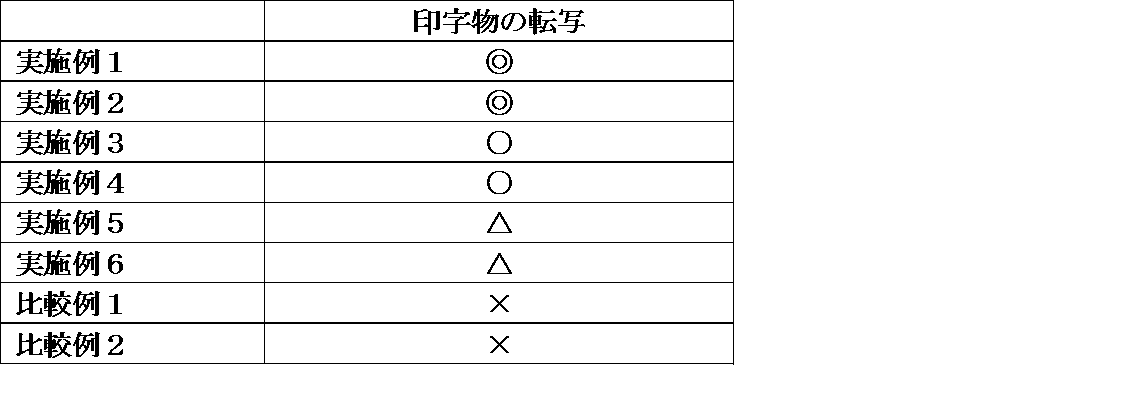
[インクジェット印字物の転写評価]
インクジェットプリンター(商品名「MP−990」、Canon製)に水性マゼンタインク(商品名「BCI−321M」、Canon製)を注入し、テスト印字パターンを圧着シートに印字した。印字後の圧着シートを幅25mm、長さ100mmに裁断して試料を作成し、この試料2枚を25mmの長さで重ね合わせ7MPaの荷重を加えて圧着した。これを接着剤の剥離接着強さ試験方法JIS−K6854に準じて、万能試験機(商品名「テンシロン」、オリエンテック社製)を用いてT型剥離試験を行い、剥離面の印字物の転写の有無を目視観察して以下のように評価した。△以上を合格とした。
◎:転写が無い
○:転写が見られるが、文字やバーコードを読み取ることはできない
△:転写した文字やバーコードが辛うじて読み取れる
×:転写した文字やバーコードがはっきり読み取れる
[Transfer evaluation of inkjet printed matter]
Aqueous magenta ink (trade name “BCI-321M”, manufactured by Canon) was injected into an inkjet printer (trade name “MP-990”, manufactured by Canon), and a test print pattern was printed on the pressure-bonding sheet. The printed pressure-bonded sheet was cut into a width of 25 mm and a length of 100 mm to prepare a sample, and the two samples were stacked with a length of 25 mm, and a pressure of 7 MPa was applied and pressure-bonded. This is subjected to a T-type peel test using a universal testing machine (trade name “Tensilon”, manufactured by Orientec Co., Ltd.) according to JIS-K6854, a test method for peel adhesion strength of adhesive, and transfer of printed matter on the peeled surface. The presence or absence of was visually observed and evaluated as follows. △ or more was accepted.
◎: No transfer ○: Transfer can be seen but characters and barcodes cannot be read △: Transferred characters and barcodes can be barely read ×: Transferred characters and barcodes can be read clearly
[実施例1]
接着剤基剤として、天然ゴムにメタクリル酸メチルをグラフト重合させた天然ゴム系ラテックス100質量部に対して、カチオン性ポリマーとしてビニルアミジン共重合物(商品名「KP7000」、ダイヤニトリックス社製)を10質量部、BET比表面積370m2/gの多孔性合成非晶質シリカ(商品名「NIPGEL AY−4A2」、東ソー・シリカ社製)を50質量部、平均粒子径20μmのスターチ80質量部を調製した。これを上質紙100g/m2からなる支持体の片面に感圧接着剤層として乾燥質量で7g/m2塗工して、圧着シートを得た。
[Example 1]
As an adhesive base, 10 parts of a vinylamidine copolymer (trade name “KP7000”, manufactured by Daianitrix Co., Ltd.) is used as a cationic polymer with respect to 100 parts by mass of natural rubber latex obtained by graft-polymerizing methyl methacrylate to natural rubber. 50 parts by mass of a porous synthetic amorphous silica (trade name “NIPGEL AY-4A2” manufactured by Tosoh Silica Co., Ltd.) having a BET specific surface area of 370 m 2 / g is prepared, and 80 parts by mass of starch having an average particle diameter of 20 μm is prepared. did. This was coated on one side of a support made of fine paper 100 g / m 2 as a pressure sensitive adhesive layer in a dry mass of 7 g / m 2 to obtain a pressure-bonded sheet.
[実施例2]
カチオン性ポリマーとして、ビニルアミジン共重合物(商品名「ハイマックスSC−700」、ハイモ社製)を、天然ゴム系ラテックス100質量部に対して10質量部配合した以外は、実施例1と同様にして圧着シートを得た。
[Example 2]
The same as Example 1 except that 10 parts by mass of vinylamidine copolymer (trade name “Himax SC-700”, manufactured by Hymo Co., Ltd.) as a cationic polymer is blended with respect to 100 parts by mass of natural rubber latex. Thus, a pressure-bonded sheet was obtained.
[実施例3]
BET比表面積220m2/gの多孔性合成非晶質シリカ(商品名「NIPGEL AY−451」、東ソー・シリカ社製)を使用した以外は、実施例1と同様にして圧着シートを得た。
[Example 3]
A pressure-bonded sheet was obtained in the same manner as in Example 1 except that porous synthetic amorphous silica having a BET specific surface area of 220 m 2 / g (trade name “NIPGEL AY-451”, manufactured by Tosoh Silica Co., Ltd.) was used.
[実施例4]
多孔性合成非晶質シリカを天然ゴム系ラテックス100質量部に対して150質量部配合した以外は、実施例1と同様にして圧着シートを得た。
[Example 4]
A pressure-bonded sheet was obtained in the same manner as in Example 1 except that 150 parts by mass of porous synthetic amorphous silica was added to 100 parts by mass of the natural rubber latex.
[実施例5]
カチオン性ポリマーとして、ビニルアミジン共重合物を、天然ゴム系ラテックス100質量部に対して0.1質量部配合した以外は、実施例1と同様にして圧着シートを得た。
[Example 5]
A pressure-bonded sheet was obtained in the same manner as in Example 1 except that 0.1 part by mass of vinylamidine copolymer as a cationic polymer was blended with respect to 100 parts by mass of natural rubber latex.
[実施例6]
感圧接着剤層を支持体の片面に乾燥質量で4g/m2塗工した以外は、実施例1と同様にして圧着シートを得た。
[Example 6]
A pressure-sensitive adhesive sheet was obtained in the same manner as in Example 1 except that the pressure-sensitive adhesive layer was coated on one side of the support at a dry mass of 4 g / m 2 .
[比較例1]
カチオン性ポリマーとして、ビニルアミン共重合物(商品名「カチオファストVFH」、星光PMC社製)を、天然ゴム系ラテックス100質量部に対して10質量部配合した以外は、実施例1と同様にして圧着シートを得た。
[Comparative Example 1]
As a cationic polymer, the same procedure as in Example 1 was conducted except that 10 parts by mass of vinylamine copolymer (trade name “Cathiofast VFH”, manufactured by Seiko PMC) was blended with 100 parts by mass of natural rubber latex. A crimped sheet was obtained.
[比較例2]
カチオン性ポリマーとして、メチルジアリルアミン共重合物(商品名「PAS−M−1」、ニットーボーメディカル社製)を、天然ゴム系ラテックス100質量部に対して10質量部配合した以外は、実施例1と同様にして圧着シートを得た。
[Comparative Example 2]
Example 1 except that 10 parts by mass of methyl diallylamine copolymer (trade name “PAS-M-1”, manufactured by Nitto Bo Medical Co., Ltd.) as a cationic polymer is blended with respect to 100 parts by mass of natural rubber latex. Similarly, a pressure-bonded sheet was obtained.
実施例及び比較例で得た圧着シートについて、インクジェット印字物の転写評価を行った結果、実施例1〜6の圧着シートは実使用上において問題が生じないレベルの転写であった。特に実施例1および2は、転写が生じなかった。なお、実施例5は文字やバーコードが僅かに読み取れる程度の転写が確認された。また、実施例6は接着力がやや不足しており、シール圧を上げて接着させたところ、文字やバーコードが僅かに読み取れる程度の転写が確認された。一方、比較例1、2の圧着シートは、文字やバーコードがはっきり読み取れるほどの印字転写が観察された。 As a result of the transfer evaluation of the ink-jet printed matter for the pressure-bonded sheets obtained in Examples and Comparative Examples, the pressure-bonded sheets of Examples 1 to 6 were at a level at which no problem occurred in actual use. In particular, in Examples 1 and 2, no transfer occurred. In Example 5, it was confirmed that the characters and bar codes were slightly readable. Further, in Example 6, the adhesive force was slightly insufficient, and when the seal pressure was increased and the adhesive was adhered, it was confirmed that the characters and bar codes were slightly readable. On the other hand, in the pressure-sensitive adhesive sheets of Comparative Examples 1 and 2, printing transfer was observed so that characters and barcodes could be clearly read.
以上の結果から、本発明の感圧接着剤組成物とそれを用いたインクジェット記録用圧着シートは、剥離後のマゼンタインクの転写が著しく抑制されることが確認された。 From the above results, it was confirmed that the pressure-sensitive adhesive composition of the present invention and the pressure-sensitive adhesive sheet for inkjet recording using the same significantly suppress the transfer of the magenta ink after peeling.
Claims (9)
Applications Claiming Priority (2)
| Application Number | Priority Date | Filing Date | Title |
|---|---|---|---|
| JP2015044101 | 2015-03-05 | ||
| JP2015044101 | 2015-03-05 |
Publications (1)
| Publication Number | Publication Date |
|---|---|
| JP2016166329A true JP2016166329A (en) | 2016-09-15 |
Family
ID=56898150
Family Applications (1)
| Application Number | Title | Priority Date | Filing Date |
|---|---|---|---|
| JP2016018413A Pending JP2016166329A (en) | 2015-03-05 | 2016-02-02 | Pressure sensitive adhesive composition and pressure sensitive sheet for inkjet recording |
Country Status (1)
| Country | Link |
|---|---|
| JP (1) | JP2016166329A (en) |
Citations (3)
| Publication number | Priority date | Publication date | Assignee | Title |
|---|---|---|---|---|
| JPH0839927A (en) * | 1994-08-01 | 1996-02-13 | Hymo Corp | Paper surface coating agent |
| JP2005125639A (en) * | 2003-10-24 | 2005-05-19 | Mitsubishi Paper Mills Ltd | High speed rotary ink jet recording postcard paper |
| JP2005131987A (en) * | 2003-10-31 | 2005-05-26 | Lintec Corp | Inkjet recording sheet |
-
2016
- 2016-02-02 JP JP2016018413A patent/JP2016166329A/en active Pending
Patent Citations (3)
| Publication number | Priority date | Publication date | Assignee | Title |
|---|---|---|---|---|
| JPH0839927A (en) * | 1994-08-01 | 1996-02-13 | Hymo Corp | Paper surface coating agent |
| JP2005125639A (en) * | 2003-10-24 | 2005-05-19 | Mitsubishi Paper Mills Ltd | High speed rotary ink jet recording postcard paper |
| JP2005131987A (en) * | 2003-10-31 | 2005-05-26 | Lintec Corp | Inkjet recording sheet |
Similar Documents
| Publication | Publication Date | Title |
|---|---|---|
| JP2009138317A (en) | Coated paper for printing | |
| JP3392649B2 (en) | Crimping postcard paper for inkjet recording | |
| JP4017532B2 (en) | Crimp postcard paper for inkjet recording | |
| JP6344822B2 (en) | Inkjet recording pressure-sensitive paper | |
| JP2005125639A (en) | High speed rotary ink jet recording postcard paper | |
| JP2004082466A (en) | Pressure sensitive adhesive sheet | |
| JP2001219680A (en) | Covert postcard | |
| JP3105943B2 (en) | Label for inkjet recording | |
| JP2009270220A (en) | Coated paper for enclosing and sealing sheet | |
| JP4037430B2 (en) | Crimp paper | |
| JP6590615B2 (en) | Crimp postcard paper | |
| JP4767490B2 (en) | High speed rotary ink jet recording postcard paper | |
| JP4849658B2 (en) | Recording paper, pseudo-adhesive recording paper using it | |
| JP4332303B2 (en) | Crimp recording paper | |
| JP6722970B2 (en) | Pressure-sensitive adhesive composition and pressure-sensitive adhesive sheet | |
| JP4640890B2 (en) | Removable pressure-sensitive recording paper | |
| JP2004216669A (en) | Crimping postcard paper for high-speed rotary ink jet recording | |
| JP6177209B2 (en) | Crimping base paper and crimping paper | |
| JP3909748B2 (en) | Removable pressure-sensitive recording paper | |
| JP2019031765A (en) | Printing paper for crimping and crimp paper | |
| JP2019035164A (en) | Crimping base paper and crimping paper | |
| JP2001354928A (en) | Crimping sheet | |
| JP2005126859A (en) | Crimp recording paper | |
| JP3696868B2 (en) | Pseudo adhesive paper | |
| JP2000335102A (en) | Inkjet recording sheet |
Legal Events
| Date | Code | Title | Description |
|---|---|---|---|
| A621 | Written request for application examination |
Free format text: JAPANESE INTERMEDIATE CODE: A621 Effective date: 20170927 |
|
| A977 | Report on retrieval |
Free format text: JAPANESE INTERMEDIATE CODE: A971007 Effective date: 20180625 |
|
| A131 | Notification of reasons for refusal |
Free format text: JAPANESE INTERMEDIATE CODE: A131 Effective date: 20180702 |
|
| A601 | Written request for extension of time |
Free format text: JAPANESE INTERMEDIATE CODE: A601 Effective date: 20180820 |
|
| A521 | Request for written amendment filed |
Free format text: JAPANESE INTERMEDIATE CODE: A523 Effective date: 20181031 |
|
| A02 | Decision of refusal |
Free format text: JAPANESE INTERMEDIATE CODE: A02 Effective date: 20181115 |