JP2012144684A - Novel (meth)acrylic monomer and method for producing the same - Google Patents
Novel (meth)acrylic monomer and method for producing the same Download PDFInfo
- Publication number
- JP2012144684A JP2012144684A JP2011006301A JP2011006301A JP2012144684A JP 2012144684 A JP2012144684 A JP 2012144684A JP 2011006301 A JP2011006301 A JP 2011006301A JP 2011006301 A JP2011006301 A JP 2011006301A JP 2012144684 A JP2012144684 A JP 2012144684A
- Authority
- JP
- Japan
- Prior art keywords
- meth
- formula
- acrylic monomer
- reaction
- represented
- Prior art date
- Legal status (The legal status is an assumption and is not a legal conclusion. Google has not performed a legal analysis and makes no representation as to the accuracy of the status listed.)
- Pending
Links
- 0 CC(C)(*C(C)(C)NCCNC(C(*)=*)=O)*OOCNC(C(*)=C)=[U] Chemical compound CC(C)(*C(C)(C)NCCNC(C(*)=*)=O)*OOCNC(C(*)=C)=[U] 0.000 description 1
Images
Landscapes
- Organic Low-Molecular-Weight Compounds And Preparation Thereof (AREA)
- Polyethers (AREA)
- Inks, Pencil-Leads, Or Crayons (AREA)
- Addition Polymer Or Copolymer, Post-Treatments, Or Chemical Modifications (AREA)
Abstract
【課題】硬化速度が速く、かつ硬化前後での体積変化率の小さい(メタ)アクリルモノマー及びその製造方法。
【解決手段】下式(II)で示される1種又は2種の炭素数2〜4のオキシアルキレン構造単位からなる特定のポリオキシアルキレングリコールと、N-ヒドロキシメチル(メタ)アクリルアミドとを、酸触媒の存在下で反応させる合成工程を含む(メタ)アクリルモノマーの製造方法。

(式中、R1は水素原子又はメチル基であり、R2及びR3は、それぞれ独立に、炭素数2〜4のアルキレン基であり、m及びnは、m+n≧1を満たす0〜50の整数である)
【選択図】なしA (meth) acryl monomer having a high curing rate and a small volume change rate before and after curing, and a method for producing the same.
A specific polyoxyalkylene glycol composed of one or two types of oxyalkylene structural units having 2 to 4 carbon atoms represented by the following formula (II) and N-hydroxymethyl (meth) acrylamide are treated with an acid. A method for producing a (meth) acrylic monomer, comprising a synthesis step of reacting in the presence of a catalyst.
(In the formula, R 1 is a hydrogen atom or a methyl group, R 2 and R 3 are each independently an alkylene group having 2 to 4 carbon atoms, and m and n are 0 to 50 satisfying m + n ≧ 1. Integer)
[Selection figure] None
Description
本発明は、UV硬化型インク、レジスト材料、ナノインプリント用材料、ホログラムメモリー材料等として用いられる(メタ)アクリルモノマー及びその製造方法に関する。 The present invention relates to a (meth) acrylic monomer used as a UV curable ink, a resist material, a nanoimprint material, a hologram memory material, and the like, and a method for producing the same.
特許文献1、2には、光硬化型の重合性モノマーとしてポリエチレングリコールジアクリレートを用いた光硬化材料が記載されている。
しかしながら、一般的なジアクリルモノマーは、光硬化前後での体積変化率が大きく、より精密な樹脂設計が求められる技術分野では用途が限定される。さらに、生産性の観点からは、硬化速度の速いことが要求される。 However, a general diacryl monomer has a large volume change rate before and after photocuring, and its application is limited in a technical field where a more precise resin design is required. Furthermore, from the viewpoint of productivity, a high curing rate is required.
本発明の課題は、硬化速度が速く、かつ硬化前後での体積変化率の小さい(メタ)アクリルモノマー及びその製造方法を提供することにある。 An object of the present invention is to provide a (meth) acryl monomer having a high curing rate and a small volume change rate before and after curing, and a method for producing the same.
本発明は、
〔1〕 式(I):
The present invention
[1] Formula (I):
(式中、R1は水素原子又はメチル基であり、R2及びR3は、それぞれ独立に、炭素数2〜4のアルキレン基であり、m及びnは、m+n≧1を満たす0〜50の整数である)
で表される(メタ)アクリルモノマー、並びに
〔2〕 式(II):
(In the formula, R 1 is a hydrogen atom or a methyl group, R 2 and R 3 are each independently an alkylene group having 2 to 4 carbon atoms, and m and n are 0 to 50 satisfying m + n ≧ 1. Integer)
(Meth) acrylic monomer represented by the formula (II):
(R2、R3、m及びnは、前記と同じ)
で表されるポリオキシアルキレングリコールと、式(III):
(R 2 , R 3 , m and n are the same as above)
A polyoxyalkylene glycol represented by formula (III):
(式中、R1は前記と同じ)
で表されるN-ヒドロキシメチル(メタ)アクリルアミドとを、酸触媒の存在下で反応させる合成工程を含む、前記〔1〕記載の(メタ)アクリルモノマーの製造方法
に関する。
(Wherein R 1 is the same as above)
The method for producing a (meth) acrylic monomer according to the above [1], which comprises a synthesis step of reacting N-hydroxymethyl (meth) acrylamide represented by the above in the presence of an acid catalyst.
本発明の(メタ)アクリルモノマーは、硬化速度が速く、かつ硬化前後での体積変化率の小さいため、幅広いポリマーのモノマーとして使用することができる。 Since the (meth) acrylic monomer of the present invention has a high curing rate and a small volume change rate before and after curing, it can be used as a monomer for a wide range of polymers.
本発明の(メタ)アクリルモノマーは、式(I): The (meth) acrylic monomer of the present invention has the formula (I):
(式中、R1は水素原子又はメチル基であり、R2及びR3は、それぞれ独立に、炭素数2〜4のアルキレン基であり、m及びnは、m+n≧1を満たす0〜50の整数である)
で表される化合物である。
(In the formula, R 1 is a hydrogen atom or a methyl group, R 2 and R 3 are each independently an alkylene group having 2 to 4 carbon atoms, and m and n are 0 to 50 satisfying m + n ≧ 1. Integer)
It is a compound represented by these.
本発明の(メタ)アクリルモノマーは、式(II): The (meth) acrylic monomer of the present invention has the formula (II):
(R2、R3、m及びnは、前記と同じ)
で表されるポリオキシアルキレングリコールと、式(III):
(R 2 , R 3 , m and n are the same as above)
A polyoxyalkylene glycol represented by formula (III):
(式中、R1は前記と同じ) (Wherein R 1 is the same as above)
で表されるN-ヒドロキシメチル(メタ)アクリルアミドとを、酸触媒の存在下で反応させて合成することができる。 And N-hydroxymethyl (meth) acrylamide represented by the above can be synthesized in the presence of an acid catalyst.
式(II)で表されるポリオキシアルキレングリコールの具体例としては、エチレングリコール、ジエチレングリコール、トリエチレングリコール、オクタエチレングリコール、プロピレングリコール、ジプロピレングリコール、トリプロピレングリコール、ブチレングリコール、ポリ(エチレンオキシドとプロピレンオキシドのブロック又はランダム共重合体)等が挙げられる。 Specific examples of the polyoxyalkylene glycol represented by the formula (II) include ethylene glycol, diethylene glycol, triethylene glycol, octaethylene glycol, propylene glycol, dipropylene glycol, tripropylene glycol, butylene glycol, poly (ethylene oxide and propylene Oxide block or random copolymer).
ポリオキシアルキレングリコールは、アルキレンオキシ基数の異なる化合物の混合物であってもよく、その場合、使用するポリオキシアルキレングリコール全体としての数平均分子量は100〜30,000が好ましい。 The polyoxyalkylene glycol may be a mixture of compounds having different numbers of alkyleneoxy groups. In that case, the number average molecular weight of the whole polyoxyalkylene glycol used is preferably 100 to 30,000.
一方、式(III)で表されるN-ヒドロキシメチル(メタ)アクリルアミドは、例えば、パラホルムアルデヒドと、式(IV): On the other hand, N-hydroxymethyl (meth) acrylamide represented by formula (III) is, for example, paraformaldehyde and formula (IV):
(式中、R1は前記と同じ)
で表される(メタ)アクリルアミドとを、メチロール化触媒の存在下で反応させて得られる。
(Wherein R 1 is the same as above)
And (meth) acrylamide represented by the following reaction in the presence of a methylolation catalyst.
パラホルムアルデヒドの量は、式(IV)で表される(メタ)アクリルアミド1モルあたり、製造効率を高める観点から、2.5〜7.0モルがより好ましく、2.5〜5.0モルがさらに好ましい。 The amount of paraformaldehyde is more preferably 2.5 to 7.0 mol, and even more preferably 2.5 to 5.0 mol, from the viewpoint of increasing production efficiency per mol of (meth) acrylamide represented by the formula (IV).
メチロール化触媒としては、ピリジン、トリエチルアミン、ジオクチルメチルアミン、トリエタノールアミン、トリイソプロパノールアミン等の有機アミン化合物等が挙げられる。 Examples of the methylolation catalyst include organic amine compounds such as pyridine, triethylamine, dioctylmethylamine, triethanolamine, and triisopropanolamine.
メチロール化触媒の量は、反応速度を向上させる観点及び副生成物の発生を抑制する観点から、パラホルムアルデヒド1モルあたり、0.00001〜0.5モルが好ましく、0.0005〜0.005モルがより好ましい。 The amount of the methylolation catalyst is preferably 0.00001 to 0.5 mol, more preferably 0.0005 to 0.005 mol per mol of paraformaldehyde, from the viewpoint of improving the reaction rate and suppressing the generation of by-products.
反応は、溶媒中で行うことが好ましい。溶媒としては、ベンゼン、トルエン等の芳香族炭化水素、酢酸エチル、酢酸ブチル等のエステル、アセトン、メチルイソブチルケトン等のケトン、メタノール、エタノール、プロパノール、ブタノール等のアルコール、ジクロロメタン、ジクロロエタン等のハロゲン化炭化水素、テトラヒドロフラン、1,4-ジオキサン等のエーテル、アセトニトリル、ニトロベンゼン、ニトロメタン等の非プロトン性有機溶媒等が挙げられ、これらの中では、原料の溶解性が高いアルコールが好ましい。 The reaction is preferably performed in a solvent. Solvents include aromatic hydrocarbons such as benzene and toluene, esters such as ethyl acetate and butyl acetate, ketones such as acetone and methyl isobutyl ketone, alcohols such as methanol, ethanol, propanol and butanol, and halogenations such as dichloromethane and dichloroethane. Examples include hydrocarbons, ethers such as tetrahydrofuran and 1,4-dioxane, and aprotic organic solvents such as acetonitrile, nitrobenzene, and nitromethane. Among these, alcohols with high solubility of raw materials are preferable.
反応液中の溶媒の量は、作業効率及び反応収率の向上の観点から、1〜95重量%が好ましく、5〜50重量%がより好ましい。 The amount of the solvent in the reaction solution is preferably 1 to 95% by weight and more preferably 5 to 50% by weight from the viewpoint of improving working efficiency and reaction yield.
(メタ)アクリルアミドとパラホルムアルデヒドとの反応は、例えば、(メタ)アクリルアミド、パラホルムアルデヒド、メチロール化触媒、さらに必要に応じて溶媒を攪拌下で混合することによって行うことができる。 The reaction between (meth) acrylamide and paraformaldehyde can be carried out, for example, by mixing (meth) acrylamide, paraformaldehyde, a methylolation catalyst, and, if necessary, a solvent with stirring.
反応温度は、反応速度を向上させる観点及び副生成物の生成を抑制する観点から、0〜90℃が好ましく、10〜60℃がより好ましい。また、反応系内の圧力は、特に限定されず、常圧であってもよい。 The reaction temperature is preferably 0 to 90 ° C and more preferably 10 to 60 ° C from the viewpoint of improving the reaction rate and suppressing the formation of by-products. Moreover, the pressure in the reaction system is not particularly limited, and may be a normal pressure.
反応液のpHは、反応速度を向上させる観点から、7〜12が好ましい。 The pH of the reaction solution is preferably 7 to 12 from the viewpoint of improving the reaction rate.
反応時間は特に限定されないが、(メタ)アクリルアミドの転化率が20%以上となるまで行うことが好ましい。 The reaction time is not particularly limited, but it is preferable to carry out the reaction until the conversion rate of (meth) acrylamide reaches 20% or more.
反応終了後、得られた反応溶液から、目的化合物の含有率が低い固形物を適宜除去した後、溶媒を留去することにより、式(III)で表されるN-ヒドロキシメチル(メタ)アクリルアミドを主成分とする混合体が得られる。 After completion of the reaction, a solid having a low content of the target compound is appropriately removed from the obtained reaction solution, and then the solvent is distilled off to obtain N-hydroxymethyl (meth) acrylamide represented by the formula (III). Is obtained as a main component.
除去した固形物における目的化合物の含有率は著しく低いため、廃棄するか、もしくは、再度N-ヒドロキシメチル(メタ)アクリルアミドの合成反応の原料として、再利用することもできる。 Since the content of the target compound in the removed solid is extremely low, it can be discarded or reused as a raw material for the synthesis reaction of N-hydroxymethyl (meth) acrylamide again.
なお、N-ヒドロキシメチル(メタ)アクリルアミドには、極めて微量のメチロール化触媒が残存していることがある。かかるメチロール化触媒が存在している場合であっても、その含有量は極めて微量であることから、実用上、特に大きな支障を生じることはないが、より純度の高いN-ヒドロキシメチル(メタ)アクリルアミドを得るために、該誘導体を単蒸留やカラムクロマトグラフィーにより精製して用いてもよい。 Note that a very small amount of methylolation catalyst may remain in N-hydroxymethyl (meth) acrylamide. Even when such a methylolation catalyst is present, since its content is extremely small, practically no serious trouble is caused, but higher purity N-hydroxymethyl (meth) In order to obtain acrylamide, the derivative may be used after being purified by simple distillation or column chromatography.
式(II)で表されるポリオキシアルキレングリコールと式(III)で表されるN-ヒドロキシメチル(メタ)アクリルアミドとの反応において、式(III)で表されるN-ヒドロキシメチル(メタ)アクリルアミドの量は、収率を向上させる観点及び製造効率を高める観点から、ポリオキシアルキレングリコール1モルあたり、1.0〜8.0モルが好ましく、1.8〜6.0モルがより好ましい。式(III)で表されるN-ヒドロキシメチル(メタ)アクリルアミドは、R1の異なる化合物の混合物であってもよい。 In the reaction of polyoxyalkylene glycol represented by formula (II) and N-hydroxymethyl (meth) acrylamide represented by formula (III), N-hydroxymethyl (meth) acrylamide represented by formula (III) The amount is preferably 1.0 to 8.0 moles, more preferably 1.8 to 6.0 moles per mole of polyoxyalkylene glycol, from the viewpoint of improving the yield and increasing the production efficiency. N-hydroxymethyl (meth) acrylamide represented by the formula (III) may be a mixture of different compounds of R 1 .
酸触媒としては、塩酸、硫酸等の無機酸、酢酸、シュウ酸等の有機酸等のエーテル化を促進する触媒が挙げられる。 Examples of the acid catalyst include catalysts that promote etherification of inorganic acids such as hydrochloric acid and sulfuric acid, and organic acids such as acetic acid and oxalic acid.
酸触媒の量は、副反応を抑制する観点から、N-ヒドロキシメチル(メタ)アクリルアミド1モルあたり、0.05モル以下が好ましく、0.0001〜0.05モルがより好ましく、0.001〜0.01モルがさらに好ましい。 From the viewpoint of suppressing side reactions, the amount of the acid catalyst is preferably 0.05 mol or less, more preferably 0.0001 to 0.05 mol, and further preferably 0.001 to 0.01 mol, per mol of N-hydroxymethyl (meth) acrylamide.
ポリオキシアルキレングリコールとN-ヒドロキシメチル(メタ)アクリルアミドとの反応は、反応中での重合を抑制する観点から、ヒドロキノン、p-メトキシフェノール等のフェノール系重合禁止剤等の重合禁止剤の存在下で行ってもよい。 The reaction between polyoxyalkylene glycol and N-hydroxymethyl (meth) acrylamide is carried out in the presence of a polymerization inhibitor such as hydroquinone and p-methoxyphenol from the viewpoint of suppressing polymerization during the reaction. You may go on.
ポリオキシアルキレングリコールとN-ヒドロキシメチル(メタ)アクリルアミドとの反応は、無溶媒で行うこともできるが、溶媒を使用して、系内を均一にすることにより反応中の温度調整等が容易になる。溶媒としては、ベンゼン、トルエン等の芳香族炭化水素、酢酸エチル、酢酸ブチル等のエステル、アセトン、メチルイソブチルケトン等のケトン、ジクロロメタン、ジクロロエタン等のハロゲン化炭化水素、テトラヒドロフラン、1,4-ジオキサン等のエーテル、アセトニトリル、ニトロベンゼン、ニトロメタン等の非プロトン性有機溶媒等が挙げられる。なかでも、トルエン等の芳香族炭化水素や、酢酸エチル等のエステルを好適に用いることができる。 The reaction of polyoxyalkylene glycol and N-hydroxymethyl (meth) acrylamide can be carried out without a solvent, but the temperature inside the reaction can be easily adjusted by using a solvent and making the system uniform. Become. Solvents include aromatic hydrocarbons such as benzene and toluene, esters such as ethyl acetate and butyl acetate, ketones such as acetone and methyl isobutyl ketone, halogenated hydrocarbons such as dichloromethane and dichloroethane, tetrahydrofuran, 1,4-dioxane and the like. And aprotic organic solvents such as ether, acetonitrile, nitrobenzene and nitromethane. Of these, aromatic hydrocarbons such as toluene and esters such as ethyl acetate can be preferably used.
反応液中の溶媒の量は、5〜95重量%が好ましく、30〜90重量%がより好ましい。 The amount of the solvent in the reaction solution is preferably 5 to 95% by weight, more preferably 30 to 90% by weight.
ポリオキシアルキレングリコールとN-ヒドロキシメチル(メタ)アクリルアミドとの反応は、例えば、ポリオキシアルキレングリコール、N-ヒドロキシメチル(メタ)アクリルアミド、酸触媒及び必要に応じて、溶媒、重合禁止剤等を混合し、得られた混合物を適宜加熱する方法等により行うことができる。 For example, polyoxyalkylene glycol, N-hydroxymethyl (meth) acrylamide, acid catalyst, and, if necessary, a solvent, a polymerization inhibitor, etc. are mixed in the reaction of polyoxyalkylene glycol and N-hydroxymethyl (meth) acrylamide. The obtained mixture can be appropriately heated.
反応温度は、原料であるポリオキシアルキレングリコール及び酸触媒の種類にもよるが、30〜110℃程度が好ましい。 The reaction temperature is preferably about 30 to 110 ° C., although it depends on the raw material polyoxyalkylene glycol and the type of acid catalyst.
反応液のpHは、反応速度と原料の安定性の観点から、3〜7が好ましい。 The pH of the reaction solution is preferably 3 to 7 from the viewpoint of reaction rate and raw material stability.
反応時間は特に限定されないが、反応の終点は、例えば、液体クロマトグラフィー(LC)のチャートにおいて、反応混合物中の目的化合物の面積比率が10%以上になり、2、3時間前の目的化合物の面積比率と変化が無くなった時点を反応の終点とみなす。 Although the reaction time is not particularly limited, the end point of the reaction is, for example, in the liquid chromatography (LC) chart, the area ratio of the target compound in the reaction mixture is 10% or more, and the target compound of 2 to 3 hours before The point at which the area ratio and the change disappear is regarded as the end point of the reaction.
反応終了後、溶媒を減圧下で留去して濃縮した後、析出した固体をろ別することにより、生成した式(I)で表される(メタ)アクリルモノマーを単離することができる。 After completion of the reaction, the solvent is distilled off under reduced pressure and concentrated, and then the precipitated (meth) acrylic monomer represented by the formula (I) can be isolated by filtering off the precipitated solid.
反応溶液から単離した(メタ)アクリルモノマーの粗生成物は、ベンゼン、トルエン、キシレン等の芳香族炭化水素、ヘキサン、ヘプタン、オクタン等の脂肪族炭化水素溶媒を用いて、洗浄することが好ましい。例えば、反応生成物を溶媒に溶解させ、ろ過し、得られたろ液を濃縮して、粗生成物を洗浄することができる。 The crude product of (meth) acrylic monomer isolated from the reaction solution is preferably washed using an aromatic hydrocarbon solvent such as benzene, toluene or xylene, or an aliphatic hydrocarbon solvent such as hexane, heptane or octane. . For example, the reaction product can be dissolved in a solvent, filtered, and the resulting filtrate can be concentrated to wash the crude product.
本発明においては、合成により得られた(メタ)アクリルモノマーを、さらに、展開溶媒としてエステル系溶媒を用いたカラムクロマトグラフィーにより精製する精製工程に供することが好ましい。 In the present invention, it is preferable that the (meth) acrylic monomer obtained by synthesis is further subjected to a purification step for purification by column chromatography using an ester solvent as a developing solvent.
カラムクロマトグラフィーの展開溶媒は、例えば、炭化水素系溶媒を用いた後、該炭化水素系溶媒とエステル系溶媒との混合液を用い、さらにエステル系溶媒の単一溶媒を用いることが好ましい。 As the developing solvent for column chromatography, for example, it is preferable to use a hydrocarbon solvent, then use a mixed solution of the hydrocarbon solvent and an ester solvent, and further use a single solvent of the ester solvent.
ここで、炭化水素系溶媒としてはヘキサン、シクロヘキサン、ヘプタン、オクタン、ベンゼン、トルエン、キシレン等が挙げられる。またエステル系溶媒としては、酢酸エチル、酢酸ブチル等が挙げられる。炭化水素系溶媒とエステル系溶媒の混合液における両者の体積比は、目的物を単離して溶出しやすいものを考慮して適宜選択する。 Here, examples of the hydrocarbon solvent include hexane, cyclohexane, heptane, octane, benzene, toluene, and xylene. Examples of the ester solvent include ethyl acetate and butyl acetate. The volume ratio of the mixture of the hydrocarbon solvent and the ester solvent is appropriately selected in consideration of a substance that easily isolates and elutes the target product.
式(I)で表される本発明の(メタ)アクリルモノマーは、光硬化させることができ、光硬化前後での体積変化率が従来の(メタ)アクリル系モノマーと対比して小さいという特性を有している。そのため、本発明の(メタ)アクリルモノマーは、体積変化をできる限り回避することが求められる用途、特に、UV硬化型インク、レジスト材料、ナノインプリント用材料、ホログラムメモリー材料等にも好適に用いることができる。本発明では、精密成型の観点から、式(I)で表される(メタ)アクリルモノマーのなかでも、実施例に記載の方法により測定される体積変化率が12%以下であるものが好ましく、10%以下であるものがより好ましい。 The (meth) acrylic monomer of the present invention represented by the formula (I) can be photocured and has a characteristic that the volume change rate before and after the photocuring is small compared to the conventional (meth) acrylic monomer. Have. Therefore, the (meth) acrylic monomer of the present invention can be suitably used for applications in which volume change is required to be avoided as much as possible, particularly for UV curable inks, resist materials, nanoimprint materials, hologram memory materials, and the like. it can. In the present invention, from the viewpoint of precision molding, among the (meth) acrylic monomers represented by the formula (I), those having a volume change rate of 12% or less measured by the method described in the examples are preferable, What is 10% or less is more preferable.
次に、本発明を実施例に基づいてさらに詳細に説明するが、本発明は、かかる実施例のみに限定されるものではない。 Next, the present invention will be described in more detail based on examples. However, the present invention is not limited to such examples.
実施例1
〔合成工程〕
攪拌機、温度計、コンデンサー及び空気導入管を備えた1リットル容のフラスコに、常温下、オクタエチレングリコール(PEG#400(日油製))82.7g(0.21モル)、N-ヒドロキシメチルアクリルアミド41.8g(0.41モル)及びトルエン99gを仕込み、シュウ酸0.1g(0.001モル)を加えた。得られた溶液のpHは3.5であった。減圧(43.3kPa)下、液温が75〜85℃になるように加温した後、12時間反応させた。反応終了後、N-ヒドロキシメチルアクリルアミドの転化率は99.9%であった。次いで、得られた反応液を、減圧下にて、液温が50〜60℃になるように加温した後、トルエンを2時間かけて留去して濃縮した。
Example 1
[Synthesis process]
In a 1 liter flask equipped with a stirrer, thermometer, condenser and air inlet tube, 82.7 g (0.21 mol) of octaethylene glycol (PEG # 400 (manufactured by NOF)) and 41.8 g of N-hydroxymethylacrylamide at room temperature. (0.41 mol) and 99 g of toluene were charged, and 0.1 g (0.001 mol) of oxalic acid was added. The pH of the obtained solution was 3.5. The mixture was heated under reduced pressure (43.3 kPa) so that the liquid temperature became 75 to 85 ° C., and then reacted for 12 hours. After completion of the reaction, the conversion rate of N-hydroxymethylacrylamide was 99.9%. Subsequently, after heating the obtained reaction liquid so that liquid temperature might be 50-60 degreeC under pressure reduction, toluene was distilled off over 2 hours and concentrated.
得られた濃縮物を30℃まで冷却して、固体が析出した後、ヘキサンにて洗浄し、固体をろ別した。ろ液を濃縮することにより粗生成物を118.1g得た。 The obtained concentrate was cooled to 30 ° C., and a solid was precipitated, then washed with hexane, and the solid was filtered off. The filtrate was concentrated to obtain 118.1 g of a crude product.
〔精製工程〕
粗生成物をオープンカラムクロマトグラフィーにより精製した。固定相としてアルミナを用い、ヘキサン単一溶液600mLにより展開した後、ヘキサンと酢酸エチルの混合液(ヘキサン/酢酸エチル=80/20(体積比))3000mLにより展開し、さらに酢酸エチル単一溶液2000mLにより展開して、目的とするアクリルモノマー(Ia)、即ち式(Ia):
[Purification process]
The crude product was purified by open column chromatography. Alumina is used as the stationary phase and developed with 600 mL of hexane single solution, then with 3000 mL of a mixed solution of hexane and ethyl acetate (hexane / ethyl acetate = 80/20 (volume ratio)), and further with 2000 mL of ethyl acetate single solution The target acrylic monomer (Ia), ie, formula (Ia):
で表される化合物113.2g(純度99.4%)を得た(N-ヒドロキシメチルアクリルアミドに対する収率96.7%)。 113.2 g (purity 99.4%) represented by the formula (96.7% yield based on N-hydroxymethylacrylamide) was obtained.
純度は、展開液を1μL用いてLC測定により分析した。分析条件を下記に示す。
〔LC測定条件〕
カラム:Waters Xterra RP8 4.6mm×150mm×5μm
溶出液:アセトニトリル/水=20/80(体積比)
流速:0.8ml/min
検出:240nmの吸収
Purity was analyzed by LC measurement using 1 μL of the developing solution. The analysis conditions are shown below.
[LC measurement conditions]
Column: Waters Xterra RP8 4.6mm × 150mm × 5μm
Eluent: acetonitrile / water = 20/80 (volume ratio)
Flow rate: 0.8ml / min
Detection: Absorption at 240nm
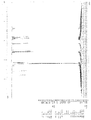
また、アクリルモノマー(Ia)の構造は、JEOL-JNM-AL300-FTNMRスペクトルメーター(日本電子(株)製)を用いた1H-NMR測定(300MHz,CDCl3)により同定した。得られたNMRスペクトルを図1に示す。 The structure of the acrylic monomer (Ia) was identified by 1 H-NMR measurement (300 MHz, CDCl 3 ) using a JEOL-JNM-AL300-FTNMR spectrum meter (manufactured by JEOL Ltd.). The obtained NMR spectrum is shown in FIG.
<ピークの帰属>
3.61〜3.74ppm:ポリエチレングリコールメチルエーテルのエチレングリコール基
4.81ppm:メチロール基
5.70ppm、6.20ppm及び6.39ppm:アクリロイル基
<Peak attribution>
3.61 to 3.74 ppm: ethylene glycol group of polyethylene glycol methyl ether
4.81ppm: Methylol group
5.70ppm, 6.20ppm and 6.39ppm: acryloyl group
〔樹脂膜の製造例〕
アクリルモノマー(Ia)5.0g及び2-メチル-1-[4-(メチルチオ)フェニル]-2-モルフォリノプロパン-1-オン(商品名:IRGACURE907、チバ・スペシャルティー・ケミカル製)0.25gを混合し、得られた混合液(光硬化性組成物)を厚さ10μmのポリフィルム上に塗布した後、メタルハライドランプにてUV露光(露光量10250mJ)することにより、透明硬化樹脂を得た。
[Production example of resin film]
Mixing 5.0 g of acrylic monomer (Ia) and 0.25 g of 2-methyl-1- [4- (methylthio) phenyl] -2-morpholinopropan-1-one (trade name: IRGACURE907, manufactured by Ciba Specialty Chemical) Then, the obtained mixed liquid (photocurable composition) was applied onto a 10 μm-thick polyfilm, and then UV-exposed (exposure amount: 10250 mJ) with a metal halide lamp to obtain a transparent curable resin.
比較例1
ポリエチレングリコールジアクリレート(共栄社株式会社製;商品名:ライトアクリレート9EG-A)及び2-メチル-1-[4-(メチルチオ)フェニル]-2-モルフォリノプロパン-1-オン(商品名:IRGACURE907、チバ・スペシャルティー・ケミカル製)0.25gを混合し、得られた混合液(光硬化性組成物)を厚さ10μmのポリフィルム上に塗布した後、メタルハライドランプにてUV露光(露光量10250mJ)することにより、透明硬化樹脂を得た。
Comparative Example 1
Polyethylene glycol diacrylate (manufactured by Kyoeisha Co., Ltd .; trade name: light acrylate 9EG-A) and 2-methyl-1- [4- (methylthio) phenyl] -2-morpholinopropan-1-one (trade name: IRGACURE907, Ciba Specialty Chemical Co., Ltd.) (0.25 g) was mixed, and the resulting mixture (photocurable composition) was applied onto a 10 μm-thick polyfilm, and then exposed to UV with a metal halide lamp (exposure 10250 mJ). As a result, a transparent cured resin was obtained.
実施例1及び比較例1において、光硬化前後の体積変化率を以下の方法に従って測定した。結果を表1に示す。 In Example 1 and Comparative Example 1, the volume change rate before and after photocuring was measured according to the following method. The results are shown in Table 1.
<光硬化体積変化率の測定>
光硬化前の光硬化性組成物を10mLメスシリンダーに加え、重量を測定し、液体密度を求める。光硬化性組成物をUV硬化させて得た透明硬化樹脂の個体密度は、分析天秤(メトラー・トレド株式会社製、XS-204)を用いて求める。得られた光硬化性組成物の液体密度及び透明硬化樹脂の個体密度の値を用い、式(1)より光硬化前後の体積変化率を求める。
<Measurement of photocuring volume change rate>
The photocurable composition before photocuring is added to a 10 mL graduated cylinder, the weight is measured, and the liquid density is determined. The solid density of the transparent curable resin obtained by UV-curing the photocurable composition is determined using an analytical balance (XS-204, manufactured by METTLER TOLEDO). Using the liquid density of the obtained photocurable composition and the solid density value of the transparent curable resin, the volume change rate before and after photocuring is obtained from the equation (1).
比較例2
メトキシポリエチレングリコールアクリレート(共栄社株式会社製;商品名:ライトアクリレート130A)を用い、比較例1と同様方法にて透明硬化樹脂を作製したが、未硬化部分を確認した。完全に硬化させるには露光量20500mJを要した。
Comparative Example 2
A transparent cured resin was prepared in the same manner as in Comparative Example 1 using methoxypolyethylene glycol acrylate (manufactured by Kyoeisha Co., Ltd .; trade name: Light Acrylate 130A), but the uncured portion was confirmed. An exposure amount of 20500 mJ was required for complete curing.
以上の結果より、アミドメチロール構造を有する実施例1の(メタ)アクリルモノマーは、比較例1、2の化合物と対比して、硬化速度が速く、かつ光硬化前後での体積変化が顕著に抑制されていることが分かる。 From the above results, the (meth) acrylic monomer of Example 1 having an amide methylol structure has a faster curing rate and significantly suppresses the volume change before and after photocuring as compared with the compounds of Comparative Examples 1 and 2. You can see that.
本発明の(メタ)アクリルモノマーは、体積変化をできる限り回避することが求められる用途、特に、UV硬化型インク、レジスト材料、ナノインプリント用材料、ホログラムメモリー材料等に好適である。 The (meth) acrylic monomer of the present invention is suitable for uses in which volume change is required to be avoided as much as possible, in particular, for UV curable inks, resist materials, nanoimprint materials, hologram memory materials, and the like.
Claims (3)
で表される(メタ)アクリルモノマー。 Formula (I):
(Meth) acrylic monomer represented by
で表されるポリオキシアルキレングリコールと、式(III):
で表されるN-ヒドロキシメチル(メタ)アクリルアミドとを、酸触媒の存在下で反応させる合成工程を含む、請求項1記載の(メタ)アクリルモノマーの製造方法。 Formula (II):
A polyoxyalkylene glycol represented by formula (III):
The manufacturing method of the (meth) acryl monomer of Claim 1 including the synthetic | combination process with which N-hydroxymethyl (meth) acrylamide represented by these is made to react in presence of an acid catalyst.
Priority Applications (1)
| Application Number | Priority Date | Filing Date | Title |
|---|---|---|---|
| JP2011006301A JP2012144684A (en) | 2011-01-14 | 2011-01-14 | Novel (meth)acrylic monomer and method for producing the same |
Applications Claiming Priority (1)
| Application Number | Priority Date | Filing Date | Title |
|---|---|---|---|
| JP2011006301A JP2012144684A (en) | 2011-01-14 | 2011-01-14 | Novel (meth)acrylic monomer and method for producing the same |
Publications (1)
| Publication Number | Publication Date |
|---|---|
| JP2012144684A true JP2012144684A (en) | 2012-08-02 |
Family
ID=46788582
Family Applications (1)
| Application Number | Title | Priority Date | Filing Date |
|---|---|---|---|
| JP2011006301A Pending JP2012144684A (en) | 2011-01-14 | 2011-01-14 | Novel (meth)acrylic monomer and method for producing the same |
Country Status (1)
| Country | Link |
|---|---|
| JP (1) | JP2012144684A (en) |
Cited By (3)
| Publication number | Priority date | Publication date | Assignee | Title |
|---|---|---|---|---|
| JP2016148768A (en) * | 2015-02-12 | 2016-08-18 | コニカミノルタ株式会社 | Intermediate transfer body and image forming apparatus having the same |
| CN117304064A (en) * | 2023-10-25 | 2023-12-29 | 科睿驰(深圳)医疗科技发展有限公司 | A kind of polymer and its preparation method and application |
| WO2025086448A1 (en) * | 2023-10-25 | 2025-05-01 | 科睿驰(深圳)医疗科技发展有限公司 | Compound for preparing embolization bead, hydrogel bead, preparation method therefor and use thereof |
-
2011
- 2011-01-14 JP JP2011006301A patent/JP2012144684A/en active Pending
Cited By (3)
| Publication number | Priority date | Publication date | Assignee | Title |
|---|---|---|---|---|
| JP2016148768A (en) * | 2015-02-12 | 2016-08-18 | コニカミノルタ株式会社 | Intermediate transfer body and image forming apparatus having the same |
| CN117304064A (en) * | 2023-10-25 | 2023-12-29 | 科睿驰(深圳)医疗科技发展有限公司 | A kind of polymer and its preparation method and application |
| WO2025086448A1 (en) * | 2023-10-25 | 2025-05-01 | 科睿驰(深圳)医疗科技发展有限公司 | Compound for preparing embolization bead, hydrogel bead, preparation method therefor and use thereof |
Similar Documents
| Publication | Publication Date | Title |
|---|---|---|
| JP5845196B2 (en) | 2,2-dimethoxy-1,2-di- [4- (meth) acryloyloxy] phenylethane-1-one, production method thereof, radical polymerization initiator and photocurable composition | |
| EP3051350B1 (en) | Alcoholic compound and method for producing alcoholic compound | |
| EP2014691A1 (en) | Adamantyl group-containing epoxy-modified (meth)acrylate and resin composition containing the same | |
| KR101795825B1 (en) | Adamantyl (meth)acrylate monomer and (meth)acrylic polymer that contains repeating units derived from the monomer | |
| CN115746186B (en) | Acrylic prepolymer containing oxetane functionality, preparation and use thereof | |
| JP6565687B2 (en) | Method for producing cyclobutanetetracarboxylic acid derivative | |
| JP2012144684A (en) | Novel (meth)acrylic monomer and method for producing the same | |
| JP5541902B2 (en) | Photocurable low shrinkage monomer compound | |
| WO2007020901A1 (en) | Fluorine-containing adamantane derivative, fluorine-containing adamantane derivative having polymerizable group, and resin composition containing same | |
| JP5198845B2 (en) | Novel (meth) acrylic monomer and method for producing the same | |
| JP5591856B2 (en) | (Meth) acrylamide compound precursor | |
| JP7169907B2 (en) | Fluorene compound and method for producing the same | |
| CN111057029B (en) | Fluorine-containing cationic polymerization monomer and synthesis and application thereof | |
| KR100857957B1 (en) | Manufacturing method of (meth) acrylic anhydride and manufacturing method of (meth) acrylic acid ester | |
| JP7589404B2 (en) | New polythiol compound | |
| WO2022163360A1 (en) | Method for producing (meth)acyrlic acid ester compound | |
| KR20180070599A (en) | Active energy ray-curable composition and plastic lens | |
| JP2005015396A (en) | New alicyclic vinyl ether | |
| CN115947657B (en) | Fluorine-containing photoresist resin monomer and preparation method thereof | |
| JP5971016B2 (en) | Fluorine-containing aromatic compound and method for producing the same | |
| JP2015044955A (en) | Polyglycerol (meth)acrylate and production method thereof, and composition containing the same | |
| WO2012144132A1 (en) | Fluorine-containing adamantane derivative | |
| US20100274040A1 (en) | 1,1'-Bi-2-Naphthol Derivatives Having (Meth)acrylate Groups | |
| US20210188864A1 (en) | Production method of diol | |
| KR100830561B1 (en) | Multifunctional liquid crystal compounds and preparation methods thereof and fine patterns obtained therefrom |