JP2012144679A - Reactive polyurethane-based electrical insulating coating material and insulated electric wire with insulating layer of the electrical insulating coating material - Google Patents
Reactive polyurethane-based electrical insulating coating material and insulated electric wire with insulating layer of the electrical insulating coating material Download PDFInfo
- Publication number
- JP2012144679A JP2012144679A JP2011006132A JP2011006132A JP2012144679A JP 2012144679 A JP2012144679 A JP 2012144679A JP 2011006132 A JP2011006132 A JP 2011006132A JP 2011006132 A JP2011006132 A JP 2011006132A JP 2012144679 A JP2012144679 A JP 2012144679A
- Authority
- JP
- Japan
- Prior art keywords
- polyurethane
- isocyanate group
- polyol
- acid
- electrical insulating
- Prior art date
- Legal status (The legal status is an assumption and is not a legal conclusion. Google has not performed a legal analysis and makes no representation as to the accuracy of the status listed.)
- Granted
Links
Landscapes
- Processes Specially Adapted For Manufacturing Cables (AREA)
- Paints Or Removers (AREA)
- Organic Insulating Materials (AREA)
- Insulated Conductors (AREA)
Abstract
Description
本発明は、反応型ポリウレタン系電気絶縁塗料および該電気絶縁塗料の絶縁層を有する絶縁被覆された電線(絶縁電線)に関する。 The present invention relates to a reactive polyurethane-based electrically insulating paint and an insulated coated electric wire (insulated electric wire) having an insulating layer of the electrically insulating paint.
絶縁電線(エナメル線)は、銅線、銅クラッド線、アルミニウム線などの導体に直接あるいは他の絶縁層を介して、電気絶縁塗料を塗布、焼付(硬化)し電気絶縁皮膜(絶縁層)を形成させることで得られる。 Insulated wires (enameled wires) are coated with an electrically insulating coating on a conductor such as copper wire, copper clad wire, or aluminum wire directly or through another insulating layer, and baked (cured) to form an electrically insulating film (insulating layer). It is obtained by forming.
特に、ポリウレタン系絶縁電線は、はんだ付けなどの絶縁電線の端末処理が容易であることや、他の絶縁電線と比較し高速作業性に優れ生産性が高いことなどから、電気・電子機器等に幅広く利用されている。 In particular, polyurethane-based insulated wires are easily used for electrical and electronic equipment because they are easy to handle the end of insulated wires such as soldering, and have high-speed workability and high productivity compared to other insulated wires. Widely used.
ポリウレタン系絶縁電線を形成するために用いられるポリウレタン系電気絶縁塗料としては、有機ポリイソシアネートのイソシアネート基をフェノール、クレゾール、キシレノール酸などのフェノール系溶剤でブロック(マスク)して 安定化したブロック有機ポリイソシアネート化合物とポリオールなどの活性水素含有化合物とを共存させて1液化したものが用いられている。 Polyurethane-based electrical insulation coatings used to form polyurethane-based insulated wires include blocked organic polysalts that are stabilized by blocking (masking) the isocyanate groups of organic polyisocyanates with phenolic solvents such as phenol, cresol, and xylenolic acid. A one-component solution in which an isocyanate compound and an active hydrogen-containing compound such as a polyol coexist is used.
ブロック有機ポリイソシアネート化合物に使用するブロック剤(マスク剤)としては、コストメリットや塗料の貯蔵安定性が高いことなどから、主にフェノール、クレゾール、キシレノール酸等のフェノール系溶剤を使用している。 As the blocking agent (masking agent) used for the block organic polyisocyanate compound, phenol solvents such as phenol, cresol, xylenolic acid and the like are mainly used because of cost merit and high storage stability of the paint.
一液型ポリウレタン系電気絶縁塗料に用いられるブロック有機ポリイソシアネート化合物は高粘度であり作業性に劣ることから、有機溶剤によって塗料粘度を調整する必要がある。 Since the block organic polyisocyanate compound used for the one-component polyurethane-based electrical insulating paint has a high viscosity and is inferior in workability, it is necessary to adjust the paint viscosity with an organic solvent.
この目的で使用される有機溶剤としては、ブロック有機ポリイソシアネート化合物や活性水素含有化合物との溶解性が高いフェノール、クレゾール、キシレノール酸などのフェノール系溶剤を主成分とし、さらに希釈による減粘効果を高めるためにキシロールやソルベントナフサなどを混合してなる溶媒が使用されている。 The organic solvent used for this purpose is mainly composed of phenolic solvents such as phenol, cresol and xylenolic acid, which are highly soluble in blocked organic polyisocyanate compounds and active hydrogen-containing compounds. In order to increase the solvent, a solvent obtained by mixing xylol or solvent naphtha is used.
しかしながら、フェノール系溶剤は劇物であり人体への毒性が高い。また、電気絶縁塗料の焼付の際に高温に加熱しても、ブロック有機ポリイソシアネート化合物のイソシアネート基からフェノール系溶剤が完全に解離せず、得られる電気絶縁皮膜中にかなりの量が残留する場合がある。 However, phenolic solvents are deleterious and highly toxic to the human body. In addition, even when heated to a high temperature during the baking of electrical insulation paint, the phenolic solvent does not completely dissociate from the isocyanate group of the blocked organic polyisocyanate compound, and a considerable amount remains in the resulting electrical insulation film There is.
電気絶縁被覆中に残存したフェノール系溶剤は、電気製品や電子機器などの使用中に徐々に大気中に放散する。これにより、室内等の使用環境を汚染することに加え、使用者の健康被害等、種々の問題を生じる。 The phenolic solvent remaining in the electrical insulation coating gradually diffuses into the atmosphere during use of electrical products and electronic equipment. Thereby, in addition to polluting the use environment such as the room, various problems such as a health hazard for the user are caused.
また、ブロック有機ポリイソシアネート化合物のブロック剤や電気絶縁塗料中の有機溶剤は、電気絶縁塗料の塗料安定性や焼付時の塗布作業性に寄与するものの、焼付時に焼付炉内で気化し、燃焼触媒によって分解され二酸化炭素(温室効果ガス)を発生する。 In addition, the blocking agent of the blocked organic polyisocyanate compound and the organic solvent in the electrical insulating paint contribute to the coating stability of the electrical insulating paint and the coating workability during baking, but are vaporized in the baking furnace during baking and burned. To decompose carbon dioxide (greenhouse gas).
従って、一液型ポリウレタン系電気絶縁塗料中のブロック剤や有機溶剤の使用量の削減も大きな課題となっている。 Therefore, reduction of the amount of block agents and organic solvents used in the one-component polyurethane electrical insulating paint is also a major issue.
この様な技術的背景の下、ポリウレタン系電気絶縁塗料中の有機溶剤やブロック剤を低減させることを目的として、従来の一液型ポリウレタン系電気絶縁塗料に替わり、反応型ポリウレタン系電気絶縁塗料が提案されている(例えば、特許文献1および特許文献2。)。 Under such a technical background, reactive polyurethane-based electrical insulation paints have been replaced with conventional one-component polyurethane-type electrical insulation paints in order to reduce organic solvents and blocking agents in polyurethane-type electrical insulation paints. (For example, patent document 1 and patent document 2).
前記反応型ポリウレタン系電気絶縁塗料では、ブロック剤を必要としないイソシアネート基含有化合物とポリオールなどの活性水素基含有化合物をそれぞれ個別に分けておき、塗布・焼付けの際にそれらを混合した後、塗布・焼付けすることで絶縁電線を得ることができる。 In the reactive polyurethane-based electrical insulating paint, an isocyanate group-containing compound that does not require a blocking agent and an active hydrogen group-containing compound such as a polyol are individually separated, mixed, and then applied during coating and baking.・ An insulated wire can be obtained by baking.
また、該塗料中にフェノール系溶剤を使用していないため、得られる電気絶縁皮膜中にフェノール系溶剤が残留することはなく、更に電気絶縁皮膜中の残留溶剤を大幅に低減できる。 In addition, since no phenolic solvent is used in the paint, no phenolic solvent remains in the resulting electrical insulating film, and the residual solvent in the electrical insulating film can be greatly reduced.
上記のように、絶縁電線(エナメル線)の製造にあたっては、電気絶縁塗料を、コーターロール等の塗布手段を用いて導体上に塗布し、次いで、焼付炉内で電気絶縁塗料を焼付けするという作業が行われる。 As described above, in the production of an insulated wire (enameled wire), an electrical insulating paint is applied onto a conductor using a coating means such as a coater roll, and then the electrical insulating paint is baked in a baking furnace. Is done.
導体に対する電気絶縁塗料の塗布・焼付けは、焼付け不足によって生じる絶縁電線の電線特性の低下やユズ状の外観不良および残留溶剤の増加等の問題を回避するために、複数回に分けて実施される。 Application and baking of electrical insulation paint on conductors are performed in multiple times to avoid problems such as deterioration of the electric wire characteristics of insulated wires caused by insufficient baking, defects in the appearance of crooked shapes and increase in residual solvent. .
しかしながら、塗布・焼付けの回数が多くなるほど、絶縁電線の生産効率が低下するという問題点がある。 However, there is a problem that the production efficiency of insulated wires decreases as the number of times of application and baking increases.
そこで、本発明は、絶縁電線の電線特性の低下やユズ状の外観の悪化等を抑制しつつ、電気絶縁塗料の塗布・焼付け回数を極力低減し、絶縁電線の生産性を向上させることを課題とするものである。 Therefore, the present invention has an object to improve the productivity of insulated wires by reducing the number of times of applying and baking the electrical insulating paint as much as possible while suppressing the deterioration of the wire characteristics of the insulated wires and the deterioration of the appearance of the crooked shape. It is what.
上記課題は、以下の構成により解決される。
(1)(a)イソシアネート基含有ポリウレタンと、(b)ポリオール化合物と、(c)ポリアミド樹脂を含有し、かつ、フェノール系溶剤を含有しないことを特徴とする反応型ポリウレタン系電気絶縁塗料。
(2)(a)イソシアネート基含有ポリウレタンが、芳香族ポリイソシアネート類と水酸基含有化合物とを水酸基に対してイソシアネート基過剰の条件下で反応させて得られるイソシアネート基含有ポリウレタンである、(1)に記載の反応型ポリウレタン系電気絶縁塗料。
(3)ポリオール化合物が、ポリエステルポリオールである、(1)又は(2)に記載の反応型ポリウレタン系電気絶縁塗料。
(4)(1)〜(3)いずれかに記載の反応型ポリウレタン系電気絶縁塗料を、導体上に、直接又は他の絶縁層を介して塗布、焼付けすることにより電気絶縁層を形成してなる、ポリウレタン系絶縁電線。
(5)(a)イソシアネート基含有ポリウレタンと、(b)ポリオール化合物と、(c)ポリアミド樹脂と、を含有し、かつ、フェノール系溶剤を含有しない反応型ポリウレタン系電気絶縁塗料を調製し、前記反応型ポリウレタン系電気絶縁塗料を、導体又は予め絶縁層で被覆された導体上に塗布し、焼付けすることにより、前記ポリウレタン系電気絶縁塗料による電気絶縁層を形成することを特徴とする、ポリウレタン系絶縁電線の製造方法。
(6)(a)イソシアネート基含有ポリウレタンが、芳香族ポリイソシアネート類と水酸基含有化合物とを水酸基に対してイソシアネート基過剰の条件下で反応させて得られるイソシアネート基含有ポリウレタンである、(5)に記載の製造方法。
(7)ポリオール化合物が、ポリエステルポリオールである、(5)又は(6)に記載の製造方法。
The above problem is solved by the following configuration.
(1) A reactive polyurethane-based electrically insulating paint comprising (a) an isocyanate group-containing polyurethane, (b) a polyol compound, (c) a polyamide resin, and no phenol solvent.
(2) (a) The isocyanate group-containing polyurethane is an isocyanate group-containing polyurethane obtained by reacting an aromatic polyisocyanate and a hydroxyl group-containing compound with an isocyanate group-excess condition with respect to a hydroxyl group. The reactive polyurethane-based electrically insulating paint as described.
(3) The reactive polyurethane electrical insulating paint according to (1) or (2), wherein the polyol compound is a polyester polyol.
(4) An electrically insulating layer is formed by applying and baking the reactive polyurethane-based electrically insulating paint according to any one of (1) to (3) on a conductor directly or through another insulating layer. A polyurethane-based insulated wire.
(5) preparing a reactive polyurethane-based electrical insulating paint containing (a) an isocyanate group-containing polyurethane, (b) a polyol compound, and (c) a polyamide resin and not containing a phenol solvent, A polyurethane-based electrically insulating coating is formed by applying a reactive polyurethane-based electrically insulating coating onto a conductor or a conductor previously coated with an insulating layer, and baking it. Insulated wire manufacturing method.
(6) (a) The isocyanate group-containing polyurethane is an isocyanate group-containing polyurethane obtained by reacting an aromatic polyisocyanate and a hydroxyl group-containing compound with a hydroxyl group-excess condition with respect to a hydroxyl group. The manufacturing method as described.
(7) The production method according to (5) or (6), wherein the polyol compound is a polyester polyol.
なお、本発明において、「反応型」の用語は、少なくとも、(a)イソシアネート基含有ポリウレタンと、(b)ポリオール化合物とが、焼付け(硬化)時に、相互に反応して硬化膜を形成し得ることを意味する。 In the present invention, the term “reactive type” means that at least (a) an isocyanate group-containing polyurethane and (b) a polyol compound can react with each other during baking (curing) to form a cured film. Means that.
また、本明細書において、(c)ポリアミド樹脂を除く成分の数平均分子量は、下記の条件でGPC(ゲルパーミエーションクロマトグラフィー)測定し、ポリスチレンを標準物質として換算した値である。
<平均分子量の測定方法>
装置:HLC−8220(東ソー社製)
検出器:RI(示差屈折率)
展開溶媒:THF(テトラヒドロフラン)
流速:0.3ml/min
温度:40℃
Moreover, in this specification, the number average molecular weight of the component except (c) polyamide resin is a value obtained by measuring GPC (gel permeation chromatography) under the following conditions and converting polystyrene as a standard substance.
<Measurement method of average molecular weight>
Apparatus: HLC-8220 (manufactured by Tosoh Corporation)
Detector: RI (differential refractive index)
Developing solvent: THF (tetrahydrofuran)
Flow rate: 0.3 ml / min
Temperature: 40 ° C
本発明の反応型ポリウレタン系電気絶縁塗料には、劇物であるフェノール系溶剤が含まれていないため、絶縁電線中のフェノール系溶剤が徐々に放出されることによる使用環境の汚染を生じることがない。 Since the reactive polyurethane-based electrically insulating paint of the present invention does not contain a phenolic solvent which is a deleterious substance, it may cause pollution of the usage environment due to the gradual release of the phenolic solvent in the insulated wire. Absent.
更に、本発明の反応型ポリウレタン系電気絶縁塗料は、得られる絶縁電線の外観不良および電線特性の低下を抑制しつつ、塗布・焼付け回数を減らし、絶縁電線の生産性を向上させることが出来る。 Furthermore, the reactive polyurethane electrical insulating paint of the present invention can improve the productivity of the insulated wire by reducing the number of times of application and baking while suppressing the appearance defect of the obtained insulated wire and the deterioration of the wire characteristics.
以下、本発明を実施形態に即して詳細に説明する。 Hereinafter, the present invention will be described in detail according to embodiments.
[ポリウレタン系電気絶縁塗料]
本発明の反応型ポリウレタン系電気絶縁塗料は、(a)イソシアネート基含有ポリウレタンと、(b)ポリオール化合物と、(c)ポリアミド樹脂と、を含有し、かつ、フェノール系溶剤を含有しないことを特徴とする。以下、これらの成分毎に説明する。
[Polyurethane-based electrical insulating paint]
The reactive polyurethane electrical insulating paint of the present invention contains (a) an isocyanate group-containing polyurethane, (b) a polyol compound, and (c) a polyamide resin, and does not contain a phenol solvent. And Hereinafter, each of these components will be described.
(a)イソシアネート基含有ポリウレタン
本発明における(a)イソシアネート基含有ポリウレタンとしては、特に制限されるものではなく、通常公知のポリイソシアネートと水酸基含有化合物とを、水酸基含有化合物の水酸基に対して、イソシアネート基過剰の条件下で反応させることにより得られるイソシアネート基含有ポリウレタンを用いることが可能である。
(A) Isocyanate group-containing polyurethane (a) Isocyanate group-containing polyurethane in the present invention is not particularly limited, and generally known polyisocyanate and hydroxyl group-containing compound are mixed with the hydroxyl group of the hydroxyl group-containing compound. It is possible to use an isocyanate group-containing polyurethane obtained by reacting under an excess of groups.
ポリイソシアネートとしては、芳香族ポリイソシアネート類が好適である。芳香族ポリイソシアネート類としては、4,4’−ジフェニルメタンジイソシアネート、2,4−ジフェニルメタンジイソシアネート、2,2’−ジフェニルメタンジイソシアネート、或いはこれらの混合物等のジフェニルメタンジイソシアネート、2,4−トルエンジイソシアネート、2,6−トルエンジイソシアネート、或いはこれらの混合物等のトルエンジイソシアネート、フェニレンジイソシアネート、ジフェニルジイソシアネート、4,4’−ジフェニルエーテルジイソシアネート、3,3’−ジメチルジフェニル−4,4’−ジイソシアネート、4,4’−ジフェニルプロパンジイソシアネート、1,2−フェニレンジイソシアネート、1,3−フェニレンジイソシアネート、1,4−フェニレンジイソシアネート、1,4−ナフタレンジイソシアネート、1,5−ナフタレンジイソシアネート、3,3’−ジメトキシジフェニル−4,4’−ジイソシアネートがあげられる。なお、これらは単独または2種以上を混合して使用することができる。 As the polyisocyanate, aromatic polyisocyanates are suitable. Aromatic polyisocyanates include 4,4′-diphenylmethane diisocyanate, 2,4-diphenylmethane diisocyanate, 2,2′-diphenylmethane diisocyanate, or mixtures thereof, such as diphenylmethane diisocyanate, 2,4-toluene diisocyanate, 2,6 -Toluene diisocyanate or mixtures thereof such as toluene diisocyanate, phenylene diisocyanate, diphenyl diisocyanate, 4,4'-diphenyl ether diisocyanate, 3,3'-dimethyldiphenyl-4,4'-diisocyanate, 4,4'-diphenylpropane diisocyanate 1,2-phenylene diisocyanate, 1,3-phenylene diisocyanate, 1,4-phenylene diisocyanate, 1,4-naphthal Data diisocyanate, 1,5-naphthalene diisocyanate, 3,3'-dimethoxy-4,4'-diisocyanate. In addition, these can be used individually or in mixture of 2 or more types.
また、芳香族ポリイソシアネート類として、上記芳香族ポリイソシアネートのアダクト変性体、ビュレット変性体、イソシアヌレート変性体、ウレトンイミン変性体、ウレトジオン変性体、カルボジイミド変性体等のいわゆる変性イソシアネート、ポリメチレンポリフェニルポリイソシアネート、クルードトルエンポリイソシアネート等のような、いわゆるポリメリック体といわれるポリイソシアネートを使用することも可能である。なお、これらは単独または2種以上を混合して使用することができる。 Further, as aromatic polyisocyanates, so-called modified isocyanates such as adduct-modified, burette-modified, isocyanurate-modified, uretonimine-modified, uretdione-modified, carbodiimide-modified, etc. of the above-mentioned aromatic polyisocyanate, polymethylene polyphenyl poly It is also possible to use polyisocyanates called so-called polymeric bodies such as isocyanate, crude toluene polyisocyanate and the like. In addition, these can be used individually or in mixture of 2 or more types.
これら芳香族ポリイソシアネート類のうち、入手のしやすさや得られるポリウレタン系絶縁電線のはんだ付け性と耐熱性が良好な点でジフェニルメタンジイソシアネート、トルエンジイソシアネートおよびこれらジイソシアネートのアダクト変性体、ビュレット変性体、イソシアヌレート変性体、ウレトンイミン変性体、ウレトジオン変性体、カルボジイミド変性体等の変性イソシアネートが好ましく、特にジフェニルメタンジイソシアネートおよびジフェニルメタンジイソシアネートの変性イソシアネートが好ましい。 Among these aromatic polyisocyanates, diphenylmethane diisocyanate, toluene diisocyanate and adducts, burettes, and isocyanates of these diisocyanates are easy to obtain and have good solderability and heat resistance of the resulting polyurethane-based insulated wires. Modified isocyanates such as a nurate modified product, a uretonimine modified product, a uretdione modified product, and a carbodiimide modified product are preferable, and diphenylmethane diisocyanate and modified isocyanates of diphenylmethane diisocyanate are particularly preferable.
水酸基含有化合物としては、良好な貯蔵安定性および塗布・焼付作業性を有するポリウレタン系電気絶縁塗料を得る観点から、分子量(分子量分布を有する化合物にあっては数平均分子量を意味する。以下、この段落において同じ。)1,000以下のポリオール類が好ましく、更に分子量500以下のポリオール類が好ましい。このようなポリオール類としては、具体的には、エチレングリコール、1,2−プロパンジオール、1,3−プロパンジオール、1,2−ブタンジオール、1,3−ブタンジオール、1,4−ブタンジオール、1,5−ペンタンジオール、1,6−ヘキサンジオール、3−メチル−1,5−ペンタンジオール、ネオペンチルグリコール、1,8−オクタンジオール、1,9−ノナンジオール、ジエチレングリコール、ジプロピレングリコール、1,4−シクロヘキサンジメタノール、ビスフェノールAのエチレンオキサイド或いはプロピレンオキサイド付加物、トリメチロールプロパン、グリセリン、ペンタエリスリトールなどがあげられる。また、後述する(b)ポリオール化合物として挙げるポリエステルポリオール、ポリカーボネートポリオール、炭化水素系ポリオールなどを用いることも可能である。 As the hydroxyl group-containing compound, from the viewpoint of obtaining a polyurethane-based electrical insulating paint having good storage stability and coating / baking workability, it means a molecular weight (in the case of a compound having a molecular weight distribution, it means a number average molecular weight. The same applies in the paragraph.) Polyols having a molecular weight of 1,000 or less are preferred, and polyols having a molecular weight of 500 or less are more preferred. Specific examples of such polyols include ethylene glycol, 1,2-propanediol, 1,3-propanediol, 1,2-butanediol, 1,3-butanediol, and 1,4-butanediol. 1,5-pentanediol, 1,6-hexanediol, 3-methyl-1,5-pentanediol, neopentyl glycol, 1,8-octanediol, 1,9-nonanediol, diethylene glycol, dipropylene glycol, Examples include 1,4-cyclohexanedimethanol, ethylene oxide or propylene oxide adduct of bisphenol A, trimethylolpropane, glycerin, pentaerythritol and the like. Moreover, it is also possible to use the polyester polyol, polycarbonate polyol, hydrocarbon polyol etc. which are mentioned as (b) polyol compound mentioned later.
これらのうち、入手のしやすさや得られるポリウレタン系絶縁電線のはんだ付け性や耐熱性のバランスが良好な点で、エチレングリコール、ネオペンチルグリコール、1,3−ブタンジオール、1,4−ブタンジオール、1,6−ヘキサンジオール、トリメチロールプロパンおよびグリセリン、並びに、ビスフェノールAのエチレンオキサイド或いはプロピレンオキサイド付加物が好ましい。 Among these, ethylene glycol, neopentyl glycol, 1,3-butanediol, 1,4-butanediol are easy to obtain and have a good balance of solderability and heat resistance of the resulting polyurethane-based insulated wire. 1,6-hexanediol, trimethylolpropane and glycerin, and ethylene oxide or propylene oxide adducts of bisphenol A are preferred.
イソシアネート基含有ポリウレタンの変性用として、数平均分子量が1,000〜4,000のポリオキシエチレンポリオール、ポリオキシプロピレンポリオール、ポリオキシテトラメチレングリコール、ポリブタジエンポリオール、ポリイソブチレンポリオールなどのポリオールを使用することもできる。また、これらのポリオール類は、いずれも単独または2種以上を混合して使用することができる。 Use of polyols such as polyoxyethylene polyol, polyoxypropylene polyol, polyoxytetramethylene glycol, polybutadiene polyol, polyisobutylene polyol having a number average molecular weight of 1,000 to 4,000 for modification of isocyanate group-containing polyurethane You can also. These polyols can be used alone or in admixture of two or more.
前記イソシアネート基含有ポリウレタンのポリイソシアネートと水酸基含有化合物との反応のイソシアネート基と水酸基の当量比は、イソシアネート基/水酸基=1.1/1〜10/1が好ましく、更に1.8/1〜5/1が好ましい。 The equivalent ratio of isocyanate group to hydroxyl group in the reaction of the polyisocyanate and the hydroxyl group-containing compound of the isocyanate group-containing polyurethane is preferably isocyanate group / hydroxyl group = 1.1 / 1 to 10/1, more preferably 1.8 / 1 to 5 / 1 is preferred.
また、前記イソシアネート基含有ポリウレタン中のイソシアネート基(NCO基)含有量は、良好な塗布・焼付作業性を有するポリウレタン系電気絶縁塗料を得るために、固形分100質量%換算で1〜30質量%が好ましく、更に5〜25質量%であることが好ましい。 Further, the isocyanate group (NCO group) content in the isocyanate group-containing polyurethane is 1 to 30% by mass in terms of solid content of 100% by mass in order to obtain a polyurethane-based electrical insulating paint having good coating and baking workability. Is preferable, and it is more preferable that it is 5-25 mass%.
また、イソシアネート基含有ポリウレタンの数平均分子量としては、300〜3,000、特に500〜2,000の範囲が好ましい。数平均分子量が300未満であると本発明の反応型ポリウレタン系電気絶縁塗料を塗布・焼付する際に焼付炉の出口からイソシアネート基含有ポリウレタンの昇華・熱分解に起因した煙が生じやすく、3,000を超えるとイソシアネート基含有ポリウレタンの樹脂濃度が高くなり、良好な塗布・焼付作業性を確保できなくなるおそれがある。 The number average molecular weight of the isocyanate group-containing polyurethane is preferably in the range of 300 to 3,000, particularly 500 to 2,000. When the number average molecular weight is less than 300, smoke due to sublimation / pyrolysis of the isocyanate group-containing polyurethane is likely to occur from the exit of the baking furnace when applying and baking the reactive polyurethane electrical insulating paint of the present invention, If it exceeds 000, the resin concentration of the isocyanate group-containing polyurethane increases, and there is a possibility that good coating and baking workability cannot be ensured.
(b)ポリオール化合物
本発明における(b)ポリオール化合物としては、具体的には、数平均分子量が500〜3,000、特に500〜2000の高分子ポリオール類および数平均分子量500未満の低分子ポリオール類が挙げられ、得られる絶縁電線の被膜形成性、耐熱性、可とう性などの電線特性が良好な点で高分子ポリオール類が好ましい。
(B) Polyol compound Specifically, the (b) polyol compound in the present invention is a high molecular polyol having a number average molecular weight of 500 to 3,000, particularly 500 to 2,000, and a low molecular polyol having a number average molecular weight of less than 500. Polymer polyols are preferred in terms of good electric wire characteristics such as film formability, heat resistance, and flexibility of the resulting insulated wire.
高分子ポリオール類としては、具体的には、ポリエステルポリオール、イミド変性ポリエステルポリオール、ポリウレタンポリオール、ポリエーテルポリオール、ポリカーボネートポリオール、炭化水素系ポリオール、ポリ(メタ)アクリルポリオール、動植物ポリオール、これらのコポリオール等が挙げられる。これらは単独または2種以上を混合して使用することができる。 Specific examples of the polymer polyols include polyester polyols, imide-modified polyester polyols, polyurethane polyols, polyether polyols, polycarbonate polyols, hydrocarbon polyols, poly (meth) acrylic polyols, animal and plant polyols, and copolyols thereof. Is mentioned. These can be used individually or in mixture of 2 or more types.
これらのうち、得られる絶縁電線のはんだ付け性と耐熱性のバランスが良好な点でポリエステルポリオール、イミド変性ポリエステルポリオール、ポリウレタンポリオールが好ましく、特にポリエステルポリオールが好ましい。 Of these, polyester polyols, imide-modified polyester polyols, and polyurethane polyols are preferable, and polyester polyols are particularly preferable in terms of a good balance between solderability and heat resistance of the obtained insulated wires.
前記ポリエステルポリオールは、酸成分とアルコール成分とを酸成分に対しアルコール成分を過剰の条件下で反応して得られ、末端に水酸基を有するポリエステルポリオールである。 The polyester polyol is a polyester polyol obtained by reacting an acid component and an alcohol component with an alcohol component in excess of the acid component and having a hydroxyl group at the terminal.
前記酸成分としては、具体的には、コハク酸、アジピン酸、セバシン酸、アゼライン酸、テレフタル酸、イソフタル酸、フタル酸、ヘキサヒドロテレフタル酸、ヘキサヒドロイソフタル酸、ヘキサヒドロオルソフタル酸、ナフタレンジカルボン酸等のポリカルボン酸またはこれらのポリカルボン酸のメチルエステルやエチルエステルなどのエステル誘導体、酸無水物等を挙げることができる。 Specific examples of the acid component include succinic acid, adipic acid, sebacic acid, azelaic acid, terephthalic acid, isophthalic acid, phthalic acid, hexahydroterephthalic acid, hexahydroisophthalic acid, hexahydroorthophthalic acid, and naphthalene dicarboxylic acid. Examples thereof include polycarboxylic acids such as acids, ester derivatives such as methyl esters and ethyl esters of these polycarboxylic acids, and acid anhydrides.
前記アルコール成分としては、エチレングリコール、1,2−プロパンジオール、1,3−プロパンジオール、1,2−ブタンジオール、1,3−ブタンジオール、1,4−ブタンジオール、1,5−ペンタンジオール、1,6−ヘキサンジオール、3−メチル−1,5−ペンタンジオール、ネオペンチルグリコール、1,8−オクタンジオール、1,9−ノナンジオール、ジエチレングリコール、ジプロピレングリコール、1,4−シクロヘキサンジメタノールおよびトリメチロールプロパン、グリセリン、ペンタエリスリトール、並びに、ビスフェノールAのエチレンオキサイド或いはプロピレンオキサイド付加物、ポリオキシエチレングリコール、ポリオキシプロピレングリコール、ポリオキシテトラメチレングルコール、ポリブタジエンポリオール、ポリイソブチレンポリオールなどが好ましい。 Examples of the alcohol component include ethylene glycol, 1,2-propanediol, 1,3-propanediol, 1,2-butanediol, 1,3-butanediol, 1,4-butanediol, and 1,5-pentanediol. 1,6-hexanediol, 3-methyl-1,5-pentanediol, neopentyl glycol, 1,8-octanediol, 1,9-nonanediol, diethylene glycol, dipropylene glycol, 1,4-cyclohexanedimethanol And trimethylolpropane, glycerin, pentaerythritol, and ethylene oxide or propylene oxide adducts of bisphenol A, polyoxyethylene glycol, polyoxypropylene glycol, polyoxytetramethylene glycol, polybutadiene Down polyols, such as polyisobutylene polyols are preferred.
このような酸成分およびアルコール成分は、それぞれ単独または2種以上混合して使用することができる。また、前記酸成分の酸基(カルボキシル基相当量)とアルコール成分との反応における、水酸基と酸基の当量比は、水酸基/酸基=1.1/1〜10/1が好ましく、更に1.8/1〜5/1が好ましい。 Such an acid component and an alcohol component can be used alone or in admixture of two or more. The equivalent ratio of hydroxyl group to acid group in the reaction of the acid group (equivalent carboxyl group) of the acid component with the alcohol component is preferably hydroxyl group / acid group = 1.1 / 1 to 10/1, and more preferably 1 .8 / 1 to 5/1 are preferred.
イミド変性ポリエステルポリオールは、アルコール成分とイミド基含有ポリカルボン酸および/またはイミド基含有ポリカルボン酸誘導体(イミド基含有ポリカルボン酸のエステル化合物、酸無水物等)とを反応させて得られ、末端に水酸基を有するイミド変性ポリエステルポリオールである。使用することができるアルコール成分に特に制限はないが、得られる絶縁電線の耐熱性や生産効率の点から、前記ポリエステルポリオールの反応で使用可能なアルコール成分を好適に例示することができる。 The imide-modified polyester polyol is obtained by reacting an alcohol component with an imide group-containing polycarboxylic acid and / or an imide group-containing polycarboxylic acid derivative (an ester compound of an imide group-containing polycarboxylic acid, an acid anhydride, etc.) Is an imide-modified polyester polyol having a hydroxyl group. Although there is no restriction | limiting in particular in the alcohol component which can be used, The alcohol component which can be used by reaction of the said polyester polyol can be illustrated suitably from the point of the heat resistance of the insulated wire obtained and production efficiency.
イミド基含有カルボン酸および/またはイミド基含有ポリカルボン酸誘導体としては、ジアミン成分と酸成分から得ることができ、例えば、ジアミン1モルに対して無水トリメリット酸2モルを反応させて得られるものなどが挙げられる。このジアミンとしては、具体的には、4,4’−ジアミノジフェニルメタン、m−フェニレンジアミン、p−フェニレンジアミン、1,4−ジアミノナフタレン、4,4’−ジアミノジフェニルエーテル、ヘキサメチレンジアミン、ジアミノジフェニルスルホンが挙げられ、これらは単独または2種以上を混合して用いることができる。また、イミド基含有ポリカルボン酸および/またはイミド基含有ポリカルボン酸誘導体を得るために、前記ジアミン成分に代えてジイソシアネート成分を用いてもよい。 The imide group-containing carboxylic acid and / or imide group-containing polycarboxylic acid derivative can be obtained from a diamine component and an acid component, for example, obtained by reacting 2 mol of trimellitic anhydride with 1 mol of diamine. Etc. Specific examples of the diamine include 4,4′-diaminodiphenylmethane, m-phenylenediamine, p-phenylenediamine, 1,4-diaminonaphthalene, 4,4′-diaminodiphenyl ether, hexamethylenediamine, and diaminodiphenylsulfone. These may be used alone or in combination of two or more. In order to obtain an imide group-containing polycarboxylic acid and / or an imide group-containing polycarboxylic acid derivative, a diisocyanate component may be used instead of the diamine component.
これらジアミン成分と酸成分の反応によるイミド基含有ポリカルボン酸および/またはイミド基含有ポリカルボン酸誘導体の合成、およびアルコール成分とイミド基含有ポリカルボン酸および/またはイミド基含有ポリカルボン酸誘導体の反応は一括で行ってもよいし、それぞれの反応を分割して行ってもよい。 Synthesis of imide group-containing polycarboxylic acid and / or imide group-containing polycarboxylic acid derivative by reaction of these diamine component and acid component, and reaction of alcohol component with imide group-containing polycarboxylic acid and / or imide group-containing polycarboxylic acid derivative May be performed in a lump, or each reaction may be divided.
ポリエステルポリオール、イミド変性ポリエステルポリオールの合成は、アルコール成分と酸成分と、またはジアミン成分とを100〜250℃の温度で副生成物などを系外へ除去しながら反応させることにより好適に行うことができる。また、必要に応じて、酢酸亜鉛、酢酸マンガン、TBT、TPT等の反応触媒を単独または2種以上混合して使用することができる。 The synthesis of the polyester polyol and the imide-modified polyester polyol can be suitably performed by reacting the alcohol component and the acid component or the diamine component at a temperature of 100 to 250 ° C. while removing by-products from the system. it can. Moreover, reaction catalysts, such as zinc acetate, manganese acetate, TBT, TPT, can be used individually or in mixture of 2 or more types as needed.
ポリウレタンポリオールとしては、芳香族ポリイソシアネート類のイソシアネート基と水酸基含有化合物の水酸基とを水酸基過剰の条件下で反応させて得られる、末端が水酸基ポリウレタンポリオールである。 The polyurethane polyol has a hydroxyl group-terminated polyurethane polyol obtained by reacting an isocyanate group of an aromatic polyisocyanate with a hydroxyl group of a hydroxyl group-containing compound under a hydroxyl-excess condition.
ポリウレタンポリオールを合成する際に用いることができる芳香族ポリイソシアネート類および水酸基含有化合物としては、上述した(a)イソシアネート基含有化合物に用いることのできる芳香族ポリイソシアネート類および水酸基含有化合物を好適に挙げることができる。 Preferable examples of the aromatic polyisocyanate and the hydroxyl group-containing compound that can be used when synthesizing a polyurethane polyol include the aromatic polyisocyanate and the hydroxyl group-containing compound that can be used for the above-mentioned (a) isocyanate group-containing compound. be able to.
また、ポリウレタンポリオールを合成する方法としては、上述した(a)イソシアネート基含有ポリウレタンを合成する方法と同様な温度条件で反応することができる。なお、ポリウレタンポリオールを合成する際の水酸基含有化合物の水酸基と芳香族ポリイソシアネート類のイソシアネート基の当量比は、水酸基/イソシアネート基=1.1/1〜10/1が好ましく、更に1.5/1〜5/1が好ましい。また、前記ポリウレタンポリオール中の水酸基(OH基)含有量は固形分100質量%換算で1〜30質量%が好ましく、更に5〜25質量%であることが好ましい。 Moreover, as a method of synthesizing the polyurethane polyol, the reaction can be carried out under the same temperature conditions as in the above-described method (a) of synthesizing the isocyanate group-containing polyurethane. The equivalent ratio of the hydroxyl group of the hydroxyl group-containing compound to the isocyanate group of the aromatic polyisocyanate when synthesizing the polyurethane polyol is preferably hydroxyl group / isocyanate group = 1.1 / 1 to 10/1, more preferably 1.5 / 1-5 / 1 is preferable. The hydroxyl group (OH group) content in the polyurethane polyol is preferably 1 to 30% by mass and more preferably 5 to 25% by mass in terms of solid content of 100% by mass.
ポリカーボネートポリオールとしては、例えば、前記ポリエステルポリオールの製造に用いられる低分子ポリオール類とホスゲンとの脱塩酸反応、或いは前記低分子ポリオール類とジエチレンカーボネート、ジメチルカーボネート、ジエチルカーボネート、ジフェニルカーボネート等とのエステル交換反応で得られるものが挙げられる。 Examples of the polycarbonate polyol include a dehydrochlorination reaction between low molecular polyols and phosgene used in the production of the polyester polyol, or transesterification of the low molecular polyols with diethylene carbonate, dimethyl carbonate, diethyl carbonate, diphenyl carbonate, and the like. What is obtained by reaction is mentioned.
ポリエーテルポリオールとしては、例えば、前記ポリエステルポリオールの製造に用いられる低分子ポリオール類、低分子ポリアミン類、低分子アミノアルコール類を開始剤として、エチレンオキサイド、プロピレンオキサイド、テトラヒドロフラン等を開環重合させたポリオキシエチレンポリオール、ポリオキシプロピレンポリオール、ポリテトラメチレンエーテルポリオール、これらを共重合したポリエーテルポリオール、更に、前記ポリエステルポリオール、ポリカーボネートポリオールを開始剤としたポリエステルエーテルポリオールが挙げられる。また、ポリエステルポリオールやポリイミドポリエステルポリオールの変性用として、メチルアルコール、エチルアルコール、プロピルアルコールなどのモノアルコール類を開始剤として、プロピレンオキサイドなどのエポキシドを開環重合させたポリオキシアルキレンモノオールなども使用できる。 Examples of polyether polyols include ring-opening polymerization of ethylene oxide, propylene oxide, tetrahydrofuran and the like using low molecular polyols, low molecular polyamines, and low molecular amino alcohols used in the production of the polyester polyol as initiators. Examples thereof include polyoxyethylene polyol, polyoxypropylene polyol, polytetramethylene ether polyol, polyether polyol obtained by copolymerization thereof, and polyester ether polyol using the polyester polyol and polycarbonate polyol as an initiator. In addition, polyoxyalkylene monools obtained by ring-opening polymerization of epoxides such as propylene oxide using monoalcohols such as methyl alcohol, ethyl alcohol, and propyl alcohol as initiators are also used for modification of polyester polyol and polyimide polyester polyol. it can.
炭化水素系ポリオールとしては、例えば、ポリブタジエンポリオール、ポリイソプレンポリオール等のポリオレフィンポリオール、水素添加ポリブタジエンポリオール、水素添加ポリイソプレンポリオール等のポリアルキレンポリオールなどが挙げられる。 Examples of the hydrocarbon-based polyol include polyolefin polyols such as polybutadiene polyol and polyisoprene polyol, and polyalkylene polyols such as hydrogenated polybutadiene polyol and hydrogenated polyisoprene polyol.
ポリ(メタ)アクリルポリオールとしては、例えば、アクリル酸2−ヒドロキシエチル、アクリル酸ヒドロキシプロピル、メタクリル酸2−ヒドロキシエチル、メタクリル酸ヒドロキシプロピル等の水酸基を含有した(メタ)アクリル酸エステル系化合物の1種以上のモノマーと、これら以外のエチレン性不飽和化合物の1種以上とを、ラジカル重合開始剤や溶剤などの存在下又は不存在下にバッチ式重合又は連続重合等の公知のラジカル重合の方法により反応させて得られるものが挙げられる。 Examples of the poly (meth) acrylic polyol include 1 (meth) acrylic acid ester-based compounds containing a hydroxyl group such as 2-hydroxyethyl acrylate, hydroxypropyl acrylate, 2-hydroxyethyl methacrylate, and hydroxypropyl methacrylate. A known radical polymerization method such as batch polymerization or continuous polymerization of at least one monomer and at least one other ethylenically unsaturated compound in the presence or absence of a radical polymerization initiator or a solvent. Can be obtained by reaction.
動植物系ポリオールとしては、例えば、ヒマシ油系ポリオール、絹フィブロインなどが挙げられる。 Examples of animal and plant-based polyols include castor oil-based polyols and silk fibroin.
また、(a)イソシアネート基含有ポリウレタンと(b)ポリオール化合物との配合比は、(a)イソシアネート基含有ポリウレタンのイソシアネート基と(b)ポリオール化合物の水酸基の当量比を、イソシアネート基/水酸基=0.3/1〜2.0/1、更には0.5/1〜1.5/1、特に0.7/1〜1.3/1になるようにすることが好ましい。イソシアネート基/水酸基が0.3/1未満であると、焼付炉での反応の際に反応不足となり耐熱性が低下するおそれがあり、2.0/1を超えると、焼付炉の出口からイソシアネート基含有ポリウレタンの昇華・熱分解に起因した煙が生じやすくなる。 The blending ratio of (a) isocyanate group-containing polyurethane and (b) polyol compound is the equivalent ratio of (a) isocyanate group of the isocyanate group-containing polyurethane and (b) hydroxyl group of the polyol compound, isocyanate group / hydroxyl group = 0. .3 / 1 to 2.0 / 1, more preferably 0.5 / 1 to 1.5 / 1, and particularly preferably 0.7 / 1 to 1.3 / 1. If the isocyanate group / hydroxyl group is less than 0.3 / 1, the reaction in the baking furnace may become insufficient and the heat resistance may be reduced. If the isocyanate group / hydroxyl group exceeds 2.0 / 1, the isocyanate is discharged from the baking furnace outlet. Smoke resulting from sublimation and thermal decomposition of the group-containing polyurethane is likely to occur.
(c)ポリアミド樹脂
本発明における(c)ポリアミド樹脂としては、特に制限されるものではないが、具体的には、ε−カプロラクタム、ラウリルラクタムなどの環状ラクタム類の開環重合、又はω−アミノカルボン酸の縮合、ジアミンと二塩基酸との共重合などによって得られるポリアミド樹脂があげられる。構成するラクタム類やジアミンと二塩基酸などの種類には制限はなく、芳香族ポリアミド、半芳香族ポリアミド、脂肪族ポリアミドのいずれでも良い。
(C) Polyamide resin (c) Polyamide resin in the present invention is not particularly limited, and specifically, ring-opening polymerization of cyclic lactams such as ε-caprolactam and lauryl lactam, or ω-amino Examples thereof include polyamide resins obtained by condensation of carboxylic acid, copolymerization of diamine and dibasic acid, and the like. There are no limitations on the types of lactams, diamines, dibasic acids, etc., which may be any of aromatic polyamides, semi-aromatic polyamides, and aliphatic polyamides.
芳香族ポリアミドとしては、p−フェニレンジアミンとテレフタル酸クロリドから得られるポリ−p−フェニレンテレフタルアミド(デュポン社:ケブラー)やポリ−m−フェニレンイソフタルアミド(デュポン社:ノーメックス)などが挙げられ、半芳香族ポリアミドとしては、ヘキサメチレンジアミンとテレフタル酸から得られるポリヘキサメチレンテレフタルアミド、ノナンメチレンジアミンとテレフタル酸から得られるポリノナンメチレンテレフタルアミドなどが挙げられ、脂肪族ポリアミドとしては、ε−カプロラクタムから得られるナイロン6、ウンデカンラクタムから得られるナイロン11、ラウリルラクタムから得られるナイロン12、ヘキサメチレンジアミンとアジピン酸から得られるナイロン6,6、ヘキサメチレンジアミンとセバシン酸から得られるナイロン6,10、ラウリルラクタムとε−カプロラクタム、デカンラクタムから得られるナイロン6,12やナイロン10,12などが挙げられる。 Examples of the aromatic polyamide include poly-p-phenylene terephthalamide (DuPont: Kevlar) and poly-m-phenylene isophthalamide (DuPont: Nomex) obtained from p-phenylenediamine and terephthalic acid chloride. Examples of the aromatic polyamide include polyhexamethylene terephthalamide obtained from hexamethylene diamine and terephthalic acid, and polynonanemethylene terephthalamide obtained from nonanemethylene diamine and terephthalic acid. Examples of the aliphatic polyamide include ε-caprolactam. Nylon 6 obtained, nylon 11 obtained from undecane lactam, nylon 12 obtained from lauryl lactam, nylon 6,6 obtained from hexamethylenediamine and adipic acid, hexamethylene di Nylon 6,10 obtained from Min and sebacic acid, lauryllactam and ε- caprolactam, nylon 6,12 or nylon 10, 12 obtained from decane lactam and the like.
これらのうち、得られる絶縁電線の可とう性、ヒートショック、はんだ付け性が良好なことから、脂肪族ポリアミドが好ましい。また脂肪族ポリアミドのうち、樹脂の結晶性が比較的低く、有機溶剤に対する溶解性が良好なことから、共重合脂肪族ポリアミドが好ましい。
特に、以下の一般式(I):
(式中、aは4〜15の整数であり、bは2〜15の整数であり、cは4〜15の整数であり、mは0〜65(好ましくは10〜65)の整数であり、nは0〜40(好ましくは10〜40)の整数であり、pは15〜35の整数であり、qは5〜35の整数であり、但しm+n+p+q=100である)で表される構造単位を有する共重合脂肪族系ポリアミド樹脂が好適である。
Of these, aliphatic polyamide is preferable because the obtained insulated wire has good flexibility, heat shock, and solderability. Among aliphatic polyamides, copolymer aliphatic polyamides are preferred because the resin has relatively low crystallinity and good solubility in organic solvents.
In particular, the following general formula (I):
(In the formula, a is an integer of 4 to 15, b is an integer of 2 to 15, c is an integer of 4 to 15, and m is an integer of 0 to 65 (preferably 10 to 65). , N is an integer of 0-40 (preferably 10-40), p is an integer of 15-35, q is an integer of 5-35, provided that m + n + p + q = 100. Copolymer aliphatic polyamide resins having units are preferred.
特に、ε−カプロラクタム(a=5)、4,4’−ジアミノ−ジシクロヘキシルメタン、アジピン酸(b=4)および1,6−ヘキサメチレンジアミン(c=6)を重合させた四元共重合体が好適である。なお、この四元共重合体は、一般式(I)における4つの構造単位が上記の割合で共重合されたものであれば、その構造(ランダム又はブロック)は特に限定されない。 In particular, quaternary copolymer obtained by polymerizing ε-caprolactam (a = 5), 4,4′-diamino-dicyclohexylmethane, adipic acid (b = 4) and 1,6-hexamethylenediamine (c = 6) Is preferred. The quaternary copolymer is not particularly limited in its structure (random or block) as long as the four structural units in the general formula (I) are copolymerized at the above ratio.
さらに、ポリアミド樹脂は、10,000〜60,000の数平均分子量を有するのが好ましく、20,000〜40,000が特に好ましい。ポリアミド樹脂の数平均分子量が10,000未満の場合、得られるポリウレタン系絶縁電線の外観やヒートショックの改善効果が小さい。また、ポリアミド樹脂の数平均分子量が60,000を超える場合、ポリアミド樹脂溶液の粘度が高すぎて塗布・焼付作業性が悪化する。 Furthermore, the polyamide resin preferably has a number average molecular weight of 10,000 to 60,000, particularly preferably 20,000 to 40,000. When the number average molecular weight of the polyamide resin is less than 10,000, the effect of improving the appearance and heat shock of the obtained polyurethane insulated wire is small. Moreover, when the number average molecular weight of a polyamide resin exceeds 60,000, the viscosity of a polyamide resin solution is too high, and application | coating and baking workability deteriorates.
ポリアミド樹脂についての「数平均分子量」は、以下のようにして測定した値を意味する。 The “number average molecular weight” for the polyamide resin means a value measured as follows.
<ポリアミド樹脂の数平均分子量測定条件>
GPC装置(商品名:HLC−8220GPC、東ソー株式会社製)を用い、温度40℃において、試料の0.25重量%のヘキサフルオロイソプロパノール溶液を試料溶液とし、試料溶液の注入量を100mLとして、分子量分布曲線を求める。得られた分子量分布曲線のピークの頂点の分子量をピークトップ分子量として求める。また得られた分子量分布曲線から、数平均分子量を求める。なお、分子量校正曲線は標準ポリスチレンを用いて作成する。
<Conditions for measuring number average molecular weight of polyamide resin>
Using a GPC apparatus (trade name: HLC-8220GPC, manufactured by Tosoh Corporation), at a temperature of 40 ° C., a 0.25 wt% hexafluoroisopropanol solution of the sample is used as the sample solution, and the injection amount of the sample solution is 100 mL, and the molecular weight Find the distribution curve. The molecular weight of the peak of the obtained molecular weight distribution curve is determined as the peak top molecular weight. Further, the number average molecular weight is obtained from the obtained molecular weight distribution curve. The molecular weight calibration curve is prepared using standard polystyrene.
上記一般式(I)で表されるポリアミド樹脂は、例えば、例えば、三羽忠広著、「基礎合成樹脂の化学(新版)」、技報堂出版株式会社、1975年11月、p.305−326などに記載されている一般的なポリアミドの合成法により得ることができる。 Examples of the polyamide resin represented by the general formula (I) include, for example, Tadahiro Miwa, “Chemistry of Basic Synthetic Resin (New Edition)”, Gihodo Publishing Co., Ltd., November 1975, p. It can be obtained by a general polyamide synthesis method described in 305-326 and the like.
ポリアミド樹脂の製造方法は特に制限はなく、通常のポリアミドの重縮合方法、溶融重合法、溶液重合法、界面重合法などが適宜適用できる。また、重合に際して、酢酸や安息香酸などの一塩基酸、あるいはヘキシルアミン、アニリンなどの一酸塩基を分子調節剤として用いてもよい。その共重合比率については特に限定されないが、ジアミン成分は5〜40mol%が好ましく、5〜30mol%が特に好ましい。 The production method of the polyamide resin is not particularly limited, and a normal polyamide polycondensation method, a melt polymerization method, a solution polymerization method, an interfacial polymerization method and the like can be appropriately applied. In the polymerization, a monobasic acid such as acetic acid or benzoic acid, or a monoacid base such as hexylamine or aniline may be used as a molecular regulator. The copolymerization ratio is not particularly limited, but the diamine component is preferably 5 to 40 mol%, particularly preferably 5 to 30 mol%.
一般式(I)で表されるポリアミド樹脂として、市販のものを用いることもできる。市販のポリアミド樹脂としては、例えば、BASF社製の商品名:ウルトラミッド1Cなどが挙げられる。 A commercially available polyamide resin can also be used as the polyamide resin represented by the general formula (I). As a commercially available polyamide resin, the brand name made from BASF: Ultramid 1C etc. are mentioned, for example.
(c)ポリアミド樹脂の含有量としては、十分な効果を奏するために、(a)イソシアネート基含有ポリウレタンと(b)ポリオール化合物の樹脂分の総量100質量部に対して、0.1〜10質量部、特に0.5〜5質量部の範囲が好ましい。ポリアミド樹脂の含有量が10質量部を超えると、得られるポリウレタン系絶縁電線のはんだ付け性や耐熱性が低下する。 (C) As content of a polyamide resin, in order to show sufficient effect, it is 0.1-10 mass with respect to 100 mass parts of total resin content of (a) isocyanate group containing polyurethane and (b) polyol compound. Part, particularly 0.5 to 5 parts by mass. When content of a polyamide resin exceeds 10 mass parts, the solderability and heat resistance of the polyurethane type insulated wire obtained will fall.
その他の成分
本発明のポリウレタン系電気絶縁塗料には、必要に応じて、有機溶剤、硬化促進触媒、硬化抑制触媒、潤滑性付与剤、着色剤など、通常公知の添加剤を添加することができる。
Other Components Conventionally known additives such as an organic solvent, a curing accelerating catalyst, a curing inhibiting catalyst, a lubricity imparting agent, and a coloring agent can be added to the polyurethane-based electrical insulating paint of the present invention as necessary. .
有機溶剤としては、イソシアネート基と反応しない公知の有機溶剤を挙げることができる。具体的には、その化合物中に活性水素を有していない有機溶剤が好ましい。活性水素があると、本発明における(a)イソシアネート基含有ポリウレタンと反応してしまい、増粘あるいは(a)イソシアネート基含有ポリウレタンが常温で固化してしまうなどの悪影響がある。 As an organic solvent, the well-known organic solvent which does not react with an isocyanate group can be mentioned. Specifically, an organic solvent having no active hydrogen in the compound is preferable. When there is active hydrogen, it reacts with the (a) isocyanate group-containing polyurethane in the present invention, and there is an adverse effect such as thickening or (a) the isocyanate group-containing polyurethane solidifies at room temperature.
活性水素を有していない有機溶剤としては、具体的には、n−ヘキサン、2−メチルペンタン、n−ヘプタン、n−オクタン、2,2,3−トリメチルペンタン、2,2,4−トリメチルペンタン、n−ノナン、2,2,5−トリメチルヘキサン、n−デカン、n−ドデカンなどの脂肪族炭化水素系溶剤:シクロヘキサンなどの脂環族炭化水素系溶剤:キシレン、エチルベンゼン、トリメチルベンゼン、イソプロピルベンゼン、ブチルベンゼン、ジエチルベンゼン、ペンチルベンゼン、ジペンチルベンゼン、シクロヘキシルベンゼン、ナフタレン、テトラリン、ビフェニルなどの芳香族炭化水素系溶剤:酢酸メチル、酢酸エチル、酢酸プロピル、酢酸ブチル、プロピオン酸メチル、プロピオン酸エチル、プロピオン酸ブチル、酪酸メチル、酪酸エチル、酪酸ブチル、ステアリン酸ブチル、安息香酸メチル、安息香酸エチル、安息香酸プロピル、安息香酸ブチル、γ−ブチロラクトン、マロン酸ジエチルなどのエステル系溶剤;N,N−ジメチルアセトアミド、N−メチルピロリドンなどのアミド系溶剤;メチルイソブチルケトン、シクロヘキサノン、メチルシクロヘキサノン、イソホロン、アセトフェノンなどのケトン系溶剤:2−メトキシエチルアセタート、2−エトキシエチルアセタート、メトキシプロピルアセテート、メトキシブチルアセテートなどのアセテート系溶剤:などが挙げられる。また、ジメチルスルホキシド、石油ナフサ、コールタールナフサ、ソルベントナフサなどやこれらの混合物も挙げられる。これらの活性水素を有していない有機溶剤は単独または2種以上を混合して使用することができる。なお、有機溶剤の沸点としては、塗布・焼付け作業性を向上させると共に絶縁電線に含まれる残留溶媒を低減させる観点から、60℃〜300℃、さらに80℃〜250℃、特に100℃〜250℃の範囲が好ましい。また、有機溶剤の含有量としては、絶縁電線に含まれる残留溶媒を低減し、かつ、塗布・焼付け回数を低減させる観点から、(a)イソシアネート基含有ポリウレタンおよび(b)ポリオール化合物の総量60質量部に対して、40質量部以下が好ましい。 Specific examples of the organic solvent having no active hydrogen include n-hexane, 2-methylpentane, n-heptane, n-octane, 2,2,3-trimethylpentane, and 2,2,4-trimethyl. Aliphatic hydrocarbon solvents such as pentane, n-nonane, 2,2,5-trimethylhexane, n-decane and n-dodecane: Alicyclic hydrocarbon solvents such as cyclohexane: xylene, ethylbenzene, trimethylbenzene, isopropyl Aromatic hydrocarbon solvents such as benzene, butylbenzene, diethylbenzene, pentylbenzene, dipentylbenzene, cyclohexylbenzene, naphthalene, tetralin, biphenyl: methyl acetate, ethyl acetate, propyl acetate, butyl acetate, methyl propionate, ethyl propionate, Butyl propionate, methyl butyrate, dairy Ester solvents such as ethyl, butyl butyrate, butyl stearate, methyl benzoate, ethyl benzoate, propyl benzoate, butyl benzoate, γ-butyrolactone, diethyl malonate; N, N-dimethylacetamide, N-methylpyrrolidone, etc. Amide solvents of: ketone solvents such as methyl isobutyl ketone, cyclohexanone, methyl cyclohexanone, isophorone and acetophenone: acetate solvents such as 2-methoxyethyl acetate, 2-ethoxyethyl acetate, methoxypropyl acetate and methoxybutyl acetate: Etc. Further, dimethyl sulfoxide, petroleum naphtha, coal tar naphtha, solvent naphtha, and the like, and mixtures thereof are also included. These organic solvents not having active hydrogen can be used alone or in admixture of two or more. The boiling point of the organic solvent is 60 ° C. to 300 ° C., more preferably 80 ° C. to 250 ° C., particularly 100 ° C. to 250 ° C. from the viewpoint of improving the coating / baking workability and reducing the residual solvent contained in the insulated wire. The range of is preferable. Moreover, as content of an organic solvent, the total amount of (a) isocyanate group containing polyurethane and (b) polyol compound is 60 mass from a viewpoint of reducing the residual solvent contained in an insulated wire, and reducing the frequency | count of application | coating and baking. 40 parts by mass or less is preferable with respect to parts.
硬化促進触媒としては、有機金属化合物、アミン類などが挙げられる。具体的には、オクチル酸錫、オクテン酸錫、ナフテン酸錫等の2価の有機錫化合物、ジブチル錫ジオクトエート、ジブチル錫ジラウレート、ジブチル錫ジアセテート、ジブチル錫ジマレエート、ジブチル錫ジステアレート、ジオクチル錫ジラウレート、ジオクチル錫ジバーサテート、ジブチル錫オキサイド、ジブチル錫ビス(トリエトキシシリケート)、ジブチル錫オキサイドとフタル酸エステルとの反応物等の4価の有機錫化合物、ジブチル錫ビス(アセチルアセトナート)、錫系キレート化合物の旭硝子社製EXCESTARC−501、ジルコニウムテトラキス(アセチルアセトナート)、チタンテトラキス(アセチルアセトナート)、アルミニウムトリス(アセチルアセトナート)、アルミニウムトリス(エチルアセトアセテート)、アセチルアセトンコバルト、アセチルアセトン鉄、アセチルアセトン銅、アセチルアセトンマグネシウム、アセチルアセトンビスマス、アセチルアセトンニッケル、アセチルアセトン亜鉛、アセチルアセトンマンガン等の各種金属のキレート化合物、オクチル酸鉛等の有機酸鉛塩、テトラ−n−ブチルチタネート、テトラプロピルチタネート等のチタン酸エステル類、オクチル酸ビスマス、ビスマスバーサテイト等の有機ビスマス化合物、トリエチルアミン、トリブチルアミン、トリエチレンジアミン、ヘキサメチレンテトラミン、1,8−ジアザビシクロ〔5,4,0〕ウンデセン−7(DBU)、1,4−ジアザビシクロ〔2,2,2〕オクタン(DABCO)、N−メチルモルホリン、N−エチルモルホリン等の第3級アミン類、或いはこれらのアミン類とカルボン酸等の塩類が挙げられる。なお、これらの硬化促進触媒は、(a)イソシアネート基含有ポリウレタンと(b)ポリオール化合物の混合後の粘度を上昇させ、電気絶縁塗料の塗布・焼付作業性を悪化させる場合があるため、その使用は混合後の粘度上昇を勘案しながら適宜選択することが好ましい。 Examples of the curing accelerating catalyst include organometallic compounds and amines. Specifically, divalent organic tin compounds such as tin octylate, tin octenoate and tin naphthenate, dibutyltin dioctate, dibutyltin dilaurate, dibutyltin diacetate, dibutyltin dimaleate, dibutyltin distearate, dioctyltin dilaurate, Divalent tin diversate, dibutyltin oxide, dibutyltin bis (triethoxysilicate), tetravalent organotin compounds such as reaction product of dibutyltin oxide and phthalate, dibutyltin bis (acetylacetonate), tin-based chelate compound EXCESTARC-501 manufactured by Asahi Glass Co., Ltd., zirconium tetrakis (acetylacetonate), titanium tetrakis (acetylacetonate), aluminum tris (acetylacetonate), aluminum tris (ethylacetoacetate) Chelating compounds of various metals such as acetylacetone cobalt, acetylacetone iron, acetylacetone copper, acetylacetone magnesium, acetylacetone bismuth, acetylacetone nickel, acetylacetone zinc, acetylacetone manganese, lead acid salts such as lead octylate, tetra-n-butyl titanate, tetrapropyl Titanates such as titanate, organic bismuth compounds such as bismuth octylate and bismuth versatate, triethylamine, tributylamine, triethylenediamine, hexamethylenetetramine, 1,8-diazabicyclo [5,4,0] undecene-7 (DBU) ), Tertiary amines such as 1,4-diazabicyclo [2,2,2] octane (DABCO), N-methylmorpholine, N-ethylmorpholine, or It can be mentioned salts such as these amines and carboxylic acids. These curing accelerating catalysts increase the viscosity after mixing (a) isocyanate group-containing polyurethane and (b) polyol compound, and may deteriorate the workability of applying and baking electrical insulating paints. Is preferably selected in consideration of the increase in viscosity after mixing.
硬化抑制触媒としては、リン酸エステル類、亜リン酸エステル類、蟻酸、酢酸、プロピオン酸などの有機酸、マロン酸ジメチル、マロン酸ジエチル、アセト酢酸エチル、アセチルアセトンなどの活性メチレン化合物、塩酸、硫酸などの無機酸が挙げられる。これらは単独または2種以上を混合して使用することができる。これらのうち、(a)イソシアネート基含有ポリウレタンと(b)ポリオール化合物との反応抑制効果が高い点でリン酸エステル類、亜リン酸エステル類が好ましい。 Curing inhibition catalysts include phosphoric acid esters, phosphites, organic acids such as formic acid, acetic acid and propionic acid, active methylene compounds such as dimethyl malonate, diethyl malonate, ethyl acetoacetate and acetylacetone, hydrochloric acid and sulfuric acid And inorganic acids. These can be used individually or in mixture of 2 or more types. Among these, phosphate esters and phosphites are preferable in that the reaction suppressing effect between (a) the isocyanate group-containing polyurethane and (b) the polyol compound is high.
リン酸エステル類としては、具体的には、メチルアシッドホスフェート、ジメチルアシッドホスフェート、エチルアシッドホスフェート、ジエチルアシッドホスフェート、プロピルアシッドホスフェート、イソプロピルアシッドホスフェート、ジプロピルアシッドホスフェート、モノブチルアシッドホスフェート、ジブチルアシッドホスフェート、2−エチルヘキシルアシッドホスフェート、ビス(2−エチルヘキシル)ホスフェート、イソデシルアシッドホスフェート、モノイソデシルホスフェート、ブチルピロホスフェート、ブトキシエチルアシッドホスフェート、オレイルアシッドホスフェート、テトラコシルアシッドホスフェート、エチレングリコールアシッドホスフェート、(2−ヒドロキシエチル)メタクリレートアシッドホスフェート等が挙げられる。これらの中で、常温における(a)イソシアネート基含有ポリウレタンと(b)ポリオール化合物との反応抑制効果が高く、それらの混合後の粘度上昇を抑制させる一方で、高温焼付時における反応抑制効果が小さく、絶縁皮膜の形成を阻害しづらいジエチルアシッドホスフェート、ジブチルアシッドホスフェート、2−エチルヘキシルアシッドホスフェートが更に好ましい。 Specific examples of phosphate esters include methyl acid phosphate, dimethyl acid phosphate, ethyl acid phosphate, diethyl acid phosphate, propyl acid phosphate, isopropyl acid phosphate, dipropyl acid phosphate, monobutyl acid phosphate, dibutyl acid phosphate, 2-ethylhexyl acid phosphate, bis (2-ethylhexyl) phosphate, isodecyl acid phosphate, monoisodecyl phosphate, butyl pyrophosphate, butoxyethyl acid phosphate, oleyl acid phosphate, tetracosyl acid phosphate, ethylene glycol acid phosphate, (2 -Hydroxyethyl) methacrylate acid phos Eto, and the like. Among these, the reaction suppressing effect between (a) the isocyanate group-containing polyurethane and (b) polyol compound at room temperature is high and the viscosity increase after mixing them is suppressed, while the reaction suppressing effect at high temperature baking is small. Diethyl acid phosphate, dibutyl acid phosphate, and 2-ethylhexyl acid phosphate that are difficult to inhibit the formation of an insulating film are more preferable.
亜リン酸エステル類としては、具体的には、トリフェニルホスファイト、トリス(ノニルフェニル)ホスファイト、トリエチルホスファイト、トリブチルホスファイト、トリペンチルホスファイト、トリヘキシルホスファイト、トリヘプチルホスファイト、トリオクチルホスファイト、トリノニルホスファイト、トリデシルホスファイト、トリラウリルホスファイト、トリス(トリデシル)ホスファイト、ジフェニルモノ(2−エチルヘキシル)ホスファイト、ジフェニルモノデシルホスファイト、ジフェニルモノ(トリデシル)ホスファイト、トリオレイルホスファイト、テトラフェニルジプロピレングリコールジホスファイト、テトラフェニルテトラ(トリデシル)ペンタエリスリトールテトラホスファイト、テトラ(トリデシル)−4,4’−イソプロピリデンジフェニルジホスファイト、トリドデシルトリチオホスファイト、トリオクタデシルホスファイト、トリス(2,4−ジ−t−ブチルフェニル)ホスファイトなどが挙げられる。 Specific examples of phosphites include triphenyl phosphite, tris (nonylphenyl) phosphite, triethyl phosphite, tributyl phosphite, tripentyl phosphite, trihexyl phosphite, triheptyl phosphite, tri Octyl phosphite, trinonyl phosphite, tridecyl phosphite, trilauryl phosphite, tris (tridecyl) phosphite, diphenyl mono (2-ethylhexyl) phosphite, diphenyl monodecyl phosphite, diphenyl mono (tridecyl) phosphite, Trioleyl phosphite, tetraphenyldipropylene glycol diphosphite, tetraphenyltetra (tridecyl) pentaerythritol tetraphosphite, tetra (tridecyl) -4 4'-isopropylidene diphenyl diphosphite, tridodecyl trithiophosphite, trioctadecyl phosphite, tris (2,4-di -t- butyl-phenyl) phosphite.
潤滑性付与剤としては、具体的には、キャンデリラワックス、カルナバワックス、ライスワックス、木ろう、蜜蝋、ラノリンなどの天然ワックスなどが挙げられる。 Specific examples of the lubricity-imparting agent include natural waxes such as candelilla wax, carnauba wax, rice wax, wax, beeswax, and lanolin.
着色剤としては、具体的には、銅フタロシアニン系染料、クロム錯体系染料、アゾ染料などが挙げられる。 Specific examples of the colorant include copper phthalocyanine dyes, chromium complex dyes, and azo dyes.
本発明の反応型ポリウレタン系電気絶縁塗料は、上記の(a)〜(c)の各成分を含有するが、フェノール系溶剤を含有しない。 The reactive polyurethane electrical insulating paint of the present invention contains the components (a) to (c) described above, but does not contain a phenol solvent.
なお、主なフェノール系溶剤としては、フェノール、クレゾール、キシレノール酸等、人体に悪影響を及ぼすおそれのある化合物である。 In addition, as a main phenol-type solvent, it is a compound which may have a bad influence on a human body, such as phenol, cresol, and xylenoleic acid.
本発明において、反応型ポリウレタン系電気絶縁塗料の有機溶剤による樹脂濃度(不揮発分)の調整は、(a)イソシアネート基含有ポリウレタンと(b)ポリオール化合物と(c)ポリアミド樹脂とがそれぞれ同一の樹脂濃度になるように予め調整してもよいし、また、一方を高濃度で調整し、他方を低濃度で調整して、それぞれを混合したとき所望の樹脂濃度となるようにしてもよい。また、これらのいずれか、あるいはこれらのすべてを高濃度で調整しておいて、混合の際に有機溶剤を加えて所望の樹脂濃度となるようにしてもよい。どの方法を採用するかは調整のし易さや貯蔵のし易さなどを勘案して適宜選択すればよい。 In the present invention, the resin concentration (nonvolatile content) of the reactive polyurethane-based electrically insulating paint by the organic solvent is adjusted such that (a) an isocyanate group-containing polyurethane, (b) a polyol compound, and (c) a polyamide resin are the same resin. The concentration may be adjusted in advance, or one may be adjusted at a high concentration and the other may be adjusted at a low concentration so that a desired resin concentration is obtained when they are mixed. Alternatively, any or all of these may be adjusted to a high concentration, and an organic solvent may be added during mixing to achieve a desired resin concentration. Which method should be adopted may be appropriately selected in consideration of ease of adjustment and ease of storage.
本発明における有機溶剤の使用量は、環境汚染の防止、得られる絶縁電線の電気絶縁層中の残留溶剤を低減させる点、塗布・焼付け回数を低減させる点で、(a)イソシアネート基含有ポリウレタンと(b)ポリオール化合物と(c)ポリアミド樹脂とを混合したときの樹脂濃度がポリウレタン系電気絶縁塗料中の60質量%以上となるように使用するのが好ましい。 The amount of the organic solvent used in the present invention is (a) an isocyanate group-containing polyurethane in terms of preventing environmental pollution, reducing the residual solvent in the electrical insulating layer of the resulting insulated wire, and reducing the number of times of coating and baking. It is preferable to use it so that the resin concentration when (b) the polyol compound and (c) the polyamide resin are mixed is 60% by mass or more in the polyurethane-based electrical insulating paint.
本発明における(a)イソシアネート基含有ポリウレタンと(b)ポリオール化合物と(c)ポリアミド樹脂との混合方法は、特に制限はなく、従来公知の混合方法を用いることができる。具体的には攪拌羽付きの攪拌モーターなどの混合ミキサー、スタティックミキサーなどを挙げることができる。 The mixing method of (a) isocyanate group-containing polyurethane, (b) polyol compound, and (c) polyamide resin in the present invention is not particularly limited, and a conventionally known mixing method can be used. Specific examples include a mixing mixer such as a stirring motor with stirring blades, a static mixer, and the like.
[ポリウレタン系絶縁電線およびその製造方法]
本発明のポリウレタン系絶縁電線は、上記反応型ポリウレタン系電気絶縁塗料を、導体上に、直接又は他の絶縁層を介して塗布、焼付け(硬化)することにより(電気)絶縁層を形成してなる。
[Polyurethane insulated wire and method for producing the same]
The polyurethane-based insulated wire of the present invention forms the (electric) insulating layer by applying and baking (curing) the reactive polyurethane-based electric insulating paint directly on the conductor or through another insulating layer. Become.
導体としては、具体的には、銅、ニッケルメッキ銅、銅クラッドアルミニウム、アルミニウム、金、金メッキ等の一般に電線の導体として使用されるものを挙げることができる。また、他の絶縁層としては、具体的には、ポリビニルホルマール系絶縁層、ポリウレタン系絶縁層、ポリエステル系絶縁層、ポリエステルイミド系絶縁層、ポリヒダントイン系絶縁層、ポリアミドイミド系絶縁層、ポリイミド系絶縁層などが挙げられる。 Specific examples of the conductor include copper, nickel-plated copper, copper-clad aluminum, aluminum, gold, and gold-plated, which are generally used as conductors for electric wires. As other insulating layers, specifically, a polyvinyl formal insulating layer, a polyurethane insulating layer, a polyester insulating layer, a polyester imide insulating layer, a polyhydantoin insulating layer, a polyamide imide insulating layer, a polyimide insulating layer For example, an insulating layer may be used.
なお、本発明の反応型ポリウレタン系電気絶縁塗料による皮膜の厚さ、あるいはこれ以外の皮膜との合計の厚さは、使用する銅線などの導体の太さや要求性能により適宜選択すればよい。所望の皮膜厚さが、1回の塗布及び焼付けで形成されない場合には、必要回数繰り返して塗布及び焼付けを行えばよい。塗料の混合・塗布方法としては、(a)イソシアネート基含有ポリウレタンと(b)ポリオール化合物と(c)ポリアミド樹脂を公知の混合方式で混合した後、または混合しながら導体上に直接又は他の絶縁層を介してフェルト絞り方式やダイス絞り方式などによって、所定量を塗布すればよい。
焼付け時の温度としては、特に制限されるものではないが、硬化反応を十分にすると共に、残留溶媒を低減する観点から、180℃〜600℃、特に200℃〜550℃の範囲が好ましい。
In addition, what is necessary is just to select suitably the thickness of the film | membrane by the reaction type polyurethane-type electrically insulating coating material of this invention, or the total thickness with another film | membrane according to the thickness and required performance of conductors, such as a copper wire to be used. When the desired film thickness is not formed by one application and baking, the application and baking may be repeated as many times as necessary. As a method of mixing and applying the paint, (a) an isocyanate group-containing polyurethane, (b) a polyol compound, and (c) a polyamide resin are mixed by a known mixing method, or mixed directly on the conductor or other insulation. A predetermined amount may be applied through a layer by a felt drawing method, a die drawing method, or the like.
Although it does not restrict | limit especially as temperature at the time of baking, From the viewpoint of making hardening reaction sufficient and reducing a residual solvent, the range of 180 to 600 degreeC, especially 200 to 550 degreeC is preferable.
本発明の反応型ポリウレタン系電気絶縁塗料を用いることにより、1回の塗布・焼付け作業あたり、被覆厚さ5〜15μm、さらには6〜14μm、特に7〜12μmの範囲の硬化膜を、外観不良および電線特性の低下を抑制しつつ形成することができる。 By using the reactive polyurethane electrical insulating paint of the present invention, a cured film having a coating thickness of 5 to 15 μm, further 6 to 14 μm, particularly 7 to 12 μm per coating / baking operation is poor in appearance. And it can form, suppressing the fall of an electric wire characteristic.
また、本発明の反応型ポリウレタン系電気絶縁塗料を塗布、焼付して形成されたポリウレタン系絶縁電線には、更に他の絶縁層および/または融着層を設けることができる。他の絶縁層としては、具体的には、ポリビニルホルマール系、ポリウレタン系、ポリエステル系、ポリエステルイミド系、ポリヒダントイン系、ポリアミドイミド系、ポリイミド系等が挙げられ、融着層としては、フェノキシ樹脂、ブチラール樹脂、ポリアミド樹脂等が挙げられる。 In addition, another insulating layer and / or a fusion layer can be provided on the polyurethane-based insulated wire formed by applying and baking the reactive polyurethane-based electrically insulating paint of the present invention. Specific examples of other insulating layers include polyvinyl formal, polyurethane, polyester, polyester imide, polyhydantoin, polyamide imide, polyimide, and the like. As the fusion layer, phenoxy resin, Examples include butyral resin and polyamide resin.
以下、本発明実施例により更に詳細に説明するが、本発明はこれらに限定されるものではない。 Hereinafter, the present invention will be described in more detail with reference to examples, but the present invention is not limited thereto.
測定条件
(1)不揮発分(固形分)
JIS C2531:2006「エナメル線用ワニス」 8.3不揮発分による。
但し、(a)イソシアネート基含有ポリウレタンは乾燥温度150℃、(b)ポリオール化合物および(c)アミド基含有化合物は乾燥温度170℃とした。
(2)イソシアネート基(NCO基)含有量
JIS K1603−1:2007「プラスチック−ポリウレタン原料芳香族イソシアネート試験方法−第1部:イソシアネート基含有率の求め方」 12.B法(トルエン/TCB/ジブチルアミン・塩酸(メタノール溶媒)法)による。
(3)酸価及び水酸基価
JIS K1557−12007「プラスッチック−ポリウレタン原料ポリオール試験方法−第1部:水酸基の求め方」 8.A法(アセチル化法)による。
(4)粘度
JIS C2531:2006「エナメル線用ワニス」 8.2粘度による。
Measurement conditions (1) Non-volatile content (solid content)
JIS C2531: 2006 “varnish for enamel wire” 8.3 According to non-volatile content.
However, (a) the isocyanate group-containing polyurethane had a drying temperature of 150 ° C., and (b) the polyol compound and (c) the amide group-containing compound had a drying temperature of 170 ° C.
(2) Isocyanate group (NCO group) content JIS K1603-1: 2007 "Plastics-Polyurethane raw material aromatic isocyanate test method-Part 1: Determination of isocyanate group content" According to method B (toluene / TCB / dibutylamine / hydrochloric acid (methanol solvent) method).
(3) Acid value and hydroxyl value JIS K1557-12007 "Plastic-Polyurethane raw material polyol test method-Part 1: How to obtain hydroxyl group" According to method A (acetylation method).
(4) Viscosity JIS C2531: 2006 “varnish for enameled wire” 8.2 According to viscosity.
合成例1:イソシアネート基含有ポリウレタンの製造1
攪拌機、温度計、窒素シール管及び加温装置付きの反応容器内に、4,4’−ジフェニルメタンジイソシアネートのカルボジイミド変性体であるコロネートMX(日本ポリウレタン工業社製)を656g、トリメチロールプロパン(広栄化学工業社製)を25g、ネオペンチルグリコール(三菱ガス化学社製)を69gそれぞれ仕込み、窒素気流下で加熱し、80℃で2時間反応し、イソシアネート基含有ウレタンプレポリマーを合成した。次いで、この反応容器内に、メチル1 ,3−ブチレングリコールアセテート(ダイセル化学工業社製)を125g、メチルイソブチルケトン(協和発酵工業社製)を125g加えてイソシアネート基含有ウレタンプレポリマーを溶解、希釈し、NCO基含有量11質量%、粘度4,500mPa・s/30℃、不揮発分75質量%のイソシアネート基含有ウレタンプレポリマー溶液(a1)を得た。
Synthesis Example 1: Production of isocyanate group-containing polyurethane 1
In a reaction vessel equipped with a stirrer, a thermometer, a nitrogen seal tube and a heating device, 656 g of coronate MX (manufactured by Nippon Polyurethane Industry Co., Ltd.) which is a modified carbodiimide of 4,4′-diphenylmethane diisocyanate, trimethylolpropane (Guangei Chemical) 25 g of Kogyo Co., Ltd. and 69 g of neopentyl glycol (Mitsubishi Gas Chemical Co., Ltd.) were respectively charged, heated under a nitrogen stream, and reacted at 80 ° C. for 2 hours to synthesize an isocyanate group-containing urethane prepolymer. Next, 125 g of methyl 1,3-butylene glycol acetate (manufactured by Daicel Chemical Industries) and 125 g of methyl isobutyl ketone (manufactured by Kyowa Hakko Kogyo Co., Ltd.) are added to the reaction vessel to dissolve and dilute the isocyanate group-containing urethane prepolymer. Thus, an isocyanate group-containing urethane prepolymer solution (a1) having an NCO group content of 11% by mass, a viscosity of 4,500 mPa · s / 30 ° C., and a nonvolatile content of 75% by mass was obtained.
合成例2:イソシアネート基含有ポリウレタンの製造2
攪拌機、温度計、窒素シール管及び加温装置付きの反応容器内に、4,4’−ジフェニルメタンジイソシアネート(日本ポリウレタン工業社製)を298g、4,4’−ジフェニルメタンジイソシアネートのカルボジイミド変性体であるコロネートMX(日本ポリウレタン工業社製)を346g、トリメチロールプロパン(広栄化学工業社製)を25g、ネオペンチルグリコール(三菱ガス化学社製)を81gそれぞれ仕込み、窒素気流下で加熱し、80℃で2時間反応し、イソシアネート基含有ウレタンプレポリマーを合成した。次いで、この反応容器内に、メチル1 ,3−ブチレングリコールアセテート(ダイセル化学工業社製)を125g、メチルイソブチルケトン(協和発酵工業社製)を125g加えてイソシアネート基含有ウレタンプレポリマーを溶解、希釈し、NCO基含有量11質量%、粘度3,500mPa・s/30℃、不揮発分75質量%のイソシアネート基含有ウレタンプレポリマー溶液(a2)を得た。
Synthesis Example 2: Production 2 of isocyanate group-containing polyurethane
In a reaction vessel equipped with a stirrer, a thermometer, a nitrogen seal tube and a heating device, 298 g of 4,4′-diphenylmethane diisocyanate (manufactured by Nippon Polyurethane Industry Co., Ltd.), coronate which is a modified carbodiimide of 4,4′-diphenylmethane diisocyanate 346 g of MX (manufactured by Nippon Polyurethane Industry Co., Ltd.), 25 g of trimethylolpropane (manufactured by Guangei Chemical Industry Co., Ltd.), and 81 g of neopentyl glycol (manufactured by Mitsubishi Gas Chemical Co., Ltd.) were respectively charged and heated in a nitrogen stream at 2 ° C. By reacting for a time, an isocyanate group-containing urethane prepolymer was synthesized. Next, 125 g of methyl 1,3-butylene glycol acetate (manufactured by Daicel Chemical Industries) and 125 g of methyl isobutyl ketone (manufactured by Kyowa Hakko Kogyo Co., Ltd.) are added to the reaction vessel to dissolve and dilute the isocyanate group-containing urethane prepolymer. Thus, an isocyanate group-containing urethane prepolymer solution (a2) having an NCO group content of 11% by mass, a viscosity of 3,500 mPa · s / 30 ° C., and a nonvolatile content of 75% by mass was obtained.
合成例3:ポリエステルポリオールの製造
攪拌機、温度計、窒素シール管及びコンデンサー、加温装置付きの反応容器内に、無水フタル酸(三菱ガス化学社製)を364g、トリメチロールプロパン(広栄化学工業社製)を329g、1,6−ヘキサンジオール(宇部興産社製)を145g仕込み、触媒を使用しないで窒素気流下で加熱し130℃で原料の溶解を確認後、副生成物である水を系外に除去しながら200℃まで5時間かけて昇温し、そのまま200℃で反応を続けた。内容物の酸価が5KOHmg/g以下となったのを確認した後、減圧を行い、反応を終結させた。次いで反応容器内に、メチル1,3−ブチレングリコールアセテート(ダイセル化学工業社製)を125g、メチルイソブチルケトン(協和発酵工業社製)を125g加えて溶解させ、水酸基価366(mgKOH/g)、粘度3,300(mPa・s/30℃)、不揮発分75質量%のポリエステルポリオール溶液を得た。
Synthesis Example 3 Production of Polyester Polyol In a reaction vessel equipped with a stirrer, thermometer, nitrogen seal tube and condenser, and heating device, 364 g of phthalic anhydride (Mitsubishi Gas Chemical Co., Ltd.) and trimethylolpropane (Guangei Chemical Industry Co., Ltd.) 329g and 1,6-hexanediol (Ube Industries) 145g, heated under a nitrogen stream without using a catalyst and confirmed the dissolution of the raw material at 130 ° C. While removing to the outside, the temperature was raised to 200 ° C. over 5 hours, and the reaction was continued at 200 ° C. as it was. After confirming that the acid value of the contents was 5 KOH mg / g or less, the reaction was terminated by reducing the pressure. Next, 125 g of methyl 1,3-butylene glycol acetate (manufactured by Daicel Chemical Industries, Ltd.) and 125 g of methyl isobutyl ketone (manufactured by Kyowa Hakko Kogyo Co., Ltd.) are added and dissolved in the reaction vessel to obtain a hydroxyl value of 366 (mgKOH / g), A polyester polyol solution having a viscosity of 3,300 (mPa · s / 30 ° C.) and a nonvolatile content of 75% by mass was obtained.
実施例1
攪拌機、温度計、窒素シール管及び加温装置付きの反応容器内に、共重合の脂肪族ポリアミドであるウルトラミッド1C(BASF社製)を50g、ジメチルスルホキシド(三協化学社製)を450g仕込み、窒素気流下で加熱し、100℃で1時間掛けて共重合ポリアミドを溶解させ、10質量%の共重合ポリアミド溶液を得た。
Example 1
In a reaction vessel equipped with a stirrer, thermometer, nitrogen seal tube and heating device, 50 g of Ultramid 1C (manufactured by BASF), a copolymerized aliphatic polyamide, and 450 g of dimethyl sulfoxide (manufactured by Sankyo Chemical Co., Ltd.) are charged. Then, the mixture was heated under a nitrogen stream, and the copolymerized polyamide was dissolved at 100 ° C. for 1 hour to obtain a 10% by mass copolymerized polyamide solution.
次にステンレス製の2Lビーカーに合成例1で得たイソシアネート基含有ウレタンプレポリマー溶液(a1)を500g、合成例3で得たポリエステルポリオール溶液を500g、共重合ポリアミド溶液を112gそれぞれ仕込み、攪拌機で十分に混合するまで攪拌した後、混合溶液をワニスバスに注入した。なお、混合溶液中のイソシアネート基含有ウレタンプレポリマーのイソシアネート基とポリエステルポリオールの水酸基の比は1.0である。 Next, 500 g of the isocyanate group-containing urethane prepolymer solution (a1) obtained in Synthesis Example 1 and 500 g of the polyester polyol solution obtained in Synthesis Example 3 and 112 g of the copolymerized polyamide solution were respectively charged in a stainless steel 2 L beaker with a stirrer. After stirring until well mixed, the mixed solution was poured into a varnish bath. In addition, the ratio of the isocyanate group of the isocyanate group-containing urethane prepolymer and the hydroxyl group of the polyester polyol in the mixed solution is 1.0.
注入した混合溶液を0.40mmφの銅線上に、下記に示す条件で3パスで塗布、焼付けして、皮膜厚20μのポリウレタン系絶縁電線を製造した。
塗布、焼付条件:
(1)塗布回数(ダイス配列)
3パス:0.43mmφ×1、0.45mmφ×1、0.46mmφ×1
(2)焼付炉:横型電熱炉(炉長2.7m)
(3)炉温:330℃(入口) − 380℃(出口)
(4)線速:19m/min
The injected mixed solution was applied and baked on a 0.40 mmφ copper wire in three passes under the following conditions to produce a polyurethane insulated wire having a film thickness of 20 μm.
Application and baking conditions:
(1) Number of applications (die arrangement)
3 passes: 0.43 mmφ × 1, 0.45 mmφ × 1, 0.46 mmφ × 1
(2) Baking furnace: Horizontal electric furnace (furnace length 2.7m)
(3) Furnace temperature: 330 ° C (inlet)-380 ° C (outlet)
(4) Line speed: 19 m / min
実施例2
実施例1において、塗布回数を2パス(ダイス配列:0.44mmφ×1、0.48mmφ×1)にした以外は同様にして、皮膜厚20μのポリウレタン系絶縁電線を製造した。
Example 2
A polyurethane-based insulated wire having a film thickness of 20 μm was manufactured in the same manner as in Example 1 except that the number of times of application was 2 passes (dies array: 0.44 mmφ × 1, 0.48 mmφ × 1).
実施例3
攪拌機、温度計、窒素シール管及び加温装置付きの反応容器内に、共重合ポリアミドであるウルトラミッド1C(BASF社製)を50g、ジメチルスルホキシド(三協化学社製)を450g仕込み、窒素気流下で加熱し、100℃で1時間掛けて共重合ポリアミドを溶解させ、10質量%の共重合ポリアミド溶液を得た。
Example 3
In a reaction vessel equipped with a stirrer, thermometer, nitrogen seal tube and heating device, 50 g of Ultramid 1C (manufactured by BASF), 450 g of dimethyl sulfoxide (manufactured by Sankyo Chemical Co., Ltd.), which is a copolyamide, is charged and a nitrogen stream Under heating, the copolymerized polyamide was dissolved for 1 hour at 100 ° C. to obtain a 10% by mass copolymerized polyamide solution.
次にステンレス製の2Lビーカーに合成例2で得たイソシアネート基含有ウレタンプレポリマー溶液(a2)を500g、合成例3で得たポリエステルポリオール溶液を500g、共重合ポリアミド溶液を112gそれぞれ仕込み、攪拌機で十分に混合するまで攪拌した後、混合溶液をワニスバスに注入した。なお、混合溶液中のイソシアネート基含有ウレタンプレポリマーのイソシアネート基とポリエステルポリオールの水酸基の比は1.0である。 Next, 500 g of the isocyanate group-containing urethane prepolymer solution (a2) obtained in Synthesis Example 2 and 500 g of the polyester polyol solution obtained in Synthesis Example 3 and 112 g of the copolymerized polyamide solution were respectively charged in a stainless steel 2 L beaker with a stirrer. After stirring until well mixed, the mixed solution was poured into a varnish bath. In addition, the ratio of the isocyanate group of the isocyanate group-containing urethane prepolymer and the hydroxyl group of the polyester polyol in the mixed solution is 1.0.
注入した混合溶液を0.40mmφの銅線上に、下記に示す条件で3パスで塗布、焼付けして、皮膜厚20μのポリウレタン系絶縁電線を製造した。
塗布、焼付条件:
(1)塗布回数(ダイス配列)
3パス:0.43mmφ×1、0.45mmφ×1、0.46mmφ×1
(2)焼付炉:横型電熱炉(炉長2.7m)
(3)炉温:330℃(入口) − 380℃(出口)
(4)線速:19m/min
The injected mixed solution was applied and baked on a 0.40 mmφ copper wire in three passes under the following conditions to produce a polyurethane insulated wire having a film thickness of 20 μm.
Application and baking conditions:
(1) Number of applications (die arrangement)
3 passes: 0.43 mmφ × 1, 0.45 mmφ × 1, 0.46 mmφ × 1
(2) Baking furnace: Horizontal electric furnace (furnace length 2.7m)
(3) Furnace temperature: 330 ° C (inlet)-380 ° C (outlet)
(4) Line speed: 19 m / min
実施例4
実施例3において、塗布回数を2パス(ダイス配列:0.44mmφ×1、0.48mmφ×1)にした以外は同様にして、皮膜厚20μのポリウレタン系絶縁電線を製造した。
Example 4
In Example 3, a polyurethane insulated wire having a film thickness of 20 μm was manufactured in the same manner except that the number of times of application was 2 passes (die arrangement: 0.44 mmφ × 1, 0.48 mmφ × 1).
比較例1
ステンレス製の2Lビーカーに合成例1で得たイソシアネート基含有ウレタンプレポリマー溶液(a1)を500g、合成例3で得たポリエステルポリオール溶液を500gそれぞれ仕込み、攪拌機で十分に混合するまで攪拌した後、混合溶液をワニスバスに注入した。なお、混合溶液中のイソシアネート基含有ウレタンプレポリマーのイソシアネート基とポリエステルポリオールの水酸基の比は1.0である。
Comparative Example 1
In a stainless steel 2 L beaker, 500 g of the isocyanate group-containing urethane prepolymer solution (a1) obtained in Synthesis Example 1 and 500 g of the polyester polyol solution obtained in Synthesis Example 3 were charged and stirred with a stirrer until sufficiently mixed. The mixed solution was poured into a varnish bath. In addition, the ratio of the isocyanate group of the isocyanate group-containing urethane prepolymer and the hydroxyl group of the polyester polyol in the mixed solution is 1.0.
注入した混合溶液を塗布回数3パス(ダイス配列:0.43mmφ×1、0.45mmφ×1、0.45mmφ×1)で焼付けした以外は実施例1と同様にして、皮膜厚20μのポリウレタン系絶縁電線を製造した。 A polyurethane system having a film thickness of 20 μm as in Example 1 except that the injected mixed solution was baked by 3 passes (dies array: 0.43 mmφ × 1, 0.45 mmφ × 1, 0.45 mmφ × 1). An insulated wire was manufactured.
比較例2
攪拌機、温度計、窒素シール管及び加温装置付きの反応容器内に、フェノキシ樹脂であるYP−50(新日鐵化学社製)を50g、シクロヘキサノン(三協化学社製)を315g、キシレンを135gそれぞれ仕込み、窒素気流下で加熱し、100℃で1時間掛けてフェノキシ樹脂を溶解させ、10質量%のフェノキシ樹脂溶液を得た。
Comparative Example 2
In a reaction vessel equipped with a stirrer, thermometer, nitrogen seal tube and heating device, phenoxy resin YP-50 (manufactured by Nippon Steel Chemical Co., Ltd.) 50 g, cyclohexanone (manufactured by Sankyo Chemical Co., Ltd.) 315 g, xylene Each 135 g was charged and heated under a nitrogen stream, and the phenoxy resin was dissolved at 100 ° C. for 1 hour to obtain a 10% by mass phenoxy resin solution.
次にステンレス製の2Lビーカーに合成例1で得たイソシアネート基含有ウレタンプレポリマー溶液(a1)を500g、合成例3で得たポリエステルポリオール溶液を500g、フェノキシ樹脂溶液を112gそれぞれ仕込み、攪拌機で十分に混合するまで攪拌した後、混合溶液をワニスバスに注入した。なお、混合溶液中のイソシアネート基含有ウレタンプレポリマーのイソシアネート基とポリエステルポリオールの水酸基の比は1.0である。
注入した混合溶液を実施例1と同様の条件で塗布、焼付けして、皮膜厚20μのポリウレタン系絶縁電線を製造した。
Next, 500 g of the isocyanate group-containing urethane prepolymer solution (a1) obtained in Synthesis Example 1 and 500 g of the polyester polyol solution obtained in Synthesis Example 3 and 112 g of the phenoxy resin solution were respectively charged in a stainless steel 2 L beaker and sufficiently stirred. Then, the mixed solution was poured into a varnish bath. In addition, the ratio of the isocyanate group of the isocyanate group-containing urethane prepolymer and the hydroxyl group of the polyester polyol in the mixed solution is 1.0.
The injected mixed solution was applied and baked under the same conditions as in Example 1 to produce a polyurethane insulated wire having a film thickness of 20 μm.
比較例3
攪拌機、温度計、窒素シール管及び加温装置付きの反応容器内に、ブチラール樹脂であるエスレックB(積水化学工業社製)を50g、シクロヘキサノンを315g、キシレンを135gそれぞれ仕込み、窒素気流下で加熱し、100℃で1時間掛けてブチラール樹脂を溶解させ、10質量%のブチラール樹脂溶液を得た。
Comparative Example 3
In a reaction vessel equipped with a stirrer, thermometer, nitrogen seal tube and warming device, 50 g of butyral resin ESREC B (manufactured by Sekisui Chemical Co., Ltd.), 315 g of cyclohexanone, and 135 g of xylene were charged, respectively, and heated under a nitrogen stream. Then, the butyral resin was dissolved at 100 ° C. for 1 hour to obtain a 10 mass% butyral resin solution.
次にステンレス製の2Lビーカーに合成例1で得たイソシアネート基含有ウレタンプレポリマー溶液(a1)を500g、合成例3で得たポリエステルポリオール溶液を500g、ブチラール樹脂溶液を112gそれぞれ仕込み、攪拌機で十分に混合するまで攪拌した後、混合溶液をワニスバスに注入した。なお、混合溶液中のイソシアネート基含有ウレタンプレポリマーのイソシアネート基とポリエステルポリオールの水酸基の比は1.0である。 Next, 500 g of the isocyanate group-containing urethane prepolymer solution (a1) obtained in Synthesis Example 1 and 500 g of the polyester polyol solution obtained in Synthesis Example 3 and 112 g of the butyral resin solution were respectively charged in a stainless steel 2 L beaker and sufficiently stirred. Then, the mixed solution was poured into a varnish bath. In addition, the ratio of the isocyanate group of the isocyanate group-containing urethane prepolymer and the hydroxyl group of the polyester polyol in the mixed solution is 1.0.
注入した混合溶液を実施例1と同様の条件で塗布、焼付けして、皮膜厚20μのポリウレタン系絶縁電線を製造した。 The injected mixed solution was applied and baked under the same conditions as in Example 1 to produce a polyurethane insulated wire having a film thickness of 20 μm.
比較例4
攪拌機、温度計、窒素シール管及び加温装置付きの反応容器内に、ジアリルフタレート樹脂であるダイソーダップ;タイプA(ダイソー社製)を50g、シクロヘキサノンを315g、キシレンを135gそれぞれ仕込み、窒素気流下で加熱し、100℃で1時間掛けてジアリルフタレート樹脂を溶解させ、10質量%のジアリルフタレート樹脂溶液を得た。
Comparative Example 4
In a reaction vessel equipped with a stirrer, a thermometer, a nitrogen seal tube and a heating device, Daisodap, which is a diallyl phthalate resin; 50 g of Type A (manufactured by Daiso), 315 g of cyclohexanone, and 135 g of xylene are charged under nitrogen flow. The diallyl phthalate resin was dissolved at 100 ° C. for 1 hour to obtain a 10% by mass diallyl phthalate resin solution.
次にステンレス製の2Lビーカーに合成例1で得たイソシアネート基含有ウレタンプレポリマー溶液(a1)を500g、合成例3で得たポリエステルポリオール溶液を500g、ジアリルフタレート樹脂溶液を112gそれぞれ仕込み、攪拌機で十分に混合するまで攪拌した後、混合溶液をワニスバスに注入した。なお、混合溶液中のイソシアネート基含有ウレタンプレポリマーのイソシアネート基とポリエステルポリオールの水酸基の比は1.0である。 Next, 500 g of the isocyanate group-containing urethane prepolymer solution (a1) obtained in Synthesis Example 1 and 500 g of the polyester polyol solution obtained in Synthesis Example 3 and 112 g of diallyl phthalate resin solution were respectively charged in a stainless steel 2 L beaker with a stirrer. After stirring until well mixed, the mixed solution was poured into a varnish bath. In addition, the ratio of the isocyanate group of the isocyanate group-containing urethane prepolymer and the hydroxyl group of the polyester polyol in the mixed solution is 1.0.
注入した混合溶液を実施例1と同様の条件で塗布、焼付けして、皮膜厚20μのポリウレタン系絶縁電線を製造した。 The injected mixed solution was applied and baked under the same conditions as in Example 1 to produce a polyurethane insulated wire having a film thickness of 20 μm.
比較例5
一液型ポリウレタン系電気絶縁塗料であるAPU−2842Sを1000g調整した後ワニスバスに注入し、塗布回数を3パス(ダイス配列:0.45mmφ×1、0.47mmφ×1、0.49mmφ×1)とした以外は実施例1と同様の条件で塗布、焼付けして、皮膜厚20μのポリウレタン系絶縁電線を製造した。
Comparative Example 5
After adjusting 1000g of APU-2842S, a one-component polyurethane electrical insulating paint, it was injected into the varnish bath and applied 3 times (die arrangement: 0.45mmφ × 1, 0.47mmφ × 1, 0.49mmφ × 1) A polyurethane insulated wire having a film thickness of 20 μm was produced by coating and baking under the same conditions as in Example 1 except that.
性能試験
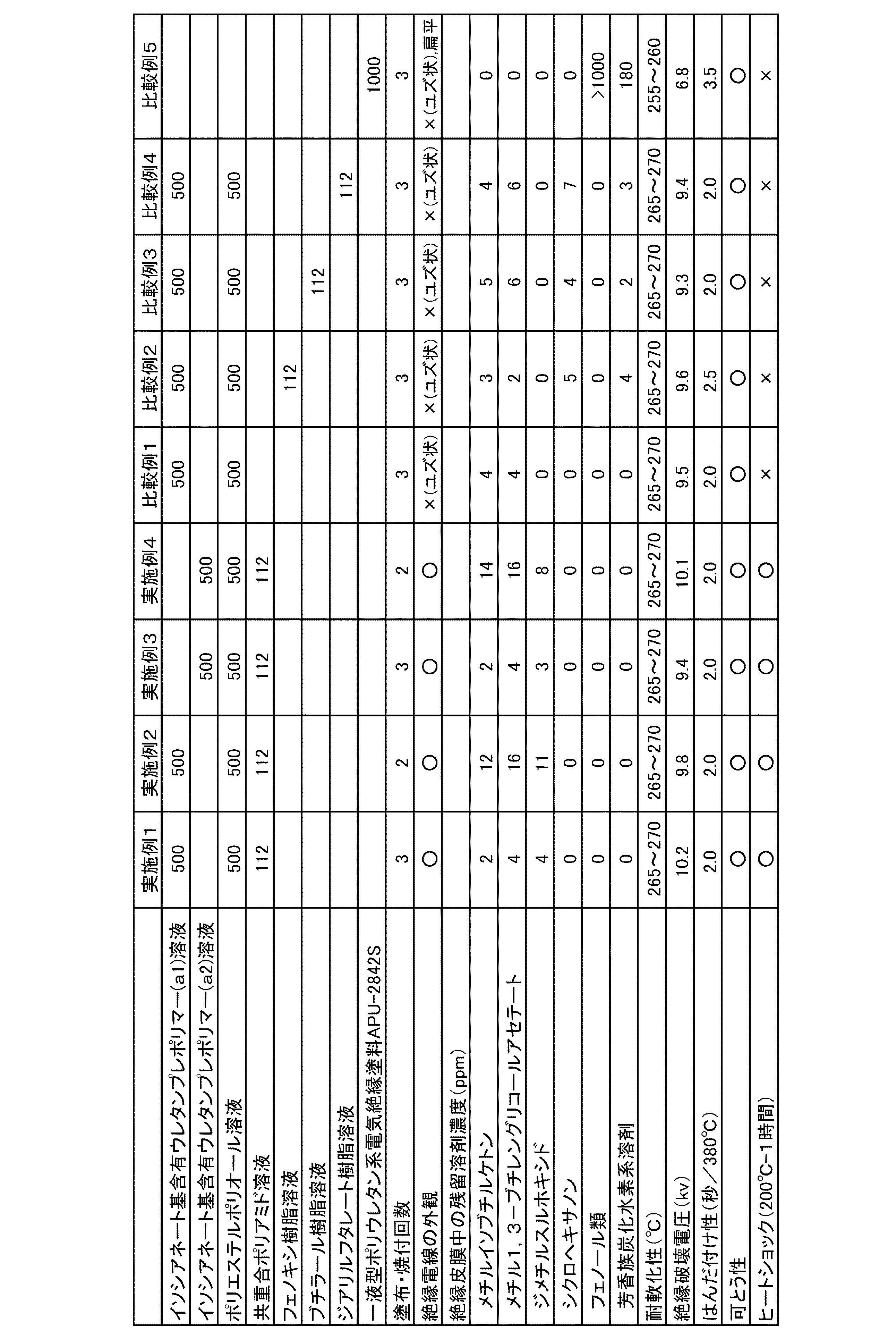
実施例1〜4及び比較例1〜5で製造したポリウレタン系絶縁電線を用いて、電線外観評価、耐軟化性試験、絶縁破壊電圧試験、はんだ付け性、可とう性、ヒートショックの各電線特性試験及び絶縁皮膜中の残留溶剤測定を行った。
(1)電線外観評価
JIS C2351:2006「エナメル線用ワニス」8.6電線外観による。
焼付け1 時間後の電線の外観を目視によって評価し、表面が滑らかで一様な光沢と色を持っているものを○と評価し、そうでないものを×と評価した。
(2)耐軟化性試験
JIS C3003:1999「エナメル線試験方法」11.2B法、b)交差法による。おもりの質量は1種で試験した。
(3)絶縁破壊電圧試験
JIS C3003:1999「エナメル線試験方法」10.2B法、b)2個より法による。
(4)はんだ付け性
JIS C3003:1999「エナメル線試験方法」14.2B法による。
(5)可とう性
試験線を引張試験機で20%伸長した後で、JIS C3003:1999「エナメル線試験方法」7.2B法に準拠し可とう性試験を行った。10倍の拡大鏡を用いて皮膜に導体が見えるき裂が生じていない場合を○と評価し、皮膜に導体が見えるき裂が生じている場合を×と評価した。
(6)ヒートショック
試験線を引張試験機で20%伸長した後で、JIS C3003:1999「エナメル線試験方法」7.2B法に準拠し巻付け電線を得た。この巻付け電線を200℃のオーブンの中に1時間置いた後、巻付け電線をオーブンの中から取出し、室温に30分放置した。その後、10倍の拡大鏡を用いて皮膜に導体が見えるき裂が生じていない場合を○と評価し、皮膜に導体が見えるき裂が生じている場合を×と評価した。
(7)電気絶縁皮膜中の残留溶剤濃度の測定
得られたポリウレタン系電気絶縁電線を5g量り取り、密閉できる容器(今回使用したのはアルミキャップ付き25cm3バイヤルビン)に入れた。この容器を150℃で60分間加熱した。
Using polyurethane-based insulated wires produced in performance test examples 1 to 4 and comparative examples 1 to 5, each of wire appearance evaluation, softening resistance test, dielectric breakdown voltage test, solderability, flexibility, heat shock The electric wire characteristic test and the residual solvent in the insulating film were measured.
(1) Electric wire appearance evaluation JIS C2351: 2006 “varnish for enameled wire” 8.6 According to electric wire appearance.
The appearance of the electric wire after 1 hour of baking was evaluated by visual observation, the surface having a smooth and uniform gloss and color was evaluated as ◯, and the other one was evaluated as ×.
(2) Softening resistance test JIS C3003: 1999 “Enamelled wire test method” 11.2B method, b) According to the crossing method. The mass of the weight was tested with one type.
(3) Dielectric breakdown voltage test JIS C3003: 1999 “Enamelled wire test method” 10.2B method, b) According to two methods.
(4) Solderability According to JIS C3003: 1999 “Enamelled wire test method” 14.2B method.
(5) Flexibility After the test wire was stretched by 20% with a tensile tester, a flexibility test was conducted in accordance with JIS C3003: 1999 “Enamel wire test method” 7.2B method. A case where a crack in which a conductor was visible on the film did not occur was evaluated using a 10 × magnifier, and a case where a crack in which a conductor was visible on the film was evaluated was evaluated as x.
(6) Heat Shock After extending the test wire by 20% with a tensile tester, a wound electric wire was obtained in accordance with JIS C3003: 1999 “Enameled wire test method” 7.2B method. The wound wire was placed in an oven at 200 ° C. for 1 hour, and then the wound wire was taken out of the oven and left at room temperature for 30 minutes. Thereafter, a case where a crack in which the conductor was visible on the film was not generated was evaluated using a 10-fold magnifier, and a case where a crack in which the conductor was visible on the film was evaluated was evaluated as x.
(7) Measurement of residual solvent concentration in electrical insulating film 5 g of the obtained polyurethane electrical insulated wire was weighed and placed in a container that can be sealed (the one used this time is a 25 cm 3 vial with an aluminum cap). The container was heated at 150 ° C. for 60 minutes.
加熱により電気絶縁皮膜から発生した残留溶剤を島津製作所製GC−14Bによるガスクロマトグラフィー法(測定条件は、島津製作所製HR−1701カラム、キャリヤーガスヘリウム、流量40ml/min、検出器FID、インジェクション180℃、スタート温度45℃、昇温速度5℃/min、最終温度160℃)で測定した。得られた測定結果から下記式により、電気絶縁皮膜中の残留溶剤濃度を求めた。 Residual solvent generated from the electrical insulating film by heating was gas chromatographic method using GC-14B manufactured by Shimadzu Corporation (measurement conditions were HR-1701 column manufactured by Shimadzu Corporation, carrier gas helium, flow rate 40 ml / min, detector FID, injection 180 And a start temperature of 45 ° C., a heating rate of 5 ° C./min, and a final temperature of 160 ° C.). From the obtained measurement results, the residual solvent concentration in the electrical insulating film was determined by the following formula.
残留溶剤量(ppm)=GCによる測定(μg)/皮膜質量(g)
皮膜質量=電線質量(g)×(皮膜付着率/100)
皮膜付着率(%)=1.3π(D22−D12)/〔8.89πD12+1.3π(D22−D12)〕×100
D1:導体径
D2:電線外径
Residual solvent amount (ppm) = measured by GC (μg) / film mass (g)
Film mass = wire mass (g) × (film adhesion rate / 100)
Coating rate (%) = 1.3π (D22−D12) / [8.89πD12 + 1.3π (D22−D12)] × 100
D1: Conductor diameter D2: Wire outer diameter
実施例1〜4の結果から、本発明の反応型ポリウレタン系電気絶縁塗料を用いて塗布・焼付けを行えば、ダイスによる塗布回数を2パス、3パスと減らし焼付けしても得られる絶縁電線の外観は良好であることが分かる。また、得られる絶縁電線の絶縁被膜中にはフェノール系溶剤が残留しないばかりか、それ以外の有機溶剤の残留溶剤量は、一液型ポリウレタン系電気絶縁塗料(比較例5)と比べ極めて低いことが分かる。更に、本発明の絶縁電線は、塗布・焼付け回数を減らしても、電線特性の低下が見られず、耐軟化性、はんだ付け性、可とう性といった電線特性が良好で、200℃−1時間の熱処理後のヒートショックも改善された。ポリアミド樹脂により、得られる絶縁皮膜に柔軟性が付与されヒートショックが改善できたと考えられる。 From the results of Examples 1 to 4, if application and baking are performed using the reactive polyurethane electrical insulating paint of the present invention, the number of times of application with a die is reduced to 2 passes and 3 passes. It can be seen that the appearance is good. In addition, phenolic solvents do not remain in the insulation film of the insulated wire obtained, and the residual solvent amount of other organic solvents is extremely low compared to the one-component polyurethane-based electrical insulating paint (Comparative Example 5). I understand. Furthermore, the insulated wire of the present invention has good wire properties such as softening resistance, solderability, and flexibility even when the number of times of coating and baking is reduced, and is 200 ° C.-1 hour. The heat shock after heat treatment was also improved. It is considered that the heat shock can be improved by imparting flexibility to the obtained insulating film by the polyamide resin.
本発明の反応型ポリウレタン系電気絶縁塗料は、上述の通り、良好な外観および電線特性を維持しつつ、塗布・焼付け回数を低減して、絶縁電線の生産効率を上げることを可能にする。 As described above, the reactive polyurethane electrical insulating paint of the present invention makes it possible to increase the production efficiency of an insulated wire by reducing the number of times of application and baking while maintaining good appearance and electrical wire characteristics.
Claims (7)
(b)ポリオール化合物と、
(c)ポリアミド樹脂とを含有し、かつ、フェノール系溶剤を含有しないことを特徴とする反応型ポリウレタン系電気絶縁塗料。 (A) an isocyanate group-containing polyurethane;
(B) a polyol compound;
(C) A reactive polyurethane-based electrically insulating paint characterized by containing a polyamide resin and not containing a phenol-based solvent.
前記ポリウレタン系電気絶縁塗料を、導体又は予め絶縁層で被覆された導体上に塗布し、焼付けすることにより、前記ポリウレタン系電気絶縁塗料による電気絶縁層を形成することを特徴とする、ポリウレタン系絶縁電線の製造方法。 Preparing a reactive polyurethane-based electrically insulating coating containing (a) an isocyanate group-containing polyurethane, (b) a polyol compound, and (c) a polyamide resin and not containing a phenolic solvent;
The polyurethane-based electrical insulation paint is applied onto a conductor or a conductor previously coated with an insulation layer and baked to form an electrical insulation layer made of the polyurethane-based electrical insulation paint. Electric wire manufacturing method.
Priority Applications (1)
| Application Number | Priority Date | Filing Date | Title |
|---|---|---|---|
| JP2011006132A JP5736631B2 (en) | 2011-01-14 | 2011-01-14 | Reactive polyurethane-based electrically insulating paint, insulated wire having an insulating layer of the electrically insulated paint, and method for producing the insulated wire |
Applications Claiming Priority (1)
| Application Number | Priority Date | Filing Date | Title |
|---|---|---|---|
| JP2011006132A JP5736631B2 (en) | 2011-01-14 | 2011-01-14 | Reactive polyurethane-based electrically insulating paint, insulated wire having an insulating layer of the electrically insulated paint, and method for producing the insulated wire |
Publications (2)
| Publication Number | Publication Date |
|---|---|
| JP2012144679A true JP2012144679A (en) | 2012-08-02 |
| JP5736631B2 JP5736631B2 (en) | 2015-06-17 |
Family
ID=46788579
Family Applications (1)
| Application Number | Title | Priority Date | Filing Date |
|---|---|---|---|
| JP2011006132A Expired - Fee Related JP5736631B2 (en) | 2011-01-14 | 2011-01-14 | Reactive polyurethane-based electrically insulating paint, insulated wire having an insulating layer of the electrically insulated paint, and method for producing the insulated wire |
Country Status (1)
| Country | Link |
|---|---|
| JP (1) | JP5736631B2 (en) |
Cited By (4)
| Publication number | Priority date | Publication date | Assignee | Title |
|---|---|---|---|---|
| CN105176353A (en) * | 2015-10-10 | 2015-12-23 | 徐州市三为水性漆科技有限公司 | Novel water-based insulating material and preparation method thereof |
| JP2017079187A (en) * | 2015-10-22 | 2017-04-27 | 三菱電線工業株式会社 | Colored insulated wire and manufacturing method thereof |
| JP2017528567A (en) * | 2014-09-12 | 2017-09-28 | モメンティブ パフォーマンス マテリアルズ インコーポレイテッド | Latent catalyst for polyurethane foam production |
| CN112430425A (en) * | 2020-12-25 | 2021-03-02 | 东莞宏石功能材料科技有限公司 | High-heat-resistance polyurethane insulating paint and preparation method thereof |
Citations (7)
| Publication number | Priority date | Publication date | Assignee | Title |
|---|---|---|---|---|
| JPS58133876A (en) * | 1982-02-05 | 1983-08-09 | Totoku Electric Co Ltd | Method and device for production of polyurethane enamel copper wire |
| JPS61130377A (en) * | 1984-11-29 | 1986-06-18 | Showa Electric Wire & Cable Co Ltd | Insulating paint resin composition and production thereof |
| JPS62141076A (en) * | 1985-12-16 | 1987-06-24 | Totoku Electric Co Ltd | Low-temperature soldering polyurethane insulated wire |
| JPH0411676A (en) * | 1990-05-01 | 1992-01-16 | Furukawa Electric Co Ltd:The | Colored, high-solid, two-pack polyurethane resin coating composition |
| JPH08249936A (en) * | 1995-03-10 | 1996-09-27 | Totoku Electric Co Ltd | Self-bonding magnet wire for alcohol winding or hot air winding |
| JP2006045484A (en) * | 2004-06-30 | 2006-02-16 | Auto Kagaku Kogyo Kk | Two-pack reactive polyurethane type electrical insulating coating and polyurethane type insulated wire using the coating |
| JP2006089556A (en) * | 2004-09-22 | 2006-04-06 | Auto Kagaku Kogyo Kk | Reactive polyurethane-based electroinsulating coating material, and polyurethane-based insulated wire using the same |
-
2011
- 2011-01-14 JP JP2011006132A patent/JP5736631B2/en not_active Expired - Fee Related
Patent Citations (7)
| Publication number | Priority date | Publication date | Assignee | Title |
|---|---|---|---|---|
| JPS58133876A (en) * | 1982-02-05 | 1983-08-09 | Totoku Electric Co Ltd | Method and device for production of polyurethane enamel copper wire |
| JPS61130377A (en) * | 1984-11-29 | 1986-06-18 | Showa Electric Wire & Cable Co Ltd | Insulating paint resin composition and production thereof |
| JPS62141076A (en) * | 1985-12-16 | 1987-06-24 | Totoku Electric Co Ltd | Low-temperature soldering polyurethane insulated wire |
| JPH0411676A (en) * | 1990-05-01 | 1992-01-16 | Furukawa Electric Co Ltd:The | Colored, high-solid, two-pack polyurethane resin coating composition |
| JPH08249936A (en) * | 1995-03-10 | 1996-09-27 | Totoku Electric Co Ltd | Self-bonding magnet wire for alcohol winding or hot air winding |
| JP2006045484A (en) * | 2004-06-30 | 2006-02-16 | Auto Kagaku Kogyo Kk | Two-pack reactive polyurethane type electrical insulating coating and polyurethane type insulated wire using the coating |
| JP2006089556A (en) * | 2004-09-22 | 2006-04-06 | Auto Kagaku Kogyo Kk | Reactive polyurethane-based electroinsulating coating material, and polyurethane-based insulated wire using the same |
Cited By (9)
| Publication number | Priority date | Publication date | Assignee | Title |
|---|---|---|---|---|
| JP2017528567A (en) * | 2014-09-12 | 2017-09-28 | モメンティブ パフォーマンス マテリアルズ インコーポレイテッド | Latent catalyst for polyurethane foam production |
| US10464056B2 (en) | 2014-09-12 | 2019-11-05 | Momentive Performance Materials Inc. | Latent catalyst for the production of polyurethane foam |
| JP2020114920A (en) * | 2014-09-12 | 2020-07-30 | モメンティブ パフォーマンス マテリアルズ インコーポレイテッドMomentive Performance Materials Inc. | Latent catalyst for production of polyurethane foam |
| JP7021946B2 (en) | 2014-09-12 | 2022-02-17 | モメンティブ パフォーマンス マテリアルズ インコーポレイテッド | Potential catalyst for polyurethane foam manufacturing |
| JP7068371B2 (en) | 2014-09-12 | 2022-05-16 | モメンティブ パフォーマンス マテリアルズ インコーポレイテッド | Potential catalyst for polyurethane foam manufacturing |
| CN105176353A (en) * | 2015-10-10 | 2015-12-23 | 徐州市三为水性漆科技有限公司 | Novel water-based insulating material and preparation method thereof |
| JP2017079187A (en) * | 2015-10-22 | 2017-04-27 | 三菱電線工業株式会社 | Colored insulated wire and manufacturing method thereof |
| CN112430425A (en) * | 2020-12-25 | 2021-03-02 | 东莞宏石功能材料科技有限公司 | High-heat-resistance polyurethane insulating paint and preparation method thereof |
| CN112430425B (en) * | 2020-12-25 | 2022-09-23 | 东莞宏石功能材料科技有限公司 | High-heat-resistance polyurethane insulating paint and preparation method thereof |
Also Published As
| Publication number | Publication date |
|---|---|
| JP5736631B2 (en) | 2015-06-17 |
Similar Documents
| Publication | Publication Date | Title |
|---|---|---|
| JP5516640B2 (en) | Thermosetting resin composition | |
| CN104893539B (en) | Preparation method of hydrophobic and flame-retardant PU (polyurethane) coating | |
| JP5736631B2 (en) | Reactive polyurethane-based electrically insulating paint, insulated wire having an insulating layer of the electrically insulated paint, and method for producing the insulated wire | |
| CN110128614B (en) | Solvent-free polyurethane resin for high-stripping foaming layer and preparation method and application thereof | |
| CN101575405B (en) | Polyurethane resin shaping combination, sealing material and hollow fiber membrane component | |
| CN115151594B (en) | Polyester resin with less foreign matter and coating composition or adhesive composition using the same | |
| US4505980A (en) | Insulated wire | |
| CN115232285B (en) | Solvent-free polyurethane resin for synthetic leather and preparation method thereof | |
| EP3049454B1 (en) | A co-polymer polyol | |
| CN102936451A (en) | Preparation method of 180 grade polyurethane enamelled wire insulating paint used for ultra-fine wire | |
| JPS58208323A (en) | Production of polyamide-imide resin | |
| JPS62167748A (en) | Manufacture of blocked polyisocyanate having carbodiimido group, polysocyanate thereby and use for manufacture of plastic | |
| JP5040284B2 (en) | Thermosetting resin composition | |
| JP2006089556A (en) | Reactive polyurethane-based electroinsulating coating material, and polyurethane-based insulated wire using the same | |
| AU705560B2 (en) | Blocked polyisocyanates containing amide/imide groups and their use in stoving lacquers | |
| WO2013137170A1 (en) | Polyamide-imide resin, resin composition using polyamide-imide resin, resin film, and seamless belt | |
| JP2004238525A (en) | Polyurethane-based electrical-insulating coating material and polyurethane-based insulated wire using the same | |
| JP5811493B2 (en) | Coating composition and insulated wire using the same | |
| JP2006045484A (en) | Two-pack reactive polyurethane type electrical insulating coating and polyurethane type insulated wire using the coating | |
| JPS5880325A (en) | Polyamide-imide resin composition and its production | |
| JP3656240B2 (en) | Low viscosity polyisocyanate curing agent containing uretonimine group for paint | |
| JP6177382B1 (en) | Polyurethane resin composition | |
| AU7938901A (en) | New coating binders with urea and/or hydantoin structures, process for their production and their use | |
| EP2957582A1 (en) | Isocyanate-based prepolymers | |
| JPS58104925A (en) | Polyamide-imide resin composition and its preparation |
Legal Events
| Date | Code | Title | Description |
|---|---|---|---|
| RD04 | Notification of resignation of power of attorney |
Free format text: JAPANESE INTERMEDIATE CODE: A7424 Effective date: 20131008 |
|
| A621 | Written request for application examination |
Free format text: JAPANESE INTERMEDIATE CODE: A621 Effective date: 20131029 |
|
| RD02 | Notification of acceptance of power of attorney |
Free format text: JAPANESE INTERMEDIATE CODE: A7422 Effective date: 20131029 |
|
| A977 | Report on retrieval |
Free format text: JAPANESE INTERMEDIATE CODE: A971007 Effective date: 20140630 |
|
| A131 | Notification of reasons for refusal |
Free format text: JAPANESE INTERMEDIATE CODE: A131 Effective date: 20140707 |
|
| A521 | Written amendment |
Free format text: JAPANESE INTERMEDIATE CODE: A523 Effective date: 20140902 |
|
| TRDD | Decision of grant or rejection written | ||
| A01 | Written decision to grant a patent or to grant a registration (utility model) |
Free format text: JAPANESE INTERMEDIATE CODE: A01 Effective date: 20150323 |
|
| A61 | First payment of annual fees (during grant procedure) |
Free format text: JAPANESE INTERMEDIATE CODE: A61 Effective date: 20150405 |
|
| R150 | Certificate of patent or registration of utility model |
Ref document number: 5736631 Country of ref document: JP Free format text: JAPANESE INTERMEDIATE CODE: R150 |
|
| R250 | Receipt of annual fees |
Free format text: JAPANESE INTERMEDIATE CODE: R250 |
|
| R250 | Receipt of annual fees |
Free format text: JAPANESE INTERMEDIATE CODE: R250 |
|
| R250 | Receipt of annual fees |
Free format text: JAPANESE INTERMEDIATE CODE: R250 |
|
| LAPS | Cancellation because of no payment of annual fees |