JP2012106905A - Acid resistant cement composition, and acid resistant mortar or concrete containing the same - Google Patents
Acid resistant cement composition, and acid resistant mortar or concrete containing the same Download PDFInfo
- Publication number
- JP2012106905A JP2012106905A JP2011174674A JP2011174674A JP2012106905A JP 2012106905 A JP2012106905 A JP 2012106905A JP 2011174674 A JP2011174674 A JP 2011174674A JP 2011174674 A JP2011174674 A JP 2011174674A JP 2012106905 A JP2012106905 A JP 2012106905A
- Authority
- JP
- Japan
- Prior art keywords
- mass
- cement
- admixture
- acid
- strength
- Prior art date
- Legal status (The legal status is an assumption and is not a legal conclusion. Google has not performed a legal analysis and makes no representation as to the accuracy of the status listed.)
- Granted
Links
Classifications
-
- Y—GENERAL TAGGING OF NEW TECHNOLOGICAL DEVELOPMENTS; GENERAL TAGGING OF CROSS-SECTIONAL TECHNOLOGIES SPANNING OVER SEVERAL SECTIONS OF THE IPC; TECHNICAL SUBJECTS COVERED BY FORMER USPC CROSS-REFERENCE ART COLLECTIONS [XRACs] AND DIGESTS
- Y02—TECHNOLOGIES OR APPLICATIONS FOR MITIGATION OR ADAPTATION AGAINST CLIMATE CHANGE
- Y02W—CLIMATE CHANGE MITIGATION TECHNOLOGIES RELATED TO WASTEWATER TREATMENT OR WASTE MANAGEMENT
- Y02W30/00—Technologies for solid waste management
- Y02W30/50—Reuse, recycling or recovery technologies
- Y02W30/91—Use of waste materials as fillers for mortars or concrete
Landscapes
- Curing Cements, Concrete, And Artificial Stone (AREA)
Abstract
Description
本発明は、主に土木・建築業界において使用されるセメント組成物、及び前記セメント組成物を配合したモルタル又はコンクリートに関する。詳しくは、コンクリートやモルタルに配合される耐酸性を向上させる耐酸性セメント組成物、並びに前記耐酸性セメントに、水及び細骨材を加えたモルタル、あるいは水、細骨材及び粗骨材を加えたコンクリートに関する。 The present invention relates to a cement composition mainly used in the civil engineering and construction industry, and mortar or concrete containing the cement composition. Specifically, an acid-resistant cement composition for improving acid resistance blended in concrete and mortar, and mortar in which water and fine aggregate are added to the acid-resistant cement, or water, fine aggregate and coarse aggregate are added. Related to concrete.
近年、日本だけでなく海外各地で道路下の下水道管の劣化によって、道路が陥没する事故が報告されており、下水道コンクリート及び地下構造物において、微生物が介在する硫酸によるコンクリートの劣化が社会的に大きな問題となっている。 In recent years, there have been reports of accidents where roads have collapsed due to deterioration of sewage pipes under roads not only in Japan but also in other parts of the world. It has become a big problem.
このコンクリートの劣化に対する技術として、普通ポルトランドセメントと、シリカフュームと、高炉水砕スラグ粉とからなる3成分系の耐酸性セメント組成物であって、前記高炉水砕スラグ粉の含有量が、前記普通ポルトランドセメントの含有量と同等か又はそれより多く、前記普通ポルトランドセメントが30〜40質量%、前記シリカフュームが12〜25質量%、前記高炉水砕スラグ粉が40〜58質量%で、これら3成分で100質量%となる耐酸性セメント組成物に関する技術が開示されている(例えば特許文献1参照)。 As a technique for the deterioration of the concrete, a ternary acid-resistant cement composition composed of ordinary Portland cement, silica fume, and blast furnace granulated slag powder, wherein the content of the blast furnace granulated slag powder is the ordinary It is equal to or more than the content of Portland cement, the normal Portland cement is 30-40% by mass, the silica fume is 12-25% by mass, the blast furnace granulated slag powder is 40-58% by mass, these three components The technique regarding the acid-resistant cement composition used as 100 mass% is disclosed (for example, refer patent document 1).
また、ポルトランドセメント10〜30部、高炉スラグ20〜40部、フライアッシュ10〜30部、シリカフューム10〜20部、及び硫酸塩1〜10部を含有してなるセメント組織物に関する技術が開示されている(例えば特許文献2参照)。 Also disclosed is a technique relating to a cement structure comprising 10 to 30 parts of Portland cement, 20 to 40 parts of blast furnace slag, 10 to 30 parts of fly ash, 10 to 20 parts of silica fume, and 1 to 10 parts of sulfate. (For example, refer to Patent Document 2).
また、耐酸性コンクリート部材として、セメント質材料としてPFBC灰とセメントとを含み、前記セメント質材料に占める前記PFBC灰の含有率が40質量%以上50質量%以下であり、前記セメント質材料に占める前記セメントの含有率が20質量%以上30質量%以下であるコンクリート部材に関する技術が開示されている(例えば特許文献3参照)。 The acid-resistant concrete member includes PFBC ash and cement as a cementitious material, and the content of the PFBC ash in the cementitious material is 40% by mass or more and 50% by mass or less, and occupies the cementitious material. A technique relating to a concrete member having a cement content of 20% by mass to 30% by mass is disclosed (see, for example, Patent Document 3).
しかし、既設下水道コンクリート構造物へ表面被覆の補修材として使用する場合には、下水道使用を長期間止めることができず3日で補修を完了して下水を流す場合がある。この点からみると、特許文献1に記載の発明は、段落[0032]の表4に記載されているように、圧縮強度は材齢7日では3.81〜7.68N/mm2であり、かつ材齢28日では実施例1で42.8N/mm2であるので、下水道コンクリート自体にセメント組成物を提供する場合はよいが、既設下水道コンクリートの表面被覆の補修材として使用する場合には、補修用セメント混合物に必要とされる圧縮強度を規定した、東京都下水道局の表面被覆材に関する[コンクリート改修技術マニュアル]の材齢3日で25N/mm2以上、かつ材齢28日で45N/mm2以上という規定を満足していないという問題があった。 However, when used as a surface covering repair material for an existing sewer concrete structure, the use of the sewer cannot be stopped for a long period of time, and the repair may be completed in 3 days and the sewage may flow. From this point, as described in Table 4 of paragraph [0032], the invention described in Patent Document 1 has a compressive strength of 3.81 to 7.68 N / mm 2 at a material age of 7 days. And, since it is 42.8 N / mm 2 in Example 1 at a material age of 28 days, a cement composition may be provided to sewer concrete itself, but when used as a surface covering repair material for existing sewer concrete. Is 25N / mm 2 or more at the age of 3 days in the [Concrete Refurbishment Technology Manual] for the surface covering material of the Tokyo Sewerage Bureau, which defines the compressive strength required for the cement mixture for repair, and at the age of 28 days There was a problem that the rule of 45 N / mm 2 or more was not satisfied.
特許文献2に記載の発明については、表面被覆材に必要とされる圧縮強度を規定した東京都下水道局の[コンクリート改修技術マニュアル]に規定された圧縮強度に対し、材齢3日や材齢7日の初期における圧縮強度の記載がなく不明であり、かつ段落[0026]表2における材齢28日における圧縮強度はすべて45N/mm2以下であるので、少なくとも下水道の表面部の被覆補修用としては適さないという懸念点があった。 Regarding the invention described in Patent Document 2, the age of 3 days or the age of the material is compared with the compressive strength defined in the [Concrete Refurbishment Technical Manual] of the Tokyo Sewerage Bureau, which defines the compressive strength required for the surface coating material. Since there is no description of the compressive strength at the beginning of the 7th day and the compressive strength at the age of 28 days in the paragraph [0026] Table 2 is all 45 N / mm 2 or less, at least for covering repair of the surface part of the sewer There was a concern that it was not suitable.
また、特許文献3に記載のコンクリート部材は、耐酸性の効果を確認するために圧縮強度試験と質量減少率の結果を開示されているが、硫酸浸透深さについての記載がない。一般的に、耐酸性の効果を確認する試験としてはコンクリートとしての強度発現の早いものと強度発現の遅いものができるため、例えば強度発現の遅いコンクリートの場合は質量減少率が小であっても硫酸がコンクリート内部に浸透していることがあり表面から内部まで硫酸による劣化が進行していることから、圧縮強度試験、質量減少率及び硫酸浸透深さの3つの試験が必要とされる。 Moreover, although the concrete member of patent document 3 is disclosing the result of a compressive strength test and a mass reduction | decrease rate in order to confirm the acid-resistant effect, there is no description about sulfuric acid penetration depth. In general, as a test to confirm the effect of acid resistance, there can be a concrete with a fast strength development and a slow strength development as a concrete. For example, in the case of a concrete with a slow strength development, even if the mass reduction rate is small. Since sulfuric acid has permeated into the concrete and deterioration by sulfuric acid has progressed from the surface to the inside, three tests are required: a compressive strength test, a mass reduction rate, and a sulfuric acid penetration depth.
特許文献3に記載の技術には混和材として強度発現の遅いフライアッシュやPFBC灰を使用しており、初期にコンクリートの表面部に剥離による質量減少がみられなくても表面から内部に至るまで空隙ができて硫酸が浸透しているというケースがあることから、圧縮強度試験と質量減少率とでは硫酸による劣化が進んでいないようにみえても水和反応が進行していないため、表面から内部に至るまで空隙が多く硫酸が内部まで浸透していることが懸念されるという問題があった。 In the technique described in Patent Document 3, fly ash or PFBC ash having a slow strength development is used as an admixture. From the surface to the inside even if there is no mass reduction due to peeling at the initial surface of the concrete. Since there is a case in which sulfuric acid has penetrated due to voids, the hydration reaction does not proceed even though it seems that the deterioration due to sulfuric acid does not progress in the compressive strength test and the mass reduction rate. There was a problem that there was a concern that sulfuric acid was permeated into the interior with many voids reaching the inside.
また、特許文献3によれば、水結合材比は、段落[0034]に30質量%又は40質量%で実施した記載があり、段落[0057]に耐酸性に優れているものとして水結合材比が30質量%の場合を示唆する記載がある。 Further, according to Patent Document 3, the water binder ratio is described in paragraph [0034] at 30% by mass or 40% by mass. In paragraph [0057], the water binder is regarded as having excellent acid resistance. There is a description suggesting that the ratio is 30% by mass.
下水道コンクリートの劣化の過程として以下の過程が考えられる。下水道内部の下水部に生息する嫌気性の硫酸塩還元細菌が生活排水中に存在する硫酸イオンを食して硫化水素を排出する。排出された硫化水素が流れの乱れる個所で下水道上部にガスとして放散される。下水道上部の大気中好気性環境においては、硫黄酸化細菌やその他種々の細菌が生息しており、これらの細菌が硫化水素ガスを食し硫酸を排出する。この硫酸が、下水道管のコンクリート壁の結露水に溶け込み、その硫酸を含んだ結露水がコンクリート内に浸入してくると、生成された強酸性である硫酸がコンクリート中の強アルカリ性である水酸化カルシウムと激しく反応し、コンクリートの表面部に泥状化した二水石膏が生成され、前記泥状化した二水石膏が表面部から剥離し、下水道コンクリート管上部の劣化に至る。 The following processes can be considered as deterioration processes of sewer concrete. Anaerobic sulfate-reducing bacteria living in the sewage section inside the sewer eat the sulfate ions present in domestic wastewater and discharge hydrogen sulfide. The discharged hydrogen sulfide is dissipated as gas in the upper part of the sewer at the place where the flow is disturbed. In the aerobic environment in the upper part of the sewer, sulfur-oxidizing bacteria and various other bacteria live, and these bacteria eat hydrogen sulfide gas and discharge sulfuric acid. When this sulfuric acid dissolves in the dew condensation water on the concrete wall of the sewer pipe, and the dew condensation water containing the sulfuric acid enters the concrete, the generated highly acidic sulfuric acid is a strong alkalinity in the concrete. It reacts violently with calcium to produce dihydrated gypsum on the surface of the concrete, and the muddy dihydrate gypsum peels off from the surface, leading to deterioration of the upper part of the sewer concrete pipe.
したがって、本発明の目的は、初期及び中長期における圧縮強度を発現する混和材を有し、新設の下水道構造物の建設工事及び既設下水道構造物のコンクリート又はモルタルの表面部の被覆補修工事の両工事に適応可能な耐酸性セメント組成物を提供するとともに、耐酸性セメント(組成物)を用いた耐酸性のモルタル又はコンクリートを提供することである。 Accordingly, an object of the present invention is to have an admixture that develops compressive strength in the initial stage, the mid-long term, and both the construction work of the new sewer structure and the covering repair work on the concrete or mortar surface of the existing sewer structure. In addition to providing an acid-resistant cement composition that can be adapted to construction, an acid-resistant mortar or concrete using an acid-resistant cement (composition) is provided.
本発明において、「セメント組成物」とは、モルタル又はコンクリートに混合される、セメント、並びにシリカフューム、高炉フューム、高炉スラグ微粉末、フライアッシュ、砥石粉及び汚泥などの混和材、並びにセメントの質量に対して0.1〜2質量%添加する高性能減水剤や流動化剤などの混和剤を含む組成を意味する。なお、高性能減水剤や流動化剤などの混和剤を含まないセメント組成物もある。 In the present invention, the term “cement composition” refers to cement mixed with mortar or concrete, admixtures such as silica fume, blast furnace fume, blast furnace slag fine powder, fly ash, grinding stone powder and sludge, and the mass of cement. On the other hand, it means a composition containing an admixture such as a high-performance water reducing agent or a fluidizing agent added in an amount of 0.1 to 2% by mass. There are also cement compositions that do not contain admixtures such as high-performance water reducing agents and fluidizing agents.
本発明において、「初期強度発現性を有する」とは、モルタル又はコンクリートを打ち込んだときから約7日までの期間においてモルタル又はコンクリートの強度を発現させることを有するということを意味し、「中長期強度発現性を有する」とは、モルタル又はコンクリートを打ち込んだときから約7日以降においてモルタル又はコンクリートの強度を発現させることを有するということを意味する。 In the present invention, “having initial strength development” means that the strength of mortar or concrete is developed in a period of about 7 days from when mortar or concrete is driven, “Having strength developability” means having the strength of the mortar or concrete developed after about 7 days from when the mortar or concrete is driven.
本発明において、「成分」とは、セメント質材料に属する、セメント、シリカフューム、高炉フューム、高炉スラグ微粉末、フライアッシュ、砥石粉又は汚泥などの材料を意味し、「3成分」とは3種類のセメント質材料を意味する。本発明における「成分」には混和剤を含んでいない。 In the present invention, “component” means a material such as cement, silica fume, blast furnace fume, blast furnace slag fine powder, fly ash, grinding stone powder or sludge belonging to cementitious material, and “three components” are three kinds. Means cementitious material. The “component” in the present invention does not contain an admixture.
本発明において、「水結合材比」とは、セメント及び混和材との混合物であるセメント組成物をセメント質材料というが、前記セメント質材料の総質量に対する水の質量の比率を意味する。また、「耐酸性セメント組成物」は耐酸性を有するセメントとするために構成される組成物からなるセメント質材料を意味し、「耐酸性セメント」とは耐酸性を有するセメントを意味するので、「耐酸性セメント組成物」と「耐酸性セメント」とは実質的に同義語である。 In the present invention, the “water binder ratio” means a cement composition that is a mixture of cement and an admixture is called a cementitious material, and means the ratio of the mass of water to the total mass of the cementitious material. In addition, “acid-resistant cement composition” means a cementitious material made of a composition configured to make a cement having acid resistance, and “acid-resistant cement” means a cement having acid resistance. “Acid resistant cement composition” and “acid resistant cement” are substantially synonymous.
「発明が解決しようとする課題」に記載した課題を解決するために、請求項1に記載の耐酸性セメント組成物の発明は、セメント40超〜50質量%と、ポゾラン反応性又は潜在水硬性を有して初期強度を発現する混和材10〜30質量%と、ポゾラン反応性又は潜在水硬性を有して中長期強度を発現する混和材20〜50質量%とからなり、前記セメントと、前記初期強度発現性を有する少なくとも1種の混和材と、前記中長期強度発現性を有する少なくとも1種の混和材との3成分〜7成分のセメント質材料で100質量%となることを特徴とする。 In order to solve the problems described in “Problems to be Solved by the Invention”, the invention of an acid-resistant cement composition according to claim 1 is characterized in that cement is more than 40 to 50% by mass, pozzolanic reactivity or latent hydraulic properties. 10-30% by mass of an admixture that exhibits initial strength and 20-50% by mass of an admixture that exhibits pozzolanic reactivity or latent hydraulic property and exhibits mid-long term strength, and the cement, 100% by mass of the cementitious material of 3 to 7 components of the at least one admixture having the initial strength development and the at least one admixture having the medium to long-term strength development is 100% by mass. To do.
請求項2に記載の耐酸性セメント組成物の発明は、セメント40超〜50質量%と、ポゾラン反応性又は潜在水硬性を有して初期強度を発現する混和材10〜30質量%と、ポゾラン反応性又は潜在水硬性を有して中長期強度を発現する混和材20〜50質量%と、セメントの質量に対して0.1〜2質量%添加する、高性能減水剤や流動化剤などの混和剤とからなり、前記セメントと、前記初期強度発現性を有する少なくとも1種の混和材と、前記中長期強度発現性を有する少なくとも1種の混和材との3成分〜7成分のセメント質材料と、前記混和剤とで100質量%となることを特徴とする。 The invention of the acid-resistant cement composition according to claim 2 comprises more than 40 to 50% by mass of cement, 10 to 30% by mass of an admixture that has pozzolanic reactivity or latent hydraulic property and exhibits initial strength, and pozzolanic High-performance water-reducing agent, fluidizing agent, etc., which is 20 to 50% by mass of an admixture that has reactivity or latent hydraulic properties and exhibits medium to long-term strength, and 0.1 to 2% by mass with respect to cement 3 to 7 component cementitious material comprising the cement, the at least one admixture having the initial strength development, and the at least one admixture having the medium to long-term strength development. The amount of the material and the admixture is 100% by mass.
請求項3に記載の耐酸性セメント組成物の発明は、請求項1又は2において、前記セメントが、ポルトランドセメント、高炉セメント又はフライアッシュセメントであることを特徴とする。 The invention of acid-resistant cement composition according to claim 3 is characterized in that, in claim 1 or 2, the cement is Portland cement, blast furnace cement, or fly ash cement.
請求項4に記載の耐酸性セメント組成物の発明は、請求項1乃至3のいずれかにおいて、前記ポゾラン反応性又は潜在水硬性を有して初期強度を発現する混和材が、シリカフューム、高炉フューム及び高炉スラグ微粉末からなる群より選択された1種以上の混和材であることを特徴とする。 The invention of acid-resistant cement composition according to claim 4 is characterized in that, in any one of claims 1 to 3, the admixture having the pozzolanic reactivity or latent hydraulic property and expressing the initial strength is silica fume, blast furnace fume. And one or more admixtures selected from the group consisting of blast furnace slag fine powder.
請求項5に記載の耐酸性セメント組成物の発明は、請求項1乃至4のいずれかにおいて、前記ポゾラン反応性又は潜在水硬性を有して中長期強度を発現する混和材が、高炉スラグ微粉末、フライアッシュ及び汚泥からなる群より選択された1種以上の混和材であることを特徴とする。 The invention of the acid-resistant cement composition according to claim 5 is the invention according to any one of claims 1 to 4, wherein the admixture having the pozzolanic reactivity or latent hydraulic property and exhibiting medium to long-term strength is blast furnace slag fine. It is one or more admixtures selected from the group consisting of powder, fly ash and sludge.
請求項6に記載の耐酸性セメント組成物の発明は、請求項1乃至5のいずれかにおいて、中長期において強度を発現する混和材として、砥石粉を5〜15質量%を配合することを特徴とする。 Invention of acid-resistant cement composition of Claim 6 mix | blends 5-15 mass% of grindstone powder as an admixture which expresses intensity | strength in medium-to-long term in any one of Claims 1 thru | or 5. And
請求項7に記載の耐酸性モルタル又はコンクリートの発明は、請求項1乃至6のいずれかに記載の耐酸性セメント組成物の総質量に対する水の質量比を示す水結合材比が50〜65質量%であることを特徴とする。 The invention of acid-resistant mortar or concrete according to claim 7 has a water binder ratio of 50 to 65 mass indicating the mass ratio of water to the total mass of the acid-resistant cement composition according to any of claims 1 to 6. %.
請求項1に記載の発明は、下水道、トンネル、地下歩道、地下商店街、地下自動車道などの地下構造物の建設工事、及び既設地下構造物の表面部の被覆補修工事の両工事に適応可能となるという効果を奏する。 The invention described in claim 1 can be applied to both construction work for underground structures such as sewers, tunnels, underground walkways, underground shopping streets, underground motorways, and covering repair work on the surface of existing underground structures. It has the effect of becoming.
また、セメント組成物中のセメント配合量が40質量%以下になるとコンクリート又はモルタルの初期における圧縮強度が発現しにくいし、セメント組成物中のセメント配合量が50質量%超になるとセメントと水との水和反応で水酸化カルシウムが多く生成されコンクリート又はモルタルの耐酸性が低下する。したがって、所要の圧縮強度と耐酸性との両方を実現させることができるという効果を奏する。 Moreover, when the amount of cement in the cement composition is 40% by mass or less, the compressive strength in the initial stage of concrete or mortar is difficult to develop, and when the amount of cement in the cement composition exceeds 50% by mass, cement and water As a result of this hydration reaction, a large amount of calcium hydroxide is produced and the acid resistance of concrete or mortar is lowered. Therefore, both the required compressive strength and acid resistance can be realized.
また、セメント量の一部をシリカフューム、高炉スラグ微粉末やフライアッシュなどに置換して、セメント組成物中のセメントの配合割合を100質量%から減少させることにより、コンクリート又はモルタル中に生成される水酸化カルシウムの生成量を減少させ、強アルカリ性である水酸化カルシウムと強酸性である硫酸との反応によって生成される二水石膏の量を抑制することができるという効果を奏する。 Moreover, a part of the cement amount is replaced with silica fume, blast furnace slag fine powder, fly ash, etc., and the blending ratio of the cement in the cement composition is reduced from 100% by mass to be generated in concrete or mortar. The production amount of calcium hydroxide can be reduced, and the amount of dihydrate gypsum produced by the reaction between the strongly alkaline calcium hydroxide and the strongly acidic sulfuric acid can be suppressed.
さらに、ポゾラン反応性を有し初期強度を発現するシリカフューム、高炉フューム又は初期における潜在水硬性を有する高炉スラグ微粉末、及び潜在水硬性を有し中長期強度発現性を有する高炉スラグ微粉末又はフライアッシュなどを配合させることから、コンクリート又はモルタル中に生成された水酸化カルシウムが硫酸と反応して二水石膏に変化する前に、ポゾラン反応性や潜在水硬性による反応によって初期及び中長期に亘って水酸化カルシウムを消費することから、コンクリートやモルタルが硫酸によりブヨブヨ状態に劣化するのを抑制するという効果を奏する。 Further, silica fume having pozzolanic reactivity and exhibiting initial strength, blast furnace fume or blast furnace slag fine powder having latent hydraulic property in the early stage, and blast furnace slag fine powder or fly having latent hydraulic property and medium to long-term strength development property As ash is added, before the calcium hydroxide produced in concrete or mortar reacts with sulfuric acid and changes to dihydrate gypsum, it reacts with the reaction by pozzolanic reactivity or latent hydraulic property over the initial, medium and long term. Since calcium hydroxide is consumed, there is an effect of suppressing deterioration of concrete and mortar into a buoyant state by sulfuric acid.
そして、モルタル又はコンクリートの長寿命化を実現させることから、下水道コンクリートなどの地下構造物のライフサイクル・コストを低減させることができるという効果を奏する。 And since the lifetime improvement of mortar or concrete is implement | achieved, there exists an effect that the life cycle cost of underground structures, such as sewer concrete, can be reduced.
請求項2の発明は請求項1と同じ効果を奏する。さらに、流動性の優れたモルタル又はコンクリートをつくるため、各種混和剤を用いてそれぞれの用途に応じた効果を得ることができる。 The invention of claim 2 has the same effect as that of claim 1. Furthermore, in order to produce mortar or concrete having excellent fluidity, various admixtures can be used to obtain effects according to each application.
請求項3、4及び5の発明は、請求項1又は2と同じ効果を奏する。 The inventions of claims 3, 4 and 5 have the same effects as those of claim 1 or 2.
請求項6の発明は、請求項1乃至5のいずれかの発明と同じ効果を奏する。さらに、中長期において耐酸性及び圧縮強度を向上させるという効果を奏する。 The invention of claim 6 has the same effects as any of the inventions of claims 1 to 5. Furthermore, it has the effect of improving acid resistance and compressive strength in the medium to long term.
請求項7の発明は、請求項1乃至6のいずれかの発明と同じ効果を奏する。さらに、セメント質材料である耐酸性セメント(組成物)の質量に対する水の質量を調整することによって、モルタル又はコンクリートにおける酸性物質による劣化の進行に影響を与えることができ、モルタル又はコンクリートを施工するときの水結合材比が50%未満であるとポルトランドセメント量が増大し二水石膏がより多く生成され泥状化がすすむ。前記水結合材比が65%超であるとモルタル又はコンクリート中に混合されたセメント質量%が減じられ過ぎ圧縮強度が得られにくい。これにより、水結合材比が50〜65質量%の範囲内であれば、耐酸性セメントを使用してモルタル又はコンクリートを造るときに最も耐酸性を得られかつ圧縮強度も得られる耐酸性モルタル又はコンクリートを造ることができるという効果を奏する。 The invention of claim 7 has the same effect as any of the inventions of claims 1 to 6. Furthermore, by adjusting the mass of water relative to the mass of acid-resistant cement (composition), which is a cementitious material, it is possible to influence the progress of deterioration due to acidic substances in mortar or concrete, and construct mortar or concrete. When the water binder ratio is less than 50%, the amount of Portland cement increases, more dihydrate gypsum is produced, and mudification is promoted. When the water binder ratio is more than 65%, the cement mass mixed in the mortar or concrete is excessively reduced and it is difficult to obtain the compressive strength. Thus, if the water binder ratio is in the range of 50 to 65% by mass, the acid-resistant mortar that can obtain the most acid resistance and also obtain the compressive strength when the mortar or concrete is made using acid-resistant cement or There is an effect that concrete can be made.
また、水結合材比を50〜65質量%とすることによって耐酸性モルタル又はコンクリート中におけるセメント量を減じることができるという効果を奏する。 Moreover, there exists an effect that the amount of cement in acid-resistant mortar or concrete can be reduced by making water binder ratio into 50-65 mass%.
本発明のセメント組成物は、コンクリートやモルタルに使用されるセメント組成物であって、セメント40超〜50質量%と、ポゾラン反応性又は潜在水硬性を有して初期で強度を発現する混和材10〜30質量%と、ポゾラン反応性又は潜在水硬性を有して中長期で強度を発現する混和材20〜50質量%とからなり、前記セメントと前記初期強度発現性を有する混和材と前記中長期強度発現性を有する混和材との3成分〜7成分のセメント質材料で100質量%の耐酸性セメント組成物である。 The cement composition of the present invention is a cement composition used for concrete and mortar, and is an admixture having a cement of more than 40 to 50% by mass and having a pozzolanic reactivity or latent hydraulic property and developing an initial strength. 10 to 30% by mass, and an admixture having pozzolanic reactivity or latent hydraulic property and exhibiting strength in the medium to long term, and 20 to 50% by mass. It is an acid-resistant cement composition of 100% by mass with a cementitious material of 3 to 7 components with an admixture having medium and long-term strength development.
また、モルタル又はコンクリートの性状によっては、セメントの質量に対して0.1〜2質量%添加する高性能減水剤や流動化剤などの混和剤を含んで、前記セメント、前記混和材及び前記混和剤とで100質量%の耐酸性セメント組成物である場合もあり、高性能減水剤や流動化剤などの混和剤を含まない耐酸性セメント組成物である場合もある。 Further, depending on the properties of the mortar or concrete, the cement, the admixture, and the admixture may be mixed with an admixture such as a high-performance water reducing agent or a fluidizing agent added in an amount of 0.1 to 2% by mass based on the mass of the cement. It may be an acid-resistant cement composition of 100% by mass with an agent, and may be an acid-resistant cement composition that does not contain an admixture such as a high-performance water reducing agent or a fluidizing agent.
本発明で使用するセメントとしては、ポルトランドセメント、高炉セメント、フライアッシュセメント、シリカセメント又はアルミナセメント等いずれの種類のセメントでもよい。また、前記ポルトランドセメントとしてはJIS規格に適合したポルトランドセメントでよく、普通、早強、超早強又は中庸熱などのポルトランドセメントのうち、いずれの種類のポルトランドセメントでもよい。また、高炉セメントとしては、スラグ比率によってA種(5〜30%)、B種(30〜60%)、C種(60〜70%)の三種のうち、いずれの種類の高炉セメントでもよい。 The cement used in the present invention may be any type of cement such as Portland cement, blast furnace cement, fly ash cement, silica cement or alumina cement. In addition, the Portland cement may be a Portland cement that conforms to JIS standards, and may be any type of Portland cement, such as normal, early strength, very early strength, or moderate heat. Moreover, as a blast furnace cement, any kind of blast furnace cement may be sufficient among three types, A type (5-30%), B type (30-60%), and C type (60-70%) by slag ratio.
セメント組成物に配合されるセメント量の配合割合は、セメント組成物中のセメント配合量が40質量%以下になるとコンクリート又はモルタルの初期における圧縮強度が発現しにくいし、セメント組成物中のセメント配合量が50質量%超になるとセメントと水との水和反応で水酸化カルシウムが多く生成されコンクリート又はモルタルの耐酸性が低下することから、40超〜50質量%がよい。 The blending ratio of the cement amount blended in the cement composition is such that when the cement blending amount in the cement composition is 40% by mass or less, the initial compressive strength of concrete or mortar is difficult to be expressed, and the cement blending in the cement composition When the amount exceeds 50% by mass, a large amount of calcium hydroxide is generated by the hydration reaction between cement and water, and the acid resistance of concrete or mortar is lowered.
本発明では、セメント配合率100質量%のセメント組成物の中のセメントの一部を混和材に置換してセメント配合率を減少させている。その混和材として、ポゾラン反応性又は潜在水硬性を有して初期で強度を発現する混和材と、ポゾラン反応性又は潜在水硬性を有して中長期で強度を発現する混和材とを併用することとしており、本発明は、3成分〜7成分のセメント質材料から構成されるセメント組成物である。 In the present invention, the cement blending ratio is reduced by substituting a part of the cement in the cement composition having a cement blending ratio of 100% by mass with an admixture. As an admixture, an admixture that has pozzolanic reactivity or latent hydraulic property and initially develops strength and an admixture that has pozzolanic reactivity or latent hydraulic property and develops strength in the medium to long term are used in combination. The present invention is a cement composition composed of a cementitious material having 3 to 7 components.
さらに、前記初期及び中長期で強度を発現する、それぞれ1種ずつの混和材に加えて、中長期で強度を発現する混和材として、砥石粉を併用させる場合もあり、この場合は中長期強度発現性を有するセメント質材料が1成分増える。 Furthermore, in addition to one kind of each admixture that develops strength in the initial period and the medium and long term, there is a case where grindstone powder is used together as an admixture that develops strength in the medium and long term. The cementitious material with expressiveness increases by one component.
ポゾラン反応性又は潜在水硬性を有して初期に強度を発現する混和材としては、シリカフューム、高炉フューム又は高炉スラグ微粉末等が挙げられ、ポゾラン反応性又は潜在水硬性を有して中長期で強度を発現する混和材としては、高炉スラグ微粉末、フライアッシュ、石膏ボードの粉砕物、瓦の粉砕物又は汚泥等が挙げられる。 Examples of admixtures that have pozzolanic reactivity or latent hydraulic properties and initially develop strength include silica fume, blast furnace fume, or blast furnace slag fine powder, and have pozzolanic reactivity or latent hydraulic properties in the medium to long term. Examples of the admixture exhibiting strength include ground granulated blast furnace slag, fly ash, gypsum board pulverized material, tile pulverized material, and sludge.
ポゾラン反応性又は潜在水硬性を有して初期に強度を発現する混和材の配合割合は、セメント40超〜50質量%を要件とした場合、10質量%以下では下水道コンクリートなどの地下構造物の表面部の被覆補修工事に必要とされる初期強度が不足し、30質量%以上になると中長期で強度を発現する混和材が量的に不足することと、シリカフュームが高価であることから、10〜30質量%を設定する。 The blending ratio of the admixture that has pozzolanic reactivity or latent hydraulic property and initially develops strength is required to exceed 40 to 50% by mass of cement, and if it is 10% by mass or less, the amount of the underground structure such as sewer concrete The initial strength required for the covering repair work on the surface portion is insufficient, and when it is 30% by mass or more, the admixture that develops strength in the medium to long term is insufficient in quantity, and silica fume is expensive. -30 mass% is set.
ポゾラン反応性又は潜在水硬性を有して中長期で強度を発現する混和材の配合割合は、セメント40超〜50質量%と初期強度発現性を有する混和材10〜30質量%を要件とし、かつ中長期で強度を発現させることを要件として配合割合を設定した。20質量%以下では中長期での強度が確保できないこと、及び50質量%以上になると、セメントや初期強度発現性を有する混和材の最低限の配合割合が確保できないことのため、20〜50質量%を設定した。 The blending ratio of the admixture that has pozzolanic reactivity or latent hydraulic property and develops strength in the medium to long term is required to be 40 to 50% by mass of cement and 10 to 30% by mass of admixture having initial strength development, In addition, the blending ratio was set as a requirement to develop strength in the medium to long term. If it is 20% by mass or less, the medium-to-long-term strength cannot be ensured, and if it is 50% by mass or more, the minimum blending ratio of cement or an admixture having initial strength development cannot be ensured. %It was set.
さらに、中長期における強度発現を図るために、砥石粉を5〜15質量%配合させる。これは、5質量%未満であると砥石粉による強度発現が顕在化せず、15質量%超になると中長期における水酸化カルシウムの消費量が増加する効果があるが、砥石粉の強度発現性が高炉スラグ微粉末より遅いので、15質量%以下とした。 Furthermore, 5-15 mass% of grindstone powder is mix | blended in order to aim at the intensity | strength expression in medium and long term. If the amount is less than 5% by mass, the strength expression due to the grinding stone powder does not become obvious, and if it exceeds 15% by mass, the consumption of calcium hydroxide in the medium to long term is increased. Is slower than the blast furnace slag fine powder, so it was set to 15% by mass or less.
また、耐酸性セメント(組成物)に水を加えるとセメントペーストになり、前記セメントペーストに細骨材を混合するとモルタルになり、前記セメントペーストに細骨材と粗骨材を混合するとコンクリートとなる。このときにセメントペーストにおける水結合材比によってモルタル又はコンクリートの酸性物質による劣化状態が異なる。水結合材比が50質量%未満の場合はセメント量が多くなって生成される水酸化カルシウムが増大し二水石膏が多く生成され泥状化が進む。また、前記水結合材比が65%超である場合は、モルタル又はコンクリート中に混合されたセメント量が減じられ過ぎ圧縮強度が得られにくい。これにより、水結合材比を50〜65質量%とすることによってモルタル又はコンクリートとしての耐酸性及び圧縮強度を最も高めることができる。 Moreover, when water is added to acid-resistant cement (composition), it becomes a cement paste. When fine aggregate is mixed with the cement paste, it becomes mortar, and when fine aggregate and coarse aggregate are mixed with the cement paste, it becomes concrete. . At this time, the deterioration state by the acidic substance of mortar or concrete changes with the water binder ratio in a cement paste. When the water binder ratio is less than 50% by mass, the amount of cement is increased and the generated calcium hydroxide is increased, so that a large amount of dihydrate gypsum is generated and mudification proceeds. Further, when the water binder ratio is more than 65%, the amount of cement mixed in mortar or concrete is excessively reduced, and it is difficult to obtain compressive strength. Thereby, the acid resistance and compressive strength as mortar or concrete can be most enhanced by setting the water binder ratio to 50 to 65% by mass.
以下、実施例で本発明を詳細に説明するが、本発明はこれらの実施例によって制限されるものではない。まず、本発明である耐酸性セメント組成物に関する実施例を説明する。 EXAMPLES Hereinafter, although an Example demonstrates this invention in detail, this invention is not restrict | limited by these Examples. First, the Example regarding the acid-resistant cement composition which is this invention is described.
実施例で使用した材料の性状を説明する。 The properties of the materials used in the examples will be described.
ポルトランドセメント(以下、OPCと記載することがある)は、市販されている普通ポルトランドセメントで、密度3.15g/cm3、比表面積3,350cm2/gのJIS規格適合品を使用した。 Portland cement (hereinafter sometimes referred to as OPC) is a commercially available ordinary Portland cement, and a JIS standard compliant product having a density of 3.15 g / cm 3 and a specific surface area of 3,350 cm 2 / g was used.
高炉セメント(以下、高Cと記載することがある)は、スラグ比率によってA種(5〜30%)、B種(30〜60%)、C種(60〜70%)の三種に分類される中で、B種を使用した。密度3.04g/cm3、比表面積3,870cm2/gの市販品を使用した。 Blast furnace cement (hereinafter sometimes referred to as “high C”) is classified into three types, A type (5-30%), B type (30-60%), and C type (60-70%), depending on the slag ratio. In particular, type B was used. A commercial product having a density of 3.04 g / cm 3 and a specific surface area of 3,870 cm 2 / g was used.
シリカフューム(以下、SFと記載することがある)は、密度2.23g/cm3、比表面積200,000cm2/gの市販品を使用した。 Silica fume (hereinafter sometimes referred to as SF) was a commercial product having a density of 2.23 g / cm 3 and a specific surface area of 200,000 cm 2 / g.
高炉フューム(以下、BFFと記載することがある)は、中国の小型溶鉱炉の炉頂から集塵される超微粉末ダストで、平均粒径4μmで、密度2.57g/cm3、比表面積21,000cm2/gで、主な化学組成を表1に示す。単位は質量%である。 Blast furnace fume (hereinafter sometimes referred to as BFF) is ultra-fine powder dust collected from the top of a small blast furnace in China, with an average particle size of 4 μm, a density of 2.57 g / cm 3 , and a specific surface area of 21 Table 1 shows the main chemical composition at 1,000 cm 2 / g. The unit is mass%.
砥石粉(以下、MPと記載することがある)は、刃物を研ぐ砥石を加工する際に副産される微粉末で、密度2.65g/cm3、比表面積3,000cm2/gで、主な化学組成を表2に示す。単位は質量%である。 Grinding stone powder (hereinafter sometimes referred to as MP) is a fine powder produced as a by-product when processing a grinding wheel for sharpening a blade, with a density of 2.65 g / cm 3 and a specific surface area of 3,000 cm 2 / g. The main chemical composition is shown in Table 2. The unit is mass%.
高炉スラグ微粉末(以下、BFSと記載することがある)は、水で急冷した高炉スラグを乾燥・粉砕したもの、または前記乾燥・粉砕したものに石膏を添加したものをいう。密度2.85g/cm3、比表面積7,800cm2/gで、JIS規格における高炉スラグ微粉末8000の市販品を使用した。 Blast furnace slag fine powder (hereinafter sometimes referred to as BFS) refers to a product obtained by drying and pulverizing blast furnace slag rapidly cooled with water, or a product obtained by adding gypsum to the dried and pulverized product. A commercial product of blast furnace slag fine powder 8000 in JIS standard was used at a density of 2.85 g / cm 3 and a specific surface area of 7,800 cm 2 / g.
フライアッシュ(以下、FAと記載することがある)は、燃料として微粉炭を使用している石炭火力発電所のボイラの煙道に設けられた集塵器で回収される鉱物質の微粉末で、密度2.10〜2.25g/cm3、比表面積3,330cm2/gで、JIS規格に適合した市販品を使用した。 Fly ash (hereinafter sometimes referred to as “FA”) is a fine powder of mineral material recovered by a dust collector installed in the boiler flue of a coal-fired power plant that uses pulverized coal as fuel. A commercial product conforming to the JIS standard with a density of 2.10 to 2.25 g / cm 3 and a specific surface area of 3,330 cm 2 / g was used.
次に、耐硫酸性試験に供したモルタルは、従来のモルタルのセメント、水、細骨材、及び空気からなるモルタル配合割合から、セメントの一部を、初期強度発現性を有するシリカフューム、高炉フューム及び高炉スラグ微粉末からなる群より選択された1種以上の混和材と、及び中長期強度発現性を有する高炉スラグ微粉末、フライアッシュ、砥石粉及び汚泥からなる群より選択された1種以上の混和材と置換したものを使用した。 Next, the mortar used for the sulfuric acid resistance test is a mortar mixture ratio of conventional mortar cement, water, fine aggregate, and air. And one or more admixtures selected from the group consisting of blast furnace slag fine powder, and one or more selected from the group consisting of blast furnace slag fine powder, fly ash, grinding stone powder, and sludge having medium to long-term strength development The one used in place of the admixture was used.
本発明の実施例で使用したセメント組成物に含まれる、シリカフューム、高炉フューム、砥石粉、高炉スラグ微粉末及びフライアッシュなどの各種混和材の配合比率を質量%で表3示す。 Table 3 shows the blending ratio of various admixtures such as silica fume, blast furnace fume, grinding stone powder, blast furnace slag fine powder and fly ash contained in the cement composition used in the examples of the present invention in mass%.
本発明の実施例で使用したモルタル試料は、直径50mmで高さ100mmの円柱状の供試体とした。実施例1乃至5における水結合材比は50質量%で実施した。 The mortar sample used in the examples of the present invention was a cylindrical specimen having a diameter of 50 mm and a height of 100 mm. The water binder ratio in Examples 1 to 5 was 50% by mass.
希硫酸浸漬試験を実施し、質量減少率を求めた。上記の試料を、硫酸濃度5%の希硫酸に浸漬し、1週間ごとに硫酸を入替え、硫酸により腐食されブヨブヨ状態となった部分を水道水で洗い流し、残存した部分の質量を求め、前記質量と元の質量との差を元の質量で除した割合を百分率で求め質量減少率とした。 A dilute sulfuric acid immersion test was performed to determine the mass reduction rate. The above sample is immersed in dilute sulfuric acid having a sulfuric acid concentration of 5%, and the sulfuric acid is replaced every week. The portion that has been corroded by sulfuric acid and is in a buoyant state is washed away with tap water, and the mass of the remaining portion is obtained. The ratio obtained by dividing the difference between the original mass and the original mass by the original mass was obtained as a percentage and used as the mass reduction rate.
材齢3日のモルタルを硫酸濃度5%の希硫酸に浸漬し、浸漬日数が28日及び84日におけるモルタルの質量減少率を表4に示す。表4の数値は元の質量からの質量減少率(%)を表す。 Table 4 shows the mortar mass reduction rate when the mortar of 3 days of age is immersed in dilute sulfuric acid having a sulfuric acid concentration of 5% and the immersion days are 28 days and 84 days. The numerical values in Table 4 represent the mass reduction rate (%) from the original mass.
表4より、浸漬28日目において、比較例であるセメント配合割合100質量%の試料1の質量減少率28%に対し、セメントの一部を初期強度発現性及び中長期強度発現性を有する混和材と置換した試料の質量減少率が−3〜5%であり、質量が増加しているものもあり質量減少がほとんど進行しておらず、本発明の効果が示されている。 From Table 4, on the 28th day of immersion, a part of the cement has an initial strength development property and a medium to long-term strength development property with respect to the mass reduction rate of 28% of the sample 1 having a cement blending ratio of 100 mass% as a comparative example. The mass reduction rate of the sample replaced with the material is −3 to 5%, and the mass has increased, and the mass reduction has hardly progressed, indicating the effect of the present invention.
また、表4において、浸漬28日目で、試料3、試料4、試料5及び試料7に見られるように若干質量が増加しているが、これは、硫酸と水酸化カルシウムとの反応によって二水石膏が生成され、同時にセメント中のアルミン酸三カルシウムと石膏とが反応してエトリンガイドが生成され、前記エトリンガイドが結晶中に多くの水を取り込む膨張性の高い物質であるためであると考えられる。 In Table 4, the mass increased slightly as seen in Sample 3, Sample 4, Sample 5 and Sample 7 on the 28th day of immersion. This is due to the reaction between sulfuric acid and calcium hydroxide. Because hydrogypsum is produced and tricalcium aluminate in the cement reacts with gypsum to produce ethrin guide, which is a highly expansible substance that incorporates a lot of water into the crystal. It is believed that there is.
また、浸漬28日経過時点で質量減少率が僅小であることは、シリカフュームや高炉フュームなどのポゾラン反応によって水酸化カルシウムが消費されたために、二水石膏の生成量が少なくなったためである。 The reason why the mass reduction rate is small after 28 days of immersion is that calcium hydroxide was consumed by the pozzolanic reaction such as silica fume and blast furnace fume, and the amount of dihydrate gypsum produced was reduced.
浸漬84日目においても、比較例としてのセメント配合割合100質量%の試料1の質量減少率76%と、セメントの一部を初期強度発現性及び中長期強度発現性を有する混和材と置換した試料の質量減少率とを比較すると本発明の効果が顕れている。 Also on the 84th day of immersion, a mass reduction rate of 76% of sample 1 having a cement blending ratio of 100% by mass as a comparative example, and a part of the cement was replaced with an admixture having an initial strength development property and a medium to long-term strength development property. When the mass reduction rate of the sample is compared, the effect of the present invention is apparent.
また、表4において、質量減少率が、セメント質材料がポルトランドセメントのみである試料1を除いて、浸漬28日目までは試料間における差が小で、その後から浸漬84日目において試料種間で差が大きくなったのは、浸漬84日目程度までに、ほとんどの試料に配合させた初期強度発現性を有するシリカフューム、高炉フュームによるポゾラン反応によって、それまで生成されていた水酸化カルシウムが消費されるので、硫酸との反応によって生成される二水石膏が少ないために、質量減少率が小さいが、その後は、比較的初期から潜在水硬性による反応が進む高炉スラグ微粉末や中・長期から反応が活発になってくる砥石粉やゆっくりしたポゾラン反応が生じるフライアッシュなどの中長期強度発現性を有する混和材の種別の違いが質量減少率に影響したと考えられる。 In Table 4, the mass reduction rate is small between samples up to the 28th day of immersion, except for the sample 1 in which the cementitious material is only Portland cement. The difference was that the calcium hydroxide that had been produced so far was consumed by the pozzolanic reaction with silica fume and blast furnace fume that had the initial strength developed in most samples by the 84th day of immersion. Because the amount of dihydrate gypsum produced by the reaction with sulfuric acid is small, the mass reduction rate is small. There are differences in the types of admixtures that have medium to long-term strength, such as grinding stone powder with active reaction and fly ash with slow pozzolanic reaction. Considered to have influence on the amount reduction rate.
表4において、試料2、試料3又は試料5の高炉スラグ微粉末や砥石粉を配合させた試料の質量減少率の方が、試料7のフライアッシュを配合させた試料の場合より質量減少率が小さい。 In Table 4, the mass reduction rate of the sample 2, the sample 3 or the sample 5 mixed with the fine blast furnace slag powder or the grinding stone powder is lower than the sample 7 mixed with the fly ash sample 7. small.
フライアッシュと砥石粉との効果の比較を、試料4と試料5でみると、砥石粉の方がフライアッシュよりも中長期における質量減少を抑制する効果が示されている。また、高炉スラグ微粉末とフライアッシュとの効果を、試料2と試料7でみると、高炉スラグ微粉末の方がフライアッシュよりも中長期における質量減少を抑制する効果がある。 When comparing the effects of fly ash and grinding stone powder with Sample 4 and Sample 5, grinding stone powder has an effect of suppressing mass reduction in the medium to long term as compared with fly ash. Moreover, when the effect of the blast furnace slag fine powder and fly ash is seen in the sample 2 and the sample 7, the blast furnace slag fine powder is more effective in suppressing mass reduction in the medium and long term than the fly ash.
材齢28日まで標準養生をしたモルタルを硫酸濃度5%の希硫酸に浸漬し、浸漬日数が28日目及び84日目におけるモルタルの質量減少率を求め、その結果を表5に示す。表5の数値は元の質量からの質量減少率(%)を表す。 Mortar that had been subjected to standard curing until the age of 28 days was immersed in dilute sulfuric acid having a sulfuric acid concentration of 5%, and the mass reduction rate of the mortar on the 28th and 84th days of immersion was determined. The results are shown in Table 5. The numerical values in Table 5 represent the mass reduction rate (%) from the original mass.
表5より、比較例であるセメント配合割合100質量%の試料1の浸漬日数28日目の質量減少率34%、及び浸漬日数84日目の質量減少率92%に対し、セメントの一部を初期強度発現性及び中長期強度発現性を有する混和材と置換した試料の浸漬日数28日目及び浸漬日数84日目の質量減少率が小であることから、本発明の効果が示されている。 From Table 5, a part of the cement was added to the mass reduction rate of 34% on the immersion day of Sample 1 and the mass reduction rate of 92% on the 84th immersion day of Sample 1 having a cement blending ratio of 100% by mass as a comparative example. The effect of the present invention is shown because the mass reduction rate of the sample replaced with the admixture having the initial strength development property and the medium-long-term strength development property is small on the immersion day 28 and the immersion day 84. .
表4と表5から、型枠を脱枠し、そのまま材齢3日で希硫酸に浸漬した試料に比べ、型枠を脱枠し材齢28日まで標準養生した後に希硫酸に浸漬した試料の方が、質量減少が大きいことから硫酸劣化が進行していることがわかる。 From Table 4 and Table 5, the sample was removed from the formwork and immersed in dilute sulfuric acid after removing the formwork and subjected to standard curing until the age of 28 days, compared to the sample immersed in dilute sulfuric acid at the age of 3 days. It can be seen that sulfuric acid deterioration is progressing because the mass decrease is larger.
高炉セメントB種を使用した場合で、材齢3日のモルタルを硫酸濃度5%の希硫酸に浸漬し、浸漬日数が28日目及び84日目におけるモルタルの質量減少率を求め、その結果を表6に示す。表6の数値は元の質量からの質量減少率(%)を表す。 In the case of using blast furnace cement type B, mortar 3 days old was immersed in dilute sulfuric acid with 5% sulfuric acid concentration, and the mass reduction rate of the mortar on the 28th and 84th days was calculated. Table 6 shows. The numerical value of Table 6 represents the mass reduction rate (%) from the original mass.
表6より、試料1のポルトランドセメント100%と試料10の高炉セメントB種100%とを比較すると、高炉セメントB種の方が、質量減少率が小であり、高い耐硫酸性を有していることが示されている。 From Table 6, comparing Portland cement 100% of sample 1 and blast furnace cement B type 100% of sample 10, blast furnace cement B type has a smaller mass reduction rate and higher sulfuric acid resistance. It has been shown that
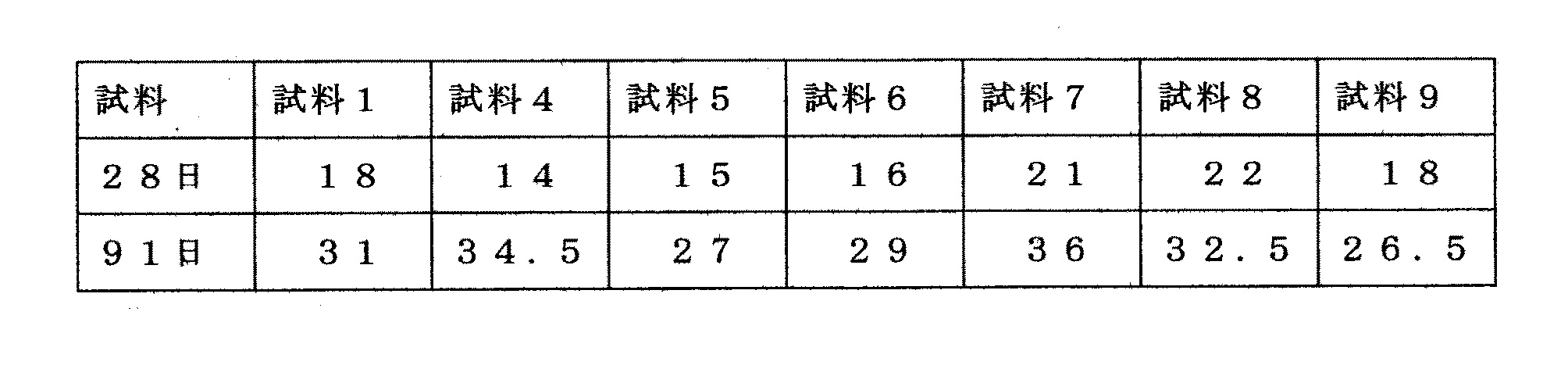
希硫酸浸漬による硫酸浸透深さ試験を実施した。硫酸浸透深さ試験方法は、試料を硫酸濃度5%の希硫酸に浸漬し、浸漬日数28日又は91日経過後に取り出し、前記取り出した試料を容量300kNの万能試験機を用いて割裂試験を行い、破断した試料片にフェノールフタレイン5%アルコール溶液を噴霧し、ノギスを用いて硫酸浸透深さを供試体の上部、中部及び下部の三箇所で測定し、それらの測定値の平均値を硫酸浸透深さとした。 The sulfuric acid penetration depth test by dilute sulfuric acid immersion was carried out. The sulfuric acid penetration depth test method involves immersing a sample in dilute sulfuric acid with a sulfuric acid concentration of 5%, taking it out after 28 days or 91 days, and performing a splitting test on the taken out sample using a universal testing machine with a capacity of 300 kN. Then, spray a 5% alcohol solution of phenolphthalein on the fractured sample piece, and measure the sulfuric acid penetration depth at the upper, middle and lower parts of the specimen using a vernier caliper. The penetration depth.
希硫酸浸漬による硫酸浸透深さ試験は、普通ポルトランドセメント使用で材齢3日で浸漬した試料、普通ポルトランドセメント使用で材齢28日で浸漬した試料、及び高炉セメント使用で材齢3日で浸漬した試料それぞれの試料に対して、希硫酸浸漬日数が28日目及び91日目における硫酸浸透深さを求めた。 The sulfuric acid penetration depth test by immersion in dilute sulfuric acid was conducted using a sample immersed at 3 days of age using normal Portland cement, a sample immersed at a material age of 28 days using normal Portland cement, and immersed at 3 days of age using blast furnace cement. For each sample, the sulfuric acid penetration depth was determined on the 28th and 91st days of immersion in dilute sulfuric acid.
普通ポルトランドセメント使用で材齢3日で浸漬した結果を表7に示し、普通ポルトランドセメント使用で材齢28日で浸漬した結果を表8に示し、高炉セメント使用で材齢3日で浸漬した結果を表9に示す。表7乃至表9のそれぞれの表に記載された硫酸浸透深さの単位はmmである。 Table 7 shows the results of immersion at a material age of 3 days using ordinary Portland cement, Table 8 shows the results of immersion at a material age of 28 days using ordinary Portland cement, and results of immersion at a material age of 3 days using a blast furnace cement Is shown in Table 9. The unit of the sulfuric acid penetration depth described in each table of Tables 7 to 9 is mm.
表7、表8及び表9より、材齢3日で浸漬した場合よりも材齢28日で浸漬した場合の方が、硫酸浸透深さが深くなっており、硫酸浸透が進むことが示されている。これは、希硫酸浸漬するまでの標準養生期間が長くなるほどモルタル組織が密実になるが、密実になっているのにかかわらず硫酸浸透深さが深くなることを示している。 From Table 7, Table 8 and Table 9, it is shown that the sulfuric acid penetration depth is deeper and the sulfuric acid penetration proceeds when immersed at the age of 28 days than when immersed at the age of 3 days. ing. This shows that the longer the standard curing period until dipping in dilute sulfuric acid, the denser the mortar structure, but the deeper the sulfuric acid penetration depth, despite the fact that it is dense.
硫酸浸透深さが深くなるのは、材齢3日から材齢28日に標準養生日数が増えると、水酸化カルシウムの生成量が材齢3日で硫酸浸漬した場合に比べて多くなり、多くなった分、硫酸と激しく反応して二水石膏が多く生成されるために硫酸浸透深さが深くなったためである。 The depth of sulfuric acid penetration increases when the number of standard curing days increases from 3 days of age to 28 days of age, and the amount of calcium hydroxide produced increases compared to the case of sulfuric acid immersion at 3 days of age. This is because the permeation depth of sulfuric acid became deeper due to a large amount of dihydrate gypsum produced by vigorous reaction with sulfuric acid.
砥石粉を配合させた試料5及び試料6の硫酸浸透深さが小であることから、砥石粉は中長期強度発現性を有していることを示しており、硫酸浸透深さを小にするには砥石粉を配合させた方が、効果がある。 Since the sample 5 and the sample 6 mixed with the grinding stone powder have a small sulfuric acid penetration depth, this indicates that the grinding stone powder has a medium- to long-term strength expression, and the sulfuric acid penetration depth is reduced. It is more effective to mix the grinding stone powder.
20℃水中の標準養生した試料を用いて、コンクリートの圧縮強度試験方法であるJIS A 1108に準じて圧縮強度試験を実施した。 Using a standard-cured sample in 20 ° C. water, a compressive strength test was performed according to JIS A 1108, which is a compressive strength test method for concrete.
セメントとして普通ポルトランドセメント又は高炉セメントを使用した場合で、それぞれ材齢3日、7日及び28日について、圧縮強度試験を実施した。普通ポルトランドセメントを使用した場合の結果を表10に示し、高炉セメントを使用した場合の結果を表11に示す。表10及び表11に記載された圧縮強度の単位はN/mm2である。 When ordinary Portland cement or blast furnace cement was used as the cement, a compressive strength test was carried out for ages 3 days, 7 days and 28 days, respectively. The results when normal portland cement is used are shown in Table 10, and the results when blast furnace cement is used are shown in Table 11. The unit of compressive strength described in Table 10 and Table 11 is N / mm 2 .
表10及び表11より、いずれの場合も圧縮強度が高いモルタル供試体は、試料2及び試料3のセメント50%でシリカフュームと高炉スラグ微粉末を配合したセメント組成物を含有するモルタルであり、試料8及び試料9のセメント配合割合が20%又は30%のセメント組成物の場合より圧縮強度が高い。 From Table 10 and Table 11, the mortar specimen having a high compressive strength in each case is a mortar containing a cement composition in which silica fume and blast furnace slag fine powder are blended with 50% of the cement of Sample 2 and Sample 3. The compressive strength is higher than in the case of the cement composition in which the blending ratio of 8 and Sample 9 is 20% or 30%.
試料4、試料6及び試料7の試料は、セメント配合割合が50%であっても、フライアッシュが配合されたセメント組成物の圧縮強度が低くなることが示されている。また、フライアッシュと砥石粉との比較を試料4と試料5とでみると、砥石粉を配合させた試料5の方が、圧縮強度が高いことが示されている。 Samples 4, 6, and 7 show that the compressive strength of the cement composition containing fly ash is low even when the cement blending ratio is 50%. Moreover, when the comparison between the fly ash and the grinding stone powder is seen between Sample 4 and Sample 5, it is shown that the compression strength is higher in the sample 5 in which the grinding stone powder is blended.
特に砥石粉を配合させた試料の場合は、初期強度は比較的小さいが中長期における圧縮強度の増加割合が大きいことから、中長期における水酸化カルシウムの消費が大きくなり、中長期に硫酸劣化を抑制するようになると思われる。 In particular, in the case of a sample mixed with grinding stone powder, the initial strength is relatively small, but the increase rate of compressive strength in the medium to long term is large. It seems to be suppressed.
次に、本発明である、耐酸性セメント(組成物)を配合した耐酸性モルタルに対して、水結合材比に関する実施例を説明する。モルタルは、セメント(組成物)、水及び細骨材を混合して造られ、コンクリートはセメント(組成物)、水、細骨材及び粗骨材を混合して造られる。モルタル又はコンクリートの硫酸劣化の腐食は、先に骨材を取り巻くセメント(組成物)の領域が硫酸劣化し泥状化した後に、骨材の表面に硫酸が浸透し骨材の硫酸劣化による腐食が始まる。 Next, the Example regarding a water binder ratio is demonstrated with respect to the acid-resistant mortar which mix | blended the acid-resistant cement (composition) which is this invention. Mortar is made by mixing cement (composition), water and fine aggregate, and concrete is made by mixing cement (composition), water, fine aggregate and coarse aggregate. Corrosion due to sulfuric acid deterioration of mortar or concrete is caused by the sulfuric acid deterioration of the aggregate surface after the sulfuric acid deterioration and mud formation of the cement (composition) surrounding the aggregate. Begins.
そこで、セメント(組成物)と水との混合割合を示す水結合材比による耐酸性評価を実施した。以下、水結合材比別に、質量減少率、硫酸浸透深さ及び圧縮強度を試験した。実施例で使用したモルタルに含まれる各種混和材や細骨材の配合比率を質量%で表12に示す。細骨材は石灰石骨材を使用した。水結合材比はOPC、SF及びBFSのセメント質材料の総質量に対する水の質量の配合割合を示し、細骨材の欄の比率はOPC、SF及びBFSのセメント質材料の総質量に対する細骨材の質量の比率を示す。例えば、「1:3」は「OPC、SF及びBFSのセメント質材料の総質量」:「細骨材の質量」を示している。 Then, the acid-proof evaluation by the water binder ratio which shows the mixing ratio of cement (composition) and water was implemented. Hereinafter, mass reduction rate, sulfuric acid penetration depth, and compressive strength were tested according to the water binder ratio. Table 12 shows the blending ratios of various admixtures and fine aggregates contained in the mortar used in Examples in mass%. Limestone aggregate was used as the fine aggregate. The water binder ratio indicates the mixing ratio of the water mass to the total mass of the OPC, SF and BFS cementitious materials, and the ratio in the fine aggregate column indicates the fine bones relative to the total mass of the OPC, SF and BFS cementitious materials. The ratio of the mass of the material is shown. For example, “1: 3” represents “total mass of cementitious materials of OPC, SF, and BFS”: “mass of fine aggregate”.
表12に示したモルタル試料を、実施例1乃至5に供した供試体と同じ大きさである、直径50mmで高さ100mmの円柱状の供試体とした。ここで、モルタル試料の配合において、空気量を約6質量%とし、高性能AE減水剤を0.2〜1質量%使用した。 The mortar sample shown in Table 12 was a cylindrical specimen having a diameter of 50 mm and a height of 100 mm, which was the same size as the specimens used in Examples 1 to 5. Here, in the blending of the mortar sample, the air amount was set to about 6% by mass, and the high-performance AE water reducing agent was used in an amount of 0.2 to 1% by mass.
実施例6乃至9における試料は、モルタルをハンドミキサーで作製後円柱型枠に入れ、締め固めを行い、材齢3日で脱枠、材齢7日まで標準養生(20℃水中)、材齢7日目に硫酸濃度5%の希硫酸に浸漬、希硫酸浸漬日数を変えて測定した。 For the samples in Examples 6 to 9, mortar was prepared with a hand mixer, placed in a cylindrical form, compacted, unframed at 3 days of age, standard curing until 20 days of age (water at 20 ° C.), material age On the seventh day, it was immersed in dilute sulfuric acid having a sulfuric acid concentration of 5%, and the measurement was performed by changing the number of days of dilute sulfuric acid immersion.
希硫酸浸漬試験を実施し質量減少率を求めた。材齢3日のモルタルを硫酸濃度5%の希硫酸に浸漬し、1週間ごとに希硫酸を入替え、浸漬日数が56日におけるモルタル試料を取り出し、前記試料を硫酸により腐食されブヨブヨ状態となっ
た部分を水道水で洗い流し、残存した部分の質量を求め、前記質量と元の質量との差を元の質量で除した割合を百分率で求め質量減少率とした。浸漬日数が56日におけるモルタルの質量減少率を表13に示す。表13の数値は元の質量からの質量減少率(%)を表す。
A dilute sulfuric acid immersion test was performed to determine the mass reduction rate. 3 days old mortar was immersed in dilute sulfuric acid with 5% sulfuric acid concentration, dilute sulfuric acid was replaced every week, mortar samples with immersion days of 56 days were taken out, and the samples were corroded by sulfuric acid and became buoyant The portion was washed away with tap water, the mass of the remaining portion was determined, and the ratio obtained by dividing the difference between the mass and the original mass by the original mass was determined as a percentage and used as the mass reduction rate. Table 13 shows the mass reduction rate of the mortar when the immersion days are 56 days. The numerical values in Table 13 represent the mass reduction rate (%) from the original mass.
表13より、試料番号23(水結合材比40質量%)、24(水結合材比50質量%)、25(水結合材比65質量%)は同じ配合割合のセメント質材料及び細骨材を使用したが、水結合材比が65質量%が最も質量減少率が小さい。また、水結合材比50質量%をみると、セメント質材料に占める割合がポルトランドセメント100%よりポルトランドセメント、シリカフューム及び高炉スラグ微粉末を混合させた方が質量減少率が小さい。 From Table 13, sample numbers 23 (water binder ratio 40% by mass), 24 (water binder ratio 50% by mass), and 25 (water binder ratio 65% by mass) have the same blending ratio of cementitious material and fine aggregate. However, when the water binder ratio is 65% by mass, the mass reduction rate is the smallest. Further, when the water binder ratio is 50% by mass, the mass reduction rate is smaller when Portland cement, silica fume and blast furnace slag fine powder are mixed than the Portland cement 100%.
このことは、セメント量の配合割合が多い場合には、セメントと水とが混合されると水和反応が生じ、硬い物質であるC−S−Hゲルと水酸化カルシウムCa(OH)2が生成されやすく、そして、水酸化カルシウムが強酸である硫酸H2SO4と反応し、泥状化された状態の二水石膏CaSO4・2H2Oが生成され硫酸劣化が進みやすいことを示している。 This means that when the blending ratio of the cement amount is large, a hydration reaction occurs when the cement and water are mixed, so that the C—S—H gel and calcium hydroxide Ca (OH) 2 which are hard substances are formed. This shows that calcium hydroxide reacts with sulfuric acid H 2 SO 4 , which is a strong acid, and dihydrated gypsum CaSO 4 .2H 2 O is produced in a muddy state, so that sulfuric acid degradation is likely to proceed. Yes.
また、水結合材比が大きいほど空隙の大きいモルタル又はコンクリートが造られ、通常の気中にある場合は、耐久性は劣るが、硫酸環境下では逆に耐硫酸性が得られていることがわかる。これは、水酸化カルシウムCa(OH)2の生成量が減少して硫酸と反応する量が減少するため二水石膏CaSO4・2H2Oの生成量が減少するためと考えられる。 In addition, the larger the water binder ratio, the larger the mortar or concrete is made, and the durability is inferior when it is in the normal atmosphere, but the sulfuric acid resistance is obtained in the sulfuric acid environment. Recognize. This is presumably because the production amount of dihydrate gypsum CaSO 4 .2H 2 O decreases because the production amount of calcium hydroxide Ca (OH) 2 decreases and the amount reacting with sulfuric acid decreases.
さらに、シリカフュームや高炉スラグ微粉末は実施例1乃至5から得られた結果から、ポラゾン反応や潜在水硬性による反応によって水酸化カルシウムCa(OH)2を消費してしまうので、二水石膏CaSO4・2H2Oの生成の要件となる水酸化カルシウムCa(OH)2を減少させたと考えられる。 Furthermore, since silica fume and blast furnace slag fine powder consume calcium hydroxide Ca (OH) 2 by the reaction of the polyazone reaction or latent hydraulic property from the results obtained from Examples 1 to 5, dihydrate gypsum CaSO 4 -It is thought that calcium hydroxide Ca (OH) 2 which is a requirement for the generation of 2H 2 O was reduced.
以上から、耐酸性セメントの組成物であるセメント質材料及び細骨材の配合割合が同じで水結合材比が異なる場合のモルタルにおいては、水結合材比が65質量%の場合が最も質量減少率が小さく、40質量%の場合より50質量%乃至65質量%の場合が質量減少率が小さいことがわかる。 From the above, in the mortar where the mixing ratio of the cementitious material and the fine aggregate which are the composition of acid-resistant cement is the same and the water binder ratio is different, the weight loss is the most when the water binder ratio is 65% by mass It can be seen that the rate of mass reduction is smaller in the case of 50 mass% to 65 mass% than in the case of 40 mass%.
希硫酸浸漬による硫酸浸透深さ試験を実施した。硫酸浸透深さ試験方法は、モルタル試料を硫酸濃度5%の希硫酸に浸漬し、浸漬日数28日経過後、及び56日経過後に取り出し、前記取り出した試料を容量300kNの万能試験機を用いて割裂試験を行い、破断した試料片にフェノールフタレイン5%アルコール溶液を噴霧し、ノギスを用いて硫酸浸透深さを供試体の上部、中部及び下部の三箇所で測定し、それらの測定値の平均値を硫酸浸透深さとした。 The sulfuric acid penetration depth test by dilute sulfuric acid immersion was carried out. In the sulfuric acid penetration depth test method, a mortar sample is immersed in dilute sulfuric acid having a sulfuric acid concentration of 5%, taken out after 28 days and 56 days, and the taken out sample is split using a universal testing machine with a capacity of 300 kN. A test was performed, and a 5% alcohol solution of phenolphthalein was sprayed on the fractured sample piece, and the sulfuric acid penetration depth was measured at the upper, middle and lower parts of the specimen using a caliper, and the average of the measured values was measured. The value was defined as the sulfuric acid penetration depth.
表14に硫酸浸透深さ試験方法による硫酸浸透深さを示し、表14に記載され
た硫酸浸透深さの単位はmmである。
Table 14 shows the sulfuric acid penetration depth by the sulfuric acid penetration depth test method. The unit of the sulfuric acid penetration depth described in Table 14 is mm.
表14より、試料番号23(水結合材比40質量%)、24(水結合材比50質量%)、25(水結合材比65質量%)は同じ配合割合のセメント質材料及び細骨材を使用したが、水結合材比が65質量%が最も硫酸浸透深さが小さい。また、水結合材比50質量%をみると、セメント質材料に占める割合がポルトランドセメント100%の場合よりポルトランドセメント、シリカフューム及び高炉スラグ微粉末を混合させた方が、硫酸浸透深さが小さい。 From Table 14, sample numbers 23 (water binder ratio 40% by mass), 24 (water binder ratio 50% by mass), and 25 (water binder ratio 65% by mass) are cementitious materials and fine aggregates having the same blending ratio. However, when the water binder ratio is 65% by mass, the sulfuric acid penetration depth is the smallest. When the water binder ratio is 50% by mass, the sulfuric acid permeation depth is smaller when Portland cement, silica fume and blast furnace slag fine powder are mixed than when Portland cement is 100% of the cementitious material.
このことは、水結合材比が大きくなるほど、セメント量が減じられ、これによって水酸化カルシウムの生成量が減じられて耐酸性が得られることを示している。 This indicates that as the water binder ratio increases, the amount of cement is reduced, thereby reducing the amount of calcium hydroxide produced and providing acid resistance.
セメントと水とが混合されると水和反応が生じ、硬い物質であるC−S−Hゲルと水酸化カルシウムCa(OH)2が生成されるが、シリカフューム(SF)は非晶質のシリカSiO2が90%程度あるため反応性が大きいことから前記シリカSiO2と水酸化カルシウムCa(OH)2とが反応(ポゾラン反応)して早期強度が得られ、また高炉スラグ微粉末(BFS)は潜在水硬性を有しているのでセメント水和生成物中の水酸化カルシウムCa(OH)2によるアルカリ刺激剤によって水和反応(潜在水硬性)が生じセメント硬化体が得られる。したがって、ポゾラン反応性又は潜在水硬性を有する物質を混合させることによって水酸化カルシウムCa(OH)2を消費するため、水酸化カルシウムと硫酸H2SO4との反応によって生成される二水石膏CaSO4・2H2Oが減じられ、そのため硫酸劣化が進まないことも示されている。 When cement and water are mixed, a hydration reaction occurs, and a C—S—H gel and calcium hydroxide Ca (OH) 2 which are hard substances are generated. Silica fume (SF) is amorphous silica. Since SiO 2 is about 90%, the reactivity is high, so that the silica SiO 2 and calcium hydroxide Ca (OH) 2 react (pozzolanic reaction) to obtain early strength, and blast furnace slag fine powder (BFS) Has latent hydraulic properties, a hydration reaction (latent hydraulic properties) is generated by an alkali stimulator with calcium hydroxide Ca (OH) 2 in the cement hydration product, and a hardened cement body is obtained. Therefore, dihydrate gypsum CaSO produced by reaction of calcium hydroxide and sulfuric acid H 2 SO 4 to consume calcium hydroxide Ca (OH) 2 by mixing a substance having pozzolanic reactivity or latent hydraulic property. 4 · 2H 2 O is reduced, it has also been shown that the reason sulfate degradation does not proceed.
以上から、耐酸性セメントの組成物であるセメント質材料及び細骨材の配合割合が同じで水結合材比が異なる場合のモルタルにおいては、水結合材比が65質量%の場合が最も硫酸浸透深さが小さく、50質量%乃至65質量%の場合が50質量%未満の場合より硫酸浸透深さが小さいことがわかる。 From the above, in the mortar in which the mixing ratio of the cementitious material and the fine aggregate which are the composition of acid-resistant cement is the same and the water binder ratio is different, the case where the water binder ratio is 65% by mass is most permeated with sulfuric acid. It can be seen that the depth of the sulfuric acid permeation is smaller when the depth is 50% by mass to 65% by mass than when the depth is less than 50% by mass.
次に、圧縮強度試験を実施した。20℃水中の標準養生した試料を用いて、コンクリートの圧縮強度試験方法であるJIS A 1108に準じて圧縮強度試験を実施した。 Next, a compressive strength test was performed. Using a standard-cured sample in 20 ° C. water, a compressive strength test was performed according to JIS A 1108, which is a compressive strength test method for concrete.
圧縮強度試験は材齢7日及び28日について実施し、その結果を表15に示す。なお、表15に記載された圧縮強度の単位はN/mm2である。 The compressive strength test was conducted for material ages 7 and 28, and the results are shown in Table 15. The unit of compressive strength described in Table 15 is N / mm 2 .
表15より、試料番号23(水結合材比40質量%)、24(水結合材比50質量%)、25(水結合材比65質量%)は耐酸性セメント組成物の配合割合が同じ場合であるが水結合材比が異なる場合のモルタルにおいては、水結合材比が65質量%が最も圧縮強度が小さいが、材齢28日における設計基準強度24N/mm2は超える圧縮強度を有している。 From Table 15, Sample Nos. 23 (water binder ratio 40% by mass), 24 (water binder ratio 50% by mass), and 25 (water binder ratio 65% by mass) have the same blending ratio of the acid-resistant cement composition. However, in the mortar with different water binder ratios, the water binder ratio is 65% by mass, and the compressive strength is the smallest, but the design standard strength 24N / mm 2 at the age of 28 days has a compressive strength exceeding. ing.
このことは、耐酸性セメントの組成物であるセメント質材料及び細骨材の配合割合が同じで水結合材比が異なる場合のモルタルにおいては、水結合材比を40質量%、50質量%、65質量%と変えたときは、水結合材比が大きいほど圧縮強度が小さくなるが、水結合材比65質量%であっても材齢28日における設計基準強度以上を有していることが示されている。 This means that in the mortar where the mixing ratio of the cementitious material and the fine aggregate which are the composition of acid resistant cement is the same and the water binder ratio is different, the water binder ratio is 40 mass%, 50 mass%, When the ratio is changed to 65% by mass, the greater the water binder ratio, the smaller the compressive strength. However, even if the water binder ratio is 65% by mass, the compressive strength may be higher than the design standard strength at the age of 28 days. It is shown.
モルタルをハンドミキサーで作製後、直径50mm、高さ100mmの円柱型枠に入れ、締固めを行い、材齢3日で脱枠、材齢7日まで20℃水中で標準養生し、材齢7日に硫酸濃度5%の希硫酸に浸漬し、希硫酸浸漬日数28日で外観の剥離状態を目視で比較した。 After making the mortar with a hand mixer, put it in a cylindrical mold with a diameter of 50 mm and a height of 100 mm, compact it, remove the frame at the age of 3 days, standard curing in water at 20 ° C. until the age of 7 days, material age 7 It was immersed in dilute sulfuric acid having a sulfuric acid concentration of 5% on the day, and the peeled state of the appearance was visually compared on the dilute sulfuric acid immersion days of 28 days.
前記目視確認結果を表16に示し、外観に剥離現象がほとんど見られない状態を「○」、剥離が部分的に見られる状態を「△」、全体的に剥離状態になっている状態を「×」で示している。 The visual confirmation results are shown in Table 16, where “◯” indicates a state in which the peeling phenomenon is hardly seen in the appearance, “Δ” indicates a state in which peeling is partially observed, and “a” indicates a state in which the peeling is entirely performed. “×”.
表16より、セメント質材料中に、初期強度発現性を有するシリカフューム及び中長期強度発現性を有する高炉スラグ微粉末を混合させていないでポルトランドセメントのみの場合である試料20及び21は、水結合材比が50質量%であっても供試体の表面のほぼ全域に剥離が生じており、試料番号23(水結合材比40質量%)、24(水結合材比50質量%)、25(水結合材比65質量%)はセメント質材料及び細骨材の配合割合が同じであるが、水結合材比が40質量%では供試体の表面のほぼ全域に剥離が生じ、50質量%では部分的にしか剥離が生じておらず、65質量%では外観に剥離現象がないことがわかる。 From Table 16, samples 20 and 21, which are a case of only Portland cement without mixing silica fume having initial strength development and blast furnace slag fine powder having medium-long-term strength development in cementitious materials, are water-bonded. Even if the material ratio was 50% by mass, peeling occurred almost over the entire surface of the specimen, and sample numbers 23 (water binding material ratio 40% by mass), 24 (water binding material ratio 50% by mass), 25 ( In the case of a water binder ratio of 65% by mass, the mixing ratio of the cementitious material and the fine aggregate is the same. However, when the water binder ratio is 40% by mass, peeling occurs almost over the entire surface of the specimen. It can be seen that peeling occurred only partially, and there was no peeling phenomenon in the appearance at 65% by mass.
以上から、耐酸性セメントの組成物であるセメント質材料及び細骨材の配合割合が同じで水結合材比が異なる場合のモルタルにおいては、水結合材比が65質量%の場合が最も表面に剥離現象が見られず、50質量%乃至65質量%の場合が外観に剥離現象が部分的に生じるか又は生じないことがわかる。水結合材比が40質量%と小さい場合は、供試体表面部の劣化が大きいことがわかる。 From the above, in the mortar in which the mixing ratio of the cementitious material and the fine aggregate which are the composition of acid-resistant cement is the same and the water binder ratio is different, the case where the water binder ratio is 65% by mass is the most on the surface. It can be seen that no peeling phenomenon is observed, and the case of 50% by mass to 65% by mass causes a partial or no peeling phenomenon on the appearance. When the water binder ratio is as small as 40% by mass, it can be seen that the surface portion of the specimen is greatly deteriorated.
Claims (7)
Priority Applications (1)
| Application Number | Priority Date | Filing Date | Title |
|---|---|---|---|
| JP2011174674A JP5924612B2 (en) | 2010-10-29 | 2011-08-10 | Acid-resistant cement composition and acid-resistant mortar or concrete containing the same |
Applications Claiming Priority (3)
| Application Number | Priority Date | Filing Date | Title |
|---|---|---|---|
| JP2010243058 | 2010-10-29 | ||
| JP2010243058 | 2010-10-29 | ||
| JP2011174674A JP5924612B2 (en) | 2010-10-29 | 2011-08-10 | Acid-resistant cement composition and acid-resistant mortar or concrete containing the same |
Publications (2)
| Publication Number | Publication Date |
|---|---|
| JP2012106905A true JP2012106905A (en) | 2012-06-07 |
| JP5924612B2 JP5924612B2 (en) | 2016-05-25 |
Family
ID=46492973
Family Applications (1)
| Application Number | Title | Priority Date | Filing Date |
|---|---|---|---|
| JP2011174674A Active JP5924612B2 (en) | 2010-10-29 | 2011-08-10 | Acid-resistant cement composition and acid-resistant mortar or concrete containing the same |
Country Status (1)
| Country | Link |
|---|---|
| JP (1) | JP5924612B2 (en) |
Cited By (4)
| Publication number | Priority date | Publication date | Assignee | Title |
|---|---|---|---|---|
| JP2019059662A (en) * | 2017-09-22 | 2019-04-18 | 株式会社デイ・シイ | Acid resistance cement composition |
| JP2020164396A (en) * | 2019-03-26 | 2020-10-08 | 米倉 亜州夫 | Acid-resistant lock bolt fixing material |
| JP2021155292A (en) * | 2020-03-27 | 2021-10-07 | 住友大阪セメント株式会社 | Covering material, manufacturing method of covering material, concrete molded body, tubular molded body, manufacturing method of tubular molded body, and, slurry |
| JP2022151337A (en) * | 2021-03-26 | 2022-10-07 | 亜州夫 米倉 | Wet type sprayed concrete |
Citations (7)
| Publication number | Priority date | Publication date | Assignee | Title |
|---|---|---|---|---|
| JP2000290057A (en) * | 1999-04-08 | 2000-10-17 | Takenaka Komuten Co Ltd | Concrete composition with reduced deterioration and contamination |
| JP2002128559A (en) * | 2000-10-16 | 2002-05-09 | Denki Kagaku Kogyo Kk | Cement composition and acid-resistant cement / concrete using the same |
| JP2005035877A (en) * | 2003-06-27 | 2005-02-10 | Shinichi Numata | Acid resistant concrete |
| JP2005324985A (en) * | 2004-05-13 | 2005-11-24 | Mitsubishi Materials Corp | Sulfuric acid resistant cement composition and cured product thereof |
| JP2007084420A (en) * | 2005-08-26 | 2007-04-05 | Ohbayashi Corp | Mortar composition, coating material, and spray material |
| JP2008247693A (en) * | 2007-03-30 | 2008-10-16 | Tsuru Gakuen | Acid-resistant mortar repair material and acid-resistant concrete material |
| JP2010155734A (en) * | 2008-12-26 | 2010-07-15 | Ohbayashi Corp | Acid resistant cement composition |
-
2011
- 2011-08-10 JP JP2011174674A patent/JP5924612B2/en active Active
Patent Citations (7)
| Publication number | Priority date | Publication date | Assignee | Title |
|---|---|---|---|---|
| JP2000290057A (en) * | 1999-04-08 | 2000-10-17 | Takenaka Komuten Co Ltd | Concrete composition with reduced deterioration and contamination |
| JP2002128559A (en) * | 2000-10-16 | 2002-05-09 | Denki Kagaku Kogyo Kk | Cement composition and acid-resistant cement / concrete using the same |
| JP2005035877A (en) * | 2003-06-27 | 2005-02-10 | Shinichi Numata | Acid resistant concrete |
| JP2005324985A (en) * | 2004-05-13 | 2005-11-24 | Mitsubishi Materials Corp | Sulfuric acid resistant cement composition and cured product thereof |
| JP2007084420A (en) * | 2005-08-26 | 2007-04-05 | Ohbayashi Corp | Mortar composition, coating material, and spray material |
| JP2008247693A (en) * | 2007-03-30 | 2008-10-16 | Tsuru Gakuen | Acid-resistant mortar repair material and acid-resistant concrete material |
| JP2010155734A (en) * | 2008-12-26 | 2010-07-15 | Ohbayashi Corp | Acid resistant cement composition |
Non-Patent Citations (3)
| Title |
|---|
| 深谷泰文, セメント・コンクリート材料科学, JPN7016000848, 10 October 2003 (2003-10-10), pages 126 - 127, ISSN: 0003292080 * |
| 鄭 然植: " 2016年度の機関定額制の利用継続手続きを2月1日より開始しました(2/1(月)-3/31(木))セメント-微粉末", 石膏と石灰, vol. 236, JPN6016012746, 1992, pages 12 - 19, ISSN: 0003292079 * |
| 高野 修壮: "下水道用モルタルの耐硫酸性に関する研究", 広島工業大学紀要研究編, vol. 第44巻, JPN7015001102, February 2010 (2010-02-01), pages 85 - 90, ISSN: 0003060661 * |
Cited By (6)
| Publication number | Priority date | Publication date | Assignee | Title |
|---|---|---|---|---|
| JP2019059662A (en) * | 2017-09-22 | 2019-04-18 | 株式会社デイ・シイ | Acid resistance cement composition |
| JP2020164396A (en) * | 2019-03-26 | 2020-10-08 | 米倉 亜州夫 | Acid-resistant lock bolt fixing material |
| JP7203672B2 (en) | 2019-03-26 | 2023-01-13 | 亜州夫 米倉 | Acid-resistant rock bolt fixing material and premix material for acid-resistant rock bolt fixing material |
| JP2021155292A (en) * | 2020-03-27 | 2021-10-07 | 住友大阪セメント株式会社 | Covering material, manufacturing method of covering material, concrete molded body, tubular molded body, manufacturing method of tubular molded body, and, slurry |
| JP2022151337A (en) * | 2021-03-26 | 2022-10-07 | 亜州夫 米倉 | Wet type sprayed concrete |
| JP7510379B2 (en) | 2021-03-26 | 2024-07-03 | 亜州夫 米倉 | Wet shotcrete |
Also Published As
| Publication number | Publication date |
|---|---|
| JP5924612B2 (en) | 2016-05-25 |
Similar Documents
| Publication | Publication Date | Title |
|---|---|---|
| JP5568812B2 (en) | Low calcium cement material composition | |
| Swaroop et al. | Durability studies on concrete with fly ash & Ggbs | |
| JP2003306359A (en) | Cement composition and hydrated hardened body | |
| JP6258697B2 (en) | Fast-setting grout composition | |
| CN108059399A (en) | A kind of upper flow regime lightweight insulating concrete and its compounding method | |
| WO2019172349A1 (en) | Acid-resistant concrete, precast concrete, and method for producing acid-resistant concrete | |
| CN101786820B (en) | Special mineral powder-based admixture for dry-mixed plastering mortar and application thereof | |
| Olonade et al. | Effects of sulphuric acid on the compressive strength of blended cement-cassava peel ash concrete | |
| CN105130349B (en) | A kind of base pit engineering water-stop curtain material based on industrial residue | |
| Ramadhansyah et al. | Properties of concrete containing rice husk ash under sodium chloride subjected to wetting and drying | |
| JP2018087111A (en) | Cement composition | |
| Quang | Effect of quartz powder and mineral admixtures on the properties of high-performance concrete | |
| JP5924612B2 (en) | Acid-resistant cement composition and acid-resistant mortar or concrete containing the same | |
| JP2003119066A (en) | Self-filling mortar composition | |
| CN101468901A (en) | Method for preparing novel plastering material for surface layer and bottom layer | |
| JP2003261372A (en) | Mortar composition for corrosive environment facility and concrete structure corrosion prevention method | |
| JP3953469B2 (en) | Acid resistant concrete | |
| JP4135743B2 (en) | Cement composition | |
| JP2008179527A (en) | Admixture for cement composition with high coal ash powder content, and cement composition and spray material with high coal ash powder content containing the same | |
| JP2011132106A (en) | Hydraulic composition and cured product | |
| Deb et al. | Sulphate resistance of slag blended fly ash based geopolymer concrete | |
| KR100519605B1 (en) | The manufacturing method and composition of Restoration mortar with function of sulfuric acid resistance | |
| JP2008156231A (en) | Cement composition | |
| JP6867801B2 (en) | Cement composition | |
| Olivia et al. | The effects of using ground cockle seashells as an additive for mortar in peat environment |
Legal Events
| Date | Code | Title | Description |
|---|---|---|---|
| A621 | Written request for application examination |
Free format text: JAPANESE INTERMEDIATE CODE: A621 Effective date: 20140804 |
|
| A977 | Report on retrieval |
Free format text: JAPANESE INTERMEDIATE CODE: A971007 Effective date: 20150325 |
|
| A131 | Notification of reasons for refusal |
Free format text: JAPANESE INTERMEDIATE CODE: A131 Effective date: 20150512 |
|
| A521 | Request for written amendment filed |
Free format text: JAPANESE INTERMEDIATE CODE: A523 Effective date: 20150710 |
|
| A131 | Notification of reasons for refusal |
Free format text: JAPANESE INTERMEDIATE CODE: A131 Effective date: 20151110 |
|
| A521 | Request for written amendment filed |
Free format text: JAPANESE INTERMEDIATE CODE: A523 Effective date: 20151225 |
|
| A521 | Request for written amendment filed |
Free format text: JAPANESE INTERMEDIATE CODE: A821 Effective date: 20151225 |
|
| TRDD | Decision of grant or rejection written | ||
| A01 | Written decision to grant a patent or to grant a registration (utility model) |
Free format text: JAPANESE INTERMEDIATE CODE: A01 Effective date: 20160405 |
|
| A61 | First payment of annual fees (during grant procedure) |
Free format text: JAPANESE INTERMEDIATE CODE: A61 Effective date: 20160408 |
|
| R150 | Certificate of patent or registration of utility model |
Ref document number: 5924612 Country of ref document: JP Free format text: JAPANESE INTERMEDIATE CODE: R150 |
|
| S111 | Request for change of ownership or part of ownership |
Free format text: JAPANESE INTERMEDIATE CODE: R313113 |
|
| R350 | Written notification of registration of transfer |
Free format text: JAPANESE INTERMEDIATE CODE: R350 |
|
| R250 | Receipt of annual fees |
Free format text: JAPANESE INTERMEDIATE CODE: R250 |
|
| R250 | Receipt of annual fees |
Free format text: JAPANESE INTERMEDIATE CODE: R250 |
|
| R250 | Receipt of annual fees |
Free format text: JAPANESE INTERMEDIATE CODE: R250 |
|
| R250 | Receipt of annual fees |
Free format text: JAPANESE INTERMEDIATE CODE: R250 |