JP2011132500A - Resin particle - Google Patents
Resin particle Download PDFInfo
- Publication number
- JP2011132500A JP2011132500A JP2010247246A JP2010247246A JP2011132500A JP 2011132500 A JP2011132500 A JP 2011132500A JP 2010247246 A JP2010247246 A JP 2010247246A JP 2010247246 A JP2010247246 A JP 2010247246A JP 2011132500 A JP2011132500 A JP 2011132500A
- Authority
- JP
- Japan
- Prior art keywords
- resin
- resin particles
- acid
- aqueous dispersion
- particles
- Prior art date
- Legal status (The legal status is an assumption and is not a legal conclusion. Google has not performed a legal analysis and makes no representation as to the accuracy of the status listed.)
- Granted
Links
Landscapes
- Processes Of Treating Macromolecular Substances (AREA)
- Compositions Of Macromolecular Compounds (AREA)
- Polyesters Or Polycarbonates (AREA)
- Polyurethanes Or Polyureas (AREA)
Abstract
【課題】低温溶融性及び耐ブロッキング性のいずれにも優れた樹脂粒子を提供する。
【解決手段】3価又は4価の芳香族カルボン酸(c)と炭素数が2〜10の脂肪族ジオール(d1)又はジアルカノールアミン化合物(d2)とのエステル(e)、ポリイソシアネート(i)及びポリアミン(b)を構成単位として有する樹脂(A)を含有することを特徴とする樹脂粒子(R)並びに上記樹脂粒子(R)の表面に樹脂(C)を含有する樹脂粒子(S)が付着されてなる構造の樹脂粒子(T)。
【選択図】なしThe present invention provides resin particles excellent in both low-temperature meltability and blocking resistance.
An ester (e) of a trivalent or tetravalent aromatic carboxylic acid (c) and an aliphatic diol (d1) or dialkanolamine compound (d2) having 2 to 10 carbon atoms, a polyisocyanate (i) ) And resin (A) having polyamine (b) as a structural unit, and resin particles (S) containing resin (C) on the surface of the resin particles (R) Resin particles (T) having a structure to which is attached.
[Selection figure] None
Description
本発明は樹脂粒子に関する。更に詳しくは、各種用途に有用な樹脂粒子とその水性分散体の製造方法に関する。 The present invention relates to resin particles. More specifically, the present invention relates to resin particles useful for various applications and a method for producing an aqueous dispersion thereof.
粒径及び形状が均一で、かつ、電気的特性、熱的特性、化学的安定性等に優れた粒子として、樹脂と必要により有機溶媒を含有する混合液と、水系媒体との懸濁液から有機溶媒を除去することによって得られる樹脂粒子が知られている(特許文献1参照)。
しかしながら、熱定着方式・熱加工方式に用いられる樹脂粒子では、低温溶融性と耐ブロッキング性の両立が求められており、特許文献1に記載の樹脂粒子を、スラッシュ成型用樹脂、粉体塗料、電子写真トナー用母体粒子、静電記録トナー用母体粒子、静電印刷トナー用母体粒子又はホットメルト接着剤として使用した場合には、低温溶融性と耐ブロッキング性が両立できるという効果が十分ではなかった。
As a particle having a uniform particle size and shape, and having excellent electrical characteristics, thermal characteristics, chemical stability, etc., from a suspension of a mixed liquid containing a resin and, if necessary, an organic solvent, and an aqueous medium Resin particles obtained by removing an organic solvent are known (see Patent Document 1).
However, the resin particles used in the heat fixing method and the heat processing method are required to have both low-temperature meltability and blocking resistance, and the resin particles described in Patent Document 1 are used as slush molding resin, powder paint, When used as a base particle for electrophotographic toner, a base particle for electrostatic recording toner, a base particle for electrostatic printing toner, or a hot melt adhesive, the effect of achieving both low-temperature meltability and blocking resistance is not sufficient. It was.
本発明は、低温溶融性及び耐ブロッキング性のいずれにも優れた樹脂粒子を提供することを目的とする。 An object of this invention is to provide the resin particle excellent in both low-temperature meltability and blocking resistance.
本発明者は、上記の課題を解決すべく鋭意検討した結果、本発明に到達した。すなわち本発明は、下記7発明である。
(I):3価又は4価の芳香族カルボン酸(c)と炭素数が2〜10の脂肪族ジオール(d1)又はジアルカノールアミン化合物(d2)とのエステル(e)、ポリイソシアネート(i)及びポリアミン(b)を構成単位として有する樹脂(A)を含有することを特徴とする樹脂粒子(R)。
(II):(I)の樹脂粒子(R)の表面に樹脂(C)を含有する樹脂粒子(S)が付着されてなる構造の樹脂粒子(T)。
(III):樹脂(C)を含有する樹脂粒子(S)の水性分散液(W)と、樹脂(A)及び/又はその前駆体、並びに必要により有機溶剤を含有する油性液(OL)とを混合し、(W)中に(OL)を分散させ、(A)の前駆体を用いる場合は(W)中で前駆体を反応させて、(A)を含有する樹脂粒子(R)を形成させることにより、(R)の表面に(S)が付着された構造の樹脂粒子(T)の水性分散体(X1)を得る工程を含み、樹脂(A)が、3価又は4価の芳香族カルボン酸と炭素数が2〜10の脂肪族ジオール(d1)又はジアルカノールアミン化合物(d2)とのエステル(e)、ポリイソシアネート(i)及びポリアミン(b)を構成単位として有する樹脂であることを特徴とする水性分散体(X1)の製造方法。
(IV):(III)で得られた水性分散体(X1)から水性溶剤を除去して樹脂粒子(T)を得る工程を含む樹脂粒子の製造方法。
(V):(III)で得られた水性分散体(X1)中において、付着している樹脂粒子(S)を樹脂粒子(R)から脱離させた後、水性分散体から(S)を分離除去して(R)の水性分散体(X2)を得る工程、又は(S)を溶解させ、必要により(S)の溶解物を分離除去して(R)の水性分散体(X2)を得る工程を含む水性分散体(X2)の製造方法。
(VI):(V)の製造方法により得られた水性分散体(X2)から水性溶剤を除去して樹脂粒子(R)を得る工程を含む樹脂粒子の製造方法。
(VII):樹脂(C)を含有する樹脂粒子(S)が、樹脂粒子(R)の表面に付着さ
れてなる構造の樹脂粒子(T)であり、
[1][(S)の体積平均粒径/(T)の体積平均粒径]が0.001〜0.3であり、
[2](S)の体積平均粒径が0.0005〜30μm、かつ(T)の体積平均粒径が0.1〜300μmであり、
[3](R)の表面の5%以上が(S)で覆われており、
[4](T)の[体積平均粒径/個数平均粒径]が1.0〜1.5であり、
[5](R)が樹脂(A)及び必要により架橋構造を有さない樹脂(B)を含有し、樹脂(A)が3価又は4価の芳香族カルボン酸と炭素数が2〜10の脂肪族ジオール(d1)又はジアルカノールアミン化合物(d2)とのエステル(e)、ポリイソシアネート(i)及びポリアミン(b)を構成単位として有する樹脂である樹脂粒子。
As a result of intensive studies to solve the above problems, the present inventor has reached the present invention. That is, the present invention is the following seven inventions.
(I): ester (e), polyisocyanate (i) of trivalent or tetravalent aromatic carboxylic acid (c) and aliphatic diol (d1) or dialkanolamine compound (d2) having 2 to 10 carbon atoms And resin (A) having polyamine (b) as structural units.
(II): Resin particles (T) having a structure in which resin particles (S) containing resin (C) are attached to the surface of resin particles (R) of (I).
(III): An aqueous dispersion (W) of resin particles (S) containing the resin (C), an oily liquid (OL) containing the resin (A) and / or its precursor, and, if necessary, an organic solvent And (OL) is dispersed in (W), and when the precursor of (A) is used, the precursor is reacted in (W) to obtain resin particles (R) containing (A). A step of obtaining an aqueous dispersion (X1) of resin particles (T) having a structure in which (S) is attached to the surface of (R), wherein the resin (A) is trivalent or tetravalent. Resin having ester (e), polyisocyanate (i) and polyamine (b) of aromatic carboxylic acid and aliphatic diol (d1) or dialkanolamine compound (d2) having 2 to 10 carbon atoms as structural units A method for producing an aqueous dispersion (X1), which is characterized in that it exists.
(IV): A method for producing resin particles, comprising removing the aqueous solvent from the aqueous dispersion (X1) obtained in (III) to obtain resin particles (T).
(V): In the aqueous dispersion (X1) obtained in (III), adhering resin particles (S) are detached from the resin particles (R), and then (S) is removed from the aqueous dispersion. A step of separating and removing to obtain an aqueous dispersion (X2) of (R), or (S) is dissolved, and if necessary, a dissolved product of (S) is separated and removed to obtain an aqueous dispersion (X2) of (R). The manufacturing method of the aqueous dispersion (X2) including the process of obtaining.
(VI): A method for producing resin particles comprising a step of removing the aqueous solvent from the aqueous dispersion (X2) obtained by the production method of (V) to obtain resin particles (R).
(VII): Resin particles (T) having a structure in which the resin particles (S) containing the resin (C) are attached to the surfaces of the resin particles (R),
[1] [Volume average particle diameter of (S) / Volume average particle diameter of (T)] is 0.001 to 0.3,
[2] The volume average particle diameter of (S) is 0.0005 to 30 μm, and the volume average particle diameter of (T) is 0.1 to 300 μm.
[3] 5% or more of the surface of (R) is covered with (S),
[4] The [volume average particle size / number average particle size] of (T) is 1.0 to 1.5,
[5] (R) contains the resin (A) and, if necessary, the resin (B) having no cross-linked structure, the resin (A) is a trivalent or tetravalent aromatic carboxylic acid and has 2 to 10 carbon atoms. Particles which are resins having ester (e), polyisocyanate (i) and polyamine (b) with aliphatic diol (d1) or dialkanolamine compound (d2) as structural units.
本発明は以下の効果を有する。
1.低温溶融性及び耐ブロッキング性のいずれにも優れた樹脂粒子を得ることができる。従って、例えば本発明の製造方法によって得られる本発明の樹脂粒子をトナーの母体粒子として用いた場合、低温定着性及び耐熱保存安定性に優れる。
2.粒径が均一な樹脂粒子分散体及び樹脂粒子を安定的に製造できる。
3.水性分散液中で樹脂粒子が得られるため、安全かつ低コストで樹脂粒子を製造できる。
The present invention has the following effects.
1. Resin particles excellent in both low-temperature meltability and blocking resistance can be obtained. Therefore, for example, when the resin particles of the present invention obtained by the production method of the present invention are used as toner base particles, they are excellent in low-temperature fixability and heat-resistant storage stability.
2. A resin particle dispersion and resin particles having a uniform particle size can be stably produced.
3. Since the resin particles are obtained in the aqueous dispersion, the resin particles can be produced safely and at low cost.
以下、本発明を詳述する。
本発明の樹脂粒子(R)が含有する樹脂(A)は、3価又は4価の芳香族カルボン酸(c)と炭素数が2〜10の脂肪族ジオール(d1)又はジアルカノールアミン化合物(d2)とのエステル(e)を必須構成単位として含有する。
3価又は4価の芳香族カルボン酸(c)としては、1,2,3−ベンゼントリカルボン酸、1,2,4−ベンゼントリカルボン酸、1,3,5−ベンゼントリカルボン酸、1,2,3,4−ベンゼンテトラカルボン酸、1,2,3,5−ベンゼンテトラカルボン酸及び1,2,4,5−ベンゼンテトラカルボン酸等が挙げられる。
これらのうち、低温溶融性及び耐ブロッキング性の観点から、好ましいのは1,2,4−ベンゼントリカルボン酸及び1,2,4,5−ベンゼンテトラカルボン酸であり、更に好ましいのは1,2,4−ベンゼントリカルボン酸である。
The present invention is described in detail below.
The resin (A) contained in the resin particles (R) of the present invention comprises a trivalent or tetravalent aromatic carboxylic acid (c) and an aliphatic diol (d1) or dialkanolamine compound having 2 to 10 carbon atoms ( An ester (e) with d2) is contained as an essential structural unit.
Examples of the trivalent or tetravalent aromatic carboxylic acid (c) include 1,2,3-benzenetricarboxylic acid, 1,2,4-benzenetricarboxylic acid, 1,3,5-benzenetricarboxylic acid, 1,2, Examples include 3,4-benzenetetracarboxylic acid, 1,2,3,5-benzenetetracarboxylic acid, and 1,2,4,5-benzenetetracarboxylic acid.
Of these, 1,2,4-benzenetricarboxylic acid and 1,2,4,5-benzenetetracarboxylic acid are preferable from the viewpoint of low-temperature melting property and blocking resistance, and 1,2,4,5-benzenetetracarboxylic acid is more preferable. , 4-benzenetricarboxylic acid.
エステル(e)を構成する炭素数が2〜10の脂肪族ジオール(d1)としては、炭素数2〜10のアルキレングリコール(エチレングリコール、1,2−プロピレングリコール、1,3−プロピレングリコール、1,4−ブタンジオール、ネオペンチルグリコール、1,6−ヘキサンジオール、1,9−ノナンジオール及び1,10−デカンジオール等);炭素数4〜10のアルキレンエーテルグリコール(ジエチレングリコール、トリエチレングリコール及びジプロピレングリコール等);等が挙げられる。
(d1)のうち、3価又は4価の芳香族カルボン酸(c)との反応性の観点から、好ましいのは分子末端に1級水酸基を有する分岐のない脂肪族ジオール(エチレングリコール、1,3−プロピレングリコール、1,4−ブタンジオール、1,6−ヘキサンジオール、1,9−ノナンジオール及び1,10−デカンジオール等)であり、更に好ましいのは、エチレングリコール、1,3−プロピレングリコール及び1,4−ブタンジオールであり、特に好ましいのは1,3−プロピレングリコール及びエチレングリコールである。
Examples of the aliphatic diol (d1) having 2 to 10 carbon atoms constituting the ester (e) include alkylene glycols having 2 to 10 carbon atoms (ethylene glycol, 1,2-propylene glycol, 1,3-propylene glycol, 1 , 4-butanediol, neopentyl glycol, 1,6-hexanediol, 1,9-nonanediol and 1,10-decanediol); alkylene ether glycols having 4 to 10 carbon atoms (diethylene glycol, triethylene glycol and diethylene glycol) Propylene glycol, etc.);
Among (d1), from the viewpoint of reactivity with the trivalent or tetravalent aromatic carboxylic acid (c), an unbranched aliphatic diol having a primary hydroxyl group at the molecular terminal (ethylene glycol, 1, 3-propylene glycol, 1,4-butanediol, 1,6-hexanediol, 1,9-nonanediol, 1,10-decanediol, etc., more preferably ethylene glycol, 1,3-propylene Glycols and 1,4-butanediol are preferred, with 1,3-propylene glycol and ethylene glycol being particularly preferred.
エステル(e)を構成するジアルカノールアミン化合物(d2)としては、式(1)で表される化合物が挙げられる。
HO−R1−N−R2−OH
| (1)
R3
式中、R1及びR2は、それぞれ独立に炭素数が2〜10の脂肪族アルキレン基、R3は、水素原子又は炭素数1〜3のアルキル基である。
炭素数2〜10のアルキレン基としては、エチレン基、トリメチレン基、メチルエチレン基、テトラメチレン基、ペンタメチレン基、2,2−ジメチル−トリメチレン基、ヘキサメチレン基、ヘプタメチレン基、オクタメチレン基、ノナメチレン基及びデカメチレン基等が挙げられる。R1及びR2のうち、1,2,4−ベンゼントリカルボン酸(c)との反応性の観点から好ましいのは、エチレン基、トリメチレン基、メチルエチレン基及びテトラメチレン基であり、更に好ましいのはエチレン基及び/又はトリメチレン基である。
炭素数1〜3のアルキル基としては、メチル基、エチル基及びn−又はイソプロピル基である。
R3のうち、1,2,4−ベンゼントリカルボン酸(c)との反応性の観点から好ましいのは、水素原子及びメチル基である。
ジアルカノールアミン化合物(d2)の具体例としては、ジエタノールアミン、N−メチルジエタノールアミン、N−エチルジエタノールアミン、N−n−プロピルジエタノールアミン、1−ヒドロキシエチル−1−ヒドロキシ−n−プロピルアミン、ジ(1−ヒドロキシ−n−プロピル)アミン、ジ(1−ヒドロキシ−n−ヘキシル)−N−メチルアミン、ジ(1−ヒドロキシ−n−プロピル)アミン、ジ(1−ヒドロキシ−n−ヘキシル)アミン、ジ(1−ヒドロキシ−n−オクチル)アミン及びジ(1−ヒドロキシ−n−デシル)アミン等が挙げられ、これらの2種以上を併用してもよい。
(d2)のうち、1,2,4−ベンゼントリカルボン酸(c)との反応性の観点から好ましいのは、ジエタノールアミン及びN−メチルジエタノールアミンである。
Examples of the dialkanolamine compound (d2) constituting the ester (e) include compounds represented by the formula (1).
HO—R 1 —N—R 2 —OH
| (1)
R 3
In the formula, R 1 and R 2 are each independently an aliphatic alkylene group having 2 to 10 carbon atoms, and R 3 is a hydrogen atom or an alkyl group having 1 to 3 carbon atoms.
Examples of the alkylene group having 2 to 10 carbon atoms include ethylene group, trimethylene group, methylethylene group, tetramethylene group, pentamethylene group, 2,2-dimethyl-trimethylene group, hexamethylene group, heptamethylene group, octamethylene group, Nonamethylene group, decamethylene group, etc. are mentioned. Of R 1 and R 2 , ethylene, trimethylene, methylethylene and tetramethylene groups are preferred from the viewpoint of reactivity with 1,2,4-benzenetricarboxylic acid (c), and more preferred. Is an ethylene group and / or a trimethylene group.
Examples of the alkyl group having 1 to 3 carbon atoms include a methyl group, an ethyl group, and n- or isopropyl group.
Of R 3 , a hydrogen atom and a methyl group are preferable from the viewpoint of reactivity with 1,2,4-benzenetricarboxylic acid (c).
Specific examples of the dialkanolamine compound (d2) include diethanolamine, N-methyldiethanolamine, N-ethyldiethanolamine, Nn-propyldiethanolamine, 1-hydroxyethyl-1-hydroxy-n-propylamine, di (1- Hydroxy-n-propyl) amine, di (1-hydroxy-n-hexyl) -N-methylamine, di (1-hydroxy-n-propyl) amine, di (1-hydroxy-n-hexyl) amine, di ( 1-hydroxy-n-octyl) amine, di (1-hydroxy-n-decyl) amine, and the like, and two or more of these may be used in combination.
Among (d2), diethanolamine and N-methyldiethanolamine are preferable from the viewpoint of reactivity with 1,2,4-benzenetricarboxylic acid (c).
エステル(e)を構成する3価の芳香族カルボン酸(c)と、炭素数が2〜10の脂肪族ジオール(d1)とのモル比は、耐ホットオフセット性の観点から、好ましくは(c)1モルに対して(d1)が1〜3モルであり、更に好ましくは1.2〜3モル、特に好ましくは2〜3モルである。
エステル(e)を構成する4価の芳香族カルボン酸(c)と、ジアルカノールアミン化合物(d2)とのモル比は、耐ホットオフセット性の観点から、好ましくは(c)1モルに対して(d2)が1〜4モルであり、更に好ましくは1.2〜4モル、特に好ましくは2〜4モルである。
The molar ratio between the trivalent aromatic carboxylic acid (c) constituting the ester (e) and the aliphatic diol (d1) having 2 to 10 carbon atoms is preferably (c ) (D1) is 1 to 3 moles per mole, more preferably 1.2 to 3 moles, and particularly preferably 2 to 3 moles.
The molar ratio of the tetravalent aromatic carboxylic acid (c) constituting the ester (e) to the dialkanolamine compound (d2) is preferably from (c) 1 mol from the viewpoint of hot offset resistance. (D2) is 1 to 4 mol, more preferably 1.2 to 4 mol, and particularly preferably 2 to 4 mol.
エステル(e)を合成する条件としては、副反応抑制の観点から100〜230℃で行うことが好ましく、5〜200mmHgの減圧下で行うことが好ましい。必要により、エステル化触媒を用いてもよい。エステル化触媒としては、スズ含有触媒(例えばジブチルスズオキシド等)、三酸化アンチモン、チタン含有触媒{例えばチタンアルコキシド、シュウ酸チタン酸カリウム、テレフタル酸チタン、特開2006−243715号公報に記載の触媒[チタニウムジヒドロキシビス(トリエタノールアミネート)、チタニウムモノヒドロキシトリス(トリエタノールアミネート)及びそれらの分子内重縮合物等]、及び特開2007−11307号公報に記載の触媒(チタントリブトキシテレフタレート、チタントリイソプロポキシテレフタレート及びチタンジイソプロポキシジテレフタレート等)}、ジルコニウム含有触媒(例えば酢酸ジルコニル等)及び酢酸亜鉛等が挙げられる。これらのうち好ましいのはチタン含有触媒である。 As conditions for synthesize | combining ester (e), it is preferable to carry out at 100-230 degreeC from a viewpoint of a side reaction suppression, and it is preferable to carry out under reduced pressure of 5-200 mmHg. If necessary, an esterification catalyst may be used. Examples of the esterification catalyst include a tin-containing catalyst (for example, dibutyltin oxide), antimony trioxide, and a titanium-containing catalyst (for example, titanium alkoxide, potassium oxalate titanate, titanium terephthalate, and catalysts described in JP-A-2006-243715 [ Titanium dihydroxybis (triethanolamate), titanium monohydroxytris (triethanolaminate) and their intramolecular polycondensates, etc.], and catalysts described in JP-A-2007-11307 (titanium tributoxyterephthalate, titanium) Triisopropoxy terephthalate and titanium diisopropoxy diterephthalate)}, a zirconium-containing catalyst (for example, zirconyl acetate, etc.) and zinc acetate. Of these, preferred are titanium-containing catalysts.
エステル(e)は、必要によりモノアルコールを構成単位として含有してもよい。モノアルコールとしては、3価又は4価の芳香族カルボン酸(c)とエステルを形成できるものであれば特に限定はない。具体例としては、炭素数1〜30のアルカノール(ドデシルアルコール、ミリスチルアルコール、セチルアルコール及びステアリルアルコール等)、炭素数2〜30のアルケノール(オレイルアルコール及びリノリルアルコール等)及び炭素数7〜30の芳香脂肪族アルコール(ベンジルアルコール等)等が挙げられる。これらのうち、生産性の観点から好ましいのは、ベンジルアルコール、炭素数10〜30のアルカノール及び炭素数10〜30のアルケノールである。 The ester (e) may contain a monoalcohol as a structural unit if necessary. The monoalcohol is not particularly limited as long as it can form an ester with a trivalent or tetravalent aromatic carboxylic acid (c). Specific examples include alkanols having 1 to 30 carbon atoms (such as dodecyl alcohol, myristyl alcohol, cetyl alcohol and stearyl alcohol), alkenols having 2 to 30 carbon atoms (such as oleyl alcohol and linoleyl alcohol), and 7 to 30 carbon atoms. Examples include araliphatic alcohols (such as benzyl alcohol). Among these, benzyl alcohol, C10-30 alkanol and C10-30 alkenol are preferable from the viewpoint of productivity.
エステル(e)の数平均分子量(以下Mnと略記する)は、定着画像の強度の観点から好ましくは180〜2,000であり、更に好ましくは200〜800、特に好ましくは220〜700である。 The number average molecular weight (hereinafter abbreviated as Mn) of the ester (e) is preferably 180 to 2,000, more preferably 200 to 800, and particularly preferably 220 to 700 from the viewpoint of the strength of the fixed image.
本発明において、樹脂の分子量[Mn及び重量平均分子量(以下Mwと略記する)]は、ゲルパーミエーションクロマトグラフィー(GPC)を用いて以下の条件で測定される。
装置(一例) :「HLC−8120」[東ソー(株)製]
カラム(一例) :「TSK GEL GMH6」2本[東ソー(株)製]
測定温度 :40℃
試料溶液 :0.25重量%のTHF(テトラヒドロフラン)溶液
溶液注入量 :100μl
検出装置 :屈折率検出器
基準物質 :標準ポリスチレン(TSKstandard POLYSTYRENE)12点(分子量 500、1,050、2,800、5,970、9,100、18,100、37,900、96,400、190,000、355,000、1,090,000、2,890,000)[東ソー(株)製]
なお、分子量の測定には、試料をTHFに溶解し、不溶解分をグラスフィルターでろ別したものを試料溶液とし用いる。
In the present invention, the molecular weight [Mn and weight average molecular weight (hereinafter abbreviated as Mw)] of the resin is measured using gel permeation chromatography (GPC) under the following conditions.
Apparatus (example): “HLC-8120” [manufactured by Tosoh Corporation]
Column (example): 2 “TSK GEL GMH6” [manufactured by Tosoh Corporation]
Measurement temperature: 40 ° C
Sample solution: 0.25 wt% THF (tetrahydrofuran) solution Injection amount: 100 μl
Detection device: Refractive index detector Reference material: Standard polystyrene (TSK standard POLYSTYRENE) 12 points (molecular weight 500, 1,050, 2,800, 5,970, 9,100, 18,100, 37,900, 96,400, 190,000, 355,000, 1,090,000, 2,890,000) [manufactured by Tosoh Corporation]
For the measurement of the molecular weight, a sample solution obtained by dissolving a sample in THF and filtering the insoluble matter with a glass filter is used.
エステル(e)の酸価は、貯蔵弾性率保持の観点から、好ましくは300(mgKOH/g、以下同じ)であり、更に好ましくは0〜280、特に好ましくは0〜180である。酸価が300以下であるとホットオフセット温度がより高くなる。
(e)の水酸基価は、ポリイソシアネート(i)との反応率の観点から、好ましくは10〜1,000(mgKOH/g、以下同じ)であり、更に好ましくは50〜800、特に好ましくは100〜700である。
The acid value of the ester (e) is preferably 300 (mg KOH / g, the same shall apply hereinafter) from the viewpoint of maintaining the storage elastic modulus, more preferably 0-280, and particularly preferably 0-180. When the acid value is 300 or less, the hot offset temperature becomes higher.
The hydroxyl value of (e) is preferably 10 to 1,000 (mg KOH / g, the same shall apply hereinafter) from the viewpoint of the reaction rate with polyisocyanate (i), more preferably 50 to 800, and particularly preferably 100. ~ 700.
本発明において、樹脂の酸価及び水酸基価は、JIS K0070(1992年版)に規定の方法で測定される。
なお、試料に架橋に伴う溶剤不溶解分がある場合は、以下の方法で溶融混練後のものを試料として用いる。
混練装置:ラボプラストミル「MODEL4M150」[東洋精機(株)製]
混練条件:130℃、70rpmで30分間
In the present invention, the acid value and hydroxyl value of the resin are measured by the method defined in JIS K0070 (1992 edition).
In addition, when the sample has a solvent-insoluble component accompanying crosslinking, a sample after melt kneading is used as a sample by the following method.
Kneading device: Laboplast mill "MODEL4M150" [manufactured by Toyo Seiki Co., Ltd.]
Kneading conditions: 130 ° C., 70 rpm for 30 minutes
樹脂(A)は、耐ホットオフセット性に加えて、定着画像の強度付与を目的に、エステル(e)以外のポリオール(p)を構成成分として用いてもよい。 For the resin (A), in addition to hot offset resistance, a polyol (p) other than the ester (e) may be used as a constituent component for the purpose of imparting strength to a fixed image.
ポリオール(p)としては、ポリエーテルポリオール、ポリエステルポリオール、ポリカーボネートポリオール、シリコーンポリオール及びアルキルポリオールの群から選ばれる1種類以上であることが好ましく、これらの中でもポリエステルポリオール及びポリカーボネートポリオールが更に好ましい。 The polyol (p) is preferably at least one selected from the group consisting of polyether polyol, polyester polyol, polycarbonate polyol, silicone polyol and alkyl polyol, and among these, polyester polyol and polycarbonate polyol are more preferable.
ポリエーテルポリオールのうち、脂肪族ポリエーテルポリオールとしては、例えばポリオキシエチレンポリオール(ポリエチレングリコール等)、ポリオキシプロピレンポリオール(ポリプロピレングリコール等)、ポリオキシエチレン/プロピレンポリオール及びポリテトラメチレンエーテルグリコール等が挙げられる。
芳香族ポリエーテルポリオールとしては、ビスフェノール骨格を有するポリオール(例えばビスフェノールAのエチレオキサイド(以下、EOと略記する)及び/又はプロピレンオキサイド(以下、POと略記する)2〜20モル付加物)、並びにレゾルシンのEO及び/又はPO付加物等が挙げられる。
ポリエーテルポリオールは、脂肪族又は芳香族活性水素原子含有化合物に、付加触媒(アルカリ金属水酸化物及びルイス酸等の公知の触媒)の存在下にアルキレンオキサイド(以下、AOと略記する)を開環付加反応させることで得られる。
Among the polyether polyols, examples of the aliphatic polyether polyol include polyoxyethylene polyol (polyethylene glycol, etc.), polyoxypropylene polyol (polypropylene glycol, etc.), polyoxyethylene / propylene polyol, and polytetramethylene ether glycol. It is done.
As the aromatic polyether polyol, a polyol having a bisphenol skeleton (for example, an ethylene oxide of bisphenol A (hereinafter abbreviated as EO) and / or a propylene oxide (hereinafter abbreviated as PO) 2 to 20 mol adduct), and Examples include EO and / or PO adducts of resorcin.
Polyether polyols open an alkylene oxide (hereinafter abbreviated as AO) to an aliphatic or aromatic active hydrogen atom-containing compound in the presence of an addition catalyst (a known catalyst such as an alkali metal hydroxide and a Lewis acid). Obtained by cycloaddition reaction.
ポリエステルポリオールとしては、縮合型ポリエステル及びポリラクトンポリオールが挙げられる。
縮合型ポリエステルとしては、低分子量(Mn300以下)の多価アルコールと多価カルボン酸又はそのエステル形成性誘導体とのポリエステルが挙げられる。
低分子量の多価アルコールとしては、水酸基当量が30以上150未満の2〜8価又はそれ以上の脂肪族多価アルコール及び水酸基当量が30以上150未満の2〜8価又はそれ以上のフェノールのAO低モル付加物等が挙げられる。
縮合型ポリエステルを構成する低分子量の多価アルコールのうち、好ましいのは、エチレングリコール、プロピレングリコール、1,4−ブタンジオール、ネオペンチルグリコール、1,6−ヘキサングリコール、ビスフェノールAのEO及び/又はPO低モル付加物並びにこれらの併用である。
縮合型ポリエステルを構成する多価カルボン酸又はそのエステル形成性誘導体としては、脂肪族ジカルボン酸(コハク酸、アジピン酸、アゼライン酸、セバチン酸、フマル酸及びマレイン酸等)、脂環式ジカルボン酸(ダイマー酸等)、芳香族ジカルボン酸(テレフタル酸、イソフタル酸及びフタル酸等)、3価又はそれ以上のポリカルボン酸(1,2,4−ベンゼントリカルボン酸及び1,2,4,5−ベンゼンテトラカルボン酸等)、これらの無水物(無水コハク酸、無水マレイン酸、無水フタル酸及び無水1,2,4−ベンゼントリカルボン酸等)、これらの酸ハロゲン化物(アジピン酸ジクロライド等)、これらの低分子量アルキルエステル(コハク酸ジメチル及びフタル酸ジメチル等)及びこれらの併用が挙げられる。
Examples of the polyester polyol include condensed polyester and polylactone polyol.
Examples of the condensed polyester include polyesters of a low molecular weight (Mn 300 or less) polyhydric alcohol and a polyvalent carboxylic acid or an ester-forming derivative thereof.
Examples of the low molecular weight polyhydric alcohol include 2 to 8 or more aliphatic polyhydric alcohols having a hydroxyl group equivalent of 30 to less than 150, and 2 to 8 or more phenols AO having a hydroxyl group equivalent of 30 to less than 150. Examples include low molar adducts.
Among the low molecular weight polyhydric alcohols constituting the condensed polyester, ethylene glycol, propylene glycol, 1,4-butanediol, neopentyl glycol, 1,6-hexane glycol, bisphenol A EO and / or PO low molar adducts and combinations thereof.
Examples of the polyvalent carboxylic acid constituting the condensed polyester or ester-forming derivatives thereof include aliphatic dicarboxylic acids (succinic acid, adipic acid, azelaic acid, sebacic acid, fumaric acid, maleic acid, etc.), alicyclic dicarboxylic acids ( Dimer acids, etc.), aromatic dicarboxylic acids (terephthalic acid, isophthalic acid, phthalic acid, etc.), trivalent or higher polycarboxylic acids (1,2,4-benzenetricarboxylic acid and 1,2,4,5-benzene) Tetracarboxylic acid, etc.), anhydrides thereof (succinic anhydride, maleic anhydride, phthalic anhydride, 1,2,4-benzenetricarboxylic anhydride, etc.), acid halides thereof (adipic acid dichloride, etc.), these Low molecular weight alkyl esters (such as dimethyl succinate and dimethyl phthalate) and combinations thereof may be mentioned.
ポリラクトンポリオールは、低分子量多価アルコールとラクトンとの重付加物であり、ラクトンとしては、炭素数4〜12のラクトンが使用でき、具体的には4−ブタノリド、5−ペンタノリド及び6−ヘキサノリド等が挙げられる。
ポリラクトンポリオールとしては、具体的にはポリカプロラクトンジオール、ポリバレロラクトンジオール及びポリカプロラクトントリオール等が挙げられる。
The polylactone polyol is a polyaddition product of a low molecular weight polyhydric alcohol and a lactone. As the lactone, a lactone having 4 to 12 carbon atoms can be used, specifically, 4-butanolide, 5-pentanolide, and 6-hexanolide. Etc.
Specific examples of the polylactone polyol include polycaprolactone diol, polyvalerolactone diol, and polycaprolactone triol.
ポリカーボネートポリオールは、低分子量多価アルコールとアルキレンカーボネートとの重付加物であり、アルキレンカーボネートとしては炭素数2〜8のアルキレンカーボネートが挙げられ、具体的にはエチレンカーボネート及びプロピレンカーボネート等が挙げられる。これらはそれぞれ2種以上を併用してもよい。
ポリカーボネートポリオールとしては、ポリヘキサメチレンカーボネートジオール等が挙げられる。
The polycarbonate polyol is a polyaddition product of a low molecular weight polyhydric alcohol and an alkylene carbonate. Examples of the alkylene carbonate include alkylene carbonates having 2 to 8 carbon atoms, and specific examples include ethylene carbonate and propylene carbonate. Two or more of these may be used in combination.
Examples of the polycarbonate polyol include polyhexamethylene carbonate diol.
シリコーンポリオールとしては、シリコーン樹脂の末端に水酸基を有するジオール等が挙げられる。
アルキルポリオールとしては、上記の低分子量の脂肪族多価アルコール等が挙げられる。
Examples of the silicone polyol include a diol having a hydroxyl group at the terminal of the silicone resin.
Examples of the alkyl polyol include the low molecular weight aliphatic polyhydric alcohols described above.
ポリオール(p)のTHF可溶分のMnは、樹脂強度の観点から、好ましくは100〜20,000であり、更に好ましくは200〜10,000、特に好ましくは400〜9,000である。 Mn of the THF soluble part of the polyol (p) is preferably 100 to 20,000, more preferably 200 to 10,000, and particularly preferably 400 to 9,000 from the viewpoint of resin strength.
樹脂(A)を構成するエステル(e)とポリオール(p)の合計モル数に対するエステル(e)の比率は、耐ホットオフセット性の観点から、好ましくは10モル%以上であり、更に好ましくは20モル%以上である。 From the viewpoint of hot offset resistance, the ratio of the ester (e) to the total number of moles of the ester (e) and the polyol (p) constituting the resin (A) is preferably 10 mol% or more, and more preferably 20 More than mol%.
樹脂(A)は、構成単位として、前記のエステル(e)と、ポリイソシアネート(i)及びポリアミン(b)を含有する。 Resin (A) contains said ester (e), polyisocyanate (i), and polyamine (b) as a structural unit.
上記ポリイソシアネート(i)としては、炭素数(NCO基中の炭素を除く、以下同様)6〜20の芳香族ポリイソシアネート、炭素数2〜18の脂肪族ポリイソシアネート、炭素数4〜15の脂環式ポリイソシアネート、炭素数8〜15の芳香脂肪族ポリイソシアネート及びこれらのポリイソシアネートの変性物(ウレタン基、カルボジイミド基、アロファネート基、ウレア基、ビューレット基、ウレトジオン基、ウレトイミン基、イソシアヌレート基及びオキサゾリドン基含有変性物等)及びこれらの2種以上の混合物が挙げられる。 As said polyisocyanate (i), C6-C20 aromatic polyisocyanate, C2-C18 aliphatic polyisocyanate, C4-C15 fat (except the carbon in a NCO group). Cyclic polyisocyanates, aromatic aliphatic polyisocyanates having 8 to 15 carbon atoms, and modified products of these polyisocyanates (urethane groups, carbodiimide groups, allophanate groups, urea groups, burette groups, uretdione groups, uretoimine groups, isocyanurate groups) And oxazolidone group-containing modified products) and mixtures of two or more thereof.
上記芳香族ポリイソシアネートの具体例としては、1,3−又は1,4−フェニレンジイソシアネート、2,4−又は2,6−トリレンジイソシアネート(TDI)、粗製TDI、2,4’−又は4,4’−ジフェニルメタンジイソシアネート(MDI)、粗製MDI、1,5−ナフチレンジイソシアネート、並びに4,4’,4”−トリフェニルメタントリイソシアネート等が挙げられる。 Specific examples of the aromatic polyisocyanate include 1,3- or 1,4-phenylene diisocyanate, 2,4- or 2,6-tolylene diisocyanate (TDI), crude TDI, 2,4′- or 4, Examples include 4′-diphenylmethane diisocyanate (MDI), crude MDI, 1,5-naphthylene diisocyanate, and 4,4 ′, 4 ″ -triphenylmethane triisocyanate.
脂肪族ポリイソシアネートの具体例としては、エチレンジイソシアネート、テトラメチレンジイソシアネート、ヘキサメチレンジイソシアネート(HDI)、ドデカメチレンジイソシアネート、1,6,11−ウンデカントリイソシアネート、リジンジイソシアネート、2,6−ジイソシアナトメチルカプロエート及びビス(2−イソシアナトエチル)フマレート等が挙げられる。 Specific examples of the aliphatic polyisocyanate include ethylene diisocyanate, tetramethylene diisocyanate, hexamethylene diisocyanate (HDI), dodecamethylene diisocyanate, 1,6,11-undecane triisocyanate, lysine diisocyanate, and 2,6-diisocyanatomethylcapro. And bis (2-isocyanatoethyl) fumarate.
脂環式ポリイソシアネートの具体例としては、イソホロンジイソシアネート(IPDI)、ジシクロヘキシルメタン−4,4’−ジイソシアネート(水添MDI)、シクロヘキシレンジイソシアネート、メチルシクロヘキシレンジイソシアネート(水添TDI)、ビス(2−イソシアナトエチル)−4−シクロヘキセン−1,2−ジカルボキシレート並びに2,5−又は2,6−ノルボルナンジイソシアネート等が挙げられる。 Specific examples of the alicyclic polyisocyanate include isophorone diisocyanate (IPDI), dicyclohexylmethane-4,4′-diisocyanate (hydrogenated MDI), cyclohexylene diisocyanate, methylcyclohexylene diisocyanate (hydrogenated TDI), bis (2- Isocyanatoethyl) -4-cyclohexene-1,2-dicarboxylate and 2,5- or 2,6-norbornane diisocyanate.
芳香脂肪族ポリイソシアネートの具体例としては、m−又はp−キシリレンジイソシアネート(XDI)並びにα,α,α’,α’−テトラメチルキシリレンジイソシアネート(TMXDI)等が挙げられる。 Specific examples of the araliphatic polyisocyanate include m- or p-xylylene diisocyanate (XDI) and α, α, α ', α'-tetramethylxylylene diisocyanate (TMXDI).
ポリイソシアネート(i)のうち、低温定着性と定着画像強度両立の観点から、好ましいのは炭素数6〜15の芳香族ポリイソシアネート、炭素数4〜12の脂肪族ポリイソシアネート及び炭素数4〜15の脂環式ポリイソシアネートであり、更に好ましいのはTDI、MDI、HDI、水添MDI及びIPDIである。 Of the polyisocyanates (i), from the viewpoint of achieving both low-temperature fixability and fixed image strength, aromatic polyisocyanates having 6 to 15 carbon atoms, aliphatic polyisocyanates having 4 to 12 carbon atoms, and 4 to 15 carbon atoms are preferable. And more preferred are TDI, MDI, HDI, hydrogenated MDI and IPDI.
ポリアミン(b)の具体例である脂肪族ジアミン類(炭素数2〜18)としては、
[1]脂肪族ジアミン{アルキレン(炭素数2〜6)ジアミン(エチレンジアミン、プロピレンジアミン、トリメチレンジアミン、テトラメチレンジアミン及びヘキサメチレンジアミン等)、ポリアルキレン(炭素数2〜6)ジアミン[ジエチレントリアミン、イミノビスプロピルアミン、ビス(ヘキサメチレン)トリアミン、トリエチレンテトラミン、テトラエチレンペンタミン及びペンタエチレンヘキサミン等]};
[2]脂肪族ジアミンのアルキル(炭素数1〜4)又はヒドロキシアルキル(炭素数2〜4)置換体[ジアルキル(炭素数1〜3)アミノプロピルアミン、トリメチルヘキサメチレンジアミン、アミノエチルエタノールアミン、2,5−ジメチル−2,5−ヘキサメチレンジアミン及びメチルイミノビスプロピルアミン等];
[3]脂環又は複素環含有脂肪族ジアミン{脂環式ジアミン(炭素数4〜15)[1,3−ジアミノシクロヘキサン、イソホロンジアミン、メンセンジアミン及び4,4´−メチレンジシクロヘキサンジアミン(水添メチレンジアニリン)等]、複素環式ジアミン(炭素数4〜15)[ピペラジン、N−アミノエチルピペラジン、1,4−ジアミノエチルピペラジン及び3,9−ビス(3−アミノプロピル)−2,4,8,10−テトラオキサスピロ[5,5]ウンデカン等]};
[4]芳香環含有脂肪族アミン類(炭素数8〜15)(キシリレンジアミン及びテトラクロロp−キシリレンジアミン等);等が挙げられる。
As aliphatic diamines (2 to 18 carbon atoms) which are specific examples of the polyamine (b),
[1] Aliphatic diamine {alkylene (2 to 6 carbon atoms) diamine (ethylenediamine, propylenediamine, trimethylenediamine, tetramethylenediamine, hexamethylenediamine, etc.), polyalkylene (2 to 6 carbon atoms) diamine [diethylenetriamine, imino Bispropylamine, bis (hexamethylene) triamine, triethylenetetramine, tetraethylenepentamine, pentaethylenehexamine, etc.]};
[2] Alkyl (carbon number 1 to 4) or hydroxyalkyl (carbon number 2 to 4) substituted product of aliphatic diamine [dialkyl (carbon number 1 to 3) aminopropylamine, trimethylhexamethylenediamine, aminoethylethanolamine, 2,5-dimethyl-2,5-hexamethylenediamine and methyliminobispropylamine etc.];
[3] Alicyclic or heterocyclic-containing aliphatic diamine {alicyclic diamine (4 to 15 carbon atoms) [1,3-diaminocyclohexane, isophoronediamine, mensendiamine and 4,4'-methylenedicyclohexanediamine (water Methylene dianiline), etc.], heterocyclic diamines (4 to 15 carbon atoms) [piperazine, N-aminoethylpiperazine, 1,4-diaminoethylpiperazine and 3,9-bis (3-aminopropyl) -2, 4,8,10-tetraoxaspiro [5,5] undecane etc.]};
[4] Aromatic ring-containing aliphatic amines (having 8 to 15 carbon atoms) (such as xylylenediamine and tetrachloro p-xylylenediamine);
芳香族ジアミン類(炭素数6〜20)としては、
[1]非置換芳香族ジアミン[1,2−、1,3−又は1,4−フェニレンジアミン、2,4´−及び4,4´−ジフェニルメタンジアミン、クルードジフェニルメタンジアミン(ポリフェニルポリメチレンポリアミン)、ジアミノジフェニルスルホン、ベンジジン、チオジアニリン、2,6−ジアミノピリジン、m−アミノベンジルアミン、トリフェニルメタン−4,4´,4”−トリアミン及びナフチレンジアミン等;
[2]核置換アルキル基(メチル基、エチル基、プロピル基及びブチル基等の炭素数1〜4のアルキル基)を有する芳香族ジアミン[例えば2,4−又は2,6−トリレンジアミン、クルードトリレンジアミン、ジエチルトリレンジアミン、4,4´−ジアミノ−3,3´−ジメチルジフェニルメタン、4,4´−ビス(o−トルイジン)、ジアニシジン、ジアミノジトリルスルホン、1,3−ジメチル−2,4−ジアミノベンゼン、2,3−ジメチル−1,4−ジアミノナフタレン及び4,4´−ジアミノ−3,3´−ジメチルジフェニルメタン等]及びこれらの異性体の種々の割合の混合物;
[3]核置換電子吸引基(フッ素、塩素、臭素及びヨウ素等のハロゲン原子;メトキシ基及びエトキシ基等のアルコキシ基;ニトロ基等)を有する芳香族ジアミン(メチレンビス−o−クロロアニリン、4−クロロ−o−フェニレンジアミン、2−クロロ−1,4−フェニレンジアミン、3−アミノ−4−クロロアニリン、4−ブロモ−1,3−フェニレンジアミン、2,5−ジクロロ−1,4−フェニレンジアミン、5−ニトロ−1,3−フェニレンジアミン及び3−ジメトキシ−4−アミノアニリン等];
[4]2級アミノ基を有する芳香族ジアミン[上記[1]〜[3]の芳香族ジアミンの−NH2の一部又は全部が−NH−R´(R´はアルキル基;例えばメチル基及びエチル基等の低級アルキル基)で置換されたもの][4,4´−ジ(メチルアミノ)ジフェニルメタン及び1−メチル−2−メチルアミノ−4−アミノベンゼン等]が挙げられる。
As aromatic diamines (C6-C20),
[1] Unsubstituted aromatic diamine [1,2-, 1,3- or 1,4-phenylenediamine, 2,4′- and 4,4′-diphenylmethanediamine, crude diphenylmethanediamine (polyphenylpolymethylenepolyamine) , Diaminodiphenylsulfone, benzidine, thiodianiline, 2,6-diaminopyridine, m-aminobenzylamine, triphenylmethane-4,4 ′, 4 ″ -triamine, naphthylenediamine, and the like;
[2] An aromatic diamine having a nucleus-substituted alkyl group (an alkyl group having 1 to 4 carbon atoms such as a methyl group, an ethyl group, a propyl group and a butyl group) [for example, 2,4- or 2,6-tolylenediamine, Crudetolylenediamine, diethyltolylenediamine, 4,4'-diamino-3,3'-dimethyldiphenylmethane, 4,4'-bis (o-toluidine), dianisidine, diaminoditolylsulfone, 1,3-dimethyl- 2,4-diaminobenzene, 2,3-dimethyl-1,4-diaminonaphthalene and 4,4′-diamino-3,3′-dimethyldiphenylmethane etc.] and mixtures of these isomers in various proportions;
[3] Aromatic diamines (methylenebis-o-chloroaniline, 4-halogen atoms such as fluorine, chlorine, bromine and iodine; halogen atoms such as fluorine, chlorine, bromine and iodine; alkoxy groups such as methoxy and ethoxy groups; nitro groups) Chloro-o-phenylenediamine, 2-chloro-1,4-phenylenediamine, 3-amino-4-chloroaniline, 4-bromo-1,3-phenylenediamine, 2,5-dichloro-1,4-phenylenediamine , 5-nitro-1,3-phenylenediamine, 3-dimethoxy-4-aminoaniline and the like];
[4] Aromatic diamine having a secondary amino group [a part or all of —NH 2 of the aromatic diamine of the above [1] to [3] is —NH—R ′ (R ′ is an alkyl group; for example, a methyl group And a lower alkyl group such as an ethyl group)] [4,4′-di (methylamino) diphenylmethane, 1-methyl-2-methylamino-4-aminobenzene, etc.].
ポリアミン(b)としては、上記のもの以外に、ポリアミドポリアミン[ジカルボン酸(ダイマー酸等)と過剰の(酸1モル当り2モル以上の)ポリアミン類(上記アルキレンジアミン及びポリアルキレンポリアミン等)との縮合により得られる低分子量ポリアミドポリアミン等]及びポリエーテルポリアミン[ポリエーテルポリオール(ポリアルキレングリコール等)のシアノエチル化物の水素化物等]等が挙げられる。 As the polyamine (b), in addition to the above, polyamide polyamine [dicarboxylic acid (dimer acid, etc.) and excess (more than 2 moles per mole of acid) polyamines (the above alkylenediamine, polyalkylene polyamine, etc.) Low molecular weight polyamide polyamine obtained by condensation, etc.] and polyether polyamine [hydride of cyanoethylated polyether polyol (polyalkylene glycol etc.)].
樹脂(A)に含有されるウレタン基の濃度は、定着画像の強度の観点から、(A)の全重量に対する、(A)の構成単位としてのポリイソシアネート(i)の量が、好ましくは70重量%以下であり、更に好ましくは0.1〜60重量%、特に好ましくは0.3〜50重量%である。 The concentration of the urethane group contained in the resin (A) is preferably 70 in terms of the amount of the polyisocyanate (i) as the structural unit of (A) with respect to the total weight of (A), from the viewpoint of strength of the fixed image. % By weight or less, more preferably 0.1 to 60% by weight, particularly preferably 0.3 to 50% by weight.
ポリイソシアネート(i)及びポリアミン(b)の構成単位の合計含有率は、定着画像の強度の観点から、樹脂(A)の全重量に対して好ましくは2〜80重量%であり、更に好ましくは10〜75重量%、特に好ましくは15〜70重量%である。 The total content of the structural units of polyisocyanate (i) and polyamine (b) is preferably from 2 to 80% by weight, more preferably from the viewpoint of the strength of the fixed image, based on the total weight of the resin (A). It is 10 to 75% by weight, particularly preferably 15 to 70% by weight.
樹脂(A)に導入されるウレタン基とウレア基のモル比率は、定着画像の強度の観点から、好ましくはウレタン基/ウレア基=45/55〜100/0であり、更に好ましくは50/50〜90/10である。
上記モル比率は、樹脂(A)を製造する際に使用した、ポリイソシアネート(i)と、ポリアミン(b)の重量から、(A)中に含有されるウレタン基(―NHCOO―)のモル数とウレア基(―NHCONH―)のモル数の比を、計算により求めたものである。
From the viewpoint of the strength of the fixed image, the molar ratio of the urethane group and urea group introduced into the resin (A) is preferably urethane group / urea group = 45/55 to 100/0, and more preferably 50/50. ~ 90/10.
The molar ratio is the number of moles of urethane group (—NHCOO—) contained in (A) from the weight of polyisocyanate (i) and polyamine (b) used in producing resin (A). And the molar ratio of urea group (—NHCONH—) was obtained by calculation.
構成単位としての3価又は4価の芳香族カルボン酸(c)の含有率は、定着画像の強度の観点から、樹脂(A)の全重量に対して好ましくは2〜60重量%であり、更に好ましくは3〜55重量%であり、特に好ましくは5〜50重量%である。 The content of the trivalent or tetravalent aromatic carboxylic acid (c) as a structural unit is preferably 2 to 60% by weight with respect to the total weight of the resin (A) from the viewpoint of the strength of the fixed image. More preferably, it is 3-55 weight%, Most preferably, it is 5-50 weight%.
樹脂(A)としては、活性水素基である水酸基を有するエステル(e)及び必要によりポリオール(p)と、ポリイソシアネート(i)とを反応させて得られる樹脂(A)の前駆体であるイソシアネート基含有ポリエステルプレポリマー(A0)を、更にポリアミン(b)によって伸長反応及び/又は架橋反応させたもの等が挙げられる。
なお、エステル(e)をジカルボン酸(好ましくは直鎖脂肪族ジカルボン酸)と反応させて得られる重縮合ポリエステルポリオールをポリイソシアネート(i)と反応させてプレポリマー(A0)を得てもよい。
As the resin (A), an isocyanate which is a precursor of a resin (A) obtained by reacting an ester (e) having a hydroxyl group which is an active hydrogen group and, if necessary, a polyol (p) and a polyisocyanate (i). Examples thereof include those obtained by further subjecting the group-containing polyester prepolymer (A0) to an extension reaction and / or a crosslinking reaction with the polyamine (b).
In addition, you may make the polycondensation polyester polyol obtained by making ester (e) react with dicarboxylic acid (preferably linear aliphatic dicarboxylic acid) react with polyisocyanate (i), and obtain prepolymer (A0).
ポリエステルプレポリマー(A0)を得る際の、ポリイソシアネート(i)の使用比率は、イソシアネート基[NCO]と、水酸基を有するエステル(e)及び必要により用いるポリオール(p)の水酸基[OH]との当量比[NCO]/[OH]として、好ましくは5/1〜1/1であり、更に好ましくは4/1〜1.2/1であり、特に好ましくは2.5/1〜1.5/1である。
[NCO]/[OH]が5以下であると低温溶融性が向上する。[NCO]/[OH]が1以上であれば、高温高湿下での耐ブロッキング性が向上する。
When the polyester prepolymer (A0) is obtained, the use ratio of the polyisocyanate (i) is that of the isocyanate group [NCO], the ester (e) having a hydroxyl group, and the hydroxyl group [OH] of the polyol (p) used as necessary. The equivalent ratio [NCO] / [OH] is preferably 5/1 to 1/1, more preferably 4/1 to 1.2 / 1, and particularly preferably 2.5 / 1 to 1.5. / 1.
When [NCO] / [OH] is 5 or less, the low-temperature meltability is improved. When [NCO] / [OH] is 1 or more, the blocking resistance under high temperature and high humidity is improved.
イソシアネート基含有ポリエステルプレポリマー(A0)中のポリイソシアネート(i)構成単位の含有率は、低温溶融性及び高温高湿下での耐ブロッキング性の観点から、好ましくは0.5〜40重量%であり、更に好ましくは1〜30重量%、特に好ましくは2〜20重量%である。 The content of the polyisocyanate (i) constituent unit in the isocyanate group-containing polyester prepolymer (A0) is preferably 0.5 to 40% by weight from the viewpoints of low-temperature melting property and blocking resistance under high temperature and high humidity. More preferably 1 to 30% by weight, particularly preferably 2 to 20% by weight.
プレポリマー(A0)のMwは、好ましくは1,000〜50,000であり、更に好ましくは1,500〜40,000、特に好ましくは2,000〜30,000である。1,000以上であれば高温高湿下での耐ブロッキング性が向上し、50,000以下であれば低温溶融性が向上する。 The Mw of the prepolymer (A0) is preferably 1,000 to 50,000, more preferably 1,500 to 40,000, particularly preferably 2,000 to 30,000. If it is 1,000 or more, the blocking resistance under high temperature and high humidity will improve, and if it is 50,000 or less, low-temperature meltability will improve.
ポリアミン(b)の使用比率は、イソシアネート基含有ポリエステルプレポリマー(A0)中のイソシアネート基[NCO]と、ポリアミン(b)中のアミノ基[NHx]の当量比[NCO]/[NHx]として、好ましくは1/2〜2/1であり、更に好ましくは1.5/1〜1/1.5、特に好ましくは1.2/1〜1/1.2である。[NCO]/[NHx]が上記範囲内であれば、高温高湿下での保存安定性が向上する。 The polyamine (b) is used in an equivalent ratio [NCO] / [NHx] of the isocyanate group [NCO] in the isocyanate group-containing polyester prepolymer (A0) and the amino group [NHx] in the polyamine (b). The ratio is preferably 1/2 to 2/1, more preferably 1.5 / 1 to 1 / 1.5, and particularly preferably 1.2 / 1 to 1 / 1.2. When [NCO] / [NHx] is within the above range, the storage stability under high temperature and high humidity is improved.
本発明の樹脂粒子においては、例えば、イソシアネート基含有ポリエステルプレポリマー(A0)をポリアミン(b)によって伸長反応及び/又は架橋反応させて得られた、ウレタン基及びウレア基を有する樹脂(A)が樹脂粒子(R)の構成成分となる。
樹脂(A)のMwは、好ましくは1万以上であり、更に好ましくは2万〜1,000万、特に好ましくは3万〜100万である。
In the resin particles of the present invention, for example, a resin (A) having a urethane group and a urea group obtained by subjecting an isocyanate group-containing polyester prepolymer (A0) to an extension reaction and / or a crosslinking reaction with a polyamine (b). It becomes a constituent component of the resin particles (R).
The Mw of the resin (A) is preferably 10,000 or more, more preferably 20,000 to 10,000,000, particularly preferably 30,000 to 1,000,000.
本発明における樹脂粒子(R)中には、樹脂(A)と共に、架橋構造を有さない樹脂(B)を含有させてもよい。
樹脂(B)としては、ポリエステル樹脂、ポリウレタン樹脂、ビニル樹脂、エポキシ樹脂、ポリアミド樹脂、ポリイミド樹脂、ケイ素樹脂、フェノール樹脂、メラミン樹脂、ユリア樹脂、アニリン樹脂、アイオノマー樹脂及びポリカーボネート樹脂等の、樹脂(A)以外の樹脂が挙げられる。
これらのうち好ましいのは、ポリエステル樹脂、ポリウレタン樹脂、ビニル樹脂及びエポキシ樹脂であり、更に好ましいのはポリエステル樹脂及びポリウレタン樹脂であり、特に好ましいのはポリエステル樹脂である。
The resin particles (R) in the present invention may contain a resin (B) having no cross-linked structure together with the resin (A).
Examples of the resin (B) include polyester resins, polyurethane resins, vinyl resins, epoxy resins, polyamide resins, polyimide resins, silicon resins, phenol resins, melamine resins, urea resins, aniline resins, ionomer resins, and polycarbonate resins ( Resins other than A) are mentioned.
Of these, polyester resins, polyurethane resins, vinyl resins and epoxy resins are preferred, polyester resins and polyurethane resins are more preferred, and polyester resins are particularly preferred.
樹脂(B)として好ましい樹脂である、ポリエステル樹脂、ポリウレタン樹脂、ビニル樹脂及びエポキシ樹脂について以下に説明する。 The polyester resin, polyurethane resin, vinyl resin and epoxy resin, which are preferable resins for the resin (B), will be described below.
ポリエステル樹脂としては、少なくともポリカルボン酸成分とポリオール成分を重縮合して得られる樹脂が使用できる。 As the polyester resin, a resin obtained by polycondensation of at least a polycarboxylic acid component and a polyol component can be used.
ポリオール成分としては、ジオール及び3〜8価又はそれ以上のポリオールが挙げられる。
ジオールとしては、炭素数2〜36のアルキレングリコール(エチレングリコール、1,2−プロピレングリコール、1,3−プロピレングリコール、1,4−ブタンジオール、1,6−ヘキサンジオール及びネオペンチルグリコール等);炭素数4〜36のアルキレンエーテルグリコール(ジエチレングリコール、トリエチレングリコール、ジプロピレングリコール、ポリエチレングリコール、ポリプロピレングリコール及びポリテトラメチレンエーテルグリコール等);炭素数6〜36の脂環式ジオール(1,4−シクロヘキサンジメタノール及び水素添加ビスフェノールA等);上記脂環式ジオールの(ポリ)オキシアルキレン(アルキレン基の炭素数2〜4、以下のポリオキシアルキレン基も同じ)エーテル[オキシアルキレン(以下、OAと略記する)単位の数1〜30];ビスフェノールAのEO付加物、2価フェノール[単環2価フェノール(例えばハイドロキノン)及びビスフェノール類(ビスフェノールA、ビスフェノールF及びビスフェノールS等)]のポリオキシアルキレンエーテル等が挙げられる。
Examples of the polyol component include diols and 3 to 8 or more polyols.
Examples of the diol include alkylene glycols having 2 to 36 carbon atoms (ethylene glycol, 1,2-propylene glycol, 1,3-propylene glycol, 1,4-butanediol, 1,6-hexanediol, neopentyl glycol, etc.); C4-C36 alkylene ether glycol (diethylene glycol, triethylene glycol, dipropylene glycol, polyethylene glycol, polypropylene glycol, polytetramethylene ether glycol, etc.); C6-C36 alicyclic diol (1,4-cyclohexane) (Methanol and hydrogenated bisphenol A, etc.); (poly) oxyalkylene of the above alicyclic diol (alkylene group having 2 to 4 carbon atoms, the same applies to the following polyoxyalkylene groups) ether [oxyalkylene , The number of units abbreviated as OA) 1 to 30]; EO addition product of bisphenol A, dihydric phenol [monocyclic dihydric phenol (for example, hydroquinone) and bisphenol (bisphenol A, bisphenol F, bisphenol S, etc.)] Examples include polyoxyalkylene ether.
3〜8価又はそれ以上のポリオールとしては、炭素数3〜36の3価〜8価又はそれ以上の脂肪族多価アルコール(アルカンポリオール及びその分子内又は分子間脱水物(例えばグリセリン、トリメチロールエタン、トリメチロールプロパン、ペンタエリスリトール、ソルビトール、ソルビタン、ポリグリセリン及びジペンタエリスリトール等);糖類及びその誘導体(例えばショ糖及びメチルグルコシド等);上記脂肪族多価アルコールの(ポリ)オキシアルキレンエーテル(OA単位の数=1〜30)等;トリスフェノール類(トリスフェノールPA等)のポリオキシアルキレンエーテル(OA単位の数=2〜30)等;ノボラック樹脂(フェノールノボラック及びクレゾールノボラック等、平均重合度=3〜60)のポリオキシアルキレンエーテル(OA単位の数=2〜30)等が挙げられる。 Examples of the polyol having 3 to 8 or more valences include trihydric to 8 or more aliphatic polyhydric alcohols having 3 to 36 carbon atoms (alkane polyols and intramolecular or intermolecular dehydrates thereof (eg glycerin, trimethylol). Ethane, trimethylolpropane, pentaerythritol, sorbitol, sorbitan, polyglycerin and dipentaerythritol, etc.); saccharides and derivatives thereof (for example, sucrose and methylglucoside); (poly) oxyalkylene ethers of the above aliphatic polyhydric alcohols ( Number of OA units = 1-30), etc .; polyoxyalkylene ethers of trisphenols (trisphenol PA, etc.) (number of OA units = 2-30), etc .; novolak resins (phenol novolak, cresol novolak, etc.) average degree of polymerization = 3-60) polyoxyalkyl N'eteru (number of OA units = 2-30), and the like.
ポリカルボン酸成分としては、ジカルボン酸及び3〜6価又はそれ以上のポリカルボン酸等が挙げられる。
ジカルボン酸としては、炭素数4〜36のアルカンジカルボン酸(コハク酸、アジピン酸、セバシン酸、アゼライン酸、ドデカンジカルボン酸、オクタデカンジカルボン酸及びデシルコハク酸等);炭素数6〜40の脂環式ジカルボン酸[ダイマー酸(2量化リノール酸)等]、炭素数4〜36のアルケンジカルボン酸[アルケニルコハク酸(ドデセニルコハク酸、ペンタデセニルコハク酸及びオクタデセニルコハク酸等)、マレイン酸、フマール酸及びシトラコン酸等];炭素数8〜36の芳香族ジカルボン酸(フタル酸、イソフタル酸、テレフタル酸、t−ブチルイソフタル酸、2,6−ナフタレンジカルボン酸及び4,4’−ビフェニルジカルボン酸等);及びこれらの無水物又は低級アルキル(炭素数1〜4)若しくはヒドロキシアルキル(炭素数1〜4)エステル[(無水)フタル酸、テレフタル酸ジメチル及びテレフタル酸1,2−プロピレングリコールジエステル等]等が挙げられる。これらは、単独で又は2種以上を併用して用いることができる。
Examples of the polycarboxylic acid component include dicarboxylic acids and tri- or hexavalent or higher polycarboxylic acids.
Examples of the dicarboxylic acid include alkane dicarboxylic acids having 4 to 36 carbon atoms (such as succinic acid, adipic acid, sebacic acid, azelaic acid, dodecanedicarboxylic acid, octadecanedicarboxylic acid, and decylsuccinic acid); alicyclic dicarboxylic acids having 6 to 40 carbon atoms. Acid [dimer acid (dimerized linoleic acid), etc.], alkene dicarboxylic acid having 4 to 36 carbon atoms [alkenyl succinic acid (such as dodecenyl succinic acid, pentadecenyl succinic acid and octadecenyl succinic acid), maleic acid, fumar Acid and citraconic acid, etc.]; aromatic dicarboxylic acids having 8 to 36 carbon atoms (phthalic acid, isophthalic acid, terephthalic acid, t-butylisophthalic acid, 2,6-naphthalenedicarboxylic acid, 4,4′-biphenyldicarboxylic acid, etc. ); And their anhydrides or lower alkyls (1 to 4 carbon atoms) or hydroxyal Kill (C1-C4) ester [(anhydrous) phthalic acid, dimethyl terephthalate, terephthalic acid 1,2-propylene glycol diester, etc.] etc. are mentioned. These can be used alone or in combination of two or more.
3〜6価又はそれ以上のポリカルボン酸としては、炭素数9〜20の芳香族ポリカルボン酸(1,2,4−ベンゼントリカルボン酸及び1,2,4,5−ベンゼンテトラカルボン酸等);炭素数6〜36の脂肪族(脂環式を含む)ポリカルボン酸(ヘキサントリカルボン酸等);及びこれらの無水物又は低級アルキル(炭素数1〜4)エステル[(無水)1,2,4−ベンゼントリカルボン酸及び無水1,2,4,5−ベンゼンテトラカルボン酸等];(メタ)アクリル酸と必要により他のビニルモノマーとの(メタ)アクリル酸(共)重合体等のポリカルボン酸重合体;及びこれらの無水物又は低級アルキル(炭素数1〜4)若しくはヒドロキシアルキル(炭素数1〜4)エステル等が挙げられる。 The polycarboxylic acid having 3 to 6 or more valences is an aromatic polycarboxylic acid having 9 to 20 carbon atoms (1,2,4-benzenetricarboxylic acid, 1,2,4,5-benzenetetracarboxylic acid, etc.) An aliphatic (including alicyclic) polycarboxylic acid having 6 to 36 carbon atoms (such as hexanetricarboxylic acid); and an anhydride or a lower alkyl (C1 to C4) ester thereof [(anhydrous) 1,2, 4-benzenetricarboxylic acid and 1,2,4,5-benzenetetracarboxylic anhydride, etc.]; (meth) acrylic acid and polycarboxylics such as (meth) acrylic acid (co) polymers with other vinyl monomers as necessary Acid polymers; and their anhydrides or lower alkyl (C1-4) or hydroxyalkyl (C1-4) esters.
ポリエステル樹脂は、ポリオール成分及びポリカルボン酸成分の合計モル数に対して、10モル%以下の範囲で、上記以外の他のモノマー、例えば安息香酸、p−置換安息香酸、o−置換安息香酸、酢酸、プロピオン酸及び酪酸等並びにこれらのメチル又はエチルエステル等;モノオール類(ベンジルアルコール、p−置換ベンジルアルコール、o−置換ベンジルアルコール、ラウリルアルコール、ミリスチルアルコール及びステアリルアルコール等)、ヒドロキシカルボン酸誘導体類(ε−カプロラクトン及びメチルバレロラクトン等並びにその開環重合物等)等を使用することもできる。 The polyester resin is in a range of 10 mol% or less with respect to the total number of moles of the polyol component and the polycarboxylic acid component, and other monomers such as benzoic acid, p-substituted benzoic acid, o-substituted benzoic acid, Acetic acid, propionic acid, butyric acid and the like and methyl or ethyl esters thereof; monools (benzyl alcohol, p-substituted benzyl alcohol, o-substituted benzyl alcohol, lauryl alcohol, myristyl alcohol, stearyl alcohol, etc.), hydroxycarboxylic acid derivatives (Ε-caprolactone, methylvalerolactone, etc. and ring-opened polymers thereof, etc.) can also be used.
ポリエステル樹脂は、通常のポリエステル樹脂の製造方法と同様にして製造することができる。例えば、不活性ガス(窒素ガス等)雰囲気中で、反応温度が好ましくは150〜280℃、更に好ましくは160〜260℃、特に好ましくは170〜240℃で反応させることにより行うことができる。反応時間は、重縮合反応を確実に行う観点から、好ましくは30分以上であり、更に好ましくは2〜40時間である。
重縮合反応は、脂肪族ジオール成分の一部又はポリカルボン酸の低級アルキルエステルに由来する炭素数1〜4のアルコールを系外に除去させながら行ってもよい。
更に反応末期の反応速度を向上させるために、反応系内を減圧にすることも有効である。
上記重縮合反応には、エステル化触媒を使用してもよい。エステル化触媒としては前記のものが挙げられる。
エステル化触媒の添加量としては、全原料に対し、好ましくは10ppm〜1.9重量%であり、更に好ましくは100ppm〜1.7重量%である。添加量を10ppm以上にすることで反応速度が大きくなる点で好ましい。
The polyester resin can be manufactured in the same manner as a normal polyester resin manufacturing method. For example, the reaction can be performed in an inert gas (nitrogen gas or the like) atmosphere at a reaction temperature of preferably 150 to 280 ° C, more preferably 160 to 260 ° C, and particularly preferably 170 to 240 ° C. The reaction time is preferably 30 minutes or more, more preferably 2 to 40 hours, from the viewpoint of reliably performing the polycondensation reaction.
You may perform a polycondensation reaction, removing the C1-C4 alcohol originating in a part of aliphatic diol component or the lower alkyl ester of polycarboxylic acid out of the system.
It is also effective to reduce the pressure in the reaction system in order to improve the reaction rate at the end of the reaction.
An esterification catalyst may be used for the polycondensation reaction. Examples of the esterification catalyst include those described above.
The addition amount of the esterification catalyst is preferably 10 ppm to 1.9% by weight, more preferably 100 ppm to 1.7% by weight, based on the total raw materials. It is preferable in that the reaction rate is increased by setting the addition amount to 10 ppm or more.
ポリウレタン樹脂としては、前記のポリイソシアネート(i)と活性水素化合物{水、前記ポリオール成分、前記ポリアミン(b)及びポリチオール等}との重付加反応物等が挙げられる。
ポリチオールとしては、エチレンジチオール、1,4−ブタンジチオール及び1,6−ヘキサンジチオール等が挙げられる。重付加反応には、公知の重合触媒等が使用できる。
Examples of the polyurethane resin include a polyaddition reaction product of the polyisocyanate (i) and an active hydrogen compound {water, the polyol component, the polyamine (b), polythiol, etc.}.
Examples of the polythiol include ethylenedithiol, 1,4-butanedithiol, 1,6-hexanedithiol, and the like. A known polymerization catalyst or the like can be used for the polyaddition reaction.
ビニル樹脂は、ビニルモノマーを単独重合又は共重合した重合体である。重合には、公知の重合触媒等が使用できる。
ビニルモノマーとしては、下記(1)〜(10)等が挙げられる。
The vinyl resin is a polymer obtained by homopolymerizing or copolymerizing vinyl monomers. A known polymerization catalyst or the like can be used for the polymerization.
Examples of the vinyl monomer include the following (1) to (10).
(1)ビニル炭化水素:
(1−1)脂肪族ビニル炭化水素:炭素数2〜12のアルケン(例えばエチレン、プロピレン、ブテン、イソブチレン、ペンテン、ヘプテン、ジイソブチレン、オクテン、ドデセン、オクタデセン及び炭素数3〜24のα−オレフィン等);炭素数4〜12のアルカジエン(例えばブタジエン、イソプレン、1,4−ペンタジエン、1,6−ヘキサジエン及び1,7−オクタジエン等)。
(1−2)脂環式ビニル炭化水素:炭素数6〜15のモノ−又はジ−シクロアルケン(例えばシクロヘキセン、ビニルシクロヘキセン及びエチリデンビシクロヘプテン等)、炭素数5〜12のモノ−又はジ−シクロアルカジエン[例えば、(ジ)シクロペンタジエン等];及びテルペン(例えばピネン、リモネン及びインデン等)等。
(1−3)芳香族ビニル炭化水素:スチレン;スチレンの炭化水素(炭素数1〜24のアルキル、シクロアルキル、アラルキル及び/又はアルケニル)置換体(例えばα−メチルスチレン、ビニルトルエン、2,4−ジメチルスチレン、エチルスチレン、イソプロピルスチレン、ブチルスチレン、フェニルスチレン、シクロヘキシルスチレン、ベンジルスチレン、クロチルベンゼン、ジビニルベンゼン、ジビニルトルエン、ジビニルキシレン及びトリビニルベンゼン等);及びビニルナフタレン等。
(1) Vinyl hydrocarbon:
(1-1) Aliphatic vinyl hydrocarbon: Alkene having 2 to 12 carbon atoms (for example, ethylene, propylene, butene, isobutylene, pentene, heptene, diisobutylene, octene, dodecene, octadecene, and α-olefin having 3 to 24 carbon atoms) Etc.); alkadienes having 4 to 12 carbon atoms (for example, butadiene, isoprene, 1,4-pentadiene, 1,6-hexadiene, 1,7-octadiene, etc.).
(1-2) Alicyclic vinyl hydrocarbon: mono- or di-cycloalkene having 6 to 15 carbon atoms (for example, cyclohexene, vinylcyclohexene and ethylidenebicycloheptene), mono- or di- having 5 to 12 carbon atoms Cycloalkadiene [eg (di) cyclopentadiene etc.]; and terpenes (eg pinene, limonene and indene etc.) etc.
(1-3) Aromatic vinyl hydrocarbon: Styrene; Hydrocarbon (alkyl, cycloalkyl, aralkyl and / or alkenyl having 1 to 24 carbon atoms) substituted styrene (for example, α-methylstyrene, vinyltoluene, 2, 4 -Dimethyl styrene, ethyl styrene, isopropyl styrene, butyl styrene, phenyl styrene, cyclohexyl styrene, benzyl styrene, crotyl benzene, divinyl benzene, divinyl toluene, divinyl xylene, and trivinyl benzene); and vinyl naphthalene.
(2)カルボキシル基含有ビニルモノマー及びそれらの塩:
炭素数3〜30の不飽和モノカルボン酸[例えば(メタ)アクリル酸(アクリル酸及び/又はメタクリル酸を表す。以下同様。)、クロトン酸イソクロトン酸及び桂皮酸等];炭素数3〜30の不飽和ジカルボン酸(無水物)[例えば(無水)マレイン酸、フマル酸、イタコン酸、(無水)シトラコン酸及びメサコン酸等];及び炭素数3〜30の不飽和ジカルボン酸のモノアルキル(炭素数1〜24)エステル(例えばマレイン酸モノメチルエステル、マレイン酸モノオクタデシルエステル、フマル酸モノエチルエステル、イタコン酸モノブチルエステル、イタコン酸グリコールモノエーテル及びシトラコン酸モノエイコシルエステル等)等。
カルボキシル基含有ビニルモノマーの塩としては、例えばアルカリ金属塩(ナトリウム塩及びカリウム塩等)、アルカリ土類金属塩(カルシウム塩及びマグネシウム塩等)、アンモニウム塩、アミン塩及び4級アンモニウム塩等が挙げられる。アミン塩としては、アミン化合物であれば特に限定されないが、例えば1級アミン塩(エチルアミン塩、ブチルアミン塩及びオクチルアミン塩等)、2級アミン塩(ジエチルアミン塩及びジブチルアミン塩等)、3級アミン塩(トリエチルアミン塩及びトリブチルアミン塩等)が挙げられる。4級アンモニウム塩としては、テトラエチルアンモニウム塩、トリエチルラウリルアンモニウム塩、テトラブチルアンモニウム塩及びトリブチルラウリルアンモニウム塩等)が挙げられる。
カルボキシル基含有ビニルモノマーの塩の具体例としては、アクリル酸ナトリウム、メタクリル酸ナトリウム、マレイン酸モノナトリウム、マレイン酸ジナトリウム、アクリル酸カリウム、メタクリル酸カリウム、マレイン酸モノカリウム、アクリル酸リチウム、アクリル酸セシウム、アクリル酸アンモニウム、アクリル酸カルシウム及びアクリル酸アルミニウム等が挙げられる。
(2) Carboxyl group-containing vinyl monomers and their salts:
C3-C30 unsaturated monocarboxylic acid [for example, (meth) acrylic acid (representing acrylic acid and / or methacrylic acid; the same shall apply hereinafter), crotonic acid isocrotonic acid, cinnamic acid, etc.]; Unsaturated dicarboxylic acids (anhydrides) [e.g. (anhydrous) maleic acid, fumaric acid, itaconic acid, (anhydrous) citraconic acid and mesaconic acid, etc.]; and monoalkyls of unsaturated dicarboxylic acids having 3 to 30 carbon atoms (carbon number 1-24) Esters (eg, maleic acid monomethyl ester, maleic acid monooctadecyl ester, fumaric acid monoethyl ester, itaconic acid monobutyl ester, itaconic acid glycol monoether and citraconic acid monoeicosyl ester).
Examples of the salt of the carboxyl group-containing vinyl monomer include alkali metal salts (such as sodium salt and potassium salt), alkaline earth metal salts (such as calcium salt and magnesium salt), ammonium salt, amine salt and quaternary ammonium salt. It is done. The amine salt is not particularly limited as long as it is an amine compound. For example, primary amine salts (such as ethylamine salts, butylamine salts and octylamine salts), secondary amine salts (such as diethylamine salts and dibutylamine salts), and tertiary amines. And salts (such as triethylamine salt and tributylamine salt). Examples of the quaternary ammonium salt include tetraethyl ammonium salt, triethyl lauryl ammonium salt, tetrabutyl ammonium salt and tributyl lauryl ammonium salt.
Specific examples of the carboxyl group-containing vinyl monomer salt include sodium acrylate, sodium methacrylate, monosodium maleate, disodium maleate, potassium acrylate, potassium methacrylate, monopotassium maleate, lithium acrylate, acrylic acid Examples include cesium, ammonium acrylate, calcium acrylate, and aluminum acrylate.
(3)スルホ基含有ビニルモノマー及びそれらの塩:
炭素数2〜14のアルケンスルホン酸(例えばビニルスルホン酸、(メタ)アリルスルホン酸及びメチルビニルスルホン酸等);スチレンスルホン酸及びこのアルキル(炭素数2〜24)誘導体(例えばα−メチルスチレンスルホン酸等);炭素数5〜18のスルホ(ヒドロキシ)アルキル−(メタ)アクリレート[例えばスルホプロピル(メタ)アクリレート、2−ヒドロキシ−3−(メタ)アクリロキシプロピルスルホン酸、2−(メタ)アクリロイルオキシエタンスルホン酸及び3−(メタ)アクリロイルオキシ−2−ヒドロキシプロパンスルホン酸等];炭素数5〜18のスルホ(ヒドロキシ)アルキル(メタ)アクリルアミド[例えば2−(メタ)アクリロイルアミノ−2,2−ジメチルエタンスルホン酸、2−(メタ)アクリルアミド−2−メチルプロパンスルホン酸及び3−(メタ)アクリルアミド−2−ヒドロキシプロパンスルホン酸等];アルキル(炭素数3〜18)アリルスルホコハク酸(例えばプロピルアリルスルホコハク酸、ブチルアリルスルホコハク酸及び2−エチルヘキシル−アリルスルホコハク酸等);ポリ[n(重合度を表す。以下同様。)=2〜30]キシアルキレン(オキシエチレン、オキシプロピレン及びオキシブチレン等:単独、ランダム又はブロックでもよい)モノ(メタ)アクリレートの硫酸エステル[例えばポリ(n=5〜15)オキシエチレンモノメタクリレート硫酸エステル及びポリ(n=5〜15)オキシプロピレンモノメタクリレート硫酸エステル等];下記一般式(2−1)〜(2−3)で表される化合物;及びこれらの塩等が挙げられる。
なお、塩としては、(6)カルボキシル基含有ビニルモノマーの塩と同様の塩等が用いられる。
(3) Sulfo group-containing vinyl monomers and their salts:
Alkene sulfonic acids having 2 to 14 carbon atoms (for example, vinyl sulfonic acid, (meth) allyl sulfonic acid and methyl vinyl sulfonic acid); styrene sulfonic acid and alkyl (2 to 24 carbon) derivatives thereof (for example, α-methyl styrene sulfone) Acid etc.); C5-C18 sulfo (hydroxy) alkyl- (meth) acrylate [for example, sulfopropyl (meth) acrylate, 2-hydroxy-3- (meth) acryloxypropylsulfonic acid, 2- (meth) acryloyl Oxyethanesulfonic acid and 3- (meth) acryloyloxy-2-hydroxypropanesulfonic acid and the like]; sulfo (hydroxy) alkyl (meth) acrylamide having 5 to 18 carbon atoms [for example, 2- (meth) acryloylamino-2,2 -Dimethylethanesulfonic acid, 2- (meth) acrylic Mido-2-methylpropane sulfonic acid and 3- (meth) acrylamide-2-hydroxypropane sulfonic acid etc.]; alkyl (C3-C18) allyl sulfosuccinic acid (for example, propyl allyl sulfosuccinic acid, butyl allyl sulfosuccinic acid and 2- Ethyl [hexyl-allylsulfosuccinic acid, etc.]; poly [n (represents the degree of polymerization; the same shall apply hereinafter) = 2-30] xoxyalkylene (oxyethylene, oxypropylene, oxybutylene, etc .: single, random or block) mono (meta) ) Sulfuric acid ester of acrylate [for example, poly (n = 5-15) oxyethylene monomethacrylate sulfuric acid ester and poly (n = 5-15) oxypropylene monomethacrylate sulfuric acid ester, etc.]; General formulas (2-1)-(2 -3); and these Examples include salts.
In addition, as a salt, the salt etc. similar to the salt of (6) carboxyl group containing vinyl monomer are used.
O−(AO)mSO3H
|
CH2=CHCH2OCH2CHCH2O−Ar−R (2−1)
CH=CH−CH3
|
R’−Ar−O−(AO)nSO3H (2−2)
CH2COOR”
|
HO3SCHCOOCH2CH(OH)CH2OCH2CH=CH2 (2−3)
式中、R及びR’は、それぞれ独立に炭素数1〜15のアルキル基;AOは炭素数2〜
4のオキシアルキレン基であり、AOは単独でも2種以上を併用したものでもよく、2種以上を併用した場合は、結合形式はランダムでもブロックでもよい;m及びnは、それぞれ独立に1〜50の数;Arはベンゼン環;R”はフッ素原子で置換されていてもよい炭素数1〜15のアルキル基を表す。
O- (AO) m SO 3 H
|
CH 2 = CHCH 2 OCH 2 CHCH 2 O-Ar-R (2-1)
CH = CH-CH 3
|
R'-Ar-O- (AO) n SO 3 H (2-2)
“CH 2 COOR”
|
HO 3 SCHCOOCH 2 CH (OH) CH 2 OCH 2 CH═CH 2 (2-3)
In the formula, R and R ′ are each independently an alkyl group having 1 to 15 carbon atoms;
4 is an oxyalkylene group, and AO may be used singly or in combination of two or more, and when two or more are used in combination, the bonding type may be random or block; 50 number; Ar is a benzene ring; R ″ represents an alkyl group having 1 to 15 carbon atoms which may be substituted with a fluorine atom.
(4)ホスホノ基含有ビニルモノマー及びその塩:
(メタ)アクリロイルオキシアルキルリン酸モノエステル(アルキル基の炭素数1〜24)[例えば2−ヒドロキシエチル(メタ)アクリロイルホスフェート及びフェニル−2−アクリロイロキシエチルホスフェート等]、(メタ)アクリロイルオキシアルキルホスホン酸(アルキル基の炭素数1〜24)(例えば2−アクリロイルオキシエチルホスホン酸等)。
なお、塩としては、(2)カルボキシル基含有ビニルモノマーの塩と同様の塩等が挙げられる。
(4) Phosphono group-containing vinyl monomer and salt thereof:
(Meth) acryloyloxyalkyl phosphoric acid monoester (alkyl group having 1 to 24 carbon atoms) [for example, 2-hydroxyethyl (meth) acryloyl phosphate and phenyl-2-acryloyloxyethyl phosphate, etc.], (meth) acryloyloxyalkyl Phosphonic acid (alkyl group having 1 to 24 carbon atoms) (for example, 2-acryloyloxyethylphosphonic acid).
In addition, as a salt, the salt etc. similar to the salt of (2) carboxyl group containing vinyl monomer are mentioned.
(5)ヒドロキシル基含有ビニルモノマー:
ヒドロキシスチレン、N−メチロール(メタ)アクリルアミド、ヒドロキシエチル(メタ)アクリレート、ヒドロキシプロピル(メタ)アクリレート、ポリエチレングリコールモノ(メタ)アクリレート、(メタ)アリルアルコール、クロチルアルコール、イソクロチルアルコール、1−ブテン−3−オール、2−ブテン−1−オール、2−ブテン−1,
4−ジオール、プロパルギルアルコール、2−ヒドロキシエチルプロペニルエーテル及びショ糖アリルエーテル等。
(5) Hydroxyl group-containing vinyl monomer:
Hydroxystyrene, N-methylol (meth) acrylamide, hydroxyethyl (meth) acrylate, hydroxypropyl (meth) acrylate, polyethylene glycol mono (meth) acrylate, (meth) allyl alcohol, crotyl alcohol, isocrotyl alcohol, 1- Buten-3-ol, 2-buten-1-ol, 2-butene-1,
4-diol, propargyl alcohol, 2-hydroxyethyl propenyl ether, sucrose allyl ether, and the like.
(6)含窒素ビニルモノマー:
(6−1)アミノ基含有ビニルモノマー:
アミノエチル(メタ)アクリレート、ジメチルアミノエチル(メタ)アクリレート、ジエチルアミノエチル(メタ)アクリレート、t−ブチルアミノエチルメタクリレート、N−アミノエチル(メタ)アクリルアミド、(メタ)アリルアミン、モルホリノエチル(メタ)アクリレート、4−ビニルピリジン、2−ビニルピリジン、クロチルアミン、N,N−ジメチルアミノスチレン、メチル−α−アセトアミノアクリレート、ビニルイミダゾール、N−ビニルピロール、N−ビニルチオピロリドン、N−アリールフェニレンジアミン、アミノカルバゾール、アミノチアゾール、アミノインドール、アミノピロール、アミノイミダゾール、アミノメルカプトチアゾール及びこれらの塩等。
(6−2)アミド基(カルバモイル基)含有ビニルモノマー:
(メタ)アクリルアミド、N−メチル(メタ)アクリルアミド、N−ブチルアクリルアミド、ジアセトンアクリルアミド、N−メチロール(メタ)アクリルアミド、N,N’−メチレン−ビス(メタ)アクリルアミド、桂皮酸アミド、N,N−ジメチルアクリルアミド、N,N−ジベンジルアクリルアミド、メタクリルホルムアミド、N−メチルN−ビニルアセトアミド及びN−ビニルピロリドン等。
(6−3)炭素数3〜10のニトリル基(シアノ基)含有ビニルモノマー:
(メタ)アクリロニトリル、シアノスチレン及びシアノアクリレート等。
(6−4)4級アンモニウムカチオンを有する基(第4級アンモニオ基)を含有するビニルモノマー:
トリメチルアンモニオエチル(メタ)アクリレートクロライド、メチルジエチルアンモニオエチル(メタ)アクリレートブロマイド、トリメチルアンモニオエチル(メタ)アクリルアミドメトサルフェート、ベンジルジエチルアンモニオエチル(メタ)アクリルアミドカーボネート、ジメチルジアリルアンモニウムクロライド及びトリメチルアリルアンモニウムクロライド等。
(6−5)炭素数8〜12のニトロ基含有ビニルモノマー:
ニトロスチレン等。
(6) Nitrogen-containing vinyl monomer:
(6-1) Amino group-containing vinyl monomer:
Aminoethyl (meth) acrylate, dimethylaminoethyl (meth) acrylate, diethylaminoethyl (meth) acrylate, t-butylaminoethyl methacrylate, N-aminoethyl (meth) acrylamide, (meth) allylamine, morpholinoethyl (meth) acrylate, 4-vinylpyridine, 2-vinylpyridine, crotylamine, N, N-dimethylaminostyrene, methyl-α-acetaminoacrylate, vinylimidazole, N-vinylpyrrole, N-vinylthiopyrrolidone, N-arylphenylenediamine, aminocarbazole Aminothiazole, aminoindole, aminopyrrole, aminoimidazole, aminomercaptothiazole, and salts thereof.
(6-2) Amide group (carbamoyl group) -containing vinyl monomer:
(Meth) acrylamide, N-methyl (meth) acrylamide, N-butyl acrylamide, diacetone acrylamide, N-methylol (meth) acrylamide, N, N′-methylene-bis (meth) acrylamide, cinnamic amide, N, N -Dimethylacrylamide, N, N-dibenzylacrylamide, methacrylformamide, N-methyl N-vinylacetamide, N-vinylpyrrolidone and the like.
(6-3) Nitrile group (cyano group) -containing vinyl monomer having 3 to 10 carbon atoms:
(Meth) acrylonitrile, cyanostyrene, cyanoacrylate and the like.
(6-4) Vinyl monomer containing a group having a quaternary ammonium cation (quaternary ammonio group):
Trimethylammonioethyl (meth) acrylate chloride, methyldiethylammonioethyl (meth) acrylate bromide, trimethylammonioethyl (meth) acrylamide methosulfate, benzyldiethylammonioethyl (meth) acrylamide carbonate, dimethyldiallylammonium chloride and trimethylallyl Ammonium chloride and the like.
(6-5) Nitro group-containing vinyl monomer having 8 to 12 carbon atoms:
Nitrostyrene etc.
(7)炭素数6〜18のエポキシ基含有ビニルモノマー:
グルシジル(メタ)アクリレート、テトラヒドロフルフリル(メタ)アクリレート及びp−ビニルフェニルフェニルオキサイド等。
(7) C6-C18 epoxy group-containing vinyl monomer:
Glucidyl (meth) acrylate, tetrahydrofurfuryl (meth) acrylate, p-vinylphenylphenyl oxide and the like.
(8)炭素数2〜16のハロゲン原子含有ビニルモノマー:
塩化ビニル、臭化ビニル、塩化ビニリデン、アリルクロライド、クロロスチレン、ブロモスチレン、ジクロロスチレン、クロロメチルスチレン、テトラフルオロスチレン及びクロロプレン等。
(8) C2-C16 halogen atom-containing vinyl monomer:
Vinyl chloride, vinyl bromide, vinylidene chloride, allyl chloride, chlorostyrene, bromostyrene, dichlorostyrene, chloromethylstyrene, tetrafluorostyrene, chloroprene and the like.
(9)ビニルエステル、ビニル(チオ)エーテル、ビニルケトン、ビニルスルホン:
(9−1)炭素数4〜16のビニルエステル:
酢酸ビニル、ビニルブチレート、プロピオン酸ビニル、酪酸ビニル、ジアリルフタレート、ジアリルアジペート、イソプロペニルアセテート、ビニルメタクリレート、メチル−4−ビニルベンゾエート、シクロヘキシルメタクリレート、ベンジルメタクリレート、フェニル(メタ)アクリレート、ビニルメトキシアセテート、ビニルベンゾエート、エチル−α−エトキシアクリレート、炭素数1〜50のアルキル基を有するアルキル(メタ)アクリレート[メチル(メタ)アクリレート、エチル(メタ)アクリレート、プロピル(メタ)アクリレート、ブチル(メタ)アクリレート、2−エチルヘキシル(メタ)アクリレート、ドデシル(メタ)アクリレート、ヘキサデシル(メタ)アクリレート、ヘプタデシル(メタ)アクリレート及びエイコシル(メタ)アクリレート等]、ジアルキルフマレート(2個のアルキル基は、炭素数2〜8の直鎖、分枝又は脂環式の基である)、ジアルキルマレエート(2個のアルキル基は、炭素数2〜8の直鎖、分枝又は脂環式の基である)、ポリ(メタ)アリロキシアルカン[ジアリロキシエタン、トリアリロキシエタン、テトラアリロキシエタン、テトラアリロキシプロパン、テトラアリロキシブタン及びテトラメタアリロキシエタン等]、ポリアルキレングリコール鎖を有するビニルモノマー[ポリエチレングリコール(Mn=300)モノ(メタ)アクリレート、ポリプロピレングリコール(Mn=500)モノアクリレート、メチルアルコールのEO10モル付加物(メタ)アクリレート及びラウリルアルコールのEO30モル付加物(メタ)アクリレート等]、ポリ(メタ)アクリレート[多価アルコールのポリ(メタ)アクリレート:エチレングリコールジ(メタ)アクリレート、プロピレングリコールジ(メタ)アクリレート、ネオペンチルグリコールジ(メタ)アクリレート、トリメチロールプロパントリ(メタ)アクリレート及びポリエチレングリコールジ(メタ)アクリレート等]等。
(9−2)炭素数3〜16のビニル(チオ)エーテル:
ビニルメチルエーテル、ビニルエチルエーテル、ビニルプロピルエーテル、ビニルブチルエーテル、ビニル2−エチルヘキシルエーテル、ビニルフェニルエーテル、ビニル2−メトキシエチルエーテル、メトキシブタジエン、ビニル2−ブトキシエチルエーテル、3,4−ジヒドロ−1,2−ピラン、2−ブトキシ−2’−ビニロキシジエチルエーテル、ビニル−2−エチルメルカプトエチルエーテル、アセトキシスチレン及びフェノキシスチレン等。
(9−3)炭素数4〜12のビニルケトン:
ビニルメチルケトン、ビニルエチルケトン及びビニルフェニルケトン等。
(9−4)炭素数2〜16のビニルスルホン:
ジビニルサルファイド、p−ビニルジフェニルサルファイド、ビニルエチルサルファイド、ビニルエチルスルホン、ジビニルスルホン及びジビニルスルホキサイド等。
(9) Vinyl ester, vinyl (thio) ether, vinyl ketone, vinyl sulfone:
(9-1) Vinyl ester having 4 to 16 carbon atoms:
Vinyl acetate, vinyl butyrate, vinyl propionate, vinyl butyrate, diallyl phthalate, diallyl adipate, isopropenyl acetate, vinyl methacrylate, methyl-4-vinyl benzoate, cyclohexyl methacrylate, benzyl methacrylate, phenyl (meth) acrylate, vinyl methoxyacetate, Vinyl benzoate, ethyl-α-ethoxy acrylate, alkyl (meth) acrylate having an alkyl group having 1 to 50 carbon atoms [methyl (meth) acrylate, ethyl (meth) acrylate, propyl (meth) acrylate, butyl (meth) acrylate, 2-ethylhexyl (meth) acrylate, dodecyl (meth) acrylate, hexadecyl (meth) acrylate, heptadecyl (meth) acrylate and ethyl Kosyl (meth) acrylate, etc.], dialkyl fumarate (two alkyl groups are linear, branched or alicyclic groups having 2 to 8 carbon atoms), dialkyl maleate (two alkyl groups are , A linear, branched or alicyclic group having 2 to 8 carbon atoms), poly (meth) allyloxyalkane [dialyloxyethane, triaryloxyethane, tetraallyloxyethane, tetraallyloxypropane, Tetraallyloxybutane, tetrametaallyloxyethane, etc.], vinyl monomers having a polyalkylene glycol chain [polyethylene glycol (Mn = 300) mono (meth) acrylate, polypropylene glycol (Mn = 500) monoacrylate, EO 10 mol of methyl alcohol EO 30 mol adduct of adduct (meth) acrylate and lauryl alcohol ( Meth) acrylates, etc.], poly (meth) acrylates [poly (meth) acrylates of polyhydric alcohols: ethylene glycol di (meth) acrylate, propylene glycol di (meth) acrylate, neopentyl glycol di (meth) acrylate, trimethylolpropane] Tri (meth) acrylate and polyethylene glycol di (meth) acrylate, etc.].
(9-2) Vinyl (thio) ether having 3 to 16 carbon atoms:
Vinyl methyl ether, vinyl ethyl ether, vinyl propyl ether, vinyl butyl ether, vinyl 2-ethylhexyl ether, vinyl phenyl ether, vinyl 2-methoxyethyl ether, methoxybutadiene, vinyl 2-butoxyethyl ether, 3,4-dihydro-1, 2-pyran, 2-butoxy-2′-vinyloxydiethyl ether, vinyl-2-ethylmercaptoethyl ether, acetoxystyrene, phenoxystyrene, and the like.
(9-3) Vinyl ketone having 4 to 12 carbon atoms:
Vinyl methyl ketone, vinyl ethyl ketone and vinyl phenyl ketone.
(9-4) Vinylsulfone having 2 to 16 carbon atoms:
Divinyl sulfide, p-vinyl diphenyl sulfide, vinyl ethyl sulfide, vinyl ethyl sulfone, divinyl sulfone, divinyl sulfoxide and the like.
(10)その他のビニルモノマー:
イソシアナトエチル(メタ)アクリレート及びm−イソプロペニル−α,α−ジメチルベンジルイソシアネート等。
(10) Other vinyl monomers:
Isocyanatoethyl (meth) acrylate and m-isopropenyl-α, α-dimethylbenzyl isocyanate.
ビニル樹脂のうち、ビニルモノマーを共重合して得られた重合体(ビニルモノマーの共重合体)としては、上記(1)〜(10)の任意のモノマー同士を、2元又はそれ以上の個数で、任意の割合で共重合して得られた重合体が用いられる。このようなポリマーとしては、例えばスチレン−(メタ)アクリル酸エステル共重合体、スチレン−ブタジエン共重合体、(メタ)アクリル酸−(メタ)アクリル酸エステル共重合体、スチレン−アクリロニトリル共重合体、スチレン−(無水)マレイン酸共重合体、スチレン−(メタ)アクリル酸共重合体、スチレン−(メタ)アクリル酸−ジビニルベンゼン共重合体及びスチレン−スチレンスルホン酸−(メタ)アクリル酸エステル共重合体等が挙げられる。 Among the vinyl resins, as a polymer obtained by copolymerizing vinyl monomers (copolymer of vinyl monomers), any one of the above monomers (1) to (10) may be a binary or more Thus, a polymer obtained by copolymerization at an arbitrary ratio is used. Examples of such polymers include styrene- (meth) acrylic acid ester copolymers, styrene-butadiene copolymers, (meth) acrylic acid- (meth) acrylic acid ester copolymers, styrene-acrylonitrile copolymers, Styrene- (maleic anhydride) copolymer, styrene- (meth) acrylic acid copolymer, styrene- (meth) acrylic acid-divinylbenzene copolymer and styrene-styrenesulfonic acid- (meth) acrylic acid ester copolymer Examples include coalescence.
エポキシ樹脂としては、ポリエポキシド(11)の開環重合物、ポリエポキシド(11)と前記活性水素化合物との重付加物及びポリエポキシド(11)と前記ポリカルボン酸成分中の酸無水物との硬化物等が挙げられる。 Examples of the epoxy resin include a ring-opening polymer of polyepoxide (11), a polyaddition product of polyepoxide (11) and the active hydrogen compound, and a cured product of polyepoxide (11) and an acid anhydride in the polycarboxylic acid component. Is mentioned.
ポリエポキシド(11)は、分子中に2個以上のエポキシ基を有していれば特に限定されない。ポリエポキシド(11)として好ましいのは、硬化物の機械的性質の観点から、分子中にエポキシ基を2〜6個有するものである。ポリエポキシド(11)のエポキシ当量(エポキシ基1個当たりの分子量)は、好ましくは65〜1,000であり、更に好ましくは90〜500である。この範囲であると、硬化物の耐水性、耐薬品性及び機械的強度が更に良好となる。なお、エポキシ当量が65未満のポリエポキシドを合成するのは困難である。 The polyepoxide (11) is not particularly limited as long as it has two or more epoxy groups in the molecule. The polyepoxide (11) preferably has 2 to 6 epoxy groups in the molecule from the viewpoint of the mechanical properties of the cured product. The epoxy equivalent (molecular weight per epoxy group) of the polyepoxide (11) is preferably 65 to 1,000, and more preferably 90 to 500. Within this range, the water resistance, chemical resistance and mechanical strength of the cured product are further improved. Note that it is difficult to synthesize a polyepoxide having an epoxy equivalent of less than 65.
ポリエポキシド(11)としては、芳香族ポリエポキシド、複素環ポリエポキシド、脂環族ポリエポキシド及び脂肪族ポリエポキシド等が挙げられる。
芳香族ポリエポキシドとしては、多価フェノールのグリシジルエーテル、多価フェノールグリシジルエステル、グリシジル芳香族ポリアミン及びアミノフェノールのグリシジル化物等が挙げられる。
多価フェノールのグリシジルエーテルとしては、ビスフェノールFジグリシジルエーテル、ビスフェノールAジグリシジルエーテル、ビスフェノールBジグリシジルエーテル、ビスフェノールADジグリシジルエーテル、ビスフェノールSジグリシジルエーテル、ハロゲン化ビスフェノールAジグリシジルエーテル、テトラクロロビスフェノールAジグリシジルエーテル、カテキンジグリシジルエーテル、レゾルシノールジグリシジルエーテル、ハイドロキノンジグリシジルエーテル、ピロガロールトリグリシジルエーテル、1,5−ジヒドロキシナフタリンジグリシジルエーテル、ジヒドロキシビフェニルジグリシジルエーテル、オクタクロロ−4,4’−ジヒドロキシビフェニルジグリシジルエーテル、テトラメチルビフェニルジグリシジルエーテル、ジヒドロキシナフチルクレゾールトリグリシジルエーテル、トリス(ヒドロキシフェニル)メタントリグリシジルエーテル、ジナフチルトリオールトリグリシジルエーテル、テトラキス(4−ヒドロキシフェニル)エタンテトラグリシジルエーテル、p−グリシジルフェニルジメチルトリールビスフェノールAグリシジルエーテル、トリスメチル−t−ブチル−ブチルヒドロキシメタントリグリシジルエーテル、9,9’−ビス(4−ヒドキシフェニル)フロオレンジグリシジルエーテル、4,4’−オキシビス(1,4−フェニルエチル)テトラクレゾールグリシジルエーテル、4,4’−オキシビス(1,4−フェニルエチル)フェニルグリシジルエーテル、ビス(ジヒドロキシナフタレン)テトラグリシジルエーテル、フェノール又はクレゾールノボラック樹脂のグリシジルエーテル、リモネンフェノールノボラック樹脂のグリシジルエーテル、ビスフェノールA2モルとエピクロロヒドリン3モルの反応から得られるジグリシジルエーテル、フェノールとグリオキザール、グルタールアルデヒド又はホルムアルデヒドの縮合反応によって得られるポリフェノールのポリグリシジルエーテル及びレゾルシンとアセトンの縮合反応によって得られるポリフェノールのポリグリシジルエーテル等が挙げられる。
Examples of the polyepoxide (11) include aromatic polyepoxides, heterocyclic polyepoxides, alicyclic polyepoxides, and aliphatic polyepoxides.
Examples of aromatic polyepoxides include glycidyl ethers of polyhydric phenols, polyhydric phenol glycidyl esters, glycidyl aromatic polyamines, and glycidylates of aminophenols.
Polyglycol glycidyl ethers include bisphenol F diglycidyl ether, bisphenol A diglycidyl ether, bisphenol B diglycidyl ether, bisphenol AD diglycidyl ether, bisphenol S diglycidyl ether, halogenated bisphenol A diglycidyl ether, tetrachlorobisphenol A diglycidyl ether, catechin diglycidyl ether, resorcinol diglycidyl ether, hydroquinone diglycidyl ether, pyrogallol triglycidyl ether, 1,5-dihydroxynaphthalene diglycidyl ether, dihydroxybiphenyl diglycidyl ether, octachloro-4,4'-dihydroxybiphenyl Diglycidyl ether, tetramethylbiphenyl diglycidyl Ether, dihydroxynaphthylcresol triglycidyl ether, tris (hydroxyphenyl) methane triglycidyl ether, dinaphthyltriol triglycidyl ether, tetrakis (4-hydroxyphenyl) ethanetetraglycidyl ether, p-glycidylphenyldimethyltolylbisphenol A glycidyl ether, trismethyl -T-butyl-butylhydroxymethane triglycidyl ether, 9,9'-bis (4-hydroxyphenyl) furorange glycidyl ether, 4,4'-oxybis (1,4-phenylethyl) tetracresol glycidyl ether, 4 , 4′-oxybis (1,4-phenylethyl) phenylglycidyl ether, bis (dihydroxynaphthalene) tetraglycidyl ether, phenol Glycidyl ether of ru or cresol novolak resin, glycidyl ether of limonene phenol novolak resin, diglycidyl ether obtained from the reaction of 2 mol of bisphenol A and 3 mol of epichlorohydrin, obtained by condensation reaction of phenol and glyoxal, glutaraldehyde or formaldehyde And polyglycidyl ether of polyphenol obtained by the condensation reaction of resorcin and acetone.
多価フェノールのグリシジルエステルとしては、フタル酸ジグリシジルエステル、イソフタル酸ジグリシジルエステル及びテレフタル酸ジグリシジルエステル等が挙げられる。
グリシジル芳香族ポリアミンとしては、N,N−ジグリシジルアニリン、N,N,N’,N’−テトラグリシジルキシリレンジアミン及びN,N,N’,N’−テトラグリシジルジフェニルメタンジアミン等が挙げられる。
アミノフェノールのグリシジル化物としては、P−アミノフェノールのトリグリシジルエーテル等が挙げられる。
芳香族ポリエポキシ化合物には、トリレンジイソシアネート又はジフェニルメタンジイソシアネートとグリシドールとの付加反応によって得られるジグリシジルウレタン化合物、トリレンジイソシアネート又はジフェニルメタンジイソシアネートとグリシドールとポリオールとを反応させて得られるグリシジル基含有ポリウレタン(プレ)ポリマー及びビスフェノールAのAO付加物のジグリシジルエーテルも含まれる。
Examples of the glycidyl ester of polyhydric phenol include phthalic acid diglycidyl ester, isophthalic acid diglycidyl ester, and terephthalic acid diglycidyl ester.
Examples of the glycidyl aromatic polyamine include N, N-diglycidylaniline, N, N, N ′, N′-tetraglycidylxylylenediamine and N, N, N ′, N′-tetraglycidyldiphenylmethanediamine.
Examples of the glycidylated product of aminophenol include triglycidyl ether of P-aminophenol.
For aromatic polyepoxy compounds, diglycidyl urethane compounds obtained by addition reaction of tolylene diisocyanate or diphenylmethane diisocyanate and glycidol, glycidyl group-containing polyurethanes obtained by reacting tolylene diisocyanate or diphenylmethane diisocyanate, glycidol and polyol ( Also included are diglycidyl ethers of AO adducts of pre) polymers and bisphenol A.
複素環ポリエポキシドとしては、トリスグリシジルメラミン等が挙げられる。
脂環族ポリエポキシドとしては、ビニルシクロヘキセンジオキサイド、リモネンジオキサイド、ジシクロペンタジエンジオキサイド、ビス(2,3−エポキシシクロペンチル)エーテル、エチレングリコールビスエポキシジシクロペンチルエーテル、3,4−エポキシ−6−メチルシクロヘキシルメチル−3’,4’−エポキシ−6’−メチルシクロヘキサンカルボキシレート、ビス(3,4−エポキシ−6−メチルシクロヘキシルメチル)アジペート、ビス(3,4−エポキシ−6−メチルシクロヘキシルメチル)ブチルアミン、ダイマー酸ジグリシジルエステル及び芳香族ポリエポキシドの核水添化物等が挙げられる。
脂肪族ポリエポキシドとしては、多価脂肪族アルコールのポリグリシジルエーテル、多価脂肪酸のポリグリシジルエステル及びグリシジル脂肪族アミン等が挙げられる。
Examples of the heterocyclic polyepoxide include trisglycidylmelamine.
Examples of the alicyclic polyepoxide include vinylcyclohexene dioxide, limonene dioxide, dicyclopentadiene dioxide, bis (2,3-epoxycyclopentyl) ether, ethylene glycol bisepoxy dicyclopentyl ether, 3,4-epoxy-6-methyl. Cyclohexylmethyl-3 ′, 4′-epoxy-6′-methylcyclohexanecarboxylate, bis (3,4-epoxy-6-methylcyclohexylmethyl) adipate, bis (3,4-epoxy-6-methylcyclohexylmethyl) butylamine And dihydrogen acid diglycidyl ester and aromatic polyepoxide nuclear hydrogenated product.
Examples of the aliphatic polyepoxide include polyglycidyl ethers of polyhydric aliphatic alcohols, polyglycidyl esters of polyhydric fatty acids, and glycidyl aliphatic amines.
多価脂肪族アルコールのポリグリシジルエーテルとしては、エチレングリコールジグリシジルエーテル、プロピレングリコールジグリシジルエーテル、テトラメチレングリコールジグリシジルエーテル、1,6−ヘキサンジオールジグリシジルエーテル、ポリエチレングリコールジグリシジルエーテル、ポリプロピレングリコールジグリシジルエーテル、ポリテトラメチレングリコールジグリシジルエーテル、ネオペンチルグリコールジグリシジルエーテル、トリメチロールプロパンポリグリシジルエーテル、グリセロールポリグリシジルエーテル、ペンタエリスリトールポリグリシジルエーテル、ソルビトールポリグリシジルエーテル及びポリグリセロールンポリグリシジルエーテル等が挙げられる。
多価脂肪酸のポリグリシジルエステルとしては、ジグリシジルオキサレート、ジグリシジルマレート、ジグリシジルスクシネート、ジグリシジルグルタレート、ジグリシジルアジペート及びジグリシジルピメレート等が挙げられる。
グリシジル脂肪族アミンとしては、N,N,N’,N’−テトラグリシジルヘキサメチレンジアミン等が挙げられる。
脂肪族ポリエポキシドには、ジグリシジルエーテル及びグリシジル(メタ)アクリレートの(共)重合体も含まれる。
ポリエポキシド(11)のうち好ましいのは、脂肪族ポリエポキシド及び芳香族ポリエポキシドである。ポリエポキシド(11)は、2種以上を併用してもよい。
Examples of polyglycidyl ethers of polyhydric aliphatic alcohols include ethylene glycol diglycidyl ether, propylene glycol diglycidyl ether, tetramethylene glycol diglycidyl ether, 1,6-hexanediol diglycidyl ether, polyethylene glycol diglycidyl ether, and polypropylene glycol diglycol. Examples include glycidyl ether, polytetramethylene glycol diglycidyl ether, neopentyl glycol diglycidyl ether, trimethylolpropane polyglycidyl ether, glycerol polyglycidyl ether, pentaerythritol polyglycidyl ether, sorbitol polyglycidyl ether and polyglycerol polyglycidyl ether. It is done.
Examples of polyglycidyl esters of polyvalent fatty acids include diglycidyl oxalate, diglycidyl malate, diglycidyl succinate, diglycidyl glutarate, diglycidyl adipate, and diglycidyl pimelate.
Examples of the glycidyl aliphatic amine include N, N, N ′, N′-tetraglycidylhexamethylenediamine.
Aliphatic polyepoxides also include (co) polymers of diglycidyl ether and glycidyl (meth) acrylate.
Of the polyepoxides (11), aliphatic polyepoxides and aromatic polyepoxides are preferred. Polyepoxide (11) may use 2 or more types together.
樹脂(B)としては、結晶性樹脂であっても非結晶性樹脂であてもよいが、好ましいのは結晶性樹脂であり、更に好ましいのは結晶性ポリエステル樹脂(B1)である。 The resin (B) may be a crystalline resin or an amorphous resin, but is preferably a crystalline resin, and more preferably a crystalline polyester resin (B1).
結晶性ポリエステル樹脂(B1)は、耐熱保存性の観点から、その融解熱の最大ピーク温度(Ta)が40〜100℃であることが好ましく、更に好ましくは45〜80℃、特に好ましくは50〜70℃である。 From the viewpoint of heat-resistant storage stability, the crystalline polyester resin (B1) preferably has a maximum peak heat temperature (Ta) of 40 to 100 ° C, more preferably 45 to 80 ° C, particularly preferably 50 to 50 ° C. 70 ° C.
結晶性ポリエステル樹脂(B1)の軟化点と融解熱の最大ピーク温度(Ta)との比[軟化点/(Ta)]は、好ましくは0.8〜1.55であり、更に好ましくは0.85〜1.25、特に好ましくは0.9〜1.2、最も好ましくは0.9〜1.19である。この範囲内であると、トナー粒子として用いた場合に、画像劣化しにくくなる。 The ratio [softening point / (Ta)] between the softening point of the crystalline polyester resin (B1) and the maximum peak temperature (Ta) of heat of fusion is preferably 0.8 to 1.55, more preferably 0.8. 85 to 1.25, particularly preferably 0.9 to 1.2, and most preferably 0.9 to 1.19. Within this range, image degradation is less likely to occur when used as toner particles.
なお、前記樹脂(A)についても、ウレタン基及びウレア基を有する結晶性ポリエステル樹脂(A1)であることが好ましく、その(Ta)、[軟化点/(Ta)]の好ましい範囲は、上記結晶性ポリエステル樹脂(B1)と同様である。 The resin (A) is also preferably a crystalline polyester resin (A1) having a urethane group and a urea group, and the preferred range of (Ta) and [softening point / (Ta)] The same as the conductive polyester resin (B1).
本発明において、軟化点及び融解熱の最大ピーク温度は、以下の方法で測定される値である。
<軟化点>
降下式フローテスター{例えば「CFT−500D」[(株)島津製作所製]}を用いて、1gの測定試料を昇温速度6℃/分で加熱しながら、プランジャーにより1.96MPaの荷重を与え、直径1mm、長さ1mmのノズルから押し出して、「プランジャー降下量(流れ値)」と「温度」とのグラフを描き、プランジャーの降下量の最大値の1/2に対応する温度をグラフから読み取り、この値(測定試料の半分が流出したときの温度)を軟化点とする。
In the present invention, the softening point and the maximum peak temperature of the heat of fusion are values measured by the following method.
<Softening point>
Using a descending flow tester {for example, “CFT-500D” [manufactured by Shimadzu Corporation]}, a 1 g measurement sample was heated at a heating rate of 6 ° C./min, and a load of 1.96 MPa was applied by a plunger. Given, extruded from a nozzle with a diameter of 1 mm and a length of 1 mm, draw a graph of "plunger descent amount (flow value)" and "temperature", a temperature corresponding to 1/2 of the maximum value of plunger descent amount Is read from the graph, and this value (temperature when half of the measurement sample flows out) is taken as the softening point.
<融解熱の最大ピーク温度>
示差走査熱量計(DSC){例えば「DSC210」[セイコー電子工業(株)製]}を用いて、測定する。
融解熱の最大ピーク温度の測定に供する試料は、前処理として、130℃で溶融した後、130℃から70℃まで1.0℃/分の速度で降温し、次に70℃から10℃まで0.5℃/分の速度で降温する。ここで、一度DSCにより、昇温速度20℃/分で昇温して吸発熱変化を測定して、「吸発熱量」と「温度」とのグラフを描き、このとき観測される20℃〜100℃にある吸熱ピーク温度を「Ta*」とする。複数ある場合は最も吸熱量が大きいピークの温度をTa*とする。最後に試料を(Ta*−10)℃で6時間保管した後、(Ta*−15)℃で6時間保管する。
次いで上記試料を、DSCにより、降温速度10℃/分で0℃まで冷却した後、昇温速度20℃/分で昇温して吸発熱変化を測定して、同様のグラフを描き、吸発熱量の最大ピークに対応する温度を、融解熱の最大ピーク温度とする。
<Maximum peak heat of fusion>
Measurement is performed using a differential scanning calorimeter (DSC) {for example, “DSC210” [manufactured by Seiko Denshi Kogyo Co., Ltd.]}.
As a pretreatment, a sample to be used for measurement of the maximum peak temperature of heat of fusion is melted at 130 ° C., then lowered from 130 ° C. to 70 ° C. at a rate of 1.0 ° C./minute, and then from 70 ° C. to 10 ° C. The temperature is lowered at a rate of 0.5 ° C./min. Here, by DSC, the temperature is increased at a rate of temperature increase of 20 ° C./min, and the endothermic change is measured, and the graph of “endothermic amount” and “temperature” is drawn. The endothermic peak temperature at 100 ° C. is defined as “Ta *”. When there are a plurality of peaks, the peak temperature with the largest endothermic amount is Ta *. Finally, the sample is stored at (Ta * -10) ° C. for 6 hours and then stored at (Ta * −15) ° C. for 6 hours.
Next, the sample was cooled to 0 ° C. by DSC at a temperature decrease rate of 10 ° C./min, and then the temperature was increased at a temperature increase rate of 20 ° C./min to measure the endothermic change. The temperature corresponding to the maximum peak of quantity is taken as the maximum peak temperature of heat of fusion.
本発明において、動的粘弾性測定値(貯蔵弾性率G’、損失弾性率G”)は、動的粘弾性測定装置「RDS−2」(Rheometric Scientific社製)を用い周波数1Hz条件下で測定される。
測定試料は、測定装置の冶具にセットした後、(Ta+30)℃まで昇温して冶具に密着させてから、(Ta+30)℃から(Ta−30)℃まで0.5℃/分の速度で降温し、(Ta−30)℃で1時間静置し、次いで(Ta−10)℃まで0.5℃/分の速度で降温し、更に(Ta−10)℃で1時間静置し、十分に結晶化を進行させたのち、これを用いて測定を行う。測定温度範囲は30〜200℃であり、この温度間の溶融粘弾性を測定することによって、温度−G’、温度−G”の曲線として得ることができる。
なお、結晶性ポリエステル樹脂(B1)を測定する場合、上記の方法で測定した結晶性樹脂粒子の融解熱の最大ピーク温度(Ta’)を、結晶性ポリエステル樹脂(B1)の融解熱の最大ピーク温度(Ta)に読み替えて行う。
In the present invention, the measured dynamic viscoelasticity (storage elastic modulus G ′, loss elastic modulus G ″) is measured under a frequency condition of 1 Hz using a dynamic viscoelasticity measuring device “RDS-2” (manufactured by Rheometric Scientific). Is done.
After setting the measurement sample on the jig of the measurement apparatus, the temperature is raised to (Ta + 30) ° C. and brought into close contact with the jig, and then the temperature is increased from (Ta + 30) ° C. to (Ta-30) ° C. at a rate of 0.5 ° C./min. The temperature was lowered, left at (Ta-30) ° C. for 1 hour, then lowered to (Ta-10) ° C. at a rate of 0.5 ° C./minute, and further left at (Ta-10) ° C. for 1 hour, After sufficient crystallization has proceeded, measurement is performed using this. The measurement temperature range is 30 to 200 ° C. By measuring the melt viscoelasticity between these temperatures, it can be obtained as a curve of temperature-G ′ and temperature-G ″.
When measuring the crystalline polyester resin (B1), the maximum peak temperature (Ta ′) of the melting heat of the crystalline resin particles measured by the above method is the maximum peak of the melting heat of the crystalline polyester resin (B1). Read as temperature (Ta).
結晶性ポリエステル樹脂(B1)の粘弾性特性において、(Ta+20)℃(Taは融解熱の最大ピーク温度)の損失弾性率G”は、1×10²〜5×10⁵(Pa)の範囲であることが好ましく、更に好ましくは5×10²〜3×10⁵(Pa)である。
(Ta+20)℃におけるG”が5×10⁵(Pa)以下であると、低温定着時でコールドオフセットが起きにくくなり、低温定着性がより良好となる。また1×10²(Pa)以上であると、定着温度領域が広くなる。
上記条件を満たす結晶性ポリエステル樹脂(B1)は、樹脂中の結晶性成分の比率を調整すること等により得ることができる。例えば、結晶化率や結晶性成分の比率を増加させると、G”(Ta+20)の値は小さくなる。結晶性成分としては、直鎖構造を有するポリオール等が挙げられる。
In the viscoelastic characteristics of the crystalline polyester resin (B1), the loss elastic modulus G ″ at (Ta + 20) ° C. (Ta is the maximum peak temperature of heat of fusion) is in the range of 1 × 10 2 to 5 × 10 5 (Pa). It is preferable to be 5 × 10 2 to 3 × 10 5 (Pa).
When G ″ at (Ta + 20) ° C. is 5 × 10 5 (Pa) or less, cold offset is less likely to occur during low-temperature fixing, and the low-temperature fixability is better. Further, when G ″ is 1 × 10 2 (Pa) or more. If it exists, the fixing temperature range becomes wide.
The crystalline polyester resin (B1) satisfying the above conditions can be obtained by adjusting the ratio of the crystalline component in the resin. For example, when the crystallization rate or the ratio of the crystalline component is increased, the value of G ″ (Ta + 20) is decreased. Examples of the crystalline component include polyols having a linear structure.
結晶性ポリエステル樹脂(B1)のMwは、定着性の観点から好ましくは5,000〜100,000であり、更に好ましくは6,000〜80,000、特に好ましくは8,000〜50,000である。 The Mw of the crystalline polyester resin (B1) is preferably 5,000 to 100,000, more preferably 6,000 to 80,000, particularly preferably 8,000 to 50,000, from the viewpoint of fixability. is there.
結晶性ポリエステル樹脂(B1)の結晶化率は、好ましくは20〜60重量%であり、更に好ましくは25〜50重量%、特に好ましくは30〜45重量%である。結晶化率は、例えばX線回折装置「XD−D1」[(株)島津製作所製]で回折X線のピーク角度位置θに応じたピーク強度を測定し、結晶部からの回折線と非晶部からの散乱線のピーク強度比から求める。
結晶化率が20重量%以上であると、低温定着性が更に良好となる。
The crystallization rate of the crystalline polyester resin (B1) is preferably 20 to 60% by weight, more preferably 25 to 50% by weight, and particularly preferably 30 to 45% by weight. For the crystallization rate, for example, the peak intensity corresponding to the peak angle position θ of the diffracted X-ray is measured with an X-ray diffractometer “XD-D1” (manufactured by Shimadzu Corporation). It is obtained from the peak intensity ratio of scattered radiation from the part.
When the crystallization rate is 20% by weight or more, the low-temperature fixability is further improved.
結晶性ポリエステル樹脂(B1)は、ジオールとジカルボン酸とから合成される重縮合ポリエステル樹脂であることが、結晶性の観点から好ましい。ただし、必要に応じて3官能以上のポリオール成分やポリカルボン酸成分を用いてもよい。
なお、ポリエステル樹脂としては、重縮合ポリエステル樹脂以外に、ラクトン開環重合物及びポリヒドロキシカルボン酸も同様に好ましい。
The crystalline polyester resin (B1) is preferably a polycondensed polyester resin synthesized from a diol and a dicarboxylic acid from the viewpoint of crystallinity. However, a tri- or higher functional polyol component or polycarboxylic acid component may be used as necessary.
As the polyester resin, besides the polycondensation polyester resin, a lactone ring-opening polymer and polyhydroxycarboxylic acid are also preferable.
結晶性部位として用いるジオールとしては、低温定着性及び耐熱保存安定性の観点から好ましいのは、炭素数2〜36の直鎖又は分岐脂肪族ジオールであり、更に好ましいのは炭素数2〜36の直鎖脂肪族ジオールである。 The diol used as the crystalline part is preferably a linear or branched aliphatic diol having 2 to 36 carbon atoms, more preferably 2 to 36 carbon atoms, from the viewpoints of low-temperature fixability and heat-resistant storage stability. It is a straight chain aliphatic diol.
結晶性部位として用いるジオールとしては、具体的にはエチレングリコール、1,3−プロパンジオール、1,4−ブタンジオール、1,5−ペンタンジオール、1,6−ヘキサンジオール、1,7−ヘプタンジオール、1,8−オクタンジオール、1,9−ノナンジオール、1,10−デカンジオール、1,11−ウンデカンジオール、1,12−ドデカンジオール、1,13−トリデカンジオール、1,14−テトラデカンジオール、1,18−オクタデカンジオール及び1,20−エイコサンジオール等が挙げられるが、これらに限定されるものではない。これらのうち、入手容易性の観点から好ましいのは、エチレングリコール、1,3−プロパンジオール、1,4−ブタンジオール、1,6−ヘキサンジオール、1,9−ノナンジオール及び1,10−デカンジオールである。
なお、結晶性部位には、その他必要に応じて前記のポリオール成分を用いてもよい。
Specific examples of the diol used as the crystalline site include ethylene glycol, 1,3-propanediol, 1,4-butanediol, 1,5-pentanediol, 1,6-hexanediol, and 1,7-heptanediol. 1,8-octanediol, 1,9-nonanediol, 1,10-decanediol, 1,11-undecanediol, 1,12-dodecanediol, 1,13-tridecanediol, 1,14-tetradecanediol 1,18-octadecanediol, 1,20-eicosanediol, and the like, but are not limited thereto. Among these, ethylene glycol, 1,3-propanediol, 1,4-butanediol, 1,6-hexanediol, 1,9-nonanediol and 1,10-decane are preferable from the viewpoint of availability. Diol.
In addition, you may use the said polyol component for a crystalline part as needed.
結晶部位として用いるジカルボン酸としては、種々のジカルボン酸が挙げられるが、前記カルボン酸成分のうち好ましいのは、直鎖又は分岐脂肪族ジカルボン酸及び芳香族ジカルボン酸であり、更に好ましいのは直鎖脂肪族ジカルボン酸である。 Examples of the dicarboxylic acid used as the crystal part include various dicarboxylic acids. Of the carboxylic acid components, linear or branched aliphatic dicarboxylic acids and aromatic dicarboxylic acids are preferable, and linear chains are more preferable. It is an aliphatic dicarboxylic acid.
結晶性ポリエステル樹脂(B1)のうち、ラクトン開環重合物は、炭素数3〜12のモノラクトン(環中のエステル基数1個)(例えばβ−プロピオラクトン、γ−ブチロラクトン、δ−バレロラクトン及びε−カプロラクトン等)を、金属酸化物及び有機金属化合物等の触媒を用いて、開環重合させることにより得ることができる。これらのうち、結晶性の観点から好ましいのはε−カプロラクトンである。
開環重合の開始剤としてグリコールを用いると、末端にヒドロキシル基を有するラクトン開環重合物が得られる。例えば、上記炭素数3〜12のモノラクトンと前記ジオール成分(エチレングリコール及びジエチレングリコール等)を触媒の存在下で反応させることにより得ることができる。触媒としては、有機スズ化合物、有機チタン化合物及び有機ハロゲン化スズ化合物等が一般的であり、0.1〜5,000ppm程度の割合で添加して、重合温度100〜230℃で、好ましくは不活性雰囲気下に重合させることにより、ラクトン開環重合物を得ることができる。ラクトン開環重合物は、その末端を例えばカルボキシル基になるように変性したものであってもよい。ラクトン開環重合物は、結晶性の高い熱可塑性脂肪族ポリエステル樹脂である。ラクトン開環重合物は、市販品を用いてもよく、例えば「PLACCEL」シリーズのH1P、H4、H5、H7等[ダイセル(株)製](いずれも、融点=約60℃、Tg=約−60℃の高結晶性ポリカプロラクトン)等が挙げられる。
Among the crystalline polyester resins (B1), the lactone ring-opening polymer is a monolactone having 3 to 12 carbon atoms (one ester group in the ring) (for example, β-propiolactone, γ-butyrolactone, δ-valerolactone). And ε-caprolactone, etc.) can be obtained by ring-opening polymerization using a catalyst such as a metal oxide or an organometallic compound. Of these, ε-caprolactone is preferable from the viewpoint of crystallinity.
When glycol is used as an initiator for ring-opening polymerization, a lactone ring-opening polymer having a hydroxyl group at the terminal is obtained. For example, it can be obtained by reacting the monolactone having 3 to 12 carbon atoms and the diol component (ethylene glycol, diethylene glycol, etc.) in the presence of a catalyst. As the catalyst, an organic tin compound, an organic titanium compound, an organic tin halide compound, and the like are generally used. The catalyst is added at a rate of about 0.1 to 5,000 ppm and is preferably at a polymerization temperature of 100 to 230 ° C. By polymerizing in an active atmosphere, a lactone ring-opening polymer can be obtained. The lactone ring-opening polymer may be modified at its terminal so as to be, for example, a carboxyl group. The lactone ring-opening polymer is a thermoplastic aliphatic polyester resin having high crystallinity. A commercially available product may be used as the lactone ring-opening polymer, for example, “PLACCEL” series H1P, H4, H5, H7, etc. [manufactured by Daicel Corporation] (all melting points = about 60 ° C., Tg = about − 60 ° C highly crystalline polycaprolactone).
結晶性ポリエステル樹脂(B1)のうち、ポリヒドロキシカルボン酸は、グリコール酸及び乳酸(L体、D体及びラセミ体)等のヒドロキシカルボン酸を直接脱水縮合することにより得られるが、グリコリド、ラクチド(L体、D体及びラセミ体)等のヒドロキシカルボン酸の2分子間又は3分子間脱水縮合物に相当する炭素数4〜12の環状エステル(環中のエステル基数2又は3個)を、金属酸化物又は有機金属化合物等の触媒を用いて開環重合する方が、分子量の調整の観点から好ましい。環状エステルのうち、結晶性の観点から好ましいのは、L−ラクチド及びD−ラクチドである。 Of the crystalline polyester resin (B1), polyhydroxycarboxylic acid can be obtained by directly dehydrating and condensing hydroxycarboxylic acid such as glycolic acid and lactic acid (L-form, D-form and racemic form), but glycolide, lactide ( A cyclic ester having 4 to 12 carbon atoms (2 or 3 ester groups in the ring) corresponding to a dehydration condensate between two or three molecules of hydroxycarboxylic acid such as L-form, D-form and racemate) Ring-opening polymerization using a catalyst such as an oxide or an organometallic compound is preferable from the viewpoint of adjusting the molecular weight. Among the cyclic esters, L-lactide and D-lactide are preferable from the viewpoint of crystallinity.
樹脂(B)として、結晶性ポリエステル樹脂(B1)を単独で用いてもよいが、(B1)以外の樹脂と共に用てもよい。
ただし、低温定着性及び光沢性の観点から、樹脂(B)中の結晶性ポリエステル樹脂(B1)の含有率は、好ましくは65重量%以上であり、更に好ましくは68重量%以上、特に好ましくは70重量%以上である。
As the resin (B), the crystalline polyester resin (B1) may be used alone, or may be used together with a resin other than (B1).
However, from the viewpoint of low-temperature fixability and gloss, the content of the crystalline polyester resin (B1) in the resin (B) is preferably 65% by weight or more, more preferably 68% by weight or more, particularly preferably. 70% by weight or more.
樹脂粒子(R)中に含有される樹脂(A)と樹脂(B)の合計重量に対する樹脂(A)の含有率は、定着性の観点から、好ましくは5重量%以上であり、更に好ましくは10〜80重量%である。 The content of the resin (A) with respect to the total weight of the resin (A) and the resin (B) contained in the resin particles (R) is preferably 5% by weight or more, more preferably from the viewpoint of fixability. 10 to 80% by weight.
本第2発明の樹脂粒子(T)は、例えば、第3発明の水性分散体の製造方法により得られる水性分散体(X1)を用いて、第4発明の樹脂粒子の製造方法により得ることができる。
更に本第1発明の樹脂粒子(R)は、例えば、第3発明の製造方法により得られる水性分散体(X1)を用いる第5発明の水性分散体の製造方法により得られる水性分散体(X2)を用いて、第6発明の樹脂粒子の製造方法により得ることができる。
The resin particles (T) of the second invention can be obtained by the method for producing resin particles of the fourth invention using, for example, the aqueous dispersion (X1) obtained by the method of producing an aqueous dispersion of the third invention. it can.
Furthermore, the resin particles (R) of the first invention are, for example, an aqueous dispersion (X2) obtained by the method for producing an aqueous dispersion of the fifth invention using the aqueous dispersion (X1) obtained by the production method of the third invention. ) Can be obtained by the method for producing resin particles of the sixth invention.
本第3発明に用いる樹脂(C)としては、水性分散液(W)を形成し得る樹脂であればいかなる樹脂であっても使用でき、熱可塑性樹脂であっても熱硬化性樹脂であってもよいが、例えばビニル樹脂、ポリウレタン樹脂、エポキシ樹脂、ポリエステル樹脂、ポリウレタンウレア樹脂、ポリアミド樹脂、ポリイミド樹脂、ケイ素系樹脂、フェノール樹脂、メラミン樹脂、ユリア樹脂、アニリン樹脂、アイオノマー樹脂及びポリカーボネート樹脂等が挙げられる。樹脂(C)としては、上記樹脂の2種以上を併用してもよい。これらのうち、微細球状樹脂粒子の水性分散体が得られやすいという観点から好ましいのは、ビニル樹脂、ポリウレタン樹脂、エポキシ樹脂、ポリエステル樹脂及びこれらの併用であり、更に好ましいのはビニル樹脂である。
これらの樹脂の具体例としては、前記樹脂粒子(R)中に含有される樹脂として例示したものと同様のものが挙げられる。
As the resin (C) used in the third invention, any resin can be used as long as it can form the aqueous dispersion (W), and even a thermoplastic resin is a thermosetting resin. For example, vinyl resin, polyurethane resin, epoxy resin, polyester resin, polyurethane urea resin, polyamide resin, polyimide resin, silicon resin, phenol resin, melamine resin, urea resin, aniline resin, ionomer resin, polycarbonate resin, etc. Can be mentioned. As the resin (C), two or more of the above resins may be used in combination. Among these, a vinyl resin, a polyurethane resin, an epoxy resin, a polyester resin, and a combination thereof are preferable from the viewpoint that an aqueous dispersion of fine spherical resin particles can be easily obtained, and a vinyl resin is more preferable.
Specific examples of these resins include the same resins as those exemplified as the resin contained in the resin particles (R).
第3発明の製造方法において、樹脂(C)を含有する樹脂粒子(S)の水性分散液(W)と、樹脂(A)及び/又はその前駆体[イソシアネート基含有ポリエステルプレポリマー(A0)とポリアミン(b)の組合せ]、並びに必要により有機溶剤を含有する油性液(OL)[油性液(OL)中には、必要により、ポリエステル樹脂、ポリウレタン樹脂、エポキシ樹脂、ビニル樹脂、樹脂(A)以外のポリウレタンウレア樹脂及びそれらの前駆体等から選ばれる1種以上を含んでいてもよい]とを混合し、水性分散液(W)中に油性液(OL)を分散させて、(A)の前躯体を用いる場合は前駆体を反応させて、樹脂(A)を含有する樹脂粒子(R)が形成される際に、樹脂粒子(S)が樹脂粒子(R)の表面に吸着されるため、樹脂粒子(R)同士あるいは樹脂粒子(T)同士が合一しににくなる。また、このため、高剪断条件下においても、樹脂粒子(T)は分裂されにくくなる。このような現象により、樹脂粒子(T)の粒径は一定の値に収斂するようになり、結果として粒径の均一な樹脂粒子が得られる。そのため、樹脂粒子(S)は、油性液(OL)を分散する際の温度において、剪断により破壊されない程度の強度を有し、水に溶解又は膨潤しにくく、油性液(OL)に溶解又は膨潤しにくいものであることが好ましい。 In the production method of the third invention, the aqueous dispersion (W) of the resin particles (S) containing the resin (C), the resin (A) and / or its precursor [isocyanate group-containing polyester prepolymer (A0) and Combination of polyamine (b)] and, if necessary, an oily liquid (OL) containing an organic solvent [in the oily liquid (OL), a polyester resin, a polyurethane resin, an epoxy resin, a vinyl resin, a resin (A) if necessary. And may contain one or more selected from polyurethane urea resins other than those and their precursors], and an oily liquid (OL) is dispersed in the aqueous dispersion (W), and (A) When the precursor is used, the precursor is reacted to form the resin particles (R) containing the resin (A), and the resin particles (S) are adsorbed on the surfaces of the resin particles (R). Because of resin particles ( ) To each other or the resin particles (T) between becomes die difficulty coalescence. For this reason, the resin particles (T) are not easily split even under high shear conditions. Due to such a phenomenon, the particle diameter of the resin particles (T) is converged to a constant value, and as a result, resin particles having a uniform particle diameter are obtained. Therefore, the resin particles (S) have such strength that they are not destroyed by shearing at the temperature at which the oily liquid (OL) is dispersed, are hardly dissolved or swollen in water, and are dissolved or swollen in the oily liquid (OL). It is preferable that it is difficult to do.
樹脂(C)のガラス転移温度(Tg)は、樹脂粒子(S)及び樹脂粒子(R)の粒径の均一性、粉体流動性、保存時の耐熱性及び耐ストレス性の観点から、好ましくは0〜300℃であり、更に好ましくは20〜250℃、特に好ましくは50〜200℃である。なお、水性分散体(X1)を作製する温度より(Tg)が低いと、合一を防止したり、分裂を防止したりする効果が小さくなり、粒径の均一性を高める効果が小さくなる。 The glass transition temperature (Tg) of the resin (C) is preferably from the viewpoint of the uniformity of the particle size of the resin particles (S) and the resin particles (R), powder fluidity, heat resistance during storage, and stress resistance. Is 0 to 300 ° C, more preferably 20 to 250 ° C, particularly preferably 50 to 200 ° C. In addition, when (Tg) is lower than the temperature at which the aqueous dispersion (X1) is produced, the effect of preventing coalescence or preventing splitting is reduced, and the effect of increasing the uniformity of particle size is reduced.
樹脂粒子(S)が水性溶剤[水と必要により有機溶剤(u)を含有する溶剤]に対して、溶解したり、膨潤したりすることを低減する観点から、樹脂(C)の分子量、SP値、結晶性、架橋点間分子量等を適宜調整するのが好ましい。 From the viewpoint of reducing dissolution or swelling of the resin particles (S) in an aqueous solvent [a solvent containing water and, if necessary, an organic solvent (u)], the molecular weight of the resin (C), SP It is preferable to appropriately adjust the value, crystallinity, molecular weight between crosslinking points, and the like.
樹脂(C)のMnは、好ましくは200〜500万であり、更に好ましくは2,000〜500,000である。樹脂(C)のSP値は、好ましくは7〜18(cal/cm3)1/2であり、更に好ましくは8〜14(cal/cm3)1/2である。樹脂(C)の融点(DSCで測定)は、好ましくは50℃以上であり、更に好ましくは80℃以上である。また、樹脂粒子(T)及び樹脂粒子(R)の耐熱性、耐水性、耐薬品性及び粒径の均一性等を向上させたい場合、樹脂(C)に、例えば3官能以上のモノマーを原料として用いて架橋構造を導入させてもよい。かかる架橋構造は、共有結合性、配位結合性、イオン結合性及び水素結合性等のいずれの架橋形態であってもよい。樹脂(C)に架橋構造を導入する場合の架橋点間分子量は、好ましくは30以上であり、更に好ましくは50以上である。一方、第5発明で樹脂粒子(R)から付着している樹脂粒子(S)を分離除去して樹脂粒子(R)の水性分散体(X2)を得る場合、樹脂(C)に架橋構造を導入しない方が好ましい。 The Mn of the resin (C) is preferably 2 to 5 million, more preferably 2,000 to 500,000. The SP value of the resin (C) is preferably 7 to 18 (cal / cm 3 ) 1/2 , and more preferably 8 to 14 (cal / cm 3 ) 1/2 . The melting point (measured by DSC) of the resin (C) is preferably 50 ° C. or higher, more preferably 80 ° C. or higher. In addition, when it is desired to improve the heat resistance, water resistance, chemical resistance, particle size uniformity, etc. of the resin particles (T) and resin particles (R), for example, a trifunctional or higher monomer is used as a raw material for the resin (C). It may be used as a cross-linked structure. Such a crosslinked structure may be any crosslinked form such as covalent bond, coordination bond, ionic bond, and hydrogen bond. In the case of introducing a crosslinked structure into the resin (C), the molecular weight between crosslinking points is preferably 30 or more, and more preferably 50 or more. On the other hand, when the resin particles (S) adhering to the resin particles (R) are separated and removed in the fifth invention to obtain an aqueous dispersion (X2) of the resin particles (R), the resin (C) has a crosslinked structure. It is preferable not to introduce.
樹脂(C)を樹脂粒子(S)の水性分散液(W)にする方法は、特に限定されないが、以下の[1]〜[8]が挙げられる。
[1]ビニル樹脂の場合、モノマーを出発原料として、懸濁重合法、乳化重合法、シード重合法又は分散重合法等の重合反応により、直接、樹脂粒子(S)の水性分散液を製造する方法。
[2]ポリエステル樹脂、ポリウレタン樹脂、エポキシ樹脂等の重付加又は縮合樹脂の場合、前駆体(モノマー及びオリゴマー等)又はその有機溶剤(u)溶液を適当な分散剤存在下で水性溶剤[水と必要により有機溶剤(u)を含有する溶剤]中に分散させ、その後に加熱したり、硬化剤を加えたりして、前駆体を硬化させて樹脂粒子(S)の水性分散液を製造する方法。
[3]ポリエステル樹脂、ポリウレタン樹脂及びエポキシ樹脂等の重付加又は縮合樹脂の場合、前駆体(モノマー及びオリゴマー等)又はその有機溶剤(u)溶液(液体であることが好ましい。加熱により液状化してもよい)中に適当な乳化剤を溶解させた後、水を加えて転相乳化した後、加熱したり、硬化剤を加えたりして前駆体を硬化させて、樹脂粒子(S)の水性分散液を製造する方法。
[4]あらかじめ重合反応(付加重合、開環重合、重付加、付加縮合又は縮合重合等いずれの重合反応様式であってもよい。以下同様。)により作製した樹脂を機械回転式又はジェット式等の微粉砕機を用いて粉砕し、次いで分級することにより樹脂粒子を得た後、適当な分散剤存在下で水性溶剤中に分散させて、樹脂粒子(S)の樹脂分散液を製造する方法。
[5]あらかじめ重合反応により作製した樹脂を有機溶剤(u)に溶解した樹脂溶液を、霧状に噴霧することにより樹脂粒子を得た後、該樹脂粒子を適当な分散剤存在下で水性溶剤中に分散させて、樹脂粒子(S)の樹脂分散液を製造する方法。
[6]あらかじめ重合反応により作製した樹脂を有機溶剤(u)に溶解した樹脂溶液に貧
溶剤を添加するか、又はあらかじめ有機溶剤(u)に加熱溶解した樹脂溶液を冷却することにより樹脂粒子を析出させ、次いで有機溶剤(u)を除去して樹脂粒子を得た後、前記樹脂粒子を適当な分散剤存在下で水性溶剤中に分散させて、樹脂粒子(S)の樹脂分散液を製造する方法。
[7]あらかじめ重合反応により作製した樹脂を有機溶剤(u)に溶解した樹脂溶液を、適当な分散剤存在下で水性溶剤中に分散させ、これを加熱又は減圧等によって有機溶剤(u)を除去して、樹脂粒子(S)の樹脂分散液を製造する方法。
[8]あらかじめ重合反応により作製した樹脂を有機溶剤(u)に溶解した樹脂溶液中に適当な乳化剤を溶解させた後、水性溶剤を加えて転相乳化して樹脂粒子(S)の樹脂分散液を製造する方法。
Although the method to make resin (C) the aqueous dispersion (W) of resin particle (S) is not specifically limited, The following [1]-[8] are mentioned.
[1] In the case of a vinyl resin, an aqueous dispersion of resin particles (S) is directly produced by a polymerization reaction such as a suspension polymerization method, an emulsion polymerization method, a seed polymerization method or a dispersion polymerization method using a monomer as a starting material. Method.
[2] In the case of polyaddition or condensation resin such as polyester resin, polyurethane resin, epoxy resin, etc., a precursor (monomer and oligomer, etc.) or an organic solvent (u) solution thereof is added to an aqueous solvent [water and A method for producing an aqueous dispersion of resin particles (S) by dispersing in a solvent containing an organic solvent (u) if necessary, followed by heating or adding a curing agent to cure the precursor. .
[3] In the case of polyaddition or condensation resin such as polyester resin, polyurethane resin and epoxy resin, the precursor (monomer and oligomer etc.) or its organic solvent (u) solution (preferably liquid). It is also possible to dissolve a suitable emulsifier in the mixture, and then add water to emulsify the phase inversion, then heat or add a curing agent to cure the precursor, and the aqueous dispersion of the resin particles (S) A method for producing a liquid.
[4] A resin prepared in advance by a polymerization reaction (which may be any polymerization reaction mode such as addition polymerization, ring-opening polymerization, polyaddition, addition condensation or condensation polymerization; the same shall apply hereinafter). A resin dispersion of resin particles (S) is obtained by pulverizing using a fine pulverizer and then classifying the resin particles to obtain resin particles which are then dispersed in an aqueous solvent in the presence of a suitable dispersant. .
[5] After obtaining resin particles by spraying a resin solution obtained by dissolving a resin prepared in advance by a polymerization reaction in an organic solvent (u) in the form of a mist, the resin particles are added to an aqueous solvent in the presence of an appropriate dispersant. A method of producing a resin dispersion of resin particles (S) by dispersing in the resin.
[6] Add a poor solvent to a resin solution prepared by previously dissolving a resin prepared by a polymerization reaction in an organic solvent (u), or cool a resin solution previously dissolved in an organic solvent (u) to cool resin particles. After the precipitation, the organic solvent (u) is removed to obtain resin particles, the resin particles are dispersed in an aqueous solvent in the presence of a suitable dispersant to produce a resin dispersion of resin particles (S). how to.
[7] A resin solution prepared by previously dissolving a resin prepared by a polymerization reaction in an organic solvent (u) is dispersed in an aqueous solvent in the presence of a suitable dispersant, and the organic solvent (u) is removed by heating or decompression. A method of removing and producing a resin dispersion of resin particles (S).
[8] Disperse the resin particles (S) by dissolving an appropriate emulsifier in a resin solution prepared by previously dissolving a resin prepared by a polymerization reaction in an organic solvent (u) and then adding an aqueous solvent to perform phase inversion emulsification. A method for producing a liquid.
上記[1]〜[8]の方法において、併用する乳化剤又は分散剤としては、公知の界面活性剤(s)、水溶性ポリマー(h)等を用いることができる。また、乳化又は分散の助剤として有機溶剤(u)、可塑剤(v)等を併用することができる。 In the above methods [1] to [8], as the emulsifier or dispersant used in combination, a known surfactant (s), water-soluble polymer (h) and the like can be used. Moreover, an organic solvent (u), a plasticizer (v), etc. can be used together as an auxiliary agent for emulsification or dispersion.
界面活性剤(s)としては特に限定されず、アニオン界面活性剤(s−1)、カチオン界面活性剤(s−2)、両性界面活性剤(s−3)及び非イオン界面活性剤(s−4)等が挙げられる。界面活性剤(s)は2種以上の界面活性剤を併用してもよい。 It does not specifically limit as surfactant (s), Anionic surfactant (s-1), Cationic surfactant (s-2), Amphoteric surfactant (s-3) and Nonionic surfactant (s -4). As the surfactant (s), two or more surfactants may be used in combination.
アニオン界面活性剤(s−1)としては、カルボン酸又はその塩、硫酸エステル塩、カルボキシメチル化物の塩、スルホン酸塩及びリン酸エステル塩等が挙げられる。
加物等の無機酸塩又は有機酸塩が挙げられる。
カチオン界面活性剤(s−2)としては、第4級アンモニウム塩型界面活性剤及びアミン塩型界面活性剤等が挙げられる。
両性界面活性剤(s−3)としては、カルボン酸塩型両性界面活性剤、硫酸エステル塩型両性界面活性剤、スルホン酸塩型両性界面活性剤及びリン酸エステル塩型両性界面活性剤等が挙げられる。
非イオン界面活性剤(s−4)としては、AO付加型非イオン界面活性剤及び多価アルコ−ル型非イオン界面活性剤等が挙げられる。
これらの界面活性剤(s)の具体例としては、特開2002−284881号公報に記載のもの等が挙げられる。
Examples of the anionic surfactant (s-1) include carboxylic acids or salts thereof, sulfate esters, carboxymethylated salts, sulfonates and phosphate esters.
Examples include inorganic acid salts or organic acid salts such as additives.
Examples of the cationic surfactant (s-2) include quaternary ammonium salt type surfactants and amine salt type surfactants.
Examples of the amphoteric surfactant (s-3) include a carboxylate amphoteric surfactant, a sulfate ester amphoteric surfactant, a sulfonate amphoteric surfactant, and a phosphate ester amphoteric surfactant. Can be mentioned.
Examples of the nonionic surfactant (s-4) include AO addition type nonionic surfactants and polyhydric alcohol type nonionic surfactants.
Specific examples of these surfactants (s) include those described in JP-A-2002-284881.
水溶性ポリマー(h)としては、セルロース化合物(例えばメチルセルロース、エチルセルロース、ヒドロキシエチルセルロース、エチルヒドロキシエチルセルロース、カルボキシメチルセルロース、ヒドロキシプロピルセルロース及びそれらのケン化物等)、ゼラチン、デンプン、デキストリン、アラビアゴム、キチン、キトサン、ポリビニルアルコール、ポリビニルピロリドン、ポリエチレングリコール、ポリエチレンイミン、ポリアクリルアミド、アクリル酸(塩)含有ポリマー(ポリアクリル酸ナトリウム、ポリアクリル酸カリウム、ポリアクリル酸アンモニウム、ポリアクリル酸の水酸化ナトリウム部分中和物及びアクリル酸ナトリウム−アクリル酸エステル共重合体等)、スチレン−無水マレイン酸共重合体の水酸化ナトリウム(部分)中和物及び水溶性ポリウレタン(ポリエチレングリコール及びポリカプロラクトンジオール等とポリイソシアネートの反応生成物等)等が挙げられる。 Examples of the water-soluble polymer (h) include cellulose compounds (for example, methylcellulose, ethylcellulose, hydroxyethylcellulose, ethylhydroxyethylcellulose, carboxymethylcellulose, hydroxypropylcellulose, and saponified products thereof), gelatin, starch, dextrin, gum arabic, chitin, and chitosan. , Polyvinyl alcohol, polyvinyl pyrrolidone, polyethylene glycol, polyethyleneimine, polyacrylamide, acrylic acid (salt) -containing polymer (sodium polyacrylate, potassium polyacrylate, ammonium polyacrylate, partially neutralized sodium hydroxide of polyacrylic acid) Sodium acrylate-acrylic acid ester copolymer, etc.), sodium hydroxide of styrene-maleic anhydride copolymer Partial) such neutralization product and a water-soluble polyurethane (reaction product of polyethylene glycol and polycaprolactone diol with polyisocyanate, and the like).
有機溶剤(u)は、樹脂(C)の乳化分散の際に必要に応じて水性溶剤中に加えてもよく、被乳化分散体中[油性液(OL)中]に加えてもよい。
有機溶剤(u)の具体例としては、芳香族炭化水素溶剤(トルエン、キシレン、エチルベンゼン及びテトラリン等);脂肪族又は脂環式炭化水素溶剤(n−ヘキサン、n−ヘプタン、ミネラルスピリット及びシクロヘキサン等);ハロゲン溶剤(塩化メチル、臭化メチル、ヨウ化メチル、メチレンジクロライド、四塩化炭素、トリクロロエチレン及びパークロロエチレン等);エステル又はエステルエーテル溶剤(酢酸エチル、酢酸ブチル、メトキシブチルアセテート、メチルセロソルブアセテート及びエチルセロソルブアセテート等);エーテル溶剤(ジエチルエーテル、テトラヒドロフラン、ジオキサン、エチルセロソルブ、ブチルセロソルブ及びプロピレングリコールモノメチルエーテル等);ケトン溶剤(アセトン、メチルエチルケトン、メチルイソブチルケトン、ジ−n−ブチルケトン及びシクロヘキサノン等);アルコール溶剤(メタノール、エタノール、n−プロパノール、イソプロパノール、n−ブタノール、イソブタノール、t−ブタノール、2−エチルヘキシルアルコール及びベンジルアルコール等);アミド溶剤(ジメチルホルムアミド及びジメチルアセトアミド等);スルホキシド溶剤(ジメチルスルホキシド等);複素環式化合物溶剤(N−メチルピロリドン等)並びにこれらの2種以上の混合溶剤が挙げられる。なお、前記水性溶剤中に用いる有機溶剤(u)としては、これらのうち、25℃で水と任意の割合で混和する溶剤(アセトン及びメタノール等)が好ましい。
The organic solvent (u) may be added to the aqueous solvent as necessary when emulsifying and dispersing the resin (C), or may be added to the emulsion dispersion [in the oily liquid (OL)].
Specific examples of the organic solvent (u) include aromatic hydrocarbon solvents (toluene, xylene, ethylbenzene, tetralin, etc.); aliphatic or alicyclic hydrocarbon solvents (n-hexane, n-heptane, mineral spirit, cyclohexane, etc.) Halogen solvent (methyl chloride, methyl bromide, methyl iodide, methylene dichloride, carbon tetrachloride, trichloroethylene, perchloroethylene, etc.); ester or ester ether solvent (ethyl acetate, butyl acetate, methoxybutyl acetate, methyl cellosolve acetate) Ether solvents (diethyl ether, tetrahydrofuran, dioxane, ethyl cellosolve, butyl cellosolve, propylene glycol monomethyl ether, etc.); ketone solvents (acetone, methyl ethyl ketone, etc.) Alcohol, methyl isobutyl ketone, di-n-butyl ketone and cyclohexanone); alcohol solvents (methanol, ethanol, n-propanol, isopropanol, n-butanol, isobutanol, t-butanol, 2-ethylhexyl alcohol, benzyl alcohol, etc.); Examples include amide solvents (such as dimethylformamide and dimethylacetamide); sulfoxide solvents (such as dimethylsulfoxide); heterocyclic compound solvents (such as N-methylpyrrolidone), and mixed solvents of two or more of these. In addition, as an organic solvent (u) used in the said aqueous solvent, the solvent (Acetone, methanol, etc.) which mixes with water at arbitrary ratios at 25 degreeC among these is preferable.
可塑剤(v)は、樹脂(C)の乳化分散の際に必要に応じて水性溶剤中に加えてもよく、被乳化分散体中[油性液(OL)中]に加えてもよい。
可塑剤(v)としては特に限定されず、(v1)フタル酸エステル(フタル酸ジブチル、フタル酸ジオクチル、フタル酸ブチルベンジル及びフタル酸ジイソデシル等);(v2)脂肪族2塩基酸エステル(アジピン酸ジ−2−エチルヘキシル及びセバシン酸−2−エチルヘキシル等);(v3)トリメリット酸エステル(トリメリット酸トリ−2−エチルヘキシル及びトリメリット酸トリオクチル等);(v4)リン酸エステル(リン酸トリエチル、リン酸トリ−2−エチルヘキシル及びリン酸トリクレジール等);(v5)脂肪酸エステル(オレイン酸ブチル等);(v6)及びこれらの2種以上の混合物が挙げられる。
The plasticizer (v) may be added to the aqueous solvent as necessary when emulsifying and dispersing the resin (C), or may be added to the dispersion to be emulsified [in the oily liquid (OL)].
The plasticizer (v) is not particularly limited. (V1) Phthalic acid ester (dibutyl phthalate, dioctyl phthalate, butylbenzyl phthalate, diisodecyl phthalate, etc.); (v2) aliphatic dibasic acid ester (adipic acid (V3) trimellitic acid ester (trimellitic acid tri-2-ethylhexyl and trimellitic acid trioctyl etc.); (v4) phosphoric acid ester (triethyl phosphate, (V5) fatty acid ester (such as butyl oleate); (v6) and a mixture of two or more thereof. (Tri-2-ethylhexyl phosphate and tricresyl phosphate, etc.);
樹脂粒子(S)の粒径は、通常、樹脂粒子(R)の粒径よりも小さくなり、得られる樹脂粒子(R)又は(T)の粒径の均一性の観点から、粒径比[樹脂粒子(S)の体積平均粒径/樹脂粒子(T)の体積平均粒径]の値が0.001〜0.3の範囲であることが好ましい。粒径比の下限は更に好ましくは0.003、特に好ましくは0.005であり、上限は更に好ましくは0.25、特に好ましくは0.1である。かかる粒径比が、0.3より大きいと樹脂粒子(S)が樹脂粒子(R)の表面に効率よく吸着しないため、得られる樹脂粒子(T)の粒度分布が広くなる傾向がある。 The particle size of the resin particle (S) is usually smaller than the particle size of the resin particle (R), and from the viewpoint of uniformity of the particle size of the obtained resin particle (R) or (T), the particle size ratio [ The value of volume average particle diameter of resin particles (S) / volume average particle diameter of resin particles (T)] is preferably in the range of 0.001 to 0.3. The lower limit of the particle size ratio is more preferably 0.003, particularly preferably 0.005, and the upper limit is more preferably 0.25, particularly preferably 0.1. When the particle size ratio is larger than 0.3, the resin particles (S) are not efficiently adsorbed on the surface of the resin particles (R), and thus the particle size distribution of the obtained resin particles (T) tends to be wide.
樹脂粒子(S)の体積平均粒径は、所望の粒径の樹脂粒子(T)を得るのに適した粒径になるように、上記粒径比の範囲で適宜調整することができる。
樹脂粒子(S)の体積平均粒径は、好ましくは0.0005〜30μmである。上限は、更に好ましくは20μm、特に好ましくは10μm、最も好ましくは2μmであり、下限は、更に好ましくは0.01μm、特に好ましくは0.02μm、最も好ましくは0.04μmである。ただし、例えば、体積平均粒径1μmの樹脂粒子(T)を得たい場合、好ましくは0.0005〜0.3μm、更に好ましくは0.001〜0.2μmであり、10μmの樹脂粒子(T)を得たい場合、好ましくは0.005〜3μm、更に好ましくは0.04〜2μm、特に好ましくは0.05〜1μmであり、100μmの樹脂粒子(T)を得たい場合、好ましくは0.05〜30μm、更に好ましくは0.1〜20μmである。なお、体積平均粒径は、レーザー式粒度分布測定装置{例えば「LA−920」[(株)堀場製作所製]}やコールターカウンター[例えば「マルチサイザーIII」(コールター社製)]で測定できる。
なお、上記粒径比が得やすいことから、後述する樹脂粒子(R)の体積平均粒径は、0.1〜300μmが好ましい。この上限は、更に好ましくは250μm、特に好ましくは200μm、最も好ましくは20μmであり、下限は、更に好ましくは0.5μm、特に好ましくは1μm、最も好ましくは4μmである。
The volume average particle size of the resin particles (S) can be adjusted as appropriate within the range of the above particle size ratio so as to be a particle size suitable for obtaining the resin particles (T) having a desired particle size.
The volume average particle diameter of the resin particles (S) is preferably 0.0005 to 30 μm. The upper limit is more preferably 20 μm, particularly preferably 10 μm, most preferably 2 μm, and the lower limit is further preferably 0.01 μm, particularly preferably 0.02 μm, and most preferably 0.04 μm. However, for example, when it is desired to obtain resin particles (T) having a volume average particle diameter of 1 μm, it is preferably 0.0005 to 0.3 μm, more preferably 0.001 to 0.2 μm, and 10 μm resin particles (T). Is preferably 0.005 to 3 μm, more preferably 0.04 to 2 μm, particularly preferably 0.05 to 1 μm. When 100 μm resin particles (T) are to be obtained, 0.05 is preferable. It is -30 micrometers, More preferably, it is 0.1-20 micrometers. The volume average particle size can be measured with a laser type particle size distribution measuring device {for example, “LA-920” [manufactured by Horiba, Ltd.]} or a Coulter counter [for example, “Multisizer III” (manufactured by Coulter)].
In addition, since the said particle size ratio is easy to be obtained, 0.1-300 micrometers is preferable as the volume average particle diameter of the resin particle (R) mentioned later. The upper limit is more preferably 250 μm, particularly preferably 200 μm, most preferably 20 μm, and the lower limit is further preferably 0.5 μm, particularly preferably 1 μm, and most preferably 4 μm.
樹脂粒子(R)に含有される樹脂(A)のMn、融点、Tg及びSP値は、樹脂粒子(T)又は樹脂粒子(R)の用途によって好ましい範囲に適宜調整すればよい。例えば、樹脂粒子(T)又は樹脂粒子(R)をスラッシュ成形用樹脂、粉体塗料として用いる場合、樹脂(A)のMnは、好ましくは2,000〜50万であり、更に好ましくは4,000〜20万である。(A)の融点は、好ましくは0〜200℃であり、更に好ましくは35〜150℃である。(A)のTgは、好ましくは−60〜100℃であり、更に好ましくは−30〜60℃である。(A)のSP値は、好ましくは7〜18(cal/cm3)1/2であり、更に好ましくは8〜14(cal/cm3)1/2である。
樹脂粒子(T)又は樹脂粒子(R)を、電子部品(液晶ディスプレイ等)製造用スペーサー又は電子測定機の標準粒子として用いる場合、樹脂(A)のMnは、好ましくは2万〜1,000万であり、更に好ましくは4万〜200万である。(A)の融点は、好ましくは40〜300℃であり、更に好ましくは70〜250℃である。(A)のTgは、好ましくは−0〜250℃であり、更に好ましくは50〜200℃である。(A)のSP値は、好ましくは8〜18(cal/cm3)1/2であり、更に好ましくは9〜14(cal/cm3)1/2である。
樹脂粒子(T)又は樹脂粒子(R)をトナーの母体粒子(電子写真、静電記録又は静電印刷等に使用されるトナーの母体粒子)として用いる場合、樹脂(A)のMnは、好ましくは1,000〜500万であり、更に好ましくは2,000〜50万である。(A)の融点は、好ましくは20〜300℃であり、更に好ましくは80〜250℃である。(A)のTgは、好ましくは20〜200℃であり、更に好ましくは40〜100℃である。(A)のSP値は、好ましくは8〜16(cal/cm3)1/2であり、更に好ましくは9〜14(cal/cm3)1/2である。
The Mn, melting point, Tg and SP value of the resin (A) contained in the resin particles (R) may be appropriately adjusted within a preferable range depending on the use of the resin particles (T) or the resin particles (R). For example, when the resin particles (T) or the resin particles (R) are used as a slush molding resin or a powder coating, the Mn of the resin (A) is preferably 2,000 to 500,000, more preferably 4, 000 to 200,000. The melting point of (A) is preferably 0 to 200 ° C, more preferably 35 to 150 ° C. (A) Tg becomes like this. Preferably it is -60-100 degreeC, More preferably, it is -30-60 degreeC. The SP value of (A) is preferably 7 to 18 (cal / cm 3 ) 1/2 , more preferably 8 to 14 (cal / cm 3 ) 1/2 .
When the resin particles (T) or the resin particles (R) are used as spacers for manufacturing electronic parts (liquid crystal displays or the like) or standard particles for electronic measuring machines, the Mn of the resin (A) is preferably 20,000 to 1,000. And more preferably 40,000 to 2,000,000. The melting point of (A) is preferably 40 to 300 ° C, more preferably 70 to 250 ° C. Tg of (A) is preferably −0 to 250 ° C., more preferably 50 to 200 ° C. The SP value of (A) is preferably 8 to 18 (cal / cm 3 ) 1/2 , more preferably 9 to 14 (cal / cm 3 ) 1/2 .
When the resin particles (T) or resin particles (R) are used as toner base particles (base particles of toner used for electrophotography, electrostatic recording, electrostatic printing, etc.), Mn of the resin (A) is preferably Is 1,000 to 5,000,000, more preferably 2,000 to 500,000. The melting point of (A) is preferably 20 to 300 ° C, more preferably 80 to 250 ° C. (A) Tg becomes like this. Preferably it is 20-200 degreeC, More preferably, it is 40-100 degreeC. The SP value of (A) is preferably 8 to 16 (cal / cm 3 ) 1/2 , more preferably 9 to 14 (cal / cm 3 ) 1/2 .
本第3発明の製造方法においては、樹脂(C)を含有する樹脂粒子(S)の水性分散液(W)と、樹脂(A)及び/又はその前駆体[イソシアネート基含有ポリエステルプレポリマー(A0)とポリアミン(b)の組合せ]、並びに必要により有機溶剤を含有する油性液(OL)[油性液(OL)中に、必要により、ポリエステル樹脂、ポリウレタン樹脂、エポキシ樹脂、ビニル樹脂、ウレタン樹脂及びそれらの前駆体等から選ばれる1種以上を含んでいてもよい。]とを混合し、水性分散液(W)中に油性液(OL)を分散させて、(A)の前躯体を用いる場合は前駆体[すなわちプレポリマー(A0)とポリアミン(b)]を反応させて、水性分散液(W)中で、樹脂(A)を含有する樹脂粒子(R)を形成させることにより、樹脂粒子(R)の表面に樹脂粒子(S)が付着した構造の樹脂粒子(T)の水性分散体(X1)を得る。 In the production method of the third invention, the aqueous dispersion (W) of the resin particles (S) containing the resin (C), the resin (A) and / or its precursor [isocyanate group-containing polyester prepolymer (A0). ) And polyamine (b)], and if necessary, an oily liquid (OL) containing an organic solvent [in the oily liquid (OL), polyester resin, polyurethane resin, epoxy resin, vinyl resin, urethane resin and 1 or more types chosen from those precursors etc. may be included. When the precursor of (A) is used, the precursor [ie, prepolymer (A0) and polyamine (b)] is added to the aqueous dispersion (W). A resin having a structure in which the resin particles (S) are attached to the surfaces of the resin particles (R) by reacting to form the resin particles (R) containing the resin (A) in the aqueous dispersion (W). An aqueous dispersion (X1) of particles (T) is obtained.
樹脂(A)及び/又はその前駆体、並びに必要により有機溶剤を含有する油性液(OL)を水性分散液(W)に分散させる際に、分散装置を用いることができる。
分散装置としては、一般に乳化機や、分散機として市販されているものであれば特に限定されず、例えばバッチ式乳化機{ホモジナイザー(IKA社製)、ポリトロン(キネマティカ社製)及びTKオートホモミキサー[特殊機化工業(株)製]等}、連続式乳化機{エバラマイルダー[(株)荏原製作所製]、TKフィルミックス、TKパイプラインホモミキサー[特殊機化工業(株)製]、コロイドミル[神鋼パンテック(株)製]、スラッシャー、トリゴナル湿式微粉砕機[サンテック(株)製]、キャピトロン(ユーロテック社製)及びファインフローミル[太平洋機工(株)製]等}、高圧乳化機{マイクロフルイダイザー[みずほ工業(株)製]、ナノマイザー[エス・ジーエンジニアリング(株)製]及びAPVガウリン(ガウリン社製)等}、膜乳化機{膜乳化機[冷化工業(株)製]等}、振動式乳化機{バイブロミキサー[冷化工業(株)製]等}、超音波乳化機{超音波ホモジナイザー(ブランソン社製)等}等が挙げられる。これらのうち、粒径の均一化の観点から好ましいのは、バッチ式乳化機、連続式乳化機及び高圧乳化機であり、更に好ましいのはAPVガウリン、ホモジナイザー、TKオートホモミキサー、エバラマイルダー、TKフィルミックス及びTKパイプラインホモミキサーである。
When dispersing the resin (A) and / or its precursor and, if necessary, the oily liquid (OL) containing an organic solvent in the aqueous dispersion (W), a dispersing device can be used.
The dispersing apparatus is not particularly limited as long as it is generally marketed as an emulsifier or a dispersing machine. For example, a batch type emulsifier {homogenizer (manufactured by IKA), polytron (manufactured by Kinematica) and TK auto homomixer. [Made by Special Machine Industry Co., Ltd.]}, Continuous Emulsifier {Ebara Milder [Made by Ebara Corporation], TK Fillmix, TK Pipeline Homo Mixer [Made by Special Machine Industries Co., Ltd.] Colloid mill [made by Shinko Pantech Co., Ltd.], thrasher, trigonal wet pulverizer [manufactured by Suntech Co., Ltd.], Captron (manufactured by Eurotech Co., Ltd.) and fine flow mill [manufactured by Taiheiyo Kiko Co., Ltd.]}, high pressure Emulsifiers {Microfluidizer [manufactured by Mizuho Industry Co., Ltd.], Nanomizer [manufactured by SGS Engineering Co., Ltd.] and APV Gaulin (Gas , Etc.}, membrane emulsifier {membrane emulsifier [produced by Chilling Industries Co., Ltd.], etc.}, vibratory emulsifier {Vibro mixer [produced by Chilled Industries Co., Ltd.]}, ultrasonic emulsifier { Ultrasonic homogenizer (manufactured by Branson Co., Ltd.), etc.}. Among these, the batch type emulsifier, the continuous type emulsifier and the high pressure emulsifier are preferable from the viewpoint of homogenizing the particle size, and more preferable are the APV Gaurin, the homogenizer, the TK auto homomixer, the Ebara milder, TK fill mix and TK pipeline homomixer.
樹脂(A)及び/又はその前駆体を樹脂粒子(S)の水性分散液(W)に分散させる際、樹脂(A)及びその前駆体[プレポリマー(A0)及びポリアミン(b)]は液体であることが好ましい。樹脂(A)及びその前駆体が常温で固体である場合、それらの融点以上の温度で分散させてもよい。
油性液(OL)の粘度は、粒径均一性の観点から、好ましくは10〜5万mPa・s(分散時の温度でB型粘度計で測定したもの)であり、更に好ましくは100〜1万mPa・sである。
分散時の温度としては、好ましくは0〜150℃(加圧下)であり、更に好ましくは5〜98℃である。上記の粘度が高い場合、温度を上げて上記の好ましい範囲まで粘度を低下させて、乳化分散を行うことが好ましい。
油性液(OL)に必要により用いる有機溶剤は、樹脂(A)及びその前駆体を25℃〜分散時の温度で溶解し得る溶剤であれば特に限定されず、具体的には、有機溶剤(u)と同様のものが挙げられる。好ましいものは樹脂(A)の種類によって異なるが、樹脂(A)とのSP値差が3以下であるのが好適である。また、樹脂粒子(T)の粒径均一性の観点から、樹脂(A)を溶解させるが、樹脂(C)を含有する樹脂粒子(S)を溶解・膨潤させにくい溶剤が好ましい。
When the resin (A) and / or its precursor is dispersed in the aqueous dispersion (W) of the resin particles (S), the resin (A) and its precursor [prepolymer (A0) and polyamine (b)] are liquid. It is preferable that When resin (A) and its precursor are solid at normal temperature, you may make it disperse | distribute at the temperature more than those melting | fusing point.
The viscosity of the oily liquid (OL) is preferably 10 to 50,000 mPa · s (measured with a B-type viscometer at the temperature during dispersion), more preferably 100 to 1 from the viewpoint of particle size uniformity. 10,000 mPa · s.
The temperature at the time of dispersion is preferably 0 to 150 ° C. (under pressure), more preferably 5 to 98 ° C. When the viscosity is high, it is preferable to carry out emulsification dispersion by raising the temperature and lowering the viscosity to the preferred range.
The organic solvent used as necessary for the oily liquid (OL) is not particularly limited as long as it is a solvent that can dissolve the resin (A) and its precursor at a temperature of 25 ° C. to dispersion, and specifically, an organic solvent ( The same thing as u) is mentioned. Although what is preferable changes with kinds of resin (A), it is suitable that SP value difference with resin (A) is 3 or less. Further, from the viewpoint of the particle size uniformity of the resin particles (T), the resin (A) is dissolved, but a solvent that hardly dissolves and swells the resin particles (S) containing the resin (C) is preferable.
樹脂粒子(S)及び/又は樹脂粒子(R)中に添加剤(顔料、充填剤、帯電防止剤、着色剤、離型剤、荷電制御剤、紫外線吸収剤、酸化防止剤、ブロッキング防止剤、耐熱安定剤及び難燃剤等)を含有させてもよい。樹脂粒子(S)又は樹脂粒子(R)中に添加剤を含有させる方法としては、水性分散液(W)中で水性分散体(X1)を形成させる際に混合してもよいが、あらかじめ樹脂(C)、又は樹脂(C)及び/又はその前駆体を含有する油性液(OL)と添加剤とを混合した後、水性分散液(W)中にその混合物を加えて分散させることが好ましい。
また、本発明においては、添加剤は必ずしも水性分散液(W)中で粒子を形成させる時に混合しておく必要はなく、粒子を形成せしめた後添加してもよい。例えば、着色剤を含まない樹脂粒子を形成させた後、公知の染着の方法で着色剤を添加したり、有機溶剤(u)及び/又は可塑剤(v)と共に前記添加剤を樹脂粒子に含浸させることもできる。
In resin particles (S) and / or resin particles (R), additives (pigments, fillers, antistatic agents, colorants, release agents, charge control agents, ultraviolet absorbers, antioxidants, antiblocking agents, Heat stabilizers, flame retardants, and the like). As a method for adding an additive to the resin particles (S) or the resin particles (R), the resin particles (S) may be mixed when forming the aqueous dispersion (X1) in the aqueous dispersion (W). (C) or an oily liquid (OL) containing the resin (C) and / or its precursor and an additive are mixed, and then the mixture is preferably added and dispersed in the aqueous dispersion (W). .
In the present invention, it is not always necessary to mix the additives when forming the particles in the aqueous dispersion (W), and they may be added after the particles are formed. For example, after forming resin particles not containing a colorant, a colorant is added by a known dyeing method, or the additive is added to the resin particles together with an organic solvent (u) and / or a plasticizer (v). It can also be impregnated.
樹脂粒子(R)中に含有される樹脂(A)を含む樹脂100重量部に対する水性分散液(W)の使用量は、好ましくは50〜2,000重量部であり、更に好ましくは100〜1,000重量部である。50重量部以上であれば樹脂(A)の分散状態が良好になり、2,000重量部以下であれば経済的である。 The amount of the aqueous dispersion (W) used with respect to 100 parts by weight of the resin containing the resin (A) contained in the resin particles (R) is preferably 50 to 2,000 parts by weight, and more preferably 100 to 1 part. 1,000 parts by weight. If it is 50 parts by weight or more, the dispersion state of the resin (A) becomes good, and if it is 2,000 parts by weight or less, it is economical.
伸長及び/又は架橋反応時間は、プレポリマー(A0)の有する反応性基の構造とポリアミン(b)の組み合わせによる反応性により選択されるが、好ましくは10分〜40時間であり、更に好ましくは30分〜24時間である。反応温度は、好ましくは0〜150℃であり、更に好ましくは50〜120℃である。また、必要に応じて公知の触媒を使用することができる。例えばイソシアネートと活性水素化合物の反応の場合には、触媒としてジブチルチンラウレート及びジオクチルチンラウレート等が挙げられる。 The elongation and / or crosslinking reaction time is selected depending on the reactivity of the reactive group structure of the prepolymer (A0) and the combination of the polyamine (b), preferably 10 minutes to 40 hours, more preferably 30 minutes to 24 hours. The reaction temperature is preferably 0 to 150 ° C, more preferably 50 to 120 ° C. Moreover, a well-known catalyst can be used as needed. For example, in the case of a reaction between an isocyanate and an active hydrogen compound, examples of the catalyst include dibutyltin laurate and dioctyltin laurate.
本第2発明の樹脂粒子(T)は、水性分散体(X1)から水性溶剤を除去することにより得られる。水性溶剤を除去する方法としては、以下の方法等が挙げられる。
[1]水性分散体(X1)を減圧下又は大気圧下で乾燥する方法。
[2]遠心分離器、スパクラフィルター又はフィルタープレス等により、水性分散体(X1)を固液分離し、得られた粉末を乾燥する方法。
[3]水性分散体(X1)を凍結させて乾燥させる方法(いわゆる凍結乾燥)。
上記[1]又は[2]の方法において、得られた粉末を乾燥する際、流動層式乾燥機、減圧乾燥機及び循風乾燥機等の公知の設備を用いて行うことができる。また、必要に応じ、風力分級器等を用いて分級し、所定の粒度分布とすることもできる。
The resin particles (T) of the second invention can be obtained by removing the aqueous solvent from the aqueous dispersion (X1). Examples of the method for removing the aqueous solvent include the following methods.
[1] A method of drying the aqueous dispersion (X1) under reduced pressure or atmospheric pressure.
[2] A method in which the aqueous dispersion (X1) is subjected to solid-liquid separation with a centrifuge, a spatula filter, a filter press or the like, and the obtained powder is dried.
[3] A method in which the aqueous dispersion (X1) is frozen and dried (so-called lyophilization).
In the method [1] or [2], when the obtained powder is dried, it can be performed using a known facility such as a fluidized bed dryer, a vacuum dryer, and a circulating dryer. Moreover, it can classify | classify using a wind classifier etc. as needed, and can also be set as predetermined particle size distribution.
樹脂粒子(S)と樹脂粒子(R)との付着力を強めたいとき、水性分散液(W)中に油性液(OL)を分散した際に、樹脂粒子(S)と樹脂粒子(R)が正負逆の電荷を持つようにしたり、樹脂粒子(S)と樹脂粒子(R)が同一の電荷持つ場合、樹脂粒子(S)及び樹脂粒子(R)と逆電荷をもつ界面活性剤(s)又は水溶性ポリマー(h)を使用したり、樹脂(C)と樹脂(A)とのSP値差を2以下にしたりすることが有効である。 When it is desired to increase the adhesion between the resin particles (S) and the resin particles (R), the resin particles (S) and the resin particles (R) are dispersed when the oily liquid (OL) is dispersed in the aqueous dispersion (W). When the resin particle (S) and the resin particle (R) have the same charge, the surfactant (s) having the opposite charge to the resin particle (S) and the resin particle (R) (s) It is effective to use a water-soluble polymer (h) or to reduce the SP value difference between the resin (C) and the resin (A) to 2 or less.
樹脂粒子(T)の粒径均一性、保存安定性等の観点から、樹脂粒子(T)は、0.1〜50(好ましくは0.2〜40)重量%の樹脂粒子(S)と、50〜99.9(好ましくは60〜99.8)重量%の樹脂粒子(R)とから構成されることが好ましい。 From the viewpoint of particle size uniformity, storage stability, and the like of the resin particles (T), the resin particles (T) are 0.1 to 50 (preferably 0.2 to 40)% by weight of resin particles (S), It is preferably composed of 50 to 99.9 (preferably 60 to 99.8)% by weight of resin particles (R).
樹脂粒子(T)の粒径均一性、粉体流動性及び保存安定性等の観点から、樹脂粒子(R)の表面の5%(好ましくは30%、更に好ましくは80%)以上が樹脂粒子(S)で覆われているのが好ましい。なお、表面被覆率は、走査電子顕微鏡(SEM)で得られる像の画像解析から下式に基づいて求めることができる。
表面被覆率(%)=(SS)×100/[(SS)+(SR)]
(SS):樹脂粒子(S)に覆われている部分の面積
(SR):樹脂粒子(R)が露出している部分の面積
From the viewpoints of particle size uniformity, powder fluidity, storage stability, etc. of the resin particles (T), 5% (preferably 30%, more preferably 80%) or more of the surface of the resin particles (R) is resin particles. It is preferable that it is covered with (S). The surface coverage can be determined based on the following equation from image analysis of an image obtained with a scanning electron microscope (SEM).
Surface coverage (%) = (SS) × 100 / [(SS) + (SR)]
(SS): Area of the portion covered with the resin particles (S) (SR): Area of the portion where the resin particles (R) are exposed
粒径均一性の観点から、樹脂粒子(T)の[体積平均粒径/個数平均粒径]は、好ましくは1.0〜1.5であり、更に好ましくは1.0〜1.45であり、特に好ましくは1.05〜1.25である。
樹脂粒子(T)の体積平均粒径は、用途により異なるが、好ましくは0.1〜300μmである。上限は、更に好ましくは250μmであり、特に好ましくは200μm、最も好ましくは20μmであり、下限は、更に好ましくは0.5μmであり、特に好ましくは1μm、最も好ましくは4μmである。
なお、体積平均粒径及び個数平均粒径は、コールターカウンターで同時に測定することができる。
From the viewpoint of particle size uniformity, the [volume average particle size / number average particle size] of the resin particles (T) is preferably 1.0 to 1.5, more preferably 1.0 to 1.45. Yes, particularly preferably from 1.05 to 1.25.
The volume average particle diameter of the resin particles (T) varies depending on the use, but is preferably 0.1 to 300 μm. The upper limit is more preferably 250 μm, particularly preferably 200 μm, most preferably 20 μm, and the lower limit is further preferably 0.5 μm, particularly preferably 1 μm, and most preferably 4 μm.
The volume average particle diameter and the number average particle diameter can be simultaneously measured with a Coulter counter.
樹脂粒子(T)は、樹脂粒子(S)と樹脂粒子(R)との粒径及び樹脂粒子(S)による樹脂粒子(R)表面の被覆率を変えることで粒子表面に所望の凹凸を付与することができる。
粉体流動性を向上させたい場合、樹脂粒子(T)のBET値比表面積が0.5〜5.0m2/gであることが好ましい。BET比表面積は、比表面積計、例えば「QUANTASORB」[ユアサアイオニクス(株)製]を用いて測定(測定ガス:He/Kr=99.9/0.1vol%、検量ガス:窒素)することができる。
同様に粉体流動性の観点から、樹脂粒子(T)の表面平均中心線粗さRaが0.01〜0.8μmであることが好ましい。Raは、粗さ曲線とその中心線との偏差の絶対値を算術平均した値のことであり、例えば、走査型プローブ顕微鏡システム[(株)東陽テクニカ製]で測定することができる。
Resin particles (T) give desired irregularities to the particle surface by changing the particle size of resin particles (S) and resin particles (R) and the coverage of resin particles (R) surface with resin particles (S). can do.
When it is desired to improve powder fluidity, the BET specific surface area of the resin particles (T) is preferably 0.5 to 5.0 m 2 / g. The BET specific surface area is measured (measurement gas: He / Kr = 99.9 / 0.1 vol%, calibration gas: nitrogen) using a specific surface area meter such as “QUANTASORB” [manufactured by Yuasa Ionics Co., Ltd.]. Can do.
Similarly, from the viewpoint of powder fluidity, the surface average center line roughness Ra of the resin particles (T) is preferably 0.01 to 0.8 μm. Ra is a value obtained by arithmetically averaging the absolute value of the deviation between the roughness curve and its center line, and can be measured by, for example, a scanning probe microscope system [manufactured by Toyo Corporation].
樹脂粒子(T)の形状は、粉体流動性及び溶融レベリング性等の観点から球状であることが好ましい。その場合、樹脂粒子(S)及び樹脂粒子(R)も球状であることが好ましい。樹脂粒子(T)は、Wadellの実用球形度が好ましくは0.85〜1.00であり、更に好ましくは0.90〜1.00である。なお、Wadellの実用球形度は、粒子の投影面積に等しい面積を持つ円の直径と粒子の投影像に外接する最小面積の円との直径の比から求められる。粒子の投影像は、例えば走査電子顕微鏡(SEM)によって撮影することができる。 The shape of the resin particles (T) is preferably spherical from the viewpoints of powder fluidity and melt leveling. In that case, the resin particles (S) and the resin particles (R) are also preferably spherical. The resin particles (T) preferably have Wadell's practical sphericity of 0.85 to 1.00, more preferably 0.90 to 1.00. Wadell's practical sphericity is obtained from the ratio of the diameter of a circle having an area equal to the projected area of the particle to the diameter of a circle having the smallest area circumscribing the projected image of the particle. The projected image of the particles can be taken with, for example, a scanning electron microscope (SEM).
樹脂粒子(R)の水性分散体(X2)は、水性分散体(X1)中において、樹脂粒子(S)を樹脂粒子(R)から脱離させた後、前記水性分散体から樹脂粒子(S)を分離除去したり、又は水性分散体(X1)中において、樹脂粒子(R)を溶解させることなく樹脂粒子(S)を溶解させたりして得られる。樹脂粒子(S)の溶解物は必要に応じて分離除去してもよい。
更に、水性分散体(X2)から水性溶剤を除去することにより樹脂粒子(R)が得られる。水性溶剤の除去方法としては、水性分散体(X1)から樹脂粒子(T)を得る場合と同様の方法が挙げられる。
水性分散体(X1)中において、付着している樹脂粒子(S)を樹脂粒子(R)から脱離させる方法としては、以下の方法等が挙げられる。
[1]水性分散体(X1)を超音波処理する方法。
[2]水性分散体(X1)を大量の水又は水溶性有機溶剤{メタノール、エタノール及びアセトン等}で希釈し、撹拌により剪断を与える方法。
[3]水性分散体(X1)に酸、アルカリ又は無機塩等を添加し、撹拌により剪断を与える方法。
[4]水性分散体(X1)を加熱し、撹拌により剪断を与える方法。
[5]水性分散体(X1)に有機溶剤を含む場合に、有機溶剤を留去する方法。
The aqueous dispersion (X2) of the resin particles (R) is obtained by removing the resin particles (S) from the resin particles (R) in the aqueous dispersion (X1), and then removing the resin particles (S) from the aqueous dispersion. ) Or by dissolving the resin particles (S) in the aqueous dispersion (X1) without dissolving the resin particles (R). The dissolved resin particles (S) may be separated and removed as necessary.
Further, the resin particles (R) are obtained by removing the aqueous solvent from the aqueous dispersion (X2). Examples of the method for removing the aqueous solvent include the same method as that for obtaining the resin particles (T) from the aqueous dispersion (X1).
Examples of a method for removing the adhering resin particles (S) from the resin particles (R) in the aqueous dispersion (X1) include the following methods.
[1] A method of ultrasonically treating the aqueous dispersion (X1).
[2] A method of diluting the aqueous dispersion (X1) with a large amount of water or a water-soluble organic solvent {methanol, ethanol, acetone, etc.} and applying shear by stirring.
[3] A method of adding an acid, an alkali, an inorganic salt, or the like to the aqueous dispersion (X1) and applying shear by stirring.
[4] A method in which the aqueous dispersion (X1) is heated and sheared by stirring.
[5] A method of distilling off the organic solvent when the aqueous dispersion (X1) contains an organic solvent.
水性分散体(X1)中において、樹脂粒子(S)を溶解させる方法としては、以下の方法等が挙げられる。
[1]樹脂(C)がカルボキシル基、ホスホノ基、スルホ基等の酸性官能基を有する樹脂(一般に酸性官能基1個当たりのMwが1,000以下であることが好ましい)である場合、水性分散体(X1)中に塩基(水酸化ナトリウム、水酸化カリウム、アンモニア及びDBU等)又はそれらの水溶液を加える方法。
[2]樹脂(C)が1級アミノ基、2級アミノ基、3級アミノ基及び4級アンモニオ基等の塩基性官能基を有する樹脂(一般に塩基性官能基1個当たりのMwが1,000以下であることが好ましい)である場合、水性分散体(X1)中に酸(塩酸、硫酸、リン酸及び酢酸等)又はそれらの水溶液を加える方法。
[3]樹脂(C)が、特定の有機溶剤(u)に溶解する場合[一般に樹脂(C)と有機溶剤(u)のSP値の差が2.5以下であることが好ましい]に、水性分散体(X1)中に特定の有機溶剤(u)を加える方法。
Examples of a method for dissolving the resin particles (S) in the aqueous dispersion (X1) include the following methods.
[1] When the resin (C) is a resin having an acidic functional group such as a carboxyl group, a phosphono group, or a sulfo group (generally, it is preferable that Mw per acidic functional group is 1,000 or less). A method of adding a base (such as sodium hydroxide, potassium hydroxide, ammonia and DBU) or an aqueous solution thereof to the dispersion (X1).
[2] Resin (C) having a basic functional group such as primary amino group, secondary amino group, tertiary amino group and quaternary ammonio group (generally, Mw per basic functional group is 1, 000 or less), a method of adding an acid (hydrochloric acid, sulfuric acid, phosphoric acid, acetic acid, etc.) or an aqueous solution thereof to the aqueous dispersion (X1).
[3] When the resin (C) is dissolved in a specific organic solvent (u) [in general, the difference in SP value between the resin (C) and the organic solvent (u) is preferably 2.5 or less] A method of adding a specific organic solvent (u) to the aqueous dispersion (X1).
水性分散体から樹脂粒子(S)又はその溶解物を分離除去する方法としては、以下の方法等が挙げられる。
[1]一定の目開きを有するろ紙、ろ布、メッシュ等を用いてろ過し、樹脂粒子(R)のみをろ別する方法。
[2]遠心分離により樹脂粒子(R)のみを沈降させ、上澄み中に含まれる樹脂粒子(S)又はその溶解物を除去する方法。
Examples of the method for separating and removing the resin particles (S) or the dissolved product from the aqueous dispersion include the following methods.
[1] A method in which only resin particles (R) are filtered by filtration using a filter paper, a filter cloth, a mesh or the like having a certain mesh opening.
[2] A method in which only the resin particles (R) are sedimented by centrifugation, and the resin particles (S) contained in the supernatant or a lysate thereof are removed.
樹脂粒子(S)の樹脂粒子(R)に対する粒径比及び水性分散体(X1)中における樹脂粒子(S)による樹脂粒子(R)表面の被覆率、水性分散体(X1)中における樹脂粒子(S)/水性溶剤界面上で樹脂粒子(S)が樹脂粒子(R)側に埋め込まれている深さを変えることにより、樹脂粒子(R)の表面を平滑にしたり、表面に所望の凹凸を付与したりすることができる。
樹脂粒子(S)による樹脂粒子(R)表面の被覆率や、樹脂粒子(S)が樹脂粒子(R)側に埋め込まれている深さは、以下のような方法で制御することができる。
[1]水性分散体(X1)を製造する際に、樹脂粒子(S)と樹脂粒子(R)とが正負逆の電荷を持つようにすると被覆率及び深さが大きくなる。この場合、樹脂粒子(S)、樹脂粒子(R)の各々の電荷を大きくするほど、被覆率及び深さが大きくなる。
[2]水性分散体(X1)を製造する際に、樹脂粒子(S)と樹脂粒子(R)とが同極性(いずれも正又はいずれも負)の電荷を持つようにすると、被覆率は下がり、深さが小さくなる傾向にある。この場合、一般に界面活性剤(s)及び/又は水溶性ポリマー(h)[特に樹脂粒子(S)及び樹脂粒子(R)と逆電荷を有するもの]を使用すると被覆率が上がる。また、水溶性ポリマー(h)を使用する場合には、水溶性ポリマー(h)のMwが大きいほど深さが小さくなる。
[3]水性分散体(X1)を製造する際に、樹脂(C)がカルボキシル基、ホスホノ基及びスルホ基等の酸性官能基を有する樹脂(一般に酸性官能基1個当たりのMwが1,000以下であることが好ましい)である場合に、水性溶剤のpHが低いほど被覆率及び深さが大きくなる。逆に、pHを高くするほど被覆率及び深さが小さくなる。
[4]水性分散体(X1)を製造する際に、樹脂(C)が1級アミノ基、2級アミノ基、3級アミノ基及び4級アンモニオ基等の塩基性官能基を有する樹脂(一般に塩基性官能基1個当たりの分子量が1,000以下であることが好ましい)である場合に、水性溶剤のpHが高いほど被覆率及び深さが大きくなる。逆に、pHを低くするほど被覆率及び深さが小さくなる。
[5]樹脂(C)と樹脂(A)とのSP値差を小さくするほど被覆率及び深さが大きくなる。
The particle size ratio of the resin particles (S) to the resin particles (R), the coverage of the surface of the resin particles (R) with the resin particles (S) in the aqueous dispersion (X1), the resin particles in the aqueous dispersion (X1) By changing the depth at which the resin particles (S) are embedded on the resin particle (R) side on the (S) / aqueous solvent interface, the surface of the resin particles (R) is smoothed, or desired irregularities are formed on the surface. Can be added.
The coverage of the resin particle (R) surface with the resin particles (S) and the depth at which the resin particles (S) are embedded on the resin particle (R) side can be controlled by the following method.
[1] When the aqueous dispersion (X1) is produced, if the resin particles (S) and the resin particles (R) are made to have positive and negative charges, the coverage and depth are increased. In this case, the coverage and the depth increase as the electric charges of the resin particles (S) and the resin particles (R) are increased.
[2] When the aqueous dispersion (X1) is produced, when the resin particles (S) and the resin particles (R) have the same polarity (both positive or negative), the coverage is as follows. It tends to decrease and decrease in depth. In this case, generally, when the surfactant (s) and / or the water-soluble polymer (h) [particularly those having a reverse charge to the resin particles (S) and the resin particles (R)] are used, the coverage is increased. Moreover, when using water-soluble polymer (h), depth becomes small, so that Mw of water-soluble polymer (h) is large.
[3] When the aqueous dispersion (X1) is produced, the resin (C) has an acidic functional group such as a carboxyl group, a phosphono group, and a sulfo group (generally, the Mw per acidic functional group is 1,000). The coverage and depth are increased as the pH of the aqueous solvent is lower. Conversely, the higher the pH, the smaller the coverage and depth.
[4] When the aqueous dispersion (X1) is produced, the resin (C) has a basic functional group such as a primary amino group, a secondary amino group, a tertiary amino group, and a quaternary ammonio group (generally, When the molecular weight per basic functional group is preferably 1,000 or less), the higher the pH of the aqueous solvent, the greater the coverage and depth. Conversely, the lower the pH, the smaller the coverage and depth.
[5] The coverage and depth increase as the SP value difference between the resin (C) and the resin (A) decreases.
樹脂粒子(R)の体積平均粒径は、用いられる用途により異なるが、好ましくは0.1〜300μmである。上限は、更に好ましくは250μmであり、特に好ましくは200μm、最も好ましくは20μmであり、下限は、更に好ましくは0.5μmであり、特に好ましくは1μm、最も好ましくは4μmである。また、粒径均一性の観点から、樹脂粒子(R)の[体積平均粒径/個数平均粒径]は、好ましくは1.0〜1.5であり、更に好ましくは1.0〜1.45、特に好ましくは1.05〜1.25である。 The volume average particle diameter of the resin particles (R) varies depending on the intended use, but is preferably 0.1 to 300 μm. The upper limit is more preferably 250 μm, particularly preferably 200 μm, most preferably 20 μm, and the lower limit is further preferably 0.5 μm, particularly preferably 1 μm, and most preferably 4 μm. Further, from the viewpoint of particle size uniformity, the [volume average particle size / number average particle size] of the resin particles (R) is preferably 1.0 to 1.5, and more preferably 1.0 to 1. 45, particularly preferably 1.05 to 1.25.
粉体流動性を向上させたい場合には、樹脂粒子(R)のBET値比表面積を0.5〜5.0m2/gとすることが好ましく、表面平均中心線粗さRaを0.01〜0.8μmと
することが好ましい。
樹脂粒子(R)の形状は、粉体流動性及び溶融レベリング性の観点から球状であることが好ましく、Wadellの実用球形度が好ましくは0.85〜1.00であり、更に好ましくは0.90〜1.00である。
When it is desired to improve the powder fluidity, the BET specific surface area of the resin particles (R) is preferably 0.5 to 5.0 m 2 / g, and the surface average centerline roughness Ra is 0.01. It is preferable to be set to 0.8 μm.
The shape of the resin particles (R) is preferably spherical from the viewpoint of powder flowability and melt leveling, and Wadell's practical sphericity is preferably 0.85 to 1.00, more preferably 0.00. 90-1.00.
以下実施例により本発明を更に説明するが、本発明はこれらに限定されるものではない。以下の記載において、「%」は重量%、「部」は重量部を示す。 EXAMPLES The present invention will be further described below with reference to examples, but the present invention is not limited to these examples. In the following description, “%” indicates% by weight, and “part” indicates part by weight.
Mn及びMwは、THF可溶分について、ゲルパーミエーションクロマトグラフィー(GPC)を用いて前記の条件で測定した。 Mn and Mw were measured under the above conditions using a gel permeation chromatography (GPC) for the THF-soluble matter.
<製造例1>(エステルe−1の製造)
撹拌機、加熱冷却装置、温度計、冷却管及び窒素導入管を備えた反応容器(特に記載のない限り、以下の製造例で用いる反応容器も同様。)に、1,2,4−ベンゼントリカルボン酸109部、エチレングリコール291部及び縮合触媒としてチタニウムジヒドロキシビス(トリエタノールアミネート)0.5部を投入し、180℃で窒素気流下に、生成する水を留去しながら8時間反応させた。次いで225℃まで徐々に昇温しながら、窒素気流下に、生成する水及びエチレングリコールを留去しながら4時間反応させ、更に5〜20mmHgの減圧下に反応させ、Mwがおよそ350になった時点で取り出した。取り出した樹脂を室温まで冷却後、粉砕し粒子化し、重縮合ポリエステル樹脂[エステルe−1]を得た。[エステルe−1]のMnは340、Mwは370、水酸基価は470であった。
<Production Example 1> (Production of ester e-1)
In a reaction vessel equipped with a stirrer, a heating / cooling device, a thermometer, a cooling tube and a nitrogen introduction tube (unless otherwise specified, the reaction vessel used in the following production examples is also the same), 1,2,4-benzenetricarboxylic acid 109 parts of acid, 291 parts of ethylene glycol and 0.5 part of titanium dihydroxybis (triethanolaminate) as a condensation catalyst were added and reacted at 180 ° C. for 8 hours while distilling off the generated water under a nitrogen stream. . Next, while gradually raising the temperature to 225 ° C., the reaction was carried out for 4 hours while distilling off the generated water and ethylene glycol under a nitrogen stream, and the reaction was further carried out under reduced pressure of 5 to 20 mmHg, resulting in an Mw of about 350. Removed at the time. The taken-out resin was cooled to room temperature and then pulverized into particles to obtain a polycondensed polyester resin [ester e-1]. [Ester e-1] had Mn of 340, Mw of 370, and a hydroxyl value of 470.
<製造例2>(エステルe−2の製造)
反応容器に、1,2,4−ベンゼントリカルボン酸94部、1,3−プロピレングリコール306部及び縮合触媒としてチタニウムジヒドロキシビス(トリエタノールアミネート)0.5部を投入し、180℃で窒素気流下に、生成する水を留去しながら8時間反応させた。次いで225℃まで徐々に昇温しながら、窒素気流下に、生成する水及び1,3−プロピレングリコールを留去しながら4時間反応させ、更に5〜20mmHgの減圧下に反応させ、Mwがおよそ380になった時点で取り出した。取り出した樹脂を室温まで冷却後、粉砕し粒子化し、重縮合ポリエステル樹脂[エステルe−2]を得た。[エステルe−2]のMnは390、Mwは410、水酸基価は420であった。
<Production Example 2> (Production of ester e-2)
A reaction vessel was charged with 94 parts of 1,2,4-benzenetricarboxylic acid, 306 parts of 1,3-propylene glycol and 0.5 part of titanium dihydroxybis (triethanolaminate) as a condensation catalyst, and a nitrogen stream at 180 ° C. Below, it was made to react for 8 hours, distilling off the water to produce | generate. Next, while gradually raising the temperature to 225 ° C., the reaction is performed for 4 hours while distilling off the generated water and 1,3-propylene glycol under a nitrogen stream, and the reaction is further performed under reduced pressure of 5 to 20 mmHg. When it reached 380, it was taken out. The taken-out resin was cooled to room temperature and then pulverized into particles to obtain a polycondensed polyester resin [ester e-2]. [Ester e-2] had Mn of 390, Mw of 410, and a hydroxyl value of 420.
<製造例3>(エステルe−3の製造)
反応容器に、1,2,4−ベンゼントリカルボン酸82部、1,4−ブタンジオール318部及び縮合触媒としてチタニウムジヒドロキシビス(トリエタノールアミネート)0.5部を投入し、180℃で窒素気流下に、生成する水を留去しながら8時間反応させた。次いで225℃まで徐々に昇温しながら、窒素気流下に、生成する水及び1,4−ブタンジオールを留去しながら4時間反応させ、更に5〜20mmHgの減圧下に反応させ、Mwがおよそ420になった時点で取り出した。取り出した樹脂を室温まで冷却後、粉砕し粒子化し、重縮合ポリエステル樹脂[エステルe−3]を得た。[エステルe−3]のMnは430、Mwは460、水酸基価は380であった。
<Production Example 3> (Production of ester e-3)
A reaction vessel was charged with 82 parts of 1,2,4-benzenetricarboxylic acid, 318 parts of 1,4-butanediol and 0.5 part of titanium dihydroxybis (triethanolamate) as a condensation catalyst, and a nitrogen stream at 180 ° C. Below, it was made to react for 8 hours, distilling off the water to produce | generate. Next, while gradually raising the temperature to 225 ° C., the reaction is performed for 4 hours while distilling off the water and 1,4-butanediol produced under a nitrogen stream, and the reaction is further performed under a reduced pressure of 5 to 20 mmHg. When it reached 420, it was taken out. The resin taken out was cooled to room temperature and then pulverized into particles to obtain a polycondensed polyester resin [Ester e-3]. [Ester e-3] had Mn of 430, Mw of 460, and a hydroxyl value of 380.
<製造例4>(エステルe−4の製造)
反応容器に、1,2,4−ベンゼントリカルボン酸66部、1,6−ヘキサンジオール334部及び縮合触媒としてチタニウムジヒドロキシビス(トリエタノールアミネート)0.5部を投入し、180℃で窒素気流下に、生成する水を留去しながら8時間反応させた。次いで225℃まで徐々に昇温しながら、窒素気流下に、生成する水及び1,6−ヘキサンジオールを留去しながら4時間反応させ、更に5〜20mmHgの減圧下に反応させ、Mwがおよそ500になった時点で取り出した。取り出した樹脂を室温まで冷却後、粉砕し粒子化し、重縮合ポリエステル樹脂[エステルe−4]を得た。[エステルe−4]のMnは500、Mwは530、水酸基価は340であった。
<Production Example 4> (Production of ester e-4)
A reaction vessel was charged with 66 parts of 1,2,4-benzenetricarboxylic acid, 334 parts of 1,6-hexanediol and 0.5 part of titanium dihydroxybis (triethanolamate) as a condensation catalyst, and a nitrogen stream at 180 ° C. Below, it was made to react for 8 hours, distilling off the water to produce | generate. Next, while gradually raising the temperature to 225 ° C., the mixture is reacted for 4 hours while distilling off the generated water and 1,6-hexanediol under a nitrogen stream, and further reacted under a reduced pressure of 5 to 20 mmHg. When it reached 500, it was taken out. The resin taken out was cooled to room temperature and then pulverized into particles to obtain a polycondensed polyester resin [ester e-4]. [Ester e-4] had Mn of 500, Mw of 530, and a hydroxyl value of 340.
<製造例5>(エステルe−5の製造)
反応容器に、1,2,4−ベンゼントリカルボン酸107部、1,3−ベンゼンジカルボン酸8.5部、エチレングリコール285部及び縮合触媒としてチタニウムジヒドロキシビス(トリエタノールアミネート)0.5部を投入し、180℃で窒素気流下に、生成する水を留去しながら8時間反応させた。次いで225℃まで徐々に昇温しながら、窒素気流下に、生成する水及びエチレングリコールを留去しながら4時間反応させ、更に5〜20mmHgの減圧下に反応させ、Mwがおよそ340になった時点で取り出した。取り出した樹脂を室温まで冷却後、粉砕し粒子化し、重縮合ポリエステル樹脂[エステルe−5]を得た。[エステルe−5]のMnは350、Mwは370、水酸基価は480であった。
<Production Example 5> (Production of ester e-5)
In a reaction vessel, 107 parts of 1,2,4-benzenetricarboxylic acid, 8.5 parts of 1,3-benzenedicarboxylic acid, 285 parts of ethylene glycol and 0.5 part of titanium dihydroxybis (triethanolamate) as a condensation catalyst were added. The reaction was carried out for 8 hours while distilling off the water produced at 180 ° C. under a nitrogen stream. Next, while gradually raising the temperature to 225 ° C., the reaction was performed for 4 hours while distilling off the generated water and ethylene glycol under a nitrogen stream, and the reaction was further performed under a reduced pressure of 5 to 20 mmHg, so that Mw became approximately 340. Removed at the time. The taken-out resin was cooled to room temperature and then pulverized into particles to obtain a polycondensed polyester resin [ester e-5]. [Ester e-5] had Mn of 350, Mw of 370, and a hydroxyl value of 480.
<製造例6>(エステルe−6の製造)
反応容器に、1,2,4−ベンゼントリカルボン酸107部、1,4−ベンゼンジカルボン酸8.5部、エチレングリコール285部及び縮合触媒としてチタニウムジヒドロキシビス(トリエタノールアミネート)0.5部を投入し、180℃で窒素気流下に、生成する水を留去しながら8時間反応させた。次いで225℃まで徐々に昇温しながら、窒素気流下に、生成する水及びエチレングリコールを留去しながら4時間反応させ、更に5〜20mmHgの減圧下に反応させ、Mwがおよそ340になった時点で取り出した。取り出した樹脂を室温まで冷却後、粉砕し粒子化し、重縮合ポリエステル樹脂[エステルe−6]を得た。[エステルe−6]のMnは340、Mwは360、水酸基価は490であった。
<Production Example 6> (Production of ester e-6)
In a reaction vessel, 107 parts of 1,2,4-benzenetricarboxylic acid, 8.5 parts of 1,4-benzenedicarboxylic acid, 285 parts of ethylene glycol and 0.5 part of titanium dihydroxybis (triethanolamate) as a condensation catalyst were added. The reaction was carried out for 8 hours while distilling off the water produced at 180 ° C. under a nitrogen stream. Next, while gradually raising the temperature to 225 ° C., the reaction was performed for 4 hours while distilling off the generated water and ethylene glycol under a nitrogen stream, and the reaction was further performed under a reduced pressure of 5 to 20 mmHg, so that Mw became approximately 340. Removed at the time. The taken-out resin was cooled to room temperature and then pulverized into particles to obtain a polycondensed polyester resin [ester e-6]. [Ester e-6] had Mn of 340, Mw of 360, and a hydroxyl value of 490.
<製造例7>(エステルe−7の製造)
反応容器に、1,2,4−ベンゼントリカルボン酸109部、ジエタノールアミン493部及び縮合触媒としてチタニウムジヒドロキシビス(トリエタノールアミネート)0.5部を投入し、180℃で窒素気流下に、生成する水を留去しながら8時間反応させた。次いで225℃まで徐々に昇温しながら、窒素気流下に、生成する水及びジエタノールアミンを留去しながら4時間反応させ、更に5〜20mmHgの減圧下に反応させ、Mwがおよそ500になった時点で取り出した。取り出した樹脂を室温まで冷却後、粉砕し粒子化し、重縮合ポリエステル樹脂[エステルe−7]を得た。[エステルe−7]のMnは480、Mwは520、水酸基価は107であった。
<Production Example 7> (Production of ester e-7)
A reaction vessel is charged with 109 parts of 1,2,4-benzenetricarboxylic acid, 493 parts of diethanolamine and 0.5 part of titanium dihydroxybis (triethanolaminate) as a condensation catalyst, and is produced at 180 ° C. under a nitrogen stream. The reaction was allowed to proceed for 8 hours while distilling off water. Next, the temperature was gradually raised to 225 ° C., and the reaction was performed for 4 hours while distilling off the generated water and diethanolamine under a nitrogen stream. I took it out. The resin taken out was cooled to room temperature and then pulverized into particles to obtain a polycondensed polyester resin [Ester e-7]. [Ester e-7] had Mn of 480, Mw of 520, and a hydroxyl value of 107.
<製造例8>(エステルe−8の製造)
反応容器に、1,2,4,5−ベンゼンテトラカルボン酸132部、エチレングリコール388部及び縮合触媒としてチタニウムジヒドロキシビス(トリエタノールアミネート)0.5部を投入し、180℃で窒素気流下に、生成する水を留去しながら8時間反応させた。次いで225℃まで徐々に昇温しながら、窒素気流下に、生成する水及びエチレングリコールを留去しながら4時間反応させ、更に5〜20mmHgの減圧下に反応させ、Mwがおよそ466になった時点で取り出した。取り出した樹脂を室温まで冷却後、粉砕し粒子化し、重縮合ポリエステル樹脂[エステルe−8]を得た。[エステルe−8]のMnは、460、Mwは470、水酸基価は118であった。
<Production Example 8> (Production of ester e-8)
A reaction vessel was charged with 132 parts of 1,2,4,5-benzenetetracarboxylic acid, 388 parts of ethylene glycol and 0.5 part of titanium dihydroxybis (triethanolamate) as a condensation catalyst, and at 180 ° C. under a nitrogen stream. And reacted for 8 hours while distilling off the water produced. Next, while gradually raising the temperature to 225 ° C., the reaction was performed for 4 hours while distilling off the generated water and ethylene glycol under a nitrogen stream, and the reaction was further performed under a reduced pressure of 5 to 20 mmHg, and Mw became approximately 466. Removed at the time. The taken-out resin was cooled to room temperature and then pulverized into particles to obtain a polycondensed polyester resin [ester e-8]. [Ester e-8] had Mn of 460, Mw of 470, and a hydroxyl value of 118.
<製造例9>(エステルe−9の製造)
反応容器に、1,2,4、5−ベンゼンテトラカルボン酸114部、1,3−プロピレングリコール408部及び縮合触媒としてチタニウムジヒドロキシビス(トリエタノールアミネート)0.5部を投入し、180℃で窒素気流下に、生成する水を留去しながら8時間反応させた。次いで225℃まで徐々に昇温しながら、窒素気流下に、生成する水及び1,3−プロピレングリコールを留去しながら4時間反応させ、更に5〜20mmHgの減圧下に反応させ、Mwがおよそ500になった時点で取り出した。取り出した樹脂を室温まで冷却後、粉砕し粒子化し、重縮合ポリエステル樹脂[エステルe−9]を得た。[エステルe−9]のMnは500、Mwは510、水酸基価は106であった。
<Production Example 9> (Production of ester e-9)
A reaction vessel was charged with 114 parts of 1,2,4,5-benzenetetracarboxylic acid, 408 parts of 1,3-propylene glycol and 0.5 part of titanium dihydroxybis (triethanolamate) as a condensation catalyst, and 180 ° C. The reaction was carried out for 8 hours while distilling off the water produced under a nitrogen stream. Next, while gradually raising the temperature to 225 ° C., the reaction is performed for 4 hours while distilling off the generated water and 1,3-propylene glycol under a nitrogen stream, and the reaction is further performed under reduced pressure of 5 to 20 mmHg. When it reached 500, it was removed. The taken-out resin was cooled to room temperature and then pulverized into particles to obtain a polycondensed polyester resin [ester e-9]. [Ester e-9] had Mn of 500, Mw of 510, and a hydroxyl value of 106.
<製造例10>(エステルe−10の製造)
反応容器に、1,2,4,5−ベンゼンテトラカルボン酸99部、1,4−ブタンジオール424部及び縮合触媒としてチタニウムジヒドロキシビス(トリエタノールアミネート)0.5部を投入し、180℃で窒素気流下に、生成する水を留去しながら8時間反応させた。次いで225℃まで徐々に昇温しながら、窒素気流下に、生成する水及び1,4−ブタンジオールを留去しながら4時間反応させ、更に5〜20mmHgの減圧下に反応させ、Mwがおよそ540になった時点で取り出した。取り出した樹脂を室温まで冷却後、粉砕し粒子化し、重縮合ポリエステル樹脂[エステルe−10]を得た。[エステルe−10]のMnは530、Mwは540、水酸基価は102であった。
<Production Example 10> (Production of ester e-10)
A reaction vessel was charged with 99 parts of 1,2,4,5-benzenetetracarboxylic acid, 424 parts of 1,4-butanediol and 0.5 part of titanium dihydroxybis (triethanolaminate) as a condensation catalyst, and 180 ° C. The reaction was carried out for 8 hours while distilling off the water produced under a nitrogen stream. Next, while gradually raising the temperature to 225 ° C., the reaction is performed for 4 hours while distilling off the water and 1,4-butanediol produced under a nitrogen stream, and the reaction is further performed under a reduced pressure of 5 to 20 mmHg. When it reached 540, it was taken out. The resin taken out was cooled to room temperature and then pulverized into particles to obtain a polycondensed polyester resin [Ester e-10]. [Ester e-10] had Mn of 530, Mw of 540, and a hydroxyl value of 102.
<製造例11>(結晶性樹脂a−1の製造)
反応容器に、セバシン酸145部、製造例4で得られたエステル(e−4)256部及び縮合触媒としてチタニウムジヒドロキシビス(トリエタノールアミネート)0.5部を投入し、180℃で窒素気流下に、生成する水を留去しながら8時間反応させた。次いで225℃まで徐々に昇温しながら、窒素気流下に、生成する水及び1,6−ヘキサンジオールを留去しながら4時間反応させ、更に5〜20mmHgの減圧下に反応させ、Mwがおよそ10,000になった時点で取り出した。取り出した樹脂を室温まで冷却後、粉砕し粒子化し、結晶性重縮合ポリエステル樹脂[結晶性樹脂a−1]を得た。[結晶性樹脂a−1]の融点は62℃、Mnは5,300、Mwは11,000、水酸基価は22であった。
<Production Example 11> (Production of crystalline resin a-1)
Into the reaction vessel, 145 parts of sebacic acid, 256 parts of the ester (e-4) obtained in Production Example 4 and 0.5 part of titanium dihydroxybis (triethanolamate) as a condensation catalyst were charged, and a nitrogen stream at 180 ° C. Below, it was made to react for 8 hours, distilling the water to produce | generate. Next, while gradually raising the temperature to 225 ° C., the mixture is reacted for 4 hours while distilling off the generated water and 1,6-hexanediol under a nitrogen stream, and further reacted under a reduced pressure of 5 to 20 mmHg. It was taken out when it reached 10,000. The taken-out resin was cooled to room temperature and then pulverized into particles to obtain a crystalline polycondensed polyester resin [crystalline resin a-1]. [Crystalline resin a-1] had a melting point of 62 ° C., Mn of 5,300, Mw of 11,000, and a hydroxyl value of 22.
<製造例12>(結晶性樹脂a−2の製造)
反応容器に、セバシン酸170部、製造例3で得られたエステル(e−3)230部及び縮合触媒としてチタニウムジヒドロキシビス(トリエタノールアミネート)0.5部を投入し、180℃で窒素気流下に、生成する水を留去しながら8時間反応させた。次いで225℃まで徐々に昇温しながら、窒素気流下に、生成する水及び1,4−ブタンジオールを留去しながら4時間反応させ、更に5〜20mmHgの減圧下に反応させ、Mwがおよそ10,000になった時点で取り出した。取り出した樹脂を室温まで冷却後、粉砕し粒子化し、結晶性重縮合ポリエステル樹脂[結晶性樹脂a−2]を得た。[結晶性樹脂a−2]の融点は58℃、Mnは5,000、Mwは11,500、水酸基価は23であった。
<Production Example 12> (Production of crystalline resin a-2)
In a reaction vessel, 170 parts of sebacic acid, 230 parts of the ester (e-3) obtained in Production Example 3 and 0.5 part of titanium dihydroxybis (triethanolaminate) as a condensation catalyst were charged, and a nitrogen stream at 180 ° C. Below, it was made to react for 8 hours, distilling off the water to produce | generate. Next, while gradually raising the temperature to 225 ° C., the reaction is performed for 4 hours while distilling off the generated water and 1,4-butanediol under a nitrogen stream, and the reaction is further performed under reduced pressure of 5 to 20 mmHg. It was taken out when it reached 10,000. The taken-out resin was cooled to room temperature and then pulverized into particles to obtain a crystalline polycondensed polyester resin [crystalline resin a-2]. [Crystalline resin a-2] had a melting point of 58 ° C., Mn of 5,000, Mw of 11,500, and a hydroxyl value of 23.
<製造例13>(結晶性樹脂B−1の製造)
反応容器に、セバシン酸145部、1,6−ヘキサンジオール255部及び縮合触媒としてチタニウムジヒドロキシビス(トリエタノールアミネート)0.5部を投入し、180℃で窒素気流下に、生成する水を留去しながら8時間反応させた。次いで225℃まで徐々に昇温しながら、窒素気流下に、生成する水及び1,6−ヘキサンジオールを留去しながら4時間反応させ、更に5〜20mmHgの減圧下に反応させ、Mwがおよそ10,000になった時点で取り出した。取り出した樹脂を室温まで冷却後、粉砕し粒子化し、結晶性重縮合ポリエステル樹脂[結晶性樹脂B−1]を得た。[結晶性樹脂B−1]の融点は67℃、Mnは5,200、Mwは10,000、水酸基価は22であった。
<Production Example 13> (Production of crystalline resin B-1)
Into a reaction vessel, 145 parts of sebacic acid, 255 parts of 1,6-hexanediol and 0.5 part of titanium dihydroxybis (triethanolaminate) as a condensation catalyst were added, and the water produced was heated at 180 ° C. under a nitrogen stream. The reaction was allowed to proceed for 8 hours while distilling off. Next, while gradually raising the temperature to 225 ° C., the mixture is reacted for 4 hours while distilling off the generated water and 1,6-hexanediol under a nitrogen stream, and further reacted under a reduced pressure of 5 to 20 mmHg. It was taken out when it reached 10,000. The taken-out resin was cooled to room temperature and then pulverized into particles to obtain a crystalline polycondensed polyester resin [crystalline resin B-1]. [Crystalline resin B-1] had a melting point of 67 ° C., Mn of 5,200, Mw of 10,000, and a hydroxyl value of 22.
<製造例14>(結晶性樹脂B−2の製造)
反応容器に、セバシン酸171部、1,4−ブタンジオール229部及び縮合触媒としてチタニウムジヒドロキシビス(トリエタノールアミネート)0.5部を投入し、180℃で窒素気流下に、生成する水を留去しながら8時間反応させた。次いで225℃まで徐々に昇温しながら、窒素気流下に、生成する水及び1,4−ブタンジオールを留去しながら4時間反応させ、更に5〜20mmHgの減圧下に反応させ、Mwがおよそ10,000になった時点で取り出した。取り出した樹脂を室温まで冷却後、粉砕し粒子化し、結晶性重縮合ポリエステル樹脂[結晶性樹脂B−2]を得た。[結晶性樹脂B−2]の融点は57℃、Mnは5,000、Mwは10,000、水酸基価は24であった。
<Production Example 14> (Production of crystalline resin B-2)
Into a reaction vessel, 171 parts of sebacic acid, 229 parts of 1,4-butanediol and 0.5 part of titanium dihydroxybis (triethanolaminate) as a condensation catalyst were added, and water produced was produced at 180 ° C. under a nitrogen stream. The reaction was allowed to proceed for 8 hours while distilling off. Next, while gradually raising the temperature to 225 ° C., the reaction is performed for 4 hours while distilling off the generated water and 1,4-butanediol under a nitrogen stream, and the reaction is further performed under reduced pressure of 5 to 20 mmHg. It was taken out when it reached 10,000. The taken-out resin was cooled to room temperature and then pulverized into particles to obtain a crystalline polycondensed polyester resin [crystalline resin B-2]. [Crystalline resin B-2] had a melting point of 57 ° C., Mn of 5,000, Mw of 10,000, and a hydroxyl value of 24.
<製造例15>(非結晶性樹脂p−1の製造)
反応容器に、1,4−ベンゼンジカルボン酸159部、1,2−プロピレングリコール108部及び縮合触媒としてチタニウムジヒドロキシビス(トリエタノールアミネート)0.5部を投入し、180℃で窒素気流下に、生成する水を留去しながら8時間反応させた。次いで225℃まで徐々に昇温しながら、窒素気流下に、生成する水及び1,2−プロピレングリコールを留去しながら4時間反応させ、更に5〜20mmHgの減圧下に反応させ、Mwがおよそ10,000になった時点で取り出した。取り出した樹脂を室温まで冷却後、粉砕し粒子化し、非晶性重縮合ポリエステル樹脂[非結晶性樹脂p−1]を得た。[非結晶性樹脂p−1]のMnは4,800、Mwは12,000、水酸基価は26であった。
<Production Example 15> (Production of Amorphous Resin p-1)
Into a reaction vessel, 159 parts of 1,4-benzenedicarboxylic acid, 108 parts of 1,2-propylene glycol and 0.5 part of titanium dihydroxybis (triethanolaminate) as a condensation catalyst were put, and at 180 ° C. under a nitrogen stream. The reaction was carried out for 8 hours while distilling off the water produced. Next, while gradually raising the temperature to 225 ° C., the reaction is performed for 4 hours while distilling off the generated water and 1,2-propylene glycol under a nitrogen stream, and further the reaction is performed under a reduced pressure of 5 to 20 mmHg. It was taken out when it reached 10,000. The taken-out resin was cooled to room temperature and then pulverized into particles to obtain an amorphous polycondensed polyester resin [amorphous resin p-1]. [Non-crystalline resin p-1] had Mn of 4,800, Mw of 12,000, and a hydroxyl value of 26.
<製造例16>(非結晶性樹脂p−2の製造)
反応容器に、1,4−ベンゼンジカルボン酸120部、ビスフェノールAのPO2モル付加物280部及び縮合触媒としてチタニウムジヒドロキシビス(トリエタノールアミネート)0.5部を投入し、180℃で窒素気流下に、生成する水を留去しながら8時間反応させた。次いで225℃まで徐々に昇温しながら、窒素気流下に、生成する水を留去しながら4時間反応させ、更に5〜20mmHgの減圧下に反応させ、酸価が1となった時点で取り出した。取り出した樹脂を室温まで冷却後、粉砕し粒子化し、非晶性重縮合ポリエステル樹脂[非結晶性樹脂p−2]を得た。[非結晶性樹脂p−2]のMnは5,200、Mwは12,000、水酸基価は25であった。
<Production Example 16> (Production of amorphous resin p-2)
Into a reaction vessel, 120 parts of 1,4-benzenedicarboxylic acid, 280 parts of a PO2 molar adduct of bisphenol A and 0.5 parts of titanium dihydroxybis (triethanolaminate) as a condensation catalyst were charged, at 180 ° C. under a nitrogen stream. And reacted for 8 hours while distilling off the water produced. Next, while gradually raising the temperature to 225 ° C., the mixture is reacted for 4 hours while distilling off the generated water, and further reacted under reduced pressure of 5 to 20 mmHg. When the acid value becomes 1, it is taken out. It was. The taken-out resin was cooled to room temperature and then pulverized into particles to obtain an amorphous polycondensed polyester resin [amorphous resin p-2]. [Non-crystalline resin p-2] had Mn of 5,200, Mw of 12,000, and a hydroxyl value of 25.
<製造例17>(プレポリマーA0−1の製造)
オートクレーブに、製造例11で得られた[結晶性樹脂a−1]414部、IPDI36部及び酢酸エチル450部を投入し、密閉状態で100℃、5時間反応を行い、分子末端にイソシアネート基を有する[プレポリマーA0−1溶液]を得た。[プレポリマーA0−1溶液]のNCO含量は0.8%であった。
<Production Example 17> (Production of Prepolymer A0-1)
In an autoclave, 414 parts of [Crystalline Resin a-1] obtained in Production Example 11, 36 parts of IPDI and 450 parts of ethyl acetate are charged, and the reaction is carried out in a sealed state at 100 ° C. for 5 hours. [Prepolymer A0-1 solution] was obtained. The NCO content of [Prepolymer A0-1 solution] was 0.8%.
<製造例18>(プレポリマーA0−2の製造)
製造例17において、IPDI36部の替わりにヘキサメチレンジイソシアネート(以下、HDIと記載。)27部を使用した以外は製造例17と同様にして、[プレポリマーA0−2溶液]を得た。[プレポリマーA0−2溶液]のNCO含量は0.8%であった。
<Production Example 18> (Production of Prepolymer A0-2)
[Prepolymer A0-2 solution] was obtained in the same manner as in Production Example 17 except that 27 parts of hexamethylene diisocyanate (hereinafter referred to as HDI) was used instead of 36 parts of IPDI in Production Example 17. The NCO content of [Prepolymer A0-2 solution] was 0.8%.
<製造例19>(プレポリマーA0−3の製造)
製造例17において、[結晶性樹脂a−1]414部の替わりに製造例12で得られた[結晶性樹脂a−2]395部を使用した以外は製造例17と同様にして、[プレポリマーA0−3溶液]を得た。[プレポリマーA0−3溶液]のNCO含量は0.8%であった。
<Production Example 19> (Production of Prepolymer A0-3)
In Production Example 17, in the same manner as in Production Example 17 except that 395 parts of [Crystalline Resin a-2] obtained in Production Example 12 were used instead of 414 parts of [Crystalline Resin a-1], Polymer A0-3 solution] was obtained. [Prepolymer A0-3 solution] had an NCO content of 0.8%.
<製造例20>(プレポリマーA0−4の製造)
製造例17において、IPDI36部の替わりにHDI27部を使用した以外は製造例17と同様にして、[プレポリマーA0−4溶液]を得た。[プレポリマーA0−4溶液]のNCO含量は0.8%であった。
<Production Example 20> (Production of Prepolymer A0-4)
[Prepolymer A0-4 solution] was obtained in the same manner as in Production Example 17 except that 27 parts of HDI was used instead of 36 parts of IPDI in Production Example 17. [Prepolymer A0-4 solution] had an NCO content of 0.8%.
<製造例21>(プレポリマーA0−5の製造)
オートクレーブに、製造例13で得られた[結晶性樹脂B−1]406部、IPDI35部及び酢酸エチル440部を投入し、密閉状態で100℃、5時間反応を行った後、25℃まで冷却し、更に製造例1で得られた[エステルe−1]8.1部及び酢酸エチル10部を投入し、再度密閉状態で100℃、5時間反応を行うことで分子末端にイソシアネート基を有する[プレポリマーA0−5溶液]を得た。[プレポリマーA0−5溶液]のNCO含量は0.4%であった。
<Production Example 21> (Production of Prepolymer A0-5)
406 parts of [Crystalline Resin B-1] obtained in Production Example 13, 35 parts of IPDI and 440 parts of ethyl acetate were put into an autoclave, reacted at 100 ° C. for 5 hours in a sealed state, and then cooled to 25 ° C. Furthermore, 8.1 parts of [Ester e-1] obtained in Production Example 1 and 10 parts of ethyl acetate were added, and the reaction was carried out again at 100 ° C. for 5 hours in a sealed state to have an isocyanate group at the molecular terminal. [Prepolymer A0-5 solution] was obtained. The NCO content of [Prepolymer A0-5 solution] was 0.4%.
<製造例22>(プレポリマーA0−6の製造)
製造例21において、IPDI35部の替わりにHDI27部を使用した以外は製造例21と同様にして、[プレポリマーA0−6溶液]を得た。[プレポリマーA0−6溶液]のNCO含量は0.4%であった。
<Production Example 22> (Production of Prepolymer A0-6)
[Prepolymer A0-6 solution] was obtained in the same manner as in Production Example 21 except that 27 parts of HDI was used instead of 35 parts of IPDI in Production Example 21. The NCO content of [Prepolymer A0-6 solution] was 0.4%.
<製造例23>(プレポリマーA0−7の製造)
製造例21において、IPDI35部の替わりに2,4−又は2,6−トリレンジイソシアネート(TDI)28部を使用した以外は製造例21と同様にして、[プレポリマーA0−7溶液]を得た。[プレポリマーA0−7溶液]のNCO含量は0.4%であった。
<Production Example 23> (Production of Prepolymer A0-7)
[Prepolymer A0-7 solution] was obtained in the same manner as in Production Example 21, except that 28 parts of 2,4- or 2,6-tolylene diisocyanate (TDI) was used instead of 35 parts of IPDI. It was. The NCO content of [Prepolymer A0-7 solution] was 0.4%.
<製造例24>(プレポリマーA0−8の製造)
製造例21において、[結晶性樹脂B−1]406部の替わりに製造例14で得られた[結晶性樹脂B−2]367部を使用した以外は製造例21と同様にして、[プレポリマーA0−8溶液]を得た。[プレポリマーA0−8溶液]のNCO含量は0.5%であった。
<Production Example 24> (Production of Prepolymer A0-8)
In Production Example 21, in the same manner as in Production Example 21, except that 367 parts of [Crystalline Resin B-2] obtained in Production Example 14 were used instead of 406 parts of [Crystalline Resin B-1], Polymer A0-8 solution] was obtained. The NCO content of [Prepolymer A0-8 solution] was 0.5%.
<製造例25>(プレポリマーA0−9の製造)
製造例21において、[エステルe−1]の替わりに製造例2で得られた[エステルe−2]を使用した以外は製造例21と同様にして、[プレポリマーA0−9溶液]を得た。[プレポリマーA0−9溶液]のNCO含量は0.5%であった。
<Production Example 25> (Production of Prepolymer A0-9)
[Prepolymer A0-9 solution] was obtained in the same manner as in Production Example 21 except that [Ester e-2] obtained in Production Example 2 was used instead of [Ester e-1] in Production Example 21. It was. The NCO content of [Prepolymer A0-9 solution] was 0.5%.
<製造例26>(プレポリマーA0−10の製造)
製造例21において、[エステルe−1]の替わりに製造例3で得られた[エステルe−3]を使用した以外は製造例21と同様にして、[プレポリマーA0−10溶液]を得た。[プレポリマーA0−10溶液]のNCO含量は0.5%であった。
<Production Example 26> (Production of Prepolymer A0-10)
[Prepolymer A0-10 solution] was obtained in the same manner as in Production Example 21, except that [Ester e-3] obtained in Production Example 3 was used instead of [Ester e-1] in Production Example 21. It was. [Prepolymer A0-10 solution] had an NCO content of 0.5%.
<製造例27>(プレポリマーA0−11の製造)
製造例21において、[エステルe−1]の替わりに製造例4で得られた[エステルe−4]を使用した以外は製造例21と同様にして、[プレポリマーA0−11溶液]を得た。[プレポリマーA0−11溶液]のNCO含量は0.5%であった。
<Production Example 27> (Production of Prepolymer A0-11)
[Prepolymer A0-11 solution] was obtained in the same manner as in Production Example 21, except that [Ester e-4] obtained in Production Example 4 was used instead of [Ester e-1]. It was. The NCO content of [Prepolymer A0-11 solution] was 0.5%.
<製造例28>(プレポリマーA0−12の製造)
製造例21において、[エステルe−1]の替わりに製造例5で得られた[エステルe−5]を使用した以外は製造例21と同様にして、[プレポリマーA0−12溶液]を得た。[プレポリマーA0−12溶液]のNCO含量は0.4%であった。
<Production Example 28> (Production of Prepolymer A0-12)
[Prepolymer A0-12 solution] was obtained in the same manner as in Production Example 21 except that [Ester e-5] obtained in Production Example 5 was used instead of [Ester e-1] in Production Example 21. It was. The NCO content of [Prepolymer A0-12 solution] was 0.4%.
<製造例29>(プレポリマーA0−13の製造)
製造例21において、[エステルe−1]の替わりに製造例6で得られた[エステルe−6]を使用した以外は製造例21と同様にして、[プレポリマーA0−13溶液]を得た。[プレポリマーA0−13溶液]のNCO含量は0.4%であった。
<Production Example 29> (Production of Prepolymer A0-13)
[Prepolymer A0-13 solution] was obtained in the same manner as in Production Example 21 except that [Ester e-6] obtained in Production Example 6 was used instead of [Ester e-1] in Production Example 21. It was. The NCO content of [Prepolymer A0-13 solution] was 0.4%.
<製造例30>(プレポリマーA0−14の製造)
製造例21において、[エステルe−1]の替わりに製造例7で得られた[エステルe−7]を使用した以外は製造例21と同様にして、[プレポリマーA0−14溶液]を得た。[プレポリマーA0−14溶液]のNCO含量は0.4%であった。
<Production Example 30> (Production of Prepolymer A0-14)
[Prepolymer A0-14 solution] was obtained in the same manner as in Production Example 21 except that [Ester e-7] obtained in Production Example 7 was used instead of [Ester e-1] in Production Example 21. It was. The NCO content of [Prepolymer A0-14 solution] was 0.4%.
<製造例31>(プレポリマーA0−15の製造)
製造例21において、[結晶性樹脂B−1]406部の替わりに製造例15で得られた[非結晶性樹脂p−1]339部を使用した以外は製造例21と同様にして、[プレポリマーA0−15溶液]を得た。[プレポリマーA0−15溶液]のNCO含量は0.5%であった。
<Production Example 31> (Production of Prepolymer A0-15)
In Production Example 21, in the same manner as in Production Example 21, except that 339 parts of [Amorphous Resin p-1] obtained in Production Example 15 were used instead of 406 parts of [Crystalline Resin B-1], Prepolymer A0-15 solution] was obtained. The NCO content of [Prepolymer A0-15 solution] was 0.5%.
<製造例32>(プレポリマーA0−16の製造)
製造例21において、[結晶性樹脂B−1]406部の替わりに製造例16で得られた[非晶性樹脂p−2]354部を使用した以外は製造例21と同様にして、[プレポリマーA0−16溶液]を得た。[プレポリマーA0−16溶液]のNCO含量は0.5%であった。
<Production Example 32> (Production of Prepolymer A0-16)
In Production Example 21, in the same manner as in Production Example 21, except that 354 parts of [Amorphous Resin p-2] obtained in Production Example 16 were used instead of 406 parts of [Crystalline Resin B-1], [ Prepolymer A0-16 solution] was obtained. [Prepolymer A0-16 solution] had an NCO content of 0.5%.
<製造例33>(プレポリマーA0−17の製造)
製造例21において、[エステルe−1]の替わりに製造例8で得られた[エステルe−8]を使用した以外は製造例21と同様にして、[プレポリマーA0−17溶液]を得た。[プレポリマーA0−17溶液]のNCO含量は0.5%であった。
<Production Example 33> (Production of Prepolymer A0-17)
[Prepolymer A0-17 solution] was obtained in the same manner as in Production Example 21, except that [Ester e-8] obtained in Production Example 8 was used instead of [Ester e-1]. It was. [Prepolymer A0-17 solution] had an NCO content of 0.5%.
<製造例34>(プレポリマーA0−18の製造)
製造例21において、[エステルe−1]の替わりに製造例9で得られた[エステルe−9]を使用した以外は製造例21と同様にして、[プレポリマーA0−18溶液]を得た。[プレポリマーA0−18溶液]のNCO含量は0.4%であった。
<Production Example 34> (Production of Prepolymer A0-18)
[Prepolymer A0-18 solution] was obtained in the same manner as in Production Example 21, except that [Ester e-9] obtained in Production Example 9 was used instead of [Ester e-1] in Production Example 21. It was. [Prepolymer A0-18 solution] had an NCO content of 0.4%.
<製造例35>(プレポリマーA0−19の製造)
製造例21において、[エステルe−1]の替わりに製造例10で得られた[エステルe−10]を使用した以外は製造例21と同様にして、[プレポリマーA0−19溶液]を得た。[プレポリマーA0−19溶液]のNCO含量は0.4%であった。
<Production Example 35> (Production of Prepolymer A0-19)
[Prepolymer A0-19 solution] was obtained in the same manner as in Production Example 21 except that [Ester e-10] obtained in Production Example 10 was used instead of [Ester e-1] in Production Example 21. It was. The NCO content of [Prepolymer A0-19 solution] was 0.4%.
<比較製造例1>(ポリエステル樹脂q−1の製造)
反応容器に、1,2,4−ベンゼントリカルボン酸2.1部、1,4−ベンゼンジカルボン酸168部、プロピレングリコール230部及び縮合触媒としてチタニウムジヒドロキシビス(トリエタノールアミネート)0.5部を投入し、180℃で窒素気流下に、生成する水を留去しながら8時間反応させた。次いで225℃まで徐々に昇温しながら、窒素気流下に、生成する水及びエチレングリコールを留去しながら4時間反応させ、更に5〜20mmHgの減圧下に反応させ、Mwがおよそ10,000になった時点で取り出した。取り出した樹脂を室温まで冷却後、粉砕し粒子化し、重縮合ポリエステル樹脂[ポリエステル樹脂q−1]を得た。[ポリエステル樹脂q−1]のMnは5,200、Mwは10,000、水酸基価は23であった。
<Comparative Production Example 1> (Production of polyester resin q-1)
In a reaction vessel, 2.1 parts of 1,2,4-benzenetricarboxylic acid, 168 parts of 1,4-benzenedicarboxylic acid, 230 parts of propylene glycol and 0.5 part of titanium dihydroxybis (triethanolaminate) as a condensation catalyst. The reaction was carried out for 8 hours while distilling off the water produced at 180 ° C. under a nitrogen stream. Next, while gradually raising the temperature to 225 ° C., the mixture is reacted for 4 hours while distilling off the generated water and ethylene glycol under a nitrogen stream, and further reacted under a reduced pressure of 5 to 20 mmHg, so that the Mw becomes approximately 10,000. It was taken out when it became. The taken-out resin was cooled to room temperature and then pulverized into particles to obtain a polycondensed polyester resin [polyester resin q-1]. [Polyester resin q-1] had Mn of 5,200, Mw of 10,000, and a hydroxyl value of 23.
<比較製造例2>(ポリエステル樹脂q−2の製造)
反応容器に、1,2,4−ベンゼントリカルボン酸1.5部、1,4−ベンゼンジカルボン酸119部、ビスフェノールAのPO2モル付加物279部及び縮合触媒としてチタニウムジヒドロキシビス(トリエタノールアミネート)0.5部を投入し、180℃で窒素気流下に、生成する水を留去しながら8時間反応させた。次いで225℃まで徐々に昇温しながら、窒素気流下に、生成する水及びエチレングリコールを留去しながら4時間反応させ、更に5〜20mmHgの減圧下に反応させ、酸価が1となった時点で取り出した。取り出した樹脂を室温まで冷却後、粉砕し粒子化し、重縮合ポリエステル樹脂[ポリエステル樹脂q−2]を得た。[ポリエステル樹脂q−2]のMnは5,300、Mwは12,000、水酸基価は24であった。
<Comparative Production Example 2> (Production of polyester resin q-2)
In a reaction vessel, 1.5 parts of 1,2,4-benzenetricarboxylic acid, 119 parts of 1,4-benzenedicarboxylic acid, 279 parts of PO2 molar adduct of bisphenol A, and titanium dihydroxybis (triethanolamate) as a condensation catalyst 0.5 part was added and reacted for 8 hours while distilling off generated water at 180 ° C. under a nitrogen stream. Next, while gradually raising the temperature to 225 ° C., the reaction was performed for 4 hours while distilling off generated water and ethylene glycol under a nitrogen stream, and the reaction was further performed under reduced pressure of 5 to 20 mmHg. Removed at the time. The taken-out resin was cooled to room temperature and then pulverized into particles to obtain a polycondensed polyester resin [polyester resin q-2]. [Polyester resin q-2] had Mn of 5,300, Mw of 12,000, and a hydroxyl value of 24.
<比較製造例3>(比較樹脂溶液D−1の製造)
温度計及び撹拌機を備えた反応容器に、製造例13で得られた[結晶性樹脂B−1]10部及び酢酸エチル10部を投入し、70℃まで昇温し撹拌して均一に分散させ、更に室温まで冷却して[樹脂溶液D−1]を得た。
<Comparative Production Example 3> (Production of Comparative Resin Solution D-1)
In a reaction vessel equipped with a thermometer and a stirrer, 10 parts of [Crystalline Resin B-1] obtained in Production Example 13 and 10 parts of ethyl acetate are added, heated to 70 ° C. and stirred to disperse uniformly. And further cooled to room temperature to obtain [resin solution D-1].
<比較製造例4>(比較樹脂溶液D−2の製造)
比較製造例3において、[結晶性樹脂B−1]の替わりに製造例14で得られた[結晶性樹脂B−2]を使用した以外は比較製造例3と同様にして、[樹脂溶液D−2]を得た。
<Comparative Production Example 4> (Production of Comparative Resin Solution D-2)
[Comparative Production Example 3] [Resin Solution D] in the same manner as Comparative Production Example 3 except that [Crystalline Resin B-2] obtained in Production Example 14 was used instead of [Crystalline Resin B-1]. -2].
<比較製造例5>(比較樹脂溶液D3の製造)
比較製造例3において、[結晶性樹脂B−1]の替わりに比較製造例1で得られた[ポリエステル樹脂q−1]を使用した以外は比較製造例3と同様にして、[樹脂溶液D−3]を得た。
<Comparative Production Example 5> (Production of Comparative Resin Solution D3)
[Comparative Production Example 3] In the same manner as Comparative Production Example 3 except that [Polyester Resin q-1] obtained in Comparative Production Example 1 was used instead of [Crystalline Resin B-1], [Resin Solution D] -3] was obtained.
<比較製造例6>(比較樹脂溶液D4の製造)
比較製造例3において、[結晶性樹脂B−1]の替わりに比較製造例2で得られた[ポリエステル樹脂q−2]を使用した以外は比較製造例3と同様にして、[樹脂溶液D4]を得た。
<Comparative Production Example 6> (Production of Comparative Resin Solution D4)
In Comparative Production Example 3, [Resin Solution D4] was used in the same manner as in Comparative Production Example 3 except that [Polyester Resin q-2] obtained in Comparative Production Example 2 was used instead of [Crystalline Resin B-1]. ] Was obtained.
<製造例36>{水性分散体[樹脂粒子(S1)分散体]の合成}
温度計及び撹拌機を備えた反応容器に、水682部、メタクリル酸EO付加物硫酸エステルのナトリウム塩「エレミノールRS−30」[三洋化成工業(株)製]11部、スチレン138部、メタクリル酸138部及び過硫酸アンモニウム1部を投入し、25℃、400回転/分で15分間撹拌したところ、白色の乳濁液が得られた。この乳濁液を加熱して75℃まで昇温し5時間反応させた。更に、1%過硫酸アンモニウム水溶液30部加え、75℃で5時間熟成してビニル樹脂(C)(スチレン−メタクリル酸−メタクリル酸EO付加物硫酸エステルのナトリウム塩の共重合体)の水性分散体[樹脂粒子(S1)分散体]を得た。[樹脂粒子(S1)分散体]の体積平均粒径は、0.15μmであった。また、[樹脂粒子(S1)分散体]の一部を乾燥して単離した樹脂粒子(S1)のTgは148℃であった。
<Production Example 36> {Synthesis of aqueous dispersion [resin particle (S1) dispersion]}
In a reaction vessel equipped with a thermometer and a stirrer, 682 parts of water, 11 parts of methacrylic acid EO adduct sulfate sodium salt “Eleminol RS-30” (manufactured by Sanyo Chemical Industries Ltd.), 138 parts of styrene, methacrylic acid When 138 parts and 1 part of ammonium persulfate were added and stirred for 15 minutes at 25 ° C. and 400 rpm, a white emulsion was obtained. The emulsion was heated to 75 ° C. and reacted for 5 hours. Further, 30 parts of a 1% ammonium persulfate aqueous solution was added, and the mixture was aged at 75 ° C. for 5 hours, and an aqueous dispersion of vinyl resin (C) (a copolymer of sodium salt of styrene-methacrylic acid-methacrylic acid EO adduct sulfate) [ Resin particle (S1) dispersion] was obtained. The volume average particle diameter of [resin particle (S1) dispersion] was 0.15 μm. Moreover, Tg of the resin particles (S1) isolated by drying a part of [resin particle (S1) dispersion] was 148 ° C.
<製造例37>{樹脂粒子(S1)を含む[水性分散液W−1]の作製}
温度計及び撹拌機を備えた反応容器に、水634部、[樹脂粒子(S1)分散体]286部、カルボキシメチルセルロース「CMCダイセル1170」[ダイセル化学工業(株)製]2部及びドデシルジフェニルエーテルジスルホン酸ナトリウムの48.5%水溶液「エレミノールMON−7」[三洋化成工業(株)製]154部を投入し、25℃で撹拌し乳白色の液体[水性分散液W−1]を得た。
<Production Example 37> {Preparation of [Aqueous dispersion W-1] containing resin particles (S1)}
In a reaction vessel equipped with a thermometer and a stirrer, 634 parts of water, 286 parts of [resin particle (S1) dispersion], 2 parts of carboxymethyl cellulose “CMC Daicel 1170” [manufactured by Daicel Chemical Industries, Ltd.] and dodecyl diphenyl ether disulfone 154 parts of a 48.5% aqueous solution of sodium acid “Eleminol MON-7” (manufactured by Sanyo Chemical Industries Co., Ltd.) was added and stirred at 25 ° C. to obtain a milky white liquid [aqueous dispersion W-1].
<製造例38>(着色剤分散液の製造)
ビーカーに銅フタロシアニン20部と着色剤分散剤「ソルスパーズ28000」[アビシア(株)製]5部及び酢酸エチル75部を投入し、撹拌して均一に分散させた後、ビーズミルによって銅フタロシアニンを微分散して、[着色剤分散液1]を得た。[着色剤分散液1]の粒子径測定装置「LA−920」[(株)堀場製作所製]で測定した体積平均粒径は0.3μmであった。
<Production Example 38> (Production of Colorant Dispersion)
Into a beaker, 20 parts of copper phthalocyanine, 5 parts of a colorant dispersant “Solsper's 28000” [manufactured by Avicia Co., Ltd.] and 75 parts of ethyl acetate were added and dispersed uniformly with stirring. Thus, [Colorant Dispersion Liquid 1] was obtained. The volume average particle diameter of the [Colorant Dispersion Liquid 1] measured by a particle diameter measuring device “LA-920” [manufactured by Horiba, Ltd.] was 0.3 μm.
<製造例39>(変性ワックスの製造)
オートクレーブに、キシレン454部及び低分子量ポリエチレン「サンワックス LEL−400」[軟化点128℃、三洋化成工業(株)製]150部を投入し、窒素置換後170℃に昇温して均一に溶解した後、スチレン595部、メタクリル酸メチル255部、ジ−t−ブチルパーオキシヘキサヒドロテレフタレート34部及びキシレン119部の混合溶液を、170℃で3時間かけて滴下して重合し、更に同温度で30分間保持した。次いで脱溶剤を行い、[変性ワックス1]を得た。[変性ワックス1]のMnは1,900、Mwは5,200、Tgは57℃であった。
<Production Example 39> (Production of modified wax)
Into an autoclave, 454 parts of xylene and 150 parts of low molecular weight polyethylene “Sun Wax LEL-400” (softening point 128 ° C., manufactured by Sanyo Chemical Industries Co., Ltd.) were added, and after nitrogen substitution, the temperature was raised to 170 ° C. and dissolved uniformly. After that, a mixed solution of 595 parts of styrene, 255 parts of methyl methacrylate, 34 parts of di-t-butylperoxyhexahydroterephthalate and 119 parts of xylene was dropped at 170 ° C. over 3 hours to polymerize, and the same temperature. For 30 minutes. Next, the solvent was removed to obtain [modified wax 1]. [Modified wax 1] had Mn of 1,900, Mw of 5,200, and Tg of 57 ° C.
<製造例40>(ワックス分散液の製造)
温度計及び撹拌機を備えた反応容器に、パラフィンワックス(融点73℃)10部、[変性ワックス1]1部及び酢酸エチル33部を投入し、78℃に昇温して均一に溶解した後、1時間かけて30℃まで冷却し、ワックスを微粒子状に晶析させ、更にウルトラビスコミル(アイメックス製)で湿式粉砕し、[ワックス分散液1]を得た。[ワックス分散液1]の粒子径測定装置「LA−920」で測定した体積平均粒径は0.3μmであった。
<Production Example 40> (Production of wax dispersion)
In a reaction vessel equipped with a thermometer and a stirrer, 10 parts of paraffin wax (melting point: 73 ° C.), 1 part of [modified wax 1] and 33 parts of ethyl acetate were added and heated to 78 ° C. to dissolve uniformly. The mixture was cooled to 30 ° C. over 1 hour, and the wax was crystallized into fine particles and further wet-pulverized with Ultraviscomil (manufactured by IMEX) to obtain [Wax Dispersion 1]. The volume average particle diameter of [Wax Dispersion Liquid 1] measured with a particle diameter measuring device “LA-920” was 0.3 μm.
<実施例1>(樹脂粒子の製造)
ビーカーに[プレポリマーA0−1溶液]366部、[ワックス分散液1]31部、[着色剤分散液1]50部及びイソホロンジアミン3.0部を投入して溶解・混合均一化し、[樹脂溶液1]を得た。得られた[樹脂溶液1]中に[水性分散液W−1]550部を投入し、TKホモミキサー[特殊機化工業(株)製]を使用し、25℃、回転数12,000rpmで1分間分散操作を行い、更にフィルムエバポレータで減圧度−0.05MPa(ゲージ圧)、温度40℃、回転数100rpmの条件で240分間脱溶剤し、水性分散体(X−1)を得た。水性分散体(X−1)100部を遠心分離し、更に水60部を加えて遠心分離して固液分離する工程を2回繰り返した後、35℃で1時間乾燥して樹脂粒子(T1)を得た。
水性分散体(X−1)100部に、5%水酸化ナトリウム水溶液100部を加え、TKホモミキサーを使用し、40℃に温調し回転数12,000rpmで10分間混合して、(T1)の表面に付着した[水性分散液W−1]由来の微粒子を溶解させた。次いで遠心分離で上澄みを除去し、更に水100部を加えて遠心分離する工程を2回繰り返した後、乾燥して樹脂粒子(R1)を得た。なお、[プレポリマーA0−1溶液]とイソホロンジアミンの反応は、それらを溶解・混合均一化し[樹脂溶液1]を得る工程から、フィルムエバポレータでの脱溶剤工程にかけて徐々に進行し、ウレタン基及びウレア基を有する樹脂が得られる。
<Example 1> (Production of resin particles)
366 parts of [Prepolymer A0-1 Solution], 31 parts of [Wax Dispersion 1], 50 parts of [Colorant Dispersion 1] and 3.0 parts of isophoronediamine are mixed in a beaker to dissolve and mix uniformly. Solution 1] was obtained. Into the obtained [resin solution 1], 550 parts of [Aqueous dispersion W-1] was charged, and a TK homomixer [manufactured by Tokushu Kika Kogyo Co., Ltd.] was used. The dispersion operation was performed for 1 minute, and the solvent was removed with a film evaporator at 240 ° C. under a reduced pressure of −0.05 MPa (gauge pressure), a temperature of 40 ° C., and a rotation speed of 100 rpm to obtain an aqueous dispersion (X-1). Centrifugation of 100 parts of the aqueous dispersion (X-1), addition of 60 parts of water, centrifugation and solid-liquid separation were repeated twice, followed by drying at 35 ° C. for 1 hour to obtain resin particles (T1 )
To 100 parts of the aqueous dispersion (X-1), 100 parts of a 5% aqueous sodium hydroxide solution is added, and the temperature is adjusted to 40 ° C. using a TK homomixer and mixed at 12,000 rpm for 10 minutes. The fine particles derived from [Aqueous dispersion W-1] adhering to the surface were dissolved. Next, the supernatant was removed by centrifugation, and the process of adding 100 parts of water and centrifuging was repeated twice, followed by drying to obtain resin particles (R1). The reaction between [Prepolymer A0-1 solution] and isophoronediamine proceeds gradually from the step of dissolving and mixing them to obtain [resin solution 1] to the solvent removal step with a film evaporator. A resin having a urea group is obtained.
<実施例2>
実施例1において、[プレポリマーA0−1溶液]の替わりに[プレポリマーA0−2溶液]を使用する以外は実施例1と同様にして、水性分散体(X−2)、樹脂粒子(T2)及び樹脂粒子(R2)を得た。
<Example 2>
In Example 1, an aqueous dispersion (X-2) and resin particles (T2) were used in the same manner as in Example 1 except that [Prepolymer A0-2 solution] was used instead of [Prepolymer A0-1 solution]. ) And resin particles (R2) were obtained.
<実施例3>
実施例2において、イソホロンジアミンの替わりにヘキサメチレンジアミンを使用する以外は実施例1と同様にして、水性分散体(X−3)、樹脂粒子(T3)及び樹脂粒子(R3)を得た。
<Example 3>
In Example 2, an aqueous dispersion (X-3), resin particles (T3), and resin particles (R3) were obtained in the same manner as in Example 1 except that hexamethylenediamine was used instead of isophoronediamine.
<実施例4>
実施例1において、[プレポリマーA0−1溶液]の替わりに[プレポリマーA0−3溶液]を使用する以外は実施例1と同様にして、水性分散体(X−4)、樹脂粒子(T4)及び樹脂粒子(R4)を得た。
<Example 4>
In Example 1, aqueous dispersion (X-4) and resin particles (T4) were used in the same manner as in Example 1 except that [Prepolymer A0-3 solution] was used instead of [Prepolymer A0-1 solution]. ) And resin particles (R4) were obtained.
<実施例5>
実施例1において、[プレポリマーA0−1溶液]の替わりに[プレポリマーA0−4溶液]を使用する以外は実施例1と同様にして、水性分散体(X−5)、樹脂粒子(T5)及び樹脂粒子(R5)を得た。
<Example 5>
In Example 1, an aqueous dispersion (X-5) and resin particles (T5) were used in the same manner as in Example 1 except that [Prepolymer A0-4 solution] was used instead of [Prepolymer A0-1 solution]. ) And resin particles (R5) were obtained.
<実施例6>
実施例5において、イソホロンジアミンの替わりにヘキサメチレンジアミンを使用する以外は実施例1と同様にして、水性分散体(X−6)、樹脂粒子(T6)及び樹脂粒子(R6)を得た。
<Example 6>
In Example 5, an aqueous dispersion (X-6), resin particles (T6) and resin particles (R6) were obtained in the same manner as in Example 1 except that hexamethylenediamine was used instead of isophoronediamine.
<実施例7>
実施例1において、[プレポリマーA0−1溶液]の替わりに[プレポリマーA0−5溶液]を使用する以外は実施例1と同様にして、水性分散体(X−7)、樹脂粒子(T7)及び樹脂粒子(R7)を得た。
<Example 7>
In Example 1, an aqueous dispersion (X-7) and resin particles (T7) were used in the same manner as in Example 1 except that [Prepolymer A0-5 solution] was used instead of [Prepolymer A0-1 solution]. ) And resin particles (R7).
<実施例8>
実施例7において、イソホロンジアミンの替わりにヘキサメチレンジアミンを使用する以外は実施例7と同様にして、水性分散体(X−8)、樹脂粒子(T8)及び樹脂粒子(R8)を得た。
<Example 8>
In Example 7, an aqueous dispersion (X-8), resin particles (T8) and resin particles (R8) were obtained in the same manner as in Example 7 except that hexamethylenediamine was used instead of isophoronediamine.
<実施例9>
実施例1において、[プレポリマーA0−1溶液]の替わりに[プレポリマーA0−6溶液]を使用する以外は実施例1と同様にして、水性分散体(X−9)、樹脂粒子(T9)及び樹脂粒子(R9)を得た。
<Example 9>
In Example 1, an aqueous dispersion (X-9) and resin particles (T9) were used in the same manner as in Example 1 except that [Prepolymer A0-6 solution] was used instead of [Prepolymer A0-1 solution]. ) And resin particles (R9) were obtained.
<実施例10>
実施例9において、イソホロンジアミンの替わりにヘキサメチレンジアミンを使用する以外は実施例9と同様にして、水性分散体(X−10)、樹脂粒子(T10)及び樹脂粒子(R10)を得た。
<Example 10>
In Example 9, an aqueous dispersion (X-10), resin particles (T10) and resin particles (R10) were obtained in the same manner as in Example 9, except that hexamethylenediamine was used instead of isophoronediamine.
<実施例11>
実施例1において、[プレポリマーA0−1溶液]の替わりに[プレポリマーA0−7溶液]を使用する以外は実施例1と同様にして、水性分散体(X−11)、樹脂粒子(T11)及び樹脂粒子(R11)を得た。
<Example 11>
In Example 1, an aqueous dispersion (X-11) and resin particles (T11) were used in the same manner as in Example 1 except that [Prepolymer A0-7 Solution] was used instead of [Prepolymer A0-1 Solution]. ) And resin particles (R11) were obtained.
<実施例12>
実施例11において、イソホロンジアミンの替わりにヘキサメチレンジアミンを使用する以外は実施例11と同様にして、水性分散体(X−12)、樹脂粒子(T12)及び樹脂粒子(R12)を得た。
<Example 12>
In Example 11, an aqueous dispersion (X-12), resin particles (T12), and resin particles (R12) were obtained in the same manner as in Example 11 except that hexamethylenediamine was used instead of isophoronediamine.
<実施例13〜24>
実施例1において、[プレポリマーA0−1溶液]の替わりに[プレポリマーA0−8溶液]〜[プレポリマーA0−19溶液]を使用する以外は実施例1と同様にして、水性分散体(X−13)〜(X−24)、樹脂粒子(T13)〜(T24)及び樹脂粒子(R13)〜(R24)を得た。
<Examples 13 to 24>
In Example 1, instead of [Prepolymer A0-1 solution], [Prepolymer A0-8 solution] to [Prepolymer A0-19 solution] were used in the same manner as in Example 1, except that an aqueous dispersion ( X-13) to (X-24), resin particles (T13) to (T24), and resin particles (R13) to (R24) were obtained.
<比較例1〜4>
実施例1において、[プレポリマーA0−1溶液]の替わりに[樹脂溶液D1]〜[樹脂溶液D4]を使用する以外は実施例1と同様にして、水性分散体(X’−1)〜(X’−4)、樹脂粒子(T’1)〜(T’4)及び樹脂粒子(R’1)〜(R’4)を得た。
<Comparative Examples 1-4>
In Example 1, in place of [Prepolymer A0-1 solution], [Resin solution D1] to [Resin solution D4] are used in the same manner as in Example 1, except that the aqueous dispersion (X′-1) is used. (X′-4), resin particles (T′1) to (T′4) and resin particles (R′1) to (R′4) were obtained.
<物性測定例>
本発明の樹脂粒子(T1)〜(T24)、(R1)〜(R24)及び比較の樹脂粒子(T’1)〜(T’4)、(R’1)〜(R’4)それぞれについて、粒径、粒度分布、結晶化率、定着性及び耐熱保存安定性を以下に記載の方法で測定又は評価した。その結果を表1、2に示す。
<Example of physical property measurement>
About the resin particles (T1) to (T24), (R1) to (R24) of the present invention and the comparative resin particles (T′1) to (T′4) and (R′1) to (R′4), respectively. The particle size, particle size distribution, crystallization rate, fixability and heat-resistant storage stability were measured or evaluated by the methods described below. The results are shown in Tables 1 and 2.
[体積平均粒径及び粒度分布]
樹脂粒子(T)及び樹脂粒子(R)の体積平均粒径(Dv)並びに粒度分布(体積平均粒径/個数平均粒径;Dv/Dn)は、コールカウンター「マルチサイザーIII」(コールター社製)で測定した(0.5%のイオン交換水の分散液、25℃)。
なお、Dv/Dnが1.25以下であれば、粒度分布が良好であると判断される。
[Volume average particle size and particle size distribution]
The volume average particle diameter (Dv) and the particle size distribution (volume average particle diameter / number average particle diameter; Dv / Dn) of the resin particles (T) and the resin particles (R) are as follows. ) (0.5% ion-exchanged water dispersion, 25 ° C.).
If Dv / Dn is 1.25 or less, it is judged that the particle size distribution is good.
[結晶化率]
樹脂粒子(T)及び樹脂粒子(R)の結晶化率は、X線回折装置「XD−D1」[(株)島津製作所製]で回折X線のピーク角度位置θに応じたピーク強度を測定し、結晶部からの回折線と非晶部からの散乱線のピーク強度比から求めた。
[Crystalization rate]
The crystallization rate of the resin particle (T) and the resin particle (R) is measured by measuring the peak intensity according to the peak angle position θ of the diffracted X-ray with an X-ray diffractometer “XD-D1” (manufactured by Shimadzu Corporation). It was determined from the peak intensity ratio of the diffraction line from the crystal part and the scattered line from the amorphous part.
[定着性]
各樹脂粒子に、「アエロジルR972」[日本アエロジル(株)社製]を1.0%添加し、よく混ぜて均一にした後、この粉体を紙面上に0.6mg/cm2となるよう均一に載せた。このとき粉体を紙面に載せる方法として、熱定着機を外したプリンターを用いた(上記の重量密度で粉体を均一に載せることができるのであれば他の方法を用いてもよい)。この紙を加圧ローラーに定着速度(加熱ローラ周速)213mm/sec、定着圧力(加圧ローラ圧)5kg/cm2の条件で通した時の最低定着温度(MFT)及びホットオフセット発生温度(HOT)を測定した。
MFT欄及びHOT欄が“×”は定着領域なしである。
[Fixability]
To each resin particle, 1.0% of “Aerosil R972” [manufactured by Nippon Aerosil Co., Ltd.] was added and mixed well to make uniform, then the powder was 0.6 mg / cm 2 on the paper surface. Mounted uniformly. At this time, as a method for placing the powder on the paper surface, a printer from which the thermal fixing machine was removed was used (other methods may be used as long as the powder can be placed uniformly at the above-described weight density). Minimum fixing temperature (MFT) and hot offset occurrence temperature (MFT) when this paper is passed through a pressure roller under conditions of a fixing speed (heating roller peripheral speed) of 213 mm / sec and a fixing pressure (pressure roller pressure) of 5 kg / cm 2 HOT) was measured.
In the MFT column and the HOT column, “x” indicates that there is no fixing area.
[耐熱保存安定性]
50℃に温調された乾燥機に樹脂粒子を15時間静置し、ブロッキングの程度により下記の基準で評価した。
○:ブロッキングが発生しない。
△:ブロッキングが発生するが、力を加えると容易に分散する。
×:ブロッキングが発生し、力を加えても分散しない。
[Heat resistant storage stability]
Resin particles were allowed to stand for 15 hours in a dryer controlled to 50 ° C., and evaluated according to the following criteria based on the degree of blocking.
○: Blocking does not occur.
Δ: Blocking occurs but disperses easily when force is applied.
X: Blocking occurs and does not disperse even when force is applied.
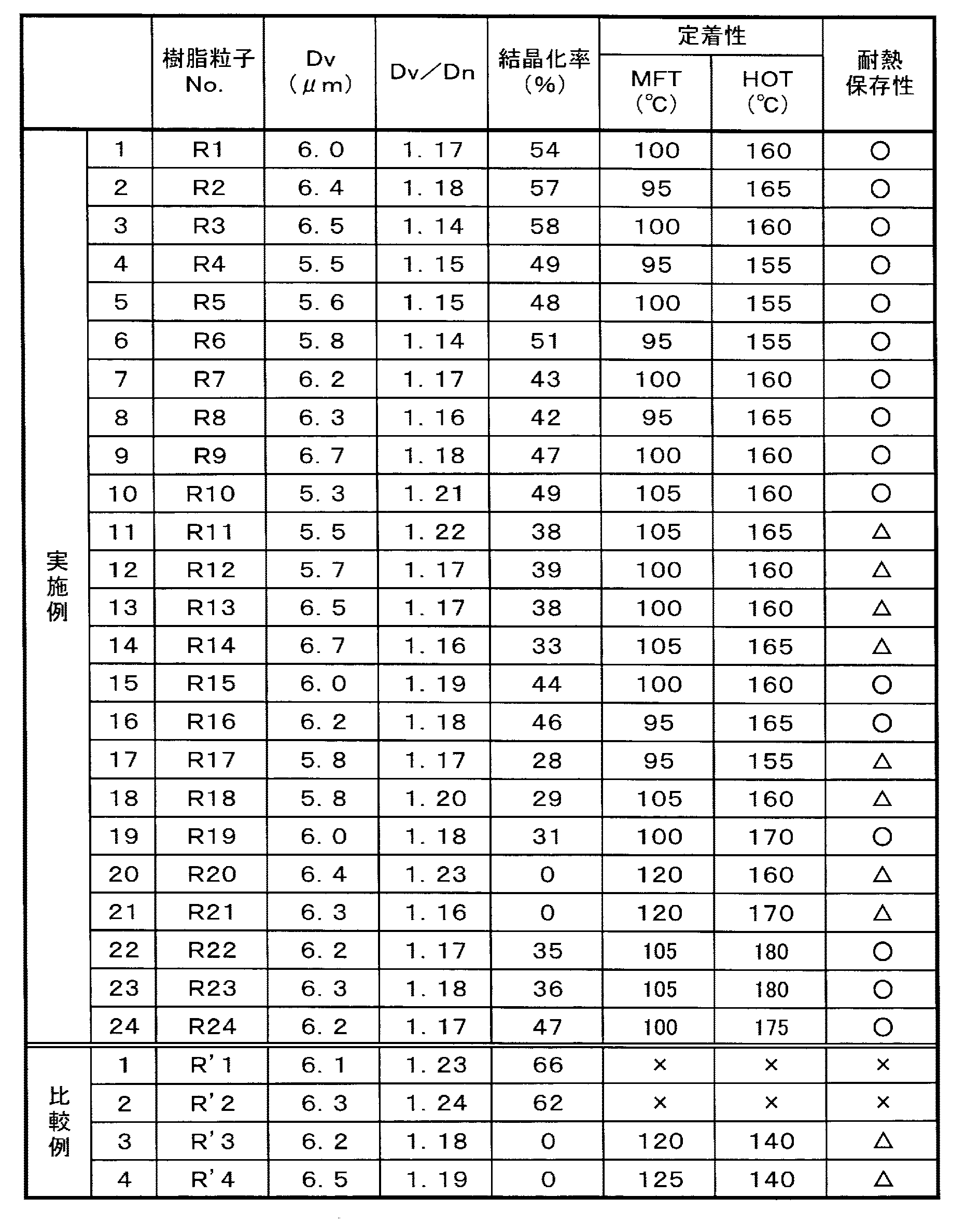
表1、2に示したように、本発明の樹脂粒子(実施例1〜24)は、比較例の樹脂粒子と比較して、特に定着性がいずれも著しく良好な結果であり、耐熱保存性も同等以上であった。 As shown in Tables 1 and 2, the resin particles of the present invention (Examples 1 to 24) are particularly excellent in fixability as compared with the resin particles of the comparative examples, and have heat resistant storage stability. Was also equal or better.
本発明の樹脂粒子は、定着性に優れ、粒度分布がシャープであり、耐熱保存性にも優れる。そのため用途としては、スラッシュ成形用樹脂、粉体塗料、電子部品製造用スペーサー、電子測定機器の標準粒子、電子写真トナー用母体粒子、静電記録トナー用母体粒子、静電印刷トナー用母体粒子及びホットメルト接着剤等として有用である。
The resin particles of the present invention have excellent fixability, a sharp particle size distribution, and excellent heat resistant storage stability. Therefore, as applications, slush molding resin, powder coating, electronic component manufacturing spacer, standard particles for electronic measuring equipment, electrophotographic toner base particles, electrostatic recording toner base particles, electrostatic printing toner base particles and It is useful as a hot melt adhesive.
Claims (11)
[1][(S)の体積平均粒径/(T)の体積平均粒径]が0.001〜0.3であり、
[2](S)の体積平均粒径が0.0005〜30μm、かつ(T)の体積平均粒径が0.1〜300μmであり、
[3](R)の表面の5%以上が(S)で覆われており、
[4](T)の[体積平均粒径/個数平均粒径]が1.0〜1.5であり、
[5](R)が樹脂(A)及び必要により架橋構造を有さない樹脂(B)を含有し、樹脂(A)が3価又は4価の芳香族カルボン酸と炭素数が2〜10の脂肪族ジオール(d1)又はジアルカノールアミン化合物(d2)とのエステル(e)、ポリイソシアネート(i)及びポリアミン(b)を構成単位として有する樹脂である樹脂粒子。
The resin particles (S) containing the resin (C) are resin particles (T) having a structure in which the resin particles (R) are attached to the surfaces of the resin particles (R).
[1] [Volume average particle diameter of (S) / Volume average particle diameter of (T)] is 0.001 to 0.3,
[2] The volume average particle diameter of (S) is 0.0005 to 30 μm, and the volume average particle diameter of (T) is 0.1 to 300 μm.
[3] 5% or more of the surface of (R) is covered with (S),
[4] The [volume average particle size / number average particle size] of (T) is 1.0 to 1.5,
[5] (R) contains the resin (A) and, if necessary, the resin (B) having no cross-linked structure, the resin (A) is a trivalent or tetravalent aromatic carboxylic acid and has 2 to 10 carbon atoms. Particles which are resins having ester (e), polyisocyanate (i) and polyamine (b) with aliphatic diol (d1) or dialkanolamine compound (d2) as structural units.
Priority Applications (1)
| Application Number | Priority Date | Filing Date | Title |
|---|---|---|---|
| JP2010247246A JP5705505B2 (en) | 2009-11-24 | 2010-11-04 | Resin particles |
Applications Claiming Priority (3)
| Application Number | Priority Date | Filing Date | Title |
|---|---|---|---|
| JP2009266026 | 2009-11-24 | ||
| JP2009266026 | 2009-11-24 | ||
| JP2010247246A JP5705505B2 (en) | 2009-11-24 | 2010-11-04 | Resin particles |
Publications (2)
| Publication Number | Publication Date |
|---|---|
| JP2011132500A true JP2011132500A (en) | 2011-07-07 |
| JP5705505B2 JP5705505B2 (en) | 2015-04-22 |
Family
ID=44345577
Family Applications (1)
| Application Number | Title | Priority Date | Filing Date |
|---|---|---|---|
| JP2010247246A Active JP5705505B2 (en) | 2009-11-24 | 2010-11-04 | Resin particles |
Country Status (1)
| Country | Link |
|---|---|
| JP (1) | JP5705505B2 (en) |
Cited By (4)
| Publication number | Priority date | Publication date | Assignee | Title |
|---|---|---|---|---|
| JP5753836B2 (en) * | 2010-02-23 | 2015-07-22 | 三洋化成工業株式会社 | Strength improver for polyurethane foam production |
| JP2015171817A (en) * | 2014-02-20 | 2015-10-01 | 三洋化成工業株式会社 | Powdery resin composition for slash molding |
| WO2018085483A1 (en) | 2016-11-04 | 2018-05-11 | Cabot Corporation | Nanocomposites containing crystalline polyester and organosilica |
| JP2019066538A (en) * | 2017-09-28 | 2019-04-25 | 花王株式会社 | Binder resin composition for electrophotographic toner |
Citations (5)
| Publication number | Priority date | Publication date | Assignee | Title |
|---|---|---|---|---|
| JPH07324117A (en) * | 1994-05-31 | 1995-12-12 | Dainippon Ink & Chem Inc | Polyurethane fine particles |
| JP2002284881A (en) * | 2000-02-16 | 2002-10-03 | Sanyo Chem Ind Ltd | Resin dispersion having uniform particle size, resin particles, and methods for producing them |
| JP2003327707A (en) * | 2000-02-16 | 2003-11-19 | Sanyo Chem Ind Ltd | Resin dispersion having uniform particle diameter and manufacturing method therefor |
| JP2008101204A (en) * | 2006-09-20 | 2008-05-01 | Sanyo Chem Ind Ltd | Method for producing resin dispersion and resin particles |
| JP2008156627A (en) * | 2006-11-30 | 2008-07-10 | Sanyo Chem Ind Ltd | Method for producing resin particle and resin particle |
-
2010
- 2010-11-04 JP JP2010247246A patent/JP5705505B2/en active Active
Patent Citations (5)
| Publication number | Priority date | Publication date | Assignee | Title |
|---|---|---|---|---|
| JPH07324117A (en) * | 1994-05-31 | 1995-12-12 | Dainippon Ink & Chem Inc | Polyurethane fine particles |
| JP2002284881A (en) * | 2000-02-16 | 2002-10-03 | Sanyo Chem Ind Ltd | Resin dispersion having uniform particle size, resin particles, and methods for producing them |
| JP2003327707A (en) * | 2000-02-16 | 2003-11-19 | Sanyo Chem Ind Ltd | Resin dispersion having uniform particle diameter and manufacturing method therefor |
| JP2008101204A (en) * | 2006-09-20 | 2008-05-01 | Sanyo Chem Ind Ltd | Method for producing resin dispersion and resin particles |
| JP2008156627A (en) * | 2006-11-30 | 2008-07-10 | Sanyo Chem Ind Ltd | Method for producing resin particle and resin particle |
Cited By (4)
| Publication number | Priority date | Publication date | Assignee | Title |
|---|---|---|---|---|
| JP5753836B2 (en) * | 2010-02-23 | 2015-07-22 | 三洋化成工業株式会社 | Strength improver for polyurethane foam production |
| JP2015171817A (en) * | 2014-02-20 | 2015-10-01 | 三洋化成工業株式会社 | Powdery resin composition for slash molding |
| WO2018085483A1 (en) | 2016-11-04 | 2018-05-11 | Cabot Corporation | Nanocomposites containing crystalline polyester and organosilica |
| JP2019066538A (en) * | 2017-09-28 | 2019-04-25 | 花王株式会社 | Binder resin composition for electrophotographic toner |
Also Published As
| Publication number | Publication date |
|---|---|
| JP5705505B2 (en) | 2015-04-22 |
Similar Documents
| Publication | Publication Date | Title |
|---|---|---|
| JP5237902B2 (en) | Crystalline resin particles | |
| JP5291649B2 (en) | Resin particles | |
| KR100837646B1 (en) | Resin Particle | |
| JP5663007B2 (en) | Non-aqueous resin particle dispersion | |
| JP5705493B2 (en) | Method for producing resin particles | |
| JP2011237790A (en) | Resin particle and producing method for the same | |
| JP2011094136A (en) | Method for producing resin particles | |
| JP5214558B2 (en) | Resin particles and method for producing the same | |
| JP2014080586A (en) | Method for producing resin particles | |
| WO2010021081A1 (en) | Resin particle and method for producing same | |
| JP5705505B2 (en) | Resin particles | |
| JP2010254896A (en) | Resin particles and its aqueous dispersion, as well as its manufacturing method | |
| JP2009057487A (en) | Resin particle and method for producing resin particle | |
| JP5101574B2 (en) | Resin particles | |
| JP6948282B2 (en) | Method for producing composite particles and dispersion liquid containing composite particles | |
| JP4629696B2 (en) | Resin particle and method for producing resin particle | |
| JP2015078352A (en) | Resin particle | |
| JP2006307195A (en) | Resin particle | |
| JP2009040893A (en) | Resin particle and method for producing resin particle | |
| JP2009030046A (en) | Resin particle | |
| JP5020529B2 (en) | Colored resin particles | |
| JP2016138257A (en) | Production method of resin particle | |
| JP5627885B2 (en) | Resin particles and method for producing the same | |
| JP2016135483A (en) | Manufacturing method of particles | |
| JP2016130306A (en) | Method for producing resin particle |
Legal Events
| Date | Code | Title | Description |
|---|---|---|---|
| A621 | Written request for application examination |
Free format text: JAPANESE INTERMEDIATE CODE: A621 Effective date: 20130708 |
|
| A977 | Report on retrieval |
Free format text: JAPANESE INTERMEDIATE CODE: A971007 Effective date: 20131210 |
|
| A131 | Notification of reasons for refusal |
Free format text: JAPANESE INTERMEDIATE CODE: A131 Effective date: 20140617 |
|
| A521 | Request for written amendment filed |
Free format text: JAPANESE INTERMEDIATE CODE: A523 Effective date: 20140818 |
|
| TRDD | Decision of grant or rejection written | ||
| A01 | Written decision to grant a patent or to grant a registration (utility model) |
Free format text: JAPANESE INTERMEDIATE CODE: A01 Effective date: 20150224 |
|
| A61 | First payment of annual fees (during grant procedure) |
Free format text: JAPANESE INTERMEDIATE CODE: A61 Effective date: 20150225 |
|
| R150 | Certificate of patent or registration of utility model |
Ref document number: 5705505 Country of ref document: JP Free format text: JAPANESE INTERMEDIATE CODE: R150 |
|
| R250 | Receipt of annual fees |
Free format text: JAPANESE INTERMEDIATE CODE: R250 |
|
| R250 | Receipt of annual fees |
Free format text: JAPANESE INTERMEDIATE CODE: R250 |