JP2007052182A - Radiation sensitive resin composition - Google Patents
Radiation sensitive resin composition Download PDFInfo
- Publication number
- JP2007052182A JP2007052182A JP2005236524A JP2005236524A JP2007052182A JP 2007052182 A JP2007052182 A JP 2007052182A JP 2005236524 A JP2005236524 A JP 2005236524A JP 2005236524 A JP2005236524 A JP 2005236524A JP 2007052182 A JP2007052182 A JP 2007052182A
- Authority
- JP
- Japan
- Prior art keywords
- group
- acid
- general formula
- resin composition
- radiation
- Prior art date
- Legal status (The legal status is an assumption and is not a legal conclusion. Google has not performed a legal analysis and makes no representation as to the accuracy of the status listed.)
- Withdrawn
Links
- 0 O=C1ONC(C2)C3C1CC2*C3 Chemical compound O=C1ONC(C2)C3C1CC2*C3 0.000 description 7
- QTICJYCJYCKKEX-UHFFFAOYSA-N CC1C2CC(C)(C)CC(C3)C1C3(C)C2 Chemical compound CC1C2CC(C)(C)CC(C3)C1C3(C)C2 QTICJYCJYCKKEX-UHFFFAOYSA-N 0.000 description 1
Landscapes
- Materials For Photolithography (AREA)
- Addition Polymer Or Copolymer, Post-Treatments, Or Chemical Modifications (AREA)
Abstract
【課題】感度、解像度に優れ、パターンのラインエッジラフネスが小さく、更にはパターン形状を良好に維持することが可能なレジストである感放射線性樹脂組成物を提供する。
【解決手段】(A)アルキル置換ノルボルナンラクトン環を含有する酸解離性基含有共重合体と、(B)スルホン酸エステル型の酸増殖剤と、(C)酸発生剤とを含有する感放射線性樹脂組成物。
【選択図】なしDisclosed is a radiation-sensitive resin composition that is a resist that is excellent in sensitivity and resolution, has a small line edge roughness of a pattern, and can maintain a good pattern shape.
A radiation sensitive composition comprising (A) an acid-dissociable group-containing copolymer containing an alkyl-substituted norbornanelactone ring, (B) a sulfonic acid ester-type acid proliferating agent, and (C) an acid generator. Resin composition.
[Selection figure] None
Description
本発明は、感放射線性樹脂組成物に関し、更に詳しくは、KrFエキシマレーザーあるいはArFエキシマレーザー等の遠紫外線、シンクロトロン放射線等のX線、電子線等の荷電粒子線の如き各種の放射線を使用する微細加工に有用な化学増幅型レジストとして好適に使用できる感放射線性樹脂組成物に関する。 The present invention relates to a radiation-sensitive resin composition, and more specifically, various radiations such as deep ultraviolet rays such as KrF excimer laser or ArF excimer laser, X-rays such as synchrotron radiation, and charged particle beams such as electron beams are used. The present invention relates to a radiation sensitive resin composition that can be suitably used as a chemically amplified resist useful for fine processing.
集積回路素子の製造に代表される微細加工の分野においては、より高い集積度を得るために、最近ではArFエキシマレーザー(波長193nm)、F2エキシマレーザー(波長157nm)等を用いた100nm程度以下のレベルでの微細加工が可能なリソグラフィー技術が必要とされている。このようなエキシマレーザーによる照射に適した感放射線性樹脂組成物として、酸解離性官能基を有する成分と放射線の照射により酸を発生する成分である酸発生剤とによる化学増幅効果を利用した化学増幅型感放射線性組成物が数多く提案されている。例えば、ノルボルナン環誘導体を有する単量体ユニットを含む特定の構造を有する重合体を樹脂成分とするフォトレジスト用高分子化合物が知られている(特許文献1、特許文献2参照)。また、感度及び解像度を向上させるために、酸解離性官能基を有する成分及び酸発生剤に、更に光活性化合物を加えた感放射線性樹脂組成物が開示されている(特許文献3参照)。 In the field of microfabrication represented by the manufacture of integrated circuit elements, in order to obtain a higher degree of integration, recently, an ArF excimer laser (wavelength 193 nm), an F 2 excimer laser (wavelength 157 nm) or the like is used. There is a need for a lithography technique capable of microfabrication at the same level. As a radiation-sensitive resin composition suitable for irradiation with such an excimer laser, a chemistry utilizing the chemical amplification effect of a component having an acid dissociable functional group and an acid generator that is a component that generates an acid upon irradiation with radiation. Many amplified radiation-sensitive compositions have been proposed. For example, a high-molecular compound for photoresist using a polymer having a specific structure including a monomer unit having a norbornane ring derivative as a resin component is known (see Patent Document 1 and Patent Document 2). Moreover, in order to improve sensitivity and resolution, a radiation sensitive resin composition is disclosed in which a photoactive compound is further added to a component having an acid dissociable functional group and an acid generator (see Patent Document 3).
しかしながら、半導体分野において、より高い集積度が求められるようになると、レジストである感放射線性樹脂組成物はより優れた感度、解像度が必要とされるようになってきた。また、同時に、より微細化が進むにつれて、パターンのラインエッジラフネス(LER)を低減する要求、更にはパターン形状を良好に維持する要求もますます強まってきた。半導体産業の微細化の進歩につれ、このような感度、解像度に優れ、パターンのラインエッジラフネスが小さく、更にはパターン形状を良好に維持できるような条件を満たす感放射線性樹脂組成物の開発が急務になっている。
本発明の課題は、感度、解像度に優れ、パターンのラインエッジラフネスが小さく、更にはパターン形状を良好に維持することが可能な化学増幅型レジストである感放射線性樹脂組成物を提供することにある。 An object of the present invention is to provide a radiation-sensitive resin composition which is a chemically amplified resist that is excellent in sensitivity and resolution, has a small pattern line edge roughness, and can maintain a good pattern shape. is there.
上記課題を解決する本発明の感放射線性樹脂組成物は、以下に示す通りである。 The radiation-sensitive resin composition of the present invention that solves the above problems is as follows.
[1] (A)下記一般式(1−1)で示される繰り返し単位および下記一般式(1−2)で示される繰り返し単位を有する酸解離性基含有重合体と、(B)下記一般式(1−3)で示される化合物と、(C)放射線の照射により酸を発生する酸発生剤とを含有する感放射線性樹脂組成物。
[2] 前記(A)酸解離性基含有重合体が、下記一般式(1−4)で示される繰り返し単位を更に有する[1]に記載の感放射線性樹脂組成物。
[3] 前記一般式(1−3)において、R3およびR4がフッ素原子である[1]又は[2]に記載の感放射線性樹脂組成物。 [3] The radiation sensitive resin composition according to [1] or [2], wherein in the general formula (1-3), R 3 and R 4 are fluorine atoms.
本発明の感放射線性樹脂組成物は、活性放射線、特に、ArFエキシマレーザー(波長193nm)に代表される遠紫外線に感応する化学増幅型レジストとして、放射線に対する感度、解像度等の特性バランスに優れているだけではなく、更に、現像後のレジストパターン形状が良好であり、パターンのラインエッジラフネスを低減することができる。 The radiation-sensitive resin composition of the present invention is a chemically amplified resist that is sensitive to actinic radiation, particularly far ultraviolet rays typified by ArF excimer laser (wavelength 193 nm), and has an excellent balance of characteristics such as sensitivity to radiation and resolution. In addition, the resist pattern shape after development is good, and the line edge roughness of the pattern can be reduced.
次に、本発明を実施するための最良の形態(以下、「実施形態」という。)を詳細に説明するが、本発明は以下の実施形態に限定されるものではなく、本発明の趣旨を逸脱しない範囲で、当業者の通常の知識に基づいて、適宜設計の変更、改良等が加えられることが理解されるべきである。 Next, the best mode for carrying out the present invention (hereinafter referred to as “embodiment”) will be described in detail, but the present invention is not limited to the following embodiment, and the gist of the present invention is described below. It should be understood that design changes, improvements, and the like can be made as appropriate based on ordinary knowledge of those skilled in the art without departing from the scope.
(感放射線性樹脂組成物)
本実施形態の感放射線性樹脂組成物は、(A)下記一般式(1−1)で示される酸解離性基を有する繰り返し単位および下記一般式(1−2)で示される繰り返し単位を有し、酸の作用によりアルカリ可溶性となるアルカリ不溶性またはアルカリ難溶性の酸解離性基含有重合体(以下、「(A)重合体」ということがある。)と、(B)下記一般式(1−3)で示される添加剤(以下、「(B)化合物」ということがある。)と、(C)放射線の照射により酸を発生する酸発生剤(以下、「(C)酸発生剤」ということがある。)とを含有するものである。
(Radiation sensitive resin composition)
The radiation-sensitive resin composition of this embodiment has (A) a repeating unit having an acid dissociable group represented by the following general formula (1-1) and a repeating unit represented by the following general formula (1-2). Then, an alkali-insoluble or alkali-insoluble acid-dissociable group-containing polymer (hereinafter sometimes referred to as “(A) polymer”) that becomes alkali-soluble by the action of an acid, and (B) the following general formula (1) -3) (hereinafter sometimes referred to as “(B) compound”) and (C) an acid generator that generates an acid upon irradiation with radiation (hereinafter referred to as “(C) acid generator”). And so on).
一般式(1−1)において、R1は水素原子、メチル基、またはトリフルオロメチル基、Zは酸の作用により脱離可能な保護基を示す。一般式(1−2)において、R1は水素原子、メチル基、またはトリフルオロメチル基を表し、R2は相互に独立に、水素原子、炭素数1〜4の直鎖状あるいは分岐状のアルキル基、炭素数1〜4の直鎖状あるいは分岐状のアルコキシ基、または、炭素数1〜4の直鎖状あるいは分岐状のフッ素化アルキル基を表す。mは0〜3の整数である。一般式(1−3)において、R3、R4は相互に独立に水素原子、フッ素原子、炭素数1〜4の直鎖状もしくは分岐のアルキル基、パーフルオロアルキル基を示す。nは1〜8の整数を、Aは酸解離性基を示し、Gはフッ素原子又は一価の有機基を表す。 In the general formula (1-1), R 1 represents a hydrogen atom, a methyl group, or a trifluoromethyl group, and Z represents a protective group that can be removed by the action of an acid. In General Formula (1-2), R 1 represents a hydrogen atom, a methyl group, or a trifluoromethyl group, and R 2 is independently a hydrogen atom, a linear or branched group having 1 to 4 carbon atoms. An alkyl group, a linear or branched alkoxy group having 1 to 4 carbon atoms, or a linear or branched fluorinated alkyl group having 1 to 4 carbon atoms is represented. m is an integer of 0-3. In General Formula (1-3), R 3 and R 4 each independently represent a hydrogen atom, a fluorine atom, a linear or branched alkyl group having 1 to 4 carbon atoms, or a perfluoroalkyl group. n represents an integer of 1 to 8, A represents an acid dissociable group, and G represents a fluorine atom or a monovalent organic group.
本実施形態の感放射線性樹脂組成物は、上述のように、(B)化合物と(C)酸発生剤とを含有するため、化学増幅型レジストとして使用し、放射線の照射により(C)酸発生剤から酸を発生させるときに、(C)酸発生剤から発生した酸の作用により(B)化合物が分解され、より多くの酸を発生することより、レジストの放射線照射部分全体に渡って大量の酸を発生させることが可能となる。このように、レジストの放射線照射部分全体に渡って大量に酸を発生させることにより、(A)重合体が有する酸解離性基を、レジストの放射線照射部分全体に渡ってより均一に解離させることが可能となるため、特に、現像後のパターンのラインエッジラフネスを低減することができるようになる。 Since the radiation sensitive resin composition of this embodiment contains (B) compound and (C) acid generator as mentioned above, it is used as a chemically amplified resist and (C) acid is irradiated by radiation. When the acid is generated from the generator, (C) the compound (B) is decomposed by the action of the acid generated from the acid generator, and more acid is generated. A large amount of acid can be generated. Thus, by generating a large amount of acid over the entire irradiated portion of the resist, (A) the acid dissociable group of the polymer can be dissociated more uniformly over the entire irradiated portion of the resist. In particular, the line edge roughness of the pattern after development can be reduced.
((A)重合体)
本実施形態の感放射線性樹脂組成物に含有される(A)重合体は、酸解離性基を有する上記一般式(1−1)で示される繰り返し単位(以下、「(1−1)繰り返し単位」ということがある。)、およびラクトン骨格を含有する上記一般式(1−2)で示される繰り返し単位(以下、「(1−2)繰り返し単位」ということがある。)を有する共重合体である。(1−1)繰り返し単位はアルカリ不溶性またはアルカリ難溶性を示す繰り返し単位であるが、酸解離性基を有するため、酸の作用により酸解離性基が解離した後はアルカリ可溶性を示すものとなる。上記一般式(1−1)において、酸解離性基は、保護基Zで保護された状態のカルボキシル基である。
((A) polymer)
The polymer (A) contained in the radiation-sensitive resin composition of the present embodiment is a repeating unit represented by the general formula (1-1) having an acid dissociable group (hereinafter referred to as “(1-1) repeating”). And a repeating unit represented by the above general formula (1-2) containing a lactone skeleton (hereinafter, also referred to as “(1-2) repeating unit”). It is a coalescence. (1-1) The repeating unit is an alkali-insoluble or hardly alkali-soluble repeating unit, but has an acid-dissociable group, and therefore exhibits alkali-solubility after the acid-dissociable group is dissociated by the action of an acid. . In the general formula (1-1), the acid dissociable group is a carboxyl group protected by a protecting group Z.
上記一般式(1−1)において、R1は水素原子、メチル基、またはトリフルオロメチル基、Zは酸の作用により脱離可能な保護基を示す。一般式(1−1)で示される酸解離性基を有する繰り返し単位としては、下記一般式(2)又は(3)で示される繰り返し単位であることが好ましい。 In the general formula (1-1), R 1 represents a hydrogen atom, a methyl group, or a trifluoromethyl group, and Z represents a protective group that can be removed by the action of an acid. The repeating unit having an acid dissociable group represented by the general formula (1-1) is preferably a repeating unit represented by the following general formula (2) or (3).
式(2)におけるR6およびR7としては、例えば、メチル基、エチル基、n−プロピル基、i−プロピル基、n−ブチル基、2−メチルプロピル基、1−メチルプロピル基、t−ブチル基等が挙げられる。R8としては、例えば、シクロブタン、シクロペンタン、シクロヘキサン、シクロヘプタン、シクロオクタン、ビシクロ[2.2.1]ヘプタン、ビシクロ[2.2.2]オクタン、トリシクロ[5.2.1.02,6]デカン、テトラシクロ[4.4.0.12,6.17,10]ドデカン、テトラシクロ[6.2.1.13,6.02,7]ドデカン、またはこれらの誘導体に由来する炭化水素基が挙げられる。R5としては例えば、水素原子、メチル基、トリフルオロメチル基が挙げられる。 R 6 and R 7 in the formula (2) are, for example, methyl group, ethyl group, n-propyl group, i-propyl group, n-butyl group, 2-methylpropyl group, 1-methylpropyl group, t- A butyl group etc. are mentioned. Examples of R 8 include cyclobutane, cyclopentane, cyclohexane, cycloheptane, cyclooctane, bicyclo [2.2.1] heptane, bicyclo [2.2.2] octane, and tricyclo [5.2.1.0 2 ]. , 6 ] decane, tetracyclo [4.4.0.1 2,6 . 1 7,10 ] dodecane, tetracyclo [6.2.1.1 3,6 . 0 2,7 ] dodecane, or hydrocarbon groups derived from these derivatives. Examples of R 5 include a hydrogen atom, a methyl group, and a trifluoromethyl group.
式(3)におけるR10としては、例えば、メチル基、エチル基、n−プロピル基、i−プロピル基、n−ブチル基、2−メチルプロピル基、1−メチルプロピル基、t−ブチル基等が挙げられる。R11およびR12しては、例えば、水素原子、メチル基、エチル基、n−プロピル基、i−プロピル基、n−ブチル基、2−メチルプロピル基、1−メチルプロピル基、t−ブチル基等が挙げられる。R9としては例えば、水素原子、メチル基、トリフルオロメチル基が挙げられる。 As R < 10 > in Formula (3), a methyl group, an ethyl group, n-propyl group, i-propyl group, n-butyl group, 2-methylpropyl group, 1-methylpropyl group, t-butyl group etc. are mentioned, for example. Is mentioned. R 11 and R 12 are, for example, a hydrogen atom, methyl group, ethyl group, n-propyl group, i-propyl group, n-butyl group, 2-methylpropyl group, 1-methylpropyl group, t-butyl. Groups and the like. Examples of R 9 include a hydrogen atom, a methyl group, and a trifluoromethyl group.
式(3)において、R10がメチル基またはエチル基、R11およびR12が水素原子、およびnが4または5であることが特に好ましい。特に好ましい例を下記式(3−1)〜(3−4)に挙げる。 In the formula (3), it is particularly preferable that R 10 is a methyl group or an ethyl group, R 11 and R 12 are hydrogen atoms, and n is 4 or 5. Particularly preferred examples are listed in the following formulas (3-1) to (3-4).
式(3−1)〜(3−4)において、Rは水素原子、メチル基、またはトリフルオロメチル基をそれぞれ示す。 In formulas (3-1) to (3-4), R represents a hydrogen atom, a methyl group, or a trifluoromethyl group.
(A)重合体は、(1−1)繰り返し単位として、上記式(2)及び(3)で示される繰り返し単位の中の1種を有してもよいし、複数種を有してもよい。 (A) The polymer may have one or more types of repeating units represented by the above formulas (2) and (3) as (1-1) repeating units. Good.
上記一般式(1−2)で表されるラクトン骨格含有繰り返し単位におけるR2が、炭素数1〜4の直鎖状または分岐状のアルキル基である場合、その具体例としては、例えば、メチル基、エチル基、n−プロピル基、i−プロピル基、n−ブチル基、2−メチルプロピル基、1−メチルプロピル基、t−ブチル基等が挙げられ、炭素数1〜4の直鎖状または分岐状のアルコキシ基である場合、その具体例としては、メトキシ基、エトキシ基、n−プロポキシ基、i−プロポキシ基、n−ブトキシ基、2−メチルプロポキシ基、1−メチルプロポキシ基、t−ブトキシ基等が挙げられる。R2が、炭素数1〜4の直鎖状あるいは分岐状のフッ素化アルキル基である場合、その具体例としては、上記アルキル基の水素の一部または全部をフッ素原子で置換した基が挙げられる。上記ラクトン骨格は、これら置換基を1種以上あるいは1個以上有することが好ましい。 When R 2 in the lactone skeleton-containing repeating unit represented by the general formula (1-2) is a linear or branched alkyl group having 1 to 4 carbon atoms, specific examples thereof include, for example, methyl Group, ethyl group, n-propyl group, i-propyl group, n-butyl group, 2-methylpropyl group, 1-methylpropyl group, t-butyl group, etc., straight chain having 1 to 4 carbon atoms In the case of a branched alkoxy group, specific examples thereof include methoxy group, ethoxy group, n-propoxy group, i-propoxy group, n-butoxy group, 2-methylpropoxy group, 1-methylpropoxy group, t -Butoxy group etc. are mentioned. When R 2 is a linear or branched fluorinated alkyl group having 1 to 4 carbon atoms, specific examples thereof include a group in which part or all of the hydrogen of the alkyl group is substituted with a fluorine atom. It is done. The lactone skeleton preferably has one or more of these substituents.
(1−1)繰り返し単位は、上記式(2)及び(3)で示される繰り返し単位の他、以下に示す単量体に由来する繰り返し単位であることが好ましい。その単量体としては、(メタ)アクリル酸2−メチルアダマンタン−2−イルエステル、(メタ)アクリル酸2−エチルアダマンタン−2−イルエステル、(メタ)アクリル酸2−n−プロビルアダマンタン−2−イルエステル、(メタ)アクリル酸2−イソプロピルアダマンタン−2−イルエステル、(メタ)アクリル酸1−(アダマンタン−1−イル)−1−メチルエチルエステル、(メタ)アクリル酸2−メチルビシクロ[2.2.1]ヘプト−2−イルエステル、(メタ)アクリル酸2−エチルビシクロ[2.2.1]ヘプト−2−イルエステル、(メタ)アクリル酸8−メチルトリシクロ[5.2.1.02,6]デカ−8−イルエステル、(メタ)アクリル酸8−エチルトリシクロ[5.2.1.02,6]デカ−8−イルエステル、(メタ)アクリル酸4−メチルテトラシクロ[6.2.1.13,6.02,7]ドデカ−4−イルエステル、(メタ)アクリル酸4−エチルテトラシクロ[6.2.1.13,6.02,7]ドデカ−4−イルエステル、(メタ)アクリル酸1−(テトラシクロ[6.2.1.13,6.02,7]ドデカ−4−イル)−1−メチルエチルエステル、(メタ)アクリル酸1,1−ジシクロヘキシルエチルエステル等の酸解離性基を有する単量体が挙げられる。 (1-1) The repeating unit is preferably a repeating unit derived from the monomer shown below in addition to the repeating units represented by the above formulas (2) and (3). As the monomer, (meth) acrylic acid 2-methyladamantan-2-yl ester, (meth) acrylic acid 2-ethyladamantan-2-yl ester, (meth) acrylic acid 2-n-propyl adamantane- 2-yl ester, (meth) acrylic acid 2-isopropyladamantan-2-yl ester, (meth) acrylic acid 1- (adamantan-1-yl) -1-methylethyl ester, (meth) acrylic acid 2-methylbicyclo [2.2.1] Hept-2-yl ester, (meth) acrylic acid 2-ethylbicyclo [2.2.1] hept-2-yl ester, (meth) acrylic acid 8-methyltricyclo [5. 2.1.0 2,6 ] dec-8-yl ester, (meth) acrylic acid 8-ethyltricyclo [5.2.1.0 2,6 ] dec-8-yl ester, (Meth) acrylic acid 4-methyltetracyclo [6.2.1.1 3,6 . 0 2,7 ] dodec-4-yl ester, (meth) acrylic acid 4-ethyltetracyclo [6.2.1.1 3,6 . 0 2,7 ] dodec-4-yl ester, (meth) acrylic acid 1- (tetracyclo [6.2.1.1 3,6 .0 2,7 ] dodec-4-yl) -1-methylethyl ester , (Meth) acrylic acid 1,1-dicyclohexyl ethyl ester and other monomers having an acid dissociable group.
(A)重合体において、(1−1)繰り返し単位の含有率(モル比)は、(1−1)繰り返し単位と、(1−2)繰り返し単位との合計(以下、「2種の繰り返し単位の合計」ということがある。)を100モル%としたときに、10〜90モル%であることが好ましく、30〜80モル%であることが更に好ましい。上記2種の繰り返し単位をこのような範囲にすることにより、適切な溶解コントラストが得られ、良好な感度、解像度およびLERが小さく優れたパターンプロファイルを得ることが可能となる。そして、(1−1)繰り返し単位の含有率が小さすぎると、溶解コントラストの低下によりパターンプロファイルが形成されない可能性があり、(1−1)繰り返し単位の含有率が大きすぎると、適切な溶解コントラストが得られず、解像度が低下する可能性がある。更に、(1−2)繰り返し単位の含有率が小さすぎると、溶解コントラストの低下により良好なパターンプロファイルが形成されない可能性があり、(1−2)繰り返し単位の含有率が大きすぎると、(A)重合体の溶剤に対する溶解性が低下する可能性がある。 (A) In the polymer, the content (molar ratio) of (1-1) repeating units is the sum of (1-1) repeating units and (1-2) repeating units (hereinafter referred to as “two types of repeating units”). Is sometimes referred to as “total of units”.) Is 100 mol%, it is preferably 10 to 90 mol%, and more preferably 30 to 80 mol%. By setting the two types of repeating units in such a range, an appropriate dissolution contrast can be obtained, and an excellent pattern profile with good sensitivity, resolution, and low LER can be obtained. And (1-1) If the content rate of the repeating unit is too small, there is a possibility that the pattern profile is not formed due to a decrease in dissolution contrast. (1-1) If the content rate of the repeating unit is too large, appropriate dissolution There is a possibility that the contrast cannot be obtained and the resolution is lowered. Furthermore, if the content of the repeating unit (1-2) is too small, a good pattern profile may not be formed due to a decrease in dissolution contrast, and (1-2) if the content of the repeating unit is too large, A) The solubility of the polymer in the solvent may decrease.
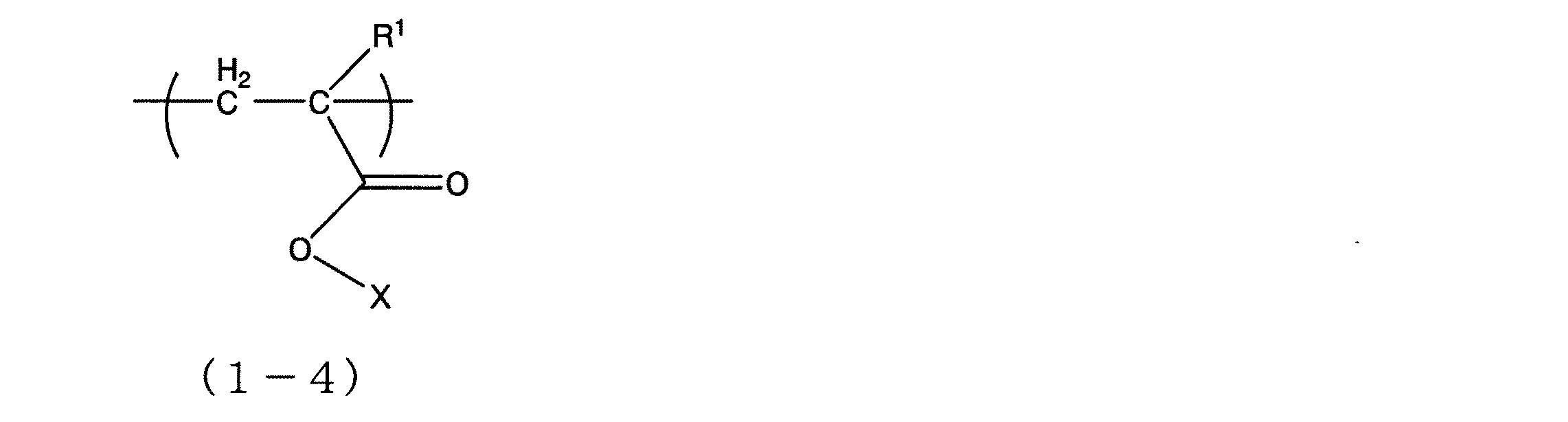
本実施形態の感放射線性樹脂組成物に含有される(A)重合体は、下記一般式(1−4)で示される繰り返し単位を更に有することが好ましい。
上記一般式(1−4)において、Xは、炭素数4〜20の置換若しくは非置換の多環型脂環式炭化水素基である。非置換の多環型脂環式炭化水素基としては、炭素原子および水素原子のみからなる多環型脂環式炭化水素基が好ましい。また、置換の多環型脂環式炭化水素基としては、上記多環型脂環式炭化水素基の環構造を形成する炭素原子に結合する水素原子の一部がヒドロキシル基に置換された基(以下、「OH置換多環型脂環式炭化水素基」ということがある。)が好ましい。また、Xで示される置換基は酸の作用によっては脱離しないものである。 In the above general formula (1-4), X is a substituted or unsubstituted polycyclic alicyclic hydrocarbon group having 4 to 20 carbon atoms. The unsubstituted polycyclic alicyclic hydrocarbon group is preferably a polycyclic alicyclic hydrocarbon group consisting of only carbon atoms and hydrogen atoms. In addition, as the substituted polycyclic alicyclic hydrocarbon group, a group in which a part of hydrogen atoms bonded to the carbon atom forming the ring structure of the polycyclic alicyclic hydrocarbon group is substituted with a hydroxyl group (Hereinafter sometimes referred to as “OH-substituted polycyclic alicyclic hydrocarbon group”). In addition, the substituent represented by X does not leave by the action of an acid.
上記多環型脂環式炭化水素基としては、例えば、下記式(4a)〜(4e)に示すように、ビシクロ[2.2.1]ヘプタン(1a)、ビシクロ[2.2.2]オクタン(1b)、トリシクロ[5.2.1.02,6]デカン(1c)、テトラシクロ[4.4.0.12,5.17,10]ドデカン(4d)、アダマンタン(4e)等のシクロアルカン類に由来する脂環族環からなる炭化水素基が挙げられる。 Examples of the polycyclic alicyclic hydrocarbon group include bicyclo [2.2.1] heptane (1a) and bicyclo [2.2.2] as shown in the following formulas (4a) to (4e). Octane (1b), tricyclo [5.2.1.0 2,6 ] decane (1c), tetracyclo [4.4.0.1 2,5 . 1 7,10 ] hydrocarbon groups composed of alicyclic rings derived from cycloalkanes such as dodecane (4d) and adamantane (4e).
これらのシクロアルカン由来の脂環式炭化水素基は、置換基を有していてもよい。好ましい置換基としては例えば、メチル基、エチル基、n−プロピル基、i−プロピル基、n−ブチル基、2−メチルプロピル基、1−メチルプロピル基、t−ブチル基等の炭素数1〜4の直鎖状、分岐状または環状のアルキル基等が挙げられ、これらの1種以上あるいは1個以上を置換基として有する脂環族環も好ましい。これらは例えば、以下の式(4f)〜(4l)に示す具体例で表されるが、これらだけに限定されるものではない。またこれらは単独でも、2種以上を混合して用いることもできる。 These cycloalkane-derived alicyclic hydrocarbon groups may have a substituent. Preferable substituents include, for example, methyl group, ethyl group, n-propyl group, i-propyl group, n-butyl group, 2-methylpropyl group, 1-methylpropyl group, t-butyl group and the like. 4 linear, branched or cyclic alkyl groups, and the like, and alicyclic rings having one or more of these as substituents are also preferred. For example, these are represented by the specific examples shown in the following formulas (4f) to (4l), but are not limited thereto. These may be used alone or in combination of two or more.
また、上記一般式(1−4)において、Xが、炭素数4〜20のOH置換多環型脂環式炭化水素基である場合には、上記(1−4)繰り返し単位としては、下記一般式(4)で表されるヒドロキシアダマンタン基含有繰り返し単位を挙げることができる。 In the general formula (1-4), when X is an OH-substituted polycyclic alicyclic hydrocarbon group having 4 to 20 carbon atoms, the repeating unit (1-4) is as follows. The hydroxyadamantane group containing repeating unit represented by General formula (4) can be mentioned.
一般式(4)において、Rは水素原子、メチル基、またはトリフルオロメチル基、pは1〜3の整数である。また、ヒドロキシル基が結合するアダマンタン骨格の位置は3位であることが好ましい。 In General formula (4), R is a hydrogen atom, a methyl group, or a trifluoromethyl group, p is an integer of 1-3. The position of the adamantane skeleton to which the hydroxyl group is bonded is preferably the 3rd position.
(A)重合体において、(1−4)繰り返し単位の含有率(モル比)は、(1−1)繰り返し単位、(1−2)繰り返し単位および(1−4)繰り返し単位の合計を100モル%としたときに、0〜50モル%であることが好ましく、0〜30モル%であることが更に好ましい。(1−4)繰り返し単位の含有率が小さすぎると、適切な溶解コントラストが得られず、解像度が低下することがあり、(1−4)繰り返し単位の含有率が大きすぎると、現像液に対する溶解性が低下し、感度、パターンプロファイルが低下することがある。 (A) In the polymer, the content (molar ratio) of (1-4) repeating units is the sum of (1-1) repeating units, (1-2) repeating units and (1-4) repeating units. When it is defined as mol%, it is preferably 0 to 50 mol%, and more preferably 0 to 30 mol%. (1-4) If the content of the repeating unit is too small, an appropriate dissolution contrast may not be obtained and the resolution may be lowered. (1-4) If the content of the repeating unit is too large, Solubility may decrease, and sensitivity and pattern profile may decrease.
本実施形態において、(A)重合体は、単独でまたは2種以上を混合して使用できる。また、この(A)重合体はアルカリ不溶性またはアルカリ難溶性であるが、酸の作用により(1−1)繰り返し単位が有する酸解離性基が解離し、アルカリ易溶性となる。 In this embodiment, (A) polymer can be used individually or in mixture of 2 or more types. Further, the polymer (A) is alkali-insoluble or hardly alkali-soluble, but the acid-dissociable group of the (1-1) repeating unit is dissociated by the action of an acid, and becomes alkali-soluble.
((B)化合物)
本実施形態の感放射線性樹脂組成物に含有される(B)化合物は、上記一般式(1−3)で示される酸増殖剤である。酸増殖剤とは、一次的に発生した(存在する)酸の作用により分解されて、その一時的に発生した酸より更に多くの酸を二次的に発生し、全体としてより多くの(少なくとも一時的に発生した酸より多くの)酸を発生させることが可能な化合物である。このように本実施の形態の感放射線性樹脂組成物は、(B)化合物が分解され、より多くの酸を発生することより、レジストの放射線照射部分全体に渡って大量の酸を発生させることが可能となる。このように、レジストの放射線照射部分全体に渡って大量に酸を発生させることにより、(A)重合体が有する酸解離性基を、レジストの放射線照射部分全体に渡ってより均一に解離させることが可能となるため、特に、現像後のパターンのラインエッジラフネスを低減することができるようになる。
((B) Compound)
The compound (B) contained in the radiation sensitive resin composition of the present embodiment is an acid proliferating agent represented by the above general formula (1-3). The acid proliferating agent is decomposed by the action of the primary (existing) acid to secondaryly generate more acid than the temporarily generated acid, and as a whole, more (at least It is a compound capable of generating an acid (more than the temporarily generated acid). As described above, the radiation-sensitive resin composition of the present embodiment generates a large amount of acid over the entire irradiated portion of the resist by decomposing the compound (B) and generating more acid. Is possible. Thus, by generating a large amount of acid over the entire irradiated portion of the resist, (A) the acid dissociable group of the polymer can be dissociated more uniformly over the entire irradiated portion of the resist. In particular, the line edge roughness of the pattern after development can be reduced.
以下に、酸増殖剤についてさらに詳細に説明する。本発明の微細パターン形成方法に用いる感光性組成物(感光性樹脂)中の、酸触媒の存在下において分解し、新たな酸分子を生成する化合物(酸増殖剤)としては、分子構造中に芳香環を含まない化合物を用いることが特徴である。言い換えれば、本発明の微細パターン形成方法に用いる酸増殖剤としては、酸の残基と、水素と、脂肪族、脂肪環、縮合脂肪環、ヘテロ環及びその誘導体のうち1つ以上のみとから構成された化合物を用いることが特徴である。このような化合物(酸増殖剤)としては、各種の化合物が上げられるが下記の一般式(5)で表されるスルホン酸エステル化合物が好適である。 Hereinafter, the acid proliferating agent will be described in more detail. In the photosensitive composition (photosensitive resin) used in the method for forming a fine pattern of the present invention, a compound that decomposes in the presence of an acid catalyst and generates a new acid molecule (acid proliferating agent) has a molecular structure. It is characterized by using a compound that does not contain an aromatic ring. In other words, the acid proliferating agent used in the method for forming a fine pattern of the present invention includes an acid residue, hydrogen, and at least one of aliphatic, alicyclic, condensed alicyclic, heterocyclic and derivatives thereof. It is characterized by using a structured compound. Examples of such a compound (acid proliferating agent) include various compounds, and a sulfonic acid ester compound represented by the following general formula (5) is preferable.
上記の一般式(5)において、R3、R4は相互に独立に水素原子、フッ素原子、炭素数1〜4の直鎖状もしくは分岐のアルキル基、パーフルオロアルキル基を示す。nは1〜8の整数を示し、Gはフッ素原子又は一価の有機基を表す。上記の一般式(5)のA1ないしA3は同一であっても異なっていてもよく、それぞれ独立な水素原子または芳香環構造を含まない一価の有機基を示す。かかる一価の有機基としては、例えばメチル、エチル、n−プロピル、イソプロピル、n−ブチル、イソブチル、tert−ブチル、ペンチル、イソペンチル等の置換あるいは非置換の鎖状アルキル、シクロプロピル、シクロブチル、ピペリジル、テトラヒドロフラニル、ピラニル等の置換あるいは非置換の脂肪族環もしくはヘテロ環をあげることができる。このとき、A1ないしA3から選ばれる二つが各々結合している炭素原子を含む環を形成していてもよい。 In the general formula (5), R 3 and R 4 each independently represent a hydrogen atom, a fluorine atom, a linear or branched alkyl group having 1 to 4 carbon atoms, or a perfluoroalkyl group. n represents an integer of 1 to 8, and G represents a fluorine atom or a monovalent organic group. A 1 to A 3 in the general formula (5) may be the same or different and each represents an independent hydrogen atom or a monovalent organic group not containing an aromatic ring structure. Examples of the monovalent organic group include substituted or unsubstituted chain alkyl such as methyl, ethyl, n-propyl, isopropyl, n-butyl, isobutyl, tert-butyl, pentyl, and isopentyl, cyclopropyl, cyclobutyl, piperidyl and the like. And substituted or unsubstituted aliphatic rings or heterocyclic rings such as tetrahydrofuranyl and pyranyl. At this time, a ring containing carbon atoms to which two members selected from A 1 to A 3 are bonded may be formed.
また、上記酸増殖剤は酸触媒の存在下で分解して酸解離定数(PKa)が3以下である化合物(JSO3H)を生成する(Jは(1−3)式中の(CR3R4)nG基を表す)。酸の強度は酸解離定数(Pka)として3以下、より好ましくは酸解離定数が2以下である。これより弱い酸では、酸増殖剤の分解反応を促進する触媒として有効に働くことができないためである。 The acid proliferator decomposes in the presence of an acid catalyst to generate a compound (JSO 3 H) having an acid dissociation constant (PKa) of 3 or less (J is (CR 3 in formula (1-3)). R 4 ) represents an n G group). The acid has an acid dissociation constant (Pka) of 3 or less, more preferably an acid dissociation constant of 2 or less. This is because a weaker acid cannot effectively act as a catalyst for promoting the decomposition reaction of the acid proliferating agent.
一般式(5)で示した化合物は、スルホン酸エステル化合物であって、酸触媒の作用により水酸基が容易に脱離して炭素陽イオンを形成し、水素移動によってスルホン酸化合物(JSO3H)を発生させる。酸触媒の存在によりこの脱離反応を大幅に活性化できるため、酸触媒の不存在下では安定であるが、酸触媒の存在下では容易に熱化学反応によって酸を発生させることが可能となる。このとき、酸触媒反応によって分解する反応で新たな酸が発生するため、一回の反応で1つ以上の酸が増えており、酸触媒反応によって発生した酸自体が次の反応の触媒となるため、反応の進行に従って酸触媒反応が加速的に進行する。 The compound represented by the general formula (5) is a sulfonic acid ester compound, a hydroxyl group is easily eliminated by the action of an acid catalyst to form a carbon cation, and the sulfonic acid compound (JSO 3 H) is converted by hydrogen transfer. generate. Since the elimination reaction can be greatly activated by the presence of the acid catalyst, it is stable in the absence of the acid catalyst, but in the presence of the acid catalyst, it is possible to easily generate an acid by a thermochemical reaction. . At this time, since a new acid is generated by a reaction that is decomposed by the acid catalyst reaction, one or more acids are increased in one reaction, and the acid generated by the acid catalyst reaction itself becomes a catalyst for the next reaction. Therefore, the acid-catalyzed reaction proceeds at an accelerated rate as the reaction proceeds.
また、発生するスルホン酸化合物(JSO3H)は、ArFエキシマーレーザー光のような短波長の露光波長における透明性を持たせるため、その構造中に芳香環を含んではならない。そのようなスルホン酸化合物(JSO3H)として好適な構造の例を以下の化学式(5−1)〜(5−9)に示すがこれに限定されるものではない。なお、式中のnは、1〜8の整数を表す。 Further, the generated sulfonic acid compound (JSO 3 H) must have an aromatic ring in its structure in order to have transparency at an exposure wavelength of a short wavelength such as ArF excimer laser light. Examples of structures suitable as such sulfonic acid compounds (JSO 3 H) are shown in the following chemical formulas (5-1) to (5-9), but are not limited thereto. In addition, n in a formula represents the integer of 1-8.
これらの構造中、その一部または全部の水素原子を、ハロゲン原子、ニトロ基、ヒドロキシル基や、メチル、エチル、正プロピル、イソプロピル、正ブチル、イソブチル、3級ブチル、ペンチル、イソペンチル等の置換あるいは非置換の鎖状アルキル基、シクロヘキシル、メンチル、ノルボルニル、イソボルニル、アダマンチル等の環状のアルキル基で置き換えても構わない。特に一般式(5−3)のアルキル基の水素の一部または全部をフッ素原子のようなハロゲン原子に置換することにより、生成されるスルホン酸化合物の酸解離定数が大きくなるなどの効果があり特に好適である。 In these structures, some or all of the hydrogen atoms are substituted with halogen atoms, nitro groups, hydroxyl groups, methyl, ethyl, normal propyl, isopropyl, normal butyl, isobutyl, tertiary butyl, pentyl, isopentyl, etc. It may be replaced with a cyclic alkyl group such as an unsubstituted chain alkyl group, cyclohexyl, menthyl, norbornyl, isobornyl, adamantyl and the like. Particularly, by substituting part or all of the hydrogen of the alkyl group of the general formula (5-3) with a halogen atom such as a fluorine atom, there is an effect that the acid dissociation constant of the sulfonic acid compound to be produced is increased. Particularly preferred.
また、上記の一般式(5)で示した化合物分子の構造中に1つ以上の脂肪族環とくに縮合脂肪族環をもつことにより多くの利点が得られる。かかる利点としては例えば酸増殖剤の熱安定性の向上、酸増殖剤の融点の上昇によるこれを含むレジスト膜の耐熱性の向上、酸増殖剤の蒸気圧の低下による加熱処理時のレジスト表面からの蒸発の抑制などがあげられる。こうした脂肪族環としては、各種のものを用いることが可能であるが、入手、合成の容易さ、安全性および化学的安定性の面から、シクロヘキサン、メンタン、アダマンタン、カンファン(ボルナン)、ノルボルナン、ピナン、トリシクロデカン、テトラシクロドデカンおよびシクロペンタジエン重合体が特に好ましい。これらの脂肪環、縮合脂肪環の例を下記(5−10)〜(5−18)に示す。 Moreover, many advantages can be obtained by having one or more aliphatic rings, particularly condensed aliphatic rings, in the structure of the compound molecule represented by the general formula (5). Such advantages include, for example, improved thermal stability of the acid proliferator, improved heat resistance of the resist film containing it by increasing the melting point of the acid proliferator, and from the resist surface during the heat treatment by reducing the vapor pressure of the acid proliferator. For example, suppression of evaporation. Various kinds of such aliphatic rings can be used. From the viewpoint of availability, ease of synthesis, safety, and chemical stability, cyclohexane, menthane, adamantane, camphane (bornane), norbornane. , Pinane, tricyclodecane, tetracyclododecane and cyclopentadiene polymers are particularly preferred. Examples of these alicyclic rings and condensed alicyclic rings are shown in the following (5-10) to (5-18).
上記一般式中、nは1以上の整数を表す。これらの脂肪族環は、その一部または全部の水素原子を、ハロゲン原子、ニトロ基、ヒドロキシル基、メチル、エチル、正プロピル、イソプロピル、正ブチル、イソブチル、3級ブチル、ペンチル、イソペンチル等の置換あるいは非置換の鎖状アルキル基で置き換えても構わない。また、こうした有機基に含まれる一部の炭素原子を、窒素原子、酸素原子、硫黄原子等と置き換えても構わない。 In the above general formula, n represents an integer of 1 or more. In these aliphatic rings, some or all of the hydrogen atoms are substituted with halogen atoms, nitro groups, hydroxyl groups, methyl, ethyl, normal propyl, isopropyl, normal butyl, isobutyl, tertiary butyl, pentyl, isopentyl, etc. Alternatively, it may be replaced with an unsubstituted chain alkyl group. In addition, some carbon atoms contained in such organic groups may be replaced with nitrogen atoms, oxygen atoms, sulfur atoms, and the like.
こうした脂肪族環を構造中に持つことにより酸増殖剤の分子量が上がるため、その分解によって発生させられる酸の単位質量あたりの量が低下する等の問題が生じる可能性がある。一般式(5)で示されるものにおいて、A1もしくはA2と、A3とが互いに結合して脂肪族環を形成することにより、酸増殖剤の分子量を上げることなく上記したような脂肪族環の利点を得ることができるので好適である。こうした化合物の例を以下の一般式(5−19)に示すがこれに限定されるものではない。 By having such an aliphatic ring in the structure, the molecular weight of the acid proliferating agent is increased, which may cause problems such as a decrease in the amount per unit mass of the acid generated by the decomposition. In the compound represented by the general formula (5), A 1 or A 2 and A 3 are bonded to each other to form an aliphatic ring, whereby the aliphatic group as described above without increasing the molecular weight of the acid proliferating agent. This is preferable because the advantage of the ring can be obtained. Examples of such compounds are shown in the following general formula (5-19), but are not limited thereto.
ここでRとしては例えば一般式(5−1)ないし(5−9)で示された(JSO3H)で表されるスルホン酸化合物のJで表される構造があげられる。 Here structure as R represented by J, for example the general formula (5-1) to (5-9) shown in (JSO 3 H) sulfonic acid compound represented by the like.
本実施形態において、(B)化合物は、単独でまたは2種以上を混合して使用できる。(B)化合物の使用量は、レジストとしてのラインエッジラフネスの低減という観点から、(A)重合体100質量部に対して、0.5〜10質量部が好ましく、0.5〜5質量部が更に好ましい。この場合、(B)化合物の使用量が0.5質量部未満では、ラインエッジラフネスの低減が不十分になることがあり、10質量部を超えると、過剰な酸の発生により適切なパターンプロファイルが形成されない可能性がある。 In this embodiment, (B) compound can be used individually or in mixture of 2 or more types. The amount of the (B) compound used is preferably 0.5 to 10 parts by mass, and 0.5 to 5 parts by mass with respect to 100 parts by mass of the polymer (A) from the viewpoint of reducing line edge roughness as a resist. Is more preferable. In this case, if the amount of the compound (B) used is less than 0.5 parts by mass, the reduction of the line edge roughness may be insufficient. If it exceeds 10 parts by mass, an appropriate pattern profile is generated due to generation of excess acid. May not be formed.
((C)酸発生剤)
本実施形態の感放射線性樹脂組成物を構成する(C)酸発生剤としては、スルホニウム塩やヨードニウム塩等のオニウム塩、有機ハロゲン化合物、ジスルホン類やジアゾメタンスルホン類等のスルホン化合物を挙げることができる。
((C) acid generator)
Examples of the acid generator (C) constituting the radiation-sensitive resin composition of the present embodiment include onium salts such as sulfonium salts and iodonium salts, organic halogen compounds, and sulfone compounds such as disulfones and diazomethane sulfones. it can.
(C)酸発生剤の具体的な好ましい例としては、トリフェニルスルホニウムトリフルオロメタンスルホネート、トリフェニルスルホニウムノナフルオロ−n−ブタンスルホネート、トリフェニルスルホニウムパーフルオロ−n−オクタンスルホネート、トリフェニルスルホニウム2−ビシクロ[2.2.1]ヘプト−2−イル−1,1,2,2−テトラフルオロエタンスルホネート、トリフェニルスルホニウムカンファースルホネート等のトリフェニルスルホニウム塩化合物; Specific preferred examples of the (C) acid generator include triphenylsulfonium trifluoromethanesulfonate, triphenylsulfonium nonafluoro-n-butanesulfonate, triphenylsulfonium perfluoro-n-octanesulfonate, triphenylsulfonium 2-bicyclo [2.2.1] Triphenylsulfonium salt compounds such as hept-2-yl-1,1,2,2-tetrafluoroethanesulfonate and triphenylsulfonium camphorsulfonate;
4−シクロヘキシルフェニルジフェニルスルホニウムトリフルオロメタンスルホネート、4−シクロヘキシルフェニルジフェニルスルホニウムノナフルオロ−n−ブタンスルホネート、4−シクロヘキシルフェニルジフェニルスルホニウムパーフルオロ−n−オクタンスルホネート、4−シクロヘキシルフェニルジフェニルスルホニウム2−ビシクロ[2.2.1]ヘプト−2−イル−1,1,2,2−テトラフルオロエタンスルホネート、4−シクロヘキシルフェニルジフェニルスルホニウムカンファースルホネート等の4−シクロヘキシルフェニルジフェニルスルホニウム塩化合物; 4-cyclohexylphenyldiphenylsulfonium trifluoromethanesulfonate, 4-cyclohexylphenyldiphenylsulfonium nonafluoro-n-butanesulfonate, 4-cyclohexylphenyldiphenylsulfonium perfluoro-n-octanesulfonate, 4-cyclohexylphenyldiphenylsulfonium 2-bicyclo [2. 2.1] 4-cyclohexylphenyldiphenylsulfonium salt compounds such as hept-2-yl-1,1,2,2-tetrafluoroethanesulfonate and 4-cyclohexylphenyldiphenylsulfonium camphorsulfonate;
4−メタンスルホニルフェニルジフェニルスルホニウムトリフルオロメタンスルホネート、4−メタンスルホニルフェニルジフェニルスルホニウムノナフルオロ−n−ブタンスルホネート、4−メタンスルホニルフェニルジフェニルスルホニウムパーフルオロ−n−オクタンスルホネート、4−メタンスルホニルフェニルジフェニルスルホニウム2−ビシクロ[2.2.1]ヘプト−2−イル−1,1,2,2−テトラフルオロエタンスルホネート、4−メタンスルホニルフェニルジフェニルスルホニウムカンファースルホネート等の4−シクロヘキシルフェニルジフェニルスルホニウム塩化合物; 4-methanesulfonylphenyldiphenylsulfonium trifluoromethanesulfonate, 4-methanesulfonylphenyldiphenylsulfonium nonafluoro-n-butanesulfonate, 4-methanesulfonylphenyldiphenylsulfonium perfluoro-n-octanesulfonate, 4-methanesulfonylphenyldiphenylsulfonium 2- 4-cyclohexylphenyldiphenylsulfonium salt compounds such as bicyclo [2.2.1] hept-2-yl-1,1,2,2-tetrafluoroethanesulfonate, 4-methanesulfonylphenyldiphenylsulfonium camphorsulfonate;
ジフェニルヨードニウムトリフルオロメタンスルホネート、ジフェニルヨードニウムノナフルオロ−n−ブタンスルホネート、ジフェニルヨードニウムパーフルオロ−n−オクタンスルホネート、ジフェニルヨードニウム2−ビシクロ[2.2.1]ヘプト−2−イル−1,1,2,2−テトラフルオロエタンスルホネート、ジフェニルヨードニウムカンファースルホネート等のジフェニルヨードニウム塩化合物; Diphenyliodonium trifluoromethanesulfonate, diphenyliodonium nonafluoro-n-butanesulfonate, diphenyliodonium perfluoro-n-octanesulfonate, diphenyliodonium 2-bicyclo [2.2.1] hept-2-yl-1,1,2, Diphenyliodonium salt compounds such as 2-tetrafluoroethanesulfonate and diphenyliodonium camphorsulfonate;
ビス(4−t−ブチルフェニル)ヨードニウムトリフルオロメタンスルホネート、ビス(4−t−ブチルフェニル)ヨードニウムノナフルオロ−n−ブタンスルホネート、ビス(4−t−ブチルフェニル)ヨードニウムパーフルオロ−n−オクタンスルホネート、ビス(4−t−ブチルフェニル)ヨードニウム2−ビシクロ[2.2.1]ヘプト−2−イル−1,1,2,2−テトラフルオロエタンスルホネート、ビス(4−t−ブチルフェニル)ヨードニウムカンファースルホネート等のビス(4−t−ブチルフェニル)ヨードニウム塩化合物; Bis (4-t-butylphenyl) iodonium trifluoromethanesulfonate, bis (4-t-butylphenyl) iodonium nonafluoro-n-butanesulfonate, bis (4-t-butylphenyl) iodonium perfluoro-n-octanesulfonate, Bis (4-t-butylphenyl) iodonium 2-bicyclo [2.2.1] hept-2-yl-1,1,2,2-tetrafluoroethanesulfonate, bis (4-t-butylphenyl) iodonium camphor Bis (4-tert-butylphenyl) iodonium salt compounds such as sulfonate;
1−(4−n−ブトキシナフタレン−1−イル)テトラヒドロチオフェニウムトリフルオロメタンスルホネート、1−(4−n−ブトキシナフタレン−1−イル)テトラヒドロチオフェニウムノナフルオロ−n−ブタンスルホネート、1−(4−n−ブトキシナフタレン−1−イル)テトラヒドロチオフェニウムパーフルオロ−n−オクタンスルホネート、1−(4−n−ブトキシナフタレン−1−イル)テトラヒドロチオフェニウム2−ビシクロ[2.2.1]ヘプト−2−イル−1,1,2,2−テトラフルオロエタンスルホネート、1−(4−n−ブトキシナフタレン−1−イル)テトラヒドロチオフェニウムカンファースルホネート等の1−(4−n−ブトキシナフタレン−1−イル)テトラヒドロチオフェニウム塩化合物; 1- (4-n-butoxynaphthalen-1-yl) tetrahydrothiophenium trifluoromethanesulfonate, 1- (4-n-butoxynaphthalen-1-yl) tetrahydrothiophenium nonafluoro-n-butanesulfonate, (4-n-Butoxynaphthalen-1-yl) tetrahydrothiophenium perfluoro-n-octanesulfonate, 1- (4-n-butoxynaphthalen-1-yl) tetrahydrothiophenium 2-bicyclo [2.2. 1] 1- (4-n-) such as hept-2-yl-1,1,2,2-tetrafluoroethanesulfonate, 1- (4-n-butoxynaphthalen-1-yl) tetrahydrothiophenium camphorsulfonate Butoxynaphthalen-1-yl) tetrahydrothiophenium salt compound;
1−(6−n−ブトキシナフタレン−2−イル)テトラヒドロチオフェニウムトリフルオロメタンスルホネート、1−(6−n−ブトキシナフタレン−2−イル)テトラヒドロチオフェニウムノナフルオロ−n−ブタンスルホネート、1−(6−n−ブトキシナフタレン−2−イル)テトラヒドロチオフェニウムパーフルオロ−n−オクタンスルホネート、1−(6−n−ブトキシナフタレン−2−イル)テトラヒドロチオフェニウム2−ビシクロ[2.2.1]ヘプト−2−イル−1,1,2,2−テトラフルオロエタンスルホネート、1−(6−n−ブトキシナフタレン−2−イル)テトラヒドロチオフェニウムカンファースルホネート等の1−(6−n−ブトキシナフタレン−2−イル)テトラヒドロチオフェニウム塩化合物; 1- (6-n-butoxynaphthalen-2-yl) tetrahydrothiophenium trifluoromethanesulfonate, 1- (6-n-butoxynaphthalen-2-yl) tetrahydrothiophenium nonafluoro-n-butanesulfonate, (6-n-Butoxynaphthalen-2-yl) tetrahydrothiophenium perfluoro-n-octanesulfonate, 1- (6-n-butoxynaphthalen-2-yl) tetrahydrothiophenium 2-bicyclo [2.2. 1] 1- (6-n-) such as hept-2-yl-1,1,2,2-tetrafluoroethanesulfonate, 1- (6-n-butoxynaphthalen-2-yl) tetrahydrothiophenium camphorsulfonate Butoxynaphthalen-2-yl) tetrahydrothiophenium salt compound;
1−(3,5−ジメチル−4−ヒドロキシフェニル)テトラヒドロチオフェニウムトリフルオロメタンスルホネート、1−(3,5−ジメチル−4−ヒドロキシフェニル)テトラヒドロチオフェニウムノナフルオロ−n−ブタンスルホネート、1−(3,5−ジメチル−4−ヒドロキシフェニル)テトラヒドロチオフェニウムパーフルオロ−n−オクタンスルホネート、1−(3,5−ジメチル−4−ヒドロキシフェニル)テトラヒドロチオフェニウム2−ビシクロ[2.2.1]ヘプト−2−イル−1,1,2,2−テトラフルオロエタンスルホネート、1−(3,5−ジメチル−4−ヒドロキシフェニル)テトラヒドロチオフェニウムカンファースルホネート等の1−(3,5−ジメチル−4−ヒドロキシフェニル)テトラヒドロチオフェニウム塩化合物; 1- (3,5-dimethyl-4-hydroxyphenyl) tetrahydrothiophenium trifluoromethanesulfonate, 1- (3,5-dimethyl-4-hydroxyphenyl) tetrahydrothiophenium nonafluoro-n-butanesulfonate, (3,5-Dimethyl-4-hydroxyphenyl) tetrahydrothiophenium perfluoro-n-octanesulfonate, 1- (3,5-dimethyl-4-hydroxyphenyl) tetrahydrothiophenium 2-bicyclo [2.2. 1] 1- (3,5- such as hept-2-yl-1,1,2,2-tetrafluoroethanesulfonate, 1- (3,5-dimethyl-4-hydroxyphenyl) tetrahydrothiophenium camphorsulfonate Dimethyl-4-hydroxyphenyl) tetrahydrothiol Salt compound;
N−(トリフルオロメタンスルホニルオキシ)ビシクロ[2.2.1]ヘプト−5−エン−2,3−ジカルボキシイミド、N−(ノナフルオロ−n−ブタンスルホニルオキシ)ビシクロ[2.2.1]ヘプト−5−エン−2,3−ジカルボキシイミド、N−(パーフルオロ−n−オクタンスルホニルオキシ)ビシクロ[2.2.1]ヘプト−5−エン−2,3−ジカルボキシイミド、N−(2−ビシクロ[2.2.1]ヘプト−2−イル−1,1,2,2−テトラフルオロエタンスルホニルオキシ)ビシクロ[2.2.1]ヘプト−5−エン−2,3−ジカルボキシイミド、N−(2−(3−テトラシクロ[4.4.0.12,5.17,10]ドデカニル)−1,1−ジフルオロエタンスルホニルオキシ)ビシクロ[2.2.1]ヘプト−5−エン−2,3−ジカルボキシイミド、N−(カンファースルホニルオキシ)ビシクロ[2.2.1]ヘプト−5−エン−2,3−ジカルボキシイミド等のビシクロ[2.2.1]ヘプト−5−エン−2,3−ジカルボキシイミド類化合物等を挙げることができる。 N- (trifluoromethanesulfonyloxy) bicyclo [2.2.1] hept-5-ene-2,3-dicarboximide, N- (nonafluoro-n-butanesulfonyloxy) bicyclo [2.2.1] hept -5-ene-2,3-dicarboximide, N- (perfluoro-n-octanesulfonyloxy) bicyclo [2.2.1] hept-5-ene-2,3-dicarboximide, N- ( 2-bicyclo [2.2.1] hept-2-yl-1,1,2,2-tetrafluoroethanesulfonyloxy) bicyclo [2.2.1] hept-5-ene-2,3-dicarboxy imide, N- (2- (3- tetracyclo [4.4.0.1 2,5 .1 7,10] dodecanyl) -1,1-difluoroethane-sulfonyloxy) bicyclo [2.2.1] hept -5 -D Bicyclo [2.2.1] hept-5 such as -2,3-dicarboximide, N- (camphorsulfonyloxy) bicyclo [2.2.1] hept-5-ene-2,3-dicarboximide -An ene-2,3- dicarboximide compound etc. can be mentioned.
本実施形態において、(C)酸発生剤は、単独でまたは2種以上を混合して使用できる。(C)酸発生剤の使用量は、レジストとしての感度および現像性を確保する観点から、(A)重合体100質量部に対して、0.1〜30質量部が好ましく、0.1〜20質量部が更に好ましい。この場合、酸発生剤の使用量が0.1質量部未満では、感度および現像性が低下する傾向があり、一方30質量部をこえると、放射線に対する透明性が低下して、矩形のレジストパターンが得られ難くなる傾向がある。 In this embodiment, (C) an acid generator can be used individually or in mixture of 2 or more types. (C) From the viewpoint of ensuring the sensitivity and developability as a resist, the amount of the acid generator used is preferably 0.1 to 30 parts by mass with respect to 100 parts by mass of the polymer (A). 20 parts by mass is more preferable. In this case, when the amount of the acid generator used is less than 0.1 parts by mass, the sensitivity and developability tend to decrease. On the other hand, when the amount exceeds 30 parts by mass, the transparency to radiation decreases and a rectangular resist pattern. Tends to be difficult to obtain.
(その他添加物)
本実施形態の感放射線性樹脂組成物には、必要に応じて、酸拡散制御剤、酸解離性基を有する脂環族添加剤、酸解離性基を有しない脂環族添加剤、界面活性剤、増感剤等の各種の添加物を配合できる。
(Other additives)
In the radiation-sensitive resin composition of the present embodiment, an acid diffusion controller, an alicyclic additive having an acid dissociable group, an alicyclic additive not having an acid dissociable group, and a surface activity are included as necessary. Various additives such as sensitizers and sensitizers can be blended.
上記酸拡散制御剤は、照射により(C)酸発生剤から生じる酸および(B)化合物から発生する酸のレジスト被膜中における拡散現象を制御し、非照射領域における好ましくない化学反応を抑制する作用を有する成分である。このような酸拡散制御剤を配合することにより、得られる感放射線性樹脂組成物の貯蔵安定性が向上し、またレジストとしての解像度がさらに向上するとともに、照射から現像処理までの引き置き時間(PED)の変動によるレジストパターンの線幅変化を抑えることができ、プロセス安定性に極めて優れた組成物が得られる。上記酸拡散制御剤としては、レジストパターンの形成工程中の照射や加熱処理により塩基性が変化しない含窒素有機化合物が好ましい。 The acid diffusion controlling agent controls the diffusion phenomenon in the resist film of the acid generated from the (C) acid generator and the acid generated from the (B) compound by irradiation, and suppresses an undesirable chemical reaction in the non-irradiated region. It is a component having By blending such an acid diffusion control agent, the storage stability of the resulting radiation-sensitive resin composition is improved, the resolution as a resist is further improved, and the holding time from irradiation to development processing ( The change in the line width of the resist pattern due to the variation in PED) can be suppressed, and a composition having excellent process stability can be obtained. The acid diffusion controller is preferably a nitrogen-containing organic compound whose basicity does not change by irradiation or heat treatment during the resist pattern formation step.
このような含窒素有機化合物としては、「3級アミン化合物」、「アミド基含有化合物」、「4級アンモニウムヒドロキシド化合物」、「含窒素複素環化合物」等が挙げられる。 Examples of such nitrogen-containing organic compounds include “tertiary amine compounds”, “amide group-containing compounds”, “quaternary ammonium hydroxide compounds”, “nitrogen-containing heterocyclic compounds”, and the like.
「3級アミン化合物」としては、例えば、トリエチルアミン、トリ−n−プロピルアミン、トリ−n−ブチルアミン、トリ−n−ペンチルアミン、トリ−n−ヘキシルアミン、トリ−n−ヘプチルアミン、トリ−n−オクチルアミン、シクロヘキシルジメチルアミン、トリシクロヘキシルアミン等のトリ(シクロ)アルキルアミン類;トリエタノールアミン、ジエタノールアニリンなどのアルカノールアミン類;N,N,N’,N’−テトラメチルエチレンジアミン、N,N,N’,N’−テトラキス(2−ヒドロキシプロピル)エチレンジアミン、1,3−ビス[1−(4−アミノフェニル)−1−メチルエチル]ベンゼンテトラメチレンジアミン、2,2−ビス(4−アミノフェニル)プロパン、2−(3−アミノフェニル)−2−(4−アミノフェニル)プロパン、2−(4−アミノフェニル)−2−(3−ヒドロキシフェニル)プロパン、2−(4−アミノフェニル)−2−(4−ヒドロキシフェニル)プロパン、1,4−ビス[1−(4−アミノフェニル)−1−メチルエチル]ベンゼン、1,3−ビス[1−(4−アミノフェニル)−1−メチルエチル]ベンゼン、ビス(2−ジメチルアミノエチル)エーテル、ビス(2−ジエチルアミノエチル)エーテル等が挙げられる。 Examples of the “tertiary amine compound” include triethylamine, tri-n-propylamine, tri-n-butylamine, tri-n-pentylamine, tri-n-hexylamine, tri-n-heptylamine, tri-n. -Tri (cyclo) alkylamines such as octylamine, cyclohexyldimethylamine, tricyclohexylamine; alkanolamines such as triethanolamine, diethanolaniline; N, N, N ', N'-tetramethylethylenediamine, N, N , N ′, N′-tetrakis (2-hydroxypropyl) ethylenediamine, 1,3-bis [1- (4-aminophenyl) -1-methylethyl] benzenetetramethylenediamine, 2,2-bis (4-amino) Phenyl) propane, 2- (3-aminophenyl) -2- (4) Aminophenyl) propane, 2- (4-aminophenyl) -2- (3-hydroxyphenyl) propane, 2- (4-aminophenyl) -2- (4-hydroxyphenyl) propane, 1,4-bis [1 -(4-aminophenyl) -1-methylethyl] benzene, 1,3-bis [1- (4-aminophenyl) -1-methylethyl] benzene, bis (2-dimethylaminoethyl) ether, bis (2 -Diethylaminoethyl) ether and the like.
「アミド基含有化合物」としては、例えば、N−t−ブトキシカルボニルジ−n−オクチルアミン、N−t−ブトキシカルボニルジ−n−ノニルアミン、N−t−ブトキシカルボニルジ−n−デシルアミン、N−t−ブトキシカルボニルジシクロヘキシルアミン、N−t−ブトキシカルボニル−1−アダマンチルアミン、N−t−ブトキシカルボニル−N−メチル−1−アダマンチルアミン、N,N−ジ−t−ブトキシカルボニル−1−アダマンチルアミン、N,N−ジ−t−ブトキシカルボニル−N−メチル−1−アダマンチルアミン、N−t−ブトキシカルボニル−4,4’−ジアミノジフェニルメタン、N,N’−ジ−t−ブトキシカルボニルヘキサメチレンジアミン、N,N,N’,N’−テトラ−t−ブトキシカルボニルヘキサメチレンジアミン、N,N’−ジ−t−ブトキシカルボニル−1,7−ジアミノヘプタン、N,N’−ジ−t−ブトキシカルボニル−1,8−ジアミノオクタン、N,N’−ジ−t−ブトキシカルボニル−1,9−ジアミノノナン、N,N’−ジ−t−ブトキシカルボニル−1,10−ジアミノデカン、N,N’−ジ−t−ブトキシカルボニル−1,12−ジアミノドデカン、N,N’−ジ−t−ブトキシカルボニル−4,4’−ジアミノジフェニルメタン、N−t−ブトキシカルボニルベンズイミダゾール、N−t−ブトキシカルボニル−2−メチルベンズイミダゾール、N−t−ブトキシカルボニル−2−フェニルベンズイミダゾール、N−t−ブトキシカルボニル−ピロリジン、N−t−ブトキシカルボニル−ピペリジン、N−t−ブトキシカルボニル−4−ヒドロキシ−ピペリジン、N−t−ブトキシカルボニル−モルホリン等のN−t−ブトキシカルボニル基含有アミノ化合物のほか、ホルムアミド、N−メチルホルムアミド、N,N−ジメチルホルムアミド、アセトアミド、N−メチルアセトアミド、N,N−ジメチルアセトアミド、プロピオンアミド、ベンズアミド、ピロリドン、N−メチルピロリドン等が挙げられる。 Examples of the “amide group-containing compound” include Nt-butoxycarbonyldi-n-octylamine, Nt-butoxycarbonyldi-n-nonylamine, Nt-butoxycarbonyldi-n-decylamine, N- t-butoxycarbonyldicyclohexylamine, Nt-butoxycarbonyl-1-adamantylamine, Nt-butoxycarbonyl-N-methyl-1-adamantylamine, N, N-di-t-butoxycarbonyl-1-adamantylamine N, N-di-t-butoxycarbonyl-N-methyl-1-adamantylamine, Nt-butoxycarbonyl-4,4′-diaminodiphenylmethane, N, N′-di-t-butoxycarbonylhexamethylenediamine N, N, N ′, N′-tetra-t-butoxycarbonylhexamethyl Range amine, N, N′-di-t-butoxycarbonyl-1,7-diaminoheptane, N, N′-di-t-butoxycarbonyl-1,8-diaminooctane, N, N′-di-t- Butoxycarbonyl-1,9-diaminononane, N, N′-di-t-butoxycarbonyl-1,10-diaminodecane, N, N′-di-t-butoxycarbonyl-1,12-diaminododecane, N, N '-Di-t-butoxycarbonyl-4,4'-diaminodiphenylmethane, Nt-butoxycarbonylbenzimidazole, Nt-butoxycarbonyl-2-methylbenzimidazole, Nt-butoxycarbonyl-2-phenylbenz Imidazole, Nt-butoxycarbonyl-pyrrolidine, Nt-butoxycarbonyl-piperidine, Nt-buto In addition to Nt-butoxycarbonyl group-containing amino compounds such as cycarbonyl-4-hydroxy-piperidine, Nt-butoxycarbonyl-morpholine, formamide, N-methylformamide, N, N-dimethylformamide, acetamide, N- Examples thereof include methylacetamide, N, N-dimethylacetamide, propionamide, benzamide, pyrrolidone, N-methylpyrrolidone and the like.
「4級アンモニウムヒドロキシド化合物」としては、例えば、テトラメチルアンモニウムヒドロキシド、テトラエチルアンモニウムヒドロキシド、テトラ−n−プロピルアンモニウムヒドロキシド、テトラ−n−ブチルアンモニウムヒドロキシド等が挙げられる。 Examples of the “quaternary ammonium hydroxide compound” include tetramethylammonium hydroxide, tetraethylammonium hydroxide, tetra-n-propylammonium hydroxide, tetra-n-butylammonium hydroxide, and the like.
「含窒素複素環化合物」としては、例えば、イミダゾール、4−メチルイミダゾール、1−ベンジル−2−メチルイミダゾール、4−メチル−2−フェニルイミダゾール、ベンズイミダゾール、2−フェニルベンズイミダゾール等のイミダゾール類;ピペラジン、1−(2−ヒドロキシエチル)ピペラジン等のピペラジン類のほか、ピラジン、ピラゾール、ピリダジン、キノザリン、プリン、ピロリジン、ピペリジン、tert−ブチル−4−ヒドロキシ−1−ピペリジンカルボキシレート等のピペリジン類、3−ピペリジノ−1,2−プロパンジオール、モルホリン、4−メチルモルホリン、1,4−ジメチルピペラジン、1,4−ジアザビシクロ[2.2.2]オクタン等が挙げられる。 Examples of the “nitrogen-containing heterocyclic compound” include imidazoles such as imidazole, 4-methylimidazole, 1-benzyl-2-methylimidazole, 4-methyl-2-phenylimidazole, benzimidazole, 2-phenylbenzimidazole; In addition to piperazines such as piperazine and 1- (2-hydroxyethyl) piperazine, piperidines such as pyrazine, pyrazole, pyridazine, quinosaline, purine, pyrrolidine, piperidine, tert-butyl-4-hydroxy-1-piperidinecarboxylate, Examples include 3-piperidino-1,2-propanediol, morpholine, 4-methylmorpholine, 1,4-dimethylpiperazine, 1,4-diazabicyclo [2.2.2] octane.
上記含窒素複素環化合物のうち、3級アミン化合物、アミド基含有化合物、含窒素複素環化合物が好ましく、また、アミド基含有化合物の中ではN−t−ブトキシカルボニル基含有アミノ化合物が好ましく、含窒素複素環化合物の中ではイミダゾール類が好ましい。 Of the above nitrogen-containing heterocyclic compounds, tertiary amine compounds, amide group-containing compounds, and nitrogen-containing heterocyclic compounds are preferable, and among the amide group-containing compounds, Nt-butoxycarbonyl group-containing amino compounds are preferable, including Among the nitrogen heterocyclic compounds, imidazoles are preferable.
上記酸拡散制御剤は、単独でまたは2種以上を混合して使用できる。酸拡散制御剤の配合量は、(A)重合体100質量部に対して、15質量部以下が好ましく、10質量部以下が更に好ましく、5質量部以下が特に好ましい。この場合、酸拡散制御剤の配合量が15質量部をこえると、レジストとしての感度および放射線照射部の現像性が低下することがある。なお、酸拡散制御剤の配合量が0.001質量部未満であると、プロセス条件によってはレジストとしてのパターン形状や寸法忠実度が低下するおそれがある。 The acid diffusion control agents can be used alone or in admixture of two or more. The blending amount of the acid diffusion controller is preferably 15 parts by mass or less, more preferably 10 parts by mass or less, and particularly preferably 5 parts by mass or less with respect to 100 parts by mass of the (A) polymer. In this case, if the compounding amount of the acid diffusion controller exceeds 15 parts by mass, the sensitivity as a resist and the developability of the radiation irradiated part may be lowered. If the amount of the acid diffusion controller is less than 0.001 part by mass, the pattern shape and dimensional fidelity as a resist may be lowered depending on the process conditions.
また、酸解離性基を有する脂環族添加剤、または酸解離性基を有しない脂環族添加剤は、ドライエッチング耐性、パターン形状、基板との接着性等をさらに改善する作用を示す成分である。 In addition, an alicyclic additive having an acid dissociable group or an alicyclic additive having no acid dissociable group is a component that further improves dry etching resistance, pattern shape, adhesion to a substrate, and the like. It is.
このような脂環族添加剤としては、例えば、1−アダマンタンカルボン酸t−ブチル、1−アダマンタンカルボン酸t−ブトキシカルボニルメチル、1−アダマンタンカルボン酸α−ブチロラクトンエステル、1,3−アダマンタンジカルボン酸ジ−t−ブチル、1−アダマンタン酢酸t−ブチル、1−アダマンタン酢酸t−ブトキシカルボニルメチル、1,3−アダマンタンジ酢酸ジ−t−ブチル、2,5−ジメチル−2,5−ジ(アダマンチルカルボニルオキシ)ヘキサン等のアダマンタン誘導体類;デオキシコール酸t−ブチル、デオキシコール酸t−ブトキシカルボニルメチル、デオキシコール酸2−エトキシエチル、デオキシコール酸2−シクロヘキシルオキシエチル、デオキシコール酸3−オキソシクロヘキシル、デオキシコール酸テトラヒドロピラニル、デオキシコール酸メバロノラクトンエステル等のデオキシコール酸エステル類;リトコール酸t−ブチル、リトコール酸t−ブトキシカルボニルメチル、リトコール酸2−エトキシエチル、リトコール酸2−シクロヘキシルオキシエチル、リトコール酸3−オキソシクロヘキシル、リトコール酸テトラヒドロピラニル、リトコール酸メバロノラクトンエステル等のリトコール酸エステル類;アジピン酸ジメチル、アジピン酸ジエチル、アジピン酸ジプロピル、アジピン酸ジn−ブチル、アジピン酸ジt−ブチル等のアルキルカルボン酸エステル類等が挙げられる。 Examples of such alicyclic additives include 1-adamantanecarboxylic acid t-butyl, 1-adamantanecarboxylic acid t-butoxycarbonylmethyl, 1-adamantanecarboxylic acid α-butyrolactone ester, and 1,3-adamantane dicarboxylic acid. Di-t-butyl, 1-adamantane acetate t-butyl, 1-adamantane acetate t-butoxycarbonylmethyl, 1,3-adamantanediacetate di-t-butyl, 2,5-dimethyl-2,5-di (adamantyl) Adamantane derivatives such as carbonyloxy) hexane; deoxycholic acid t-butyl, deoxycholic acid t-butoxycarbonylmethyl, deoxycholic acid 2-ethoxyethyl, deoxycholic acid 2-cyclohexyloxyethyl, deoxycholic acid 3-oxocyclohexyl , Deoxyco Deoxycholic acid esters such as tetrahydropyranyl acid, deoxycholic acid mevalonolactone ester; t-butyl lithocholic acid, t-butoxycarbonylmethyl lithocholic acid, 2-ethoxyethyl lithocholic acid, 2-cyclohexyloxyethyl lithocholic acid, lithocol Lithocholic acid esters such as 3-oxocyclohexyl acid, tetrahydropyranyl lithocholic acid, mevalonolactone ester of lithocholic acid; dimethyl adipate, diethyl adipate, dipropyl adipate, di-n-butyl adipate, di-t-butyl adipate And alkyl carboxylic acid esters.
これらの脂環族添加剤は、単独でまたは2種以上を混合して使用できる。脂環族添加剤の配合量は、(A)重合体100質量部に対して、50質量部以下が好ましく、30質量部以下が更に好ましい。この場合、脂環族添加剤の配合量が50質量部をこえると、レジストとしての耐熱性が低下する傾向がある。 These alicyclic additives can be used alone or in admixture of two or more. The compounding amount of the alicyclic additive is preferably 50 parts by mass or less, more preferably 30 parts by mass or less, with respect to 100 parts by mass of the polymer (A). In this case, when the blending amount of the alicyclic additive exceeds 50 parts by mass, the heat resistance as a resist tends to decrease.
また、添加物としての界面活性剤は、塗布性、ストリエーション、現像性等を改良する作用を示す成分である。このような界面活性剤としては、例えば、ポリオキシエチレンラウリルエーテル、ポリオキシエチレンステアリルエーテル、ポリオキシエチレンオレイルエーテル、ポリオキシエチレンn−オクチルフェニルエーテル、ポリオキシエチレンn−ノニルフェニルエーテル、ポリエチレングリコールジラウレート、ポリエチレングリコールジステアレート等のノニオン系界面活性剤のほか、以下商品名で、KP341(信越化学工業(株)製)、ポリフローNo.75,同No.95(共栄社化学(株)製)、エフトップEF301,同EF303,同EF352(トーケムプロダクツ(株)製)、メガファックスF171,同F173(大日本インキ化学工業(株)製)、フロラードFC430,同FC431(住友スリーエム(株)製)、アサヒガードAG710,サーフロンS−382,同SC−101,同SC−102,同SC−103,同SC−104,同SC−105,同SC−106(旭硝子(株)製)等が挙げられる。 Further, the surfactant as an additive is a component having an effect of improving coating property, striation, developability and the like. Examples of such surfactants include polyoxyethylene lauryl ether, polyoxyethylene stearyl ether, polyoxyethylene oleyl ether, polyoxyethylene n-octylphenyl ether, polyoxyethylene n-nonylphenyl ether, and polyethylene glycol dilaurate. In addition to nonionic surfactants such as polyethylene glycol distearate, KP341 (manufactured by Shin-Etsu Chemical Co., Ltd.), Polyflow No. 75, no. 95 (manufactured by Kyoeisha Chemical Co., Ltd.), Ftop EF301, EF303, EF352 (manufactured by Tochem Products), Megafax F171, F173 (manufactured by Dainippon Ink and Chemicals), Fluorad FC430, FC431 (manufactured by Sumitomo 3M Limited), Asahi Guard AG710, Surflon S-382, SC-101, SC-102, SC-103, SC-104, SC-105, SC-106 ( Asahi Glass Co., Ltd.).
これらの界面活性剤は、単独でまたは2種以上を混合して使用できる。界面活性剤の配合量は、酸解離性基含有重合体100質量部に対して、2質量部以下であることが好ましい。 These surfactants can be used alone or in admixture of two or more. It is preferable that the compounding quantity of surfactant is 2 mass parts or less with respect to 100 mass parts of acid dissociable group containing polymers.
「増感剤」としては、例えば、カルバゾール類、ベンゾフェノン類、ローズベンガル類、アントラセン類、フェノール類等が挙げられる。これら増感剤は、単独でまたは2種以上を混合して使用できる。増感剤は、放射線のエネルギーを吸収して、そのエネルギーを酸発生剤に伝達し、それにより酸の生成量を増加させる作用を示すもので、感放射線性樹脂組成物のみかけの感度を向上させる効果を有する。増感剤の配合量は、(A)重合体100質量部に対して、好ましくは50質量部以下である。 Examples of the “sensitizer” include carbazoles, benzophenones, rose bengals, anthracenes, phenols and the like. These sensitizers can be used alone or in admixture of two or more. A sensitizer absorbs radiation energy and transmits the energy to the acid generator, thereby increasing the amount of acid produced, thereby improving the apparent sensitivity of the radiation-sensitive resin composition. Has the effect of The blending amount of the sensitizer is preferably 50 parts by mass or less with respect to 100 parts by mass of the polymer (A).
さらに、上記以外の添加物としては、ハレーション防止剤、接着助剤、保存安定化剤、消泡剤等が挙げられる。 Furthermore, examples of additives other than those mentioned above include antihalation agents, adhesion assistants, storage stabilizers, antifoaming agents, and the like.
((A)重合体の製造方法)
本実施形態の感放射線性樹脂組成物を構成する(A)重合体の製造方法は、特に限定されるものではないが、例えば、所望の分子組成を構成する各繰り返し単位に対応する重合性不飽和単量体を、ラジカル重合開始剤、連鎖移動剤等の存在下、適当な溶媒中で重合することにより製造することができる。ラジカル重合開始剤は、十分な重合速度を実現するために、十分高い濃度になるように添加することが好ましい。ただしラジカル重合開始剤量の連鎖移動剤量に対する比率が高すぎると、ラジカル−ラジカルカップリング反応が発生し、望ましくない非リビングラジカル重合体が生成するので、得られる重合体は分子量および分子量分布などの高分子特性においてコントロールされていない特性を有する部分が含まれてしまう。ラジカル重合開始剤量と連鎖移動剤量とのモル比率は、(1:1)〜(0.005:1)であることが好ましい。
((A) Polymer production method)
The method for producing the polymer (A) that constitutes the radiation-sensitive resin composition of the present embodiment is not particularly limited. For example, the polymerization failure corresponding to each repeating unit constituting the desired molecular composition is not limited. The saturated monomer can be produced by polymerizing in a suitable solvent in the presence of a radical polymerization initiator, a chain transfer agent or the like. The radical polymerization initiator is preferably added so as to have a sufficiently high concentration in order to realize a sufficient polymerization rate. However, if the ratio of the amount of radical polymerization initiator to the amount of chain transfer agent is too high, a radical-radical coupling reaction will occur and an undesirable non-living radical polymer will be formed, so the resulting polymer will have a molecular weight and molecular weight distribution, etc. In other words, a portion having uncontrolled characteristics in the polymer characteristics is included. The molar ratio between the amount of radical polymerization initiator and the amount of chain transfer agent is preferably (1: 1) to (0.005: 1).
上記ラジカル重合開始剤としては、特に限定されるものではないが、熱重合開始剤、レドックス重合開始剤、光重合開始剤が挙げられる。具体的には例えばパーオキシドやアゾ化合物等の重合開始剤が挙げられる。さらに具体的なラジカル重合開始剤としては、t−ブチルハイドロパーオキサイド、t−ブチルパーベンゾエート、ベンゾイルパーオキサイド、2,2’−アゾビス(2,4−ジメチルバレロニトリル)、2,2’−アゾビスイソブチロニトリル(AIBN)、1,1’−アゾビス(シクロヘキサンカルボニトリル)、ジメチル−2,2’−アゾビスイソブチレート(MAIB)等が挙げられる。 Although it does not specifically limit as said radical polymerization initiator, A thermal polymerization initiator, a redox polymerization initiator, and a photoinitiator are mentioned. Specific examples include polymerization initiators such as peroxides and azo compounds. More specific radical polymerization initiators include t-butyl hydroperoxide, t-butyl perbenzoate, benzoyl peroxide, 2,2′-azobis (2,4-dimethylvaleronitrile), 2,2′-azo. Examples thereof include bisisobutyronitrile (AIBN), 1,1′-azobis (cyclohexanecarbonitrile), dimethyl-2,2′-azobisisobutyrate (MAIB), and the like.
上記連鎖移動剤としては、ピラゾール誘導体、アルキルチオール類等が挙げられる。 Examples of the chain transfer agent include pyrazole derivatives and alkylthiols.
重合操作については通常のバッチ重合、滴下重合などの方法で重合できる。例えば、上記(1−1)繰り返し単位、(1−2)繰り返し単位及びその他の繰り返し単位のそれぞれに対応する単量体について、必要な種類および量を有機溶媒に溶解させ、ラジカル重合開始剤および連鎖移動剤の存在下で重合することにより(A)重合体が得られる。重合溶媒は一般に単量体、ラジカル重合開始剤、連鎖移動剤を溶解できる有機溶剤が用いられる。有機溶剤としてケトン系溶剤、エーテル系溶剤、非プロトン系極性溶剤、エステル系溶剤、芳香族系溶剤、線状または環状脂肪族系溶剤が挙げられる。ケトン系溶剤としては、メチルエチルケトン、アセトンなどが挙げられる。エーテル系溶剤としてはアルコキシアルキルエーテル、例えば、メトキシメチルエーテル、エチルエーテル、テトラヒドロフラン、1,4−ジオキサンなどが挙げられる。非プロトン系極性溶剤としては、ジメチルホルムアミド、ジメチルスルホオキサイドなどが挙げられる。エステル系溶剤としては、酢酸アルキル、例えば酢酸エチル、酢酸メチルなどが挙げられる。芳香族系溶剤としては、アルキルアリール溶剤、例えばトルエン、キシレン、およびハロゲン化芳香族溶剤、例えばクロロベンゼンなどが挙げられる。脂肪族系溶剤としては、ヘキサン、シクロヘキサンなどが挙げられる。 As for the polymerization operation, polymerization can be carried out by a usual method such as batch polymerization or dropping polymerization. For example, for the monomer corresponding to each of the above (1-1) repeating unit, (1-2) repeating unit and other repeating units, the necessary type and amount are dissolved in an organic solvent, and a radical polymerization initiator and By polymerizing in the presence of a chain transfer agent, a polymer (A) is obtained. As the polymerization solvent, an organic solvent capable of dissolving the monomer, radical polymerization initiator and chain transfer agent is generally used. Examples of the organic solvent include ketone solvents, ether solvents, aprotic polar solvents, ester solvents, aromatic solvents, and linear or cyclic aliphatic solvents. Examples of the ketone solvent include methyl ethyl ketone and acetone. Examples of ether solvents include alkoxyalkyl ethers such as methoxymethyl ether, ethyl ether, tetrahydrofuran, and 1,4-dioxane. Examples of the aprotic polar solvent include dimethylformamide and dimethylsulfoxide. Examples of ester solvents include alkyl acetates such as ethyl acetate and methyl acetate. Aromatic solvents include alkylaryl solvents such as toluene, xylene, and halogenated aromatic solvents such as chlorobenzene. Examples of the aliphatic solvent include hexane and cyclohexane.
重合温度は、一般に20〜120℃、好ましくは50〜110℃、さらに好ましくは60〜100℃である。通常の大気雰囲気でも重合できる場合もあるが、窒素やアルゴンなどの不活性ガス雰囲気下での重合が好ましい。(A)重合体の分子量は単量体量と連鎖移動剤量との比率を制御することで調整できる。重合時間は一般に0.5〜144時間、好ましくは1〜72時間、より好ましくは2〜24時間である。 The polymerization temperature is generally 20 to 120 ° C, preferably 50 to 110 ° C, more preferably 60 to 100 ° C. Although polymerization may be performed even in a normal air atmosphere, polymerization in an inert gas atmosphere such as nitrogen or argon is preferable. (A) The molecular weight of the polymer can be adjusted by controlling the ratio between the monomer amount and the chain transfer agent amount. The polymerization time is generally 0.5 to 144 hours, preferably 1 to 72 hours, more preferably 2 to 24 hours.
(A)重合体は、分子鎖末端に連鎖移動剤由来の残基を有してもよく、分子鎖末端に連鎖移動剤由来の残基を有さなくてもよく、また、分子鎖末端に連鎖移動剤由来の残基が一部残存する状態であってもよい。 (A) The polymer may have a residue derived from a chain transfer agent at the end of the molecular chain, may not have a residue derived from the chain transfer agent at the end of the molecular chain, It may be in a state in which a part of the residue derived from the chain transfer agent remains.
(A)重合体は、ハロゲン、金属等の不純物が少ないのは当然のことながら、残留単量体やオリゴマー成分が既定値以下、例えばHPLCによる分析で0.1質量%以下であることが好ましく、それにより、レジストとしての感度、解像度、プロセス安定性、パターン形状等をさらに改善できるだけでなく、液中異物や感度等の経時変化が少ないレジストとして使用できる感放射線性樹脂組成物が得られる。 The polymer (A) is naturally low in impurities such as halogen and metal, but the residual monomer or oligomer component is preferably not more than a predetermined value, for example, 0.1% by mass or less by HPLC analysis. Thereby, not only can the sensitivity, resolution, process stability, pattern shape and the like as a resist be further improved, but also a radiation-sensitive resin composition that can be used as a resist with little change over time such as foreign matter in liquid and sensitivity.
(A)重合体の精製法としては、例えば以下の方法が挙げられる。金属等の不純物を除去する方法としては、ゼータ電位フィルターを用いて(A)重合体溶液中の金属を吸着させる方法や蓚酸やスルホン酸等の酸性水溶液で(A)重合体溶液を洗浄することで金属をキレート状態にして除去する方法等が挙げられる。また、残留単量体やオリゴマー成分を規定値以下に除去する方法としては、水洗や適切な溶剤を組み合わせることにより残留単量体やオリゴマー成分を除去する液々抽出法、特定の分子量以下のもののみを抽出除去する限外ろ過等の溶液状態での精製方法や、(A)重合体溶液を貧溶媒へ滴下することで(A)重合体を貧溶媒中に凝固させることにより残留単量体等を除去する再沈澱法やろ別した重合体スラリーを貧溶媒で洗浄する等の固体状態での精製方法がある。また、これらの方法を組み合わせることもできる。上記再沈澱法に用いられる貧溶媒としては、精製する(A)重合体の物性等に左右され一概には例示することはできないが、当業者であれば重合体の物性等に合わせて適宜選定することができる。 (A) As a purification method of a polymer, the following method is mentioned, for example. As a method for removing impurities such as metals, (A) a polymer solution is adsorbed using a zeta potential filter, or (A) the polymer solution is washed with an acidic aqueous solution such as oxalic acid or sulfonic acid. And a method of removing the metal in a chelated state. In addition, as a method of removing residual monomer and oligomer components below the specified value, liquid-liquid extraction method that removes residual monomer and oligomer components by combining water washing and an appropriate solvent, those with a specific molecular weight or less A purification method in a solution state such as ultrafiltration to extract and remove only (A) a residual monomer by coagulating the polymer in the poor solvent by dripping the polymer solution into the poor solvent (A) There are a reprecipitation method for removing etc. and a purification method in a solid state such as washing the filtered polymer slurry with a poor solvent. Moreover, these methods can also be combined. The poor solvent used in the reprecipitation method depends on the physical properties of the polymer to be purified (A) and cannot be generally exemplified. However, those skilled in the art will appropriately select the poor solvent according to the physical properties of the polymer. can do.
(A)重合体のゲルパーミエーションクロマトグラフィ(GPC)によるポリスチレン換算重量平均分子量(以下、「Mw」と略称する)は、通常、1,000〜300,000、好ましくは2,000〜300,000、さらに好ましくは2,000〜12,000である。(A)重合体のMwが1,000未満では、レジストとしての耐熱性が低下する傾向があり、一方300,000をこえると、レジストとしての現像性が低下する傾向がある。 (A) The weight average molecular weight in terms of polystyrene (hereinafter abbreviated as “Mw”) by gel permeation chromatography (GPC) of the polymer is usually 1,000 to 300,000, preferably 2,000 to 300,000. More preferably, it is 2,000-12,000. (A) When the Mw of the polymer is less than 1,000, the heat resistance as a resist tends to be lowered, and when it exceeds 300,000, the developability as a resist tends to be lowered.
また、(A)重合体のMwとゲルパーミエーションクロマトグラフィ(GPC)によるポリスチレン換算数平均分子量(以下、「Mn」と略称する)との比(Mw/Mn)は、好ましくは1〜5、更に好ましくは1〜3、特に好ましくは1〜1.6である。 The ratio (Mw / Mn) of (A) Mw of the polymer to polystyrene-reduced number average molecular weight (hereinafter abbreviated as “Mn”) by gel permeation chromatography (GPC) is preferably 1-5, Preferably it is 1-3, Most preferably, it is 1-1.6.
本実施形態の感放射線性樹脂組成物は、その使用に際して、通常、全固形分濃度が3〜50質量%、好ましくは5〜25質量%となるように、溶剤に溶解したのち、例えば孔径0.2μm程度のフィルターでろ過し感放射線性樹脂組成物溶液として調製される。上記感放射線性樹脂組成物溶液の調製に使用される溶剤としては、例えば、2−ペンタノン、2−ヘキサノン、2−ヘプタノン、2−オクタノン等の直鎖状若しくは分岐状のケトン類;シクロペンタノン、シクロヘキサノン等の環状のケトン類;プロピレングリコールモノメチルエーテルアセテート、プロピレングリコールモノエチルエーテルアセテート等のプロピレングリコールモノアルキルエーテルアセテート類;2−ヒドロキシプロピオン酸メチル、2−ヒドロキシプロピオン酸エチル等の2−ヒドロキシプロピオン酸アルキル類;3−メトキシプロピオン酸メチル、3−メトキシプロピオン酸エチル、3−エトキシプロピオン酸メチル、3−エトキシプロピオン酸エチル等の3−アルコキシプロピオン酸アルキル類のほか、エチレングリコールモノメチルエーテル、エチレングリコールモノエチルエーテル、ジエチレングリコールジメチルエーテル、ジエチレングリコールジエチルエーテル、エチレングリコールモノメチルエーテルアセテート、エチレングリコールモノエチルエーテルアセテート、プロピレングリコールモノメチルエーテル、プロピレングリコールモノエチルエーテル、酢酸n−ブチル、ピルビン酸メチル、ピルビン酸エチル、N−メチルピロリドン、γ−ブチロラクトン等が挙げられる。 The radiation-sensitive resin composition of the present embodiment is usually dissolved in a solvent such that the total solid content concentration is 3 to 50% by mass, preferably 5 to 25% by mass. It is filtered through a filter of about 2 μm and prepared as a radiation sensitive resin composition solution. Examples of the solvent used in the preparation of the radiation sensitive resin composition solution include linear or branched ketones such as 2-pentanone, 2-hexanone, 2-heptanone, and 2-octanone; cyclopentanone Cyclic ketones such as cyclohexanone; propylene glycol monoalkyl ether acetates such as propylene glycol monomethyl ether acetate and propylene glycol monoethyl ether acetate; 2-hydroxypropions such as methyl 2-hydroxypropionate and ethyl 2-hydroxypropionate Alkyl alkyls; 3-alkoxypropionate alkyls such as methyl 3-methoxypropionate, ethyl 3-methoxypropionate, methyl 3-ethoxypropionate, ethyl 3-ethoxypropionate, etc., ethylene Recall monomethyl ether, ethylene glycol monoethyl ether, diethylene glycol dimethyl ether, diethylene glycol diethyl ether, ethylene glycol monomethyl ether acetate, ethylene glycol monoethyl ether acetate, propylene glycol monomethyl ether, propylene glycol monoethyl ether, n-butyl acetate, methyl pyruvate, Examples include ethyl pyruvate, N-methylpyrrolidone, and γ-butyrolactone.
これらの溶剤は、単独でまたは2種以上を混合して使用できるが、プロピレングリコールモノメチルエーテルアセテート、プロピレングリコールモノメチルエーテル、2−ヘプタノン、シクロヘキサノン、γ−ブチロラクトン、2−ヒドロキシプロピオン酸エチル、3−エトキシプロピオン酸エチルから選ばれる少なくとも1種を含有することが好ましい。ただし、シクロヘキサノンは溶解性の点からは、有効な溶剤であるが、その毒性からは使用はできるだけ避けることが好ましい。 These solvents may be used alone or in admixture of two or more, but propylene glycol monomethyl ether acetate, propylene glycol monomethyl ether, 2-heptanone, cyclohexanone, γ-butyrolactone, ethyl 2-hydroxypropionate, 3-ethoxy It is preferable to contain at least one selected from ethyl propionate. However, cyclohexanone is an effective solvent from the viewpoint of solubility, but its use is preferably avoided as much as possible because of its toxicity.
本発明の感放射線性樹脂組成物からレジストパターンを形成する際には、上記のようにして調製された組成物溶液を、回転塗布等の適宜の塗布手段によって、例えばシリコンウエハー、アルミニウムで被覆されたウエハー等の基板上に塗布することにより、レジスト被膜を形成し、場合により予めプレベーク(以下、PBという。)を行った後、所定のレジストパターンを形成するように該レジスト被膜に露光する。その際に使用される放射線としては、ArFエキシマレーザー(波長193nm)が使用される。また、露光量等の露光条件は、組成物の配合組成等に応じて、適宜選定される。本発明においては、レジスト被膜見かけの感度を向上させるために、露光後に過熱処理(以下、PEBという。)を行うことが好ましい。その加熱条件は、組成物の配合組成等により変わるが、通常30〜200℃、好ましくは40〜150℃である。また、レジストパターンを形成する際に、環境雰囲気中に含まれる塩基性不純物等の影響を防止するため、レジスト被膜上に保護膜を設けることもできる。次いで、露光されたレジスト被膜をアルカリ現像液で現像することにより、所定のレジストパターンを形成する。前記アルカリ現像液としては、例えば、アルカリ金属水酸化物;アンモニア水;モノ−、ジ−あるいはトリ−アルカノールアミン類;複素環式アミン類;テトラメチルアンモニウムヒドキシド;コリン;1,8−ジアザビシクロ−[5,4,0]−7−ウンデセン、1,5−ジアザビシクロ−[4,3,0]−5−ノネン等のアルカリ性化合物の少なくとも1種を、通常、1〜10質量%、好ましくは2〜5質量%の濃度となるように溶解したアルカリ性水溶液が使用される。また、前記アルカリ性水溶液からなる現像液には、例えばメタノール、エタノール等の水溶性有機溶剤や界面活性剤を適量添加することもできる。なお、このようにアルカリ性水溶液からなる現像液を使用する場合には、一般に現像後、水洗する。 When forming a resist pattern from the radiation-sensitive resin composition of the present invention, the composition solution prepared as described above is coated with, for example, a silicon wafer or aluminum by an appropriate application means such as spin coating. A resist film is formed by coating on a substrate such as a wafer, and after pre-baking (hereinafter referred to as PB) in some cases, the resist film is exposed to form a predetermined resist pattern. An ArF excimer laser (wavelength 193 nm) is used as the radiation used at that time. The exposure conditions such as the exposure amount are appropriately selected according to the composition of the composition. In the present invention, in order to improve the apparent sensitivity of the resist film, it is preferable to perform a heat treatment (hereinafter referred to as PEB) after exposure. The heating conditions vary depending on the composition of the composition and the like, but are usually 30 to 200 ° C, preferably 40 to 150 ° C. Further, when forming a resist pattern, a protective film can be provided on the resist film in order to prevent the influence of basic impurities contained in the environmental atmosphere. Next, the exposed resist film is developed with an alkali developer to form a predetermined resist pattern. Examples of the alkali developer include alkali metal hydroxides; aqueous ammonia; mono-, di- or tri-alkanolamines; heterocyclic amines; tetramethylammonium hydride; choline; 1,8-diazabicyclo- At least one alkaline compound such as [5,4,0] -7-undecene, 1,5-diazabicyclo- [4,3,0] -5-nonene is usually 1 to 10% by mass, preferably 2 An alkaline aqueous solution dissolved to a concentration of ˜5% by mass is used. In addition, an appropriate amount of a water-soluble organic solvent such as methanol or ethanol, or a surfactant can be added to the developer composed of the alkaline aqueous solution. In addition, when using the developing solution which consists of alkaline aqueous solution in this way, generally it wash | cleans with water after image development.
以下、本発明を実施例に基づいてさらに具体的に説明するが、本発明は、これらの実施例に何ら制約されるものではない。ここで、部は、特記しない限り質量基準である。 EXAMPLES Hereinafter, although this invention is demonstrated further more concretely based on an Example, this invention is not restrict | limited at all by these Examples. Here, the part is based on mass unless otherwise specified.
実施例および比較例における各測定・評価は、下記の要領で行った。 Each measurement and evaluation in Examples and Comparative Examples was performed as follows.
(Mw)
東ソー(株)製GPCカラム(G2000HXL 2本、G3000HXL 1本、G4000HXL 1本)を用い、流量1.0ミリリットル/分、溶出溶媒テトラヒドロフラン、カラム温度40℃の分析条件で、単分散ポリスチレンを標準とするゲルパーミエーションクロマトグラフィー(GPC)により測定した。
(Mw)
Using a GPC column (2 G2000HXL, 1 G3000HXL, 1 G4000HXL) manufactured by Tosoh Corporation, monodisperse polystyrene was used as the standard under the analysis conditions of a flow rate of 1.0 ml / min, elution solvent tetrahydrofuran, and column temperature of 40 ° C. Measured by gel permeation chromatography (GPC).
(感度)
ウエハー表面に膜厚780オングストロームのARC29(ブルワー・サイエンス(Brewer Science)社製)膜を形成したシリコーンウエハー(ARC29)を用い、各組成物溶液を、基板上にスピンコートにより塗布し、ホットプレート上にて、表2に示す条件でPBを行って形成した膜厚0.20μmのレジスト被膜に、ニコン製ArFエキシマレーザー露光装置(開口数0.75)を用い、マスクパターンを介して露光した。その後、表2に示す条件でPEBを行ったのち、2.38質量%のテトラメチルアンモニウムヒドロキシド水溶液により、25℃で表2に示す条件で現像し、水洗し、乾燥して、ポジ型のレジストパターンを形成した。このとき、線幅0.090μmのライン・アンド・スペースパターン(1L1S)を1対1の線幅に形成する露光量を最適露光量とし、この最適露光量を感度とした。
(sensitivity)
Using a silicon wafer (ARC29) having an ARC29 (Brewer Science) film with a film thickness of 780 Å formed on the wafer surface, each composition solution was applied onto the substrate by spin coating, and then on a hot plate. Then, a resist film having a thickness of 0.20 μm formed by performing PB under the conditions shown in Table 2 was exposed through a mask pattern using a Nikon ArF excimer laser exposure apparatus (numerical aperture 0.75). Then, after carrying out PEB under the conditions shown in Table 2, the film was developed with a 2.38 mass% tetramethylammonium hydroxide aqueous solution at 25 ° C. under the conditions shown in Table 2, washed with water and dried. A resist pattern was formed. At this time, an exposure amount for forming a line-and-space pattern (1L1S) having a line width of 0.090 μm in a one-to-one line width was defined as an optimum exposure amount, and this optimum exposure amount was defined as sensitivity.
(解像度)
最適露光量で解像される最小のレジストパターンの寸法を、解像度とした。
(resolution)
The minimum resist pattern dimension that can be resolved at the optimum exposure dose is defined as the resolution.
(パターン形状)
線幅0.090μmのライン・アンド・スペースパターン(1L1S)の方形状断面の下辺寸法Lbと上辺寸法Laとを走査型電子顕微鏡により測定し、0.85≦La/Lb≦1を満足し、かつパターン形状が裾を引いていない場合を、パターン形状が“良好”とし、0.85>La/Lbのとき、パターン形状が“不良”とした。
(Pattern shape)
The lower side dimension Lb and the upper side dimension La of the rectangular cross section of the line-and-space pattern (1L1S) having a line width of 0.090 μm were measured with a scanning electron microscope, and 0.85 ≦ La / Lb ≦ 1 was satisfied, In addition, when the pattern shape has no bottom, the pattern shape is “good”, and when 0.85> La / Lb, the pattern shape is “bad”.
(ラインエッジラフネス(LER))
最適露光量にて解像した90nm(1L/1S)パターンの観測において、日立製作所社製測長SEM:S9220にてパターン上部から観察する際、線幅を任意のポイントで観測し、その測定ばらつきを3シグマで表現した場合に、その値が10nm以上の場合を不良、10nm未満の場合を良好と表現した。
(Line edge roughness (LER))
When observing a 90 nm (1L / 1S) pattern resolved at the optimum exposure dose, the line width is observed at an arbitrary point when observing from the upper part of the pattern with Hitachi SEM: S9220. Is expressed as 3 sigma, a value of 10 nm or more is expressed as poor and a value of less than 10 nm is expressed as good.
(合成例1)
化合物(S1−1)48.59g(50mol%)、化合物(S1−2)20.67g(20mol%)と化合物(S1−3)30.74g(30mol%)を2−ブタノン200gに溶解し、更にジメチル2,2’−アゾビス(2−メチルプロピオネート)4.03gを投入したモノマー溶液を準備し、100gの2−ブタノンを投入した1000mLの三口フラスコを30分窒素パージする。窒素パージの後、反応釜を攪拌しながら80℃に加熱し、事前に準備した前記モノマー溶液を滴下漏斗を用いて、10mL/5minの速度で滴下した。滴下開始を重合開始時間とし、重合反応を6時間実施した。重合終了後、重合溶液は水冷することにより30℃以下に冷却し、2000gのメタノールへ投入し、析出した白色粉末を炉別する。炉別された白色粉末を2度400gのメタノールにてスラリー状にして洗浄した後、炉別し、50℃にて17時間乾燥し、白色粉末の樹脂を得た(74g、収率74%)。この樹脂は、分子量が9800であり、化合物(S1−1)、化合物(S1−2)および化合物(S1−3)で表される繰り返し単位のそれぞれの含有比が、(S1−1):(S1−2):(S1−3)=33.2:15.8:51.0(mol比)の共重合体であった。この樹脂を樹脂(A−1)とする。
(Synthesis Example 1)
Compound (S1-1) 48.59 g (50 mol%), compound (S1-2) 20.67 g (20 mol%) and compound (S1-3) 30.74 g (30 mol%) were dissolved in 2-butanone 200 g, Furthermore, a monomer solution charged with 4.03 g of dimethyl 2,2′-azobis (2-methylpropionate) is prepared, and a 1000 mL three-necked flask charged with 100 g of 2-butanone is purged with nitrogen for 30 minutes. After purging with nitrogen, the reactor was heated to 80 ° C. with stirring, and the monomer solution prepared in advance was added dropwise at a rate of 10 mL / 5 min using a dropping funnel. The polymerization start was carried out for 6 hours with the start of dropping as the polymerization start time. After completion of the polymerization, the polymerization solution is cooled to 30 ° C. or less by water cooling, charged into 2000 g of methanol, and the precipitated white powder is separated by furnace. The white powder separated in the furnace was washed twice in 400 g of methanol and washed, and then separated in the furnace and dried at 50 ° C. for 17 hours to obtain a white powder resin (74 g, yield 74%). . This resin has a molecular weight of 9800, and the content ratio of each of the repeating units represented by the compound (S1-1), the compound (S1-2) and the compound (S1-3) is (S1-1) :( S1-2): (S1-3) = 33.2: 15.8: 51.0 (mol ratio). This resin is referred to as “resin (A-1)”.
(合成例2)
化合物(S2−1)10.70g(13mol%)、化合物(S2−2)39.14g(37mol%)と化合物(S2−3)50.16g(50mol%)を2−ブタノン200gに溶解し、更に2,2’−アゾビスイソブチロニトリル1.52gを投入したモノマー溶液を準備し、100gの2−ブタノンを投入した1000mLの三口フラスコを30分窒素パージする。窒素パージの後、反応釜を攪拌しながら80℃に加熱し、事前に準備した前記モノマー溶液を滴下漏斗を用いて、10mL/5minの速度で滴下した。滴下開始を重合開始時間とし、重合反応を6時間実施した。重合終了後、重合溶液は水冷することにより30℃以下に冷却し、2000gのメタノールへ投入し、析出した白色粉末を炉別する。炉別された白色粉末を2度400gのメタノールにてスラリー状にして洗浄した後、炉別し、50℃にて17時間乾燥し、白色粉末の樹脂を得た(78g、収率78%)。この樹脂は、分子量が8700であり、化合物(S2−1)、化合物(S2−2)および化合物(S2−3)で表される繰り返し単位のそれぞれの含有比が、(S2−1):(S2−2):(S2−3)=14.7:34.2:51.1(mol比)の共重合体であった。この樹脂を樹脂(A−2)とする。
(Synthesis Example 2)
Compound (S2-1) 10.70 g (13 mol%), compound (S2-2) 39.14 g (37 mol%) and compound (S2-3) 50.16 g (50 mol%) were dissolved in 2-butanone 200 g, Further, a monomer solution charged with 1.52 g of 2,2′-azobisisobutyronitrile is prepared, and a 1000 mL three-necked flask charged with 100 g of 2-butanone is purged with nitrogen for 30 minutes. After purging with nitrogen, the reactor was heated to 80 ° C. with stirring, and the monomer solution prepared in advance was added dropwise at a rate of 10 mL / 5 min using a dropping funnel. The polymerization start was carried out for 6 hours with the start of dropping as the polymerization start time. After completion of the polymerization, the polymerization solution is cooled to 30 ° C. or less by water cooling, charged into 2000 g of methanol, and the precipitated white powder is separated by furnace. The white powder separated in the furnace was washed twice with 400 g of methanol as a slurry and then separated in the furnace and dried at 50 ° C. for 17 hours to obtain a white powder resin (78 g, yield 78%). . This resin has a molecular weight of 8700, and the content ratio of each of the repeating units represented by the compound (S2-1), the compound (S2-2) and the compound (S2-3) is (S2-1) :( S2-2): (S2-3) = 14.7: 34.2: 51.1 (mol ratio). This resin is referred to as “resin (A-2)”.
(合成例3)
化合物(S3−1)35.38g(40mol%)、化合物(S3−2)10.69g(10mol%)と化合物(S3−3)53.93g(50mol%)を2−ブタノン200gに溶解し、更にジメチル2,2’−アゾビス(2−メチルプロピオネート)5.59gを投入したモノマー溶液を準備し、100gの2−ブタノンを投入した1000mLの三口フラスコを30分窒素パージする。窒素パージの後、反応釜を攪拌しながら80℃に加熱し、事前に準備した前記モノマー溶液を滴下漏斗を用いて、10mL/5minの速度で滴下した。滴下開始を重合開始時間とし、重合反応を6時間実施した。重合終了後、重合溶液は水冷することにより30℃以下に冷却し、2000gのメタノールへ投入し、析出した白色粉末を炉別する。炉別された白色粉末を2度400gのメタノールにてスラリー状にして洗浄した後、炉別し、50℃にて17時間乾燥し、白色粉末の樹脂を得た(81g、収率81%)。この樹脂は、分子量が6600であり、化合物(S3−1)、化合物(S3−2)および化合物(S3−3)で表される繰り返し単位のそれぞれの含有比が、(S3−1):(S3−2):(S3−3)=39.8:7.7:52.5(mol比)の共重合体であった。この樹脂を樹脂(A−3)とする。
(Synthesis Example 3)
35.38 g (40 mol%) of the compound (S3-1), 10.69 g (10 mol%) of the compound (S3-2) and 53.93 g (50 mol%) of the compound (S3-3) were dissolved in 200 g of 2-butanone, Furthermore, a monomer solution charged with 5.59 g of dimethyl 2,2′-azobis (2-methylpropionate) is prepared, and a 1000 mL three-necked flask charged with 100 g of 2-butanone is purged with nitrogen for 30 minutes. After purging with nitrogen, the reactor was heated to 80 ° C. with stirring, and the monomer solution prepared in advance was added dropwise at a rate of 10 mL / 5 min using a dropping funnel. The polymerization start was carried out for 6 hours with the start of dropping as the polymerization start time. After completion of the polymerization, the polymerization solution is cooled to 30 ° C. or less by water cooling, charged into 2000 g of methanol, and the precipitated white powder is separated by furnace. The white powder separated in the furnace was washed twice in 400 g of methanol and washed, and then separated in the furnace and dried at 50 ° C. for 17 hours to obtain a white powder resin (81 g, yield 81%). . This resin has a molecular weight of 6600, and the content ratio of each of the repeating units represented by the compound (S3-1), the compound (S3-2) and the compound (S3-3) is (S3-1) :( It was a copolymer of (S3-2) :( S3-3) = 39.8: 7.7: 52.5 (mol ratio). This resin is referred to as “resin (A-3)”.
感放射線性樹脂組成物溶液を、以下の実施例1〜6および比較例1に示すように作製した。樹脂(A−1)〜(A−3)以外の成分は以下の通りである。各感放射線性樹脂組成物溶液の組成を表1に示す。 Radiation sensitive resin composition solutions were prepared as shown in Examples 1 to 6 and Comparative Example 1 below. Components other than the resins (A-1) to (A-3) are as follows. The composition of each radiation sensitive resin composition solution is shown in Table 1.
(化合物(B))
(B−1):ピナンジオール−カンファースルホン酸エステル(下記式(B−1)参照)
(B−2):ピナンジオール−トリフルオロメタンスルホン酸エステル(下記式(B−2)参照)
(Compound (B))
(B-1): Pinanediol-camphorsulfonic acid ester (see the following formula (B-1))
(B-2): Pinanediol-trifluoromethanesulfonic acid ester (see the following formula (B-2))
(酸発生剤(C))
(C−1):トリフェニルスルホニウム・ノナフルオロ−n−ブタンスルホネート
(C−2):1−(4−n−ブトキシナフタレン−1−イル)テトラヒドロチオフェニウムノナフルオロ−n−ブタンスルホネート
(Acid generator (C))
(C-1): Triphenylsulfonium nonafluoro-n-butanesulfonate (C-2): 1- (4-n-butoxynaphthalen-1-yl) tetrahydrothiophenium nonafluoro-n-butanesulfonate
(酸拡散制御剤(D))
(D−1):tert−ブチル−4−ヒドロキシ−1−ピペリジンカルボキシレート
(Acid diffusion control agent (D))
(D-1): tert-butyl-4-hydroxy-1-piperidinecarboxylate
(溶剤(E))
(E−1):プロピレングリコールモノメチルエーテルアセテート
(Solvent (E))
(E-1): Propylene glycol monomethyl ether acetate
(実施例1)
樹脂(A−1)100部、化合物(B−1)2部、酸発生剤(C−1)2部、酸発生剤(C−2)2.5部、酸拡散制御剤(D−1)0.55部、溶剤(E−1)900部を混合して感放射線性樹脂組成物を得た。
Example 1
Resin (A-1) 100 parts, Compound (B-1) 2 parts, Acid generator (C-1) 2 parts, Acid generator (C-2) 2.5 parts, Acid diffusion controller (D-1 ) 0.55 parts and 900 parts of solvent (E-1) were mixed to obtain a radiation sensitive resin composition.
(実施例2)
化合物(B−1)の代わりに(B−2)を使用した以外は実施例1と同様にして感放射線性樹脂組成物を得た。
(Example 2)
A radiation sensitive resin composition was obtained in the same manner as in Example 1 except that (B-2) was used in place of the compound (B-1).
(実施例3)
樹脂(A−1)を樹脂(A−2)とした以外は実施例1と同様にして感放射線性樹脂組成物を得た。
(Example 3)
A radiation-sensitive resin composition was obtained in the same manner as in Example 1 except that the resin (A-1) was changed to the resin (A-2).
(実施例4)
化合物(B−1)の代わりに(B−2)を使用した以外は実施例3と同様にして感放射線性樹脂組成物を得た。
Example 4
A radiation-sensitive resin composition was obtained in the same manner as in Example 3 except that (B-2) was used instead of the compound (B-1).
(実施例5)
樹脂(A−1)を樹脂(A−3)とした以外は実施例1と同様にして感放射線性樹脂組成物を得た。
(Example 5)
A radiation-sensitive resin composition was obtained in the same manner as in Example 1 except that the resin (A-1) was changed to the resin (A-3).
(実施例6)
化合物(B−1)の代わりに(B−2)を使用した以外は実施例5と同様にして感放射線性樹脂組成物を得た。
(Example 6)
A radiation sensitive resin composition was obtained in the same manner as in Example 5 except that (B-2) was used in place of the compound (B-1).
(比較例1)
化合物(B−1)を使用しなかった以外は実施例1と同様にして感放射線性樹脂組成物を得た。
(Comparative Example 1)
A radiation sensitive resin composition was obtained in the same manner as in Example 1 except that the compound (B-1) was not used.
得られた各感放射線性樹脂組成物溶液について、各種評価を行った。評価結果を表3に示す。 Various evaluation was performed about each obtained radiation sensitive resin composition solution. The evaluation results are shown in Table 3.
表3より、実施例1〜6の感放射線性樹脂組成物は、ラインエッジラフネス(LER)、パターン形状、解像度及び感度に優れるものであった。これに対し、比較例1の感放射線性樹脂組成物は、化合物(B)を有しないため、特にLERおよびパターン形状に劣るものであった。 From Table 3, the radiation sensitive resin compositions of Examples 1 to 6 were excellent in line edge roughness (LER), pattern shape, resolution and sensitivity. On the other hand, since the radiation sensitive resin composition of the comparative example 1 does not have a compound (B), it was especially inferior to LER and pattern shape.
本発明の感放射線性樹脂組成物は、KrFエキシマレーザーあるいはArFエキシマレーザーに代表される遠紫外線、シンクロトロン放射線等のX線、電子線等の荷電粒子線の如き各種の放射線を使用する微細加工に有用な化学増幅型レジストとして好適に使用することができ、今後さらに微細化が進むと予想される半導体デバイスの製造に極めて好適に使用することができる。 The radiation-sensitive resin composition of the present invention is a microfabrication that uses various kinds of radiation such as deep ultraviolet rays typified by KrF excimer laser or ArF excimer laser, X-rays such as synchrotron radiation, and charged particle beams such as electron beams. It can be suitably used as a chemically amplified resist useful in the present invention, and can be used very suitably in the production of semiconductor devices that are expected to be further miniaturized in the future.
Claims (3)
Priority Applications (1)
| Application Number | Priority Date | Filing Date | Title |
|---|---|---|---|
| JP2005236524A JP2007052182A (en) | 2005-08-17 | 2005-08-17 | Radiation sensitive resin composition |
Applications Claiming Priority (1)
| Application Number | Priority Date | Filing Date | Title |
|---|---|---|---|
| JP2005236524A JP2007052182A (en) | 2005-08-17 | 2005-08-17 | Radiation sensitive resin composition |
Publications (1)
| Publication Number | Publication Date |
|---|---|
| JP2007052182A true JP2007052182A (en) | 2007-03-01 |
Family
ID=37916680
Family Applications (1)
| Application Number | Title | Priority Date | Filing Date |
|---|---|---|---|
| JP2005236524A Withdrawn JP2007052182A (en) | 2005-08-17 | 2005-08-17 | Radiation sensitive resin composition |
Country Status (1)
| Country | Link |
|---|---|
| JP (1) | JP2007052182A (en) |
Cited By (8)
| Publication number | Priority date | Publication date | Assignee | Title |
|---|---|---|---|---|
| JP2007272194A (en) * | 2006-01-24 | 2007-10-18 | Fujifilm Corp | Positive photosensitive composition and pattern forming method using the same |
| WO2008133270A1 (en) * | 2007-04-25 | 2008-11-06 | Jsr Corporation | Radiation-sensitive resin composition |
| WO2009063726A1 (en) * | 2007-11-12 | 2009-05-22 | Jsr Corporation | Process for production of photoresist resins |
| JP2010266755A (en) * | 2009-05-15 | 2010-11-25 | Jsr Corp | Radiation sensitive resin composition |
| US20120258399A1 (en) * | 2009-12-25 | 2012-10-11 | Jsr Corporation | Radiation-sensitive resin composition, compound and producing method of compound |
| JP2014085475A (en) * | 2012-10-23 | 2014-05-12 | Jsr Corp | Photoresist composition, resist pattern formation method, acid multiplication agent, compound, and method for manufacturing compound |
| US9052594B2 (en) | 2006-01-24 | 2015-06-09 | Fujifilm Corporation | Positive photosensitive composition and method of forming pattern using the same |
| CN107229187A (en) * | 2016-03-24 | 2017-10-03 | 东友精细化工有限公司 | Colored photosensitive resin composition and the colour filter including it |
-
2005
- 2005-08-17 JP JP2005236524A patent/JP2007052182A/en not_active Withdrawn
Cited By (12)
| Publication number | Priority date | Publication date | Assignee | Title |
|---|---|---|---|---|
| JP2007272194A (en) * | 2006-01-24 | 2007-10-18 | Fujifilm Corp | Positive photosensitive composition and pattern forming method using the same |
| US9052594B2 (en) | 2006-01-24 | 2015-06-09 | Fujifilm Corporation | Positive photosensitive composition and method of forming pattern using the same |
| WO2008133270A1 (en) * | 2007-04-25 | 2008-11-06 | Jsr Corporation | Radiation-sensitive resin composition |
| JPWO2008133270A1 (en) * | 2007-04-25 | 2010-07-29 | Jsr株式会社 | Radiation sensitive resin composition |
| WO2009063726A1 (en) * | 2007-11-12 | 2009-05-22 | Jsr Corporation | Process for production of photoresist resins |
| JPWO2009063726A1 (en) * | 2007-11-12 | 2011-03-31 | Jsr株式会社 | Manufacturing method of resin for photoresist |
| JP2010266755A (en) * | 2009-05-15 | 2010-11-25 | Jsr Corp | Radiation sensitive resin composition |
| US20120258399A1 (en) * | 2009-12-25 | 2012-10-11 | Jsr Corporation | Radiation-sensitive resin composition, compound and producing method of compound |
| US9120726B2 (en) * | 2009-12-25 | 2015-09-01 | Jsr Corporation | Radiation-sensitive resin composition, compound and producing method of compound |
| JP2014085475A (en) * | 2012-10-23 | 2014-05-12 | Jsr Corp | Photoresist composition, resist pattern formation method, acid multiplication agent, compound, and method for manufacturing compound |
| CN107229187A (en) * | 2016-03-24 | 2017-10-03 | 东友精细化工有限公司 | Colored photosensitive resin composition and the colour filter including it |
| CN107229187B (en) * | 2016-03-24 | 2021-05-28 | 东友精细化工有限公司 | Colored photosensitive resin composition and color filter comprising same |
Similar Documents
| Publication | Publication Date | Title |
|---|---|---|
| JP3952946B2 (en) | (Meth) acrylic polymer and radiation-sensitive resin composition | |
| JP5565443B2 (en) | Acrylic copolymer and radiation-sensitive resin composition | |
| JP2010237313A (en) | Radiation sensitive resin composition | |
| WO2010123101A1 (en) | Radiation-sensitive resin composition | |
| JP2007079552A (en) | Radiation sensitive resin composition | |
| JP5233995B2 (en) | Radiation sensitive resin composition | |
| JP5696352B2 (en) | Radiation sensitive resin composition and polymer used therefor | |
| JP2007052182A (en) | Radiation sensitive resin composition | |
| JP4655886B2 (en) | Positive radiation sensitive resin composition | |
| JP5051232B2 (en) | Radiation sensitive resin composition and pattern forming method | |
| JP2006045387A (en) | Pyrazole derivative, chain transfer agent, acid-dissociable group-containing polymer and radiation-sensitive resin composition | |
| JP2005023234A (en) | Acrylic polymer and radiation-sensitive resin composition | |
| JP2004300403A (en) | (Meth) acrylic polymer and radiation-sensitive resin composition | |
| JP2004176049A (en) | Acrylic copolymer and radiation-sensitive resin composition | |
| JP4765625B2 (en) | Acrylic polymer and radiation-sensitive resin composition | |
| JP5287065B2 (en) | Radiation sensitive resin composition | |
| JP2005068418A (en) | Acrylic polymer and radiation-sensitive resin composition | |
| JP4134685B2 (en) | Radiation sensitive resin composition | |
| JP2004203898A (en) | Acrylic polymer and radiation-sensitive resin composition | |
| JP2004210910A (en) | (Meth) acrylic polymer and radiation-sensitive resin composition | |
| JP4670624B2 (en) | Radiation sensitive resin composition | |
| JP2007231202A (en) | Copolymer and radiation-sensitive resin composition | |
| JP5239287B2 (en) | Radiation sensitive resin composition | |
| JP2006045136A (en) | Pyrazole derivative, chain transfer agent, acid-dissociable group-containing polymer and radiation-sensitive resin composition | |
| JP2005156725A (en) | Radiation sensitive resin composition |
Legal Events
| Date | Code | Title | Description |
|---|---|---|---|
| A300 | Withdrawal of application because of no request for examination |
Free format text: JAPANESE INTERMEDIATE CODE: A300 Effective date: 20081104 |