JP2005298882A - Aluminum alloy plate for automobile outer plate and surface plate with excellent surface quality after press working - Google Patents
Aluminum alloy plate for automobile outer plate and surface plate with excellent surface quality after press working Download PDFInfo
- Publication number
- JP2005298882A JP2005298882A JP2004115050A JP2004115050A JP2005298882A JP 2005298882 A JP2005298882 A JP 2005298882A JP 2004115050 A JP2004115050 A JP 2004115050A JP 2004115050 A JP2004115050 A JP 2004115050A JP 2005298882 A JP2005298882 A JP 2005298882A
- Authority
- JP
- Japan
- Prior art keywords
- plate
- aluminum alloy
- less
- surface quality
- press working
- Prior art date
- Legal status (The legal status is an assumption and is not a legal conclusion. Google has not performed a legal analysis and makes no representation as to the accuracy of the status listed.)
- Pending
Links
Images
Landscapes
- Continuous Casting (AREA)
Abstract
【課題】プレス加工でのリジングマークの発生が抑制され、プレス加工後の表面品質に優れた自動車外板用アルミニウム合金板および自動車外板を提供する。
【解決手段】Si:0.4〜1.5%、Mg:0.2〜1.2%を含有し、残部Alおよび不純物からなり、不純物としてのFeを0.30%以下に制限したアルミニウム合金のT4調質された溶湯圧延板であって、内部に存在する連続した晶出物の最大長さが500μm以下である。
【選択図】 なしThe present invention provides an aluminum alloy plate for an automobile outer plate and an automobile outer plate, in which generation of ridging marks in the pressing process is suppressed and the surface quality after the pressing process is excellent.
Aluminum containing Si: 0.4 to 1.5%, Mg: 0.2 to 1.2%, the balance being Al and impurities, and Fe as impurities being limited to 0.30% or less It is a T4 tempered molten metal rolled sheet of an alloy, and the maximum length of continuous crystallized material existing inside is 500 μm or less.
[Selection figure] None
Description
本発明は、プレス加工後の表面品質に優れた自動車外板用アルミニウム合金板および該アルミニウム合金板をプレス加工してなる自動車外板に関する。 The present invention relates to an aluminum alloy plate for an automobile outer plate having excellent surface quality after pressing and an automobile outer plate formed by pressing the aluminum alloy plate.
従来、自動車外板として適用されるアルミニウム合金としては、5000系(Al−Mg系)合金が使用されてきたが、5000系合金は強度および延性に優れ、良好な成形性を示すものの、Mgの含有量が高くなると、熱間加工性が低下するとともに、成形時にS−Sマーク(ストレッチャー・ストレインマーク)が発生し易くなり、外観不良が生じる場合が少なくないため、近年では6000系(Al−Mg−Si系)合金の使用が拡大している。 Conventionally, a 5000 series (Al-Mg series) alloy has been used as an aluminum alloy applied as an automobile outer plate. Although a 5000 series alloy is excellent in strength and ductility and exhibits good formability, When the content is increased, hot workability is deteriorated and an SS mark (stretcher / strain mark) is likely to be generated at the time of molding. The use of (Mg-Si) alloys is expanding.
6000系合金は、成形性に優れ、塗装焼付けを行うことにより強度が上昇し、優れた耐デント性を示すが、自動車外板として汎用されてきた冷延鋼板に比べてコスト高となるため、使用される範囲が限定されており、そのため、6000系合金板の製造コスト低減を図るための試みが行われている。 The 6000 series alloy is excellent in formability, increases in strength by performing paint baking, and exhibits excellent dent resistance, but is expensive compared to cold-rolled steel sheets that have been widely used as automobile outer plates, The range to be used is limited, and therefore, attempts have been made to reduce the manufacturing cost of 6000 series alloy plates.
例えば、6000系合金板の製造において、従来のIM法(DC鋳造−熱間圧延法)に代わり、双ロール溶湯圧延法による板材の製造が提案され、溶湯圧延板において、表層部の金属組織における連続した晶出物の最大長さを50μm以下とすることにより、優れた成形性と表面性状を得ることが提案されている(特許文献1参照)。 For example, in the production of a 6000 series alloy plate, the production of a plate material by a twin roll molten metal rolling method is proposed instead of the conventional IM method (DC casting-hot rolling method). It has been proposed to obtain excellent moldability and surface properties by setting the maximum length of continuous crystallized substances to 50 μm or less (see Patent Document 1).
また、特定の組成を有する6000系合金の溶湯を、150℃/秒以上の凝固速度で連続鋳造し、冷間圧延により所定の板厚とした後、520〜560℃の温度で溶体化処理を行い、30秒以内に急冷することにより強度、成形性に優れた板材を得る手法も提案されている(特許文献2参照)。
しかしながら、上記提案の材料は、成形性に優れたものではあるが、プレス加工後に塗装焼付けを行うと、プレス加工時に板面に発生したリジングマーク(表面に発生した凹凸によって観察される筋状の模様)が目視で観察される場合があり、自動車外板として品質上問題がある。 However, although the above proposed material is excellent in formability, when coating baking is performed after press working, ridging marks generated on the plate surface during press processing (streaks observed by unevenness generated on the surface). Pattern) may be observed visually, and there is a problem in quality as an automobile outer plate.
発明者らは、この問題を解決することを目的として、溶湯圧延板におけるリジングマーク発生のメカニズムとその抑制手法について、種々の観点から試験、検討を行った結果、溶湯圧延板の内部に存在する晶出物がリジングマークの発生の要因となっていることを見出した。 In order to solve this problem, the inventors have conducted tests and examinations from various points of view regarding the mechanism of ridging mark generation in the molten rolled sheet and the suppression method thereof, and as a result, they exist inside the molten rolled sheet. It was found that the crystallized product was the cause of generation of ridging marks.
本発明は、上記の知見に基づいて、さらに検討を重ねた結果としてなされたものであり、その目的は、プレス加工で発生するリジングマークを抑制し、自動車外板として適用可能なプレス加工後の表面品質に優れた自動車外板用アルミニウム合金板および自動車外板を提供することにある。 The present invention has been made as a result of further studies based on the above knowledge, and its purpose is to suppress ridging marks generated in press processing and to be applied as an automobile outer plate after press processing. An object of the present invention is to provide an aluminum alloy plate for automobile outer plates and an automobile outer plate having excellent surface quality.
上記の目的を達成するための請求項1によるプレス加工後の表面品質に優れた自動車外板用アルミニウム合金板は、Si:0.4〜1.5%、Mg:0.2〜1.2%、Fe:0.31〜1.0%を含有し、残部Alおよび不純物からなるアルミニウム合金のT4調湯圧延板であって、内部に存在する連続した晶出物の最大長さが500μm以下であることを特徴とする。
In order to achieve the above object, the aluminum alloy sheet for an automobile outer plate excellent in surface quality after press working according to
請求項2によるプレス加工後の表面品質に優れた自動車外板用アルミニウム合金板は、請求項1において、前記アルミニウム合金が、さらにMn:0.3%以下(0%を含まず、以下同じ)、Cr:0.3%以下、V:0.2%以下、Zr:0.15%以下のうちの1種以上を含有することを特徴とする。
The aluminum alloy plate for an automobile outer plate excellent in surface quality after press working according to claim 2 is the aluminum alloy plate according to
請求項3によるプレス加工後の表面品質に優れた自動車外板用アルミニウム合金板は、請求項1または2において、前記アルミニウム合金が、さらにZn:0.5%以下を含有することを特徴とする。
An aluminum alloy plate for an automobile outer plate excellent in surface quality after press working according to
請求項4によるプレス加工後の表面品質に優れた自動車外板用アルミニウム合金板は、請求項1〜3のいずれかにおいて、前記アルミニウム合金が、さらにCu:1.0%以下を含有することを特徴とする。
The aluminum alloy plate for an automobile outer plate excellent in surface quality after press working according to claim 4 is any one of
請求項5によるプレス加工後の表面品質に優れた自動車外板用アルミニウム合金板は、請求項1〜4のいずれかにおいて、前記アルミニウム合金が、さらにTi:0.1%以下、B:50ppm以下のうちの少なくとも1種を含有することを特徴とする。
The aluminum alloy plate for an automobile outer plate excellent in surface quality after press working according to claim 5 is any one of
請求項6によるプレス加工後の表面品質に優れた自動車外板は、請求項1〜5のいずれかに記載のアルミニウム合金の溶湯圧延板を、プレス加工してなることを特徴とする。
An automotive outer plate excellent in surface quality after press working according to claim 6 is obtained by pressing the molten aluminum alloy plate according to any one of
本発明によれば、プレス加工でのリジングマークの発生が抑制され、プレス加工後の表面品質に優れた自動車外板用アルミニウム合金板および自動車外板が提供される。 ADVANTAGE OF THE INVENTION According to this invention, generation | occurrence | production of the ridging mark in press work is suppressed and the aluminum alloy plate for motor vehicle outer plates and the motor vehicle outer plate which were excellent in the surface quality after press work are provided.
本発明のアルミニウム合金板は、溶湯圧延法(連続鋳造圧延法ともいう)により得られ、T4調質(溶体化処理、焼入れ、常温時効)された6000系アルミニウム合金板であり、その含有成分の意義および限定理由は以下のとおりである。 The aluminum alloy plate of the present invention is a 6000 series aluminum alloy plate obtained by a molten metal rolling method (also referred to as a continuous casting rolling method) and subjected to T4 tempering (solution treatment, quenching, normal temperature aging). The significance and reasons for limitation are as follows.
Siは、Mgと共存してMg−Si系化合物を形成して強度を向上させるとともに、高い塗装焼付け硬化性を与えるよう機能する。Siの好ましい含有量は0.4〜1.5%の範囲であり、0.4%未満では塗装焼付け時の加熱で十分な強度が得難く、また成形性が低下することがあり、1.5%を越えると、曲げ加工性が低下して実用上問題となることがある。Siのさらに好ましい含有範囲は0.6〜1.3%、最も好ましい含有範囲は0.8〜1.2%である。 Si coexists with Mg to form a Mg-Si compound to improve the strength, and also functions to give high paint bake hardenability. The preferable content of Si is in the range of 0.4 to 1.5%. If it is less than 0.4%, it is difficult to obtain sufficient strength by heating during coating baking, and the moldability may be lowered. If it exceeds 5%, bending workability may be lowered, which may cause a practical problem. The more preferable content range of Si is 0.6 to 1.3%, and the most preferable content range is 0.8 to 1.2%.
Mgは、Siと共存してMg−Si系化合物を形成して強度を向上させるよう機能する。Mgの好ましい含有量は0.2〜1.2%の範囲であり、0.2%未満では塗装焼付け時の加熱で十分な強度が得難く、1.2%を越えると、溶体化処理、焼入れ後の耐力が高くなってプレス加工時の成形性および形状凍結性が低下する。Mgのさらに好ましい含有範囲は0.3〜0.8%、最も好ましい含有範囲は0.4〜0.7%である。 Mg functions to improve strength by coexisting with Si to form a Mg-Si compound. The preferable content of Mg is in the range of 0.2 to 1.2%. If the content is less than 0.2%, it is difficult to obtain sufficient strength by heating during coating baking. The yield strength after quenching is increased, and the formability and shape freezing properties during press working are reduced. The more preferable content range of Mg is 0.3 to 0.8%, and the most preferable content range is 0.4 to 0.7%.
Feは、基本的には不純物として含有されるが、リサイクル材を使用する場合にはFe量の増加は避けられない。Feは鋳造時にAl−Fe−Si系またはAl−Fe系の晶出物を生成して、合金板の内部に連続した晶出物を形成し易く、本発明においては、Feの含有量を0.31〜1.0%の範囲に制御する。0.31%未満では、リサイクル材の溶解時に新地金を用いて溶湯を薄めることが必要となり、溶解作業上不都合が生じることとなる。1.0%を越えて含有されると、Al−Fe−Si系晶出物が形成されてSi固溶量が減少し、ベークハード性が低下する。また成形性や延性の低下を招く。Feのさらに好ましい含有範囲は0.31〜0.8%、最も好ましい含有範囲は0.40〜0.6%である。 Although Fe is basically contained as an impurity, an increase in the amount of Fe is inevitable when using recycled materials. Fe easily produces an Al-Fe-Si-based or Al-Fe-based crystallized product during casting to form a continuous crystallized product inside the alloy plate. In the present invention, the Fe content is reduced to 0. Control within the range of 31-1.0%. If it is less than 0.31%, it is necessary to dilute the molten metal with a new metal at the time of melting the recycled material, which causes inconvenience in melting work. If the content exceeds 1.0%, an Al-Fe-Si-based crystallized product is formed, the amount of Si solid solution decreases, and the bake hardness deteriorates. Moreover, a moldability and ductility fall. The more preferable content range of Fe is 0.31 to 0.8%, and the most preferable content range is 0.40 to 0.6%.
Mn、Cr、V、Zrは、結晶粒微細化により成形加工時の肌荒れを防止するよう機能する。好ましい含有量は、Mn:0.3%以下、Cr:0.3%以下、V:0.2%以下、Zr:0.15%以下の範囲であり、それぞれ上限を越えて含有すると、粗大な金属間化合物が生成して成形性が低下する。さらに好ましい含有範囲は、Mn:0.05〜0.15%、Cr:0.05〜0.15%、V:0.05〜0.15%、Zr:0.05〜0.12%である。 Mn, Cr, V, and Zr function so as to prevent rough skin at the time of molding by refining crystal grains. Preferable contents are Mn: 0.3% or less, Cr: 0.3% or less, V: 0.2% or less, Zr: 0.15% or less. As a result, a formable intermetallic compound is formed and the moldability is lowered. Further preferable content ranges are: Mn: 0.05 to 0.15%, Cr: 0.05 to 0.15%, V: 0.05 to 0.15%, Zr: 0.05 to 0.12% is there.
Znは、表面処理性を改善するよう機能する。Znの好ましい含有量は0.5%以下の範囲であり、0.5%を越えると、塗装後の耐食性の低下を招く。Znのさらに好ましい含有範囲は0.3%以下である。 Zn functions to improve surface treatability. The preferable content of Zn is in the range of 0.5% or less. If it exceeds 0.5%, the corrosion resistance after coating is reduced. A more preferable content range of Zn is 0.3% or less.
Cuは、成形性を改善するよう機能する。Cuの好ましい含有量は1.0%以下の範囲であり、1.0%を越えると、塗装後の耐食性の低下を招く。成形性の観点からは0.3〜0.8%の範囲、耐食性が重視される場合には0.1%以下の範囲が好ましい。 Cu functions to improve formability. The preferable content of Cu is in the range of 1.0% or less, and if it exceeds 1.0%, the corrosion resistance after coating is reduced. A range of 0.3 to 0.8% is preferable from the viewpoint of moldability, and a range of 0.1% or less is preferable when corrosion resistance is important.
TiおよびBは、鋳造組織を微細化して成形性を向上させるよう機能する。好ましい含有量は、Ti:0.1%以下、B:50ppm以下の範囲であり、それぞれ上限を越えて含有されると、粗大な金属間化合物の生成が増加して成形性が低下し易くなる。 Ti and B function to refine the cast structure and improve formability. Preferable contents are in the ranges of Ti: 0.1% or less and B: 50 ppm or less. When the content exceeds each upper limit, the formation of coarse intermetallic compounds increases and the formability tends to decrease. .
本発明においては、合金板の内部に存在する連続した晶出物の最大長さを500μm以下に規制することが重要である。晶出物としては、Al−Fe−Si系化合物、Al−Fe系化合物、Mg−Si系化合物が形成される。溶湯圧延法によるアルミニウム合金板の製造は、図1に示すように、一対のロールR1 、R2 の間にアルミニウム合金溶湯1がノズル2より導入され、凝固したアルミニウム合金板3をロールR1 、R2 で圧延しながら引き出すことにより行われるが、溶湯1の最終凝固位置4が板厚のほぼ中心に位置するため、最終凝固位置4においてFe、Si、Mgなどの成分濃度が最も高くなり易く、板厚の中心部近傍に連続した上記晶出物が形成され易い。図1において、Sは溶湯1の凝固界面を示すものである。
In the present invention, it is important to limit the maximum length of continuous crystallized substances existing in the alloy plate to 500 μm or less. As the crystallized product, an Al—Fe—Si compound, an Al—Fe compound, and an Mg—Si compound are formed. As shown in FIG. 1, the production of an aluminum alloy sheet by the molten metal rolling method is performed by introducing a
板厚の中心部近傍に連続して形成される晶出物は中心線偏析とも呼ばれるが、これらの晶出物はマトリックスのアルミニウムより硬いため、T4調質後、プレス加工した時に、晶出物は変形し難く、周囲のアルミニウムのみが変形するため、板表面に晶出物の形状が浮き出た状態となり、1種のリジングマーク(筋状の表面欠陥)として観察されるようになる。リジングマークが生じないようにするためには、板厚の中心部近傍に形成される連続した晶出物の最大長さを500μm以下とすることが好ましく、300μm以下とするのがさらに好ましい。 Crystallized substances formed continuously in the vicinity of the center of the plate thickness are also called centerline segregation, but these crystallized substances are harder than matrix aluminum, so that they are crystallized when pressed after T4 refining. Is difficult to deform and only the surrounding aluminum is deformed, so that the shape of the crystallized material is raised on the surface of the plate, and it is observed as one kind of ridging mark (striated surface defect). In order to prevent generation of ridging marks, the maximum length of continuous crystallized substances formed in the vicinity of the center portion of the plate thickness is preferably 500 μm or less, and more preferably 300 μm or less.
溶湯圧延においては、設備や合金組成によって最適の鋳造条件が異なり、鋳造速度や溶湯温度などをそれぞれ最適の条件に設定することが必要となるが、前記の連続した晶出物の最大長さを500μm以下にするためには、溶湯圧延時の溶湯1の最終凝固位置4と一対のロールR1 、R2 の中心点O1 、O2 を結んだ線L1 との距離D1 が、溶湯がロールに最初に接触する位置P1 、P2 を結んだ線L2 と、一対のロールR1 、R2 の中心点O1 、O2 を結んだ線L1 との距離D2 に対して、D1 ≧0.3×D2 を満たすことが必要であり、そのためには、溶湯圧延装置に合わせて、鋳造速度やノズル先端NとロールR1 、R2 間の距離D3 などが設定される。なお、この場合、鋳造速度V(mm/s)と、ノズル先端NとロールR1 、R2 の距離D3 (mm)は、V≦0.5D3 を満たすことが必要であり、さらに鋳造速度V(mm/s)と溶湯圧延材の板厚t(mm)は、V≦10tを満たす必要がある。これらの条件を満たすことにより、上述のD1 ≧0.3×D2 になる鋳造が可能になる。
In molten metal rolling, the optimum casting conditions differ depending on the equipment and alloy composition, and it is necessary to set the casting speed and the molten metal temperature to the optimum conditions. In order to make the thickness 500 μm or less, the distance D 1 between the final solidification position 4 of the
溶湯圧延工程により、連続した晶出物の最大長さが500μmを越えた場合には、溶湯圧延後に均質化処理を行って晶出物を分断化して500μm以下とする手法を用いることもできる。この場合の均質化処理温度は550℃以上、均質化処理時間は5時間以上とするのが望ましい。 When the maximum length of the continuous crystallized product exceeds 500 μm by the molten metal rolling process, a method of dividing the crystallized product to 500 μm or less by performing a homogenization treatment after the molten metal rolling can be used. In this case, the homogenization temperature is preferably 550 ° C. or higher, and the homogenization time is preferably 5 hours or longer.
得られた溶湯圧延板は、冷間圧延を行うことなく溶体化処理、焼入れ処理する工程によりT4調質され、あるいは、冷間圧延した後、溶体化処理、焼入れ処理する工程でT4調質される。冷間圧延を行う場合には、必要に応じて中間焼鈍を行ってもよい。溶体化処理および焼入れの条件はとくに規定されないが、溶体化処理は材料が溶解しない範囲でなるべく高温、例えば500〜580℃の温度域で行うことが望ましく、溶体化処理での保持時間は比較的短時間、例えば300秒以下で十分である。焼入れは5℃/秒以上の焼入れ速度で行うのが好ましい。 The obtained molten rolled sheet is T4 tempered by a solution treatment and quenching process without performing cold rolling, or is T4 tempered by a solution treatment and quenching process after cold rolling. The When cold rolling is performed, intermediate annealing may be performed as necessary. The conditions for the solution treatment and quenching are not particularly defined, but the solution treatment is preferably performed at a temperature as high as possible, for example, in a temperature range of 500 to 580 ° C., and the holding time in the solution treatment is relatively high. A short time, for example 300 seconds or less, is sufficient. The quenching is preferably performed at a quenching rate of 5 ° C./second or more.
焼入れ後、ベークハード性の付与を目的として予備時効処理を行ってもよい。この場合の処理条件としては、焼入れ後60分以内に、40〜120℃の温度で50時間以内が好ましい。また、予備時効処理を行った後、3日以内に170〜230℃の温度で60秒以内の復元処理を行うこともでき、この復元処理により塗装焼付け硬化性をさらに向上させることができる。 After quenching, preliminary aging treatment may be performed for the purpose of imparting bake hardness. As processing conditions in this case, within 60 minutes after quenching, the temperature is preferably 40 to 120 ° C. and within 50 hours. In addition, after the preliminary aging treatment, the restoration treatment within 60 seconds can be performed at a temperature of 170 to 230 ° C. within 3 days, and this baking treatment can further improve the paint bake hardenability.
上記のようにして得られた自動車外板用アルミニウム合金板を、プレス成形することにより表面品質に優れ、リジングマークの発生が抑制された自動車外板が製造され、コスト低減も可能となる。 By pressing the aluminum alloy plate for an automobile outer plate obtained as described above, an automobile outer plate having excellent surface quality and suppressed generation of ridging marks is manufactured, and the cost can be reduced.
以下、本発明の実施例を比較例と対比して説明するとともに、その効果を実証する。なお、これらの実施例は、本発明の一実施態様を示すものであり、本発明はこれらに限定されるものではない。 Examples of the present invention will be described below in comparison with comparative examples, and the effects will be demonstrated. In addition, these Examples show one embodiment of this invention, and this invention is not limited to these.
実施例1
表1に示す組成を有するアルミニウム合金を溶解し、略図を図1に示す双ロール式溶湯圧延機により、最終凝固位置4とロールの中心を結んだ線L1 との距離D1 が、溶湯とロールの接触部を結んだ線L2 と、ロール中心を結んだ線L1 との距離D2 に対して、D1 ≧0.3×D2 になるよう、ロールの中心を結んだ線L1 とノズル2の先端Nの距離D3 を60mmに設定し、鋳造速度を1m/分として溶湯圧延を行い、板厚2.0mmの溶湯圧延板を製造した。
Example 1
The aluminum alloy having the composition shown in Table 1 was melted, and the distance D 1 between the final solidification position 4 and the line L 1 connecting the center of the roll was determined by the twin roll type hot rolling mill shown in FIG. A line L connecting the roll centers so that D 1 ≧ 0.3 × D 2 with respect to a distance D 2 between the line L 2 connecting the contact portions of the roll and the line L 1 connecting the roll centers. 1 and the distance D 3 at the tip N of the nozzle 2 is set to 60 mm, subjected to molten metal rolling casting speed as 1 m / min, to produce a molten metal rolled plate having a thickness of 2.0 mm.
得られた溶湯圧延板について、540℃で5秒間の溶体化処理を行った後、常温の水道水で焼入れを行いT4調質材とし、得られたT4調質材を試験材として、以下の方法により、焼入れから7日後の引張性質、板内部の連続した晶出物の最大長さ、リジングマークの発生の有無を評価した。結果を表2に示す。 The obtained molten rolled sheet was subjected to a solution treatment for 5 seconds at 540 ° C., then quenched with tap water at room temperature to obtain a T4 tempered material, and the obtained T4 tempered material as a test material, By the method, the tensile properties after 7 days from quenching, the maximum length of continuous crystallized material inside the plate, and the presence or absence of ridging marks were evaluated. The results are shown in Table 2.
引張性質の評価:JIS 5号試験片を成形し、JIS Z2241に従って引張強さ(σB ) 、耐力(σ0.2)、伸び(δ) を測定した。
板内部の連続した晶出物の最大長さの評価:試験材を幅15mm、長さ30mmに切断し、圧延面が観察面になるように樹脂埋めを行い、エメリー紙で#1200まで研磨し、さらにバフ研磨を行って板厚中心部を露出させ、ケラー氏液でエッチングを行い、光学顕微鏡で連続した晶出物の最大長さを測定した。
リジングマークの発生の評価:試験材を幅200mm、長さ30mmに切断し、板幅方向に10%の引張歪みを導入した後、スプレー塗料で15±5μmの塗膜を塗布し、目視によりリジングマークの有無を観察した。
Evaluation of tensile properties: JIS No. 5 test pieces were molded, and tensile strength (σ B ), proof stress (σ 0.2 ), and elongation (δ) were measured according to JIS Z2241.
Evaluation of the maximum length of the continuous crystallized material inside the plate: Cut the test material to 15 mm width and 30 mm length, fill the resin so that the rolled surface becomes the observation surface, and polish to # 1200 with emery paper Further, buffing was performed to expose the central portion of the plate thickness, etching was performed with Keller solution, and the maximum length of the continuous crystallized product was measured with an optical microscope.
Evaluation of the generation of ridging marks: The test material was cut to a width of 200 mm and a length of 30 mm, 10% tensile strain was introduced in the plate width direction, a 15 ± 5 μm coating film was applied with a spray paint, and ridging was visually observed. The presence or absence of the mark was observed.
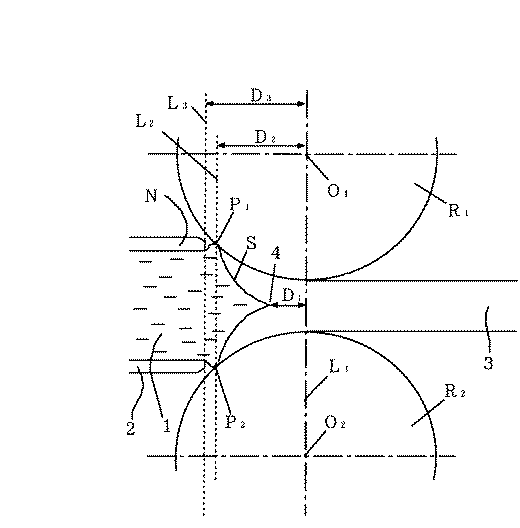
表2にみられるように、本発明に従う試験材No.1〜3はいずれも、最終凝固位置4とロールの中心を結んだ線L1 との距離D1 は、溶湯とロールの接触部を結んだ線L2 と、ロール中心を結んだ線L1 との距離D2 に対して、D1 ≧0.3×D2 を満たしており、板内部の連続した晶出物の最大長さが25〜36μmと短く、リジングマークの発生は認められなかった。 As can be seen in Table 2, the test material No. Both 1-3, the distance D 1 of the a line L 1 connecting the center of the final solidification position 4 and roll, the line L 2 connecting the contact portion of the molten metal and the roll, the line L 1 connecting the roll center with respect to the distance D 2 between, meets the D 1 ≧ 0.3 × D 2, the maximum length of continuous crystallized substances inside the plate is short and 25~36Myuemu, occurrence of ridging marks observed It was.
実施例2
実施例1で作製した3種類の溶湯圧延板を用い、50%の冷間圧延を行って板厚1.0mmとし、さらに540℃で5秒間の溶体化処理を行った後、常温の水道水で焼入れを行ってT4調質材とした。得られたT4調質材を試験材として、実施例1と同様の評価を行った。結果を表3に示す。
Example 2
Using the three types of molten metal sheets produced in Example 1, 50% cold rolling was performed to obtain a sheet thickness of 1.0 mm, and a solution treatment was performed at 540 ° C. for 5 seconds, followed by room temperature tap water. And T4 tempered material. The same evaluation as Example 1 was performed by using the obtained T4 tempered material as a test material. The results are shown in Table 3.
表3にみられるように、本発明に従う試験材No.4〜6はいずれも、最終凝固位置4とロールの中心を結んだ線L1 との距離D1 は、溶湯とロールの接触部を結んだ線L2 と、ロール中心を結んだ線L1 との距離D2 に対して、D1 ≧0.3×D2 を満たしており、板内部の連続した晶出物の最大長さが48〜75μmと短く、リジングマークの発生は認められなかった。 As can be seen in Table 3, the test material No. In all of 4 to 6, the distance D 1 between the final solidification position 4 and the line L 1 connecting the center of the roll is the line L 2 connecting the contact portion between the molten metal and the roll and the line L 1 connecting the center of the roll. D 1 ≧ 0.3 × D 2 is satisfied with respect to the distance D 2 , and the maximum length of continuous crystallized material inside the plate is as short as 48 to 75 μm, and generation of ridging marks is not recognized. It was.
比較例1
表1に示す組成を有するアルミニウム合金を溶解し、実施例1と同様、双ロール式溶湯圧延機により、最終凝固位置4とロールの中心を結んだ線L1 との距離D1 が、溶湯とロールの接触部を結んだ線L2 と、ロール中心を結んだ線L1 との距離D2 に対して、D1 <0.3×D2 になるよう、ロールの中心を結んだ線L1 とノズル2の先端Nの距離D3 を30mmに設定し、鋳造速度を2m/分として溶湯圧延を行い、板厚2.0mmの溶湯圧延板を製造した。
Comparative Example 1
An aluminum alloy having the composition shown in Table 1 was melted, and, as in Example 1 , the distance D 1 between the final solidification position 4 and the line L 1 connecting the center of the roll was determined by A line L connecting the centers of the rolls such that D 1 <0.3 × D 2 with respect to a distance D 2 between a line L 2 connecting the contact portions of the rolls and a line L 1 connecting the roll centers. 1 and the distance D 3 at the tip N of the nozzle 2 is set to 30 mm, subjected to molten metal rolling casting speed as 2m / min, to produce a molten metal rolled plate having a thickness of 2.0 mm.
得られた溶湯圧延板について、540℃で5秒間の溶体化処理を行った後、常温の水道水で焼入れを行いT4調質材とし、得られたT4調質材を試験材として、実施例1と同様の評価を行った。結果を表4に示す。 About the obtained molten rolled sheet, after performing solution treatment for 5 seconds at 540 ° C., it was quenched with normal temperature tap water to obtain a T4 tempered material, and the obtained T4 tempered material was used as a test material. Evaluation similar to 1 was performed. The results are shown in Table 4.
表4に示すように、試験材7〜9はいずれも、最終凝固位置4とロールの中心を結んだ線L1 との距離D1 は、溶湯とロールの接触部を結んだ線L2 と、ロール中心を結んだ線L1 との距離D2 に対して、D1 ≧0.3×D2 を満たしていないため、板内部の連続した晶出物の最大長さが500μmを越えており、リジングマークが発生した。 As shown in Table 4, none of the test material 7-9, the distance D 1 of the a line L 1 connecting the center of the final solidification position 4 and roll, the line L 2 connecting the contact portion of the molten metal and the roll Since the distance D 2 with the line L 1 connecting the roll centers does not satisfy D 1 ≧ 0.3 × D 2 , the maximum length of continuous crystallized material inside the plate exceeds 500 μm. A ridging mark was generated.
比較例2
比較例1で作製した3種類の溶湯圧延板を用い、50%の冷間圧延を行って板厚1.0mmとし、さらに540℃で5秒間の溶体化処理を行った後、常温の水道水で焼入れを行ってT4調質材とした。得られたT4調質材を試験材として、実施例1と同様の評価を行った。結果を表5に示す。
Comparative Example 2
Using the three types of molten metal sheets produced in Comparative Example 1, 50% cold rolling was performed to obtain a sheet thickness of 1.0 mm, and a solution treatment was performed at 540 ° C. for 5 seconds, followed by room temperature tap water. And T4 tempered material. The same evaluation as Example 1 was performed by using the obtained T4 tempered material as a test material. The results are shown in Table 5.
表5に示すように、試験材10〜12はいずれも、最終凝固位置4とロールの中心を結んだ線L1 との距離D1 は、溶湯とロールの接触部を結んだ線L2 と、ロール中心を結んだ線L1 との距離D2 に対して、D1 ≧0.3×D2 を満たしていないため、板内部の連続した晶出物の最大長さが500μmを越えており、リジングマークが発生した。 As shown in Table 5, both test materials 10 to 12, the distance D 1 of the a line L 1 connecting the center of the final solidification position 4 and roll, the line L 2 connecting the contact portion of the molten metal and the roll Since the distance D 2 with the line L 1 connecting the roll centers does not satisfy D 1 ≧ 0.3 × D 2 , the maximum length of continuous crystallized material inside the plate exceeds 500 μm. A ridging mark was generated.
1 アルミニウム合金溶湯
2 ノズル
3 溶湯圧延板
4 最終凝固位置(凝固先端)
R1 溶湯圧延ロール
R2 溶湯圧延ロール
O1 R 1の中心
O2 R 2の中心
S 凝固界面
P1 溶湯とロールとの接触部
P2 溶湯とロールとの接触部
N ノズル先端
L1 O1 、O2 を結んだ線
L2 P1 、P2 を結んだ線
L3 ノズル先端を結んだ線
D1 凝固先端とL1 の距離
D2 L1 とL2 の距離
D3 L1 とL3 の距離
1 Aluminum alloy molten metal 2
R 1 molten metal roll R 2 molten metal roll O 1 center of R 1 O 2 center of R 2 S solidification interface P 1 contact portion between molten metal and P 2 contact portion between molten metal and roll N nozzle tip L 1 O 1 , O 2 connected line L 2 P 1 , P 2 connected line L 3 Nozzle tip connected line D 1 Solidification tip and L 1 distance D 2 L 1 and L 2 distance D 3 L 1 and L Distance of 3
Claims (6)
An automobile outer plate, wherein the molten aluminum alloy rolled plate according to any one of claims 1 to 5 is pressed.
Priority Applications (1)
| Application Number | Priority Date | Filing Date | Title |
|---|---|---|---|
| JP2004115050A JP2005298882A (en) | 2004-04-09 | 2004-04-09 | Aluminum alloy plate for automobile outer plate and surface plate with excellent surface quality after press working |
Applications Claiming Priority (1)
| Application Number | Priority Date | Filing Date | Title |
|---|---|---|---|
| JP2004115050A JP2005298882A (en) | 2004-04-09 | 2004-04-09 | Aluminum alloy plate for automobile outer plate and surface plate with excellent surface quality after press working |
Publications (1)
| Publication Number | Publication Date |
|---|---|
| JP2005298882A true JP2005298882A (en) | 2005-10-27 |
Family
ID=35330794
Family Applications (1)
| Application Number | Title | Priority Date | Filing Date |
|---|---|---|---|
| JP2004115050A Pending JP2005298882A (en) | 2004-04-09 | 2004-04-09 | Aluminum alloy plate for automobile outer plate and surface plate with excellent surface quality after press working |
Country Status (1)
| Country | Link |
|---|---|
| JP (1) | JP2005298882A (en) |
Cited By (1)
| Publication number | Priority date | Publication date | Assignee | Title |
|---|---|---|---|---|
| US20230175103A1 (en) * | 2020-07-31 | 2023-06-08 | Arconic Technologies Llc | New 6xxx aluminum alloys and methods for producing the same |
-
2004
- 2004-04-09 JP JP2004115050A patent/JP2005298882A/en active Pending
Cited By (2)
| Publication number | Priority date | Publication date | Assignee | Title |
|---|---|---|---|---|
| US20230175103A1 (en) * | 2020-07-31 | 2023-06-08 | Arconic Technologies Llc | New 6xxx aluminum alloys and methods for producing the same |
| JP2023536096A (en) * | 2020-07-31 | 2023-08-23 | アーコニック テクノロジーズ エルエルシー | Novel 6xxx aluminum alloy and method of making same |
Similar Documents
| Publication | Publication Date | Title |
|---|---|---|
| EP1846584B2 (en) | Austenitic steel having high strength and formability method of producing said steel and use thereof | |
| KR101456684B1 (en) | Aluminum composite material with almgsi core alloy layer | |
| US12503754B2 (en) | Method of making 6XXX aluminium sheets with high surface quality | |
| EP2219860B1 (en) | Clad sheet product and method for its production | |
| KR101974624B1 (en) | Method for producing almgsi aluminum strip | |
| US20070217943A1 (en) | Al-Mg Alloy Sheet with Excellent Formability at High Temperatures and High Speeds and Method of Production of Same | |
| US20130112323A1 (en) | Formable aluminum alloy sheet | |
| JP3590685B2 (en) | Manufacturing method of aluminum alloy sheet for automobile outer panel | |
| JPH10130768A (en) | Direct cast rolled sheet of Al-Mg-Si alloy for forming and method for producing the same | |
| JP2012224929A (en) | High formable aluminum-magnesium-silicon based alloy sheet, and manufacturing method therefor | |
| JP3838504B2 (en) | Aluminum alloy plate for panel forming and manufacturing method thereof | |
| JP3791337B2 (en) | Highly formable aluminum alloy plate and method for producing the same | |
| JP4222964B2 (en) | Aluminum alloy plate for automobile outer plate, method for producing the same and automobile outer plate | |
| JP4022497B2 (en) | Method for manufacturing aluminum alloy panel | |
| JP3749627B2 (en) | Al alloy plate with excellent press formability | |
| JP2001262265A (en) | Hot rolling stock of high formability aluminum alloy sheet | |
| JP2006241548A (en) | Al-Mg-Si alloy plate material excellent in bending workability, manufacturing method thereof, and automobile outer plate obtained from the plate material | |
| JPH09272938A (en) | Aluminum foil and manufacturing method thereof | |
| JP2005298882A (en) | Aluminum alloy plate for automobile outer plate and surface plate with excellent surface quality after press working | |
| JP4456505B2 (en) | Manufacturing method of forming aluminum alloy sheet | |
| JPH10130766A (en) | Direct cast rolled sheet of Al-Mg-Si based alloy with excellent formability and surface quality and little change over time, and method for producing the same | |
| JPH10130767A (en) | High formability Al-Mg-Si alloy sheet and method for producing the same | |
| JP4542004B2 (en) | Aluminum alloy sheet for forming | |
| JP2008062255A (en) | SUPERPLASTIC MOLDING METHOD FOR Al-Mg-Si BASED ALUMINUM ALLOY SHEET HAVING REDUCED GENERATION OF CAVITY, AND Al-Mg-Si BASED ALUMINUM ALLOY MOLDED SHEET | |
| JP2003073764A (en) | Aluminum alloy sheet for forming and its manufacturing method |