JP2005298764A - Method for preparing polypyrrole film - Google Patents
Method for preparing polypyrrole film Download PDFInfo
- Publication number
- JP2005298764A JP2005298764A JP2004120722A JP2004120722A JP2005298764A JP 2005298764 A JP2005298764 A JP 2005298764A JP 2004120722 A JP2004120722 A JP 2004120722A JP 2004120722 A JP2004120722 A JP 2004120722A JP 2005298764 A JP2005298764 A JP 2005298764A
- Authority
- JP
- Japan
- Prior art keywords
- polypyrrole film
- polypyrrole
- electrolytic
- electrolytic solution
- electrolytic polymerization
- Prior art date
- Legal status (The legal status is an assumption and is not a legal conclusion. Google has not performed a legal analysis and makes no representation as to the accuracy of the status listed.)
- Pending
Links
- 229920000128 polypyrrole Polymers 0.000 title claims abstract description 94
- 238000000034 method Methods 0.000 title claims abstract description 45
- 238000006116 polymerization reaction Methods 0.000 claims abstract description 50
- VLTRZXGMWDSKGL-UHFFFAOYSA-M perchlorate Chemical compound [O-]Cl(=O)(=O)=O VLTRZXGMWDSKGL-UHFFFAOYSA-M 0.000 claims abstract description 34
- 229920001940 conductive polymer Polymers 0.000 claims abstract description 31
- KAESVJOAVNADME-UHFFFAOYSA-N Pyrrole Chemical compound C=1C=CNC=1 KAESVJOAVNADME-UHFFFAOYSA-N 0.000 claims abstract description 27
- HBGGXOJOCNVPFY-UHFFFAOYSA-N diisononyl phthalate Chemical compound CC(C)CCCCCCOC(=O)C1=CC=CC=C1C(=O)OCCCCCCC(C)C HBGGXOJOCNVPFY-UHFFFAOYSA-N 0.000 claims abstract description 26
- 239000002904 solvent Substances 0.000 claims abstract description 22
- 239000003792 electrolyte Substances 0.000 claims abstract description 19
- 239000000178 monomer Substances 0.000 claims abstract description 16
- 150000003233 pyrroles Chemical class 0.000 claims abstract description 13
- 239000008151 electrolyte solution Substances 0.000 claims description 48
- 238000004519 manufacturing process Methods 0.000 claims description 38
- 238000006073 displacement reaction Methods 0.000 claims description 24
- 229910052751 metal Inorganic materials 0.000 claims description 16
- 239000002184 metal Substances 0.000 claims description 15
- 239000012528 membrane Substances 0.000 claims description 11
- NIQCNGHVCWTJSM-UHFFFAOYSA-N Dimethyl phthalate Chemical compound COC(=O)C1=CC=CC=C1C(=O)OC NIQCNGHVCWTJSM-UHFFFAOYSA-N 0.000 claims description 10
- QPJVMBTYPHYUOC-UHFFFAOYSA-N methyl benzoate Chemical group COC(=O)C1=CC=CC=C1 QPJVMBTYPHYUOC-UHFFFAOYSA-N 0.000 claims description 10
- 239000002019 doping agent Substances 0.000 claims description 8
- XSIFPSYPOVKYCO-UHFFFAOYSA-N butyl benzoate Chemical compound CCCCOC(=O)C1=CC=CC=C1 XSIFPSYPOVKYCO-UHFFFAOYSA-N 0.000 claims description 6
- DOIRQSBPFJWKBE-UHFFFAOYSA-N dibutyl phthalate Chemical compound CCCCOC(=O)C1=CC=CC=C1C(=O)OCCCC DOIRQSBPFJWKBE-UHFFFAOYSA-N 0.000 claims description 6
- FLKPEMZONWLCSK-UHFFFAOYSA-N diethyl phthalate Chemical compound CCOC(=O)C1=CC=CC=C1C(=O)OCC FLKPEMZONWLCSK-UHFFFAOYSA-N 0.000 claims description 6
- MTZQAGJQAFMTAQ-UHFFFAOYSA-N ethyl benzoate Chemical compound CCOC(=O)C1=CC=CC=C1 MTZQAGJQAFMTAQ-UHFFFAOYSA-N 0.000 claims description 6
- OSWPMRLSEDHDFF-UHFFFAOYSA-N methyl salicylate Chemical compound COC(=O)C1=CC=CC=C1O OSWPMRLSEDHDFF-UHFFFAOYSA-N 0.000 claims description 6
- FBSAITBEAPNWJG-UHFFFAOYSA-N dimethyl phthalate Natural products CC(=O)OC1=CC=CC=C1OC(C)=O FBSAITBEAPNWJG-UHFFFAOYSA-N 0.000 claims description 5
- 229960001826 dimethylphthalate Drugs 0.000 claims description 5
- 229940095102 methyl benzoate Drugs 0.000 claims description 5
- UDEWPOVQBGFNGE-UHFFFAOYSA-N benzoic acid n-propyl ester Natural products CCCOC(=O)C1=CC=CC=C1 UDEWPOVQBGFNGE-UHFFFAOYSA-N 0.000 claims description 3
- OLXYLDUSSBULGU-UHFFFAOYSA-N methyl pyridine-4-carboxylate Chemical compound COC(=O)C1=CC=NC=C1 OLXYLDUSSBULGU-UHFFFAOYSA-N 0.000 claims description 3
- 229960001047 methyl salicylate Drugs 0.000 claims description 3
- 239000003115 supporting electrolyte Substances 0.000 abstract description 4
- 230000015572 biosynthetic process Effects 0.000 abstract 1
- 230000008602 contraction Effects 0.000 description 30
- 230000033116 oxidation-reduction process Effects 0.000 description 11
- 230000000052 comparative effect Effects 0.000 description 8
- BASFCYQUMIYNBI-UHFFFAOYSA-N platinum Substances [Pt] BASFCYQUMIYNBI-UHFFFAOYSA-N 0.000 description 7
- 150000003839 salts Chemical class 0.000 description 7
- 229910020366 ClO 4 Inorganic materials 0.000 description 6
- 229910045601 alloy Inorganic materials 0.000 description 5
- 239000000956 alloy Substances 0.000 description 5
- 150000002500 ions Chemical class 0.000 description 5
- 239000010936 titanium Substances 0.000 description 5
- CSCPPACGZOOCGX-UHFFFAOYSA-N Acetone Chemical compound CC(C)=O CSCPPACGZOOCGX-UHFFFAOYSA-N 0.000 description 4
- 229910052697 platinum Inorganic materials 0.000 description 4
- 229910052719 titanium Inorganic materials 0.000 description 4
- 238000006243 chemical reaction Methods 0.000 description 3
- 238000011156 evaluation Methods 0.000 description 3
- 239000011521 glass Substances 0.000 description 3
- WABPQHHGFIMREM-UHFFFAOYSA-N lead(0) Chemical compound [Pb] WABPQHHGFIMREM-UHFFFAOYSA-N 0.000 description 3
- 210000003205 muscle Anatomy 0.000 description 3
- 229910052759 nickel Inorganic materials 0.000 description 3
- 230000003647 oxidation Effects 0.000 description 3
- 238000007254 oxidation reaction Methods 0.000 description 3
- 238000012360 testing method Methods 0.000 description 3
- 229910052804 chromium Inorganic materials 0.000 description 2
- 229920006351 engineering plastic Polymers 0.000 description 2
- 229910001026 inconel Inorganic materials 0.000 description 2
- 238000000691 measurement method Methods 0.000 description 2
- 150000002739 metals Chemical class 0.000 description 2
- 229910052750 molybdenum Inorganic materials 0.000 description 2
- PXHVJJICTQNCMI-UHFFFAOYSA-N nickel Substances [Ni] PXHVJJICTQNCMI-UHFFFAOYSA-N 0.000 description 2
- VLTRZXGMWDSKGL-UHFFFAOYSA-N perchloric acid Chemical compound OCl(=O)(=O)=O VLTRZXGMWDSKGL-UHFFFAOYSA-N 0.000 description 2
- 229920000642 polymer Polymers 0.000 description 2
- RUOJZAUFBMNUDX-UHFFFAOYSA-N propylene carbonate Chemical compound CC1COC(=O)O1 RUOJZAUFBMNUDX-UHFFFAOYSA-N 0.000 description 2
- 229910052721 tungsten Inorganic materials 0.000 description 2
- OXHNLMTVIGZXSG-UHFFFAOYSA-N 1-Methylpyrrole Chemical compound CN1C=CC=C1 OXHNLMTVIGZXSG-UHFFFAOYSA-N 0.000 description 1
- GEZGAZKEOUKLBR-UHFFFAOYSA-N 1-phenylpyrrole Chemical compound C1=CC=CN1C1=CC=CC=C1 GEZGAZKEOUKLBR-UHFFFAOYSA-N 0.000 description 1
- OJFOWGWQOFZNNJ-UHFFFAOYSA-N 3,4-dimethyl-1h-pyrrole Chemical compound CC1=CNC=C1C OJFOWGWQOFZNNJ-UHFFFAOYSA-N 0.000 description 1
- FEKWWZCCJDUWLY-UHFFFAOYSA-N 3-methyl-1h-pyrrole Chemical compound CC=1C=CNC=1 FEKWWZCCJDUWLY-UHFFFAOYSA-N 0.000 description 1
- LJDRAKFYYGCAQC-UHFFFAOYSA-N 3-phenyl-1h-pyrrole Chemical compound N1C=CC(C=2C=CC=CC=2)=C1 LJDRAKFYYGCAQC-UHFFFAOYSA-N 0.000 description 1
- DKPFZGUDAPQIHT-UHFFFAOYSA-N Butyl acetate Natural products CCCCOC(C)=O DKPFZGUDAPQIHT-UHFFFAOYSA-N 0.000 description 1
- 239000002202 Polyethylene glycol Substances 0.000 description 1
- RTAQQCXQSZGOHL-UHFFFAOYSA-N Titanium Chemical compound [Ti] RTAQQCXQSZGOHL-UHFFFAOYSA-N 0.000 description 1
- 239000000654 additive Substances 0.000 description 1
- 229910052782 aluminium Inorganic materials 0.000 description 1
- XAGFODPZIPBFFR-UHFFFAOYSA-N aluminium Chemical compound [Al] XAGFODPZIPBFFR-UHFFFAOYSA-N 0.000 description 1
- 150000003863 ammonium salts Chemical class 0.000 description 1
- 150000001450 anions Chemical class 0.000 description 1
- 239000007864 aqueous solution Substances 0.000 description 1
- 125000003118 aryl group Chemical group 0.000 description 1
- 125000004429 atom Chemical group 0.000 description 1
- 238000006056 electrooxidation reaction Methods 0.000 description 1
- 230000001747 exhibiting effect Effects 0.000 description 1
- 238000004880 explosion Methods 0.000 description 1
- 125000001153 fluoro group Chemical group F* 0.000 description 1
- 239000011245 gel electrolyte Substances 0.000 description 1
- FUZZWVXGSFPDMH-UHFFFAOYSA-M hexanoate Chemical compound CCCCCC([O-])=O FUZZWVXGSFPDMH-UHFFFAOYSA-M 0.000 description 1
- 229910001293 incoloy Inorganic materials 0.000 description 1
- 229910001055 inconels 600 Inorganic materials 0.000 description 1
- 230000003993 interaction Effects 0.000 description 1
- 229920002521 macromolecule Polymers 0.000 description 1
- 229910052755 nonmetal Inorganic materials 0.000 description 1
- 150000002894 organic compounds Chemical class 0.000 description 1
- 239000002985 plastic film Substances 0.000 description 1
- 239000002798 polar solvent Substances 0.000 description 1
- 229920002401 polyacrylamide Polymers 0.000 description 1
- 229920001223 polyethylene glycol Polymers 0.000 description 1
- 239000005518 polymer electrolyte Substances 0.000 description 1
- 238000012545 processing Methods 0.000 description 1
- 125000000168 pyrrolyl group Chemical group 0.000 description 1
- 239000000243 solution Substances 0.000 description 1
- 238000003756 stirring Methods 0.000 description 1
- 238000009864 tensile test Methods 0.000 description 1
- 150000005621 tetraalkylammonium salts Chemical class 0.000 description 1
- -1 trifluoromethanesulfonate ion Chemical class 0.000 description 1
Classifications
-
- C—CHEMISTRY; METALLURGY
- C08—ORGANIC MACROMOLECULAR COMPOUNDS; THEIR PREPARATION OR CHEMICAL WORKING-UP; COMPOSITIONS BASED THEREON
- C08G—MACROMOLECULAR COMPOUNDS OBTAINED OTHERWISE THAN BY REACTIONS ONLY INVOLVING UNSATURATED CARBON-TO-CARBON BONDS
- C08G73/00—Macromolecular compounds obtained by reactions forming a linkage containing nitrogen with or without oxygen or carbon in the main chain of the macromolecule, not provided for in groups C08G12/00 - C08G71/00
- C08G73/06—Polycondensates having nitrogen-containing heterocyclic rings in the main chain of the macromolecule
- C08G73/0605—Polycondensates containing five-membered rings, not condensed with other rings, with nitrogen atoms as the only ring hetero atoms
- C08G73/0611—Polycondensates containing five-membered rings, not condensed with other rings, with nitrogen atoms as the only ring hetero atoms with only one nitrogen atom in the ring, e.g. polypyrroles
-
- C—CHEMISTRY; METALLURGY
- C08—ORGANIC MACROMOLECULAR COMPOUNDS; THEIR PREPARATION OR CHEMICAL WORKING-UP; COMPOSITIONS BASED THEREON
- C08G—MACROMOLECULAR COMPOUNDS OBTAINED OTHERWISE THAN BY REACTIONS ONLY INVOLVING UNSATURATED CARBON-TO-CARBON BONDS
- C08G61/00—Macromolecular compounds obtained by reactions forming a carbon-to-carbon link in the main chain of the macromolecule
- C08G61/12—Macromolecular compounds containing atoms other than carbon in the main chain of the macromolecule
- C08G61/122—Macromolecular compounds containing atoms other than carbon in the main chain of the macromolecule derived from five- or six-membered heterocyclic compounds, other than imides
- C08G61/123—Macromolecular compounds containing atoms other than carbon in the main chain of the macromolecule derived from five- or six-membered heterocyclic compounds, other than imides derived from five-membered heterocyclic compounds
- C08G61/124—Macromolecular compounds containing atoms other than carbon in the main chain of the macromolecule derived from five- or six-membered heterocyclic compounds, other than imides derived from five-membered heterocyclic compounds with a five-membered ring containing one nitrogen atom in the ring
Landscapes
- Chemical & Material Sciences (AREA)
- Health & Medical Sciences (AREA)
- Chemical Kinetics & Catalysis (AREA)
- Medicinal Chemistry (AREA)
- Polymers & Plastics (AREA)
- Organic Chemistry (AREA)
- Polyoxymethylene Polymers And Polymers With Carbon-To-Carbon Bonds (AREA)
Abstract
Description
本発明は、電解酸化還元により大きな伸縮をすることができる、過塩素酸イオンをドーパントとして含むポリピロール膜に関する。 The present invention relates to a polypyrrole film containing perchlorate ions as a dopant that can be greatly expanded and contracted by electrolytic oxidation and reduction.
ポリピロールなどの導電性高分子は、電気化学的な酸化還元によって伸縮あるいは変形する現象である電解伸縮を発現することが知られている。この導電性高分子の電解伸縮は、伸縮の際に押圧や引張り等の発生力が生じることから、マイクロマシン、人工筋肉、義手・義足、パワードスーツなどのアクチュエータ等の用途として応用が期待され、近年注目されている。このような導電性高分子の製造方法としては、電解重合法により製造されるのが一般的である。電解重合法としては、通常は、電解液中にピロール等のモノマー成分を加え、この電解液中に作用電極及び対向電極を設置して、両電極に電圧を印加することで導電性高分子膜を作用電極上に得る方法が行われる。 It is known that a conductive polymer such as polypyrrole exhibits electrolytic stretching, which is a phenomenon that stretches or deforms by electrochemical redox. Electrolytic expansion / contraction of this conductive polymer is expected to be applied as actuators for micromachines, artificial muscles, artificial hands / prosthetic legs, powered suits, etc., due to the generation of pressure and tension during expansion and contraction. Attention has been paid. As a method for producing such a conductive polymer, it is generally produced by an electrolytic polymerization method. As an electropolymerization method, a conductive polymer membrane is usually obtained by adding a monomer component such as pyrrole to an electrolytic solution, installing a working electrode and a counter electrode in the electrolytic solution, and applying a voltage to both electrodes. Is obtained on the working electrode.
電解重合法により得られた導電性高分子は、人工筋肉に用いられている導電性高分子として、1酸化還元サイクル当たりの伸張と発生力とについては、膜に形成されたポリピロールの伸縮率が1%であるときに3MPaの発生力が得られる程度であることが知られている。(例えば、非特許文献1)。 The conductive polymer obtained by the electropolymerization method is a conductive polymer used for artificial muscles, and the elongation and generation force per one redox cycle are such that the expansion rate of polypyrrole formed on the film is It is known that a generation force of 3 MPa can be obtained at 1%. (For example, Non-Patent Document 1).
上記における電解重合法も該当するのであるが、導電性高分子を得るための電解重合法としては、電解液中に支持電解質を含むのが通常である。前記支持塩としては、公知の電解質を使用することができるが、安価であること、電気化学的に安定であること、及び電解液での混合性が良いことの3つの利点を有することから、製造作業上有利な支持塩である過塩素酸イオン(ClO4 −)を用いることが望ましい。 The above-mentioned electrolytic polymerization method is also applicable, but as an electrolytic polymerization method for obtaining a conductive polymer, it is usual to include a supporting electrolyte in the electrolytic solution. As the supporting salt, a known electrolyte can be used, but it has three advantages of being inexpensive, electrochemically stable, and having good miscibility with an electrolytic solution. It is desirable to use a perchlorate ion (ClO 4 − ), which is a supporting salt advantageous in manufacturing operations.
しかし、導電性高分子をマイクロマシンや人工筋肉、義手・義足などのアクチュエータに用いる場合には、アクチュエータにより大きな変位運動をさせることが目的となるので、1酸化還元サイクル当たりの伸縮率を1%程度から大きく改善する必要がある。また、過塩素酸イオンをドーパントとして含む導電性高分子アクチュエータの伸縮率は3%以下であった。 However, when conductive polymers are used in actuators such as micromachines, artificial muscles, artificial hands and artificial legs, the purpose is to make the actuator move greatly, so the expansion / contraction rate per oxidation-reduction cycle is about 1%. There is a need to greatly improve. Moreover, the expansion / contraction rate of the conductive polymer actuator containing perchlorate ion as a dopant was 3% or less.
また、導電性高分子であるポリピロールフィルムは、汎用エンジニアリングプラスチックフィルムと比べて一般には機械的強度が十分ではなく、高い機械的強度が要求されないパッケージ内の電極等の用途には好適であるが、高い機械的強度が要求される外装フィルムやフレキシブル電極等の用途には好適に用いることができない。特に、過塩素酸イオン(ClO4 −)をドーパントとして含む導電性高分子であって、プロピレンカーボネートや酢酸ブチル等の溶媒を用いた電解重合法により得られた導電性高分子は、1酸化還元サイクル当たりの伸縮率と機械的強度とが十分ではない。 In addition, the polypyrrole film, which is a conductive polymer, generally has insufficient mechanical strength compared to general-purpose engineering plastic films, and is suitable for applications such as electrodes in packages that do not require high mechanical strength. It cannot be suitably used for applications such as exterior films and flexible electrodes that require high mechanical strength. In particular, a conductive polymer containing a perchlorate ion (ClO 4 − ) as a dopant and obtained by an electropolymerization method using a solvent such as propylene carbonate or butyl acetate is a redox oxide. The stretch rate per cycle and the mechanical strength are not sufficient.
本発明の目的は、製造作業上有利な支持塩である過塩素酸イオン(ClO4 −)を用い、しかも、大きな伸縮率と高い機械的強度とを有する導電性高分子を得ることである。 An object of the present invention is to obtain a conductive polymer using perchlorate ions (ClO 4 − ), which is a supporting salt advantageous in manufacturing operations, and having a large stretch ratio and high mechanical strength.
そこで、本発明者らは、鋭意検討の結果、本発明のポリピロール膜の製造方法を用いることにより、上記課題を解決することができることを見出し本発明に至った。本発明は以下である。 As a result of intensive studies, the present inventors have found that the above problems can be solved by using the method for producing a polypyrrole film of the present invention, and have reached the present invention. The present invention is as follows.
本発明は、電解重合法を用いたポリピロール膜の製造方法であって、電解重合法に用いられる電解液はピロール及び/又はピロール誘導体をモノマー成分として含み、前記電解重合法は芳香族エステルを溶媒として含む電解液を用い、前記電解液は過塩素酸イオンを含み、作用電極及び対極に電圧を印加することにより作用電極上に導電性高分子膜が形成されることを特徴とするポリピロール膜の製造方法である。前記製造方法は、過塩素酸イオン(ClO4 −)を支持塩として用いることができるので製造作業性が良好であり、しかも、得られた導電性高分子膜は電解伸縮による大きな伸縮率と高い機械的強度とを有する。なお、本願において、ポリピロール膜は、ピロールのみをモノマー成分とする高分子であるポリピロールの膜状体に限られず、ピロール誘導体、並びにピロールとピロール誘導体とをモノマー成分とする高分子も含む。 The present invention relates to a method for producing a polypyrrole film using an electrolytic polymerization method, wherein an electrolytic solution used in the electrolytic polymerization method contains pyrrole and / or a pyrrole derivative as a monomer component, and the electrolytic polymerization method uses an aromatic ester as a solvent. A polypyrrole film characterized in that the electrolyte contains perchlorate ions, and a conductive polymer film is formed on the working electrode by applying a voltage to the working electrode and the counter electrode. It is a manufacturing method. In the above production method, perchlorate ions (ClO 4 − ) can be used as a supporting salt, so that the production workability is good, and the obtained conductive polymer film has a high expansion and contraction rate due to electrolytic expansion and contraction. Mechanical strength. In addition, in this application, a polypyrrole film | membrane is not restricted to the film-form body of the polypyrrole which is a polymer | macromolecule which uses only a pyrrole as a monomer component, The polymer which uses a pyrrole derivative and a pyrrole and a pyrrole derivative as a monomer component is also included.
また、本発明は、ピロール及び/又はピロール誘導体を重合単位とするポリピロール膜であって、前記ポリピロール膜が電解重合法により得られたポリピロール膜であり、前記電解重合法が芳香族エステルを溶媒として含む電解液を用い、前記電解液が過塩素酸イオンを含むことを特徴とするポリピロール膜である。 Further, the present invention is a polypyrrole film having pyrrole and / or a pyrrole derivative as a polymerization unit, wherein the polypyrrole film is a polypyrrole film obtained by an electrolytic polymerization method, and the electrolytic polymerization method uses an aromatic ester as a solvent. The polypyrrole film is characterized in that the electrolytic solution contains a perchlorate ion.
また、本発明は、電圧印加により変位する変位部と電解質と対極とを少なくとも備えたアクチュエータ素子であって、前記変位部が上記のポリピロール膜であるアクチュエータ素子である。前記アクチュエータは、ドーパントとして過塩素酸イオン(ClO4 −)含み、しかも大きな1酸化還元サイクルあたりの伸縮率を示し、高い機械的強度を有するので、アクチュエータ素子として好適に用いることができる。特に、前記アクチュエータ素子は、高い機械的強度を有するので、マニピュレータ及びロボットに代表される機械的衝撃が与えられる装置の駆動部に、好適に用いることができる。 The present invention is also an actuator element including at least a displacement part that is displaced by voltage application, an electrolyte, and a counter electrode, wherein the displacement part is the polypyrrole film. Since the actuator contains perchlorate ions (ClO 4 − ) as a dopant, exhibits a high expansion / contraction rate per one redox cycle, and has a high mechanical strength, it can be suitably used as an actuator element. In particular, since the actuator element has a high mechanical strength, it can be suitably used for a drive unit of a device to which a mechanical impact such as a manipulator and a robot is applied.
上記のように、本発明のポリピロール膜の製造方法は、得られた導電性高分子膜が電解伸縮による大きな伸縮率と高い機械的強度とを有するので、過塩素酸イオン(ClO4 −)を支持電解質として用いることができることから、大きな伸縮率と高い機械的強度とを有する導電性高分子を従来の製造方法よりも容易に得ることができる。また、本発明のポリピロール膜は、大きな1酸化還元サイクルあたりの伸縮率を示し、高い機械的強度を有するので、アクチュエータ素子として好適であり、特にマニピュレータ及びロボットに代表される機械的衝撃が与えられる装置の駆動部用いられるアクチュエータ素子として、更に好適である。 As described above, in the method for producing a polypyrrole film of the present invention, since the obtained conductive polymer film has a large expansion ratio due to electrolytic expansion and contraction and high mechanical strength, perchlorate ions (ClO 4 − ) Since it can be used as a supporting electrolyte, a conductive polymer having a large expansion / contraction ratio and high mechanical strength can be obtained more easily than the conventional production method. In addition, the polypyrrole film of the present invention exhibits a high expansion / contraction rate per one redox cycle and has high mechanical strength, so that it is suitable as an actuator element, and is particularly subjected to mechanical impact represented by manipulators and robots. It is further suitable as an actuator element used in the drive unit of the apparatus.
(製造方法)
本発明は、電解重合法を用いたポリピロール膜の製造方法であって、電解重合法に用いられる電解液はピロール及び/又はピロール誘導体をモノマー成分として含み、前記電解重合法は芳香族エステルを溶媒として含む電解液を用い、前記電解液は過塩素酸イオンを含み、作用電極及び対極に電圧を印加することにより作用電極上に導電性高分子膜が形成されることを特徴とするポリピロール膜の製造方法である。
(Production method)
The present invention relates to a method for producing a polypyrrole film using an electrolytic polymerization method, wherein an electrolytic solution used in the electrolytic polymerization method contains pyrrole and / or a pyrrole derivative as a monomer component, and the electrolytic polymerization method uses an aromatic ester as a solvent. A polypyrrole film characterized in that the electrolyte contains perchlorate ions, and a conductive polymer film is formed on the working electrode by applying a voltage to the working electrode and the counter electrode. It is a manufacturing method.
本発明のポリピロール膜の製造方法において、電解重合法に用いられる電解液には、ピロール及び/又はピロール誘導体をモノマー成分として含み、溶媒として芳香族エステルを含み、さらに過塩素酸イオンを含む。 In the method for producing a polypyrrole film of the present invention, the electrolytic solution used in the electrolytic polymerization method contains pyrrole and / or a pyrrole derivative as a monomer component, an aromatic ester as a solvent, and further contains perchlorate ions.
前記電解液は、過塩素酸イオンを含み、かつ溶媒として芳香族エステルを含むことにより、導電性高分子であるポリピロール膜の製造作業性が容易であり、しかも1酸化還元サイクル当たりの大きな伸縮率と高い機械的物性とを兼ね備えたポリピロール膜を得ることができる。前記電解液に溶媒として芳香族エステルが含まれない場合には、1酸化還元サイクル当たりの大きな伸縮率と高い機械的物性とを兼ね備えたポリピロール膜を得ることは難しい。 Since the electrolytic solution contains perchlorate ions and contains an aromatic ester as a solvent, the manufacturing workability of the polypyrrole film, which is a conductive polymer, is easy, and a large expansion / contraction rate per one oxidation-reduction cycle is obtained. And a polypyrrole film having both high mechanical properties can be obtained. When the electrolytic solution does not contain an aromatic ester as a solvent, it is difficult to obtain a polypyrrole film having both a large expansion / contraction rate per redox cycle and high mechanical properties.
前記芳香族エステルとしては、芳香環を有し、1以上エステル結合を分子中に有していれば特に限定されるものではない。前記芳香族エステルは、例えば、安息香酸メチル、安息香酸エチル、安息香酸プロピル、安息香酸ブチル、フタル酸ジメチル、フタル酸ジエチル、フタル酸ジブチル、及びサリチル酸メチルからなる群から選ばれた芳香族エステルを用いることができ、電解液のイオン導電率が大きいことから安息香酸メチル、フタル酸ジメチルが好ましい。理由は定かではないが、支持塩に過塩素酸イオンを含む塩を用いても、前記芳香族エステルを溶媒として電解液に用いることにより、ポリピロール鎖間の相互作用を高めて、緻密な構造となるので、1酸化還元サイクル当たりの大きな伸縮率と高い機械的物性とを兼ね備えたポリピロール膜を得ることができるものと考えられる。 The aromatic ester is not particularly limited as long as it has an aromatic ring and one or more ester bonds in the molecule. The aromatic ester is, for example, an aromatic ester selected from the group consisting of methyl benzoate, ethyl benzoate, propyl benzoate, butyl benzoate, dimethyl phthalate, diethyl phthalate, dibutyl phthalate, and methyl salicylate. Methyl benzoate and dimethyl phthalate are preferable because they can be used and the ionic conductivity of the electrolytic solution is large. The reason is not clear, but even if a salt containing a perchlorate ion is used as the supporting salt, by using the aromatic ester as a solvent in the electrolytic solution, the interaction between the polypyrrole chains is increased, and the dense structure and Therefore, it is considered that a polypyrrole film having a large expansion / contraction ratio per one oxidation-reduction cycle and high mechanical properties can be obtained.
前記芳香族エステルは、電解液中に溶媒として含まれていれば、特に限定されるものではないが、電解液中に、電解液全量に対して60〜90重量%含まれれば、1酸化還元サイクル当たりの大きな伸縮率と高い機械的物性とを兼ね備えたポリピロール膜を得ることができる。 The aromatic ester is not particularly limited as long as it is contained as a solvent in the electrolytic solution. However, if the aromatic ester is contained in the electrolytic solution in an amount of 60 to 90% by weight based on the total amount of the electrolytic solution, the redox oxide is reduced. A polypyrrole film having both a large expansion / contraction rate per cycle and high mechanical properties can be obtained.
本発明のポリピロール膜の製造方法において、電解液中に含まれる過塩素酸イオンは、電解液中に安定に溶解していれば、電解液全量中における含有量が特に限定されるものではなが、良好なイオン伝導度を保つために電解液中に0.1〜35重量%含まれるのが好ましく、1〜20重量%含まれるのがより好ましい。過塩素酸イオンを含む電解液は過塩素酸塩を電解液に溶解することにより得ることができる。該過塩素酸塩は、電解液に溶解することができ、爆発等の危険の少ないものであれば特に限定されるものではなく、テトラアルキルアンモニウム塩を用いることができるが、テトラ−n−ブチルアンモニウム塩を用いることが入手が容易で溶解度が大きいために好ましい。過塩素酸イオンを含む電解液を用いて電解重合を行うことにより、過塩素酸イオンをドーパントとして含むポリピロール膜が得られる。 In the method for producing a polypyrrole film of the present invention, the perchlorate ion contained in the electrolytic solution is not particularly limited in content in the total amount of the electrolytic solution as long as it is stably dissolved in the electrolytic solution. In order to maintain good ionic conductivity, the electrolyte solution preferably contains 0.1 to 35% by weight, more preferably 1 to 20% by weight. An electrolytic solution containing perchlorate ions can be obtained by dissolving perchlorate in the electrolytic solution. The perchlorate is not particularly limited as long as it can be dissolved in an electrolytic solution and has a low risk of explosion or the like, and a tetraalkylammonium salt can be used. It is preferable to use an ammonium salt because it is easily available and has high solubility. By conducting electrolytic polymerization using an electrolytic solution containing perchlorate ions, a polypyrrole film containing perchlorate ions as a dopant is obtained.
本願発明の導電性高分子の製造方法において、電解重合における作用電極は、電解重合に用いることができる電極であれば特に限定されるものではない。前記作用電極として、金属電極やITOガラス電極などの非金属電極を用いることにより、高い機械的物性を備えたポリピロール膜を得ることができる。前記金属電極は、金属を主とする電極であれば特に限定されるものではないが、Pt、Ti、Ni、Au、Ta、Mo、Cr及びWからなる群より選ばれた金属元素についての金属単体の電極またはこれらの合金の電極を好適に用いることができる。前記製造方法により得られた導電性高分子の伸縮率及び発生力が大きく、且つ電極を容易に入手できることから、金属電極に含まれる金属種がNi、Tiであることが特に好ましい。なお、前記合金としては、例えば、商品名「INCOLOY alloy 825」、「INCONEL alloy 600」、「INCONEL alloy X−750」(以上、大同スペシャルメタル株式会社製)を用いることができる。また、非金属電極としては、ITOガラス電極等の公知の電極を用いることができる。前記電解重合における作用電極としてITOガラス電極を用いて得られたポリピロール膜は、60MPa以上の引張り強度を示すことができる。なお、電解重合における作用電極としては、ポリピロール膜の量産性の観点から、金属電極であることが好ましい。 In the method for producing a conductive polymer of the present invention, the working electrode in electrolytic polymerization is not particularly limited as long as it can be used for electrolytic polymerization. By using a non-metal electrode such as a metal electrode or ITO glass electrode as the working electrode, a polypyrrole film having high mechanical properties can be obtained. The metal electrode is not particularly limited as long as it is an electrode mainly composed of metal, but a metal for a metal element selected from the group consisting of Pt, Ti, Ni, Au, Ta, Mo, Cr and W. A single electrode or an electrode of these alloys can be preferably used. It is particularly preferable that the metal species contained in the metal electrode is Ni or Ti because the conductive polymer obtained by the above production method has a large expansion / contraction rate and generation force and the electrode can be easily obtained. As the alloy, for example, trade names “INCOLOY alloy 825”, “INCONEL alloy 600”, “INCONEL alloy X-750” (manufactured by Daido Special Metal Co., Ltd.) can be used. As the non-metallic electrode, a known electrode such as an ITO glass electrode can be used. A polypyrrole film obtained using an ITO glass electrode as a working electrode in the electrolytic polymerization can exhibit a tensile strength of 60 MPa or more. The working electrode in the electropolymerization is preferably a metal electrode from the viewpoint of mass productivity of the polypyrrole film.
本発明の導電性高分子の製造方法において、電解重合法に用いられる電解液に含まれる導電性高分子のモノマー成分としては、電解重合により高分子化して導電性を示すピロール及び/またはピロール誘導体であれば特に限定されるものではない。前記ピロール誘導体は、電解重合によりポリピロールを得ることができれば特に限定されるものではなく、1−メチルピロール、1−フェニルピロール、3−メチルピロール、3,4−ジメチルピロール、3−フェニルピロールなどを用いることができる。前記モノマー成分としては、製造が容易であり、導電性高分子として安定であるために、ピロールが好ましい。また、上記モノマーは2種以上併用することができる。 In the method for producing a conductive polymer of the present invention, as a monomer component of the conductive polymer contained in the electrolytic solution used in the electrolytic polymerization method, pyrrole and / or a pyrrole derivative exhibiting conductivity by being polymerized by electrolytic polymerization. If it is, it will not specifically limit. The pyrrole derivative is not particularly limited as long as polypyrrole can be obtained by electrolytic polymerization, and includes 1-methylpyrrole, 1-phenylpyrrole, 3-methylpyrrole, 3,4-dimethylpyrrole, 3-phenylpyrrole, and the like. Can be used. The monomer component is preferably pyrrole because it is easy to produce and is stable as a conductive polymer. Moreover, the said monomer can be used together 2 or more types.
本発明の導電性高分子の製造方法において、電解重合法に用いられる電解液には、前記有機化合物溶媒と前記トリフルオロメタンスルホン酸イオン及び/または中心原子に対してフッ素原子を複数含むアニオンとの溶液中に、導電性高分子の単量体を含み、さらにポリエチレングリコールやポリアクリルアミドなどの公知のその他の添加剤を含むこともできる。 In the method for producing a conductive polymer of the present invention, the electrolytic solution used in the electrolytic polymerization method includes the organic compound solvent and the trifluoromethanesulfonate ion and / or an anion containing a plurality of fluorine atoms with respect to the central atom. The solution contains a monomer of a conductive polymer, and can also contain other known additives such as polyethylene glycol and polyacrylamide.
本発明の導電性高分子の製造方法において用いられる電解重合法は、導電性高分子単量体の電解重合として、公知の電解重合方法を用いることが可能であり、定電位法、定電流法及び電気掃引法のいずれをも用いることができる。例えは、前記電解重合法は、電流密度0.01〜20mA/cm2、反応温度―20〜80℃で行うことができ、良好な膜質の導電性高分子を得るために、電流密度0.1〜2mA/cm2、反応温度−10〜40℃の条件下で行うことが好ましく、反応温度が0〜30℃の条件であることがより好ましい。 As the electrolytic polymerization method used in the method for producing a conductive polymer of the present invention, a known electrolytic polymerization method can be used as the electrolytic polymerization of the conductive polymer monomer. And the electric sweep method can be used. For example, the electrolytic polymerization method can be performed at a current density of 0.01 to 20 mA / cm 2 and a reaction temperature of −20 to 80 ° C. It is preferable to carry out on the conditions of 1-2 mA / cm < 2 > and reaction temperature -10-40 degreeC, and it is more preferable that reaction temperature is 0-30 degreeC conditions.
(ポリピロール膜)
本発明は、上記製造方法により得られたポリピロール膜である。即ち、本発明は、ピロール及び/又はピロール誘導体を重合単位とするポリピロール膜であって、前記ポリピロール膜が電解重合法により得られたポリピロール膜であり、前記電解重合法が芳香族エステルを溶媒として含む電解液を用い、前記電解液が過塩素酸イオンを含むことを特徴とするポリピロール膜である。前記ポリピロール膜は、電解重合時における電解液中に過塩素酸イオンをと溶媒として芳香族エステルを含む電解重合法により得られたポリピロール膜であることから、1酸化還元サイクル当たりの大きな伸縮率と高い機械的物性とを兼ね備えたポリピロール膜として得られる。
(Polypyrrole film)
The present invention is a polypyrrole film obtained by the above production method. That is, the present invention is a polypyrrole film having pyrrole and / or a pyrrole derivative as a polymerization unit, wherein the polypyrrole film is a polypyrrole film obtained by an electrolytic polymerization method, and the electrolytic polymerization method uses an aromatic ester as a solvent. The polypyrrole film is characterized in that the electrolytic solution contains a perchlorate ion. Since the polypyrrole film is a polypyrrole film obtained by an electropolymerization method containing perchlorate ions and an aromatic ester as a solvent in an electrolytic solution at the time of electrolytic polymerization, a large stretch rate per one oxidation-reduction cycle is obtained. It can be obtained as a polypyrrole film having high mechanical properties.
本発明のポリピロール膜における電解重合の電解液中の芳香族エステルは、上記製造方法の場合と同様である。つまり、前記芳香族エステルは、特に限定されるものではないが、安息香酸メチル、フタル酸ジメチルが好ましく、電解液中、電解液全量に対して60〜99重量%含まれれば良い。 The aromatic ester in the electrolytic solution of the electrolytic polymerization in the polypyrrole film of the present invention is the same as in the above production method. That is, the aromatic ester is not particularly limited, but methyl benzoate and dimethyl phthalate are preferable, and 60 to 99% by weight may be included in the electrolytic solution with respect to the total amount of the electrolytic solution.
本発明のポリピロール膜における電解重合の電解液中の過塩素酸イオンは、上記製造方法の場合と同様である。つまり、前記ポリピロール膜は、電解液中に0.1〜35重量%含まれるのが好ましく、1〜15重量%含まれるのがより好ましい。 The perchlorate ion in the electrolytic solution of the electrolytic polymerization in the polypyrrole film of the present invention is the same as in the above production method. That is, the polypyrrole film is preferably contained in the electrolytic solution in an amount of 0.1 to 35% by weight, and more preferably 1 to 15% by weight.
本発明のポリピロール膜における電解重合の作用電極は、上記製造方法の場合と同様である。つまり、Pt、Ti、Ni、Au、Ta、Mo、Cr及びWからなる群より選ばれた金属元素についての金属単体の電極またはこれらの合金の電極を好適に用いることができる。 The working electrode for electrolytic polymerization in the polypyrrole film of the present invention is the same as in the above production method. That is, an electrode made of a single metal or an electrode of an alloy of these metals for a metal element selected from the group consisting of Pt, Ti, Ni, Au, Ta, Mo, Cr and W can be suitably used.
また、本発明のポリピロール膜における電解重合法は、芳香族エステル、過塩素酸イオン、及び作用電極を除く、その他の条件について、上記製造方法の場合と同様である。 In addition, the electrolytic polymerization method in the polypyrrole film of the present invention is the same as that in the above production method except for the aromatic ester, the perchlorate ion, and the working electrode.
本発明のポリピロール膜は、電解重合法により、作用電極上に形成される。作用電極上に形成されたポリピロール膜は、作用電極から剥離してアクチュエータ素子に用いられるが、作用電極が構造上伸縮可能である場合には作用電極を備えた状態で、アクチュエータ素子に用いることもできる。作用電極上に形成されたポリピロール膜を剥離する方法としては、特に限定されるものではないが、アセトンやプロピレンカーボネート等の極性溶媒中に浸漬し、付着した電解液を洗浄後にピンセット等を用いて剥がすことができる。 The polypyrrole film of the present invention is formed on the working electrode by electrolytic polymerization. The polypyrrole film formed on the working electrode is peeled off from the working electrode and used for the actuator element. However, when the working electrode is structurally extendable and contractible, it may be used for the actuator element with the working electrode. it can. The method for peeling the polypyrrole film formed on the working electrode is not particularly limited, but it is immersed in a polar solvent such as acetone or propylene carbonate, and the attached electrolytic solution is washed and then used with tweezers. Can be peeled off.
(アクチュエータ素子)
本発明は、電圧印加により変位する変位部と電解質と対極とを少なくとも備えたアクチュエータ素子であって、前記変位部が上記のポリピロール膜であり、前記ポリピロール膜及び前記対極に電圧を供給するためのリード線が接続されているアクチュエータ素子である。変位部としてピロール及び/又はピロール誘導体を重合単位とするポリピロール膜であって、前記ポリピロール膜が電解重合法により得られたポリピロール膜であり、前記電解重合法が芳香族エステルを溶媒として含む電解液を用い、前記電解液が過塩素酸イオンを含むことを特徴とするポリピロール膜を備えていることから、前記アクチュエータ素子は、引張り強度が60MPa以上である高い機械的強度を有し、しかも電解伸縮による最大の伸縮率として、1酸化還元当たりの伸縮率が10%以上の伸縮をすることができる。前記アクチュエータ素子は、高い機械的強度と大きな伸縮率を有することから、マニピュレータ及びロボットに代表される機械的衝撃が与えられる装置の駆動部に、好適に用いることができる。
(Actuator element)
The present invention is an actuator element including at least a displacement portion that is displaced by voltage application, an electrolyte, and a counter electrode, wherein the displacement portion is the polypyrrole film, and supplies voltage to the polypyrrole film and the counter electrode. An actuator element to which a lead wire is connected. A polypyrrole film having pyrrole and / or a pyrrole derivative as a polymerization unit as a displacement part, wherein the polypyrrole film is a polypyrrole film obtained by an electrolytic polymerization method, and the electrolytic polymerization method includes an aromatic ester as a solvent. The actuator element has a high mechanical strength with a tensile strength of 60 MPa or more, and also has an electrolytic expansion and contraction. As the maximum expansion / contraction rate due to the above, the expansion / contraction rate per oxidation-reduction can be 10% or more. Since the actuator element has a high mechanical strength and a large expansion / contraction ratio, it can be suitably used for a drive unit of a device to which a mechanical impact such as a manipulator and a robot is applied.
前記アクチュエータ素子は、電圧印加により変位する変位部、電解質、及び対極を少なくとも備えている。前記変位部及び前記対極を、前記変位部及び前記対極のそれぞれに電圧を印加できるように、前記電解質を挟むように設置することができる。このように前記変位部と前記対極を設置することにより、前記変位部及び前記対極に電圧を印加することで、前記変位部と前記対極との間の電解質中においてイオンの移動が生じ、ポリピロール膜においてドーピング及び脱ドーピングが生じる。この変位部におけるポリピロール膜のドーピング及び脱ドーピングにより、アクチュエータ素子は駆動することができる。 The actuator element includes at least a displacement portion that is displaced by voltage application, an electrolyte, and a counter electrode. The displacement part and the counter electrode can be installed so as to sandwich the electrolyte so that a voltage can be applied to each of the displacement part and the counter electrode. By installing the displacement part and the counter electrode in this way, by applying a voltage to the displacement part and the counter electrode, movement of ions occurs in the electrolyte between the displacement part and the counter electrode, and the polypyrrole film Doping and dedoping occur at. The actuator element can be driven by doping and dedoping of the polypyrrole film in the displacement portion.
前記電解質は、前記ポリピロール膜がドーピング及び脱ドーピングを行うことができるイオンを含むものであれば特に限定されるものではなく、電解液、高分子電解質、ゲル電解質等の電解質を所望により用いることができる。また、前記変位部、前記電解質、及び前記対極を筐体中に収納し、変位部の変位を外部に取り出すためにロッドを備えたアクチュエータ素子の構成とすることができる。例えば、前記電解質が電解液である場合には、筐体中に前記変位部、前記電解質、及び前記対極を封入した素子構成を採用することが好ましい。前記変位部及び前記対極に電圧を印加する方法としては、特に限定されるものではなく、公知の方法により行うことができる。例えば、前記変位部及び前記対極のそれぞれにリード線を接続し、該リード線を電源に接続し、該電源から電圧を印加することで、前記変位部及び前記対極に電圧を印加することができる。 The electrolyte is not particularly limited as long as the polypyrrole film contains ions that can be doped and dedoped, and an electrolyte such as an electrolytic solution, a polymer electrolyte, or a gel electrolyte may be used as desired. it can. Further, the displacement portion, the electrolyte, and the counter electrode can be housed in a housing, and an actuator element having a rod for taking out the displacement of the displacement portion to the outside can be used. For example, when the electrolyte is an electrolytic solution, it is preferable to employ an element configuration in which the displacement portion, the electrolyte, and the counter electrode are enclosed in a casing. The method for applying a voltage to the displacement part and the counter electrode is not particularly limited, and can be performed by a known method. For example, a voltage can be applied to the displacement portion and the counter electrode by connecting a lead wire to each of the displacement portion and the counter electrode, connecting the lead wire to a power source, and applying a voltage from the power source. .
前記アクチュエータ素子は、機械的強度が高く、電解伸縮における1酸化還元サイクル当たりの伸縮率が大きいことから、マニピュレータ及びロボットに代表される機械的衝撃が与えられる装置の駆動部に、好適に用いることができる。 Since the actuator element has high mechanical strength and a large expansion / contraction rate per one oxidation-reduction cycle in electrolytic expansion / contraction, it is preferably used for a drive unit of a device to which a mechanical impact such as a manipulator and a robot is applied. Can do.
以下に、本願発明の実施例及び比較例を示すが、本願発明は以下に限定されるものではない。 Examples of the present invention and comparative examples are shown below, but the present invention is not limited to the following.
(実施例1)
表1に記載されたモノマー及びドーパントイオンの塩を表1に記載の溶媒に公知の撹拌方法により溶解し、導電性高分子のモノマーを0.25mol/lとして、かつ過塩素酸イオンを表1の濃度として含む電解液を調製した。この電解液に作用電極としてチタン電極(Ti電極)を用い、対向電極として白金電極(Pt電極)を用いて、重合電流密度が表1に記載の値である定電流法により電解重合を行った。この電解重合により、表1に記載の導電率及び膜厚を有する実施例1のポリピロール膜が得られた。
(Example 1)
The salt of the monomer and dopant ion described in Table 1 is dissolved in the solvent described in Table 1 by a known stirring method, the monomer of the conductive polymer is set to 0.25 mol / l, and the perchlorate ion is converted to Table 1. An electrolyte solution containing the concentration of was prepared. The electrolytic solution was subjected to electrolytic polymerization by a constant current method in which the polymerization current density was a value described in Table 1, using a titanium electrode (Ti electrode) as a working electrode and a platinum electrode (Pt electrode) as a counter electrode in this electrolytic solution. . By this electrolytic polymerization, the polypyrrole film of Example 1 having the conductivity and film thickness shown in Table 1 was obtained.
(実施例2及び3)
表1に記載されたモノマー、ドーパントイオン、溶媒、及び作用電極を用いたこと以外は実施例1と同様にしてポリピロール膜を得た。
(Examples 2 and 3)
A polypyrrole film was obtained in the same manner as in Example 1 except that the monomers, dopant ions, solvent, and working electrode described in Table 1 were used.
(比較例1)
溶媒として、表1に記載の溶媒を用いたこと以外は実施例1と同様にして比較例1のポリピロールフィルムを得た。
(Comparative Example 1)
A polypyrrole film of Comparative Example 1 was obtained in the same manner as in Example 1 except that the solvents listed in Table 1 were used as the solvent.
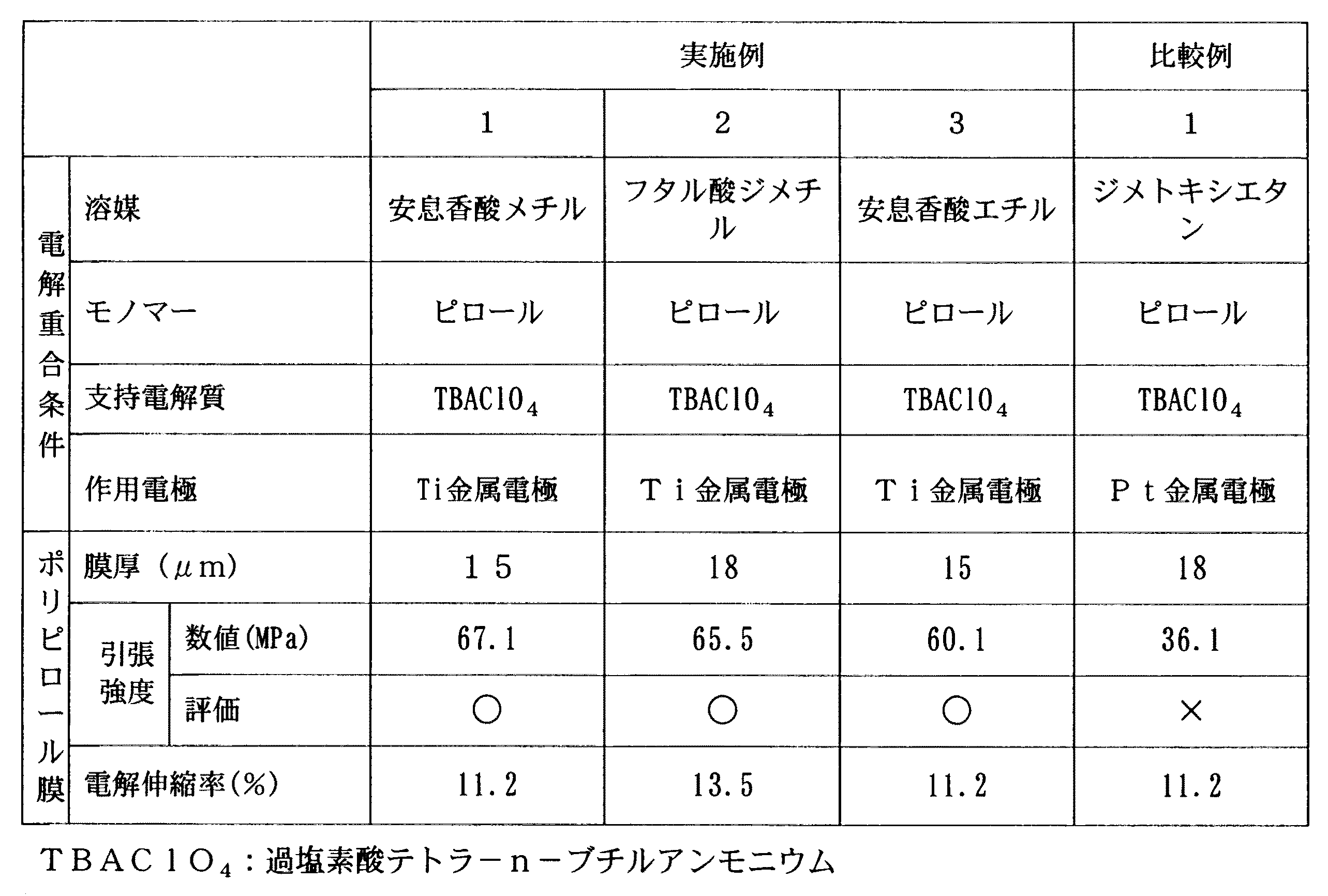
(評価)
実施例1〜3及び比較例1のポリピロール膜を、アセトンを用いて作用電極から剥離して、動作電解質(PF6)を含んだ1mol/lのPF6水溶液(動作電解液)に保持した。保持されたポリピロール膜について、下記の測定方法により、それぞれ1酸化還元サイクル当たりの伸縮率を測定した。また、実施例1〜3及び比較例1のポリピロール膜について、下記の測定方法を用いて引張強度を測定した。結果を表1に示す。なお、引張強度については、下記の評価基準により評価した。
(Evaluation)
The polypyrrole films of Examples 1 to 3 and Comparative Example 1 were peeled off from the working electrode using acetone and held in a 1 mol / l PF 6 aqueous solution (operating electrolyte) containing the operating electrolyte (PF 6 ). About the held polypyrrole film | membrane, the expansion / contraction rate per 1 oxidation-reduction cycle was measured with the following measuring method, respectively. Moreover, about the polypyrrole film | membrane of Examples 1-3 and the comparative example 1, tensile strength was measured using the following measuring method. The results are shown in Table 1. The tensile strength was evaluated according to the following evaluation criteria.
〔伸縮率の測定方法〕
実施例1〜3及び比較例1で得られた膜状の導電性高分子成形品を長さ15mm、幅2mmの動作電極とし、白金プレートを対向電極とし、それぞれ電極の端部に、動作電極を前記電解液中に保持し、リードを介して電源と接続して、電位(−0.9〜+0.7V v.s. Ag/Ag+)を1サイクル印加して変位量(変位した長さ)を測定した。動作電極が1サイクルの印加(1酸化還元サイクル)で伸長と収縮とをすることにより得られた変位の差を、動作電極の元の長さで割ることにより、最初の酸化還元サイクルである1酸化還元サイクル当たりの伸縮率を求めた。
[Measurement method of stretch rate]
The film-like conductive polymer molded products obtained in Examples 1 to 3 and Comparative Example 1 were used as a working electrode having a length of 15 mm and a width of 2 mm, a platinum plate as a counter electrode, and a working electrode at each end of the electrode. Is held in the electrolytic solution, connected to a power source through a lead, and a potential (−0.9 to +0.7 V vs. Ag / Ag + ) is applied for one cycle to apply a displacement amount (displaced length). Measured). The difference in displacement obtained by extending and contracting the working electrode by one cycle of application (one redox cycle) is divided by the original length of the working electrode, which is the first redox cycle 1 The expansion / contraction rate per oxidation-reduction cycle was determined.
(伸縮率の測定方法)
実施例1〜3及び比較例1で得られたポリピロール膜をそれぞれ長さ20mmの短冊状に裁断した後に、タブ間隔が約4mmとなるようにアルミタブ加工を施して5mm幅短冊である試験片をそれぞれ作成した。各試験片を用いて、JIS K7127のフィルム引張試験(強さ)に準拠して、試験速度0.5mm/minで引張強度を公知の装置を用いて測定した。なお、引張強度の測定には、試験機「INSTRON5582型」を用いて測定した。
(Measurement method of stretch rate)
After the polypyrrole films obtained in Examples 1 to 3 and Comparative Example 1 were cut into strips each having a length of 20 mm, a test piece which was a strip of 5 mm width was subjected to aluminum tab processing so that the tab spacing was about 4 mm. Each was created. Using each test piece, the tensile strength was measured at a test speed of 0.5 mm / min using a known apparatus in accordance with the film tensile test (strength) of JIS K7127. The tensile strength was measured using a tester “INSTRON 5582 type”.
(評価基準)
○:引張り強度が従来の汎用エンジニアリングプラスチックと同等であり、引張強度が優れ、高強度が要求される用途に好適である。
×:引張り強度が従来のポリピロールフィルムと同程度であり、高強度が要求される用途に好適ではない。
(Evaluation criteria)
◯: Tensile strength is equivalent to conventional general-purpose engineering plastics, excellent tensile strength, and suitable for applications requiring high strength.
X: The tensile strength is comparable to that of a conventional polypyrrole film, and is not suitable for applications requiring high strength.
(結果)
実施例1〜3のポリピロール膜は、1酸化還元サイクル当たりの伸縮率が11.2〜13.5%であるので、電解伸縮による伸縮の最大値が11.2%以上であり、さらに機械的強度(引張り強度)も60.1MPa以上であった。従って、実施例1〜3のポリピロール膜は、電解重合時に、溶媒として芳香族エステルを用いていることから、製造作業性の良好な過塩素酸イオンを電解質に用いても、電解伸縮における1酸化還元サイクル当たりの伸縮率に優れ、しかも機械的強度に優れていた。
(result)
Since the polypyrrole films of Examples 1 to 3 have an expansion / contraction ratio per oxidation-reduction cycle of 11.2 to 13.5%, the maximum value of expansion / contraction due to electrolytic expansion / contraction is 11.2% or more. The strength (tensile strength) was also 60.1 MPa or more. Therefore, since the polypyrrole films of Examples 1 to 3 use an aromatic ester as a solvent at the time of electrolytic polymerization, even when perchlorate ions having good manufacturing workability are used as the electrolyte, the oxidation of the electropyrrole film is 1 oxidation. Excellent stretch ratio per reduction cycle and excellent mechanical strength.
一方、比較例1のポリピロール膜は金属電極を用いているが、芳香族エステルを溶媒として用いなかったことから、実施例1〜3のポリピロール膜に比べて機械的強度が低下した。 On the other hand, although the polypyrrole film | membrane of the comparative example 1 uses the metal electrode, since the aromatic ester was not used as a solvent, mechanical strength fell compared with the polypyrrole film | membrane of Examples 1-3.
本発明のポリピロール膜の製造方法は、電解液中に過塩素酸イオンを含むことから、ポリピロールの製造作業性が他のマイナスイオンを支持電解質に含む電解液を用いたポリピロール膜の製造方法に比べて、製造作業性が良好である。さらに、本発明のポリピロール膜の製造方法は、電解液中に過塩素酸イオンを含み、さらに電解液中に芳香族エステルを含むことから、電気化学的な酸化還元による伸縮における1酸化還元サイクル当たりの伸縮率が大きく、機械的強度が高いポリピロール膜を得ることができる。 Since the manufacturing method of the polypyrrole membrane of the present invention contains perchlorate ions in the electrolytic solution, the manufacturing workability of the polypyrrole is compared with the manufacturing method of the polypyrrole membrane using the electrolytic solution containing other negative ions in the supporting electrolyte. Therefore, the manufacturing workability is good. Furthermore, the method for producing a polypyrrole film of the present invention includes perchlorate ions in the electrolytic solution, and further includes an aromatic ester in the electrolytic solution. Therefore, per one redox cycle in stretching by electrochemical redox. A polypyrrole film having a large stretch ratio and a high mechanical strength can be obtained.
上記製造方法により得られたポリピロール膜は、電気化学的な酸化還元による伸縮における1酸化還元サイクル当たりの伸縮率が大きく、機械的強度が高いことから、アクチュエータ素子として好適に用いることができる。さらに、前記ポリピロール膜を変位部に用いたアクチュエータ素子は、電気化学的な酸化還元による伸縮における1酸化還元サイクル当たりの伸縮率が大きく、機械的強度が高いことから、マニピュレータ及びロボットに代表される機械的衝撃が与えられる装置の駆動部に用いられるアクチュエータ素子として好適に用いることができる。
The polypyrrole film obtained by the above manufacturing method can be suitably used as an actuator element because it has a high expansion / contraction rate per one oxidation-reduction cycle in expansion / contraction by electrochemical oxidation / reduction and high mechanical strength. Furthermore, an actuator element using the polypyrrole film as a displacement portion is represented by a manipulator and a robot because it has a large expansion / contraction rate per one oxidation-reduction cycle in electrochemical expansion / contraction expansion and high mechanical strength. It can be suitably used as an actuator element used in a drive unit of a device to which a mechanical impact is applied.
Claims (10)
電解重合法に用いられる電解液はピロール及び/又はピロール誘導体をモノマー成分として含み、
前記電解重合法は芳香族エステルを溶媒として含む電解液を用い、
前記電解液は過塩素酸イオンを含み、
作用電極及び対極に電圧を印加することにより作用電極上に導電性高分子膜が形成される
ことを特徴とするポリピロール膜の製造方法。 A method for producing a polypyrrole film using an electrolytic polymerization method,
The electrolytic solution used in the electropolymerization method contains pyrrole and / or a pyrrole derivative as a monomer component,
The electrolytic polymerization method uses an electrolytic solution containing an aromatic ester as a solvent,
The electrolyte includes perchlorate ions;
A method for producing a polypyrrole film, wherein a conductive polymer film is formed on a working electrode by applying a voltage to the working electrode and the counter electrode.
前記ポリピロール膜が電解重合法により得られたポリピロール膜であり、
前記電解重合法が芳香族エステルを溶媒として含む電解液を用い、
前記電解液が過塩素酸イオンを含むことを特徴とするポリピロール膜。 A polypyrrole film having pyrrole and / or a pyrrole derivative as a polymerization unit,
The polypyrrole film is a polypyrrole film obtained by an electrolytic polymerization method,
The electrolytic polymerization method uses an electrolytic solution containing an aromatic ester as a solvent,
The polypyrrole film, wherein the electrolytic solution contains perchlorate ions.
An actuator element comprising at least a displacement part that is displaced by voltage application, an electrolyte, and a counter electrode, wherein the displacement part is a polypyrrole film according to any one of claims 5 to 9.
Priority Applications (2)
| Application Number | Priority Date | Filing Date | Title |
|---|---|---|---|
| JP2004120722A JP2005298764A (en) | 2004-04-15 | 2004-04-15 | Method for preparing polypyrrole film |
| PCT/JP2005/005360 WO2005100438A1 (en) | 2004-04-15 | 2005-03-24 | Method for producing polypyrrole film |
Applications Claiming Priority (1)
| Application Number | Priority Date | Filing Date | Title |
|---|---|---|---|
| JP2004120722A JP2005298764A (en) | 2004-04-15 | 2004-04-15 | Method for preparing polypyrrole film |
Publications (1)
| Publication Number | Publication Date |
|---|---|
| JP2005298764A true JP2005298764A (en) | 2005-10-27 |
Family
ID=35149959
Family Applications (1)
| Application Number | Title | Priority Date | Filing Date |
|---|---|---|---|
| JP2004120722A Pending JP2005298764A (en) | 2004-04-15 | 2004-04-15 | Method for preparing polypyrrole film |
Country Status (2)
| Country | Link |
|---|---|
| JP (1) | JP2005298764A (en) |
| WO (1) | WO2005100438A1 (en) |
Cited By (2)
| Publication number | Priority date | Publication date | Assignee | Title |
|---|---|---|---|---|
| JP2007186637A (en) * | 2006-01-16 | 2007-07-26 | Eamex Co | Conductive polymer actuator element |
| JP2008010407A (en) * | 2006-05-31 | 2008-01-17 | Honda Motor Co Ltd | Method and apparatus for producing conductive polymer film |
Families Citing this family (2)
| Publication number | Priority date | Publication date | Assignee | Title |
|---|---|---|---|---|
| US7557433B2 (en) | 2004-10-25 | 2009-07-07 | Mccain Joseph H | Microelectronic device with integrated energy source |
| JP4644130B2 (en) * | 2006-01-24 | 2011-03-02 | イーメックス株式会社 | Method for manufacturing conductive polymer actuator element |
Citations (7)
| Publication number | Priority date | Publication date | Assignee | Title |
|---|---|---|---|---|
| JPH01164804A (en) * | 1987-12-21 | 1989-06-28 | Canon Inc | actuator |
| JPH0521283A (en) * | 1991-07-10 | 1993-01-29 | Matsushita Electric Ind Co Ltd | Capacitor and manufacturing method thereof |
| JPH05326338A (en) * | 1992-05-21 | 1993-12-10 | Nippon Chibagaigii Kk | Solid electrolytic capacitor and its manufacture |
| JPH10306144A (en) * | 1997-05-08 | 1998-11-17 | Toshio Kunugi | Method for high-sensitivity shrinkage elongation of pyrrole polymer film or fiber |
| JP2000336154A (en) * | 1999-03-23 | 2000-12-05 | Mitsubishi Chemicals Corp | Method for producing conductive polymer |
| JP2004010858A (en) * | 2002-06-11 | 2004-01-15 | Yamaguchi Technology Licensing Organization Ltd | Method for producing conductive polymer fine particles and conductive polymer fine particles |
| JP2005187510A (en) * | 2003-12-24 | 2005-07-14 | Achilles Corp | Film-like conductive polymer and its manufacturing method |
Family Cites Families (6)
| Publication number | Priority date | Publication date | Assignee | Title |
|---|---|---|---|---|
| JPS6088036A (en) * | 1983-10-21 | 1985-05-17 | Agency Of Ind Science & Technol | Production of electroconductive polypyrrole |
| JP3132219B2 (en) * | 1992-03-10 | 2001-02-05 | 住友化学工業株式会社 | Method for producing conductive resin composite |
| US5916627A (en) * | 1997-12-31 | 1999-06-29 | Kemet Electronics Corp. | Conductive polymer using self-regenerating oxidant |
| JP4507297B2 (en) * | 1998-07-06 | 2010-07-21 | 株式会社村田製作所 | Conductive polymer, solid electrolytic capacitor and manufacturing method thereof |
| JP4049217B2 (en) * | 2002-10-02 | 2008-02-20 | イーメックス株式会社 | Conductive polymer molded article and apparatus using laminate |
| JP2004285352A (en) * | 2003-03-04 | 2004-10-14 | Eamex Co | Deformable high strength polypyrrole film and its producing method |
-
2004
- 2004-04-15 JP JP2004120722A patent/JP2005298764A/en active Pending
-
2005
- 2005-03-24 WO PCT/JP2005/005360 patent/WO2005100438A1/en not_active Ceased
Patent Citations (7)
| Publication number | Priority date | Publication date | Assignee | Title |
|---|---|---|---|---|
| JPH01164804A (en) * | 1987-12-21 | 1989-06-28 | Canon Inc | actuator |
| JPH0521283A (en) * | 1991-07-10 | 1993-01-29 | Matsushita Electric Ind Co Ltd | Capacitor and manufacturing method thereof |
| JPH05326338A (en) * | 1992-05-21 | 1993-12-10 | Nippon Chibagaigii Kk | Solid electrolytic capacitor and its manufacture |
| JPH10306144A (en) * | 1997-05-08 | 1998-11-17 | Toshio Kunugi | Method for high-sensitivity shrinkage elongation of pyrrole polymer film or fiber |
| JP2000336154A (en) * | 1999-03-23 | 2000-12-05 | Mitsubishi Chemicals Corp | Method for producing conductive polymer |
| JP2004010858A (en) * | 2002-06-11 | 2004-01-15 | Yamaguchi Technology Licensing Organization Ltd | Method for producing conductive polymer fine particles and conductive polymer fine particles |
| JP2005187510A (en) * | 2003-12-24 | 2005-07-14 | Achilles Corp | Film-like conductive polymer and its manufacturing method |
Cited By (2)
| Publication number | Priority date | Publication date | Assignee | Title |
|---|---|---|---|---|
| JP2007186637A (en) * | 2006-01-16 | 2007-07-26 | Eamex Co | Conductive polymer actuator element |
| JP2008010407A (en) * | 2006-05-31 | 2008-01-17 | Honda Motor Co Ltd | Method and apparatus for producing conductive polymer film |
Also Published As
| Publication number | Publication date |
|---|---|
| WO2005100438A1 (en) | 2005-10-27 |
Similar Documents
| Publication | Publication Date | Title |
|---|---|---|
| Hara et al. | Highly stretchable and powerful polypyrrole linear actuators | |
| JP4997773B2 (en) | Actuator element | |
| Rosi et al. | Hydrogel-polymer electrolytes based on polyvinyl alcohol and hydroxyethylcellulose for supercapacitor applications | |
| Amarnath et al. | Electrochemical supercapacitor application of electroless surface polymerization of polyaniline nanostructures | |
| Zama et al. | Comparison of conducting polymer actuators based on polypyrrole doped with BF4−, PF6−, CF3SO3−, and ClO4− | |
| JP5948624B2 (en) | Conductive polymer composite and method for producing the same | |
| Fu et al. | Electrochemical preparation of porous poly (3, 4-ethylenedioxythiophene) electrodes from room temperature ionic liquids for supercapacitors | |
| WO2012144477A1 (en) | Electrically conductive polymer containing phenol compound | |
| JP5388192B2 (en) | Conductive polymer actuator material | |
| Rasouli et al. | The influence of electrodeposited conducting polymer electrode structure on the actuation performance of muscle-like ionic actuators | |
| WO2005100438A1 (en) | Method for producing polypyrrole film | |
| JP4727182B2 (en) | Driving method of conductive polymer actuator element | |
| JP4943707B2 (en) | Conductive polymer actuator element | |
| DE3027529A1 (en) | METHOD FOR THE PRODUCTION OF ELECTRICALLY CONDUCTIVE POLYMERIC SYSTEMS AND THEIR USE IN ELECTROTECHNICS AND FOR THE ANTISTATIC EQUIPMENT OF PLASTICS | |
| JP6481356B2 (en) | Electrolyte for actuator element and actuator element | |
| US8715531B2 (en) | Actuator | |
| Çağlar et al. | Electrochemically synthesized Sn2+ doped poly (3-methylthiophene) and poly (3, 4-ethylenedioxythiophene) for supercapacitors | |
| JP2007023173A (en) | Conductive polymer actuator element | |
| JP2006274229A (en) | Driving method of conductive polymer actuator element | |
| JP5261730B2 (en) | Conductive polymer actuator element | |
| US5120407A (en) | Electrochemical polymerization of five-membered heterocyclic monomers | |
| Kaneto et al. | Relationship between Elasticity and Contraction Force in Conducting Polymer; Polyaniline Softactuator | |
| JP2010186937A (en) | Electrode material for capacitor, and electric doublelayer capacitor using the same | |
| JP4644130B2 (en) | Method for manufacturing conductive polymer actuator element | |
| Sundararaman et al. | Electrochemical synthesis of conducting polymers |
Legal Events
| Date | Code | Title | Description |
|---|---|---|---|
| RD03 | Notification of appointment of power of attorney |
Free format text: JAPANESE INTERMEDIATE CODE: A7423 Effective date: 20060227 |
|
| RD04 | Notification of resignation of power of attorney |
Free format text: JAPANESE INTERMEDIATE CODE: A7424 Effective date: 20060228 |
|
| A621 | Written request for application examination |
Free format text: JAPANESE INTERMEDIATE CODE: A621 Effective date: 20070307 |
|
| A131 | Notification of reasons for refusal |
Free format text: JAPANESE INTERMEDIATE CODE: A131 Effective date: 20100226 |
|
| A02 | Decision of refusal |
Free format text: JAPANESE INTERMEDIATE CODE: A02 Effective date: 20100817 |