JP2005298616A - Resin composition for optical semiconductor encapsulation and optical semiconductor device using the same - Google Patents
Resin composition for optical semiconductor encapsulation and optical semiconductor device using the same Download PDFInfo
- Publication number
- JP2005298616A JP2005298616A JP2004114978A JP2004114978A JP2005298616A JP 2005298616 A JP2005298616 A JP 2005298616A JP 2004114978 A JP2004114978 A JP 2004114978A JP 2004114978 A JP2004114978 A JP 2004114978A JP 2005298616 A JP2005298616 A JP 2005298616A
- Authority
- JP
- Japan
- Prior art keywords
- optical semiconductor
- resin composition
- group
- epoxy resin
- light
- Prior art date
- Legal status (The legal status is an assumption and is not a legal conclusion. Google has not performed a legal analysis and makes no representation as to the accuracy of the status listed.)
- Granted
Links
- 239000004065 semiconductor Substances 0.000 title claims abstract description 38
- 230000003287 optical effect Effects 0.000 title claims abstract description 37
- 239000011342 resin composition Substances 0.000 title claims abstract description 20
- 238000005538 encapsulation Methods 0.000 title claims 2
- 239000003822 epoxy resin Substances 0.000 claims abstract description 37
- 229920000647 polyepoxide Polymers 0.000 claims abstract description 37
- 150000002903 organophosphorus compounds Chemical class 0.000 claims abstract description 23
- 239000003795 chemical substances by application Substances 0.000 claims abstract description 15
- 125000000217 alkyl group Chemical group 0.000 claims abstract description 7
- 125000004432 carbon atom Chemical group C* 0.000 claims abstract description 7
- 229920005989 resin Polymers 0.000 claims abstract description 5
- 239000011347 resin Substances 0.000 claims abstract description 5
- 239000000203 mixture Substances 0.000 claims description 27
- 238000007789 sealing Methods 0.000 claims description 16
- 125000004435 hydrogen atom Chemical group [H]* 0.000 claims description 8
- 125000002496 methyl group Chemical group [H]C([H])([H])* 0.000 claims description 5
- ZEFSGHVBJCEKAZ-UHFFFAOYSA-N bis(2,4-ditert-butyl-6-methylphenyl) ethyl phosphite Chemical compound CC=1C=C(C(C)(C)C)C=C(C(C)(C)C)C=1OP(OCC)OC1=C(C)C=C(C(C)(C)C)C=C1C(C)(C)C ZEFSGHVBJCEKAZ-UHFFFAOYSA-N 0.000 claims description 4
- 125000000956 methoxy group Chemical group [H]C([H])([H])O* 0.000 claims description 4
- 238000002834 transmittance Methods 0.000 abstract description 22
- 239000003566 sealing material Substances 0.000 abstract description 8
- 125000001797 benzyl group Chemical class [H]C1=C([H])C([H])=C(C([H])=C1[H])C([H])([H])* 0.000 abstract 1
- 125000005936 piperidyl group Chemical class 0.000 abstract 1
- 239000000047 product Substances 0.000 description 16
- 239000007788 liquid Substances 0.000 description 13
- -1 2,6-di-tert-butyl-4-methylphenyl) group Chemical group 0.000 description 8
- 238000000034 method Methods 0.000 description 8
- 239000000843 powder Substances 0.000 description 8
- 239000000654 additive Substances 0.000 description 6
- IISBACLAFKSPIT-UHFFFAOYSA-N bisphenol A Chemical compound C=1C=C(O)C=CC=1C(C)(C)C1=CC=C(O)C=C1 IISBACLAFKSPIT-UHFFFAOYSA-N 0.000 description 6
- 230000000052 comparative effect Effects 0.000 description 5
- 150000001875 compounds Chemical class 0.000 description 5
- 238000004519 manufacturing process Methods 0.000 description 5
- 230000005540 biological transmission Effects 0.000 description 4
- 230000015556 catabolic process Effects 0.000 description 4
- 238000006731 degradation reaction Methods 0.000 description 4
- 230000005284 excitation Effects 0.000 description 4
- 239000003381 stabilizer Substances 0.000 description 4
- ISWSIDIOOBJBQZ-UHFFFAOYSA-N Phenol Chemical compound OC1=CC=CC=C1 ISWSIDIOOBJBQZ-UHFFFAOYSA-N 0.000 description 3
- 150000001412 amines Chemical class 0.000 description 3
- 239000002518 antifoaming agent Substances 0.000 description 3
- 239000003963 antioxidant agent Substances 0.000 description 3
- 239000003086 colorant Substances 0.000 description 3
- 239000002270 dispersing agent Substances 0.000 description 3
- 239000000835 fiber Substances 0.000 description 3
- 239000004850 liquid epoxy resins (LERs) Substances 0.000 description 3
- 239000000463 material Substances 0.000 description 3
- 239000003607 modifier Substances 0.000 description 3
- 229920000098 polyolefin Polymers 0.000 description 3
- LGRFSURHDFAFJT-UHFFFAOYSA-N Phthalic anhydride Natural products C1=CC=C2C(=O)OC(=O)C2=C1 LGRFSURHDFAFJT-UHFFFAOYSA-N 0.000 description 2
- VYPSYNLAJGMNEJ-UHFFFAOYSA-N Silicium dioxide Chemical compound O=[Si]=O VYPSYNLAJGMNEJ-UHFFFAOYSA-N 0.000 description 2
- 150000008065 acid anhydrides Chemical class 0.000 description 2
- 150000001298 alcohols Chemical class 0.000 description 2
- 230000003078 antioxidant effect Effects 0.000 description 2
- VZRMYAIVHSRUQY-UHFFFAOYSA-N bis(2,4-ditert-butyl-6-methylphenyl) methyl phosphite Chemical compound CC=1C=C(C(C)(C)C)C=C(C(C)(C)C)C=1OP(OC)OC1=C(C)C=C(C(C)(C)C)C=C1C(C)(C)C VZRMYAIVHSRUQY-UHFFFAOYSA-N 0.000 description 2
- PXKLMJQFEQBVLD-UHFFFAOYSA-N bisphenol F Chemical compound C1=CC(O)=CC=C1CC1=CC=C(O)C=C1 PXKLMJQFEQBVLD-UHFFFAOYSA-N 0.000 description 2
- JHIWVOJDXOSYLW-UHFFFAOYSA-N butyl 2,2-difluorocyclopropane-1-carboxylate Chemical compound CCCCOC(=O)C1CC1(F)F JHIWVOJDXOSYLW-UHFFFAOYSA-N 0.000 description 2
- UKMSUNONTOPOIO-UHFFFAOYSA-N docosanoic acid Chemical compound CCCCCCCCCCCCCCCCCCCCCC(O)=O UKMSUNONTOPOIO-UHFFFAOYSA-N 0.000 description 2
- 230000000694 effects Effects 0.000 description 2
- FPYJFEHAWHCUMM-UHFFFAOYSA-N maleic anhydride Chemical compound O=C1OC(=O)C=C1 FPYJFEHAWHCUMM-UHFFFAOYSA-N 0.000 description 2
- 238000002156 mixing Methods 0.000 description 2
- 239000006082 mold release agent Substances 0.000 description 2
- 238000000465 moulding Methods 0.000 description 2
- 239000011368 organic material Substances 0.000 description 2
- 230000001590 oxidative effect Effects 0.000 description 2
- 150000003003 phosphines Chemical class 0.000 description 2
- AQSJGOWTSHOLKH-UHFFFAOYSA-N phosphite(3-) Chemical class [O-]P([O-])[O-] AQSJGOWTSHOLKH-UHFFFAOYSA-N 0.000 description 2
- 230000000704 physical effect Effects 0.000 description 2
- 239000002994 raw material Substances 0.000 description 2
- 230000000087 stabilizing effect Effects 0.000 description 2
- 238000003756 stirring Methods 0.000 description 2
- SRPWOOOHEPICQU-UHFFFAOYSA-N trimellitic anhydride Chemical compound OC(=O)C1=CC=C2C(=O)OC(=O)C2=C1 SRPWOOOHEPICQU-UHFFFAOYSA-N 0.000 description 2
- LTVUCOSIZFEASK-MPXCPUAZSA-N (3ar,4s,7r,7as)-3a-methyl-3a,4,7,7a-tetrahydro-4,7-methano-2-benzofuran-1,3-dione Chemical compound C([C@H]1C=C2)[C@H]2[C@H]2[C@]1(C)C(=O)OC2=O LTVUCOSIZFEASK-MPXCPUAZSA-N 0.000 description 1
- KNDQHSIWLOJIGP-UMRXKNAASA-N (3ar,4s,7r,7as)-rel-3a,4,7,7a-tetrahydro-4,7-methanoisobenzofuran-1,3-dione Chemical compound O=C1OC(=O)[C@@H]2[C@H]1[C@]1([H])C=C[C@@]2([H])C1 KNDQHSIWLOJIGP-UMRXKNAASA-N 0.000 description 1
- MUTGBJKUEZFXGO-OLQVQODUSA-N (3as,7ar)-3a,4,5,6,7,7a-hexahydro-2-benzofuran-1,3-dione Chemical compound C1CCC[C@@H]2C(=O)OC(=O)[C@@H]21 MUTGBJKUEZFXGO-OLQVQODUSA-N 0.000 description 1
- KMOUUZVZFBCRAM-OLQVQODUSA-N (3as,7ar)-3a,4,7,7a-tetrahydro-2-benzofuran-1,3-dione Chemical compound C1C=CC[C@@H]2C(=O)OC(=O)[C@@H]21 KMOUUZVZFBCRAM-OLQVQODUSA-N 0.000 description 1
- BSYJHYLAMMJNRC-UHFFFAOYSA-N 2,4,4-trimethylpentan-2-ol Chemical compound CC(C)(C)CC(C)(C)O BSYJHYLAMMJNRC-UHFFFAOYSA-N 0.000 description 1
- GOXQRTZXKQZDDN-UHFFFAOYSA-N 2-Ethylhexyl acrylate Chemical compound CCCCC(CC)COC(=O)C=C GOXQRTZXKQZDDN-UHFFFAOYSA-N 0.000 description 1
- QTWJRLJHJPIABL-UHFFFAOYSA-N 2-methylphenol;3-methylphenol;4-methylphenol Chemical compound CC1=CC=C(O)C=C1.CC1=CC=CC(O)=C1.CC1=CC=CC=C1O QTWJRLJHJPIABL-UHFFFAOYSA-N 0.000 description 1
- RSKXYCDTGOUAKH-UHFFFAOYSA-N 2-methylpropyl dihydrogen phosphite Chemical compound CC(C)COP(O)O RSKXYCDTGOUAKH-UHFFFAOYSA-N 0.000 description 1
- ADRNSOYXKABLGT-UHFFFAOYSA-N 8-methylnonyl diphenyl phosphite Chemical compound C=1C=CC=CC=1OP(OCCCCCCCC(C)C)OC1=CC=CC=C1 ADRNSOYXKABLGT-UHFFFAOYSA-N 0.000 description 1
- 235000021357 Behenic acid Nutrition 0.000 description 1
- 239000005997 Calcium carbide Substances 0.000 description 1
- 239000004593 Epoxy Substances 0.000 description 1
- LFQSCWFLJHTTHZ-UHFFFAOYSA-N Ethanol Chemical compound CCO LFQSCWFLJHTTHZ-UHFFFAOYSA-N 0.000 description 1
- JIGUQPWFLRLWPJ-UHFFFAOYSA-N Ethyl acrylate Chemical compound CCOC(=O)C=C JIGUQPWFLRLWPJ-UHFFFAOYSA-N 0.000 description 1
- ZKTFNWPPVIAFDC-UHFFFAOYSA-N OB(O)O.P.P.P Chemical class OB(O)O.P.P.P ZKTFNWPPVIAFDC-UHFFFAOYSA-N 0.000 description 1
- OQQKJFQTVBRWKJ-UHFFFAOYSA-N P(OC1=C(C=C(C=C1C)C(C)(C)C)C(C)(C)C)(OC1=C(C=C(C=C1C)C(C)(C)C)C(C)(C)C)OCCCC Chemical compound P(OC1=C(C=C(C=C1C)C(C)(C)C)C(C)(C)C)(OC1=C(C=C(C=C1C)C(C)(C)C)C(C)(C)C)OCCCC OQQKJFQTVBRWKJ-UHFFFAOYSA-N 0.000 description 1
- ZONJYFAIGFJMHO-UHFFFAOYSA-N P(OC1=C(C=C(C=C1C)C(C)(C)C)C(C)(C)C)(OC1=C(C=C(C=C1C)C(C)(C)C)C(C)(C)C)OCCCCC Chemical compound P(OC1=C(C=C(C=C1C)C(C)(C)C)C(C)(C)C)(OC1=C(C=C(C=C1C)C(C)(C)C)C(C)(C)C)OCCCCC ZONJYFAIGFJMHO-UHFFFAOYSA-N 0.000 description 1
- QAAFTFPBKMUZKV-UHFFFAOYSA-N P(OC1=C(C=C(C=C1C)C(C)(C)C)C(C)(C)C)(OC1=C(C=C(C=C1C)C(C)(C)C)C(C)(C)C)OCCCCCC Chemical compound P(OC1=C(C=C(C=C1C)C(C)(C)C)C(C)(C)C)(OC1=C(C=C(C=C1C)C(C)(C)C)C(C)(C)C)OCCCCCC QAAFTFPBKMUZKV-UHFFFAOYSA-N 0.000 description 1
- XOBJMQROZQLSDD-UHFFFAOYSA-N P(OC1=C(C=C(C=C1C)C(C)(C)C)C(C)(C)C)(OC1=C(C=C(C=C1C)C(C)(C)C)C(C)(C)C)OCCCCCCCC Chemical compound P(OC1=C(C=C(C=C1C)C(C)(C)C)C(C)(C)C)(OC1=C(C=C(C=C1C)C(C)(C)C)C(C)(C)C)OCCCCCCCC XOBJMQROZQLSDD-UHFFFAOYSA-N 0.000 description 1
- 229910052581 Si3N4 Inorganic materials 0.000 description 1
- 235000021355 Stearic acid Nutrition 0.000 description 1
- 125000002723 alicyclic group Chemical group 0.000 description 1
- 239000004844 aliphatic epoxy resin Substances 0.000 description 1
- PNEYBMLMFCGWSK-UHFFFAOYSA-N aluminium oxide Inorganic materials [O-2].[O-2].[O-2].[Al+3].[Al+3] PNEYBMLMFCGWSK-UHFFFAOYSA-N 0.000 description 1
- 229940116226 behenic acid Drugs 0.000 description 1
- 125000000484 butyl group Chemical group [H]C([*])([H])C([H])([H])C([H])([H])C([H])([H])[H] 0.000 description 1
- 150000001732 carboxylic acid derivatives Chemical class 0.000 description 1
- 238000005266 casting Methods 0.000 description 1
- 238000004040 coloring Methods 0.000 description 1
- 238000013329 compounding Methods 0.000 description 1
- 238000007796 conventional method Methods 0.000 description 1
- 229930003836 cresol Natural products 0.000 description 1
- 239000011353 cycloaliphatic epoxy resin Substances 0.000 description 1
- GYZLOYUZLJXAJU-UHFFFAOYSA-N diglycidyl ether Chemical compound C1OC1COCC1CO1 GYZLOYUZLJXAJU-UHFFFAOYSA-N 0.000 description 1
- NFORZJQPTUSMRL-UHFFFAOYSA-N dipropan-2-yl hydrogen phosphite Chemical compound CC(C)OP(O)OC(C)C NFORZJQPTUSMRL-UHFFFAOYSA-N 0.000 description 1
- 239000000975 dye Substances 0.000 description 1
- 125000003700 epoxy group Chemical group 0.000 description 1
- 125000001495 ethyl group Chemical group [H]C([H])([H])C([H])([H])* 0.000 description 1
- 238000011156 evaluation Methods 0.000 description 1
- ANSXAPJVJOKRDJ-UHFFFAOYSA-N furo[3,4-f][2]benzofuran-1,3,5,7-tetrone Chemical compound C1=C2C(=O)OC(=O)C2=CC2=C1C(=O)OC2=O ANSXAPJVJOKRDJ-UHFFFAOYSA-N 0.000 description 1
- 238000001879 gelation Methods 0.000 description 1
- 230000009477 glass transition Effects 0.000 description 1
- VANNPISTIUFMLH-UHFFFAOYSA-N glutaric anhydride Chemical compound O=C1CCCC(=O)O1 VANNPISTIUFMLH-UHFFFAOYSA-N 0.000 description 1
- LNEPOXFFQSENCJ-UHFFFAOYSA-N haloperidol Chemical compound C1CC(O)(C=2C=CC(Cl)=CC=2)CCN1CCCC(=O)C1=CC=C(F)C=C1 LNEPOXFFQSENCJ-UHFFFAOYSA-N 0.000 description 1
- 230000020169 heat generation Effects 0.000 description 1
- 238000010438 heat treatment Methods 0.000 description 1
- AJHVMIKRCDKKFP-UHFFFAOYSA-N heptyl dihydrogen phosphite Chemical compound CCCCCCCOP(O)O AJHVMIKRCDKKFP-UHFFFAOYSA-N 0.000 description 1
- 125000000623 heterocyclic group Chemical group 0.000 description 1
- WJRBRSLFGCUECM-UHFFFAOYSA-N hydantoin Chemical compound O=C1CNC(=O)N1 WJRBRSLFGCUECM-UHFFFAOYSA-N 0.000 description 1
- 229940091173 hydantoin Drugs 0.000 description 1
- 150000002460 imidazoles Chemical class 0.000 description 1
- 230000006698 induction Effects 0.000 description 1
- 125000000959 isobutyl group Chemical group [H]C([H])([H])C([H])(C([H])([H])[H])C([H])([H])* 0.000 description 1
- 239000012948 isocyanate Substances 0.000 description 1
- 150000002513 isocyanates Chemical class 0.000 description 1
- 125000001449 isopropyl group Chemical group [H]C([H])([H])C([H])(*)C([H])([H])[H] 0.000 description 1
- 239000000155 melt Substances 0.000 description 1
- 229910052751 metal Inorganic materials 0.000 description 1
- 239000002184 metal Substances 0.000 description 1
- 239000012778 molding material Substances 0.000 description 1
- 150000004767 nitrides Chemical class 0.000 description 1
- 229920003986 novolac Polymers 0.000 description 1
- QIQXTHQIDYTFRH-UHFFFAOYSA-N octadecanoic acid Chemical compound CCCCCCCCCCCCCCCCCC(O)=O QIQXTHQIDYTFRH-UHFFFAOYSA-N 0.000 description 1
- OQCDKBAXFALNLD-UHFFFAOYSA-N octadecanoic acid Natural products CCCCCCCC(C)CCCCCCCCC(O)=O OQCDKBAXFALNLD-UHFFFAOYSA-N 0.000 description 1
- 230000003647 oxidation Effects 0.000 description 1
- 238000007254 oxidation reaction Methods 0.000 description 1
- 238000010525 oxidative degradation reaction Methods 0.000 description 1
- PNJWIWWMYCMZRO-UHFFFAOYSA-N pent‐4‐en‐2‐one Natural products CC(=O)CC=C PNJWIWWMYCMZRO-UHFFFAOYSA-N 0.000 description 1
- XRBCRPZXSCBRTK-UHFFFAOYSA-N phosphonous acid Chemical class OPO XRBCRPZXSCBRTK-UHFFFAOYSA-N 0.000 description 1
- 229910052698 phosphorus Inorganic materials 0.000 description 1
- 239000011574 phosphorus Substances 0.000 description 1
- 150000003018 phosphorus compounds Chemical class 0.000 description 1
- 239000000049 pigment Substances 0.000 description 1
- 229920001296 polysiloxane Polymers 0.000 description 1
- 239000002244 precipitate Substances 0.000 description 1
- 238000012545 processing Methods 0.000 description 1
- PRAHMDIEZMWIRW-UHFFFAOYSA-N propyl dihydrogen phosphite Chemical compound CCCOP(O)O PRAHMDIEZMWIRW-UHFFFAOYSA-N 0.000 description 1
- 125000001436 propyl group Chemical group [H]C([*])([H])C([H])([H])C([H])([H])[H] 0.000 description 1
- 238000012827 research and development Methods 0.000 description 1
- 150000003839 salts Chemical class 0.000 description 1
- 125000002914 sec-butyl group Chemical group [H]C([H])([H])C([H])([H])C([H])(*)C([H])([H])[H] 0.000 description 1
- 239000000377 silicon dioxide Substances 0.000 description 1
- HQVNEWCFYHHQES-UHFFFAOYSA-N silicon nitride Chemical compound N12[Si]34N5[Si]62N3[Si]51N64 HQVNEWCFYHHQES-UHFFFAOYSA-N 0.000 description 1
- 239000008117 stearic acid Substances 0.000 description 1
- 229920001059 synthetic polymer Polymers 0.000 description 1
- CLZWAWBPWVRRGI-UHFFFAOYSA-N tert-butyl 2-[2-[2-[2-[bis[2-[(2-methylpropan-2-yl)oxy]-2-oxoethyl]amino]-5-bromophenoxy]ethoxy]-4-methyl-n-[2-[(2-methylpropan-2-yl)oxy]-2-oxoethyl]anilino]acetate Chemical compound CC1=CC=C(N(CC(=O)OC(C)(C)C)CC(=O)OC(C)(C)C)C(OCCOC=2C(=CC=C(Br)C=2)N(CC(=O)OC(C)(C)C)CC(=O)OC(C)(C)C)=C1 CLZWAWBPWVRRGI-UHFFFAOYSA-N 0.000 description 1
- 125000000999 tert-butyl group Chemical group [H]C([H])([H])C(*)(C([H])([H])[H])C([H])([H])[H] 0.000 description 1
- 150000003512 tertiary amines Chemical class 0.000 description 1
- 238000012360 testing method Methods 0.000 description 1
- 125000003944 tolyl group Chemical group 0.000 description 1
- 238000001721 transfer moulding Methods 0.000 description 1
- 238000009849 vacuum degassing Methods 0.000 description 1
Landscapes
- Compositions Of Macromolecular Compounds (AREA)
- Structures Or Materials For Encapsulating Or Coating Semiconductor Devices Or Solid State Devices (AREA)
Abstract
【課題】光透過性、UV〜nUV安定性および熱安定性に優れた光半導体封止材用の樹脂組成物及びこれを用いた光半導体装置の提供。
【解決手段】下記の(A)〜(D)成分を含有する光半導体封止用樹脂組成物及びこれを用いて樹脂封止された光半導体装置である。(A)エポキシ樹脂(B)硬化剤(C)硬化促進剤(D)下記の一般式(I)で表される有機リン化合物。
〔R1 は炭素原子数1〜9のアルキル基、アルキル置換ピペリジル基、アルキル置換ピペリジルアルキル基、アルキル置換ベンジル基を表す。〕
【選択図】なしThe present invention provides a resin composition for an optical semiconductor sealing material excellent in light transmittance, UV to nUV stability and thermal stability, and an optical semiconductor device using the same.
An optical semiconductor encapsulating resin composition containing the following components (A) to (D) and an optical semiconductor device encapsulated with the resin. (A) Epoxy resin (B) Curing agent (C) Curing accelerator (D) An organophosphorus compound represented by the following general formula (I).
[R 1 represents an alkyl group having 1 to 9 carbon atoms, an alkyl-substituted piperidyl group, an alkyl-substituted piperidylalkyl group, or an alkyl-substituted benzyl group. ]
[Selection figure] None
Description
この発明は、光透過性、熱安定性およびUV〜nUV安定性に優れた光半導体封止材を、その硬化によって付与する樹脂組成物及び該樹脂組成物の硬化によって樹脂封止された光半導体装置に関するものである。 The present invention relates to a resin composition that provides an optical semiconductor sealing material excellent in light transmittance, thermal stability, and UV to nUV stability by curing thereof, and an optical semiconductor that is resin-encapsulated by curing of the resin composition. It relates to the device.
近年、種々の表示板、画像読み取り用光源、交通信号、大型ディスプレイ用ユニット等に実用化されている発光ダイオード(LED)等の発光素子や受光素子等の光半導体装置は、大部分が封止樹脂を用いて製造されている。このような封止用の樹脂としては、耐熱性、接着性、耐湿性、機械的強度および電気特性等に優れていることから、エポキシ樹脂が一般的に使用されている。 In recent years, most of optical semiconductor devices such as light emitting diodes and light receiving elements such as light emitting diodes (LEDs) that have been put to practical use in various display boards, light sources for image reading, traffic signals, large display units, etc. are mostly sealed. Manufactured using resin. As such a sealing resin, an epoxy resin is generally used because of its excellent heat resistance, adhesiveness, moisture resistance, mechanical strength, electrical characteristics, and the like.
しかしながら、今日のLEDの飛躍的な進歩により、LEDの高出力化および短波長化が急速に現実のものとなり始めていて、特に窒化物半導体を用いた高出力な発光が可能となっている。一例を挙げると、蛍光体と紫外(以下「UV」と略す)〜近紫外(以下「nUV」と略す)光の励起エネルギーの高い光を発するLEDを組み合わせ、次世代の照明用途をターゲットとした研究や開発がなされている。従って、このような励起エネルギーの高い光を用いる分野において、上述のエポキシ樹脂で封止すると、LEDチップから発せられる熱および紫外線、太陽光から照射されるUV光等により、封止材料が経時的に劣化し、基本性能である光透過性が顕著に低下するという問題が発生する。 However, due to the dramatic progress of today's LEDs, higher output and shorter wavelengths of LEDs are rapidly becoming a reality, and particularly high output light emission using a nitride semiconductor is possible. For example, phosphors and LEDs that emit light with high excitation energy from ultraviolet (hereinafter abbreviated as “UV”) to near ultraviolet (hereinafter abbreviated as “nUV”) are combined to target the next-generation lighting applications. Research and development are done. Therefore, in such a field using light with high excitation energy, when sealing with the above-described epoxy resin, the sealing material is changed over time due to heat generated from the LED chip, ultraviolet light, UV light irradiated from sunlight, and the like. The light transmission, which is the basic performance, is significantly deteriorated.
ところで、基本性能である光透過性が良好であることが要求される発光素子や受光素子等の光半導体装置の封止材料としては、この光透過性を確保する観点からこれまで様々な改善がなされているが主として熱酸化防止の観点からである。例えば、エポキシ樹脂の熱による着色を防ぐための酸化防止剤の一つとして、ジフェニルイソデシルホスファイト、9,10−ジヒドロ−9−オキサ−10−ホスファフェナントレン−10−オキシド等の有機リン化合物が開示されている(例えば、特許文献1参照)。なお、封止用エポキシ樹脂成形材料の一つとして添加した有機リン化合物の事例としては、有機ホスフィン、ホスホニウムボレート、有機ホスフィン類と有機ボロン類との錯体(例えば、特許文献2参照)が開示されているが、これらは硬化促進剤として添加されたものである。 By the way, as a sealing material for an optical semiconductor device such as a light emitting element or a light receiving element, which is required to have good light transmittance as a basic performance, various improvements have been made so far from the viewpoint of securing this light transmittance. It is made mainly from the viewpoint of preventing thermal oxidation. For example, as one of antioxidants for preventing coloration of epoxy resin due to heat, organophosphorus compounds such as diphenylisodecyl phosphite and 9,10-dihydro-9-oxa-10-phosphaphenanthrene-10-oxide Is disclosed (for example, see Patent Document 1). Examples of organic phosphorus compounds added as one of the epoxy resin molding materials for sealing include organic phosphines, phosphonium borates, and complexes of organic phosphines and organic borons (see, for example, Patent Document 2). However, these are added as curing accelerators.
一方、酸化的、熱的または光誘発的崩壊を受け易い有機材料(ポリオレフィン繊維)に対する加工安定剤提供を課題としていることから、ポリオレフィン繊維の光誘発的崩壊に対する安定剤提供の課題の解決を含むものとして、該ポリオレフィン繊維にベンゾフラノ−2−オン型の化合物の少なくとも1種及び立体障害性アミンの群からの化合物の少なくとも1種からなる組成物にさらに有機ホスフィットまたはホスホナイトからの群の化合物の少なくとも1種を含ませた組成物が開示されている(特許文献3参照)。しかし、これらの有機ホスフィット等を含む組成物が封止材としてのエポキシ樹脂の光誘発的崩壊に対して何らかの安定化の作用をするかどうかについては何ら明らかにされていない。 On the other hand, since the problem is to provide processing stabilizers for organic materials (polyolefin fibers) that are susceptible to oxidative, thermal, or light-induced degradation, this includes solutions to the problem of providing stabilizers for light-induced degradation of polyolefin fibers. The polyolefin fiber comprising at least one compound of the benzofurano-2-one type and at least one compound from the group of sterically hindered amines, further comprising a compound of the group from organic phosphites or phosphonites. A composition containing at least one kind is disclosed (see Patent Document 3). However, it is not clarified at all whether the composition containing these organic phosphites or the like has any stabilizing action against the light-induced degradation of the epoxy resin as a sealing material.
また、光誘導および/または熱酸化的分解を受ける有機材料のための効果的安定剤の提供を課題とし、それを解決するための手段としてビス(2,6―ジ―tert―ブチル―4―メチルフェニル)基を有する有機リン化合物と酸化的、熱的および/または光誘導分解を受けやすい合成ポリマーからなる組成物が開示されている(特許文献4参照)。しかし、この有機リン化合物がUV〜nUVといった励起エネルギーの高い光に対して安定剤として作用するかどうかの開示はなく、さらにいえば、これらの光に晒される封止材として用いるエポキシ樹脂に対する該有機リン化合物による安定化効果の有無については何ら明らかにされていないものである。
この発明は、このような事情に鑑みなされたもので、光透過性、UV〜nUV安定性および熱安定性に優れた光半導体封止材用の樹脂組成物及びこれを用いた光半導体装置の提供を目的とする。 The present invention has been made in view of such circumstances, and a resin composition for an optical semiconductor sealing material excellent in light transmittance, UV to nUV stability and thermal stability, and an optical semiconductor device using the same For the purpose of provision.
すなわち、本発明者らは、上記問題点を解決すべく、一連の研究を重ねた。そして、エポキシ樹脂に様々な添加剤を用いた結果、特許文献4記載のビス(2,6―ジ―tert―ブチル―4―メチルフェニル)基を有する有機リン化合物のうちの、またはそれらとは異なる、下記の特定の有機リン化合物を用いる場合にのみ、光透過性、UV〜nUV安定性および熱安定性に優れた封止材が得られることを見出し、ついに本発明を完成するに至った。 That is, the present inventors have made a series of studies to solve the above problems. As a result of using various additives in the epoxy resin, the organophosphorus compound having a bis (2,6-di-tert-butyl-4-methylphenyl) group described in Patent Document 4 is or Only when different organic phosphorus compounds described below are used, it was found that a sealing material excellent in light transmittance, UV to nUV stability and thermal stability was obtained, and finally the present invention was completed. .
すなわち、本発明のうち第1の発明は、下記の(A)〜(D)成分を含有することを特徴とする光半導体封止用樹脂組成物である。
(A)エポキシ樹脂
(B)硬化剤
(C)硬化促進剤
(D)下記の一般式(I)で表される有機リン化合物
That is, 1st invention among this invention is a resin composition for optical semiconductor sealing characterized by containing the following (A)-(D) component.
(A) Epoxy resin (B) Curing agent (C) Curing accelerator (D) Organophosphorus compound represented by the following general formula (I)
R2は水素原子、メチル基もしくはメトキシ基を表し;
R3およびR4は水素原子、−OH基もしくはメトキシ基を表し;
R5 は水素原子またはメチル基を表し:
R6とR7は、他と独立して、水素原子もしくは炭素原子数1〜9のアルキル基を表し;
そしてnは1〜3を表す。〕
上記エポキシ樹脂(A成分)としては、いわゆるエポキシ樹脂であれば特に制限されるものではないが、着色の少ないものを用いるのが好ましい。例えば、ビスフェノールA型エポキシ樹脂、ビスフェノールF型エポキシ樹脂、フェノールまたはクレゾールノボラック型エポキシ樹脂、脂環式エポキシ樹脂、トリグリシジルイソシアネート、ヒダントインエポキシ等の含複素環エポキシ樹脂、水添加ビスフェノールA型エポキシ樹脂、脂肪族系エポキシ樹脂、グリシジルエーテル型エポキシ樹脂等があげられる。これらは単独でもしくは併せて用いられる。
R 2 represents a hydrogen atom, a methyl group or a methoxy group;
R 3 and R 4 represent a hydrogen atom, —OH group or methoxy group;
R 5 represents a hydrogen atom or a methyl group:
R 6 and R 7 each independently represent a hydrogen atom or an alkyl group having 1 to 9 carbon atoms;
And n represents 1-3. ]
The epoxy resin (component A) is not particularly limited as long as it is a so-called epoxy resin, but it is preferable to use a less colored one. For example, bisphenol A type epoxy resin, bisphenol F type epoxy resin, phenol or cresol novolak type epoxy resin, cycloaliphatic epoxy resin, triglycidyl isocyanate, heterocyclic-containing epoxy resin such as hydantoin epoxy, water-added bisphenol A type epoxy resin, Examples thereof include aliphatic epoxy resins and glycidyl ether type epoxy resins. These may be used alone or in combination.
上記硬化剤(B成分)としては、エポキシ樹脂の硬化剤であれば特に制限されるものではないが、着色の少ないものを用いるのが好ましい。例えば、酸無水物系硬化剤では無水フタル酸、無水マレイン酸、無水トリメリット酸、無水パイロメリット酸、ヘキサヒドロ無水フタル酸、テトラヒドロ無水フタル酸、無水メチルナジック酸、無水ナジック酸、無水グルタル酸等が例示される。その他、フェノール系硬化剤、アミン系硬化剤等も用いることができる。これらは単独でもしくは併せて用いることができる。また、フェノール系硬化剤、アミン系硬化剤においても、着色が少なく、UV安定性および熱安定性に優れたものを用いるのが好ましい。これら硬化剤(B成分)の使用量は、上記エポキシ樹脂(A成分)のエポキシ基1当量に対して、通常、0.6〜1.5当量、好適には0.8〜1.2当量となるように配合される。 The curing agent (component B) is not particularly limited as long as it is a curing agent for an epoxy resin, but it is preferable to use a curing agent with little coloring. For example, phthalic anhydride, maleic anhydride, trimellitic anhydride, pyromellitic anhydride, hexahydrophthalic anhydride, tetrahydrophthalic anhydride, methyl nadic anhydride, nadic anhydride, glutaric anhydride, etc. Is exemplified. In addition, phenolic curing agents, amine-based curing agents, and the like can also be used. These can be used alone or in combination. Moreover, it is preferable to use a phenolic curing agent and an amine curing agent that are less colored and excellent in UV stability and thermal stability. The amount of these curing agents (component B) used is usually 0.6 to 1.5 equivalents, preferably 0.8 to 1.2 equivalents, based on 1 equivalent of the epoxy group of the epoxy resin (component A). It mix | blends so that it may become.
上記硬化促進剤(C成分)としては、上記エポキシ樹脂の硬化促進剤であれば特に制限されるものではないが、三級アミン,イミダゾール類,カルボン酸金属塩,リン化合物等が例示される。これらの硬化促進剤(C成分)の使用量は、上記硬化剤(B成分)100重量部(以下「部」と略す)に対して0.05〜10部の範囲に設定することが好ましく、より好ましくは0.1〜5部である。すなわち、硬化促進剤(C成分)の使用量が0.05部未満では、ゲル化時間が長くなり硬化作業性が著しく低下する恐れが生じる。また、逆に10部を超えると、硬化が急激に進み、その結果、硬化時の発熱が大きくなって注型品にクラックが生じたり、光透過性が低下したりする傾向がみられるからである。 The curing accelerator (component C) is not particularly limited as long as it is a curing accelerator for the epoxy resin, and examples thereof include tertiary amines, imidazoles, carboxylic acid metal salts, and phosphorus compounds. The amount of these curing accelerators (component C) used is preferably set in the range of 0.05 to 10 parts with respect to 100 parts by weight (hereinafter abbreviated as “parts”) of the curing agent (component B). More preferably, it is 0.1 to 5 parts. That is, if the usage-amount of a hardening accelerator (C component) is less than 0.05 part, gelation time will become long and there exists a possibility that hardening workability | operativity may fall remarkably. On the other hand, if it exceeds 10 parts, curing proceeds rapidly, and as a result, there is a tendency that heat generation during curing increases, cracks occur in the cast product, and the light transmission tends to decrease. is there.
上記特定の有機リン化合物(D成分)は、上記の一般式(I)で表される有機リン化合物はであればいずれも有用であるが、具体的に化合物名を列記すると、例えば、ビス(2,4−ジ−tert−ブチル−6−メチルフェニル)メチルホスファイト、ビス(2,4−ジ−tert−ブチル−6−メチルフェニル)エチルホスファイト、ビス(2,4−ジ−tert−ブチル−6−メチルフェニル)プロピルもしくはイソプロピルホスファイト、ビス(2,4−ジ−tert−ブチル−6−メチルフェニル)ブチルもしくはイソブチルホスファイト、ビス(2,4−ジ−tert−ブチル−6−メチルフェニル)ペンチルホスファイト、ビス(2,4−ジ−tert−ブチル−6−メチルフェニル)ヘキシルルホスファイト、ビス(2,4−ジ−tert−ブチル−6−メチルフェニル)ヘプチルホスファイト、ビス(2,4−ジ−tert−ブチル−6−メチルフェニル)オクチルホスファイト、ビス(2,4−ジ−tert−ブチル−6−メチルフェニル)−4−(2,2,6,6−テトラメチルピペリジル)ホスファイト、ビス(2,4−ジ−tert−ブチル−6−メチルフェニル)−1−(2,2,6,6−テトラメチル−4−ヒドロキシピペリジル)ホスファイト、またはビス(2,4−ジ−tert−ブチル−6−メチルフェニル)−1−(3,5−ジノニル−4−ヒドロキシベンジル)ホスファイト等が挙げられる。これらは単独でもしくは併せて用いられる。 Any organic phosphorus compound represented by the above general formula (I) is useful as the specific organic phosphorus compound (component D), but when the compound names are specifically listed, for example, bis ( 2,4-di-tert-butyl-6-methylphenyl) methyl phosphite, bis (2,4-di-tert-butyl-6-methylphenyl) ethyl phosphite, bis (2,4-di-tert- Butyl-6-methylphenyl) propyl or isopropyl phosphite, bis (2,4-di-tert-butyl-6-methylphenyl) butyl or isobutyl phosphite, bis (2,4-di-tert-butyl-6- Methylphenyl) pentyl phosphite, bis (2,4-di-tert-butyl-6-methylphenyl) hexyl phosphite, bis (2,4- -Tert-butyl-6-methylphenyl) heptyl phosphite, bis (2,4-di-tert-butyl-6-methylphenyl) octyl phosphite, bis (2,4-di-tert-butyl-6-methyl) Phenyl) -4- (2,2,6,6-tetramethylpiperidyl) phosphite, bis (2,4-di-tert-butyl-6-methylphenyl) -1- (2,2,6,6- Tetramethyl-4-hydroxypiperidyl) phosphite, bis (2,4-di-tert-butyl-6-methylphenyl) -1- (3,5-dinonyl-4-hydroxybenzyl) phosphite, etc. . These may be used alone or in combination.
第2の発明は、一般式(I)で表される有機リン化合物のR1 が炭素原子数1〜4のアルキル基であるあることを特徴とする第1発明記載の光半導体封止用樹脂組成物である。 The second invention is the resin for encapsulating an optical semiconductor according to the first invention, wherein R 1 of the organophosphorus compound represented by the general formula (I) is an alkyl group having 1 to 4 carbon atoms It is a composition.
この場合、R1は、具体的には、メチル基、エチル基、プロピル基、イソプロピル基、ブチル基、イソブチル基、sec−ブチル基またはtert−ブチル基を表す。 In this case, R 1 specifically represents a methyl group, an ethyl group, a propyl group, an isopropyl group, a butyl group, an isobutyl group, a sec-butyl group, or a tert-butyl group.
第3の発明は、一般式(I)で表される有機リン化合物が、ビス(2,4−ジ−tert-ブチル−6−メチルフェニル)エチルホスファイトであることを特徴とする第2発明記載の光半導体封止用樹脂組成物である。 The third invention is characterized in that the organophosphorus compound represented by the general formula (I) is bis (2,4-di-tert-butyl-6-methylphenyl) ethyl phosphite. It is the resin composition for optical semiconductor sealing of description.
第4の発明は、(D)成分の含有量が、(A)成分100重量部に対して0.1重量部〜10重量部であることを特徴とする第1発明、第2発明または第3発明記載の光半導体封止用樹脂組成物である。 In a fourth invention, the content of the component (D) is 0.1 to 10 parts by weight with respect to 100 parts by weight of the component (A). 3. A resin composition for sealing an optical semiconductor according to the invention 3.
すなわち、有機リン化合物(D成分)の含有量は、上記エポキシ樹脂(A成分)100重量部に対して0.1重量部〜10重量部、好適には0.5重量部〜5重量部となるように配合される。その理由は、D成分の含有量が0.1重量部未満では充分な光透過性の改善効果が得られず、10重量部を超え多量に用いると得られるエポキシ樹脂組成物硬化体の物性(ガラス転移温度,耐湿性,ヒートサイクル性)が劣化する傾向がみられるからである。 That is, the content of the organophosphorus compound (component D) is 0.1 to 10 parts by weight, preferably 0.5 to 5 parts by weight with respect to 100 parts by weight of the epoxy resin (component A). It mix | blends so that it may become. The reason is that if the content of the D component is less than 0.1 parts by weight, a sufficient effect of improving light transmission cannot be obtained, and the physical properties of the cured epoxy resin composition obtained when used in excess of 10 parts by weight ( This is because the glass transition temperature, moisture resistance, and heat cycle properties tend to deteriorate.
第5の発明は、第1発明〜第4発明のいずれか一つに記載の光半導体樹脂組成物を用いて光半導体素子を封止してなる光半導体装置である。 5th invention is the optical semiconductor device formed by sealing an optical semiconductor element using the optical semiconductor resin composition as described in any one of 1st invention-4th invention.
第1の発明によれば、光透過性、UV〜nUV安定性および熱安定性に優れた光半導体封止用のエポキシ樹脂組成物が得られる。第2の発明の組成物は、第1の発明の効果に加えて有機リン化合物とエポキシ樹脂との相溶性がよく、また、有機リン化合物の原料アルコールが安価で取り扱い易いため有機リン化合物の製造コストが安価になるメリットを有し、第3の発明の組成物は、上記UV〜nUV安定性、相溶性等の物性面や製造コスト面において特に優れている。第5の発明によれば、光透過性、UV〜nUV安定性および熱安定性に優れた光半導体装置が得られる。 According to 1st invention, the epoxy resin composition for optical semiconductor sealing excellent in light transmittance, UV-nUV stability, and thermal stability is obtained. In addition to the effects of the first invention, the composition of the second invention has good compatibility between the organophosphorus compound and the epoxy resin, and the raw material alcohol of the organophosphorus compound is inexpensive and easy to handle. The composition has a merit that the cost is low, and the composition of the third invention is particularly excellent in terms of physical properties such as the above-mentioned UV to nUV stability, compatibility, and the production cost. According to the fifth aspect of the invention, an optical semiconductor device excellent in light transmittance, UV to nUV stability, and thermal stability can be obtained.
本発明を実施するための形態は次の通りであるが、これらは本発明を実施するための形態の一例に過ぎず、本発明はこれらの実施の形態に限定されるものではない。 Although the form for implementing this invention is as follows, these are only examples of the form for implementing this invention, and this invention is not limited to these embodiment.
以下に、この発明を実施するための形態の一例について説明する。この発明の光半導体封止用樹脂組成物の実施の形態の一例としては、(1)ビスフェノールA型エポキシ樹脂や脂環式エポキシ樹脂等のエポキシ樹脂(A)と、(2)無水フタル酸,無水マレイン酸,無水トリメリット酸等(特に充分精製され着色の少ないものが好ましい。)の酸無水物系硬化剤(B)と、(3)リン化合物等の硬化促進剤(C)と、(4)ビス(2,4−ジ−tert−ブチル−6−メチルフェニル)エチルホスファイト、ビス(2,4−ジ−tert−ブチル−6−メチルフェニル)メチルホスファイト、ビス(2,4−ジ−tert−ブチル−6−メチルフェニル)プロピルホスファイト又はビス(2,4−ジ−tert−ブチル−6−メチルフェニル)ブチルホスファイト等の有機リン化合物(D)を用いて、例えば、次のようにして得ることが出来る。これらの成分はそれぞれ、単独でまたは併せて用いることができるのはもちろんである。組成物の形状としては液状、粉末状またはこの粉末状を打錠したタブレット状のものが得られる。 Below, an example of the form for implementing this invention is demonstrated. As an example of the embodiment of the resin composition for encapsulating an optical semiconductor of the present invention, (1) epoxy resin (A) such as bisphenol A type epoxy resin or alicyclic epoxy resin, and (2) phthalic anhydride, An acid anhydride-based curing agent (B) such as maleic anhydride, trimellitic anhydride (particularly purified and less colored), (3) a curing accelerator (C) such as a phosphorus compound, ( 4) Bis (2,4-di-tert-butyl-6-methylphenyl) ethyl phosphite, bis (2,4-di-tert-butyl-6-methylphenyl) methyl phosphite, bis (2,4- Examples using organic phosphorus compounds (D) such as di-tert-butyl-6-methylphenyl) propyl phosphite or bis (2,4-di-tert-butyl-6-methylphenyl) butyl phosphite , It can be obtained in the following manner. Of course, each of these components can be used alone or in combination. As the shape of the composition, a liquid form, a powder form or a tablet form obtained by tableting this powder form is obtained.
本発明に係る光半導体封止用樹脂組成物の製造方法の一例を、上記(1)に例示するエポキシ樹脂組成物の状態から下記の二つの方法に大別して述べる。 An example of a method for producing a resin composition for encapsulating an optical semiconductor according to the present invention will be roughly classified into the following two methods from the state of the epoxy resin composition exemplified in (1) above.
一つは、エポキシ樹脂組成物を、液状で提供する場合である。この場合、まず、上記A〜D成分の必須成分と、必要に応じて以下に述べる他の添加剤を撹拌混合する。通常は、上記(1)に例示するエポキシ樹脂(A成分)と(4)に例示する有機リン化合物(D成分)および下記の他の添加剤を主体とするa液と、(2)に例示する酸無水物系硬化剤(B成分)と(3)に例示する硬化促進剤(C成分)および下記の他の添加剤を主体とするb液の二液を準備し、これらを撹拌混合することにより目的とする液状のエポキシ樹脂組成物を得ることができる。 One is a case where the epoxy resin composition is provided in liquid form. In this case, first, the essential components of the components A to D and other additives described below are mixed with stirring as necessary. Usually, the epoxy resin (A component) exemplified in the above (1), the organophosphorus compound (D component) exemplified in (4) and a liquid mainly composed of the following other additives, and exemplified in (2) Prepare two liquids consisting mainly of an acid anhydride curing agent (component B) and a curing accelerator (component C) exemplified in (3) and the following other additives, and stir and mix them. Thus, the intended liquid epoxy resin composition can be obtained.
他の一つは、エポキシ樹脂組成物を、粉末もしくはタブレット状で提供する場合である。この場合、まず、上記(1)〜(4)に例示する必須成分と、必要に応じて下記他の添加剤を混合する。そして、この混合物を常法に準じてドライブレンド法または溶融ブレンド法を適宜採用し、混合・混練して、冷却することにより目的とする粉末状のエポキシ樹脂組成物を得ることができる。そして、タブレット状の場合は、上記粉末状の組成物を打錠することにより得られる。 The other is when the epoxy resin composition is provided in the form of powder or tablet. In this case, first, the essential components exemplified in the above (1) to (4) and the following other additives are mixed as necessary. Then, a dry powder method or a melt blend method is appropriately employed in accordance with a conventional method, and this mixture is mixed, kneaded, and cooled to obtain a desired powdery epoxy resin composition. And in the case of a tablet form, it is obtained by tableting the said powdery composition.
このような光半導体封止用樹脂組成物を用いての光半導体素子の封止は、特に限定するものではなく、例えば注型等の公知のモールド方法あるいはトランスファー成形を用いて適宜に行うことができる。 Sealing of the optical semiconductor element using such a resin composition for sealing an optical semiconductor is not particularly limited, and may be appropriately performed using a known molding method such as casting or transfer molding, for example. it can.
この発明に用いる光半導体封止用樹脂組成物は、通常行われる硬化条件によりその得られる硬化物の無色透明性において良好な結果が得られる。そして、好適な硬化条件としては、80〜150℃の温度で数分間〜1日間であり、また120〜150℃で数分間〜数時間の短時間の硬化でも良好な結果が得られる。 The resin composition for encapsulating an optical semiconductor used in the present invention provides good results in the colorless and transparent properties of the cured product obtained under the usual curing conditions. And as a suitable curing condition, it is several minutes to one day at a temperature of 80 to 150 ° C, and good results are obtained even in a short time of curing at 120 to 150 ° C for several minutes to several hours.
このようにして得られる光半導体封止用樹脂組成物の硬化物は、光透過率、UV〜nUV安定性および熱安定性に優れ、UV等の照射や熱負荷後も初期の硬化体と同程度の光透過性を維持することができる。 The cured product of the resin composition for encapsulating an optical semiconductor thus obtained is excellent in light transmittance, UV-nUV stability and thermal stability, and is the same as the initial cured product after irradiation with UV or the like and after thermal load. The degree of light transmission can be maintained.
なお、この発明に用いる光半導体封止用樹脂組成物には、上記したように、本発明に係るA〜D成分以外に、必要に応じて着色剤、変性剤、離型剤、光分散剤、消泡剤等の他の添加剤を適宜に配合することが出来る。ここで、従来公知の着色剤、変性剤、離型剤、光分散剤、消泡剤等としては、夫々以下のようなものが例示される。 In addition, as described above, the resin composition for encapsulating an optical semiconductor used in the present invention includes, in addition to the components A to D according to the present invention, a colorant, a modifier, a release agent, and a light dispersant as necessary. Other additives such as an antifoaming agent can be appropriately blended. Here, conventionally known colorants, modifiers, mold release agents, light dispersing agents, antifoaming agents and the like are exemplified as follows.
上記着色剤としては、例えば各種染料および顔料等が挙げられる。 Examples of the colorant include various dyes and pigments.
上記変性剤としては、シリコーン化合物、アルコール、他価アルコール類等が挙げられる。 Examples of the modifier include silicone compounds, alcohols, and other alcohols.
上記離型剤としては、ステアリン酸、ベヘン酸等が挙げられる。 Examples of the mold release agent include stearic acid and behenic acid.
上記光分散剤としては、シリカ粉末、炭化カルシウム粉末、アルミナ粉末、窒化ケイ素粉末等が挙げられる。 Examples of the light dispersant include silica powder, calcium carbide powder, alumina powder, and silicon nitride powder.
上記消泡剤としては、エチルアクリレート、2−エチルヘキシルアクリレート等が挙げられる。 Examples of the antifoaming agent include ethyl acrylate and 2-ethylhexyl acrylate.
つぎに、実施例について比較例と併せて説明する。
[実施例1〜10、比較例1〜8]
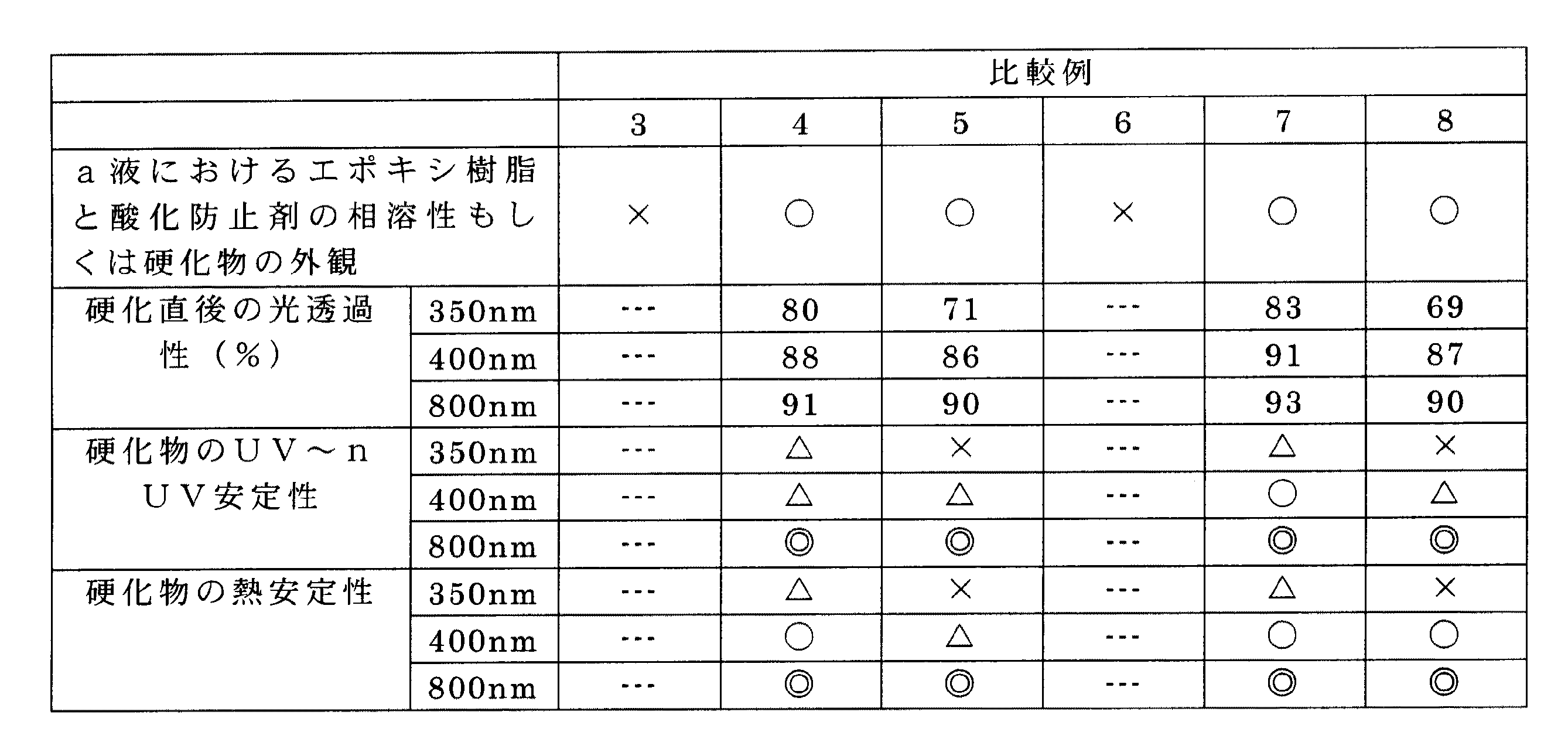
下記の表1〜3に示す各原料を同表に示す割合で配合し(配合数値の単位は重量部である。)、加温(80℃)下、撹拌することにより目的とする液状サンプルであるa液およびb液をそれぞれ準備した。そして、a液およびb液を同表に示す配合割合で混合した後、減圧脱泡することにより液状の光半導体封止用エポキシ樹脂組成物を得た。ついで、上記液状の光半導体封止用エポキシ樹脂組成物をφ50mm×1mmの金型に注型し、硬化物を得た。
Next, examples will be described together with comparative examples.
[Examples 1 to 10, Comparative Examples 1 to 8]
Each raw material shown in the following Tables 1 to 3 is blended in the proportions shown in the same table (the unit of the blending numerical value is parts by weight), and stirred with heating (80 ° C.) to obtain a target liquid sample A liquid and a liquid were respectively prepared. And after mixing a liquid and b liquid by the compounding ratio shown to the same table | surface, the liquid epoxy resin composition for optical semiconductor sealing was obtained by carrying out vacuum degassing. Subsequently, the liquid epoxy resin sealing epoxy resin composition was cast into a φ50 mm × 1 mm mold to obtain a cured product.
[a液におけるエポキシ樹脂と酸化防止剤の相溶性もしくは硬化物の外観]
上記の方法で得られたa液および硬化物を目視で観察した際、濁りおよび析出物が認められるものを「×」、全く認められないものを「○」として評価した。
[硬化直後の光透過性]
上記の製法で得られた硬化物を分光光度計(日立製:U-2001)にセットし、350nm、400nm、800nmの波長における透過率(%)を測定・評価した。
[硬化物のUV〜nUV安定性]
上記の製法で得られた硬化体を26W/m2(300nm〜400nm)の照度、温度50℃の促進耐光試験機(スガ試験機製:サンテスターXT750)に100時間放置した後、上記と同様の方法で透過率(%)を測定・評価した。
[硬化物の熱安定性]
上記の製法で得られた硬化物を150℃のギヤオーブンに72時間放置した後、上記と同様の方法で透過率(%)を測定・評価した。
[Compatibility of epoxy resin and antioxidant in liquid a or appearance of cured product]
When the liquid a and the cured product obtained by the above method were visually observed, those with turbidity and precipitates were evaluated as “x”, and those with no turbidity were evaluated as “◯”.
[Light transmittance immediately after curing]
The cured product obtained by the above production method was set in a spectrophotometer (Hitachi: U-2001), and the transmittance (%) at wavelengths of 350 nm, 400 nm, and 800 nm was measured and evaluated.
[UV to nUV stability of cured product]
The cured product obtained by the above production method was allowed to stand for 100 hours in an accelerated light resistance tester (Suga Test Instruments: SUNTESTER XT750) having an illuminance of 26 W / m 2 (300 nm to 400 nm) and a temperature of 50 ° C. The transmittance (%) was measured and evaluated by the method.
[Thermal stability of the cured product]
The cured product obtained by the above production method was left in a gear oven at 150 ° C. for 72 hours, and the transmittance (%) was measured and evaluated by the same method as described above.
なお、下表の表4〜6中の硬化物のUV〜nUV安定性および硬化物の熱安定性における評価基準は、波長ごとに定め、350nmにおいては硬化直後の透過率の70%以上を維持しているものを「◎」、70〜60%のものを「○」、60%〜50%のものを「△」、50%〜0%のものを「×」と示した。400nmにおいては硬化直後の透過率の95%以上を維持しているものを「◎」、95〜90%以上を維持しているものを「○」、90〜80%のものを「△」、80%〜0%のものを「×」と示した。800nmにおいては硬化直後の透過率の95%以上を維持しているものを「◎」、95〜90%のものを「○」、90%〜80%のものを「△」、80%〜0%を[×]と示した。なお、表4〜6において、硬化直後の光透過性を表す数値の単位は%である。 The evaluation criteria for UV to nUV stability of cured products and thermal stability of cured products in Tables 4 to 6 in the following table are determined for each wavelength, and at 350 nm, 70% or more of the transmittance immediately after curing is maintained. “◎” indicates 70%, “◯” indicates 70-60%, “Δ” indicates 60% -50%, and “x” indicates 50% -0%. At 400 nm, “◎” indicates that the transmittance is maintained at 95% or more immediately after curing, “◯” indicates that the transmittance is maintained at 95 to 90% or higher, and “△” indicates that the transmittance is 90 to 80%. Those with 80% to 0% were indicated as “x”. At 800 nm, “◎” indicates that the transmittance is 95% or more immediately after curing, “◯” indicates 95 to 90%, “Δ” indicates 90% to 80%, and 80% to 0%. % Was indicated as [×]. In Tables 4 to 6, the unit of the numerical value indicating the light transmittance immediately after curing is%.
そして、上記実施例で調製したエポキシ樹脂組成物を用いて光半導体素子を公知の方法でモールドした結果、光透過率、UV〜nUV安定性および熱安定性に優れた光半導体装置が得られた。 And as a result of molding an optical semiconductor element by a publicly known method using the epoxy resin composition prepared in the above-mentioned example, an optical semiconductor device excellent in light transmittance, UV to nUV stability and thermal stability was obtained. .
Claims (5)
(A)エポキシ樹脂
(B)硬化剤
(C)硬化促進剤
(D)下記の一般式(I)で表される有機リン化合物
R2は水素原子、メチル基もしくはメトキシ基を表し;
R3およびR4は水素原子、−OH基もしくはメトキシ基を表し;
R5 は水素原子またはメチル基を表し:
R6とR7は、他と独立して、水素原子もしくは炭素原子数1〜9のアルキル基を表し;
そしてnは1〜3を表す。〕 The resin composition for optical semiconductor sealing containing the following (A)-(D) component.
(A) Epoxy resin (B) Curing agent (C) Curing accelerator (D) Organophosphorus compound represented by the following general formula (I)
R 2 represents a hydrogen atom, a methyl group or a methoxy group;
R 3 and R 4 represent a hydrogen atom, —OH group or methoxy group;
R 5 represents a hydrogen atom or a methyl group:
R 6 and R 7 each independently represent a hydrogen atom or an alkyl group having 1 to 9 carbon atoms;
And n represents 1-3. ]
Priority Applications (1)
| Application Number | Priority Date | Filing Date | Title |
|---|---|---|---|
| JP2004114978A JP4473030B2 (en) | 2004-04-09 | 2004-04-09 | Resin composition for optical semiconductor encapsulation and optical semiconductor device using the same |
Applications Claiming Priority (1)
| Application Number | Priority Date | Filing Date | Title |
|---|---|---|---|
| JP2004114978A JP4473030B2 (en) | 2004-04-09 | 2004-04-09 | Resin composition for optical semiconductor encapsulation and optical semiconductor device using the same |
Publications (2)
| Publication Number | Publication Date |
|---|---|
| JP2005298616A true JP2005298616A (en) | 2005-10-27 |
| JP4473030B2 JP4473030B2 (en) | 2010-06-02 |
Family
ID=35330555
Family Applications (1)
| Application Number | Title | Priority Date | Filing Date |
|---|---|---|---|
| JP2004114978A Expired - Fee Related JP4473030B2 (en) | 2004-04-09 | 2004-04-09 | Resin composition for optical semiconductor encapsulation and optical semiconductor device using the same |
Country Status (1)
| Country | Link |
|---|---|
| JP (1) | JP4473030B2 (en) |
Cited By (3)
| Publication number | Priority date | Publication date | Assignee | Title |
|---|---|---|---|---|
| US9464186B2 (en) | 2011-04-08 | 2016-10-11 | Jx Nippon Oil & Energy Corporation | Resin composition, hardened coating films therefrom, and photosemiconductor device using same |
| JP2023026856A (en) * | 2021-08-16 | 2023-03-01 | 日東電工株式会社 | Optical semiconductor sealing resin composition, optical semiconductor sealing resin molding, optical semiconductor sealing material, and optical semiconductor device |
| US12630707B2 (en) | 2021-08-16 | 2026-05-19 | Nitto Denko Corporation | Resin composition for sealing optical semiconductor, resin molded product for sealing optical semiconductor, optical semiconductor sealing material, and optical semiconductor device |
-
2004
- 2004-04-09 JP JP2004114978A patent/JP4473030B2/en not_active Expired - Fee Related
Cited By (5)
| Publication number | Priority date | Publication date | Assignee | Title |
|---|---|---|---|---|
| US9464186B2 (en) | 2011-04-08 | 2016-10-11 | Jx Nippon Oil & Energy Corporation | Resin composition, hardened coating films therefrom, and photosemiconductor device using same |
| JP2023026856A (en) * | 2021-08-16 | 2023-03-01 | 日東電工株式会社 | Optical semiconductor sealing resin composition, optical semiconductor sealing resin molding, optical semiconductor sealing material, and optical semiconductor device |
| US20230071071A1 (en) * | 2021-08-16 | 2023-03-09 | Nitto Denko Corporation | Resin composition for sealing optical semiconductor, resin molded product for sealing optical semiconductor, optical semiconductor sealing material, and optical semiconductor device |
| JP7713334B2 (en) | 2021-08-16 | 2025-07-25 | 日東電工株式会社 | Optical semiconductor encapsulation resin composition, optical semiconductor encapsulation resin molding, optical semiconductor encapsulant, and optical semiconductor device |
| US12630707B2 (en) | 2021-08-16 | 2026-05-19 | Nitto Denko Corporation | Resin composition for sealing optical semiconductor, resin molded product for sealing optical semiconductor, optical semiconductor sealing material, and optical semiconductor device |
Also Published As
| Publication number | Publication date |
|---|---|
| JP4473030B2 (en) | 2010-06-02 |
Similar Documents
| Publication | Publication Date | Title |
|---|---|---|
| TWI637983B (en) | Thermosetting resin composition for optical semiconductor element sealing, hardening material thereof, and optical semiconductor device using the same | |
| JP5179013B2 (en) | Epoxy resin composition for optical semiconductor element sealing and optical semiconductor device using the same | |
| JP5626856B2 (en) | Curable resin composition and cured product thereof | |
| KR101869704B1 (en) | Thermosetting epoxy resin composition and optical semiconductor device | |
| JP5300148B2 (en) | Epoxy resin composition, curable resin composition | |
| JP5842600B2 (en) | Epoxy resin composition, cured product, transparent sealing material, and optical semiconductor device | |
| JP6233228B2 (en) | Thermosetting epoxy resin composition for optical semiconductor element sealing and semiconductor device using the same | |
| KR20110055481A (en) | Epoxy Resin Curing Agent, Epoxy Resin Composition, Cured Product thereof, and Optical Semiconductor Device | |
| JP4473030B2 (en) | Resin composition for optical semiconductor encapsulation and optical semiconductor device using the same | |
| CN102796347B (en) | Epoxy resin composition for optical semiconductor device and optical semiconductor device using the same | |
| JP2010144015A (en) | Epoxy resin composition for sealing optical semiconductor element, and optical semiconductor device using the same | |
| JP5700618B2 (en) | Epoxy resin composition, curable resin composition | |
| JP4710379B2 (en) | Epoxy resin composition and epoxy resin for semiconductor encapsulation | |
| JP2014237861A (en) | Epoxy resin composition and curable resin composition | |
| JP6233229B2 (en) | Thermosetting epoxy resin composition for optical semiconductor element sealing and optical semiconductor device using the same | |
| JP5832601B2 (en) | Curable resin composition and cured product thereof | |
| JP2017095548A (en) | Thermosetting epoxy resin composition for optical semiconductor element sealing and optical semiconductor device using the same | |
| JP6077321B2 (en) | Curable resin composition, optical semiconductor sealing material, and optical semiconductor device | |
| JPH05136300A (en) | Optical semiconductor device | |
| JP2007016073A (en) | Epoxy resin composition and optical semiconductor device | |
| JP2008222741A (en) | Epoxy resin composition for optical semiconductor element sealing and optical semiconductor device using the same | |
| JP2011037996A (en) | Transparent resin composition and method for producing the same, and optical semiconductor device | |
| JP2007204643A (en) | Epoxy resin composition for optical semiconductor element sealing and optical semiconductor device using the same | |
| JP3965689B2 (en) | Epoxy resin composition for optical semiconductor encapsulation and optical semiconductor device | |
| JP3899678B2 (en) | Epoxy resin composition for optical semiconductor and optical semiconductor device |
Legal Events
| Date | Code | Title | Description |
|---|---|---|---|
| A621 | Written request for application examination |
Free format text: JAPANESE INTERMEDIATE CODE: A621 Effective date: 20070316 |
|
| A977 | Report on retrieval |
Free format text: JAPANESE INTERMEDIATE CODE: A971007 Effective date: 20091120 |
|
| A131 | Notification of reasons for refusal |
Free format text: JAPANESE INTERMEDIATE CODE: A131 Effective date: 20091201 |
|
| A521 | Request for written amendment filed |
Free format text: JAPANESE INTERMEDIATE CODE: A523 Effective date: 20100106 |
|
| TRDD | Decision of grant or rejection written | ||
| A01 | Written decision to grant a patent or to grant a registration (utility model) |
Free format text: JAPANESE INTERMEDIATE CODE: A01 Effective date: 20100209 |
|
| A01 | Written decision to grant a patent or to grant a registration (utility model) |
Free format text: JAPANESE INTERMEDIATE CODE: A01 |
|
| A61 | First payment of annual fees (during grant procedure) |
Free format text: JAPANESE INTERMEDIATE CODE: A61 Effective date: 20100304 |
|
| FPAY | Renewal fee payment (event date is renewal date of database) |
Free format text: PAYMENT UNTIL: 20130312 Year of fee payment: 3 |
|
| R150 | Certificate of patent or registration of utility model |
Ref document number: 4473030 Country of ref document: JP Free format text: JAPANESE INTERMEDIATE CODE: R150 Free format text: JAPANESE INTERMEDIATE CODE: R150 |
|
| FPAY | Renewal fee payment (event date is renewal date of database) |
Free format text: PAYMENT UNTIL: 20160312 Year of fee payment: 6 |
|
| R250 | Receipt of annual fees |
Free format text: JAPANESE INTERMEDIATE CODE: R250 |
|
| R250 | Receipt of annual fees |
Free format text: JAPANESE INTERMEDIATE CODE: R250 |
|
| R250 | Receipt of annual fees |
Free format text: JAPANESE INTERMEDIATE CODE: R250 |
|
| R250 | Receipt of annual fees |
Free format text: JAPANESE INTERMEDIATE CODE: R250 |
|
| LAPS | Cancellation because of no payment of annual fees |